Results for "Beaune+|+127"
20377 results found.
Cette blanche terre verte.... English translation pending
Qui sait pourquoi un pays qui est couvert à 85% de calotte glaciaire a été baptisé "Terre Verte" (Groenland en danois), mystère ...
Ce "département" n'attire pas la foule : conditions climatiques hostiles, peu de liaisons et infrastructures ... Pourtant ces paysage à la beauté rude et énigmatique, que j'imagine offrir à la fois un sentiment d'inouï et de violence de la nature, m'attire ...
Le désir d'y aller : tel un enfant que l'on berce et dorlote, et qui se transforme pas à pas en adulte qui ose et s'affirme.
Qui ? Oui, qui est parti là-bas ? Qui est parti et voudrait partager son expérience avec moi, qui compte bien y aller ? Qui connaît Sisimiuit, Nuuk, Nanortalik, Upernavik, Nanortalik ? Qui a vu ces épouvantables glaces à la taille effrayante qui se trouvent en Europe, à cinq heures de vol de chez nous ?
Ce "département" n'attire pas la foule : conditions climatiques hostiles, peu de liaisons et infrastructures ... Pourtant ces paysage à la beauté rude et énigmatique, que j'imagine offrir à la fois un sentiment d'inouï et de violence de la nature, m'attire ...
Le désir d'y aller : tel un enfant que l'on berce et dorlote, et qui se transforme pas à pas en adulte qui ose et s'affirme.
Qui ? Oui, qui est parti là-bas ? Qui est parti et voudrait partager son expérience avec moi, qui compte bien y aller ? Qui connaît Sisimiuit, Nuuk, Nanortalik, Upernavik, Nanortalik ? Qui a vu ces épouvantables glaces à la taille effrayante qui se trouvent en Europe, à cinq heures de vol de chez nous ?
Transports au Pérou + trek English translation pending
salut!
1)quelqu'un peut il me renseigner sur les trajets arequipa/puno puno/cuzco?
Bus ou train (compagnie, prix, confort général
+des sièges, sorroche, durée, beauté des paysages...) de jour ou de nuit, achat des billets, sécurité des bagages...
Ce serait pour la dernière quinzaine de juillet
2)canyon del colca:
au depart de cabanaconde et pour dormir une nuit en bas à l'oasis, il semblerait que le chemin en 2001 soit assez mal indiqué; qu'en est il maintenant?
peut on aller voir la cruz del condor à cheval le matin au départ de cabanaconde?y a t'il des guides et faut il en prendre un?
pour revenir sur aréquipa y a t'il des bus dans l'après midi ou le soir?
merci pour vos sympathiques réponses!!!
1)quelqu'un peut il me renseigner sur les trajets arequipa/puno puno/cuzco?
Bus ou train (compagnie, prix, confort général
+des sièges, sorroche, durée, beauté des paysages...) de jour ou de nuit, achat des billets, sécurité des bagages...
Ce serait pour la dernière quinzaine de juillet
2)canyon del colca:
au depart de cabanaconde et pour dormir une nuit en bas à l'oasis, il semblerait que le chemin en 2001 soit assez mal indiqué; qu'en est il maintenant?
peut on aller voir la cruz del condor à cheval le matin au départ de cabanaconde?y a t'il des guides et faut il en prendre un?
pour revenir sur aréquipa y a t'il des bus dans l'après midi ou le soir?
merci pour vos sympathiques réponses!!!
Poésie afghane English translation pending
Je viens de lire un très beau recueil de poésie:
Le suicide et le chant, poésie populaire des femmes pashtounes. Le poète qui a recueilli et commenté ces vers est Sayd Bahodin Majrouh.
Il s'agit de landays, poèmes de deux vers, créés et chantés par ces femmes.
Il se dégage une force et une beauté incroyables de ces écrits...
Le suicide et le chant, poésie populaire des femmes pashtounes. Le poète qui a recueilli et commenté ces vers est Sayd Bahodin Majrouh.
Il s'agit de landays, poèmes de deux vers, créés et chantés par ces femmes.
Il se dégage une force et une beauté incroyables de ces écrits...
Aborigènes: " Message des hommes vrais au monde mutant" English translation pending
Un livre merveilleux, je l'ai offert trois fois et je sais que les personnes a qui je les ai offert ne cesse de le faire passer dans leurs entourage! MESSAGE DES HOMMES VRAIS AU MONDE MUTANT de MARLO MORGAN . Allez découvrir la vie d'aborrigènes dans le bush! il est d'une beauté! l'écriture est simple mais alors le fond...
Trek de Ciudada Perdida près de Santa Maria en Colombie English translation pending
salut,
actuellement au venezuela, je cherche des infos recentes sur le trek de ciudad perdida, pres de santa maria en colombie. tarif, securite, beaute du site, possibilite de passer la frontiere ss pb etc...
en bref est ce que ca vaut le cout cette histoire?!?!?!
merci d avance!😉
Retour du Grand Playa Turquesa Holguin English translation pending
Pour tous ceux qui sont inquiets au sujet du Grand Playa Turquesa suite aux mauvais commentaires ....Je veux vous dire que j'y suis allée la semaine du 3 février au 10 février et que c'est vraiment un très beau site !!!!!!!!
J'ai adoré mon voyage, malheureusement trop court !!!(une semaine)..... Les piscines sont de toutes beauté, il y a abondance dans la nourriture (buffet, donc pour tout les goût), le personnel est courtois et surtout très souriant, le service est impeccable, pour ce qui est de la plage, c'est vrai qu'il y a un peu d'algues à quelques endroits mais rien de dramatique!!!! En passant, ils vont procéder au nettoyage au mois de mars il vont agrandir la plage et la nettoyer.......Les chambres sont spacieuses et très propres, il y a beaucoup d'animations au bar de la piscine l'après-midi soit : des parades de modes, de la danse, ou spectacle
Qui connait les îles Turquoises? English translation pending
Bonjours je vais faire mon premier voyage l'an prochain et je me demandais si quelqu'un avait déjà été aux iles turquoise si oui donnez moi votre avis
Merci
Merci
Cadeaux pour les employés de l'hôtel English translation pending
Bonjour à qui me lira,
Je suis sur le point de réserver mon tout premier voyage (Cayo Guillermo, Cuba) et j'aurais aimé avoir des suggestions de petits présents à laisser au staff de l'hotel et à qui est-il bon d'en laisser. J'ai lu à quelque part que les femmes de chambre aimaient les produits de beauté mais quoi au juste (parfum, crème hydratante, ???), étant donné que je suis quelqu'un qui planifie beaucoup à l'avance j'aurais aimé avoir plus de détails pour être sûre d'apporter le nécessaire.
J'aurais aussi voulu savoir si quelqu'un a une idée du prix du stationnement à l'aéroport de Mirabel pour laisser sa voiture pour la semaine.
Merci de l'attention que vous porterez à mes inquiétudes de débutante.
Au plaisir!
Je suis sur le point de réserver mon tout premier voyage (Cayo Guillermo, Cuba) et j'aurais aimé avoir des suggestions de petits présents à laisser au staff de l'hotel et à qui est-il bon d'en laisser. J'ai lu à quelque part que les femmes de chambre aimaient les produits de beauté mais quoi au juste (parfum, crème hydratante, ???), étant donné que je suis quelqu'un qui planifie beaucoup à l'avance j'aurais aimé avoir plus de détails pour être sûre d'apporter le nécessaire.
J'aurais aussi voulu savoir si quelqu'un a une idée du prix du stationnement à l'aéroport de Mirabel pour laisser sa voiture pour la semaine.
Merci de l'attention que vous porterez à mes inquiétudes de débutante.
Au plaisir!
Récit d'un vol au dessus d'un petit coin de Paradis English translation pending
Voici un récit écrit récemment sur une navigation Paris - Chambéry réalisée en mai dernier. Cette fois-ci, je n'ai pas fait trop de rencontres humaines, ou même animales, mais j'ai pu m'émerveiller sur la beauté de la Terre (en France, en plus!).
30 avril au soir et 1er mai 2003 au matin.
Ca commence toujours pareil.
Un trait sur la carte, le plus droit possible, en fonction des espaces aériens et du relief. Quelques indications notées sur une feuille de papier viendront compléter cette préparation.
Ensuite, régler le réveil pour trop tôt demain matin. Toujours trop tôt. Je n’ai jamais aimé me lever tôt, même pour aller rejoindre des amis à l’autre bout de la France, même si cette jonction se fera par la voie des airs.
Une dernière check de la météo sur internet. Pas terrible. Je sens que mon réveil va aller se faire voir demain matin, ce qui, d’un autre côté, est dommage, parce que ce voyage, je l’attends depuis longtemps. Comme toujours, on verra bien, en attendant, il faut dormir, pour être en forme demain, il est déjà une heure.
Non, il est déjà six heures et demie. Encore un peu. Ah, comme tout est plus facile le soir. Allez, il est sept heures moins le quart. Je ne peux pas me permettre de combler mon retard en prenant un petit déjeuner allégé. Pas cette fois-ci. Je ne vais pas au travail. Cette fois-ci, c’est une histoire plus sérieuse. Il n’y a pas de croissanteries entre les cumulus.
Allumer l’ordinateur, lancer internet, se connecter à Météo France. Rubrique aéronautique. Le temps ? Mouais. Vraiment moyen. Juste le temps intermédiaire où on ne peut pas se replonger sous la couette en disant « super, je dors encore, maintenant, c’est sûr, pas moyen d’aller voler », et où on ne peut pas non plus se dire : « Ca va être une super navigation, du gateau ! Je suis sûr d’être à destination à l’heure prévue ». Dans ces cas là, une seule chose à faire : déjà, aller au terrain. Ensuite, voir comment ça évolue.
Je prends mon petit déjeuner et mes affaires, puis descend à la voiture. Périf, A4, Lognes, ciel bas et gris, sol humide, essuis-glace intermittents. Le trajet habituel, maintes et maintes fois effectué.
Je passe à la tour prendre les dernière nouvelles officielles concernant la réglementation et les éventuels évènements exceptionnels sur le trajet prévu (ces formalités s’appellent les NOTAM). Rien des spécial, à part une balise en rade sur la route. Je ferai sans. Si je décolle. Pour le moment, le plafond n’a pas l’air très haut, et on sent qu’il va bientôt pleuvoir. Il y a du vent qui souffle assez fort. La visibilité est moyenne.
Comme je m’y attendais, personne au club. Tout est fermé. Les hangars aussi. Heureusement, quelqu’un arrive. Un mécano. J’entre avec lui. J’ouvre les portes du hangar, je sors le Piper. Je le prépare. Le temps reste toujours le même. Je ferai comme d’habitude : « Just go and see. », comme on dit outre-Atlantique. Le plafond est au moins suffisant pour faire des tours de piste. De plus, selon la météo plus nationale, sur la route, il fait beau. L’incertitude réside au départ, et à l’arrivée. Là bas, il y a aussi des nuages. On verra bien. Les jauges sont pleines, et je calcule qu’il me restera deux heures et demie d’autonomie à l’arrivée, de quoi rentrer à Lognes, dans la pire des extrémités. Je décide de la tenter.
Démarrage. Contact radio. Roulage. Alignement. Décollage. Huit heures. La visibilité est effectivement limite, mais je connais la région, et vers le sud, ça a l’air de se dégager. Je prends mon cap, corrigé de dix degrés à cause du vent. Pour le moment, je baisse la tête pour ne pas me cogner aux nuages au dessus de moi. Je suis à 1300 pieds. Je passe entre les deux étangs qui marquent en quelque sorte la porte de sortie de l’espace de Lognes. Je contacte Melun. Jour férié, personne, normal. Un autre avion passe sur ma droite, à la même hauteur, pas très loin. Ce sera la seule créature ailée croisée durant toute cette navigation matinale.
A Melun, le plafond nuageux monte d’un cran, je le suis. La visibilité devient meilleure. Je décide de continuer. Au moins jusqu’à Auxerre. Je quitte Melun, ciao, merci pour la compagnie à la radio, j’étais le seul à me parler, sympa.
Je passe la forêt de Fontainebleau, un peu triste dans cette grisaille. Mais toujours plus au sud, ça se dégage. Je peux encore monter. Je monte. Un peu plus loin, un peu avant Auxerre, c’est l’éclaircie. Le front est passé, il est derrière moi, et devant, c’est un ciel dorénavant totalement bleu. La visibilité est dingue. Je vois très loin. Le survol du Morvan commence. Il restera parmi mes plus beaux souvenirs aéronautiques. On s’imagine tous que le top du top, ce doit être de voler au dessus de paysages grandioses, comme le Sahara ou de hautes montagnes. Certes, certes. Cependant, moi, je ne l’ai pas fait, mais je peux dores et déjà affirmer que le top du top du top, par définition, c’est le survol du Paradis. J’ai survolé, ce matin là, un bout de planète qui n’avait plus rien de terrestre. J’avais la sensation d’être arrivé au Ciel avec mon avion (ce qui n’est pas si choquant, somme toute). Je m’explique : la visibilité et les couleurs étaient telles que l’horizon prenait des allures inhabituelles. Toutes ces magnifiques collines s’enchevêtraient jusqu’à la limite de la courbure de la Terre, tout au sud-est, jusqu’à disparaître au niveau d’une ligne d’horizon qui me paraissait à la fois toute proche et très lointaine. Et surtout, cette sensation que juste derrière, il n’y a plus rien. L’impression d’être sur une sorte de bosse plate, couverte d’une ondulation de verdure printanière (on était le premier mai, il était neuf heures du matin), parcourue de magnifiques cours d’eau, parsemée de vieilles constructions romaines ou moyenageuses, de fermes séculaires, de vergers antiques, de vertes prairies. L’harmonie totale entre l’homme et la nature, des images surgies d’un autre temps. Celui d’avant l’époque où on pouvait aller dans le ciel pour les voir. Où que mon regard se portait, je voyais distinctement, quelque soit la distance. Je sursautai presque quand je vis au loin, dépassant de derrière cette limite du paradis terrestre, un gâteau à la chantilly, sur mes dix heures. Oui, bon, c’est bon, on t’a vu, inutile de te cacher, de toute façon, tu es trop gros, Mont Blanc. Je ne m’attendais pas à te voir déjà, d’autant plus que j’étais redescendu au niveau des collines, pour aller les chatouiller de plus près. Je m’émerveille de longues minutes sur ce cadeau que m’offrent ensemble la nature, la firme qui construit les Piper et Total (à Lognes, c’est Total qui nourrit nos machines). C’est étrange de voir un si beau spectacle de l’harmonie entre la Terre et ses bipèdes habitants grâce à un de ses plus actifs ennemis.
J’envoie un texto à Olivier, qui devra m’attendre au terrain, pour lui dire que tout va bien. Je passe le Morvan. Au revoir. Et merci. J’en ai presque les larmes aux yeux, mais je les retiens, pour ne pas maculer une telle visibilité. Je passe Autun, Montceau-lès-Mines, puis encore quelques collines, et c’est le grand plongeon sur la vallée de la Saône. Je frôle la zone de Saint-Exupéry, à Lyon, par le Nord. Je me branche sur leur fréquence. Je fais bien, les arrivées des gros machins se font par le Nord, je suis légèrement sous leur trajectoire. Je ne les vois pas, mais à les écouter parler, tantôt en anglais, tantôt en français, je devine leur position, et je garde les yeux dehors. Devant moi, s’étale toute la chaîne des Alpes. J’ai repris de l’altitude, environ 3500 pieds. Juste devant, légèrement à ma gauche, la barrière du Jura finissant. En dessous de moi, je repère le terrain de Bourg-en-Bresse. Sous mon aile droite, le Bugey. Au loin, le Rhône avance paresseusement vers la capitale des Gaules. Tout au fond de ce panorama hallucinant, je reconnais certains de mes amis : Le Pic de L’étendard, les aiguilles d’Arves, La Meije, La Grande Casse qui a été un jour bien sympa avec moi, les glaciers de la Vanoise, Toute la bande de Belledonne, Les Aravis, et plein d’autres copains, jamais vus sous cet angle.
A la radio, ça n’arrête pas une seule seconde. J’ai manifestement passé l’axe, maintenant, je n’ai plus besoin d’eux, je veux retrouver le calme du Morvan. Je m’avance toujours vers les hautes collines du Jura. Pour la première fois, je vole à côté de reliefs aussi élevés. Cela fait drôle, il m’arrive de lever la tête pour regarder le sol. Pourtant, je ne suis pas sur le dos, je vole bien sur le ventre, et le PA 28 Archer 2 n’est pas un avion de voltige. Je dois penser sérieusement à l’approche. J’ai un peu trop rêvé. Je me rends compte que derrière le Jura, que je laisse juste à quelques centaines de mètres à gauche de mon aile gauche, les conditions météo donnent raison à la météo: sous moi, s'étend une magnifique mer de nuage. Les Bauges au loin, les Aravis plus loin sont autant de massifs surgis de cette nuée, c’est certes très beau, mais la question n’est plus là. Je dois d’une part trouver mon chemin à travers ces massifs qui, malgré le fait qu’ils me sont familiers, sont vus sous un angle inhabituel, et d’autre part, il faudra tôt ou tard que je traverse la couche, ce qui n’est absolument pas envisageable si elle est totalement soudée. Je dois donc trouver un trou, m’y engouffrer en spiralant dedans pour ne pas m’éclater les tympans, et continuer sous la grisaille au dessus de ce qui devra être le lac du Bourget jusqu’à Chambéry-Aix-Les-Bains, point final de ma destination. Je contacte Chambéry, me signale, signale mon arrivée, et demande la météo sur le terrain. Réponse : quelques nuages bas en voie de dissipation. A tenter.
Pour l’instant, je ne sais pas où se trouve le lac, je me trompe même de vallée à un moment. Je m’en rends compte rapidement, je vire vers la bonne vallée. Un collègue dans la zone me contacte directement pour me dire que les trous existent, lui en a trouvé un au dessus du lac. En effet, j’en repère un en dessous de moi. Je descends donc. Je fais plusieurs circonvolutions pour limiter la vitesse verticale, je suis sensible des oreilles. En dessous, je reconnais le Rhône, qui croise ma route et descend vers Lyon. Je passe finalement sous la couche, et je reste juste en dessous du plafond. Je remonte un peu le fleuve, puis vire à droite, plein sud. J’apperçois alors le lac du Bourget, immense, et tout au bout, je sais qu’il y a Chambéry. J’ai l’impression de pénétrer dans une immense caverne, dont le sol est recouvert d’un lac souterrain géant, éclairée par une lumière diffuse, légèrement grise, bordée de parois presque verticales des deux côtés. L’eau du lac a des couleurs sinistres, parsemées par endroits d'éclats argentés résultants de trous dans le plafond de cette caverne géante, c’est très impressionnant. Je signale ma position, à savoir au nord du lac du Bourget. Ils me demandent de rappeler lorsque j’aurais passé Aix les Bains. Je distingue déjà la ville en question, sur une inflexion de la rive est, devant moi. Au bout de deux minutes, je laisse ce point d'entrée sous mon aile gauche, et me prépare pour intégrer le tour de piste, par la vent arrière. La piste en service est en effet malheureusement la 36, je dois donc faire le tour du circuit de piste. Or, la limite de survol est de 1300 pieds sol, si bien qu’au niveau de la petite colline qui borde le terrain et qu’il faut frôler, à cause du plafond qui baisse au fur et à mesure que je me rapproche du terrain, ça risque de ne pas passer. Et effectivement, je passe la rive du lac, et me voilà en vent arrière, je dois encore descendre si je ne veux pas me retrouver dans la couche, et mon altimètre indique que je suis clairement plus bas que la limite autorisée. J’essaye malgré tout d’éviter les zones d’habitations, il est encore tôt, et on est un jour férié, que diable. Les Chambériens ont bien le droit au repos, eux aussi. Je passe la colline, les nuages sont d’un seul coup plus épars. Je sors les volets, vire plein ouest. J’ai maintenant la piste à ma droite. Je suis presque dans l’axe. Je descends, vire encore de 90 degrés, et rejoins la finale. Maintenant, j’ai la 36 en face de moi, elle est immense. Je n’ai pas l’habitude de me poser sur un véritable aéroport. Mon dernier doit remonter à l’année dernière, à Nantes. Derrière la piste, en fond de paysage, le lac, jusqu’à l’horizon. Un dernier cran de volets, 130 km/h. La radio me donne le vent, quasiment nul, je m’approche encore, courte finale, 125 km/h. La piste arrive. Le seuil de piste défile sous moi, je descends encore, je suis trop haut, j’ai mal pris mes repères, trompé par la largeur de cette piste, sur laquelle on pourrait presque se poser en perpendiculaire tant elle est surdimensionnée. La piste continue de défiler et de s’agrandir sous moi, je finis pas arrondir, et tchouff, le bruit caractéristique du touché des pneus arrière en caoutchouc sur le béton vient symboliser la fin de cette échappée céleste, je retouche l’écorce terrestre. La roue avant tombe d’elle même sous l’effet de la perte de vitesse, puis je freine doucement, et vire à droite sur le taxiway latéral. Mon pote Olivier m’attend là bas, près de la Tour. Il est dis heures et quart, il fait super beau, une belle promenade dans les Bauges nous attend. Et dire qu’il y a un peu plus de deux heures, j’étais à Lognes, dans la grisaille parisienne, et qu’il y a une heure, je survolais le paradis. Etrange, tout ça. Bien étrange.
30 avril au soir et 1er mai 2003 au matin.
Ca commence toujours pareil.
Un trait sur la carte, le plus droit possible, en fonction des espaces aériens et du relief. Quelques indications notées sur une feuille de papier viendront compléter cette préparation.
Ensuite, régler le réveil pour trop tôt demain matin. Toujours trop tôt. Je n’ai jamais aimé me lever tôt, même pour aller rejoindre des amis à l’autre bout de la France, même si cette jonction se fera par la voie des airs.
Une dernière check de la météo sur internet. Pas terrible. Je sens que mon réveil va aller se faire voir demain matin, ce qui, d’un autre côté, est dommage, parce que ce voyage, je l’attends depuis longtemps. Comme toujours, on verra bien, en attendant, il faut dormir, pour être en forme demain, il est déjà une heure.
Non, il est déjà six heures et demie. Encore un peu. Ah, comme tout est plus facile le soir. Allez, il est sept heures moins le quart. Je ne peux pas me permettre de combler mon retard en prenant un petit déjeuner allégé. Pas cette fois-ci. Je ne vais pas au travail. Cette fois-ci, c’est une histoire plus sérieuse. Il n’y a pas de croissanteries entre les cumulus.
Allumer l’ordinateur, lancer internet, se connecter à Météo France. Rubrique aéronautique. Le temps ? Mouais. Vraiment moyen. Juste le temps intermédiaire où on ne peut pas se replonger sous la couette en disant « super, je dors encore, maintenant, c’est sûr, pas moyen d’aller voler », et où on ne peut pas non plus se dire : « Ca va être une super navigation, du gateau ! Je suis sûr d’être à destination à l’heure prévue ». Dans ces cas là, une seule chose à faire : déjà, aller au terrain. Ensuite, voir comment ça évolue.
Je prends mon petit déjeuner et mes affaires, puis descend à la voiture. Périf, A4, Lognes, ciel bas et gris, sol humide, essuis-glace intermittents. Le trajet habituel, maintes et maintes fois effectué.
Je passe à la tour prendre les dernière nouvelles officielles concernant la réglementation et les éventuels évènements exceptionnels sur le trajet prévu (ces formalités s’appellent les NOTAM). Rien des spécial, à part une balise en rade sur la route. Je ferai sans. Si je décolle. Pour le moment, le plafond n’a pas l’air très haut, et on sent qu’il va bientôt pleuvoir. Il y a du vent qui souffle assez fort. La visibilité est moyenne.
Comme je m’y attendais, personne au club. Tout est fermé. Les hangars aussi. Heureusement, quelqu’un arrive. Un mécano. J’entre avec lui. J’ouvre les portes du hangar, je sors le Piper. Je le prépare. Le temps reste toujours le même. Je ferai comme d’habitude : « Just go and see. », comme on dit outre-Atlantique. Le plafond est au moins suffisant pour faire des tours de piste. De plus, selon la météo plus nationale, sur la route, il fait beau. L’incertitude réside au départ, et à l’arrivée. Là bas, il y a aussi des nuages. On verra bien. Les jauges sont pleines, et je calcule qu’il me restera deux heures et demie d’autonomie à l’arrivée, de quoi rentrer à Lognes, dans la pire des extrémités. Je décide de la tenter.
Démarrage. Contact radio. Roulage. Alignement. Décollage. Huit heures. La visibilité est effectivement limite, mais je connais la région, et vers le sud, ça a l’air de se dégager. Je prends mon cap, corrigé de dix degrés à cause du vent. Pour le moment, je baisse la tête pour ne pas me cogner aux nuages au dessus de moi. Je suis à 1300 pieds. Je passe entre les deux étangs qui marquent en quelque sorte la porte de sortie de l’espace de Lognes. Je contacte Melun. Jour férié, personne, normal. Un autre avion passe sur ma droite, à la même hauteur, pas très loin. Ce sera la seule créature ailée croisée durant toute cette navigation matinale.
A Melun, le plafond nuageux monte d’un cran, je le suis. La visibilité devient meilleure. Je décide de continuer. Au moins jusqu’à Auxerre. Je quitte Melun, ciao, merci pour la compagnie à la radio, j’étais le seul à me parler, sympa.
Je passe la forêt de Fontainebleau, un peu triste dans cette grisaille. Mais toujours plus au sud, ça se dégage. Je peux encore monter. Je monte. Un peu plus loin, un peu avant Auxerre, c’est l’éclaircie. Le front est passé, il est derrière moi, et devant, c’est un ciel dorénavant totalement bleu. La visibilité est dingue. Je vois très loin. Le survol du Morvan commence. Il restera parmi mes plus beaux souvenirs aéronautiques. On s’imagine tous que le top du top, ce doit être de voler au dessus de paysages grandioses, comme le Sahara ou de hautes montagnes. Certes, certes. Cependant, moi, je ne l’ai pas fait, mais je peux dores et déjà affirmer que le top du top du top, par définition, c’est le survol du Paradis. J’ai survolé, ce matin là, un bout de planète qui n’avait plus rien de terrestre. J’avais la sensation d’être arrivé au Ciel avec mon avion (ce qui n’est pas si choquant, somme toute). Je m’explique : la visibilité et les couleurs étaient telles que l’horizon prenait des allures inhabituelles. Toutes ces magnifiques collines s’enchevêtraient jusqu’à la limite de la courbure de la Terre, tout au sud-est, jusqu’à disparaître au niveau d’une ligne d’horizon qui me paraissait à la fois toute proche et très lointaine. Et surtout, cette sensation que juste derrière, il n’y a plus rien. L’impression d’être sur une sorte de bosse plate, couverte d’une ondulation de verdure printanière (on était le premier mai, il était neuf heures du matin), parcourue de magnifiques cours d’eau, parsemée de vieilles constructions romaines ou moyenageuses, de fermes séculaires, de vergers antiques, de vertes prairies. L’harmonie totale entre l’homme et la nature, des images surgies d’un autre temps. Celui d’avant l’époque où on pouvait aller dans le ciel pour les voir. Où que mon regard se portait, je voyais distinctement, quelque soit la distance. Je sursautai presque quand je vis au loin, dépassant de derrière cette limite du paradis terrestre, un gâteau à la chantilly, sur mes dix heures. Oui, bon, c’est bon, on t’a vu, inutile de te cacher, de toute façon, tu es trop gros, Mont Blanc. Je ne m’attendais pas à te voir déjà, d’autant plus que j’étais redescendu au niveau des collines, pour aller les chatouiller de plus près. Je m’émerveille de longues minutes sur ce cadeau que m’offrent ensemble la nature, la firme qui construit les Piper et Total (à Lognes, c’est Total qui nourrit nos machines). C’est étrange de voir un si beau spectacle de l’harmonie entre la Terre et ses bipèdes habitants grâce à un de ses plus actifs ennemis.
J’envoie un texto à Olivier, qui devra m’attendre au terrain, pour lui dire que tout va bien. Je passe le Morvan. Au revoir. Et merci. J’en ai presque les larmes aux yeux, mais je les retiens, pour ne pas maculer une telle visibilité. Je passe Autun, Montceau-lès-Mines, puis encore quelques collines, et c’est le grand plongeon sur la vallée de la Saône. Je frôle la zone de Saint-Exupéry, à Lyon, par le Nord. Je me branche sur leur fréquence. Je fais bien, les arrivées des gros machins se font par le Nord, je suis légèrement sous leur trajectoire. Je ne les vois pas, mais à les écouter parler, tantôt en anglais, tantôt en français, je devine leur position, et je garde les yeux dehors. Devant moi, s’étale toute la chaîne des Alpes. J’ai repris de l’altitude, environ 3500 pieds. Juste devant, légèrement à ma gauche, la barrière du Jura finissant. En dessous de moi, je repère le terrain de Bourg-en-Bresse. Sous mon aile droite, le Bugey. Au loin, le Rhône avance paresseusement vers la capitale des Gaules. Tout au fond de ce panorama hallucinant, je reconnais certains de mes amis : Le Pic de L’étendard, les aiguilles d’Arves, La Meije, La Grande Casse qui a été un jour bien sympa avec moi, les glaciers de la Vanoise, Toute la bande de Belledonne, Les Aravis, et plein d’autres copains, jamais vus sous cet angle.
A la radio, ça n’arrête pas une seule seconde. J’ai manifestement passé l’axe, maintenant, je n’ai plus besoin d’eux, je veux retrouver le calme du Morvan. Je m’avance toujours vers les hautes collines du Jura. Pour la première fois, je vole à côté de reliefs aussi élevés. Cela fait drôle, il m’arrive de lever la tête pour regarder le sol. Pourtant, je ne suis pas sur le dos, je vole bien sur le ventre, et le PA 28 Archer 2 n’est pas un avion de voltige. Je dois penser sérieusement à l’approche. J’ai un peu trop rêvé. Je me rends compte que derrière le Jura, que je laisse juste à quelques centaines de mètres à gauche de mon aile gauche, les conditions météo donnent raison à la météo: sous moi, s'étend une magnifique mer de nuage. Les Bauges au loin, les Aravis plus loin sont autant de massifs surgis de cette nuée, c’est certes très beau, mais la question n’est plus là. Je dois d’une part trouver mon chemin à travers ces massifs qui, malgré le fait qu’ils me sont familiers, sont vus sous un angle inhabituel, et d’autre part, il faudra tôt ou tard que je traverse la couche, ce qui n’est absolument pas envisageable si elle est totalement soudée. Je dois donc trouver un trou, m’y engouffrer en spiralant dedans pour ne pas m’éclater les tympans, et continuer sous la grisaille au dessus de ce qui devra être le lac du Bourget jusqu’à Chambéry-Aix-Les-Bains, point final de ma destination. Je contacte Chambéry, me signale, signale mon arrivée, et demande la météo sur le terrain. Réponse : quelques nuages bas en voie de dissipation. A tenter.
Pour l’instant, je ne sais pas où se trouve le lac, je me trompe même de vallée à un moment. Je m’en rends compte rapidement, je vire vers la bonne vallée. Un collègue dans la zone me contacte directement pour me dire que les trous existent, lui en a trouvé un au dessus du lac. En effet, j’en repère un en dessous de moi. Je descends donc. Je fais plusieurs circonvolutions pour limiter la vitesse verticale, je suis sensible des oreilles. En dessous, je reconnais le Rhône, qui croise ma route et descend vers Lyon. Je passe finalement sous la couche, et je reste juste en dessous du plafond. Je remonte un peu le fleuve, puis vire à droite, plein sud. J’apperçois alors le lac du Bourget, immense, et tout au bout, je sais qu’il y a Chambéry. J’ai l’impression de pénétrer dans une immense caverne, dont le sol est recouvert d’un lac souterrain géant, éclairée par une lumière diffuse, légèrement grise, bordée de parois presque verticales des deux côtés. L’eau du lac a des couleurs sinistres, parsemées par endroits d'éclats argentés résultants de trous dans le plafond de cette caverne géante, c’est très impressionnant. Je signale ma position, à savoir au nord du lac du Bourget. Ils me demandent de rappeler lorsque j’aurais passé Aix les Bains. Je distingue déjà la ville en question, sur une inflexion de la rive est, devant moi. Au bout de deux minutes, je laisse ce point d'entrée sous mon aile gauche, et me prépare pour intégrer le tour de piste, par la vent arrière. La piste en service est en effet malheureusement la 36, je dois donc faire le tour du circuit de piste. Or, la limite de survol est de 1300 pieds sol, si bien qu’au niveau de la petite colline qui borde le terrain et qu’il faut frôler, à cause du plafond qui baisse au fur et à mesure que je me rapproche du terrain, ça risque de ne pas passer. Et effectivement, je passe la rive du lac, et me voilà en vent arrière, je dois encore descendre si je ne veux pas me retrouver dans la couche, et mon altimètre indique que je suis clairement plus bas que la limite autorisée. J’essaye malgré tout d’éviter les zones d’habitations, il est encore tôt, et on est un jour férié, que diable. Les Chambériens ont bien le droit au repos, eux aussi. Je passe la colline, les nuages sont d’un seul coup plus épars. Je sors les volets, vire plein ouest. J’ai maintenant la piste à ma droite. Je suis presque dans l’axe. Je descends, vire encore de 90 degrés, et rejoins la finale. Maintenant, j’ai la 36 en face de moi, elle est immense. Je n’ai pas l’habitude de me poser sur un véritable aéroport. Mon dernier doit remonter à l’année dernière, à Nantes. Derrière la piste, en fond de paysage, le lac, jusqu’à l’horizon. Un dernier cran de volets, 130 km/h. La radio me donne le vent, quasiment nul, je m’approche encore, courte finale, 125 km/h. La piste arrive. Le seuil de piste défile sous moi, je descends encore, je suis trop haut, j’ai mal pris mes repères, trompé par la largeur de cette piste, sur laquelle on pourrait presque se poser en perpendiculaire tant elle est surdimensionnée. La piste continue de défiler et de s’agrandir sous moi, je finis pas arrondir, et tchouff, le bruit caractéristique du touché des pneus arrière en caoutchouc sur le béton vient symboliser la fin de cette échappée céleste, je retouche l’écorce terrestre. La roue avant tombe d’elle même sous l’effet de la perte de vitesse, puis je freine doucement, et vire à droite sur le taxiway latéral. Mon pote Olivier m’attend là bas, près de la Tour. Il est dis heures et quart, il fait super beau, une belle promenade dans les Bauges nous attend. Et dire qu’il y a un peu plus de deux heures, j’étais à Lognes, dans la grisaille parisienne, et qu’il y a une heure, je survolais le paradis. Etrange, tout ça. Bien étrange.
Chachapoyas au Pérou English translation pending
Salut, salut, un petit message pour dire a ceux qui se trouvent au Perou de passer a Chachapoyas, petite ville tranquille au Nord du Perou a la frontiere entre les Andes et l Amazonie. La richesse de la region reside dans la beaute des paysages (le rio marañon d ou ne le fleuve amazone, la rain forest, le rio Utcubamba et son cour agite, le cañon de Huancas, les lagunes de Mamacocha et de Pomacocha...) et dans l extraordinaire abondance de sites archeologiques. Pour exemple Gran Vilaya au coeur de la rain Forest, Kuelap qui perche a 3000m domine du haut de ses monumentales murailles les vallees avoisinante, ou bien encore Pueblo de los Muertos avec ses mausoles acroches comme par magie sur une falaise et dominant 1000m d abime.
C est beau, tres beau, les gens sont adorables et se font un devoir de bien recevoir l etranger.
Allez allez, venez depenser des sous sous ici pour que eux aussi profitent de la mane economique qu engendre le tourisme. Cette region est encore peut developpee au tourisme.
De Chachapoyas on peut se rendre sans probleme en Equateur mais aussi a Yurimaguas d ou l on peut embarquer pour Iquitos.
C est une belle region ou l on est generalement seul sur les sites archeologiques (qui sont gratuits mis a part pour Cuelap) et au milieu de la nature.
Pour bien etre honete je me dois de preciser que c est une region ou l on doit avoir du temps car pour se rendre sur un site, il faut prendre le combi tot le matin, faire au moins 1h a 1h30 de trajet et marcher 1h en moyenne pour arriver sur un site. Ou bien il faut carrement partir en trek de 3 jours minimum (a cheval et pied quand le cheval ne peut pas passer). La seule exception est Kuelap, le combi depose au pied du site.
Mais bon, il y a toujours moyen de faire les trajets en taxi ce qui n est pas tres cher. Un taxi se loue environ 100 a 120 soles la journee. A 4 personnes cela revient a 30 soles chacun.
5 jours ici c est peu dans un voyage mais se sera beaucoup de retomber pour les paysans a qui vous acheterez du fromage (le seul bon fromage du Perou😉), des bananes, des mangues, ...
Allez allez ils vous attendent.
Quelle île en Thaïlande? English translation pending
Hello à tous!
Je n'arrive pas à me décider pour une île en Thaïlande, les avis que je lis sur le sujet sont par trop contradictoires... Je cherche une île qui ne soit pas over-touristique (style Phuket ou Pattaya) mais qui ne soit pas non plus désertique (1 resto et 2 macaques). N'étant pas fan de plongée, la beauté des fonds marins m'importe peu, je recherche plutôt la beauté en surface ainsi que la possibilité de me promener afin d'entrecouper le "farniente". Le prix de l'hébergement importe peu, du moment que ça ne dépasse pas les 1500 bahts par nuit...
Il paraît qu'il y a moyen de trouver des coins pas trop bétonnés sur Ko Samet ou Samui, mais les Phi Phi ont l'air tellement belles... Et pourquoi pas Koh Lanta, finalement, quoiqu'on dise beaucoup de bien de Ko Chang! Donc, voilà, je ne sais pas du tout ou aller, en gros... :D
Des idées?
Mitsu :D
Je n'arrive pas à me décider pour une île en Thaïlande, les avis que je lis sur le sujet sont par trop contradictoires... Je cherche une île qui ne soit pas over-touristique (style Phuket ou Pattaya) mais qui ne soit pas non plus désertique (1 resto et 2 macaques). N'étant pas fan de plongée, la beauté des fonds marins m'importe peu, je recherche plutôt la beauté en surface ainsi que la possibilité de me promener afin d'entrecouper le "farniente". Le prix de l'hébergement importe peu, du moment que ça ne dépasse pas les 1500 bahts par nuit...
Il paraît qu'il y a moyen de trouver des coins pas trop bétonnés sur Ko Samet ou Samui, mais les Phi Phi ont l'air tellement belles... Et pourquoi pas Koh Lanta, finalement, quoiqu'on dise beaucoup de bien de Ko Chang! Donc, voilà, je ne sais pas du tout ou aller, en gros... :D
Des idées?
Mitsu :D
Le Mélia Cayo Santa Maria English translation pending
L'hôtel susmentionné en objet a fait son ouverture récemment. Je vous invite donc à me fournir vos commentaires sur: le rapport qualité prix, nourriture, divertissement, beauté de la plage, animation, visites touristiques des lieux, qualité des spectacles. Est-ce vrai qu'il y a une plage nudiste, que le monokini est permis. Est- vrai qu'il y seulement 2 hôtels à Santa Maria lequel choisir? Nous n'avons pas voyagé souvent mais un agent de voyage nous mentionnait que notre premier voyage à Punta Cana plus précisemment au Flamenco de la chaîne Occidental Hôtel serait difficile à battre pour les critère susmentionné.😎 Que pensez vous de cet endroit en général?
Climat au Nord Vietnam en février? English translation pending
Je pars pour le Vietnam et la Thailande le 06 fevrier 2004. J'aimerais me rendre au nord ( style, genre, comme : Hanoi) pour voir la beaute des paysages bla!bla!bla!...sauf que je trouve des informations contradictoires quant à la temperature pour cette region...en cette periode !
Quelqu'un peut-il me confirmer ce qu'il en est...😊
Quelqu'un peut-il me confirmer ce qu'il en est...😊
Hôtel Dominican bay English translation pending
bonjour a tous,
je pars en republique dominicaine au mois de janvier dans l'hotel dominican bay.
merci de me donner des renseignements sur cet hotel si vous y étes déja allé( ambiance, distance de la plage, beauté de la plage, nourriture, hébergement..)
merci bcp et a bientot.😉
sandrine
je pars en republique dominicaine au mois de janvier dans l'hotel dominican bay.
merci de me donner des renseignements sur cet hotel si vous y étes déja allé( ambiance, distance de la plage, beauté de la plage, nourriture, hébergement..)
merci bcp et a bientot.😉
sandrine
Trek en Ouzbékistan, cadeaux à offrir? English translation pending
Je pars 2 semaines en Ouzbekistan fin Octobre, faut il apporter des produits ou autres au personnes que je vais rencontrer voir me loger . Si oui lesqels?
A visiter à Punta Cana? English translation pending
Bonjour, en février je vais au Breezes à Punta Cana et j'aimerais savoir qu'est-ce qu'il y a à visiter là-bas. Mon mari a entendu dire qu'il y avait une excursion en bateau vers un lagon, de toute beauté paraît-il, est-ce que quelqu'un a déjà entendu parler de ça. Merci à l'avance Laise
Voyage au Québec English translation pending
Bonsoir Didier, 🙂
J'ai consulté mon bouquin.
Voici quelques suggestions pour ton prochain voyage au Québec.
Premièrement, je te suggère fortement d'aller dans les parcs nationaux. Ils sont de toute beauté. Si tu aimes la nature, je te jure que tu ne seras pas déçue. Si tu veux avoir un bref apperçu, tu peux consulter mon site web. J'y ai mis quelques photos. Tu m'en donneras des nouvelles.
Pour ma part, je suis allée à plusieurs reprises au Parc national de la Mauricie, y faire du canoê-camping. C'est génial!! Une expérience inoubliable à renouveler n'importe quand!
J'ai aussi fait de la randonnée pédestre en montagnes à Baie St-Paul. Les paysages sont à couper le souffle. J'ai quelques photos, mais elle ne sont pas scannée encore.
A part ça, j'ai passé un mois aux îles-de-la-Madeleine. C'est extraordinaire. Juste un petit conseil: je te suggère d'y aller durant la période estivale, car hors de cette période tout est fermé. Ah oui j'oubliai... Comment ai-je pu??? J'ai jamais vu un endroit où le vent est aussi fort et présent. Les Madelinois sont des gens très accueillant.
Les Laurentides est aussi une très belle région. Je la conseille surtout à l'automne, car les feulles des érables sont colorées de jaune et de rouge. C'est magnifique. Sinon, il y a l'hiver, où c'est aussi pas mal, si tu aimes les sports d'hiver, tel que le ski alpin.
La Gaspésie, est aussi très belle. Malheureusement, je n'ai pas eu l'occasion de la visiter. Mais je me promets de la faire un de ces jours.
Le Lac St-Jean est également à visiter. J'ai eu plusieurs amis qui venaient du Lac St-Jean. Ils m'ont dit que c'était magnifique. Et si ma mémoire est bonne, il me semble qu'on peut y voir des baleines. Une très belle expérience à vivre.
Voilà, je crois que c'est tout pour le moment.
Je te conseille d'aller à "La librairie du Québec" à Paris avant ton départ. Tu pourras y trouver une foule de livres, de CD (de musique québécoise; le choix y est excellent!). Tu trouveras les coordonnées de cette librairie dans "livres..." et "musique du monde".
De plus, les parcs nationaux ont un site internet. Je te le conseille fortement. Il est très bien fait. Et tu pourras voir des photos magnifiques!
J'espère avoir répondu à ta question.
Ah oui, j'oubliai... il y a également un site sur le tourisme au Québec sur internet. Je crois qu'il se nomme: "bonjour Québec" ou quelque chose du genre.
Je te souhaite un très beau voyage!
Et pourrais-tu copier ce message et le mettre dans "Amérique du Nord" pour en faire profiter les autres voyageurs s'il te plaît? Merci à l'avance de ta collaboration.
Josée
J'ai consulté mon bouquin.
Voici quelques suggestions pour ton prochain voyage au Québec.
Premièrement, je te suggère fortement d'aller dans les parcs nationaux. Ils sont de toute beauté. Si tu aimes la nature, je te jure que tu ne seras pas déçue. Si tu veux avoir un bref apperçu, tu peux consulter mon site web. J'y ai mis quelques photos. Tu m'en donneras des nouvelles.
Pour ma part, je suis allée à plusieurs reprises au Parc national de la Mauricie, y faire du canoê-camping. C'est génial!! Une expérience inoubliable à renouveler n'importe quand!
J'ai aussi fait de la randonnée pédestre en montagnes à Baie St-Paul. Les paysages sont à couper le souffle. J'ai quelques photos, mais elle ne sont pas scannée encore.
A part ça, j'ai passé un mois aux îles-de-la-Madeleine. C'est extraordinaire. Juste un petit conseil: je te suggère d'y aller durant la période estivale, car hors de cette période tout est fermé. Ah oui j'oubliai... Comment ai-je pu??? J'ai jamais vu un endroit où le vent est aussi fort et présent. Les Madelinois sont des gens très accueillant.
Les Laurentides est aussi une très belle région. Je la conseille surtout à l'automne, car les feulles des érables sont colorées de jaune et de rouge. C'est magnifique. Sinon, il y a l'hiver, où c'est aussi pas mal, si tu aimes les sports d'hiver, tel que le ski alpin.
La Gaspésie, est aussi très belle. Malheureusement, je n'ai pas eu l'occasion de la visiter. Mais je me promets de la faire un de ces jours.
Le Lac St-Jean est également à visiter. J'ai eu plusieurs amis qui venaient du Lac St-Jean. Ils m'ont dit que c'était magnifique. Et si ma mémoire est bonne, il me semble qu'on peut y voir des baleines. Une très belle expérience à vivre.
Voilà, je crois que c'est tout pour le moment.
Je te conseille d'aller à "La librairie du Québec" à Paris avant ton départ. Tu pourras y trouver une foule de livres, de CD (de musique québécoise; le choix y est excellent!). Tu trouveras les coordonnées de cette librairie dans "livres..." et "musique du monde".
De plus, les parcs nationaux ont un site internet. Je te le conseille fortement. Il est très bien fait. Et tu pourras voir des photos magnifiques!
J'espère avoir répondu à ta question.
Ah oui, j'oubliai... il y a également un site sur le tourisme au Québec sur internet. Je crois qu'il se nomme: "bonjour Québec" ou quelque chose du genre.
Je te souhaite un très beau voyage!
Et pourrais-tu copier ce message et le mettre dans "Amérique du Nord" pour en faire profiter les autres voyageurs s'il te plaît? Merci à l'avance de ta collaboration.
Josée
Activités à la Baie de Samana et proximité de Cabarete English translation pending
salut tous le monde, petite question, est-ce que vous savez s'il y a des activités intéressantes à faire dans la BAIE de SAMANA? Il parait que c'est de toute beauté dans ce secteur à cause des longues plages. Je me demandais aussi si c'est bien loin de Cabarete. Nous comptons partir à Cabarete pour 2 semaine au Paraiso Del Sol, mais nous hésitions aussi pour l'autre côté de l'île vers Julian Dolio, l'hôtel nous le savons pas encore. Nous irions vers Boca Chica où encore une fois, il parait que c'est très paradisiaque.
Donc si vous y êtes allés, donnez nous des conseils, ça serait bien gentil..🙂
ps. Une question me tracasse... qu'est qui est le plus chaud entre la mer des caraibes et l'océan Atlantique?
bonne semaine à tous....😎
Donc si vous y êtes allés, donnez nous des conseils, ça serait bien gentil..🙂
ps. Une question me tracasse... qu'est qui est le plus chaud entre la mer des caraibes et l'océan Atlantique?
bonne semaine à tous....😎
Magnifique séjour à Boca Chica English translation pending
😎 bonjour a tous! nous sommes 2 couples d'amis qui arrivons de boca chica. nous avons sejourne a la villa sans soucy! quoi que nous avions lu sur boca chica nous on c eclater on a meme adore pour y retourne l'an prochain. l'hotel ou ns avons sejourne est de toute beaute c pas un all mais un petit hotel familial avec des gens super sympathique!
le resto a meme l'hotel serve une bouffe vraiment delicieuse et fraiche, que dire de la plage magnifique!! quoi qu'il ya un peu trop de vendeur mais au bout de quelques jours tout ce tasse.
cote temperature 15jours de soleil sans un nuage avec un beau 33 degre la belle vie quoi!!!
alors hesitez pas a passe un sejour a boca chica et si vous debarquer a la villa sans soucy salue les propio de notre part!
lucie, geraldine, luc et pierrot!
le resto a meme l'hotel serve une bouffe vraiment delicieuse et fraiche, que dire de la plage magnifique!! quoi qu'il ya un peu trop de vendeur mais au bout de quelques jours tout ce tasse.
cote temperature 15jours de soleil sans un nuage avec un beau 33 degre la belle vie quoi!!!
alors hesitez pas a passe un sejour a boca chica et si vous debarquer a la villa sans soucy salue les propio de notre part!
lucie, geraldine, luc et pierrot!
Quels sont les plus beaux coins du Sri Lanka? English translation pending
j'aimerai savoir les coins les plus beaux au sri lanka😊 notamment les plages. Peut t'on les comparer par leur beauté a l'ile maurice ou la reunion ou sont t'elle moins bien?😕 car j'ai parcourue pas mal de photos et je vois que les plages sont moyenne.
Merçi d'avance de vos réponses🤪
choupada déjà en vaccance😎😛
Merçi d'avance de vos réponses🤪
choupada déjà en vaccance😎😛
Cherche toute info sur le Panama English translation pending
bonjour j aimerais savoir si il y une persone qui pourrais me donner des renseignements general sur le panama merci
LTI Costaverde (Guardalavaca) English translation pending
Allo, est-ce que quelqu`un a des renseignements ou des photos sur cette hotel? J`en serais bien contente...
merci amelie
Forming a friendly small group of seniors for trips to decide together
Hello,
I’m a 76-year-old "senior" who’s still active and full of energy.
I ski, swim, hike, and keep traveling a lot, including to the other side of the world. My most recent trip: The Philippines (winter 2026).
I’d love to gather a small group of friendly seniors to first plan some short trips in France together. If everything goes well, we could venture farther and for longer.
What matters to me in a foreign country: a change of scenery, trying to understand the locals and their way of life, architectural heritage (cities in particular), and of course the beauty of natural sites. I’m not really into "road trips."
I live in Paris and am available the second half of August and the first week of September (2026). Nothing’s set yet for 2027.
Hope to meet you soon!
Granviajera.
Mamoudzou, Mayotte - December 2025
There exists a rare land where life expresses itself, a land where everything is destroyed, patched up, where everything is dirty and faded, yet paradoxically, each passing day is synonymous with light and joy. Seen from the sea, magnified by its translucent waters, the island is splendid; seen from inland, ochre and green dress a landscape one would wish to be pristine. As you approach the coast with the tides, countless boat wrecks never finish dying; returning from a hike, you know you’re nearing the city by the increasingly obvious proliferation of all kinds of trash. Overflowing the towns, makeshift homes made of corrugated iron stand here and there, wherever the eye lands; from a height, looking toward the horizon, you find the calm blue of the ocean and the beauty of infinity.
But where does all this corrugated iron come from? Blue, gray, red, or black, you find it pretty much everywhere—except, of course, on the island’s heights, where the heat is such that all life seems impossible. Yet, a few kilometers from the capital, more than an hour’s walk away, the corrugated iron is very much there, omnipresent, guaranteeing a land registry as hypothetical for us Europeans as it is very real for those who live there, far from civilization and comfort. I keep climbing. I’m precisely looking to meet these people who live on very little, if not nothing.
- Jéjé Mogné (Hello, sir in Shimahorais)! Where do you get water here, in this place? How do you drink, irrigate your plants?
- I wait for the rain. We have tanks that fill up well with each rainfall. But right now, it’s not raining much.
At the top of the next hill, lost in the bushes, it’s easier for me to guess the distant city, Mamoudzou, than the rest of the path, a remnant of a magnificent GR called the Island Tour, abandoned for the most part, sometimes maintained between two lost hamlets. The city, the pulse, water. Below, the ocean, running water, drinking water—despite regular interruptions; here, up high, an hour and a half’s walk away, tanks, arbitrariness. On other slopes, however, during another hike, I saw the water supply network, made of sturdy pipes tangled in the earth, right there by the path. It seems there are places where water climbs. Others not. Each to their own karma. In 2025. In a French department.
A path of misfortune, lost and regained, thanks to a sign, an inscription, or the compass’s directions. No one walks here anymore, except those who live here or come to harvest their crops. I remember that breathtaking hike in 2013, when I connected Bandrélé to Mamoudzou, passing by the peaks of Bénara (660m) and Bépilipili (643m), barely pausing at Tsararano and Vahibé: 34 km of intense effort on a rollercoaster path, along a trail that was still discernible. Today, it’s as if everything had disappeared. By also destroying the paths and vegetation, Chido* broke the last momentum of these cautious hikers: insecurity has made its way across the archipelago, and Sunday strolls are no longer the norm. Me, I keep going. I will have walked here and there during these three weeks to get an idea of the places, the people, the landscapes, and the superhuman effort required to move forward in over 40°C. To tell the truth, during my last hike, I cut my plans short and let myself be carried by a group of young people heading back to the city. The path is now just an inextricable network of small trails, the specter of Providence** comes to mind. True wisdom is knowing when to give up. I leave.
* A cyclone named "desire" (in Shona), which ravaged the island of Mayotte on December 14, 2024. ** June 2023, a very poorly prepared hike on Providence Island (Caribbean) from which I miraculously escaped.
On Petite-Terre, Marie takes me to visit some locals, white people who have lived there for a long time and make a living from their art; jewelry for her, all kinds of objects for him. We love this little shop, this oasis amid the chaos that embodies Dostoevsky’s phrase: "Beauty will save the world." It’s clean and tidy, beautiful, well-kept. Invariably, the question of insecurity resurfaces in the middle of the conversation. The woman says:
- I know someone who slipped in their bathtub. Still, I keep taking baths…
So, is this insecurity a myth or reality? I hear stories that are often true but sometimes seemingly exaggerated through the lens of misunderstanding and one-upmanship. Like that of this midwife assaulted one evening (it gets dark early) on her way home from work. Sometimes she was attacked on the path, dragged by the hair for several meters, sometimes she made it home, but it was her roommate who let the two men in. One version talks about a snatched phone and gratuitous violence, another about violence outright. In short, one thing is certain: walking around at night flaunting your phone isn’t a good idea, no more in Mamoudzou than in the rough neighborhoods of Nantes. Also, I played it safe: nothing flashy, nothing bling-bling, and always something to give if needed. I was never approached. It’s not easy to get a sense of the realities, between the hazy reports from journalists sensationalizing everything and the real lives of real people. But I know I can’t rely on these few ideas I’ve formed: I’m nobody, and above all, I don’t live here. What I do know, however, is that since my last visit to the island in 2017, over 80,000 babies have been born, and tens of thousands of immigrants have reached the archipelago’s shores. What’s also obvious is that poverty, hunger, and—let’s say it—indignity foster delinquency and insecurity. So, without taking journalists’ alarmist speeches at face value, we’ll try to keep in mind that a young person rendered orphaned by circumstances (parents expelled), poor and often hungry, involved more or less against their will in village wars and fueled by synthetic drugs*, will readily turn to violence when they truly have nothing to lose. We can trace the origin of this despair to the fact that in Mayotte, those without legal existence have virtually no hope of accessing anything.
* "Chimique" is a series of synthetic cannabinoids
Meanwhile, in the evening, it’s good to go home before the time of stone-throwing. From time to time, along the roads, gangs throw stones at vehicles and school buses, but mostly at police cars—almost all the white Dusters on the island! In front of the Mamoudzou police station, all parked vehicles—mostly Dusters—bear the scars of these attacks. Maybe it’s only at night that gangs unleash and all the burglaries happen? I saw nothing, heard nothing. I lived three weeks in a sort of bunker with no real access to outside light, protected by a fake wooden door doubled with a real metal door, both locked at all times. You don’t tempt fate. You endure it differently.
Today, extraordinarily, it’s raining. Yet, it’s the rainy season! But with my karma helping (what selfishness to want to walk dry when so many souls live off the rain) or is it climate change? The rain only falls once I’ve put on my horrible green pajamas. In front of the board outlining the program, I’m told that out of the six scheduled C-sections today (sic), they’ll probably only do two, maybe three. Because it’s raining. And when it rains, people don’t move around. Not for lack of will. Rather, for lack of means. And that ties into those sad days when the police patrol around the hospital: patients don’t come. They’ll come back tomorrow. To compensate, I’m happy at the thought of tackling the abscess program, but the sterilization unit is acting up and blocking the instrument trays. When it’s not the rain, it’s the unions. And when both finally quiet down, there’s always someone to find fault with the order of operations. You have to imagine an operating room where the question of urgency reigns supreme. Here, no surgery is scheduled more than 24 hours in advance—only emergencies, nothing but emergencies. So, following that reasonable adage that what’s done is no longer to be done, it’s sheer madness when the rain meets the interests of Force Ouvrière and the bad will of some combines with the laziness of others. To tell the truth, I’ve never seen so much energy expended to… do nothing. Hallucinating. But who am I, a small-time striver, an islander in my spare time, a temporary worker at the end of the world? I came, I saw, I was disappointed? Not really. Here again, I can’t judge a system in so little time. I can barely utter a few bitter words in front of obvious facts. But nothing will take away my joy of being here for three weeks. Here, they heal with somewhat outdated but still functional means. You do what you can with what you have, 8,000 km from the Métropole. Yes, the operating room doors hesitate, and the operating tables stutter, but in this blessed period, we lack neither medicines nor supplies. So we examine, anesthetize, and repair, far more undocumented people than French—if I may play with somewhat borderline statistics here; we deliver babies, dress wounds, and relieve pain in this hospital at the end of the world where neither white women nor Mahorais women would ever consider giving birth or getting treated.
What’s the solution? The obstetrician talks to the woman during a C-section under spinal anesthesia:
- Bouéni! (Madame, in Shimahorais) You need to think about tubal ligation. This is your fourth C-section. Your uterus is like tissue paper. Your next pregnancy will be very risky.
No answer. Culture. It’s all about culture. The funniest thing is that France also gets bogged down with the idea of other cultures’… cultures. The woman in question arrived illegally a few years ago to give birth to her first child. Since then, rejecting the very idea of contraception—her husband, for his part, will invoke God or Allah to refuse a vasectomy—she comes back every 12-14 months. And the obstetrician explains to me how his idea of making information about permanent contraception mandatory was deemed racist by associations. It’s always the same story. I suggest to the associations that they take charge of all these extra births, not only the medical costs but also the entire education, not just financial, of all these children doomed to live a life of misery on this forsaken archipelago. The probability that one of these offspring will emerge as a gifted, sensitive, and fiercely happy individual must truly be weighed against the degradation and abandonment that will invariably afflict the thousands of others living around him. In reality, simply mentioning a very real danger to the mother should be enough to impose sterilization. But we are a country whose greatness of soul is measured by the number of heads cut off to uphold the famous rights of man... Already a proponent at home of ending family allowances after the third child—you can’t subscribe to a certain idea of society and, at the same time, accept that tens of thousands of children are sacrificed on the altar of thoughtlessness and financial interest*—I will weakly advocate here for a controlled right to have children. Well, what will they say about me when I express the idea of imposing sterilization on women in irregular situations after the birth of their third child? National solidarity funds the noblest ideals? In Mayotte? Let’s be serious. It’s so much easier to hide behind the inalienable right of women to control their bodies than to acknowledge one’s own powerlessness to assume the consequences of such a policy. Because after 18 years of struggles as a second-class citizen, the young stateless person will have no choice but to live in hiding: faced with the impossibility of claiming birthright citizenship**, they will be deportable. In Mayotte, there aren’t enough schools, not enough housing, not enough projects for youth, not enough jobs, not enough money, not enough future… In Mayotte, an average of 5 children are born per woman. In reality, we never ask about the right of children to control their own lives.
* Single parent with 4 children: RSA at 1937 € + family allowances… ** Law of May 12, 2025 aiming to strengthen the conditions for accessing French nationality in Mayotte.
I live in the city in a clean apartment where air conditioning eases my aches and sweat, and where water flows abundantly, thanks to huge tanks that fill up between water cuts. On the hills of Koungou, I was struck by this image: there, women (a matriarchal society?) do the dishes in a miserable stream. Upstream of the same stream, the same image as downstream: disgusting water with bits of foam floating on it. A little further, however, there are taps with running water that children play with. Strange. In any case, water is a question. They tell me it’s drinkable; I doubt it. A system that’s regularly cut doesn’t seem reliable to me. In any case, I can’t help but think of the Canary Islands and their chronic water shortage, especially in Lanzarote. Without entering the debate on desalination plants—I’m quite ignorant about environmental repercussions—I’ll just say that in the Canary Islands, you can buy 8 L jugs of purified water for less than 2 €. Here, in Mayotte, the price of water—as is the price of gasoline—is the same everywhere: 0.65 € for a bottle of Cristaline (1 €/L)*. While I was walking up there with a couple of farmers shuttling between two remote spots, I know I hit the mark by offering them one of my two bottles I’d brought for the occasion.
* At home, we find Cristaline at 1.14 € for a 9 L pack, i.e., 0.13 € per liter.
Outside, everything is broken, abandoned, old, worn, torn, faded, heavy, dirty, forsaken. But life goes on. And that’s fascinating. At home, at 5:45 PM, people close their shutters and watch cable TV, sometimes late into the night, emptying the streets of any salutary clamor, unwittingly extinguishing the necessary pulse of life. At home, we die of boredom. In Mamoudzou, between two dying trash cans, metal frames laid on the ground are covered by the elements of a broken garden set. A bare concrete staircase, without railings, provides access to the upper floor of a dwelling. On the steps, you can read: Private space - Please take your trash with you. Metal rods protrude from the said dwelling. On the ground, it’s a festival of screws and nails… A cat passes by. It doesn’t look great. A madwoman crosses the street dancing. A slightly hurried driver brakes. A six- or seven-year-old boy comes out in his underwear from his low house made of corrugated iron. He smiles. He’s having fun doing acrobatic figures over an old mattress on the sidewalk. Forward roll, backward roll. You wonder if he eats enough. Different culture. Different customs.
I will remember for a long time this blinding morning light, a raw, vital, striking light. I almost forgot where I came from, the grayness and boredom of that continental European country where nothing really happens anymore. Here, I could join Camus, contemplating these people placed halfway between misery and the sun, resigned for the most part and, for the other part, not too unhappy with their lot. But the Mahorais discourse is unanimous: "France really screwed us over!" Today, more than half of the island’s inhabitants are undocumented; a tremendous amount of energy is spent expelling 20,000 to 25,000 of them each year; colossal sums are swallowed up to care for all these people, and the island is drifting. I talk with some gendarmes. One of them tells me:
- They intercept one kwassa* out of three… Can you explain to me why they can’t catch everyone? It’s 2025! Can’t they put the necessary boats in place?
Clearly, and this is also my opinion, this whole mess serves interests beyond us. For who can believe for a second that this glaring incompetence isn’t orchestrated? Shared interests between secret France and the Union of the Comoros? A desire to bring insecurity to its peak, either by the Comoros to eventually take back control of Mayotte, or by our own government, in a deliberate effort to see all the white people leave the archipelago and let the Mahorais fend for themselves? At one point, I’m even told about an extraordinary deposit beneath Mayotte’s soil, a promise of infinite wealth**. Not to infringe on human rights, to do some cleaning from time to time, to calm things down to avoid implosion, while waiting to go after this providential bounty? Decidedly, Mayotte hasn’t said its last word!
*What’s paradoxical is that in the early 2010s, to revive traditional fishing activity, the UN financed in Anjouan the construction of a factory to produce these light boats, 7-10m long and 1m wide, which largely served the interests of smugglers. This skiff owes its name to a Congolese dance known for being as rhythmic as it is jerky, much like the navigation experience offered during a crossing to Mayotte. ** A 2025 study revealed the existence of a gigantic magmatic reservoir located 23km beneath the archipelago. If the Icelandic experiment succeeds (Project KMT, see here), Mayotte will then possess almost unlimited energy.
Hell on earth. Paradise at sea. The world’s largest lagoon offering spectacular marine depths, Mayotte’s coral reef suffers less from the abundance of tourists* than from tropical storms**. So, let’s admit that Mayotte is best appreciated when approached from the lagoon. The heights are for old hands like me. The sea spray is rather for the snobs who shun the sun god Ra, risking too much exposure and ending up on sick leave for sunstroke! But I’m not exclusive: I twice don my snob attire and head out to tackle the waves, the seabeds, and the elusive. Because yes, underwater, we leave our landlubber reflexes behind, and flying over corals and other magnificent drop-offs, it’s as if we’re soaring, keeping in memory only what our eyes can store. Multicolored, even phosphorescent fish, sharks, rays, the immensity of the blue, and then, there, dolphins, just a few meters from me, underwater. Incredible.
* 70,000 tourists annually, mostly affinity tourism (links with family or an expatriate). ** Present almost at the water’s surface, the reefs were largely destroyed by Chido.
Paradise at sea? When you think that Mayotte comes from the Arabic Jazirat al Mawet—literally, Island of Death—because of its double coral barrier where many skiffs have run aground and continue to do so… Paradise. Eldorado. The Comoros now face an unprecedented influx of immigrants from the African Great Lakes. And Mayotte, for its part, continues to attract relentlessly, thanks to the evolution of the law*. In reality, whether hidden interests exist or not, France remains bound hand and foot by international, European, and French rules: it can’t do much. Barely has it boarded a kwassa when the one who flees by swimming cries attempted murder; barely has one been sent back to the Comoros when an association will look into their detention conditions and find a loophole; barely has one told a bouéni how her next pregnancy could be fatal when so-called human voices cry scandal.
* Regarding the Métropole, the rights of squatters and other bad payers against the notion of private property, legally violated in favor of the right to housing… ** You can read about France being condemned for its illegal practices of expelling Comorian minors. Inhumane treatment, arbitrary detention, collective expulsion.
Everyone forms their own idea of justice, and no one can claim a monopoly on good thinking. So, as long as I treat without prejudice, as long as my hands are sincerely guided by the love I bear for our humanity, I’ll allow myself to think what I think, understanding that I’m rather open to dialogue and that my opinions evolve with time and events. Today, Mayotte represents for me the failure of a model, a European one in this case, where opulence quickly meets its limits. For it’s not wrong to think that our society can’t share more than it produces, nor is it wrong to think that every human being has a right to their share of the pie; in Mayotte, you’ll find the proven result of our civilization: it doesn’t work. Exclusively financed by the right, the ideas of the left jam in Mayotte more than anywhere else: national solidarity coupled with a sense of guilt creates chaos. Political courage, or true social justice, would be to offer a future to those who have no choice—the one who’s already here, the child to be born—not to offer a present to those who can choose or to whom one can give keys to understanding—the woman of childbearing age, the candidate for exile. Ultimately, the Comoros’ coup d’état over France comes at the cost of many innocent victims, starting with the children*.
* Tens of thousands of deaths by drowning between Anjouan and Mayotte, tens of thousands of children left to fend for themselves and doomed to a non-existent future.
On the evening of the 31st, I go for my usual run and notice near a roundabout a fool in rags pedaling the wrong way. A police car passes by: the guy gets stopped. A rather quick identity check. The guy is taken away. Would he still be among us if he had ridden the right way? In the evening, the line is long in front of the club near the dock. Me, I’m just passing by, greeting my friends of the season, much more inclined to savor rest than to exhaust myself on an overheated dance floor. There, a man, thirty or forty years old, clearly in a world of his own, is searching the trash for something to eat. He’s barefoot. I console myself by thinking that at least he won’t die of cold. Out of ten children born in Mayotte, I can reasonably think that only one will be able to afford an existence that minimally meets any of our criteria.
It’s time to go home. After sweating and thinking so much about this gem of the Mozambique Channel, I spend peaceful hours by the pool at a hotel next to the airport. We checked out at 8 AM, and the flight is at 7 PM. The perfect opportunity to slack off and chat a bit more. I’m happy to get to know one of the co-pilots of tonight’s flight, staying at this hotel, while one of my flight attendant friends from this airline had already recommended me to the crew. But it’s not the captain’s day, who’s in a rather gloomy mood. I’ll travel in the back, up to the vertical of Cairo. Midnight has just struck; it’s January 2nd, my name day. Concerned about solving an unsolvable problem with a passenger, the crew asks me to give up my exit row seat and takes me to the front for the last four hours of the flight. In the end, the captain gave in? I laugh to myself: if there’s one thing I mustn’t forget, it’s that God never abandons me!
But where does all this corrugated iron come from? Blue, gray, red, or black, you find it pretty much everywhere—except, of course, on the island’s heights, where the heat is such that all life seems impossible. Yet, a few kilometers from the capital, more than an hour’s walk away, the corrugated iron is very much there, omnipresent, guaranteeing a land registry as hypothetical for us Europeans as it is very real for those who live there, far from civilization and comfort. I keep climbing. I’m precisely looking to meet these people who live on very little, if not nothing.
- Jéjé Mogné (Hello, sir in Shimahorais)! Where do you get water here, in this place? How do you drink, irrigate your plants?
- I wait for the rain. We have tanks that fill up well with each rainfall. But right now, it’s not raining much.
At the top of the next hill, lost in the bushes, it’s easier for me to guess the distant city, Mamoudzou, than the rest of the path, a remnant of a magnificent GR called the Island Tour, abandoned for the most part, sometimes maintained between two lost hamlets. The city, the pulse, water. Below, the ocean, running water, drinking water—despite regular interruptions; here, up high, an hour and a half’s walk away, tanks, arbitrariness. On other slopes, however, during another hike, I saw the water supply network, made of sturdy pipes tangled in the earth, right there by the path. It seems there are places where water climbs. Others not. Each to their own karma. In 2025. In a French department.
A path of misfortune, lost and regained, thanks to a sign, an inscription, or the compass’s directions. No one walks here anymore, except those who live here or come to harvest their crops. I remember that breathtaking hike in 2013, when I connected Bandrélé to Mamoudzou, passing by the peaks of Bénara (660m) and Bépilipili (643m), barely pausing at Tsararano and Vahibé: 34 km of intense effort on a rollercoaster path, along a trail that was still discernible. Today, it’s as if everything had disappeared. By also destroying the paths and vegetation, Chido* broke the last momentum of these cautious hikers: insecurity has made its way across the archipelago, and Sunday strolls are no longer the norm. Me, I keep going. I will have walked here and there during these three weeks to get an idea of the places, the people, the landscapes, and the superhuman effort required to move forward in over 40°C. To tell the truth, during my last hike, I cut my plans short and let myself be carried by a group of young people heading back to the city. The path is now just an inextricable network of small trails, the specter of Providence** comes to mind. True wisdom is knowing when to give up. I leave.
* A cyclone named "desire" (in Shona), which ravaged the island of Mayotte on December 14, 2024. ** June 2023, a very poorly prepared hike on Providence Island (Caribbean) from which I miraculously escaped.
On Petite-Terre, Marie takes me to visit some locals, white people who have lived there for a long time and make a living from their art; jewelry for her, all kinds of objects for him. We love this little shop, this oasis amid the chaos that embodies Dostoevsky’s phrase: "Beauty will save the world." It’s clean and tidy, beautiful, well-kept. Invariably, the question of insecurity resurfaces in the middle of the conversation. The woman says:
- I know someone who slipped in their bathtub. Still, I keep taking baths…
So, is this insecurity a myth or reality? I hear stories that are often true but sometimes seemingly exaggerated through the lens of misunderstanding and one-upmanship. Like that of this midwife assaulted one evening (it gets dark early) on her way home from work. Sometimes she was attacked on the path, dragged by the hair for several meters, sometimes she made it home, but it was her roommate who let the two men in. One version talks about a snatched phone and gratuitous violence, another about violence outright. In short, one thing is certain: walking around at night flaunting your phone isn’t a good idea, no more in Mamoudzou than in the rough neighborhoods of Nantes. Also, I played it safe: nothing flashy, nothing bling-bling, and always something to give if needed. I was never approached. It’s not easy to get a sense of the realities, between the hazy reports from journalists sensationalizing everything and the real lives of real people. But I know I can’t rely on these few ideas I’ve formed: I’m nobody, and above all, I don’t live here. What I do know, however, is that since my last visit to the island in 2017, over 80,000 babies have been born, and tens of thousands of immigrants have reached the archipelago’s shores. What’s also obvious is that poverty, hunger, and—let’s say it—indignity foster delinquency and insecurity. So, without taking journalists’ alarmist speeches at face value, we’ll try to keep in mind that a young person rendered orphaned by circumstances (parents expelled), poor and often hungry, involved more or less against their will in village wars and fueled by synthetic drugs*, will readily turn to violence when they truly have nothing to lose. We can trace the origin of this despair to the fact that in Mayotte, those without legal existence have virtually no hope of accessing anything.
* "Chimique" is a series of synthetic cannabinoids
Meanwhile, in the evening, it’s good to go home before the time of stone-throwing. From time to time, along the roads, gangs throw stones at vehicles and school buses, but mostly at police cars—almost all the white Dusters on the island! In front of the Mamoudzou police station, all parked vehicles—mostly Dusters—bear the scars of these attacks. Maybe it’s only at night that gangs unleash and all the burglaries happen? I saw nothing, heard nothing. I lived three weeks in a sort of bunker with no real access to outside light, protected by a fake wooden door doubled with a real metal door, both locked at all times. You don’t tempt fate. You endure it differently.
Today, extraordinarily, it’s raining. Yet, it’s the rainy season! But with my karma helping (what selfishness to want to walk dry when so many souls live off the rain) or is it climate change? The rain only falls once I’ve put on my horrible green pajamas. In front of the board outlining the program, I’m told that out of the six scheduled C-sections today (sic), they’ll probably only do two, maybe three. Because it’s raining. And when it rains, people don’t move around. Not for lack of will. Rather, for lack of means. And that ties into those sad days when the police patrol around the hospital: patients don’t come. They’ll come back tomorrow. To compensate, I’m happy at the thought of tackling the abscess program, but the sterilization unit is acting up and blocking the instrument trays. When it’s not the rain, it’s the unions. And when both finally quiet down, there’s always someone to find fault with the order of operations. You have to imagine an operating room where the question of urgency reigns supreme. Here, no surgery is scheduled more than 24 hours in advance—only emergencies, nothing but emergencies. So, following that reasonable adage that what’s done is no longer to be done, it’s sheer madness when the rain meets the interests of Force Ouvrière and the bad will of some combines with the laziness of others. To tell the truth, I’ve never seen so much energy expended to… do nothing. Hallucinating. But who am I, a small-time striver, an islander in my spare time, a temporary worker at the end of the world? I came, I saw, I was disappointed? Not really. Here again, I can’t judge a system in so little time. I can barely utter a few bitter words in front of obvious facts. But nothing will take away my joy of being here for three weeks. Here, they heal with somewhat outdated but still functional means. You do what you can with what you have, 8,000 km from the Métropole. Yes, the operating room doors hesitate, and the operating tables stutter, but in this blessed period, we lack neither medicines nor supplies. So we examine, anesthetize, and repair, far more undocumented people than French—if I may play with somewhat borderline statistics here; we deliver babies, dress wounds, and relieve pain in this hospital at the end of the world where neither white women nor Mahorais women would ever consider giving birth or getting treated.
What’s the solution? The obstetrician talks to the woman during a C-section under spinal anesthesia:
- Bouéni! (Madame, in Shimahorais) You need to think about tubal ligation. This is your fourth C-section. Your uterus is like tissue paper. Your next pregnancy will be very risky.
No answer. Culture. It’s all about culture. The funniest thing is that France also gets bogged down with the idea of other cultures’… cultures. The woman in question arrived illegally a few years ago to give birth to her first child. Since then, rejecting the very idea of contraception—her husband, for his part, will invoke God or Allah to refuse a vasectomy—she comes back every 12-14 months. And the obstetrician explains to me how his idea of making information about permanent contraception mandatory was deemed racist by associations. It’s always the same story. I suggest to the associations that they take charge of all these extra births, not only the medical costs but also the entire education, not just financial, of all these children doomed to live a life of misery on this forsaken archipelago. The probability that one of these offspring will emerge as a gifted, sensitive, and fiercely happy individual must truly be weighed against the degradation and abandonment that will invariably afflict the thousands of others living around him. In reality, simply mentioning a very real danger to the mother should be enough to impose sterilization. But we are a country whose greatness of soul is measured by the number of heads cut off to uphold the famous rights of man... Already a proponent at home of ending family allowances after the third child—you can’t subscribe to a certain idea of society and, at the same time, accept that tens of thousands of children are sacrificed on the altar of thoughtlessness and financial interest*—I will weakly advocate here for a controlled right to have children. Well, what will they say about me when I express the idea of imposing sterilization on women in irregular situations after the birth of their third child? National solidarity funds the noblest ideals? In Mayotte? Let’s be serious. It’s so much easier to hide behind the inalienable right of women to control their bodies than to acknowledge one’s own powerlessness to assume the consequences of such a policy. Because after 18 years of struggles as a second-class citizen, the young stateless person will have no choice but to live in hiding: faced with the impossibility of claiming birthright citizenship**, they will be deportable. In Mayotte, there aren’t enough schools, not enough housing, not enough projects for youth, not enough jobs, not enough money, not enough future… In Mayotte, an average of 5 children are born per woman. In reality, we never ask about the right of children to control their own lives.
* Single parent with 4 children: RSA at 1937 € + family allowances… ** Law of May 12, 2025 aiming to strengthen the conditions for accessing French nationality in Mayotte.
I live in the city in a clean apartment where air conditioning eases my aches and sweat, and where water flows abundantly, thanks to huge tanks that fill up between water cuts. On the hills of Koungou, I was struck by this image: there, women (a matriarchal society?) do the dishes in a miserable stream. Upstream of the same stream, the same image as downstream: disgusting water with bits of foam floating on it. A little further, however, there are taps with running water that children play with. Strange. In any case, water is a question. They tell me it’s drinkable; I doubt it. A system that’s regularly cut doesn’t seem reliable to me. In any case, I can’t help but think of the Canary Islands and their chronic water shortage, especially in Lanzarote. Without entering the debate on desalination plants—I’m quite ignorant about environmental repercussions—I’ll just say that in the Canary Islands, you can buy 8 L jugs of purified water for less than 2 €. Here, in Mayotte, the price of water—as is the price of gasoline—is the same everywhere: 0.65 € for a bottle of Cristaline (1 €/L)*. While I was walking up there with a couple of farmers shuttling between two remote spots, I know I hit the mark by offering them one of my two bottles I’d brought for the occasion.
* At home, we find Cristaline at 1.14 € for a 9 L pack, i.e., 0.13 € per liter.
Outside, everything is broken, abandoned, old, worn, torn, faded, heavy, dirty, forsaken. But life goes on. And that’s fascinating. At home, at 5:45 PM, people close their shutters and watch cable TV, sometimes late into the night, emptying the streets of any salutary clamor, unwittingly extinguishing the necessary pulse of life. At home, we die of boredom. In Mamoudzou, between two dying trash cans, metal frames laid on the ground are covered by the elements of a broken garden set. A bare concrete staircase, without railings, provides access to the upper floor of a dwelling. On the steps, you can read: Private space - Please take your trash with you. Metal rods protrude from the said dwelling. On the ground, it’s a festival of screws and nails… A cat passes by. It doesn’t look great. A madwoman crosses the street dancing. A slightly hurried driver brakes. A six- or seven-year-old boy comes out in his underwear from his low house made of corrugated iron. He smiles. He’s having fun doing acrobatic figures over an old mattress on the sidewalk. Forward roll, backward roll. You wonder if he eats enough. Different culture. Different customs.
I will remember for a long time this blinding morning light, a raw, vital, striking light. I almost forgot where I came from, the grayness and boredom of that continental European country where nothing really happens anymore. Here, I could join Camus, contemplating these people placed halfway between misery and the sun, resigned for the most part and, for the other part, not too unhappy with their lot. But the Mahorais discourse is unanimous: "France really screwed us over!" Today, more than half of the island’s inhabitants are undocumented; a tremendous amount of energy is spent expelling 20,000 to 25,000 of them each year; colossal sums are swallowed up to care for all these people, and the island is drifting. I talk with some gendarmes. One of them tells me:
- They intercept one kwassa* out of three… Can you explain to me why they can’t catch everyone? It’s 2025! Can’t they put the necessary boats in place?
Clearly, and this is also my opinion, this whole mess serves interests beyond us. For who can believe for a second that this glaring incompetence isn’t orchestrated? Shared interests between secret France and the Union of the Comoros? A desire to bring insecurity to its peak, either by the Comoros to eventually take back control of Mayotte, or by our own government, in a deliberate effort to see all the white people leave the archipelago and let the Mahorais fend for themselves? At one point, I’m even told about an extraordinary deposit beneath Mayotte’s soil, a promise of infinite wealth**. Not to infringe on human rights, to do some cleaning from time to time, to calm things down to avoid implosion, while waiting to go after this providential bounty? Decidedly, Mayotte hasn’t said its last word!
*What’s paradoxical is that in the early 2010s, to revive traditional fishing activity, the UN financed in Anjouan the construction of a factory to produce these light boats, 7-10m long and 1m wide, which largely served the interests of smugglers. This skiff owes its name to a Congolese dance known for being as rhythmic as it is jerky, much like the navigation experience offered during a crossing to Mayotte. ** A 2025 study revealed the existence of a gigantic magmatic reservoir located 23km beneath the archipelago. If the Icelandic experiment succeeds (Project KMT, see here), Mayotte will then possess almost unlimited energy.
Hell on earth. Paradise at sea. The world’s largest lagoon offering spectacular marine depths, Mayotte’s coral reef suffers less from the abundance of tourists* than from tropical storms**. So, let’s admit that Mayotte is best appreciated when approached from the lagoon. The heights are for old hands like me. The sea spray is rather for the snobs who shun the sun god Ra, risking too much exposure and ending up on sick leave for sunstroke! But I’m not exclusive: I twice don my snob attire and head out to tackle the waves, the seabeds, and the elusive. Because yes, underwater, we leave our landlubber reflexes behind, and flying over corals and other magnificent drop-offs, it’s as if we’re soaring, keeping in memory only what our eyes can store. Multicolored, even phosphorescent fish, sharks, rays, the immensity of the blue, and then, there, dolphins, just a few meters from me, underwater. Incredible.
* 70,000 tourists annually, mostly affinity tourism (links with family or an expatriate). ** Present almost at the water’s surface, the reefs were largely destroyed by Chido.
Paradise at sea? When you think that Mayotte comes from the Arabic Jazirat al Mawet—literally, Island of Death—because of its double coral barrier where many skiffs have run aground and continue to do so… Paradise. Eldorado. The Comoros now face an unprecedented influx of immigrants from the African Great Lakes. And Mayotte, for its part, continues to attract relentlessly, thanks to the evolution of the law*. In reality, whether hidden interests exist or not, France remains bound hand and foot by international, European, and French rules: it can’t do much. Barely has it boarded a kwassa when the one who flees by swimming cries attempted murder; barely has one been sent back to the Comoros when an association will look into their detention conditions and find a loophole; barely has one told a bouéni how her next pregnancy could be fatal when so-called human voices cry scandal.
* Regarding the Métropole, the rights of squatters and other bad payers against the notion of private property, legally violated in favor of the right to housing… ** You can read about France being condemned for its illegal practices of expelling Comorian minors. Inhumane treatment, arbitrary detention, collective expulsion.
Everyone forms their own idea of justice, and no one can claim a monopoly on good thinking. So, as long as I treat without prejudice, as long as my hands are sincerely guided by the love I bear for our humanity, I’ll allow myself to think what I think, understanding that I’m rather open to dialogue and that my opinions evolve with time and events. Today, Mayotte represents for me the failure of a model, a European one in this case, where opulence quickly meets its limits. For it’s not wrong to think that our society can’t share more than it produces, nor is it wrong to think that every human being has a right to their share of the pie; in Mayotte, you’ll find the proven result of our civilization: it doesn’t work. Exclusively financed by the right, the ideas of the left jam in Mayotte more than anywhere else: national solidarity coupled with a sense of guilt creates chaos. Political courage, or true social justice, would be to offer a future to those who have no choice—the one who’s already here, the child to be born—not to offer a present to those who can choose or to whom one can give keys to understanding—the woman of childbearing age, the candidate for exile. Ultimately, the Comoros’ coup d’état over France comes at the cost of many innocent victims, starting with the children*.
* Tens of thousands of deaths by drowning between Anjouan and Mayotte, tens of thousands of children left to fend for themselves and doomed to a non-existent future.
On the evening of the 31st, I go for my usual run and notice near a roundabout a fool in rags pedaling the wrong way. A police car passes by: the guy gets stopped. A rather quick identity check. The guy is taken away. Would he still be among us if he had ridden the right way? In the evening, the line is long in front of the club near the dock. Me, I’m just passing by, greeting my friends of the season, much more inclined to savor rest than to exhaust myself on an overheated dance floor. There, a man, thirty or forty years old, clearly in a world of his own, is searching the trash for something to eat. He’s barefoot. I console myself by thinking that at least he won’t die of cold. Out of ten children born in Mayotte, I can reasonably think that only one will be able to afford an existence that minimally meets any of our criteria.
It’s time to go home. After sweating and thinking so much about this gem of the Mozambique Channel, I spend peaceful hours by the pool at a hotel next to the airport. We checked out at 8 AM, and the flight is at 7 PM. The perfect opportunity to slack off and chat a bit more. I’m happy to get to know one of the co-pilots of tonight’s flight, staying at this hotel, while one of my flight attendant friends from this airline had already recommended me to the crew. But it’s not the captain’s day, who’s in a rather gloomy mood. I’ll travel in the back, up to the vertical of Cairo. Midnight has just struck; it’s January 2nd, my name day. Concerned about solving an unsolvable problem with a passenger, the crew asks me to give up my exit row seat and takes me to the front for the last four hours of the flight. In the end, the captain gave in? I laugh to myself: if there’s one thing I mustn’t forget, it’s that God never abandons me!
Upper Antelope Canyon prices
Hi there. I'm shocked by the price of the Upper Antelope Canyon tour—$175 for less than an hour… You might say, "if you can’t afford it…" But the real question is whether it’s really worth it, because $350 for two makes me feel like I’m getting ripped off. For those who’ve done both Lower and Upper, can you tell me if the price difference is really justified? Thanks
Nisyros: Greece’s most beautiful island?
Hi everyone,
I hesitated for a long time before publishing this travel journal since it’s been 8 months now since I left Nisyros. But in the end, I found it too beautiful to keep quiet about. So here we go—I finally got around to writing it. Nisyros is a stunning little Greek island, and luckily, it’s well hidden. Located a good twenty hours by boat from Athens, its distance from the Greek mainland deters most tourists from visiting. That’s what makes it an off-the-beaten-path destination. So much for the general info.
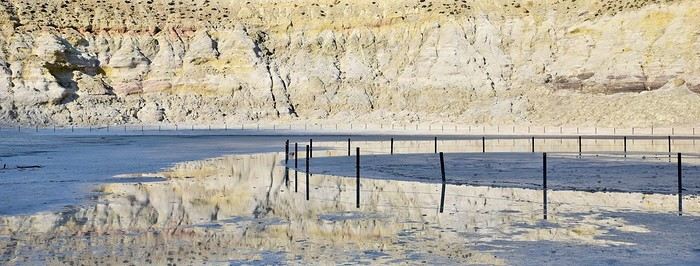
Before diving into the details, I should mention that I visited by bike (despite its severe and constant volcanic elevation) as part of a solo trip from France to Turkey. Why this detail? Because out of the ten countries I crossed and the dozens of sites I saw, Nisyros is one of my top three favorites (along with Pag Island, off-season, in Croatia, and Albania for its overall beauty—stunning natural landscapes and the incredible hospitality of its people). Anyway, welcome to this travel journal dedicated to the lovely little volcanic island of Nisyros…
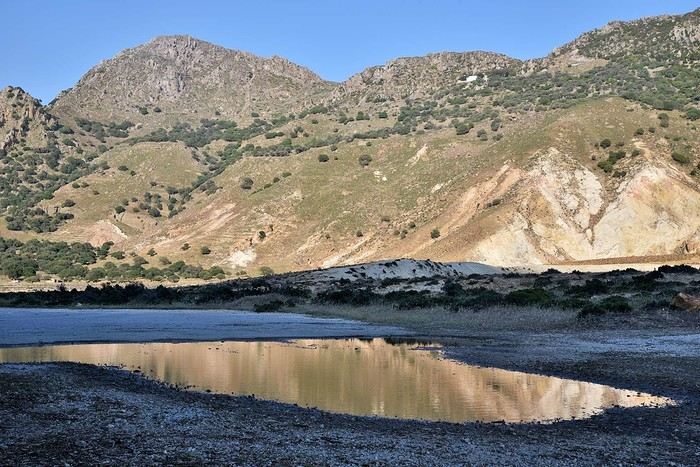
I arrived one beautiful morning in Mandraki, the island’s main port. The twenty-hour boat ride from Athens went by like a breeze. I slept on the deck for three or four hours, sprawled on a bench that was more or less sheltered from the wind. At this time of year (it’s May 2nd), tourists aren’t exactly flocking here, so the boat was far from full. My first glimpse of Nisyros is classic Greek island scenery: blazing sun, an azure sky, and an even deeper blue sea. The trip is off to a great start. I quickly found a small, out-of-the-way hotel (I’m one of those people who avoids crowds as much as possible when traveling, which is getting harder and harder to do). While everyone else from the boat turned right out of the port toward the center of Mandraki, I went left! My nice little hotel was just a hundred meters away, facing a pretty little Orthodox church whose red color contrasted beautifully with the deep blue sea.
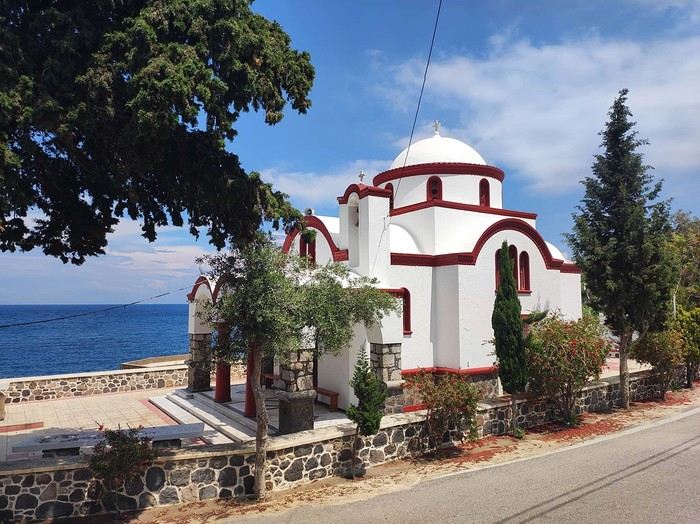
I dropped off my panniers in my room so I could ride light for once, then headed toward the next village: Pali. It’s a small fishing village that apparently comes to life a bit in the summer with a few tourists.
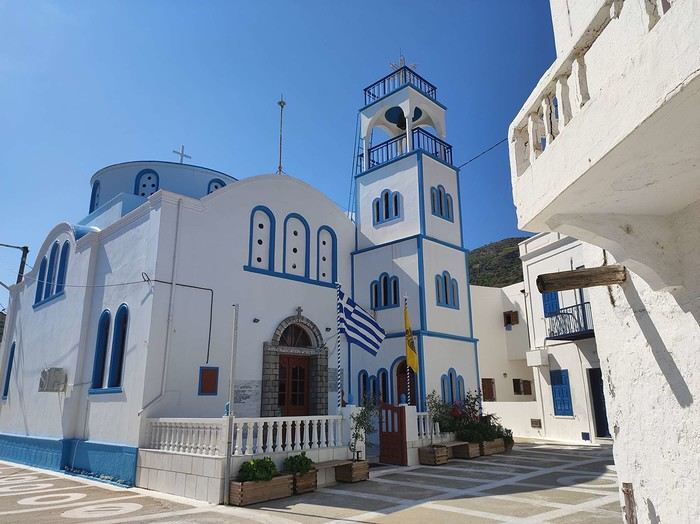
As I pedaled along the dock, I passed right by a guy sitting in a chair in full sun. Unfazed despite the sweat pouring down his forehead, he untangled his fishing net with a precision that commanded respect. I gave him the obligatory kalimera (good morning), but he reacted like a deaf-mute—no response at all. On the other hand, his employee answered me kindly from the trawler docked right next to him. Standing on deck, he was also untangling a mess of nets and invited me aboard to chat. That’s Mohamed.
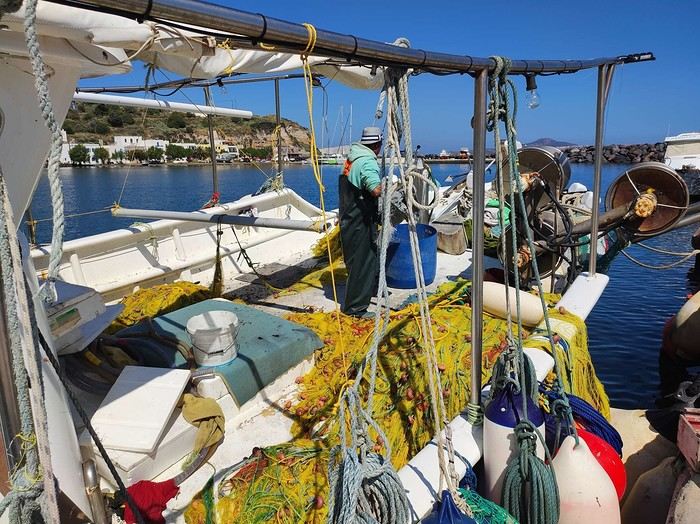
Communication wasn’t easy since he only spoke Greek and I didn’t, but he was cheerful, and his joy was contagious. He proudly showed off their catch of the day: two beautiful rays and a few brightly colored fish. We chatted like that for about fifteen minutes.
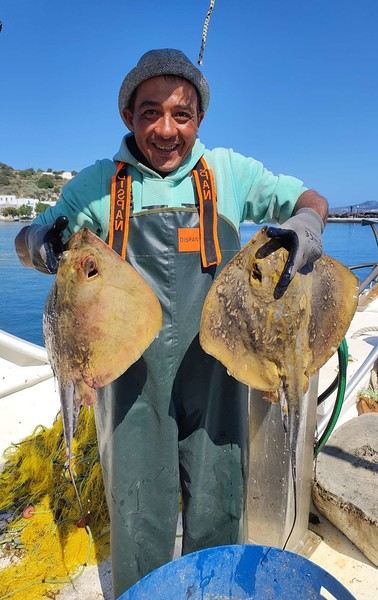
When it was time to hit the road again, I said goodbye to Mohamed, who smiled back. But this time, his boss—still dripping sweat in his chair under the scorching sun—greeted me too. Turns out he wasn’t deaf or mute after all.
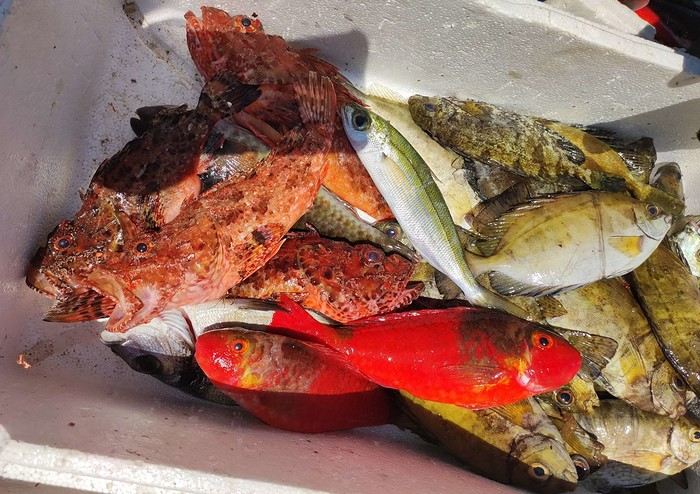
I continued along the coast since that’s where most of Nisyros’ beaches are. They start lining up just outside Pali. These are black sand beaches, which can’t hide their volcanic origins.
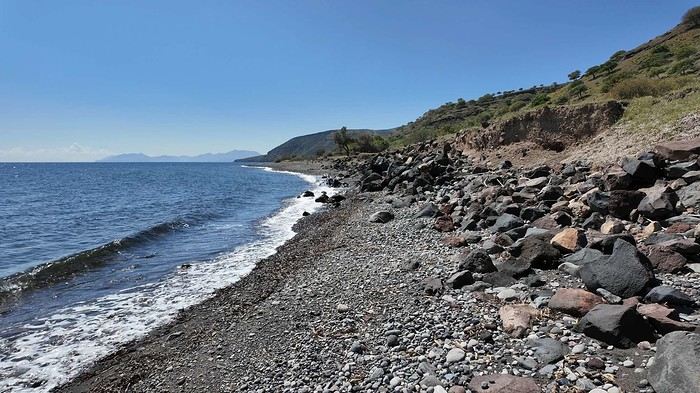
Yesterday afternoon in Athens, I met Peter and Michelle, a Dutch-French couple, while we were waiting for the ferry to depart. The Greek sailors were on strike, so we ended up waiting about twelve hours before setting off. Anyway, we had plenty of time to chat, and Peter, who’s lived on Tilos—a small island near Nisyros—for about twenty years, told me that many migrants pass through these two islands. Most come from Afghanistan and Syria, fleeing authoritarian regimes and the massacres that come with them. They’re looking for *anywhere* else where the future can’t possibly be worse. Peter explained that you often find their belongings on the local beaches. And sure enough, I didn’t have to look far to spot some—clothes, life jackets…
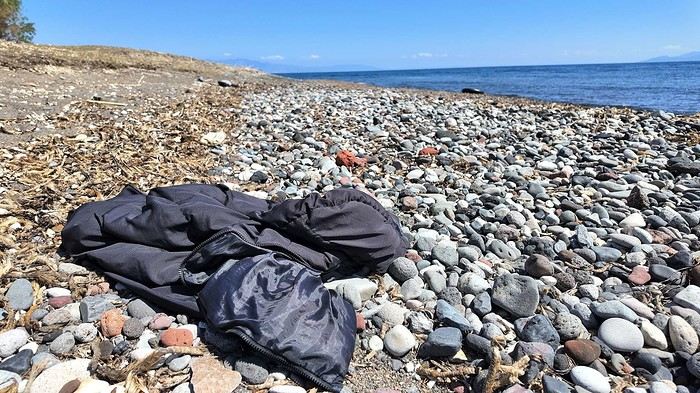
I glanced around, hoping to see one of them to maybe exchange a few words, but no—no one. I was completely alone.
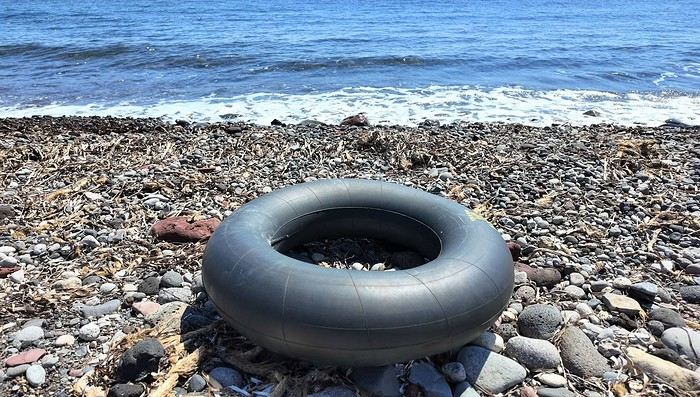
I got back on my bike and spent the rest of the day wandering aimlessly, just exploring this beautiful part of Nisyros. I also picked up some supplies because tomorrow, I’d be heading inland for two days, deep into its four-kilometer-wide caldera to explore the volcano. I’d be sleeping in a tent, so I needed to stock up on food. After a restful night in a real bed—something rare on this bike trip (and I won’t even mention the shower…)—I finally set off for the volcano (I’ll share details about that charming little hotel with the amazing breakfasts at the end of the journal). To reach Stefanos (the name of the main crater), I had to climb to the top of the caldera. It was hot, and some of the slopes were between 10 and 15%, which is steep, especially with a 54 kg bike. But who cares? I was admiring the scenery, and I have to say, I was surprised by how green it was. The higher I climbed, the more beautiful the vegetation became. It stood out against the blue of the sea, and the landscapes inside the island were truly stunning. So, I stopped every five minutes to take photos. Every now and then, I’d come across cows in the middle of the road—or goats in the trees! They climbed with the agility of monkeys to munch on the leaves. I couldn’t get a photo of them because they’d all scatter before I got close. It was actually the noise they made climbing down that tipped me off to their presence. Two villages sit at the top of the caldera: Emporios and Nikia. I passed the first one without climbing up to it, then continued to the second. And let me tell you, Nikia was love at first sight! I found myself pedaling through tiny streets, some barely wider than my bike with its panniers. The walls were white, and the doors were painted in all sorts of colors—green, blue, red… The streets were empty, and silence reigned. But it wasn’t a dead silence. It was more like the kind you find in small, secret, peaceful places. The village exuded tranquility, calm, and well-being. I leaned my bike—with all its gear—against a wall without locking it. It was the first time on this trip that I’d done that. Sure, its weight made it more like a tank than a bike, so you’d have to be *really* motivated to steal it, but here, for some reason, I felt completely at ease. Maybe it wasn’t the smartest move, but I go a lot by instinct, and here, it felt right. So I left my bike there and went to eat a little farther away, at a small restaurant on the village’s main square. It’s famous all over Greece for the beautiful mosaic that covers and decorates the floor. Once I’d eaten and drunk my fill, I hopped back on my bike, which had waited patiently without running off. And the best part? After riding uphill all morning to reach the top of the caldera, all I had to do now was coast downhill to the volcano. Pure bliss in such breathtaking scenery.
I hesitated for a long time before publishing this travel journal since it’s been 8 months now since I left Nisyros. But in the end, I found it too beautiful to keep quiet about. So here we go—I finally got around to writing it. Nisyros is a stunning little Greek island, and luckily, it’s well hidden. Located a good twenty hours by boat from Athens, its distance from the Greek mainland deters most tourists from visiting. That’s what makes it an off-the-beaten-path destination. So much for the general info.
Before diving into the details, I should mention that I visited by bike (despite its severe and constant volcanic elevation) as part of a solo trip from France to Turkey. Why this detail? Because out of the ten countries I crossed and the dozens of sites I saw, Nisyros is one of my top three favorites (along with Pag Island, off-season, in Croatia, and Albania for its overall beauty—stunning natural landscapes and the incredible hospitality of its people). Anyway, welcome to this travel journal dedicated to the lovely little volcanic island of Nisyros…
I arrived one beautiful morning in Mandraki, the island’s main port. The twenty-hour boat ride from Athens went by like a breeze. I slept on the deck for three or four hours, sprawled on a bench that was more or less sheltered from the wind. At this time of year (it’s May 2nd), tourists aren’t exactly flocking here, so the boat was far from full. My first glimpse of Nisyros is classic Greek island scenery: blazing sun, an azure sky, and an even deeper blue sea. The trip is off to a great start. I quickly found a small, out-of-the-way hotel (I’m one of those people who avoids crowds as much as possible when traveling, which is getting harder and harder to do). While everyone else from the boat turned right out of the port toward the center of Mandraki, I went left! My nice little hotel was just a hundred meters away, facing a pretty little Orthodox church whose red color contrasted beautifully with the deep blue sea.
I dropped off my panniers in my room so I could ride light for once, then headed toward the next village: Pali. It’s a small fishing village that apparently comes to life a bit in the summer with a few tourists.
As I pedaled along the dock, I passed right by a guy sitting in a chair in full sun. Unfazed despite the sweat pouring down his forehead, he untangled his fishing net with a precision that commanded respect. I gave him the obligatory kalimera (good morning), but he reacted like a deaf-mute—no response at all. On the other hand, his employee answered me kindly from the trawler docked right next to him. Standing on deck, he was also untangling a mess of nets and invited me aboard to chat. That’s Mohamed.
Communication wasn’t easy since he only spoke Greek and I didn’t, but he was cheerful, and his joy was contagious. He proudly showed off their catch of the day: two beautiful rays and a few brightly colored fish. We chatted like that for about fifteen minutes.
When it was time to hit the road again, I said goodbye to Mohamed, who smiled back. But this time, his boss—still dripping sweat in his chair under the scorching sun—greeted me too. Turns out he wasn’t deaf or mute after all.
I continued along the coast since that’s where most of Nisyros’ beaches are. They start lining up just outside Pali. These are black sand beaches, which can’t hide their volcanic origins.
Yesterday afternoon in Athens, I met Peter and Michelle, a Dutch-French couple, while we were waiting for the ferry to depart. The Greek sailors were on strike, so we ended up waiting about twelve hours before setting off. Anyway, we had plenty of time to chat, and Peter, who’s lived on Tilos—a small island near Nisyros—for about twenty years, told me that many migrants pass through these two islands. Most come from Afghanistan and Syria, fleeing authoritarian regimes and the massacres that come with them. They’re looking for *anywhere* else where the future can’t possibly be worse. Peter explained that you often find their belongings on the local beaches. And sure enough, I didn’t have to look far to spot some—clothes, life jackets…
I glanced around, hoping to see one of them to maybe exchange a few words, but no—no one. I was completely alone.
I got back on my bike and spent the rest of the day wandering aimlessly, just exploring this beautiful part of Nisyros. I also picked up some supplies because tomorrow, I’d be heading inland for two days, deep into its four-kilometer-wide caldera to explore the volcano. I’d be sleeping in a tent, so I needed to stock up on food. After a restful night in a real bed—something rare on this bike trip (and I won’t even mention the shower…)—I finally set off for the volcano (I’ll share details about that charming little hotel with the amazing breakfasts at the end of the journal). To reach Stefanos (the name of the main crater), I had to climb to the top of the caldera. It was hot, and some of the slopes were between 10 and 15%, which is steep, especially with a 54 kg bike. But who cares? I was admiring the scenery, and I have to say, I was surprised by how green it was. The higher I climbed, the more beautiful the vegetation became. It stood out against the blue of the sea, and the landscapes inside the island were truly stunning. So, I stopped every five minutes to take photos. Every now and then, I’d come across cows in the middle of the road—or goats in the trees! They climbed with the agility of monkeys to munch on the leaves. I couldn’t get a photo of them because they’d all scatter before I got close. It was actually the noise they made climbing down that tipped me off to their presence. Two villages sit at the top of the caldera: Emporios and Nikia. I passed the first one without climbing up to it, then continued to the second. And let me tell you, Nikia was love at first sight! I found myself pedaling through tiny streets, some barely wider than my bike with its panniers. The walls were white, and the doors were painted in all sorts of colors—green, blue, red… The streets were empty, and silence reigned. But it wasn’t a dead silence. It was more like the kind you find in small, secret, peaceful places. The village exuded tranquility, calm, and well-being. I leaned my bike—with all its gear—against a wall without locking it. It was the first time on this trip that I’d done that. Sure, its weight made it more like a tank than a bike, so you’d have to be *really* motivated to steal it, but here, for some reason, I felt completely at ease. Maybe it wasn’t the smartest move, but I go a lot by instinct, and here, it felt right. So I left my bike there and went to eat a little farther away, at a small restaurant on the village’s main square. It’s famous all over Greece for the beautiful mosaic that covers and decorates the floor. Once I’d eaten and drunk my fill, I hopped back on my bike, which had waited patiently without running off. And the best part? After riding uphill all morning to reach the top of the caldera, all I had to do now was coast downhill to the volcano. Pure bliss in such breathtaking scenery.
From Fès to Marrakech via Merzouga
Hi there,
We’re a group of 14 (adults and kids), and we’re planning the following itinerary for next October:
- Day 0: Arrival and visit Fès - Day 1: Depart Fès for Midelt - Overnight in Midelt - Day 2: From Midelt to Merzouga - Overnight in Merzouga (camp in the dunes) - Day 3: From Merzouga to the Dadès Gorges - Overnight in the Dadès Gorges - Day 4: Excursion and hike in the Dadès Gorges - Overnight in the Dadès Gorges - Day 5: From Dadès to Marrakech (visiting Ouarzazate studios and Aït Ben Haddou) - Day 6: Explore Marrakech - Day 7: Return
Any tips or suggestions for this plan? Is quad biking or buggy riding in the dunes (for adults, obviously) worth it? Which spots are really worth stopping at—and which ones aren’t?
Thanks in advance for your advice!
We’re a group of 14 (adults and kids), and we’re planning the following itinerary for next October:
- Day 0: Arrival and visit Fès - Day 1: Depart Fès for Midelt - Overnight in Midelt - Day 2: From Midelt to Merzouga - Overnight in Merzouga (camp in the dunes) - Day 3: From Merzouga to the Dadès Gorges - Overnight in the Dadès Gorges - Day 4: Excursion and hike in the Dadès Gorges - Overnight in the Dadès Gorges - Day 5: From Dadès to Marrakech (visiting Ouarzazate studios and Aït Ben Haddou) - Day 6: Explore Marrakech - Day 7: Return
Any tips or suggestions for this plan? Is quad biking or buggy riding in the dunes (for adults, obviously) worth it? Which spots are really worth stopping at—and which ones aren’t?
Thanks in advance for your advice!
Luang Prabang Among the Best Holiday Destinations in Asia for 2025
The city of Luang Prabang, a UNESCO World Heritage site, has once again caught the world's attention by ranking among the best holiday destinations in Asia for 2025, according to the Smart Travel Asia Best in Travel Poll. This prestigious annual ranking celebrates cities that combine authenticity, culture, and natural beauty—and Luang Prabang has all three in spades....
You Don't Eat Cannibals (book)
Take a step back, forget your bearings, and momentarily set aside the boxes we use to categorize life: humans on one side, animals on the other. Immerse yourself in that unsettling zone where man, stripped of his humanity, and the beast—capable of emotions and sensitivity—stand face to face.
Who is the predator, who is the prey? Where do fear, barbarism, or extreme violence lie, and where do compassion and philosophy reside?
In this book steeped in anthropomorphism, Stéphanie Artarit weaves a cruel plot and pushes the boundaries of darkness without ever wallowing in the grim or sordid.
A story of love and vengeance, of fierce beasts and humans, where the abominable, the unbearable, and the unthinkable are pierced by the candor and fragile luminosity of the heroine, Bambi, around whom (very) dark passions rage.
The action takes place in the Pyrenees in the mid-1970s. A dilapidated, isolated house, the theater of the unthinkable, where a shattered family ignored by social services lives—or survives: a missing father, a helpless mother, two degenerate twins, Sam and Valerien, a violent older brother, Martin, an absolute bastard, a dog... and a young adolescent, Bambi, the precarious pillar of this teetering balance. To escape this hopeless daily life, she regularly finds refuge in a nearby zoo. Caught during yet another sneaky visit, she is taken to the owner of the place, Noel Rivière, who, moved by her misery (and her ethereal, unreal beauty...), hires her as an apprentice.
This could have been the start of a fairy tale, redemption through love, the bastard permanently neutralized... and a breather for the reader.
But no.
The zoo serves as the backdrop for the second part of the story, which introduces new characters... a little girl, Feline, and a chimpanzee, Adam, placed in an isolated enclosure upon arrival because he was aggressive and unable to live among his own kind.
Humans with primitive animality, animals with astonishing humanity... a deranged, fierce, and heartbreaking Jungle Book. A noir novel with fluid, poetic writing.
A breathless read, almost devoured in one go (in two sittings) because it’s impossible to catch your breath before finding out how far the author will push the limits and what fate she has in store for her characters...
You Don’t Eat Cannibals Stéphanie ARTARIT Belfond Noir
In this book steeped in anthropomorphism, Stéphanie Artarit weaves a cruel plot and pushes the boundaries of darkness without ever wallowing in the grim or sordid.
A story of love and vengeance, of fierce beasts and humans, where the abominable, the unbearable, and the unthinkable are pierced by the candor and fragile luminosity of the heroine, Bambi, around whom (very) dark passions rage.
The action takes place in the Pyrenees in the mid-1970s. A dilapidated, isolated house, the theater of the unthinkable, where a shattered family ignored by social services lives—or survives: a missing father, a helpless mother, two degenerate twins, Sam and Valerien, a violent older brother, Martin, an absolute bastard, a dog... and a young adolescent, Bambi, the precarious pillar of this teetering balance. To escape this hopeless daily life, she regularly finds refuge in a nearby zoo. Caught during yet another sneaky visit, she is taken to the owner of the place, Noel Rivière, who, moved by her misery (and her ethereal, unreal beauty...), hires her as an apprentice.
This could have been the start of a fairy tale, redemption through love, the bastard permanently neutralized... and a breather for the reader.
But no.
The zoo serves as the backdrop for the second part of the story, which introduces new characters... a little girl, Feline, and a chimpanzee, Adam, placed in an isolated enclosure upon arrival because he was aggressive and unable to live among his own kind.
Humans with primitive animality, animals with astonishing humanity... a deranged, fierce, and heartbreaking Jungle Book. A noir novel with fluid, poetic writing.
A breathless read, almost devoured in one go (in two sittings) because it’s impossible to catch your breath before finding out how far the author will push the limits and what fate she has in store for her characters...
You Don’t Eat Cannibals Stéphanie ARTARIT Belfond Noir
Namibia or Botswana?
Hi everyone,
We’re seriously considering a two-week trip in August 2026 with our kids, who’ll be 11 and 10 years old.
That’s where we’re torn on the destination. For those who’ve been to both, could you share the main differences? I get the impression that in Botswana, the landscapes are a bit samey everywhere, while Namibia offers more diversity? We’re looking for an "off-the-beaten-path" adventure: safaris, meeting local communities, etc., and not too many touristy spots. Thanks for your help!
Olivia