Results for "ski"
12466 results found.
Voyage en haute montagne (France) English translation pending
Bonjour a tous !
Cela fait un petit moment que je n'ai pas quitté la région parisienne et j'ai l'idée dans les prochains mois de partir en haute montagne, seulement je n'y suis jamais allé et donc n'y connait rien.
Pourriez vous me conseiller des beaux lieu facilement accessible (train, bus...) pour pas trop cher, dans un endroit pas trop construit et située au plus près des hautes montagnes ? Je cherche pas a faire du ski mais je suis pas contre voir un peu de neige de temps en temps planqué en haut des plus hauts sommets^^.
Je dormirais probablement dans des auberges de jeunesses et marcherais un peu dans la nature même si le but du voyage est plus un dépaysement que de la randonnée.🙂
Cela fait un petit moment que je n'ai pas quitté la région parisienne et j'ai l'idée dans les prochains mois de partir en haute montagne, seulement je n'y suis jamais allé et donc n'y connait rien.
Pourriez vous me conseiller des beaux lieu facilement accessible (train, bus...) pour pas trop cher, dans un endroit pas trop construit et située au plus près des hautes montagnes ? Je cherche pas a faire du ski mais je suis pas contre voir un peu de neige de temps en temps planqué en haut des plus hauts sommets^^.
Je dormirais probablement dans des auberges de jeunesses et marcherais un peu dans la nature même si le but du voyage est plus un dépaysement que de la randonnée.🙂
Juillet dans les Alpes suisses en camping-car English translation pending
Bonjour,
Je cherche des informations sur les facilités de voyage en camping-car dans les Alpes suisses. J'ai lu ici et là des commentaires disant que ce mode de voyage n'était pas très aisé en Suisse et assez onéreux. Ces commentaires datent d'il y a quelques années alors je ne sais pas si les mentalités ont évolué ?
J'envisage un séjour/circuit plutôt au sud du Lac Léman et jusque dans les alpes italiennes en camping sauvage, en tout cas pas sur des parkings spéciaux camping-car…
Je vous remercie pour votre aide
Destination montagneuse (en France) avec enfant English translation pending
Bonjour à toutes et à tous.
Je viens ici solliciter votre culture de globe-trotteur car nous sommes à la rechercher d'une destination montagneuse (France) et ce serait notre toute première fois.
Nous partirons avec notre fille qui aura 3 ans et ça serait en été (Août).
Voici un peu les critères de recherches :
* Alpes (Nord/Sud?) * dans un club avec piscine pour la petite * pas mal d'activités d'été * paysage magnifique (avec un lac à proximité serait l'idéal)
Merci par avance ;)
Je viens ici solliciter votre culture de globe-trotteur car nous sommes à la rechercher d'une destination montagneuse (France) et ce serait notre toute première fois.
Nous partirons avec notre fille qui aura 3 ans et ça serait en été (Août).
Voici un peu les critères de recherches :
* Alpes (Nord/Sud?) * dans un club avec piscine pour la petite * pas mal d'activités d'été * paysage magnifique (avec un lac à proximité serait l'idéal)
Merci par avance ;)
Voyager en hiver à vélo (France) English translation pending
Bonjour à vous tous.
Lors de mes prochaines vacances, du 10 au 20 février, j'aimerai entreprendre un voyage en vélo en partant de Caen et à destination de Nantes puis continuer en bretagne en fonction de la vitesse à laquelle j'avancerai. J'ai déjà fait un voyage l'été dernier, il s'agissait de mon premier. Or, j'aimerai avoir quelques conseils sur le matériel nécessaire en hiver. J'aimerai utiliser warmshower ainsi que m'arrêter chez des amis pour dormir, mais je vais aussi, très certainement, être dans la nécessité de dormir en extérieur (tente).
Bien évidemment, les températures sont beaucoup moins agréables que l'été ... ihi et pour faire de bonnes nuits j'aimerai avoir quelques conseils pour l'achat de matériel (duvet, vêtements chauds, gants, bonnets etc.) qui soient confortables.
J'aimerai ne pas avoir à dépenser trop d'argent, notamment pour le duvet (même si il semblerait que le prix monte assez vite) et la matelas isolant du sol (ou si vous avez d'autres idées pour le couchage).
Merci pour vos conseils !
Lors de mes prochaines vacances, du 10 au 20 février, j'aimerai entreprendre un voyage en vélo en partant de Caen et à destination de Nantes puis continuer en bretagne en fonction de la vitesse à laquelle j'avancerai. J'ai déjà fait un voyage l'été dernier, il s'agissait de mon premier. Or, j'aimerai avoir quelques conseils sur le matériel nécessaire en hiver. J'aimerai utiliser warmshower ainsi que m'arrêter chez des amis pour dormir, mais je vais aussi, très certainement, être dans la nécessité de dormir en extérieur (tente).
Bien évidemment, les températures sont beaucoup moins agréables que l'été ... ihi et pour faire de bonnes nuits j'aimerai avoir quelques conseils pour l'achat de matériel (duvet, vêtements chauds, gants, bonnets etc.) qui soient confortables.
J'aimerai ne pas avoir à dépenser trop d'argent, notamment pour le duvet (même si il semblerait que le prix monte assez vite) et la matelas isolant du sol (ou si vous avez d'autres idées pour le couchage).
Merci pour vos conseils !
Israël en février English translation pending
Bonjour à tous,
Je me demande donc si aller en Israël deuxième quinzaine de février serait une bonne idée. Ne fait-il pas trop froid à cette période ?
Merci de me renseigner.
Cordialement.
Voyage en avril au Liban: itinéraire et sécurité English translation pending
Bonjour,
Nous avons nos billets pour le Liban du 24 avril au 5 mai 2019 :)
J'ai préparé un circuit qu'on ajustera sur place mais pouvez vous me dire ce que vous pensez du "timing" dans chaque endroit et notamment Beyrouth et Byblos où je voudrais réserver les hebergements, hotel à Beyrouth et AirB&B à Byblos.
On arrive par un vol très tardif le 23, 2 heures du matin, je dois donc réserver la nuit du 23 au 24 à l'hotel :( Pour Beyrouth nous prendrons les services, bus et à pied. Ensuite nous quitterons la capitale en voiture de loc pour découvrir le reste du pays.
Du 24 au 26/4 inclus : Beyrouth avec musée, corniche, hamra .... La journée du 26 aller-retour à Baalbeck en bus. 27 et 28 : Visite des grootes de Jeita, Jounieh et Byblos, Batroun, avec 2 nuits a Byblos 29 : Visite de Tripoli et route pour Bscharré pour y dormir 30 : Rando dans la Qadisha. A ce propos, niveau sécurité et balisage, peut on randonner seuls ? 01/05:Ballade aus Cedres et route jusqu'a Zahle pour y dormir 02 : découverte autour de Zahlé. on pensait à la montagne ou se trouvent les pistes de ski, bonne idée ? Route jusqu'à Deil el Qamar pour y dormir 03 : Visite de Beitedine, jezzine et arrivée a Saida pour la nuit 04 : Saida, souk, chateau... Milieu d'après midi, retour à Beyrouth pour rendre la voiture et passer la dernière soirée sur la Corniche avant de rejoindre l'aéroport pour notre vol à 2h50 du matin !
2 journées pleines et 3 soirées à Beyrouth n'est ce pas trop ? on pourrait mettre un jour de plus à Bscharré ? avez vous des remarques ou des suggestions sur des coins à ne pas manquer ou au contraire à éviter pour questions de sécurité notamment ? Je vous remercie d'avoir pris le temps Christine
J'ai préparé un circuit qu'on ajustera sur place mais pouvez vous me dire ce que vous pensez du "timing" dans chaque endroit et notamment Beyrouth et Byblos où je voudrais réserver les hebergements, hotel à Beyrouth et AirB&B à Byblos.
On arrive par un vol très tardif le 23, 2 heures du matin, je dois donc réserver la nuit du 23 au 24 à l'hotel :( Pour Beyrouth nous prendrons les services, bus et à pied. Ensuite nous quitterons la capitale en voiture de loc pour découvrir le reste du pays.
Du 24 au 26/4 inclus : Beyrouth avec musée, corniche, hamra .... La journée du 26 aller-retour à Baalbeck en bus. 27 et 28 : Visite des grootes de Jeita, Jounieh et Byblos, Batroun, avec 2 nuits a Byblos 29 : Visite de Tripoli et route pour Bscharré pour y dormir 30 : Rando dans la Qadisha. A ce propos, niveau sécurité et balisage, peut on randonner seuls ? 01/05:Ballade aus Cedres et route jusqu'a Zahle pour y dormir 02 : découverte autour de Zahlé. on pensait à la montagne ou se trouvent les pistes de ski, bonne idée ? Route jusqu'à Deil el Qamar pour y dormir 03 : Visite de Beitedine, jezzine et arrivée a Saida pour la nuit 04 : Saida, souk, chateau... Milieu d'après midi, retour à Beyrouth pour rendre la voiture et passer la dernière soirée sur la Corniche avant de rejoindre l'aéroport pour notre vol à 2h50 du matin !
2 journées pleines et 3 soirées à Beyrouth n'est ce pas trop ? on pourrait mettre un jour de plus à Bscharré ? avez vous des remarques ou des suggestions sur des coins à ne pas manquer ou au contraire à éviter pour questions de sécurité notamment ? Je vous remercie d'avoir pris le temps Christine
Piste cyclable de la vallée de l'Inn avec enfants (Allemagne - Autriche) English translation pending
Bonjour,
Toujours à la recherche d'idées pour cet été, j'ai obtenu quelques informations sur la piste cyclable de la Vallée de l'Inn sur environ 520 kms.
Je ne trouve pas de carte reprenant l'ensemble du parcours mais seulement des cartes de certains tronçons.
Je souhaiterais avoir une idée plus globale du parcours. Si vous avez des informations, je suis preneur.
Si vous avez eu l'occasion de faire cette route, pensez vous qu'elle soit adaptée pour des enfants de 9 et 11 ans ?
Merci à vous. Olivier
Je ne trouve pas de carte reprenant l'ensemble du parcours mais seulement des cartes de certains tronçons.
Je souhaiterais avoir une idée plus globale du parcours. Si vous avez des informations, je suis preneur.
Si vous avez eu l'occasion de faire cette route, pensez vous qu'elle soit adaptée pour des enfants de 9 et 11 ans ?
Merci à vous. Olivier
Climat au Kirghizistan en mars English translation pending
Bonjour à tous !
Ayant la possibilité de me rendre au Kirghizistan au mois de mars, j'au rai néanmoins quelques questions surtout relatives au climat.
Je souhaite essentiellement visiter des grands espaces et faire quelques trekks mais j'ai quelques doutes concernant le climat étant donné que nous serons en fin d'hiver.
Est-ce que les lieux seront accessibles ou fermés en raison de la neige ? N'y a t'il pas trop de pluie, ou neige, et pas énormément de soleil ?
Dans l'attente de vos conseils et avis 🙂
Ayant la possibilité de me rendre au Kirghizistan au mois de mars, j'au rai néanmoins quelques questions surtout relatives au climat.
Je souhaite essentiellement visiter des grands espaces et faire quelques trekks mais j'ai quelques doutes concernant le climat étant donné que nous serons en fin d'hiver.
Est-ce que les lieux seront accessibles ou fermés en raison de la neige ? N'y a t'il pas trop de pluie, ou neige, et pas énormément de soleil ?
Dans l'attente de vos conseils et avis 🙂
Idées de séjour en hiver et en été au Québec English translation pending
Bonjour ,
Je vais m'installer pour vivre un an à Montréal .
J aurai quatre semaines de congés et je cherche à préparer des idées de voyage au Québec voir au Canada en général. De même des idées weekend...
Quels sont les idées que vous auriez pour
- une semaine en hiver ou en été
- deux semaines en hiver ou en été
- des idées weekend en hiver ou en été
Je serai avec ma femme et mes quatres enfants , avec un budget moyen . J aurai probablement un véhicule .
Merci de vos idées pour que cette année nous permette de voir le plus de jolies choses possibles.
Paul
Je serai avec ma femme et mes quatres enfants , avec un budget moyen . J aurai probablement un véhicule .
Merci de vos idées pour que cette année nous permette de voir le plus de jolies choses possibles.
Paul
Randonnée raquettes au Massif Central English translation pending
Bonjour a tous,
j aimerai beaucoup avoir des infos sur la pratique de randonnée en raquette dans le massif central, faut il suivre les parcours raquettes, faut il t il un guide si on n a jamais pratique, des idées de location ( chalet) pour un petit weekend??enfin bref tout ce qui pourrais m aider a préparer un petit weekend randonnée cet hiver ( bon plan bienvenus) merci a tous
j aimerai beaucoup avoir des infos sur la pratique de randonnée en raquette dans le massif central, faut il suivre les parcours raquettes, faut il t il un guide si on n a jamais pratique, des idées de location ( chalet) pour un petit weekend??enfin bref tout ce qui pourrais m aider a préparer un petit weekend randonnée cet hiver ( bon plan bienvenus) merci a tous
Taille des roues de vélo English translation pending
Bonjour les cyclos,
Pouvez vous me dire si à l'heure actuelle on trouve du pneu de 27.5 pouces (650) partout dans le monde ? Je suis rentrée de mon dernier périple sans mon vélo couché et du coup dois acheter un nouveau véhicule que j'équiperais bien en roues de 27.5...
Merci d'avance à tous pour vos retours
Pouvez vous me dire si à l'heure actuelle on trouve du pneu de 27.5 pouces (650) partout dans le monde ? Je suis rentrée de mon dernier périple sans mon vélo couché et du coup dois acheter un nouveau véhicule que j'équiperais bien en roues de 27.5...
Merci d'avance à tous pour vos retours
Hôtel à Mumbai près de l'aéroport English translation pending
bonjour, je pars un mois en inde, et mon retour, a partir de mumbai, est a 4 h du matin. (donc il faut que j'y sois plus ou moins a 2.30 ?) pouvez vous m'indiquer un hotel tres proche de l'aeroport, je ne m'imagine pas vraiment dormir sur les sieges de l'aeroport, j'a 70 ans et qui plus est, vraiment malade, je gere assez bien sauf que je me couche très tot,
j'ai aussi entendu parler d'un hotel a l'aeroport même, mais je n'arrive pas a le trouver qui peut aider (j imagine que ca ne doit pas etre donné, mais ca serait pour moi, une solution ideale), merci a tous, jeanne
j'ai aussi entendu parler d'un hotel a l'aeroport même, mais je n'arrive pas a le trouver qui peut aider (j imagine que ca ne doit pas etre donné, mais ca serait pour moi, une solution ideale), merci a tous, jeanne
Norvège en hiver English translation pending
Bonjour , j envisage une aventure en Norvège en hivers 2019.
J aurai besoin de quelque conseil , quel vêtement prévoir pour cet période ? Concernant pour échanger des euros contre des couronnes , plutôt en Norvège ou en France ? Sur l’archipel des Vesterålen, faire un safari au baleine , es que on en voit la bas ? Concernant les transports commun (avion , bus) sont il bien desservis entre les villes car les distances sont éloigné d un points à un autre. Merci de me donner vos conseils concernant cet destination. On m'a dit que c est une belle destination de voyage mais es que en hivers sa vaut le détour car c est un pays où le coût de la vie est extrêmement cher ?
Merci d avance.
J aurai besoin de quelque conseil , quel vêtement prévoir pour cet période ? Concernant pour échanger des euros contre des couronnes , plutôt en Norvège ou en France ? Sur l’archipel des Vesterålen, faire un safari au baleine , es que on en voit la bas ? Concernant les transports commun (avion , bus) sont il bien desservis entre les villes car les distances sont éloigné d un points à un autre. Merci de me donner vos conseils concernant cet destination. On m'a dit que c est une belle destination de voyage mais es que en hivers sa vaut le détour car c est un pays où le coût de la vie est extrêmement cher ?
Merci d avance.
Horaires d'ouverture des magasins à Montréal English translation pending
Bonjour,
Devant prochainement aller à Montréal, j'aurais voulu savoir les horaires d'ouverture des magasins à Montréal.
De plus, arrivant le 31 décembre à quelle heure ferment les magasins ce jour là? JEt sont-ils ouverts le 1er janvier?
Je dois acheter des vêtements pour le froid et notamment un manteau auriez vous une enseigne à me conseiller?
Merci pour vos réponses.
Sept jours en Islande en amoureux (octobre) English translation pending
Bonjour
Pour remercier tous ceux qui m'ont aidé pour organiser notre petite escapade automnale je vais essayer de vous faire un compte rendu de notre semaine Islandaise.
Questions pratiques et organisation :
- voyage du 20 au 27 octobre
- billet mulhouse / rekjavik sur easyjet pris en avril (360E avec un bagage en soute)
-location van (traffic 3 personnes, j'ai beaucoup comparé les aménagements que ne sont pas tous identiques nous avons adoré le notre) chez Tripcamper pour 950E transfert aller retour aéroport compris sans assurance supplémentaire ni second conducteur. Agence sur à recommander.
- décision du sens du parcours le matin même en fonction de la météo
- 9kg de nourriture dans le bagage en soute (épicerie, sachet de soupe, nutella chocolat, pate sauce tomate, paella couscous, truc à tartiner pour pique nique ..)
- veste de ski, bonnet, gant fin (un peu trop léger), sous vetement haut et bas technique
- vielle serviette pour ne pas salir l'interieur du van, torchon, ouvre bouteille, micro fibre et chiffonnette pour lunettes pour l'appareil photo, trepieds, obj 10-24 / 35/ 70-200
- 2 duvets léger (15°) en plus de ce qui était fourni (oreillé couette drap) qui ont servis !
- roadbook bien sur !!!
Le récit et qq photos à venir !
Le récit et qq photos à venir !
Organiser son voyage au Canada sans agence English translation pending
Bonsoir j ai besoin d aide. Nous aimerions partir au Canada en février. Les prix d avion sont très attractifs et j ai besoin de conseils pour l organisation sur place (hôtel, resto, transfert aéroport transport d une ville a l autre). Nous aimerions avoir le temps de visiter Montreal et Quebec et nous aimerions faire des activités d hiver (moto neige et chien de traîneau) merci d avance pour vos réponses.
Aventure randonnée d'hiver et bivouac au Québec English translation pending
bonjour les vagabonds
connaissez-vous des blogs de voyage aventure dans la neige ??
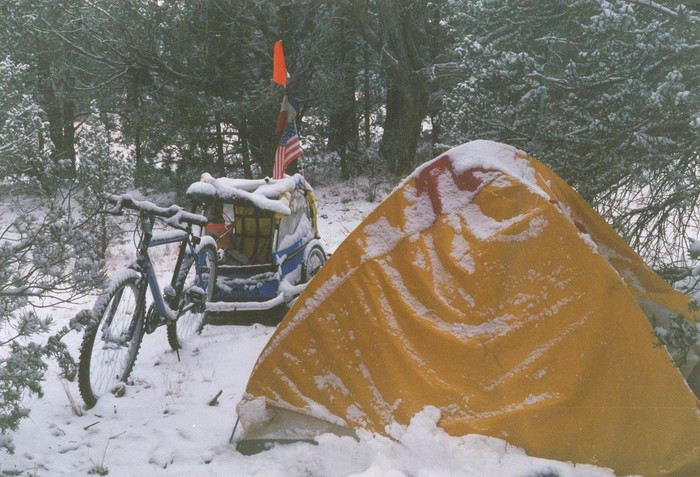
je viens de la course à pied + longs voyages en vélo/remorque tout à coup il me prend l'envie de traverser et de dormir dans d'immenses forêts enneigés !! avec peut être une aurore boréale ??
besoin de me renseigner sur le matériel adapté au froid / les mesures de sécurité dans les intempéries hivernales
apparemment il y a beaucoup de sentiers randonnée d'hiver au québec j'image qu'il existe aussi une foule de parcours balisés magnifiques en finlande norvège forêt noire slovénie et ailleurs??
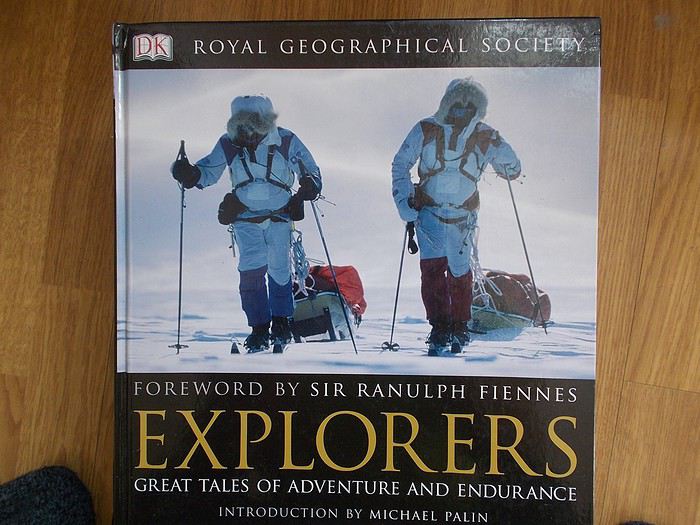
je rêve d'une petite expé raquette ou ski de fond en trainant une luge , camping en autonome
le budget est probablement élevé ?? tente thermo - duvet de compet - luge - chaussettes gants , sous vêtement spéciaux et tout et tout .. où acheter du matériel d'occasion en france ?? mieux là bas au québec ??
j'ai déjà pas mal d'affaires de camping grâce aux tours en vélo + passé quelques dizaines de nuit en bivouac sous 0 degré
merci pour vos infos et nouvelles fraiches j'espère que vous resterez pas de glace ??
janick petite infidélité au vélo
oh un détail .. je n'ai pas fait de ski depuis février 1972 - classe de neige scolaire sauvegardé mes genoux pour la course à pied !!
La Grèce à vélo (vos avis et retours d'expériences) English translation pending
Salut,
J'aurais voulu avoir quelques retours d'expériences de cyclistes qui auraient parcouru la Grèce, c'est une destination qui me plaît bien, peut-être l'année prochaine :)
Merci d'avance.
Gilles
Stratégie du backpacker pour la nuit en octobre au Sud Lipez English translation pending
Hello,
J'ai cherché sur le forum et sur le web avant mais c'est pas très claire pour moi.
Je reviens de chez Décathlon et le sac de couchage à -15 degrès pour le confort me rebute, pas vraiment le prix, c'est une question de prix, mais la place que ça prend dans le sac!
Alors j'ai acheté des t shirt thermiques, un sweat thermiques aussi, j'ai un pantalon de ski, et des chaussette aussi pour les nuits froides.
Alors mon agence ( Tupiza Tours ) loue des sac de couchages ( sleeping bags ) donc je suppose que c'est ça..niveau hygiène j'en sais rien mais je compte du coup acheter un sac à viande pour les nuits et louer un sac chez eux.
Pour trois nuits je me vois mal transporter un gros sac de couchage depuis le Pérou.
Autre chose: Comment me conseillez vous d'organiser les nuits, je dors en refuse en fin octobre ( Sud Lipez ) l'idée était de louer un sac de couchage avec l'agence et acheter ceci pour protéger le duvet : www.decathlon.ch/...soie-fr-s107085.html
Pour les nuits faut dormir avec un t shirt thermique sans pantalon de ski, pour éviter de suer et du coup etre humide et etre mal au matin ? J'ai jamais dormi dans ces conditions, j'ai vécu les très chauds mais jamais les très froid la nuit ;)
Merci pour vos retours Nico
J'ai cherché sur le forum et sur le web avant mais c'est pas très claire pour moi.
Je reviens de chez Décathlon et le sac de couchage à -15 degrès pour le confort me rebute, pas vraiment le prix, c'est une question de prix, mais la place que ça prend dans le sac!
Alors j'ai acheté des t shirt thermiques, un sweat thermiques aussi, j'ai un pantalon de ski, et des chaussette aussi pour les nuits froides.
Alors mon agence ( Tupiza Tours ) loue des sac de couchages ( sleeping bags ) donc je suppose que c'est ça..niveau hygiène j'en sais rien mais je compte du coup acheter un sac à viande pour les nuits et louer un sac chez eux.
Pour trois nuits je me vois mal transporter un gros sac de couchage depuis le Pérou.
Autre chose: Comment me conseillez vous d'organiser les nuits, je dors en refuse en fin octobre ( Sud Lipez ) l'idée était de louer un sac de couchage avec l'agence et acheter ceci pour protéger le duvet : www.decathlon.ch/...soie-fr-s107085.html
Pour les nuits faut dormir avec un t shirt thermique sans pantalon de ski, pour éviter de suer et du coup etre humide et etre mal au matin ? J'ai jamais dormi dans ces conditions, j'ai vécu les très chauds mais jamais les très froid la nuit ;)
Merci pour vos retours Nico
Voyage en France en hiver et activités English translation pending
Allo!
Nous aurions l'opportunité de faire le saut vers la France en atterrissant sur Paris en février ou mars 2019, ma femme et moi, pour 10 ou 14 jours. Je sais, c'est un (pas mal) hors saison, mais je me disais qu'il y aurais ici quelque personnes bien intentionnées pour m'aiguiller ou me conseiller sur des activités.
Dans mon cas, c'est ma 1ère fois en France, mais je suis passé en Europe centrale il y a une vingtaine d'années (Allemagne, Autriche, Slovénie, Croatie, Nord-est de l'Italie et Bosnie-Herzégovine). Pour ma conjointe, c'est son baptême européen.
Merci de vos conseils!
Nous aurions l'opportunité de faire le saut vers la France en atterrissant sur Paris en février ou mars 2019, ma femme et moi, pour 10 ou 14 jours. Je sais, c'est un (pas mal) hors saison, mais je me disais qu'il y aurais ici quelque personnes bien intentionnées pour m'aiguiller ou me conseiller sur des activités.
Dans mon cas, c'est ma 1ère fois en France, mais je suis passé en Europe centrale il y a une vingtaine d'années (Allemagne, Autriche, Slovénie, Croatie, Nord-est de l'Italie et Bosnie-Herzégovine). Pour ma conjointe, c'est son baptême européen.
Merci de vos conseils!
Kayaking in Greenland - Disko Bay: Circumnavigation of Arve Princess Island
After two rather rainy kayaking experiences in Alaska at the end of summer in recent years, we chose a slightly drier destination for this late August 2018: the west coast of Greenland. The temperature will certainly be a bit colder, especially at this time of year, but we’re betting on a beautiful end to the season. According to temperature charts, it should be around 5 to 10°C with a few night frosts. The tundra will already have its autumn colors, and by the end of the trip, we might be lucky enough to see the northern lights when the nights get darker.
We’re setting off as a group of three in two inflatable double-seater kayaks (Gumotex) brought from France. The plan is to spend two weeks circumnavigating Arve Princess Island, located north of Ilulissat in Disko Bay, with a possible boat drop-off at the southern tip of the island.
This seems like a fairly classic route in the area—we found several descriptions online (thanks to the authors). With their help and Google Earth, we identified all potential campsites and entered their coordinates into a GPS. The western part of the island, facing the bay, seems ideal for whale watching, while the more rugged eastern side offers access to several glacial walls. We’re somewhat familiar with the area from two winter expeditions on skis and pulkas.
Plus, the commitment is limited due to the island’s proximity to several small villages, including Qeqertaq, Oqaatsut, and even Ilulissat. In fact, we saw fishing boats almost every day. The distance suits us well: 200 kilometers in 16 full days on site, which should leave some leeway in case of bad weather or for hiking.
We booked our flights in June with Air Greenland to Ilulissat for the last week of August and the first week of September. On both the outbound and return trips, we stayed overnight in Copenhagen. The France-Copenhagen flight was with Air France.
We were allowed 3 x 20 kg in the hold. Each kayak with its accessories fits into a 20 kg bag; the last hold bag is for shared gear: tent, stoves, dry bags… We only brought 1.5 kg of semolina for food. In the end, we had 61 kg of gear, and no excess baggage was charged.
Individual gear (clothes and sleeping bags…) was distributed in the cabin luggage.
For the boat transfer, we contacted an agency: Blue Jay, which gave us a number to call upon arrival.
Day 0: Wednesday, August 22 Departure day. After work, I drove from Gap to Marseille’s Marignane Airport for the first leg of the trip to Copenhagen. I enjoyed the rather mild local temperatures: 35°C in the shade. After a layover in Paris, I arrived at the Copenhagen hotel, located two train stops from the airport, where my companions were already settled. No issues—everyone was on time with their luggage.
Day 1 The flight to Greenland was at 9 AM. We had a layover in Kangerlussuaq, where we changed planes, then stopped in Aasiaat before reaching Ilulissat Airport at 3 PM under beautiful sunshine.
We called Blue Jay for the boat transfer: they could take us to the island as early as 6 PM; otherwise, we’d have to wait until the next day. That left us 3 hours to prepare our gear and, most importantly, do our shopping for the two-week trip—it seemed tight, but we gave it a shot.
A quick taxi ride took us to Pisiffik, where we easily found everything we needed: bread, butter, cheese, cold cuts, rice, pasta, jam, muesli… There was no C fuel or methylated spirits for the stoves, but this time we knew the trick: at Stark, a bit uphill from the town, we found the precious liquids. Two hours later, we filled our dry bags and containers with our purchases, and by 5:30 PM, we met Klaus, the Blue Jay manager, directly at the port.
The vacation seemed to truly begin as we sped by boat through the icebergs toward Arve Princess Island. Forty-five minutes later, we spotted a beach lined with rocks where Klaus dropped us off quickly (he had another transfer to make right after).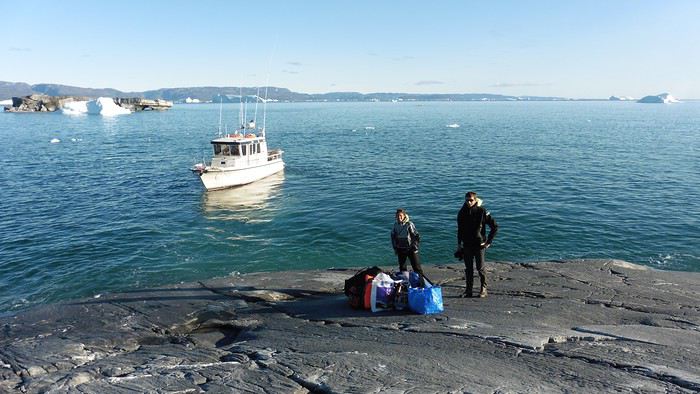
Here we were on the island, in the middle of nowhere, with all our luggage and food to organize, the tent to set up, and the kayaks to inflate—just 10 hours after leaving the Copenhagen hotel. We got to work, bothered by the flies. Despite our head nets, it was barely tolerable—there were so many of them. They swarmed by the dozens into every bag we opened. It was quite mild: 10°C.
Everything was ready by evening, and we were very happy to have completed all these transfers (planes and boat in a single day) as we slipped into our sleeping bags.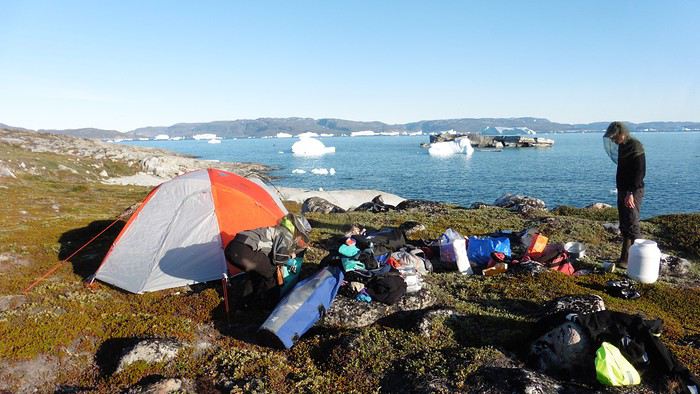
During the night, the wind picked up, and we went out several times to check the tent and kayak anchors. We noticed how bright it was—it was still quite twilight even at 1 AM.
Day 2 5:30 AM wake-up—the south wind was still strong, but since we were heading north, we decided to give it a try anyway.
This was also the moment we loaded the kayaks: since there were only three of us for two double-seater kayaks, we filled the hatch of one kayak, which allowed us to fit all our food. It would have been very difficult if there had been four of us for two kayaks.
Finally, we set off north along the western coast of the island. The conditions were far from ideal—the sea was rough, and the kayaks had a lot of wind resistance. But the main problem was the spray skirt: the gear on deck weighed it down, and the skirt kept coming off… We’d have to deal with it. Barely underway, and whales were already breaking the surface—it was our first time seeing them, and we were very impressed. Too bad the wind didn’t allow for longer contemplation; stopping paddling was impossible with such strong gusts.
We passed a few headlands and even considered stopping due to the conditions. To find some semblance of shelter, we had to hug the coast closely without cutting across the numerous bays, which significantly lengthened the journey. But as the morning went on, the wind died down, and the sea calmed. We spotted several whales and our first seals. It was almost pleasant during the picnic break. By late afternoon, we reached Kangerup Sarqâ Bay, where we had identified a great campsite with a very large beach and a river. But the wind had shifted—it was now coming from the north, making the last hour difficult due to fatigue and headwinds.
The campsite was ideal and beautiful, facing numerous icebergs grounded in the bay.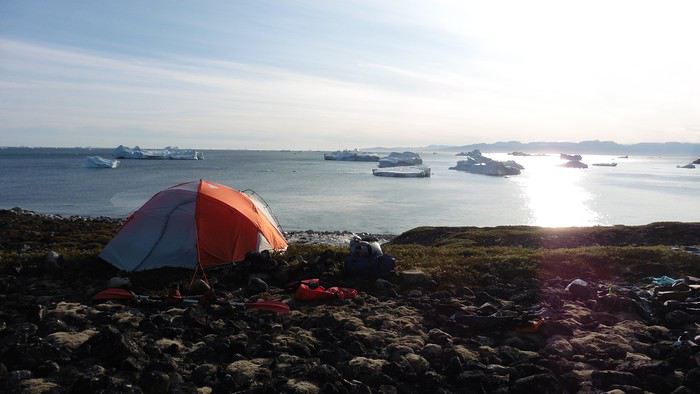
The GPS alerted us to another major drawback of inflatable kayaks: their slowness. It took us 7.5 hours of actual paddling (excluding breaks) to cover 28 km, averaging 3.7 km/h—somewhat disappointing. But we knew this before leaving, and once again, we’d have to make do!
Day 3 Surprise: at 6 AM wake-up, it was raining, foggy, with a south wind, and the sea was choppy even in the bay. It seemed wise to skip paddling, even though stopping on the second day was tough on morale. We went back to sleep, especially since the travel fatigue and the harsh conditions of the previous day had taken their toll.
At 11 AM, the navigation conditions weren’t any better—at the ends of the bay, we saw huge waves crashing onto the rocks, and giving up for the day became obvious. However, the rain had stopped, so we set off for a hike along the large lake bordering the bay. The wind hadn’t let up, and it was quite cold.
The tundra was starting to take on its autumn colors, and the contrast between the white lichens and the red vegetation was stunning. At the lake, we took out the fishing rods and quickly caught two beautiful Arctic char over 50 cm long.
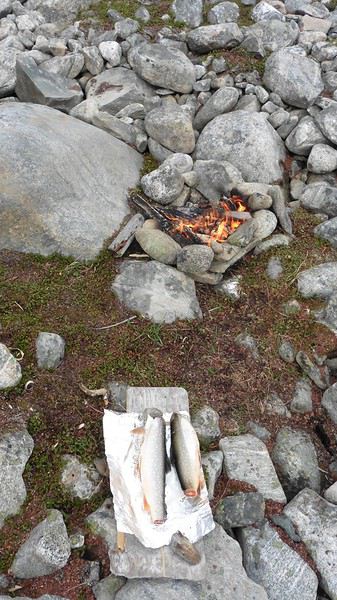
As the afternoon wore on, the sun seemed closer. Along the beach, we gathered driftwood (mostly old planks) to cook our catch in foil over a fire. Eating our own food in such a beautiful place next to a good fire was comforting after the day’s setback.
In the middle of the night, an Arctic fox entered the tent’s rear awning. It seemed barely intimidated when we shooed it away with loud shouts and then with stones.
Day 4 6:15 AM wake-up—3°C. We were on the water by 8 AM. The wind had dropped significantly, but the sea was shrouded in fog, and it was very cold in these damp conditions.
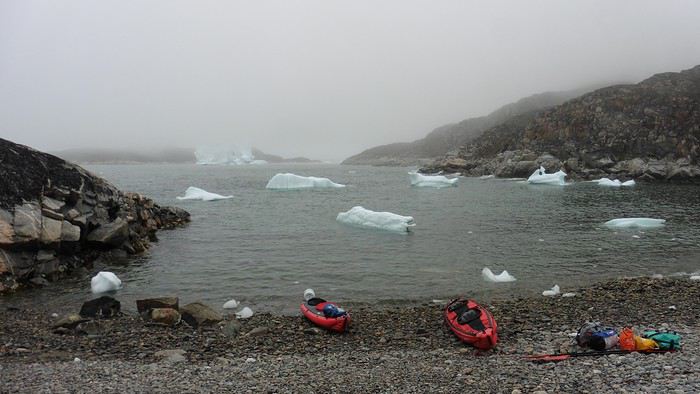
We passed the bay’s headland, Kangea, and headed toward the abandoned village of Agpat. The atmosphere was very austere—we hugged black rocks in fog that limited visibility to 50 meters, revealing large icebergs as we went.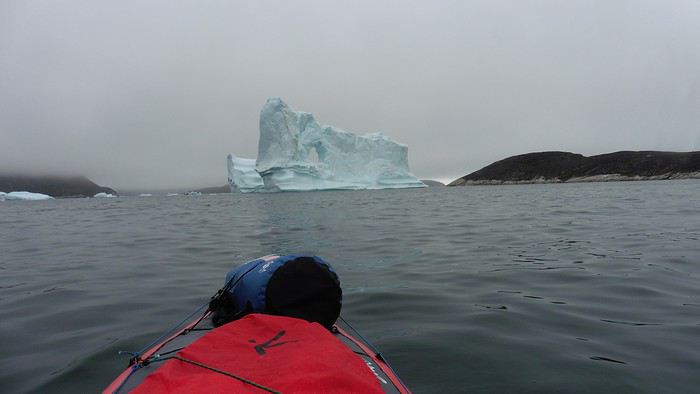
Suddenly, the water’s surface stirred in front of my kayak, and a huge gray back emerged from the sea. The collision was inevitable, but the whale seemed to understand and dove immediately, passing under the kayak and resurfacing a few meters away. I felt the kayak rock in the white foam and quickly paddled to escape the turbulence. What an emotion!
A light wind began to clear the fog, and the sun made beautiful appearances. Despite the cold, we stopped to visit the abandoned village, which left a strange impression. All the houses were still in good condition and wide open—some must have been very spacious in their time. We went back to sea, and in front of the large Kaangerdluk Bay, we hesitated—the headwind was strong, and large waves split the water. The next beach, from the island of Nua where we stopped to think, was over 8 km away. It was barely 2 PM, but caution led us to stop here for the day. We had covered 12 km—exactly the distance needed to stay on schedule. The afternoon was spent hiking on the island’s hills and gathering mussels and wood.
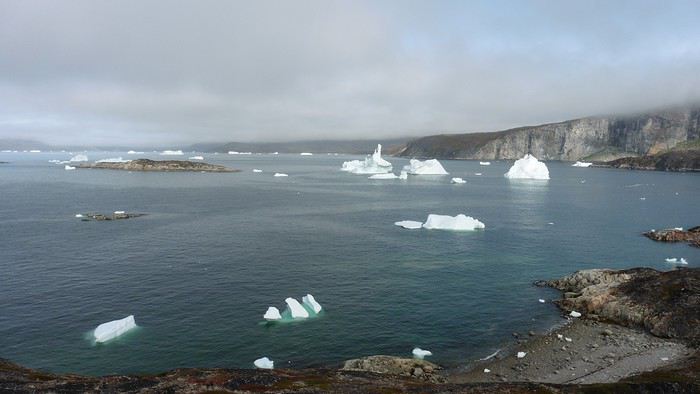
In the evening, we cooked these large Greenlandic mussels over a wood fire and savored them under the beautiful evening light. The weather was now fine, but the thermometer read -5°C in the sun…
Day 5 Bright sunshine, a glassy sea, and -8°C at 6 AM. Everything was green for setting off, even if putting on damp kayaking gear was a bit unpleasant in the cold. It was the first time we’d paddled on a flat sea since the start of the trip, and our average speed increased slightly.
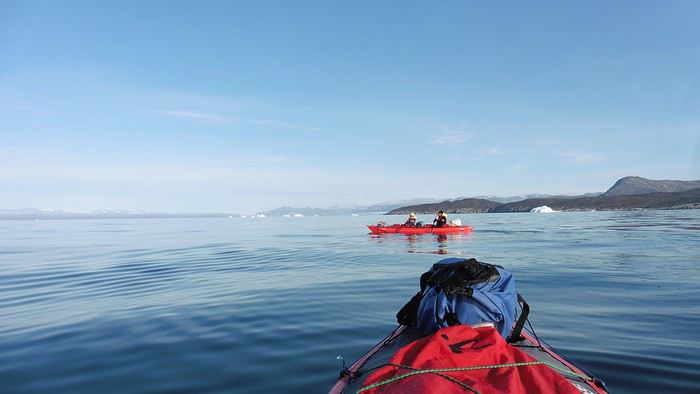
We entered the Smallesund Strait, marking the end of the island’s west coast. We were close to the large Torssukatak Fjord, where two glaciers flow. The access pass to the fjord was very narrow, and numerous ice chunks blocked access to the beaches. The wind had picked up and was now hitting us head-on (again). Just before entering the fjord, we landed on a steep beach made of large pebbles on Oqaitsut Island. It was very cold with the wind, and moving forward became difficult. We decided to stop for the day both because of the conditions and because the next campsite was far away, given how rugged the fjord was.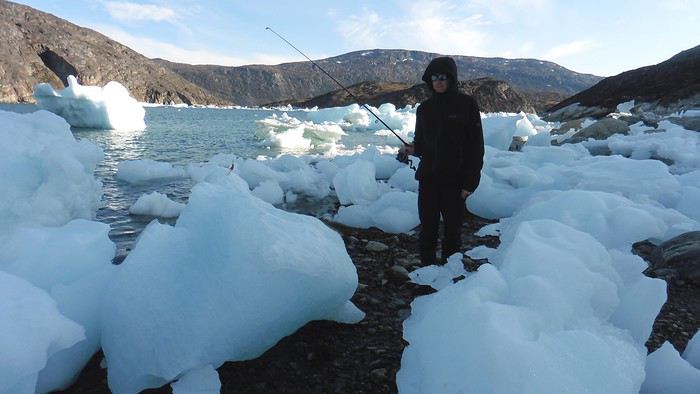
We eventually found a flat spot for the tent despite the steep slope. Even with the wind, the weather was beautiful, and we set off on foot for the northeastern cape of the island, overlooking the fjord. The view was far-reaching and exceptional—up close, the large fjord filled with ice and its steep granite cliffs, and in the distance, the ice cap and glacial walls.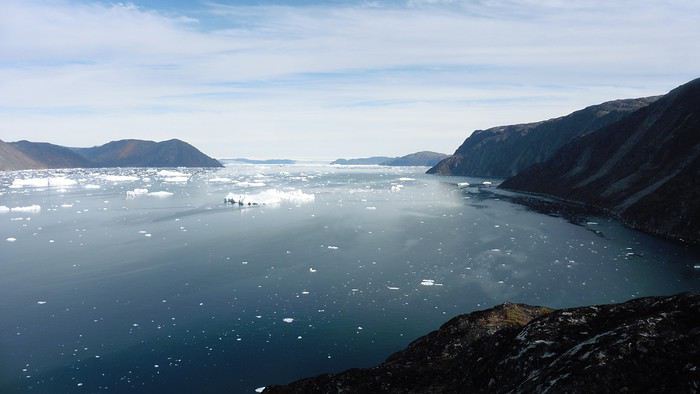
We spotted the village of Qeqertaq, whose network we could pick up, allowing us to check the weather forecast, which was rather good. While securing the kayaks in the evening, I noticed the strange behavior of one kayak at the end of the stage was due to the loss of the skeg—impossible to know where it detached. We’d have to do without it.
Day 6 Still that icy headwind from the northeast. We set off anyway for a long stage to reach the large pass connecting the Torssukatak and Ata Fjords.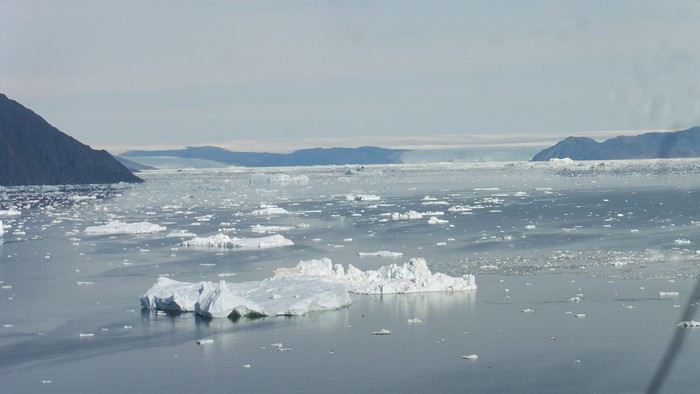
We advanced laboriously along the high cliffs of the fjord’s southern shore. They faced due north and blocked the sun. We felt the cold and dampness of the rock. It was really cold, especially in the extremities. We picnicked on the western cape of Qeqertakavasak Island. The cold didn’t allow us to stop for more than 20 minutes… But the wind dropped, and the sea was now very smooth. It was heavily cluttered with ice between the icebergs and old pack ice. The goal was to reach the large rocky promontory of Anapnuna, wedged between the Kujatdleq and Kangilerngata Glaciers, but the ice made progress difficult. We stopped to gain height on a small island and spot a passage of open water, but all we saw was white—passing seemed impossible. The currents were very complex, and entire sections of ice were being swept in one direction and then another at an impressive speed.
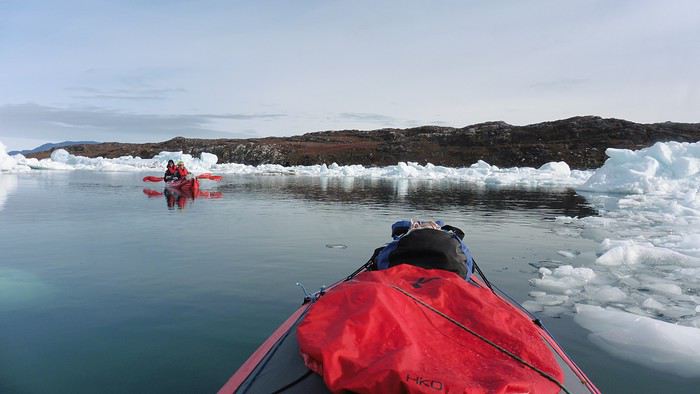
We wandered through this labyrinth until landing on a beach on the small island of Takissut, where we set up camp, exhausted from the 30 km covered and the vigilance required by the abundance of ice. The place was sublime under the evening sun—we were surrounded by ice and mountains, with the Kangilerngata Glacier in the distance. The summer contrasts were striking between the water, icebergs, sky, and flaming tundra—all colors were represented. Absolute calm reigned.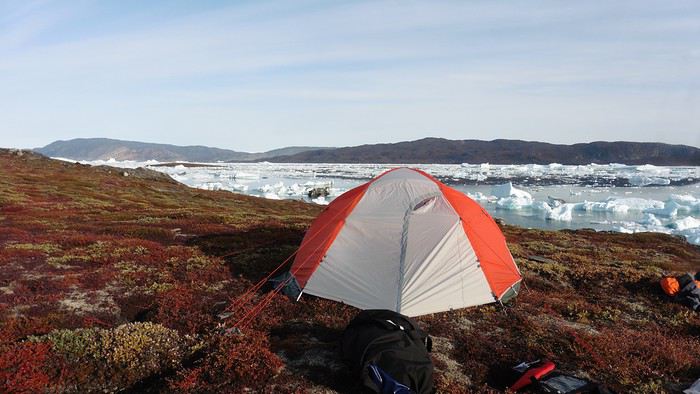
The lack of drinking water at this spot wasn’t too much of a constraint: as soon as we arrived on the beach, we placed containers under the icebergs stranded in the intertidal zone. They were all full by the time we finished setting up.
Day 7 We had to change our plans: we wouldn’t reach the rocky promontory, too well protected by the ice. We set off under the sun for Igdluluarssuit Island. Although we had spotted a passage just before launching, we quickly found ourselves surrounded by ice. It was everywhere, and finding water to paddle became complicated. We tried to force our way in every direction, even retracing our steps. Everything moved at an impressive speed—we were in the middle of a whirlpool of ice.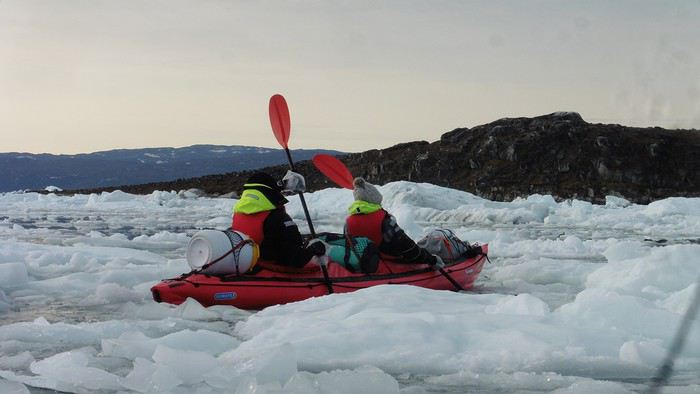
The tension rose, and each boat had its share of big scares. I was trapped against ice floes that dragged me toward an iceberg—the pressure on the kayak was enormous; it was going to capsize or puncture! But with a few strong strokes and paddling against the ice, I managed to free myself from the trap. Barely 10 minutes later, my companions were sandwiched perpendicularly between two icebergs that were closing in. The situation was desperate—the kayak was bending and twisting more and more, but with some strong paddle strokes, it finally freed itself. After these particularly unpleasant moments, we were completely blocked. The drifting ice floes had tightened, and the kayaks were no longer even in the water… The only solution: wait with the kayaks on these floes, which were too thin to walk on (even though we didn’t try). Within minutes, the situation cleared—a waterway opened, and we rushed into it. We paddled with one goal: find a larger pool of water. After going back and forth, our path took shape—we had to force the passage several times, attacking the ice directly with the kayaks, and finally, we escaped the worst of the labyrinth. We reached land on the west side of the island and saw that the rest would be easier. To reach the island, we just had to cross the Arsiviup Ikera Strait, which was lightly cluttered. We reached the eastern cape of the island, ideal for camping, even though we had only paddled for 3 hours. We set up camp and hiked to the island’s summit, which overlooks the entire pass and the glaciers.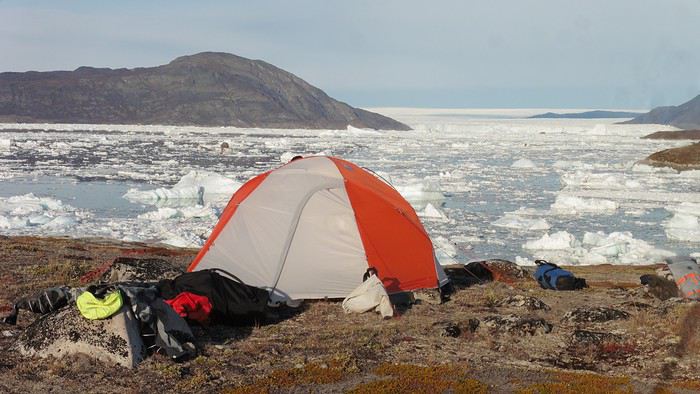
Everything was magnificent, no matter the direction. At 2 PM, we were at the summit—the beauty of the place and the picnic facing the glacier in the sun without wind made us forget the near-disaster from a few hours earlier. It would be impossible to approach the glacier by kayak, but from our summit on foot, it seemed so close, and contemplating it safely on solid ground was a great moment.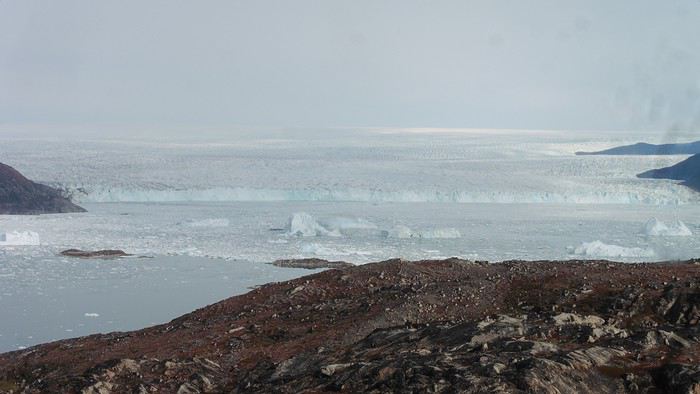
The pass was incredibly complex—everything was in motion, and an impassable passage could become open water within minutes. We were delighted when we returned to camp. A slightly lost whale among the ice accompanied us along the shore. The place was truly beautiful, but the temperature dropped again under the clear sky, preventing us from eating outside.
Day 8 Clear and cold at wake-up: -9°C. The sea had frozen in many places. We hesitated about the rest of the trip—should we start heading back to Ilulissat or linger in the pass, especially to approach the Eqi Glacier? After the incidents of the previous day, we decided to think carefully and paddled to the southern cape of our island to check the ice conditions toward Eqi. The weather had clouded over in the meantime, and the sky was quite gray. At the cape, we spotted the glacier’s wall, still 15 km away.
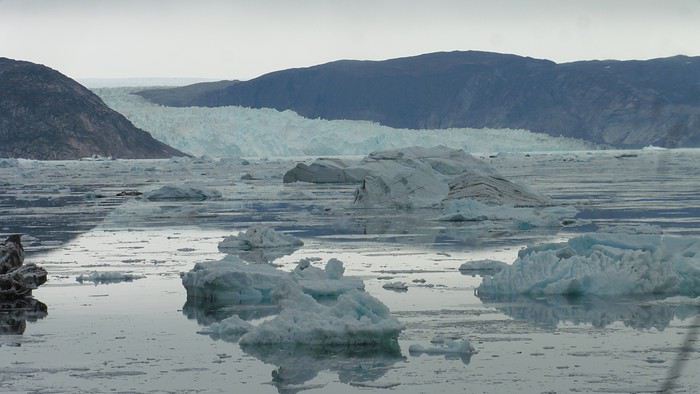
The fjord was quite cluttered, but it seemed passable. However, there was no guarantee the view would be much better 1 km from the glacier than 15 km away, especially since the front was quite active and therefore dangerous. We decided to head south without passing by the glacier. The cold temperatures encountered in the pass also motivated us to move away from the glaciers and the ice cap. We navigated under a threatening sky but without wind. The kayaks cut through the thin layer of ice on the surface with a crinkling paper sound. We reached the Ata campsite in the late afternoon after 5 hours of rowing without a single break…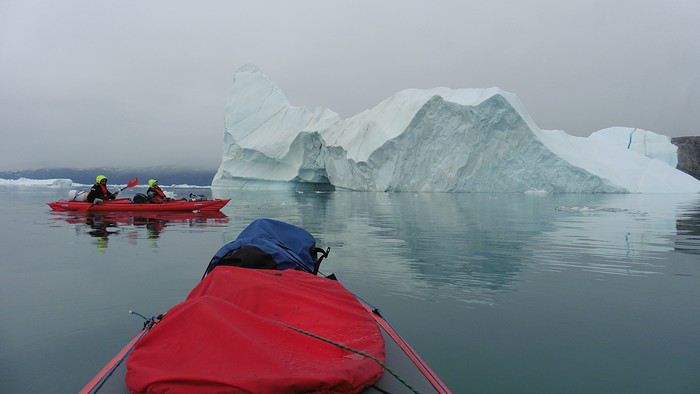
The wind had picked up, and we discovered a nice surprise: a refuge with a table and a comfortable bench lined with mattresses. Facing the worsening weather, we settled in comfortably. The kerosene stove was too complex for our three brains—we couldn’t get it started, too bad, as it was 0°C inside. The rest of the afternoon was spent fishing in the large lake, where we landed a beautiful Arctic char, more than enough for three. A good night’s sleep without the risk of foxes or the sound of a tent shaking in the wind.
Day 9 6 AM wake-up to the sound of rain hitting the cabin. The decision was made looking out the window—wind, rain, and fog obscured the sea: we went back to sleep.
New wake-up, and the rain had stopped—we could go out and stock up on fish. We set off on foot toward the lake, following its western shore. It was very overcast, and the wind encouraged us to keep moving. We made our way to a smaller lake at the end of the large one, where we caught a huge Arctic char. A small clearing brightened the picnic, and we headed back to our cabin.
This 20 km hike kept us busy all day: walking on slippery scree and the micro-relief of the peat bogs took time.
Day 10 The sky was clear, but a light south wind made paddling intense. We set off southeast to reach the opposite shore of the fjord. It was very cold, and it was impossible to stop paddling for even a moment without immediately losing ground due to the wind. We crossed the Kangerluarsuk Fjord. I recognized the cape I had reached on skis in the winter of 2017. We found a nice campsite on the southern shore of the fjord: Uiartag. It wasn’t even noon, but facing this headwind, we preferred to stop here rather than exhaust ourselves for a few extra kilometers. Like the previous ones, this campsite was very comfortable: the ground was covered with a thick layer of lichens and mosses, very pleasant to lie on.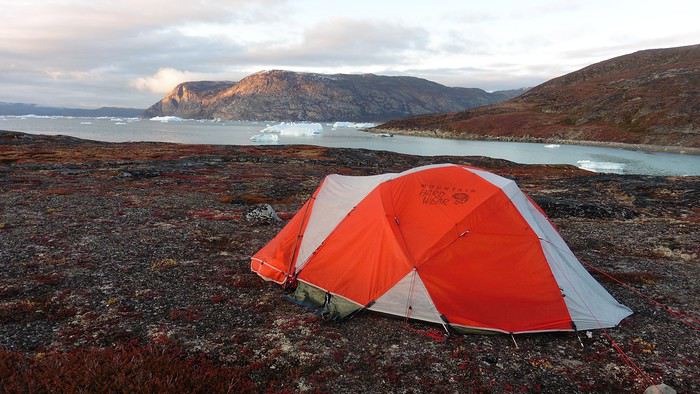
We set off on a hike to the heights of the cape, where the weather alternated between large clearings and snow showers. We noticed the loss of the thermometer, poorly attached to the backpack. On the way back, in the small bay of our beach, a whale swam calmly 10 meters from the shore—a beautiful surprise.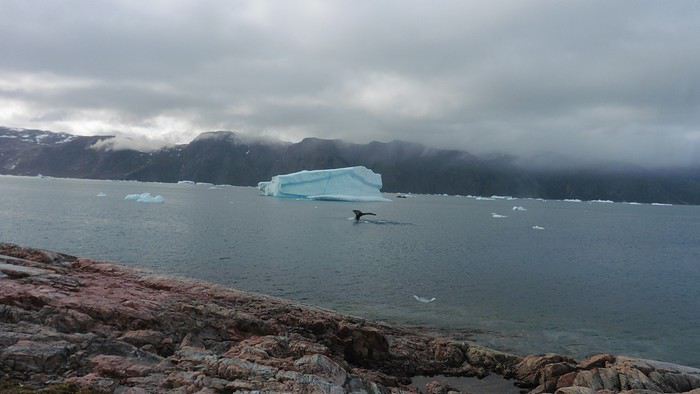
The sky cleared completely, and the temperature dropped as night approached.
We’re setting off as a group of three in two inflatable double-seater kayaks (Gumotex) brought from France. The plan is to spend two weeks circumnavigating Arve Princess Island, located north of Ilulissat in Disko Bay, with a possible boat drop-off at the southern tip of the island.
This seems like a fairly classic route in the area—we found several descriptions online (thanks to the authors). With their help and Google Earth, we identified all potential campsites and entered their coordinates into a GPS. The western part of the island, facing the bay, seems ideal for whale watching, while the more rugged eastern side offers access to several glacial walls. We’re somewhat familiar with the area from two winter expeditions on skis and pulkas.
Plus, the commitment is limited due to the island’s proximity to several small villages, including Qeqertaq, Oqaatsut, and even Ilulissat. In fact, we saw fishing boats almost every day. The distance suits us well: 200 kilometers in 16 full days on site, which should leave some leeway in case of bad weather or for hiking.
We booked our flights in June with Air Greenland to Ilulissat for the last week of August and the first week of September. On both the outbound and return trips, we stayed overnight in Copenhagen. The France-Copenhagen flight was with Air France.
We were allowed 3 x 20 kg in the hold. Each kayak with its accessories fits into a 20 kg bag; the last hold bag is for shared gear: tent, stoves, dry bags… We only brought 1.5 kg of semolina for food. In the end, we had 61 kg of gear, and no excess baggage was charged.
Individual gear (clothes and sleeping bags…) was distributed in the cabin luggage.
For the boat transfer, we contacted an agency: Blue Jay, which gave us a number to call upon arrival.
Day 0: Wednesday, August 22 Departure day. After work, I drove from Gap to Marseille’s Marignane Airport for the first leg of the trip to Copenhagen. I enjoyed the rather mild local temperatures: 35°C in the shade. After a layover in Paris, I arrived at the Copenhagen hotel, located two train stops from the airport, where my companions were already settled. No issues—everyone was on time with their luggage.
Day 1 The flight to Greenland was at 9 AM. We had a layover in Kangerlussuaq, where we changed planes, then stopped in Aasiaat before reaching Ilulissat Airport at 3 PM under beautiful sunshine.
We called Blue Jay for the boat transfer: they could take us to the island as early as 6 PM; otherwise, we’d have to wait until the next day. That left us 3 hours to prepare our gear and, most importantly, do our shopping for the two-week trip—it seemed tight, but we gave it a shot.
A quick taxi ride took us to Pisiffik, where we easily found everything we needed: bread, butter, cheese, cold cuts, rice, pasta, jam, muesli… There was no C fuel or methylated spirits for the stoves, but this time we knew the trick: at Stark, a bit uphill from the town, we found the precious liquids. Two hours later, we filled our dry bags and containers with our purchases, and by 5:30 PM, we met Klaus, the Blue Jay manager, directly at the port.
The vacation seemed to truly begin as we sped by boat through the icebergs toward Arve Princess Island. Forty-five minutes later, we spotted a beach lined with rocks where Klaus dropped us off quickly (he had another transfer to make right after).
Here we were on the island, in the middle of nowhere, with all our luggage and food to organize, the tent to set up, and the kayaks to inflate—just 10 hours after leaving the Copenhagen hotel. We got to work, bothered by the flies. Despite our head nets, it was barely tolerable—there were so many of them. They swarmed by the dozens into every bag we opened. It was quite mild: 10°C.
Everything was ready by evening, and we were very happy to have completed all these transfers (planes and boat in a single day) as we slipped into our sleeping bags.
During the night, the wind picked up, and we went out several times to check the tent and kayak anchors. We noticed how bright it was—it was still quite twilight even at 1 AM.
Day 2 5:30 AM wake-up—the south wind was still strong, but since we were heading north, we decided to give it a try anyway.
This was also the moment we loaded the kayaks: since there were only three of us for two double-seater kayaks, we filled the hatch of one kayak, which allowed us to fit all our food. It would have been very difficult if there had been four of us for two kayaks.
Finally, we set off north along the western coast of the island. The conditions were far from ideal—the sea was rough, and the kayaks had a lot of wind resistance. But the main problem was the spray skirt: the gear on deck weighed it down, and the skirt kept coming off… We’d have to deal with it. Barely underway, and whales were already breaking the surface—it was our first time seeing them, and we were very impressed. Too bad the wind didn’t allow for longer contemplation; stopping paddling was impossible with such strong gusts.
We passed a few headlands and even considered stopping due to the conditions. To find some semblance of shelter, we had to hug the coast closely without cutting across the numerous bays, which significantly lengthened the journey. But as the morning went on, the wind died down, and the sea calmed. We spotted several whales and our first seals. It was almost pleasant during the picnic break. By late afternoon, we reached Kangerup Sarqâ Bay, where we had identified a great campsite with a very large beach and a river. But the wind had shifted—it was now coming from the north, making the last hour difficult due to fatigue and headwinds.
The campsite was ideal and beautiful, facing numerous icebergs grounded in the bay.
The GPS alerted us to another major drawback of inflatable kayaks: their slowness. It took us 7.5 hours of actual paddling (excluding breaks) to cover 28 km, averaging 3.7 km/h—somewhat disappointing. But we knew this before leaving, and once again, we’d have to make do!
Day 3 Surprise: at 6 AM wake-up, it was raining, foggy, with a south wind, and the sea was choppy even in the bay. It seemed wise to skip paddling, even though stopping on the second day was tough on morale. We went back to sleep, especially since the travel fatigue and the harsh conditions of the previous day had taken their toll.
At 11 AM, the navigation conditions weren’t any better—at the ends of the bay, we saw huge waves crashing onto the rocks, and giving up for the day became obvious. However, the rain had stopped, so we set off for a hike along the large lake bordering the bay. The wind hadn’t let up, and it was quite cold.
The tundra was starting to take on its autumn colors, and the contrast between the white lichens and the red vegetation was stunning. At the lake, we took out the fishing rods and quickly caught two beautiful Arctic char over 50 cm long.
As the afternoon wore on, the sun seemed closer. Along the beach, we gathered driftwood (mostly old planks) to cook our catch in foil over a fire. Eating our own food in such a beautiful place next to a good fire was comforting after the day’s setback.
In the middle of the night, an Arctic fox entered the tent’s rear awning. It seemed barely intimidated when we shooed it away with loud shouts and then with stones.
Day 4 6:15 AM wake-up—3°C. We were on the water by 8 AM. The wind had dropped significantly, but the sea was shrouded in fog, and it was very cold in these damp conditions.
We passed the bay’s headland, Kangea, and headed toward the abandoned village of Agpat. The atmosphere was very austere—we hugged black rocks in fog that limited visibility to 50 meters, revealing large icebergs as we went.
Suddenly, the water’s surface stirred in front of my kayak, and a huge gray back emerged from the sea. The collision was inevitable, but the whale seemed to understand and dove immediately, passing under the kayak and resurfacing a few meters away. I felt the kayak rock in the white foam and quickly paddled to escape the turbulence. What an emotion!
A light wind began to clear the fog, and the sun made beautiful appearances. Despite the cold, we stopped to visit the abandoned village, which left a strange impression. All the houses were still in good condition and wide open—some must have been very spacious in their time. We went back to sea, and in front of the large Kaangerdluk Bay, we hesitated—the headwind was strong, and large waves split the water. The next beach, from the island of Nua where we stopped to think, was over 8 km away. It was barely 2 PM, but caution led us to stop here for the day. We had covered 12 km—exactly the distance needed to stay on schedule. The afternoon was spent hiking on the island’s hills and gathering mussels and wood.
In the evening, we cooked these large Greenlandic mussels over a wood fire and savored them under the beautiful evening light. The weather was now fine, but the thermometer read -5°C in the sun…
Day 5 Bright sunshine, a glassy sea, and -8°C at 6 AM. Everything was green for setting off, even if putting on damp kayaking gear was a bit unpleasant in the cold. It was the first time we’d paddled on a flat sea since the start of the trip, and our average speed increased slightly.
We entered the Smallesund Strait, marking the end of the island’s west coast. We were close to the large Torssukatak Fjord, where two glaciers flow. The access pass to the fjord was very narrow, and numerous ice chunks blocked access to the beaches. The wind had picked up and was now hitting us head-on (again). Just before entering the fjord, we landed on a steep beach made of large pebbles on Oqaitsut Island. It was very cold with the wind, and moving forward became difficult. We decided to stop for the day both because of the conditions and because the next campsite was far away, given how rugged the fjord was.
We eventually found a flat spot for the tent despite the steep slope. Even with the wind, the weather was beautiful, and we set off on foot for the northeastern cape of the island, overlooking the fjord. The view was far-reaching and exceptional—up close, the large fjord filled with ice and its steep granite cliffs, and in the distance, the ice cap and glacial walls.
We spotted the village of Qeqertaq, whose network we could pick up, allowing us to check the weather forecast, which was rather good. While securing the kayaks in the evening, I noticed the strange behavior of one kayak at the end of the stage was due to the loss of the skeg—impossible to know where it detached. We’d have to do without it.
Day 6 Still that icy headwind from the northeast. We set off anyway for a long stage to reach the large pass connecting the Torssukatak and Ata Fjords.
We advanced laboriously along the high cliffs of the fjord’s southern shore. They faced due north and blocked the sun. We felt the cold and dampness of the rock. It was really cold, especially in the extremities. We picnicked on the western cape of Qeqertakavasak Island. The cold didn’t allow us to stop for more than 20 minutes… But the wind dropped, and the sea was now very smooth. It was heavily cluttered with ice between the icebergs and old pack ice. The goal was to reach the large rocky promontory of Anapnuna, wedged between the Kujatdleq and Kangilerngata Glaciers, but the ice made progress difficult. We stopped to gain height on a small island and spot a passage of open water, but all we saw was white—passing seemed impossible. The currents were very complex, and entire sections of ice were being swept in one direction and then another at an impressive speed.
We wandered through this labyrinth until landing on a beach on the small island of Takissut, where we set up camp, exhausted from the 30 km covered and the vigilance required by the abundance of ice. The place was sublime under the evening sun—we were surrounded by ice and mountains, with the Kangilerngata Glacier in the distance. The summer contrasts were striking between the water, icebergs, sky, and flaming tundra—all colors were represented. Absolute calm reigned.
The lack of drinking water at this spot wasn’t too much of a constraint: as soon as we arrived on the beach, we placed containers under the icebergs stranded in the intertidal zone. They were all full by the time we finished setting up.
Day 7 We had to change our plans: we wouldn’t reach the rocky promontory, too well protected by the ice. We set off under the sun for Igdluluarssuit Island. Although we had spotted a passage just before launching, we quickly found ourselves surrounded by ice. It was everywhere, and finding water to paddle became complicated. We tried to force our way in every direction, even retracing our steps. Everything moved at an impressive speed—we were in the middle of a whirlpool of ice.
The tension rose, and each boat had its share of big scares. I was trapped against ice floes that dragged me toward an iceberg—the pressure on the kayak was enormous; it was going to capsize or puncture! But with a few strong strokes and paddling against the ice, I managed to free myself from the trap. Barely 10 minutes later, my companions were sandwiched perpendicularly between two icebergs that were closing in. The situation was desperate—the kayak was bending and twisting more and more, but with some strong paddle strokes, it finally freed itself. After these particularly unpleasant moments, we were completely blocked. The drifting ice floes had tightened, and the kayaks were no longer even in the water… The only solution: wait with the kayaks on these floes, which were too thin to walk on (even though we didn’t try). Within minutes, the situation cleared—a waterway opened, and we rushed into it. We paddled with one goal: find a larger pool of water. After going back and forth, our path took shape—we had to force the passage several times, attacking the ice directly with the kayaks, and finally, we escaped the worst of the labyrinth. We reached land on the west side of the island and saw that the rest would be easier. To reach the island, we just had to cross the Arsiviup Ikera Strait, which was lightly cluttered. We reached the eastern cape of the island, ideal for camping, even though we had only paddled for 3 hours. We set up camp and hiked to the island’s summit, which overlooks the entire pass and the glaciers.
Everything was magnificent, no matter the direction. At 2 PM, we were at the summit—the beauty of the place and the picnic facing the glacier in the sun without wind made us forget the near-disaster from a few hours earlier. It would be impossible to approach the glacier by kayak, but from our summit on foot, it seemed so close, and contemplating it safely on solid ground was a great moment.
The pass was incredibly complex—everything was in motion, and an impassable passage could become open water within minutes. We were delighted when we returned to camp. A slightly lost whale among the ice accompanied us along the shore. The place was truly beautiful, but the temperature dropped again under the clear sky, preventing us from eating outside.
Day 8 Clear and cold at wake-up: -9°C. The sea had frozen in many places. We hesitated about the rest of the trip—should we start heading back to Ilulissat or linger in the pass, especially to approach the Eqi Glacier? After the incidents of the previous day, we decided to think carefully and paddled to the southern cape of our island to check the ice conditions toward Eqi. The weather had clouded over in the meantime, and the sky was quite gray. At the cape, we spotted the glacier’s wall, still 15 km away.
The fjord was quite cluttered, but it seemed passable. However, there was no guarantee the view would be much better 1 km from the glacier than 15 km away, especially since the front was quite active and therefore dangerous. We decided to head south without passing by the glacier. The cold temperatures encountered in the pass also motivated us to move away from the glaciers and the ice cap. We navigated under a threatening sky but without wind. The kayaks cut through the thin layer of ice on the surface with a crinkling paper sound. We reached the Ata campsite in the late afternoon after 5 hours of rowing without a single break…
The wind had picked up, and we discovered a nice surprise: a refuge with a table and a comfortable bench lined with mattresses. Facing the worsening weather, we settled in comfortably. The kerosene stove was too complex for our three brains—we couldn’t get it started, too bad, as it was 0°C inside. The rest of the afternoon was spent fishing in the large lake, where we landed a beautiful Arctic char, more than enough for three. A good night’s sleep without the risk of foxes or the sound of a tent shaking in the wind.
Day 9 6 AM wake-up to the sound of rain hitting the cabin. The decision was made looking out the window—wind, rain, and fog obscured the sea: we went back to sleep.
New wake-up, and the rain had stopped—we could go out and stock up on fish. We set off on foot toward the lake, following its western shore. It was very overcast, and the wind encouraged us to keep moving. We made our way to a smaller lake at the end of the large one, where we caught a huge Arctic char. A small clearing brightened the picnic, and we headed back to our cabin.
This 20 km hike kept us busy all day: walking on slippery scree and the micro-relief of the peat bogs took time.
Day 10 The sky was clear, but a light south wind made paddling intense. We set off southeast to reach the opposite shore of the fjord. It was very cold, and it was impossible to stop paddling for even a moment without immediately losing ground due to the wind. We crossed the Kangerluarsuk Fjord. I recognized the cape I had reached on skis in the winter of 2017. We found a nice campsite on the southern shore of the fjord: Uiartag. It wasn’t even noon, but facing this headwind, we preferred to stop here rather than exhaust ourselves for a few extra kilometers. Like the previous ones, this campsite was very comfortable: the ground was covered with a thick layer of lichens and mosses, very pleasant to lie on.
We set off on a hike to the heights of the cape, where the weather alternated between large clearings and snow showers. We noticed the loss of the thermometer, poorly attached to the backpack. On the way back, in the small bay of our beach, a whale swam calmly 10 meters from the shore—a beautiful surprise.
The sky cleared completely, and the temperature dropped as night approached.
Séjour multi-activités à Québec en décembre English translation pending
Bonjour,
je prépare notre séjour à Québec pour Décembre 2018 les billets d'avion sont déjà achetés objectif recherché : trouver un hébergement le plus près possible de la ville de Québec (notre fils y travaille) qui nous proposerait du "tout inclus" c'est à dire : - aller nous chercher à l'aéroport de Montréal et nous ramener pour notre retour (nous ne pensons pas louer de voiture) - nous proposer des activités de chiens de traîneaux, moto-neige, cabane à sucre (je connais en été mais pas en hiver), raquettes, match de hockey, bref toute activité pouvant se proposer en hiver, sauf le ski - nous proposer la formule 1/2 pension ou pension complète. j'oubliais : nous serons 3 ou 4 suivant la présente ou nom de mon fils
j'ai bien sur commencé à chercher mais tout ce que je trouve est du côté de Montréal existe-t-il des gîtes qui ont font ce genre de formule ? cela nous permettrait de rencontrer des gens et partager avec eux, contrairement à la formule hôtel. si vous avez des idées, des contacts, merci d'avance !
je prépare notre séjour à Québec pour Décembre 2018 les billets d'avion sont déjà achetés objectif recherché : trouver un hébergement le plus près possible de la ville de Québec (notre fils y travaille) qui nous proposerait du "tout inclus" c'est à dire : - aller nous chercher à l'aéroport de Montréal et nous ramener pour notre retour (nous ne pensons pas louer de voiture) - nous proposer des activités de chiens de traîneaux, moto-neige, cabane à sucre (je connais en été mais pas en hiver), raquettes, match de hockey, bref toute activité pouvant se proposer en hiver, sauf le ski - nous proposer la formule 1/2 pension ou pension complète. j'oubliais : nous serons 3 ou 4 suivant la présente ou nom de mon fils
j'ai bien sur commencé à chercher mais tout ce que je trouve est du côté de Montréal existe-t-il des gîtes qui ont font ce genre de formule ? cela nous permettrait de rencontrer des gens et partager avec eux, contrairement à la formule hôtel. si vous avez des idées, des contacts, merci d'avance !
Road trip en Andalousie avec enfants de 4 et 7 ans English translation pending
Bonjour à tous,
Nous voyagerons à la Toussaint pour 10 jour en Andalousie.
Notre première interrogation est la suivante : Est il nécessaire de réserver à l’avance les logements où au jour le jour c’est jouable à cette saison ??
Merci pour vos réponses
Nous voyagerons à la Toussaint pour 10 jour en Andalousie.
Notre première interrogation est la suivante : Est il nécessaire de réserver à l’avance les logements où au jour le jour c’est jouable à cette saison ??
Merci pour vos réponses
Randonnée raquettes entre amis English translation pending
Bonjour,
Nous sommes un petit groupe d'amis (6 pers) et nous recherchons notre prochain séjour hivernal pour une semaine de randonnée à raquettes. Nous souhaitons partir hors-saison fin janvier début février 2019.
Nous avons cherché dans le Jura (Les Rousses/Lamoura) mais cela semble au delà de notre hors budget (500 euros/pers, hébergement en demi-pension).
Nous élargissons nos recherches à l'Auvergne et aux Alpes, mais ne trouvons pas notre bonheur.
Est-ce que vous avez des références de gîtes ou hôtel en demi-pension dans le Jura ou en Auvergne ?
Nous sommes un petit groupe d'amis (6 pers) et nous recherchons notre prochain séjour hivernal pour une semaine de randonnée à raquettes. Nous souhaitons partir hors-saison fin janvier début février 2019.
Nous avons cherché dans le Jura (Les Rousses/Lamoura) mais cela semble au delà de notre hors budget (500 euros/pers, hébergement en demi-pension).
Nous élargissons nos recherches à l'Auvergne et aux Alpes, mais ne trouvons pas notre bonheur.
Est-ce que vous avez des références de gîtes ou hôtel en demi-pension dans le Jura ou en Auvergne ?
PVT Argentine: Bariloche et sa beauté naturelle en 2 minutes 20 (vidéo) English translation pending
Cela fait 6 mois que je voyage en Argentine avec une amie et notre séjour a commencé en début d'année. Après le passage obligé par la capitale Buenos Aires, nous avons pris la direction de la Patagonie et sa nature éblouissante !! Nous avons commencé par le nord de la Patagonie avec San Carlos de Bariloche. Sa nature, ses montagnes et ses lacs nous ont fait succomber.
La ville est connue pour son chocolat, mais aussi pour sa célèbre station de ski en hiver, Cerro Catedral, et pour ses sentiers de randonnées en été. Plusieurs points qui font qu’on la surnomme parfois la petite suisse des Andes. Bariloche est une ville charmante sur les bords du lac Nahuel Huapi, en plein cœur du Parc National Nahuel Huapi. Nous y avons passé une semaine et nous avons beaucoup apprécié notre séjour même si nous y étions en pleine saison touristique. Pour ceux qui aime la nature, les randonnées et la montagne, vous serez servi ! Pour vous donner un avant goût de ce que vous pourriez découvrir à Bariloche, mon amie et moi avons fait une vidéo de 2min20, top chrono, pour vous mettre l'eau à la bouche sans pour autant tout vous dévoiler. 😉 Dites moi ce que vous en pensez. Et si vous avez déjà eu la chance de passer par cette ville, ou même peut être d’y vivre, je serais ravie d'avoir votre ressenti !
https://www.youtube.com/watch?v=-VkrgN4V4GU&t=10s
La ville est connue pour son chocolat, mais aussi pour sa célèbre station de ski en hiver, Cerro Catedral, et pour ses sentiers de randonnées en été. Plusieurs points qui font qu’on la surnomme parfois la petite suisse des Andes. Bariloche est une ville charmante sur les bords du lac Nahuel Huapi, en plein cœur du Parc National Nahuel Huapi. Nous y avons passé une semaine et nous avons beaucoup apprécié notre séjour même si nous y étions en pleine saison touristique. Pour ceux qui aime la nature, les randonnées et la montagne, vous serez servi ! Pour vous donner un avant goût de ce que vous pourriez découvrir à Bariloche, mon amie et moi avons fait une vidéo de 2min20, top chrono, pour vous mettre l'eau à la bouche sans pour autant tout vous dévoiler. 😉 Dites moi ce que vous en pensez. Et si vous avez déjà eu la chance de passer par cette ville, ou même peut être d’y vivre, je serais ravie d'avoir votre ressenti !
https://www.youtube.com/watch?v=-VkrgN4V4GU&t=10s
Itinéraire 3 mois Argentine et Chili English translation pending
Bonjour,
Je suis actuellement en Bolivie. Je vais pouvoir voyager au Chili et en Argentine, en partant de la ville de Sucre (Bolivie), pour une durée de 3 mois. Mon billet de retour, pour revenir en France, est à Sucre, en Bolivie. C'est pourquoi je fais appel à vous pour des conseils d'itinéraires au Chili et en Argentine, sur une période de trois mois.
Pour profiter plus longtemps de mon périple, et pour éviter un fastidieux retour en bus pour rejoindre la Bolivie, je songe à prendre un avion à Buenos Aires ou à Santiago, pour revenir à Sucre, pour pouvoir prendre mon billet d'avion vers la France.
Pensez-vous que je peux avoir le temps de descendre en Patagonie et de revenir en Bolivie ensuite ? Quels sont les endroits que vous recommandez de visiter au Chili, en Argentine et même en Uruguay ? Quels sont les itinéraires que vous me suggérez pour une période de 3 mois de voyage ?
Je vous remercie d'avance.
Je vous souhaite de beaux voyages à toutes et tous !
Je suis actuellement en Bolivie. Je vais pouvoir voyager au Chili et en Argentine, en partant de la ville de Sucre (Bolivie), pour une durée de 3 mois. Mon billet de retour, pour revenir en France, est à Sucre, en Bolivie. C'est pourquoi je fais appel à vous pour des conseils d'itinéraires au Chili et en Argentine, sur une période de trois mois.
Pour profiter plus longtemps de mon périple, et pour éviter un fastidieux retour en bus pour rejoindre la Bolivie, je songe à prendre un avion à Buenos Aires ou à Santiago, pour revenir à Sucre, pour pouvoir prendre mon billet d'avion vers la France.
Pensez-vous que je peux avoir le temps de descendre en Patagonie et de revenir en Bolivie ensuite ? Quels sont les endroits que vous recommandez de visiter au Chili, en Argentine et même en Uruguay ? Quels sont les itinéraires que vous me suggérez pour une période de 3 mois de voyage ?
Je vous remercie d'avance.
Je vous souhaite de beaux voyages à toutes et tous !
Aéroport de Lyon, terminal T1B English translation pending
Un an est passé depuis ma première utilisation et je viens a nouveau d'utiliser le terminal T1B ; le constat reste inchangé !
Pour l'aller nous avons du attendre la désignation de la porte d'embarquement dans une sorte de hangar situé au milieu des pistes , accessible par un souterrain et sans aucun service digne de ce nom (un distributeur de boisson et des toilettes) les boutiques existent mais sont toutes fermées.
Au retour, atterrissage 23h10(merci Transavia pour les 10 mn d'avace), il aura fallu plus d'une heure pour délivrer nos bagages ; il faudra 40 minutes pour que la navette parking (à priori unique à cette heure) réussisse à nous emmeer à notre parking.
Je me garderai de rappeler le marathon intérieur à effectuer dans l'aéroport, l'inefficience des contrôles bagages et aux frontières ; je n’évoquerai pas la signalétique désastreuse des départs de navettes, ni la géolocalisation de celles-ci également en panne ; heureusement qu'il existe de la solidarité entre voyageurs et des personnes habituées des lieux.
Stop dans le Vermont + itinéraire au Québec en transport en commun English translation pending
Bonjour
Nous serons 2 adultes et un enfant. Nous souhaiterions passer 2 nuits dans le Vermont.
Nous devrions a priori arriver en voiture depuis Boston sauf s'il est simple de s'y rendre en bus ou train. Si nous arrivons en voiture nous souhaiterions rendre la voiture aux Etats Unis.
Nous aimerions visiter un endroit avec de beaux paysages puis ensuite nous rendre dans la ville de Quebec par train ou bus.
Auriez vous un conseil de stop dans le Vermont et m'indiquer comment on peut se rendre à Quebec? Merci
Nous devrions a priori arriver en voiture depuis Boston sauf s'il est simple de s'y rendre en bus ou train. Si nous arrivons en voiture nous souhaiterions rendre la voiture aux Etats Unis.
Nous aimerions visiter un endroit avec de beaux paysages puis ensuite nous rendre dans la ville de Quebec par train ou bus.
Auriez vous un conseil de stop dans le Vermont et m'indiquer comment on peut se rendre à Quebec? Merci
Road trip Grand Canyon - Lake Powell - Monument Valley - Zion English translation pending
Bonjour à tous :)
J'ai besoin de quelques conseils...
Road trip aux USA en AOUT 2018. Je souhaiterai savoir si il est suffisant et judicieux de consacrer 5 jours ( voir 6 jours max) pour faire GRAND CANYON - MONUMENT VALLEY - LAKE POWELL - ZION ?
1 - Où Dormir ? (Hôtel pour Monument Valley ? - Hôtel pour ZION ?) 2 - Combien de temps consacrer à chaque parc en sachant que nous avons uniquement 5 Jours voir 6 possible ? 3 - Notre Priorité est Grand Canyon - Lake Powell - Monument Valley - Zion, est-ce judicieux ? 4 - Faut-il acheter pass pour parc ? si Oui, que me conseillez-vous ? 5 - Hélicoptère ou Jet Ski Lake Powell ? Avez-vous des infos à me communiquer et conseils ? 6 - Location voiture Las Vegas, pour commencer par Grand Canyon et remonter LAKE POWELL - MONUMENT VALLEY - ZION - LAS VEGAS ? Judicieux ?
Je vous remercie par avance de votre aide :)
J'ai besoin de quelques conseils...
Road trip aux USA en AOUT 2018. Je souhaiterai savoir si il est suffisant et judicieux de consacrer 5 jours ( voir 6 jours max) pour faire GRAND CANYON - MONUMENT VALLEY - LAKE POWELL - ZION ?
1 - Où Dormir ? (Hôtel pour Monument Valley ? - Hôtel pour ZION ?) 2 - Combien de temps consacrer à chaque parc en sachant que nous avons uniquement 5 Jours voir 6 possible ? 3 - Notre Priorité est Grand Canyon - Lake Powell - Monument Valley - Zion, est-ce judicieux ? 4 - Faut-il acheter pass pour parc ? si Oui, que me conseillez-vous ? 5 - Hélicoptère ou Jet Ski Lake Powell ? Avez-vous des infos à me communiquer et conseils ? 6 - Location voiture Las Vegas, pour commencer par Grand Canyon et remonter LAKE POWELL - MONUMENT VALLEY - ZION - LAS VEGAS ? Judicieux ?
Je vous remercie par avance de votre aide :)
Road trip de 22 jours en Californie et dans l'Ouest américain English translation pending
Bonjour, j'avais demandé pas mal d'avis pour préparer mon Road Trip, le voilà bouclé. 🙂
Je vous l'expose et j'attends vos éventuels retours et conseils afin d'optimiser au mieux .
Merci à tous. 😉
J1- arrivée dans la soirée à SFO - J2 libre SFO nuit SFO J3 libre SFO nuit SFO J4 vol pour salt lake city (nuit à thayne) J5 grand téton park + début yellowstone (nuit à Lake yellowstone) J6- yellowstone (nuit à mamoth) J7 Yellowstone (nuit à West yellowstone) J8 yellowstone (nuit à West yellowstone) J9 route jusqu'à provo (via antelope island) (nuit à provo) J10 Bryce canyon (nuit à bryce) J11 ZION - page (nuit à page) J12 jounée lac powell (jet ski) horseshoe bend (nuit page) J13 LOWER antelope canyon + départ pour M. VAlley - valley drive en fin de journée (nuit M. V) J14 petit tour à M. V et le goulding's muséum puis route vers G. CANYON (avec les points de vus) nuit à G. Canyon J15 journée à G. canyon J16- route vers las vegas en empruntant un peu de la route 66 - nuit à LV J17 - las vegas, repos, piscine ... nuit à LV. J18 Départ pour LA J19 visite des studions universal J20- Sortie en mer pour observer les balleines + Santa monica + B. Hills J21- Visite des Studios WB + mme TUSSAUD et bien sur walk of fame J22 libre jusqu'à 14h (vol à 17h)
J1- arrivée dans la soirée à SFO - J2 libre SFO nuit SFO J3 libre SFO nuit SFO J4 vol pour salt lake city (nuit à thayne) J5 grand téton park + début yellowstone (nuit à Lake yellowstone) J6- yellowstone (nuit à mamoth) J7 Yellowstone (nuit à West yellowstone) J8 yellowstone (nuit à West yellowstone) J9 route jusqu'à provo (via antelope island) (nuit à provo) J10 Bryce canyon (nuit à bryce) J11 ZION - page (nuit à page) J12 jounée lac powell (jet ski) horseshoe bend (nuit page) J13 LOWER antelope canyon + départ pour M. VAlley - valley drive en fin de journée (nuit M. V) J14 petit tour à M. V et le goulding's muséum puis route vers G. CANYON (avec les points de vus) nuit à G. Canyon J15 journée à G. canyon J16- route vers las vegas en empruntant un peu de la route 66 - nuit à LV J17 - las vegas, repos, piscine ... nuit à LV. J18 Départ pour LA J19 visite des studions universal J20- Sortie en mer pour observer les balleines + Santa monica + B. Hills J21- Visite des Studios WB + mme TUSSAUD et bien sur walk of fame J22 libre jusqu'à 14h (vol à 17h)