Results for "Athènes+|+66+>+211"
5749 results found.
2026 Destinations: Watch Out Before Booking!
If you're planning your trips for 2026, Bruno Maltor's latest video should catch your interest. The travel tips YouTuber lists about ten destinations that could seriously complicate your stay this year.
What to expect in 2026
Without giving everything away, here are a few hints about what might ruin your trip:
- Major construction projects turning some cities into work zones (Olympics, infrastructure, etc.)
- Iconic sites under scaffolding – yes, even world-famous landmarks
- Major sporting events causing prices to skyrocket and accommodations to fill up
- Formerly affordable destinations now priced out of reach
- New tourist restrictions in cities that can’t handle any more visitors
- Concerning health or logistical situations in certain countries
10 destinations scrutinized
Bruno Maltor breaks down the cases of Los Angeles, Athens, Barcelona, Hallstatt, Vancouver, Cuba, Argentina, Kyoto, the Canary Islands, and Cairo in his video. For each, he explains exactly what the issues are and whether they’re temporary or structural.
Watch the full video.
Nisyros: Greece’s most beautiful island?
Hi everyone,
I hesitated for a long time before publishing this travel journal since it’s been 8 months now since I left Nisyros. But in the end, I found it too beautiful to keep quiet about. So here we go—I finally got around to writing it. Nisyros is a stunning little Greek island, and luckily, it’s well hidden. Located a good twenty hours by boat from Athens, its distance from the Greek mainland deters most tourists from visiting. That’s what makes it an off-the-beaten-path destination. So much for the general info.
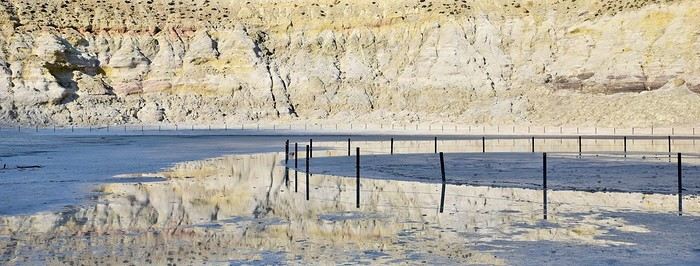
Before diving into the details, I should mention that I visited by bike (despite its severe and constant volcanic elevation) as part of a solo trip from France to Turkey. Why this detail? Because out of the ten countries I crossed and the dozens of sites I saw, Nisyros is one of my top three favorites (along with Pag Island, off-season, in Croatia, and Albania for its overall beauty—stunning natural landscapes and the incredible hospitality of its people). Anyway, welcome to this travel journal dedicated to the lovely little volcanic island of Nisyros…
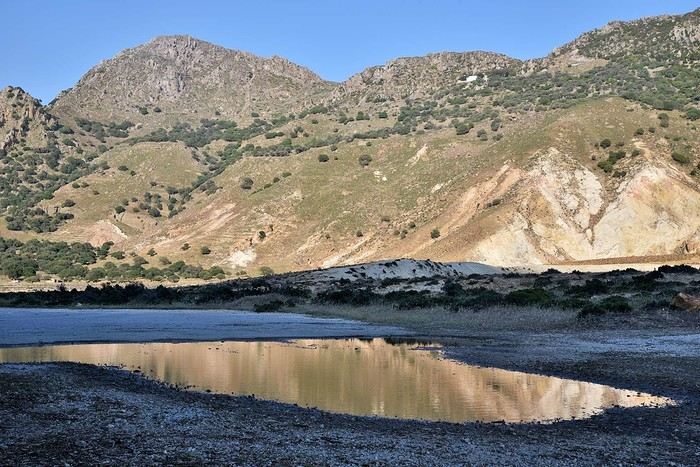
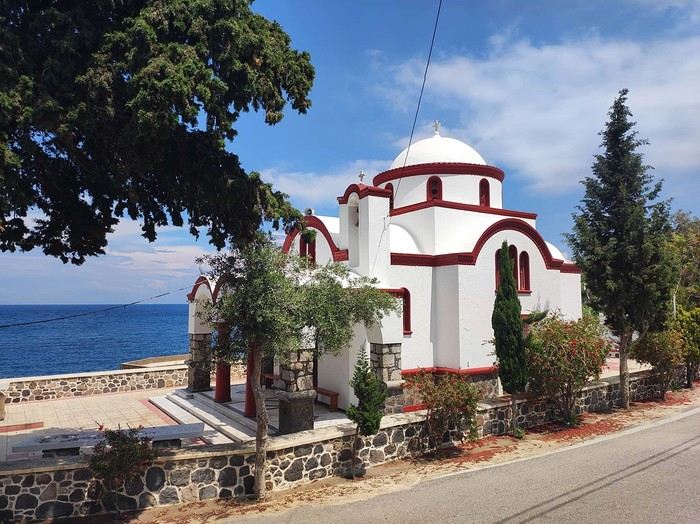
I arrived one beautiful morning in Mandraki, the island’s main port. The twenty-hour boat ride from Athens went by like a breeze. I slept on the deck for three or four hours, sprawled on a bench that was more or less sheltered from the wind. At this time of year (it’s May 2nd), tourists aren’t exactly flocking here, so the boat was far from full. My first glimpse of Nisyros is classic Greek island scenery: blazing sun, an azure sky, and an even deeper blue sea. The trip is off to a great start. I quickly found a small, out-of-the-way hotel (I’m one of those people who avoids crowds as much as possible when traveling, which is getting harder and harder to do). While everyone else from the boat turned right out of the port toward the center of Mandraki, I went left! My nice little hotel was just a hundred meters away, facing a pretty little Orthodox church whose red color contrasted beautifully with the deep blue sea.
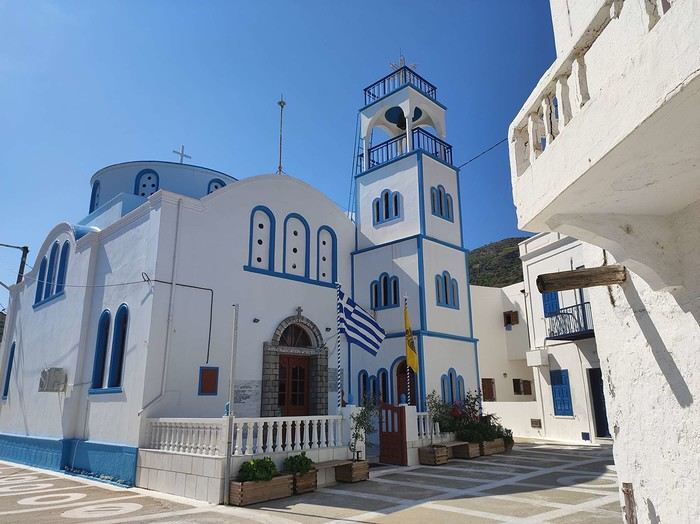
I dropped off my panniers in my room so I could ride light for once, then headed toward the next village: Pali. It’s a small fishing village that apparently comes to life a bit in the summer with a few tourists.
As I pedaled along the dock, I passed right by a guy sitting in a chair in full sun. Unfazed despite the sweat pouring down his forehead, he untangled his fishing net with a precision that commanded respect. I gave him the obligatory kalimera (good morning), but he reacted like a deaf-mute—no response at all. On the other hand, his employee answered me kindly from the trawler docked right next to him. Standing on deck, he was also untangling a mess of nets and invited me aboard to chat. That’s Mohamed.
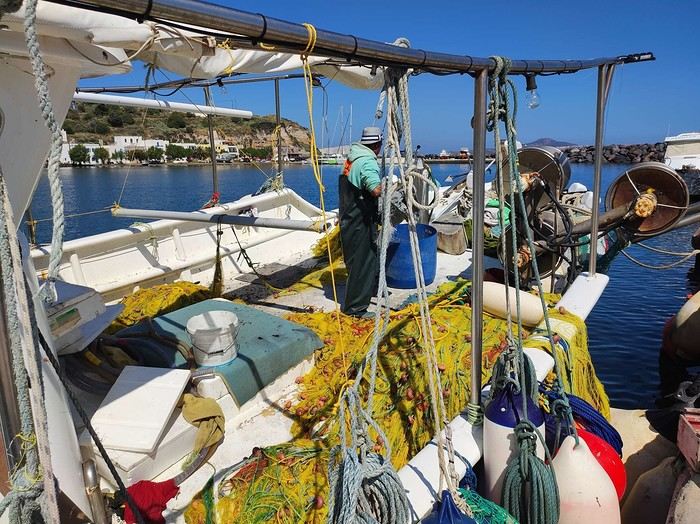
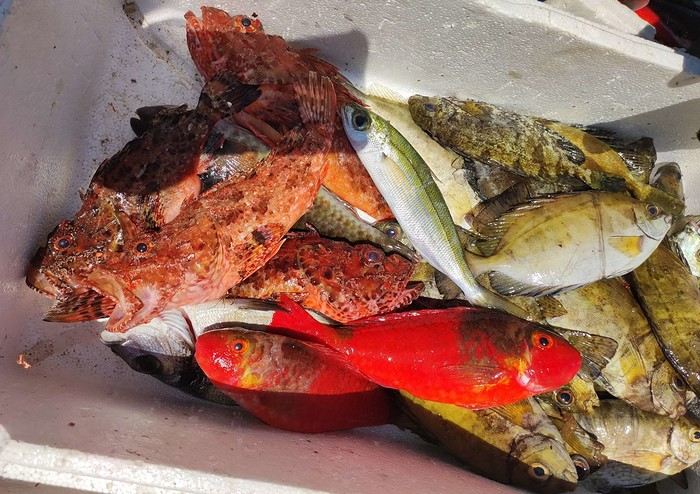
Communication wasn’t easy since he only spoke Greek and I didn’t, but he was cheerful, and his joy was contagious. He proudly showed off their catch of the day: two beautiful rays and a few brightly colored fish. We chatted like that for about fifteen minutes.
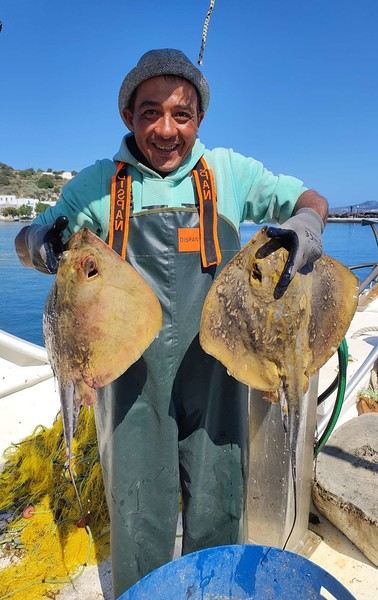
When it was time to hit the road again, I said goodbye to Mohamed, who smiled back. But this time, his boss—still dripping sweat in his chair under the scorching sun—greeted me too. Turns out he wasn’t deaf or mute after all.
I continued along the coast since that’s where most of Nisyros’ beaches are. They start lining up just outside Pali. These are black sand beaches, which can’t hide their volcanic origins.
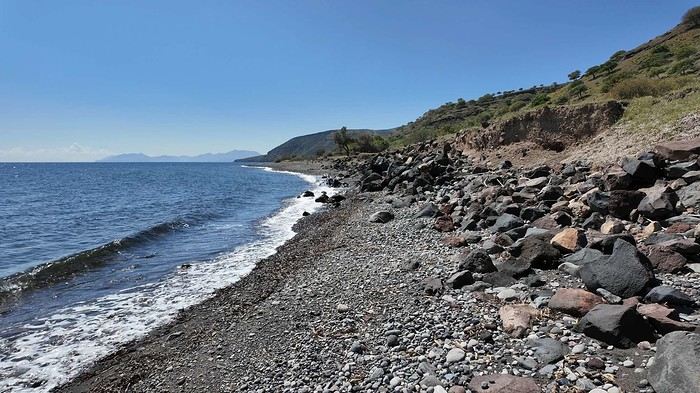
Yesterday afternoon in Athens, I met Peter and Michelle, a Dutch-French couple, while we were waiting for the ferry to depart. The Greek sailors were on strike, so we ended up waiting about twelve hours before setting off. Anyway, we had plenty of time to chat, and Peter, who’s lived on Tilos—a small island near Nisyros—for about twenty years, told me that many migrants pass through these two islands. Most come from Afghanistan and Syria, fleeing authoritarian regimes and the massacres that come with them. They’re looking for *anywhere* else where the future can’t possibly be worse. Peter explained that you often find their belongings on the local beaches. And sure enough, I didn’t have to look far to spot some—clothes, life jackets…
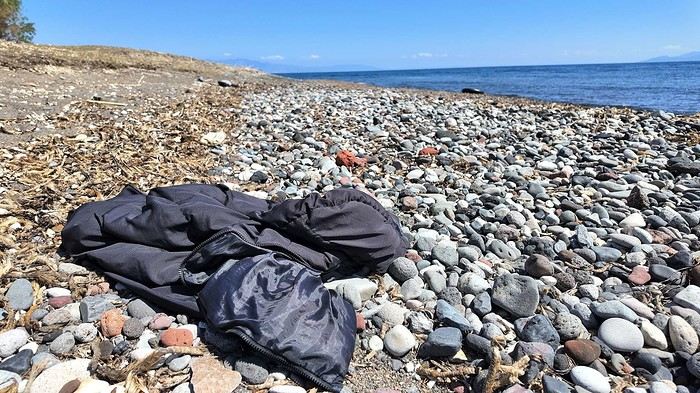
I glanced around, hoping to see one of them to maybe exchange a few words, but no—no one. I was completely alone.
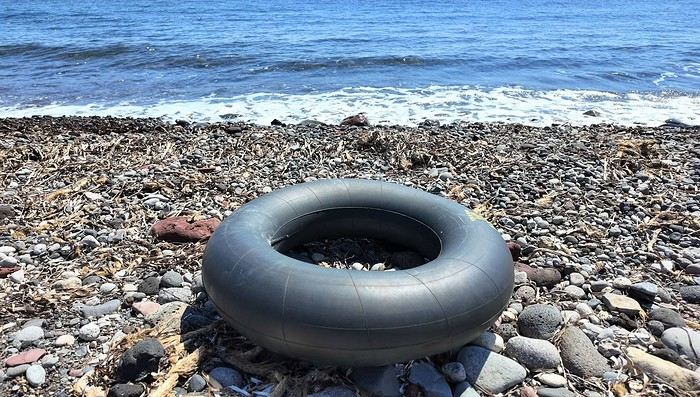
I got back on my bike and spent the rest of the day wandering aimlessly, just exploring this beautiful part of Nisyros. I also picked up some supplies because tomorrow, I’d be heading inland for two days, deep into its four-kilometer-wide caldera to explore the volcano. I’d be sleeping in a tent, so I needed to stock up on food. After a restful night in a real bed—something rare on this bike trip (and I won’t even mention the shower…)—I finally set off for the volcano (I’ll share details about that charming little hotel with the amazing breakfasts at the end of the journal). To reach Stefanos (the name of the main crater), I had to climb to the top of the caldera. It was hot, and some of the slopes were between 10 and 15%, which is steep, especially with a 54 kg bike. But who cares? I was admiring the scenery, and I have to say, I was surprised by how green it was. The higher I climbed, the more beautiful the vegetation became. It stood out against the blue of the sea, and the landscapes inside the island were truly stunning. So, I stopped every five minutes to take photos. Every now and then, I’d come across cows in the middle of the road—or goats in the trees! They climbed with the agility of monkeys to munch on the leaves. I couldn’t get a photo of them because they’d all scatter before I got close. It was actually the noise they made climbing down that tipped me off to their presence. Two villages sit at the top of the caldera: Emporios and Nikia. I passed the first one without climbing up to it, then continued to the second. And let me tell you, Nikia was love at first sight! I found myself pedaling through tiny streets, some barely wider than my bike with its panniers. The walls were white, and the doors were painted in all sorts of colors—green, blue, red… The streets were empty, and silence reigned. But it wasn’t a dead silence. It was more like the kind you find in small, secret, peaceful places. The village exuded tranquility, calm, and well-being. I leaned my bike—with all its gear—against a wall without locking it. It was the first time on this trip that I’d done that. Sure, its weight made it more like a tank than a bike, so you’d have to be *really* motivated to steal it, but here, for some reason, I felt completely at ease. Maybe it wasn’t the smartest move, but I go a lot by instinct, and here, it felt right. So I left my bike there and went to eat a little farther away, at a small restaurant on the village’s main square. It’s famous all over Greece for the beautiful mosaic that covers and decorates the floor. Once I’d eaten and drunk my fill, I hopped back on my bike, which had waited patiently without running off. And the best part? After riding uphill all morning to reach the top of the caldera, all I had to do now was coast downhill to the volcano. Pure bliss in such breathtaking scenery.
I hesitated for a long time before publishing this travel journal since it’s been 8 months now since I left Nisyros. But in the end, I found it too beautiful to keep quiet about. So here we go—I finally got around to writing it. Nisyros is a stunning little Greek island, and luckily, it’s well hidden. Located a good twenty hours by boat from Athens, its distance from the Greek mainland deters most tourists from visiting. That’s what makes it an off-the-beaten-path destination. So much for the general info.
Before diving into the details, I should mention that I visited by bike (despite its severe and constant volcanic elevation) as part of a solo trip from France to Turkey. Why this detail? Because out of the ten countries I crossed and the dozens of sites I saw, Nisyros is one of my top three favorites (along with Pag Island, off-season, in Croatia, and Albania for its overall beauty—stunning natural landscapes and the incredible hospitality of its people). Anyway, welcome to this travel journal dedicated to the lovely little volcanic island of Nisyros…
I arrived one beautiful morning in Mandraki, the island’s main port. The twenty-hour boat ride from Athens went by like a breeze. I slept on the deck for three or four hours, sprawled on a bench that was more or less sheltered from the wind. At this time of year (it’s May 2nd), tourists aren’t exactly flocking here, so the boat was far from full. My first glimpse of Nisyros is classic Greek island scenery: blazing sun, an azure sky, and an even deeper blue sea. The trip is off to a great start. I quickly found a small, out-of-the-way hotel (I’m one of those people who avoids crowds as much as possible when traveling, which is getting harder and harder to do). While everyone else from the boat turned right out of the port toward the center of Mandraki, I went left! My nice little hotel was just a hundred meters away, facing a pretty little Orthodox church whose red color contrasted beautifully with the deep blue sea.
I dropped off my panniers in my room so I could ride light for once, then headed toward the next village: Pali. It’s a small fishing village that apparently comes to life a bit in the summer with a few tourists.
As I pedaled along the dock, I passed right by a guy sitting in a chair in full sun. Unfazed despite the sweat pouring down his forehead, he untangled his fishing net with a precision that commanded respect. I gave him the obligatory kalimera (good morning), but he reacted like a deaf-mute—no response at all. On the other hand, his employee answered me kindly from the trawler docked right next to him. Standing on deck, he was also untangling a mess of nets and invited me aboard to chat. That’s Mohamed.
Communication wasn’t easy since he only spoke Greek and I didn’t, but he was cheerful, and his joy was contagious. He proudly showed off their catch of the day: two beautiful rays and a few brightly colored fish. We chatted like that for about fifteen minutes.
When it was time to hit the road again, I said goodbye to Mohamed, who smiled back. But this time, his boss—still dripping sweat in his chair under the scorching sun—greeted me too. Turns out he wasn’t deaf or mute after all.
I continued along the coast since that’s where most of Nisyros’ beaches are. They start lining up just outside Pali. These are black sand beaches, which can’t hide their volcanic origins.
Yesterday afternoon in Athens, I met Peter and Michelle, a Dutch-French couple, while we were waiting for the ferry to depart. The Greek sailors were on strike, so we ended up waiting about twelve hours before setting off. Anyway, we had plenty of time to chat, and Peter, who’s lived on Tilos—a small island near Nisyros—for about twenty years, told me that many migrants pass through these two islands. Most come from Afghanistan and Syria, fleeing authoritarian regimes and the massacres that come with them. They’re looking for *anywhere* else where the future can’t possibly be worse. Peter explained that you often find their belongings on the local beaches. And sure enough, I didn’t have to look far to spot some—clothes, life jackets…
I glanced around, hoping to see one of them to maybe exchange a few words, but no—no one. I was completely alone.
I got back on my bike and spent the rest of the day wandering aimlessly, just exploring this beautiful part of Nisyros. I also picked up some supplies because tomorrow, I’d be heading inland for two days, deep into its four-kilometer-wide caldera to explore the volcano. I’d be sleeping in a tent, so I needed to stock up on food. After a restful night in a real bed—something rare on this bike trip (and I won’t even mention the shower…)—I finally set off for the volcano (I’ll share details about that charming little hotel with the amazing breakfasts at the end of the journal). To reach Stefanos (the name of the main crater), I had to climb to the top of the caldera. It was hot, and some of the slopes were between 10 and 15%, which is steep, especially with a 54 kg bike. But who cares? I was admiring the scenery, and I have to say, I was surprised by how green it was. The higher I climbed, the more beautiful the vegetation became. It stood out against the blue of the sea, and the landscapes inside the island were truly stunning. So, I stopped every five minutes to take photos. Every now and then, I’d come across cows in the middle of the road—or goats in the trees! They climbed with the agility of monkeys to munch on the leaves. I couldn’t get a photo of them because they’d all scatter before I got close. It was actually the noise they made climbing down that tipped me off to their presence. Two villages sit at the top of the caldera: Emporios and Nikia. I passed the first one without climbing up to it, then continued to the second. And let me tell you, Nikia was love at first sight! I found myself pedaling through tiny streets, some barely wider than my bike with its panniers. The walls were white, and the doors were painted in all sorts of colors—green, blue, red… The streets were empty, and silence reigned. But it wasn’t a dead silence. It was more like the kind you find in small, secret, peaceful places. The village exuded tranquility, calm, and well-being. I leaned my bike—with all its gear—against a wall without locking it. It was the first time on this trip that I’d done that. Sure, its weight made it more like a tank than a bike, so you’d have to be *really* motivated to steal it, but here, for some reason, I felt completely at ease. Maybe it wasn’t the smartest move, but I go a lot by instinct, and here, it felt right. So I left my bike there and went to eat a little farther away, at a small restaurant on the village’s main square. It’s famous all over Greece for the beautiful mosaic that covers and decorates the floor. Once I’d eaten and drunk my fill, I hopped back on my bike, which had waited patiently without running off. And the best part? After riding uphill all morning to reach the top of the caldera, all I had to do now was coast downhill to the volcano. Pure bliss in such breathtaking scenery.
Feedback on a road trip in Greece
Hi there,
We’re planning a 12-day trip to Greece next February.
It’s our first time, so we’ll be hitting the "Must-Sees"—that should keep us busy enough! 😎
The itinerary isn’t set in stone yet, but we’re already wondering if it’s doable or just crazy, if some stops are essential or a waste of time...
Here’s the plan: Day 1-2-3: Athens (we arrive midday on Day 1) Day 4: Southern Athens (Temple of Neptune) then overnight in Corinth (we’re renting a car from the airport) Day 5-6-7: Western/Southern Peloponnese (one or two places to stay, and the iconic spots: Acrocorinth, Cargo, Mycenae, Sanctuary of Epidaurus, Nafplio, Nemea...) Day 8: Transit to Delphi via Olympia Day 9-10: Delphi, Monastery of Osios Loukas... Day 11: Return to Athens via Thermopylae We were wondering if it’s feasible to add the Meteora monasteries? And Mount Olympus, just for fun?
For accommodations, do you have any recommendations for Athens? Peloponnese? Delphi? In Athens, I think it’s best to stay near the metro line that connects to the airport. But which neighborhood is good? It’s hard to navigate such a big city...
Two more questions: - Is Piraeus worth a visit? - We know February is a quieter time than peak tourist season, and that’s what we like. But there must be consequences—do all sites/museums close by 5 PM (except in Athens, maybe)? What do you do in the evenings once it’s dark?
Thanks in advance for your tips and advice!
We’re planning a 12-day trip to Greece next February.
It’s our first time, so we’ll be hitting the "Must-Sees"—that should keep us busy enough! 😎
The itinerary isn’t set in stone yet, but we’re already wondering if it’s doable or just crazy, if some stops are essential or a waste of time...
Here’s the plan: Day 1-2-3: Athens (we arrive midday on Day 1) Day 4: Southern Athens (Temple of Neptune) then overnight in Corinth (we’re renting a car from the airport) Day 5-6-7: Western/Southern Peloponnese (one or two places to stay, and the iconic spots: Acrocorinth, Cargo, Mycenae, Sanctuary of Epidaurus, Nafplio, Nemea...) Day 8: Transit to Delphi via Olympia Day 9-10: Delphi, Monastery of Osios Loukas... Day 11: Return to Athens via Thermopylae We were wondering if it’s feasible to add the Meteora monasteries? And Mount Olympus, just for fun?
For accommodations, do you have any recommendations for Athens? Peloponnese? Delphi? In Athens, I think it’s best to stay near the metro line that connects to the airport. But which neighborhood is good? It’s hard to navigate such a big city...
Two more questions: - Is Piraeus worth a visit? - We know February is a quieter time than peak tourist season, and that’s what we like. But there must be consequences—do all sites/museums close by 5 PM (except in Athens, maybe)? What do you do in the evenings once it’s dark?
Thanks in advance for your tips and advice!
Tips for cycling the EuroVelo 8 from Nice to Izmir
Hi there,
I’m planning to cycle the EuroVelo 8 route from Nice to Izmir in Turkey (about 2,500 km), but I’m not finding much info or tips for this itinerary.
I’d like to leave at the end of September and complete the route in a max of 2 months, as self-sufficiently as possible (I have a tent, sleeping bag, and camping cookware).
Is this a good idea (will it be too cold starting in October)?
Are there any precautions I should take? Any areas to avoid? Since multiple countries are involved.
And are there any places worth visiting that aren’t on the main route?
I’m used to cycle touring in France but not abroad, so I’d appreciate any tips!
Thanks in advance.
I’d like to leave at the end of September and complete the route in a max of 2 months, as self-sufficiently as possible (I have a tent, sleeping bag, and camping cookware).
Is this a good idea (will it be too cold starting in October)?
Are there any precautions I should take? Any areas to avoid? Since multiple countries are involved.
And are there any places worth visiting that aren’t on the main route?
I’m used to cycle touring in France but not abroad, so I’d appreciate any tips!
Thanks in advance.
Are there any flights from Tirana to Corfu?
Hi there,
We’re renting a car to explore Albania in September/October. We’ll start in the north and finish in the south. We’d love to drop off the car near Saranda and take the ferry to Corfu on foot, but it seems we’ll have to return it to Tirana since there’s nowhere else to drop it off. From there, we’d like to take a direct flight to Corfu, but I can’t find any direct flights... I really don’t want to connect through Athens and backtrack when we’re so close! Any suggestions on what to do? Thanks, Carole (Canada)
We’re renting a car to explore Albania in September/October. We’ll start in the north and finish in the south. We’d love to drop off the car near Saranda and take the ferry to Corfu on foot, but it seems we’ll have to return it to Tirana since there’s nowhere else to drop it off. From there, we’d like to take a direct flight to Corfu, but I can’t find any direct flights... I really don’t want to connect through Athens and backtrack when we’re so close! Any suggestions on what to do? Thanks, Carole (Canada)
Bus transport from Nafplio and Olympia
Hi there, I’m planning to travel by bus during my stay in Greece, mainly in November. Since I’ll be spending a few days in Nafplio, is it easy to get to Olympia by bus, or is it better to take a guided tour from Nafplio? It’s not ideal, but it would be my only option to see the site. Also, since I want to go to Delphi, is it possible to take public transport, staying one night in Olympia and leaving from there the next day for Delphi? That would save me from having to go back to Athens. If anyone has already done this route, I’d love to hear about your experience. Thanks!
Draft itinerary for Greece
Hi everyone,
I’m planning my first trip to Greece from October 29th to November 23rd and I’d love to hear your thoughts and suggestions on the itinerary I’m considering. For a first visit, I’ll definitely cover the traditional tourist route, but I’m also open to off-the-beaten-path ideas. I’m curious and interested in history, archaeological sites, and the islands—more for culture than beaches, anyway, especially in November!
Here’s the plan: 3–4 days in Athens, 2 days in Nafplio: visiting Epidaurus and Mycenae, Stop in Olympia on the way to Delphi via Patras by bus? To avoid backtracking to Athens; 2 days in Delphi, including the site and Mount Parnassus, Explore the Ionian coast and a few islands? A few days in Corfu, 3 days in Meteora, 2–3 days in Thessaloniki, Direct flight from Thessaloniki to Heraklion, Crete, 3–4 days in Crete, November 22nd–23rd: overnight ferry back to Athens to catch my return flight to Montreal.
You’ve probably guessed I’m traveling solo. It might seem a bit scattered right now—I’ve started reading up on Greece, and there are must-see spots. What feels unclear are the 4–5 days between Delphi and Corfu. Also, mid-November in the islands might not be ideal if the weather’s bad.
Is Corfu worth it? Maybe there are other options—like a few days in Albania? Just throwing the idea out there.
Thanks for your input! I’d love to hear about your experiences to help enrich my upcoming trip.
Here’s the plan: 3–4 days in Athens, 2 days in Nafplio: visiting Epidaurus and Mycenae, Stop in Olympia on the way to Delphi via Patras by bus? To avoid backtracking to Athens; 2 days in Delphi, including the site and Mount Parnassus, Explore the Ionian coast and a few islands? A few days in Corfu, 3 days in Meteora, 2–3 days in Thessaloniki, Direct flight from Thessaloniki to Heraklion, Crete, 3–4 days in Crete, November 22nd–23rd: overnight ferry back to Athens to catch my return flight to Montreal.
You’ve probably guessed I’m traveling solo. It might seem a bit scattered right now—I’ve started reading up on Greece, and there are must-see spots. What feels unclear are the 4–5 days between Delphi and Corfu. Also, mid-November in the islands might not be ideal if the weather’s bad.
Is Corfu worth it? Maybe there are other options—like a few days in Albania? Just throwing the idea out there.
Thanks for your input! I’d love to hear about your experiences to help enrich my upcoming trip.
Restaurant on the MSC Musica Aurea?
Hi there,
On the MSC Musica, there’s no Yacht Club—do you know if there’s a dedicated Aurea restaurant?
Thanks in advance for your reply..
Car rental in Patras-Araxos (northern Peloponnese)
Hi, could you recommend a local and reliable car rental agency, not one of the big international chains, at Patras-Araxos Airport in northern Peloponnese
or a bit further into town?
Thanks.
Renting a sailboat and sailing in the Cyclades
Hi everyone, our friend is a real Captain with experience—last time we rented in the Balearics and it was amazing. This year, we’d like to rent a sailboat for a week in May or September to sail around the Cyclades. I have a few questions, starting with the wind.
1/ Does it really blow very hard during these periods? Some crew members aren’t exactly seasoned sailors.
2/ Is it better to rent from Athens or one of the Cycladic islands from a cost and time-management perspective? We only have a week.
3/ Which are the most beautiful and wild or least crowded islands, and where should we start?
4/ Do you know of a good sailboat rental agency?
Thanks a million for your answers—I hope some fellow sailors will chime in too!
Thanks a million for your answers—I hope some fellow sailors will chime in too!
Two weeks in the Cyclades
The Cyclades attract a lot (a LOT) of people in the summer, and it's not always clear how to visit them.
For our first family trip to the Cyclades (in 2016), we took a route that seems great for discovering the islands: - Flight Paris / Santorini (Transavia) - 3 nights in Santorini - Ferry Santorini / Milos - 4 nights in Milos - Ferry Milos / Sifnos - 4 nights in Sifnos - Ferry Sifnos / Athens - 3 nights in Athens - Flight Athens / Paris
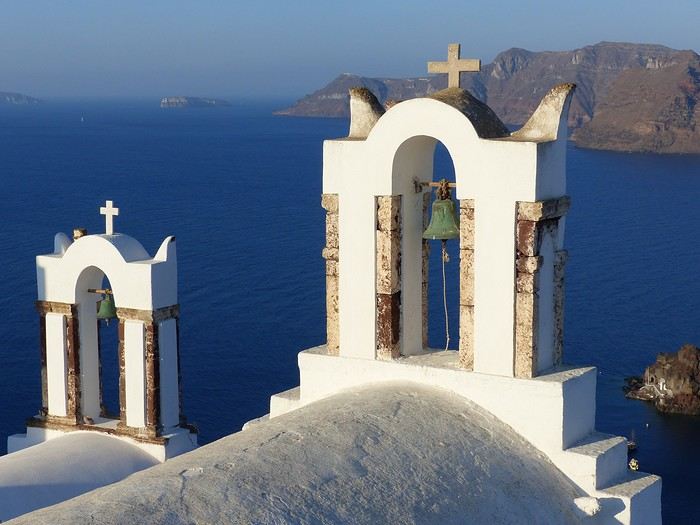
Santorini is the postcard image of the Cyclades... but not really any beaches for kids. My tip: you should stay in Oia because it's really "the spot" on the island. We chose the Pension "The Flower": simple but very well located and with a pool for the kids. Another tip: rent a car as soon as you arrive at the airport because the island is vast.
Our favorite moment: Oia around 6:00 AM, a paradise for photographers. It’s nothing like the daytime, or especially the evening when all the crowds rush in for the famous "sunset." Another favorite, the hike between Fira and Oia, 10 km, 4 hours of walking with extraordinary views (especially around Imerovigli). For the rest, we toured the island—it’s nice but nothing to marvel at.
After a 2.5-hour ferry ride, we arrived in Milos, home of the famous Venus de Milo. This is our favorite island in the Cyclades (though we haven’t seen them all!). In the port of Adamantas, we stayed at the Liogerma Hotel (very well located near the port).
Our favorite experience: the boat tour around the island (and swimming at Kleftiko). Absolutely a must-do, but book it as soon as you arrive because it’s often fully booked for the next two days.
I also recommend renting a car to explore this island. Other favorites: the incredible fishing village of Klima with its colorful boat houses, the rocks of Sarakiniko (best in the morning sun), the beach at Tsigrado (with its ladder access through the rocks), Plaka, the caves of Papafragas, the waters of Firopotamos, and Fyriplaka...
Just a 1-hour ferry ride, and you’re already in Sifnos. A small island with a bus network that means you don’t need to rent a vehicle. We stayed in Kamares (Hotel Afroditi).
Sifnos has charming villages typical of the Cyclades (Kastro, Apollonia), beautiful chapels (Chrisopigi, the Church of the Seven Martyrs...), and lovely beaches (Cherronissos, Platis Galios...). Our favorite: hiking around Faros and the Chrisopigi Monastery.
A 3-hour ferry ride takes you back to the port of Piraeus to visit Athens: the Acropolis, its museums, and the Plaka district. A little favorite of ours: the Archaeological Museum, slightly off the tourist trail... With this route, you’ll see the diversity of the Cyclades and Athens without wasting too much time on ferries.
PS: We also did the loop Mykonos / Paros / Amorgos / Mykonos, but that’s a good idea... for a second trip ;)
For our first family trip to the Cyclades (in 2016), we took a route that seems great for discovering the islands: - Flight Paris / Santorini (Transavia) - 3 nights in Santorini - Ferry Santorini / Milos - 4 nights in Milos - Ferry Milos / Sifnos - 4 nights in Sifnos - Ferry Sifnos / Athens - 3 nights in Athens - Flight Athens / Paris
Santorini is the postcard image of the Cyclades... but not really any beaches for kids. My tip: you should stay in Oia because it's really "the spot" on the island. We chose the Pension "The Flower": simple but very well located and with a pool for the kids. Another tip: rent a car as soon as you arrive at the airport because the island is vast.
Our favorite moment: Oia around 6:00 AM, a paradise for photographers. It’s nothing like the daytime, or especially the evening when all the crowds rush in for the famous "sunset." Another favorite, the hike between Fira and Oia, 10 km, 4 hours of walking with extraordinary views (especially around Imerovigli). For the rest, we toured the island—it’s nice but nothing to marvel at.
After a 2.5-hour ferry ride, we arrived in Milos, home of the famous Venus de Milo. This is our favorite island in the Cyclades (though we haven’t seen them all!). In the port of Adamantas, we stayed at the Liogerma Hotel (very well located near the port).
Our favorite experience: the boat tour around the island (and swimming at Kleftiko). Absolutely a must-do, but book it as soon as you arrive because it’s often fully booked for the next two days.
I also recommend renting a car to explore this island. Other favorites: the incredible fishing village of Klima with its colorful boat houses, the rocks of Sarakiniko (best in the morning sun), the beach at Tsigrado (with its ladder access through the rocks), Plaka, the caves of Papafragas, the waters of Firopotamos, and Fyriplaka...
Just a 1-hour ferry ride, and you’re already in Sifnos. A small island with a bus network that means you don’t need to rent a vehicle. We stayed in Kamares (Hotel Afroditi).
Sifnos has charming villages typical of the Cyclades (Kastro, Apollonia), beautiful chapels (Chrisopigi, the Church of the Seven Martyrs...), and lovely beaches (Cherronissos, Platis Galios...). Our favorite: hiking around Faros and the Chrisopigi Monastery.
A 3-hour ferry ride takes you back to the port of Piraeus to visit Athens: the Acropolis, its museums, and the Plaka district. A little favorite of ours: the Archaeological Museum, slightly off the tourist trail... With this route, you’ll see the diversity of the Cyclades and Athens without wasting too much time on ferries.
PS: We also did the loop Mykonos / Paros / Amorgos / Mykonos, but that’s a good idea... for a second trip ;)
14-Day Trip Report to Milos and Kimolos in September-October 2021
14-Day Trip Report to Milos and Kimolos in September-October 2021
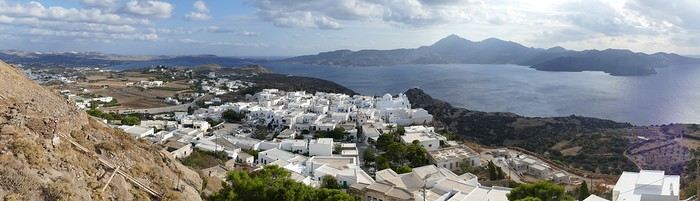
The village of Plaka in Milos
It was with great pleasure that we finally reconnected with our old habits as inveterate travelers! Greece, and more specifically the Greek islands, was the natural choice for us. After having already visited many Greek islands during around 18 trips, we decided to revisit islands we had seen over 40 years ago, like Milos, where our memories were extremely hazy. Our route was well-planned and familiar: a low-cost flight from Basel-Mulhouse to Athens, then a traditional ferry from Piraeus to Milos. Taking a speedboat, which is faster, would have forced us to spend a night in Piraeus. Plus, we felt that the traditional ferry was part of the journey, and with good weather, spending eight hours on deck wasn’t unpleasant at all. Watching the docking maneuvers with the comings and goings of trucks and cars, observing the passengers, reading a book, or admiring the scenery—all of that is part of the travel experience. Milos Island: Accommodation in Adamas We arrived quite late, around 11 PM, in Adamas, the port of Milos. No worries—the friendly couple managing the apartment was waiting for us, and it was just a 10-minute walk from the port. The first two days were spent unwinding, with swimming at the nearby beach, strolling through Adamas, and relaxing.
Discovering Plaka On the third day, we took the path along the small beach west of town toward a French military cemetery! A historical reminder of our presence here during the Crimean War, among others. The path climbs toward a beacon perched on top of a hill before disappearing into the scrubland. We returned to Adamas for lunch on our terrace.
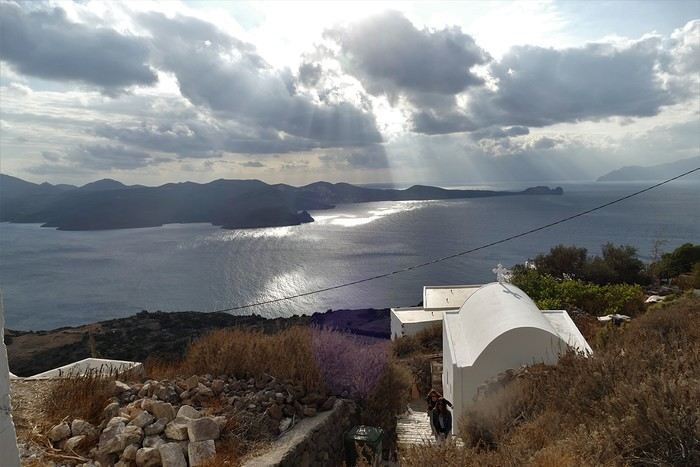
In the afternoon, we visited the hilltop village of Plaka by bus from Adamas. Plaka is the original old town, dominated by a church and, even higher up, the ruins of the Kastro. The view is magnificent. We stopped at a pastry shop in the village to enjoy excellent orange cakes and baklavas. Back in Adamas, we checked out car rental agencies to be more mobile, though the bus network seemed quite extensive. It costs around 40 € per day, plus 8 € if you want to significantly reduce the deductible. Port of Klima.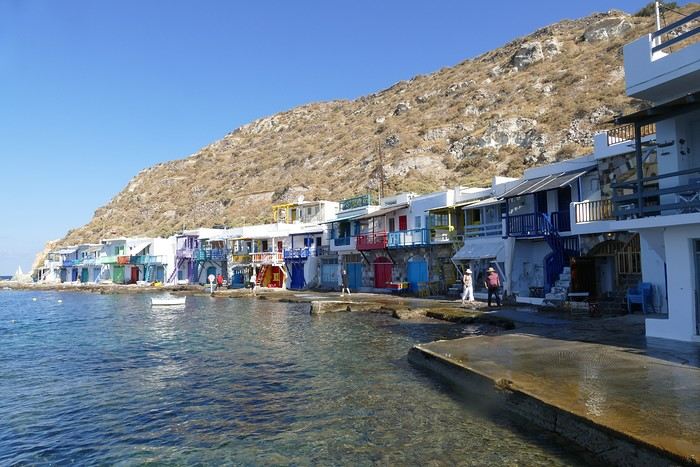
Yesterday’s weather was quite mixed with lots of clouds, but today the sun is shining again. We drove to the small port of Klima, famous for its boat garages called "sirmatas." It’s true that in the morning sun, these boat garages carved into the volcanic tuff are beautifully lit, turning the village into a colorful mosaic. Above the village, a path climbs directly to the magnificent Roman theater overlooking the surroundings and the sea.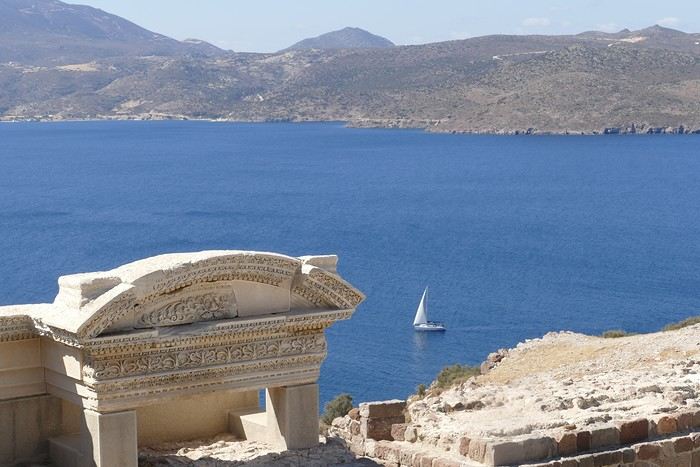 Following the well-marked path, we reached the road leading 200 meters down to the catacombs. It’s an impressive complex of 3rd and 4th-century catacombs, though only a small part is open to visitors—it’s still very moving. In the mid-afternoon, we got back in the car to visit the tiny ports of Firopotamos and Mandraki, which also have their colorful sirmatas. We took the opportunity to swim at the small beach in Mandraki, where the water was warm and calm.
Mandraki Port. We had a decent dinner at a seaside restaurant in Adamas, though you have to be selective—we had a bad experience at Kynigos on the second night!
Moving to Polonia in Eastern Milos, Sarakiniko Site
Following the well-marked path, we reached the road leading 200 meters down to the catacombs. It’s an impressive complex of 3rd and 4th-century catacombs, though only a small part is open to visitors—it’s still very moving. In the mid-afternoon, we got back in the car to visit the tiny ports of Firopotamos and Mandraki, which also have their colorful sirmatas. We took the opportunity to swim at the small beach in Mandraki, where the water was warm and calm.
Mandraki Port. We had a decent dinner at a seaside restaurant in Adamas, though you have to be selective—we had a bad experience at Kynigos on the second night!
Moving to Polonia in Eastern Milos, Sarakiniko Site
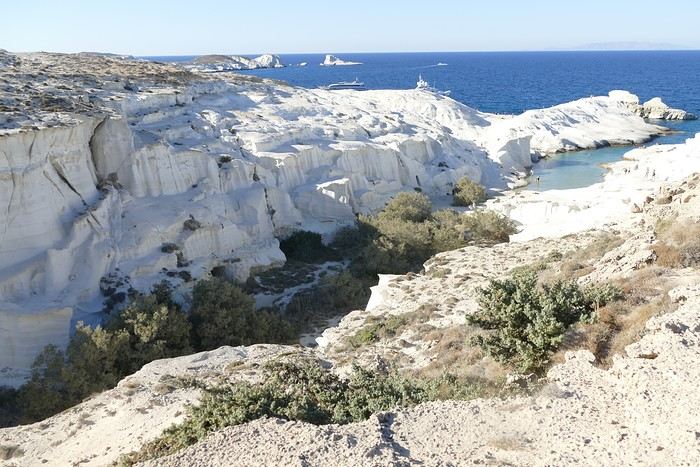
The Sarakiniko site We left Adamas for a second stay on Milos, this time in Polonia. The rental Panda was packed with the four of us and our luggage! Our apartment was in a beautiful house surrounded by a grove, so our lovely terrace was well-shaded. Luckily, there was a small beach nearby, and we went for a swim right away. Apart from us, there were only three other swimmers—definitely the end of the season!
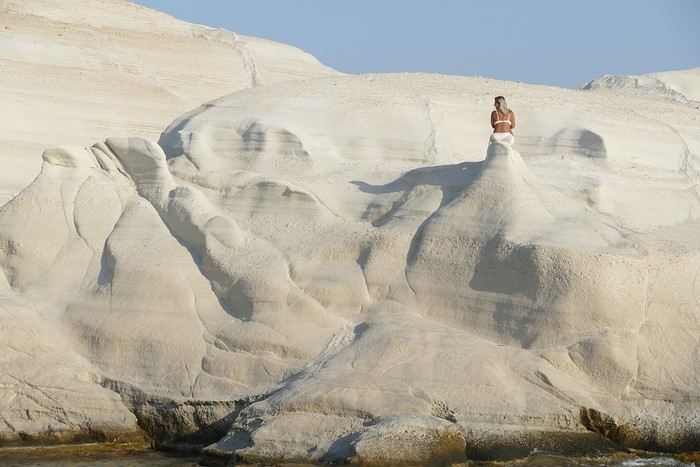
"Fairy chimney"! In the afternoon, we visited the famous Sarakiniko site, Milos’ emblematic spot. Judging by the number of cars in the parking lot, we wouldn’t be alone. As we approached, we heard an indefinable rock/punk/metal music: some young people had brought a sound system and a foghorn and were having fun diving off a fairly high cliff to impress the crowd. It definitely spoiled the visit. Most spots were taken by couples busy taking selfies, so getting photos of the site without tourists was impossible. Still, the site is magnificent, with its white cliffs looking like they’re covered in whipped cream! The sun was still very bright, reflecting strongly off the cliffs, making photography difficult due to the excessive brightness. We had a fish dinner in Polonia at the Enalion restaurant: while the octopus and squid were good, the fish soup tasted more like vegetable soup with a few fish crumbs—too bad.
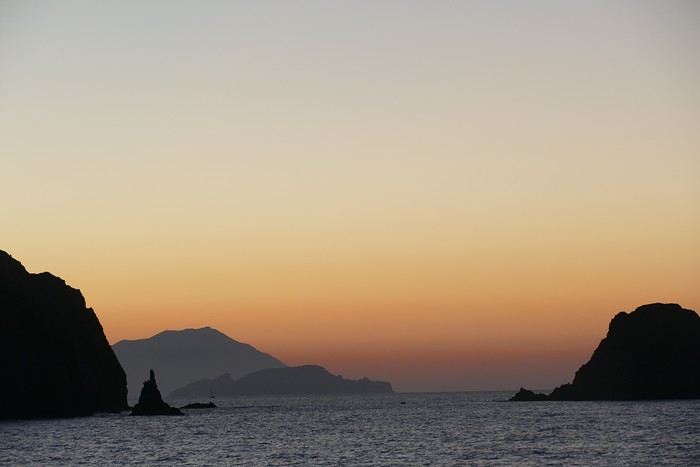
Sunset in Polonia
Ports of Papafranga and Mytikos We continued our exploration of Milos with the Papafranga gorge, a narrow and deep gorge that opens to the sea, where the water is a stunning color. Access via an unstable and dangerous path is prohibited, but that didn’t stop a couple of tourists in flip-flops from venturing in!!! We then swam in the tiny, calm, and sheltered cove of the small port of Mytikos. We returned to Polonia for lunch at Alkis: excellent moussaka. In the late afternoon, Pat and I went out to take some photos just before sunset near the Agios Nikolaos chapel, the beacon, and the new Petakoudia neighborhood next to Polonia to the north.
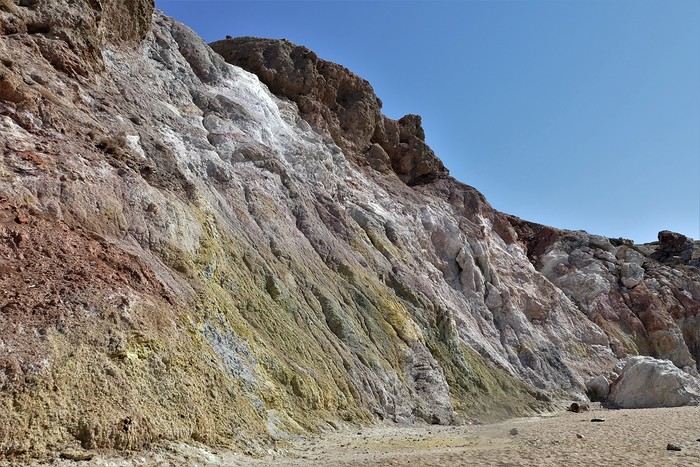
Paleochori Beach
Toward the Multicolored Beach of Paleochori Another sunny day: we still had to discover Paleochori Beach in the south of the island. It was 10:30 AM, and the beach was almost deserted! The water was pleasant, though a bit chilly when we first entered. The beach is bordered by a cliff that, in some places, displays a beautiful multicolored palette. We returned to Polonia in the late afternoon, and Pat and I headed toward Vouddhia Beach south of Polonia—bad choice. The beach is surrounded by a huge mining site served by a dusty road where lines of trucks loaded with ore cross paths. It’s the other side of the coin, and Greece still has progress to make in this area. Dinner at Alki’s was just as good as always. Return to the Sarakiniko Site Early this morning, Pat and I went back to the Sarakiniko site, hoping to take photos in better conditions. While there were fewer people, the parking lot was still full because sunrise is a must in Milos. Still, the conditions were good, and the sunrise spectators left quickly once the sun had risen above the horizon. During the day, an increasingly strong wind cooled the atmosphere, making swimming less enjoyable. Departure for Kimolos Island We changed islands and left Milos for Kimolos, a nearby island—just a 30-minute trip from Polonia’s port. Our apartment was at the entrance of the hilltop village. It’s a village with typical Cycladic architecture, featuring the remains of an old kastro, a few old churches, and windmill towers perched on the hill. We dined in a tiny tavern where the small outdoor tables were squeezed against the walls to let passersby through! As soon as the sun disappeared, it got cold, especially because of the wind. Ports of Kara and Goupa This morning, we explored the small hamlets of Kara and Goupa by Rema Beach, east of the main port. There, we found the sirmatas again—those boat garages partly carved into the volcanic tuff. The path winds between several sirmatas before climbing back up to the Praça road to return to the apartment.
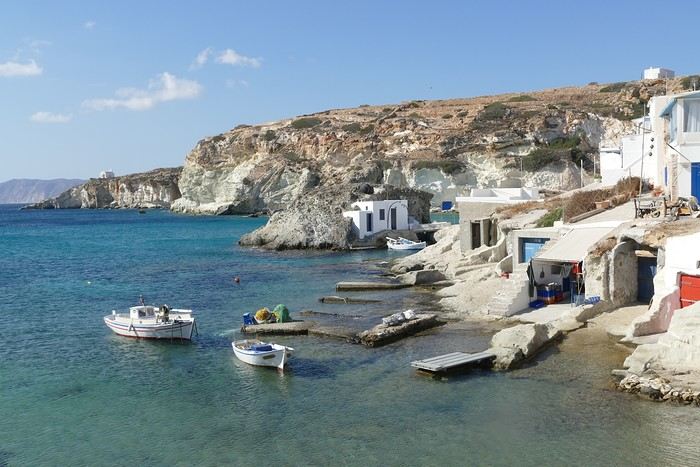
Ports of Kara and Goupa
In the afternoon, we strolled through town, and Pat and I climbed the hill overlooking the village to get a closer look at the few more or less ruined windmills dotting the ridge. Only one mill still had its complete mechanism in place under the roof; the others were empty. The view over the village, port, and sea was beautiful. That evening, we tried another restaurant in the village center, Kali Kardia Bohoris, which was well-frequented by locals, and we didn’t regret it: delicious food, efficient and friendly service, and reasonable prices.
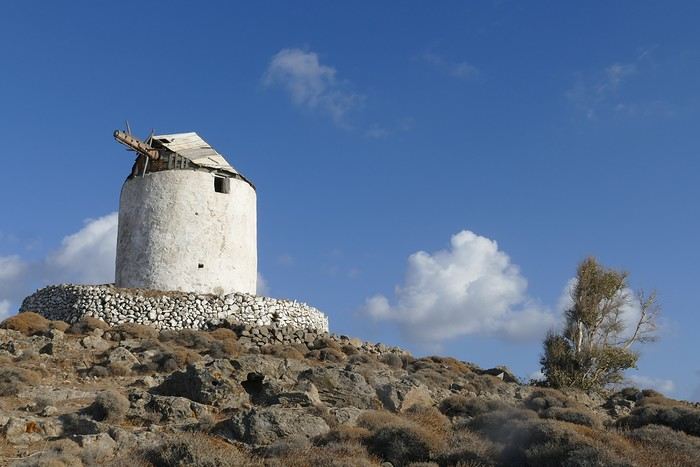
The Kastro Mill
Toward Aliki Beach We walked to Aliki Beach, west of the main village. It’s a large sandy beach shaded by tamarisk trees, but the strong wind prevented us from enjoying it. In the afternoon, I set off on a hike toward the fairy chimney at Skiadi (1.5 hours one way). The paths were very well-marked with signs indicating the trail number and the time to reach the destination. The countryside was beautiful but very dry at this time of year, and as always in Greece, many white chapels dotted the landscape. The numerous dry stone walls testify to the immense labor done by the island’s inhabitants over the centuries! For our last day in Kimolos, we decided to visit the beautiful Praça Beach, one of the most beautiful according to the guides! To get there, we took a path through the interior before joining the paved road near a large dump overflowing with various waste. It’s the flip side of the scenery, and Greece still has progress to make in this area. In the end, Praça Beach left us underwhelmed. The environment, marred by mining operations, detracts from the charm of the beautiful sandy beach. End of the Trip, Return to Piraeus and France And that’s it—we took the Zanteferries ferry back to Piraeus, arriving after a calm and sunny 10-hour journey. We had dinner at Souvlaki Street on the port and spent a good night at the Faros I Hotel in Piraeus—a great spot, close to the port, very clean, and reasonably priced. We flew from Athens to Basel-Mulhouse EuroAirport without any issues. N.B. Budget: around 1850 € all included for 14 days per couple The photo album is available by clicking this link: https://photos.app.goo.gl/wRpxRipg4erpzGj99
The village of Plaka in Milos
It was with great pleasure that we finally reconnected with our old habits as inveterate travelers! Greece, and more specifically the Greek islands, was the natural choice for us. After having already visited many Greek islands during around 18 trips, we decided to revisit islands we had seen over 40 years ago, like Milos, where our memories were extremely hazy. Our route was well-planned and familiar: a low-cost flight from Basel-Mulhouse to Athens, then a traditional ferry from Piraeus to Milos. Taking a speedboat, which is faster, would have forced us to spend a night in Piraeus. Plus, we felt that the traditional ferry was part of the journey, and with good weather, spending eight hours on deck wasn’t unpleasant at all. Watching the docking maneuvers with the comings and goings of trucks and cars, observing the passengers, reading a book, or admiring the scenery—all of that is part of the travel experience. Milos Island: Accommodation in Adamas We arrived quite late, around 11 PM, in Adamas, the port of Milos. No worries—the friendly couple managing the apartment was waiting for us, and it was just a 10-minute walk from the port. The first two days were spent unwinding, with swimming at the nearby beach, strolling through Adamas, and relaxing.
Discovering Plaka On the third day, we took the path along the small beach west of town toward a French military cemetery! A historical reminder of our presence here during the Crimean War, among others. The path climbs toward a beacon perched on top of a hill before disappearing into the scrubland. We returned to Adamas for lunch on our terrace.
In the afternoon, we visited the hilltop village of Plaka by bus from Adamas. Plaka is the original old town, dominated by a church and, even higher up, the ruins of the Kastro. The view is magnificent. We stopped at a pastry shop in the village to enjoy excellent orange cakes and baklavas. Back in Adamas, we checked out car rental agencies to be more mobile, though the bus network seemed quite extensive. It costs around 40 € per day, plus 8 € if you want to significantly reduce the deductible. Port of Klima.
Yesterday’s weather was quite mixed with lots of clouds, but today the sun is shining again. We drove to the small port of Klima, famous for its boat garages called "sirmatas." It’s true that in the morning sun, these boat garages carved into the volcanic tuff are beautifully lit, turning the village into a colorful mosaic. Above the village, a path climbs directly to the magnificent Roman theater overlooking the surroundings and the sea.
Following the well-marked path, we reached the road leading 200 meters down to the catacombs. It’s an impressive complex of 3rd and 4th-century catacombs, though only a small part is open to visitors—it’s still very moving. In the mid-afternoon, we got back in the car to visit the tiny ports of Firopotamos and Mandraki, which also have their colorful sirmatas. We took the opportunity to swim at the small beach in Mandraki, where the water was warm and calm.
Mandraki Port. We had a decent dinner at a seaside restaurant in Adamas, though you have to be selective—we had a bad experience at Kynigos on the second night!
Moving to Polonia in Eastern Milos, Sarakiniko SiteThe Sarakiniko site We left Adamas for a second stay on Milos, this time in Polonia. The rental Panda was packed with the four of us and our luggage! Our apartment was in a beautiful house surrounded by a grove, so our lovely terrace was well-shaded. Luckily, there was a small beach nearby, and we went for a swim right away. Apart from us, there were only three other swimmers—definitely the end of the season!
"Fairy chimney"! In the afternoon, we visited the famous Sarakiniko site, Milos’ emblematic spot. Judging by the number of cars in the parking lot, we wouldn’t be alone. As we approached, we heard an indefinable rock/punk/metal music: some young people had brought a sound system and a foghorn and were having fun diving off a fairly high cliff to impress the crowd. It definitely spoiled the visit. Most spots were taken by couples busy taking selfies, so getting photos of the site without tourists was impossible. Still, the site is magnificent, with its white cliffs looking like they’re covered in whipped cream! The sun was still very bright, reflecting strongly off the cliffs, making photography difficult due to the excessive brightness. We had a fish dinner in Polonia at the Enalion restaurant: while the octopus and squid were good, the fish soup tasted more like vegetable soup with a few fish crumbs—too bad.
Sunset in Polonia
Ports of Papafranga and Mytikos We continued our exploration of Milos with the Papafranga gorge, a narrow and deep gorge that opens to the sea, where the water is a stunning color. Access via an unstable and dangerous path is prohibited, but that didn’t stop a couple of tourists in flip-flops from venturing in!!! We then swam in the tiny, calm, and sheltered cove of the small port of Mytikos. We returned to Polonia for lunch at Alkis: excellent moussaka. In the late afternoon, Pat and I went out to take some photos just before sunset near the Agios Nikolaos chapel, the beacon, and the new Petakoudia neighborhood next to Polonia to the north.
Paleochori Beach
Toward the Multicolored Beach of Paleochori Another sunny day: we still had to discover Paleochori Beach in the south of the island. It was 10:30 AM, and the beach was almost deserted! The water was pleasant, though a bit chilly when we first entered. The beach is bordered by a cliff that, in some places, displays a beautiful multicolored palette. We returned to Polonia in the late afternoon, and Pat and I headed toward Vouddhia Beach south of Polonia—bad choice. The beach is surrounded by a huge mining site served by a dusty road where lines of trucks loaded with ore cross paths. It’s the other side of the coin, and Greece still has progress to make in this area. Dinner at Alki’s was just as good as always. Return to the Sarakiniko Site Early this morning, Pat and I went back to the Sarakiniko site, hoping to take photos in better conditions. While there were fewer people, the parking lot was still full because sunrise is a must in Milos. Still, the conditions were good, and the sunrise spectators left quickly once the sun had risen above the horizon. During the day, an increasingly strong wind cooled the atmosphere, making swimming less enjoyable. Departure for Kimolos Island We changed islands and left Milos for Kimolos, a nearby island—just a 30-minute trip from Polonia’s port. Our apartment was at the entrance of the hilltop village. It’s a village with typical Cycladic architecture, featuring the remains of an old kastro, a few old churches, and windmill towers perched on the hill. We dined in a tiny tavern where the small outdoor tables were squeezed against the walls to let passersby through! As soon as the sun disappeared, it got cold, especially because of the wind. Ports of Kara and Goupa This morning, we explored the small hamlets of Kara and Goupa by Rema Beach, east of the main port. There, we found the sirmatas again—those boat garages partly carved into the volcanic tuff. The path winds between several sirmatas before climbing back up to the Praça road to return to the apartment.
Ports of Kara and Goupa
In the afternoon, we strolled through town, and Pat and I climbed the hill overlooking the village to get a closer look at the few more or less ruined windmills dotting the ridge. Only one mill still had its complete mechanism in place under the roof; the others were empty. The view over the village, port, and sea was beautiful. That evening, we tried another restaurant in the village center, Kali Kardia Bohoris, which was well-frequented by locals, and we didn’t regret it: delicious food, efficient and friendly service, and reasonable prices.
The Kastro Mill
Toward Aliki Beach We walked to Aliki Beach, west of the main village. It’s a large sandy beach shaded by tamarisk trees, but the strong wind prevented us from enjoying it. In the afternoon, I set off on a hike toward the fairy chimney at Skiadi (1.5 hours one way). The paths were very well-marked with signs indicating the trail number and the time to reach the destination. The countryside was beautiful but very dry at this time of year, and as always in Greece, many white chapels dotted the landscape. The numerous dry stone walls testify to the immense labor done by the island’s inhabitants over the centuries! For our last day in Kimolos, we decided to visit the beautiful Praça Beach, one of the most beautiful according to the guides! To get there, we took a path through the interior before joining the paved road near a large dump overflowing with various waste. It’s the flip side of the scenery, and Greece still has progress to make in this area. In the end, Praça Beach left us underwhelmed. The environment, marred by mining operations, detracts from the charm of the beautiful sandy beach. End of the Trip, Return to Piraeus and France And that’s it—we took the Zanteferries ferry back to Piraeus, arriving after a calm and sunny 10-hour journey. We had dinner at Souvlaki Street on the port and spent a good night at the Faros I Hotel in Piraeus—a great spot, close to the port, very clean, and reasonably priced. We flew from Athens to Basel-Mulhouse EuroAirport without any issues. N.B. Budget: around 1850 € all included for 14 days per couple The photo album is available by clicking this link: https://photos.app.goo.gl/wRpxRipg4erpzGj99
VoyageForum Members' 2025 Cruise Departure Calendar
hi everyone
I’ll go ahead and restart the cruise calendar for 2025 for now.
It can give people ideas and might help members meet up!
Two essential rules: don’t “quote” the calendar when replying—this’ll avoid any confusion and if you can, list your cruise in this example format: enter the month first, then date /username / SHIP / number of days / destination / departure port
FEBRUARY
14/02- poupou10 / CELEBRITY INFINITY /11 days / Greece Turkey Cyprus / Piraeus (Athens) AUGUST 01/08- poupou10 / REGAL PRINCESS /13 days / British Isles / Southampton YOUR TURN 😉 NUMBER OF CRUISES 2025: 2 JANUARY FEBRUARY 14/02- poupou10 / CELEBRITY INFINITY /11 days / Greece Turkey Cyprus / Piraeus (Athens) MARCH APRIL MAY JUNE JULY AUGUST 01/08- poupou10 / REGAL PRINCESS /13 days / British Isles / Southampton SEPTEMBER OCTOBER NOVEMBER DECEMBER
Two essential rules: don’t “quote” the calendar when replying—this’ll avoid any confusion and if you can, list your cruise in this example format: enter the month first, then date /username / SHIP / number of days / destination / departure port
FEBRUARY
14/02- poupou10 / CELEBRITY INFINITY /11 days / Greece Turkey Cyprus / Piraeus (Athens) AUGUST 01/08- poupou10 / REGAL PRINCESS /13 days / British Isles / Southampton YOUR TURN 😉 NUMBER OF CRUISES 2025: 2 JANUARY FEBRUARY 14/02- poupou10 / CELEBRITY INFINITY /11 days / Greece Turkey Cyprus / Piraeus (Athens) MARCH APRIL MAY JUNE JULY AUGUST 01/08- poupou10 / REGAL PRINCESS /13 days / British Isles / Southampton SEPTEMBER OCTOBER NOVEMBER DECEMBER
Conseils pour le choix d'une île en Grèce English translation pending
Bonjour à vous tous,
Le séjour en Grèce pour le mois d'octobre avec mes amis approchant (si la situation sanitaire le permet encore) , je suis en plein questionnement sur le choix définitif de l'Ile. Je précise que le séjour dure 6 jours : du 12 au 17 octobre.
Le choix initial s'était porté sur Andros. Arrivée vers 13h30 à l'aéroport et nous partions directement sur le port de Rafina pour un bateau à 17h00. Nous y avions prévu de séjourner jusqu'au 15, pour ensuite profiter d'Athènes. Durant notre séjour, nous projetions de marcher et aussi de profiter de la mar.
Et puis, en regardant d'autres choix possibles d'ile, je me suis dis que l'ile d'Agistri pouvait aussi être un autre choix possible. L'ile est petite et il est possible de faire pas mal de choses à pieds. Proche d'Egine ou il y a la possibilité d'y passer la journée. Possibilité de marcher et de profiter des plages.
Et vous, que me conseillez-vous ? Merci pour vos suggestions. Tous les conseils sont bons à prendre. Même les hôtels.
Le séjour en Grèce pour le mois d'octobre avec mes amis approchant (si la situation sanitaire le permet encore) , je suis en plein questionnement sur le choix définitif de l'Ile. Je précise que le séjour dure 6 jours : du 12 au 17 octobre.
Le choix initial s'était porté sur Andros. Arrivée vers 13h30 à l'aéroport et nous partions directement sur le port de Rafina pour un bateau à 17h00. Nous y avions prévu de séjourner jusqu'au 15, pour ensuite profiter d'Athènes. Durant notre séjour, nous projetions de marcher et aussi de profiter de la mar.
Et puis, en regardant d'autres choix possibles d'ile, je me suis dis que l'ile d'Agistri pouvait aussi être un autre choix possible. L'ile est petite et il est possible de faire pas mal de choses à pieds. Proche d'Egine ou il y a la possibilité d'y passer la journée. Possibilité de marcher et de profiter des plages.
Et vous, que me conseillez-vous ? Merci pour vos suggestions. Tous les conseils sont bons à prendre. Même les hôtels.
La Grèce en ferry via Ancône English translation pending
Bonjour, je pose la question ici si quelqu'un peut partager son expérience récente du ferry Ancone/Corfu ou patras, on a l'habitude de prendre cet itinéraire pour aller en Grèce, et habituellement c'est assez chargé comme moyen de transport, est ce que la distanciation sociale est encore possible dans ces espaces exiguës? concernant le test Covid aléatoire à l'arrivée, est ce qu'il faut attendre le résultat du test sur place? j'ai appris qu'à la suite d'un cas positif dans un vol pour Athènes, les autres passagers ont été contactés pour s'auto isoler, est ce que c'est le cas aussi si un passager s'avère positif dans un ferry?? Merci pour vos retours, A Bientôt
Vacances en Sardaigne avec CNI périmée pour enfant devenue majeur English translation pending
Bonjour,
Nous partons en famille en Sardaigne dans 10 jours, et nous nous apercevons ce jour qu'une de nos filles venant d'avoir 18 ans a sa carte périmée depuis le 31 mai 2020.
Nous partons avec AIR FRANCE de Roissy. Pouvez-vous nous dire si en ayant une attestation de demande de renouvellement et la CNI périmée, cela est possible de partir en vacances. La seule carte avec photo qu'elle a est sa carte vitale. On aura sur nous le livret de famille, s'il le faut.
Nous vous remercions vivement de votre aide.
Programme cohérent Péloponnèse et iles ioniennes sur 27 jours? English translation pending
Bonjour à tous,
Mon programme est il cohérent selon vous? 27 jours sur place, la trame serait:
Athene Hermioni Hermioni Hermioni Hydra Hydra Hydra Monemassia Monemvassia Elafonissos Elafonissos Elafonnissos le magne le magne le magne le magne le magne le magne Itahque (via Kyllini) Itahque Itahque Ithaque Cephalonie Cephalonie Cephalonie Cephalonie Cephalonie Cephalonie Leucade Leucade Leucade Leucade Leucade Leucade Athene Athene: visite, mont licabette, Monastriri Square...
J'emmène de la famille et un ami, ils sont plus plages, petites ballades, paysages naturels que visites culturelles. location de voiture en arrivant à Athène pour tout le séjour.
Selon vous c'est équilibré?
Athene Hermioni Hermioni Hermioni Hydra Hydra Hydra Monemassia Monemvassia Elafonissos Elafonissos Elafonnissos le magne le magne le magne le magne le magne le magne Itahque (via Kyllini) Itahque Itahque Ithaque Cephalonie Cephalonie Cephalonie Cephalonie Cephalonie Cephalonie Leucade Leucade Leucade Leucade Leucade Leucade Athene Athene: visite, mont licabette, Monastriri Square...
J'emmène de la famille et un ami, ils sont plus plages, petites ballades, paysages naturels que visites culturelles. location de voiture en arrivant à Athène pour tout le séjour.
Selon vous c'est équilibré?
Vol Santorin-Bordeaux annulé par Volotea English translation pending
En consultant ma réservation ce matin sur le site Volotea, je vois que mon vol retour Santorin-Bordeaux le 4 aout 2020 est annulé. Je n'ai reçu aucun mail pour m'en informer. Je ne sais pas comment faire car mon aller (avec Ryan air) est par contre confirmé, je peux m'enregistrer.
Avez-vous des informations à ce sujet ?
Mon vol Volotea peut-il être de nouveau programmé ?
Sinon puis-je me faire rembourser si je dois trouver un autre vol retour ?
Qui pourra aller en Grèce cet été? English translation pending
https://www.lesoir.be/303972/article/2020-05-29/les-belges-ne-pourront-pas-se-rendre-en-grece-contrairement-dautres
Les touristes et voyageurs en provenance de 29 pays seulement pourront à nouveau se rendre en Grèce à partir du 15 juin sans devoir subir de quarantaine, a indiqué vendredi le ministre grec du Tourisme. Ni la Belgique ni la France n’en font partie. Athènes réexaminera le 1er juillet la situation et étendra éventuellement sa liste à d’autres pays.
Les 29 pays concernés par l’absence de quarantaine sont l’Allemagne, l’Autriche, la Suisse, l’Albanie, l’Australie, la Macédoine du Nord, la Bulgarie, le Danemark, l’Estonie, le Japon, Israël, la Chine, la Croatie, Chypre, la Lettonie, le Liban, la Lituanie, Malte, le Monténégro, la Nouvelle-Zélande, la Norvège, la Corée du Sud, la Hongrie, la Roumanie, la Serbie, la Slovaquie, la Slovénie, la République Tchèque et la Finlande.
Les touristes et voyageurs en provenance de 29 pays seulement pourront à nouveau se rendre en Grèce à partir du 15 juin sans devoir subir de quarantaine, a indiqué vendredi le ministre grec du Tourisme. Ni la Belgique ni la France n’en font partie. Athènes réexaminera le 1er juillet la situation et étendra éventuellement sa liste à d’autres pays.
Les 29 pays concernés par l’absence de quarantaine sont l’Allemagne, l’Autriche, la Suisse, l’Albanie, l’Australie, la Macédoine du Nord, la Bulgarie, le Danemark, l’Estonie, le Japon, Israël, la Chine, la Croatie, Chypre, la Lettonie, le Liban, la Lituanie, Malte, le Monténégro, la Nouvelle-Zélande, la Norvège, la Corée du Sud, la Hongrie, la Roumanie, la Serbie, la Slovaquie, la Slovénie, la République Tchèque et la Finlande.
Snorkeling dans les îles Ioniennes ou en Corse du Sud? English translation pending
Bonsoir,
Je suis férue de snorkeling J'ai pratiqué un peu partout sur le globe, mentions spéciales pour La Grande Barrière de Corail, la réserve Cousteau en Guadeloupe, les îles Cook (Aitutaki) et Las Roques dans les Caraïbes
Je cherche présentement une destination plus modeste J'hésite entre les Iles Ionniennes, depuis Corfou Et le Sud de la Corse
Quelqu'un a-t-il pratiqué les deux et pourrait-il m'éclairer et guider mon choix?
Pour ce qui est de la Grèce et des îles Ioniennes, j'ai l'impression que c'est galère et très long pour y accéder, depuis Athènes j'imagine...
Je suis férue de snorkeling J'ai pratiqué un peu partout sur le globe, mentions spéciales pour La Grande Barrière de Corail, la réserve Cousteau en Guadeloupe, les îles Cook (Aitutaki) et Las Roques dans les Caraïbes
Je cherche présentement une destination plus modeste J'hésite entre les Iles Ionniennes, depuis Corfou Et le Sud de la Corse
Quelqu'un a-t-il pratiqué les deux et pourrait-il m'éclairer et guider mon choix?
Pour ce qui est de la Grèce et des îles Ioniennes, j'ai l'impression que c'est galère et très long pour y accéder, depuis Athènes j'imagine...
Touristikis à la crème de solaris English translation pending
Comme j'ai un peu de temps, je vous livre le récit d'un voyage de 2018 qui traînait sur mon ordinateur :
Il était une fois, par delà les pandémies et les crises économiques, un temps où nous pouvions voyager : 2018. En cette année béni(t)e, il n’y eut pour nous point de virée nord-atlantique dans la chaleur estivale au programme, point de douches gratuites rafraîchissantes, point de températures vivifiantes, point de gastronomie douteuse et point de prix déments. En passant, félicitations à l’Islande et ses pizzas caoutchouteuse à 30 euros. En 2018, non, on va dans un vrai pays où l’on sait ce que signifie avoir chaud, manger et glander à une terrasse : la Grèce. Et comme nous ne sommes quand même pas des stakhanovistes du 40° à l’ombre, nous avons choisi le printemps, avril plus précisément. Pour le terrain de jeu, il s'agira d'Athènes et du Péloponnèse sur un peu plus de deux semaines. A nous, les petites églises, les ruines romantiques et les oliviers scintillants !
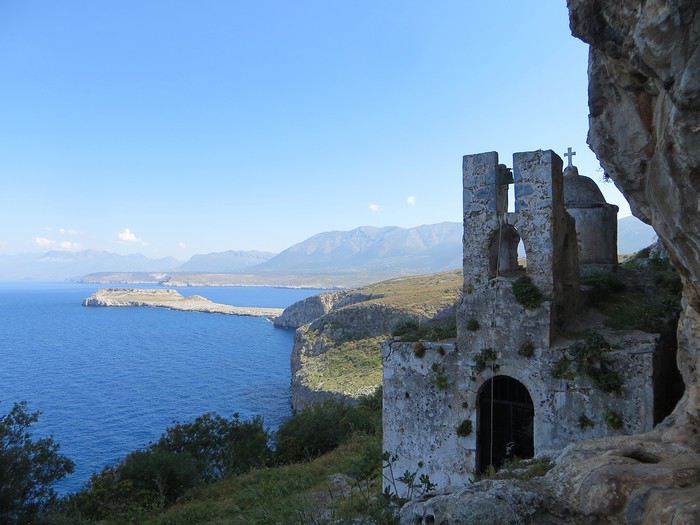 Bien choisir sa photo d'appel pour attirer le chaland. Un bon point et toute mon estime pour celui qui devine où c'est.
Avec la Grèce - pour ceux qui ont lu mes autres carnets qui sont tellement merveilleux qu’il faut les lire immédiatement et que votre vie s’en trouvera changée et éblouie - tout est chamboulé : fini les campings, les dortoirs et les piques-niques miteux de nos voyages dans le nord, place aux hôtels, aux b&b et aux restos. Et en plus, les Grecs ont le bon goût d’être accueillants.
Laissons la parole à du Ballay, parrainé par Alain Deloin et Jean-Michel Apeupré :
Heureux qui comme Ulysse a fait un beau voyage (en Grèce), Ou comme celui-là qui vit le Parthénon, Et puis est retourné, plein d'image et pâmoison, Vivre exubérant le reste de son âge
Et avant d'attaquer le vif du sujet, quelques annonces pour le public innocent : Avertissement : vous lisez ce compte-rendu à vos risques et périls. Toute indignation n’est pas de ma responsabilité. Avertissement bis : non je ne suis pas raciste non je n’ai rien contre les Néerlandais, j’ai d’ailleurs un ami néerlandais non les Grecs ne sont pas des feignants oui les Allemands ont pour passe-temps l’invasion… Ah mince une rechute.
Jour 1
Ayé, c’est parti pour une journée de transport translation Lyon-Athènes via Munich en empruntant la Lufthansa. Le vol est sans encombre, une conversation s’engage avec un voisin grec sympathique autour de la qualité douteuse de la bouffe allemande. J'en profite pour avoir une illumination : la nourriture, voilà ce qui unit les Européens (enfin ceux du sud) ! Eclair de génie, j’ai trouvé comment sauver l’Union européenne « tous unis contre la vie beurk ». Malheureusement, ça risque d’exclure les riches du nord. D’ailleurs c’est peut-être un signe : faut-il mal manger pour être riche ? Faudrait exclure les Japonais de l’équation mais sinon ça marche (pays germaniques, scandinaves et anglo-saxons même combat). Revenons au voisin grec, je tente de donner un tour sportif à la conversation mais malheureusement il n’aime pas le foot « football is shit »… Arrgghh, de quoi vais-je bien pouvoir parler alors ?! Du coup, je parle plus. Alors qu’un petit débat sur le scandale du moment, le président du PAOK Salonique et son flingue, ça, ça aurait été fun .
L’atterrissage se passe sans encombre dans cet aéroport d’Athènes qui a changé de place depuis mon unique passage dans le coin et s’est éloigné du centre-ville. Première prise de contact avec l’alphabet grec, on avait essayé pour le fun de potasser les équivalences mais c’est loin d’être évident ! Combien d'équivalents du O ont-ils dans cet alphabet ?!
Le trajet jusqu’au centre d’Athènes est long, très long et le métro/train se remplit progressivement jusqu’à être bondé à ras bord. Nous sommes tassés, compressés et pour sortir de cette fournaise, c’est la lutte finale, poussons-nous et demain, l’air sera le sauveur du genre humain (note à moi-même : éviter la prochaine fois d’arriver au moment de la sortie du travail)
La chambre chez l’habitant est bien placée, en plein centre sans être très bruyante. On profite de notre premier soir pour une approche de la cuisine grecque et un mauvais choix de commande (que de la friture…). On enchaîne sur une petite balade nocturne pour revenir sur l’impression née du voyage précédent (ie dans les années 90 la voiture reine, une ville bruyante et désagréable). Eh bien en fait, une partie du centre-ville s’est piétonnisé, il y a de la vie, des restos et des cafés avec des terrasses partout, c’est très agréable finalement.
Il était une fois, par delà les pandémies et les crises économiques, un temps où nous pouvions voyager : 2018. En cette année béni(t)e, il n’y eut pour nous point de virée nord-atlantique dans la chaleur estivale au programme, point de douches gratuites rafraîchissantes, point de températures vivifiantes, point de gastronomie douteuse et point de prix déments. En passant, félicitations à l’Islande et ses pizzas caoutchouteuse à 30 euros. En 2018, non, on va dans un vrai pays où l’on sait ce que signifie avoir chaud, manger et glander à une terrasse : la Grèce. Et comme nous ne sommes quand même pas des stakhanovistes du 40° à l’ombre, nous avons choisi le printemps, avril plus précisément. Pour le terrain de jeu, il s'agira d'Athènes et du Péloponnèse sur un peu plus de deux semaines. A nous, les petites églises, les ruines romantiques et les oliviers scintillants !
Bien choisir sa photo d'appel pour attirer le chaland. Un bon point et toute mon estime pour celui qui devine où c'est.Avec la Grèce - pour ceux qui ont lu mes autres carnets qui sont tellement merveilleux qu’il faut les lire immédiatement et que votre vie s’en trouvera changée et éblouie - tout est chamboulé : fini les campings, les dortoirs et les piques-niques miteux de nos voyages dans le nord, place aux hôtels, aux b&b et aux restos. Et en plus, les Grecs ont le bon goût d’être accueillants.
Laissons la parole à du Ballay, parrainé par Alain Deloin et Jean-Michel Apeupré :
Heureux qui comme Ulysse a fait un beau voyage (en Grèce), Ou comme celui-là qui vit le Parthénon, Et puis est retourné, plein d'image et pâmoison, Vivre exubérant le reste de son âge
Et avant d'attaquer le vif du sujet, quelques annonces pour le public innocent : Avertissement : vous lisez ce compte-rendu à vos risques et périls. Toute indignation n’est pas de ma responsabilité. Avertissement bis : non je ne suis pas raciste non je n’ai rien contre les Néerlandais, j’ai d’ailleurs un ami néerlandais non les Grecs ne sont pas des feignants oui les Allemands ont pour passe-temps l’invasion… Ah mince une rechute.
Jour 1
Ayé, c’est parti pour une journée de transport translation Lyon-Athènes via Munich en empruntant la Lufthansa. Le vol est sans encombre, une conversation s’engage avec un voisin grec sympathique autour de la qualité douteuse de la bouffe allemande. J'en profite pour avoir une illumination : la nourriture, voilà ce qui unit les Européens (enfin ceux du sud) ! Eclair de génie, j’ai trouvé comment sauver l’Union européenne « tous unis contre la vie beurk ». Malheureusement, ça risque d’exclure les riches du nord. D’ailleurs c’est peut-être un signe : faut-il mal manger pour être riche ? Faudrait exclure les Japonais de l’équation mais sinon ça marche (pays germaniques, scandinaves et anglo-saxons même combat). Revenons au voisin grec, je tente de donner un tour sportif à la conversation mais malheureusement il n’aime pas le foot « football is shit »… Arrgghh, de quoi vais-je bien pouvoir parler alors ?! Du coup, je parle plus. Alors qu’un petit débat sur le scandale du moment, le président du PAOK Salonique et son flingue, ça, ça aurait été fun .
L’atterrissage se passe sans encombre dans cet aéroport d’Athènes qui a changé de place depuis mon unique passage dans le coin et s’est éloigné du centre-ville. Première prise de contact avec l’alphabet grec, on avait essayé pour le fun de potasser les équivalences mais c’est loin d’être évident ! Combien d'équivalents du O ont-ils dans cet alphabet ?!
Le trajet jusqu’au centre d’Athènes est long, très long et le métro/train se remplit progressivement jusqu’à être bondé à ras bord. Nous sommes tassés, compressés et pour sortir de cette fournaise, c’est la lutte finale, poussons-nous et demain, l’air sera le sauveur du genre humain (note à moi-même : éviter la prochaine fois d’arriver au moment de la sortie du travail)
La chambre chez l’habitant est bien placée, en plein centre sans être très bruyante. On profite de notre premier soir pour une approche de la cuisine grecque et un mauvais choix de commande (que de la friture…). On enchaîne sur une petite balade nocturne pour revenir sur l’impression née du voyage précédent (ie dans les années 90 la voiture reine, une ville bruyante et désagréable). Eh bien en fait, une partie du centre-ville s’est piétonnisé, il y a de la vie, des restos et des cafés avec des terrasses partout, c’est très agréable finalement.
Le problème c'est de pouvoir rentrer en France à la fin des vacances! English translation pending
Bonjour
Je lis sur les forums de nombreux messages ou l' on se pose la question de partir à l' étranger dans les prochaines semaines .
Mais le problème est surtout de pouvoir revenir en France à la fin de nos vacances .............
En effet certaines compagnies continuent de nous amener dans de nombreuses destinations mais que fait on lorsque les vols retours sont annulés ....??????? sans que l' on vous propose une autre solution ( surtout avec les low coast )
Par exemple , nous rentrons d' Israël ou le gouvernement ferme les frontières progressivement à la majorité des touristes , difficile de rentrer car Easy jet , Ryanair, Air France , Martinair , Lufthansa , El Al et de nombreuses autres compagnies suppriment progressivement leurs vols , après le 14 mars cela va s' averer très compliqué voire très, très compliqué, la frontière avec la Cisjordanie et la Jordanie étant aussi fermée.
Il nous restait peu de solutions passer par Istambul , Athènes, Malte ou Bruxelles .
Nous avons pu partir par Bruxelles à moindre frais .
Il faut donc se poser la question : si l' on part , allons nous pouvoir rentrer ? comment ? et À quel prix ?
Nous étions partis début mars avant que tout s' emballe , mais à présent on a une idée des problèmes :partir s' avéré beaucoup plus simple que rentrer !
Pourquoi marcher en montagne? English translation pending
Qu’est ce donc qu’un marcheur ?
Diriez-vous que c’est un être à contre-courant qui veut maitriser son temps et a décidé de ralentir? Celui qui n’en peut plus de courir, de respirer vite, de penser encore plus vite , les dents serrées, le souffle rendu court non par un sentier pentu mais par la trépidante de sa vie?
Demandez à quelqu'un de dire spontanément ce qu’évoque pour lui le mot marche. Le plus souvent, il répondra : sentier, soleil, vent, ciel, horizon, espace. Et pourtant cela pourrait évoquer aussi bien pluie, vent, tempête, fatigue, faim, soif, lassitude. Comme si le seul mot de marche libérait des besoins d'espace et d'horizon, et surtout des désirs de liberté, d'imprévu, d'aventure.La marche : Un chemin intérieur : Ne dit-on pas de quelqu'un qui a avancé dans sa construction interne, qu'il a cheminé?
Aristote enseignait la philosophie au Lycée d'Athènes en marchant avec ses élèves ce qui valut à son École le qualificatif de péripatéticienne (l’école des promeneurs).
La marche favorise la concentration:
«Les seules pensées valables viennent en marchant » écrivait Nietzsche. Rousseau affirme que « la marche met l’esprit en mouvement »,
Les effets de la marche sur le cerveau:
A l’Institut Max Planck de Berlin, on a demandé à des enfants et à des adultes de passer des tests assis devant un bureau, ou en marchant à la vitesse de leur choix sur un tapis roulant. Ces tests consistaient à écouter des séries de chiffres prononcés par un haut-parleur, et à indiquer, pour chaque chiffre, s’ils l’avaient déjà entendu quatre chiffres plus tôt. Dans ces conditions, les participants, quel que soit leur âge, ont commis moins d’erreurs en marchant, les enfants de neuf ans tirant le meilleur bénéfice de cet exercice, avec presque 40 pour cent d’erreurs en moins. Quel étudiant n’a pas marché en rond, en large et en travers pour se réciter un passage qu’il n’arrivait pas à mémoriser. Quel petit de 8 ans, déjà, ne marchait pas pour se « rentrer sa récitation dans la tête. Selon les psychologues, ce phénomène s’explique par un effet de vigilance : la marche maintient le corps en action et, dans une certaine mesure, l’esprit alerte. Le cerveau est mieux irrigué, l’attention se relâche moins facilement.
Marcher c’est lever la tête vers le ciel… et remarquer la forme des nuages, c’est choisir son coin de prairie pour savourer son pique-nique. C’est écouter les bruits de la forêt ou le silence du bois. Ce sont des petites successions d’éternités, de présents sans temps, d’éphémères non-pensées ou on reste juste là. Marcheur ou vagabond? Il y a ceux qui préfèrent se réfugier le soir dans une grange ou leur tente, qui se sentent vagabonds ou clochards célestes, qui se ravissent du chant des oiseaux, de l’odeur du trèfle alpin ou des violettes au printemps qui sont éblouis par la lumière du soir sur les crêtes.
Les effets de la marche sur le cerveau:
A l’Institut Max Planck de Berlin, on a demandé à des enfants et à des adultes de passer des tests assis devant un bureau, ou en marchant à la vitesse de leur choix sur un tapis roulant. Ces tests consistaient à écouter des séries de chiffres prononcés par un haut-parleur, et à indiquer, pour chaque chiffre, s’ils l’avaient déjà entendu quatre chiffres plus tôt. Dans ces conditions, les participants, quel que soit leur âge, ont commis moins d’erreurs en marchant, les enfants de neuf ans tirant le meilleur bénéfice de cet exercice, avec presque 40 pour cent d’erreurs en moins. Quel étudiant n’a pas marché en rond, en large et en travers pour se réciter un passage qu’il n’arrivait pas à mémoriser. Quel petit de 8 ans, déjà, ne marchait pas pour se « rentrer sa récitation dans la tête. Selon les psychologues, ce phénomène s’explique par un effet de vigilance : la marche maintient le corps en action et, dans une certaine mesure, l’esprit alerte. Le cerveau est mieux irrigué, l’attention se relâche moins facilement.
Marcher c’est lever la tête vers le ciel… et remarquer la forme des nuages, c’est choisir son coin de prairie pour savourer son pique-nique. C’est écouter les bruits de la forêt ou le silence du bois. Ce sont des petites successions d’éternités, de présents sans temps, d’éphémères non-pensées ou on reste juste là. Marcheur ou vagabond? Il y a ceux qui préfèrent se réfugier le soir dans une grange ou leur tente, qui se sentent vagabonds ou clochards célestes, qui se ravissent du chant des oiseaux, de l’odeur du trèfle alpin ou des violettes au printemps qui sont éblouis par la lumière du soir sur les crêtes.
Idées d'itinéraires et points de chute en Grèce continentale English translation pending
Bonjour,
Avec ma femme et ma fille qui aura presque 4 ans en Aout, nous réfléchissons à partir en Grèce. Pas forcément dans les îles, plutôt Continentale. Dates : vers le 02/08 et jusqu'au 18, 19/08.
J'ai regardé un peu à gauche à droite et je ne tombe que sur des road trip. Ce qui est génial (j'en fait aussi) mais moins avec un enfant de même pas 4 ans.
En gros nous souhaiterions alterner les 2, c'est à dire prendre 2 3 points de chute et rayonner avec voiture de location. Nous arriverons et repartirons d’Athènes.
L'escapade serait éventuellement dans ce style là : Athènes Nauplie Leonidion Mistra et Sparte à côté Gythio Monemvasio (peut être) Athènes Nous sommes vraiment ouvert à toutes idées.
Notre style de voyage est surtout orienté, rencontre et paysages extérieurs. Pas intéréssé par les hotels resorts (location style AirBnb est le top). Et quand même un peu de détente et plage.
C'est pour ca que sur l'itinéraire indiqué plus haut, je pensais faire : - 2 jours Athènes (En air bnb par exemple) - 5, 6 jours ailleurs (toujours airbnb) - 5, 6 jours encore ailleurs (toujours airbnb) - 1, 2 jours sur Athènes avant de repartir
Du coup, vous qui êtes expert, avez vous des idées d'endroits où je pourrais louer et ensuite rayonner ? obligation d'avoir la voiture pour 10 12 jours ? ca ne me dérange pas de louer au jour le jour en fonction.
Merci pour tout.
Avec ma femme et ma fille qui aura presque 4 ans en Aout, nous réfléchissons à partir en Grèce. Pas forcément dans les îles, plutôt Continentale. Dates : vers le 02/08 et jusqu'au 18, 19/08.
J'ai regardé un peu à gauche à droite et je ne tombe que sur des road trip. Ce qui est génial (j'en fait aussi) mais moins avec un enfant de même pas 4 ans.
En gros nous souhaiterions alterner les 2, c'est à dire prendre 2 3 points de chute et rayonner avec voiture de location. Nous arriverons et repartirons d’Athènes.
L'escapade serait éventuellement dans ce style là : Athènes Nauplie Leonidion Mistra et Sparte à côté Gythio Monemvasio (peut être) Athènes Nous sommes vraiment ouvert à toutes idées.
Notre style de voyage est surtout orienté, rencontre et paysages extérieurs. Pas intéréssé par les hotels resorts (location style AirBnb est le top). Et quand même un peu de détente et plage.
C'est pour ca que sur l'itinéraire indiqué plus haut, je pensais faire : - 2 jours Athènes (En air bnb par exemple) - 5, 6 jours ailleurs (toujours airbnb) - 5, 6 jours encore ailleurs (toujours airbnb) - 1, 2 jours sur Athènes avant de repartir
Du coup, vous qui êtes expert, avez vous des idées d'endroits où je pourrais louer et ensuite rayonner ? obligation d'avoir la voiture pour 10 12 jours ? ca ne me dérange pas de louer au jour le jour en fonction.
Merci pour tout.
Itinéraire pour 2 ou 3 semaines en voiture en Crète English translation pending
Bonjour,
ma copine et moi commençons à penser aller en Crète, en juin 2020, pour probablement 2 semaines (peut être un peu plus). Possiblement entre le 8 juin et le 25 juin.
On ne s'intéresse pas particulièrement à la plage. On préfères les randonnées, les sites archéologiques et les paysages. Nous prévoyons louer une voiture pour la plupart des déplacements.
J'ai plusieurs questions :
1. Quel est le meilleur moyen de se rendre en Crète ? Nous partons de Montréal (Québec). Nous pensons prendre un vol Montréal-Athènes, puis un 2e vol Athènes-Héraklion (ou Chania). Quel est le coût pour un vol intérieur ? Ou est-ce mieux de prendre un ferry de Athènes à la Crète ? Combien de temps ça prendrait ?
2. En Crète, quel itinéraire pouvez-vous nous suggérer ? Quels sont les lieux qui valent vraiment le détour ? Quels sont les sites incontournables à voir, à mettre sur une liste pour 2 semaines ?
3. Quel est le coût typique d'un bon repas, sur l'ensemble de l'île ?
4. Quel est le coût de la location d'une voiture pour 2 semaines ?
5. Quel est le coût typique d'une chambre de qualité, à Héraklion (1ere grande ville) et Chania (2e grande ville), et dans les petits villages, sans chercher le gros luxe ?
6. Quelles températures prévoir pour cette période de l'année (entre le 8 juin et le 25 juin) ? Très chaud ? Sec et venteux ?
ma copine et moi commençons à penser aller en Crète, en juin 2020, pour probablement 2 semaines (peut être un peu plus). Possiblement entre le 8 juin et le 25 juin.
On ne s'intéresse pas particulièrement à la plage. On préfères les randonnées, les sites archéologiques et les paysages. Nous prévoyons louer une voiture pour la plupart des déplacements.
J'ai plusieurs questions :
1. Quel est le meilleur moyen de se rendre en Crète ? Nous partons de Montréal (Québec). Nous pensons prendre un vol Montréal-Athènes, puis un 2e vol Athènes-Héraklion (ou Chania). Quel est le coût pour un vol intérieur ? Ou est-ce mieux de prendre un ferry de Athènes à la Crète ? Combien de temps ça prendrait ?
2. En Crète, quel itinéraire pouvez-vous nous suggérer ? Quels sont les lieux qui valent vraiment le détour ? Quels sont les sites incontournables à voir, à mettre sur une liste pour 2 semaines ?
3. Quel est le coût typique d'un bon repas, sur l'ensemble de l'île ?
4. Quel est le coût de la location d'une voiture pour 2 semaines ?
5. Quel est le coût typique d'une chambre de qualité, à Héraklion (1ere grande ville) et Chania (2e grande ville), et dans les petits villages, sans chercher le gros luxe ?
6. Quelles températures prévoir pour cette période de l'année (entre le 8 juin et le 25 juin) ? Très chaud ? Sec et venteux ?
Ferries pour Limnos et Skyros (Grèce) English translation pending
Bonjour,
à peine rentrée du Viet Nam, je me mets déjà à rêver de Grèce... et me demande quelle est, en saison estivale, la desserte ferry pour Limnos. Il y a bien Kavala-Limnos, mais au départ de Limnos y'a-t-il d'autres destinations ? Le Pirée sans doute ? d'autres îles ? et notamment Skyros ? Même question pour Skyros : un ferry régulier depuis Kymi en Eubée... liaisons avec les Sporades... mais d'autres départs ? Merci pour vos conseils et retours d'expériences ! Marie
à peine rentrée du Viet Nam, je me mets déjà à rêver de Grèce... et me demande quelle est, en saison estivale, la desserte ferry pour Limnos. Il y a bien Kavala-Limnos, mais au départ de Limnos y'a-t-il d'autres destinations ? Le Pirée sans doute ? d'autres îles ? et notamment Skyros ? Même question pour Skyros : un ferry régulier depuis Kymi en Eubée... liaisons avec les Sporades... mais d'autres départs ? Merci pour vos conseils et retours d'expériences ! Marie
Grèce ou Sicile en camping-car? English translation pending
Bonjour
Pour cet été de fin juillet à mi août je ne sais pas trop où aller...................
J'hésite entre la Sicile et la Grèce
Merci de me donner votre avis
Le prix du ferry est différent de 200 euros La chaleur OK
Mais le reste ?????????????????????
Merci pour votre aide
Merci de me donner votre avis
Le prix du ferry est différent de 200 euros La chaleur OK
Mais le reste ?????????????????????
Merci pour votre aide
Itinéraire de 3 semaines en Chine Pékin, Shenzhen, Macao... English translation pending
Bonjour à tous !
Nous partons en famille, mon mari, ma fille de 7 ans et moi-même, 3 semaines en Chine, en juillet prochain.
Nous avons prévu de rester sur Pékin les 5 premiers jours. Ensuite, nous prenons un avion jusqu'à Shenzhen. Nous pensons rester une nuit sur Macao. Nous reprenons l'avion de Shengdu le dernier jour de notre voyage pour nous ramener sur Pékin puis sur Nice. En consacrant environ 5 jours pour le Sichuan.
Là où j'ai besoin de votre aide c'est pour la partie entre Macao et le Sichuan. Nous allons prendre les transports en commun pour remonter. Cependant, nous hésitons en Lijiang qui est quand même assez excentré ou l'île Haïnan (pour faire un peu de farniente). Nous aimerions également passer par Yangshuo et Guilin.
Auriez-vous des conseils ou des suggestions pour choisir entre ces deux étapes ? Ou d'autres idées pour remonter de Macao à Shengdu en 15 jours.
Merci beaucoup pour toute l'aide que vous pourrez nous apporter !!!
Marion
Nous partons en famille, mon mari, ma fille de 7 ans et moi-même, 3 semaines en Chine, en juillet prochain.
Nous avons prévu de rester sur Pékin les 5 premiers jours. Ensuite, nous prenons un avion jusqu'à Shenzhen. Nous pensons rester une nuit sur Macao. Nous reprenons l'avion de Shengdu le dernier jour de notre voyage pour nous ramener sur Pékin puis sur Nice. En consacrant environ 5 jours pour le Sichuan.
Là où j'ai besoin de votre aide c'est pour la partie entre Macao et le Sichuan. Nous allons prendre les transports en commun pour remonter. Cependant, nous hésitons en Lijiang qui est quand même assez excentré ou l'île Haïnan (pour faire un peu de farniente). Nous aimerions également passer par Yangshuo et Guilin.
Auriez-vous des conseils ou des suggestions pour choisir entre ces deux étapes ? Ou d'autres idées pour remonter de Macao à Shengdu en 15 jours.
Merci beaucoup pour toute l'aide que vous pourrez nous apporter !!!
Marion
Où dormir: Delphes, Arachova ou Galaxidi? English translation pending
Bonjour,
Après un séjour dans les cyclades, si nous prévoyons visiter Delphes et ensuite quitter le lendemain vers les Météores, où vous nous suggérez de dormir Delphes, Arachova ou Galaxidi?
Est-ce que vous avez également des suggestions pour des endroits où nous arrêter sur le route entre Météores et Athène lorsque nous allons revenir afin que la route soit moins longue.
Si nous prévoyons prendre un vol de Santorini à Athene, est-ce qu'il serait mieux de prendre un vol intérieur vers l'aéroport de Thessalonique pour se rendre en premier aux météores afin de diminuer la route
Merci
Après un séjour dans les cyclades, si nous prévoyons visiter Delphes et ensuite quitter le lendemain vers les Météores, où vous nous suggérez de dormir Delphes, Arachova ou Galaxidi?
Est-ce que vous avez également des suggestions pour des endroits où nous arrêter sur le route entre Météores et Athène lorsque nous allons revenir afin que la route soit moins longue.
Si nous prévoyons prendre un vol de Santorini à Athene, est-ce qu'il serait mieux de prendre un vol intérieur vers l'aéroport de Thessalonique pour se rendre en premier aux météores afin de diminuer la route
Merci
Destination voyage avec enfants de 6 et 3 ans (Italie, Espagne, Grèce...) English translation pending
Bonsoir,
Je vous consulte car nous comptons partir 4-5 jours en avril avec nos deux enfants de 3 et 6 ans.
Nous avons déjà visité avec eux : - Barcelone quelques jours avec l'aînée en 2015 ; - la Croatie pendant deux semaines avec l'aînée en 2016 ; - Porto et Lisbonne quelques jours avec les deux en 2018; - Madrid quelques jours avec les deux en 2019.
Nous sommes à la recherche d'une nouvelle destination pour 2020. Par exemple, nous avons repéré Rome ou Athènes mais on se dit que les enfants sont trop jeunes pour comprendre. On préfère attendre qu'ils soient plus grands pour faire un lien avec ce qu'ils apprennent à l'école. On a bien identifié Séville aussi par exemple, ou refaire Barcelone.
Avez-vous des conseils avec des enfants de cet âge et pour cette période ?
Merci d'avance.
Je vous consulte car nous comptons partir 4-5 jours en avril avec nos deux enfants de 3 et 6 ans.
Nous avons déjà visité avec eux : - Barcelone quelques jours avec l'aînée en 2015 ; - la Croatie pendant deux semaines avec l'aînée en 2016 ; - Porto et Lisbonne quelques jours avec les deux en 2018; - Madrid quelques jours avec les deux en 2019.
Nous sommes à la recherche d'une nouvelle destination pour 2020. Par exemple, nous avons repéré Rome ou Athènes mais on se dit que les enfants sont trop jeunes pour comprendre. On préfère attendre qu'ils soient plus grands pour faire un lien avec ce qu'ils apprennent à l'école. On a bien identifié Séville aussi par exemple, ou refaire Barcelone.
Avez-vous des conseils avec des enfants de cet âge et pour cette période ?
Merci d'avance.