Results for "Washington+|+3+>+99"
5599 results found.
Conseils pour un premier séjour en Équateur? English translation pending
Nous allons bientôt préparer un séjour de 4 semaines en Equateur.
Nos aimerions avoir pas mal d'infos !
Vols, logements, guides sur place, incontournables, guides etcc...
pouvez-vous nous aider ?
Merci
Douches à l'aéroport de Dorval Pierre-Elliott-Trudeau? English translation pending
J'aimerais savoir si il y a des douches a l'aéroport de Dorval Pierre Trudo.
Traversée des Etats-Unis English translation pending
Bonjour á tous,
J`ai pour projet de partir fin aout aux Etats-Unis, pour plusieurs semaines, afin de traverser le pays d`est en ouest, en bus, train, voir de temps en temps location de voiture, et hébergement dans des hotels bons marchés. Malgré mes recherches, j`ai des difficultés á estimer le nombre de semaines idéales pour effectuer cette traversée, et surtout le budget a prévoir. Si quelqu`un a effectué un voyage de ce type, pourrait-il m`aider svp??? Merci d`avance
J`ai pour projet de partir fin aout aux Etats-Unis, pour plusieurs semaines, afin de traverser le pays d`est en ouest, en bus, train, voir de temps en temps location de voiture, et hébergement dans des hotels bons marchés. Malgré mes recherches, j`ai des difficultés á estimer le nombre de semaines idéales pour effectuer cette traversée, et surtout le budget a prévoir. Si quelqu`un a effectué un voyage de ce type, pourrait-il m`aider svp??? Merci d`avance
Votre avis sur itinéraire et organisation de mon voyage aux Etats-Unis English translation pending
Bonjour !🙂
Je viens de m'inscrire après avoir longtemps cherché un forum sur les voyages aux USA, celui-ci me semble parfait !
Alors voilà, j'ai pris la ferme décision de partir 3 ou 4 semaines aux USA (sept-oct), pour la première fois. J'ai donc un grand besoin de vos conseils avisés... Comme je n'aime pas trop planifier mes voyages, voilà en gros ce que je compte faire: d'abord, je pars seul (j'aime ça), avion Paris=>Los Angeles, là je prends la voiture louée via Autoescape, je ne traîne pas à L.A. (m'en fous...), je pars directos vers le nord jusqu'à l'Oregon en longeant la côte. Puis plein Est, Idaho, Wyoming (?), puis plein sud, Utah, Colorado, si je peux tirer jusqu'au Kansas et Oklahoma, puis retour via Arizona, Nevada... J'ai un budget de 2500/3000€. La voiture sera la moins chère (Chevrolet Aveo). En faisant 300 ou 400 kms/j, ça me fait un circuit de 5 ou 6000 kms. Pour le logement : 50% campings, 25% motels pas chers, 25% dans la voiture ou dehors, à côté. Nourriture : bord de route, supermarchés (m'en fiche un peu...)
Ce que j'aime surtout, c'est l'Amérique "profonde" : le trip éoliennes grinçantes, motels paumés, stations essences abandonnées, avec Tom Waits et Woody Guthrie dans l'autoradio, etc... vous voyez l'genre quoi ! 😛 Je compte éviter les grandes villes et le shopping...
Alors bien-sûr, je me doute bien que je vais devoir passer par la case visa à Paris et tout le tralala. Tant pis. Je ne vous en parle pas...
Mais j'ai une question : est-ce que tout cela vous parait réalisable ? Au niveau budget, itinéraire, "esprit"... Est-ce que j'ai choisi les bons endroits pour trouver ce que je cherche ?
Je serais vraiment content de recueillir vos conseils et avis sur la question. Vraiment. Cette histoire de visa et de passeport biométrique me fait douter...😕
A bientôt !😎
Je viens de m'inscrire après avoir longtemps cherché un forum sur les voyages aux USA, celui-ci me semble parfait !
Alors voilà, j'ai pris la ferme décision de partir 3 ou 4 semaines aux USA (sept-oct), pour la première fois. J'ai donc un grand besoin de vos conseils avisés... Comme je n'aime pas trop planifier mes voyages, voilà en gros ce que je compte faire: d'abord, je pars seul (j'aime ça), avion Paris=>Los Angeles, là je prends la voiture louée via Autoescape, je ne traîne pas à L.A. (m'en fous...), je pars directos vers le nord jusqu'à l'Oregon en longeant la côte. Puis plein Est, Idaho, Wyoming (?), puis plein sud, Utah, Colorado, si je peux tirer jusqu'au Kansas et Oklahoma, puis retour via Arizona, Nevada... J'ai un budget de 2500/3000€. La voiture sera la moins chère (Chevrolet Aveo). En faisant 300 ou 400 kms/j, ça me fait un circuit de 5 ou 6000 kms. Pour le logement : 50% campings, 25% motels pas chers, 25% dans la voiture ou dehors, à côté. Nourriture : bord de route, supermarchés (m'en fiche un peu...)
Ce que j'aime surtout, c'est l'Amérique "profonde" : le trip éoliennes grinçantes, motels paumés, stations essences abandonnées, avec Tom Waits et Woody Guthrie dans l'autoradio, etc... vous voyez l'genre quoi ! 😛 Je compte éviter les grandes villes et le shopping...
Alors bien-sûr, je me doute bien que je vais devoir passer par la case visa à Paris et tout le tralala. Tant pis. Je ne vous en parle pas...
Mais j'ai une question : est-ce que tout cela vous parait réalisable ? Au niveau budget, itinéraire, "esprit"... Est-ce que j'ai choisi les bons endroits pour trouver ce que je cherche ?
Je serais vraiment content de recueillir vos conseils et avis sur la question. Vraiment. Cette histoire de visa et de passeport biométrique me fait douter...😕
A bientôt !😎
Compagnie aérienne la moins chère pour aller à Montréal? English translation pending
bonjour à tous,
je suis dans la mélasse !!! je me perds dans les différents tarifs des compagnies aériennes pour un aller-retour Paris Montréal... quelqu'un saurait me dire si de qui, Airtransat, SwissAir ou autre serait le plus compétitif?
bien évidemment, je choisis la bonne période (aout!!!) et en plus nous avons une belle famille, soir 2 adultes et 3 enfants dont un qui aura 13 ans.
bref les tarifs sont tous différents et je ne sais plus quoi choisir...
AU SECOURS!!!😕
Un mois dans l'Ouest américain English translation pending
Bonjour à tous !
Depuis longtemps je prévoyais de partir dans le SO Américain, et voilà que mon projet semble vouloir se réaliser pour Août prochain... 🙂🙂🙂 Nous serons en principe 3 personnes (23-25 ans), et voici ce que j' ai prévu: un voyage de 25 jours environ, avec le programme qui suit: vol Paris / San Francisco location de voiture à l' aéroport visite de San Francisco (Golden Gate Bridge, divers quartiers, éventuellement Alcatraz, les Twin Peaks) Sequoia / Kings Canyon Yosemite (Glacier Point, cascades, El Capitan...) Mono Lake direction Yellowstone par la route US 50, le lac salé de Bonneville (Nevada) et Salt Lake City Yellowstone (visite en 2 jours mini je pense) Grand Teton route vers Rocky Mountains Rocky Mountains - route US 34 route vers Arches National Park par Denver Arches, Canyonlands, Monument Valley Lake Powell, Bryce Canyon, Grand Canyon Las Vegas, Death Valley retour sur Los Angeles retour avion L.A / Paris
Je ne sais pas si ce programme tient réellement la route, je l' ai constitué en regardant une carte du SO des Etats-Unis + le road Atlas USA Michelin...😉, puis évidemment le forum, sites divers...
J' ai par contre du mal à évaluer le temps de parcours entre les étapes, ainsi que le temps sur place. Je sais par exemple que pour Yellowstone il faut y rester au minimum 2 jours pour en découvrir un tant soit peu les richesses, ainsi que San Francisco...
Concernant les tarifs, après m' être renseigné sur le net je ne tomberai pas sous la barre des 950 € pour le vol A/R, et 800 € pour la loc de voiture. J' espère qu' à 3 en partageant les frais nous arriverons à nous en tirer pour 2500 € tout compris... Evidemment nous comptons au maximum sur les campings (voire sauvage parfois même si je sais que c' est interdit 😊😊) et sur les motels à bas prix...
J' ai trouvé une multitude de sites sur l' Ouest Américain, certains sont vraiment sublimes, tout autant que les paysages fabuleux qui y sont montrés.. 😮😮 Il y a tellement d' infos et de choses à voir que j' en perds un peu la tête, c' est pourquoi je m' exprime sur ce forum pour trouver des personnes ayant déjà voyagé là bas !!
Merci d' avance !!!
Thibaut
Depuis longtemps je prévoyais de partir dans le SO Américain, et voilà que mon projet semble vouloir se réaliser pour Août prochain... 🙂🙂🙂 Nous serons en principe 3 personnes (23-25 ans), et voici ce que j' ai prévu: un voyage de 25 jours environ, avec le programme qui suit: vol Paris / San Francisco location de voiture à l' aéroport visite de San Francisco (Golden Gate Bridge, divers quartiers, éventuellement Alcatraz, les Twin Peaks) Sequoia / Kings Canyon Yosemite (Glacier Point, cascades, El Capitan...) Mono Lake direction Yellowstone par la route US 50, le lac salé de Bonneville (Nevada) et Salt Lake City Yellowstone (visite en 2 jours mini je pense) Grand Teton route vers Rocky Mountains Rocky Mountains - route US 34 route vers Arches National Park par Denver Arches, Canyonlands, Monument Valley Lake Powell, Bryce Canyon, Grand Canyon Las Vegas, Death Valley retour sur Los Angeles retour avion L.A / Paris
Je ne sais pas si ce programme tient réellement la route, je l' ai constitué en regardant une carte du SO des Etats-Unis + le road Atlas USA Michelin...😉, puis évidemment le forum, sites divers...
J' ai par contre du mal à évaluer le temps de parcours entre les étapes, ainsi que le temps sur place. Je sais par exemple que pour Yellowstone il faut y rester au minimum 2 jours pour en découvrir un tant soit peu les richesses, ainsi que San Francisco...
Concernant les tarifs, après m' être renseigné sur le net je ne tomberai pas sous la barre des 950 € pour le vol A/R, et 800 € pour la loc de voiture. J' espère qu' à 3 en partageant les frais nous arriverons à nous en tirer pour 2500 € tout compris... Evidemment nous comptons au maximum sur les campings (voire sauvage parfois même si je sais que c' est interdit 😊😊) et sur les motels à bas prix...
J' ai trouvé une multitude de sites sur l' Ouest Américain, certains sont vraiment sublimes, tout autant que les paysages fabuleux qui y sont montrés.. 😮😮 Il y a tellement d' infos et de choses à voir que j' en perds un peu la tête, c' est pourquoi je m' exprime sur ce forum pour trouver des personnes ayant déjà voyagé là bas !!
Merci d' avance !!!
Thibaut
Conseils sur itinéraire et logements en Nouvelle-Calédonie English translation pending
Bonjour,
c'est en recherchant des infos sur la Nelle Calédonie que j'ai découvert le site Voyages Forum
Nous sommes une famille française expatriée au Japon depuis 6 mois et ce pour 2 ans, et comme c'est plus facile financièrement du Japon, ns partons en Nouvelle Calédonie fin avril début mai (14 jours) ; petit détail non négligeable, nous sommes 5: (3 enfants 16, 13 et 8 ans)et je suis à la recherche de logements à un prix raisonnable ; au programme nous pensons faire 2 jours à NOUMEA, puis partir vers le Nord et redescendre au Sud ; ns pensons finir par l'île des Pins (des personnes sont elles déjà allées"chez Régis") et aussi l'île de Lifou ou Maré ; là le choix semble difficile.....
qu'en est il des liaisons ferry qui sont moins chères il me semble ?
Dernière précision : nous ne sommes pas contre la marche et les enfants suivent très bien
Est on limités en poids sur les vols intérieurs ?
J'attends vos conseils ou vos astuces ; merci d'avance
A votre disposition si vs avez besoin de renseignements sur le Japon.....
Top 5 de l'ouest des États-Unis English translation pending
J'attends de votre part votre classement des 5 sites ou villes qui vous ont le plus marqué sur l'Ouest des Etats-Unis.
Marqué par la beauté et la majesté, l'accueil, les senteurs, un souvenir personnel.
A vos claviers.
D'Asie du Sud aux Etats-Unis: nécessairement par l'Europe? English translation pending
Salute!
Je me posais une question...
Les vols de l'asie du sud vers les states, ils passent tous necessairement par l'europe?
Merki amis des oiseaux de fer qui polluent.
Je me posais une question...
Les vols de l'asie du sud vers les states, ils passent tous necessairement par l'europe?
Merki amis des oiseaux de fer qui polluent.
Les dix plus beaux sites du monde? English translation pending
Bonjour,
Je souhaiterais partager vos gouts !!!!!!!! Pouvez m'énumérer vos 10 plus beaux spots sur cette planète terre... Mentionner le pays pour nous autres, merci
1 du plus beau 2 3 4 5 6 7 8 9 10
J'ai hate de connaitre vos réponses. A+ OL
Je souhaiterais partager vos gouts !!!!!!!! Pouvez m'énumérer vos 10 plus beaux spots sur cette planète terre... Mentionner le pays pour nous autres, merci
1 du plus beau 2 3 4 5 6 7 8 9 10
J'ai hate de connaitre vos réponses. A+ OL
Obtention et validité du visa indonésien English translation pending
bonjour aux spécialistes du problème récurrent des visas..
les visas c complexes, j'ai des infos différentes sur le meme visa : indonésie.
J'ai donc besoin de vos témoignages pour savoir que/comment/ou faire.
En fait on va avoir besoin de les faire pendant un TDM, donc où le faire ? quelle ville est la plus aventageuse pour le visa indonésien?
1ere info que j'ai trouvé : le visa est valable 60j sur place, coute 50$, valable pendant 3 mois avant l'arrivée dans le pays. Mais je ne sais pas où trouver ce précieux visa ? a l'arivée a l'aeroport?
2eme info, j'ai écrit au consulat a hong kong et là, ils me disent que le visa n'est valable que 30j sur place, mais 6 mois avant l'arrivée dans le pays, et coute 280HK$.
Comme je voudrais le beurre et l'argent du beurre, j'aimerais savoir où le prendre facilement, pas exorbitant et valable 60j sur place!!😛 Sinon est-il renouvelable facilement sur place ??
merci de votre savoir!!
a bientot
les visas c complexes, j'ai des infos différentes sur le meme visa : indonésie.
J'ai donc besoin de vos témoignages pour savoir que/comment/ou faire.
En fait on va avoir besoin de les faire pendant un TDM, donc où le faire ? quelle ville est la plus aventageuse pour le visa indonésien?
1ere info que j'ai trouvé : le visa est valable 60j sur place, coute 50$, valable pendant 3 mois avant l'arrivée dans le pays. Mais je ne sais pas où trouver ce précieux visa ? a l'arivée a l'aeroport?
2eme info, j'ai écrit au consulat a hong kong et là, ils me disent que le visa n'est valable que 30j sur place, mais 6 mois avant l'arrivée dans le pays, et coute 280HK$.
Comme je voudrais le beurre et l'argent du beurre, j'aimerais savoir où le prendre facilement, pas exorbitant et valable 60j sur place!!😛 Sinon est-il renouvelable facilement sur place ??
merci de votre savoir!!
a bientot
Plus belles plages entre le Maine (Québec) et Hampton (Etats-Unis) English translation pending
salut tout le monde !
je menvais sur la cote est des etas unis ....vous etes deja allée ? quelle est la plus belle plage que vous avez vu entre le quebec et hampton ???? une place ou ya des grosses vagues yen a ? du sable blanc de la belle eau ...lol
merci !!!!😛
je menvais sur la cote est des etas unis ....vous etes deja allée ? quelle est la plus belle plage que vous avez vu entre le quebec et hampton ???? une place ou ya des grosses vagues yen a ? du sable blanc de la belle eau ...lol
merci !!!!😛
Besoin de vos avis sur la Région de Montréal et de Québec English translation pending
Salut à tous,
Je viens de décourvir votre site et forum. 🙂 Je voudrais savoir si parmi vous il y a des accrocs de Montréal et du Québec et de ses alentours. En fait je pars bientôt là-bas. Je dispose de 1 semaine seulement pour visiter la ville de Montréal et celle de Québec. Je vais visiter les gros sites de Montréal et de Québec : planing ok (ex:Chateau, port, traversier vers Lévis, ..). J'ai un ou deux jours maxi à consacrer pour faire un peu les alentours de Québec (en louant peut-être une voiture, les bus et trains sont ok pour les trajets directs style Montréal à Québec mais plus dur, je crois pour aller à Tadoussac). Est ce que vous pouvez me conseiller des sites intéressants dans la région de Québec. Je pense ne pas aller au Lac Saint Jean, un peu loin; Est ce que vous connaissez l'île d'Orléans, Tadoussac, Charlevoix, Chutes de Montmorency et est ce que ça vaut le déplacement et la location d'une voiture? ou bien, je peux m'en sortir avec le co-voiturage ou les bus?
Je vous remercie pour vos réponses,
Je viens de décourvir votre site et forum. 🙂 Je voudrais savoir si parmi vous il y a des accrocs de Montréal et du Québec et de ses alentours. En fait je pars bientôt là-bas. Je dispose de 1 semaine seulement pour visiter la ville de Montréal et celle de Québec. Je vais visiter les gros sites de Montréal et de Québec : planing ok (ex:Chateau, port, traversier vers Lévis, ..). J'ai un ou deux jours maxi à consacrer pour faire un peu les alentours de Québec (en louant peut-être une voiture, les bus et trains sont ok pour les trajets directs style Montréal à Québec mais plus dur, je crois pour aller à Tadoussac). Est ce que vous pouvez me conseiller des sites intéressants dans la région de Québec. Je pense ne pas aller au Lac Saint Jean, un peu loin; Est ce que vous connaissez l'île d'Orléans, Tadoussac, Charlevoix, Chutes de Montmorency et est ce que ça vaut le déplacement et la location d'une voiture? ou bien, je peux m'en sortir avec le co-voiturage ou les bus?
Je vous remercie pour vos réponses,
Que choisir entre Pittsburgh, Cleveland et Indianapolis aux Etats Unis English translation pending
🙂 Salut à tous et à toute😎
Voila je fais un road trip sur la cote est au mois d'aout et je dois passer par une de ces trois villes.
Si qqn peut m'indiquer la meilleur de ces trois villes ce serait sympa, j'ai bo chercher sur le net qq infos : je ne trouve rien d'interressant.
Merci d'avance pour vos réponses
Politique de surclassement d'Air France English translation pending
Quelqu'un a t'il des details sur la politique de surclassement d'Air France sur les longs courriers.
J'ai compris que la tendance etait à surclasser les bons clients (FP Rouge, Club 2000 etc ...) lorsqu'on avait besoin de leur fauteuil pour faire rentrer plus de monde dans un avion survendu, mais quelqu'un a t'il plus de detail quant aux règles de priorité appliquées et au libre arbitre de la personne qui fait l'enregistrement ?????
Grand voyage aux USA, plein de questions... English translation pending
Bonjour a tous,
Je veux partir aux etats unis faire un grand tour, si possible... Mon point de depart serai miami, a partir de mi-avril environ.
De la, je voudrais aller en lousianne et visiter la floride, puis remonter jusqu'a New York. Ensuite je voudrais faire les grand parks, et le colorado, la californie, mais je ne sais pas encore dans quel ordre.
C'est pas facile de se decider, je voudrais partir en avril, et deja les avions commencent a se remplir... Va falloir vite se decider. J'ai pas mal d'economie en poche, mais comment estimer ce genre de voyage ? pas simple, et les transport la bas me semble chers...
Y'en a t'il parmis vous qui on des tuyaux, des idees d'itineraires ? Je voudrais aussi savoir combien reviens en moyenne un moins au USA, a quel prix on trouve des hotel bon marché, etc...
Si il y a des gens motivé par ce genre d'experience, je recherche aussi des compagnons de voyage.. Rencontres possible sur paris. J'ai 25 ans pour ceux kil veulent savoir. Ca me fait kan meme un peu peur de partir seul faire ce grand trip...
Je veux partir aux etats unis faire un grand tour, si possible... Mon point de depart serai miami, a partir de mi-avril environ.
De la, je voudrais aller en lousianne et visiter la floride, puis remonter jusqu'a New York. Ensuite je voudrais faire les grand parks, et le colorado, la californie, mais je ne sais pas encore dans quel ordre.
C'est pas facile de se decider, je voudrais partir en avril, et deja les avions commencent a se remplir... Va falloir vite se decider. J'ai pas mal d'economie en poche, mais comment estimer ce genre de voyage ? pas simple, et les transport la bas me semble chers...
Y'en a t'il parmis vous qui on des tuyaux, des idees d'itineraires ? Je voudrais aussi savoir combien reviens en moyenne un moins au USA, a quel prix on trouve des hotel bon marché, etc...
Si il y a des gens motivé par ce genre d'experience, je recherche aussi des compagnons de voyage.. Rencontres possible sur paris. J'ai 25 ans pour ceux kil veulent savoir. Ca me fait kan meme un peu peur de partir seul faire ce grand trip...
Budget Japon 3 semaines English translation pending
Bonjour à tous,
Je m'adresse à tous ceux qui sont partis au Japon dernièrement, car j'ai l'intention de partir avec mon ami 3 semaines en mai, mais j'aimerais beaucoup savoir pour ceux qui sont partis, quel a été leur budget pour 3 semaines.
Dans les guides, ils disent de compter 150€/jour, logement+nourriture. Est-ce bien exact ?
Sinon, si je comprends bien, dans des ryokans, le prix est toujours indiqué pour 1 personne, n'est-ce-pas ? donc il faut multiplier par 2 pour une base chambre double. Y-a-t'il des sites internet où l'on puisse réserver son ryokan avant de partir au japon ?
Pour le Rail pass, il est valable à l'intérieur de tout le pays ou seulemement Tokyo et sa périphérie ? Arrive-t'on à reconnaître facilement les lignes JR car si c'est écrit en japonais !!!
Pour l'instant, voici mes principales questions, si vous pouviez m'aider, cela m'éclairerait beaucoup.
Merci
Je m'adresse à tous ceux qui sont partis au Japon dernièrement, car j'ai l'intention de partir avec mon ami 3 semaines en mai, mais j'aimerais beaucoup savoir pour ceux qui sont partis, quel a été leur budget pour 3 semaines.
Dans les guides, ils disent de compter 150€/jour, logement+nourriture. Est-ce bien exact ?
Sinon, si je comprends bien, dans des ryokans, le prix est toujours indiqué pour 1 personne, n'est-ce-pas ? donc il faut multiplier par 2 pour une base chambre double. Y-a-t'il des sites internet où l'on puisse réserver son ryokan avant de partir au japon ?
Pour le Rail pass, il est valable à l'intérieur de tout le pays ou seulemement Tokyo et sa périphérie ? Arrive-t'on à reconnaître facilement les lignes JR car si c'est écrit en japonais !!!
Pour l'instant, voici mes principales questions, si vous pouviez m'aider, cela m'éclairerait beaucoup.
Merci
Les États-Unis en train English translation pending
Bonjour,
je pense partir en voyage environ 2 semaines en janvier 2005. J'aimerais découvrir les États-Unis. J'ai pensé le faire avec une carte Amérique du Nord, c'est-à-dire une carte qui permet de voyager partout en Amérique du Nord pendant 30 jours. Est-ce que quelqu'un a déjà fait ce genre de voyage aux États-Unis? Est-ce une bonne idée? Y'a-t-il des intéressés?
Un gars de l'Abitibi (Québec)
je pense partir en voyage environ 2 semaines en janvier 2005. J'aimerais découvrir les États-Unis. J'ai pensé le faire avec une carte Amérique du Nord, c'est-à-dire une carte qui permet de voyager partout en Amérique du Nord pendant 30 jours. Est-ce que quelqu'un a déjà fait ce genre de voyage aux États-Unis? Est-ce une bonne idée? Y'a-t-il des intéressés?
Un gars de l'Abitibi (Québec)
Passeport optique pour USA English translation pending
Bonjour a tous.
Je vous ecrit car j'ai un gros, un TRES gros probleme 😕
J'ai un rendez-vous TRES IMPORTANT au Etats-Unis le 14 novembre 2004. J'ai fais toutes les demarches (je reste 3 jours) : hotel réservé, vol réservé, tout ca deja prelevé sur ma carte !
UNE chose🙁, j'avais oublié (vous me direz qu'il faut vraiment etre atteint d'Elzaymer) que je n'ai qu'une carte d'identié donc :pas de passeport.
J'ai besoin de votre aide pour savoir s'il n'y orait pas un moyen, même s'il faut remuer ciel et terre, d'obtenir ce fichu passeport optique avant la date de mon depart? 🤪
J'ai lu beaucoup beaucoup de documentation qui me parlent d'un delai de 4 semaines pour l'obtention d'un passeport mais comme vous le voyez 4 semaines -> c'est trop! Alors...😕
Je suis pres à aller pleurer devant l'ambassade des Etats unis d'amerique si ca peut m'aider pour avoir mon passeport.
Je sais pas moi, le deces de ma grand mere ou un truc medical.. aidez moi! s'il vous plait
REPONDEZ VITE SVP car je vais à l'embassade et à la prefecture dés lundi MERCI! 😕
Je vous ecrit car j'ai un gros, un TRES gros probleme 😕
J'ai un rendez-vous TRES IMPORTANT au Etats-Unis le 14 novembre 2004. J'ai fais toutes les demarches (je reste 3 jours) : hotel réservé, vol réservé, tout ca deja prelevé sur ma carte !
UNE chose🙁, j'avais oublié (vous me direz qu'il faut vraiment etre atteint d'Elzaymer) que je n'ai qu'une carte d'identié donc :pas de passeport.
J'ai besoin de votre aide pour savoir s'il n'y orait pas un moyen, même s'il faut remuer ciel et terre, d'obtenir ce fichu passeport optique avant la date de mon depart? 🤪
J'ai lu beaucoup beaucoup de documentation qui me parlent d'un delai de 4 semaines pour l'obtention d'un passeport mais comme vous le voyez 4 semaines -> c'est trop! Alors...😕
Je suis pres à aller pleurer devant l'ambassade des Etats unis d'amerique si ca peut m'aider pour avoir mon passeport.
Je sais pas moi, le deces de ma grand mere ou un truc medical.. aidez moi! s'il vous plait
REPONDEZ VITE SVP car je vais à l'embassade et à la prefecture dés lundi MERCI! 😕
Demande de visas pour l'Asie Sud Est à l'avance? English translation pending
Salut à tous,
On est 2 nanas qui partons un an découvrir l'asie du sud est le 8.10, pour nous faciliter la tâche, il serait cool de pouvoir faire des visas d'entrée dans les différents pays dès notre arrivée à BKK, le 8 octobre, mais est-ce que celà est possible?
Je ne sais pas si ma question est claire, pour prendre un ex je suis allée à l'ambassade de Thai le 18 septembre pour demander le visa, elle m'a dit de repasser la veille de mon départ parce qu'il ne leur est pas possible de mettre une date d'entrée différente de la date du jour où on demande le visa. Du coup on aurait bien eu un visa valable 2 mois, mais valable dès le 18 sept alors qu'on ne franchit la frontière que le 8 octobre, on aurait perdu 3 semaine de Thailande.
Voilà j'espère que ma formulation est assez claire, vu l'heure très matinale qu'il est 😉
On est 2 nanas qui partons un an découvrir l'asie du sud est le 8.10, pour nous faciliter la tâche, il serait cool de pouvoir faire des visas d'entrée dans les différents pays dès notre arrivée à BKK, le 8 octobre, mais est-ce que celà est possible?
Je ne sais pas si ma question est claire, pour prendre un ex je suis allée à l'ambassade de Thai le 18 septembre pour demander le visa, elle m'a dit de repasser la veille de mon départ parce qu'il ne leur est pas possible de mettre une date d'entrée différente de la date du jour où on demande le visa. Du coup on aurait bien eu un visa valable 2 mois, mais valable dès le 18 sept alors qu'on ne franchit la frontière que le 8 octobre, on aurait perdu 3 semaine de Thailande.
Voilà j'espère que ma formulation est assez claire, vu l'heure très matinale qu'il est 😉
Quel état des USA choisir? English translation pending
Hello tout le monde!
Je vais faire un séjour linguistique aux States au mois de juillet prochain...on me propose plusieurs destinations du type : Virginie, Pennsylvanie, Delaware, Maryland...je sais que ce ne sont pas de très grands lieux touristiques, mais c'est justement ce qui m'intéresse...j'ai plutôt envie de m'intéresser aux autochtones et aux paysages plutôt qu'aux touristes européens et japonais! Toute info sur ces différents états me sera très précieuse (visites, accueil des américains, activités sur place...)!
Merci d'avance pour tout vos renseignements!
@ + 😉
Je vais faire un séjour linguistique aux States au mois de juillet prochain...on me propose plusieurs destinations du type : Virginie, Pennsylvanie, Delaware, Maryland...je sais que ce ne sont pas de très grands lieux touristiques, mais c'est justement ce qui m'intéresse...j'ai plutôt envie de m'intéresser aux autochtones et aux paysages plutôt qu'aux touristes européens et japonais! Toute info sur ces différents états me sera très précieuse (visites, accueil des américains, activités sur place...)!
Merci d'avance pour tout vos renseignements!
@ + 😉
Africa: A Heartfelt Love for a Continent
“When the Whites came to Africa, we had the land and they had the Bible. They taught us to pray with our eyes closed: when we opened them, the Whites had the land and we had the Bible.” Jomo Kenyatta (p.7)
The Maggi cube, an unchallenged hegemony, and so much more
“The hopeless continent,” headlined The Economist, a British magazine, in July 2000 about Africa. Eleven years later, the same magazine headlined “Africa rising” instead. Images of Africa in the prosperous North constantly oscillate between apocalyptic scenarios and enthusiastic projections. A key issue with such images lies in the generalization they entail. If you look at the continent, considerable contrasts emerge depending on space and time. It’s no surprise that a region of the world encompassing such diverse ecological zones, maintaining such varied ties with other continents, comprising nearly fifty nation-states in sub-Saharan Africa alone, and characterized by a great diversity of languages, belief systems, and historical paths, doesn’t share a single destiny.
And yet, for many people outside Africa, as well as for many Africans, the continent constitutes a single entity, defined by criteria such as skin color, a colonial past, poverty, and the art of survival. Until now, these perspectives were generally accompanied by the idea that Africa had to—or should have—followed a single path together, sometimes called development, sometimes modernization, sometimes liberation, then a market economy. None of these paths delivered on their promises.
The two writers Alain Mabanckou and Abdourahman Waberi—one from Congo, the other raised in Djibouti, both long settled in France and now professors at renowned North American universities (Los Angeles, Washington)—have had enough of pessimistic scenarios: “We are aware that Africa is in the world and the world is in Africa. The same goes for all other continents, as our destinies are inextricably linked for better or worse. We refuse to see Africa as a reservoir of misfortunes or a continent cursed by atavistic misfortune and characterized by ethnic conflicts. [...] It’s this passionate flame we wanted to capture in a book [...] a kind of stroll through African cultures, without any demands, each letter of the alphabet leading us to a notion, a practice, a concept, a moment in history, literature, painting, politics, economics, cuisine, etc.” (p.10-11). Africa, they write, is on the verge of “imposing a signature, a style, a way of being in the world and in relation to the rest of the world.” (p.11) To put words to the continent’s diversity and dynamism, the two authors created a “rambling ABC,” a kind of portrait—or more precisely, a mythography—that lets you see and feel the pulse of a vast continent whose cultural power is unfolding before our eyes. Once marginalized or even mocked, the voice and importance of the Continent in global affairs are now undeniable” (p.11), containing over a hundred entries, mostly concise, written in a relaxed and casual style. The optimistic, even exuberant tone is set from the brief introduction. The duo of authors wants to “sing a love song to the cultures of our continent, to its inhabitants past and present, to its exceptional resources and its spectacular globalization despite a certain pollution that still clouds our skies due to the unmatched duration of dictatorships in some of our regions.” (p.12) In doing so, they don’t want to be too distracted by today’s Afewerki-Biya-Bongo-Déby & Co. ...
Of course, you’ll find tributes to great precursors like Frantz Fanon (“[...] it was a love story and admiration that wasn’t dimmed by the four decades separating his birth from ours. Let’s add that we were born while the native of Fort-de-France had left the world’s stage four years earlier, in the prime of life” p.141), Mongo Beti (“You must read and reread Mongo Beti, a genius who used his fame to support often just causes in Africa, like defending oppressed groups. His place is already in History. His oppressors, like the dictators Ahmadou Ahidjo and Paul Biya, can’t compete in the same category” p.64), the Malian Amadou Hampâté Bâ
(“Posterity remembers him mainly as an tireless defender of African cultures. His plea for the collection and preservation of traditional African knowledge remains a major event for all men and women of good will. One day in 1960, at the UNESCO podium, the native of Bandiagara sounded the alarm: ‘[...] Since we’ve admitted that the humanity of each people is the heritage of all humanity, if African traditions aren’t collected in time and written down, they’ll one day be missing from the universal archives of humanity.’” p.51),
Kwame Nkrumah, “one of the founders of Pan-Africanism, father of Ghana’s independence” (p.239), as well as the historian Cheikh Anta Diop, the writer, poet, and politician Aimé Césaire, and the economist and thinker Samir Amin, but also very warm tributes to certain contemporary African intellectuals like Souleymane Bachir Diagne and Achille Mbembe
(“A few years ago, in dominant economic circles, a rumor often resurfaced, usually disguised as a cold and scientifically proven analysis: Africa is useless. It’s a burden for the rest of the human community. With its 2% share in world trade, it would disappear from stock market radars without anyone noticing. So? Maybe it’ll be pulled up by other continents. Wanting to surpass itself is a crazy bet for Africans, they concluded. Arrogant or clueless, President Nicolas Sarkozy declared before an audience of students and teachers at Cheikh Anta Diop University in Dakar: ‘The African man hasn’t entered history enough [...] He only knows the eternal repetition of time marked by the endless repetition of the same gestures and words.’ That was in 2007. For decades, armed only with reason, an intellectual often steps up to debunk prejudices, lazy readings, and dishonest frameworks used as false fronts by those who, like Nicolas Sarkozy or former journalist Stephen Smith, out of ignorance, contempt, or condescension, distort African reality. This intellectual is none other than the historian and political scientist Achille Mbembe. This heir of Frantz Fanon, Amílcar Cabral, Jean-Marc Ela, and Fabien Eboussi-Boulaga was born in 1957 in Cameroon, in the Bassa region. Marked early by the upheavals of a fratricidal war, Achille Mbembe became the guardian of the memory of martyrs. After brilliant studies in Paris, he went on to teach at the best American universities, but the call of the Continent was stronger than anything else. In Dakar, he once directed CODESRIA (Council for the Development of Social Science Research in Africa) before joining the University of the Witwatersrand in Johannesburg, South Africa. Even though the author of *Critique of Black Reason* (Éditions La Découverte, 2015) spends a few months at Duke University in North Carolina, his observation post remains South Africa. From Johannesburg, Achille Mbembe scrutinizes Africa and the whole world. A lucid observer with an elegant and generous pen, Achille Mbembe knows how to blend big and small history: ‘I was born one day in July, as the month was drawing to a close. It was 1957, in that part of Africa recently named ‘Cameroon,’ a memory of the wonder that seized Portuguese sailors in the 15th century when, sailing up the river near Douala, they couldn’t help but note the presence of a multitude of crustaceans, and named it *Rio dos Camarões*, meaning ‘River of Shrimp.’ I grew up in the shadow of this nameless land, since, in a way, the name it bears is only the product of someone else’s astonishment: a lexical mistake, if you will.’ From this mistake or wound, he made leaven, a springboard to compose a rich work, recognized worldwide. To denounce barriers and barbarians too. But that’s not enough. Among his peers in circles of thought and action, Achille Mbembe passionately and consistently defends human dignity and the beauty of the world. In doing so, he fulfills the mission Frantz Fanon entrusted to him.” (p.227-229),
as well as entries dedicated to lesser-known artists and intellectuals, like the French journalist and activist Rokhaya Diallo, daughter of Senegalese and Gambian parents, or the Ethiopian filmmaker Haile Gerima, who has long lived in the United States. Other names from politics, sports, music, art, and literature: Kofi Annan, p.36; Barack Obama, p.243; Thomas Sankara, p.277; Ousmane Sow, p.285; Yambo Ouologuem, p.250; Léopold Sédar Senghor, p.282; Muhammad Ali, p.30; Nuruddin Farah, p.146; Salif Keita, p.203; Ahmadou Kourouma, p.206; Ngũgĩ wa Thiong’o, p.236; Winnie Mandela, p.224; Kylian Mbappé, p.226 ...
The authors, who resolutely commit to a “mythography” (p.11) of Africa, also pay special attention to local social movements, cultural events, and aspects of daily life. *Y’en a marre*, “which also meant ‘we’re fed up with sitting on our hands’” (p.320-321), emerged about a decade ago in Senegal as a citizen movement of peaceful resistance and symbolizes, the authors emphasize, the fact that African youth are increasingly fed up “with the political circus deployed in Africa since independence, as our parents would say, ‘since the White man left’...” (p.321). A full entry is dedicated to the Maggi bouillon cube, which has flooded African markets for about forty years and enjoys immense popularity (“It’s everywhere in Africa, from Dakar to Djibouti, and from Tangier to Cape Town. It’s in every pot, every stew. Little hands put it in every sauce, every local or adapted dish. An unchallenged hegemony! You’ll find it in diasporas too. The culinary strolls in Paris, in the [...] neighborhood” p.90). Critics blame it not only for impoverishing the aromatic diversity of local dishes but also for being harmful to health. And yet, “he poorest Africans, those who eat only once a day, a few spoonfuls of white beans and a ball of *foufou*, for example, are the most fervent users of the magic cube.” (p.92-93)
For *fonio*, “the new trendy cereal. [...] From the millet family, fonio is probably the oldest cereal cultivated in West Africa, and mainly in its sub-Saharan part, for millennia. [...] Easy to grow, water-efficient, fonio grows everywhere except on clay soils. Long neglected because it was considered the poor man’s crop, fonio is now a source of pride for the farmers who cultivate it and cherish it like the apple of their eye” (p.156-157), the authors immediately offer a detailed recipe, letting the reader know that “e can’t resist sharing this fonio with chicken recipe from Mali with you:
Ingredients: 1 chicken 3 large ripe red tomatoes 4 tbsp tomato paste 4 large onions 1 garlic clove 1/2 cup oil 2 Maggi cubes or salt 2 large carrots 1 turnip 1 large cabbage 2 large potatoes 1 celery stalk 1 packet pre-cooked fonio 4 okra (or okra powder) salt, pepper
Preparation: 1. Prepare the sauce: wash and cut the chicken. Peel the onions, garlic, and vegetables. 2. In a pot, fry the chicken pieces. 3. Dice the onions, tomatoes, carrots, and turnip very small and add them to the pot. 4. Add the tomato paste, salt, and pepper. 5. Simmer for 15 min, then add 2 L of water and the cooked chicken pieces. 6. Simmer for 30 min, then add the crushed garlic and celery, plus the cabbage cut into 4 and the potatoes cut in half. 7. Prepare the fonio: cover it with warm water, let it rest for 15 min, and cook it over low heat. 8. In a small pot, boil the okra and crush them. 9. Mix the crushed okra with the cooked fonio, then salt. Serve hot.” (p.158-159)
The comedy *Black Mic Mac*, released in French theaters in 1986 and addressing France’s increasingly restrictive immigration policy at the time, also gets an entry, as do *Tintin in the Congo*, the popular comic, and *Jip’s Café* (“[...] a little Africa in the heart of Paris, with passersby stopping to admire the ‘ambianceurs’ on the dance floor or attend the cultural events offered by the place” (p.194), an African establishment in Paris that Alain Mabanckou already immortalized in one of his novels.
The duo of authors also tackles thorny subjects like jihadism (p.119), the Rwandan genocide (p.272), the CFA franc (p.82), and dictatorship (p.110). While the two strike the right tone here, many entries leave a slightly bitter taste. Two examples: why doesn’t the text on Barack Obama mention the great disappointment of many people in Africa, who expected more from the African policy of the first U.S. president with African roots than just occasional warm words? Why do the comments on Winnie Mandela gloss over the fact that she was a highly controversial icon of the anti-apartheid movement due to her involvement in kidnappings, acts of torture, and murders of alleged apartheid collaborators? Instead, there’s a compassion that brings tears to the eyes: “She was often reduced to a secondary role, the wife of a great man” or “When victory came, she didn’t taste its fruits. Divorced, isolated. She would never be a ‘first lady’ in an evening gown, posing before a bed of chrysanthemums. They’d keep her far from the circles of power” (p.224-225). At this point, I would’ve liked the authors to take a slightly more critical stance...
That said, these “weaknesses” (if you can call them that) shouldn’t overshadow the book as a whole. It remains an informative, sometimes very entertaining, and often even original work in its own way.
Book information (the original French and the German translation):
Alain Mabanckou/Abdourahman Waberi. Dictionnaire enjoué des cultures africaines. Fayard, 2019. Alain Mabanckou/Abdourahman Waberi. Der Puls Afrikas. Eine Liebeserklärung von A bis Z. Reclam, 2022.
Hery
The Maggi cube, an unchallenged hegemony, and so much more
“The hopeless continent,” headlined The Economist, a British magazine, in July 2000 about Africa. Eleven years later, the same magazine headlined “Africa rising” instead. Images of Africa in the prosperous North constantly oscillate between apocalyptic scenarios and enthusiastic projections. A key issue with such images lies in the generalization they entail. If you look at the continent, considerable contrasts emerge depending on space and time. It’s no surprise that a region of the world encompassing such diverse ecological zones, maintaining such varied ties with other continents, comprising nearly fifty nation-states in sub-Saharan Africa alone, and characterized by a great diversity of languages, belief systems, and historical paths, doesn’t share a single destiny.
And yet, for many people outside Africa, as well as for many Africans, the continent constitutes a single entity, defined by criteria such as skin color, a colonial past, poverty, and the art of survival. Until now, these perspectives were generally accompanied by the idea that Africa had to—or should have—followed a single path together, sometimes called development, sometimes modernization, sometimes liberation, then a market economy. None of these paths delivered on their promises.
The two writers Alain Mabanckou and Abdourahman Waberi—one from Congo, the other raised in Djibouti, both long settled in France and now professors at renowned North American universities (Los Angeles, Washington)—have had enough of pessimistic scenarios: “We are aware that Africa is in the world and the world is in Africa. The same goes for all other continents, as our destinies are inextricably linked for better or worse. We refuse to see Africa as a reservoir of misfortunes or a continent cursed by atavistic misfortune and characterized by ethnic conflicts. [...] It’s this passionate flame we wanted to capture in a book [...] a kind of stroll through African cultures, without any demands, each letter of the alphabet leading us to a notion, a practice, a concept, a moment in history, literature, painting, politics, economics, cuisine, etc.” (p.10-11). Africa, they write, is on the verge of “imposing a signature, a style, a way of being in the world and in relation to the rest of the world.” (p.11) To put words to the continent’s diversity and dynamism, the two authors created a “rambling ABC,” a kind of portrait—or more precisely, a mythography—that lets you see and feel the pulse of a vast continent whose cultural power is unfolding before our eyes. Once marginalized or even mocked, the voice and importance of the Continent in global affairs are now undeniable” (p.11), containing over a hundred entries, mostly concise, written in a relaxed and casual style. The optimistic, even exuberant tone is set from the brief introduction. The duo of authors wants to “sing a love song to the cultures of our continent, to its inhabitants past and present, to its exceptional resources and its spectacular globalization despite a certain pollution that still clouds our skies due to the unmatched duration of dictatorships in some of our regions.” (p.12) In doing so, they don’t want to be too distracted by today’s Afewerki-Biya-Bongo-Déby & Co. ...
Of course, you’ll find tributes to great precursors like Frantz Fanon (“[...] it was a love story and admiration that wasn’t dimmed by the four decades separating his birth from ours. Let’s add that we were born while the native of Fort-de-France had left the world’s stage four years earlier, in the prime of life” p.141), Mongo Beti (“You must read and reread Mongo Beti, a genius who used his fame to support often just causes in Africa, like defending oppressed groups. His place is already in History. His oppressors, like the dictators Ahmadou Ahidjo and Paul Biya, can’t compete in the same category” p.64), the Malian Amadou Hampâté Bâ
(“Posterity remembers him mainly as an tireless defender of African cultures. His plea for the collection and preservation of traditional African knowledge remains a major event for all men and women of good will. One day in 1960, at the UNESCO podium, the native of Bandiagara sounded the alarm: ‘[...] Since we’ve admitted that the humanity of each people is the heritage of all humanity, if African traditions aren’t collected in time and written down, they’ll one day be missing from the universal archives of humanity.’” p.51),
Kwame Nkrumah, “one of the founders of Pan-Africanism, father of Ghana’s independence” (p.239), as well as the historian Cheikh Anta Diop, the writer, poet, and politician Aimé Césaire, and the economist and thinker Samir Amin, but also very warm tributes to certain contemporary African intellectuals like Souleymane Bachir Diagne and Achille Mbembe
(“A few years ago, in dominant economic circles, a rumor often resurfaced, usually disguised as a cold and scientifically proven analysis: Africa is useless. It’s a burden for the rest of the human community. With its 2% share in world trade, it would disappear from stock market radars without anyone noticing. So? Maybe it’ll be pulled up by other continents. Wanting to surpass itself is a crazy bet for Africans, they concluded. Arrogant or clueless, President Nicolas Sarkozy declared before an audience of students and teachers at Cheikh Anta Diop University in Dakar: ‘The African man hasn’t entered history enough [...] He only knows the eternal repetition of time marked by the endless repetition of the same gestures and words.’ That was in 2007. For decades, armed only with reason, an intellectual often steps up to debunk prejudices, lazy readings, and dishonest frameworks used as false fronts by those who, like Nicolas Sarkozy or former journalist Stephen Smith, out of ignorance, contempt, or condescension, distort African reality. This intellectual is none other than the historian and political scientist Achille Mbembe. This heir of Frantz Fanon, Amílcar Cabral, Jean-Marc Ela, and Fabien Eboussi-Boulaga was born in 1957 in Cameroon, in the Bassa region. Marked early by the upheavals of a fratricidal war, Achille Mbembe became the guardian of the memory of martyrs. After brilliant studies in Paris, he went on to teach at the best American universities, but the call of the Continent was stronger than anything else. In Dakar, he once directed CODESRIA (Council for the Development of Social Science Research in Africa) before joining the University of the Witwatersrand in Johannesburg, South Africa. Even though the author of *Critique of Black Reason* (Éditions La Découverte, 2015) spends a few months at Duke University in North Carolina, his observation post remains South Africa. From Johannesburg, Achille Mbembe scrutinizes Africa and the whole world. A lucid observer with an elegant and generous pen, Achille Mbembe knows how to blend big and small history: ‘I was born one day in July, as the month was drawing to a close. It was 1957, in that part of Africa recently named ‘Cameroon,’ a memory of the wonder that seized Portuguese sailors in the 15th century when, sailing up the river near Douala, they couldn’t help but note the presence of a multitude of crustaceans, and named it *Rio dos Camarões*, meaning ‘River of Shrimp.’ I grew up in the shadow of this nameless land, since, in a way, the name it bears is only the product of someone else’s astonishment: a lexical mistake, if you will.’ From this mistake or wound, he made leaven, a springboard to compose a rich work, recognized worldwide. To denounce barriers and barbarians too. But that’s not enough. Among his peers in circles of thought and action, Achille Mbembe passionately and consistently defends human dignity and the beauty of the world. In doing so, he fulfills the mission Frantz Fanon entrusted to him.” (p.227-229),
as well as entries dedicated to lesser-known artists and intellectuals, like the French journalist and activist Rokhaya Diallo, daughter of Senegalese and Gambian parents, or the Ethiopian filmmaker Haile Gerima, who has long lived in the United States. Other names from politics, sports, music, art, and literature: Kofi Annan, p.36; Barack Obama, p.243; Thomas Sankara, p.277; Ousmane Sow, p.285; Yambo Ouologuem, p.250; Léopold Sédar Senghor, p.282; Muhammad Ali, p.30; Nuruddin Farah, p.146; Salif Keita, p.203; Ahmadou Kourouma, p.206; Ngũgĩ wa Thiong’o, p.236; Winnie Mandela, p.224; Kylian Mbappé, p.226 ...
The authors, who resolutely commit to a “mythography” (p.11) of Africa, also pay special attention to local social movements, cultural events, and aspects of daily life. *Y’en a marre*, “which also meant ‘we’re fed up with sitting on our hands’” (p.320-321), emerged about a decade ago in Senegal as a citizen movement of peaceful resistance and symbolizes, the authors emphasize, the fact that African youth are increasingly fed up “with the political circus deployed in Africa since independence, as our parents would say, ‘since the White man left’...” (p.321). A full entry is dedicated to the Maggi bouillon cube, which has flooded African markets for about forty years and enjoys immense popularity (“It’s everywhere in Africa, from Dakar to Djibouti, and from Tangier to Cape Town. It’s in every pot, every stew. Little hands put it in every sauce, every local or adapted dish. An unchallenged hegemony! You’ll find it in diasporas too. The culinary strolls in Paris, in the [...] neighborhood” p.90). Critics blame it not only for impoverishing the aromatic diversity of local dishes but also for being harmful to health. And yet, “he poorest Africans, those who eat only once a day, a few spoonfuls of white beans and a ball of *foufou*, for example, are the most fervent users of the magic cube.” (p.92-93)
For *fonio*, “the new trendy cereal. [...] From the millet family, fonio is probably the oldest cereal cultivated in West Africa, and mainly in its sub-Saharan part, for millennia. [...] Easy to grow, water-efficient, fonio grows everywhere except on clay soils. Long neglected because it was considered the poor man’s crop, fonio is now a source of pride for the farmers who cultivate it and cherish it like the apple of their eye” (p.156-157), the authors immediately offer a detailed recipe, letting the reader know that “e can’t resist sharing this fonio with chicken recipe from Mali with you:
Ingredients: 1 chicken 3 large ripe red tomatoes 4 tbsp tomato paste 4 large onions 1 garlic clove 1/2 cup oil 2 Maggi cubes or salt 2 large carrots 1 turnip 1 large cabbage 2 large potatoes 1 celery stalk 1 packet pre-cooked fonio 4 okra (or okra powder) salt, pepper
Preparation: 1. Prepare the sauce: wash and cut the chicken. Peel the onions, garlic, and vegetables. 2. In a pot, fry the chicken pieces. 3. Dice the onions, tomatoes, carrots, and turnip very small and add them to the pot. 4. Add the tomato paste, salt, and pepper. 5. Simmer for 15 min, then add 2 L of water and the cooked chicken pieces. 6. Simmer for 30 min, then add the crushed garlic and celery, plus the cabbage cut into 4 and the potatoes cut in half. 7. Prepare the fonio: cover it with warm water, let it rest for 15 min, and cook it over low heat. 8. In a small pot, boil the okra and crush them. 9. Mix the crushed okra with the cooked fonio, then salt. Serve hot.” (p.158-159)
The comedy *Black Mic Mac*, released in French theaters in 1986 and addressing France’s increasingly restrictive immigration policy at the time, also gets an entry, as do *Tintin in the Congo*, the popular comic, and *Jip’s Café* (“[...] a little Africa in the heart of Paris, with passersby stopping to admire the ‘ambianceurs’ on the dance floor or attend the cultural events offered by the place” (p.194), an African establishment in Paris that Alain Mabanckou already immortalized in one of his novels.
The duo of authors also tackles thorny subjects like jihadism (p.119), the Rwandan genocide (p.272), the CFA franc (p.82), and dictatorship (p.110). While the two strike the right tone here, many entries leave a slightly bitter taste. Two examples: why doesn’t the text on Barack Obama mention the great disappointment of many people in Africa, who expected more from the African policy of the first U.S. president with African roots than just occasional warm words? Why do the comments on Winnie Mandela gloss over the fact that she was a highly controversial icon of the anti-apartheid movement due to her involvement in kidnappings, acts of torture, and murders of alleged apartheid collaborators? Instead, there’s a compassion that brings tears to the eyes: “She was often reduced to a secondary role, the wife of a great man” or “When victory came, she didn’t taste its fruits. Divorced, isolated. She would never be a ‘first lady’ in an evening gown, posing before a bed of chrysanthemums. They’d keep her far from the circles of power” (p.224-225). At this point, I would’ve liked the authors to take a slightly more critical stance...
That said, these “weaknesses” (if you can call them that) shouldn’t overshadow the book as a whole. It remains an informative, sometimes very entertaining, and often even original work in its own way.
Book information (the original French and the German translation):
Alain Mabanckou/Abdourahman Waberi. Dictionnaire enjoué des cultures africaines. Fayard, 2019. Alain Mabanckou/Abdourahman Waberi. Der Puls Afrikas. Eine Liebeserklärung von A bis Z. Reclam, 2022.
Hery
15 days in Texas in October 2022
Ah! This trip to Texas, postponed so many times because of Covid. I wanted to discover this state, but not in the summer due to the temperatures.
I’ll try to dig into my memories since I didn’t take any notes.
Day 1: Departure
Early morning flight from Lyon to Frankfurt (I often fly with Lufthansa). We only have a 50-minute layover, but I trust German organization—it’s not just talk, since it took us only 30 minutes to get to the boarding gate. Arriving in Houston, we’re excited because it’s been 3 years since we last visited the USA, and we’ve missed it.
Everything goes smoothly with the formalities and the car rental, so 1.5 hours after landing, I park near Sam Houston Park to start our discovery. The park is pretty, clean, and has the unique feature of housing some well-preserved Victorian houses. The sun is shining, and it’s always fun to see old wooden houses surrounded by gleaming skyscrapers. A quick drive to the Rothko Chapel, which is dedicated to all faiths. There are also modern artworks in an annex building and outside. Then we head to Pasadena to reach our hotel and go to bed since we’ve been awake for a while!
Hotel: A classic Days Inn. It’s standard, but the beds are comfortable, and it’s a quiet place. The + of the day: We're back in the USA The -: Nothing
Day 2: NASA and then Galveston
Of course, we wake up super early. A quick trip to the nearby Walmart for the usual small purchases. Surprise—I can’t buy a bottle of California white wine because in Texas, there are set hours for buying alcohol. Talk about a bummer for my apéro! Next, we head to Kemah, a small, hyper-touristy port where everything is kitschy but clean and nice. It’s a bit overdone, but since NASA doesn’t open until 10 AM and it’s still early, we might as well enjoy the good weather in a pleasant spot.
We arrive at the NASA Houston center without any issues. It’s smaller than the one in Florida and organized a bit differently. There are trains that take passengers to the different sites, but you need to get tickets (included in the price), and once you’ve finished visiting one site, you have to return to the center to get a ticket for another. Not very practical.
We choose to visit the training center and the rockets, skipping the control room, which, based on the photos, looks like the one at Cape Canaveral. The training center is a cool place because it’s still in use. Engineers are working on machines and computers. We don’t see any astronauts training, but we see the space chair, the shuttle’s robotic arm, and lots of gadgets—this hangar is like Gyro Gearloose’s or Doc’s domain!
Next, we head to the rocket hangar, featuring the Saturn V, the same one as at Cape Canaveral. Finally, we wrap up our tour by returning to the center, where a Boeing 747 with a shuttle attached to its back dominates the outside. We can visit the shuttle, and we don’t miss the chance.
A few exhibits inside complete the experience and satisfy our thirst for knowledge. I love the space exploration era, and gotta say, the Americans do it right. Then we drive to Galveston, about 100 km away. Why Galveston? It’s by the sea, so swimming in late October isn’t unpleasant, and there’s a neighborhood called East End Historic District filled with stunning Victorian houses, each more beautiful than the last. Plus, it’s Halloween season, so the decorations are over the top! They really go all out!
Madame takes a swim, but I find the water too cold for my taste. Apéro (they didn’t trick me twice—I had time to go back to another Walmart!) Dinner + bedtime
Hotel: A classic Quality Inn. No issues. The +: NASA, even if it’s smaller than Cape Canaveral The -: I would’ve preferred the water in the Gulf of Mexico to be a bit warmer
Day 1: Departure
Early morning flight from Lyon to Frankfurt (I often fly with Lufthansa). We only have a 50-minute layover, but I trust German organization—it’s not just talk, since it took us only 30 minutes to get to the boarding gate. Arriving in Houston, we’re excited because it’s been 3 years since we last visited the USA, and we’ve missed it.
Everything goes smoothly with the formalities and the car rental, so 1.5 hours after landing, I park near Sam Houston Park to start our discovery. The park is pretty, clean, and has the unique feature of housing some well-preserved Victorian houses. The sun is shining, and it’s always fun to see old wooden houses surrounded by gleaming skyscrapers. A quick drive to the Rothko Chapel, which is dedicated to all faiths. There are also modern artworks in an annex building and outside. Then we head to Pasadena to reach our hotel and go to bed since we’ve been awake for a while!
Hotel: A classic Days Inn. It’s standard, but the beds are comfortable, and it’s a quiet place. The + of the day: We're back in the USA The -: Nothing
Day 2: NASA and then Galveston
Of course, we wake up super early. A quick trip to the nearby Walmart for the usual small purchases. Surprise—I can’t buy a bottle of California white wine because in Texas, there are set hours for buying alcohol. Talk about a bummer for my apéro! Next, we head to Kemah, a small, hyper-touristy port where everything is kitschy but clean and nice. It’s a bit overdone, but since NASA doesn’t open until 10 AM and it’s still early, we might as well enjoy the good weather in a pleasant spot.
We arrive at the NASA Houston center without any issues. It’s smaller than the one in Florida and organized a bit differently. There are trains that take passengers to the different sites, but you need to get tickets (included in the price), and once you’ve finished visiting one site, you have to return to the center to get a ticket for another. Not very practical.
We choose to visit the training center and the rockets, skipping the control room, which, based on the photos, looks like the one at Cape Canaveral. The training center is a cool place because it’s still in use. Engineers are working on machines and computers. We don’t see any astronauts training, but we see the space chair, the shuttle’s robotic arm, and lots of gadgets—this hangar is like Gyro Gearloose’s or Doc’s domain!
Next, we head to the rocket hangar, featuring the Saturn V, the same one as at Cape Canaveral. Finally, we wrap up our tour by returning to the center, where a Boeing 747 with a shuttle attached to its back dominates the outside. We can visit the shuttle, and we don’t miss the chance.
A few exhibits inside complete the experience and satisfy our thirst for knowledge. I love the space exploration era, and gotta say, the Americans do it right. Then we drive to Galveston, about 100 km away. Why Galveston? It’s by the sea, so swimming in late October isn’t unpleasant, and there’s a neighborhood called East End Historic District filled with stunning Victorian houses, each more beautiful than the last. Plus, it’s Halloween season, so the decorations are over the top! They really go all out!
Madame takes a swim, but I find the water too cold for my taste. Apéro (they didn’t trick me twice—I had time to go back to another Walmart!) Dinner + bedtime
Hotel: A classic Quality Inn. No issues. The +: NASA, even if it’s smaller than Cape Canaveral The -: I would’ve preferred the water in the Gulf of Mexico to be a bit warmer
One-Month Itinerary from San Francisco to Seattle via Vancouver BC
Hi there,
I’m planning a month-long trip that’ll take me from San Francisco to Seattle, stopping in Vancouver BC along the way. After tweaking this route every which way and trying to balance must-see spots with more relaxed stops (like the Oregon coast), I’ve landed on this itinerary—I’d love your thoughts!
Days 1 and 2: San Francisco Days 3 and 4: Lassen Volcanic Park Days 5 and 6: Crater Lake Days 7 to 9: Portland Day 10: Astoria or Cannon Beach Day 11: Ruby Beach or Forks (for the Hoh Rain Forest) Days 12 and 13: Port Angeles (for Hurricane Ridge) Day 14: Victoria (Vancouver Island) Days 15 to 17: Ucluelet (Vancouver Island) Days 18 to 20: Vancouver BC Days 21 and 22: North Cascades NP Days 23 to 25: Mt. Rainier Days 26 to 28: Seattle
Of course, there’s travel time built in—for example, the third day on Vancouver Island will mostly be eaten up by getting back to the mainland and Vancouver.
Do you think there are any extra stops or anything I’ve missed? A month feels like a lot and not a lot at the same time… Thanks!
I’m planning a month-long trip that’ll take me from San Francisco to Seattle, stopping in Vancouver BC along the way. After tweaking this route every which way and trying to balance must-see spots with more relaxed stops (like the Oregon coast), I’ve landed on this itinerary—I’d love your thoughts!
Days 1 and 2: San Francisco Days 3 and 4: Lassen Volcanic Park Days 5 and 6: Crater Lake Days 7 to 9: Portland Day 10: Astoria or Cannon Beach Day 11: Ruby Beach or Forks (for the Hoh Rain Forest) Days 12 and 13: Port Angeles (for Hurricane Ridge) Day 14: Victoria (Vancouver Island) Days 15 to 17: Ucluelet (Vancouver Island) Days 18 to 20: Vancouver BC Days 21 and 22: North Cascades NP Days 23 to 25: Mt. Rainier Days 26 to 28: Seattle
Of course, there’s travel time built in—for example, the third day on Vancouver Island will mostly be eaten up by getting back to the mainland and Vancouver.
Do you think there are any extra stops or anything I’ve missed? A month feels like a lot and not a lot at the same time… Thanks!
Planning a family road trip from New York to Montreal
Hi there,
I’d like to plan a family road trip (2 adults, 2 kids aged 14 and 11) next summer, starting in New York and ending in Montreal.
Here’s my rough itinerary:
Arrival in New York: 4 nights
Train to Boston: 2 nights
Car rental, then off to Cape Cod: 2 nights
Head to Acadia Park: 2 nights
On to Quebec City: 2 nights
Tadoussac: 2 nights
Saguenay region/Lac Saint-Jean: 2 nights
Montreal: 2 nights
Departure from Montreal.
Could you share some ideas for places to stay, eat, visit, whale watching, lobster feasts, etc.?
Also, about the car rental: picking up in the US and dropping off in Canada—any tips?
Would it be easier to fly round-trip from Lyon to Montreal and drive to NY instead?
Thanks for your feedback!
23-Day Itinerary in the Pacific Northwest (USA) and Western Canada
Hi everyone,
We’re heading to the Pacific Northwest (USA) and Western Canada this summer. We’ve made some progress planning, but we still have a few questions.
Our trip is mostly nature-focused—hiking, wildlife spotting (ideally bears, orcas/whales, otters, etc.), mountains, forests—and a few days in cities, though we’re not big on museums.
We’re looking at flying into Seattle (cheaper than Vancouver), then renting a car and staying in Airbnbs.
A few years ago, we traveled through eastern Canada/USA (Halifax/Montréal/Boston/Halifax) and ended up driving *way* too much and switching accommodations too often. This time, we’d like to settle in a bit more.
Here’s our current plan:
- 2 nights in Seattle to avoid hitting the road right after the flight. One day for a quick city visit, then we’ll leave early after the second night. -> Heading to Olympic National Park from the south.
- 4 nights near Olympic National Park, likely around Forks. -> Then to Port Angeles and a ferry to Vancouver Island via Victoria (maybe 1 night there).
- 7 nights in Port Alberni, which seems like a central base for exploring Vancouver Island (Tofino, Pacific Rim, Cathedral Grove, etc.). We really want to enjoy the area without constantly packing and unpacking.
The issue is, that brings us to 13–14 nights, and we’d like to spend 2 in Vancouver.
We’re wondering if we should head farther north on the island and add a few more days, or reduce our stay in Port Alberni to explore the north as well.
After that, we’d have about a week left. We’re considering a detour near the Canadian Rockies, then slowly making our way back to Seattle via North Cascades National Park.
Anyway, we’d love your input on all this!
Thanks for your suggestions,
Emilie and Thomas
We’re heading to the Pacific Northwest (USA) and Western Canada this summer. We’ve made some progress planning, but we still have a few questions.
Our trip is mostly nature-focused—hiking, wildlife spotting (ideally bears, orcas/whales, otters, etc.), mountains, forests—and a few days in cities, though we’re not big on museums.
We’re looking at flying into Seattle (cheaper than Vancouver), then renting a car and staying in Airbnbs.
A few years ago, we traveled through eastern Canada/USA (Halifax/Montréal/Boston/Halifax) and ended up driving *way* too much and switching accommodations too often. This time, we’d like to settle in a bit more.
Here’s our current plan:
- 2 nights in Seattle to avoid hitting the road right after the flight. One day for a quick city visit, then we’ll leave early after the second night. -> Heading to Olympic National Park from the south.
- 4 nights near Olympic National Park, likely around Forks. -> Then to Port Angeles and a ferry to Vancouver Island via Victoria (maybe 1 night there).
- 7 nights in Port Alberni, which seems like a central base for exploring Vancouver Island (Tofino, Pacific Rim, Cathedral Grove, etc.). We really want to enjoy the area without constantly packing and unpacking.
The issue is, that brings us to 13–14 nights, and we’d like to spend 2 in Vancouver.
We’re wondering if we should head farther north on the island and add a few more days, or reduce our stay in Port Alberni to explore the north as well.
After that, we’d have about a week left. We’re considering a detour near the Canadian Rockies, then slowly making our way back to Seattle via North Cascades National Park.
Anyway, we’d love your input on all this!
Thanks for your suggestions,
Emilie and Thomas
Biking Across New York State on the Empire State Trail
From Buffalo to New York City, the Empire State Trail is a 900 km route specifically designed for biking, with 75% on dedicated bike paths.
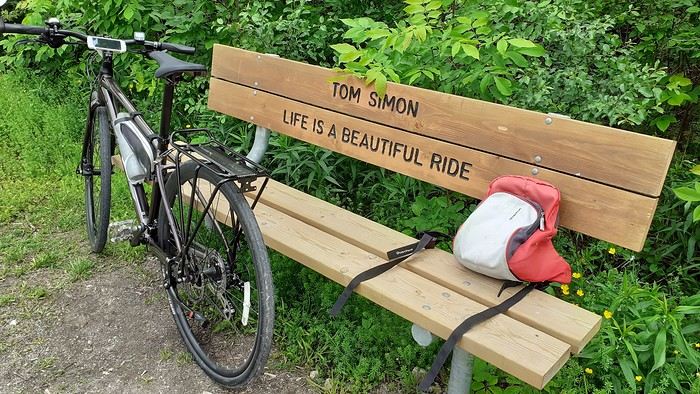
A special train with bike spaces runs almost the entire route. First along the Erie Canal to Albany, then through the Hudson Valley all the way to the tip of Manhattan. This lets you skip sections and also return to your starting point without having to take a flight. Just be aware that bike spaces need to be reserved and can fill up during peak times. In June, no problem though.
This aspect really appealed to me, since my last trip had kinda put me off biking in the US. But here, 75% on dedicated paths, plus that legendary finish in NYC with your bike—I couldn’t resist celebrating my 70th birthday this way.
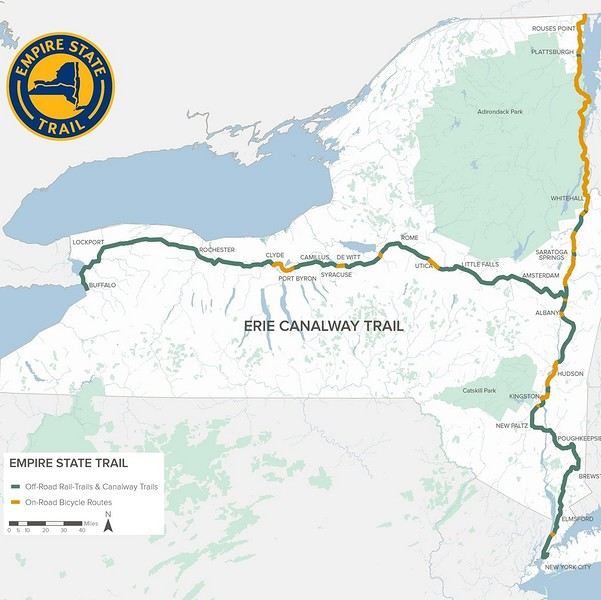 https://empiretrail.ny.gov/map
Two branches to reach NYC: from Buffalo (mostly on dedicated paths) or from Montreal (mostly on roads)
The route was developed in just three years. While it’s popular with cyclists on certain stretches near cities, those who bike the whole thing are still pretty rare.
It’s true that the scenery isn’t exactly breathtaking, and some sections—especially along the Erie Canal—can feel a bit tedious, though they’re very easy since there’s no elevation.
https://empiretrail.ny.gov/map
Two branches to reach NYC: from Buffalo (mostly on dedicated paths) or from Montreal (mostly on roads)
The route was developed in just three years. While it’s popular with cyclists on certain stretches near cities, those who bike the whole thing are still pretty rare.
It’s true that the scenery isn’t exactly breathtaking, and some sections—especially along the Erie Canal—can feel a bit tedious, though they’re very easy since there’s no elevation.
The trail starts in Buffalo, but since my bus from Toronto goes straight to Niagara, I’ll be starting at the falls instead. Plus, that’s where the direct train to NYC departs from (and arrives at).
A special train with bike spaces runs almost the entire route. First along the Erie Canal to Albany, then through the Hudson Valley all the way to the tip of Manhattan. This lets you skip sections and also return to your starting point without having to take a flight. Just be aware that bike spaces need to be reserved and can fill up during peak times. In June, no problem though.
This aspect really appealed to me, since my last trip had kinda put me off biking in the US. But here, 75% on dedicated paths, plus that legendary finish in NYC with your bike—I couldn’t resist celebrating my 70th birthday this way.
https://empiretrail.ny.gov/map
Two branches to reach NYC: from Buffalo (mostly on dedicated paths) or from Montreal (mostly on roads)
The route was developed in just three years. While it’s popular with cyclists on certain stretches near cities, those who bike the whole thing are still pretty rare.
It’s true that the scenery isn’t exactly breathtaking, and some sections—especially along the Erie Canal—can feel a bit tedious, though they’re very easy since there’s no elevation.The trail starts in Buffalo, but since my bus from Toronto goes straight to Niagara, I’ll be starting at the falls instead. Plus, that’s where the direct train to NYC departs from (and arrives at).
Préparation d'un programme de 4 semaines Seattle-Seattle English translation pending
Bonjour
parce qu'il faut réver et se projeter..
Les vols sont réservés.. seattle seattle
J'aimerai votre avis sur ce programme. Merci d'avance.
14 juillet buckley (pour sunrise mont rainier) 15 buckley 16 bellevue ou autour 17 Harrison hot spring ou autour 18 clearwater CA 19 clearwater 20 hinton (ou jasper) 21 IDEM 22 banff ou camnore 23 IDEM 24 waterton 25 idem 26 Glacier NP 27 butte ou missoula 28 gardiner 29 gardiner 30 canyon lodge 31 WY 1 aout WY 2 driggs 3 driggs 4 Boise 5 John day 6 bend 7newburry station 8 idem crater lake 9 Vers Florence 10 canon beach 11 forks ou ocean shore 12 forks 13 port angeles ou sequin.
Ce sont les nuits..
votre avis merci d avance
J'aimerai votre avis sur ce programme. Merci d'avance.
14 juillet buckley (pour sunrise mont rainier) 15 buckley 16 bellevue ou autour 17 Harrison hot spring ou autour 18 clearwater CA 19 clearwater 20 hinton (ou jasper) 21 IDEM 22 banff ou camnore 23 IDEM 24 waterton 25 idem 26 Glacier NP 27 butte ou missoula 28 gardiner 29 gardiner 30 canyon lodge 31 WY 1 aout WY 2 driggs 3 driggs 4 Boise 5 John day 6 bend 7newburry station 8 idem crater lake 9 Vers Florence 10 canon beach 11 forks ou ocean shore 12 forks 13 port angeles ou sequin.
Ce sont les nuits..
votre avis merci d avance
Qantas va proposer des "rotations touristiques au dessus de l'Antarctique" English translation pending
Bonjour
Plus de voyageurs en international alors Qantas décollera en novembre pour des rotations touristique au dessus de l’Antarctique pour 12h 13 h de vols premier prix 730 euros en éco pour un siège au dessus de l'aile 🙁 4875 euros pour les meilleures places en affaire . vol en B787 dreamliner . avis aux amateurs lol
source air journal
Mich74
Road trip Texas-Louisiane English translation pending
bonjour à tous
pendant le confinement le moyen de voyager c'est de préparer le prochain voyage sans dates bien précises mais en espérant mai /juin 2021 nous avons prévu une boucle de Houston, san Antonio, Austin, dallas, memphis, nashville, natchez nola, Houston, dans les grandes lignes la durée et les dates ne sont pas définis ainsi que le départ et l'arrivée je regardais entre dallas et memphis vu la distance à part hot sprints je ne vois pas Grand choses où faire une étape avez vous des idées d'étapes une où deux merci