Results for "Bâle+|+38+>+232"
2130 results found.
Compagnie lowcost pour Fuerteventura en janvier? English translation pending
Bonjour,
je cherche une compagnie pas chere qui dessert fuerteventura en janvier depart lyon, geneve, marseille, bale mais pas paris
merci d'avance
je cherche une compagnie pas chere qui dessert fuerteventura en janvier depart lyon, geneve, marseille, bale mais pas paris
merci d'avance
Vacances à vélo de Nantes à Biarritz English translation pending
Bonsoir à tous,
suite à un changement de parcours (nous avions décidés de faire Nantes-Bâle par la Loire, le temps ne s'annonçant pas terrrible, nous décidons donc de descendre vers le sud, les cieux seront peut-être plus cléments!!!), nous n'avons donc aucun renseignements sur le tracé Nantes-Biarritz. En parcourant les forums j'ai pu voir que l'on pouvait faire ce trajet sur pistes cyclables. J'aimerais avoir des précisions sur les étapes, les campings, est-ce que ça nous emmène jusqu'à Biarritz, doit-on prendre des routes? Bref, tous vos conseils seront les bienvenus.
Dans l'attente de vous lire , bonne soirée à tous.
Travailler dans une ville frontalière? English translation pending
Bonjour à tous!!
Donc voila, j'habite à Colmar en Alsace, je suis a 1 heure de la frontière suisse (bâle), j'aimerais voir si il y a du boulot dans l'industrie en intérim pour commencer. Est ce qu'il faut absolument parler le Suisse-Allemand pour pouvoir chercher un emploi la bas? je m'oriente vers des usines pour être opérateur sur ligne de production ou cariste, je sais que beaucoup de gens parle français la bas mais je sais pas si ça peut être un gros freins pour avoir du travail... Merci de vos réponses si quelqu'un à été dans ce cas...
Donc voila, j'habite à Colmar en Alsace, je suis a 1 heure de la frontière suisse (bâle), j'aimerais voir si il y a du boulot dans l'industrie en intérim pour commencer. Est ce qu'il faut absolument parler le Suisse-Allemand pour pouvoir chercher un emploi la bas? je m'oriente vers des usines pour être opérateur sur ligne de production ou cariste, je sais que beaucoup de gens parle français la bas mais je sais pas si ça peut être un gros freins pour avoir du travail... Merci de vos réponses si quelqu'un à été dans ce cas...
Retour de croisière sur le MSC Splendida du 24 avril au 1er mai English translation pending
Compte rendu de notre croisière sur le Splendida.
Voyage jusqu'a Gênes en voiture 600 Km départ 4 heures via Bale
Saint Gothard Milan arrivée a 11heures.
Sitôt arrivés prise en charge des valises par le personnel MSC.
Pour la voiture loué par Internet Autosiloport 70 euros pour la semaine;
on nous attendait a l'entrée du bateau conduit au garage fermé et ramené
au bateau en voiture...parfait a recommander, au retour avec les
valises dans le chariot nous allons directement a la voiture garage en face du
port 100 mètres environ.
Embarquement prioritaire avec Carte MSC Club.
Aucune attente un garçon nous amène a notre cabine, très belle avec balcon,
légèrement plus petite que sur Costa Serena où nous avions un divan en plus,
décoration moderne de bon goût.
Nous allons tout de suite manger au buffet pour ma part rien a dire sur le
manger c'est d'ailleurs la seule fois que nous mangerons au buffet.
La cohue qui y règne et le peu de savoir vivre de beaucoup fait que nous
préférons manger tranquille au restaurant, nous y prenons également le
petit déjeuner.
A la différence de Costa on ne se sert pas, le garçon passe avec le plateau
croissants, muffins, pain etc.. moins de choix que sur Costa, jus de fruits pas
très bon en poudre.
Au thé de 4 heures un énorme choix des pâtisseries.
Pour les repas du soir nous avions demandé le 1er service et on nous avait mis
au 2eme, nous avons dû batailler pour changer car il n'y avait pas de place.
Pour finir au 2eme jour cela s'est arrangé.
Nous avons trouvé la cuisine bonne dans l'ensemble mais légèrement inférieure
a Costa surtout les soirées de gala 2 au total où nous n'avons pas trouvé de
différence notoire par rapport aux autres soirs.
La soirée du commandant fusionnait avec la soirée italienne.
Nous avions un gala privé avec le commandant sur invitation pour le MSC Club
où il fallait montrer patte blanche pour entrer.
Nous sommes rentrés mais ils ont refusé nos enfants alors que sur Costa on les
avait emmenés avec nous et en plus nous avions droit a la photo gratuite avec
le commandant, MSC photo avec le commandant payante.
Le prix des de boissons les pack de boissons sont plus chers que chez Costa
et il y a 15% de service en plus exemple
MSC 7 vins + 7 eaux 125 euros + 15% = 144 euros
4 vins + 7 eaux 79 euros + 15% = 91 Euros
pas de réduction carte MSC
Costa 4 vins + 7 eaux 69 euros - 20% avec carte Costa = 55,20 euros
Ascenseurs au pont central un bateau avec 3900 passagers pour seulement
4 ascenseurs (12 chez Costa Serena) il faut attendre et attendre aux heures
de pointe et finir pour prendre les escaliers, un bateau si moderne c'est incroyable.
Les spectacles dans l'ensemble très bien aussi bien que Costa.
Les animations pour tous les goûts a 5 places différentes.
La décoration du bateau Splendida un peu sombre par rapport au Fantasia
mais on s'y habitue vite.
A la piscine chez Costa on prend une serviette quand on veut où on veut
sur MSC on nous donne une serviette sur présentation de la carte de chambre
et ils pointent quand on la rend.
Personnellement nous préférons Costa tout en appréciant MSC qui est très bien aussi. Manu
A suivre
Retour d'Afrique: Botswana, Zimbabwe et Namibie English translation pending
J 1, 30/8 : Départ Bale/Mulhouse J 2, 31/8 : Otjiwarongo J 3, 1/9 : Caprivi, Mahango J 4, 2/9 : Katima Mulilo J 5, 3/9 : Katima Mulilo J 6, 4/9 : Kasane (Botswana) J 7, 5/9 : Kasane (Botswana) J 8, 6/9 : Kasane (Botswana) J 9, 7/9 : Kasane (Botswana) J10, 8/9 : Rundu J11, 9/9 : Etosha, Halali J12, 10/9 : Etosha, Halali J13, 11/9 : Etosha, Halali J14, 12/9 : Etosha, Halali J15, 13/9 : Etosha, Onguma J16, 14/9 : Etosha, Onguma J17, 15/9 : Etosha, Onguma J18, 16/9 : Okahandja J19, 17/9 : Retour Windhoek J20, 18/9 : Arrivée Bale/Mulhouse,
Beaucoup de kilomètres mais énormément d'émotions. Quelques photos vous feraient plaisirs ? Ah si vous insistez...
Éthiopie: sécheresses dans la région du Sidamo en novembre? English translation pending
Bonjour,
Après un premier séjour l'an passé dans la vallée du Rift et les montagnes de Bale, cette année, j'ai envie de trainer dans le sud-ouest(Omo and co.).Comme j'y vais en partie pour récolter des graines de plantes indigènes, je voulais savoir si la région du Sidamo souffrait de sécheresse? Y at-il eu des pluies en novembre? Pas facile d'avoir des infos fiables....
Merci par avance.
J.luc
Après un premier séjour l'an passé dans la vallée du Rift et les montagnes de Bale, cette année, j'ai envie de trainer dans le sud-ouest(Omo and co.).Comme j'y vais en partie pour récolter des graines de plantes indigènes, je voulais savoir si la région du Sidamo souffrait de sécheresse? Y at-il eu des pluies en novembre? Pas facile d'avoir des infos fiables....
Merci par avance.
J.luc
Partir de Francfort pour la Tunisie en étant française? English translation pending
Bonjour
Je souhaiterai reservé un séjour hotel + vol en tunisie, avec un tour opérateur mais au départ de bale, tout es complet.. donc on a pris francfort..
Le problème c'est que nous avons juste une carte d'identité.. donc ma question est: étant francaise et partant de francfort avec un package et non seule, ma carte d'identité suffit???😉
Une heure pour changer d'avion à Dusseldorf English translation pending
En prévision d'un week end à venise, on nous propose un vol au départ de bale-mulhouse avec seulement une heure pour changer à Dusseldorf.
A votre avis est ce suffisant?
Idées de circuits à vélo en Alsace, en famille? English translation pending
Bonjour,
Je cherche des idées de circuit en Alsace pour quelques jours (pour les beaux jours). On avait pensé à Strasbourg-Bâle en suivant le Rhin. Est-ce qu'il existe un livre sur ce thème? (du genre de celui sur le canal du Midi, balade que j'ai faite en 2002) Nous sommes deux adultes et une petite fille qui aura 2 ans au printemps. Des conseils? des suggestions?
Merci
Flo
Je cherche des idées de circuit en Alsace pour quelques jours (pour les beaux jours). On avait pensé à Strasbourg-Bâle en suivant le Rhin. Est-ce qu'il existe un livre sur ce thème? (du genre de celui sur le canal du Midi, balade que j'ai faite en 2002) Nous sommes deux adultes et une petite fille qui aura 2 ans au printemps. Des conseils? des suggestions?
Merci
Flo
Écrans individuels sur un vol Francfort-Chennai avec Lufthansa? English translation pending
bonjour je part sur chennai le 20 fevrier avec la lufthansa.
je part de bale-mulhouse via francfort.qui a deja pris ce vol?moi meme je n'ai jamais voler avec cette compagnie.
le vol francfort se fait en airbus a340-600.y a t'il des ecrans individuels sur ce vol?
merci
Trouver facilement des cybercafés en Éthiopie? English translation pending
Bonjour à tous,
savez vous si l'on trouve facilement des cybercafés en ethiopie, et principalement dans le sud (balé et vallée de l'omo)? Merci pour votre aide! vivalpaga
savez vous si l'on trouve facilement des cybercafés en ethiopie, et principalement dans le sud (balé et vallée de l'omo)? Merci pour votre aide! vivalpaga
Istanbul Sabiha Gôkçen: transport et hôtels pour arrivée et départ en pleine nuit? English translation pending
Hello,
Etudiant, donc peu argenté, je prends un vol fin avril pour Istanbul avec easyjet, au départ de Bâle... Billets moins chers, mais arrivée à deux heures du matin... Savez-vous si, à cette heure, il y a encore des navettes pour le centre ville, depuis l'aéroport de Sabiha Gôkçen ? Ou tout au moins des logements à prix raisonnable dans les environs ? Sinon, il y a le taxi, mais on m'a prédit des prix prohibitifs... S'il s'avère que je ne peux pas y couper, quel est le quartier aux auberges de jeunesse ou hôtels les plus modérés demander ?
Pour le retour, ce sera le même genre de galère, puisque l'avion part à 3h... Donc dites-moi qu'il y a des navettes, des bus ! :-D
Merci !
Etudiant, donc peu argenté, je prends un vol fin avril pour Istanbul avec easyjet, au départ de Bâle... Billets moins chers, mais arrivée à deux heures du matin... Savez-vous si, à cette heure, il y a encore des navettes pour le centre ville, depuis l'aéroport de Sabiha Gôkçen ? Ou tout au moins des logements à prix raisonnable dans les environs ? Sinon, il y a le taxi, mais on m'a prédit des prix prohibitifs... S'il s'avère que je ne peux pas y couper, quel est le quartier aux auberges de jeunesse ou hôtels les plus modérés demander ?
Pour le retour, ce sera le même genre de galère, puisque l'avion part à 3h... Donc dites-moi qu'il y a des navettes, des bus ! :-D
Merci !
Billet d'avion pour la Turquie English translation pending
Bonjour,
Je cherche un vol sec pour la Turquie au mois d'août au départ de Strasbourg, Bale-Mulhouse, ou d'Allemagne.. éventuellement de Paris..
J'ai trouvé un aller retour Strasbourg (bus jusqu'à Frankfort) - Istanbul à 325 €..
Avis aux experts... Qu'en pensez vous? Est-ce que je peux trouver encore moins cher? sachant que la ville d'arrivée à peu d'importance pour moi puisque je pense bouger pas mal une fois sur place.. Au prix où est le billet je me dépèche de réserver ou j'attends la dernière minute??
Merci d'avance pour vos avis éclairés.. ;)
Trajet aéroport Sabiha Gökçen - Istanbul English translation pending
Hello!
J'arrive à l'aéroport de Sabiha Gökçen à 2h30 du mat' (vol easyjet Bâle-Istanbul) et j'aimerais connaître le moyen de rejoindre le centre ville. J'ai lu que c'était assez compliqué sans prendre le taxi, mais quelqu'un pourrait-il me dire si c'est possible de faire ce trajet en transports publics? Je suis en vacances, j'ai donc tout le temps avec moi... Merci!
J'arrive à l'aéroport de Sabiha Gökçen à 2h30 du mat' (vol easyjet Bâle-Istanbul) et j'aimerais connaître le moyen de rejoindre le centre ville. J'ai lu que c'était assez compliqué sans prendre le taxi, mais quelqu'un pourrait-il me dire si c'est possible de faire ce trajet en transports publics? Je suis en vacances, j'ai donc tout le temps avec moi... Merci!
De la Turquie au Vietnam (de juin 2006 à février 2007) English translation pending
Le goût de la vie, Voyage en Asie
Un matin pas comme les autres. Le train se dirigeant vers Bale, en Suisse, allait partir. J'embrassais une dernière fois avant longtemps l'amour de ma vie. Les vitres du wagon me séparaient désormais d'elle. Nous avions rompu, mais nous nous aimions encore et pour toujours. Le train sifflait, mes larmes coulaient. L'excitation des mois à venir était obscurcie par mes pensées. Tous allaient me manquer. C'était sur. Je m'endormis au cours du trajet. L'arrivée en début d'après midi me permit d'aller visiter la ville. Traversée par le Rhin, Bale, est un joyau. La promenade le long du fleuve par une journée ensoleillée était un délice. Certains se baignaient, faisaient du ski nautique. J'étais dans un état d'esprit de combattant, de celui qui a un long chemin devant soi, qui a quelque chose à accomplir, pour lui, malgré lui. Le haut de la vieille ville, et ses petites ruelles ombragées, la place de la cathédrale et l'édifice en lui même, me permettaient d'avoir les yeux rives une dernière fois sur l'Europe et sa magnifique architecture. La chaleur de la journée tourna à l'orage en fin d'âpres midi. J'attendais sous le porche du tramway devant la gare, mais je du traverser la faible distance sous la forte pluie sous peine de rater le bus devant m'amener a l'aéroport. Mes bagages étaient dans les consignes de la gare, j'étais trempe et je me changeai. J'arrivais à l'aéroport en avance. Le vol à bas prix pour Istanbul partait tard dans la soirée. 2h30 de vol plus tard, j'arrivais à l'aéroport à l'Est d'Istanbul. Je dormis dans le bus allant à la place Taschim. Ma fatigue aidant, l'arrivée fut presque instantanée. A 5h30, je m'installais sur la terrasse d'un café en bord de rue. Le café turc me réveilla bon grés mal grés. Des turcs vinrent s'asseoir a cote de moi. Ils ne parlaient que le turc, nos échanges furent rapides. A l'arrêt de bus T4 pour Sulthanammet, un turc me fit la conversation, lui parlait anglais, sortait de soirée et puait littéralement. Il me paya mon billet de bus mais voulait m'accompagner et me proposer un hôtel, des filles et bien d'autres choses. J'aperçu l'éblouissant lever de soleil sur le Bosphore et les minarets. Je me séparai de l'homme une fois arrivé à Sulthanammet, devant la mosquée bleue. Du parc central, je partais la tète embrumée a la recherche d’un hôtel. La chaleur se levait sur l’ancienne Constantinople, la sueur perlait sur mon front, j’avais au bas mot vingt kilogrammes sur le dos et entre cinq et dix kilogrammes dans les bras. Je n’étais pas parti léger, la perspective de l’échange universitaire au Vietnam ne me le permettait pas. Je suivais les contours de la mosquée bleue, ne me situant pas encore bien dans la ville et descendais les petites ruelles. Je m’aperçus que j’étais dans la mauvaise direction, des turcs m’indiquèrent mon chemin. La ville s’était déjà éveillée, l’activité des marchands s’accélérait. Je fis le choix simple d’un hôtel figurant dans le Lonely Planet, l’Orient International Hostel. La vue de celui-ci était plutôt agréable, on pouvait y apercevoir un bout du Bosphore et les minarets de Sainte Sophie. Une douche réparatrice m’aida à lever le camp. Je devais aller à l’ Otogär. Dans le tramway je fis connaissance avec la vie turque, hommes et femmes très occidentalisés, aimables et joyeux, ils ne me regardaient pas comme une étrange chose. La rencontre de l’Occident et de l’Asie a définitivement pour source l’Istanbul moderne. On me demanda où je souhaitais aller, un bébé me souri, une femme voilée entra et une femme en jean troué descendit. J’accédai au métro à pied. Les prix des transports en commun sont dans l’ensemble corrects, on sent toutefois l’accession et l’ambition de la Turquie, surtout d’Istanbul aux normes des voisins de l’Ouest. La partie occidentale du pays se développe à toute vitesse, ne laissant pas le temps au centre et à l’Est de la suivre. Le réseau métropolitain d’Istanbul n’est pas étendu à merveille mais conduit toutefois à l’immense gare de bus de la ville. La périphérie de la ville semble industrielle et polluée. Comme dans de nombreux endroits dans le monde désormais, les gares de bus sont déconcentrées du centre ville, laissant celui-ci respirait un air plus sain. Je me rappelle de ma surprise à la vue de toutes ces compagnies de bus, plus de deux cent, numérotées et installées sur les contours de la place circulaire les accueillant. Certaines disposent de rabatteurs vers les destinations touristiques courues de la mer égéenne, de la Cappadoce. Quant à moi je devais aller à l’Est, à Dogubayazit. J’avais déjà pu visiter la Cappadoce et la côte sud. Je ne m’attarderai donc pas en Turquie. Igdir Tourism me proposa un aller direct vers Igdir. Les liaisons pour Dogubayazit étaient complètes. Je partirai donc à 18h30 le lendemain, le temps de visiter une minuscule partie d’Istanbul. Je fis le chemin inverse vers le centre ville. En marchant pour regagner le tramway, j’observais les alentours, les habitations, la multitude de commerces en tout genre, la vie des gens. La structure de la ville en dehors du centre me rappela sommairement Le Caire. On ne peut s’empêcher de comparer les pays et les villes dans lesquelles on a été. Néanmoins après plusieurs voyages je me suis fait l’idée que l’on doit garder ces comparaisons pour soit, les penser en nous, garder intact les sentiments et images de chaque endroits, ne pas les assembler, et les livrer dans toute leur diversité par écrit ou oral aux personnes à qui l’on contera nos histoires, nos idées. C’est pourquoi je ne retranscrirai plus ces analogies. Je déjeunais dans la ruelle en contrebas de mon hôtel. J’étais exténué, je voyais la vie au ralenti, des turcs lisaient le journal en tirant sur leur narguilé. Les odeurs de pomme et de tabac frais parvenaient à mes narines, enveloppant mes rêves éveillés d’une douceur sucrée. Un japonais vint s’asseoir a coté de moi. Le turc s’occupant d’attirer les clients ne lui fit pas la même « promotion » qu’a moi. En Asie, les japonais sont connus pour dépenser leur argent, les turcs en profitent. Mais attention, les japonais sont aussi ceux qui voyagent dans les contrées les plus folles de l’Asie, et ceux la sont connus pour ne dépenser que le strict nécessaire. Je retournai à l’hôtel, la fatigue m’avait vaincu. Une heure et demie plus tard, de nouveau en forme, je visitais la mosquée bleue. Dans la cour extérieure centrale, des gamins turcs en groupe scolaire s’approchèrent de moi, m’encerclèrent. On parla une demi-heure, d’eux, de moi, d’où nous venions respectivement. Leur professeur semblait enchanter de cet échange. Ils venaient de la côte de la mer noire. Ils regrettèrent que je n’y aille pas. Certains se chamaillèrent pour essayer de s’approcher de moi. Nous avons pris des photos, signe d’au revoir. Je rencontrai ensuite Ibrahim le tisseur « renommé », il me montra un journal allemand dans lequel il figurait. Il tissait de petits chapeaux en laine colorée. Je traversai le parc Topkapi, source d’apaisement dans le centre. Un homme s’approcha de moi pour me lire les lignes de la main. Il était japonais et était venu ici pour travailler. Il avait les yeux globuleux et me fixait avec une rigueur extrême, tout en souriant. C’était déconcertant, je me sentis perdre mes moyens et ressentis le besoin de m’écarter de lui. J’avais l’impression qu’il tentait de m’hypnotiser. Peut-être était-ce la fatigue... J’arrivais à l’embarcadère Serkeci et pris un ferry pour Karakoy sur la rive asiatique. Traversée symbolique. Au retour, j’empruntais le passage à travers le bazar aux épices, magnifique et animé. Je finis la journée assis en tailleur, au coucher du soleil, devant la mosquée bleue. Une turque qui apprenais l’anglais vint me parler essayant de converser, mais en vain. Je dinais ensuite seul, au célèbre « pudding shop » connu comme le rendez vous des hippies des années soixante. L’acceuil fut déplorable mais la nourriture acceptable. La coupe du monde battait son plein, des suédois m’invitèrent à aller voir un match, je fus désolé de ne pas accepter et tomba de fatigue. Le lendemain je me levais pour aller à l’embarcadère Eminomii. Je pris un ferry m’offrant des vues splendides du Bosphore et des palais de sultan. Au port je déjeunais d’un kebab. J’en pris un second avant de me diriger vers le grand bazar. J’appréhendais le coté touristique de celui-ci, mais la majeure partie des allées semblait conserver une certaine authenticité malgré l’afflux constant de touristes du monde entier. Je pensais éviter de m’y perdre. En vain. Je fis un détour monstrueux pour rejoindre Sulthanammet, prendre mes affaires et monter dans mon bus. Le bus allait vers l’Est et comme dans tout bus qui se respecte, le chargement de provisions, d’imposants cartons remplis de denrées et de divers produits avait sa place et prenait son temps.
voila une premiere ébauche d'ecriture, je souhaitais la mettre à disposition dans le forum, pour avoir vos avis, si vous souhaitez que je continue à le diffuser. merci bye
Un matin pas comme les autres. Le train se dirigeant vers Bale, en Suisse, allait partir. J'embrassais une dernière fois avant longtemps l'amour de ma vie. Les vitres du wagon me séparaient désormais d'elle. Nous avions rompu, mais nous nous aimions encore et pour toujours. Le train sifflait, mes larmes coulaient. L'excitation des mois à venir était obscurcie par mes pensées. Tous allaient me manquer. C'était sur. Je m'endormis au cours du trajet. L'arrivée en début d'après midi me permit d'aller visiter la ville. Traversée par le Rhin, Bale, est un joyau. La promenade le long du fleuve par une journée ensoleillée était un délice. Certains se baignaient, faisaient du ski nautique. J'étais dans un état d'esprit de combattant, de celui qui a un long chemin devant soi, qui a quelque chose à accomplir, pour lui, malgré lui. Le haut de la vieille ville, et ses petites ruelles ombragées, la place de la cathédrale et l'édifice en lui même, me permettaient d'avoir les yeux rives une dernière fois sur l'Europe et sa magnifique architecture. La chaleur de la journée tourna à l'orage en fin d'âpres midi. J'attendais sous le porche du tramway devant la gare, mais je du traverser la faible distance sous la forte pluie sous peine de rater le bus devant m'amener a l'aéroport. Mes bagages étaient dans les consignes de la gare, j'étais trempe et je me changeai. J'arrivais à l'aéroport en avance. Le vol à bas prix pour Istanbul partait tard dans la soirée. 2h30 de vol plus tard, j'arrivais à l'aéroport à l'Est d'Istanbul. Je dormis dans le bus allant à la place Taschim. Ma fatigue aidant, l'arrivée fut presque instantanée. A 5h30, je m'installais sur la terrasse d'un café en bord de rue. Le café turc me réveilla bon grés mal grés. Des turcs vinrent s'asseoir a cote de moi. Ils ne parlaient que le turc, nos échanges furent rapides. A l'arrêt de bus T4 pour Sulthanammet, un turc me fit la conversation, lui parlait anglais, sortait de soirée et puait littéralement. Il me paya mon billet de bus mais voulait m'accompagner et me proposer un hôtel, des filles et bien d'autres choses. J'aperçu l'éblouissant lever de soleil sur le Bosphore et les minarets. Je me séparai de l'homme une fois arrivé à Sulthanammet, devant la mosquée bleue. Du parc central, je partais la tète embrumée a la recherche d’un hôtel. La chaleur se levait sur l’ancienne Constantinople, la sueur perlait sur mon front, j’avais au bas mot vingt kilogrammes sur le dos et entre cinq et dix kilogrammes dans les bras. Je n’étais pas parti léger, la perspective de l’échange universitaire au Vietnam ne me le permettait pas. Je suivais les contours de la mosquée bleue, ne me situant pas encore bien dans la ville et descendais les petites ruelles. Je m’aperçus que j’étais dans la mauvaise direction, des turcs m’indiquèrent mon chemin. La ville s’était déjà éveillée, l’activité des marchands s’accélérait. Je fis le choix simple d’un hôtel figurant dans le Lonely Planet, l’Orient International Hostel. La vue de celui-ci était plutôt agréable, on pouvait y apercevoir un bout du Bosphore et les minarets de Sainte Sophie. Une douche réparatrice m’aida à lever le camp. Je devais aller à l’ Otogär. Dans le tramway je fis connaissance avec la vie turque, hommes et femmes très occidentalisés, aimables et joyeux, ils ne me regardaient pas comme une étrange chose. La rencontre de l’Occident et de l’Asie a définitivement pour source l’Istanbul moderne. On me demanda où je souhaitais aller, un bébé me souri, une femme voilée entra et une femme en jean troué descendit. J’accédai au métro à pied. Les prix des transports en commun sont dans l’ensemble corrects, on sent toutefois l’accession et l’ambition de la Turquie, surtout d’Istanbul aux normes des voisins de l’Ouest. La partie occidentale du pays se développe à toute vitesse, ne laissant pas le temps au centre et à l’Est de la suivre. Le réseau métropolitain d’Istanbul n’est pas étendu à merveille mais conduit toutefois à l’immense gare de bus de la ville. La périphérie de la ville semble industrielle et polluée. Comme dans de nombreux endroits dans le monde désormais, les gares de bus sont déconcentrées du centre ville, laissant celui-ci respirait un air plus sain. Je me rappelle de ma surprise à la vue de toutes ces compagnies de bus, plus de deux cent, numérotées et installées sur les contours de la place circulaire les accueillant. Certaines disposent de rabatteurs vers les destinations touristiques courues de la mer égéenne, de la Cappadoce. Quant à moi je devais aller à l’Est, à Dogubayazit. J’avais déjà pu visiter la Cappadoce et la côte sud. Je ne m’attarderai donc pas en Turquie. Igdir Tourism me proposa un aller direct vers Igdir. Les liaisons pour Dogubayazit étaient complètes. Je partirai donc à 18h30 le lendemain, le temps de visiter une minuscule partie d’Istanbul. Je fis le chemin inverse vers le centre ville. En marchant pour regagner le tramway, j’observais les alentours, les habitations, la multitude de commerces en tout genre, la vie des gens. La structure de la ville en dehors du centre me rappela sommairement Le Caire. On ne peut s’empêcher de comparer les pays et les villes dans lesquelles on a été. Néanmoins après plusieurs voyages je me suis fait l’idée que l’on doit garder ces comparaisons pour soit, les penser en nous, garder intact les sentiments et images de chaque endroits, ne pas les assembler, et les livrer dans toute leur diversité par écrit ou oral aux personnes à qui l’on contera nos histoires, nos idées. C’est pourquoi je ne retranscrirai plus ces analogies. Je déjeunais dans la ruelle en contrebas de mon hôtel. J’étais exténué, je voyais la vie au ralenti, des turcs lisaient le journal en tirant sur leur narguilé. Les odeurs de pomme et de tabac frais parvenaient à mes narines, enveloppant mes rêves éveillés d’une douceur sucrée. Un japonais vint s’asseoir a coté de moi. Le turc s’occupant d’attirer les clients ne lui fit pas la même « promotion » qu’a moi. En Asie, les japonais sont connus pour dépenser leur argent, les turcs en profitent. Mais attention, les japonais sont aussi ceux qui voyagent dans les contrées les plus folles de l’Asie, et ceux la sont connus pour ne dépenser que le strict nécessaire. Je retournai à l’hôtel, la fatigue m’avait vaincu. Une heure et demie plus tard, de nouveau en forme, je visitais la mosquée bleue. Dans la cour extérieure centrale, des gamins turcs en groupe scolaire s’approchèrent de moi, m’encerclèrent. On parla une demi-heure, d’eux, de moi, d’où nous venions respectivement. Leur professeur semblait enchanter de cet échange. Ils venaient de la côte de la mer noire. Ils regrettèrent que je n’y aille pas. Certains se chamaillèrent pour essayer de s’approcher de moi. Nous avons pris des photos, signe d’au revoir. Je rencontrai ensuite Ibrahim le tisseur « renommé », il me montra un journal allemand dans lequel il figurait. Il tissait de petits chapeaux en laine colorée. Je traversai le parc Topkapi, source d’apaisement dans le centre. Un homme s’approcha de moi pour me lire les lignes de la main. Il était japonais et était venu ici pour travailler. Il avait les yeux globuleux et me fixait avec une rigueur extrême, tout en souriant. C’était déconcertant, je me sentis perdre mes moyens et ressentis le besoin de m’écarter de lui. J’avais l’impression qu’il tentait de m’hypnotiser. Peut-être était-ce la fatigue... J’arrivais à l’embarcadère Serkeci et pris un ferry pour Karakoy sur la rive asiatique. Traversée symbolique. Au retour, j’empruntais le passage à travers le bazar aux épices, magnifique et animé. Je finis la journée assis en tailleur, au coucher du soleil, devant la mosquée bleue. Une turque qui apprenais l’anglais vint me parler essayant de converser, mais en vain. Je dinais ensuite seul, au célèbre « pudding shop » connu comme le rendez vous des hippies des années soixante. L’acceuil fut déplorable mais la nourriture acceptable. La coupe du monde battait son plein, des suédois m’invitèrent à aller voir un match, je fus désolé de ne pas accepter et tomba de fatigue. Le lendemain je me levais pour aller à l’embarcadère Eminomii. Je pris un ferry m’offrant des vues splendides du Bosphore et des palais de sultan. Au port je déjeunais d’un kebab. J’en pris un second avant de me diriger vers le grand bazar. J’appréhendais le coté touristique de celui-ci, mais la majeure partie des allées semblait conserver une certaine authenticité malgré l’afflux constant de touristes du monde entier. Je pensais éviter de m’y perdre. En vain. Je fis un détour monstrueux pour rejoindre Sulthanammet, prendre mes affaires et monter dans mon bus. Le bus allait vers l’Est et comme dans tout bus qui se respecte, le chargement de provisions, d’imposants cartons remplis de denrées et de divers produits avait sa place et prenait son temps.
voila une premiere ébauche d'ecriture, je souhaitais la mettre à disposition dans le forum, pour avoir vos avis, si vous souhaitez que je continue à le diffuser. merci bye
Compte-rendu sur notre voyage avec Arkefly English translation pending
😎bonjour. Je viens de rentrer d'un séjour sur isla margarita du 25 décembre au 8 janvier, au départ de bale-mulhouse avec la compagnie aérienne ARKEFLY.
à l'aller, nous avons voyagé en classe economy et au retour nous avions réservé en classe comfort. Certes la différence de tarif est assez conséquente (60€ par personne pour un trajet en vol long courrier). mais effectivement vous avez plus d'espace (84 cm entre les sièges), le choix du menu, vin et bière inclus aux repas chauds, écouteurs gratuits, kit sur les vols de nuit (chaussons, bouchons d'oreilles, masque pour les yeux, brosse à dents dentifrice).
Notre départ était prévu le 25 DECEMBRE à 13 H30. Nous attendions patiemment l'embarquement après avoir enregistré nos bagages, et là retard annoncé...... Tant pis, on ré - attend!!!!!
A 14 heures, on nous annonce que l'appareil est à AMSTERDAM avec des problèmes techniques!!!!!!! Les personnes qui veulent rester sur place doivent se présenter au guichet et serons rapatriés dans un hôtel à BALE pour la nuit!!!!! OUPS!!!!!!
A 15 heures, des bus viennent nous chercher jpour nous emmener au RADISSON A BALE (eh oui, pardon au radisson, 5 étoiles tout de même)).
Nous étions 120 personnes à héberger et à nourrir. On nous a servi un buffet très bon, et nous avons passé une excellente nuit bien au calme, puis un ptit déj succulent (buffet varié).
En fin de matinée, les bus nous ont recherché pour l'aéroport, pour enfin décoller à 14 HEURES LE 26 DECEMBRE.
Nous étions un peu déçus d'avoir perdu une journée sur nos vacances, mais je tiens à souligner la rapidité et l'efficacité d'ARKEFLY pour parer à cet incident, le 25 décembre étant quand même le jour de NOEL avec des restrictions de personnel. CHAPEAU!!!!!!!!
à l'aller, nous avons voyagé en classe economy et au retour nous avions réservé en classe comfort. Certes la différence de tarif est assez conséquente (60€ par personne pour un trajet en vol long courrier). mais effectivement vous avez plus d'espace (84 cm entre les sièges), le choix du menu, vin et bière inclus aux repas chauds, écouteurs gratuits, kit sur les vols de nuit (chaussons, bouchons d'oreilles, masque pour les yeux, brosse à dents dentifrice).
Notre départ était prévu le 25 DECEMBRE à 13 H30. Nous attendions patiemment l'embarquement après avoir enregistré nos bagages, et là retard annoncé...... Tant pis, on ré - attend!!!!!
A 14 heures, on nous annonce que l'appareil est à AMSTERDAM avec des problèmes techniques!!!!!!! Les personnes qui veulent rester sur place doivent se présenter au guichet et serons rapatriés dans un hôtel à BALE pour la nuit!!!!! OUPS!!!!!!
A 15 heures, des bus viennent nous chercher jpour nous emmener au RADISSON A BALE (eh oui, pardon au radisson, 5 étoiles tout de même)).
Nous étions 120 personnes à héberger et à nourrir. On nous a servi un buffet très bon, et nous avons passé une excellente nuit bien au calme, puis un ptit déj succulent (buffet varié).
En fin de matinée, les bus nous ont recherché pour l'aéroport, pour enfin décoller à 14 HEURES LE 26 DECEMBRE.
Nous étions un peu déçus d'avoir perdu une journée sur nos vacances, mais je tiens à souligner la rapidité et l'efficacité d'ARKEFLY pour parer à cet incident, le 25 décembre étant quand même le jour de NOEL avec des restrictions de personnel. CHAPEAU!!!!!!!!
Retour de l'hôtel Isla Caribe! (25 décembre-8 janvier 2007) English translation pending
😎je viens de rentrer d'un voyage à isla margarita du 25 DECEMBRE AU 8 JANVIER.
Je suis partie de BALE MULHOUSE le 26 (je dépose mon avis concernant la cie aérienne un peu plus tard!!!). après 9 H 30 de vol arrivée à Porlamar.
J'avais réservé le séjour à l'hôtel ISLA CARIBE à playa el tirano sur la côte atlantique.
C'est un hôtel 4 étoiles locales ouvert depuis janvier 2006.
La réception est assez austère, ouverte sur l'extérieur, sans grands chichis, avec simplement quelques sièges en rotin.
Arrivée à l'hotel nous avons eu l'attribution de la chambre assez rapidement. Nous voilà partis à la recherch e de notre immeuble en trainant nos valises, car il n'y avait point de porteur. Youpi! voilà la 3213 au premier étage (c'est plus rassurant), je mets la carte magnétique, j'ouvre la porte et ........ pardon msieur, dame, de vous déranger................. la chambre était occupée.
Après avoir parlementé une bonne demie-heure, nous avons eu une autre chambre très grande avec un immense lit, deux chevets, une commode, un placard, un frigo, un e douche, un sèche cheveux mais au-dessus du restaurant avec un bruit infernal de la hotte qui fonctionne.
Nous avons donc passé 14 nuits avec des bouchons dans les oreilles.
Le ménage était fait rapidement, sans plus, avec le récurage du sol avec la même eau pour 10 chambres!!!!!!
Lorsqu'il y avait une averse, (tous les deux jours pendant une heure) l'eau stagnait dans le couloir et passait sous la porte de notre chambre d'où des inondations régulières
l'hôtel est surveillé par des gardiens avec des matraques en permanence (pas très rassurant), et les guides vous préviennent de ne pas s'aventurer seuls la nuit, car la délinquance est très répandue.
Le buffet était varié et bon avec toutes sortes de légumes, mais seulement trois viandes (boeuf - porc- poulet) et quelques fruits. nous étions en all inclusive et avions des boissons à volonté (cocktails excellents à boire avec modération!!!!!)
La piscine (point positif) est très belle et grande, propre, nettoyée tous les jours.
Pour aller à la plage, il faut traverser une route. Le sable est très sale, noir (suspect avec des traces de mazout), jonché de détritus et rarement nettoyée. Mais bon, nous nous sommes rabattus sur la piscine.
nous avons fait deux excursions : une en catamaran sur l'ile coche (superbe sortie) et une en véhicule 4X4 pour le tour de l'ile, plages sauvages, et tour en barque à moteur dans les mangroves.
Le paysage n'est pas grandiose et l'ile très sale, des montagnes de poubelles trainent partout. Les baraques à toits en tôle cotoient des villas entourées de murs hauts et barreaux aux fenetres.
CONCLUSION : il me semble que le venezuela n'est pas encore prêt pour le tourisme (comparé à la rép dom par exemple), les gens ne sont pas très accueillants et les rues sont sales.
Si vous décidez d'y aller, prenez un hôtel avec au moins 4 étoiles pour ne pas avoir trop de surprises, et pensez à emporter du produit solaire de haute protection car le soleil tape très fort.
Arrivés à l'aéroport pour le départ, il a fallu débourser 56 dollars US de taxe de sortie, contrairement aux 38 dollars annoncés dans le catalogue de voyage........ du racket en somme!!!!!!!!!!!!
Par contre, nous étions contents d'avoir rechargé nos batteries avec du soleil à profusion.....
Je suis partie de BALE MULHOUSE le 26 (je dépose mon avis concernant la cie aérienne un peu plus tard!!!). après 9 H 30 de vol arrivée à Porlamar.
J'avais réservé le séjour à l'hôtel ISLA CARIBE à playa el tirano sur la côte atlantique.
C'est un hôtel 4 étoiles locales ouvert depuis janvier 2006.
La réception est assez austère, ouverte sur l'extérieur, sans grands chichis, avec simplement quelques sièges en rotin.
Arrivée à l'hotel nous avons eu l'attribution de la chambre assez rapidement. Nous voilà partis à la recherch e de notre immeuble en trainant nos valises, car il n'y avait point de porteur. Youpi! voilà la 3213 au premier étage (c'est plus rassurant), je mets la carte magnétique, j'ouvre la porte et ........ pardon msieur, dame, de vous déranger................. la chambre était occupée.
Après avoir parlementé une bonne demie-heure, nous avons eu une autre chambre très grande avec un immense lit, deux chevets, une commode, un placard, un frigo, un e douche, un sèche cheveux mais au-dessus du restaurant avec un bruit infernal de la hotte qui fonctionne.
Nous avons donc passé 14 nuits avec des bouchons dans les oreilles.
Le ménage était fait rapidement, sans plus, avec le récurage du sol avec la même eau pour 10 chambres!!!!!!
Lorsqu'il y avait une averse, (tous les deux jours pendant une heure) l'eau stagnait dans le couloir et passait sous la porte de notre chambre d'où des inondations régulières
l'hôtel est surveillé par des gardiens avec des matraques en permanence (pas très rassurant), et les guides vous préviennent de ne pas s'aventurer seuls la nuit, car la délinquance est très répandue.
Le buffet était varié et bon avec toutes sortes de légumes, mais seulement trois viandes (boeuf - porc- poulet) et quelques fruits. nous étions en all inclusive et avions des boissons à volonté (cocktails excellents à boire avec modération!!!!!)
La piscine (point positif) est très belle et grande, propre, nettoyée tous les jours.
Pour aller à la plage, il faut traverser une route. Le sable est très sale, noir (suspect avec des traces de mazout), jonché de détritus et rarement nettoyée. Mais bon, nous nous sommes rabattus sur la piscine.
nous avons fait deux excursions : une en catamaran sur l'ile coche (superbe sortie) et une en véhicule 4X4 pour le tour de l'ile, plages sauvages, et tour en barque à moteur dans les mangroves.
Le paysage n'est pas grandiose et l'ile très sale, des montagnes de poubelles trainent partout. Les baraques à toits en tôle cotoient des villas entourées de murs hauts et barreaux aux fenetres.
CONCLUSION : il me semble que le venezuela n'est pas encore prêt pour le tourisme (comparé à la rép dom par exemple), les gens ne sont pas très accueillants et les rues sont sales.
Si vous décidez d'y aller, prenez un hôtel avec au moins 4 étoiles pour ne pas avoir trop de surprises, et pensez à emporter du produit solaire de haute protection car le soleil tape très fort.
Arrivés à l'aéroport pour le départ, il a fallu débourser 56 dollars US de taxe de sortie, contrairement aux 38 dollars annoncés dans le catalogue de voyage........ du racket en somme!!!!!!!!!!!!
Par contre, nous étions contents d'avoir rechargé nos batteries avec du soleil à profusion.....
Remboursement pour un changement de vol imposé par la compagnie aérienne? English translation pending
Dans quelques jours je part pour la Thaïlande. J'avais un vol avec escale depuis Paris et un autre le jour même depuis Bâle jusqu'à Paris (sur une autre compagnie) qui me laissait largement le temps d'enregistrer à Paris pour mon vol pour Bangkok.
Mais voilà le site internet sur lequel j'ai réservé mon vol pour Bangkok m'a envoyé un message m'indiquant que mon vol n'est plus le même: l'heure de départ est avancée (ce qui fait que je ne peux plus partir avec mon premier vol à destination de Paris) et l'escale n'est plus dans le même pays par contre la compagnie est la même.
Je suis donc obligé de me rendre à Paris la veille et de prendre un hotel (j'ai modifier mon billet Bâle Paris à la dernière minute donc j'ai payé plein pot😠)
Cette compagnie ayant donc modifiée l'heure d'embarquement (embarquement avancé d'une heure 30 minutes) et la destination (pour l'escale) par rapport à ma réservation doit-elle me renbourser les frais occasionnés pour l'hotel et le changement de vol sur l'autre compagnie.
Puis je faire les démarches de demande de remboursement au comptoir de cette compagnie lors de l'enregistrement?
Espagne: quelle ville choisir pour apprendre l'espagnol? English translation pending
Bonjour,
Je vais partir pour l'espagne pour qlq mois histoire d'apprendre l'espagnol. Habitant pres de l'aeroport bale-mulhouse, je vais peut-etre choisir une des 4 destinations offertes par EasyJet de Bale: Barcelone, Malaga, Madrid ou Alicante. Je prefererais eviter Barcelone (a cause du Catalan). Que pensez vous des autrse villes. Je cherche un endroit ou je peux aller randonnner en montagne facilement, une belle ville pas trop betonnee comme certains coins de la cote. Merci de votre aide ou infos. Vince
Je vais partir pour l'espagne pour qlq mois histoire d'apprendre l'espagnol. Habitant pres de l'aeroport bale-mulhouse, je vais peut-etre choisir une des 4 destinations offertes par EasyJet de Bale: Barcelone, Malaga, Madrid ou Alicante. Je prefererais eviter Barcelone (a cause du Catalan). Que pensez vous des autrse villes. Je cherche un endroit ou je peux aller randonnner en montagne facilement, une belle ville pas trop betonnee comme certains coins de la cote. Merci de votre aide ou infos. Vince
Sécurité de la régon de Sidamo en Ethiopie English translation pending
Bonjour à tous,
Je prépare un petit périple botanique dans le sud de l'Ethiopie, région de Bale et Sidamo pour y collecter diverses graines.Je me pose la question de la sécurité de la région de Sidamo.Seul avec sac à dos, c'est apparement risqué. Peut-être que parmi vous certains ont déjà traversé la région pour aller au Kenya (ou inversement).Qu'en est-il? Je suis assez refroidi après la lecture de la traversée de l'Ethiopie de Sonia et Alexandre Poussin...Je n'ai pas envie de bader... Toutes infos sont les bienvenues! Merci par avance! Jean-Luc
Je prépare un petit périple botanique dans le sud de l'Ethiopie, région de Bale et Sidamo pour y collecter diverses graines.Je me pose la question de la sécurité de la région de Sidamo.Seul avec sac à dos, c'est apparement risqué. Peut-être que parmi vous certains ont déjà traversé la région pour aller au Kenya (ou inversement).Qu'en est-il? Je suis assez refroidi après la lecture de la traversée de l'Ethiopie de Sonia et Alexandre Poussin...Je n'ai pas envie de bader... Toutes infos sont les bienvenues! Merci par avance! Jean-Luc
Feedback on first Switzerland trip itinerary with AI help
Hi everyone,
My wife and I have booked our tickets from the 24th to the 31st to visit Switzerland, and we want to try skiing for the first time.
Here’s the itinerary I put together with some AI help. I’d love your feedback and tips to tweak the plan! Thanks in advance!
Arrival in Basel on the 24th in the evening, hotel in the city center with breakfast the next morning.
Train from Basel to Interlaken on December 25th, arriving at the hotel around 2 PM.
14:00 – 15:00: Arrival and check-in at Neuhaus Golf & Strandhotel Check-in, rest, and freshen up after the trip. Enjoy the view of Lake Thun—it’s a stunning setting. Grab a coffee or a drink on the terrace or at the hotel bar. The Neuhaus has direct lake access, perfect for a short walk right after settling in.
---
15:30 – 17:30: Downtown & Christmas vibes Bus or taxi (10 min) → Interlaken city center (Hohematte Park). Stroll through the park, take in the views of the Jungfrau, and check out the open shops and chocolateries. Wander around Interlaken’s Christmas market (if it’s still up, often until the 26th). Grab a hot chocolate or mulled wine at a local stand.
---
17:30 – 18:30: Gourmet break or aperitif Café de Paris, Hüsi Bierhaus, or Velo Café for a snack or drink.
For a unique hot chocolate: Funky Chocolate Club (you can even make your own chocolate!). 19:30 – Alpine Christmas dinner
Romantic dinner at a typical restaurant: Spycher Restaurant: fondue and Swiss folklore (reservation recommended). Laterne Restaurant: cozy chalet vibe, traditional cuisine. Des Alpes: local dishes with a view of Interlaken’s lights.
21:30 – Quiet end to the evening Digestive walk around the lake, peaceful and romantic atmosphere. Cozy option: hot bath or reading at the hotel bar with mountain views.
---
Thursday, December 26th — First ski day: Bodmi Arena (Grindelwald)
Goal: Learn to ski gently
🕘 10:00 — Leave the hotel Bus or taxi (5–10 min) → Interlaken Ost train station. Train Interlaken Ost → Grindelwald (departs around 10:20, arrives 10:50).
🕚 11:00 – 13:00 — Beginner ski lesson at Bodmi Arena Booking: Swiss Ski School Grindelwald. Location: Beginner slopes with a “magic carpet.”
🍽️ 13:00 – 14:00 — Lunch on-site
Restaurant Bodmi (view of the Eiger).
☕ 14:00 – 16:00 — Free practice + coffee break in the sun Keep practicing or enjoy the valley views from the terrace.
🚂 16:30 — Return train Grindelwald → Interlaken Ost. 🕖 17:00 — Back to the hotel, relax or take a lakeside walk. 🍽️ 20:00 — Fondue dinner at Spycher Restaurant or Husi Bierhaus.
---
Friday, December 27th — Ski #2: Grindelwald First (blue slope autonomy)
Goal: Improve and enjoy the scenery
🕘 10:00 — Leave hotel → Interlaken Ost → Grindelwald (arrive 10:50). 🕚 11:00 — Rent gear (Skiset or Alpin Center). 🚡 12:00 — Cable car Grindelwald → First (20-minute scenic ride). 🍽️ 12:30 – 15:00 — Ski on the First blue slope, multiple runs at your own pace. 🍽️🏔️ Lunch with a view at Berggasthaus First between runs. ☕ 15:30 – 16:00 — Break at the summit, coffee or hot chocolate. 🚡 16:30 — Cable car descent → return to the station. 🚂 17:30 — Train back → Interlaken Ost → hotel. 🍽️ 20:00 — Free evening (suggestion: dinner at Des Alpes Restaurant, mountain vibe).
---
Saturday, December 28th — Nature day in Lauterbrunnen
Goal: Discover the valley of 72 waterfalls
🕘 10:00 — Leave hotel → Interlaken Ost. 🚂 10:35 — Train Interlaken Ost → Lauterbrunnen (arrive 10:55). 🕚 11:00 – 12:30 — Walk through the village + hike to Staubbach Falls. 🚡 12:30 – 14:00 — Lunch at Hotel Oberland Restaurant or Airtime Café. 🚶 14:00 – 15:00 — Walk to Trümmelbachfälle (45 min on foot, bus available). 🏞️ 15:00 – 16:00 — Visit the indoor waterfalls (entry ~CHF 14). 🚍 16:30 — Return to Lauterbrunnen (bus or on foot). 🚂 17:00 — Train back → Interlaken Ost → hotel. 🍽️ 20:00 — Dinner in Interlaken (Laterne Restaurant or Ox Restaurant & Grill).
---
Sunday, December 29th — Scenic day: Mürren & Allmendhubel
Goal: Effortless alpine views + mountain vibes
🕘 10:00 — Leave hotel → Interlaken Ost → Lauterbrunnen (arrive 10:30). 🚡 10:45 — Cable car Lauterbrunnen → Grütschalp → scenic train to Mürren. 🕚 11:30 – 12:00 — Walk around Mürren, a car-free village. 🍽️🏔️ 12:00 – 13:30 — Lunch at Alpenruh Restaurant (panoramic terrace). 🚡 13:30 – 15:00 — Funicular ride to Allmendhubel, views of Eiger – Mönch – Jungfrau. ☕ 15:30 — Descent to Mürren, coffee or walk. 🚡 16:30 — Cable car + train back to Lauterbrunnen → Interlaken. 🚂 17:30 — Return to the hotel. 🍽️ 20:00 — Cozy dinner (raclette or Swiss soup in Interlaken).
---
Monday, December 30th — Relaxation in Interlaken
Goal: Rest and enjoy the scenery before departure
🕘 10:00 — Leisurely start, walk along Lake Thun. 🚡 11:00 — Funicular to Harder Kulm (~CHF 40 round trip for 2 people). 🍽️🏔️ 12:30 – 14:00 — Lunch at Harder Kulm’s panoramic restaurant (lake views). 🚶 14:30 – 16:00 — Descent and stroll through Interlaken (shopping streets, chocolateries). ☕ 16:00 — Coffee or hot chocolate at Funky Chocolate Club. 🚂 17:30 — Return to the hotel, relax or spa if desired. 🍽️ 20:00 — Dinner at Victoria-Jungfrau Spa & Terrace Restaurant.
My wife and I have booked our tickets from the 24th to the 31st to visit Switzerland, and we want to try skiing for the first time.
Here’s the itinerary I put together with some AI help. I’d love your feedback and tips to tweak the plan! Thanks in advance!
Arrival in Basel on the 24th in the evening, hotel in the city center with breakfast the next morning.
Train from Basel to Interlaken on December 25th, arriving at the hotel around 2 PM.
14:00 – 15:00: Arrival and check-in at Neuhaus Golf & Strandhotel Check-in, rest, and freshen up after the trip. Enjoy the view of Lake Thun—it’s a stunning setting. Grab a coffee or a drink on the terrace or at the hotel bar. The Neuhaus has direct lake access, perfect for a short walk right after settling in.
---
15:30 – 17:30: Downtown & Christmas vibes Bus or taxi (10 min) → Interlaken city center (Hohematte Park). Stroll through the park, take in the views of the Jungfrau, and check out the open shops and chocolateries. Wander around Interlaken’s Christmas market (if it’s still up, often until the 26th). Grab a hot chocolate or mulled wine at a local stand.
---
17:30 – 18:30: Gourmet break or aperitif Café de Paris, Hüsi Bierhaus, or Velo Café for a snack or drink.
For a unique hot chocolate: Funky Chocolate Club (you can even make your own chocolate!). 19:30 – Alpine Christmas dinner
Romantic dinner at a typical restaurant: Spycher Restaurant: fondue and Swiss folklore (reservation recommended). Laterne Restaurant: cozy chalet vibe, traditional cuisine. Des Alpes: local dishes with a view of Interlaken’s lights.
21:30 – Quiet end to the evening Digestive walk around the lake, peaceful and romantic atmosphere. Cozy option: hot bath or reading at the hotel bar with mountain views.
---
Thursday, December 26th — First ski day: Bodmi Arena (Grindelwald)
Goal: Learn to ski gently
🕘 10:00 — Leave the hotel Bus or taxi (5–10 min) → Interlaken Ost train station. Train Interlaken Ost → Grindelwald (departs around 10:20, arrives 10:50).
🕚 11:00 – 13:00 — Beginner ski lesson at Bodmi Arena Booking: Swiss Ski School Grindelwald. Location: Beginner slopes with a “magic carpet.”
🍽️ 13:00 – 14:00 — Lunch on-site
Restaurant Bodmi (view of the Eiger).
☕ 14:00 – 16:00 — Free practice + coffee break in the sun Keep practicing or enjoy the valley views from the terrace.
🚂 16:30 — Return train Grindelwald → Interlaken Ost. 🕖 17:00 — Back to the hotel, relax or take a lakeside walk. 🍽️ 20:00 — Fondue dinner at Spycher Restaurant or Husi Bierhaus.
---
Friday, December 27th — Ski #2: Grindelwald First (blue slope autonomy)
Goal: Improve and enjoy the scenery
🕘 10:00 — Leave hotel → Interlaken Ost → Grindelwald (arrive 10:50). 🕚 11:00 — Rent gear (Skiset or Alpin Center). 🚡 12:00 — Cable car Grindelwald → First (20-minute scenic ride). 🍽️ 12:30 – 15:00 — Ski on the First blue slope, multiple runs at your own pace. 🍽️🏔️ Lunch with a view at Berggasthaus First between runs. ☕ 15:30 – 16:00 — Break at the summit, coffee or hot chocolate. 🚡 16:30 — Cable car descent → return to the station. 🚂 17:30 — Train back → Interlaken Ost → hotel. 🍽️ 20:00 — Free evening (suggestion: dinner at Des Alpes Restaurant, mountain vibe).
---
Saturday, December 28th — Nature day in Lauterbrunnen
Goal: Discover the valley of 72 waterfalls
🕘 10:00 — Leave hotel → Interlaken Ost. 🚂 10:35 — Train Interlaken Ost → Lauterbrunnen (arrive 10:55). 🕚 11:00 – 12:30 — Walk through the village + hike to Staubbach Falls. 🚡 12:30 – 14:00 — Lunch at Hotel Oberland Restaurant or Airtime Café. 🚶 14:00 – 15:00 — Walk to Trümmelbachfälle (45 min on foot, bus available). 🏞️ 15:00 – 16:00 — Visit the indoor waterfalls (entry ~CHF 14). 🚍 16:30 — Return to Lauterbrunnen (bus or on foot). 🚂 17:00 — Train back → Interlaken Ost → hotel. 🍽️ 20:00 — Dinner in Interlaken (Laterne Restaurant or Ox Restaurant & Grill).
---
Sunday, December 29th — Scenic day: Mürren & Allmendhubel
Goal: Effortless alpine views + mountain vibes
🕘 10:00 — Leave hotel → Interlaken Ost → Lauterbrunnen (arrive 10:30). 🚡 10:45 — Cable car Lauterbrunnen → Grütschalp → scenic train to Mürren. 🕚 11:30 – 12:00 — Walk around Mürren, a car-free village. 🍽️🏔️ 12:00 – 13:30 — Lunch at Alpenruh Restaurant (panoramic terrace). 🚡 13:30 – 15:00 — Funicular ride to Allmendhubel, views of Eiger – Mönch – Jungfrau. ☕ 15:30 — Descent to Mürren, coffee or walk. 🚡 16:30 — Cable car + train back to Lauterbrunnen → Interlaken. 🚂 17:30 — Return to the hotel. 🍽️ 20:00 — Cozy dinner (raclette or Swiss soup in Interlaken).
---
Monday, December 30th — Relaxation in Interlaken
Goal: Rest and enjoy the scenery before departure
🕘 10:00 — Leisurely start, walk along Lake Thun. 🚡 11:00 — Funicular to Harder Kulm (~CHF 40 round trip for 2 people). 🍽️🏔️ 12:30 – 14:00 — Lunch at Harder Kulm’s panoramic restaurant (lake views). 🚶 14:30 – 16:00 — Descent and stroll through Interlaken (shopping streets, chocolateries). ☕ 16:00 — Coffee or hot chocolate at Funky Chocolate Club. 🚂 17:30 — Return to the hotel, relax or spa if desired. 🍽️ 20:00 — Dinner at Victoria-Jungfrau Spa & Terrace Restaurant.
21-Day Trip to La Gomera and La Palma
Travel Journal: 21 Days in La Gomera and La Palma
From February 6 to February 26, 2024
Tuesday, February 6 We left around 9 AM with our car, along with Pierre-Paul and Patricia, heading to the Bluepark parking lot in Bartenheim. As expected, we were awaited and left promptly for EuroAirport Basel. Took off at 12:25 PM for a 4-hour-15-minute flight under excellent conditions. Beautiful arrival in Tenerife with Teide in sight under a clear blue sky. Fifteen minutes later, we waited for bus No. 40 to Los Cristianos with quite a few other tourists, but we managed to find four seats. From the bus station, it was a 20-minute walk to our hotel. We checked into a lovely apartment for the four of us, complete with all the comforts. Outside, it was quite warm—at least 25°C! After dropping off our luggage, we went for a stroll. The immediate surroundings of the hotel held no interest for us: a modern, concrete area filled with hotels, bars, tourist agencies, and unappealing restaurants all offering the same bland international cuisine. Pat went to cool off at the pool, unfortunately overrun by loud, drunk English tourists. I took a walk to the paseo maritimo that leads to the port, skirting the seafront. The promenade was pleasant, but it could have been any seaside resort in the world—same old scene: a succession of bars with blaring music where many elderly people sipped cold beers waiting for the sunset, the backdrop a wall of resort-style hotels resembling rabbit hutches! Upon reaching the port, I scouted the route we’d take the next day to the Fred Olsen ferry. Back at the apartment, in the early evening, we looked for a non-touristy restaurant for dinner. Monique stopped a woman to ask her opinion! In this area, she told us, there’s no restaurant that serves Canarian or Spanish cuisine! The only place with decent restaurants is at the port. Off we went to the port, where we sat down at Al Bordo restaurant and ordered a seafood paella for four. Excellent, and at a very reasonable price (36 € for two). We returned to the hotel along the seafront.
Wednesday, February 7
Woke up at 6 AM. Had breakfast in the apartment with what we’d bought the day before at a supermarket. It was still dark when we left on foot toward the port, walking along the calm seafront at this early hour. Forty minutes later, we arrived and waited 10 minutes before the ferry docked. At 9:30 AM, we left the port of Los Cristianos for a 50-minute crossing on a calm sea under a beautiful blue sky. There were quite a few people on this large ferry, but many had no luggage, meaning they were visiting La Gomera for the day and would take the ferry back in the evening. Upon disembarking, we went straight to our rental car agency to pick up the car we’d booked online a few months earlier. It was a nice Peugeot 2008, spacious enough for the four of us and our luggage. We immediately took the beautiful road from San Sebastián that climbs directly into the mountains toward our rental in Vallehermoso. The road was in perfect condition—it seemed brand new, like all the others we’d take on this island later. This side of the island is very arid with little vegetation, and the terrain is particularly rugged, as it is throughout the island. We stopped at our first miradors, which would be followed by many more throughout our Canarian trip. Our first visit was to the small village of Agulo, perched on a promontory above the sea and at the foot of a high cliff. The village features typical Canarian houses with windows flush with the façade and black volcanic stone masonry on white or reddish-brown walls. The first recommended restaurant was already booked for a group, so we settled for the shaded terrace of the excellent El Alameda bar-restaurant. From Agulo, you can access the Abrante viewpoint via a winding road, where the view of Agulo, 600 meters below, is exceptional. A glass ledge over the void lets you test your fear of heights!
We drove to Vallehermoso to do our grocery shopping at the supermarket—a habit that would continue until the end of the trip. Our little house, "Casa rural El Encatadora," is located in a beautiful flower-filled valley a few kilometers west of Vallehermoso. Each of us had a bedroom with an en-suite bathroom, plus a living room, kitchen, and a small terrace overlooking the quiet street at the valley’s end, which didn’t bother us at all.
Thursday, February 8 The good weather seemed to follow us since our arrival in the Canary Islands. This morning, we took the road—still as beautiful and new—toward Arure, high up to the west. The landscape was magnificent, with breathtaking glimpses of the sea far below. In Arure, we parked in front of Conchita’s bar, where a hike (Rother No. 30) starts toward two viewpoints: Alojera, which we reached after 45 minutes on a lovely path. Monique, tired from the first steep climb, stopped at the first viewpoint and hitchhiked back to Arure. Meanwhile, we continued toward the second viewpoint, Los Barranquillos, where the view of the surroundings was partially hidden by misty clouds rising from the sea. The entire mountain is sculpted by ancient, endless terraces climbing until the slope becomes too steep for construction—visible traces of the hard work of past inhabitants trying to survive in a harsh environment. We had a decent lunch at La Conchita bar, then drove to the small seaside town of Puerto la Caleta, sheltered by an immense cliff plunging into the sea. Black sand beach, rough sea—despite our encouragement, Pat didn’t dare to swim! As for the old village of Caleta, it’s perched on the mountainside, and visiting it requires climbing steep, stair-filled alleys to discover a few traditional houses. Back at the casa, dinner in, and card games...
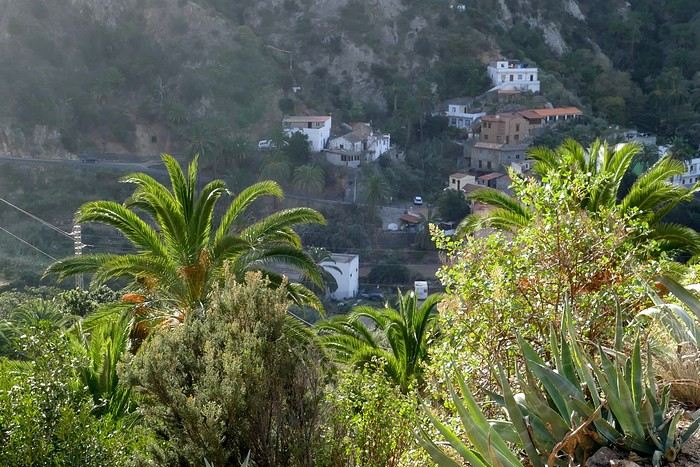 Vallehermoso
Friday, February 9 This morning, the sky was overcast, and the peaks around us were shrouded in clouds. We took the same road as yesterday to hike Las Creces. Quickly gaining altitude, we entered a thick fog—visibility was very limited. We stopped at the Las Creces parking lot; visibility improved, and the sun wasn’t far off. The hike is entirely within a beautiful laurel forest, with the sun playing hide-and-seek, but it wasn’t cold despite the altitude. After finishing the loop trail, we decided to picnic—not there, as it was too chilly—but on Vallehermoso’s beach, where we found a nice picnic area sheltered by large black rocks. A short digestive walk on the surrounding hill to admire the little beach from above. Back in Vallehermoso, we did some grocery shopping, then tried to return to the casa—only to find ourselves locked out because we’d left the key in the lock inside! After several attempts and with the help of Yéli, a relative of the owner we called for help, we were finally able to get back in!
Saturday, February 10
It rained last night, and the sky remained overcast. Monique decided to rest this morning. PP, Pat, and I set off on the hike that starts from the house toward the Marichal reservoir. The sun wasn’t far off, and by 11 AM, it was fully out. The pleasant hike passed by many flower-filled gardens and orchards—orange, lemon, and mandarin trees in fruit. The path climbed gently toward the reservoir, where the view of the Cano rock dominating the landscape was magnificent. The last part of the climb was a bit tough, overgrown with lush vegetation, and the trail was slippery from last night’s rain. We descended via a different, much more pleasant path and returned to the casa just in time for lunch, prepared by Monique. This valley is rich with its many farmers and market gardeners who’ve cultivated the entire valley, taking advantage of the water flowing down from the mountain, captured upstream and redistributed through countless pipes snaking along the paths. Numerous tanks also store water during dry periods. The houses are scattered across both sides of the valley, and these colorful little homes add a beautiful touch to the landscape. The many palm trees give this valley a distinctly tropical feel—you could almost imagine yourself in the Caribbean. Add to that some salsa music drifting from a hut where farmers were working, and the picture is complete. A well-chilled beer apéro capped off a lovely morning. The afternoon was dedicated to rest, relaxation, reading, and games.
Sunday, February 11 The blue sky returned, though a few clouds still capped the highest peaks. Today, we visited Garajonay National Park, which covers the highest central mountains. Up there, we were above the clouds, and the panoramas from the various viewpoints were stunning: first, Cherelepin, accessible from the Laguna Grande parking lot, then Alto de Garajonay, offering an exceptional view of Teide—over 3,000 meters high—emerging from the clouds on Tenerife, far in the distance. We continued to the Los Roques viewpoints, then stopped for lunch at the Degollada de Peraza restaurant, where the view of the barranco was impressive. We descended toward San Sebastián and checked into our new lodging, La Cabezada, located in the countryside about 3 km above San Sebastián. It’s a small apartment adjacent to the owner’s, with a lovely terrace overlooking the surrounding mountains and surrounded by a beautiful garden. Apéro, then dinner on our beautiful terrace.
Monday, February 12 This morning, we went down to visit San Sebastián de La Gomera: its old tower, main street with some beautiful traditional houses, and the Church of the Assumption. Back at the casa for lunch. In the afternoon, Pat, PP, and I set off on the short hike from San Sebastián beach to La Guancha beach. We drove down and parked on the beach. The path climbs along the hill overlooking San Sebastián, passes by the tall Christ statue dominating the landscape, and roughly follows the coast down to the isolated Guancha beach. A beautiful hike under a hot sun, and a swim was welcome, even if the beach and sea access weren’t very comfortable due to large pebbles and quickly deepening water. Apart from two nudist bathers, there was no one on this beach. We returned the same way.
Tuesday, February 13 Rest day. We went down to town to stroll and do some shopping. I took the opportunity to visit the parador, beautifully situated above the city in a lovely garden overlooking the port and town. Together, we went for a cuba libre at the "Cuba Libre" bar, then had lunch at Breñusca (mediocre paella!). Back at the casa, then we went back down to town to see a carnival parade, a "passacalles," which actually passed an hour earlier than scheduled. Oh well.
Wednesday, February 14 Each to their own program this morning. Pat went swimming at San Sebastián beach, Monique rested at the casa, and PP and I set off on the hike from Playa de Avalos to the Ermita de Guadalupe on Playa del Cangrejo. It wasn’t easy to find the right road or the parking spot, but we managed. The path seemed to have suffered landslides, according to a sign at the trailhead! We decided to check it out, ready to turn back if it seemed too dangerous. In the end, apart from one or two slightly tricky spots where we had to climb a pile of rocks, the trail remained passable, though a bit vertigo-inducing in places. The narrow path clings to very vertical cliffs nearly 300 meters above sea level! But what a magnificent view. At one point, the trail runs alongside a wall of basaltic pipes. We returned via the drivable track that parallels the trail a bit lower. Back at the house for lunch. In the late afternoon, we returned to town to attend the "Entierro de las Sardinas" (Burial of the Sardine), which closes the Canarian carnival festivities. While waiting, we strolled through the parador’s gardens and had mojitos in town. Around 9 PM, we heard the noise and cries of the mourners. The procession advanced, led by a large papier-mâché sardine on a float, surrounded by wailing mourners. The procession headed toward the sea, where the sardine was burned, and a mini fireworks display ended the procession. It was all very good-natured, and everyone had fun. We ended the evening with dinner at a good fish restaurant, El Pajar.
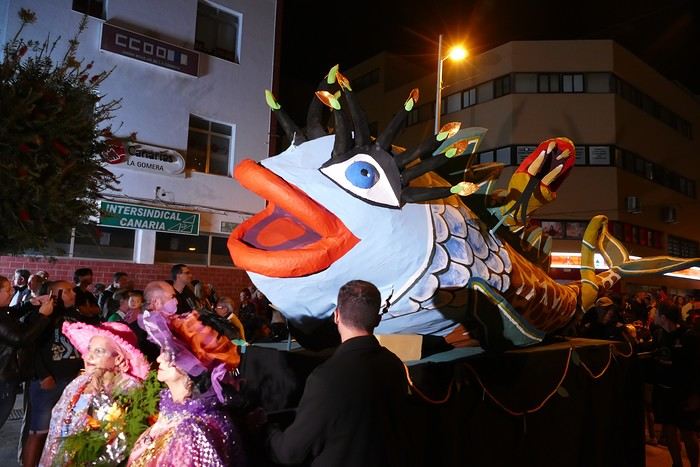 Entierro de la Sardina in San Sebastián de La Gomera
Thursday, February 15
Woke up at 5:15 AM. The only suitable ferry was at 7 AM, which would get us to La Palma by late morning rather than evening. We packed our bags, had breakfast, then headed to the port, left our rental car, and boarded the ferry to Tenerife, from where we’d continue to La Palma. Calm sea, beautiful sun—by 10:30 AM, we disembarked in La Palma. We picked up our car and immediately headed to our new apartment in Breña Alta. It’s a large apartment with a superb terrace facing the sea, fully equipped and very comfortable. The hosts recommended Casa Goyo restaurant, near the airport and close to us. It’s a restaurant with many small rooms, some of which can be reserved for families. The fish-based cuisine (chipirones, pulpo) was excellent, hearty, and reasonably priced. Since it’s in the airport’s flight path, we occasionally heard planes landing. Quick and efficient service. Afterward, we visited Santa Cruz de La Palma, which reminded us of the historic quarters of La Orotava in Tenerife or the capital of Gran Canaria.
Friday, February 16
Beautiful weather, blue sky. We headed to the San Bartolo viewpoint toward the northeast coast, then to the lovely village of San Andrés, which we explored. From there, we walked along the shore to the natural pools of Charco Azul, where we swam in the cool but "swimmable" sea. Back in San Andrés for lunch at the "San Andrés" restaurant on the beautiful church square. Very good fish-based meal. We got back in the car and continued along the north coast to the port of Espindola and the natural pools of Fajana near the Cumplida lighthouse. A fairly strong wind whipped up beautiful waves crashing onto the rocky coast in bursts of foam. Back in Santa Cruz, we stopped at the Mercadona supermarket to buy fresh shrimp for dinner.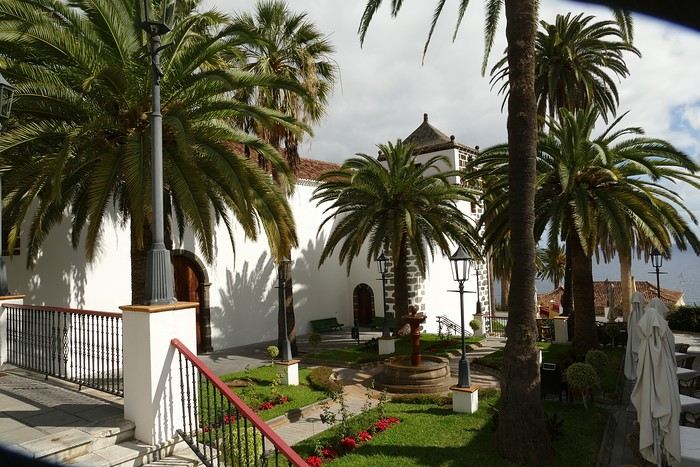 San Andrés
Saturday, February 17
Uniform blue sky, even on the heights. We took the beautiful road that winds up to the summit of the Caldera de Taburiente. Several viewpoints offer 360° views of the entire island and beyond: you can make out La Gomera, El Hierro, and, of course, Tenerife with the perfect triangle of Teide. We parked at the Los Andes viewpoint parking lot and started our hike to Pico de la Cruz along a trail following the ridge, offering superb views into the caldera. We got back in the car and passed by the Roque de los Muchachos astronomical complex, composed of numerous observatories, some with very aesthetic mirror telescopes. We hiked from the Roque de los Muchachos parking lot to the various viewpoints, always as impressive. Picnic on site, then back to Santa Cruz. We stopped by our car dealer because the oil warning light came on—better safe than sorry. The representative reassured us but preferred to give us a Fiat Cross SUV instead.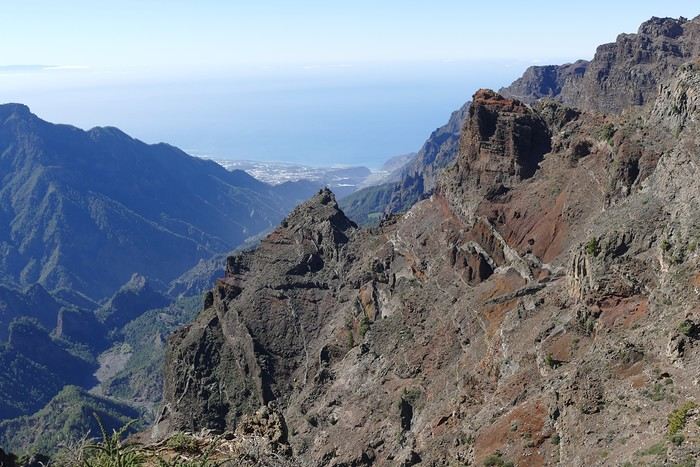 The Caldera de Taburiente
Sunday, February 18 The weather was a bit mixed, with cloudy patches. We set off to hike the Barranco de la Cuba de Galga. Unfortunately, the Los Tilos trail had been closed for several months due to a major landslide. The parking lot by the road was already quite full, and indeed, we crossed paths with many hikers along the way—it’s an easy hike with little elevation gain, which is rare here in La Palma! The beautiful path winds through a very narrow, deep gorge covered in lush tropical vegetation—you’d think you were in a Southeast Asian forest, especially with the humidity in the gorge bringing out earthy and floral scents. Halfway through, Monique turned back while the rest of us continued to the Cuba de Galga. A light drizzle accompanied us on the return. For lunch, we went to Chipi Chipi restaurant in the heights of Santa Cruz. The cool air forced us to leave the lovely terrace for the slightly noisy dining room. The meal was very good and hearty. Afternoon spent resting at our house.
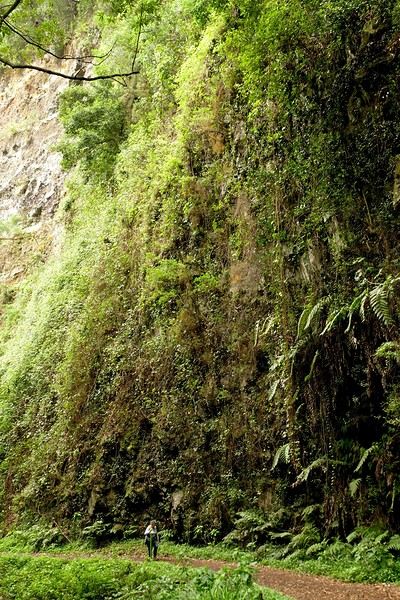 La Cuba de la Galga
Monday, February 19 A few clouds still clung to the nearby mountain peaks. We headed south to Los Canarios. We stopped in front of the small San Antonio Abad church, where a path leads to the viewpoint in 15 minutes. Then we visited the San Antonio Volcano Interpretation Center and climbed to the viewpoint via the trail along the crater’s edge, offering a plunging view into the crater. Then PP, Pat, and I headed toward the Teneguía volcano but turned back given the remaining distance and the intense heat bearing down on us! Plus, the landscape was rather arid and not very interesting. We got back in the car and drove down to the salt flats at the island’s southern tip. The ocean crashes here in large waves, exploding against the volcanic rocks and feeding a "blowhole" carved into the rock. We stopped for drinks at the salt flats restaurant, then headed home.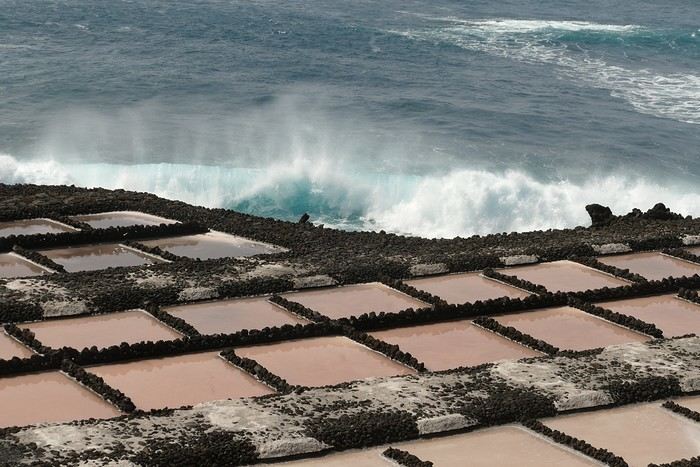 The salt flats in Fuencaliente
Tuesday, February 20 Beautiful weather with a few clouds clinging to the mountains, as usual. A relaxed morning since my parking reservation at La Cumbrecita didn’t start until 1 PM. It takes about 30 minutes from Santa Cruz to reach the valley floor via a beautiful but narrow road toward the end, though there’s very little traffic. Meanwhile, the clouds had disappeared, and the view from the La Cumbrecita viewpoint was superb. We recognized Pico de la Cruz in the distance, where we’d been a few days earlier. We then took the path leading to the Las Chozas viewpoint through a magnificent Canarian pine forest. We picnicked on site, then took the path to the Los Roques viewpoint. We returned the same way since the direct route was closed for construction. Back in Santa Cruz, we visited the Sanctuary of Las Nieves, with its beautiful golden Baroque altar.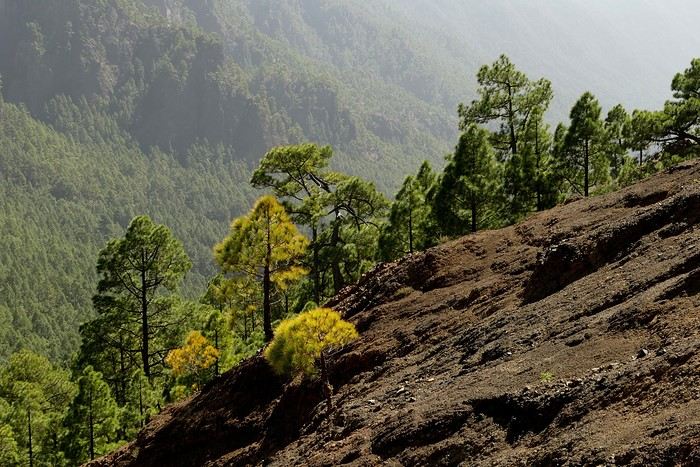 Hike from La Cumbrecita
Wednesday, February 21 After packing our things and loading the car, we left Santa Cruz under a very blue sky for Los Llanos de Aridane, where we stopped to visit this lovely town. The Church of Nuestra Señora de los Remedios has a beautiful coffered ceiling and an original papier-mâché Christ statue from the 16th century. Around it, colorful old Canarian houses brighten the streets of the town center. We took the opportunity to stroll, do some shopping, and finally sat down at La Pergola restaurant for a mediocre lunch. We got back in the car to check into our new house in Arecida. On the way, we stopped at the Mirador del Time, which once again offered an impressive panorama, allowing us—for the first time—to see the damage caused by the Tajogaite volcano eruption in 2021. You can clearly see the still-smoking crater and the large black lava flow covering the landscape down to the sea. We really liked our new accommodation: a local house that’s been renovated on the heights of Arecida, not far from the Canarian pine forest. From several terraces, we have a 360° view of the sea and mountains. We even have a private pool! There are two beautiful, brand-new bedrooms, each with its own bathroom—the best. Plus, we’re on the GR 131 trail that runs along the Barranco de las Angustias toward the northeast.
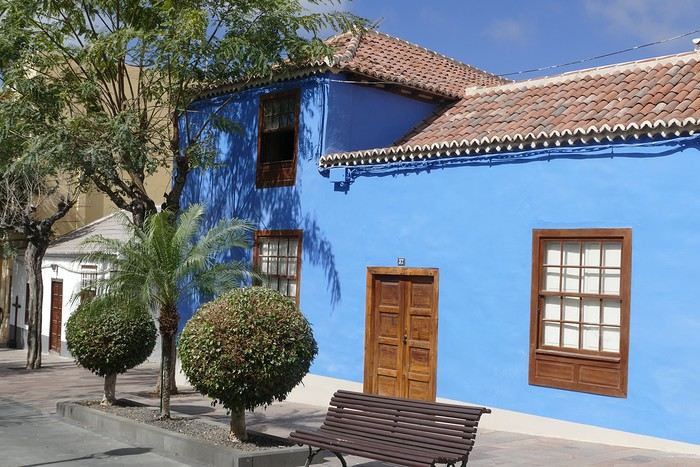 Los Llanos de Aridane
Thursday, February 22 Once again, beautiful weather greeted us when we woke up. We started the GR 131 with the goal of reaching the Torre del Time viewpoint—about 400 meters of elevation gain. The path, quite steep at first, winds through a superb Canarian pine forest. A few viewpoints let you appreciate the sheer drop of the Barranco de las Angustias—watch out for vertigo! At the Torre del Time viewpoint, there’s a nearly 1,000-meter vertical drop. We returned via another path, the PLP1, which meanders first through this beautiful forest, then along lovely flower-filled gardens adjacent to beautiful properties that cascade from the forest down to the road serving these neighborhoods. This afternoon, we tried to get closer to the area devastated by the 2021 lava flows. Several roads are still closed or reserved for residents, while others—brand new—have been rebuilt to open up this densely populated and cultivated region. In some places, the lava flow slightly diverted, sparing some properties that logically should have disappeared. Now, they’re encircled by a massive cooled lava field. In other spots, twisted and charred metal scraps or greenhouse remains protrude from the lava—all that’s left of the former banana plantations. A little higher up, you can see the slightly smoking crater of Tajogaite, responsible for this disaster. Back to Casa Barreros.
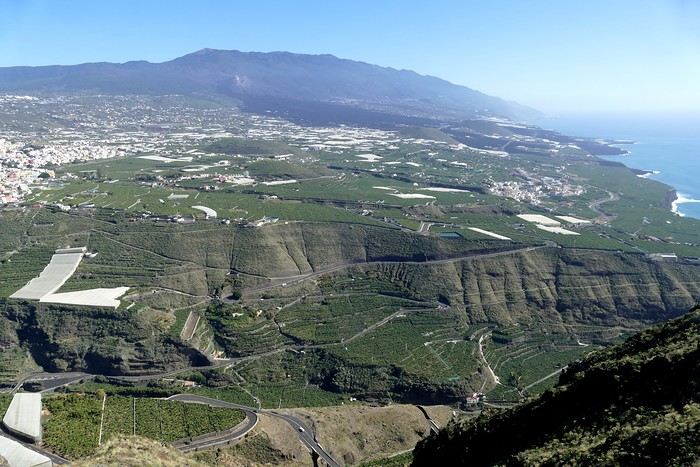 View of Los Llanos and, in the background, the 2021 lava flow
Friday, February 23
Though the sky was still blue, the temperature had dropped due to a chilly wind. By midday, it still rose to 22°C. Today, we headed north, specifically to the town of Tijarafe, where a very narrow road descends to the small port, Porís de Candelaria. The 3.7-kilometer road drops 700 meters in elevation, with gradients up to 30%—it was going to be intense! Indeed, the descent was scary, with the void right next to the very narrow road where passing was impossible except at a few rare spots. Everything went well—there was little traffic at this early hour. From the parking lot at the bottom, a path leads to Porís de Candelaria. It’s surprising to see this small fishing hamlet nestled in the shelter of an immense cave opening onto the sea, which was quite rough today. The sun, at this time of year, would appear late in the cave, which remained in shadow for much of the day. We returned via the same road, strolled through the small town of Puntagorda, and had lunch at El Jardín de los Naranjos restaurant—excellent meal.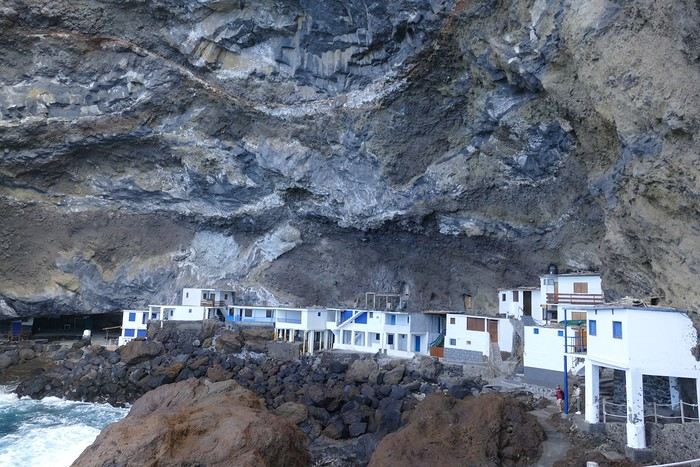 Fishing hamlet of Candelaria
Saturday, February 24 The air was still cool, but the sun was beautiful. While Monique stayed home to rest, the three of us headed to the village of Las Tricias to hike the Buracas Caves trail. We left the car parked on the LP1 road and took the small paved road down to the sign marking the trail’s start. The signage for all the trails we took here, as in La Gomera, was very well done. The path descended steadily, then more steeply toward the caves where the island’s first inhabitants lived—some petroglyphs are still visible in certain caves. The path then climbed back up, passing magnificent dragon trees and more or less elaborate huts occupied by Germans who’ve lived here for many years. Back at Casa Barreros for some rest.
Sunday, February 25 The weather once again blessed us with a beautiful day. This morning, we visited the local produce market held on weekends in Puntagorda. You’ll find agricultural products, crafts, and food to keep you going. A little further on, there’s a glass viewpoint overlooking the barranco plunging toward the sea, with a view of the thrill-seekers trying the zip line right next to it. Lunch at Naranjos—definitely a good spot—with their shrimp and spice tagliatelle. Back home for an afternoon of relaxation.
Monday, February 26 We left Arecida under a cloudy sky. Driving up from Los Llanos de Aridane toward the east, an enormous cascade of clouds poured from the mountain peaks into the Los Llanos plain—very impressive. Arriving in Santa Cruz, we went for a stroll, did some last-minute shopping, then had a final good-quality paella at La Chalana on the paseo maritimo. We left the car in the parking lot and took the 5 PM Olsen ferry to Tenerife on a slightly choppy sea, but the ferry didn’t rock too much. Arriving at 7:15 PM, we dropped off our things near the port in our reserved apartment and went for dinner at Abordo—rubbery chipirones. A digestive stroll among the ever-increasing number of tourists in Los Cristianos—restaurants were packed to the brim, the season is in full swing here. Gone is the calm of La Gomera and La Palma, and the laid-back tourism of German hikers among whom a few French were hiding!
Tuesday, February 27 To make our homemade breakfast more enjoyable, we went to buy pastries at the local bakery, then took one last walk on the paseo along the beaches, mingling with the many mobility scooters driven by elderly or disabled people, joggers, and tourists. Last apéro near the bus station, then off to the airport. After a smooth 4-hour-30-minute flight, we arrived in Basel-Mulhouse at 10:20 PM.
THE END
Conclusion A fantastic trip to two islands with magnificent and diverse nature, where landscapes range from desert-like to tropical depending on exposure to winds and clouds. Thanks to the many beautiful viewpoints, you can truly appreciate these exceptionally dynamic reliefs. A hiker’s paradise, the trails are all very well marked, though the choice of easy or moderate paths for "casual walkers" is quite limited. Another notable advantage, in our opinion, is that these islands are very lightly developed—you’ll hardly see any of those ugly hotel blocks that spoil the landscapes of some other Canary Islands. It’s true that the beaches on these two islands don’t meet traditional international tourism criteria: they’re small, with black sand, and often difficult to access. Special mention for the quality of the road network (except for a few small local roads), which seems brand new, well-paved, and well-signposted. We also enjoyed exceptional weather for February, with fewer than three days of gray or rainy weather out of 21.
Almost all the accommodations we chose met or exceeded our expectations, often at reasonable prices: an average of 98 € per night for an apartment or house with two bedrooms for four people.
All photos can be viewed by clicking this link: https://photos.app.goo.gl/G44pPk4g9PW1rNzg8
Tuesday, February 6 We left around 9 AM with our car, along with Pierre-Paul and Patricia, heading to the Bluepark parking lot in Bartenheim. As expected, we were awaited and left promptly for EuroAirport Basel. Took off at 12:25 PM for a 4-hour-15-minute flight under excellent conditions. Beautiful arrival in Tenerife with Teide in sight under a clear blue sky. Fifteen minutes later, we waited for bus No. 40 to Los Cristianos with quite a few other tourists, but we managed to find four seats. From the bus station, it was a 20-minute walk to our hotel. We checked into a lovely apartment for the four of us, complete with all the comforts. Outside, it was quite warm—at least 25°C! After dropping off our luggage, we went for a stroll. The immediate surroundings of the hotel held no interest for us: a modern, concrete area filled with hotels, bars, tourist agencies, and unappealing restaurants all offering the same bland international cuisine. Pat went to cool off at the pool, unfortunately overrun by loud, drunk English tourists. I took a walk to the paseo maritimo that leads to the port, skirting the seafront. The promenade was pleasant, but it could have been any seaside resort in the world—same old scene: a succession of bars with blaring music where many elderly people sipped cold beers waiting for the sunset, the backdrop a wall of resort-style hotels resembling rabbit hutches! Upon reaching the port, I scouted the route we’d take the next day to the Fred Olsen ferry. Back at the apartment, in the early evening, we looked for a non-touristy restaurant for dinner. Monique stopped a woman to ask her opinion! In this area, she told us, there’s no restaurant that serves Canarian or Spanish cuisine! The only place with decent restaurants is at the port. Off we went to the port, where we sat down at Al Bordo restaurant and ordered a seafood paella for four. Excellent, and at a very reasonable price (36 € for two). We returned to the hotel along the seafront.
Wednesday, February 7
Woke up at 6 AM. Had breakfast in the apartment with what we’d bought the day before at a supermarket. It was still dark when we left on foot toward the port, walking along the calm seafront at this early hour. Forty minutes later, we arrived and waited 10 minutes before the ferry docked. At 9:30 AM, we left the port of Los Cristianos for a 50-minute crossing on a calm sea under a beautiful blue sky. There were quite a few people on this large ferry, but many had no luggage, meaning they were visiting La Gomera for the day and would take the ferry back in the evening. Upon disembarking, we went straight to our rental car agency to pick up the car we’d booked online a few months earlier. It was a nice Peugeot 2008, spacious enough for the four of us and our luggage. We immediately took the beautiful road from San Sebastián that climbs directly into the mountains toward our rental in Vallehermoso. The road was in perfect condition—it seemed brand new, like all the others we’d take on this island later. This side of the island is very arid with little vegetation, and the terrain is particularly rugged, as it is throughout the island. We stopped at our first miradors, which would be followed by many more throughout our Canarian trip. Our first visit was to the small village of Agulo, perched on a promontory above the sea and at the foot of a high cliff. The village features typical Canarian houses with windows flush with the façade and black volcanic stone masonry on white or reddish-brown walls. The first recommended restaurant was already booked for a group, so we settled for the shaded terrace of the excellent El Alameda bar-restaurant. From Agulo, you can access the Abrante viewpoint via a winding road, where the view of Agulo, 600 meters below, is exceptional. A glass ledge over the void lets you test your fear of heights!
We drove to Vallehermoso to do our grocery shopping at the supermarket—a habit that would continue until the end of the trip. Our little house, "Casa rural El Encatadora," is located in a beautiful flower-filled valley a few kilometers west of Vallehermoso. Each of us had a bedroom with an en-suite bathroom, plus a living room, kitchen, and a small terrace overlooking the quiet street at the valley’s end, which didn’t bother us at all.
Thursday, February 8 The good weather seemed to follow us since our arrival in the Canary Islands. This morning, we took the road—still as beautiful and new—toward Arure, high up to the west. The landscape was magnificent, with breathtaking glimpses of the sea far below. In Arure, we parked in front of Conchita’s bar, where a hike (Rother No. 30) starts toward two viewpoints: Alojera, which we reached after 45 minutes on a lovely path. Monique, tired from the first steep climb, stopped at the first viewpoint and hitchhiked back to Arure. Meanwhile, we continued toward the second viewpoint, Los Barranquillos, where the view of the surroundings was partially hidden by misty clouds rising from the sea. The entire mountain is sculpted by ancient, endless terraces climbing until the slope becomes too steep for construction—visible traces of the hard work of past inhabitants trying to survive in a harsh environment. We had a decent lunch at La Conchita bar, then drove to the small seaside town of Puerto la Caleta, sheltered by an immense cliff plunging into the sea. Black sand beach, rough sea—despite our encouragement, Pat didn’t dare to swim! As for the old village of Caleta, it’s perched on the mountainside, and visiting it requires climbing steep, stair-filled alleys to discover a few traditional houses. Back at the casa, dinner in, and card games...
VallehermosoFriday, February 9 This morning, the sky was overcast, and the peaks around us were shrouded in clouds. We took the same road as yesterday to hike Las Creces. Quickly gaining altitude, we entered a thick fog—visibility was very limited. We stopped at the Las Creces parking lot; visibility improved, and the sun wasn’t far off. The hike is entirely within a beautiful laurel forest, with the sun playing hide-and-seek, but it wasn’t cold despite the altitude. After finishing the loop trail, we decided to picnic—not there, as it was too chilly—but on Vallehermoso’s beach, where we found a nice picnic area sheltered by large black rocks. A short digestive walk on the surrounding hill to admire the little beach from above. Back in Vallehermoso, we did some grocery shopping, then tried to return to the casa—only to find ourselves locked out because we’d left the key in the lock inside! After several attempts and with the help of Yéli, a relative of the owner we called for help, we were finally able to get back in!
Saturday, February 10
It rained last night, and the sky remained overcast. Monique decided to rest this morning. PP, Pat, and I set off on the hike that starts from the house toward the Marichal reservoir. The sun wasn’t far off, and by 11 AM, it was fully out. The pleasant hike passed by many flower-filled gardens and orchards—orange, lemon, and mandarin trees in fruit. The path climbed gently toward the reservoir, where the view of the Cano rock dominating the landscape was magnificent. The last part of the climb was a bit tough, overgrown with lush vegetation, and the trail was slippery from last night’s rain. We descended via a different, much more pleasant path and returned to the casa just in time for lunch, prepared by Monique. This valley is rich with its many farmers and market gardeners who’ve cultivated the entire valley, taking advantage of the water flowing down from the mountain, captured upstream and redistributed through countless pipes snaking along the paths. Numerous tanks also store water during dry periods. The houses are scattered across both sides of the valley, and these colorful little homes add a beautiful touch to the landscape. The many palm trees give this valley a distinctly tropical feel—you could almost imagine yourself in the Caribbean. Add to that some salsa music drifting from a hut where farmers were working, and the picture is complete. A well-chilled beer apéro capped off a lovely morning. The afternoon was dedicated to rest, relaxation, reading, and games.
Sunday, February 11 The blue sky returned, though a few clouds still capped the highest peaks. Today, we visited Garajonay National Park, which covers the highest central mountains. Up there, we were above the clouds, and the panoramas from the various viewpoints were stunning: first, Cherelepin, accessible from the Laguna Grande parking lot, then Alto de Garajonay, offering an exceptional view of Teide—over 3,000 meters high—emerging from the clouds on Tenerife, far in the distance. We continued to the Los Roques viewpoints, then stopped for lunch at the Degollada de Peraza restaurant, where the view of the barranco was impressive. We descended toward San Sebastián and checked into our new lodging, La Cabezada, located in the countryside about 3 km above San Sebastián. It’s a small apartment adjacent to the owner’s, with a lovely terrace overlooking the surrounding mountains and surrounded by a beautiful garden. Apéro, then dinner on our beautiful terrace.
Monday, February 12 This morning, we went down to visit San Sebastián de La Gomera: its old tower, main street with some beautiful traditional houses, and the Church of the Assumption. Back at the casa for lunch. In the afternoon, Pat, PP, and I set off on the short hike from San Sebastián beach to La Guancha beach. We drove down and parked on the beach. The path climbs along the hill overlooking San Sebastián, passes by the tall Christ statue dominating the landscape, and roughly follows the coast down to the isolated Guancha beach. A beautiful hike under a hot sun, and a swim was welcome, even if the beach and sea access weren’t very comfortable due to large pebbles and quickly deepening water. Apart from two nudist bathers, there was no one on this beach. We returned the same way.
Tuesday, February 13 Rest day. We went down to town to stroll and do some shopping. I took the opportunity to visit the parador, beautifully situated above the city in a lovely garden overlooking the port and town. Together, we went for a cuba libre at the "Cuba Libre" bar, then had lunch at Breñusca (mediocre paella!). Back at the casa, then we went back down to town to see a carnival parade, a "passacalles," which actually passed an hour earlier than scheduled. Oh well.
Wednesday, February 14 Each to their own program this morning. Pat went swimming at San Sebastián beach, Monique rested at the casa, and PP and I set off on the hike from Playa de Avalos to the Ermita de Guadalupe on Playa del Cangrejo. It wasn’t easy to find the right road or the parking spot, but we managed. The path seemed to have suffered landslides, according to a sign at the trailhead! We decided to check it out, ready to turn back if it seemed too dangerous. In the end, apart from one or two slightly tricky spots where we had to climb a pile of rocks, the trail remained passable, though a bit vertigo-inducing in places. The narrow path clings to very vertical cliffs nearly 300 meters above sea level! But what a magnificent view. At one point, the trail runs alongside a wall of basaltic pipes. We returned via the drivable track that parallels the trail a bit lower. Back at the house for lunch. In the late afternoon, we returned to town to attend the "Entierro de las Sardinas" (Burial of the Sardine), which closes the Canarian carnival festivities. While waiting, we strolled through the parador’s gardens and had mojitos in town. Around 9 PM, we heard the noise and cries of the mourners. The procession advanced, led by a large papier-mâché sardine on a float, surrounded by wailing mourners. The procession headed toward the sea, where the sardine was burned, and a mini fireworks display ended the procession. It was all very good-natured, and everyone had fun. We ended the evening with dinner at a good fish restaurant, El Pajar.
Entierro de la Sardina in San Sebastián de La GomeraThursday, February 15
Woke up at 5:15 AM. The only suitable ferry was at 7 AM, which would get us to La Palma by late morning rather than evening. We packed our bags, had breakfast, then headed to the port, left our rental car, and boarded the ferry to Tenerife, from where we’d continue to La Palma. Calm sea, beautiful sun—by 10:30 AM, we disembarked in La Palma. We picked up our car and immediately headed to our new apartment in Breña Alta. It’s a large apartment with a superb terrace facing the sea, fully equipped and very comfortable. The hosts recommended Casa Goyo restaurant, near the airport and close to us. It’s a restaurant with many small rooms, some of which can be reserved for families. The fish-based cuisine (chipirones, pulpo) was excellent, hearty, and reasonably priced. Since it’s in the airport’s flight path, we occasionally heard planes landing. Quick and efficient service. Afterward, we visited Santa Cruz de La Palma, which reminded us of the historic quarters of La Orotava in Tenerife or the capital of Gran Canaria.
Friday, February 16
Beautiful weather, blue sky. We headed to the San Bartolo viewpoint toward the northeast coast, then to the lovely village of San Andrés, which we explored. From there, we walked along the shore to the natural pools of Charco Azul, where we swam in the cool but "swimmable" sea. Back in San Andrés for lunch at the "San Andrés" restaurant on the beautiful church square. Very good fish-based meal. We got back in the car and continued along the north coast to the port of Espindola and the natural pools of Fajana near the Cumplida lighthouse. A fairly strong wind whipped up beautiful waves crashing onto the rocky coast in bursts of foam. Back in Santa Cruz, we stopped at the Mercadona supermarket to buy fresh shrimp for dinner.
San AndrésSaturday, February 17
Uniform blue sky, even on the heights. We took the beautiful road that winds up to the summit of the Caldera de Taburiente. Several viewpoints offer 360° views of the entire island and beyond: you can make out La Gomera, El Hierro, and, of course, Tenerife with the perfect triangle of Teide. We parked at the Los Andes viewpoint parking lot and started our hike to Pico de la Cruz along a trail following the ridge, offering superb views into the caldera. We got back in the car and passed by the Roque de los Muchachos astronomical complex, composed of numerous observatories, some with very aesthetic mirror telescopes. We hiked from the Roque de los Muchachos parking lot to the various viewpoints, always as impressive. Picnic on site, then back to Santa Cruz. We stopped by our car dealer because the oil warning light came on—better safe than sorry. The representative reassured us but preferred to give us a Fiat Cross SUV instead.
The Caldera de TaburienteSunday, February 18 The weather was a bit mixed, with cloudy patches. We set off to hike the Barranco de la Cuba de Galga. Unfortunately, the Los Tilos trail had been closed for several months due to a major landslide. The parking lot by the road was already quite full, and indeed, we crossed paths with many hikers along the way—it’s an easy hike with little elevation gain, which is rare here in La Palma! The beautiful path winds through a very narrow, deep gorge covered in lush tropical vegetation—you’d think you were in a Southeast Asian forest, especially with the humidity in the gorge bringing out earthy and floral scents. Halfway through, Monique turned back while the rest of us continued to the Cuba de Galga. A light drizzle accompanied us on the return. For lunch, we went to Chipi Chipi restaurant in the heights of Santa Cruz. The cool air forced us to leave the lovely terrace for the slightly noisy dining room. The meal was very good and hearty. Afternoon spent resting at our house.
La Cuba de la GalgaMonday, February 19 A few clouds still clung to the nearby mountain peaks. We headed south to Los Canarios. We stopped in front of the small San Antonio Abad church, where a path leads to the viewpoint in 15 minutes. Then we visited the San Antonio Volcano Interpretation Center and climbed to the viewpoint via the trail along the crater’s edge, offering a plunging view into the crater. Then PP, Pat, and I headed toward the Teneguía volcano but turned back given the remaining distance and the intense heat bearing down on us! Plus, the landscape was rather arid and not very interesting. We got back in the car and drove down to the salt flats at the island’s southern tip. The ocean crashes here in large waves, exploding against the volcanic rocks and feeding a "blowhole" carved into the rock. We stopped for drinks at the salt flats restaurant, then headed home.
The salt flats in FuencalienteTuesday, February 20 Beautiful weather with a few clouds clinging to the mountains, as usual. A relaxed morning since my parking reservation at La Cumbrecita didn’t start until 1 PM. It takes about 30 minutes from Santa Cruz to reach the valley floor via a beautiful but narrow road toward the end, though there’s very little traffic. Meanwhile, the clouds had disappeared, and the view from the La Cumbrecita viewpoint was superb. We recognized Pico de la Cruz in the distance, where we’d been a few days earlier. We then took the path leading to the Las Chozas viewpoint through a magnificent Canarian pine forest. We picnicked on site, then took the path to the Los Roques viewpoint. We returned the same way since the direct route was closed for construction. Back in Santa Cruz, we visited the Sanctuary of Las Nieves, with its beautiful golden Baroque altar.
Hike from La CumbrecitaWednesday, February 21 After packing our things and loading the car, we left Santa Cruz under a very blue sky for Los Llanos de Aridane, where we stopped to visit this lovely town. The Church of Nuestra Señora de los Remedios has a beautiful coffered ceiling and an original papier-mâché Christ statue from the 16th century. Around it, colorful old Canarian houses brighten the streets of the town center. We took the opportunity to stroll, do some shopping, and finally sat down at La Pergola restaurant for a mediocre lunch. We got back in the car to check into our new house in Arecida. On the way, we stopped at the Mirador del Time, which once again offered an impressive panorama, allowing us—for the first time—to see the damage caused by the Tajogaite volcano eruption in 2021. You can clearly see the still-smoking crater and the large black lava flow covering the landscape down to the sea. We really liked our new accommodation: a local house that’s been renovated on the heights of Arecida, not far from the Canarian pine forest. From several terraces, we have a 360° view of the sea and mountains. We even have a private pool! There are two beautiful, brand-new bedrooms, each with its own bathroom—the best. Plus, we’re on the GR 131 trail that runs along the Barranco de las Angustias toward the northeast.
Los Llanos de AridaneThursday, February 22 Once again, beautiful weather greeted us when we woke up. We started the GR 131 with the goal of reaching the Torre del Time viewpoint—about 400 meters of elevation gain. The path, quite steep at first, winds through a superb Canarian pine forest. A few viewpoints let you appreciate the sheer drop of the Barranco de las Angustias—watch out for vertigo! At the Torre del Time viewpoint, there’s a nearly 1,000-meter vertical drop. We returned via another path, the PLP1, which meanders first through this beautiful forest, then along lovely flower-filled gardens adjacent to beautiful properties that cascade from the forest down to the road serving these neighborhoods. This afternoon, we tried to get closer to the area devastated by the 2021 lava flows. Several roads are still closed or reserved for residents, while others—brand new—have been rebuilt to open up this densely populated and cultivated region. In some places, the lava flow slightly diverted, sparing some properties that logically should have disappeared. Now, they’re encircled by a massive cooled lava field. In other spots, twisted and charred metal scraps or greenhouse remains protrude from the lava—all that’s left of the former banana plantations. A little higher up, you can see the slightly smoking crater of Tajogaite, responsible for this disaster. Back to Casa Barreros.
View of Los Llanos and, in the background, the 2021 lava flowFriday, February 23
Though the sky was still blue, the temperature had dropped due to a chilly wind. By midday, it still rose to 22°C. Today, we headed north, specifically to the town of Tijarafe, where a very narrow road descends to the small port, Porís de Candelaria. The 3.7-kilometer road drops 700 meters in elevation, with gradients up to 30%—it was going to be intense! Indeed, the descent was scary, with the void right next to the very narrow road where passing was impossible except at a few rare spots. Everything went well—there was little traffic at this early hour. From the parking lot at the bottom, a path leads to Porís de Candelaria. It’s surprising to see this small fishing hamlet nestled in the shelter of an immense cave opening onto the sea, which was quite rough today. The sun, at this time of year, would appear late in the cave, which remained in shadow for much of the day. We returned via the same road, strolled through the small town of Puntagorda, and had lunch at El Jardín de los Naranjos restaurant—excellent meal.
Fishing hamlet of CandelariaSaturday, February 24 The air was still cool, but the sun was beautiful. While Monique stayed home to rest, the three of us headed to the village of Las Tricias to hike the Buracas Caves trail. We left the car parked on the LP1 road and took the small paved road down to the sign marking the trail’s start. The signage for all the trails we took here, as in La Gomera, was very well done. The path descended steadily, then more steeply toward the caves where the island’s first inhabitants lived—some petroglyphs are still visible in certain caves. The path then climbed back up, passing magnificent dragon trees and more or less elaborate huts occupied by Germans who’ve lived here for many years. Back at Casa Barreros for some rest.
Sunday, February 25 The weather once again blessed us with a beautiful day. This morning, we visited the local produce market held on weekends in Puntagorda. You’ll find agricultural products, crafts, and food to keep you going. A little further on, there’s a glass viewpoint overlooking the barranco plunging toward the sea, with a view of the thrill-seekers trying the zip line right next to it. Lunch at Naranjos—definitely a good spot—with their shrimp and spice tagliatelle. Back home for an afternoon of relaxation.
Monday, February 26 We left Arecida under a cloudy sky. Driving up from Los Llanos de Aridane toward the east, an enormous cascade of clouds poured from the mountain peaks into the Los Llanos plain—very impressive. Arriving in Santa Cruz, we went for a stroll, did some last-minute shopping, then had a final good-quality paella at La Chalana on the paseo maritimo. We left the car in the parking lot and took the 5 PM Olsen ferry to Tenerife on a slightly choppy sea, but the ferry didn’t rock too much. Arriving at 7:15 PM, we dropped off our things near the port in our reserved apartment and went for dinner at Abordo—rubbery chipirones. A digestive stroll among the ever-increasing number of tourists in Los Cristianos—restaurants were packed to the brim, the season is in full swing here. Gone is the calm of La Gomera and La Palma, and the laid-back tourism of German hikers among whom a few French were hiding!
Tuesday, February 27 To make our homemade breakfast more enjoyable, we went to buy pastries at the local bakery, then took one last walk on the paseo along the beaches, mingling with the many mobility scooters driven by elderly or disabled people, joggers, and tourists. Last apéro near the bus station, then off to the airport. After a smooth 4-hour-30-minute flight, we arrived in Basel-Mulhouse at 10:20 PM.
THE END
Conclusion A fantastic trip to two islands with magnificent and diverse nature, where landscapes range from desert-like to tropical depending on exposure to winds and clouds. Thanks to the many beautiful viewpoints, you can truly appreciate these exceptionally dynamic reliefs. A hiker’s paradise, the trails are all very well marked, though the choice of easy or moderate paths for "casual walkers" is quite limited. Another notable advantage, in our opinion, is that these islands are very lightly developed—you’ll hardly see any of those ugly hotel blocks that spoil the landscapes of some other Canary Islands. It’s true that the beaches on these two islands don’t meet traditional international tourism criteria: they’re small, with black sand, and often difficult to access. Special mention for the quality of the road network (except for a few small local roads), which seems brand new, well-paved, and well-signposted. We also enjoyed exceptional weather for February, with fewer than three days of gray or rainy weather out of 21.
Almost all the accommodations we chose met or exceeded our expectations, often at reasonable prices: an average of 98 € per night for an apartment or house with two bedrooms for four people.
All photos can be viewed by clicking this link: https://photos.app.goo.gl/G44pPk4g9PW1rNzg8
Route 66: Trip Report
Route 66 in 30 days
From Chicago to Los Angeles with a few stops at sites near the route: a total of 6,800 km. Total trip cost: 8,600 € all-inclusive—flights, car rental, gas, meals (raw veggies and fruit for lunch, fast food in the evening), hotels, and little knick-knacks picked up here and there. British Airways flights from Basel-Mulhouse Midsize car from Dollar via AutoEurope. No issues on return. Accommodations booked through Booking
First off, we met really friendly people all along the way. Most attractions are free, and you can easily walk into bars, hotels, and gas stations without buying anything—though you might get kicked out.
The original Route 66 no longer exists in its entirety. Only sections remain, and signage varies by state. Plus, the route has changed over time. But with a good map or GPS, you can figure it out. I used the CoPilot app, which lets you download all the world’s maps for a small fee—so no data issues abroad. I’d noted the GPS coordinates of places to visit during my trip prep, which came in handy.
Along the route, you’ll find old gas stations, vintage motels (some renovated, some not) with their retro signs. The most famous is Bagdad Café. There are also tons of beautiful murals and the Muffler Men.
Chicago is an amazing city. We stayed for 2 days. The best move is to pick a hotel near a Blues Line metro station—it takes you straight from the airport to your hotel, then to downtown. At the end of the trip, the metro takes you back to the airport to pick up your rental car. The 72-hour pass is super convenient. Must-sees in Chicago: John Hancock Center (skip the Tilt option—it’s a rip-off), the Chicago Riverwalk all the way to Merchandise Mart, Picasso and Calder statues, The Bean and its reflections, and don’t miss the signs marking the start/end of Route 66.
Here’s a non-exhaustive list of things that surprised or delighted us (aside from major sites like Petrified Forest): - Joliet and its prison tied to the *Blues Brothers* story - Gardner and its jail cells - Abraham Lincoln’s tomb in Springfield - Country Classic Cars in Staunton (39.03066, -89.75145): a used car lot with everything from Ford Model Ts to classic American cars. You can walk freely through the three hangars - Old Chain of Rocks Bridge (38.76062, -90.47978) - St. Louis with its Gateway Arch and City Garden (full of sculptures and free to enter) - Philipsburg and its candy factory - Springfield: Bass Pro Shop outdoor store (37.179, -93.296) - Carthage: The Precious Moments Chapel (37.113, -94.345) - Foyil: Ed Galloway’s Totem Park - Tulsa: Harley Davidson dealership (36.111, -95.885) - Oklahoma City: Stockyards City—one of the trip’s highlights. Cattle auctions are wild; plan ahead for open days/hours (35.456, -97.552) - Centennial Land Run Monument (35.461, -97.504) - Amarillo: VW Slug Bug Ranch (35.191, -101.985) - Cadillac Ranch (35.191, -101.985) - Palo Duro Canyon State Park - Bandelier - El Morro, NM - Canyon de Chelly (detour) - Little Painted Desert (35.157608, -110.47105) - Winslow: *Standin’ on the Corner* (Eagles) - Oatman and its burros - Las Vegas: two days, one spent at Valley of the Fire and Red Rock Canyon. Pick a hotel near Fremont Avenue for nightlife - Rainbow Basin Area (35.012369, -117.03858) - The Bottle Tree Ranch (34.69113, -117.34206) - The Justice Private Automotive Collection in Duarte (34.13830, -117.94591) - Los Angeles: 4 days. Start at Griffith Observatory for a city overview and the Hollywood sign. Don’t forget to see the end of Route 66 in Santa Monica. Venice is worth a visit for a more authentic vibe. Check out the Walt Disney Concert Hall and surrounding buildings for the architecture. Distances are huge. We mixed driving with the metro. Avoid the Interstates—they’re packed with traffic and frequent jams. Stick to parallel roads
From Chicago to Los Angeles with a few stops at sites near the route: a total of 6,800 km. Total trip cost: 8,600 € all-inclusive—flights, car rental, gas, meals (raw veggies and fruit for lunch, fast food in the evening), hotels, and little knick-knacks picked up here and there. British Airways flights from Basel-Mulhouse Midsize car from Dollar via AutoEurope. No issues on return. Accommodations booked through Booking
First off, we met really friendly people all along the way. Most attractions are free, and you can easily walk into bars, hotels, and gas stations without buying anything—though you might get kicked out.
The original Route 66 no longer exists in its entirety. Only sections remain, and signage varies by state. Plus, the route has changed over time. But with a good map or GPS, you can figure it out. I used the CoPilot app, which lets you download all the world’s maps for a small fee—so no data issues abroad. I’d noted the GPS coordinates of places to visit during my trip prep, which came in handy.
Along the route, you’ll find old gas stations, vintage motels (some renovated, some not) with their retro signs. The most famous is Bagdad Café. There are also tons of beautiful murals and the Muffler Men.
Chicago is an amazing city. We stayed for 2 days. The best move is to pick a hotel near a Blues Line metro station—it takes you straight from the airport to your hotel, then to downtown. At the end of the trip, the metro takes you back to the airport to pick up your rental car. The 72-hour pass is super convenient. Must-sees in Chicago: John Hancock Center (skip the Tilt option—it’s a rip-off), the Chicago Riverwalk all the way to Merchandise Mart, Picasso and Calder statues, The Bean and its reflections, and don’t miss the signs marking the start/end of Route 66.
Here’s a non-exhaustive list of things that surprised or delighted us (aside from major sites like Petrified Forest): - Joliet and its prison tied to the *Blues Brothers* story - Gardner and its jail cells - Abraham Lincoln’s tomb in Springfield - Country Classic Cars in Staunton (39.03066, -89.75145): a used car lot with everything from Ford Model Ts to classic American cars. You can walk freely through the three hangars - Old Chain of Rocks Bridge (38.76062, -90.47978) - St. Louis with its Gateway Arch and City Garden (full of sculptures and free to enter) - Philipsburg and its candy factory - Springfield: Bass Pro Shop outdoor store (37.179, -93.296) - Carthage: The Precious Moments Chapel (37.113, -94.345) - Foyil: Ed Galloway’s Totem Park - Tulsa: Harley Davidson dealership (36.111, -95.885) - Oklahoma City: Stockyards City—one of the trip’s highlights. Cattle auctions are wild; plan ahead for open days/hours (35.456, -97.552) - Centennial Land Run Monument (35.461, -97.504) - Amarillo: VW Slug Bug Ranch (35.191, -101.985) - Cadillac Ranch (35.191, -101.985) - Palo Duro Canyon State Park - Bandelier - El Morro, NM - Canyon de Chelly (detour) - Little Painted Desert (35.157608, -110.47105) - Winslow: *Standin’ on the Corner* (Eagles) - Oatman and its burros - Las Vegas: two days, one spent at Valley of the Fire and Red Rock Canyon. Pick a hotel near Fremont Avenue for nightlife - Rainbow Basin Area (35.012369, -117.03858) - The Bottle Tree Ranch (34.69113, -117.34206) - The Justice Private Automotive Collection in Duarte (34.13830, -117.94591) - Los Angeles: 4 days. Start at Griffith Observatory for a city overview and the Hollywood sign. Don’t forget to see the end of Route 66 in Santa Monica. Venice is worth a visit for a more authentic vibe. Check out the Walt Disney Concert Hall and surrounding buildings for the architecture. Distances are huge. We mixed driving with the metro. Avoid the Interstates—they’re packed with traffic and frequent jams. Stick to parallel roads
Comment concilier voyage à vélo et visites culturelles au quotidien? English translation pending
Bonjour!
Bon randonneur mais cycliste très occasionnel, j'ai programmé mon premier (petit) voyage à vélo pour la fin juillet: 10 jours le long de l'EuroVelo 15, de Bâle à Cologne. En raison de mon manque d'expérience et afin de pouvoir profiter des sites traversés, je me suis fixé une moyenne a priori raisonnable de 60 km par jour. 😇
Bien que rompu au camping sauvage en milieux variés, j'ai fait le choix de réserver des hébergements sous toit pour l'ensemble de l'itinéraire, principalement parce que je serai accompagné durant quatre jours et que ma compagne (inexpérimentée elle aussi) veut voyager léger (pour une première, je valide 😛).
J'ai déjà trouvé beaucoup de conseils en ligne pour des débutants comme nous, mais des questions demeurent: comment concilier voyage à vélo et visites culturelles au quotidien? Laisser son vélo (équipé de sacoches) sans surveillance pendant une heure ou deux ne pose-t-il pas de problème? Et surtout, comment gérer facilement le petit sac à dos (20 litres environ) qui m'est indispensable dès que je quitte le vélo, pour emmener veste de pluie, matériel photo, bouteille d'eau et autres?
Je songe à investir dans deux sacoches arrière et un grand panier de guidon, dans lequel je pourrais déposer ledit sac à dos: cette solution me semble très pratique, dès qu'il faut s'éloigner du vélo (on empoigne le sac à dos et hop, on est prêt en deux secondes 😏). Mais les sacoches de guidon (dédiées) ont aussi leurs avantages (accès rapide à l'appareil photo quand on est en selle, porte-carte inclus, etc.) et certaines sont amovibles (quid du confort s'il faut les trimballer pendant une heure?). J'ai même vu qu'il existait des sacoches arrière transformables en sac à dos (en leur harnachant des bretelles amovibles), mais si le principe me plaît bien, ça me semble un poil laborieux au quotidien.
Et vous, cyclistes chevronnés, comment procédez-vous? Je serais ravi de profiter de vos lumières avant d'investir dans du matériel que j'espère perenne... afin d'envisager d'autres virées du genre. 🙂
Bon randonneur mais cycliste très occasionnel, j'ai programmé mon premier (petit) voyage à vélo pour la fin juillet: 10 jours le long de l'EuroVelo 15, de Bâle à Cologne. En raison de mon manque d'expérience et afin de pouvoir profiter des sites traversés, je me suis fixé une moyenne a priori raisonnable de 60 km par jour. 😇
Bien que rompu au camping sauvage en milieux variés, j'ai fait le choix de réserver des hébergements sous toit pour l'ensemble de l'itinéraire, principalement parce que je serai accompagné durant quatre jours et que ma compagne (inexpérimentée elle aussi) veut voyager léger (pour une première, je valide 😛).
J'ai déjà trouvé beaucoup de conseils en ligne pour des débutants comme nous, mais des questions demeurent: comment concilier voyage à vélo et visites culturelles au quotidien? Laisser son vélo (équipé de sacoches) sans surveillance pendant une heure ou deux ne pose-t-il pas de problème? Et surtout, comment gérer facilement le petit sac à dos (20 litres environ) qui m'est indispensable dès que je quitte le vélo, pour emmener veste de pluie, matériel photo, bouteille d'eau et autres?
Je songe à investir dans deux sacoches arrière et un grand panier de guidon, dans lequel je pourrais déposer ledit sac à dos: cette solution me semble très pratique, dès qu'il faut s'éloigner du vélo (on empoigne le sac à dos et hop, on est prêt en deux secondes 😏). Mais les sacoches de guidon (dédiées) ont aussi leurs avantages (accès rapide à l'appareil photo quand on est en selle, porte-carte inclus, etc.) et certaines sont amovibles (quid du confort s'il faut les trimballer pendant une heure?). J'ai même vu qu'il existait des sacoches arrière transformables en sac à dos (en leur harnachant des bretelles amovibles), mais si le principe me plaît bien, ça me semble un poil laborieux au quotidien.
Et vous, cyclistes chevronnés, comment procédez-vous? Je serais ravi de profiter de vos lumières avant d'investir dans du matériel que j'espère perenne... afin d'envisager d'autres virées du genre. 🙂
Auto Train de nuit de Belfort à Copenhague English translation pending
Bonjour,
Je voudrais aller au Danemark en auto train de nuit si possible et je ne trouve pas ou aller regarder :(
Merci de m'aider :)
Merci de m'aider :)
Trouver un appartement en Croatie pour mai / juin English translation pending
On connaît pas la Croatie et on cherche un appartement á louer près de la mer dans un endroit assez tranquille. Le grand luxe ne nous intéresse pas mais faut que ce soit assez spacieux, tranquille donc pas trop bruyant. Depuis Bâle on peut prendre la direction Dubrovnik, Pula et Split. Quel sera donc l'aéroport convenable? On louera une voiture sur place (à l'aéroport).
Merci d'avance pour vos conseils
Visa Schengen pour la France English translation pending
Bonjour !
Je suis marocaine et j'ai un visa Schengen du consulat de france casablanca.
Je pars à Mulhouse, et donc J'ai un vol de casablanca à l'aéroportde Bâle/Mulhouse.
C'est écrit sur mon billet que l'enregistrement sera effectué dans le secteurs suisse a bale . Et comme cet aéroport est situé aux frontières et j'aimerais passer par la douance française, et comment j'aurai accès au coté de la France.
C'est urgent!!
Si vous pourriez m'aider, j'en serai très reconnaissant !
Merci d'avance.
Itinéraire 10 jours Israël - Jordanie English translation pending
Bonjour à tous,
Le sujet a déjà été abordé mais j'aimerais des expériences récentes sur un trip Israel Jordanie. Nous y sommes pour 10 jours (9 nuits).
Pour des questions de budgets, nous avons opté pour un vol aller retour Bale Tel Aviv.
Nous arrivons et repartons donc de Tel Aviv.
Vous recommandez de faire la boucle par la sud autrement dit : Tel Aviv - Eilat - Wadi RUM - Petra - Mer Morte - Jerusalem - TEL AVIV ou alors l'inverse ?
Le passage a la frontière à Eilat étant le plus simple, notre itinéraire s'orienterait vers ça.
Nous sommes preneurs de tous vos conseils et retours d'expérience.
Un grand merci.
Le sujet a déjà été abordé mais j'aimerais des expériences récentes sur un trip Israel Jordanie. Nous y sommes pour 10 jours (9 nuits).
Pour des questions de budgets, nous avons opté pour un vol aller retour Bale Tel Aviv.
Nous arrivons et repartons donc de Tel Aviv.
Vous recommandez de faire la boucle par la sud autrement dit : Tel Aviv - Eilat - Wadi RUM - Petra - Mer Morte - Jerusalem - TEL AVIV ou alors l'inverse ?
Le passage a la frontière à Eilat étant le plus simple, notre itinéraire s'orienterait vers ça.
Nous sommes preneurs de tous vos conseils et retours d'expérience.
Un grand merci.
Problème avec agence pour l'Écosse English translation pending
L’Ecosse ... avec Quartier libre ... plus jamais ! Aucun pays avec cette agence d’ailleurs !
Avant de partir, promesse mensongère un vol direct Bâle-Edimbourg avec Lufthansa que l’agence nous confirme par 2 fois, quand le carnet de vols arrive ... escale Francfort 😡! Vol aller 1h retard, circuit plus que basique avec beaucoup trop de temps libre, une guide qui a fait le « minimum syndical » moins souriante quand il faut résoudre le moins petit problème ! Vol retour perturbé : départ retard 2h donc correspondance Francfort loupée (je savais pourquoi je voulais un vol direct et surtout pas d’escale à Francfort !) , soit-disant pas de places vol suivant, j’insiste ... finalement après vérifications 14 places dispos ... Quartier libre me propose ... 25€ de dédommagement ... au tél je ris au nez du responsable de l’agence !!! Que de mails et coups de tél pour obtenir plus !
Quartier libre ... plus jamais !!!
Séjour en Suisse et Italie (en train) English translation pending
Bonjour,
Je pars pour la Suisse et l'Italie en juillet prochain. J'arriverai sur Zurich pour aller tout de suite à Bâle ensuite Lucerne et retour à Zurich. Je pensais prendre le train.
Ensuite de Zurich, nous partons pour le Lac Majeur en Italie et ensuite les Cinq-Terre, retour pour Montréal par Gênes. Je pensais louer une voiture de Zurich jusqu'à Gênes que nous partagerons à 2 couples. Les prix sont assez élevés par contre, plus de 1600$ pour 13 jours (la moins chère est 1400$C soit 1110 CH et que est trop petite pour 2 couples et quand même chère). Avez-vous des trucs pour baisser le prix de location. Le but du voyage est de débuter par Bâle et finir par Gênes. Merci