Results for "pêche+ou+pêche+|+4+>+127"
31547 results found.
Iberostar Dominicana et Iberostar Hacienda Dominicus English translation pending
Je suis allé deux semaines dans chacun de ces hôtels, en 2002 et en 2004... si vous avez des questions, n'hésitez pas 😎
Discussion sur le Japon English translation pending
Pourquoi le Japon augmente son quota de chasse à la baleine ? Pourquoi le Japon continue a continue a croire que la Corée lui appartient encore (ile de Dokdo que les japonais dénomment Takeshima).
Des hamburgers à la baleine vendus au Japon grâce à la pêche "scientifique" nippone
Tranche de baleine, laitue, mayonnaise pour 380 yens, soit trois euros environ: une chaîne de restauration rapide nippone proposait jeudi un hamburger au steak de baleine alors que la communauté internationale appelle le Japon à mettre fin à son programme prétendument scientifique de pêche au cétacé. Le Japon affirme devoir tuer des baleines pour les étudier correctement et notamment analyser le contenu de leur estomac afin d'avoir des précisions sur leur régime alimentaire. Mais les organisations écologistes et les pays hostiles à la chasse à la baleine estiment que le programme scientifique nippon n'est qu'une entreprise commerciale à peine déguisée. Ils soulignent que la viande des cétacés est vendue dans les supermarchés et restaurants japonais pour aider à financer le programme. Chaque année, le Japon tue 400 rorquals communs dans l'Antarctique et 210 autres cétacés dans le Pacifique: 100 rorquals communs, 50 rorquals de Bryde, 50 rorquals de rudolphi et 10 cachalots.
Des hamburgers à la baleine vendus au Japon grâce à la pêche "scientifique" nippone
Tranche de baleine, laitue, mayonnaise pour 380 yens, soit trois euros environ: une chaîne de restauration rapide nippone proposait jeudi un hamburger au steak de baleine alors que la communauté internationale appelle le Japon à mettre fin à son programme prétendument scientifique de pêche au cétacé. Le Japon affirme devoir tuer des baleines pour les étudier correctement et notamment analyser le contenu de leur estomac afin d'avoir des précisions sur leur régime alimentaire. Mais les organisations écologistes et les pays hostiles à la chasse à la baleine estiment que le programme scientifique nippon n'est qu'une entreprise commerciale à peine déguisée. Ils soulignent que la viande des cétacés est vendue dans les supermarchés et restaurants japonais pour aider à financer le programme. Chaque année, le Japon tue 400 rorquals communs dans l'Antarctique et 210 autres cétacés dans le Pacifique: 100 rorquals communs, 50 rorquals de Bryde, 50 rorquals de rudolphi et 10 cachalots.
Emmerdes à Bangkok English translation pending
Ça passe ou ça casse. (ou l’art de se mettre les pieds dans les plats)
En Thaïlande, comme partout ailleurs, on ne badine pas avec les visas. En janvier 1999 je l’ai appris à mes dépends. Après avoir traversé la frontière Cambodge-Thaïlande (voir De Kompong Som à Klong Hay en ti-batô) mes neuf premiers jours au pays le furent sans visa. Quatre entre la frontière et Bangkok, cinq dans la mégapole à poireauter pour l’obtenir, non sans une certaine inquiétude.
J’aime le brouhaha des passages frontaliers, la recherche de combines légales et honnêtes, le négoce pour la conversion des monnaies, d’où mon butinage de quatre jours avant de rejoindre Bangkok, histoire de prendre le pouls du pays qui m’accueille. Donc pas de tampon-visa à la frontière? Ni de bureau d’immigration à Trat? No problemo me dis-je! Je vais remonter molo jusqu’à Bangkok et régulariser ma situation sur place. Ils vont me recevoir avec une tape dans le dos et ce sourire tellement imprimé dans le Lonely Planet. Ce fut d’une naïveté et d’une insouciance sans bornes de ma part! Fallait le faire! Et je l’ai fait.
Bangkok, 9 heures 30 le matin, direction Bureau des visas. Dans la file je remarque que par osmose tous nous avons la même attitude; cœur allègre, légère, très légère impatience d’attendre son tour et sourire d’une ou d’un ‘’tamponé’’ quittant le guichet, le passeport collé sur le cœur et la Thaïlande devant soi.
- SUIVANT!
Justement le suivant c’est moi (et pas Jacques Brel!). Je tends le passeport. Miss Sourire feuillette et recherche je ne sais quoi. Page après page son sourire se fane. Elle tente une explication.
- Ils ont oubliés le tampon à l’aéroport?
Moi le con au lieu de sauter sur l’occasion je réponds doublement con.
- Euh! Pas du tout!
Je lui explique le no man’s land juridique que j’ai traversé. Là je n’aime pas mais alors pas du tout ce regard soupçonneux qu’elle pose sur moi. J’aggrave la situation.
- Ya un problème?
La ‘’Demoiselle sourire perdu’’ me scanne du premier cheveux gris jusqu’à l’ongle du petit orteil puis disparaît dans les dédales de l’arrière guichet, mon passeport à la main. Le temps de me retourner pour faire la moue interrogative en guise d’excuse à la file, elle revient précédée de deux gardes en uniforme brun chocolat et casquettes astiquées. Elle ajoute :
- Vous allez devoir suivre les policiers au 9e étage dans l’édifice derrière.
- SUIVANT!
Dans l’ascenseur vers le 7e ciel du 9e étage commence à trottiner un spaghetti de points d’interrogations entre mes neurones. Long corridor avec bancs de bois près de chaque porte close d’un coté et de l’autre, fenêtres entre ouvertes à mi-hauteur d’où parviennent de grands pans des rumeurs de Bangkok. Un des policiers me désigne poliment un des bancs: You here! Attente d’une quinzaine de minutes. Ça me donne le temps d’observer que toutes les femmes cèdent le passage en saluant celui ou ceux qu’elles croisent dans le corridor. Plus haut est le gradé plus haut se fait le salut Thaï! Nous les occidentaux devrions adapter cette politesse élémentaire; serrer la main au niveau du genoux pour un subalterne et au niveau des épaules pour le patron! Le niveau de la taille étant réservé aux confrères de même rang.
À deux portes du banc où je converse avec ma maman sort un civil au regard sévère. Chemise blanche immaculée, manches courtes, cheveux noir jais coupés courts, pantalon gris bleu et souliers vernis schuischuitant sur les carreaux céramiques. Monsieur Sévère m’ordonne de demeurer assis avant même d’avoir le temps de le saluer. Mon petit doigt me dit d’écouter sans interrompre.
- You illegal in Thailand. Maybe you go in jail!
Puis il déboule question sur question; où je crèche à Bangkok, la durée de mon séjour en Thaïlande, si j’ai un billet de retour, combien d’argent j’ai en poche et surtout, surtout, pourquoi j’ai franchi la frontière thaïlandaise dans une zone de conflits armés potentiels.
Bon écoutes Chose! Pour l’instant je n’ai pas d’hôtel attitrée, je veux visiter votre beau pays environ un mois ou deux, je n’ai pas de billet de retour en avion because je voyage par les routes, j’ai une carte de crédit Visa, une carte débit de ma banque, près de quatre cent dollars au porteur émis par l’oncle Sam, mille deux cent dollars en chèques de voyage Thomas Cook à l’effigie de Georges Washington… et un petit grain de beauté en haut de la fesse gauche. Quand à la Province de Trat je n’ai pas vu l’ombre d’un canon de fusil ni de panneaux indiquant ‘’No trepassing’’ ou ‘’Stay away. War in progress’’. Alors? Tu me le fais le visa?
Ma dernière question fut suffisante pour ouvrir un dossier à mon nom au 9e étage de l’édifice, derrière le guichet de Miss Sourire. Cinq jours plus tard ce dossier avait deux centimètres d’épaisseur; résultat des rendez-vous de l’avant midi et de l’après midi de chaque jour où je devais me présenter à Monsieur Sévère.
Entre-temps j’allais quotidiennement à l’ambassade canadienne où une employée Thaïe, d’une gentillesse exemplaire et d’un français impeccable, s’inquiéta de mon sort en me suppliant de l’informer régulièrement de l’évolution du dossier.
Au cinquième jour dans l’après-midi Monsieur Sévère me remit mon passeport estampillé d’un joli visa à la page 11, suivi d’une note signée et rédigée en Thaï sur la moitié de la page 12. Je le remerciai d’un salut Thaï à la hauteur du front qu’il ne m’a pas retourné. Dans le corridor vers l’ascenseur je me disais ‘’Mamounet tu peux retourner prendre le thé avec St Pierre. Je te fais signe si j’ai besoin de toi à nouveau’’
Dernière visite à l’ambassade canadienne pour remercier Mademoiselle Gentille et lui annoncer que j’avais récupéré mon passeport. Une question, que je n’ai pas osé lui demander, me rongeait l’esprit : ‘’Vous ne seriez pas ma maman réincarnée à Bangkok par hasard?’’
Bangkok, 15 heures 20, direction gare de Hualamphong pour le train de nuit de Surat Thani. J’ai mon passeport collé sur le cœur et la Thaïlande devant moi! Ne bouge pas Ko Samui! J’arrive!
Épilogue : De Ko Samui j’ai du faire un voyage-visa vers la Malaisie, un aller retour éclair de dernière minute. Ne lisant pas le Thaï j’ignorais ne posséder que 21 jours de visa dans mon passeport (30-9 jours illégaux. Merci au policier du poste de Na Thon!) Je suis d’une nonchalance!...En même temps je me dis que j’ai sûrement les ailes diaphanes d’un ange gardien greffées dans le dos…Incorrigible Marcel!
DeCléricy
Notes de voyage en Thaïlande, cahier no. 3, janvier 1999.
En Thaïlande, comme partout ailleurs, on ne badine pas avec les visas. En janvier 1999 je l’ai appris à mes dépends. Après avoir traversé la frontière Cambodge-Thaïlande (voir De Kompong Som à Klong Hay en ti-batô) mes neuf premiers jours au pays le furent sans visa. Quatre entre la frontière et Bangkok, cinq dans la mégapole à poireauter pour l’obtenir, non sans une certaine inquiétude.
J’aime le brouhaha des passages frontaliers, la recherche de combines légales et honnêtes, le négoce pour la conversion des monnaies, d’où mon butinage de quatre jours avant de rejoindre Bangkok, histoire de prendre le pouls du pays qui m’accueille. Donc pas de tampon-visa à la frontière? Ni de bureau d’immigration à Trat? No problemo me dis-je! Je vais remonter molo jusqu’à Bangkok et régulariser ma situation sur place. Ils vont me recevoir avec une tape dans le dos et ce sourire tellement imprimé dans le Lonely Planet. Ce fut d’une naïveté et d’une insouciance sans bornes de ma part! Fallait le faire! Et je l’ai fait.
Bangkok, 9 heures 30 le matin, direction Bureau des visas. Dans la file je remarque que par osmose tous nous avons la même attitude; cœur allègre, légère, très légère impatience d’attendre son tour et sourire d’une ou d’un ‘’tamponé’’ quittant le guichet, le passeport collé sur le cœur et la Thaïlande devant soi.
- SUIVANT!
Justement le suivant c’est moi (et pas Jacques Brel!). Je tends le passeport. Miss Sourire feuillette et recherche je ne sais quoi. Page après page son sourire se fane. Elle tente une explication.
- Ils ont oubliés le tampon à l’aéroport?
Moi le con au lieu de sauter sur l’occasion je réponds doublement con.
- Euh! Pas du tout!
Je lui explique le no man’s land juridique que j’ai traversé. Là je n’aime pas mais alors pas du tout ce regard soupçonneux qu’elle pose sur moi. J’aggrave la situation.
- Ya un problème?
La ‘’Demoiselle sourire perdu’’ me scanne du premier cheveux gris jusqu’à l’ongle du petit orteil puis disparaît dans les dédales de l’arrière guichet, mon passeport à la main. Le temps de me retourner pour faire la moue interrogative en guise d’excuse à la file, elle revient précédée de deux gardes en uniforme brun chocolat et casquettes astiquées. Elle ajoute :
- Vous allez devoir suivre les policiers au 9e étage dans l’édifice derrière.
- SUIVANT!
Dans l’ascenseur vers le 7e ciel du 9e étage commence à trottiner un spaghetti de points d’interrogations entre mes neurones. Long corridor avec bancs de bois près de chaque porte close d’un coté et de l’autre, fenêtres entre ouvertes à mi-hauteur d’où parviennent de grands pans des rumeurs de Bangkok. Un des policiers me désigne poliment un des bancs: You here! Attente d’une quinzaine de minutes. Ça me donne le temps d’observer que toutes les femmes cèdent le passage en saluant celui ou ceux qu’elles croisent dans le corridor. Plus haut est le gradé plus haut se fait le salut Thaï! Nous les occidentaux devrions adapter cette politesse élémentaire; serrer la main au niveau du genoux pour un subalterne et au niveau des épaules pour le patron! Le niveau de la taille étant réservé aux confrères de même rang.
À deux portes du banc où je converse avec ma maman sort un civil au regard sévère. Chemise blanche immaculée, manches courtes, cheveux noir jais coupés courts, pantalon gris bleu et souliers vernis schuischuitant sur les carreaux céramiques. Monsieur Sévère m’ordonne de demeurer assis avant même d’avoir le temps de le saluer. Mon petit doigt me dit d’écouter sans interrompre.
- You illegal in Thailand. Maybe you go in jail!
Puis il déboule question sur question; où je crèche à Bangkok, la durée de mon séjour en Thaïlande, si j’ai un billet de retour, combien d’argent j’ai en poche et surtout, surtout, pourquoi j’ai franchi la frontière thaïlandaise dans une zone de conflits armés potentiels.
Bon écoutes Chose! Pour l’instant je n’ai pas d’hôtel attitrée, je veux visiter votre beau pays environ un mois ou deux, je n’ai pas de billet de retour en avion because je voyage par les routes, j’ai une carte de crédit Visa, une carte débit de ma banque, près de quatre cent dollars au porteur émis par l’oncle Sam, mille deux cent dollars en chèques de voyage Thomas Cook à l’effigie de Georges Washington… et un petit grain de beauté en haut de la fesse gauche. Quand à la Province de Trat je n’ai pas vu l’ombre d’un canon de fusil ni de panneaux indiquant ‘’No trepassing’’ ou ‘’Stay away. War in progress’’. Alors? Tu me le fais le visa?
Ma dernière question fut suffisante pour ouvrir un dossier à mon nom au 9e étage de l’édifice, derrière le guichet de Miss Sourire. Cinq jours plus tard ce dossier avait deux centimètres d’épaisseur; résultat des rendez-vous de l’avant midi et de l’après midi de chaque jour où je devais me présenter à Monsieur Sévère.
Entre-temps j’allais quotidiennement à l’ambassade canadienne où une employée Thaïe, d’une gentillesse exemplaire et d’un français impeccable, s’inquiéta de mon sort en me suppliant de l’informer régulièrement de l’évolution du dossier.
Au cinquième jour dans l’après-midi Monsieur Sévère me remit mon passeport estampillé d’un joli visa à la page 11, suivi d’une note signée et rédigée en Thaï sur la moitié de la page 12. Je le remerciai d’un salut Thaï à la hauteur du front qu’il ne m’a pas retourné. Dans le corridor vers l’ascenseur je me disais ‘’Mamounet tu peux retourner prendre le thé avec St Pierre. Je te fais signe si j’ai besoin de toi à nouveau’’
Dernière visite à l’ambassade canadienne pour remercier Mademoiselle Gentille et lui annoncer que j’avais récupéré mon passeport. Une question, que je n’ai pas osé lui demander, me rongeait l’esprit : ‘’Vous ne seriez pas ma maman réincarnée à Bangkok par hasard?’’
Bangkok, 15 heures 20, direction gare de Hualamphong pour le train de nuit de Surat Thani. J’ai mon passeport collé sur le cœur et la Thaïlande devant moi! Ne bouge pas Ko Samui! J’arrive!
Épilogue : De Ko Samui j’ai du faire un voyage-visa vers la Malaisie, un aller retour éclair de dernière minute. Ne lisant pas le Thaï j’ignorais ne posséder que 21 jours de visa dans mon passeport (30-9 jours illégaux. Merci au policier du poste de Na Thon!) Je suis d’une nonchalance!...En même temps je me dis que j’ai sûrement les ailes diaphanes d’un ange gardien greffées dans le dos…Incorrigible Marcel!
DeCléricy
Notes de voyage en Thaïlande, cahier no. 3, janvier 1999.
A bas les visas! English translation pending
Comme tous les voyageurs (ou touristes ou routards ou backpackers comme vous préférez) je me suis heurté plusieurs fois à l'obtention des sacro-saints visas.
Je voulais partager ma colère vis à vis de ces formalités archaïques. Je comprends qu'un Etat veuille tracer les étrangers se rendant sur son territoire. Je comprends aussi qu'un Etat taxe l'entrée d'un étranger (on taxe bien le pain). Je ne pense pas non plus être naïf : si l'idée de Nation a des relents nauséabonds elle pemet aussi à nous autres occidentaux d'avoir des vies privilégiées par rapport à d'autres pays. Or qui dit Nation dit frontière. Et une frontière n'exiset que si elle est surveillée...
Mais je me demande vraiment l'utilité de demander autant de formalités (lettres d'invitation, etc...) pour délivrer ces bouts de papier. Pourquoi ne pas délivrer un visa au moment ou un voyageur entre dans le pays plutot que de demander de passer par l'ambassade, de patienter plusieurs jours ou semaines, etc... (avec le cout pour le pays d'ailleurs) ? A la rigueur limiter les points d'entrée autorisés (ce qui est d'ailleurs souvent le cas) pour faciliter les communications entres les postes frontiere provinciaux et l'administration centrale.
L'amérique du sud dont la plupart des pays ne demandent pas de visas est-elle sujette à plus de criminalité étrangère, à plus d'immigration illégale ? Un immigrant voulant profiter d'un visa touristique pour rester dans le pays en sera-t-il empéché par quelques formalités supplémentaires ? Un criminel sera-t-il empéché de commettre des crimes (pour les criminels recherchés par la police la douane à l'entrée dans le pays suffit).
Que représente mieux l'aburdité administrative que l'obtention du visa russe ou iranien ou moldo-poldaque...
Bref à bas les visas !!
Mais je me demande vraiment l'utilité de demander autant de formalités (lettres d'invitation, etc...) pour délivrer ces bouts de papier. Pourquoi ne pas délivrer un visa au moment ou un voyageur entre dans le pays plutot que de demander de passer par l'ambassade, de patienter plusieurs jours ou semaines, etc... (avec le cout pour le pays d'ailleurs) ? A la rigueur limiter les points d'entrée autorisés (ce qui est d'ailleurs souvent le cas) pour faciliter les communications entres les postes frontiere provinciaux et l'administration centrale.
L'amérique du sud dont la plupart des pays ne demandent pas de visas est-elle sujette à plus de criminalité étrangère, à plus d'immigration illégale ? Un immigrant voulant profiter d'un visa touristique pour rester dans le pays en sera-t-il empéché par quelques formalités supplémentaires ? Un criminel sera-t-il empéché de commettre des crimes (pour les criminels recherchés par la police la douane à l'entrée dans le pays suffit).
Que représente mieux l'aburdité administrative que l'obtention du visa russe ou iranien ou moldo-poldaque...
Bref à bas les visas !!
Madagascar: De Morondava à Tuléar English translation pending
Bonjour,
Je souhaite me rendre de Belo sur mer (ou Morondava) ? Tul?ar par la mer aux environs du mois d'aout. Avez-vous des infos ? Est-ce facile de trouver un piroguier, et une pirogue "relativement" sure (avec moteur?!) Comment s'effectue le cabotage ? A "l'int?rieur" de la c?te (avant la barri?re de corail ?) ou part-on loin au large ? Combien de temps cela prend-il ?
Merci d'avance
Greg
Je souhaite me rendre de Belo sur mer (ou Morondava) ? Tul?ar par la mer aux environs du mois d'aout. Avez-vous des infos ? Est-ce facile de trouver un piroguier, et une pirogue "relativement" sure (avec moteur?!) Comment s'effectue le cabotage ? A "l'int?rieur" de la c?te (avant la barri?re de corail ?) ou part-on loin au large ? Combien de temps cela prend-il ?
Merci d'avance
Greg
Resorts a cote d'un village? English translation pending
bonjour chers membres,
j'ai besoin de vos conseils: je recherche un resort (4 ou 5 *) dans le sud, qui serait situe tout tout pres d'un village ou d'une ville ou je pourrais louer un appartement ou une chambre. Est-ce que la ville de Bahibe (?) se situe pres des resorts? est-ce qu'il ya a punta cana, pres du site hotelier, des locations a des prix modiques?
merci pour votre aide!🙂
j'ai besoin de vos conseils: je recherche un resort (4 ou 5 *) dans le sud, qui serait situe tout tout pres d'un village ou d'une ville ou je pourrais louer un appartement ou une chambre. Est-ce que la ville de Bahibe (?) se situe pres des resorts? est-ce qu'il ya a punta cana, pres du site hotelier, des locations a des prix modiques?
merci pour votre aide!🙂
Nous rentrons d'Algérie English translation pending
rentrons d'alger. extra, sejour helas trop court mais visite à tipaza.
la luminosite à alger est inoubliable. vraiment tres particuliere et unique
accueil tres chaleureux, mais respecter les consignes des algerois
pour visiter certains quartier.
eviter de conduire en ville pas pire que le caire mais ....
alger-tipaza :de merveilleux ports de pêche, et tipaza!!
envie de repartir
à voir le musee des beaux-arts
à voir le musee des beaux-arts
Togo / Bénin / Burkina Faso English translation pending
Bénin/Burkina/Togo
Bonjour vous tous,
Vous qui connaissez ces pays ou qui en êtes originaires et qui aimez décrire ce que vous avez vu, racontez-nous ces pays, donnez-nous envie de les découvrir.
Ecrivez-nous un bon itinéraire, donnez-nous vos bonnes adresses et les choses à ne pas faire/éviter?
On aimerait bien par ailleurs passer une semaine à faire du soutien scolaire en Août dans une école là-bas et on est preneurs de toutes bonnes adresses.
Evidemment, seuls les endroits authentiques nous intéressent. Donc pas d'adresses de Sofitel ou autres. Par contre, un minimum s'impose...mais dans les villages pourquoi pas?
Nous partirons en Août, je crains un peu pour le climat.
Amicalement
Odile & Alain
Bonjour vous tous,
Vous qui connaissez ces pays ou qui en êtes originaires et qui aimez décrire ce que vous avez vu, racontez-nous ces pays, donnez-nous envie de les découvrir.
Ecrivez-nous un bon itinéraire, donnez-nous vos bonnes adresses et les choses à ne pas faire/éviter?
On aimerait bien par ailleurs passer une semaine à faire du soutien scolaire en Août dans une école là-bas et on est preneurs de toutes bonnes adresses.
Evidemment, seuls les endroits authentiques nous intéressent. Donc pas d'adresses de Sofitel ou autres. Par contre, un minimum s'impose...mais dans les villages pourquoi pas?
Nous partirons en Août, je crains un peu pour le climat.
Amicalement
Odile & Alain
Descente du Danube en bateau English translation pending
On a le projet pour le mois de mai prochain de descendre le danube en bateau, ou plus exactement en Toue de loire (bateau a fond plat). On partira de bratislava avec pour but d'aller dire bonjour à la mer noire!
Je cherche des infos sur tout ce qui touche à la navigation fluviale ... les autorisations ect...est-ce dur de naviguer sur le danube pour deux neophytes, y-a-t-il des points d'arrets en dehors des grandes villes pour l'essence, l'eau potable...comment passer les portes de fer? Bref, beaucoup de questions! Donc si qqun connait qqun qui s'y connait, dites le moi!
Je cherche des infos sur tout ce qui touche à la navigation fluviale ... les autorisations ect...est-ce dur de naviguer sur le danube pour deux neophytes, y-a-t-il des points d'arrets en dehors des grandes villes pour l'essence, l'eau potable...comment passer les portes de fer? Bref, beaucoup de questions! Donc si qqun connait qqun qui s'y connait, dites le moi!
Excursions las galeras casa marina bay English translation pending
bonjour à tous,
Mon amie et moi descendons au casa marina bay le 10 novembre avec la ferme intention de voir autre choses que la piscine et les restos de l'hotel 😎.
nous comptons faire des excursions et celles qui reviennent le plus souvent sont : el limon a cheval los haitises cayo levantado route du cacao en quad peche en haute mer
mais en 1 semaine on ne peut pas tout faire 😐, et il va falloir faire des choix!!
quelles excursions vaut il mieux privilégier? et peut on les faire sans passer par l'hotel? si oui avez vous des adresses? (j'ai entendu parler d'un enzo au ranch thikis)
ps on ne parle pas un mot d'espagnol!
aussi avez vous aussi qq restos a conseiller pour se régaler de langoustes
merci d'avance
zoz
Mon amie et moi descendons au casa marina bay le 10 novembre avec la ferme intention de voir autre choses que la piscine et les restos de l'hotel 😎.
nous comptons faire des excursions et celles qui reviennent le plus souvent sont : el limon a cheval los haitises cayo levantado route du cacao en quad peche en haute mer
mais en 1 semaine on ne peut pas tout faire 😐, et il va falloir faire des choix!!
quelles excursions vaut il mieux privilégier? et peut on les faire sans passer par l'hotel? si oui avez vous des adresses? (j'ai entendu parler d'un enzo au ranch thikis)
ps on ne parle pas un mot d'espagnol!
aussi avez vous aussi qq restos a conseiller pour se régaler de langoustes
merci d'avance
zoz
Madives: quelle ile choisir? English translation pending
je pars aux Maldives en février 2005 et j ai besoins d info sur 3 iles
Velidhu: les bungalows sont ils indépendants ou doubles et sont ils bruyants, y a t il du vis a vis. est ce que le paysage n est pas trop dénaturé avec les digues. les cours de plongés sont ils en francais, et le snorkeling est il pret de la plage. Est ce que la formule All Incluse est intéressante.
Maayafushi : y a t il des cours de plongés en francais ? peut on faire du snorkeling pret des plages ?
Filitheyo : y a t il des cours de plongés en francais ? peut on faire du snorkeling pret des plages ?
Merci pour toutes vos réponses qui m aiderons à finaliser mon choix
Velidhu: les bungalows sont ils indépendants ou doubles et sont ils bruyants, y a t il du vis a vis. est ce que le paysage n est pas trop dénaturé avec les digues. les cours de plongés sont ils en francais, et le snorkeling est il pret de la plage. Est ce que la formule All Incluse est intéressante.
Maayafushi : y a t il des cours de plongés en francais ? peut on faire du snorkeling pret des plages ?
Filitheyo : y a t il des cours de plongés en francais ? peut on faire du snorkeling pret des plages ?
Merci pour toutes vos réponses qui m aiderons à finaliser mon choix
Bons plans excursions? English translation pending
Salut,
Nous allons en septembre en RD pour deux semaines au viva dominicus palace à bayahibe et nous aimerions savoir si quelqu un avait des bons plans sorties, excursions....
Ex : saona, peche, langoustes....
Merçi d avance
Bruno
Nous allons en septembre en RD pour deux semaines au viva dominicus palace à bayahibe et nous aimerions savoir si quelqu un avait des bons plans sorties, excursions....
Ex : saona, peche, langoustes....
Merçi d avance
Bruno
La plongée sous-marine au Pérou ( à Parabas ) English translation pending
Parmi les heureux globe-trotteurs qui ont été à Parabas et dans les iles Ballistas, y a t-il des clubs ou des structures pour pratiquer la plongée et si jamais quelqu'un d'entre vous en a fait l'expérience ... qu'est ce qu'il y a à voir ?
Merci
Merci
Que mettre dans sa valise pour 2 semaines en République dominicaine? English translation pending
Salut
Je pars en RD ds 2 semaines.
Quest ce que je dois absolument penser a prendre ? creme solaire evidemment, lotion anti moustiques.
Et puis ?...
Merci ;o)
Je pars en RD ds 2 semaines.
Quest ce que je dois absolument penser a prendre ? creme solaire evidemment, lotion anti moustiques.
Et puis ?...
Merci ;o)
Mamoudzou, Mayotte - December 2025
There exists a rare land where life expresses itself, a land where everything is destroyed, patched up, where everything is dirty and faded, yet paradoxically, each passing day is synonymous with light and joy. Seen from the sea, magnified by its translucent waters, the island is splendid; seen from inland, ochre and green dress a landscape one would wish to be pristine. As you approach the coast with the tides, countless boat wrecks never finish dying; returning from a hike, you know you’re nearing the city by the increasingly obvious proliferation of all kinds of trash. Overflowing the towns, makeshift homes made of corrugated iron stand here and there, wherever the eye lands; from a height, looking toward the horizon, you find the calm blue of the ocean and the beauty of infinity.
But where does all this corrugated iron come from? Blue, gray, red, or black, you find it pretty much everywhere—except, of course, on the island’s heights, where the heat is such that all life seems impossible. Yet, a few kilometers from the capital, more than an hour’s walk away, the corrugated iron is very much there, omnipresent, guaranteeing a land registry as hypothetical for us Europeans as it is very real for those who live there, far from civilization and comfort. I keep climbing. I’m precisely looking to meet these people who live on very little, if not nothing.
- Jéjé Mogné (Hello, sir in Shimahorais)! Where do you get water here, in this place? How do you drink, irrigate your plants?
- I wait for the rain. We have tanks that fill up well with each rainfall. But right now, it’s not raining much.
At the top of the next hill, lost in the bushes, it’s easier for me to guess the distant city, Mamoudzou, than the rest of the path, a remnant of a magnificent GR called the Island Tour, abandoned for the most part, sometimes maintained between two lost hamlets. The city, the pulse, water. Below, the ocean, running water, drinking water—despite regular interruptions; here, up high, an hour and a half’s walk away, tanks, arbitrariness. On other slopes, however, during another hike, I saw the water supply network, made of sturdy pipes tangled in the earth, right there by the path. It seems there are places where water climbs. Others not. Each to their own karma. In 2025. In a French department.
A path of misfortune, lost and regained, thanks to a sign, an inscription, or the compass’s directions. No one walks here anymore, except those who live here or come to harvest their crops. I remember that breathtaking hike in 2013, when I connected Bandrélé to Mamoudzou, passing by the peaks of Bénara (660m) and Bépilipili (643m), barely pausing at Tsararano and Vahibé: 34 km of intense effort on a rollercoaster path, along a trail that was still discernible. Today, it’s as if everything had disappeared. By also destroying the paths and vegetation, Chido* broke the last momentum of these cautious hikers: insecurity has made its way across the archipelago, and Sunday strolls are no longer the norm. Me, I keep going. I will have walked here and there during these three weeks to get an idea of the places, the people, the landscapes, and the superhuman effort required to move forward in over 40°C. To tell the truth, during my last hike, I cut my plans short and let myself be carried by a group of young people heading back to the city. The path is now just an inextricable network of small trails, the specter of Providence** comes to mind. True wisdom is knowing when to give up. I leave.
* A cyclone named "desire" (in Shona), which ravaged the island of Mayotte on December 14, 2024. ** June 2023, a very poorly prepared hike on Providence Island (Caribbean) from which I miraculously escaped.
On Petite-Terre, Marie takes me to visit some locals, white people who have lived there for a long time and make a living from their art; jewelry for her, all kinds of objects for him. We love this little shop, this oasis amid the chaos that embodies Dostoevsky’s phrase: "Beauty will save the world." It’s clean and tidy, beautiful, well-kept. Invariably, the question of insecurity resurfaces in the middle of the conversation. The woman says:
- I know someone who slipped in their bathtub. Still, I keep taking baths…
So, is this insecurity a myth or reality? I hear stories that are often true but sometimes seemingly exaggerated through the lens of misunderstanding and one-upmanship. Like that of this midwife assaulted one evening (it gets dark early) on her way home from work. Sometimes she was attacked on the path, dragged by the hair for several meters, sometimes she made it home, but it was her roommate who let the two men in. One version talks about a snatched phone and gratuitous violence, another about violence outright. In short, one thing is certain: walking around at night flaunting your phone isn’t a good idea, no more in Mamoudzou than in the rough neighborhoods of Nantes. Also, I played it safe: nothing flashy, nothing bling-bling, and always something to give if needed. I was never approached. It’s not easy to get a sense of the realities, between the hazy reports from journalists sensationalizing everything and the real lives of real people. But I know I can’t rely on these few ideas I’ve formed: I’m nobody, and above all, I don’t live here. What I do know, however, is that since my last visit to the island in 2017, over 80,000 babies have been born, and tens of thousands of immigrants have reached the archipelago’s shores. What’s also obvious is that poverty, hunger, and—let’s say it—indignity foster delinquency and insecurity. So, without taking journalists’ alarmist speeches at face value, we’ll try to keep in mind that a young person rendered orphaned by circumstances (parents expelled), poor and often hungry, involved more or less against their will in village wars and fueled by synthetic drugs*, will readily turn to violence when they truly have nothing to lose. We can trace the origin of this despair to the fact that in Mayotte, those without legal existence have virtually no hope of accessing anything.
* "Chimique" is a series of synthetic cannabinoids
Meanwhile, in the evening, it’s good to go home before the time of stone-throwing. From time to time, along the roads, gangs throw stones at vehicles and school buses, but mostly at police cars—almost all the white Dusters on the island! In front of the Mamoudzou police station, all parked vehicles—mostly Dusters—bear the scars of these attacks. Maybe it’s only at night that gangs unleash and all the burglaries happen? I saw nothing, heard nothing. I lived three weeks in a sort of bunker with no real access to outside light, protected by a fake wooden door doubled with a real metal door, both locked at all times. You don’t tempt fate. You endure it differently.
Today, extraordinarily, it’s raining. Yet, it’s the rainy season! But with my karma helping (what selfishness to want to walk dry when so many souls live off the rain) or is it climate change? The rain only falls once I’ve put on my horrible green pajamas. In front of the board outlining the program, I’m told that out of the six scheduled C-sections today (sic), they’ll probably only do two, maybe three. Because it’s raining. And when it rains, people don’t move around. Not for lack of will. Rather, for lack of means. And that ties into those sad days when the police patrol around the hospital: patients don’t come. They’ll come back tomorrow. To compensate, I’m happy at the thought of tackling the abscess program, but the sterilization unit is acting up and blocking the instrument trays. When it’s not the rain, it’s the unions. And when both finally quiet down, there’s always someone to find fault with the order of operations. You have to imagine an operating room where the question of urgency reigns supreme. Here, no surgery is scheduled more than 24 hours in advance—only emergencies, nothing but emergencies. So, following that reasonable adage that what’s done is no longer to be done, it’s sheer madness when the rain meets the interests of Force Ouvrière and the bad will of some combines with the laziness of others. To tell the truth, I’ve never seen so much energy expended to… do nothing. Hallucinating. But who am I, a small-time striver, an islander in my spare time, a temporary worker at the end of the world? I came, I saw, I was disappointed? Not really. Here again, I can’t judge a system in so little time. I can barely utter a few bitter words in front of obvious facts. But nothing will take away my joy of being here for three weeks. Here, they heal with somewhat outdated but still functional means. You do what you can with what you have, 8,000 km from the Métropole. Yes, the operating room doors hesitate, and the operating tables stutter, but in this blessed period, we lack neither medicines nor supplies. So we examine, anesthetize, and repair, far more undocumented people than French—if I may play with somewhat borderline statistics here; we deliver babies, dress wounds, and relieve pain in this hospital at the end of the world where neither white women nor Mahorais women would ever consider giving birth or getting treated.
What’s the solution? The obstetrician talks to the woman during a C-section under spinal anesthesia:
- Bouéni! (Madame, in Shimahorais) You need to think about tubal ligation. This is your fourth C-section. Your uterus is like tissue paper. Your next pregnancy will be very risky.
No answer. Culture. It’s all about culture. The funniest thing is that France also gets bogged down with the idea of other cultures’… cultures. The woman in question arrived illegally a few years ago to give birth to her first child. Since then, rejecting the very idea of contraception—her husband, for his part, will invoke God or Allah to refuse a vasectomy—she comes back every 12-14 months. And the obstetrician explains to me how his idea of making information about permanent contraception mandatory was deemed racist by associations. It’s always the same story. I suggest to the associations that they take charge of all these extra births, not only the medical costs but also the entire education, not just financial, of all these children doomed to live a life of misery on this forsaken archipelago. The probability that one of these offspring will emerge as a gifted, sensitive, and fiercely happy individual must truly be weighed against the degradation and abandonment that will invariably afflict the thousands of others living around him. In reality, simply mentioning a very real danger to the mother should be enough to impose sterilization. But we are a country whose greatness of soul is measured by the number of heads cut off to uphold the famous rights of man... Already a proponent at home of ending family allowances after the third child—you can’t subscribe to a certain idea of society and, at the same time, accept that tens of thousands of children are sacrificed on the altar of thoughtlessness and financial interest*—I will weakly advocate here for a controlled right to have children. Well, what will they say about me when I express the idea of imposing sterilization on women in irregular situations after the birth of their third child? National solidarity funds the noblest ideals? In Mayotte? Let’s be serious. It’s so much easier to hide behind the inalienable right of women to control their bodies than to acknowledge one’s own powerlessness to assume the consequences of such a policy. Because after 18 years of struggles as a second-class citizen, the young stateless person will have no choice but to live in hiding: faced with the impossibility of claiming birthright citizenship**, they will be deportable. In Mayotte, there aren’t enough schools, not enough housing, not enough projects for youth, not enough jobs, not enough money, not enough future… In Mayotte, an average of 5 children are born per woman. In reality, we never ask about the right of children to control their own lives.
* Single parent with 4 children: RSA at 1937 € + family allowances… ** Law of May 12, 2025 aiming to strengthen the conditions for accessing French nationality in Mayotte.
I live in the city in a clean apartment where air conditioning eases my aches and sweat, and where water flows abundantly, thanks to huge tanks that fill up between water cuts. On the hills of Koungou, I was struck by this image: there, women (a matriarchal society?) do the dishes in a miserable stream. Upstream of the same stream, the same image as downstream: disgusting water with bits of foam floating on it. A little further, however, there are taps with running water that children play with. Strange. In any case, water is a question. They tell me it’s drinkable; I doubt it. A system that’s regularly cut doesn’t seem reliable to me. In any case, I can’t help but think of the Canary Islands and their chronic water shortage, especially in Lanzarote. Without entering the debate on desalination plants—I’m quite ignorant about environmental repercussions—I’ll just say that in the Canary Islands, you can buy 8 L jugs of purified water for less than 2 €. Here, in Mayotte, the price of water—as is the price of gasoline—is the same everywhere: 0.65 € for a bottle of Cristaline (1 €/L)*. While I was walking up there with a couple of farmers shuttling between two remote spots, I know I hit the mark by offering them one of my two bottles I’d brought for the occasion.
* At home, we find Cristaline at 1.14 € for a 9 L pack, i.e., 0.13 € per liter.
Outside, everything is broken, abandoned, old, worn, torn, faded, heavy, dirty, forsaken. But life goes on. And that’s fascinating. At home, at 5:45 PM, people close their shutters and watch cable TV, sometimes late into the night, emptying the streets of any salutary clamor, unwittingly extinguishing the necessary pulse of life. At home, we die of boredom. In Mamoudzou, between two dying trash cans, metal frames laid on the ground are covered by the elements of a broken garden set. A bare concrete staircase, without railings, provides access to the upper floor of a dwelling. On the steps, you can read: Private space - Please take your trash with you. Metal rods protrude from the said dwelling. On the ground, it’s a festival of screws and nails… A cat passes by. It doesn’t look great. A madwoman crosses the street dancing. A slightly hurried driver brakes. A six- or seven-year-old boy comes out in his underwear from his low house made of corrugated iron. He smiles. He’s having fun doing acrobatic figures over an old mattress on the sidewalk. Forward roll, backward roll. You wonder if he eats enough. Different culture. Different customs.
I will remember for a long time this blinding morning light, a raw, vital, striking light. I almost forgot where I came from, the grayness and boredom of that continental European country where nothing really happens anymore. Here, I could join Camus, contemplating these people placed halfway between misery and the sun, resigned for the most part and, for the other part, not too unhappy with their lot. But the Mahorais discourse is unanimous: "France really screwed us over!" Today, more than half of the island’s inhabitants are undocumented; a tremendous amount of energy is spent expelling 20,000 to 25,000 of them each year; colossal sums are swallowed up to care for all these people, and the island is drifting. I talk with some gendarmes. One of them tells me:
- They intercept one kwassa* out of three… Can you explain to me why they can’t catch everyone? It’s 2025! Can’t they put the necessary boats in place?
Clearly, and this is also my opinion, this whole mess serves interests beyond us. For who can believe for a second that this glaring incompetence isn’t orchestrated? Shared interests between secret France and the Union of the Comoros? A desire to bring insecurity to its peak, either by the Comoros to eventually take back control of Mayotte, or by our own government, in a deliberate effort to see all the white people leave the archipelago and let the Mahorais fend for themselves? At one point, I’m even told about an extraordinary deposit beneath Mayotte’s soil, a promise of infinite wealth**. Not to infringe on human rights, to do some cleaning from time to time, to calm things down to avoid implosion, while waiting to go after this providential bounty? Decidedly, Mayotte hasn’t said its last word!
*What’s paradoxical is that in the early 2010s, to revive traditional fishing activity, the UN financed in Anjouan the construction of a factory to produce these light boats, 7-10m long and 1m wide, which largely served the interests of smugglers. This skiff owes its name to a Congolese dance known for being as rhythmic as it is jerky, much like the navigation experience offered during a crossing to Mayotte. ** A 2025 study revealed the existence of a gigantic magmatic reservoir located 23km beneath the archipelago. If the Icelandic experiment succeeds (Project KMT, see here), Mayotte will then possess almost unlimited energy.
Hell on earth. Paradise at sea. The world’s largest lagoon offering spectacular marine depths, Mayotte’s coral reef suffers less from the abundance of tourists* than from tropical storms**. So, let’s admit that Mayotte is best appreciated when approached from the lagoon. The heights are for old hands like me. The sea spray is rather for the snobs who shun the sun god Ra, risking too much exposure and ending up on sick leave for sunstroke! But I’m not exclusive: I twice don my snob attire and head out to tackle the waves, the seabeds, and the elusive. Because yes, underwater, we leave our landlubber reflexes behind, and flying over corals and other magnificent drop-offs, it’s as if we’re soaring, keeping in memory only what our eyes can store. Multicolored, even phosphorescent fish, sharks, rays, the immensity of the blue, and then, there, dolphins, just a few meters from me, underwater. Incredible.
* 70,000 tourists annually, mostly affinity tourism (links with family or an expatriate). ** Present almost at the water’s surface, the reefs were largely destroyed by Chido.
Paradise at sea? When you think that Mayotte comes from the Arabic Jazirat al Mawet—literally, Island of Death—because of its double coral barrier where many skiffs have run aground and continue to do so… Paradise. Eldorado. The Comoros now face an unprecedented influx of immigrants from the African Great Lakes. And Mayotte, for its part, continues to attract relentlessly, thanks to the evolution of the law*. In reality, whether hidden interests exist or not, France remains bound hand and foot by international, European, and French rules: it can’t do much. Barely has it boarded a kwassa when the one who flees by swimming cries attempted murder; barely has one been sent back to the Comoros when an association will look into their detention conditions and find a loophole; barely has one told a bouéni how her next pregnancy could be fatal when so-called human voices cry scandal.
* Regarding the Métropole, the rights of squatters and other bad payers against the notion of private property, legally violated in favor of the right to housing… ** You can read about France being condemned for its illegal practices of expelling Comorian minors. Inhumane treatment, arbitrary detention, collective expulsion.
Everyone forms their own idea of justice, and no one can claim a monopoly on good thinking. So, as long as I treat without prejudice, as long as my hands are sincerely guided by the love I bear for our humanity, I’ll allow myself to think what I think, understanding that I’m rather open to dialogue and that my opinions evolve with time and events. Today, Mayotte represents for me the failure of a model, a European one in this case, where opulence quickly meets its limits. For it’s not wrong to think that our society can’t share more than it produces, nor is it wrong to think that every human being has a right to their share of the pie; in Mayotte, you’ll find the proven result of our civilization: it doesn’t work. Exclusively financed by the right, the ideas of the left jam in Mayotte more than anywhere else: national solidarity coupled with a sense of guilt creates chaos. Political courage, or true social justice, would be to offer a future to those who have no choice—the one who’s already here, the child to be born—not to offer a present to those who can choose or to whom one can give keys to understanding—the woman of childbearing age, the candidate for exile. Ultimately, the Comoros’ coup d’état over France comes at the cost of many innocent victims, starting with the children*.
* Tens of thousands of deaths by drowning between Anjouan and Mayotte, tens of thousands of children left to fend for themselves and doomed to a non-existent future.
On the evening of the 31st, I go for my usual run and notice near a roundabout a fool in rags pedaling the wrong way. A police car passes by: the guy gets stopped. A rather quick identity check. The guy is taken away. Would he still be among us if he had ridden the right way? In the evening, the line is long in front of the club near the dock. Me, I’m just passing by, greeting my friends of the season, much more inclined to savor rest than to exhaust myself on an overheated dance floor. There, a man, thirty or forty years old, clearly in a world of his own, is searching the trash for something to eat. He’s barefoot. I console myself by thinking that at least he won’t die of cold. Out of ten children born in Mayotte, I can reasonably think that only one will be able to afford an existence that minimally meets any of our criteria.
It’s time to go home. After sweating and thinking so much about this gem of the Mozambique Channel, I spend peaceful hours by the pool at a hotel next to the airport. We checked out at 8 AM, and the flight is at 7 PM. The perfect opportunity to slack off and chat a bit more. I’m happy to get to know one of the co-pilots of tonight’s flight, staying at this hotel, while one of my flight attendant friends from this airline had already recommended me to the crew. But it’s not the captain’s day, who’s in a rather gloomy mood. I’ll travel in the back, up to the vertical of Cairo. Midnight has just struck; it’s January 2nd, my name day. Concerned about solving an unsolvable problem with a passenger, the crew asks me to give up my exit row seat and takes me to the front for the last four hours of the flight. In the end, the captain gave in? I laugh to myself: if there’s one thing I mustn’t forget, it’s that God never abandons me!
But where does all this corrugated iron come from? Blue, gray, red, or black, you find it pretty much everywhere—except, of course, on the island’s heights, where the heat is such that all life seems impossible. Yet, a few kilometers from the capital, more than an hour’s walk away, the corrugated iron is very much there, omnipresent, guaranteeing a land registry as hypothetical for us Europeans as it is very real for those who live there, far from civilization and comfort. I keep climbing. I’m precisely looking to meet these people who live on very little, if not nothing.
- Jéjé Mogné (Hello, sir in Shimahorais)! Where do you get water here, in this place? How do you drink, irrigate your plants?
- I wait for the rain. We have tanks that fill up well with each rainfall. But right now, it’s not raining much.
At the top of the next hill, lost in the bushes, it’s easier for me to guess the distant city, Mamoudzou, than the rest of the path, a remnant of a magnificent GR called the Island Tour, abandoned for the most part, sometimes maintained between two lost hamlets. The city, the pulse, water. Below, the ocean, running water, drinking water—despite regular interruptions; here, up high, an hour and a half’s walk away, tanks, arbitrariness. On other slopes, however, during another hike, I saw the water supply network, made of sturdy pipes tangled in the earth, right there by the path. It seems there are places where water climbs. Others not. Each to their own karma. In 2025. In a French department.
A path of misfortune, lost and regained, thanks to a sign, an inscription, or the compass’s directions. No one walks here anymore, except those who live here or come to harvest their crops. I remember that breathtaking hike in 2013, when I connected Bandrélé to Mamoudzou, passing by the peaks of Bénara (660m) and Bépilipili (643m), barely pausing at Tsararano and Vahibé: 34 km of intense effort on a rollercoaster path, along a trail that was still discernible. Today, it’s as if everything had disappeared. By also destroying the paths and vegetation, Chido* broke the last momentum of these cautious hikers: insecurity has made its way across the archipelago, and Sunday strolls are no longer the norm. Me, I keep going. I will have walked here and there during these three weeks to get an idea of the places, the people, the landscapes, and the superhuman effort required to move forward in over 40°C. To tell the truth, during my last hike, I cut my plans short and let myself be carried by a group of young people heading back to the city. The path is now just an inextricable network of small trails, the specter of Providence** comes to mind. True wisdom is knowing when to give up. I leave.
* A cyclone named "desire" (in Shona), which ravaged the island of Mayotte on December 14, 2024. ** June 2023, a very poorly prepared hike on Providence Island (Caribbean) from which I miraculously escaped.
On Petite-Terre, Marie takes me to visit some locals, white people who have lived there for a long time and make a living from their art; jewelry for her, all kinds of objects for him. We love this little shop, this oasis amid the chaos that embodies Dostoevsky’s phrase: "Beauty will save the world." It’s clean and tidy, beautiful, well-kept. Invariably, the question of insecurity resurfaces in the middle of the conversation. The woman says:
- I know someone who slipped in their bathtub. Still, I keep taking baths…
So, is this insecurity a myth or reality? I hear stories that are often true but sometimes seemingly exaggerated through the lens of misunderstanding and one-upmanship. Like that of this midwife assaulted one evening (it gets dark early) on her way home from work. Sometimes she was attacked on the path, dragged by the hair for several meters, sometimes she made it home, but it was her roommate who let the two men in. One version talks about a snatched phone and gratuitous violence, another about violence outright. In short, one thing is certain: walking around at night flaunting your phone isn’t a good idea, no more in Mamoudzou than in the rough neighborhoods of Nantes. Also, I played it safe: nothing flashy, nothing bling-bling, and always something to give if needed. I was never approached. It’s not easy to get a sense of the realities, between the hazy reports from journalists sensationalizing everything and the real lives of real people. But I know I can’t rely on these few ideas I’ve formed: I’m nobody, and above all, I don’t live here. What I do know, however, is that since my last visit to the island in 2017, over 80,000 babies have been born, and tens of thousands of immigrants have reached the archipelago’s shores. What’s also obvious is that poverty, hunger, and—let’s say it—indignity foster delinquency and insecurity. So, without taking journalists’ alarmist speeches at face value, we’ll try to keep in mind that a young person rendered orphaned by circumstances (parents expelled), poor and often hungry, involved more or less against their will in village wars and fueled by synthetic drugs*, will readily turn to violence when they truly have nothing to lose. We can trace the origin of this despair to the fact that in Mayotte, those without legal existence have virtually no hope of accessing anything.
* "Chimique" is a series of synthetic cannabinoids
Meanwhile, in the evening, it’s good to go home before the time of stone-throwing. From time to time, along the roads, gangs throw stones at vehicles and school buses, but mostly at police cars—almost all the white Dusters on the island! In front of the Mamoudzou police station, all parked vehicles—mostly Dusters—bear the scars of these attacks. Maybe it’s only at night that gangs unleash and all the burglaries happen? I saw nothing, heard nothing. I lived three weeks in a sort of bunker with no real access to outside light, protected by a fake wooden door doubled with a real metal door, both locked at all times. You don’t tempt fate. You endure it differently.
Today, extraordinarily, it’s raining. Yet, it’s the rainy season! But with my karma helping (what selfishness to want to walk dry when so many souls live off the rain) or is it climate change? The rain only falls once I’ve put on my horrible green pajamas. In front of the board outlining the program, I’m told that out of the six scheduled C-sections today (sic), they’ll probably only do two, maybe three. Because it’s raining. And when it rains, people don’t move around. Not for lack of will. Rather, for lack of means. And that ties into those sad days when the police patrol around the hospital: patients don’t come. They’ll come back tomorrow. To compensate, I’m happy at the thought of tackling the abscess program, but the sterilization unit is acting up and blocking the instrument trays. When it’s not the rain, it’s the unions. And when both finally quiet down, there’s always someone to find fault with the order of operations. You have to imagine an operating room where the question of urgency reigns supreme. Here, no surgery is scheduled more than 24 hours in advance—only emergencies, nothing but emergencies. So, following that reasonable adage that what’s done is no longer to be done, it’s sheer madness when the rain meets the interests of Force Ouvrière and the bad will of some combines with the laziness of others. To tell the truth, I’ve never seen so much energy expended to… do nothing. Hallucinating. But who am I, a small-time striver, an islander in my spare time, a temporary worker at the end of the world? I came, I saw, I was disappointed? Not really. Here again, I can’t judge a system in so little time. I can barely utter a few bitter words in front of obvious facts. But nothing will take away my joy of being here for three weeks. Here, they heal with somewhat outdated but still functional means. You do what you can with what you have, 8,000 km from the Métropole. Yes, the operating room doors hesitate, and the operating tables stutter, but in this blessed period, we lack neither medicines nor supplies. So we examine, anesthetize, and repair, far more undocumented people than French—if I may play with somewhat borderline statistics here; we deliver babies, dress wounds, and relieve pain in this hospital at the end of the world where neither white women nor Mahorais women would ever consider giving birth or getting treated.
What’s the solution? The obstetrician talks to the woman during a C-section under spinal anesthesia:
- Bouéni! (Madame, in Shimahorais) You need to think about tubal ligation. This is your fourth C-section. Your uterus is like tissue paper. Your next pregnancy will be very risky.
No answer. Culture. It’s all about culture. The funniest thing is that France also gets bogged down with the idea of other cultures’… cultures. The woman in question arrived illegally a few years ago to give birth to her first child. Since then, rejecting the very idea of contraception—her husband, for his part, will invoke God or Allah to refuse a vasectomy—she comes back every 12-14 months. And the obstetrician explains to me how his idea of making information about permanent contraception mandatory was deemed racist by associations. It’s always the same story. I suggest to the associations that they take charge of all these extra births, not only the medical costs but also the entire education, not just financial, of all these children doomed to live a life of misery on this forsaken archipelago. The probability that one of these offspring will emerge as a gifted, sensitive, and fiercely happy individual must truly be weighed against the degradation and abandonment that will invariably afflict the thousands of others living around him. In reality, simply mentioning a very real danger to the mother should be enough to impose sterilization. But we are a country whose greatness of soul is measured by the number of heads cut off to uphold the famous rights of man... Already a proponent at home of ending family allowances after the third child—you can’t subscribe to a certain idea of society and, at the same time, accept that tens of thousands of children are sacrificed on the altar of thoughtlessness and financial interest*—I will weakly advocate here for a controlled right to have children. Well, what will they say about me when I express the idea of imposing sterilization on women in irregular situations after the birth of their third child? National solidarity funds the noblest ideals? In Mayotte? Let’s be serious. It’s so much easier to hide behind the inalienable right of women to control their bodies than to acknowledge one’s own powerlessness to assume the consequences of such a policy. Because after 18 years of struggles as a second-class citizen, the young stateless person will have no choice but to live in hiding: faced with the impossibility of claiming birthright citizenship**, they will be deportable. In Mayotte, there aren’t enough schools, not enough housing, not enough projects for youth, not enough jobs, not enough money, not enough future… In Mayotte, an average of 5 children are born per woman. In reality, we never ask about the right of children to control their own lives.
* Single parent with 4 children: RSA at 1937 € + family allowances… ** Law of May 12, 2025 aiming to strengthen the conditions for accessing French nationality in Mayotte.
I live in the city in a clean apartment where air conditioning eases my aches and sweat, and where water flows abundantly, thanks to huge tanks that fill up between water cuts. On the hills of Koungou, I was struck by this image: there, women (a matriarchal society?) do the dishes in a miserable stream. Upstream of the same stream, the same image as downstream: disgusting water with bits of foam floating on it. A little further, however, there are taps with running water that children play with. Strange. In any case, water is a question. They tell me it’s drinkable; I doubt it. A system that’s regularly cut doesn’t seem reliable to me. In any case, I can’t help but think of the Canary Islands and their chronic water shortage, especially in Lanzarote. Without entering the debate on desalination plants—I’m quite ignorant about environmental repercussions—I’ll just say that in the Canary Islands, you can buy 8 L jugs of purified water for less than 2 €. Here, in Mayotte, the price of water—as is the price of gasoline—is the same everywhere: 0.65 € for a bottle of Cristaline (1 €/L)*. While I was walking up there with a couple of farmers shuttling between two remote spots, I know I hit the mark by offering them one of my two bottles I’d brought for the occasion.
* At home, we find Cristaline at 1.14 € for a 9 L pack, i.e., 0.13 € per liter.
Outside, everything is broken, abandoned, old, worn, torn, faded, heavy, dirty, forsaken. But life goes on. And that’s fascinating. At home, at 5:45 PM, people close their shutters and watch cable TV, sometimes late into the night, emptying the streets of any salutary clamor, unwittingly extinguishing the necessary pulse of life. At home, we die of boredom. In Mamoudzou, between two dying trash cans, metal frames laid on the ground are covered by the elements of a broken garden set. A bare concrete staircase, without railings, provides access to the upper floor of a dwelling. On the steps, you can read: Private space - Please take your trash with you. Metal rods protrude from the said dwelling. On the ground, it’s a festival of screws and nails… A cat passes by. It doesn’t look great. A madwoman crosses the street dancing. A slightly hurried driver brakes. A six- or seven-year-old boy comes out in his underwear from his low house made of corrugated iron. He smiles. He’s having fun doing acrobatic figures over an old mattress on the sidewalk. Forward roll, backward roll. You wonder if he eats enough. Different culture. Different customs.
I will remember for a long time this blinding morning light, a raw, vital, striking light. I almost forgot where I came from, the grayness and boredom of that continental European country where nothing really happens anymore. Here, I could join Camus, contemplating these people placed halfway between misery and the sun, resigned for the most part and, for the other part, not too unhappy with their lot. But the Mahorais discourse is unanimous: "France really screwed us over!" Today, more than half of the island’s inhabitants are undocumented; a tremendous amount of energy is spent expelling 20,000 to 25,000 of them each year; colossal sums are swallowed up to care for all these people, and the island is drifting. I talk with some gendarmes. One of them tells me:
- They intercept one kwassa* out of three… Can you explain to me why they can’t catch everyone? It’s 2025! Can’t they put the necessary boats in place?
Clearly, and this is also my opinion, this whole mess serves interests beyond us. For who can believe for a second that this glaring incompetence isn’t orchestrated? Shared interests between secret France and the Union of the Comoros? A desire to bring insecurity to its peak, either by the Comoros to eventually take back control of Mayotte, or by our own government, in a deliberate effort to see all the white people leave the archipelago and let the Mahorais fend for themselves? At one point, I’m even told about an extraordinary deposit beneath Mayotte’s soil, a promise of infinite wealth**. Not to infringe on human rights, to do some cleaning from time to time, to calm things down to avoid implosion, while waiting to go after this providential bounty? Decidedly, Mayotte hasn’t said its last word!
*What’s paradoxical is that in the early 2010s, to revive traditional fishing activity, the UN financed in Anjouan the construction of a factory to produce these light boats, 7-10m long and 1m wide, which largely served the interests of smugglers. This skiff owes its name to a Congolese dance known for being as rhythmic as it is jerky, much like the navigation experience offered during a crossing to Mayotte. ** A 2025 study revealed the existence of a gigantic magmatic reservoir located 23km beneath the archipelago. If the Icelandic experiment succeeds (Project KMT, see here), Mayotte will then possess almost unlimited energy.
Hell on earth. Paradise at sea. The world’s largest lagoon offering spectacular marine depths, Mayotte’s coral reef suffers less from the abundance of tourists* than from tropical storms**. So, let’s admit that Mayotte is best appreciated when approached from the lagoon. The heights are for old hands like me. The sea spray is rather for the snobs who shun the sun god Ra, risking too much exposure and ending up on sick leave for sunstroke! But I’m not exclusive: I twice don my snob attire and head out to tackle the waves, the seabeds, and the elusive. Because yes, underwater, we leave our landlubber reflexes behind, and flying over corals and other magnificent drop-offs, it’s as if we’re soaring, keeping in memory only what our eyes can store. Multicolored, even phosphorescent fish, sharks, rays, the immensity of the blue, and then, there, dolphins, just a few meters from me, underwater. Incredible.
* 70,000 tourists annually, mostly affinity tourism (links with family or an expatriate). ** Present almost at the water’s surface, the reefs were largely destroyed by Chido.
Paradise at sea? When you think that Mayotte comes from the Arabic Jazirat al Mawet—literally, Island of Death—because of its double coral barrier where many skiffs have run aground and continue to do so… Paradise. Eldorado. The Comoros now face an unprecedented influx of immigrants from the African Great Lakes. And Mayotte, for its part, continues to attract relentlessly, thanks to the evolution of the law*. In reality, whether hidden interests exist or not, France remains bound hand and foot by international, European, and French rules: it can’t do much. Barely has it boarded a kwassa when the one who flees by swimming cries attempted murder; barely has one been sent back to the Comoros when an association will look into their detention conditions and find a loophole; barely has one told a bouéni how her next pregnancy could be fatal when so-called human voices cry scandal.
* Regarding the Métropole, the rights of squatters and other bad payers against the notion of private property, legally violated in favor of the right to housing… ** You can read about France being condemned for its illegal practices of expelling Comorian minors. Inhumane treatment, arbitrary detention, collective expulsion.
Everyone forms their own idea of justice, and no one can claim a monopoly on good thinking. So, as long as I treat without prejudice, as long as my hands are sincerely guided by the love I bear for our humanity, I’ll allow myself to think what I think, understanding that I’m rather open to dialogue and that my opinions evolve with time and events. Today, Mayotte represents for me the failure of a model, a European one in this case, where opulence quickly meets its limits. For it’s not wrong to think that our society can’t share more than it produces, nor is it wrong to think that every human being has a right to their share of the pie; in Mayotte, you’ll find the proven result of our civilization: it doesn’t work. Exclusively financed by the right, the ideas of the left jam in Mayotte more than anywhere else: national solidarity coupled with a sense of guilt creates chaos. Political courage, or true social justice, would be to offer a future to those who have no choice—the one who’s already here, the child to be born—not to offer a present to those who can choose or to whom one can give keys to understanding—the woman of childbearing age, the candidate for exile. Ultimately, the Comoros’ coup d’état over France comes at the cost of many innocent victims, starting with the children*.
* Tens of thousands of deaths by drowning between Anjouan and Mayotte, tens of thousands of children left to fend for themselves and doomed to a non-existent future.
On the evening of the 31st, I go for my usual run and notice near a roundabout a fool in rags pedaling the wrong way. A police car passes by: the guy gets stopped. A rather quick identity check. The guy is taken away. Would he still be among us if he had ridden the right way? In the evening, the line is long in front of the club near the dock. Me, I’m just passing by, greeting my friends of the season, much more inclined to savor rest than to exhaust myself on an overheated dance floor. There, a man, thirty or forty years old, clearly in a world of his own, is searching the trash for something to eat. He’s barefoot. I console myself by thinking that at least he won’t die of cold. Out of ten children born in Mayotte, I can reasonably think that only one will be able to afford an existence that minimally meets any of our criteria.
It’s time to go home. After sweating and thinking so much about this gem of the Mozambique Channel, I spend peaceful hours by the pool at a hotel next to the airport. We checked out at 8 AM, and the flight is at 7 PM. The perfect opportunity to slack off and chat a bit more. I’m happy to get to know one of the co-pilots of tonight’s flight, staying at this hotel, while one of my flight attendant friends from this airline had already recommended me to the crew. But it’s not the captain’s day, who’s in a rather gloomy mood. I’ll travel in the back, up to the vertical of Cairo. Midnight has just struck; it’s January 2nd, my name day. Concerned about solving an unsolvable problem with a passenger, the crew asks me to give up my exit row seat and takes me to the front for the last four hours of the flight. In the end, the captain gave in? I laugh to myself: if there’s one thing I mustn’t forget, it’s that God never abandons me!
What to see and do in Agadir?
We're heading to Agadir in early December. What outings do you recommend? Just so you know, I have trouble walking (foot paralysis).
7-Day Morocco Itinerary Feedback
Hi there,
I’m about to take my nephews to Morocco for a week to celebrate their 18th birthdays during the first week of September. I’ve already planned most of it, but I’d love any advice or tips on my itinerary! Thanks in advance to anyone who replies :)
Day 1: Agadir → Essaouira Morning: Crocoparc/cable car/kasbah (I’d considered Paradise Valley, but it seems less great now? Dirty, drought, etc.?) Depart for Essaouira, lunch in Taghazout around 1 PM. Mid-afternoon to evening in Essaouira, overnight there. Visit the medina, walk along the ramparts and fishing port. Sunset from the Skala du Port or the beach. Dinner at one of the seafood restaurants near the port.
Day 2: Essaouira → Marrakech → Agafay Desert Morning: 🔹 Early departure from Essaouira to Marrakech (~2.5 hours). Afternoon: Explore Marrakech: 🔹 Jemaa el-Fna Square 🔹 Majorelle Garden Late afternoon: 🔹 At 3 PM, depart for the Agafay Desert (~1 hour) for a camel ride + quad excursion. Evening: 🔹 Dinner and overnight in the desert.
Day 3: Agafay → Marrakech → Ouzoud Morning: 🔹 Return to Marrakech from Agafay at 11 AM. Late morning & early afternoon: Last spots in Marrakech: 🔹 Bahia Palace 🔹 Ben Youssef Madrasa Mid/late afternoon: 🔹 Depart for Ouzoud (~2.5 hours). Evening: 🔹 Overnight in Ouzoud. Day 4: Ouzoud → Marrakech Morning: 🔹 Visit Ouzoud Waterfalls. Early afternoon: 🔹 Return to Marrakech (~2.5 hours). Late afternoon/evening: 🔹 Free time in Marrakech to wander the souks and experience Jemaa el-Fna Square at night with its evening atmosphere. Evening: 🔹 Overnight in Marrakech. Day 5: Marrakech → Aït Ben Haddou → Ouarzazate Early morning: 🔹 Depart for Aït Ben Haddou via the Tizi n'Tichka Pass (~3 hours 45 minutes). Midday: 🔹 Visit the Ksar of Aït Ben Haddou. Afternoon: 🔹 Drive to Ouarzazate (~30 minutes), visit the Taourirt Kasbah. Evening: 🔹 Overnight in Ouarzazate. Day 6: Ouarzazate → Agadir Very early departure in the morning. Morning: Visit Agadir’s souk. Afternoon: 🔹 Relax at the hotel pool, jet ski, and overnight stay. Day 7: Agadir Morning off. 🔹 Beach and pool time. Return flight.
Thanks so much!
Day 1: Agadir → Essaouira Morning: Crocoparc/cable car/kasbah (I’d considered Paradise Valley, but it seems less great now? Dirty, drought, etc.?) Depart for Essaouira, lunch in Taghazout around 1 PM. Mid-afternoon to evening in Essaouira, overnight there. Visit the medina, walk along the ramparts and fishing port. Sunset from the Skala du Port or the beach. Dinner at one of the seafood restaurants near the port.
Day 2: Essaouira → Marrakech → Agafay Desert Morning: 🔹 Early departure from Essaouira to Marrakech (~2.5 hours). Afternoon: Explore Marrakech: 🔹 Jemaa el-Fna Square 🔹 Majorelle Garden Late afternoon: 🔹 At 3 PM, depart for the Agafay Desert (~1 hour) for a camel ride + quad excursion. Evening: 🔹 Dinner and overnight in the desert.
Day 3: Agafay → Marrakech → Ouzoud Morning: 🔹 Return to Marrakech from Agafay at 11 AM. Late morning & early afternoon: Last spots in Marrakech: 🔹 Bahia Palace 🔹 Ben Youssef Madrasa Mid/late afternoon: 🔹 Depart for Ouzoud (~2.5 hours). Evening: 🔹 Overnight in Ouzoud. Day 4: Ouzoud → Marrakech Morning: 🔹 Visit Ouzoud Waterfalls. Early afternoon: 🔹 Return to Marrakech (~2.5 hours). Late afternoon/evening: 🔹 Free time in Marrakech to wander the souks and experience Jemaa el-Fna Square at night with its evening atmosphere. Evening: 🔹 Overnight in Marrakech. Day 5: Marrakech → Aït Ben Haddou → Ouarzazate Early morning: 🔹 Depart for Aït Ben Haddou via the Tizi n'Tichka Pass (~3 hours 45 minutes). Midday: 🔹 Visit the Ksar of Aït Ben Haddou. Afternoon: 🔹 Drive to Ouarzazate (~30 minutes), visit the Taourirt Kasbah. Evening: 🔹 Overnight in Ouarzazate. Day 6: Ouarzazate → Agadir Very early departure in the morning. Morning: Visit Agadir’s souk. Afternoon: 🔹 Relax at the hotel pool, jet ski, and overnight stay. Day 7: Agadir Morning off. 🔹 Beach and pool time. Return flight.
Thanks so much!
Various questions for a Yukon-Alaska road trip
Hi everyone,
I’m finally heading to the Yukon in May-June 2025 and also Alaska.
My flight is booked, the truck camper too, but I’m a bit stuck on visas:
I’ll arrive in Canada by plane, drive to Alaska by road, and return to Canada by road before flying out again. Is the eTA sufficient?
I’d also love to hear from people who’ve done this trip—great tips, places to stay, warnings, or personal experiences!
What about bear spray? Where can I find it, and how much does it cost?
I’ll be spending a few days in Whitehorse when I arrive on May 8th, and again the weekend of June 20th—any suggestions for accommodation are welcome.
I’m Belgian and flying out of Germany.
Information for two weeks in the Seychelles
Hi there, we’re heading to the Seychelles at the end of March for two weeks.
I was thinking 5 days in Praslin, 3 days in La Digue, and 5 days in Mahé. Does that time split sound good to you?!
For accommodation in Praslin, does the Grande Anse area seem nicer than St Anne for a quiet stay?
And on Mahé, is the south coast or the west coast better?
Do you know where the boats usually leave from for island-hopping excursions?
Last question: I’m a fisherman and I’ll have some gear with me. Do you know where the fishing reserves are? Are there any small harbors where I can hop on a boat with locals?
Thanks in advance for your tips!
Hiking and Swimming in Mauritius in April
Hi,
We're planning to visit Mauritius in April. We'd like to do some beginner-level hikes but we're also wondering if we'll be able to enjoy the beach or if the water will be too cold.
Thanks for your replies
Randonnées avec enfants autour d'Antalya (Turquie) English translation pending
Bonjour,
Pourriez-vous me conseiller une belle rando avec belles vues (bord de mer ou montagne) à proximité d'Antalya (max une heure de transport) ? Ce serait pour marcher maximum 4 heures avec des enfants de 7 et 4 ans (qui marchent). Le départ de la voie lycienne ou Themessos, par exemple est-ce que ce sont de bons plans ? Merci
Acheter poissons et crustacés en direct aux pêcheurs en Bretagne? English translation pending
Bonjour,
Je suis en location en octobre entre Loctudy et Guilvinec, le Palud du Cosquer pour être précis et je voulais savoir si l'on peut acheter directement les pêches aux pêcheurs quelque part ? Certes, il y a les marchés, je me renseignerai sur place pour ça, mais des fois que vous connaissiez un endroit proche de Guilvinec ou Loctudy autre qu'une poissonnerie qui ne traite qu'en négoce. Même une petite adresse d'un pêcheur qui a son vivier nous irait amplement. Une semaine de cure de homard, langoustines et autre petits crabes. 😎
Merci d'avance
Kenavo
Je suis en location en octobre entre Loctudy et Guilvinec, le Palud du Cosquer pour être précis et je voulais savoir si l'on peut acheter directement les pêches aux pêcheurs quelque part ? Certes, il y a les marchés, je me renseignerai sur place pour ça, mais des fois que vous connaissiez un endroit proche de Guilvinec ou Loctudy autre qu'une poissonnerie qui ne traite qu'en négoce. Même une petite adresse d'un pêcheur qui a son vivier nous irait amplement. Une semaine de cure de homard, langoustines et autre petits crabes. 😎
Merci d'avance
Kenavo
Été Covid, un ferry pour la Grèce (en famille) English translation pending
Bonjour à tous,
Voici mon carnet de voyage lors de cet été un peu spécial. Je limite volontairement sur vf à une ou deux photos par jour (certains trouveront que c'est encore trop...) C'est parti 🙂
Les billets étaient pris depuis novembre. Très incertain depuis ce printemps marqué par l'épidémie, ce voyage en Grèce est une bouffée d'air (chaud) après cette période de confinement et d'immobilisme. Nous reprenons donc la route en camion, vers la Grèce continentale. Routes montagneuses, sites antiques, eaux cristallines et ports de pêche, voici en quelques mots les contours d'un voyage riche en couleurs et en saveurs... Les cigales ? Elles ne s'arrêtent qu'à la nuit tombée...
18/07/2020 Jour : 478 km Total : 478 km Départ traditionnel et tardif de Vendée après une quinzaine de jours de vacances.
La cathédrale de Nantes est en feu, le périphérique est bloqué. Challans, Niort, Montluçon, nous prenons la poudre d'escampette en dehors des sentiers battus afin d'éviter le coût exorbitant des péages français. Petit parking très au calme à Rocles quelque part dans l'Allier entre La Prugnole et Blanchetière. Pour celles et ceux qui ne visualisent pas, nous sommes à une trentaine de kilomètres au sud-ouest de Moulins. Les enfants ramassent des bâtons qu'ils jettent dans le lac tandis que mes talents de bricoleur se confirment: le mitigeur nouvellement installé inonde le camion.
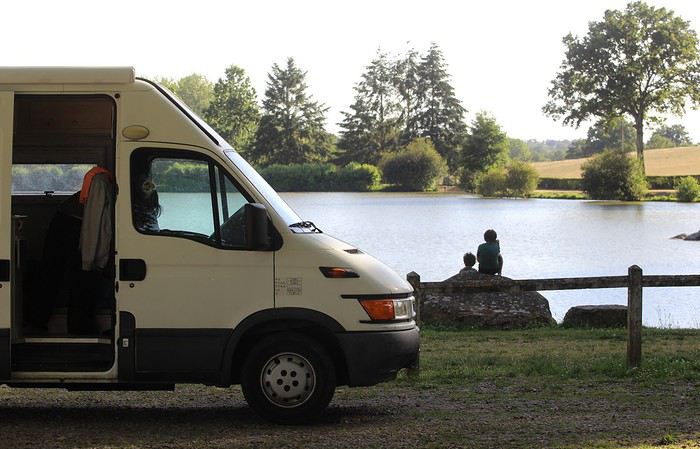
Voici mon carnet de voyage lors de cet été un peu spécial. Je limite volontairement sur vf à une ou deux photos par jour (certains trouveront que c'est encore trop...) C'est parti 🙂
Les billets étaient pris depuis novembre. Très incertain depuis ce printemps marqué par l'épidémie, ce voyage en Grèce est une bouffée d'air (chaud) après cette période de confinement et d'immobilisme. Nous reprenons donc la route en camion, vers la Grèce continentale. Routes montagneuses, sites antiques, eaux cristallines et ports de pêche, voici en quelques mots les contours d'un voyage riche en couleurs et en saveurs... Les cigales ? Elles ne s'arrêtent qu'à la nuit tombée...
18/07/2020 Jour : 478 km Total : 478 km Départ traditionnel et tardif de Vendée après une quinzaine de jours de vacances.
La cathédrale de Nantes est en feu, le périphérique est bloqué. Challans, Niort, Montluçon, nous prenons la poudre d'escampette en dehors des sentiers battus afin d'éviter le coût exorbitant des péages français. Petit parking très au calme à Rocles quelque part dans l'Allier entre La Prugnole et Blanchetière. Pour celles et ceux qui ne visualisent pas, nous sommes à une trentaine de kilomètres au sud-ouest de Moulins. Les enfants ramassent des bâtons qu'ils jettent dans le lac tandis que mes talents de bricoleur se confirment: le mitigeur nouvellement installé inonde le camion.
Balade au Cap Ferret English translation pending

En cette année si particulière où les idées de voyage au-delà de nos frontières sont difficilement envisageables … l'occasion nous est donnée de « voyager » plus près de chez nous. Avec ce récit très illustré, je vous invite à découvrir (ou à redécouvrir) un de nos plus beaux sites du Sud-Ouest : le Cap Ferret. Entre les eaux du Bassin d'Arcachon et les vagues de l'Océan Atlantique, ma balade (photographique) suivra les rivages, de plages en dunes et traversera la pinède jusqu'au phare. J'ai choisi de vous présenter ces lieux que j'apprécie tout particulièrement depuis de nombreuses années mais en essayant d'éviter l'affluence estivale … Vous l'avez donc compris, ce sera ce coin de nature privilégiée qui sera à l'honneur mais sans l'agitation et la surfréquentation de la haute saison ! Certaines des photos présentées ont été prises à la fin de ce printemps, d'autres sont plus anciennes mais toutes vous feront partager, je le souhaite, le charme fou de cette si plaisante presqu'île.
……………………………………………………… ………………………………………………………..
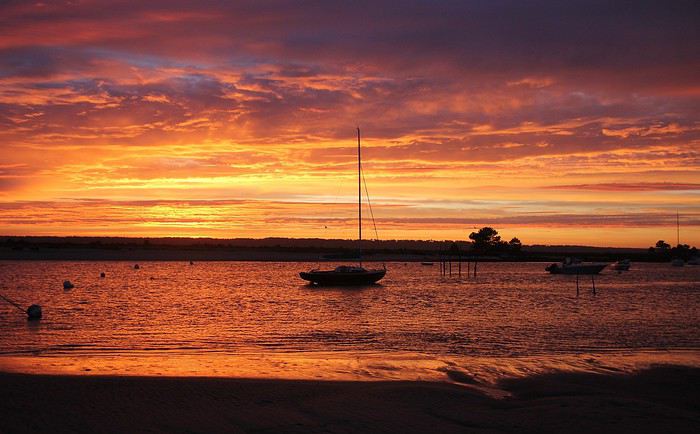
Au Cap-Ferret, un privilège des lèves-tôt consiste à assister parfois au spectacle de l'embrasement du ciel avant le lever du soleil … avec un plus, celui de contempler les nuances sur le miroir d'eau du Bassin d'Arcachon. Des lumières et des teintes dévoilées dans un superbe fondu enchaîné. De minutes en minutes, les tonalités varient passant comme ce matin-là de l'orangé au rose jusqu'à ce que le soleil inonde le paysage marin de sa lumière dorée. Splendide et éblouissant.

Je me trouve sur la plage du phare et il suffit de se retourner pour voir côté terre, le fameux phare avec sa lanterne encore allumée. Le phare du Cap Ferret qui veille sur cette extrémité de presqu'île sera un peu un fil rouge au cours de cette balade qui va vous mener du rivage côté Bassin jusqu'au littoral côté Océan. Un fil rouge … ou plutôt rouge et blanc à l'image des couleurs de sa haute colonne. Un phare qui domine toute cette extrémité de la presqu'île, on l'aperçoit de presque partout, aussi il sera présent sur plusieurs de mes photos de ce récit. En bordure de plage, les villas avec vue marine nous offrent à l'aurore un second miroir avec des reflets d'or sur leurs surfaces vitrées.
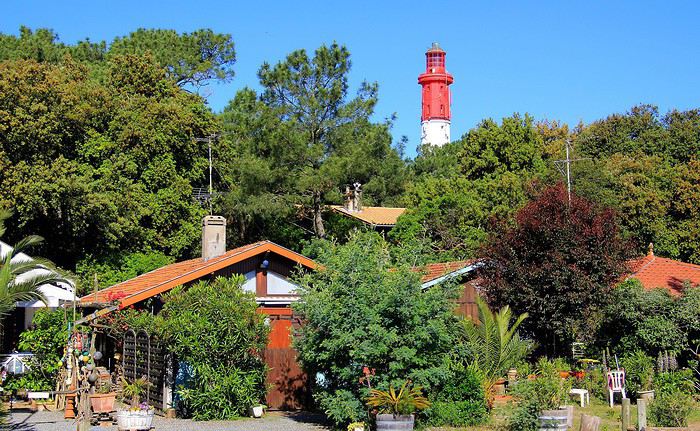
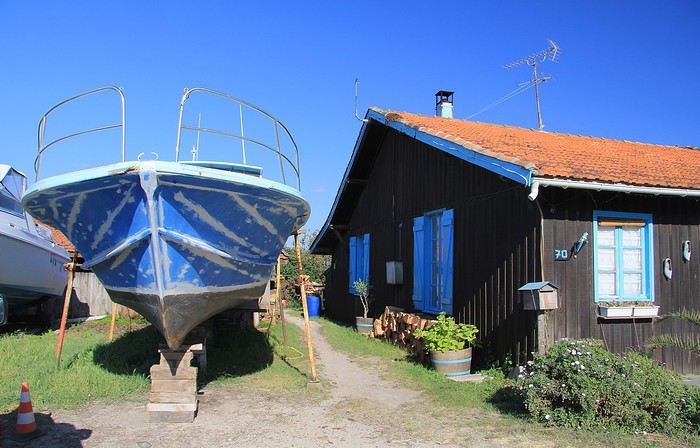
Un peu plus loin et un peu plus tard dans la matinée, nous voici à l'entrée du Quartier des pêcheurs que l'on pourrait également qualifier de quartier des ostréiculteurs. Un site classé pour le pittoresque de ses cabanes en bois. A côté de cette cabane, une pinasse, l'embarcation traditionnelle des lieux, vient de se refaire une beauté à coups de pinceaux. Elle attend sagement la prochaine mise à l'eau. Ici règne une atmosphère d'authenticité, celle des travailleurs de la mer et des parcs ostréicoles.
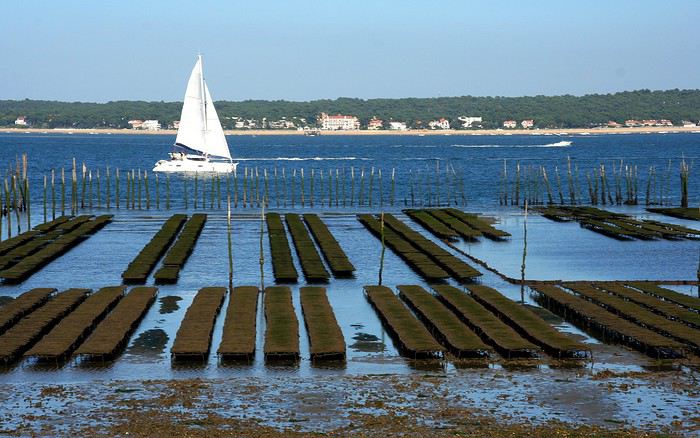

Dans ce hameau on prépare les fameuses huîtres du Bassin que l'on peut même déguster sur des terrasses aménagées avec vue imprenable sur l'étendue d'eau de la baie du Mimbeau.
C'est la dernière cabane ostréicole, tout au bout du quartier des pêcheurs, une cabane avec ici une vue dégagée sur la célèbre Dune du Pilat. J'aime bien cette atmosphère surannée donnée par cette ancienne Aronde des années 50/60. La présentation de la photo en sépia convient parfaitement en renforçant cette impression rétro … mais c'est peut-être dommage de se priver des jolies teintes jaunes des genêts en fleurs ! Bon, une précision, la photo n'a été prise qu'il y a deux ans seulement.

Faisons maintenant un bref crochet à proximité des cabanes des ostréiculteurs en passant parmi les pins. Avec ce soleil matinal et cette photo prise à contre-jour, les pins allongent leurs ombres sur le sol, un bel effet photogénique, je m'empresse de le capturer.
Un autre point de vue depuis ce bosquet. Ici, entre les pins et leurs lignes verticales s'invite la colonne toute droite du phare. Entre deux troncs elle s'immisce et tranche avec sa teinte claire par rapport à celle plus sombre de l'écorce des troncs de résineux.
Grosse grosse grosse frustration... English translation pending
Bon Ok... Je n'aurai peut être aucun écho dans ce poste dépressif. Mais je me dis que je ne suis peut être pas la seule et ça me fera au moins du bien d'en parler.... voir de le hurler !
Je tente de garder chaque jour le sourire et pourtant... Je dis à tout le monde que je garde la pèche et pourtant...
Je fais partie de ces globe-trotters qui ont mis leur besoin de grands espaces de côté au profit d'une vie familiale paisible et bien rangée. Je fais partie de ces gens qui malgré une hyperactivité notoire, sont capables de s'adapter à 3 hommes casaniers pour qui le voyage rime avec inconfort et danger. Et comme souvent, je fais partie de ceux qui, à la quarantaine et les enfants suffisamment grands pour affronter le monde extérieur, décident de tout plaquer pour enfin partager ça en famille.
Enfin, en octobre 2019, j'ai passé le pas et tout plaqué comme ce burn-out qui pointait le bout de son nez et mes 3 hommes ont accepté l'aventure, histoire de ne pas faire partie de ce qui passait à la trappe. Comble du bonheur d'autant qu'il ne reste plus que deux ans avant que mes enfants passent le bac, après ils partiront. Nous programmons donc un voyage d'un an à partir de Juillet 2020. Tout est sur des roulettes, il n'y a plus qu'à.
On tombe d'accord, nous parcourrons l’Europe à Vélo : France - Turquie par le nord à l'allée et retour par le sud. Nous avons à peine le temps de poser nos démissions, de gérer les écoles et d'afficher nos premières punaises sur la vieille carte du salon que la nouvelle tombe... Covid - Confinement... Je fais un blocage. Tout disparait dans ma tête. Je me plonge dans mon travail pour oublier, les jours avancent et je garde le front haut, le nez pointé au nord. Mais à chaque allocutions ministérielles, mon entourage y va de sa pitié ou de son conseil... Et personne dans mon entourage ne sait ce que c'est d'être suspendu.... Tout mon élan de vie s'est stoppé net. Je me sens comme dans une quatrième dimension où mon corps, mon coeur, mon cerveau sont à l'arrêt. Sans savoir au jour le jour de quoi sera fait le lendemain. Toute analyse protectionnelle sous forme d'oracle me donne la nausée....
Et des jours comme aujourd'hui, des jours ensoleillés de week end prolongé... Je me souviens que j'avais programmé que nous testerions notre matériel au complet sur une randonnée de 3 jours... Je me rends compte que mes garçons ont encore l'adolescence silencieuse, celle qui n'a pas encore découvert le besoin de s'éloigner inexorablement de ses parents et de crier à la liberté. Je sais que nous avons la chance d'avoir 1 an d'arrêt professionnel programmé que nous n'arriverons pas financièrement à renouveler....
Et je ne peux pas m’empêcher d'avoir le moral dans les chaussettes. Évidemment, ce n'est pas la fin du monde. Évidemment, mon entourage est en bonne santé et je ne peux que m'en réjouir. Évidemment, on pourra toujours s'adapter et peut être même découvrir d'autres choses... Évidemment....
Mais j'avais l'occasion de vivre cette folle aventure d'un an non stop avec mes proches.... Et tout s'effrite, reste flou. Je perds déjà la simple excitation de la préparation du voyage. Ma vie bascule dans moins de 2 mois, mais c'est dans un inconnu assez peu reluisant. On pourra peut être sortir, mais on n'est pas sûr. On pourra peut être aller au delà de 100 km, mais c'est pas sûr. Nous ne savons pas quand les frontières ouvriront... Mais nous ne savons pas si nous serons de toutes façons les bienvenus. Et pour combien de temps ? Quand reviendra la seconde vague et devront nous à nouveau nous confiner ?...
Bref, je dois faire le deuil de ce projet si beau, si chaud que je m'étais rêvé depuis près de 15 ans et voir partir en fumée la meilleure occasion de faire cela en famille....
Je sais qu'il y a plus grave, je sais que ce n'est pas essentiel... Mais je suis si triste et tellement frustrée....
Y a-t-il d'autres personnes traversant ce "deuil" ?
Je tente de garder chaque jour le sourire et pourtant... Je dis à tout le monde que je garde la pèche et pourtant...
Je fais partie de ces globe-trotters qui ont mis leur besoin de grands espaces de côté au profit d'une vie familiale paisible et bien rangée. Je fais partie de ces gens qui malgré une hyperactivité notoire, sont capables de s'adapter à 3 hommes casaniers pour qui le voyage rime avec inconfort et danger. Et comme souvent, je fais partie de ceux qui, à la quarantaine et les enfants suffisamment grands pour affronter le monde extérieur, décident de tout plaquer pour enfin partager ça en famille.
Enfin, en octobre 2019, j'ai passé le pas et tout plaqué comme ce burn-out qui pointait le bout de son nez et mes 3 hommes ont accepté l'aventure, histoire de ne pas faire partie de ce qui passait à la trappe. Comble du bonheur d'autant qu'il ne reste plus que deux ans avant que mes enfants passent le bac, après ils partiront. Nous programmons donc un voyage d'un an à partir de Juillet 2020. Tout est sur des roulettes, il n'y a plus qu'à.
On tombe d'accord, nous parcourrons l’Europe à Vélo : France - Turquie par le nord à l'allée et retour par le sud. Nous avons à peine le temps de poser nos démissions, de gérer les écoles et d'afficher nos premières punaises sur la vieille carte du salon que la nouvelle tombe... Covid - Confinement... Je fais un blocage. Tout disparait dans ma tête. Je me plonge dans mon travail pour oublier, les jours avancent et je garde le front haut, le nez pointé au nord. Mais à chaque allocutions ministérielles, mon entourage y va de sa pitié ou de son conseil... Et personne dans mon entourage ne sait ce que c'est d'être suspendu.... Tout mon élan de vie s'est stoppé net. Je me sens comme dans une quatrième dimension où mon corps, mon coeur, mon cerveau sont à l'arrêt. Sans savoir au jour le jour de quoi sera fait le lendemain. Toute analyse protectionnelle sous forme d'oracle me donne la nausée....
Et des jours comme aujourd'hui, des jours ensoleillés de week end prolongé... Je me souviens que j'avais programmé que nous testerions notre matériel au complet sur une randonnée de 3 jours... Je me rends compte que mes garçons ont encore l'adolescence silencieuse, celle qui n'a pas encore découvert le besoin de s'éloigner inexorablement de ses parents et de crier à la liberté. Je sais que nous avons la chance d'avoir 1 an d'arrêt professionnel programmé que nous n'arriverons pas financièrement à renouveler....
Et je ne peux pas m’empêcher d'avoir le moral dans les chaussettes. Évidemment, ce n'est pas la fin du monde. Évidemment, mon entourage est en bonne santé et je ne peux que m'en réjouir. Évidemment, on pourra toujours s'adapter et peut être même découvrir d'autres choses... Évidemment....
Mais j'avais l'occasion de vivre cette folle aventure d'un an non stop avec mes proches.... Et tout s'effrite, reste flou. Je perds déjà la simple excitation de la préparation du voyage. Ma vie bascule dans moins de 2 mois, mais c'est dans un inconnu assez peu reluisant. On pourra peut être sortir, mais on n'est pas sûr. On pourra peut être aller au delà de 100 km, mais c'est pas sûr. Nous ne savons pas quand les frontières ouvriront... Mais nous ne savons pas si nous serons de toutes façons les bienvenus. Et pour combien de temps ? Quand reviendra la seconde vague et devront nous à nouveau nous confiner ?...
Bref, je dois faire le deuil de ce projet si beau, si chaud que je m'étais rêvé depuis près de 15 ans et voir partir en fumée la meilleure occasion de faire cela en famille....
Je sais qu'il y a plus grave, je sais que ce n'est pas essentiel... Mais je suis si triste et tellement frustrée....
Y a-t-il d'autres personnes traversant ce "deuil" ?
Que faire en trois jours et demi à Malte en février English translation pending
Bonjour
Nous partons pour 3 jours et demi semaine prochaine
jour 1 la valette
jour 2 gozo
jour 3 mdena/rabat
jour 4 1/2 journée 3 cites
Je me questionne sur gozo : raisonnable ou pas? ET que faire là bas en février.
J’attends vos suggestions. Merci Beaucoup Pascal
jour 1 la valette
jour 2 gozo
jour 3 mdena/rabat
jour 4 1/2 journée 3 cites
Je me questionne sur gozo : raisonnable ou pas? ET que faire là bas en février.
J’attends vos suggestions. Merci Beaucoup Pascal
Île Kiji en hiver au départ de Petrozavodsk (Russie) English translation pending
Bonjour,
Je pars fin février en Russie. Arrivée à Saint Pétersbourg et ensuite train jusqu'à Mourmansk. En route j'aimerais m'arrêter à Kiji. Je pense qu'il est possible d'y aller en hiver à partir de Petrozavodsk. Pour y aller : voiture, motoneige ou hydroglisseur ? Est-il possible de partir aussi d'un autre endroit ? J'ai vu qu'il y a un hydroglisseur à partir de Tipinitsy.
Je suis intéressée par toute information à ce sujet. Tous mes remerciements.
Nuit à Fort St. James en Colombie-Britannique English translation pending
Bonjour
J'ai vu que l'on pouvait réserver une nuit à Fort Saint James mais aucun des liens que je trouve ne marche. Auriez vous des adresses valides à me fournir ? Merci d'avance
Météo à M'bour en juin et juillet English translation pending
Bonjour,
Je souhaiterai avoir votre avis sur la météo à M'bour au mois de juillet s'il vous plaît? Trouvez-vous que le temps est meilleur ou moins bon d'année en année? Je souhaiterai faire un séjour à la pouponnière là-bas de mi juin à fin juillet mais pour un premier séjour au sénégal, je me demande si partir à cette période est quand même agréable et vaut le coup? Sinon je partirai en avril si le climat est incommodant en juillet mais je voudrais votre avis s'ils vous plait,
En vous remerciant par avance,
Je souhaiterai avoir votre avis sur la météo à M'bour au mois de juillet s'il vous plaît? Trouvez-vous que le temps est meilleur ou moins bon d'année en année? Je souhaiterai faire un séjour à la pouponnière là-bas de mi juin à fin juillet mais pour un premier séjour au sénégal, je me demande si partir à cette période est quand même agréable et vaut le coup? Sinon je partirai en avril si le climat est incommodant en juillet mais je voudrais votre avis s'ils vous plait,
En vous remerciant par avance,
Contrôle de douane à l'entrée en Islande: nourriture et alcool English translation pending
Bonjour à tous,
Nous partons en Islande à 3 et embarquons un peu d'alcool/alimentation de base. Nous nous posons une question au sujet des quotas douaniers : si nous indiquons que nous voyageons ensemble, le contrôle se fait individuellement ou sur le groupe ? (en gros, si j'ai 6 kgs de nourriture et mes 2 amis n'en ont pas, ça passe ou alors il faut répartir pour que chacun aie moins de 3 kg ?)
Merci d'avance,
Vincent
Nous partons en Islande à 3 et embarquons un peu d'alcool/alimentation de base. Nous nous posons une question au sujet des quotas douaniers : si nous indiquons que nous voyageons ensemble, le contrôle se fait individuellement ou sur le groupe ? (en gros, si j'ai 6 kgs de nourriture et mes 2 amis n'en ont pas, ça passe ou alors il faut répartir pour que chacun aie moins de 3 kg ?)
Merci d'avance,
Vincent