Results for "Ban+Krut+et+hébergement+|+8+>+193"
4072 results found.
Cambodge - Angkor - Ratanakiri English translation pending
Bonjour,
Allant au Cambodge vers mi octobre, j'aurais voulu avoir qqes renseignements :
qqun connait il une adresse sympa à Siem Reap, et y a t il besoin de réserver ?
j'envisage d'aller au Ratanakiri (depuis phnom penh) par voie maritime et terrestre et de revenir par voie aérienne. Est il préférable de réserver un billet longtemps avant ?
Je suis preneur de toute info (ballade à faire, site à ne pas manquer, ...) sur le Ratanakiri...
D'avance merci
Allant au Cambodge vers mi octobre, j'aurais voulu avoir qqes renseignements :
qqun connait il une adresse sympa à Siem Reap, et y a t il besoin de réserver ?
j'envisage d'aller au Ratanakiri (depuis phnom penh) par voie maritime et terrestre et de revenir par voie aérienne. Est il préférable de réserver un billet longtemps avant ?
Je suis preneur de toute info (ballade à faire, site à ne pas manquer, ...) sur le Ratanakiri...
D'avance merci
Bons plans à Koh Lanta (Thaïlande) English translation pending
Nous projetons d'aller une dizaine de jours à Koh Lanta en février prochain (on restera d'abord 3 jours à Bangkok et plus je crois qu'on prendra l'avion pour Krabi). Avez-vous des bons plans et des conseils à nous donner, y a-t-il des chouettes trucs à voir ou à faire, des adresses de bons restos, ... ? (nous, ce qu'on aime, c'est faire du snorkeling) Curieusement, les guides ne donnent pas tellement d'infos sur Koh Lanta. Alors, si vous pouviez m'aider ... D'avance, merci à tous 😉 Sabaïdee.
Traversée Mauritanie vers le Sénégal English translation pending
J'enquête pour le compte de Nathalie et son fiston Thomas (7ans aujourd'hui), qui, au départ de Marseille, partent 9 mois à Dakar en fin octobre .
Ils voulaient au départ y aller en voiture, mais apparemment 2 choses les freinent : le prix de la traversée voiture au départ de Marseille et du dédouanement, La traversée de la Mauritanie, car parait il qu'il n'y a "qu'une route sableuse, praticable uniquement lorsque le marée est basse"....😕
Qui peut éclairer notre lanterne ?
D'avance, merci de nous donner vos infos, toutes bonnes à prendre, et pourquoi pas un co voiturage s'il se présentait ? (Ils sont trés sympas tous les deux)
ion ion
Ils voulaient au départ y aller en voiture, mais apparemment 2 choses les freinent : le prix de la traversée voiture au départ de Marseille et du dédouanement, La traversée de la Mauritanie, car parait il qu'il n'y a "qu'une route sableuse, praticable uniquement lorsque le marée est basse"....😕
Qui peut éclairer notre lanterne ?
D'avance, merci de nous donner vos infos, toutes bonnes à prendre, et pourquoi pas un co voiturage s'il se présentait ? (Ils sont trés sympas tous les deux)
ion ion
Itinéraire et transports sur l'Isan (Thaïlande) English translation pending
Bonjour à tous. Nous venons juste de rentrer de Thailande et on pense déjà aux prochaines vacances . En effet, en juillet prochain, on aimerait aller quelques jours (4 ou 5) dans l'ISAN (avant d'aller au sud, vers Koh Samui), mais on trouve très peu d'infos dans les guides. Pouvez-vous nous aider? Itinéraire, moyens de transport (au départ de Bangkok), hotels, choses à voir ou à faire (ou à ne pas faire) ... D'avance, merci à vous.
Padaung, les femmes au long cou (Thaïlande) English translation pending
Bonjour
Ceux qui voyagent en Thaïlande ont certainement entendu parler ou vu les fameuses "femmes-girafes", membres de l'ethnie Padaung de Birmanie. Elles sont devenues l'une des "carte postale" classique de la Thaïlande. Les tours-operators organisent depuis une quinzaine d'année des visites dans les camps de réfugiés de la région de Mae Hong Song. Ci-joint, un article sur l'envers du décor.
Pour information, il existe (en 2002) un village à Inle, en Birmanie où une vingtaine de ces femmes sont parquées par la junte militaire et des opérateurs locaux véreux pour le plus grand bonheur des touristes.
Survivants sans statut dans l'exil thaïlandais Source: Le Monde diplomatique, juin 1994
La visite du village de Huang-Haen, dans l'extrême nord-ouest de la Thaïlande, est au programme de la plupart des agences touristiques du pays.
Il s'agit, ni plus ni moins, d'un zoo humain. On peut y voir vingt et une femmes, appelées " femmes-girafes ". Leur cou est allongé, cerné d'une spirale de cuivre plus haute chaque année, comme le veut une coutume ancestrale. Flairant la bonne affaire, M. Su Pot, un entrepreneur thaïlandais, a parqué ces femmes dans un village de bambou reconstitué. Il a installé une guérite à l'entrée, où un guide accueille les visiteurs. Le prix d'entrée est de 100 francs. A qui s'étonne, il répond : " Nous reversons 1 000 baths (1 bath = 0, 25 franc) à chacune des femmes, et nous veillons à leur santé. " Une centaine de touristes visitent quotidiennement ce zoo humain, ce qui représente un chiffre d'affaires de 300 000 F par mois. Même en déduisant les 5 250 F " généreusement " reversés aux "femmes-girafes ", Huang-Haen reste une affaire rentable. Les femmes peuvent circuler dans le village. Elles portent leur prison sur elles, une prison de cuivre qui leur enserre la gorge. Comment pourraient-elles s'enfuir ?
En ville, elles seraient immédiatement repérées et ramenées au camp. Et qu'y feraient-elles ? Elles n'ont connu que la forêt. Eloignées de leurs époux, elles ne pourraient y survivre seules. Originaires de Birmanie, elles ont grandi dans la forêt jusqu'à ce qu'en 1988 la guerre civile les chasse de leur territoire.
" Si tu parles trop... "
Par milliers, les Birmans ont fui la répression du régime de Rangoun. Ce dernier n'a jamais pardonné l'appui apporté aux séparatistes et autres aspirants à la démocratie qui ont menacé le régime en 1988. Viols, tortures, exécutions sommaires, villages incendiés, rien n'a été épargné aux populations soupçonnées d'avoir prêté main-forte aux rebelles et aux opposants. Les exilés n'ont aucun statut.
Officiellement, ils ne sont rien. Ni Birmans, ni Thaïlandais, ni réfugiés politiques, ils s'appellent eux-mêmes des " personnes déplacées ". Démunis de papiers, sans recours, ils sont la proie de toutes les tracasseries. Les " femmes-girafes " faisaient partie de ce flot. Pour les milliers d'autres qui n'ont pas de long cou, la réalité est tout aussi dramatique. Certains ont choisi de tenter leur chance en ville. Ainsi, cette serveuse, âgée de dix-neuf ans, dans un restaurant huppé de Mae-Hong-Son. Pour 800 baths mensuels (" C'est un salaire correct pour une Birmane ", précise-t-elle), elle travaille au minimum dix heures par jour. Parfois dix-neuf. Elle dort dans la cuisine sur une natte. " Au début, j'étais employée sur un chantier de construction routière, à manier des pelletées de goudron. Je n'ai jamais été payée. J'avais droit à deux soupes par jour. C'était trop dur, j'ai craqué ", dit-elle. Les revendications sociales sont systématiquement rejetées. " Si tu parles trop, je te dénonce ", s'entend répondre le plaignant. Etre dénoncé, pour un Birman, c'est être emmené au poste de police pour défaut de papiers. Le séjour peut se prolonger longtemps, derrière les barreaux, dans l'indifférence générale.
Than Htay, un étudiant qui a fui la Birmanie au lendemain de la répression de 1988, raconte : " En 1991, j'ai été arrêté pour défaut de présentation de papiers d'immigration. J'ai passé treize jours au poste de police principal de Mae-Hong-Son. Dans le même temps, six Birmanes ont été arrêtées en compagnie de leurs époux. A 1 heure du matin, une nuit, la lumière s'est éteinte. J'ai entendu des policiers s'approcher. Ils ont pénétré dans la cellule d'à côté, et ont menacé les femmes de leurs armes. Puis ils les ont violées. Je ne pouvais rien faire. J'ai envoyé ce témoignage à Amnesty International. Un officier de la Thaï Intelligence Agency a été contacté. Il m'a clairement fait comprendre que, pour faire avancer l'enquête, il fallait organiser une confrontation et que, dans ce cas, je n'avais aucune chance. C'était la parole des policiers contre la mienne, avec toutes les représailles que je risquais. J'ai abandonné, mais je n'oublierai jamais cette nuit. " Tous les six mois, il part avec un commando d'étudiants, pénétrant loin à l'intérieur de son pays pour y tendre des embuscades, pour harceler le régime, tenter de provoquer un soulèvement général. Il ajoute : " En Birmanie, la situation est dramatique, plus dure encore pour nous qu'ici en Thaïlande. Les travailleurs sont réquisitionnés sous le contrôle de l'armée. Beaucoup meurent, car la tâche est trop dure. Par exemple, les Birmans construisent une voie ferrée entre Aung-Ban et Loikaw. Tous les hommes valides qui habitent à proximité doivent abandonner leurs cultures et travailler gratuitement à l'édification de la ligne. Pendant ce temps, les récoltes de paddy pourrissent sur pied. Ou encore, l'armée débarque un beau jour dans un village et dévalise les greniers, ou ordonne qu'on lui fournisse des porteurs qui devront marcher avec des charges d'un poids inhumain sur le dos, en tête des troupes anti-guérilla, pour faire exploser les mines. Et si vous refusez, c'est l'exécution immédiate, pour l'exemple. " Fuyant l'horreur, beaucoup n'ont trouvé au bout de leur route qu'un autre drame, ainsi ces nombreuses prostituées séquestrées dans les bordels de Bangkok ou d'ailleurs, sans espoir d'en sortir. Tous les réfugiés n'ont pas choisi de vivre en ville. Beaucoup s'entassent dans des camps, au milieu de la forêt tropicale. Sur des terrains prêtés par la Thaïlande, ils ont bâti des constructions rustiques mais solides. Des organisations non gouvernementales (ONG) ont ensuite apporté leur concours. L'une d'elles, la Commission internationale pour les droits des ethnies minoritaires et des peuples aborigènes, leur a fourni les protéines dont ils manquaient cruellement.
Sous la houlette de M. Jean-Philippe Vandroux, un jeune Français installé à Mae-Hong-Son, des élevages de poules, de canards, de poissons, de grenouilles, de porcs et de dindes commencent à se multiplier dans les camps. Une organisation américaine a permis l'adduction d'eau. Tous ces progrès sont menacés par le bon vouloir des Thaïlandais, qui peuvent à tout moment ordonner le déplacement des camps afin d'interdire aux Birmans de s'implanter durablement. Les Thaïlandais sont déchirés entre deux attitudes: d'un côté, il leur faut ménager leurs bons rapports avec Rangoun ; de l'autre, venir en aide aux réfugiés pour ne pas s'exposer aux foudres des enquêteurs internationaux. D'où cette solution intermédiaire : les réfugiés sont aidés mais modérément. Sombre tableau sanitaire La situation sanitaire est mauvaise. Le docteur Richard est médecin-chef birman du camp de Mae-Sarin qui accueille plus d'un millier de réfugiés. Formé par des volontaires de Médecins sans frontières pendant quatre années, il se déclare prêt à soigner la plupart des patients. Il dresse néanmoins un sombre tableau de la situation : " La malaria fait des ravages, suivie de près par la dysentrie et les diarrhées. Pour la malaria cérébrale, on m'apporte en général les malades quand il est trop tard. Nous manquons de quinine, n'avons pas de produits antimoustiques autres que le DDT, dont nous aspergeons régulièrement chaque maison. Mais c'est insuffisant. Les moustiquaires sont en mauvais état, nous n'avons pas de produit pour protéger nos enfants. Le camp est mal placé, très humide, peu aéré, car encerclé de montagnes. Il fait trop chaud en été, trop froid en hiver. Nous faisons des campagnes d'information, pour que les gens fassent bouillir l'eau, mais quand le bois est mouillé, les gens oublient ces recommandations. " Le général Aung Than a été élu en 1992 premier ministre de la nation karenni, ethnie en lutte depuis 1948 contre le régime de Rangoun, qui a toujours refusé l'indépendance à son peuple. Il vit dans le camp forestier de Mae-Sarin. A première vue, rien ne le distingue de ses compatriotes réfugiés, si ce n'est le talkie-walkie qu'il porte en permanence, pour se tenir informé de la situation " à l'intérieur ". " Nous ne contrôlons plus qu'une mince bande de notre territoire. L'armée birmane a quasiment gagné sa guerre contre nous. Sans appui international, nous sommes oubliés du monde ", commente-t-il avec rancoeur. Il ajoute : " Nous ne pouvons rien faire. Nous sommes les invités de la Thaïlande. Nous ne pouvons que l'en remercier, car sans elle nous serions tous morts. Mais la contrepartie, c'est que nous ne pouvons rien lui refuser. S'il y a des abus, nous ne pouvons que les accepter. Car si on nous chasse, nous n'avons nulle part où aller. "
Philippe Tarnier, journaliste
Ceux qui voyagent en Thaïlande ont certainement entendu parler ou vu les fameuses "femmes-girafes", membres de l'ethnie Padaung de Birmanie. Elles sont devenues l'une des "carte postale" classique de la Thaïlande. Les tours-operators organisent depuis une quinzaine d'année des visites dans les camps de réfugiés de la région de Mae Hong Song. Ci-joint, un article sur l'envers du décor.
Pour information, il existe (en 2002) un village à Inle, en Birmanie où une vingtaine de ces femmes sont parquées par la junte militaire et des opérateurs locaux véreux pour le plus grand bonheur des touristes.
Survivants sans statut dans l'exil thaïlandais Source: Le Monde diplomatique, juin 1994
La visite du village de Huang-Haen, dans l'extrême nord-ouest de la Thaïlande, est au programme de la plupart des agences touristiques du pays.
Il s'agit, ni plus ni moins, d'un zoo humain. On peut y voir vingt et une femmes, appelées " femmes-girafes ". Leur cou est allongé, cerné d'une spirale de cuivre plus haute chaque année, comme le veut une coutume ancestrale. Flairant la bonne affaire, M. Su Pot, un entrepreneur thaïlandais, a parqué ces femmes dans un village de bambou reconstitué. Il a installé une guérite à l'entrée, où un guide accueille les visiteurs. Le prix d'entrée est de 100 francs. A qui s'étonne, il répond : " Nous reversons 1 000 baths (1 bath = 0, 25 franc) à chacune des femmes, et nous veillons à leur santé. " Une centaine de touristes visitent quotidiennement ce zoo humain, ce qui représente un chiffre d'affaires de 300 000 F par mois. Même en déduisant les 5 250 F " généreusement " reversés aux "femmes-girafes ", Huang-Haen reste une affaire rentable. Les femmes peuvent circuler dans le village. Elles portent leur prison sur elles, une prison de cuivre qui leur enserre la gorge. Comment pourraient-elles s'enfuir ?
En ville, elles seraient immédiatement repérées et ramenées au camp. Et qu'y feraient-elles ? Elles n'ont connu que la forêt. Eloignées de leurs époux, elles ne pourraient y survivre seules. Originaires de Birmanie, elles ont grandi dans la forêt jusqu'à ce qu'en 1988 la guerre civile les chasse de leur territoire.
" Si tu parles trop... "
Par milliers, les Birmans ont fui la répression du régime de Rangoun. Ce dernier n'a jamais pardonné l'appui apporté aux séparatistes et autres aspirants à la démocratie qui ont menacé le régime en 1988. Viols, tortures, exécutions sommaires, villages incendiés, rien n'a été épargné aux populations soupçonnées d'avoir prêté main-forte aux rebelles et aux opposants. Les exilés n'ont aucun statut.
Officiellement, ils ne sont rien. Ni Birmans, ni Thaïlandais, ni réfugiés politiques, ils s'appellent eux-mêmes des " personnes déplacées ". Démunis de papiers, sans recours, ils sont la proie de toutes les tracasseries. Les " femmes-girafes " faisaient partie de ce flot. Pour les milliers d'autres qui n'ont pas de long cou, la réalité est tout aussi dramatique. Certains ont choisi de tenter leur chance en ville. Ainsi, cette serveuse, âgée de dix-neuf ans, dans un restaurant huppé de Mae-Hong-Son. Pour 800 baths mensuels (" C'est un salaire correct pour une Birmane ", précise-t-elle), elle travaille au minimum dix heures par jour. Parfois dix-neuf. Elle dort dans la cuisine sur une natte. " Au début, j'étais employée sur un chantier de construction routière, à manier des pelletées de goudron. Je n'ai jamais été payée. J'avais droit à deux soupes par jour. C'était trop dur, j'ai craqué ", dit-elle. Les revendications sociales sont systématiquement rejetées. " Si tu parles trop, je te dénonce ", s'entend répondre le plaignant. Etre dénoncé, pour un Birman, c'est être emmené au poste de police pour défaut de papiers. Le séjour peut se prolonger longtemps, derrière les barreaux, dans l'indifférence générale.
Than Htay, un étudiant qui a fui la Birmanie au lendemain de la répression de 1988, raconte : " En 1991, j'ai été arrêté pour défaut de présentation de papiers d'immigration. J'ai passé treize jours au poste de police principal de Mae-Hong-Son. Dans le même temps, six Birmanes ont été arrêtées en compagnie de leurs époux. A 1 heure du matin, une nuit, la lumière s'est éteinte. J'ai entendu des policiers s'approcher. Ils ont pénétré dans la cellule d'à côté, et ont menacé les femmes de leurs armes. Puis ils les ont violées. Je ne pouvais rien faire. J'ai envoyé ce témoignage à Amnesty International. Un officier de la Thaï Intelligence Agency a été contacté. Il m'a clairement fait comprendre que, pour faire avancer l'enquête, il fallait organiser une confrontation et que, dans ce cas, je n'avais aucune chance. C'était la parole des policiers contre la mienne, avec toutes les représailles que je risquais. J'ai abandonné, mais je n'oublierai jamais cette nuit. " Tous les six mois, il part avec un commando d'étudiants, pénétrant loin à l'intérieur de son pays pour y tendre des embuscades, pour harceler le régime, tenter de provoquer un soulèvement général. Il ajoute : " En Birmanie, la situation est dramatique, plus dure encore pour nous qu'ici en Thaïlande. Les travailleurs sont réquisitionnés sous le contrôle de l'armée. Beaucoup meurent, car la tâche est trop dure. Par exemple, les Birmans construisent une voie ferrée entre Aung-Ban et Loikaw. Tous les hommes valides qui habitent à proximité doivent abandonner leurs cultures et travailler gratuitement à l'édification de la ligne. Pendant ce temps, les récoltes de paddy pourrissent sur pied. Ou encore, l'armée débarque un beau jour dans un village et dévalise les greniers, ou ordonne qu'on lui fournisse des porteurs qui devront marcher avec des charges d'un poids inhumain sur le dos, en tête des troupes anti-guérilla, pour faire exploser les mines. Et si vous refusez, c'est l'exécution immédiate, pour l'exemple. " Fuyant l'horreur, beaucoup n'ont trouvé au bout de leur route qu'un autre drame, ainsi ces nombreuses prostituées séquestrées dans les bordels de Bangkok ou d'ailleurs, sans espoir d'en sortir. Tous les réfugiés n'ont pas choisi de vivre en ville. Beaucoup s'entassent dans des camps, au milieu de la forêt tropicale. Sur des terrains prêtés par la Thaïlande, ils ont bâti des constructions rustiques mais solides. Des organisations non gouvernementales (ONG) ont ensuite apporté leur concours. L'une d'elles, la Commission internationale pour les droits des ethnies minoritaires et des peuples aborigènes, leur a fourni les protéines dont ils manquaient cruellement.
Sous la houlette de M. Jean-Philippe Vandroux, un jeune Français installé à Mae-Hong-Son, des élevages de poules, de canards, de poissons, de grenouilles, de porcs et de dindes commencent à se multiplier dans les camps. Une organisation américaine a permis l'adduction d'eau. Tous ces progrès sont menacés par le bon vouloir des Thaïlandais, qui peuvent à tout moment ordonner le déplacement des camps afin d'interdire aux Birmans de s'implanter durablement. Les Thaïlandais sont déchirés entre deux attitudes: d'un côté, il leur faut ménager leurs bons rapports avec Rangoun ; de l'autre, venir en aide aux réfugiés pour ne pas s'exposer aux foudres des enquêteurs internationaux. D'où cette solution intermédiaire : les réfugiés sont aidés mais modérément. Sombre tableau sanitaire La situation sanitaire est mauvaise. Le docteur Richard est médecin-chef birman du camp de Mae-Sarin qui accueille plus d'un millier de réfugiés. Formé par des volontaires de Médecins sans frontières pendant quatre années, il se déclare prêt à soigner la plupart des patients. Il dresse néanmoins un sombre tableau de la situation : " La malaria fait des ravages, suivie de près par la dysentrie et les diarrhées. Pour la malaria cérébrale, on m'apporte en général les malades quand il est trop tard. Nous manquons de quinine, n'avons pas de produits antimoustiques autres que le DDT, dont nous aspergeons régulièrement chaque maison. Mais c'est insuffisant. Les moustiquaires sont en mauvais état, nous n'avons pas de produit pour protéger nos enfants. Le camp est mal placé, très humide, peu aéré, car encerclé de montagnes. Il fait trop chaud en été, trop froid en hiver. Nous faisons des campagnes d'information, pour que les gens fassent bouillir l'eau, mais quand le bois est mouillé, les gens oublient ces recommandations. " Le général Aung Than a été élu en 1992 premier ministre de la nation karenni, ethnie en lutte depuis 1948 contre le régime de Rangoun, qui a toujours refusé l'indépendance à son peuple. Il vit dans le camp forestier de Mae-Sarin. A première vue, rien ne le distingue de ses compatriotes réfugiés, si ce n'est le talkie-walkie qu'il porte en permanence, pour se tenir informé de la situation " à l'intérieur ". " Nous ne contrôlons plus qu'une mince bande de notre territoire. L'armée birmane a quasiment gagné sa guerre contre nous. Sans appui international, nous sommes oubliés du monde ", commente-t-il avec rancoeur. Il ajoute : " Nous ne pouvons rien faire. Nous sommes les invités de la Thaïlande. Nous ne pouvons que l'en remercier, car sans elle nous serions tous morts. Mais la contrepartie, c'est que nous ne pouvons rien lui refuser. S'il y a des abus, nous ne pouvons que les accepter. Car si on nous chasse, nous n'avons nulle part où aller. "
Philippe Tarnier, journaliste
Saveurs du sud Vietnam English translation pending
Voilà, à la demande je délivre ici ma première recette, une toute simple pour commencer en plus avec toutes les herbes de mon jardin :
Avec des restes de boeuf et du riz blanc.
Couper en lamelle la viande macérér avec du citron pressé et du 5 épices, hacher une gousse d'ail la faire revenir dans un wok ou une poêle avec une lichette d'huile d'olive, quelques gouttes d'huile de sésame, et une lichette de nuoc man.
Couper en lamelles des feuilles de citronnelle, des oignons blancs avec le vert et verser le tout dans le wok.
Rajouter en dernier la viande juste 5 mn avant de servir. Le boeuf ne doit rester saignant.
Vous pouvez rajouter quelques cacahuètes pilées mais là ce ne sera plus une recette minceur.
Une autre recette un peu plus continentale :
J'ouvre mon frigo, grrrr que des restes et je n'ai pas envie de ma farcir les courses .... je me creuse ... bon j'ai :*
Quelques tranches de jambon cru Un boursin au poivre De la mozarelle Un restant de gruyère râpé.
Bon, allez on va faire un festin avec tous ça !
Je ferme les yeux... 1, 2, 3 Euréka !!!
Je mets mes pommes de terre à cuire dans du cello frais au cronde (c'est plus rapide pour la cuisson bien fermer de cello frais et cuire 10 mn) ensuite dérouler et épluchez les pommes de terres.
Je les coupe en deux et les dispose dans un plat en terre (que j'ai récupéré c'était un plateau de fromage, idéal pour les cuissons pour deux)
Allez c'est parti, je prends mes ciseaux direction mon petit jardin : je coupe 2 feuilles d'oseille, 2 feuilles de sauge (ça c'est pour mes bouffées de chaleur...) un brin de thym poivre et un brin de thym citron, un petit brin de curry (la plante), un petit brin de thym normal de provence et en dernier 2 oignons blancs (ceux que j'ai piqué 1 par 1 à 4 pattes et que je ramasse avant qu'ils ne soient trop gros ça fait un peu comme des cébettes)
Je m'acharne sur ma planche en bois avé mon coupe coupe et hop ni une ni deux tout est coupé, émincé, impecc.
Dans mon wok (ou une poêle) j'émiette une gousse d'ail que je fais revenir dans une lichette d'huile d'olive, j'émince un oignon jaune normal pas trop gros et hop j'arrose de vin blanc pour éviter que ça crame !
Bon, j'hume tout ça... j'ai gardé une vieille bouteille de vin imbuvable aigre à souhait, aujourd'hui c'est un régal pour radoucir mes oignons pas besoin de sucre, mon vin vinaigré et devenu légèrement sucré et ça me donne un fumé le mélange waouhhhhhhh !!!!!
Tiens ma voisine par l'odeur alléchée colle son nez à ma fenêtre pour savoir ce que je prépare.
Bon je cuis tout ça je mélange et hop voilà impeccable mes oignons mélangés aux herbes hummm sentez !!!!
Je reprends mon plat en terre avé mes pommes de terre, je rajoute une lamelle de mozarelle pour couvrir, je poivre (mélange de poivre gris, blanc, noir, rose et vert), j'rajoute une tranchette de jambon cru et j'arrose ma préparation du wok par dessus. j'rajoute une lichette d'huile d'olive et nappe de gruyère râpé !
10mn au four chaud (220) et voilà !!!!
j'retourne dans mon ptit jardin, et j'demande à mon ptit homme de passer de son hamac à table !!!!!
Voilà une deux et hop c'est l'heure de la sieste !
Avec des restes de boeuf et du riz blanc.
Couper en lamelle la viande macérér avec du citron pressé et du 5 épices, hacher une gousse d'ail la faire revenir dans un wok ou une poêle avec une lichette d'huile d'olive, quelques gouttes d'huile de sésame, et une lichette de nuoc man.
Couper en lamelles des feuilles de citronnelle, des oignons blancs avec le vert et verser le tout dans le wok.
Rajouter en dernier la viande juste 5 mn avant de servir. Le boeuf ne doit rester saignant.
Vous pouvez rajouter quelques cacahuètes pilées mais là ce ne sera plus une recette minceur.
Une autre recette un peu plus continentale :
J'ouvre mon frigo, grrrr que des restes et je n'ai pas envie de ma farcir les courses .... je me creuse ... bon j'ai :*
Quelques tranches de jambon cru Un boursin au poivre De la mozarelle Un restant de gruyère râpé.
Bon, allez on va faire un festin avec tous ça !
Je ferme les yeux... 1, 2, 3 Euréka !!!
Je mets mes pommes de terre à cuire dans du cello frais au cronde (c'est plus rapide pour la cuisson bien fermer de cello frais et cuire 10 mn) ensuite dérouler et épluchez les pommes de terres.
Je les coupe en deux et les dispose dans un plat en terre (que j'ai récupéré c'était un plateau de fromage, idéal pour les cuissons pour deux)
Allez c'est parti, je prends mes ciseaux direction mon petit jardin : je coupe 2 feuilles d'oseille, 2 feuilles de sauge (ça c'est pour mes bouffées de chaleur...) un brin de thym poivre et un brin de thym citron, un petit brin de curry (la plante), un petit brin de thym normal de provence et en dernier 2 oignons blancs (ceux que j'ai piqué 1 par 1 à 4 pattes et que je ramasse avant qu'ils ne soient trop gros ça fait un peu comme des cébettes)
Je m'acharne sur ma planche en bois avé mon coupe coupe et hop ni une ni deux tout est coupé, émincé, impecc.
Dans mon wok (ou une poêle) j'émiette une gousse d'ail que je fais revenir dans une lichette d'huile d'olive, j'émince un oignon jaune normal pas trop gros et hop j'arrose de vin blanc pour éviter que ça crame !
Bon, j'hume tout ça... j'ai gardé une vieille bouteille de vin imbuvable aigre à souhait, aujourd'hui c'est un régal pour radoucir mes oignons pas besoin de sucre, mon vin vinaigré et devenu légèrement sucré et ça me donne un fumé le mélange waouhhhhhhh !!!!!
Tiens ma voisine par l'odeur alléchée colle son nez à ma fenêtre pour savoir ce que je prépare.
Bon je cuis tout ça je mélange et hop voilà impeccable mes oignons mélangés aux herbes hummm sentez !!!!
Je reprends mon plat en terre avé mes pommes de terre, je rajoute une lamelle de mozarelle pour couvrir, je poivre (mélange de poivre gris, blanc, noir, rose et vert), j'rajoute une tranchette de jambon cru et j'arrose ma préparation du wok par dessus. j'rajoute une lichette d'huile d'olive et nappe de gruyère râpé !
10mn au four chaud (220) et voilà !!!!
j'retourne dans mon ptit jardin, et j'demande à mon ptit homme de passer de son hamac à table !!!!!
Voilà une deux et hop c'est l'heure de la sieste !
Thaïlande: Koh Chang ou Ko Samet? English translation pending
je connais deja koh phi phi, samui et phuket.
envie de decouvrir une de ces 2 iles en juin ...
vos opinions, critiques +/- sur koh chang ou samet m interessent !
merci
envie de decouvrir une de ces 2 iles en juin ...
vos opinions, critiques +/- sur koh chang ou samet m interessent !
merci
Myanmar: visa, déplacements et visites English translation pending
Bonjour a tous,
J'ai quelques questions concernant le Myanmar qui vont peut etre vous paraitres betes et stupides, mais je n'ai pas encore reussi a me procurer le guide de ce pays, alors en attendant je fouille le forum.
1.Il parait qu'on peut y rester pour une duree de max 28 jours, est-ce toujours d'actualite ou pas?
2.Parait aussi qu'on ne peut y entrer que par avion, billet aller-retour, ou serait-ce possible de prendre un vol Bangkok Rangoon et en suite de sortir en Inde soit par voie terrestre ou aerienne si par la terre n'est pas possible?
3.Peut-on se deplacer ou on veut par les transports publiques locaux (style Thailande/Laos) ou est-ce que les touristes sont 'ballades' dans des endroits bien definis?
Voila c'est tout pour aujourd'hui, merci d'avance a ceux qui vont me repondre.
PS:Desolee pour le manque d'accents, il n'y a pas cette option la sur le clavier😉
Zarofaze
J'ai quelques questions concernant le Myanmar qui vont peut etre vous paraitres betes et stupides, mais je n'ai pas encore reussi a me procurer le guide de ce pays, alors en attendant je fouille le forum.
1.Il parait qu'on peut y rester pour une duree de max 28 jours, est-ce toujours d'actualite ou pas?
2.Parait aussi qu'on ne peut y entrer que par avion, billet aller-retour, ou serait-ce possible de prendre un vol Bangkok Rangoon et en suite de sortir en Inde soit par voie terrestre ou aerienne si par la terre n'est pas possible?
3.Peut-on se deplacer ou on veut par les transports publiques locaux (style Thailande/Laos) ou est-ce que les touristes sont 'ballades' dans des endroits bien definis?
Voila c'est tout pour aujourd'hui, merci d'avance a ceux qui vont me repondre.
PS:Desolee pour le manque d'accents, il n'y a pas cette option la sur le clavier😉
Zarofaze
Visite de la Thaïlande authentique, vos conseils English translation pending
salut à tous,
je pars en thailande pour 3 semaines cet été avec mon chéri, nous avons du mal à trouver les endroits encore sauvages dans les guides.Aussi avons nous besoin de vous.L'idée de se voyage c'est de se débrouiller tous seuls avec notre sac à dos et d'avoir le plus de contacts possible avec la population.Nous cherchons surtout un trek au nord (pas à dos d'éléphant par pitié) et une île de rêve au sud .
merci à tous de votre aide, à +, stéph
Infos pour un mois au Cambodge English translation pending
SALUT A TOUS DURANT LE MOIS DE JUILLET JE PARS 1 MOIS AU CAMBODGE QUI A DES INFO CONCERNANT LE PAYS HEBERGEMENT NOURRITURE TRANSPORT CLIMAT ETC VOILA MERCI POUR VOS REPONSES
CIAO
CIAO
Honte à l'Assemblée nationale..... English translation pending
Oui, honte aux élus du Palais Bourbon qui vont accueillir ce jour le président chinois Hu Jintao, et rappelons que celui ci était gouverneur du Tibet durant les années de grande répression en 1988/89, qui lui valu le surnom de " boucher de Lhassa "......
Cette même année 2004, le 7 Avril devrait être éxécuté le moine Rintoche pour " séparatisme et terrorisme "......
J'ai vraiment envie de vomir........
Cette même année 2004, le 7 Avril devrait être éxécuté le moine Rintoche pour " séparatisme et terrorisme "......
J'ai vraiment envie de vomir........
Porc au caramel English translation pending
Porc au caramel (Vietnam)
Ce plat, très commun au Vietnam, peut se servir avec du riz gluant ou du riz parfumé.
Ingrédients pour 4 pers. Temps de cuisson : 30 mn à 1 heure
500 g de maigre de poitrine de porc (ou d'échine) 1 cuil. à soupe de maïzena 1 gros oignon 3 cuil. à soupe de sucre 3 cuil. à soupe de nuoc mâm (sauce de poisson) sel, poivre 1 cuil. à café de 5 parfums (mélange d'épices tout prêt) 1 étoile de badiane (anis étoilé) Coriandre fraîche (facultatif)
Découper la viande en dés en éliminant les parties trop grasses. Les assaisoner de sel (peu) et poivre et les mélanger avec la maïzena. Dans une cocotte en fonte (ou sauteuse), faire caraméliser 2 cuil. à soupe de sucre à feu très doux sans eau. Faire un caramel bien foncé. Ajouter le porc, l'oignon haché et le nuoc mâm et remuer jusqu'à évaporation de l'eau résiduelle du porc. Ajouter les 5 parfums et l'étoile de badiane, puis recouvrir d'eau. Ajouter la dernière cuil. à soupe de sucre et laisser mijoter à feu doux en couvrant aux 2 tiers jusqu'�� évaporation presque complète de l'eau. Surveiller l'eau pour que le plat n'attache pas, ne pas hésiter à en remettre. Servir en parsemant le plat de coriandre hachée avec du riz non salé. Proposer piment et nuoc mâm aux convives.
C'est le plat favori de mon dernier.
Ce plat, très commun au Vietnam, peut se servir avec du riz gluant ou du riz parfumé.
Ingrédients pour 4 pers. Temps de cuisson : 30 mn à 1 heure
500 g de maigre de poitrine de porc (ou d'échine) 1 cuil. à soupe de maïzena 1 gros oignon 3 cuil. à soupe de sucre 3 cuil. à soupe de nuoc mâm (sauce de poisson) sel, poivre 1 cuil. à café de 5 parfums (mélange d'épices tout prêt) 1 étoile de badiane (anis étoilé) Coriandre fraîche (facultatif)
Découper la viande en dés en éliminant les parties trop grasses. Les assaisoner de sel (peu) et poivre et les mélanger avec la maïzena. Dans une cocotte en fonte (ou sauteuse), faire caraméliser 2 cuil. à soupe de sucre à feu très doux sans eau. Faire un caramel bien foncé. Ajouter le porc, l'oignon haché et le nuoc mâm et remuer jusqu'à évaporation de l'eau résiduelle du porc. Ajouter les 5 parfums et l'étoile de badiane, puis recouvrir d'eau. Ajouter la dernière cuil. à soupe de sucre et laisser mijoter à feu doux en couvrant aux 2 tiers jusqu'�� évaporation presque complète de l'eau. Surveiller l'eau pour que le plat n'attache pas, ne pas hésiter à en remettre. Servir en parsemant le plat de coriandre hachée avec du riz non salé. Proposer piment et nuoc mâm aux convives.
C'est le plat favori de mon dernier.
Trains au Cambodge English translation pending
Je compte faire, au cambodge, la boucle Poipet, Siem Rap, Phnom Pen, Pursat, Battambang et retour en Thailande par Poipet.
Je souhaite recevoir des infos sur les moyens de transport autres que l'avion.
En particulier, existe-il un train entre Phnom Penh et Poipet ?
Merci
Je souhaite recevoir des infos sur les moyens de transport autres que l'avion.
En particulier, existe-il un train entre Phnom Penh et Poipet ?
Merci
Itinéraire en Thaïlande? English translation pending
Bonjour!
Je suis en train de plannifier mon voyage en Thailande pour l'an prochain, mais j'aurais besoin de votre avis. 🙂 J'ai l'intention d'arriver à Bangkok et de monter jusqu'à Chang Mai en train (ou autobus), mais avez-vous des suggestions de villes intéressantes que je pourrais visiter entre ces deux destinations?
De plus, j'ai l'intention de séjourner sur une île à la fin de ce périple et je suis encore embêtée à savoir laquelle que je devrais choisir. Koh Tarutao, Koh Phangan ou Koh Phi Phi.... Laquelle me suggérez-vous? Ou, si vous avez d'autres idées...
Un gros merci!
Mari
Je suis en train de plannifier mon voyage en Thailande pour l'an prochain, mais j'aurais besoin de votre avis. 🙂 J'ai l'intention d'arriver à Bangkok et de monter jusqu'à Chang Mai en train (ou autobus), mais avez-vous des suggestions de villes intéressantes que je pourrais visiter entre ces deux destinations?
De plus, j'ai l'intention de séjourner sur une île à la fin de ce périple et je suis encore embêtée à savoir laquelle que je devrais choisir. Koh Tarutao, Koh Phangan ou Koh Phi Phi.... Laquelle me suggérez-vous? Ou, si vous avez d'autres idées...
Un gros merci!
Mari
Thaïlande ou Cambodge? English translation pending
hello, 🙂, que vaut il mieux, la thailande ou le cambodge?? La thailande, ca a l air tres beau mais je n ai que 2 semaines et j ai peur de ne pas pouvoir voir assez de choses, de plus, angkor est un site que j ai vraiment envie de voir mais le cambodge est il assez sûr?😕? peut on y aller en independant ou vaut il mieux la securite de la thailande?? merci d avance...😉, olivier
Méditation au Népal English translation pending
Bonjour, je vais au Nepal du 13 sept au 11 oct...donc apres la visite de la vallée de Kathmandou et un p'tit trek, je voudrais pouvoir faire une petite retraite de 5 jours meditative dans un temple boudhiste...connaissez vous un temple ou cela est possible?merci
Thaïlande: vos impressions sur Pattaya English translation pending
sur un coup de tete je me suis inscrite par internet pour un voyage combiné à noel 3 jours à bangkok et 5 à Pattaya ( j'avais envie de revoir Bangkok et envie de soleil aussi). Maintenant en lisant des choses sur Pattaya je regrette amèrement( faune, plage polluée, tourisme sexuel etc...) et pense à tout annuler . Pouvez vous me donnez votre avis ou des éléments me permettant de décider
y a t- il des excursions possibles autour ? Merci d'avance pour les réponses.
Mado
Any quiet spots in Thailand in February?
Hi there,
I didn’t plan to return to Thailand this year, but my health conditions mean it’ll be the best place for me to stay between two trips to India. The tourism setup there is so well-organized that it’s the most "comfortable" country for a short visit. Thailand feels too sanitized for my taste, and there’s too much religion, Buddha, and the King, but it’s still the best option given how my health has been evolving. I’d considered two weeks in ThaTon for hiking, but I got too sick from the burn-offs during my trips to the mountains around Chiang Rai. So I’m not sure where to go this year. Definitely not the sea, touristy spots, or the mountains with burn-offs...
Thanks, friends, if you’ve got any suggestions.
Thanks, friends, if you’ve got any suggestions.
3 weeks in Laos, stress-free
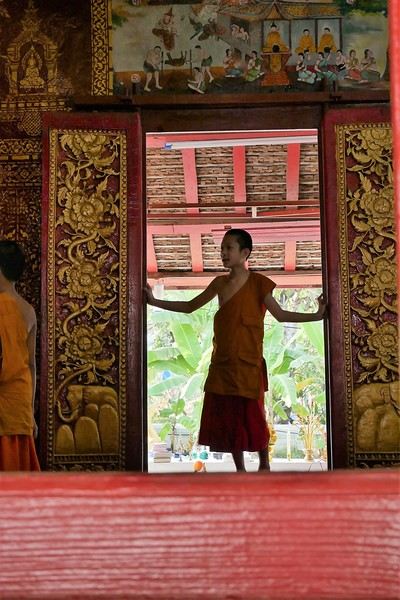 Come along, I'm taking you to this country where it's so nice to wander and slow down...
This trip was in 2023, but when I wanted to write my travel journal, VF was still closed to contributions... So, now that I've just finished my Japan travel journal here, I figured it was high time to honor this destination we came back from so enchanted. Disclaimer 1: This is a written travel journal. There’ll be text! Too much, for some! Disclaimer 2: This is an illustrated travel journal. There’ll be photos! Too many, for some!
I have to say, every time I try to discipline myself, to keep it shorter, to include fewer photos... I end up adding more. It feels like my dear Aunt Nicole, who exhausted us with her slide-show evenings in the 70s/80s, decided to take her revenge. The upside for you, readers, is that you can slip away anytime without offending Aunt Nicole. I won’t even notice!
Anyway, since I love maps, here’s one to give you an idea of where I’m taking you. As you can see, we only saw a tiny part of Laos (the areas circled in red); we only had 3 weeks for ourselves (my husband’s newly retired, I still work), and we prefer taking our time over rushing around like crazy.
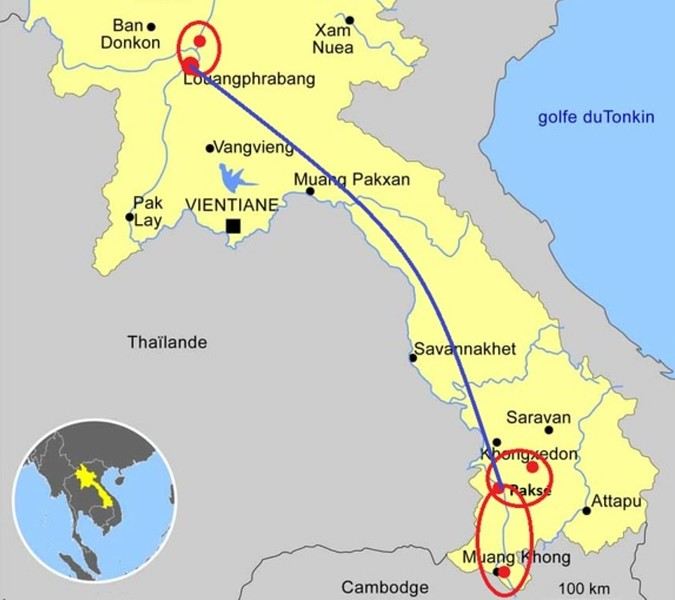
In broad strokes, it was very classic:
First, we “settled in” at Luang Prabang (8 days), because we wanted and needed to. From there, we took three days to venture a little further north—not far in kilometers, but as we know, distances aren’t just about km! Then we flew south to Paksé, letting ourselves drift down to the 4,000 Islands while stopping by the pre-Angkorian archaeological sites. We wrapped up with the Bolaven Plateau.
A few practical notes: We arrived via Bangkok, then took a Bangkok-Luang Prabang flight, having picked up our luggage in Bangkok to check it in for Luang Prabang. No issues—the Bangkok airport, which many of you know, is very well organized. We got our visas on arrival in Luang Prabang. Quick, but to be fair, we were on a “small” plane, and the big flights had arrived earlier, so we weren’t too crowded in line! At the end of our trip, we didn’t fly out of Paksé but from the nearby airport in Thailand, Ubon Ratchathani (a 2.5-hour drive from Paksé), then Bangkok and Paris. You’ll notice we skipped Vientiane to stay longer in Luang Prabang. That said, there’s now a high-speed train between Vientiane and Luang Prabang—good to know—and soon the (Chinese) train will go all the way to Bangkok and even Kuala Lumpur!
With that intro out of the way, let’s dive into the heart of the matter. To be continued: Slowing down the pace... in Luang Prabang
Getting to Ko Chang from Cambodia without going through Bangkok
Hi everyone!
I’m heading back to Thailand in July 2026 with a stopover in Cambodia to visit the Angkor site.
After Angkor, I’ve booked a stay on Ko Chang island. Does anyone know if there are direct transport options from Cambodia to Ko Chang without having to go back through Bangkok? That would be amazing!!
I think there are, but I’d need more details!!
I went to Thailand in February 2025 and don’t remember having to apply for a visa—is that still the case now? And for Cambodia too?
Thanks so much!!!
Laurence from Bayonne
Family Itinerary Feedback: Chiang Mai - Krabi/Railay - Bangkok
hi fellow travelers,
I'm "finalizing" a trip with my adventurous family (wife + 3 kids aged 16, 14, and 8) for this Easter break in Thailand (we'll be there from 04/19 to 05/01).
I'm going through the site and wanted to thank you all for the tips and insights you share on the forum. They're really valuable. But boy, it's tough to sketch out an itinerary
Of course, my backpacking route might be debatable, but I'm trying to target this path to get a first taste of the country's different "facets" and keep everyone in the family happy 😛
For this first trip, we're sticking to the classics and planning to explore a different side of the Land of Smiles in the future:
- arrival in BKK at 4 PM on 04/19 ==> leaving the same day at 7 PM for Chiang Mai (I "hesitated" with the 5:30 PM flight but was worried we wouldn't have enough time to switch from British AW to Thai Airways + airport fees + baggage + customs, etc. )
- from 04/20 to 04/23 ==> Chiang Mai with the main highlights (we've picked: Doi Suthep, Wat Pha Lat, elephant sanctuary, Doi Inthanon, the old city, Wat Chedi, Wat Phra Singh).
==> For the elephant sanctuary: any recommendations? Morning or afternoon visit?
==> It might seem ambitious, but we're considering a day trip to Chiang Rai—though it's not a must. Yes, we know it means ~6 hours of travel in one day.
- direct flight on the morning of 04/24 to Krabi ==> Railay - Phang Nga ==> this part isn't finalized yet (we won't stay in Krabi).
For those who've been there, which part of the south would be best weather-wise during this period?
We'd stay in the south until 04/28 and take a 8 PM flight to BKK.
- BKK on 04/29, 04/30, and part of 05/01 before our flight to London at 11 PM.
We'll hit the must-see/classic spots there.
If you have time to share some insights, I'd really appreciate it.
Thanks a million to everyone!
Hédi.
I'm "finalizing" a trip with my adventurous family (wife + 3 kids aged 16, 14, and 8) for this Easter break in Thailand (we'll be there from 04/19 to 05/01).
I'm going through the site and wanted to thank you all for the tips and insights you share on the forum. They're really valuable. But boy, it's tough to sketch out an itinerary
Of course, my backpacking route might be debatable, but I'm trying to target this path to get a first taste of the country's different "facets" and keep everyone in the family happy 😛
For this first trip, we're sticking to the classics and planning to explore a different side of the Land of Smiles in the future:
- arrival in BKK at 4 PM on 04/19 ==> leaving the same day at 7 PM for Chiang Mai (I "hesitated" with the 5:30 PM flight but was worried we wouldn't have enough time to switch from British AW to Thai Airways + airport fees + baggage + customs, etc. )
- from 04/20 to 04/23 ==> Chiang Mai with the main highlights (we've picked: Doi Suthep, Wat Pha Lat, elephant sanctuary, Doi Inthanon, the old city, Wat Chedi, Wat Phra Singh).
==> For the elephant sanctuary: any recommendations? Morning or afternoon visit?
==> It might seem ambitious, but we're considering a day trip to Chiang Rai—though it's not a must. Yes, we know it means ~6 hours of travel in one day.
- direct flight on the morning of 04/24 to Krabi ==> Railay - Phang Nga ==> this part isn't finalized yet (we won't stay in Krabi).
For those who've been there, which part of the south would be best weather-wise during this period?
We'd stay in the south until 04/28 and take a 8 PM flight to BKK.
- BKK on 04/29, 04/30, and part of 05/01 before our flight to London at 11 PM.
We'll hit the must-see/classic spots there.
If you have time to share some insights, I'd really appreciate it.
Thanks a million to everyone!
Hédi.
Airport bus from Hanoi to Cao Bang
Hi there, we’re landing at Hanoi Airport and would like to head straight to Cao Bang without going into Hanoi. Does anyone know if there are buses that go directly from the airport to Cao Bang (especially in the early afternoon)? Thanks in advance!
Bangkok - Kanchanaburi - Koh Yao Noi - Phuket Trip: Live Practical Info
Hey everyone,
We're currently in Thailand. I'm opening this thread to share practical info for those planning their trip. As for impressions and feelings—I love it, but I'll let everyone form their own opinions. The goal here is more about: how to do this or that, how to get there, etc.
1 month in northern Laos (Oct 23 to Nov 24, 2025)
Northern Laos, Nov 25
Thursday, Oct 23. Left home at 8:25 AM, took the bus from St Cyp to Perpignan, then a BlaBlaBus to Barcelona airport. Last night, a huge storm crossed France, and the bus was an hour late. We finally left at 11 AM. At the Spanish border, we were checked—several Africans were traveling on the bus, and their document verification took quite a while. In the end, everything was in order, and we set off again a good half-hour later. We finally arrived at Barcelona airport after 2 PM, but no stress since my flight was scheduled for 4:30 PM with Saudia. At check-in, the hostess told me there’d be a 1-hour delay due to bad weather in France and Belgium. In the end, the flight didn’t just have a 1-hour delay but a 5-hour one because of a technical issue. The next flight wouldn’t wait for us. When we arrived in Jeddah, they gave us another ticket for the following day—the flight to Bangkok was scheduled for 11:55 AM. The airline assigned us a room, which was good news since I was exhausted. Friday morning, the flight was still scheduled for 11:55 AM, but the gate wasn’t displayed. It was announced with a 1-hour delay, but that stretched to 4 hours. They handed out drinks and a snack—again, the delay was due to technical problems. In Bangkok, I had a connecting flight to Chiang Rai, where I’d also booked a room—I lost everything. We finally arrived in Bangkok on Saturday at 4 AM. I had to buy another ticket for a 7 AM flight. The formalities were quick, and my flight went smoothly. A taxi took me to Bus Terminal 1, where I caught a bus leaving at 10 AM, and we arrived at the Thailand-Laos border. I shared a taxi with other travelers, which took us to Houay Xai. The guesthouse I’d booked was right across from the stop—that was great. I exchanged some money and bought a SIM card at the guesthouse. Despite the fatigue, I needed to stretch my legs, so I walked down the street to the temple.
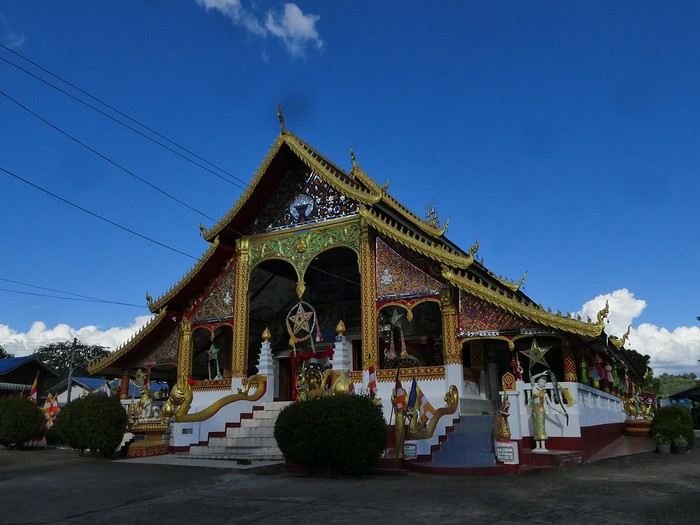
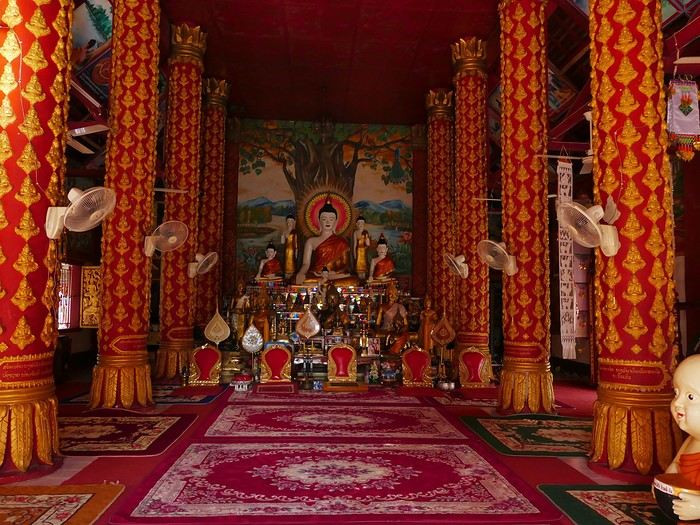
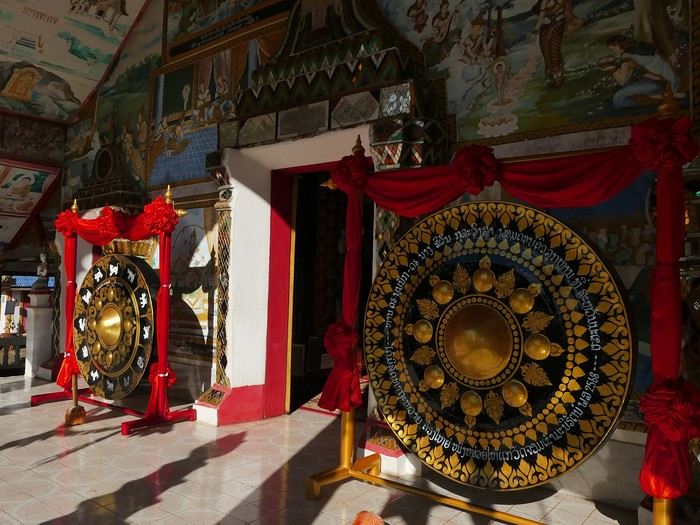
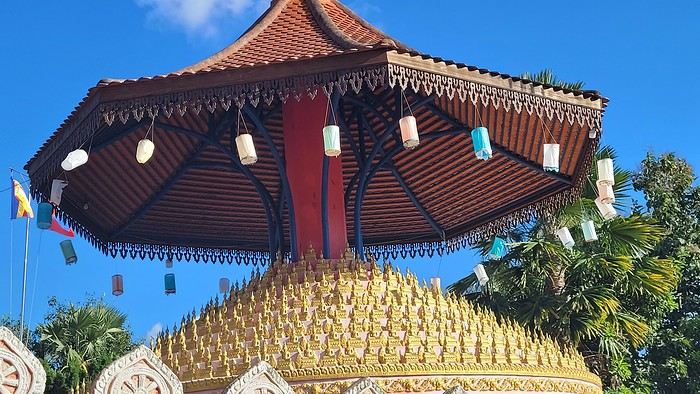
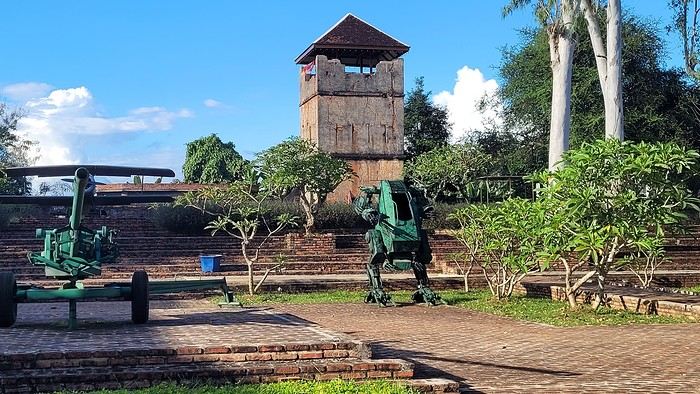
and continued to Fort Carnot, built by the French.
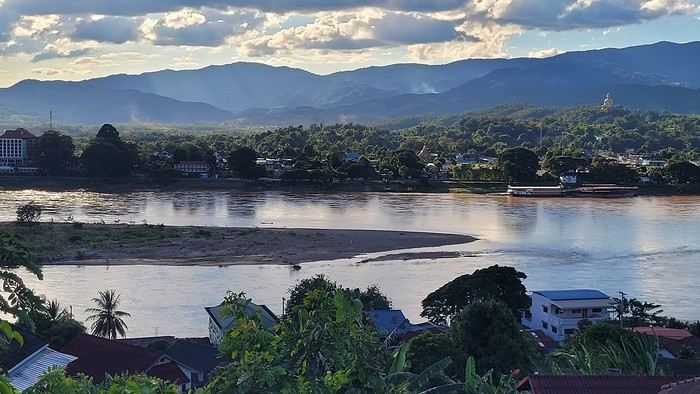
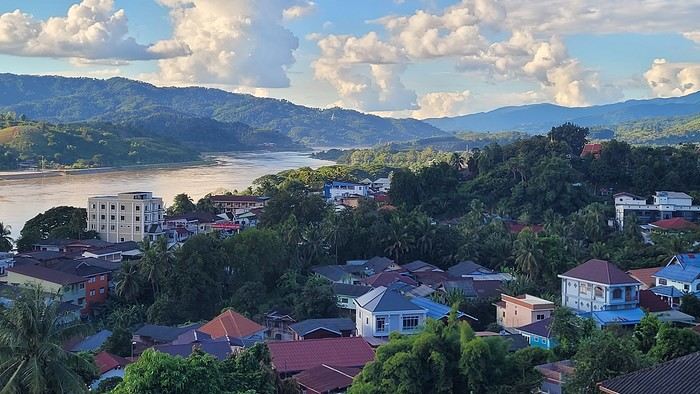
The views of the Mekong are beautiful for a first glimpse of the country.
yum-yum, bon appétit!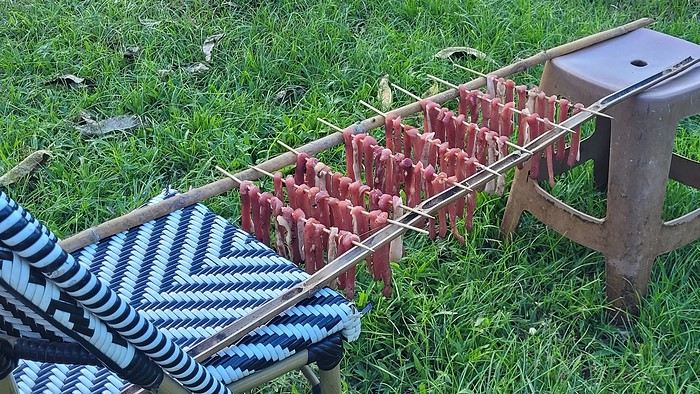
At 6:30 PM, I went to dinner at a restaurant across from the guesthouse—a chicken curry with vegetables.
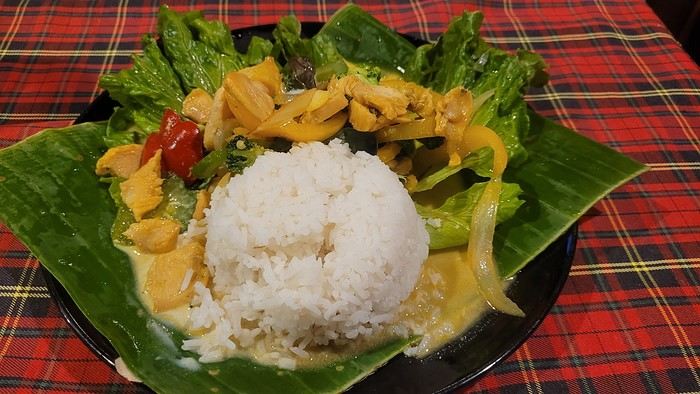
I didn’t linger and went back to bed. I slept well, even if I woke up often.
Thursday, Oct 23. Left home at 8:25 AM, took the bus from St Cyp to Perpignan, then a BlaBlaBus to Barcelona airport. Last night, a huge storm crossed France, and the bus was an hour late. We finally left at 11 AM. At the Spanish border, we were checked—several Africans were traveling on the bus, and their document verification took quite a while. In the end, everything was in order, and we set off again a good half-hour later. We finally arrived at Barcelona airport after 2 PM, but no stress since my flight was scheduled for 4:30 PM with Saudia. At check-in, the hostess told me there’d be a 1-hour delay due to bad weather in France and Belgium. In the end, the flight didn’t just have a 1-hour delay but a 5-hour one because of a technical issue. The next flight wouldn’t wait for us. When we arrived in Jeddah, they gave us another ticket for the following day—the flight to Bangkok was scheduled for 11:55 AM. The airline assigned us a room, which was good news since I was exhausted. Friday morning, the flight was still scheduled for 11:55 AM, but the gate wasn’t displayed. It was announced with a 1-hour delay, but that stretched to 4 hours. They handed out drinks and a snack—again, the delay was due to technical problems. In Bangkok, I had a connecting flight to Chiang Rai, where I’d also booked a room—I lost everything. We finally arrived in Bangkok on Saturday at 4 AM. I had to buy another ticket for a 7 AM flight. The formalities were quick, and my flight went smoothly. A taxi took me to Bus Terminal 1, where I caught a bus leaving at 10 AM, and we arrived at the Thailand-Laos border. I shared a taxi with other travelers, which took us to Houay Xai. The guesthouse I’d booked was right across from the stop—that was great. I exchanged some money and bought a SIM card at the guesthouse. Despite the fatigue, I needed to stretch my legs, so I walked down the street to the temple.
and continued to Fort Carnot, built by the French.
The views of the Mekong are beautiful for a first glimpse of the country.
yum-yum, bon appétit!
At 6:30 PM, I went to dinner at a restaurant across from the guesthouse—a chicken curry with vegetables.
I didn’t linger and went back to bed. I slept well, even if I woke up often.
Trip to Thailand and Laos
Hello! 🙂
January 2026 Here we go again for new adventures and the pleasure of sharing them with you here! First of all, I’d like to thank everyone who helped me with the preparations, even with some last-minute improvisations just days before departure. Thanks to Montagnard74, Jojoone1, Songsam, Attila, Dennis2, NadegerFERM, and the authors whose travel journals about Laos inspired me (Montagnard74, Muriel18, Mavietongs...).
In this story, written by Richard and illustrated by me, we’ll tell you about the journey of four friends: Catherine, Richard, Nathalie, and Bruno. A reinvented but overall successful trip, filled with discoveries and surprises, the scents of spices and frangipani flowers, (too) spicy food, sunsets, and... one big mess.
January 2026 Here we go again for new adventures and the pleasure of sharing them with you here! First of all, I’d like to thank everyone who helped me with the preparations, even with some last-minute improvisations just days before departure. Thanks to Montagnard74, Jojoone1, Songsam, Attila, Dennis2, NadegerFERM, and the authors whose travel journals about Laos inspired me (Montagnard74, Muriel18, Mavietongs...).
In this story, written by Richard and illustrated by me, we’ll tell you about the journey of four friends: Catherine, Richard, Nathalie, and Bruno. A reinvented but overall successful trip, filled with discoveries and surprises, the scents of spices and frangipani flowers, (too) spicy food, sunsets, and... one big mess.
What to see and do on a trip through the Northeast and Sukhothai?
Hello,
After a successful first trip in 2025, with the help of forum members, we’d love to return to this amazing cultural melting pot in 2026 for three weeks (2 adults, 2 kids aged 13 and 16).
We’d like to explore new places in the Northeast: fly into Khon Kaen and explore the region—Loei, Nong Khai, perhaps? A detour to the center to visit Sukhothai would be a great addition.
I’ll admit, planning this itinerary is a bit trickier for me since I’m less familiar with these areas and what they have to offer. The distances also seem longer than our previous transfers (BKK-Kanchanaburi-Kaeng Krachan-Sam Roi Yot...).
Do you have any suggestions or hidden gems to explore in the Northeast and Central regions that keep travel time between stops reasonable (3-4 hours)?
Thanks for your input!
After a successful first trip in 2025, with the help of forum members, we’d love to return to this amazing cultural melting pot in 2026 for three weeks (2 adults, 2 kids aged 13 and 16).
We’d like to explore new places in the Northeast: fly into Khon Kaen and explore the region—Loei, Nong Khai, perhaps? A detour to the center to visit Sukhothai would be a great addition.
I’ll admit, planning this itinerary is a bit trickier for me since I’m less familiar with these areas and what they have to offer. The distances also seem longer than our previous transfers (BKK-Kanchanaburi-Kaeng Krachan-Sam Roi Yot...).
Do you have any suggestions or hidden gems to explore in the Northeast and Central regions that keep travel time between stops reasonable (3-4 hours)?
Thanks for your input!
First family trip to Thailand
Hi there,
We’re planning a trip to Thailand with my husband and our two 7-year-old kids. Three weeks in February/March. Our rough itinerary is: arriving in Bangkok for 3-4 days, then Chiang Mai and the surrounding area, and finally an island in the south.
-We land in Bangkok around 7 AM. Any hotel recommendations? We’d love to rest right after we arrive. Budget is around 40 € per night.
For the rest, I’m open to any tips or suggestions:
-Accommodation in Chiang Mai, and maybe a night in an elephant sanctuary park...
-Should we take the overnight train to Chiang Mai on the way there or on the way back?
-Which island should we choose?
We love authentic experiences and connecting with locals...
Thanks so much!!!
Elodie.
We’re planning a trip to Thailand with my husband and our two 7-year-old kids. Three weeks in February/March. Our rough itinerary is: arriving in Bangkok for 3-4 days, then Chiang Mai and the surrounding area, and finally an island in the south.
-We land in Bangkok around 7 AM. Any hotel recommendations? We’d love to rest right after we arrive. Budget is around 40 € per night.
For the rest, I’m open to any tips or suggestions:
-Accommodation in Chiang Mai, and maybe a night in an elephant sanctuary park...
-Should we take the overnight train to Chiang Mai on the way there or on the way back?
-Which island should we choose?
We love authentic experiences and connecting with locals...
Thanks so much!!!
Elodie.
Hitchhiking in the 70s-80s
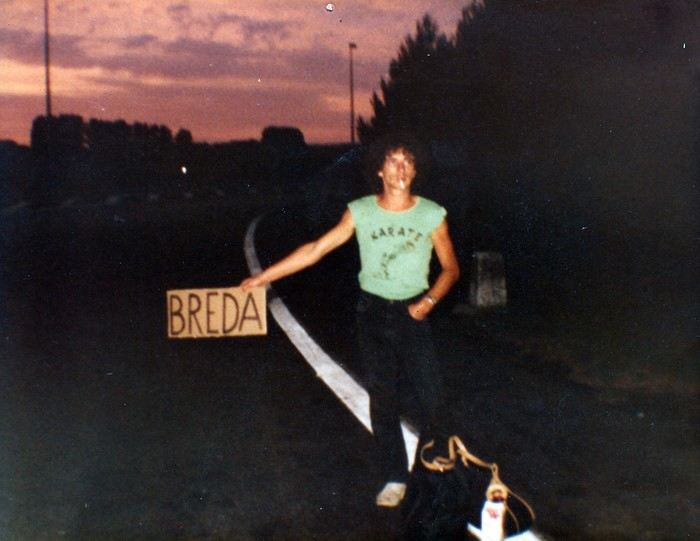
“Hey, your Marker... - My Marker? - The one you used to make hitchhiking signs.”
The marker in question is sitting proudly on the kitchen table. Marielle found it at the bottom of a moving box.
I’ve been meaning to tell the long story of my love affair with hitchhiking for years. Here we go.
To be honest, I’m not quite sure when it started. My earliest memory goes back to a fair with a bike race in my maternal grandparents’ village. I was with my cousin, my little sister, and three girl cousins. There were six of us, ages ranging from six or seven to thirteen or fourteen. Our parents stayed at the fair, and we’d had enough. So we decided to walk home. Only it was four kilometers away. So we hitchhiked. A guy driving an old car picked us all up and dropped us off at the farm. He probably found it amusing to see us thumbing a ride by the side of the road, but maybe it also worried him a bit. With everything you read in the papers...
Around fifteen or sixteen, I started hitchhiking regularly, alone or with a friend, to go to the nearby town. But it was especially when I started boarding school in Orléans that it became more regular. The first year, I’d leave Monday morning and come back Saturday noon by bus. It was an old, uncomfortable bus where we froze in winter. To make matters worse, I often got motion sickness if, as was too often the case, I ended up sitting in the back. In the spring, a high school friend suggested I hitchhike back. It meant a slight detour, but the advantage was taking only national roads.
So that’s how, from the end of tenth grade to twelfth grade, I’d thumb a ride every Saturday on the Pont de Bourgogne. Drivers were used to seeing young people hitchhiking, and it worked pretty well. Our biggest fear? Soldiers! At that time, military service was still mandatory, and on weekends, it wasn’t rare to see them competing with us. They’d keep their uniforms on to go home. That gave people confidence—with everything you read in the papers—and they’d rarely wait more than five minutes. We, with our long hair, were definitely less popular. From time to time, three big red-faced guys in a van coming back from a construction site would flip us off, yelling things like “go get a haircut, you bums!” Those were the good old days.
We still had a good laugh, though. Patrice, the friend I’d hitchhike back from school with on Saturdays, is a musician—I’d later discover he’s an excellent composer. A die-hard Beatles fan, he knows their repertoire by heart and spends his time singing at the top of his lungs while we thumb a ride. One Saturday late morning, we’d been waiting for a while at the exit of Châteauneuf-sur-Loire when a little lady came up to him and asked if he could please sing a little quieter: a baby was sleeping in the house. He put on the most sorry face: “Oh, sorry ma’am, we didn’t realize.” No sooner had the lady gone back inside than he started again. Luckily, a car stopped just then, sparing me the embarrassment of seeing the lady come back out.
Saturday was also the day when the cigarette pack was dangerously low. So before leaving, we’d go buy some “Parisiennes,” the “P4s” as we called them back then. They were slightly thinner cigarettes with a mix of tobacco scraps. Sometimes they tasted like light tobacco, sometimes like dark. Not great, but by the end of the week, our pocket money was gone. They were sold in small packs of four, hence the name P4. We’d only pay 20 centimes. On Saturdays, it was rare for the two of us to manage to scrape together 1.50 F to buy a whole pack of Gauloises...
The last twenty kilometers, I’d usually do alone, Patrice having reached his destination. From time to time, luck would smile on me: an acquaintance would just happen to pass by and stop. One January Saturday, at the exit of Gien, I ran into another guy from Argenton whom I knew a little. That day, the weather was nice, but the temperature was well below zero. It was around noon, and it was the off-peak hour. We were shivering, stamping our feet by the side of the road, when a Citroën “Tube” arrived: it was his father’s boss’s, a mason. They were both sitting in the front, but since they were obese, they had us climb onto the open back. Even though we huddled against the cab to shelter from the wind, the twenty kilometers felt very long, especially since we were only going sixty kilometers an hour. Our hands and cheeks were blue when we finally arrived.
The year I took my baccalaureate, a friend with a 2CV would take me Monday mornings with one or two others we’d pick up in nearby villages. We’d share the gas costs, but it was still cheaper than the bus. And in winter, the bus was my nightmare. You had to get up at five to catch it at six. Not enough sleep, and outside it was freezing or raining—or both. The 2CV was luxury. Plus, Philippe would pick me up at home. On the other hand, since I didn’t have class Saturday mornings—well, I did, but we only had PE the first two hours and nothing after—I’d skip class and slip out right after breakfast to thumb a ride at the Pont de Bourgogne.
Those three high school years were formative in this optional subject that was hitchhiking. Little by little, I learned the rules of the game. First, you shouldn’t walk along the road while thumbing. Cars go too fast and can’t stop easily. Accepting a ride that’s too short is also a no-go. The guy who offers to take you a little way but drops you off at some vague crossroads in the middle of nowhere? No thanks. You need to get dropped off in a town. If it’s a fairly big city, you often have to cross it from one end to the other, but it’s better. At the exit, you have to choose your spot well. Actually, you have to put yourself in the driver’s shoes: they need to see you early enough, not be going too fast, and be able to stop easily without risking an accident. So when leaving a city, it’s better not to go too far. It’s wiser to find a spot where cars go slowly and can stop easily. And preferably near a café. The café is for when you still have a few coins for a coffee and need to warm up. From time to time, you’d run into someone nice who’d make a detour to drop you off at a better spot to start again. Finally, if possible, avoid hitchhiking on Sundays. Cars are packed with whole families who, most of the time, aren’t going far. And then there’s the little worry of those people who rarely leave home: with everything you read in the papers...
During those high school years, it was only short trips, rarely exceeding a hundred kilometers. Later, I aimed bigger, and things were a bit different. In 1973-74, I crossed part of France for the first time on two or three occasions, coming back from the German border or returning to Bordeaux, where we lived briefly. Since there weren’t many highways back then, we took national roads. It was during these trips that I realized it was better to leave in the evening. As I said earlier, Sunday is to be avoided, but on weekdays, there’s another problem: if you leave in the morning, you only make short hops. First, it often takes longer to get going because drivers are people going to work nearby. Which brings us back to those who drop you off in a bad spot, far from everything. There, you have to know how to refuse. You thank the driver for stopping—oh, if only everyone could be like you—while explaining why you’d rather stay put. People don’t take offense, by the way. Those who pick up hitchhikers often hitchhiked themselves when they were in the military or before they had a car. In the late afternoon, you’d often run into salespeople or truckers, in other words, people who drive a lot. At that time, salespeople no longer had appointments and were more relaxed. They wanted to talk about something other than the merits of their products. On the radio, it was time for *Les Grosses Têtes*. You’d also quite often run into small business owners, professionals, or even hippies. The conversations were pleasant and often enriching. A little later in the evening, truckers would take over. They’d already driven a few hundred kilometers, and the depot or customs was still far away. So they’d gladly take a hitchhiker to stay awake at the wheel and chat. The radio with Max Ménier’s show *Les routiers sont sympas*, you’d eventually get tired of it. So a hitchhiker was a change. Others, who’d hit the road at midnight to be at their destination by morning, were nice and offered to let you lie down on the bunk while they drove. When you’d been hitchhiking since six in the evening, freezing in the wind between two vehicles, you weren’t unhappy to take a little nap.
Speaking of Max Ménier, he’d often make announcements for hitchhikers. One evening, I called him. It was getting late, and I still had quite a way to go. No luck: the show had ended for good the day before!
In short, it’s better not to rush, sleep in, and leave after lunch, or better yet, in the late afternoon. Obviously, I’m talking about when you have several hundred kilometers to cover. That’s when you have to play it pro.
First thing, especially at night, but it also applies in the middle of summer when the light is blinding: dress to be seen from far away. I’ll admit I have an advantage over most other hitchhikers: I’m small and don’t scare people. To balance that out, racist drivers often take me for an Arab and are less likely to pick me up, but overall, the balance tips in my favor. Back to the need to be seen: at night, I wear light-colored clothes. In headlights, you can see me from far away.
Second thing: travel light. Forget the big backpack with a frame. Drivers don’t always have room in the trunk or on the back seat, especially if it’s rained and the ground is wet. Plus, it forces them to get out of the car. If they’re nice enough to pick up a hitchhiker, you shouldn’t ask for too much either.
Third thing: bring a cardboard sign and a big marker—like the ones in the photo at the start of this post—to write the name of your destination. In the early 80s, I ran a tourist house in the Cher, but I lived in the Netherlands. In the off-season, it was only open on weekends. On Fridays, I’d leave Holland and return on Mondays. 1200 km round trip. On the way there, in Paris, I’d stand at Porte de la Chapelle. At that spot, the road is very wide, and drivers could stop easily. Obviously, on the sign, I didn’t write Eindhoven, which not everyone knows, and even less Amsterdam because of its seedy reputation. In that case, you’d expect to see a police car stop and two officers in kepis ask for your papers. So as a first destination, I’d write Compiègne. We were well out of Paris, and since it wasn’t too far, a trucker or salesperson was less reluctant to stop. Once past Compiègne, I’d take out my Lille sign. Once in Belgium, it wasn’t really necessary to use a sign anymore, since everyone was going in the same direction. Usually, the guy who picked me up at Porte de la Chapelle would say he wasn’t going far but could take me a little way. Before that, I’d still ask if there was a gas station on the highway where he could drop me off before exiting. While talking, the guy would realize he wasn’t dealing with a dangerous criminal. He’d pretend to check his watch, think for a moment, then say that actually, he was going to Belgium and could take me to the border or a little beyond. To leave Paris on the way back, I’d take the train to Melun, where it was easier to hitchhike than at Porte d’Italie.
Over all those years, I think I was pretty lucky. Or maybe philosophical enough not to imagine a car would stop after a few minutes. An hour’s wait was average. Sure, I sometimes waited three, four, or five hours. Most often at odd hours and in terrible weather. When it doesn’t work, it doesn’t work. But there’s always a moment when things pick up. Sure, when you’re soaked in freezing rain in the early morning after a sleepless night, you’re less philosophical than when I’m writing these lines comfortably at my computer, but it still holds true.
Earlier, I mentioned clothing and the importance of being well-rested before leaving. When you’ve eaten well and just gotten out of the shower, shaved, you’re in a better mood. And somehow, drivers sense it. Or at least, that’s the impression I’ve always had. It’s better to look in shape than disgusted at standing there, half-heartedly thumbing a ride. In short, when I’d start to get fed up with waiting, I’d go into the first café I saw for a coffee. Coming back out, I’d be refreshed, and most of the time, a car would stop within minutes. I’ve often said that when I stood by the side of the road thumbing a ride, I felt a bit like a gambler in front of a slot machine. It was a matter of giving luck a chance. And well, it worked out pretty well.
Then, there are countries where hitchhiking works really well and others where it’s harder. In the 70s-80s, it worked best in Germany and England. In the late afternoon, it wasn’t rare to be invited for tea. Well, that was in England. Tea meant being offered room and board. In Germany, they’d offer you coffee. Once there, they’d first show you the guest room and point out the bathroom before sitting you down in front of a big plate of cold cuts. In the evening, they’d go out in town, and the next morning, they’d usually drop you off at a good spot for hitchhiking. On the other hand, in Mediterranean and Scandinavian countries, you’d better be patient. In Spain or Italy, it’s better to take the train, which was dirt cheap back then. However, if you’re a couple traveling light, it’s already easier in most countries.
In 1982, I went on a trip around Turkey with my girlfriend. We only had two small bags, which was plenty. It was November-December, and we wore our warm, bulky clothes. Leaving Eindhoven at nine in the morning, we arrived in Graz, near the Yugoslav border, at eleven at night. 1300 km in a day! In just four or five vehicles. One to the German border, about fifty kilometers from Eindhoven, the second to Hagen in the Ruhr, the third to Salzburg, and the last to Graz at the Yugoslav border. Record broken. During the night crossing of Yugoslavia, we ran into a trucker close to retirement who lent us the truck’s bunk. So we arrived fresh and rested near Skopje the next morning. We continued to Thessaloniki in northern Greece before taking the train to Istanbul. In Turkey, we traveled a good part of the country by hitchhiking too. With truckers in old, overloaded, slow trucks that climbed hills at fifteen kilometers an hour, but also in cars where five or six people were already crammed in. And every time, we were invited for tea. Once, we were even picked up by a big shot in his Mercedes with a chauffeur. Until then, the average speed was around fifty kilometers an hour. There, we were going two hundred. On a national road, not a nice European highway.
I’ve also hitchhiked in Nepal, from Lumbini, Buddha’s birthplace, to a village on the way to Pokhara. It must have been midday. No bus until the next day. I gave it a try. A small truck overloaded with rice sacks, with two or three young people already perched on top, stopped. I rode on the roof of the cab. At fifty kilometers an hour when it was going well, with a breathtaking view. Coming back from India, I also crossed part of Iran by hitchhiking, from Tehran to the Turkish border. I did this trip with an Austrian I met at the hotel who, like me, had to watch his pennies. We gave it a shot. There was almost no traffic, but to our great surprise, the first car that passed in the area would always stop. They’d just ask for a modest contribution for gas, and it cost next to nothing.
Sometimes, you get scared too. After leaving Turkey in early December 82, we spent about two weeks in the southern Peloponnese harvesting olives. A few days before Christmas, we hitchhiked back to Holland. A girl picked us up in her little Fiat 500. We were driving on a mountain road, and that morning there was a bit of black ice. After crossing a pass, we saw the old Ford Taunus ahead of us at fifty meters start to skid. The driver let out a “heeee!” while grabbing my knees. I reflexively grabbed the wheel. Finally, the Taunus got back on track. And we didn’t swerve. But those few seconds felt very long.
In January 77, while I’d been living in Germany for a few months, I decided to spend a few days in Italy. By hitchhiking, of course. I left in the early afternoon, and by ten at night, I wasn’t far from Frankfurt. I saw a big Mercedes stop. The four or five young people crammed inside were listening to Schlager at full volume. Beer cans littered the floor. They didn’t have a precise destination, and as long as they were going south, that was fine with me. They’d finished their military service that very day and had clearly already celebrated their discharge. The driver was going 160, zigzagging dangerously from one side of the highway to the other. I should have realized he wasn’t entirely sober either. Luckily, there was almost no traffic. Finally, I managed to get dropped off at a gas station just before Frankfurt, relieved. I hope their trip didn’t end tragically.
Another time, coming back from Holland with my wife, we were picked up early in the morning near Senlis by two guys from Lille. They were going to work near Tours and could drop us off at Porte d’Italie. Apparently, they were coworkers but barely knew each other. The driver offered us a beer—at six in the morning, sure!—before opening another can for himself. He was clearly having trouble staying in the right lane. We politely declined, the passenger too. Everyone was tense. Luckily, it was rush hour on the ring road, and we were going slowly. When we got out of the car, the passenger said goodbye with the look of a guy being offered the condemned man’s rum and cigarette.
Finally, there are the annoying remarks from drivers who are either gay when you’re alone or turned on by the sight of your girlfriend when you’re a couple. In those cases, I’d get in the back so the guy wouldn’t feel too confident. And if the conversation got a little too suggestive, we’d deflect until we got dropped off.
And luckily, there are the times, not so rare after all, when you run into really nice people who invite you to eat and sleep at their place and drive you to a good spot the next morning. In Germany and England, that was common. And then there are the big strokes of luck, like during our trip to Turkey when we crossed most of Germany in one car, or that other time when some Germans drove me from the exit of Geneva all the way to the Costa Brava.
Going back to “with everything you read in the papers” and its variant “with everything you see on TV”—and now on the internet—it’s always left me perplexed. Personally, I’ve never heard of hitchhikers assaulting drivers, even if it may have happened. On the other hand, what was most common were hitchhikers being assaulted, especially girls. Anyway, even armed, it seems a bit stupid to assault the driver—wouldn’t that risk causing an accident?
Finally, since that time, I’ve occasionally wanted to hitchhike somewhere far away in France. Most often, too busy with work, it never happened, but the nostalgia hasn’t completely disappeared.
* * *
Other Hitchhikers
And then one day, I... settled down to become a driver myself. Ten years had passed, and you saw fewer and fewer hitchhikers. Or maybe I saw fewer because I had a regular job and wasn’t traveling the same way. And then I understood a few things.
Several times, I was tempted to pick up a hitchhiker, but they didn’t meet the required conditions. They were walking along the road instead of staying at the exit of the previous town. Hard to stop without risking an accident. Or the guy looked really scruffy. Or he was sulking, if not both. Then you think of that famous “with everything you read in the papers.” Not that I was scared, but unfortunately, the few hitchhikers I did pick up later were rarely interesting.
A few years ago, we picked up a young guy at the exit of a small town in Sologne. Not an easy spot for hitchhiking. Bad luck, he was a pretentious little jerk. He was barely 20 or 25 and talked like a bitter old man. He was a waiter in a restaurant. According to him, it was lucky he was there, otherwise the boss would have closed up shop long ago. You’d think he had thirty or forty years of professional experience behind him. As we approached Blois, he started ranting about Arabs, blaming them for all evils. And he laid it on thick. That morning, we were going to a teenager’s funeral who had just committed suicide, so he really got on our nerves, Mr. Know-It-All. Out of anger, I dropped him off next to a shopping center a few kilometers from downtown. Not nice, but it felt good.
Some time ago, we were driving around the Limousin on a Sunday to try out the used Twingo we’d just bought. We picked up a guy in his forties. A German who spoke French well. He started talking about the environment. He was a green Khmer. He got worked up all by himself with his pseudo-eco rant and, after a few kilometers, was almost yelling at us. As we were about to leave the main road for a small one, I dropped him off at a crossroads in the middle of nowhere. Normally, I would have made a little detour to take him to a better spot, but this time, I didn’t feel like doing the... eco-warrior a favor.
On the other hand, I’ve still done my good deed a few times. One June morning, coming back from Orléans, I saw a man in his sixties hitchhiking. The poor guy had had a rough time. He was from Montpellier and was coming back from Caen, where he’d been promised a job. Once there, they bluntly told him the position was already taken, and he had to go back. Except he didn’t have enough money left for the train. He’d spent the night hitchhiking without success. I could only take him as far as Lamotte-Beuvron, where I dropped him off near the fire station. Apparently, there was some vague shelter there or something, but it only opened a few hours later. In the meantime, he settled on the grass in a corner to sleep a little. While he was doing that, I quickly went to the train station to check the price of a ticket to Montpellier. It was within my means. Since he was sound asleep, I slipped the train ticket and 100 francs into his pocket. I couldn’t imagine him continuing to hitchhike all the way to Montpellier. And I bet he didn’t even have a piece of cardboard and a marker!
When we go to Brazil, we usually rent a small car. One day, we were coming back from Paracuru to Fortaleza when we saw a whole family hitchhiking. Two adults and two or three small children. Here near the equator, the sun sets very quickly, and it would soon be night. There was little traffic, and trucks wouldn’t stop because there was no room in the cab. As for the rich people driving big 4x4s, they wouldn’t stoop to picking up the lower classes. The only hope for this kind of family was usually a farmer or artisan who’d let them ride in the back of his pickup. Obviously, they were a bit surprised to see us. Everyone crammed in as best they could in the back of our little car. When we dropped them off, we got a whole string of “Deus lhes abençõe”—God bless you.
Still in Brazil, we were on the road from Barreirinhas to São Luís do Maranhão. About 150 km of deserted road with an isolated mud house here and there. A young woman flagged us down. She was very pregnant and had to get to the clinic twenty or thirty kilometers away to give birth. Someone was supposed to drive her, but the first signs of labor started earlier than expected, and the driver was unavailable. Even driving fast, we weren’t feeling great: it would be just our luck if she gave birth in the car!
Today, we’re in the age of smartphones and carpooling apps. Safety. With everything you see on TV... Three or four years ago, we signed up on a platform. Our first, and only, “client” was a little jerk who didn’t say a word the whole trip. No hello, no goodbye, and certainly no thank you. The next day, we found his Ray-Bans in the car. We didn’t run after him to give them back. Ha!
Looking for feedback and advice on a Thailand-Laos-Cambodia itinerary plan
Hi everyone,
I’m starting to plan my next trip to Southeast Asia this winter (2.5 months, leaving in early December), and here’s a rough outline of my route—I’d love to share it with you and hear your thoughts and tips.
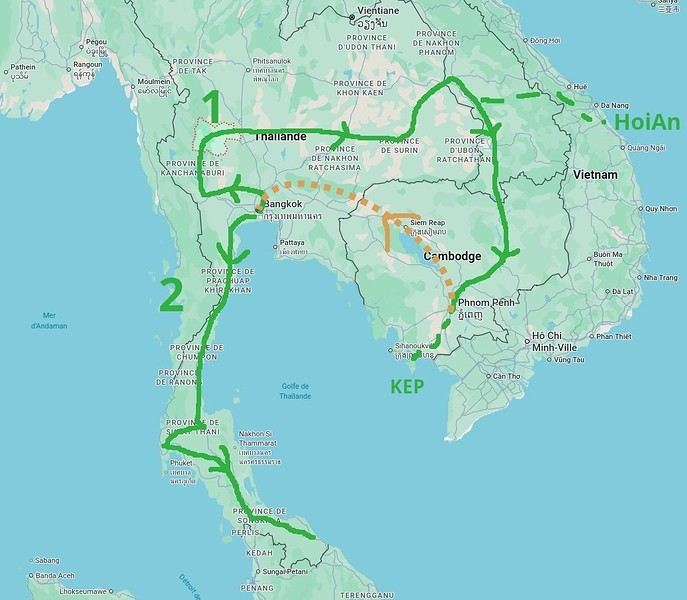
- I’ll start in Bangkok and already have three spots I’ve marked: Ayutthaya, Kanchanaburi, and Uthai Thani (I haven’t been to any of these places yet). - Next, I’d like to cross the country from west to east to reach the Laos border. I’d love suggestions for any interesting stops along this route—I don’t know this part of Thailand at all... - Then I’ll head into Laos, probably at Savannakhet (you can usually get a visa at the border). - > I’m tempted to spend a week in Hoi An, Vietnam, since I loved that city and the area when I visited two years ago. No visa needed for Vietnam now, so it could be a nice little detour. On the map, it doesn’t look too far, but I know you’ve got to be careful with these things, and I’m not sure if it’s a good idea. Any opinions on this? - Back to Laos (maybe via Dakta), and I’ll head south along the Mekong, probably doing the Bolaven Plateau loop that I missed last time. Then Paksé, the 4,000 Islands... I’ve been before, but I’d happily go back. - Crossing into Cambodia, I’ll follow the Mekong down to Phnom Penh (I know this area and love how untouristy it is). From there, I’ll probably spend a few days in Kep (quieter than Kampot). Still undecided, though. - Then back to Thailand (BKK), likely by plane from Phnom Penh since the borders between the two countries are currently closed (plus, let’s be honest, Cambodian roads... ;-). We’ll see how things look when the time comes. - After that, I’d like to explore southern Thailand, taking it slow with short hops. I’ve got my eye on Khao Sok National Park, and I’ve heard good things about Krabi... Again, I don’t know this region well, so any info or tips would be great.
So, I think this should be doable in 2.5 months, especially since I prefer short hops of 300 km max to avoid getting too tired, and I like staying 2-3 days in each place to explore. Plus, I’ll take a week off to relax if I find a spot I love—maybe by the sea for some real downtime.
Thanks for your feedback and for sharing your favorite spots! Pascal
- I’ll start in Bangkok and already have three spots I’ve marked: Ayutthaya, Kanchanaburi, and Uthai Thani (I haven’t been to any of these places yet). - Next, I’d like to cross the country from west to east to reach the Laos border. I’d love suggestions for any interesting stops along this route—I don’t know this part of Thailand at all... - Then I’ll head into Laos, probably at Savannakhet (you can usually get a visa at the border). - > I’m tempted to spend a week in Hoi An, Vietnam, since I loved that city and the area when I visited two years ago. No visa needed for Vietnam now, so it could be a nice little detour. On the map, it doesn’t look too far, but I know you’ve got to be careful with these things, and I’m not sure if it’s a good idea. Any opinions on this? - Back to Laos (maybe via Dakta), and I’ll head south along the Mekong, probably doing the Bolaven Plateau loop that I missed last time. Then Paksé, the 4,000 Islands... I’ve been before, but I’d happily go back. - Crossing into Cambodia, I’ll follow the Mekong down to Phnom Penh (I know this area and love how untouristy it is). From there, I’ll probably spend a few days in Kep (quieter than Kampot). Still undecided, though. - Then back to Thailand (BKK), likely by plane from Phnom Penh since the borders between the two countries are currently closed (plus, let’s be honest, Cambodian roads... ;-). We’ll see how things look when the time comes. - After that, I’d like to explore southern Thailand, taking it slow with short hops. I’ve got my eye on Khao Sok National Park, and I’ve heard good things about Krabi... Again, I don’t know this region well, so any info or tips would be great.
So, I think this should be doable in 2.5 months, especially since I prefer short hops of 300 km max to avoid getting too tired, and I like staying 2-3 days in each place to explore. Plus, I’ll take a week off to relax if I find a spot I love—maybe by the sea for some real downtime.
Thanks for your feedback and for sharing your favorite spots! Pascal
Your recommendations for 20 days in Thailand
Hello,
Our flights are booked, and we’ll arrive in Thailand at the beginning of January.
Originally, we were supposed to spend 14 days there. But after booking the flights and seeing the prices, we’ll now be there for 20 days instead.
Our initial plan was: 2 days in Bangkok 1 day in Ayutthaya 4 days in Chiang Mai 6 days around Krabi
So we have 7 more days to fill. What do you recommend?
An extra day in Bangkok? Adding more days in the north? If so, where? Exploring another region, like Kanchanaburi or Cheow Lan Lake? Traveling north in stages instead of taking the overnight train?
A few extra details about us: For us, vacation isn’t about relaxation—we love walking, exploring, and packed days don’t bother us. Hiking for hours and doing active things is what makes us happy. That said, we also enjoy visiting villages and towns if they’re worth the detour. In Thailand, we’d like to visit temples too. We’re early risers, so our days tend to be long. 🙂 In short, we like to keep things moving during our trips. 😉
Unfortunately, seeing terraced rice fields isn’t possible in January. I read there are rice fields around Sukhothai. Are they green in January?
In the north, do you recommend Doi Inthanon, Huai Nam Dang, or Doi Chiang Dao National Parks? Which one is the most beautiful and best for January?
Our flights are booked, and we’ll arrive in Thailand at the beginning of January.
Originally, we were supposed to spend 14 days there. But after booking the flights and seeing the prices, we’ll now be there for 20 days instead.
Our initial plan was: 2 days in Bangkok 1 day in Ayutthaya 4 days in Chiang Mai 6 days around Krabi
So we have 7 more days to fill. What do you recommend?
An extra day in Bangkok? Adding more days in the north? If so, where? Exploring another region, like Kanchanaburi or Cheow Lan Lake? Traveling north in stages instead of taking the overnight train?
A few extra details about us: For us, vacation isn’t about relaxation—we love walking, exploring, and packed days don’t bother us. Hiking for hours and doing active things is what makes us happy. That said, we also enjoy visiting villages and towns if they’re worth the detour. In Thailand, we’d like to visit temples too. We’re early risers, so our days tend to be long. 🙂 In short, we like to keep things moving during our trips. 😉
Unfortunately, seeing terraced rice fields isn’t possible in January. I read there are rice fields around Sukhothai. Are they green in January?
In the north, do you recommend Doi Inthanon, Huai Nam Dang, or Doi Chiang Dao National Parks? Which one is the most beautiful and best for January?