last edited Dec 11, 2019
Overview of Spain
Location Map of Spain
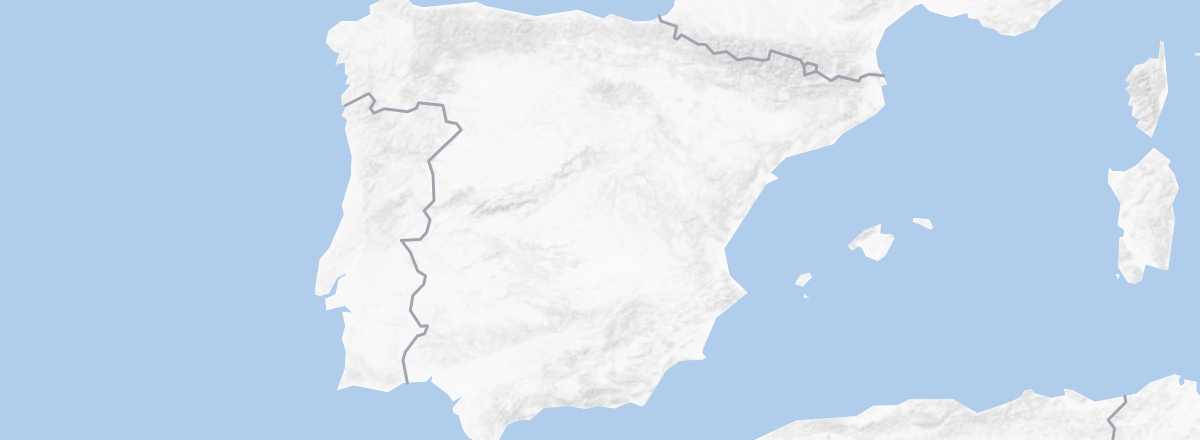 Spain
Open the interactive map
Spain
Open the interactive map
Quick Overview
Spain in Eight Tourist Regions
- Andalusia: abundant sunshine, beaches, and seaside resorts (sometimes a bit overdeveloped), along with a rich history, make the Autonomous Community of Andalusia one of Spain’s most visited regions. Tourism is by far the main resource for this land, which otherwise struggles economically.
- Balearic Islands: this small archipelago south of Barcelona has built a global tourist reputation over decades, first as a hippie destination, then a trendy one, and later a hotspot for "mass tourism" or partygoers, especially on Ibiza.
- Catalonia: thanks to Barcelona, its mountainous hinterland, and the famous Costa Brava and Costa Daurada, Catalonia has long been one of Spain’s top tourist destinations. Whether you're looking for nature, culture, or simply a relaxing holiday, Catalonia delivers for all types of visitors...
- Central Spain: the heart of the country, with Castile and León, Castile-La Mancha, Extremadura, and the Community of Madrid. Under scorching sun, especially in summer, you’ll discover the Spain of Don Quixote’s villages and some of the Iberian Peninsula’s most beautiful cities.
- Spain's East Coast: Murcia and the Valencian Community have long been known for their coastline and numerous seaside resorts. A top summer destination in Spain and even across Europe.
- Northern Spain: between Catalonia and the Basque Country, nestled against the Pyrenees, the communities of La Rioja, Navarre, and Aragon. This is Spain for mountain lovers, outdoor activities, and nature.
- Northwest Spain: the three autonomous communities of Galicia, Asturias, and Cantabria along the Atlantic. Here, the landscape is greener, and the climate is milder and more humid, especially in summer—far from the usual image of the rest of Spain. This is also where the famous Camino de Santiago pilgrimage routes end, in the city of Santiago de Compostela.
- Spanish Basque Country: bathed by the Gulf of Biscay and straddling France and Spain, the Basque Country—an autonomous community on the Spanish side—is a land of traditions, culture, and history, with a distinct identity and language. More than landscapes, monuments, or the coastline, it’s this Basque uniqueness that’s worth discovering.
Key Facts
- Type of place: country.
- Location: in southwestern Europe, at the exit of the Mediterranean into the Atlantic.
- Latitude/longitude: 40.00' N, 4.00' W.
- Local time:
- Capital: Madrid.
- Nature of the state: Constitutional monarchy.
- Official languages: Spanish, plus Basque, Catalan, and Galician locally.
- Currency: euro.
- Population: 49,331,076 inhabitants (2018).
- Area: 505,370 km².
- Density: 97.5 inhabitants/km².
- Highest point: Mount Mulhacén (3,478 m) in the Sierra Nevada.
- Lowest point: sea level.
- Coastline: 4,964 km.
- Driving: on the right.
Tourism
For decades, Spain has been one of the world’s top three most visited destinations, with tourism contributing over 6% to the national wealth. Each year, over 80 million people visit the country for their holidays (82.773 million in 2018). Among them, the British are the most numerous, followed by the French (11.3 million entries in 2016), Germans, Italians, Dutch, and Belgians.
With such numbers, Spain is naturally crowded, and tourist flows are unevenly distributed in both time and space. As in much of Europe, there’s significant "urban tourism" for short stays in cities like Madrid and especially Barcelona, which attract visitors year-round for weekends or short breaks. Of course, as a renowned seaside destination, Spain’s entire Mediterranean coastline, the southern Atlantic coast (between Portugal and Gibraltar), and the Balearic Islands (not to mention the Canary Islands) are swamped every summer by millions of holidaymakers. Elsewhere, inland or in the northwest, tourist pressure is lower or even minimal, though regions like Andalusia or stunning cities (Granada, Salamanca, Seville, etc.) draw visitors in season.
Travel Essentials
- Destination: for beginner travellers.
- By air: France-Madrid for 90 to 200 € round trip.
- Entry requirements: ID card or passport.
- Currency to bring: euros.
- Exchange rate:
- Backpacker daily budget: 50 to 70 € per person.
- Accommodation: hotels or "private rentals" while travelling or in cities. Apartment or villa rentals for longer stays, especially in coastal areas.
- Getting around: personal vehicle or buses.
- Risks: minimal health risks and low security risks.
- Best time for climate/crowds/prices: April-May and mid-September/October for most regions.
- Interests (out of ): Nature ; Adventure ; Culture ; Relaxation/Holidays .
Addresses in France
- Tourist Office: available online.
- Instituto Cervantes: 7 rue Quentin Bauchard, 75008 Paris. Tel.: +33 1 40 70 92 92. The Instituto Cervantes is the world’s leading institution for teaching Spanish.
Addresses in Belgium, Switzerland, and Quebec
Socio-Economic Statistics
- "Quality of life": 26/188 (2018 ranking)
- GDP per capita: $38,400 (2018)
- Average monthly income: ()
- Inflation: +2% (2017)
- "Official" unemployment: 17.2% (2017)
- Population below poverty line: 21.1% (2012)
- Life expectancy: 81.8 years (2018)
- Migration rate per 1,000 inhabitants: +7.8 (2017)
- Population growth: +0.73% (2018)
- Literacy rate: 98.3% (2016)
- Urban population: 80.3% (2018)
- Press freedom: 31/180 (2018 ranking)
- Political regime: democracy (19/167 in 2018)
Sources: World Bank, Human Development Indicators, RSF, The Economist, The World Factbook