je prépare mon prochain voyage au ladakh et ai déjà pas mal navigué sur les forumes, blog....
cependant , des questions encore sans réponse :
1 partout il est dit que septembre est bien du point de vue climat , mais j'ai vu aussi qu"apres le 15 aout , bcp de lieux sont fermés (tentes repas guesthouse , ) : je souhaite combiner trck et nuit chez l'habitant ou guest house
qu'en pensez vous ?? je trouverai encore de l'activité ou bien tt le monde se prépare dejà a l'hiver à cette période
mon idée est d'arriver fin aout par la route depuis srinagar et de rester jusque vers le 20 septembre et retour par avion a delhi
-en dehors de mes projets de treck eventuels , (que je suis en train de regarder) je voudrais savoir si les monastères peuvent encore héberger (hypothèse : compliqué de trouver un véhicule de retour après une visite ) et si comme femme je pourrais y loger??? dans une de mes lectures j'ai cru comprendre que parfois les femmes y sont interdites....
au plaisir de vous lire, de vos retours d'experience
"c'est pas moi qui fais le voyage, c'est le voyage qui me fait "
b lavilliers
Bonjour,
Le mois de septembre est évidement le meilleur mois pour visiter le Ladakh. En juillet-août, le soleil est brûlant. Les fermetures de tentes-restaurants commençaient à la mi-septembre, mais ceci a évolué (devant le nombre croissant de touristes ?) et elles restent maintenant en place jusqu'à fin septembre, voire mi-octobre.
Tous les treks sont possibles en septembre, pas de neige sur les cols, et cours d'eau très bas pour les traversées à gué.
Depuis l'an dernier, le festival Ladakhi de Leh se tient du 20 au 26 septembre au lieu du 1 au 15 auparavant.
C'est à partir de la mi-octobre que les Ladakhis commencent à se préparer à l'hiver, quand les nuits deviennent plus longues et plus faîches.
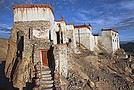
Tous les monastères sont maintenant accessibles en voiture, et les hébergements y sont devenus très rares parce que tous les visiteurs repartent avec leur taxi après la visite. Autrefois, les hommes dormaient dans les monastères de moines, et les femmes dans les nonneries. Aujourd'hui les quelques hébergements sont à l'écart du monastère et sont accessibles aux hommes et aux femmes.
La nonnerie de Chulichen, à côté de Ridzong, propose un hébergement confortable.
Celle de Wakha, près de Mulbek, fonctionne comme une guesthouse de 4 chambres.
Dans les gonpas de moines, c'est devenu plus rare :
à Takthok, les moines tiennent un tourist bugalow au bord de la route,
à Hemis, j'ai vu l'été dernier un panneau qui signalait une guesthouse dans le monastère mais je ne l'ai pas essayé,
à Thikse, l’hébergement est ouvert seulement pendant la fête, certainement parce qu'ils ont le grand hôtel-restaurant au bord de la route,
à Ridzong, les 4 chambres spartiates construites hors de l'enceinte du monastère ont été abîmées lors des pluies de 2010 et n'ont pas été arrangées, mais on peut y dormir en apportant son sac de couchage,
à Likir, je sais qu'il y a quelque chose dans le monastère.
C'est tout ce que je vois au Ladakh.
Hors sujet, mais je ne peux m'empêcher de le suggérer, c'est de quitter le Ladakh par la route de Manali.
(mais surtout pas avec un taxi collectif qui fait la route "en un jour", c'est à dire moins de 24h, non stop.)
En septembre, il y a toujours le bus d'Himachal Tourism qui fait la route jusqu'à Manali en deux jours avec une nuit à Keylong. Deux jours de traversée de l'Himalaya avec des paysages inoubliables.
Sinon, le bus Leh-Keylong, ne va pas plus loin que Keylong, où lon peut passer une journée avant de prendre l'un des deux bus qui font Keylong-Manali.
suis assez d'accord aussi sur route par manali au retour mais quid ensuite de manali dehli ? c'est facile en avion???
j'avais aussi repéré le festival mais sans avoir les dates: du coup ç'a peut être bien d'en voir un peu , mais cela veut il dire aussi du mal a se loger??
je vais regarder attentivement votre site
mais du coup j'ai une autre question : les trecks du ladakh sont bien différents de ceux du Zanskar????? (du point d evue des paysages et des caractéristiques techniques)
"c'est pas moi qui fais le voyage, c'est le voyage qui me fait "
b lavilliers
Bonjour Chrystine,
D'abord les réponses faciles :
Manali-Delhi se fait le plus surement en bus de nuit. Il y en a plus d'une douzaine chaque jour : départ vers 17h de Manali, arrivée vers 7h-8h à Delhi le lendemain matin. Réservation dans n'importe quelle agence de voyage à Manali. Les bus venant de Keylong arrivent en début d'après midi à Manali. Il faut immédiatement passer dans une agence pour repartir le soir même, mais Manali ressemble à une vallée des Alpes Suisses et l'on a envie d'y rester quelques heures de plus.
Il y a eu des avions entre Bhuntar près de Kulu, puis il n'y en a plus eu, maintenant je ne sais pas.
Pour le festival de Leh, il n'y a pas de problème pour se loger. Il est tard en saison et la majorité des touristes est déjà repartie.
Le Zanskar est moins peuplé et plus sauvage que le Ladakh-vallée-de-l'Indus.
Le principal trek du Zanskar est la traversée de Darcha à Lamayuru, dans un sens ou dans l'autre, qui peut se fractionner en deux treks : Padum-Lamayuru (avec un col presque chaque jour) et Padum-Darcha (un seul grand col mais plus de villages). Il faut avoir sa tente et son couchage, on trouve à se nourrir tous les jours.
Les autres treks sont des variantes plus "sportives" : Pas de ravitaillement en route, et très souvent des chaussures spéciales pour marcher dans l'eau. Les sentiers sont peu fréquentés et parfois intuitifs.
Le Ladakh offre plus de treks aux traces mieux marquées car plus fréquentées. Le tour du Sham et la Markha Valley peuvent se faire "les mains dans les poches", on peut être logé et nourri à chaque étape. Lamayuru-Chiling se fait avec une tente, ou sans tente mais avec quelques longues étapes.
Les paysages sont aussi beaux, on peut seulement voir plus de neige sur les sommets du Zanskar. La vallée de l'Indus est une vallée large surtout au niveau de Leh, mais les treks se déroulent dans des vallées parallèles dont le cadre n'a rien à envier au Zanskar.
c'est re_moi!!
comme je crois comprendre que dune manière générale les sentiers ne sont pas techniques (au moins au ladakh) est ce que des chaussures a tiges basses conviennent???
j'ai pris l'habitude de randonner (y compris trecks) avec des trails!!
merci
chrystine
"c'est pas moi qui fais le voyage, c'est le voyage qui me fait "
b lavilliers
En marchant sans gros sac à dos, sur les sentiers courus et parcourus, on peut facilement marcher avec avec des chaussures basses : par exemple sur le tour du Sham, ou Lamayuru-Chilling avec la descente du Konzke La où il faudra bien regarder où poser les pieds.
Avec un sac lourd, sur des variantes peu parcourues ou au passage de cols hauts (+ de 5000 m), il vaut mieux avoir des chaussures montantes pour mieux tenir les chevilles dans les pierres, et étanches pour traverser les endroits où l'eau affleure et crée un peu de gadoue.
Pour traverser les gués de la vallée de la Markha par exemple, chaussures hautes ou chaussures basses n'a pas d'importance : dans les deux cas il faut les quitter.
Il ne reste plus qu'à choisir son camp.
Jean-Louis.
Nous préparons un voyage au Ladakh en partant de Leh, avec un guide. Nous sommes à la phase 1 de la préparation. Connaissez vous la meilleurs période, quel…
J'aimerai beaucoup partir au Ladakh vers fin Juin pendant 2 semaines. Mais j'ai besoin de quelques conseils amis forumeurs J'ai 35 ans, en bonne condition…
J'envisage un voyage d'un mois au Ladakh et Zanskar peutetre???? Je préfère voir directement les agences sur place car j'ai éssayé d'en contacter des mais…
Je fais appel aux connaisseurs de la région pour me donner leur avis sur un itinéraire de trek qui m'est proposé par l'agence Ju-Leh Adventure (sept 2020)…
Hi,
We’re planning to do the 4-day trek from Mestia to Ushguli without an agency. The descriptions mention that there are accommodations at each stop, but we can’t find any details about them. Has anyone got info or feedback on this route?
I'm developing a free and open-source web app for planning walking and cycling trips (and even car trips). You can create a route by clicking directly on the map to add waypoints, and it can consist of multiple stages. The app provides tools to edit the stages and the overall route, and to display useful information (distances, altitudes, and elevation changes). A relief profile can be shown as a graph for a specific stage or the entire route.
Once the route is ready, it can be exported as a GPX file, which can then be used with a GPS or a mobile navigation app.
The app is built in JavaScript and runs entirely in the web browser. It uses the Leaflet library and several OpenStreetMap-based services. Initially developed for my personal needs (I enjoy hiking and cycle touring), I’d be happy to share it with anyone who might find it useful. It’s free to use, doesn’t require an account, and the source code is available.
New to this forum, I’m planning a pretty big project for 2028.
I’m heading to Nepal to do a trek from Kathmandu all the way to Everest Base Camp (a cool 5,300 m 😄).
This trek is a bit special because even though I’ll be part of a group, I’m going solo (so far, no problem—I’m used to it). But it’s my first real trek, and it’s also a humanitarian one: once I reach base camp, I’ll stay an extra week to help clean up the waste left by tens of thousands of climbers! Since I’m originally from South America, from two countries that share the Andes, I have a deep respect for mountains—they fascinate me. So Everest… it’s kind of the trip of a lifetime!
So, a little question for those who’ve done treks to Everest before… any tips for good mental preparation (I’m already working on the physical side)?
We're planning to trek in Peru and Bolivia and would love to find some local agencies.
If you know any, could you share details on prices and, of course, the names of the agencies?
Which trek would you recommend?
Elocine
I'm heading out on a fully self-sufficient trek in Morocco (10 days) from Imilchil to Aghbalou.
Can I find screw-on gas canisters (Coleman, Primus) in Marrakech (any addresses?) or in villages between Imilchil and Aghbalou?
If not, are Butagaz canisters for camping gas (small 230g size) available?
Thanks in advance for your tips!
Hello, I’d like to embark on a little trip in my home country, Switzerland. I’ll start walking from La Cure, heading toward Le Noirmont first, then I’ll improvise my route—but it’ll probably follow the French border... at least as far as Lac de Joux.
I’ll decide day by day how much farther to go after that. My goal is to stay in nature as much as possible, wander around for as long as I can, and restock food in villages or towns along the way.
I’m thinking of mostly camping, but we’ll see if I end up in a hotel or another campsite depending on my route.
I’d love to reach La Chaux-de-Fonds on foot... maybe even Delémont.
The whole thing should take about a week, give or take.
I’ll be bringing my dog, and I’m preparing for this as soon as I’m ready.
Any tips to make sure everything goes smoothly for us? Things I should know—or avoid? What about shepherds with their flocks of sheep? And isn’t hunting season open right now?
I’m not sure if what I’m planning is even doable, which is why I’m asking around.
This’ll be my first time doing something like this—wandering in nature *and* with a dog. I’m really excited for this adventure... and I need it. Thanks!
We’re really keen on ecosystems and want to hike in "natural" ancient forests—not planted woods or areas heavily degraded by human activity. Travel guides (like Lonely Planet) don’t provide much info on this. Could you point us to the most interesting spots?
Thanks in advance for your tips.
We wish you happy holidays and a fantastic 2026, full of discoveries!
Claire and Albert
Hi, this might not be the right section, but I’d like to know if it’s possible to start mountaineering with another person without necessarily hiring a guide. We’ve done quite a bit of hiking but not mountaineering—we’ll just do a half-day glacier course. After that, we were thinking of starting with La Grande Motte and the Pointe de la Traversière, which were recommended to us. Honestly, for things like roping up and knots, I’ll learn at home with lots of videos and a book.
I’d love to know if anyone has done treks in the Rwenzori Mountains and how much it costs on average, what the infrastructure is like, the landscapes, and safety in the area. Thanks so much! I’m really looking forward to your replies.
We’re leaving in 9 days for a two-week trip to Madeira, mainly to hike.
From my research, I’ve found that since last year, access to most trails—and systematically for the most popular ones—is now paid. You have to pay an access fee of 4.50 € per person per classified hike in 2026, and even 10.50 € for the most iconic hike: Pico Arieiro to Pico Ruivo. When paying, you also have to choose a day and a 30-minute time slot for your start time. Of course, this reservation is neither changeable nor refundable, even if the weather that day is terrible.
Personally, given the massive influx of tourists to the island in recent years, I don’t mind paying a fee to help maintain the trails. Similarly, setting a limit on the number of people who can hike them per day is certainly preferable to preserve this priceless heritage.
However, what’s much less fair is that in reality, most of the available spots are reserved: 1/ for Madeira residents (which is normal); 2/ for "economic operators" (meaning local tour operators). For example, if you’re a non-resident (independent tourist), no booking is possible for the Pico Arieiro hike for an early morning start before September! So, unfortunately, we’ll have to skip this hike.
It’s the same issue for Ponta de São Lourenço, the 25 Fontes, Pico Ruivo... in short, all the most popular hikes. Oh well, we’ll skip those too!
So my question is: which hikes do you recommend where we won’t face the huge crowds that the others get? And where we can book the day before for the next day, taking the weather into account?
Finally, a quick accommodation question: we’ve booked the first week in Funchal, but I haven’t decided yet for the second week. Do you have any advice on where to stay in the south or north, preferably avoiding overly concrete-heavy and touristy spots?
I’m reposting about the logistics for Samaria Gorge.
I’d love to get recent info, especially about whether it’s possible to park my car in Omalos, do the hike, and then catch a bus back to my vehicle.
In theory, it’s doable, but when you check the KTEL website, there aren’t any feasible schedules listed. If anyone has recently organized this with reliable, verified details, I’d really appreciate it. Thanks in advance!
Hi there,
We’re flying from Montreal to Lyon this August to go hiking in the French Alps. We’ve rented a car and will be staying at campgrounds. We’re planning to do day hikes and want to stay a few days in one spot, do a few hikes, then move on to our next camping spot. Could you share your favorite spots or any recommendations for places to spend a few days with great hikes?
A few details:
We arrive in early August and leave in early September.
We’re looking for day hikes (or shorter), moderate difficulty, with a cumulative elevation gain of no more than 1000m, and of course, beautiful scenery!
We’d prefer not to drive too much—maybe it’s best not to head too far south and deal with unnecessary heat?
Along the same lines, if you know of any great campgrounds where we can start our hike directly without needing the car, we’d love to hear your suggestions!
Hi there,
I’m planning to go hiking on this island and would like to know the best time to do it. I visited for a few days in November 2018—not for hiking but just to explore—and the weather wasn’t great, especially in the mountains. So, is a star-shaped itinerary doable if I rent a car and maybe use two different accommodations?
I’m not planning to join an organized group—just traveling with one other person and organizing things ourselves—unless you’d recommend a local agency or guide. Finally, even though I’ll be getting maps, a topo guide, and a GPS, I’d really appreciate your top hiking recommendations.
Thanks so much for your tips!
I’m planning to do the Mercantour crossing following the Randoxygène route in mid-July.
I’m used to hiking in the mountains, but I sometimes get vertigo, for example on ridges with drops on both sides. I wanted to check if there are any T4 or T3-T4 sections and find out if there are any very exposed passages—and if so, where—so I can plan an alternative route.
Can anyone give me some info on this?
Thanks!
I’m planning a trip around Cap Corse and the AGRIATES in 2026, from May 8th to 15th (there are still 2 spots left, by the way! Just DM me if you're interested).
I’d love to know which hikes are worth prioritizing in the AGRIATES. We’ll be staying in SALECCIA for two days as our base—what should we focus on from there?
A round trip to IGNHU beach? Any other suggestions?
For Ostricano, I think it’s too far for a round trip...
Thanks for your tips!
Have a great day,
Anie, Toulouse
I’d like to get some info about the GR10 Pyrenees traverse. I need help planning the daily stages and accommodations—my wife isn’t an experienced hiker but walks a lot, so I’d like to schedule shorter walking days and thus a longer overall trip in terms of number of days.
Could anyone give me some help and advice?
Best regards,
Hi there, I’m planning the Annapurna Circuit for March 2027 and I’m looking for a local agency with a local guide—preferably French-speaking—to arrange this trek for us. Any suggestions? Thanks
Hello!
We’re spending a few days in Toraja country at the end of May. We’d love to do a day trek—taking our time—on a route that’s stunning in terms of scenery, but not a level 5 in difficulty!
Any suggestions you can share, please?
Thanks in advance
I’d like to do the Mare a Mare Sud in May over 4 days. I’ve found quite a few places to stay along the route, but I’m stuck on the start and finish.
I’ll be arriving by plane on Sunday evening and would like to start pretty early on Monday morning. Ideally, accommodation right at the trailhead (Alzu di Gallina) would be amazing, but I can’t find anything. Any tips?
Also, for the transfer from Figari Airport to Porto Vecchio or Alzu di Gallina?
At the end, I’d like to pick up a rental car—any advice on that too?
I’m traveling solo by plane to Catania in May and plan to hike the northern side of Etna, starting from Linguaglossa where I’ll arrive by bus. After that, I’d love some info on how to get up to Piano Provenzana (shuttles or hitchhiking), since it seems there’s no public transport except in the summer. Can you sleep there in a free or cheap refuge, or camp? And how far up can you go without having to hire a guide? Thanks in advance. Bernard.
Hi everyone,
I’m heading to Morocco in August and we’ll start with a stop in Chefchaouen (we’re driving).
My question: can anyone suggest a 5-to-7-day loop hiking route from Chefchaouen in Talassemtane Park, ideally passing by the God’s Bridge? Or a paper guidebook that covers a few options?
We prefer wild camping and guesthouses.
Thanks in advance
Hi there, for those who’ve been recently—is it possible to find other solo travelers in March on the island to share transport or room costs? It doesn’t seem easy to travel on a budget.
If you have any recommendations for simple lodgings or places with dorms, I’d love to hear them.
For those who’ve done multi-day treks while moving around: do you need to bring your own sleeping bag? I’d love to hear about itineraries you’ve done without a guide, just with a map and GPS.
Thanks, and have a great day!
Hi everyone!
We’re planning a 15-day road trip to Scotland this summer, specifically to explore and hike on Lewis and Harris—places we’ve never been before. We’ve visited other islands on previous road trips in Scotland (we usually go in April for a week). This would be our first time in Scotland in the summer and for 15 days. We’re looking at late August to early September.
I’m currently drafting the itinerary. We’d be crossing from Ullapool and were thinking of spending 3 nights on Harris and 4 nights on Lewis.
Does that sound balanced to you? Is it better to keep the same accommodation on Harris and the same on Lewis to explore the area? I’d love to hear about any past experiences you’ve had on these islands.
Thanks!
Hi there, I’m trying to leave for 15 days very soon to São Vicente. I’m either looking to join an agency or figure things out on my own to go hiking on one of these islands or both. From what I’ve seen, it’s not easy to organize with local transport, so it gets expensive. Can I use the services of a small local agency? I’m looking for the simplest way to hike for several days. Also, how do you get from São Vicente to São Nicolau? Thanks in advance and have a great day!
Aichatou
I’ve been wanting to do this for several years, and this year’s the one. Next September, I’ll be trekking in Tusheti (Georgia), from Omalo to Shatili.
Of course, I won’t be renting a vehicle that’d just sit unused. No problem getting to Pshaveli, but from there to Omalo, it’s a dirt road (still the case?)
There must be some form of public transport since there are so many guesthouses, and not all travelers come in a 4x4.
If any of you have been to Omalo, could you confirm that these shared transports exist and how often they run?
we’re planning a trip to Yellowstone and hoping to do a three-day backcountry hike if we get a permit.
if any of you have done this before, could you let me know if it’s possible to find water along the way? And if we can transport it, are we allowed to use a stove?
Hello,
I’ll be in Nepal from March 6th to 29th (we’re flying into Kathmandu via Varanasi and leaving via Delhi).
I’m a bit confused about the regulations requiring a guide.
My wife and I (we’re 63 and 64) aren’t experienced trekkers—we’re more used to walking on terrain with very moderate elevation changes. I’m looking for fairly easy hikes, possibly day trips.
Here are my questions:
- Does the Poon Hill trek from Pokhara require a guide, or is it better to go through a local agency? (I’ve seen a lot of them offering 4-day packages)
- I’d like to do a few multi-day hikes around Jomsom (Kagbeni, Mukitinath, Lupra, Marpha)... Do you need a guide for those, and can you find accommodations easily without booking in advance?
Last question—I’m really hesitant to lug around a sleeping bag or down jacket during our 6 weeks in India. Can you easily find these kinds of items at reasonable prices in Pokhara?
Thanks in advance for any tips you can share!
Yann