bonjour, avec ma copine nous avons prévu d'aller au népal puis rejoindre la birmanie par la partie nord est de l'inde.
Nous avons 2 mois et demi pour faire ça, janvier, février et mars.
Il est très difficile de trouver des infos sur cette partie car apparement pas très touristique ce que j'adore. Mes questions seraient surtout sur l'inde du nord est.
Il y a t il besoin de permis que ce soit pour le nagaland, mizoram, nagaland, Tripura ou manipur??
N'est il pas trop compliquer de faire de la route là-bas sans guide, trouver des bus ou autre transport, faire du stop éventuellement??
Est il possible d'aller se ballader librement dans les villages environnant sans embéter les gens??
Ou sont les endroits que vous nous conseilleriez d'aller sur cette itineraire??
Ma copine et moi tenont un restaurant végétarien et nous aimerions aller à la rencontre des gens pour cuisiner les spécialités locales avec les gens.
Après si vous avez des endroit à nous conseillé que se soit au Népal ou dans la partie de l'Inde qu'on doit visité ou la Birmanie nous sommes prenneurs.
Robin et Sabrina
Namaste everyone,
We went to Nepal last October and literally fell in love with this country (like so many others, it seems). During our trek, we had the chance to meet and travel with an incredible independent local guide, Apsara Luitel. She told us about a unique project she’s organizing starting mid-May, and we wanted to share it in case it interests anyone. We mentioned it on another travel forum, but just in case, we’re posting it here too to reach as many people as possible.
Apsara, who knows the Api mountain valley (a name as joyful as it is intriguing!) in Nepal’s Far West (on the border between India and Tibet, at the edge of the world) perfectly, is offering an off-the-beaten-path trek for a group of 3 to 8 people max. The program? An authentic and preserved itinerary combining homestays and small mountain lodges, all the way to the Api base camp. Once at base camp, locals will guide us to secret spots only they know, where we’ll harvest yarsagumba (those famous caterpillar-fungi, rare and prized for their medicinal properties in traditional Chinese medicine—they were going for $20,000 per kilo last year!).
Mid-May is the ideal time to discover this almost unexplored region and take part in harvesting these natural treasures. This kind of adventure, led by an inspiring young woman like Apsara, is rare, and we think it could appeal to Nepal lovers and those who enjoy authentic treks far from the usual tourist routes.
No matter how many participants there are (between 3 and 8), there will always be two guides: Apsara, who speaks English (and is learning French!), and a French-speaking guide. The dates are flexible around May 15th, depending on the availability of those who’d like to take on the adventure.
We went to Nepal last October and literally fell in love with this country (like so many others, it seems). During our trek, we had the chance to meet and travel with an incredible independent local guide, Apsara Luitel. She told us about a unique project she’s organizing starting mid-May, and we wanted to share it in case it interests anyone. We mentioned it on another travel forum, but just in case, we’re posting it here too to reach as many people as possible.
Apsara, who knows the Api mountain valley (a name as joyful as it is intriguing!) in Nepal’s Far West (on the border between India and Tibet, at the edge of the world) perfectly, is offering an off-the-beaten-path trek for a group of 3 to 8 people max. The program? An authentic and preserved itinerary combining homestays and small mountain lodges, all the way to the Api base camp. Once at base camp, locals will guide us to secret spots only they know, where we’ll harvest yarsagumba (those famous caterpillar-fungi, rare and prized for their medicinal properties in traditional Chinese medicine—they were going for $20,000 per kilo last year!).
Mid-May is the ideal time to discover this almost unexplored region and take part in harvesting these natural treasures. This kind of adventure, led by an inspiring young woman like Apsara, is rare, and we think it could appeal to Nepal lovers and those who enjoy authentic treks far from the usual tourist routes.
No matter how many participants there are (between 3 and 8), there will always be two guides: Apsara, who speaks English (and is learning French!), and a French-speaking guide. The dates are flexible around May 15th, depending on the availability of those who’d like to take on the adventure.
Namasté,
Bien sûr il a des milliers de morts dans le monde liés au COVD 19, bien sûr il y a bien plus de désastres dans les familles touchées par l’infection, mais je voulais juste avoir une pensée pour les Népalais qui subissent la double peine de cette pandémie.
J’ai des relations avec un responsable d’agence de treks à KTM, avec deux accompagnateurs de moyenne ( ?!) montagne et un guide de haute montagne. Pour eux l’avenir est très sombre et leur situation à court terme par le manque de touristes étrangers est quasi dramatique, mais je pense aussi à toutes ces personnes qui en vivent : porteurs, guesthouses, commerces etc etc..
Fait chier !
A++ Le Belu
Bien sûr il a des milliers de morts dans le monde liés au COVD 19, bien sûr il y a bien plus de désastres dans les familles touchées par l’infection, mais je voulais juste avoir une pensée pour les Népalais qui subissent la double peine de cette pandémie.
J’ai des relations avec un responsable d’agence de treks à KTM, avec deux accompagnateurs de moyenne ( ?!) montagne et un guide de haute montagne. Pour eux l’avenir est très sombre et leur situation à court terme par le manque de touristes étrangers est quasi dramatique, mais je pense aussi à toutes ces personnes qui en vivent : porteurs, guesthouses, commerces etc etc..
Fait chier !
A++ Le Belu
Bonjour, je viens visiter le nepal avec ma fille de 18 ans.
Ni elle ni moi ne sommes partant pour des treks de plusieurs jours (ballade à la journée autour des villes visitée)
Nous venons 19 jours mais avec l'envie de profiter de shiva ratri au milieu du sejour que nous pensons passer à Kathmandou. ce qui complique pour faire un grand tour.
Je pensais donc passer les Premiers jours à et autour de kathmandou puis partir un peu plus loin.
que faire donc autour de kathmandou?
Pour un tour de 8 jours? le classique Bandipur - pokhara - lumbini - chitwan ?? ce n'est pas beaucoup de route en si peu de temps?
merci de vos conseils
Ni elle ni moi ne sommes partant pour des treks de plusieurs jours (ballade à la journée autour des villes visitée)
Nous venons 19 jours mais avec l'envie de profiter de shiva ratri au milieu du sejour que nous pensons passer à Kathmandou. ce qui complique pour faire un grand tour.
Je pensais donc passer les Premiers jours à et autour de kathmandou puis partir un peu plus loin.
que faire donc autour de kathmandou?
Pour un tour de 8 jours? le classique Bandipur - pokhara - lumbini - chitwan ?? ce n'est pas beaucoup de route en si peu de temps?
merci de vos conseils
My partner and I are planning a 2-week trip to Goa from late September to early October. It’s sandwiched between a trip to Nepal (September) and our return home to Thailand. We can’t stay longer, but cutting it shorter wouldn’t be worth the effort or flight costs.
I’ve visited several regions of India in the past (between 2000 and 2020) and spent a total of about 4 months there. My only time in Goa was a few days in Palolem in 2007—I didn’t like it. I found the place almost sordid with all the crowds... not at all the India I love.
But I have an Indian friend with 2 or 3 apartments in a residence in North Goa who keeps telling me to visit. I’m tempted. But where should we go? I don’t want to rent from him because it’s expensive (high-end) and I don’t want to feel too dependent on him either.
After 2 days in Panaji (since it’s near GOI), I’ve booked 5 days in Mandrem, which I’ve heard great things about. This’ll let us explore the Arambol area. I’m hesitant to stay there longer—if we don’t like it or get bored after a few days, spending the full 2 weeks there isn’t ideal! I’m thinking of trying South Goa instead, somewhere between Benaulim and Agonda. The downside? All the rumors about the vibe in different spots—loud techno here, jet skis there, "paunchy English tourists" elsewhere, package tours everywhere... not to mention the expected influx of Russians and/or Israelis (I’ve seen this in other parts of India, Thailand, and Vietnam). Plus, accommodation options are way more limited in the south.
Basically, I’m leaning toward Agonda—relaxed but not too quiet or isolated. But there’s so little availability on sites like Booking and Agoda...
Any recent tips or advice from folks who’ve been to Goa lately? I’d really appreciate it, thanks in advance!
I’ve visited several regions of India in the past (between 2000 and 2020) and spent a total of about 4 months there. My only time in Goa was a few days in Palolem in 2007—I didn’t like it. I found the place almost sordid with all the crowds... not at all the India I love.
But I have an Indian friend with 2 or 3 apartments in a residence in North Goa who keeps telling me to visit. I’m tempted. But where should we go? I don’t want to rent from him because it’s expensive (high-end) and I don’t want to feel too dependent on him either.
After 2 days in Panaji (since it’s near GOI), I’ve booked 5 days in Mandrem, which I’ve heard great things about. This’ll let us explore the Arambol area. I’m hesitant to stay there longer—if we don’t like it or get bored after a few days, spending the full 2 weeks there isn’t ideal! I’m thinking of trying South Goa instead, somewhere between Benaulim and Agonda. The downside? All the rumors about the vibe in different spots—loud techno here, jet skis there, "paunchy English tourists" elsewhere, package tours everywhere... not to mention the expected influx of Russians and/or Israelis (I’ve seen this in other parts of India, Thailand, and Vietnam). Plus, accommodation options are way more limited in the south.
Basically, I’m leaning toward Agonda—relaxed but not too quiet or isolated. But there’s so little availability on sites like Booking and Agoda...
Any recent tips or advice from folks who’ve been to Goa lately? I’d really appreciate it, thanks in advance!
I'm planning a return trip to India next year, and this time I want to check out what's nice on the way up to Manali. Since the bus rides are really long coming from the plains (Chandigarh or even Delhi), I'm looking for a place to stop along the way (my partner and I). I’ve spotted Kullu, about an hour from Manali, but no matter how much I study the map, I can’t tell if there’s an actual town there. We really don’t want to end up in some isolated hotel that’s only convenient for people traveling with their own transport—definitely not our style. We prefer to drop our bags in a room, freshen up a bit, then wander around streets or alleys with at least a little life.
So, I’m wondering if we’d be better off just skipping Kullu altogether.
What do you think, folks who’ve been there before?
So, I’m wondering if we’d be better off just skipping Kullu altogether.
What do you think, folks who’ve been there before?
NAMASTE NEPAL! PRACTICAL INFO AND EXPERIENCE FEEDBACK
Stay from March 25 to April 16, 2025
· Flight tickets Air India (via Delhi) (via Skyscanner) = 1130 € per person · Planned budget (and respected without too many restrictions and while buying a few small gifts) = 2000 € for the stay for two. Buses, taxis, and entrance fees to various sites represent a budget to consider. Meals are cheap. Drinks like beer/Coke, however, are not cheap and cost the equivalent of a meal. · Exchange rate of the rupee during our stay = 0.0064 € (the exchange rate is almost identical everywhere, including at the airport). · At the airport, purchase of two SIM cards (phone) = 1000 NPR x 2 for 28 days. · Kathmandu: we had booked the hotel upon arrival: Kathmandu Boutique Hotel (+977 015 357 446 – email: booking@kathmanduboutiquehotel.com), very well located in a quiet alley off the street, south of Thamel, a 10-minute walk from Durbar Square. A hotel like Nepal knows how to do, where tall people will have to duck. Night + breakfast = 18 € for two. Very warm welcome, great location, excellent value for money. · Bhaktapur: we had also booked a hotel for the end of our stay because the chance of the year 2025 made the Nepali New Year and Bisket Jatra particularly festive in Bhaktapur: Manju Baha Hotel School (+977 976 7234014 – email: manjubahahotel@gmail.com) located in an old monastery. "A social enterprise transforming an old monastery into a charming hotel, offering professional hospitality training to underprivileged Nepali youth." Night + breakfast = 32 € for two. Beautifully decorated room. Very warm welcome. Don’t miss the Changunarayan site (near Bhaktapur), it’s amazing. And if you’re lucky enough to be in Bhaktapur in mid-April for 3 days, there’s the Bisket Jatra festivities (Newari festival), joyful, noisy, fun, and wild… · Pokhara (hotel recommended by the Kathmandu hotel): Hotel Green Tara, Lakeside, 10th street, set back, quiet (Tel. +977 61 462698 – email: greentara_67@hotmail.com) · Trek permit (Lower Mustang, no need for an agency or guide, permits checked at Ghasa and Jomsom) = 2000 NPR per person (2 ID photos) · Bus Kathmandu/Pokhara and return = 2000 NPR per person · Bus Pokhara/Jomsom, 2 one-way tickets = 2800 NPR. · Taxi: negotiation with a driver we recommend, Vicky (+977 984 075 599). You explain what you want, negotiate the price, and he waits for you during the visit. Very charming, we used him several times. For example: departure from our hotel at 10 AM -> Boudhanath/Pashupatinath/Patan return at 5 PM to the hotel = 6500 NPR – Swayambhunath (round trip) = 1200 NPR · Site prices: https://ntb.gov.np/plan-your-trip/before-you-come/heritage-site-entry-fees o Visitor Pass for Kathmandu Durbar Square (for the duration of the stay, show your visa) = 1000 NPR per person (1 ID photo) o Bhaktapur Durbar Square (old town) = 1800 NPR per person o Patan = 1000 NPR per person o Swayambhu Stupa = 200 NPR per person o Boudha Stupa = 200 NPR per person o Pashupatinath Temple = 1000 NPR per person (interesting to take a guide) o Changunarayan Temple (6 km north of Bhaktapur) = 400 NPR per person o Mountain Museum in Pokhara = 750 NPR per person · E-cigarettes: e-cigarettes are banned in India and confiscated whether they’re in carry-on or checked luggage. On the way there, we had kept them in our carry-on, they were confiscated in Delhi. On the way back, learning from our previous experience, we put them in our checked luggage. Someone came to get us to take them out of our bags and confiscate them… You can find e-cigarettes and products in Kathmandu.
* * *
I’m 74 years old. I went to Nepal in 1982, 1983, and the last time in 1986. I wanted to introduce this beautiful and endearing country to my husband, and it was… now or never. So we decided it was now.
I knew the trek starting from Pokhara: Naudanda/Birethanti/Ghorepani/Tatopani/Kalopani. There was no way I was going to do that trek, especially the 1000-meter staircase to reach Ghorepani… You have to stay humble with age.
Back then, the road didn’t exist. I didn’t consider, with the construction of this road (NH48) along the western bank of the Kali Gandaki, doing a trek along a windy and dusty road. Was there an alternative hiking trail on the eastern bank? No one answered my question on VoyageForum, so I did my research online. And I found this site: "Andrées de Ruiter and Prem Rai - Trekking the Annapurna Circuit, including the new NATT trails that avoid the road - A guide to one of the most beautiful trekking regions in Nepal and the world (2011) - NATT = New Annapurna Trekking Trail".
Phew! A solution was emerging. This circuit from 2011 wasn’t fully marked. The idea was to go from Jomsom to Tatopani, so we needed to make sure the path was well-marked all the way, which we did, and the path exists, marked in red and white!
So, with the walking times information, we built our 8-day circuit:
· Jomsom/Thinigaon · Thinigaon/Chimang · Chimang/Saura · Saura/Kokhetanti · Rest day or, if in good shape: loop to Sekong Lake · Kokhetanti/Jhipra Deurali · Jhipra Deurali/Kopchepani · Kopchepani/Tatopani
It’s a senior trek, after all. So the walking times noted on the sites indicated 3 hours or even 4 hours for the two longest stages. That pace suited us fine.
On March 29, we left Kathmandu (1400m), after visiting the must-see sites, by bus to Pokhara: 200 km and 8.5 hours on a chaotic road under construction. I had a memory of Pokhara where it was the first city where you could see the Himalayan range, especially Machhapuchhare. But the pollution is such, the dust raised by traffic and construction, that no horizon is visible except the first hills around Pokhara.
We stayed 24 hours in Pokhara (820m), and on March 31, we left our luggage at the hotel and set off with our lightest backpacks: change of clothes, toiletries, first aid kit, anti-chafing cream, water bottle, sleeping bag liner, and light shoes for the stages.
We took the bus to Jomsom: 160 km/7.5 hours including stops for bathroom breaks, tea, and lunch. The road is nothing but a chaos of potholes, landslides, construction, dust, rebuilding, and mudslides. In Ghasa, the bus stops, and we’re told we’re at a checkpoint and that the two foreigners in the bus, my husband and I, need to have our permits checked, which takes a few minutes. The driving is rock-and-roll, surprising, and courteous. The drivers have their codes, and on these improbable roads, they’re virtuosos.
We could have chosen the plane, but several reasons dissuaded us: if there’s too much wind, the planes don’t take off; personally, I wasn’t reassured about landing in Jomsom, and this transport has a cost.
We arrived around 2 PM in Jomsom (2720m), and despite the early wake-up, the nearly 8 hours on the bus, and the altitude, we decided to head straight to Thinigaon (2840m). At the Jomsom checkpoint, they told us it was a 30-minute walk. Great! Except we took an hour and a half on an uphill road, bent over to fight a strong wind. But the Himalayan range is there! The Dhaulagiri, the Nilgiri, the Annapurnas as a reward.
In Thinigaon, we found a room at the "Nilgiri View Hotel" run by a didi (big sister in Nepali). From the lodge’s roof, she proudly showed us the different peaks surrounding the village and told us, worried, that it hadn’t snowed here for 3 years. She said there are very few tourists, that the season is rather in September/October/November. It seems there’s not a soul in this village, yet mules pass through the narrow street paved with large flat stones, their bells ringing. We dine at 6 PM and go to bed… Room = 1200 NPR and dinner, breakfast, and drinks = 2560 NPR.
On April 1, we set off at 9 AM, not for Chimang as planned but for Marpha! The didi from the Thinigaon lodge had said it was a 3-hour walk. The first part of this stage is attractive, the mountains are magnificent and imposing, the landscape is superb, there’s no one around, a feeling of being "alone in the world." We follow Dhumbra Tal, this small green lake. The path is a rocky track that climbs steeply. Then, around a hill, we start the big descent that joins the Kali Gandaki. We face the wind head-on, and the violent gusts take our breath away, throw us off balance, and envelop us in dust. We see the road on the other side of the Kali Gandaki. We arrive in the village of Chhairo at 2 PM, completely exhausted and with blistered feet, after 5 hours of walking instead of the planned 3.5 hours.
We’re welcomed by the village nurse, who tells us there’s a lodge in the village. Chhairo is a Tibetan village, a 20-minute walk from Marpha (according to the locals, multiply by 2 or even 3 for us…). We’re going to revise our trek plan and, first of all, spend the night in Chhairo.
The lodge is quite pleasant, and Karma, the hostess, is very friendly. She asks about our plans and suggests we stay in Chhairo the next day, from where we can visit Marpha and also Chimang, a 1-hour walk away, in light mode, meaning without backpacks. She invites us to participate in a village ceremony the next evening.
We immediately accept the proposal, as our feet need rest and the welcome is so warm… Dinner and bed!
We reworked our trek plan, which was too ambitious for our untrained bodies and, let’s face it… no longer in our first youth. In the initial plan, we thought there wouldn’t be too much elevation gain following the Kali Gandaki, but checking the map, we realize there might be significant elevation changes between Sauru and Sirkung. So we plan:
· Tomorrow: visit Marpha (2670m) and Chimang (2744m) · April 3: bus from Chhairo (2700m) to Kalopani (2530m) and continue on foot to Ghasa (2010m) · April 4: Ghasa/Pairataplo (1940m) · April 5: Pairatapla/Gadpar (1580m) · April 6: Gadpar/Narchyang (1510m) · April 7: Narchyang/Tatopani (1190m) · April 8: return to Pokhara.
Normally, it’s all downhill…
April 2, a rest day then… We set off in the morning to explore Marpha. We have to take a temporary bridge because the suspension bridge is closed due to road construction. We join the road and arrive in Marpha, a village famous for its apple orchards, brandy, cider, and apple juice production. This village is magnificent with its stone houses and monastery clinging to the hillside. The road construction spared it. There are people, but very few Western tourists.
We have lunch in Marpha and go back through Chhairo to take the path to Chimang. We cross a fragrant pine forest and find the rocky path; the landscape is splendid. We walk quietly, passing peaceful buffaloes and cows, and arrive at the foot of a stone staircase… 275 steps (which we counted on the way back) leading us to the village of Chimang. Chimang is an isolated Newari village that seems a bit desolate. Despite the slopes, there are crops on every little bit of land. Thankfully, we changed our initial program because there’s no lodge in this village, contrary to what we saw on a map… We wander through the village, which seems very deserted, have coffee in a house from another world, and then head back to Chhairo.
A rest day? = 5 hours of walking!!
Dinner and village ceremony. From what we understand, this ceremony is in honor of the Dalai Lama. Men, women, and children in traditional costumes gather twice a month; they dance, make, and offer small sweet cakes with Tibetan tea (made from tea, yak butter—often rancid—water, and salt). Surprising for first-timers…
Around 10 PM, we leave the ceremony; tomorrow morning, we need to be on the roadside by 7 AM to catch the bus to Kalopani…
This village of Chhairo is very pleasant and welcoming, no tourists, just two motorcyclists who arrived in the evening, one of whom participated in the ceremony and discreetly poured his Tibetan tea outside.
Lodge: "Norsang Tibetan Guesthouse and Restaurant". Total bill for 2 nights, 2 dinners, 2 breakfasts, and drinks = 8000 NPR.
April 3: bus from Chhairo to Kalopani, about 1.5 hours for the 20 km (200 NPR per person). We descend on the right bank of the Kali Gandaki. We find the red and white markings to resume the trek toward Ghasa. We’re in a fragrant pine forest, the Dhaulagiri on one side and the Annapurnas on the other, magnificent, and the path is pleasant and easy. We get a bit lost in this forest, always looking for the markings. Near Lete, two trekkers pass us, and we meet them again a little further on with two very young children, to whom we give the 2 hard-boiled eggs I didn’t eat this morning. They accepted them without hesitation.
We arrive in a village and ask for directions to Ghasa. The young girls point the way. But we come across a forest being logged, trees cut in all directions. We turn back and ask for confirmation. They confirm… But the two young girls catch up with us and clear the way. We have to step over, go around, and cross the felled trees, with no indication at all. Through this pick-up sticks of felled trees, the girls lead us to the top of a stone staircase, indicating that was the path. It’s the only place where we saw rhododendrons in bloom.
We descend the staircase. At the bottom, to the left, there’s a bridge to go toward Choyo, and to the right, a path to Ghasa. We take the right path and join the road. We should normally find the red and white markings, but we don’t… So we continue on the western bank road of the Kali Gandaki.
A little before the village of Misi, we see fumaroles on the opposite bank that seem to come from the ground. We don’t understand. We stopped to eat in the village of Misi (noodle soup = 600 NPR), but it’s hard to communicate with the elderly people running the guesthouse.
We continued on the road, not finding the marked path parallel to the road. Landslides, both on the left and right banks, seem to have taken over the marked routes. It’s a place where the Kali Gandaki gorge narrows, and on the opposite bank, the mountain smokes more and more, and we now hear the crackling of fire. Across from us, the mountain is burning… Our initial plan had us passing on that burning bank right now…
We arrive in Ghasa at 3:30 PM, a 6.5-hour stage but with a 1-hour stop at noon. We’re at the "Florida Guesthouse and Restaurant." From our room, we see the mountain smoking on the other side of the river, and at night, we see the flames. In this village, posters show Himalayan eagles and vultures that seem to be protected species. Indeed, we saw (and heard) 3 eagles circling today.
April 4 – Today, heading to Pairothapla or Kopchepani depending on our feet, accommodation options, and simply our desires.
No more smoke on the mountain this morning. It’s chilly, 7:45 AM, the sky is clear, just a smell of smoke outside.
Price of the lodge = 1000 NPR for the night + 3580 NPR for meals.
We cross Ghasa, which stretches over more than a kilometer. We have a drink at the last guesthouse in the village, and the didi, when she learns our destination, tells us to be careful because the villages we’re going to aren’t safe. Should we distribute our rupees in different pockets? Nah, we kept going.
At the exit of Ghasa, we find the red and white markings and take the suspension bridge to cross the boiling waters of the Kali Gandaki. The passage is impressive because the river is tumultuous. Lots of climbs and even more descents. We’re back on the eastern bank. It’s hot! On the narrow path, we meet a group of buffaloes. Who has the right of way? We decide to stick as close as possible to the rock wall and move forward calmly. The buffaloes look at us, chewing placidly, with no intention of jumping on us. Phew!
After a 5-hour stage (including stops), we arrive in Pairothapla, with hot feet and firm thighs, and decide we won’t go any further. It’s a good thing because there’s a lodge, the most basic so far, but with a great welcome. We have a meal and a short nap. The buffaloes we met on the way belong to this house. They come to drink at the fountain by the path.
Our host, very pleasant, doesn’t know what to do to please us and is very attentive. He wants to chat. He has two children, a 4-year-old girl and a 7-year-old boy. Where do they go to school? Do they go? He tells us that the fires in the mountain are caused by people, but for what reason? We won’t find out, but it’s illegal. From here, we can still see smoke rising in the distance. The wife is a bit less friendly. Corn kernels dry on a woven straw mat on the ground, and the mom sorts them.
From where we are, we overlook the valley and see the road under construction winding along the mountainside on the other bank.
Dinner on the terrace of the house overlooking the path, windbreaker and fleece on: dal bhat chicken for me and chicken curry for my husband: "organic" products, at least local production. There are small vegetable gardens everywhere with all sorts of vegetables.
April 5 – While we’re having breakfast on the terrace of our lodge, 5 porters, straps on their foreheads, heavily loaded, pass by on the path. A few minutes later, a group of 9 people appears. It must be said that since the beginning of our journey, we’ve met very few hikers. Two backpackers in Chhairo, the two hikers near Lete, two female hikers passed us before Pairothapla, a solo female hiker passed us…
The lodge in Pairothapla is called "Bimala Lodge & Thakali Kitchen" – Price for night + 4 meals + 2 breakfasts = 3000 NPR.
The descent toward the Kali Gandaki involves climbs whose steps we didn’t count. Clearly, the landslides on the mountain cause changes to the official ACAP trek marked in red and white, and the marking updates can’t keep up with the pace of these landslides. It’s almost always by chance that we find the markings. Fortunately, we can follow the power line that guides us somewhat.
Drink stop in Kopchepani, the legs are fine, but the feet don’t like being tightly enclosed. A group of trekkers with porters passes on the path. We met buffaloes that we kindly let pass; the path was wide enough, but it was a staircase going up, and we didn’t want to take any risks.
Across, a view of the magnificent Rupse Waterfall on the other bank of the Kali Gandaki, at the bottom, lots of vehicles and people.
Arrival in Gadpar after crossing a rather unwelcoming small village and cultivated gardens between dry stone walls, each better built than the last.
First lodge spotted, first lodge adopted to answer the call of our feet, and a very warm welcome from the owner. Since we hadn’t eaten at noon, we had Tibetan bread/jam. 6-hour stage including 1 hour of stops. Night + dinner + breakfast + drinks = 5060 NPR
April 6 – Today, heading to Narchyang.
For several days, we’ve seen banana trees with their bunches of fruit and even a prickly pear with large fruits ripening.
This stage is quite peaceful and pleasant. We take a suspension bridge to cross a tributary of the Kali Gandaki. While we’re resting for a moment before crossing the bridge, a couple of porters, a man and a woman, arrive and start across the bridge with their wood load in a basket held by a strap on their forehead, making them bend. We set off too… lighter than them.
On the other side of the bridge… a stone staircase, and it climbs steeply. The porter couple didn’t take this staircase; they went right on the path.
At the top of the staircase, we arrive in Narchyang after a 4-hour stage. A magnificent waterfall overlooks the village. We get lost in this fairly large village looking for a lodge. After wandering around for a while, we ask for directions, and an 84-year-old man takes us through the whole village and accompanies us to a very nice lodge run by a woman.
We chat with our hostess, who asks where we’re from and where we’re going. We explain that we want to reach Tatopani the next day and then return to Pokhara. She tells us there are 4x4s going directly to Pokhara and that it would probably be easier than taking a bus that might be full in Tatopani. After a quick consultation, we decide to return to Pokhara the next day by 4x4. She finds us a 4x4 with 2 seats left, departure at 8 AM – 5 hours on the road and 1500 NPR per person. A charming didi who does everything to be pleasant and helpful.
Narchyang community lodge = night + snacks + dinner + breakfast = 3000 NPR.
There you go, our trek ends tomorrow. Many necessary changes and adaptations to our initial trek, but no regrets, it was superb and a great experience that, for my part, I won’t be able to repeat. Always this encounter with the endearing, welcoming, curious, and very kind Nepali people. It was now or never, and we did it!
* * *
In conclusion, 3 full weeks in Nepal is a duration that allows visiting Kathmandu, Patan, and Bhaktapur, enjoying the various sites, and soaking in the atmosphere and urban Nepali life.
The trek, even revised and corrected, allowed us to get close to the impressive Annapurna and Dhaulagiri peaks. One or two acclimatization days might be necessary to get the body in tune with this magical and extraordinary land.
Stay from March 25 to April 16, 2025
· Flight tickets Air India (via Delhi) (via Skyscanner) = 1130 € per person · Planned budget (and respected without too many restrictions and while buying a few small gifts) = 2000 € for the stay for two. Buses, taxis, and entrance fees to various sites represent a budget to consider. Meals are cheap. Drinks like beer/Coke, however, are not cheap and cost the equivalent of a meal. · Exchange rate of the rupee during our stay = 0.0064 € (the exchange rate is almost identical everywhere, including at the airport). · At the airport, purchase of two SIM cards (phone) = 1000 NPR x 2 for 28 days. · Kathmandu: we had booked the hotel upon arrival: Kathmandu Boutique Hotel (+977 015 357 446 – email: booking@kathmanduboutiquehotel.com), very well located in a quiet alley off the street, south of Thamel, a 10-minute walk from Durbar Square. A hotel like Nepal knows how to do, where tall people will have to duck. Night + breakfast = 18 € for two. Very warm welcome, great location, excellent value for money. · Bhaktapur: we had also booked a hotel for the end of our stay because the chance of the year 2025 made the Nepali New Year and Bisket Jatra particularly festive in Bhaktapur: Manju Baha Hotel School (+977 976 7234014 – email: manjubahahotel@gmail.com) located in an old monastery. "A social enterprise transforming an old monastery into a charming hotel, offering professional hospitality training to underprivileged Nepali youth." Night + breakfast = 32 € for two. Beautifully decorated room. Very warm welcome. Don’t miss the Changunarayan site (near Bhaktapur), it’s amazing. And if you’re lucky enough to be in Bhaktapur in mid-April for 3 days, there’s the Bisket Jatra festivities (Newari festival), joyful, noisy, fun, and wild… · Pokhara (hotel recommended by the Kathmandu hotel): Hotel Green Tara, Lakeside, 10th street, set back, quiet (Tel. +977 61 462698 – email: greentara_67@hotmail.com) · Trek permit (Lower Mustang, no need for an agency or guide, permits checked at Ghasa and Jomsom) = 2000 NPR per person (2 ID photos) · Bus Kathmandu/Pokhara and return = 2000 NPR per person · Bus Pokhara/Jomsom, 2 one-way tickets = 2800 NPR. · Taxi: negotiation with a driver we recommend, Vicky (+977 984 075 599). You explain what you want, negotiate the price, and he waits for you during the visit. Very charming, we used him several times. For example: departure from our hotel at 10 AM -> Boudhanath/Pashupatinath/Patan return at 5 PM to the hotel = 6500 NPR – Swayambhunath (round trip) = 1200 NPR · Site prices: https://ntb.gov.np/plan-your-trip/before-you-come/heritage-site-entry-fees o Visitor Pass for Kathmandu Durbar Square (for the duration of the stay, show your visa) = 1000 NPR per person (1 ID photo) o Bhaktapur Durbar Square (old town) = 1800 NPR per person o Patan = 1000 NPR per person o Swayambhu Stupa = 200 NPR per person o Boudha Stupa = 200 NPR per person o Pashupatinath Temple = 1000 NPR per person (interesting to take a guide) o Changunarayan Temple (6 km north of Bhaktapur) = 400 NPR per person o Mountain Museum in Pokhara = 750 NPR per person · E-cigarettes: e-cigarettes are banned in India and confiscated whether they’re in carry-on or checked luggage. On the way there, we had kept them in our carry-on, they were confiscated in Delhi. On the way back, learning from our previous experience, we put them in our checked luggage. Someone came to get us to take them out of our bags and confiscate them… You can find e-cigarettes and products in Kathmandu.
* * *
I’m 74 years old. I went to Nepal in 1982, 1983, and the last time in 1986. I wanted to introduce this beautiful and endearing country to my husband, and it was… now or never. So we decided it was now.
I knew the trek starting from Pokhara: Naudanda/Birethanti/Ghorepani/Tatopani/Kalopani. There was no way I was going to do that trek, especially the 1000-meter staircase to reach Ghorepani… You have to stay humble with age.
Back then, the road didn’t exist. I didn’t consider, with the construction of this road (NH48) along the western bank of the Kali Gandaki, doing a trek along a windy and dusty road. Was there an alternative hiking trail on the eastern bank? No one answered my question on VoyageForum, so I did my research online. And I found this site: "Andrées de Ruiter and Prem Rai - Trekking the Annapurna Circuit, including the new NATT trails that avoid the road - A guide to one of the most beautiful trekking regions in Nepal and the world (2011) - NATT = New Annapurna Trekking Trail".
Phew! A solution was emerging. This circuit from 2011 wasn’t fully marked. The idea was to go from Jomsom to Tatopani, so we needed to make sure the path was well-marked all the way, which we did, and the path exists, marked in red and white!
So, with the walking times information, we built our 8-day circuit:
· Jomsom/Thinigaon · Thinigaon/Chimang · Chimang/Saura · Saura/Kokhetanti · Rest day or, if in good shape: loop to Sekong Lake · Kokhetanti/Jhipra Deurali · Jhipra Deurali/Kopchepani · Kopchepani/Tatopani
It’s a senior trek, after all. So the walking times noted on the sites indicated 3 hours or even 4 hours for the two longest stages. That pace suited us fine.
On March 29, we left Kathmandu (1400m), after visiting the must-see sites, by bus to Pokhara: 200 km and 8.5 hours on a chaotic road under construction. I had a memory of Pokhara where it was the first city where you could see the Himalayan range, especially Machhapuchhare. But the pollution is such, the dust raised by traffic and construction, that no horizon is visible except the first hills around Pokhara.
We stayed 24 hours in Pokhara (820m), and on March 31, we left our luggage at the hotel and set off with our lightest backpacks: change of clothes, toiletries, first aid kit, anti-chafing cream, water bottle, sleeping bag liner, and light shoes for the stages.
We took the bus to Jomsom: 160 km/7.5 hours including stops for bathroom breaks, tea, and lunch. The road is nothing but a chaos of potholes, landslides, construction, dust, rebuilding, and mudslides. In Ghasa, the bus stops, and we’re told we’re at a checkpoint and that the two foreigners in the bus, my husband and I, need to have our permits checked, which takes a few minutes. The driving is rock-and-roll, surprising, and courteous. The drivers have their codes, and on these improbable roads, they’re virtuosos.
We could have chosen the plane, but several reasons dissuaded us: if there’s too much wind, the planes don’t take off; personally, I wasn’t reassured about landing in Jomsom, and this transport has a cost.
We arrived around 2 PM in Jomsom (2720m), and despite the early wake-up, the nearly 8 hours on the bus, and the altitude, we decided to head straight to Thinigaon (2840m). At the Jomsom checkpoint, they told us it was a 30-minute walk. Great! Except we took an hour and a half on an uphill road, bent over to fight a strong wind. But the Himalayan range is there! The Dhaulagiri, the Nilgiri, the Annapurnas as a reward.
In Thinigaon, we found a room at the "Nilgiri View Hotel" run by a didi (big sister in Nepali). From the lodge’s roof, she proudly showed us the different peaks surrounding the village and told us, worried, that it hadn’t snowed here for 3 years. She said there are very few tourists, that the season is rather in September/October/November. It seems there’s not a soul in this village, yet mules pass through the narrow street paved with large flat stones, their bells ringing. We dine at 6 PM and go to bed… Room = 1200 NPR and dinner, breakfast, and drinks = 2560 NPR.
On April 1, we set off at 9 AM, not for Chimang as planned but for Marpha! The didi from the Thinigaon lodge had said it was a 3-hour walk. The first part of this stage is attractive, the mountains are magnificent and imposing, the landscape is superb, there’s no one around, a feeling of being "alone in the world." We follow Dhumbra Tal, this small green lake. The path is a rocky track that climbs steeply. Then, around a hill, we start the big descent that joins the Kali Gandaki. We face the wind head-on, and the violent gusts take our breath away, throw us off balance, and envelop us in dust. We see the road on the other side of the Kali Gandaki. We arrive in the village of Chhairo at 2 PM, completely exhausted and with blistered feet, after 5 hours of walking instead of the planned 3.5 hours.
We’re welcomed by the village nurse, who tells us there’s a lodge in the village. Chhairo is a Tibetan village, a 20-minute walk from Marpha (according to the locals, multiply by 2 or even 3 for us…). We’re going to revise our trek plan and, first of all, spend the night in Chhairo.
The lodge is quite pleasant, and Karma, the hostess, is very friendly. She asks about our plans and suggests we stay in Chhairo the next day, from where we can visit Marpha and also Chimang, a 1-hour walk away, in light mode, meaning without backpacks. She invites us to participate in a village ceremony the next evening.
We immediately accept the proposal, as our feet need rest and the welcome is so warm… Dinner and bed!
We reworked our trek plan, which was too ambitious for our untrained bodies and, let’s face it… no longer in our first youth. In the initial plan, we thought there wouldn’t be too much elevation gain following the Kali Gandaki, but checking the map, we realize there might be significant elevation changes between Sauru and Sirkung. So we plan:
· Tomorrow: visit Marpha (2670m) and Chimang (2744m) · April 3: bus from Chhairo (2700m) to Kalopani (2530m) and continue on foot to Ghasa (2010m) · April 4: Ghasa/Pairataplo (1940m) · April 5: Pairatapla/Gadpar (1580m) · April 6: Gadpar/Narchyang (1510m) · April 7: Narchyang/Tatopani (1190m) · April 8: return to Pokhara.
Normally, it’s all downhill…
April 2, a rest day then… We set off in the morning to explore Marpha. We have to take a temporary bridge because the suspension bridge is closed due to road construction. We join the road and arrive in Marpha, a village famous for its apple orchards, brandy, cider, and apple juice production. This village is magnificent with its stone houses and monastery clinging to the hillside. The road construction spared it. There are people, but very few Western tourists.
We have lunch in Marpha and go back through Chhairo to take the path to Chimang. We cross a fragrant pine forest and find the rocky path; the landscape is splendid. We walk quietly, passing peaceful buffaloes and cows, and arrive at the foot of a stone staircase… 275 steps (which we counted on the way back) leading us to the village of Chimang. Chimang is an isolated Newari village that seems a bit desolate. Despite the slopes, there are crops on every little bit of land. Thankfully, we changed our initial program because there’s no lodge in this village, contrary to what we saw on a map… We wander through the village, which seems very deserted, have coffee in a house from another world, and then head back to Chhairo.
A rest day? = 5 hours of walking!!
Dinner and village ceremony. From what we understand, this ceremony is in honor of the Dalai Lama. Men, women, and children in traditional costumes gather twice a month; they dance, make, and offer small sweet cakes with Tibetan tea (made from tea, yak butter—often rancid—water, and salt). Surprising for first-timers…
Around 10 PM, we leave the ceremony; tomorrow morning, we need to be on the roadside by 7 AM to catch the bus to Kalopani…
This village of Chhairo is very pleasant and welcoming, no tourists, just two motorcyclists who arrived in the evening, one of whom participated in the ceremony and discreetly poured his Tibetan tea outside.
Lodge: "Norsang Tibetan Guesthouse and Restaurant". Total bill for 2 nights, 2 dinners, 2 breakfasts, and drinks = 8000 NPR.
April 3: bus from Chhairo to Kalopani, about 1.5 hours for the 20 km (200 NPR per person). We descend on the right bank of the Kali Gandaki. We find the red and white markings to resume the trek toward Ghasa. We’re in a fragrant pine forest, the Dhaulagiri on one side and the Annapurnas on the other, magnificent, and the path is pleasant and easy. We get a bit lost in this forest, always looking for the markings. Near Lete, two trekkers pass us, and we meet them again a little further on with two very young children, to whom we give the 2 hard-boiled eggs I didn’t eat this morning. They accepted them without hesitation.
We arrive in a village and ask for directions to Ghasa. The young girls point the way. But we come across a forest being logged, trees cut in all directions. We turn back and ask for confirmation. They confirm… But the two young girls catch up with us and clear the way. We have to step over, go around, and cross the felled trees, with no indication at all. Through this pick-up sticks of felled trees, the girls lead us to the top of a stone staircase, indicating that was the path. It’s the only place where we saw rhododendrons in bloom.
We descend the staircase. At the bottom, to the left, there’s a bridge to go toward Choyo, and to the right, a path to Ghasa. We take the right path and join the road. We should normally find the red and white markings, but we don’t… So we continue on the western bank road of the Kali Gandaki.
A little before the village of Misi, we see fumaroles on the opposite bank that seem to come from the ground. We don’t understand. We stopped to eat in the village of Misi (noodle soup = 600 NPR), but it’s hard to communicate with the elderly people running the guesthouse.
We continued on the road, not finding the marked path parallel to the road. Landslides, both on the left and right banks, seem to have taken over the marked routes. It’s a place where the Kali Gandaki gorge narrows, and on the opposite bank, the mountain smokes more and more, and we now hear the crackling of fire. Across from us, the mountain is burning… Our initial plan had us passing on that burning bank right now…
We arrive in Ghasa at 3:30 PM, a 6.5-hour stage but with a 1-hour stop at noon. We’re at the "Florida Guesthouse and Restaurant." From our room, we see the mountain smoking on the other side of the river, and at night, we see the flames. In this village, posters show Himalayan eagles and vultures that seem to be protected species. Indeed, we saw (and heard) 3 eagles circling today.
April 4 – Today, heading to Pairothapla or Kopchepani depending on our feet, accommodation options, and simply our desires.
No more smoke on the mountain this morning. It’s chilly, 7:45 AM, the sky is clear, just a smell of smoke outside.
Price of the lodge = 1000 NPR for the night + 3580 NPR for meals.
We cross Ghasa, which stretches over more than a kilometer. We have a drink at the last guesthouse in the village, and the didi, when she learns our destination, tells us to be careful because the villages we’re going to aren’t safe. Should we distribute our rupees in different pockets? Nah, we kept going.
At the exit of Ghasa, we find the red and white markings and take the suspension bridge to cross the boiling waters of the Kali Gandaki. The passage is impressive because the river is tumultuous. Lots of climbs and even more descents. We’re back on the eastern bank. It’s hot! On the narrow path, we meet a group of buffaloes. Who has the right of way? We decide to stick as close as possible to the rock wall and move forward calmly. The buffaloes look at us, chewing placidly, with no intention of jumping on us. Phew!
After a 5-hour stage (including stops), we arrive in Pairothapla, with hot feet and firm thighs, and decide we won’t go any further. It’s a good thing because there’s a lodge, the most basic so far, but with a great welcome. We have a meal and a short nap. The buffaloes we met on the way belong to this house. They come to drink at the fountain by the path.
Our host, very pleasant, doesn’t know what to do to please us and is very attentive. He wants to chat. He has two children, a 4-year-old girl and a 7-year-old boy. Where do they go to school? Do they go? He tells us that the fires in the mountain are caused by people, but for what reason? We won’t find out, but it’s illegal. From here, we can still see smoke rising in the distance. The wife is a bit less friendly. Corn kernels dry on a woven straw mat on the ground, and the mom sorts them.
From where we are, we overlook the valley and see the road under construction winding along the mountainside on the other bank.
Dinner on the terrace of the house overlooking the path, windbreaker and fleece on: dal bhat chicken for me and chicken curry for my husband: "organic" products, at least local production. There are small vegetable gardens everywhere with all sorts of vegetables.
April 5 – While we’re having breakfast on the terrace of our lodge, 5 porters, straps on their foreheads, heavily loaded, pass by on the path. A few minutes later, a group of 9 people appears. It must be said that since the beginning of our journey, we’ve met very few hikers. Two backpackers in Chhairo, the two hikers near Lete, two female hikers passed us before Pairothapla, a solo female hiker passed us…
The lodge in Pairothapla is called "Bimala Lodge & Thakali Kitchen" – Price for night + 4 meals + 2 breakfasts = 3000 NPR.
The descent toward the Kali Gandaki involves climbs whose steps we didn’t count. Clearly, the landslides on the mountain cause changes to the official ACAP trek marked in red and white, and the marking updates can’t keep up with the pace of these landslides. It’s almost always by chance that we find the markings. Fortunately, we can follow the power line that guides us somewhat.
Drink stop in Kopchepani, the legs are fine, but the feet don’t like being tightly enclosed. A group of trekkers with porters passes on the path. We met buffaloes that we kindly let pass; the path was wide enough, but it was a staircase going up, and we didn’t want to take any risks.
Across, a view of the magnificent Rupse Waterfall on the other bank of the Kali Gandaki, at the bottom, lots of vehicles and people.
Arrival in Gadpar after crossing a rather unwelcoming small village and cultivated gardens between dry stone walls, each better built than the last.
First lodge spotted, first lodge adopted to answer the call of our feet, and a very warm welcome from the owner. Since we hadn’t eaten at noon, we had Tibetan bread/jam. 6-hour stage including 1 hour of stops. Night + dinner + breakfast + drinks = 5060 NPR
April 6 – Today, heading to Narchyang.
For several days, we’ve seen banana trees with their bunches of fruit and even a prickly pear with large fruits ripening.
This stage is quite peaceful and pleasant. We take a suspension bridge to cross a tributary of the Kali Gandaki. While we’re resting for a moment before crossing the bridge, a couple of porters, a man and a woman, arrive and start across the bridge with their wood load in a basket held by a strap on their forehead, making them bend. We set off too… lighter than them.
On the other side of the bridge… a stone staircase, and it climbs steeply. The porter couple didn’t take this staircase; they went right on the path.
At the top of the staircase, we arrive in Narchyang after a 4-hour stage. A magnificent waterfall overlooks the village. We get lost in this fairly large village looking for a lodge. After wandering around for a while, we ask for directions, and an 84-year-old man takes us through the whole village and accompanies us to a very nice lodge run by a woman.
We chat with our hostess, who asks where we’re from and where we’re going. We explain that we want to reach Tatopani the next day and then return to Pokhara. She tells us there are 4x4s going directly to Pokhara and that it would probably be easier than taking a bus that might be full in Tatopani. After a quick consultation, we decide to return to Pokhara the next day by 4x4. She finds us a 4x4 with 2 seats left, departure at 8 AM – 5 hours on the road and 1500 NPR per person. A charming didi who does everything to be pleasant and helpful.
Narchyang community lodge = night + snacks + dinner + breakfast = 3000 NPR.
There you go, our trek ends tomorrow. Many necessary changes and adaptations to our initial trek, but no regrets, it was superb and a great experience that, for my part, I won’t be able to repeat. Always this encounter with the endearing, welcoming, curious, and very kind Nepali people. It was now or never, and we did it!
* * *
In conclusion, 3 full weeks in Nepal is a duration that allows visiting Kathmandu, Patan, and Bhaktapur, enjoying the various sites, and soaking in the atmosphere and urban Nepali life.
The trek, even revised and corrected, allowed us to get close to the impressive Annapurna and Dhaulagiri peaks. One or two acclimatization days might be necessary to get the body in tune with this magical and extraordinary land.
De retour d’un premier séjour au Ladakh…je me décide enfin à écrire quelques lignes.
En effet le voyage date déjà de quelques mois, l’été 2019. Mieux vaut tard que jamais…
Beaucoup de montagnards chevronnés sur cette destination (il y a peut être une certaine logique à cela), je dois avouer que je n’entre pas dans cette catégorie… ce qui ne m’empêche pas d’apprécier de grandioses paysages de montagne !! Mes motivations premières pour cette destination étaient donc : la découverte de la région et des ses habitants, bien entendu ; l’Himalaya bien sûr, mais sans forcément penser à faire de grandes marches / de grands escalades ; les monastères bouddhistes, cela va sans dire ; et les routes mythiques, en particulier la route ralliant Leh à Manali qui est bien haut dans ma wish-list depuis un certain nombre d’années…
Avant de rentrer dans le vif du sujet, un grand merci à tous ceux qui ont répondu à mes messages et m’ont aidé à dans ma préparation. Et des very special thanks au grand spécialiste de la destination, Djullé84, qui, m’a grandement aidé dans mon itinéraire, et qui a aussi influé sur le contenu de mon voyage. On en reparlera !
Donc, les grandes lignes de ce voyage ont été : - Leh (inévitablement) et les monastères de la vallée de l’Indus - Le festival de Lamayuru - Le trek de la Markha - Une virée dans la vallée de la Nubra - Le trajet de retour en bus de Leh à Delhi. Pour les déplacements, les transports publics sont privilégiés, autant que possible.
Durée / période : ~3 semaines, fin juin / mi-juillet
Le voyage jusqu'à Leh : vol jusqu’à Delhi sur Lufthansa via Munich (Lufthansa est très concurrentiel vers les destinations asiatiques depuis ma province). Arrivée Delhi peu avant minuit, passage à l’immigration sans problème pour valider mon visa à entrées multiples sur un an obtenu sur internet. Je traîne quelques heures dans l’aéroport puis je m’aperçois qu’il me faut changer de terminal pour prendre mon vol SpiceJet du petit matin. Le terminal 1D est loin, la navette en bus est gratuite en montrant sa carte d’embarquement du vol précédent et sa réservation du vol suivant (à prendre près du pilier 10 accessible par la sortie 4, le monsieur dans la cabane donne le ticket). Heureusement, j’avais été attentif lors de ma réservation et je n’avais pas acheté mon billet avec une CB virtuelle : il faut effectivement montrer la CB avec laquelle on a fait l’achat pour obtenir sa boarding card…(Spicejet) Vol sans histoire, mais… le ciel très couvert ne permet aucun spectacle, c’est une déception car ça aurait pu être pire : le vol n’a pas été annulé… Avion jusqu'à Leh, donc : d'une part en juin, c'est encore tôt dans la saison pour prendre la route ; et d'autre part, la route Delhi-Manali-Leh me paraît très haute pour l'emprunter sans aucune acclimatation, je la réserve pour le retour... Et l'autre possibilité par Amritsar et Srinagar était très tentante, mais d'une part elle exigeait beaucoup de temps, et d'autre part cet itinéraire fait emprunter des trajets qui se situent dans la zone rouge du ministère des affaires étrangères...
Depuis l'aéroport, le taxi pour le centre de Leh coûte 450 Rs (flat price), installation à la GH, réservée sur booking, dans le vieux Leh, entre le terrain de polo et la rue principale.
La 1ère journée se passe au ralenti, sous un ciel couvert, il me faut récupérer du voyage et de la nuit dans l’aéroport de Delhi, et m’acclimater à l’altitude. Premières découvertes de Leh qui au premier abord et sous le ciel gris, n’est pas vraiment enthousiasmante (ça me rassure un peu d’avoir lu quelque part (n’est ce pas, Djullé84) que « chaque journée passée à Leh est une journée de moins passée au Ladakh »…). Ah tous ces toutous en train de roupiller… La première nuit est un peu difficile, mal de tête avec l’altitude… Et les chiens donnent un concert dès le coucher du soleil. Je comprends pourquoi les chiens dormaient dans la journée : à Leh, le chien est un animal nocturne, qui dort le jour et qui passe ses nuits à aboyer… Ah, il y a le chant du muezzin aussi…
Temps pluvieux le matin (et j’apprends qu’il n’y a aucun vol depuis/vers Leh aujourd’hui…), il me faut récupérer des infos pratiques pour organiser la suite du voyage (les jours et heures des bus, en particulier …). Le temps s’arrange, location de scooter l’après midi, je parviens à en obtenir un bien que je n’aie pas pu avoir mon permis de conduire international en temps et en heure. Je vais aller jusqu’à Phyang. Une fois sorti des embouteillages et du bazar de Leh, la ballade permet les premières vues spectaculaires sur les montagnes himalayennes et sur l’Indus. Et les premiers convois militaires à croiser aussi, ils seront omniprésents sur les routes…Et la possibilité de voir de près le 1er monastère ! (mais pas de le visiter à l’heure de mon arrivée) Côté organisation, j’ai pu planifier les choses : dans les prochains jours, ce sera une virée Alchi – Likir – Lamayuru et retour sur Leh : le lendemain je prendrai un premier bus pour Alchi ; mon périple continuera en prenant le bus qui repart pour Leh ; en descendant à la bifurcation pour Likir, je pourrai ensuite monter à pied pour la fin d’après-midi et la nuit à Likir. Le jour suivant je redescendrai à pied à la highway prendre le bus pour Lamayuru, où je resterai deux jours et demi (dont une pleine journée de festival) avant de rentrer en bus pour Leh. J’en repartirai le lendemain pour la vallée de la Markha. Leh sera donc ma plaque tournante, ce qui me permet de m’alléger en demandant à la GH de garder une partie de mes affaires lors de chacune de mes escapades.
(à suivre)
En effet le voyage date déjà de quelques mois, l’été 2019. Mieux vaut tard que jamais…
Beaucoup de montagnards chevronnés sur cette destination (il y a peut être une certaine logique à cela), je dois avouer que je n’entre pas dans cette catégorie… ce qui ne m’empêche pas d’apprécier de grandioses paysages de montagne !! Mes motivations premières pour cette destination étaient donc : la découverte de la région et des ses habitants, bien entendu ; l’Himalaya bien sûr, mais sans forcément penser à faire de grandes marches / de grands escalades ; les monastères bouddhistes, cela va sans dire ; et les routes mythiques, en particulier la route ralliant Leh à Manali qui est bien haut dans ma wish-list depuis un certain nombre d’années…
Avant de rentrer dans le vif du sujet, un grand merci à tous ceux qui ont répondu à mes messages et m’ont aidé à dans ma préparation. Et des very special thanks au grand spécialiste de la destination, Djullé84, qui, m’a grandement aidé dans mon itinéraire, et qui a aussi influé sur le contenu de mon voyage. On en reparlera !
Donc, les grandes lignes de ce voyage ont été : - Leh (inévitablement) et les monastères de la vallée de l’Indus - Le festival de Lamayuru - Le trek de la Markha - Une virée dans la vallée de la Nubra - Le trajet de retour en bus de Leh à Delhi. Pour les déplacements, les transports publics sont privilégiés, autant que possible.
Durée / période : ~3 semaines, fin juin / mi-juillet
Le voyage jusqu'à Leh : vol jusqu’à Delhi sur Lufthansa via Munich (Lufthansa est très concurrentiel vers les destinations asiatiques depuis ma province). Arrivée Delhi peu avant minuit, passage à l’immigration sans problème pour valider mon visa à entrées multiples sur un an obtenu sur internet. Je traîne quelques heures dans l’aéroport puis je m’aperçois qu’il me faut changer de terminal pour prendre mon vol SpiceJet du petit matin. Le terminal 1D est loin, la navette en bus est gratuite en montrant sa carte d’embarquement du vol précédent et sa réservation du vol suivant (à prendre près du pilier 10 accessible par la sortie 4, le monsieur dans la cabane donne le ticket). Heureusement, j’avais été attentif lors de ma réservation et je n’avais pas acheté mon billet avec une CB virtuelle : il faut effectivement montrer la CB avec laquelle on a fait l’achat pour obtenir sa boarding card…(Spicejet) Vol sans histoire, mais… le ciel très couvert ne permet aucun spectacle, c’est une déception car ça aurait pu être pire : le vol n’a pas été annulé… Avion jusqu'à Leh, donc : d'une part en juin, c'est encore tôt dans la saison pour prendre la route ; et d'autre part, la route Delhi-Manali-Leh me paraît très haute pour l'emprunter sans aucune acclimatation, je la réserve pour le retour... Et l'autre possibilité par Amritsar et Srinagar était très tentante, mais d'une part elle exigeait beaucoup de temps, et d'autre part cet itinéraire fait emprunter des trajets qui se situent dans la zone rouge du ministère des affaires étrangères...
Depuis l'aéroport, le taxi pour le centre de Leh coûte 450 Rs (flat price), installation à la GH, réservée sur booking, dans le vieux Leh, entre le terrain de polo et la rue principale.
La 1ère journée se passe au ralenti, sous un ciel couvert, il me faut récupérer du voyage et de la nuit dans l’aéroport de Delhi, et m’acclimater à l’altitude. Premières découvertes de Leh qui au premier abord et sous le ciel gris, n’est pas vraiment enthousiasmante (ça me rassure un peu d’avoir lu quelque part (n’est ce pas, Djullé84) que « chaque journée passée à Leh est une journée de moins passée au Ladakh »…). Ah tous ces toutous en train de roupiller… La première nuit est un peu difficile, mal de tête avec l’altitude… Et les chiens donnent un concert dès le coucher du soleil. Je comprends pourquoi les chiens dormaient dans la journée : à Leh, le chien est un animal nocturne, qui dort le jour et qui passe ses nuits à aboyer… Ah, il y a le chant du muezzin aussi…
Temps pluvieux le matin (et j’apprends qu’il n’y a aucun vol depuis/vers Leh aujourd’hui…), il me faut récupérer des infos pratiques pour organiser la suite du voyage (les jours et heures des bus, en particulier …). Le temps s’arrange, location de scooter l’après midi, je parviens à en obtenir un bien que je n’aie pas pu avoir mon permis de conduire international en temps et en heure. Je vais aller jusqu’à Phyang. Une fois sorti des embouteillages et du bazar de Leh, la ballade permet les premières vues spectaculaires sur les montagnes himalayennes et sur l’Indus. Et les premiers convois militaires à croiser aussi, ils seront omniprésents sur les routes…Et la possibilité de voir de près le 1er monastère ! (mais pas de le visiter à l’heure de mon arrivée) Côté organisation, j’ai pu planifier les choses : dans les prochains jours, ce sera une virée Alchi – Likir – Lamayuru et retour sur Leh : le lendemain je prendrai un premier bus pour Alchi ; mon périple continuera en prenant le bus qui repart pour Leh ; en descendant à la bifurcation pour Likir, je pourrai ensuite monter à pied pour la fin d’après-midi et la nuit à Likir. Le jour suivant je redescendrai à pied à la highway prendre le bus pour Lamayuru, où je resterai deux jours et demi (dont une pleine journée de festival) avant de rentrer en bus pour Leh. J’en repartirai le lendemain pour la vallée de la Markha. Leh sera donc ma plaque tournante, ce qui me permet de m’alléger en demandant à la GH de garder une partie de mes affaires lors de chacune de mes escapades.
(à suivre)
Bonjour à toutes et tous,
Je serai à Goa début février 2020, et je souhaite visiter les 3 sites Gadag Badami et Hampi.
Je pense passer 1 jour à Gadag, un jour a Badami et 3 à Hampi.
Cela vous paraît-il plausible ou faut-il prendre plus de temps sur un des site?
Je n’arrive pas à estimer les temps de déplacements et comment faire pour rejoindre chacun des sites. Tout conseil sera le bienvenu.
Peut-être avez-vous le nom d’un chauffeur ou d’une agence à Goa à me transmettre, c’est volontiers
Je vous souhaite à toutes et tous une belle journée et vous remercie d’av Pour vos réponses
Je vous souhaite à toutes et tous une belle journée et vous remercie d’av Pour vos réponses
Résumé du voyage : 3 semaines dans l’Himalya indien, 3 villages, et pas de trek ni randonnée….
Ce séjour avec une association de tourisme équitable a eu lieu en août 2007. Les incidents qui ont lieu entre l’armée chinoise et l’armée indienne au Ladakh récemment m’ont rappelé ce voyage pas comme les autres que je vais vous évoquer. N'hésitez pas à me contacter pour en savoir plus.
Tout d’abord, je vous laisse lire les engagements de Rencontre au bout du monde sur leur site, engagements qui font de ce voyage un voyage à part : https://boutdumonde.eu/
Après l’arrivée à Leh la veille, nous sommes logés dans une guest-house avec jardin, nous avons un jour d’acclimatation libre, nous nous baladons dans la ville. Nous croisons la voiture du Dalai Lama, les femmes se sont mises sur leur 31 pour l’accueillir. Le lendemain, visite des monastères alentours. Souvent l’unique moine qui détient la clé a quitté les lieux pour aller voir le Dalai Lama….Nous visitons aussi un village de réfugiés tibétains.
Ca y est, le lendemain matin, c’est parti pour 2 jours de route pour le Zanskar. Le groupe comprend 3 voyageurs français, un accompagnateur français et un accompagnateur zanskari. En route, nous en profitons pour visiter des monastères (Alchi)…Nous passons la nuit à Kargil et arrivons, via le col du Pensi La, à la nuit tombée, à Karsha. Que dire de la route sinon que les paysages sont magifiques et les routes vertigineuses…
Karsha (3 jours) :
Gros village, surmonté par un grand monastère. Je suis logée dans une grande maison, on me prépare des chapati le matin et la vue sur les cimes enneigées est magnifique. A Karsha, nous assisterons à une prière (puja) spéciale au monastère, nous nous baladerons, les femmes sont en train de moissonner à mains nues, toujours dans la bonne humeur. Nous préparerons nous-même les momo (ravioli) du déjeuner chez l’une des familles. Un cordier et un bijoutier nous feront découvrir leur métier. Les villageois en costume local nous initieront à leurs chants et danses. A peine le temp de s’attacher, nous partons déjà pour Pidmo.
Pidmo (3 jours) :
Pas de route à Pidmo. C’est un village paysan traversé par des troupeaux d’ânes. Je suis hébergée au premier étage d’une maison traditionnelle, le rez-de-chaussée étant réservé aux bêtes. Mon hôte est pauvre mais accueillante, nous nous comprenons par le regard. A Pidmo, nous nous promenons et nous suivons les préparatif de la « chang party » du soir avec la confection du "chang" (bierre d'orge). Je fait la connaissance de la personne haute en couleurs qui gère les petits canaux d’irrigation qui quadrillent le village. Nous visiterons également la Lamdon School Model High School de Pipiting, financée par l'ONG française AAZ. Le matin du départ, les sacs sont attachés aux ânes et nous marchons 3 h jusqu’au village suivant, Zangla.
Zangla (3 jours)
Je suis logée dans une belle maison avec un jardin potager. La famille est adorable. Nous visitons le Palais royal et la nonnerie. Nous faisons une randonnée et un pique-nique le long d’une rivière. De retour vers Leh, nous passons 2 nuit au "doksa" (pâturage d'altitude) du Col du Pensi La (4500m), auprès des bergères du Zanskar. Après une nuit à Kargil, nous en profitons pour visiter le monastère d’Alchi. Puis retour à Leh, à Delhi et en France… Ce que j’aimerais vous faire passer c’est la chaleur que j’ai ressenti, chaleur du soleil, chaleur des habitants. Habitants d’une gentillesse exceptionnelle. Et ce qui est très intéressant, c’est de voir sur place ce qu’apporte Rencontres au bout du monde grâce aux voyages solidaires.
Ce séjour avec une association de tourisme équitable a eu lieu en août 2007. Les incidents qui ont lieu entre l’armée chinoise et l’armée indienne au Ladakh récemment m’ont rappelé ce voyage pas comme les autres que je vais vous évoquer. N'hésitez pas à me contacter pour en savoir plus.
Tout d’abord, je vous laisse lire les engagements de Rencontre au bout du monde sur leur site, engagements qui font de ce voyage un voyage à part : https://boutdumonde.eu/
Après l’arrivée à Leh la veille, nous sommes logés dans une guest-house avec jardin, nous avons un jour d’acclimatation libre, nous nous baladons dans la ville. Nous croisons la voiture du Dalai Lama, les femmes se sont mises sur leur 31 pour l’accueillir. Le lendemain, visite des monastères alentours. Souvent l’unique moine qui détient la clé a quitté les lieux pour aller voir le Dalai Lama….Nous visitons aussi un village de réfugiés tibétains.
Ca y est, le lendemain matin, c’est parti pour 2 jours de route pour le Zanskar. Le groupe comprend 3 voyageurs français, un accompagnateur français et un accompagnateur zanskari. En route, nous en profitons pour visiter des monastères (Alchi)…Nous passons la nuit à Kargil et arrivons, via le col du Pensi La, à la nuit tombée, à Karsha. Que dire de la route sinon que les paysages sont magifiques et les routes vertigineuses…
Karsha (3 jours) :
Gros village, surmonté par un grand monastère. Je suis logée dans une grande maison, on me prépare des chapati le matin et la vue sur les cimes enneigées est magnifique. A Karsha, nous assisterons à une prière (puja) spéciale au monastère, nous nous baladerons, les femmes sont en train de moissonner à mains nues, toujours dans la bonne humeur. Nous préparerons nous-même les momo (ravioli) du déjeuner chez l’une des familles. Un cordier et un bijoutier nous feront découvrir leur métier. Les villageois en costume local nous initieront à leurs chants et danses. A peine le temp de s’attacher, nous partons déjà pour Pidmo.
Pidmo (3 jours) :
Pas de route à Pidmo. C’est un village paysan traversé par des troupeaux d’ânes. Je suis hébergée au premier étage d’une maison traditionnelle, le rez-de-chaussée étant réservé aux bêtes. Mon hôte est pauvre mais accueillante, nous nous comprenons par le regard. A Pidmo, nous nous promenons et nous suivons les préparatif de la « chang party » du soir avec la confection du "chang" (bierre d'orge). Je fait la connaissance de la personne haute en couleurs qui gère les petits canaux d’irrigation qui quadrillent le village. Nous visiterons également la Lamdon School Model High School de Pipiting, financée par l'ONG française AAZ. Le matin du départ, les sacs sont attachés aux ânes et nous marchons 3 h jusqu’au village suivant, Zangla.
Zangla (3 jours)
Je suis logée dans une belle maison avec un jardin potager. La famille est adorable. Nous visitons le Palais royal et la nonnerie. Nous faisons une randonnée et un pique-nique le long d’une rivière. De retour vers Leh, nous passons 2 nuit au "doksa" (pâturage d'altitude) du Col du Pensi La (4500m), auprès des bergères du Zanskar. Après une nuit à Kargil, nous en profitons pour visiter le monastère d’Alchi. Puis retour à Leh, à Delhi et en France… Ce que j’aimerais vous faire passer c’est la chaleur que j’ai ressenti, chaleur du soleil, chaleur des habitants. Habitants d’une gentillesse exceptionnelle. Et ce qui est très intéressant, c’est de voir sur place ce qu’apporte Rencontres au bout du monde grâce aux voyages solidaires.
Bonjour,
Nous sommes 2 amies arrivant en Inde mi-janvier pour 8 semaines et souhaitons commencer par la visite de L'Orissa. Les zones tribales sont-elles autorisées en ce moment? Un permis est-il nécessaire? Peut on s'organiser en arrivant sur place ou faut il utiliser les services d'un guide chauffeur pour un "tour" de 5-6 jours du côté de Koraput-Jeypore? Auriez-vous les coordonnées et les tarifs d'une agence sérieuse? Quels endroits privilégier?
Merci pour votre retour: zanzibar13
Hello and happy travels for 2025!
Reading through the discussions, I’m wondering what to pick between Bikaner and Jaisalmer for spending a few days in the desert without running into too many tour groups. Should I skip Jaisalmer? Rent a motorcycle and go solo? I’d love to hear any tips. Thanks
Bonjour
nous souhaitons partir en mars en Inde
nous serons du 1er mars au matin jusqu'au 13 mars départ 1h
soit 12 jours sur place
Nous souhaitons prendre voiture avec chauffeur voir guide si pas trop cher nous avons demandé des devis à des agences conseillés ici mais nous hésitons sur le circuit sachant que nous ne souhaitons pas faire que des forts mais variés avec des temples, de la nature et aussi la vie locale
aussi on nous a proposé la réserve de ranthambore est ce que çà vaut la peine ? Avec safari soir et matin ensuite pour les ghats vu le peu de jours nous pensions aller à Pushkar car on pense que vanarasi est trop loin bien qu'une agence nous a proposé de le faire en train de nuit est ce que Pushkar suffit pour s'imprégner de l'ambiance
pour les sites du rajahstan : jaipur, jodhpur, amber, jailsamer, udaipur est ce qu'ils valent tous le coup d'être visités ? différents ? sachant qu'il y a beaucoup de kms entre l'option serait de prendre ou des vols (mais souvent çà perd une journée ?) ou des trains de nuit je vous mentionne ici les sites que je pensais faire mais peut être enlever jailsamer qui est le plus loin ? Enfin s'il y a des villages à voir où on baigne dans l'ambiance locale je suis preneuse j'ai vu Bundi ?
DEHLI arrivée la nuit visite le 1er mars AGRA voiture ou train ? jaipur voiture ou train ? amber réservé de ranthambore Bundi pushkar udaipur ou/et jodhpur ??? Jailsamer retour avion train sur dehli ?
d'autres sites sont conseillés peut être moins bondés chittogarh ranakpur osyian
pour le désert je pense que de faire une nuit çà ne vaut pas la peine
voilà je vous remercie de vos suggestions d'itinéraires et de sites sachant qu'on ne souhaite pas forcément faire le circuit classique sauf ne pas manquer le taj mahal
Nous souhaitons prendre voiture avec chauffeur voir guide si pas trop cher nous avons demandé des devis à des agences conseillés ici mais nous hésitons sur le circuit sachant que nous ne souhaitons pas faire que des forts mais variés avec des temples, de la nature et aussi la vie locale
aussi on nous a proposé la réserve de ranthambore est ce que çà vaut la peine ? Avec safari soir et matin ensuite pour les ghats vu le peu de jours nous pensions aller à Pushkar car on pense que vanarasi est trop loin bien qu'une agence nous a proposé de le faire en train de nuit est ce que Pushkar suffit pour s'imprégner de l'ambiance
pour les sites du rajahstan : jaipur, jodhpur, amber, jailsamer, udaipur est ce qu'ils valent tous le coup d'être visités ? différents ? sachant qu'il y a beaucoup de kms entre l'option serait de prendre ou des vols (mais souvent çà perd une journée ?) ou des trains de nuit je vous mentionne ici les sites que je pensais faire mais peut être enlever jailsamer qui est le plus loin ? Enfin s'il y a des villages à voir où on baigne dans l'ambiance locale je suis preneuse j'ai vu Bundi ?
DEHLI arrivée la nuit visite le 1er mars AGRA voiture ou train ? jaipur voiture ou train ? amber réservé de ranthambore Bundi pushkar udaipur ou/et jodhpur ??? Jailsamer retour avion train sur dehli ?
d'autres sites sont conseillés peut être moins bondés chittogarh ranakpur osyian
pour le désert je pense que de faire une nuit çà ne vaut pas la peine
voilà je vous remercie de vos suggestions d'itinéraires et de sites sachant qu'on ne souhaite pas forcément faire le circuit classique sauf ne pas manquer le taj mahal
Mi-Septembre, pour notre quatrième voyage en Inde, après le Rajasthan, le Tamil Nadu, Kerala et le Gujarat, nous avons décidé de changer radicalement d’ambiance en nous rendant dans l’Himachal Pradesh dans l’Himalaya indien. Nous avons ciblé plus particulièrement un lieu hors des sentiers battus et méconnu : la vallée de Spiti frontalière du Tibet dont l’altitude avoisine ou dépasse les 4000 mètres…
Quel choc ! Cela n’avait plus rien à voir avec l’Inde que nous connaissions. Ici, nous avons découvert une Inde totalement différente tant sur le plan des paysages, de la population, de l���habitat et bien sur de la religion, le bouddhisme ayant totalement remplacé l’hindouisme…
Nous sommes restés littéralement ébahis devant les paysages grandioses et uniques de la Spiti Valley : montagnes totalement dénudées ou le minéral a pris la place de la végétation (la Spiti valley est classée parmi les « desert mountains»), formations géologiques inouïes provoquées par l’érosion conjuguée aux forces tectoniques gigantesques ayant contribuées à la formation de la chaine himalayenne.
Cette vallée désertique n’en reste pas moins habitée et nous avons traversé ces villages aux maisons à l’architecture tibétaine si particulière. Nous découvrons ainsi les stupas – blancs ou multicolores-, les drapeaux de prière par milliers, les monastères bouddhistes perchés sur le sommet des collines, les yaks, … Nous faisons connaissance avec la population « Spiti » semblable aux Tibétains, du fait de la proximité du Tibet chinois et dont la langue très similaire appartient à la famille tibeto-birmane.
Ce fut aussi notre première expérience de la haute montagne. Vivant au niveau de la mer, notre organisme n’était bien sur pas habitué à des altitudes moyennes de 4000 m et nous appréhendions quelque peu cet aspect de notre voyage. Afin de minimiser au maximum les effets du mal des montagnes, nous avons choisi de partir de Shimla situé à environ 2000 m d’altitude et de nous diriger vers l’est. Cet itinéraire a pour avantage de monter progressivement ce qui laisse le temps à notre organisme de s’habituer. Nous n’avons que très peu ressenti ce mal, juste quelques maux de têtes passagers mais rien d’autre. Si vous envisagez de visiter la vallée de Spiti, cette voie est à conseiller plutôt que celle passant par le nord (Manali puis le col de Rohtang La et celui de Kunzum La à 4590 m) car le changement d’altitude trop rapide sur une courte durée (près de 2000 m de dénivelé en quelques heures !) augmente considérablement le risque de souffrir du mal des montagnes.
En fin de parcours, au nord de la vallée de Spiti et avant de redescendre vers le col de Rohtang La et la ville de Manali, le passage du col de Kunzum La est un moment mémorable du voyage tout comme le trajet sur une piste ressemblant par moment plus au lit d’une rivière qu’à une route carrossable ! Les éboulements sont légion et la piste est très souvent rendue impraticable.
Nous n’avons rencontré que très peu de touristes dont la quasi-totalité est indienne, consistant pour la plupart en groupes de motards voyageant en Royal Enfield.
Pour se rendre dans la vallée de Spiti via Shimla, les étrangers doivent obtenir un permis qui s’obtient soit à Shimla soit à Reckong Peo. Il est plutôt conseillé de se rendre au bureau de Reckong Peo car il y a peu de monde et ils sont équipés d’une webcam qui évite d’avoir à fournir des photos papier. L’obtention de ce permis est supposée être gratuite mais comme on doit impérativement passer par un agent de voyage local pour constituer le dossier, il faut s’acquitter de 400 INR pour sa prestation. Ce permis sera à présenter au check point militaire un peu plus loin sur la route menant à la vallée de Spiti. (vous trouverez toutes les explications en anglais ici : https://devilonwheels.com/inner-line-permits-for-kinnaur-lahaul-spiti-valley/ - Ce site est une mine d’informations pour préparer le voyage dans la région du Kinnaur et la vallée de Spiti.
La meilleure période pour s'y rendre est entre Juillet et Septembre. Dès le début du mois d'Octobre, les premières neiges font leur apparition et la route risque d'être coupée par endroit, notamment au col de Kunzum La. Mi-Septembre, nous avons eu un temps radieux et des températures agréables en journée mais très fraiches la nuit (5° C).
Bonjour,
nous envisageons un circuit de 3 semaines au GUJARAT en février 2020. Nous seronss 2.
QUE VOIR DS CETTE REGION DE L Inde (pour ma part ce sera mon 7ème voyage ds ce pays mais ce sera 1ère fois au GUJARAT)
3 semaines est ce trop long dans cette région?
Faut-il prendre un chauffeur local ou peut on se débrouiller aisément seuls?
Nous aimons vivre au plus près de la population, partager leurs coutumes, visiter leurs structures scolaires, découvrir des villages typiques et même partager leur vie, voir les marchés, leur artisanat, fuyons les endroits trop touristiques, et pas trop fans de safaris mais grands marcheurs. Et nous aimons prendre notre temps.
QUE NOUS CONSEILLEZ VOUS ? réserver les 2 premiers jours hôtels puis recherche ensuite sur place en fonction du parcours? CONNAISSEZ VOUS DES GUESTS HOUSES SYMPATHIQUES, des "huts eco-friendly" ou des petits hôtel simples mais propres?
Je sais pouvoir compter sur vous pour nous aider.
Bien cordialement et bon long week-end à vous toutes et tous sous la pluie, ici à La Rochelle.
Paule
QUE VOIR DS CETTE REGION DE L Inde (pour ma part ce sera mon 7ème voyage ds ce pays mais ce sera 1ère fois au GUJARAT)
3 semaines est ce trop long dans cette région?
Faut-il prendre un chauffeur local ou peut on se débrouiller aisément seuls?
Nous aimons vivre au plus près de la population, partager leurs coutumes, visiter leurs structures scolaires, découvrir des villages typiques et même partager leur vie, voir les marchés, leur artisanat, fuyons les endroits trop touristiques, et pas trop fans de safaris mais grands marcheurs. Et nous aimons prendre notre temps.
QUE NOUS CONSEILLEZ VOUS ? réserver les 2 premiers jours hôtels puis recherche ensuite sur place en fonction du parcours? CONNAISSEZ VOUS DES GUESTS HOUSES SYMPATHIQUES, des "huts eco-friendly" ou des petits hôtel simples mais propres?
Je sais pouvoir compter sur vous pour nous aider.
Bien cordialement et bon long week-end à vous toutes et tous sous la pluie, ici à La Rochelle.
Paule
bonjour,
je dois aller au Kerala en fevrier et j'aurais souhaiter louer les service d'un bateau pour la journée et nuit pour deux pers au départ d'Alleppey ... merci de vos conseils, avis, retour d'expérience ...etc (je sais que le sujet a déjà été discuté mais les post sont vieux pour la plupart ...)
amicalement
je dois aller au Kerala en fevrier et j'aurais souhaiter louer les service d'un bateau pour la journée et nuit pour deux pers au départ d'Alleppey ... merci de vos conseils, avis, retour d'expérience ...etc (je sais que le sujet a déjà été discuté mais les post sont vieux pour la plupart ...)
amicalement
Hi everyone,
I’ll be landing in Srinagar on October 23rd. I’ve decided to visit this region of India that I haven’t explored yet to discover new landscapes and, especially, their crafts. I don’t have anything planned so far. I’ll be staying for about two weeks before heading back to Pushkar. I’d love any tips you can share—small towns or villages to visit, ideas for affordable and authentic accommodations, workshops to check out, and so on. I’m open to all your suggestions! I might head toward Jammu, where a host has offered to put me up for a few days. Thanks in advance, and take care!
I’ll be landing in Srinagar on October 23rd. I’ve decided to visit this region of India that I haven’t explored yet to discover new landscapes and, especially, their crafts. I don’t have anything planned so far. I’ll be staying for about two weeks before heading back to Pushkar. I’d love any tips you can share—small towns or villages to visit, ideas for affordable and authentic accommodations, workshops to check out, and so on. I’m open to all your suggestions! I might head toward Jammu, where a host has offered to put me up for a few days. Thanks in advance, and take care!
Bonjour 🙂🙂
Je voyage beaucoup ces derniers temps, et mon prochain voyage sera en Inde.
J'aurais aimé avoir des renseignements sur la culture des habitants. J'ai déjà lu par-ci par-là que c'était un peuple très ouvert d'esprit, qui prône la bienveillance, le contact et la joie de vivre.
La richesse de la vie et de l'amour est t'elle quelque chose d'important pour les indiens?
J'aurais également voulu des infos sur la langue hindi?
Merci d'avance!!!
Merci d'avance!!!
Bonjour,
Pardon d'avance pour la question tres bete mais je me demande. Les enfants souvent demandent de stylos ("pen! pen!"). Est-ce que je comprends mal et ils demandent autre chose? sinon pourquoi particulierement des stylos?..
J'hesite a en acheter un paquet de 100 en arrivant pour pouvoir les distribuer ;)
Pardon d'avance pour la question tres bete mais je me demande. Les enfants souvent demandent de stylos ("pen! pen!"). Est-ce que je comprends mal et ils demandent autre chose? sinon pourquoi particulierement des stylos?..
J'hesite a en acheter un paquet de 100 en arrivant pour pouvoir les distribuer ;)
bonjour..nous désirons aller en Inde au GUJARATH en novembre 2019. Il y a eu un cyclone (?) important en juin2019. Peut on raisonnablement aller dans cette région depuis Mumbay ?
Hi everyone! 🙂
My partner (who’s a teacher—hence the summer holidays) and I are heading to Eastern India for 23 days in July. This is my 5th trip to India, but her first.
We fly into Delhi on July 7th and leave from Delhi on the 23rd (since our flight to Kolkata arrived late at night, and I wanted to show Agra and Varanasi to my partner).
We love getting off the beaten track and meeting people, so we’ll mostly be taking the train.
Here’s what we’re planning:
- **DELHI**: 1 night on the way (short because the plane is supposed to land at 01:55), then we take the train at 13:00 - **GWALIOR**: 3 nights, including a day trip to **AGRA** by train to see the Taj Mahal and the Red Fort (I find Agra too touristy to stay overnight). Otherwise, in Gwalior, the Fort, the temples, the Man Mandir Palace, and the Jai Vilas Palace if we have time. - **ORCHHA**: 2 nights... *maybe skip this to spend more time in VARANASI?* - **VARANASI**: overnight train + 3 nights, the Ghats, temples... maybe a day trip to **SARNATH**. - **KOLKATA**: overnight train + 3 nights. Maybe a countryside excursion to the ashram in Channa. *- Here we’re hesitating over 2 nights: either 2 nights in **SHANTINIKETAN** with a visit to **CHANNA** on the way, or a 2-day excursion to the **SUNDARBAN** nature park. But is it worth it in July during the monsoon?* - **PURI**: overnight train + 4 nights. *We’re planning to do everything from Puri, as it seems nicer than staying in BHUBANESWAR. What do you think?* Visit **KONARK** and **CHILIKA LAKE**. *Is it worth visiting Chilika Lake this season? Another question: can you swim in Puri, or is it too dangerous (waves)?* - Train to **BHUBANESWAR**, then a flight from BHUBANESWAR to **DELHI**, - 2 nights in **DELHI**, visiting Jama Masjid, and *either Humayun’s Tomb, Safdarjung’s Tomb, or Qutb Minar.*
Back to Paris. Total: 23 nights.
What do you think of these choices? What about the options we’re still unsure about *(in bold/italics)*? Thanks so much! 🙂
We fly into Delhi on July 7th and leave from Delhi on the 23rd (since our flight to Kolkata arrived late at night, and I wanted to show Agra and Varanasi to my partner).
We love getting off the beaten track and meeting people, so we’ll mostly be taking the train.
Here’s what we’re planning:
- **DELHI**: 1 night on the way (short because the plane is supposed to land at 01:55), then we take the train at 13:00 - **GWALIOR**: 3 nights, including a day trip to **AGRA** by train to see the Taj Mahal and the Red Fort (I find Agra too touristy to stay overnight). Otherwise, in Gwalior, the Fort, the temples, the Man Mandir Palace, and the Jai Vilas Palace if we have time. - **ORCHHA**: 2 nights... *maybe skip this to spend more time in VARANASI?* - **VARANASI**: overnight train + 3 nights, the Ghats, temples... maybe a day trip to **SARNATH**. - **KOLKATA**: overnight train + 3 nights. Maybe a countryside excursion to the ashram in Channa. *- Here we’re hesitating over 2 nights: either 2 nights in **SHANTINIKETAN** with a visit to **CHANNA** on the way, or a 2-day excursion to the **SUNDARBAN** nature park. But is it worth it in July during the monsoon?* - **PURI**: overnight train + 4 nights. *We’re planning to do everything from Puri, as it seems nicer than staying in BHUBANESWAR. What do you think?* Visit **KONARK** and **CHILIKA LAKE**. *Is it worth visiting Chilika Lake this season? Another question: can you swim in Puri, or is it too dangerous (waves)?* - Train to **BHUBANESWAR**, then a flight from BHUBANESWAR to **DELHI**, - 2 nights in **DELHI**, visiting Jama Masjid, and *either Humayun’s Tomb, Safdarjung’s Tomb, or Qutb Minar.*
Back to Paris. Total: 23 nights.
What do you think of these choices? What about the options we’re still unsure about *(in bold/italics)*? Thanks so much! 🙂
Hi there,
I’ve got a few questions about my upcoming 3.5-week trip to Tamil Nadu and Kerala (January 2025).
On the itinerary, we’re supposed to spend 3 or 4 days in Thanjavur (Tanjore). I thought the location would let us explore the surrounding area, but I’m realizing everything I want to see won’t fit into the schedule! I’d planned: 1 day to arrive from Pondicherry 1 day to go to Darasuram 1 day to go to Tiruchirappalli 1 day to head to Madurai with a stop in Chettinad Basically, we won’t see anything of Thanjavur itself! Should I skip one of the destinations?
In Kerala, after 3 days in Munnar, I’ve planned to spend a few days in Munroe Island since I didn’t get great feedback about Alleppey. I wanted to "wander" through the backwaters. Has anyone been there?
Finally, we’re ending the trip in Cherai. After booking, I realized the beaches seemed unusable (trash, rough sea...) and I’m pretty frustrated about not being able to swim. Unless there’s a better spot nearby?
Thanks for your input!
I’ve got a few questions about my upcoming 3.5-week trip to Tamil Nadu and Kerala (January 2025).
On the itinerary, we’re supposed to spend 3 or 4 days in Thanjavur (Tanjore). I thought the location would let us explore the surrounding area, but I’m realizing everything I want to see won’t fit into the schedule! I’d planned: 1 day to arrive from Pondicherry 1 day to go to Darasuram 1 day to go to Tiruchirappalli 1 day to head to Madurai with a stop in Chettinad Basically, we won’t see anything of Thanjavur itself! Should I skip one of the destinations?
In Kerala, after 3 days in Munnar, I’ve planned to spend a few days in Munroe Island since I didn’t get great feedback about Alleppey. I wanted to "wander" through the backwaters. Has anyone been there?
Finally, we’re ending the trip in Cherai. After booking, I realized the beaches seemed unusable (trash, rough sea...) and I’m pretty frustrated about not being able to swim. Unless there’s a better spot nearby?
Thanks for your input!
Nous sommes rentrés d'Inde la semaine dernière avec une grosse surprise en fin de voyage avec notre chauffeur.
Nous sommes restés 28 jours avec lui à faire un tour complet du Rajasthan. Nous sommes passés par une agence de Delhi pour trouver ce chauffeur et nous avons strictement suivi l'itinéraire que nous avions prévu nous-mêmes avant d'arriver. Tout nous semblait bien se passer pendant ce circuit.
Puis est arrivé le dernier jour et le moment crucial du pourboire. Comme c'était notre premier voyage de ce type, nous nous étions renseignés sur internet pour savoir combien il était d'usage et raisonnable de donner. D'après les informations que nous avions pu trouver, nous avons décidé de donner 10 % du montant total payé à l'agence (46 euros par jour). Et là, énorme déception et colère (contenue) de notre chauffeur qui n'a pas pu se retenir, tout de même, de nous dire que ce montant était ridiculement bas par rapport à ce qu'il espérait.
Nous en sommes restés là, déçus lui comme nous de cette fin d'aventure en nous posant beaucoup de questions auxquelles nous n'avons pas de réponses.
Quelqu'un pourrait-il nous dire si 10 % vous semble correct ?
Merci de vos expériences pour nous aider à mieux comprendre.
Nous sommes restés 28 jours avec lui à faire un tour complet du Rajasthan. Nous sommes passés par une agence de Delhi pour trouver ce chauffeur et nous avons strictement suivi l'itinéraire que nous avions prévu nous-mêmes avant d'arriver. Tout nous semblait bien se passer pendant ce circuit.
Puis est arrivé le dernier jour et le moment crucial du pourboire. Comme c'était notre premier voyage de ce type, nous nous étions renseignés sur internet pour savoir combien il était d'usage et raisonnable de donner. D'après les informations que nous avions pu trouver, nous avons décidé de donner 10 % du montant total payé à l'agence (46 euros par jour). Et là, énorme déception et colère (contenue) de notre chauffeur qui n'a pas pu se retenir, tout de même, de nous dire que ce montant était ridiculement bas par rapport à ce qu'il espérait.
Nous en sommes restés là, déçus lui comme nous de cette fin d'aventure en nous posant beaucoup de questions auxquelles nous n'avons pas de réponses.
Quelqu'un pourrait-il nous dire si 10 % vous semble correct ?
Merci de vos expériences pour nous aider à mieux comprendre.
Bonjour à tous,
Je vais partir en mars dans le Tamil Nadu, j'y resterai 16 jours. peut-être 17.
Pouvez m'aidez sachant que le critère numéro 1 n'est pas de faire la course. ce qui m'oblige à faire des choix entre les merveilleux sites... j'aime aussi visiter les villes, me perdre dans les rues, ...
ITINERAIRE:
CHENAI le 15/03 : arrivée à 2 h du matin et départ le soir même : bus de nuit direction Madurai
- MADURAI le 16/03 matin - départ le 20 matin - KODAIKANNAL le 20/03 fin milieu d'après midi - départ le 24 - THANJAVUR Entre le 24 et le 28 visite de Tirichirapalli / Tajore /Kumbakonam est il possible de voir traquillement ces sites en si peu de jours? je préfère voir que 2 sites et prendre mon temps que voir tout et bâcler les visites... dans quelle ville séjourner ? Thanjavur ou trichy? le choix de ces sites est il un bon choix ou il y a mieux? le site de mahabalipuram m'a l'air pas mal non plus. - FIN DU VOYAGE A PONDICHERY le 28 /03 et retour le 01/04 (avion le soir à Chenai)- envie de flâner à Pudu.... ou peut être le retour le 02/04 le soir
QUESTION Quel est le tarif moyen d'entrée de ces sites?
Merci de votre aide. Sibylle
Je vais partir en mars dans le Tamil Nadu, j'y resterai 16 jours. peut-être 17.
Pouvez m'aidez sachant que le critère numéro 1 n'est pas de faire la course. ce qui m'oblige à faire des choix entre les merveilleux sites... j'aime aussi visiter les villes, me perdre dans les rues, ...
ITINERAIRE:
CHENAI le 15/03 : arrivée à 2 h du matin et départ le soir même : bus de nuit direction Madurai
- MADURAI le 16/03 matin - départ le 20 matin - KODAIKANNAL le 20/03 fin milieu d'après midi - départ le 24 - THANJAVUR Entre le 24 et le 28 visite de Tirichirapalli / Tajore /Kumbakonam est il possible de voir traquillement ces sites en si peu de jours? je préfère voir que 2 sites et prendre mon temps que voir tout et bâcler les visites... dans quelle ville séjourner ? Thanjavur ou trichy? le choix de ces sites est il un bon choix ou il y a mieux? le site de mahabalipuram m'a l'air pas mal non plus. - FIN DU VOYAGE A PONDICHERY le 28 /03 et retour le 01/04 (avion le soir à Chenai)- envie de flâner à Pudu.... ou peut être le retour le 02/04 le soir
QUESTION Quel est le tarif moyen d'entrée de ces sites?
Merci de votre aide. Sibylle
Hi there! 🙂
We’re heading to Sri Lanka for 23 days in January 2027—there are four of us—and we’ll wrap up the trip with 5 days in Mumbai. Our itinerary is coming together, but what do you think? (We can’t change the dates since our flights are already booked.)
We still have one night to slot in, and I’ve tentatively planned it in Tangalle, though it was a bit random. Would it make more sense to place it at a different stop? Or is there an intermediate stop I might be missing?
I’ve got accommodations sorted everywhere except Mumbai—it’s a nightmare (either way too expensive or really dodgy). By default, we’ve spotted the Residency Hotel Fort, but 70 € a night (with a discount) for a hotel that doesn’t offer anything special in India?!
Thanks so much for your help!
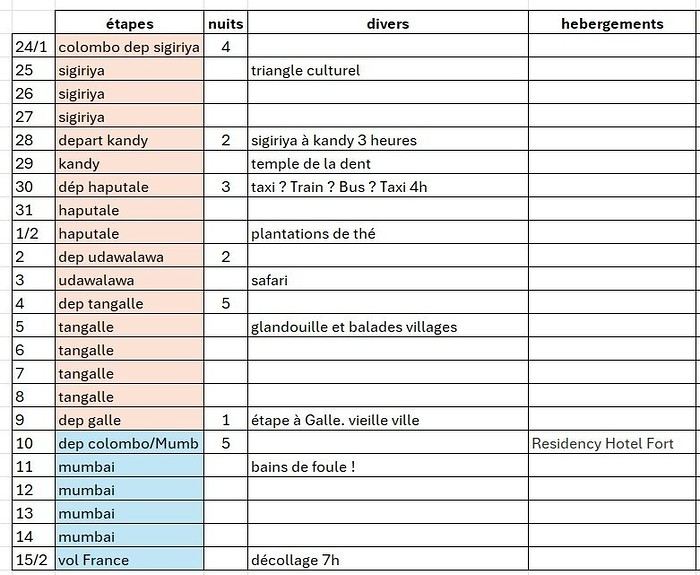
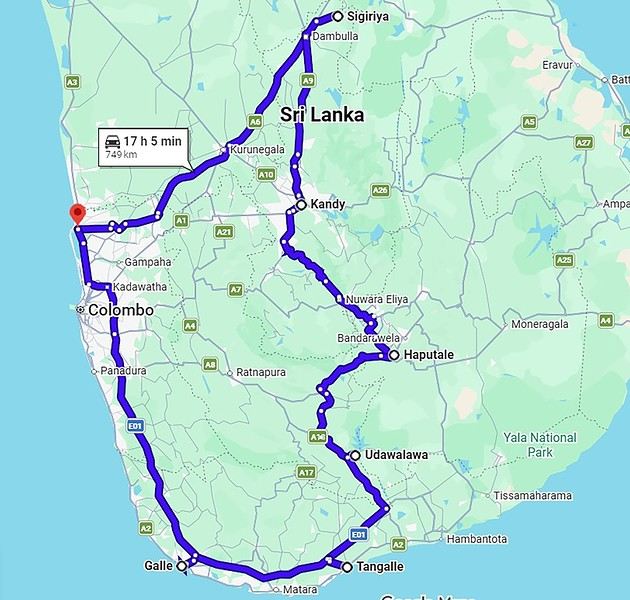
We’re heading to Sri Lanka for 23 days in January 2027—there are four of us—and we’ll wrap up the trip with 5 days in Mumbai. Our itinerary is coming together, but what do you think? (We can’t change the dates since our flights are already booked.)
We still have one night to slot in, and I’ve tentatively planned it in Tangalle, though it was a bit random. Would it make more sense to place it at a different stop? Or is there an intermediate stop I might be missing?
I’ve got accommodations sorted everywhere except Mumbai—it’s a nightmare (either way too expensive or really dodgy). By default, we’ve spotted the Residency Hotel Fort, but 70 € a night (with a discount) for a hotel that doesn’t offer anything special in India?!
Thanks so much for your help!
Hello,
We’ve already traveled to India twice before, but only for two-week stretches (2013, a loop from Mumbai including Hampi, and in 2019, Tamil Nadu). This time, we’re leaving at the end of October for nearly three months of travel—something completely new for us! We’ll arrive in Delhi and depart from Bangalore. Our goal is to explore Northern India and then head down to Kerala, taking a maximum of one flight and prioritizing trains.
Traveling for this long should let us plan longer stops to slow down the pace and fully enjoy our trip...
What are the places you’ve loved with this in mind? I’ve already thought of Gokarna... Do you have any other suggestions, especially in Northern India? Thanks in advance for your tips!
Traveling for this long should let us plan longer stops to slow down the pace and fully enjoy our trip...
What are the places you’ve loved with this in mind? I’ve already thought of Gokarna... Do you have any other suggestions, especially in Northern India? Thanks in advance for your tips!
Bonjour à tous et toutes,
Pour vous distraire un peu en attendant de pouvoir retourner en Inde, je vous propose de profiter de quelques danses auxquelles nous avions eu la chance extraordinaire d'assister pendant notre séjour à Ooty, dans les Nilgiri Mountains, dans le sud de l'Inde (Karnataka).
J'en fais le récit ici : https://www.unendroitoualler.fr/ooty-via-metuppelayam/
Et les danses, c'est ici : https://youtu.be/58UuAzI63Zo
Bon visionnage Anne
Et les danses, c'est ici : https://youtu.be/58UuAzI63Zo
Bon visionnage Anne
Bonjour à tous’ fin novembre je serais à Pondicherry et je voudrai faire un stop à Munnar avant d’aller sur Kochi...je peux envisager un stop aussi entre Pondi et Munnar... des idées a’ me communiquer? Je suis plus village que ville en voyage.Quel moyen de transport?
Merci de toutes vos suggestions
We’re back from an amazing trip to Northern India, which was incredible largely thanks to our driver Harpal, who accompanied us for nearly three weeks. Harpal isn’t just a driver—he’s also a guide. He knows the region perfectly and showed us the authentic side of India, with stops along the way to see peanut farmers at work, a family making bricks, an unlikely temple where devotees offer whisky to the deity, and so much more. Not to mention the conversations over a cup of chai!
Harpal is a very cautious driver, speaks English fluently, is attentive, and incredibly kind. On our first day, his family welcomed us like friends at their home in his village, and we even took part in a wedding celebration—an unforgettable moment. We contacted him through the Routard forum. We’d already planned our itinerary, and he gave us advice and even booked our train tickets. In short, I highly recommend Harpal for showing you his country off the beaten path. Contact details via PM.
Harpal is a very cautious driver, speaks English fluently, is attentive, and incredibly kind. On our first day, his family welcomed us like friends at their home in his village, and we even took part in a wedding celebration—an unforgettable moment. We contacted him through the Routard forum. We’d already planned our itinerary, and he gave us advice and even booked our train tickets. In short, I highly recommend Harpal for showing you his country off the beaten path. Contact details via PM.
bonjour,
je projette de revenir en inde sur une boucle Bengalore hampi sur une petite dizaine de jours
périple court donc besoin d'infos pour voir si jouable
avec :
étape 1 : atterrissage Bengalore (apparemment le plus logique)
étape 2 : hampi 3 nuits (surement avec un train de nuit Bengalore-hampi)
étape 3 : ? peut être Mysore ? autre étape ? hassan ?
je suis preneurs d'infos ou d'idées carpe diem
je suis preneurs d'infos ou d'idées carpe diem