Bonjour,
Mon conjoint et moi voulons faire un voyage d'un peu plus de 2 semaines vers mars/avril.
Nous hésitons entre le Costa Rica et les Philippines.
Le Costa Rica me semble plus "simple" (environ 11h00 de vol puis déplacements en voiture), mais les paysages ne me semblent pas si épatants que ça.
Les philippines ne sont pas simples (entre 15 et 20h00 de vols, puis des vols intérieurs ou longs trajets en bus pour aller d'un site à l'autre), mais les sites à voir me semblent beaux et spectaculaires.
Qu'en dites-vous? Certains d'entre vous auraient-ils fait l'un ou l'autre, ou mieux les 2?
D'avance merci pour vos avis!
Virginie
Bonjour à tous,
Je viens vers vous car je dois organiser le VDN pour des amis car j'ai une petite expérience des voyages. Ils souhaitent partir 15 jours aux Philippines en février et découvrir des coins sauvages avec un budget serré (1000€ sur place à 2). Dans l'idéal : 1 semaine de randonnées, rizières, jungle, cascades ... etc et 1 semaines de plage "déserte pour faire du snorkeling. J'ai parcouru de nombreuses discussions sur ce forum mais je ne parviens pas a me decider car je ne veux pas qu'ils perdent beaucoup de temps dans les transferts ... A priori Palawan semble super mais les transferts semblent longs ... Alors PALAWAN uniquement ? PALAWAN + 1 ile dans les VISAYAS (comme Bohol ?) ou 2 iles dans les VISAYAS ? Bohol et Sequijor par exemple ?
Merci d'avance pour vos conseils ... notamment Yannick et Eva !
Je viens vers vous car je dois organiser le VDN pour des amis car j'ai une petite expérience des voyages. Ils souhaitent partir 15 jours aux Philippines en février et découvrir des coins sauvages avec un budget serré (1000€ sur place à 2). Dans l'idéal : 1 semaine de randonnées, rizières, jungle, cascades ... etc et 1 semaines de plage "déserte pour faire du snorkeling. J'ai parcouru de nombreuses discussions sur ce forum mais je ne parviens pas a me decider car je ne veux pas qu'ils perdent beaucoup de temps dans les transferts ... A priori Palawan semble super mais les transferts semblent longs ... Alors PALAWAN uniquement ? PALAWAN + 1 ile dans les VISAYAS (comme Bohol ?) ou 2 iles dans les VISAYAS ? Bohol et Sequijor par exemple ?
Merci d'avance pour vos conseils ... notamment Yannick et Eva !
Bonjour à tous. Étant en préparation pour mon prochain séjour d'un mois en janvier prochain, 3 destinations m'attirent, mais j'hésite dans mon choix. Pour ceux qui ont fait les 3 destinations, quel sont les avantages et différences? Ce que je recherche c'est 1-le cout sur place (pension oblige),2- la sécurité 3- la gentillesse des gens et la richesse culturelle.
Je voyage sac à dos, en louant scooter ou transport en commun, et ne recherche pas le party mais bien la tranquilité et le quotidien des gens, de belles plages et paysages grandioses.
Voici ou j'en suis dans mes réflections: Indonésie et Phillipines= trop grand pour un mois (donc encore plus indécis sur l'itinéraire) Le Sri Lanka me rebute pour une seule raison , l'hygiène (mes craintes sont-elles fondées?). Par contre il semble facile de s'y déplacer et d'en faire le tour en un mois. Bref, après avoir consulter différents forum et m'etre procurer les guides de chaque destination mentionnée, le ressenti de personne y ayant séjourné ou qui y vivent m'éclairerais peut-etre. Merci de partager vos expériences.
Est-ce que l'on a le droit de camper ou de dormir à la belle étoile de partout aux Philippines ?
🙂 Hi everyone!
Hope you're all doing well! It's been a while since I last traveled, but I'm finally heading out again soon!
For those familiar with SOUTHEAST ASIA, I'm planning to leave in mid-June (with the trip ending at the latest in November), and I don’t have a precise idea of exact places or itineraries yet. The thing is, this period is usually the rainy season...
Any advice? I was thinking of Malaysia or Indonesia, like Sulawesi, for example (all countries and islands in Southeast Asia interest me except Bali).
Any recommendations? I’m doing my research online, but if anyone here has the time and knowledge, I’d love to hear from you.
Thanks everyone, take care and stay happy! ❤️
Hope you're all doing well! It's been a while since I last traveled, but I'm finally heading out again soon!
For those familiar with SOUTHEAST ASIA, I'm planning to leave in mid-June (with the trip ending at the latest in November), and I don’t have a precise idea of exact places or itineraries yet. The thing is, this period is usually the rainy season...
Any advice? I was thinking of Malaysia or Indonesia, like Sulawesi, for example (all countries and islands in Southeast Asia interest me except Bali).
Any recommendations? I’m doing my research online, but if anyone here has the time and knowledge, I’d love to hear from you.
Thanks everyone, take care and stay happy! ❤️
Bonjour,
Je projette un voyage aux Philippines en février 2012 (voyage "sac à dos") mais après avoir parcouru le forum et d'autres sites, j'ai l'impression que les Philippines sont essentiellement une destination pour plongeurs...
J'étais partie en Indonésie et j'avais beaucoup aimé ce pays (volcans, rizières etc) que j'avais trouvé très varié. Les philippines sont-elles aussi variées au niveau paysages?
Je précise que j'aime avant tout la rando, la découverte de villages, les volcans etc.
J'hésite donc encore un peu à partir dans cet archipel.
Tous vos conseils et avis sont les bienvenus!
Merci d'avance
Je projette un voyage aux Philippines en février 2012 (voyage "sac à dos") mais après avoir parcouru le forum et d'autres sites, j'ai l'impression que les Philippines sont essentiellement une destination pour plongeurs...
J'étais partie en Indonésie et j'avais beaucoup aimé ce pays (volcans, rizières etc) que j'avais trouvé très varié. Les philippines sont-elles aussi variées au niveau paysages?
Je précise que j'aime avant tout la rando, la découverte de villages, les volcans etc.
J'hésite donc encore un peu à partir dans cet archipel.
Tous vos conseils et avis sont les bienvenus!
Merci d'avance
Bonjour,
Nous avons passé un gros mois aux Philippines du 15 juillet au 18 aout 2015: Manille, Banaue, Pandan Island et Apo Reef sur Mindoro, Palawan, Malapascua, Camiguin. Itinéraire global construit grâce aux bons avis de voyage forum puis aménagé au jour le jour. Il faut dire que l'été est la basse saison et qu'il est donc plus facile de voyager sans réservations préalables. Et que la météo a été plutôt clémente. Je ne vais pas vous refaire le voyage mais voici quelques points qui peuvent intéresser de futurs voyageurs et sur lesquels je m'étais posé quelques questions avant le voyage
Manille, : l'Oasis Park hôtel est plutôt sympa, bon rapport qualité prix et un des rares hôtels à ce prix avec piscine. RAS pour Manille, ceci dit, si on a une journée à y passer, elle s'occupe plutôt agréablement entre le vieux centre intramuros, le quartier chinois et les parcs.
Bus de nuit pour Banaue. A réserver un peu à l'avance quand on peut (le matin ou la veille). 2-3 départs chaque soir autour de 20h-21h. N'étant pas pressées, nous aurions bien aimé faire un trajet de jour pour voir les paysages mais ya pas... 3 jours à Banaue. Sanafe Lodge est vraiment très agréable, bon rapport qualité prix. Les trek de 3 jours proposés sont tous les mêmes (Banaue, Cambulo, Batad). Mais à cette saison, les chemins ne sont pas franchement surpeuplés. Il y a l'embarras du choix sur place pour s'organiser et trouver un trek du jour au lendemain. Mon amie étant tombée dans une rizière (si si, c'est possible, une chute de plus de 2 mètres. Il faut dire que les petits murets sur lesquels on circule peuvent être glissants surtout si pluie), nous avons laissé tomber le trek de 3 jour et avisé au jour le jour. Quelques pistes pour occuper 1 journée ou ½ journée : - Balade à Hapao, très belles rizières à 10-15 km de Banaue et retour par le View point d'où on peut redescendre à Banaue à pied - Au départ de Banaue, possibilité d'aller passer la journée à Batad et de revenir le soir. Il y a des jeepneys qui partent du centre de Banaue devant le Market à 8h30 et qui vous déposent à « la jonction » d'où part la route pour Batad. Très facile aussi en tricycle. Le pb c'est que la route entre la jonction et Batad (2 km environ) monte dur et est sans intérêt. Mieux vaut donc négocier pour vous faire monter jusqu'à la fin de la route d'où part le sentier pour Batad. Au retour par contre, beaucoup plus aléatoire de trouver un tricycle en haut de la route et il faut prévoir éventuellement de redescendre jusqu'à la jonction mais c'est tout à fait faisable et en descente. - petite balade sympa de 2-3h sur les hauteurs de Banaue en partant du viewpoint et en redescendant vers Bocos. Le chemin est assez facile à suivre, on traverse villages et maisons et de toute façon il y a toujours quelqu'un pour vous renseigner.
Retour à Manille par l'incontournable bus de nuit, changement de terminal de bus (en taxi, c'est plus simple) et départ dans la foulée pour Tagatay et le lac Taal. Il y a des bus toutes les heures, trajet d'1h30 à 2h donc pas de souci.
Puis liaison Tagatay – Batangas pour partir sur Mindoro. Là, cela a été plus sport car nécessité de prendre 2 jeepneys différents, pas de liaison directe mais ça se fait (3h environ). A Batangas, les ferry sont réguliers pour Mindoro (plusieurs par jour) donc pas de souci. On retrouvera d'ailleurs le bus venu de Manille, monté sur le ferry, et dans lequel on montera à la sortie du Ferry pour aller direct à Sablayan. On arrivera à Sablayan à 22h en étant parties de Tagatay à 9h. Grosse journée mais faisable. Et le staff du Pandan Island resort vient nous chercher à la demande ce qui nous permettra d'arriver sur l'île dès ce 1er soir.
L'idée était de plonger à Apo reef. Et effectivement, cela vaut le coup malgré le tarif (il faut trouver un bateau à partager pour le trajet vers Apo reef sinon, c'est vraiment cher). Et là, coup de cœur pour Pandan Island et son petit resort sur la plage, le Pandan Island resort. Accueil sympa, bungalows sur la plage. Enormes tortues à 30m de la plage que l'on va visiter en masque et tuba, snorkeling. Ok, on était hors saison donc peu de monde et vraiment tranquille ce qui est peut être moins le cas en haute saison mais le site est vraiment chouette. Ils organisent aussi des sorties plongée vers Apo selaon la demande.
Liaison Sablayan / San José / Coron. Les ferry partant 5j/7 de San José vers Coron, il faut dormir à San José. 3H de bus depuis Sablayan, les dits bus étant souvent en fait des taxis collectifs dans lesquels on entasse le plus de monde possible. Attention, beaucoup vous demanderons un supplément si vous avez de gros bagages mais vous n'avez aucune raison de payer plus. Franchement, San José est sans intérêt à part pour prendre le Ferry vers Coron. Les hôtels que nous avons vus dans notre budget (1000 pesos, 20 euros environ) n'étaient vraiment pas terribles, juste bons pour un dépannage d'1 nuit. Les ferry sont en fait de grandes bankas (capacité 40 personnes environs) qui partent tous les jours de San José vers Coron (6h de traversée) sauf le lundi et le vendredi. Attention, ça peut bouger si la mer est forte. Nous, nous avons eu de la chance et une mer bien tranquille.
Coron: agréablement surprises: bruyant et pollué, ok mais une allure de gros village avec une vie locale bien présente. On a beaucoup aimé le Krystal Lodge, installé au milieu des cabanes de pêcheurs avec de petits bungalows sur pilotis très sympas (cuisine en bas et chambre en mezzanine). Je suis moyennement emballée par la plongée sur les épaves. Pour moi, l'appellation de plongées exceptionnelles est plutôt usurpée (visibilité très moyenne, épaves peu colonisées) mais il faut dire que que ne suis pas non plus une fan d'épaves. Ceci dit, aller à Coron POUR les épaves est un peu excessif quand même. Quant aux excursions à la journée, il y a tellement d'agences que l'on peut s'organiser comme on veut a jour le jour. Très touristique, trop de monde mais paysages somptueux.
L'idéal aurait été de pouvoir descendre sur El Nido avec l'agence Tao Philippines qui propose ainsi des tours et aussi des liaisons entre Coron et El Nido sur 3-4 jours tout en visitant les plages et les îles mais hors sentiers battus, dans un esprit éco-responsable et de découverte de la vie locale. Mais en basse saison, les départs ne sont pas réguliers et cela ne collait pas avec notre planning. Dommage.
Nous avons donc repris le ferry (enfin, comme d'hab, plutôt une grande banka) pour El Nido. Départs 5j/7 sauf samedi et un autre jour dont je ne me souviens pas. 5H de traversée.
El Nido nous a paru beaucoup plus touristique, tout est centré autour des restos et des agences qui proposent les excursions. Coté hôtels et après avoir cherché pas mal et vus des trucs moches et hors de prix, nous avons été très bien au Talindak beach cottages à Corong Corong (3 km du centre d'El Nido, plus calme). 1000 pesos (20 euros) le bungalow, accueil très sympa. Pour info : https://fr-fr.facebook.com/TalindakBeachCottages/ La plage de Calaan juste à la sortie d'El Nido propose aussi des hôtels très agréables, avec bungalows sur jolis jardins. Un peu plus chers (à partir d 1500 pesos et plutôt 2000) mais vraiment sympa et tranquille. Les excursions sont très belles mais les sites sont surpeuplés. Une solution est de négocier pour partir tôt le matin (7h) et ainsi passer avant la foule. Mais bien se faire préciser les endroits visités car certains loueurs restent très vagues et vont aller le moins loin possible et pas forcément dans les plus beaux endroits. Belle balade sur la plage de Las Cabanas juste après Corong Corong. On peut marcher sur la plage un bon moment, lumière et paysages vraiment très beaux.
Puerto Princesa nous déçoit. Pas grand chose à y faire sur place. C'est plutôt un point de passage et de transit. Par contre, coté hôtels, très bon rapport qualité prix de « House of Rose ». Un peu excentré mais calme, pas cher (1200 pesos) et tout prêt de l'aéroport. Pratique pour un éventuel transfert.
Les étapes suivantes auront été inégales et sans coups de cœur ou adresses notables à conseiller donc je ne m'étends pas. Pour faire vite : Cébu : 1 journée à tuer avant l'avion, on a détesté. A part le Carbon Market, rien à y faire et à y voir, la ville est sans intérêt à part bien sûr la vie locale mais que l'on peut découvrir bien plus agréablement ailleurs. Malapascua : chouette séjour plongée entre les requins renards qui ont été une très belle rencontre et belles plongées macro. Hélas, un reste de typhon passé par là nous a empêché d'en apprécier la plage parait-il magnifique et qui là était plutôt grise et agitée. Camiguin : un peu déçues. On nous avait vanté un petit bijou naturel et volcanique...oui et non. La silhouette montagneuse de l'île avec le sommet du Hibok est effectivement très belle. Les forêts luxuriantes. Tour de l'île sympa, ferme aux bénitiers très intéressante. L'île n'est pas exclusivement touristique d'où une vie locale bien présente. Mais pour ce qui est des paysages volcaniques, en fait on ne voit pas les volcans car ils sont recouverts de forêt (je ne voit d'ailleurs pas pourquoi les guides mettent en avant les 20 cônes volcaniques...qu'on ne voit pas!). Coté balades, pas mal d'agences proposent des activités (cher) mais si on veut se balader seul, c'est très limité. On arrive quasiment en voiture au pied de la plupart des cascades. Et pas vraiment d'itinéraires à pratiquer seul. J'ai eu des échos mitigés de la randonnée sur le Hibok (belle forêt, belle vue en haut mais intérêt limité) donc je ne l'ai pas tentée. Coté plage, réserve de Mantigue et banc de white sand sympas avec belle vue sur l'île et couleurs assez magiques. Mais franchement, j'ai vu mieux ailleurs coté plage et snorkeling. La plage principale est en sable noir ce qui a un charme certain mais pas vraiment prévu pour le farniente plage et le snorkeling y est sans aucun intérêt. (c'est simple, il n'y a rien...) On est peut être passés à coté... Il faut dire que c'était la fin d'un séjour de 5 semaines aux Philippines avec de belles étapes et qu'on en avait pris plain les yeux avant. Les plus belles étapes pour nous auront été celles du début : Banaue, Pandan Island, Palawan.
Nous avons passé un gros mois aux Philippines du 15 juillet au 18 aout 2015: Manille, Banaue, Pandan Island et Apo Reef sur Mindoro, Palawan, Malapascua, Camiguin. Itinéraire global construit grâce aux bons avis de voyage forum puis aménagé au jour le jour. Il faut dire que l'été est la basse saison et qu'il est donc plus facile de voyager sans réservations préalables. Et que la météo a été plutôt clémente. Je ne vais pas vous refaire le voyage mais voici quelques points qui peuvent intéresser de futurs voyageurs et sur lesquels je m'étais posé quelques questions avant le voyage
Manille, : l'Oasis Park hôtel est plutôt sympa, bon rapport qualité prix et un des rares hôtels à ce prix avec piscine. RAS pour Manille, ceci dit, si on a une journée à y passer, elle s'occupe plutôt agréablement entre le vieux centre intramuros, le quartier chinois et les parcs.
Bus de nuit pour Banaue. A réserver un peu à l'avance quand on peut (le matin ou la veille). 2-3 départs chaque soir autour de 20h-21h. N'étant pas pressées, nous aurions bien aimé faire un trajet de jour pour voir les paysages mais ya pas... 3 jours à Banaue. Sanafe Lodge est vraiment très agréable, bon rapport qualité prix. Les trek de 3 jours proposés sont tous les mêmes (Banaue, Cambulo, Batad). Mais à cette saison, les chemins ne sont pas franchement surpeuplés. Il y a l'embarras du choix sur place pour s'organiser et trouver un trek du jour au lendemain. Mon amie étant tombée dans une rizière (si si, c'est possible, une chute de plus de 2 mètres. Il faut dire que les petits murets sur lesquels on circule peuvent être glissants surtout si pluie), nous avons laissé tomber le trek de 3 jour et avisé au jour le jour. Quelques pistes pour occuper 1 journée ou ½ journée : - Balade à Hapao, très belles rizières à 10-15 km de Banaue et retour par le View point d'où on peut redescendre à Banaue à pied - Au départ de Banaue, possibilité d'aller passer la journée à Batad et de revenir le soir. Il y a des jeepneys qui partent du centre de Banaue devant le Market à 8h30 et qui vous déposent à « la jonction » d'où part la route pour Batad. Très facile aussi en tricycle. Le pb c'est que la route entre la jonction et Batad (2 km environ) monte dur et est sans intérêt. Mieux vaut donc négocier pour vous faire monter jusqu'à la fin de la route d'où part le sentier pour Batad. Au retour par contre, beaucoup plus aléatoire de trouver un tricycle en haut de la route et il faut prévoir éventuellement de redescendre jusqu'à la jonction mais c'est tout à fait faisable et en descente. - petite balade sympa de 2-3h sur les hauteurs de Banaue en partant du viewpoint et en redescendant vers Bocos. Le chemin est assez facile à suivre, on traverse villages et maisons et de toute façon il y a toujours quelqu'un pour vous renseigner.
Retour à Manille par l'incontournable bus de nuit, changement de terminal de bus (en taxi, c'est plus simple) et départ dans la foulée pour Tagatay et le lac Taal. Il y a des bus toutes les heures, trajet d'1h30 à 2h donc pas de souci.
Puis liaison Tagatay – Batangas pour partir sur Mindoro. Là, cela a été plus sport car nécessité de prendre 2 jeepneys différents, pas de liaison directe mais ça se fait (3h environ). A Batangas, les ferry sont réguliers pour Mindoro (plusieurs par jour) donc pas de souci. On retrouvera d'ailleurs le bus venu de Manille, monté sur le ferry, et dans lequel on montera à la sortie du Ferry pour aller direct à Sablayan. On arrivera à Sablayan à 22h en étant parties de Tagatay à 9h. Grosse journée mais faisable. Et le staff du Pandan Island resort vient nous chercher à la demande ce qui nous permettra d'arriver sur l'île dès ce 1er soir.
L'idée était de plonger à Apo reef. Et effectivement, cela vaut le coup malgré le tarif (il faut trouver un bateau à partager pour le trajet vers Apo reef sinon, c'est vraiment cher). Et là, coup de cœur pour Pandan Island et son petit resort sur la plage, le Pandan Island resort. Accueil sympa, bungalows sur la plage. Enormes tortues à 30m de la plage que l'on va visiter en masque et tuba, snorkeling. Ok, on était hors saison donc peu de monde et vraiment tranquille ce qui est peut être moins le cas en haute saison mais le site est vraiment chouette. Ils organisent aussi des sorties plongée vers Apo selaon la demande.
Liaison Sablayan / San José / Coron. Les ferry partant 5j/7 de San José vers Coron, il faut dormir à San José. 3H de bus depuis Sablayan, les dits bus étant souvent en fait des taxis collectifs dans lesquels on entasse le plus de monde possible. Attention, beaucoup vous demanderons un supplément si vous avez de gros bagages mais vous n'avez aucune raison de payer plus. Franchement, San José est sans intérêt à part pour prendre le Ferry vers Coron. Les hôtels que nous avons vus dans notre budget (1000 pesos, 20 euros environ) n'étaient vraiment pas terribles, juste bons pour un dépannage d'1 nuit. Les ferry sont en fait de grandes bankas (capacité 40 personnes environs) qui partent tous les jours de San José vers Coron (6h de traversée) sauf le lundi et le vendredi. Attention, ça peut bouger si la mer est forte. Nous, nous avons eu de la chance et une mer bien tranquille.
Coron: agréablement surprises: bruyant et pollué, ok mais une allure de gros village avec une vie locale bien présente. On a beaucoup aimé le Krystal Lodge, installé au milieu des cabanes de pêcheurs avec de petits bungalows sur pilotis très sympas (cuisine en bas et chambre en mezzanine). Je suis moyennement emballée par la plongée sur les épaves. Pour moi, l'appellation de plongées exceptionnelles est plutôt usurpée (visibilité très moyenne, épaves peu colonisées) mais il faut dire que que ne suis pas non plus une fan d'épaves. Ceci dit, aller à Coron POUR les épaves est un peu excessif quand même. Quant aux excursions à la journée, il y a tellement d'agences que l'on peut s'organiser comme on veut a jour le jour. Très touristique, trop de monde mais paysages somptueux.
L'idéal aurait été de pouvoir descendre sur El Nido avec l'agence Tao Philippines qui propose ainsi des tours et aussi des liaisons entre Coron et El Nido sur 3-4 jours tout en visitant les plages et les îles mais hors sentiers battus, dans un esprit éco-responsable et de découverte de la vie locale. Mais en basse saison, les départs ne sont pas réguliers et cela ne collait pas avec notre planning. Dommage.
Nous avons donc repris le ferry (enfin, comme d'hab, plutôt une grande banka) pour El Nido. Départs 5j/7 sauf samedi et un autre jour dont je ne me souviens pas. 5H de traversée.
El Nido nous a paru beaucoup plus touristique, tout est centré autour des restos et des agences qui proposent les excursions. Coté hôtels et après avoir cherché pas mal et vus des trucs moches et hors de prix, nous avons été très bien au Talindak beach cottages à Corong Corong (3 km du centre d'El Nido, plus calme). 1000 pesos (20 euros) le bungalow, accueil très sympa. Pour info : https://fr-fr.facebook.com/TalindakBeachCottages/ La plage de Calaan juste à la sortie d'El Nido propose aussi des hôtels très agréables, avec bungalows sur jolis jardins. Un peu plus chers (à partir d 1500 pesos et plutôt 2000) mais vraiment sympa et tranquille. Les excursions sont très belles mais les sites sont surpeuplés. Une solution est de négocier pour partir tôt le matin (7h) et ainsi passer avant la foule. Mais bien se faire préciser les endroits visités car certains loueurs restent très vagues et vont aller le moins loin possible et pas forcément dans les plus beaux endroits. Belle balade sur la plage de Las Cabanas juste après Corong Corong. On peut marcher sur la plage un bon moment, lumière et paysages vraiment très beaux.
Puerto Princesa nous déçoit. Pas grand chose à y faire sur place. C'est plutôt un point de passage et de transit. Par contre, coté hôtels, très bon rapport qualité prix de « House of Rose ». Un peu excentré mais calme, pas cher (1200 pesos) et tout prêt de l'aéroport. Pratique pour un éventuel transfert.
Les étapes suivantes auront été inégales et sans coups de cœur ou adresses notables à conseiller donc je ne m'étends pas. Pour faire vite : Cébu : 1 journée à tuer avant l'avion, on a détesté. A part le Carbon Market, rien à y faire et à y voir, la ville est sans intérêt à part bien sûr la vie locale mais que l'on peut découvrir bien plus agréablement ailleurs. Malapascua : chouette séjour plongée entre les requins renards qui ont été une très belle rencontre et belles plongées macro. Hélas, un reste de typhon passé par là nous a empêché d'en apprécier la plage parait-il magnifique et qui là était plutôt grise et agitée. Camiguin : un peu déçues. On nous avait vanté un petit bijou naturel et volcanique...oui et non. La silhouette montagneuse de l'île avec le sommet du Hibok est effectivement très belle. Les forêts luxuriantes. Tour de l'île sympa, ferme aux bénitiers très intéressante. L'île n'est pas exclusivement touristique d'où une vie locale bien présente. Mais pour ce qui est des paysages volcaniques, en fait on ne voit pas les volcans car ils sont recouverts de forêt (je ne voit d'ailleurs pas pourquoi les guides mettent en avant les 20 cônes volcaniques...qu'on ne voit pas!). Coté balades, pas mal d'agences proposent des activités (cher) mais si on veut se balader seul, c'est très limité. On arrive quasiment en voiture au pied de la plupart des cascades. Et pas vraiment d'itinéraires à pratiquer seul. J'ai eu des échos mitigés de la randonnée sur le Hibok (belle forêt, belle vue en haut mais intérêt limité) donc je ne l'ai pas tentée. Coté plage, réserve de Mantigue et banc de white sand sympas avec belle vue sur l'île et couleurs assez magiques. Mais franchement, j'ai vu mieux ailleurs coté plage et snorkeling. La plage principale est en sable noir ce qui a un charme certain mais pas vraiment prévu pour le farniente plage et le snorkeling y est sans aucun intérêt. (c'est simple, il n'y a rien...) On est peut être passés à coté... Il faut dire que c'était la fin d'un séjour de 5 semaines aux Philippines avec de belles étapes et qu'on en avait pris plain les yeux avant. Les plus belles étapes pour nous auront été celles du début : Banaue, Pandan Island, Palawan.
Bonjour,
Je pars aux Philippines en janvier 2017 et, j'ai beau parcourir le web, je n'arrive pas à construire un itinéraire pour la visite du Nord de Luzon auquel je compte consacré environ 8/10 jours. Je compte bien faire un trek de trois jours autour de Banaue mais hormis ça, je bloque. Sachant que les grottes et cercueils suspendus de Sagada ne me tentent pas, j'aurais besoin de vos conseils pour voir ce que je peux insérer dans mon itinéraire sans trop de difficultés: de belles randonnées, de jolies rencontres, ou gravir des volcans ou des monts sont les activités qui m'intéressent plus particulièrement.
Merci de votre aide! 😉
Je pars aux Philippines en janvier 2017 et, j'ai beau parcourir le web, je n'arrive pas à construire un itinéraire pour la visite du Nord de Luzon auquel je compte consacré environ 8/10 jours. Je compte bien faire un trek de trois jours autour de Banaue mais hormis ça, je bloque. Sachant que les grottes et cercueils suspendus de Sagada ne me tentent pas, j'aurais besoin de vos conseils pour voir ce que je peux insérer dans mon itinéraire sans trop de difficultés: de belles randonnées, de jolies rencontres, ou gravir des volcans ou des monts sont les activités qui m'intéressent plus particulièrement.
Merci de votre aide! 😉
Bonsoir à tous,
Nous partons en voyage de noces en juillet ou en août pendant 12 jours. Nous recherchons une destination dépaysante, qui allie à la fois les visites, les randos, le contact avec la population locale et les belles plages si possible. Nous souhaitons aller dans un endroit pas trop touristique, pas trop bétonné, nous aimerions bien que le pays ait gardé son authenticité et son charme. Nous pensons donc à Bali ou aux Philippines. Est-ce quelqu'un pourrait nous aiguiller, nous dire si on part dans la bonne direction et quelles sont les différences majeures entre ces deux destinations. Merci d'avance
Nous partons en voyage de noces en juillet ou en août pendant 12 jours. Nous recherchons une destination dépaysante, qui allie à la fois les visites, les randos, le contact avec la population locale et les belles plages si possible. Nous souhaitons aller dans un endroit pas trop touristique, pas trop bétonné, nous aimerions bien que le pays ait gardé son authenticité et son charme. Nous pensons donc à Bali ou aux Philippines. Est-ce quelqu'un pourrait nous aiguiller, nous dire si on part dans la bonne direction et quelles sont les différences majeures entre ces deux destinations. Merci d'avance
Bonjour à tous,
j'ai besoin de votre aide. Je prospecte pour mon voyage de noce en Janvier 2017 et je souhaiterai avoir vos conseils pour savoir quelle destination nous correspondrait le plus?
Nous aimons les beaux paysages, la nature, la marche, les animaux, l'architecture, et bien sûr le repos! Nous voudrions allier tout cela.
Je ne suis pas fan de l'amas de touriste mais en même temps peut-être est-ce plus rassurant pour un premier grand voyage car il y a toutes les structures nécessaires... j'ai flashé sur les Philippines mais je ne sais pas si c'est facile sur place de trouver des hôtels, des taxis, et prendre l'avion si jamais nous voulons faire un semaines en thailande ou en Malaisie? ( nous partons 3 semaines)
merci de votre aide
j'ai besoin de votre aide. Je prospecte pour mon voyage de noce en Janvier 2017 et je souhaiterai avoir vos conseils pour savoir quelle destination nous correspondrait le plus?
Nous aimons les beaux paysages, la nature, la marche, les animaux, l'architecture, et bien sûr le repos! Nous voudrions allier tout cela.
Je ne suis pas fan de l'amas de touriste mais en même temps peut-être est-ce plus rassurant pour un premier grand voyage car il y a toutes les structures nécessaires... j'ai flashé sur les Philippines mais je ne sais pas si c'est facile sur place de trouver des hôtels, des taxis, et prendre l'avion si jamais nous voulons faire un semaines en thailande ou en Malaisie? ( nous partons 3 semaines)
merci de votre aide
After several discussions on VF about travel journals from the Philippines, I decided to write this curiosity: a trip report from a journey made in 1984, when traveling to the Philippines was still an adventure.
A curiosity because writing a travel journal about a trip 35 years later isn’t common, but also (mostly?) because exploring the Philippines at that time had little in common with traveling there today.
Obviously, I’ve forgotten a number of facts, most of the details, but with the help of a few notes from that time and a stack of slides (yes, there was life before digital 😊), many memories came back and added to the highlights I’d never forgotten. The scanned slides aren’t always great quality, but there are still quite a few to brighten up this chatter. Back then, we didn’t snap photos like we do now—film was too expensive—so I don’t have pictures of every place we visited... too bad, comparing some of those spots to how they look today would’ve been interesting.
Why "Adventures"? Why call it "Adventures" in the Philippines in 1984, a word so often used for a simple exotic trip? - Because the lack of information (no *Guide du Routard*, no *Lonely Planet*, no *Michelin Guide*, nothing, and obviously no internet) gave this trip what’s at the heart of adventure: the unknown. - Because the political situation made the stay sometimes dangerous. - Because transportation conditions were always epic, often perilous. - Because the question of where we’d spend the night came up almost every evening. - And for... quite a few other reasons.
That said, we weren’t exactly explorers!
Why the Philippines? First of all, why go to the Philippines in 1984—a country not exactly set up for tourism and about which we knew very little? How could we get an idea of the beauty of the Philippines and its points of interest when we had no guides or photos?
The idea came to us from Thailand a year earlier, during our first long-haul trip. After touring the north of the country, we met a Frenchman living in Phuket, where there were only a few tourists in Patong, with just a few small hotels and guesthouses. Kata and Karon had no buildings or roads, Rawai only had three palm-thatched bungalows, including ours, and the other islands were unknown to tourists. There was plenty to discover, and we wanted to return to this beautiful country... but the Frenchman made us dream about the Philippines—a country to explore, with wild landscapes.
Long evenings of discussion over multiple Sprite-Mekong cocktails (what memories of those headaches!) finally convinced us we had to go to the Philippines.
Episode 0: Before Departure The decision was made: we’d go to the Philippines in May 1984. Our friends and family were surprised when we announced we were going on vacation to the Philippines (a bit like saying today we were going paddleboarding in the Kerguelen Islands 🤪).
These days, preparing for each of our trips takes long evenings of research, planning, and noting down good addresses... etc. But for the Philippines in 1984, preparation was quick: we had very little information about the country, we were leaving almost at random, and the discovery would only be more exciting.
We still had a few bits of info gathered here and there: the rice terraces in northern Luzon, volcanoes, Negros where we were supposed to visit an acquaintance, Cebu and its marine life (we ended up going elsewhere), and absolutely avoid Mindanao, which was practically at war with the regime. That was about it, but it was already a great itinerary.
Nothing was organized in advance; we’d see day by day. We had no idea about travel times or even the existence of transportation options. The main (and sometimes only) way to connect two islands was by overloaded, rusty ferry. Only the big cities had airports.
Let’s Go: Episode 1: Paris to Manila My travel journals always start after arriving at the airport—the Europe-to-“Other Continent” trip isn’t interesting—but the flight to the Philippines was already an adventure, so I’ll make an exception.
This was the era when only a few Asian airlines were on par with Western ones: Thai, Singapore Airlines, and Philippine Airlines. They had beautiful, brand-new planes, and to attract customers (almost exclusively “businessmen”) from the usual airlines (Air France, Lufthansa, British Airways), there was opulence on board: unlimited champagne, all sorts of cocktails... Compared to today’s long-haul flights, there was still one small difference: no personal screens, just one screen at the front of the cabin with one mandatory movie. And I don’t know why, but we only got James Bond films, both ways... that must’ve been the trend at the time.
The tourism boom to Southeast Asia hadn’t started yet, and the “Asian Tigers” weren’t a thing, so there weren’t many business trips. That meant long-haul flights made stops everywhere to fill the planes. Our Philippine Airlines Boeing 747 left London, picked us up in Paris, then stopped in Frankfurt to take on a few Germans. I don’t know why we then made a stop in Dubai—a totally exotic place at the time. There was nothing to do there... things have changed a lot since. It was a small town lost in the desert. The airport was tiny, with just one or two buildings and a supermarket. During the stopover, everyone had to get off the plane and walk to the supermarket. Photo and electronic equipment were dirt cheap—I guess that was the only reason for the stop. Maybe it was their first commercial move. Emirates didn’t exist yet, as I checked online, but anyway, the idea that such a remote place could have its own airline was unthinkable.
Online, I found this photo of Dubai Airport in 1980. Anyone who’s transited through today’s massive airport with its rows of A380s will appreciate it: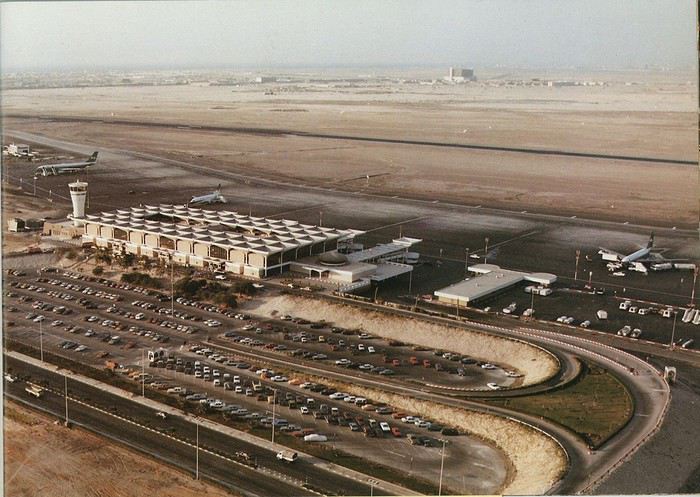
Next stop: New Delhi to drop off some Europeans and pick up a few Indians, and finally, the terminus: Manila. I don’t remember how long the trip took with its five stops—an unimaginable journey today. Despite all those stops to fill the plane, there was still enough space to stretch out on the four center seats of the 747, something that never happens these days despite all the flights in every direction.
So here we are, finally at Manila Airport around midnight.
Episode 1: Manila and Baguio To start, a quick note on the political and economic situation in the Philippines in 1984, which had consequences for us as tourists, as we’d soon realize upon arrival.
After several centuries of Spanish colonization, the Philippines became American at the start of the 20th century, then independent. In 1966, Marcos took power, and little by little, his regime sank into corruption and mismanagement, becoming a dictatorship with martial law, all for the benefit of his family and friends, who enriched themselves endlessly. The peak was the assassination of opposition leader Benigno Aquino in August 1983, which triggered harshly repressed protests. So we arrived a few months later in a very poor country, with omnipresent corruption and an extremely tense political situation, as we’d soon see for ourselves. Major protests took place in the main cities during our trip—I’ll come back to that. Two years later, Marcos fled to Hawaii after being forced out of power following rigged elections. This historical context explains a lot of the situations we found ourselves in over the following weeks.
Arriving in the middle of the night isn’t very cheerful. Manila was already a huge city with many slums, where you could find a few business hotels like the Hilton or Intercontinental—way out of our budget—and plenty of run-down hotels. Luckily, two Indians we’d chatted with on the plane offered to take us to their usual hotel. They came to Manila twice a year for business. We accepted their offer, relieved not to have to look for a place to stay in the middle of the night, figuring the address must be good since they came back every time... we were wrong 🙁
We left the airport and immediately got a taste of the local vibe when we got into the taxi: the police asked for our passports. We thought: what’s more normal than police in a dictatorship?
But that wasn’t it at all. Our two Indian friends explained that the police were noting our names along with the taxi number and time. Crime in Manila was so bad that the taxi driver would be held responsible if anything happened to us... welcome to the Philippines 😎 😎
Historically, the Philippines was a very violent country, where everything was settled with guns or machetes. Previous governments had banned carrying weapons, but Marcos later allowed the free sale and carrying of guns, and disputes were settled with pistols again (or worse, as we’d discover later). Since he’d released most of the criminals from prison to form a paramilitary militia at his service (I’ll talk about our encounter with these “heroes” later), it was pretty dangerous to go into many parts of Manila, where these “tonton macoutes” ruled.
We arrived at our hotel without incident... and then things started badly. The room was infested with big cockroaches—exactly what I hate most in those kinds of countries. No way to find another hotel at that hour. After the long flight, the urge to take a shower was so strong that we squeezed into the bathroom as best we could. After that, I don’t remember—I guess we must’ve fallen asleep exhausted under the sheets in the heat... air conditioning wasn’t widespread yet.
The next day, we just wanted to leave that dump as soon as possible. So we decided to head north right away, stopping in Baguio, and we’d visit Manila a bit on the way back.
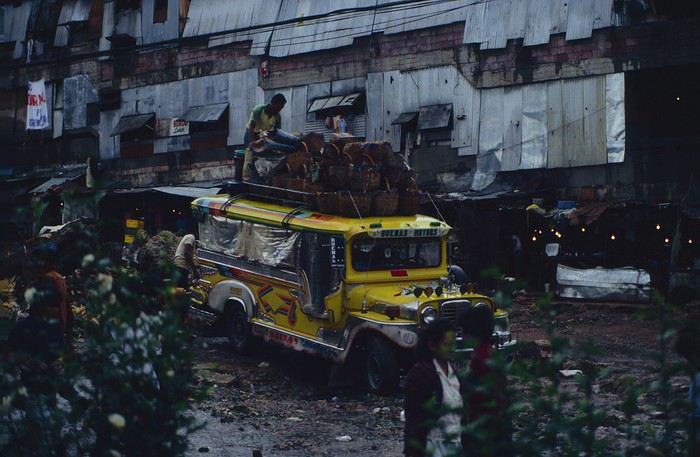
When we stepped outside, we discovered a pretty run-down neighborhood with potholed streets. But we also discovered the jeepneys. They were everywhere, flooding the streets.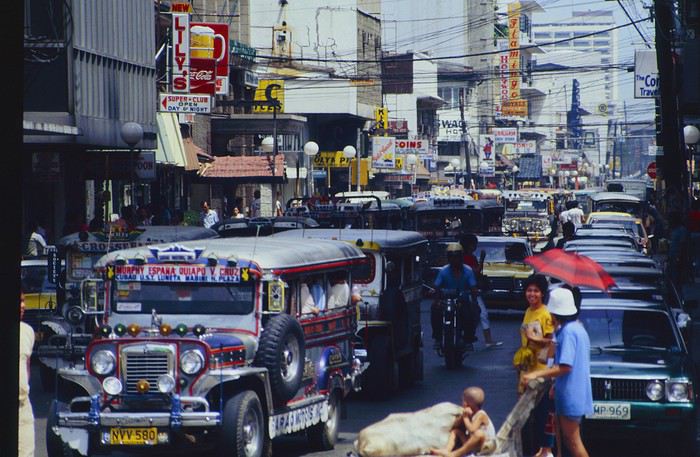
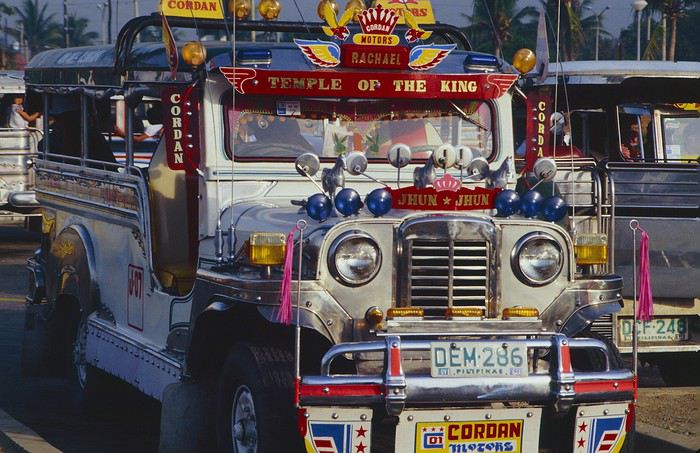
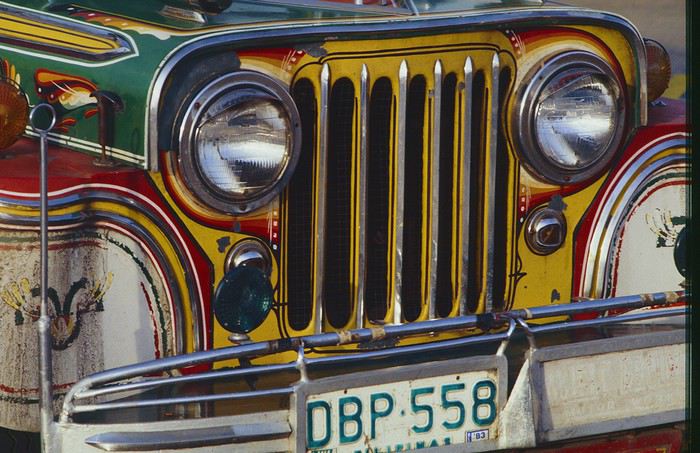
They had crazy sound systems, each one blasting louder than the last. The interiors were kitschy but fun. There weren’t many private cars—almost all transportation was by jeepney, with buses reserved for intercity trips.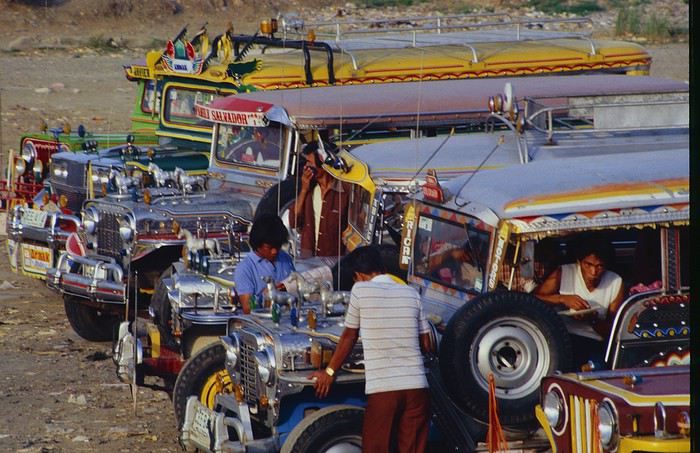
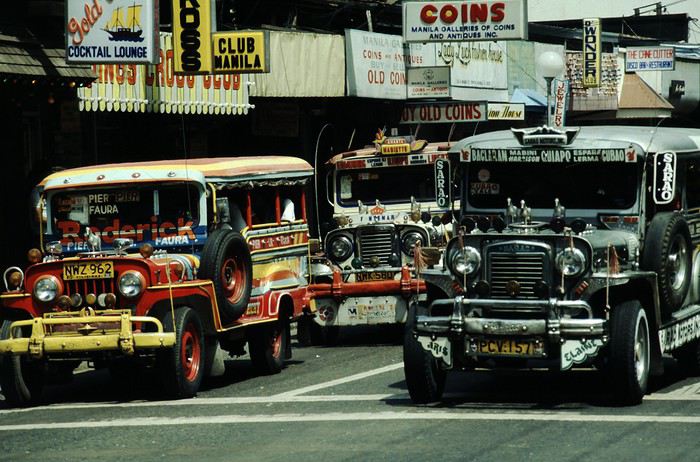
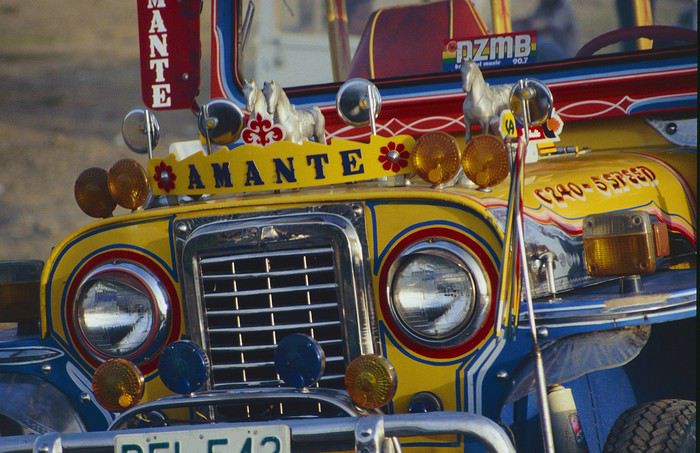
Before heading to the bus terminal for the north, somewhere on the outskirts of the city, we needed to exchange some money. I don’t remember how we ended up in a policeman’s jeep who offered his services: - Exchange money on the black market at a better rate than the banks. - Take us wherever we wanted, in this case, the bus terminal.
We accepted both offers (we’d still checked the official exchange rate from dollars to pesos). So we found ourselves in his jeep. After exchanging money, we left in his vehicle and stopped for gas. Without turning off the engine, he calmly smoked a cigarette while filling up. Since we were in a jeep with no doors or roof, we were ready to jump out if things went south, our travel bag in hand.
But we weren’t done with surprises yet. Once we left the small streets, we ended up in a neighborhood with wide avenues and not much traffic, which didn’t justify his incredible behavior. At every intersection, he made the sign of the cross, closed his eyes, and crossed without looking. I was more stunned than terrified! It wasn’t until we got out of the car later that I told Anne-Marie what had happened. I’d seen everything because the cop had put me in the front seat. Luckily, A-Marie hadn’t noticed anything from the back. Crossing Manila by trusting God rather than the rules of the road was ultimately effective. We were lucky—the trip was off to a good start. 🙂 🙂
We then passed through a neighborhood where slums stretched on for a while, and we left our policeman—friendly but a bit crazy—with relief.
A few hours by bus later, here we are in Baguio, cool in the mountains. My memories of Baguio are pretty fuzzy. I remember a small town. After some research while writing this journal, I found that the population was 120,000 in 1980. Given the population density in each home, that confirms my memory of a smallish town. Outside the “official” district with the president’s summer residence and government buildings, there were two or three paved streets with nice houses. The rest was very dirty and very poor, with lots of slums and dirt roads.
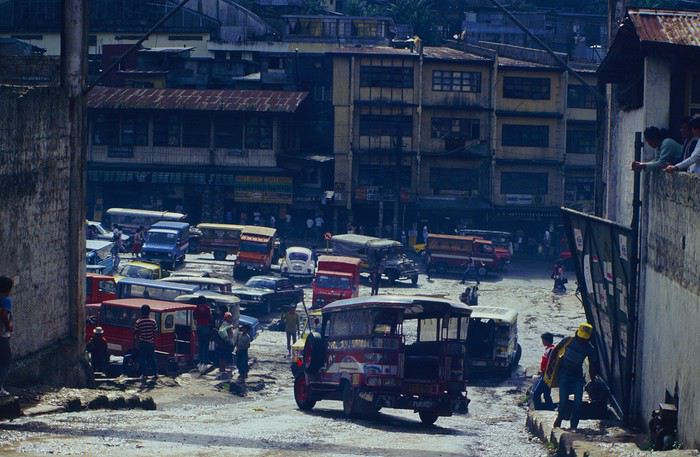
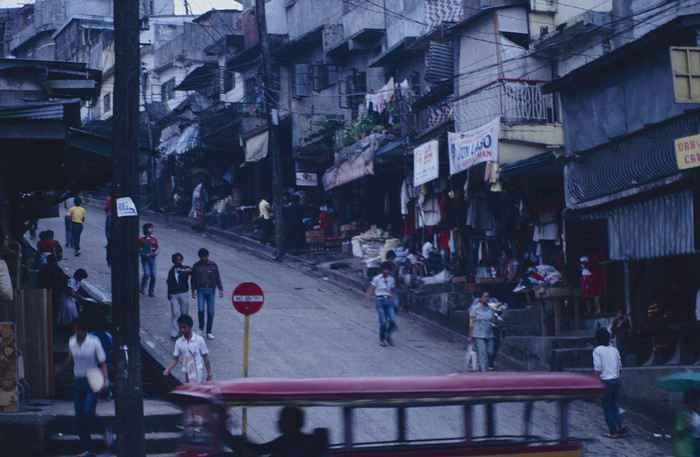
People we met on the street invited us to stay with them. These days, we wouldn’t just show up at strangers’ houses, which we should’ve done in Baguio—it would’ve saved us from an unimaginable and dangerous situation... which I won’t say anything about... !😊
The simple wooden house was on stilts at the edge of a hill with a view of the mountains. Since it was the start of the rainy season in a city that gets a lot of rain, we saw a lot of water. Our outings in town happened between downpours.
View from our lodging: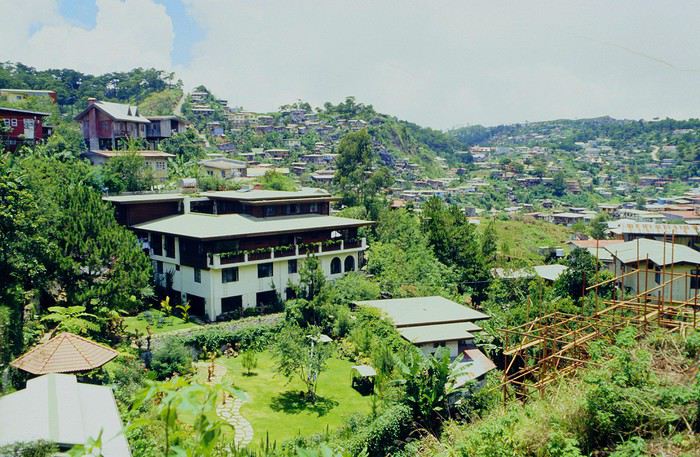
Episode 2: Baguio to Bontoc Aside from the situation briefly mentioned above, it was on the next leg to Bontoc that the adventure really began: an endless and dangerous road, a bus from another era, breathtaking landscapes, and surprising people.
We didn’t know the distance or how long it would take to get to Bontoc. When we arrived after about ten hours, we learned that Baguio to Bontoc was 140 km.
We got on a bus with wooden seats and settled in, two to a seat meant for two. As the bus filled up, passengers squeezed in three or four per seat, with chickens and baskets full of all sorts of things in the aisle. A little embarrassed, we didn’t know if we should squeeze in three on our seat. The seats were super tight (luckily, Filipinos are small), and I didn’t know where to put my legs given my height. I don’t remember if we stayed alone on our bench or if we ended up sharing with others.
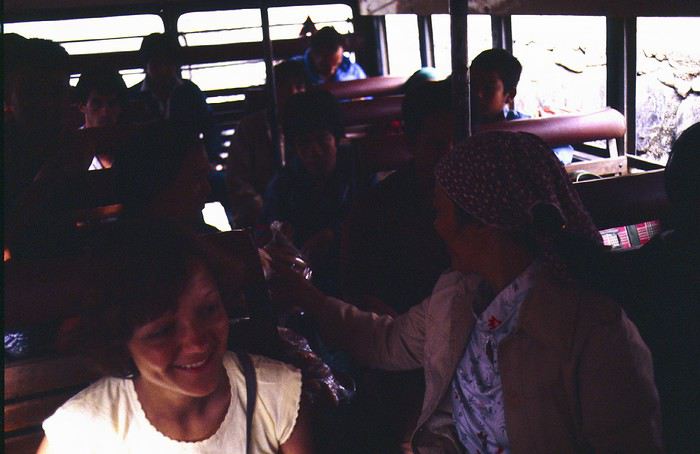
The “road” was a dirt track (or rather, a mud track) with endless turns. We held on as best we could to our slippery wooden seats—it was shaking in every direction. The woman behind us was carsick and throwing up... gross... but what were we doing there? Then we plunged into the Sierra Madre... just the name is dreamy!
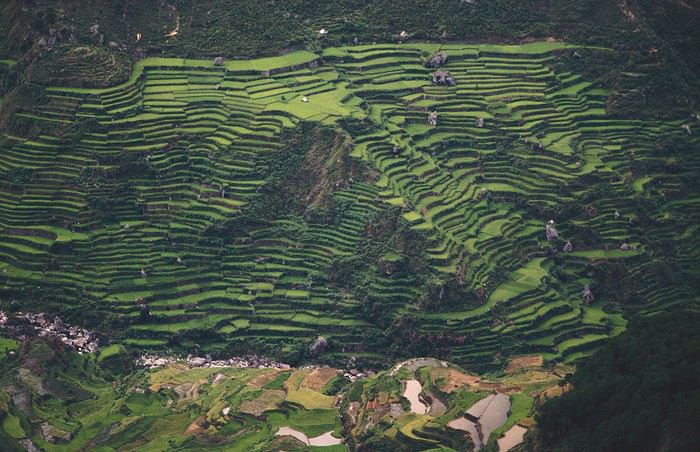
Rice terraces started to appear: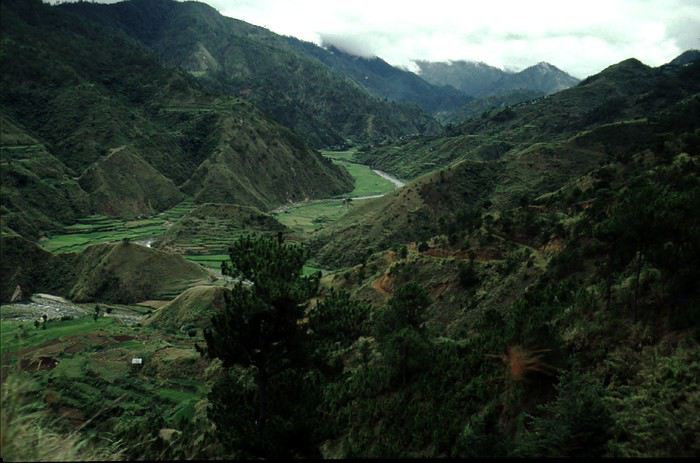
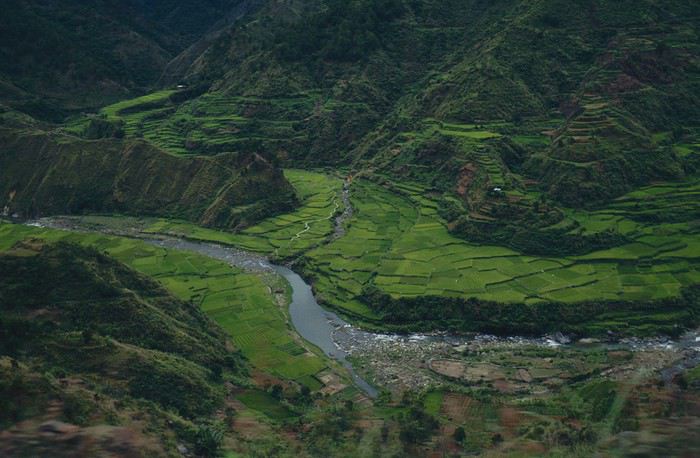
they took up more and more space along cliffs where we weren’t always reassured,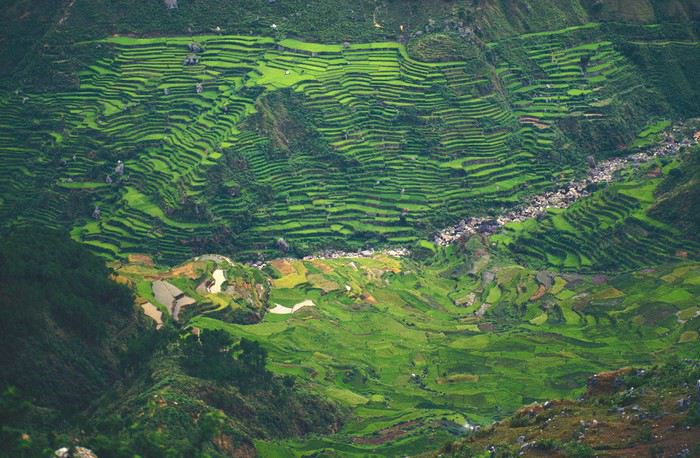
with lots of waterfalls (all that water had to go somewhere).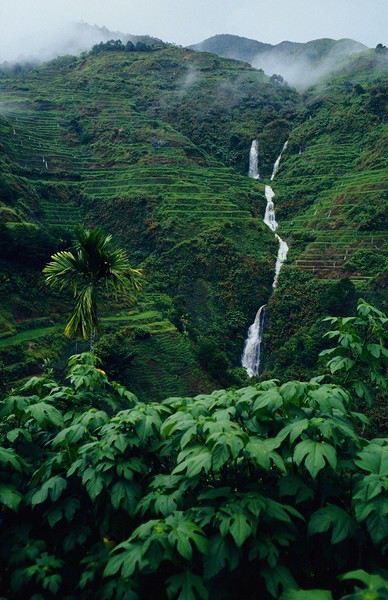
A few miserable villages stretched along the track, most often just a few houses balancing between the road and the drop. The bus stopped in every village—people got on or off and settled inside or on the roof. Street vendors offered their products to the bus passengers—a common sight in Asia, even today.
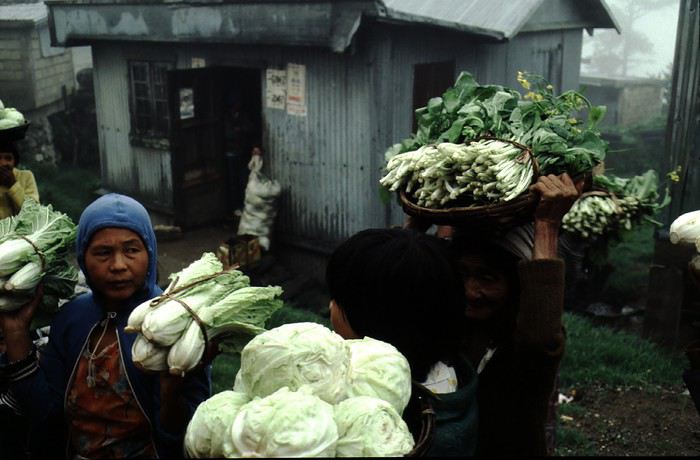
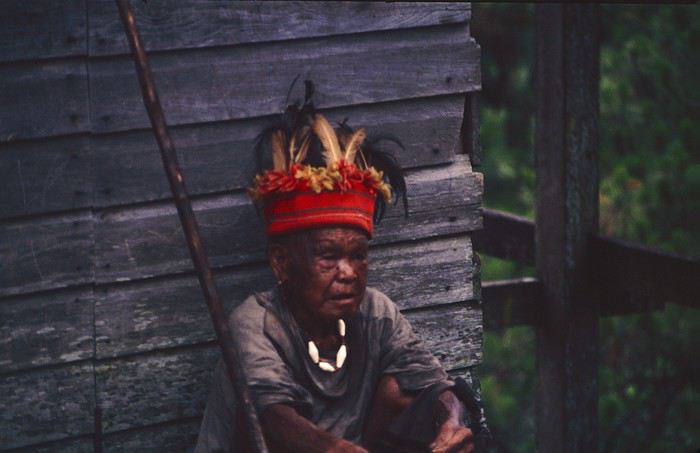
We were in another world—villagers were in loincloths, others had spears. The atmosphere was strange... but all good, we wanted exoticism, and we got it: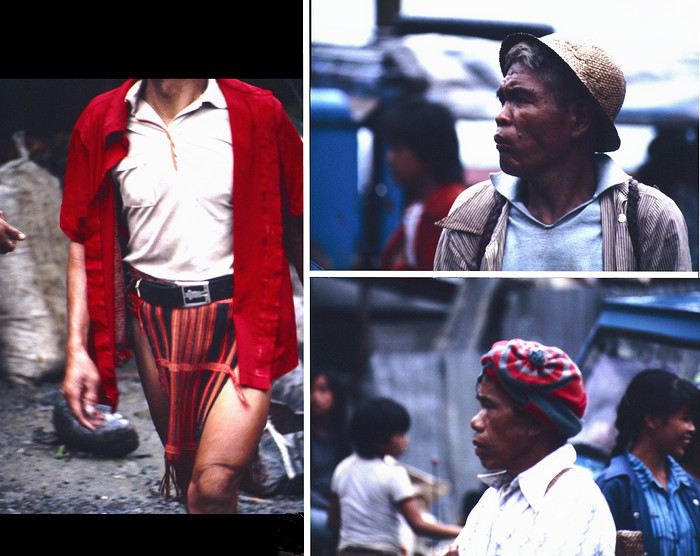
This so-called traditional outfit was everyday wear—it wasn’t for tourists since there weren’t any.
A curiosity because writing a travel journal about a trip 35 years later isn’t common, but also (mostly?) because exploring the Philippines at that time had little in common with traveling there today.
Obviously, I’ve forgotten a number of facts, most of the details, but with the help of a few notes from that time and a stack of slides (yes, there was life before digital 😊), many memories came back and added to the highlights I’d never forgotten. The scanned slides aren’t always great quality, but there are still quite a few to brighten up this chatter. Back then, we didn’t snap photos like we do now—film was too expensive—so I don’t have pictures of every place we visited... too bad, comparing some of those spots to how they look today would’ve been interesting.
Why "Adventures"? Why call it "Adventures" in the Philippines in 1984, a word so often used for a simple exotic trip? - Because the lack of information (no *Guide du Routard*, no *Lonely Planet*, no *Michelin Guide*, nothing, and obviously no internet) gave this trip what’s at the heart of adventure: the unknown. - Because the political situation made the stay sometimes dangerous. - Because transportation conditions were always epic, often perilous. - Because the question of where we’d spend the night came up almost every evening. - And for... quite a few other reasons.
That said, we weren’t exactly explorers!
Why the Philippines? First of all, why go to the Philippines in 1984—a country not exactly set up for tourism and about which we knew very little? How could we get an idea of the beauty of the Philippines and its points of interest when we had no guides or photos?
The idea came to us from Thailand a year earlier, during our first long-haul trip. After touring the north of the country, we met a Frenchman living in Phuket, where there were only a few tourists in Patong, with just a few small hotels and guesthouses. Kata and Karon had no buildings or roads, Rawai only had three palm-thatched bungalows, including ours, and the other islands were unknown to tourists. There was plenty to discover, and we wanted to return to this beautiful country... but the Frenchman made us dream about the Philippines—a country to explore, with wild landscapes.
Long evenings of discussion over multiple Sprite-Mekong cocktails (what memories of those headaches!) finally convinced us we had to go to the Philippines.
Episode 0: Before Departure The decision was made: we’d go to the Philippines in May 1984. Our friends and family were surprised when we announced we were going on vacation to the Philippines (a bit like saying today we were going paddleboarding in the Kerguelen Islands 🤪).
These days, preparing for each of our trips takes long evenings of research, planning, and noting down good addresses... etc. But for the Philippines in 1984, preparation was quick: we had very little information about the country, we were leaving almost at random, and the discovery would only be more exciting.
We still had a few bits of info gathered here and there: the rice terraces in northern Luzon, volcanoes, Negros where we were supposed to visit an acquaintance, Cebu and its marine life (we ended up going elsewhere), and absolutely avoid Mindanao, which was practically at war with the regime. That was about it, but it was already a great itinerary.
Nothing was organized in advance; we’d see day by day. We had no idea about travel times or even the existence of transportation options. The main (and sometimes only) way to connect two islands was by overloaded, rusty ferry. Only the big cities had airports.
Let’s Go: Episode 1: Paris to Manila My travel journals always start after arriving at the airport—the Europe-to-“Other Continent” trip isn’t interesting—but the flight to the Philippines was already an adventure, so I’ll make an exception.
This was the era when only a few Asian airlines were on par with Western ones: Thai, Singapore Airlines, and Philippine Airlines. They had beautiful, brand-new planes, and to attract customers (almost exclusively “businessmen”) from the usual airlines (Air France, Lufthansa, British Airways), there was opulence on board: unlimited champagne, all sorts of cocktails... Compared to today’s long-haul flights, there was still one small difference: no personal screens, just one screen at the front of the cabin with one mandatory movie. And I don’t know why, but we only got James Bond films, both ways... that must’ve been the trend at the time.
The tourism boom to Southeast Asia hadn’t started yet, and the “Asian Tigers” weren’t a thing, so there weren’t many business trips. That meant long-haul flights made stops everywhere to fill the planes. Our Philippine Airlines Boeing 747 left London, picked us up in Paris, then stopped in Frankfurt to take on a few Germans. I don’t know why we then made a stop in Dubai—a totally exotic place at the time. There was nothing to do there... things have changed a lot since. It was a small town lost in the desert. The airport was tiny, with just one or two buildings and a supermarket. During the stopover, everyone had to get off the plane and walk to the supermarket. Photo and electronic equipment were dirt cheap—I guess that was the only reason for the stop. Maybe it was their first commercial move. Emirates didn’t exist yet, as I checked online, but anyway, the idea that such a remote place could have its own airline was unthinkable.
Online, I found this photo of Dubai Airport in 1980. Anyone who’s transited through today’s massive airport with its rows of A380s will appreciate it:
Next stop: New Delhi to drop off some Europeans and pick up a few Indians, and finally, the terminus: Manila. I don’t remember how long the trip took with its five stops—an unimaginable journey today. Despite all those stops to fill the plane, there was still enough space to stretch out on the four center seats of the 747, something that never happens these days despite all the flights in every direction.
So here we are, finally at Manila Airport around midnight.
Episode 1: Manila and Baguio To start, a quick note on the political and economic situation in the Philippines in 1984, which had consequences for us as tourists, as we’d soon realize upon arrival.
After several centuries of Spanish colonization, the Philippines became American at the start of the 20th century, then independent. In 1966, Marcos took power, and little by little, his regime sank into corruption and mismanagement, becoming a dictatorship with martial law, all for the benefit of his family and friends, who enriched themselves endlessly. The peak was the assassination of opposition leader Benigno Aquino in August 1983, which triggered harshly repressed protests. So we arrived a few months later in a very poor country, with omnipresent corruption and an extremely tense political situation, as we’d soon see for ourselves. Major protests took place in the main cities during our trip—I’ll come back to that. Two years later, Marcos fled to Hawaii after being forced out of power following rigged elections. This historical context explains a lot of the situations we found ourselves in over the following weeks.
Arriving in the middle of the night isn’t very cheerful. Manila was already a huge city with many slums, where you could find a few business hotels like the Hilton or Intercontinental—way out of our budget—and plenty of run-down hotels. Luckily, two Indians we’d chatted with on the plane offered to take us to their usual hotel. They came to Manila twice a year for business. We accepted their offer, relieved not to have to look for a place to stay in the middle of the night, figuring the address must be good since they came back every time... we were wrong 🙁
We left the airport and immediately got a taste of the local vibe when we got into the taxi: the police asked for our passports. We thought: what’s more normal than police in a dictatorship?
But that wasn’t it at all. Our two Indian friends explained that the police were noting our names along with the taxi number and time. Crime in Manila was so bad that the taxi driver would be held responsible if anything happened to us... welcome to the Philippines 😎 😎
Historically, the Philippines was a very violent country, where everything was settled with guns or machetes. Previous governments had banned carrying weapons, but Marcos later allowed the free sale and carrying of guns, and disputes were settled with pistols again (or worse, as we’d discover later). Since he’d released most of the criminals from prison to form a paramilitary militia at his service (I’ll talk about our encounter with these “heroes” later), it was pretty dangerous to go into many parts of Manila, where these “tonton macoutes” ruled.
We arrived at our hotel without incident... and then things started badly. The room was infested with big cockroaches—exactly what I hate most in those kinds of countries. No way to find another hotel at that hour. After the long flight, the urge to take a shower was so strong that we squeezed into the bathroom as best we could. After that, I don’t remember—I guess we must’ve fallen asleep exhausted under the sheets in the heat... air conditioning wasn’t widespread yet.
The next day, we just wanted to leave that dump as soon as possible. So we decided to head north right away, stopping in Baguio, and we’d visit Manila a bit on the way back.
When we stepped outside, we discovered a pretty run-down neighborhood with potholed streets. But we also discovered the jeepneys. They were everywhere, flooding the streets.
They had crazy sound systems, each one blasting louder than the last. The interiors were kitschy but fun. There weren’t many private cars—almost all transportation was by jeepney, with buses reserved for intercity trips.
Before heading to the bus terminal for the north, somewhere on the outskirts of the city, we needed to exchange some money. I don’t remember how we ended up in a policeman’s jeep who offered his services: - Exchange money on the black market at a better rate than the banks. - Take us wherever we wanted, in this case, the bus terminal.
We accepted both offers (we’d still checked the official exchange rate from dollars to pesos). So we found ourselves in his jeep. After exchanging money, we left in his vehicle and stopped for gas. Without turning off the engine, he calmly smoked a cigarette while filling up. Since we were in a jeep with no doors or roof, we were ready to jump out if things went south, our travel bag in hand.
But we weren’t done with surprises yet. Once we left the small streets, we ended up in a neighborhood with wide avenues and not much traffic, which didn’t justify his incredible behavior. At every intersection, he made the sign of the cross, closed his eyes, and crossed without looking. I was more stunned than terrified! It wasn’t until we got out of the car later that I told Anne-Marie what had happened. I’d seen everything because the cop had put me in the front seat. Luckily, A-Marie hadn’t noticed anything from the back. Crossing Manila by trusting God rather than the rules of the road was ultimately effective. We were lucky—the trip was off to a good start. 🙂 🙂
We then passed through a neighborhood where slums stretched on for a while, and we left our policeman—friendly but a bit crazy—with relief.
A few hours by bus later, here we are in Baguio, cool in the mountains. My memories of Baguio are pretty fuzzy. I remember a small town. After some research while writing this journal, I found that the population was 120,000 in 1980. Given the population density in each home, that confirms my memory of a smallish town. Outside the “official” district with the president’s summer residence and government buildings, there were two or three paved streets with nice houses. The rest was very dirty and very poor, with lots of slums and dirt roads.
People we met on the street invited us to stay with them. These days, we wouldn’t just show up at strangers’ houses, which we should’ve done in Baguio—it would’ve saved us from an unimaginable and dangerous situation... which I won’t say anything about... !😊
The simple wooden house was on stilts at the edge of a hill with a view of the mountains. Since it was the start of the rainy season in a city that gets a lot of rain, we saw a lot of water. Our outings in town happened between downpours.
View from our lodging:
Episode 2: Baguio to Bontoc Aside from the situation briefly mentioned above, it was on the next leg to Bontoc that the adventure really began: an endless and dangerous road, a bus from another era, breathtaking landscapes, and surprising people.
We didn’t know the distance or how long it would take to get to Bontoc. When we arrived after about ten hours, we learned that Baguio to Bontoc was 140 km.
We got on a bus with wooden seats and settled in, two to a seat meant for two. As the bus filled up, passengers squeezed in three or four per seat, with chickens and baskets full of all sorts of things in the aisle. A little embarrassed, we didn’t know if we should squeeze in three on our seat. The seats were super tight (luckily, Filipinos are small), and I didn’t know where to put my legs given my height. I don’t remember if we stayed alone on our bench or if we ended up sharing with others.
The “road” was a dirt track (or rather, a mud track) with endless turns. We held on as best we could to our slippery wooden seats—it was shaking in every direction. The woman behind us was carsick and throwing up... gross... but what were we doing there? Then we plunged into the Sierra Madre... just the name is dreamy!
Rice terraces started to appear:
they took up more and more space along cliffs where we weren’t always reassured,
with lots of waterfalls (all that water had to go somewhere).
A few miserable villages stretched along the track, most often just a few houses balancing between the road and the drop. The bus stopped in every village—people got on or off and settled inside or on the roof. Street vendors offered their products to the bus passengers—a common sight in Asia, even today.
We were in another world—villagers were in loincloths, others had spears. The atmosphere was strange... but all good, we wanted exoticism, and we got it:
This so-called traditional outfit was everyday wear—it wasn’t for tourists since there weren’t any.
Bonjour tout le monde,
Je prépare un long voyage en Asie qui devrait s'étendre de mi-juillet à fin janvier 2014. J'ai juste prévu les grandes lignes mais j'ai besoin de votre avis pour la fin de mon itinéraire :
Mi-juillet à mi-août : Géorgie et Arménie
Mi-aout à début septembre : Iran
Mi-septembre : Inde (Uttarakhand uniquement)
Mi-septembre à mi-decembre : Nepal
Mi-décembre à fin janvier : ... ? Asie du Sud-Est...
Après le Nepal, qui est LE but de mon année sabbatique, je pensais varier un peu mon voyage car dans toute cette première partie du voyage, je compte randonner un maximum. Je pense qu'après 3 mois de treks au Nepal, un peu de plage me feront bien envie... et ça serait surtout pour y faire du snorkelling (petit budget donc je préfère vraiment si on peut voir des belles choses depuis la plage sans prendre de tour en bateau)... que me conseillez-vous ?
Trois critères me semblent essentielles : 1) Climat favorable en décembre/janvier 2) Beauté des fonds sous-marins accessibles depuis la plage 3) J'aurais mes vacances scolaires en juillet/août les années qui viendront... donc j'aimerais profiter de cette année sabbatique pour aller dans des régions qui ont un climat favorable en décembre/janvier et défavorable le en juillet/août, car c'est l'occasion ou jamais d'y aller.
Je me disais que les îles de la côte Ouest de Thaïlande devaient être bien pour ça, même si très fréquentée. Lesquelles en particuliers ? Où est-ce qu'on peut avoir de très bons fond sous-marins en partant de la plage.
Pour les Philippines : en théorie c'est la bonne saison (d'après les Guides papiers) mais d'après les discussions sur ce forum, j'ai l'impression que ce n'est plus le cas depuis quelques années. Sur quelles îles le climat est-il favorable en janvier ? Luzon m'intéresse bien car en plus du snorkelling, il y aurait pas mal de possibilité de rando. Le 3e critère que j'ai énoncé risque d'entrée en compte : si le temps est pareil aux Philippines/à Luzon, l'hiver que l'été... j'attendrais pour y aller, j'aurais bien l'occasion par la suite.
Sinon, je pensais encore aux Moluques... mais là, je n'ai pas encore trop fait de recherches. Et ça couterais plus cher en billet d'avion.
Il y a aussi Phu Quoc au Vietnam qui semble convenir à mes critères.
Très généralement, quels sont vos meilleurs souvenirs de snorkelling en Asie du Sud-Est ? Quel pays, quelle région ?
Merci de votre aide pour ces questions très très larges,
Julien
Après le Nepal, qui est LE but de mon année sabbatique, je pensais varier un peu mon voyage car dans toute cette première partie du voyage, je compte randonner un maximum. Je pense qu'après 3 mois de treks au Nepal, un peu de plage me feront bien envie... et ça serait surtout pour y faire du snorkelling (petit budget donc je préfère vraiment si on peut voir des belles choses depuis la plage sans prendre de tour en bateau)... que me conseillez-vous ?
Trois critères me semblent essentielles : 1) Climat favorable en décembre/janvier 2) Beauté des fonds sous-marins accessibles depuis la plage 3) J'aurais mes vacances scolaires en juillet/août les années qui viendront... donc j'aimerais profiter de cette année sabbatique pour aller dans des régions qui ont un climat favorable en décembre/janvier et défavorable le en juillet/août, car c'est l'occasion ou jamais d'y aller.
Je me disais que les îles de la côte Ouest de Thaïlande devaient être bien pour ça, même si très fréquentée. Lesquelles en particuliers ? Où est-ce qu'on peut avoir de très bons fond sous-marins en partant de la plage.
Pour les Philippines : en théorie c'est la bonne saison (d'après les Guides papiers) mais d'après les discussions sur ce forum, j'ai l'impression que ce n'est plus le cas depuis quelques années. Sur quelles îles le climat est-il favorable en janvier ? Luzon m'intéresse bien car en plus du snorkelling, il y aurait pas mal de possibilité de rando. Le 3e critère que j'ai énoncé risque d'entrée en compte : si le temps est pareil aux Philippines/à Luzon, l'hiver que l'été... j'attendrais pour y aller, j'aurais bien l'occasion par la suite.
Sinon, je pensais encore aux Moluques... mais là, je n'ai pas encore trop fait de recherches. Et ça couterais plus cher en billet d'avion.
Il y a aussi Phu Quoc au Vietnam qui semble convenir à mes critères.
Très généralement, quels sont vos meilleurs souvenirs de snorkelling en Asie du Sud-Est ? Quel pays, quelle région ?
Merci de votre aide pour ces questions très très larges,
Julien
bonjour
Nous serons à el nido dans quelques semaines. Nous envisageons de partir 3 jours pour visiter les îles avec Nativ' Exploration Palawan à El Nido. Nous aimerions avoir quelques retours d'expérience.
merci
🙂
Bonjour, nous atterrissons a Cebu city le 20 janvier et des amis nous rejoignent le 3 février pour aller ensemble visiter les Visayas.
Ma question est; que visiter en les attendant ?
Nous sommes une famille de 4 avec 2 garçons de 5 et 7 ans actuellement en tour du monde. Nous aimons la nature, marcher mais aussi la plage (si il y a quelque chose a voir sous l'eau) et surtout les coins pas trop touristique ( où l'on se fait prendre pour des pigeons...)
Je n'ai pas de guide papier et une connexion internet aléatoire.
Negros semble pas mal, mais je ne me rend pas trop compte des temps de trajets.
Si vous avez des idées n'hésitez pas!
Merci de l'aide que vous pourrez nous apporter !
Celine
bonjour tout le monde,
je pars 3 semaines aux philippine, j'aime les beaux paysages, la rando et la plongée, quels sont les endroits a ne pas louper?
et comment les rejoindre en atterrissant a manille.
merci pour vos conseils
Le volcan Pinatubo qui est entré en éruption pour la dernière fois en 1991 et la nature reprend petit à petit ses droits. Le paysage pendant l'approche est exceptionnel.
Le 31 Janvier 2013:
Hélas, mille fois hélas, un nouveau tronçon de "route" pour 4X4 a été inauguré aujourd'hui. Il fait 4 kilometres, le prochain tronçon de 2 kms ouvrira dans 15 jours. Ce qui fait que sur les 7 kms que faisait la balade d'approche sur le volcan il ne restera qu'un petit Km à faire à pied et avec un chemin dans la végétation donc sans paysage.
A l'arrivée tout est bétonné et des zones pour pique-nique ont été créées et la baignade est maintenant interdite.
Conclusion la super balade pour routards avec un bain à l'arrivée devient une promenade pour touristes du dimanche très BC BG avec tout juste un quart d' heure de marche à l' arrivée.
Bon on a vraiment eu de la chance car étant arrivés avant le vice président, on a pu tout faire à pied, mais on sera les derniers car ils n' autoriseront pas les marcheurs et les 4X4 en même temps. Le fait est que passage présidentiel du convoi de vingt 4X4 a été parfois pénible. Notre guide nous a dit qu'ils attendent jusqu'à 260 4X4 par jour en pleine saison!.. ]Adieu belle balade au mont "Pina tout beau" .
Merci a ceux qui feront l'excursion à partir du 1/2/2013 de confirmer ou d'infirmer les infos glanées lors de notre excursion (faite le 31/1/2013) J'espère que nous avons mal compris les explications données par notre guide et un visiteur Philippin
Conclusion la super balade pour routards avec un bain à l'arrivée devient une promenade pour touristes du dimanche très BC BG avec tout juste un quart d' heure de marche à l' arrivée.
Bon on a vraiment eu de la chance car étant arrivés avant le vice président, on a pu tout faire à pied, mais on sera les derniers car ils n' autoriseront pas les marcheurs et les 4X4 en même temps. Le fait est que passage présidentiel du convoi de vingt 4X4 a été parfois pénible. Notre guide nous a dit qu'ils attendent jusqu'à 260 4X4 par jour en pleine saison!.. ]Adieu belle balade au mont "Pina tout beau" .
Merci a ceux qui feront l'excursion à partir du 1/2/2013 de confirmer ou d'infirmer les infos glanées lors de notre excursion (faite le 31/1/2013) J'espère que nous avons mal compris les explications données par notre guide et un visiteur Philippin
Bonjour,
Dans un peu moins de trois semaines je serai aux Philippines ! J’ai prévu un séjour de 2 semaines, Oui je sais, c’est trop peu mais je ne peux pas rester plus. C’est pour cela que je me limiterai aux îles autours de Cebu. Mon trajet prévisionnel est : cebu, Dumaguate-Negros, Siquijor, Bohol et retour sur cebu. Faisable ? Lors d’un précédent voyage j’avais visité le nord de Luzon et j’avais apprécié le volcan Taal. Pour moi les voyages en bateau et les volcans sont indissociables d’un voyage aux philippines. Le problème et la question sont : Est il possible d’approcher le volcan Kanlaon et de faire un trek? J’ai lu qu’il était en alerte 1, en pratique ça veut dire quoi. Faut-il que je me rabatte sur les volcans de Camingui? Dans ce cas mon trip risque d’être encore plus intensif. Merci de me faire partager votre expérience. Serge
Dans un peu moins de trois semaines je serai aux Philippines ! J’ai prévu un séjour de 2 semaines, Oui je sais, c’est trop peu mais je ne peux pas rester plus. C’est pour cela que je me limiterai aux îles autours de Cebu. Mon trajet prévisionnel est : cebu, Dumaguate-Negros, Siquijor, Bohol et retour sur cebu. Faisable ? Lors d’un précédent voyage j’avais visité le nord de Luzon et j’avais apprécié le volcan Taal. Pour moi les voyages en bateau et les volcans sont indissociables d’un voyage aux philippines. Le problème et la question sont : Est il possible d’approcher le volcan Kanlaon et de faire un trek? J’ai lu qu’il était en alerte 1, en pratique ça veut dire quoi. Faut-il que je me rabatte sur les volcans de Camingui? Dans ce cas mon trip risque d’être encore plus intensif. Merci de me faire partager votre expérience. Serge
Bonjour à tous
Je pars aux Philippines du 26 Décembre 2015 au 15 Janvier 2016 avec une amie. Je suis entrain de "travailler" sur ce voyage et je souhaiterais avoir quelques bons plans d'hébergements et astuces pour des trajets non compliqués par rapport au circuit que je me suis fixée.
Arrivée Manille hébergement quartier de Makati à priori pas mal d'activités, salons de massage, marchés, restos, bars etc...
Puis descendre sur Tagaytay pour voir le Lac Taal et son Volcan (si quelqu'un connait un hébergement sympa et à bon prix!)
combien de jours dois-je prévoir pour ces 2 escales ?
Ensuite, direction PALAWAN en Avion arrivée soit à Puerto Princesa pour remonter le Nord jusqu'à l'Ile de Busuanga/Coron SOIT commencer par Coron et descendre sur PP. Dans quel sens c'est le mieux ?
J'ai aussi vu qu'il y avait problème sur le poids des bagages de Manille à Palawan 12kgs maxi je crois, mais comment fait-on si on a déjà 17 kgs par exemple ? Est-il possible de laisser quelques affaires en consigne ?
Circuit prévu sur Palawan : Sabang/Port Barton/Roxas/El Nido Archipel de Bacuit/ Ile de Busuanga Coron.
Pour info je me considère comme "semi-routarde" pas de sac à dos mais 1 valise ! Point de vue Budget quotidien je prévois 2200-6000P pour un minimum de confort (suis plus toute jeune)
voilà c'est tout pour aujourd'hui, j'attends vos premiers conseils avant de poser d'autres questions utiles !
merci d'avance
Bonjour à tous,
Avec ma compagne, nous organisons un voyage de 3 semaines et demi aux Philippines mi Avril / début Mai et nous cherchons à définir le "meilleur" parcours en tenant compte des distances, de la durée du voyage et bien sur de la pertinence des différentes choses à visiter.
Pour le moment nous avons seulement notre aller retour: Départ de Paris :J1 Arrivée à Manille: J2 à 13h
Départ de Manille: J 24 à 18h Arrivée à Paris: J25
Donc nous disposons de 22 jours sur place.
Après une rapide recherches, nous nous sommes rendus comptes de la difficulté à se déplacer aux Philippines (bien plus que d'autres pays d'Asie) et avons donc essayé de réduire les déplacements.
Pour le moment nous pensons:
- Passer une journée à Manille et partir des le lendemain matin pour Bohol - Aller à Bohol (en avion) et y rester 5/6 jours - Aller ensuite à Panglao (en bateau) et y rester 2/3 jours - Aller à Siquijor (en bateau) et y rester 4/5 jours - Aller à Cebu (en bateau) et y rester 1/2 jours - Aller à Palawan (en avion) et y rester 6/7 jours - Revenir à Manille (en avion) la veille du retour pour Paris
Que pensez vous de ce début d'itinéraire? Est-ce que les durées semblent cohérents? Cebu merite-il de s'y attarder?
Nous nous posons pas mal de questions. Dans un premier temps nous aurions souhaité ajouter à notre programme: - Un trek dans le nord (Banaue) et/ou la visite du lac/volcan Taal - Un passage par l'ile de Boracay
Mais cela semblait trop ambitieux et nous avons donc réduit notre programme. Qu'en pensez vous?
Nous aimons certes beaucoup la plage et la baignade mais nous souhaiterions diversifier nos activités: Trek, Cascades, Volcan etc.
Est il possible de réaliser des trek dans la nature/jungle/rizière ailleurs que dans le nord et la région de Luzon, et plus particulièrement sur notre parcours? Y a-t il des Volcans à visiter sur notre parcours?
Nous sommes volontiers preneurs de toutes informations concernant les activités et sorties à faire sur chaque ile ainsi que des conseils concernant les déplacements.
Ne connaissant pas du tout ce pays, toutes vos remarques seront les bienvenues et nous serons d'une grande aide! ;)
Merci d'avance!
Avec ma compagne, nous organisons un voyage de 3 semaines et demi aux Philippines mi Avril / début Mai et nous cherchons à définir le "meilleur" parcours en tenant compte des distances, de la durée du voyage et bien sur de la pertinence des différentes choses à visiter.
Pour le moment nous avons seulement notre aller retour: Départ de Paris :J1 Arrivée à Manille: J2 à 13h
Départ de Manille: J 24 à 18h Arrivée à Paris: J25
Donc nous disposons de 22 jours sur place.
Après une rapide recherches, nous nous sommes rendus comptes de la difficulté à se déplacer aux Philippines (bien plus que d'autres pays d'Asie) et avons donc essayé de réduire les déplacements.
Pour le moment nous pensons:
- Passer une journée à Manille et partir des le lendemain matin pour Bohol - Aller à Bohol (en avion) et y rester 5/6 jours - Aller ensuite à Panglao (en bateau) et y rester 2/3 jours - Aller à Siquijor (en bateau) et y rester 4/5 jours - Aller à Cebu (en bateau) et y rester 1/2 jours - Aller à Palawan (en avion) et y rester 6/7 jours - Revenir à Manille (en avion) la veille du retour pour Paris
Que pensez vous de ce début d'itinéraire? Est-ce que les durées semblent cohérents? Cebu merite-il de s'y attarder?
Nous nous posons pas mal de questions. Dans un premier temps nous aurions souhaité ajouter à notre programme: - Un trek dans le nord (Banaue) et/ou la visite du lac/volcan Taal - Un passage par l'ile de Boracay
Mais cela semblait trop ambitieux et nous avons donc réduit notre programme. Qu'en pensez vous?
Nous aimons certes beaucoup la plage et la baignade mais nous souhaiterions diversifier nos activités: Trek, Cascades, Volcan etc.
Est il possible de réaliser des trek dans la nature/jungle/rizière ailleurs que dans le nord et la région de Luzon, et plus particulièrement sur notre parcours? Y a-t il des Volcans à visiter sur notre parcours?
Nous sommes volontiers preneurs de toutes informations concernant les activités et sorties à faire sur chaque ile ainsi que des conseils concernant les déplacements.
Ne connaissant pas du tout ce pays, toutes vos remarques seront les bienvenues et nous serons d'une grande aide! ;)
Merci d'avance!
Bonjour
j'envisage de me rendre aux Philippines et mes dates de vacances correspondent à la Semaine Sainte là bas ( Pâques) d'après vos expériences est ce que cela empêche tous déplacements, les transports sont plein , les hébergements onéreux ??
j'envisage de me rendre aux Philippines et mes dates de vacances correspondent à la Semaine Sainte là bas ( Pâques) d'après vos expériences est ce que cela empêche tous déplacements, les transports sont plein , les hébergements onéreux ??
Bonjour,
Petite nouvelle sur voyageforum.com, je cherche des informations sur les Philippines.
Je pars avec mon fiancé du 28 janvier au 11 février 2012. Nous arrivons donc à Manille le 29/01 en milieu d'après-midi et voulons partir pour Coron le 31/01.
Nous hésitons beaucoup entre deux options pour combler la journée du 30/01 et comptons sur vos conseils pour prendre une décision 🙂:
1. BANAUE Prendre le bus de nuit pour Banaue le 29/01, passer la journée dans les rizières et reprendre le bus de nuit le 30/01 vers Manille. - -> Peut-on en faire un minimum en une journée à Banaue? Est-ce suffisant pour voir de belles rizières? Si oui, quels coins conseillez-vous? Est-ce que ça vaut vraiment le coup de faire le déplacement durant cette période? En plus, nous risquons d'être très fatigués entre les heures de vols / bus + jetlag... 🤪
OU
2. MONT PINATUBO Faire une petite visite de Manille en fin d'aprem le 29/01. Partir en excursion pour le mont Pinatubo toute la journée (j'ai vu que des daytrip étaient possibles au départ de Manille) du 30/01 + nuit à Manille. - -> Est-ce que le volcan vaut le détour? Quel prestataire conseillez-vous?
Merci à vous!
Petite nouvelle sur voyageforum.com, je cherche des informations sur les Philippines.
Je pars avec mon fiancé du 28 janvier au 11 février 2012. Nous arrivons donc à Manille le 29/01 en milieu d'après-midi et voulons partir pour Coron le 31/01.
Nous hésitons beaucoup entre deux options pour combler la journée du 30/01 et comptons sur vos conseils pour prendre une décision 🙂:
1. BANAUE Prendre le bus de nuit pour Banaue le 29/01, passer la journée dans les rizières et reprendre le bus de nuit le 30/01 vers Manille. - -> Peut-on en faire un minimum en une journée à Banaue? Est-ce suffisant pour voir de belles rizières? Si oui, quels coins conseillez-vous? Est-ce que ça vaut vraiment le coup de faire le déplacement durant cette période? En plus, nous risquons d'être très fatigués entre les heures de vols / bus + jetlag... 🤪
OU
2. MONT PINATUBO Faire une petite visite de Manille en fin d'aprem le 29/01. Partir en excursion pour le mont Pinatubo toute la journée (j'ai vu que des daytrip étaient possibles au départ de Manille) du 30/01 + nuit à Manille. - -> Est-ce que le volcan vaut le détour? Quel prestataire conseillez-vous?
Merci à vous!
Hi everyone,
We (two adults, 74 and 70 years old) had already shared a travel journal about our first trip to the Philippines in February/March 2019 on this forum (https://voyageforum.com/v.f?post=9377175;search_string=carnet%20philippines). We had visited Manila, the Banaue rice terraces, Sagada, the Visayas (Bohol, Siquijor, Dumaguette), and on our way back to Luzon, the Taal volcano before returning to France. Delighted by this trip, organized by the French-speaking agency Alizé, we decided to further explore this beautiful country, this time focusing on Coron and Palawan.
Before writing this journal, I should mention that these are personal comments and don’t reflect any differing opinions. Without any literary or photographic talent, I’ll stick to the facts and share a few details about the visits, hotels, and restaurants.
Preparations
We decided to return in mid-January 2025 and consulted three French-speaking tour operators to create a trip based on our wishes (places to visit, type of accommodation) and budget. Comparing three operators helped us weigh their advice and make our choices. Only our first operator respected the budget, a second came close, and the third proposed a slightly more upscale trip. In the end, we chose the agency from our first trip. Our discussions helped refine our itinerary, and when we reviewed it point by point, the document provided was perfect, full of great tips. The most debated point was a 3-day, 2-night cruise between Coron and Palawan. We were tempted but worried about being the only "older" travelers among younger people and feared two uncomfortable nights. Reassured by our tour operator, we finally opted for this "exploration." We’ll come back to that later. Once the choice was made and dates set, we booked our international flights with Cathay Pacific for 750 € per person, which offers the best schedules (short layovers) at an acceptable price for flights arriving in Cebu. Our trip started on February 25 and returned to Paris on March 15.
International flights
The round-trip flights went smoothly. Cathay does the job well, without frills. The service quality seems to have slightly declined compared to our previous trips with them. Hong Kong Airport is huge but very practical. Note that not all airlines serve Cebu. Recommendation: Fill out your Philippine entry form within 72 hours before your flight. This can prevent issues with the airline (possible boarding refusal) and saves a lot of time upon arrival (see the Philippine embassy website).
Domestic flights
For our two domestic flights—Cebu to Coron and Puerto Princesa to Cebu—our tour operator chose Philippine Airlines and their propeller planes. No problems there.
Day 1: We landed around 12 PM (local time) after 17 hours of travel. A driver was waiting for us at the airport exit and took us to our hotel, intentionally chosen near the airport (Mandaue, about 10 minutes away) to help us recover and get a good night’s sleep before our early morning domestic flight the next day. The Mayoo Hotel, reasonably priced, was perfect for this. Large, beautiful room in a new building—clean, comfortable, with a spa. We could relax by the pool on the 16th floor and enjoy the city view. The breakfast was exceptional, and the staff was smiling, attentive, and helpful. An ATM in the lobby allowed for withdrawals. However, the hotel is in a neighborhood with nothing to see or do. We dined at the Korean restaurant K-GOGI across from the hotel—a real attraction and a great discovery.
Day 2: After a restful night, we were driven to the airport around 6:30 AM for an 8:10 AM flight from Cebu to Busuanga (Coron).
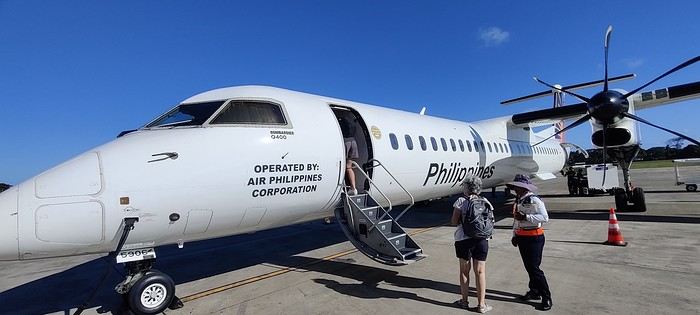
The flight was uneventful. Upon arrival, we paid 200 pesos per person for the Coron tourist fee before a 40-minute transfer to our hotel: Natura Resort, located outside the city in a secluded spot. The setting is stunning—a beautifully maintained tropical garden, a pleasant pool, and the option to book massages. The cottages are tropical-style with thatched roofs, simple and unpretentious.
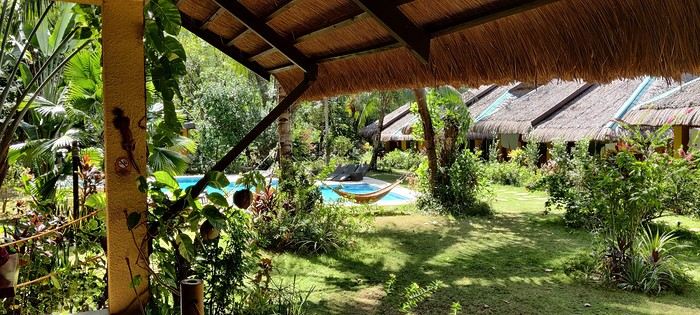
The owner, who speaks French, told us that given the heat and our ages, climbing the 721 steps to the top of Mount Tapyas wasn’t necessary. She gave us a few rooftop recommendations to watch the sunset over Coron Bay. After a good swim in the pool and a meal at the resort’s pleasant restaurant, we hired a tricycle to go into town. We were told it costs 150 pesos one way, and depending on the return time, it could exceed 250 pesos. But our driver gave us his WhatsApp number and charged the same price regardless of the time. He just earned two days’ worth of customers. He dropped us off at the port where bangkas (local boats) gather for day trips. It was the end of the day, so there was a rush. A few shops around the port sold waterproof bags for marine excursions at reasonable prices (compared to back home), after some bargaining. We wandered the town’s alleys looking for the Top Hotel, whose rooftop is famous. Indeed, it’s perfectly located to admire the sunset and enjoy a refreshing drink.
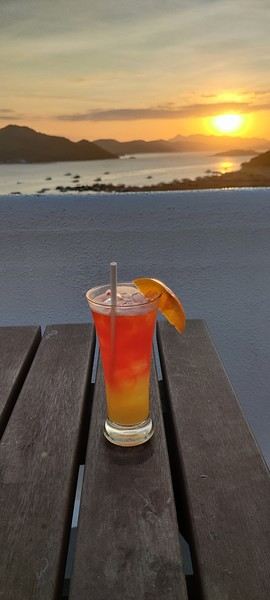
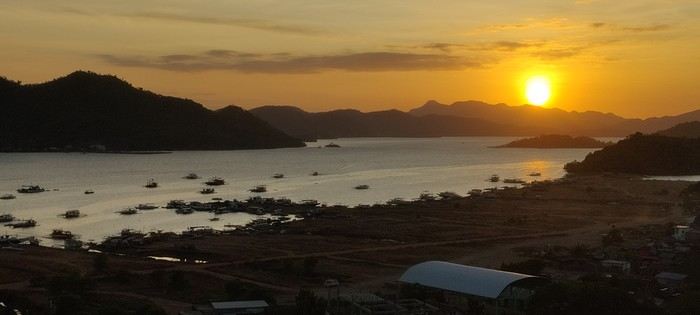
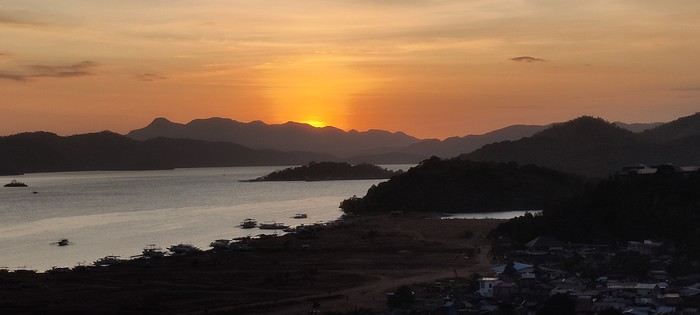
We dined nearby at a small Chinese restaurant, then just had to call our driver to head back. The night wasn’t entirely restful—our hotel had a soundtrack of all the countryside animals, and it seemed they had no set bedtime! :
Preparations
We decided to return in mid-January 2025 and consulted three French-speaking tour operators to create a trip based on our wishes (places to visit, type of accommodation) and budget. Comparing three operators helped us weigh their advice and make our choices. Only our first operator respected the budget, a second came close, and the third proposed a slightly more upscale trip. In the end, we chose the agency from our first trip. Our discussions helped refine our itinerary, and when we reviewed it point by point, the document provided was perfect, full of great tips. The most debated point was a 3-day, 2-night cruise between Coron and Palawan. We were tempted but worried about being the only "older" travelers among younger people and feared two uncomfortable nights. Reassured by our tour operator, we finally opted for this "exploration." We’ll come back to that later. Once the choice was made and dates set, we booked our international flights with Cathay Pacific for 750 € per person, which offers the best schedules (short layovers) at an acceptable price for flights arriving in Cebu. Our trip started on February 25 and returned to Paris on March 15.
International flights
The round-trip flights went smoothly. Cathay does the job well, without frills. The service quality seems to have slightly declined compared to our previous trips with them. Hong Kong Airport is huge but very practical. Note that not all airlines serve Cebu. Recommendation: Fill out your Philippine entry form within 72 hours before your flight. This can prevent issues with the airline (possible boarding refusal) and saves a lot of time upon arrival (see the Philippine embassy website).
Domestic flights
For our two domestic flights—Cebu to Coron and Puerto Princesa to Cebu—our tour operator chose Philippine Airlines and their propeller planes. No problems there.
Day 1: We landed around 12 PM (local time) after 17 hours of travel. A driver was waiting for us at the airport exit and took us to our hotel, intentionally chosen near the airport (Mandaue, about 10 minutes away) to help us recover and get a good night’s sleep before our early morning domestic flight the next day. The Mayoo Hotel, reasonably priced, was perfect for this. Large, beautiful room in a new building—clean, comfortable, with a spa. We could relax by the pool on the 16th floor and enjoy the city view. The breakfast was exceptional, and the staff was smiling, attentive, and helpful. An ATM in the lobby allowed for withdrawals. However, the hotel is in a neighborhood with nothing to see or do. We dined at the Korean restaurant K-GOGI across from the hotel—a real attraction and a great discovery.
Day 2: After a restful night, we were driven to the airport around 6:30 AM for an 8:10 AM flight from Cebu to Busuanga (Coron).
The flight was uneventful. Upon arrival, we paid 200 pesos per person for the Coron tourist fee before a 40-minute transfer to our hotel: Natura Resort, located outside the city in a secluded spot. The setting is stunning—a beautifully maintained tropical garden, a pleasant pool, and the option to book massages. The cottages are tropical-style with thatched roofs, simple and unpretentious.
The owner, who speaks French, told us that given the heat and our ages, climbing the 721 steps to the top of Mount Tapyas wasn’t necessary. She gave us a few rooftop recommendations to watch the sunset over Coron Bay. After a good swim in the pool and a meal at the resort’s pleasant restaurant, we hired a tricycle to go into town. We were told it costs 150 pesos one way, and depending on the return time, it could exceed 250 pesos. But our driver gave us his WhatsApp number and charged the same price regardless of the time. He just earned two days’ worth of customers. He dropped us off at the port where bangkas (local boats) gather for day trips. It was the end of the day, so there was a rush. A few shops around the port sold waterproof bags for marine excursions at reasonable prices (compared to back home), after some bargaining. We wandered the town’s alleys looking for the Top Hotel, whose rooftop is famous. Indeed, it’s perfectly located to admire the sunset and enjoy a refreshing drink.
We dined nearby at a small Chinese restaurant, then just had to call our driver to head back. The night wasn’t entirely restful—our hotel had a soundtrack of all the countryside animals, and it seemed they had no set bedtime! :
Bonjour à tous...
Je m’adresse à la “communauté” de Forum Voyage pour un peu d’aide ... J’AI PRIS LA DÉCISION EN DERNIÈRE MINUTE de m’envoler pour les Philipines.
Je vais réalisé un voyage de 7 semaines du 15 avril au 30 mai 2019.
J’y vais en SOLO... et ne disposerais pas de voiture (je ne conduis pas). C’est un voyage-découverte...
JE VOUDRAIS QUELQUES CONSEILS SUR LE PROGRAMME ... DES CONSEILS BASÉS SUR VOS EXPÉRIENCES.
J’ai 7 semaines. Je parle très bien anglais. Je ne veux pas aller trop vite. Je veux profiter de mon “IMMERSION” dans une autre culture, profiter de la nature, des paysages, voir des animaux, randonnées, photos. Je ne vais pas faire de plongée ... peut-être un peu de snorkelling (mais c’est pas sûr car je me remets d’un poignet cassé). ==> JE ME POSE DES QUESTIONS SUR LA SÉCURITÉ en solo ... J’ai voyagé dans différents pays mais je ne connais pas du tout la situation spécifique aux Philipines. QUELLES ÎLES SERAIENT RELATIVEMENT “SÛRES” ? ==> QUELLES ÎLES ME CONSEILLERIEZ-VOUS D’INCLURE sur un séjour de 7 semaines ... sans courir ? Je ne me rends pas compte de ce que je peux réaliser sur cette durée.
Je suis un peu bousculé dans ma prise d’informations. Je vais essayer de lire au maximum le forum à la recherche d’idées et de conseils. 🙂
Est-il facile de trouver à se loger ? Je voudrais ne pas mettre cher dans mes logements... Trouve t-on facilement des hoStels (auberges) ? :-)
Merci à tous pour votre aide...
Jean
Je m’adresse à la “communauté” de Forum Voyage pour un peu d’aide ... J’AI PRIS LA DÉCISION EN DERNIÈRE MINUTE de m’envoler pour les Philipines.
Je vais réalisé un voyage de 7 semaines du 15 avril au 30 mai 2019.
J’y vais en SOLO... et ne disposerais pas de voiture (je ne conduis pas). C’est un voyage-découverte...
JE VOUDRAIS QUELQUES CONSEILS SUR LE PROGRAMME ... DES CONSEILS BASÉS SUR VOS EXPÉRIENCES.
J’ai 7 semaines. Je parle très bien anglais. Je ne veux pas aller trop vite. Je veux profiter de mon “IMMERSION” dans une autre culture, profiter de la nature, des paysages, voir des animaux, randonnées, photos. Je ne vais pas faire de plongée ... peut-être un peu de snorkelling (mais c’est pas sûr car je me remets d’un poignet cassé). ==> JE ME POSE DES QUESTIONS SUR LA SÉCURITÉ en solo ... J’ai voyagé dans différents pays mais je ne connais pas du tout la situation spécifique aux Philipines. QUELLES ÎLES SERAIENT RELATIVEMENT “SÛRES” ? ==> QUELLES ÎLES ME CONSEILLERIEZ-VOUS D’INCLURE sur un séjour de 7 semaines ... sans courir ? Je ne me rends pas compte de ce que je peux réaliser sur cette durée.
Je suis un peu bousculé dans ma prise d’informations. Je vais essayer de lire au maximum le forum à la recherche d’idées et de conseils. 🙂
Est-il facile de trouver à se loger ? Je voudrais ne pas mettre cher dans mes logements... Trouve t-on facilement des hoStels (auberges) ? :-)
Merci à tous pour votre aide...
Jean
Hello les voyageurs :)
J'avais posé un paquet de questions ici sur les Philippines et vous m'aviez pas mal aidé :) Maintenant que nous sommes revenus, je peux partager avec vous ce que ça a donné 😉
Nos carnets de voyage précédents :
3 semaines au Myanmar Un mois au Laos Que faire à Hoi An : suivez le guide (activités, restaurants, logement, etc)
Pour rappel, nous sommes actuellement en tour du monde depuis le 1er septembre 2016. Nous avons déjà parcouru le Sri Lanka, le Myanmar, la Thaïlande du Nord, le Laos, le Cambodge, le Vietnam, les Philippines, Singapour et nous sommes actuellement en Indonésie 🙂
Le contexte : - Du 5 mars au 20 avril 2017 - En couple - 7ème destination de notre tour du monde - Les Gros Sacs = Nous = Anaïs & Florent 🙂
Sommaire du carnet : - La vidéo récap' - Moalboal - Dumaguete & Apo Island - Siquijor - Bohol - Camiguin - Port Barton (Palawan) - Coron (Palawan) - Le bilan (en chiffre et en lettres, avec des cartes et tout et tout) - Vos critiques et insultes 😉
Allez c'est parti :)
J'avais posé un paquet de questions ici sur les Philippines et vous m'aviez pas mal aidé :) Maintenant que nous sommes revenus, je peux partager avec vous ce que ça a donné 😉
Nos carnets de voyage précédents :
3 semaines au Myanmar Un mois au Laos Que faire à Hoi An : suivez le guide (activités, restaurants, logement, etc)
Pour rappel, nous sommes actuellement en tour du monde depuis le 1er septembre 2016. Nous avons déjà parcouru le Sri Lanka, le Myanmar, la Thaïlande du Nord, le Laos, le Cambodge, le Vietnam, les Philippines, Singapour et nous sommes actuellement en Indonésie 🙂
Le contexte : - Du 5 mars au 20 avril 2017 - En couple - 7ème destination de notre tour du monde - Les Gros Sacs = Nous = Anaïs & Florent 🙂
Sommaire du carnet : - La vidéo récap' - Moalboal - Dumaguete & Apo Island - Siquijor - Bohol - Camiguin - Port Barton (Palawan) - Coron (Palawan) - Le bilan (en chiffre et en lettres, avec des cartes et tout et tout) - Vos critiques et insultes 😉
Allez c'est parti :)
Bonjour à vous!
Nous avons prevu un voyage de 16 jours au philippines en mars 2018. Nous sommes en train de finaliser notre itinéraire et nous nous interrogeons particulièrement sur notre visite a banaue. Nous avons prevu 3 jours aux alentours de banaue avec deux solutions:
1ere solution : Jour 1: arrivé a banaue. Repos car nous enchainons directement le bus de nuit apres notre vol international de france. Jour 2: trek banaue / pula / Cambulo Jour 3: cambulo / batad / banaue. Retour a banaue pour prendre le bus de nuit direction manille.
2eme solution : Jour 1 : repos a banaue Jour 2: balade autour de batad. Nuit a banaue Jour 3: balade autour de banaue. Puis bus de nuit.
Je ne suis pas particulièrement sportive (pb de respiration) et jai peur de la difficulté d’un trek de 2jours avec notamment 7h de marche sur la premiere journee. Qu’en pensez vous ? Quel est le niveau de difficulté ?
Merci pour vos retours d’experience!
1ere solution : Jour 1: arrivé a banaue. Repos car nous enchainons directement le bus de nuit apres notre vol international de france. Jour 2: trek banaue / pula / Cambulo Jour 3: cambulo / batad / banaue. Retour a banaue pour prendre le bus de nuit direction manille.
2eme solution : Jour 1 : repos a banaue Jour 2: balade autour de batad. Nuit a banaue Jour 3: balade autour de banaue. Puis bus de nuit.
Je ne suis pas particulièrement sportive (pb de respiration) et jai peur de la difficulté d’un trek de 2jours avec notamment 7h de marche sur la premiere journee. Qu’en pensez vous ? Quel est le niveau de difficulté ?
Merci pour vos retours d’experience!
Bonjour tout le monde!
Mon conjoint et moi partons aux Philippines du 25 janvier au 1 mars 2013 (5 semaines) et nous tentons de trouver le plus d'informations possible sur ce merveilleux pays. Or, fidèle à mes habitudes, j'ai pris le temps de vous lire chers amis. Par contre, j'admets que pour ce voyage, j'ai du mal à trouver mes informations... Est-ce que quelqu'un peut me venir en aide SVP? J'ai du mal à cibler les incontournables des Philippines et je constate beaucoup d'avis contradictoires. Les transports semblent laborieux (comme certains pays d'Asie...) et j'ai du mal à dresser un itinéraire réaliste. Alors voilà, nous attérirons à Manille et nous prévoyons quitter la ville le plus rapidement possible.
1) Nous prévoyons faire un peu de plongée sous-marine, donc j'aimerais connaître les meilleurs spots de plongée (épaves de bateau (Coron) ou plongée avec les baleines pendant cette période?).
2) Outre la plongée, nous sommes des adeptes de moto. Existe-t-il des routes "panoramiques" aux Philippines? Paysage à couper le souffle dans les montagnes... (Pour la conduite, pas d'inquiétude, nous avons conduit un peu partout, notamment en Inde...) J'ai cru comprendre que la route au Nord de Luzon était très belle, mais que Bohol, Camiguin et Siquijor pouvaient aussi être très intéressantes à parcourir dans les régions montagneuses. Que devrais-je prioriser?
3) Nous aimerions également faire un trek, lequel me recommandez-vous en février? (2 jours environ). Est-ce que l'ascension du Mont Pinatubo est intéressante?
4) Où se trouvent les plus belles plages? Vos coups de coeur...
5) Est-ce que les excursions de rivières souterraines sont intéressantes (Sabang ou Grottes de Calbiga)? Avons-nous la possibilité de plonger dans les grottes, comme au Mexique, où la totalité de la visite se déroule en embarquation?
5) Enfin, quelles sont les îles incontournables pour des voyageurs comme nous? (En passant, nous sommes dans la trentaine. Nous aimons sortir des sentiers battus et rencontrer des gens, mais nous apprécions aussi faire la fête à nos heures...). Jusqu'à maintenant, je retiens que Banaue/ Luzon et sa campagne, Palawan (El Nido, Coron, Sabang), île Camiguin, Bohol et peut-être Cebu pourraient être des avenues intéressantes.
En terminant, toutes vos suggestions et commentaires seront les bienvenus. Merci d'avance pour votre temps. Je dresserai mon itinéraire en fonction de votre aide. Nous sommes ouverts à prendre plusieurs vols intérieurs.
Une passionnée de voyage qui a besoin de vos lanternes,
Geneviève 🙂
Mon conjoint et moi partons aux Philippines du 25 janvier au 1 mars 2013 (5 semaines) et nous tentons de trouver le plus d'informations possible sur ce merveilleux pays. Or, fidèle à mes habitudes, j'ai pris le temps de vous lire chers amis. Par contre, j'admets que pour ce voyage, j'ai du mal à trouver mes informations... Est-ce que quelqu'un peut me venir en aide SVP? J'ai du mal à cibler les incontournables des Philippines et je constate beaucoup d'avis contradictoires. Les transports semblent laborieux (comme certains pays d'Asie...) et j'ai du mal à dresser un itinéraire réaliste. Alors voilà, nous attérirons à Manille et nous prévoyons quitter la ville le plus rapidement possible.
1) Nous prévoyons faire un peu de plongée sous-marine, donc j'aimerais connaître les meilleurs spots de plongée (épaves de bateau (Coron) ou plongée avec les baleines pendant cette période?).
2) Outre la plongée, nous sommes des adeptes de moto. Existe-t-il des routes "panoramiques" aux Philippines? Paysage à couper le souffle dans les montagnes... (Pour la conduite, pas d'inquiétude, nous avons conduit un peu partout, notamment en Inde...) J'ai cru comprendre que la route au Nord de Luzon était très belle, mais que Bohol, Camiguin et Siquijor pouvaient aussi être très intéressantes à parcourir dans les régions montagneuses. Que devrais-je prioriser?
3) Nous aimerions également faire un trek, lequel me recommandez-vous en février? (2 jours environ). Est-ce que l'ascension du Mont Pinatubo est intéressante?
4) Où se trouvent les plus belles plages? Vos coups de coeur...
5) Est-ce que les excursions de rivières souterraines sont intéressantes (Sabang ou Grottes de Calbiga)? Avons-nous la possibilité de plonger dans les grottes, comme au Mexique, où la totalité de la visite se déroule en embarquation?
5) Enfin, quelles sont les îles incontournables pour des voyageurs comme nous? (En passant, nous sommes dans la trentaine. Nous aimons sortir des sentiers battus et rencontrer des gens, mais nous apprécions aussi faire la fête à nos heures...). Jusqu'à maintenant, je retiens que Banaue/ Luzon et sa campagne, Palawan (El Nido, Coron, Sabang), île Camiguin, Bohol et peut-être Cebu pourraient être des avenues intéressantes.
En terminant, toutes vos suggestions et commentaires seront les bienvenus. Merci d'avance pour votre temps. Je dresserai mon itinéraire en fonction de votre aide. Nous sommes ouverts à prendre plusieurs vols intérieurs.
Une passionnée de voyage qui a besoin de vos lanternes,
Geneviève 🙂
Hello everyone,
We (3 adults: 68, 65, and 25 years old) are just back from a short trip to the Philippines, and I’d like to share a little summary of our journey. First of all, I’d like to thank everyone who contributes to this forum about this destination and answers the questions of those who aren’t familiar with it. I should also mention that my comments are personal and don’t reflect anyone else’s opinions. Since I don’t have any literary or photographic talent, I’ll stick to the facts and share a few details about the sights, hotels, and restaurants.
Preparations: We chose this destination in December and quickly booked our flight tickets (540 € with Turkish Airlines) for a departure on February 16 and return on March 5, 2019. We then contacted two French-speaking tour operators based in Manila, asking them to put together an itinerary based on our wishes (places to visit, type of accommodation) and our budget. We wanted to see the rice terraces in northern Luzon, the hanging coffins in Sagada, before flying to the Visayas (Bohol, Siquijor, etc.), and the Taal Volcano, while limiting our nights in Manila as much as possible. In the end, we opted for Alize, whose itinerary and quote matched our request almost perfectly. Our exchanges helped us refine our circuit.
International flights: The round-trip flights went smoothly. Turkish Airlines, while not at the level of Asian or Gulf airlines, does the job just fine.
Day 1: We landed on time (6:15 PM) on Monday, February 16, at Terminal 3. We exchanged our euros (near the car rental counters), and I can confirm the exchange rate was very good. On the way to the St. Giles Hotel (decent and affordable for a transit night), we got our first glimpse of Manila’s dense traffic. The Makati district, where our hotel was located, offers a wide choice of restaurants, so we grabbed a quick bite to recover from the trip.
Day 2: This day was dedicated to transferring to Banaue. Fortunately, we had a comfortable van and an excellent driver for this journey, which took all day (8 to 9 hours with stops). We got a taste of driving in the Philippines—and it’s terrifying. You wouldn’t want to drive on these roads. The first thing that struck us was the relatively good condition of the roads and the cleanliness (a change from other Southeast Asian countries). This impression lasted throughout our trip. Around 6 PM, we checked into our room at the Banaue Hotel (large, charm-free, but with a beautiful view of the rice terraces).
Day 3: With the help of a local guide, we took a jeepney to Batad. And then—wow! The rice terraces form an amphitheater overlooking the small village. Under the sun, it’s simply spectacular and breathtaking! Even though we’re familiar with rice terraces (Sapa, Bali, Thailand, etc.), we were dazzled by so much beauty. We spent the day walking along the terrace walls. This place is timeless and fully deserves its UNESCO World Heritage status. However, we returned to the hotel exhausted (due to our ages and lack of exercise). We had dinner with our driver at the Las Vegas restaurant in the center of Banaue. The meal was decent, cheap, and the Filipino owner played the guitar to accompany our dinner.
Day 4: Today, our driver took us to Sagada. The mountain road offered spectacular landscapes (about 1.5 to 2 hours). Along the way, we stopped in Bontoc to visit the small but interesting anthropological museum. It features old photos and various objects from the Ifugao tribes, as well as a reconstruction of primitive dwellings. We then went on a short hike in Sagada with a very friendly local guide who explained the region’s funeral rites. The walk started at the communal cemetery before reaching “Echo Valley,” where we saw the first coffins hanging on the cliff. We continued to the “Underground River” and a small waterfall, ending our journey in the “Lumiang Cave” burial cave. All in all, this day was very interesting. On the way back, we made a few photo stops. In the evening, on our driver’s recommendation, we ate at the “Bistro,” a French enclave in the center of Banaue (good pizza, roasted quail, homemade fries).
Day 5: Today was a transfer day. To limit fatigue and nights in Manila, our tour operator arranged a flight from Clark to Tagbilaran (Bohol), saving us 2 to 3 hours of driving. But to catch our flight, we had to leave very early: 5:30 AM. Our kind driver dropped us off on time at the airport. To use it, we had to pay a 150 PHP tax per person. The Philippine Airlines flight (15 minutes) left early and was far from full. Upon arrival, we were taken to the Loboc River Hotel, on the banks of the river of the same name. A very charming lodge lost in a tropical garden. We stayed in a stilt cottage overlooking the river. We relaxed a bit in the lovely pool. This place is really great—the staff is charming, and the food is excellent for a reasonable price.
Day 6: This day was dedicated to exploring Bohol. The program was classic, starting with the tarsier sanctuary. We saw a few specimens in a small garden, each pointed out by a staff member. It was both good and disappointing because the animals were in pseudo-freedom in a small enclosure. Then we went to the “Chocolate Hills” and climbed 240 steps to admire the panoramic view of the hills—but by 10 AM, it was crowded. On the way back, we stopped at the butterfly garden, which was uninteresting: tiny, with few butterflies. We consoled ourselves by photographing beautiful flowers. To please our teen, we stopped at the Loboc Eco Tourism Adventure Park and crossed the river lying down, suspended from a steel cable (300 PHP). Finally, we had the traditional lunch-cruise on the Loboc River. It was a factory-like experience, and the meal was unremarkable. The only good thing was the singer on each boat and the lush vegetation. Afterward, we visited colonial churches and the cathedral, remnants of the Spanish presence, before returning to the hotel for a well-deserved dip in the pool. Note that for those interested, there’s an arena near the hotel where cockfights are held every Sunday—something Filipinos are passionate (if not obsessed) about.
Day 8: Very early departure for the port. We boarded a *banca* in search of dolphins. After about an hour of sailing, we were lucky enough to spot around a hundred dolphins. Our boat then headed to the small and charming island of Pamilacan. After a walk through the little village, we came across locals traditionally building a boat. They told us it takes about a month to finish their outrigger boat. Then we had to choose our snorkeling spot between the coral garden, the fish park, and the turtle enclosure. Note that a fee is charged for each spot: 150 PHP per place and per person. It felt a bit like we were being ripped off, especially since the spots weren’t amazing—we’d see much better on Apo for much less. We had lunch on the island at one of the many small eateries (350 PHP per person).
Days 9 and 10: On our return, we were taken to the Bohol Sea Resort on Panglao Island, where we stayed for 2 nights. It’s a small, recent establishment in a quiet corner of the island. It’s relaxing—maybe a bit too much. It has a nice pool and access to Danao Beach, but the view is blocked by a flotilla of boats. We didn’t try their diving school. The meals were good. If we had to do it again, we’d skip this stop to spend more time in Negros.
Days 11 and 12: We took a fast ferry (Ocean Jet) from Tagbilaran port to Dumaguete and were taken to the Thalatta Resort, about 20 km away near Zamboanguita. We stayed there for 2 nights. Let’s just say it was our favorite. It’s a small place facing Apo Island. The rooms are simple, and the pool, nestled in a magnificent tropical garden, is fantastic. The staff is friendly, and the meals are very good. The hotel has its own diving center (snorkeling gear provided) and its own boats. We booked the Apo Island excursion: 1,350 PHP per person, including lunch. It was incredible: magnificent corals, colorful fish, and turtles of all sizes. The crew was endlessly kind and didn’t hesitate to dive to guide us to the best spots. In short, a perfect day. This site is ranked among the top 5 diving spots in the Philippines. Since we were lucky enough to be there on a Wednesday morning, we explored the surprising Malapay Market, a 10-minute walk from our hotel. You’ll find numerous stalls selling vegetables, fruits, live or dried fish, and handicrafts. Enclosures are set up for selling livestock (calves, zebu, pigs). There are also restaurants. We were lucky to see two pigs roasted traditionally on a spit. There are few Europeans, and the people are warm. A great moment. We left this beautiful place with regret because we didn’t have time to visit the island or go swimming with whale sharks.
Days 12 to 15: From Dumaguete port, we took a short crossing (1 hour with Ocean Jet) to Siquijor Island to reach the Coco Grove Beach Resort. A beautiful hotel nestled in a spacious tropical garden. Several restaurants and bars, 4 pools. Despite the size of the place, it remains intimate. You can snorkel (corals and fish) right in front of the beautiful beach. We stayed in a very pleasant duplex suite. For those interested, there’s a spa and a diving center. You can also take the Apo Island excursion (offered at 1,950 PHP). We spent our days relaxing between the pool and the beach. In the evening, the sunsets over Negros and Apo were stunning. We booked an island tour with a comfortable tricycle from the hotel (1,500 PHP). The circuit was classic and allowed us to go around the island. We discovered beaches, the famous 400-year-old ficus tree with its enormous roots, and its equally famous foot bath with its cleaning fish. Then we visited the St. Isidore Convent before heading to the Cambugahay waterfalls and their four pools. The setting is idyllic, and the water is surprisingly good—we had a lot of fun swimming. We had dinner at a restaurant overlooking the island, where you can see Apo, Cebu, and Negros. In the end, Siquijor turned out to be a real little tropical paradise. Since the hotel restaurants were expensive, we dined at nearby establishments: Fuego (clean, good—excellent raw fish—and quiet), Chekesch (louder), and the very pleasant Baha Bar, which brews its own beer and offers more refined cuisine.
Days 15 to 16: We left at dawn to return to Dumaguete and its airport by ferry. We had breakfast at the Coco Grande Hotel, an annex of the previous one. The Philippine Airlines flight went smoothly. A driver took us to the town of Taal. We stayed at Paradores Del Castillo, right in the heart of the old town. It’s a charming old house with only 6 rooms. The various rooms are decorated with antiques—a real little museum. The garden is pleasant and opens onto the town. It’s an old early 19th-century house converted into a hotel, beautifully arranged with 6 rooms in the heart of the city. The restaurant in the garden is very pleasant and offers a panoramic view. We visited an old Spanish house before heading to the beautiful Basilica of St. Martin of Tours, one of the most beautiful religious buildings in the Philippines. A mass was in progress, allowing us to gauge the Filipinos’ fervor before we could visit. When we left, it was dark, and we could admire the illuminated building. We ended our evening by exploring the night market with its many fruit and skewer stalls. A nice surprise. In the morning, we were taken to the shores of Taal Lake, an ancient caldera where a second volcano has formed in the middle of the lake, which in turn contains another lake. We boarded a *banca* to reach the island in the middle of the lake. This was followed by an uphill walk, made difficult by the high temperature (36°C) and the dust on the path. The dust was worsened by the many horses carrying (or bringing back) the less courageous. To illustrate the difficulty of the climb, the trail is marked by the Stations of the Cross and its 14 stations. We were panting while our guide trotted far ahead. Our effort was rewarded when we reached the summit and its viewpoints over the inner lake and the surroundings. The wisps of smoke seen here and there confirmed we were on an active volcano. Inside the lake, there are supposedly 45 small volcanoes, one of which emerged during its last eruption in 1911. On the way back, we had lunch by the lake before returning to Manila and the Bayleaf Hotel, whose main merit is its location in the Intramuros district. In the late afternoon, we walked along the walls of the old city. We had dinner on the hotel’s panoramic terrace overlooking the city and the bay.
Day 17: Last day! Our tour operator joined us for a tour of the Intramuros district. He enriched the visit with comments on the history, geopolitics, and economy of the Philippines. We visited the Manila Cathedral, destroyed 7 times in the past (6 earthquakes and the 1945 bombing). It’s beautiful, and its stained glass is magnificent. We couldn’t enter the San Agustin Church, the oldest Catholic building in Manila. We passed by the memorial to the Battle of Manila, which claimed over 100,000 lives. We visited the area around Casa Manila, which was closed on Monday, and had a drink at Barbara’s cabaret, located in a historic house. A very enriching morning. Then we went to the Mall of Asia, the world’s largest shopping mall, to buy some souvenirs (Kultura store) before being taken to the airport. We exchanged our last pesos at the buying rate right after check-in. The return flight went smoothly. We regretted not being able to use the facilities of Istanbul’s new airport, as its opening was delayed by another month.
Finances: In the end, we spent 1,640 € for the international flights, 4,200 € for the stay (hotels, visits, various transports) with the agency (whose professionalism we can only praise), and about 700 € for meals, tips, and souvenirs.
Summary: Luckily, we had beautiful weather throughout our stay, with temperatures between 26 and 35°C. Discovering the Philippines was a wonderful experience. The diversity of the landscapes, the kindness of the Filipinos, the cleanliness, and the truly delicious fruits (especially pineapples and mangoes). We were never harassed, unlike in many touristy countries. On the other hand, the food, though generally cheap, wasn’t exceptional. Since this country is so vast, we might return in the near future.
Though I’m not a specialist on this destination, I’m happy to answer your questions based on my experience.
We (3 adults: 68, 65, and 25 years old) are just back from a short trip to the Philippines, and I’d like to share a little summary of our journey. First of all, I’d like to thank everyone who contributes to this forum about this destination and answers the questions of those who aren’t familiar with it. I should also mention that my comments are personal and don’t reflect anyone else’s opinions. Since I don’t have any literary or photographic talent, I’ll stick to the facts and share a few details about the sights, hotels, and restaurants.
Preparations: We chose this destination in December and quickly booked our flight tickets (540 € with Turkish Airlines) for a departure on February 16 and return on March 5, 2019. We then contacted two French-speaking tour operators based in Manila, asking them to put together an itinerary based on our wishes (places to visit, type of accommodation) and our budget. We wanted to see the rice terraces in northern Luzon, the hanging coffins in Sagada, before flying to the Visayas (Bohol, Siquijor, etc.), and the Taal Volcano, while limiting our nights in Manila as much as possible. In the end, we opted for Alize, whose itinerary and quote matched our request almost perfectly. Our exchanges helped us refine our circuit.
International flights: The round-trip flights went smoothly. Turkish Airlines, while not at the level of Asian or Gulf airlines, does the job just fine.
Day 1: We landed on time (6:15 PM) on Monday, February 16, at Terminal 3. We exchanged our euros (near the car rental counters), and I can confirm the exchange rate was very good. On the way to the St. Giles Hotel (decent and affordable for a transit night), we got our first glimpse of Manila’s dense traffic. The Makati district, where our hotel was located, offers a wide choice of restaurants, so we grabbed a quick bite to recover from the trip.
Day 2: This day was dedicated to transferring to Banaue. Fortunately, we had a comfortable van and an excellent driver for this journey, which took all day (8 to 9 hours with stops). We got a taste of driving in the Philippines—and it’s terrifying. You wouldn’t want to drive on these roads. The first thing that struck us was the relatively good condition of the roads and the cleanliness (a change from other Southeast Asian countries). This impression lasted throughout our trip. Around 6 PM, we checked into our room at the Banaue Hotel (large, charm-free, but with a beautiful view of the rice terraces).
Day 3: With the help of a local guide, we took a jeepney to Batad. And then—wow! The rice terraces form an amphitheater overlooking the small village. Under the sun, it’s simply spectacular and breathtaking! Even though we’re familiar with rice terraces (Sapa, Bali, Thailand, etc.), we were dazzled by so much beauty. We spent the day walking along the terrace walls. This place is timeless and fully deserves its UNESCO World Heritage status. However, we returned to the hotel exhausted (due to our ages and lack of exercise). We had dinner with our driver at the Las Vegas restaurant in the center of Banaue. The meal was decent, cheap, and the Filipino owner played the guitar to accompany our dinner.
Day 4: Today, our driver took us to Sagada. The mountain road offered spectacular landscapes (about 1.5 to 2 hours). Along the way, we stopped in Bontoc to visit the small but interesting anthropological museum. It features old photos and various objects from the Ifugao tribes, as well as a reconstruction of primitive dwellings. We then went on a short hike in Sagada with a very friendly local guide who explained the region’s funeral rites. The walk started at the communal cemetery before reaching “Echo Valley,” where we saw the first coffins hanging on the cliff. We continued to the “Underground River” and a small waterfall, ending our journey in the “Lumiang Cave” burial cave. All in all, this day was very interesting. On the way back, we made a few photo stops. In the evening, on our driver’s recommendation, we ate at the “Bistro,” a French enclave in the center of Banaue (good pizza, roasted quail, homemade fries).
Day 5: Today was a transfer day. To limit fatigue and nights in Manila, our tour operator arranged a flight from Clark to Tagbilaran (Bohol), saving us 2 to 3 hours of driving. But to catch our flight, we had to leave very early: 5:30 AM. Our kind driver dropped us off on time at the airport. To use it, we had to pay a 150 PHP tax per person. The Philippine Airlines flight (15 minutes) left early and was far from full. Upon arrival, we were taken to the Loboc River Hotel, on the banks of the river of the same name. A very charming lodge lost in a tropical garden. We stayed in a stilt cottage overlooking the river. We relaxed a bit in the lovely pool. This place is really great—the staff is charming, and the food is excellent for a reasonable price.
Day 6: This day was dedicated to exploring Bohol. The program was classic, starting with the tarsier sanctuary. We saw a few specimens in a small garden, each pointed out by a staff member. It was both good and disappointing because the animals were in pseudo-freedom in a small enclosure. Then we went to the “Chocolate Hills” and climbed 240 steps to admire the panoramic view of the hills—but by 10 AM, it was crowded. On the way back, we stopped at the butterfly garden, which was uninteresting: tiny, with few butterflies. We consoled ourselves by photographing beautiful flowers. To please our teen, we stopped at the Loboc Eco Tourism Adventure Park and crossed the river lying down, suspended from a steel cable (300 PHP). Finally, we had the traditional lunch-cruise on the Loboc River. It was a factory-like experience, and the meal was unremarkable. The only good thing was the singer on each boat and the lush vegetation. Afterward, we visited colonial churches and the cathedral, remnants of the Spanish presence, before returning to the hotel for a well-deserved dip in the pool. Note that for those interested, there’s an arena near the hotel where cockfights are held every Sunday—something Filipinos are passionate (if not obsessed) about.
Day 8: Very early departure for the port. We boarded a *banca* in search of dolphins. After about an hour of sailing, we were lucky enough to spot around a hundred dolphins. Our boat then headed to the small and charming island of Pamilacan. After a walk through the little village, we came across locals traditionally building a boat. They told us it takes about a month to finish their outrigger boat. Then we had to choose our snorkeling spot between the coral garden, the fish park, and the turtle enclosure. Note that a fee is charged for each spot: 150 PHP per place and per person. It felt a bit like we were being ripped off, especially since the spots weren’t amazing—we’d see much better on Apo for much less. We had lunch on the island at one of the many small eateries (350 PHP per person).
Days 9 and 10: On our return, we were taken to the Bohol Sea Resort on Panglao Island, where we stayed for 2 nights. It’s a small, recent establishment in a quiet corner of the island. It’s relaxing—maybe a bit too much. It has a nice pool and access to Danao Beach, but the view is blocked by a flotilla of boats. We didn’t try their diving school. The meals were good. If we had to do it again, we’d skip this stop to spend more time in Negros.
Days 11 and 12: We took a fast ferry (Ocean Jet) from Tagbilaran port to Dumaguete and were taken to the Thalatta Resort, about 20 km away near Zamboanguita. We stayed there for 2 nights. Let’s just say it was our favorite. It’s a small place facing Apo Island. The rooms are simple, and the pool, nestled in a magnificent tropical garden, is fantastic. The staff is friendly, and the meals are very good. The hotel has its own diving center (snorkeling gear provided) and its own boats. We booked the Apo Island excursion: 1,350 PHP per person, including lunch. It was incredible: magnificent corals, colorful fish, and turtles of all sizes. The crew was endlessly kind and didn’t hesitate to dive to guide us to the best spots. In short, a perfect day. This site is ranked among the top 5 diving spots in the Philippines. Since we were lucky enough to be there on a Wednesday morning, we explored the surprising Malapay Market, a 10-minute walk from our hotel. You’ll find numerous stalls selling vegetables, fruits, live or dried fish, and handicrafts. Enclosures are set up for selling livestock (calves, zebu, pigs). There are also restaurants. We were lucky to see two pigs roasted traditionally on a spit. There are few Europeans, and the people are warm. A great moment. We left this beautiful place with regret because we didn’t have time to visit the island or go swimming with whale sharks.
Days 12 to 15: From Dumaguete port, we took a short crossing (1 hour with Ocean Jet) to Siquijor Island to reach the Coco Grove Beach Resort. A beautiful hotel nestled in a spacious tropical garden. Several restaurants and bars, 4 pools. Despite the size of the place, it remains intimate. You can snorkel (corals and fish) right in front of the beautiful beach. We stayed in a very pleasant duplex suite. For those interested, there’s a spa and a diving center. You can also take the Apo Island excursion (offered at 1,950 PHP). We spent our days relaxing between the pool and the beach. In the evening, the sunsets over Negros and Apo were stunning. We booked an island tour with a comfortable tricycle from the hotel (1,500 PHP). The circuit was classic and allowed us to go around the island. We discovered beaches, the famous 400-year-old ficus tree with its enormous roots, and its equally famous foot bath with its cleaning fish. Then we visited the St. Isidore Convent before heading to the Cambugahay waterfalls and their four pools. The setting is idyllic, and the water is surprisingly good—we had a lot of fun swimming. We had dinner at a restaurant overlooking the island, where you can see Apo, Cebu, and Negros. In the end, Siquijor turned out to be a real little tropical paradise. Since the hotel restaurants were expensive, we dined at nearby establishments: Fuego (clean, good—excellent raw fish—and quiet), Chekesch (louder), and the very pleasant Baha Bar, which brews its own beer and offers more refined cuisine.
Days 15 to 16: We left at dawn to return to Dumaguete and its airport by ferry. We had breakfast at the Coco Grande Hotel, an annex of the previous one. The Philippine Airlines flight went smoothly. A driver took us to the town of Taal. We stayed at Paradores Del Castillo, right in the heart of the old town. It’s a charming old house with only 6 rooms. The various rooms are decorated with antiques—a real little museum. The garden is pleasant and opens onto the town. It’s an old early 19th-century house converted into a hotel, beautifully arranged with 6 rooms in the heart of the city. The restaurant in the garden is very pleasant and offers a panoramic view. We visited an old Spanish house before heading to the beautiful Basilica of St. Martin of Tours, one of the most beautiful religious buildings in the Philippines. A mass was in progress, allowing us to gauge the Filipinos’ fervor before we could visit. When we left, it was dark, and we could admire the illuminated building. We ended our evening by exploring the night market with its many fruit and skewer stalls. A nice surprise. In the morning, we were taken to the shores of Taal Lake, an ancient caldera where a second volcano has formed in the middle of the lake, which in turn contains another lake. We boarded a *banca* to reach the island in the middle of the lake. This was followed by an uphill walk, made difficult by the high temperature (36°C) and the dust on the path. The dust was worsened by the many horses carrying (or bringing back) the less courageous. To illustrate the difficulty of the climb, the trail is marked by the Stations of the Cross and its 14 stations. We were panting while our guide trotted far ahead. Our effort was rewarded when we reached the summit and its viewpoints over the inner lake and the surroundings. The wisps of smoke seen here and there confirmed we were on an active volcano. Inside the lake, there are supposedly 45 small volcanoes, one of which emerged during its last eruption in 1911. On the way back, we had lunch by the lake before returning to Manila and the Bayleaf Hotel, whose main merit is its location in the Intramuros district. In the late afternoon, we walked along the walls of the old city. We had dinner on the hotel’s panoramic terrace overlooking the city and the bay.
Day 17: Last day! Our tour operator joined us for a tour of the Intramuros district. He enriched the visit with comments on the history, geopolitics, and economy of the Philippines. We visited the Manila Cathedral, destroyed 7 times in the past (6 earthquakes and the 1945 bombing). It’s beautiful, and its stained glass is magnificent. We couldn’t enter the San Agustin Church, the oldest Catholic building in Manila. We passed by the memorial to the Battle of Manila, which claimed over 100,000 lives. We visited the area around Casa Manila, which was closed on Monday, and had a drink at Barbara’s cabaret, located in a historic house. A very enriching morning. Then we went to the Mall of Asia, the world’s largest shopping mall, to buy some souvenirs (Kultura store) before being taken to the airport. We exchanged our last pesos at the buying rate right after check-in. The return flight went smoothly. We regretted not being able to use the facilities of Istanbul’s new airport, as its opening was delayed by another month.
Finances: In the end, we spent 1,640 € for the international flights, 4,200 € for the stay (hotels, visits, various transports) with the agency (whose professionalism we can only praise), and about 700 € for meals, tips, and souvenirs.
Summary: Luckily, we had beautiful weather throughout our stay, with temperatures between 26 and 35°C. Discovering the Philippines was a wonderful experience. The diversity of the landscapes, the kindness of the Filipinos, the cleanliness, and the truly delicious fruits (especially pineapples and mangoes). We were never harassed, unlike in many touristy countries. On the other hand, the food, though generally cheap, wasn’t exceptional. Since this country is so vast, we might return in the near future.
Though I’m not a specialist on this destination, I’m happy to answer your questions based on my experience.
Bonjour,
Nous vivons actuellement aux Vietnam et avons déjà visité le Laos et le Cambodge. Nous souhaitons compléter nos vacances en Asie du Sud Est par 3-4 semaines dans une région différente, et suite au messages lus sur ce forum nous hésitons entre 2 destinations : Les Phillipines ou Sulawesi ?
Est ce que quelqu'un connait les 2 destinations et pourrait nous conseiller ?
Pour précision, - Nous sommes un jeune couple, sportif. - Ce que nous aimons par dessus tout, ce sont les treks dans les montagne avec nuit dans un village ethnique ayant gardé son authenticité. - On n'est pas contre quelques jours sur une belle plage à regarder les poissons, mais ca reste secondaire ! - Nous voulons prendre notre temps pour sortir des sentiers touristiques (donc on se concentre sur 1 pays) - Nous n'avons pas peur de faire du bus et de dormir sur le sol ! - Notre budget est serré !
Merci beaucoup !
Thuy et Thomas
Nous vivons actuellement aux Vietnam et avons déjà visité le Laos et le Cambodge. Nous souhaitons compléter nos vacances en Asie du Sud Est par 3-4 semaines dans une région différente, et suite au messages lus sur ce forum nous hésitons entre 2 destinations : Les Phillipines ou Sulawesi ?
Est ce que quelqu'un connait les 2 destinations et pourrait nous conseiller ?
Pour précision, - Nous sommes un jeune couple, sportif. - Ce que nous aimons par dessus tout, ce sont les treks dans les montagne avec nuit dans un village ethnique ayant gardé son authenticité. - On n'est pas contre quelques jours sur une belle plage à regarder les poissons, mais ca reste secondaire ! - Nous voulons prendre notre temps pour sortir des sentiers touristiques (donc on se concentre sur 1 pays) - Nous n'avons pas peur de faire du bus et de dormir sur le sol ! - Notre budget est serré !
Merci beaucoup !
Thuy et Thomas
Bonjour par ici,
Ayant peaufiné mon itinéraire pour mon voyage de cet hiver aux Philippines, il me manque 5 jours à définir pour pouvoir terminer mon planning en beauté :)
Le Lonely Planet ne m'ayant pas donné toutes les infos nécessaires je fais donc appel à vous afin d'éclairer ma lanterne un peu mieux, car j'avoue être un peu perdue sur certaines informations trouvées par ci par là sur le forum et internet, et mises bout à bout, j'ai réussi à savoir plus ou moins ce que je voulais voir / faire mais cela reste un peu confus sur certains points :
J'arriverais donc un matin à Banaue par le bus de nuit, je souhaiterais simplement voir le point de vue qui se trouve plus haut, ainsi qu'une vue sur Hapao, celle-ci existe-elle ? ou il faut prendre un guide et effectuer une randonnée précise pour avoir une jolie vue d'Hapao ? Mais je ne souhaite pas perdre de temps à Banaue, je préfèrerais partir loger à Batad, y effectuer un trek à la journée et finir le lendemain à Bangaan Je ne sais pas trop comment organiser cela, à savoir est-ce que je passe ma première nuit à Banaue et je file ensuite passer deux nuits à Batad, ou est-ce que je dors les trois nuits à Batad directement ? Est-il préférable de faire une journée de trek à Batad et n'aller voir que le point de vue de Bangaan en repartant ? En gros ma fin de voyage (après Palawan) se profilerait ainsi :
J12 Retour à Manille dans l'après-midi (depuis Coron) - Bus de nuit pour Banaue J13 Arrivée à Banaue - Point de vue + Hapao J14 Batad randonnée ? Nuit sur place J15 Batad - Bangaan - Retour à Banaue pour bus de nuit ? J16 Manille OU toujours dans les rizières et bus de nuit OU autre ? J17 Manille J18 - Départ à l'aube pour Shanghaï
En fait, je cherche à optimiser mes visites pour tenter de caler autre chose dans la région de Luzon (un lac ? Pinatubo, Taal ?) cela me paraît compliqué pour le Pinatubo car d'après ce que j'ai lu il faudrait revenir à Manille pour y aller et cela prend du temps, c'est pour cela que je vous demande votre avis, ce que vous feriez à ma place, je pars en janvier, les rizières ne seront pas à leur plus belle saison mais elles valent quand même la peine selon moi, par contre si je peux m'éviter deux jours plein à Manille pour faire autre chose cela m'arrange :) Donc si vous avez des idées ou conseils n'hésitez pas
Ayant peaufiné mon itinéraire pour mon voyage de cet hiver aux Philippines, il me manque 5 jours à définir pour pouvoir terminer mon planning en beauté :)
Le Lonely Planet ne m'ayant pas donné toutes les infos nécessaires je fais donc appel à vous afin d'éclairer ma lanterne un peu mieux, car j'avoue être un peu perdue sur certaines informations trouvées par ci par là sur le forum et internet, et mises bout à bout, j'ai réussi à savoir plus ou moins ce que je voulais voir / faire mais cela reste un peu confus sur certains points :
J'arriverais donc un matin à Banaue par le bus de nuit, je souhaiterais simplement voir le point de vue qui se trouve plus haut, ainsi qu'une vue sur Hapao, celle-ci existe-elle ? ou il faut prendre un guide et effectuer une randonnée précise pour avoir une jolie vue d'Hapao ? Mais je ne souhaite pas perdre de temps à Banaue, je préfèrerais partir loger à Batad, y effectuer un trek à la journée et finir le lendemain à Bangaan Je ne sais pas trop comment organiser cela, à savoir est-ce que je passe ma première nuit à Banaue et je file ensuite passer deux nuits à Batad, ou est-ce que je dors les trois nuits à Batad directement ? Est-il préférable de faire une journée de trek à Batad et n'aller voir que le point de vue de Bangaan en repartant ? En gros ma fin de voyage (après Palawan) se profilerait ainsi :
J12 Retour à Manille dans l'après-midi (depuis Coron) - Bus de nuit pour Banaue J13 Arrivée à Banaue - Point de vue + Hapao J14 Batad randonnée ? Nuit sur place J15 Batad - Bangaan - Retour à Banaue pour bus de nuit ? J16 Manille OU toujours dans les rizières et bus de nuit OU autre ? J17 Manille J18 - Départ à l'aube pour Shanghaï
En fait, je cherche à optimiser mes visites pour tenter de caler autre chose dans la région de Luzon (un lac ? Pinatubo, Taal ?) cela me paraît compliqué pour le Pinatubo car d'après ce que j'ai lu il faudrait revenir à Manille pour y aller et cela prend du temps, c'est pour cela que je vous demande votre avis, ce que vous feriez à ma place, je pars en janvier, les rizières ne seront pas à leur plus belle saison mais elles valent quand même la peine selon moi, par contre si je peux m'éviter deux jours plein à Manille pour faire autre chose cela m'arrange :) Donc si vous avez des idées ou conseils n'hésitez pas