Hi,
On October 30, 2025, the Court of Justice of the European Union issued its ruling in case C-558/24 Corendon.
When an airline issues a ticket (or booking confirmation) and later issues a new ticket delaying the arrival time at the final destination, the delay of "3 hours or more"—which entitles passengers to compensation of 250, 400, or 600 euros (depending on the distance) per paying passenger—must be calculated based on the arrival time stated in the initial booking.
In the case examined, the airline had issued a new booking confirmation that delayed the flight. The passenger arrived less than 3 hours late compared to the arrival time in the new confirmation but was more than 3 hours late compared to the original booking confirmation.
This puts an end to interpretations that the previous texts allowed.
The ruling states:
"Article 5(1)(c) and Article 7(1) of Regulation (EC) No 261/2004 of the European Parliament and of the Council of 11 February 2004 [...] must be interpreted as meaning that: in the event of a change to the departure and arrival times of a flight, announced in advance by an air carrier and accompanied by the issuance of a new booking confirmation to the passengers concerned, the duration of the delay suffered by those passengers upon arrival must be determined by taking into consideration the initially scheduled arrival time."
I think it should have been specified: "in the case examined, the airline had issued a new booking confirmation the day before departure that delayed the flight."
This is a key point. Because if the carrier had done this more than 14 days before departure and not the day before, no compensation claim would have succeeded... The passenger would have had no choice but to accept the rescheduling (without compensation) or request a full refund.
I think it should have been specified: "in the case examined, the airline had issued a new booking confirmation the day before departure that delayed the flight."
This is a key point. Because if the carrier had done this more than 14 days before departure and not the day before, no compensation claim would have succeeded... The passenger would have had no choice but to accept the rescheduling (without compensation) or request a full refund.
Hello NTO,
You're confusing canceled flights with delayed flights! See the definition in point (l) of Article 2 of Regulation 261/2004 of the European Parliament and Council, then Article 5 of the same regulation. It has nothing to do with a delayed flight. Moreover, the CJEU case law always takes care not to equate canceled flights with delayed flights. It only equates passengers (not the flights) who arrive at their final destination with "3 hours or more" delay to passengers of canceled flights.
Read the operative part of the CJEU ruling more carefully—it sets no condition regarding the timing of passenger notification.
It’s clear that airlines will now be more inclined to declare a cancellation with re-routing than to proceed with a simple modification involving a delayed schedule.
Interesting!
Because this would mean that if an airline changes a flight's schedule (resulting in the passenger arriving more than 3 hours after the original time) without affecting the flight number, the passenger would be eligible for delay compensation—even if the schedule change happens several months in advance and they were notified and accepted it.
Just a reminder: rulings by the Court of Justice of the European Union set legal precedents that bind every judge within the EU, overriding any decisions from lower courts (including, therefore, any rulings by the French Court of Cassation). What binds all judges—provided they’re made aware of it—is the "operative part" (always in bold at the end of CJEU rulings).
To clear up any doubts, you just need to read the operative part of case C-558/24 from the Court of Justice of the European Union (quoting directly):
"On those grounds, the Court (Eighth Chamber) hereby rules:
Article 5(1)(c) and Article 7(1) of Regulation (EC) No 261/2004 of the European Parliament and of the Council of 11 February 2004 establishing common rules on compensation and assistance to passengers in the event of denied boarding and of cancellation or long delay of flights, and repealing Regulation (EEC) No 295/91, must be interpreted as meaning that:
in the event of a flight’s departure and arrival times being rescheduled, announced in advance by an air carrier and accompanied by the issuance of a new booking confirmation to the passengers concerned, the length of the delay suffered by those passengers upon arrival must be calculated based on the originally scheduled arrival time."
Doesn’t that seem clear enough?
Airlines are free, instead of informing passengers of a flight plan change more than 14 days in advance involving a delayed schedule, to cancel the flight and offer passengers—under Article 8 of Regulation 261/2004—a choice between three options (quoting):
Article 8
Right to reimbursement or re-routing
1. Where reference is made to this Article, passengers shall be offered the choice between:
a) - reimbursement within seven days, by the means provided for in Article 7(3), of the full cost of the ticket at the price at which it was bought, for the part or parts of the journey not made, and for the part or parts already made if the flight is no longer serving any purpose in relation to the passenger’s original travel plan, and where relevant,
- a return flight to the first point of departure, at the earliest opportunity;
b) re-routing, under comparable transport conditions, to their final destination at the earliest opportunity, or
c) re-routing, under comparable transport conditions, to their final destination at a later date at the passenger’s convenience, subject to availability of seats." (end of quote)
This has little to do with Article 6 on departure delays, which only references Article 8 (but limits its scope under point iii of Article 6) for cases of departure delays of 5 hours or more. In such cases, only paragraph 1(a) of Article 8 applies, meaning options (b) and (c) no longer apply for departure delays (quoting):
"iii) where the delay is at least five hours, the assistance provided for in Article 8(1)(a)." (end of quote). See Article 8 above.
So, in cases of departure delays of 5 hours or more, passengers only have the choice between accepting the departure delay or opting for a refund—or, if it’s a connecting flight, returning to their point of origin. Note that passenger consent isn’t required for departure delays of less than 5 hours.
It’s therefore very clear that canceled flights and delayed flights shouldn’t be confused.
The only common points are the right to assistance (though under slightly different conditions) and the right to compensation (unless the airline can PROVE extraordinary circumstances AND PROVE that "reasonable measures" were taken to avoid them) if:
- the flight is canceled less than 14 days before departure without a re-routing offer that results in a small time difference (various scenarios, but max 4 hours),
- the passenger arrives at their final destination with "3 hours or more" of delay.
It’s important to look at the timeframes in which the airline must inform passengers of the flight’s rescheduling to be exempt from the obligation to pay flat-rate compensation. Reference should be made to point 86 of the CJEU ruling of December 21, 2021, mentioned above, as well as Article 5, paragraph 1 of the regulation it refers to.
There are three timeframes:
– At least two weeks before the departure time: no right to flat-rate compensation;
– Between two weeks and seven days before the departure time: if the flight is brought forward by a maximum of two hours;
– Less than 7 days before the departure time: if the flight is brought forward by a maximum of one hour.
Furthermore, the 50% reduction in compensation provided for in Article 7, paragraph 2 of the European Parliament and Council regulation does not apply to flights that are brought forward.
Finally, since a flight brought forward will be considered as cancelled, compensation will be due unless the airline can PROVE (simply alleging is not enough) that the issue was due to (I quote) "extraordinary circumstances which could not have been avoided even if all reasonable measures had been taken" (end of quote).
This text (Article 5, paragraph 3 of Regulation 261/2004 of the European Parliament and Council) therefore implies that the airline must provide 2 PIECES OF EVIDENCE:
- EVIDENCE of the alleged extraordinary circumstances;
- EVIDENCE (and this is just as important) of the "reasonable measures" taken.
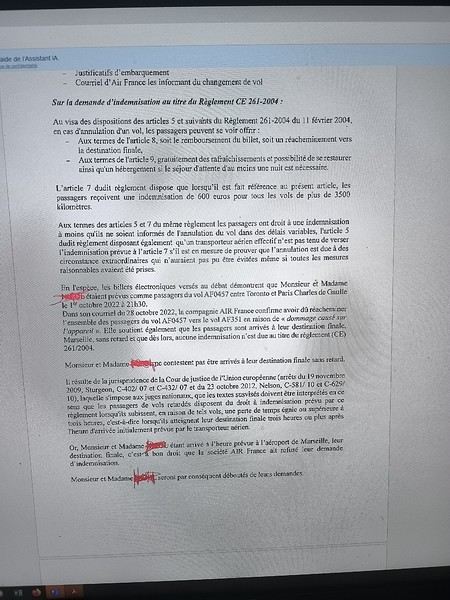
That’s right. In my case, the flight was moved up by more than 3 hours on the same day. I got an email with the new ticket.
It took me nearly 2 years and an appeal to finally get the compensation.
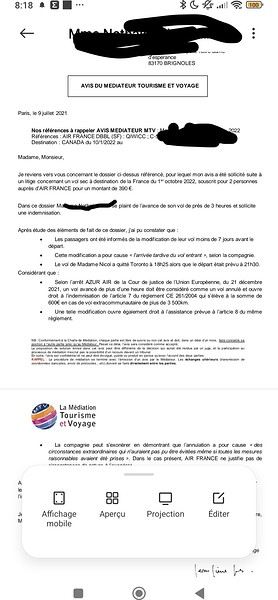
Even with a favorable ruling from the justice mediator, Air France refused to pay, claiming I didn’t actually experience a flight delay...
Air France isn’t the only case. Most airlines are reluctant to compensate passengers, even when they’re legally entitled to it. While there are exceptions, you’ll almost always have to take legal action. And at that point, airlines will almost always settle before a ruling if your case is well-prepared. However, in rare cases, an airline may go all the way to a ruling, even when they know they’ll lose. Here’s a particularly telling example:
Don’t be mistaken about the role and powers of a mediator. A mediator has only one power: mediation, which means NONE. Moreover, their role isn’t to interpret the law but simply to try to reach an agreement (good or bad, it doesn’t matter) to avoid going to court.
That’s why airlines almost always ignore the mediator’s opinion. But under French procedure (which will soon be mandatory), you must go through the tourism and travel mediator before you can take legal action.
Note, however, that the mediator isn’t required if you use the "European Small Claims Procedure."
Well, I can only speak for my case,
but in my situation, they went to court...
The first trial was lost—God knows how—even though they didn’t even show up...
I had to appeal...
Air France lost the appeal.
The compensation was doubled, and all court costs had to be reimbursed by Air France as well.
It’s clear that if I hadn’t had legal protection, I wouldn’t have gone as far as the appeal... And that’s exactly what Air France is banking on.
But in my case, they went to court...
The first trial was lost, God knows how, even though they didn’t even show up...
I had to appeal...
Air France lost on appeal.
The compensation was doubled, and all court costs had to be reimbursed by Air France as well.
Hello,
The civil justice system works like clockwork. When it comes to air passenger rights, to win your case, all you need to do is cite:
1° the relevant articles of Regulation 261/2004 of the European Parliament and Council;
2° the rulings (mainly from the Court of Justice of the European Union, and secondarily those from the Council of State) that apply to your situation.
And the judge has no choice but to apply the relevant texts.
I’m surprised you mentioned an appeal after a first-instance ruling, unless the amount in dispute allowed for it.
If you send me, at my email address (which is listed on every page of my website https://retardimportantavion.wordpress.com/), the arguments submitted to the court by both parties and the ruling issued (anonymized if you prefer), as well as the same for the appeal, I’ll be able to explain why things turned out the way they did.
By the way, you’ll likely find the explanation on my website yourself.
Well, I can't really tell you why it happened like that...
What I do know is that the judge in the first instance dismissed my case...
I appealed, and I won. The appeal judge overturned the first ruling... And ordered Air France to pay double the compensation, which came to 1,200 € per passenger, plus 2,500 € in legal fees (it has another name, but I’ve forgotten it).
I’m getting more and more confused.
For amounts under 5,000 €, the case falls under the local court, which, in this type of dispute, rules as a final decision (meaning no possibility of appeal).
The only recourse in this case is the Court of Cassation, which, if it overturns the ruling, will send the case back to another local court. Indeed, the Court of Cassation does not examine the case itself but only whether the rules of law—and particularly procedure—were respected. As a result, the Court of Cassation only has two options: uphold the ruling or overturn it and send it back to another court.
So, in your case, since compensation is calculated per passenger, the number of passengers meant the total amount exceeded 5,000 €. In this situation, an appeal is possible.
If your "additional compensation" was the same amount as the compensation due under Article 7, that was pure coincidence. In the case linked above, the additional compensation was 500 € on top of the 600 € compensation set by Article 7.
But the compensation under Article 7 can only be 600 € for a non-EU flight over 3,500 km. It cannot, under any circumstances, be 599 € or 601 €, let alone double. So in your case, it could only have been "additional compensation," meaning the airline really messed up.
The explanation for your situation necessarily lies in the details of your case. If you send it to me (anonymized if you prefer), I can give you a clearer answer.
Finally, "legal fees" correspond to Article 700 of the Code of Civil Procedure. The judge orders the losing party to reimburse the winning party for the costs they incurred to defend themselves.
"
The court, ruling by contradictory judgment,
Overturns the referred judgment and rules anew:
Orders AIR FRANCE to pay each of the appellants:
- A sum of 600 € as the flat-rate compensation provided for by European Regulation No.
261/2004 of February 11, 2004,
- A sum of 600 € in compensation for the moral damage caused by its abusive resistance,
And 2,500 € in legal costs"
"
The court, ruling by contradictory judgment,
Overturns the referred judgment and rules anew:
Orders AIR FRANCE to pay each of the appellants:
- A sum of 600 euros as the flat-rate compensation provided for by European Regulation No.
261/2004 of February 11, 2004,
- A sum of 600 euros in compensation for the moral damage caused by its abusive resistance,
And 2500 € in legal costs."
Hello,
Things are becoming much clearer regarding the "doubling" of compensation.
As I already explained, a judge cannot double the amount of the flat-rate compensation provided for in Article 7 of Regulation 261/2004 of the European Parliament and Council, but they can grant (which is very rare) "additional compensation." It’s pure coincidence that the judge set the amount of this additional compensation equal to the amount provided for in Article 7.
Reason for the initial judgment’s failure:
You only provided a single page of the judgment in question and did not provide the conclusions submitted by both parties to the court.
As a result, my opinion can only be a guess based on this very partial information, and in no way an affirmation.
This single page of the judgment mentions the Sturgeon ruling by the Court of Justice of the European Union. Given procedural rules, if the judge refers to it, it can only be because either your lawyer or Air France’s lawyer brought it up.
However, this ruling only concerns the right to compensation for arriving at the final destination with "3 hours or more" of delay.
If your lawyer claimed compensation on this basis, it’s obvious the judge could only dismiss your case since you had no delay upon arrival at your final destination...
Still, I can’t believe your lawyer would make such a mistake!
What’s more, this makes the error even more unlikely: your flight wasn’t delayed but was simply canceled and rebooked (your first flight segment) 3 hours earlier, according to your explanation. From what you said, it seems you were informed of the cancellation of your first flight segment and the rebooking 3 hours earlier at the last minute—or at least less than 7 days before.
It therefore seems (once again, this is just a guess given the very limited information you provided) that your lawyer "forgot" to cite Article 5, paragraph 1, subsection c) of Regulation 261/2004 of the European Parliament and Council (I quote):
Article 5
Cancellations
1. In the event of a flight cancellation, the passengers concerned:
[...]
c) are entitled to compensation from the operating air carrier in accordance with Article 7, unless they are informed of the cancellation of the flight:
[...]
iii) less than seven days before the scheduled departure time if they are offered re-routing allowing them to depart no more than one hour before the scheduled departure time and to reach their final destination less than two hours after the scheduled arrival time. (end of quote)
But again, I find it hard to believe your lawyer would "forget" something like that!
However, it’s clear that no judge could have dismissed your case if Article 5, paragraph 1, subsection c) had been cited.
Just a reminder: in civil matters, a judge, who is bound by impartiality, can only rule on a dispute based on the "grounds" (laws, case law, regulations, contractual rights) cited by both parties, while their duty of impartiality prevents them from "suggesting" to either party a "ground" they may have omitted.
I have no way of forming an opinion on this "appeal," especially since, in this case, a judgment rendered by the local court is issued "as a final decision," meaning it cannot be appealed, except in cases provided for by Article 473 of the Code of Civil Procedure (I quote):
When the defendant does not appear, the judgment is rendered by default if the decision is final and if the summons was not served in person.
The judgment is deemed contradictory when the decision is subject to appeal or when the summons was served on the defendant in person. (end of quote)
The question is why the judgment was "deemed" contradictory and subject to appeal. Only a complete file consisting of the conclusions submitted by each party in both instances, plus the two full judgments, would shed light on this. But I must admit, my curiosity is piqued...
It clearly states in the claim that the flight was canceled and rescheduled more than 3 hours earlier on the same day...
When we lost the first case, my lawyer really didn’t understand why... He just concluded that a judge is sovereign in making the decisions they want... In this case, the judge ruled there was no damage... since we arrived without delay... He told me that’s what appeals are for... And sure enough, we won on appeal... In the end, it was mostly the lawyer who made extra money... But the appeal judge still recognized moral damages...
It does clearly state "flight canceled and brought forward by more than 3 hours on the same day" in the request..
But did your lawyer write—and confirm verbally during the hearing before the judge—the terms of Article 5, paragraph 1, subsection c) of Regulation (EC) No 261/2004 of the European Parliament and of the Council (quoting):
Article 5
Cancellations
1. In the event of cancellation of a flight, the passengers concerned:
[..]
c) shall be entitled to compensation by the operating air carrier in accordance with Article 7, unless they are informed of the cancellation of the flight:
[..]
iii) less than seven days before the scheduled time of departure if they are offered re-routing, allowing them to depart no more than one hour before the scheduled time of departure and to reach their final destination less than two hours after the scheduled arrival time. (end of quote)
It does seem like everything is there, because if they didn’t, the judge simply couldn’t rule in your favor. In civil matters, a judge can only base their decision on the "arguments" put forward by both parties.
A guess: your opponent likely invoked the Sturgeon ruling (compensation for passengers who arrive at their final destination with a delay of "3 hours or more"). They may have done so in writing only, requesting that the case be handled without a hearing.
If your lawyer didn’t cite Article 5, paragraph 1, subsection c), the judgment dismissing your claim makes perfect sense.
He even mentioned Corendon (not sure about the spelling).
Unfortunately, the first judge didn’t agree.
Luckily, the appeals judge did.
.
When there’s an appeal ruling, the same things are requested as in the first hearing—no changes—so yes, everything was done by the book.
Hello,
That the same things are requested on appeal is one thing, but it doesn’t mean they’re argued with the same *"means"* (laws, case law, regulations, contract law). Otherwise, in such a straightforward case, the ruling would’ve been the same as the first judgment! Again, in civil matters, a judge CANNOT have a personal opinion. They can only decide based on the *"means"* presented by both parties.
Here’s the operative part of the Corendon ruling, as you can read in the link above (quoting):
"On those grounds, the Court (Eighth Chamber) hereby rules:
Article 5(1)(c) and Article 7(1) of Regulation (EC) No 261/2004 of the European Parliament and of the Council of 11 February 2004 establishing common rules on compensation and assistance to passengers in the event of denied boarding and of cancellation or long delay of flights, and repealing Regulation (EEC) No 295/91, must be interpreted as meaning that:
in the event of a rescheduled flight where the departure and arrival times are changed in advance by the airline and accompanied by a new booking confirmation for the affected passengers, the length of the delay upon arrival must be calculated based on the originally scheduled arrival time." (end of quote).
The Corendon ruling states that the delay must be assessed against the originally scheduled arrival time.
The Sturgeon ruling (likely cited by your opponent in the first judgment) states that passengers must be compensated if they reach their final destination with *"a delay of 3 hours or more."*
However, you didn’t experience any delay upon arrival at your final destination since you were rebooked on another flight 3 hours earlier!
On these grounds, the judge had no choice but to side with your opponent—since you arrived at your final destination with no delay whatsoever!!! Furthermore, it’s important to note that this ruling applies to delayed flights, not canceled ones, whereas your first flight segment was *canceled*, not delayed! It’s understandable that your opponent cited the Sturgeon ruling to argue you didn’t suffer a *"3-hour or more delay."* But for your lawyer to cite the Corendon ruling, which only strengthens your opponent’s position, is a whole different story!
Given your description, we can assume your flight was canceled last-minute—less than 7 days before departure—and you were rebooked 3 hours earlier. The outcome would’ve been entirely different if your lawyer had cited (which they likely did on appeal) Article 5(1)(c)(iii), emphasizing to the judge that compensation was being sought for *cancellation*, not delay. (Quoting):
"Article 5 Cancellations
1. In the event of a flight cancellation, the affected passengers:
[...]
c) are entitled to compensation from the operating air carrier in accordance with Article 7, unless they are informed of the cancellation:
[...]
There’s a major difference between the role of a mediator and that of a judge. A mediator’s role isn’t to interpret the law but to try to reach an agreement to avoid going to court.
As a result, a mediator gives their opinion, which they can’t enforce. On the other hand, a judge can’t give their opinion because they CANNOT have one. They can only make a decision based on the "arguments" (laws, case law, regulations, contractual rights) raised by both parties. Therefore, they CANNOT consider the mediator’s opinion because, precisely, it’s just an opinion.
What’s more, the mediator’s opinion confirms that your lawyer made a mistake. Indeed, according to the mediator’s assessment, your flight wasn’t classified as canceled (even though it clearly was) but only as rescheduled earlier. The mediator even cites the Court of Justice of the European Union’s ruling on flights rescheduled by more than one hour. However, it was clearly a canceled flight with rebooking on another flight—not a rescheduled one—since the rebooking flight had a different flight number.
If, as you say, your lawyer cited the Corendon ruling (which determines the relevant schedule for a delayed flight) while it seems your opponent cited the Sturgeon ruling (compensation only for "3 hours or more" delays), the judge could only rule in favor of your opponent.
These exchanges are becoming completely pointless since you haven’t provided the full judgment (only 1 page), the ruling, the submissions filed in court, or those filed with the Court.
Therefore, I’m ending this exchange, which is turning into a useless debate.
I just saw that new rules for air travel disputes are coming into effect today, and apparently, for consumers, it’s going to be longer, more complicated, and more expensive.
Hello,
This decree dates back to last August. My website https://retardimportantavion.wordpress.com has long since been updated. While the decree only came into force six months later, it was already necessary to account for the airline's response time to a claim sent by registered letter with acknowledgment of receipt (A.R.), as well as the processing time for the conciliation procedure before taking the matter to court. Note—given the many questions visitors to my site ask on this point—many still haven’t understood that a registered letter with A.R. is the *only* valid method of communication for the initial claim.
The decree has a clear purpose: to paralyze agencies that charge "I’ll take 30%" (or more!!!). Since court action must now *mandatorily* be initiated by summons—meaning through a *commissaire de justice* (the new name for bailiffs)—you’ll need to spend around 100 to 150 € to file a case. This will obviously create a serious cash-flow problem for these agencies.
The obvious solution would have been to enforce Article 16 of Regulation 261/2004 of the European Parliament and Council: imposing dissuasive fines on airlines that routinely violate the regulation. But during discussions to update the same 2004 regulation (particularly the compensation amounts, which have never been adjusted), the Council (heads of state and government of the 27 EU member states) and the European Parliament have failed to reach an agreement for years. The Council is always very receptive to airlines’ arguments, while the Parliament remains strongly focused on consumer rights.
For consumers, the key changes are as follows:
1. Before taking a case to court, instead of contacting the *conciliateur de justice*, you must now contact the *médiateur du tourisme et du voyage* (MTV).
2. Instead of filing a simple *requête* (petition) after an unsuccessful mediation, you must now do so by summons, meaning you’ll need to hire a *commissaire de justice*.
3. In practice, this mainly affects agencies—mass procedures are no longer possible.
Let’s look at the first two points:
Contacting the *médiateur du tourisme et du voyage* (MTV) instead of the conciliator doesn’t change much. What’s more, the MTV can only handle cases involving member companies. Many foreign airlines aren’t members, so you’ll need to prove that the MTV rejected your case.
The second point (summons) is major: Airlines will now resist passenger claims even more, betting that even fewer passengers will take legal action than before.
However, for passengers determined to enforce their rights, the consequences are limited to:
Paying the *commissaire de justice* (around 100 to 150 €). This amount will be part of the sum claimed in court and will be covered by the losing party under Article 700 of the French Code of Civil Procedure.
More than ever, *not deviating in the slightest* from the rules outlined on my website;
This new decree has been *strongly* criticized by legal professionals (both judges and lawyers).
It can reasonably be argued that this decree violates EU law, which has led to an ongoing legal challenge for its annulment. However, this process is likely to take a long time.
This decree is also strongly criticized by consumer associations. UFC-Que Choisir filed a case with the Council of State on October 6th to demand its annulment.
" Celui qui voyage sans rencontrer l'autre ne voyage pas , il se déplace "
( Alexandra David-Néel )
" Ahora todos quieren ser latinos , no , ey , pero les falta sazon , bateria y reggaeton " ( Bad Bunny )
Ce qui devait arriver arriva: la compagnie cesse son activité à compter de demain 1er septembre. Vienne avait également décidé de ne plus l'accueillir. Le peu…
Je suis navré d'apprendre cette nouvelle car je trouvais le rapport qualité prix honnete...avec une promo! www.air-journal.fr/... c est la concurrence qui va…
J'effectue régulièrement des voyages depuis plus de vingt ans
maís c'est la première fois qu'un compagnies me traite si mal que Air France.
Deux voyages, deux fois des problèmes. Le dernier:
Voyage de Séoul à Rennes. Dernière partie de París CDG à Rennes par Air France.
J'arrive à Paris et je me rends directement chez Air France pour obtenir la carte d'embarquement jusqu'à Rennes. On n'y assure que mon bagage suit jusqu'à Rennes.
Arrivé à Rennes, pas de bagage, comme c'est le cas de 5 personnes.
Le bureau d'Air France est fermé et le oersonnel de l'aéroport m'assure qu''il y a rarement quelqu'un.
Avec l'aide du personnel de l'aéroport, je fais une réclamation par internet et Mon bagage est quadi directement localisé, en conséquence je l'aurai le lendemain.
4 jours plus tard, le bagage est toujours au même endroitvà CDG, rien ne bouge.
Le problème est qu'Air France m'a pas de service clientèle. Ce qu'ils appellent service clientes, c'est un service qui répond après une heure et qui vous répète ce qu''il y a sur le FORMULAIRE informatique. Aucune coordination, aucune moyen de faire bouger les choses, je suppose que Air France préfère me payer l'indemnisation après 21 jours que se bouger le cul.
J'ai déjà eu des bagages égarés dans d'autres voyages maís c'est la première fois que je vous un tel je-m'en-foutisme foutisme et manque de professionalisme..
Hi there,
We had planned a trip to Sicily in August, and due to the volcanic eruption of Mount Etna, my flight was canceled. The airline is refunding the outbound flight, but none of the non-refundable expenses: accommodation booked through Booking, rental car, and the return flight aren’t covered. My SUPER Gold card doesn’t work in this specific case! :( If anyone has been in this situation, could you let me know if you were able to get any recourse and, if so, how?
Thanks in advance
Back in February, I booked a flight with Air France-KLM from Lyon to San Diego with a layover in Amsterdam (flights operated by KLM). The flight is scheduled for late August.
My Lyon→Amsterdam flight was canceled by KLM in June, and a replacement flight the evening before was booked for me. So, I’ll end up spending the night at Amsterdam Airport to catch my flight to San Diego the next morning.
Since the cancellation happened more than 14 days before departure, I know I’m not entitled to financial compensation (EU Regulation 261/2004). But am I entitled to reimbursement for a hotel night in Amsterdam?
Hi,
Air Cairo offers good prices on domestic flights and schedules that work for us, but is this airline reliable?
Thanks in advance for your feedback.
Hi,
I booked an Etihad ticket on their website for Dusseldorf-Abu Dhabi. In the first name field, I entered all my first names (something I never do and I regret it, but the site was confusing). Everything is spelled correctly, but the problem is that I just received my new passport and only my first two first names and the first letter of the third appear—there’s no trace of the last one.
I called Etihad, and of course, they tried to charge me $100 USD to remove that last first name. But I’m hesitant because usually, I only put my first first name and not the others, and I’ve never had an issue... So I’m wondering if having that extra first name, which isn’t on my passport, could get me denied at check-in.
Thanks for your feedback!
Hi everyone,
Next January, I’m heading to India.
My outbound flight is with Emirates from Paris to Dubai, then another Emirates flight from Dubai to Calcutta.
Could anyone tell me how the connection works? I’ve heard there’s a dedicated Emirates zone, but how does it actually work in practice—I’ve got a 2-hour layover.
Thanks so much!
Take care.
I’d like to fly to Malta from Lyon.
I’ve read a lot of negative reviews about KM MALTA, especially regarding baggage fees at the airport.
Of course, I don’t want to book through third parties (like SkyScanner, Opodo…).
AIR FRANCE offers tickets to MALTA in partnership, if I understood correctly.
On AIR FRANCE, the tickets include everything (checked baggage, cabin bag, small personal item, seat), whereas with KM MALTA, everything is extra and the final price is almost double!
In this case, is AIR FRANCE considered the same as sites like Opodo or others?
Given the price difference, I’m hesitant…
Have any of you booked with AIR FRANCE for this destination? How did it go?
Thanks,
HERVE
Hi everyone, I’ve unfortunately only just noticed that I booked two flight tickets, but I made a mistake on the second first name. Basically, my computer auto-filled and typed my first name twice, so both tickets are in my first name. Only the last names—mine and my friend’s—are correct.
TAP Portugal refuses to make the change because they consider it a change of passenger, even though it’s clearly a typo (plus, my last name isn’t common).
I’m leaving in 5 days, and buying a new ticket would cost 3 times the original price. Has anyone been in this situation before? I’d like to try negotiating at the airport, but it’s a gamble… Thanks in advance for any advice!
Since it came into force, Regulation 261/2004 of the European Parliament and Council, which defines air passenger rights, has faced fierce resistance from airlines, backed by IATA (the association representing almost all passenger airlines).
Beyond the airlines' often abusive—and even frequently bad-faith—resistance to passenger rights, IATA has been lobbying EU institutions for years, with the Council paying close attention for a long time.
As a result, the Council and the Commission have been proposing revisions to Regulation 261/2004 for years that are particularly unfavorable to passengers. The latest attempt nearly eliminated the right to compensation for delays of 3 hours or more upon arrival at the final destination.
However, since this is a regulation of both the European Parliament AND the Council, the two bodies had to agree.
But the European Parliament has always stood firm, consistently responding that passenger rights must be preserved.
After 11 years of struggle, it seems likely that we’re finally nearing the end of the match between the European Commission, the Council (the 27 heads of state or government), and the European Parliament.
Indeed, the Commission and the European Parliament have agreed on a text that will be debated again on Monday, July 6, 2026, with a vote scheduled for July 7, 2026. It’s very likely that this text, which would come into force in a year, will be adopted.
The main changes would be as follows:
- Families with children will no longer be forced to pay to sit together on planes;
- A flight will be considered canceled (not just delayed) if it departs more than one hour late;
- Right to compensation for arrival at the final destination if the delay exceeds 3 hours (no longer "3 hours OR more"). The arrival time will be when the plane, having reached its parking spot, engages its parking brakes (no longer when the aircraft door opens);
- Airlines can no longer refuse boarding or charge extra on the return flight for a passenger who didn’t take the outbound flight;
- If a flight is canceled, the airline must, at the same time as informing passengers of the event, offer the choice between a refund and re-routing, and inform them of their rights to assistance and, if applicable, compensation;
- The airline must, without undue delay, inform passengers of the reason;
- In the case of a connecting flight, if the connection is missed and the delay at the final destination entitles the passenger to compensation, the responsible airline will be liable. This is very different from the current situation, where, under the KLM ruling, any airline operating a segment of the flight is liable for compensation. This promises more disputes that the Court of Justice of the European Union will have to resolve if two separate airlines operating segments of a connecting flight are both responsible for the delay. See this case for an example: https://retardimportantavion.wordpress.com/2026/04/18/swiss-international-air-lines-la-mauvaise-foi/
Moreover, this case demonstrates in advance another potential dispute: It could be argued that it wasn’t a missed connection since the flight was canceled before the first leg even departed.
- Within 96 hours of a flight that could entitle passengers to compensation, the airline must contact them to inform them of their rights and explain the next steps.
- Passengers must claim their right to compensation within 9 months. This is very different from the current situation, as Regulation 261/2004 sets no time limit. Currently, national law applies—in France, the limit is 5 years. The airline must respond within 30 days. If the airline refuses compensation on the grounds of "extraordinary circumstances," it must specify which type of case it refers to from the list in the annex of the new regulation. If the case isn’t on the list, the airline must explain what the event was, why it qualifies as extraordinary circumstances with "clear, substantial, and concise" explanations, and why it’s directly linked to the reason given. It must also declare what "reasonable measures" were taken to mitigate the issue. This is, of course, a huge change in the regulation, with the clear goal of preventing airlines from declaring just anything as "extraordinary circumstances" to avoid compensation.
- If, within 3 hours of a last-minute canceled or delayed flight, the airline hasn’t offered re-routing under comparable transport conditions and as soon as possible—whether on one of its own flights or another airline’s—the passenger will have the right to arrange their own re-routing and demand a refund for the new ticket, up to 400% of the original ticket price. This is a significant improvement that would have likely prevented the case described here: https://retardimportantavion.wordpress.com/2024/01/12/reacheminement-catastrophique-droit-indemnisation-meme-circonstances-extraordinaires-2/
- If a flight is canceled due to "extraordinary circumstances," the airline will only be required to offer up to 3 nights in a hotel. This is a major change, as there’s currently no limit. Expect disputes if the extraordinary circumstances end while the passenger hasn’t been re-routed.
- The price of a flight, as first displayed, must obligatorily include a cabin bag. This doesn’t prevent the airline from offering a price reduction if the passenger waives the cabin bag. This will put an end to abnormal practices, such as (just one example) Condor charging extra for a cabin bag on long-haul flights like Frankfurt (Germany)–Puerto Plata (Dominican Republic)–Santo Domingo (Dominican Republic)–Frankfurt.
- Free correction of a passenger’s name if requested 48 hours before departure. Note: This can’t be used to replace one passenger with another—just to correct a typo, e.g., Dupont instead of Dpont.
- Airlines’ websites and apps must include information on how to file a claim.
It’s clear that, despite a few details, these changes are very positive for upholding passenger rights. It remains to be seen whether this text will be definitively adopted on July 7, 2026, as is very likely, and, more importantly, whether IATA will encourage airlines to loyally respect these new rules or persist in their old habits.
I’m planning a trip to Georgia this summer and I’ve been comparing some airlines. I’m not particularly set on flying with Pegasus (though it’s convenient with direct flights from Lyon to Tbilisi), but right off the bat, Pegasus states this:
As of January 1, 2026, all foreign nationals traveling to Georgia for tourism purposes will be required to present valid travel health insurance. Guests who fail to provide the relevant health insurance will not be accepted on our flights to Georgia.
Sincerely,
Pegasus Airlines
In other words, if you don’t show proof of travel health insurance, you’ll be denied boarding.
Personally, my credit card insurance has always been enough for me, and I’d rather not take out extra coverage...
Have any of you run into this issue before? If not, what do you think? Why is Pegasus asking for this proof? Other airlines don’t mention it at all.
I bought my flight ticket with my first (usual) first name, which appears first on my passport. However, I have two first names on my passport, and of course, it’s mentioned in the machine-readable zone at the bottom.
I booked with Turkish Airlines (through an online agency) for a trip to South Korea.
I wanted to know if it would be a problem that I only used my first first name on the ticket, while my passport has two. I had requested through the agency to add the second first name, but the airline refused because it doesn’t meet their general conditions. (They must have seen that the last name and first name were the same, and only the second first name was added.)
So, my ticket has my last name and first first name correctly spelled, and when I check in online, I’ll enter the passport details correctly.
I’ll have a layover in Istanbul on the flight.
Thanks in advance for your replies.
Have a great day.
Hi there,
I traveled in June 2025 with Nouvelair Destinations to Hammamet.
I had one checked bag and one carry-on sized 40x24x30, which I usually take on low-cost flights, and I didn’t have any issues. But I just read on a website that Nouvel Air only accepts carry-ons of 40x20x15. I’m flying back to Djerba in June—what do you think? Especially since that size is impossible to find??????? Thanks
Hi, it's my first time taking a plane and I chose EasyJet for a Geneva -> Barcelona flight.
I booked my ticket.
I received my booking reference by email, but I don’t see the actual ticket (barcode or QR code?).
Then I checked in to get the boarding pass with the flight details, QR code, etc. But does this boarding pass act as the ticket?
Because I’ve seen several times online that the flight ticket and the boarding pass aren’t the same thing.
We're leaving for Albania on June 18th. When I validated the flight tickets with Wizz Air on Booking, I only put my son's first name but forgot to include his other three first names on the ticket.
On the passport: SURNAME: Dupont, FIRST NAMES: toto titi tutu tata
On the flight ticket: SURNAME: Dupont, FIRST NAME: toto
I can't seem to reach anyone at Wizz Air to get an answer.
Booking and Wizz Air's chat say I need to modify it, but ChatGPT says it should be fine.
I wanted to know if he can fly like this or if I need to change his ticket?
(It costs 140 €, I know I shouldn't have made a mistake🙁)
Basically, all airlines have been blacklisted because they don’t meet European safety standards. They’re banned from flying in Europe but continue operating in Tanzania.
The main issue is that travel agencies’ civil liability no longer applies to blacklisted airlines.
So we can’t allow clients to fly with these carriers.
Of course, there’s huge pressure from European agencies, which are forced to disrupt their plans or even cancel trips because of this.
Personally, I’ve got a trip planned for February 2026 to the southern parks in Tanzania, so I’ll be keeping an eye on how this develops.
Do any of you have updates?
Thanks!
Right now, with the war raging in Iran and affecting all the neighboring countries of the Persian Gulf, many airports are completely closed to all traffic.
Several airlines like Qatar Airways, Emirates, and others have almost completely halted their operations.
Whether in the Middle East or Africa, many travelers are stranded—maybe for a long time... A heartfelt thought for them and the struggles this will cause.
Four months ago, I was in Kenya with a flight booked through Qatar Airways... I can’t even imagine how I’d react if I were stuck there now. ??
Wishing all these travelers courage, patience, and success in making it back home.
Hello, some (potentially) good news for Brazil lovers—GOL airline is launching a route to Europe from Rio, starting in September for Lisbon, then Paris at a later date that hasn’t been announced yet.
They’ll be using their new A330-900 neo.
No prices have been announced so far, but hopefully we’ll find direct flights from GIG at a more interesting fare than AF or Latam…
I’m really surprised because in TUI’s new tour packages, the airlines they’re using are of low quality. Before, they used to prioritize major airlines, but now it’s small airlines from small countries—companies with terrible ratings and borderline safety concerns. I even just noticed this note for a Tanzania trip: "We inform you that the domestic flight segment in Tanzania included in your trip is operated by an airline listed on the European Union’s list of air carriers subject to an operating ban within the European Union. This ban only applies to European Union airspace, meaning this airline is not permitted to take off, land, or fly over European airspace. However, this airline is authorized to operate in Tanzania."
This means they’re using airlines on the blacklist!! It’s pretty worrying for safety. What do you all think?
We’re planning a cruise to the UAE/QATAR/OMAN starting from DUBAI, with flights departing from Paris CDG.
Which airlines would you recommend for round-trip flights, with or without a layover?
We need assistance for check-in and boarding/disembarking (my husband is a mobility-impaired traveler who uses a cane and/or a walker).
We’ve done a cruise return from Dubai to Paris CDG before in 2016, with a layover in Istanbul, but we booked the transfer and return flight with COSTA.
For our current plan, it would be with Celestyal, which doesn’t offer round-trip flights from Paris to Dubai.
Should we book very far in advance, or is a few months before departure enough (4/6 months)?
We’re thinking of arriving the day before the ship departs, so we’d need to stay overnight in Dubai—either on the way there or for the return flight, depending on the flight schedules. Could you recommend a hotel not too far from the airport, and how to get to the port from the airport?
Thanks so much for your advice. Have a great Sunday! Mum49
Hi,
It's all in the title—this means nothing's getting through, so no more oil.
In Europe, kerosene reserves are still good, but by the end of April, flights will have to be reduced.
European airports fear running out of kerosene if the Strait of Hormuz isn’t reopened within three weeks
I’m reaching out to ask for your help with a bit of a problem:
I booked a flight to Berlin from Orly for April 15th—it’s coming up fast. But I just made an annoying discovery: my passport expired two weeks ago.
From what I understand, in principle, I can still travel within the Schengen Zone with an expired passport as long as it’s been less than five years. However, EasyJet’s website explicitly requires a valid ID (and just to add to the fun, my national ID card has been expired for a while now).
So, I’d love to know: how strict are EasyJet’s ID checks? Do they enforce validity rules strictly and refuse boarding if the ID isn’t valid? Or is it more of a luck-of-the-draw situation?
Basically, should I just write off this trip now, or should I still try my luck—maybe with a little tearful plea? Has anyone here had a similar experience? I can’t be the only one, right!
I booked a flight with RyanAir for next month, with the priority+ option and two cabin bags. So I can take a 10 kg bag with dimensions 55x40x20 in the cabin (plus another smaller one).
The problem is that the smallest suitcase I have (which is supposed to be designed specifically for cabin size standards, according to the manual) has the following dimensions: 55x37x21, so it's just 1 cm over (wheels included) on one of the measurements.
I wasn’t too worried at first, but I’ve read dozens of stories about people’s misadventures and the hassles they’ve had with RyanAir.
Since I don’t want my suitcase to end up in the hold (that would waste time picking it up when I’m already arriving late and need to get to the city center), nor do I want to pay an extra fee (apparently 50 €) for the outbound and return flights for just 1 centimeter—especially since I paid for the "priority+" option and I’m not exactly rolling in money—I’d love some advice.
Have any of you been in the same situation? I’ve read that with this airline, they check bags in templates (testing them in different positions) and are completely uncompromising. I tried contacting customer service, who, as luck would have it, "don’t handle this kind of request," and a rep I spoke to wasn’t much help.
I know it’s a low-cost airline, and I don’t expect luxury or even kindness, but come on—just 1 cm on a short flight with the + option... I’m a bit overwhelmed by everything I’ve read...
Just to clarify, since I’m going for 8 days, I can’t just take one bag for my stuff. I’ve done that for shorter trips before, and it was a hassle—I even had to buy an extra bag for the return trip... Luckily, the inspector was nice about it!
Thanks so much!
I’m a newbie when it comes to air travel :) Hope I posted this in the right section!
When I run searches on Skyscanner, I see that only Lufthansa has flights to Seoul with just one stop. Air France doesn’t show up, even though I thought the French airline served Seoul?
I can’t even log into the Air France website—it keeps glitching.
Hi there,
I’d like to return to Uzbekistan next April for 10 days with my husband to visit our son who lives there. We went last July and I bought the flight tickets (direct flight from Paris on Uzbekistan Airways) about 2 months in advance at very reasonable prices. I’ve been checking for late April for a few weeks now, and the tickets are much more expensive and keep rising. I can’t figure out if the prices are going up because it’s still a bit too early to buy and they’ll likely drop if the planes aren’t full, or if it’s because the period is actually in high demand. For reference, last year I bought my son’s ticket on May 30th for a departure on June 3rd—just 3 days later—at a very low price that didn’t budge at all.
Just in case, does anyone know the pricing trends for this airline and can advise me? Should I wait or not?
Thanks, and feel free to ask if you need any tips about the country!
My wife bought a flight ticket (Lucky Air) under her Thai maiden name and was issued a Chinese visa on her new Thai passport but with her French married name (due to administrative requirements). She was denied boarding by the airline in Bangkok for the flight to Kunming—resulting in the loss of our round-trip flight tickets, including mine since we were traveling together—despite presenting both passports at the airline counter at the same time.
Hi there.
I’m planning a trip to Chile, and the fares from the Colombian airline Avianca are really appealing.
Way cheaper than Air France, for example.
That said, the reviews I’ve seen online aren’t great.
What do you think of this airline?
Have any of you taken long-haul flights with Avianca?
Thanks in advance for your replies.
Eric
This might be a silly question, but I’m traveling to Japan from CDG and returning via Osaka with EVA Air, and I have a pretty bulky aluminum knee brace.
It’s this model:
https://enovis-medtech.eu/fr_FR/OA-FullForce-74358.html
Has anyone had any experience with airport security checks or flying with one of these?
I can't seem to find flights between the Cape Verde islands on the airline's website. No matter the date or route, I always get the same response: "no flights on this date."
See the photo.
Would anyone have an explanation? Surely not all flights are fully booked in July?
Hi there,
I have a question...
Has anyone managed to get a refund from Oman Air?
After a delayed flight, we missed our connecting flight to get home!!
At midnight, the flight attendant booked us on a flight to Nice via Munich, even though we were in Munich and wanted to get back to Nice... Too tired from the trip, we didn’t notice the mistake!!
The next day, of course, the booking wasn’t valid!!
We had to pay again for the flight back to Nice...
I’m really struggling!! I think they’re giving me the runaround!!
I’ve sent several emails, tried Messenger and WhatsApp, but the only responses I get are: "We need to investigate!! We’ll get back to you in 15 days!!"
It’s been over a month!!
I just sent a registered letter (LRAR) to their office at Paris Charles de Gaulle, which is still open!!