Enmenez avec vous une petite rape. A chaque repas rapez sur votre plat une ou plutot deux gousses d'ail ( l'ail indien étant petit) . Excellente prévention contre les dérangements intestinaux et autres infections microbiennes. Ca marche!
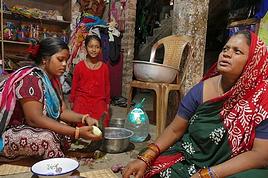
Elle écrase le piment noir, ses cheveux longs balaient le sol.
le kilo d'ail à delhi( et ce n'est pas là où c'est le moins cher) est à moins de 90 cts (d'euros) le kilo. Vous ne pourriez plus vous en passer. Au début c'est un peu difficile mais comme pour tout on finit par s'y habituer. Sinon en moins efficace mais plus agréable un trait de pastis( seulment comme désinfectant intestinal ) dans un verre d'eau(l'apéro quoi) .Toujours le pastis, un bouchon de cette liqueur dans votre gourde d'eau fraiche garantit un rafraichissement et donne à l'eau un bon gout. Encore un truc, si le pastis ne plait pas, presser un petit citron indien dans votre gourde d'eau fraiche, efficace que pour le rafrachissement.
je ne suis pas plus produceur d'ail, de pastis ou de citron que Nika Zarai est productrice d'herbes médicinales. Ce sont les recettes( sauf pour le pastis) de mes grand mères et taties indiennes.
Elle écrase le piment noir, ses cheveux longs balaient le sol.
sa me rapelle les premiers jours arriver a delhi...
avec mon pote on avait pris une petite bouteille de pastis pour feter l arrivé en inde !!!!
j'ai un peut abuser le soir et dans la nuit je me suis reveillé avec une bouche seche et pateuse;je n'avai pas d'eau en bouteille cette nuit la et j'ai pas peut resister de boire un litres d'eau du robinet de la guest...
le lendemain matin je me suis reveille et j'ai vomi pendant 2h l'eau pourri de delhi..!!🙂
par contre pendant les 2 mois passer la bas a chaque repas je gouté l'eau et si ellle n'avait pas
un trop mauvais gout je la buvé en mangeant et ya pas eut de souci !!
je pense que tous les corps ne reagissent pas pareil...
alors un peut d'ail dans la bouffe un peut de pastis dans l'eau, les boules;et un CD de massilia !!😎
L'eau de Delhi vient de la Yamuna, celle de benares du Gange ( ce n'est pas une blague) tout comme l'eau de Paris de la Seine, dans les trois cas elles sont traitées dira ton mais on se contentera de l'eau de Seine.
Ah j'oubliai, lorsqu'à Vanarasi vous remetterez votre linge à laver aux dhobis, n'oubliez pas que ce sera dans le Gange au savon 'gonaz' et seché sur la terre battue au bord de l'eau. Avis aux allergiques de la peau. Je n'ai pas de recette, je demanderai à ma grand mère à Pondy, au téléphone, parce qu'elle ne maitrise pas encore internet, ma grand mère chérie confond l'écran d'ordi avec celui de la television.
Elle écrase le piment noir, ses cheveux longs balaient le sol.
En plus des recettes de grand-mère qui sont les meilleures du monde, la médecine actuelle admet que l'ail est un antibiotique naturel qui peut jouer un rôle déterminant comme médecine préventive et comme agent thérapeutique. De plus, c'est un excellent désinfectant du système digestif.... donc, à vos petites râpes !!!
I’m from West Africa and I’d love to introduce a Russian friend to a traditional product from my region: soumbara.
For those who don’t know, soumbara is a condiment made from fermented néré seeds. It has a pretty distinctive smell and a very strong, salty, fermented, umami-rich flavor. In West Africa, we mainly use it to add flavor to sauces, with rice, vegetables, meat, etc.
I’m curious to know, from Russian cuisine lovers: which traditional Russian dish do you think soumbara would pair particularly well with?
I’m looking for a real Russian dish where the combination could be interesting—not just rice or an adapted African dish.
Hi there, we’re heading to Cagliari for one night in April, staying at a hotel without a restaurant. Would you happen to know of a restaurant near Via Giuseppe Garibaldi for a typical dinner that’s not too pricey? Thanks.
I’m looking for typical Catalan restaurants in Barcelona! Any suggestions for areas or little hidden spots?
I know to avoid places like La Rambla, the beachfront restaurants in Barceloneta, and anywhere where they greet you with a menu asking if you want to eat, but are there any specific restaurants to avoid? Any bad experiences or unpleasant surprises?
I’m heading to Barcelona in early May—it’s my first time there. I’d love to hear your suggestions for restaurants (ideally near the tourist center, Las Ramblas). That said, I’m happy to travel if needed. I’m looking for a place renowned for its gastronomy, a spot serving typical Spanish or Catalan food, or somewhere with a unique vibe you wouldn’t normally find... In short, which restaurant did you love most during your stay in Barcelona?
Maybe you already use it in your recipes? Just to let you know that here in Quebec, the maple water harvest has started in several regions. The next step will be to boil this water to turn it into syrup. A sweet nectar, it works well in salad dressings, desserts, with salmon, and more. 😋
If you ever pass through here, don’t miss the chance to visit one of our wonderful sugar shacks. You can taste maple taffy on snow, among other things. 😄
Do you drink wine with your meal, and how often—every day, just on weekends, or only occasionally for special events?
What are your favorite wines, from which country, and what grape variety?
I drink wine with my evening meal every day. I’m particularly fond of wines from Australia and Spain—I really like grape varieties like Cabernet Sauvignon and Shiraz.
Leaving in 15 days for Brittany, specifically the southern Finistère and Bénodet...
Tourists expected to boost the culinary restaurant industry!
Haven’t read the guide for latecomers yet, and I’m really wary of online reviews.
Where can I eat without getting ripped off, enjoy quality food—crêperies, seafood, nice atmosphere...
Thanks to all you savvy foodies!
The title might surprise you, but you’ll understand my point of view.
1/ MEAL STRUCTURE
I’m talking about the standard meal, not the one for those who have to budget for financial reasons (generally fewer in northern and central Italy than in France, but more in the south, which makes up 35% of Italy—Eurostat figures), nor for those (mostly women) watching their figure.
The tradition (once the meal of the well-off, widespread among the general population in the 1950s) starts with soup or pasta (or rice, gnocchi, ravioli, lasagna)—this is the *primo piatto*.
Next comes meat or another animal-based product (fish, cured meats, eggs, etc.)—the *secondo piatto*, which can be replaced by cooked vegetables (the only known example in France: eggplant parmesan).
If the meat dish doesn’t already include vegetables, one is served. Salads, whether green or tomato-based, are side dishes, not starters.
The meal ends with dessert—no difference from French habits: cheese, fruit, or sweets.
*Antipasti* (appetizers) are reserved for festive meals or receptions and are served *in addition* to the main courses at the start.
4 practices unknown in France:
- If the menu includes pasta and ham, you start with the pasta.
- If the menu includes pasta with a meat sauce and fish, you start with the pasta too.
- Pasta is never a side dish for meat.
- It’s not unusual for Italians to start with pasta in a meat sauce and then have a meat dish—most do this several times a week.
Modern adaptations:
- People eat pasta less often (on average 5 times a week, according to recent figures) and soups, which are being replaced by *antipasti*.
- The main meal is now mostly dinner, so it’s much heartier, while lunch isn’t usually eaten at home.
2/ THE CUISINE
What do we know in France? Pizza, pasta Bolognese, carbonara, arrabbiata, ravioli, and lasagna. Fried scampi, Milanese or Bolognese cutlets, carpaccio, and finally tiramisu.
In short, a few basic dishes, but nothing of the gastronomy—whether regional traditions or high-end restaurants.
2 anecdotes:
**Bolognese sauce**
In Italy, the most common homemade sauce is a meat-and-tomato-based sauce called *ragù* (pronounced *ragoo*). Every region, even every town and family, as well as every restaurant, has its own recipe. *Ragù alla bolognese* is just one of these countless *ragù*—and no one in France knows the real recipe (I can share it with those interested). The name *bolognese* given abroad to any *ragù* comes from a canned sauce manufacturer who once branded their product that way. Until the early 1960s, it was called *sauce à la viande* (meat sauce).
**Pizza**
Before World War II, it was practically unknown north of Rome.
Today, Italy is one of the countries where it’s eaten the least (twice as much in France, four times as much in Germany).
Top 15 Brazilian eating habits that surprise the French 😮
Brazil is a multicultural country, and its history has shaped a very unique cuisine, influenced by European, African, Japanese, and Indigenous traditions. Its food culture is quite different from what we’re used to in France, and Brazilian eating habits often surprise French travelers exploring the land of samba and soccer.
We live in Réunion and we're looking for places where we can learn to cook authentic Réunionese Creole cuisine.
We're based in Saint-Denis and are searching in that area.