05:30 15.12.2008 Le chef de l'opposition élu premier ministre en Thaïlande Abhisit Vejjajiva, chef de l'opposition thaïlandaise, a été élu Premier ministre par le Parlement. Son élection fait suite à la dissolution par la Cour constitutionnelle du parti au pouvoir proche de Thaksin Shinawatra, ancien homme fort du pays. M. Abhisit, âgé de 44 ans, leader du Parti démocrate, a reçu le soutien de 235 députés lors d'un vote à la chambre basse, alors que le seuil nécessaire pour être désigné chef du gouvernement était fixé à 220 voix. Pracha Promnog, candidat soutenu par le camp Thaksin, a obtenu 198 voix lors de l'élection de lundi, tandis que trois députés se sont abstenus.
Né il y a 44 ans à Newcastle, en Angleterre, Abhisit succède à Somchai Wongsawat, issu du Parti du pouvoir du peuple (PPP), contraint à la démission après une condamnation pour fraude électorale lors des législatives de décembre 2007 qui l'ont conduit à la tête du gouvernement.
La situation politique reste très incertaine en Thaïlande après les manifestations organisées par les partisans de l'Alliance du peuple pour la démocratie (PAD) qui ont bloqué pendant plusieurs jours les principaux aéroports du pays, fin novembre et début décembre. (ats)
"situation incertaine" est le moins que l'on puisse dire.
Samedi j'étais au national stadium, c'était archi comble mais d'avenants supporters de Thaksin m'ont hissé au sommet des gradins.
Une vue magnifique sur une marée rouge vif mais ceci n'augure guère une accalmie avec la nomination d'Abbhisit qui jusqu'a la semaine dernière faisait figure d'outsider.
Quelle sera la réaction de Thaksin, de ses supporters. ils ont été un peu décu samedi, ils hurlaient plus avant la vidéo de leur idole qu'après. Enfin cela a fait de joli clichés d'une mer rouge... (voir blog)
cela me change des jaunes canaris... tout aussi accueillant au passage.
Violences à Bangkok après l'élection du nouveau premier ministre Des partisans du gouvernement déchu se sont livrés à des violences autour du Parlement peu après l'élection d'un nouveau premier ministre thaïlandais issu de l'opposition à Bangkok.
Ils ont tenté de bloquer le Parlement, jetant des pierres sur les véhicules qui en sortaient.
Ils ont également jeté des projectiles dans l'enceinte du Parlement, blessant au moins un journaliste et un policier, rapporte le quotidien thaïlandais «The Nation» sur son site internet. Les pierres ont aussi endommagé de nombreux véhicules.
Des renforts de police ont été déployés sur les lieux.
Ces incidents sont intervenus peu après qu'Abhisit Vejjajiva, chef de l'opposition thaïlandaise, a été officiellement désigné 27e Premier ministre du royaume à l'issue d'une élection lundi au Parlement. Elle a mis fin à 10 mois de pouvoir chaotique des lieutenants de Thaksin Shinawatra.
Vu les tensions actuelles Abhisit ne doit pas etree trop pressé de dévoiler ses intentions. Quand tu vois qu'ils en sont a cachés à l'hôtel leurs déput"és par peur de surrenchère...
pffff, complet délire !!! qu'est ce qui n'empêcherea pas ses mêmes députés de désavouer le gvt à la première occasion sonnante et trébuchante ?
Il me parait bancal ce gvt tiré par les cheveaux. enfin on verra
Il me parait bancal ce gvt tiré par les cheveaux. enfin on verra
Tu as voulu écrire capillo tracté ou cavalo tracté.......J'ai un doute 😉
Tout le monde meurt, peu de gens vivent .
Je n'aime pas donner des réponses ... . Aujourd'hui, quand on donne aux gens des réponses, ils ont l'impression qu'on les prend pour des imbéciles et qu'on empiète sur leur liberté.
Mon testament philosophique
Citations de Jean Guitton
Décidémment les claviers et la relecture ne me réussissent guère.
Humm j'ai un jour tapé "femme" au lieu de "ferme" une secrétaire de redac me montre la perle, on rigole et du coup elle est restée... la boulette. Vu le contexte une lectrice a fait un scandale et du coup c'est passé au perles du canard.
je vois bien la phrase : " Pour me détendre, J'ai été passé un weekend end à la femme"
Tout le monde meurt, peu de gens vivent .
Je n'aime pas donner des réponses ... . Aujourd'hui, quand on donne aux gens des réponses, ils ont l'impression qu'on les prend pour des imbéciles et qu'on empiète sur leur liberté.
Mon testament philosophique
Citations de Jean Guitton
Dec 15 Prime Minister Abhisit Vejjajiva Daily Photos from Thailand
Monday 15th December, 2008 at 11:39:02| Words: 53 words |
Abhisit Vejjajiva (C) greets members of Parliament after being voted in as the prime minister of Thailand in Bangkok December 15 2008. Thailand's opposition Democrat Party leader, Abhisit Vejjajiva, won a thin majority in a parliamentary vote on Monday to become prime minister as the economy teeters on the brink of recession. (REUTERS/Sukree Sukplang)
http://fr.youtube.com/watch?v=P2Xs6kGCoQohttp://news.bbc.co.uk/2/hi/7783060.stm violences autour du Parlement
Pendant les manifestations des jaunes, l’armée et la police a surtout brillé par son absence. Je suis sûr que si les rouges se permettent d’intervenir contre ce nouveau gouvernement la police et l’armée vont reprendre du poil de la bête et faire preuve d’une assiduité dans les rues inhabituelles !
"The reasonable man adapts himself to the world; the unreasonable one persists in trying to adapt the world to himself. Therefore, all progress depends on the unreasonable man." - George Bernard Shaw
Bonjour Sunpax,
Je viens de lire ton message et je m'interroge car, nous devons aller en thailande en voyage de noces en février 2009 et je pense qu'il n'y aura pas de soucis mais qu'en pensez vous?
Vous croyez que cela peut etre "dangereux" de visiter le pays à cette période? Personnellement, je pense qu'il n'y aura aucun soucis mais bon, c'est toujours intéressant d'avoir l'avis d'autres personnes!
A mon humble avis la securité des touristes sera toujours assurée ! meme si le conflit interne devait s'accentuer...maintenant qui peut dire si les transports ou autres ne seront pas perturbés !!!
En tout cas je pense que ca vaut la peine de venir ;) et ce en toute objectivité !
Hier en fin d'après midi je suis passé a Sanam Luang, quelques dizaines de rouges écoutaient des orateurs de seconde zone sur une estrade a 2 bahts. Il y avait une photo d'abbhisit donnant l'accolade a Sonthi !
Et un peu plus loin les forces de l'ordre surveillaient la scène.
Cette fois ci je verrais bien l'armée se raviser, déclarer que cela suffit, que les désordres coutent cher à la nation et qu'elle ne permettrait pas de nouveaux désordres... de désordre rouge il va de soit.
Red Shirts Protest PM Votes Daily Photos from Thailand
Monday 15th December, 2008 at 19:33:13| Words: 139 words |
Supporters of Thailand's ousted Prime Minister Thaksin Shinawatra throw bricks at cars of some members of parliament after opposition leader Abhisit Vejjajiva won in a vote to become prime minister at the Parliament in Bangkok December 15, 2008. At least 200 demonstrators blocked access to Thailand's parliament and threw bricks at cars of some MPs after opposition leader Vejjajiva won a thin majority in a vote to become prime minister. The protesters barricaded all gates out of the compound and checked cars trying to leave. Some cars had windows broken with clubs or bricks. (REUTERS/Sukree Sukplang)
A pro-Thaksin Shinawatra supporter looks on as others burn banners outside Parliament Monday, Dec. 15, 2008, in Bangkok, Thailand prior to the formation of a new government. Parliament chose Democrat Abhisit Vejjajiva as the nation's new prime minister following months of political chaos. (AP Photo/David Longstreath)
Exactement. Je pense qu'on peut lancer les paris! Et ils ne prennent pas les gens pour des c***!
Cette fois ci je verrais bien l'armée se raviser, déclarer que cela suffit, que les désordres coutent cher à la nation et qu'elle ne permettrait pas de nouveaux désordres... de désordre rouge il va de soit.
"The reasonable man adapts himself to the world; the unreasonable one persists in trying to adapt the world to himself. Therefore, all progress depends on the unreasonable man." - George Bernard Shaw
ok tu paris que l'armùée ne fait rien et moi je prends l'autre option, du 10 contre un ?
Avant gout de la chose, la police s'empresse de s'occuper des casseurs rouges de lundi, alors que les jaunes des aeroports ca a l'air plus compliqué...
Enfin les rouges se rassemblent demain a Sanam Luang.
A non, pas question. JE paris que l'armee intervient et tu paris qu'elle n'intervient pas. Je ne paris jamais si je ne suis pas sur de gagner!
"The reasonable man adapts himself to the world; the unreasonable one persists in trying to adapt the world to himself. Therefore, all progress depends on the unreasonable man." - George Bernard Shaw
Dec 17 Abhisit Appointed by Royal Command Daily Photos from Thailand
Wednesday 17th December, 2008 at 21:48:29| Words: 115 words | Category: News Photos
Abhisit Vejjajiva, leader of the Democrat Party, kneels down before a portrait of Thailand's King Bhumibol Adulyadej as he receives Bhumibol's command appointing him as the new Thai prime minister during a ceremony at the party's headquarters in Bangkok December 17, 2008. REUTERS/Apichart Weerawong/Pool
Abhisit Vejjajiva, leader of the Democrat Party, addresses the media after receiving Thailand's King Bhumibol Adulyadej's command appointing him as the new Thai prime minister during a ceremony at the party's headquarters in Bangkok December 17, 2008. Abhisit said on Wednesday that reviving an economy hit by political unrest and a global slowdown would be his first priority, after he was royally endorsed as Thailand's 27th prime minister. REUTERS/Apichart Weerawong/Pool (THAILAND)
Bon qui empoche l'argent maintenant? Je propose qu'on fasse 50/50: 60 pour moi et 35 pour toi. Ca te va?
"The reasonable man adapts himself to the world; the unreasonable one persists in trying to adapt the world to himself. Therefore, all progress depends on the unreasonable man." - George Bernard Shaw
Un petit peu de lecture afin que vous compreniez mieux qui est reellement le nouveau premier ministre de Thailande:tomber plus bas, ca va etre difficile:
Thaïlande: Les cafards reprennent le pouvoir
Giles Ji Ungpakorn
Turn Left Thailand
15 décembre 2008
La nomination du dirigeant du Parti "Démocrate" Abhisit Vejjajiva comme nouveau premier ministre est la dernière étape de ce deuxième coup d'état contre un gouvernement élu. Après le chaos délibéré créé par l'occupation des aéroports par le PAD, la cour est intervenue pour dissoudre le très populaire parti du gouvernement pour la seconde fois. Ensuite, le chef de l'armée a appelé à une réunion des parlementaires du Parti Démocrate ainsi que certains des éléments les plus corrompus des partis de la coalition gouvernementale. Il est largement cru que le chef de l'armée et d'autres ont menacés et payés des députés pour changer de camps. Le chef d'entre eux est “Newin Chitchorp”, qui a été baptisé par son père d'après le tristement célèbre dictateur birman.
Le Parti Démocrate est connu parmi la cyber communauté sous le nom de "Parti des Cafards". Ceci parce que les cafards vivent dans des endroits dégoûtants et peuvent même survivre à un holocauste nucléaire. Le parti a survécu pendant de nombreuses années, formant des gouvernements à la suite de diverses crises. Ces soi-disant Démocrates ont systématiquement soutenus des mesures antidémocratiques. Ils ont supportés le coup d'état de 2006, la constitution militaire et le PAD. Un député du Parti Démocrate était un des dirigeants de la foule qui a envahi l'aéroport international. Tout au long des 30 dernières années, le Parti Démocrate n'a jamais gagné la majorité absolue au parlement. Il ne représente pas le peuple. Durant les années Thaksin, il a passé la totalité du temps à critiquer le système universel de protection de la santé ainsi que d'autres mesures politiques en faveur des pauvres. Après la crise économique de
1997, il a utilisé l'argent de l'état pour soutenir les banques et garantir les comptes des riches tandis qu'il disait aux pauvres de se débrouiller et de dépendre de leurs familles. Même le nom d'Abhisit veut dire "privilège" en Thaï. C'est un diplômé d'Oxford d'une famille riche.
Le premier coup d'état du 19 septembre 2006 était un putsch militaire direct et effronté, utilisant des tanks et des soldats portants des rubans jaunes Royaux. La junte militaire déchira la constitution démocratique et la remplaça par une nouvelle autoritaire. La moitié du sénat a été nommé par l'armée et beaucoup de soi-disant organismes furent peuplés de personnels soutenant la junte. Les militaires se nommèrent eux même à la tête d'entreprises d'état lucratives. Ensuite ils obtinrent de la cour qu'elle dissolve le Parti Thai Rak Thai malgré le fait qu'il avait gagné des élections répétés. Le Parti Thai Rak Thai de Thaksin était et reste énormément populaire parmi la majorité des Thaïlandais. Ce parti a introduit le premier système universel de protection de la santé ainsi que des projets pour stimuler l'économie des villages. Le but était de développer la Thaïlande dans l'ensemble, augmenter l'éducation et le
système de santé de la population, ainsi que de les transformer en "dépositaires". C'était une formule gagnante, une alliance entre un parti capitaliste pro-pauvre et les plus démunis aussi bien urbains que ruraux.
Mais les plans de modernisation de Thaksin, qui incluaient aussi des infrastructures majeures comme les projets de transport publique pour Bangkok bouleversa le Vieil Ordre. Ce "Vieil Ordre" n'est pas régenté par le Roi comme beaucoup de commentateurs le pensent. Le Vieil Ordre est composé de mafias politiques locales, de l'armée, de juges conservateurs et du Parti Démocrate. Ils furent rejoint par des hommes d'affaires comme Sondhi Limthongkul, qui a soutenu initialement Thaksin, mais s'est brouillé avec lui pour des questions d'intérêts personnels. Le PAD mobilisa une foule de style fasciste composée de gens de la classe moyenne pour causer le chaos. Ils envahirent Government House, détruisirent des bureaux, volèrent des armes et ensuite essayèrent de fermer le parlement. Leur action finale fut l'occupation des deux aéroports internationaux avec le soutien ouvert des militaires. Le PAD et le Vieil Ordre veulent, sans plus attendre,
réduire la démocratie. Ils veulent diminuer le nombre de membres élus du parlement, renforcer les lois de Lèse Majesté et détruire l'alliance entre les pauvres et Thaksin. Ils sont furieux que les pauvres soient devenus politisés. Ils haïssent le fait que le budget de l'état soit dépensé pour la santé, le développement rural et l'éducation. A la place, ils veulent s'accrocher à leurs vieux privilèges, épouser un "Monétarisme" strict (excepté pour l'élite et les dépenses militaires) et défendre l'idée que les pauvres devraient être "Suffisant" dans leur pauvreté. Ces gens utilisent l'économie de marché libre néo-libérale en association avec l'idéologie "Économie Suffisante" du Roi. Leur excuse pour s'opposer à la démocratie est leur croyance que les pauvres sont trop stupides pour avoir le droit de voter.
Le Roi thaïlandais a toujours été faible. Son statut a été systématiquement défendu par des juntes militaires et par l'élite en général. Nous sommes tous socialisé à penser que le Roi est un "ancien Monarque Absolu", tandis qu'en même temps il est à l'intérieur de la constitution. Cette image de pouvoir crée une carapace pour protéger l'entière élite dirigeante et le statu quo sous un climat de peur. L'armée spécialement a besoin d'une telle carapace légitime parce qu'il n'est plus bon pour les militaires d'avoir le pouvoir politique, à moins de pouvoir prétendre protéger la Monarchie.
Durant les précédentes crises politiques comme celles de 1973 et 1992, le Roi n'est intervenu que tard, lorsque il était facile de savoir qui avait gagné. Durant la crise présente, le Roi est resté silencieux et n'a fait aucune tentative pour la résoudre. Il a manqué son discourt annuel du 4 décembre cette année, sous le prétexte d'avoir mal à la gorge.
La dimension Royale de cette crise est qu'il s'agit d'une lutte entre deux groupes de l'élite. Un coté a eu beaucoup plus de succès en se prétendant d'une légitimité Royale. Mais, ironiquement, cette revendication par le camp anti-Thaksin a causé une crise de la Monarchie parce que la violence et le non respect de la loi du PAD sont associés avec elle et que les actions des militaires ont créés l'image d'une Monarchie contre la majorité de la population. Le soutien montré par la Reine au PAD a aussi rendu furieux ou déçu beaucoup de Thaïlandais.
Le nouveau gouvernement sera fait d'une coalition de quelques uns des politiciens les plus corrompus et qui ont le moins de principes. Cela démontre que l'opposition des élites à Thaksin n'a jamais été prête pour prévenir la corruption ou l'achat des votes malgré le fait que beaucoup de gens ordinaires de la classe moyenne ont pu penser qu'elle l'était. Même le Parti Démocrate a une histoire d'achat de voix et de corruption. Le gouverneur Démocrate de Bangkok, affecté par la corruption, a dut démissionner récemment. A l'heure actuelle, le parti n'a pas été dissous par la cour. Tout au plus, Thaksin et ses collègues politiciens n'ont été reconnu coupable que de détails techniques. Aucune charge sérieuse de corruption n'a jamais été prouvée. Aucune évidente fraude électorale n'a même été découverte. En fait, le parti de Thaksin a réduit l'importance des achats de votes grâce à une politique pro-pauvre. C'est ce qui a mis
en colère le Vieil Ordre. Cela veut dire qu'il ne pouvait renverser son gouvernement qu'en promettant plus pour les pauvres ou en utilisant divers moyens pour organiser des coups d'états.
Il y a un certain nombre de questions qui doivent etre posés au nouveau gouvernement:
1: Le gouvernement va-t-il punir les dirigeants du PAD pour n'avoir pas respectés la loi, y compris le député Démocrate qui a envahi l'aéroport? Le PAD aura-t-il à répondre des dommages causés à Government House? Les Démocrates vont-ils expulser leur député qui a dirigé l'occupation de l'aéroport?
2: Les chefs militaires vont-ils être licenciés pour avoir brisés la loi et être intervenus en politique? Devront-ils démissionner pour avoir donner le feu vert à l'assaut des deux aéroports et compromis la sécurité aérienne?
3: Le gouvernement va-t-il défendre la constitution antidémocratique ou va-t-il l'amender dans un sens plus démocratique?
4: Des élections vont-elles être organisées dés que possible pour autoriser la population thaïlandaise à s'exprimer?
5: Quelles sérieuses mesures le gouvernement va-t-il prendre pour protéger les pauvres de la crise économique? Quelle politique de création de l'emploi va-t-il avoir? Comment peut-il empêcher les travailleurs de se faire licencier des usines? Vont-ils augmenter les salaires et réduire la TVA pour stimuler l'économie? Vont-ils augmenter les impôts des riches dans le but d'aider les pauvres?
6: Le gouvernement va-t-il punir les agents de l'état qui ont assassinés des manifestants désarmés à Takbai durant le gouvernement Thaksin? Vont-ils retirer leurs troupes et policiers pour qu'une solution politique pacifique puisse être trouvée?
7: Le gouvernement va-t-il assurer un équilibre médiatique en autorisant un espace significatif pour les critiques antigouvernementales des Chemises Rouges? Ou le gouvernement va-t-il augmenter la censure et son influence sur les médias? Vont-ils abroger la loi de Lèse Majesté et autoriser le public à examiner scrupuleusement et à critiquer les cours de justice?
Beaucoup d'entre nous devinent que la réponse va être....
Très bon "discours", parsemé d'insultes "à la Goebbels" ...
Je ne crois pas qu'il ne puisse avoir d'autre utilité que de contribuer au défoulement de son auteur !
Pour donner une bonne idée de la "qualité" des arguments, taxer quelqu'un de "réactionnaire" au vu de son nom, c'est infliger l'opprobre en France à tous les "Richard" (salauds de riches) et "Prosper" (Yop-Là-Boum) !
NB: Il existe d'autres moyens -moins "violents"- de se défouler, et ces moyens sont accessibles à tous, y compris aux membres de l'élite comme Mr Ungpakorn.
Si vous avez compris tout ce que je viens de vous dire, c'est que j'ai dû faire une erreur quelque part. - Alan Greenspan
Science sans conscience n'est que ruine de l'âme - Rabelais
Pas de probleme. Envoi moi tes informations de carte de credit et je te transfert tout ca. En plus, comme c'est un plaisir de faire affaire avec toi, je vais te donner quelques rai de terrain au centre de Bangkok!
"The reasonable man adapts himself to the world; the unreasonable one persists in trying to adapt the world to himself. Therefore, all progress depends on the unreasonable man." - George Bernard Shaw
En travaillant en Chulalongkorn je trouve qu'il crache un peu dans sa propre soupe Giles...
Il y a un coté "myanmarisation" -affreux comme mot- de la junte thailandaise qui recoure à la justice pour ecarter ceux qui la gêne et qui ont fait l'erreur de ne pas répartir comme il faut les parts du gateaux des "fruits de la croissance"
Une grosse erreur de Thaksin.
La question du moment est ce juste un effet d'annonce pour calmer le jeu qu'Abhisit dit vouloir continuer les mesures pro pauvres ? ou va t-il reellement le faire ?
L'histoire récente des démocrates montre que ce parti monétariste et ultra libéral n'a eu de cesse dénoncer les mesures sociales couteuses de l'administration Shinawatra. Si Abbhisit veut réellement déraciner le "système Thaksin" la pérenisation des mesures sociales asurerait un ralliement massif sous la banière démocrate et la fin des rêves d'empire du clan des Shinawtra.
L'histoire récente des démocrates montre que ce parti monétariste et ultra libéral n'a eu de cesse dénoncer les mesures sociales couteuses de l'administration Shinawatra.
Je ne suis pas vraiment d'accord avec çà ...
Les "dems" ont été obligés après 1997 de se plier aux règles "ultra-libérales" du FMI.
(Ils n'étaient en rien responsables du krach de 1997, ils se sont contentés de sortir le pays de la m... où l'on collé les (futurs) "thaksiniens").
A l'époque, il n'y avait pas vraiment d'option, un scénario "à l'argentinienne" avec mise en cessation de paiement du pays entier ne me paraissait pas vraiment raisonnable.
Et il me semble un peu "léger" de reprocher aux uns les mesures nécessaires pour redresser le pays mais pas aux autres d'avoir provoqué le krach.
D'ailleurs, curieuse coïncidence, certains "corrompus" de l'époque sont toujours "en fuite" et ... en GB !.
Si vous avez compris tout ce que je viens de vous dire, c'est que j'ai dû faire une erreur quelque part. - Alan Greenspan
Science sans conscience n'est que ruine de l'âme - Rabelais
Lors des élections de 2001, le leit-motiv de la presse était "the democrats are boring".
("les démocrates sont chiants"), à cause -à la fois- du côté restrictif des politiques "de redressement" mises en oeuvre et de l'aspect "trop coincé" de Chuan, Thaksin étant bien plus "flamboyant" (costards de grand couturier, voitures de luxe etc ... ).
Si vous avez compris tout ce que je viens de vous dire, c'est que j'ai dû faire une erreur quelque part. - Alan Greenspan
Science sans conscience n'est que ruine de l'âme - Rabelais
Ah ca le physique, l'allure cela me fait pensé a un certain Lionel Jospin et a son air "coincé"...
A part ca j'ai vu tout a l'heure sur the Nation que l'armée n'était pas très enthousiate à l'idée d'un grand rally des chemises rouges le 28 decembre. Cela pourrait apporter plus de "chaos".
Pour Chuan, je l'ai croisé une fois à l'aéroport de HatYai, et effectivement, il ne faisait pas très "PM", costard "Tati", serviette d'écolier, l'air très préoccupé, sans l'escorte il n'est pas impossible qu'on ne l'aie pas laisser monter dans l'avion ...
Pour le 28, clairement, les "casseurs" potentiels auront intérêt à se munir de masques appropriés car les caméras seront braquées sur eux ... (cf. Les caillassages de voitures de députés).
Ces "chemises-rouges" ne pourront avoir de sens qu'une fois qu'ils auront abandonné leur support (idolâtre) pour Thaksin ...
Thaksin, lui, est bien cuit maintenant que les anglais eux aussi lui gèlent ses avoirs, les émirs n'en veulent plus, les chinois sont réticents ...
Reste son "copain" HunSen pour faire des parties de monopoly 😉
Si vous avez compris tout ce que je viens de vous dire, c'est que j'ai dû faire une erreur quelque part. - Alan Greenspan
Science sans conscience n'est que ruine de l'âme - Rabelais
Mon cher Mengwan un point pour toi, je commence aussi a me demander si Thasksin n'est pas en très sérieuse perte de vitesse après tous ces déboires.
La défection de Newin me semble significative. Pour l'achever il suffirait qu'Abhisit lui pique ses mesures populistes.
Des copains comme HS ! Bonne chance, le Samdech Suprême du Cambodge n'aime pas les loosers !
Tu connais les Asiates, ils sentent le vent, les amitiés indéfectibles ne durent que si elles sont rentables. Cela m'a toujours épaté ce sens circulaire des amitiés/trahisons. Si contradictoire avec les Occidentaux qui restent linéaires sur les faits les plus odieux.
ex la haine de Hitler, de la shoah est indéfectible, linéaire sans durée dans le temps.
la haine de Khmers Rouges est circulaire, Hun Sen et ses anciens copains sont à nouveau fréquentables, leurs erreurs de jeunesse sont oubliés. Enfin presque, ce n'est pas une simple équation que l'on résume en deux lignes.
Brefs les ex KR sont toujours au pouvoir et sans contestation possible mais des amitiés/intérêts durable avec Thaksin en ce moment pas sur, pas sur.
Un jour croisé Samak Sundarajev, sans rire c'était sur un marché où il achetait des mets ! Imposant le type, impressionnant même, lui, tu t'écartes...
"La défection de Newin me semble significative. Pour l'achever il suffirait qu'Abhisit lui pique ses mesures populistes."
Le qualificatif "populiste" s'applique au bonhomme, à la présentation donnée à certaines mesures, pas aux mesures elles-mêmes (sous réserve d'examen des détails).
Cheu nous, une longue liste de mesures favorables aux couches populaires ont été reconduites après les alternances, et sont même devenues des institutions (Retraite par répartition, Sécu, Assurance chômage etc ...).
Personne -à la fois- ne crie au "populisme" ni ne songe (ouvertement du moins LOL) à remettre ces institutions en cause !
En Thaïlande, c'est la même chose, sous réserve qu'elles soient appliquées correctement (par exemple que les fonds aillent aux destinataires et ne soient pas conditionnés à la soumission à un "petit-chef" local) elles doivent être reconduites.
"Un jour croisé Samak Sundarajev, sans rire c'était sur un marché où il achetait des mets ! Imposant le type, impressionnant même, lui, tu t'écartes... "
Même si je ne saisis pas toutes les nuances du thaïlandais, j'ai pu observer la personnalité du bonhomme en regardant ses émissions de TV !
En gros, s'il disait xxx "nam plaa", fallait pas trop essayer de dire qu'il en fallait le double !
Et çà me fait penser à cette (stupide) expression qu'on entend souvent aux infos (françaises) comme récemment "la Thaïlande a élu un nouvel HOMME FORT" (sic).
Je ne suis pas convaincu qu'un pays comme la Thaïlande ait besoin d'"hommes forts", mais plutôt d'"hommes intègres" et besogneux, vu le "boulot" à accomplir.
Et çà même si le thaïlandais moyen est anarchiste dans l'âme, qu'il ne respecte aucun règlement et aucune loi (sauf s'il les comprend parfaitement et qu'il y adhère), ce qui aurait plutôt tendance à rendre une dictature nécessaire.
L'option "gouvernement par le droit" est pour moi la seule direction viable pour la/les génération(s) à venir, et ce n'est pas vraiment un accident si c'est "la voie" indiquée par le Souverain ...
NB:Il y a de "vraies" amitiés asiatiques, simplement des "autocrates" (mini ou maxi) ne peuvent pas en jouir, c'est ce qu'on appelle "la solitude du pouvoir" !
Si vous avez compris tout ce que je viens de vous dire, c'est que j'ai dû faire une erreur quelque part. - Alan Greenspan
Science sans conscience n'est que ruine de l'âme - Rabelais
Pour samak c'était plus le "nouvel homme corpulent"
Je n'aime pas non plus l'expression "homme fort". Elle est maintenant accolé à Hun Sen, l'homme fort du Cambodge.
La ou il est fort c'est pour tenir d'une main d'airain son parti et de mettre en coupe réglé le pays. Pour le reste il reste un type infect qui tourne toujours la tête aux caméras pour lancer un blague a ses acolytes. Et au niveau du discours c'est limite, genre le Pen en France.
Au Cambodge, Thailande, France, etc on attend toujours l'homme providentiel intègre.
l'histoire du "16 septembre" d'Anwar Ibrahim en Malaisie était décevante. Un ami qui y réside remarquait que le "pouvoir se prend par la grande porte pas par la porte de service".
C'est un peu ce qui me gène avec Abhisit avec les 10 jours de tractations qui l'ont précédé.
l'histoire du "16 septembre" d'Anwar Ibrahim en Malaisie était décevante. Un ami qui y réside remarquait que le "pouvoir se prend par la grande porte pas par la porte de service".
C'est un peu ce qui me gène avec Abhisit avec les 10 jours de tractations qui l'ont précédé.
Dans ces deux cas, face à un système "verrouillé", soit on "enfonce la porte" (révolution) soit on entre en bricolant la serrure ...
Tous comptes faits, les "bricolages de serrure", çà a du bon car c'est essentiellement pacifique !
Il ne faut simplement pas se laisser corrompre par ceux qu'on a dû "retourner", une "purge" dès que possible, Docteur (approvisonnez le vermifuge) !
J'ai longtemps admiré les résultats des gouvernements de Mahatir, son grand tort est d'avoir installé (peut-être par obligation) un système verrouillé là aussi qui ne peut que conduire à la prise du pouvoir par les "islamistes".
Par contre, l'opposition politique en Malaisie a des aspects ... poisseux (pour être correct), manifestement on ne rechigne pas à porter des "coups bas" 🏴☠️
Si vous avez compris tout ce que je viens de vous dire, c'est que j'ai dû faire une erreur quelque part. - Alan Greenspan
Science sans conscience n'est que ruine de l'âme - Rabelais
la France a commnu un grand serrurier : Louis XVI !
Pour ouvrir la boite de Pandore il a réussi... enfin il était pas tout seul.
je pense que la journée des dupes du 16 septembre valait mieux. Cela aurait mal passé auprès de la grande majorité des 50 % de Malais.
Question vermifuge, cela me fait pensé aux ralliement des députés du PSR au PPC de Hun Sen. Avec un ami on rigolait d'avance en juillet :" après les élections ils vont découvrir des cas de malfaçons, truquage, corruption... et vont devoir -les larmes aux yeux - s'en séparer."
Ben oui, j'attend de voir comment Abhisit va se comporter. Vue la situation compiquée ses premières déclarations mes eblent correctes, j'attends les actes par la suite.
Et pour ceux qui trouve super et normal que les militaires aient pris le pouvoir, vous allez déguster: Les appels de la communauté internationale à un retour à…
Je suis actuellement en Thaïlande en Visa Touriste (2 mois) sur lequel j'ai fait une extension (1 mois supplémentaire). Arrivant à court de pages libres sur…
J'aimerais savoir si il y a des gents qui ont des nouvelles concernant le nouveaux visa Thaïlandais? Visa 1 mois transformer automatiquement en visa 2 mois,…
Vu ce matin à l"ambassade thai à Paris:on m'a demandé un justificatif de pension pour le vis O +de 50 ans alors que celà n'apparait pas sur le site.La petite…
Hi fellow travelers,
First trip to Vietnam.
We’ll be arriving in Ho Chi Minh City during Tet.
Is it complicated to find accommodation and get around during this period?
Any tips would be welcome.
Thanks for your replies.
Hello,
After 1 night in Khao Sok, I’d like to find a 2 Days 1 Night package on the lake.
After reading a lot, I decided to "break the bank" and treat ourselves to a private tour—mainly to avoid the crowds.
But after contacting several operators, they offer "private tours" that are very expensive (around 700 €), yet in the details, the boats can only leave from the pier at 10 AM like everyone else. (I was hoping to leave much earlier.) The morning program is the same for everyone too (private or not). They drop us off at noon at our floating hotel (I’d chosen Phupha Waree). Free afternoon (swimming or kayaking in front of the hotel). We head back by boat for a 1-hour sunset ride. And the next morning, we leave the hotel at 8 AM to be at the pier by 9:30 AM at the latest—end of the trip.
So basically, we’re paying a lot for a private tour just to do the same thing as everyone else at the same time.
Or maybe I just had bad luck in my search.
I contacted Panida Ladi, who’s very popular on forums. We’d agreed on a private tour that matched my request (departure from the pier at 8 AM, very personalized itinerary). We settled on the itinerary and price, she asked for a Wise transfer for a 30% deposit, confirmed receipt of the deposit. Then 30 minutes later, she messaged me to say she was canceling everything because it was impossible to do the requested tour—and promised a quick refund of my deposit.
So here’s my question: Who’s done a *real* private tour on this lake? Who can recommend a reliable agency? Is it even really possible to do a private tour here?
Hi,
I wanted to get some info about the cable car and the bridge—I see lots of different options...
How much time should we allow for these two activities? If we arrive around 4 PM, will we have enough time to visit without rushing?
Thanks
I’m searching for a real gem for my 3rd stay in Koh Lanta: a lovely, high-quality hotel right by an easily accessible beach in a lively spot.
If you know of anything that fits what I’m looking for and want to share, don’t hesitate!
Hi,
On September 1st, we're heading to Kalimantan for six weeks, probably from Pontianak to the Derawan Islands.
I've scoured this site, which is usually my go-to 😉, and others like VoyageForum, but recent info is pretty scarce.
I'd love any tips on places you've visited—our itinerary is still a work in progress.
We're two couples traveling with backpacks, using buses, boats, guesthouses, and homestays.
Thanks in advance!
Hi! I’d like to split my trip into two parts: 15 days in Phuket and 15 days in Krabi. Do you know if I can rent a car and drop it off in Krabi when I fly back to France?
Thanks for your feedback!
Have a great Sunday!
Martine
Hi, is anyone there in Flores right now? According to some websites, everything is closed and the situation is tough. But our guide says it's fine. Who should we believe? We're supposed to leave on September 2nd. Thanks to anyone in Flores at the moment!
Hi dear community,
I'm planning to visit Cambodia this winter, right after Christmas, for my first solo trip and my first trip to Asia. For two weeks (yes, I know it's short, but I really can't do more...). I have two main desires: Siem Reap and the countryside, the villages, the Mekong...
What do you think of this itinerary? Arrival in Siem Reap, departure from Phnom Penh.
SR: 5 days (1 day for arrival, 3 for the temples, 1 for the lake and its villages)
Kratie (stop on the way to Mondolkiri): 3 days (1 day of travel, 2 days there)
Mondolkiri/Sen Monorom: 4 days (1 day of travel, 1 day there, 2 days of treks)
PP: 3 days (1 day of travel, 2 days of sightseeing)
I think I need to cut one day somewhere if I travel from Saturday to Saturday or Sunday to Sunday. In Kratie, maybe? Or in PP? And I'll miss the boat trip that everyone recommends (SR-Battambang), but I don't see where to fit it in. Unless I do a PP-PP loop starting in the east, skip Kratie or just stay one night, then SR, then PP.
In my timing, Mondolkiri seems closer than Ratanakiri, which also tempted me a lot! Will it be too complicated alone? I'm thinking of using local guides or a small local agency for a nature and village getaway.
I've read that Siem Reap is very crowded between Christmas and New Year's. I could also do the circuit in the opposite direction. But I thought it would be easier to get familiar with the country by arriving in a touristy area—I might be wrong...
Thanks for your advice and opinions!
Hi everyone.
I’m planning my trip, and based on all the posts I’ve read, this country is amazing.
Of course, I’ve got a ton of questions for you.
Here’s a possible itinerary: Vientiane - Vang Vieng - Phonsavan - Sam Neua - Nong Khiaw + villages - Phongsali - Luang Namtha and the area - Udomxai - Huay Xai - Luang Prabang and back to Vientiane.
What do you think?
We’re planning to prioritize local transport—is it possible to do this loop?
We’d also love to go kayaking, but I’m not sure if the season’s right or where the best spot is.
For trekking—I read that Phongsali is the most authentic spot to visit villages and see wildlife. Do you know of a reliable agency and a guesthouse with reasonable prices?
Is it worth taking a slow boat for a stretch on the Mekong, and if so, which route?
For accommodations, is it better to book through Booking.com and Agoda or look when we arrive?
Are mosquitoes bad in Laos, and should we take malaria prophylaxis?
What’s the average daily budget (accommodation, food, visits)?
Is renting scooters a good option for exploring towns, and if so, which ones?
From what I’ve read, it’s best to carry cash—euros or dollars? Is it risky to walk around with that much cash?
I’ve still got tons of questions. Thanks to anyone who can help, and I’m open to all tips, info, etc.
Thanks again
Hi there,
I’m planning a trip to Vietnam in February, specifically Da Nang and Hoi An.
Does anyone know a French-speaking guide in the area?
Thanks for your help
Hi there,
I’m planning a family trip (my wife and I, both 47, and our two sons, aged 5 and 12) to Malaysia for the last week of June and the first two weeks of July 2027.
We used to love road trips as a couple, then as a trio, but since our second child arrived, we’ve taken a break with "camping village" style trips.
Now feels like the right time to get back to our old habits, while adjusting the pace for the kids.
We’re craving Asia. We’ve been lucky enough to visit Thailand, Indonesia (Bali and Lombok), and Sri Lanka before.
Friends have raved about Malaysia, so we’re definitely tempted.
For those who know and love Malaysia, what would be a good itinerary starting from Kuala Lumpur, with a maximum of 3-4 stops? We’d like a mix of culture, nature, and relaxation (just to clarify, we’re not big beach fans). All of this without rushing, of course.
Hello,
We’re a family of four with two teens aged 16 and 18. We’re heading to Thailand this summer. We’ll arrive in Bangkok and plan to take a flight to Luang Prabang.
I’ve seen there are some great visits and excursions to do (temples, markets, waterfalls) and maybe even venture a bit north to places like Nong Khiaw, Muang Xay, Muang Ngoy, or Oudom Xay.
But I’ve also heard about the Bokeo region with the Gibbon Experience.
Since we won’t be able to do everything, I’d love to hear about your experiences, impressions, and advice on the two options I’m considering, especially since we’ll be meeting family in Chiang Mai, Thailand, afterward.
Option 1: A loop from Luang Prabang heading slightly north, then a flight from Luang Prabang to Chiang Mai.
Option 2: A few days in Luang Prabang, exploring within a few dozen kilometers around, then heading to Bokeo province for the 2-day/1-night Gibbon Experience. For this option, I saw on Rome2Rio that it’s possible to book a ferry trip on the Mekong from Luang Prabang to Huay Xay—they mention about 8 hours. But is that realistic? What type of boat is it?
Then, to get to Chiang Mai, there aren’t many options—bus or minivan—but how does crossing the border work?
Finally, for those of you who’ve been to Laos in August, what was the weather like?
We’ve already visited Thailand, Vietnam, and Cambodia during the same period over the past four years and weren’t really bothered by bad weather.
I’m starting a discussion about guides in the Mekong Delta because we’ve just finished our trip in this region and had a hard time finding a French-speaking guide. We had Thanh—she speaks French really well and travels all over the delta region, including Ho Chi Minh City. She’s super friendly and flexible. I recommend her wholeheartedly. If it can help someone...
Feel free to contact us for her number.
Hi everyone,
I couldn’t find any recent info on Kuching.
Can anyone recommend a hotel or guesthouse for under 100 RM that’s nice and affordable? No dorms, please.
Also, does it rain a lot in November, and is it still worth visiting Semenggoh or Bako?
We’ll be arriving in Phnom Penh this coming January and we’re thinking of starting our trip with a stop in Kampong Cham, then Kratie.
After Kratie, we’re considering heading toward Siem Reap with a stop in Kampong Thom.
That said, I’m not really sure how long the Kratie–Kampong Thom journey might take or how complicated it is.
Does this stop on the way to Siem Reap seem like a good idea to you?
If we don’t visit the Sambor Prei Kuk site, are there still any walks or sights worth checking out in Kampong Thom?
Silly question—backpack or hard-shell suitcase for the Sepilok, Kinabatangan, Tioman, KL trip?
I’m struggling to fit all my son’s and my stuff into the 70L backpack... and I’m thinking a suitcase would be easier, but I’m not sure if it’ll work for getting around.
Hi there,
I didn’t plan to return to Thailand this year, but my health conditions mean it’ll be the best place for me to stay between two trips to India. The tourism setup there is so well-organized that it’s the most "comfortable" country for a short visit. Thailand feels too sanitized for my taste, and there’s too much religion, Buddha, and the King, but it’s still the best option given how my health has been evolving. I’d considered two weeks in ThaTon for hiking, but I got too sick from the burn-offs during my trips to the mountains around Chiang Rai. So I’m not sure where to go this year. Definitely not the sea, touristy spots, or the mountains with burn-offs...
After a stay on Koh Phayam this coming November, I’d like to spend 2 or 3 days on Koh Phra Thong before heading further south.
Do you think it’s doable to leave Koh Phayam early enough to catch the 10 AM boat from Khura Buri to Koh Phra Thong? The next one isn’t until 4 PM, which would cost me a whole day.
I’m planning a trip to Indonesia, specifically Sulawesi and Java, in September for 10 days.
I don’t know this part of the world at all—any advice is welcome!
I’ll be traveling solo and would also love tips on meeting other travelers or locals.
Hello everyone,
Not long ago, I used to travel as a couple, but my husband has since passed away, and I’ve decided to set off again. The trip I took to Cambodia in January 2025 did me a world of good.
I’m now considering Thailand, a destination we never included in our plans because even 15 years ago, people said it was too touristy. Still, I’m thinking about the itinerary below, but I don’t feel up to arranging buses, trains, or guides on my own while I’m there. I’m looking for one or more drivers and have been in touch with an agency, but their offers are just copy-paste group tours that I don’t want.
So, if you have any contacts, experiences, or advice, I’d be so grateful if you’d share them with me. Here’s my rough plan:
Arrival in Bangkok
Ayutthaya (2 nights)
Kanchanaburi (2 or 3 nights)
Sangkhlaburi/Sai Yok (3 nights)
Sukhothai (2 nights)
Lampang (I’ve planned 3 nights, but that might be a bit much—it depends on what time I arrive in the city)
Chiang Mai
Chiang Dao
Pai
Chiang Rai
I was thinking about the Mae Hong Son loop—thoughts?
What do you think about staying overnight at the Golden Triangle?
When I look online, of course, I can find agencies that organize tours to national parks, etc.
I’m retired but in great physical shape. I’d rather go hiking than sit in hot springs with crowds of tourists who’ve all arranged meet-ups. I don’t want to spend a day at an elephant camp, and I don’t want to visit Karen villages.
I’d love to hear your advice.
Thank you all,
Hi everyone,
Could you share your thoughts on my 3-week itinerary?
We’re a small group (family + friends) of 12 people, planning to leave around January 21, 2027.
Here’s my itinerary:
3 nights in Bangkok
4 nights in Chiang Mai
3 nights on Koh Samui
3 nights on Koh Phangan
4 nights in Krabi
4 nights in Phuket
I’m also open to any great tips you might have...
Thanks, everyone! Alain.
Hi,
From Malacca to get to Jerantut, is it better to go back to KL and take a bus from there, or take a bus to Tampin and then a train? Any feedback on the "Jungle Train"? (duration, price, comfort, etc.). Thanks
Hi there,
We’re planning a 3-week family trip next summer with our three kids, who’ll be 8, 8, and 7 years old.
After some research, we’re leaning toward Malaysia to combine nature/forests and paradise beaches. The idea is to introduce our kids to the country’s culture, nature, and wildlife.
We want a great trip but without splurging on luxury options like high-end lodges and resorts. We’re looking for comfort with a touch of authenticity—basically, a good middle ground.
I’ve started putting together an itinerary and would love your expert advice and tips to help us build this amazing trip with our little ones.
Day 1: Departure from France
Day 2: Kuala Lumpur
Stay at a hotel near the airport or KL Sentral.
Just one night.
Day 3: Morning flight to Sandakan (Borneo).
Stay in Sepilok
Day 4: Sepilok:
* Orangutan Center
* Malayan Sun Bear Center
* Rainforest Discovery Centre
Day 5: Depart for Kinabatangan.
Boat safari in the late afternoon.
Day 6: Sunrise safari.
Jungle walk.
Evening safari.
Day 7: Final safari.
Return to Sandakan.
Flight to Kuala Lumpur, then to Kota Bharu (or overnight transit depending on schedules).
Day 8: Transfer to the port.
Boat to the Perhentian Islands.
Days 9 to 13: Perhentian Besar
5 full days.
* Snorkeling
* Hiking
* Turtle watching
* Wild beaches
* Relaxation
Day 14: Return to the mainland.
Bus or private car to Taman Negara.
Hi everyone,
We’re heading to Flores and then Bali at the end of September.
We’ve already visited both but this time, once we’re in Labuan Bajo, we’d like to take a boat to the Komodo Islands to see the famous Komodo dragons.
I don’t want to sleep on the boat—just a day trip would be perfect.
Does anyone know a reliable and friendly provider to recommend?
Thanks in advance, and have a great summer!
Summer seems to be the best time weather-wise for Bali.
And since summer’s when we can take a long trip, let’s go for Bali... even though we know it’ll be *packed* with people!
So we’ll steer clear of the island’s south...
Our current plan (19 days on the ground, 7 stops):
- 4 Nights (3 days) in Ubud
2 days for rice terraces / activities (Tegallalang, Campuhan Ridge, Monkey Forest, Bird Park, coffee plantation, market (?), dance "pestacle," cooking class and/or spa)
1 day with a driver for the Temples (Pura Gunung Kawi, Tirta Empul Spring, Pura Mengening, Goa Gajah...)
- 2 nights in Sidemen (1 day for Pura Kehen + Batur Caldera + Pura Besakih and 1 day to relax in the rice terraces)
- 3 nights on Gili Meno (Rest and beaches) from Padangbai
- 2 nights in Amed (1 day from Padangbai with the Abang rice terrace and Tirta Gangga baths, and the next day a boat tour in Amed)
- 4 nights in Pemuteran (1 day for transfer and rest, 1 day to visit Kawah Ijen, and 2 days of snorkeling at Menjangan Island)
- 2 nights in Munduk (1 day with the Dayang rice terrace and the 3-waterfall hike, 1 day at Pura Ulun Danu Bratan)
- 2 nights in Jatiluwih (1 day in the rice terraces, and on the last day, we’ll stop by Pura Taman Ayun in Mengwi and Pura Tanah Lot before catching our red-eye flight).
Accommodations in homestays or hotels.
Transportation to be arranged on-site with the lodgings (?)
Boat to Gili Meno to book in advance (?)
Kawah Ijen excursion to plan ahead (?)—check with the homestay (?)
Thanks for your thoughts/comments to help us explore this destination...
After reading and researching, we're planning the following stops in Cambodia in January 2027:
- Phnom Penh
- Kampong Cham
- Kratie
- Siem Reap
- Battambang
- Kampot (round trip)
I'm wondering about the direction of these stops, which could also influence our international flights.
Either a round trip from Phnom Penh in the order above.
Or landing in Siem Reap with the following order:
This second option would save us the Battambang - PP - Kampot trip but means doing a round trip to Battambang from Siem Reap and placing the "highlight of the trip" (Angkor) at the beginning of our stay.
Hi there,
We’re planning to travel from Chiang Rai to Luang Prabang next November.
We’d like to take a slow boat from Chiang Khong—or rather from Huay Xai in Laos—with an overnight stop in Pakbeng.
Could you let us know if the boat still leaves Huay Xai in the late morning? If so, what time roughly, and what’s the price for the trip?
Thanks for your help!
Alod
We (3 adults: 68, 65, and 25 years old) are just back from a short trip to the Philippines, and I’d like to share a little summary of our journey. First of all, I’d like to thank everyone who contributes to this forum about this destination and answers the questions of those who aren’t familiar with it. I should also mention that my comments are personal and don’t reflect anyone else’s opinions. Since I don’t have any literary or photographic talent, I’ll stick to the facts and share a few details about the sights, hotels, and restaurants.
Preparations:
We chose this destination in December and quickly booked our flight tickets (540 € with Turkish Airlines) for a departure on February 16 and return on March 5, 2019. We then contacted two French-speaking tour operators based in Manila, asking them to put together an itinerary based on our wishes (places to visit, type of accommodation) and our budget. We wanted to see the rice terraces in northern Luzon, the hanging coffins in Sagada, before flying to the Visayas (Bohol, Siquijor, etc.), and the Taal Volcano, while limiting our nights in Manila as much as possible. In the end, we opted for Alize, whose itinerary and quote matched our request almost perfectly. Our exchanges helped us refine our circuit.
International flights:
The round-trip flights went smoothly. Turkish Airlines, while not at the level of Asian or Gulf airlines, does the job just fine.
Day 1:
We landed on time (6:15 PM) on Monday, February 16, at Terminal 3. We exchanged our euros (near the car rental counters), and I can confirm the exchange rate was very good. On the way to the St. Giles Hotel (decent and affordable for a transit night), we got our first glimpse of Manila’s dense traffic. The Makati district, where our hotel was located, offers a wide choice of restaurants, so we grabbed a quick bite to recover from the trip.
Day 2:
This day was dedicated to transferring to Banaue. Fortunately, we had a comfortable van and an excellent driver for this journey, which took all day (8 to 9 hours with stops). We got a taste of driving in the Philippines—and it’s terrifying. You wouldn’t want to drive on these roads. The first thing that struck us was the relatively good condition of the roads and the cleanliness (a change from other Southeast Asian countries). This impression lasted throughout our trip. Around 6 PM, we checked into our room at the Banaue Hotel (large, charm-free, but with a beautiful view of the rice terraces).
Day 3:
With the help of a local guide, we took a jeepney to Batad. And then—wow! The rice terraces form an amphitheater overlooking the small village. Under the sun, it’s simply spectacular and breathtaking! Even though we’re familiar with rice terraces (Sapa, Bali, Thailand, etc.), we were dazzled by so much beauty. We spent the day walking along the terrace walls. This place is timeless and fully deserves its UNESCO World Heritage status. However, we returned to the hotel exhausted (due to our ages and lack of exercise). We had dinner with our driver at the Las Vegas restaurant in the center of Banaue. The meal was decent, cheap, and the Filipino owner played the guitar to accompany our dinner.
Day 4:
Today, our driver took us to Sagada. The mountain road offered spectacular landscapes (about 1.5 to 2 hours). Along the way, we stopped in Bontoc to visit the small but interesting anthropological museum. It features old photos and various objects from the Ifugao tribes, as well as a reconstruction of primitive dwellings.
We then went on a short hike in Sagada with a very friendly local guide who explained the region’s funeral rites. The walk started at the communal cemetery before reaching “Echo Valley,” where we saw the first coffins hanging on the cliff. We continued to the “Underground River” and a small waterfall, ending our journey in the “Lumiang Cave” burial cave. All in all, this day was very interesting. On the way back, we made a few photo stops.
In the evening, on our driver’s recommendation, we ate at the “Bistro,” a French enclave in the center of Banaue (good pizza, roasted quail, homemade fries).
Day 5:
Today was a transfer day. To limit fatigue and nights in Manila, our tour operator arranged a flight from Clark to Tagbilaran (Bohol), saving us 2 to 3 hours of driving. But to catch our flight, we had to leave very early: 5:30 AM. Our kind driver dropped us off on time at the airport. To use it, we had to pay a 150 PHP tax per person. The Philippine Airlines flight (15 minutes) left early and was far from full. Upon arrival, we were taken to the Loboc River Hotel, on the banks of the river of the same name. A very charming lodge lost in a tropical garden. We stayed in a stilt cottage overlooking the river. We relaxed a bit in the lovely pool. This place is really great—the staff is charming, and the food is excellent for a reasonable price.
Day 6:
This day was dedicated to exploring Bohol. The program was classic, starting with the tarsier sanctuary. We saw a few specimens in a small garden, each pointed out by a staff member. It was both good and disappointing because the animals were in pseudo-freedom in a small enclosure. Then we went to the “Chocolate Hills” and climbed 240 steps to admire the panoramic view of the hills—but by 10 AM, it was crowded. On the way back, we stopped at the butterfly garden, which was uninteresting: tiny, with few butterflies. We consoled ourselves by photographing beautiful flowers. To please our teen, we stopped at the Loboc Eco Tourism Adventure Park and crossed the river lying down, suspended from a steel cable (300 PHP). Finally, we had the traditional lunch-cruise on the Loboc River. It was a factory-like experience, and the meal was unremarkable. The only good thing was the singer on each boat and the lush vegetation. Afterward, we visited colonial churches and the cathedral, remnants of the Spanish presence, before returning to the hotel for a well-deserved dip in the pool. Note that for those interested, there’s an arena near the hotel where cockfights are held every Sunday—something Filipinos are passionate (if not obsessed) about.
Day 8:
Very early departure for the port. We boarded a *banca* in search of dolphins. After about an hour of sailing, we were lucky enough to spot around a hundred dolphins. Our boat then headed to the small and charming island of Pamilacan. After a walk through the little village, we came across locals traditionally building a boat. They told us it takes about a month to finish their outrigger boat. Then we had to choose our snorkeling spot between the coral garden, the fish park, and the turtle enclosure. Note that a fee is charged for each spot: 150 PHP per place and per person. It felt a bit like we were being ripped off, especially since the spots weren’t amazing—we’d see much better on Apo for much less. We had lunch on the island at one of the many small eateries (350 PHP per person).
Days 9 and 10:
On our return, we were taken to the Bohol Sea Resort on Panglao Island, where we stayed for 2 nights. It’s a small, recent establishment in a quiet corner of the island. It’s relaxing—maybe a bit too much. It has a nice pool and access to Danao Beach, but the view is blocked by a flotilla of boats. We didn’t try their diving school. The meals were good. If we had to do it again, we’d skip this stop to spend more time in Negros.
Days 11 and 12:
We took a fast ferry (Ocean Jet) from Tagbilaran port to Dumaguete and were taken to the Thalatta Resort, about 20 km away near Zamboanguita. We stayed there for 2 nights. Let’s just say it was our favorite. It’s a small place facing Apo Island. The rooms are simple, and the pool, nestled in a magnificent tropical garden, is fantastic. The staff is friendly, and the meals are very good. The hotel has its own diving center (snorkeling gear provided) and its own boats. We booked the Apo Island excursion: 1,350 PHP per person, including lunch. It was incredible: magnificent corals, colorful fish, and turtles of all sizes. The crew was endlessly kind and didn’t hesitate to dive to guide us to the best spots. In short, a perfect day. This site is ranked among the top 5 diving spots in the Philippines.
Since we were lucky enough to be there on a Wednesday morning, we explored the surprising Malapay Market, a 10-minute walk from our hotel. You’ll find numerous stalls selling vegetables, fruits, live or dried fish, and handicrafts. Enclosures are set up for selling livestock (calves, zebu, pigs). There are also restaurants. We were lucky to see two pigs roasted traditionally on a spit. There are few Europeans, and the people are warm. A great moment.
We left this beautiful place with regret because we didn’t have time to visit the island or go swimming with whale sharks.
Days 12 to 15:
From Dumaguete port, we took a short crossing (1 hour with Ocean Jet) to Siquijor Island to reach the Coco Grove Beach Resort. A beautiful hotel nestled in a spacious tropical garden. Several restaurants and bars, 4 pools. Despite the size of the place, it remains intimate. You can snorkel (corals and fish) right in front of the beautiful beach. We stayed in a very pleasant duplex suite. For those interested, there’s a spa and a diving center. You can also take the Apo Island excursion (offered at 1,950 PHP).
We spent our days relaxing between the pool and the beach. In the evening, the sunsets over Negros and Apo were stunning.
We booked an island tour with a comfortable tricycle from the hotel (1,500 PHP). The circuit was classic and allowed us to go around the island. We discovered beaches, the famous 400-year-old ficus tree with its enormous roots, and its equally famous foot bath with its cleaning fish. Then we visited the St. Isidore Convent before heading to the Cambugahay waterfalls and their four pools. The setting is idyllic, and the water is surprisingly good—we had a lot of fun swimming. We had dinner at a restaurant overlooking the island, where you can see Apo, Cebu, and Negros. In the end, Siquijor turned out to be a real little tropical paradise.
Since the hotel restaurants were expensive, we dined at nearby establishments: Fuego (clean, good—excellent raw fish—and quiet), Chekesch (louder), and the very pleasant Baha Bar, which brews its own beer and offers more refined cuisine.
Days 15 to 16:
We left at dawn to return to Dumaguete and its airport by ferry. We had breakfast at the Coco Grande Hotel, an annex of the previous one. The Philippine Airlines flight went smoothly. A driver took us to the town of Taal. We stayed at Paradores Del Castillo, right in the heart of the old town. It’s a charming old house with only 6 rooms. The various rooms are decorated with antiques—a real little museum. The garden is pleasant and opens onto the town.
It’s an old early 19th-century house converted into a hotel, beautifully arranged with 6 rooms in the heart of the city. The restaurant in the garden is very pleasant and offers a panoramic view.
We visited an old Spanish house before heading to the beautiful Basilica of St. Martin of Tours, one of the most beautiful religious buildings in the Philippines. A mass was in progress, allowing us to gauge the Filipinos’ fervor before we could visit. When we left, it was dark, and we could admire the illuminated building. We ended our evening by exploring the night market with its many fruit and skewer stalls. A nice surprise.
In the morning, we were taken to the shores of Taal Lake, an ancient caldera where a second volcano has formed in the middle of the lake, which in turn contains another lake. We boarded a *banca* to reach the island in the middle of the lake. This was followed by an uphill walk, made difficult by the high temperature (36°C) and the dust on the path. The dust was worsened by the many horses carrying (or bringing back) the less courageous. To illustrate the difficulty of the climb, the trail is marked by the Stations of the Cross and its 14 stations. We were panting while our guide trotted far ahead. Our effort was rewarded when we reached the summit and its viewpoints over the inner lake and the surroundings. The wisps of smoke seen here and there confirmed we were on an active volcano. Inside the lake, there are supposedly 45 small volcanoes, one of which emerged during its last eruption in 1911.
On the way back, we had lunch by the lake before returning to Manila and the Bayleaf Hotel, whose main merit is its location in the Intramuros district. In the late afternoon, we walked along the walls of the old city.
We had dinner on the hotel’s panoramic terrace overlooking the city and the bay.
Day 17:
Last day! Our tour operator joined us for a tour of the Intramuros district. He enriched the visit with comments on the history, geopolitics, and economy of the Philippines. We visited the Manila Cathedral, destroyed 7 times in the past (6 earthquakes and the 1945 bombing). It’s beautiful, and its stained glass is magnificent. We couldn’t enter the San Agustin Church, the oldest Catholic building in Manila. We passed by the memorial to the Battle of Manila, which claimed over 100,000 lives. We visited the area around Casa Manila, which was closed on Monday, and had a drink at Barbara’s cabaret, located in a historic house. A very enriching morning.
Then we went to the Mall of Asia, the world’s largest shopping mall, to buy some souvenirs (Kultura store) before being taken to the airport. We exchanged our last pesos at the buying rate right after check-in.
The return flight went smoothly. We regretted not being able to use the facilities of Istanbul’s new airport, as its opening was delayed by another month.
Finances:
In the end, we spent 1,640 € for the international flights, 4,200 € for the stay (hotels, visits, various transports) with the agency (whose professionalism we can only praise), and about 700 € for meals, tips, and souvenirs.
Summary:
Luckily, we had beautiful weather throughout our stay, with temperatures between 26 and 35°C. Discovering the Philippines was a wonderful experience. The diversity of the landscapes, the kindness of the Filipinos, the cleanliness, and the truly delicious fruits (especially pineapples and mangoes). We were never harassed, unlike in many touristy countries. On the other hand, the food, though generally cheap, wasn’t exceptional.
Since this country is so vast, we might return in the near future.
Though I’m not a specialist on this destination, I’m happy to answer your questions based on my experience.
So, my flight tickets have just been booked for a trip to Cambodia from November 4th to 27th, 2025.
I’ll be traveling solo and want to explore this amazing country while getting a bit off the beaten path.
I’m arriving in Phnom Penh and also departing from Phnom Penh.
My goal is to travel as much as possible by bus and scooter.
What itinerary would you recommend?
What are the must-do things?
I’m open to all tips and info.
Thanks in advance for your help and responses.
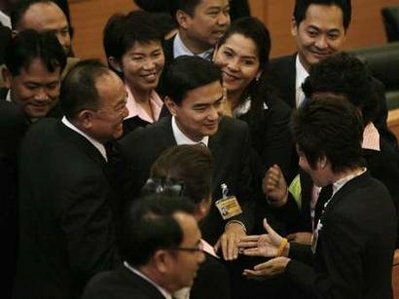 Abhisit Vejjajiva (C) greets members of Parliament after being voted in as the prime minister of Thailand in Bangkok December 15 2008. Thailand's opposition Democrat Party leader, Abhisit Vejjajiva, won a thin majority in a parliamentary vote on Monday to become prime minister as the economy teeters on the brink of recession. (REUTERS/Sukree Sukplang)
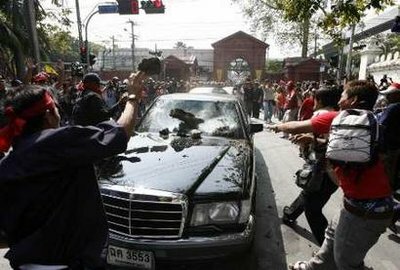 Supporters of Thailand's ousted Prime Minister Thaksin Shinawatra throw bricks at cars of some members of parliament after opposition leader Abhisit Vejjajiva won in a vote to become prime minister at the Parliament in Bangkok December 15, 2008. At least 200 demonstrators blocked access to Thailand's parliament and threw bricks at cars of some MPs after opposition leader Vejjajiva won a thin majority in a vote to become prime minister. The protesters barricaded all gates out of the compound and checked cars trying to leave. Some cars had windows broken with clubs or bricks. (REUTERS/Sukree Sukplang)
  A pro-Thaksin Shinawatra supporter looks on as others burn banners outside Parliament Monday, Dec. 15, 2008, in Bangkok, Thailand prior to the formation of a new government. Parliament chose Democrat Abhisit Vejjajiva as the nation's new prime minister following months of political chaos. (AP Photo/David Longstreath)
 Abhisit Vejjajiva, leader of the Democrat Party, kneels down before a portrait of Thailand's King Bhumibol Adulyadej as he receives Bhumibol's command appointing him as the new Thai prime minister during a ceremony at the party's headquarters in Bangkok December 17, 2008. REUTERS/Apichart Weerawong/Pool
 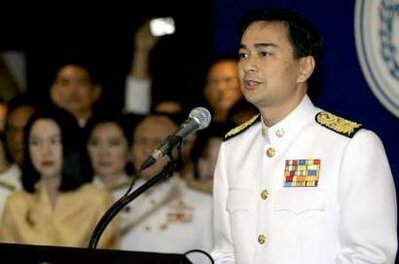 Abhisit Vejjajiva, leader of the Democrat Party, addresses the media after receiving Thailand's King Bhumibol Adulyadej's command appointing him as the new Thai prime minister during a ceremony at the party's headquarters in Bangkok December 17, 2008. Abhisit said on Wednesday that reviving an economy hit by political unrest and a global slowdown would be his first priority, after he was royally endorsed as Thailand's 27th prime minister. REUTERS/Apichart Weerawong/Pool (THAILAND)