Thailand Travel Journal: From Chiang Mai to Bangkok, We Didn’t Buddha Our Fun
FR

Translated into English.

JO Jojoone1 Globetrotter ·
This second day in Sukhothai was simply dedicated to the other sites outside the main square, from very close to a few kilometers from the fortifications.

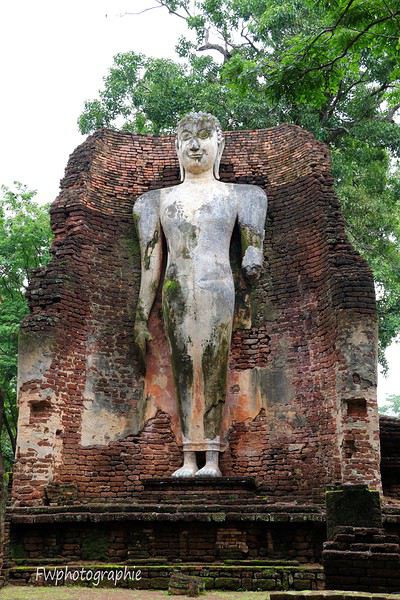
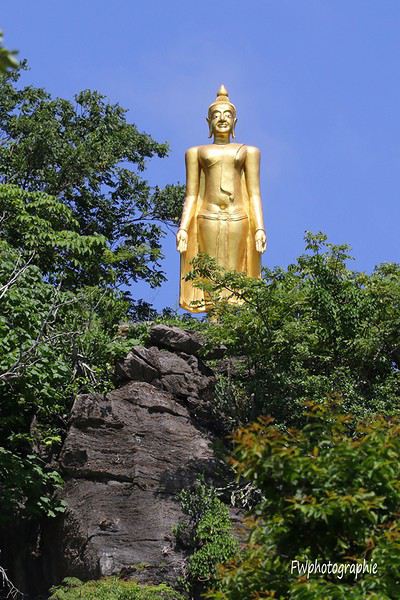
There are sites in all four cardinal directions. Note that the northern and western sections are paid, 100 baht each. In the western section, Wat Saphan Hin, with its standing Buddha on a hill, is currently under restoration, and it looks like they waited until the last minute to fix it up. With the scaffolding in front, you can't see much. Since this is the most interesting monument in the group, let's just say that if we had known, we wouldn't have made the trip.

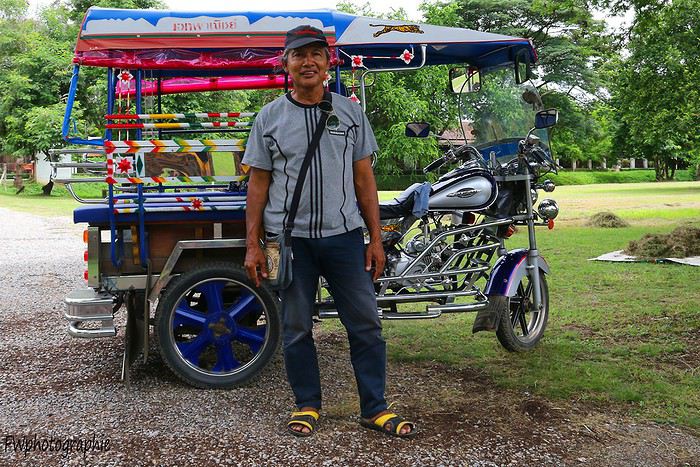
At first, we took the 30-baht truck to Old Sukhothai. The day before, we saw loads of tuk-tuks in front of the park and set off to make the journey that way. So we were a bit stunned near the entrance when we didn’t see any in sight. After waiting a few minutes, we spotted one parked on the other side of the road. We went over, thinking the driver would show up immediately. But alas, we're not in Bangkok, where they swoop down on you like sparrows on breadcrumbs! Neither the bike renter nor the nearby hotel owner knew where he’d gone. We waited for long minutes, even hailing another passing tuk-tuk whose driver, lost in his daydreams, didn’t even notice us. And the other one still didn’t come back. Were we going to have to admit in a few weeks on VoyageForum that we’d been left stranded... in Sukhothai!?

Just as we were asking ourselves that question, a tuk-tuk appeared, maybe coming from New Sukhothai, pulling up in front of the park entrance to drop off its passengers. We dashed across the road at full speed so as not to miss the opportunity. The guy had a friendly face, and we listed the monuments we wanted to see. On the map, it didn’t look far, but it was actually quite a few kilometers. So we were surprised when he offered us a 200-baht tour that would take up the morning.

Later, we realized this guy must’ve been making trips in New Sukhothai and the route to Old Sukhothai. But when it came to the outer sites, he was completely lost. Not only did he underestimate the price of his service, but he spent his morning searching, asking everyone for directions, and waiting during our long visits. He probably missed his lunch, but he never showed it—always friendly and smiling. Even today, we’d bet he wouldn’t have dared ask for extra money since we’d agreed on his initial offer. Of course, when it came time to pay him, we increased his compensation based on a fairer evaluation. Props to this guy, who might not be the sharpest tool in the shed but was so brave and persistent. Not everyone is like that.
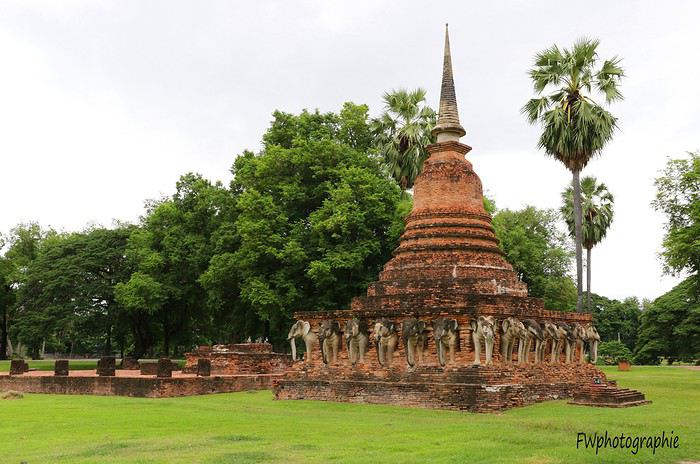
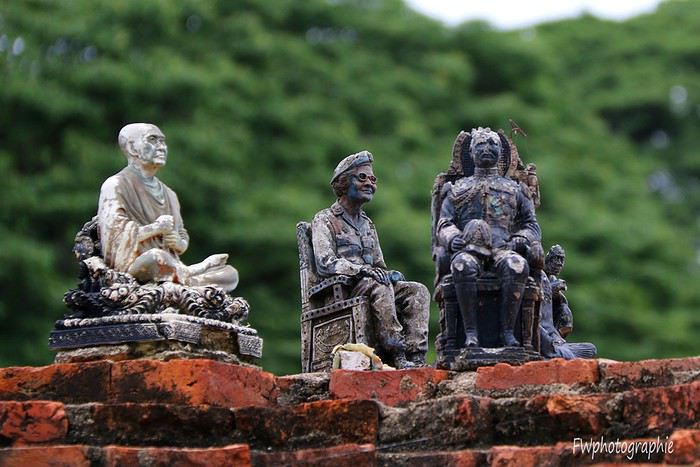
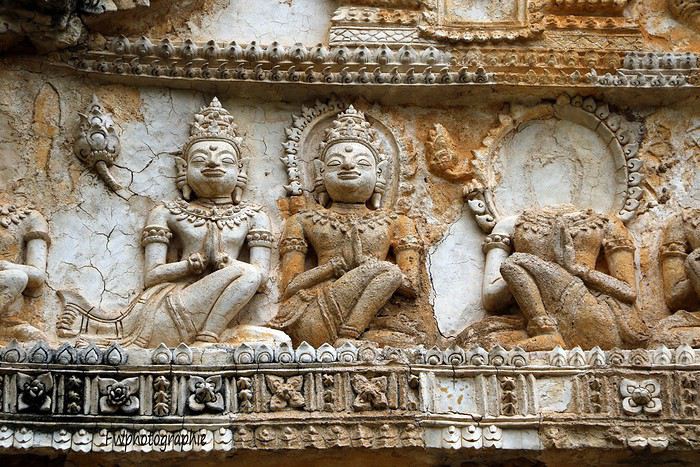


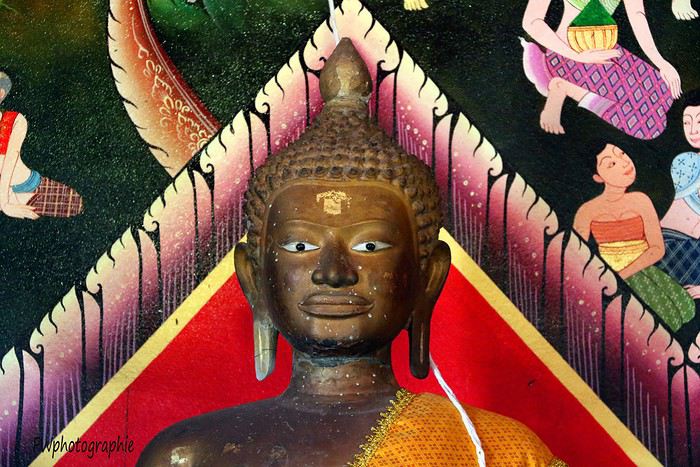
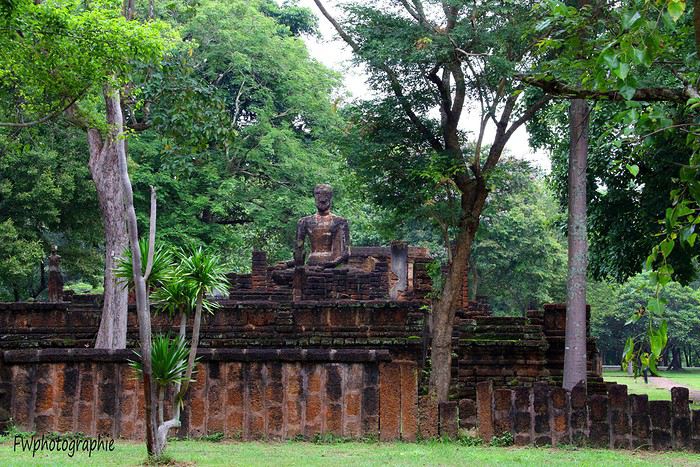
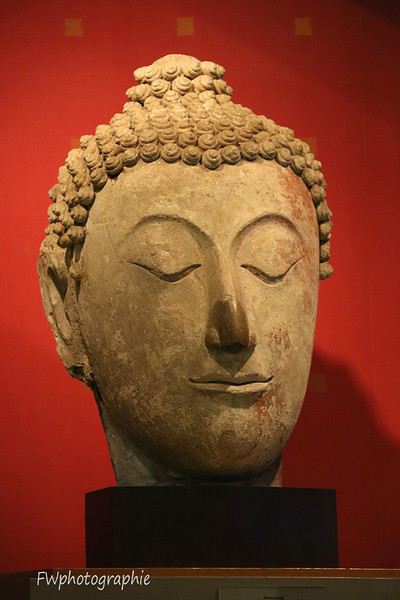
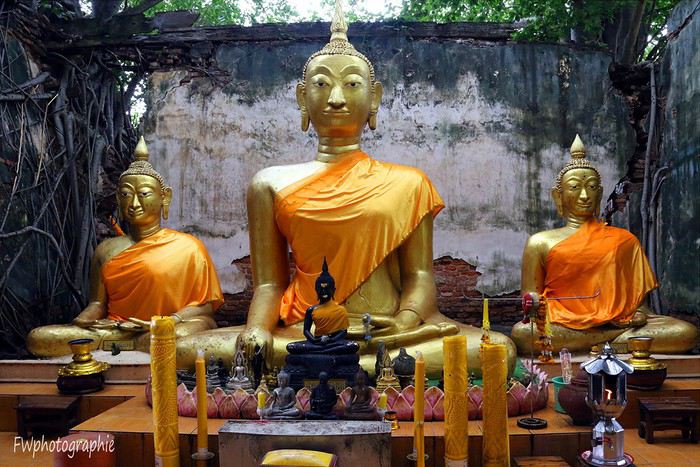
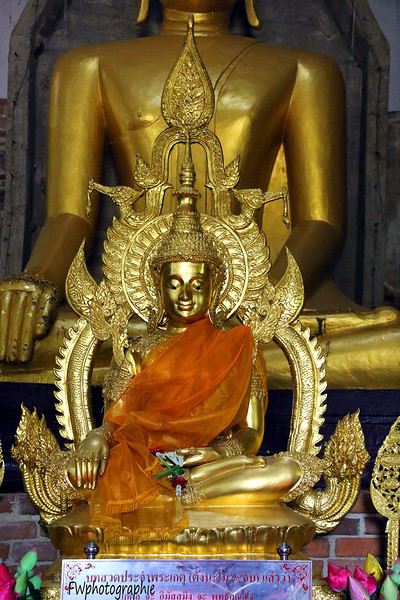
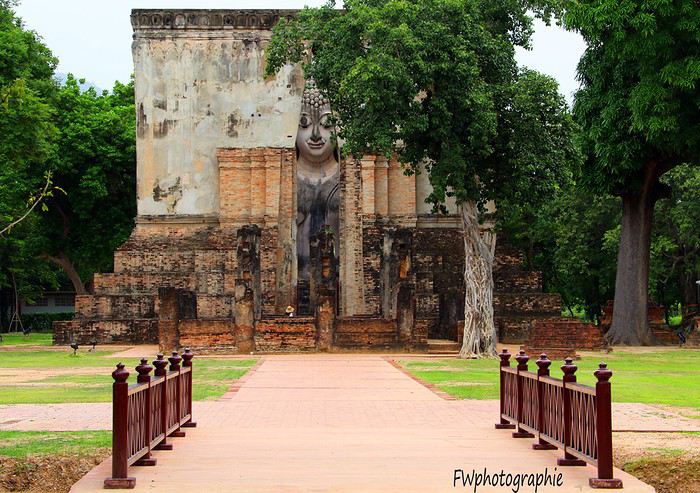
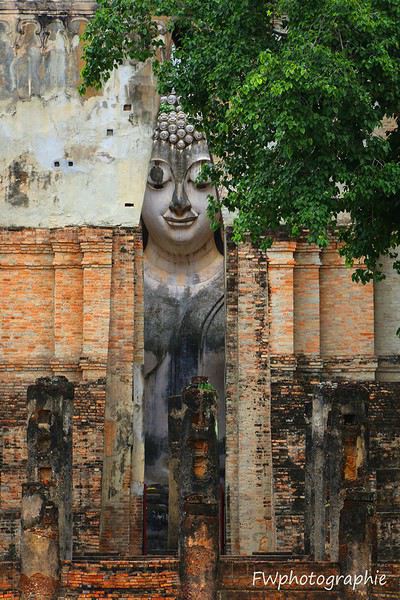
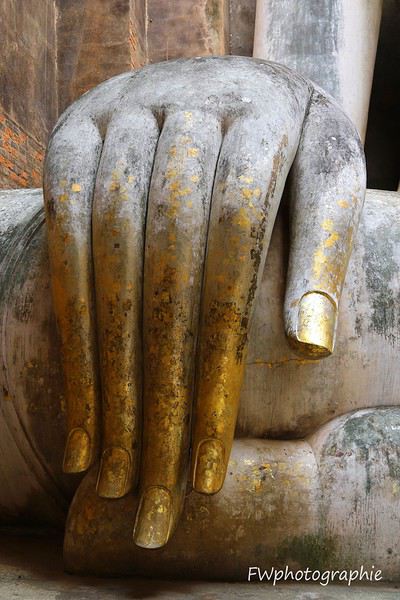
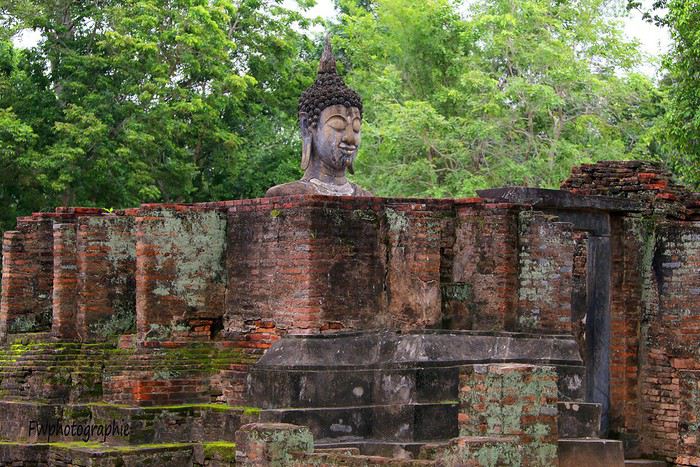
The highlight of the day was Wat Si Chum in the northern group. From over a hundred meters away, you can see this large seated Buddha, whose serene face seems to gaze only at you through the triangular opening at the top of the wall surrounding it. We’d never been there before, and despite the photos we’d seen, the light rain, and the other visitors, we were somewhat mesmerized. A must-visit...


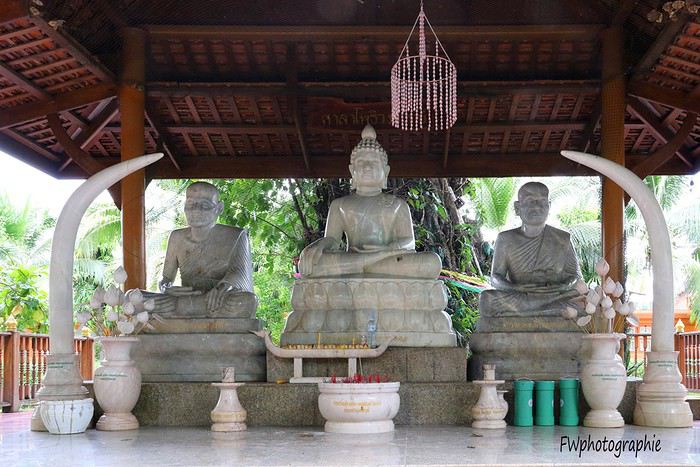
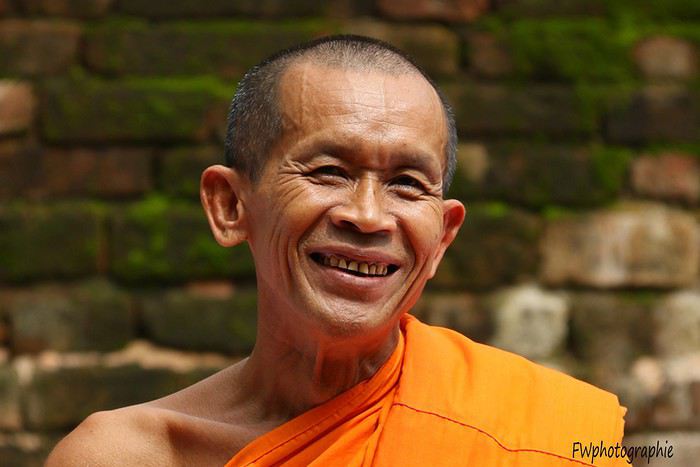
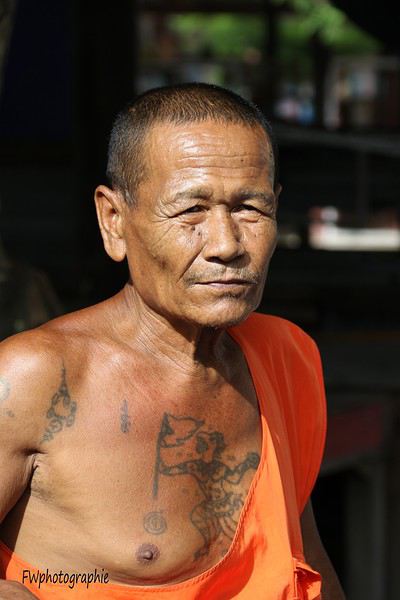
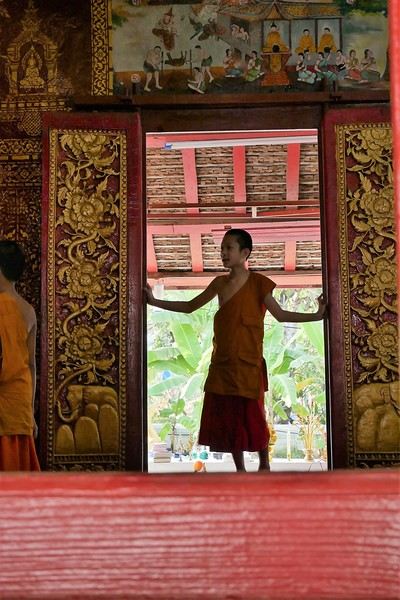
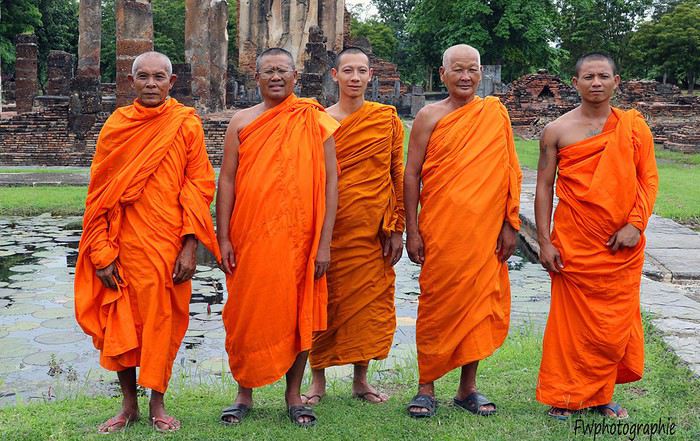
When we finished with Wat Chetuphon in the southern zone, some monks were having their portraits taken by a few photographers, and Françoise took the opportunity to join the group. It was the first time we had the chance to greet monks using the phrase one of them had taught us so insistently in Lampang. It always has the same effect: after the initial surprise—sometimes great surprise—the monks are extremely happy to be greeted that way. Some even burst out laughing. The ones in Sukhothai, as they were leaving, kept repeating the phrase, cracking up like whales. It was a sight that delighted us, simply because it was so funny.


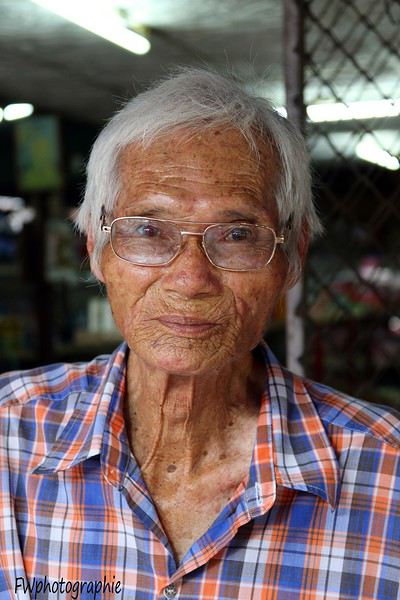
That evening, we were enjoying fried chicken drumsticks and satay skewers on the steps of a 7/11 when a very thin old man approached us. We couldn’t quite tell at first if he was a bit odd or if that was just his usual behavior—a guy who’d seen better days. After exchanging a few words with him, we saw him go to his scooter and reach into the compartment under the seat. We must’ve made a good impression because he pulled out a box of Tiger Balm and offered it to us for free before saying goodbye and leaving.

This year, the weather hasn’t been great, but wow, the Thai people are so nice to us!
« Tout le monde s'interroge sur comment laisser une meilleure planète à nos enfants, mais on devrait plutôt penser à laisser de meilleurs enfants pour notre planète. » Clint Eastwood
SU SuisseChris Veteran ·
Always a pleasure to read your stories about moments you’ve experienced on the road...

That second photo is surprising.

The downside of photos in general is that they can’t capture the smells, the vibes, or the feelings of the moment. Those belong only to the person who was there at the time.

It’s funny reading about your experience with the tuk-tuk driver who gave you a price without really realizing the distance. Sometimes with tuk-tuks, they’ll quote you a price that should get you all the way to the moon! After that, you can always haggle a little...
L'éternité c'est très long....surtout vers la fin (Woody Allen)
JO Jojoone1 Globetrotter ·
Once again, a 1.5-hour bus ride for 68 baht per person, and we arrive in Kamphaeng Phet. This time, it’s definitely Thailand off the beaten path. The hotels with pools were either too far away or known for having mattresses that were too hard, so we opted for the Chakungrao Riverview, one of the two big hotels in this town.

This one also made the long list of hotels that used to be better than they are now. More accustomed to smaller places, we didn’t exactly love this impersonal hotel. Still, we were warmly welcomed, especially by a very proud and self-assured gentleman who seemed authorized to take charge of *farangs* (foreigners). We didn’t dare hope to find someone here who spoke good English.

Of course, by lunchtime, we didn’t even bother looking for a proper restaurant. Right across from the hotel, between two buildings, we spotted a semi-mobile kitchen, tables, and chairs, all sheltered under a huge plastic tarp. It was a delight to watch the cook and his wife, along with a customer. No need to spell it out—they were the real deal. No frills on the plate either: the smoke from the big wok had already decided it—excellent chicken and herb rice. The bill was steep: 60 baht for two...

In the afternoon, we took a walk that wasn’t too long in distance but felt like it in time. There’s always that pleasant sense of stepping back in time when you’re immersed in one of these provincial towns. For example, on a street corner, the printer works from home on the ground floor, using a big black machine much older than him, clattering away nonstop.

We passed by Wat Khu Yang, with its 19th-century wooden structure and its library in the middle of a water rectangle, as is customary.


A short distance away, we stumbled into another temple, Wat Sadej. We were even allowed into the small temple reserved for monks, where only one was on duty, killing time by watching a movie on his laptop. Given the loud, chaotic sound, it was unlikely to be a religious film.

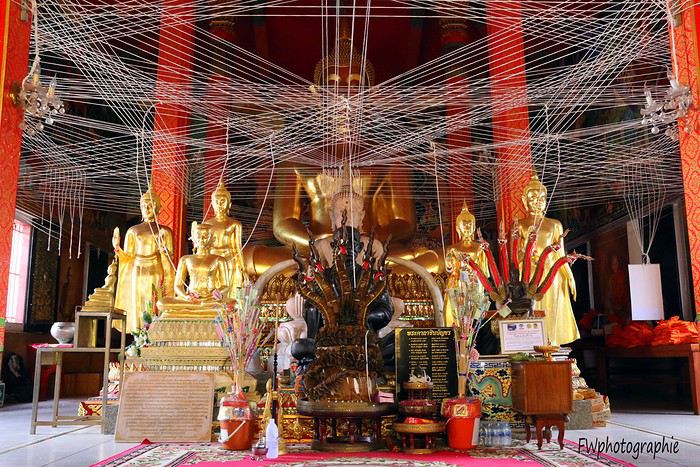
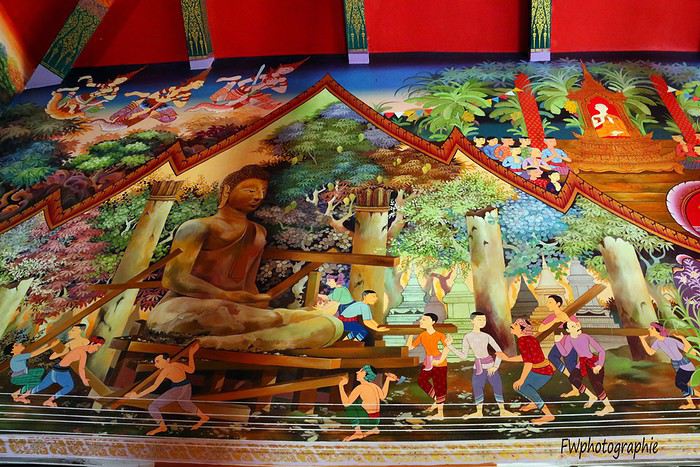
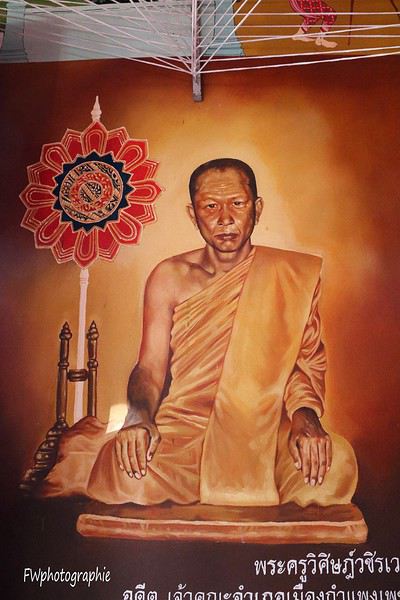
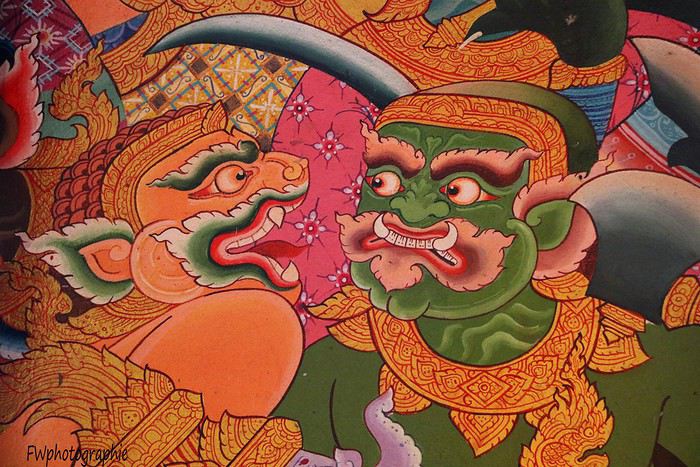
The walls and ceiling were entirely covered in vibrant colors. Beneath magnificent scenes depicting the life of Buddha and renowned monks, we could see several strikingly realistic portraits of monks painted directly onto the walls. A revered golden Buddha and another made entirely of marble stood among others, with white string patterns crisscrossing the ceiling and around the small temple’s perimeter. Behind the mother-of-pearl shutters, we could admire a garden of colorful stupas in various shapes outside. A feast for the eyes, with the added bonus of surprise. As they say, a little gem.


It was a blessing to then stumble upon a trendy tea salon planted in the middle of a dull street like a temporal anomaly. Once again, the heat was stifling, and an iced espresso was always welcome. The young waitress was like a breath of fresh air—smiling, friendly, and warm. Her university studies had included English, and once again, we were thrilled to have been so well received.

Just a little further on, Wat Thep Molee showcased its highly venerated Buddha, reputed to have the power to stop the rain—if you know how to pray to it correctly.


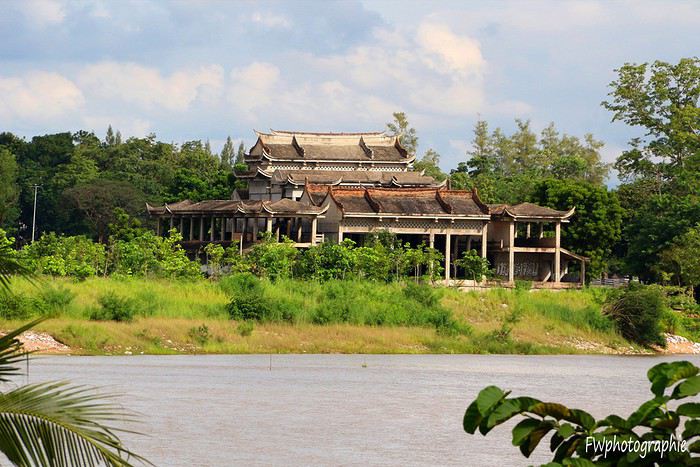
Through some very lively streets, we headed back toward the Ping River. Across from the city center, there’s an island with an imposing Chinese-style building. It’s unfinished and, at dusk, gives off a ghostly hotel vibe. Note that there are two wide parallel paths for bikes and pedestrians all along the river.


There’s a covered market 300 meters to the left when leaving the hotel. No problem stocking up on budget-friendly fruit there. Right next door is the big night market, open every day. Unlike Chiang Mai’s, you won’t run into hordes of tourists here, so our presence didn’t go unnoticed. The goods on display weren’t the same either—we saw quite a few unfamiliar edible items, some hard to identify. The look and color of some products didn’t exactly make us want to try them. That said, there are plenty of dining options, and the more cautious can always order what we did: chicken with rice noodles and chicken satay on a stick. Some corridors of this market pass over sewage pipes, and your nostrils get to enjoy all the scents at once. It’s a big market where there’s plenty to see, and those of you who ask about "off the beaten path" spots on this site would do well to check it out.
« Tout le monde s'interroge sur comment laisser une meilleure planète à nos enfants, mais on devrait plutôt penser à laisser de meilleurs enfants pour notre planète. » Clint Eastwood
JO Jojoone1 Globetrotter ·
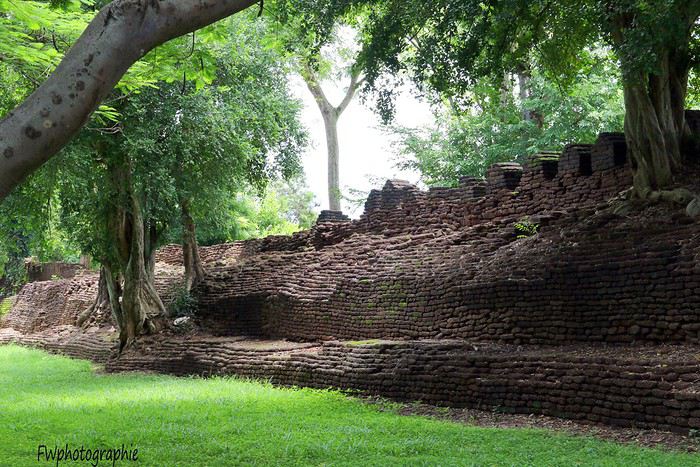
Kamphaeng Phet means "Diamond Wall." The ancient city had numerous fortification walls since it was the main western defense point of the Sukhothai Kingdom.


Our hotel’s staff quickly arranged for the hotel minivan to take us to the historical site. It turned out the ride was complimentary.

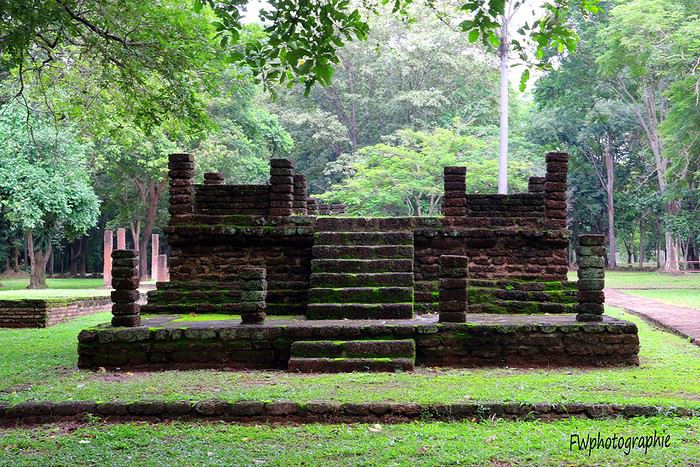
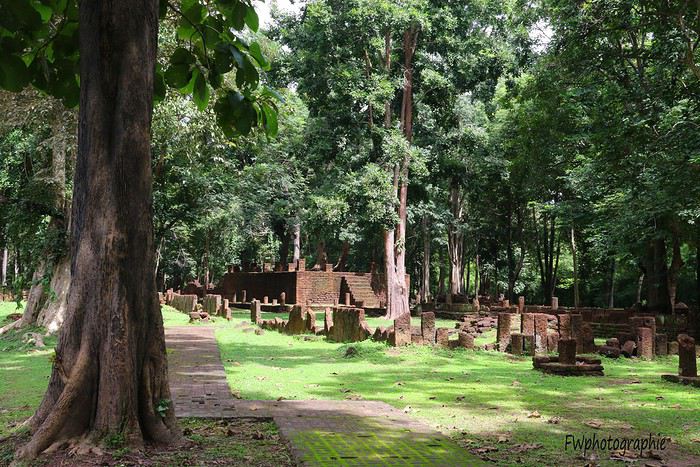
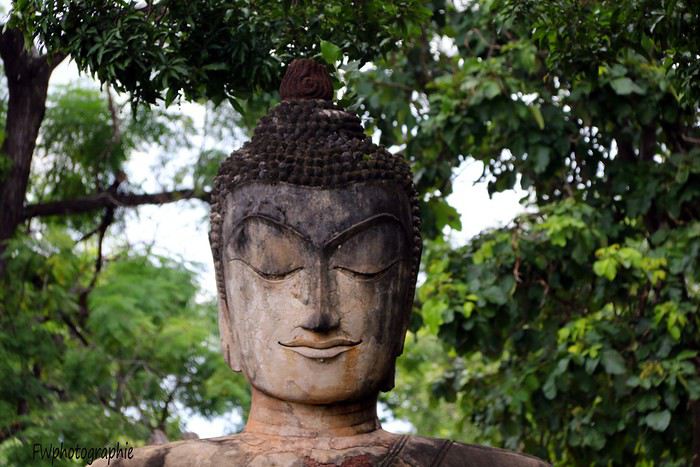
The Kamphaeng Phet site is divided into two parts: one is in the forest, and the other, a few hundred meters away, has been absorbed by the town. The closest end to the city center is about 3 km away. Each ticket costs 100 baht, but a combined ticket is only 150 baht. As mentioned by other travelers before us, the walk through the landscaped forest is as worthwhile as the temple visits themselves. Even more so than in Sukhothai, time has taken its toll here. Many statues are reduced to vague shapes. Overall, it’s mostly ruins with a few remnants. That said, this is just our opinion—after five trips to see wonders, we’ve unintentionally become a bit picky. As we stroll along, we still get a sense of the ancient city’s scale. We rent bikes at the same hut where we buy the tickets. Some bicycles are barely worth their 30 baht rental fee.


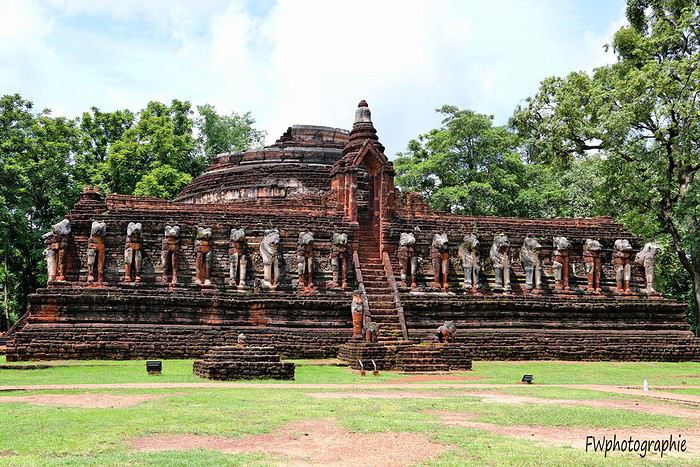
The sun finally graces us with its presence as we finish the circuit at the large elephant stupa, Wat Chang Rob, where Buddha kindly places two 100 baht notes in our path—fallen from who knows which pocket.


Just 100 meters to the right after leaving the forest site, a family has set up their home and a restaurant. Their daughter serves us a delicious open-air meal next to a pond where large fish are swimming.

Unfortunately, the entrance to the second part of the site is on the exact opposite side. Under this stormy heat, we end up making two round trips and one one-way trip to visit the site and return. There’s a real symphony of honking in the curve ahead of us, which is unusual in Thailand. We guess that’s where the City Pillar Shrine is, and the map confirms it. The city pillar sanctuary is indeed saluted by most Thai drivers—a way to honor their ancestors.

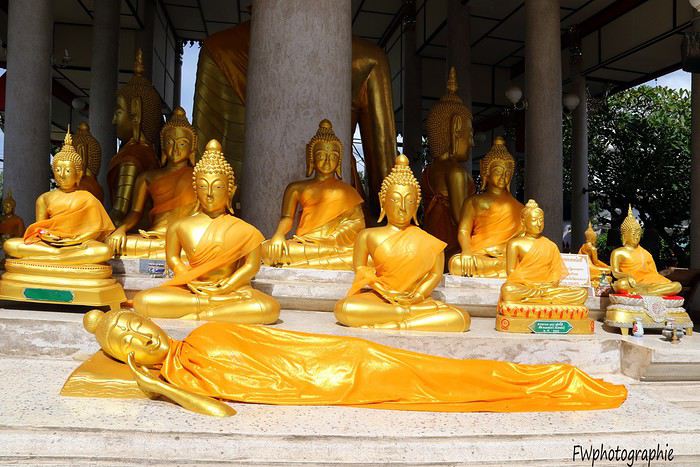
In this "city" section, which stretches out, there are just two monumental temples, the most memorable image being the group of three Buddhas: two seated and one reclining, surprisingly well-preserved.


On our way back, we can’t miss the two workers trying to clear a dead tree that’s fallen onto the temple wall. It’s a true Thai-style effort: instead of positioning themselves on the right side to lift and remove it, they stand on the wrong side and pull. This, of course, dislodges large century-old stones that had survived the Burmese and the passage of time. Out of kindness, we didn’t film it—just in case they ended up on the internet, poor guys...

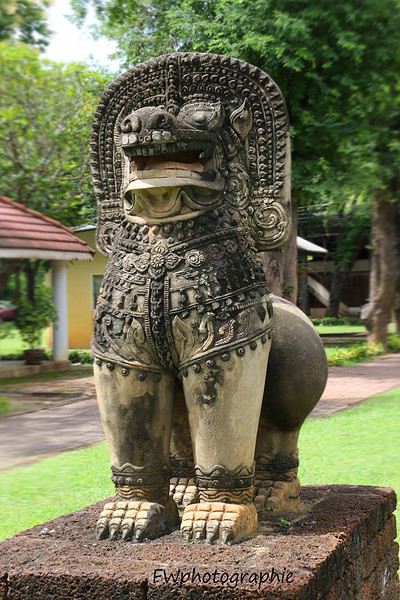
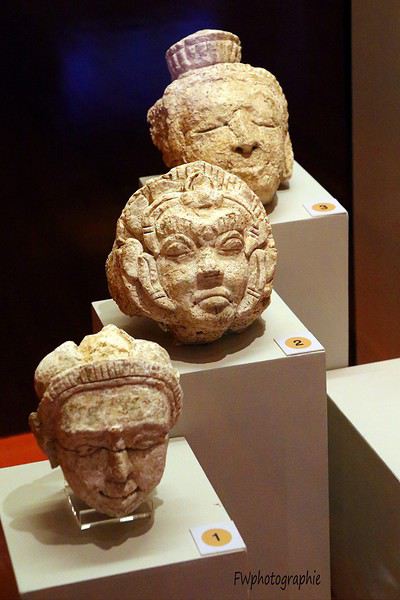
A stone’s throw away, we visit the national museum, where entry is set at 100 baht. In the courtyard, a lion and two elephant heads are displayed, having been moved from their original sites due to their well-preserved state. There were a few survivors.


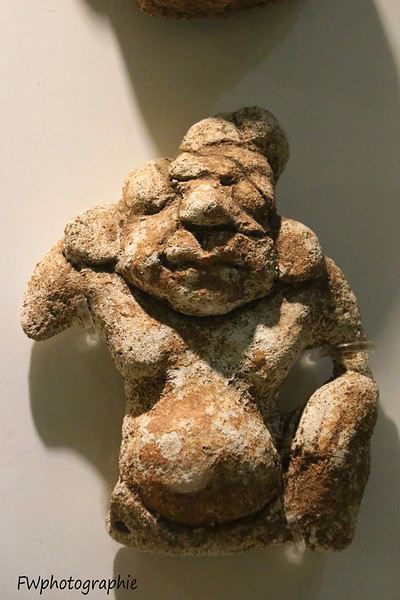
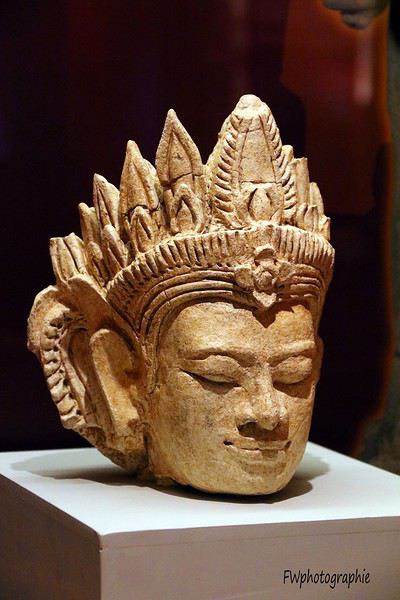
Let’s admit it, this museum is tastefully and skillfully arranged. The lighting is good, and most pieces are well-displayed. There are inevitably many works from the Sukhothai period (13th and 14th centuries), as well as objects from earlier periods and even Thai prehistory. Some are beautiful, others downright funny.


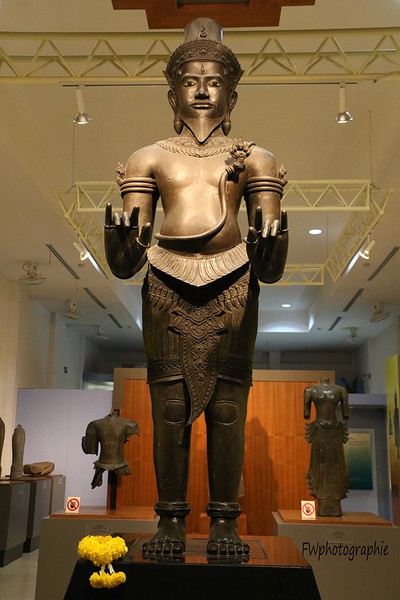
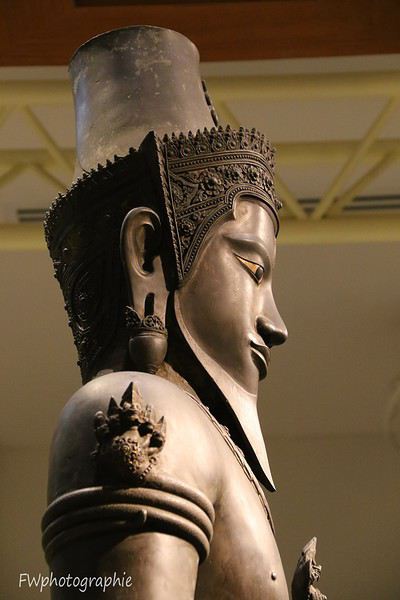
But we’re truly stunned by the 1510 Shiva statue, which towers over the entire great hall from its pedestal, exuding majesty. Not only is it the largest Hindu bronze in Thailand, but this statue also has a striking resemblance to a Phoenician or Etruscan colossus. Its impassive mask, the serpent coiled around its arms and torso, its elegant loincloth, and its sheer size make it an impressive work.


We hesitated a bit, but in the end, it was worth the trip. For info, right next door is the Thai Houses Museum, which is lovely to admire from the outside.

Not knowing when we’d return, we hadn’t arranged anything with the hotel. Earlier in the afternoon, we’d seen vans arriving from the city and thought they were shuttles. Of course, now that the storm is looming on the horizon in fast-forward mode, the place is deserted. We approach the woman selling tickets for the historical park, and she gives us that famous Thai "no," waving her hand with fingers spread. But our predicament seems to bother her. Without hesitation, she steps out of her booth and we hear her talking to someone. We thought she’d just gone to ask for info, but she returns with a couple, each on their own small motorbike. We’ll never know if they were friends, vendors, or other employees. What was clear was that they were going to take us. We ask what we should pay for the moto-taxi, and she says no. We insist, and she says no, no. It’s surreal—these people seem happy to give us a ride. Just enough time to warmly thank the woman, and off we go. And just as we leave, a heavy rain starts pouring. The trip was short, but with the backpacks we were carrying, it was a close call for the camera and the photo gear. Riding on the back of a motorbike without a helmet—with or without sunglasses—it only takes five seconds to lose all sense of where you are and where you’re going.

In our shorts and soaking-wet T-shirts, we try in vain to convince the couple to accept a small bill, at least for the trouble or the gas. They’re clearly happy to have brought us safely, wave goodbye, and zoom off down the road. As our hair drips with sweat, we think: "Good grief, there are so many kind people in this country."

We’ll still be thinking about it after our second visit to the evening market, holding another bunch of small bananas bought for... 10 baht.
« Tout le monde s'interroge sur comment laisser une meilleure planète à nos enfants, mais on devrait plutôt penser à laisser de meilleurs enfants pour notre planète. » Clint Eastwood
PI Pirandy Veteran ·
A huge, huge thank you for your travel journal—it’s an absolute treat to read, so enjoy it without moderation! =^= 🙂
SU SuisseChris Veteran ·
Some bicycles aren’t worth much more than their 30 baht rental fee.


Loved your story! I adore those little moments when something fun or unexpected happens, like your ride back to the hotel on a moped.

Personally, I think some of your photos have something special... Like the one of the Diamond Wall.

Have a great evening!
L'éternité c'est très long....surtout vers la fin (Woody Allen)
68 68bass Regular ·
Still so fun to read—it has a bit of a Siem Reap vibe, minus the tourists...
JO Jojoone1 Globetrotter ·
Hello,

Thanks, and we can say it wasn’t easy! We’ve got a feeling the rest won’t disappoint you either, in that case...
« Tout le monde s'interroge sur comment laisser une meilleure planète à nos enfants, mais on devrait plutôt penser à laisser de meilleurs enfants pour notre planète. » Clint Eastwood
JO Jojoone1 Globetrotter ·
Hi,

Honestly, we knew you’d love it. It couldn’t have been any other way!

Of course, we don’t have any extraordinary adventures to share, and maybe that’s for the best in some cases. Personally, if I found out that some people were laughing heartily because of a few of my paragraphs, that’d be awesome.

From the very first story, we decided we’d give the most faithful summary possible of what really happened. There’s a practical side to it—we don’t need to make up or imagine stories that never took place. Besides, that wouldn’t be honest. The beauty of anecdotes is that in a similar situation, they can give readers ideas. And sometimes, it’s good to know what to expect. We can’t include everything: some parts are too private, others just aren’t that interesting.

Once we’re proud of some great moments or beautiful photos, we might as well include the less glorious stories that are part of the whole. People can laugh at us or think we were silly in certain moments—well, it doesn’t matter because it really happened, and even we can’t go back in time to fix it.

I also think some photos have something special: they’ve got a bit of Françoise and a bit of Thailand. So Jojoone is doubly happy!! 😊
« Tout le monde s'interroge sur comment laisser une meilleure planète à nos enfants, mais on devrait plutôt penser à laisser de meilleurs enfants pour notre planète. » Clint Eastwood
JO Jojoone1 Globetrotter ·
There were 8,000 people, but we managed to get them all to step aside for the photos.😉

As for Angkor, we’ll save it for another trip. You could spend weeks there. A few photos can make a place seem worse or better than it really is.

It’s clear that tourists—at least Western ones—weren’t exactly swarming this part of the country. Then again, we weren’t crazy enough to do the Golden Triangle-Chiang Mai-Sukhothai-Lopburi-Pattaya-Bangkok route either!!
« Tout le monde s'interroge sur comment laisser une meilleure planète à nos enfants, mais on devrait plutôt penser à laisser de meilleurs enfants pour notre planète. » Clint Eastwood
SU SuisseChris Veteran ·
Hello,

From the very first account, we told ourselves we’d make the most faithful summary possible of what really happened. There’s a practical side to it—we don’t need to invent or imagine stories that didn’t actually occur. Besides, it wouldn’t be honest.

Yes, that’s for sure, and it’s not necessarily interesting for you to write. 🤪

The beauty of anecdotes is that in a similar situation, they can give readers ideas. And sometimes, it’s good to know what to expect.

When I think back to your return to the hotel in the storm... I’ll admit I’m in no hurry to experience that situation myself, which just goes to show—if it were even necessary—how kind Thais are. 🙂

On the other hand, paying 10 baht for a few bananas? I’ve never gotten such a good price. The best deal I ever got on fruit was 20 baht for a whole pineapple, sold directly by the producer.

We can’t include everything: some parts are too private, others just aren’t that interesting.

Too bad—my eyes were already gleefully anticipating reading about those steamy erotic moments shared with Françoise... 😄 😄 😄

Once you’re proud of certain great moments or beautiful photos, you might as well include the less glorious stories that are part of the whole.

I write about the little anecdotes that don’t exactly paint me in a flattering light, whether they’re glorious or not. They’re often funny, or at least I try to make them funny—you’ve got to be able to laugh at yourself. Your story about returning to the hotel in the storm is a joy to read; it’s funny not because of you, but just because the story itself is amusing.

People can laugh at us or think we’re idiots....

Personally, I try not to judge people. The anecdote is either funny or instructive, and that’s just fine.

I also think some photos have something special—they capture something of Françoise and something of Thailand. So Jojoone is doubly happy!!

Isn’t that the point of life? To be happy? (As long as it’s not at others’ expense.)

You went, you had fun on the trip, and you came back happy—what more could you ask for? 🙂
L'éternité c'est très long....surtout vers la fin (Woody Allen)
JO Jojoone1 Globetrotter ·
Since you contribute so often and we’re now at Kamphaeng Phet, there’s no way I’m continuing this story without dedicating a video to you—shot at random, of course.

At random? Well, maybe not entirely...

https://youtu.be/o2wlonyHUjo
« Tout le monde s'interroge sur comment laisser une meilleure planète à nos enfants, mais on devrait plutôt penser à laisser de meilleurs enfants pour notre planète. » Clint Eastwood
SU SuisseChris Veteran ·
Thanks! 🙂
It's funny, I'd never heard of Kampagne Phet before. I passed through that province by minibus when I went from Sukhothai to Nakhon Sawan. But I don’t know much about it—basically nothing. I’ll look into this place.

As for the video, I love the old man with the gloves grilling... I don’t know what. 😉
L'éternité c'est très long....surtout vers la fin (Woody Allen)
JO Jojoone1 Globetrotter ·
We hired the hotel’s minivan for a solid half-day. It quickly became clear that our driver wasn’t exactly skilled or resourceful. Sometimes, you just have to roll with it. To be fair, we do ask to see places that are hard to find or not well-known to locals.

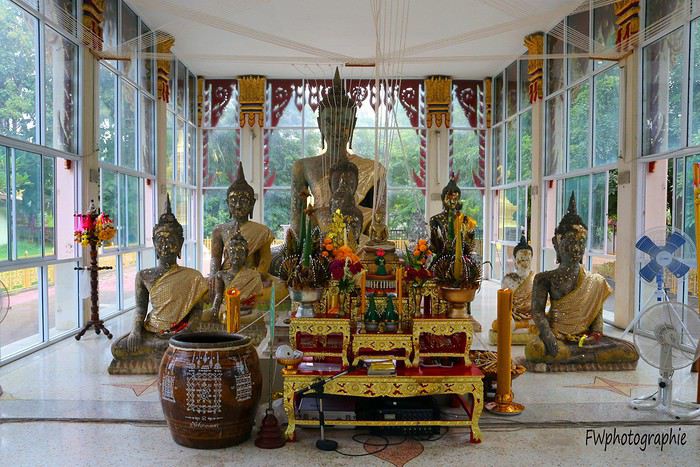
That’s how we ended up at a temple not on our list, about ten kilometers south of Kamphaeng Phet. Many temples were built on the same sites where older ones stood during the Sukhothai Kingdom era. This one features a building with glass windows all around, protecting eight beautiful stone Buddhas and a few scattered fragments of others that didn’t survive to this day.


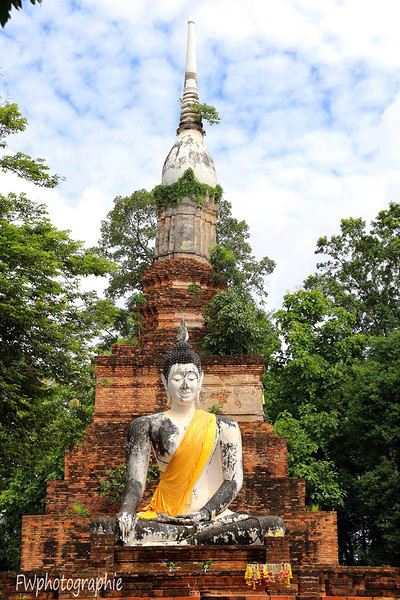
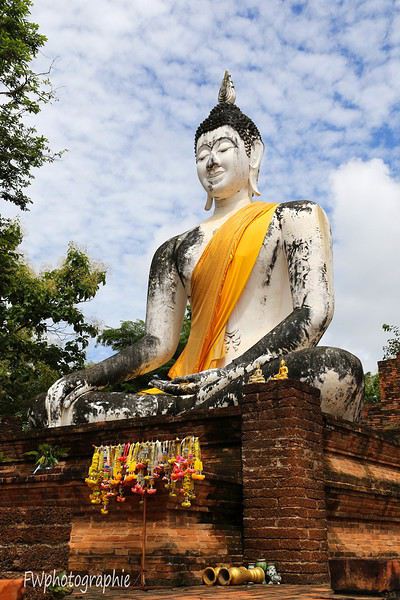
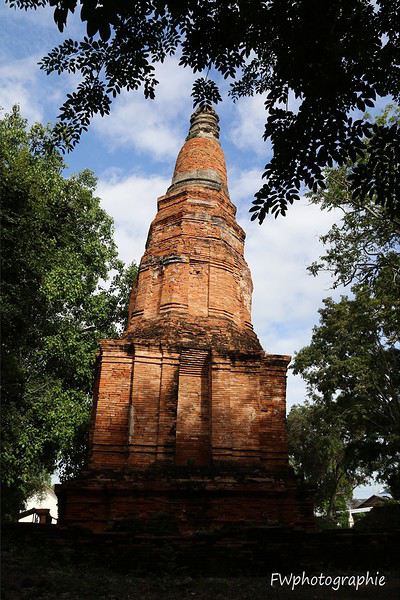
About 18 kilometers south of Kamphaeng Phet, near the river, a few remnants of the ancient city of Muang Trai Trueng still stand, right next to Wat Wang Phra That. Apart from the remains of the small town’s wall, the main attraction is a tall, elegant stupa alongside its majestic white Buddha. For us, it was a hidden gem in the countryside.


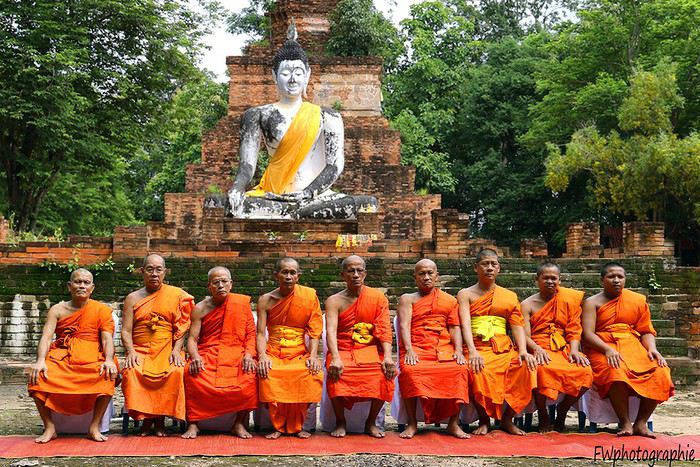
Coincidentally, a group of nine monks was there just as we arrived, lining up for local photographers in front of the monument. Another perfect opportunity for Françoise to snap away with such a great subject.


The small Wat Wang wasn’t to be outdone, bursting with color in the sunlight. Two pink elephants greet visitors. Inside, there are very old Buddhas and numerous carvings.


In the countryside, many traces of ancient settlements remain. Lots of walls, chedis, and small towers are visible near sugarcane fields. Sugarcane and bananas are the region’s specialties.

We made a quick stop at Wat Phra Borommathat Chediyaram, but the temple was closed for a monks’ prayer session. The large golden Burmese-style chedi is impressive, but we’d seen so many last year...


Our driver, trying to be helpful, took us to a clean but very limited-menu restaurant. For the first and only time, we tried the spicy soup that many Thais love—floating with fish surimi and those chemical meatballs you often see on sidewalks or markets. If it’s nearly impossible to eat badly in Thailand, this time we managed it perfectly!
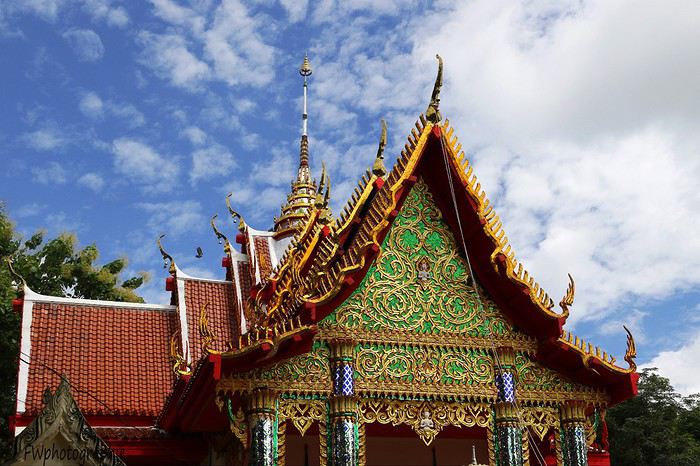
In the afternoon, we visited Wat Sawang Arom, about 5 km northwest of Kamphaeng Phet. Nothing extraordinary except for its Buddha from the Chieng Saen period, predating Sukhothai. However, something quite surprising happened there. A man approached us, speaking Thai, and led us around the temple alleys, giving us all sorts of explanations. We tried to show him we only understood a few words, but he was clearly set on his mission and wouldn’t let up. Eventually, we played along, throwing in a few well-placed “ahs.” It made for a surreal moment, and in the end, the man left very satisfied. On our side, well played—we didn’t lose face...

We also stopped by Chedi Klang Thung (late 14th to early 15th century), another remnant of past magnificence.


For our last visit to the night market, we arrived during the day. This gave us time to sit and watch people passing by. An elderly woman, likely without resources, sat with her bowl at the market entrance from the parking lot. No matter the age or social status of those passing by, everyone left a few coins or a small bill. It seemed like a habit—if not out of charity, then at least to secure some good karma.
« Tout le monde s'interroge sur comment laisser une meilleure planète à nos enfants, mais on devrait plutôt penser à laisser de meilleurs enfants pour notre planète. » Clint Eastwood
SU SuisseChris Veteran ·
If it's nearly an achievement to eat badly in Thailand, this time we managed it perfectly!

That *is* rare...

Still, something pretty surprising happened. A man approached us speaking Thai and led us through the temple alleys, giving us all sorts of explanations. We tried to show him we only understood a few words, but he was clearly set on his spiel and wouldn’t let up. Eventually, we just played along, throwing in a few well-timed "ahs." It made for a surreal moment, and in the end, the guy left very satisfied. Our side? Well played—we didn’t lose face...


Amazing Thailand!

An elderly woman, likely without resources, sat with her bowl at the market entrance from the parking lot. No matter the age or social status of those passing by, everyone left a few coins or a small bill. It seemed like a habit—if not out of charity, then at least to secure some good karma.

Interesting question (at least for me). Do Thais understand the meaning of charity, or are they just trying to secure good karma? I couldn’t say...
L'éternité c'est très long....surtout vers la fin (Woody Allen)
JO Jojoone1 Globetrotter ·
The staff at Chakungrao Hotel still take great care of their guests: the minivan takes us to the bus station for free. Once there, the ticket counter employee tries to explain something to us, but there’s no one around to translate at that moment, and he gives up. We’ll find out after four hours on the road that the bus only passes near our destination, Singburi.

It’s not a big deal in itself to end up at a tiny stop right on the highway, but with our phone issues and only one moto taxi available, we could’ve been stuck there for a while. Fate had other plans, though—a charming fifty-something woman, perfectly put-together and fragrant, strikes up a conversation with Françoise and mentions she’s waiting for someone. She tells us the hotel we’re heading to is near her destination, and we can ride with her. The vehicle that arrives is a cross between a songthaew and a tuk-tuk. No matter— the driver speeds along, and we reach our destination quickly.

We’ve already shared Lampang’s most beautiful hotel from our Thailand travels, and now it’s time to introduce you to the most pleasant hotel owner we’ve ever met. Philippe is Swiss and built Villa Sumali. This property includes the family home, his daughter’s house, buildings for guests, and a lovely pool. The concept, which might’ve confused some visitors, is a hotel-guesthouse hybrid. You have breakfast on the owner’s terrace and dine in their stunning dining room. Actually, it’s pretty flexible. You can spend a little time with the family or keep to yourself like in any other hotel.

As we entered the property, we saw Philippe on his mini-tractor mowing the lawn. Our bags had barely touched the ground before he was there, welcoming us. Instantly, we felt something positive. Some things are hard to put into words, but he immediately put us at ease—simple, genuine, and radiating serenity.

Villa Sumali is located in Jaksi, several kilometers from Singburi. During our search, there weren’t many options. It was the only hotel in the area with a pool and looked promising. Turns out, we lucked out here too—the hotel is right next to a historic site and a fascinating temple. From what we’ve seen, Singburi itself doesn’t have much to offer.

We have the option of a ground-floor room. The beds are just as comfortable as at Baan Suchadaa in Lampang, with 5-star hotel-quality mattresses... Philippe’s daughter does the cooking, and she’s really talented. We usually prefer eating outside the hotel, but not this time.

When we share our plans for the next day, Philippe explains that finding a driver isn’t easy and offers to take us himself. When we cautiously ask about the cost, he casually replies there isn’t one—he’ll just come along. Of course, we can’t believe our ears. Having someone monopolize their 4x4 for half a day without charging us? That’s a first!

https://youtu.be/5fe3WjyVKvc
« Tout le monde s'interroge sur comment laisser une meilleure planète à nos enfants, mais on devrait plutôt penser à laisser de meilleurs enfants pour notre planète. » Clint Eastwood
JO Jojoone1 Globetrotter ·
There’s a new filmmaker on VoyageForum: we’re dedicating this short film to them

https://youtu.be/bQNUMZhklqw
« Tout le monde s'interroge sur comment laisser une meilleure planète à nos enfants, mais on devrait plutôt penser à laisser de meilleurs enfants pour notre planète. » Clint Eastwood
TH Therat Veteran ·
Bobebebus.... thanks. 😉
Mon site sur la Thaïlande : http://www.phil-a-phuket.com
SU SuisseChris Veteran ·
Photos or videos, both have their strengths. I take photos, but since I’m not very good at it, I avoid posting or sharing them.

Videos capture movement, though it’s harder to make a good video than a good photo.

I really appreciate that you post videos. Little moments with their own unique atmosphere—always great to watch.

A fellow countryman lost in the middle of nowhere with his hotel-guesthouse... always good to know.
L'éternité c'est très long....surtout vers la fin (Woody Allen)
JO Jojoone1 Globetrotter ·
The next morning, Philippe’s daughter opened the little gate at the back of the property for us. We set off down the small road that runs alongside the canal—it’s a pleasant but short walk.


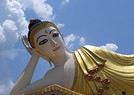
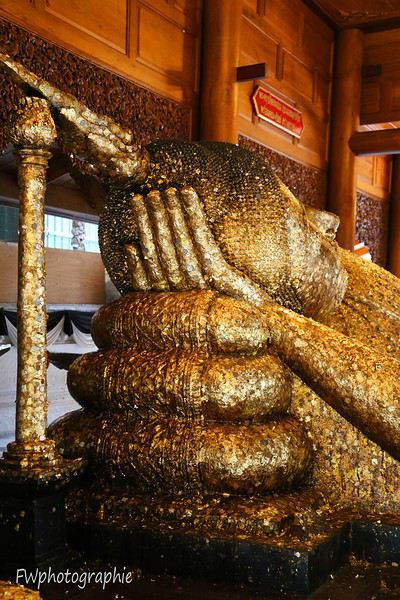
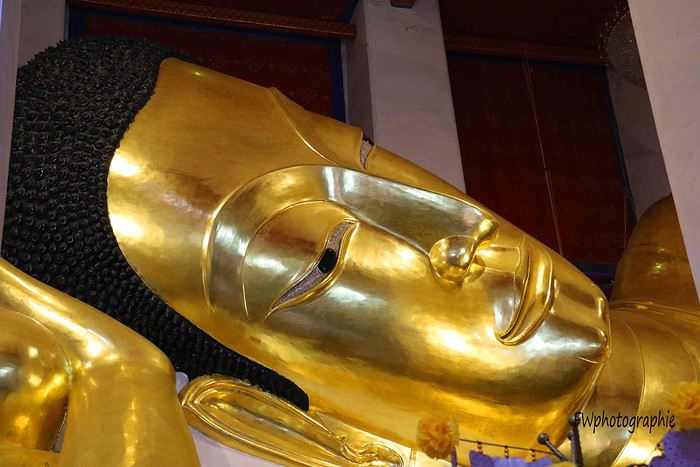
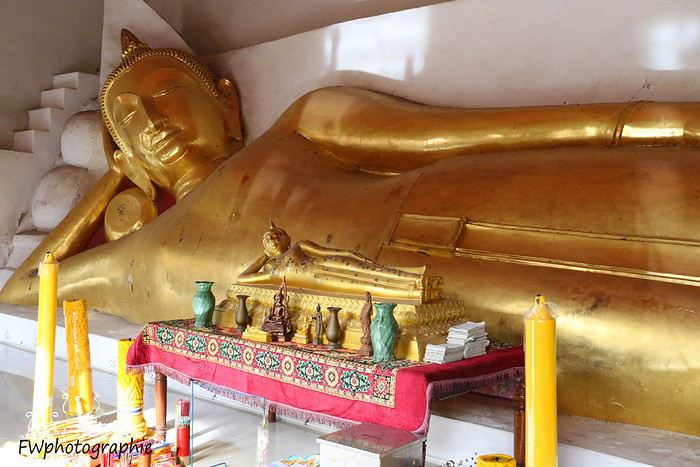
It’s short because we quickly arrive at Wat Phra Non Chakkrasi (or Wat Phra Non Chaksi). It’s a third-class royal temple, and at first glance, it seems quite large. This temple is famous for its reclining Buddha, which measures between 46 and 48 meters long, depending on the source. But for us, it was everything else that blew us away. This temple is simply incredible and belongs in the temple-museum category.

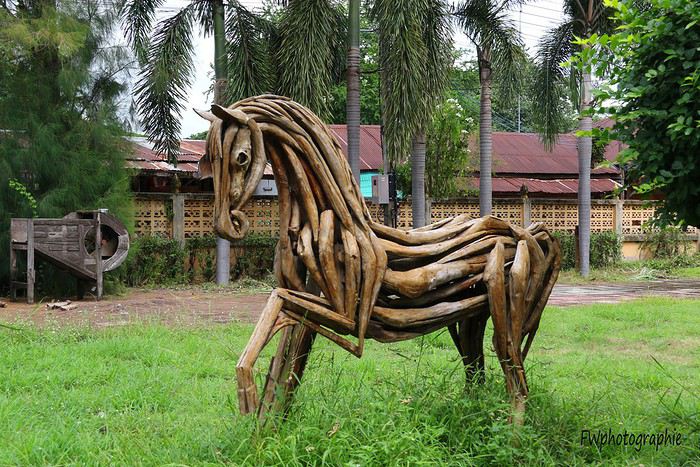
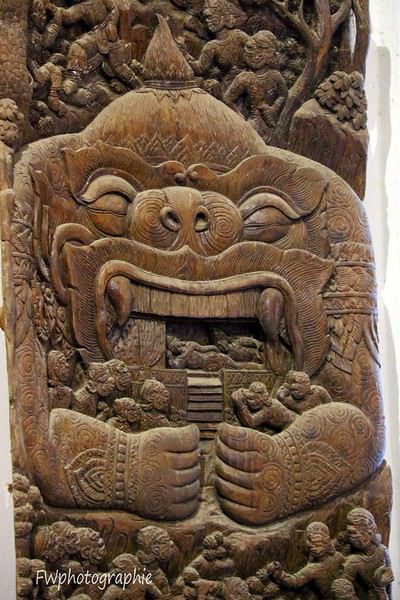
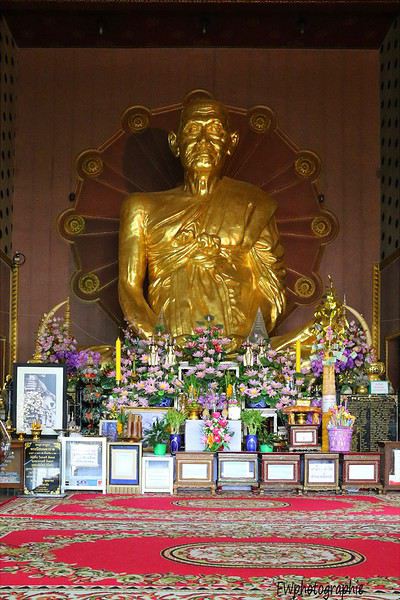
Right from the start, there’s a large open hall with an intricately carved old tree trunk and a three-meter-tall monk statue on its pedestal.


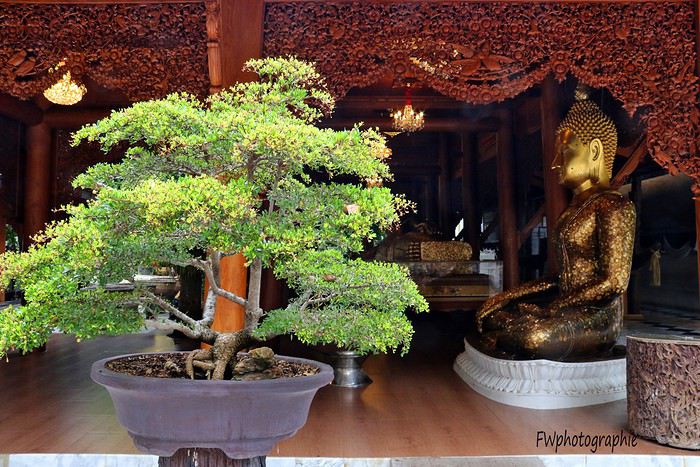
Inside a courtyard, several Buddhas covered in gold leaf stand side by side, along with a large number of finely carved tree trunks, pillars, and canoes, plus an assortment of stunning bonsai trees.


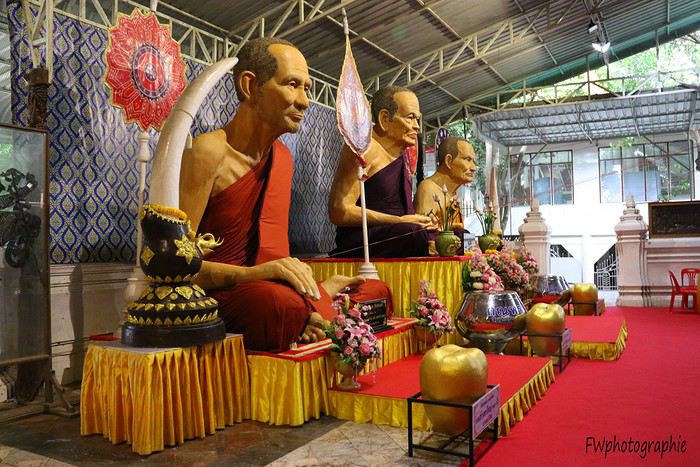
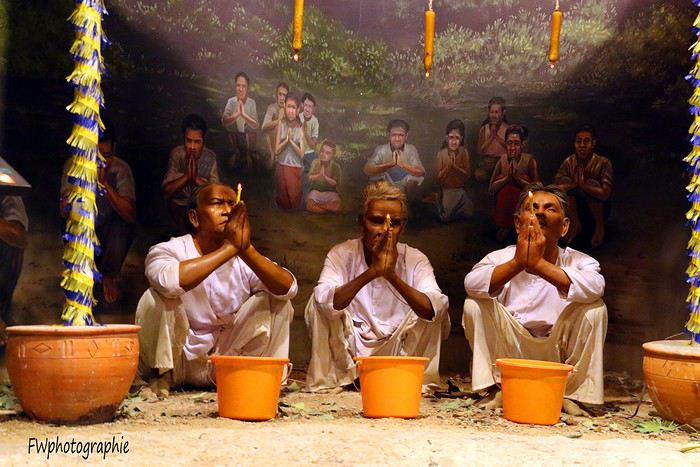
Before entering the temple, you pass by six wax monks that look incredibly lifelike—though much larger than the life-sized replicas you usually see in other Thai temples.


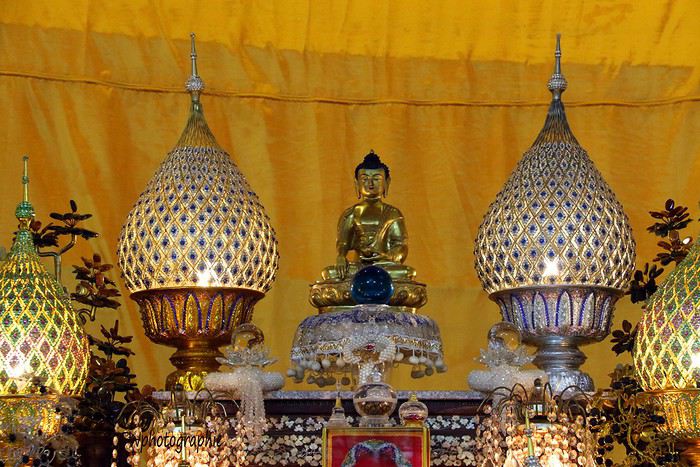
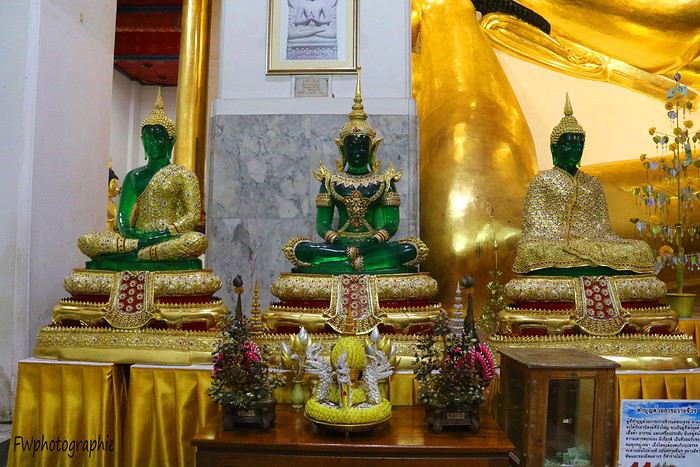
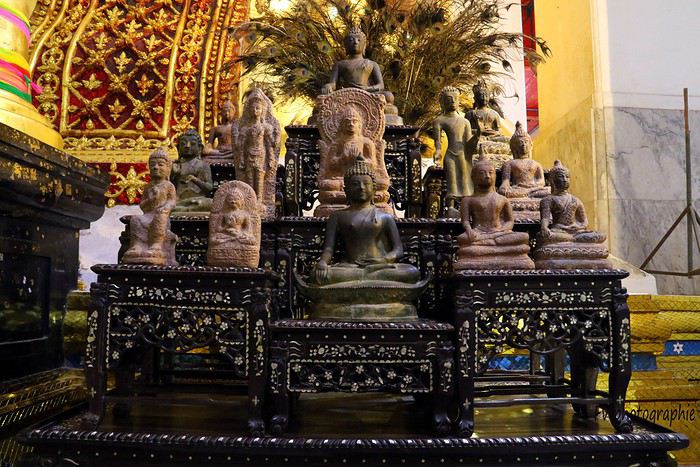
Inside the temple, the giant reclining Buddha takes up the entire center, surrounded by thick pillars that make visibility tricky. But all around it, on all four sides, it’s a full-on festival of antiques and artworks. Beyond the sculptures and century-old statues, there’s a large painting featuring—if you look closely—the late king, along with numerous display cases filled with precious objects. We saw marvels in bronze and ivory, as well as several large jade Buddhas, each dressed differently. At the back of the hall, dozens of Buddhas and statuettes in every style and material imaginable, each more beautiful than the last. On the other side, there are fabulous antique carved furniture pieces inlaid with mother-of-pearl and adorned with many ancient objects. Then comes an incredible collection of pots and vases in various shapes, all very old—including several Chinese pieces from the Ming period. Some are even made of silver. There are simply hundreds of them. More than two meters up, on metal stands, several carved seats—thrones, really—are displayed. Not only are they stunning, but the Buddhas perched on them are just as impressive.


This is exactly the kind of temple we love. Completely unknown to the general public, almost no one around early in the morning, and a visit that keeps surprising us at every turn. The sheer concentration of fantastic creations here could easily fill an entire day.

We’re caught off guard because we’d planned a quicker visit, and our host is probably already waiting for us. We didn’t get to explore the entire complex. Given how rich it is, we promise ourselves we’ll come back in the next few years—it won’t be a waste of time.

Just as we’re about to leave the temple, our day is darkened by the sight of an old dog making heartbreaking sounds. He’s lying down, occasionally trying to get up, but there’s no strength left in his hind legs. We can tell this poor animal is nearing the end of its life. In Buddhist culture, karma is left to run its course, and unfortunately, animals in agony aren’t relieved—not at the temple, at least, not by the monks. It’s awful.
« Tout le monde s'interroge sur comment laisser une meilleure planète à nos enfants, mais on devrait plutôt penser à laisser de meilleurs enfants pour notre planète. » Clint Eastwood
JO Jojoone1 Globetrotter ·
Hi Michel,

This is just a small sample of the treasures this temple has to offer. We weren’t going to post fifty photos. And those who are interested will make the trip to enjoy it fully. To think we didn’t even see the exterior—but we’ll fix that. As for guides, whole sections of the country are almost completely absent from them. Maybe that’s for the best, in a way. We would’ve just appreciated more feedback to confirm that people have discovered places thanks to our stories. That *was* really the case in 2013 with the langurs, and our satisfaction was immense. Every year, we’re on the verge of giving up. No matter what we do, there’s always that lingering thought of the people who read, who benefit, and yet never engage with the story—or, afterward, don’t even contribute a single tiny addition of their own. You end up feeling like some kind of voluntary sucker...

Anyway, if you enjoyed this last quarter of the day, I guarantee you’ll have plenty of fun in the coming days.

Madame also appreciates your photographs, by the way.
« Tout le monde s'interroge sur comment laisser une meilleure planète à nos enfants, mais on devrait plutôt penser à laisser de meilleurs enfants pour notre planète. » Clint Eastwood
SU SuisseChris Veteran ·
I just read your posts:

We would have just appreciated more feedback to confirm that people discovered places thanks to our stories. That really was the case in 2013 with the langurs, and our satisfaction was immense. Every year, we’re on the verge of giving up. No matter what we do, there’s always that lingering thought of those who read, who benefit, and yet don’t engage with the story—or later, don’t contribute even a tiny bit in return. You end up feeling like a volunteer who’s being taken advantage of...

I still have a lot to learn, and there are a few things I already know. I’d like to remind you—or share with you—something that’s oh-so-true, something I’ve experienced for far too many years: "A great way to be disappointed is to have expectations."

Writing a travel journal in hopes of getting feedback is, in my opinion, a reason that could lead to disappointment if the feedback isn’t what you expected.

So why write a travel journal, you ask? Everyone has their own reasons—they can vary from person to person. For me, writing a travel journal helps me remember the good (and not-so-good) moments. It lets me close the book on my trip and move on to the next thing.

It’s up to you to find your own reason for writing your journal and sharing your photos 🙂

I checked the stats on your journal: In 18 days, your journal has been viewed 5,277 times, 15 people have contributed, and 72 replies have been posted. That’s more than respectable—better than mine, actually 😉

Personally, I love reading your travel journal because you often visit places I don’t know about. Sometimes, I’ve never even heard of them (which always surprises me a little). Also, I think some of your photos are particularly well done, at least in my opinion. Even if I don’t always leave a comment, rest assured that I enjoy reading your posts.

I hope you find a "good" reason to keep publishing your travel journals and that you continue to enjoy it. No matter what people do with them... 🙂

Have a great rest of your Sunday 😎
L'éternité c'est très long....surtout vers la fin (Woody Allen)
JO Jojoone1 Globetrotter ·
Hello,

I’m revisiting your kind message—which disappeared in the meantime—to say I figured you’d like it, because over time, you start to pick up on what certain people prefer. At heart, there aren’t that many of us who truly appreciate this kind of place, atmosphere, aesthetic, and the spiritual weight that comes with it. By spiritual, I mean the way Thais experience their visits to their wats—it’s something we love even if we can’t quite explain it in a few lines. When you’re there, you always worry about disturbing people who are praying, and that’s often when they give you the warmest smile. Sometimes you hesitate to go further, and it’s *them* who wave you in. Absolutely amazing.

It’s too bad these kinds of surprises don’t happen more often during a trip. One experience like that is worth several less memorable ones. Still, it’s great that Thailand has so many hidden gems like this. For my part, I’ve spotted a few more I’m itching to see in person. For other sites, maybe luck will give us a little nudge. At the same time, not so fast—*the more you’ve seen, the less there is left to see.* I’m guessing you’ll make the jump to Jaksi one day. Get ready to keep that camera rolling for a while and enjoy yourself as much as we did.

As for the pool in Lampang, I see both sides of the conflicting arguments, and they both crossed my mind when the owner explained it to me. But in that moment, as he said it so calmly and confidently, what could I possibly say? After all, it’s *his* money that made this place possible—he used it to create this little wonder. Guests paying around 100 € a night come for peace and privacy. It’s hard to imagine letting things slide like they do elsewhere. Plus, his own home is on the property, so it’s *his* space. He did add that he doesn’t always say no outright but explains the rules of the game when needed.

What’s next? Like you said… well, even the last few days aren’t written yet, so I’ll keep things going at my own serial-paced rhythm. But knowing you a little, there are a few paragraphs coming that should pique your interest… 😉
« Tout le monde s'interroge sur comment laisser une meilleure planète à nos enfants, mais on devrait plutôt penser à laisser de meilleurs enfants pour notre planète. » Clint Eastwood
JO Jojoone1 Globetrotter ·
We head back along the same little path, serenaded by birds, startling a squirrel that sprints ahead of us for a stretch.

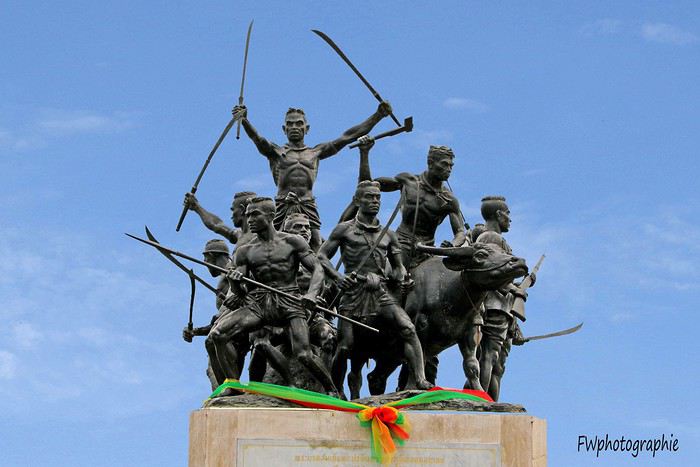
Philippe and his 4x4 are indeed ready, and we set off to take a look at the Heroes of Bang Rachan monument. Just like the famous Gallic village in Asterix standing up to the Romans, a village here held its ground against the Burmese invaders during the Ayutthaya period. The heroism of these Thais and their long resistance before being decimated by far more numerous enemies are a key part of the country’s history and national pride. A beautiful memorial has been erected on the site of the battles, in the middle of a large esplanade with a park surrounding it.


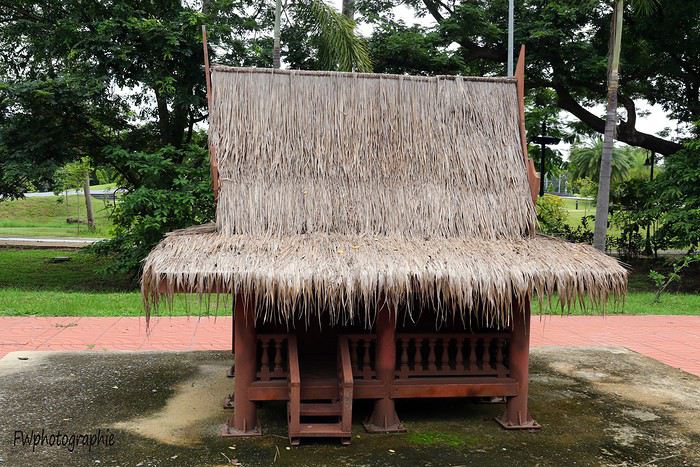
In the park, the Thais have placed other statues of the fighters, each in front of a representation of the house they occupied at the time.


There’s a free museum right next door, which turned out to be more interesting than we expected. We first discover an impressive model of the landscape from back then, with the river and its boats, wooden houses on the riverbank, forests, and temples. Large illustrated panels depict battle scenes, and there’s the inevitable life-sized statue of a warrior brandishing his axe, seated on his battle buffalo. Throughout the exhibit, there are reconstructions, short films on TVs, and a collection of artifacts found during excavations.

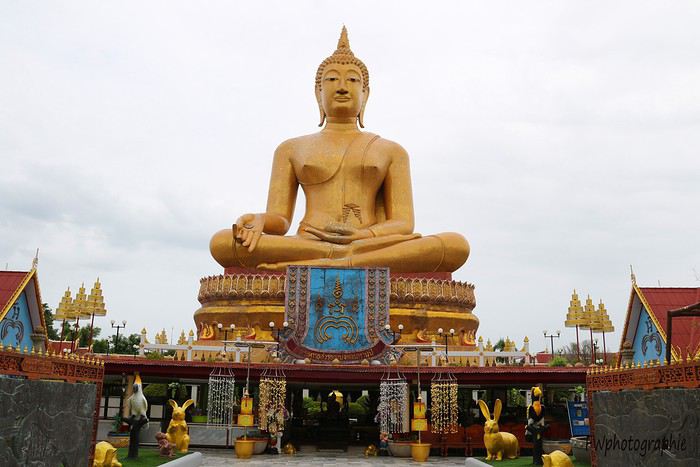
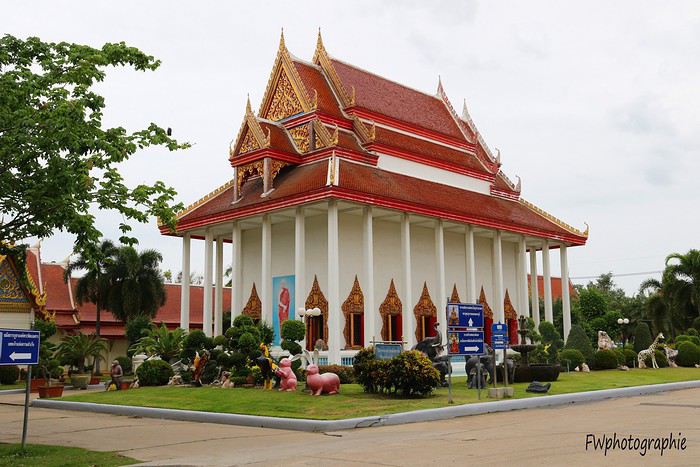
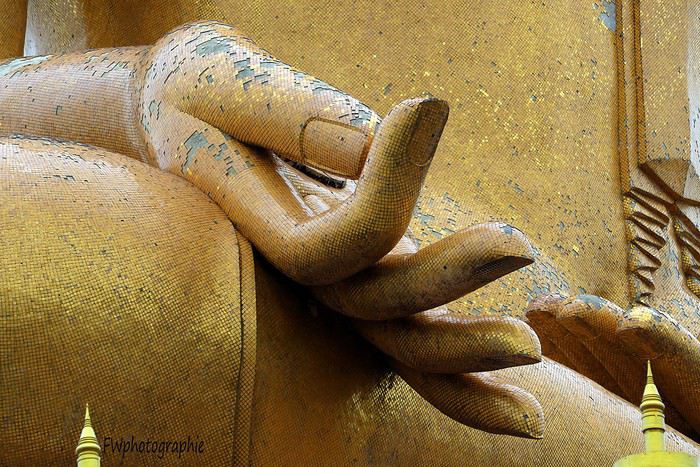
Ten kilometers south of Singburi, in the village of Tha Chang, we visit Wat Pikun Thong. You can’t miss its 42-meter-tall and 23-meter-wide Buddha.


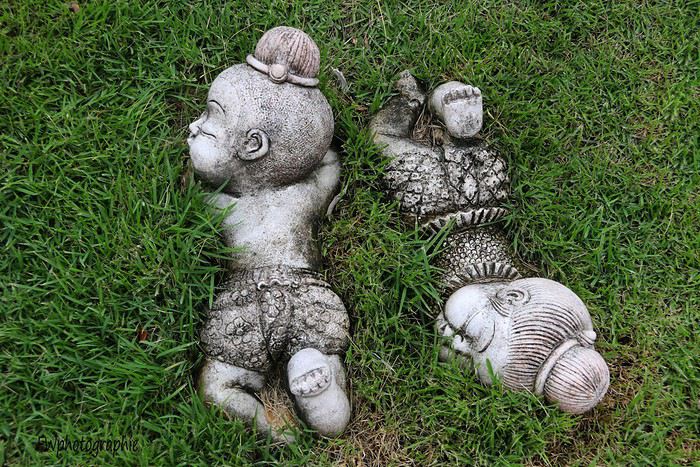
It’s hard not to smile as you walk around the statue. On the lawn, it’s Noah’s Ark with a rabbit next to tigers, a flock of sheep with their shepherds, and a little couple lying down for a nap.


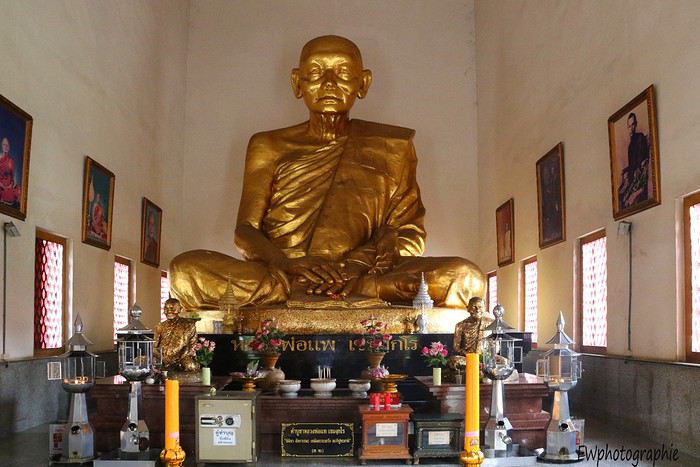
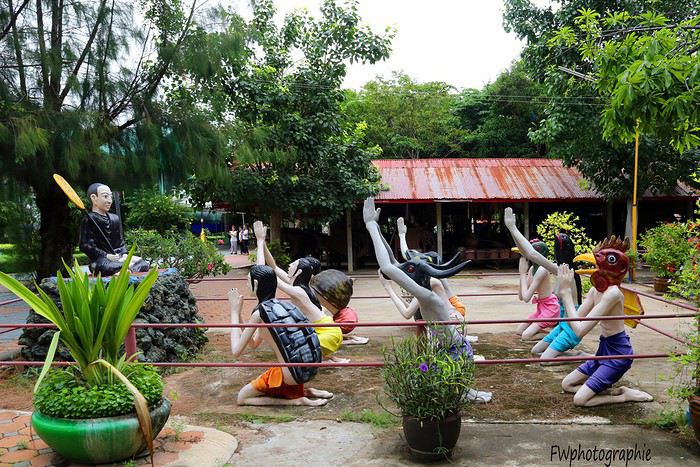
Under the Buddha, you’ll notice relief panels depicting heavenly bliss on one side and the horrors awaiting sinners in hell on the other. It’s absolutely gory. A chapel has been built in honor of the monk Luang Pho Phae, who once led this temple. Besides the imposing golden statue of the holy man, there are also chronological photos showing different stages of his life. He was a very cute little monk and ended up as an old monk with an incredibly kind face.


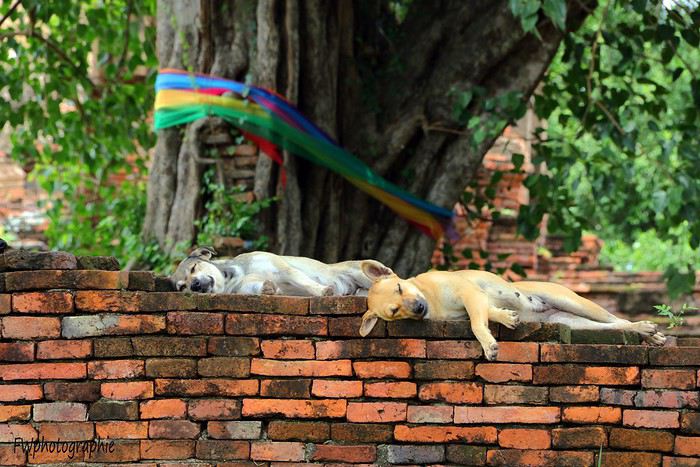
Just before heading back, we take a closer look at Wat Na Prathat, visible from the back of Villa Sumali’s property. It’s a Khmer sanctuary, featuring a tower alongside pottery kilns, restored during the Ayutthaya period. It’s remained in pretty good condition, with some figures still clearly visible. We clearly disturb the peace of a pack of dogs—some of them scatter before we even have a chance to strike up a conversation.


In the afternoon, Françoise takes advantage of a masseuse visiting the hotel family to get her own one-hour session. Excluding the tip, a full-hour massage costs 200 baht. And you can tell this woman knew her stuff. Even though we’re familiar with the rates and expect something like this, it’s still a bit of a shock every time. A steal here, a rip-off back home.

Dinner finally gives us the chance to try snakehead fish—smoked on the grill—and its four sauces. An interesting experience and a tasty dish, even if the value for money isn’t the best we’ve found. No doubt about it, this fish looks nasty.
« Tout le monde s'interroge sur comment laisser une meilleure planète à nos enfants, mais on devrait plutôt penser à laisser de meilleurs enfants pour notre planète. » Clint Eastwood
JO Jojoone1 Globetrotter ·
We had several interesting discussions with Philippe, all in a very friendly atmosphere. This year, we heard loads of anecdotes and significantly expanded our knowledge about Thais, their customs, and how their society works. Once again, it turns out that expats everywhere share the same take on all the topics we covered.

We’re honored, grateful, and... amazed that Philippe still generously shows us around today. This time, his wife joined us because she’s from the area and knows the best routes.

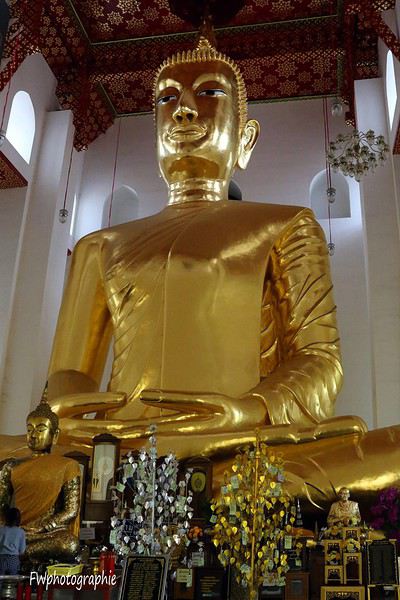
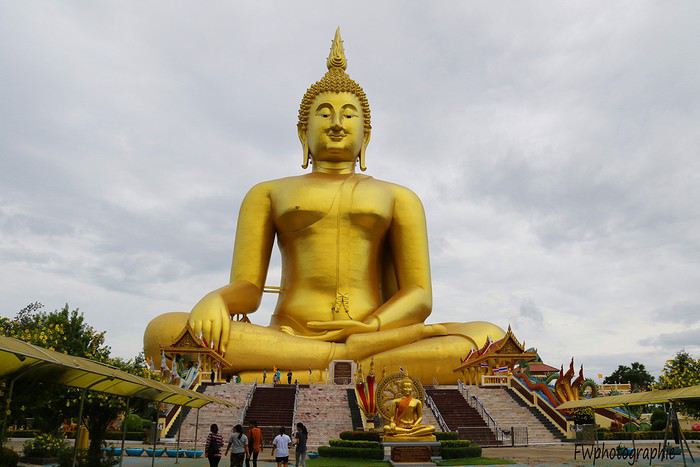
There are many famous temples between Singburi and Ang Thong. There’s an inflation of temples housing large or very large Buddha statues. Wat Chaiyo Worawihan (16 km to the south) is one of them. This second-class royal temple houses a beautiful golden Buddha nearly 23 meters tall and 16 meters wide under its viharn. Needless to say, it’s majestic. It’s amusing to see the circular hollow in the roof to accommodate the tip.


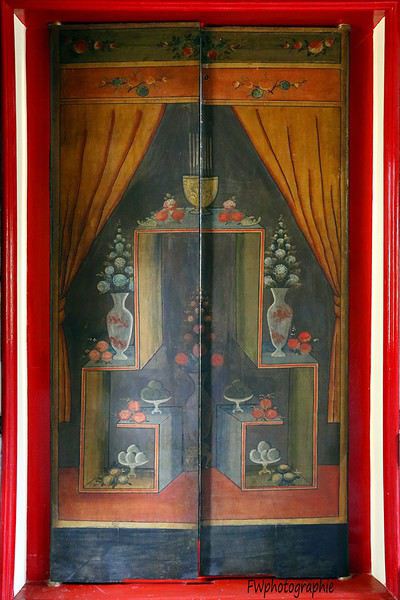
The ubosot right across is very pretty, with mural paintings like those found in the most meticulously maintained temples, and even still-life trompe-l'œil on the doors.


In the courtyard, we came across a skeleton dressed in military gear, complete with sunglasses and a hat, doing the wai.

The end of the temple opens directly onto the river. That’s where we found another chapel near a large gong. There’s also an imposing statue of the monk who was behind the evolution of this temple, which was once just a small rural wat.


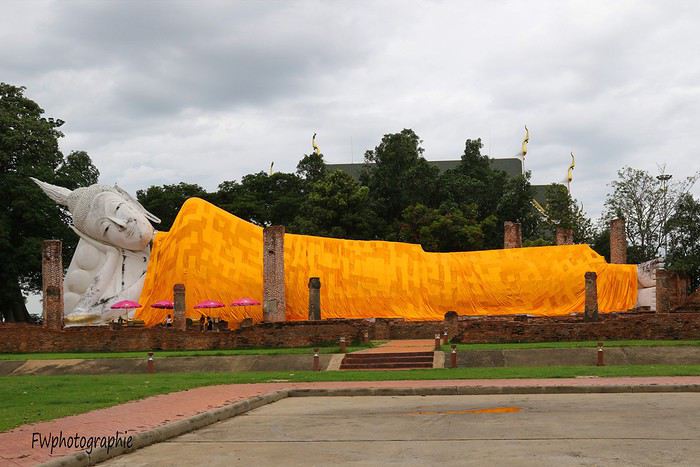
About 12 km southwest, we didn’t visit all of Wat Khun Inthapramun. Our interest was in Thailand’s largest and longest reclining Buddha statue. Legend has it that Mr. Inthapramun was a revenue manager for the King of Sukhothai. He allegedly embezzled funds either to build this statue and take credit for it or to expand it beyond what was planned. The poor man was, of course, executed. When a skeleton was discovered in 1998 in these parts, face down with hands and feet tied, some thought it was probably him. He achieved immortality this way, as the temple now bears his name.

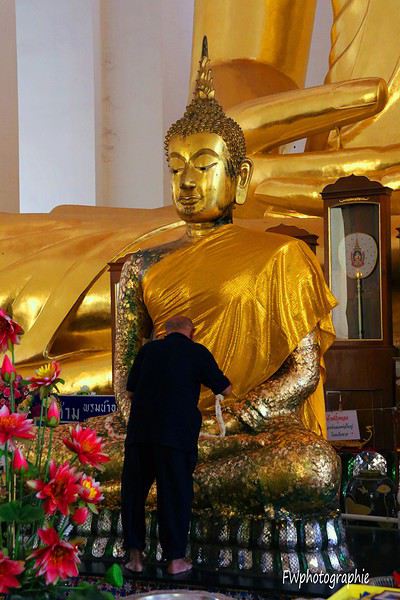
This Buddha is well taken care of: it took a truckload of fabric to dress him. Today, someone gave him a beautiful lotus flower bouquet, and his huge elbow is all gilded.


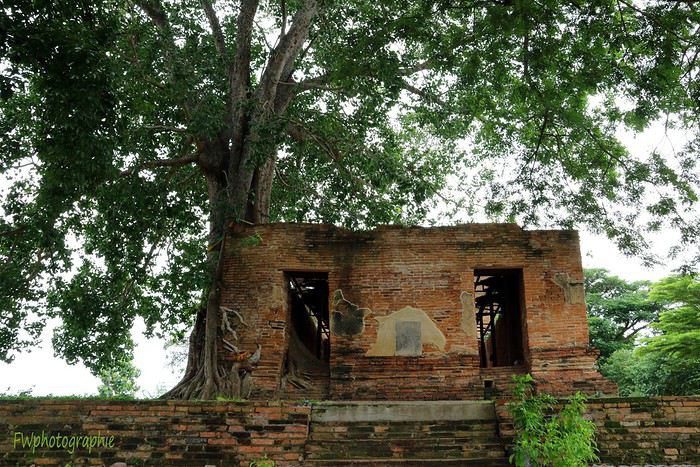
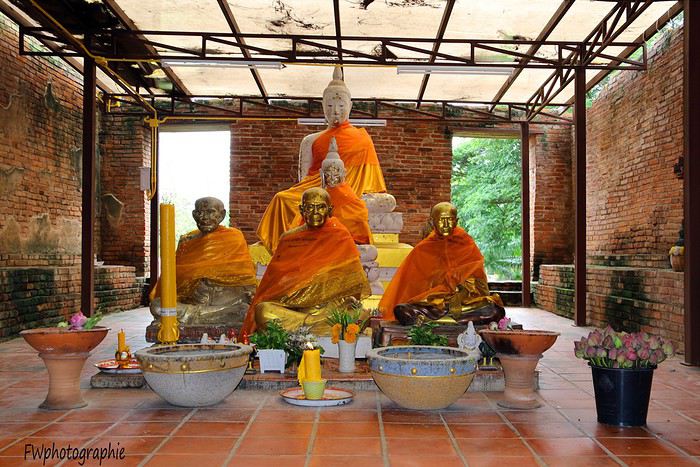
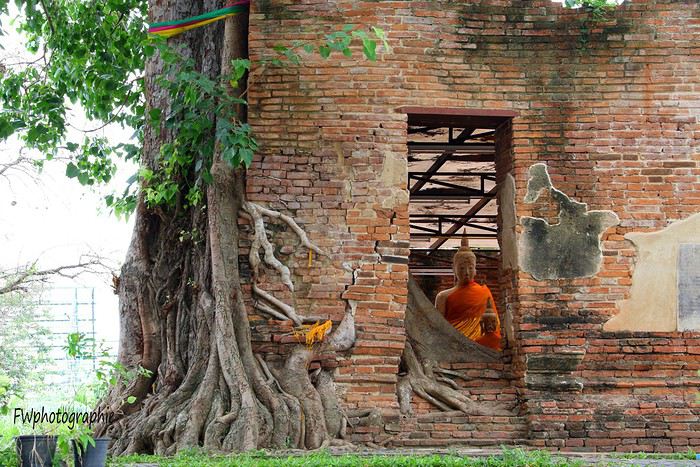
We didn’t know that a small temple nearby had been restored. Its entrance blends with a tree that grew there to embrace it. Inside, a few statues and a small collection of... zebras (!).


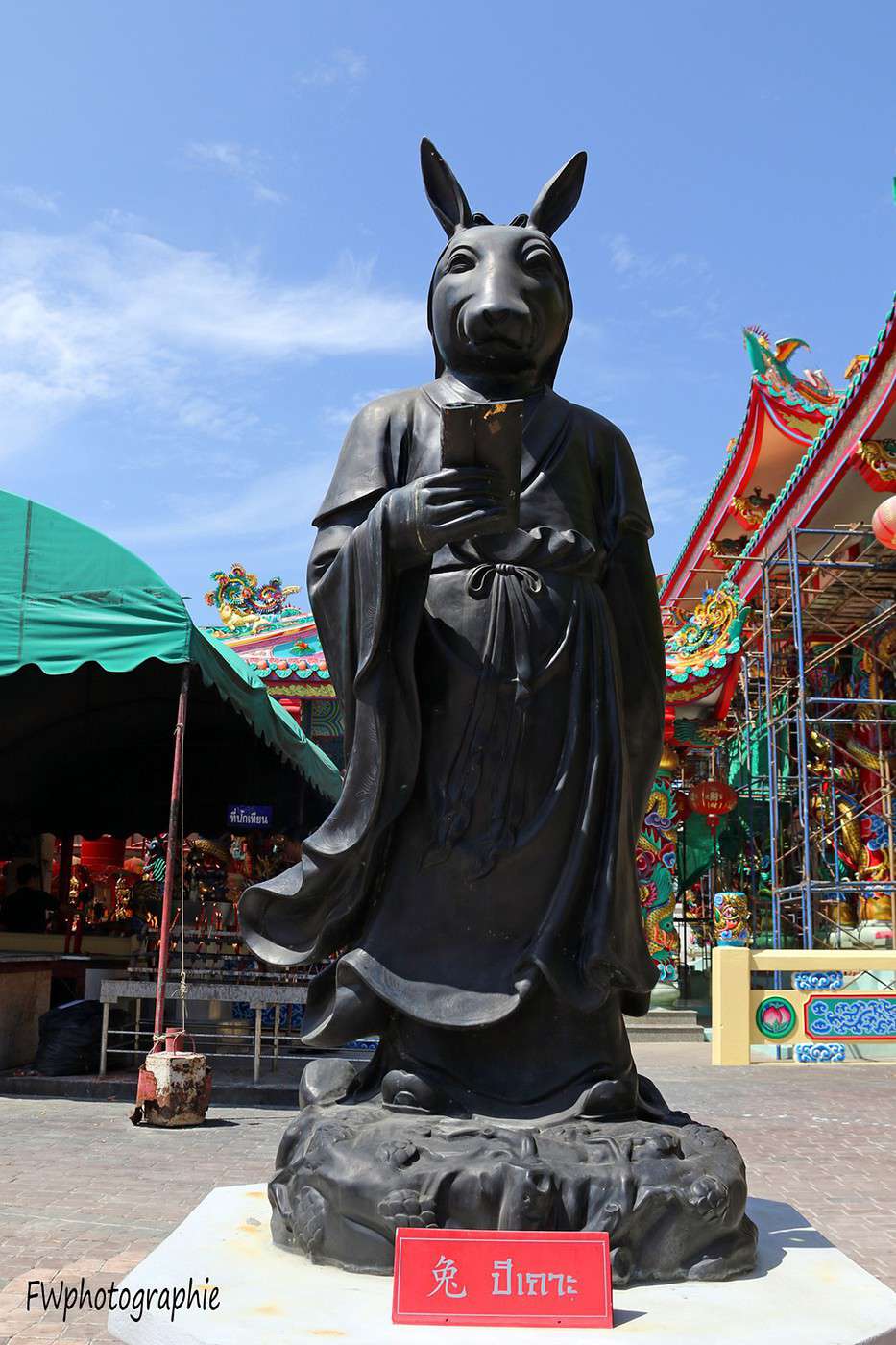
Near Ang Thong, in the Sala Daeng district, there’s a spot that’s not so easy to find. It’s a monastery abandoned over a century ago due to the strong personalities of the spirits inhabiting the place. The name Wat Sang Kratai was initially supposed to mean Sam Kratay: three rabbits. Or maybe I’m starting to understand Thai and I’m talking nonsense.

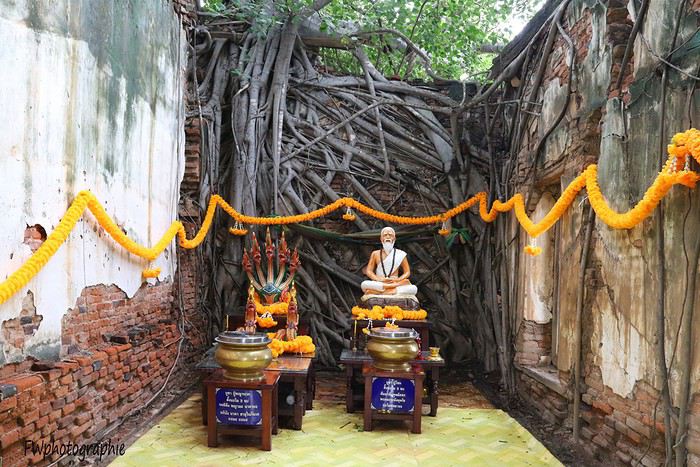
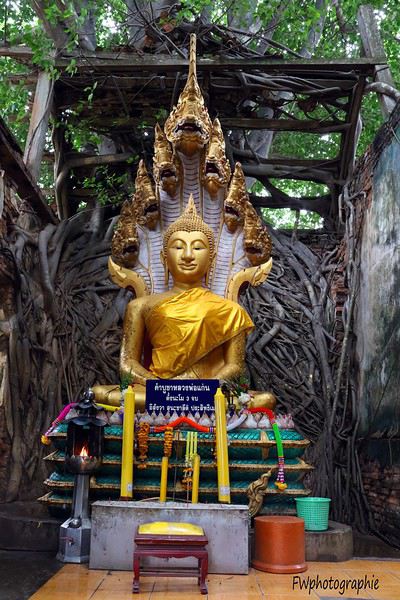
The first sight is striking. Several trees have taken over the building, reinforcing its structure and framework. It’s just as clear from the inside. Each of the three open-air rooms has its own representations to honor. Behind the monastery, next to the fountains, a few large terracotta rabbits stand with their 40-centimeter ears upright. Places like this delight us.


A few kilometers away, in the Wiset Chai Chan district, a monk was on a forest retreat in the early 1980s when he rediscovered the ruins of Wat Muang. His project from then on was to give it new life. In 1990, over 18 years, construction began not only on the temple but also on one of the ten largest statues in the world. The seated Buddha at Wat Muang is indeed Thailand’s largest statue. This great golden Buddha, which seems to hint at a smile, is 63 meters wide and 92 meters tall.


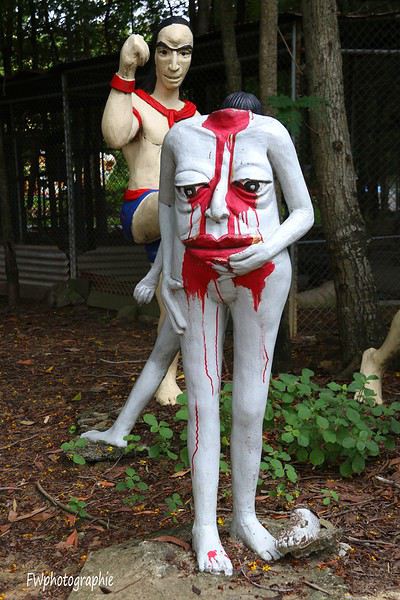
Let’s clarify that it’s not just a temple at this location but a whole park. We knew that under the Buddha, life-sized scenes (and sometimes even larger) of the torments of hell were displayed. However, we had no idea it covered such a large area. Clearly, more than one little Thai must have been scared by all these atrocities. There are some forms of torture we couldn’t have imagined. Battle scenes and Buddhist-themed tableaux also have their place.


We took advantage of a small stall to stock up on some Thai medicine jars. There’s not just the famous Tiger Balm but many others, in different colors, for all sorts of uses. The one with the dark green product is very effective for quickly relieving pain.

It was getting late, and we couldn’t explore the space further or visit the Chinese temple, so we’ll have to come back. Indeed, Philippe’s wife has been struggling to hide her suffering for a while now. She’s hungry, really hungry. If you want to upset a Thai, just stop them from eating when they’re hungry.

While the couple discussed where to go and playfully argued over the best route, we ended up in a place we obviously wouldn’t have found on our own. The large restaurant has several tables right by large ponds used for fishing contests. It’s very pleasant, and we’re the only customers. We did as the Thais do: everyone orders their own dish, and we all taste everything.

After nightfall, Pam (Philippe’s daughter) and her boyfriend showed us the Singburi market. Even though it’s smaller than on weekends, it’s still quite large, with all sorts of shops. It’s more organized than what we’re used to. The market forms a square with clean central aisles, and each vendor’s space is clearly defined. It reminds us a bit of some of our local markets from the 70s. In this part of the country, pineapples are twice as expensive as in the north, but they’re still delicious—and of course, that wasn’t a complaint...

« Tout le monde s'interroge sur comment laisser une meilleure planète à nos enfants, mais on devrait plutôt penser à laisser de meilleurs enfants pour notre planète. » Clint Eastwood
SU SuisseChris Veteran ·
Good evening,

Wat Chaiyo Worawihan (16 km to the south) is one of those. This second-class royal temple houses a stunning golden Buddha nearly 23 meters tall and 16 meters wide beneath its viharn. Needless to say, it's majestic. It's amusing to note the circular hollow in the roof so the tip can fit inside.

The second photo has the advantage of putting the first one into proper perspective. You mentioned the dimensions, but I find it easier to understand with a photo—in this case, two.

The places where roots have taken over have a special charm. You can really see the work of time and what it took to reach such a state.

Thanks for this travel journal—it's a pleasure to follow.
L'éternité c'est très long....surtout vers la fin (Woody Allen)
BO Bonheurjoie ·
Hello, Thank you so much for your entire travel journal. I really enjoy reading your posts and looking at the photos. I love your take on the daily and spiritual life of Thai people. I’ve been to Thailand once and really enjoyed visiting the temples. Your stories let me relive my time in Thailand. Thank you both! Lise from Montreal
JO Jojoone1 Globetrotter ·
Good evening,

After a while, how should we even thank you? By saying that dunces understand better with pictures than explanations!! 😛 It just so happens that what you said, I had just told Françoise two hours earlier... Yes, there are photos I’m discovering or rediscovering right now. Over the years, images and notes become an increasingly important support for our memory 🤪

I think you’re now grasping what this year has meant for us. We’d love for it to always be like this, but we can always hope...
« Tout le monde s'interroge sur comment laisser une meilleure planète à nos enfants, mais on devrait plutôt penser à laisser de meilleurs enfants pour notre planète. » Clint Eastwood
MO Moustache35 Regular ·
hi there I'm planning a trip to Thailand in January, and after reading your amazing story, I can't wait to be there!

thanks again kenavo
JO Jojoone1 Globetrotter ·
Hi Lise!

There’s undeniably something that clicked. That first trip ten years ago set things in motion (albeit with a delay). Not everyone gets to discover this country without falling in love with it. We had no idea it would one day lead to this on such a forum. It started as a kind of tribute to those who give to others, a sign of gratitude.

Our feelings about it are genuine—it’s not some huge effort toward the cultural or spiritual. We try to offer a personal take on what’s already well-known and put into perspective some of what’s less familiar. It might make a few people’s stays easier or more enjoyable, but it’s hard to say to what extent.

Say, think about diving into planning your next trip, because when it comes to temples, the stock just keeps growing every year, and you’ll run out of days to fit them all in! Thanks so much for your message.

And hello to our Francophone friends outside France. Whether it’s in the story or even more so during our stays, their spontaneous and friendly sides really stand out. There you go—so we don’t one day regret not having said it!
« Tout le monde s'interroge sur comment laisser une meilleure planète à nos enfants, mais on devrait plutôt penser à laisser de meilleurs enfants pour notre planète. » Clint Eastwood
JO Jojoone1 Globetrotter ·
Good evening,

Thank you, we're blushing! It's exciting to find extra reasons to be happy. You'll have more people around you, but also better chances for pleasant skies and weather. As the days go by, we're thrilled to dedicate a day to responding to those who left a message. You might have even more reason to get excited. Oh wow, January feels so far away!!😛
« Tout le monde s'interroge sur comment laisser une meilleure planète à nos enfants, mais on devrait plutôt penser à laisser de meilleurs enfants pour notre planète. » Clint Eastwood
DA Daisyone Globetrotter ·
What strikes me as I read through your journal every day is the truly MIND-BLOWING, breathtaking, extraordinary richness of Thailand. Even in the most remote places, off the tourist trails, you find real wonders. A little dig at those who don’t understand why we keep coming back every year...
daisy
JO Jojoone1 Globetrotter ·
Hey there!

I’ve had the same thought recently. Too bad Thailand is richer than I am! 😄
« Tout le monde s'interroge sur comment laisser une meilleure planète à nos enfants, mais on devrait plutôt penser à laisser de meilleurs enfants pour notre planète. » Clint Eastwood
JO Jojoone1 Globetrotter ·
The day before, as we were leaving the market, we tried to get some information at the bus station. Despite all the lights being off, someone near the entrance was able to answer our question. We wanted to know the bus schedules, and we were told that due to a lack of passengers, there were no more buses to Suphanburi. Well, that was a surprise!

After a leisurely breakfast with Philippe, he once again volunteered to take us into town. It didn’t take long for him to spot an ad for a taxi. A quick phone call and a little haggling later, followed by goodbyes (well, see-you-laters!), and we covered the 82 km in a way that wasn’t backpacker-style at all.

The Songphanburi Hotel is a massive concrete block. We got the superior room with breakfast for 27 €. We also chose it because of the pool. True, maintaining it isn’t their top priority.

As we were walking up the ramp, we crossed paths with a very beautiful young woman, absolutely distinguished and stylish, who had the serious and absorbed expression you often see in Thais busy with business. For a moment, you might think she was putting on airs...

Our surprise was great when we arrived at the reception. All the young women at the front desk looked at us with a stunned expression. And it didn’t get any better when we tried to communicate. No one spoke English, no one seemed to make an effort, and honestly, we felt like they were paralyzed. Often, we use the first contact to talk about our upcoming days and at least start organizing things. We had to admit that our first attempts were hitting a 0% success rate, and being pragmatic, we decided to take a few minutes in our room to unpack some things. We took the elevator, almost able to feel the wave of relief behind us as we left.

At one point, a light bulb went off. Joel remembered seeing some well-dressed people in the lobby, busy on their smartphones. He figured there was a good chance some of them spoke at least a little English. You’ve got to seize good ideas when they come, so when the elevator opened on the ground floor, a new wave of panic swept over the receptionists—until they realized we were turning into the lobby. Phew! Meanwhile, the men we’d seen earlier had disappeared, and we thought we’d struck out—until a last glance revealed two young women in the back of the room, focused on their phones, including the one we’d seen on the ramp. It was hard to tell if they were sisters, friends, or colleagues, but one thing was certain: each could be happy with her reflection in the mirror.

We really had to talk to them for them to notice us, they were so absorbed. Joel asked them in English, with his shy-awkward-polite side: "Excuse me, do you understand English? Could you help us?"

The reaction, which lasted just a moment, was telling of our month in Thailand and spoke volumes about Thais. In a split second, this person with her cold-beauty appearance stood up like a jack-in-the-box, just long enough to put down her phone, and transformed into the most charming and helpful person in the world, with a radiant smile that could defrost a freezer.

"Yes, of course, what can I do for you?" Our arms nearly fell off.

For the record, two days later when we came down for breakfast, we saw that the hotel had transformed overnight into Cinderella’s palace, with people dressed up everywhere to host a wedding. Our two young women were back, and we then understood they were the masterminds behind the ceremony.

From the moment we approached them, things moved quickly. These young women dropped everything, shuttling back and forth between us and the receptionists, their smartphones buzzing nonstop—so much so that we ended up feeling a bit lost. In any case, it turned out that in just 20 minutes, they’d not only sorted out our afternoon plans but also the next two days. Here’s your gift pack, you can take it with you... We thanked them as much as we could, feeling like it still wasn’t enough.

We had an organization problem and stumbled upon... THE ORGANIZER!! Isn’t life beautiful?


We couldn’t help but tell her that we’d never received such a poor welcome in a Thai hotel. She immediately explained something we should’ve realized long ago: "You know, they’re terrified. They know they can’t help you and they’re extremely embarrassed." That’s when everything clicked. Those odd reactions that had seemed so strange and inappropriate—both now and in the past—were all about the absolute dread of *losing face*!!!!

We barely had time to get ready before the tuk-tuk was already waiting to take us to the Suphanburi National Museum. In Asia, we don’t usually go for museums because they can be disappointing. But you’ve got to make exceptions now and then, and we’ve had some great ones these past few weeks.

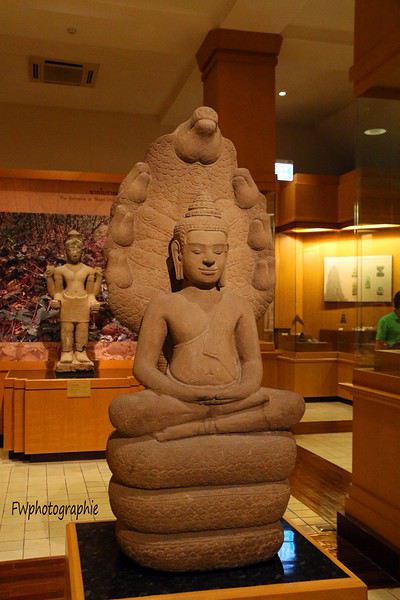
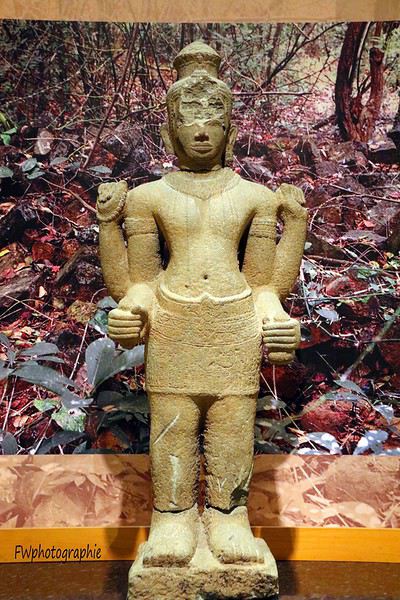
The museum is open from 9 AM to 4 PM, closed Mondays and Tuesdays. Entry is 100 baht. The first panels in the museum proudly state that this region was the cradle of Thai civilization. Two of the rooms are interesting, showcasing several magnificent Lopburi-style sculptures from the 13th century, delicate statuettes, splendid votive tablets, and some prehistoric tools and jewelry. (Note that Thai prehistory is around 600 AD.)


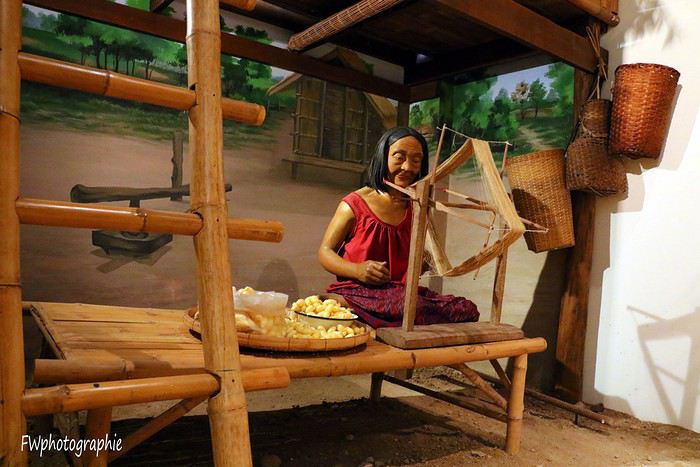
The tour then leads through reconstructions of old-time scenes with huts, shops, and wax mannequins, while a soundtrack plays dialogues matching the scenes. It’s a really well-done setup, let’s admit it.


Before leaving, there’s a surprising large room where the public can access jukebox-like stations with headphones. You can listen to old Thai hits from the 45-rpm record era. A quirky touch we wouldn’t have expected.

While strolling through town before dinner, we passed the memorial dedicated to King Naresuan. In Thailand, there’s a direct link between the image of the rooster and the king. It’s not the first time we’ve seen this kind of scene—it’s a sort of tribute from the people—but this was the most impressive army of roosters we’d ever seen.
« Tout le monde s'interroge sur comment laisser une meilleure planète à nos enfants, mais on devrait plutôt penser à laisser de meilleurs enfants pour notre planète. » Clint Eastwood
SU SuisseChris Veteran ·
😄 😄 😄

I love it!

The interaction with the receptionists reminded me of a similar moment in Nakhon Sawan.

I still smile about it today when I think back.

And all that for what? Just to save face... I saw girls "fleeing" from the reception when I arrived. At first, it left me with a strange impression.

Thanks for this really enjoyable read.
L'éternité c'est très long....surtout vers la fin (Woody Allen)
JO Jojoone1 Globetrotter ·
When you're not in the know, dear Christophe, it must feel weird the first time: you arrive all smooth and charming, and then they take off running! 🏴‍☠️
« Tout le monde s'interroge sur comment laisser une meilleure planète à nos enfants, mais on devrait plutôt penser à laisser de meilleurs enfants pour notre planète. » Clint Eastwood
SU SuisseChris Veteran ·
The first time, I was taken aback by such behavior. Actually, I didn’t understand why they "ran away" when I approached. At a **** hotel in a city like Nakhon Sawan, I thought the receptionists would speak a little English.

Now that I’ve figured it out, it’s actually kind of funny because I know how to say hello or get someone’s attention in Thai, which makes them come back. Then, I ask, "Do you speak English?" 😏

With people who are a bit shy or don’t want to lose face, the reaction is often pretty amusing. 😄 After that, I manage with my three Thai words and my smartphone, which has an app that can speak Thai—and it does a great job, by the way. Sometimes, they call someone else who speaks three words of English, and we always make it work by putting in some effort, being patient, and keeping a friendly smile.

Arriving like a flirt? That’s not me at all, my dear... my natural charm is enough! 😄 😄 😄 (Please consider this last line written in self-deprecating humor.)

Honestly, in Thailand, there are so many funny moments to experience. It’s one of the things I love about this country.
L'éternité c'est très long....surtout vers la fin (Woody Allen)
JO Jojoone1 Globetrotter ·
https://youtu.be/dPNYejK1-vw
« Tout le monde s'interroge sur comment laisser une meilleure planète à nos enfants, mais on devrait plutôt penser à laisser de meilleurs enfants pour notre planète. » Clint Eastwood
SU SuisseChris Veteran ·
This army of little roosters or ugly roosters ... leaves me perplexed. Sometimes, I admit I don’t quite see the point of certain things. Oh well, it’s meant to pay homage... though even knowing that... Maybe I haven’t reached a level of wisdom high enough to grasp the full subtlety of such a monument.
L'éternité c'est très long....surtout vers la fin (Woody Allen)
JO Jojoone1 Globetrotter ·
You have to admit, breakfast at the Songphanburi Hotel really stands out from the usual routine. We’re pleasantly surprised to find guava juice, real jam, two kinds of cakes, excellent pineapple, decent coffee, and real milk available. That said, this kind of spread isn’t an everyday thing in Thailand.

The turnaround in the reception staff is striking: the girls are totally relaxed and greet us with big smiles. The farangs have been taken care of, they’re happy, and the staff won’t lose face. Amazing Thailand!

At eight in the morning, our guide Ha shows up as planned with the little Mitsubishi driven by her boyfriend Beuh (pronounced the Thai way, with a slight gagging intonation). Real names are often more complicated, so nicknames are the way to go. While Beuh has a bit of a roguish, deadpan side, Ha is an extremely considerate and cheerful little woman. We hit it off right away—there are just some people you can’t help but like.

They’ve brought the full list of the day’s activities. It’s a packed schedule because Suphanburi is a must-visit stop on the Buddha trail.

Our first stop is Wat Phra Rup, a six-century-old temple where, at this early hour, only the guard dog seems vaguely awake. The word in the country is that the long reclining Buddha (13 meters) here has the most beautiful face in Thailand. That’s absolutely not true, though his expression leaves no doubt he’s just reached nirvana. Near this statue, a monk in wax sits cross-legged on a wooden table. Oh wait—no, he moved! Turns out he’s real. Not far from nirvana himself, actually.


But that’s not the only reason we’re here. We’re lucky our new friends exchange a few words with the first monk we meet. He gives them some explanations and hurries to find the keys to unlock a door on the upper floor of a side building. The most precious items are displayed in a long hall, including a large piece of padauk wood, or Burmese rosewood, unique in Thailand. It’s about two meters long and 90 centimeters wide, carved on both sides. On one side, the famous footprint of Buddha, and on the other, a battle scene with elephants. Unfortunately, it was the least photogenic thing we saw. The thick glass protecting it was dirty, and bright light streamed in through the row of windows at the bottom of the hall. We had to press our noses right up to it to get a good look. It’s a delicate and original piece. All around, there are finely crafted furniture, statues, and statuettes. Notably, two statues bear a strong resemblance to the one we saw the day before at the national museum.


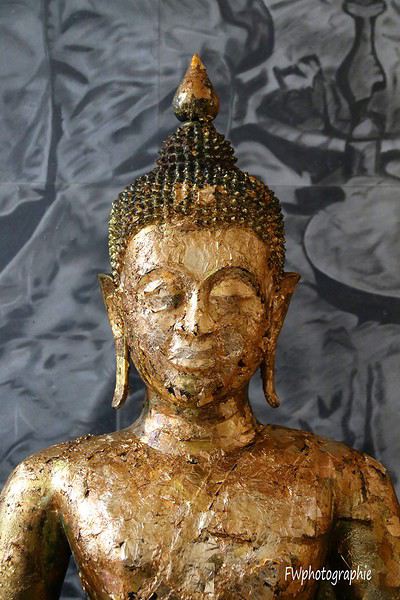
Time to tackle the highlight of the day: Wat Pa Lelai. This temple’s origins date back to the 13th century. It’s now a large complex, with even a new and spacious viharn under construction. Right at the entrance, there’s already a good crowd, even though it’s a weekday, and you can feel the devotion. Everyone comes to ring the bells. And there are already so many statues to admire. Several Buddhas are heavily gilded with gold leaf, the newest layers fluttering in the light breeze while incense fills the air.

The first building is guarded by an elephant and a monkey, both made of granite. It’s tall and narrow, with a constant flow of people entering and exiting. Inside, all you can do is look up—it’s another case of sheer scale. The seated Buddha, once outdoors, stands 23 meters tall and commands attention under its colorful ceiling.


Around this building, there’s a succession of figures and animals—not your average garden pottery. A small shrine at the back houses a very old Buddha representation.


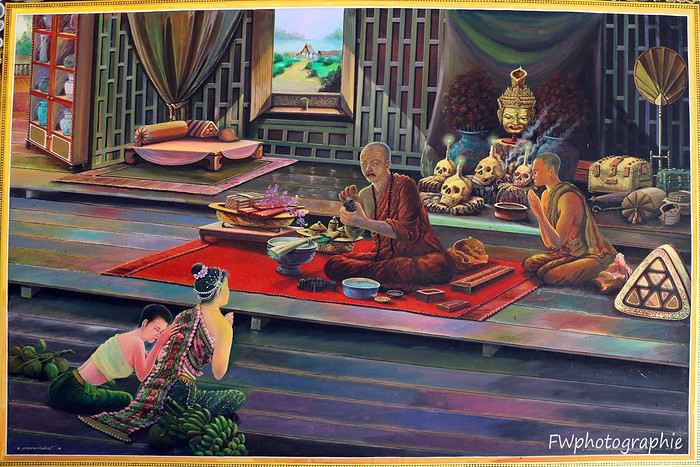
Leaving the small enclosure, after an inner courtyard, we’re treated to a walk along the four galleries on the sides of the large inner courtyard. It’s an unbroken sequence of vibrant, colorful murals, each at least three meters by two. They’re unlike anything we usually see and incredibly expressive. You can spot scenes from daily life centuries ago, few of which are ordinary. One depicts a decapitation, another a cremation, and several show acts of sorcery and ghosts.


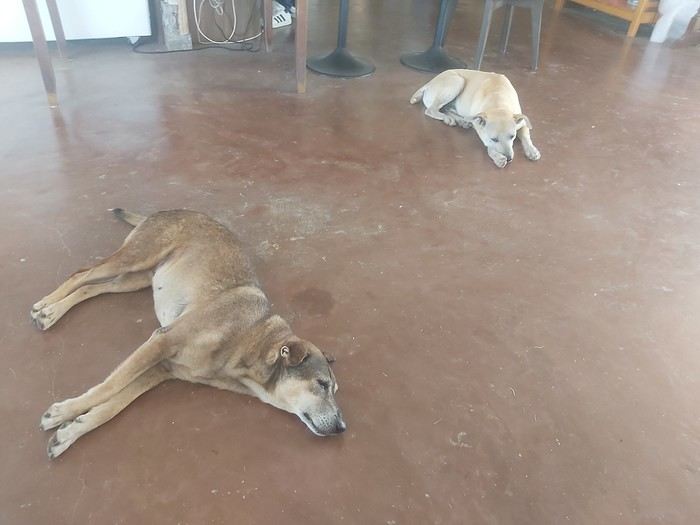
We’re snapped out of our awe by a dog lying on a mat, just after we catch a whiff of death. He’s barely breathing, clearly in his final moments. Up until now, we hadn’t seen anything like this—now it’s two in just a few days. There’s no way we’ll ever get used to it.

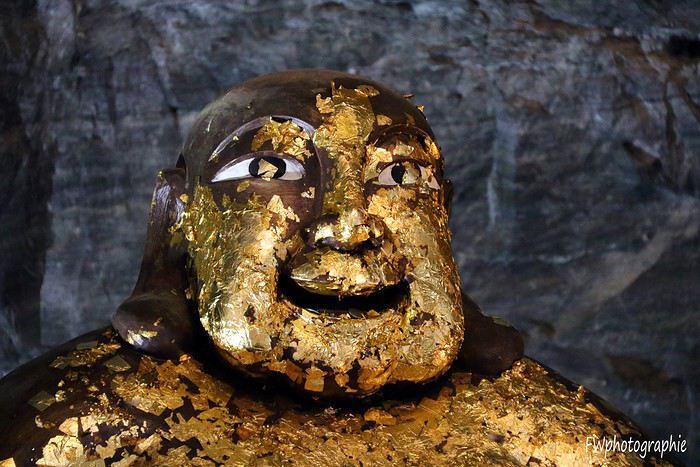
At the end of the path, a pot-bellied, laughing Chinese Buddha towers over a stele, a turtle, and a statue that seem even older than the temple itself.

We emerge at the exit into a whole row of shops where you can grab a bite and buy all sorts of items.

We’ve seen so much, even though we haven’t even covered the whole temple. But our schedule is packed, and the next stop awaits. Our guides still take the time to feed the fish. In this region, many temples are by the river or a pond, and the sacred fish aren’t caught—they’re fattened up.

On the west bank, where the ancient city of Suwannaphum once stood, another 600-year-old temple is worth a visit. Wat Phra Si Rattana Mahathat houses a rather flat, two-meter Buddha in the shape of a votive tablet in one of its chapels.


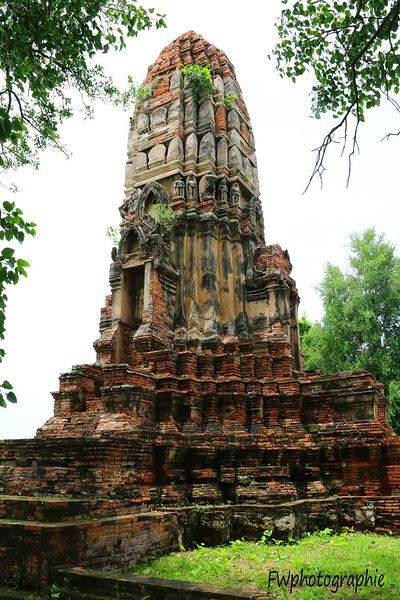
The interior has a bit of an Ayutthaya vibe, with stupas in varying states of preservation, but with a large chedi that archaeologists date to the U Thong period, predating Ayutthaya.


Only Joel, driven by his modern-day adventurer spirit, gives in to the temptation to climb the steps to see what’s behind the gaping entrance a few meters off the ground, under the imposing dome. Inside, there are indeed a few statuettes and a slender golden Buddha with arms outstretched in a peaceful pose, draped in colorful flower garlands. You have to lean in to make out a mysterious statue completely wrapped in colored bandages—only the gilded base is visible. The mummy?

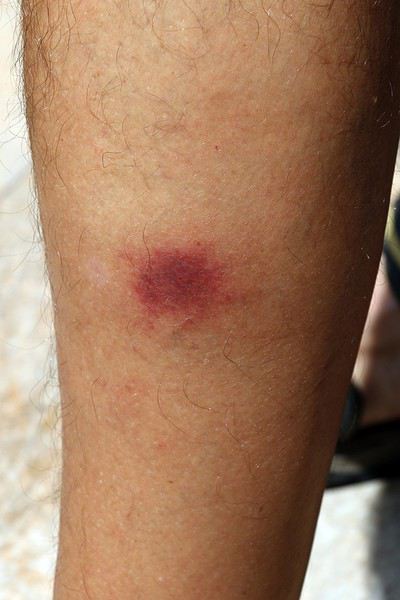
A few meters after descending the steps, Joel feels an unpleasant sensation on the outer part of his left leg, just below the calf. Maybe a mosquito or one of those random aches that come and go. Let’s forget about it. A few more steps, and he feels that stinging sensation again—though there’s nothing on his leg. But it’s definitely red, and it’s itching a bit too much to be normal. Later, Beuh pulls a homemade cream from the glove compartment that soothes the itching. Temporarily. The mummy’s curse?

Across from the chedi stands a house-shaped structure with a temple-style roof. You can’t go inside—the windows are closed, and a gate blocks the door. Only a cat got through... and the GoPro, much to the Canon’s jealousy at that exact moment. It’s a storage shed for Buddhas of all sizes, some also shaped like votive tablets.

« Tout le monde s'interroge sur comment laisser une meilleure planète à nos enfants, mais on devrait plutôt penser à laisser de meilleurs enfants pour notre planète. » Clint Eastwood
PI Pirandy Veteran ·
Thanks Joël for this new little bubble of happiness to start the weekend off right— So much fun reading you! 😎
JO Jojoone1 Globetrotter ·
Wat Pa Lelai with the family

https://youtu.be/S27gAnuZ0cU
« Tout le monde s'interroge sur comment laisser une meilleure planète à nos enfants, mais on devrait plutôt penser à laisser de meilleurs enfants pour notre planète. » Clint Eastwood
JO Jojoone1 Globetrotter ·
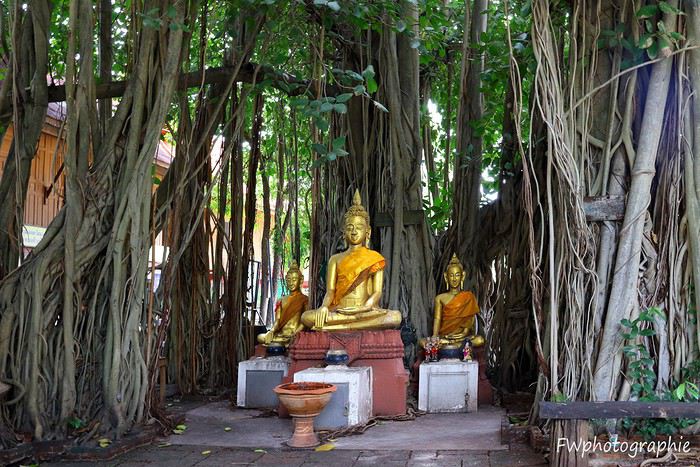
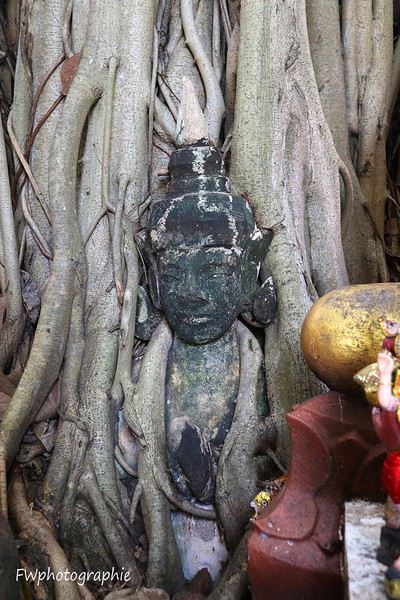
Just a little further north, the road of wonders continues at Wat Khae. Hearing that this temple coexists with a thousand-year-old tamarind tree is one thing, but arriving at the parking lot, stepping out of the car, and seeing it for yourself is something else entirely. You're facing a block nearly ten meters in diameter that seems to be made up of hundreds of trunks. On one side, a trio of Buddhas watches over it; on the other, there's a statue. And just like in Ayutthaya, here a Buddha bust is completely embedded at the base of the trunk.


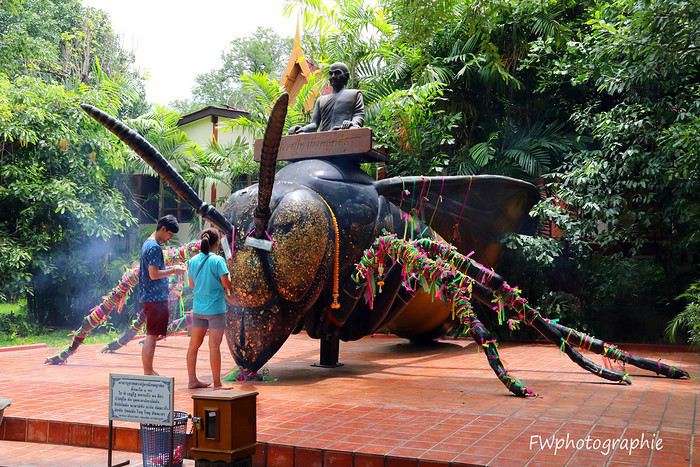
A legend tells that a magician taught the local hero the art of transforming tamarind leaves into wasps to counterattack the enemy. Without this information, you might be a bit taken aback by the gigantic insect adorned with colorful ribbons behind the temple. The hero sitting on it must be quite satisfied watching all the devotees who come to pay their respects and decorate it with small gold leaves. It works out well: yellow suits the wasp!


A fake nest was even hung in the nearest tree to complete the scene. It's amusing to discover nearby a fake rock with the local Excalibur stuck in it. However, this part of the legend remains unknown to us.

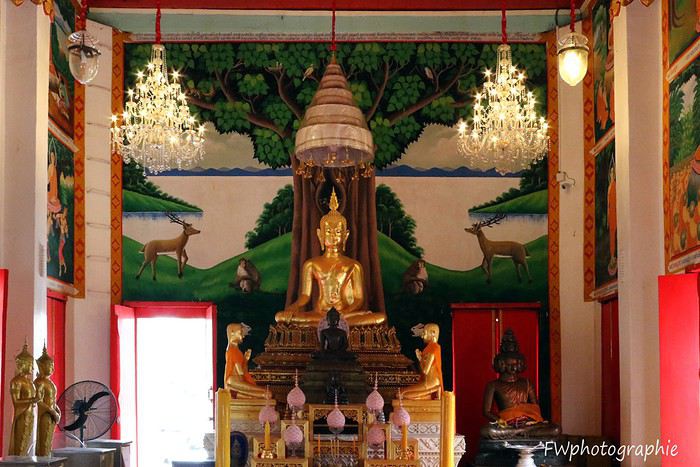
The temple itself isn't very large. It seems to have been recently renovated. Around the perimeter, you'll notice semi-realistic, semi-naive frescoes in bright colors, as well as a copper Buddha with multiple heads.


Françoise scratched her leg somewhere and a few drops of blood appeared. Immediately, there was a flurry of activity among our companions and the people around us, everyone rushing to save her life. In the blink of an eye, a band-aid was applied, and while that was happening, some people took the opportunity to chat with us. In the end, everyone was very satisfied.

We're feeling motivated today. The fifth temple is Wat Phra Loi, which also likely dates back to before Ayutthaya. It was founded where villagers discovered a sandstone statue drifting on the river. It must have been a sign from heaven.

In front of the current ubosot, we see these representations of little monks holding their offering bowls. Two of them are wearing pink sunglasses... There are interesting statues both outside and inside, including the famous Buddha saved from the waters.


Closer to the river are the ruins of the old ubosot. They're about 700 years old and are protected by walls and a roof built over them. The monk present keeps an eye on small statues, including pink and yellow Buddhas, old stone sculptures, a remarkable set of relief panels, and even the wooden gable of the old temple.


Several covered piers with benches have been set up along the river, where visitors can feed the protected fish. These fish live like pashas, their main occupation being to outswim each other to stuff themselves. There are some impressive sizes, and they're not in danger of extinction anytime soon.

Next, we wanted to see Wat No Phuttangkul, renowned for its 1848 mural paintings from the reign of Rama III. But we later realized our guide had made a mistake. We did raise an eyebrow briefly but were unsure. Maybe fatigue played a part at that time of day. Still, we did get to see, prominently displayed, a large golden Buddha... made of woven wicker.


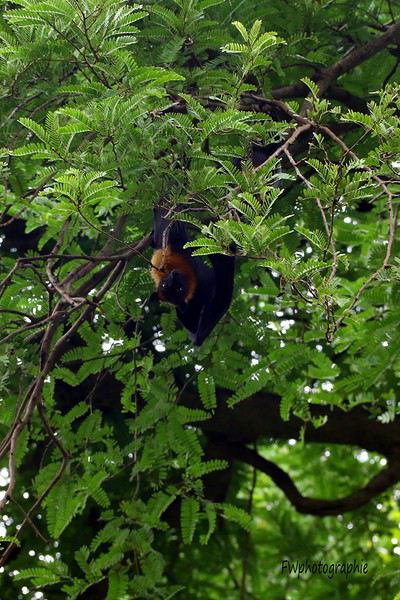
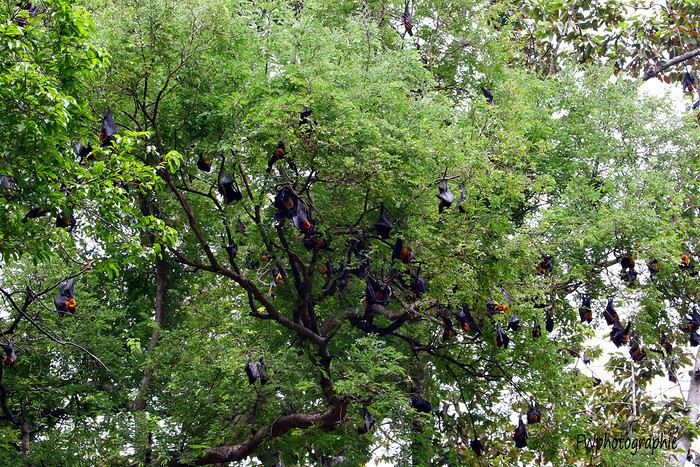
Our companions could have stopped there, but they wanted to take us to Wat Phrao. More precisely, behind the temple. There's rustling in the trees: a colony of flying foxes lives here in peace. We spent some pleasant moments watching the big "Batsmans" flying from tree to tree and occasionally squabbling. Against the light and on the ground, it's more of an experience to live than to photograph.


We and our friends are starving. We let them choose, and it's hot pot at Robinson. It's not really our cup of tea—a fondue distorted in a big shopping mall—but it gives us the chance to discover another aspect of Thai life, in a truly convivial moment.
« Tout le monde s'interroge sur comment laisser une meilleure planète à nos enfants, mais on devrait plutôt penser à laisser de meilleurs enfants pour notre planète. » Clint Eastwood
SU SuisseChris Veteran ·
The bats are impressively large!

The tree is stunning.

I’ve always loved carved wood, and Thailand is full of it. You can still find temples made entirely of wood.

Your travel journal is still such a pleasure to read.
L'éternité c'est très long....surtout vers la fin (Woody Allen)
JO Jojoone1 Globetrotter ·
For this new day, our two guides arrive looking like they just stepped out of the shower. In the early morning, given how often Beuh stops the car to use the restroom, he must’ve really celebrated the previous workday. Ha is thrilled to see us again and brings a lot of cheer to the situation. She shows us a few photos from the night before, with Beuh looking perfectly tipsy among his friends and a few bottles.

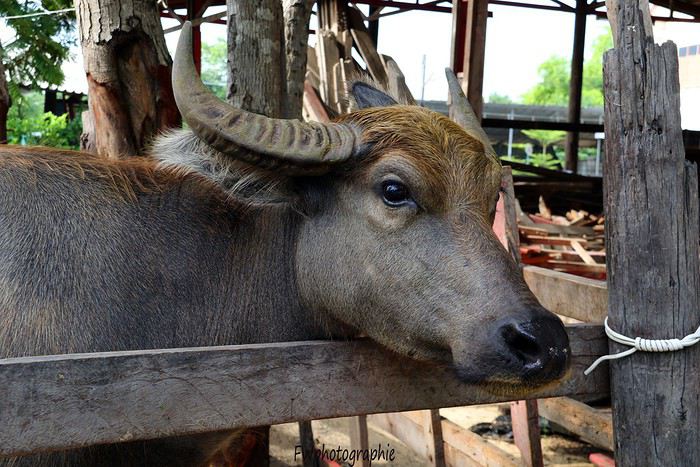
We leave the city to get some fresh air in the countryside. Our first stop is a temple that houses buffaloes and deer in enclosures. The animals are completely used to humans and calmly come over to be fed.


We planned to take a walk at Muang Phu Forest Park, about forty kilometers southwest of Suphanburi. There’s a 1.5 km nature trail leading to a five-tiered waterfall. Our driver had time to prepare for it since the day before yesterday and planned the route. But no such luck! We’re left scrambling and only then do we think to look for a solution! This leads to a few detours and roadside inquiries. Our phone isn’t working well, so we suggest checking Google, but no luck. What bothers them is that the national park’s standard line isn’t answering. And for good reason. When we arrive, the air is dry, and the idle employees inform us the park is closed—there’s simply no water. So much for our walk, monkeys, and waterfall!

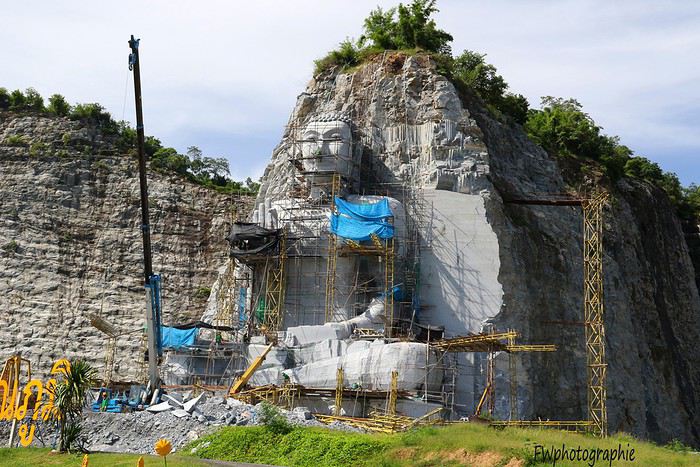
Instead, we decide to head nearby to visit... a construction site. Yes, really! Once completed, the project will be called Somdet Phra Putta Kiri Sri Suwannaphumi. For simplicity, it’ll also be known as Luang Pho U-Tong. The whole thing is officially under the supervision of Wat Khao Tham Thiam.

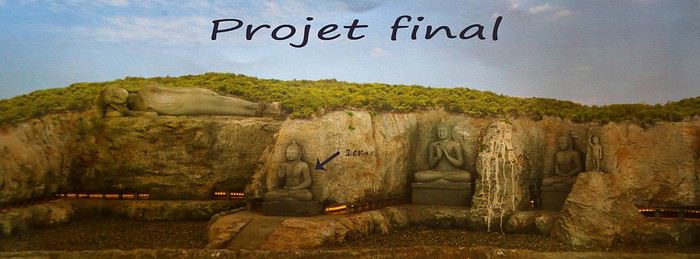
It’s a massive project: not one, not two, not three, but—ladies and gentlemen—five giant Buddhas carved into the rock! Something that’ll surely make headlines soon.

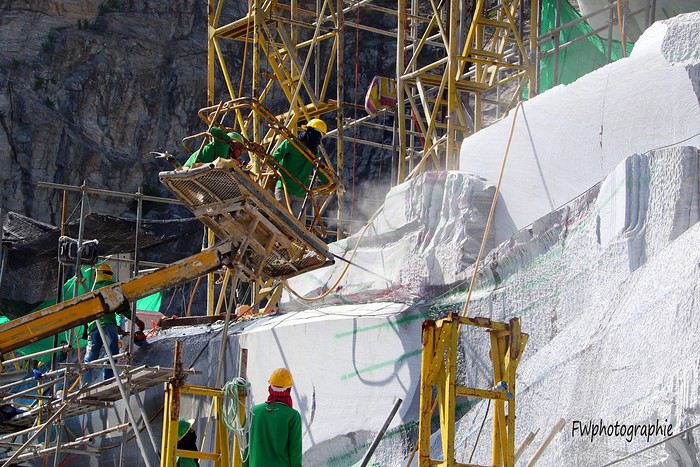
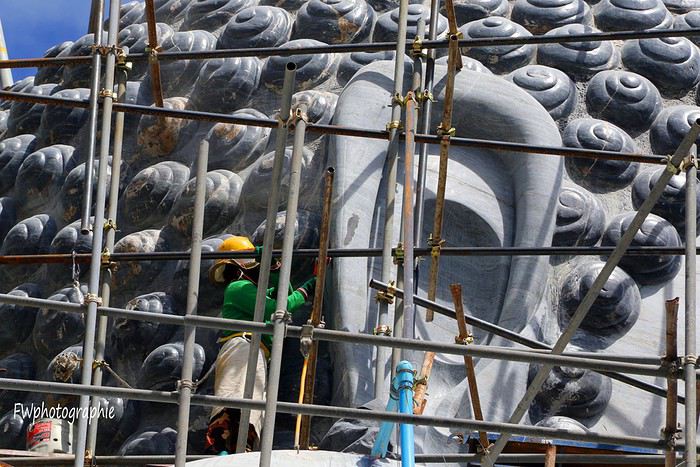
Upon arrival, we see the original site looks like a large abandoned quarry, shaped like a crescent. At the center of the view, the first Buddha is nearing completion. It’ll be 84 meters tall and 65 meters wide. Only the head is almost finished. The sound of construction machinery and jackhammers is everywhere. There’s a small temporary temple across from it, with a model of the site, and a few vendors are already set up.


We climb the slope leading to the back of the statue, where a tunnel has been dug. Soon, a monk comes to meet us, determined to make contact and give us all the details. He tells us he was sent here by his superior from Wat Pa Lelai. He’s the first to confirm there’ll be five Buddhas, with only one not being gigantic. So, a future attraction—and plenty of work for the laborers.


The area is pretty, with scattered hills breaking up the landscape’s monotony.


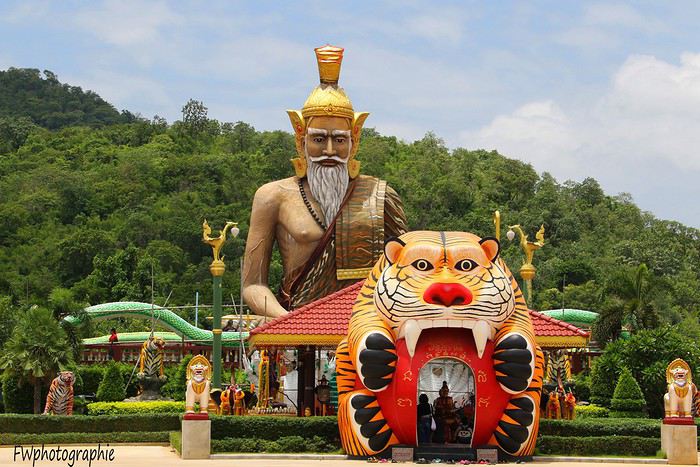
To keep us busy, our guides take us to a very recent temple. Here too, though on a smaller scale, gigantism is the theme. This temple seems dedicated to a spirit or historical figure whose name we didn’t catch. Still, it’s the largest statue of its kind in Thailand.


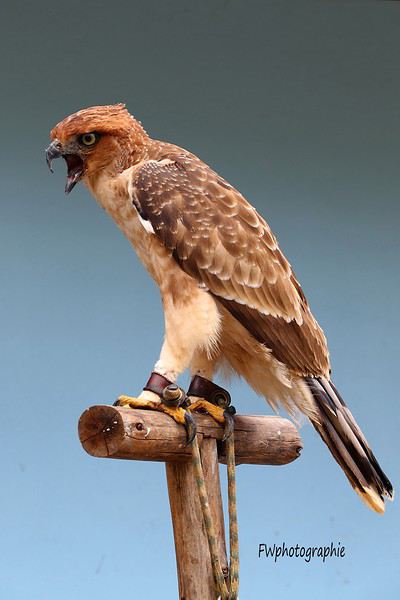
Despite the background noise, a sharp, high-pitched, regular cry catches our attention. That’s how we stumble upon (or rather, beak-to-beak with) a magnificent raptor perched on its stand. We have no idea if it was rescued injured or what, as there’s no one around. It worries us a bit seeing it in full sun—we don’t know if it can handle it. Still, it seems healthy.


It’s high time to eat, and we manage to make it clear we want to have lunch at a classic restaurant. We arrive during the rush, and right next to us, a whole group of diners is making a lot of noise. Turns out, it’s one of the men’s birthdays, and they’re celebrating. They’ve downed a few bottles of Thai whiskey. Whiskey in a glass, topped with a splash of water, and they drink until they can’t anymore. There’s loud talking and laughing. Of course, there comes a moment when they start acting silly and almost fall onto our table. Since we were already laughing at them, they felt encouraged, and Joel ended up having to down his glass of whiskey in one go. Cheap whiskey with water is disgusting. Still, they must’ve been happy later when they saw the photos of them posing with their arms around the friendly *farang*. Well, if they remembered, that is.

Before leaving, we ask Ha and Beuh if they’d like to take us to our next destination tomorrow, which would earn them a little extra for a half-day. They happily agree. So, we can comfortably retreat to the cool of the hotel, where the staff is always smiling and happy to see us...

In the evening, we need to stop by the pharmacy. The red mark has spread, and there’s a rather hard swelling where it seems like a bite happened. If it were a wasp, you’d see it; if it were a snake, there’d be two puncture marks. So, it must’ve been a spider. A bit of ointment for the night—since the first 24 hours have passed, the victim should survive.
« Tout le monde s'interroge sur comment laisser une meilleure planète à nos enfants, mais on devrait plutôt penser à laisser de meilleurs enfants pour notre planète. » Clint Eastwood
OB Obeoandpai Globetrotter ·
This temple seems dedicated to a spirit or historical figure whose name we didn’t catch.

Hi there, To add some value to the travel journal,

Explanations >>HERE<< Maybe he lived here, or someone crashed an ultralight pretty recently on the site?
Mon YouTube https://www.youtube.com/user/voyageurasie/videos?view_as=subscriber
SU SuisseChris Veteran ·
😄 😄 😄

Sorry, this is the kind of post that just makes me laugh!

Not sure if it adds much to this travel journal... But it was a few seconds of workout for my cheek muscles! !
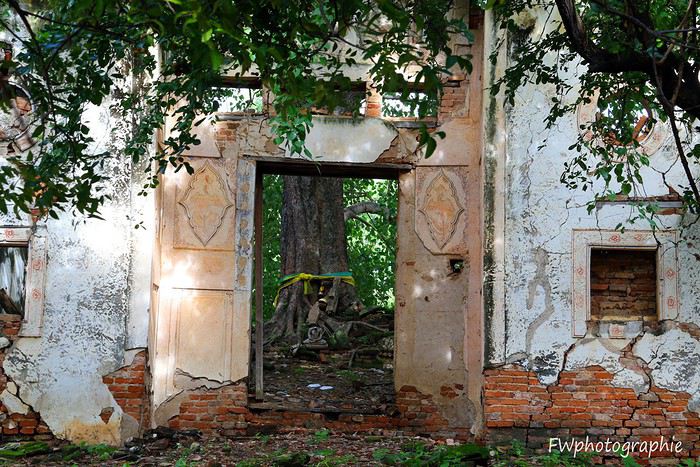
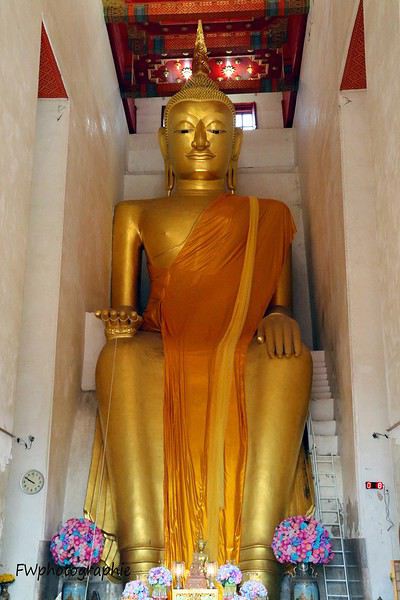
L'éternité c'est très long....surtout vers la fin (Woody Allen)
BA Barefoot Veteran ·
Explanations

LOL! The "culture for dummies" part is like DIY—still needs some polishing... No offense to Sir Number One, but after the 15th or 17th temple, you start looking for a little humor to lighten things up.
JO Jojoone1 Globetrotter ·
As previously mentioned, breakfast is packed, and the outfits worn by most guests are absolutely astonishing—dare we say, sometimes downright grotesque. There are so many princesses and subjects from the Kingdom of Siam that it feels like you're having coffee in the middle of a costume party.

When we bump into the young woman who organized our stay, we greet her and don’t miss the chance to tell her we’ve had three wonderful days thanks to her. The lovely lady is delighted!

We ask Ha and Beuh if they’d mind stopping by the Celestial Dragon Village before hitting the road. Of course not!

Two structures stand out in Suphanburi. There’s a tower overlooking the city, offering a 360-degree view. It’s a closed tower, though, and not what we’re interested in. But watch out! There’s also a dragon in the landscape, added less than a decade ago. It’s 135 meters long, 35 meters high, and 18 meters wide. It’s colorful, friendly, and impossible to miss.


It’s actually a shopping village with numerous shops. It also commemorates the friendship between Thailand and China. The dragon itself houses a museum with about twenty rooms. It’s open from Wednesday to Sunday. We didn’t have time to visit, but we did notice the entrance fee is 500 baht. We took a pleasant stroll without lingering too long. Even at this early hour, on this fourth consecutive day of sunshine—a record—hats or umbrellas are a must. Even the clouds have cleared out.


In one alley, we spot some intriguing black statues—half-human, half-animal figures, including a donkey that reminds us of some forum memories. Anyway, let’s move on, and *sabaidee chok dee khrap hi han*.

Ninety kilometers south, it’s no less hot. It feels like May (though what do they know—they’ve never been here in May!). Our friends seem reluctant to leave. Ha has almost fallen for Françoise, and she’s given Joel a nickname: Mister Bean. Since it’s not about his looks, it must be his overall performance...

So, they join us for a visit to the Proud Exclusive Hotel in Nakhon Pathom. It’s clearly a very new hotel, spotless and fresh. At 20 € a night, it’s a great deal. The mattress is super comfy, and the balcony is spacious. There’s a modestly sized pool, but it’s more than enough (or even necessary) for heatwaves like this. Just know that the pool is in front of the hotel. You’ve got an audience when you swim: passersby, guests grabbing a snack, delivery folks, and the whole crew at reception. Despite our best efforts, we’ve felt the march of time and have certainly puffed out our chests and sucked in our stomachs now and then.

Then we realize why Ha and Beuh hadn’t left right away. They knew we wanted to see the famous chedi in town and made it a point of honor to drop us off before saying goodbye. We’ll skip describing the farewell scene to avoid getting too emotional. At least these days, phones make it possible to stay in touch visually from afar.

The tallest chedi in Thailand shines brightly under the blazing sun. It’s more of a stacking job—the original structure has had new cones added over time, reaching its current height of just over 120 meters. The spot at the top of the stairs, in front of the Buddha statues, is taken up by Thais holding incense sticks, lotus flowers, and little squares with gold leaf. Like on previous stops, these gold leaves gradually take over and distort all the Buddha representations. Here, a nun walks around the buildings applying a product to the leaves that the wind has loosened, so they stick better.


There’s a maze of corridors, chapels, small plazas, and even a few caves in this complex. One building houses a small, dimly lit museum that seems to have been left untouched for ages. As usual, among the clutter, a few standout items catch the eye. There’s a nice collection of votive tablets, some showing remarkable craftsmanship. Photos are forbidden in this museum, though.

We stumble upon a small ceremony in a modest temple. The monk faces a group of about forty women, almost exclusively. The whole group sings and chants in unison. Every time we hear these sounds, we get goosebumps. It’s truly a part of our Asian dream.


In the end, we cut our visit short. There wasn’t much new to discover, and with the heat, it was time to grab some food and fluids before passing out. There are huge open spaces around the chedi and, of course, plenty of stalls. We got to try *khao larn*, a mix of rice and coconut cooked in bamboo shoots. Sweet and pretty tasty.

The return to the hotel was a bit less straightforward. We didn’t see any tuk-tuks, and when a moto-taxi approached us, we decided to take the plunge. We were in the middle of some communication issues when another guy showed up on his bike, sensing an opportunity. He was much quicker on the uptake and knew the hotel. It was immediately obvious he was mute, and later we found out he was almost deaf too. Watching their "conversation," we were completely lost. They agreed to split the ride.

Then came our athletic moment. Let’s skip the part where one almost lost the other, and the brief moment of anxiety before we were reassured. We’ve had calmer drivers in the past, and when Françoise joined Joel, he wasn’t entirely surprised to hear her say she thought she was going to die several times. The deaf-mute guy was super nervous and drove like a maniac. Try telling a nervous deaf guy to slow down. The most astonishing part isn’t even that, though. Françoise practically jumped off the bike when all that was left was crossing the main road, just a stone’s throw from the hotel. Hard to say if the guy even realized how terrified this usually calm woman was. After paying the guys, our deaf-mute driver, pleased with himself, pulled out a pen, wrote on his hand, and showed his palm to Françoise. Not only did it say, "I am deaf and mute. Thank you very much," but it was in FRENCH! And *vroom*—off he went like a shot.

Some days, you experience things like this and can hardly believe it yourself.

After getting out of the pool, once the risk of fainting or heatstroke had passed, Françoise said to Joel, "Hey, that redness on your leg is starting to darken. I don’t like it. Tomorrow, we’ll need to go to the hospital." Hospitals aren’t exactly an exciting prospect. And let’s not forget that sometimes they amputate the wrong leg.

« Tout le monde s'interroge sur comment laisser une meilleure planète à nos enfants, mais on devrait plutôt penser à laisser de meilleurs enfants pour notre planète. » Clint Eastwood
OB Obeoandpai Globetrotter ·
😄 😄 😄

Sorry, it's the kind of post that just makes me laugh! I don’t know if it adds much to this travel journal... But it was a few seconds of workout for my cheek muscles!

It’s true that for a Westerner, this might seem a bit amusing, but the goal was to explain Jojoone1’s (and readers’) questions about the figure depicted. You should know that hermits are as revered as some monks after leaving their current life. I met one in Bang Boet, an impressive experience—I talked about it on VF in October 2014:

https://voyageforum.com/v.f?post=6765983#6765983
Mon YouTube https://www.youtube.com/user/voyageurasie/videos?view_as=subscriber

Similar discussions

You might also like