After checking a thousand times that we hadn’t forgotten anything, we ordered an Uber, and our little crew piled into a battered vehicle headed for Roissy-Charles de Gaulle Terminal 2C. Théo (who had just turned 2 shortly before our departure) seemed to understand he was going on a trip. I mean, we’d been hammering it into him for weeks, and at his very young age, his travel résumé is maybe even more impressive than mine was at 15. He’d already followed us on a stay in Brittany, crisscrossed France from Paris to Lille, the Auvergne, Occitanie, the Pyrenees, Burgundy, Norway (and later crossed France several more times, seen the Netherlands twice, Senegal, Andorra, and soon Turkey). The oldest, Kelyandre, who was 10 at the time, was a little anxious about the strange things he’d find in this country we’d sold him as so mysterious. He knew Senegal but had few memories of it. That said, we were all excited at the idea that in just a few hours—and after months of preparation and waiting—the dream we’d been talking about for months would finally come true! And for me, it was a chance to return to my "second country" after six years. Still, we had no idea how everyone would react to the unknown for some and the unexpected inconveniences for all...
Once at the airport, everything went smoothly: we cleared all the hurdles, loaded down with luggage as we were, and finally reached the boarding gate. As usual, the little one was wild, running and jumping on the seats, which already tired us out but at least helped pass the time. He’s way ahead in language and speaks easily—sometimes too much! That bodes well for India... Finally, we boarded. The plane took off at 9:30 PM, and despite the usual challenges of sleeping well on a night flight in economy, the trip went smoothly. With all those screens in front of and around him, we had no choice but to let Théo watch, even though we’d have preferred to avoid it. Still, it helped make the start of the journey go off without too much fuss and even let us sleep—a little, at least. We were surprised at how good Vistara was, with very professional staff and decent food.
The next morning, we arrived in Mumbai slightly late. The five-hour layover had given us hope of stepping out of the airport and quickly visiting the Juhu Beach area, a spot Mumbaikars love for strolling by the sea or enjoying Mumbai’s famous street food. It would’ve been a nice break before the next flight and an easier first contact with India for my three newbies. But the line, the time it took to process our e-tourist visas for four, the fact we had to collect and recheck our luggage for the next flight to Ahmedabad, the possible traffic jams to reach this neighborhood so close to the airport, and the stress of having to queue up again to make our boarding time in the end made us give up. Why spend half an hour at Juhu Beach and risk so much hassle? Our entry into India would happen in Ahmedabad. After the e-visa counter process, which still took a while for four people—even though we’d managed to find a counter without too much of a wait—we used the time we had left to exchange some money at an ATM to start the trip: the maximum allowed, 10,000 rupees each. Our online bank lets us avoid foreign withdrawal fees, but not the airport’s terrible exchange rate... It’s really just a stopgap. Then we set off to explore the airport’s many restaurants, starting with a selection of South Indian specialties: dosa, idli, vada, yogurt rice, and a chai, just so I could relive the sensations (even though Indian food is part of our daily life, here in India, it’s different). Théo was already playing with an Indian kid his age, which, as a warm-up, gave me the chance to start a conversation in Hindi with the father, who was originally from Rajasthan. Time flew, and we reboarded for Ahmedabad, the main city of Gujarat, home of the controversial Prime Minister Narendra Modi. An hour’s flight, and around 4 PM, it was the moment of truth—we were really here!
Ahmedabad’s airport is very modern and spotless, a bit like airports in Gulf countries. It’s as if Modi wanted "his" city to have a very *shāndār* ("lavish," "showy") gateway to India for visitors from around the world—him, who so modestly named the city’s relatively new stadium after himself and aims to host the 2036 Olympics. Not in Delhi, not even Mumbai or Bangalore, but in Ahmedabad. We got out quickly since we’d already done the e-visas in Mumbai. A few taxi drivers approached us, offering crazy prices (for India) to reach our hotel in the heart of the old city, near the Gheekanta metro station, 8 kilometers away. I answered in Hindi (Gujarat’s language is Gujarati, but Hindi, which is linguistically close, is very well understood there) with what I thought was a reasonable estimate. "Oh, *hindi aati hai* (you speak Hindi)?!" Surprised, they laughed, shook my hand, and patted my shoulder. To pay less, they advised us to leave the airport parking lot and hail a rickshaw. We moved forward, and very quickly, a tout came up to us and stopped a rickshaw, which we negotiated as much as we could. It was gray and dark in the late afternoon, and it was drizzling, so we finally agreed on 350 rupees. Though the local price was probably cheaper, we were four and a bit loaded down: I figured it was fair for both sides. Some might see all this as a hassle to save a few euros, but we and the kids found it hilarious! We got into the vehicle, Magali and the two kids in the back, me in the front with the driver, a small part of my body sticking out of the cabin. The roads leaving the airport area were wide and clean, the traffic not yet too dense. Again, this entry into the city might make a newcomer think India isn’t as dirty, polluted, or noisy as they’d been told. But I knew it wouldn’t last—and sure enough, it didn’t. Around a bend, the traffic thickened, horns blared from everywhere, and vehicles came from all directions, some nearly hitting us. The wide avenues suddenly became much less *shāndār*, and the Indian chaos set in. The little one, who loves disorder and noise, was over the moon, wearing a delighted smile, somewhere between hilarity and surprise. But Magali and Kelyandre were terrified! They screamed every time a vehicle cut us off or scraped us. Magali pointed out several times to the driver that a vehicle was about to hit us and didn’t understand this anarchic traffic code that worked only on instinct and noise. I laughed, trying to reassure them that everything was normal and that our *rikshāwālā* knew exactly what he was doing, just like those who seemed to want to hit us head-on. But no luck—they weren’t reassured at all and weren’t sure we’d arrive in one piece. From Bollywood-style Modi to total chaos, this was the best possible introduction for my crew of explorers. I’d warned them about this joyful mess, and my good old India didn’t let me down!
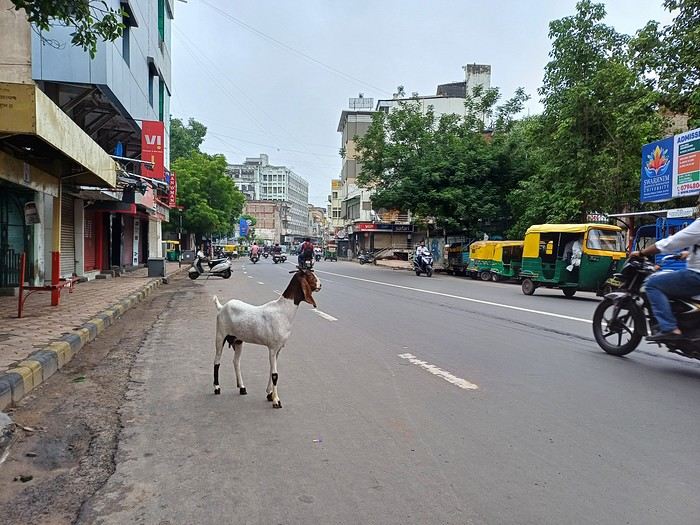
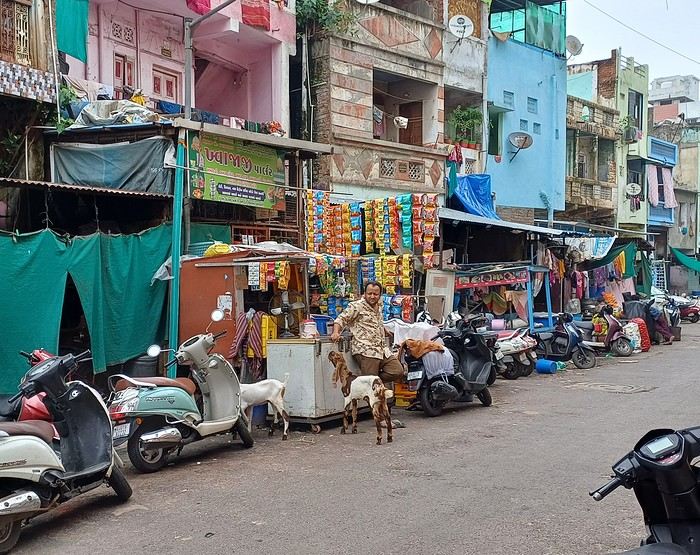
From our wind-battered carriage, we watched the street scenes of this world unknown to them but so familiar to me. We quickly reached Relief Road, one of the main thoroughfares where our hotel was located, running through the city from Kalupur Station to Laal Darwaza (the Red Gate), one of Ahmedabad’s liveliest bazaars. The animals roaming freely on Relief Road—goats, cows, dogs, and others—obviously delighted the kids, as it was another of the Indian quirks I’d promised them. In the heart of this hubbub of vehicles and horns, we kept an eye out to the left to help our driver, who didn’t know exactly where our hotel was. Finally, we spotted the Hotel Prime sign. Seeing us get out of the rickshaw, the hotel guard immediately came to meet us, and two porters rushed to grab our suitcases. Despite the scares, my team fully approved of the rickshaw ride, their faces still shaken and exhilarated, like they’d just ridden a roller coaster at an amusement park. It was their first experience of India, and it was positive for everyone!
But little complications are never far away and remind you that in this country of emotional contrasts, you always have to stay on your toes: "Don’t dream in India!" Claire Landais warns in her travel novel of the same name, which I recommend (or not). We arrived at the reception, which didn’t look too bad. But I’m sure you can already sense something coming... We announced our reservation, explaining that we’d contacted them via WhatsApp and paid a 1,000-rupee deposit to book the room. The three managers searched their computer and paperwork, frowned several times, conferred among themselves... My experience in India whispered that there was a hitch—I was sure of it. And here was the first classic Indian scam: "the unrecorded reservation." I’d mentioned the possibility to Magali, who was skeptical, and as soon as we arrived, India didn’t let me down again. "Here we are, welcome to India!" After a few minutes of fruitless searching, they announced, unsurprisingly, that there was no trace of the reservation or mention of a deposit sent by Western Union. And that the large deluxe room we’d booked with that deposit was therefore not available... "You see, it’s starting!" I said to Magali with a smirk. But in a sudden twist, like in a last-minute Bollywood plot turn, they announced "good news": the person I’d been in contact with on WhatsApp wasn’t a scammer but actually hotel staff—though they didn’t explain whether it was one of them or someone who wasn’t there anymore. I showed them my WhatsApp exchanges and the receipt for our transfer as proof. Like gentlemen, they agreed without argument to honor the advance payment and gave us a large air-conditioned room at the initially agreed price (2,000 rupees) at the end of the hallway, next to a dilapidated and slightly creepy nook that looked like a squat or a pigeon coop, and clearly a bit less nice than the one we’d carefully reserved. That said, it was spacious enough for us and, though not 100% spotless, was pretty clean and did the job. Anyway, we’d only be there for two nights for our two and a half days in Ahmedabad, since the third would be spent on the train to Jaisalmer. I figured it was a perfect and funny initiation. And besides, it wouldn’t do to get used to too much ease and luxury right from the start! Anyway, no one saw any problem with it.
We took a little breather in the room, resting, showering, then went down for a quick neighborhood tour to stock up on water bottles and scout out the area. It was late afternoon, the sky was darkening, it was drizzling again, and this little walk through the alleys behind the hotel was the chance for Magali, Kelyandre, and Théo to take their first steps on solid ground in the heart of Indian life. As we walked, it got harder to make out details with the falling night, but the few lights that dimly lit the darkness, the candles behind temple walls, the smell of burning ghee, and the temple bells ringing for the *pūjā ārti* offered to the gods hinted at a somewhat mysterious world. This atmosphere—both bustling and peaceful—so particular to Indian cities at dusk immediately plunged me back into the deep end. We briefly visited a Krishna temple where a small group of devotees attended the evening *ārti*, the priest waving his tray of candles in a circular motion before the deity. To avoid an accident during the trip, we had to try to explain to Théo the constant danger Indian traffic posed for him, especially in these crowded little streets where motorcycles, scooters, and cars trampled the "sidewalks"—or rather, the edges of the road... Naturally restless, curious, and a true motor-vehicle enthusiast, he’d landed in the right country. But his enthusiasm could lead to disaster at any moment. We explained that vehicles came from everywhere all the time and that he couldn’t act like he did on French sidewalks. He seemed to understand a little and preferred to let us carry his 15 kilos, which, much to our vertebrae’s dismay, would unfortunately become a habit throughout the trip. But we couldn’t see how a stroller would’ve been practical on India’s impassable streets and potholed paths! On our way back to the hotel, still soaking in the slices of life around us, the scene of a family with three very thin children living in a rickshaw parked on the side of Relief Road moved us. This scene let us illustrate with reality what we’d told Kelyandre about the poverty plaguing this amazing country. The father gratefully accepted the vegetarian chickpea masala sandwiches left in our bags from the many snacks Vistara had served us. A humble, kind exchange of smiles—he distributed the food to his kids, and we let the rickshaw fade into the night behind us.
Back at the hotel, the kids were thrilled (and so were we) because we spotted our first monkey on the hotel roof—a langur, which made another of my pre-departure stories real and restored my credibility, since we hadn’t seen any until then and I could tell they were starting to doubt. Finally safe in the comfort of our room, I connected to the Wi-Fi and scanned the city on Google Maps for a place to eat. After a few suggestions, we opted for Ambrosia, the kind of middle-class vegetarian restaurant I love—always clean and air-conditioned, with authentic food and a varied menu, for about 200-300 rupees per person. It was on the other side of the Sabarmati, near the Gandhigram metro station. In the rain, which was getting heavier, the old, friendly guard who always sat on an old chair at the hotel entrance in his uniform with his stick helped us flag down a rickshaw that took us for 50 rupees (for all our trips in the city, we’d always pay between 40 and 60 rupees, almost the local price). A second rickshaw experience that delighted everyone! We left the old city for a brighter, less dense area, crossed the huge Nehru Bridge, and arrived at our destination in a very quiet, upscale neighborhood where our restaurant was, in the pouring rain. Seeing this motley crew of rain-soaked aliens taking refuge in their restaurant, the manager and his team looked a bit stunned. You could tell they were momentarily puzzled by this odd family: a European man, a mixed-race woman with her hair braided in a tribal style, a mixed-race kid with curly hair, and a little white kid with reddish-blond curly hair but whose features somehow echoed the African traits of the other two... I sensed a moment of identification in their gaze, as if they were staring at a picture with incoherent elements and thus a bit suspicious. People’s looks would give me that feeling for almost the entire trip, though with less surprise for us. Quickly, ordering in Hindi did the trick and snapped them out of their stupor. They did their best to serve us like special guests. What a great find! Everything was delicious: Kelyandre played it safe and chose his usual Indo-Chinese stir-fried noodles (which he’d rarely abandon during the trip), and they made Théo a simple but delicious *khichḍi*, Indian kids’ favorite dish (a mix of *dal* and rice boiled together with just salt and turmeric). We didn’t forget a few sides and desserts. We feasted, and our hosts seemed delighted. It took us a while to find a rickshaw in this deserted neighborhood at that hour, and we returned to the hotel for a well-deserved night’s sleep, since we’d been on the go for the last 24 hours. And I knew that when you arrive in India in the evening, you always see things in a whole new light the next morning.
I don’t have many photos from these departure and arrival days.

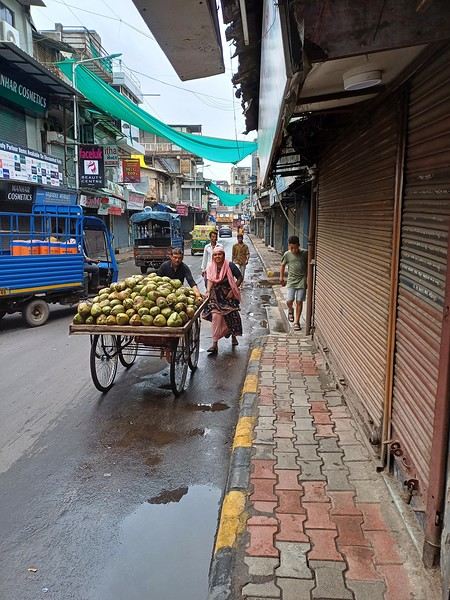
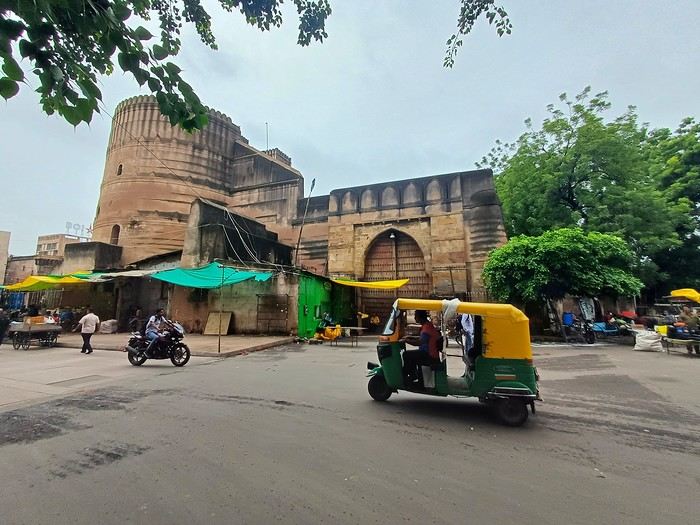
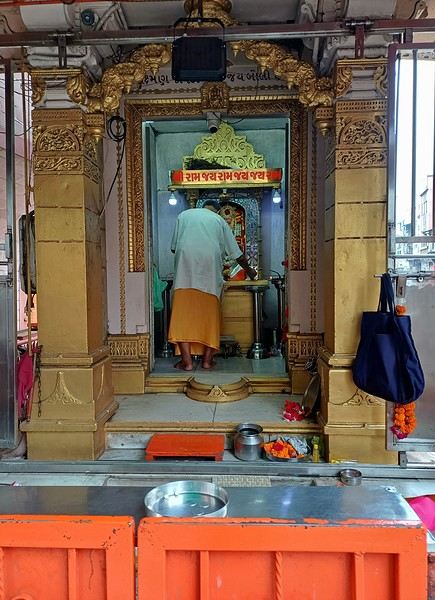 We passed by the entrance of the Jama Masjid, one of the country’s largest mosques, dating back to the 15th century. I had already visited (and enjoyed) Ahmedabad ten years earlier, yet passing by the Great Mosque, I didn’t really recognize the place. That said, I have fond memories of it because, infinitely less crowded than Delhi’s, the ambiance is much freer and more peaceful. We kept its potential visit for later (which never happened). In this moment of discovery for my crew, we preferred to soak in the street scenes stress-free while drinking coconut water straight from the shell (40 rupees). It was still too early for India, and most shops remained closed, to the point that I barely recognized the bustling neighborhood I had crossed years before.
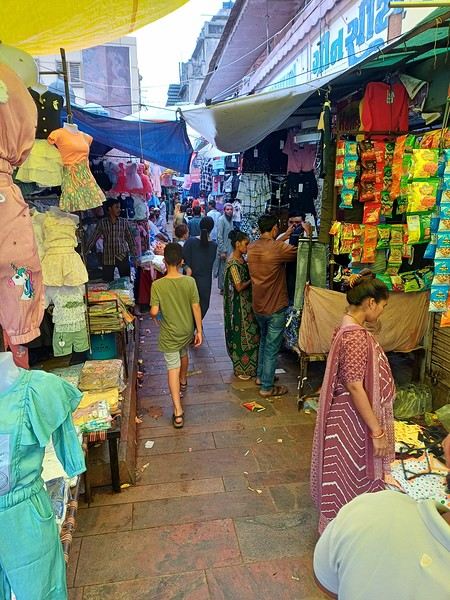
 We plunged into the colorful stalls, not knowing where to look first—there was so much beauty per square meter, and in this explosion for the eyes, we wanted to buy everything. As we wandered through different sections, Magali, who was looking for practical Indian outfits for the rest of the trip, browsed the shops and fell for two gorgeous kurtī, these traditional dresses, here with Kutch patterns. Kutch is a desert region bordering Pakistan and Rajasthan in northern Gujarat, renowned for the craftsmanship of its tribal populations. For sure, with one of the kurtī she put on right away and her African braids made for this trip, she’d be mistaken for a tribal! In fact, quite a few passersby, especially women, would literally freeze, stopping in their tracks with a bodily and ocular halt, punctuated by a low grumble in Gujarati at this mixed-race girl with long braided extensions—more often out of great surprise than rejection. It was only in Ahmedabad, upon arrival and return, that I noticed this kind of reaction. I’m not saying there weren’t reactions elsewhere, but certainly not the same ones.






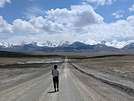


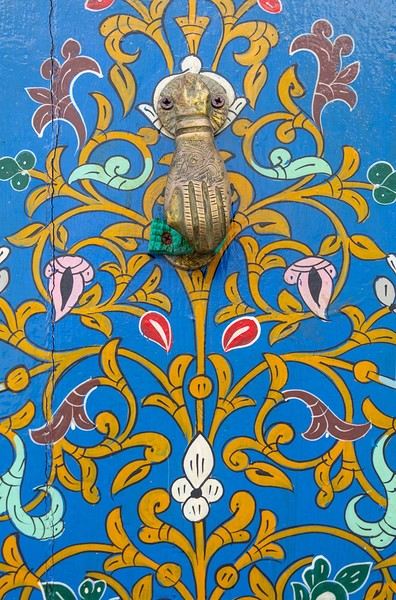
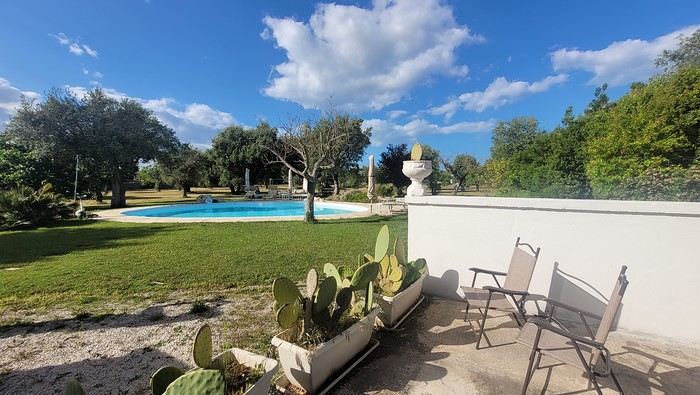
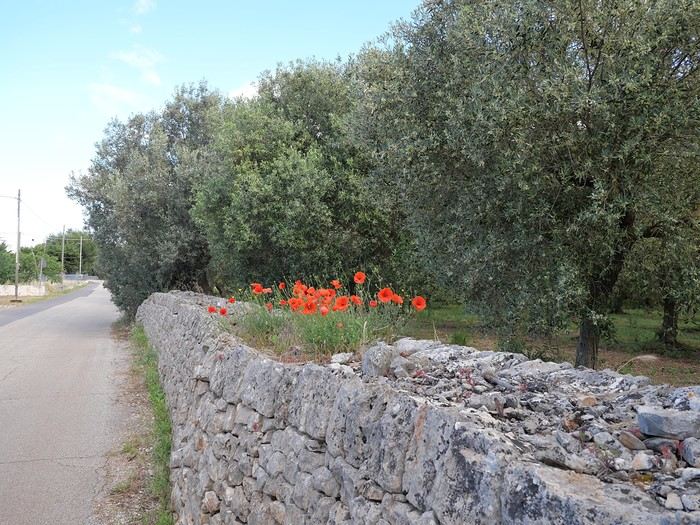
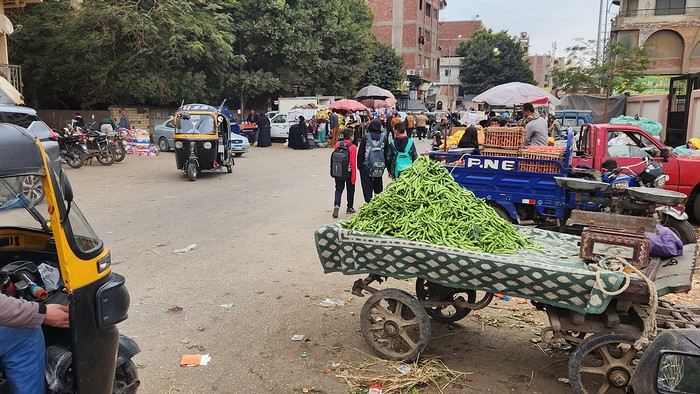
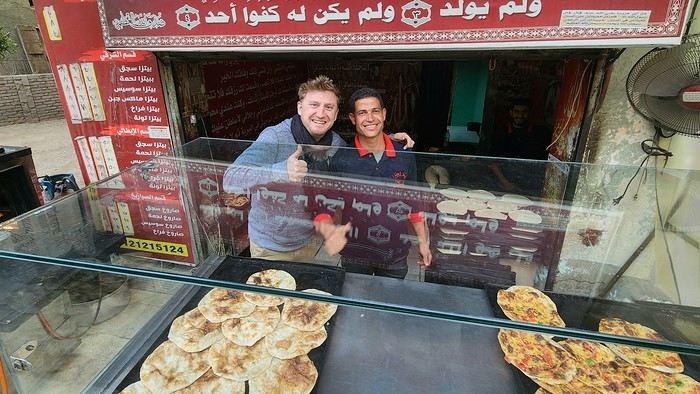
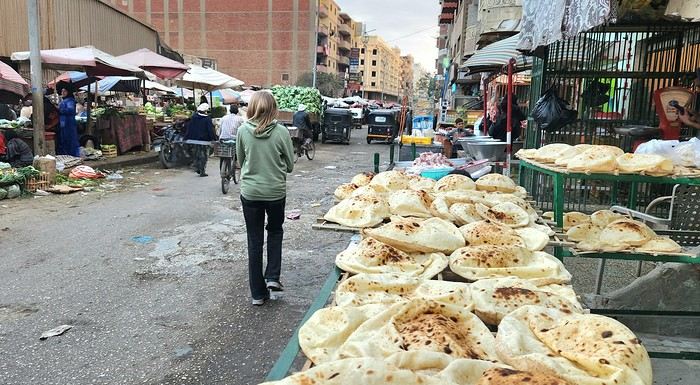
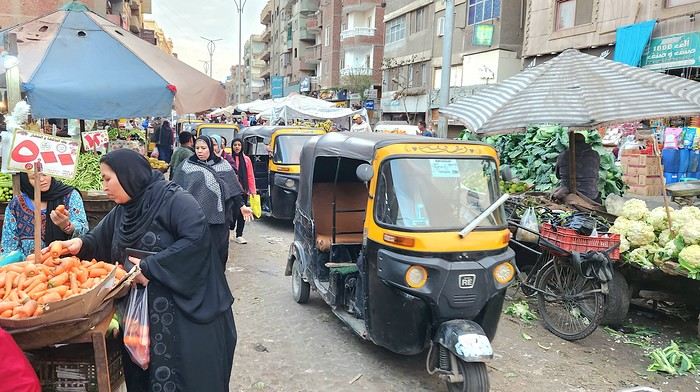


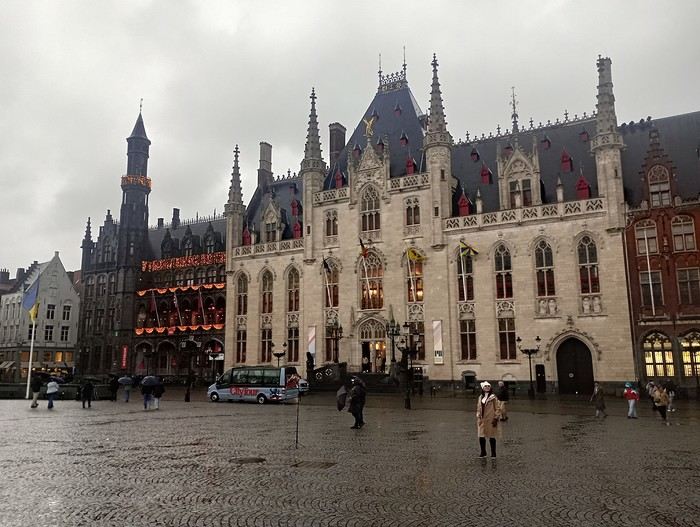


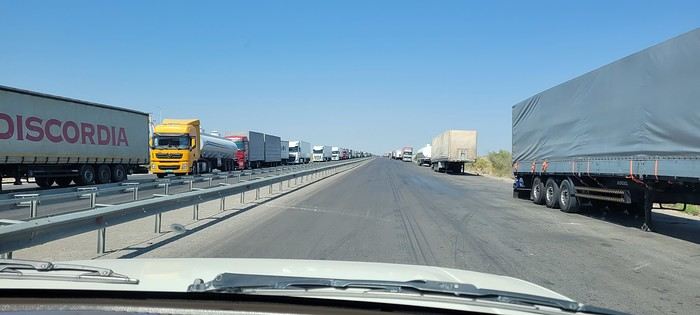
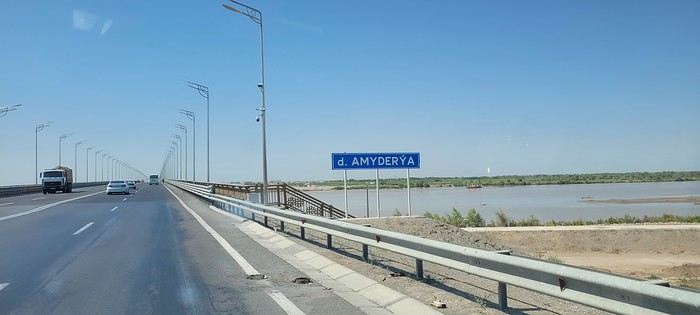
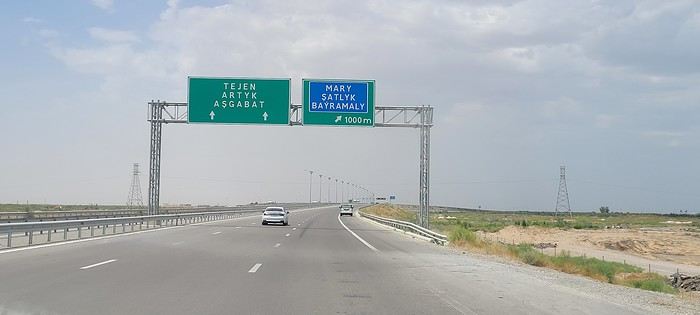
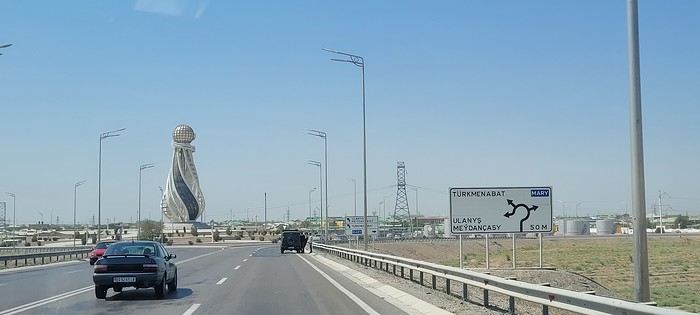
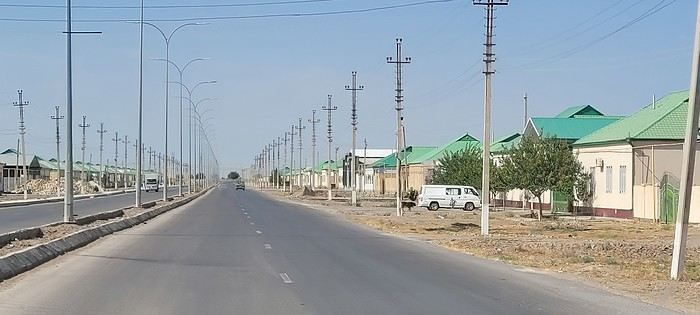 Roundabouts are particularly interesting because they feature emblems of Turkmen culture, like the dog, a carpet, the Ahal Teke horse, or Muslim symbols, even though the presence of Islamic artifacts is quite limited.
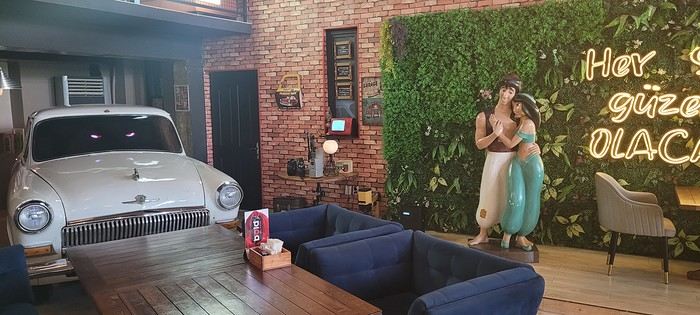


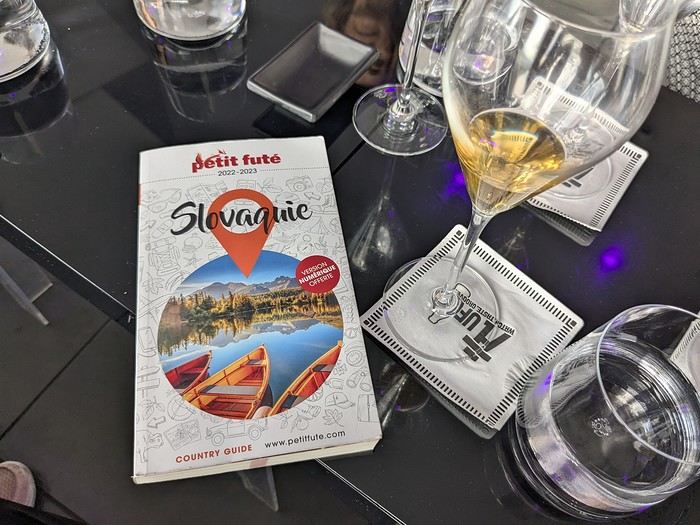 Why this country?
After visiting Hungary, Slovenia, Romania, and Poland in recent years, I’ve fallen in love with Eastern European countries. I adore the Slavic soul, its Austro-Hungarian villages, the gentle landscapes, the Carpathian Mountains, and that slightly mysterious atmosphere.
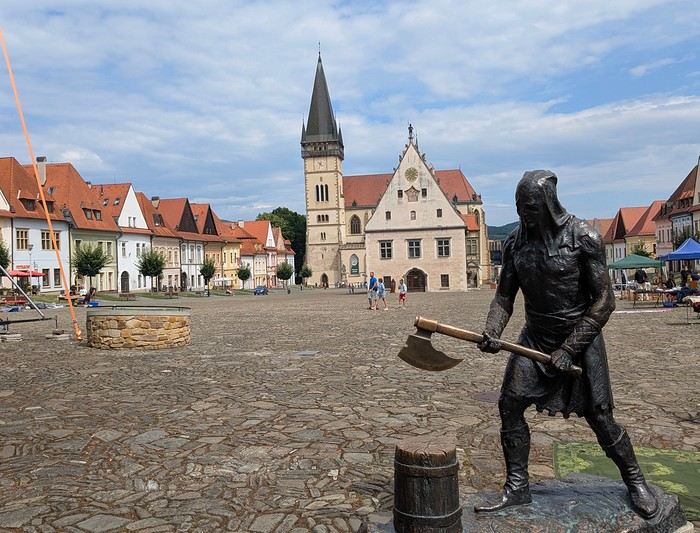
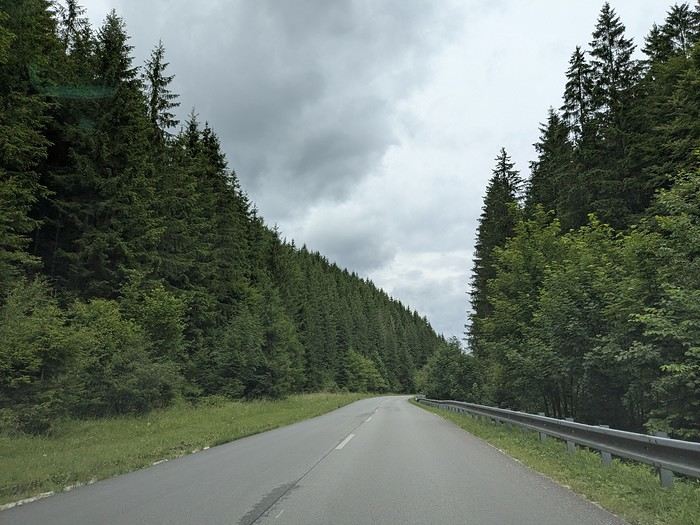
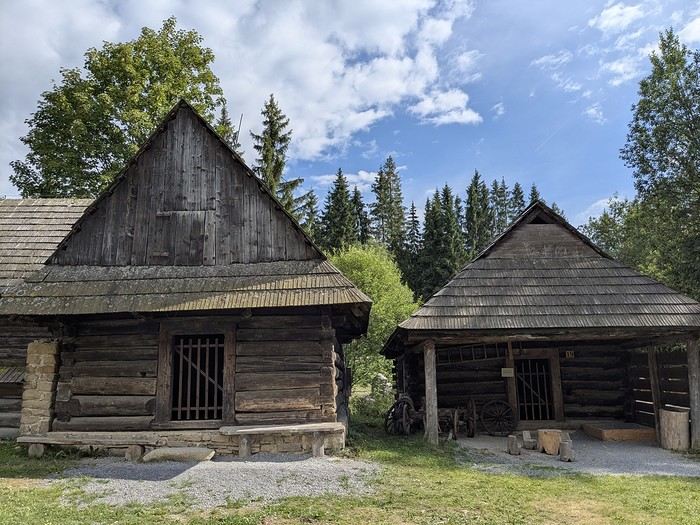
Slovakia evokes a certain imagination with its deep forests, medieval castles, and cobbled villages.
After seeing photos of the High Tatras—especially Lake Štrbské Pleso and Spiš Castle—I thought, "Let’s do it! We’re going!"
So, will Slovakia live up to what I imagine?
We’ll find out together.
We decided to travel as a group of six (five adults and a six-year-old child), by car (we needed two).
Here’s the day-by-day itinerary for this family trip, which started with a 3-day stay in Vienna (see the dedicated travel journal):
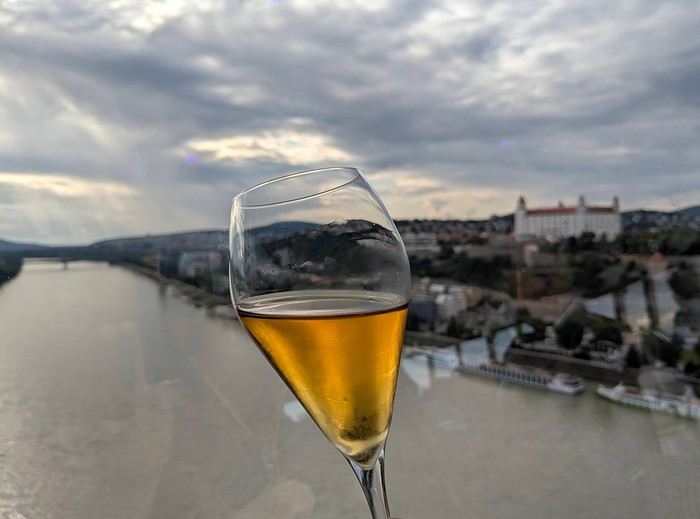

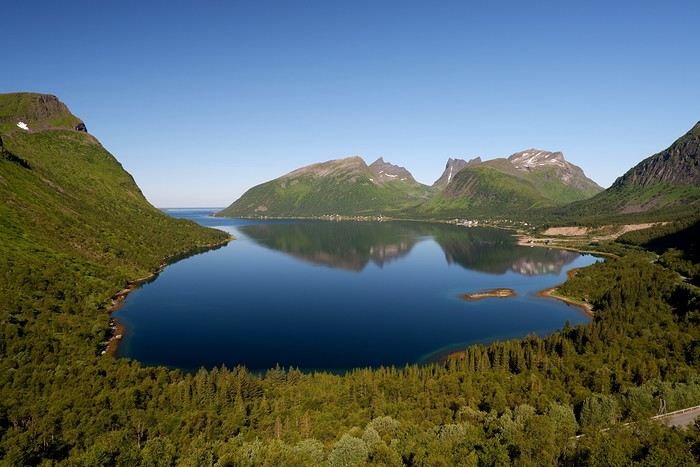
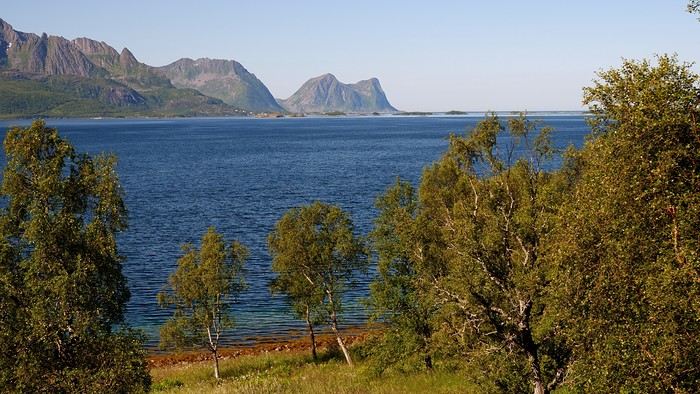
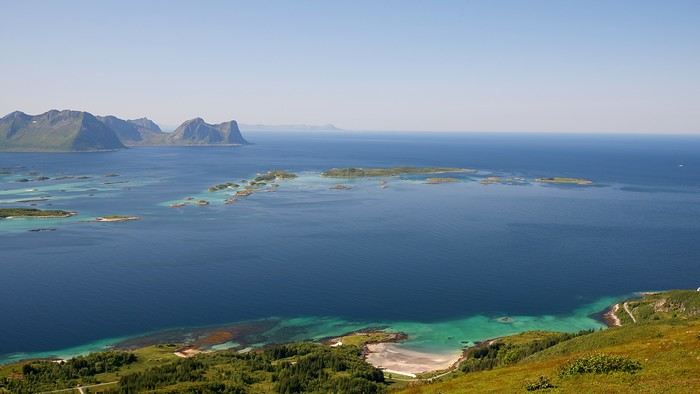
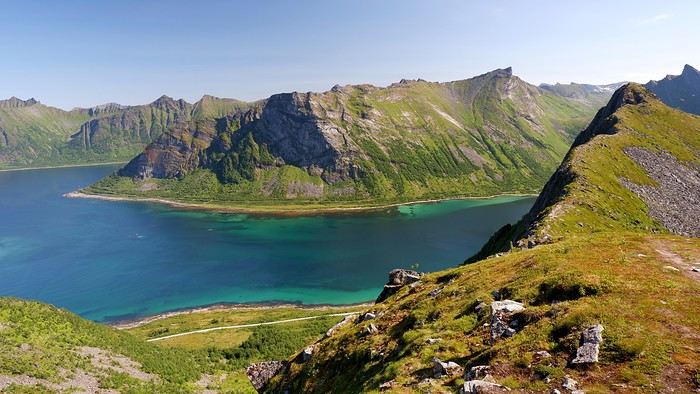
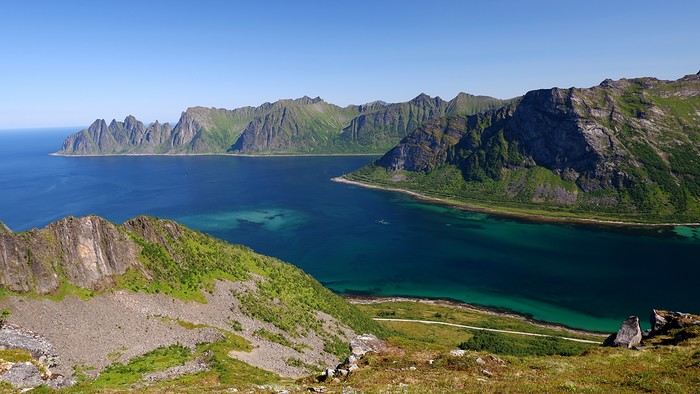
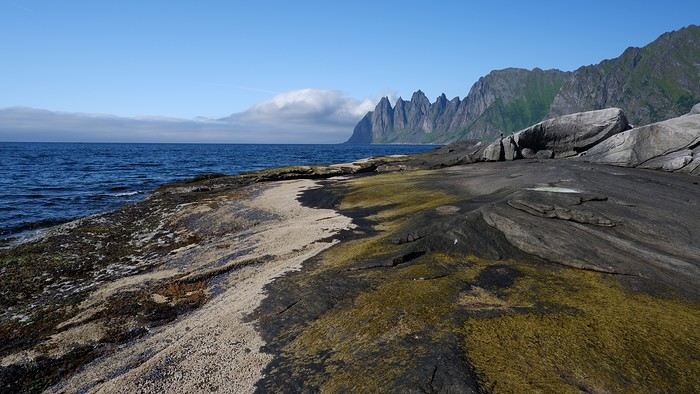
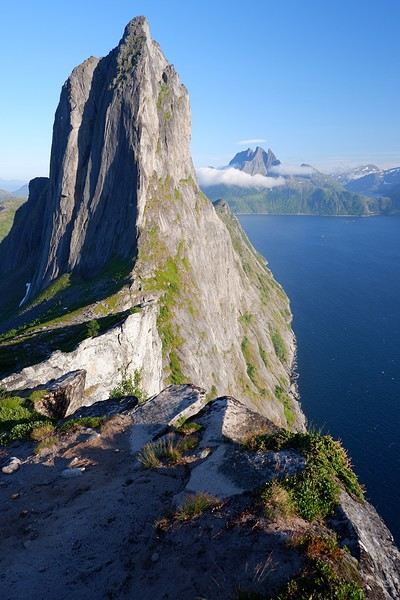
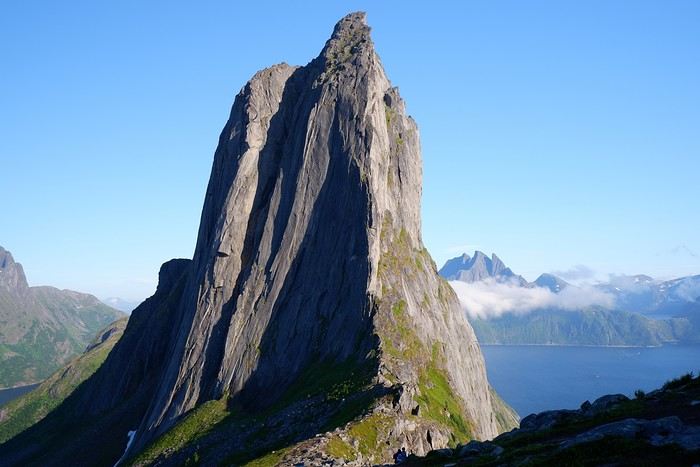
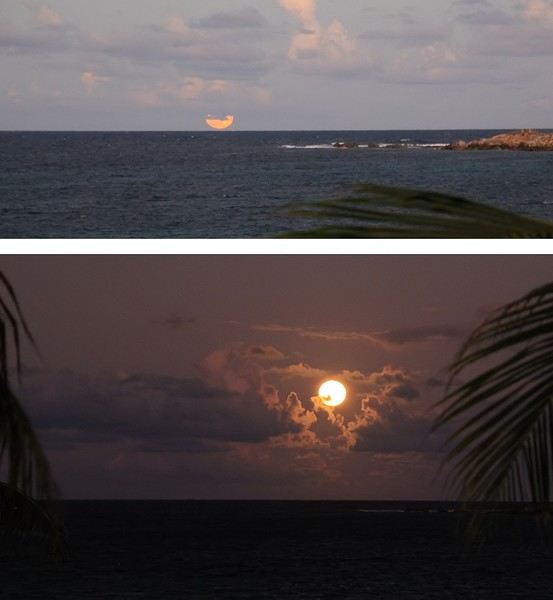
 When it comes to the Caribbean island of Saint-Martin, it's customary to praise its coastline and dreamy beaches—and they certainly deserve it.
But in this story, I’d like to highlight other memories, aspects, and impressions for a slightly different change of scenery.
Enjoy the read—some text and, above all, lots of photos.
« Byenveni sou zile Sen Maten! » (Welcome to the island of Saint-Martin)
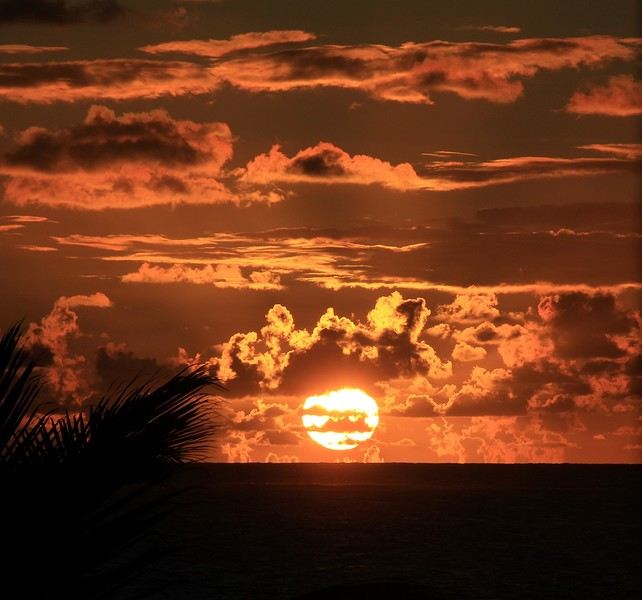
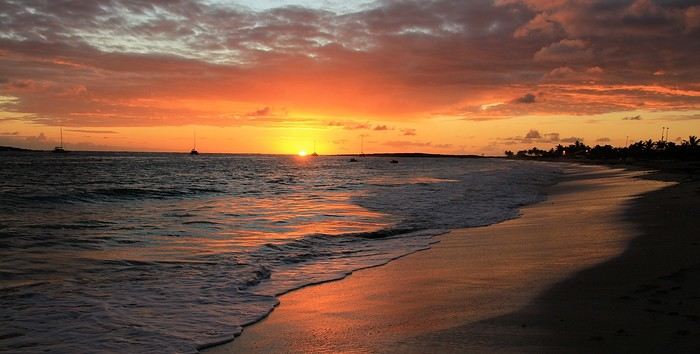
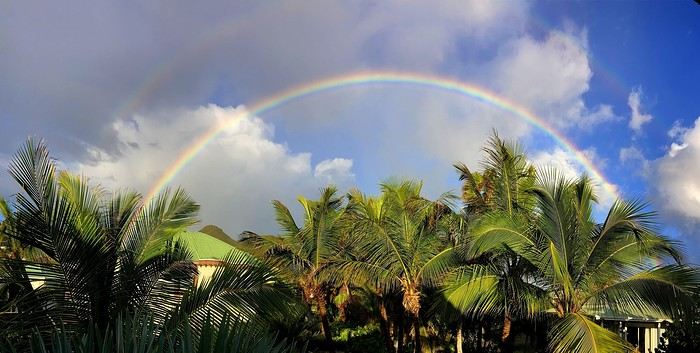

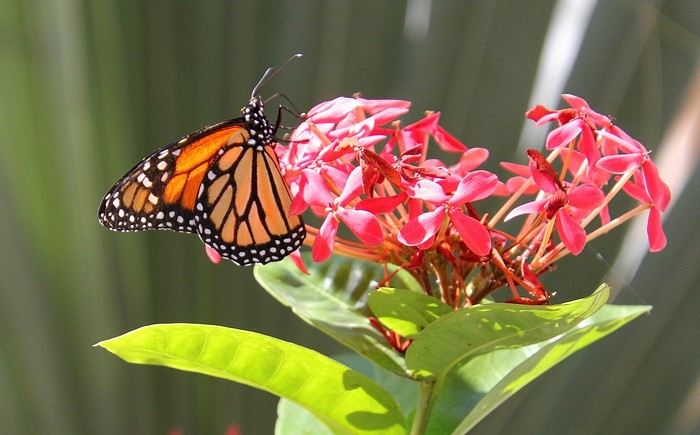
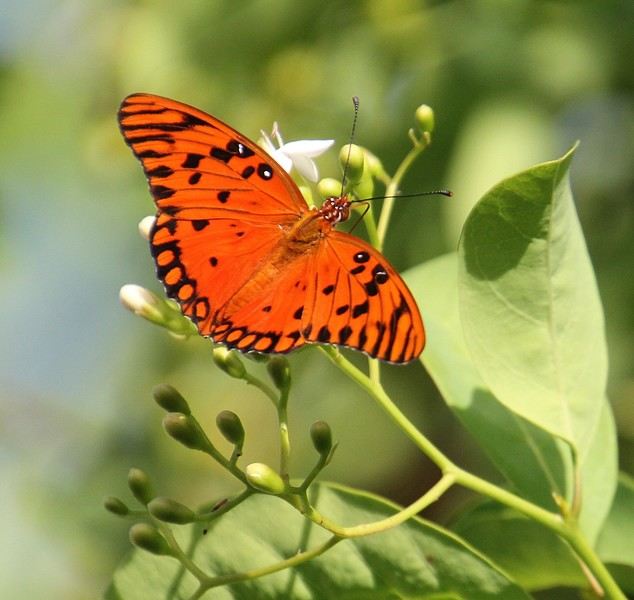

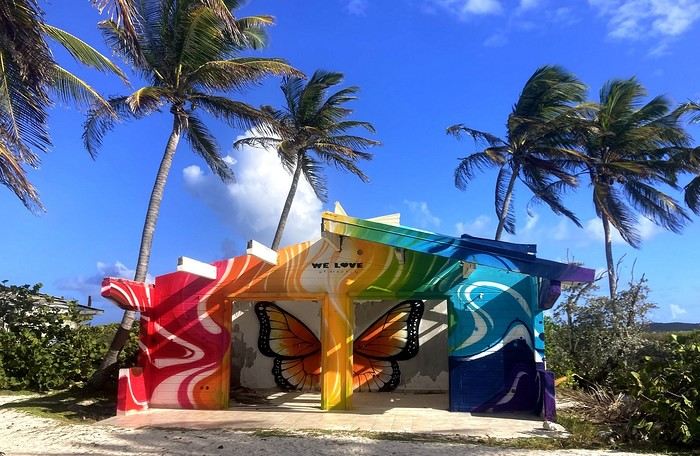









 Come along, I'm taking you to this country where it's so nice to wander and slow down...