Bonjour,
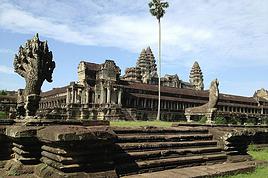
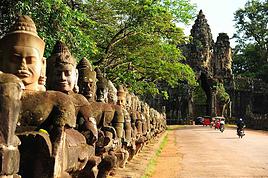
Nous allons visiter Angkor 3 jours début février.
Pour l organisation de ce séjour, comment proceder ? Vaut il mieux organiser sa visite tout seul (nous avons le bouquin #Ankgor, cité khmer # ) mais nous perdrons surement du temps a nous organiser et à nous répérer, ou devons nous louer les servicesv d'un guide officiel afin de profiter au maximum de son organisation . Ou pouvons nous faire un mix, 1 jour avec guide, les autres , sans?
Merci de nous donner vos retours d expérience , et quelle est la meilleure formule afin que nous puissions tirer le meilleur parti de ces merveilleux monuments et de réussir ce court séjour
En vous remerciant de vos réponses
Cordialement
Marc
Je te conseille de visiter les temples d'Angkor sans guide. Comme tu as le livre "Angkor cité khmère" de Claude Jacques, un guide ne t'apprendra rien de plus que ce livre. Le prix actuel pour un guide c'est 45 $ la journée.
La difficulté est de trouver un bon guide et cela n'est pas évident, un guide sera bon pour certaines personnes et mauvais pour d'autres…. Tout dépend de ce que tu attends d'un guide….
Je suis un passionné des temples d'Angkor, et depuis mon premier séjour j'écoute les guides francophones, j'ai pu constater que malheureusement que sur 10 guides il y en a 2 qui sont excellents, 3 qui sont très bons et le reste varie entre bons et très mauvais… Il s'agit bien sûr d'un avis personnel mais je pense que tu peux me faire confiance étant donné que j'ai commencé à me documenter très sérieusement depuis 2000… Je suis allé dix fois visiter les temples d'Angkor et à chaque fois j'ai pris le pass de 7 jours…
Voici donc ce que je te conseille :
Tu visites les temples avec un tuktuk qui peut transporter 1 à 3 personnes, le prix est à la journée (le même de 1 à 3 personnes), et varie en fonction des distances.
Afin d'optimiser tes visites je te conseille d'avoir un programme, tu dis à ton conducteur de tuktuk les temples que tu veux voir au cours d'une journée et il fixera son prix en fonction des distances.
Pour le jour 2 je te conseille de ne pas visiter le Kbal Spean sinon la journée sera trop chargée. En tuktuk il faut compter environ 30 à 35 $ mais je pense qu'il est préférable, si possible, de prendre une voiture avec chauffeur pour 40-45 $ car les distances sont importantes.
Je rebondis sur ton post car tu as l'air de très bien connaître le sujet. Je projette dans un futur plus ou moins proche (certainement fin 2018) un voyage passant via Angor/Siem Reap (je n'avais pas l'intention de commencer à préparer cela maintenant, mais tu pourrais déjà répondre à certaines de mes questions).
Nous serions avec 2 enfants (8 et 4 ans). Quel est le bon rythme de visite ? Leur montrer des vieilles pierres durant 3 jours, ils vont saturer, ou alors il faudrait choisir. Je ne me rends pas compte des distances...
Mixer cela avec la découverte de la campagne environnante cela peut plus le faire ? En privatisant une voiture ?
Bref, as-tu qqs conseils pour la découverte (j'utilise ce terme et non "la visite" volontairement) de Angkor et la région de Siem Reap avec des enfants ?
Merci d'avance🙂
PS : tant que j'y suis, si tu as l'adresse d'un hôtel sympa avec belle piscine dans le secteur, je prends 😉
Il n'y a pas de problème sans solution... et si il n'y a pas de solution, il n'y a pas de problème !
Est ce que vous avez trois jours pleins ? ou le premier jour comprend l'arrivée et le troisième le départ ?
L'intéressant est de prendre son passe pour les trois jours la veille, après 17 heures et d'admirer le coucher de soleil sur les temples gratuitement. Nous y étions en février 2017 et avons utilisé le même guide papier que vous possédez. En fait c'est le plus complet et vous pourrez vous orienter facilement avec celui-ci.
Nous avions pris un tuk tuk francophone, Vuong un jeune qui connait parfaitement les circuits et astuces pour ne pas rencontrer la foule chinoise 😕 ou du moins l'éviter en partie...Il explique un peu avant d'entrer sur les sites et nous attend à un point de rendez vous. Nous avons largement le temps pour tout découvrir et c'est nous qui avons fixé la "cadence". Nous avons fait l'impasse sur le déjeuner au restaurant (en cas à grignoter que nous emportions de l'hôtel). Tous les groupes quittent les sites entre midi et 14 heures, donc moins de monde et moins de bruit pour les visites ! Pendant ce laps de temps les photos sont plus facilement réalisables et l'on peut apprécier la sérénité des lieux.
Nous avions pris le pass 3 jours : 1 jour pour le grand circuit, 1 jour pour les temples éloignés et le dernier jour pour le petit circuit. Nous avions suivi et imprimé les conseils de Schnacke67 qui nous ont été très utiles.
Excellente soirée.
P.S.Nous possédons les coordonnées de Vuong qui a toujours été ponctuel, courtois et très souriant avec en plus des anecdotes sur chaque temple. De plus ses tarifs sont très compétitifs.
Nous serons les 22 et 23 février de cette année avec Vuong pour se balader dans la campagne autour de Siem Reap...
Il n'est pas facile de trouver des lieux à visiter avec des enfants afin que ceux-ci soient intéressés.
Pour la visite des temples je te conseille de prendre le pass de 3 jours qui est utilisable sur une période de 7 jours, cela permet d'alterner visite de temples avec d'autres endroits…
Prix du pass de 3 jours : 37 $ par personne, gratuit pour les enfants de moins de 12 ans.
Pour la visite des temples avec des enfants il est préférable de faire un programme "allégé" pour éviter une éventuelle saturation.
Je pense (et je ne suis pas le seul à penser cela) qu'il y a quatre temples à voir absolument :
Ta Prohm, Banteay Srei, Bayon, et Angkor Vat.
Un tuktuk peut transporter 3 adultes, donc deux adultes et deux enfants. Si tu vas au Banteay Srei je conseille quand même de prendre une voiture avec chauffeur car les distances sont importantes.
Pour tes enfants je pense qu'ils seront intéressés pare la visite du "village de la soie" à Puok
En ce qui concerne les hôtels à Siem Reap il y en a une multitude et à tous les prix. L'hôtel où j'allais n'a pas de piscine mais tu trouveras facilement sur ce forum et sur des sites spécialisés des hôtels avec piscine.
bonjour
Avec un bon tuktuk (moto grosses mobylette pour deux ou 4 personnes)c est possible d avoir aussi un bon guide vous emmenant de site en site egalement.
Si c est un bon garder le pendant votre sejour c est le plus simple.
c est juste un avis personnel.bon voyage
Merci pour d avoir pris le temps, ainsi qu'à Joël, pour une réponse si précise et pleine de bons conseils. Nous passerons 3 jours complets sur place, puisque nous arrivons le jeudi 8 dans la matinée et repartons le lundi 12 février. En prenant les billets le jour de notre arrivée, nous pourrons donc faire les 2 circuits + 1 journée pour les temples plus lointains. Nous louerons les services d un tuk tuk et visiterons à notre rythme en fonction des indications du guide " Ankgor " JE te ferais donc très reconnaissant de me fournir les coordonnées de Vuang ( téléphone et mail s il a ) afin que je puisse le réserver si possible.
Nous repaasons une journée sur Siem Reap a notre retour du Laos le 25, malheureusement tu n y sera plus....sinon il aurait été marrant ques des Picards se retrouve la bas !
Encore merci pour tes conseils,
Cordialement
Marc
En relisant mes messages, je m aperçois 🤪que je t ai un peu confondu avec Joël.. . qui lui est picard comme moi, alors que tu habites l Alsace... mille excuses!!
Je vais m inspirer de tes programmes, -qui sont vraiment excellents- et avec le bon bouquin de Michel Petrotchenko et un tuk tuk, je pense que ca ira.
J ai une question au sujet des monnaies en circulation au Cambodge.
Il semblerait qu' en plus du Riel, on utilise le $. Je n aime pas du tout voyager avec des devises sur moi. Peut-on retirer suffisamment d espèces dans des distributeurs à Siem Reap pour payer visites, Tuk tuk etc etc ... Et distribuent ils des $ ? Ou uniquement des Riels , et sont ils " fiables" c'est à dire sans trop de risque d avaler ta carte bleue.??
( ce qui est le cas par ex à Cuba😠ou il fortement recommandé de ne pas se servir des dab...)
Mon forfait bancaire ne me prenant pas de frais sur les retraits étrangers, 😉 j ai toujours privilégié cette méthode pour mes espèces quand je voyage. Je ne m encombre pas ainsi de devises , ce qui est plus sécurisant.
Merci pour ta réponse, ou venant de tout autre sympathique membre du forum!
Bien cordialement
Marc
Je ne suis pas Picard mais voisin, je suis originaire du Pas de Calais… 😉
Tu as fait un très bon choix avec le livre de Michel Petrotchenko "Le guide des temples d'Angkor".
Pour ceux qui ne connaissent pas ce livre voir :
"Le guide des temples d'Angkor" de Michel Petrotchenko "
https://voyageforum.com/v.f?post=6768958#6768958
Concernant la monnaie au Cambodge tout se paye en Dollars, on te rend des dollars et des Riels qui seront utilisés pour les petits achats (bouteilles d'eau…). Les cartes bancaires sont très rarement acceptées.
Je conseille d'arriver avec une cinquantaine de dollars pour les premiers frais (Visa…)
Emporter des Euros (éviter les billets de 100 €), le taux de change est plus intéressant sur place
En général le taux de change est plus intéressant chez les changeurs (très rapide) que dans les banques.
A Siem Reap il y a deux changeurs aux taux intéressants en face de l'Hôtel "Terrasse des Eléphant, près du marché central.
Concernant les cartes bancaires je n'ai jamais fait de retrait dans des DAB (ou ATM) et je ne peux donc pas te renseigner
Pour les retrait dans des distributeurs il y a des commissions de change : les frais bancaires de ta banque (selon ce que tu as écrit il n'y a pas de frais) et les frais bancaires de la banque cambodgienne.
J'ai déjà lu des posts de personnes qui ont écrit que lors d'un retrait dans distributeur il était mentionné que la banque (cambodgienne) prenait une commission puisqu'on te donne des dollars
Je sais que certaines banques cambodgiennes ne prennent pas de commission. (A vérifier).
Il faudrait que tu commences une nouvelle discussion pour demander ce qu'il en est pour les retraits au Cambodge.
Merci pour ta réponse
Il est vraiment réjouissant 🙂 de voir que certains " symmpatiques" personnes prennent pas mal de temps à aider et guider en partageant leur expérience.!
J ai posté un nouveau post hier soir sur le Cambodge pour ces histoires de devises.
Et si on change facilement les € sur place, je ne vais pas m embêter avec des $, que je prendrais uniquement pour les visas, à moins que là aussi, je puisse les payer en €, mais comme tous les guides donnent le prix en $, je ne sais pas trop.
J ai le temps de voir, d ici notre départ, dans 15 jours.
Bien cordialement
Marc
Je pense aller faire un petit tour vers Siem Reap en décembre et rester 5-6 jours pour la visite des temples. Je vais acheter le livre que vous mentionnez et oublier le vélo sur place apparemment, un peu trop fatigant🙂 Bonnes vacances
"Nous possédons les coordonnées de Vuong qui a toujours été ponctuel, courtois et très souriant avec en plus des anecdotes sur chaque temple. De plus ses tarifs sont très compétitifs."
bonjour
je suis intéressée pour avoir ses coordonnées (mail, site internet?), merci de me les envoyer je serais a siem rep du 26 au 1 er mars...
bonne journée
Bonjour,
Je peux néanmoins malgré ce qui peut être dit des guides recommander une jeune femme que je connais personnellement , ayant enseigné à Siem Reap .
Srey Noch Oung est guide francophone diplômée, compétente et sérieuse . Voici son mail:
Désolé pour cette réponse tardive, mais nous étions sur l'île de Koh Tonsay et pas de WiFi, peu d'électricité (le soir à 17h30).
Nous sommes de retour à Kep...
Voici le mail :
https://m.facebook.com/hemvung/
077503786 son téléphone
Tuk-Tuk Driver
Mais pas certain qu'à cette date il soit disponible, il est maintenant très demandé. Par contre il pourra te donner les coordonnées de son collègue que je ne connais pas.
Je te souhaite un excellent voyage.
Bien cordialement.
Je suis actuellement à Siem Reap et j utilise les services d un excellent chauffeur ( truck truck et voiture ) qui s appele Haun et dont les coordonnées sont haun.heam@yahoo.com Je suis avec lui encore 2 jours et Il me semble disponible.
Tres sympa, gentil et sérieux, c est un ami de wong.
Tu peux donc t adresser à lui en toute quiétude. Il communique également par messenger
Bien cordialement Marc
Je me permets même si ce n'est pas le sujet 😉.
Koh Tonsay c'est "l'ile du lapin", c'est ça ?
C'était comment ? ça vous a plu ? y a t'il des choses à voir en snorkelling ?
Merci d'avance
Christelle
Le monde est comme un miroir, si tu lui souris, il te sourit aussi!
Effectivement c'est bien la même île.
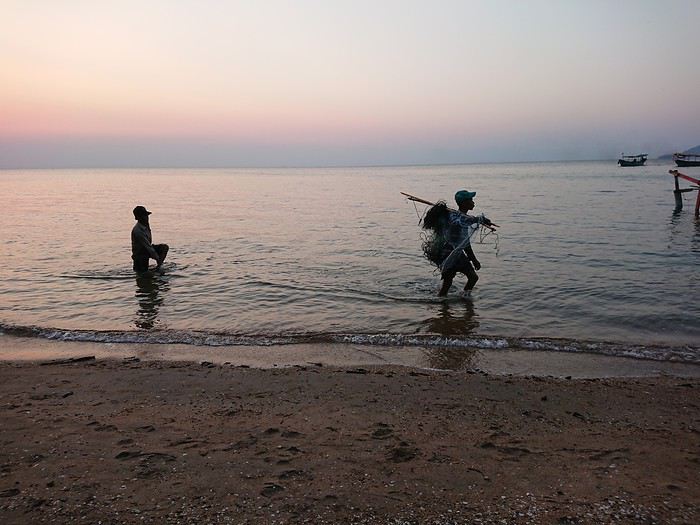
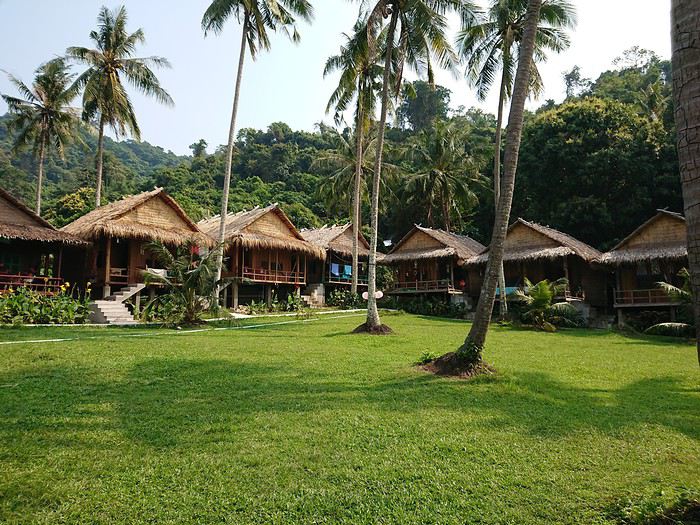
C'est un endroit très calme avec de petits bungalows sans électricité ou si peu quelques heures le soir. Douche à l'eau froide, mais l'eau n'est pas glacée 😁.
Moi j'adore d'autres détestent...
Je réserve toujours chez Vana, il me semble que c'est l'un des mieux. Sa cuisine est divine, les crabes au poivre vert un régal.
Pour le snorkelling c'est pas le top, on ne vient pas pour cela, désolé.
Une excellente journée.
Bien cordialement.
Merci beaucoup Joel !
Le choix de l'ile pour le final de notre balade va être compliqué je pense 😉 (jusque là je pensais à Koh Rong Samloen mais tu me mets le doute!)
On verra selon l'inspiration du moment
Bonne soirée
Christelle
Le monde est comme un miroir, si tu lui souris, il te sourit aussi!
Ni
Il est vrai que le choix est difficile.
Nous sommes en ce moment à Koh Rong Samloen depuis deux jours.
Comme nous adorons ces deux îles, nous y passons tous les ans.
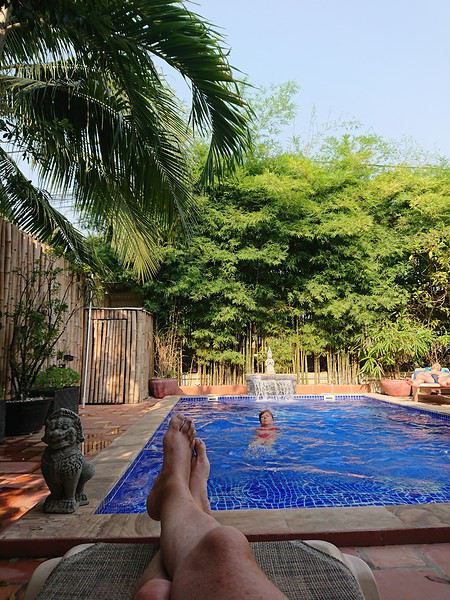
Eau turquoise, soleil, farniente... La vie est parfois difficile !!! 🙄
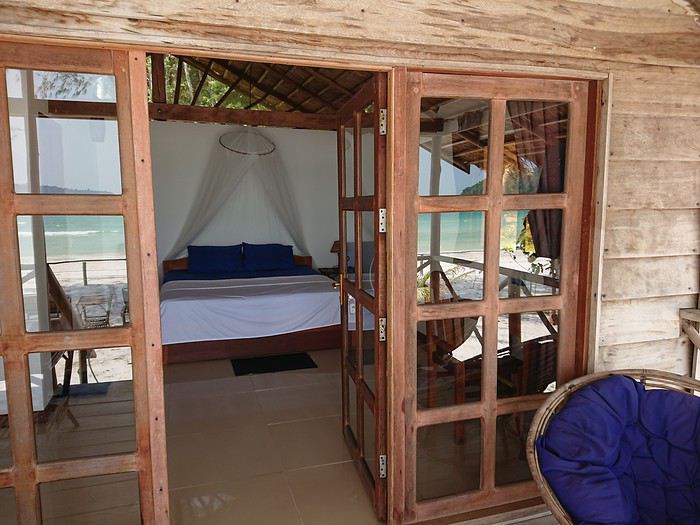
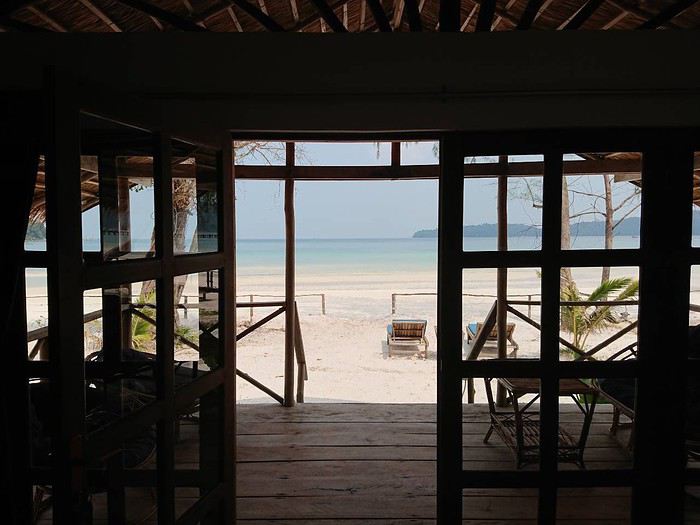
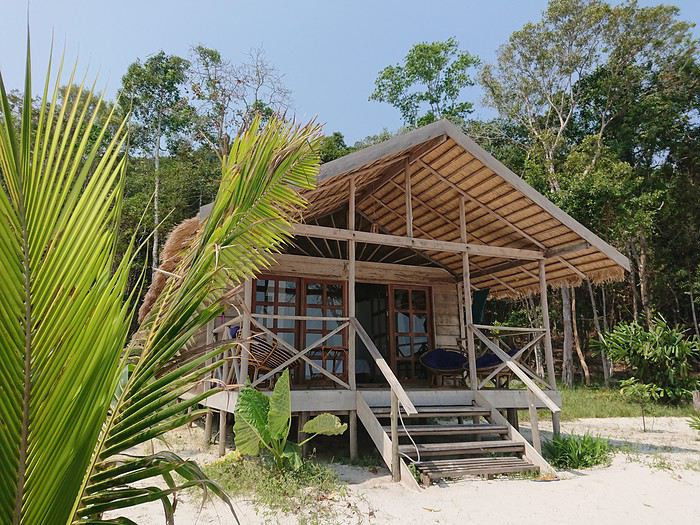
Quelques photos pour compliquer le choix 😜
Nous sommes sur la plage de Saracen Bay
à l'hôtel Saracen Bay Ressort.
Le meilleur et le mieux situé.
La plage est nettoyée "non stop" du matin au soir devant le Ressort...
Certains diront que c'est cher, mais la tranquillité n'a pas de prix et les services sont à la hauteur.
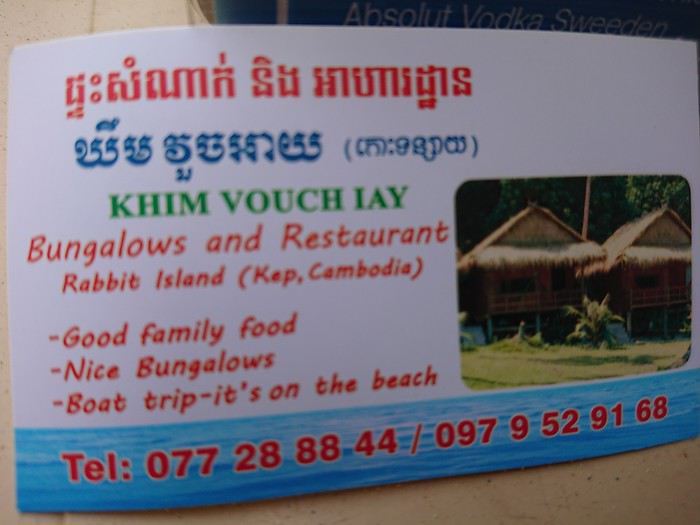
De retour à Sianoukville par 34 degrés et au bord de la piscine de la Villa d'artagnan je t'envoie la photo de la carte à Vana.
Tu le trouveras sur Facebook sous le nom de Nep Vana ou Vanna.
Bonjour,
Nous sommes 2 adultes qui envisageons d'aller visiter les temples aux alentours de Siem Reap, après quelques jours à Singapour. Déjà, un grand merci pour toutes vos informations 🙂
Nous aurons 4 jours entiers pour visiter les temples et j'avais lu qu'il était possible de louer un scooter, comme nous l'avions fait au Vietnam sur une partie du séjour. Nous arriverons le lundi après-midi à Siem Reap et repartirons le samedi pour Phnom-Penh.
Il est difficile de programmer de chez soi un circuit logique et cohérent ; j'ai beaucoup lu sur les différents programmes et en ciblant sur les visites de 4 jours (il faut bien trouver un critère de sélection de lecture😎), j'ai trouvé une proposition de visites pour 4 jours :
Jour 1 : Grand Circuit en commençant par Banteay Kdei et en terminant par Preah Khan en fin de journée
Jour 2 : Lever de soleil sur Angkor Vat puis Angkor Thom pour être au Bayon avant 7h30. Continuer le Petit Circuit et explorer Angkor Vat dans la journée
Jour 3 : découverte de Banteay Srei (Lady Temple) puis de Beng Mealea, deux temples situés à l’extérieur du complexe d’Angkor
Jour 4 : Ta Phrom à 7h30 (pour espérer être un peu tranquilles avant l’arrivée massive de touristes)
ou bien le programme de 3 jours que vous proposez, auquel il faut ajouter une journée (ou bien jour 4 dans le Petit Plus que vous mentionnez)
D'après ce ce que vous dîtes, le guide n'est pas obligatoire, si on lit un peu avant. Ou alors prendre un guide pour certains temples, mais en scooter, cela ne sera peut-être pas pratique, sauf si le guide est aussi en scooter.
Merci d'avance pour vos conseils avisés.
Tout d'abord une remarque concernant la location de scooter : je te déconseille de louer un scooter et je ne suis pas le seul à dire cela, car il y a un grand problème : il n'y a pas d'assurance… Chacun est libre de faire ce qu'il veut… Voir la discussion suivante : "Visiter les temples d'Angkor en scooter"
https://voyageforum.com/discussion/visiter-temples-angkor-en-scooter-d8351959/
Je conseille la visite des temples en tuktuk mais pour le Banteay Srei et le Beng Mealea je conseille une voiture (les distances sont importantes).
Voici un exemple de programme de 4 jours. L'ordre des jours peut, bien sûr, être modifié. Pour la visite d'Angkor Vat il faut tenir compte de ceci : un jour par semaine le sanctuaire central est fermé (le reste du temple est accessible), il s'agit du "jour saint" ou "jour de Bouddha". Se renseigner sur place, en général sur les calendriers khmers ce jour est signalé par un petit dessin représentant un bouddha assis.
Jour 1
- TA PROHM
- PRE RUP : au Nord il y a un escalier en bois qui facilite la montée.
- BANTEAY SAMRE (1)
- MEBON ORIENTAL
- TA SOM : aller directement au fond pour y voir le ficus qui entoure la porte (en passant par la droite)
- NEAK PEAN
- PREAH KHAN : Entrer à l'Est, dire au conducteur de tuktuk de t'attendre à l'Ouest.
Jour 2
- BANTEAY SREI ("La citadelle des femmes")
Après la visite du temple, ne pas rejoindre immédiatement le parking mais continuer tout droit. Il y a un petit bâtiment dans lequel on y trouve des explications sur les temples et des photographies de l'époque de la restauration du Banteay Srei (1931 à 1936).
- Eventuellement le Kbal Spean, il faut 30 à 40 minutes de marche (petite montée) pour accéder aux sculptures et à la cascade.
- BENG MEALEA
Jour 3
- BAYON
- BAPHUON : Après t'avoir déposée devant le Baphuon, le conducteur de tuktuk t'attendra probablement devant la terrasse du Roi Lépreux (sur le parking près des gargotes où l'on peut se restaurer). A partir de l'angle Nord-Ouest du Baphuon en allant vers la droite tu accèdes au Phimeanakas.
- PHIMEANAKAS ou PALAIS ROYAL : inutile d''y montrer, il n'y a rien d'intéressant au sommet, par contre au Nord voir le bassin royal (grand bassin), descendre dans le bassin au niveau du Sud-Ouest, tu y verras des sculptures (que l'on ne voit pas du haut de ce bassin). Ressortir par l'Est
- TERRASSE des ELEPHANTS
- TERRASSE du ROI LEPREUX. (2)
- Groupe de Rolluos : uniquement le PREAH KO et LE BAKONG
Jour 4
Lever du soleil a ANGKOR VAT
Visite de ce temple.
Il te restera du temps pour revoir éventuellement un ou plusieurs temples (Ta Prohm, Bayon…)
(1) Le Banteay Samré ("La citadelle des Samrès")
La population du Cambodge est composée de plusieurs groupes : principalement des khmers, puis des vietnamiens et chinois … Il faut ajouter quelques minorités dont les "samrés". Il y aurait encore dans la région de Siem Reap quelques rares samrés.
Le monument lui-même a sa légende : "Le roi des concombres", elle relate l’asccension au trône d'un pauvre cultivateur de souche Samrè, du nom de Pou, spécialisé dans la culture des concombres doux, dont il avait reçu les graines de façon surnaturelle. Ayant fait hommage de sa première récolte au Roi, celui-ci trouva les fruits si succulents qu'il s'en assura bien vite l'exclusivité, prescrivant à Pou de tuer tous ceux, hommes ou animaux, qui pénétreraient dans son champ.
A la saison des pluies, où les concombres se faisaient rares, le souverain, impatient d'y goûter, se rendit lui-même dans le champ. Mais n'étant arrivé qu'à la nuit il fut mortellement blessé par son jardinier d'un coup de lance, ayant été pris pour un voleur, et enterré comme tel en plein champ.
Le roi étant sans descendance directe et les dignitaires du royaume n'ayant pu se mettre d'accord sur le choix de son successeur, on eut recours à l'intervention divine, et ce fut, "l'Eléphant de la victoire" qui, chargé de désigner le nouveau roi, s'arrêta dans sa course précisément devant l'homme aux concombres doux, le salua, trompe basse entre les pattes, s'agenouilla et l'enlaçant d'une trompe flexible, le jucha doucement sur son dos.
Devenu roi, l'homme aux concombres fit rechercher le corps de son prédécesseur, et célébrer les cérémonies funèbres au Mébôn puis le rite de la crémation à Pré Rûp. Par la suite, les personnages de la Cour, humiliés d'être gouvernés par un Samrè, ne manquèrent pas de manifester leur opposition en feignant d'oublier les marques rituelles du respect. Le roi, n'ayant pu les fléchir ni par la bonté ni par la violence, quitta le Palais-Royal et s'en vint habiter à quelque distance de la cité, à Banteay Samré où il resta claquemuré comme la tortue-boîte quand, peureuse, elle a rentré la tête dans la carapace.
Là il faisait comparaître ses ministres, qui continuaient à affecter, d'adorer les attributs de la royauté et les emblèmes des anciens rois au lieu du Maître lui-même. Un jour, poussé à bout, il résolut de les punir et ayant tait apporter la chaise percée de son prédécesseur, fit décapiter tous ceux qui cherchaient à l'humilier en manifestant leur dévotion à ce misérable objet en tant que témoin de la dynastie éteinte. Son règne se poursuivit désormais dans le calme parmi ceux qui, conquis par sa bonté, lui étaient devenus fidèles...
(2) Terrasse du Roi Lépreux : je pense que l'on devrait dire plus exactement "La terrasse dite du Roi Lépreux".
Il existe une légende d'un roi lépreux dont on peut voir un bas-relief au Bayon. bas-relief intérieur, galerie Est, moitié Nord. Description dans les livres suivants :
- "Les monuments du groupe d'Angkor" de Maurice GLAIZE.
- "Angkor cité khmère" de Claude JACQUES
- "Le guide des temples d'Angkor" de Michel PETROTCHENKO
Lors de la découverte de cette statue au sommet de cette terrasse, on a constaté sur celle-ci des taches de lichen, des cambodgiens qui ont vu cela ont immédiatement assimilé cette statue au roi lépreux de la légende… Après diverses recherches on sait que la sculpture au sommet de cette terrasse n'a rien à voir avec la légende du roi lépreux, il s'agirait de Yama (Dieu de la mort et roi des enfers) ou Dharma l'un de ses assistants.
Bonjour Marie Noëlle,
Je suis encore à Siem Reap et je termine un séjour Angkor er Laos.
Je ne rajouterai rien au programme de Jacques qui est un bien meilleur connaisseur, mais je peux te dire qques mots de notre visite . Nous y avons passé 3 jours au début de notre voyage.
Nous avons pris un chauffeur qui nous a accompagné 2 jours en tuk tuk pour le petit et grand circuit et 1 jour en voiture pour la cascade de kbal Sean et Bentei Srei. On aurait pu sans problème rajouter sur cette journée Beng Mealea., mais nous y sommes passés au retour du Laos. Le chauffeur s appelle Haun et je peux te donner ses coordonnées si tu le souhaites, il est très bien, je le recommande.
Je ne sais pa's quelle est ta date de départ, mais il commence à faire chaud, et 4 jours d 'affiles risquent d être assez éprouvant, il vaut mieux je pense insérer la journée en voiture au milieu , la clim permettra de récupérer un peu.....
Je te recommande de bien de documenter avant ton départ, car sans guide, on a tendance à perdre du temps déjà a se repérer et difficile d aller à l essentiel, car en 3 ou 4 jours , si on veut voir une dizaine.e de temples, on ne peut que les survoler, tant il y a à voir , c'est extraordinaire. Et armé toi de patience , si tu veux prendre des photos....les chinois accaparent tout ce qui peut être photographié. ...pour des selfies tous les plus inertes qui soient......
Sinon c est vraiment une pure merveille dont on ne peut prendre l ampleur que sur place, en se remplissant les yeux de toutes ces beautés mais un peu frustrant, chaque temple méritant des journées entières â les decouvrir!
Tu ne seras pas déçu. ...sauf par le monde. ...mais ça. ...
Et encore que j ai réussi à faire des centaines de photos....sans personne dessus mais avec un peu de patience.
Je te souhaite une très bonne découverte, je te donne les coordonnées du chauffeur su tu les veux,
merci beaucoup pour ce programme. Je suppose qu'il faut se lever de bonne heure pour espérer ne pas être submergés par les touristes🙂
pour la location d'un scooter, quand nous l'avions fait au Vietnam, nous n'avions pas pensé à l'assurance...
le séjour est prévu pour décembre prochain. Je veux bien les coordonnées du chauffeur en mp, merci🙂 quant au monde sur les sites, j'ai vu quelques photos, ça fait un peu peur effectivement 😕 mais bon, avec un peu de patience effectivement, ça le fera
Depuis mes premières visites j'ai pu constater qu'il y a de plus en plus de touristes à Angkor. Il y a encore 3 ans on pouvait commencer les visites dès 5h30, cela était très agréable car les groupes n'arrivent que vers 8h00-8h30. Je me souviens avoir compté les visiteurs que j'avais rencontrés lors d'une visite au Ta Prohm entre 6h00 et 8h00 : il n'y en avait que 14… Il m'est également arrivé de me retrouver seul au Bantteay Srei
Malheureusement depuis 2 ou 3 ans les horaires de visite ne sont plus les mêmes :
Angkor Vat : 5h00 - 17h30 - Montée au sanctuaire central à partir de 6h30
Srah Srang : 5h00 - 17h30
Phnom Bakheng : 5h00 - 19h00
Pre Rup : 5h00 - 19h00
Les autres temples sont ouverts de 7h30 à 17h30
Avant 7h30 il y aura du monde uniquement à Angkor Vat pour le lever du soleil. Pour ce lever du soleil le "bain de foule" est garanti (il y a parfois des bousculades pour être au premier rang …). Même s'il y a du monde à ce moment-là il est préférable de visiter ce temple juste après le lever du soleil. Pour la montée au sanctuaire central (ouverture 6h30) il est préférable d'arriver dès 6h15 au pied de l'escalier qui accède au sommet, après 6h30 il peut y avoir une attente parfois de 20 à 30 minutes
Les temples les plus visités sont : Angkor Vat Bayon Ta Prohm et Banteay Srei. Au cours de la journée (sauf entre 12h00 et 14h00) il y aura du monde. C'est pour cette raison que je conseille de faire les visites sur 4 jours pour commencer chaque jour par un des temples principaux.
Ah oui vraiment Jacques t'es une mine d'infos à toi tout seul, merci beaucoup.
Je note qu'on sera plus tranquille avant 7h30 (mais le soleil se lève vers 6h non??) et entre 12 ET 14H (si on résiste à la canicule 😉).
Qu'en est-il de la fin de journée entre 16 et 19h, gavé de monde ??
Et le coucher de soleil à Angkor ?? on parle tjs du lever à Angkor Vat mais n'y a t-il pas pas un joli coin, pas envahit (oui je rêve !!) sur le site pour le coucher du soleil ?
J'avoue que j'ai repoussé ce voyage depuis des années à cause de cette foule inévitable mais tous les gens qui sont revenus d'Angkor étaient enchantés malgré tout donc on on va aller voir ça !!
Bonne soirée et merci encore
Christelle
Le monde est comme un miroir, si tu lui souris, il te sourit aussi!
Bonsoir Christelle,
Je reviens d'Angkor ( suivi par un voyage au Laos, pays magnifique) et je suis enchanté par la visite des temples. ...malgré le monde. Et c est dommage de retarder car il y aura chaque année de plus en plus de personnes..a moins d instituer des quotas...ce qui serait peut être la solution!!, Mais il ne faut pas être parano....certes il y a du monde, mais je m attendais à beaucoup plus de gêne que ça.. .En respectant les horaires indiqués sur le forum on arrive à passer un peu a travers. Et les groupes se cantonnent bien souvent aux 2- 3 grands temples, délaissant les moins important qui n en sont pas moins splendides. Sûr, Angkor Var est blindé. ..je n ai même pas envisage de monter à la tour centrale, il devait y avoir 1 â 2 h de queue. .... Mais j ai réussi à prendre des centaines de photos.. ..avec personne dessus....avec un peu de patience. Et le souvenir que je garde de ces visites est fabuleux et je ne pense même plus au monde qu' il y avait.
Donc dépêché toi de prendre ton billet d avion...ce sera un fabuleux voyage!
J ai mis sur le forum les coordonnées d un chauffeur qui est très bien pour les circuits et en tuk tuk et en voiture pour les plus lointains ( la, sans grand monde! 0
cordialement Marc
Ah ah il est pris mon billet Marc...pour le week-end prochain 😉
Merci, tu me confirmes les échos que je reçois d'habitude.
je pense qu'on va survivre à la foule et déguster les beautés Angkoriennes 😛
Bon courage pour le retour
Christelle
Le monde est comme un miroir, si tu lui souris, il te sourit aussi!
Il y a longtemps dans un guide il était mentionné qu'en montant au Bakheng on pouvait voir le coucher du soleil sur Angkor Vat. En 2002 lors de mon premier séjour je suis donc monté au Bakheng vers 17h00. Il y avait déjà une cinquantaine de personnes qui regardaient en direction d'Angkor Vat qui est situé assez loin.
Angkor Vat est situé au Sud- Est du Bakheng et le soleil ne se couche donc pas derrière ce temple mais sur la campagne… Les personnes présentes tout comme moi ont dû lire ce guide… En regardant une carte j'aurai du m'en rendre compte immédiatement
Maintenant encore de nombreux conducteur de tuktuk emmènent leurs clients au Bakheng pour le coucher de soleil sur Angkor Vat...
Je n'ai pas d'endroit particulier à te conseiller pour un coucher du soleil, ni pour un lever du soleil, à part à Angkor Vat.
J'ai l'impression que 3 jours de visite des temples ce n'est pas assez pour toi. Tu aurais probablement préféré passer plus de temps sur place pour voir ces temples plus en détail…
Concernant ton conducteur de tuktuk (et de voiture) pourrais-tu nous communiquer ses tarifs
Effectivement, 3 jours m'ont paru bien court pour effectuer la visite des temples d'Angkor...
( presque 4 jours en fait avec Sambor Prei Kuk et Ben Mealea au retour du Laos) Si cela permet tout de même d'avoir un bon aperçu et une bonne vision de ce magnifique ensemble (nous avons visité 8-10 temples environ) je n'ai pu que me sentir frustré que de passer si vite devant tant de merveilles et de n'avoir pas le temps ...de prendre le temps ..de les découvrir davantage: il y a tant à voir, à admirer, à découvrir!
Mais, bon, il faut faire avec son planning ..Et il faut en laisser pour le prochain séjour...😉
Quant au coucher du soleil, nous l'avons vu à Pre rup..mais, comme pour Bakheng, aucun intérêt, malgré la foule qui est juchée sur les tours...le soleil se couche sur la forêt ....
Je pense qu'effectivement que le seul spectacle doit être à Angkor Vat quand le soleil apparait ( ou disparait ) derrière les murailles ou les tours de ce magnifique temple: là aussi, ce sera pour une prochaine visite!...
J'ai mis la carte de notre chauffeur sur le site : on peut le contacter facilement par Messenger ( ou par mail) . Son tarif pour 3 jours ( 2 en tuk tuk et 1 en voiture ) était de 115 $. J'en ai été trés satisfait et je le conseille favorablement.
bonjour Marie-Helene,
Je me permets de vous contacter concernant un message que vous aviez posté concernant
Srey Noch Oung , guide francophone diplomee, sur Siem Reap.
Savez vous si elle propose toujours des tours des tempkes d’Angkor ?
Nous y serions du 29 avril au 1mai 2020
Merci pour votre reponse
Bloavezh mad
Christelle
Pour un prochain voyage à Angkor (février), nous souhaitons utiliser comme moyen de locomotion le vélo. J'ai lu passablement de discussions à ce sujet mais…
Nous nous rendons en Thaïlande fin Janvier 2012. Nous souhaitons en profiter pour visiter un peu le Cambodge, en particulier Phnom Penh et les temples d'Ankor.…
Je compte visiter le site d'Angkor Vat en venant de la Thaïlande par Surin (ISAN). Combien de jours prévoir sur place pour bien profiter du site? (2, 3, 4…
Je n'arrive pas à trouver (sur guide papier et net) comment visiter Angkor. Nous y serons en Aout avec deux enfants et avons prévu 3 jours pour la visite du…
Je compte visiter Angkor mi octobre 2008. J'ai lu ça et là qu'il y avait des travaux de rénovation en ce moment. Pouvez-vous me confirmer que l'ensemble du…
First stop on our discovery of the peninsula: Amphawa. It’s our first night in Thailand (we arrived at Suvarnabhumi at 8:50 AM).
Our initial plan was to explore the area before heading further south. The Mae Klong Railway Market is tempting... but what else is there to do????
We’ll be there on a Wednesday, and from what I’ve read on the forum, some say there’s absolutely nothing to do during the week—no floating market, barely any shops open, no restaurants, etc.
Others, though, say the place is actually more charming without the weekend crowds.
Could you share your thoughts? Missing the floating market is one thing, but if it’s really a ghost town on Wednesdays, I might just drop our bags somewhere else.
Amphawa seemed like a good first stop, just 1.5 hours from the airport, but I’d still like to settle somewhere a bit lively for our first evening.
We’ll be there at the end of October.
Thanks!
Hi,
I wanted to visit the plantations in the morning with GetYourGuide or by just showing up.
How much time should I really plan for?
I’d like to catch either the 3 PM or 5 PM bus back to KL.
Thanks
Hi,
I wanted to get some info about the cable car and the bridge—I see lots of different options...
How much time should we allow for these two activities? If we arrive around 4 PM, will we have enough time to visit without rushing?
Thanks
Hi there,
I didn’t plan to return to Thailand this year, but my health conditions mean it’ll be the best place for me to stay between two trips to India. The tourism setup there is so well-organized that it’s the most "comfortable" country for a short visit. Thailand feels too sanitized for my taste, and there’s too much religion, Buddha, and the King, but it’s still the best option given how my health has been evolving. I’d considered two weeks in ThaTon for hiking, but I got too sick from the burn-offs during my trips to the mountains around Chiang Rai. So I’m not sure where to go this year. Definitely not the sea, touristy spots, or the mountains with burn-offs...
Hi,
On September 1st, we're heading to Kalimantan for six weeks, probably from Pontianak to the Derawan Islands.
I've scoured this site, which is usually my go-to 😉, and others like VoyageForum, but recent info is pretty scarce.
I'd love any tips on places you've visited—our itinerary is still a work in progress.
We're two couples traveling with backpacks, using buses, boats, guesthouses, and homestays.
Thanks in advance!
Hi fellow travelers,
First trip to Vietnam.
We’ll be arriving in Ho Chi Minh City during Tet.
Is it complicated to find accommodation and get around during this period?
Any tips would be welcome.
Thanks for your replies.
Hi! I’d like to split my trip into two parts: 15 days in Phuket and 15 days in Krabi. Do you know if I can rent a car and drop it off in Krabi when I fly back to France?
Thanks for your feedback!
Have a great Sunday!
Martine
Hello,
After 1 night in Khao Sok, I’d like to find a 2 Days 1 Night package on the lake.
After reading a lot, I decided to "break the bank" and treat ourselves to a private tour—mainly to avoid the crowds.
But after contacting several operators, they offer "private tours" that are very expensive (around 700 €), yet in the details, the boats can only leave from the pier at 10 AM like everyone else. (I was hoping to leave much earlier.) The morning program is the same for everyone too (private or not). They drop us off at noon at our floating hotel (I’d chosen Phupha Waree). Free afternoon (swimming or kayaking in front of the hotel). We head back by boat for a 1-hour sunset ride. And the next morning, we leave the hotel at 8 AM to be at the pier by 9:30 AM at the latest—end of the trip.
So basically, we’re paying a lot for a private tour just to do the same thing as everyone else at the same time.
Or maybe I just had bad luck in my search.
I contacted Panida Ladi, who’s very popular on forums. We’d agreed on a private tour that matched my request (departure from the pier at 8 AM, very personalized itinerary). We settled on the itinerary and price, she asked for a Wise transfer for a 30% deposit, confirmed receipt of the deposit. Then 30 minutes later, she messaged me to say she was canceling everything because it was impossible to do the requested tour—and promised a quick refund of my deposit.
So here’s my question: Who’s done a *real* private tour on this lake? Who can recommend a reliable agency? Is it even really possible to do a private tour here?
I’m searching for a real gem for my 3rd stay in Koh Lanta: a lovely, high-quality hotel right by an easily accessible beach in a lively spot.
If you know of anything that fits what I’m looking for and want to share, don’t hesitate!
Hi, is anyone there in Flores right now? According to some websites, everything is closed and the situation is tough. But our guide says it's fine. Who should we believe? We're supposed to leave on September 2nd. Thanks to anyone in Flores at the moment!
Hi dear community,
I'm planning to visit Cambodia this winter, right after Christmas, for my first solo trip and my first trip to Asia. For two weeks (yes, I know it's short, but I really can't do more...). I have two main desires: Siem Reap and the countryside, the villages, the Mekong...
What do you think of this itinerary? Arrival in Siem Reap, departure from Phnom Penh.
SR: 5 days (1 day for arrival, 3 for the temples, 1 for the lake and its villages)
Kratie (stop on the way to Mondolkiri): 3 days (1 day of travel, 2 days there)
Mondolkiri/Sen Monorom: 4 days (1 day of travel, 1 day there, 2 days of treks)
PP: 3 days (1 day of travel, 2 days of sightseeing)
I think I need to cut one day somewhere if I travel from Saturday to Saturday or Sunday to Sunday. In Kratie, maybe? Or in PP? And I'll miss the boat trip that everyone recommends (SR-Battambang), but I don't see where to fit it in. Unless I do a PP-PP loop starting in the east, skip Kratie or just stay one night, then SR, then PP.
In my timing, Mondolkiri seems closer than Ratanakiri, which also tempted me a lot! Will it be too complicated alone? I'm thinking of using local guides or a small local agency for a nature and village getaway.
I've read that Siem Reap is very crowded between Christmas and New Year's. I could also do the circuit in the opposite direction. But I thought it would be easier to get familiar with the country by arriving in a touristy area—I might be wrong...
Thanks for your advice and opinions!
Hi everyone.
I’m planning my trip, and based on all the posts I’ve read, this country is amazing.
Of course, I’ve got a ton of questions for you.
Here’s a possible itinerary: Vientiane - Vang Vieng - Phonsavan - Sam Neua - Nong Khiaw + villages - Phongsali - Luang Namtha and the area - Udomxai - Huay Xai - Luang Prabang and back to Vientiane.
What do you think?
We’re planning to prioritize local transport—is it possible to do this loop?
We’d also love to go kayaking, but I’m not sure if the season’s right or where the best spot is.
For trekking—I read that Phongsali is the most authentic spot to visit villages and see wildlife. Do you know of a reliable agency and a guesthouse with reasonable prices?
Is it worth taking a slow boat for a stretch on the Mekong, and if so, which route?
For accommodations, is it better to book through Booking.com and Agoda or look when we arrive?
Are mosquitoes bad in Laos, and should we take malaria prophylaxis?
What’s the average daily budget (accommodation, food, visits)?
Is renting scooters a good option for exploring towns, and if so, which ones?
From what I’ve read, it’s best to carry cash—euros or dollars? Is it risky to walk around with that much cash?
I’ve still got tons of questions. Thanks to anyone who can help, and I’m open to all tips, info, etc.
Thanks again
Hi there,
I’m planning a trip to Vietnam in February, specifically Da Nang and Hoi An.
Does anyone know a French-speaking guide in the area?
Thanks for your help
Hi there,
I’m planning a family trip (my wife and I, both 47, and our two sons, aged 5 and 12) to Malaysia for the last week of June and the first two weeks of July 2027.
We used to love road trips as a couple, then as a trio, but since our second child arrived, we’ve taken a break with "camping village" style trips.
Now feels like the right time to get back to our old habits, while adjusting the pace for the kids.
We’re craving Asia. We’ve been lucky enough to visit Thailand, Indonesia (Bali and Lombok), and Sri Lanka before.
Friends have raved about Malaysia, so we’re definitely tempted.
For those who know and love Malaysia, what would be a good itinerary starting from Kuala Lumpur, with a maximum of 3-4 stops? We’d like a mix of culture, nature, and relaxation (just to clarify, we’re not big beach fans). All of this without rushing, of course.
Hello,
We’re a family of four with two teens aged 16 and 18. We’re heading to Thailand this summer. We’ll arrive in Bangkok and plan to take a flight to Luang Prabang.
I’ve seen there are some great visits and excursions to do (temples, markets, waterfalls) and maybe even venture a bit north to places like Nong Khiaw, Muang Xay, Muang Ngoy, or Oudom Xay.
But I’ve also heard about the Bokeo region with the Gibbon Experience.
Since we won’t be able to do everything, I’d love to hear about your experiences, impressions, and advice on the two options I’m considering, especially since we’ll be meeting family in Chiang Mai, Thailand, afterward.
Option 1: A loop from Luang Prabang heading slightly north, then a flight from Luang Prabang to Chiang Mai.
Option 2: A few days in Luang Prabang, exploring within a few dozen kilometers around, then heading to Bokeo province for the 2-day/1-night Gibbon Experience. For this option, I saw on Rome2Rio that it’s possible to book a ferry trip on the Mekong from Luang Prabang to Huay Xay—they mention about 8 hours. But is that realistic? What type of boat is it?
Then, to get to Chiang Mai, there aren’t many options—bus or minivan—but how does crossing the border work?
Finally, for those of you who’ve been to Laos in August, what was the weather like?
We’ve already visited Thailand, Vietnam, and Cambodia during the same period over the past four years and weren’t really bothered by bad weather.
I’m starting a discussion about guides in the Mekong Delta because we’ve just finished our trip in this region and had a hard time finding a French-speaking guide. We had Thanh—she speaks French really well and travels all over the delta region, including Ho Chi Minh City. She’s super friendly and flexible. I recommend her wholeheartedly. If it can help someone...
Feel free to contact us for her number.
Hi everyone,
I couldn’t find any recent info on Kuching.
Can anyone recommend a hotel or guesthouse for under 100 RM that’s nice and affordable? No dorms, please.
Also, does it rain a lot in November, and is it still worth visiting Semenggoh or Bako?
We’ll be arriving in Phnom Penh this coming January and we’re thinking of starting our trip with a stop in Kampong Cham, then Kratie.
After Kratie, we’re considering heading toward Siem Reap with a stop in Kampong Thom.
That said, I’m not really sure how long the Kratie–Kampong Thom journey might take or how complicated it is.
Does this stop on the way to Siem Reap seem like a good idea to you?
If we don’t visit the Sambor Prei Kuk site, are there still any walks or sights worth checking out in Kampong Thom?
Silly question—backpack or hard-shell suitcase for the Sepilok, Kinabatangan, Tioman, KL trip?
I’m struggling to fit all my son’s and my stuff into the 70L backpack... and I’m thinking a suitcase would be easier, but I’m not sure if it’ll work for getting around.
After a stay on Koh Phayam this coming November, I’d like to spend 2 or 3 days on Koh Phra Thong before heading further south.
Do you think it’s doable to leave Koh Phayam early enough to catch the 10 AM boat from Khura Buri to Koh Phra Thong? The next one isn’t until 4 PM, which would cost me a whole day.
I’m planning a trip to Indonesia, specifically Sulawesi and Java, in September for 10 days.
I don’t know this part of the world at all—any advice is welcome!
I’ll be traveling solo and would also love tips on meeting other travelers or locals.
Hello everyone,
Not long ago, I used to travel as a couple, but my husband has since passed away, and I’ve decided to set off again. The trip I took to Cambodia in January 2025 did me a world of good.
I’m now considering Thailand, a destination we never included in our plans because even 15 years ago, people said it was too touristy. Still, I’m thinking about the itinerary below, but I don’t feel up to arranging buses, trains, or guides on my own while I’m there. I’m looking for one or more drivers and have been in touch with an agency, but their offers are just copy-paste group tours that I don’t want.
So, if you have any contacts, experiences, or advice, I’d be so grateful if you’d share them with me. Here’s my rough plan:
Arrival in Bangkok
Ayutthaya (2 nights)
Kanchanaburi (2 or 3 nights)
Sangkhlaburi/Sai Yok (3 nights)
Sukhothai (2 nights)
Lampang (I’ve planned 3 nights, but that might be a bit much—it depends on what time I arrive in the city)
Chiang Mai
Chiang Dao
Pai
Chiang Rai
I was thinking about the Mae Hong Son loop—thoughts?
What do you think about staying overnight at the Golden Triangle?
When I look online, of course, I can find agencies that organize tours to national parks, etc.
I’m retired but in great physical shape. I’d rather go hiking than sit in hot springs with crowds of tourists who’ve all arranged meet-ups. I don’t want to spend a day at an elephant camp, and I don’t want to visit Karen villages.
I’d love to hear your advice.
Thank you all,
Hi everyone,
Could you share your thoughts on my 3-week itinerary?
We’re a small group (family + friends) of 12 people, planning to leave around January 21, 2027.
Here’s my itinerary:
3 nights in Bangkok
4 nights in Chiang Mai
3 nights on Koh Samui
3 nights on Koh Phangan
4 nights in Krabi
4 nights in Phuket
I’m also open to any great tips you might have...
Thanks, everyone! Alain.
Hi there,
We’re planning a 3-week family trip next summer with our three kids, who’ll be 8, 8, and 7 years old.
After some research, we’re leaning toward Malaysia to combine nature/forests and paradise beaches. The idea is to introduce our kids to the country’s culture, nature, and wildlife.
We want a great trip but without splurging on luxury options like high-end lodges and resorts. We’re looking for comfort with a touch of authenticity—basically, a good middle ground.
I’ve started putting together an itinerary and would love your expert advice and tips to help us build this amazing trip with our little ones.
Day 1: Departure from France
Day 2: Kuala Lumpur
Stay at a hotel near the airport or KL Sentral.
Just one night.
Day 3: Morning flight to Sandakan (Borneo).
Stay in Sepilok
Day 4: Sepilok:
* Orangutan Center
* Malayan Sun Bear Center
* Rainforest Discovery Centre
Day 5: Depart for Kinabatangan.
Boat safari in the late afternoon.
Day 6: Sunrise safari.
Jungle walk.
Evening safari.
Day 7: Final safari.
Return to Sandakan.
Flight to Kuala Lumpur, then to Kota Bharu (or overnight transit depending on schedules).
Day 8: Transfer to the port.
Boat to the Perhentian Islands.
Days 9 to 13: Perhentian Besar
5 full days.
* Snorkeling
* Hiking
* Turtle watching
* Wild beaches
* Relaxation
Day 14: Return to the mainland.
Bus or private car to Taman Negara.
Summer seems to be the best time weather-wise for Bali.
And since summer’s when we can take a long trip, let’s go for Bali... even though we know it’ll be *packed* with people!
So we’ll steer clear of the island’s south...
Our current plan (19 days on the ground, 7 stops):
- 4 Nights (3 days) in Ubud
2 days for rice terraces / activities (Tegallalang, Campuhan Ridge, Monkey Forest, Bird Park, coffee plantation, market (?), dance "pestacle," cooking class and/or spa)
1 day with a driver for the Temples (Pura Gunung Kawi, Tirta Empul Spring, Pura Mengening, Goa Gajah...)
- 2 nights in Sidemen (1 day for Pura Kehen + Batur Caldera + Pura Besakih and 1 day to relax in the rice terraces)
- 3 nights on Gili Meno (Rest and beaches) from Padangbai
- 2 nights in Amed (1 day from Padangbai with the Abang rice terrace and Tirta Gangga baths, and the next day a boat tour in Amed)
- 4 nights in Pemuteran (1 day for transfer and rest, 1 day to visit Kawah Ijen, and 2 days of snorkeling at Menjangan Island)
- 2 nights in Munduk (1 day with the Dayang rice terrace and the 3-waterfall hike, 1 day at Pura Ulun Danu Bratan)
- 2 nights in Jatiluwih (1 day in the rice terraces, and on the last day, we’ll stop by Pura Taman Ayun in Mengwi and Pura Tanah Lot before catching our red-eye flight).
Accommodations in homestays or hotels.
Transportation to be arranged on-site with the lodgings (?)
Boat to Gili Meno to book in advance (?)
Kawah Ijen excursion to plan ahead (?)—check with the homestay (?)
Thanks for your thoughts/comments to help us explore this destination...
After reading and researching, we're planning the following stops in Cambodia in January 2027:
- Phnom Penh
- Kampong Cham
- Kratie
- Siem Reap
- Battambang
- Kampot (round trip)
I'm wondering about the direction of these stops, which could also influence our international flights.
Either a round trip from Phnom Penh in the order above.
Or landing in Siem Reap with the following order:
This second option would save us the Battambang - PP - Kampot trip but means doing a round trip to Battambang from Siem Reap and placing the "highlight of the trip" (Angkor) at the beginning of our stay.
Hi there,
We’re planning to travel from Chiang Rai to Luang Prabang next November.
We’d like to take a slow boat from Chiang Khong—or rather from Huay Xai in Laos—with an overnight stop in Pakbeng.
Could you let us know if the boat still leaves Huay Xai in the late morning? If so, what time roughly, and what’s the price for the trip?
Thanks for your help!
Alod
We (3 adults: 68, 65, and 25 years old) are just back from a short trip to the Philippines, and I’d like to share a little summary of our journey. First of all, I’d like to thank everyone who contributes to this forum about this destination and answers the questions of those who aren’t familiar with it. I should also mention that my comments are personal and don’t reflect anyone else’s opinions. Since I don’t have any literary or photographic talent, I’ll stick to the facts and share a few details about the sights, hotels, and restaurants.
Preparations:
We chose this destination in December and quickly booked our flight tickets (540 € with Turkish Airlines) for a departure on February 16 and return on March 5, 2019. We then contacted two French-speaking tour operators based in Manila, asking them to put together an itinerary based on our wishes (places to visit, type of accommodation) and our budget. We wanted to see the rice terraces in northern Luzon, the hanging coffins in Sagada, before flying to the Visayas (Bohol, Siquijor, etc.), and the Taal Volcano, while limiting our nights in Manila as much as possible. In the end, we opted for Alize, whose itinerary and quote matched our request almost perfectly. Our exchanges helped us refine our circuit.
International flights:
The round-trip flights went smoothly. Turkish Airlines, while not at the level of Asian or Gulf airlines, does the job just fine.
Day 1:
We landed on time (6:15 PM) on Monday, February 16, at Terminal 3. We exchanged our euros (near the car rental counters), and I can confirm the exchange rate was very good. On the way to the St. Giles Hotel (decent and affordable for a transit night), we got our first glimpse of Manila’s dense traffic. The Makati district, where our hotel was located, offers a wide choice of restaurants, so we grabbed a quick bite to recover from the trip.
Day 2:
This day was dedicated to transferring to Banaue. Fortunately, we had a comfortable van and an excellent driver for this journey, which took all day (8 to 9 hours with stops). We got a taste of driving in the Philippines—and it’s terrifying. You wouldn’t want to drive on these roads. The first thing that struck us was the relatively good condition of the roads and the cleanliness (a change from other Southeast Asian countries). This impression lasted throughout our trip. Around 6 PM, we checked into our room at the Banaue Hotel (large, charm-free, but with a beautiful view of the rice terraces).
Day 3:
With the help of a local guide, we took a jeepney to Batad. And then—wow! The rice terraces form an amphitheater overlooking the small village. Under the sun, it’s simply spectacular and breathtaking! Even though we’re familiar with rice terraces (Sapa, Bali, Thailand, etc.), we were dazzled by so much beauty. We spent the day walking along the terrace walls. This place is timeless and fully deserves its UNESCO World Heritage status. However, we returned to the hotel exhausted (due to our ages and lack of exercise). We had dinner with our driver at the Las Vegas restaurant in the center of Banaue. The meal was decent, cheap, and the Filipino owner played the guitar to accompany our dinner.
Day 4:
Today, our driver took us to Sagada. The mountain road offered spectacular landscapes (about 1.5 to 2 hours). Along the way, we stopped in Bontoc to visit the small but interesting anthropological museum. It features old photos and various objects from the Ifugao tribes, as well as a reconstruction of primitive dwellings.
We then went on a short hike in Sagada with a very friendly local guide who explained the region’s funeral rites. The walk started at the communal cemetery before reaching “Echo Valley,” where we saw the first coffins hanging on the cliff. We continued to the “Underground River” and a small waterfall, ending our journey in the “Lumiang Cave” burial cave. All in all, this day was very interesting. On the way back, we made a few photo stops.
In the evening, on our driver’s recommendation, we ate at the “Bistro,” a French enclave in the center of Banaue (good pizza, roasted quail, homemade fries).
Day 5:
Today was a transfer day. To limit fatigue and nights in Manila, our tour operator arranged a flight from Clark to Tagbilaran (Bohol), saving us 2 to 3 hours of driving. But to catch our flight, we had to leave very early: 5:30 AM. Our kind driver dropped us off on time at the airport. To use it, we had to pay a 150 PHP tax per person. The Philippine Airlines flight (15 minutes) left early and was far from full. Upon arrival, we were taken to the Loboc River Hotel, on the banks of the river of the same name. A very charming lodge lost in a tropical garden. We stayed in a stilt cottage overlooking the river. We relaxed a bit in the lovely pool. This place is really great—the staff is charming, and the food is excellent for a reasonable price.
Day 6:
This day was dedicated to exploring Bohol. The program was classic, starting with the tarsier sanctuary. We saw a few specimens in a small garden, each pointed out by a staff member. It was both good and disappointing because the animals were in pseudo-freedom in a small enclosure. Then we went to the “Chocolate Hills” and climbed 240 steps to admire the panoramic view of the hills—but by 10 AM, it was crowded. On the way back, we stopped at the butterfly garden, which was uninteresting: tiny, with few butterflies. We consoled ourselves by photographing beautiful flowers. To please our teen, we stopped at the Loboc Eco Tourism Adventure Park and crossed the river lying down, suspended from a steel cable (300 PHP). Finally, we had the traditional lunch-cruise on the Loboc River. It was a factory-like experience, and the meal was unremarkable. The only good thing was the singer on each boat and the lush vegetation. Afterward, we visited colonial churches and the cathedral, remnants of the Spanish presence, before returning to the hotel for a well-deserved dip in the pool. Note that for those interested, there’s an arena near the hotel where cockfights are held every Sunday—something Filipinos are passionate (if not obsessed) about.
Day 8:
Very early departure for the port. We boarded a *banca* in search of dolphins. After about an hour of sailing, we were lucky enough to spot around a hundred dolphins. Our boat then headed to the small and charming island of Pamilacan. After a walk through the little village, we came across locals traditionally building a boat. They told us it takes about a month to finish their outrigger boat. Then we had to choose our snorkeling spot between the coral garden, the fish park, and the turtle enclosure. Note that a fee is charged for each spot: 150 PHP per place and per person. It felt a bit like we were being ripped off, especially since the spots weren’t amazing—we’d see much better on Apo for much less. We had lunch on the island at one of the many small eateries (350 PHP per person).
Days 9 and 10:
On our return, we were taken to the Bohol Sea Resort on Panglao Island, where we stayed for 2 nights. It’s a small, recent establishment in a quiet corner of the island. It’s relaxing—maybe a bit too much. It has a nice pool and access to Danao Beach, but the view is blocked by a flotilla of boats. We didn’t try their diving school. The meals were good. If we had to do it again, we’d skip this stop to spend more time in Negros.
Days 11 and 12:
We took a fast ferry (Ocean Jet) from Tagbilaran port to Dumaguete and were taken to the Thalatta Resort, about 20 km away near Zamboanguita. We stayed there for 2 nights. Let’s just say it was our favorite. It’s a small place facing Apo Island. The rooms are simple, and the pool, nestled in a magnificent tropical garden, is fantastic. The staff is friendly, and the meals are very good. The hotel has its own diving center (snorkeling gear provided) and its own boats. We booked the Apo Island excursion: 1,350 PHP per person, including lunch. It was incredible: magnificent corals, colorful fish, and turtles of all sizes. The crew was endlessly kind and didn’t hesitate to dive to guide us to the best spots. In short, a perfect day. This site is ranked among the top 5 diving spots in the Philippines.
Since we were lucky enough to be there on a Wednesday morning, we explored the surprising Malapay Market, a 10-minute walk from our hotel. You’ll find numerous stalls selling vegetables, fruits, live or dried fish, and handicrafts. Enclosures are set up for selling livestock (calves, zebu, pigs). There are also restaurants. We were lucky to see two pigs roasted traditionally on a spit. There are few Europeans, and the people are warm. A great moment.
We left this beautiful place with regret because we didn’t have time to visit the island or go swimming with whale sharks.
Days 12 to 15:
From Dumaguete port, we took a short crossing (1 hour with Ocean Jet) to Siquijor Island to reach the Coco Grove Beach Resort. A beautiful hotel nestled in a spacious tropical garden. Several restaurants and bars, 4 pools. Despite the size of the place, it remains intimate. You can snorkel (corals and fish) right in front of the beautiful beach. We stayed in a very pleasant duplex suite. For those interested, there’s a spa and a diving center. You can also take the Apo Island excursion (offered at 1,950 PHP).
We spent our days relaxing between the pool and the beach. In the evening, the sunsets over Negros and Apo were stunning.
We booked an island tour with a comfortable tricycle from the hotel (1,500 PHP). The circuit was classic and allowed us to go around the island. We discovered beaches, the famous 400-year-old ficus tree with its enormous roots, and its equally famous foot bath with its cleaning fish. Then we visited the St. Isidore Convent before heading to the Cambugahay waterfalls and their four pools. The setting is idyllic, and the water is surprisingly good—we had a lot of fun swimming. We had dinner at a restaurant overlooking the island, where you can see Apo, Cebu, and Negros. In the end, Siquijor turned out to be a real little tropical paradise.
Since the hotel restaurants were expensive, we dined at nearby establishments: Fuego (clean, good—excellent raw fish—and quiet), Chekesch (louder), and the very pleasant Baha Bar, which brews its own beer and offers more refined cuisine.
Days 15 to 16:
We left at dawn to return to Dumaguete and its airport by ferry. We had breakfast at the Coco Grande Hotel, an annex of the previous one. The Philippine Airlines flight went smoothly. A driver took us to the town of Taal. We stayed at Paradores Del Castillo, right in the heart of the old town. It’s a charming old house with only 6 rooms. The various rooms are decorated with antiques—a real little museum. The garden is pleasant and opens onto the town.
It’s an old early 19th-century house converted into a hotel, beautifully arranged with 6 rooms in the heart of the city. The restaurant in the garden is very pleasant and offers a panoramic view.
We visited an old Spanish house before heading to the beautiful Basilica of St. Martin of Tours, one of the most beautiful religious buildings in the Philippines. A mass was in progress, allowing us to gauge the Filipinos’ fervor before we could visit. When we left, it was dark, and we could admire the illuminated building. We ended our evening by exploring the night market with its many fruit and skewer stalls. A nice surprise.
In the morning, we were taken to the shores of Taal Lake, an ancient caldera where a second volcano has formed in the middle of the lake, which in turn contains another lake. We boarded a *banca* to reach the island in the middle of the lake. This was followed by an uphill walk, made difficult by the high temperature (36°C) and the dust on the path. The dust was worsened by the many horses carrying (or bringing back) the less courageous. To illustrate the difficulty of the climb, the trail is marked by the Stations of the Cross and its 14 stations. We were panting while our guide trotted far ahead. Our effort was rewarded when we reached the summit and its viewpoints over the inner lake and the surroundings. The wisps of smoke seen here and there confirmed we were on an active volcano. Inside the lake, there are supposedly 45 small volcanoes, one of which emerged during its last eruption in 1911.
On the way back, we had lunch by the lake before returning to Manila and the Bayleaf Hotel, whose main merit is its location in the Intramuros district. In the late afternoon, we walked along the walls of the old city.
We had dinner on the hotel’s panoramic terrace overlooking the city and the bay.
Day 17:
Last day! Our tour operator joined us for a tour of the Intramuros district. He enriched the visit with comments on the history, geopolitics, and economy of the Philippines. We visited the Manila Cathedral, destroyed 7 times in the past (6 earthquakes and the 1945 bombing). It’s beautiful, and its stained glass is magnificent. We couldn’t enter the San Agustin Church, the oldest Catholic building in Manila. We passed by the memorial to the Battle of Manila, which claimed over 100,000 lives. We visited the area around Casa Manila, which was closed on Monday, and had a drink at Barbara’s cabaret, located in a historic house. A very enriching morning.
Then we went to the Mall of Asia, the world’s largest shopping mall, to buy some souvenirs (Kultura store) before being taken to the airport. We exchanged our last pesos at the buying rate right after check-in.
The return flight went smoothly. We regretted not being able to use the facilities of Istanbul’s new airport, as its opening was delayed by another month.
Finances:
In the end, we spent 1,640 € for the international flights, 4,200 € for the stay (hotels, visits, various transports) with the agency (whose professionalism we can only praise), and about 700 € for meals, tips, and souvenirs.
Summary:
Luckily, we had beautiful weather throughout our stay, with temperatures between 26 and 35°C. Discovering the Philippines was a wonderful experience. The diversity of the landscapes, the kindness of the Filipinos, the cleanliness, and the truly delicious fruits (especially pineapples and mangoes). We were never harassed, unlike in many touristy countries. On the other hand, the food, though generally cheap, wasn’t exceptional.
Since this country is so vast, we might return in the near future.
Though I’m not a specialist on this destination, I’m happy to answer your questions based on my experience.


 Bonjour Christelle,
 Ni
Ni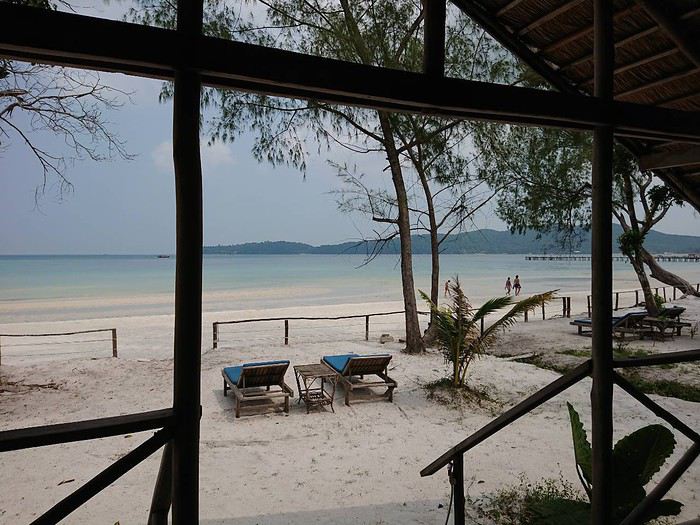
 Il est vrai que le choix est difficile.
Nous sommes en ce moment à Koh Rong Samloen depuis deux jours.
Comme nous adorons ces deux îles, nous y passons tous les ans.
Eau turquoise, soleil, farniente... La vie est parfois difficile !!! 🙄
Quelques photos pour compliquer le choix 😜
Il est vrai que le choix est difficile.
Nous sommes en ce moment à Koh Rong Samloen depuis deux jours.
Comme nous adorons ces deux îles, nous y passons tous les ans.
Eau turquoise, soleil, farniente... La vie est parfois difficile !!! 🙄
Quelques photos pour compliquer le choix 😜