je prévois de faire Salta - San Pedro de Atacama au Chili et je cherche à m'y rendre en passant par Socompa. Salta -Socompa ça a l'air possible par un train de marchandises mais qui peut me dire si on peut rejoindre San Pedro De Atacama depuis Socompa ?
muchas gracias d'avance
Sylvaie
"On ne fait pas un voyage. Le voyage nous fait et nous défait, il nous
invente."
(David Le Breton)
Ce passage est vraiment très reculé. D'après ce que je sais, le train est à peu près la seule option (2 ou 3 par semaine je crois), sauf si tu as du temps pour trouver une bagnole qui passe. Tu ne dis pas quand tu veux y aller (risque de neige en ce moment).
Pourquoi ne passes-tu pas par le Paso de Jama ? La route est beaucoup plus directe et hallucinogène de beauté (mais j'imagine que pour vouloir passer par Socompa tu dois avoir une bonne raison 😉).
En tout cas si tu y vas, tous tes commentaires seront les bienvenus car je projette de grimper le volcan Socompa qui se trouve au pied de la Estacion Socompa.
Dis moi si c'est vraiment un projet qui te tiens à coeur, en ce cas, je tacherai d'avoir des renseignements d'amis argentins de Salta qui connaissent ce coin.
A+
"Old travellers never die, they just smell that way"
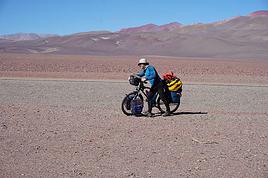
Salut, le paso socompa est tres recule, en decembre 2001, la douane n'a enregistre qu'une vingtaine de personnes en direction de l'argentine. j'ai fait cette piste a velo, pas un seul vehicule en 3 jours ! De plus, la piste est tres mauvaise pendant 100 km, meilleure ensuite. Je crois que le train ne fonctionne plus jusqu'au paso, il y a un train touristique qui part de salta et qui va un peu au dela de san antonio de los cobres. ce train est el treno de las nubes, il y a un site qu'on trouve facilement avec yahoo argentine.
On peut aller du paso a san pedro par le cote chilien, c'est long mais faisable, meme a velo. alors avec un 4*4 ...
Pour monter au volcan socompa, il faut savoir que le col est a 3800 m, le volcan a 6080 m et qu'il n'y a pas d'eau, pas une goutte. Avec beaucoup de chance, il reste peut etre une ou 2 plaques de neige.
t'as l'air d'être la star du formum, normal tu donnes des conseils à tout le monde et c'est très sympa de ta part. merci pour ta réponse d'ailleurs. je pars avec un copain vendredi prochain direction buenos aires et pour ce qui est de relier Salta à San Pedro de Atacama par Socompa je pense qu'on va laisser tomber. on se disait juste que ça devait être beau de traverser la cordillère des andes en train (surtout lui).
c'est pas facile de faire le parcours. tu crois qu'on peut relier San Antonio de los Cobres à Paso Jama ? ou connais tu la route Purmanarca - San Pedro de Atacama, qu'est-ce qui te semble le plus faisable ?
merci pour tes conseils
(j'ai lu rapidement ta fiche, humour certain, qu'est-ce que tu as contre le pastis ?)
A +
sylvie
"On ne fait pas un voyage. Le voyage nous fait et nous défait, il nous
invente."
(David Le Breton)
je pensais avoir fait une réponse perso à Gnome, je me suis plantée. je vous remercie tous les 2 pour vos conseils. comme j'ai pas de 4X4 ni de vélo je vais prendre le bus sans passer par le désert d'atacama.
Sylvie
"On ne fait pas un voyage. Le voyage nous fait et nous défait, il nous
invente."
(David Le Breton)
on peut aller de san antonio de los cobres a san pedro de atacama, il y a une piste. mais quand on rejoint la route qui passe au paso jama, c'est gourdronne cote chilien, je crois que c'est en cours de groudonnement cote argentin, au moins entre susque et la frontiere. sinon, de san antonio de los cobres, on peut aussi aller a san pedro de atacama par le paso sico, il y a quelques collectivos qui font le trajet. le visa touristique chilien s'obtient sans probleme a la frontiere, valable 3 mois, gratuit, sur presentation du passeport valable au moins 6 mois.
salut Alexis, merci bcp pout ta réponse on ne peut plus précise, ces conseils sont d'une grande aide pour moi.
le parcours est bouclé ça y est enfin à J-4.
bonne journée
sylvie
"On ne fait pas un voyage. Le voyage nous fait et nous défait, il nous
invente."
(David Le Breton)
Bonjour à vous, je viens de lire vos infos sur le paso socompa, je vois que vous l'avez fait à vélo il y a quelques années. Nous pensons nous y rendre à vélo dans un mois venant d'antofagasta puis prendre la direction du paso sico pour retourner au Chili. Pourriez-vous me dire s'il y a des villages entre antofagasta et paso socompa ? Facile ou pas de se ravitailler ? Si les pourcentages sont importants ou pas ? Enfin, merci de me donner quelques infos qui pourraient nous aider. A bientot de vous lire. (départ antofagasta-paso socompa-cauchari-paso sico-socaire-san pedro-salar de uyuni)
Voyager, c'est un peu comme peindre un tableau : Les couleurs s'imposent à vous...
Il n'y a pas de village entre Antofagasta et le Paso Socompa. Il y a de l'eau a la Mina Escondida, mais c'est deja haut, aux alentours de 3050 m d'altitude. il y a aussi de l'eau a la frontiere, au Paso Socompa, il y a la douane et le bureau d'immigration. Apres, il n'y a rien jusqu'a Tolar Grande, a 2 jours de velo du Paso Socompa. A Tolar Grande, il y avait 2 petites epiceries il y a 5 ans, lors de mon passage et on a la ville de San Antonio de Los Cobres ou il y a des commerces. Il y a 5 ans, il n'y avait ni l'internet ni de distributeurs de billets et pratiquement pas la possibilite de changer de l'argent, sauf des dollars US au pres de quelques commercants. Par contre, la piste du paso Socompa etait tres mauvaise sur 80 km environ, dont 60 cote argentin.
un peu avant le paso sico, cote argentin, il y avait un petit village, a 60 km de la frontiere. A Socaire, il y a de l'eau et une ou 2 epiceries. San Pedro de Atacama est un gros village, il y a l'internet, des commerces, des hotels et de nombreuses agences de voyages pour explorer la region en 4*4.
Nous sommes passés cet été par le Paso de Sico puis par le Paso de Jama (pas en vélo!)
De mémoire (mais à vérifier) il me semble que le Paso Socompa (par la route) est interdit aux touristes.
La piste du Paso de Sico est très pénible, de la tôle ondulée sur des dizaines de km et les paysages très beaux (mais pas plus que par le Paso de Jama) sont gâchés par une ligne à haute tension du côté argentin de San Antonio de Los Cobres jusqu'à la douane.
Il y a de Salta jusqu'à San Antonio de Los Cobres des dizaines d'énomes camions qui transportent du minerai et soulèvent une poussière terrible!
Nous n'avons pas vu cet été âme humaine entre San Antonio de Los Cobres et Socaire, pas de village, rien sauf des lagunes (peut-être très minéralisées comme souvent dans le coin donc je ne sais pas si c'est buvable) Il doit sans doute être possible d'avoir de l'eau à la douane.
La route du Paso de Jama est parfaite.
Je ne sais pas quand vous comptez y passer mais il arrive que les cols soient fermés en cas de neige.
Pensez aussi qu'en entrant au Chili vous ne devrez pas avoir de produits frais (il faut tout manger à la frontière ou c'est confisqué) donc veillez à avoir "du carburant" pour redescendre sur SPDA.
Pour préparer notre voyage j'avais contacté un certain Sébastian de Salta qui a fait un site super sur toutes ses rando à vélo dans le coin mais l'adresse ne fonctionne plus. Je lui ai envoyé un mail et te tiendrai au courant si j'ai du neuf.
😉 Merci à vous pour ces précisions.
En fait, nous choisirons donc de partir d'antofagasta pour aller jusqu'à socompa
Puis de socompa au col de sico et aller jusqu'à socaire puis san pedro (j'aurai préférer le paso Jama mais il me semble que le manque d'eau serait un problème). Avez vous fait ces parcours à vélo, l'eau est-il un problème, et la nourriture aussi, car dans ce que je lis, il semble qu'il y ait plusieurs jours sans ravitaillement. Et votre avis sur le parcours (en fait de san pedro nous voudrions rejoindre le salar de Uyuni).
Merci de vos réponses précieuses. AMicalement...
Voyager, c'est un peu comme peindre un tableau : Les couleurs s'imposent à vous...
Voici l'adresse du site dont je parle dans mon post précédent.
Il y a parfois des pb de serveur donc il faut réessayer + tard si ça ne fonctionne pas.
http://www.camdipsalta.gov.ar/latitudcero/
Il faut cliquer dans la colonne de gauche sur traversias 2004, 05, 06, 07
Sébastian connait ce coin comme sa poche. Il a fait plusieurs fois à vélo le Sico et le Jama et doit donc connaître les points d'eau...Tu peux le contacter par mail à travers son site. Il parle aussi anglais et est très réactif.
Salut,
je suis egalement interessé aux Socompa, alors bonne nouvelle, que ca sera pas trop dure de St. Pedro, depuis la frontiere il doit etre plus sabloneux et dure.
Quant au Sico, le Sico est parfait en Chili, c'etait mon premier "ripio", mais dès la frontiere c'est plus dure, comme c'est plus sabloneux (il vaut mieux alors de venir de Chili, comme ca decent). Ce ne sont pas plus que 2 vehicules par jour qui passent ce col, parcontre le Jama est bien utilise, il y a de l'eau a Susques et aux Douannes argentines pres de la frontiere, puis a San Pedro. Entre Susques et la Frontiere on passe meme une village de 2 ou trois maisons.
Le Sico a de l'eau a Catua et aux deux stations de la frontiere (douanes argentines et gendarmes chileens, mais c'est l'eau de Catua, puis a Socaire). Cauchari n'est pas plus que deux batiments en ruines. Je ne suis pas passé par Catua, mais par le Salar, mais on dit que la route par Catua serait plus facile. En Chili le Sico est plus joli que le Jama.
Bonne chance et ecrivez quand vous avez fait le Socompa.
Christian
L'an dernier j'avais internet a la frontiere du Jama (j'ai passé la nuit chez les gendarmes argentines) A San Antonio il y maintenant aussi de l'internet, mais c'etait fermé quand je suis passé
😉 Bonjour à vous, merci pour les infos, nous partons pour l'expédition le 25 octobre depuis antafagasta. Je vous donnerai des infos à notre retour en mi-novembre. Amitiés. Gil
Voyager, c'est un peu comme peindre un tableau : Les couleurs s'imposent à vous...
et comment ca allait? J'espere que vous avez bien passé votre voyage. Pour passer la frontiere de Chili a l'Argentine suffit-il de faire les papiers a la frontiere ou es-ce-qu'il est necessaire de faire quelque chose deja a Antofagasta ou a San Pedro?
Bonjour à vous, oui cela fut un voyage à vélo absolument superbe. Nous sommes monté par le paso sico, mais les conditions météo nous ont fait faire demi-tour à la frontière argentine à 4600 mètres d'altitude. En fait, il n'y a aucun problème pour passer la frontière argentine avec un passeport européen. Nous sommes aller en Bolivie sur le salar d'Uyuni, génial à vélo, nous sommes aussi monté à 6000 mètres sur le volcan Ollague. La difficulté, c'est que nous avions des vélos de route pour passer sur des pistes difficiles. Mais les paysages étaient exceptionnels. Vous pouvez aller voir quelques photo dans la rubrique chili sur notre site www.villageboutdumonde.com . A bientot. Gilles
Voyager, c'est un peu comme peindre un tableau : Les couleurs s'imposent à vous...
En Février 2007 je vais passer du Chili en Argentine par la route en C/C. Normalement je vais prendre la 7 pour Mendoza. Questions: que pensez vous de prendre…
Nous partons dans 6 jours en Argentine et avions prévu de passer au Chili (des hôtels sont réservés) avec une voiture de location. Hier, le loueur (Sixt) nous…
En lisant le " Routard "Argentine 2005/2006, page 247, on nous dis qu'avec un véhicule de location, on ne peut pas aller sur le chili et comme depuis Mendoza…
Je crois encore en mon départ fin octobre pour 3 mois en Argentine et Chili avec mon propre véhicule. Je descends le long de ruta 40 en Argentine et remonte…
Hello,
my wife and I will be in Cusco for a week in March 2027.
I’d like to organize the visit to the site on our own, combining the Sacred Valley and Machu Picchu.
We’d leave Cusco on Day 1 to arrive at the site in the morning, then stay in Aguas Calientes or Ollantaytambo, and on Day 2 return to Cusco while visiting the Sacred Valley.
Is this doable?
Looking forward to hearing from you.
Cédric.
Hello,
We’re spending 3 weeks in Rio between February 20 and March 15, 2027, to visit our son and daughter-in-law. We’re thinking of one or two "escapes" from Rio—3-day trips to get away from the city (so not too far, max 3–4 hours by car or bus). We’re all ears for suggestions! We love beautiful nature and authentic experiences, not so much the touristy spots... even though those spots are often in beautiful places, we’d rather avoid them.
Thanks for your insights!
Catherine
Hello,
we’re arriving in Fortaleza on February 14, 2027, and planning to rent a car to drive to João Pessoa in two stages. We’ll leave from there on the 20th or 21st to head to Rio. Our questions:
- Which stop between Fortaleza and João Pessoa would be the most enjoyable?
- How long does it take to drive from Fortaleza to João Pessoa?
- Are there any easy hikes (no guide needed) around João Pessoa?
Thanks for all your replies—I’m hoping for lots!
Catherine
Hi there,
I’m planning a trip with my partner (no kids this time—thanks, Grandma!) for two weeks to celebrate her 40th birthday. I’ve been thinking about Chile. We’re looking at leaving around September 18, 2027, starting in the south and returning in early April.
Here’s what I had in mind:
8 nights in a van in the Lake District and the start of the Carretera Austral (up to the Chaitén area). We’re set to arrive in Puerto Montt around 2:00 PM. We don’t want to go too far south since we’re planning to explore the heart of Patagonia (Chile and Argentina) with the kids when they’re older. The idea is to spend 3 nights discovering the lakes (up to Cochamó) and 3 nights in Pumalín Park. I’ve also added two transition nights.
7 nights in the Atacama to experience another side of Chile (San Pedro), taking a domestic flight from Puerto Montt to Calama in the early afternoon. We’ll depart for France in the early evening from Santiago.
IMPORTANT NOTICE for those planning to take a bus to another city, state, or destination from Salvador!
Starting January 20, 2026, the intercity bus station Rodoviária is changing its address!
The Rodoviária is leaving the Iguatemi area and will now be located in ÁGUAS CLARAS (about twenty kilometers from downtown Salvador).
A brand-new station (the most modern in Brazil) has just been set up there, accessible by car/taxi/Uber/metro.
Allow for much more transfer time (especially during rush hours), so leave early if you're heading to Chapada Diamantina or other Brazilian cities by bus.
Remember, there are also private transfers (even French-speaking ones) that can take you directly from your hotel in Salvador to your hotel in Chapada. Sure, it’ll be more expensive, but you’ll save on transfer time and comfort.
Tropical greetings from Salvador,
@ivanbahiaguide
Loyal member of the French-Speaking Brazil Forums for over 15 years already 😊 🇧🇷
Hello,
We’re thinking of spending 1 month in Chile, maybe doing a loop?
From 12/23 to 01/22.
What are the must-see sights, given we’re more interested in the country’s cultural side than the beaches?
Thanks
Hi everyone,
We're planning a trip to southern Chile in November. Here's our tentative itinerary:
Day 1: Arrival in Santiago, then a flight the next day to Balmaceda where we'll pick up a rental car to reach Coyhaique.
Day 3: Walk in the Coyhaique National Reserve, then continue to Puerto Chacabuco. Return to Coyhaique for the second night.
Day 4: Drive to Villa Cerro Castillo for a hike in the national park. Continue to Puerto Tranquilo and stay there for 3 nights.
Day 5: Boat tour on Laguna San Rafael.
Day 6: Day trip to Monte San Valentin Glacier.
Day 7: Excursion to the Marble Chapels, then drive to Puerto Guadal. We'll stay there for 3 nights.
Day 8: Walk along Lago Carrera and return to Puerto Guadal.
Day 9: Rio Baker Valley and, if possible, a glacier excursion.
Day 10: Drive to Cochrane and hike in Tamango National Reserve. We'll stay 2 nights in Cochrane.
Day 11: Walk in the Chacabuco Valley.
Day 12: Drive to Caleta Tortel. We'll stay there for 2 nights.
Day 13: Cruise in the Rio Baker delta.
Day 14: Return to Cochrane.
Day 15: Return to Balmaceda in two stages.
Day 16: Continue the return journey.
Day 17: Return the rental car and head back to Santiago.
After this, we're also planning to explore northern Santiago. I'll post about that part once I have a clearer idea of the route.
What do you think of this itinerary? Is it doable in 17 days?
Thanks in advance for your tips and recommendations.
martine
Hi everyone! So happy to be back on this forum—it’s packed with such useful info! 🙂 My husband and I are planning a 2.5-week self-drive trip to Colombia at the end of the year, including some domestic flights. My first question is: is it possible, easy, and safe to do a road trip in Colombia?
Below is our draft itinerary (with questions at each stop):
29/11: France → Colombia. Overnight in Bogotá.
30/11: Exploring Bogotá: La Candelaria and Montserrate.
01/12: Gold Museum (closed on Mondays). Drive to Zipaquirá (1.5 hrs) to visit the Salt Cathedral. Then drive to Villa de Leyva (3 hrs). Explore the town. Overnight in Villa de Leyva.
02/12: Return to Bogotá via Laguna de Guatavita (5 hrs). Is it worth the detour? Overnight in Bogotá.
03/12: Flight to Pereira. Drive to Salento. Overnight in Salento.
04/12: Cocora Valley (hike among the wax palms) followed by a drive around the area. Are there any waterfalls or other sights nearby?
05/12: Visit a coffee finca—any recommendations? Then explore the surroundings: Filandia, Manizales, waterfalls? Hot springs? Which ones?
06/12: Flight to Medellín.
07/12: Exploring Medellín: Centro, Plaza Botero, Comuna 13. How do you visit Comuna 13? Is it easy to get around Medellín? Metro? Buses?
08/12: Drive to Guatapé (2 hrs). Visit the town, stroll around the lake, then El Peñol. Overnight in Guatapé.
09/12: Return to Medellín.
10/12: Flight to Santa Marta. Drive to a hotel near Tayrona Park.
11/12: Tayrona—El Zaino entrance.
12/12: Tayrona—Palangana entrance, then Bahia Concha and Santa Marta. What do you think?
13/12: Drive to Minca (45 mins). Can we reach the village by car? Pozo Azul and Marinka waterfalls. Overnight in Minca (or back in Tayrona?).
14/12: Drive to Puerto Nao (5 hrs). Stop in Ciénaga on the way + boat tour in Nueva Venecia and/or Buena Vista? Not enough time? Overnight in Puerto Nao.
15/12: Exploring Cartagena: Centro, Getsemaní, the walls + La Boquilla if we have time.
16/12: La Boquilla (is it really worth it?) if we didn’t have time yesterday, then back to the beach.
17/12: Return to France.
So, what do you think? Is this doable, or should we tweak it? Thanks in advance for your invaluable feedback and tips! 🙂
Hi there, I’ll be in Brazil from December 10th to the end of February.
I’ve sketched out a rough itinerary but I’m not sure how to arrange it—considering the climate, year-end holidays, and Carnival.
Basically, I’m thinking of the Amazon, the Northeast coast with Lençóis Maranhenses National Park (but skipping Chapada Diamantina),
Ouro Preto, Paraty, and Ilha Grande—but no Rio visit.
Is this doable in 3 months?
Which direction should I take for this itinerary?
Thanks in advance!
Hi everyone, does anyone know the agency Ventura Travel Agency (not ventura travel)? After lots of research and quotes, it’s the only one offering Uyuni at a reasonable price while meeting all the criteria: transfer to the border, private-room accommodation, and a very fair rate. Other agencies or guides either offer shared rooms, no border transfer, or prices that are way too high. But I’d love to hear some reviews about this agency. Thanks in advance!
Hi everyone,
We're planning a trip to Chile to visit the Atacama Desert and then head toward Putre, Lauca, Salar de Surire, etc.
Which would be the better time to go, April or November?
Is an SUV enough?
Looking forward to your tips!
Hi everyone, French travelers in Chile—what credit cards do you use for your various car rentals in the country? I’m traveling in September and was planning to switch my regular debit card (a VISA PREMIER in deferred debit mode) for the deposit guarantee.
My rentals are with Figal in Punta Arenas, Econautos in Arica, and Chilean Rent a Car in Temuco, and all of them want the deposit on a credit card. For me, deferred debit *should* work, but I’ve read comments saying the opposite.
How’s it actually working on the ground with these rental companies right now? Will a deferred debit card work, or not at all?
In France, banks don’t issue credit cards, right—or am I mistaken?
Hi everyone, is it still possible to travel in Ecuador outside the Amazon region? If so, do you have a reliable agency to recommend? All your recent experiences from the past few months would be greatly appreciated. Thanks so much
Hi,
We’re heading to Buenos Aires for 3 days in November and would like to do a guided tour of a few neighborhoods. There are "free" tours, but none in French. Does anyone have a guide to recommend so we can really get to know the city beyond just the architecture?
Thanks
Hi there,
I’m desperately looking for info on the schedules and routes of (shared) boats to visit the islands of Lake Titicaca.
From what I’ve found, there’s a *combi* (bus) that leaves from Puno to go to Llachon. Where do you catch it? What are the schedules and frequency? Does it take about 1 hour?
Then in Llachon, you can take a boat to Amantani (45 min). Same question—where do you check for frequency and schedule?
After that, from Amantani, boats go to Taquile and then Uros. Do you have enough time to visit the islands between two boats? Frequency and schedule?
The goal is to do this tour independently (no agency) over 2 days. Thanks for any tips you might have!
I just got back from a trip to Bolivia and wow—what a wake-up call. It’s not the easiest country, but it’s absolutely stunning.
I started with Isla del Sol, perfect for easing into the altitude at a relaxed pace. Try to stay in the northern part of the island—it’s quieter and the views are insane. And the trout there? Unreal. Quick tip: bring cash in small bills; they almost never have change, and cards are rarely accepted.
Next up, La Paz. The city’s pretty wild, built in every direction. I did a few hikes in the area, including the famous Charquini Lagoon (the blue lake) at over 5,000 m—let’s just say I struggled 😅 but it was so beautiful it was totally worth it.
After that, I headed to Sajama. It’s cool, especially for the hot springs, and I stayed in Tomarapi. But honestly, if you’re short on time, you can skip it without too many regrets.
The highlight of the trip: the Salar. I did it starting from Tupiza, and I *highly* recommend going Tupiza → Uyuni. Way less crowded at the start and the landscapes are super varied. For the tour, I used SplitYourGuide to find a group, and it worked out great. Super handy for splitting costs and meeting people.
I wrapped up in Sucre—this city is gorgeous, all white, with such a chill vibe. And the salteñas + ice cream? Next level 😋
Bottom line: Bolivia’s a bit rough around the edges, sometimes exhausting (shoutout to the altitude), but it’s 1000% worth it.
If you’ve got questions or need tips, I’m happy to help!
Martin
I was planning to go to Réunion and stay in half-board accommodation with non-professionals, but it seems that’s not really the custom there—or maybe my budget isn’t big enough.
So, since I’ve already traveled around Ecuador and Peru, I’m now looking at Argentina, especially for its mountains (like the ones in Réunion that tempted me, even though—frustratingly—I could only admire them from below).
I plan to get around by bus and don’t know in advance where I’ll sleep, so I won’t book ahead. If I like a place, I might stay for several days.
I know that in Chile, it’s easy to find half-board accommodation, but what about in Argentina?
I’d like to stay with locals in half-board without it being a professional setup. I’m not sure if this is common practice there. It’s up to me to find someone willing to host me.
What do you think?
What would be a fair price (keeping in mind that 40 to 50 € is the max I can spend on accommodation, breakfast, and dinner)?
Hi everyone,
We’re heading to Patagonia for three weeks in November, starting from Coyhaique in Chile.
We won’t have a car, and I’m struggling to find information about transportation options for a few parts of the itinerary we’d like to do:
1) From Perito Moreno (the town, near Los Antiguos), we’d like to travel down Ruta 40 to visit Perito Moreno National Park and then cross into Chile via the Paso Roballos (at the latitude of Bajo Caracoles) to reach the road to Cochrane. Without a car, it seems we’ll need to use private agencies to get to the national park—do you have any recommendations or suggestions? Also, does anyone know if it’s possible to cross into Chile via Paso Roballos (from Bajo Caracoles) without a rental car? That is, without having to go all the way down to El Chaltén or back up toward Perito Moreno/Los Antiguos, etc.?
2) The second stretch that seems a bit tricky (though still easier, in theory) is from Caleta Tortel to Villa O’Higgins on the Chilean side. Do we have to go back through Cochrane, or are there ways to get directly from Tortel to Villa O’Higgins?
3) Finally, we’d like to hike into Argentina (El Chaltén) from O’Higgins. Any recommendations for this? Do we need to go through an agency? What’s the estimated duration of the trek?
As you’ve probably gathered, we want to visit some off-the-beaten-path spots but don’t have a car, so we’re looking for the best possible compromises.
Thanks so much in advance for all your suggestions!
Thomas
Hi,
we’re planning a round trip from San Pedro de Atacama, Chile, to Salta, Argentina, in two months. On the way there, we’ll take the northern route via Susques, Route 27, then 52. But for the return, we were thinking of taking the southern route via San Antonio de los Cobres, Route 51, then 23. Is it similar to the northern route in terms of road surface? How busy is it, and are there gas stations? Basically, should we be worried about doing it in an SUV that’s supposedly 4x4 but has regular road tires and no second spare wheel, obviously...
I’ve seen that we can stop over in San Antonio de los Cobres.
Thanks for your feedback.
Raf.
Hi,
we’ll be in Calama at the end of March 2026, and I’m looking for a reliable car rental there for a 7-day road trip to Salta, Argentina. But I’m struggling with the car rental agencies in Calama because the reviews can be scary. I saw Gyg, which has great ratings, but I’m a bit wary (5/5 from 59 reviews—either the guy’s amazing or it’s fake...), but I can’t find any recent reviews on VF in general.
For Punta Arenas, I booked with Dachelet and didn’t have any issues with email exchanges.
Thanks in advance.
Raf.
I’m planning the trip of my dreams for next November—Chile!
I’d love to get your thoughts on my potential itinerary. I know it’s a big investment in terms of both time and money, so every bit of feedback, suggestion, or info helps immensely. Thank you in advance!!
1-Flight to Santiago
2-Explore Santiago
3-Explore Santiago
4-Bus from STG to Valpo (2h) + visit Valparaíso + night in Viña
5-Visit Valparaíso + bus back to STG (2h)
6-Flight to Calama + bus to San Pedro + explore and acclimate in San Pedro + car rental in the afternoon (+Chaxa?)
7-(Very early) Valle del Arcoíris + Laguna Cejar + Valle de la Luna
Good evening,
We’d love to go in November to enjoy some beautiful beaches for about two weeks, preferably around Bahia, as November/December seems like a great time.
We’ve already traveled to Brazil several times and know the south of Rio as well as the region between São Luís and Fortaleza, and Chapada Diamantina...
What advice would you give us: the south with Itaparica, Morro de São Paulo, Boipeba, Barra Grande—or all four? Or maybe the north?
Thanks in advance for your help
Hi everyone, it’s been a while since I last posted!
First time in South America for me, my wife, and our 7-year-old son. I’ve put together this itinerary and would love to hear your thoughts:
Bogotá 28/07 – 30/07: Arrival. Which neighborhood and outings would you recommend?
Flight to
2 Filandia 30/07 – 03/08: (255 €). Waterfalls and horseback riding,
Cocora Valley,
Hiking,
Nearby villages.
Flight to
3 Tayrona 03/08 – 07/08: Hotel La Casablanca
Hike with Tierra Nevada and the Kogui village (any feedback?). Return by inner tube for the little one.
Short night hike.
Second hike to La Piscina, etc., return by 🐎.
4 Cartagena 07/08 – 10/08: Air-conditioned bus.
Staying in Getsemaní? Mangroves & the Castle, exploring the city.
5 Bogotá 10/08 – 12/08
Feel free to share your feedback!
Have a great day!
Hi,
During an upcoming trip to Peru, we’ll have one day to explore around Arequipa (excluding Colca Canyon) with a car and driver.
We’ve got a few options:
- Toro Muerto petroglyphs and dinosaur footprints at Querulpa
- Ruta del Sillar and Quebrada de Culebrillas
We’re a group of 6 friends with an average age of 70, all mobile, and we’re planning a trip to Peru in September/October 2026. Below is an idea of what we’re looking for: a French-speaking guide, accommodation in 3-star hotels or homestays with comfort.
Duration: 16 to 20 days on-site.
Visit the main sites with immersion in the culture and way of life.
Which francophone agency in Peru would you recommend? Thanks
Hi there!
I’m putting together my itinerary for Brazil, looking for beautiful natural spots with wildlife, flora, and great hikes...
I’ve come across the Cananeia / Super Agui / Ilha do Mel region and the PETAR / Intervales / Alto Ribeira area.
Has anyone here been to these places? If so, do you have any recommendations for accommodations and activities?
Thanks in advance!
Best,
Olivier 🌍
I’ll be in ARICA in northern Chile at the end of May 2026 and want to get to TACNA.
Are there taxis, buses, or collectivos that run the border crossing route?
After that, bus to AREQUIPA (Peru): any bus company you’d recommend?
Hi there,
We’re spending 3 weeks in Brazil, arriving in São Paulo—a couple plus a teen—and we’ll have a rental car.
We especially love nature: hiking, wildlife watching, birds, etc.
We’re planning to wrap up with a week around Paraty and Ilha Grande.
We’re not really into visiting big cities like São Paulo or Rio unless you think we’d be missing out big time.
So we’ve got 2 weeks to explore the south/southwest region of São Paulo.
What do you recommend?
National parks? Off-the-beaten-path nature spots? Iguazu Falls?