Hi there,
We’re heading to Québec from July 7 to 24, 2025, and we’d love some advice on our itinerary. We’re flying in and out of Montréal and want to visit Montréal, Québec City, Parc de la Gaspésie, and the Saguenay Fjord. What do you think would be the best route to make the most of these spots without racking up too many kilometers each day?
Thanks in advance for your help!
Catherine
1,414 similar discussions in English
Who are you? Where are you from? Where are you going?
Like last year at this time, a post about bike travel ideas.
How many of us are preparing a trip planned for this year? Probably a lot.
What’s yours—the one you’ve been dying to do for so long, maybe too long? For us, it’s a modest PARIS-MARATHON by bike, followed by MARATHON-ATHENS on foot in June 2010. And you?
May the passion keep growing before, during, and after! Happy planning and safe travels to everyone.
Hi everyone.
We’re taking a 15-day RV trip, Montreal to Quebec City loop. Late September to early October 2025. I was wondering if it’s easy to find spots for the RV at that time, and if we absolutely have to book RV campground sites in advance? Also, if you’ve got any great places to park and stay, we’d love your recommendations… thanks so much!
Hello! 🙂
In 2017, struck by western addiction, our first road trip gave us an irresistible urge to return, which we did from September 2nd to 24th, 2019, on a loop from Denver to Denver via Yellowstone. The westernmost point of this journey, which took us through the geographical center of the USA, brought us within about a hundred kilometers of Moab, which had been the easternmost point of our last trip.
We’ve been back for over a month now, and I realize I’m starting to forget some details—it’s high time I started my travel journal before my brain turns into Swiss cheese and lets everything slip away. As I mentioned in my last story, it’ll take me quite a while to finish, so if any travelers have specific questions, don’t hesitate to message me privately. Once again, I’d like to thank everyone who helped me (and there were many!) prepare our road trip, with a special shout-out to Disneydiddl, Hiacinthe, and Titou (ladies first) as well as Fred and Itat, whom I bombarded with questions for months and who always kindly and patiently gave me tons of great tips. It’s thanks to all of you that this trip was such a success. I was a little worried I wouldn’t recapture the emotion and enthusiasm of our 2017 trip, but this one was just as "Wow" as the last.
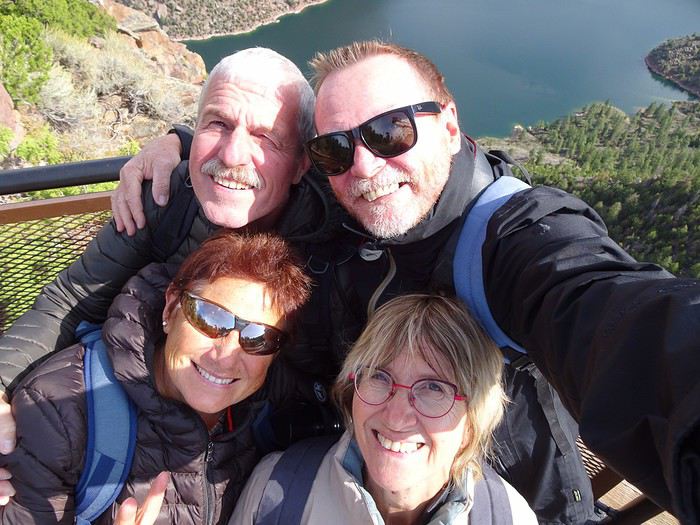
For those who don’t know us, let me introduce our little group. We’re four friends in our sixties (this time, everyone made it, which let us score some "senior" discounts...). We live in the Var region, have known each other for over 20 years, and this was our second trip together to this magical West.
Mimi (Michèle): always the smallest and the funniest. Thank goodness she was there to speak English! Maumau (Maurice): her husband, always with his white hair, his Gallic mustache, his humor, and his Southern accent. He drove every other day. DD (André): the one with the beard, with whom I celebrated our 41st wedding anniversary at Yellowstone. Our second driver appreciated having a peaceful mind since he’s been retired since July. Marcalamar (Martine): that’s me—still blonde with glasses, still talking a lot, and still terrified of messing up the organization of this trip despite all the hours spent on the forum.
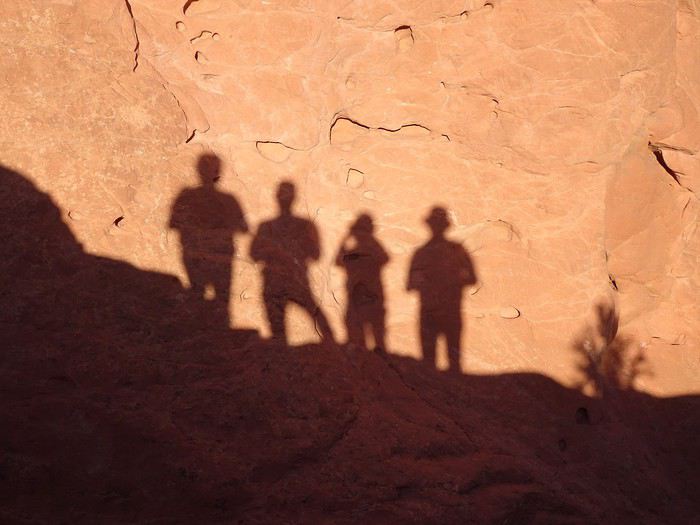 Recognize us? Ha ha ha!!!! No, just kidding!!!!
That’s us!!!
In 2017, struck by western addiction, our first road trip gave us an irresistible urge to return, which we did from September 2nd to 24th, 2019, on a loop from Denver to Denver via Yellowstone. The westernmost point of this journey, which took us through the geographical center of the USA, brought us within about a hundred kilometers of Moab, which had been the easternmost point of our last trip.
We’ve been back for over a month now, and I realize I’m starting to forget some details—it’s high time I started my travel journal before my brain turns into Swiss cheese and lets everything slip away. As I mentioned in my last story, it’ll take me quite a while to finish, so if any travelers have specific questions, don’t hesitate to message me privately. Once again, I’d like to thank everyone who helped me (and there were many!) prepare our road trip, with a special shout-out to Disneydiddl, Hiacinthe, and Titou (ladies first) as well as Fred and Itat, whom I bombarded with questions for months and who always kindly and patiently gave me tons of great tips. It’s thanks to all of you that this trip was such a success. I was a little worried I wouldn’t recapture the emotion and enthusiasm of our 2017 trip, but this one was just as "Wow" as the last.
For those who don’t know us, let me introduce our little group. We’re four friends in our sixties (this time, everyone made it, which let us score some "senior" discounts...). We live in the Var region, have known each other for over 20 years, and this was our second trip together to this magical West.
Mimi (Michèle): always the smallest and the funniest. Thank goodness she was there to speak English! Maumau (Maurice): her husband, always with his white hair, his Gallic mustache, his humor, and his Southern accent. He drove every other day. DD (André): the one with the beard, with whom I celebrated our 41st wedding anniversary at Yellowstone. Our second driver appreciated having a peaceful mind since he’s been retired since July. Marcalamar (Martine): that’s me—still blonde with glasses, still talking a lot, and still terrified of messing up the organization of this trip despite all the hours spent on the forum.
Recognize us? Ha ha ha!!!! No, just kidding!!!!
That’s us!!!Why bike (MTB) along the canal between the Two Seas: the lateral canal of the Garonne from Bordeaux to Toulouse, and the Midi Canal from Toulouse to the Mediterranean?
This canal was created to connect the Mediterranean to the Atlantic without going around Spain, and along its entire length, there’s an old towpath (used to pull barges). Since this path is closed to traffic (except for service vehicles from Voies Navigables de France), no cars drive on it—it’s dangerous, noisy, and polluting. The Canal between the Two Seas was built for transporting goods, so it passes through many towns you can explore without dealing with traffic. You can stock up on supplies or spend the night. You’ll discover the varied landscapes of the countryside, always in the serenity brought by the calm and slow flow of the canal’s water. Most of the time, you’ll be in the shade of trees planted to stabilize the banks with their roots. All you have to do is follow this blue—or rather green—ribbon without needing to consult a map. But the biggest advantage is that it’s flat! Of course, on the Canal du Midi, water flows from the watershed divide at Naurouze eastward to the Mediterranean and westward to Toulouse. On the lateral canal of the Garonne, water flows toward Bordeaux. But this slope is almost imperceptible, which is a huge plus when you want to travel by bike for several days with luggage.
When I say "bike," I really mean MTB because, while the towpath has been replaced in some places by a paved bike path, it mostly resembles a dirt trail—sometimes smooth, sometimes rocky, and often cluttered with roots from the magnificent trees lining it. Since the canal was classified as a UNESCO World Heritage site, improvements have been underway, but it won’t be tomorrow that you’ll be able to ride from Bordeaux to Sète on a road bike. And I’m afraid the first sections of the path will be worn out before the rest is finished. You might even run into construction work for this bike path. That’s what happened to me during the spring of 2007.
Sunday, 03/11 – Valence d'Agen 08:15 to Toulouse (Rangueil) 16:30 97 km in 8h15 (6h on the bike) I started on the recently paved path along the lateral canal of the Garonne. The first locks appeared, and as I approached Moissac, the path turned into a billiard table until Castelsarrasin. After the Cousteau port, I was back on the classic dirt towpath with its rocks, roots, and nutria holes. But not for long—soon, I hit ruts left by backhoes and bulldozers, which, fortunately, were resting for the Sunday. A pile of rubble taller than me blocked the entire width of the path. I didn’t want to turn back to find the previous bridge and ride on the other bank, which was just as impassable (dense grass). It wasn’t easy to carry a bike with full panniers, so I lifted it over several mounds. I kept going, sometimes on foot, unsure how far the construction extended. Another bulldozer—luckily, the ground was dry. The work went all the way to Montech, making the path impassable. I recommend taking the N113, which runs parallel (that’s what I did on the way back). In Montech, the famous water slope was at rest, waiting for tourists. For many kilometers, I was back on the traditional towpath. The closer I got to Toulouse, the better the surface became, and the more cyclists and pedestrians I saw—until the city center, where there was nonstop bike traffic, especially students heading to Rangueil.
Monday, 03/12 – Rangueil 09:10 to Revel 16:30 86 km in 7h20 (5h30 on the bike) As soon as you reach Toulouse, you make a 90° turn to follow the connection between the lateral canal and the Canal du Midi. Heading east, you pass the barge selling the famous Toulouse violet souvenirs. A real bike path has been built for 50 km to Port Lauragais. It’s a true joy for Toulousains and travelers. Restrooms have been installed or shared with highway rest areas, allowing you to refill water (of course, bikes are banned from ASF rest areas, but cleverly placed racks let you secure your bike and walk in). At Port Lauragais, it’s another rest area shared by highway users, cyclists, and boaters. You’ll find a cafeteria, restaurant, hotel, and a shop selling regional souvenirs. But the real pleasure is reaching the watershed divide at Naurouze, where water flows toward the Mediterranean on one side and the Atlantic on the other. There, I decided to leave the Canal du Midi, which continues toward Castelnaudary with a much rougher towpath, to follow the *Rigole* that feeds the canal with water from the Saint-Ferréol basin. For me, it was like returning to the source—a bit like a pilgrimage in honor of the brilliant Pierre-Paul Riquet, the designer of this magnificent work. I followed the service trail along the *Rigole*. It’s actually a variant of the GR 653, leading to Revel alongside this artificial waterway. It’s fed by water from the Montagne Noire, and I was worried about a steep climb. But that wasn’t the case—the *Rigole* winds for 40 km, flowing gently under the trees. It was better than a dream: a smooth dirt path with the crunch of pine needles under the wheels, where I only crossed paths with a few fishermen... And to soothe sore buns, the last kilometers were on packed earth—a paradise (ATVs, stay away!). More walkers and cyclists appeared there.
Tuesday, 03/13 After a restful night in Revel, I started the morning with a walk around Lake Saint-Ferréol. A very pleasant 10 km hike, but I don’t recommend it for mountain bikers unless you’re used to mountain terrain and have strong calves. Otherwise, you can take the road—there are at least two hotels near the lake. In the afternoon, I began the return trip to Tarn-et-Garonne via the same path, with the same pleasure.
Total: 378 km of suffering and bliss, for which I must thank the departmental and regional councils for their funding, Voies Navigables de France for maintenance, and the volunteers who mark the hiking trails. And don’t you think you’re exaggerating a bit with your 378 km of bliss and the paradise of the *Rigole*?
Okay, fine—it wasn’t always idyllic. Sometimes the path was downright *pierrique*... but I had great weather, and the landscapes were so beautiful (water, sun, vegetation). In the rain or mud, it would’ve been less fun. What does *pierrique* even mean?
*Pierrique* is worse than rocky. I know a Pierrick, and he’s tough. And why *Facteur4*?
It’s France’s goal to reduce greenhouse gas emissions by a factor of 4 by 2050. I’m doing my part by biking to work 3 out of 4 times. And your cassoulet?
Guilty as charged. I ate the best cassoulet of my life at the Hôtel du Midi in Revel. But it was very productive in methane. My stomach hurt so much I couldn’t sleep and ended up writing my postcards between 3 and 4 AM. So many great memories!
Hi there,
I know these aren’t the most popular destinations on the forum, but I thought I’d give it a shot.
I’d love to do a road trip loop next April, and I really want to visit Nashville and Memphis first.
Browsing the forum, I saw that Atlanta / Memphis / Nashville / Charlotte / Charleston / Savannah / Atlanta might be a good route. But I’m only planning to go for 14 days, and it seems like that might be too much. What do you think?
I mostly want to enjoy the music scene in the area and pass through the Smoky Mountains. I know I won’t have much time to stop for hiking, but oh well...
I’m saving Louisiana and New Orleans for another trip.
Thanks to anyone who can help me map out my route and make the most of this part of the U.S. that I don’t know at all yet.
Hello,
I’m looking for your help planning a 3-week road trip from mid-September to early October starting in Montréal.
We’d like to explore part of Québec and the Gaspésie, and we’re intentionally starting with the Gaspésie because if we leave it for the end (early October), the weather might be less favorable and a lot of places will already be closed. I’ve also read that the fall colors are more beautiful in the Mauricie and Laurentides regions toward the end of our trip (early October).
Here’s the itinerary we’ve come up with:
Montréal (arrival and departure airport) -> Québec City -> Charlevoix -> Crossing the St. Lawrence River from St-Siméon to Rivière-du-Loup -> Rimouski and Parc du Bic -> Gaspésie along the coast (Matapedia, Percé, Bonaventure Island, Gaspé, Forillon Park) -> Crossing the St. Lawrence River from Matane to Baie-Comeau -> Tadoussac to Lac Saint-Jean via the route along the Saguenay River -> Return to Montréal via La Tuque, crossing the Laurentides and Mauricie Park
This is our first time in Canada, so don’t hesitate to be critical (I won’t take it badly ;)), if the route seems too ambitious (we know there’ll be a lot of driving!) or if it’s better to skip some stops that aren’t must-sees.
Thanks so much for your help.
hi everyone,
my flight’s all booked (Sept 19–Oct 4), with 1.5 days in Montreal + 1.5 days in Quebec City...
then I’ve got 11 days starting from Quebec City for a road trip—what route do you recommend?
(I’ve seen these stops come up a lot: Parc Omega, Charlevoix, Tadoussac, Bas-Saint-Laurent, Saguenay, Parc de la Gaspésie, Parc Forillon, Mauricie...)
The idea is no more than 2–3 hours of driving per day on average.
I’m traveling solo :-( (if you’re in the area around the same dates, hit me up!)
45 years old, I love sports (so I’m hoping to do hikes, kayaking, and other activities, see whales...discover beautiful landscapes). I’m not sure if there are any events in the area during those dates, but I’d also like to meet some people...
Thanks in advance for your tips!
hi everyone
I’ll go ahead and restart the cruise calendar for 2025 for now.
It can give people ideas and might help members meet up!
Two essential rules: don’t “quote” the calendar when replying—this’ll avoid any confusion and if you can, list your cruise in this example format: enter the month first, then date /username / SHIP / number of days / destination / departure port
FEBRUARY
14/02- poupou10 / CELEBRITY INFINITY /11 days / Greece Turkey Cyprus / Piraeus (Athens) AUGUST 01/08- poupou10 / REGAL PRINCESS /13 days / British Isles / Southampton YOUR TURN 😉 NUMBER OF CRUISES 2025: 2 JANUARY FEBRUARY 14/02- poupou10 / CELEBRITY INFINITY /11 days / Greece Turkey Cyprus / Piraeus (Athens) MARCH APRIL MAY JUNE JULY AUGUST 01/08- poupou10 / REGAL PRINCESS /13 days / British Isles / Southampton SEPTEMBER OCTOBER NOVEMBER DECEMBER
Well, since the lockdown is dragging on, I’m starting a new travel journal following the one I finished publishing yesterday:
https://voyageforum.com/discussion/voyage-pays-perles-voyage-dans-ouest-americain-d9943984/
This time, after the U.S., we’re heading to the Middle East—Jordan!
And we’re keeping up the good habits: one day’s entry published every day at 5:30 PM! Happy reading, and feel free to leave a comment, question, or remark...
Franck
Franck
Hi everyone,
I’ve got 2 weeks of vacation to take (around Sept 15–Oct 10 max).
I’m thinking of Canada since I’ve never been, to see the beautiful fall colors, mix in some sports activities (hiking or others), and a bit of city exploration...
Traveling solo, backpacker style (youth hostels), renting a car/van or using buses... (whichever is most cost-effective and practical).
Which area would you recommend?
For arrival, I can fly into Montreal, Quebec City, or Toronto at the cheapest fares.
What itinerary (big picture) or activities would you suggest? Or maybe you’d advise against it? ))
Thanks in advance!
For arrival, I can fly into Montreal, Quebec City, or Toronto at the cheapest fares.
What itinerary (big picture) or activities would you suggest? Or maybe you’d advise against it? ))
Thanks in advance!
Hi there, I live in Quebec and I’m planning a trip to Italy. We’re thinking of visiting Rome, Florence, Venice, and Tuscany. Here are a few questions I haven’t been able to find clear answers to online. If anyone can help, I’d really appreciate it—thanks in advance!
- There are different City Passes for Rome. I’ve found the differences between them, but whenever I try to simulate a purchase, I’m always redirected to another site like Tiquet. Is there an official Tourism Office website for these?
- Is it easy to get around Tuscany by public transport, especially in the Chianti region?
- For guided tours (or not), which company do you prefer? Get Your Guide? Viator?
Looking forward to your recommendations—thanks again!
Planning a trip to Italy in October. I’d love to hear about your experiences. Thanks!
Hi everyone,
I’m planning a trip to Canada this fall. I have 19 days total. The trip will start in Quebec, then continue to Gaspésie, New Brunswick, and finally Nova Scotia. I’ve already mapped out my itinerary, and it only leaves me with 3 days (including the departure day) in Nova Scotia. We’ll be flying out of Halifax for the return. That’s really not much time—just enough to see Halifax and the surrounding area.
I’d love to hear your thoughts: would it be better to cut some days from Gaspésie or New Brunswick to have more time in Nova Scotia? Do you think I’d be missing out by not spending more time in the region?
Thanks in advance to anyone who’s visited these parts and takes the time to reply.
Great news that the forum is back—we’ve been waiting for this for ages! Now we can chat again with the die-hards like Claudio, Luc Bertand, and everyone else...
Voyager à vélo
Hi there,
We’re flying from Montreal to Lyon this August to go hiking in the French Alps. We’ve rented a car and will be staying at campgrounds. We’re planning to do day hikes and want to stay a few days in one spot, do a few hikes, then move on to our next camping spot. Could you share your favorite spots or any recommendations for places to spend a few days with great hikes?
A few details: We arrive in early August and leave in early September. We’re looking for day hikes (or shorter), moderate difficulty, with a cumulative elevation gain of no more than 1000m, and of course, beautiful scenery! We’d prefer not to drive too much—maybe it’s best not to head too far south and deal with unnecessary heat? Along the same lines, if you know of any great campgrounds where we can start our hike directly without needing the car, we’d love to hear your suggestions!
Thanks! :-)
Hi everyone!!!
I’m finally getting around to writing about this 20-day trip to southern Italy: we didn’t travel this summer, and luckily, we found beautiful light and dreamy weather there at the end of September.
First, here’s the context of the trip: we’re both "confirmed seniors" but still curious and alert enough to enjoy the itinerary we’d imagined! We wanted a mix of discoveries—culture, cities, and nature—with guaranteed sunshine and the occasional short hike... We’re flying to Naples, round-trip, because the flight times work better for us. We rented a car online, picked it up at the airport (details to come... and it won’t be the highlight of the trip!), and booked our hotels in advance.
A quick overview of the itinerary: leaving Naples on September 15th, early in the morning, we’ll drive straight across the boot of Italy to Bari. After 11 days in Puglia, we’ll head back toward our starting point, taking our time: Matera in Basilicata, Maratea by the sea, and finally Paestum with its incredible temples.
Day 1: Brussels-Naples flight (Brussels Airlines) went smoothly; it landed an hour early, and we were thrilled, thinking we could use that time for a quick visit or two... Everything went well until we left the airport. We took the shuttle to the car rental offices, and at first glance, we realized this wouldn’t be smooth sailing!!! In front of every office (they’re side by side), there were already lines and kids sitting on suitcases—everyone looked exhausted... We resigned ourselves to waiting: nothing moved until tempers flared at the counters, and two people nearly came to blows. Things sped up a little, and after 2 (two...) hours of waiting, we finally got our chariot: a black Fiat Tipo, dirty, with a few dents and scratches that we made sure to note in the contract... but it ran!
Off to Bari, then: no time for sightseeing along the way! From there, we headed straight to our hotel in the countryside near Polignano a Mare.
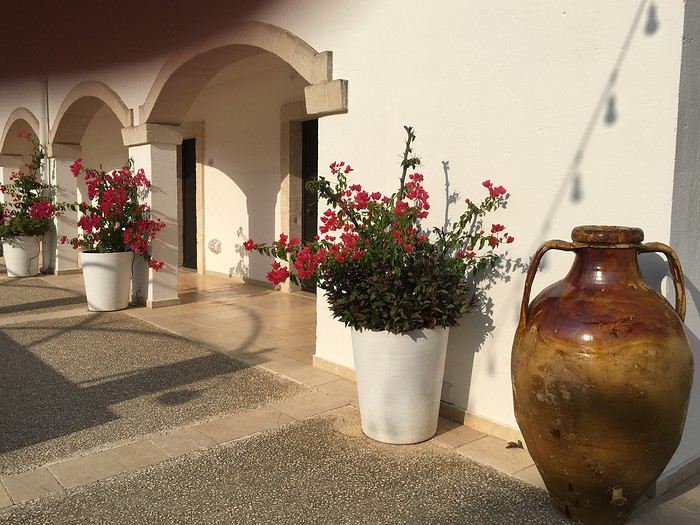
A recurring detail: this happened constantly during our travels. We’d installed our own GPS, fully updated... In recent years, many dirt roads have become drivable, and lots of hotels and hostels have opened in the outskirts of towns. It was extremely rare for our ‘guide’ to recognize the street—let alone the number—we entered. Often, we got by calling the hotel reception: it might seem like a small thing, but it happened so often it became frustrating. In hindsight, it seems like without Google Maps, we’d have been lost!
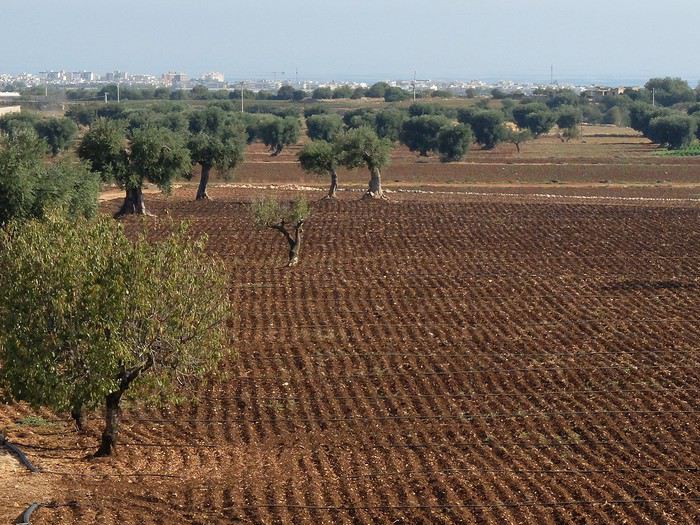
Anyway, we were beautifully settled, with a terrace overlooking olive groves and the sea in the distance: all was well.
To be continued...
I’m finally getting around to writing about this 20-day trip to southern Italy: we didn’t travel this summer, and luckily, we found beautiful light and dreamy weather there at the end of September.
First, here’s the context of the trip: we’re both "confirmed seniors" but still curious and alert enough to enjoy the itinerary we’d imagined! We wanted a mix of discoveries—culture, cities, and nature—with guaranteed sunshine and the occasional short hike... We’re flying to Naples, round-trip, because the flight times work better for us. We rented a car online, picked it up at the airport (details to come... and it won’t be the highlight of the trip!), and booked our hotels in advance.
A quick overview of the itinerary: leaving Naples on September 15th, early in the morning, we’ll drive straight across the boot of Italy to Bari. After 11 days in Puglia, we’ll head back toward our starting point, taking our time: Matera in Basilicata, Maratea by the sea, and finally Paestum with its incredible temples.
Day 1: Brussels-Naples flight (Brussels Airlines) went smoothly; it landed an hour early, and we were thrilled, thinking we could use that time for a quick visit or two... Everything went well until we left the airport. We took the shuttle to the car rental offices, and at first glance, we realized this wouldn’t be smooth sailing!!! In front of every office (they’re side by side), there were already lines and kids sitting on suitcases—everyone looked exhausted... We resigned ourselves to waiting: nothing moved until tempers flared at the counters, and two people nearly came to blows. Things sped up a little, and after 2 (two...) hours of waiting, we finally got our chariot: a black Fiat Tipo, dirty, with a few dents and scratches that we made sure to note in the contract... but it ran!
Off to Bari, then: no time for sightseeing along the way! From there, we headed straight to our hotel in the countryside near Polignano a Mare.
A recurring detail: this happened constantly during our travels. We’d installed our own GPS, fully updated... In recent years, many dirt roads have become drivable, and lots of hotels and hostels have opened in the outskirts of towns. It was extremely rare for our ‘guide’ to recognize the street—let alone the number—we entered. Often, we got by calling the hotel reception: it might seem like a small thing, but it happened so often it became frustrating. In hindsight, it seems like without Google Maps, we’d have been lost!
Anyway, we were beautifully settled, with a terrace overlooking olive groves and the sea in the distance: all was well.
To be continued...
After exploring Dawson City, the final stop on our incredible road trip to the Yukon (see travel journal), it was time to head back to Quebec.
Instead of returning directly, we took advantage of this cross-country drive to make several stops in British Columbia and Alberta.
This part of the trip allowed us to discover some of the most beautiful attractions in Western Canada, from breathtaking landscapes to iconic natural sites that are must-sees in Canada.
Between majestic mountains, turquoise lakes, and jaw-dropping panoramas, every stop added a memorable touch to this already exceptional adventure.
A wonderful way to wrap up this journey across Canada while fully enjoying the richness and diversity of its vast landscapes.
In the upcoming posts, you’ll discover the highlights that marked our journey through Western Canada.
I invite you to watch the associated videos to fully experience the atmosphere, landscapes, and attractions we were lucky enough to explore.
To navigate to a specific post, here are the appropriate links:
Adventure on the Alaska Highway: Bald Eagles, Bison & Moose Adventure on the Alaska Highway: Bison, Caribou & Bears Yellowhead Highway (Alberta): Roche Miette, Jasper Lake & Emerald Pond Maligne Lake Road (Jasper) | Moose and Elk Exploring Mount Robson Provincial Park (BC) Must-Sees on the Icefields Parkway - Alberta David Thompson Highway11 (AB): A Stunning Scenic Route What to See in Yoho National Park (BC) Johnston Canyon: Hike to the Lower & Upper Falls Iconic Sites of East Kootenay, BC Lundbreck Falls - A Spectacular Waterfall in Southern Alberta Trails of Red Rock Canyon & Blakiston Falls - Waterton Waterton Village Under the Snow - A Unique Place Writing-on-Stone: A Park Famous for Its Hoodoos Red Rock Coulee Natural Area Alberta – A Supernatural Landscape Dinosaur Provincial Park Alberta - Mysterious Badlands Drumheller: Dinos, Hoodoos & Badlands Interpretive Trail Hike at Horsethief Canyon | Drumheller Badlands Red Deer: Public Art & Murals Downtown Calgary | Public Art, Skyline & Iconic Spots Medicine Hat | Public Art & Iconic Spots
It's all in the title—I'm 70, and I've been traveling by bike (tent and camp stove) for five years now. Statistically, how many more years do I have left to plan my destinations and see (almost) everything?
Question is half realistic, half humorous.
To keep it simple: how old are you, fellow senior cyclists still on the road? And what are your biggest challenges?
Personally, I'm in good physical shape, though my cruising speed has dropped from 3–4 km/h over the past five years.
But arthritis (hip) is starting to make it tricky to swing my leg over the frame.
Hello,
Happy to see VoyageForum "back in action" again, and even though I know my post is a bit off-topic, I’ll give it a shot anyway:
We’re a group of four looking to take an organized trip to Canada at the end of September/beginning of October 2025, starting from Quebec. These kinds of tours exist, but our main issue is that local agencies don’t handle pre-routing from France, which is a deal-breaker for us.
Of course, we’re not at all opposed to traveling in a (small) group.
Thanks for your replies and any leads you might have.
In this time of general travel-journal scarcity, I’m stepping up to tell you about a far-too-short getaway to the Top West End, a local term for the very northern part of Western Australia, right on the border ( ;) ) with the Northern Territory.
As usual, I didn’t manage to keep it short, but this time I’ve got photos to go with it!
August 2020. Since the opportunities to explore the world are extremely limited right now, all we (R&X) can do is explore our own island! Well, just a part of it, because with the state borders still closed, we’re stuck in Western Australia (WA).
Luckily, we’re pretty fortunate because this state is huge: over 2.5 million km² (that’s more than four times the size of France or 1.5 times Quebec). What’s more, stretching over 20 degrees of latitude between the Antarctic Ocean and the Timor Sea, you’ll find climates ranging from Mediterranean to arid to tropical. That’s actually why we decided to head as far north as possible. Sick of the endless rainy winter in Perth, bring on the heat of the Kimberley... way up Nooorth!
Friday. At the airport, the main terminal was closed (not enough flights), so we ended up in the annex (where flights to the various mines usually depart from). There was no crowd at the gate, and in this huge, single departure lounge, empty seats were plentiful. Only three flights were listed on the screens for the rest of the morning: the first to Coondewanna (?), the second to Darwin, and ours to Kununurra (code KNX).
A cool breeze swept through the half-open corridors along the runways. At the top of the walkway leading to the Fokker 100 (the Airbuses and Boeings are now parked!), a flight attendant greeted us with a basket full of sanitary masks. We were actually the only masked passengers (the staff weren’t wearing them either). With zero Covid-19 cases in WA at the time, the only rule was to maintain social distancing—something pretty hard to do on a full plane!
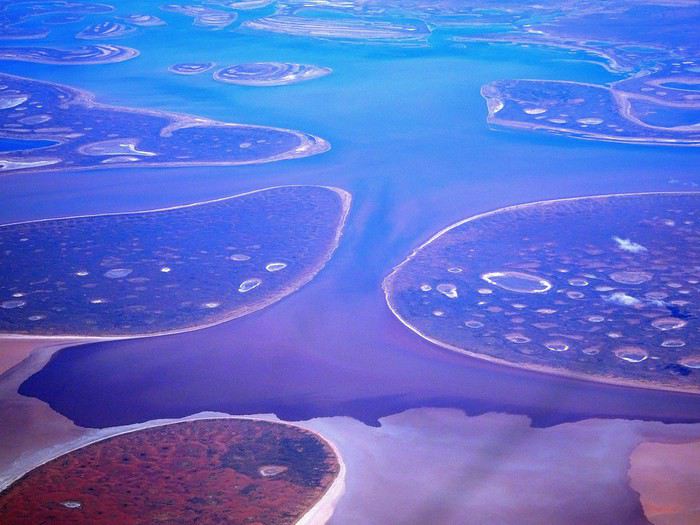
It was also my first time wearing a mask—it felt weird, pretty uncomfortable, and after a while, painful behind the ears. I really feel for those who have to wear one all day, every day. The flight lasted three long hours, but luckily, I had a good book. From the window, I watched an endless expanse of salt lakes in all shapes and sizes—round, elongated, gray, white, sometimes blue and green—and an infinity of winding, capricious meanders, along with long straight lines that led nowhere. The last half-hour got more interesting as rocky, swollen formations and long, sloping plateaus appeared. Against the vast ochre landscape, green patches became more frequent.
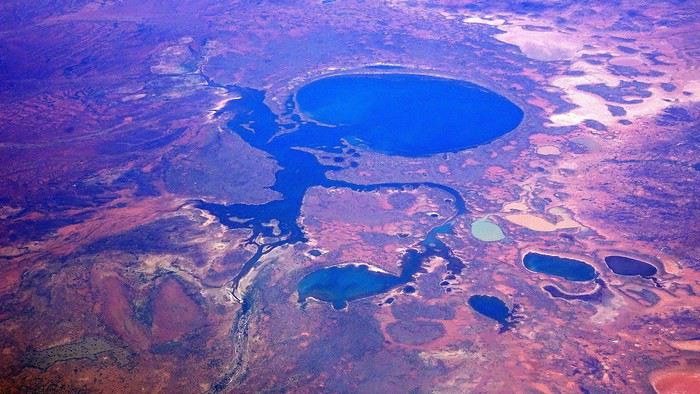
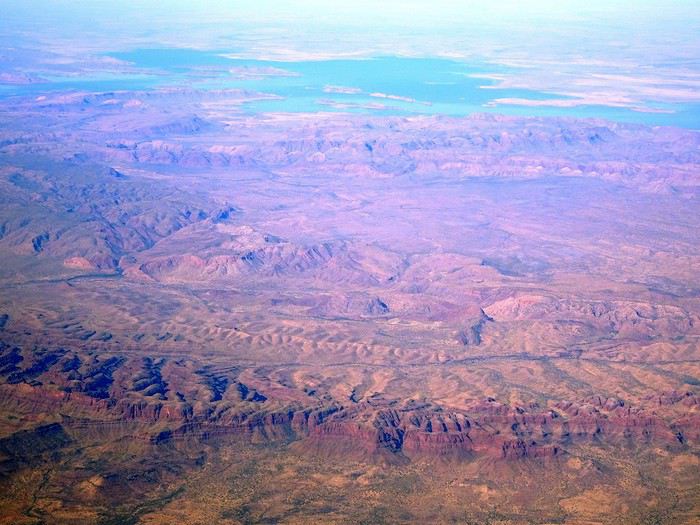
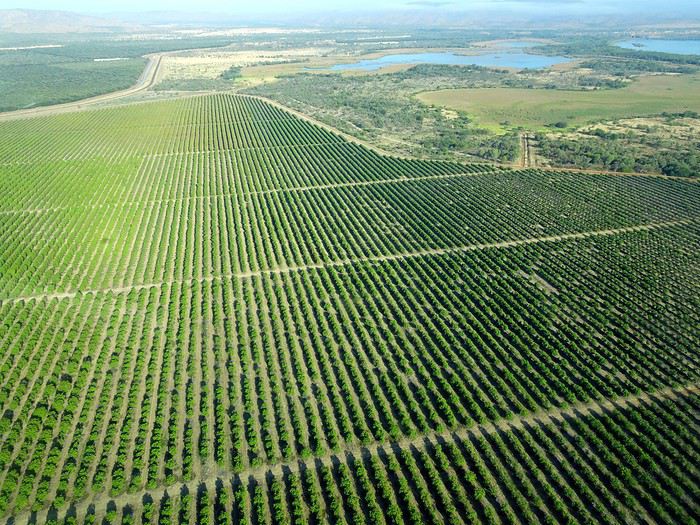
Just before landing, rows of green fields briefly appeared, along with an surprisingly wide river—but we were already rolling down the tarmac. A few hangars, a myriad of small, stationary planes, and a tiny terminal topped with a sign: “Welcome to Kununurra.”
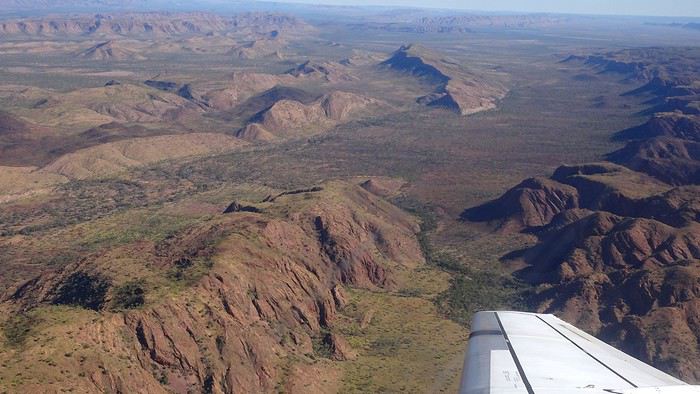
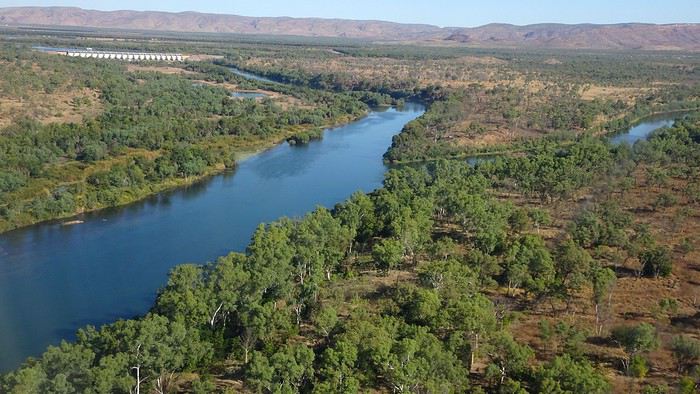
We wanted heat, and here it was—34°C the moment we stepped off the plane! We felt alive again and totally ridiculous in our jeans and sweaters. We quickly grabbed our suitcase and picked up the 4x4 we’d rented—more out of necessity, since only that type of vehicle can access the national parks we planned to visit.
Just four kilometers separated us from Kununurra, a town of 5,000 people founded in 1961 during the construction of the Lake Argyle Dam and the development of the Ord River Irrigation Area Scheme (more on that later). On the horizon, mountain ranges (a bit of an exaggeration, since we know Mt. Meharry, WA’s highest ‘mountain,’ doesn’t even reach 1,250 meters!) and closer to the road, a few irrigation canals cutting through stretches of bush, then a huge park overlooking a small lake lined with reeds.
A row of baobabs (yes, there are baobabs in Australia too!), a series of motels with immaculate lawns, a gas station, and there’s the main street leading to the town center—that is, the parking lots of the two supermarkets, the bottleshop, the pub, the Town Hall, the municipal pool, and the Tourist Office (already closed!), and at the next roundabout, another park, the Presbyterian church, and a few other shops. In short, two or three green blocks that you can explore in no time.
One road leads to the small industrial area and one of the town’s three or four campgrounds, while another heads toward the residential neighborhoods, which look just like the typical suburbs you find in any Australian city—except with tropical vegetation. We stocked up at Coles, an identical copy of the one near our place, and—surprise—the prices were practically the same.
We checked into one of the motels. The receptionist listed the town’s three or four restaurants, insisting that it’s always better to book a table. She recommended the Pump House, a bit outside town on the lake’s edge. “Best spot to watch the sunset, but hurry up.” she told us. It was only 5:00 PM!
When we got there half an hour later, the place was packed, and the sun had already disappeared behind a row of trees! Sure enough, we’d see a few days later that the sunset can be a stunning spectacle—if you wait a bit for the sky (especially if it’s cloudy) to blaze and reflect in the lake’s calm waters. A little disappointed, we headed back into town, where we easily found the other lively spot in town: the pub (nothing like an old English pub). Above the long L-shaped bar, several giant screens (thankfully muted) were broadcasting live footy, rugby league, etc. In one corner, players circled the pool table, while in another, customers were digging into plates of the day’s special. Instead of rooms, there were various patios where groups of friends and coworkers (easily recognizable by the fluoro vests they were still wearing) were gathered. We found a table under a mango tree—unfortunately, a little too close to the guitarist strumming his entire Country Music repertoire, complete with Keith Urban-style tremolos. Guaranteed culture shock!
Since it’s the custom here, we called the Country Club to book a table before the kitchen closed! The CC is the town’s—and even the region’s—fancy spot. Dark decor, modern furniture, dim lighting, and the air conditioning blasting. The twenty or so customers had taken refuge on the vast terrace, lit by torches. The view of the tall eucalyptus trees, illuminated by spotlights shifting from red to blue, was breathtaking.
The menu was minimal, but the grilled salmon was excellent, and the Pavlova (the meringue dessert Kiwis and Aussies have been arguing over since 1906) with melon and watermelon was absolutely divine.
It wasn’t even 9:00 PM, and we were already in bed. Had we already adopted the Top West End’s chicken schedule?!
To be continued... Journal dedicated to Attila
As usual, I didn’t manage to keep it short, but this time I’ve got photos to go with it!
August 2020. Since the opportunities to explore the world are extremely limited right now, all we (R&X) can do is explore our own island! Well, just a part of it, because with the state borders still closed, we’re stuck in Western Australia (WA).
Luckily, we’re pretty fortunate because this state is huge: over 2.5 million km² (that’s more than four times the size of France or 1.5 times Quebec). What’s more, stretching over 20 degrees of latitude between the Antarctic Ocean and the Timor Sea, you’ll find climates ranging from Mediterranean to arid to tropical. That’s actually why we decided to head as far north as possible. Sick of the endless rainy winter in Perth, bring on the heat of the Kimberley... way up Nooorth!
Friday. At the airport, the main terminal was closed (not enough flights), so we ended up in the annex (where flights to the various mines usually depart from). There was no crowd at the gate, and in this huge, single departure lounge, empty seats were plentiful. Only three flights were listed on the screens for the rest of the morning: the first to Coondewanna (?), the second to Darwin, and ours to Kununurra (code KNX).
A cool breeze swept through the half-open corridors along the runways. At the top of the walkway leading to the Fokker 100 (the Airbuses and Boeings are now parked!), a flight attendant greeted us with a basket full of sanitary masks. We were actually the only masked passengers (the staff weren’t wearing them either). With zero Covid-19 cases in WA at the time, the only rule was to maintain social distancing—something pretty hard to do on a full plane!
It was also my first time wearing a mask—it felt weird, pretty uncomfortable, and after a while, painful behind the ears. I really feel for those who have to wear one all day, every day. The flight lasted three long hours, but luckily, I had a good book. From the window, I watched an endless expanse of salt lakes in all shapes and sizes—round, elongated, gray, white, sometimes blue and green—and an infinity of winding, capricious meanders, along with long straight lines that led nowhere. The last half-hour got more interesting as rocky, swollen formations and long, sloping plateaus appeared. Against the vast ochre landscape, green patches became more frequent.
Just before landing, rows of green fields briefly appeared, along with an surprisingly wide river—but we were already rolling down the tarmac. A few hangars, a myriad of small, stationary planes, and a tiny terminal topped with a sign: “Welcome to Kununurra.”
We wanted heat, and here it was—34°C the moment we stepped off the plane! We felt alive again and totally ridiculous in our jeans and sweaters. We quickly grabbed our suitcase and picked up the 4x4 we’d rented—more out of necessity, since only that type of vehicle can access the national parks we planned to visit.
Just four kilometers separated us from Kununurra, a town of 5,000 people founded in 1961 during the construction of the Lake Argyle Dam and the development of the Ord River Irrigation Area Scheme (more on that later). On the horizon, mountain ranges (a bit of an exaggeration, since we know Mt. Meharry, WA’s highest ‘mountain,’ doesn’t even reach 1,250 meters!) and closer to the road, a few irrigation canals cutting through stretches of bush, then a huge park overlooking a small lake lined with reeds.
A row of baobabs (yes, there are baobabs in Australia too!), a series of motels with immaculate lawns, a gas station, and there’s the main street leading to the town center—that is, the parking lots of the two supermarkets, the bottleshop, the pub, the Town Hall, the municipal pool, and the Tourist Office (already closed!), and at the next roundabout, another park, the Presbyterian church, and a few other shops. In short, two or three green blocks that you can explore in no time.
One road leads to the small industrial area and one of the town’s three or four campgrounds, while another heads toward the residential neighborhoods, which look just like the typical suburbs you find in any Australian city—except with tropical vegetation. We stocked up at Coles, an identical copy of the one near our place, and—surprise—the prices were practically the same.
We checked into one of the motels. The receptionist listed the town’s three or four restaurants, insisting that it’s always better to book a table. She recommended the Pump House, a bit outside town on the lake’s edge. “Best spot to watch the sunset, but hurry up.” she told us. It was only 5:00 PM!
When we got there half an hour later, the place was packed, and the sun had already disappeared behind a row of trees! Sure enough, we’d see a few days later that the sunset can be a stunning spectacle—if you wait a bit for the sky (especially if it’s cloudy) to blaze and reflect in the lake’s calm waters. A little disappointed, we headed back into town, where we easily found the other lively spot in town: the pub (nothing like an old English pub). Above the long L-shaped bar, several giant screens (thankfully muted) were broadcasting live footy, rugby league, etc. In one corner, players circled the pool table, while in another, customers were digging into plates of the day’s special. Instead of rooms, there were various patios where groups of friends and coworkers (easily recognizable by the fluoro vests they were still wearing) were gathered. We found a table under a mango tree—unfortunately, a little too close to the guitarist strumming his entire Country Music repertoire, complete with Keith Urban-style tremolos. Guaranteed culture shock!
Since it’s the custom here, we called the Country Club to book a table before the kitchen closed! The CC is the town’s—and even the region’s—fancy spot. Dark decor, modern furniture, dim lighting, and the air conditioning blasting. The twenty or so customers had taken refuge on the vast terrace, lit by torches. The view of the tall eucalyptus trees, illuminated by spotlights shifting from red to blue, was breathtaking.
The menu was minimal, but the grilled salmon was excellent, and the Pavlova (the meringue dessert Kiwis and Aussies have been arguing over since 1906) with melon and watermelon was absolutely divine.
It wasn’t even 9:00 PM, and we were already in bed. Had we already adopted the Top West End’s chicken schedule?!
To be continued... Journal dedicated to Attila
Hi there,
I’m planning a trip to the White Villages and noticed that many are in the Province of Cádiz—like Setenil de las Bodegas, Olvera, Ubrique, Grazalema, Zahara de la Sierra, Medina-Sidonia, and Vejer de la Frontera. Are all of these worth visiting, or are there others you’d recommend? I’ve already been to Arcos de la Frontera and Ronda in the area and wouldn’t mind returning, of course. I’m also considering the Caminito del Rey, so maybe a few interesting villages in the province of Málaga too. Do you think an itinerary starting from Málaga (arriving at the airport) with 2 or 3 stops (like Ronda, Arcos, and a third in one of these villages) would work?
Thanks for your tips!
Hi there,
Our son is in Canada for a year on a Working Holiday Visa, and we’re planning to join him around September 20th for a 15-day campervan road trip in Nova Scotia.
I was thinking of going with Canadream, but if you have other rental companies to recommend, don’t hesitate!
Here’s the itinerary I’ve been considering—I tried not to cram in too many stops so we’re not just driving the whole time.
Day 1: Pick up campervan in Halifax at 3 PM. Stop at Peggy’s Cove, then drive to Lunenburg and Blue Rocks (151 km) Day 2: Explore Lunenburg, then head to Kejimkujik National Park for hikes or other activities. Overnight in the park (91 km) Day 3: Drive to Annapolis Royal (visit), Port-Royal National Historic Site, then on to Digby (111 km) Day 4: Ferry to Saint John (visit Reversing Falls), then drive to St. Andrews (103 km) Day 5: Whale-watching excursion and explore St. Andrews Day 6: Drive to Alma and Fundy National Park (233 km—we’ll probably leave St. Andrews the night before to split the drive and arrive earlier in Alma) Day 7: Hopewell Rocks (check tides) (43 km) Day 8: Hopewell Rocks—Tatamagouche (dinner train)—Pictou (237 km). Any suggestions for this day? Day 9: Drive to Baddeck, Cabot Trail to Chéticamp (317 km). Ideas for breaking up the drive? I thought of Pomquet Beach Provincial Park for a walk on the boardwalks, but any other suggestions are welcome. Day 10–11: Cape Breton Highlands National Park for hikes and Cabot Trail to Baddeck (208 km) Day 12: Explore Baddeck, Graham Bell Museum, and Bras d’Or Lake Drive. Drive to Louisbourg (118 km) Day 13: Fortress of Louisbourg, then drive to Liscomb (302 km) Day 14: Drive back to Halifax via Lawrencetown Beach (or other suggestions?). Fisherman’s Cove (205 km) Day 15: Return campervan by 10 AM
- All suggestions are welcome, as long as they don’t add too much detour from the main stops. We’d rather skip some places to fully enjoy the ones we visit. We love hiking in beautiful landscapes, charming and lively towns or villages, etc. - I wanted to add a museum dedicated to Acadian culture, but I didn’t find anything along the route—or they’re closed this time of year. Maybe there are places to listen to folk music? - If you have any campgrounds or wild camping spots to recommend, I’d love to hear about them. - Do we need to book the ferry this time of year?
Thanks in advance for your ideas and suggestions!
Claire
Hi there,
We’re planning a 15-day family trip in February 2026 (with 3 teens). We’ll be visiting friends who live in Puebla. Initially, I was thinking of the Yucatán, but after reading up on it, I don’t think it’s the right fit for us (too crowded, too touristy). So, we’re leaning toward something like this: - Mexico City: 2 days (Teotihuacán + city) - Puebla: 3 days - Tehuacán: 2 days (to break up the trip—is this a good choice? Is there enough to do for 2 days?) - Oaxaca: 3 days (Hierve el Agua, Monte Albán, city/tours) - Pacific Coast: 4 days (snorkeling, excursions)
Does this seem balanced? We’d like to end on the coast for some relaxation, ocean time, and fun for the kids. I’ve seen lots of excursions offered along the coast but can’t decide where to stay. Puerto Escondido? Huatulco? The beaches seem better for snorkeling in Huatulco, but I’ve read mixed things, and it’s farther away. What do you think?
For transportation, is this doable by bus? I’m struggling to find a decent bus between Tehuacán and Oaxaca (overnight schedules), and I’m not sure how to get around the coast. Also, how do we handle luggage between cities? We usually rent a car.
Finally, I’d love feedback on the Pacific Coast excursions—I get the feeling some are worth it and others aren’t. Is bioluminescence really magical? Are dolphin-watching tours ethical and not too "factory-like"? (We skipped them in Quebec and just watched whales from shore.) Can you see sea turtles up close?
Thanks for your help!
Hi there,
We’re leaving from Montreal and planning to bike the Petit Train du Nord route.
Any ideas for loops so we don’t have to return the same way?
We’re thinking of a one-week trip.
Thanks in advance for your tips!
Rachel
Hi everyone, I don’t think there’s already a thread on this topic,
we’re planning—two or three years from now (I know, it’s a ways off...)—a cross-Canada trip from east to west, meaning Montréal ====> Vancouver, and leaving the RV in Vancouver. First, we’ll spend a few days visiting Québec City, then pick up the RV in Montréal. The trip will likely be around 5 weeks, late August to early September. If you’ve got any route ideas, we’d love to hear them! Banff is probably a must-see stop for us. Thanks in advance!
Didier and Nicole
Hi there,
I’d love to take a road trip and visit Nova Scotia. I’d appreciate some info on the best cities to see and the most interesting spots. The trip should last about 10 to 15 days, staying in hotels or motels. Thanks in advance!
I’d love to take a road trip and visit Nova Scotia. I’d appreciate some info on the best cities to see and the most interesting spots. The trip should last about 10 to 15 days, staying in hotels or motels. Thanks in advance!
FOREWORD
In July 2018, we decided to go on a road trip to Prince Edward Island. We had four days off, so it was the perfect opportunity to set off on an adventure.
This time, I hadn’t had much time to prepare an itinerary. I’d only done a bit of research online to try and find tourist attractions that might interest us.
I should say that it wasn’t our first visit to the island, and since our stay was quite short, we decided to complete the island loop by making stops along the coast to admire the lighthouses, small fishing villages, beaches, and the stunning steep cliffs.
We also made a few stops at lookouts along the road and even went for a hike in Greenwich National Park.
Our trip was more of an escape into nature. When we travel, we feel best when we’re far from the noise and crowds.
So, I invite you to discover the fabulous landscapes of Prince Edward Island.
To get there, we had to cover nearly 1,000 km. It took us a full day, and we had to cross parts of Quebec and New Brunswick.
The roads are beautiful. However, there isn’t much to see except the vast forests lining the highways.
The Confederation Bridge, which is 12.9 kilometers long, connects New Brunswick to Prince Edward Island.
There’s no fee to enter the island when you cross this bridge. However, a toll must be paid when leaving the island.
https://www.confederationbridge.com/fr/tolls-fees
https://youtu.be/UWhn5bqLONU
Hi there, I’ve traveled for work and taken several leisure trips with my late partner, and now friends are scarce at 74. I’d love to do more budget travel, either solo or with travel companions, but I don’t know where to start. Any help would be greatly appreciated! I’m from Quebec, Canada, and I speak French and a little English. Hervé
Hi,
This autumn, we’re planning to explore the Oriental region and we’re wondering where the best place to land would be. We’ll have three weeks ahead of us and we’ll be renting a car.
Any tips would be much appreciated. Thanks.