This catchy and somewhat mysterious title comes from several questions I’ve been asking myself.
VF has been back open for a reasonable number of weeks and months now.
The number of visitors overall matches past averages, but the number of members online in the last 24 hours seems relatively lower than what we used to see.
Yet, to my surprise, I’m seeing fewer travel journals, way fewer messages, and way fewer questions.
I don’t see many new registered users online, and I notice a number of members who are logged in but either aren’t participating or have stopped participating.
Something’s not adding up for me because, in my opinion, VF is still appealing, and I don’t see which other sites could really compete.
Was there a real break between pre- and post-Covid?
Does it just take more time for some people to discover the site or learn that it’s active again?
Do people now prefer quick consumption on sites like FB or others I’m not familiar with?
Where have the site’s old-timers gone, and what are they doing with their time now?
What’s really going on here?
587 similar discussions in English
Hi everyone,
In this age of zero-commission cards and fee-free accounts, I’m curious why some travelers still prefer to set off with a wallet stuffed with bills and exchange money on the spot.
I get it for those whose income comes from undeclared activities, but what about everyone else?
Between the risk of theft, scams at exchange counters, and fees that often end up being higher, I’m really puzzled.
The last time I traveled with a wad of cash was because I had to pay for accommodation in cash only, the local currency was the dollar (easy to exchange at a very low cost), and I was still paying some fees.
I’m still wondering about my next trip to Argentina because the situation there is very specific, but otherwise?
Is it an allergy to modern payment methods?
A budget so tight that an extra 20 € (the fees some local banks charge for withdrawals) on a 2000 € budget would be impossible to manage?
Thanks for shedding some light on this!
After five trips to the American West, we had planned to switch countries and continents to visit Turkey. However, by the time we made up our minds, flight ticket prices had nearly doubled, reaching 400 € for a round-trip ticket. A bit disappointed, I started looking at transatlantic flight prices and stumbled upon discounted tickets from Basel-Mulhouse to Dallas—at the same price as our tickets to Turkey!
No hesitation needed; we bought the five tickets for a total of 1,860 € excluding baggage!
From Fort Worth Airport, we had two options: - Head west on a loop through Texas, New Mexico, and southern Colorado - Head east to change the scenery and explore East Texas, Louisiana, with a possible detour into Florida.
The latter option won unanimously, so here we are, off to discover new states, mainly Louisiana and Texas.
One of the main post-COVID challenges is finding a reasonably priced car rental. After an initial booking around 1,300 €, we kept an eye on prices a few weeks before departure and managed to snag a better deal at around 900 € for a comfortable sedan.
Yes, this summer will also be a first: no 4x4, no camping, and plenty of restaurants!
As always, I’ve planned a packed itinerary, ready to adjust on the go. A few weeks before departure, we learned we’d be at full capacity—our eldest son, Maxime, got his first-year med school results. By finishing as a top admit, he avoided the mandatory July-August internship that would’ve kept him from joining us. Instead, he wrapped up his internship at the last minute the night before our big departure.
We’ll get to savor these special moments together.
The itinerary: Day 1 - 07/15: Fort Worth Day 2: Dallas Day 3: Jefferson - Caddo Lake Day 4: Black Bayou Lake - Natchez - Stanton Hall and Rosalie Mansion Day 5: St. Francisville - Rosedown Plantation - Cat Island Wildlife Refuge Day 6: Mobile - USS Alabama Battleship Memorial Park Day 7 - 8: Pensacola Beach Day 9: Bellingrath Gardens - New Orleans Day 10 - 11: New Orleans Day 12: Plantation Route Day 13: Jungle Gardens - Tabasco Factory - Vermilionville - Lake Martin Day 14: Baton Rouge - USS Kidd Day 15: Houma - Cajun Man's Swamp Tour Day 16: Galveston, Texas Day 17: Space Center Houston - Painted Churches Day 18: San Antonio Day 19: Texas Hill Country Day 20: Texas Hill Country and evening in San Antonio Day 21: Austin and Waco
Day 0 - 07/14: The departure timing isn’t exactly relaxing. On Thursday late afternoon, we hit the road to Alsace, aiming to drop off our two cockers with family before reaching the airport at 2 AM for a 3-hour power nap. Not exactly fresh, we arrive at the terminal looking for a British Airways counter. None in sight, so we try our luck at a United Airlines counter—who knows, maybe it’ll work out. And bingo! The agent checks us in. We didn’t quite understand why, but maybe there’s some agreement between airlines. For the first time, we’re traveling without checked baggage, so no extra fees. Not a huge feat, given the scorching temperatures awaiting us!
The connecting flight to London goes smoothly.
During the layover, liquid checks get stricter—now requiring small bottles to be in a pre-approved clear bag, with only one bag allowed per passenger. Normally, no big deal, but between deodorant, sunscreen, after-sun lotion, hand sanitizer, contact lens solution, etc., we spend 20 minutes optimizing the arrangement! When we finally succeed, one of the security staff bursts out laughing and congratulates us!
With our stomachs growling, we grab an American breakfast before browsing the airport shops.
We then discover our plane for the long-haul flight and are thrilled to see it’s an A380—a first for Laetitia, though the rest of the family experienced it during our winter getaway. Still just as impressive!
With a hint of uncertainty, we take off for the States—my third trip in barely 12 months. This time, no endless badlands, canyons, slot canyons, hoodoos, or brain rocks, but a journey through five states (Texas, Louisiana, a quick stop in Mississippi, Alabama, and the northwest tip of Florida), where we hope to soak up a unique vibe... with a packed schedule of diverse visits.
Arrival at Fort Worth Airport and customs go smoothly. Since we have no checked baggage, we’re first in line at the Dollar counter. In just 3 minutes, the formalities are done. We decline the Toll Pass, which I don’t think we’ll need based on my "calculations," and head to the Dollar parking lot, where an employee tells us we can pick any car we want!
There are about thirty cars waiting. Too many choices!
After last year’s mishap in Oakland, where our 4x4’s trunk was broken into, we’re looking for a sedan to hide our luggage this time. Unfortunately, there are none—only SUVs. We finally settle on a comfortable 7-seater Ford SUV with a massive trunk when set up for five.
On the road from Fort Worth to Dallas, we accidentally take a toll highway without realizing until it’s too late to exit. Let’s hope Dollar doesn’t charge us a week’s worth of their pricey Toll Pass for a $2 toll. We’ll see... In the meantime, Maxime sets up Google Maps to avoid toll roads.
Since it’s not too late, we stop by the nearest Walmart for groceries before checking into our hotel room for three nights in East Dallas suburb.
I'm looking for anyone who knew the old Amporaha holiday camp (north of Nosy Be).
Many of us longtime members surely remember the little frieze of monuments that used to decorate the top of VF pages.
Eiffel Tower, Statue of Liberty, Taj Mahal...
The famous must-see icons of architectural heritage!
Today, I’m inviting you to dig through your archives and share 3 photos of these international stars made of stone, marble, concrete, or steel.
I can already hear some of you protesting that this theme isn’t very original.
Well, it’s up to you to think outside the box...
So the monument doesn’t have to be the original. It could be its twin in Las Vegas, a matchstick replica made by Uncle Bob, a piece of jewelry, a gorgeous snow globe made in China, and so on.
The monument can be photographed from above, below, in the rain, as a reflection...
Deserted or swarming with visitors...
Montages are also allowed! 😉
In short, a classic topic that’ll become original thanks to your creative take.
Now, there are still 3 rules:
- No selfies (But a photo showing people taking selfies in front of a monument is allowed...🤪)
- Once a monument has been posted by someone, no one else can post it again. I don’t want to see the same thing 10 times...😊
- The theme isn’t about the monument’s originality. Please don’t post a photo of a monument known only to you or almost no one...😏
You can post your photos (one per message) until January 21, 2015, at 11:55 PM
Voting will take place from January 22, 2015, at 12:05 AM to January 29, 2015, at 11:55 PM.
During the vote, you’ll choose your 3 favorite photos, awarding 3 points to your top pick, 2 to your second, and 1 to your third.
Please clearly indicate the photographer’s name and the number of the winning photo!
For the rest, I’m using Cocottte’s rules:
The winner is the one with the most points. In case of a tie, the winner will be the one with the most first-place votes, or, if still tied, the most second-place votes. If there’s a perfect tie, the winner will be the one who reached their score first. The winner will then choose a theme for February’s contest and organize it. Ties for any place other than first won’t be broken.
You can vote without participating, participate without voting, or do neither. Slideshow
Finally, here’s the little off-topic link where all your comments and other expressions of good humor are welcome!
Hello forum,
Did any of you feel the same things we did in China?
We spent a good twenty days there in August. First, we traveled solo around Chengdu, then joined an organized tour for 12 days (Beijing, Pingyao, Xi'an, Guilin, Xingping, Yangshuo, Shanghai, Wuzhen) and extended our stay by 4 extra days to visit Zhangjiajie.
The landscapes were stunning, and we have unforgettable memories... but we were really disappointed by the following points:
- The food: way too spicy. Lacking in flavor, not much taste. I’m speaking "in general" because we did enjoy some good steamed dumplings, smoked pork, and other dumplings... But compared to Thailand, Cambodia, or India, Chinese cuisine didn’t impress us at all.
- The behavior of the Chinese: disrespectful, rushed, agitated. You constantly have to fight—people push, crowd, and overwhelm you... At the entrance to the Terracotta Army (and other sites), it’s a human tidal wave... and I mean that literally. We were carried by the crowd without even touching the ground. It was like a situation where you have one bowl of rice and 20,000 starving people diving for it...
You’re at a ticket counter, and they cut in front of you. You’re in line for boarding, suitcase ready to go on the conveyor belt, and someone shows up out of nowhere to put THEIR suitcase down... even though they have a flight ticket with THEIR seat number and won’t be leaving before you!!!! You’re getting on the bus, and someone shoves past you just so they don’t end up behind you.
It’s like these people only think about themselves. I didn’t see a single person let someone else go first or even ask—it’s as if politeness and respect are completely foreign to them.
It’s honestly exhausting and draining...
- Communication: In every other country we’ve visited, whether in Asia or Europe, we always manage—with English, a few words of Italian, French, or Spanish. In China, I’ll be blunt: if you don’t speak Chinese, you’re screwed. And yet, a pair of kids around ten or twelve years old asked us in English where we were from :)
- Understanding: Here’s the rule. Even if the person you’re talking to speaks a little English and says they understand you... make sure they *really* do, because 9 times out of 10, they don’t. Out of pride or just cluelessness, they’ll give you a big smile and nod, but in reality, they didn’t get what you were saying.
Several times with our group, in the evening at a restaurant, if we hadn’t been helped by someone at another table who spoke a little English, we’d still be there. The classic example: the waiter brings one menu (for 10 people at the table), and we’re all trying to explain that we need 4 or more menus. Five minutes later, he’s still staring at us with that same blank smile...
In 3* or 4* hotels, you go to the front desk for a hot water or AC issue. Three or four staff members just stand there beaming at you. You try to explain with photos or a translator, but in the end, you leave with the problem unresolved.
They don’t speak—they shout... on buses, in hotels...
We were also surprised to find that self-service laundromats were almost nonexistent. We got scammed once at a hotel with an astronomical bill!
As for flights, we flew Air China on the way there and Austrian Airlines on the way back—no comparison. Air China had zero service and food that was "baby food" quality. Austrian Airlines had multiple services, a decent meal, and smiling flight attendants.
I don’t know if any of you had the same experience in this country, but I’m definitely not eager to go back. Whereas if someone offered me India, Thailand, or Vietnam tomorrow, I’d be there in a heartbeat!!!
As soon as I return to France, I catch myself thinking, "it’s better elsewhere."
Wherever we’ve been, I feel this lightness of living—less restriction, less pressure, less sadness—and I start dreaming of somewhere else, of living somewhere else, a simpler life, more authentic, with colors everywhere: markets, clothes, homes...!!! Meeting kindred spirits, genuine people, gentle and kind, and letting go of all this modernism, this technological rat race, the indifference toward others, the confinement, the racism against the elderly in France, against the poor, the weak, the beautiful... fleeing the news, politics, jealousy, meanness, stupidity, greed... And in my moments of clarity, I tell myself that every country, every city has its pros and cons, and that maybe the best of all worlds isn’t down here. But I also remind myself that you have to know how to COME BACK in order to LEAVE again... yet still...!!! IS IT REALLY BETTER ELSEWHERE?😏😏😏
Alright, this year, we're heading back to South America!
The initial plan was to retrace the route we imagined in the summer of 2020: a trip to northern Argentina starting from Córdoba.
Unfortunately, the flight to Córdoba no longer exists, and airfares to Javier Milei’s country are both outrageously priced and involve multiple layovers.
So, I tweaked Google Flights every which way and finally found a flight within my budget—departing from Clermont-Ferrand!
Not to Argentina, though...
Our transatlantic flight will cross the snow-capped Andes, landing in Santiago, Chile, with a return from Lima!
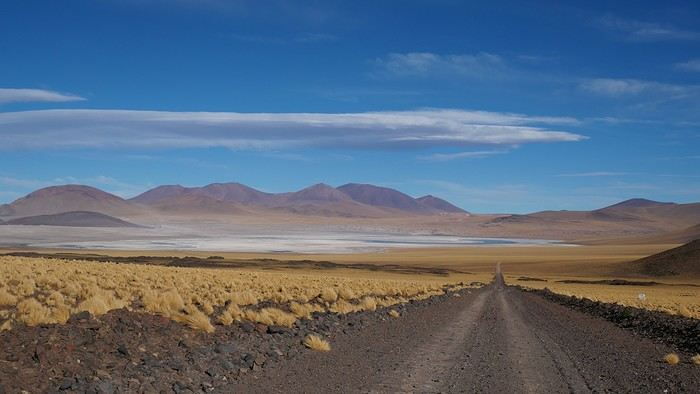
In between, two domestic flights and a big road trip loop starting from the coastal city of Arica to explore the treasures of northern Chile.
Our mode of transport: a pseudo 4x4 that won’t take us through sand dunes or devilish tracks but will let us tackle the entire secondary network, including unpaved main roads, while still being insured.
Is the suitcase packed with all-season clothes?
Are the driver’s license and passport ready?
Bank cards and a few euros too?
Off we go for just over 3 weeks of southern wanderings!
--/--
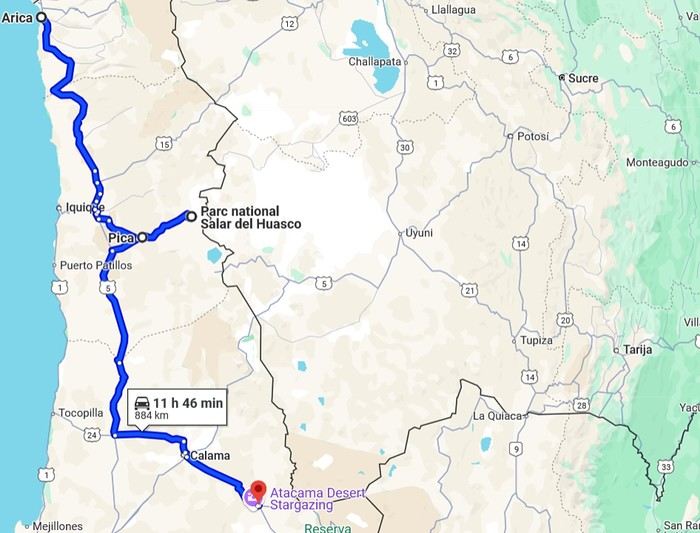
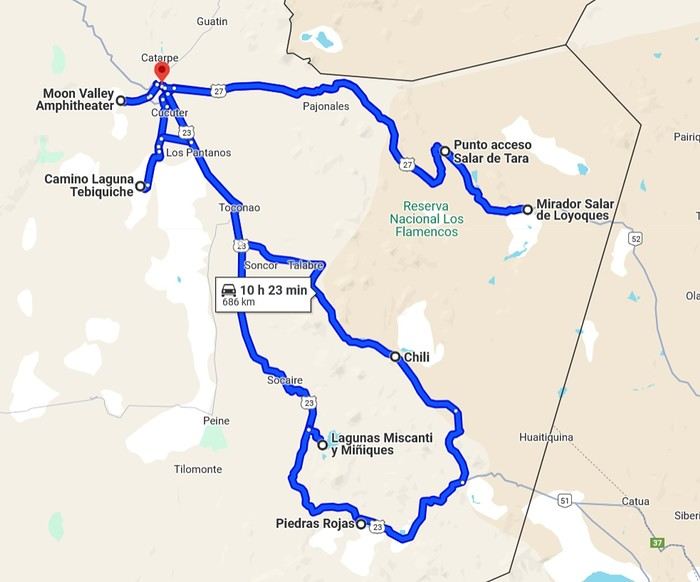
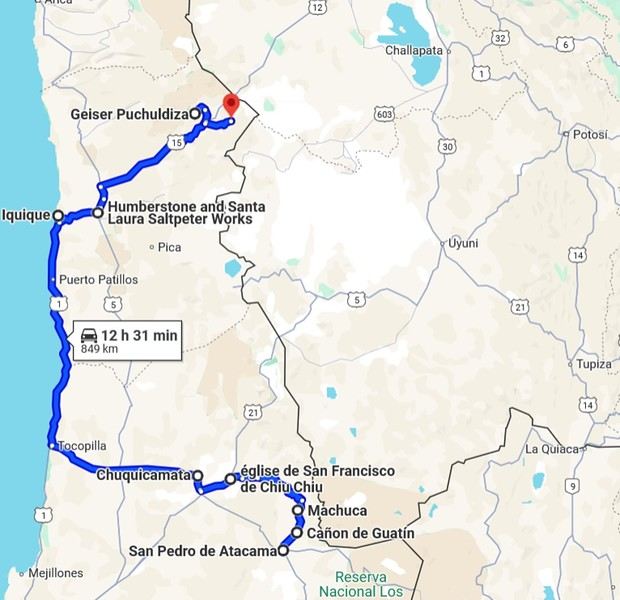
To keep all my esteemed readers on track, here are a few maps outlining the Arica-Arica loop!
1- From Arica to San Pedro de Atacama via Pica and the Salar de Huasco
 2- Around San Pedro
3- From San Pedro to Cariquima
4- From Cariquima to Putre
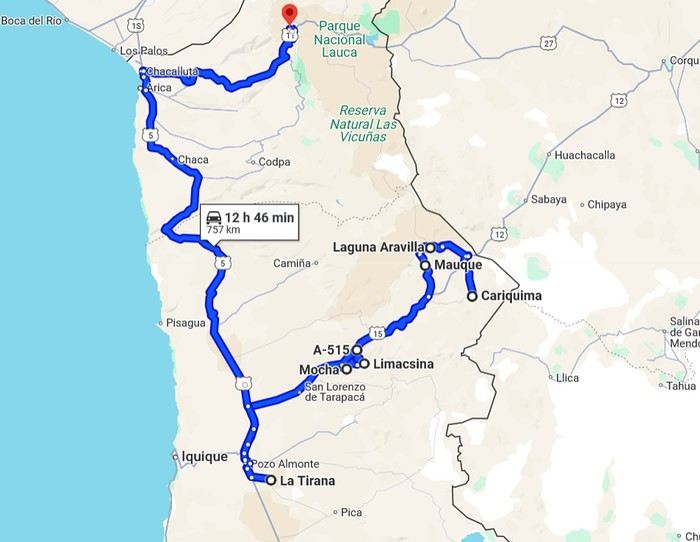
5 - From Putre to Arica
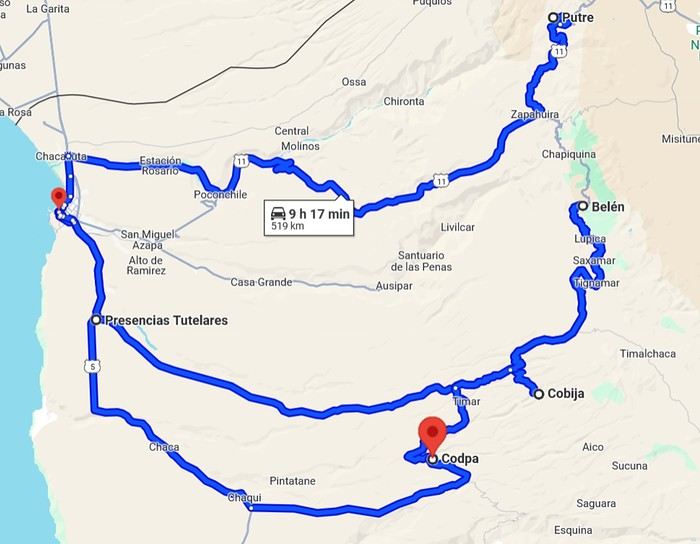
Gas stations in this part of Chile are located in Arica, Iquique, Pozo Almonte, Pica, Calama, and San Pedro de Atacama.
The initial plan was to retrace the route we imagined in the summer of 2020: a trip to northern Argentina starting from Córdoba.
Unfortunately, the flight to Córdoba no longer exists, and airfares to Javier Milei’s country are both outrageously priced and involve multiple layovers.
So, I tweaked Google Flights every which way and finally found a flight within my budget—departing from Clermont-Ferrand!
Not to Argentina, though...
Our transatlantic flight will cross the snow-capped Andes, landing in Santiago, Chile, with a return from Lima!
In between, two domestic flights and a big road trip loop starting from the coastal city of Arica to explore the treasures of northern Chile.
Our mode of transport: a pseudo 4x4 that won’t take us through sand dunes or devilish tracks but will let us tackle the entire secondary network, including unpaved main roads, while still being insured.
Is the suitcase packed with all-season clothes?
Are the driver’s license and passport ready?
Bank cards and a few euros too?
Off we go for just over 3 weeks of southern wanderings!
--/--
To keep all my esteemed readers on track, here are a few maps outlining the Arica-Arica loop!
1- From Arica to San Pedro de Atacama via Pica and the Salar de Huasco
2- Around San Pedro3- From San Pedro to Cariquima
4- From Cariquima to Putre
5 - From Putre to Arica
Gas stations in this part of Chile are located in Arica, Iquique, Pozo Almonte, Pica, Calama, and San Pedro de Atacama.
Hello everyone,
As usual, I’m posting a new travel journal about our trip to Norway last September. This one will span several months, with a day-by-day account of our adventure. I won’t be posting many photos on the forum (the publishing rules have become even more complicated since my last journal), but you can find all the shots on my blog (address in my signature).
We’ve just returned from a truly extraordinary, unforgettable trip. Planning this trip wasn’t easy, and I’ll admit I struggled to decide on the itinerary… Should we take the Hurtigruten all the way from the south to the north? But a whole trip by boat didn’t really appeal to us. Or focus on the south in the fjord region? But that would mean missing out on the Lofoten Islands… In the end, we chose to concentrate on southern Norway, exploring the coast and fjords, while including a stop in Oslo and mixing train, boat, and car travel. I also opted for a trip where we’d drive less than in previous years (1,650 km compared to 2,000 km in Portugal and 3,800 km in the American West), but we’d still move around a bit and do some hikes. Here’s the itinerary we followed:

This trip was absolutely amazing and introduced us to so many things we’d never seen or done before—fjords, a night on a boat, glaciers, stave churches, snow in summer (…and the high cost of living!).
If we had to sum up our top highlights, here’s our top 3: Mr.:
the variety of landscapes the colors, especially the colors of the water—from crystal clear to light blue and turquoise in some spots eating good fish
Mrs.:
the roads: the ones in the area we explored were truly stunning Geirangerfjord, especially in the late afternoon, when it was quiet and free of cruise ships the Trolltunga hike: a challenging trek and a little personal achievement for us
What we liked less:
the sometimes inconsistent signage on hikes the cost of living (everything costs money, and even food is expensive) the tunnels: there are so many, and they’re not much fun (except for one with a roundabout inside…!)
That’s it for this first summary/overview, and I can already tell that choosing photos is going to be tough!!! Here’s a little preview of what we discovered:

To see the photos in full size on my blog: check it out here
As usual, I’m posting a new travel journal about our trip to Norway last September. This one will span several months, with a day-by-day account of our adventure. I won’t be posting many photos on the forum (the publishing rules have become even more complicated since my last journal), but you can find all the shots on my blog (address in my signature).
We’ve just returned from a truly extraordinary, unforgettable trip. Planning this trip wasn’t easy, and I’ll admit I struggled to decide on the itinerary… Should we take the Hurtigruten all the way from the south to the north? But a whole trip by boat didn’t really appeal to us. Or focus on the south in the fjord region? But that would mean missing out on the Lofoten Islands… In the end, we chose to concentrate on southern Norway, exploring the coast and fjords, while including a stop in Oslo and mixing train, boat, and car travel. I also opted for a trip where we’d drive less than in previous years (1,650 km compared to 2,000 km in Portugal and 3,800 km in the American West), but we’d still move around a bit and do some hikes. Here’s the itinerary we followed:
This trip was absolutely amazing and introduced us to so many things we’d never seen or done before—fjords, a night on a boat, glaciers, stave churches, snow in summer (…and the high cost of living!).
If we had to sum up our top highlights, here’s our top 3: Mr.:
the variety of landscapes the colors, especially the colors of the water—from crystal clear to light blue and turquoise in some spots eating good fish
Mrs.:
the roads: the ones in the area we explored were truly stunning Geirangerfjord, especially in the late afternoon, when it was quiet and free of cruise ships the Trolltunga hike: a challenging trek and a little personal achievement for us
What we liked less:
the sometimes inconsistent signage on hikes the cost of living (everything costs money, and even food is expensive) the tunnels: there are so many, and they’re not much fun (except for one with a roundabout inside…!)
That’s it for this first summary/overview, and I can already tell that choosing photos is going to be tough!!! Here’s a little preview of what we discovered:
To see the photos in full size on my blog: check it out here
Hi there!
It’s been nearly 6 years since I last posted here or on my travel blog. But I’m back, at least for one post! I’m returning with a dream trip we took in April 2023: a stay at Walt Disney World in Florida.
We went for 10 days. Ten days at an amusement park might seem like a lot, but you should know that Disney isn’t just one park—it’s 4 parks and 2 water parks (only one was open during our trip). So we split those 10 days across 5 parks, which worked out to about 2 days per park.
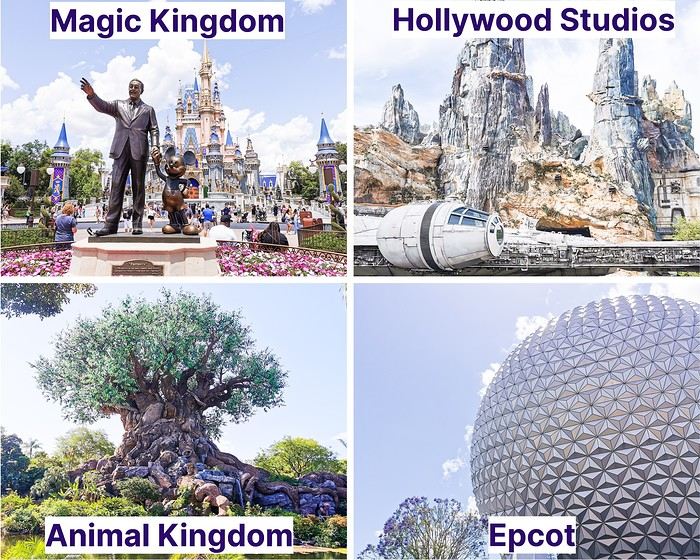
The four main parks each have a different vibe:
Magic Kingdom: The most famous one, the one that most resembles our Disneyland Paris. It’s home to several "lands" (Adventureland, Frontierland, Fantasyland, Tomorrowland, Liberty Square, and Main Street USA). This is the park where you’ll find the iconic castle, the symbol of the parks. Disney’s Hollywood Studios: It’s a bit like the studios at Disneyland Paris, with the well-known Tower of Terror and Toy Story Land. It also features the stunning Star Wars: Galaxy’s Edge (a must-see, even if you’re not a Star Wars fan). Animal Kingdom: A very nature-focused park, divided into several sections, including representations of Africa and Asia, as well as the breathtaking Pandora – The World of Avatar. Epcot: The park of countries, where different nations are represented around a large circular lake—including France!
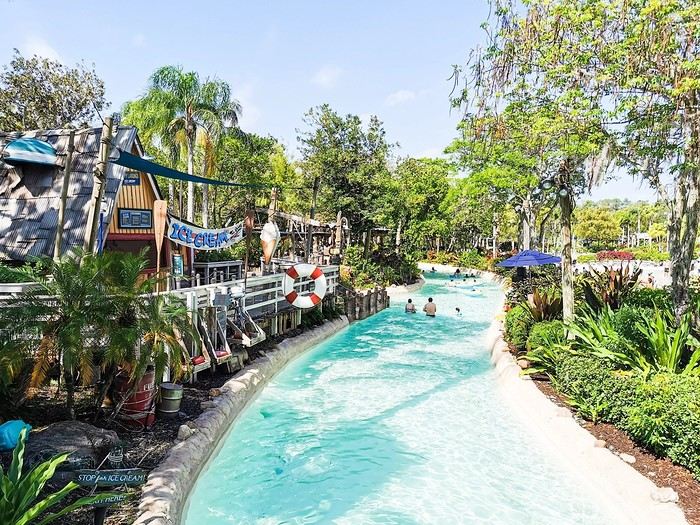
 The water park that was open during our stay was Typhoon Lagoon. We spent a morning there lounging and swimming before heading to Disney Springs (the equivalent of Disney Village in France). We’re not big on pools or chilling out, so we didn’t stay long, but there was no time limit.
 We chose to stay at the Disney’s Art of Animation hotel, a Resort (huge, like everything there!) with 4 themed areas: Nemo, Cars, The Lion King, and The Little Mermaid (where the rooms for 4 people or fewer are located).
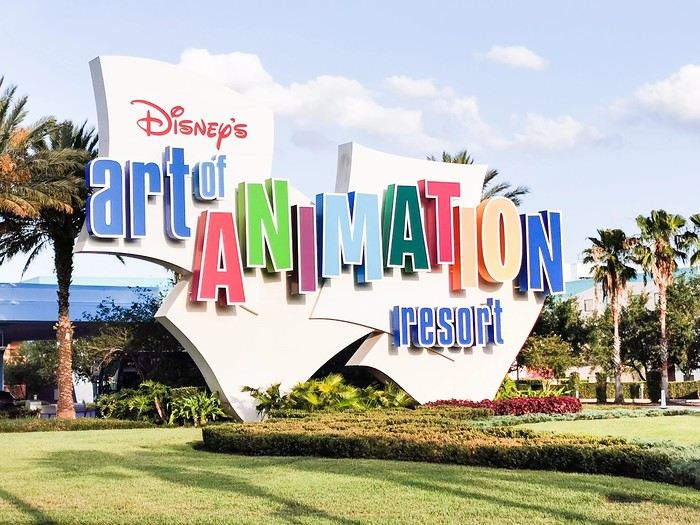
Here’s the itinerary we followed for those 10 days:
Day 1: Flight at 7:35 AM–4:40 PM (with a layover in London), stroller pickup, then shuttle bus to our hotel Day 2: Day at Magic Kingdom Day 3: Day at Hollywood Studios Day 4: Day at Animal Kingdom Day 5: Day at Epcot Day 6: Day at Hollywood Studios Day 7: Relaxing day at Typhoon Lagoon and Disney Springs Day 8: Day at Magic Kingdom Day 9: Day at Epcot Day 10: Day at Magic Kingdom Day 11: Morning at Hollywood Studios, then shuttle bus to the airport, stroller return at the airport, flight at 7:05 PM–1:50 PM (next day)
We rented the stroller from Kingdom Stroller. The rental process was super easy—everything was done online. On the day we arrived and the day we left, there was no staff at the counter, but the stroller was ready with a tag bearing our name. When we left, we just dropped it off at the designated spot, still with no one checking... We used the Mears Connect shuttle: you pick a day and time for them to pick you up at the airport and your hotel. Everything went smoothly, no surprises.
For planning, you’ll need to decide in advance which parks you’ll visit each day because a reservation is required (just like in Paris now). I’d recommend making a schedule ahead of time. Same goes for restaurants—figure out which ones you’d like to eat at beforehand. Some work like fast food and don’t require reservations, while others, the "Table Service" restaurants, operate like traditional restaurants and need to be booked in advance to guarantee a spot. These can be reserved 60 days before the first day of your visit, and that applies to all the restaurants for your entire stay (e.g., if you’re going from February 1st to 11th, you can make reservations for the whole trip 60 days before February 1st).
Not essential, but we found them super handy: MagicBands. These are connected bracelets you buy on-site (not cheap, of course) that let you, once linked to your account in the app, open your hotel room, enter the parks, validate Lightning Lane reservations at attraction entrances, and even make purchases (if you’ve linked a credit card). We got the cheapest ones and loved them!
As for the trip’s wrap-up, if I were to do it again, ... I’d do almost everything the same: The schedule and restaurant reservations I planned were perfect! ... I’d change one thing: Maybe I wouldn’t plan two full days at Epcot because it was the park we enjoyed the least. Some attractions (like the amazing Guardians of the Galaxy: Cosmic Rewind) were great, but it was really hot, the park isn’t shaded, and it felt stifling when the weather was scorching. That said, I don’t regret it because a big storm hit on our second day, forcing us back to the hotel.
That’s all for now—I’ll be back soon with photos from each park and the hotel. You’ll see, it was incredible! See you soon! :)
Magic Kingdom: The most famous one, the one that most resembles our Disneyland Paris. It’s home to several "lands" (Adventureland, Frontierland, Fantasyland, Tomorrowland, Liberty Square, and Main Street USA). This is the park where you’ll find the iconic castle, the symbol of the parks. Disney’s Hollywood Studios: It’s a bit like the studios at Disneyland Paris, with the well-known Tower of Terror and Toy Story Land. It also features the stunning Star Wars: Galaxy’s Edge (a must-see, even if you’re not a Star Wars fan). Animal Kingdom: A very nature-focused park, divided into several sections, including representations of Africa and Asia, as well as the breathtaking Pandora – The World of Avatar. Epcot: The park of countries, where different nations are represented around a large circular lake—including France!
The water park that was open during our stay was Typhoon Lagoon. We spent a morning there lounging and swimming before heading to Disney Springs (the equivalent of Disney Village in France). We’re not big on pools or chilling out, so we didn’t stay long, but there was no time limit.
We chose to stay at the Disney’s Art of Animation hotel, a Resort (huge, like everything there!) with 4 themed areas: Nemo, Cars, The Lion King, and The Little Mermaid (where the rooms for 4 people or fewer are located).Here’s the itinerary we followed for those 10 days:
Day 1: Flight at 7:35 AM–4:40 PM (with a layover in London), stroller pickup, then shuttle bus to our hotel Day 2: Day at Magic Kingdom Day 3: Day at Hollywood Studios Day 4: Day at Animal Kingdom Day 5: Day at Epcot Day 6: Day at Hollywood Studios Day 7: Relaxing day at Typhoon Lagoon and Disney Springs Day 8: Day at Magic Kingdom Day 9: Day at Epcot Day 10: Day at Magic Kingdom Day 11: Morning at Hollywood Studios, then shuttle bus to the airport, stroller return at the airport, flight at 7:05 PM–1:50 PM (next day)
We rented the stroller from Kingdom Stroller. The rental process was super easy—everything was done online. On the day we arrived and the day we left, there was no staff at the counter, but the stroller was ready with a tag bearing our name. When we left, we just dropped it off at the designated spot, still with no one checking... We used the Mears Connect shuttle: you pick a day and time for them to pick you up at the airport and your hotel. Everything went smoothly, no surprises.
For planning, you’ll need to decide in advance which parks you’ll visit each day because a reservation is required (just like in Paris now). I’d recommend making a schedule ahead of time. Same goes for restaurants—figure out which ones you’d like to eat at beforehand. Some work like fast food and don’t require reservations, while others, the "Table Service" restaurants, operate like traditional restaurants and need to be booked in advance to guarantee a spot. These can be reserved 60 days before the first day of your visit, and that applies to all the restaurants for your entire stay (e.g., if you’re going from February 1st to 11th, you can make reservations for the whole trip 60 days before February 1st).
Not essential, but we found them super handy: MagicBands. These are connected bracelets you buy on-site (not cheap, of course) that let you, once linked to your account in the app, open your hotel room, enter the parks, validate Lightning Lane reservations at attraction entrances, and even make purchases (if you’ve linked a credit card). We got the cheapest ones and loved them!
As for the trip’s wrap-up, if I were to do it again, ... I’d do almost everything the same: The schedule and restaurant reservations I planned were perfect! ... I’d change one thing: Maybe I wouldn’t plan two full days at Epcot because it was the park we enjoyed the least. Some attractions (like the amazing Guardians of the Galaxy: Cosmic Rewind) were great, but it was really hot, the park isn’t shaded, and it felt stifling when the weather was scorching. That said, I don’t regret it because a big storm hit on our second day, forcing us back to the hotel.
That’s all for now—I’ll be back soon with photos from each park and the hotel. You’ll see, it was incredible! See you soon! :)
Hi there! I’m Simon, and for years I’ve been exploring some of Europe’s most beautiful and well-equipped bike paths. My passion for cycling led me to start a blog where I share my travel impressions, practical tips, and photos taken along the way. I ride both well-known routes like the Alpe-Adria, the Loire à Vélo, and the Rhein Route, as well as lesser-known but equally charming regions.
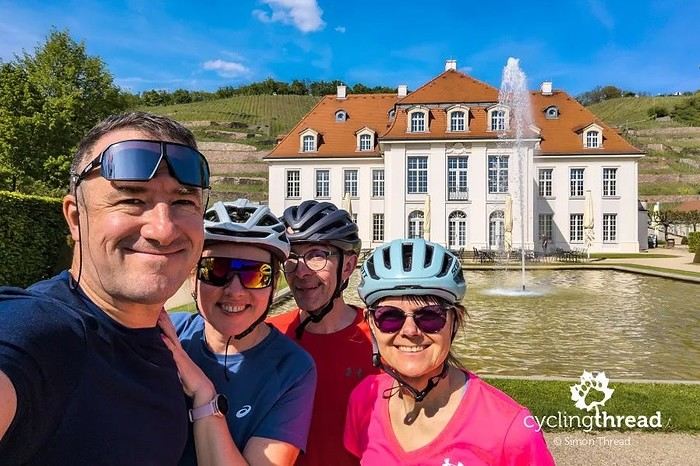
In my stories, I pay special attention to the quality of infrastructure, cyclist safety, and route accessibility—for young and old, experienced riders and beginners alike. I love discovering and sharing spots that are truly welcoming for cycle tourists: well-marked, with rest areas and easy train access.
On the blog, you’ll find ready-to-follow route suggestions, tips for preparing your bike trips, and plenty of inspiration for your next adventures. I travel with my panniers, a camera in the front bag, and always keep an eye out for what’s around me. Feel free to check out my blog, Cycling Thread—you might find some ideas for your next bike getaway! :-)
* * *
I hope this won’t just be a one-off post—I’ll try to share our bike trips with you here regularly. To start: our May trip on the Elberadweg, the queen of German bike paths, between the stunning city of Dresden and Magdeburg. I invite you to visit:
Elberadweg in Germany – From Dresden to Magdeburg
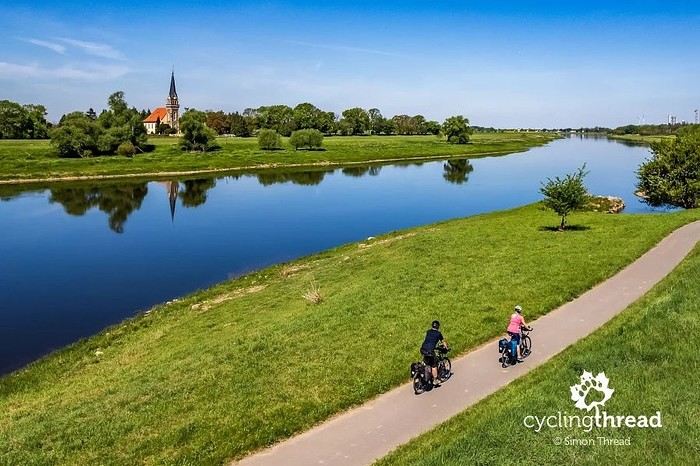
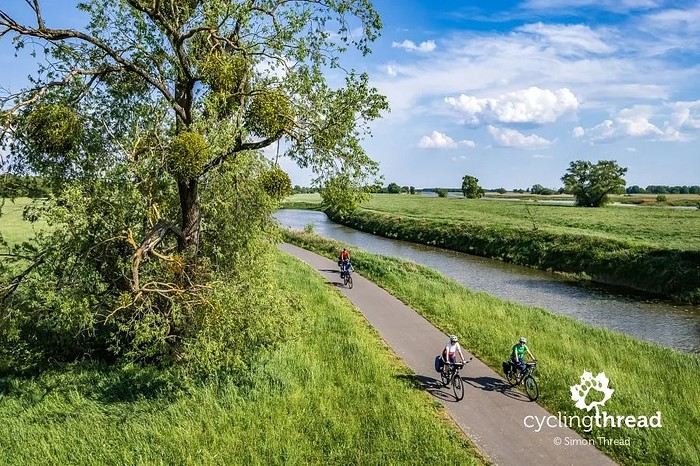
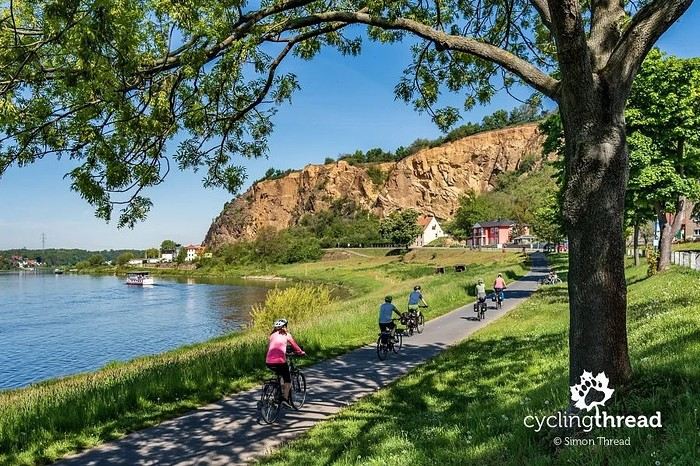
The Elbe bike path is about 1200 km long, following the river from its source in the Giant Mountains in the Czech Republic to its mouth in Cuxhaven, on the North Sea. The route crosses a variety of landscapes: mountain valleys, vineyards, open plains, and coastline. As is often the case in Germany, the signage is excellent and the route easy to follow.
But what surprised us was the number of cobblestone sections! Sure, the cobblestones are well-laid and fairly smooth—but they’re still cobblestones. And when they disappear, they’re often replaced by concrete slabs, typical of river dikes. That’s just part of the face of this 30-year-old "queen"—a heritage that’s hard to replace entirely with fresh asphalt.
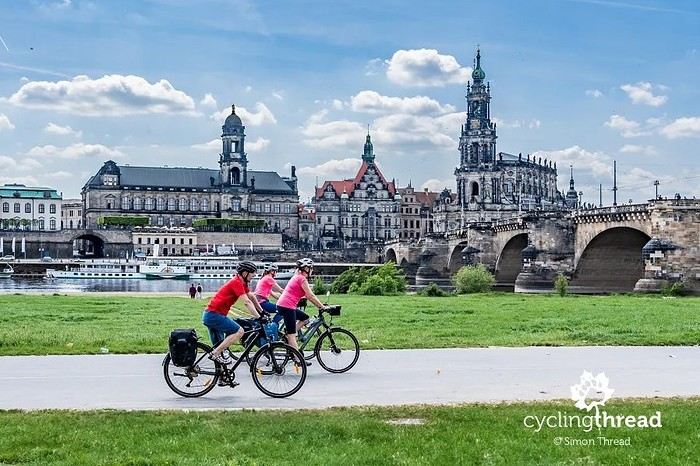
Along the way, don’t miss the many cultural highlights. Dresden impresses with its restored old town, the Frauenkirche, and the Brühl Terraces along the Elbe—it’s one of Germany’s most elegant cities. In Meissen, you can visit the famous porcelain factory and its Gothic cathedral. Wittenberg is a must-stop to follow in Martin Luther’s footsteps, with its castle church and Reformation Museum. And to finish, in Dessau-Roßlau, besides the Bauhaus, don’t miss the stunning Dessau-Wörlitz landscape gardens—one of the oldest English-style parks in Europe.
A few photos to give you a feel for the route and inspire you to check out our blog! :-)
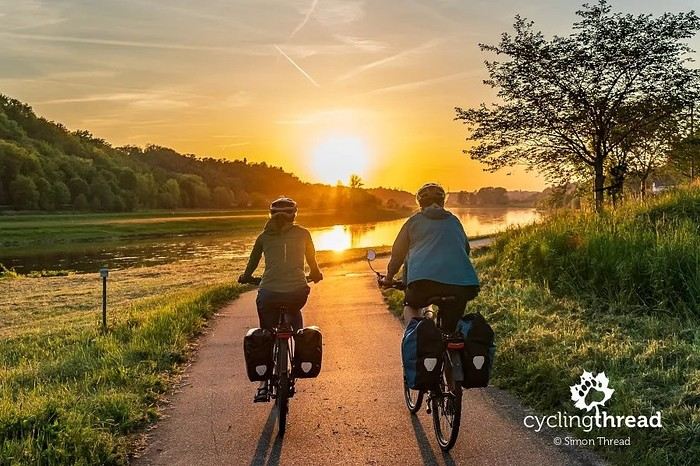
Happy cycling!
Simon
In my stories, I pay special attention to the quality of infrastructure, cyclist safety, and route accessibility—for young and old, experienced riders and beginners alike. I love discovering and sharing spots that are truly welcoming for cycle tourists: well-marked, with rest areas and easy train access.
On the blog, you’ll find ready-to-follow route suggestions, tips for preparing your bike trips, and plenty of inspiration for your next adventures. I travel with my panniers, a camera in the front bag, and always keep an eye out for what’s around me. Feel free to check out my blog, Cycling Thread—you might find some ideas for your next bike getaway! :-)
* * *
I hope this won’t just be a one-off post—I’ll try to share our bike trips with you here regularly. To start: our May trip on the Elberadweg, the queen of German bike paths, between the stunning city of Dresden and Magdeburg. I invite you to visit:
Elberadweg in Germany – From Dresden to Magdeburg
The Elbe bike path is about 1200 km long, following the river from its source in the Giant Mountains in the Czech Republic to its mouth in Cuxhaven, on the North Sea. The route crosses a variety of landscapes: mountain valleys, vineyards, open plains, and coastline. As is often the case in Germany, the signage is excellent and the route easy to follow.
But what surprised us was the number of cobblestone sections! Sure, the cobblestones are well-laid and fairly smooth—but they’re still cobblestones. And when they disappear, they’re often replaced by concrete slabs, typical of river dikes. That’s just part of the face of this 30-year-old "queen"—a heritage that’s hard to replace entirely with fresh asphalt.
Along the way, don’t miss the many cultural highlights. Dresden impresses with its restored old town, the Frauenkirche, and the Brühl Terraces along the Elbe—it’s one of Germany’s most elegant cities. In Meissen, you can visit the famous porcelain factory and its Gothic cathedral. Wittenberg is a must-stop to follow in Martin Luther’s footsteps, with its castle church and Reformation Museum. And to finish, in Dessau-Roßlau, besides the Bauhaus, don’t miss the stunning Dessau-Wörlitz landscape gardens—one of the oldest English-style parks in Europe.
A few photos to give you a feel for the route and inspire you to check out our blog! :-)
Happy cycling!
Simon
Hi everyone,
I’m planning a trip to Northern Italy for 2 weeks in August 2025. Here’s my itinerary: MILAN – 2 days LAKE MAGGIORE – 2 days LAKE COMO – 3 days BERGAMO – 1 day LAKE GARDA – 2 days VERONA – 1 day DOLOMITES – 2 days BOLOGNA – 1 day CINQUE TERRE – 2 days TURIN – 1 day Return to France
Let me know your thoughts, and any kid-friendly attractions would be great!
Hi everyone, I’m planning a trip to Barcelona with my girlfriend for 3 days—arriving Saturday midday and leaving Tuesday early afternoon.
Here’s what I’ve listed to visit:
- Sagrada Familia
- Park Güell
- Gothic Quarter
- La Rambla
- Boqueria Market
- Picasso Museum
Do you think all of this is doable? I’ve grabbed the metro map and I’m trying to figure out the simplest way to fit everything in. And most importantly, are those famous Barcelona City passes with skip-the-line tickets really worth it?
Thanks, friends! :)
Do you think all of this is doable? I’ve grabbed the metro map and I’m trying to figure out the simplest way to fit everything in. And most importantly, are those famous Barcelona City passes with skip-the-line tickets really worth it?
Thanks, friends! :)
Hi everyone,
I’m heading to Bangkok for a 5-month internship, and I’m wondering about the budget because I’ve read all sorts of things—so I decided to post here to get answers tailored to my situation! :D I found housing that costs me 7,000 baht (I know it’s a bit pricey, but it’s super convenient...), which works out to about 160 € all-inclusive. So, I was wondering if it’s realistic to live on 500 or 600 € per month, and if so, under what conditions? Is that enough, considering I’ll be working 40 hours a week?
Thanks in advance for your replies—I hope they’ll reassure me!
hi everyone, and so glad Voyage Forum is back up and running!
my partner and I, along with some friends, are planning a trip to Peru in May 2025.
I’ve got some questions about the Machu Picchu excursion.
we’re in our 60s and 70s, and while we’re pretty fit at European altitudes, I’m a bit worried about hiking above 2,500 m!
that’s why we didn’t hesitate to skip the 4-day Inca Trail trek.
but I’m wondering about the 2-day "short Inca Trail" offered by some agencies—basically one day of hiking with visits to a few sites, and the second day, the classic Machu Picchu visit.
has anyone done it? do you need to be in top shape?
thanks for your tips
Hello everyone!
I’m back from two weeks in southern Kazakhstan. I went with a friend, and we organized everything ourselves. We came back enchanted by this trip: stunning landscapes, lots of animals seen in the parks, and above all, top-notch hospitality and welcome... All of this makes me really want to go back and explore the other countries in the region. In the meantime, I’m sharing the story of these two weeks of travel... Don’t hesitate if you have any questions. And if you want more practical info and/or see more photos, you can check out my blog: https://smilingaroundtheworld.com/category/kazakhstan/
Day 1: First Kazakh steps in Shymkent
So here we are in Kazakhstan for two weeks. We had an excellent flight with Air Astana, which instantly made it into my top 3 best airlines! From the airport, the service was top-notch, with very friendly staff who went out of their way to ensure we both got vegetarian meals (my order hadn’t been taken into account when booking the tickets online). The flight to Nur-Sultan (the new name for the capital, formerly Astana, renamed last month in honor of the resigning president) was three-quarters empty, and we each got to stretch out over three seats. We were given an incredible travel kit, including a reversible sleep mask with phosphorescent writing: “Do not disturb” or “Wake me for meals.” Awesome! As for the lighting in the plane, I think the interior cycled through every color to simulate evening, early night, pitch-black night, and then dawn. It was even a bit surreal—those lights and everyone’s glowing masks ^^ The flight was a bit early and too short for us to sleep well, but it was still pleasant :-)
Upon arriving in Nur-Sultan, the atmosphere was a bit colder. There was staff everywhere, and we were under heavy surveillance. A camera even filmed us as we entered the terminal. We got our passports stamped and settled in to wait for our second flight. We eventually realized we were waiting in the wrong place... We were still in the international terminal, while our next flight was domestic. We finally found the right spot—saved! We started our trip in Shymkent, in the south of the country. We dropped our bags at the City Hostel, a super modern youth hostel offering double rooms. The decor is industrial-style, with very high ceilings—we loved it. When we arrived, it was too early for check-in, so we just left our luggage and went for a walk around the neighborhood. There was quite a bit of traffic, and the avenues were very wide. Despite that, there was also a lot of greenery and green spaces, which lightened things up a bit.
We had lunch (pizza + smoothie) on the top floor of a shopping mall, then headed to the pre-Russian quarter, a much quieter area with its little streets and individual houses.
Back at the hostel, after checking in, we treated ourselves to a two-hour nap—it felt great! In the late afternoon, we set out to find the Salman Bazaar. It wasn’t easy to organize—we realized Shymkent isn’t a very touristy destination—but we eventually managed with the help of the hostel receptionist, who called us a taxi. This bazaar is huge and has everything you could need for daily life: clothes, food, household products, toys... We did some shopping for dinner, then took another taxi to Independence Park, inaugurated in 2011 for the 20th anniversary of Kazakhstan’s independence. We really liked this park—it’s very wooded, and the late afternoon light was, as always, beautiful and pleasant... In the center, a large monument resembles the center of a yurt.
We then walked back to the hostel via Independence Square and several parks. We wanted to grab a drink along the way but didn’t find anything inspiring—oh well. We had dinner at the hostel and went straight to bed. Tomorrow, we’re getting up early... We’re heading out for two days to explore Aksou-Jabagly National Park. This park is famous for its landscapes at this time of year—it should be in full bloom, especially with tulips. We’ll see!
Days 2 & 3: Canyon, tulips, and wildlife in Aksou-Jabagly Park
Located two hours from Shymkent, Aksou-Jabagly Park is reputed to be one of the most beautiful in the region. We took a taxi from Shymkent, and upon arrival, we were warmly welcomed by Ruslan and his mother. They live at the entrance to the reserve, at the foot of the mountains, in a house surrounded by poplars. The setting is exceptional, and we immediately fell in love with the place. For our first day, we set off to explore the Aksou Canyon. Ruslan arranged a 4x4 with a driver and a ranger. The ranger speaks a few words of English, and with Coralie’s few words of Russian, we should manage! After a “viewpoint” stop, the road turns into a dirt track. It’s rained a lot lately, and the track is sometimes very muddy—at one point, we even had to cross a river. Four-wheel drive was definitely needed! The ranger pointed out some marmots by the side of the path—they were adorable.
We finally arrived at “Inspector’s House No. 1,” which overlooks the canyon. The view is magnificent, with high cliffs, wildflowers, conifers, and the Aksou River winding far below. While the driver chatted with the inspector, we descended to the bottom of the canyon with the ranger. The tulips I’d been hoping for were there—I was so happy! There were red, yellow, and even bicolor ones...
At the bottom of the canyon, we took a little break by the river. “Aksou” means “white waters” in Kazakh—the water does indeed have a very special color, a blue that’s both very light and very intense, like some South American lagoons. It bubbles around the rocks. The climb back up was easier than we feared. Once at the top, we continued along the canyon. The perspective changed as we progressed, and we never got tired of the view... Eagles circled above us.
After about 2 km, the driver picked us up, and we continued to a small kiosk at the foot of the mountains, where we had a picnic. Ruslan’s mother had prepared vegetarian “lunch boxes”—it was delicious and felt good to eat. However, it had gotten noticeably colder, so we put our jackets and scarves back on! After the meal, the driver walked off with a bucket—we figured he was going mushroom picking with Inspector No. 2, who had a house nearby.
We enjoyed the spot a bit longer while the driver gathered mushrooms, and then we headed back toward Ruslan’s place. Or so we thought... The return trip turned out to be quite long—the park wasn’t as deserted as it seemed, and the driver stopped every five minutes to chat with people we passed. At one point, we ran into Inspector No. 2 on horseback—it looked like there was a problem with a car further ahead... The driver and ranger bolted out of the car, headed toward the other vehicle, and we heard raised voices... When they came back, we tried to figure out what had happened, but no luck. We stopped again at Inspector No. 1’s house (are you following?), and they made us get out, telling us Inspector No. 2 needed the car for a few minutes... They left us stranded with Inspector No. 1, who went home, leaving us in the garden :-D We kept busy with the puppies, and I even took a little nap in the sun... Three-quarters of an hour later, we finally left—we didn’t fully understand what happened and never found out!
We got back (almost) without stopping to Ruslan’s house. Our room was ready, and we settled in quickly before dinner. It was already 6:30 PM, even though we were supposed to be back by 4 PM. Mushroom picking really slows things down ^^ Ruslan’s mother had prepared a delicious meal: vegetable soup, raw vegetable salad, and a mushroom, carrot, and potato stew. We loved it!
We spent the rest of the evening planning the rest of our trip while sipping tea. At one point, Ruslan and his mother signaled that there were wild boars right across from us—we could see them clearly! There were three adults and three piglets. We also took a little walk in the garden, watched the sunset, I did some blogging, and Coralie read... A lovely evening, and an equally lovely ten-hour night! The next morning, after a good breakfast, we set off on foot into the park. The trail starts right next to Ruslan’s house—so convenient! Today, we were with another ranger, two Germans (brother and sister), and their English-speaking guide (who didn’t guide much). We walked on a dirt road—there were even more tulips than yesterday, and the snow-capped mountains in the distance were stunning. After 5 km, we reached a small cabin, then continued another kilometer to Kishy Kaindy, a viewpoint overlooking the Jabagly River waterfalls (Jabagly means “year-old foal”). It was spectacular! We stayed a good while admiring this natural wonder. Like yesterday, the ranger didn’t rush us at all—it was really nice. We also saw eagles and an ibex perched on a ridge.
We had a picnic at the cabin before heading back the same way we came. This time, the snow-capped peaks were facing us—so beautiful! We picked up our bags and said goodbye to Ruslan’s mother. She was really happy today because her granddaughter was there. She told us she was a “babushka”—I understood that! Ruslan then drove us to Turar Ryskulov, where we took a shared taxi back to Shymkent.
In Shymkent, we struggled a bit with our Airbnb. We waited half an hour for the person who was supposed to let us in, then discovered the Wi-Fi wasn’t working—but we had a lot of bookings to make that evening. The lady finally lent us a Kazakh SIM card with data, which Coralie put in her phone in “hotspot” mode so I could get some internet too. All of that took nearly two hours. Phew! We then rushed to do some shopping at the supermarket. On the way back, some lights caught my eye—it was a pedestrian street all decorated with a funfair next to it. It was very lively, and we spent a good while strolling and people-watching! The rest of our evening was studious, between preparing dinner and booking our next stops.
Day 4: Turkestan, Yasawi Mausoleum, and Sauran ruins
This morning, after one last stroll in Shymkent, we headed to Turkestan. When we arrived at the bus station, we were told the next bus was in nearly three hours, but there were minibuses leaving when full. The system was well-oiled, and in just fifteen minutes, our minibus was ready to go. We each had a seat (and one for our luggage since there’s no trunk!), and the minibus was quite new—nothing like Madagascar ;-)
The trip went well despite a few driving scares—the driver was going a bit fast for my liking! Along the road, the fields were full of poppies—so pretty. When we arrived, we headed straight to the Edem hotel, where we wouldn’t be staying (we had a train to Almaty at midnight) but where we wanted to leave our luggage for the day. They agreed easily—great! Once we’d dropped off our bags and suitcases, we started our visits.
We began with the architectural gem and largest pilgrimage site in Kazakhstan: the mausoleum of Khodja Ahmad Yasawi, a great Sufi sage. Yasawi’s original tomb was already a pilgrimage site when Tamerlane ordered the construction of a larger mausoleum in 1390. It’s decorated with white and blue tiles and has a turquoise dome (currently under renovation). The main facade, unfinished at Tamerlane’s death, was left in earth with visible scaffolding. Impressive! The site is UNESCO-listed. Inside, the main hall displays a large cauldron, and other small rooms showcase plates, ancient coins, belts... Yasawi’s tomb is visible via two adjacent corridors.
We then strolled through the park, which includes many other mausoleums and tombs. We visited the old baths, the Friday Mosque, and then the history museum. The underground mosque, where Yasawi’s cell is located (where he retreated at the end of his life), was unfortunately closed for renovations.
We then went back to the Edem hotel to have them call us a taxi, and we set off to visit the ancient fortress of Sauran. This Silk Road city, once prosperous, is now reduced to ruins, with thousands of poppies blooming between them. High walls once surrounded a bustling and pleasant city. Many foundations remain visible. The place is vast, quiet, almost deserted, and imbued with a certain melancholy... The deep red poppies swayed in the wind, between the remnants of this city, reminding us how fleeting things are.
Back in Turkestan, we had dinner at the Edem hotel’s restaurant (we had to thank them somehow ;-)) and then rushed to the station to catch our train... 18 hours of travel awaited us to Almaty!
Day 5: From Turkestan to Almaty, 18 hours by train across the Kazakh steppe
We traveled from Turkestan to Almaty by train. We booked our tickets the day before departure, and only six seats were left: three in second class, not together at all, and three in first class, also not together but in the same carriage. We opted for first class! It was more expensive, but for such a long trip, a little comfort wouldn’t hurt... We wondered if we’d manage to switch cabins to be together, but it resolved itself: when we boarded, the conductor/carriage chief immediately noticed we weren’t together. He literally kicked a young man out of his berth so we could travel in the same cabin. We felt bad for the young man, even though he seemed to take it well... we thanked him with dried fruit (and I can confirm he took it well—the next day, he came to chat with us). In any case, we were really happy to have our own little cabin for this long journey, especially since we were the only foreigners and the only women in the carriage.
Eighteen hours by train might seem long, but these long trips while traveling aren’t wasted time—they’re the breathing space of the journey. They’re the essential moments for digesting what we’ve already experienced and preparing for future discoveries. They’re also privileged moments for reflection. Traveling slowly, to the rhythm of the train, means falling asleep in Turkestan’s outskirts, lulled by the train’s rocking and creaking, and waking up in the steppe. It’s feeling the train slow down and stop, stepping onto the platform for a moment, and watching the women sell food to passengers. It’s taking the time to write, read, think. It’s chatting with our neighbors and, despite the language barrier, managing to communicate a little. It’s picnicking at the little table in our cabin, with the landscape rolling by outside, and listening to music. It’s feeling privileged, imagining ourselves on the Orient Express or the Trans-Siberian. Reminding ourselves that one day, one day for real, we’ll take that Trans-Siberian. And smiling, thinking that in the meantime, in a few months, there’ll be the Trans-Canadian...
Days 6 & 7: Almaty, the “little apple”
The former capital of Kazakhstan, Almaty is known as the most Western and lively city in the country. At first, we had a bit of trouble identifying the city center—it’s more spread out and less dense than what we’re used to in Europe—but once we got our bearings, we really enjoyed strolling along the wide avenues lined with cafés and in the few pedestrian streets. The city’s emblem is the apple, which you’ll find in various forms around the city, from benches to statues to fountains. The original apple, from which all the apples we know today descend, is said to come from the mountains of Kazakhstan.
For nature, Almaty is a pretty green city. It has large parks, like Panfilov Park, which houses the Zenkov Cathedral. Some streets are also very tree-lined, so much so that they almost look like gardens. Often, high mountains peek out from behind the streets...
For shopping, traditional boutiques sit alongside big international brands. We really liked the Green Bazaar, a large market that sells everything. The food section was great, with stalls of pickled vegetables, dried fruits, and beautifully stacked fresh fruits... A feast for the eyes and lots of temptations for me!
For culture, Almaty has several museums. We visited two: the Fine Arts Museum and the National Museum. Both are housed in very Soviet-looking buildings on the outside, but the Fine Arts Museum turned out to be quite modern inside, with a pleasant museography. The National Museum, on the other hand, has stayed true to its roots ^^ Just walking through it was an experience in itself. And we did quite a bit of shopping there... The hall is a giant shop with lots of handicrafts—we treated ourselves.
The Arasan Baths are a must in Almaty. They’re said to be among the most beautiful baths in Central Asia... Architecturally, I didn’t find them amazing (nothing like Budapest’s, for example), but wow, did it feel good to relax there after a day of sightseeing! I happily moved between the sauna, hammam, and Russian sauna, with a preference for the latter—less dry than a traditional sauna and less humid than the hammam. You can buy bundles of leaves to slap yourself (or get slapped) with to boost circulation. The prices are very affordable too... On a weekday evening, we paid 1,800 tenge, or 4.5 euros, for an hour. Note that they add 20 minutes for changing, so you really get a full hour in the baths.
For restaurants, we didn’t try many because we preferred to limit our food budget by cooking ourselves. However, we did try and highly recommend Daredzhani, a great Georgian restaurant where we feasted. We didn’t know Georgian cuisine before, but we really liked it—vegetables cooked in various ways, cheese-filled breads, potato and/or egg-filled breads, and very thin fruit pastes made from grapes. We actually ate there twice because it was so good! We also loved Coffee Delia, where you can enjoy delicious pastries in a very cozy setting.
Besides being a pleasant place to live, Almaty is also a great base for exploring the surrounding area, and we were happy to stay eight days to discover more of the region!
Days 7, 8 & 9: Getting green around Almaty: Kok Tobe, Shymbulak, Medeo, and Big Almaty Lake
During our stay in Almaty, we used a rather unusual means of transport several times: the cable car! Here, it’s called a "gondola," and it allowed us to gain some altitude and breathe in the fresh mountain air surrounding Almaty ;-)
First cable car ride: Kok Tobe. The cable car starts in the city center and takes you to the top of a hill overlooking Almaty. At the top, it’s fairground vibes with an upside-down house, a Ferris wheel, rides, and the inevitable eagle trainer... There’s even a little corner dedicated to the Beatles, complete with music and a statue!
Second ride: Shymbulak. This time, you take a bus to Medeo, then three cable cars to the top of the mountain, at 3,200 meters altitude. Shymbulak is the largest ski resort in Central Asia. We went there to hike, but there was still snow and skiers, so we settled for admiring the view... With the blue sky and sun we had, it was gorgeous! We then treated ourselves to tea on the terrace—chalet vibes... At Paul’s, we weren’t completely out of place ;-)
Before taking the bus back, we stopped by Medeo, where there’s a large ice rink. With 10,000 m², it can host a thousand skaters in winter! This season, it’s closed; part of it is used as a go-kart track, and the other as a landing strip for paragliders.
Located an hour’s drive from the city center, Big Almaty Lake reveals itself at the last moment, around a bend, nestled in a setting of mountains and greenery. With the recent cold snap, it’s frozen, and the edges are snowy—a beautiful winter atmosphere! The ice was starting to melt, though—we could hear the water moving underneath, and when Coralie tried to walk on the ice, it collapsed under her feet. Unfortunately, it’s impossible to walk around it—a ranger keeps an eye out and blocks the adventurous (including us ;-)).
Days 10 & 11: Excursions around Almaty: Charyn Canyon, Issyk, and Turgen
Almaty’s tourism office is very active and organizes outings on weekends and holidays. We went to Charyn Canyon and then to Issyk and Turgen. A great way to discover the Almaty area at a modest cost (the outing costs about 6,000 tenge, or 15 euros per person).
Formed over millennia by erosion and wind, Charyn Canyon is reminiscent of the Colorado and the Grand Canyon. The most touristy part we visited is called the Valley of Castles, referring to the rock formations that resemble towers. We first walked along the ridge, where there are many viewpoints, then descended into the canyon. A three-kilometer walk leads to the banks of the Charyn River. The place seems to be a favorite relaxation spot for Kazakh families, who picnic, play ball, sunbathe... There’s also a hotel, bungalows, yurts, and a restaurant. Issyk is famous for its burial mounds and its Golden Man—maybe even a Golden Woman—found there. A small museum displays some artifacts. A little further on is Issyk Lake, once dried up but now reappearing... Whether naturally or not isn’t very clear!
As for Turgen, it’s a natural park known for its gorges and waterfalls. We didn’t have time to explore it in detail, but the bus drove through some beautiful landscapes, and we still walked to Bear Waterfall. It’s not incredible, but it’s still a nice little hike.
Besides the practical side of these organized excursions from Almaty, we appreciated being able to do an activity that Kazakhs do on weekends. During the Issyk/Turgen excursion, we really hit it off with Karina, a young student dragged there on vacation by her mother. She’s currently studying computer science at the best university in Astana and hopes to go to Europe eventually... A brilliant young woman, and a chance for us to chat in English ;-)
Days 12 & 13: The spectacular landscapes of Altyn-Emel Park
The last stop on our Kazakhstan trip was Altyn-Emel Park. This park is quite hard to access, so we opted for a car with a driver for two days—pure luxury!
Our driver’s name is Andrei. We met him at 7 AM outside our apartment on Wednesday morning. He doesn’t speak English, but a young man from the agency we booked through was also there, and we went over the itinerary together before leaving with Andrei.
Our first stop was Tamgaly Tas, two hours from Almaty. It’s a site where you can see 16th-century petroglyphs depicting Buddha. The place is also known for climbing—there were lots of young people harnessed up and/or climbing. It’s right in the middle of the Kazakh countryside, and we had a bit of trouble finding it!
Even with the language barrier, Andrei turned out to be very friendly. He suggested photo stops from time to time, didn’t rush us, and pointed out animals he saw... We even backed up on the road to see and help a tortoise cross!
It took another two and a half hours to reach Bashi, the “gateway” village to Altyn-Emel Park. After a quick stop at the rangers’, we arrived at the hotel. Our guidebook mentioned modest guesthouses, but things are changing... The hotel is large, brand new, and still being expanded. It reminded me of some Chinese hotels in Laos.
We had a quick lunch with Andrei—he explained that he’s a truck driver normally, delivering clothes and fabrics between Kazakhstan, Afghanistan, and Russia. He also showed us photos of his wife and son and told us he’s recently become a grandfather! We then headed to the park, grabbing a ranger on the way. Like in Aksou-Jabagly, he was dressed in full military gear. We first headed toward the Katutau Mountains. The rocks are reddish, sculpted by wind and erosion—the place reminded us a bit of Charyn Canyon. We had some “free time” to explore—we didn’t need to be told twice... Meanwhile, Andrei and the ranger chatted nonstop—it looked like they’d hit it off!
We got back in the car and continued along the track to the Aktau Mountains. Change of scenery! The mountains weren’t red anymore but white... Or so they appeared from afar. When we got closer, we realized they were actually multicolored, striped with yellow, pink, and ochre veins... It was magnificent, even more so with the late afternoon light. We had time to explore on our own again, and we walked with delight in this almost dreamlike landscape. We thought we’d made the right choice coming here ;-) We made one last stop before heading back to see a 700-year-old willow. It’s in an oasis where other tourists were camping—very tempting... I got the coordinates of their guide for next time ;-) The way back was in beautiful light, between sunset and a distant storm. Nature even treated us to a gorgeous sunset!
It was past 8 PM when we got back to the hotel, but our dinner was still waiting for us. We ate with Andrei, chatted a bit with a Polish woman who spoke both Russian and French (we put her to work chatting with Andrei ;-)), and then had a quiet evening with Wi-Fi, a shower, and reading in our room.
The next day, after breakfast, we met up with the same ranger and headed toward the singing dunes. These dunes are supposed to make a sound when you slide down their slopes. I was more than skeptical, but okay! When we arrived, we discovered a beautiful landscape—the main dune is gigantic, and when we reached the top, the view was extraordinary: it was the first time I’d seen a dune in the desert, snow-capped mountains, and a river all in one glance! A group of Chinese tourists was ahead of us on the dune, but they turned back quickly, and we were alone. After studying the terrain, I chose a slope that seemed good, and I started sliding down on my bottom... Quickly, I heard and felt a strong vibration, which turned into a hum. The dune really sings! It’s completely crazy... We did several tests—the most effective was sliding down side by side. But it works as long as there aren’t too many tourists doing it and the dune has time to rebuild between slides... There are about thirty singing dunes in the world. This phenomenon, already described by Marco Polo, comes from the synchronous movement of sand grains, which must be very round and covered with a varnish called “desert glaze”...
Covered in sand but delighted, we headed back to Bashi. The ranger stopped at a small spring so we could wash up, but it was almost dry. Along the way, we also saw the “Oshaktas,” a place where Genghis Khan’s expedition is said to have camped in 1219 during his conquest of Central Asia. The stones were apparently used to support the cauldron where food was prepared. A little further on, the ranger made us stop: there were antelopes!!! We saw one up close and a herd further away.
When we got back to the hotel, I took a quick shower to get rid of the sand—I felt like I had it everywhere! We had a quick lunch and then hit the road back to Almaty. Andrei drove very well, had a nice playlist, and I let myself be lulled while watching the landscape roll by outside...
For our last night in Kazakhstan, we booked a yurt in the hills above Almaty, not far from Medeo. For one night, we pretended to be nomads... The bed was a bit hard, and the air was a bit chilly, but we loved it! And the welcome was kind, the meal very good—only downside: the horse milk and camel milk, still warm... I almost threw up. Well, it was an experience, and all of this beautifully concluded our Kazakh stay!
Who are you? Where are you from? Where are you going?
Like last year at this time, a post about bike travel ideas.
How many of us are preparing a trip planned for this year? Probably a lot.
What’s yours—the one you’ve been dying to do for so long, maybe too long? For us, it’s a modest PARIS-MARATHON by bike, followed by MARATHON-ATHENS on foot in June 2010. And you?
May the passion keep growing before, during, and after! Happy planning and safe travels to everyone.
Hi there,
who has already done the EURO VELO 1 in Norway from the south to the North Cape, and what are the main difficulties:
elevation gain, etc.......
Otherwise, who has already done the EURO VELO 7 from south to north, crossing Sweden up to the North Cape? If so, what are the difficulties, elevation gain, and does it pass through villages for supplies, etc.......
Hi there,
Last February, I made a trip using "public transport" from France to southern Senegal via Spain, Morocco, Western Sahara, and Mauritania.
It’s a journey of about 5,000 km, where I took trains (as far as Marrakech), ferries (to cross Gibraltar and then to reach Casamance from Dakar), and mostly buses on the long desert straightaways. I hadn’t planned any stops in advance or booked any hotels, except for the very first train to Spain, which left plenty of room for the unexpected. Why travel by land and sea? In recent years, flight-free travel has been gaining popularity. On social media, posts explaining how to cross Europe by train as quickly as possible go viral. Traveling without flying—and making sure people know about it—has become a great way to earn a badge of eco-responsibility: an essential totem for anyone wanting to prove both their dedication to the ecological cause and the wisdom of slow travel. I haven’t flown in years, and this journey to West Africa could easily be filed under "responsible travel." But it wouldn’t be honest to say that: in reality, it wasn’t really my aversion to flying that motivated this long trek. I see overland travel primarily as a way to experience the world’s geography at a grounded, earthly pace—the pace of the locals. Besides, I’ll be flying back, which disqualifies any claim to being a model of sustainability. So no eco-badge, and no adventurer’s badge either: you won’t find any heroic tales of camel rides in lost lands or mineral train wagons in this account (popular with influencers, the Mauritania iron ore train now attracts tourists from all over the world, turning "the experience" into something you "have to do at least once in your life"). This five-part story, written on the road, has no other ambition than to recount a journey through places and people, and to share the thoughts they inspire in me. As simply and, I hope, as humbly as possible.
I’m posting the episodes here, which you can also find on my blog (with more photos) at the following links:
Episode 1: Spain, from Avignon to Algeciras
Episode 2: Morocco, from Tangier to Tarfaya
Episode 3: Western Sahara, from Tarfaya to Guerguerat
Episode 4: Mauritania, from Guerguerat to Nouakchott
Episode 5: Senegal, from Rosso to Saloulou
To help those who might want to make the same trip, I’ve also put together a summary of the route with recommendations—you can read it at the end of the story and on the blog: From France to Senegal Without Flying: Route and Itinerary Recommendations
Happy reading, and safe travels!
Hi everyone,
I’ve traveled a lot outside Europe before Covid, usually organizing my trips myself. In recent years, I’ve focused on Europe, which I’d neglected before. Now, I’d like to get back to long-haul trips and fill in some gaps on my world map.
At the moment, I’m considering a route in China—I’ve only been to Hong Kong (which isn’t really China)—for late April/early May 2026. Here’s a first draft:
D1: Departure D2: Arrive in Beijing in the morning – hutongs – night in Beijing D3: Forbidden City – Temple of Heaven – night in Beijing D4: Great Wall – night in Beijing D5: Summer Palace – (Ming Tombs?) – night in Beijing D6: Train to Datong – Yungang Grottoes – night in Datong D7: Train to Pingyao – visit – night in Pingyao D8: Train to Xi’an – Wild Goose Pagoda – night in Xi’an D9: Terracotta Army – Xi’an city walls – night in Xi’an D10: Flight to Zhangjiajie (or the night before) – Tianzi Mountain – night in Wulingyuan D11: National park – night in Wulingyuan D12: National park – night in Wulingyuan D13: Train to Chongqing – night in Chongqing D14: Explore Chongqing – night in Chongqing D15: Return flight
I know it’s tight, but what do you think? For the Great Wall section, what do you recommend? Jinshanling seems like the best option, or Simatai, but it’s far. For the budget, I’m planning on 2,500 € per person. Thanks for your feedback! Phil
Hi everyone,
We’re planning a week-long trip to Finnish Lapland in February 2026 with two kids aged 7 and 4.
I’ve spent quite a bit of time browsing websites and this forum, but I still have a few questions left.
We’ll be landing in Rovaniemi but won’t be staying there, so we’re planning to rent a car. Do you have any recommendations for rental companies? Is a Golf-sized car sufficient, or should we opt for something better suited to the conditions?
I found some nice accommodations near Akaslompolo. Is the area nice? Are there restaurants, shops, etc.? If it were just me, I’d go for total isolation, but I’m not alone 😎 If not, do you have any alternatives within a 2-hour radius of Rovaniemi? I’d also spotted Luosto.
We’re planning the classic activities: - Visiting a reindeer farm (but no sled ride); - A dog-sledding excursion; - Ice fishing; - A few evenings hunting for auroras using our car and a dedicated app; - A day in Rovaniemi for Santa Claus Village, the Arctic Museum, and the small Ranua Zoo; - An ice hockey game; - And maybe a day of skiing.
Do you have any recommendations for activity providers?
What kind of clothing layers do you recommend for the kids at this time of year?
Is the amethyst mine in Luosto worth it? I think the prices are over the top and can’t figure out why… Maybe there’s a good reason?
Thanks in advance for your answers.
Best regards.
The reopening of the forum is great news—let's keep it going! I’m going to share a little story about this 12-day trip, which was my second-to-last journey and my most recent one in Africa for now.
I went to this country for one very specific reason: to see two endemic animal species. A little suspense… you’ll find out what they are soon if you don’t already know!
The country is poor, very poor even. And it hits you even harder when you arrive in the capital: a massive open-air construction site that gives an impression of prosperity. A lot of roads were built by the Chinese, but to be honest, they’re far from perfect… and I mean *far*!
When it comes to restaurants, it’s pretty much the same story. Most offer endless menus, but in reality, there aren’t many choices. Once, I was flat-out told: “No rice today!” Ordering a dish? It’s a real gamble! The food is *very* spicy—I’m warning you, it’s intense! There’s chili in almost everything, so it’s best to ask beforehand if you don’t want your mouth on fire. Actually, this was the first time I didn’t like the food in a country I visited. Had to happen eventually, right?
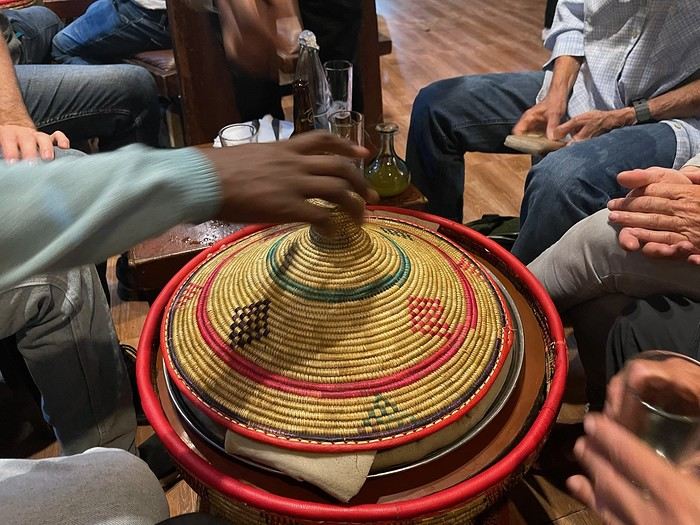
Their national dish? Injera. A large flatbread topped with sauces, vegetables, and meat. The taste is really unique—some love it, others… not so much.
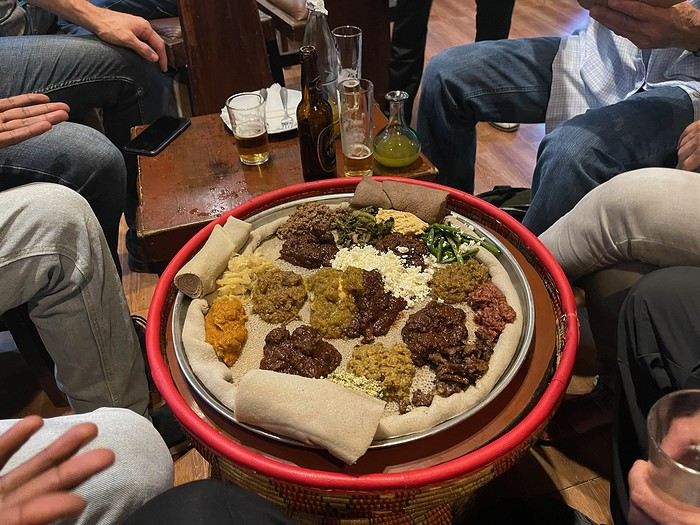
I went to this country for one very specific reason: to see two endemic animal species. A little suspense… you’ll find out what they are soon if you don’t already know!
The country is poor, very poor even. And it hits you even harder when you arrive in the capital: a massive open-air construction site that gives an impression of prosperity. A lot of roads were built by the Chinese, but to be honest, they’re far from perfect… and I mean *far*!
When it comes to restaurants, it’s pretty much the same story. Most offer endless menus, but in reality, there aren’t many choices. Once, I was flat-out told: “No rice today!” Ordering a dish? It’s a real gamble! The food is *very* spicy—I’m warning you, it’s intense! There’s chili in almost everything, so it’s best to ask beforehand if you don’t want your mouth on fire. Actually, this was the first time I didn’t like the food in a country I visited. Had to happen eventually, right?
Their national dish? Injera. A large flatbread topped with sauces, vegetables, and meat. The taste is really unique—some love it, others… not so much.
Hi everyone,
I’m posting this because in about two weeks, my wife and I want to go to Myanmar. Ever since the country opened up, we’ve really wanted to visit. However, I’m wondering if there’s too much hype about it. Everywhere you read that it’s authentic, not too touristy, really different, etc. So I’m worried we might be getting our hopes up too high and risk being disappointed if it’s not the case. Because despite everything, it’s become a very popular destination in Asia, and a lot of tourists are heading there.
I’d love to hear your general thoughts. Were you disappointed? Or was it exactly what you expected?
Because if all this enthusiasm is a bit exaggerated, maybe we’ll choose another country instead.
Thanks in advance! :)
Hi there,
I’m planning a trip with my partner (no kids this time—thanks, Grandma!) for two weeks to celebrate her 40th birthday. I’ve been thinking about Chile. We’re looking at leaving around September 18, 2027, starting in the south and returning in early April.
Here’s what I had in mind:
8 nights in a van in the Lake District and the start of the Carretera Austral (up to the Chaitén area). We’re set to arrive in Puerto Montt around 2:00 PM. We don’t want to go too far south since we’re planning to explore the heart of Patagonia (Chile and Argentina) with the kids when they’re older. The idea is to spend 3 nights discovering the lakes (up to Cochamó) and 3 nights in Pumalín Park. I’ve also added two transition nights. 7 nights in the Atacama to experience another side of Chile (San Pedro), taking a domestic flight from Puerto Montt to Calama in the early afternoon. We’ll depart for France in the early evening from Santiago.
What do you think? Thanks,
Hi everyone!
New to this forum, I’m planning a pretty big project for 2028. I’m heading to Nepal to do a trek from Kathmandu all the way to Everest Base Camp (a cool 5,300 m 😄). This trek is a bit special because even though I’ll be part of a group, I’m going solo (so far, no problem—I’m used to it). But it’s my first real trek, and it’s also a humanitarian one: once I reach base camp, I’ll stay an extra week to help clean up the waste left by tens of thousands of climbers! Since I’m originally from South America, from two countries that share the Andes, I have a deep respect for mountains—they fascinate me. So Everest… it’s kind of the trip of a lifetime!
So, a little question for those who’ve done treks to Everest before… any tips for good mental preparation (I’m already working on the physical side)?
Thanks in advance for your advice! 🙂
Hello everyone.
Preamble:
Sooner or later, you’ve got to take the plunge! I thought lockdown would be the perfect time to start this travel journal, but between working from home and gardening, I just didn’t have the time (or the motivation). Plus, long-haul trips weren’t really on the cards back then... But then I stumbled upon my photos and thought, "I’ve got to share my latest adventure in Brazil—you guessed it!"
First, a little flashback: some of you (yes, really, in DMs!) pointed out the big gaps in my travel journals—India in 2019, Vietnam in 2018, so many missed opportunities!
Truth is, for India, I traveled with a private guide and honestly didn’t have much to add to the tons of well-documented journals already out there. Plus, I still haven’t decided if I love or hate India... So, how do you share your feelings when you’re not even sure yourself? As for Vietnam, I had plenty to say—even though the itinerary was pretty classic—but I’ll admit the vibe on this part of the forum at the time kinda put me off for a while... And time flies, and memories fade... Anyway, just wanted to clear that up for my (many or few) readers. *Tudo bem*, let’s get started!!
After the wide-open spaces of the American West, we're off to a new destination: Dubai. Not just for a layover, but for a real family vacation!! The question that kept coming up was "why Dubai?" (after why Colorado this summer, people are going to think we're really weird 😅). So, why Dubai? First, because skiing isn’t really our thing anymore—so in winter, we want sunshine 😎. But not just any sunshine—warm enough to swim, which narrows things down a bit 😅. The second constraint this year: Franck can’t take more than a week off (and it’s unpaid), so we’re ruling out destinations with 12-hour flights and jet lag that knocks you out when you get back 😅. The options are getting tighter… So, against all odds, it’s me who ends up suggesting Dubai (my husband’s been nagging me for years about Atlantis and its mega water park—ah, the kids! 😉).
Actually, Dubai only has 2 days of rain a year (you’d have to be *really* unlucky!!), temperatures around 30°C in winter, the sea (oh yeah, I forgot—the sea was something we missed this summer, so it was on our list 😅), a 6/7-hour flight, just 3 hours of jet lag, reasonable family prices, and tons of activities for all tastes. Starting my research with a pretty negative bias, I’m now looking forward to this trip with excitement and impatience… and without spoiling the ending, I won’t be disappointed—our whole family will come back enthusiastic and ready to go back!!
So, I’m taking you along for a week in Dubai at the beginning of March.
Here’s a travel journal with photos, different from the ones we usually share with you.
Some of you may have heard about the legendary charm of Alsace, this small region in eastern France, right next to Germany. For those who want to visit, we’re offering this journal. While it’s not exhaustive, it covers many of the most interesting sites, and we’d love to help make your trip a success—or maybe even inspire you to take a trip there.
Introduction
" HOW BEAU-TI-FUL OUR ALSACE IS WITH ITS FRESH VALLEYS IN SUMMER, IT RI-PENS THERE WHEAT, VINES, AND HOPS "
This is the start of a little tune our elementary school teacher used to make us sing in class. That was last century. This refrain and its melody have stayed in my heart because they perfectly capture this region. I know many tourists dream of the Christmas market and the magical snowy landscapes, which makes sense, especially for visitors from the south or those with young kids. As for me, I’d recommend visiting between June and September because everything is so much more pleasant and enjoyable during the warm season.
Alsace is a mix of German organization and French art de vivre. The result? A place beautifully shaped by nature, thoughtfully developed by people, and packed with exceptional restaurants and bakeries. Plus, tourists are generally welcomed with courtesy and expertise.
The heart of the region’s tourism lies between Strasbourg and Colmar, spanning the Haut-Rhin and Bas-Rhin departments. To the west of these cities, often on the slopes between the plain and the hills, winds the famous Wine Route. From north to south, it stretches about 150 to 170 kilometers. A proper visit to Alsace takes about five days to a week—or longer if you’re really into it. I think having a car is best, as the terrain isn’t flat.
Let’s start with northern Alsace, which is less known to tourists—except for the Germans, who love strolling around and enjoying good food there.
Wissembourg sits on the border with Germany, at the very north of the Bas-Rhin, about 60 km from Strasbourg. The tourist office has set up signs near the large free parking lot, so you can take a pleasant walk through this small town. Highlights include the Saint-Pierre Saint-Paul Church (the second-largest in Alsace), the 1741 town hall, the Salt House with its unusual roof, the ramparts, and some fascinating old houses.
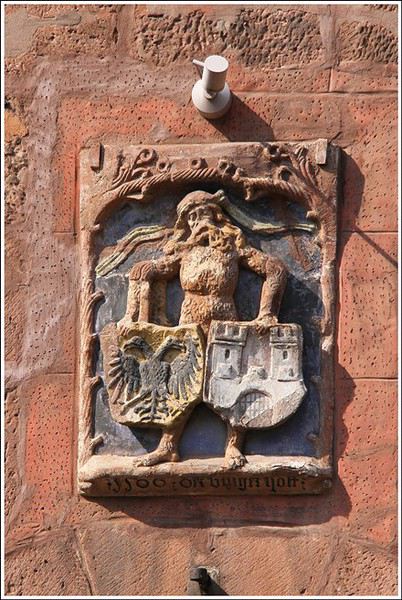
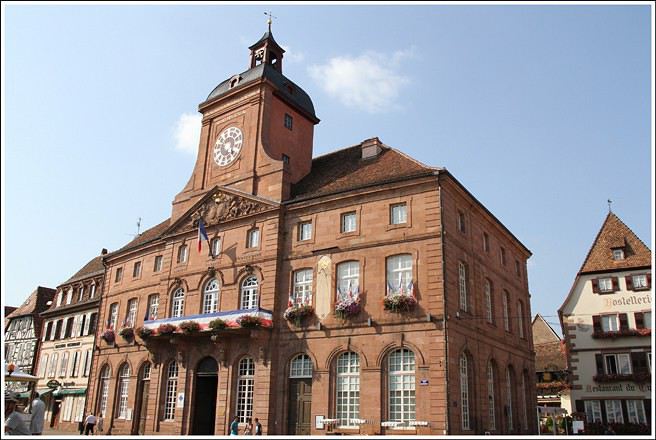


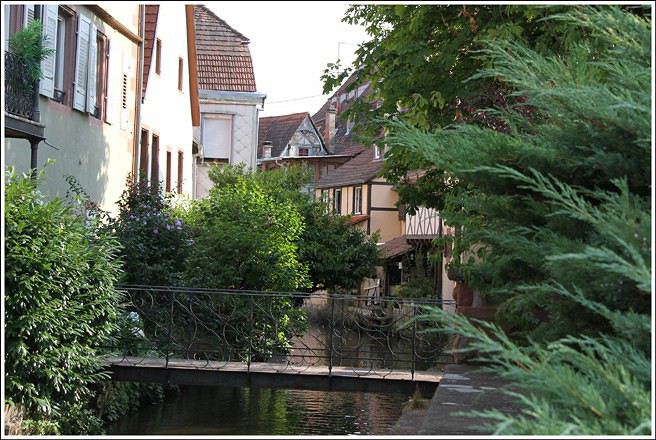
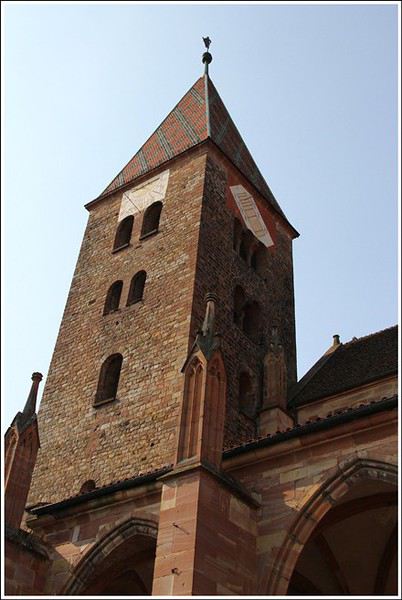
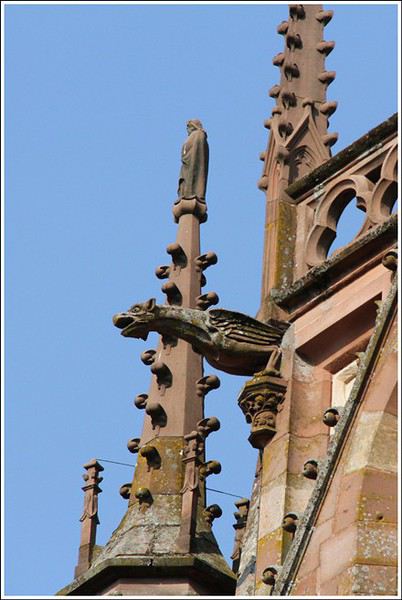
Hills border Alsace along its entire western frontier and also to the north. Countless hikes are possible in these low- and mid-altitude forests, where you can find chanterelles, sheep’s head mushrooms, and blueberries. Here’s a typical view taken above Wissembourg, near the Pigeonnier Pass:
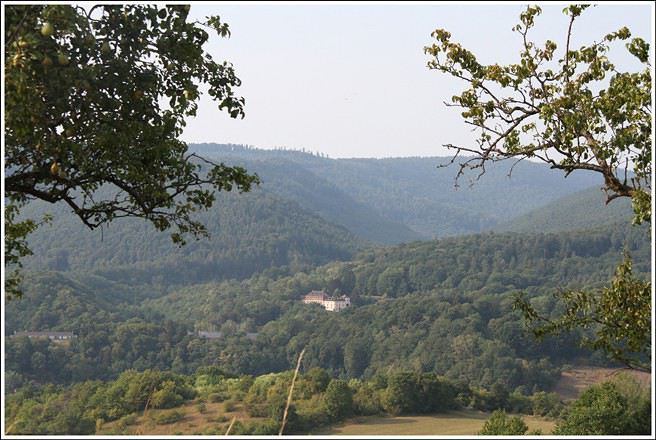
Some of you may have heard about the legendary charm of Alsace, this small region in eastern France, right next to Germany. For those who want to visit, we’re offering this journal. While it’s not exhaustive, it covers many of the most interesting sites, and we’d love to help make your trip a success—or maybe even inspire you to take a trip there.
Introduction
" HOW BEAU-TI-FUL OUR ALSACE IS WITH ITS FRESH VALLEYS IN SUMMER, IT RI-PENS THERE WHEAT, VINES, AND HOPS "
This is the start of a little tune our elementary school teacher used to make us sing in class. That was last century. This refrain and its melody have stayed in my heart because they perfectly capture this region. I know many tourists dream of the Christmas market and the magical snowy landscapes, which makes sense, especially for visitors from the south or those with young kids. As for me, I’d recommend visiting between June and September because everything is so much more pleasant and enjoyable during the warm season.
Alsace is a mix of German organization and French art de vivre. The result? A place beautifully shaped by nature, thoughtfully developed by people, and packed with exceptional restaurants and bakeries. Plus, tourists are generally welcomed with courtesy and expertise.
The heart of the region’s tourism lies between Strasbourg and Colmar, spanning the Haut-Rhin and Bas-Rhin departments. To the west of these cities, often on the slopes between the plain and the hills, winds the famous Wine Route. From north to south, it stretches about 150 to 170 kilometers. A proper visit to Alsace takes about five days to a week—or longer if you’re really into it. I think having a car is best, as the terrain isn’t flat.
Let’s start with northern Alsace, which is less known to tourists—except for the Germans, who love strolling around and enjoying good food there.
Wissembourg sits on the border with Germany, at the very north of the Bas-Rhin, about 60 km from Strasbourg. The tourist office has set up signs near the large free parking lot, so you can take a pleasant walk through this small town. Highlights include the Saint-Pierre Saint-Paul Church (the second-largest in Alsace), the 1741 town hall, the Salt House with its unusual roof, the ramparts, and some fascinating old houses.
Hills border Alsace along its entire western frontier and also to the north. Countless hikes are possible in these low- and mid-altitude forests, where you can find chanterelles, sheep’s head mushrooms, and blueberries. Here’s a typical view taken above Wissembourg, near the Pigeonnier Pass:
It's all in the title—I'm 70, and I've been traveling by bike (tent and camp stove) for five years now. Statistically, how many more years do I have left to plan my destinations and see (almost) everything?
Question is half realistic, half humorous.
To keep it simple: how old are you, fellow senior cyclists still on the road? And what are your biggest challenges?
Personally, I'm in good physical shape, though my cruising speed has dropped from 3–4 km/h over the past five years.
But arthritis (hip) is starting to make it tricky to swing my leg over the frame.
Reading an excerpt from "The Art of Boring People by Telling Your Travel Stories" by Matthias Debureaux first made me smile, then got me thinking… Are we "travel-bores" with our travel stories?
"Annoying is the one who, like Ulysses, had a wonderful trip. Because for every silver-tongued storyteller with marvelous tales, how many bores and nuisances… The traveler, drunk on grand images and magical encounters, has only one thing on their mind: pelting us with anecdotes, life lessons, and ideals. They’ll paint the most beautiful and distant Edens… the traveler has an endless pharmacy of stories. But nothing is designed to immunize us against travel tales. We should impose a quarantine on returning travelers. At least a dozen hours in a sobering cell. What’s the point? Months, years later, they’ll never miss an opportunity to reminisce. The evocation of their odyssey is a perpetual fireplace fire."
A provocative text, sure, but isn’t the person telling their travel story doing it mostly for themselves? Just to relive the joy of their trip? At friendly gatherings or with family, we sometimes have to endure the enthusiast… without necessarily sharing their passion for the destination!
The advantage of writing—and also of exchanges on sites like VF—is that only those who want to read a story do so… with the option to skip it anytime!
So, what do you think, authors and fans of travel stories published online?
Jean
P.S.: "The Art of Boring People by Telling Your Travel Stories" by Matthias Debureaux, Éditions Cavatines, 2005 Excerpts read in "The Taste of Travel" Éditions Mercure de France, 2008
P.S.: As a little wink… I still invite you to check out my latest travel story about a trip to the Aeolian Islands… see the story and photos by following this link: http://voyageforum.com/v.f?post=4409520;page=unread#unread
I hope I didn’t "bore" you too much with this story 😉











