Hello everyone,
So happy to be back on this Forum!
We’re heading off on another cruise—our 7th—after a 5-year break...
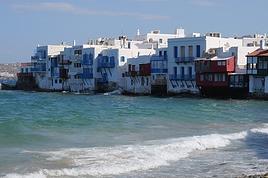
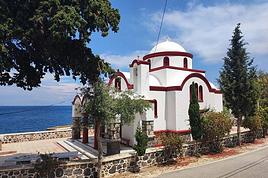
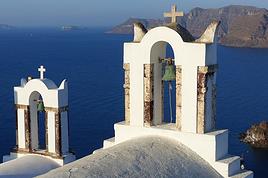
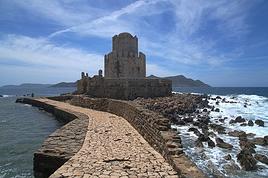
We’ll be leaving from Venice on April 26th with stops in Kotor, Mykonos, Santorini, and Ancona.
Could you help me plan the stops by sharing tips, tricks, and advice?
For those who already know me, you know we prefer not to take the cruise line’s excursions but instead organize everything ourselves.
Thanks in advance to everyone, and looking forward to chatting with you all!
342 similar discussions in English
Hello,
This is still just a plan: My wife and I are considering a bike trip in Denmark.
The timeframe would be July 2020, for a solid three weeks. We’d prefer to do a loop to avoid seeing the same landscapes and cities. We also camp.
We have our own well-equipped bikes and a single-wheel "Bob" trailer.
We’ll likely start and finish in Copenhagen, covering 40 to 60 km per day while leaving time to explore the cities and regions.
Through word of mouth, we know Denmark is another cycling country, so we won’t have any trouble finding bike paths.
However, when it comes to documents, we’re a bit lost. Since we don’t know the country at all, we’re not sure what’s most interesting to see and travel through.
We have the double-sided *Dänemark* map at 1:150,000 from Freytag & Berndt. It shows bike routes and campgrounds (which is great!), but it’s not very practical for biking.
Our experience in the Netherlands with "road" maps that quickly fell apart in the rain showed us the limits of those documents...
Are there more practical resources? Like a bike guide similar to what we have in France or for European bike routes?
Is there a system for identifying bike route numbers like in Holland?
And of course, we’d love any practical tips—cost of living, campground prices, hospitality (which I’m sure is excellent), weather quirks, coastal areas, wind (memories of the Netherlands!!!), and, of course, your personal favorites...
Thanks in advance to all contributors;
Pierre and Dominique from Lorient
We’re wrapping up our Sardinia tour by camper van. We stayed for 5 weeks, covered 2,150 km on this island, and will leave with mixed feelings!!
While the island is beautiful—especially for those who love beaches and all kinds of water sports—it’s also appealing for history buffs and archaeology enthusiasts. The mountains, scenic roads, and small villages are really lovely too.
That said, driving here can be pretty hazardous. Locals don’t respect speed limits or road rules, they roll through stops, zoom out of side streets, and often overtake without proper visibility. On top of that, the quality of roads and highways is really disappointing!! And service areas, whether paid or free, are few and far between and often poorly maintained.
One last thing: we’d heard Sardinians were welcoming... I don’t know if it’s because they’ve "endured" waves of tourists from all over during the summer months, but unfortunately, we didn’t find that to be true. Most seemed rather gloomy or even unwelcoming, with just a few exceptions saving Sardinia’s reputation!!
It’s a real shame for an island with so much potential. I think a serious review of how tourism is managed would be worth considering. That aside, we did notice some efforts and goodwill that were nice to see.
Good evening,
I’m leaving for five weeks in Colombia on July 9th. Over the past few years, I’ve traveled solo with great pleasure in Argentina, then Chile, and last year in Ecuador...
It’s the realization of a childhood dream... I was 14 and promised myself I’d go one day.
My daughters are grown and "independent," as we say in Brittany. Forty years to prepare for a trip... that’s no small feat...
In short.
I’m heading to Colombia. Last year, I was lucky enough to spend a week in Ecuador with Wilhem and Soria, a Guarani couple.
If I’m renting a room, I’d rather it benefits locals. It was an unparalleled adventure, and we’ve stayed in touch.
So, I’m looking for a way to do a kind of "community-based" tourism where we both benefit—I need your recommendations...
I haven’t found any useful info on the forum.
Maybe Colombia is less suited for this than Ecuador...
Anyway... I’m making this request so I don’t end up like last year in Quito, in a totally improbable hostel where the vibe was all about mimicking American trends and avoiding Spanish at all costs.
My next trip was wonderful.
If I’m paying for a night, I’d like it to go to locals, and if you have a place to stay that could lead to a meaningful human connection, I’m all ears.
I’m open to suggestions.
On the other hand, I can also give you info about the two communities where I spent two weeks in Ecuador: they need funds to carry out their projects, and working with them brought me a lot.
I’m from Central Brittany—this wasn’t some neo-rural discovery for me... for good reason...
Their values are my values.
I’ve got time... Still, your contributions would be very welcome.
Happy to help if you’re thinking of heading to Ecuador.
Happy travels,
Françoise
Saturday, September 22, 2018
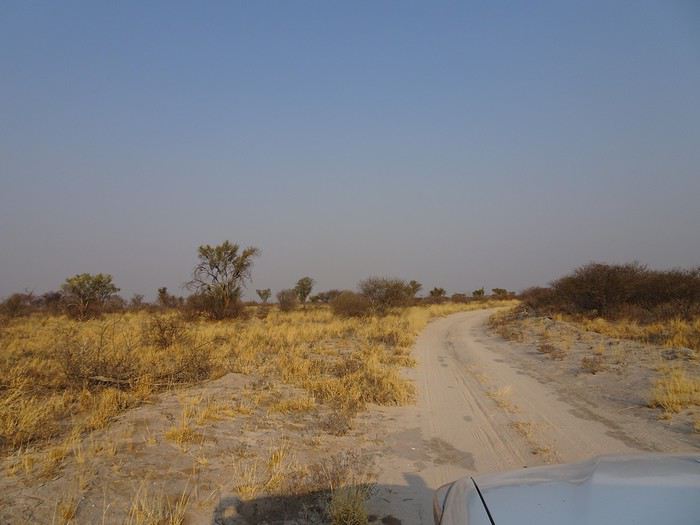
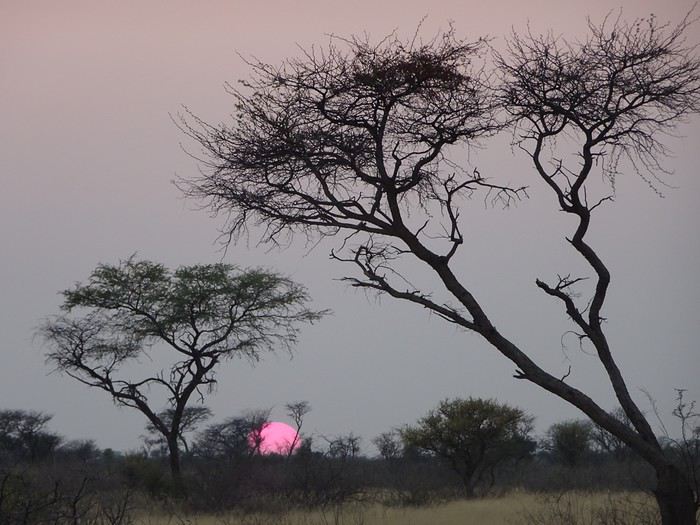
This morning, we woke up at dawn at 6:00 AM. Headed to Letlhakeng, the last town where we could fill up on fuel before starting our crossing of the Kalahari. Our consumption since Johannesburg has been 11L/100 km. We took the direction of Khutse Game Reserve, whose entrance is about a hundred kilometers north of Letlhakeng. Access is via a gravel road along which we saw magnificent pink trees.
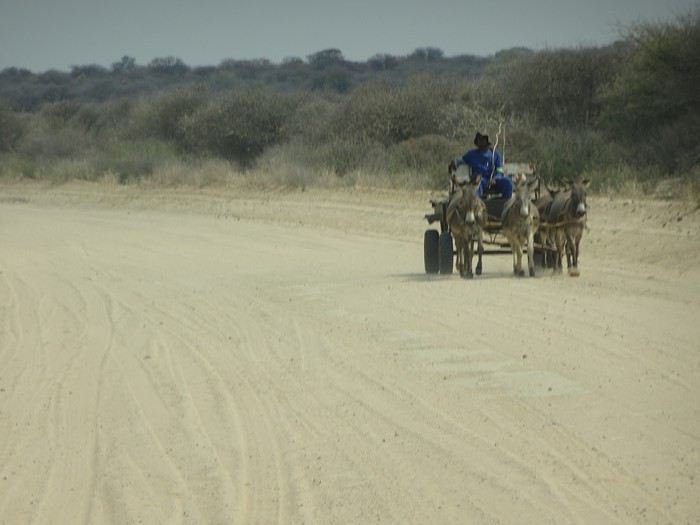
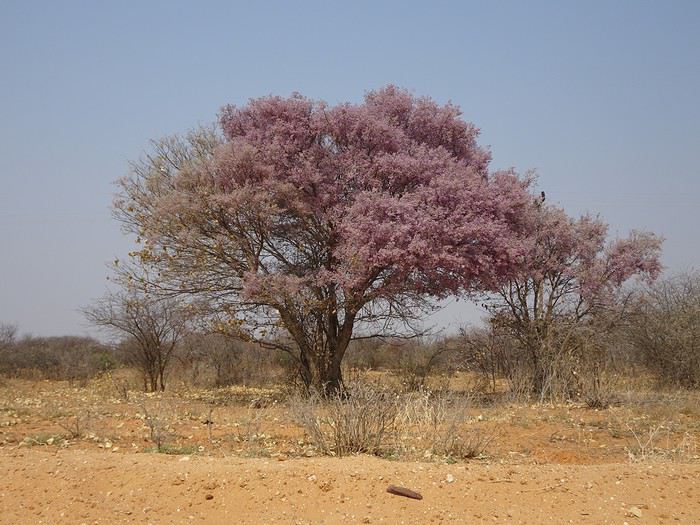
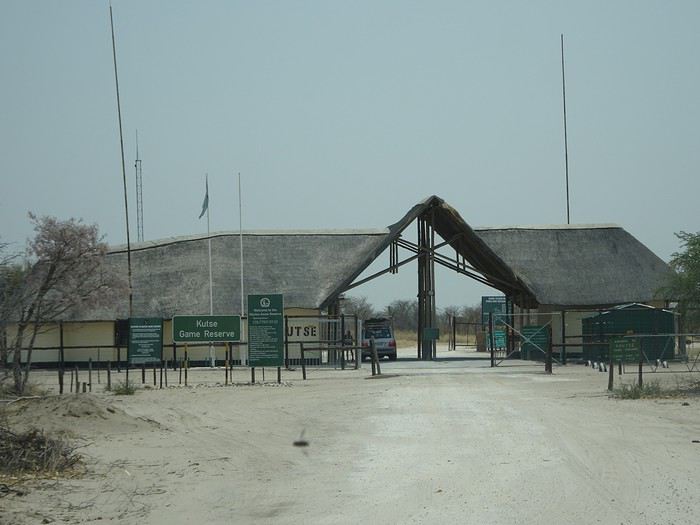
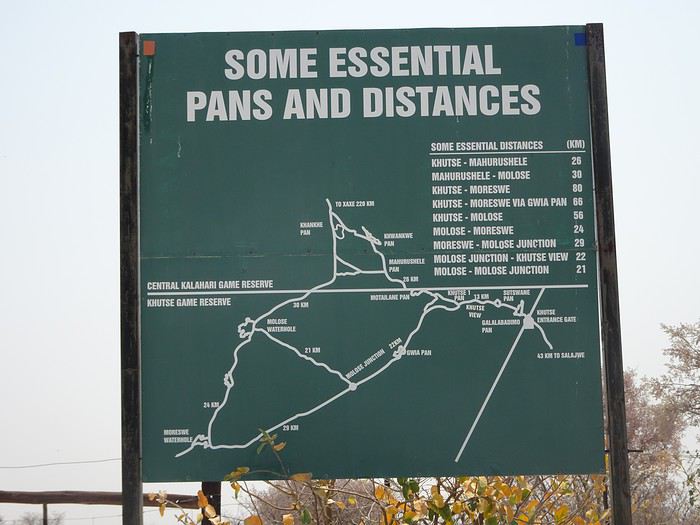
At Khutse Gate, we registered in the entry log and paid the access fees for 6 days: 120 Pulas/day/person and 50 Pulas/day/vehicle. Our stays at the Xaka and Deception Valley campsites had been reserved by our tour operator but not paid, contrary to what they’d told us. So we settled the 2 unpaid days of camping at 30 Pulas/day/person. The park rangers informed us that the southern triangle of Khutse Game Reserve, with its tip at Moreswe Pan, had burned. Note that these two campsites are government-run, which explains the low prices. Private campsites cost ten to fifteen times more. We headed to Khutse campsite, site 5. To enter the parks, you must have a reservation either at a lodge or a campsite. Since the number of spots in the campsites is limited, this means you have to book well in advance. We ate the salad we’d prepared the night before at our campsite. It was very hot—39°C. We made a round trip to Khankhe Pan. On the track, we encountered three South African cars, one of which was stuck in the sand and blocking the way. We helped push the car to get it unstuck. We saw very few animals at Khankhe Pan. We returned to the campsite, which has dry toilets and a shower you have to supply with your own water. We tried out the shower.
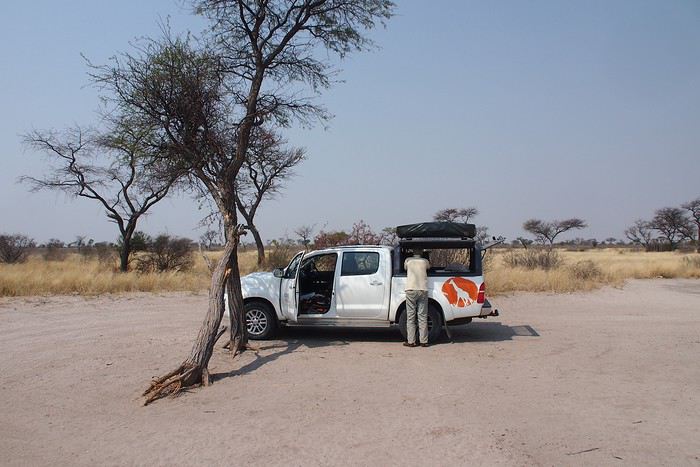
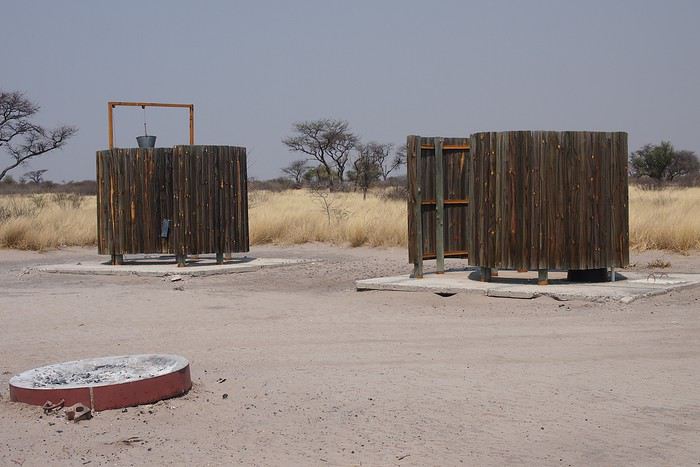
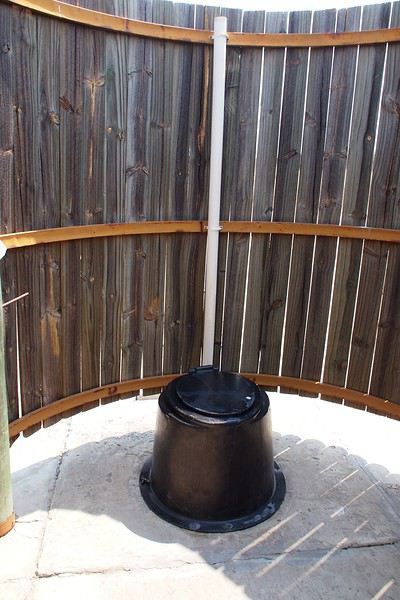
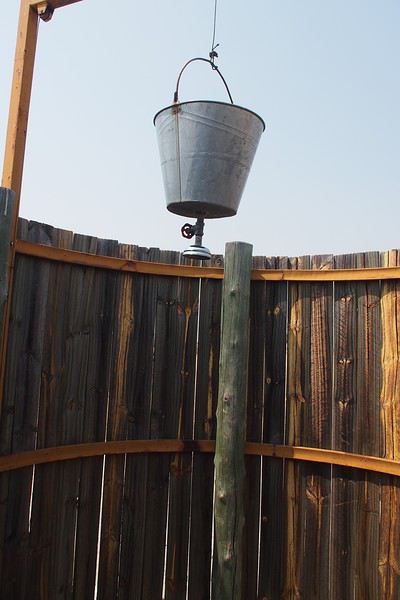
We witnessed our first Kalahari sunset. These sunsets are unmatched, and that didn’t change throughout the trip.
During the trip, we followed the solar rhythm—waking up at 6:00 AM, having dinner at sunset around 6:30 PM, and retiring to our tents by 8:30 PM.
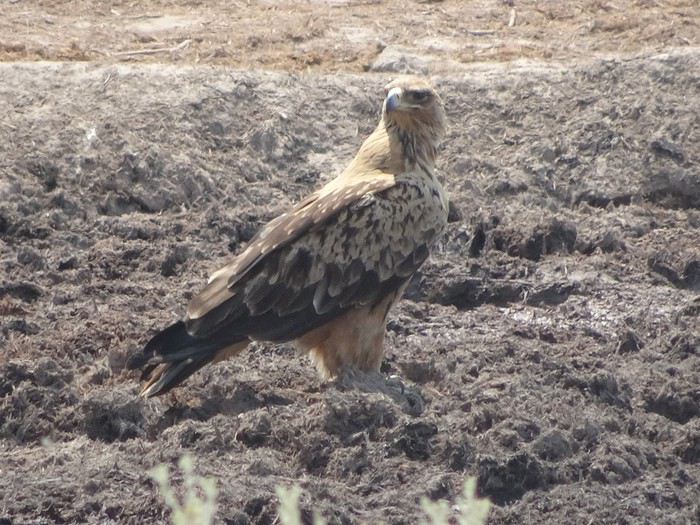
Sunday, September 23, 2018 Up at 6:00 AM. It was 15°C. We were cold last night. Tonight, we’ll use blankets in addition to our sleeping bags. We headed southwest and, past Gwian Pan, turned northwest toward the Molose waterhole, where we saw our first elephants and our first raptor. Indeed, on the track leading to the Molose waterhole, we could see the traces of the massive fire that had ravaged the southern part of Khutse, as the park rangers had warned us.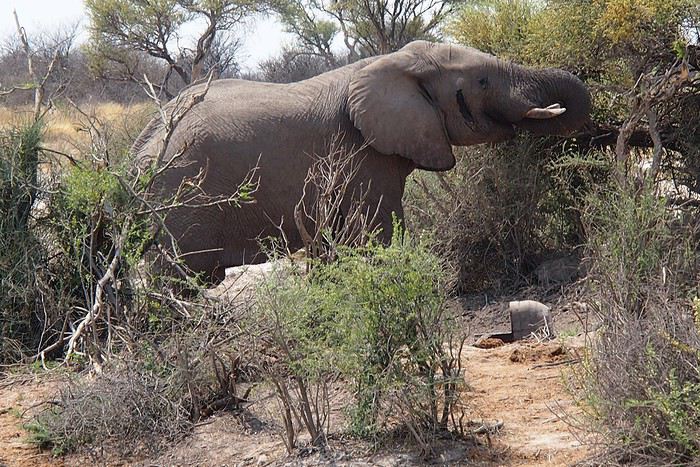
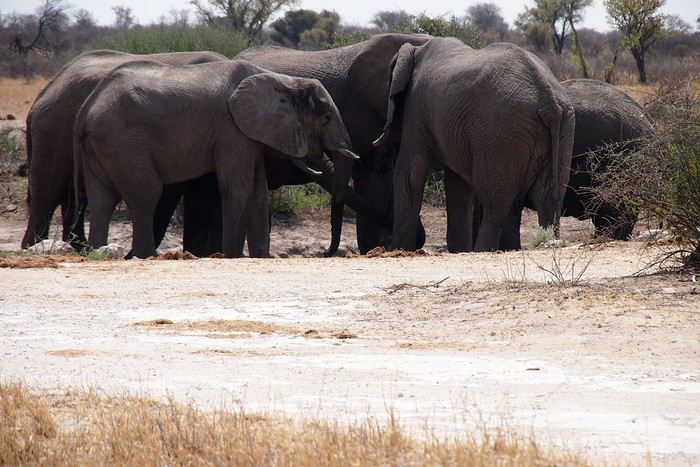
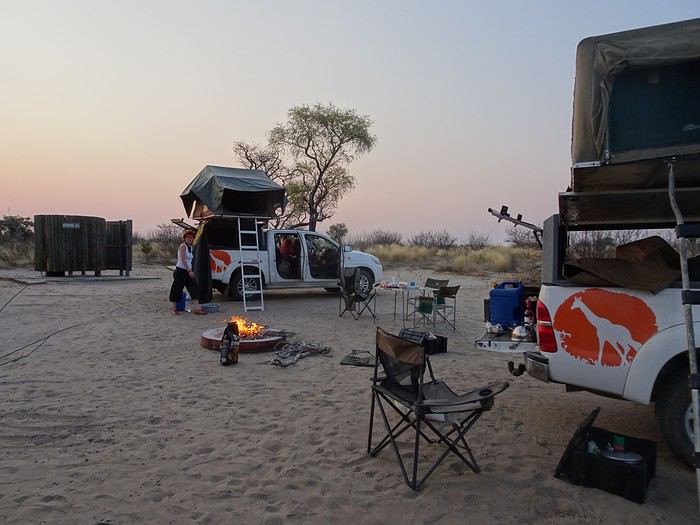
Our first braai at Khankhe campsite.
At Khutse Gate, we registered in the entry log and paid the access fees for 6 days: 120 Pulas/day/person and 50 Pulas/day/vehicle. Our stays at the Xaka and Deception Valley campsites had been reserved by our tour operator but not paid, contrary to what they’d told us. So we settled the 2 unpaid days of camping at 30 Pulas/day/person. The park rangers informed us that the southern triangle of Khutse Game Reserve, with its tip at Moreswe Pan, had burned. Note that these two campsites are government-run, which explains the low prices. Private campsites cost ten to fifteen times more. We headed to Khutse campsite, site 5. To enter the parks, you must have a reservation either at a lodge or a campsite. Since the number of spots in the campsites is limited, this means you have to book well in advance. We ate the salad we’d prepared the night before at our campsite. It was very hot—39°C. We made a round trip to Khankhe Pan. On the track, we encountered three South African cars, one of which was stuck in the sand and blocking the way. We helped push the car to get it unstuck. We saw very few animals at Khankhe Pan. We returned to the campsite, which has dry toilets and a shower you have to supply with your own water. We tried out the shower.
We witnessed our first Kalahari sunset. These sunsets are unmatched, and that didn’t change throughout the trip.
During the trip, we followed the solar rhythm—waking up at 6:00 AM, having dinner at sunset around 6:30 PM, and retiring to our tents by 8:30 PM.
Sunday, September 23, 2018 Up at 6:00 AM. It was 15°C. We were cold last night. Tonight, we’ll use blankets in addition to our sleeping bags. We headed southwest and, past Gwian Pan, turned northwest toward the Molose waterhole, where we saw our first elephants and our first raptor. Indeed, on the track leading to the Molose waterhole, we could see the traces of the massive fire that had ravaged the southern part of Khutse, as the park rangers had warned us.
Our first braai at Khankhe campsite.
Hey everyone, travelers! Here’s a little post to share our bike trip this summer. We did the Via Rhôna from Geneva all the way to the Mediterranean Sea. It was a truly amazing adventure—no hitches, lots of independent greenways, and we felt like we had the Rhône all to ourselves as our guide for 700 km over 7 days. That averages out to 100 km a day. We thought we’d do less, but the Via Rhôna is flat and not too tiring, which let us push to around 100 km each day!
Here’s the full video of our route: www.youtube.com/watch?v=x_cpBro6Df8
We’re not seasoned cyclists—we just love biking, and this trip was our first big bike touring adventure. As for our bikes (see photo), we had road bikes, sturdy ones with fairly large wheels and rear racks for our gear.
Speaking of gear, here’s what we brought: just the essentials for 7 days of biking and camping—1 tent for 2, two sleeping bags, a few clothes (not too many), 1 book each, toiletries, phone chargers, a basic bike repair kit... and maybe 2 or 3 things I’m forgetting. The idea is to travel light so you’re carrying as little as possible!
We camped every night. Along the Rhône, it’s pretty easy to find campgrounds, and they’re cheap too! Each morning, we’d decide on our destination for the evening (usually based on available campgrounds) and call during the day to book. We always managed to get a spot right away (except when we reached the Mediterranean coast, but we should’ve seen that coming 😛).
For expenses, we slept at campgrounds (between 15 and 25 € per site for 2) and either picnicked or ate at restaurants. Other than that, there weren’t really any other costs besides a few small souvenirs here and there. In total, we spent about 500 € for two over 7 days (so 35 € per person per day). I think it’s possible to spend even less—we decided not to restrict ourselves when it came to restaurants and campground prices.
For us, the most beautiful part was between Geneva and Lyon! The Rhône is still a bit wild there, as are its banks. Not too many roads, highways, trains, or factories around—just nature and peace. You gradually leave the Alps behind and head further south. It was truly stunning. We also loved the "Rhône Valley" after Lyon. The succession of dozens of suspension bridges and little villages, each more charming than the last, really enchanted us.
The trickiest part was leaving Lyon... The Via Rhôna disappears for a long stretch, forcing you to alternate between roads, traffic, danger, and pollution. We had to wait until Givors, further south, to finally get back to the quiet bike path and the Rhône showing us the way. Also, after Lyon, the Rhône becomes a bit more industrial—you pass by dams, factories, and power plants more often. But it’s really just a small detail, the exception that proves the rule of this magnificent Via Rhôna.
The Via Rhôna is a fantastic way to see how water from the mountains of Lake Geneva flows, travels, and winds its way for hundreds of kilometers to reach the sea. With this trip, you get closer to the Rhône—it becomes your accomplice, your guide. Plus, you cross a beautiful part of France, with its charm and little villages. It’s the France we love, and it’s great to explore your own country like a tourist.
That’s it for our little travel journal. I didn’t go into too much detail about our days since everyone will follow the same route, and everyone can go at their own pace :) But I’m happy to answer any questions (logistics, technical stuff, routes, etc.)—I’d be glad to help!
Here’s the video of our route again—I also composed the music, so I hope you’ll like it: www.youtube.com/watch?v=x_cpBro6Df8
Happy travels,
Flo
Hello everyone,
We’re going on a cruise in January 2017 from Rio, and I’m looking for a French-speaking driver/guide in Rio de Janeiro.
Can anyone help? Do you have any contacts?
I’d also love to hear your tips and ideas.
Thanks in advance, and have a great day!
Francine
We’re going on a cruise in January 2017 from Rio, and I’m looking for a French-speaking driver/guide in Rio de Janeiro.
Can anyone help? Do you have any contacts?
I’d also love to hear your tips and ideas.
Thanks in advance, and have a great day!
Francine
Hello,
I’m an agronomy student specializing in tropical regions, and I need to do my 4-month internship near Tuléar. However, I only found out about it yesterday, and I’m supposed to leave on September 16th. I’ve never done this kind of trip before—neither alone nor with someone else. So, I’m a little lost and, um… panicking! I also need to transport valuable equipment that doesn’t take up too much space!
I’m not sure how to get between the two cities, Antananarivo and Tuléar. I plan to carry my luggage in an 80L hiking backpack to avoid drawing attention in Antananarivo.
Has anyone taken a *taxi-brousse* on this route before? How much time should I allow between the two cities, and what budget should I plan for this trip? Where can I find *taxis-brousses* (TB) in Antananarivo?
Any info will be helpful and reassuring! Thanks!
PS: What do you think about safety in Tuléar?
A big thank you to the VoyageForum members who shared their experiences with us! We spent 3 wonderful days at "La Kasbah la Palmeraie" in Skoura. Coming from Marrakech (a stunning drive after the Tichka Pass via Telouet and Ait-Benhaddou), our stay at the Palmeraie was pure bliss: Mohammed and Ghizlane’s warm welcome, delicious breakfasts on the terrace overlooking the palm grove (wood-fired bread, honey pancakes made by Ghizlane), and equally delicious and hearty evening meals shared as a family around a cozy fire. We felt right at home and learned so much about the local way of life. The excursions offered were always interesting and off the beaten tourist track—from there, we explored the Dades Valley and Gorges, the Almond Blossom Valley (gorgeous!), and the palm grove. The region is home to magnificent kasbahs, including our hosts’. A different way to "visit" Morocco!
Hello,
Taking the boat from VENICE to Alexandria is easier than going through Tunisia and Libya.
We’re putting together a group to split costs for a trip in 2011 or early 2012.
Inshallah.
I’m looking for people who’ve recently crossed the Libyan Desert—sand sea, oases, etc.—with their 4x4s.
Any info is welcome, thanks in advance.
Things like:
Entry formalities for the 4x4.
Agencies and guides for the desert.
Military requirements.
Fuel, etc.
Thanks again.
Saharan greetings.
Namaste!
Here I am live from Delhi, past midnight, at least 30 degrees....
I wanted to post the start of this France travel journal but couldn’t find the time, so here it is live!
Off we go for a third trip, but this time for double the duration—6 weeks with the goal of discovering Ladakh and Spiti, starting with a detour to Varanasi to meet up with Babeli and her family.
Phir milenge for the rest of the adventures...
Phir milenge for the rest of the adventures...
😎Hi there, fellow backpackers in French Polynesia,
I’ll share my personal impressions and some tips for budget backpackers. French Polynesia isn’t just for the rich—I’ve met plenty of backpackers exploring these islands on a shoestring! The biggest expense is definitely the flight ticket. Since the beginning of April 2003, Corsair no longer serves Papeete, leaving only Air France and Air Tahiti Nui (and long live competition!). (AF is ATN’s partner, and a round-trip Paris-Papeete ticket costs at least 1300 € all taxes included.)
"An agreement was signed on 14/08/2002 between the Government of French Polynesia, Nouvelles Frontières Touraventure, Air Tahiti Nui, and Corsair. Corsair’s operation of the Papeete route was scheduled to continue until March 31, 2003. From that date, the Polynesian carrier Air Tahiti Nui would reinforce this route and put two A 340-300s into service."
Before heading to French Polynesia, ask for the brochure *"La petite hôtellerie & l'hébergement chez l'habitant à Tahiti et ses Îles"* (updated every year). Of course, a travel guide from the bookstore is also very useful. Address: Maison de Tahiti et ses îles, 28, bld Saint Germain, 75005 Paris Phone: 01 55 42 64 64 www.voyageatahiti.com This brochure helped me a lot: rates, phone numbers, transfer prices, camping info...
French Polynesia is vast! Which islands do you want to visit? The Marquesas from September to December, and the rest... Two seasons: hot and humid from November to March, and a cooler season from April to October. Note that the rainy season runs from November to April. It can rain for 3 or 4 days straight... but hey, as the Tahitians say: so what! Or, well, plants need rain. In July and August, it gets chilly in the evenings in Tahiti and Moorea (the record is 16°C)!
Things to do on Tahiti: island tour, excursion to the interior, the Pearl Museum, the Museum of Tahiti and its Islands, dinner at the food trucks on the waterfront parking lot (VIP boats), Papeete Market. After that, it’s time to head to the other islands...
Cheapest accommodation right in the center of Papeete: Teamo Hostel (5-minute walk from the market!). Dorm beds cost 2100 CFP (a bit run-down, but hey, we’re backpackers, right?). It’s run by a Chinese grandma married to a Tahitian. (You can’t cook or make coffee anymore because some backpackers stole kitchen utensils.) Apparently, there’s a cheap place to stay near the hospital where you can cook, but I don’t know the address...
Truck fare from FAA airport to downtown Papeete: 130 CFP during the day, 200 CFP at night (runs 24/7). You can eat cheaply at Papeete Market (sandwiches for 300 CFP, takeaway meals from 400 to 700 CFP).
Maritime transport from Papeete to Moorea: Aremiti Ferry, 1060 CFP one way. Truck to Moorea Camping or Nelson and Josiane’s camping: 300 CFP. Rates at Nelson’s: camping 1100 CFP/night/person; dorm 1600 CFP/night/person—clean and much better than Moorea Camping.
At Moorea Camping, the shark tour (feeding sharks and rays + snorkeling) costs 2500 CFP/person for guests and 3000 CFP for others (it’s the cheapest on the island—I did it three times!). Getting around isn’t easy because the truck only runs according to ferry schedules, about 3 or 4 times a day. You’ll need to rent a bike or scooter, but it’s expensive: bike rental for 8 hours is 2000 CFP. For the sporty types, the island tour is 60 km.
I can’t afford to stay at the Sofitel in Moorea, but I know it has the most beautiful beach on the island!
To continue to the other islands, you’ll need to either return to Papeete or take a plane, but since we’re broke, we head back to Papeete to catch the boats at Motu-Uta (the maritime port, a 15-minute walk from downtown). Destinations include: - Tuamotu: Tikehau, Rangiroa, Ahe, Apataki, Manihi, Fakarava... - Austral Islands: Rimatara, Rurutu, Tubuai, Raivavae, Rapa - Leeward Islands: Huahine, Raiatea, Tahaa, Bora Bora, Maupiti - Gambier and the Marquesas Islands: Nuku-Hiva, Hiva-Oa...
You can get maritime schedules from the tourist office (very useful for boat info, schedules, destinations, rates, etc.).
For transport, opt for inter-island ships: schooners or bonitiers (super cheap), but be prepared for long trips with minimal comfort and seasickness... For example, Rurutu to Papeete takes 42 hours at sea! Papeete to Bora Bora is 22 hours!
Update: The cargo ship Dory 2 sank (gasoline explosion), and Vaeanu II is grounded on the reef at Rimatara (Austral Islands).
To be continued in episode (2/)...
February 9 - Day 1
"So, my little wanderers, back at the decks? What’s this mystery destination you’ve got in store for us at the start of the year?"
Yes, the schoolyard bell’s ringing again! We’re hitting the road... or rather, the skies! At first glance, our destination might surprise more than a few. First off, simply because I was here exactly twenty years ago, and I don’t usually like retracing my own footsteps. Secondly, because the name of this place screams mass tourism—basically the opposite of what Flo and I look for.
Despite that, in this land of backsheesh, I’d promised myself I’d come back one day to experience it my way. And since Flo told me, during our wanderer chats, that this destination straddling Africa and the Middle East was in her top 2 travel dreams, the stars aligned for this roots-style trip to quickly make it onto our pharaonic festivities program! Unless you’re totally clueless in general knowledge, you’ve probably guessed by now—we’re off to Egypt! Of course, a few classics will be on our itinerary, but above all, we want to soak up a culture that can’t be appreciated in four-star resorts or on a Nile cruise boat. And let’s be clear, these next two weeks won’t be a walk in the park—neither for our two daughters who are joining us, nor for our bodies!
And that’s clear from the get-go: after our first flight, eight hours of trying (and failing) to sleep on Milan airport’s metal seats, our second flight, landing, passport stamps, our Uber ride, and our first Cairo kilometers, we finally drop our exhaustion at the little guesthouse we booked in Giza. Doesn’t all that energy deserve a little reward?
Oh, absolutely! And here it is: a full-on slap in the face for everyone! But just look at this view from our hotel terrace? For 20 € a night for four, even with this incredible view, I figured the room must be pretty shabby, right? Nope... Is the staff rude, then? Nope... Okay, so what’s the catch? You’re gonna tell me breakfast is included too? Well, yes! Honestly, this Egypt trip is off to a great start.

And the rest of the afternoon, spent rubbing shoulders with locals, only confirmed this vibe. After digesting our pyramid view, we dove into the hustle and bustle of our neighborhood with the goal of exchanging money, eating at street stalls, and testing the hospitality of the locals. Ten out of ten!




Eight little sun breads with baba ganoush and falafel? 80 pounds, or 1.5 €. A dozen Middle Eastern pastries? Same! 80 pounds! Two hawawshis, those little pita breads stuffed with meat and spices? 10 pounds each, or about twenty cents! Not to mention all those smiles and free "welcomes" left and right!!!

What a welcome! We end this first day with a sunset over the three sisters of Giza—where we’ll obviously be gawking tomorrow...



https://voyageforum.com/images/posts/small/1789072399-cCyLDYuFwPLAZTY.jpg
"So, my little wanderers, back at the decks? What’s this mystery destination you’ve got in store for us at the start of the year?"
Yes, the schoolyard bell’s ringing again! We’re hitting the road... or rather, the skies! At first glance, our destination might surprise more than a few. First off, simply because I was here exactly twenty years ago, and I don’t usually like retracing my own footsteps. Secondly, because the name of this place screams mass tourism—basically the opposite of what Flo and I look for.
Despite that, in this land of backsheesh, I’d promised myself I’d come back one day to experience it my way. And since Flo told me, during our wanderer chats, that this destination straddling Africa and the Middle East was in her top 2 travel dreams, the stars aligned for this roots-style trip to quickly make it onto our pharaonic festivities program! Unless you’re totally clueless in general knowledge, you’ve probably guessed by now—we’re off to Egypt! Of course, a few classics will be on our itinerary, but above all, we want to soak up a culture that can’t be appreciated in four-star resorts or on a Nile cruise boat. And let’s be clear, these next two weeks won’t be a walk in the park—neither for our two daughters who are joining us, nor for our bodies!
And that’s clear from the get-go: after our first flight, eight hours of trying (and failing) to sleep on Milan airport’s metal seats, our second flight, landing, passport stamps, our Uber ride, and our first Cairo kilometers, we finally drop our exhaustion at the little guesthouse we booked in Giza. Doesn’t all that energy deserve a little reward?
Oh, absolutely! And here it is: a full-on slap in the face for everyone! But just look at this view from our hotel terrace? For 20 € a night for four, even with this incredible view, I figured the room must be pretty shabby, right? Nope... Is the staff rude, then? Nope... Okay, so what’s the catch? You’re gonna tell me breakfast is included too? Well, yes! Honestly, this Egypt trip is off to a great start.
And the rest of the afternoon, spent rubbing shoulders with locals, only confirmed this vibe. After digesting our pyramid view, we dove into the hustle and bustle of our neighborhood with the goal of exchanging money, eating at street stalls, and testing the hospitality of the locals. Ten out of ten!
Eight little sun breads with baba ganoush and falafel? 80 pounds, or 1.5 €. A dozen Middle Eastern pastries? Same! 80 pounds! Two hawawshis, those little pita breads stuffed with meat and spices? 10 pounds each, or about twenty cents! Not to mention all those smiles and free "welcomes" left and right!!!
What a welcome! We end this first day with a sunset over the three sisters of Giza—where we’ll obviously be gawking tomorrow...
https://voyageforum.com/images/posts/small/1789072399-cCyLDYuFwPLAZTY.jpg
Hi everyone,
I’m starting to plan a motorcycle trip from Marrakech to Dakar for September 2027.
The idea is to cross southern Morocco, then Mauritania, and finally Senegal all the way to Dakar, taking the time to explore the regions we pass through.
I’m especially looking for advice and feedback from people who’ve already done all or part of this route: recommended itinerary, road and track conditions, border crossings, formalities, safety, fuel, accommodations, must-see stops, things to avoid, etc.
I’d also love to hear your thoughts on traveling in September for this trip.
If any motorcyclists want to join the adventure, that’d be great! The idea is to form a small group, each covering their own expenses, and plan the trip together.
All your tips, experiences, and good addresses are welcome!
Thanks in advance for your help.
Khalid Marrakech
My first trip to Morocco dates back to the early 90s.
Four more followed...
I’d never gone further north than Casablanca, Volubilis, or Fez—it was time to fix that!
So I planned a route that would fill in the gaps while revisiting a few places.
This route is pretty classic—if you’re looking for something original, you might want to skip it!
The starting point of the trip: the city of Rabat.
The stops?
Azrou, Fez, Al Hoceïma, Akchour, Tetouan, Tangier, Asilah, and finally Rabat.
Mostly an urban trip, then.
Too much?
We’ll see at the end of the travel journal!

Four more followed...
I’d never gone further north than Casablanca, Volubilis, or Fez—it was time to fix that!
So I planned a route that would fill in the gaps while revisiting a few places.
This route is pretty classic—if you’re looking for something original, you might want to skip it!
The starting point of the trip: the city of Rabat.
The stops?
Azrou, Fez, Al Hoceïma, Akchour, Tetouan, Tangier, Asilah, and finally Rabat.
Mostly an urban trip, then.
Too much?
We’ll see at the end of the travel journal!
As I’ve mentioned elsewhere, I inherited my love of travel from my parents and some of my grandparents. A strong passion, but one that was unfortunately limited by our family’s modest resources. Back then, living in northern Alsace, a simple trip to the southern part of the region—with the Wine Route as our destination—felt like an extraordinary journey to a land of plenty for the little boy I was in the late 60s and early 70s.
Everything seemed so huge when you were still just a kid.
Back then, I was overwhelmed by countless sensations—I was already highly sensitive, with a keen mind and a nose and taste buds that were developing like a pro’s. Which, as I’d later realize, wasn’t always an advantage.
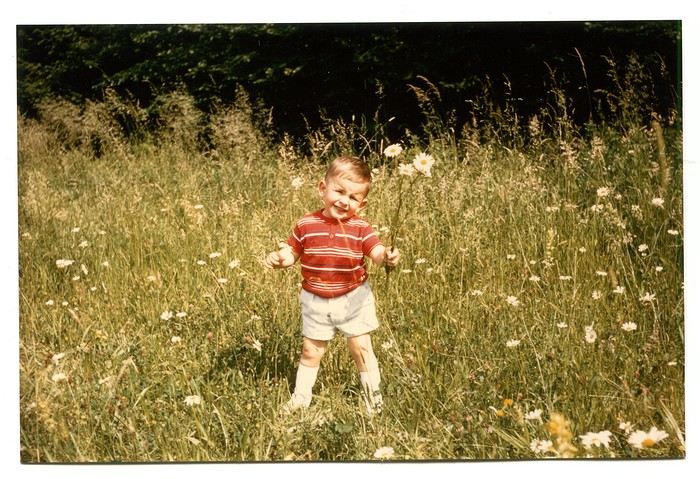
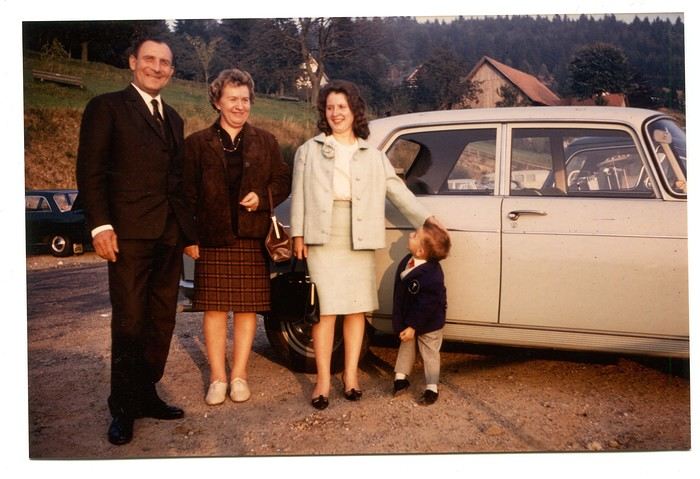
Those magical days always began with a gentle late-spring or midsummer morning. The interior of the white Peugeot 404, license plate 210 LZ 67, had already soaked up the sun before the engine purred to life, and the cabin gave off a scent I could still recognize today—a fragrance I found so pleasant. Back then, I had no idea it was just the smell of warm plastic from the car’s interior. Yes, the scents of the 404 on sunny days became my madeleine de Proust... What’s more, the whole family was unusually cheerful because those moments of relaxation and leisure were rare. Everyone worked, and no one had an easy job or was well paid. Without the *Trente Glorieuses*, these experiences might never have happened.
Once we crossed the canton’s borders, I felt like I was light-years away from my everyday surroundings, and every kilometer plunged me deeper into *terra incognita*. It was thrilling. Far from my so-called "medium-sized" town, wheat fields, cornfields, and cabbage patches stretched out, punctuated by tall poles connected by long wires and topped with vegetation—like giant clotheslines without laundry, where magical beanstalks might grow to touch the sky. Back then, I was still far from tasting their product, which was simply beer. At the time, there was still a significant local hop production. Fun fact: it wasn’t until 2002 that Anglo-Saxon scientists proved hops and cannabis belong to the same biological family.
After the fields, the landscape took another step up as it rolled past the little boy’s eyes, often glued to the windows. First came modest hills, then a succession of rolling slopes that soon formed an unbroken chain. Their 700 meters in altitude felt like Himalayan peaks to me—impressive, inert giants, a whole new world. Gazing at them, an intense emotion welled up somewhere between my stomach and lungs, nearly taking my breath away. What mysteries, what treasures did these heights hold? And then there were the cherries on top—the crowning touch that made the scene even more magical: proud, majestic castles perched on the summits like impassive sentinels. Monuments from the past, yet firmly rooted in the present on their rocky spurs. The little boy’s eyes sparkled—he’d been given a castle for Christmas, complete with battlements, towers, a drawbridge, and fully armed knights. He’d watched and lived *Ivanhoe* on the only French TV channel that existed back then.
Only once did my paternal grandfather join us on one of these trips. A tall, intelligent man with a face that could shift from stern to mischievous, clearly full of humor and charisma. Sadly, his relationship with alcohol had taken a toll on his life and, by extension, those of his loved ones. He had a strong personality—if his boss crossed the line, he wouldn’t hesitate to punch him, which meant he went through a lot of different jobs. Back then, you could quit one job and easily find another. It was quite something to see him in his final stages, hallucinating pink elephants and even drinking perfume when he had nothing else left. The last time I saw him, he’d slipped away from the doctors and nurses while hospitalized in pretty bad shape—at least, I assume his liver was the issue. We were sitting down for a family lunch when the door burst open, and there he stood in his pajamas, eyes twinkling with mischief, clearly pleased with the dramatic entrance. That theatrical moment didn’t spare us from burying him a few months later at the age of 71. One day, my mother told me the family doctor had quietly remarked that it was a shame—with his robust constitution, he could’ve lived to be a hundred. Yes, the family doctor—this was the man who’d come treat you any day, at almost any hour, just for a phone call. It really existed, it’s not a myth!
That day, his wife—my paternal grandmother—was also along for the ride. Everyone agreed that Jeannette was a good woman. She worked as a waitress at *Le Tigre*, the biggest brasserie in town, right in the center. Most customers preferred to be served by her, including local dignitaries and even the mayor. As a kid, I didn’t find her very fun, open, or warm—she seemed a bit stern. Back then, women in their fifties already had the face and build of grandmothers. Same went for men, don’t get me wrong. I had no idea about the struggles she faced because of her husband. I didn’t know that 30 years earlier, she’d had to flee Alsace while pregnant, under threat from Nazi fighter-bombers. I didn’t know she’d had several miscarriages, and that my father—her only surviving child, born prematurely in March 1940 at the other end of France—weighed less than a kilo at birth and was so tiny he could fit in a shoebox. Hard to imagine he’d grow into a strapping man nearly 1.80 meters tall, tipping the scales at 100 kilos. When you come back from summer camp in early August and ask why she didn’t pick you up with your parents, and they gently tell you she’s "in heaven," you don’t realize she passed away at 54 after suffering greatly from stomach cancer that had spread.
Back to that family outing, that enchanted parenthesis. I even remembered where we’d had lunch when I passed through Dambach-la-Ville decades later. One of those charming, flower-filled towns Alsace produces in abundance—and preserves so well. This one sits high on a hill, and I was a bit stunned on the parking lot because the view stretched far, revealing the Alsace plain below—its fields, villages, hills, and forests. The world seemed so vast and enticing that day, even though I was only glimpsing a tiny fraction of it.
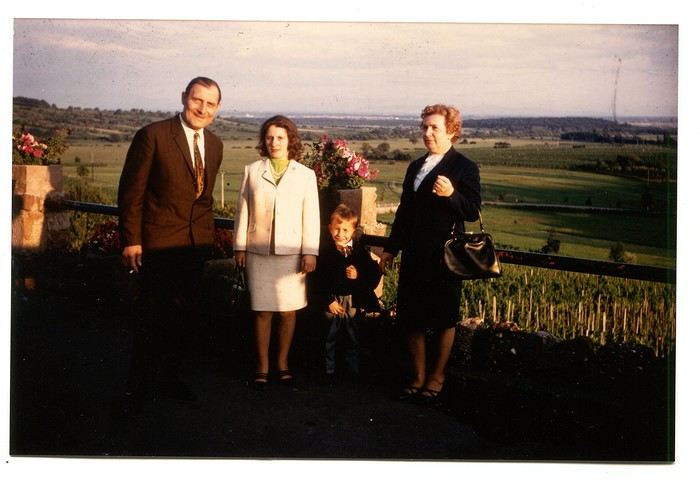
The region was already very touristy, but I wouldn’t notice the downsides until much later. That Sunday noon, I discovered a large restaurant filled with diners. I can still see the enormous piece of meat they served me, decorated with a little wooden skewer topped with a flag. I kept that one for a long time. Those were the golden days of rich, flowing, thick sauces—so flavorful—and the era of the world’s best fries, made on the spot with the best potatoes. To top it off, I was *exceptionally* allowed a small bottle of apple juice, Orangina, or—even better if possible—Sinalco. Yes, Sinalco—like Orangina, but better. A brand that must’ve disappeared in the 70s, but why, and what a shame! Since then, Orangina’s little bubbles have taken the brand to the other side of the planet—it’s now Japanese.
Year after year, I’d eagerly await that ecstatic moment when the most beautiful castle in Alsace, the Haut-Koenigsbourg, appeared in my field of vision. The perfect model, the archetype that blended into the landscape at the height of a child’s dreams. The trip home always felt like a reality check—less jarring than an alarm clock, but more diffuse and melancholic. From then on, there was only one wish: *When do we leave again?*
Those magical days always began with a gentle late-spring or midsummer morning. The interior of the white Peugeot 404, license plate 210 LZ 67, had already soaked up the sun before the engine purred to life, and the cabin gave off a scent I could still recognize today—a fragrance I found so pleasant. Back then, I had no idea it was just the smell of warm plastic from the car’s interior. Yes, the scents of the 404 on sunny days became my madeleine de Proust... What’s more, the whole family was unusually cheerful because those moments of relaxation and leisure were rare. Everyone worked, and no one had an easy job or was well paid. Without the *Trente Glorieuses*, these experiences might never have happened.
Once we crossed the canton’s borders, I felt like I was light-years away from my everyday surroundings, and every kilometer plunged me deeper into *terra incognita*. It was thrilling. Far from my so-called "medium-sized" town, wheat fields, cornfields, and cabbage patches stretched out, punctuated by tall poles connected by long wires and topped with vegetation—like giant clotheslines without laundry, where magical beanstalks might grow to touch the sky. Back then, I was still far from tasting their product, which was simply beer. At the time, there was still a significant local hop production. Fun fact: it wasn’t until 2002 that Anglo-Saxon scientists proved hops and cannabis belong to the same biological family.
After the fields, the landscape took another step up as it rolled past the little boy’s eyes, often glued to the windows. First came modest hills, then a succession of rolling slopes that soon formed an unbroken chain. Their 700 meters in altitude felt like Himalayan peaks to me—impressive, inert giants, a whole new world. Gazing at them, an intense emotion welled up somewhere between my stomach and lungs, nearly taking my breath away. What mysteries, what treasures did these heights hold? And then there were the cherries on top—the crowning touch that made the scene even more magical: proud, majestic castles perched on the summits like impassive sentinels. Monuments from the past, yet firmly rooted in the present on their rocky spurs. The little boy’s eyes sparkled—he’d been given a castle for Christmas, complete with battlements, towers, a drawbridge, and fully armed knights. He’d watched and lived *Ivanhoe* on the only French TV channel that existed back then.
Only once did my paternal grandfather join us on one of these trips. A tall, intelligent man with a face that could shift from stern to mischievous, clearly full of humor and charisma. Sadly, his relationship with alcohol had taken a toll on his life and, by extension, those of his loved ones. He had a strong personality—if his boss crossed the line, he wouldn’t hesitate to punch him, which meant he went through a lot of different jobs. Back then, you could quit one job and easily find another. It was quite something to see him in his final stages, hallucinating pink elephants and even drinking perfume when he had nothing else left. The last time I saw him, he’d slipped away from the doctors and nurses while hospitalized in pretty bad shape—at least, I assume his liver was the issue. We were sitting down for a family lunch when the door burst open, and there he stood in his pajamas, eyes twinkling with mischief, clearly pleased with the dramatic entrance. That theatrical moment didn’t spare us from burying him a few months later at the age of 71. One day, my mother told me the family doctor had quietly remarked that it was a shame—with his robust constitution, he could’ve lived to be a hundred. Yes, the family doctor—this was the man who’d come treat you any day, at almost any hour, just for a phone call. It really existed, it’s not a myth!
That day, his wife—my paternal grandmother—was also along for the ride. Everyone agreed that Jeannette was a good woman. She worked as a waitress at *Le Tigre*, the biggest brasserie in town, right in the center. Most customers preferred to be served by her, including local dignitaries and even the mayor. As a kid, I didn’t find her very fun, open, or warm—she seemed a bit stern. Back then, women in their fifties already had the face and build of grandmothers. Same went for men, don’t get me wrong. I had no idea about the struggles she faced because of her husband. I didn’t know that 30 years earlier, she’d had to flee Alsace while pregnant, under threat from Nazi fighter-bombers. I didn’t know she’d had several miscarriages, and that my father—her only surviving child, born prematurely in March 1940 at the other end of France—weighed less than a kilo at birth and was so tiny he could fit in a shoebox. Hard to imagine he’d grow into a strapping man nearly 1.80 meters tall, tipping the scales at 100 kilos. When you come back from summer camp in early August and ask why she didn’t pick you up with your parents, and they gently tell you she’s "in heaven," you don’t realize she passed away at 54 after suffering greatly from stomach cancer that had spread.
Back to that family outing, that enchanted parenthesis. I even remembered where we’d had lunch when I passed through Dambach-la-Ville decades later. One of those charming, flower-filled towns Alsace produces in abundance—and preserves so well. This one sits high on a hill, and I was a bit stunned on the parking lot because the view stretched far, revealing the Alsace plain below—its fields, villages, hills, and forests. The world seemed so vast and enticing that day, even though I was only glimpsing a tiny fraction of it.
The region was already very touristy, but I wouldn’t notice the downsides until much later. That Sunday noon, I discovered a large restaurant filled with diners. I can still see the enormous piece of meat they served me, decorated with a little wooden skewer topped with a flag. I kept that one for a long time. Those were the golden days of rich, flowing, thick sauces—so flavorful—and the era of the world’s best fries, made on the spot with the best potatoes. To top it off, I was *exceptionally* allowed a small bottle of apple juice, Orangina, or—even better if possible—Sinalco. Yes, Sinalco—like Orangina, but better. A brand that must’ve disappeared in the 70s, but why, and what a shame! Since then, Orangina’s little bubbles have taken the brand to the other side of the planet—it’s now Japanese.
Year after year, I’d eagerly await that ecstatic moment when the most beautiful castle in Alsace, the Haut-Koenigsbourg, appeared in my field of vision. The perfect model, the archetype that blended into the landscape at the height of a child’s dreams. The trip home always felt like a reality check—less jarring than an alarm clock, but more diffuse and melancholic. From then on, there was only one wish: *When do we leave again?*
...
" We’re ALL different, and so are our expectations when it comes to travel or leisure ". There are—without a doubt—as many ways to experience a trip as there are travelers!! For the two of us, it’s only our love of wild nature that guides us to East Africa. The stated goal of this trip was purely wildlife-focused, and NOT about discovering the country or its people.
...
Hello everyone,
Previously, I shared the account of a trip/safari in southern Tanzania in June 2024, in the Mikumi and Selous reserves.
This time, still in southern Tanzania, I invite you to join us in Ruaha National Park. (Then, depending on the number of images allowed in my quota, at the end of my story, we’ll return to Selous for the second part of the same trip.)
- This trip/safari took place in November 2022. - Our flight started in Marseille, heading to Addis Ababa, then Dar es Salaam (via Ethiopian Airlines). In Dar, we spent one night at a hotel near the airfield.
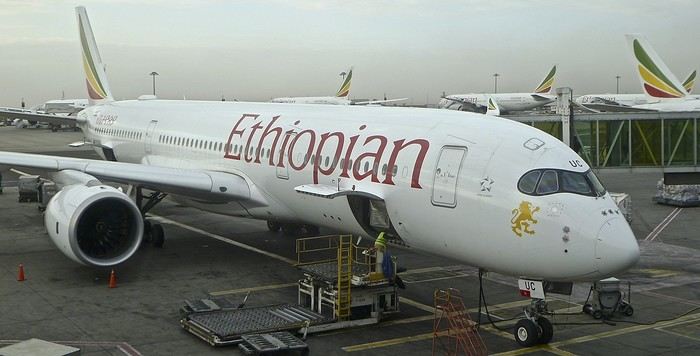
-1- During the layover in Addis Ababa. The Airbus A-350 in the early morning mist.
Reminder: Click on each image to enlarge it, if needed. .
From Dar es Salaam, if you want to go by road to Ruaha, it’ll take a very long and tiring day. 🤪
On previous trips, we’ve always taken a bush plane for this route. In this case, it took just over an hour and a half, with two short intermediate stops to drop off passengers at other bush airstrips.
Since I’m also passionate about aviation, I love these flights where you can admire the landscapes from low altitude while sitting right behind the pilot 🙂.
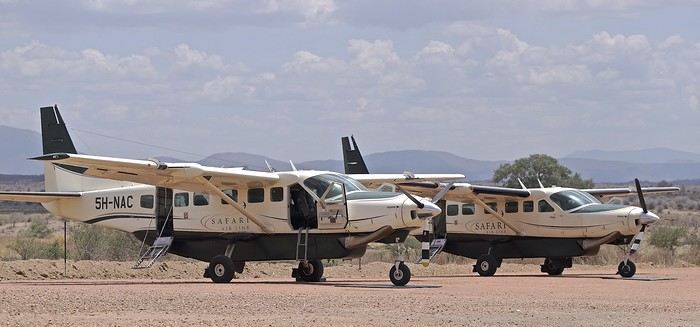
-2- These routes mainly use Cessna 208 Caravans.
At the Msembe airstrip, we’re greeted around 1:30 PM by a guide and a driver from our chosen lodge. They brought a picnic basket, which we enjoy at a nearby picnic area. We’re by the Ruaha River, completely dry—it’s scorching hot.
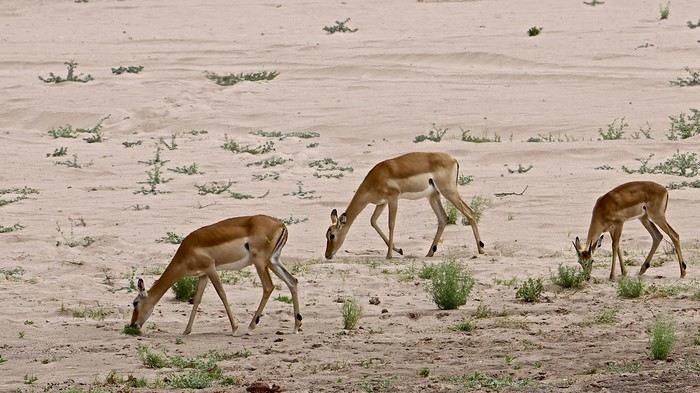
-3- The first mammals we encounter are a pair of female impalas, accompanied by a young male.
Reminder: Click on the image to view it in larger size. 😉
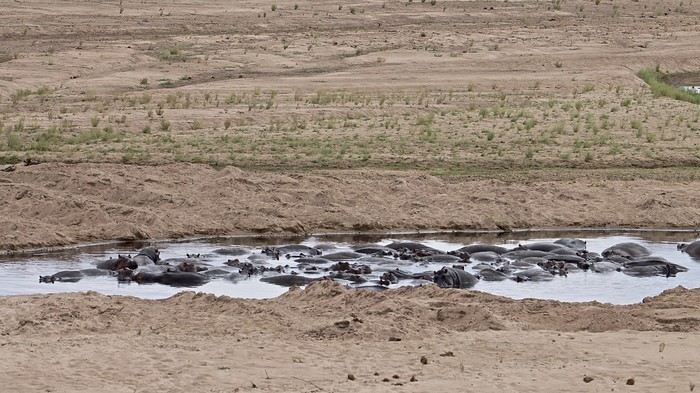
-4- To save the hippopotamus populations from certain death, rangers had to dig holes in the sand with bulldozers. Fortunately, water is present beneath the sand layer.
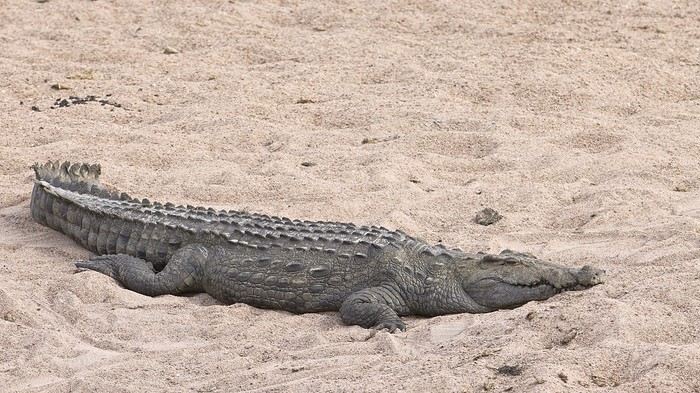
-5- This crocodile doesn’t seem to have been accepted as a swimming neighbor by the hippos...
We’ll explore along the river for 2-3 hours before crossing it at a ford toward the southern part of the reserve.
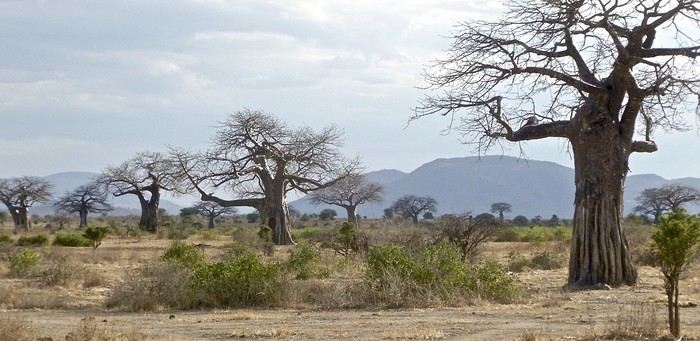
-6- The typical landscape of Ruaha, with its many baobabs.
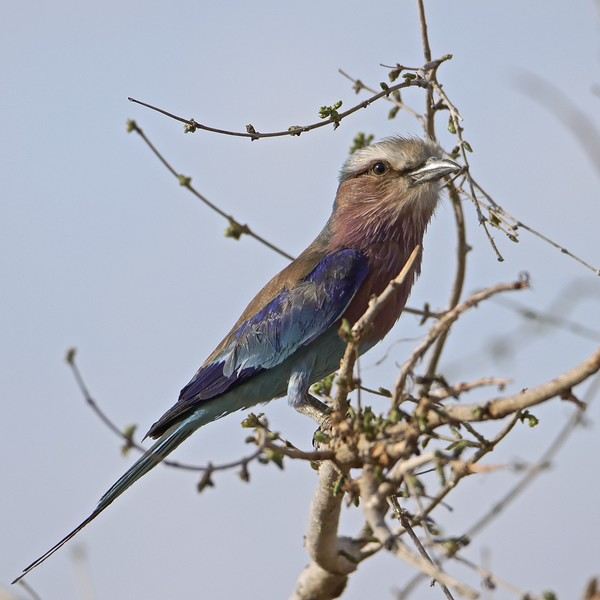
-7- My buddy the R.L.B. is also here to welcome me.... 🙂 🙂
-8- As well as this little bee-eater... 😎
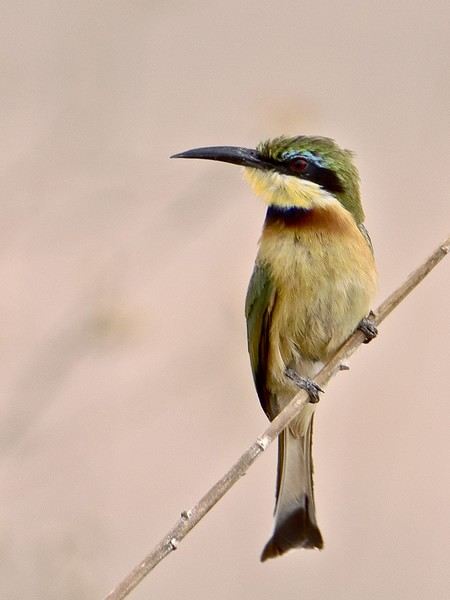
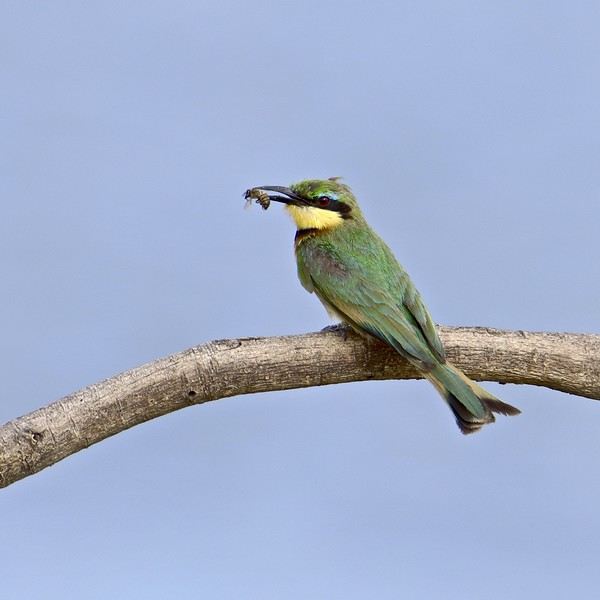
-9- ...which reminds us of the origin of its name...!
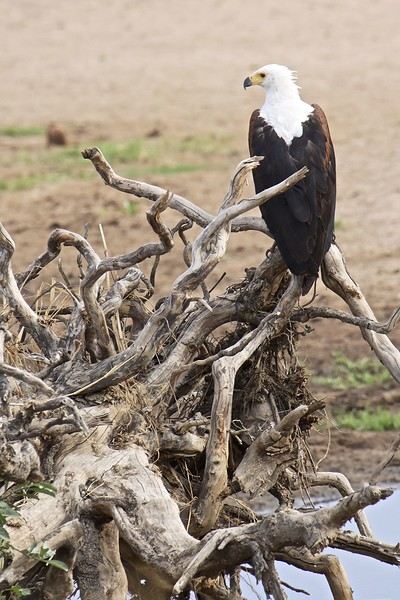
-10- Above a rare waterhole, a fish eagle keeps watch for fish...
...
*** Please wait until the end of the story for any questions or to share your own experiences in Ruaha. (Or via PM.) Thanks in advance for keeping this account smooth and enjoyable. 😉
...
*** I’m not an ornithologist, but birds are an important and unavoidable part of safari discoveries. You’ll find quite a few in the images of my story. 😎
...
" We’re ALL different, and so are our expectations when it comes to travel or leisure ". There are—without a doubt—as many ways to experience a trip as there are travelers!! For the two of us, it’s only our love of wild nature that guides us to East Africa. The stated goal of this trip was purely wildlife-focused, and NOT about discovering the country or its people.
...
Hello everyone,
Previously, I shared the account of a trip/safari in southern Tanzania in June 2024, in the Mikumi and Selous reserves.
This time, still in southern Tanzania, I invite you to join us in Ruaha National Park. (Then, depending on the number of images allowed in my quota, at the end of my story, we’ll return to Selous for the second part of the same trip.)
- This trip/safari took place in November 2022. - Our flight started in Marseille, heading to Addis Ababa, then Dar es Salaam (via Ethiopian Airlines). In Dar, we spent one night at a hotel near the airfield.
-1- During the layover in Addis Ababa. The Airbus A-350 in the early morning mist.
Reminder: Click on each image to enlarge it, if needed. .
From Dar es Salaam, if you want to go by road to Ruaha, it’ll take a very long and tiring day. 🤪
On previous trips, we’ve always taken a bush plane for this route. In this case, it took just over an hour and a half, with two short intermediate stops to drop off passengers at other bush airstrips.
Since I’m also passionate about aviation, I love these flights where you can admire the landscapes from low altitude while sitting right behind the pilot 🙂.
-2- These routes mainly use Cessna 208 Caravans.
At the Msembe airstrip, we’re greeted around 1:30 PM by a guide and a driver from our chosen lodge. They brought a picnic basket, which we enjoy at a nearby picnic area. We’re by the Ruaha River, completely dry—it’s scorching hot.
-3- The first mammals we encounter are a pair of female impalas, accompanied by a young male.
Reminder: Click on the image to view it in larger size. 😉
-4- To save the hippopotamus populations from certain death, rangers had to dig holes in the sand with bulldozers. Fortunately, water is present beneath the sand layer.
-5- This crocodile doesn’t seem to have been accepted as a swimming neighbor by the hippos...
We’ll explore along the river for 2-3 hours before crossing it at a ford toward the southern part of the reserve.
-6- The typical landscape of Ruaha, with its many baobabs.
-7- My buddy the R.L.B. is also here to welcome me.... 🙂 🙂
-8- As well as this little bee-eater... 😎
-9- ...which reminds us of the origin of its name...!
-10- Above a rare waterhole, a fish eagle keeps watch for fish...
...
*** Please wait until the end of the story for any questions or to share your own experiences in Ruaha. (Or via PM.) Thanks in advance for keeping this account smooth and enjoyable. 😉
...
*** I’m not an ornithologist, but birds are an important and unavoidable part of safari discoveries. You’ll find quite a few in the images of my story. 😎
...
We’ve just returned from a cruise that my wife and I will remember—unfortunately, not in a good way.
There’s so much to say that I’ll proceed chapter by chapter.
Pre-Cruise
On January 24th, 2025, I booked through a supposedly attentive cruise agent the repositioning cruise of the CFC Renaissance to the French West Indies, initially departing from Le Havre, then from Dunkirk, on November 1st, 2025.
The return flight was included in the price of this trip.
From January, right after booking, this adventure got off to a bad start.
Used to major cruise lines, I asked my agent to reserve a table for 4 at the "Vatel" restaurant for the second seating, and to link this reservation to the cabin of friends traveling with us. First brush-off: "Ask the maître d’ at the restaurant entrance on the first night."
"To govern is to foresee, and to foresee nothing is to head for disaster," as Émile de Girardin said.
Following this maxim, in February, I started looking for transportation to Le Havre, which was initially the departure port. Then, I asked the travel agent which airport the return flight would land at. I knew flights from Pointe-à-Pitre to Paris served both main Parisian airports. Here, I found myself like a ping-pong ball between the cruise agent and CFC: The cruise agent said, "Ask CFC," and CFC replied, "No, your agent is your intermediary—ask them." It went back and forth like that. Impossible to pre-book the flight that would take us back to our final destination. During the summer, we learned that the departure port was no longer Le Havre but Dunkirk. We canceled our transfers to Le Havre but, of course, lost the cost of the reservations. Meanwhile, we purchased our "Beverage" package—we chose the "Fraîcheur" option, which included all non-alcoholic cocktails, canned sodas, fruit juices, bottled water, and regular coffees. This detail is important for the rest of the story. Every month, I followed up to find out the return airport. Nothing until October 28th (3 days before departure), when CFC finally informed me it was Orly, along with the flight number and time. Of course, on top of booking at full price, I had to arrange my final transfer home. Since I had very little time before the return flight, I had to book an Uber in a rush for the Orly/CDG transfer. Right after, we were told that our first stop in Lisbon—the most anticipated for many cruisers—had been canceled due to a strike at the port of Lisbon and replaced with Vigo, Spain. A completely unremarkable stop—nothing outstanding. As you can see, the prelude was already problematic, yet we’re far from reaching the peak of our disappointments. .......... to be continued soon.
Since Voyage Forum is restarting after a few years of hiatus, I couldn’t find any recent info about my trip between late November 2024 and January 20, 2025, going from DAR ES SALAAM to the Cape Town area via ZAMBIA and BOTSWANA.
I’m really happy the site is back up, but I’ve noticed more and more people planning their trips down to the day, mentioning what they’ve scheduled and asking for technical advice for their 4x4 routes.
That’s not how I travel at all—I prefer to leave a lot to the unexpected, like public transport (and the weather) and the people you meet along the way.
The tips I’m sharing below come from the current situation, the randomness that makes unplanned trips special, and the strong connections you can make when you take your time without knowing what tomorrow will bring.
😏 TANZANIA: I had booked a TAZARA train ticket via WhatsApp before leaving to go from DAR ES SALAAM to MBEYA near the Zambian border. I’d contacted the station manager in Dar at +255 713 413 141, who kindly confirmed my reservation. Unfortunately, the train was out of service for an indefinite period, so I had to take the bus from the new Mwenge bus station on the city’s outskirts (allow extra time to get there—traffic is heavy). There’s no longer a direct train to ZAMBIA. You have to get off at MBEYA, then take a bus to the TUNDUMA border (2 hours to the bus station, then a 2 km taxi ride to the border). Crossing is easy—visa is free, no no-man’s-land, and you arrive directly in NAKONDE, Zambia. Exchange money on the Zambian side, but don’t change with the first person you see—check the rate first. I preferred to stop for the night in IRINGA since I took the bus at 4 PM. I arrived at 2 AM at Georges’ place, who picked me up directly from the bus station (several km from town). I’d booked the accommodation via Booking under Travellers Backpackers and Free City Tours. Georges and his employee were extremely helpful—they organized my bus trip to MBEYA the next day (bought the ticket and dropped me off, no commission). The place is decent, clean, and comfortable (10 € per night). Georges also organizes tours and safaris in the area (+255 679 529 700 direct). In MBEYA, I stayed at Karibuni Center Hotel (a quiet evangelical convent, very friendly and open to everyone, 13 € per night with breakfast). You can eat at a restaurant across the street. The rooms are clean and quiet (contact +255 754 510 174). To head to Lake MALAWI or the tea fields in TUKUYU, it’s best to take a moto-taxi from MBEYA to the Uyole junction. From there, you’ll find minibuses heading south frequently—change buses in TUKUYU (the tea fields are 4-5 km away).
😏 ZAMBIA: In NAKONDE, I highly recommend Izukanji Lodge—very quiet and clean, 2 km from the station (take a moto-taxi). The main building’s rooms are pricier than the annex across the street (where the restaurant and pool are). The rooms are just as clean and quiet but only 10 €, breakfast included. Contact the manager directly on WhatsApp at +260 979 649 452. If it’s full, try Divine Guest House (+260 973 127 816). The train isn’t always on time—if you catch it on the scheduled day, consider yourself lucky. The stationmaster, Mr. Chulu, is lovely. Contact him on WhatsApp at +260 777 550 302 for real-time updates. First-class berths are great (4 per compartment), 15 € one-way to KAPIRI MPOSHI. There always seems to be space. Book two berths if you want extra comfort. No need to bring food—the dining car serves decent meals, and there’s a bar. In KAPIRI MPOSHI, I stayed at Kapiri Council Lodge, 2 km from the train station. It’s okay, but there are often power outages in the evening, which means no water either. You’ll have to wait until 8 PM. Breakfast is very basic. For LUSAKA, there are plenty of buses in the morning from the downtown bus station (2-3 hours). The best companies are Power Tools (yellow buses) or UBZ if you can find it (the best in Zambia—Western comfort). In LUSAKA, use Yango taxis (download the app—it’s like Uber in Zambia, very affordable). I stayed at Natwange (Hostelworld chain), reachable at +260 966 303 816. It’s a beautiful, quiet place 3-4 km from downtown, very shady, with a pool. The rooms are clean and comfortable, and the food is excellent (great salads). The staff is super friendly, as they are everywhere in the country. There’s also a mini-supermarket nearby with everything, including takeout meals. Book your bus ticket to LIVINGSTONE at least the day before (UBZ). The trip is pleasant. In LIVINGSTONE, many backpackers stay at Jolly Boys—it’s a nice place to relax by the pool with a beer at the end of the day, but it’s mostly a party hostel for young people doing rafting or canyoning on the Zambezi (pricier than elsewhere). For those who prefer peace and quiet, I highly recommend Likute Guest House on the same street, right near Jolly Boys. The rooms are decent for 10 €, breakfast included (same price as a dorm at JB). You can order dinner in advance. The staff is friendly. Great value at Da Canton restaurant on the main road (pizza, pasta, meat, salads, etc.). The Livingstone Museum is worth a visit if you have time. At the bottom of Kapondo Street, you can take a shared taxi to Victoria Falls or even to KAZUNGULA at the Botswana border (cheap—the taxi leaves when full). People short on time often compare the views of Victoria Falls from the Zambian side (20 $) and the Zimbabwean side (30 $). Honestly, they’re very different, and it’s worth seeing the falls from Zimbabwe even if it’s pricier (visa required, easy to get at the border—everything is done on foot). Cross the bridge where you can bungee jump. Take your time at the falls—it’s truly stunning. You can visit Zimbabwe for half a day and stay in Zambia (cheaper, since everything in Zimbabwe is paid in dollars). There’s more water on the Zimbabwean side, but the Zambian side is beautiful too.
😏 BOTSWANA: Crossing the border at KAZUNGULA from Zambia is quick and easy (brand-new bridge over the Zambezi). Visa is free. Don’t exchange money at the border. There’s a shopping center 1 km away (Choppies store) with an ATM (no commission). I hitched a ride with tourists to the bank since they had a car. In the shopping center parking lot, you can easily find a shared taxi to KASANE. In the area, you can get around easily by shared taxi (just give the name of your guesthouse, and the drivers will tell you which vehicle to take). The fare is fixed (0.50 €). I stayed at Elephant Trail GH and Backpackers—a great spot where you can stay in a 4-bed dorm for 10 €. There are also huts for two in the garden (clean and comfortable) with a pool. You can order dinner (great food) or cook your own meals. The place is quiet and friendly (they organize safaris with early-morning pickups for Chobe and evening boat trips in the Kwando marshes to see animals). I preferred flying (Air Botswana) with a friend to MAUN (55 €) instead of taking an 8-10 hour bus (tickets can be bought directly at the airport). In MAUN, I stayed at Jayla Homestay with Mapula (+267 71 658 737)—a wonderful, kind woman always ready to help. The homestay is in a beautiful family home 3-4 km from downtown, past the Kwanokeng gas station. It’s easy to get there by shared taxi from the downtown taxi stand near Shoprite. Mapula cooks refined, varied meals on request. She also organizes safaris in the OKAVANGO with morning pickups from the guesthouse (picnic included) at a great price. Her rooms are comfortable and very clean (microwave, coffee/tea, and kettle available). The day trip by canoe in the OKAVANGO marshes is a must. However, we saw very few animals because the rainy season had started (zebras, giraffes, buffaloes, hippos). The atmosphere, serenity, and changing light throughout the day were remarkable. Direct flight from MAUN to CAPE TOWN with Airlink for 280 € on December 24.
😏 SOUTH AFRICA: In Cape Town, I stayed at Sunflower Stop Backpackers in the Green Point neighborhood—very quiet and safe. This hostel is perfect for meeting travelers of all ages. Everything is nearby (supermarkets, bars, restaurants, the sea, the park, tourist areas, the stadium, Sea Point, and the Waterfront). I spent 13 days in Cape Town and always found something to do—this city is so pleasant to live in, welcoming, and packed with sports and cultural activities. Don’t miss the Minstrel Carnival in early January if you’re in the area. Kalk Bay beach (with its colorful beach huts) is worth the detour on the way to SIMON’S TOWN and Boulders Beach. Stop for lunch at Salt in FISH HOEK—the homemade ravioli and fish are amazing. Everything is excellent there. At Boulders Beach, when you arrive at the main beach after the entrance gate, don’t hesitate to wade into the water up to your waist if the tide is high and head straight past the northern end of the beach—the penguins are farther out. Beautiful beach and sunset at Scarborough Beach. I took the 8-day Bazbus pass (134 €) for the Garden Route and stopped in STELLENBOSCH on the last day of my loop back to Cape Town. This lets you extend the trip to 10 days if you stay 2 nights in STELLENBOSCH, since it’s easy and cheap to get back to Cape Town with an Uber. I really liked this Bazbus option—it’s convenient because they drop you off and pick you up directly at your chosen hostel or hotel. I loved HERMANUS, even though I didn’t see any whales. The atmosphere is very British and classy. The coastline is beautiful and rugged. Don’t miss the walk to Mosselberg, which overlooks the entire bay. MOSSEL BAY is more working-class and run-down—nothing particularly interesting, in my opinion. In WILDERNESS, try to stay at Beach House Backpackers Lodge. The sea view is stunning, even from the dorm. In KNYSNA, Thesen Island is overrated—it’s full of soulless new buildings. Prefer Leisure Island, which is just as busy with wealthy owners but nice for walks and swimming. Head to The Heads to wander the coastal trails with incredible views of the bay. Don’t hesitate to explore the heart of the artistic Concordia neighborhood (Rastafarian) to Judah Square on your own. The locals are warm and laid-back. No need to go through a tour operator. Anchorage restaurant is excellent for refined dishes and a great variety of food. In STELLENBOSCH, I stayed at Just a Bed (booked for one person on Booking). Don’t hesitate to contact the owner—she has several rooms in her guesthouse. The place is cozy and charming. The town is pleasant but feels disconnected from the surrounding population. You can walk to the Lanzerac vineyard, but don’t miss Boschendal a few kilometers away on the way to FRANSCHHOEK. People talk a lot about safety in South Africa, but as long as you respect the local norms, everything goes smoothly—the people are really welcoming, no matter their social background.
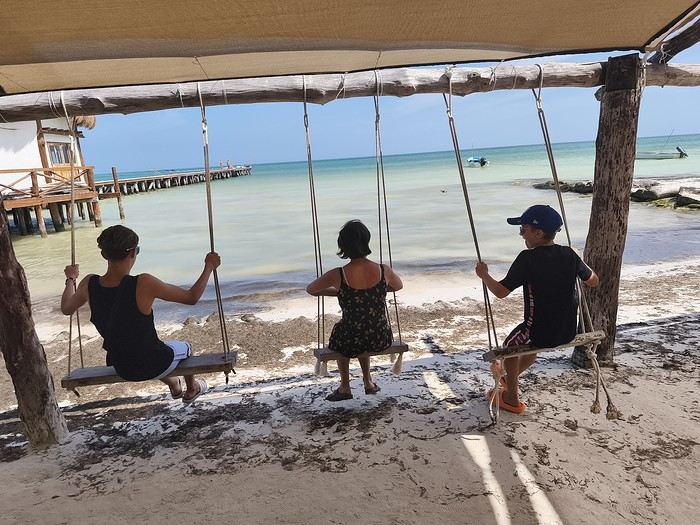
Hi everyone!
That was about all the Spanish I could speak before we left... Luckily, Tom, 15 and in high school, gets by just fine! And Caroline did a year of Duolingo before we took off... Anyway, after 55 days in the American West three years ago, it’s Mexico’s turn for this second long adventure.
A quick intro to the crew:
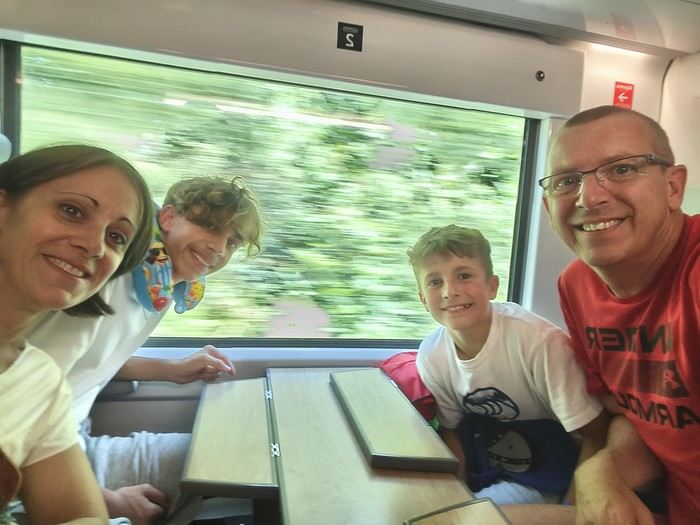

- Oscar, 10, a sporty and lively little boy who loves swimming and basketball, - Tom, 15, a high schooler, sporty and tall, who loves swimming and American football, - Caroline, 47, a PE teacher, sporty , loves hiking and snorkeling, - and me, Sylvain, 50, a science teacher, sporty, loves traveling and always has a possible next trip in mind
We mostly travel by swapping our house to discover beautiful France and the world: 135 swaps over the last 13 years.....
Our itinerary is pretty classic since it’s our first time in the Yucatán, and we’ll make a little 10-day detour to Belize...
See you soon...
We did the Langtang trek (hike) from September 10th to 17th, with the first and last days being the trip from Kathmandu and back—so 6 days of actual walking. It’s a fairly well-known trek but certainly not as famous or crowded as those in the Annapurna or Everest regions, which is why we chose it.
In theory, it’s mandatory to have a guide for this trek. In reality, it seems there are ways to bypass the regulations: we met at least two people hiking without a guide—a South Korean, a New Zealander, and possibly also a couple of English women and an American couple, though we’re not sure if they had a guide.
The agency we booked with had told us it was an affordable trek for relatively older people in good shape—which is our case (I’m 72 myself). I have to say upfront that we found it quite challenging, maybe because we didn’t have good weather—it was the end of the monsoon season. To be clear, no matter your fitness level, I’d say doing this trek in the middle of the monsoon season would be suicidal.
Day 1 – Journey from Kathmandu to Syapru Besi
On Monday, September 8th, there had been violent protests in Kathmandu against the government, which had, among other things, blocked access to social media and been accused of nepotism and corruption. There were 19 deaths. The situation was very tense on the day of our departure, Wednesday the 10th. The agency warned us that public transport was very unreliable. So, we decided to take a jeep, at an additional cost of $100 ($160 minus what was already budgeted for the bus).
We left a little before 7 a.m. and it took us a good hour just to reach the outskirts of Kathmandu. Along the way, we saw several houses and vehicles set on fire by protesters.
The road to Syapru Besi is only 120 km, but it’s frankly awful. It’s always narrow, winds through endless mountains, and the shoulders range from bad to confusing to nonexistent. Several sections are just dirt tracks. We didn’t regret opting for the jeep, as we could stop several times at our convenience—if only to let Y (my Thai partner) throw up everything she had. She’d taken her usual motion sickness medication, but the constant turns, accelerations, and braking eventually made her terribly carsick.
In Nuwakot, we stopped for breakfast at a nice little restaurant, Jimbu. It was around 8:30 a.m., and we’d barely covered 60 km. The restaurant has a lovely garden overlooking the Trishuli Ganga, the river flowing down from Syapru Besi. First photo: the river in the bottom right corner, mist and clouds over the mountain on the other side.
An hour later, my second photo: the hills along the Trishuli Ganga. You can see the different crops—lush green rice paddies in the lower right and corn, already yellowed and likely harvested, in the foreground on the left. And of course, the mist and clouds through which you can glimpse the mountain on the other side of the river.
Hi everyone,
Next summer, we (2 adults and a 12-year-old child) have decided to visit Japan.
Admittedly, it’s still early to plan everything, but my wife will soon need to request her vacation time—either in August or July... and we’re hesitating.
I know summer isn’t the ideal time to visit Japan, but we don’t really have a choice... It’s either July or August. On one hand, I’d love to experience the O-Bon festivities from August 14th to 16th, and I’ve drafted an initial itinerary that would let us experience the Gujo Hachiman Bon Odori, possibly visit the Okunoin Cemetery in Koyasan, and be in Kyoto on the 16th for the Gozan Okuribi fires. But on the other hand, I’m worried it’ll be *packed*, especially in Kyoto, and less enjoyable than in July. So, have any of you experienced these celebrations? Are they worth it? Too crowded? Do you know of other celebrations or festivals in July? Thanks for your input!
For once, given the destination, the author can’t set aside their religious beliefs, which inevitably shape this kind of journey.
The Trip
Early in the morning at Orly Airport, in the departure lounge for Tel Aviv, a group of about forty young men arrives, all looking identical! The same neatly trimmed beards, the same identical haircuts, the same outfits with a touch of whimsy… The effect of seeing these forty “clones” is striking and raises questions! Why such perfect uniformity among this group of guys? Do they belong to the same family, sports club, cultural association, or religious group? A mystery! At the same time, the waiting area fills up with men who are more expected, given our destination: they wear large felt hats and dress in black suits with white shirts—Hassidim? The ones I’ve glimpsed fleetingly in Paris or New York, who have always been a mystery to me. More discreet-looking women accompany them.
I’m already in Israel without even setting foot there! Plus, I witness the preparations for an improvised show.
The “clones” start a flash mob at seven in the morning in a Paris airport departure lounge! Some pull out musical instruments, others begin singing and dancing. A music with strange, unfamiliar sounds enchants the waiting passengers.
The flight crew finally arrives, cutting through the flash mob, bringing us back to the reality of the moment: waiting to take off soon for this so troubling and mysterious Middle East. We go through passport control, presenting our faces to the scanners that operate the exit gate. The group of “identical” young men gets held up by the system: logically, a scanner let the first one through but blocked the second because of his perfect resemblance to the first. To the machine, the same person shouldn’t be able to cross the border twice? But eventually, the whole group makes it through the glass doors, leaving the Republic behind. My simplistic explanation is left looking ridiculous.
At every new destination, I ask myself countless questions, revealing a certain anxiety tied to the unknown: fear of attacks (one just happened at a bus station in Jerusalem), possible police pressure, unexpected events. Israel isn’t known for being a relaxing destination. In reality, if I did face a serious difficulty in this country, it wasn’t one I had anticipated—and it wasn’t particularly tied to Israel!
I take my seat by the window, which is already occupied by a little girl. Her father, a Hassidic man, politely asks if I’d be willing to give up my seat for his daughter. I tell him I’d be happy to make her happy. Seeing me masked, he asks if I’d like him and his daughter to wear masks too. In response, I take off my mask so as not to impose any constraints on them and wish them a good flight.
It was the first time I’d approached and spoken to a Hassidic man. He didn’t speak the way I might have expected after watching *Rabbi Jacob* with Louis de Funès; he spoke perfectly without an accent, just like you and me! Beware of stereotypes! Throughout the flight, I sneak glances at my strange neighbor: he prayed silently without stopping for a minute. His daughter, as good as gold, never interrupted him. He used several religious accessories during his three-hour continuous prayer: a kippa, a prayer shawl, and a rosary?… I left that plane deeply impressed, me, who has a very distant relationship with my Creator and only prays now and then.
Hi there!
Here’s a quick review of my cruise on the REGAL PRINCESS.
This was my 35th cruise and my second on the REGAL PRINCESS, which I first discovered in 2017 during a Caribbean cruise.
A few months ago, we received an email from PRINCESS changing the itinerary—DUBLIN and EDINBURGH were replaced by two Scottish islands. We were a little disappointed, but since we’d never sailed around the UK, we didn’t really know any of the ports anyway.
The itinerary was:
SOUTHAMPTON
AT SEA
KIRKWALL
INVERGORDON
AT SEA
STORNOWAY
GLASGOW
BELFAST
AT SEA
CORK
AT SEA
PORTLAND
LE HAVRE
SOUTHAMPTON
A 13-day/12-night cruise for 1350 € per person in a guaranteed deluxe balcony cabin. PRINCESS assigned us a balcony cabin on deck 8 with a large balcony. We ended up happy with our cabin, even though we’d initially preferred a higher deck. I’ll admit I hesitated to choose this cruise because of the weather—I love sunshine and good weather—but the desire to discover new ports won out, especially with the promise of heading to Corsica afterward to soak up some sun again 😉
On PRINCESS, as Catherine mentioned, there’s no card—everyone has a medallion! I loved this system, which unlocks your cabin door as you approach. It’s really well thought out!
We took the EUROSTAR from Lille to London, then a train from London to Southampton the day before. We stayed in a nice IHG hotel near the port.
EMBARKATION It’s Friday, August 1st. After a good breakfast and a quick check-out, we realize our UBER app isn’t working in England ;(. We have to go back to reception to ask for a taxi because, even though the hotel is close to the port, the ship is still over 2 km away—hardly ideal with luggage! The problem is that many hotel guests also requested taxis... so we wait a good 30 minutes before ours arrives! We get to the REGAL PRINCESS pretty quickly but are shocked to see a huge line outside!!! We hadn’t seen that in over a decade! Not the best start! 🙁
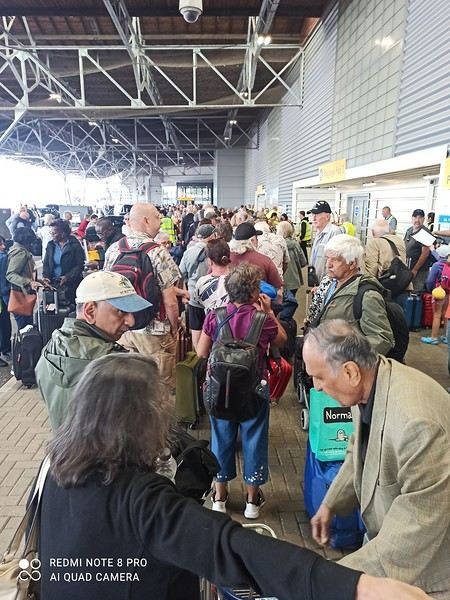
TO BE CONTINUED!
A 13-day/12-night cruise for 1350 € per person in a guaranteed deluxe balcony cabin. PRINCESS assigned us a balcony cabin on deck 8 with a large balcony. We ended up happy with our cabin, even though we’d initially preferred a higher deck. I’ll admit I hesitated to choose this cruise because of the weather—I love sunshine and good weather—but the desire to discover new ports won out, especially with the promise of heading to Corsica afterward to soak up some sun again 😉
On PRINCESS, as Catherine mentioned, there’s no card—everyone has a medallion! I loved this system, which unlocks your cabin door as you approach. It’s really well thought out!
We took the EUROSTAR from Lille to London, then a train from London to Southampton the day before. We stayed in a nice IHG hotel near the port.
EMBARKATION It’s Friday, August 1st. After a good breakfast and a quick check-out, we realize our UBER app isn’t working in England ;(. We have to go back to reception to ask for a taxi because, even though the hotel is close to the port, the ship is still over 2 km away—hardly ideal with luggage! The problem is that many hotel guests also requested taxis... so we wait a good 30 minutes before ours arrives! We get to the REGAL PRINCESS pretty quickly but are shocked to see a huge line outside!!! We hadn’t seen that in over a decade! Not the best start! 🙁
TO BE CONTINUED!
Hello,
Our flights are booked, and we’ll arrive in Thailand at the beginning of January.
Originally, we were supposed to spend 14 days there. But after booking the flights and seeing the prices, we’ll now be there for 20 days instead.
Our initial plan was: 2 days in Bangkok 1 day in Ayutthaya 4 days in Chiang Mai 6 days around Krabi
So we have 7 more days to fill. What do you recommend?
An extra day in Bangkok? Adding more days in the north? If so, where? Exploring another region, like Kanchanaburi or Cheow Lan Lake? Traveling north in stages instead of taking the overnight train?
A few extra details about us: For us, vacation isn’t about relaxation—we love walking, exploring, and packed days don’t bother us. Hiking for hours and doing active things is what makes us happy. That said, we also enjoy visiting villages and towns if they’re worth the detour. In Thailand, we’d like to visit temples too. We’re early risers, so our days tend to be long. 🙂 In short, we like to keep things moving during our trips. 😉
Unfortunately, seeing terraced rice fields isn’t possible in January. I read there are rice fields around Sukhothai. Are they green in January?
In the north, do you recommend Doi Inthanon, Huai Nam Dang, or Doi Chiang Dao National Parks? Which one is the most beautiful and best for January?
Hi everyone!
Blue skies (lots of them), whitewashed villages with steep alleyways, hundreds of churches, and... thousands of stairs? Welcome to the Cyclades! 🙂
We’d been dreaming about this for a while, but in July-August—with the crowds—no way! Now that I can travel outside school holidays, the Cyclades are back on the agenda. And so begins a loooong period of planning and second-guessing, with countless itinerary changes: the Cyclades, yes, but which ones? I was fixated on Folegandros (we won’t be going after all) and really wanted to visit Delos. So, for this first trip, it’ll be: Mykonos (and Delos)-Naxos-Amorgos-Santorini.
Saturday 24/05: Departure from Orly on a Transavia flight, arriving in Mykonos in the late afternoon. We found a hotel that offers free transfers (pretty rare and not insignificant—it’s 25 € each way for just a few kilometers 😠) and at a reasonable price (83 € per night for B&B). Time for dinner already: Greek salad and souvlaki (we’re in Greece, right?)
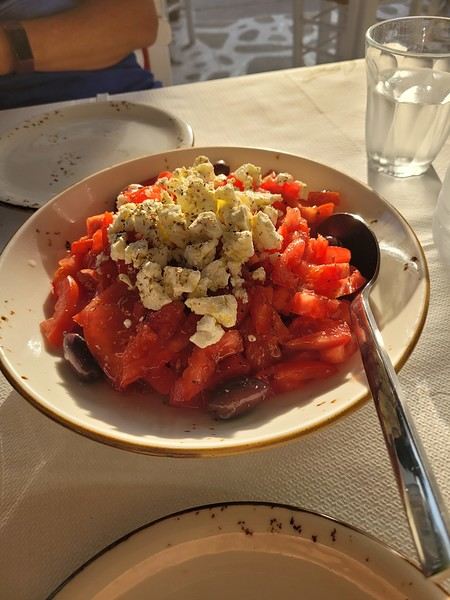 (Okay, this is actually a dakos with Naxos cheese, but I don’t have a photo of a Greek salad 😏).
Blue skies (lots of them), whitewashed villages with steep alleyways, hundreds of churches, and... thousands of stairs? Welcome to the Cyclades! 🙂
We’d been dreaming about this for a while, but in July-August—with the crowds—no way! Now that I can travel outside school holidays, the Cyclades are back on the agenda. And so begins a loooong period of planning and second-guessing, with countless itinerary changes: the Cyclades, yes, but which ones? I was fixated on Folegandros (we won’t be going after all) and really wanted to visit Delos. So, for this first trip, it’ll be: Mykonos (and Delos)-Naxos-Amorgos-Santorini.
Saturday 24/05: Departure from Orly on a Transavia flight, arriving in Mykonos in the late afternoon. We found a hotel that offers free transfers (pretty rare and not insignificant—it’s 25 € each way for just a few kilometers 😠) and at a reasonable price (83 € per night for B&B). Time for dinner already: Greek salad and souvlaki (we’re in Greece, right?)
(Okay, this is actually a dakos with Naxos cheese, but I don’t have a photo of a Greek salad 😏).Hi everyone,
We were offered a visit to the Renaissance by the new CFC cruise line through Croisiland. After reading all the reviews—some very harsh, others glowing—I wanted to form my own opinion without having to book a full cruise to test it out. This visit to the ship at the port of Le Havre for 49 € per person came at the perfect time, even if I’m a bit put off by having to pay for a ship tour. That’s not how it usually works with other cruise lines, as far as I know.
The Renaissance is a former Holland America Line ship, built in 1993 and renovated in 2023. We’re familiar with this style of ship since we took a long cruise in Polynesia in 2014 on one of its sister ships, the MS Statendam. We remember it as a charming small ship with a lovely pool terrace at the very back.
Off we went this morning for a relaxing day on a ship—always a nice change!
The Pont de Normandie is the last elegant structure you see before entering the vast and rather smelly port area of Le Havre.
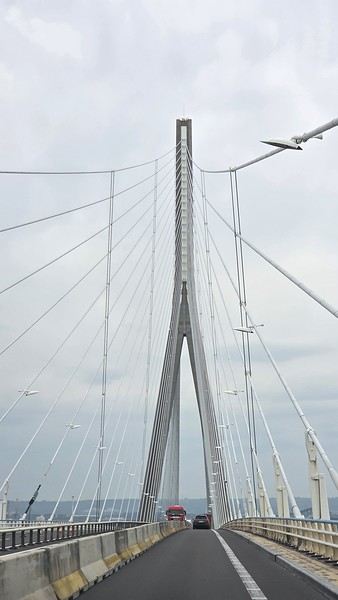
The area around the port where the Renaissance is docked is total chaos—cars everywhere and only a handful of taxis. We were supposed to have a reserved parking spot in front of the terminal (we’d even given them our car model and license plate), but we were denied entry. There’s no paved public parking, so we left the car on a vacant lot.
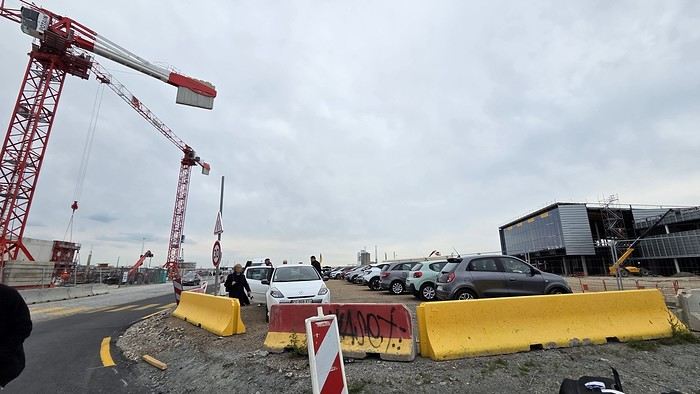
CFC was officially acquired by the British cruise line Ambassador Cruise Line in January 2025. Ambassador Cruise Line, launched in 2010, already owns two ships of the same type and age. They wasted no time repainting the funnel in their new colors.
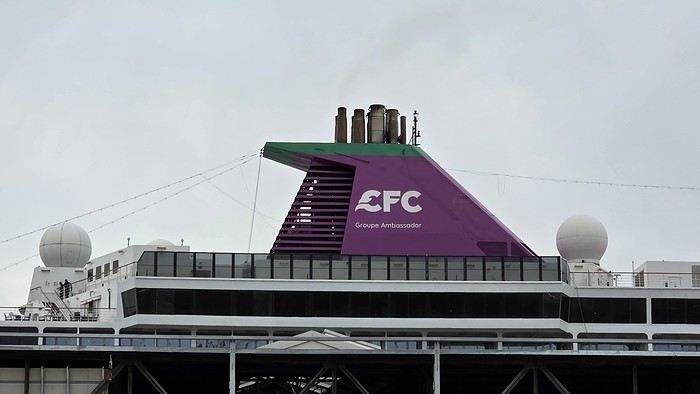
The line of passengers disembarking and waiting for taxis is endless... and taxis are trickling in. Is this the aftermath of yesterday’s strike, or is this the norm in this port? Either way, I feel bad for the poor travelers waiting—it’s going to be a long haul. Many are leaving on foot, dragging their suitcases. Compared to the port of Marseille, this is pretty dismal.
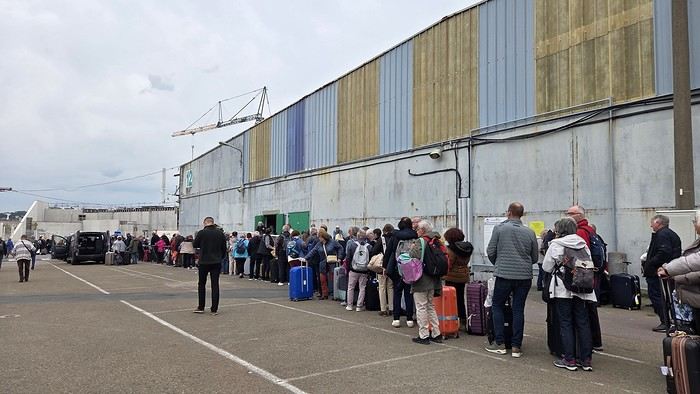
Forty spots were available for this visit organized by Croisiland, but we ran into a good hundred people at the meet-up. A group from the AVF (Accueil des Villes Françaises) of Le Havre will be joining us. Our Croisiland group consists of twelve people, if I counted right.
Security clearance is done alphabetically, and we quickly board the ship. Now we’re getting to the heart of the matter.
To be continued...
We were offered a visit to the Renaissance by the new CFC cruise line through Croisiland. After reading all the reviews—some very harsh, others glowing—I wanted to form my own opinion without having to book a full cruise to test it out. This visit to the ship at the port of Le Havre for 49 € per person came at the perfect time, even if I’m a bit put off by having to pay for a ship tour. That’s not how it usually works with other cruise lines, as far as I know.
The Renaissance is a former Holland America Line ship, built in 1993 and renovated in 2023. We’re familiar with this style of ship since we took a long cruise in Polynesia in 2014 on one of its sister ships, the MS Statendam. We remember it as a charming small ship with a lovely pool terrace at the very back.
Off we went this morning for a relaxing day on a ship—always a nice change!
The Pont de Normandie is the last elegant structure you see before entering the vast and rather smelly port area of Le Havre.
The area around the port where the Renaissance is docked is total chaos—cars everywhere and only a handful of taxis. We were supposed to have a reserved parking spot in front of the terminal (we’d even given them our car model and license plate), but we were denied entry. There’s no paved public parking, so we left the car on a vacant lot.
CFC was officially acquired by the British cruise line Ambassador Cruise Line in January 2025. Ambassador Cruise Line, launched in 2010, already owns two ships of the same type and age. They wasted no time repainting the funnel in their new colors.
The line of passengers disembarking and waiting for taxis is endless... and taxis are trickling in. Is this the aftermath of yesterday’s strike, or is this the norm in this port? Either way, I feel bad for the poor travelers waiting—it’s going to be a long haul. Many are leaving on foot, dragging their suitcases. Compared to the port of Marseille, this is pretty dismal.
Forty spots were available for this visit organized by Croisiland, but we ran into a good hundred people at the meet-up. A group from the AVF (Accueil des Villes Françaises) of Le Havre will be joining us. Our Croisiland group consists of twelve people, if I counted right.
Security clearance is done alphabetically, and we quickly board the ship. Now we’re getting to the heart of the matter.
To be continued...
Since no travel journal has been posted about this destination since 2020, I’m giving it a go—maybe it’ll jog some memories for a few of you or give others a few ideas... even if, in the end, there isn’t much to tell 😎!
Even though the itinerary was as classic as can be, it still led to a few brain knots: in what order? How many nights on each island? Rent a car or not?
In short, plenty of existential questions to land on 4 nights per island, finishing with Mahé to avoid any nasty surprises before the return flight.
Saturday 03/22: Flight to Mahé with Qatar Airways (no—or rather, no more—direct flights from Paris 😕) A nice surprise at CDG with the discovery of a new lounge in Terminal 1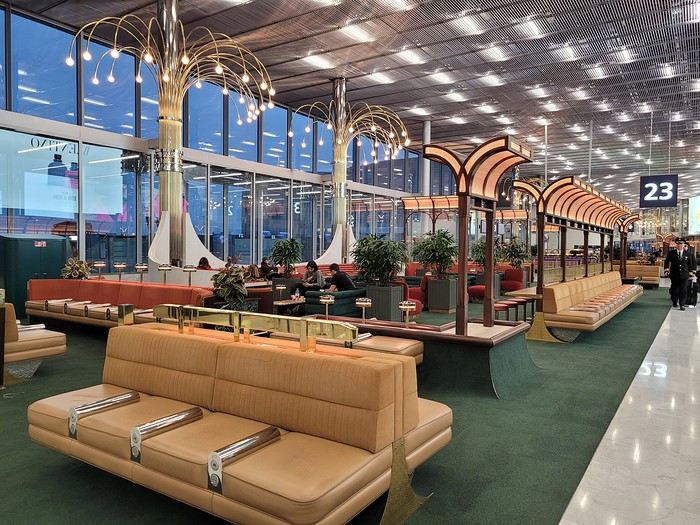
Then, an in-depth exploration of Doha Airport thanks to (or because of) a loooong layover:
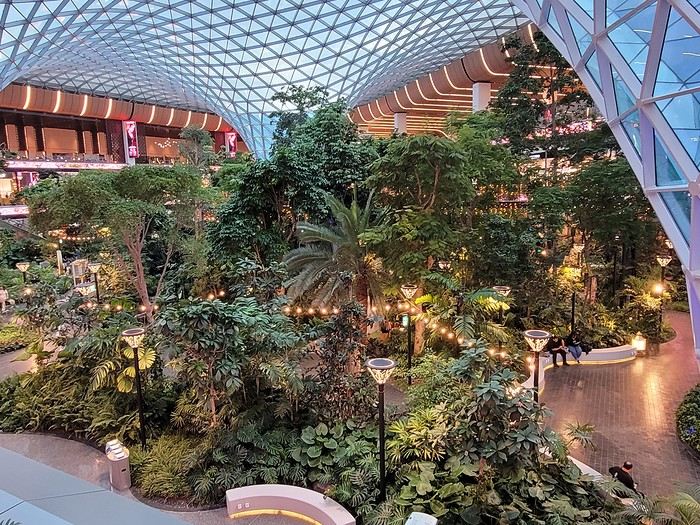
And finally, arrival at the tiny Mahé airport where we step onto the tarmac feeling like we’ve walked into a steam room
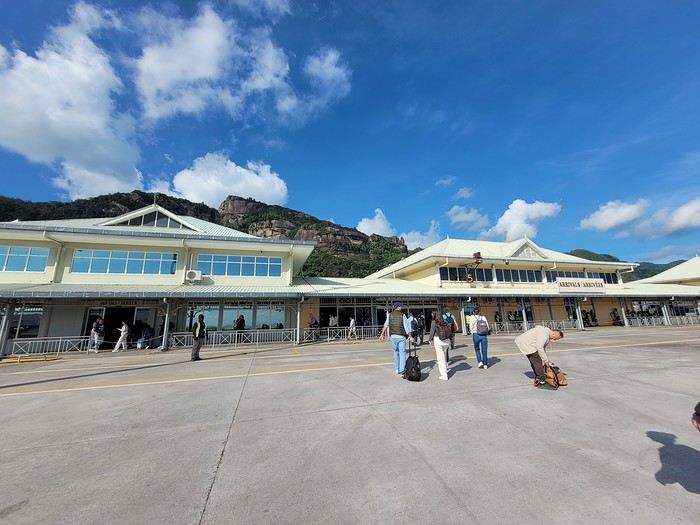 Baggage claim is quick, the shuttle to the port is on time, the ferry is punctual (we, on the other hand, are *very* early for it ), and there’s Praslin in sight:
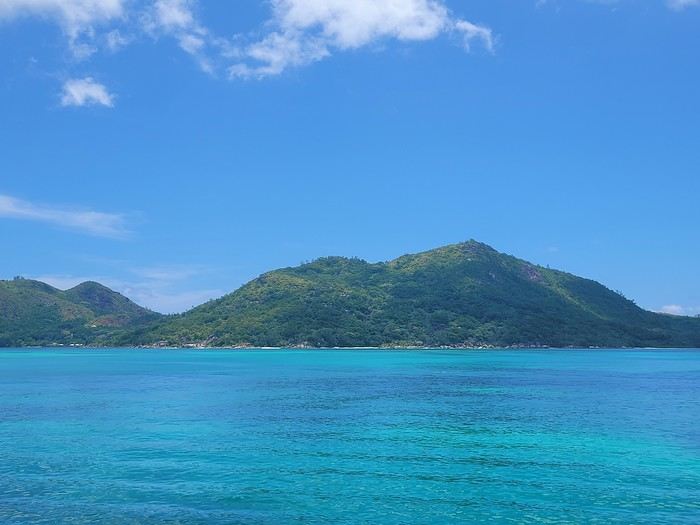
... with a sneak peek of the sea’s colors 🙂 Quick note on the photos: most were taken with a smartphone, and the colors are a bit more saturated than in real life (I did bring my hybrid camera, but in the end, I barely used it since it wasn’t very practical to lug around on the water or for snorkeling).
We pick up the car (a Grand i10 instead of a Picanto) from a muddy parking lot (it just rained) and off we go—of course, with a windshield wiper instead of the turn signal 😎, left-hand driving obliges. In just a few minutes, we arrive at our accommodation for these 4 nights on Praslin (Oh, and now the "lien" tab isn’t working! ) We’re blown away by the view from the terrace:
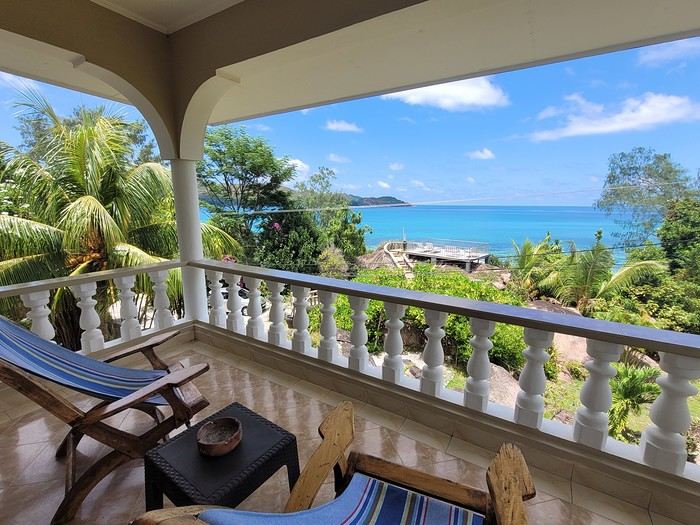
Then by the view from the little shared terrace on a promontory:
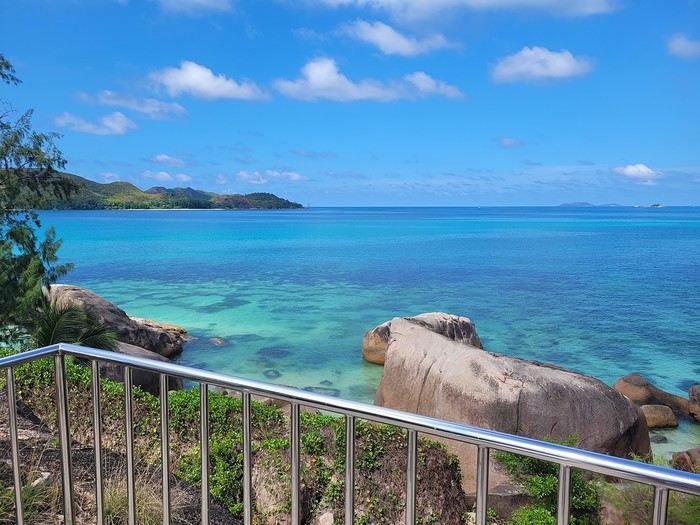 Before heading to test the water temperature on the other side of the road, at Anse Boudin, and spotting our first fish.
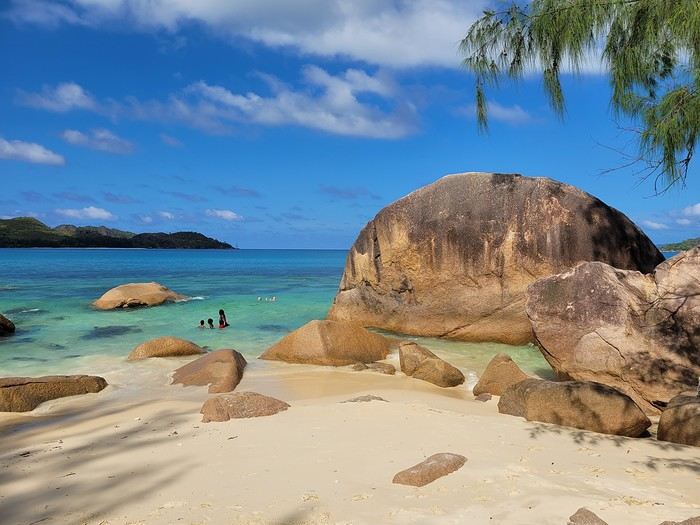
Saturday 03/22: Flight to Mahé with Qatar Airways (no—or rather, no more—direct flights from Paris 😕) A nice surprise at CDG with the discovery of a new lounge in Terminal 1
Then, an in-depth exploration of Doha Airport thanks to (or because of) a loooong layover:
And finally, arrival at the tiny Mahé airport where we step onto the tarmac feeling like we’ve walked into a steam room
Baggage claim is quick, the shuttle to the port is on time, the ferry is punctual (we, on the other hand, are *very* early for it ), and there’s Praslin in sight:... with a sneak peek of the sea’s colors 🙂 Quick note on the photos: most were taken with a smartphone, and the colors are a bit more saturated than in real life (I did bring my hybrid camera, but in the end, I barely used it since it wasn’t very practical to lug around on the water or for snorkeling).
We pick up the car (a Grand i10 instead of a Picanto) from a muddy parking lot (it just rained) and off we go—of course, with a windshield wiper instead of the turn signal 😎, left-hand driving obliges. In just a few minutes, we arrive at our accommodation for these 4 nights on Praslin (Oh, and now the "lien" tab isn’t working! ) We’re blown away by the view from the terrace:
Then by the view from the little shared terrace on a promontory:
Before heading to test the water temperature on the other side of the road, at Anse Boudin, and spotting our first fish.
Our trip lasted a month, from March 10 to April 10, 2024, and was done aboard our Land Rover Defender 110. For those interested, our 4x4 is equipped with mountain-approved 3PMFSF all-terrain tires (non-studded), a removable electric winch that can be attached to either the front or rear of the vehicle, two sand recovery boards, and we bring two pairs of snow chains. We sleep in our Land Rover, which is equipped with a diesel-powered independent heater, a small fridge, and has a layout that allows the dinette to be converted into a bed.
Starting from the Paris region, we crossed Belgium and Germany, took the ferry from Travemünde in northern Germany to Helsinki, followed the Russian border up to northern Finland, then headed into Norway all the way to the North Cape before returning via Norway, taking the ferry from Larvik in Norway to Hirtshals in Denmark, then passing through Germany and Belgium on our way back to France.
Tonight, March 10, 2024, we’ll be sleeping at our daughter’s place in the North.
Tuesday, March 11, we’ll cross Belgium and then enter Germany, where we’ll camp in Bremen.
Wednesday, March 12, we’ll have a quick visit to Bremen in the morning. We had planned to visit Lübeck, but some electrical issues with the car delayed us, so we head straight to the German port of Travemünde, where we’re set to embark at 11:30 PM to cross the Baltic Sea and arrive in Helsinki after 31 hours of sailing (one-way cabin ticket cost: 850 €—quite expensive since we booked last minute).
On the ferry, there are mostly semi-trucks and only a few campervans and passenger cars. The boat is quiet, and the Baltic Sea is calm.
About two hours before arriving in Helsinki, we hear noise along the hull. Surprise—looking out the porthole, we realize we’re sailing on frozen sea ice!
Thursday, March 14, we arrive at the port of Helsinki at 9:30 AM. Disembarking takes a while. As soon as we’re out, we head straight to Rastila Camping (cost: 27 €), about ten kilometers east of Helsinki. Then we go to a Land Rover garage to fix our headlight switch, which stopped working (a real hassle in Finland since you have to drive with low beams on at all times).
After the repair, we visit the stunning Temppeliaukio Church, which is built underground.
On our way back to the campsite, we stop at the supermarket for supplies. Prices are similar to France, except for imported products.
We settle into our snowy campsite spot.
Hi there,
We’re planning a 15-day family trip in February 2026 (with 3 teens). We’ll be visiting friends who live in Puebla. Initially, I was thinking of the Yucatán, but after reading up on it, I don’t think it’s the right fit for us (too crowded, too touristy). So, we’re leaning toward something like this: - Mexico City: 2 days (Teotihuacán + city) - Puebla: 3 days - Tehuacán: 2 days (to break up the trip—is this a good choice? Is there enough to do for 2 days?) - Oaxaca: 3 days (Hierve el Agua, Monte Albán, city/tours) - Pacific Coast: 4 days (snorkeling, excursions)
Does this seem balanced? We’d like to end on the coast for some relaxation, ocean time, and fun for the kids. I’ve seen lots of excursions offered along the coast but can’t decide where to stay. Puerto Escondido? Huatulco? The beaches seem better for snorkeling in Huatulco, but I’ve read mixed things, and it’s farther away. What do you think?
For transportation, is this doable by bus? I’m struggling to find a decent bus between Tehuacán and Oaxaca (overnight schedules), and I’m not sure how to get around the coast. Also, how do we handle luggage between cities? We usually rent a car.
Finally, I’d love feedback on the Pacific Coast excursions—I get the feeling some are worth it and others aren’t. Is bioluminescence really magical? Are dolphin-watching tours ethical and not too "factory-like"? (We skipped them in Quebec and just watched whales from shore.) Can you see sea turtles up close?
Thanks for your help!