I thought I knew the definition, but since VF reopened, I’ve been wondering—so if you could help me out, that’d be great! 🙂.
Thanks a lot!
201 similar discussions in English
Back in the "travel journal" section to share our 15-day discovery of Kenya in November 2024.
It was pretty much our first time in East Africa (since Zanzibar doesn’t really count 😅).
Hi there,
I’m reaching out because I’ve recently returned to VoyageForum after several years away. Back then, the forum had switched to "read-only" mode, which paused my participation.
Now, I’d like to update my profile, especially by adding an avatar, but I can’t find the steps to do that. Could you point me to the instructions or guide me to a help page if one exists?
Thanks in advance for your help—I’m so happy to be back in the forum community!
Best regards, JULIE
Now, I’d like to update my profile, especially by adding an avatar, but I can’t find the steps to do that. Could you point me to the instructions or guide me to a help page if one exists?
Thanks in advance for your help—I’m so happy to be back in the forum community!
Best regards, JULIE
Reading an excerpt from "The Art of Boring People by Telling Your Travel Stories" by Matthias Debureaux first made me smile, then got me thinking… Are we "travel-bores" with our travel stories?
"Annoying is the one who, like Ulysses, had a wonderful trip. Because for every silver-tongued storyteller with marvelous tales, how many bores and nuisances… The traveler, drunk on grand images and magical encounters, has only one thing on their mind: pelting us with anecdotes, life lessons, and ideals. They’ll paint the most beautiful and distant Edens… the traveler has an endless pharmacy of stories. But nothing is designed to immunize us against travel tales. We should impose a quarantine on returning travelers. At least a dozen hours in a sobering cell. What’s the point? Months, years later, they’ll never miss an opportunity to reminisce. The evocation of their odyssey is a perpetual fireplace fire."
A provocative text, sure, but isn’t the person telling their travel story doing it mostly for themselves? Just to relive the joy of their trip? At friendly gatherings or with family, we sometimes have to endure the enthusiast… without necessarily sharing their passion for the destination!
The advantage of writing—and also of exchanges on sites like VF—is that only those who want to read a story do so… with the option to skip it anytime!
So, what do you think, authors and fans of travel stories published online?
Jean
P.S.: "The Art of Boring People by Telling Your Travel Stories" by Matthias Debureaux, Éditions Cavatines, 2005 Excerpts read in "The Taste of Travel" Éditions Mercure de France, 2008
P.S.: As a little wink… I still invite you to check out my latest travel story about a trip to the Aeolian Islands… see the story and photos by following this link: http://voyageforum.com/v.f?post=4409520;page=unread#unread
I hope I didn’t "bore" you too much with this story 😉
Hello,
I’m looking for advice from seasoned travelers about a roughly one-month trip to Japan. From late October to late November 2026.
We often travel in Southeast Asia but have never been to Japan. Based on what I’ve read, I’d love to hear your thoughts on:
- Is traveling day-to-day, without booking hotels or trains in advance, possible in Japan? (I’ve read many travel journals and blogs that say everything was booked way in advance… but that’s not how we usually travel.)
- Will the Japan Rail Pass be worth it for us? (According to an old simulator, I’m looking at around 400 € for trains compared to 570 € for the JRP.)
Here’s our rough itinerary (which may change):
- Arrival Osaka: 3 nights with Nara - Hiroshima and Miyajima Island: 3 nights - Kurashiki or Naoshima: 2 nights - Himeji: 1 night - Kyoto: 4 nights - Kanazawa: 2 nights - Takayama and Shirakawa-go: 3 nights - Around Mount Fuji: 3 nights - Tokyo with Nikko: 6 nights (no theme parks) Departure from Tokyo
Thanks for sharing your thoughts! :)
Hello,
After 20 years of operation and a 4-year hiatus, we were happy to rediscover this forum following its acquisition by Myatlas.
At the very beginning of the adventure, there was a section allowing members to share their ideas—good or bad, feasible or not—with the team in charge to help perfect the forum.
So, to help VoyageForum regain its momentum and adapt to new audiences and a new environment, why not put our heads together and suggest some improvement ideas in this thread?
I’ll get the ball rolling!
Travel journals are limited to 300 photos because photo storage is expensive. This limitation is completely understandable, and Myatlas found a solution by offering a paid subscription for those who wanted to exceed the free photo limit. Maybe this approach could be adapted here? Limiting without offering an alternative is a reason members leave.
I don’t want to write an obituary for VF here; I hope it’s just a rough patch and that we can keep exchanging. But I do want to list all the great things this Forum has given me:
-Some amazing travel stories from Yangguizi, one of which led me to North Korea. Just look at the power of storytelling! And Looping, Mariecurry, Michant... Pondi will see me in the Altai one day. -Meeting a really friendly travel companion, which gave me the confidence to explore the Russian Far North. Where else could I have found a travel buddy for such a unique trip? -Meeting people on the Forum who encouraged me to write and gave me confidence. I even found my Quebecois translator and Breton translator for a few lines here on VF. A big thank you to them. -A wealth of information from reading travel journals, plus the chance to ask specific questions to prepare for a trip. Reading these journals also inspired me to visit new destinations.
And then, Voyage Forum is like a big family made up of so many different personalities. Anonymity breaks down all barriers and inhibitions. Sure, some people can be a pain and might’ve needed some help, there are the lost souls; others are all kindness and warmth; some stand out for their beautiful French; that’s not something to dismiss in these times of language impoverishment; some intellectuals share ideas that often go over my head; there are the ruthless commentators on others’ writing and thoughts. Ego battles flare up—it’s all part of the game. I can’t imagine the work it takes to manage all this. Rarely, a historical discussion takes hold with knowledgeable contributors. How cool is that! It’s fascinating and educational. Unfortunately, political correctness often shuts it down quickly. The trolls are watching!
Thank you, VF. And thank you all who owe it to yourselves. What are the most original contributions?
You can post your personal photos in the following thread: https://voyageforum.com/forum/quelque-part-en-thailande-d10655574/
This travel journal is therefore intended solely for my photos, to present a consistent style. All the shots were taken with a simple Samsung Galaxy smartphone and with whatever was at hand.
All stays combined, I’ve spent the equivalent of three years at most in Thailand, and I’m not a big expert on the country. However, after many trips, lots of reading on VoyageForum and other sites, and conversations with many locals as well as expats, my view of the country is becoming clearer, though it’s constantly evolving. You never stop discovering and learning.
I guess I wanted to piece together a puzzle, mainly for those who want to get an idea of the country here and for those who miss it. I don’t know if this minimalist sharing will interest anyone, but it’ll do me good to put it together. After so many months without traveling and then these other long months with VF closed, there’s plenty of material available.
There’ll be a mix of places, periods, and subjects, but it might well be intentional.
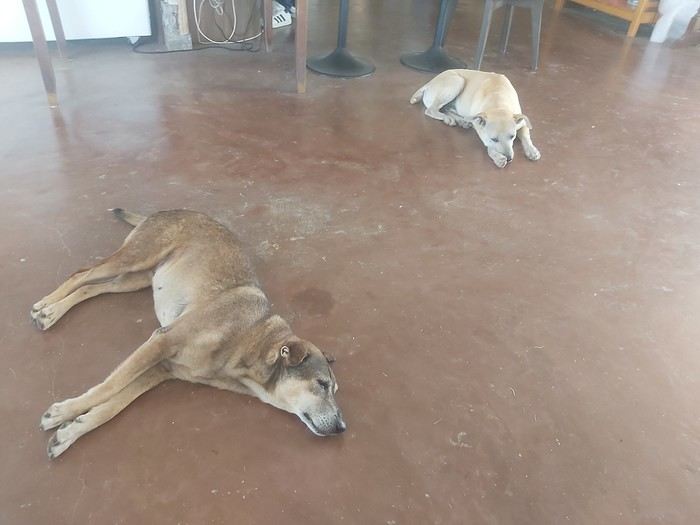
I suspect many Thais have dogs because they make excellent guards for the home. Nothing better to deter burglars or to signal the presence of a snake. You’ll often see Thais tapping the top of their dog’s head, but don’t be fooled: it’s a sign of affection from them. Judging by the dogs’ reactions, they’re used to it.
Thailand is one of the countries on the planet where rabies is still present, so keep that in mind. It’s not just bites that can be dangerous, so don’t let just any dog lick you. Especially on a wound, of course. Even though dogs often fear humans—this dangerous and unpredictable predator—we still need to stay cautious. Be careful when walking into alleys because the dog will defend its master’s big property, be careful at night, and be careful when they’re in packs. It sometimes crosses our minds that Thailand isn’t really made for walking around, and dogs are one of the reasons. That said, it’s not uncommon to see them chasing bikes or scooters. Cars, though, are much rarer—they’re too big.
It seems Thais prefer to give their dogs freedom by not locking them behind gates. Though sometimes the gate is closed, the little side door is wide open. Oh, and sometimes there’s no gate in front of the property, or it’s been broken for years.
You’ll often see dogs sleeping on the side of the road, sometimes right on the road. When you arrive, they move aside nonchalantly—or not at all. It’s less funny when they suddenly appear from thick vegetation, which reminds visitors not to drive too fast. As a result, you’ll notice that dogs with injuries or missing legs aren’t that rare.
Since they believe in reincarnation and respect for all forms of life, they don’t chase dog packs away too much, and they don’t sterilize them enough. Seeing a small pack roaming freely in the countryside, you might think it’s best not to cross paths with them at the edge of a field. A darker side of this is that euthanasia isn’t often practiced. Twice, we saw dogs at temples on the brink of death, enduring terrible suffering. No one did anything about it. The image (and the smell) of one of them, dying and emitting the stench of death, still comes back to me sometimes.
Some of you may have seen the YouTube vlog of a French woman living in Phuket who was given a little pig by her Thai friends. The well-fed animal quickly became a happy, enormous beast with its own garden. Yet, it didn’t take long for it to fall seriously ill and become incurable. In her video, the French woman described how difficult it was to find a vet willing to perform euthanasia.
You’ll often see bowls by the side of the road. Thais leave food and water in them for stray cats and dogs. Overall, they have a big heart for animals.
If you ever pop into a shopping mall, you might see people pushing their small dogs in strollers. It’s not a gimmick—it’s just that these strollers are provided for customers to put their pets in, otherwise you can’t bring them inside. It looks a bit odd when you expect to see a baby.
This travel journal is therefore intended solely for my photos, to present a consistent style. All the shots were taken with a simple Samsung Galaxy smartphone and with whatever was at hand.
All stays combined, I’ve spent the equivalent of three years at most in Thailand, and I’m not a big expert on the country. However, after many trips, lots of reading on VoyageForum and other sites, and conversations with many locals as well as expats, my view of the country is becoming clearer, though it’s constantly evolving. You never stop discovering and learning.
I guess I wanted to piece together a puzzle, mainly for those who want to get an idea of the country here and for those who miss it. I don’t know if this minimalist sharing will interest anyone, but it’ll do me good to put it together. After so many months without traveling and then these other long months with VF closed, there’s plenty of material available.
There’ll be a mix of places, periods, and subjects, but it might well be intentional.
I suspect many Thais have dogs because they make excellent guards for the home. Nothing better to deter burglars or to signal the presence of a snake. You’ll often see Thais tapping the top of their dog’s head, but don’t be fooled: it’s a sign of affection from them. Judging by the dogs’ reactions, they’re used to it.
Thailand is one of the countries on the planet where rabies is still present, so keep that in mind. It’s not just bites that can be dangerous, so don’t let just any dog lick you. Especially on a wound, of course. Even though dogs often fear humans—this dangerous and unpredictable predator—we still need to stay cautious. Be careful when walking into alleys because the dog will defend its master’s big property, be careful at night, and be careful when they’re in packs. It sometimes crosses our minds that Thailand isn’t really made for walking around, and dogs are one of the reasons. That said, it’s not uncommon to see them chasing bikes or scooters. Cars, though, are much rarer—they’re too big.
It seems Thais prefer to give their dogs freedom by not locking them behind gates. Though sometimes the gate is closed, the little side door is wide open. Oh, and sometimes there’s no gate in front of the property, or it’s been broken for years.
You’ll often see dogs sleeping on the side of the road, sometimes right on the road. When you arrive, they move aside nonchalantly—or not at all. It’s less funny when they suddenly appear from thick vegetation, which reminds visitors not to drive too fast. As a result, you’ll notice that dogs with injuries or missing legs aren’t that rare.
Since they believe in reincarnation and respect for all forms of life, they don’t chase dog packs away too much, and they don’t sterilize them enough. Seeing a small pack roaming freely in the countryside, you might think it’s best not to cross paths with them at the edge of a field. A darker side of this is that euthanasia isn’t often practiced. Twice, we saw dogs at temples on the brink of death, enduring terrible suffering. No one did anything about it. The image (and the smell) of one of them, dying and emitting the stench of death, still comes back to me sometimes.
Some of you may have seen the YouTube vlog of a French woman living in Phuket who was given a little pig by her Thai friends. The well-fed animal quickly became a happy, enormous beast with its own garden. Yet, it didn’t take long for it to fall seriously ill and become incurable. In her video, the French woman described how difficult it was to find a vet willing to perform euthanasia.
You’ll often see bowls by the side of the road. Thais leave food and water in them for stray cats and dogs. Overall, they have a big heart for animals.
If you ever pop into a shopping mall, you might see people pushing their small dogs in strollers. It’s not a gimmick—it’s just that these strollers are provided for customers to put their pets in, otherwise you can’t bring them inside. It looks a bit odd when you expect to see a baby.
Hi everyone,
After 8 months of volunteering in Tanzania at a center for street children, I’d like to go back for a year in the same kind of role—this time in Burkina. So I’m looking for contacts in this field, in Ouaga or elsewhere. I’m *super* motivated! It’s been over two years since I got back from Tanzania, and I’m starting to feel restless! Thanks so much!! Emmanuelle.
After 8 months of volunteering in Tanzania at a center for street children, I’d like to go back for a year in the same kind of role—this time in Burkina. So I’m looking for contacts in this field, in Ouaga or elsewhere. I’m *super* motivated! It’s been over two years since I got back from Tanzania, and I’m starting to feel restless! Thanks so much!! Emmanuelle.
Hi there,
I’m planning my first trip to Asia next summer with my partner and our daughter, who’ll be 3 and a half at the time, for 4 weeks (maybe 5).
I’ve heard that the timing is better for visiting Indonesia, but I’m hesitant because Thailand seems more accessible, and I’m worried that traveling to Indonesia during high season might be less enjoyable and a lot more expensive due to the number of tourists. We love cultural sites as much as natural ones, and we’re big foodies. We’re not necessarily looking for luxury and tend to take our time, travel by public transport, and look for accommodations with a good value for money—though we do occasionally splurge on a high-end restaurant.
I’m also wondering when and where to buy flight tickets and how comfortable the journey will be (especially for our daughter) if we fly with Thai Airways or Garuda.
Thanks in advance for sharing your thoughts and tips!
Damien
This catchy and somewhat mysterious title comes from several questions I’ve been asking myself.
VF has been back open for a reasonable number of weeks and months now. The number of visitors overall matches past averages, but the number of members online in the last 24 hours seems relatively lower than what we used to see.
Yet, to my surprise, I’m seeing fewer travel journals, way fewer messages, and way fewer questions. I don’t see many new registered users online, and I notice a number of members who are logged in but either aren’t participating or have stopped participating.
Something’s not adding up for me because, in my opinion, VF is still appealing, and I don’t see which other sites could really compete.
Was there a real break between pre- and post-Covid? Does it just take more time for some people to discover the site or learn that it’s active again? Do people now prefer quick consumption on sites like FB or others I’m not familiar with? Where have the site’s old-timers gone, and what are they doing with their time now? What’s really going on here?
Sometimes a trip, a desire to travel, a travel dream... begins between the pages of a book.
These three invite you to Scotland, on the Isle of Lewis. And although they’re published by Babel Noir, Actes Sud’s collection dedicated to crime novels with a dark atmosphere, and even though each book features a crime to solve, these three stories go far beyond the genre.
The central character, Fin, a man who wasn’t gifted with lightness or whimsy at birth, used to be a cop. He isn’t anymore, having left the police after a personal tragedy... A crime with a modus operandi similar to a case he was handling brings him back to Lewis... He’ll stay there. Because the time seems right for him to retrace the steps of his own story... a story deeply rooted in this land of melancholic geography, this island battered and rebattered by the winds, frozen in the past, where beliefs and traditions endure, defying time.
This austere island where his tender years were bruised. This harsh land that closes in on the dead... and returns them to the living years later, when the time seems right for them to put their childhood to rest, by facing the figures and ghosts that once crossed it.
Past and present intertwine, the memories of one explaining and perhaps unraveling the shadows of the other... and it’s only by confronting the darkness that he’ll find a strength he didn’t know he had, one that may—likely will—help him overcome the unspeakable.
In each book, Peter May, like a historian and anthropologist rolled into one, explores a page of the past, highlighting some of Scotland’s darker chapters: the omnipresence of religion, the conflict between Protestants and Catholics, the rituals marking the passage into adulthood, the terrible fate of orphans... the shadowy corners of the human soul.
A poetic, dense, and minimalist writing style that cuts to the essence, with just the right words to describe childhood, solitude, second chances—those who offer them and those who seize them—the weight of things... and happiness sometimes so close yet not always allowed to be grasped.
Three intense stories set in the same landscape: nature ever-present, the icy dampness, the slippery machair, the dry peat that fuels the fires... and Gaelic, that language with its harsh, guttural, rugged sounds?... which isn’t pronounced exactly as it’s written.
Peter May The Scottish Trilogy, Complete edition by Éditions du Rouergue Or In paperback, Actes Sud publisher, Babel Noir collection 1/ The Blackhouse 2/ The Lewis Man 3/ The Chessmen
Who are you? Where are you from? Where are you going?
Like last year at this time, a post about bike travel ideas.
How many of us are preparing a trip planned for this year? Probably a lot.
What’s yours—the one you’ve been dying to do for so long, maybe too long? For us, it’s a modest PARIS-MARATHON by bike, followed by MARATHON-ATHENS on foot in June 2010. And you?
May the passion keep growing before, during, and after! Happy planning and safe travels to everyone.
Why bike (MTB) along the canal between the Two Seas: the lateral canal of the Garonne from Bordeaux to Toulouse, and the Midi Canal from Toulouse to the Mediterranean?
This canal was created to connect the Mediterranean to the Atlantic without going around Spain, and along its entire length, there’s an old towpath (used to pull barges). Since this path is closed to traffic (except for service vehicles from Voies Navigables de France), no cars drive on it—it’s dangerous, noisy, and polluting. The Canal between the Two Seas was built for transporting goods, so it passes through many towns you can explore without dealing with traffic. You can stock up on supplies or spend the night. You’ll discover the varied landscapes of the countryside, always in the serenity brought by the calm and slow flow of the canal’s water. Most of the time, you’ll be in the shade of trees planted to stabilize the banks with their roots. All you have to do is follow this blue—or rather green—ribbon without needing to consult a map. But the biggest advantage is that it’s flat! Of course, on the Canal du Midi, water flows from the watershed divide at Naurouze eastward to the Mediterranean and westward to Toulouse. On the lateral canal of the Garonne, water flows toward Bordeaux. But this slope is almost imperceptible, which is a huge plus when you want to travel by bike for several days with luggage.
When I say "bike," I really mean MTB because, while the towpath has been replaced in some places by a paved bike path, it mostly resembles a dirt trail—sometimes smooth, sometimes rocky, and often cluttered with roots from the magnificent trees lining it. Since the canal was classified as a UNESCO World Heritage site, improvements have been underway, but it won’t be tomorrow that you’ll be able to ride from Bordeaux to Sète on a road bike. And I’m afraid the first sections of the path will be worn out before the rest is finished. You might even run into construction work for this bike path. That’s what happened to me during the spring of 2007.
Sunday, 03/11 – Valence d'Agen 08:15 to Toulouse (Rangueil) 16:30 97 km in 8h15 (6h on the bike) I started on the recently paved path along the lateral canal of the Garonne. The first locks appeared, and as I approached Moissac, the path turned into a billiard table until Castelsarrasin. After the Cousteau port, I was back on the classic dirt towpath with its rocks, roots, and nutria holes. But not for long—soon, I hit ruts left by backhoes and bulldozers, which, fortunately, were resting for the Sunday. A pile of rubble taller than me blocked the entire width of the path. I didn’t want to turn back to find the previous bridge and ride on the other bank, which was just as impassable (dense grass). It wasn’t easy to carry a bike with full panniers, so I lifted it over several mounds. I kept going, sometimes on foot, unsure how far the construction extended. Another bulldozer—luckily, the ground was dry. The work went all the way to Montech, making the path impassable. I recommend taking the N113, which runs parallel (that’s what I did on the way back). In Montech, the famous water slope was at rest, waiting for tourists. For many kilometers, I was back on the traditional towpath. The closer I got to Toulouse, the better the surface became, and the more cyclists and pedestrians I saw—until the city center, where there was nonstop bike traffic, especially students heading to Rangueil.
Monday, 03/12 – Rangueil 09:10 to Revel 16:30 86 km in 7h20 (5h30 on the bike) As soon as you reach Toulouse, you make a 90° turn to follow the connection between the lateral canal and the Canal du Midi. Heading east, you pass the barge selling the famous Toulouse violet souvenirs. A real bike path has been built for 50 km to Port Lauragais. It’s a true joy for Toulousains and travelers. Restrooms have been installed or shared with highway rest areas, allowing you to refill water (of course, bikes are banned from ASF rest areas, but cleverly placed racks let you secure your bike and walk in). At Port Lauragais, it’s another rest area shared by highway users, cyclists, and boaters. You’ll find a cafeteria, restaurant, hotel, and a shop selling regional souvenirs. But the real pleasure is reaching the watershed divide at Naurouze, where water flows toward the Mediterranean on one side and the Atlantic on the other. There, I decided to leave the Canal du Midi, which continues toward Castelnaudary with a much rougher towpath, to follow the *Rigole* that feeds the canal with water from the Saint-Ferréol basin. For me, it was like returning to the source—a bit like a pilgrimage in honor of the brilliant Pierre-Paul Riquet, the designer of this magnificent work. I followed the service trail along the *Rigole*. It’s actually a variant of the GR 653, leading to Revel alongside this artificial waterway. It’s fed by water from the Montagne Noire, and I was worried about a steep climb. But that wasn’t the case—the *Rigole* winds for 40 km, flowing gently under the trees. It was better than a dream: a smooth dirt path with the crunch of pine needles under the wheels, where I only crossed paths with a few fishermen... And to soothe sore buns, the last kilometers were on packed earth—a paradise (ATVs, stay away!). More walkers and cyclists appeared there.
Tuesday, 03/13 After a restful night in Revel, I started the morning with a walk around Lake Saint-Ferréol. A very pleasant 10 km hike, but I don’t recommend it for mountain bikers unless you’re used to mountain terrain and have strong calves. Otherwise, you can take the road—there are at least two hotels near the lake. In the afternoon, I began the return trip to Tarn-et-Garonne via the same path, with the same pleasure.
Total: 378 km of suffering and bliss, for which I must thank the departmental and regional councils for their funding, Voies Navigables de France for maintenance, and the volunteers who mark the hiking trails. And don’t you think you’re exaggerating a bit with your 378 km of bliss and the paradise of the *Rigole*?
Okay, fine—it wasn’t always idyllic. Sometimes the path was downright *pierrique*... but I had great weather, and the landscapes were so beautiful (water, sun, vegetation). In the rain or mud, it would’ve been less fun. What does *pierrique* even mean?
*Pierrique* is worse than rocky. I know a Pierrick, and he’s tough. And why *Facteur4*?
It’s France’s goal to reduce greenhouse gas emissions by a factor of 4 by 2050. I’m doing my part by biking to work 3 out of 4 times. And your cassoulet?
Guilty as charged. I ate the best cassoulet of my life at the Hôtel du Midi in Revel. But it was very productive in methane. My stomach hurt so much I couldn’t sleep and ended up writing my postcards between 3 and 4 AM. So many great memories!
I'm currently converting a DAF/HEULIEZ MB205 bus.
Cheaper and more spacious than a regular vehicle, the paperwork (in France) isn't too difficult for approval.
I'm ready to help anyone who wants to tackle this kind of project. Those who know, help those who want to....
Cheaper and more spacious than a regular vehicle, the paperwork (in France) isn't too difficult for approval.
I'm ready to help anyone who wants to tackle this kind of project. Those who know, help those who want to....
Hello!
I’m a former VF lover (and, incidentally, an explorer of my Atlas 😊) and I’m genuinely thrilled the forum is reopening, but I have two little questions.
Over the past four years, I’ve put together a few travel journals that I’d love to share, but there are two things that bother me: - How can I edit my post after a few hours? (Because sometimes I need to correct mistakes even two days later.)
- At the end of VF’s previous run, there were a few members who were really unpleasant and enjoyed derailing certain discussions. As a result, I know several people who stopped coming to VF because of that. So, for MY travel journals, I’d really like to keep the vibe positive and kind. Is there any way to set something up so the person who starts a discussion can block them?
Thanks, and long live VF!
Sometimes a trip to Thailand starts in a hotel near an airport, where guests have misunderstood the meaning of the name easyJet...

We know all too well that this long flight will leave us a bit jet-lagged when we arrive...
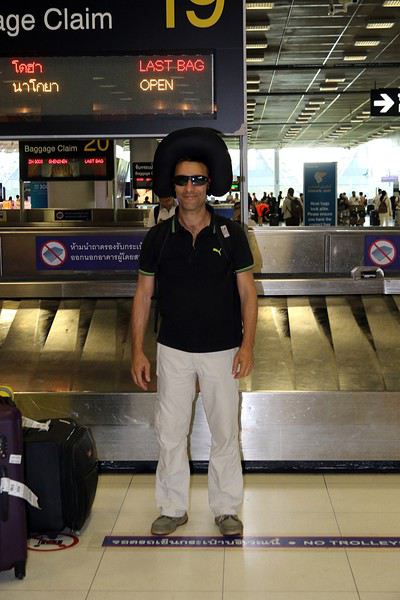
all while hoping we won’t start our stay completely...
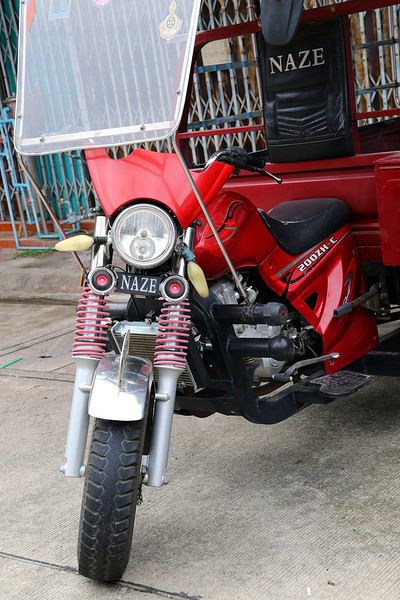
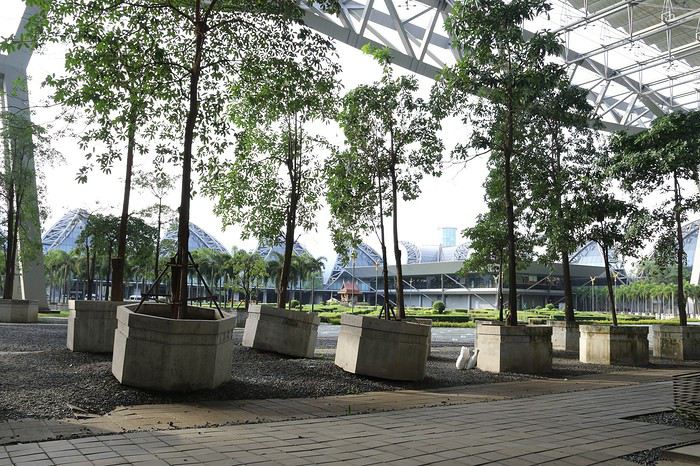
Still, we’re lucid enough to notice that they could’ve at least leveled the ground before adding the decor at the airport:
As always, our arrival is under the watchful eye of some...
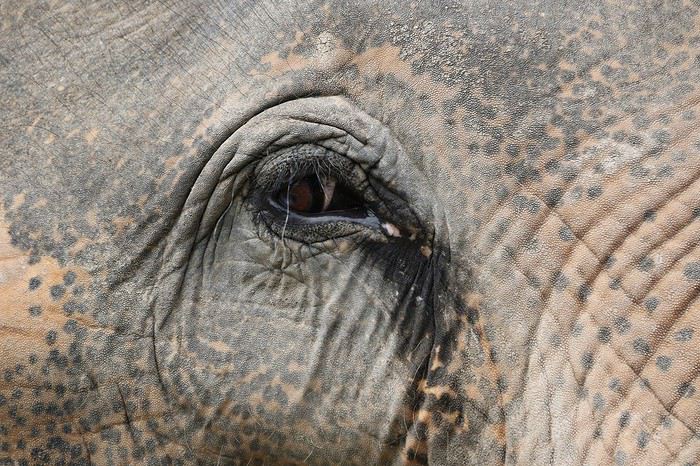
under the frankly curious gaze of others...
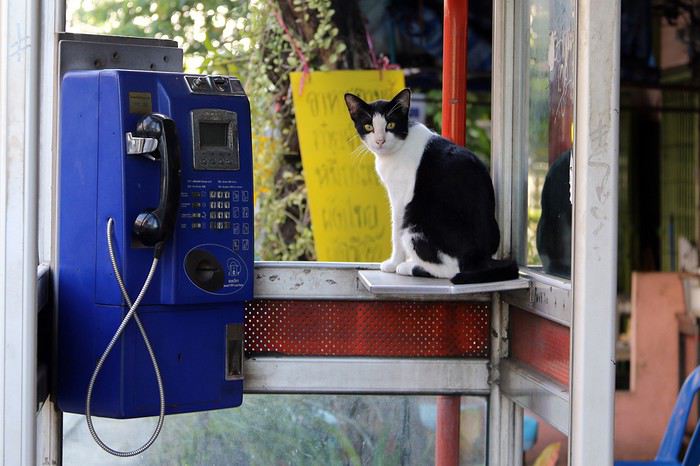
but of course, there are plenty who couldn’t care less...
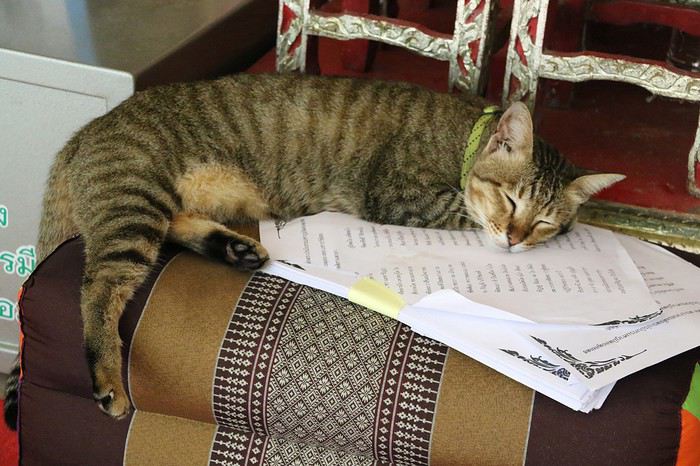
All that’s left is to set off exploring, while staying cautious so we don’t get caught off guard...
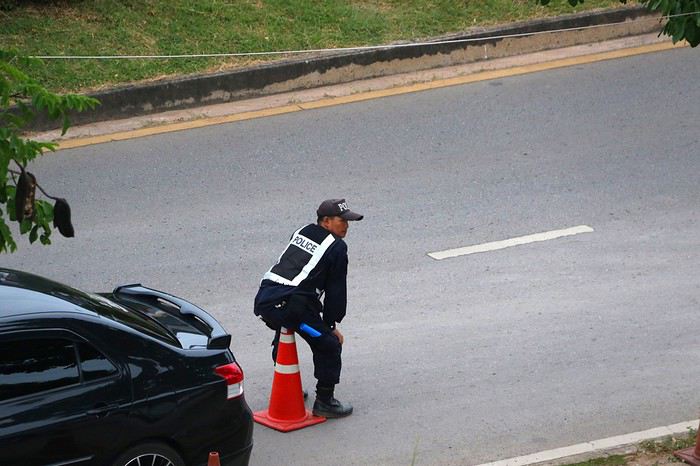
We know all too well that this long flight will leave us a bit jet-lagged when we arrive...
all while hoping we won’t start our stay completely...
Still, we’re lucid enough to notice that they could’ve at least leveled the ground before adding the decor at the airport:
As always, our arrival is under the watchful eye of some...
under the frankly curious gaze of others...
but of course, there are plenty who couldn’t care less...
All that’s left is to set off exploring, while staying cautious so we don’t get caught off guard...
Hi,
Many of us have noticed that bugs have been making it difficult to navigate the forum lately.
I’ll let Kate and Ticapi explain the issue:
I went to your profile to check out the Thailand travel journal, and when I clicked on it, it brought me back here again. All week, I’ve been dealing with bugs like this—it’s really discouraging from continuing on VF.🙁
I had the same thing happen, and multiple times. For me, it was Montagnard’s latest journal that kept coming up no matter which discussion I clicked on.
Hopefully, a solution will be found soon.🙂
Hi everyone,
I’ve got 2 weeks of vacation to take (around Sept 15–Oct 10 max).
I’m thinking of Canada since I’ve never been, to see the beautiful fall colors, mix in some sports activities (hiking or others), and a bit of city exploration...
Traveling solo, backpacker style (youth hostels), renting a car/van or using buses... (whichever is most cost-effective and practical).
Which area would you recommend?
For arrival, I can fly into Montreal, Quebec City, or Toronto at the cheapest fares.
What itinerary (big picture) or activities would you suggest? Or maybe you’d advise against it? ))
Thanks in advance!
For arrival, I can fly into Montreal, Quebec City, or Toronto at the cheapest fares.
What itinerary (big picture) or activities would you suggest? Or maybe you’d advise against it? ))
Thanks in advance!
And nowhere else...😉
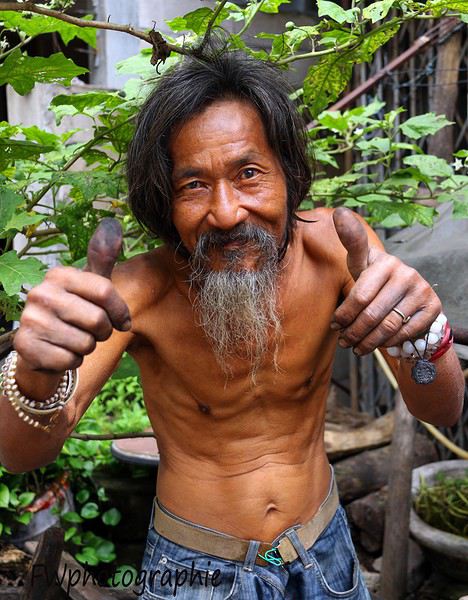
We’re excited to share our sixth travel journal with photos from Southeast Asia, this one entirely dedicated to Thailand. As a reminder, our previous travel journals can be accessed directly by clicking on the username "jojoone1" to the left of each post.
For a change, let’s start with the conclusion: our trip left us with an excellent memory. Very often, everything went like clockwork—short wait times, quick problem-solving, and the curious feeling of being pampered. Sometimes, life isn’t so cruel after all.
It’s only fair to admit that day after day, we encountered Thais who were smiling, helpful, kind, funny, and sometimes even touching. There were a few exceptions, but they were just the trees hiding the (tropical) forest. After this year’s experience, we won’t be the ones to tell you that Thailand isn’t the Land of Smiles or that laughter is just for business. We’ve witnessed so many kind behaviors and gestures that we no longer understand how anyone could complain about the people here—except for bad experiences in ultra-touristy spots packed with travelers lacking any finesse. It got to the point where it made us reflect. And we concluded that we probably have funny, friendly faces (?). We also know we’re the first to smile at them, and every day there, we show respect to everyone we meet. In any case, we have fond thoughts for many of the people we crossed paths with. Thanks to them, our trip took on a whole new human dimension.
A quick note about the photos: last year, the VoyageForum team made a change to how photos are uploaded. This gives us the choice between displaying high-definition photos (but losing ownership rights) or non-HD photos (less sharp, but the originals won’t be spread online without compensation or credit). We opted for the second solution, if only as a matter of principle. It does leave us with some regrets, especially since Françoise switched to the Canon EOS 7D Mark II, whose performance is notably better than the 7D.
Our first trip with Emirates was satisfying but left a mixed impression. Sure, it was the first time all four of our flights were on an Airbus A380. The crews were super friendly, and the meal trays were the best on the first two flights. On the return flights, the meals weren’t great and weren’t filling enough. Overall, the crews seemed disorganized and rushed—clearly some new recruits. The Doha-Paris flight, if memory serves, was on an A380-600, and in that configuration, we were packed in like it hadn’t been in years. In conclusion, it’s hard to say at this stage whether Qatar or Emirates comes out on top.
From our perspective, the journey from northern Thailand to Bangkok can be done via two different routes. This year, we took one of them, which allowed us to alternate between well-known destinations and original visits. Note that some of this year’s visits include cities we’ve already been to. So for a more complete view (Bangkok and Chiang Mai, for example), you’ll need to check out our previous travel journals.
We’ve improved our Thai vocabulary with a few more words and hope next year to move from kindergarten to first grade... For those reading us for the first time, we can only advise against visiting this country on an organized tour or looking for a French-speaking guide. The Thais have organized themselves well—they now have proven tourism practices. Maybe a guidebook for culture, a few basic English words, and a little organization are all you need for a great trip.
CHIANG MAI
Chiang Mai and its region are packed with treasures—so much so that one or two visits might not be enough.
At the airport, you go to a counter that provides a taxi ticket. The fare is 150 baht for a regular car and 200 baht for a larger vehicle. When our turn came, a large vehicle showed up, but we were only charged 150 baht. Okay, fine.
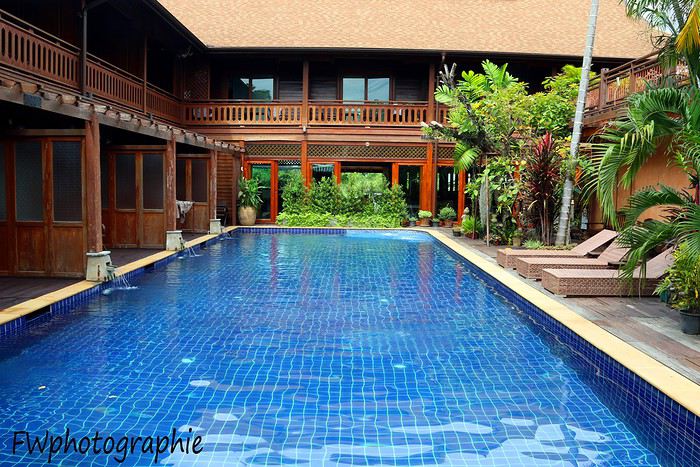
The hotels we’d selected three years ago had significantly increased their rates, so we had to find a new base. In the city center, hotels with large pools are overpriced, and despite the wide selection, it was hard to decide. We ended up at a hotel near the airport, the Baan U Sabai Boutique House. The superior room with a balcony can be negotiated for just under 40 €. It’s a beautiful, fairly new complex in traditional teak style, with very well-kept rooms and a long pool. Given the rather stormy weather in early July, it was the first time in Thailand we swam in cool water. It encouraged us to swim rather than just lounge...
At the end of the hotel street, you come out onto a busy main road where you can hail a songthaew (a kind of shared taxi). It’s easy to be offered a ride to the city center for 2 x 20 baht, but getting a return trip for less than 2 x 40 baht is tough, especially in the evening. Our red songthaew took us straight to Chiang Mai Gate, one of the city’s gates, located southeast of the historic square. We then took Phra Pok Khlao Road for a few dozen meters and chose the first little restaurant that looked nice. Within minutes, we had our dishes and smoothies for a total of 235 baht. Great quality, despite the place looking very touristy. The owner set the tone by handing out smiles left and right.
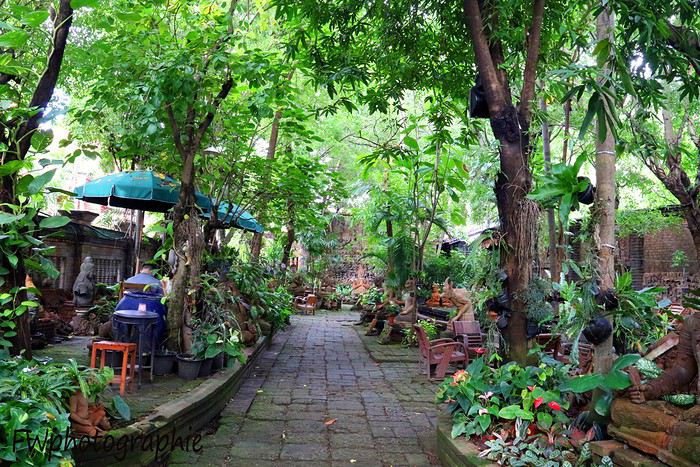
There’s an amazing spot in Chiang Mai to grab a coffee: Baan Phor Liang Meun. Once you reach Chiang Mai Gate, take Phra Pok Khlao Road for a few meters, then turn onto soi 2 (alley 2). It’s actually the first on the left. After a few dozen meters, you’ll find yourself walking alongside what looks like a Khmer temple.
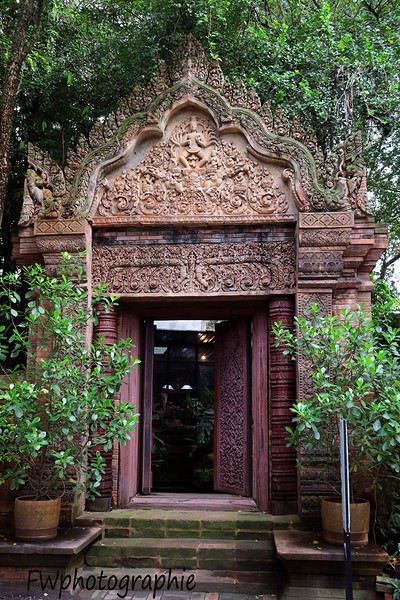
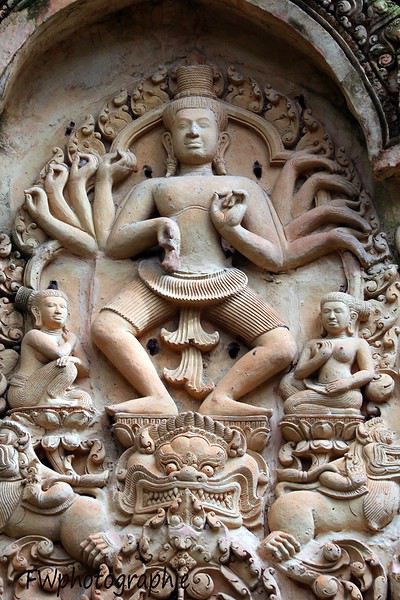
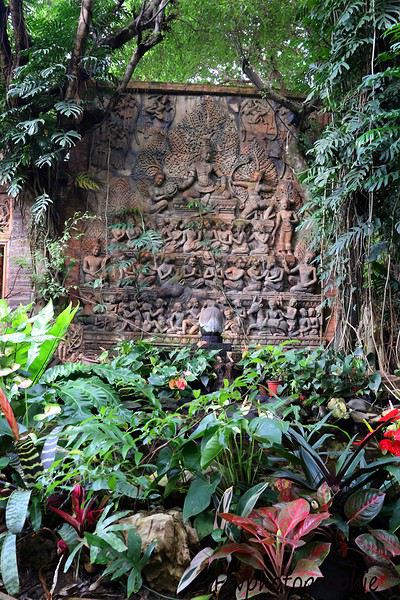
When you enter, you’re in a vast space—like a temple-garden—where you can eat a small dish or sip a good café crème as if you were in Angkor. The tables are far apart, so you’re as close to birds and squirrels as you are to other customers.
In the small building where the staff works, they provide high-quality mosquito repellent for free—something we’ll now buy regularly at 7/11. They’re small plastic bottles, mostly pink or orange, with Thai writing and "floral fragrance" in English. The scent is actually pleasant. Remember to shake the bottle before opening and pressing, or you’ll end up with cream all over your shorts...
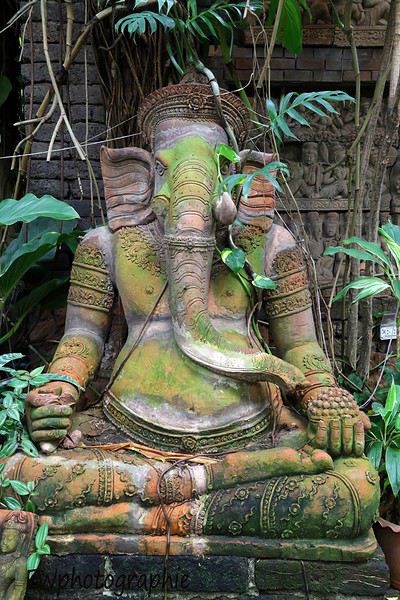
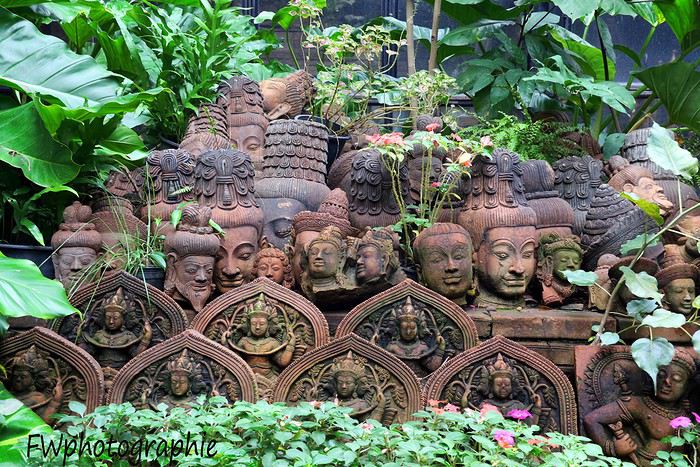
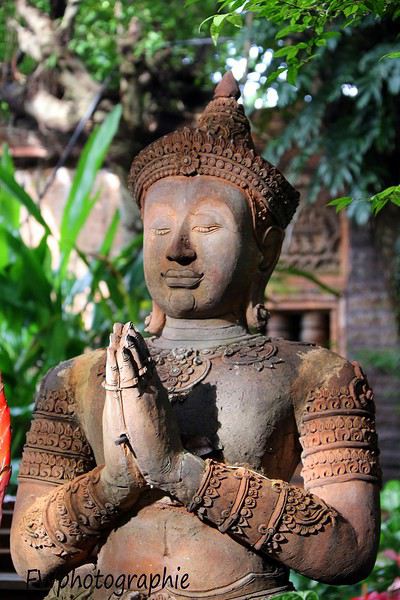
The creator of this space has been sculpting terracotta works since the early 1980s using clay from the Lamphun region—the most consistent clay found in all of Thailand. This café is like visiting an ancient temple, with its abundance of statues, high-reliefs, and bas-reliefs. It’s undeniably a romantic spot for couples—a haven of calm in a very lively city.
Here’s our third travel journal with photos, following Vietnam in 2012 and Southern Thailand + Angkor in 2013.
Once again, we’d like to thank everyone who brightens up this site with their experiences and tips. Every year, some parts of our itinerary are made easier or richer thanks to your contributions.
We hope our own story will do the same for other travelers.
**10 JULY 2014**
We booked our flight tickets back in September to get a better deal than last year. We were happy with the 1291 € price for two people from Paris—until mid-January, when several airlines started offering promotions we hadn’t expected for our travel dates. Next year, we’ll take the gamble and wait longer, hoping to fly with Qatar Airways, for example. Fate had us flying with Indian Airlines. The Paris-to-Delhi leg was on a brand-new Boeing Dreamliner—obviously fresh off the assembly line. After a quick four-hour layover to stretch our legs, we boarded an Airbus A321 that looked prehistoric for the Delhi-to-Bangkok flight. Honestly, if the outside of the plane had matched the inside, we’d never have made it. Broken screens, shattered armrests—you name it. As for the meal trays, we would’ve devoured them only after a week stranded on a desert island. The cabin crew didn’t win us over either. And we really didn’t appreciate the behavior, attitudes, or stares from most of the people we encountered during our layovers in Delhi. This year’s experience has definitely put us off flying with this airline again—or even setting foot in India ever again. That’s just our personal take, but it’s clear.
Stepping onto Thai soil was an immense relief. After exchanging just a few euros, we took a taxi from the designated spot and had a completely different experience from last year: the driver was normal and efficient. So efficient, in fact, that we arrived at our destination much earlier than expected. A well-deserved tip, and it seemed to make his day.
We dropped our bags at reception and rushed to Harmonique restaurant, just 300 meters away, just in time for the last dinner service. We’d talked about this place at length last year. We’d been looking forward to it for a year, but we only managed to nibble on some spring rolls because what we really wanted was a good night’s sleep. While quite a few customers were still around, four staff members walked through the dining area with two large trash bins from the day’s service. They were clearly pleased with themselves and having a good laugh. It made us chuckle too—seeing something like that done so naturally, when back home, some people would’ve been outraged to witness it in a similar establishment!
A quick word about the Swan Hotel: we’re grateful to those who recommended it on this site and on their blogs. It’s quietly located in the Silom district, just steps from the river. We have fond memories of the giant, ultra-comfortable bed and the well-maintained pool. It was very peaceful, though we were there during a quieter season. At 30 € with breakfast when we booked (and around 20 € without breakfast now), we can’t imagine finding a better-suited hotel in Bangkok.
**11 JULY**
We couldn’t find an open bank and had to withdraw cash from an ATM. Now we know: July 11 is a public holiday in Thailand. It suddenly occurred to us that next year, we’ll keep some baht from our return trip to save time at the airport and avoid little hiccups like this.
We decided not to head straight to Laos and instead spent the day visiting Muang Boran, also known as Ancient City, about 30 km southeast of Bangkok.
There are plenty of ways to get there. We ruled out taxis—too expensive. Besides, we enjoy using local transport; it’s more fun. We took a taxi to Democracy Monument, then found the bus stop about 100 meters from the roundabout, on one of the avenues leading to it. Someone always points you in the right direction. We hopped on bus 511 for a long ride, with two major slowdowns at red lights. The same happened on the way back, as our route crossed busier roads. We told the driver our destination, and he let us know when to get off. No problem—someone already flagged us down 20 meters later to put us in a *songthaew* (a shared taxi-van) that took us straight to the site. The bus and *songthaew* fares were minimal. Already, the people around us were smiling, and we were smiling back.
The entrance fee has gone up: 700 baht. That includes bike rental, a tour minibus, and a boat ride on the river. We still hadn’t fully recovered from the flight, and with the heavy, humid heat, we opted for the electric cart instead—no regrets. Still, 150 baht per hour.
We had an amazing day, beyond our expectations. The park features full-scale or scaled-down replicas of Thailand’s main landmarks, along with countless statues and landscaped gardens. There are also reconstructions of a typical Thai village, a northern Thai village, a farm with animals, and a floating village.
Almost everything we saw was well-made and aesthetically pleasing. The whole place is absolutely worth the trip. We spent six solid hours there without dawdling.
Here’s a very incomplete sample of what we admired:


Visitors will find restrooms, restaurants, and a few shops scattered throughout the site. On the way back, just cross the road using the pedestrian bridge about 250 meters to the left of the exit. Flag down a *songthaew* as it passes.
The whole day flew by between the visit and the commute. We still had time to return to Harmonique to try their famous crab curry. Once you’ve finished it, you think—life isn’t so bad after all.
**10 JULY 2014**
We booked our flight tickets back in September to get a better deal than last year. We were happy with the 1291 € price for two people from Paris—until mid-January, when several airlines started offering promotions we hadn’t expected for our travel dates. Next year, we’ll take the gamble and wait longer, hoping to fly with Qatar Airways, for example. Fate had us flying with Indian Airlines. The Paris-to-Delhi leg was on a brand-new Boeing Dreamliner—obviously fresh off the assembly line. After a quick four-hour layover to stretch our legs, we boarded an Airbus A321 that looked prehistoric for the Delhi-to-Bangkok flight. Honestly, if the outside of the plane had matched the inside, we’d never have made it. Broken screens, shattered armrests—you name it. As for the meal trays, we would’ve devoured them only after a week stranded on a desert island. The cabin crew didn’t win us over either. And we really didn’t appreciate the behavior, attitudes, or stares from most of the people we encountered during our layovers in Delhi. This year’s experience has definitely put us off flying with this airline again—or even setting foot in India ever again. That’s just our personal take, but it’s clear.
Stepping onto Thai soil was an immense relief. After exchanging just a few euros, we took a taxi from the designated spot and had a completely different experience from last year: the driver was normal and efficient. So efficient, in fact, that we arrived at our destination much earlier than expected. A well-deserved tip, and it seemed to make his day.
We dropped our bags at reception and rushed to Harmonique restaurant, just 300 meters away, just in time for the last dinner service. We’d talked about this place at length last year. We’d been looking forward to it for a year, but we only managed to nibble on some spring rolls because what we really wanted was a good night’s sleep. While quite a few customers were still around, four staff members walked through the dining area with two large trash bins from the day’s service. They were clearly pleased with themselves and having a good laugh. It made us chuckle too—seeing something like that done so naturally, when back home, some people would’ve been outraged to witness it in a similar establishment!
A quick word about the Swan Hotel: we’re grateful to those who recommended it on this site and on their blogs. It’s quietly located in the Silom district, just steps from the river. We have fond memories of the giant, ultra-comfortable bed and the well-maintained pool. It was very peaceful, though we were there during a quieter season. At 30 € with breakfast when we booked (and around 20 € without breakfast now), we can’t imagine finding a better-suited hotel in Bangkok.
**11 JULY**
We couldn’t find an open bank and had to withdraw cash from an ATM. Now we know: July 11 is a public holiday in Thailand. It suddenly occurred to us that next year, we’ll keep some baht from our return trip to save time at the airport and avoid little hiccups like this.
We decided not to head straight to Laos and instead spent the day visiting Muang Boran, also known as Ancient City, about 30 km southeast of Bangkok.
There are plenty of ways to get there. We ruled out taxis—too expensive. Besides, we enjoy using local transport; it’s more fun. We took a taxi to Democracy Monument, then found the bus stop about 100 meters from the roundabout, on one of the avenues leading to it. Someone always points you in the right direction. We hopped on bus 511 for a long ride, with two major slowdowns at red lights. The same happened on the way back, as our route crossed busier roads. We told the driver our destination, and he let us know when to get off. No problem—someone already flagged us down 20 meters later to put us in a *songthaew* (a shared taxi-van) that took us straight to the site. The bus and *songthaew* fares were minimal. Already, the people around us were smiling, and we were smiling back.
The entrance fee has gone up: 700 baht. That includes bike rental, a tour minibus, and a boat ride on the river. We still hadn’t fully recovered from the flight, and with the heavy, humid heat, we opted for the electric cart instead—no regrets. Still, 150 baht per hour.
We had an amazing day, beyond our expectations. The park features full-scale or scaled-down replicas of Thailand’s main landmarks, along with countless statues and landscaped gardens. There are also reconstructions of a typical Thai village, a northern Thai village, a farm with animals, and a floating village.
Almost everything we saw was well-made and aesthetically pleasing. The whole place is absolutely worth the trip. We spent six solid hours there without dawdling.
Here’s a very incomplete sample of what we admired:
Visitors will find restrooms, restaurants, and a few shops scattered throughout the site. On the way back, just cross the road using the pedestrian bridge about 250 meters to the left of the exit. Flag down a *songthaew* as it passes.
The whole day flew by between the visit and the commute. We still had time to return to Harmonique to try their famous crab curry. Once you’ve finished it, you think—life isn’t so bad after all.
As soon as I return to France, I catch myself thinking, "it’s better elsewhere."
Wherever we’ve been, I feel this lightness of living—less restriction, less pressure, less sadness—and I start dreaming of somewhere else, of living somewhere else, a simpler life, more authentic, with colors everywhere: markets, clothes, homes...!!! Meeting kindred spirits, genuine people, gentle and kind, and letting go of all this modernism, this technological rat race, the indifference toward others, the confinement, the racism against the elderly in France, against the poor, the weak, the beautiful... fleeing the news, politics, jealousy, meanness, stupidity, greed... And in my moments of clarity, I tell myself that every country, every city has its pros and cons, and that maybe the best of all worlds isn’t down here. But I also remind myself that you have to know how to COME BACK in order to LEAVE again... yet still...!!! IS IT REALLY BETTER ELSEWHERE?😏😏😏
Good evening to all you photographers and photo enthusiasts on VF,
This is the place to exchange, debate, chat, philosophize, nitpick, ramble, bicker, and congratulate each other on this month’s theme: "The Street as a Livelihood."
Just a reminder that the photos expected in the contest thread should depict street scenes showing people using the street as a place to earn a living—whether it’s legal work, informal jobs, illegal activities, or begging. In the discussion thread, feel free to be much more open-ended.
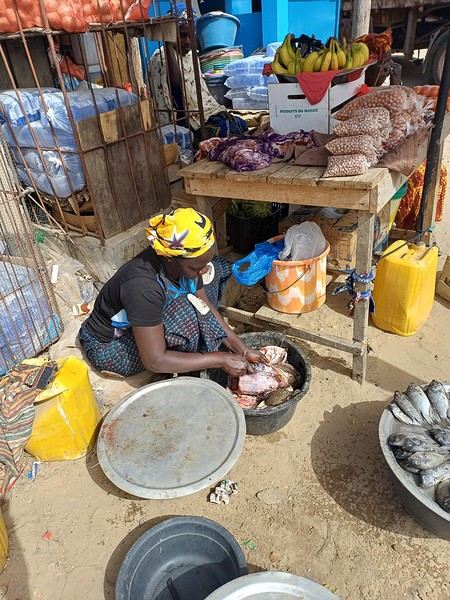
This is the place to exchange, debate, chat, philosophize, nitpick, ramble, bicker, and congratulate each other on this month’s theme: "The Street as a Livelihood."
Just a reminder that the photos expected in the contest thread should depict street scenes showing people using the street as a place to earn a living—whether it’s legal work, informal jobs, illegal activities, or begging. In the discussion thread, feel free to be much more open-ended.
Hello,
A few months ago, I posted a message in the Southern Africa section about a family trip in July/August. In the end, since I had too much trouble deciding on the destination and procrastinated too much with the planning 😎, I changed my mind and we’re going for a completely different trip—to Madagascar, a country we already know a bit since we’ve traveled there several times for 4 to 6 months each time, though our last visit was back in 2012!
The tickets are booked: 19 days on the ground (excluding arrival and departure days in Tana), spanning July and August.
We’re not looking to rack up landscapes (and kilometers). The kids really want to see lots of animals, while we mostly want to show them what daily life is like in Malagasy villages. So ideally, we’d like a trip split into two parts: - For 8/10 days, a hiking portion. The idea isn’t to do a tough trek in very remote areas but rather to walk from one village to another. Let’s say 3-4 hours a day. And when we arrive in each village, we’d have time to explore a bit, chat with the locals, let our kids play with the village children, etc. Stay with locals when possible. Move to a new village every day or every 2-3 days. - A few days visiting 1 or 2 national parks (with lemurs if possible to keep everyone happy!) - With the inevitable travel days, we’ll quickly hit 19 days.
Does this kind of trip sound doable (and fun) to you? Do you know of any villages that would fit our hiking plans?
I don’t have a preferred region yet, except that very dry landscapes appeal to me less. My real love from past trips was the highlands and their bright green rice paddies against red earth, but I’m a bit worried about the cold at this time of year.
After my initial research (thanks to this forum), I get the impression that the Ambalavao/Ambohimahamasina area might meet our criteria. I saw there are "accueil paysan" (farm stays) in that area, which could match what we’re looking for and would let us visit Andringitra National Park and Ranomafana on the way there or back.
But I’m open to all your more original ideas!
For logistical questions (transport, guides, accommodations, etc.), I’ll tackle those later—it’ll depend on the area we choose.
Thanks in advance for your suggestions
Hello,
We (a couple aged 60 and 66) are arriving in Montreal on 09/21 to meet up with our son (on a working holiday). Our original plan was to spend the first 3 nights near Parc de la Mauricie, then 3 nights in Quebec City, and the following 3 near Parc des Hautes-Gorges-de-la-Malbaie. The 2 days we’d planned in each park were supposed to be for hiking (including the Acropole des Draveurs) and canoeing if possible.
The issue is that I’ve recently developed frozen shoulder (capsulitis😕), and I likely won’t have recovered by the time we leave. So, we’re scrapping hikes with significant elevation gain, trekking poles, or any risk of falling.
My question is: which hikes of 10–15 km max on easy terrain with beautiful views would you recommend? (We’ll be there in late September, hoping to catch the fall colors already!). For this type of hike, would it be better to swap Parc de la Mauricie for Réserve faunique des Laurentides, Parc de la Jacques-Cartier, or is Mauricie still okay? And should we replace Parc des Hautes-Gorges-de-la-Malbaie with Parc des Grands-Jardins?
Are there spots easier than others for canoeing (I could get in the canoe with my son, but he’d be the only one paddling—I’m light, and he’s strong, but I don’t want to overdo it 😉). Or maybe pedal boats, if that’s still an option this season?
Thanks for your advice after these unexpected changes of plans.
Claire
Hello,
We’re a group of four seventy-something retirees and we’re planning a 4-week trip to South Africa. We’re seasoned "adventurers" used to multi-week stays (we’ve been to India seven times, Mexico, Thailand, Laos, Myanmar, Australia, etc.).
For South Africa, we’re thinking of covering most of the trip in a private vehicle and taking flights for inter-state transfers. We’re interested in meeting people, learning about the country’s evolution, exploring major cities, visiting traditional villages, and seeing wildlife.
Here’s the itinerary we’re considering: Johannesburg – 2 days (we’ll pass through again later) Pretoria – 2 days Blyde River Canyon and Graskop – 1 day Acornhoek – 1 day Letaba – 2 days Lobamba – 2 days Johannesburg – 1 day
Flight to Cape Town
Cape Town – 3 days Cape of Good Hope – 1 day Stellenbosch – 1 day Hermanus – 1 day Mossel Bay – 2 days Oudtshoorn Wilderness – 2 days Knysna Port Elizabeth – 2 days Addo Elephant Park
Flight back to Johannesburg
Johannesburg – 1 day
Return to Paris
Could you share your thoughts on this itinerary? We’ll be renting a vehicle to explore both regions. We can easily add 4–5 more days to the trip if needed.
We’re looking at traveling either between April and May 2026 or in October/November 2026.
I’ll follow up later to discuss the best safari options and get a rough budget estimate.
Thanks to everyone who takes the time to read this and share their thoughts!
The end of a golden age
For years, travel forums embodied the spirit of mutual aid on the web. Travelers generously shared their experiences, tips, and secret spots. This collective generosity seemed endless. But behind this altruistic facade lay a more complex reality.
The silent infiltration of forums Free travel forums have gradually become marketing hunting grounds. Under the guise of "experienced travelers," professionals in tourism, affiliates seeking commissions, or aspiring influencers testing monetization strategies now lurk.
These fake profiles master the community’s codes. They build credibility by answering dozens of basic questions before subtly slipping in their paid recommendations. A "favorite" hotel mentioned insistently, an "essential" guidebook systematically cited, an "extraordinary" local agency that keeps coming up in conversations.
New travelers can no longer tell the difference between selfless advice and disguised promotion. This informational pollution has gradually eroded the trust that gave these platforms their value.
The rise of paid Travel Planners Faced with this decline, a new profession has emerged: the independent Travel Planner. These professionals fully embrace their commercial status and charge for personalized advice.
The model is transparent: you pay for real expertise, tailor-made itineraries, and guaranteed availability. Some offer packages for 150-300 € to plan a two-week trip entirely. Others charge by the hour.
This professionalization marks a turning point. Travel advice is leaving the realm of volunteerism and entering the world of paid services. Paradoxically, this acknowledged monetization can restore a form of trust: you know what you’re paying for.
The irruption of artificial intelligence But now, a third option is emerging: generative AI. ChatGPT, Claude, Gemini, and others can now generate travel itineraries in seconds, for free, with no commercial agenda.
AI promises neutral, synthetic, endlessly customizable information. It compiles thousands of sources in real time, suggests alternatives, and adapts recommendations to your budget and time constraints. It doesn’t sell anything, earns no commissions, and has no hotels to promote.
But this apparent neutrality hides its own limitations. AI feeds on existing data, often from the same polluted forums or marketing content. It can invent restaurants that don’t exist, mix up tourist seasons, or ignore recent local realities. It has never walked a city’s streets, negotiated with a tuk-tuk driver, or felt the atmosphere of a neighborhood at nightfall.
The forgotten alternative: authentic local experts In this landscape saturated with dubious information, imperfect AI, and monetized services, one often-overlooked option remains: consulting real local professionals.
Not the agencies at the top of Google’s first page—often the most expensive and generic. But small local businesses, independent guides established for years, still-free municipal tourism offices, and cultural associations organizing themed tours.
These players offer what neither AI nor forums can: embodied, up-to-date, contextualized knowledge of the area. They know the newly opened restaurant, the museum temporarily closed for renovations, the impromptu weekend festival, or the alternative route to avoid construction.
Finding them takes extra effort. You have to search in the local language, look beyond the first page of results, check regional institutional websites, and join community Facebook groups. But this approach is often rewarded with free or low-cost advice of unmatched precision.
Toward an ecology of travel advice The future of travel advice likely won’t be binary but hybrid. AI can rough out itineraries, propose logistical options, and compare alternatives. Travel Planners can refine, personalize, and reassure anxious travelers. Local experts can enrich, correct, and ground advice in on-the-ground reality.
But for this ecosystem to work, we’ll need to develop new discernment. Learn to spot fake profiles on forums. Systematically verify AI suggestions. Assess the real value of a Travel Planner before paying. And, above all, rediscover the habit of contacting those who live there directly.
Travel has always been a school of discernment. It teaches us to distinguish the authentic from the fake, sincere advice from commercial manipulation. In the digital age, this skill becomes more crucial than ever.
Because ultimately, the real question isn’t which information source to prioritize, but how to cultivate our own ability to evaluate, cross-check, and ultimately make informed choices. The best travel guide may still be our critical thinking.
Photo credit: Arakis Travel
Hi everyone,
I’m a die-hard fan of India, but it’s time I discovered Thailand too to broaden my Asian horizons.
I’m heading there on January 19, 2025, for a 46-day trip (no visa needed as I’m French). I’ve pored over a few guidebooks and travel blogs. Based on what caught my interest, I’ve put together a rough itinerary and list of sights. But since I know absolutely nothing about Thailand, I’m kind of flying blind here.
Since I’m not exactly a spring chicken anymore, I’ve opted for a few bases where I’ll stay several days in the same place. That way, I won’t have to change locations and hotels every day or so, packing and unpacking my suitcase constantly. Instead, I plan to explore the surrounding area each day, within a maximum radius of 50 to 70 km.
So, first question: Is that kind of round-trip distance manageable in a day in Thailand?
In India, renting a car for a day—with a driver—currently costs around 35 to 40 € per day. Knowing that 1,300 to 1,500 THB would be my absolute max, and even then, only if I don’t rent a car every single day.
Which brings me to my second question: Am I being unrealistic?
Otherwise—third question—once I’m settled in the city I’ve chosen as my base, can I get around within that 50–70 km radius using public transport?
I’ve already booked all my hotels—with free cancellation—on booking.com at an average price of 950/1,000 THB per night. Does that put me in a good range for value for money? Or am I dreaming?
Here’s my plan:
BANGKOK (13 days, 14 nights): 1 week for exploring Bangkok – Kanchanaburi/Erawan National Park? – Ayutthaya/Lopburi? – Muang Boran – Samut – Songkram/Amphawa
Bangkok -> Chiang Mai by overnight train in first-class sleeper
CHIANG MAI (6 days/6 nights): Mae Hong Son – Hot springs – Chiang Dao – caves – Lamphun – other places to be decided on the spot based on what’s worth seeing and transport options
Chiang Mai -> Chiang Rai
CHIANG RAI (7 days/8 nights): Fang – Tha Ton – Chiang Saen – Doi Tung – Chiang Khong – Doi Ang Khang, Phu Chi Fah, etc.
Chiang Rai -> Phrae
PHRAE (4 days/5 nights): Lampang and surrounding areas, depending on what’s interesting to see
Phrae -> Loei
LOEI (4 days/5 nights): Phu Kradung – Chiang Khan and surrounding areas, depending on what’s worth seeing
Loei -> Buriram
PHIMAI (Nakhon Ratchasima/Khorat) (5 days/6 nights): Phimai – Prasat Muang Tam – Phanom Rung – Prasat Phanom Wan
Phimai -> Khorat (airport or train station) -> Bangkok (overnight in Bangkok)
Day 46: BANGKOK -> KOCHI
Thanks in advance for your thoughts and advice!
hi there,
I’m heading to the Dominican Republic (Punta Cana) at the end of October for 10 days at an all-inclusive hotel with my wife and kids (ages 8 and 10). Since I’m not a fan of spending entire days at the hotel, I was wondering what the best way(s) to explore the area might be.
Last year, I went to Mexico and rented a car, so I initially thought about doing the same here—but this time, I’d get full-coverage insurance, which I didn’t do in Mexico. After checking a few forums and reviews, though, I’m really second-guessing it because some posts make it sound completely crazy to drive there.
So, I’d love to hear from anyone who’s been there recently and rented a car, as well as the different ways to get around while you’re there.
Thanks everyone! !