Travel Journal: Northern Laos, Chiang Mai, Bangkok
FR

Translated into English.

Original post
JO
Here’s our third travel journal with photos, following Vietnam in 2012 and Southern Thailand + Angkor in 2013. Once again, we’d like to thank everyone who brightens up this site with their experiences and tips. Every year, some parts of our itinerary are made easier or richer thanks to your contributions. We hope our own story will do the same for other travelers.

**10 JULY 2014**

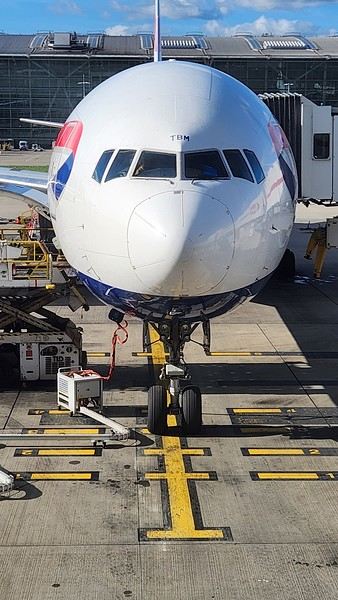
We booked our flight tickets back in September to get a better deal than last year. We were happy with the 1291 € price for two people from Paris—until mid-January, when several airlines started offering promotions we hadn’t expected for our travel dates. Next year, we’ll take the gamble and wait longer, hoping to fly with Qatar Airways, for example. Fate had us flying with Indian Airlines. The Paris-to-Delhi leg was on a brand-new Boeing Dreamliner—obviously fresh off the assembly line. After a quick four-hour layover to stretch our legs, we boarded an Airbus A321 that looked prehistoric for the Delhi-to-Bangkok flight. Honestly, if the outside of the plane had matched the inside, we’d never have made it. Broken screens, shattered armrests—you name it. As for the meal trays, we would’ve devoured them only after a week stranded on a desert island. The cabin crew didn’t win us over either. And we really didn’t appreciate the behavior, attitudes, or stares from most of the people we encountered during our layovers in Delhi. This year’s experience has definitely put us off flying with this airline again—or even setting foot in India ever again. That’s just our personal take, but it’s clear.

Stepping onto Thai soil was an immense relief. After exchanging just a few euros, we took a taxi from the designated spot and had a completely different experience from last year: the driver was normal and efficient. So efficient, in fact, that we arrived at our destination much earlier than expected. A well-deserved tip, and it seemed to make his day.

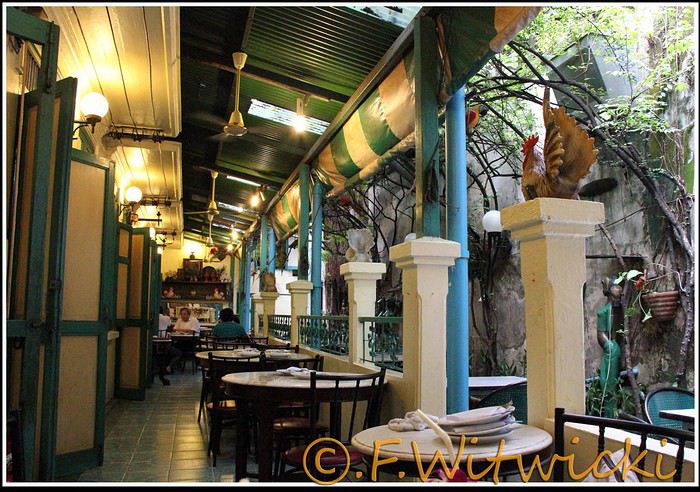
We dropped our bags at reception and rushed to Harmonique restaurant, just 300 meters away, just in time for the last dinner service. We’d talked about this place at length last year. We’d been looking forward to it for a year, but we only managed to nibble on some spring rolls because what we really wanted was a good night’s sleep. While quite a few customers were still around, four staff members walked through the dining area with two large trash bins from the day’s service. They were clearly pleased with themselves and having a good laugh. It made us chuckle too—seeing something like that done so naturally, when back home, some people would’ve been outraged to witness it in a similar establishment!

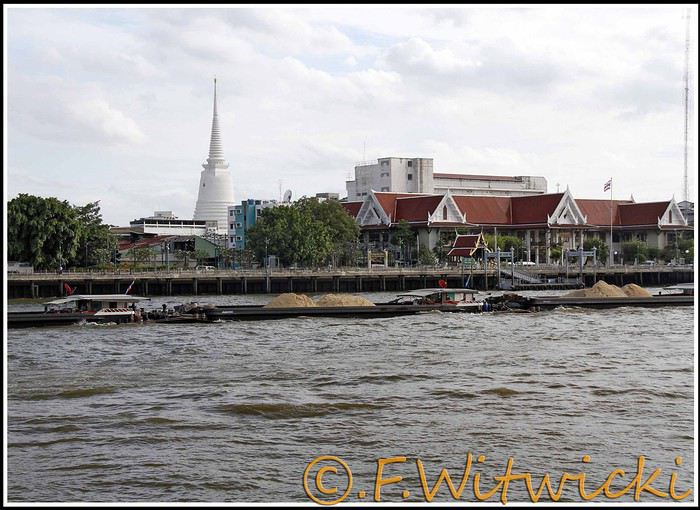
A quick word about the Swan Hotel: we’re grateful to those who recommended it on this site and on their blogs. It’s quietly located in the Silom district, just steps from the river. We have fond memories of the giant, ultra-comfortable bed and the well-maintained pool. It was very peaceful, though we were there during a quieter season. At 30 € with breakfast when we booked (and around 20 € without breakfast now), we can’t imagine finding a better-suited hotel in Bangkok.

**11 JULY**

We couldn’t find an open bank and had to withdraw cash from an ATM. Now we know: July 11 is a public holiday in Thailand. It suddenly occurred to us that next year, we’ll keep some baht from our return trip to save time at the airport and avoid little hiccups like this.

We decided not to head straight to Laos and instead spent the day visiting Muang Boran, also known as Ancient City, about 30 km southeast of Bangkok.

There are plenty of ways to get there. We ruled out taxis—too expensive. Besides, we enjoy using local transport; it’s more fun. We took a taxi to Democracy Monument, then found the bus stop about 100 meters from the roundabout, on one of the avenues leading to it. Someone always points you in the right direction. We hopped on bus 511 for a long ride, with two major slowdowns at red lights. The same happened on the way back, as our route crossed busier roads. We told the driver our destination, and he let us know when to get off. No problem—someone already flagged us down 20 meters later to put us in a *songthaew* (a shared taxi-van) that took us straight to the site. The bus and *songthaew* fares were minimal. Already, the people around us were smiling, and we were smiling back.

The entrance fee has gone up: 700 baht. That includes bike rental, a tour minibus, and a boat ride on the river. We still hadn’t fully recovered from the flight, and with the heavy, humid heat, we opted for the electric cart instead—no regrets. Still, 150 baht per hour.

We had an amazing day, beyond our expectations. The park features full-scale or scaled-down replicas of Thailand’s main landmarks, along with countless statues and landscaped gardens. There are also reconstructions of a typical Thai village, a northern Thai village, a farm with animals, and a floating village.

Almost everything we saw was well-made and aesthetically pleasing. The whole place is absolutely worth the trip. We spent six solid hours there without dawdling.

Here’s a very incomplete sample of what we admired:


Visitors will find restrooms, restaurants, and a few shops scattered throughout the site. On the way back, just cross the road using the pedestrian bridge about 250 meters to the left of the exit. Flag down a *songthaew* as it passes.

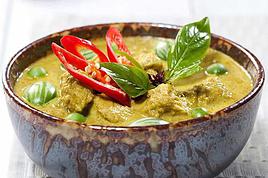
The whole day flew by between the visit and the commute. We still had time to return to Harmonique to try their famous crab curry. Once you’ve finished it, you think—life isn’t so bad after all.
« Tout le monde s'interroge sur comment laisser une meilleure planète à nos enfants, mais on devrait plutôt penser à laisser de meilleurs enfants pour notre planète. » Clint Eastwood
JO Jojoone1 Globetrotter ·
JULY 12

So we decided to take the tourist highway through northern Laos. The choice of words is a little nod to those obsessed with untouched or isolated spaces, the ones who are fixated on "I’m a tourist but I avoid other tourists like the plague," those who regularly come to the forum to prove they’re the only real adventurers moving through unknown territories. But how can you call it a tourist highway in such exotic, disorienting places, where every day unfolds far from familiar faces, food, language, and comforts? And besides, you’ve got to start by discovering these countries. What’s more, most of the most remarkable sites just happen to be on that tourist highway. What a joke!

We took a flight to Luang Prabang to save time. From above, in the minutes before landing, the region looks stunning. Still, there’s a thick layer of clouds, and we can’t help but wonder if the bad weather we’ve avoided for the past two years is about to take its revenge this time.

We can confirm that upon arrival, the immigration officer was satisfied with a 30-year-old photo. Since it’s the weekend, the visa costs $31 instead of $30. No one rushes us at the airport exit. In fact, there doesn’t seem to be any competition. The ride to the city center is $7 for two, or you can walk. So we hop in the minivan.

The Lao Blossom Hotel, which we’d booked for two nights, turned out to be our worst choice of the trip. The owner is Chinese, and sometimes you can manage to get a smile out of her. The place is aesthetically pretty, but here’s the thing: the ACs are faulty, lightbulbs are broken, the bathrooms have doors without handles that you can’t get out of without help, and most of all, the beds are as hard as life itself. Aside from the coffee, breakfast didn’t whet our appetite.

As usual, the first tuk-tuk we take isn’t great—except, of course, at tripling the fare. We need to exchange money, and the driver insists on taking us to banks, all closed on Saturday. It’s about to turn into a nightmare. In situations like this, you’ve got to ask to stop when you pass a decent hotel. The reception always has bilingual staff. Here, a very polite young man stands up: "May I help you, sir?", takes the time to step outside, and talks to our driver. Two minutes later, we’re at the post office’s exchange bureau, the one that doesn’t charge fees. With pockets full of thick wads of cash, we’re temporary millionaires.


We have the driver take us to the Mekong River and easily find the Lamache restaurant recommended by Larsay, our esteemed acquaintance who’s a regular on the Vietnam forum. It’s always a great tip: long opening hours, a wide selection of dishes, quality and quantity on the plate for a low price, good pad thai, and very smiley young staff. We’re so happy under the shade of these huge trees, watching the milky-brown Mekong, its boatmen, and life going on across the river. That special moment when another one of our dreams starts to come true...


The afternoon is well underway, and we study our map before starting, just west of the city center, with Wat That. If you don’t like temples, you might want to skip this part of the travel journal! Nothing extraordinary, but there’s always a gong being struck, monks chanting, worshippers praying, and animals wandering around. We soak up the Asian atmosphere without ever getting enough of it.


Next, a quick stop at the nearby Wat Hosiang Voravihane—same vibe.

On a roll, we head straight to Wat Mai. It’s here that we nearly had a disaster. The photographer sets up her tripod just past the half-dozen steps leading into the temple. The monks are praying.


Just as the photo is taken, a hornet goes for her. She’s focused and, caught off guard, takes two steps back. Unfortunately, a metal rod was fixed to the last step, and down she goes, camera and tripod in hand. Meanwhile, I’m inspecting the courtyard a little farther away and suddenly find myself in a pure nightmare—everything in slow motion, muffled: a thud on each step, a spray of blood, a body face-down on the ground, not moving. At first, you stupidly think about that Canon she’s so attached to, then immediately wonder if it’s death or a coma. In a country where travel is slow and medical facilities are limited, right when the vacation’s just begun, your mind goes to dark places. The next few minutes showed us the photographer had survived, and the blood was just from a small scratch on her nose. There were a few bruises all over. The medical checkup back home revealed a cracked rib on the side and a broken scapula. Oh, and aside from two small scratches, the camera is intact and working. The survival instinct of her prized possession! In the end, the trip’s itinerary was followed, though some days were lighter, and a few were a bit painful...

After a shower and a forced rest, a slow walk takes us to a convenience store selling some pharmaceutical products. In a small street, women run stalls with lots of raw or cooked food. You pick what you want and fill your plate for 10,000 kyat—less than 1 €. The alley is packed with young backpackers who don’t hold back, turning their plates into mountains...

That evening, we’re not feeling too clever. We go to bed a little bitter on our hard bed, hoping there won’t be any nasty surprises when we wake up.
« Tout le monde s'interroge sur comment laisser une meilleure planète à nos enfants, mais on devrait plutôt penser à laisser de meilleurs enfants pour notre planète. » Clint Eastwood
NO Nolack Regular ·
A broken rib—ouch, poor thing! But what a joy to find your new travel journal! Keep sharing your stories, even if it means going to bed a little late... I just got back from Asia too, and thanks to you, it feels like I’m extending the trip by a few more days. Thanks so much!
HI Hissého Regular ·
Two minutes later, we're at the post office exchange counter—the one that doesn’t charge fees. With pockets full of thick wads of cash, we’re fleeting millionaires.

What a vibe! A real joy to read.[;]
Il n'y a pas d'ennemi, seulement parfois de bonnes bouffées de haine... ( JR)
DA DanyMichel Veteran ·
Awesome, a new travel journal!!!! I'm savoring it... So lucky the fall wasn't serious (it reminds me of memories of... me taking a big plunge into a rice paddy near Ubud, Bali, holding my Canon tightly in my arms...). The Canon survived, and so did I, more or less (though I still needed an osteopath when I got back...).

By the way, Joël, in Laos, it's kips... not kyats (that's in Myanmar)... We also spent a week in Luang Prabang three years ago and really enjoyed our stay (at Paradise Hotel, with a pool, some really nice bungalows on the other side of the little river whose name I've forgotten, and close to the airport).

I can't wait to read the rest to compare it with my impressions of Laos, while I prepare for my trip next February to Myanmar and... Thailand (again)!

Thank youuuuu
Dany
JO Jojoone1 Globetrotter ·
you know, between the sawadee kip and the sabaidee kyat, it all ends up getting mixed up. But as you might guess, Dany, it was obviously just to check if you were paying attention! We’ll try to finish this travel journal before February...
« Tout le monde s'interroge sur comment laisser une meilleure planète à nos enfants, mais on devrait plutôt penser à laisser de meilleurs enfants pour notre planète. » Clint Eastwood
DA DanyMichel Veteran ·
😉 !!! Nice comeback, I stand corrected !!!
Dany
BO Bonnie53 Veteran ·
Thanks for sharing this... delicious 😉
Le monde est mon horizon...
JO Jojoone1 Globetrotter ·
JULY 13

Of course, only one of us slept well. We’re surprised to wake up at eleven o’clock. Madame has a new look—everyone’s going to think her man beats her!

We spend the day in the UNESCO-listed part of the city, bordered on one side by the Mekong and on the other by the Nam Khan River, with the tip ending at the confluence. This area is about 800 meters by 200 meters. The charm is immediate, and it’s no surprise the site is listed and so many travelers love the place. The rehabilitation was done efficiently, and we stroll through an area where pretty local and colonial houses follow one after another, sometimes separated by a temple, all set in a lush green landscape. We don’t know which alley to take—each one invites you to wander. Of course, there seem to be as many guesthouses as there are residents.


The weather is quite changeable, and a stormy spell first brings a welcome cool-down, followed by a quarter-hour of less-welcome heavy rain. That was the only one of the day, and thank goodness. Just a stone’s throw from the confluence stands the famous and ancient Wat Xieng Thong, best known for its Tree of Enlightenment made of glass mosaic (entry: 20,000 kips per person, a price that’s generally the same for all paid visits). But the adjoining chapels are just as interesting, including one with a reclining Buddha.


Since we arrived more from the Mekong side, we continue the loop along the river. As it’s narrower, the opposite bank is closer, and the lush vegetation makes the landscape even more vibrant. The sun finally decides to show up, adding to the effect. We don’t realize it at first, but when we run our hands through our hair, it’s burning hot. After the umbrella, the cap.


After stopping at a shaded riverside café, we gradually make our way back toward the city center, given all the detours we take, and stumble upon a pharmacy. The owner and her husband are charming sixty-somethings, and we have a lovely chat—made even easier by their perfect French. We leave with the necessary balms and pills.

In a shop, we find local cigarettes, Honghua, made in Savannakhet. The pack costs 5,000 kips, meaning a carton for less than the price of a pack in France.

We’d noticed earlier that the Tamarind restaurant was closed, with no sign explaining why. So we went to dinner at Apsara, right next door. This isn’t a casual café—it’s more of a gourmet spot. Without holding back, the bill comes to 30 €. The place stands out for its stunning decor and has a lovely terrace. Choosing from the menu isn’t easy, with options like caramelized buffalo cheeks or double-cooked duck. The salads are just as original and packed with flavor. The coconut sorbet, made by an artisanal ice cream maker, perfectly rounds off the meal. Those who get the chance to try it might want to hurry—the Canadian manager and her Australian chef husband are a bit worn out and may move on to new horizons by the end of the year. The need for constant presence (because with Lao employees, one day off and everything goes to pot—er, I mean, pear-shaped...)
« Tout le monde s'interroge sur comment laisser une meilleure planète à nos enfants, mais on devrait plutôt penser à laisser de meilleurs enfants pour notre planète. » Clint Eastwood
LO Lolo333 Regular ·
Gorgeous travel journal—humor, humility, humanity, and so many insightful little reflections. Thanks! Thanks! Thanks!
YE Yellowmop Veteran ·
Sawasdee J🙂el,

Thanks for your travel feedback!

I agree with your take on buying flight tickets well in advance (in your case, 10 months!!). We were diligently tracking ours for November since June, only to book them recently, and we realized the best fares (with decent flight times) were still around 500 € round-trip. We’ve concluded that the only real advantage of booking tickets early is having more choice for departure/arrival times and taking advantage of pre-travel promotions (like SNCF deals). Plus, we’re now skeptical about the usefulness of booking through comparison sites—payment fees and other charges often bring the final price up to what the airline charges directly.

I took note of your review of Indian Airlines—I’ll add it to my "blacklist."

Your report on Muang Boran/Ancient City was really interesting! We’ve never visited, so I’m adding it to our "to-do list." And of course, it’s hard to resist the call of the Harmonic!!!

Good luck with the rest of your travel journal!

Warm regards,

Yellowmop.😉
JO Jojoone1 Globetrotter ·
JULY 14TH

We wanted to break up our stay in Luang Prabang with a short getaway to the north. Switching up the places we visit makes our trips more varied and complete. Maybe it even gives us the feeling that our vacation is longer...

The day before, we booked our seats on a minibus to Nong Khiaw at a travel agency we passed by. Since the village is almost 200 kilometers away, the trip takes a good three hours. The non-negotiable price was 150,000 kips per person. The road conditions were pretty decent, though slightly better on the first half of the journey than the second. Toward the end, the landscape gets more and more beautiful—it’s really encouraging.

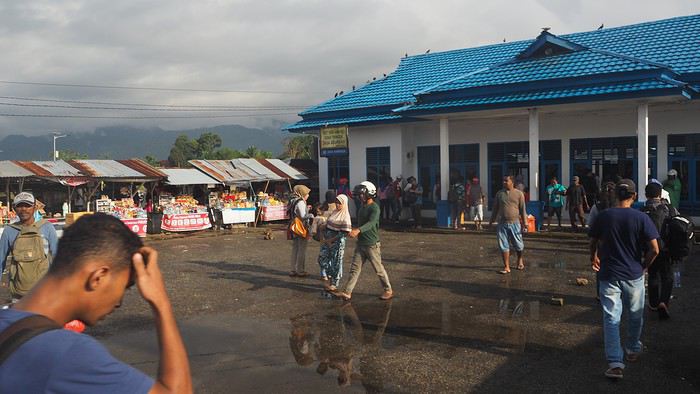
We arrived at the small bus station under the scorching sun, about two kilometers from Nong Khiaw.

You can’t miss the impressive limestone cliffs on either side of the road. A big tuk-tuk took us all to our respective hotels for 10,000 kips.

We chose the Vongmany guesthouse for one night at just over eleven euros. It wasn’t the cheapest, but it turned out to be a great find. Sure, we were a little disappointed when we first walked into our room—our grandparents with modest means probably lived in places like this in the early 1950s. Still, there was a working shower and a not-too-uncomfortable bed. We could tell we’d entered a different world. But then, what a view! From the balcony, you could see the gardens, the river, the village, the Chinese bridge, and the surrounding peaks. That single glance made the trip worth it!


The guesthouse had a covered but open-air dining area. We had lunch there and quickly realized its culinary reputation was well-deserved—everything we were served was excellent, including the spring rolls, and there was a great selection on the menu. The family running the place was genuinely friendly and welcoming, and communication was easy.

Since we only had the afternoon, we didn’t go on a long hike. The owner called a tuk-tuk for us to visit a small waterfall. The driver asked for an outrageous price—something like 200,000 kips—and didn’t speak English. We called the owner for help and managed to get it down to 50,000. The upside of the tuk-tuk was the breeze while we were moving—it was a temporary relief on such a hot day. The waterfall was tiny, but we enjoyed watching kids playing in it.


There was a village nearby. It wasn’t very lively—some people had gone about their business, and many were probably napping. Mostly, there were kids. For the third year in a row, we were struck by how adorable all these little ones were, especially the girls with their bowl cuts, braids, or pigtails, not to mention their slippers with cartoon characters peeking out from the toes. Chickens, pigs, and ducks were everywhere, with the road as their playground. Watching it all, we thought that apart from the road and motorized vehicles, what we were seeing wasn’t so different from what this place might have looked like decades—or even centuries—ago. What’s certain, and it kept being confirmed, is that even a short visit to one of these villages is an opportunity to take tons of photos. You don’t need to go to the most remote corners of the country to find authenticity. In fact, at this spot, the remote corners weren’t that far away...


We took the tuk-tuk back and asked the driver to drop us off a kilometer before Nong Khiaw, where we’d spotted another village on the way in. We walked the rest of the way—it was just what we felt like doing. At the small shop, we found the same packs of cigarettes for 3,500 kips that we’d bought for 5,000 in Luang Prabang not long before. The girls in the shop gathered around to see the foreigners, and we had to pull out a notebook to communicate better—everyone was laughing easily.


Back in Nong Khiaw, we took our time strolling around, crossed the bridge built by the Chinese, and wandered through the old part of the village.


It was a nice change from the hustle and bustle of some of the places we stay. By the river, we chatted with a boatman on the dock who really wanted to take us for a ride, but we’d already be doing plenty of boating the next day and couldn’t hire everyone.


In the evening, it was so pleasant to dream while gazing at the view—it was hard to look away...
« Tout le monde s'interroge sur comment laisser une meilleure planète à nos enfants, mais on devrait plutôt penser à laisser de meilleurs enfants pour notre planète. » Clint Eastwood
YO Yozaz Regular ·
Wow, those photos are stunning and your commentary is amazing! I can't wait to read the rest of your adventures—and I'm definitely not the only one.
Yo
JO Jojoone1 Globetrotter ·
JULY 15

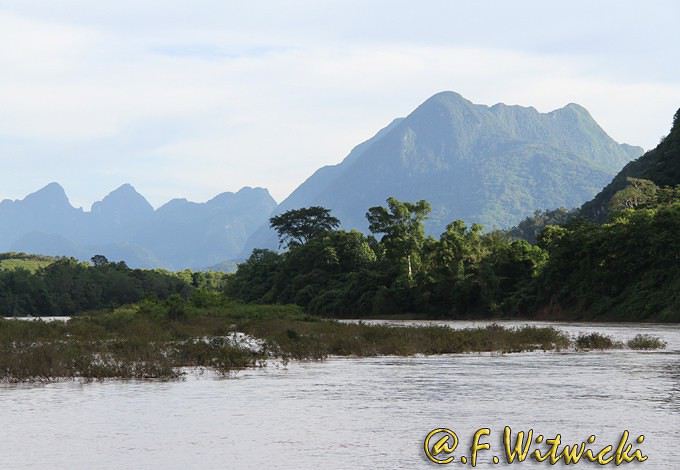
At dawn, on the balcony, we’re struck by the sight: day breaks over Nong Khiaw as thick misty bands embrace the surrounding peaks, then reluctantly drift away to make room for the next. The rest of the landscape, slightly lower, is lit by a pale light. It’s as if the sky has lowered several notches in a painting where the surreal and the magical compete. Not every morning offers such a spectacle. When the sun appears, it breaks some of the charm but makes up for it by restoring color to the panorama.

Breakfast is surprisingly good at Vongmany’s—they served us the best jam of all our stays in Asia. And for a French person, that’s no small detail. We take the time to tell them how much we appreciated it before leaving, and it clearly makes them as happy as it does us.

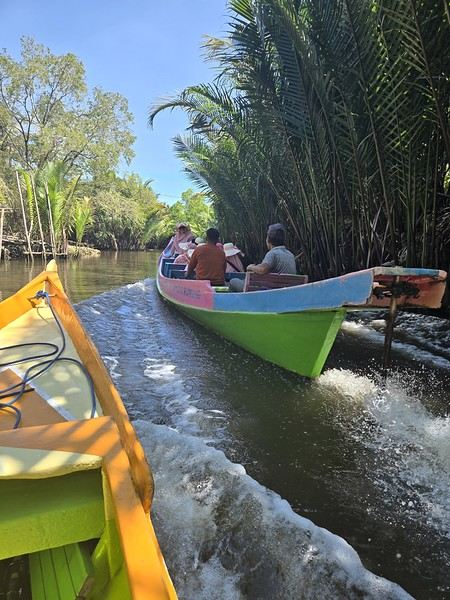
We arrive at the dock at 11 a.m. to take the boat to Muang Ngoi. These long, narrow boats that navigate rivers and streams are so picturesque. My partner manages to get us "first class" access to suffer less: the six large seats at the front, which look like they might’ve been taken from a bus or a plane. The other passengers are packed tightly in a small space, squeezed against each other, knees tucked in, and sitting on bare wooden benches. Let’s be honest—it’s not the height of comfort.

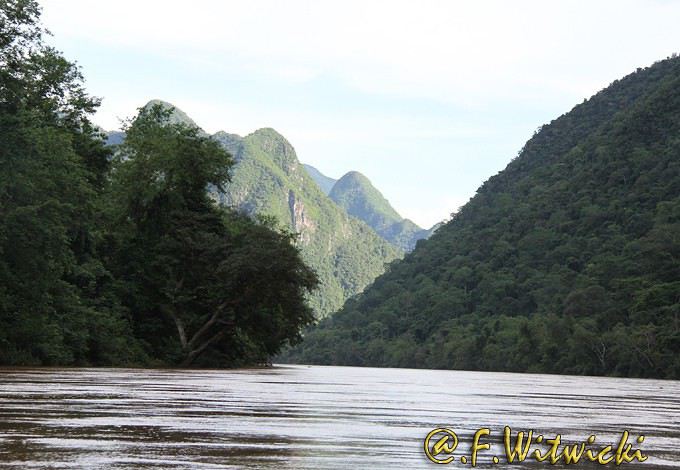
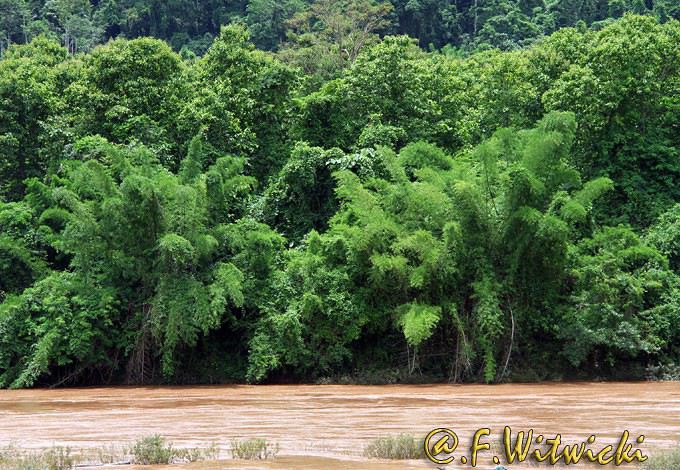
The trip lasts almost exactly an hour, the hull is low, and you can touch the water by stretching out your arm. Tropical vegetation covers the nearby hills, with small mountains in the background. We’re happy to see the large bamboo clusters again, which we’d discovered with delight in Vietnam. Brief stops now and then allow someone to disembark and deliver mail or a package. If the recipient isn’t there, the letter is tossed into their boat...


When we arrive, the feeling of being in a remote corner is much stronger. A large rigid white plastic block lets us step from the boat to solid ground. This time, there’s no road. We’re gathering our bags when a young Westerner approaches us, looking a bit worried, asking if we know where we’re going. This was the only undefined stop on our trip—we’d planned to go to a guesthouse at the foot of the hill, already recommended by some. What convinced us was that the owner sold his place without being pushy. The best argument was that the rooms faced the river and it wasn’t far to walk. He explained that he’s married to a Laotian woman, that they’d just bought the place and fixed it up. When he turned to lead the way, seeing his jean shorts—let’s just say they were *very* distressed with a large tear in the back—we thought it’d be a good idea to help him get back on his feet. Our room, facing the river, offered a lovely view, a perfectly decent bed, a mosquito net, but a weak fan. A really honest deal for five dollars.

We quickly went to eat at the nearest family-run canteen. The family’s kid, a confident 10-year-old, took our orders—pretty funny in his little-man act. We thought we’d have to settle for mediocre food in this remote spot, but we ended up enjoying it once again.

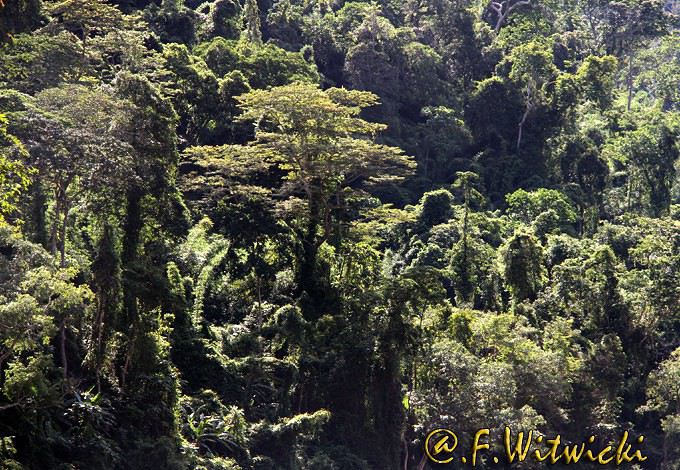
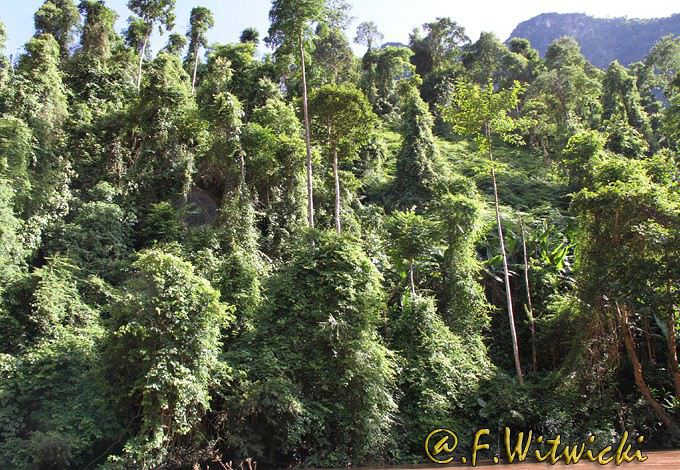
During this quick stop, no time to waste. We had to find someone to take us a bit further north—we’d heard great things about the route toward Muang Khoua. So we set off again in a motorboat with a young man from the village. The goal was to go up the river for an hour before returning to the starting point. Very quickly, the breeze over the water brought some relief from the heat. Along the banks, the scenery shifted from tropical vegetation to jungle, which we found very pleasant to look at. Where others might glance briefly, these untouched spaces make us want to linger. It’s a joy to see these preserved areas.


We weren’t too keen on visiting the village by the river, a visit automatically included in the "mini motorboat excursion" package. We imagined a fake authentic village, with stalls and dozens of pot-bellied tourists pretending to live the great adventure among blasé locals dressed in colorful costumes. We decided not to say no thanks because the young guy seemed programmed to take us there, but also because it’d give us a break before the return trip.

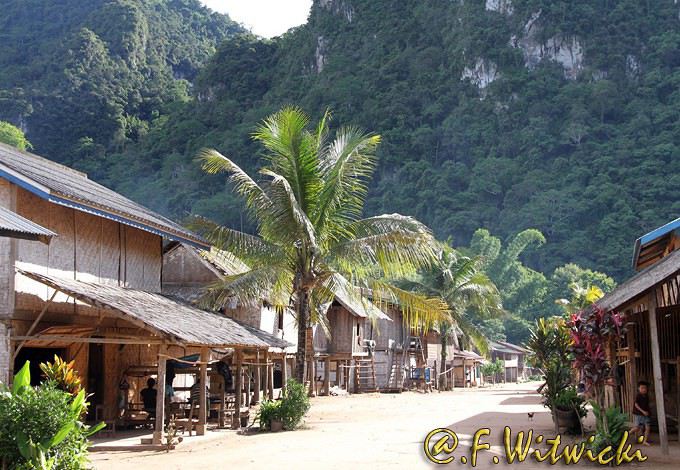
Once we docked, climbed the bank, and went up a few steps, another world appeared around the bend: a real, clean village, well laid out with wide paths between groups of houses. A very peaceful atmosphere, a sense of serenity. No one around except the locals. Only our young guide seemed anxious—he took great care to make us walk straight back and forth and seemed to suffer every time we strayed from the path to look at a plant, say hi to a child, or chat with a weaver. Yet the people we spoke to were cheerful. It was as if the village visit was a concession to tourism, as long as it didn’t bother the residents. If that’s the case, it’s understandable.


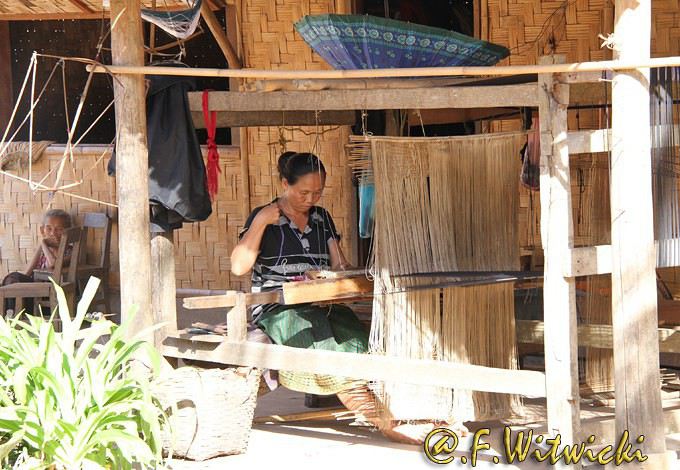
On the other hand, there’s no objection to checking out the local crafts. In front of some houses, the women’s creations are displayed. We saw two or three of them working at their looms.


When we manage to make one of the villagers understand our question, she tells us that making one piece takes five to seven days. You can really tell it’s not mass-produced. We prefer to buy here rather than in tourist hotspots. At two different places, we choose some pretty scarves and don’t haggle over the price set at 50,000 kips.

On the way back, the sun starts to set, and both the angle of the light and its intensity reveal the place in a new way. In some spots, the high cliffs are closer to the river, and every glance toward the horizon brings its share of satisfaction.


Another treat follows at the local restaurant before a night without AC—a little less comfortable than usual. When nature calls at night, and you’ve forgotten to keep the flashlight nearby, and you don’t want to turn on the light to avoid waking your partner, it’s possible—when you push aside the mosquito net and get up—to wonder if you’re about to step on a friendly snake or a cheerful scorpion. But usually, that doesn’t happen.
« Tout le monde s'interroge sur comment laisser une meilleure planète à nos enfants, mais on devrait plutôt penser à laisser de meilleurs enfants pour notre planète. » Clint Eastwood
GR Grandgognand ·
What a joy! I'm reliving this trip that left me with so many wonderful memories! I'll definitely go back one day! I can't wait to read the rest soon.
26 26alain Veteran ·
hi, just one word: bravo! thanks to you, I just "went back there" and it was amazing!!
Cordialement @lain26 site http://voyagesalain26.over-blog.com et http://randosalain26.over-blog.com
JO Jojoone1 Globetrotter ·
JULY 16

We woke up before six, and for the second time in two days, the sight that greeted us outside was breathtaking. It felt like we were alone with the river, the jungle, the hills, and the mist.


There’s a path behind the village that supposedly leads to a pretty valley. We’d planned to take a walk in the cool morning air, but our plans were about to change. We’d barely stepped out and reached the main road when we spotted several groups of women waiting. A little further up, people dressed in orange were approaching. Of course—here too, it’s time for the alms-giving to the monks! We’d actually skipped the alms-giving in Luang Prabang because it felt a bit overdone, almost too touristy, especially with people flashing cameras in the monks’ faces. Seeing them arrive in this small village—unexpectedly—was so much better for us. We kept a low profile and didn’t miss a moment.


After they passed, we were about to leave when, after being served by another group of women, the monks stopped and started chanting. We’re always mesmerized when we hear chanting in temples, and this time, we didn’t miss a single note.


After breakfast, we walked through the village and realized it was even more authentic than we’d thought. The whole place is basically one giant farm. We kept having to resist the urge to photograph everything—almost everything was photogenic.


We set off toward the valley, but unfortunately, we didn’t have enough time, and with the mosquitoes starting to attack, we turned back, crossing paths with farmers heading to their plots of land.


The boat we took to Nong Khiaw looked like it was about to fall apart and was taking on water through a cracked plank at the front. After a while, the engine died. But they were resourceful, and after fifteen minutes, we were on our way again—though we weren’t entirely sure we’d make it.

The minibus ride to Luang Prabang went smoothly. Oddly enough, this time, the first part of the route seemed less bumpy.

The tuk-tuk we took in Luang Prabang initially quoted us five times the reasonable price. We chose the My Dream Boutique Resort, on the other side of the river. It’s at the higher end of what we usually pick in Asia, but it has a well-maintained pool and a lovely tropical garden right by the river. The young manager, who’s local, really stands out for his friendliness and efficiency. In the afternoon, we just relaxed.

We took the free shuttle in the late afternoon to pop into town and had dinner at Café Toui. The Lao chef opened this tiny spot after working with some French chefs. We can only recommend his selection of Lao specialties—there’s a touch of fine dining, even in the portions, which aren’t huge. It’s worth the trip, though the prices aren’t what they used to be.

We’ll continue exploring Luang Prabang tomorrow.
« Tout le monde s'interroge sur comment laisser une meilleure planète à nos enfants, mais on devrait plutôt penser à laisser de meilleurs enfants pour notre planète. » Clint Eastwood
SE Seye2 Veteran ·
Good evening,

Just as delicious a read as the last one. Thanks! 🙂

And just as addictive. See you tomorrow! 😏
SI Siriss ·
Hi there, I’m a fan too! ...Thanks for this amazing travel journal, the photos are gorgeous :)
Siriss
AN Annebleue Veteran ·
Thanks to you, JOJOONE1! What a marvel this travel journal of northern Laos is. Ah, waking up in the morning in Muang Noi, which I visited twice a long time ago, and seeing that little has changed—except for the plastic dock, which is probably more practical than the wobbly planks that could send you for a little dip in the river. The sunrise, the sunset, far from any hustle and bustle. THANK YOU++++++++++ for such a vivid account! You have a gift—keep it and keep delighting us with your stories. Anne
ANNEBLEUE
JO Jojoone1 Globetrotter ·
Hi there,

This dock also doubles as a diving board for the village kids. Now that I think about it, I once helped an older Australian guy—kind of a rugged traveler—who was trying to grab onto it to pull himself out of the water but couldn’t because the dock is pretty thick and slippery when you’re wet. Apparently, he’d decided to take a dip to cool off and had swum for a bit too long. When we ran into him the next day, he told me I’d saved his life, but I think he was joking. It’s also a chance to thank you for letting us know how much you’re enjoying our travel journal, as well as the other readers (who, in our opinion, aren’t nearly as many as we’d hoped) who’ve already reacted...
« Tout le monde s'interroge sur comment laisser une meilleure planète à nos enfants, mais on devrait plutôt penser à laisser de meilleurs enfants pour notre planète. » Clint Eastwood
AN Annebleue Veteran ·
Good evening

Thanks for the details about the pier. You liked the SWAN HOTEL in Bangkok, which I’ve been visiting for at least 10 years ("it’s my second home," said the manager!!!). I can leave clothes and other items in their storage for up to 4 months max (I store my warm clothes there because last year, when I went to South Korea, I had to bring warm clothes).

What’s more, it’s really close to the CHAO PHRAYA and, most importantly, two excellent restaurants: the Islamic restaurant right across the street (great value for money and amazing homemade yogurts—the owner is lovely), and especially L’Harmonique, which has become my go-to spot!!! Excellent value for money for the crab curry, and everything is perfect, especially the atmosphere (not to mention the charming owners who greet you in the little patio).

All the best, For me, it’ll be Taiwan in April... Safe travels, and thanks again for your stories. Anne
ANNEBLEUE
OB Obeoandpai Globetrotter ·
as well as the other readers (not many in our opinion) who have already reacted...

Sawadee krap

1,650 views is already a good benchmark— keep the rest coming! final reactions
Mon YouTube https://www.youtube.com/user/voyageurasie/videos?view_as=subscriber
RI Ricouthai Regular ·
Hello and thank you! Your travel journal takes me on a journey and helps me plan my trip to Laos from February 1st to 7th, 2015. Should I prioritize Luang Prabang and take the bus, or do the Mekong descent from Huay Xai to Luang Prabang by slow boat? Thanks! (To get to 2%.)
LO Lolo333 Regular ·
🤪HEU ratio of 1 to 100
JO Jojoone1 Globetrotter ·
JULY 17

We start our day by bravely climbing Mount Phousi. It’s not difficult in itself—this time, the steps are well-spaced, and the climb is relatively short. But back in Luang Prabang, we’re hit with that heavy, humid weather that makes you sweat nonstop.

Before tackling the climb, we stop to greet the musician playing in the street to make a living.


Just a few steps higher, we spot a small, somewhat neglected wat made of wood, with an old-world feel. We love finding buildings that have escaped renovation—it gives us the impression of seeing them as they once were. Inside, you can see mural frescoes in varying states of preservation.


At the top, there’s a lovely view—on one side, the city, and on the other, the river.


We just pop into the grounds of the former royal palace. No museum visit—we’ve often been disappointed by Asian museums. We take a quick look at the king’s statue and the small collection of American cars from the 1950s–60s. Unfortunately, they’re not well-maintained.


On our way back, we spend some time in two adjacent wats. The first, Wat Aham, isn’t particularly interesting, except for the old stupa facing it.


But we absolutely loved Wat Visoun. Even though it burned down at the end of the 19th century, it was almost immediately rebuilt. There’s a lot of wood, and we felt a warmer atmosphere here than elsewhere. We counted at least eight emerald Buddhas of different sizes. There are many ancient statues and sculptures. The most surprising thing is that some of them are real masterpieces, scattered or even piled up at the back of the wat, too sheltered from the light and not enough from the dust. Some pieces are in poor condition—what a shame...


We’ve learned not to push it in the afternoon, so we only visit the pool.

In the evening, we take a little stroll around the neighborhood. There are quite a few huge houses belonging to the newly rich lining the street. It contrasts sharply with the modest locals you see around. We made the mistake of trying some skewers—you can’t win every time! Here, they make skewers with nothing but chicken fat. The first two bites are okay, but after that, you start feeling queasy. Tonight, we’ll settle for pineapple.
« Tout le monde s'interroge sur comment laisser une meilleure planète à nos enfants, mais on devrait plutôt penser à laisser de meilleurs enfants pour notre planète. » Clint Eastwood
SI Sissi57 Globetrotter ·
Hi, Well, I’m one of the 1,650 who’ve been quietly following along and really enjoying your story. It’s making me *so* want to go... Quick question: did the rain affect your trip at all?
Je n'aurai pas le temps...
JO Jojoone1 Globetrotter ·
Good evening,

Honestly, we’ve also read travel journals that we really enjoyed. Sometimes with photos that made us want to dive right into the screen. We haven’t always left a comment either. Whether the journal is successful or not, it’s already a great effort to share. Don’t worry, when we look back at what we’ve done, especially in winter, it makes us want to go back so badly. As for the rain, as you’ll see later, there was a bit of everything. Overall, we were still very lucky, but only just. This time of year, you can expect anything. The two and a half days of non-stop rain we had in early August two years ago in Vietnam were long—really long. Generally, the sky is blue in the early morning, turns white for the rest of the day, and showers pop up now and then, usually in the evening. But we all know the climate isn’t as stable as it was a few decades ago. At least, that’s what everyone says...,
« Tout le monde s'interroge sur comment laisser une meilleure planète à nos enfants, mais on devrait plutôt penser à laisser de meilleurs enfants pour notre planète. » Clint Eastwood
SI Sissi57 Globetrotter ·
I'm waiting for the rest about the rain. I've been wondering a lot because I'd love to travel to these regions when the rice fields are green and there's activity in the fields, but I've taken a few trips during the rainy season—especially in Costa Rica, where I was told there would just be showers in the late afternoon, but the rain still really got in the way. Since then, I've been wary.
Je n'aurai pas le temps...
CH Chantalmrs Regular ·
Thank you sooooo much Joel for this beautiful story and amazing photos.....

So.... I’m changing my itinerary and from Xouiesai, instead of taking the classic boat trip to LPrabang, I’ll be doing a loop via Oudomxai, Muang Khua, and Muang Ngoi.

Have a great day!
RI Ricouthai Regular ·
Thank you sooooo much Joel for this beautiful story and great photos .....

So .... I’m changing my itinerary and from Xouiesai, instead of heading to LPrabang with the classic boat trip, I’ll do a loop via Oudomxai, Muang Khua, and Muang Ngoi.

Have a great day!

Hi everyone, is it better to do the loop to Muang Ngoi or take the classic Mekong descent and spend 2 days in Vang Vieng? Either way, I’ve got a week. For a discovery trip—people, towns, and landscapes—backpacking style. Thanks for your input!
JO Jojoone1 Globetrotter ·
18 JULY

The day before, we booked a tuk-tuk for the morning. The guy picks us up at the hotel and right off the bat, he’s absolutely hilarious. Since he later makes a few references to marijuana, we quickly figure out why he was so happy during the few hours we spent together. Word must be going around in the area because several people approached us about it. When he stops in the suburbs to buy drinks, we take the opportunity to restock on the same cigarettes we’d bought earlier. This time, after paying 50,000 for a carton downtown and then 35,000 in a small village, it’s 25,000 at this little shop. Go figure...

After a half-hour drive through the forest, we arrive at Kuang Si Falls. A five-minute easy walk and we discover this series of small tiered waterfalls with beautifully colored water.


At the end, there’s a much bigger waterfall.


We’re early risers, so the temperature isn’t too high yet, but the humidity is at its peak. It’s a gorgeous spot. If you look up, you can see some impressive, sturdy trees.


Don’t forget that near the entrance, there’s a bear sanctuary as part of a rescue and conservation program.


Here too, lots of curious hornets took an interest in us. The infrequent use of chemicals in this country leaves plenty of room for certain insects.

We take our time for another lunch by the Mekong, where we can’t help but share with a particularly hungry cat. The owner tells us she’s just had kittens.

In the historic center, we visit our last wats. The first one is mainly interesting for its garden—it’s the Wat, the Watchoum, uh... well, you get the idea:


The second one, Wat Xieng Mouane, is closed for the third time we’ve passed by. The sign says no... We just see young monks taking a sculpture lesson as part of a UNESCO program.


Finally, just behind it, the Xieng Mouane house, recently turned into a museum and even more recently with a paid entrance.


By late afternoon, the little Dutch kid who spends his time jumping like a maniac in the pool is driving us absolutely nuts. It’s true—we’re well on our way to becoming grumpy old farts.

Evening thunderstorms keep us from going out. Another chance to die laughing (or cringe for them) while flipping through the various Asian channels...
« Tout le monde s'interroge sur comment laisser une meilleure planète à nos enfants, mais on devrait plutôt penser à laisser de meilleurs enfants pour notre planète. » Clint Eastwood
SI Sith ·
I’m one of the silent readers who really enjoys the travel stories, the style, and of course the photos! Keep it up :)

I’m struggling to picture how big tourism is in these East Asian countries (I’ve never been there yet—my trip is planned in 2 years!). Are there a lot of tourists? The idea, especially for small local villages, is to feel immersed in the local culture, and well… if you run into tourists at every corner…
NO Nolack Regular ·
It's beautiful... well, for a bunch of grumpy old folks, you're not too bad—you even have such an open view of your surroundings that I'm starting to wish I was only surrounded by grumpy old folks!

Mission accomplished: because of you, I now want to go to Laos, and it's totally impossible right now!

Anyway, what's up with that bear? How big is it? Is it the famous bear whose bile cures everything in Chinese medicine? It doesn't look too good...
JO Jojoone1 Globetrotter ·
hi there and thanks

With the global population constantly growing, there are inevitably more tourists everywhere each year than the year before. We can't reasonably expect all these people to go somewhere other than where we go ourselves. Due to economic shifts, we might see fewer Westerners in Asia and more Russians, Chinese, or Indians. Of course, a large proportion of tourists head mainly to the most famous spots. We have to be content with the fact that, for now, there are still countries where parts of the territory remain untouched—beautiful places that aren’t yet touristy. I don’t even dare to think what it’ll be like in a few decades at this rate. Everywhere, there’s still a big difference between high season and the rest of the year. Thailand in July? Honestly, it’s fine. Laos, Myanmar, and Vietnam are still relatively quiet destinations. As for immersion, that’s a pretty subjective idea. True immersion would mean living with and among a local family, cooking and working with them, settling for their pastimes... After a few days, many of us would probably run for the hills! No, really, as soon as you land there, it’s total culture shock. People are generally decent, the food is great, and some landscapes are extraordinary. Don’t give up just because of a few doubts.
« Tout le monde s'interroge sur comment laisser une meilleure planète à nos enfants, mais on devrait plutôt penser à laisser de meilleurs enfants pour notre planète. » Clint Eastwood
AN Annebleue Veteran ·
Hi there, Once again, I’d like to thank Jojooine1 for their summary on LAOS and tourism in neighboring countries.

A BRIEF OVERVIEW OF LAOS, AND LUANG PRABANG FOR THOSE LUCKY ENOUGH TO DISCOVER THIS WONDERFUL COUNTRY.

I had the chance to visit LAOS 10 years ago and have been back at least 5 times since... It’s a magical country that’s worth the effort because the roads are pretty rough, winding (with some impressive cliffs), and there are lots of twists and turns... but the people are charming and calm. Of course, you’ll hear the neighbors say they’re lazybones!!!

Last year in Luang Prabang, I found myself on the evening of my arrival looking for accommodation. Everyone was offering crazy prices in USD, but in the end, I found the best guesthouse in all of Laos (or almost, except for ZUELA in Luang Prabang, which is the top spot in the north) right across from the French cultural center, in the city center. The Lao family spoke little English (their kids did), and I had a large room with AC, a bedside table, and a bedside lamp (unbelievable!!), plus a balcony overlooking the cultural center—all for 10 €, or 100,000 kip. So I highly recommend KINNALY GUEST HOUSE to everyone. Wake up early because the alms-giving ceremony to the monks takes place right below the guesthouse, but it’s better to go to the street across the way for a bit of peace. Great breakfast with an amazing fresh fruit salad (yum!) just across from the guesthouse.

I can’t recommend the morning market enough, and of course, the night market with its food stalls at super low prices.

Along the banks of the MEKONG, not far from LAO LU LODGE Street, there’s a restaurant that offers an all-you-can-eat buffet for 7 or 8 €—barbecue, salads, fruit, and ice cream!!! Who could ask for more? It’s full of Lao families and, of course, a few tourist groups, but how do you avoid them unless you go into a cave...

If you have time, cross the Mekong and take a stroll on the other side: beautiful wats in the jungle and no tourists... a nice change.

Excellent massages at the RED CROSS, and you’ll also be helping students of traditional massage pay for their studies. (Don’t forget that many young people are poor, and if their families live in the countryside, it’s hard for them to afford education... not everyone is the child of a restaurant or hotel owner.)

If you’d like more details, I can send you a full guide on LAOS. Van Vieng has changed a lot, and the landscapes are breathtaking, especially in the evening or morning, so go quickly.....

Anne
ANNEBLEUE
JO Jojoone1 Globetrotter ·
JULY 19

The plan was ambitious for our last day in Luang Prabang. We took the ferry for 5000 kips to cross to the other side of the Mekong.


You can take loops of varying lengths with villages, caves, and temples along the way. Probably the ideal way to do it would be by bicycle. Since we had to walk, we didn’t have a precise plan—just do as much as possible. In the end, only the first half-hour went smoothly. The first village made a great impression with its narrow paved street, just wide enough for a tuk-tuk to pass.


Even though it’s just a stone’s throw from the city, it feels far away.


The sky had been threatening all day, and suddenly the downpours started one after another. Some young girls kindly opened their door to shelter us when it really started pouring. No more pavement—just huge puddles everywhere, a dark horizon, and a few aches resurfacing for my partner. No point pushing it when you’re not feeling up to it.


Back at the little Lamache restaurant, dry and relieved we’d done most of the sightseeing the previous days. We’d just be able to relax a bit in the late afternoon in the hotel garden by the river.


We’re just hoping our trip south will leave some of those clouds behind. Well, it’s July, it’s the north—we knew what we were getting into…
« Tout le monde s'interroge sur comment laisser une meilleure planète à nos enfants, mais on devrait plutôt penser à laisser de meilleurs enfants pour notre planète. » Clint Eastwood
BE Bettybo Regular ·
I went to Laos two years in a row but no rain since it was early in the year. Your story and photos bring back great memories and make me want to go back. Thanks.
VE Veroniva ·
I love your stories, the way you describe things, and especially your photos are gorgeous!!! Thanks so much, it really takes me on a journey!
DA DanyMichel Veteran ·
This story fascinates me, just like the previous ones... Beautiful writing and stunning photos—you two really complement each other! It reminds me of our trip in March 2011... We did the Mekong River descent from Huay Xai to Pakbeng, where we spent 3 days. Then, we continued to Luang Prabang, where we stayed for a week. We loved this little town, its many wats, its countless monks, its morning market, and even more, the evening market (they sell beautiful handicrafts and, surprisingly, gorgeous duvet covers—we bought two, ordering real "made-to-measure" ones—ordered one day and received them the next evening!).

Most hotels were already quite expensive, but we still found a small resort (bungalows) on the other side of the Nam Khan River that offered a great price (around $45 at the time) and had a lovely pool! That’s very rare in Luang Prabang (unless you have a *very* well-filled wallet). It was the Luang Prabang Paradise.

I can’t wait to read your impressions of southern Laos (we continued to Vientiane, Pakse, and Si Phan Don before flying to Siem Reap, Cambodia).

Thanks again for sharing! !
Dany
JO Jojoone1 Globetrotter ·
JULY 20

The minibus to Vang Vieng costs us 120,000 kips per person, which is about 11 euros. The trip takes six hours instead of the advertised five. There were two scheduled stops, including one for lunch. It seems this is the most beautiful road in Laos. Well, we wouldn’t know. A light rain kept us company for almost the entire journey. Since we were driving through the mountains, we did get a good look at the clouds—because we were right inside them.

There are two or three resorts and a bunch of guesthouses in this small town, but not many classic hotels. We’d decided on the Silver Naga, with a room for 26 euros. The receptionist is friendly and immediately tells us he’s upgrading us. So instead of a view of the back, we get a side view. As soon as we open the window, we notice a row of rooms above ours occupied by young people with strong American accents, shouting to each other from window to window. We have a vague feeling something’s not going to go well. You should always trust your gut. We head down to reception, and sure enough, it pays to ask: without batting an eye, the receptionist gives us another room. This time, it’s a clear double upgrade—the room is nicer, and most importantly, we have the best possible view of the river and the limestone peaks. But there’s a catch: low clouds block most of the scenery, and we wonder if we’ll see anything over the next two days...


We pop over to the other side of the toll bridge to Noé’s place, a French guy who runs the Mango Guesthouse. We were hoping to do a tour with him since he organizes jeep trips for half a day or a full day. He honestly tells us that given the state of the route, there’ll be too many bumps and jolts for my wife to handle. We’ll have to find another solution.


After turning back, we head to Chaleun, one of the restaurants with a good reputation. There’s indeed a wide selection of decent-quality dishes, a free shake in the evening, and very friendly staff. Across the street, we see a few places that have been accurately described on many sites: big TVs playing the American series *Friends* on loop, young Anglo-Saxons in swimsuits and often barefoot, some of them looking a bit out of it, and blaring music. At this time of year, it’s not exactly crowded, and you can tell the wild heyday is, for now at least, a thing of the past.

Even though we’re heading back in the rain, we decide to explore the area on foot the next day—if it turns out to be possible.
« Tout le monde s'interroge sur comment laisser une meilleure planète à nos enfants, mais on devrait plutôt penser à laisser de meilleurs enfants pour notre planète. » Clint Eastwood
JO Jojoone1 Globetrotter ·
JULY 21ST PART ONE

We had an excellent breakfast at Silver Naga. There was a much wider selection of fruit than elsewhere, and some of these fruits were of better quality than usual. The main reason for our satisfaction was the cinnamon buns without raisins—so good they could have come from a top French bakery. We wondered where they got them and who made them. In any case, it was a first for us.

There are two loops to do around Vang Vieng: the west loop and the east loop. The longer and more beautiful one is the west loop. Due to constraints, we walked as much of the west loop as we could on foot. Unlike any other mode of transportation, walking lets us soak in the landscape and all its details most intensely, so no regrets—quite the opposite.

Like the day before, we took the wooden toll bridge, its entrance framed by remnants of American bombs.


Just a little further on, we had to turn left. Everything is marked in the guidebooks, you can easily get a map in town, and anyway, just ask for directions to the Blue Lagoon—anyone there will know how to point you.

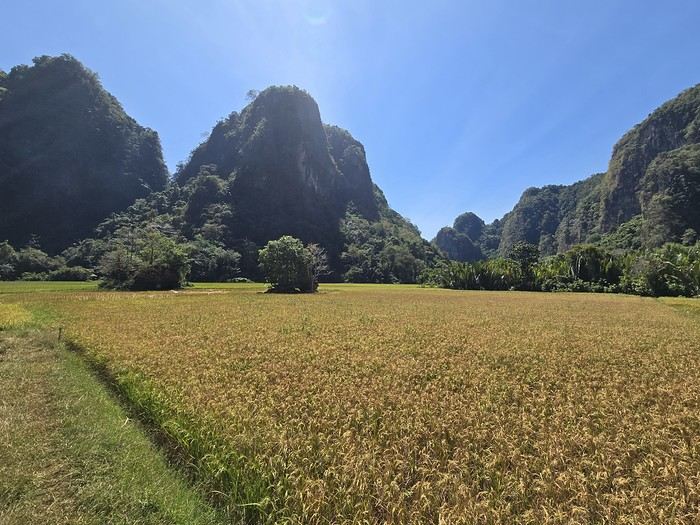
Once again, we found ourselves in a situation we love: after a few dozen meters on a straight, rocky path, we stepped into another world—rice fields, villagers, and karst massifs. It would be a whole day of drinking in the scenery...


The few raindrops at the start of the route made us appreciate the long break we’d get afterward even more. Every now and then, we had to weave between potholes filled with rainwater from the day before, sometimes even walk along fences or skip a shortcut because of the amount of standing water blocking the path—but nothing insurmountable.

All along the way, we saw smiling faces: from the little boy on his doorstep to the family running the small shop where we quenched our thirst, to the farmer selling homemade fruit in the middle of nowhere, the little girl carrying her sister on her back, or the kids bathing naked in the river, having the time of their lives.


It was all so pretty and charming—even better than we’d hoped. Honestly, the place made a better impression on us than the terrestrial Halong Bay...

We already felt like we’d crossed the country after walking the seven kilometers to the Blue Lagoon (also a paid entrance), where we were thrilled to sit at a table under the trees and enjoy a good meal at the on-site canteen. To be continued...

« Tout le monde s'interroge sur comment laisser une meilleure planète à nos enfants, mais on devrait plutôt penser à laisser de meilleurs enfants pour notre planète. » Clint Eastwood
JO Jojoone1 Globetrotter ·
So you and we will continue to satisfy each other. 🙂 No doubt we'll soon show you some spots around Chiang Mai that won't leave you indifferent. As well as a few restaurants we walked out of unscathed...!
« Tout le monde s'interroge sur comment laisser une meilleure planète à nos enfants, mais on devrait plutôt penser à laisser de meilleurs enfants pour notre planète. » Clint Eastwood
YO Yozaz Regular ·
To follow—I’ll be following! And eagerly, at that! Once again, bravo for your photos—so natural and inspiring—and for the story. Thanks.
Yo
DA DanyMichel Veteran ·
Thanks once again... Such a polished, smooth travel journal... and those stunning photos (I know, I’m repeating myself...). And those little Laotian kids—aren’t they just gorgeous! Asia is a true paradise for photography lovers, landscapes, and portraits...

Until the next page! !
Dany
DA DanyMichel Veteran ·
😉 yeah, the sky there is often stunning to photograph...
Dany
AL Alexval2 Veteran ·
I was already a fan of your two previous travel journals, and I just want to congratulate you again for this one—I can’t wait for the next part!
JO Jojoone1 Globetrotter ·
JULY 21ST – PART 2

At the Blue Lagoon, the vibe is laid-back and fun. Above the pool, a rope is tied to a thick branch. You grab the rope, swing yourself, and jump into the water. The bravest climb the tree and jump from higher up, cheered on by their friends with whoops and applause. We witness a long, friendly scene between an American couple with their whisky and a group of Chinese travelers with crates of beer. Thankfully, they’re not all drinking straight from the river—or it would’ve dried up ages ago. Behind us, on some very tall trees, there are zip lines. Everyone’s having a blast there too. We see Noé arrive, driving his jeep with some French girls for an excursion. He’s surprised to see us covering the whole route on foot.

We set off again, walking no faster than on the way there. The weather’s really changeable. In just a few minutes, we see the same landscape shift from light rain to an overcast sky to bathed in sunlight.


Nature lovers and scenery enthusiasts could easily spend three or four days here without regretting it.


You can also go tubing, climbing, kayaking, scale one of the peaks, or explore caves—plus the eastern loop.

The motorbikes, 4x4s, and other vehicles had been pretty respectful of us as pedestrians. That is, until the end, when a group of Chinese tourists came roaring up on their loud, smelly dune buggies. I’m sure it’s a blast driving those things on these kinds of trails. We’d even seen people returning from their rides covered in mud from head to toe. But this time, the last guy made sure to gun it straight through a huge puddle right as he passed us. Oh, it was clear he didn’t try to avoid it—and he was laughing his head off. Sometimes you just feel like picking up a rock and... A few minutes later, my wife’s legs broke out in big red patches, and we had to head to a pharmacy that evening to treat the allergic reaction that flared up. There’s definitely some nasty stuff in that water.

We’re completely wiped out by the time we get back to the hotel, and we don’t even bother showering properly. It’s the perfect moment to take advantage of the pool. The one at the Silver Naga is only five meters wide, but since it runs along the building, it must be close to 15 meters long. The best part? It faces the river and those stunning hills. We meet a French couple there. The husband’s a customs officer, and he explains that even though there was a big cleanup operation, the trafficking hasn’t stopped—it’s just gone underground. Several bars offer "happy shakes," which are basically cannabis shakes. That explains a few things we’d seen...

Dark, ominous clouds roll in with the storm that’s approaching—we barely dodged it! We’re over the moon about the day we’ve had, and it’ll stay etched in our memories for a long time.
« Tout le monde s'interroge sur comment laisser une meilleure planète à nos enfants, mais on devrait plutôt penser à laisser de meilleurs enfants pour notre planète. » Clint Eastwood
JO Jojoone1 Globetrotter ·
JULY 22

We rented a tuk-tuk to take us to the village of Phatang, whose name means "the tooth." Indeed, a limestone hill near the village really does look like a big tooth. The ride is quirky because the tuk-tuk is old—so old that the owner plans to buy a brand-new one in the next few days. In the meantime, we have to stop every seven kilometers to open the inner hood and add two liters of water. The guy keeps apologizing, even though we’re totally fine with it.


We took a little walk around the village, but since every path was blocked by a fence or a pond, we couldn’t get any closer to the tooth. There’s a small Chinese temple and the typical local houses.


We still had plenty of time to admire the long karst range on the 17-kilometer ride back. It’s a really pretty spot that might’ve deserved an extra day or two. We would’ve loved to do the eastern loop around Vang Vieng if our legs weren’t still sore from the day before. Over the years, we’ve been choosing more and more places with pools—let’s be honest, it’s also an excuse to take a break.

That day, another storm hit earlier than the day before, which lessened our regrets about knowing we would’ve gotten soaked if we’d gone out. We were lucky enough to see that beautiful landscape one last time under alternating rain and sunshine.


That’s what kept us from wandering too far that evening. Right next to the hotel, a family runs a modest little restaurant with an outdoor barbecue. For a reasonable price, we feasted on chicken skewers and sweet Lao sausages with pineapple. Little by little, we started wondering if we’d ever stop gravitating toward mid-range restaurants when these little spots offer such quality and authenticity.
« Tout le monde s'interroge sur comment laisser une meilleure planète à nos enfants, mais on devrait plutôt penser à laisser de meilleurs enfants pour notre planète. » Clint Eastwood
KA Kawo Veteran ·
Hi Joël,

I’ve been following your amazing travel journal with so much pleasure.

Just wanted to say thanks for sharing!

Similar discussions

You might also like