Who are you? Where are you from? Where are you going?
Like last year at this time, a post about bike travel ideas.
How many of us are preparing a trip planned for this year? Probably a lot.
What’s yours—the one you’ve been dying to do for so long, maybe too long? For us, it’s a modest PARIS-MARATHON by bike, followed by MARATHON-ATHENS on foot in June 2010. And you?
May the passion keep growing before, during, and after! Happy planning and safe travels to everyone.
1,922 similar discussions in English
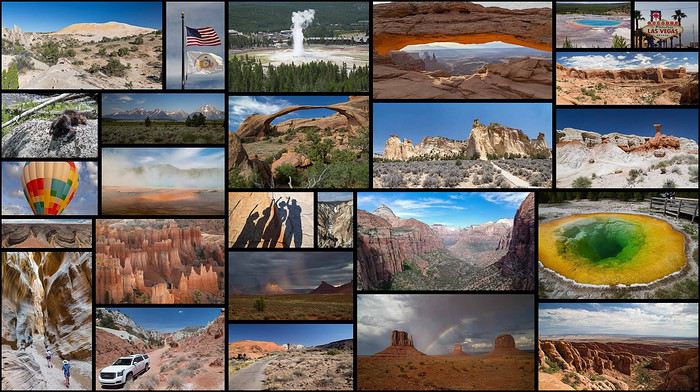
Nine Bretons in the USA from June 24 to July 20, 2018: Greenery and mosquitoes in the North, heat and storms in the South
Choosing the trip:
After returning from the USA in 2014 (travel journal here), it was clear we’d go back, this time with the firm intention of bringing our kids. 😇
2015 was the year of Scotland (travel journal here), 2016 was a work year, and 2017 was the discovery of Aragon in Spain (travel journal here)… Meanwhile, our kids’ age still seemed like a hurdle for this kind of trip. The long wait turned out to be an advantage, letting us refine the project and rally others: what started as a two-week trip for four turned into three weeks for nine!! JF’s parents (M&P, who’d already been in 2014) and JF’s brother (C&D&Y) joined our little family (C&JF&A&L)!!😎 After plenty of family discussions, route tweaks, travel journal reads, and advice from VF (plus some specialized books like Photographing the Southwest by Laurent Martrès), we made up our minds—fully aware of the constraints—and split the trip in two:
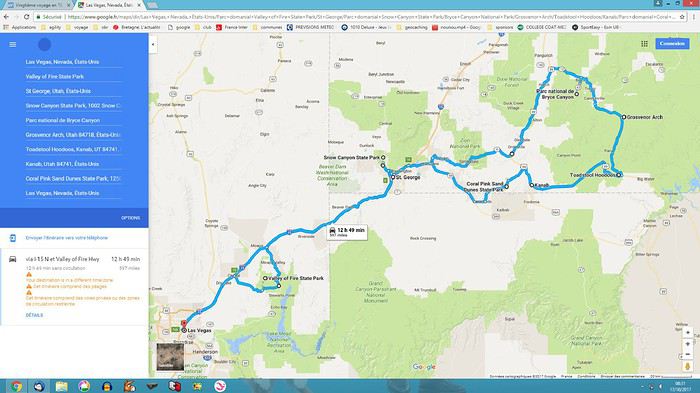
- First week, just the four of us in an SUV + hotels, looping from LV (Valley of Fire, Saint George, Bryce, Kanab), focusing on rocky, sandy, and colorful hikes:
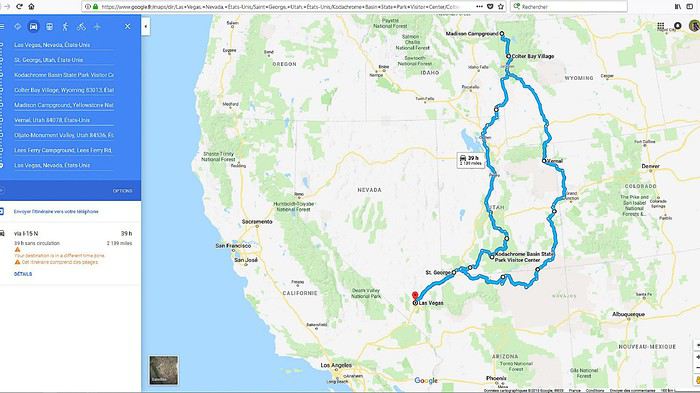
 - Followed by two weeks with nine people in 2 RVs + campgrounds, as close to nature as possible in the parks (Snow Canyon, Kodachrome, Yellowstone, Arches, Canyonlands, Dead Horse, Monument Valley, Grand Canyon):
 🙂Before going further, we want to thank the forum members who took the time to answer our questions. Your patience and kindness are amazing! We might forget someone, but thank you all: Jpg13, Mlefebvre, Kast13,Glll2012New, PCecile, Aquilegia, Adumas4, Ju45, Mycovtt, Natb72, Soula1, Orionide, Simonic, Hiacinthe, etc.
Traveling with nine people (ages 9 to 76, including three kids!!) requires some serious logistics and near-perfect timing to avoid wasting time. The plan went off without a hitch😎… well, almost—we’ll get into the details later…😛🏴☠️🙂 In the end, we came back enchanted and happy!! 🙂The family aspect played a big part, but we also discovered spots that were much less crowded, definitely less known to the general public and the hordes of Asian tourists… The kids returned with stars in their eyes, and the adults with just as many memories (plus around 1,200 photos and 130 GB of GoPro video to sort through)!!😎 We’re already feeling the itch to go back—a Denver loop is starting to take shape…😇
Thoughts on the Americans we met and places we visited: They haven’t changed since 2014… Still cool, optimistic, and smiling, always ready to strike up a conversation and offer help—even without the lure of our tourist dollars. (Only two cold locals at Monument Valley clearly made little effort to help us.) We noticed a few changes in the parks😕: some infrastructure was less well-maintained (wobbly wooden walkways, for example), French info pamphlets disappeared from entrance huts, and there were fewer rangers (Lee’s Ferry ranger station was closed). These changes are likely due to Trump’s restrictive policies toward national parks. On the economic side, gas prices rose by 30% since 2014, now around 0.85 € per liter, and with the current exchange rate, conditions are much less favorable for European tourists than in 2014. But this area is so beautiful—too bad Americans have such an idiot for a president!😠
The flights: Round-trip Paris CDG to Las Vegas LAS Roissy to Los Angeles with Air Tahiti Nui, then American Airlines for Los Angeles to Las Vegas. The A340s were impeccable, and service was great with Air Tahiti Nui (the tiare flower given at boarding), and no complaints about AA either.🙂
The hotels: All booked in advance, either through Hotels.com or directly on the hotel’s website (like the Planet Hollywood in Las Vegas). No surprises, everything met expectations.🙂 It’s a real plus for a family of four to have two beds in every room… Still rare in France.
The campgrounds: Except for one night at Lee’s Ferry, all were booked from France through NPS, Xanterra, and KOA sites. No surprises here either—everything met expectations and was well-organized (fire rings and tables at every site, for example).🙂
The vehicles:
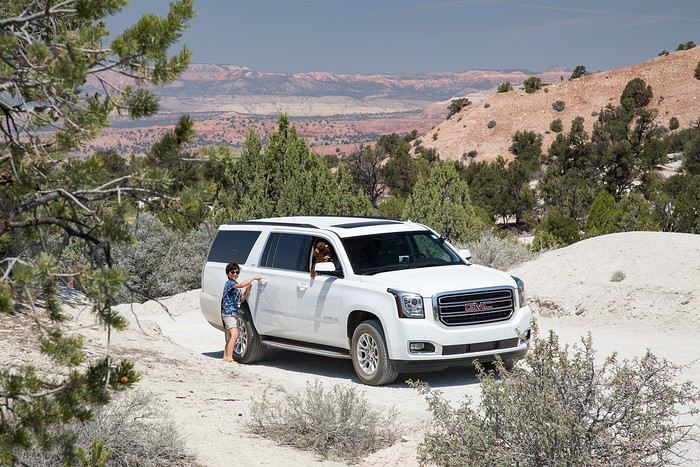
First week: Four people in a GMC Yukon XL from HERTZ, at Las Vegas airport for 327 €, unlimited miles, second driver, and insurance. A typically American beast—355 hp, seven seats: it’s long, big, wide, and tall😮😎😎!! Impeccable condition, quiet, super comfortable with tons of safety features and gadgets (like weather updates tied to GPS!!), and it averaged about 12 L/100 km in 2WD (in 4WD, we nearly hit 19 L on the Stukumpah Road…). A total win thanks to the HERTZ GOLD card, following Jpg13’s advice (Jean-Pierre, you’re my idol!!😎). It let us skip the counter lines (we didn’t even stop there!), pick up the car, and leave the parking lot in under seven minutes… Even less time for the return!
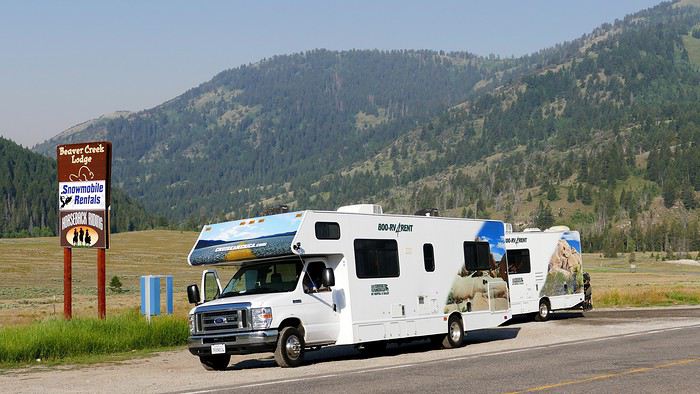
 Second and third weeks: Nine people in two RVs. A 30-foot RV + a 25-foot RV from CRUISE AMERICA in Las Vegas for 5000 €, unlimited miles, kitchenware, and linens/towels/comforters.
A love story in 2014 with this same agency, but unfortunately, this year was much more mixed: aging RVs, ineffective AC in the C30, a leak in the C25’s skylight, a leak in the C25’s toilet drain valve (imagine the dump every time we opened the drain plug…😠🙁), late delivery of both RVs (after 5 PM, though the contract said 4 PM max), abnormal wear on the front tires (we’d discover that later😠), trouble closing the door, etc.In short, a disappointment.😠
Note that other rental companies (El Monte and Road Bear) are probably gaining market share—we saw a lot of their vehicles on the road, and they offer much newer models (at least on the outside) for similar prices…🙂
But setting aside those issues, the vehicles still did their job: letting us sleep as close to nature as possible in the parks and enjoy beautiful sunrises/sunsets with family campfires and marshmallows flambéed with Jack Daniel’s Tennessee Honey😇!!😎 Also worth noting: Cruise America’s solid roadside assistance (we’ll talk more about that later), and how easy it was to drive these beasts—nearly 10 meters long! (Our walkie-talkies were super handy for communication between the two RVs.)
 And for the last day, a Ford Transit 12-seater from Hertz, at Las Vegas airport for 145 € for 24 hours. Perfect for a day with nine people and nine suitcases + nine bags!! Everything fit in the trunk, and it let us explore LV independently (including a trip to the outlet) for less than three taxis would’ve cost…😎
There you have it—the scene is set! If you’re interested in the rest, feel free to join in. The travel journal is done on the computer, and we’re up to day 11 for photos… We should be posting daily!!🙂
See you soon. Christelle & JF
Prologue
This journal recounts a trip to Rajasthan that’s already over a year old and that I’ve only now found the chance to write about. The summer of 2024 marked my return to India—my tenth trip—after six long years away since my last solo wanderings in Tamil Nadu in 2018 (the journal of which is published on this site). That absence was partly (but not only) due to the long COVID and post-COVID period, which saw a complete halt and then a major slowdown in global tourism. To top it off, Voyage Forum announced its closure in an end-of-the-world atmosphere. A sad time for our favorite social activity…
A few weeks after returning from Rajasthan, I tried to motivate myself to start writing a journal to publish on a forum claiming to be VF’s successor, which I’d eventually signed up for out of desperation. But I kept hesitating and putting the project off because, for one, I no longer have the time I used to. For another, the vibe wasn’t really taking off on that forum—it was overrun with ads and not very active, contrary to what its host’s name suggested. Despite its good intentions and commendable role as a stopgap, it also turned out to be very impractical to use, especially when you don’t have much time like me. I’ll admit I’d occasionally check back on VF to see if anything was happening. But all the discussions remained frozen in time, stuck in that fateful year, 2020. Then, rumors swirled online about shady reasons behind its closure, leaving little room for hope.
And then, one fine morning, I got a message at work from Marien informing me that VF had reopened. What a huge surprise! Even though the forum’s “end” had played out in a somewhat apocalyptic atmosphere, the memories of passionate and heated discussions, the frank debates, and the useful exchanges that made this site a traveler’s goldmine and a unique hub of conviviality all came rushing back to me like a breath of fresh air. I finally saw a sign and tried to motivate myself to find the time to publish the journal of this tenth trip to India and fifth to Rajasthan. But in the end, I got bogged down in professional and family obligations and never managed to find the time to get started. That’s now fixed, though, because I had two reasons for wanting to do it: I find that looking back on a trip to tell others about it is a highly beneficial introspective exercise. Also, I thought this journal could be useful to other travelers on a few points.
Because, “do we really need yet another journal about Rajasthan?” you might rightly ask! Especially in a time when so many journals about the “Land of Kings” have been published since VF’s return, not to mention the countless stories you can already find online about this region, one of India’s most touristy. And I’d add, why go back to Rajasthan for a fifth time, where I’ve already dragged my feet more than enough—through its forts, deserts, temples, cities, villages, bumpy roads, train stations, tasty street food stalls, cheap guesthouses, and more? Where some might see just another overhyped tourist destination full of the same old *Arabian Nights* clichés, worn to a thread, that I mentioned earlier, when there’s so much else to see in India? Well, first because it’s a magnificent country I never tire of, where I started an academic study and made so many connections. It’s also packed with places where you won’t find a single tourist (right, Marie-Jo?), even in the heart of well-trodden paths and classic itineraries. And most importantly, as I said earlier, things have changed in recent years. First, after six years without traveling far, the urge to go back to India was getting stronger. But this time, no more solo trips (often) or duo adventures (sometimes)—now it’s a team of four that has to come along! And even if you can argue with that, what better place than Rajasthan to introduce India to people who’ve never seen it? To kids you want to amaze? Plus, traveling with your new little family to your favorite country isn’t the same as going solo in often spartan conditions that only affect you. It’s a different challenge, but ultimately probably much harder. So, is it really reasonable to take two kids to India, including a two-year-old baby? That’s one of the main goals of this journal (but not the only one)—to try to answer that question.
As you can tell, it’s not so much the destination but the slightly unusual setup of this trip that, in my opinion, will make this journal interesting. Despite my experience and expertise (yes, I dare say it) in India, there were plenty of questions before we finalized the plan and said, “Alright, let’s go!” The questions were flying for us parents. Is it wise to travel to India with a two-year-old? What would we do (it happened) if the kids got very sick? Would they be able to handle a road trip on Rajasthan’s bumpy, dusty roads using public transport? Could they handle the shock of such a different world—the dirt, poverty, pollution, noise (…and the smell, as they say), the spicy food, monkeys, mosquitoes, snakes, tigers, leopards, and so on? In short, all the clichés that I usually joke about suddenly became potential realities. Another concern: as a mixed Franco-African family (not me, but my partner and her oldest), wouldn’t we risk not always being well received, given what you sometimes hear about that in India? How would Indians react to seeing a mixed-race family, the ultimate taboo in a country of purity and social segregation, which would undoubtedly raise many questions for them? Of course, not everything went as expected… Because, as you know, with India—and what makes it charming for some—there are always complications: sometimes where you don’t expect them… and sometimes where you do. I’ll go into detail about that in the journal to come (not right away) and in the final review (even later). These experiences could be useful to travelers who find themselves in similar situations and have the same questions we did before embarking on such a journey. And maybe it’ll spark the curiosity of those who aren’t concerned and will read yet another Rajasthan journal, but with its own unique twists.
Despite my unchanged constraints, which mean I have little time to write this, I don’t want to rush the story, so I’ll take my time. There will probably be lulls. I hope that won’t stop people from coming to react, debate, share their impressions, or ask for information.
Hi there,
We’re heading to Quebec from July 7 to 21 with our two kids (ages 5 and 7) and my wife, and we’re putting together an itinerary while keeping some flexibility (though much less than we’d hoped, since we’re realizing accommodations are already filling up fast!).
Below is our draft plan—pretty far along since we’ve booked 9 out of 14 nights—but it’s definitely not perfect.
We’d love some advice on what to do after Parc du Bic (3 nights to improvise) before heading back to Parc Omega, where we’ve booked a tipi :-)
It seems clear that a 3-day Gaspésie loop isn’t doable (too bad about Percé and Parc Forillon, but I think we’re already covering a lot of ground with this route!). But what about the option of driving up to Sainte-Anne-des-Monts to spend a day in Parc de la Gaspésie before the (long) drive back, and still enjoying part of the coastal road, which looks stunning? Thanks in advance for your thoughts!
3 nights in Montreal (booked) Day 1 to 3 – July 7 to 9: Montreal
2 nights near Lac Saint-Charles, 20 min from Quebec City (booked) Day 4 – July 10: Montreal → Montmorency Falls → Quebec City (~3h drive) Day 5 – July 11: Quebec City
2 nights in the Saguenay region (booked) Day 6 – July 12: Quebec City → Baie-Saint-Paul → Canopée Lit (Saguenay), 20 min from Tadoussac Day 7 – July 13: Day in Tadoussac/Les Bergeronnes for a whale-watching excursion, then back toward the Saguenay Fjord for the evening and overnight stay
1 night in Parc du Bic (booked)
Day 8 – July 14: Ferry from Les Escoumins (2 PM) → Trois-Pistoles → Parc du Bic
3 nights to improvise—is it even feasible to go without reservations in July for a family of 4? Day 9 – July 15: Hikes/activities in Parc du Bic – overnight near Cap-Chat/Sainte-Anne-des-Monts??? Other ideas? Day 10 – July 16: Parc de la Gaspésie? Day 11 – July 17: More hikes? Then drive back toward the Mont-Joli area?
1 night at Parc Omega (booked)
Day 12 – July 18: Long drive back from Mont-Joli? Maybe via Kamouraska for a meal break, then overnight at Parc Omega
2 nights near Montreal or surrounding area
Day 13 – July 19: Visit Parc Omega, then a relaxed drive back via scenic routes to Montreal or nearby
Day 14 – July 20: Last day and night in Montreal or the suburbs, fun activities with the kids
Day 15 – July 21: Flight home in the evening
Hello! 🙂
In 2017, struck by western addiction, our first road trip gave us an irresistible urge to return, which we did from September 2nd to 24th, 2019, on a loop from Denver to Denver via Yellowstone. The westernmost point of this journey, which took us through the geographical center of the USA, brought us within about a hundred kilometers of Moab, which had been the easternmost point of our last trip.
We’ve been back for over a month now, and I realize I’m starting to forget some details—it’s high time I started my travel journal before my brain turns into Swiss cheese and lets everything slip away. As I mentioned in my last story, it’ll take me quite a while to finish, so if any travelers have specific questions, don’t hesitate to message me privately. Once again, I’d like to thank everyone who helped me (and there were many!) prepare our road trip, with a special shout-out to Disneydiddl, Hiacinthe, and Titou (ladies first) as well as Fred and Itat, whom I bombarded with questions for months and who always kindly and patiently gave me tons of great tips. It’s thanks to all of you that this trip was such a success. I was a little worried I wouldn’t recapture the emotion and enthusiasm of our 2017 trip, but this one was just as "Wow" as the last.
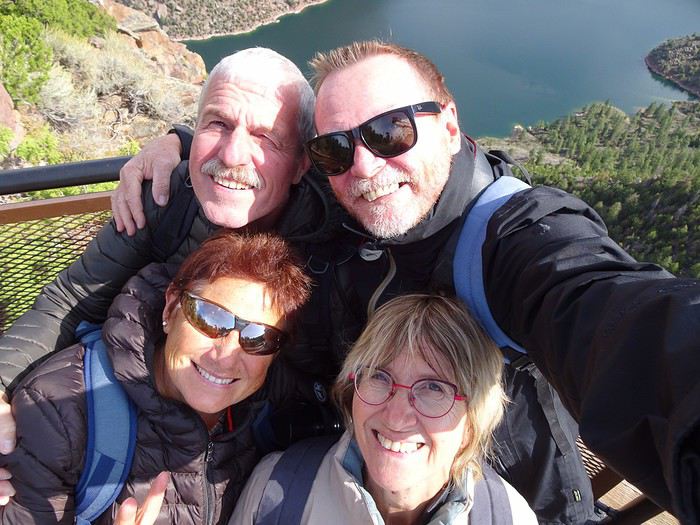
For those who don’t know us, let me introduce our little group. We’re four friends in our sixties (this time, everyone made it, which let us score some "senior" discounts...). We live in the Var region, have known each other for over 20 years, and this was our second trip together to this magical West.
Mimi (Michèle): always the smallest and the funniest. Thank goodness she was there to speak English! Maumau (Maurice): her husband, always with his white hair, his Gallic mustache, his humor, and his Southern accent. He drove every other day. DD (André): the one with the beard, with whom I celebrated our 41st wedding anniversary at Yellowstone. Our second driver appreciated having a peaceful mind since he’s been retired since July. Marcalamar (Martine): that’s me—still blonde with glasses, still talking a lot, and still terrified of messing up the organization of this trip despite all the hours spent on the forum.
 Recognize us? Ha ha ha!!!! No, just kidding!!!!
That’s us!!!
In 2017, struck by western addiction, our first road trip gave us an irresistible urge to return, which we did from September 2nd to 24th, 2019, on a loop from Denver to Denver via Yellowstone. The westernmost point of this journey, which took us through the geographical center of the USA, brought us within about a hundred kilometers of Moab, which had been the easternmost point of our last trip.
We’ve been back for over a month now, and I realize I’m starting to forget some details—it’s high time I started my travel journal before my brain turns into Swiss cheese and lets everything slip away. As I mentioned in my last story, it’ll take me quite a while to finish, so if any travelers have specific questions, don’t hesitate to message me privately. Once again, I’d like to thank everyone who helped me (and there were many!) prepare our road trip, with a special shout-out to Disneydiddl, Hiacinthe, and Titou (ladies first) as well as Fred and Itat, whom I bombarded with questions for months and who always kindly and patiently gave me tons of great tips. It’s thanks to all of you that this trip was such a success. I was a little worried I wouldn’t recapture the emotion and enthusiasm of our 2017 trip, but this one was just as "Wow" as the last.
For those who don’t know us, let me introduce our little group. We’re four friends in our sixties (this time, everyone made it, which let us score some "senior" discounts...). We live in the Var region, have known each other for over 20 years, and this was our second trip together to this magical West.
Mimi (Michèle): always the smallest and the funniest. Thank goodness she was there to speak English! Maumau (Maurice): her husband, always with his white hair, his Gallic mustache, his humor, and his Southern accent. He drove every other day. DD (André): the one with the beard, with whom I celebrated our 41st wedding anniversary at Yellowstone. Our second driver appreciated having a peaceful mind since he’s been retired since July. Marcalamar (Martine): that’s me—still blonde with glasses, still talking a lot, and still terrified of messing up the organization of this trip despite all the hours spent on the forum.
Recognize us? Ha ha ha!!!! No, just kidding!!!!
That’s us!!!HELLO!
For a trip to the Cyclades in early May (1st–18th), we’re planning to visit Naxos, Amorgos, and finish on Paros to catch a flight back to Athens.
I was wondering if we need to book the ferries now or if we can wait a bit... also, for car rental, can we book on the spot?
For accommodations, our bookings are done except for Paros... any suggestions for good value-for-money options?
Also, any other tips about our route or anything else would be super welcome!!!
Thanks in advance from Quebec! 🙂
Christine
Hello everyone!
This travel journal aims to help future travelers (well, I hope so!), since there’s so little information available about this remote archipelago. Big thanks to Lolodesiles and Ayis for answering my questions while I planned this trip!
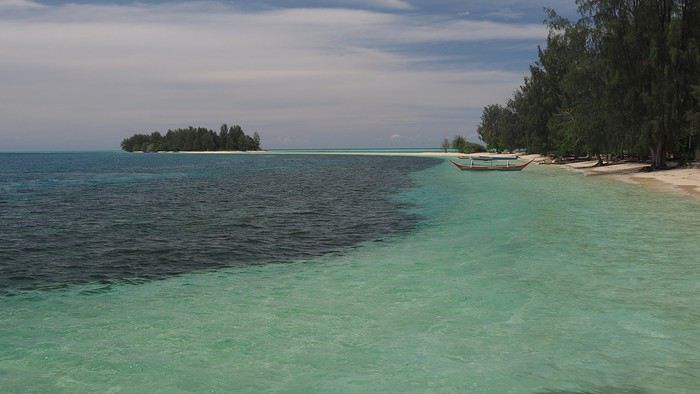
Context This is our fourth trip to Indonesia as a couple—after Java-Bali in 2011, Flores-Komodo in 2013, and Sulawesi in 2016—each time for three weeks. It’s also our tenth trip to Southeast Asia overall.
We’re traveling like we have in previous years: with a rough itinerary that often changes based on who we meet, tips from other travelers, how tired we are, or what we’re feeling in the moment. In the Moluccas, it’ll change constantly, mostly depending on transportation.
Our only accommodation booking: the first few nights in Ambon when we arrive.
Planned route (to be refined on the spot): Ambon - Banda Islands - Lease Islands - Ternate - Tidore - Halmahera (between Sofifi and Tobelo) - Morotai and the neighboring unnamed archipelago.
Flights: Lyon-Paris-Singapore on Air France (428 € round-trip), with good meals, champagne, and wine (we like our little comforts when going on vacation 😏). Then Singapore-Jakarta-Ambon on Air Asia and Garuda. Return flight: Ternate-Jakarta-Singapore on Lion Air, with a 3-day stopover in Singapore before heading home.
Episode 1: Ambon to Banda Our guesthouse, booked two days before departure, is 45 minutes from Ambon Airport, near Natsepa Beach (northeast of Leihitu). It’s a pretty average beach—quiet on weekdays but packed on Sundays (we saw the difference). It’s lined with warungs. This rainy day helps us readjust to the atmosphere of this country we love so much.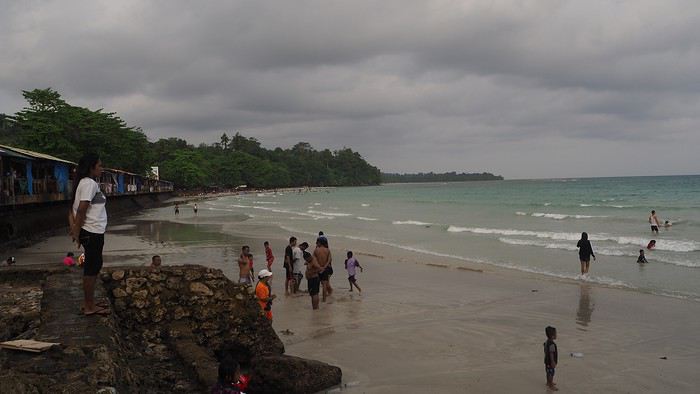
Our “Solim Guesthouse” is a lovely house with a living/dining room and garden, costing 15 € per night for two, including a hearty breakfast. Dinner is at Gaba Gaba, a great restaurant just a short walk away, right by the water, recommended by our host. Fun fact: it’s in the Lonely Planet, and it might be the only LP-listed spot in the Moluccas that actually matches the description (the others either don’t exist or have nothing to do with what’s advertised 😠).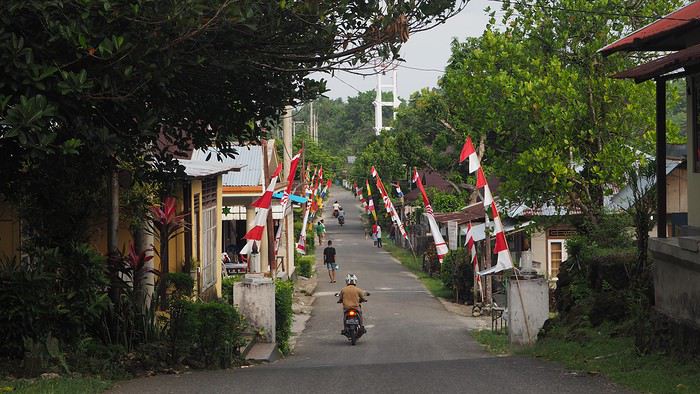
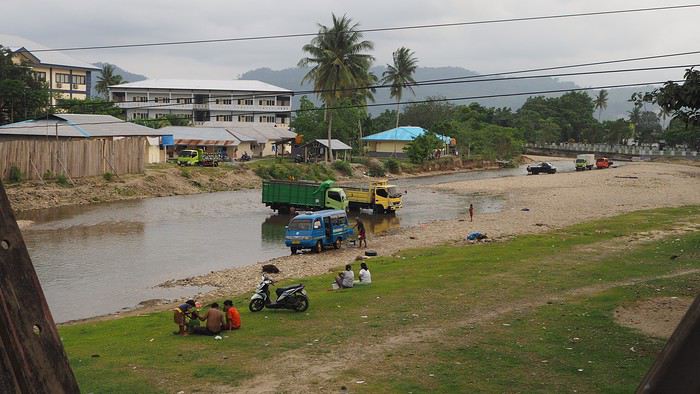
For the next two days, the super-friendly owner lends us his scooter. We set off to explore the coastal villages in northern Leihitu (the western part of Ambon Island, which has a weird shape).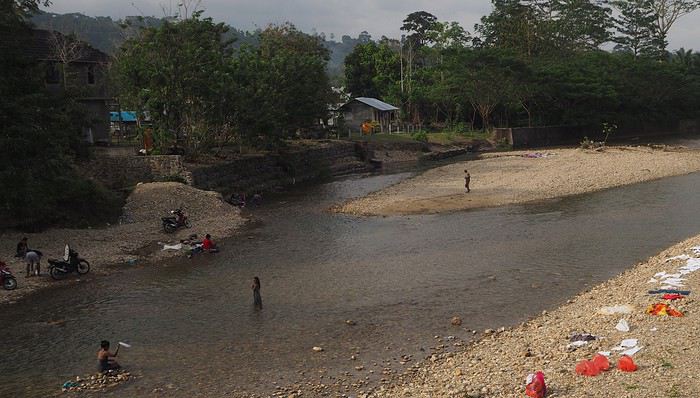 Laundry and trucks washed in the same stream.
Liang Beach, described as the island’s most beautiful, is almost gone (climate change or something else?), but the colors are magical.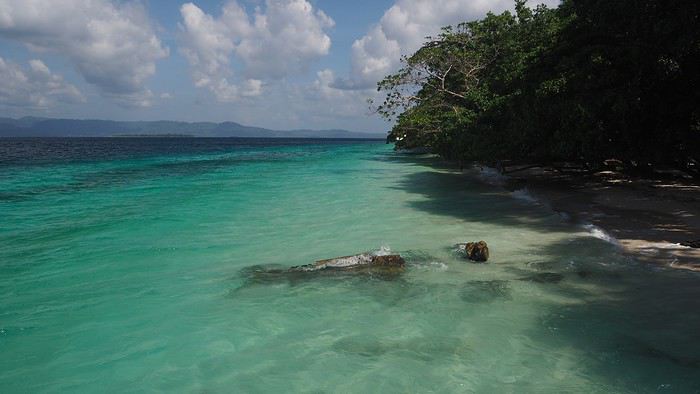
We continue 25 km toward a snorkeling spot our host recommended, taking a gorgeous, deserted little road through tiny villages in clove plantations (oh, those unforgettable scents!), stunning coves, and dense forest.
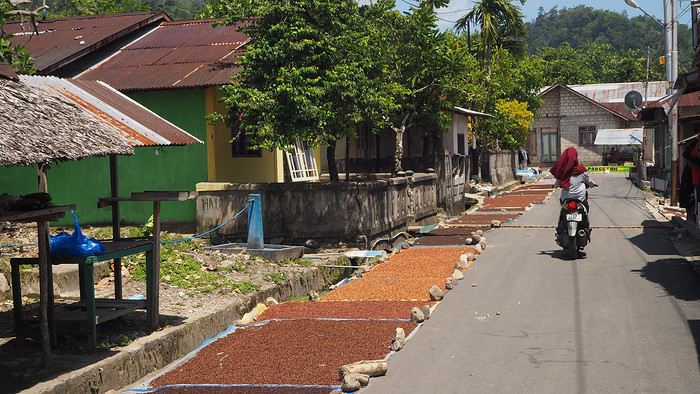
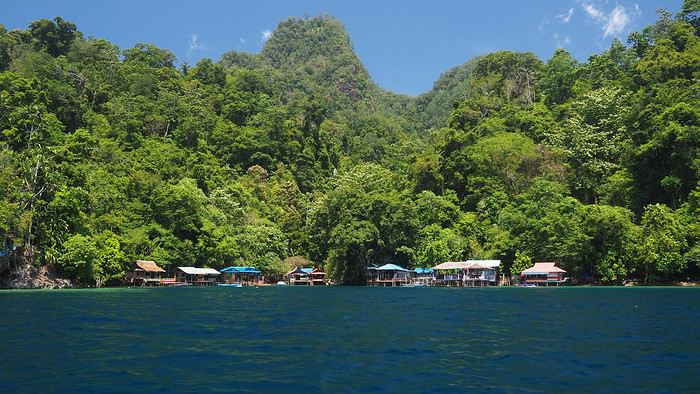 We’re greeted dozens of times with “Hello Mister”—a daily routine in the Moluccas. Every time we stop, we pose for photos to be saved on locals’ smartphones. They don’t see tourists often.
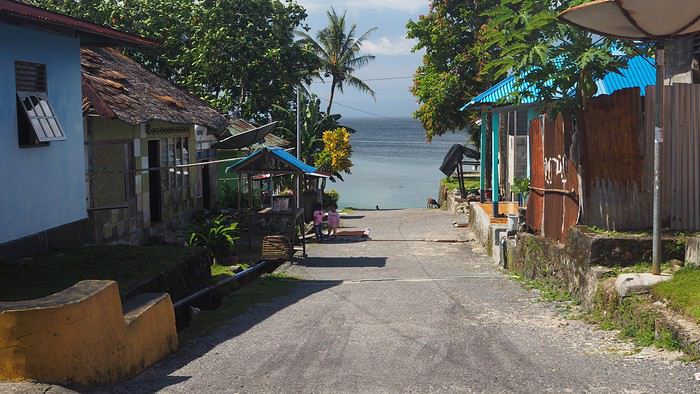
We ask for directions to the snorkeling spot (not easy—we only know basic Indonesian like *Selamat pagi*, *siang*, *sore*, and other polite phrases). Not many people know where it is (especially since we never know which village we’re in), but we eventually reach a small village that seems to be the right place. 🙂
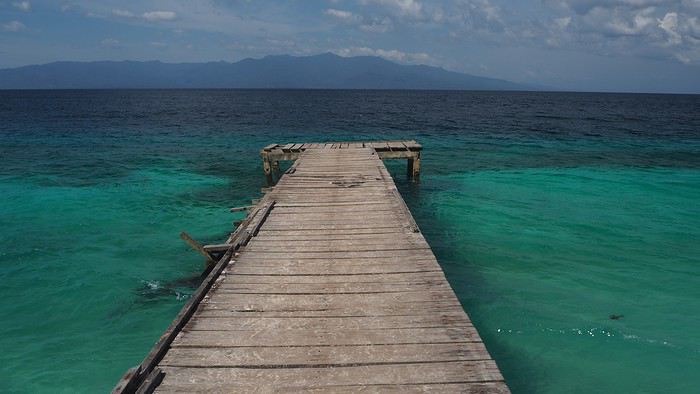
We ask a local to take us there by boat (it’s not reachable by land).
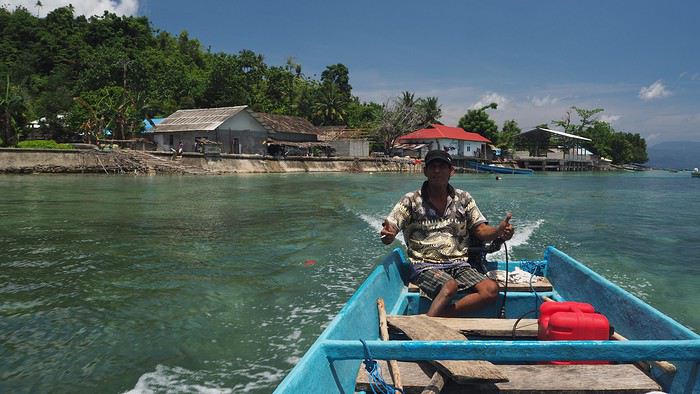
The spot is at most 100 meters long, but the coral is in good condition (apparently not dynamited by fishermen, unlike in other parts of this beautiful country where fishing methods are destructive and nature pays the price 😠). The fish are plentiful and diverse. It’s a great start before heading to Banda. We’re happy to have the place to ourselves… though we don’t yet realize we won’t see a single tourist for the rest of the trip!
After two days of rest, we head to Tulehu Port in the morning, aiming for the Banda Islands. We know the journey is often tricky: the Pelni ferry runs twice a month but doesn’t match our dates, the 10-seat Suzi Air plane is always full (you can’t book—you have to show up on Mondays and Fridays), and it’s often canceled due to weather. So we opt for the Tuesday speedboat (which also gets canceled if there are waves or wind), with the next one on Saturday. We’re used to Indonesian ports—crowded, rusty boats, no English speakers—but we still feel lost. When I ask about the speedboat to Bandaneira, people gesture wildly, someone takes me to the “harbor office,” then tells me there’s no boat, others try to sell me tickets, and some just say, “No boat.”
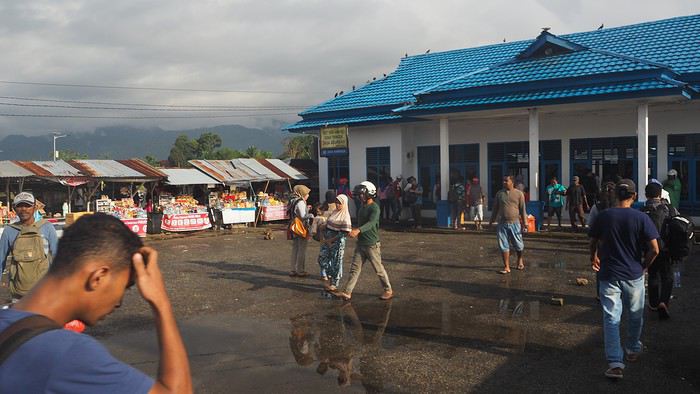
Luckily, an English-speaking local approaches us and confirms the speedboat is broken. The next one will be Saturday *if* it’s fixed—otherwise, even later. 🤪 😠 We’re crushed. We came here for the Banda Islands… 🙁 We decide waiting five days for a maybe-boat isn’t an option, so we decide to head straight to North Moluccas, which was planned for later. We’re so disappointed we don’t even want to stay in the area. The Lease Islands don’t appeal to us despite what we’ve read, and Seram would deserve its own trip with its remote mountain tribes. Huge disappointment—we’d been dreaming of Banda for months, with its incredible drop-offs like Bunaken, its islands covered in nutmeg trees, etc. I’d read that Banda is in the world’s top 5, alongside Bunaken (amazing—we went in 2016), Komodo (incredible—we went in 2013), Sipadan, and another spot I’ve forgotten.
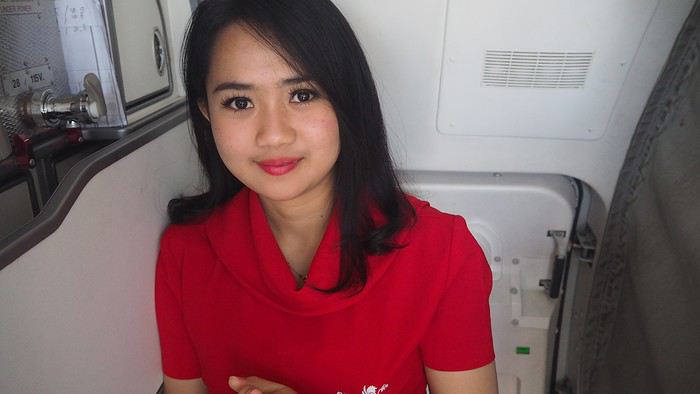
We take a taxi back to Ambon (45 minutes) to a travel agency to buy plane tickets to Ternate. There’s a daily ATR72 flight at noon—perfect timing. Ambon is the capital of South Moluccas (or Central, depending on who you ask!) with 300,000 people. The city doesn’t seem unpleasant, but we don’t stop. On the plane, there are only about ten passengers for 72 seats. The flight attendants are stunning, as always with Wings Air—clearly, they’re hired for their looks. 😊
Stopover in Bacan—a runway in the middle of coconut trees serving a tiny town—then we fly over countless volcanoes, the last one towering over Ternate.
Next episode coming soon: Ternate.
This travel journal aims to help future travelers (well, I hope so!), since there’s so little information available about this remote archipelago. Big thanks to Lolodesiles and Ayis for answering my questions while I planned this trip!
Context This is our fourth trip to Indonesia as a couple—after Java-Bali in 2011, Flores-Komodo in 2013, and Sulawesi in 2016—each time for three weeks. It’s also our tenth trip to Southeast Asia overall.
We’re traveling like we have in previous years: with a rough itinerary that often changes based on who we meet, tips from other travelers, how tired we are, or what we’re feeling in the moment. In the Moluccas, it’ll change constantly, mostly depending on transportation.
Our only accommodation booking: the first few nights in Ambon when we arrive.
Planned route (to be refined on the spot): Ambon - Banda Islands - Lease Islands - Ternate - Tidore - Halmahera (between Sofifi and Tobelo) - Morotai and the neighboring unnamed archipelago.
Flights: Lyon-Paris-Singapore on Air France (428 € round-trip), with good meals, champagne, and wine (we like our little comforts when going on vacation 😏). Then Singapore-Jakarta-Ambon on Air Asia and Garuda. Return flight: Ternate-Jakarta-Singapore on Lion Air, with a 3-day stopover in Singapore before heading home.
Episode 1: Ambon to Banda Our guesthouse, booked two days before departure, is 45 minutes from Ambon Airport, near Natsepa Beach (northeast of Leihitu). It’s a pretty average beach—quiet on weekdays but packed on Sundays (we saw the difference). It’s lined with warungs. This rainy day helps us readjust to the atmosphere of this country we love so much.
Our “Solim Guesthouse” is a lovely house with a living/dining room and garden, costing 15 € per night for two, including a hearty breakfast. Dinner is at Gaba Gaba, a great restaurant just a short walk away, right by the water, recommended by our host. Fun fact: it’s in the Lonely Planet, and it might be the only LP-listed spot in the Moluccas that actually matches the description (the others either don’t exist or have nothing to do with what’s advertised 😠).
For the next two days, the super-friendly owner lends us his scooter. We set off to explore the coastal villages in northern Leihitu (the western part of Ambon Island, which has a weird shape).
Laundry and trucks washed in the same stream.
Liang Beach, described as the island’s most beautiful, is almost gone (climate change or something else?), but the colors are magical.
We continue 25 km toward a snorkeling spot our host recommended, taking a gorgeous, deserted little road through tiny villages in clove plantations (oh, those unforgettable scents!), stunning coves, and dense forest.
We’re greeted dozens of times with “Hello Mister”—a daily routine in the Moluccas. Every time we stop, we pose for photos to be saved on locals’ smartphones. They don’t see tourists often.We ask for directions to the snorkeling spot (not easy—we only know basic Indonesian like *Selamat pagi*, *siang*, *sore*, and other polite phrases). Not many people know where it is (especially since we never know which village we’re in), but we eventually reach a small village that seems to be the right place. 🙂
We ask a local to take us there by boat (it’s not reachable by land).
The spot is at most 100 meters long, but the coral is in good condition (apparently not dynamited by fishermen, unlike in other parts of this beautiful country where fishing methods are destructive and nature pays the price 😠). The fish are plentiful and diverse. It’s a great start before heading to Banda. We’re happy to have the place to ourselves… though we don’t yet realize we won’t see a single tourist for the rest of the trip!
After two days of rest, we head to Tulehu Port in the morning, aiming for the Banda Islands. We know the journey is often tricky: the Pelni ferry runs twice a month but doesn’t match our dates, the 10-seat Suzi Air plane is always full (you can’t book—you have to show up on Mondays and Fridays), and it’s often canceled due to weather. So we opt for the Tuesday speedboat (which also gets canceled if there are waves or wind), with the next one on Saturday. We’re used to Indonesian ports—crowded, rusty boats, no English speakers—but we still feel lost. When I ask about the speedboat to Bandaneira, people gesture wildly, someone takes me to the “harbor office,” then tells me there’s no boat, others try to sell me tickets, and some just say, “No boat.”
Luckily, an English-speaking local approaches us and confirms the speedboat is broken. The next one will be Saturday *if* it’s fixed—otherwise, even later. 🤪 😠 We’re crushed. We came here for the Banda Islands… 🙁 We decide waiting five days for a maybe-boat isn’t an option, so we decide to head straight to North Moluccas, which was planned for later. We’re so disappointed we don’t even want to stay in the area. The Lease Islands don’t appeal to us despite what we’ve read, and Seram would deserve its own trip with its remote mountain tribes. Huge disappointment—we’d been dreaming of Banda for months, with its incredible drop-offs like Bunaken, its islands covered in nutmeg trees, etc. I’d read that Banda is in the world’s top 5, alongside Bunaken (amazing—we went in 2016), Komodo (incredible—we went in 2013), Sipadan, and another spot I’ve forgotten.
We take a taxi back to Ambon (45 minutes) to a travel agency to buy plane tickets to Ternate. There’s a daily ATR72 flight at noon—perfect timing. Ambon is the capital of South Moluccas (or Central, depending on who you ask!) with 300,000 people. The city doesn’t seem unpleasant, but we don’t stop. On the plane, there are only about ten passengers for 72 seats. The flight attendants are stunning, as always with Wings Air—clearly, they’re hired for their looks. 😊
Stopover in Bacan—a runway in the middle of coconut trees serving a tiny town—then we fly over countless volcanoes, the last one towering over Ternate.
Next episode coming soon: Ternate.
Hi everyone!!!
I’m finally getting around to writing about this 20-day trip to southern Italy: we didn’t travel this summer, and luckily, we found beautiful light and dreamy weather there at the end of September.
First, here’s the context of the trip: we’re both "confirmed seniors" but still curious and alert enough to enjoy the itinerary we’d imagined! We wanted a mix of discoveries—culture, cities, and nature—with guaranteed sunshine and the occasional short hike... We’re flying to Naples, round-trip, because the flight times work better for us. We rented a car online, picked it up at the airport (details to come... and it won’t be the highlight of the trip!), and booked our hotels in advance.
A quick overview of the itinerary: leaving Naples on September 15th, early in the morning, we’ll drive straight across the boot of Italy to Bari. After 11 days in Puglia, we’ll head back toward our starting point, taking our time: Matera in Basilicata, Maratea by the sea, and finally Paestum with its incredible temples.
Day 1: Brussels-Naples flight (Brussels Airlines) went smoothly; it landed an hour early, and we were thrilled, thinking we could use that time for a quick visit or two... Everything went well until we left the airport. We took the shuttle to the car rental offices, and at first glance, we realized this wouldn’t be smooth sailing!!! In front of every office (they’re side by side), there were already lines and kids sitting on suitcases—everyone looked exhausted... We resigned ourselves to waiting: nothing moved until tempers flared at the counters, and two people nearly came to blows. Things sped up a little, and after 2 (two...) hours of waiting, we finally got our chariot: a black Fiat Tipo, dirty, with a few dents and scratches that we made sure to note in the contract... but it ran!
Off to Bari, then: no time for sightseeing along the way! From there, we headed straight to our hotel in the countryside near Polignano a Mare.
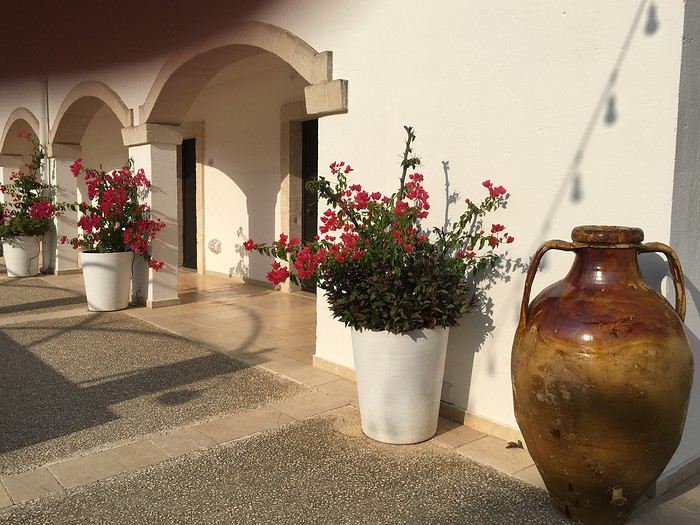
A recurring detail: this happened constantly during our travels. We’d installed our own GPS, fully updated... In recent years, many dirt roads have become drivable, and lots of hotels and hostels have opened in the outskirts of towns. It was extremely rare for our ‘guide’ to recognize the street—let alone the number—we entered. Often, we got by calling the hotel reception: it might seem like a small thing, but it happened so often it became frustrating. In hindsight, it seems like without Google Maps, we’d have been lost!
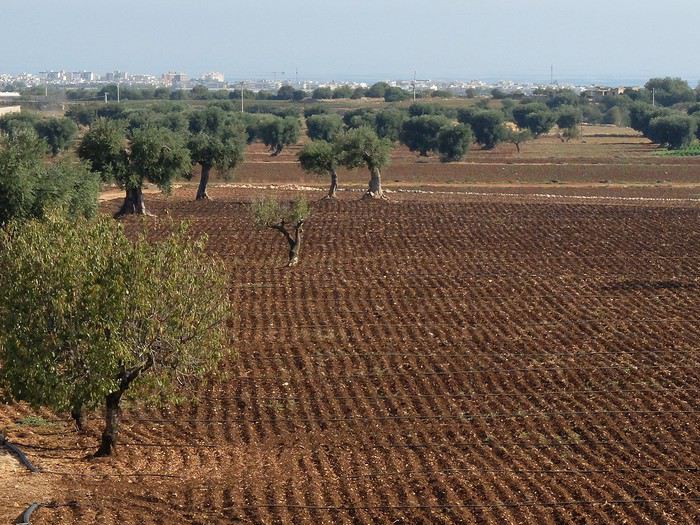
Anyway, we were beautifully settled, with a terrace overlooking olive groves and the sea in the distance: all was well.
To be continued...
I’m finally getting around to writing about this 20-day trip to southern Italy: we didn’t travel this summer, and luckily, we found beautiful light and dreamy weather there at the end of September.
First, here’s the context of the trip: we’re both "confirmed seniors" but still curious and alert enough to enjoy the itinerary we’d imagined! We wanted a mix of discoveries—culture, cities, and nature—with guaranteed sunshine and the occasional short hike... We’re flying to Naples, round-trip, because the flight times work better for us. We rented a car online, picked it up at the airport (details to come... and it won’t be the highlight of the trip!), and booked our hotels in advance.
A quick overview of the itinerary: leaving Naples on September 15th, early in the morning, we’ll drive straight across the boot of Italy to Bari. After 11 days in Puglia, we’ll head back toward our starting point, taking our time: Matera in Basilicata, Maratea by the sea, and finally Paestum with its incredible temples.
Day 1: Brussels-Naples flight (Brussels Airlines) went smoothly; it landed an hour early, and we were thrilled, thinking we could use that time for a quick visit or two... Everything went well until we left the airport. We took the shuttle to the car rental offices, and at first glance, we realized this wouldn’t be smooth sailing!!! In front of every office (they’re side by side), there were already lines and kids sitting on suitcases—everyone looked exhausted... We resigned ourselves to waiting: nothing moved until tempers flared at the counters, and two people nearly came to blows. Things sped up a little, and after 2 (two...) hours of waiting, we finally got our chariot: a black Fiat Tipo, dirty, with a few dents and scratches that we made sure to note in the contract... but it ran!
Off to Bari, then: no time for sightseeing along the way! From there, we headed straight to our hotel in the countryside near Polignano a Mare.
A recurring detail: this happened constantly during our travels. We’d installed our own GPS, fully updated... In recent years, many dirt roads have become drivable, and lots of hotels and hostels have opened in the outskirts of towns. It was extremely rare for our ‘guide’ to recognize the street—let alone the number—we entered. Often, we got by calling the hotel reception: it might seem like a small thing, but it happened so often it became frustrating. In hindsight, it seems like without Google Maps, we’d have been lost!
Anyway, we were beautifully settled, with a terrace overlooking olive groves and the sea in the distance: all was well.
To be continued...
I recently took a six-week trip to Mexico with Y, my Thai partner. To be precise, we spent 43 days there plus a final half-day before heading to Mexico City Airport for our return flight to Europe.
I’d already been to Mexico about 40 years ago! But that was only for a week or so, between Mérida and the Belize border.
First off, I should mention that I’ve never seen a beach in Mexico. I say this because discussions about Mexico always seem to revolve around the Costa / Riviera Maya.
Let’s start with an overview of the trip. Our itinerary can be split into two halves:
- First half: Querétaro, San Miguel de Allende, Morelia, Guanajuato, Mexico City “CDMX” (the capital). - Second half: Palenque, San Cristóbal de Las Casas, Chiapa de Corzo, Oaxaca, Puebla, Cholula, and finally Mexico City CDMX.
To move from one part of the trip to the other, we took a flight from Mexico City CDMX to Villahermosa, then a bus to Palenque.
In six weeks, we visited maybe a quarter or a fifth of the country (see the attached maps). Mexico is about three times the size of France! And when I say “visited,” it was really just a quick stop—enough to get a first impression. I understand that some people can only spend one or two weeks on vacation in a given country, but that’s not my idea of travel. Personally, I’d say a country as rich in every way as Mexico deserves several months of travel before you can say you’ve “seen” it.
In my next post, I’ll break down the expenses. That might help future travelers plan their trips. You don’t go to a country for several weeks (or more) without thinking about the budget! Besides, one of those future travelers to Mexico is us—we were so thrilled by Mexico that we’re definitely going back.
Hi everyone, I just got back from a trip to Northern India with my family. Given the time it took to organize, I thought future travelers might find this useful.
Context: First time in India. Dates: August 5 to August 23. 2 adults + 2 boys (17 and 11 years old). Itinerary: Delhi - Shekawati (Bagar, Mandawa) - Bikaner - Thar Desert (Kaku) - Jaisalmer - Jodhpur - Udaipur - Bundi - Jaipur - Agra - Delhi. High-end hotels, travel in a Toyota Innova (like a Renault Espace) with a driver. Agency: Atithi Travels, contact: Rajeev, Driver: William. Budget: 3112 € for flights (Air India chartered by Air France and booked through Go Voyages), 1080 US$ per person for hotels with breakfast, car with driver, full-board night in the desert, camel ride, boat on the lake in Udaipur, farewell dinner, 1000 € for on-site expenses (drinks and meals—1 per day / various tips including driver (150 rupees per day) / monuments and outings / personal shopping and gifts (including 2 carpets 1x2m, 1 bedspread, a pair of curtains, 10 shirts, 2 pairs of pants, 2 tablecloths, 5 scarves, 1 small piece of jewelry, and various trinkets...). In short, about 1900 € per person all-inclusive for 17 nights.
Review of Atithi Travels: Very professional and accommodating. They responded quickly to my many prep emails, accepted all my hotel choices—even those they weren’t used to working with (I picked them beforehand using TripAdvisor, VoyageForum, the *Routard* guide, and Ulysses’ Rajasthan guide). They were the only agency out of the nine I consulted that accepted all my choices. Their pricing was reasonable, in the first quartile of the agencies I contacted. They allowed payment in three installments (1/3 at booking by bank transfer, 1/3 upon arrival in India, 1/3 in Udaipur). They checked in throughout the trip to ensure everything was going well with the driver and local reps. They offered a great solution for the night in the desert. My direct contact (Rajeev) personally picked us up at Delhi airport on the evening of the 5th (a Sunday). If I had to do it again, I’d go with Atithi again without hesitation—just negotiate the prices a bit.
Review of the Driver (William): He drove very cautiously (which is super important in this country). He kept his distance from his "guests," which worked perfectly for us. No hard sell to take us to shops or restaurants. Just so you know, the driver gets 150 rupees per day for lodging and meals. When he stops at a tourist restaurant, especially on the road, he eats for free (for you, if you eat there, it’s 2–3 times more expensive than elsewhere). Some shops, especially in Jaipur, give him commissions. Overall, we had an unspoken agreement. The driver would stop halfway through the journey at a tourist restaurant so we could use clean toilets, grab a Coke, and he could eat and rest (after 2.5 hours on the road in India, it’s well-deserved and necessary). After 30 minutes, we’d hit the road again. For shops, he didn’t pressure us, and we were very clear about stopping only at places we’d chosen (via Lonely Planet, for example). Overall, we were happy with his service.
Review of the Stops: Generally speaking, in very touristy places, you’re constantly approached by touts and vendors. As soon as you move away from those spots, Indians are welcoming, friendly, and happy to chat with foreigners. Between each stop, it’s 4–6 hours because the roads are tough—average speed is 50 km/h. Keep this in mind when planning your route. We chose to stay 2 nights in most places to avoid spending all our time in the car. Delhi: Worth seeing, but rough for a first impression—loud in some areas, aggressive, but we don’t regret it. For our first taste of Indian cuisine, we dined at United Coffee House on Connaught Place, a restaurant for the Indian middle class. It was delicious, really nice, and reassured us that we’d enjoy the food. Shekawati: Amazing, off the beaten path, not very touristy, and the people are friendly. Note: Bagar, which we picked after reading an article in *Ulysses*. It’s off the usual routes. Result: we were the only tourists in this small town and had a fantastic evening. Mandawa (just an hour from Bagar) is on all the Shekhawati circuits, so it’s more touristy. But still nice because of the colorful Havelis (go see them alone, without clingy guides trying to charge you extra for every visit without giving all the details—only the rupees matter to them). Note: there’s a great, affordable cobbler on the main street of Mandawa (Main Bazaar), just before Sonathia Gate on the right. Beautiful handmade slippers for 300 rupees. By the end of the trip, I regretted not buying more pairs—the leather is so soft and comfortable. I haven’t seen any as nice since. Bikaner: Good, a necessary stop before crossing the desert if you’re heading to Jaisalmer (recommended). It lets you see the Karni Mata Temple (Temple of the Rats), a camel farm, a first Jain temple, a quiet spice bazaar (take a rickshaw for a morning), and the well-maintained fort. Kaku (night in the Thar Desert): A highlight, absolutely must-do. Nothing like what you’ll find in Jaisalmer. Simple, remote, and wild—no tourist buses, just you and the few Indians taking care of you. Watching the sunset, the starry sky, shooting stars, and sleeping under the stars is unforgettable. It’s neither too cold nor too hot. The toilet facilities are basic but hygienic. It’s fantastic, and the whole family loved it. Jaisalmer: Very exotic, at the edge of Rajasthan, right out of the Thar Desert. A magical little town. Watch the sunset near the cenotaphs, visit Gadi Sagar for a picturesque stop with a temple by the lake, lots of Indians feeding huge catfish, and pedal boats for rent. Nearby, the best lassi of the trip at "Mohan Juice Center." Don’t miss the three Havelis—take the back streets if you want to avoid the touristy areas. As for the classic camel ride at sunset, know that the dune spots are beautiful, but at the same spot, at the same time, hundreds (no exaggeration) of tourists arrive by the busload, each on their own camel (hundreds of them), with vendors selling drinks, trinkets, and impromptu shows. It kills the dream. Jodhpur: The Mehrangarh Fort is EXCEPTIONAL, very well maintained, with a great audio guide in French. The most beautiful fort/palace visit of the whole trip. The restaurant inside is excellent. Spend a morning there, and don’t forget to visit the temple at the end of the ramparts for a top-notch view of the Blue City. Around the Clock Tower, you can try delicious, fresh lassis at Shri Mishrilal Hotel, mostly frequented by locals, and grab a tasty masala omelet on the go at Vicky’s Omelette Shop—he’s always smiling and collects notebooks full of messages from his customers. We found beautiful cashmere scarves at Handloom House, a fixed-price shop with good prices. Ranakpur: Another highlight. An exceptional Jain temple in the middle of nature. We chatted with the high priest, ate in the refectory at 5 PM (meals at 5, 5:30, and 6 PM) with locals (super good, all-you-can-eat for 20 rupees per person). Our only regret: not staying overnight. For just 50 rupees more, you can sleep in simple but clean cells and attend the evening ceremony, see the temple at sunset (otherwise, it closes at 5 PM), and be alone in the middle of nowhere. It’s also a lush place full of non-aggressive monkeys that take what you give them from your hand. Don’t miss it under any circumstances. Udaipur: Unique and charming, our first glimpse of Ghats on this trip with Indians bathing in the morning and doing laundry. The lake is enchanting, and the Hindu temple is special. Dinner at Jagat Niwas Palace Hotel (where we were staying) with a stunning view of the lake. Very good food, reasonable prices, and an exceptional setting. Bundi: First regret. A charming little town off the tourist trail, but dull after Shekawati. Not much to see. Jaipur: Second regret. VERY aggressive, overcrowded, with glaring poverty in the streets, persistent beggars, relentless vendors, deafening traffic, and endless traffic jams. The Hawa Mahal is on a polluted main road, and the Amber Fort is a tourist trap. It’s poorly maintained, and the elephant ride is the ultimate tourist attraction: hundreds of tourists on elephants in a line, 550 rupees for 2 people for a 10-minute ride, with vendors shouting the whole way while the elephant handler reminds you 10 times to tip him. Tourism at its worst. Don’t go unless you’re with young kids who’ll remember riding an elephant forever. Even then, it’s possible in other cities like Udaipur. Don’t believe your driver if he says not to shop before Jaipur because that’s where the best selection and prices are. It’s false. There’s no more selection (except for jewelry), prices aren’t lower, and the quality isn’t better. It’s just a big city with lots of shops that pay commissions to touts. Still, there’s a beautiful textile shop that doesn’t look like much but has fixed prices, is affordable, and offers superb quality: SOMA (http://www.somashop.com/). The local middle and upper classes shop there for home textiles (tablecloths, bedspreads, sheets, curtains) and clothes. This shop is even mentioned by *Forbes* as one of the "World's Top Shops" (http://www.forbes.com/..._sb_1215feat_ls.html). The one positive in Jaipur: Raj Mandir, a historic, stunning cinema. You can go with your eyes closed—guaranteed atmosphere with Indians cheering, laughing, and taking sides for the characters. Even without speaking the language, we understood everything and had a great family moment. Plus, there’s an intermission to grab a snack. It’s fantastic. The theater is often full, but you can reserve. Nearby, the Galta Temple is picturesque with hundreds of monkeys and kids bathing in the pools. Fun, especially in the late afternoon. If we had to do it again, we’d skip Jaipur—too noisy, too aggressive. Agra: Just before Agra, stop at Fatehpur Sikri. The visit takes about 3 hours. It’s beautiful. I regret not staying overnight to admire Akbar the Great’s city at sunset. In Agra, the Taj Mahal is king. Our best photos were taken from the Yamuna River. From there, the Taj is stunning (its back = its front), and you can stay as long as you want (it’s free). The next day, we visited at 6 AM and stayed for 4 hours—it was peaceful and gorgeous.
Overall, we would’ve liked one more night in Ranakpur, one more in Udaipur, one in Fatehpur Sikri, and just one in Jaipur to see the Hawa Mahal and go to the Raj Mandir.
Review of the Hotels
Delhi / Amaraya Haveli: Clean and nice, run by two French people in a quiet neighborhood of New Delhi. Comfortable rooms, good breakfast, clean, a bit pricey. Satisfaction rating: 3 out of 5
Bagar / Piramal Haveli: A charming stop, a Haveli from the early 20th century, with very large rooms, warm and attentive service, and a GREAT dinner. All for a modest price since it’s off the tourist trail. Highly recommend. Satisfaction rating: 5 out of 5
Mandawa / Desert Resort: Outside the city, at the edge of the desert. Rooms are in "traditional" huts with all the comforts. There’s a pool, and it’s very quiet. Breakfast is mediocre. Avoid dinner—it’s a rip-off (three times more expensive than elsewhere and not good). Satisfaction rating: 4 out of 5
Bikaner / Lallgarh Palace: Former maharaja’s palace, well maintained, gorgeous rooms with marble everywhere, a large art-deco indoor pool, good restaurant, very classy. Worth the price. Satisfaction rating: 5 out of 5
Jaisalmer / Gorbandh Palace: Large modern hotel mimicking local architecture. Big pool, but the rooms are poor—noisy and small. Mediocre breakfast. Satisfaction rating: 2 out of 5
Jodhpur / Ajit Bhawan: Former residence, very classy, Hollywood-style pool with waterfalls and fountains, comfortable rooms tastefully decorated. Great breakfast. Satisfaction rating: 5 out of 5
Udaipur / Jagat Niwas Palace: By the lake, very charming, good food, restaurant with an exceptional view, very romantic, but the room amenities are mediocre. Satisfaction rating: 5 out of 5
Bundi / Braj Bhushanjee: The best hotel in Bundi, in a beautifully decorated old Haveli. The rooms are mediocre and very noisy. Breakfast is average, but the welcome is warm. Satisfaction rating: 2 out of 5
Jaipur / Samode Haveli: Exceptional, very comfortable, gorgeous pool, spacious rooms, attentive and non-pushy service, free Wi-Fi, beautiful restaurant, great breakfast. Satisfaction rating: 5 out of 5
Agra / Howard Park Plaza: A mid-range chain hotel with a small pool. Comfortable enough, limited service, terrible breakfast. Satisfaction rating: 1 out of 5
If this feedback was helpful, feel free to leave me a message.
Thierry
This catchy and somewhat mysterious title comes from several questions I’ve been asking myself.
VF has been back open for a reasonable number of weeks and months now. The number of visitors overall matches past averages, but the number of members online in the last 24 hours seems relatively lower than what we used to see.
Yet, to my surprise, I’m seeing fewer travel journals, way fewer messages, and way fewer questions. I don’t see many new registered users online, and I notice a number of members who are logged in but either aren’t participating or have stopped participating.
Something’s not adding up for me because, in my opinion, VF is still appealing, and I don’t see which other sites could really compete.
Was there a real break between pre- and post-Covid? Does it just take more time for some people to discover the site or learn that it’s active again? Do people now prefer quick consumption on sites like FB or others I’m not familiar with? Where have the site’s old-timers gone, and what are they doing with their time now? What’s really going on here?
Hello everyone,
We’ve decided to head to Quebec next year—it’s been a dream for the whole family (after watching so many travel shows and the like...). There’ll be five of us: 2 adults, 2 teens (16 and 13), and a child (8 years old). We’re all pretty good walkers, though maybe the teens a little less so—it’s just that age, you know? 😊 That said, they’ve got no problem doing 15 km hikes, just not every single day.
We’re planning to go from July 23 to August 14, arriving and departing from Montreal, so almost 3 weeks. I’ve started looking into logistics and accommodation prices, but before I dive into bookings, I’d love some advice on the itinerary. I’ve read a few threads here and there. Our idea is to visit between 3 and 5 different places over the 3 weeks, so that means the same number of accommodations. The goal is to optimize travel as much as possible—I’ve realized that getting around can take a long time. I think the first two days will be in Montreal to adjust to the time difference, and the last two in Quebec City, though that’s not set in stone.
Anyway, I’m not really sure about the route. I’ve got time to plan everything, but I know the longer we wait, the more expensive and scarce accommodations will get. Same goes for budget—we’ve set aside a mid-range budget, flights included: 3k per person (1k for the flight). So if you’ve got any great tips or advice, we’re all ears!
I was thinking of going up the St. Lawrence River, but I’m not sure how long that takes or where to stop. Maybe there are other places worth visiting farther away...
Anyway, thanks for reading this far! If you’ve got any questions, don’t hesitate.
Thanks, everyone.
Hi,
I’ve read that trains in India are packed and it’s pretty tough to find seats 2-3 days in advance... Apparently, there’s still a small tourist quota for available seats, but they’re limited. Would anyone have more specific info on this?
I’ve read that trains in India are packed and it’s pretty tough to find seats 2-3 days in advance... Apparently, there’s still a small tourist quota for available seats, but they’re limited. Would anyone have more specific info on this?
Hi everyone,
We’re planning to head to Québec on June 11th (departing from CDG) and return around July 3rd, leaving from Toronto—so about 3 weeks there, traveling by rental car.
We’re thinking of stopping in Ottawa to visit a friend.
We’d love to see the "must-see" spots, but not *too* many, along with nature, parks, some short hikes, canoeing, a seaplane ride, and wrapping up with Niagara Falls.
Do you think we can fit all that into the time we have?
What are the spots you’d recommend not missing along our route?
Is a short trip to Gaspésie at the start of our trip worth considering?
Anyway, as you’ve probably guessed, we’re still in the early planning stages and aren’t quite sure how to organize everything 🤪
Thanks in advance for your thoughts and advice!
Hi there,
We’re leaving from Montreal and planning to bike the Petit Train du Nord route.
Any ideas for loops so we don’t have to return the same way?
We’re thinking of a one-week trip.
Thanks in advance for your tips!
Rachel
During our first road trip across the United States, we covered 23,000 km and crossed 28 states in 53 days.
Originally, we had planned to drive Route 66 all the way to Oatman in Arizona and visit various national parks in the American West over a two-month period.
This itinerary was planned before our departure, and all the relevant information had been gathered to stick to the schedule.
Everything went so smoothly that we finished visiting the national parks well ahead of our planned return date.
It helped that having a bed, a portable toilet, and a cooler in our vehicle gave us some autonomy since we didn’t have to worry about accommodation.
So, we decided to extend our road trip to the cities of Nashville and Memphis in Tennessee.
We then headed to Louisiana to visit Baton Rouge and New Orleans.
We crossed Mississippi and Alabama before driving along Florida’s west coast all the way to Key West.
We returned via Florida’s east coast and then crossed the eastern U.S. states to get back to Quebec through the Jackman border crossing in Maine.
So, I invite you to keep reading this long recap, which will let you discover the different attractions we visited throughout this amazing journey.
Videos are included throughout the recap. Click on the image to start the video.
To jump to a specific post, here are the relevant links:
Route 66 - Illinois & Missouri Route 66 - St. Louis (Missouri) - Gateway Arch National Park Route 66 - Cuba (Missouri) - City Murals Route 66 - Springfield (Missouri) - Fantastic Caverns Route 66 - Kansas & Oklahoma Route 66 - Texas & Arizona Route 66 - Texas - The Stations of the Cross in Groom Route 66 - Texas - Panhandle - VW Slug Bug Ranch Texas - Palo Duro Canyon State Park - Juniper Trails Texas - Palo Duro Canyon State Park - The Lighthouse Trail Route 66 - Texas - Amarillo - Cadillac Ranch Route 66 - New Mexico - Santa Rosa Blue Hole New Mexico - Bandelier National Monument - Alcove House Trail via Main Loop Trail New Mexico - Bandelier National Monument - Tsankawi Ruins Trail New Mexico - White Rock Overlook Route 66 - New Mexico - Albuquerque - Old Town New Mexico - White Sands National Park New Mexico - White Sands National Park - Dune Life Nature Trail New Mexico - White Sands National Park - Playa Trail New Mexico - White Sands National Park - Interdune Boardwalk New Mexico - Gila Cliff Dwellings National Monument New Mexico - Grants - Ice Cave & Bandera Volcano New Mexico - Gallup - Pyramide Rock Trail & Church Rock Trail Arizona - Holbrook - Painted Desert Arizona - Petrified Forest National Park - Puerco Pueblo & Newspaper Rock Viewpoint Arizona - Petrified Forest National Park - Blue Mesa Arizona - Petrified Forest National Park - The Teepees, Agate Bridge & Jasper Forest Overlook Arizona - Petrified Forest National Park - Crystal Forest Trail Arizona - Petrified Forest National Park - Giant Logs Trail Arizona - Winslow - Two Guns Ghost Town Arizona - Cameron - Little Colorado River Gorge Overlooks Arizona - Grand Canyon National Park - Shoshone Point Trail Arizona - Grand Canyon National Park - Desert View Drive Arizona - Grand Canyon National Park - Rim Route (Orange) & Village Route (Blue) Arizona - Grand Canyon National Park - Hermit Route (Red Line) Route 66 - Arizona - Historic Town of Oatman Arizona - Bullhead City Community Park Nevada - Red Rock Canyon - Calico I & II & Sandstone Quarry Nevada - Red Rock Canyon - Willow Springs Nevada - Red Rock Canyon Lookouts Nevada - Valley of Fire State Park - White Domes Trail Nevada - Valley of Fire State Park - Seven Wonders Trail, Pink Canyon, Fire Wave Nevada - Valley of Fire State Park - Rainbow Vista Trail Nevada - Valley of Fire State Park - Mouse's Tank Trail Nevada - Valley of Fire State Park - Rock Formations Nevada - Valley of Fire State Park - Scenic Routes Nevada - Cathedral Gorge State Park - Slot Canyons Nevada - Cathedral Gorge State Park - Eagle Point & Miller Point Utah - Bryce Canyon National Park - Mossy Cave & Tropic Ditch Waterfall Trail Utah - Bryce Canyon National Park - Scenic Drive Utah - Zion National Park - Pa'rus Trail Utah - Zion National Park - Sand Bench Trail Utah - Zion National Park - Emerald Pools Trail Utah - Zion National Park - West Rim Trail (Trail connecting to Angels Landing) Utah - Zion National Park - Riverside Walk Utah - Zion National Park - Court of The Patriarchs & Big Bend Utah - Zion National Park - Mount Carmel Highway Scenic Drive Utah - Kanab - Jackson Flat Reservoir Utah - Toadstools Trail in Grand Staircase-Escalante National Monument Arizona - Page - Glen Canyon Dam Overlook Arizona - Page - Glen Canyon National Recreation Area Arizona - Page - Horseshoe Bend Overlook Arizona - Page - Upper Antelope Canyon Arizona - Page - Navajo Canyon Boat Tour at Lake Powell Arizona - Page - Antelope Canyon X Arizona - Canyon de Chelly National Monument - Chelly Canyon Arizona - Canyon de Chelly National Monument - Canyon del Muerto Arizona - Monument Valley Navajo Tribal Park Utah - Mexican Hat Utah - Mexican Hat - Goosenecks State Park Utah - Mexican Hat - Valley of the Gods Utah - The Moki Dugway Scenic Backway Utah - Blanding - Natural Bridges National Monument Utah - Lake Powell - Hite Crossing Bridge Utah - Lake Powell - Glen Canyon National Recreation Area - Hite Overlook Utah - Capitol Reef National Park - Chimney Rock Loop Trail Utah - Capitol Reef National Park - Hickman Bridge Trail Utah - Capitol Reef National Park - Grand Wash Trail Utah - Capitol Reef National Park - Sunset Point Trail Utah - Capitol Reef National Park - Goosenecks Trail Utah - Capitol Reef National Park - Viewpoints - Fruita Area Utah - Capitol Reef National Park - Viewpoints - Scenic Drive Utah - Capitol Reef National Park - Cassidy Arch Trail Utah - Capitol Reef National Park - On the way to Capitol Gorge Trailhead Utah - Capitol Reef National Park - Capitol Gorge Trailhead Utah - Monroe - Mystic Hot Springs Utah - Scenic Overlooks on UT-24, UT-119 & I-70 Utah - Arches National Park - Park Avenue Trail Utah - Arches National Park - Courthouse Towers Section's Viewpoints Utah - Arches National Park - Balanced Rock, Pothole Arch, Ham Rock & Garden of Eden Utah - Arches National Park - Double Arch Trail, Cove Arch, Cove of Caves & Panorama Point Utah - Arches National Park - Windows Loop & Turret Arch Trail Utah - Arches National Park - Delicate Arch Trail Utah - Arches National Park - Upper Delicate Arch Viewpoint Trail Utah - Arches National Park - Fiery Furnace Section - Viewpoints Utah - Arches National Park - Sand Dune Arch Trail Utah - Arches National Park - Skyline Arch Trail Utah - Arches National Park - Devils Garden Trail Utah - Dead Horse Point State Park - West Rim Trail Utah - Dead Horse Point State Park - East Rim Trail Utah - Moab - Utah State Route 279 (Potash Road) Utah - Moab - Shafer Trail - Potash Evaporation Ponds Utah - Moab - Potash Road Dinosaur Tracks and Petroglyphs Utah - Moab - Potash Road - Corona, Bowtie & Pinto Arches Trail Utah - Moab - Potash Road - Wall Street Climbing Area Utah - Moab - Kane Springs Road Utah - Moab - Kane Springs Road - Side By Side Adventure Utah - Moab - Kane Springs Road to Moab Utah - Canyonlands National Park - Island in the Sky - Mesa Arch Trail Utah - Canyonlands National Park - Island in the Sky - Aztec Butte Trail Utah - Canyonlands National Park - Island in the Sky - Whale Rock Trail Utah - Canyonlands National Park - Island in the Sky - Upheaval Dome Trail Utah - Canyonlands National Park - Island in the Sky - Grand View Point Overlook Trail Utah - Canyonlands National Park - Island in the Sky - White Rim Overlook Trail Utah - Canyonlands National Park - Island in the Sky - Overlooks Utah - Moab - Wilson Arch Utah - Monticello - Newspaper Rock State Historical Monument Utah - Canyonlands National Park - The Needles - Road Side Ruin Trail Utah - Canyonlands National Park - The Needles - Cave Spring Trail Utah - Canyonlands National Park - The Needles - Pothole Point Trail Utah - Canyonlands National Park - The Needles - Big Spring Canyon Overlook Trail Utah - Canyonlands National Park - The Needles - Overlooks Colorado - Mesa Verde National Park - Mesa Top Ruins Road Colorado - Mesa Verde National Park - Chapin Mesa Road Colorado - Mesa Verde National Park - Mesa Top Loop Colorado - Mesa Verde National Park - Wetherill Mesa Road Colorado - Great Sand Dunes National Park Colorado - Mosca - Zapata Falls Colorado - Colorado Springs - Garden of the Gods Colorado - Black Canyon of the Gunnison National Park Colorado - Gunnison - Curecanti National Recreation Area Colorado - Gunnison - Blue Mesa Dam & Reservoir Colorado - Lake Pueblo State Park (Pueblo Reservoir) Kentucky - Mayfield, 5 months after an EF4 tornado Tennessee - Nashville - Downtown Walking Tour Tennessee - Graceland Mansion - Home of Elvis Presley Tennessee - Graceland - Lisa Marie & Hound Dog II Jets Tennessee - Graceland - Elvis Presley Automobile Museum & Exhibits Tennessee - Exploring Memphis Louisiana - Exploring Baton Rouge Louisiana - Exploring Lafayette Louisiana - Exploring Houma Louisiana - New Orleans - French Quarter Tour Louisiana - New Orleans - Garden District Tour Louisiana - New Orleans - Creole Queen Mississippi River Cruise Florida - Clearwater Beach Florida - Sanibel Island - Bowman's Beach Florida - Siesta Key Beach Florida - Captiva Island - Turner Beach Florida - Key Largo - Sunset Florida - Key West - Smathers Beach Florida - Miami Beach - Art Deco District Florida - Miami Beach South Carolina - Myrtle Beach Virginia - Virginia Beach Maine - Scarborough - Pine Point Beach
It's all in the title—I'm 70, and I've been traveling by bike (tent and camp stove) for five years now. Statistically, how many more years do I have left to plan my destinations and see (almost) everything?
Question is half realistic, half humorous.
To keep it simple: how old are you, fellow senior cyclists still on the road? And what are your biggest challenges?
Personally, I'm in good physical shape, though my cruising speed has dropped from 3–4 km/h over the past five years.
But arthritis (hip) is starting to make it tricky to swing my leg over the frame.
Hi everyone,
We’re heading out as a family from July 2nd to 16th on a loop from Montreal to Montreal. We’re a couple with a little girl who’ll be turning 7 in July, plus my in-laws (one of whom uses a wheelchair).
Here’s our itinerary:
Wednesday, July 2: Arrival in Montreal in the early afternoon – picking up the car at the airport – exploring the city and overnight in Montreal Thursday, July 3: Montreal – overnight in Montreal Friday, July 4: Visit to Parc Omega – overnight in Saint-Jérôme Saturday, July 5: Heading to Trois-Rivières – visit to a sugar shack (Chez Dany? or another name?) – exploring the old town – overnight in Trois-Rivières Sunday, July 6: Shawinigan – Le Village du Bûcheron in Grandes-Piles? – black bear watching (probably not doable for wheelchair users, I think?!) – overnight in Trois-Rivières Monday, July 7: Heading to Chicoutimi – Saguenay – day at Lac Saint-Jean / Val-Jabert – overnight in Saguenay Tuesday, July 8: L’Anse-Saint-Jean – Saguenay Fjord National Park – overnight in Saguenay Wednesday, July 9: Tadoussac – exploring the area and the town – overnight in Tadoussac Thursday, July 10: Whale watching – Baie-Sainte-Catherine – overnight in Tadoussac Friday, July 11: La Malbaie – Baie-Saint-Paul – overnight on Île aux Coudres Saturday, July 12: Exploring the area? – overnight on Île aux Coudres Sunday, July 13: Montmorency Falls – overnight in Quebec City Monday, July 14: Quebec City – overnight in Quebec City Tuesday, July 15: Quebec City and return to Montreal – overnight in Beloeil Wednesday, July 16: Montreal – evening flight
We’ve booked our rooms to ensure a wheelchair-accessible room is available. When searching on Expedia or Booking, few hotels have rooms with a shower accessible for wheelchairs (so a real PMR room). However, these are cancelable, so if something really stands out, I’m all ears 😉.
We’ve booked our car through BSP Auto and we’re flying with Air Transat.
Thanks for any feedback and tips for the visits.
See you soon 🙂 Jennifer
Hello,
I need some advice because I can't decide on an itinerary. We're going to join our son around September 20th, who's spending a year in Canada on a working holiday visa. I did the classic Quebec loop over 30 years ago, so I’m ruling out the Saguenay Fjord and Lac Saint-Jean right away. Here are the stops (overnights) I’ve tentatively planned:
D1-2-3: Quebec City D4: Malbaie Gorges National Park via Routes 360 and 362 D5: Malbaie Gorges National Park (fishing and canoeing) D6: Tadoussac (walks and whale watching from the shore, hiking up to Cap du Bon Désir) D7: Whale-watching zodiac excursion – ferry – Bic National Park D8: Bic National Park D9: Carleton-sur-Mer via the Matapedia Valley D10: Percé D11: Percé (Bonaventure Island excursion) D12: Forillon National Park D13: Forillon National Park D14: Sainte-Anne-des-Monts via Route 132 D15: Sainte-Anne-des-Monts (Gaspésie National Park) D16: Kamouraska D17: Quebec City D18-19-20: Montreal
I feel like one night in Tadoussac is too short. Wouldn’t it be better to add another night there and only spend one night in Sainte-Anne-des-Monts, skipping Gaspésie National Park? Just to clarify, we love nature and hiking but limit ourselves to about 10 km per day.
Also, I’m wondering about the distances (even though I tried to keep them reasonable), the short stops (max 2 nights except in Quebec City and Montreal, so not much time to settle in), and the weather in Gaspésie in late September-October (my husband doesn’t handle the cold well). Maybe it’d be better to only go as far as Bic National Park, then head back, and add more nights at Malbaie Gorges National Park (I didn’t stay in a park on my first trip, and my son, who got his fishing license, would be proud to bring us dinner 😊), Tadoussac, and maybe around Bic/Rimouski?
One last detail: the plan is to land in Quebec City, rent a car on D4, return it on D17, and take the train or bus to Montreal the next day, where we’ll catch our flight 4 days later. This is to cut down on rental costs and avoid having a car in Quebec City.
Thanks for reading this far—I hope I can count on your advice! 😊
Claire
Hi there,
Our son is in Canada for a year on a Working Holiday Visa, and we’re planning to join him around September 20th for a 15-day campervan road trip in Nova Scotia.
I was thinking of going with Canadream, but if you have other rental companies to recommend, don’t hesitate!
Here’s the itinerary I’ve been considering—I tried not to cram in too many stops so we’re not just driving the whole time.
Day 1: Pick up campervan in Halifax at 3 PM. Stop at Peggy’s Cove, then drive to Lunenburg and Blue Rocks (151 km) Day 2: Explore Lunenburg, then head to Kejimkujik National Park for hikes or other activities. Overnight in the park (91 km) Day 3: Drive to Annapolis Royal (visit), Port-Royal National Historic Site, then on to Digby (111 km) Day 4: Ferry to Saint John (visit Reversing Falls), then drive to St. Andrews (103 km) Day 5: Whale-watching excursion and explore St. Andrews Day 6: Drive to Alma and Fundy National Park (233 km—we’ll probably leave St. Andrews the night before to split the drive and arrive earlier in Alma) Day 7: Hopewell Rocks (check tides) (43 km) Day 8: Hopewell Rocks—Tatamagouche (dinner train)—Pictou (237 km). Any suggestions for this day? Day 9: Drive to Baddeck, Cabot Trail to Chéticamp (317 km). Ideas for breaking up the drive? I thought of Pomquet Beach Provincial Park for a walk on the boardwalks, but any other suggestions are welcome. Day 10–11: Cape Breton Highlands National Park for hikes and Cabot Trail to Baddeck (208 km) Day 12: Explore Baddeck, Graham Bell Museum, and Bras d’Or Lake Drive. Drive to Louisbourg (118 km) Day 13: Fortress of Louisbourg, then drive to Liscomb (302 km) Day 14: Drive back to Halifax via Lawrencetown Beach (or other suggestions?). Fisherman’s Cove (205 km) Day 15: Return campervan by 10 AM
- All suggestions are welcome, as long as they don’t add too much detour from the main stops. We’d rather skip some places to fully enjoy the ones we visit. We love hiking in beautiful landscapes, charming and lively towns or villages, etc. - I wanted to add a museum dedicated to Acadian culture, but I didn’t find anything along the route—or they’re closed this time of year. Maybe there are places to listen to folk music? - If you have any campgrounds or wild camping spots to recommend, I’d love to hear about them. - Do we need to book the ferry this time of year?
Thanks in advance for your ideas and suggestions!
Claire
Hi there, my partner and I are planning a 3-week trip to Scandinavia next June (2026). We’d love to validate our itinerary and get any relevant tips on what to see—or avoid, etc.
Day 1 and 2: Departure from Montreal and arrival in Copenhagen Days 2, 3, 4: Stay in Copenhagen Day 5: Train from Copenhagen to Stockholm Days 5, 6, 7: Stay in Stockholm Day 8: Flight from Stockholm to Oslo Days 8, 9, 10: Stay in Oslo Day 11: Train from Oslo to Bergen (Bergen Line) Days 11, 12: Stay in Bergen Days 13 to 18: 6-night cruise with Hurtigruten or Havila Day 19: Stay in Kirkenes Day 20: Flight from Kirkenes to Oslo Days 20, 21: Stay in Oslo Day 22: Return to Montreal from Oslo.
Thanks so much.
Hi there,
I’ll be traveling to Japan this coming August. We’ve finalized our itinerary and booked our flight tickets. Now I’m at the stage of buying train tickets for the few segments we’ll need to cover:
Tokyo - Hakone
Hakone - Kyoto
Kyoto - Osaka
Osaka - Tokyo
Here are my questions:
a) Is it possible to buy train tickets for these segments from Canada?
b) If so, which website should I use to do this?
c) And if it is possible, will we be able to print our tickets from Canada?
d) If it’s not possible, where in Tokyo should I go to buy these tickets when I arrive?
Thanks a bunch,
Mario Séguin Québec, Canada
Thanks a bunch,
Mario Séguin Québec, Canada
We took this trip from September 12 to October 7, 2022. I didn’t post this travel journal earlier in Voyage Forum because the site wasn’t back up yet (and also because I was short on time).
Then, at the end of 2024, I made a promise to a friend: to publish my travel journal on VF. So here it is!
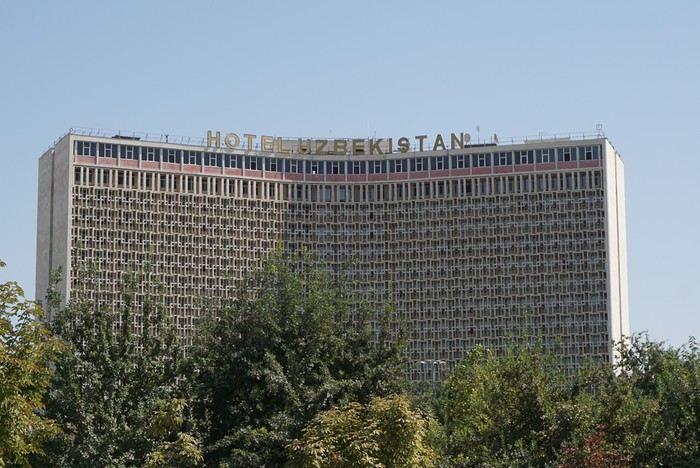 We took off from Paris in the late afternoon on September 12 and arrived in Tashkent around 7:15 AM on the 13th.
This trip was the result of long contemplation and preparation (it was originally planned for the year of the lockdown (2020) and was prepared with the help and advice of Nasrullo Jumanov from Turquoise Travel.
Stages and Itinerary
Stage 1: Tashkent - September 13 and 14
Stage 2: Ferghana Valley – September 15 to 17
Stage 3: Nukus and Moynaq - September 18 and 19
Stage 4: Mysterious Khiva - September 20 to 22
Stage 5: Holy Bukhara - September 23 to 26
Stage 6: Asraf - September 27 and 28
Stage 7: Mythical Samarkand - September 29 to October 2
Stage 8: Tersak (via Shakhrisabz and Urgut) – October 3 and 4
Stage 9: Samarkand – October 5 and 6
Stage 10: Tashkent/Istanbul/Paris – October 6 and 7
Stage 1: Tashkent
September 13
At the airport exit, we were greeted by the owner of our B&B (B&B Gulnara).
Today was all about recovery and our first steps in the capital. Our first currency exchange made us feel like sudden millionaires.
Our first stroll down the avenue leading to Chorsu Market introduced us to the fact that 80 to 90% of the cars here are white Chevrolets.
A walk under the arcades facing Chorsu: hardware stores, cabinetmakers, lute makers (one of them gave me a little concert/demo of a few string instruments).
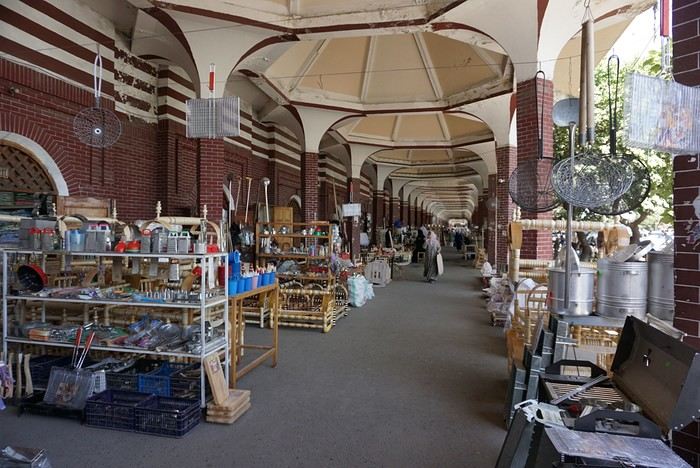
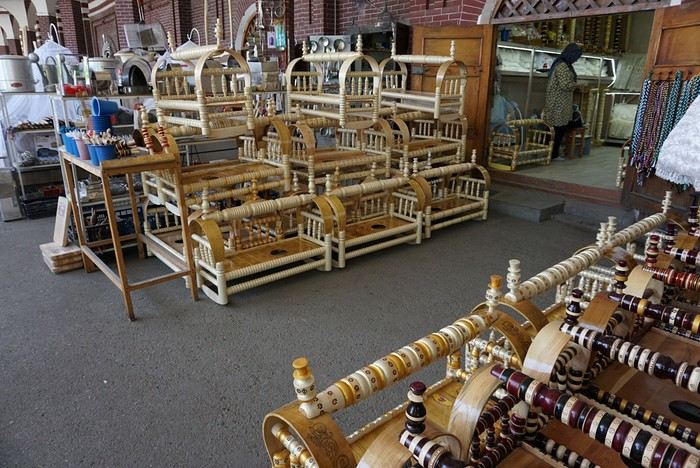
As we entered the market, many vendors called out to us, including this florist who asked where we were from: ‘France? Ah! Macron! PSG!’ He then recited a list of players from the Parisian team as well as past (Platini, Zidane, etc.) and current (Giroud, Griezmann, Mbappé, etc.) French national team players. Since we’re more into rugby (we live near Toulouse), he knew more players than I did!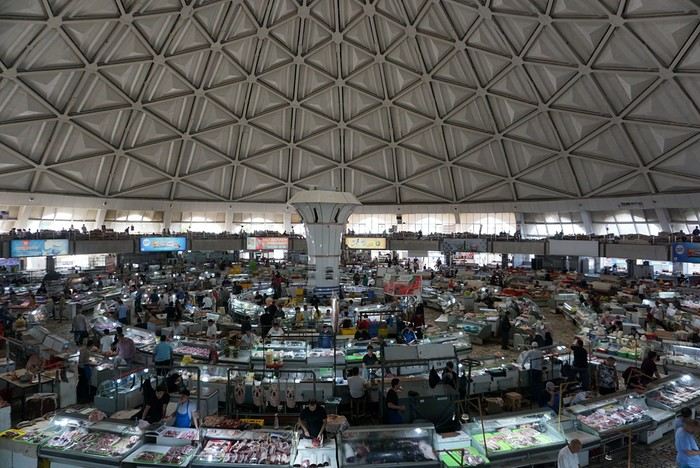
The market sprawls outside around the large circular, multi-story hall. We bought some grapes and bottles of freshly squeezed pomegranate juice for just a few sums. This evening, we had a meet-up with Nasrullo. The reunion was very warm: we’d been exchanging messages for over two years, and I’d been ‘torturing’ him with changes to our itinerary and trip duration. We were finally eager to meet, and honestly, I wasn’t disappointed—in fact, it was the opposite. Nasrullo was very attentive throughout our trip and always made sure, even from a distance (and most often from a distance!), that everything went smoothly. His goal was for us to leave delighted with our trip and, why not, indirectly become ambassadors for this destination. September 14 Breakfast with Nasrullo, then we set off with him by taxi to explore some of the capital’s sites.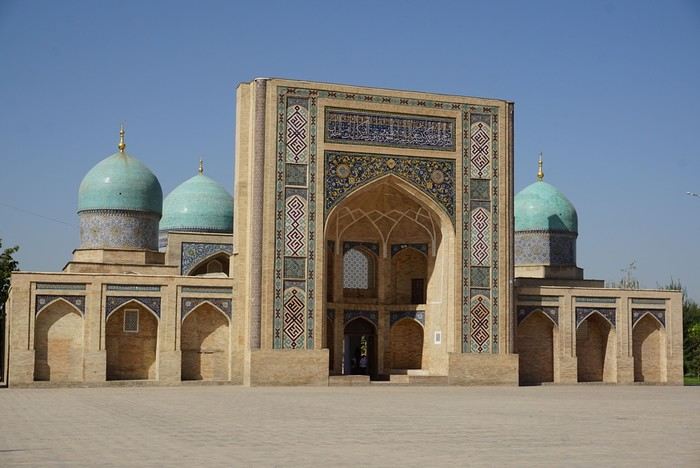
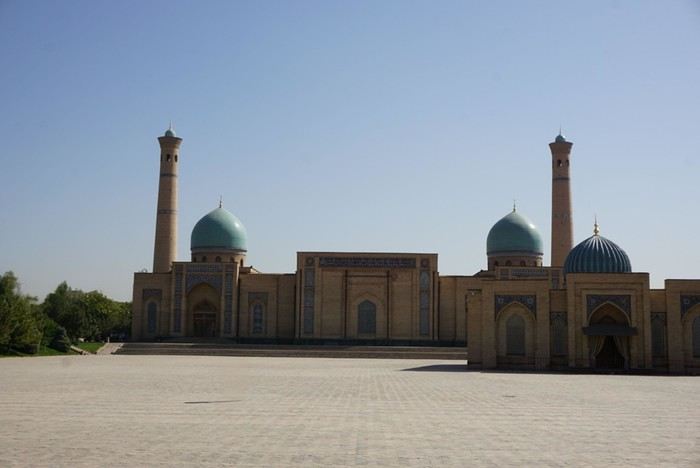
We started by visiting the Khazrati Imam complex, which includes the mausoleum of Kaffal Shashi, the Barak Khan and Muyi Muborak madrasas, and the great Khazrati Imam Mosque with its immense prayer hall.
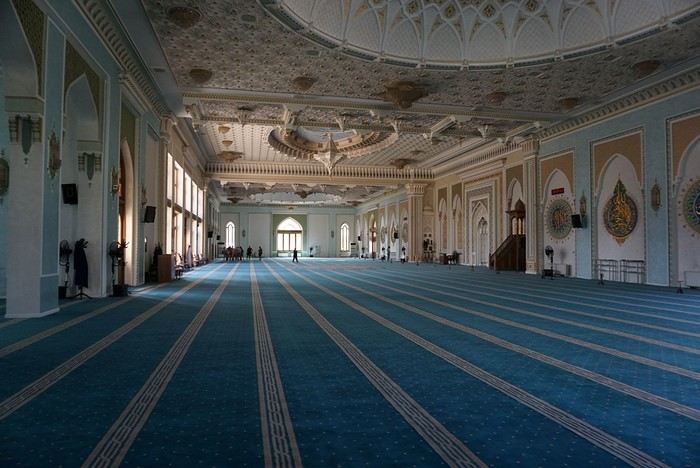
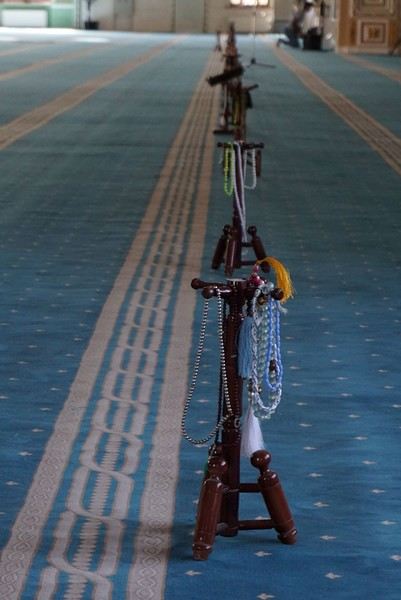
In the Muyi Muborak madrasa, now a museum, you can see the oldest Quran in the world. It was written by three religious scholars, including the secretary of the Prophet Muhammad, on large ‘pages’ made of antelope skin. Next, we explored Soviet-era Tashkent, discovering its parks, canals, and squares: Independence Square with its storks and phoenixes, Amir Temur Square with its large statue and, in the background, the massive Soviet-era hotel that has become one of Tashkent’s iconic buildings. Nasrullo took us through Broadway Boulevard and along what he calls ‘Tashkent’s Montmartre’… Well, it’s far, very far from Montmartre (in every sense of the word!). Then we took the metro to Chorsu station. Rush hour is pretty much the same everywhere in the metro… When we arrived at Chorsu, it was time to say goodbye. Nasrullo had to head back to Samarkand. Before leaving, he recommended some chaikhanas at the end of the galleries facing the market. We ate there for just a few euros (2 or 3 € for two people). After eating, we headed back to our room to cool off (our B&B is about a 10-minute walk away).
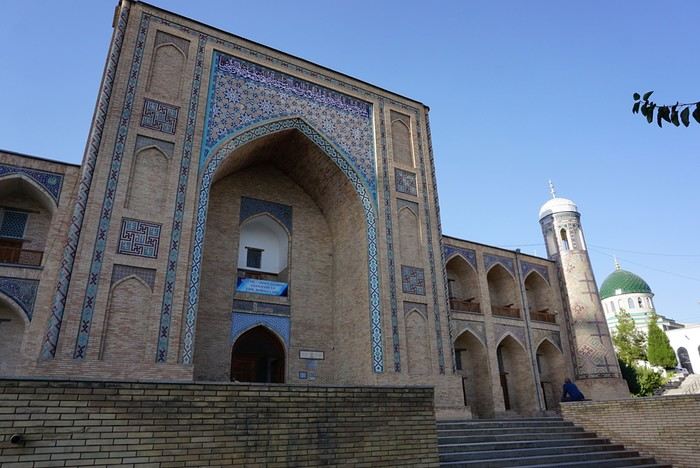
Around 4 PM, we set off to visit the Kokeldash Madrasa, which is still active. On the way, we stopped to watch some bread vendors and take a few photos. We were hesitating about buying some for our evening picnic when a young woman approached us. In perfect English, she asked: ‘Are you looking for something? Do you want to buy bread? Which one? How much?’ She then spoke to one of the vendors and negotiated the price. ‘Do you want one?’ And she took two. She paid directly. I took out my wallet to reimburse her, but she refused. It’s on the house! Then the vendor asked where we were from. And off we went again: Macron, PSG, football players… We’ll have to get used to it. The young woman smiled at the questions and comments, barely gave us time to thank her, and left as quickly as she had approached us.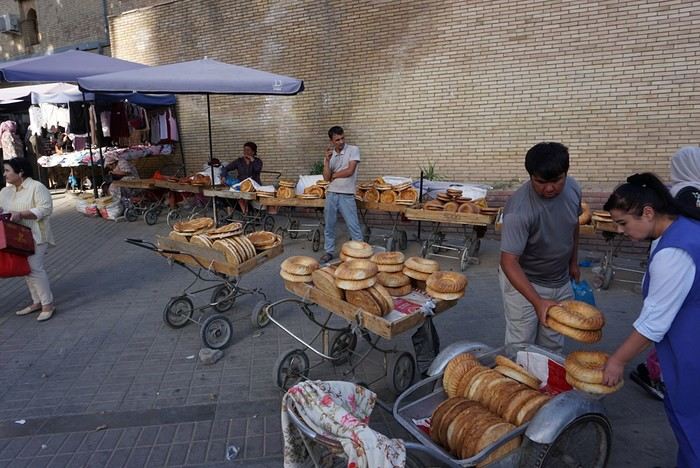
We continued our walk. Visited the madrasa. Then we crossed the boulevard to see the Tashkent Circus. I would’ve loved to go in and visit, but the ticket seller wouldn’t hear of it. We carried on around what should’ve been a park with old-fashioned rides and attractions. All we found was a construction site. Oh well! Back at our hotel, a message from Nasrullo was waiting for us. He had managed to change our train ticket for the next day. Instead of taking the 6:00 AM train, we’d take the 8:00 AM one. And instead of second class, we’d be in first class! Great! This evening, we had a picnic at one of the breakfast tables in the B&B courtyard. Under a shelter, the owner and his family were celebrating a birthday. The owner started by offering us some tea. Then they brought us some fruit (watermelon and melon). Finally, after the song, candles, and cake cutting, they brought us two generous slices of that beautiful birthday cake. Delicious!
We took off from Paris in the late afternoon on September 12 and arrived in Tashkent around 7:15 AM on the 13th.
This trip was the result of long contemplation and preparation (it was originally planned for the year of the lockdown (2020) and was prepared with the help and advice of Nasrullo Jumanov from Turquoise Travel.
Stages and Itinerary
Stage 1: Tashkent - September 13 and 14
Stage 2: Ferghana Valley – September 15 to 17
Stage 3: Nukus and Moynaq - September 18 and 19
Stage 4: Mysterious Khiva - September 20 to 22
Stage 5: Holy Bukhara - September 23 to 26
Stage 6: Asraf - September 27 and 28
Stage 7: Mythical Samarkand - September 29 to October 2
Stage 8: Tersak (via Shakhrisabz and Urgut) – October 3 and 4
Stage 9: Samarkand – October 5 and 6
Stage 10: Tashkent/Istanbul/Paris – October 6 and 7
Stage 1: Tashkent
September 13
At the airport exit, we were greeted by the owner of our B&B (B&B Gulnara).
Today was all about recovery and our first steps in the capital. Our first currency exchange made us feel like sudden millionaires.
Our first stroll down the avenue leading to Chorsu Market introduced us to the fact that 80 to 90% of the cars here are white Chevrolets.
A walk under the arcades facing Chorsu: hardware stores, cabinetmakers, lute makers (one of them gave me a little concert/demo of a few string instruments).As we entered the market, many vendors called out to us, including this florist who asked where we were from: ‘France? Ah! Macron! PSG!’ He then recited a list of players from the Parisian team as well as past (Platini, Zidane, etc.) and current (Giroud, Griezmann, Mbappé, etc.) French national team players. Since we’re more into rugby (we live near Toulouse), he knew more players than I did!
The market sprawls outside around the large circular, multi-story hall. We bought some grapes and bottles of freshly squeezed pomegranate juice for just a few sums. This evening, we had a meet-up with Nasrullo. The reunion was very warm: we’d been exchanging messages for over two years, and I’d been ‘torturing’ him with changes to our itinerary and trip duration. We were finally eager to meet, and honestly, I wasn’t disappointed—in fact, it was the opposite. Nasrullo was very attentive throughout our trip and always made sure, even from a distance (and most often from a distance!), that everything went smoothly. His goal was for us to leave delighted with our trip and, why not, indirectly become ambassadors for this destination. September 14 Breakfast with Nasrullo, then we set off with him by taxi to explore some of the capital’s sites.
We started by visiting the Khazrati Imam complex, which includes the mausoleum of Kaffal Shashi, the Barak Khan and Muyi Muborak madrasas, and the great Khazrati Imam Mosque with its immense prayer hall.
In the Muyi Muborak madrasa, now a museum, you can see the oldest Quran in the world. It was written by three religious scholars, including the secretary of the Prophet Muhammad, on large ‘pages’ made of antelope skin. Next, we explored Soviet-era Tashkent, discovering its parks, canals, and squares: Independence Square with its storks and phoenixes, Amir Temur Square with its large statue and, in the background, the massive Soviet-era hotel that has become one of Tashkent’s iconic buildings. Nasrullo took us through Broadway Boulevard and along what he calls ‘Tashkent’s Montmartre’… Well, it’s far, very far from Montmartre (in every sense of the word!). Then we took the metro to Chorsu station. Rush hour is pretty much the same everywhere in the metro… When we arrived at Chorsu, it was time to say goodbye. Nasrullo had to head back to Samarkand. Before leaving, he recommended some chaikhanas at the end of the galleries facing the market. We ate there for just a few euros (2 or 3 € for two people). After eating, we headed back to our room to cool off (our B&B is about a 10-minute walk away).
Around 4 PM, we set off to visit the Kokeldash Madrasa, which is still active. On the way, we stopped to watch some bread vendors and take a few photos. We were hesitating about buying some for our evening picnic when a young woman approached us. In perfect English, she asked: ‘Are you looking for something? Do you want to buy bread? Which one? How much?’ She then spoke to one of the vendors and negotiated the price. ‘Do you want one?’ And she took two. She paid directly. I took out my wallet to reimburse her, but she refused. It’s on the house! Then the vendor asked where we were from. And off we went again: Macron, PSG, football players… We’ll have to get used to it. The young woman smiled at the questions and comments, barely gave us time to thank her, and left as quickly as she had approached us.
We continued our walk. Visited the madrasa. Then we crossed the boulevard to see the Tashkent Circus. I would’ve loved to go in and visit, but the ticket seller wouldn’t hear of it. We carried on around what should’ve been a park with old-fashioned rides and attractions. All we found was a construction site. Oh well! Back at our hotel, a message from Nasrullo was waiting for us. He had managed to change our train ticket for the next day. Instead of taking the 6:00 AM train, we’d take the 8:00 AM one. And instead of second class, we’d be in first class! Great! This evening, we had a picnic at one of the breakfast tables in the B&B courtyard. Under a shelter, the owner and his family were celebrating a birthday. The owner started by offering us some tea. Then they brought us some fruit (watermelon and melon). Finally, after the song, candles, and cake cutting, they brought us two generous slices of that beautiful birthday cake. Delicious!
Well, since the lockdown is dragging on, I’m starting a new travel journal following the one I finished publishing yesterday:
https://voyageforum.com/discussion/voyage-pays-perles-voyage-dans-ouest-americain-d9943984/
This time, after the U.S., we’re heading to the Middle East—Jordan!
And we’re keeping up the good habits: one day’s entry published every day at 5:30 PM! Happy reading, and feel free to leave a comment, question, or remark...
Franck
Franck
Why bike (MTB) along the canal between the Two Seas: the lateral canal of the Garonne from Bordeaux to Toulouse, and the Midi Canal from Toulouse to the Mediterranean?
This canal was created to connect the Mediterranean to the Atlantic without going around Spain, and along its entire length, there’s an old towpath (used to pull barges). Since this path is closed to traffic (except for service vehicles from Voies Navigables de France), no cars drive on it—it’s dangerous, noisy, and polluting. The Canal between the Two Seas was built for transporting goods, so it passes through many towns you can explore without dealing with traffic. You can stock up on supplies or spend the night. You’ll discover the varied landscapes of the countryside, always in the serenity brought by the calm and slow flow of the canal’s water. Most of the time, you’ll be in the shade of trees planted to stabilize the banks with their roots. All you have to do is follow this blue—or rather green—ribbon without needing to consult a map. But the biggest advantage is that it’s flat! Of course, on the Canal du Midi, water flows from the watershed divide at Naurouze eastward to the Mediterranean and westward to Toulouse. On the lateral canal of the Garonne, water flows toward Bordeaux. But this slope is almost imperceptible, which is a huge plus when you want to travel by bike for several days with luggage.
When I say "bike," I really mean MTB because, while the towpath has been replaced in some places by a paved bike path, it mostly resembles a dirt trail—sometimes smooth, sometimes rocky, and often cluttered with roots from the magnificent trees lining it. Since the canal was classified as a UNESCO World Heritage site, improvements have been underway, but it won’t be tomorrow that you’ll be able to ride from Bordeaux to Sète on a road bike. And I’m afraid the first sections of the path will be worn out before the rest is finished. You might even run into construction work for this bike path. That’s what happened to me during the spring of 2007.
Sunday, 03/11 – Valence d'Agen 08:15 to Toulouse (Rangueil) 16:30 97 km in 8h15 (6h on the bike) I started on the recently paved path along the lateral canal of the Garonne. The first locks appeared, and as I approached Moissac, the path turned into a billiard table until Castelsarrasin. After the Cousteau port, I was back on the classic dirt towpath with its rocks, roots, and nutria holes. But not for long—soon, I hit ruts left by backhoes and bulldozers, which, fortunately, were resting for the Sunday. A pile of rubble taller than me blocked the entire width of the path. I didn’t want to turn back to find the previous bridge and ride on the other bank, which was just as impassable (dense grass). It wasn’t easy to carry a bike with full panniers, so I lifted it over several mounds. I kept going, sometimes on foot, unsure how far the construction extended. Another bulldozer—luckily, the ground was dry. The work went all the way to Montech, making the path impassable. I recommend taking the N113, which runs parallel (that’s what I did on the way back). In Montech, the famous water slope was at rest, waiting for tourists. For many kilometers, I was back on the traditional towpath. The closer I got to Toulouse, the better the surface became, and the more cyclists and pedestrians I saw—until the city center, where there was nonstop bike traffic, especially students heading to Rangueil.
Monday, 03/12 – Rangueil 09:10 to Revel 16:30 86 km in 7h20 (5h30 on the bike) As soon as you reach Toulouse, you make a 90° turn to follow the connection between the lateral canal and the Canal du Midi. Heading east, you pass the barge selling the famous Toulouse violet souvenirs. A real bike path has been built for 50 km to Port Lauragais. It’s a true joy for Toulousains and travelers. Restrooms have been installed or shared with highway rest areas, allowing you to refill water (of course, bikes are banned from ASF rest areas, but cleverly placed racks let you secure your bike and walk in). At Port Lauragais, it’s another rest area shared by highway users, cyclists, and boaters. You’ll find a cafeteria, restaurant, hotel, and a shop selling regional souvenirs. But the real pleasure is reaching the watershed divide at Naurouze, where water flows toward the Mediterranean on one side and the Atlantic on the other. There, I decided to leave the Canal du Midi, which continues toward Castelnaudary with a much rougher towpath, to follow the *Rigole* that feeds the canal with water from the Saint-Ferréol basin. For me, it was like returning to the source—a bit like a pilgrimage in honor of the brilliant Pierre-Paul Riquet, the designer of this magnificent work. I followed the service trail along the *Rigole*. It’s actually a variant of the GR 653, leading to Revel alongside this artificial waterway. It’s fed by water from the Montagne Noire, and I was worried about a steep climb. But that wasn’t the case—the *Rigole* winds for 40 km, flowing gently under the trees. It was better than a dream: a smooth dirt path with the crunch of pine needles under the wheels, where I only crossed paths with a few fishermen... And to soothe sore buns, the last kilometers were on packed earth—a paradise (ATVs, stay away!). More walkers and cyclists appeared there.
Tuesday, 03/13 After a restful night in Revel, I started the morning with a walk around Lake Saint-Ferréol. A very pleasant 10 km hike, but I don’t recommend it for mountain bikers unless you’re used to mountain terrain and have strong calves. Otherwise, you can take the road—there are at least two hotels near the lake. In the afternoon, I began the return trip to Tarn-et-Garonne via the same path, with the same pleasure.
Total: 378 km of suffering and bliss, for which I must thank the departmental and regional councils for their funding, Voies Navigables de France for maintenance, and the volunteers who mark the hiking trails. And don’t you think you’re exaggerating a bit with your 378 km of bliss and the paradise of the *Rigole*?
Okay, fine—it wasn’t always idyllic. Sometimes the path was downright *pierrique*... but I had great weather, and the landscapes were so beautiful (water, sun, vegetation). In the rain or mud, it would’ve been less fun. What does *pierrique* even mean?
*Pierrique* is worse than rocky. I know a Pierrick, and he’s tough. And why *Facteur4*?
It’s France’s goal to reduce greenhouse gas emissions by a factor of 4 by 2050. I’m doing my part by biking to work 3 out of 4 times. And your cassoulet?
Guilty as charged. I ate the best cassoulet of my life at the Hôtel du Midi in Revel. But it was very productive in methane. My stomach hurt so much I couldn’t sleep and ended up writing my postcards between 3 and 4 AM. So many great memories!
Here we go with this second travel journal dedicated to the American West! It’s a must when you love it! 😊
We had left off in the charming town of Bisbee, which once thrived thanks to its copper mines. Today, mining is a thing of the past, and the town seems a bit sleepy.
Unfortunately, I didn’t dig deep enough on-site to answer all the questions my observations raised. Guess I’ll have to *dig* into the subject a bit more... no pun intended! 😊
Let’s hop back in the car and head a little further south to check out the esplanade that offers a view—if you can call it that—of the impressive open-pit mine. Then, it’s off to the Lowell neighborhood.
Preserved almost exactly as it was, this area must’ve been bustling in its heyday. The vintage cars are still around, storefronts and signs look like they’re straight out of another era, and the whole place has a pretty amazing vibe. You’d almost think you were on Route 66!
Here, we’re not just discovering an old neighborhood—it’s a little slice of American history. And, a detail that’s great for my physical health: the area isn’t too spread out. Lucky me! 😊
I won’t post too many photos here since I think I can turn them into a future photo exhibit. Between these and some shots from Route 66, I should have more than enough material! So, let’s keep a few under wraps... to preserve the surprise. 😊
We had left off in the charming town of Bisbee, which once thrived thanks to its copper mines. Today, mining is a thing of the past, and the town seems a bit sleepy.
Unfortunately, I didn’t dig deep enough on-site to answer all the questions my observations raised. Guess I’ll have to *dig* into the subject a bit more... no pun intended! 😊
Let’s hop back in the car and head a little further south to check out the esplanade that offers a view—if you can call it that—of the impressive open-pit mine. Then, it’s off to the Lowell neighborhood.
Preserved almost exactly as it was, this area must’ve been bustling in its heyday. The vintage cars are still around, storefronts and signs look like they’re straight out of another era, and the whole place has a pretty amazing vibe. You’d almost think you were on Route 66!
Here, we’re not just discovering an old neighborhood—it’s a little slice of American history. And, a detail that’s great for my physical health: the area isn’t too spread out. Lucky me! 😊
I won’t post too many photos here since I think I can turn them into a future photo exhibit. Between these and some shots from Route 66, I should have more than enough material! So, let’s keep a few under wraps... to preserve the surprise. 😊
An 80-Day Tour of Southern Africa
Back in South Africa
January 12, 2013, 5:30 AM, Flight BA043 London-Cape Town
Directly below, Windhoek glittered like a tangle of fairy lights still lit and tossed into a box.
The horizon, edged in purple, was setting up a backup fireworks display, and suddenly, like a cherry on the platter and with unbearable intensity, in less than two minutes the entire sun revealed a gray dam and then a vast, untouched massif.
A few more minutes and the glare to the east of the plane was total. In Africa, the sun is swift.
We still had a France to cross before landing, but it felt as if we were already there. To the west, the raking light revealed what looked like acne and long, swollen scars in a desert region that might be the Swartkloofberg. Further still, straight as far as the eye could see, the two parallel tracks of a dirt road.
At 11,500 meters altitude and 940 km/h, we had a sense of stillness until the Orange River appeared, an incongruous serpent, gray edged with green.
The first South African settlements were dotted with trees providing shade, then rivers highlighted by continuous lines of vegetation.
Water and shade that make life possible.
We’ll return here by the backroads.
Half an hour from Cape Town, the plane tilted toward the sea, crossing plantations (likely citrus) and then an explosion of cultivated greenery in circles on either side of an unruly river. Finally, the coastline was no longer just sand and water—a frothy hem, a suture?
A peninsula came into view, forming two magnificent bays, and... a flight attendant firmly instructed me to return to my seat: we’d arrived!
The Colors of Cape Town
The city was dressed up as I like them—deserted, fluid, free of its vendors.
In the parking lot of the endless beach next to the commercial port north of the city, about two hundred people were unloading their goods in front of their pickups or combis, none of which were from this century: mixed-race, ageless Black people, and white folks who looked like they’d stepped out of another era.
After a few minutes, intrigued, I played a game: first looking at the merchandise, then imagining who was selling it, and finally looking at who was actually manning the stall. Tall Black vendors were selling what they often sell in Europe—leather, sunglasses, watches; mixed-race folks offered discount bundles, and the tanned older white people seemed to have emptied their attics.
We left with an antique tin kettle for morning tea over an open fire, a pack of five exercise books (that’s 600 pages to fill), Bill Bryson’s earliest stories in English, some snoek rillettes (a local fish), and—never seen before—tuna biltong and snoek biltong.
In so-called advanced countries, Sunday is for sports: white cyclists dressed like pros sweating diligently, Black street vendors running in loops at red lights to sell trash bags that day; white golfers losing their balls, which a scantily clad Black man retrieves from the water; under the sails of kite surf boards, it’s all blondes, and in the foam, joyful splashes from a bunch of Black kids.
Searching for an unusual spot for lunch, we drove through the fishing port looking for a dive and, at the end of a dead-end road with no warning, we arrived at the Shimmy Beach Club—quite the program.
The place, open for just three weeks, aims to be ultra-trendy. You could be in San Francisco, Lisbon’s docks, or St. Barth. This time, the "visible" staff was diverse, but the clientele was exclusively white, except for one mixed-race couple.
For this Sunday lunch, the women had pulled out all the stops, and local starlets—who’d make ours look tame—were turning the terrace into a frenzy.
At Cape Town’s port, the girls have *port*. The trend seems to be crochet dresses over swimsuits.
For two hours, a team of employees watered and raked the sand, starting over when they finished. A child in a floaty pink dress and a gold headband, but a future adventurer, stepped onto the freshly raked artificial beach sand for the first time.
A lanky mixed-race man dragged a hose across the ground, followed by a white woman—enchanted?—who then started watering the sand herself, carelessly splashing the glass terrace her colleague had just swept. I suspect a tacit work arrangement to keep everyone employed.
A galleon packed with tourists (are there any in the hold? Does it take tourists to Robben Island?) left the port. A helicopter took off in its wake. Trawlers returned, cutting through a ballet of catamarans, their waterlines well above the water: a bad catch.
If there’s one country where you can’t pretend to ignore skin color, it’s this one. The question is in everyone’s mind, and here more than anywhere else, it’s a decisive economic and political factor.
Columbine of Brittany
200 km north of Cape Town and 9,000 km south of the Breton coast, but on the same cold ocean, we camped on the shore of the Columbine Cape Nature Reserve, sheltered by a rocky chaos that, at first light tomorrow, would transport us to Perros-Guirec.
Our first encounter with wild animals wouldn’t end well for them: it was crayfish season, and they were the size of lobsters at Lorient’s fish market. Bought for R60 (5.5 €) a pair from kids in Pater Noster, they’d end up between two rocks, over a fire. But first, we had to pair the Chenin blanc with some snoek biltong.
With no wood, I lit a fire at dawn with dried seaweed and kelp, as if petrified; it gave off a smell of court-bouillon and... tires. Two hundred fathoms away, on an outpost, an army of cormorants stood at attention, unmoved among the frolicking seals.
At the reserve’s exit, the guard spoke French; Patrick Mwanba had arrived from Congo three years earlier to study, but the cost of living here forced him to drop out. He’d like to return home because life is cheaper there, but the war made him hesitate.
Ding ding dong! Vroom! Arf arf, Woof! Buzz! (A night from hell!)
I’d long planned to visit Calvinia, the center of a region known for extensive sheep farming. An excellent provincial museum, run by an enthusiastic curator, kept us too late to start the drive north.
So we camped in a tiny, charming campsite set up in the garden of a house. A few trees, a patch of resilient grass, and a view of a pretty lit-up steeple—what else?
Well, it turned out to be a sound-and-light show, with the pretty steeple chiming the hours and half-hours. Then suddenly, we were in the VIP stands of the Karoo-Kalahari Truck Race: roaring trucks paraded under our canvas windows, and we realized we were on the main road through town. To top it off, we enjoyed an uninterrupted canine cacophony, from the *arf arf* of little dogs to the *woof* of a mastiff. Oh, and some mosquitoes—the first ones—insisted on keeping us company in the tent, and we hadn’t yet bought the arsenal to neutralize them.
I walked through Calvinia at night; the house gardens weren’t fenced, nor did they have the «Armed Response» signs so common in the country.
The Kalahari Trails
(No, no, I haven’t converted to hiking.)
North of Calvinia, in the south of the Northern Cape, small towns follow one another up to Upington, about a hundred kilometers apart—welcome havens. Between them, with no trees in sight, we stopped in the shade of a motionless cloud: the temperature exceeded 40°C in mid-January.
We were almost out of the High Karoo and into a region of pans drying up, until the first red dunes appeared, precursors of the Kalahari. In the sparse veld vegetation, gatherings of quiver trees in the kopjes, and a caravan of camels without a handler or packs, marching in perfect formation across a pan (no, I hadn’t overdone the Windhoek at the last stop, and no, I wasn’t dehydrated enough to hallucinate).
The historic part of these towns, European in style, was built on the same plans as those in the American Midwest or the Australian Outback: a grid of streets wide enough to turn a wagon pulled by eight pairs of oxen. The architecture was Dutch-inspired, tropicalized with awnings.
Then came more recent housing, functional in style, where the wealthier mixed-race people—who make up the majority of this state—lived, and further on, the township, an assemblage of corrugated iron and plastic, like everywhere else.
Orange, Right Bank
North of Augrabies Falls National Park, on the other side of the Orange River, stretches a rugged and wild territory the size of fifty Groix islands, crisscrossed by a few tracks—the Riemvasmaak.
The inhabitants were driven out half a century ago for a military base, and as soon as President Mandela was elected, he made it a symbol by allowing the exiled populations to return. Several ethnic groups live here on almost nothing, in government-built shacks.
A community camp is set up in a small cirque at the end of a canyon that, while not in the history books, offers a good descent. By mid-afternoon, the air was at 44°C, but luckily there was a spring... except it was a hot spring, with water at 38°C. And they haven’t invented a reversible spring yet. Once the birds and baboons had settled in, in absolute silence and far from any light pollution, we enjoyed the stars like nowhere else (well, that’s what they claim in the region).
The Orange didn’t choose the easy path: arriving from Lesotho, it was almost at the ocean. The terrain to the south and north of this massif seemed easier to cross. Was it to avoid the curse of the Okavango, whose waters disappear into the sands without ever seeing the sea, that it chose this rocky route, thinking that at least the granite wouldn’t steal its water?
I Love You, I Eat You
In the dry bed of the Auob, it lay panting, head raised, alert, between its paws but head-to-tail, a tawny springbok, motionless.
A few minutes earlier, their story had been written in a lightning-fast chase, captured in photos by the driver of the car that alerted us.
It would be a long time before it started eating at the groin without breaking its surveillance.
Earlier, there was a lion lounging in the shade and hundreds of antelopes: springboks and gemsboks (oryx) in herds, hartebeests and steenboks alone. Strange pairs, apart several times, formed by a springbok and a gemsbok.
A few solitary jackals moved slightly sideways, looking furtive. Ostriches, alone, looking a bit dazed.
It was a lucky morning in the Kgalagadi (KTP).
In and Out
Kgalagadi, Nossob Camp.
We were at the very end of the almost-empty camp, ten meters from the fence, whose structure wouldn’t resist an elephant (though there aren’t any here), but it was electrified.
At dusk, on the other side, ten meters away, three lions passed in a row, as if on parade, seemingly focused on their goal and indifferent to the camp, though they glanced at it.
A jackal had gotten into the camp and was trying to get out without success while scavenging. I offered it two pieces of snoek biltong (Don’t feed the animals!) from three meters away—it smelled strong and had bones (bones in biltong!). When it passed by again, it sniffed but didn’t dare approach. Curled up in the chair, motionless, by the faint moonlight, I finally saw it come closer, grab the nearest piece, and move ten meters away to enjoy it (how many jackals know the finer points of sea biltong?). A little reassured, it came back for the second piece.
Another Morning
By morning, the jackal was gone, but our luck hadn’t left us. Two cheetahs again, who found me in the way and slowly moved toward a calmer shadow. Enough birds of prey to form a squadron, but they’re solitary hunters. Two ostriches busy with their dozen unruly chicks. And while we’re at it, a group of four Kalahari lions, sprawled under a thorny bush. Lots of oryx crossing the dunes and herds of red hartebeest. Kori bustards and secretary birds.
It was the first time the Kgalagadi had spoiled us so much.
Hi everyone,
I’d love to share a little travel journal from our 14-day/12-night road trip with our two teens (14 and 17) in February/March 2020. A huge thank you to all of you who helped me plan this trip to South Africa—your patience with my endless questions was amazing!
We left Lyon on Saturday, February 22 at 7:00 AM and arrived in Johannesburg at 10:00 PM after a short layover in Amsterdam. Flights cost 440 € per person (booked in October), with carry-on luggage. We added just one checked bag for the whole family (80 € round-trip with the free Flying Blue membership). Since we’d be moving around a lot, we packed light! In Lyon, we reserved parking at P5 in advance for 70 € for 14 days. The Air France/KLM flight was smooth. When we landed, we picked up our bags and had booked a night at the Aero Guest Lodge, just 5 minutes from the airport, with a free shuttle and breakfast. All you have to do is send a WhatsApp message when you arrive at the airport to let the shuttle driver know. The tricky part? Finding him in the terminal—he wasn’t holding a sign with the hotel’s name. 🤪 A South African called him for me since my English wasn’t great (and I had to get used to the accent 😛), and helped us spot the driver (who was actually less than 5 meters away!) with other guests. When we got to the hotel: all good, except we were 10 people in a van meant for 7. The room was spacious—one king-size bed and two single beds for the kids—with a simple but clean bathroom, a garden, pool, and breakfast (which we didn’t try). All for 65 €, so an awesome value!
 After a restful night, we woke up at 6:00 AM to catch the shuttle back to the airport. Just a heads-up: there’s only one shuttle per hour in the morning, and Kulula canceled our 9:00 AM flight, moving it to 8:00 AM—so no time for breakfast (it starts at 6:30).
We waited 15 minutes in the lovely garden for the driver, who dropped us off at the airport in 5 minutes.
We checked in for our flight to Cape Town, which cost around 40 € (including two checked bags per person).
We grabbed breakfast at the airport instead (less than 20 € for all four of us—one of the nice surprises of South Africa!), and arrived in Cape Town at 10:20 AM.
 After quickly picking up our bags, we headed to the Avis counter and left with a Toyota Corolla for 80 € for 4 days (rented with the Flying Blue card—free additional driver).
Everything’s on the left... not easy, but it works if you plan your route well.
We drove to our Airbnb in Constantia. We were surprised to see animals, bikes, and pedestrians on the highway!
We arrived around 11:30 AM at our rental—a huge house in the vineyards, in a super secure neighborhood, about 15-20 minutes from Hout Bay. It felt like Beverly Hills, but with super-high walls and barbed wire around the villas. 😕

We dropped off our bags, changed into shorts (it was around 30°C/86°F), and headed to the Bay Harbour Market in Hout Bay. We had lunch there—such a great vibe! We wandered through the stalls, everyone picked their own dish, and we sat down on the terrace. There was music, artisans of all kinds... a really nice moment.

I’d withdrawn 50 € before leaving... and that gave me change to pay the parking attendant. Lunch cost around 30 € for four, including food and drinks.

After browsing the artisan stalls, we headed to Hout Bay Beach near the restaurant, Marina Wharf (another small tip for the parking attendant—we’d have to get used to that!). We stopped to admire the sea lions. An ice cream for 1 €? No way we were saying no! 🙂
The fatigue was starting to hit, so we headed to the grocery store 10 minutes away (Constantia shopping center) and then had an aperitif in front of the vineyards, opening a delicious bottle of white wine.
I’d love to share a little travel journal from our 14-day/12-night road trip with our two teens (14 and 17) in February/March 2020. A huge thank you to all of you who helped me plan this trip to South Africa—your patience with my endless questions was amazing!
We left Lyon on Saturday, February 22 at 7:00 AM and arrived in Johannesburg at 10:00 PM after a short layover in Amsterdam. Flights cost 440 € per person (booked in October), with carry-on luggage. We added just one checked bag for the whole family (80 € round-trip with the free Flying Blue membership). Since we’d be moving around a lot, we packed light! In Lyon, we reserved parking at P5 in advance for 70 € for 14 days. The Air France/KLM flight was smooth. When we landed, we picked up our bags and had booked a night at the Aero Guest Lodge, just 5 minutes from the airport, with a free shuttle and breakfast. All you have to do is send a WhatsApp message when you arrive at the airport to let the shuttle driver know. The tricky part? Finding him in the terminal—he wasn’t holding a sign with the hotel’s name. 🤪 A South African called him for me since my English wasn’t great (and I had to get used to the accent 😛), and helped us spot the driver (who was actually less than 5 meters away!) with other guests. When we got to the hotel: all good, except we were 10 people in a van meant for 7. The room was spacious—one king-size bed and two single beds for the kids—with a simple but clean bathroom, a garden, pool, and breakfast (which we didn’t try). All for 65 €, so an awesome value!
After a restful night, we woke up at 6:00 AM to catch the shuttle back to the airport. Just a heads-up: there’s only one shuttle per hour in the morning, and Kulula canceled our 9:00 AM flight, moving it to 8:00 AM—so no time for breakfast (it starts at 6:30).
We waited 15 minutes in the lovely garden for the driver, who dropped us off at the airport in 5 minutes.
We checked in for our flight to Cape Town, which cost around 40 € (including two checked bags per person).
We grabbed breakfast at the airport instead (less than 20 € for all four of us—one of the nice surprises of South Africa!), and arrived in Cape Town at 10:20 AM.
After quickly picking up our bags, we headed to the Avis counter and left with a Toyota Corolla for 80 € for 4 days (rented with the Flying Blue card—free additional driver).
Everything’s on the left... not easy, but it works if you plan your route well.
We drove to our Airbnb in Constantia. We were surprised to see animals, bikes, and pedestrians on the highway!
We arrived around 11:30 AM at our rental—a huge house in the vineyards, in a super secure neighborhood, about 15-20 minutes from Hout Bay. It felt like Beverly Hills, but with super-high walls and barbed wire around the villas. 😕We dropped off our bags, changed into shorts (it was around 30°C/86°F), and headed to the Bay Harbour Market in Hout Bay. We had lunch there—such a great vibe! We wandered through the stalls, everyone picked their own dish, and we sat down on the terrace. There was music, artisans of all kinds... a really nice moment.
I’d withdrawn 50 € before leaving... and that gave me change to pay the parking attendant. Lunch cost around 30 € for four, including food and drinks.
After browsing the artisan stalls, we headed to Hout Bay Beach near the restaurant, Marina Wharf (another small tip for the parking attendant—we’d have to get used to that!). We stopped to admire the sea lions. An ice cream for 1 €? No way we were saying no! 🙂
The fatigue was starting to hit, so we headed to the grocery store 10 minutes away (Constantia shopping center) and then had an aperitif in front of the vineyards, opening a delicious bottle of white wine.
As soon as I return to France, I catch myself thinking, "it’s better elsewhere."
Wherever we’ve been, I feel this lightness of living—less restriction, less pressure, less sadness—and I start dreaming of somewhere else, of living somewhere else, a simpler life, more authentic, with colors everywhere: markets, clothes, homes...!!! Meeting kindred spirits, genuine people, gentle and kind, and letting go of all this modernism, this technological rat race, the indifference toward others, the confinement, the racism against the elderly in France, against the poor, the weak, the beautiful... fleeing the news, politics, jealousy, meanness, stupidity, greed... And in my moments of clarity, I tell myself that every country, every city has its pros and cons, and that maybe the best of all worlds isn’t down here. But I also remind myself that you have to know how to COME BACK in order to LEAVE again... yet still...!!! IS IT REALLY BETTER ELSEWHERE?😏😏😏
Hello!
My wife and I (Quebecers, 63 years old, retired, celebrating our 45 years together this year, including 20 years of marriage) have chosen to mark the occasion with a trip to Dubai, Réunion, and Mauritius (4 days in Dubai, then 24 days on the islands).
We have a lot of experience planning road trips (scouting routes, visits, hotels, and restaurants of interest), but we travel without reservations to keep the freedom to follow our instincts and tips we get on the spot. We’re moderately active physically and prefer the countryside and beaches over big cities. Our only fixed dates: arrival in Réunion on October 5th and departure from Mauritius on October 29th.
After lots of reading and with the help of an AI (super useful for drafting a first outline!), here’s a possible itinerary framework. Nothing is set in stone—I’d love your suggestions, comments, and thoughts on what’s worth adding or avoiding. Are the proposed bases optimal? Also, if you have recommendations for hotels (mid-range budget of 100–200 euros per night), restaurants, etc., I’m all ears! ;-)
Thanks! 😊
🌴 Réunion (October 5–13, 9 days) Base 1 – Saint-Gilles / L’Hermitage (October 5–8, 3 nights) Oct 5 (Sun): Settle in, relax at L’Hermitage beach. Oct 6 (Mon): Saint-Paul market (morning), beach + sunset at Boucan Canot. Oct 7 (Tue): Excursion to Maïdo (view of Mafate), return via Saint-Leu (Stella Matutina). Oct 8 (Wed): Beach + dolphin/whale-watching boat trip.
Base 2 – Cilaos (October 8–10, 2 nights) Oct 9 (Thu): Route des 400 virages, stroll through the village and Roche Merveilleuse. Oct 10 (Fri): Hike to Bras Rouge (3–4h) or the Chapelle canyon. Creole inn evening.
Base 3 – Plaine des Cafres / Bourg-Murat (October 10–13, 3 nights) Oct 11 (Sat): Road to the volcano → Plaine des Sables → Piton de la Fournaise. Oct 12 (Sun): Wild south coast at Cap Méchant, lava flows, Jardin Parfums, Grande Anse beach. Oct 13 (Mon): Relaxed morning, flight from Réunion to Mauritius.
🏝️ Mauritius (October 13–29, 16 days) Base 1 – Grand Baie / Pereybère (October 13–18, 5 nights) Oct 13 (Mon): Settle in, swim at Mont Choisy. Oct 14 (Tue): Boat excursion to Île Plate & Coin de Mire. Oct 15 (Wed): Pamplemousses Garden + L’Aventure du Sucre. Evening in Grand Baie. Oct 16 (Thu): Trou aux Biches beach, snorkeling. Oct 17 (Fri): Free day, relaxation/shopping.
Base 2 – Flic-en-Flac / Tamarin (October 18–23, 5 nights) Oct 18 (Sat): Drive to the west, settle in, beach. Oct 19 (Sun): Dolphin excursion in Tamarin, relax in the afternoon. Oct 20 (Mon): Chamarel: Terres 7 Couleurs + rum distillery. Oct 21 (Tue): Black River Gorges (hike + waterfalls). Oct 22 (Wed): Snorkeling + sunset.
Base 3 – Belle Mare / Trou d’Eau Douce (October 23–26, 3 nights) Oct 23 (Thu): Settle in, Belle Mare beach. Oct 24 (Fri): Catamaran excursion to Île aux Cerfs. Oct 25 (Sat): Flacq market (morning), beach in the afternoon.
Base 4 – Mahébourg / Blue Bay (October 26–29, 3 nights) Oct 26 (Sun): Settle in, snorkeling at Blue Bay Marine Park. Oct 27 (Mon): Pointe d’Esny + Île aux Aigrettes. Oct 28 (Tue): Free beach day + Mahébourg village. Oct 29 (Wed): Morning swim, return flight at 4 PM (airport is 15 min away).