Hi everyone,
After 8 months of volunteering in Tanzania at a center for street children, I’d like to go back for a year in the same kind of role—this time in Burkina. So I’m looking for contacts in this field, in Ouaga or elsewhere. I’m *super* motivated! It’s been over two years since I got back from Tanzania, and I’m starting to feel restless!
Thanks so much!!
Emmanuelle.
2,077 similar discussions in English
Hi there,
After booking an Airbnb last January for this summer’s vacation in Sarajevo... My "host" canceled our reservation without any reason—this has never happened to me before.
Of course, now it’s impossible to find a place to stay at a "normal" price in Sarajevo with parking... So we’re falling back on the capital of the Republika Srpska, Banja Luka, which had already crossed my mind before I booked Sarajevo.
I already have quite a few ideas in mind, without having dug too deep into the region yet. But if anyone has already been there and has suggestions? Even for restaurants—I’m all ears!
And even if it’s not right next door, I’m planning to spend a day in Sarajevo!
hi there
I’m leaving on October 1st for Rio, which I’ll be exploring over 10 days while staying in Copacabana and Ipanema.
After that, I’m heading to Ilha Grande, Paraty, and finally a flight to Iguaçu.
I’d love to hear your thoughts on Rio. Is it possible to walk around and explore without constantly worrying about getting my phone snatched?
I’m traveling alone and don’t speak Portuguese.
I need GPS to get around.
I love walking and don’t really like taking taxis, which is why I’ve booked two places to stay in Rio to experience different neighborhoods.
But is this doable given the security concerns there?!
In short, can you travel peacefully?
Thanks for your feedback if you’ve been to Rio!
Best,
Can you tell me if the site promocroisières is reliable, since that's where I got the (great) deal? Thanks so much!
🙂
I’ve read everything and its opposite in travel guides and online. It seems that hotel owners—and the government—require tourists to pay in foreign currency rather than the local one (pounds). This is a huge problem for me since I’ll be in Egypt for 3 months. I can’t exactly walk around with thousands of dollars on me (I’m from Quebec). I could pay with a credit card—easier—but I think there’s an extra fee. Is that really the case? But what do I do if a small-town hotel doesn’t accept credit cards??? I thought about using a WISE debit card, but again, what if the place doesn’t have a payment terminal??? Can I hope that some establishments in less touristy areas might accept payment in pounds? And most importantly: does the same issue apply to paying for entry to archaeological sites??? A big thank you for your insights—I’m totally in the DARK here!!!
Marc Lamarre
Marc Lamarre
Hi there,
We’ll be in India in March and we’re taking the boat-bus between Alleppey and Kottayam. After that, we’d like to head to Kumily. I’ve found totally different info and can’t seem to find a daytime bus.
Do you have any websites or tips to share?
Thanks so much! :)
Thanks so much! :)
Hello,
Today is January 7th, Orthodox Christmas Day.
It’s the perfect occasion to share on VF a religious site that left a lasting impression on us.
For a long time, we’d admired photos of the Makaryevo Women’s Monastery on Russian websites. They’re always taken from cruise hydrofoils that, in season, depart from Nizhny Novgorod.
This gave us the idea for a crazy challenge: to visit the monastery during a river cruise, with our little plumber’s van that’s become the common thread of our travels!
This challenge seemed impossible to pull off.
The equation was indeed impossible to solve
1. Find a dock 2. Load the van onto a boat 3. Cross the Volga 4. Arrive at sunset 5. Sail past the monastery 6. All with no reliable information. NONE!
Incredibly, every obstacle fell into place one after another! Gifting us unforgettable moments.
The photos follow our exact journey.
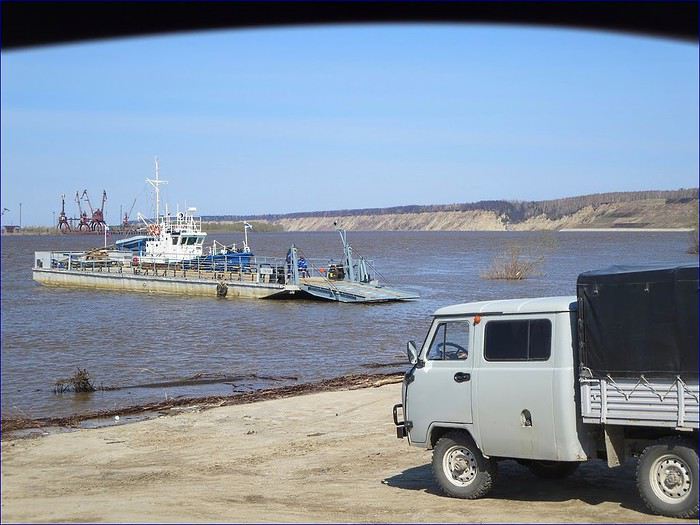
1. We arrive on the southern bank of the Volga, searching for a ferry to Makaryevo. First attempt, first failure—we’re way too far east. We find a second ferry, but it serves a different town on the northern bank.
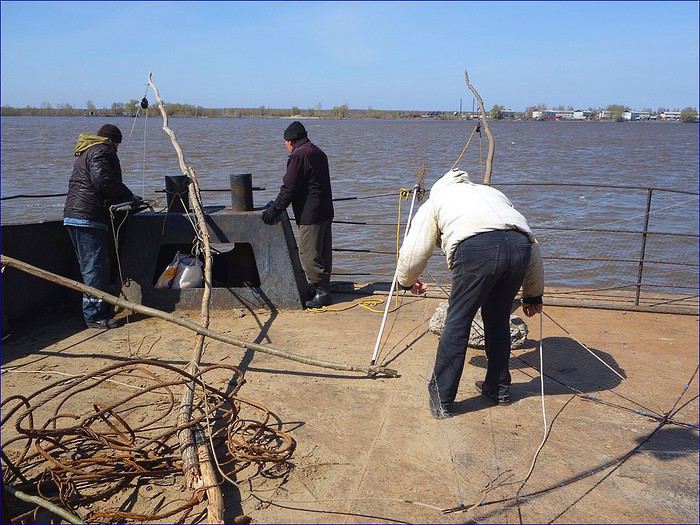
2. We keep going and meet some fishermen. But even they don’t know where to board a vehicle for the monastery.
3. After several fruitless searches, a young man who speaks a few words of English points us to a dock where, in summer, boats *might* serve the monastery. Miraculously, at the end of a rough track, we find an old ferry moored. But no one’s on board, and a chain blocks the entrance.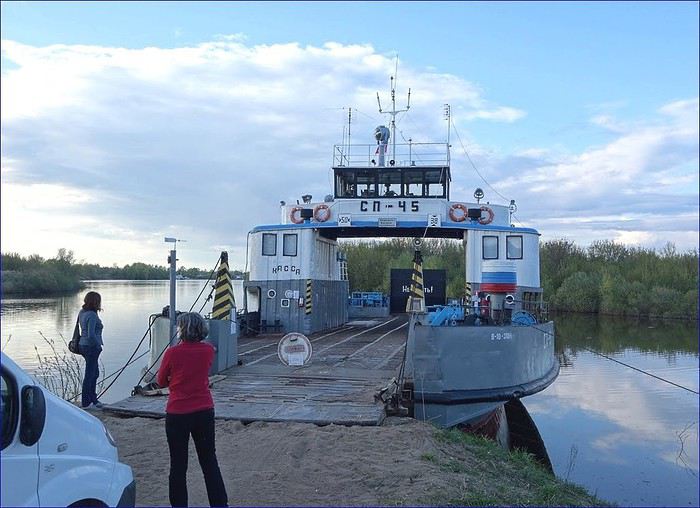 After an hour of waiting, a worker arrives and tells us they *will* cross the Volga tonight,
but the exit ramp at Makaryevo isn’t accessible for our vehicle.
The captain joins him, and seeing our disappointed faces, they confer, discuss,
and load some planks to raise the ramp!
Another miracle!
4. We board, with just one passenger accompanying us— the Trafic is the only vehicle on board.

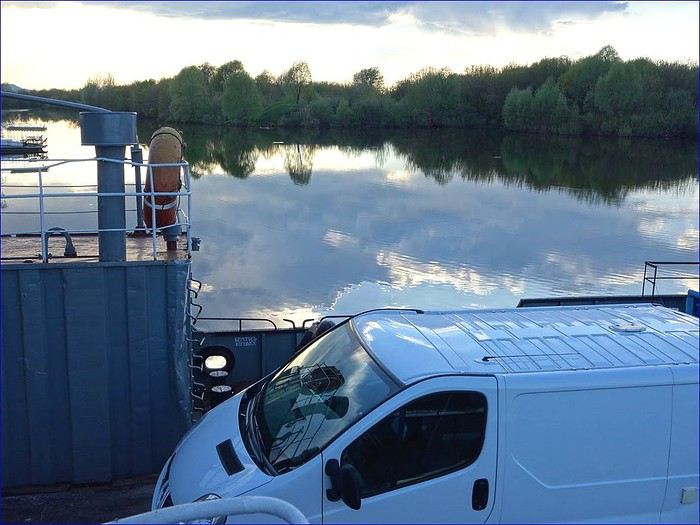
5. The crossing was magical. And longer than expected, since the Volga here is several kilometers wide, and we’re navigating between countless islands!
6. Under a sky that gradually clears, we discover there are homes on the river— invisible from the banks—that form small communities where people get around by boat!
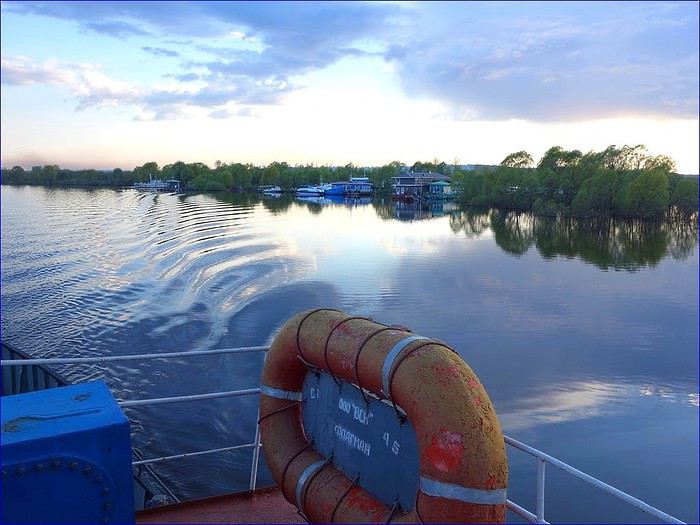
7. Then, suddenly, around a bend in the channel, the monastery appears in the distance on the northern bank.
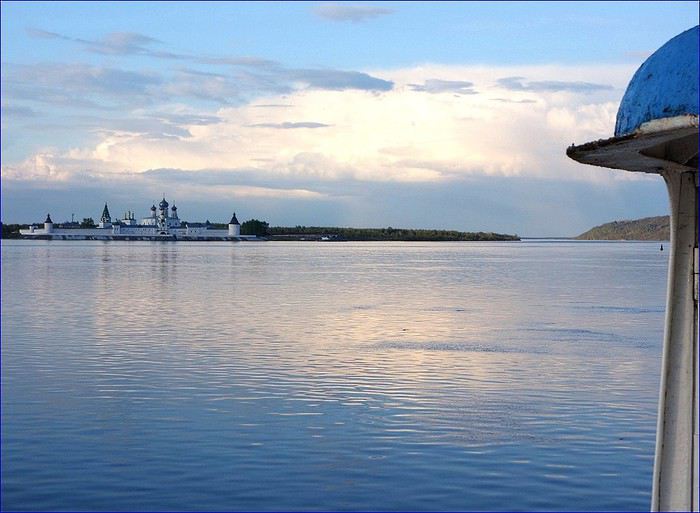
8. At the exact moment our boat rounds the buoy and nears the monastery, the sun breaks through the clouds!
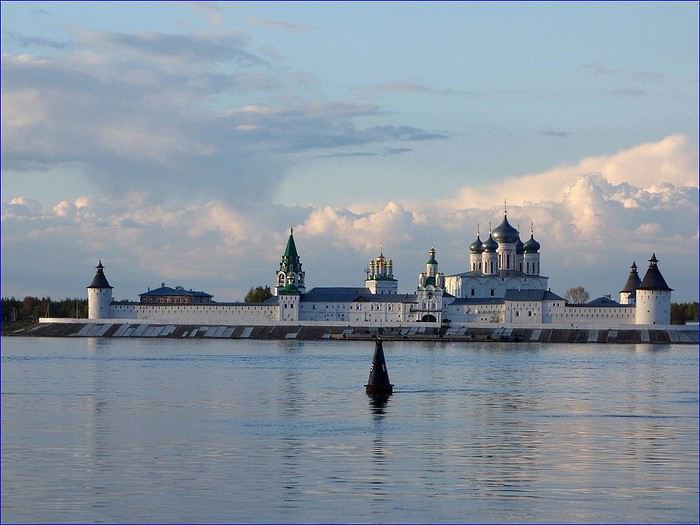
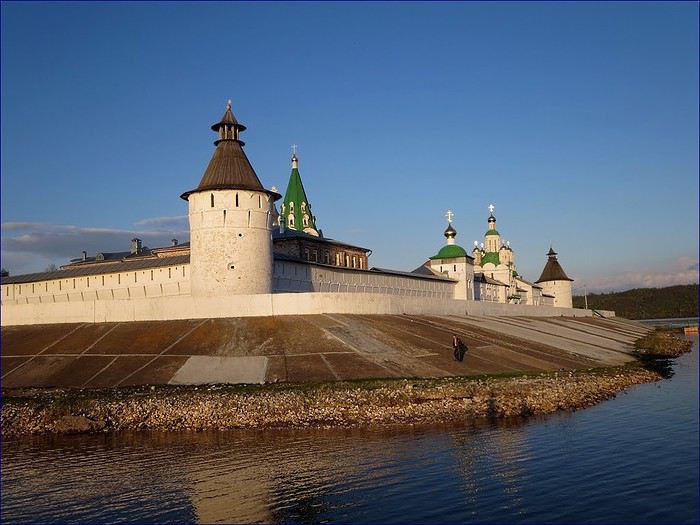
9. A breathtaking sight, with our boat gliding along the monastery walls in absolute silence.
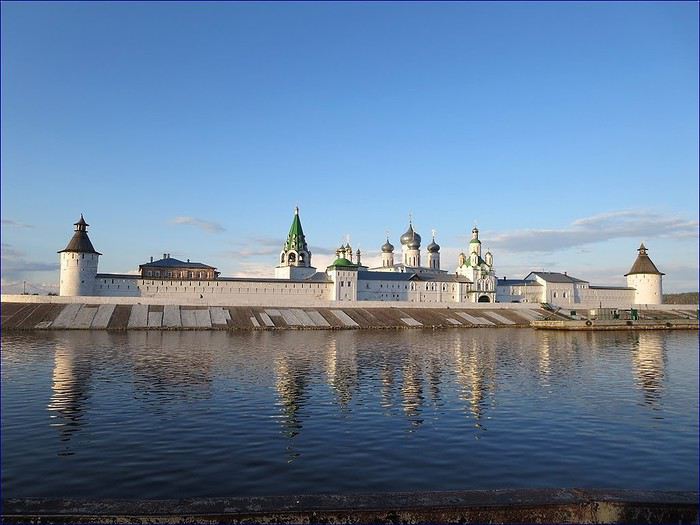
10. The sky, now a deep blue, makes the vibrant colors of the onion domes pop.
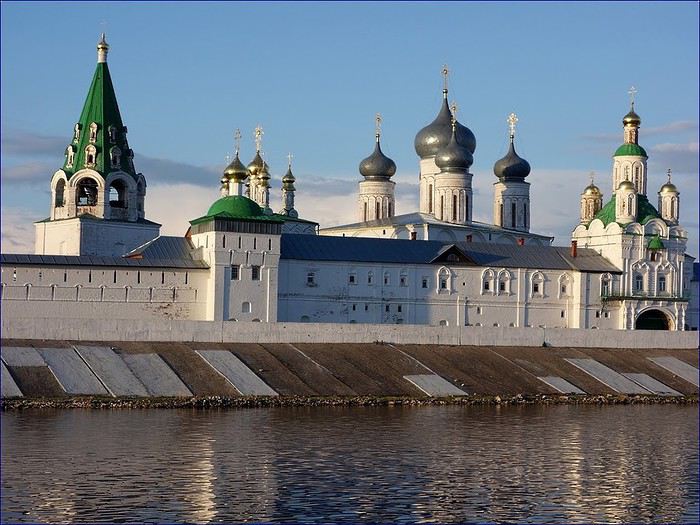
11. We sail slowly past the monastery under extraordinary light— something our little compact camera can’t fully capture.
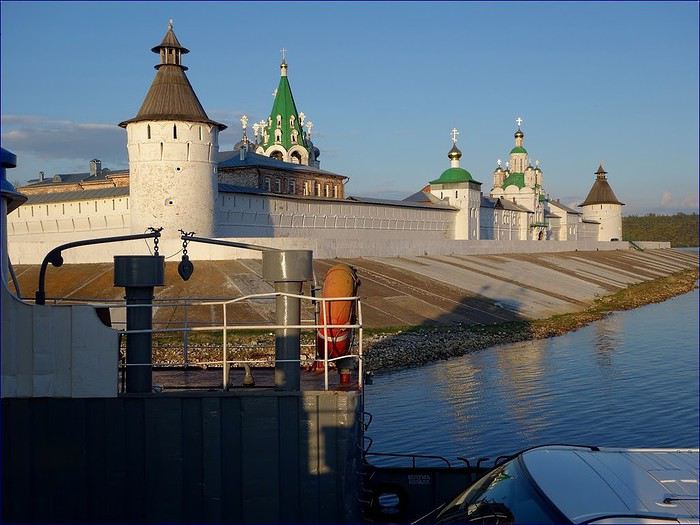
12. As promised, the captain and his crew adjust the exit ramp. You can’t tell from the photo, but even with the planks, it was a close call— the van’s chassis barely cleared the ramp. We thanked them warmly.
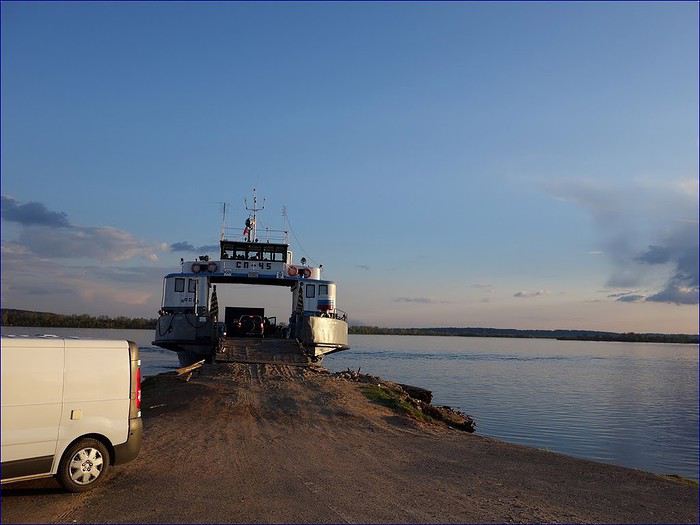
13. By the end of the day, the monastery is, of course, closed. But another miracle happens! It turns out the passenger who crossed with us is the mayor’s wife. When Sylvie told her we were from France, she called her husband, who immediately contacted the Mother Superior. Like in a dream, the monastery opens just for us. A nun and a guard come to meet us and take us through the chapels and gardens!
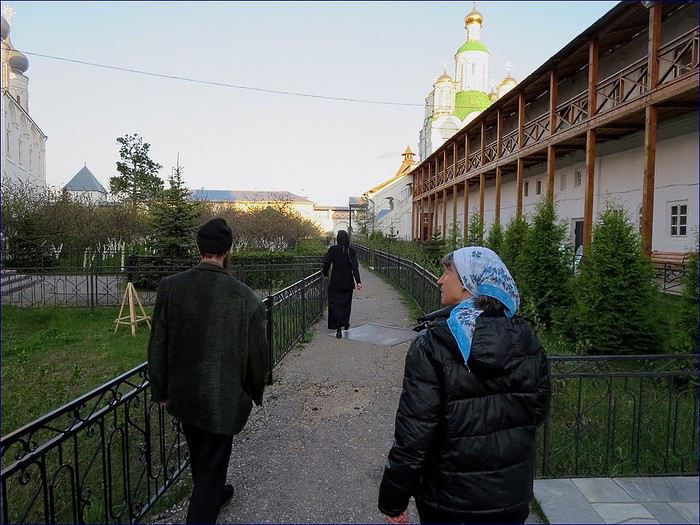
14. A visit all the more intimate since only the silent nuns, deep in prayer, are present in these sacred spaces.
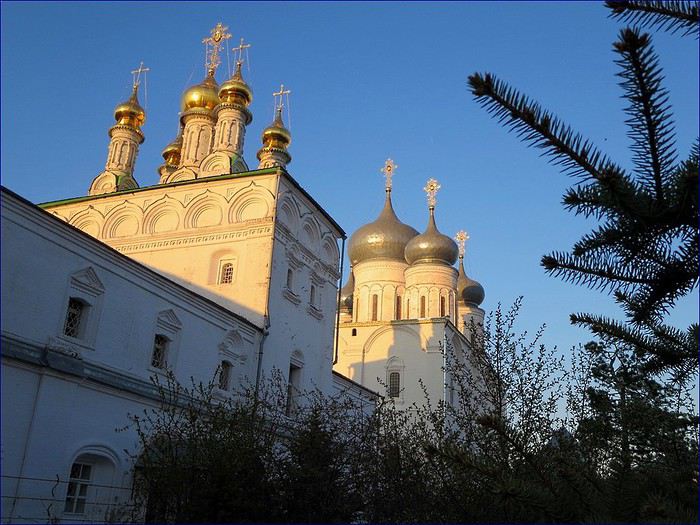
15. After dinner in our little van, we enjoy the exceptional light illuminating the now-closed monastery. We’re the only visitors, and the site feels like a massive ship anchored on the Volga.
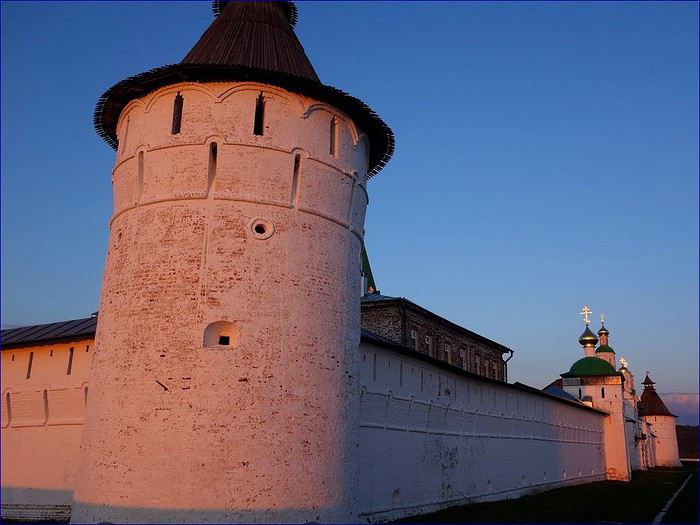
16. The setting sun now bathes the monastery walls in gorgeous pink hues!
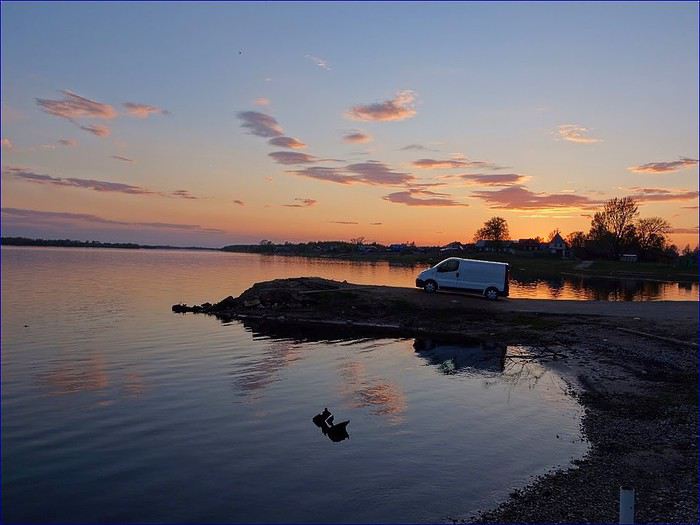
17. Gradually, the legendary Volga itself takes on magical colors! For the night, I’ll just back the van up to level it. It’ll take us a while to fall asleep after such intense moments.
18. Just as inexplicably, the magic continues the next morning! Seeing I’m struggling with my knee, the guard lets us drive slowly along the monastery’s perimeter path. So there we are at dawn, solitary wanderers between the Volga and the monastery walls.
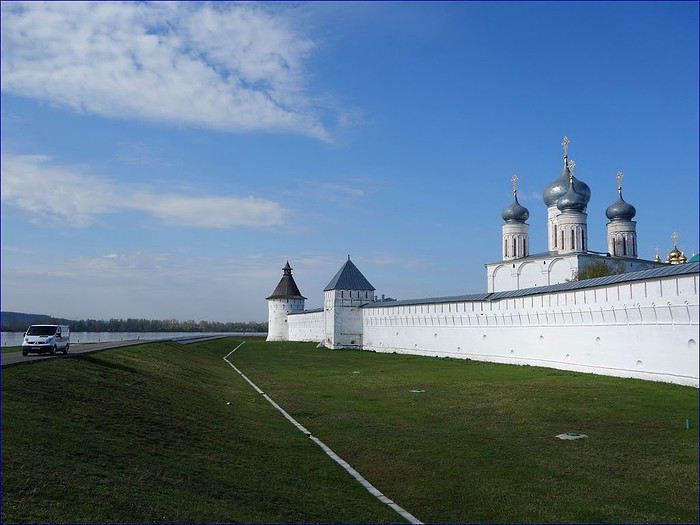
19. The morning light now illuminates the monastery’s eastern façade, which we hadn’t admired yesterday. An exceptional moment.
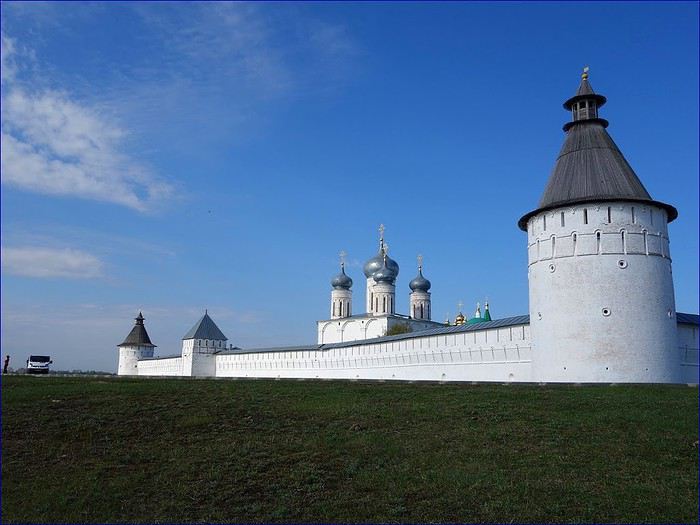
20. Even more impressive when we realize we’re on the nuns’ prayer path. We cross paths with them—tall, silent, black-clad figures, fully covered.
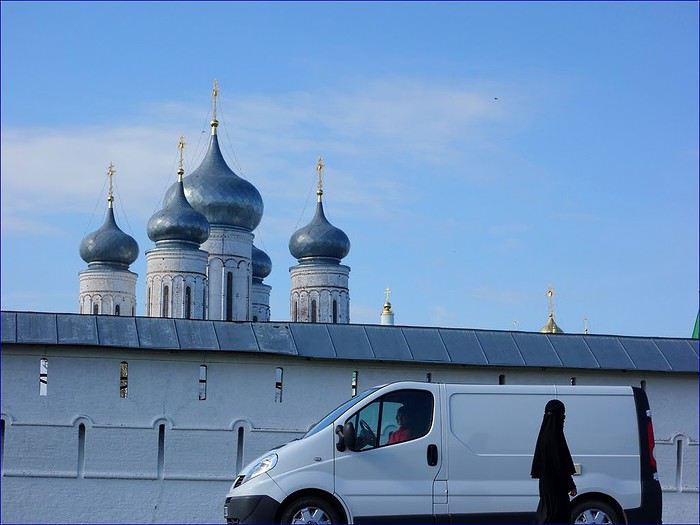
We leave Makaryevo with regret, following the Volga toward Kostroma on the Golden Ring. That’s about all there is to add.
We’ve already taken three long trips through Russia in our little van. The travel journals are shared in the link in our signature.
Best regards, Sylvie & Bernard
Today is January 7th, Orthodox Christmas Day.
It’s the perfect occasion to share on VF a religious site that left a lasting impression on us.
For a long time, we’d admired photos of the Makaryevo Women’s Monastery on Russian websites. They’re always taken from cruise hydrofoils that, in season, depart from Nizhny Novgorod.
This gave us the idea for a crazy challenge: to visit the monastery during a river cruise, with our little plumber’s van that’s become the common thread of our travels!
This challenge seemed impossible to pull off.
The equation was indeed impossible to solve
1. Find a dock 2. Load the van onto a boat 3. Cross the Volga 4. Arrive at sunset 5. Sail past the monastery 6. All with no reliable information. NONE!
Incredibly, every obstacle fell into place one after another! Gifting us unforgettable moments.
The photos follow our exact journey.
1. We arrive on the southern bank of the Volga, searching for a ferry to Makaryevo. First attempt, first failure—we’re way too far east. We find a second ferry, but it serves a different town on the northern bank.
2. We keep going and meet some fishermen. But even they don’t know where to board a vehicle for the monastery.
3. After several fruitless searches, a young man who speaks a few words of English points us to a dock where, in summer, boats *might* serve the monastery. Miraculously, at the end of a rough track, we find an old ferry moored. But no one’s on board, and a chain blocks the entrance.
After an hour of waiting, a worker arrives and tells us they *will* cross the Volga tonight,
but the exit ramp at Makaryevo isn’t accessible for our vehicle.
The captain joins him, and seeing our disappointed faces, they confer, discuss,
and load some planks to raise the ramp!Another miracle!
4. We board, with just one passenger accompanying us— the Trafic is the only vehicle on board.
5. The crossing was magical. And longer than expected, since the Volga here is several kilometers wide, and we’re navigating between countless islands!
6. Under a sky that gradually clears, we discover there are homes on the river— invisible from the banks—that form small communities where people get around by boat!
7. Then, suddenly, around a bend in the channel, the monastery appears in the distance on the northern bank.
8. At the exact moment our boat rounds the buoy and nears the monastery, the sun breaks through the clouds!
9. A breathtaking sight, with our boat gliding along the monastery walls in absolute silence.
10. The sky, now a deep blue, makes the vibrant colors of the onion domes pop.
11. We sail slowly past the monastery under extraordinary light— something our little compact camera can’t fully capture.
12. As promised, the captain and his crew adjust the exit ramp. You can’t tell from the photo, but even with the planks, it was a close call— the van’s chassis barely cleared the ramp. We thanked them warmly.
13. By the end of the day, the monastery is, of course, closed. But another miracle happens! It turns out the passenger who crossed with us is the mayor’s wife. When Sylvie told her we were from France, she called her husband, who immediately contacted the Mother Superior. Like in a dream, the monastery opens just for us. A nun and a guard come to meet us and take us through the chapels and gardens!
14. A visit all the more intimate since only the silent nuns, deep in prayer, are present in these sacred spaces.
15. After dinner in our little van, we enjoy the exceptional light illuminating the now-closed monastery. We’re the only visitors, and the site feels like a massive ship anchored on the Volga.
16. The setting sun now bathes the monastery walls in gorgeous pink hues!
17. Gradually, the legendary Volga itself takes on magical colors! For the night, I’ll just back the van up to level it. It’ll take us a while to fall asleep after such intense moments.
18. Just as inexplicably, the magic continues the next morning! Seeing I’m struggling with my knee, the guard lets us drive slowly along the monastery’s perimeter path. So there we are at dawn, solitary wanderers between the Volga and the monastery walls.
19. The morning light now illuminates the monastery’s eastern façade, which we hadn’t admired yesterday. An exceptional moment.
20. Even more impressive when we realize we’re on the nuns’ prayer path. We cross paths with them—tall, silent, black-clad figures, fully covered.
We leave Makaryevo with regret, following the Volga toward Kostroma on the Golden Ring. That’s about all there is to add.
We’ve already taken three long trips through Russia in our little van. The travel journals are shared in the link in our signature.
Best regards, Sylvie & Bernard
I'm looking for an au pair who'd like to come to Bournemouth in the south of England, and I'd love to know what the best websites are to find one, please.
hi everyone
We’ll be applying for a retiree OA visa by September. For our part, we’ll head back to France for a bit and return a month BEFORE our current OA visa expires to renew it at immigration. We’ve emailed several immigration offices but haven’t gotten any responses. We’ve searched online for info but haven’t found anything. What we’re really interested in is knowing which documents they’ll ask for at the immigration office in Phang Nga, for example, for our renewal. We’ve seen all the paperwork needed for the initial OA visa on the official online visa application site... but for the renewal, do we need to provide ALL the same documents? Thanks in advance
We’ll be applying for a retiree OA visa by September. For our part, we’ll head back to France for a bit and return a month BEFORE our current OA visa expires to renew it at immigration. We’ve emailed several immigration offices but haven’t gotten any responses. We’ve searched online for info but haven’t found anything. What we’re really interested in is knowing which documents they’ll ask for at the immigration office in Phang Nga, for example, for our renewal. We’ve seen all the paperwork needed for the initial OA visa on the official online visa application site... but for the renewal, do we need to provide ALL the same documents? Thanks in advance
Hi fellow travelers! I’d like to do a homestay on a farm in the Oita region, Kyushu. The "farm stays" association’s address isn’t responding anymore. Would anyone have any info? Thanks
Hi everyone,
The idea of traveling to Bolivia came to me after seeing Jean-François (Max68)’s photos on his website. I thought we *had* to see those stunning landscapes with the colorful lagoons for ourselves. But a self-drive trip didn’t seem doable at first. A few years ago, everyone advised against going to the South Lipez with just one car.
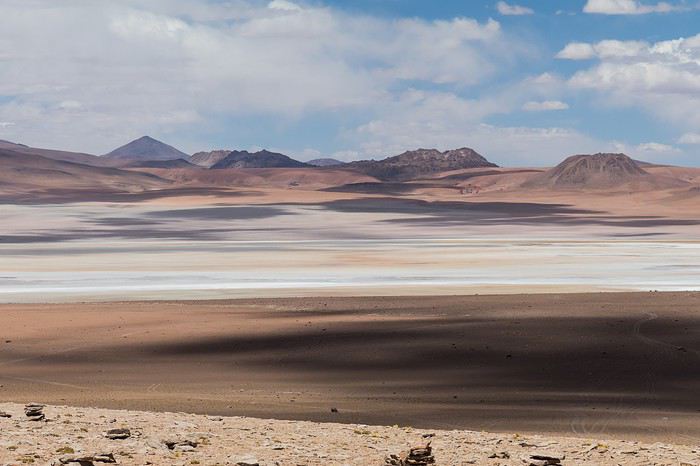 Laguna Kara
It was only after reading Laurent (Lolobe) and Pascal (Pepe874)’s travel journals—who explored the South Lipez solo with a car from Biz Rent a Car—that I thought we might be able to do the same. Meanwhile, we’d already contacted a local agency to organize a trip with a driver and guide. But the idea of a self-drive adventure really appealed to us. With encouragement and tips from Thierry (Tbernay) and Jean-François (Max68), we decided to plan our own self-drive trip. I’d like to thank them for their advice—it was *super* helpful. And a big thanks to all the other forum members for the info shared during our prep!
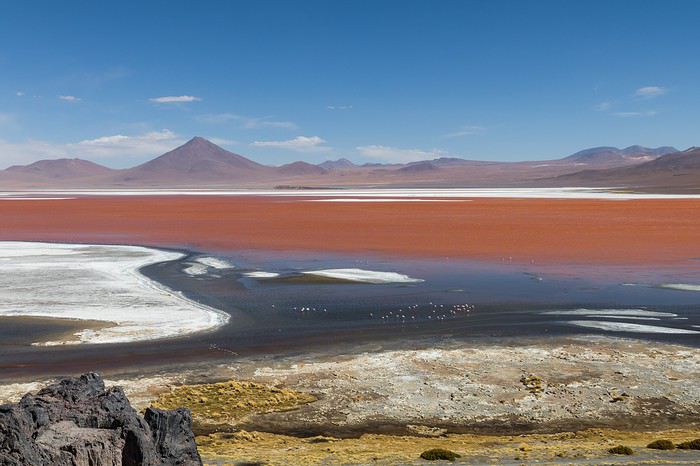 Laguna Colorada
Planning this trip happened during a tough time for our family. My mother-in-law’s illness and passing, plus a few health issues of my own, made us doubt the trip multiple times and nearly scrap the whole thing.
We booked our international flights in February with Swiss. They offered the best balance of travel time and price from Switzerland. Swiss operates Zurich–São Paulo with their own fleet, and São Paulo–Santa Cruz with GOL. In June, GOL canceled the Saturday flight and rebooked us on Sunday. Spending over 24 hours in that huge Brazilian city didn’t work for us at all, so we asked Swiss to put us on the next Zurich–São Paulo flight. Too bad—we lost a day in Bolivia and had to skip the Tarabucco market on Sunday.
Right after, we also booked the car in February. After contacting Imbex and Biz, we went with Biz. Not speaking Spanish, we were relieved to communicate with Alejandra in French. The contact was great—she answered all our questions patiently. Sometimes it took a few days to get a reply, but we could also reach her on WhatsApp. After our trip, we can *only* recommend Biz for rentals in Bolivia. The cars are well-prepped for the South Lipez tracks. The agency is reliable, and the vehicles are new and well-maintained.
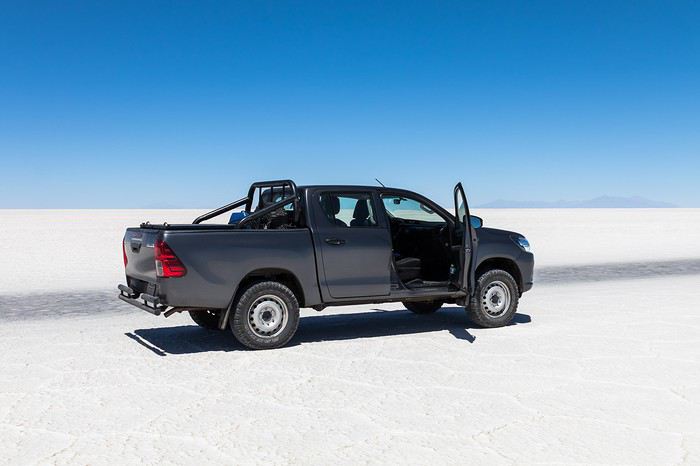 “Our” car, a Toyota Hilux
While planning, we realized the presidential elections would happen while we were in Bolivia. The risk of *bloqueos* (roadblocks and protests) was very real. But in Bolivia, *bloqueos* seem common—you always have to account for that kind of hassle. In late August/early September, Uyuni and the Salar region were blocked for days, leading to food, fuel, and cash shortages. Worried about a blockade in Uyuni and missing the Salar, we decided to visit it first *just in case*.
On election day, the whole country shut down. Planes were grounded, buses and taxis couldn’t circulate, and private cars were banned. There were a few exceptions—ambulances, police, or certain professions—but as tourists, we couldn’t get permission to drive. We asked the embassy, and Biz even requested a permit from the electoral office. So we had to plan to be somewhere with things to do *without* the car.
We decided not to book any accommodations in advance—a first for us. Usually, we plan our stops and reserve lodges, hotels, or campgrounds well ahead. This time, only the room in Sucre was booked, so we’d have a base when we arrived.
In July, Alex (Delhenry) reached out to propose joining part of the trip. He didn’t realize we were leaving in October. Still, we got fresh updates when he returned from the South Lipez. Thanks, Alex—your tips, especially about the Guadalupe–Tupiza stretch, were *super* useful.
In September, we connected with Jean-Louis (Avx) and Anne (Xeta), who were also heading to Bolivia in October, one and two weeks after us. We had dinner with Jean-Louis and his friend after our South Lipez trip and stayed in touch with Anne. It was great to chat with them! Unfortunately, Anne and her husband had a much rockier trip—they got hit hard by post-election issues.
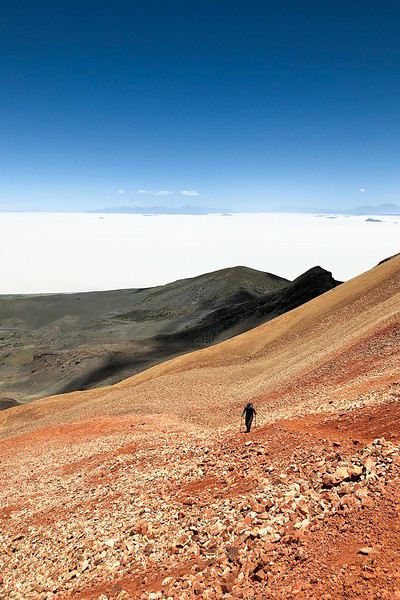 Climbing Volcán Tunupa
Our itinerary wasn’t set in stone—we decided to wing it on the spot. Two weeks before departure, I reconnected with Alejandra at Biz to move the car rental up by a day. With the elections, we wanted to leave Sucre ASAP and focus on the South Lipez. Outside Uyuni and Tupiza, the risk of blockades was zero. We also planned a two-night buffer in Sucre before our flights, just in case. It might sound overcautious, but in hindsight, we made the right call. If we’d left Sucre a day later, we wouldn’t have made it to Potosí—it was completely blocked. On the way back, we *just* dodged blockades in Potosí and elsewhere. Sometimes, you’ve gotta trust your gut.
Here’s our route—only the first two nights in Sucre were booked ahead:
D1 Departure from Switzerland
D2 Sucre (La Selenita)
D3 Sucre (La Selenita)
D4 Colchani (Hotel de Sal Luna Salada)
D5 Jirira (Auberge Doña Lupe)
D6 On the Salar (in the car)
D7 A few kilometers from Estancia Catal (in the car)
D8 Laguna Hedionda (Hotel Los Flamencos)
D9 Laguna Colorada (Lodge by the lagoon)
D10 Middle of nowhere, en route Laguna Verde–Mina Horsu–Quetena Chico (in the car)
D11 Quetena Chico (Lamphaya Lodge Andino)
D12 Quetena Chico (Lamphaya Lodge Andino)
D13 Guadalupe (Guest room at Celia’s)
D14 Along the Rio Grande (in the car)
D15 Tupiza (Hotel Mitru)
D16 Tupiza (Hotel Mitru)
D17 Sucre (La Selenita)
D18 Sucre (La Selenita)
D19 Santa Cruz (Hotel Sun)
D20 Departure from Santa Cruz
D21 Arrival in Switzerland
As you can see, we spent 13 nights in the South Lipez. Initially, we’d planned for nine, but Jean-François (Max68) suggested staying longer. Great advice—we didn’t regret it one bit. We could’ve even added 2–3 more days without getting bored.
Self-driving in the South Lipez takes some prep and a good GPS. We kept it simple and used maps.me to navigate. It’s a solid app—just save your waypoints ahead of time. For some stretches, I used Google Earth to visualize the tracks and sites. If you stick to the tour operator routes, you *almost* can’t get lost. But we often veered off the beaten path and took different routes. Some days, we didn’t see another car. So in case of a breakdown, it’s key to have water and food for several days. In some spots, there’s *zero* signal—your phone won’t work. Another must: it gets *cold* in the South Lipez, and a good sleeping bag is essential. We brought down sleeping bags rated for -10°C and didn’t regret it during our car nights.
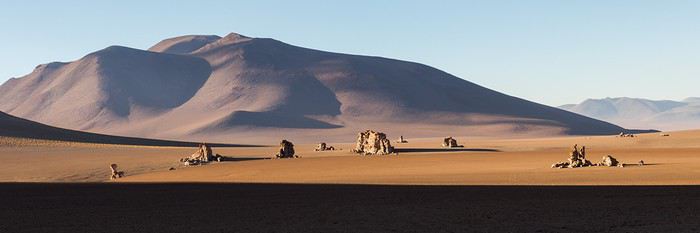 The Dalí Desert
Some tracks are *super* rocky—flat tires are a real risk. On those stretches, maps.me’s estimated travel time was way off. Some sections barely let us go over 15 km/h.
Lots of forum members recommend doing the South Lipez “loop” from Tupiza to Uyuni—ending with the Salar—to avoid Uyuni’s crowds. That might work for organized tours, but for self-drive, the direction *doesn’t* matter. I’ll say this: the few vehicles we saw mostly came from Tupiza and Chile, not Uyuni. So if starting from Uyuni works better for you, go for it! Ending in Tupiza means heading toward warmer weather. For our planned stops and climbs, starting in Uyuni helped with acclimatization. Spending a few nights between 3,600–3,800 m before going over 4,000 m is a smart move.
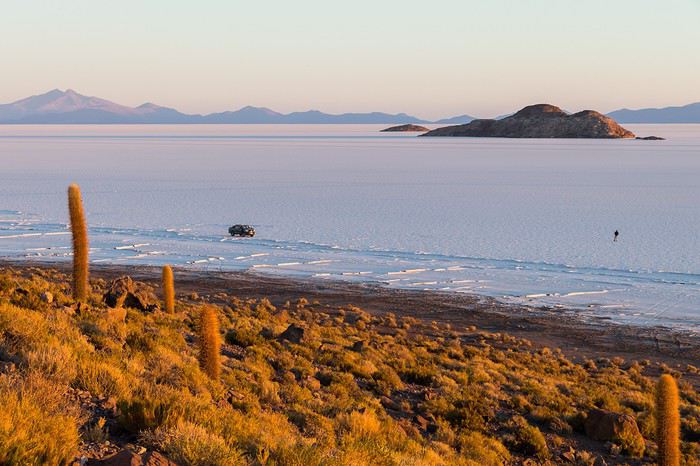 Uyuni Salt Flats in the morning
Overall, we barely saw anyone—except at Laguna Hedionda and Chalviri. There were several tour groups at Hotel Los Flamencos (Laguna Hedionda), but we didn’t cross paths during the day. Hardly anyone on the Salar, on the roads, or at the lodges in the evenings. The *only* place that shocked us was Chalviri. We’d planned to stay there, but it was fully booked—and we counted *forty* tour jeeps on-site. This was around noon! At the Polques hot springs (Chalviri), it was *packed*—we quickly nixed the idea of a dip. Plus, the vibe wasn’t great: soaking right by the road with lodges and restaurants in the background? Meh. Still, lots of tourists love it, so it’s up to you.
For the photos, I kept the colors and mood we saw. The lagoons’ hues are often stunning, but some online photos are *way* over-edited and oversaturated. The South Lipez’s landscapes are breathtaking—no need for excessive retouching.
If you don’t want to read all the details, the start of the travel journal is here: https://voyageforum.com/v.f?post=9888761;a=9888761
The idea of traveling to Bolivia came to me after seeing Jean-François (Max68)’s photos on his website. I thought we *had* to see those stunning landscapes with the colorful lagoons for ourselves. But a self-drive trip didn’t seem doable at first. A few years ago, everyone advised against going to the South Lipez with just one car.
Laguna KaraIt was only after reading Laurent (Lolobe) and Pascal (Pepe874)’s travel journals—who explored the South Lipez solo with a car from Biz Rent a Car—that I thought we might be able to do the same. Meanwhile, we’d already contacted a local agency to organize a trip with a driver and guide. But the idea of a self-drive adventure really appealed to us. With encouragement and tips from Thierry (Tbernay) and Jean-François (Max68), we decided to plan our own self-drive trip. I’d like to thank them for their advice—it was *super* helpful. And a big thanks to all the other forum members for the info shared during our prep!
Laguna ColoradaPlanning this trip happened during a tough time for our family. My mother-in-law’s illness and passing, plus a few health issues of my own, made us doubt the trip multiple times and nearly scrap the whole thing.
We booked our international flights in February with Swiss. They offered the best balance of travel time and price from Switzerland. Swiss operates Zurich–São Paulo with their own fleet, and São Paulo–Santa Cruz with GOL. In June, GOL canceled the Saturday flight and rebooked us on Sunday. Spending over 24 hours in that huge Brazilian city didn’t work for us at all, so we asked Swiss to put us on the next Zurich–São Paulo flight. Too bad—we lost a day in Bolivia and had to skip the Tarabucco market on Sunday.
Right after, we also booked the car in February. After contacting Imbex and Biz, we went with Biz. Not speaking Spanish, we were relieved to communicate with Alejandra in French. The contact was great—she answered all our questions patiently. Sometimes it took a few days to get a reply, but we could also reach her on WhatsApp. After our trip, we can *only* recommend Biz for rentals in Bolivia. The cars are well-prepped for the South Lipez tracks. The agency is reliable, and the vehicles are new and well-maintained.
“Our” car, a Toyota HiluxWhile planning, we realized the presidential elections would happen while we were in Bolivia. The risk of *bloqueos* (roadblocks and protests) was very real. But in Bolivia, *bloqueos* seem common—you always have to account for that kind of hassle. In late August/early September, Uyuni and the Salar region were blocked for days, leading to food, fuel, and cash shortages. Worried about a blockade in Uyuni and missing the Salar, we decided to visit it first *just in case*.
On election day, the whole country shut down. Planes were grounded, buses and taxis couldn’t circulate, and private cars were banned. There were a few exceptions—ambulances, police, or certain professions—but as tourists, we couldn’t get permission to drive. We asked the embassy, and Biz even requested a permit from the electoral office. So we had to plan to be somewhere with things to do *without* the car.
We decided not to book any accommodations in advance—a first for us. Usually, we plan our stops and reserve lodges, hotels, or campgrounds well ahead. This time, only the room in Sucre was booked, so we’d have a base when we arrived.
In July, Alex (Delhenry) reached out to propose joining part of the trip. He didn’t realize we were leaving in October. Still, we got fresh updates when he returned from the South Lipez. Thanks, Alex—your tips, especially about the Guadalupe–Tupiza stretch, were *super* useful.
In September, we connected with Jean-Louis (Avx) and Anne (Xeta), who were also heading to Bolivia in October, one and two weeks after us. We had dinner with Jean-Louis and his friend after our South Lipez trip and stayed in touch with Anne. It was great to chat with them! Unfortunately, Anne and her husband had a much rockier trip—they got hit hard by post-election issues.
Climbing Volcán TunupaOur itinerary wasn’t set in stone—we decided to wing it on the spot. Two weeks before departure, I reconnected with Alejandra at Biz to move the car rental up by a day. With the elections, we wanted to leave Sucre ASAP and focus on the South Lipez. Outside Uyuni and Tupiza, the risk of blockades was zero. We also planned a two-night buffer in Sucre before our flights, just in case. It might sound overcautious, but in hindsight, we made the right call. If we’d left Sucre a day later, we wouldn’t have made it to Potosí—it was completely blocked. On the way back, we *just* dodged blockades in Potosí and elsewhere. Sometimes, you’ve gotta trust your gut.
Here’s our route—only the first two nights in Sucre were booked ahead:
D1 Departure from Switzerland
D2 Sucre (La Selenita)
D3 Sucre (La Selenita)
D4 Colchani (Hotel de Sal Luna Salada)
D5 Jirira (Auberge Doña Lupe)
D6 On the Salar (in the car)
D7 A few kilometers from Estancia Catal (in the car)
D8 Laguna Hedionda (Hotel Los Flamencos)
D9 Laguna Colorada (Lodge by the lagoon)
D10 Middle of nowhere, en route Laguna Verde–Mina Horsu–Quetena Chico (in the car)
D11 Quetena Chico (Lamphaya Lodge Andino)
D12 Quetena Chico (Lamphaya Lodge Andino)
D13 Guadalupe (Guest room at Celia’s)
D14 Along the Rio Grande (in the car)
D15 Tupiza (Hotel Mitru)
D16 Tupiza (Hotel Mitru)
D17 Sucre (La Selenita)
D18 Sucre (La Selenita)
D19 Santa Cruz (Hotel Sun)
D20 Departure from Santa Cruz
D21 Arrival in Switzerland
As you can see, we spent 13 nights in the South Lipez. Initially, we’d planned for nine, but Jean-François (Max68) suggested staying longer. Great advice—we didn’t regret it one bit. We could’ve even added 2–3 more days without getting bored.
Self-driving in the South Lipez takes some prep and a good GPS. We kept it simple and used maps.me to navigate. It’s a solid app—just save your waypoints ahead of time. For some stretches, I used Google Earth to visualize the tracks and sites. If you stick to the tour operator routes, you *almost* can’t get lost. But we often veered off the beaten path and took different routes. Some days, we didn’t see another car. So in case of a breakdown, it’s key to have water and food for several days. In some spots, there’s *zero* signal—your phone won’t work. Another must: it gets *cold* in the South Lipez, and a good sleeping bag is essential. We brought down sleeping bags rated for -10°C and didn’t regret it during our car nights.
The Dalí DesertSome tracks are *super* rocky—flat tires are a real risk. On those stretches, maps.me’s estimated travel time was way off. Some sections barely let us go over 15 km/h.
Lots of forum members recommend doing the South Lipez “loop” from Tupiza to Uyuni—ending with the Salar—to avoid Uyuni’s crowds. That might work for organized tours, but for self-drive, the direction *doesn’t* matter. I’ll say this: the few vehicles we saw mostly came from Tupiza and Chile, not Uyuni. So if starting from Uyuni works better for you, go for it! Ending in Tupiza means heading toward warmer weather. For our planned stops and climbs, starting in Uyuni helped with acclimatization. Spending a few nights between 3,600–3,800 m before going over 4,000 m is a smart move.
Uyuni Salt Flats in the morningOverall, we barely saw anyone—except at Laguna Hedionda and Chalviri. There were several tour groups at Hotel Los Flamencos (Laguna Hedionda), but we didn’t cross paths during the day. Hardly anyone on the Salar, on the roads, or at the lodges in the evenings. The *only* place that shocked us was Chalviri. We’d planned to stay there, but it was fully booked—and we counted *forty* tour jeeps on-site. This was around noon! At the Polques hot springs (Chalviri), it was *packed*—we quickly nixed the idea of a dip. Plus, the vibe wasn’t great: soaking right by the road with lodges and restaurants in the background? Meh. Still, lots of tourists love it, so it’s up to you.
For the photos, I kept the colors and mood we saw. The lagoons’ hues are often stunning, but some online photos are *way* over-edited and oversaturated. The South Lipez’s landscapes are breathtaking—no need for excessive retouching.
If you don’t want to read all the details, the start of the travel journal is here: https://voyageforum.com/v.f?post=9888761;a=9888761
Hi there, we’re landing at Hanoi Airport and would like to head straight to Cao Bang without going into Hanoi. Does anyone know if there are buses that go directly from the airport to Cao Bang (especially in the early afternoon)? Thanks in advance!
Hi,
I’m reaching out to the community because I can’t find the answer to my question.
I’d like to book a flight from Barcelona to Singapore, then from Singapore to Bali with Singapore Airlines.
When transferring from Singapore to Bali, does the airline handle the baggage transfer between the two flights?
Or do we have to collect our luggage, go through security again, check in, etc.?
Thanks in advance for your replies.
Thanks in advance for your replies.
Hi,
We’re planning to start the Camino del Cid from Vivar del Cid (Burgos) to Atienza in April.
How can we get back and pick up our car, which we left in Burgos? I haven’t found any info on this.
Thanks for your tips!
Hi there,
I’m just starting my research for Tashkent, Samarkand, Bukhara... I’m not sure I’ll manage to organize everything with the train or find a driver every time I need one. I don’t want a packaged tour. Can you tell me if everything needs to be booked well in advance? I’m also looking for fun activities for my teens (other than museum and mosque visits). We’ll be traveling in October. Thanks for your tips!
I’m just starting my research for Tashkent, Samarkand, Bukhara... I’m not sure I’ll manage to organize everything with the train or find a driver every time I need one. I don’t want a packaged tour. Can you tell me if everything needs to be booked well in advance? I’m also looking for fun activities for my teens (other than museum and mosque visits). We’ll be traveling in October. Thanks for your tips!
Hello,
My partner and I are planning a trip to Thailand, Laos, and Japan. To do this, we’re thinking of booking a flight ticket from Paris to Bangkok, departing in January 2025 and returning in April 2025. During this period, we’d travel overland to Laos and fly to Japan from Thailand, then return to Thailand. What type of visa should we apply for at the Thai embassy? Thanks in advance. Best regards,
My partner and I are planning a trip to Thailand, Laos, and Japan. To do this, we’re thinking of booking a flight ticket from Paris to Bangkok, departing in January 2025 and returning in April 2025. During this period, we’d travel overland to Laos and fly to Japan from Thailand, then return to Thailand. What type of visa should we apply for at the Thai embassy? Thanks in advance. Best regards,
Excellent bike path almost entirely off-road, with a really scenic route. We joined it in Bad Tölz after coming from Strasbourg and left it 100 km before Venice to stay in the mountains and connect with the end of the Via Claudia, which is probably on next year’s program. The trail is often on packed gravel, but even though some short sections aren’t great, our 32C tires were enough—though wider would’ve been better. Mostly wild camping, often by a lake or river. The signage is top-notch. The only downside is the noise from cars in some valleys—out of sight but not out of earshot.
Sites that explain it better than I can: https://italy-cycling-guide.info/ An English site—check the INTERNATIONAL CYCLE ROUTES section.
It’s almost *too* detailed—a 1:200,000 map is plenty.
And here’s a photo to inspire you!
Sites that explain it better than I can: https://italy-cycling-guide.info/ An English site—check the INTERNATIONAL CYCLE ROUTES section.
It’s almost *too* detailed—a 1:200,000 map is plenty.
And here’s a photo to inspire you!
Hi, I'm looking for someone who could teach me Kabyle, thanks.
I took a few days to get some fresh air outside the Schengen-NATO prison. Between March 18, 2026, and March 25, 2026, as shown by the passport stamps:
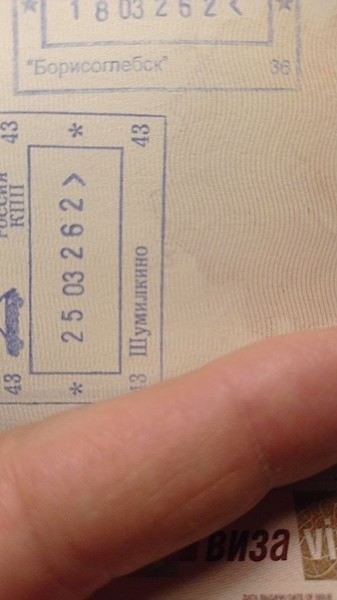
Borisoglebsk is the Russian border checkpoint after Kirkenes, on the road to Murmansk.
Kirkenes is a tiny town with a correspondingly small airport. Nothing has changed there: the minibuses to Murmansk wait on the right as you exit the airport. They’re synchronized with the two daily flights from Oslo—the SAS around 11:00 AM and Norwegian around 11:30 AM. They stop in Kirkenes at the corner of the Scandic for an hour, where other passengers can board, then head straight to the nearby border.
This is the least hassle Frontex/Schengen border. The Norwegian agent quickly scans your passport, and that’s it. No customs, since Norway is Schengen but not in the EU. On the Russian side, there’s a passport check and a quick customs inspection. All in all, crossing both the Norwegian and Russian checkpoints takes about 15 minutes.
A paper visa is required; e-visas aren’t accepted.
Two companies run the route: Avto Ekspress and Borodin: https://ae51.ru/routes/kirkenes-murmansk/ https://borodinbus.com/
The one-way fare is 5,500 ₽. You can either buy it online in rubles with a MIR card or make a formal reservation and pay in NOK cash to the driver. I took Borodin, and the price in NOK was much more expensive than in ₽.
=========================
On March 25, I left from Pskov via the Estonian border post at Luhaama. I spent three days in Murmansk, flew to St. Petersburg (SPB), stayed there for two days, then took an evening train to Pskov.
Since the end of February—and reportedly until the end of May—the Estonians have restricted the opening hours of the two border crossings near Pskov: Koidula (Pechory on the Russian side) and Luhaama (Izborsk on the Russian side). They’re closed at night between 7:00 PM and 7:00 AM. Right now, there’s a bus from Pskov at 7:00 AM to the border. It drops you off at the end of the road where truckers—many Kazakh and Serbian—are parked on the side. You finish the rest on foot to the barrier, where there’s a quick initial check for Ukrainian stamps in passports. Then you walk to the customs building, followed by passport control at the kiosk for motorists. After that, it’s a 500-meter walk to the Estonian checkpoint. At the moment, things seem calmer. Passport control is quick. The usual silly questions in English: "Where were you? Where are you going?" I just gave my most clueless smile: "Sorry, I don’t understand." Yeah, right—I don’t speak English, especially not at an Estonian border with a French passport. If they’re in a mood, though... A very quick bag inspection. Once you exit the Estonian post, walk to the bus stop sign by the road where another coach takes you to Riga.
The catch: in my case, last Wednesday, there were two passengers (Russians) with old Ukrainian stamps in their passports. The bus from the Estonian post to Riga was supposed to leave around 9:30 AM. We ended up leaving around noon after the two were grilled by the FSB. Since it was a weekday outside of holidays, the bus was half-empty. The fuller the bus and the more people with Ukrainian stamps, the worse the nightmare. Don’t book a same-day flight from Riga. I had a flight at 6:00 PM, so it worked out.
=============
The Kirkenes-Murmansk route is still clearly the easiest and fastest. But it’s not the most convenient since it’s way up north.
Next, I’d say the Gdansk-Kaliningrad route in the middle of the week. Avoid weekends and holiday departures/returns.
Avoid the Narva-Ivangorod route during Christmas, Easter, May 9, and *all* summer.
==============
About flights from Murmansk to St. Petersburg: prices are good. I bought my ticket the day before departure on Rossiya for 7,500 ₽, including 10 kg of luggage + a handbag.
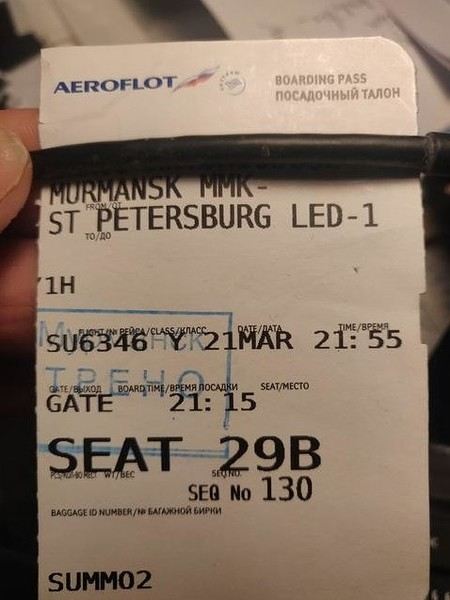
It’s the tail end of the northern lights season, and there were still crowds of Chinese tourists.
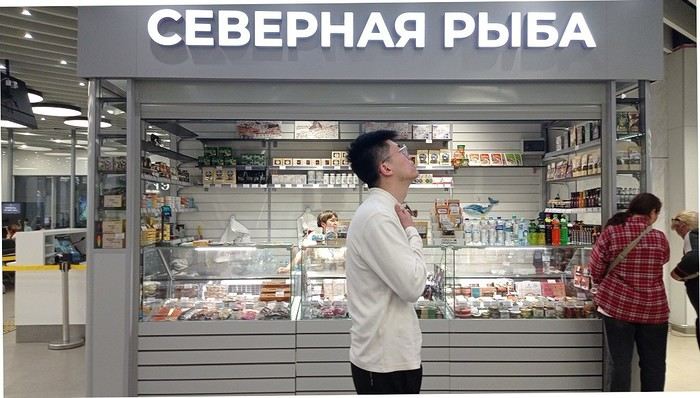
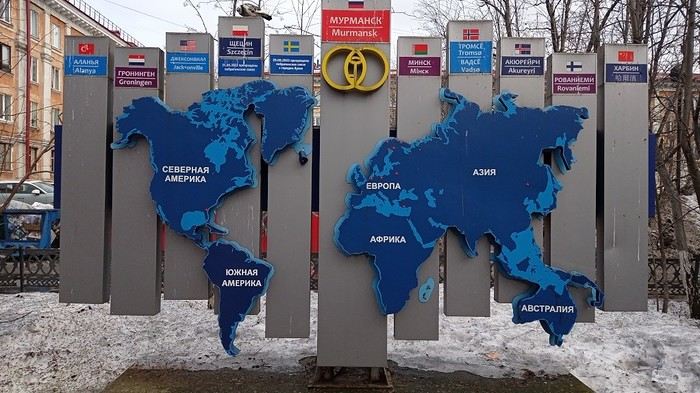
By the way, Murmansk is twinned with Harbin:
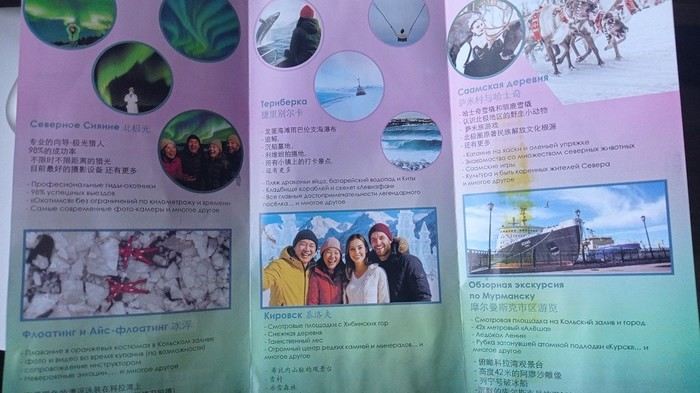
Chinese tourists are the largest foreign group, followed by Indians, then a mix of others from the Far East, Turks, Arabs, etc. Brochures are bilingual—Russian and Chinese:
============================
But let’s talk practical stuff. --
My domestic SIM card was restricted for SMS and internet for 24 hours. After that, if you want to keep using SMS, don’t turn off your phone—restarting triggers another 24-hour purgatory.
My Russian SIM cards (Megafon, MTS, Beeline) were activated as soon as I logged into their respective apps with my credentials.
Internet --
Telegram is heavily slowed down by authorities. To use it, you need to connect through proxy servers, which you load into the latest version of the app. Traffic is then rerouted internally within Telegram to servers outside Russia (Germany, Poland, Sweden, etc.). You can find these proxies on various channels. One is ChatVPN—check their website too.
For general internet use, like browsing the web, VPNs that work right now use the VLESS protocol. You can find several on Telegram by searching "VPN." A few free days, then payment in rubles or crypto.
Rozkomnadzor’s team are experts at this, so things can change. It’s a constant cat-and-mouse game.
Pskov is a special case. The city is near Estonia and has a large military base. Depending on NATO drone swarms launched from the Baltics, Wi-Fi can be completely suspended except for the most essential mobile apps. The drone swarms use the 4G network, and the powerful electronic jamming and drone suppression systems cause periods without Wi-Fi—including in hotels. Wired connections aren’t affected.
Borisoglebsk is the Russian border checkpoint after Kirkenes, on the road to Murmansk.
Kirkenes is a tiny town with a correspondingly small airport. Nothing has changed there: the minibuses to Murmansk wait on the right as you exit the airport. They’re synchronized with the two daily flights from Oslo—the SAS around 11:00 AM and Norwegian around 11:30 AM. They stop in Kirkenes at the corner of the Scandic for an hour, where other passengers can board, then head straight to the nearby border.
This is the least hassle Frontex/Schengen border. The Norwegian agent quickly scans your passport, and that’s it. No customs, since Norway is Schengen but not in the EU. On the Russian side, there’s a passport check and a quick customs inspection. All in all, crossing both the Norwegian and Russian checkpoints takes about 15 minutes.
A paper visa is required; e-visas aren’t accepted.
Two companies run the route: Avto Ekspress and Borodin: https://ae51.ru/routes/kirkenes-murmansk/ https://borodinbus.com/
The one-way fare is 5,500 ₽. You can either buy it online in rubles with a MIR card or make a formal reservation and pay in NOK cash to the driver. I took Borodin, and the price in NOK was much more expensive than in ₽.
=========================
On March 25, I left from Pskov via the Estonian border post at Luhaama. I spent three days in Murmansk, flew to St. Petersburg (SPB), stayed there for two days, then took an evening train to Pskov.
Since the end of February—and reportedly until the end of May—the Estonians have restricted the opening hours of the two border crossings near Pskov: Koidula (Pechory on the Russian side) and Luhaama (Izborsk on the Russian side). They’re closed at night between 7:00 PM and 7:00 AM. Right now, there’s a bus from Pskov at 7:00 AM to the border. It drops you off at the end of the road where truckers—many Kazakh and Serbian—are parked on the side. You finish the rest on foot to the barrier, where there’s a quick initial check for Ukrainian stamps in passports. Then you walk to the customs building, followed by passport control at the kiosk for motorists. After that, it’s a 500-meter walk to the Estonian checkpoint. At the moment, things seem calmer. Passport control is quick. The usual silly questions in English: "Where were you? Where are you going?" I just gave my most clueless smile: "Sorry, I don’t understand." Yeah, right—I don’t speak English, especially not at an Estonian border with a French passport. If they’re in a mood, though... A very quick bag inspection. Once you exit the Estonian post, walk to the bus stop sign by the road where another coach takes you to Riga.
The catch: in my case, last Wednesday, there were two passengers (Russians) with old Ukrainian stamps in their passports. The bus from the Estonian post to Riga was supposed to leave around 9:30 AM. We ended up leaving around noon after the two were grilled by the FSB. Since it was a weekday outside of holidays, the bus was half-empty. The fuller the bus and the more people with Ukrainian stamps, the worse the nightmare. Don’t book a same-day flight from Riga. I had a flight at 6:00 PM, so it worked out.
=============
The Kirkenes-Murmansk route is still clearly the easiest and fastest. But it’s not the most convenient since it’s way up north.
Next, I’d say the Gdansk-Kaliningrad route in the middle of the week. Avoid weekends and holiday departures/returns.
Avoid the Narva-Ivangorod route during Christmas, Easter, May 9, and *all* summer.
==============
About flights from Murmansk to St. Petersburg: prices are good. I bought my ticket the day before departure on Rossiya for 7,500 ₽, including 10 kg of luggage + a handbag.
It’s the tail end of the northern lights season, and there were still crowds of Chinese tourists.
By the way, Murmansk is twinned with Harbin:
Chinese tourists are the largest foreign group, followed by Indians, then a mix of others from the Far East, Turks, Arabs, etc. Brochures are bilingual—Russian and Chinese:
============================
But let’s talk practical stuff. --
My domestic SIM card was restricted for SMS and internet for 24 hours. After that, if you want to keep using SMS, don’t turn off your phone—restarting triggers another 24-hour purgatory.
My Russian SIM cards (Megafon, MTS, Beeline) were activated as soon as I logged into their respective apps with my credentials.
Internet --
Telegram is heavily slowed down by authorities. To use it, you need to connect through proxy servers, which you load into the latest version of the app. Traffic is then rerouted internally within Telegram to servers outside Russia (Germany, Poland, Sweden, etc.). You can find these proxies on various channels. One is ChatVPN—check their website too.
For general internet use, like browsing the web, VPNs that work right now use the VLESS protocol. You can find several on Telegram by searching "VPN." A few free days, then payment in rubles or crypto.
Rozkomnadzor’s team are experts at this, so things can change. It’s a constant cat-and-mouse game.
Pskov is a special case. The city is near Estonia and has a large military base. Depending on NATO drone swarms launched from the Baltics, Wi-Fi can be completely suspended except for the most essential mobile apps. The drone swarms use the 4G network, and the powerful electronic jamming and drone suppression systems cause periods without Wi-Fi—including in hotels. Wired connections aren’t affected.
hi there
I’m reaching out because I don’t understand how Volcanoes National Park works. I looked at booking for the gorillas, but there’s just the price listed, and the same goes for the Diane Fossey tomb.
So I contacted a hotel in Kinigi, and they told me that for the gorillas, you need a car to get to the park headquarters, and then once you know your group, you need to get from the headquarters to the trekking start point?? Do you confirm this? Is that really how it works? They say the hotel has a driver and it would cost 100 DOLLARS!! I just found out that on top of the permit, there are other fees??? Uhh… Are there other options, knowing I don’t want to rent a 4x4 since I’m traveling alone?
And if I don’t get the gorilla permit but just want to visit the Diane Fossey tomb, is it the same issue? From Kinigi, do you need a 4x4? How far is the tomb from the headquarters? Is it a hike you can do alone OR DO YOU NEED A GUIDE, ON FOOT? By car?? If someone could explain everything to me… and is the DF Foundation different??
If I decide to go through an agency, is it possible in Musanze (which would save me trips) or is it mandatory to go through Kigali? Thanks so much for your help… Best regards
The Eastern region is a landscape of protected coasts and bays, charming little fishing villages, exceptional scenic routes, and hiking trails in the heart of preserved habitats where many migratory bird species live, including puffins.
Stretching from Cape Bonavista in the north, where John Cabot landed in 1497, to Fortune and Grand Bank in the south, this part of Newfoundland was the first to be discovered and settled.
Visiting this region is like stepping back in time and discovering the cultural and artistic richness of this province, all at a more relaxed pace.
Source: https://www.exploretnl.ca/region-est
Videos are embedded throughout the summary. Please click on the image to start the video.
Bonavista Peninsula - Trinity - Gun Hill Trail Bonavista Peninsula - Trinity East - Skerwink Trail Bonavista Peninsula - Elliston - Puffin viewing site Bonavista Peninsula - Elliston - Spillars Cove (Cable John Cove) Bonavista - Dungeon Provincial Park Bonavista - John Cabot Municipal Park Bonavista Peninsula - Cape Bonavista Lighthouse St. Lawrence - Cape Chapeau Rouge Trail
Hi everyone,
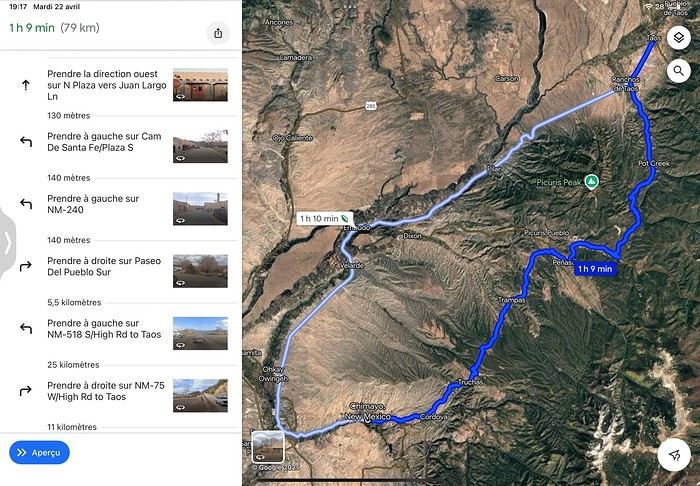
For our leg from Taos to Albuquerque, we have two options with roughly the same mileage and driving time:
Either the light blue route (NM 518 then NM 76)
or the dark blue route (NM 68), which would let us visit the Embudo Gas Museum.
We’d love to stop at the Chimayó Sanctuary if it’s worth the small detour.
We’ll have already taken NM 518 from Las Vegas to Taos.
Which route is prettier and has the most points of interest?
Afterward, we’ll take the Turquoise Trail between Santa Fe and Albuquerque.
Thanks for your input!
Marcalamar :)
Hi Voyage Forum members,
My wife and I took American Airlines flight no. 63 on Tuesday, February 18, 2025, at 9:30 AM, with a scheduled arrival in Miami at 1:30 PM local time.
After about half an hour of flight, a young passenger had a medical emergency. They were given care, and a flight attendant went to get an oxygen bottle. Then, an announcement over the loudspeakers informed passengers that the plane was diverting to London.
Once at London Heathrow (LHR), we were waiting to depart again. But a new announcement asked us to disembark because the plane wouldn’t be able to take off until the next day. (American responded to my follow-up, saying they’re required to limit their staff’s working hours to a certain number per day.)
A crowd of travelers gathered at the American Airlines counter, where they were told to follow instructions to get to a hotel. Meanwhile, I called the airline’s customer service to find a replacement flight that same day, since I couldn’t afford to leave the next day. If I had, I would’ve lost my hotel and car rental reservations due to late cancellation, which would’ve cost me a significant amount.
After discussing in English with customer service and the counter staff (who I handed my phone to), we managed to get two seats on British Airways flight BA 0209, which was leaving about 2 hours later.
That’s how, after a stressful wait unsure if we’d get our luggage back, and once we did, we hurried—heavily loaded—to reach the far-off terminal for our new boarding on foot and by train shuttle.
We finally took off for Miami and landed around 7:30 PM, which was 6 hours later than the originally scheduled arrival time of American Airlines flight 63.
On top of the stress, there were the costs of meals in the meantime, and I had to notify the hotel and car rental company about our delay.
As a result, I requested compensation for a flight delay of at least 3 hours (and I’ve involved my insurance’s legal protection to pursue this claim). American Airlines argued that exceptional circumstances prevented them from compensating me.
What do you think? Is my request unreasonable?
This catchy and somewhat mysterious title comes from several questions I’ve been asking myself.
VF has been back open for a reasonable number of weeks and months now. The number of visitors overall matches past averages, but the number of members online in the last 24 hours seems relatively lower than what we used to see.
Yet, to my surprise, I’m seeing fewer travel journals, way fewer messages, and way fewer questions. I don’t see many new registered users online, and I notice a number of members who are logged in but either aren’t participating or have stopped participating.
Something’s not adding up for me because, in my opinion, VF is still appealing, and I don’t see which other sites could really compete.
Was there a real break between pre- and post-Covid? Does it just take more time for some people to discover the site or learn that it’s active again? Do people now prefer quick consumption on sites like FB or others I’m not familiar with? Where have the site’s old-timers gone, and what are they doing with their time now? What’s really going on here?
Hi,
Just so you know, when you take the JR from the airport to central Tokyo, the company has introduced a baggage fee of 900 yen (5.50 €) per person for foreigners. There’s a dedicated line for this, and you’re directed by a JR agent.
If you take the Keisei network from Narita, there’s no fee for now.
As a reminder, the JR Pass has tripled in price since October 2023. It’s not essential if you’re staying less than 3 weeks—consider the bus instead, which is much cheaper. Sure, it takes longer, but it’s budget-friendly.
Since October 1, 2024, agents have been handing out flyers to tourists at airport arrivals with recommendations about theft in hotels. Over the past few months, there’s been a rise in stolen phones, laptops, and other electronics from rooms. The advice is to lock everything in a suitcase with a key or code when you’re not around to avoid issues. Japan’s economy isn’t doing well right now, and some locals are struggling financially, blaming tourists for rising prices. Of course, the current exchange rate is great for us—165 yen to the euro lets us eat ramen for next to nothing—but inflation has hit them hard.
Since October 1, 2024, agents have been handing out flyers to tourists at airport arrivals with recommendations about theft in hotels. Over the past few months, there’s been a rise in stolen phones, laptops, and other electronics from rooms. The advice is to lock everything in a suitcase with a key or code when you’re not around to avoid issues. Japan’s economy isn’t doing well right now, and some locals are struggling financially, blaming tourists for rising prices. Of course, the current exchange rate is great for us—165 yen to the euro lets us eat ramen for next to nothing—but inflation has hit them hard.
Hi,
My boyfriend and I are looking to spend a week in the Alps at the end of August. But since we only know the region in winter, I have no idea where to start!
I’d like to avoid the big resorts with apartment blocks and instead head for a typical village, with great hikes (on foot and by bike) and ideally near a lake, river, or water spot.
All suggestions are welcome!!! :)
Morgane.
All suggestions are welcome!!! :)
Morgane.
Hi there, I’m planning a cross-Canada bike trip, and I’ve got a question that might seem silly, but could someone tell me how to pack a bike (in a box, with a fragile sticker... I don’t know) for a flight? Thanks in advance!
Hi, I need to buy about ten pairs of babouches. Do you know if there are any shops around Ouarzazate or Agdz where I could find them? Maybe even cheaper than in Marrakech?
Thanks.
Thanks.
Hi everyone,
After several trips and meetings in Morocco, I’d like to take the plunge and go work there.
I’m French and currently a Project Manager for an IT consulting firm. I’m primarily looking at Casablanca.
Could you share any advice or experiences? Is it better to go there and look for opportunities on the spot, and if so, who should I reach out to?
Alternatively, do you know of any French companies looking for someone with my profile for a position in Morocco?
I’m open to any great tips or potential contacts.
Thanks in advance, everyone!!
Hello everyone,
We’ve planned a trip (retired couple) for late August to the first half of September in Western Canada.
Classic itinerary: arrival in Calgary, Banff, Jasper, Clearwater, Whistler, Vancouver Island, departure from Vancouver.
I know you can’t see into the future any better than I can, so I’m obviously not asking what the wildfire situation will be like in a month...
But if any of you could let me know if, CURRENTLY, there are major difficulties—not just for locals, of course, but for tourists as well?
We’re hesitating between taking the chance or canceling what we still can.
We’re not young anymore and don’t have the flexibility we once did...
A thousand thanks to those of you on the ground or with contacts there who can help us make this decision!