Discussions Slrdnv took part in
13 results on this page.
More options
Many results are in French, the community’s main language. English translations are added over time.
Search results
Trajet San Pedro de Atacama / Sud Lipez / Uyuni
Bonjour à tous,
Pouvez vous me conseiller sur un trajet San Pedro de Atacama / Sud Lipez / Salar de Uyuni Auriez vous fait ce circuit ? Est-ce que je pourrais trouver sur place à San Pedro de Atacama une agence organisant ce genre de trip ? Ou est il préférable de réserver avant ?
Je n'ai pas envie de faire en bus : San Pedro de Atacama / Calama (1h30) + Calama / Uyuni (8h) + Uyuni et trip Sud Lipez -- Trop de transport !!!
Voyage sur plusieurs mois, donc j'ai mon temps Je pense etre à San Pedro de Atacam début novembre 2020
Merci de votre aide Valérie
Propositions d'itinéraire trek vers Huaraz (Pérou)
Bonjour a tous,
Mi septembre, après avoir passé persque 2 semaine vers Cusco, nous serons a Huaraz pour quelques jours, et nous aimerions faire un petit trek. Nous avons quelques propositions d'itinéraire:
_Le trek de Santa Cruz (un classique)
_Le trek Ishinca: J1: Huaraz / Pashpa / refuge Ishinca J2: Refuge Ishinca / une boucle vers les lacs autour et retour au refuge Ishinca J3: Refuge Ishinca / Pashpa / Huaraz
_Le trek Refuge Peru et Laguna 69: J1: Huaraz / Cebollapampa / Refuge Peru J2: Refuge Peru / Laguna 69 / Cebollapampa / Huaraz
Au niveau des paysages, pourriez vous me dire quels sont les treks les plus intéressant?
Merci d'avance
Visiter la réserve de Paracas en voiture au départ de Lima
Bonjour,
Nous sommes 5 dont 3 personnes "agés" nous avons loué une voiture au départ de Lima (aucun soucis pour la conduite, nous avons déja fait le mexique et le chili et le brésil en voiture) Est-ce que vous savez si c'est possible de visiter la réserve en voiture ? ou du moins d'y entrer en voiture ?
Merci
Votre avis sur mon itinéraire de 2 semaines en Bolivie
Bonjour à tous !
Je pars le 21 mai pour 2 semaines en Bolivie (avant d'aller au Pérou). Mes billets d'avion sont pris et le trek de l'incas au Pérou est réservé.
Je voulais vous soumettre mon itinéraire afin que vous puissiez me donner votre avis.
Jour 01 : Départ à 23h35 (CDG)
Jour 02 : Arrivée à Santa Cruz à 12h20.
Jour 03 : Départ l'aprem pour Sucre en avion.
Jour 04 : Sucre.
Jour 05 : Départ l'aprem pour Potosi en bus.
Jour 06 : Potosi.
Jour 07 : Bus pour Uyuni (ou Tupiza).
Jour 08 : Salaar d'Uyuni (sur 4 jours).
Jour 09 : Salaar d'Uyuni.
Jour 10 : Salaar d'Uyuni.
Jour 11 : Salaar d'Uyuni.
Jour 12 : Avion pour La Paz.
Jour 13 : La Paz.
Jour 14 : Bus pour Copacabana.
Jour 15 : Journée à la Isla Del Sol.
Jour 16 : Copacabana.
Jour 17 : Direction Puno au Pérou.
Jour 18 : Puno + îles.
Jour 19 : Bus pour Cuzco.
Jour 20 : Cuzco.
Jour 21 : Départ pour le trek de l'incas...
Qu'en pensez-vous ? Vous semble-t-il réalisable en 2 semaines ? Des lieux non cités vous semblent-ils préférables à ceux choisis ?
Merci beaucoup par avance pour le temps que vous prendrez à répondre à mon post
Bonne journée à tous :)
Bolivia: Exploring the South Lipez by Self-Drive
Hi everyone,
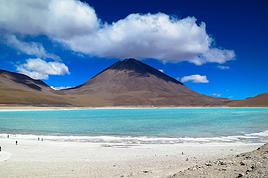
The idea of traveling to Bolivia came to me after seeing Jean-François (Max68)’s photos on his website. I thought we *had* to see those stunning landscapes with the colorful lagoons for ourselves. But a self-drive trip didn’t seem doable at first. A few years ago, everyone advised against going to the South Lipez with just one car.
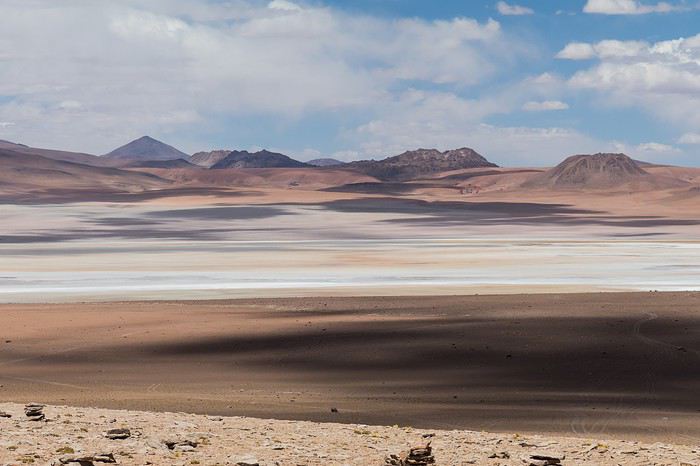 Laguna Kara
It was only after reading Laurent (Lolobe) and Pascal (Pepe874)’s travel journals—who explored the South Lipez solo with a car from Biz Rent a Car—that I thought we might be able to do the same. Meanwhile, we’d already contacted a local agency to organize a trip with a driver and guide. But the idea of a self-drive adventure really appealed to us. With encouragement and tips from Thierry (Tbernay) and Jean-François (Max68), we decided to plan our own self-drive trip. I’d like to thank them for their advice—it was *super* helpful. And a big thanks to all the other forum members for the info shared during our prep!
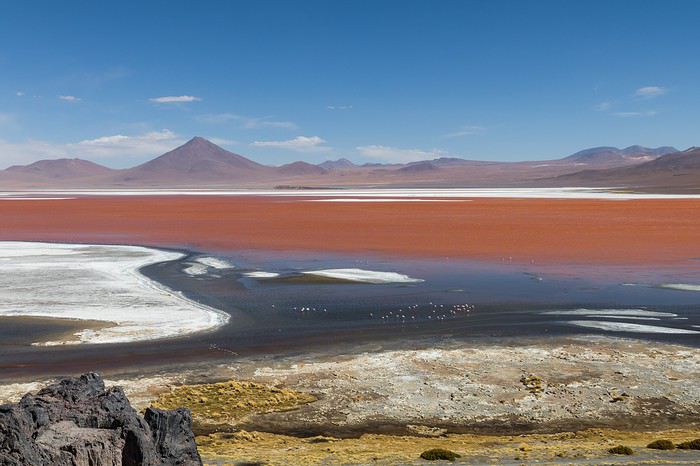 Laguna Colorada
Planning this trip happened during a tough time for our family. My mother-in-law’s illness and passing, plus a few health issues of my own, made us doubt the trip multiple times and nearly scrap the whole thing.
We booked our international flights in February with Swiss. They offered the best balance of travel time and price from Switzerland. Swiss operates Zurich–São Paulo with their own fleet, and São Paulo–Santa Cruz with GOL. In June, GOL canceled the Saturday flight and rebooked us on Sunday. Spending over 24 hours in that huge Brazilian city didn’t work for us at all, so we asked Swiss to put us on the next Zurich–São Paulo flight. Too bad—we lost a day in Bolivia and had to skip the Tarabucco market on Sunday.
Right after, we also booked the car in February. After contacting Imbex and Biz, we went with Biz. Not speaking Spanish, we were relieved to communicate with Alejandra in French. The contact was great—she answered all our questions patiently. Sometimes it took a few days to get a reply, but we could also reach her on WhatsApp. After our trip, we can *only* recommend Biz for rentals in Bolivia. The cars are well-prepped for the South Lipez tracks. The agency is reliable, and the vehicles are new and well-maintained.
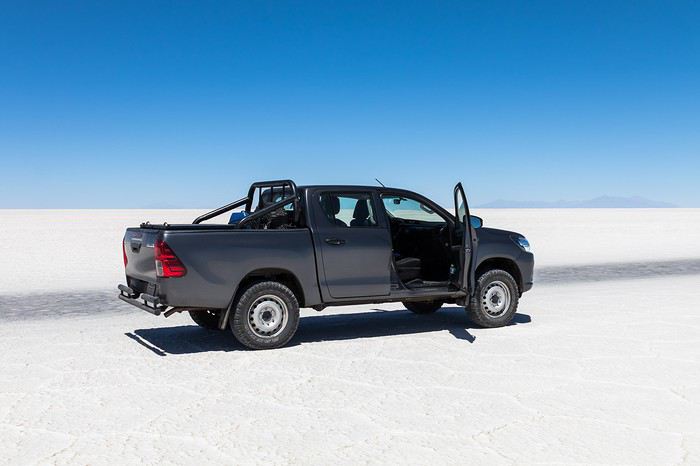 “Our” car, a Toyota Hilux
While planning, we realized the presidential elections would happen while we were in Bolivia. The risk of *bloqueos* (roadblocks and protests) was very real. But in Bolivia, *bloqueos* seem common—you always have to account for that kind of hassle. In late August/early September, Uyuni and the Salar region were blocked for days, leading to food, fuel, and cash shortages. Worried about a blockade in Uyuni and missing the Salar, we decided to visit it first *just in case*.
On election day, the whole country shut down. Planes were grounded, buses and taxis couldn’t circulate, and private cars were banned. There were a few exceptions—ambulances, police, or certain professions—but as tourists, we couldn’t get permission to drive. We asked the embassy, and Biz even requested a permit from the electoral office. So we had to plan to be somewhere with things to do *without* the car.
We decided not to book any accommodations in advance—a first for us. Usually, we plan our stops and reserve lodges, hotels, or campgrounds well ahead. This time, only the room in Sucre was booked, so we’d have a base when we arrived.
In July, Alex (Delhenry) reached out to propose joining part of the trip. He didn’t realize we were leaving in October. Still, we got fresh updates when he returned from the South Lipez. Thanks, Alex—your tips, especially about the Guadalupe–Tupiza stretch, were *super* useful.
In September, we connected with Jean-Louis (Avx) and Anne (Xeta), who were also heading to Bolivia in October, one and two weeks after us. We had dinner with Jean-Louis and his friend after our South Lipez trip and stayed in touch with Anne. It was great to chat with them! Unfortunately, Anne and her husband had a much rockier trip—they got hit hard by post-election issues.
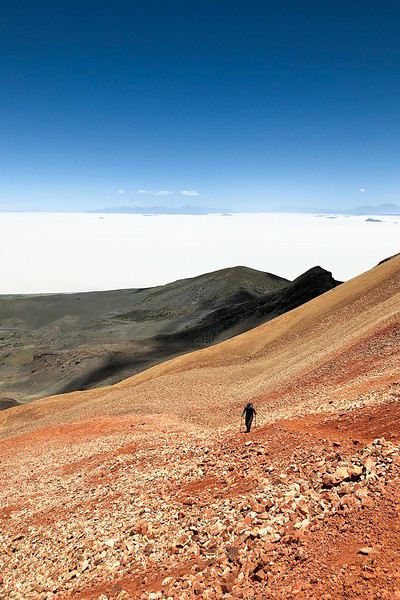 Climbing Volcán Tunupa
Our itinerary wasn’t set in stone—we decided to wing it on the spot. Two weeks before departure, I reconnected with Alejandra at Biz to move the car rental up by a day. With the elections, we wanted to leave Sucre ASAP and focus on the South Lipez. Outside Uyuni and Tupiza, the risk of blockades was zero. We also planned a two-night buffer in Sucre before our flights, just in case. It might sound overcautious, but in hindsight, we made the right call. If we’d left Sucre a day later, we wouldn’t have made it to Potosí—it was completely blocked. On the way back, we *just* dodged blockades in Potosí and elsewhere. Sometimes, you’ve gotta trust your gut.
Here’s our route—only the first two nights in Sucre were booked ahead:
D1 Departure from Switzerland
D2 Sucre (La Selenita)
D3 Sucre (La Selenita)
D4 Colchani (Hotel de Sal Luna Salada)
D5 Jirira (Auberge Doña Lupe)
D6 On the Salar (in the car)
D7 A few kilometers from Estancia Catal (in the car)
D8 Laguna Hedionda (Hotel Los Flamencos)
D9 Laguna Colorada (Lodge by the lagoon)
D10 Middle of nowhere, en route Laguna Verde–Mina Horsu–Quetena Chico (in the car)
D11 Quetena Chico (Lamphaya Lodge Andino)
D12 Quetena Chico (Lamphaya Lodge Andino)
D13 Guadalupe (Guest room at Celia’s)
D14 Along the Rio Grande (in the car)
D15 Tupiza (Hotel Mitru)
D16 Tupiza (Hotel Mitru)
D17 Sucre (La Selenita)
D18 Sucre (La Selenita)
D19 Santa Cruz (Hotel Sun)
D20 Departure from Santa Cruz
D21 Arrival in Switzerland
As you can see, we spent 13 nights in the South Lipez. Initially, we’d planned for nine, but Jean-François (Max68) suggested staying longer. Great advice—we didn’t regret it one bit. We could’ve even added 2–3 more days without getting bored.
Self-driving in the South Lipez takes some prep and a good GPS. We kept it simple and used maps.me to navigate. It’s a solid app—just save your waypoints ahead of time. For some stretches, I used Google Earth to visualize the tracks and sites. If you stick to the tour operator routes, you *almost* can’t get lost. But we often veered off the beaten path and took different routes. Some days, we didn’t see another car. So in case of a breakdown, it’s key to have water and food for several days. In some spots, there’s *zero* signal—your phone won’t work. Another must: it gets *cold* in the South Lipez, and a good sleeping bag is essential. We brought down sleeping bags rated for -10°C and didn’t regret it during our car nights.
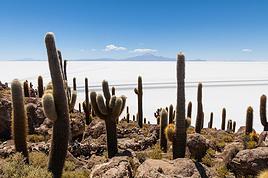
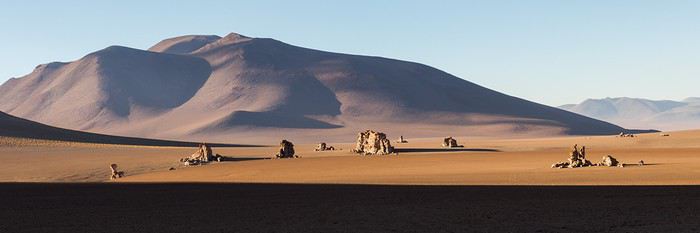 The Dalí Desert
Some tracks are *super* rocky—flat tires are a real risk. On those stretches, maps.me’s estimated travel time was way off. Some sections barely let us go over 15 km/h.
Lots of forum members recommend doing the South Lipez “loop” from Tupiza to Uyuni—ending with the Salar—to avoid Uyuni’s crowds. That might work for organized tours, but for self-drive, the direction *doesn’t* matter. I’ll say this: the few vehicles we saw mostly came from Tupiza and Chile, not Uyuni. So if starting from Uyuni works better for you, go for it! Ending in Tupiza means heading toward warmer weather. For our planned stops and climbs, starting in Uyuni helped with acclimatization. Spending a few nights between 3,600–3,800 m before going over 4,000 m is a smart move.
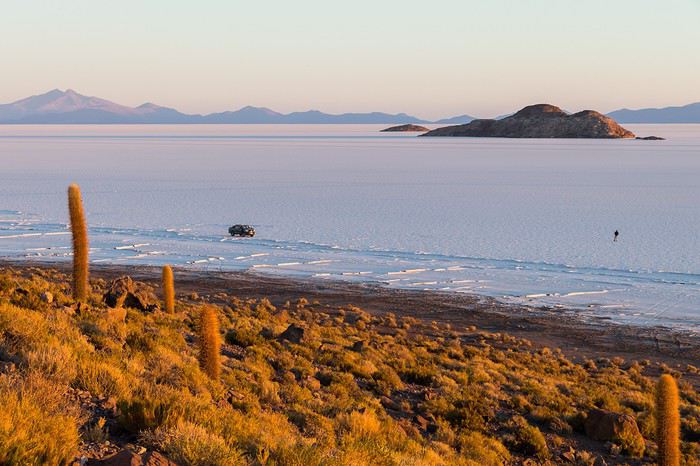 Uyuni Salt Flats in the morning
Overall, we barely saw anyone—except at Laguna Hedionda and Chalviri. There were several tour groups at Hotel Los Flamencos (Laguna Hedionda), but we didn’t cross paths during the day. Hardly anyone on the Salar, on the roads, or at the lodges in the evenings. The *only* place that shocked us was Chalviri. We’d planned to stay there, but it was fully booked—and we counted *forty* tour jeeps on-site. This was around noon! At the Polques hot springs (Chalviri), it was *packed*—we quickly nixed the idea of a dip. Plus, the vibe wasn’t great: soaking right by the road with lodges and restaurants in the background? Meh. Still, lots of tourists love it, so it’s up to you.
For the photos, I kept the colors and mood we saw. The lagoons’ hues are often stunning, but some online photos are *way* over-edited and oversaturated. The South Lipez’s landscapes are breathtaking—no need for excessive retouching.
If you don’t want to read all the details, the start of the travel journal is here: https://voyageforum.com/v.f?post=9888761;a=9888761
The idea of traveling to Bolivia came to me after seeing Jean-François (Max68)’s photos on his website. I thought we *had* to see those stunning landscapes with the colorful lagoons for ourselves. But a self-drive trip didn’t seem doable at first. A few years ago, everyone advised against going to the South Lipez with just one car.
Laguna KaraIt was only after reading Laurent (Lolobe) and Pascal (Pepe874)’s travel journals—who explored the South Lipez solo with a car from Biz Rent a Car—that I thought we might be able to do the same. Meanwhile, we’d already contacted a local agency to organize a trip with a driver and guide. But the idea of a self-drive adventure really appealed to us. With encouragement and tips from Thierry (Tbernay) and Jean-François (Max68), we decided to plan our own self-drive trip. I’d like to thank them for their advice—it was *super* helpful. And a big thanks to all the other forum members for the info shared during our prep!
Laguna ColoradaPlanning this trip happened during a tough time for our family. My mother-in-law’s illness and passing, plus a few health issues of my own, made us doubt the trip multiple times and nearly scrap the whole thing.
We booked our international flights in February with Swiss. They offered the best balance of travel time and price from Switzerland. Swiss operates Zurich–São Paulo with their own fleet, and São Paulo–Santa Cruz with GOL. In June, GOL canceled the Saturday flight and rebooked us on Sunday. Spending over 24 hours in that huge Brazilian city didn’t work for us at all, so we asked Swiss to put us on the next Zurich–São Paulo flight. Too bad—we lost a day in Bolivia and had to skip the Tarabucco market on Sunday.
Right after, we also booked the car in February. After contacting Imbex and Biz, we went with Biz. Not speaking Spanish, we were relieved to communicate with Alejandra in French. The contact was great—she answered all our questions patiently. Sometimes it took a few days to get a reply, but we could also reach her on WhatsApp. After our trip, we can *only* recommend Biz for rentals in Bolivia. The cars are well-prepped for the South Lipez tracks. The agency is reliable, and the vehicles are new and well-maintained.
“Our” car, a Toyota HiluxWhile planning, we realized the presidential elections would happen while we were in Bolivia. The risk of *bloqueos* (roadblocks and protests) was very real. But in Bolivia, *bloqueos* seem common—you always have to account for that kind of hassle. In late August/early September, Uyuni and the Salar region were blocked for days, leading to food, fuel, and cash shortages. Worried about a blockade in Uyuni and missing the Salar, we decided to visit it first *just in case*.
On election day, the whole country shut down. Planes were grounded, buses and taxis couldn’t circulate, and private cars were banned. There were a few exceptions—ambulances, police, or certain professions—but as tourists, we couldn’t get permission to drive. We asked the embassy, and Biz even requested a permit from the electoral office. So we had to plan to be somewhere with things to do *without* the car.
We decided not to book any accommodations in advance—a first for us. Usually, we plan our stops and reserve lodges, hotels, or campgrounds well ahead. This time, only the room in Sucre was booked, so we’d have a base when we arrived.
In July, Alex (Delhenry) reached out to propose joining part of the trip. He didn’t realize we were leaving in October. Still, we got fresh updates when he returned from the South Lipez. Thanks, Alex—your tips, especially about the Guadalupe–Tupiza stretch, were *super* useful.
In September, we connected with Jean-Louis (Avx) and Anne (Xeta), who were also heading to Bolivia in October, one and two weeks after us. We had dinner with Jean-Louis and his friend after our South Lipez trip and stayed in touch with Anne. It was great to chat with them! Unfortunately, Anne and her husband had a much rockier trip—they got hit hard by post-election issues.
Climbing Volcán TunupaOur itinerary wasn’t set in stone—we decided to wing it on the spot. Two weeks before departure, I reconnected with Alejandra at Biz to move the car rental up by a day. With the elections, we wanted to leave Sucre ASAP and focus on the South Lipez. Outside Uyuni and Tupiza, the risk of blockades was zero. We also planned a two-night buffer in Sucre before our flights, just in case. It might sound overcautious, but in hindsight, we made the right call. If we’d left Sucre a day later, we wouldn’t have made it to Potosí—it was completely blocked. On the way back, we *just* dodged blockades in Potosí and elsewhere. Sometimes, you’ve gotta trust your gut.
Here’s our route—only the first two nights in Sucre were booked ahead:
D1 Departure from Switzerland
D2 Sucre (La Selenita)
D3 Sucre (La Selenita)
D4 Colchani (Hotel de Sal Luna Salada)
D5 Jirira (Auberge Doña Lupe)
D6 On the Salar (in the car)
D7 A few kilometers from Estancia Catal (in the car)
D8 Laguna Hedionda (Hotel Los Flamencos)
D9 Laguna Colorada (Lodge by the lagoon)
D10 Middle of nowhere, en route Laguna Verde–Mina Horsu–Quetena Chico (in the car)
D11 Quetena Chico (Lamphaya Lodge Andino)
D12 Quetena Chico (Lamphaya Lodge Andino)
D13 Guadalupe (Guest room at Celia’s)
D14 Along the Rio Grande (in the car)
D15 Tupiza (Hotel Mitru)
D16 Tupiza (Hotel Mitru)
D17 Sucre (La Selenita)
D18 Sucre (La Selenita)
D19 Santa Cruz (Hotel Sun)
D20 Departure from Santa Cruz
D21 Arrival in Switzerland
As you can see, we spent 13 nights in the South Lipez. Initially, we’d planned for nine, but Jean-François (Max68) suggested staying longer. Great advice—we didn’t regret it one bit. We could’ve even added 2–3 more days without getting bored.
Self-driving in the South Lipez takes some prep and a good GPS. We kept it simple and used maps.me to navigate. It’s a solid app—just save your waypoints ahead of time. For some stretches, I used Google Earth to visualize the tracks and sites. If you stick to the tour operator routes, you *almost* can’t get lost. But we often veered off the beaten path and took different routes. Some days, we didn’t see another car. So in case of a breakdown, it’s key to have water and food for several days. In some spots, there’s *zero* signal—your phone won’t work. Another must: it gets *cold* in the South Lipez, and a good sleeping bag is essential. We brought down sleeping bags rated for -10°C and didn’t regret it during our car nights.
The Dalí DesertSome tracks are *super* rocky—flat tires are a real risk. On those stretches, maps.me’s estimated travel time was way off. Some sections barely let us go over 15 km/h.
Lots of forum members recommend doing the South Lipez “loop” from Tupiza to Uyuni—ending with the Salar—to avoid Uyuni’s crowds. That might work for organized tours, but for self-drive, the direction *doesn’t* matter. I’ll say this: the few vehicles we saw mostly came from Tupiza and Chile, not Uyuni. So if starting from Uyuni works better for you, go for it! Ending in Tupiza means heading toward warmer weather. For our planned stops and climbs, starting in Uyuni helped with acclimatization. Spending a few nights between 3,600–3,800 m before going over 4,000 m is a smart move.
Uyuni Salt Flats in the morningOverall, we barely saw anyone—except at Laguna Hedionda and Chalviri. There were several tour groups at Hotel Los Flamencos (Laguna Hedionda), but we didn’t cross paths during the day. Hardly anyone on the Salar, on the roads, or at the lodges in the evenings. The *only* place that shocked us was Chalviri. We’d planned to stay there, but it was fully booked—and we counted *forty* tour jeeps on-site. This was around noon! At the Polques hot springs (Chalviri), it was *packed*—we quickly nixed the idea of a dip. Plus, the vibe wasn’t great: soaking right by the road with lodges and restaurants in the background? Meh. Still, lots of tourists love it, so it’s up to you.
For the photos, I kept the colors and mood we saw. The lagoons’ hues are often stunning, but some online photos are *way* over-edited and oversaturated. The South Lipez’s landscapes are breathtaking—no need for excessive retouching.
If you don’t want to read all the details, the start of the travel journal is here: https://voyageforum.com/v.f?post=9888761;a=9888761
Voyage 3 semaines en bus Pérou-Bolivie (lac Titicaca, Puno, La Paz...)
Bonjour,
je vais faire avec des amis un voyage sur 3 semaines Perou-Bolivie en mai, nous voyagerons en bus.
Nous ferons une escale au Lac Titicaca et nous prendrons le bus le 16 mai 2020 de Puno vers 7h00 (d'après les horaires vus sur le net) pour La Paz (arrivée vers 15 h). Nous envisageons de reprendre un bus de nuit le soir même vers 19h30 (toujours d'après ce que j'ai vu sur le net) pour Tupiza.
Pensez-vous qu'en arrivant vers 15 h à La Paz, je pourrai avoir des places (nous sommes 5) pour un bus de nuit (départ vers 19h30 avec Expreso tupiza bus) ou est-il préférable que je réserve à l'avance ? j'ai vu un site qui s'appelle "ticketsbolivia.com" où il est possible de réserver des billets.
Merci pour vos réponses.
Des idées de choses à voir pour 3-4 jours à partir de Cusco
Bonjour a tous
Après notre retour du Machu Picchu et de la Vallée Sacrée, nous avons 3 ou 4 jours de libre avant de reprendre un vol pour Lima. Nous aimerions savoir si vous auriez des idées de choses a voir sur un ou plusieurs jours, sachant que nous ne sommes pas trop branché ville mais plutôt paysages et natures. Nous avons déja pensé a Vinicunca qui nous plairait beaucoup. Nous pensions aussi au lac Titicaca, mais ca risque d'être juste niveau timming d'autant plus que visiblement le coté Peruvien a l'air un peu trop cliché "vacances tour operator". Qu'en pensez vous?
Merci d'avance pour vos idées et complement d'infos 😉
Météo fin avril-début mai pour le Pérou-Bolivie
Bonsoir
Nous prévoyons de partir dernière semaine d’avril en Bolivie suivi de la première semaine de Mai au Pérou. Certains disent que ce n’est pas la bonne saison, d’autre oui. idem pour les sites de voyage. Qui peu le renseigner ? Qui y a été à cette période la. Merci
Compagnon pour le trek de la cordillère Huayhuash en août 2019
Bonjour,
Ma soeur et moi allons faire le trek de la cordillère Huayhuash du 15 au 22 (ou 23) août 2019. Nous avons déjà un contact pour un cuisinier/guide avec ânes.
Si intéressé, me contacter :)
Manon
Treks Huayhuash et Ausangate
Hello à tous,
Je me pose quelques questions sur la possibilité de faire des treks au Pérou sans passer par une agence. En particulier ceux de Huayhuash et de l’Ausangate.
Nous serons deux et souhaitons organiser ça par nous-même : 1/ c’est moins cher qu’en passant par un agence 2/ on est sûr que les guides/muletiers locaux sont correctement payés 3/ On ne se retrouve pas dans un groupe avec 10 personnes et on peut modifier l’itinéraire Mais peut être que ce n’est pas le cas ?
Dans l’idée on aimerait bien trouver un guide/muletier qui assurerait les services tel que :
portage (mules !), ravitaillement et cuisine guide pour que nous n’ayons pas à nous « embêter » à lire une carte et profiter de ses connaissances
Est-ce que ce sont des services courants pour un guide/muletier ? Ou faut-il louer les service d’un muletier et d’un guide ?
Combien de mules faut il prévoir pour 2 personnes (+ le muletier) ? Quel est le coût d’un muletier (+ mules) par jour ? Et d’un guide (si guide nécessaire) ?
Vaut-il mieux organiser ça maintenant par mail ? Ou peut-on organiser ça au dernier moment ? Dans ce cas quelles villes sont les plus adaptées ? Chiquian pour la cordillère Huayhuash ? Tinki pour l’Ausangate ?
Auriez-vous des guides/muletiers à nous conseiller ?
Un grand merci à ceux qui nous répondrons !
Aurélien
Trajet bus Cusco - Puerto Maldonado dangereux?
Bonjour
Nous partons au Pérou en juillet prochain et avons réservé un trajet avec Cruz del sur entre cusco et Puerto Maldonado , de nuit. Certains hôtels déconseillent le voyage en bus . Est ce que quelqu’un pourrait m’en dire plus sur son expérience ?
Merci
Agences pour le salar d'Uyuni
peut on me donner des commentaires sur les agences Esmeralda Tours
et Luz Andina pour visites sur le salar d'Uyuni,
sur leurs prestations et leurs tarifs.
merci
Découverte de l'Écosse en fourgon aménagé
Bonjour,
Avec mon conjoint nous prévoyons de visiter le l'Ecosse en Octobre 2019 durant 3 semaines et désirant être totalement libre, nous désirerions louer sur place au départ de Edimbourg un Fourgon aménagé (car plus petit qu'un camping car) afin de circuler sur les routes étroites d'Ecosse. Je suis à la recherche de conseil sur un bon loueur de Fourgon aménagé.
De plus, dans notre voyage nous avons programmé la route 500, faut-il mieux la parcourir dans le sens des aiguilles d'une montre ou l'inverse pour la circulation ?
merci