Results for "Europe+de+l'Ouest+sécurité"
About 82,077 results.
More options
Many results are in French, the community’s main language. English translations are added over time.
Search results
Traverser l'Amazonie seul et à vélo... inconscience?
Bonjour à tous !
Enfin je vais pouvoir assouvir mes envies de voyages ! En effet je compte traverser l'Amérique du Sud en 5 mois ( de Avril à Septembre ) à vélo et seul. L'idée serait de partir de Maracaïbo pour terminer à Ushuaia .. J'ai 20 ans, je suis sportif, aventurier et débrouillard. Comme l'indique le titre de cette discussion, dans mon périple, je compte traverser l'Amazonie. 😉😉 Ma toute première question serait , cela vous parait-il possible? En effet, se pose la question des routes(y en a t il ?), des animaux sauvages en tout genre ( vilains piranhas et araignées sanglantes...), la nourriture pour la traversée.. Enfin voilà, mon voyage est prévu pour Avril, donc assez loin encore. Egalement, n'hésitez pas à me dire quels endroits vous ont ému lors de vos voyages sur l'Amérique du sud, quels sont ceux qui vous paraissent incontournables selon vous ... Le sujet de ma discussion est certes très large mais j'espère de tout cœur que vous pourrez m'aider grâce à vos expériences vécus!! Merci !
Enfin je vais pouvoir assouvir mes envies de voyages ! En effet je compte traverser l'Amérique du Sud en 5 mois ( de Avril à Septembre ) à vélo et seul. L'idée serait de partir de Maracaïbo pour terminer à Ushuaia .. J'ai 20 ans, je suis sportif, aventurier et débrouillard. Comme l'indique le titre de cette discussion, dans mon périple, je compte traverser l'Amazonie. 😉😉 Ma toute première question serait , cela vous parait-il possible? En effet, se pose la question des routes(y en a t il ?), des animaux sauvages en tout genre ( vilains piranhas et araignées sanglantes...), la nourriture pour la traversée.. Enfin voilà, mon voyage est prévu pour Avril, donc assez loin encore. Egalement, n'hésitez pas à me dire quels endroits vous ont ému lors de vos voyages sur l'Amérique du sud, quels sont ceux qui vous paraissent incontournables selon vous ... Le sujet de ma discussion est certes très large mais j'espère de tout cœur que vous pourrez m'aider grâce à vos expériences vécus!! Merci !
GPS français pour voiture de location aux Etats-Unis?
Hello,
Une petite question toute simple qui peut néanmoins faire économiser plus de 150€, ce qui n'est pas rien pour mon budget😉!!
Je vais louer une voiture en septembre prochain (chevrolet Cobalt ou similaire) pour plus de 3000km dans l'Ouest. J'ai un GPS TomTom, je peux acheter la carte des USA à 25€ sur le net, mais ce GPS (et surtout sa prise adaptée pour un allume cigare en France) sera -t- il compatible avec les prises d'une voiture US?? J'espere vraiment que cette petite combin pourra marcher, merci de me renseigner si qqn a déjà fait ça ou a un témoignage sur la question.
Merci à tous😎
Une petite question toute simple qui peut néanmoins faire économiser plus de 150€, ce qui n'est pas rien pour mon budget😉!!
Je vais louer une voiture en septembre prochain (chevrolet Cobalt ou similaire) pour plus de 3000km dans l'Ouest. J'ai un GPS TomTom, je peux acheter la carte des USA à 25€ sur le net, mais ce GPS (et surtout sa prise adaptée pour un allume cigare en France) sera -t- il compatible avec les prises d'une voiture US?? J'espere vraiment que cette petite combin pourra marcher, merci de me renseigner si qqn a déjà fait ça ou a un témoignage sur la question.
Merci à tous😎
Location de camping-car aux États-Unis
Nous sommes 6 (2 parents + 4 enfants) et envisageons de faire un voyage aux états unis cet été pendant 5 semaines.
Par commodité nous pensons louer un camping car.
plusieurs questions à ce sujet : en fonction de la taille faut-il un permis spécial ? sa taille nous limitera-t-il pour trouver des endroits où dormir, peut-on s'arrêter parfois en dehors des campings? doit-on réserver à l'avance un emplacement dans les parcs de l'ouest ? avez vous des adresses pour la location du camping car?
En vous remerciant
sophie
Excursion de croisière sur une petite île à Belize
Bonjour!
Je reviens de croisiere et j'ai fait une excursion à Belize sur petite ile, je ne me souviens plus du nom de cette ile, quelqu'un pourrait m'aider, je crois que c'est sur ce forum que j'avais vue le nom de cette petite ile.
Céline257
Je reviens de croisiere et j'ai fait une excursion à Belize sur petite ile, je ne me souviens plus du nom de cette ile, quelqu'un pourrait m'aider, je crois que c'est sur ce forum que j'avais vue le nom de cette petite ile.
Céline257
Autotour de quinze jours dans le nord-est des États-Unis
😉 Bonjour, avec mon épouse, nous préparons un voyage en autotour de 2 semaines en aout 2008 au depart de NY vers cap cod, Bar Harbor, le Quebec (montreal, quebec, toronto, ottawa), gettysburg, washington, boston et NY. soit une viree de 4500 kms
Nous ne connaissons absolument pas les states, si quelqu'un pouvait nous apporter des renseignements ce serait sympa.
🙂Comment se restaurer pour pas cher ?
🙂Le cout de la vie est il interessant ? et sur quoi ( vetements, photos, video...) ?
🙂la vitesse sur les routes ? Sont elles belles ? Y a t il beaucoup de pompes a essence ?
🙂La sécurité ? peut on faire du tourisme sereinement ?
🙂Peut on rencontrer facilement des gens parlant un peu le francais ?
Enfin nous sommes preneurs de toutes sortes de renseignements sur tout ce qui pourrait nous aider a preparer ce voyage.
Merci d'avance à ceux qui pourront nous aider.
Enfin nous sommes preneurs de toutes sortes de renseignements sur tout ce qui pourrait nous aider a preparer ce voyage.
Merci d'avance à ceux qui pourront nous aider.
Destination idéale à vélo pour l'été?
Ces dernières années, j'ai pas mal bourlingué sac au dos sur différents continents. Après avoir souvent croisé (et bien sûr jalousé !!!) des cyclotouristes, je me dis qu'il est temps de me lancer. Je cherche donc une destination sympa pour l'été (1 mois 1/2 à 2 mois). Difficile de jongler entre budget et climat à cette saison. Mes expériences de voyages me font exclure d'un trip à vélo dans des zones trop chaudes ou trop soumises à la mousson (exit Afrique, Moyen Orient, Inde, Asie du Sud-Est) ou trop humides et cafies de moustiques (genre Ecosse, Québec, Scandinavie) ou trop chères (USA, Australie, Europe etc).
J'adore le Tibet et le sud-ouest de la Chine, mais ça me semble un peu ambitieux pour un premier grand voyage à vélo ? L'Amérique du Sud ? Des suggestions ?
J'adore le Tibet et le sud-ouest de la Chine, mais ça me semble un peu ambitieux pour un premier grand voyage à vélo ? L'Amérique du Sud ? Des suggestions ?
Vélo, sécurité et camping au Maroc
Bonjour, je pense partir fin fevrirer début mars au Maroc à vélo. Est-il pensable d'effectuer le voyage en camping sauvage (et chez l'habitant)? J'ai entendu dire que le pays était en général accueillant mais que parfois des pierres étaient lancé sur les cyclistes et que la traversée des villes étaient cahotiques. Qu'en est-il?
Fragments de voyage I/II: d'Istanbul à Jakarta par la route
J'entreprends un périple de 3 mois et plus jusqu'aux portes de l'Asie. Je vous livrerai en vrac mes impressions sous forme de carnet de bord, d'anecdotes, d'émotions brutes et aussi des informations pratiques. J'essaierai autant que possible d'écrire sur le vif et de vous envoyer quelques photos.
Pour passer directement au chapitre II des fragments de voyage le 21 février 2012 c'est ici : Fragments de voyage II : Istanbul-Téhéran-Lahore-Chengdu-Bangkok-Jakarta par la route
fraternellement Eric mosquée de Soleyman le Magnifique

PARFUMS D'ORIENT ISTANBOULIOTES
19-20-21-22-23-24 octobre Lyon-Strasbourg-Bâle-Istanbul
Des rues bruyantes et bigarrées. Des gens partout qui s'affairent, un ballet continu ponctué de coups de klaxons et des sirenes des bateaux, rythmé par l'appel du Muezzin, répercuté tel un écho dans toutes les mosquées majestueuses de la cité. Quel meilleur endroit pour commencer ce voyage si ce n'est Istanbul, carrefour et porte de l'Orient. C'est ma 4eme fois ici et je m'y sens bien, une ville attachante. Le soleil est de la partie. Je me balade dans le vieil Istanbul. A Eminonu, des gens qui pêchent, le pont de Galata est hérissé de cannes à pêche. Sur des bateaux amarrés le long des quais, des hommes font frire le poisson que l'on peut déguster dans des pains avec des oignons au bord de la Corne d'Or. Je me perds dans les ruelles qui remontent vers le grand bazar. Bain de foule. Des tas de drapeaux turcs pendent aux fenêtres, d'autres recouvrent des pans entiers de murs. Tout cela se passe dans tout le pays. Des manifs se déroulent un peu partout. Hommage aux soldats martyrs tombés au combat dans l'est. A la TV, des images passent en boucle, des généraux revanchards sont propulsés sur le devant de la scene. A qui profite cette inflation de violence ? une chose est sûre, pas à la population kurde de Turquie. Pêcheurs sur les quais d'Eminonu au fond la mosquée de Suleiman le Magnifique
Infos pratiques
Arrivée à l'aéroport Ataturk
prendre le métro (jeton 1, 30 YTL) jusqu'à Aksaray, puis le Tramway (jeton 1, 30 YTL) direction Sultanahmet ou Taksim
Arrivée à l'aéroport de Sabiha Gocken
prendre la navette ( à droite en sortant 3 YTL) E10 jusqu'à l'embarcadère de Kadikoy, puis le ferry (jeton 1, 10 YTL) jusqu'à Eminonu. Ensuite prendre le Tramway, soit direction Taksim (de l'autre coté du pont de Galata) soit direction Aksaray/Sultanahmet
Pour se loger, pléthore d'hôtels bon marché du coté de Sultanahmet derriere la Mosquée Bleue.
Pour manger : Eviter le quartier de Sultanahmet
Pour le change : changer le strict minimum a l'aéroport, taux plus avantageux autour du Grand Bazar
Pour aller au bord de la Mer Noire
Prendre un bus (du coté d'Eminonu) direction Sariyer sur le Bosphore, ensuite prendre un Dolmus direction Kilyos
Pêcheurs sur les quais d'Eminonu au fond la mosquée de Suleiman le Magnifique
Infos pratiques
Arrivée à l'aéroport Ataturk
prendre le métro (jeton 1, 30 YTL) jusqu'à Aksaray, puis le Tramway (jeton 1, 30 YTL) direction Sultanahmet ou Taksim
Arrivée à l'aéroport de Sabiha Gocken
prendre la navette ( à droite en sortant 3 YTL) E10 jusqu'à l'embarcadère de Kadikoy, puis le ferry (jeton 1, 10 YTL) jusqu'à Eminonu. Ensuite prendre le Tramway, soit direction Taksim (de l'autre coté du pont de Galata) soit direction Aksaray/Sultanahmet
Pour se loger, pléthore d'hôtels bon marché du coté de Sultanahmet derriere la Mosquée Bleue.
Pour manger : Eviter le quartier de Sultanahmet
Pour le change : changer le strict minimum a l'aéroport, taux plus avantageux autour du Grand Bazar
Pour aller au bord de la Mer Noire
Prendre un bus (du coté d'Eminonu) direction Sariyer sur le Bosphore, ensuite prendre un Dolmus direction Kilyos
SUR LA ROUTE DE LA SOIE...QUELQUE PART ENTRE SIVAS ET TERCAN
Istanbul-Erzurum 24-25 octobre
Aujourd'hui, je trace sur Erzurum. Il pleut légerement. Je me rend à l'immense otogar au nord d'Istanbul et je prend le bus de 16h. Cela m'arrange car j'ai ma demande de visa iranien à déposer au plus vite et ensuite, sachant qu'il faut 10 jours pour l'obtenir, je compte visiter l'est. Bus de nuit. 1375 kms à parcourir. Mon voisin ne parle pas Anglais, nous communiquons par gestes et par bribes de mots turcs pris dans mon lexique🙂. La TV diffuse le match de foot Besiktas-Liverpool, les Turcs sont fondus de football, ca tombe bien moi aussi.😏 A l'aube, en consultant ma carte, je réalise que nous empruntons la route de la Soie, route mythique pour bien des voyageurs, Nicolas Bouvier et Thierry Vernet étaient passés par ici en 1953. Nous roulons au milieu d'une vallée entourée de puissantes montagnes, la végétation est rare, quelques troupeaux de moutons paissent. Le climat doit être rude en hiver. Et premiere émotion : nous croisons l'Euphrate (en Turc : Firat). Depuis mon enfance, je suis fasciné par les grands fleuves, mon voyage qui s'annonce en sera parsemé. Et hop🙂 une photo pour immortaliser l'instant. Arrivée à Erzurum fin de matinée. Il fait beau, une chance car la température peut descendre très bas en cette période de l'année. Il y a une station de ski pas loin d'ici. Je me rend au consulat en marchant😎. Accueil austere mais correct, j'avais préparé les formulaires mais il n'en veut pas et je dois m'y coller une nouvelle fois. Puis il faut aller courir jusque dans le centre à la banque Oyak pour payer les frais de visa, heureusement un chauffeur de taxi qui m'avait vu poirauter devant le bureau, m'attend et m'amène sans hésiter à la banque puis fait le retour. Apparemment, il a l'habitude de la procédure😉
Passage éclair dans cette ville, je prendrai plus de temps dans 10 jours pour la visiter. Maintenant, je file sur Malatya. Bus de nuit. Jamais bu autant de thé et autant les mains parfumées d'eau de cologne🙂🙂.
Otogar de Malatya à 2h du matin, je décide de finir la nuit ici, il y a des sièges confortables😉. J'irai chercher un hôtel le matin.
Mes 4 premieres nuits
1 à l'aéroport/1 à l'hôtel /1 dans le bus/1 dans l'otogar de Malatya, vive les voyages😎
Arrivée à Erzurum fin de matinée. Il fait beau, une chance car la température peut descendre très bas en cette période de l'année. Il y a une station de ski pas loin d'ici. Je me rend au consulat en marchant😎. Accueil austere mais correct, j'avais préparé les formulaires mais il n'en veut pas et je dois m'y coller une nouvelle fois. Puis il faut aller courir jusque dans le centre à la banque Oyak pour payer les frais de visa, heureusement un chauffeur de taxi qui m'avait vu poirauter devant le bureau, m'attend et m'amène sans hésiter à la banque puis fait le retour. Apparemment, il a l'habitude de la procédure😉
Passage éclair dans cette ville, je prendrai plus de temps dans 10 jours pour la visiter. Maintenant, je file sur Malatya. Bus de nuit. Jamais bu autant de thé et autant les mains parfumées d'eau de cologne🙂🙂.
Otogar de Malatya à 2h du matin, je décide de finir la nuit ici, il y a des sièges confortables😉. J'irai chercher un hôtel le matin.
Mes 4 premieres nuits
1 à l'aéroport/1 à l'hôtel /1 dans le bus/1 dans l'otogar de Malatya, vive les voyages😎
Infos pratiques Trajet Istanbul-Erzurum 55 YTL par la compagnie Esadas Trajet Erzurum-Malatya 40YTL par la compagnie Bingol 1 Bouteille d'eau 1l : 0, 50YTL 1 pide ou galette : 0, 30 YTL Demande de visa iranien : 2 photos/2 formulaires remplis a la main/copies des pages importantes du passeport/60 euros ou 103 YTL payables a la banque Oyak
Pour passer directement au chapitre II des fragments de voyage le 21 février 2012 c'est ici : Fragments de voyage II : Istanbul-Téhéran-Lahore-Chengdu-Bangkok-Jakarta par la route
fraternellement Eric mosquée de Soleyman le Magnifique
PARFUMS D'ORIENT ISTANBOULIOTES
19-20-21-22-23-24 octobre Lyon-Strasbourg-Bâle-Istanbul
Des rues bruyantes et bigarrées. Des gens partout qui s'affairent, un ballet continu ponctué de coups de klaxons et des sirenes des bateaux, rythmé par l'appel du Muezzin, répercuté tel un écho dans toutes les mosquées majestueuses de la cité. Quel meilleur endroit pour commencer ce voyage si ce n'est Istanbul, carrefour et porte de l'Orient. C'est ma 4eme fois ici et je m'y sens bien, une ville attachante. Le soleil est de la partie. Je me balade dans le vieil Istanbul. A Eminonu, des gens qui pêchent, le pont de Galata est hérissé de cannes à pêche. Sur des bateaux amarrés le long des quais, des hommes font frire le poisson que l'on peut déguster dans des pains avec des oignons au bord de la Corne d'Or. Je me perds dans les ruelles qui remontent vers le grand bazar. Bain de foule. Des tas de drapeaux turcs pendent aux fenêtres, d'autres recouvrent des pans entiers de murs. Tout cela se passe dans tout le pays. Des manifs se déroulent un peu partout. Hommage aux soldats martyrs tombés au combat dans l'est. A la TV, des images passent en boucle, des généraux revanchards sont propulsés sur le devant de la scene. A qui profite cette inflation de violence ? une chose est sûre, pas à la population kurde de Turquie.
Pêcheurs sur les quais d'Eminonu au fond la mosquée de Suleiman le Magnifique
Infos pratiques
Arrivée à l'aéroport Ataturk
prendre le métro (jeton 1, 30 YTL) jusqu'à Aksaray, puis le Tramway (jeton 1, 30 YTL) direction Sultanahmet ou Taksim
Arrivée à l'aéroport de Sabiha Gocken
prendre la navette ( à droite en sortant 3 YTL) E10 jusqu'à l'embarcadère de Kadikoy, puis le ferry (jeton 1, 10 YTL) jusqu'à Eminonu. Ensuite prendre le Tramway, soit direction Taksim (de l'autre coté du pont de Galata) soit direction Aksaray/Sultanahmet
Pour se loger, pléthore d'hôtels bon marché du coté de Sultanahmet derriere la Mosquée Bleue.
Pour manger : Eviter le quartier de Sultanahmet
Pour le change : changer le strict minimum a l'aéroport, taux plus avantageux autour du Grand Bazar
Pour aller au bord de la Mer Noire
Prendre un bus (du coté d'Eminonu) direction Sariyer sur le Bosphore, ensuite prendre un Dolmus direction KilyosSUR LA ROUTE DE LA SOIE...QUELQUE PART ENTRE SIVAS ET TERCAN
Istanbul-Erzurum 24-25 octobre
Aujourd'hui, je trace sur Erzurum. Il pleut légerement. Je me rend à l'immense otogar au nord d'Istanbul et je prend le bus de 16h. Cela m'arrange car j'ai ma demande de visa iranien à déposer au plus vite et ensuite, sachant qu'il faut 10 jours pour l'obtenir, je compte visiter l'est. Bus de nuit. 1375 kms à parcourir. Mon voisin ne parle pas Anglais, nous communiquons par gestes et par bribes de mots turcs pris dans mon lexique🙂. La TV diffuse le match de foot Besiktas-Liverpool, les Turcs sont fondus de football, ca tombe bien moi aussi.😏 A l'aube, en consultant ma carte, je réalise que nous empruntons la route de la Soie, route mythique pour bien des voyageurs, Nicolas Bouvier et Thierry Vernet étaient passés par ici en 1953. Nous roulons au milieu d'une vallée entourée de puissantes montagnes, la végétation est rare, quelques troupeaux de moutons paissent. Le climat doit être rude en hiver. Et premiere émotion : nous croisons l'Euphrate (en Turc : Firat). Depuis mon enfance, je suis fasciné par les grands fleuves, mon voyage qui s'annonce en sera parsemé. Et hop🙂 une photo pour immortaliser l'instant.
Arrivée à Erzurum fin de matinée. Il fait beau, une chance car la température peut descendre très bas en cette période de l'année. Il y a une station de ski pas loin d'ici. Je me rend au consulat en marchant😎. Accueil austere mais correct, j'avais préparé les formulaires mais il n'en veut pas et je dois m'y coller une nouvelle fois. Puis il faut aller courir jusque dans le centre à la banque Oyak pour payer les frais de visa, heureusement un chauffeur de taxi qui m'avait vu poirauter devant le bureau, m'attend et m'amène sans hésiter à la banque puis fait le retour. Apparemment, il a l'habitude de la procédure😉
Passage éclair dans cette ville, je prendrai plus de temps dans 10 jours pour la visiter. Maintenant, je file sur Malatya. Bus de nuit. Jamais bu autant de thé et autant les mains parfumées d'eau de cologne🙂🙂.
Otogar de Malatya à 2h du matin, je décide de finir la nuit ici, il y a des sièges confortables😉. J'irai chercher un hôtel le matin.
Mes 4 premieres nuits
1 à l'aéroport/1 à l'hôtel /1 dans le bus/1 dans l'otogar de Malatya, vive les voyages😎Infos pratiques Trajet Istanbul-Erzurum 55 YTL par la compagnie Esadas Trajet Erzurum-Malatya 40YTL par la compagnie Bingol 1 Bouteille d'eau 1l : 0, 50YTL 1 pide ou galette : 0, 30 YTL Demande de visa iranien : 2 photos/2 formulaires remplis a la main/copies des pages importantes du passeport/60 euros ou 103 YTL payables a la banque Oyak
Château de Versailles à vélo
Salut à tous 😉
Est ce que quelqu'un pourait me dire si le chateau de Versailles est facilement accessible à vélo?
D'après viamichelin ça a l'air assez simple mais en pratique?
Ah oui et est ce facile de laiser les vélos pour visiter?
MErci d'avance
A+😉
Ah oui et est ce facile de laiser les vélos pour visiter?
MErci d'avance
A+😉
Petit coup de de gueule!
Bonjour à tous
Mon coup de gueule est petit pour l'instant car je ne dois pas avoir toutes les cartes en main, je m'explique... Cette rubrique s'apelle "faire le tour du monde" et la plupart des tourdemondistes ne passent pas par le continent africain et je dirais même qu'ils osent dire qu'ils font le tour du monde alors qu'ils omettent ce gros détail... Alors je voudrais savoir pourquoi vous n'allez pas en afrique?? est-ce que c'est parce que vous n'aimez pas la culture? est-ce que c'est parce que vous craignez une certaine insécurité?? Est-ce que vos billets d'avion vous l'empêchent?? J'ai pourtant l'impression que comme les autres ce continent est unique !! Pour moi un tour du monde c'est pas seulement faire le tour d'une boule mais aller fourrer son nez au moins sur les 5 continents !! Je trouve ça dommage que personne n'inclut l'afrique dans son itinéraire et je voulais appuyer là-dessus pour pas l'oublier... voilà alors suis-je ignorant ou ai-je raison de pousser cette petite gueulante?? merci a+
Mon coup de gueule est petit pour l'instant car je ne dois pas avoir toutes les cartes en main, je m'explique... Cette rubrique s'apelle "faire le tour du monde" et la plupart des tourdemondistes ne passent pas par le continent africain et je dirais même qu'ils osent dire qu'ils font le tour du monde alors qu'ils omettent ce gros détail... Alors je voudrais savoir pourquoi vous n'allez pas en afrique?? est-ce que c'est parce que vous n'aimez pas la culture? est-ce que c'est parce que vous craignez une certaine insécurité?? Est-ce que vos billets d'avion vous l'empêchent?? J'ai pourtant l'impression que comme les autres ce continent est unique !! Pour moi un tour du monde c'est pas seulement faire le tour d'une boule mais aller fourrer son nez au moins sur les 5 continents !! Je trouve ça dommage que personne n'inclut l'afrique dans son itinéraire et je voulais appuyer là-dessus pour pas l'oublier... voilà alors suis-je ignorant ou ai-je raison de pousser cette petite gueulante?? merci a+
Sud de la France: où aller?
Bonjour à tous,
Je suis une étudiante de 21 ans et je voyage seule. Mon avion arrive à Paris à la mi-mai et j'ai à peu près un mois à passer en France. Sans m'étaler sur de grandes distances, je préfére visiter une région à fond: j'ai donc choisi le sud de la France.
Sans nécessairement rechercher les grandes villes, j'aimerais plutôt découvrir les petits coins qui sont aussi beaux (sinon plus!). Je pense qu'en un mois je devrais avoir le temps de faire tout le sud, de l'est à l'ouest: mais où m'arrêter, quels villages sont à ne pas manquer? De plus, étant étudiante à temps plein, je n'ai pas d'argent, sinon juste assez pour survivre (eau, baguette et auberge de jeunesse miteuse!). Je suis à la recherche de conseils, suggestions et autres informations sur la région et la meilleure façon de m'y déplacer (j'imagine l'autobus comme étant la meilleure solution.) Merci à l'avance.
Dorothée
Je suis une étudiante de 21 ans et je voyage seule. Mon avion arrive à Paris à la mi-mai et j'ai à peu près un mois à passer en France. Sans m'étaler sur de grandes distances, je préfére visiter une région à fond: j'ai donc choisi le sud de la France.
Sans nécessairement rechercher les grandes villes, j'aimerais plutôt découvrir les petits coins qui sont aussi beaux (sinon plus!). Je pense qu'en un mois je devrais avoir le temps de faire tout le sud, de l'est à l'ouest: mais où m'arrêter, quels villages sont à ne pas manquer? De plus, étant étudiante à temps plein, je n'ai pas d'argent, sinon juste assez pour survivre (eau, baguette et auberge de jeunesse miteuse!). Je suis à la recherche de conseils, suggestions et autres informations sur la région et la meilleure façon de m'y déplacer (j'imagine l'autobus comme étant la meilleure solution.) Merci à l'avance.
Dorothée
Sécurité au Vénézuela
Bonjour à tous
En février prochain nous souhaitons partir au vénézuela, mais j'ai très peu quant aux problèmes de sécurité, y aurait t il qqn qui pourrait me rassurer
Nous souhaitons aller aux Llanos, parc de Mochima, Delta de l'Orénoque et los Roques. en 4 semaines par bus, c faisable?
Si vous avez des bons plans, n'hésitez pas à me contacter
vraiment merci d'avance à tous pour vos précieux renseignements
Sandrine
En février prochain nous souhaitons partir au vénézuela, mais j'ai très peu quant aux problèmes de sécurité, y aurait t il qqn qui pourrait me rassurer
Nous souhaitons aller aux Llanos, parc de Mochima, Delta de l'Orénoque et los Roques. en 4 semaines par bus, c faisable?
Si vous avez des bons plans, n'hésitez pas à me contacter
vraiment merci d'avance à tous pour vos précieux renseignements
Sandrine
L'Inde ou non?
🙂 Bonjours tous le monde!
Je m'appel David j'ai 25 ans et j’ai pris dernièrement la décision d’arrêté mon travail (dans environ 8 mois, argent oblige ! 😕) pour m’en aller loin pendant une année à la recherche de mon moi intérieur, que j’ai beaucoup de peine à trouver dans la routine et le stress journalier.
J’aimerai beaucoup commencer par l’Inde et faire une grande partie de mon voyage là-bas (env. 6 mois) mais étant donné que ne suis jamais partis seul hors d’europe je dois avouer quand lisant des témoignages je me tâte ! certaines personnes de mon entourage qui ont voyagé d’abord dans d’autre pays d’Asie avant d’aller en Inde et ont vécu le choc aussi violent que ceux qui y sont aller en 1ere destination donc j’hésite un peu. Je me dis autant commencé par le plus dur…
J’aimerai avoir un peu de vos avis à ce sujet et éventuellement par quelle partie de l’Inde commencer ? je pensai à la base commencé par le nord (Dharamsala) ou peut-être même d’abord par le Népal puis descendre sur le nord de l’Inde et faire le tour…
Dans l’attente de vos nouvelles je vous souhaite tout le meilleurs votre voyage ou votre futur voyage
See you
Je m'appel David j'ai 25 ans et j’ai pris dernièrement la décision d’arrêté mon travail (dans environ 8 mois, argent oblige ! 😕) pour m’en aller loin pendant une année à la recherche de mon moi intérieur, que j’ai beaucoup de peine à trouver dans la routine et le stress journalier.
J’aimerai beaucoup commencer par l’Inde et faire une grande partie de mon voyage là-bas (env. 6 mois) mais étant donné que ne suis jamais partis seul hors d’europe je dois avouer quand lisant des témoignages je me tâte ! certaines personnes de mon entourage qui ont voyagé d’abord dans d’autre pays d’Asie avant d’aller en Inde et ont vécu le choc aussi violent que ceux qui y sont aller en 1ere destination donc j’hésite un peu. Je me dis autant commencé par le plus dur…
J’aimerai avoir un peu de vos avis à ce sujet et éventuellement par quelle partie de l’Inde commencer ? je pensai à la base commencé par le nord (Dharamsala) ou peut-être même d’abord par le Népal puis descendre sur le nord de l’Inde et faire le tour…
Dans l’attente de vos nouvelles je vous souhaite tout le meilleurs votre voyage ou votre futur voyage
See you
Jeune aide soignante désirant vivre au Maroc
Bonjour à tous!
J'ai pour projet de partir vivre travailler au maroc en tant qu'aide soignante ou autre métier du paramédical (assistante dentaire, auxiliaire de puériculture...)
Vais-je pouvoir trouver un travail sans trop de difficultés. J'ai lu que le salaire pour ces métiers étaient d'à peu près 250 euros. Est ce suffisant pour pouvoir vivre.
Quelles sont les formalités administratives à accomplir?
Merci d'avance pour vos réponses
Été 1985 : un voyage de noces hors du commun dans la Chine pop
Deuxième séjour à Pékin en 2018, je discute à l'auberge avec une voyageuse :
"Pékin ! Ici on vit vraiment dans un autre monde."
"Peut-être, mais alors que dire du Pékin des années 80. Une autre planète !"
Ceux qui découvrent cette Chine du 21° siècle ne retrouveront guère que des fragments de celle que je vais raconter ici, comme j'ai pu le constater par moi-même. (Voir mes carnets sur la route de la soie.)
Ce sera donc un carnet "impressions de Chine", ce qui m'est resté de plus marquant. Les quelques photos jaunies que j'ai pu sauver sont scannées et de mauvaise qualité. Merci à Jacqueline et Jean-Pierre pour leur contribution photographique, entièrement d'époque elle aussi.
AU MENU
Préambule - le contexte politique et économique du pays Chapitre 1 - Un voyage qui s'annonce pas très romantique, c'était prévu... Chapitre 2 - Pékin : le trafic de monnaie. Illégal mais indispensable. Chapitre 3 - Pékin 1985-2018 : du Moyen-Age à la révolution technologique. Immersion comparative. Chapitre 4 - Pékin : un billet de train pour Xi'an ? Pas si simple que ça. Chapitre 5 - Le "qi feng shui". Le soigneur se fait soigner. Chapitre 6 - Xi'an : «mei yo», la réponse favorite des fonctionnaires. Chapitre 7 - Vol au-dessus de la jungle. Le coucou arrivera-t-il à bon port ? Chapitre 8 - Chongqing : le bal, ou la vie sexuelle des jeunes chinois. Chapitre 9 - Croisière pop sur le Yangtse. Chapitre 10 - L'hôtel à rats. C'est à Wuhan, comme par hasard. Chapitre 11 - Canton : à la recherche de xiao Wu. Chapitre 12 - Canton : un train sous haute surveillance. Chapitre 13 - Hong Kong : dur retour à la civilisation. Albums : les photos d'époque signées Jacqueline et Jean-Pierre. A partir de la page 5 Témoignages et photos d'époque. Merci aux différents contributeurs. A partir de la page 6. Ne manquez pas le Tibet et le Xinjiang !
PREAMBULE : le contexte politique et économique Comment voyager dans ce pays encore très fermé, obscur, énigmatique, dont en Europe on ne connaît guère la mentalité, les règles de fonctionnement, dont on ne perçoit à l'étranger que quelques images soigneusement filtrées par la censure. Comment se déplacer, se loger, se nourrir, sans moyen de communication, sans réservation d'hôtel ou de train, sans connaître la langue , sans aide, sans guide, sans assistance, sans carte bleue...
1984, date clé pour le voyageur Après trente années de communisme à marche forcée, de campagnes idéologiques calamiteuses pour les populations, de luttes intestines pour le pouvoir, le pays n'arrive pas à décoller économiquement. L'écart grandit avec les nations développées. Mais avec le rétablissement des relations diplomatiques avec les Etats Unis en 1979, le nouveau président, Deng Xiaoping, tient enfin sa revanche et entame sa longue marche vers le progrès. Les fossiles maoïstes de la "longue marche", des "cent fleurs", du "grand bond en avant", les criminels de la "grande révolution culturelle prolétarienne", représentés par la "bande des quatre", tous ceux qui l'avaient évincé du pouvoir et condamné à l'oubli au fin fond d'une province, le sont à leur tour.
Le "révisionniste", comme l'a appelé la veuve Mao, lance ses réformes de libéralisation et d'ouverture de l'économie : « Peu importe qu'un chat soit blanc ou noir, l'essentiel est qu'il attrape les souris ! » Parole du maître.
Parmi ces réformes : l'ouverture au tourisme. Jusqu'à présent, pour visiter le pays, il fallait obligatoirement, soit passer par un tour opérateur avec guide et circuit programmé, soit demander des autorisations de voyage pour un nombre limité de destinations. Très peu pour moi. Mais en 1984, monsieur Deng supprime le permis de circuler et ouvre quasiment tout le pays aux visiteurs. L'info provoque un déclic : - C'est l'occasion ou jamais. L'année prochaine, ce sera la Chine. Et en sac à dos! Et ce sera aussi notre voyage de noces...
Nous aurons le privilège d'être parmi les premiers voyageurs occidentaux à tenter l'aventure. Je pourrai enfin mettre en pratique ce que j'ai appris de chinois à la fac et réaliser un vieux rêve. A nous la Chine, à nous la découverte de ce pays mystérieux et fascinant. Quelle réalité se cache derrière ces images édulcorées de bonheur populaire que nous distillent les images officielles ? Comment vit-on réellement dans ce pays ? Quel accueil réserve-t-on aux impérialistes occidentaux ?

Wuhan, 1985 : slogans révolutionnaires pour mini gardes rouges
CHAPITRE 1 : un voyage qui s'annonce pas très romantique, c'était prévu... Eh oui, juste mariés, il y a peut-être plus glamour comme destination. Bon, Venise, on connaît déjà. Quoi de mieux qu'une telle aventure pour forger un couple ? Pendant toute l'année, je peaufine le projet : itinéraire, transports, hébergements... Les guides de voyage sur la Chine ne sont pas nombreux, il n'en existe d'ailleurs qu'un en français. Pour ce qui est de l'itinéraire, c'est à peu près établi, pour le reste, ce sera au coup par coup, improvisation et opportunités. L'aventure quoi. Juste qu'on dispose d'un mois entre l'atterrissage et le retour à Hong-Kong. Pour l'itinéraire, ce sera donc Pékin - Hong Kong, mais par où et comment ? C'est le grand mystère, même si certains incontournables sont au programme : la Grande Muraille, Xi'an et son armée en terre cuite, la croisière sur le Yang Tse Kiang...
Août 1985 : Hong Kong, premiers pas en extrême-orient Munis d'un joli visa sur notre passeport et d'un billet d'avion Hong Kong - Pékin acheté en agence en France, nous débarquons à Hong Kong pour y passer une nuit avant de repartir pour Pékin le lendemain, L'atterrissage au-dessus de la ville est spectaculaire, l'avion louvoie entre les immeubles pour plonger vers la piste au raz de l'océan, un véritable tour de manège à sensations. Pas trop le temps d'explorer la ville, mais le dépaysement est déjà total. Et pourtant, ce n'est rien à côté de ce qui nous attend...
Ca commence plutôt mal Aéroport de Hong Kong, le lendemain. Nos billets sont valables, pas de problème, seulement : - Désolé, mais vous n'avez pas confirmé votre vol, l'avion est complet. Il va falloir attendre deux ou trois jours... Eh oui, en 1985, il faut confirmer son vol la veille par téléphone. Dans l'excitation et l'émotion, nous avions complètement oublié la consigne. Zut alors, deux ou trois jours de perdus sur le projet, c'est beaucoup trop. - Attendez ici, peut-être il y aura des places si des voyageurs ne se présentent pas. Longue attente plutôt anxieuse, et quelques minutes avant le décollage, petit signe de l'employé : - C'est bon, il reste deux places, vous pouvez partir.
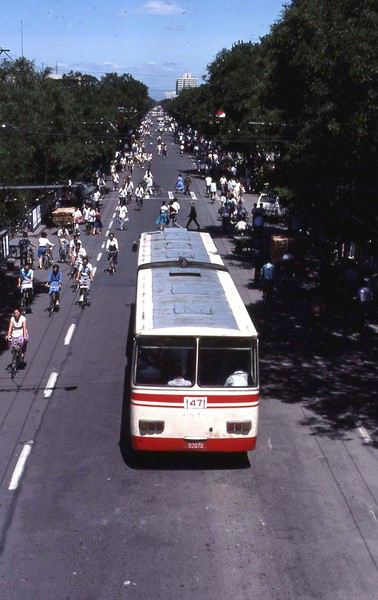
Pékin : avenue Xidan. Photo : Jacqueline et Jean-Pierre
Dès l'aéroport, j'ai senti le choc... Une simple piste en béton, pas d'avion en attente, un trafic aérien quasi nul, un bâtiment à la chinoise, usé et vieillot à souhait, des gardes en uniforme. L'aéroport est encore une base militaire, accessoirement civile pour quelques rares liaisons vers l'URSS et les pays d'Asie. Il n'y a rien dans ce qui fait office de hall d'accueil, une pièce de quelques dizaines de mètres carré tout au plus.
Contrôles minutieux, file d'attente, les militaires ne sont pas très souriants, et le comité d'accueil pas très... accueillant. On n'est pas là pour rigoler, surtout avec ces étrangers qui débarquent de Hong Kong, la zone capitaliste. Eh oui, Hong Kong chinois, ce sera dans une dizaine d'années. D'ici là...
Des billets de Monopoly ?! Un simple bureau dans un recoin fait office de banque. Vite, changer nos travelers chèques en dollars. Ben oui, la carte bleue, ça n'existe pas encore. Derrière son boulier, l'employé fait ses calculs à une vitesse incroyable et me rend le change. Surprise : j'ai une liasse de jolis billets tout neufs dans la main, mais ils n'ont rien à voir avec la monnaie locale. La preuve, il n'y a pas le portrait du grand timonier, mais des jolis dessins de monuments et paysages ! Ca ressemble davantage à des billets de Monopoly.
C'est quoi ce truc ?
Une bonne affaire, mais un gros risque En fait, c'est une monnaie spéciale réservée aux étrangers. Nous allons vite apprendre deux choses. - Un, cette monnaie n'est pas utilisée (et même interdite) par les chinois dans leur vie quotidienne. Elle est réservée aux étrangers et ils doivent payer avec. - Deux, elle est très recherchée par quelques autochtones, car c'est la seule monnaie ayant un équivalent dollar. A l'époque, le yuan chinois ne vaut absolument rien, il n'est pas convertible dans une autre monnaie. Pire que le kopeck. Du coup, notre monnaie "spécial étrangers" fait l'objet d'un trafic formellement interdit et sévèrement réprimé par les autorités.
Mais comment faire si tu veux voyager en dehors des circuits touristiques et des grands hôtels, juste prendre le bus par exemple ou manger dans une gargote. Ca, les autorités n'en ont cure. Un étranger, ça dort dans les hôtels de luxe, ça prend l'avion ou le train en première classe, ça mange dans les grands restaurants. Mieux encore, ça voyage en groupe avec un guide.
Pas d'autre solution, il faudra changer au black Dans la rue, avec les petits trafiquants locaux. Il y a même un cours « officiel » du change : un yuan de Monopoly contre trois yuans de monnaie populaire. A l'époque, un yuan, c'est à peu près un franc. Une sacrée bonne affaire ! Le tout, c'est de ne pas se faire pincer. Les rumeurs les plus folles courent sur les peines encourues pour les trafiquants, mais aussi pour les étrangers qui se font pincer. C'est d'ailleurs marqué sur certains documents. Si les peines de prison ferme ont de quoi dissuader le voyageur, il faudra quand même prendre le risque, pas le choix. Une des nombreuses absurdités du système.
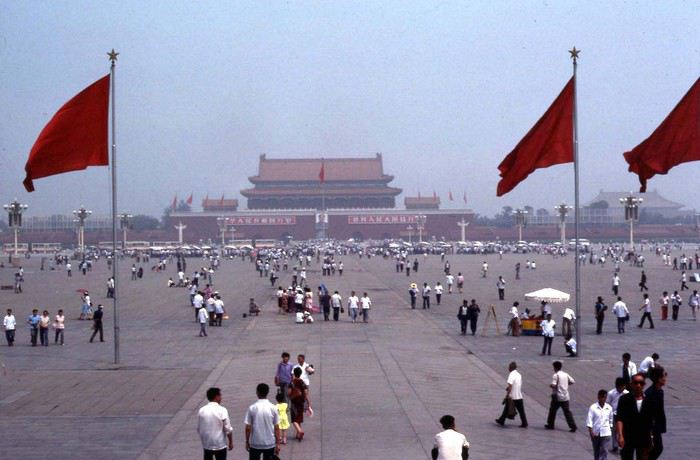
Pékin : place Tian An Men. Photo : Jacqueline et Jean-Pierre
Mise à l'épreuve 1 : trouver un hébergement... Sortie de l'aéroport, c'est l'après-midi. Quelques taxis attendent, réservés aux privilégiés du régime et aux étrangers. Mais nous ne savons même pas où nous allons, juste en ville, et on verra après. Donc ce sera le bus, celui-ci prend la monnaie de Monopoly. C'est notre premier transport en commun, direction le centre ville, à une vingtaine de kilomètres. Très bien, mais où aller, à qui demander un tuyau, un renseignement, une bonne adresse ?
L'aéroport étant en rase campagne, la route bordée d'arbres qui conduit à Pékin centre ressemble à une de nos départementales. De part et d'autres, c'est le défilé des paysans, le plus souvent à pied, tirant des charrettes à bras, quelques fois à bicyclette ou en tracteur. Pour nous occidentaux déjà rodés aux autoroutes, c'est un choc. Ici, pas de voiture individuelle : les véhicules à moteur, c'est juste des camions, quelques bus et de rares taxi, c'est tout .
La carte de Pékin n'indique rien d'autre que le nom des rues, impossible de savoir où se trouve tel service, hôtel, restaurant... Il faut se débrouiller. Les quelques éléments écrits et oraux de chinois que je possède, je vais vite devoir les mettre à l'épreuve. L'anglais ici, on connaît pas.
Juste à côté de nous est assise une jeune femme, bien de sa personne, sans doute un cadre du parti ou d'une grande entreprise. Elle semble plus amène que les autres voyageurs, plus disposée à rendre service. J'entame la conversation comme je peux. Après les échanges d'usage : - Nous sommes français, c'est notre premier voyage en Chine. Connaissez-vous un hôtel sur le trajet du bus qui nous accepterait ? Coup de chance, la femme nous en indique un non loin d'un arrêt, elle nous dira quand il faudra descendre.
Mise à l'épreuve 2 : et qui accepte les étrangers... L'hôtel n'est pas facile à trouver, tout se ressemble ici et rien ne permet de discerner au premier coup d'oeil la fonction d'un bâtiment. Ce n'est même pas écrit « hôtel » à l'entrée. Finalement nous poussons la porte de ce qui semble être ce que nous cherchons. Un étroit couloir sombre, un guichet, une sorte de réception, on dirait un peu un hôtel. Le type de l'accueil est très surpris de nous voir ici, mais oui, c'est bien un hôtel, sauf que : - C'est interdit aux étrangers, vous ne devez pas rester ici ! - Mais comment faire alors ? Le type décroche son téléphone, puis, au bout d'un moment : - Prenez le bus et descendez à cet arrêt, vous y trouverez un hôtel pour vous.
C'est ainsi que nous découvrons que nous ne pourrons pas loger comme on veut dans le pays. La plupart des hôtels sont interdits aux étrangers, il faut toujours aller à l'hôtel spécial « wai guo ren». Oui, mais ce n'est pas forcément indiqué. Quant à dormir chez l'habitant, ce n'est même pas la peine d'y songer, c'est interdit. De plus, quand on voit dans quoi vivent les gens en ville, le peu d'espace dont ils disposent, ça ne donne pas vraiment envie de se faire inviter.
Je ne me souviens plus comment nous avons fait pour trouver le bon bus et le bon arrêt, juste que ça n'a pas été facile du tout. La contrôleuse du bus a tiré une drôle de tronche quand je lui ai tendu le billet de Monoploy, mais elle n'avait pas le choix. Un mao le ticket, dix centimes de franc. Premier aperçu du coup de la vie : trois fois rien. Dans le bus, tous les regards sont fixés sur nous...
Pas de doute, il faut absolument trouver de la monnaie locale, et le plus vite possible. On ne va rien pouvoir faire avec cette monnaie de m... Et quand par hasard ils sont acceptés, on y perd sacrément au change, car ils nous rendent l'argent en monnaie locale. C'est une arnaque gouvernementale bien calculée !
Prochain épisode : le trafic de monnaie
Ce sera donc un carnet "impressions de Chine", ce qui m'est resté de plus marquant. Les quelques photos jaunies que j'ai pu sauver sont scannées et de mauvaise qualité. Merci à Jacqueline et Jean-Pierre pour leur contribution photographique, entièrement d'époque elle aussi.
AU MENU
Préambule - le contexte politique et économique du pays Chapitre 1 - Un voyage qui s'annonce pas très romantique, c'était prévu... Chapitre 2 - Pékin : le trafic de monnaie. Illégal mais indispensable. Chapitre 3 - Pékin 1985-2018 : du Moyen-Age à la révolution technologique. Immersion comparative. Chapitre 4 - Pékin : un billet de train pour Xi'an ? Pas si simple que ça. Chapitre 5 - Le "qi feng shui". Le soigneur se fait soigner. Chapitre 6 - Xi'an : «mei yo», la réponse favorite des fonctionnaires. Chapitre 7 - Vol au-dessus de la jungle. Le coucou arrivera-t-il à bon port ? Chapitre 8 - Chongqing : le bal, ou la vie sexuelle des jeunes chinois. Chapitre 9 - Croisière pop sur le Yangtse. Chapitre 10 - L'hôtel à rats. C'est à Wuhan, comme par hasard. Chapitre 11 - Canton : à la recherche de xiao Wu. Chapitre 12 - Canton : un train sous haute surveillance. Chapitre 13 - Hong Kong : dur retour à la civilisation. Albums : les photos d'époque signées Jacqueline et Jean-Pierre. A partir de la page 5 Témoignages et photos d'époque. Merci aux différents contributeurs. A partir de la page 6. Ne manquez pas le Tibet et le Xinjiang !
PREAMBULE : le contexte politique et économique Comment voyager dans ce pays encore très fermé, obscur, énigmatique, dont en Europe on ne connaît guère la mentalité, les règles de fonctionnement, dont on ne perçoit à l'étranger que quelques images soigneusement filtrées par la censure. Comment se déplacer, se loger, se nourrir, sans moyen de communication, sans réservation d'hôtel ou de train, sans connaître la langue , sans aide, sans guide, sans assistance, sans carte bleue...
1984, date clé pour le voyageur Après trente années de communisme à marche forcée, de campagnes idéologiques calamiteuses pour les populations, de luttes intestines pour le pouvoir, le pays n'arrive pas à décoller économiquement. L'écart grandit avec les nations développées. Mais avec le rétablissement des relations diplomatiques avec les Etats Unis en 1979, le nouveau président, Deng Xiaoping, tient enfin sa revanche et entame sa longue marche vers le progrès. Les fossiles maoïstes de la "longue marche", des "cent fleurs", du "grand bond en avant", les criminels de la "grande révolution culturelle prolétarienne", représentés par la "bande des quatre", tous ceux qui l'avaient évincé du pouvoir et condamné à l'oubli au fin fond d'une province, le sont à leur tour.
Le "révisionniste", comme l'a appelé la veuve Mao, lance ses réformes de libéralisation et d'ouverture de l'économie : « Peu importe qu'un chat soit blanc ou noir, l'essentiel est qu'il attrape les souris ! » Parole du maître.
Parmi ces réformes : l'ouverture au tourisme. Jusqu'à présent, pour visiter le pays, il fallait obligatoirement, soit passer par un tour opérateur avec guide et circuit programmé, soit demander des autorisations de voyage pour un nombre limité de destinations. Très peu pour moi. Mais en 1984, monsieur Deng supprime le permis de circuler et ouvre quasiment tout le pays aux visiteurs. L'info provoque un déclic : - C'est l'occasion ou jamais. L'année prochaine, ce sera la Chine. Et en sac à dos! Et ce sera aussi notre voyage de noces...
Nous aurons le privilège d'être parmi les premiers voyageurs occidentaux à tenter l'aventure. Je pourrai enfin mettre en pratique ce que j'ai appris de chinois à la fac et réaliser un vieux rêve. A nous la Chine, à nous la découverte de ce pays mystérieux et fascinant. Quelle réalité se cache derrière ces images édulcorées de bonheur populaire que nous distillent les images officielles ? Comment vit-on réellement dans ce pays ? Quel accueil réserve-t-on aux impérialistes occidentaux ?
Wuhan, 1985 : slogans révolutionnaires pour mini gardes rouges
CHAPITRE 1 : un voyage qui s'annonce pas très romantique, c'était prévu... Eh oui, juste mariés, il y a peut-être plus glamour comme destination. Bon, Venise, on connaît déjà. Quoi de mieux qu'une telle aventure pour forger un couple ? Pendant toute l'année, je peaufine le projet : itinéraire, transports, hébergements... Les guides de voyage sur la Chine ne sont pas nombreux, il n'en existe d'ailleurs qu'un en français. Pour ce qui est de l'itinéraire, c'est à peu près établi, pour le reste, ce sera au coup par coup, improvisation et opportunités. L'aventure quoi. Juste qu'on dispose d'un mois entre l'atterrissage et le retour à Hong-Kong. Pour l'itinéraire, ce sera donc Pékin - Hong Kong, mais par où et comment ? C'est le grand mystère, même si certains incontournables sont au programme : la Grande Muraille, Xi'an et son armée en terre cuite, la croisière sur le Yang Tse Kiang...
Août 1985 : Hong Kong, premiers pas en extrême-orient Munis d'un joli visa sur notre passeport et d'un billet d'avion Hong Kong - Pékin acheté en agence en France, nous débarquons à Hong Kong pour y passer une nuit avant de repartir pour Pékin le lendemain, L'atterrissage au-dessus de la ville est spectaculaire, l'avion louvoie entre les immeubles pour plonger vers la piste au raz de l'océan, un véritable tour de manège à sensations. Pas trop le temps d'explorer la ville, mais le dépaysement est déjà total. Et pourtant, ce n'est rien à côté de ce qui nous attend...
Ca commence plutôt mal Aéroport de Hong Kong, le lendemain. Nos billets sont valables, pas de problème, seulement : - Désolé, mais vous n'avez pas confirmé votre vol, l'avion est complet. Il va falloir attendre deux ou trois jours... Eh oui, en 1985, il faut confirmer son vol la veille par téléphone. Dans l'excitation et l'émotion, nous avions complètement oublié la consigne. Zut alors, deux ou trois jours de perdus sur le projet, c'est beaucoup trop. - Attendez ici, peut-être il y aura des places si des voyageurs ne se présentent pas. Longue attente plutôt anxieuse, et quelques minutes avant le décollage, petit signe de l'employé : - C'est bon, il reste deux places, vous pouvez partir.
Pékin : avenue Xidan. Photo : Jacqueline et Jean-Pierre
Dès l'aéroport, j'ai senti le choc... Une simple piste en béton, pas d'avion en attente, un trafic aérien quasi nul, un bâtiment à la chinoise, usé et vieillot à souhait, des gardes en uniforme. L'aéroport est encore une base militaire, accessoirement civile pour quelques rares liaisons vers l'URSS et les pays d'Asie. Il n'y a rien dans ce qui fait office de hall d'accueil, une pièce de quelques dizaines de mètres carré tout au plus.
Contrôles minutieux, file d'attente, les militaires ne sont pas très souriants, et le comité d'accueil pas très... accueillant. On n'est pas là pour rigoler, surtout avec ces étrangers qui débarquent de Hong Kong, la zone capitaliste. Eh oui, Hong Kong chinois, ce sera dans une dizaine d'années. D'ici là...
Des billets de Monopoly ?! Un simple bureau dans un recoin fait office de banque. Vite, changer nos travelers chèques en dollars. Ben oui, la carte bleue, ça n'existe pas encore. Derrière son boulier, l'employé fait ses calculs à une vitesse incroyable et me rend le change. Surprise : j'ai une liasse de jolis billets tout neufs dans la main, mais ils n'ont rien à voir avec la monnaie locale. La preuve, il n'y a pas le portrait du grand timonier, mais des jolis dessins de monuments et paysages ! Ca ressemble davantage à des billets de Monopoly.
C'est quoi ce truc ?
Une bonne affaire, mais un gros risque En fait, c'est une monnaie spéciale réservée aux étrangers. Nous allons vite apprendre deux choses. - Un, cette monnaie n'est pas utilisée (et même interdite) par les chinois dans leur vie quotidienne. Elle est réservée aux étrangers et ils doivent payer avec. - Deux, elle est très recherchée par quelques autochtones, car c'est la seule monnaie ayant un équivalent dollar. A l'époque, le yuan chinois ne vaut absolument rien, il n'est pas convertible dans une autre monnaie. Pire que le kopeck. Du coup, notre monnaie "spécial étrangers" fait l'objet d'un trafic formellement interdit et sévèrement réprimé par les autorités.
Mais comment faire si tu veux voyager en dehors des circuits touristiques et des grands hôtels, juste prendre le bus par exemple ou manger dans une gargote. Ca, les autorités n'en ont cure. Un étranger, ça dort dans les hôtels de luxe, ça prend l'avion ou le train en première classe, ça mange dans les grands restaurants. Mieux encore, ça voyage en groupe avec un guide.
Pas d'autre solution, il faudra changer au black Dans la rue, avec les petits trafiquants locaux. Il y a même un cours « officiel » du change : un yuan de Monopoly contre trois yuans de monnaie populaire. A l'époque, un yuan, c'est à peu près un franc. Une sacrée bonne affaire ! Le tout, c'est de ne pas se faire pincer. Les rumeurs les plus folles courent sur les peines encourues pour les trafiquants, mais aussi pour les étrangers qui se font pincer. C'est d'ailleurs marqué sur certains documents. Si les peines de prison ferme ont de quoi dissuader le voyageur, il faudra quand même prendre le risque, pas le choix. Une des nombreuses absurdités du système.
Pékin : place Tian An Men. Photo : Jacqueline et Jean-Pierre
Mise à l'épreuve 1 : trouver un hébergement... Sortie de l'aéroport, c'est l'après-midi. Quelques taxis attendent, réservés aux privilégiés du régime et aux étrangers. Mais nous ne savons même pas où nous allons, juste en ville, et on verra après. Donc ce sera le bus, celui-ci prend la monnaie de Monopoly. C'est notre premier transport en commun, direction le centre ville, à une vingtaine de kilomètres. Très bien, mais où aller, à qui demander un tuyau, un renseignement, une bonne adresse ?
L'aéroport étant en rase campagne, la route bordée d'arbres qui conduit à Pékin centre ressemble à une de nos départementales. De part et d'autres, c'est le défilé des paysans, le plus souvent à pied, tirant des charrettes à bras, quelques fois à bicyclette ou en tracteur. Pour nous occidentaux déjà rodés aux autoroutes, c'est un choc. Ici, pas de voiture individuelle : les véhicules à moteur, c'est juste des camions, quelques bus et de rares taxi, c'est tout .
La carte de Pékin n'indique rien d'autre que le nom des rues, impossible de savoir où se trouve tel service, hôtel, restaurant... Il faut se débrouiller. Les quelques éléments écrits et oraux de chinois que je possède, je vais vite devoir les mettre à l'épreuve. L'anglais ici, on connaît pas.
Juste à côté de nous est assise une jeune femme, bien de sa personne, sans doute un cadre du parti ou d'une grande entreprise. Elle semble plus amène que les autres voyageurs, plus disposée à rendre service. J'entame la conversation comme je peux. Après les échanges d'usage : - Nous sommes français, c'est notre premier voyage en Chine. Connaissez-vous un hôtel sur le trajet du bus qui nous accepterait ? Coup de chance, la femme nous en indique un non loin d'un arrêt, elle nous dira quand il faudra descendre.
Mise à l'épreuve 2 : et qui accepte les étrangers... L'hôtel n'est pas facile à trouver, tout se ressemble ici et rien ne permet de discerner au premier coup d'oeil la fonction d'un bâtiment. Ce n'est même pas écrit « hôtel » à l'entrée. Finalement nous poussons la porte de ce qui semble être ce que nous cherchons. Un étroit couloir sombre, un guichet, une sorte de réception, on dirait un peu un hôtel. Le type de l'accueil est très surpris de nous voir ici, mais oui, c'est bien un hôtel, sauf que : - C'est interdit aux étrangers, vous ne devez pas rester ici ! - Mais comment faire alors ? Le type décroche son téléphone, puis, au bout d'un moment : - Prenez le bus et descendez à cet arrêt, vous y trouverez un hôtel pour vous.
C'est ainsi que nous découvrons que nous ne pourrons pas loger comme on veut dans le pays. La plupart des hôtels sont interdits aux étrangers, il faut toujours aller à l'hôtel spécial « wai guo ren». Oui, mais ce n'est pas forcément indiqué. Quant à dormir chez l'habitant, ce n'est même pas la peine d'y songer, c'est interdit. De plus, quand on voit dans quoi vivent les gens en ville, le peu d'espace dont ils disposent, ça ne donne pas vraiment envie de se faire inviter.
Je ne me souviens plus comment nous avons fait pour trouver le bon bus et le bon arrêt, juste que ça n'a pas été facile du tout. La contrôleuse du bus a tiré une drôle de tronche quand je lui ai tendu le billet de Monoploy, mais elle n'avait pas le choix. Un mao le ticket, dix centimes de franc. Premier aperçu du coup de la vie : trois fois rien. Dans le bus, tous les regards sont fixés sur nous...
Pas de doute, il faut absolument trouver de la monnaie locale, et le plus vite possible. On ne va rien pouvoir faire avec cette monnaie de m... Et quand par hasard ils sont acceptés, on y perd sacrément au change, car ils nous rendent l'argent en monnaie locale. C'est une arnaque gouvernementale bien calculée !
Prochain épisode : le trafic de monnaie
On the Silk Road: Chronicles of a Sixty-Something Traveling Completely Independently
From Beijing to Khiva: China, Kyrgyzstan, Tajikistan, Uzbekistan
Chronicle of anecdotes, highlights, and other adventures that marked this eight-week journey in 2018.
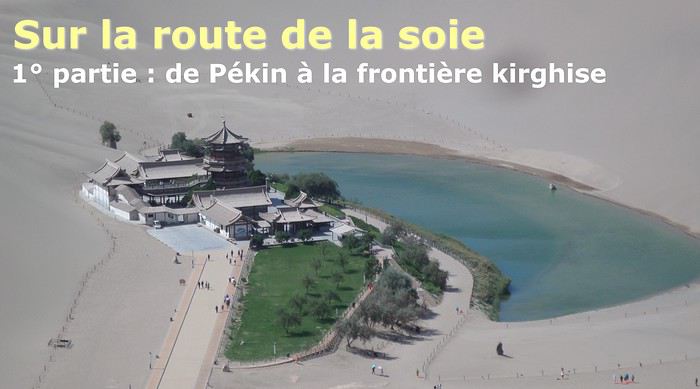
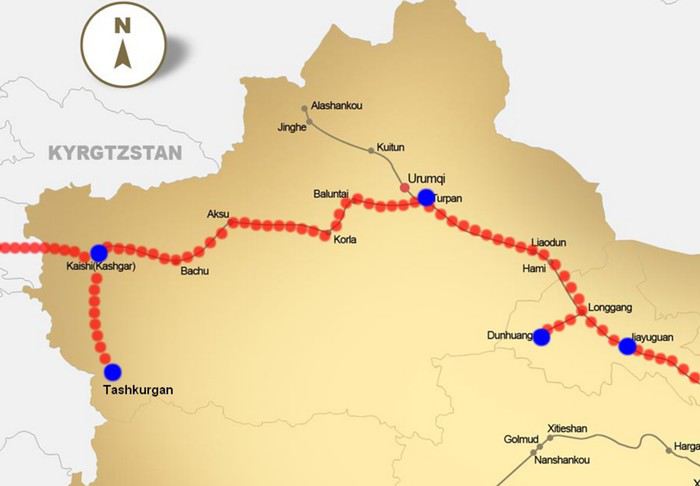
The Chinese Far West More than 30 years after my first trip to eastern China, I finally fulfilled an old dream: traveling solo from Beijing to the far west, discovering Xinjiang, the Uyghur people and the oppression they endure, the oases of Turpan and Kashgar, the Taklamakan Desert, the end of the Great Wall... The route was covered by train.
MENU PART 1: CHINA
1- Beijing (Jiankou) : the authentic Great Wall, without tourists 2- Cycling in Beijing, the best way to get around 3- Beijing : departure for the far west 4- Jiayuguan : getting by without English 5- Jiayuguan : scams and heritage 6- Dunhuang : abundance in the middle of the desert 7- Turpan : the Uyghurs under heavy surveillance 8- Kashgar : love at first sight for the old city 9- Kashgar : China’s recipe for controlling the populace 10- Tashkurgan : what on earth was I thinking going there! Kyrgyz border: a surreal epic Photo album from the 80s, contributions from other travelers (page 2)
1- JIANKOU Finding the authentic Great Wall, without tourists or a guide Friday, August 24, 2018 Thirty years later, I didn’t feel like revisiting the Great Wall at Badaling or any other overcrowded site. I chose to explore it at Jiankou, in its wildest, most authentic, and unrestored section, starting from a lost village deep in a valley—though it wasn’t *that* lost, since it had everything for communication.
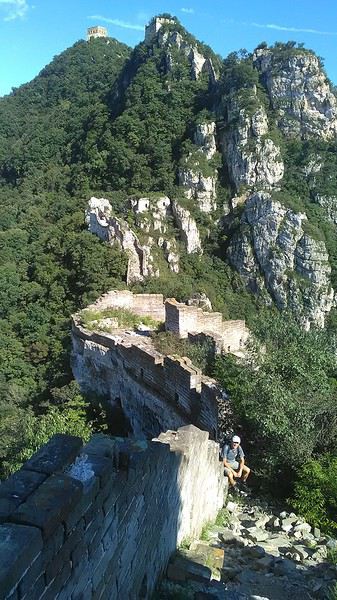
No need to pay for a taxi to get there—by timing it right, you can take the bus for just a few yuan. You have to get off at Xizhazi, the bus terminus. Be careful, there are only two buses a day in each direction. At the Xizhazi bus stop, I met a young couple who’d arrived with zero information about what to expect. We hiked the three of us toward the restored section of Mutianyu.
Still, be cautious With GPS and a topographic map (OpenTopoMap), you can set off without a problem or guide. The trail up to Jiankou is easy and well-marked. The trails down are too. But be careful—once you’re on the Wall, it’s real mountain hiking, with easy but dangerous climbing sections (over sheer drops). Not for amateurs or those afraid of heights! But what a reward. The Wall all to yourself, where it’s at its most daring. Truly mesmerizing.
More photos...
2- BEIJING The best way to get around the capital Sunday, August 26 The best way to explore the city is still by bike. Most are in a bike-share system, but you need to use an app—WeChat, the app that does everything, like monitoring your every move. No way I was installing that.
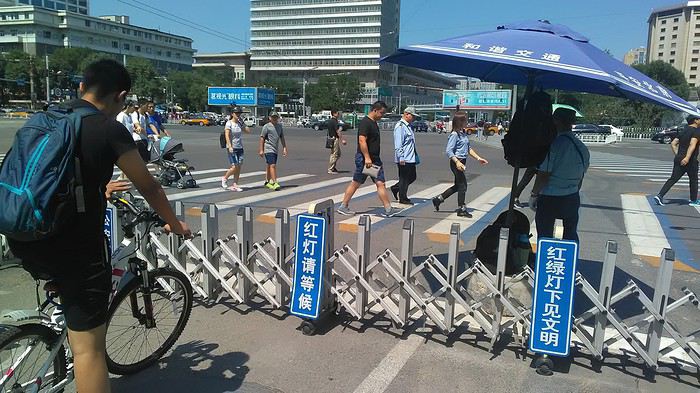
I found one at a rental shop near the hostel. The key is to quickly learn local traffic customs to minimize risks. Bike lanes are wide along the avenues.
But you still have to: - Watch out for anything parked on the bike paths—the most annoying are people napping or talking on the phone in their cars - Keep an eye on everything coming the wrong way—the list is long - The worst is right turns on red, which in Chinese traffic rules seem to have priority Once you get the hang of it, it’s fine. The city is huge but flat, so you can just wing it.
3- BEIJING By train to the far west Sunday, August 26 Beijing West Station is the size and operates like an airport. With your e-ticket from the agency, you first have to pick up your ticket at the special "English" counter, after passing through security. With your ticket in hand, you have to exit and enter through the boarding waiting area—not the platform—after a second security check.
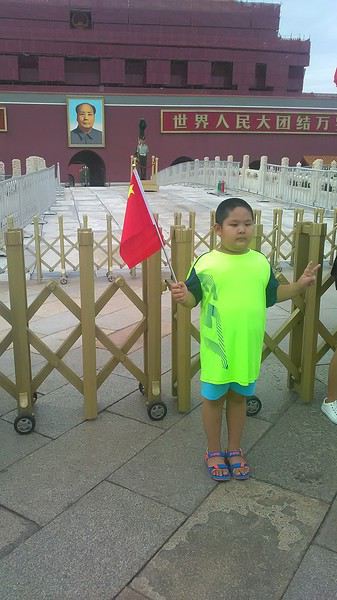 Then you find the right hall and wait for the sign to finally access the platform. In the end, it works pretty well given the incredible number of passengers to manage. Everywhere in Beijing, I saw that the Chinese have mastered crowd flow management.
Nice surprise: second-class carriages are clean, air-conditioned, and bright. Perfect, since I was in for 20 hours. One uniformed attendant per carriage, mobile meal service—luxury! Small downside: no luggage space. Hauling your suitcase up to the top bunk is quite a workout. I was in the middle, so it wasn’t too bad. The landscape, though, whether rural or urban, is pretty bleak. That should change once we leave the eastern plains.
Of course, I got my first police visit, with a thorough passport check and bag search. I was warned—going to the Chinese far west exposes you to this kind of hassle. But they were polite and respectful.
 The Chinese Far West
4- JIAYUGUAN Getting by without English Monday, August 27 At the gates of two deserts (Gobi and Taklamakan) and at the foot of the Tibetan highlands, the Great Wall ends at Jiayuguan. Here, I found the deeper China I’d somewhat rediscovered during my bike ride, even if now everyone gets around on electric bikes and I’m no longer stared at like an alien.
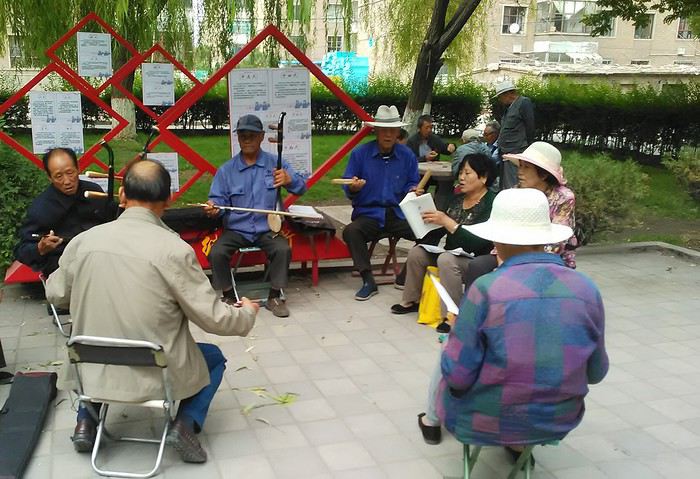
Prices are nothing like Beijing: you can find a full meal for 2 €, and my bike cost 7 € for two days. Plus, few people speak English—neither the owner of the HI hostel where I stayed, nor the ticket sellers at the sites, let alone the servers at the small eateries where I ate. Everything is written in Chinese. So I had to use the little Chinese I know to communicate about essentials. It makes the locals laugh to see a European trying to speak their language, but it earns respect. With Google Translate’s help, I managed.
Rant: With their avenues blocked for construction for kilometers without warning, and new roads not yet on maps, I must’ve taken 15 km of detours. More photos...
5- JIAYUGUAN Scams and heritage Tuesday, August 28 The Great Wall doesn’t exactly end at the fort I visited yesterday but 10 km further, at the entrance to a river gorge at the foot of the mountains. All that’s left is a badly damaged tower (more like a mound of earth) and a section of clay wall, similar to the one I biked yesterday.
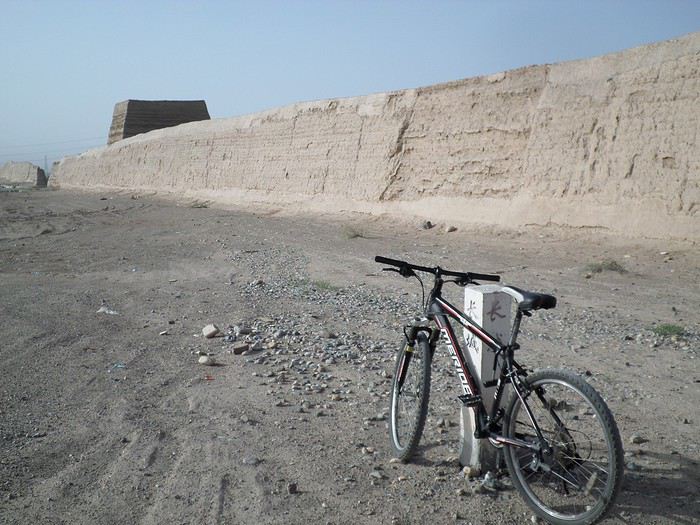
This morning, I hopped on my bike, determined to venture into the desert to see this highly symbolic site. First, you access it via a wide, brand-new road with not a soul in sight. Just before the site, I came across a grand welcome gate, very period-style, but it’s actually the inevitable toll booth.
Behind the gate, the road continues straight to the site, which you can see in the distance—at least 2 km away—the remains of the tower and wall. I had to leave my bike here. Fine. I went to the ticket counter and asked the price: 120 yuan! I couldn’t believe it—over 15 € for a simple mound of earth.
I showed my displeasure to the attendant, who couldn’t care less, and immediately turned back. 120 yuan—that’s the price for a new road, a fancy gate planted 2 km before the site just to force you to take a shuttle, and employees with nothing to do all day... Now I understand why I didn’t meet anyone!
Heritage China is a bit pricey Generally, sites are expensive for the country’s standard of living, but travelers are supposed to have money, so why hold back? I even gave up on the Forbidden City—reservations required days in advance (or on the black market at an impossible price). I prefer to keep the memory of my first visit, when entry must’ve cost a few dozen cents, and there were only a handful of visitors.
This morning, I took a taxi to see remarkable tombs of common people from the 3rd to 6th centuries. They’re small vaulted caves made of painted bricks, depicting scenes of daily life. Very pretty and moving. But even here, though the price was more reasonable, I was left wanting—only one of the 16 tombs is open to visitors, and it’s apparently not the most beautiful.
The authentic China—at least what’s left of it... Wandering the impersonal avenues of the city, you stumble upon a market. There, you still find traditional China—small shops with questionable hygiene, Go players, musicians, and even a dental prosthetist. The last refuge for those untouched by modernity. More photos...
6- DUNHUANG Abundance in the middle of the desert Wednesday, August 29 Well, I thought the landscape would be less bleak as I headed west. Nope. The only distraction in this expanse of dark, clayey sand is the forests of pylons and wind turbines, plus wild camels racing each other.
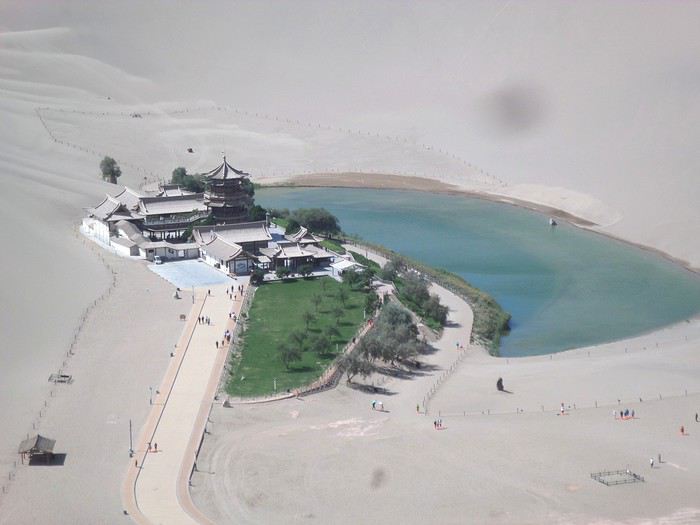 However, Dunhuang, the gateway to the Taklamakan, is by far the most pleasant Chinese city I know. There’s a real city center you can explore on foot. It’s hot but not unbearable, with a light, dry breeze. Much nicer than Beijing. The Han Chinese are still the majority, but the Muslim Uyghurs are more numerous, and the muezzin’s call to prayer echoes around the mosque.
The most surprising thing is the abundance and diversity of fruits and vegetables. You wonder how it all grows here. Well-irrigated, the desert sands are very fertile. Here, raisins have subtle, mysterious flavors, and the lamb really tastes like lamb.
Today, I visited the must-see Mingshashan, a dune complex next to which Pila is a molehill. The Basque Country, but covered in sand... More photos...
7- TURPAN The Uyghurs under heavy surveillance Friday, August 31 Surveillance cameras everywhere in the city, armed police stationed at intersections, in front of public buildings, at the entrance and inside tourist sites, police stations on every corner, patrols on foot or by car, khaki uniforms even for middle schoolers... here, the Han Chinese are in the minority, and you can feel it. Turpan feels like a city under siege.
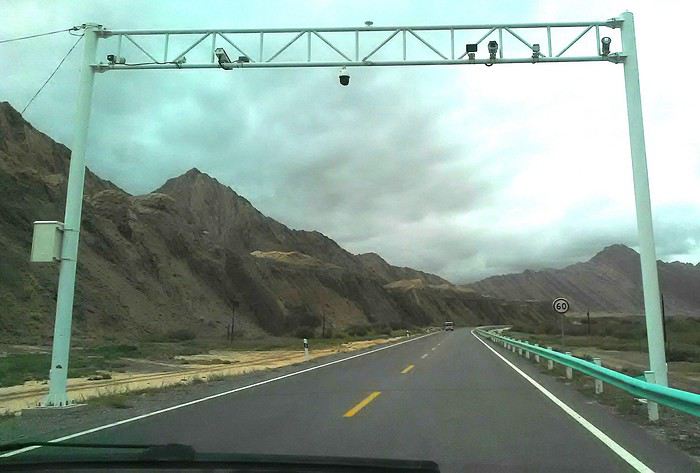
To enter the youth hostel where I stayed, there’s even a security gate, and the receptionist (a Han, like everyone in tourism) wears a bulletproof vest! Reassuring. Still, you don’t feel particularly threatened here, especially as a European. The troublemakers are the Chinese, not the Uyghurs. Generally, China is a very safe country for visitors.
Smile, you’re on camera! I was biking on an avenue when the car in front of me got flashed for driving slowly. I quickly understood why when I got flashed too.
Here, the official time is Beijing time, but it gets dark two hours later. It’ll be even worse in Kashgar. Trickier to manage: everything is displayed in Chinese and Arabic. Nothing in English. Choosing a menu is a shot in the dark. Apart from a few young Chinese, no one here speaks English, and my Chinese doesn’t seem very understandable...
Mogao, the end of the road for the Han Yesterday, near Dunhuang, I went to Mogao, a complex of decorated caves with Buddha sculptures and paintings. Stunning, but so crowded! Luckily, here in Turpan, Chinese tourists barely venture out. So I visited a Silk Road ghost town with only a handful of other visitors and under a howling wind.
The modern Chinese city is swallowing up the old Uyghur neighborhoods—only a museum-like district remains in the center, and pockets of resistance on the outskirts are doomed to disappear soon. More photos...
8- KASHGAR A (relative) love at first sight for the old city Sunday, September 2 After three overnight trains, here I am in the far west of China, nearly 4,000 km from the capital. Despite the omnipresent police and an old city preserved UNESCO-style, Kashgar is my Chinese love at first sight.
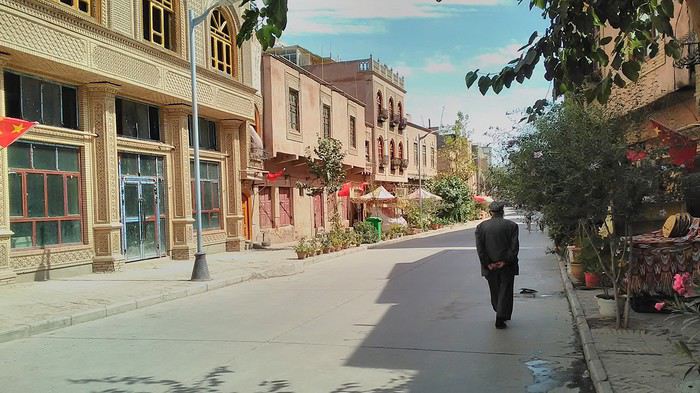
Finally, Chinese... well, sort of, because we’re in Uyghur territory here—a Turkic people with nothing culturally in common with the Han, the eastern Chinese. It started badly yesterday at Turfan station, where after three security gate passes, at least five passport checks, and a bag search, three adorable policewomen confiscated my antibacterial lotion because it had a flammable logo...
Then came the welcoming committee of armed cops at Kashgar station. Once all that was over, they left me alone—except you still have to go through security checks like everyone else to enter the old city, the bazaar, the livestock market... The further west you go, the more the siege mentality is evident. Luckily, the border isn’t far...
Despite the inevitable destruction-reconstruction, the city center has been well preserved. Thankfully, because it’s a very original style, a mix of local and colonial. I love it, even if it’s a bit too artificial, sanitized, and watered-down, and rather empty of residents. On the Silk Road, the city was famous for its great food. And it still is—rarely have I seen such richness and abundance of food! And not just scorpions or snakes. More photos...
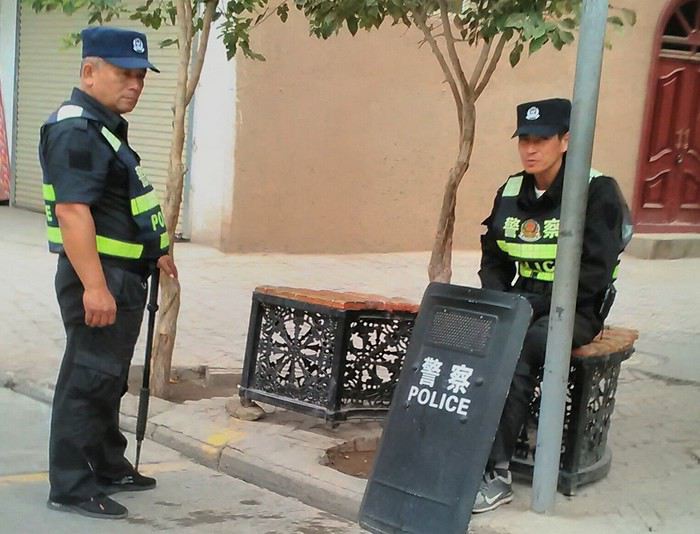
9- KASHGAR China’s recipe for controlling the populace Saturday, September 1 Xinjiang, along with Tibet, is a "sensitive" area of rebellion in the eyes of Chinese authorities. As a result, the state has these regions and their populations under total control. Tourists also feel the consequences, even if they’re not at risk of re-education camps.
 - Putting barbed wire and anti-ramming barriers around sensitive sites (schools, big hotels, government buildings...)
- Installing traffic surveillance gates with cameras and photo flashes (for all vehicles passing, including bikes) throughout the city and even in the countryside
- Posting uniformed guards with tasers, batons, or huge baseball bats every 100 meters
- Training the Han population (ethnic Chinese) in self-defense with sticks, preferably in the morning on the street. Men and women of all ages
- Starting school with the national anthem, doing military exercises, and receiving political indoctrination, all neatly lined up in the courtyard. (The dream school for any teacher)
- Placing a snitch in uniform (a pseudo-guard) in public gathering places, like youth hostels. Mine spends the day loafing around the courtyard
- Putting Chinese flags everywhere on the streets to remind everyone who’s in charge
- Installing security gates at every entrance to areas frequented by tourists (thanks for that) but not just there
- Never photographing cops, or else! I tried, but it’s not easy...
- Putting barbed wire and anti-ramming barriers around sensitive sites (schools, big hotels, government buildings...)
- Installing traffic surveillance gates with cameras and photo flashes (for all vehicles passing, including bikes) throughout the city and even in the countryside
- Posting uniformed guards with tasers, batons, or huge baseball bats every 100 meters
- Training the Han population (ethnic Chinese) in self-defense with sticks, preferably in the morning on the street. Men and women of all ages
- Starting school with the national anthem, doing military exercises, and receiving political indoctrination, all neatly lined up in the courtyard. (The dream school for any teacher)
- Placing a snitch in uniform (a pseudo-guard) in public gathering places, like youth hostels. Mine spends the day loafing around the courtyard
- Putting Chinese flags everywhere on the streets to remind everyone who’s in charge
- Installing security gates at every entrance to areas frequented by tourists (thanks for that) but not just there
- Never photographing cops, or else! I tried, but it’s not easy...
With all that, you can stroll around safely Not much crime! As for the amount the Chinese state spends to maintain such a system, it’s staggering! A third of the Han living in Xinjiang work in security. Today, I wandered freely around old Kashgar, which is quite large after all. More photos...
10- TASHKURGAN What on earth was I thinking going there! Wednesday, September 5 First, there’s the taxi—pretty crappy, with a driver who doesn’t speak a word of English and won’t stop smoking. Over six hours in that... shared with a completely out-of-it American.
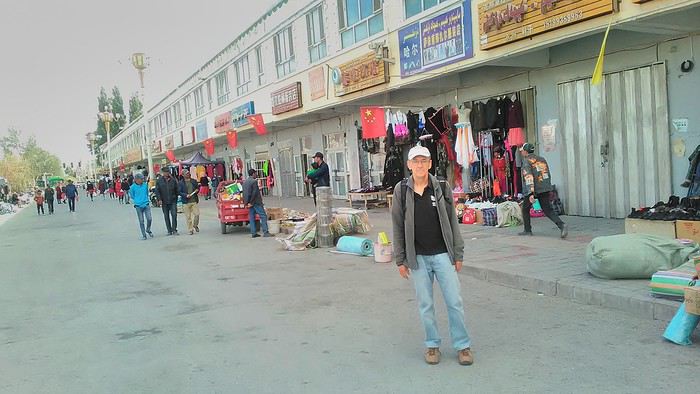
Then there are all the checkpoints along the way. I won’t go on—you know the drill by now.
After that, there’s Tashkurgan—a town with nothing to see, nothing to do. Deserted as soon as night falls. There’s this huge youth hostel and a few lost Chinese tapping away on their smartphones, chain-smoking. This lost American-European crowd, swapping tips on how to enter Pakistan or Tajikistan.
Luckily, there’s the Chinese Pamir Highway, lined with peaks over 7,000m. There’s the feeling of no longer being in China, with a population whose features are Middle Eastern. And these Tajik women with their stunning hairstyles and vibrant costumes. There’s the fact of having reached the westernmost Chinese city, far from crowds and tourist sites. A sort of end of the world. More photos...
11- KYRGYZ BORDER A surreal epic Thursday, September 6 The road from Kashgar to the Kyrgyzstan border is a little over 200 km and passes through beautiful landscapes of colorful, desert-like mountains with acrobatic folds. That’s the bucolic part of the trip.
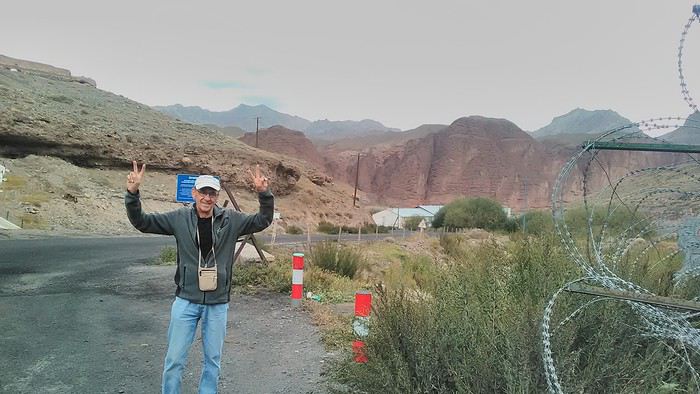 Yesterday, I managed to gather four people to rent a minibus to reach the border more easily: a Spaniard and an Argentine I’d already met in Turpan, and two New Zealanders who responded to the ad left at the hostel.
Absurdity and paranoia of Chinese authorities The highlight was crossing the town of Wuqia, 50 km past Kashgar. After tallying up with my fellow sufferers, we must’ve passed about ten checkpoints with: - Passport checks: 14 times, sometimes by two cops side by side - Bag checks: 4 times - Smartphone checks: 2 times, with deletion of "non-compliant" photos, and registration of your IMEI in the exit log!... Absurd and surreal at the same time, since my camera stayed in my bag, my apps are in French, and my photos have been online for ages...
With all that, we arrived just as the last checkpoint before the no man’s land marking the border between the two countries was on lunch break. And bam! Another 1.5-hour wait, alongside truckers who were much more used to this than we were.
What to think? The cops themselves aren’t fooled. They play the role they’re asked to, but sometimes you can coax a smile out of them—they realize how ridiculous the situation is.
What’s the point? That’s the big question my companions and I were tempted to answer with "to piss people off." To show you your place isn’t here, but with the other tourists, over there in the east, in Shanghai, Xi’an, or Guangzhou.
As for you, a traveler from a democratic country, you really experience this as aggression, humiliation, a violation of your private space. And yet, I’m respected, they speak to me properly. Today, I better understand what a Palestinian or a citizen of an occupied country might feel daily. A unique experience! Thanks, China.
And to top it off, the cherry on the cake! It’s still this glowing button you press to rate your passage after clearing the last obstacle before the exit stamp. I was so surprised it turned off before I could react. The Spaniard, with great humor and irony, had time to vote "excellent." In the end, he wasn’t wrong—you can hardly do better!
PS: I ditched my buddies at the border. They didn’t want to pay for a taxi to continue. So I took a direct taxi to Osh. The first 100 km are fabulous. I couldn’t take many photos, but I’ll be back on Monday to go to Tajikistan.
More photos...
The rest of the Silk Road, Part 2, in these travel journals: Kyrgyzstan, Tajikistan, Uzbekistan.
The Chinese Far West More than 30 years after my first trip to eastern China, I finally fulfilled an old dream: traveling solo from Beijing to the far west, discovering Xinjiang, the Uyghur people and the oppression they endure, the oases of Turpan and Kashgar, the Taklamakan Desert, the end of the Great Wall... The route was covered by train.
MENU PART 1: CHINA
1- Beijing (Jiankou) : the authentic Great Wall, without tourists 2- Cycling in Beijing, the best way to get around 3- Beijing : departure for the far west 4- Jiayuguan : getting by without English 5- Jiayuguan : scams and heritage 6- Dunhuang : abundance in the middle of the desert 7- Turpan : the Uyghurs under heavy surveillance 8- Kashgar : love at first sight for the old city 9- Kashgar : China’s recipe for controlling the populace 10- Tashkurgan : what on earth was I thinking going there! Kyrgyz border: a surreal epic Photo album from the 80s, contributions from other travelers (page 2)
1- JIANKOU Finding the authentic Great Wall, without tourists or a guide Friday, August 24, 2018 Thirty years later, I didn’t feel like revisiting the Great Wall at Badaling or any other overcrowded site. I chose to explore it at Jiankou, in its wildest, most authentic, and unrestored section, starting from a lost village deep in a valley—though it wasn’t *that* lost, since it had everything for communication.
No need to pay for a taxi to get there—by timing it right, you can take the bus for just a few yuan. You have to get off at Xizhazi, the bus terminus. Be careful, there are only two buses a day in each direction. At the Xizhazi bus stop, I met a young couple who’d arrived with zero information about what to expect. We hiked the three of us toward the restored section of Mutianyu.
Still, be cautious With GPS and a topographic map (OpenTopoMap), you can set off without a problem or guide. The trail up to Jiankou is easy and well-marked. The trails down are too. But be careful—once you’re on the Wall, it’s real mountain hiking, with easy but dangerous climbing sections (over sheer drops). Not for amateurs or those afraid of heights! But what a reward. The Wall all to yourself, where it’s at its most daring. Truly mesmerizing.
More photos...
2- BEIJING The best way to get around the capital Sunday, August 26 The best way to explore the city is still by bike. Most are in a bike-share system, but you need to use an app—WeChat, the app that does everything, like monitoring your every move. No way I was installing that.
I found one at a rental shop near the hostel. The key is to quickly learn local traffic customs to minimize risks. Bike lanes are wide along the avenues.
But you still have to: - Watch out for anything parked on the bike paths—the most annoying are people napping or talking on the phone in their cars - Keep an eye on everything coming the wrong way—the list is long - The worst is right turns on red, which in Chinese traffic rules seem to have priority Once you get the hang of it, it’s fine. The city is huge but flat, so you can just wing it.
3- BEIJING By train to the far west Sunday, August 26 Beijing West Station is the size and operates like an airport. With your e-ticket from the agency, you first have to pick up your ticket at the special "English" counter, after passing through security. With your ticket in hand, you have to exit and enter through the boarding waiting area—not the platform—after a second security check.
Then you find the right hall and wait for the sign to finally access the platform. In the end, it works pretty well given the incredible number of passengers to manage. Everywhere in Beijing, I saw that the Chinese have mastered crowd flow management.Nice surprise: second-class carriages are clean, air-conditioned, and bright. Perfect, since I was in for 20 hours. One uniformed attendant per carriage, mobile meal service—luxury! Small downside: no luggage space. Hauling your suitcase up to the top bunk is quite a workout. I was in the middle, so it wasn’t too bad. The landscape, though, whether rural or urban, is pretty bleak. That should change once we leave the eastern plains.
Of course, I got my first police visit, with a thorough passport check and bag search. I was warned—going to the Chinese far west exposes you to this kind of hassle. But they were polite and respectful.
The Chinese Far West4- JIAYUGUAN Getting by without English Monday, August 27 At the gates of two deserts (Gobi and Taklamakan) and at the foot of the Tibetan highlands, the Great Wall ends at Jiayuguan. Here, I found the deeper China I’d somewhat rediscovered during my bike ride, even if now everyone gets around on electric bikes and I’m no longer stared at like an alien.
Prices are nothing like Beijing: you can find a full meal for 2 €, and my bike cost 7 € for two days. Plus, few people speak English—neither the owner of the HI hostel where I stayed, nor the ticket sellers at the sites, let alone the servers at the small eateries where I ate. Everything is written in Chinese. So I had to use the little Chinese I know to communicate about essentials. It makes the locals laugh to see a European trying to speak their language, but it earns respect. With Google Translate’s help, I managed.
Rant: With their avenues blocked for construction for kilometers without warning, and new roads not yet on maps, I must’ve taken 15 km of detours. More photos...
5- JIAYUGUAN Scams and heritage Tuesday, August 28 The Great Wall doesn’t exactly end at the fort I visited yesterday but 10 km further, at the entrance to a river gorge at the foot of the mountains. All that’s left is a badly damaged tower (more like a mound of earth) and a section of clay wall, similar to the one I biked yesterday.
This morning, I hopped on my bike, determined to venture into the desert to see this highly symbolic site. First, you access it via a wide, brand-new road with not a soul in sight. Just before the site, I came across a grand welcome gate, very period-style, but it’s actually the inevitable toll booth.
Behind the gate, the road continues straight to the site, which you can see in the distance—at least 2 km away—the remains of the tower and wall. I had to leave my bike here. Fine. I went to the ticket counter and asked the price: 120 yuan! I couldn’t believe it—over 15 € for a simple mound of earth.
I showed my displeasure to the attendant, who couldn’t care less, and immediately turned back. 120 yuan—that’s the price for a new road, a fancy gate planted 2 km before the site just to force you to take a shuttle, and employees with nothing to do all day... Now I understand why I didn’t meet anyone!
Heritage China is a bit pricey Generally, sites are expensive for the country’s standard of living, but travelers are supposed to have money, so why hold back? I even gave up on the Forbidden City—reservations required days in advance (or on the black market at an impossible price). I prefer to keep the memory of my first visit, when entry must’ve cost a few dozen cents, and there were only a handful of visitors.
This morning, I took a taxi to see remarkable tombs of common people from the 3rd to 6th centuries. They’re small vaulted caves made of painted bricks, depicting scenes of daily life. Very pretty and moving. But even here, though the price was more reasonable, I was left wanting—only one of the 16 tombs is open to visitors, and it’s apparently not the most beautiful.
The authentic China—at least what’s left of it... Wandering the impersonal avenues of the city, you stumble upon a market. There, you still find traditional China—small shops with questionable hygiene, Go players, musicians, and even a dental prosthetist. The last refuge for those untouched by modernity. More photos...
6- DUNHUANG Abundance in the middle of the desert Wednesday, August 29 Well, I thought the landscape would be less bleak as I headed west. Nope. The only distraction in this expanse of dark, clayey sand is the forests of pylons and wind turbines, plus wild camels racing each other.
However, Dunhuang, the gateway to the Taklamakan, is by far the most pleasant Chinese city I know. There’s a real city center you can explore on foot. It’s hot but not unbearable, with a light, dry breeze. Much nicer than Beijing. The Han Chinese are still the majority, but the Muslim Uyghurs are more numerous, and the muezzin’s call to prayer echoes around the mosque.The most surprising thing is the abundance and diversity of fruits and vegetables. You wonder how it all grows here. Well-irrigated, the desert sands are very fertile. Here, raisins have subtle, mysterious flavors, and the lamb really tastes like lamb.
Today, I visited the must-see Mingshashan, a dune complex next to which Pila is a molehill. The Basque Country, but covered in sand... More photos...
7- TURPAN The Uyghurs under heavy surveillance Friday, August 31 Surveillance cameras everywhere in the city, armed police stationed at intersections, in front of public buildings, at the entrance and inside tourist sites, police stations on every corner, patrols on foot or by car, khaki uniforms even for middle schoolers... here, the Han Chinese are in the minority, and you can feel it. Turpan feels like a city under siege.
To enter the youth hostel where I stayed, there’s even a security gate, and the receptionist (a Han, like everyone in tourism) wears a bulletproof vest! Reassuring. Still, you don’t feel particularly threatened here, especially as a European. The troublemakers are the Chinese, not the Uyghurs. Generally, China is a very safe country for visitors.
Smile, you’re on camera! I was biking on an avenue when the car in front of me got flashed for driving slowly. I quickly understood why when I got flashed too.
Here, the official time is Beijing time, but it gets dark two hours later. It’ll be even worse in Kashgar. Trickier to manage: everything is displayed in Chinese and Arabic. Nothing in English. Choosing a menu is a shot in the dark. Apart from a few young Chinese, no one here speaks English, and my Chinese doesn’t seem very understandable...
Mogao, the end of the road for the Han Yesterday, near Dunhuang, I went to Mogao, a complex of decorated caves with Buddha sculptures and paintings. Stunning, but so crowded! Luckily, here in Turpan, Chinese tourists barely venture out. So I visited a Silk Road ghost town with only a handful of other visitors and under a howling wind.
The modern Chinese city is swallowing up the old Uyghur neighborhoods—only a museum-like district remains in the center, and pockets of resistance on the outskirts are doomed to disappear soon. More photos...
8- KASHGAR A (relative) love at first sight for the old city Sunday, September 2 After three overnight trains, here I am in the far west of China, nearly 4,000 km from the capital. Despite the omnipresent police and an old city preserved UNESCO-style, Kashgar is my Chinese love at first sight.
Finally, Chinese... well, sort of, because we’re in Uyghur territory here—a Turkic people with nothing culturally in common with the Han, the eastern Chinese. It started badly yesterday at Turfan station, where after three security gate passes, at least five passport checks, and a bag search, three adorable policewomen confiscated my antibacterial lotion because it had a flammable logo...
Then came the welcoming committee of armed cops at Kashgar station. Once all that was over, they left me alone—except you still have to go through security checks like everyone else to enter the old city, the bazaar, the livestock market... The further west you go, the more the siege mentality is evident. Luckily, the border isn’t far...
Despite the inevitable destruction-reconstruction, the city center has been well preserved. Thankfully, because it’s a very original style, a mix of local and colonial. I love it, even if it’s a bit too artificial, sanitized, and watered-down, and rather empty of residents. On the Silk Road, the city was famous for its great food. And it still is—rarely have I seen such richness and abundance of food! And not just scorpions or snakes. More photos...
9- KASHGAR China’s recipe for controlling the populace Saturday, September 1 Xinjiang, along with Tibet, is a "sensitive" area of rebellion in the eyes of Chinese authorities. As a result, the state has these regions and their populations under total control. Tourists also feel the consequences, even if they’re not at risk of re-education camps.
- Putting barbed wire and anti-ramming barriers around sensitive sites (schools, big hotels, government buildings...)
- Installing traffic surveillance gates with cameras and photo flashes (for all vehicles passing, including bikes) throughout the city and even in the countryside
- Posting uniformed guards with tasers, batons, or huge baseball bats every 100 meters
- Training the Han population (ethnic Chinese) in self-defense with sticks, preferably in the morning on the street. Men and women of all ages
- Starting school with the national anthem, doing military exercises, and receiving political indoctrination, all neatly lined up in the courtyard. (The dream school for any teacher)
- Placing a snitch in uniform (a pseudo-guard) in public gathering places, like youth hostels. Mine spends the day loafing around the courtyard
- Putting Chinese flags everywhere on the streets to remind everyone who’s in charge
- Installing security gates at every entrance to areas frequented by tourists (thanks for that) but not just there
- Never photographing cops, or else! I tried, but it’s not easy...With all that, you can stroll around safely Not much crime! As for the amount the Chinese state spends to maintain such a system, it’s staggering! A third of the Han living in Xinjiang work in security. Today, I wandered freely around old Kashgar, which is quite large after all. More photos...
10- TASHKURGAN What on earth was I thinking going there! Wednesday, September 5 First, there’s the taxi—pretty crappy, with a driver who doesn’t speak a word of English and won’t stop smoking. Over six hours in that... shared with a completely out-of-it American.
Then there are all the checkpoints along the way. I won’t go on—you know the drill by now.
After that, there’s Tashkurgan—a town with nothing to see, nothing to do. Deserted as soon as night falls. There’s this huge youth hostel and a few lost Chinese tapping away on their smartphones, chain-smoking. This lost American-European crowd, swapping tips on how to enter Pakistan or Tajikistan.
Luckily, there’s the Chinese Pamir Highway, lined with peaks over 7,000m. There’s the feeling of no longer being in China, with a population whose features are Middle Eastern. And these Tajik women with their stunning hairstyles and vibrant costumes. There’s the fact of having reached the westernmost Chinese city, far from crowds and tourist sites. A sort of end of the world. More photos...
11- KYRGYZ BORDER A surreal epic Thursday, September 6 The road from Kashgar to the Kyrgyzstan border is a little over 200 km and passes through beautiful landscapes of colorful, desert-like mountains with acrobatic folds. That’s the bucolic part of the trip.
Yesterday, I managed to gather four people to rent a minibus to reach the border more easily: a Spaniard and an Argentine I’d already met in Turpan, and two New Zealanders who responded to the ad left at the hostel.Absurdity and paranoia of Chinese authorities The highlight was crossing the town of Wuqia, 50 km past Kashgar. After tallying up with my fellow sufferers, we must’ve passed about ten checkpoints with: - Passport checks: 14 times, sometimes by two cops side by side - Bag checks: 4 times - Smartphone checks: 2 times, with deletion of "non-compliant" photos, and registration of your IMEI in the exit log!... Absurd and surreal at the same time, since my camera stayed in my bag, my apps are in French, and my photos have been online for ages...
With all that, we arrived just as the last checkpoint before the no man’s land marking the border between the two countries was on lunch break. And bam! Another 1.5-hour wait, alongside truckers who were much more used to this than we were.
What to think? The cops themselves aren’t fooled. They play the role they’re asked to, but sometimes you can coax a smile out of them—they realize how ridiculous the situation is.
What’s the point? That’s the big question my companions and I were tempted to answer with "to piss people off." To show you your place isn’t here, but with the other tourists, over there in the east, in Shanghai, Xi’an, or Guangzhou.
As for you, a traveler from a democratic country, you really experience this as aggression, humiliation, a violation of your private space. And yet, I’m respected, they speak to me properly. Today, I better understand what a Palestinian or a citizen of an occupied country might feel daily. A unique experience! Thanks, China.
And to top it off, the cherry on the cake! It’s still this glowing button you press to rate your passage after clearing the last obstacle before the exit stamp. I was so surprised it turned off before I could react. The Spaniard, with great humor and irony, had time to vote "excellent." In the end, he wasn’t wrong—you can hardly do better!
PS: I ditched my buddies at the border. They didn’t want to pay for a taxi to continue. So I took a direct taxi to Osh. The first 100 km are fabulous. I couldn’t take many photos, but I’ll be back on Monday to go to Tajikistan.
More photos...
The rest of the Silk Road, Part 2, in these travel journals: Kyrgyzstan, Tajikistan, Uzbekistan.
Uganda: 20 days discovering authenticity
Preamble:
For summer 2019, the idea was to return to Africa. We had already been to Namibia in 2017 (+ a few days in Botswana and the end of the trip at Victoria Falls), which we loved, and a trip to Asia in 2018 (Borneo, Perhentian, and Singapore), a nature-focused trip but a bit disappointing due to environmental destruction. The desire to return to Africa was very strong. We wanted a change of scenery, nature, discoveries, to step out of our little comfort zone (a bit, anyway!) and experience travel differently. In short, we dreamed of authenticity, and we weren’t disappointed.
We traveled as a family of four with our daughters, aged 19 and 17. When the urge for Africa hit, Uganda quickly stood out, especially for the chance to see rare animals, particularly the famous mountain gorillas. When I looked into the budget, I was quickly disheartened. It’s really expensive. Too expensive… Then, after reading a few trip reports on "VoyageForum" (thanks Muriel J!), I decided to ask a local agency for a quote. The first contact was very friendly and responsive, and the initial offer for two weeks fit our budget :). A few images gathered from the internet (especially Sipi Falls) finally convinced us all. I asked for an adapted offer with a few more sites to extend the trip to three weeks and cover a fairly complete visit to the country (which, of course, increased the budget! To stay within an acceptable range, we prioritized activities over accommodations and regularly chose the cheapest options, with 2-3 nice lodges in between). It’s booked! We were in October 2018, and the first thing to do was reserve permits to see the gorillas and chimpanzees. Then, the agency took care of all the bookings except for the international flights, which we booked with Ethiopian Airlines. A few months of waiting to look forward to… and a little worry too! Two events didn’t reassure us: the kidnapping of an American tourist by four men at the DRC border and the Ebola outbreak in Congo, with confirmed cases in Uganda by mid-June…
Here we are in July, and departure is approaching. The suitcases are packed (warm clothes, long, short, dark, light, practical, sun, rain, hiking/trekking shoes, flip-flops—clothes for every situation! Don’t forget: headlamp (essential!), binoculars, cameras), and we’re ready.
One day before departure, our agency Mpolampola, through its manager Paul, informs us that he won’t be the one taking care of us during the trip but another guide named Moses. He has a big problem with a vehicle and can’t do otherwise. For us, as long as everything is okay, no worries, especially since I had read glowing reviews about Moses, who turned out to be a very pleasant guide, cautious (most important) on the road, clear about all the activities, and an expert on birds, his specialty. We briefly met Paul in the middle of the trip, who is also very friendly. In short, we 100% recommend this agency. Flights to Entebbe went smoothly; we arrived around 10:30 AM, filled out health forms (Ebola information signs everywhere), visas, baggage claim, and met Moses, who took us directly to the vehicle. It was in pretty good condition with huge tires (we’d understand why later!), but it had quite a few miles (400,000 on the odometer!). Just missing a seatbelt… Okay, it’s Africa!
Now, here’s our day-by-day itinerary, which I’ll summarize briefly with ratings for each activity: ****TOPISSIME (Amazing) ***Very good **Good *Meh
Day 1) Departure from the airport at 11:45 AM for some currency exchange. Stop along the way at the equator for a meal and souvenir photo! Arrival at Lake Mburo Park *** around 5:00 PM. Even before entering the park, we saw lots of antelopes, zebras, elks, etc.—it’s magnificent. On the way, we had already encountered many goats and cows, and we were impressed by their enormous horns. We enjoyed a nice game drive until about 7:00 PM, when we reached our lodge, one of the nicest of the trip, Eagle’s Nest ****, with a magnificent view, a tent with a nice bathroom/shower, and a very good meal.
Day 2) Departure at 7:00 AM for a game drive; we encountered many animals again, especially antelopes, zebras, and birds. There are no giraffes, lions, or cheetahs in this park. We didn’t get lucky enough to see a leopard… :-) Then, we continued to Lake Bunyonyi ***, where the road and views are very beautiful, but we were shocked to see locals (mostly women and children) breaking stones by hand on the mountainside in very precarious safety conditions. There are regularly dramatic accidents because, over time, entire sections detach and cause landslides. These stones are then used for road construction… Another world… This was the only place we saw this. Lake Bunyonyi is a nice stop (but less exotic in our opinion since we have many lakes back home too!). We took a boat to our accommodation, Byoona Amagara ***, which has a lot of charm. We stayed in huts called "geodomes," completely open to nature, so it was very cool at night. To reach the toilets located below, you had to be brave! The meal consisted of lake shrimp—good but a bit bland.
Day 3) After a good breakfast, departure at 9:00 AM to visit three islands. We took several nice walks with beautiful views of the lake and islands. A local meal was served on the last island. At 1:00 PM, we met Moses for the rest of the program and headed to Ruhija in Bwindi Forest****. The landscapes are breathtaking. After two hours of driving and many photo stops, we arrived at our accommodation near the trekking starting point, Ruhija Gorilla Friends Resort **. We stayed in a room instead of the initially planned tents, which was just as well because there was a lot of wind during the night. We still had time for an activity and decided to meet the Bwata pygmies despite the bad reviews in the guide… The first part of the visit was quite nice, with a visit to a school where the children gave us a very joyful welcome. We had a great time listening to them sing and dance! Then we met the Bwata pygmies who live on the edge of the forest. When Bwindi Forest was declared a national park, they had to leave their habitat because their activities weren’t compatible with nature and wildlife protection. We left on a somewhat sad note… The visit ended with a local doctor explaining different medicinal plants, and we watched the making of local beer from sorghum. Good meal. We had butterflies in our stomachs—tomorrow was a big day! I admit I was a bit stressed, not entirely confident in my physical abilities…
Day 4) After a short night due to excitement, breakfast, and departure at 7:30 AM. First, it started calmly with singing and dancing. Then, a 15-minute briefing and group assignments. No one asked if we had any physical problems or anything (when booking, I had inquired a bit, and they told me groups were assigned based on physical abilities). We were assigned to the Mukiza group. At first, I was pretty happy—it was a fairly large group with babies :). The ranger explained that for now, they didn’t know where the gorillas were… the trackers couldn’t find them… Oh… (that’s not a good sign!!!) We set off at a good pace, first on a reasonably sloped path. We were accompanied by a family of four Italians and five porters (four for us!). After an hour, the ranger stopped us and informed us they still couldn’t find them—they had fought with another group the day before and scattered throughout the forest, so they were very far away, and we needed to move faster… Hmm… we picked up the pace (we weren’t going slowly before!!!) and walked for another good hour—down, up, down again, up again, we kept going, but always more or less on paths. Then another stop. A 10-minute break waiting for news. The news wasn’t very precise, it seemed! The ranger decided to cut through the forest—machetes were used to clear the path. We descended unimaginable slopes, then climbed back up. Our stick kept getting stuck; luckily, our porter helped us, held our hands, and the terrain was vertical! An hour later, another stop: we heard gorilla cries (yay!!!). False hope—we waited again for news from the trackers, who informed our ranger that it was a non-habituated family, so we couldn’t see them. Cold shower—we had to go all the way back up and return to the starting point to maybe see another group. But time was running out… We arrived around 1:30 PM; all the other groups had already left long ago. Our guide was worried because we still had a long drive ahead. We quickly ate a banana, and off we went for another trek (I was exhausted!). Luckily, this group was close—about 45 minutes of steep descent (I was already thinking about the climb back and considering being adopted by a gorilla ). The forest was sublime, with magnificent tree ferns—the place was truly splendid. Finally, we were there. The porters stayed behind, we grabbed our cameras, and followed the ranger. The progress wasn’t easy, but suddenly, a female was in front of us, curled up in a little ball, eating—so cute. The emotion overwhelmed us. But she moved away—it’s hard to observe them; they move constantly, and the terrain is very steep and uneven. We saw a female descending from a tree with a baby on her back—too adorable. Then, here was the silverback, enormous, incredible, yet so calm and peaceful. He ate quietly and gave us a nice demonstration of nostril exploration! We could observe them for a good hour, but photographing them wasn’t easy because they kept moving, and we could barely stand! Toward the end, a large male (black back) suddenly stood up and decided to pass right where I was! I ended up in the bushes, and the male passed in front of me just a few centimeters away (he stepped on one of my daughters’ feet!) followed by the whole family. Just an exceptional moment. It was time to leave; we had to climb back up. I dreaded it because, I admit, I was exhausted. We finished the hike after 4:00 PM, exhausted but happy. The ranger gave us diplomas, and we didn’t linger because we still had a long drive—we needed to reach Ishasha before nightfall. Our guide was a bit stressed. If we were to do it again, we’d spend an extra night in Bwindi. However, it seems finishing so late is exceptional—it never happens, according to our guide! The road between Bwindi and Ishasha is sublime, with extraordinary landscapes, and despite the late hour, we regularly asked our guide to stop for photos. We arrived at Enjojo *** Lodge around 6:00 PM. The huts are located quite far from the reception and the bathrooms, a bit far from the huts, but otherwise, it was very nice.
Day 5) Departure at 8:00 AM after a good breakfast with the hope of seeing tree-climbing lions (no luck!). Overall, there weren’t many animals, and we arrived around 12:45 PM at our next stop, Parkview Safari Lodge ****, with a magnificent view, a beautiful family bungalow, and a good meal. We enjoyed a short relaxation by the lovely pool. At 4:00 PM, we left to see Kyambura Gorge *** and hike there. Unfortunately, this activity is no longer available, so we walked around the area—it was very beautiful. Back at the hotel, a little rest after the previous day wasn’t a bad idea! Reading, swimming, meals, and dances made the end of the day enjoyable.
Day 6) Departure at 6:30 AM—one of our daughters was sick (stomachache, cold sweats…). Safari in Queen Elizabeth ** (Kaseny Plains)—a bit disappointing. Stop by the salt lake with a nice view. A small market, but we weren’t thrilled by the crafts (overall, apart from some beautiful baskets/plates, there wasn’t much, and the wooden objects were, in our opinion, much less pretty than in Namibia). Then we took the crater road (27 km long) **** with magnificent landscapes. However, you absolutely must close the windows because it’s infested with tsetse flies. At noon, we arrived at Mweya, where we stayed in basic rooms, but the restaurant was well-placed with a beautiful view of the Kazinga Channel. At 2:00 PM, we enjoyed a magnificent cruise **** on the channel. Elephants, antelopes, crocodiles, hippos (including adorable babies), buffaloes, all kinds of birds. Wow!!! Two hours of pure bliss. Quiet end of the day playing cards with a view of the channel and elephants.
Day 7) Departure at 6:00 AM—still sick, we weren’t sure if it was due to the preventive treatment (Malarone) or something else… Another game drive in Queen Elizabeth (Kaseny Plains) and breakfast by the salt lake. Overall, we were a bit disappointed by this park. Then we took the road to Crater Lakes***, again with very beautiful landscapes. A hike of about an hour and a half allowed us to discover these beautiful crater lakes (the water mainly comes from the Rwenzoris). We crossed pretty villages and had nice encounters. End of the day at Tinka’s Home ****, with a family. We loved this place—very welcoming, where we took a cooking class with our hosts. A really great time. After the meal, we enjoyed African stories and dances. Really awesome.
Day 8) Departure at 7:30 AM for another highly anticipated discovery—the chimpanzees in Kibale Forest ****. We went to the meeting point and were split into groups of six, each with a guide. We saw three different groups, and for the last group, we followed a chimpanzee (slightly more comfortable running in the forest than we were!) that led us to the group. Their cries are very impressive, and we could observe them well, even though they were often high up in the trees. We were lucky enough to see two on the ground, very close to us. It was magnificent. End of the encounter and return to the starting point—it was noon. We went back to Tinka’s Home for the meal (delicious!). At 2:00 PM, we hiked in Bigodi Swamp ***, a marsh surrounded by beautiful vegetation, especially huge papyrus, and inhabited by many birds and monkeys. We saw, among others, black-and-white colobus monkeys, red colobus monkeys, and vervet monkeys. We also visited a basket-weaving workshop where we bought two beautiful baskets. Then a short stop in Fort Portal, where we stayed for two nights at Ruwenzori View Guesthouse ***, a nice place with a family room and very good communal meals.
Day 9) Departure at 8:00 AM for a hike in the Rwenzori****—it was a bit chaotic today. First, we had to exchange shillings because we wouldn’t have another chance in the following days. At the bank, employees went to get the bills by motorcycle from other buildings—it was quite surreal! And it took time! Then there was a misunderstanding between the organizer and me… I really wanted to see the region where chameleons are found in the Rwenzori—this region is south of the mountain range, and we were in the north! Anyway, the program included an ascent in the northern part with a positive elevation gain of over 1,500 meters… Talking to the guide scheduled for this hike (Noah), we explained that we really wanted to discover the vegetation and these famous chameleons, not necessarily achieve a physical feat… (we’d had enough!). The decision was made to go south, which meant quite a bit of driving. The hike was really enjoyable, with magnificent vegetation by the river. We saw three of the four chameleon species present, including the famous three-horned chameleon. The region is superb. We ended with a drink at Ruboni Camp, which has a magnificent view of the region (ideally, we should have stayed there). Two hours of driving to finish, and a good meal :).
Day 10) Departure at 8:00 AM—we had a long drive to Ziwa Rhino Ranch****. We passed through Hoima, had lunch in Masindi, and arrived in time for the rhino tracking walk. We could approach them closely on foot—it was impressive. We saw eight. Since we were staying on-site in the guesthouse **, we received precise safety instructions for moving between the rooms and the restaurant. And we quickly understood why!
Day 11) Departure at 6:00 AM for breakfast—surprise, in front of our room, several large rhinos were sleeping (we had also heard a lot of animal noises during the night—rhinos but also what seemed to be predators). So we had to take a detour to reach the restaurant! Second surprise—next to the restaurant, just three meters away at most, two mothers and their baby were also sleeping! Memorable! Then we had an appointment for the shoebill trek and canoe ride **** (package with the previous day’s walk). So there we were, in our boots, splashing through 30 cm of water in search of the shoebill (I really wanted to see one :))! It was really fun, and luck was on our side—a shoebill had just landed in the distance! We approached as best we could and observed it from afar. What a strange bird! There are very few left, and Uganda is one of the countries where the chances of seeing one are quite good. The tour continued with a canoe cruise where we saw a herd of cows (the famous ones with enormous horns) being swum as a dowry to the father of the future bride! A funny spectacle. This stop wasn’t the most anticipated, but we all thought it was really worth the detour. Road to Murchison Falls Park, and arrival around noon at Red Chili Rest Camp **, where we stayed for two nights (family banda). Good meal. Then a cruise to Murchison Falls*** where we disembarked and continued on foot. It was pretty. Back to Red Chili.
Day 12) This morning, early departure for a cruise in search of the shoebill*** (booked in case we didn’t see one at Ziwa). The landscapes were pretty, but there weren’t many birds in the end. We spotted the chosen one from afar after the first 10 minutes—so the suspense didn’t last long :-) It was a nice activity but quite long—5 hours. In the afternoon, safari in Murchison Park****—this park is sublime, the landscapes fabulous. Really one of our favorite parts of the trip. Lots of animals and even a leopard spotted with binoculars because it was far away! Night at Red Chili.
Day 13) Departure for the first morning ferry—it was drizzling, the sky was threatening at first, so the landscape was spectacular! Beautiful contrasts. In the middle of the morning, we were lucky to observe a whole group of lions, first from afar, then with a little patience, the whole group approached until they passed beside and in front of our vehicle. What emotion and excitement! We could then observe large groups of giraffes. They were magnificent. The morning was incredible. Then we headed to our lodge, Fort Murchison ****, and on the way, we saw a whole group of elephants—the view was magnificent. We had a very good meal and enjoyed the pool a bit. We also met Paul, the organizer of our trip. Very nice :). In the late afternoon, off for a short safari in the park. We slept in very well-equipped tents.
Day 14) Today, we had a long drive to Kidepo Park. It was raining, which didn’t help our guide—according to him, the tracks near Kidepo turn to mud with rain and become difficult to navigate. We saw, among other things, a bus in a bad situation in the ditch. Some sections were really tricky, and we were glad to have a driver. The end of the trip—the landscape was spectacular and original, and we saw some traditional villages. We arrived at Kidepo quite late. Short safari in the park before reaching the accommodation. We booked two simple bandas in the park camp**. It was clean but didn’t hold up well in the rain . The restaurant was very nice, though.
Day 15) The day was dedicated to discovering Kidepo Park **** where the landscapes were again superb. First encounter with a lioness resting on a rock. We saw other lions later and observed them for a long time. There were almost no other tourists in the park. Our daughter wasn’t feeling well, and by the time we arrived at the lodge, she had a temperature of 39.5°C (103.1°F)… A nap was necessary. In the late afternoon, we returned to the spot where we had seen the lions that morning, and they were still there—they weren’t happy because rain was threatening! It was a great photo opportunity. Then came the downpour, and our driver urged us to return quickly because the tracks were becoming impassable. Indeed, a jeep was in the ditch… The return was eventful, and several times we slid without being able to do anything… Wow, what a day!
Day 16) No safari this morning because of impassable tracks—the road to Kotido*** was longer than expected as we had to take a detour. The landscapes along the way were surprising. We finally arrived around 1:00 PM at the accommodation and left at 3:00 PM to visit the largest manyatta in East Africa with two translators. It was incredible—a very beautiful experience. The manyatta is immense and has 28,000 inhabitants. Night at Karamojaarts guesthouse*—very average meal.
Day 17) Departure for Moroto****—on the way, we saw many bird species. Moroto doesn’t look like other Ugandan cities. Life there seems very pleasant. We arrived at Kara-Tunga and had a bite to eat. At 4:00 PM, we left to visit a Karamojong village. We enjoyed beautiful dances and watched communal games—it was fun and so authentic. Then we headed to a kraal (where shepherds and herds are) to set up our camp. Moses had to get used to the idea of sleeping in the tribe in a tent! It was incredible to find ourselves in this universe. The place was beautiful, and we had a great time with the Karamojong. Some had never seen white people… had never been in a car… Their culture is incredible. During the evening, around the fire, to our guide’s dismay (a bird enthusiast), they grilled hornbills! On our side, we ate a meal prepared by Kara-Tunga for our sensitive stomachs! Night in a tent.
Day 18) Dawn wake-up in the fog—the atmosphere was quite strange. Our daughter was attacked by a cow—fortunately, more fear than harm, but she ended up with a lot of thorns in her buttocks and thighs ! Then we left for the Mount Elgon region, specifically Sipi Falls****. Lacam Lodge****, perched on the edge of the cliff with a direct view of one of the falls, was just magnificent. The view and landscapes were fabulous. Big favorite. We had dinner and then went for a hike to visit the three falls in the region, partly in the rain. The landscapes were breathtaking! Sunset at Lacam Lodge with the sun setting over the waterfall. We couldn’t get enough and stayed to admire until nightfall!
Day 19) Visit to coffee plantations*** where we were given all the useful explanations to understand the culture and the incredible work required for this product, which is ultimately not very glorified. The visit was very interesting, and we drank very good coffee with the owners. Last photos at Lacam Lodge, and then departure for Jinja, where we arrived in the middle of the afternoon. We took a small cruise to see the source of the Nile*. Very touristy and not at all to our taste… Then a meal at Jinja Base Camp** where we enjoyed guacamole. Our guide Moses left us because another group was waiting for him!
Day 20) Road to Kampala***, the market, the Gaddafi Mosque. Short but interesting visit. Last meal in Entebbe by Lake Victoria, where we almost felt like we were by the sea. Transfer to the airport and return to Switzerland…
Epilogue: All four of us were enchanted by this trip, which will undoubtedly remain one of the most beautiful we’ve ever taken. Talking about it gives me chills and brings tears to my eyes. It was simply a magnificent experience. However, I wouldn’t recommend this trip to everyone because you often have to overlook small inconveniences like toilets (the worst of my life) and certain comfort details that, for us, remain details but could be important to others.
Our favorites: - The gorilla trek - The cruise on Kazinga Channel - The Fort Portal region - The Rwenzori Mountains - The chimpanzee trek - Murchison Falls - Kidepo - Spending time with the Karamojong tribe - The Sipi Falls region - The accommodations: Eagle’s Nest, Byonna Amagara, Parkview Lodge, Tinka’s Home, Rwenzori Guesthouse, Fort Murchison, Night in the kraal, and Lacam Lodge
What we liked less: - Queen Elizabeth Park - Jinja - The accommodations: Ziwa Rhino Ranch, Karamojaarts Guesthouse
I’ll try to post some photos later. If you have any questions about a future trip, I’d be happy to answer them.
For summer 2019, the idea was to return to Africa. We had already been to Namibia in 2017 (+ a few days in Botswana and the end of the trip at Victoria Falls), which we loved, and a trip to Asia in 2018 (Borneo, Perhentian, and Singapore), a nature-focused trip but a bit disappointing due to environmental destruction. The desire to return to Africa was very strong. We wanted a change of scenery, nature, discoveries, to step out of our little comfort zone (a bit, anyway!) and experience travel differently. In short, we dreamed of authenticity, and we weren’t disappointed.
We traveled as a family of four with our daughters, aged 19 and 17. When the urge for Africa hit, Uganda quickly stood out, especially for the chance to see rare animals, particularly the famous mountain gorillas. When I looked into the budget, I was quickly disheartened. It’s really expensive. Too expensive… Then, after reading a few trip reports on "VoyageForum" (thanks Muriel J!), I decided to ask a local agency for a quote. The first contact was very friendly and responsive, and the initial offer for two weeks fit our budget :). A few images gathered from the internet (especially Sipi Falls) finally convinced us all. I asked for an adapted offer with a few more sites to extend the trip to three weeks and cover a fairly complete visit to the country (which, of course, increased the budget! To stay within an acceptable range, we prioritized activities over accommodations and regularly chose the cheapest options, with 2-3 nice lodges in between). It’s booked! We were in October 2018, and the first thing to do was reserve permits to see the gorillas and chimpanzees. Then, the agency took care of all the bookings except for the international flights, which we booked with Ethiopian Airlines. A few months of waiting to look forward to… and a little worry too! Two events didn’t reassure us: the kidnapping of an American tourist by four men at the DRC border and the Ebola outbreak in Congo, with confirmed cases in Uganda by mid-June…
Here we are in July, and departure is approaching. The suitcases are packed (warm clothes, long, short, dark, light, practical, sun, rain, hiking/trekking shoes, flip-flops—clothes for every situation! Don’t forget: headlamp (essential!), binoculars, cameras), and we’re ready.
One day before departure, our agency Mpolampola, through its manager Paul, informs us that he won’t be the one taking care of us during the trip but another guide named Moses. He has a big problem with a vehicle and can’t do otherwise. For us, as long as everything is okay, no worries, especially since I had read glowing reviews about Moses, who turned out to be a very pleasant guide, cautious (most important) on the road, clear about all the activities, and an expert on birds, his specialty. We briefly met Paul in the middle of the trip, who is also very friendly. In short, we 100% recommend this agency. Flights to Entebbe went smoothly; we arrived around 10:30 AM, filled out health forms (Ebola information signs everywhere), visas, baggage claim, and met Moses, who took us directly to the vehicle. It was in pretty good condition with huge tires (we’d understand why later!), but it had quite a few miles (400,000 on the odometer!). Just missing a seatbelt… Okay, it’s Africa!
Now, here’s our day-by-day itinerary, which I’ll summarize briefly with ratings for each activity: ****TOPISSIME (Amazing) ***Very good **Good *Meh
Day 1) Departure from the airport at 11:45 AM for some currency exchange. Stop along the way at the equator for a meal and souvenir photo! Arrival at Lake Mburo Park *** around 5:00 PM. Even before entering the park, we saw lots of antelopes, zebras, elks, etc.—it’s magnificent. On the way, we had already encountered many goats and cows, and we were impressed by their enormous horns. We enjoyed a nice game drive until about 7:00 PM, when we reached our lodge, one of the nicest of the trip, Eagle’s Nest ****, with a magnificent view, a tent with a nice bathroom/shower, and a very good meal.
Day 2) Departure at 7:00 AM for a game drive; we encountered many animals again, especially antelopes, zebras, and birds. There are no giraffes, lions, or cheetahs in this park. We didn’t get lucky enough to see a leopard… :-) Then, we continued to Lake Bunyonyi ***, where the road and views are very beautiful, but we were shocked to see locals (mostly women and children) breaking stones by hand on the mountainside in very precarious safety conditions. There are regularly dramatic accidents because, over time, entire sections detach and cause landslides. These stones are then used for road construction… Another world… This was the only place we saw this. Lake Bunyonyi is a nice stop (but less exotic in our opinion since we have many lakes back home too!). We took a boat to our accommodation, Byoona Amagara ***, which has a lot of charm. We stayed in huts called "geodomes," completely open to nature, so it was very cool at night. To reach the toilets located below, you had to be brave! The meal consisted of lake shrimp—good but a bit bland.
Day 3) After a good breakfast, departure at 9:00 AM to visit three islands. We took several nice walks with beautiful views of the lake and islands. A local meal was served on the last island. At 1:00 PM, we met Moses for the rest of the program and headed to Ruhija in Bwindi Forest****. The landscapes are breathtaking. After two hours of driving and many photo stops, we arrived at our accommodation near the trekking starting point, Ruhija Gorilla Friends Resort **. We stayed in a room instead of the initially planned tents, which was just as well because there was a lot of wind during the night. We still had time for an activity and decided to meet the Bwata pygmies despite the bad reviews in the guide… The first part of the visit was quite nice, with a visit to a school where the children gave us a very joyful welcome. We had a great time listening to them sing and dance! Then we met the Bwata pygmies who live on the edge of the forest. When Bwindi Forest was declared a national park, they had to leave their habitat because their activities weren’t compatible with nature and wildlife protection. We left on a somewhat sad note… The visit ended with a local doctor explaining different medicinal plants, and we watched the making of local beer from sorghum. Good meal. We had butterflies in our stomachs—tomorrow was a big day! I admit I was a bit stressed, not entirely confident in my physical abilities…
Day 4) After a short night due to excitement, breakfast, and departure at 7:30 AM. First, it started calmly with singing and dancing. Then, a 15-minute briefing and group assignments. No one asked if we had any physical problems or anything (when booking, I had inquired a bit, and they told me groups were assigned based on physical abilities). We were assigned to the Mukiza group. At first, I was pretty happy—it was a fairly large group with babies :). The ranger explained that for now, they didn’t know where the gorillas were… the trackers couldn’t find them… Oh… (that’s not a good sign!!!) We set off at a good pace, first on a reasonably sloped path. We were accompanied by a family of four Italians and five porters (four for us!). After an hour, the ranger stopped us and informed us they still couldn’t find them—they had fought with another group the day before and scattered throughout the forest, so they were very far away, and we needed to move faster… Hmm… we picked up the pace (we weren’t going slowly before!!!) and walked for another good hour—down, up, down again, up again, we kept going, but always more or less on paths. Then another stop. A 10-minute break waiting for news. The news wasn’t very precise, it seemed! The ranger decided to cut through the forest—machetes were used to clear the path. We descended unimaginable slopes, then climbed back up. Our stick kept getting stuck; luckily, our porter helped us, held our hands, and the terrain was vertical! An hour later, another stop: we heard gorilla cries (yay!!!). False hope—we waited again for news from the trackers, who informed our ranger that it was a non-habituated family, so we couldn’t see them. Cold shower—we had to go all the way back up and return to the starting point to maybe see another group. But time was running out… We arrived around 1:30 PM; all the other groups had already left long ago. Our guide was worried because we still had a long drive ahead. We quickly ate a banana, and off we went for another trek (I was exhausted!). Luckily, this group was close—about 45 minutes of steep descent (I was already thinking about the climb back and considering being adopted by a gorilla ). The forest was sublime, with magnificent tree ferns—the place was truly splendid. Finally, we were there. The porters stayed behind, we grabbed our cameras, and followed the ranger. The progress wasn’t easy, but suddenly, a female was in front of us, curled up in a little ball, eating—so cute. The emotion overwhelmed us. But she moved away—it’s hard to observe them; they move constantly, and the terrain is very steep and uneven. We saw a female descending from a tree with a baby on her back—too adorable. Then, here was the silverback, enormous, incredible, yet so calm and peaceful. He ate quietly and gave us a nice demonstration of nostril exploration! We could observe them for a good hour, but photographing them wasn’t easy because they kept moving, and we could barely stand! Toward the end, a large male (black back) suddenly stood up and decided to pass right where I was! I ended up in the bushes, and the male passed in front of me just a few centimeters away (he stepped on one of my daughters’ feet!) followed by the whole family. Just an exceptional moment. It was time to leave; we had to climb back up. I dreaded it because, I admit, I was exhausted. We finished the hike after 4:00 PM, exhausted but happy. The ranger gave us diplomas, and we didn’t linger because we still had a long drive—we needed to reach Ishasha before nightfall. Our guide was a bit stressed. If we were to do it again, we’d spend an extra night in Bwindi. However, it seems finishing so late is exceptional—it never happens, according to our guide! The road between Bwindi and Ishasha is sublime, with extraordinary landscapes, and despite the late hour, we regularly asked our guide to stop for photos. We arrived at Enjojo *** Lodge around 6:00 PM. The huts are located quite far from the reception and the bathrooms, a bit far from the huts, but otherwise, it was very nice.
Day 5) Departure at 8:00 AM after a good breakfast with the hope of seeing tree-climbing lions (no luck!). Overall, there weren’t many animals, and we arrived around 12:45 PM at our next stop, Parkview Safari Lodge ****, with a magnificent view, a beautiful family bungalow, and a good meal. We enjoyed a short relaxation by the lovely pool. At 4:00 PM, we left to see Kyambura Gorge *** and hike there. Unfortunately, this activity is no longer available, so we walked around the area—it was very beautiful. Back at the hotel, a little rest after the previous day wasn’t a bad idea! Reading, swimming, meals, and dances made the end of the day enjoyable.
Day 6) Departure at 6:30 AM—one of our daughters was sick (stomachache, cold sweats…). Safari in Queen Elizabeth ** (Kaseny Plains)—a bit disappointing. Stop by the salt lake with a nice view. A small market, but we weren’t thrilled by the crafts (overall, apart from some beautiful baskets/plates, there wasn’t much, and the wooden objects were, in our opinion, much less pretty than in Namibia). Then we took the crater road (27 km long) **** with magnificent landscapes. However, you absolutely must close the windows because it’s infested with tsetse flies. At noon, we arrived at Mweya, where we stayed in basic rooms, but the restaurant was well-placed with a beautiful view of the Kazinga Channel. At 2:00 PM, we enjoyed a magnificent cruise **** on the channel. Elephants, antelopes, crocodiles, hippos (including adorable babies), buffaloes, all kinds of birds. Wow!!! Two hours of pure bliss. Quiet end of the day playing cards with a view of the channel and elephants.
Day 7) Departure at 6:00 AM—still sick, we weren’t sure if it was due to the preventive treatment (Malarone) or something else… Another game drive in Queen Elizabeth (Kaseny Plains) and breakfast by the salt lake. Overall, we were a bit disappointed by this park. Then we took the road to Crater Lakes***, again with very beautiful landscapes. A hike of about an hour and a half allowed us to discover these beautiful crater lakes (the water mainly comes from the Rwenzoris). We crossed pretty villages and had nice encounters. End of the day at Tinka’s Home ****, with a family. We loved this place—very welcoming, where we took a cooking class with our hosts. A really great time. After the meal, we enjoyed African stories and dances. Really awesome.
Day 8) Departure at 7:30 AM for another highly anticipated discovery—the chimpanzees in Kibale Forest ****. We went to the meeting point and were split into groups of six, each with a guide. We saw three different groups, and for the last group, we followed a chimpanzee (slightly more comfortable running in the forest than we were!) that led us to the group. Their cries are very impressive, and we could observe them well, even though they were often high up in the trees. We were lucky enough to see two on the ground, very close to us. It was magnificent. End of the encounter and return to the starting point—it was noon. We went back to Tinka’s Home for the meal (delicious!). At 2:00 PM, we hiked in Bigodi Swamp ***, a marsh surrounded by beautiful vegetation, especially huge papyrus, and inhabited by many birds and monkeys. We saw, among others, black-and-white colobus monkeys, red colobus monkeys, and vervet monkeys. We also visited a basket-weaving workshop where we bought two beautiful baskets. Then a short stop in Fort Portal, where we stayed for two nights at Ruwenzori View Guesthouse ***, a nice place with a family room and very good communal meals.
Day 9) Departure at 8:00 AM for a hike in the Rwenzori****—it was a bit chaotic today. First, we had to exchange shillings because we wouldn’t have another chance in the following days. At the bank, employees went to get the bills by motorcycle from other buildings—it was quite surreal! And it took time! Then there was a misunderstanding between the organizer and me… I really wanted to see the region where chameleons are found in the Rwenzori—this region is south of the mountain range, and we were in the north! Anyway, the program included an ascent in the northern part with a positive elevation gain of over 1,500 meters… Talking to the guide scheduled for this hike (Noah), we explained that we really wanted to discover the vegetation and these famous chameleons, not necessarily achieve a physical feat… (we’d had enough!). The decision was made to go south, which meant quite a bit of driving. The hike was really enjoyable, with magnificent vegetation by the river. We saw three of the four chameleon species present, including the famous three-horned chameleon. The region is superb. We ended with a drink at Ruboni Camp, which has a magnificent view of the region (ideally, we should have stayed there). Two hours of driving to finish, and a good meal :).
Day 10) Departure at 8:00 AM—we had a long drive to Ziwa Rhino Ranch****. We passed through Hoima, had lunch in Masindi, and arrived in time for the rhino tracking walk. We could approach them closely on foot—it was impressive. We saw eight. Since we were staying on-site in the guesthouse **, we received precise safety instructions for moving between the rooms and the restaurant. And we quickly understood why!
Day 11) Departure at 6:00 AM for breakfast—surprise, in front of our room, several large rhinos were sleeping (we had also heard a lot of animal noises during the night—rhinos but also what seemed to be predators). So we had to take a detour to reach the restaurant! Second surprise—next to the restaurant, just three meters away at most, two mothers and their baby were also sleeping! Memorable! Then we had an appointment for the shoebill trek and canoe ride **** (package with the previous day’s walk). So there we were, in our boots, splashing through 30 cm of water in search of the shoebill (I really wanted to see one :))! It was really fun, and luck was on our side—a shoebill had just landed in the distance! We approached as best we could and observed it from afar. What a strange bird! There are very few left, and Uganda is one of the countries where the chances of seeing one are quite good. The tour continued with a canoe cruise where we saw a herd of cows (the famous ones with enormous horns) being swum as a dowry to the father of the future bride! A funny spectacle. This stop wasn’t the most anticipated, but we all thought it was really worth the detour. Road to Murchison Falls Park, and arrival around noon at Red Chili Rest Camp **, where we stayed for two nights (family banda). Good meal. Then a cruise to Murchison Falls*** where we disembarked and continued on foot. It was pretty. Back to Red Chili.
Day 12) This morning, early departure for a cruise in search of the shoebill*** (booked in case we didn’t see one at Ziwa). The landscapes were pretty, but there weren’t many birds in the end. We spotted the chosen one from afar after the first 10 minutes—so the suspense didn’t last long :-) It was a nice activity but quite long—5 hours. In the afternoon, safari in Murchison Park****—this park is sublime, the landscapes fabulous. Really one of our favorite parts of the trip. Lots of animals and even a leopard spotted with binoculars because it was far away! Night at Red Chili.
Day 13) Departure for the first morning ferry—it was drizzling, the sky was threatening at first, so the landscape was spectacular! Beautiful contrasts. In the middle of the morning, we were lucky to observe a whole group of lions, first from afar, then with a little patience, the whole group approached until they passed beside and in front of our vehicle. What emotion and excitement! We could then observe large groups of giraffes. They were magnificent. The morning was incredible. Then we headed to our lodge, Fort Murchison ****, and on the way, we saw a whole group of elephants—the view was magnificent. We had a very good meal and enjoyed the pool a bit. We also met Paul, the organizer of our trip. Very nice :). In the late afternoon, off for a short safari in the park. We slept in very well-equipped tents.
Day 14) Today, we had a long drive to Kidepo Park. It was raining, which didn’t help our guide—according to him, the tracks near Kidepo turn to mud with rain and become difficult to navigate. We saw, among other things, a bus in a bad situation in the ditch. Some sections were really tricky, and we were glad to have a driver. The end of the trip—the landscape was spectacular and original, and we saw some traditional villages. We arrived at Kidepo quite late. Short safari in the park before reaching the accommodation. We booked two simple bandas in the park camp**. It was clean but didn’t hold up well in the rain . The restaurant was very nice, though.
Day 15) The day was dedicated to discovering Kidepo Park **** where the landscapes were again superb. First encounter with a lioness resting on a rock. We saw other lions later and observed them for a long time. There were almost no other tourists in the park. Our daughter wasn’t feeling well, and by the time we arrived at the lodge, she had a temperature of 39.5°C (103.1°F)… A nap was necessary. In the late afternoon, we returned to the spot where we had seen the lions that morning, and they were still there—they weren’t happy because rain was threatening! It was a great photo opportunity. Then came the downpour, and our driver urged us to return quickly because the tracks were becoming impassable. Indeed, a jeep was in the ditch… The return was eventful, and several times we slid without being able to do anything… Wow, what a day!
Day 16) No safari this morning because of impassable tracks—the road to Kotido*** was longer than expected as we had to take a detour. The landscapes along the way were surprising. We finally arrived around 1:00 PM at the accommodation and left at 3:00 PM to visit the largest manyatta in East Africa with two translators. It was incredible—a very beautiful experience. The manyatta is immense and has 28,000 inhabitants. Night at Karamojaarts guesthouse*—very average meal.
Day 17) Departure for Moroto****—on the way, we saw many bird species. Moroto doesn’t look like other Ugandan cities. Life there seems very pleasant. We arrived at Kara-Tunga and had a bite to eat. At 4:00 PM, we left to visit a Karamojong village. We enjoyed beautiful dances and watched communal games—it was fun and so authentic. Then we headed to a kraal (where shepherds and herds are) to set up our camp. Moses had to get used to the idea of sleeping in the tribe in a tent! It was incredible to find ourselves in this universe. The place was beautiful, and we had a great time with the Karamojong. Some had never seen white people… had never been in a car… Their culture is incredible. During the evening, around the fire, to our guide’s dismay (a bird enthusiast), they grilled hornbills! On our side, we ate a meal prepared by Kara-Tunga for our sensitive stomachs! Night in a tent.
Day 18) Dawn wake-up in the fog—the atmosphere was quite strange. Our daughter was attacked by a cow—fortunately, more fear than harm, but she ended up with a lot of thorns in her buttocks and thighs ! Then we left for the Mount Elgon region, specifically Sipi Falls****. Lacam Lodge****, perched on the edge of the cliff with a direct view of one of the falls, was just magnificent. The view and landscapes were fabulous. Big favorite. We had dinner and then went for a hike to visit the three falls in the region, partly in the rain. The landscapes were breathtaking! Sunset at Lacam Lodge with the sun setting over the waterfall. We couldn’t get enough and stayed to admire until nightfall!
Day 19) Visit to coffee plantations*** where we were given all the useful explanations to understand the culture and the incredible work required for this product, which is ultimately not very glorified. The visit was very interesting, and we drank very good coffee with the owners. Last photos at Lacam Lodge, and then departure for Jinja, where we arrived in the middle of the afternoon. We took a small cruise to see the source of the Nile*. Very touristy and not at all to our taste… Then a meal at Jinja Base Camp** where we enjoyed guacamole. Our guide Moses left us because another group was waiting for him!
Day 20) Road to Kampala***, the market, the Gaddafi Mosque. Short but interesting visit. Last meal in Entebbe by Lake Victoria, where we almost felt like we were by the sea. Transfer to the airport and return to Switzerland…
Epilogue: All four of us were enchanted by this trip, which will undoubtedly remain one of the most beautiful we’ve ever taken. Talking about it gives me chills and brings tears to my eyes. It was simply a magnificent experience. However, I wouldn’t recommend this trip to everyone because you often have to overlook small inconveniences like toilets (the worst of my life) and certain comfort details that, for us, remain details but could be important to others.
Our favorites: - The gorilla trek - The cruise on Kazinga Channel - The Fort Portal region - The Rwenzori Mountains - The chimpanzee trek - Murchison Falls - Kidepo - Spending time with the Karamojong tribe - The Sipi Falls region - The accommodations: Eagle’s Nest, Byonna Amagara, Parkview Lodge, Tinka’s Home, Rwenzori Guesthouse, Fort Murchison, Night in the kraal, and Lacam Lodge
What we liked less: - Queen Elizabeth Park - Jinja - The accommodations: Ziwa Rhino Ranch, Karamojaarts Guesthouse
I’ll try to post some photos later. If you have any questions about a future trip, I’d be happy to answer them.
Entrée du mausolée de Minh Mang, Hué (Vietnam à moto)
Bonjour aux forumistes du Vietnam,
Qui connaît l'entrée du Mausolée de Minh Mang, quand on y va par la route (Moto) ?
Merci de vos lumières;
Patalb
Et si on parlait d'Hawaï en famille pour changer un peu
Bonjour à tous les forumeurs,
En lisant tous les carnets de voyages depuis que je suis rentrée, je constate qu'il y en a beaucoup sur l'Ouest, un peu moins sur la Floride mais Hawaii semble un grand oublié. Certes la destination n'est pas simple venant d'Europe : le vol est long et il n'y a pas de guide en français. Cependant lors de notre périple nous avons rencontré plusieurs autres familles francophones donc je me dis que qui sait : c'est peut être la destination phare qui monte😊...
Donc pour tout ceux qui serait à la recherche d'infos pour la préparation d'un nouveau voyage ou qui aurait simplement envie de voyager, je vous propose ce modeste carnet. Il ne prétend pas concurrencer celui de Smartrippers qui est vraiment très bien fait mais il peut éventuellement le completer.
J'ai déjà posté d'autres carnets mais je nous re présente : Sophie (moi) 44 ans dans 15 jours, Jérôme (le mari) 45 ans et presque tous ses cheveux et nos 2 ados : Jules bientôt 16 (toujours content, toujours partant) et Clara 13 ans un peu plus compliquée à manager😇. Au passage bonjour aux copains de passage qui nous reconnaitraient😛
Ce voyage, comme beaucoup, je l'ai rêvé et préparer pendant plus d'un an. Comme beaucoup de mes consoeurs rédactrices de carnet, je suis celle qui est en charge de la préparation, de l'organisation et de la rédaction du roadbook..... Jérôme et les enfants suivent les yeux fermés... des poids morts dans la préparation😛 L'avantage c'est qu'ils ont passé l'âge de réclamer leur propres roadbook😄.
Que ceux qui veulent embarquer me suivent:
Tout d'abord une petite présentation du parcours Nous sommes partis du 01 au 18 août et compte tenu du temps impartis, je me suis cantonnée à 3 îles : Big Island pour la plongée, les volcans et ses 11 climats sur les 14 présents sur terre Kauai pour ses paysages de rêves et son côté plus "sauvage" O'ahu pour finir parce que les enfants voulaient voir Honolulu. Ils y sont allés, ils ont vu et ils n'ont pas été vaincus, ni convaincus d'ailleurs😏.
Les billets ont été acheté 11 mois avant et les hébergements ont été réservé via airbnb dans la foulée. Seule exception Honolulu où nous logions au Pacific Beach Hotel (remarques à suivre) Coût : 2944 dollars pour les 4 logements
Les voitures seront réservées un peu plus tard sur Hawaii Rental Car (un grossiste comme rentalcar par ex) à un bon prix Coût : 846 pour 3 voitures (Jeep Compass sur Big Island, Jeep Wrangler sur Kauai et une berline full size sur O'ahu)
Pour la nourriture nous avons (j'ai) beaucoup cuisiné et nous nous sommes fait quelques restaurants sauf sur O'ahu où c'était restaurants tous les soirs, ce qui a fait plonger le budget alimentation🤪. Si vous voulez acheter à manger privilégier les magasins Foodland présents sur toutes les îles. On peut se faire délivrer une carte de fidélité gratuitement simplement en donnant un numéro de téléphone et ensuite on a accès à pleins de réductions sur la nourriture. Si vous n'avez pas de numéro de téléphone US, donnez celui de la première location ou de l'hôtel. Ils ne vérifient pas et ne vous appellent pas pour contrôler. C'est juste pour vous enregistrer. Ensuite on vous redemandera de le taper à chaque passage en caisse donc bien penser à le noter quelque part😛 C'est un vrai bon plan. On a économisé pleins de sous comme ça (presque 400 dollars). Sinon habitués que nous sommes aux prix de Boston nous n'avons pas trouvé les prix si élevés que ça.
31 juillet : Boston - San Diego Aujourd'hui c'est enfin le grand jour du départ. Mes ados sont surexcités et les valises bouclées. Seule ombre au tableau : lors du checking (la veille donc) seuls 2 de nous avaient des places attribuées dans l'avion pour le vol BOS - SAN et que le vol suivant SAN - KONA est lui surbooké (compagnie Alaska airline) et ils cherchent des volontaires pour décaler leur voyage🏴☠️ . Gros coup de chaud. Appel au service client de Jetblue qui nous confirme le fait et nous informe qu'ils ne peuvent rien faire, qu'il faudra voir à l'aéroport tente de me rassurer en me confirmant que leur compagnie ne fait pas de surbooking.... On aura donc tous une place... mais ils ne peuvent rien faire pour Alaska....Pendant ce temps, j'avais dans ma tête les images de ce pauvre passager d'United débarqué de force quelques mois avant... En plus moi qui est horreur des imprévus ce n'est pas fait pour me rassurer... Mais quand faut y aller, faut y aller. On va à l'aéroport 2 heures avant, et je me précipite au guichet du checking. Très vite la personne de service me rassure, nous confirme que nous avons tous des places mais qu'elle ne peut pas nous placer à côté ou 2 par 2 et qu'i faudra voir avec Alaska pour les places.... Pas grave. Les enfants sont grands, ils ont l'habitude des voyages en avions et l'essentiel est que nous partions tous.... enfin qu'on atteignent tous San Diego.
Le vol est sans soucis. Ecran individuel, snack basic mais OK. On arrive à 21h à l'aéroport, on récupère le sac et on file se coucher (dans un hôtel de la zone avec navette) car le lendemain les vraies vacances commencent et on décolle à 7h25 du matin. Hotel : Courtyard San Diego - Liberty Station Payé avec des miles.
01 août San Diego - Big Island (Kona) (Kona airport)Compte tenu du problème de surbooking nous sommes à l'aéroport à 5h30. Il y a déjà foule mais une dame adorable d'Alaska nous à pitié de nous et se démène comme elle peut pour qu'on puisse partir... je ne sais toujours pas comment elle a fait mais elle réussira à nous trouver 2 fois 2 places ....et encore elle s'est excusée de ne pas pouvoir nous faire voyager les 4 à côtés😄 Pas de problème....on prend😇 et soulagés on file avaler un café accompagné d'un muffin pas terrible à la buvette devant notre porte d'embarquement. Des départs en vacances comme ça on s'en passerait bien mais secrètement je remercie les passagers qui ont accepté d'être volontaires pour libérer des places. La encore vol sans soucis particuliers et on arrive enfin à Kauai notre première destination. Je n'avais jamais vu un aéroport comme ça... tout ouvert sur l'extérieur avec des salles d'attentes et tapis bagages ouverts sur les pistes et finalement très peu de contrôles😮. Pas grave on y est, il fait chaud et l'excitation est à son comble. On va pour récupérer nos bagages et la surprise juste au niveau de l'entrée des tapis je vois une pancarte avec nos noms et un type avec des colliers de fleurs autours du coup et une chemise hawaïenne. Jérôme et les enfants sont derrière moi, je les entends bouffés et pour sur je n'ai absolument pas prévu ça. Je vais voir le gars en me présentant et voila qu'il me souhaite la bienvenue et à ma grande surprise me met un collier autour du coup.. whaaaat! Les enfants sont morts de rire et Jérôme a un grand sourire. Il finit par m'avouer que c'est lui qui a commandé en cachette un collier de fleur (oui oui ca peut se commander en avance) et que c'était sa manière à lui de me remercier d'avoir tout prix en charge et il savait que j'allais adorer cette petite attention purement hawaïenne..... ohhhhh trop choux.
Nous filons ensuite récupérer la voiture un Jeep Compass et munis de Waze nous filons sur Kona pour récupérer notre logement. Les instructions sont claires, l'appartement est conforme à l'annonce et comme il est fourni avec tout le matos nécéssaire pour faire du snorkeling nous décidons d'aller nous baigner au State Park (Kahalu'u Beach) juste à côté réputé pour sa richesse sous marine. Le cadre est très sympa, l'eau super chaude, un peu trop peuplée à mon goût mais les poissons sont là... un vrai bonheur. Nous irons manger ensuite un Poké (Da Poke shack trouvé sur Yelp) qui est un plat traditionnel Hawaiien d'origine asiatique et qui consiste en du poisson cru (généralement du thon) coupé en gros cubes et mariné dans du soja ou d'autres préparations... excellent et très sain mais un peu cher. Le shack étant tout petit nous prenons à emporter et nous allons manger notre repas sur la très petite mais très jolie plage de White Sand Beach qui a l'avantage de proposer des tables pour le pique nique. Re baignade et regrets d'avoir laissé les plage de Booggie Board à l'appart. C'est un spot idéal pour s'y amuser.
Nous finirons la journée par faire les courses au supermarché du coin, puis repas à l'appart et dodo car on est tous claqués.
Promis demain je mets les photos mais faut que je rappelle comment faire🤪
En lisant tous les carnets de voyages depuis que je suis rentrée, je constate qu'il y en a beaucoup sur l'Ouest, un peu moins sur la Floride mais Hawaii semble un grand oublié. Certes la destination n'est pas simple venant d'Europe : le vol est long et il n'y a pas de guide en français. Cependant lors de notre périple nous avons rencontré plusieurs autres familles francophones donc je me dis que qui sait : c'est peut être la destination phare qui monte😊...
Donc pour tout ceux qui serait à la recherche d'infos pour la préparation d'un nouveau voyage ou qui aurait simplement envie de voyager, je vous propose ce modeste carnet. Il ne prétend pas concurrencer celui de Smartrippers qui est vraiment très bien fait mais il peut éventuellement le completer.
J'ai déjà posté d'autres carnets mais je nous re présente : Sophie (moi) 44 ans dans 15 jours, Jérôme (le mari) 45 ans et presque tous ses cheveux et nos 2 ados : Jules bientôt 16 (toujours content, toujours partant) et Clara 13 ans un peu plus compliquée à manager😇. Au passage bonjour aux copains de passage qui nous reconnaitraient😛
Ce voyage, comme beaucoup, je l'ai rêvé et préparer pendant plus d'un an. Comme beaucoup de mes consoeurs rédactrices de carnet, je suis celle qui est en charge de la préparation, de l'organisation et de la rédaction du roadbook..... Jérôme et les enfants suivent les yeux fermés... des poids morts dans la préparation😛 L'avantage c'est qu'ils ont passé l'âge de réclamer leur propres roadbook😄.
Que ceux qui veulent embarquer me suivent:
Tout d'abord une petite présentation du parcours Nous sommes partis du 01 au 18 août et compte tenu du temps impartis, je me suis cantonnée à 3 îles : Big Island pour la plongée, les volcans et ses 11 climats sur les 14 présents sur terre Kauai pour ses paysages de rêves et son côté plus "sauvage" O'ahu pour finir parce que les enfants voulaient voir Honolulu. Ils y sont allés, ils ont vu et ils n'ont pas été vaincus, ni convaincus d'ailleurs😏.
Les billets ont été acheté 11 mois avant et les hébergements ont été réservé via airbnb dans la foulée. Seule exception Honolulu où nous logions au Pacific Beach Hotel (remarques à suivre) Coût : 2944 dollars pour les 4 logements
Les voitures seront réservées un peu plus tard sur Hawaii Rental Car (un grossiste comme rentalcar par ex) à un bon prix Coût : 846 pour 3 voitures (Jeep Compass sur Big Island, Jeep Wrangler sur Kauai et une berline full size sur O'ahu)
Pour la nourriture nous avons (j'ai) beaucoup cuisiné et nous nous sommes fait quelques restaurants sauf sur O'ahu où c'était restaurants tous les soirs, ce qui a fait plonger le budget alimentation🤪. Si vous voulez acheter à manger privilégier les magasins Foodland présents sur toutes les îles. On peut se faire délivrer une carte de fidélité gratuitement simplement en donnant un numéro de téléphone et ensuite on a accès à pleins de réductions sur la nourriture. Si vous n'avez pas de numéro de téléphone US, donnez celui de la première location ou de l'hôtel. Ils ne vérifient pas et ne vous appellent pas pour contrôler. C'est juste pour vous enregistrer. Ensuite on vous redemandera de le taper à chaque passage en caisse donc bien penser à le noter quelque part😛 C'est un vrai bon plan. On a économisé pleins de sous comme ça (presque 400 dollars). Sinon habitués que nous sommes aux prix de Boston nous n'avons pas trouvé les prix si élevés que ça.
31 juillet : Boston - San Diego Aujourd'hui c'est enfin le grand jour du départ. Mes ados sont surexcités et les valises bouclées. Seule ombre au tableau : lors du checking (la veille donc) seuls 2 de nous avaient des places attribuées dans l'avion pour le vol BOS - SAN et que le vol suivant SAN - KONA est lui surbooké (compagnie Alaska airline) et ils cherchent des volontaires pour décaler leur voyage🏴☠️ . Gros coup de chaud. Appel au service client de Jetblue qui nous confirme le fait et nous informe qu'ils ne peuvent rien faire, qu'il faudra voir à l'aéroport tente de me rassurer en me confirmant que leur compagnie ne fait pas de surbooking.... On aura donc tous une place... mais ils ne peuvent rien faire pour Alaska....Pendant ce temps, j'avais dans ma tête les images de ce pauvre passager d'United débarqué de force quelques mois avant... En plus moi qui est horreur des imprévus ce n'est pas fait pour me rassurer... Mais quand faut y aller, faut y aller. On va à l'aéroport 2 heures avant, et je me précipite au guichet du checking. Très vite la personne de service me rassure, nous confirme que nous avons tous des places mais qu'elle ne peut pas nous placer à côté ou 2 par 2 et qu'i faudra voir avec Alaska pour les places.... Pas grave. Les enfants sont grands, ils ont l'habitude des voyages en avions et l'essentiel est que nous partions tous.... enfin qu'on atteignent tous San Diego.
Le vol est sans soucis. Ecran individuel, snack basic mais OK. On arrive à 21h à l'aéroport, on récupère le sac et on file se coucher (dans un hôtel de la zone avec navette) car le lendemain les vraies vacances commencent et on décolle à 7h25 du matin. Hotel : Courtyard San Diego - Liberty Station Payé avec des miles.
01 août San Diego - Big Island (Kona) (Kona airport)Compte tenu du problème de surbooking nous sommes à l'aéroport à 5h30. Il y a déjà foule mais une dame adorable d'Alaska nous à pitié de nous et se démène comme elle peut pour qu'on puisse partir... je ne sais toujours pas comment elle a fait mais elle réussira à nous trouver 2 fois 2 places ....et encore elle s'est excusée de ne pas pouvoir nous faire voyager les 4 à côtés😄 Pas de problème....on prend😇 et soulagés on file avaler un café accompagné d'un muffin pas terrible à la buvette devant notre porte d'embarquement. Des départs en vacances comme ça on s'en passerait bien mais secrètement je remercie les passagers qui ont accepté d'être volontaires pour libérer des places. La encore vol sans soucis particuliers et on arrive enfin à Kauai notre première destination. Je n'avais jamais vu un aéroport comme ça... tout ouvert sur l'extérieur avec des salles d'attentes et tapis bagages ouverts sur les pistes et finalement très peu de contrôles😮. Pas grave on y est, il fait chaud et l'excitation est à son comble. On va pour récupérer nos bagages et la surprise juste au niveau de l'entrée des tapis je vois une pancarte avec nos noms et un type avec des colliers de fleurs autours du coup et une chemise hawaïenne. Jérôme et les enfants sont derrière moi, je les entends bouffés et pour sur je n'ai absolument pas prévu ça. Je vais voir le gars en me présentant et voila qu'il me souhaite la bienvenue et à ma grande surprise me met un collier autour du coup.. whaaaat! Les enfants sont morts de rire et Jérôme a un grand sourire. Il finit par m'avouer que c'est lui qui a commandé en cachette un collier de fleur (oui oui ca peut se commander en avance) et que c'était sa manière à lui de me remercier d'avoir tout prix en charge et il savait que j'allais adorer cette petite attention purement hawaïenne..... ohhhhh trop choux.
Nous filons ensuite récupérer la voiture un Jeep Compass et munis de Waze nous filons sur Kona pour récupérer notre logement. Les instructions sont claires, l'appartement est conforme à l'annonce et comme il est fourni avec tout le matos nécéssaire pour faire du snorkeling nous décidons d'aller nous baigner au State Park (Kahalu'u Beach) juste à côté réputé pour sa richesse sous marine. Le cadre est très sympa, l'eau super chaude, un peu trop peuplée à mon goût mais les poissons sont là... un vrai bonheur. Nous irons manger ensuite un Poké (Da Poke shack trouvé sur Yelp) qui est un plat traditionnel Hawaiien d'origine asiatique et qui consiste en du poisson cru (généralement du thon) coupé en gros cubes et mariné dans du soja ou d'autres préparations... excellent et très sain mais un peu cher. Le shack étant tout petit nous prenons à emporter et nous allons manger notre repas sur la très petite mais très jolie plage de White Sand Beach qui a l'avantage de proposer des tables pour le pique nique. Re baignade et regrets d'avoir laissé les plage de Booggie Board à l'appart. C'est un spot idéal pour s'y amuser.
Nous finirons la journée par faire les courses au supermarché du coin, puis repas à l'appart et dodo car on est tous claqués.
Promis demain je mets les photos mais faut que je rappelle comment faire🤪
Quelle frontière est la plus sécuritaire dans l'Est américain pour le Mexique?
Bonjour, nous sommes une petite famille qui allons traverser la frontière Mexicaine en Novembre 2016. Nouss aimerions traverser par l'est, direction Tulum dans le temps des fêtes et remonter par l'ouest. Pour traverser la frontière à l'EST, que suggérez vous? Nous ne trouvons que peu d'information qui sont à la fois récentes et pertinentes.
Merci beaucoup de votre aide précieuse!
Myriam et LP
Merci beaucoup de votre aide précieuse!
Myriam et LP