Results for "Niger"
About 13,026 results.
More options
Many results are in French, the community’s main language. English translations are added over time.
Search results
J'ai gagné une croisière sur le net, arnaque?
Bonjour,
J'aimerais avoir votre avis au sujet d'un supposé prix gagné sur le net. Hier, je cherchais des infos sur les chiens. Je suis tombée sur un site (jimwillis0.tripod.com) et un message me disait que j'étais la millionième visiteuse et que je venais de gagner un prix d'une valeur de 1804 euros. Ensuite il fallait que j'entre mes coordonnées pour en savoir plus. Il s'agissait d'une agence de voyage (Sun-Kissed Travel), située en Floride. Le prix était une croisière pour deux et il fallait que j'appelle à un numéro supposément sans frais. J'étais vraiment sceptique, mais bon, on ne sait jamais. Alors j'appelle au numéro pour valider mon prix, mais la dame ne parle pas le français. Je me débrouille un peu en anglais, mais elle parle trop vite. J'ai compris que c'était une croisière aux Bahamas et que je devais trouver quelqu'un qui parle bien l'anglais pour valider mes informations. Alors j'ai raccroché.
Après avoir cherché sur le net au sujet de Sun-kissed travel ou travasaurus, je suis tombée sur un site où une personne déclarait avoir gagné le même prix en avril dernier parce qu'elle était la 50 000e visiteuse. Cette personne semblait dire que c'était véridique.... Mais après une autre recherche, j'ai trouvé un autre site de Canada Industries où deux personnes parlaient de cette affaire. Ils avaient téléphoné là et il fallait qu'ils disent leur numéro de carte de crédit. Alors ils se sont dits qu'il s'agissait d'une arnaque...
C'est quoi cette arnaque? Quelqu'un pourrait m'en dire davantage??
Merci et bonne journée...
J'aimerais avoir votre avis au sujet d'un supposé prix gagné sur le net. Hier, je cherchais des infos sur les chiens. Je suis tombée sur un site (jimwillis0.tripod.com) et un message me disait que j'étais la millionième visiteuse et que je venais de gagner un prix d'une valeur de 1804 euros. Ensuite il fallait que j'entre mes coordonnées pour en savoir plus. Il s'agissait d'une agence de voyage (Sun-Kissed Travel), située en Floride. Le prix était une croisière pour deux et il fallait que j'appelle à un numéro supposément sans frais. J'étais vraiment sceptique, mais bon, on ne sait jamais. Alors j'appelle au numéro pour valider mon prix, mais la dame ne parle pas le français. Je me débrouille un peu en anglais, mais elle parle trop vite. J'ai compris que c'était une croisière aux Bahamas et que je devais trouver quelqu'un qui parle bien l'anglais pour valider mes informations. Alors j'ai raccroché.
Après avoir cherché sur le net au sujet de Sun-kissed travel ou travasaurus, je suis tombée sur un site où une personne déclarait avoir gagné le même prix en avril dernier parce qu'elle était la 50 000e visiteuse. Cette personne semblait dire que c'était véridique.... Mais après une autre recherche, j'ai trouvé un autre site de Canada Industries où deux personnes parlaient de cette affaire. Ils avaient téléphoné là et il fallait qu'ils disent leur numéro de carte de crédit. Alors ils se sont dits qu'il s'agissait d'une arnaque...
C'est quoi cette arnaque? Quelqu'un pourrait m'en dire davantage??
Merci et bonne journée...
Le nord du bénin?
Salut tout le monde. Je cherche du monde qui a déjà passé quelques semaines au nord du bénin. En effet, nous sommes trois filles et comptons nous rendre au bénin dans quelques temps. Nous connaissons bien le Sud jusqu'à Savé, mais nous n'avons jamais été plus au nord que Savalou...
Lors de notre prochain voyage nous envisageons donc de partir quelques semaines au nord et nous voudrions savoir comment est l'acceuil. Est-il facile de se loger, voir de se faire loger. Qu'y a-t-il d'intéressant à y voir (sites touristiques et parcs nationaux s'abstenir!). Qu'en est-il de la sécurité? Les coupeurs de routes? Les transports?
Merci de vos réponses
Idisis
Lors de notre prochain voyage nous envisageons donc de partir quelques semaines au nord et nous voudrions savoir comment est l'acceuil. Est-il facile de se loger, voir de se faire loger. Qu'y a-t-il d'intéressant à y voir (sites touristiques et parcs nationaux s'abstenir!). Qu'en est-il de la sécurité? Les coupeurs de routes? Les transports?
Merci de vos réponses
Idisis
Festival de l'imaginaire à Paris (8 mars - 17 avril)
Savez-vous que du 8 mars au 17 avril la Maison des cultures du Monde à Paris organise déjà la 9e édition du Festival de l'imaginaire?
Personnellement, je n'ai pas eu la chance de voir les éditions précédentes mais franchement, cette année je ne le ratterai pas. Au programme: théâtre, spectacle de marionnettes, danse, rituels, concerts de musique et de chants traditionnels, films, expositions, colloques, ... Pays représentés: Taïwan (marionettes magiques; spectacle de chants et de danses), Portugal (chant: fado), Sibérie (ethnoscénologie - films sur le chamanisme boréal), Brésil (ethnoscénologie - films sur spectacles et fêtes populaires réalisés par une anthropologue; concert de Dona Inah - chanteuse du Samba), Inde (films sur les rituels de l'Inde du Sud), Chine (musique et danse traditionnelle: le muqam des agriculteurs et éleveurs de moutons de la plaine de Xinjiang, les Dolan), Espagne (chants liturgiques monodiques et polyphoniques de l'Espagne médiévale), Maroc/Espagne (musique classique du Maroc: musique juive et arabo-andalouse - Françoise Atlan et l'Orchestre de Fès; chants judéo-espagnols et judéo-arabes), Bali (le calonarong - rituel sacré dansé magico-religieux), Pérou (concert de violons et harpe de Cuzco), Colombie (Orlando Cholo Valderrama - chant des llaneros), Tunisie/Syrie (monologue tragique par une tragédienne syrienne sur l'histoire de Sharajat Ad Durr, reine du Caire et de l'Egypte, de damas, d'Alep, de hama, de Homs, de tous les pays de Sham jusqu'au Golfe d'Aqaba, du Nord de l'Irak et du Yémén - écrit par un grand dramaturge tunisien, Ezzeddine Madani), Nigéria (musique haoussa), Corée (exposition sur le hanji = papier coréen de mûrier, utilisé comme support esthétique pour les calligraphies - en ouverture de l'expo: défilé de vêtements réalisés avec le hanji et dessinés par de jeunes stylistes coréens, ateliers d'initiation à la fabrication du hanji pour tous les mercredi pendant la durée de l'expo); ...
6 lieux parisiens: Maisons des Cultures du Monde, Auditorium du Louvre, Institut du Monde arabe, Musée du Montparnasse, Théâtre du Soleil-Cartoucherie, Théâtre équestre Zingaro.
Entrée variable: gratuite (films, exposition du Hanji, table ronde Patrimoine Immatériel de l'INESCO); 5 E (l'expo Paris Scènes du Monde), 6E (atelier de la fabrication du papier coréen hanji), 10-30 E (les autres manifestations)
Réservations pour les manifestations payantes: Maison des Cultures du Monde, 101 bd Raspail, 75006 Paris, 01 45 44 72 30.
Programme détaillé sur le site de la Maison des Cultures du Monde: http://www.mcm.asso.fr/site02/festival/festival01_2005.htm
Personnellement, je n'ai pas eu la chance de voir les éditions précédentes mais franchement, cette année je ne le ratterai pas. Au programme: théâtre, spectacle de marionnettes, danse, rituels, concerts de musique et de chants traditionnels, films, expositions, colloques, ... Pays représentés: Taïwan (marionettes magiques; spectacle de chants et de danses), Portugal (chant: fado), Sibérie (ethnoscénologie - films sur le chamanisme boréal), Brésil (ethnoscénologie - films sur spectacles et fêtes populaires réalisés par une anthropologue; concert de Dona Inah - chanteuse du Samba), Inde (films sur les rituels de l'Inde du Sud), Chine (musique et danse traditionnelle: le muqam des agriculteurs et éleveurs de moutons de la plaine de Xinjiang, les Dolan), Espagne (chants liturgiques monodiques et polyphoniques de l'Espagne médiévale), Maroc/Espagne (musique classique du Maroc: musique juive et arabo-andalouse - Françoise Atlan et l'Orchestre de Fès; chants judéo-espagnols et judéo-arabes), Bali (le calonarong - rituel sacré dansé magico-religieux), Pérou (concert de violons et harpe de Cuzco), Colombie (Orlando Cholo Valderrama - chant des llaneros), Tunisie/Syrie (monologue tragique par une tragédienne syrienne sur l'histoire de Sharajat Ad Durr, reine du Caire et de l'Egypte, de damas, d'Alep, de hama, de Homs, de tous les pays de Sham jusqu'au Golfe d'Aqaba, du Nord de l'Irak et du Yémén - écrit par un grand dramaturge tunisien, Ezzeddine Madani), Nigéria (musique haoussa), Corée (exposition sur le hanji = papier coréen de mûrier, utilisé comme support esthétique pour les calligraphies - en ouverture de l'expo: défilé de vêtements réalisés avec le hanji et dessinés par de jeunes stylistes coréens, ateliers d'initiation à la fabrication du hanji pour tous les mercredi pendant la durée de l'expo); ...
6 lieux parisiens: Maisons des Cultures du Monde, Auditorium du Louvre, Institut du Monde arabe, Musée du Montparnasse, Théâtre du Soleil-Cartoucherie, Théâtre équestre Zingaro.
Entrée variable: gratuite (films, exposition du Hanji, table ronde Patrimoine Immatériel de l'INESCO); 5 E (l'expo Paris Scènes du Monde), 6E (atelier de la fabrication du papier coréen hanji), 10-30 E (les autres manifestations)
Réservations pour les manifestations payantes: Maison des Cultures du Monde, 101 bd Raspail, 75006 Paris, 01 45 44 72 30.
Programme détaillé sur le site de la Maison des Cultures du Monde: http://www.mcm.asso.fr/site02/festival/festival01_2005.htm
Bénin Togo en janvier
ello, je part pour Cotonou en Janvier pour 3 mois de vie africaine.
Je pense passer par des chantiers humanitaires proposés par des associations comme le CAVOT, afritour, le CIEJ du Béninou encore JED Togo.
Ayant un budjet très limité et désirant pourtant voyager et découvrir un maximum(la population, la culture, les langues, le voodo, les coins de Nature), j'aurai peut etre besoin de conseil.
Peut on vivre avec 150 euros par mois en comptant nourriture, déplacements locaux et logement(chez l'habitant de préférence)??
Peut on etre accueilli dans des villages isolés pour passer quelques jours loin de tout? l'eau y est elle potable? si non, quelles solutions?
y a t il des gens qui prévoient de se rendre dans un chantier ou simplement au Bénin ou au Togo et qui ferai un petit bout de chemin "roots" avec moi?(si affinités)
ben y a t il des choses importantes a savoir? des trucs indispensables a pas oublier?
merci de vos réponses qui j'en suis sur seront très nombreuses, très très nombreuses...
n'est ce pas? hein.....
Je pense passer par des chantiers humanitaires proposés par des associations comme le CAVOT, afritour, le CIEJ du Béninou encore JED Togo.
Ayant un budjet très limité et désirant pourtant voyager et découvrir un maximum(la population, la culture, les langues, le voodo, les coins de Nature), j'aurai peut etre besoin de conseil.
Peut on vivre avec 150 euros par mois en comptant nourriture, déplacements locaux et logement(chez l'habitant de préférence)??
Peut on etre accueilli dans des villages isolés pour passer quelques jours loin de tout? l'eau y est elle potable? si non, quelles solutions?
y a t il des gens qui prévoient de se rendre dans un chantier ou simplement au Bénin ou au Togo et qui ferai un petit bout de chemin "roots" avec moi?(si affinités)
ben y a t il des choses importantes a savoir? des trucs indispensables a pas oublier?
merci de vos réponses qui j'en suis sur seront très nombreuses, très très nombreuses...
n'est ce pas? hein.....
France - Argentine en bateau?
salut
je me demandais si il etait possible daller a buenos aires en argentine en bateau si oui cb ca vous a coutez? cb de tps? et a votre avis ya til moyens de faire un petit boulot remunere? j ai oublier voyager avec un velo!!!!!!!!!!!!!!!!!!!!!!!!!!!!!!!!!! merci d avance pour vos infos
je me demandais si il etait possible daller a buenos aires en argentine en bateau si oui cb ca vous a coutez? cb de tps? et a votre avis ya til moyens de faire un petit boulot remunere? j ai oublier voyager avec un velo!!!!!!!!!!!!!!!!!!!!!!!!!!!!!!!!!! merci d avance pour vos infos
Ile de Kish ( Iran )
Bjr.
Quelqu'un a t'il déjà été sur l'ïle de Kish, dans le sud de l'Iran ?
Je sais que c'est un coin d'Iran avec plages, palmiers, mode de vie presque occidental, qui n'a rien à voir avec le reste de l'Iran.
Par quel moyen y êtes-vous allés ? J'envisage d'y aller, via Dubai.
Merci d'avance.
Philippe😉
Quelqu'un a t'il déjà été sur l'ïle de Kish, dans le sud de l'Iran ?
Je sais que c'est un coin d'Iran avec plages, palmiers, mode de vie presque occidental, qui n'a rien à voir avec le reste de l'Iran.
Par quel moyen y êtes-vous allés ? J'envisage d'y aller, via Dubai.
Merci d'avance.
Philippe😉
Touriste noir en Inde du nord
Bonjour,
Je cherche des témoignages de couples mixtes (black&white) qui ont voyagé en Inde DU NORD.
Comment les indiens réagissent-ils avec les touristes black?
Cuba yes instead of Cuba si...?
Mauvaise nouvelle....
Le congres américain permettrait sous peu aux ressortissants US d'aller à Cuba directement à partir des USA....? Ce qui veut dire qu'à l'instar des allemands en Espagne.....les yankees vont envahir Cuba... pour la 3e (?) fois...
Billets verts et gros sabots.....
Bonne journée quand même....
Memphré
PS: actuellement ils y vont quand même mais à partir du Mexique ou du Canada et...demandent aux douaniers de ne pas "souiller" leur passeport...
Le congres américain permettrait sous peu aux ressortissants US d'aller à Cuba directement à partir des USA....? Ce qui veut dire qu'à l'instar des allemands en Espagne.....les yankees vont envahir Cuba... pour la 3e (?) fois...
Billets verts et gros sabots.....
Bonne journée quand même....
Memphré
PS: actuellement ils y vont quand même mais à partir du Mexique ou du Canada et...demandent aux douaniers de ne pas "souiller" leur passeport...
Africa: A Heartfelt Love for a Continent
“When the Whites came to Africa, we had the land and they had the Bible. They taught us to pray with our eyes closed: when we opened them, the Whites had the land and we had the Bible.” Jomo Kenyatta (p.7)
The Maggi cube, an unchallenged hegemony, and so much more
“The hopeless continent,” headlined The Economist, a British magazine, in July 2000 about Africa. Eleven years later, the same magazine headlined “Africa rising” instead. Images of Africa in the prosperous North constantly oscillate between apocalyptic scenarios and enthusiastic projections. A key issue with such images lies in the generalization they entail. If you look at the continent, considerable contrasts emerge depending on space and time. It’s no surprise that a region of the world encompassing such diverse ecological zones, maintaining such varied ties with other continents, comprising nearly fifty nation-states in sub-Saharan Africa alone, and characterized by a great diversity of languages, belief systems, and historical paths, doesn’t share a single destiny.
And yet, for many people outside Africa, as well as for many Africans, the continent constitutes a single entity, defined by criteria such as skin color, a colonial past, poverty, and the art of survival. Until now, these perspectives were generally accompanied by the idea that Africa had to—or should have—followed a single path together, sometimes called development, sometimes modernization, sometimes liberation, then a market economy. None of these paths delivered on their promises.
The two writers Alain Mabanckou and Abdourahman Waberi—one from Congo, the other raised in Djibouti, both long settled in France and now professors at renowned North American universities (Los Angeles, Washington)—have had enough of pessimistic scenarios: “We are aware that Africa is in the world and the world is in Africa. The same goes for all other continents, as our destinies are inextricably linked for better or worse. We refuse to see Africa as a reservoir of misfortunes or a continent cursed by atavistic misfortune and characterized by ethnic conflicts. [...] It’s this passionate flame we wanted to capture in a book [...] a kind of stroll through African cultures, without any demands, each letter of the alphabet leading us to a notion, a practice, a concept, a moment in history, literature, painting, politics, economics, cuisine, etc.” (p.10-11). Africa, they write, is on the verge of “imposing a signature, a style, a way of being in the world and in relation to the rest of the world.” (p.11) To put words to the continent’s diversity and dynamism, the two authors created a “rambling ABC,” a kind of portrait—or more precisely, a mythography—that lets you see and feel the pulse of a vast continent whose cultural power is unfolding before our eyes. Once marginalized or even mocked, the voice and importance of the Continent in global affairs are now undeniable” (p.11), containing over a hundred entries, mostly concise, written in a relaxed and casual style. The optimistic, even exuberant tone is set from the brief introduction. The duo of authors wants to “sing a love song to the cultures of our continent, to its inhabitants past and present, to its exceptional resources and its spectacular globalization despite a certain pollution that still clouds our skies due to the unmatched duration of dictatorships in some of our regions.” (p.12) In doing so, they don’t want to be too distracted by today’s Afewerki-Biya-Bongo-Déby & Co. ...
Of course, you’ll find tributes to great precursors like Frantz Fanon (“[...] it was a love story and admiration that wasn’t dimmed by the four decades separating his birth from ours. Let’s add that we were born while the native of Fort-de-France had left the world’s stage four years earlier, in the prime of life” p.141), Mongo Beti (“You must read and reread Mongo Beti, a genius who used his fame to support often just causes in Africa, like defending oppressed groups. His place is already in History. His oppressors, like the dictators Ahmadou Ahidjo and Paul Biya, can’t compete in the same category” p.64), the Malian Amadou Hampâté Bâ
(“Posterity remembers him mainly as an tireless defender of African cultures. His plea for the collection and preservation of traditional African knowledge remains a major event for all men and women of good will. One day in 1960, at the UNESCO podium, the native of Bandiagara sounded the alarm: ‘[...] Since we’ve admitted that the humanity of each people is the heritage of all humanity, if African traditions aren’t collected in time and written down, they’ll one day be missing from the universal archives of humanity.’” p.51),
Kwame Nkrumah, “one of the founders of Pan-Africanism, father of Ghana’s independence” (p.239), as well as the historian Cheikh Anta Diop, the writer, poet, and politician Aimé Césaire, and the economist and thinker Samir Amin, but also very warm tributes to certain contemporary African intellectuals like Souleymane Bachir Diagne and Achille Mbembe
(“A few years ago, in dominant economic circles, a rumor often resurfaced, usually disguised as a cold and scientifically proven analysis: Africa is useless. It’s a burden for the rest of the human community. With its 2% share in world trade, it would disappear from stock market radars without anyone noticing. So? Maybe it’ll be pulled up by other continents. Wanting to surpass itself is a crazy bet for Africans, they concluded. Arrogant or clueless, President Nicolas Sarkozy declared before an audience of students and teachers at Cheikh Anta Diop University in Dakar: ‘The African man hasn’t entered history enough [...] He only knows the eternal repetition of time marked by the endless repetition of the same gestures and words.’ That was in 2007. For decades, armed only with reason, an intellectual often steps up to debunk prejudices, lazy readings, and dishonest frameworks used as false fronts by those who, like Nicolas Sarkozy or former journalist Stephen Smith, out of ignorance, contempt, or condescension, distort African reality. This intellectual is none other than the historian and political scientist Achille Mbembe. This heir of Frantz Fanon, Amílcar Cabral, Jean-Marc Ela, and Fabien Eboussi-Boulaga was born in 1957 in Cameroon, in the Bassa region. Marked early by the upheavals of a fratricidal war, Achille Mbembe became the guardian of the memory of martyrs. After brilliant studies in Paris, he went on to teach at the best American universities, but the call of the Continent was stronger than anything else. In Dakar, he once directed CODESRIA (Council for the Development of Social Science Research in Africa) before joining the University of the Witwatersrand in Johannesburg, South Africa. Even though the author of *Critique of Black Reason* (Éditions La Découverte, 2015) spends a few months at Duke University in North Carolina, his observation post remains South Africa. From Johannesburg, Achille Mbembe scrutinizes Africa and the whole world. A lucid observer with an elegant and generous pen, Achille Mbembe knows how to blend big and small history: ‘I was born one day in July, as the month was drawing to a close. It was 1957, in that part of Africa recently named ‘Cameroon,’ a memory of the wonder that seized Portuguese sailors in the 15th century when, sailing up the river near Douala, they couldn’t help but note the presence of a multitude of crustaceans, and named it *Rio dos Camarões*, meaning ‘River of Shrimp.’ I grew up in the shadow of this nameless land, since, in a way, the name it bears is only the product of someone else’s astonishment: a lexical mistake, if you will.’ From this mistake or wound, he made leaven, a springboard to compose a rich work, recognized worldwide. To denounce barriers and barbarians too. But that’s not enough. Among his peers in circles of thought and action, Achille Mbembe passionately and consistently defends human dignity and the beauty of the world. In doing so, he fulfills the mission Frantz Fanon entrusted to him.” (p.227-229),
as well as entries dedicated to lesser-known artists and intellectuals, like the French journalist and activist Rokhaya Diallo, daughter of Senegalese and Gambian parents, or the Ethiopian filmmaker Haile Gerima, who has long lived in the United States. Other names from politics, sports, music, art, and literature: Kofi Annan, p.36; Barack Obama, p.243; Thomas Sankara, p.277; Ousmane Sow, p.285; Yambo Ouologuem, p.250; Léopold Sédar Senghor, p.282; Muhammad Ali, p.30; Nuruddin Farah, p.146; Salif Keita, p.203; Ahmadou Kourouma, p.206; Ngũgĩ wa Thiong’o, p.236; Winnie Mandela, p.224; Kylian Mbappé, p.226 ...
The authors, who resolutely commit to a “mythography” (p.11) of Africa, also pay special attention to local social movements, cultural events, and aspects of daily life. *Y’en a marre*, “which also meant ‘we’re fed up with sitting on our hands’” (p.320-321), emerged about a decade ago in Senegal as a citizen movement of peaceful resistance and symbolizes, the authors emphasize, the fact that African youth are increasingly fed up “with the political circus deployed in Africa since independence, as our parents would say, ‘since the White man left’...” (p.321). A full entry is dedicated to the Maggi bouillon cube, which has flooded African markets for about forty years and enjoys immense popularity (“It’s everywhere in Africa, from Dakar to Djibouti, and from Tangier to Cape Town. It’s in every pot, every stew. Little hands put it in every sauce, every local or adapted dish. An unchallenged hegemony! You’ll find it in diasporas too. The culinary strolls in Paris, in the [...] neighborhood” p.90). Critics blame it not only for impoverishing the aromatic diversity of local dishes but also for being harmful to health. And yet, “he poorest Africans, those who eat only once a day, a few spoonfuls of white beans and a ball of *foufou*, for example, are the most fervent users of the magic cube.” (p.92-93)
For *fonio*, “the new trendy cereal. [...] From the millet family, fonio is probably the oldest cereal cultivated in West Africa, and mainly in its sub-Saharan part, for millennia. [...] Easy to grow, water-efficient, fonio grows everywhere except on clay soils. Long neglected because it was considered the poor man’s crop, fonio is now a source of pride for the farmers who cultivate it and cherish it like the apple of their eye” (p.156-157), the authors immediately offer a detailed recipe, letting the reader know that “e can’t resist sharing this fonio with chicken recipe from Mali with you:
Ingredients: 1 chicken 3 large ripe red tomatoes 4 tbsp tomato paste 4 large onions 1 garlic clove 1/2 cup oil 2 Maggi cubes or salt 2 large carrots 1 turnip 1 large cabbage 2 large potatoes 1 celery stalk 1 packet pre-cooked fonio 4 okra (or okra powder) salt, pepper
Preparation: 1. Prepare the sauce: wash and cut the chicken. Peel the onions, garlic, and vegetables. 2. In a pot, fry the chicken pieces. 3. Dice the onions, tomatoes, carrots, and turnip very small and add them to the pot. 4. Add the tomato paste, salt, and pepper. 5. Simmer for 15 min, then add 2 L of water and the cooked chicken pieces. 6. Simmer for 30 min, then add the crushed garlic and celery, plus the cabbage cut into 4 and the potatoes cut in half. 7. Prepare the fonio: cover it with warm water, let it rest for 15 min, and cook it over low heat. 8. In a small pot, boil the okra and crush them. 9. Mix the crushed okra with the cooked fonio, then salt. Serve hot.” (p.158-159)
The comedy *Black Mic Mac*, released in French theaters in 1986 and addressing France’s increasingly restrictive immigration policy at the time, also gets an entry, as do *Tintin in the Congo*, the popular comic, and *Jip’s Café* (“[...] a little Africa in the heart of Paris, with passersby stopping to admire the ‘ambianceurs’ on the dance floor or attend the cultural events offered by the place” (p.194), an African establishment in Paris that Alain Mabanckou already immortalized in one of his novels.
The duo of authors also tackles thorny subjects like jihadism (p.119), the Rwandan genocide (p.272), the CFA franc (p.82), and dictatorship (p.110). While the two strike the right tone here, many entries leave a slightly bitter taste. Two examples: why doesn’t the text on Barack Obama mention the great disappointment of many people in Africa, who expected more from the African policy of the first U.S. president with African roots than just occasional warm words? Why do the comments on Winnie Mandela gloss over the fact that she was a highly controversial icon of the anti-apartheid movement due to her involvement in kidnappings, acts of torture, and murders of alleged apartheid collaborators? Instead, there’s a compassion that brings tears to the eyes: “She was often reduced to a secondary role, the wife of a great man” or “When victory came, she didn’t taste its fruits. Divorced, isolated. She would never be a ‘first lady’ in an evening gown, posing before a bed of chrysanthemums. They’d keep her far from the circles of power” (p.224-225). At this point, I would’ve liked the authors to take a slightly more critical stance...
That said, these “weaknesses” (if you can call them that) shouldn’t overshadow the book as a whole. It remains an informative, sometimes very entertaining, and often even original work in its own way.
Book information (the original French and the German translation):
Alain Mabanckou/Abdourahman Waberi. Dictionnaire enjoué des cultures africaines. Fayard, 2019. Alain Mabanckou/Abdourahman Waberi. Der Puls Afrikas. Eine Liebeserklärung von A bis Z. Reclam, 2022.
Hery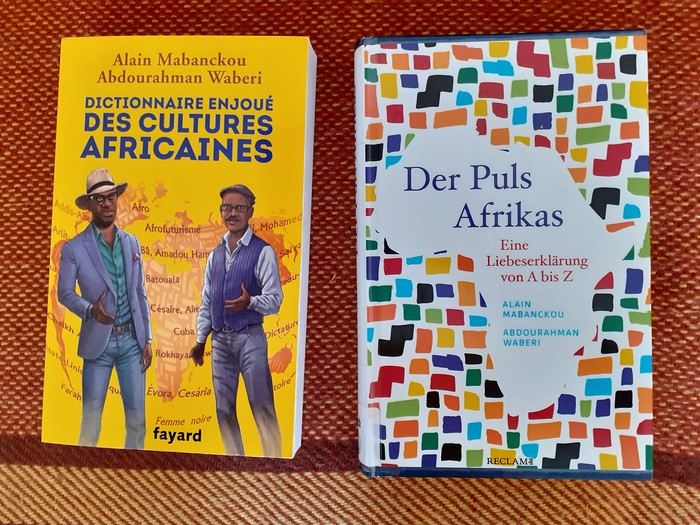
The Maggi cube, an unchallenged hegemony, and so much more
“The hopeless continent,” headlined The Economist, a British magazine, in July 2000 about Africa. Eleven years later, the same magazine headlined “Africa rising” instead. Images of Africa in the prosperous North constantly oscillate between apocalyptic scenarios and enthusiastic projections. A key issue with such images lies in the generalization they entail. If you look at the continent, considerable contrasts emerge depending on space and time. It’s no surprise that a region of the world encompassing such diverse ecological zones, maintaining such varied ties with other continents, comprising nearly fifty nation-states in sub-Saharan Africa alone, and characterized by a great diversity of languages, belief systems, and historical paths, doesn’t share a single destiny.
And yet, for many people outside Africa, as well as for many Africans, the continent constitutes a single entity, defined by criteria such as skin color, a colonial past, poverty, and the art of survival. Until now, these perspectives were generally accompanied by the idea that Africa had to—or should have—followed a single path together, sometimes called development, sometimes modernization, sometimes liberation, then a market economy. None of these paths delivered on their promises.
The two writers Alain Mabanckou and Abdourahman Waberi—one from Congo, the other raised in Djibouti, both long settled in France and now professors at renowned North American universities (Los Angeles, Washington)—have had enough of pessimistic scenarios: “We are aware that Africa is in the world and the world is in Africa. The same goes for all other continents, as our destinies are inextricably linked for better or worse. We refuse to see Africa as a reservoir of misfortunes or a continent cursed by atavistic misfortune and characterized by ethnic conflicts. [...] It’s this passionate flame we wanted to capture in a book [...] a kind of stroll through African cultures, without any demands, each letter of the alphabet leading us to a notion, a practice, a concept, a moment in history, literature, painting, politics, economics, cuisine, etc.” (p.10-11). Africa, they write, is on the verge of “imposing a signature, a style, a way of being in the world and in relation to the rest of the world.” (p.11) To put words to the continent’s diversity and dynamism, the two authors created a “rambling ABC,” a kind of portrait—or more precisely, a mythography—that lets you see and feel the pulse of a vast continent whose cultural power is unfolding before our eyes. Once marginalized or even mocked, the voice and importance of the Continent in global affairs are now undeniable” (p.11), containing over a hundred entries, mostly concise, written in a relaxed and casual style. The optimistic, even exuberant tone is set from the brief introduction. The duo of authors wants to “sing a love song to the cultures of our continent, to its inhabitants past and present, to its exceptional resources and its spectacular globalization despite a certain pollution that still clouds our skies due to the unmatched duration of dictatorships in some of our regions.” (p.12) In doing so, they don’t want to be too distracted by today’s Afewerki-Biya-Bongo-Déby & Co. ...
Of course, you’ll find tributes to great precursors like Frantz Fanon (“[...] it was a love story and admiration that wasn’t dimmed by the four decades separating his birth from ours. Let’s add that we were born while the native of Fort-de-France had left the world’s stage four years earlier, in the prime of life” p.141), Mongo Beti (“You must read and reread Mongo Beti, a genius who used his fame to support often just causes in Africa, like defending oppressed groups. His place is already in History. His oppressors, like the dictators Ahmadou Ahidjo and Paul Biya, can’t compete in the same category” p.64), the Malian Amadou Hampâté Bâ
(“Posterity remembers him mainly as an tireless defender of African cultures. His plea for the collection and preservation of traditional African knowledge remains a major event for all men and women of good will. One day in 1960, at the UNESCO podium, the native of Bandiagara sounded the alarm: ‘[...] Since we’ve admitted that the humanity of each people is the heritage of all humanity, if African traditions aren’t collected in time and written down, they’ll one day be missing from the universal archives of humanity.’” p.51),
Kwame Nkrumah, “one of the founders of Pan-Africanism, father of Ghana’s independence” (p.239), as well as the historian Cheikh Anta Diop, the writer, poet, and politician Aimé Césaire, and the economist and thinker Samir Amin, but also very warm tributes to certain contemporary African intellectuals like Souleymane Bachir Diagne and Achille Mbembe
(“A few years ago, in dominant economic circles, a rumor often resurfaced, usually disguised as a cold and scientifically proven analysis: Africa is useless. It’s a burden for the rest of the human community. With its 2% share in world trade, it would disappear from stock market radars without anyone noticing. So? Maybe it’ll be pulled up by other continents. Wanting to surpass itself is a crazy bet for Africans, they concluded. Arrogant or clueless, President Nicolas Sarkozy declared before an audience of students and teachers at Cheikh Anta Diop University in Dakar: ‘The African man hasn’t entered history enough [...] He only knows the eternal repetition of time marked by the endless repetition of the same gestures and words.’ That was in 2007. For decades, armed only with reason, an intellectual often steps up to debunk prejudices, lazy readings, and dishonest frameworks used as false fronts by those who, like Nicolas Sarkozy or former journalist Stephen Smith, out of ignorance, contempt, or condescension, distort African reality. This intellectual is none other than the historian and political scientist Achille Mbembe. This heir of Frantz Fanon, Amílcar Cabral, Jean-Marc Ela, and Fabien Eboussi-Boulaga was born in 1957 in Cameroon, in the Bassa region. Marked early by the upheavals of a fratricidal war, Achille Mbembe became the guardian of the memory of martyrs. After brilliant studies in Paris, he went on to teach at the best American universities, but the call of the Continent was stronger than anything else. In Dakar, he once directed CODESRIA (Council for the Development of Social Science Research in Africa) before joining the University of the Witwatersrand in Johannesburg, South Africa. Even though the author of *Critique of Black Reason* (Éditions La Découverte, 2015) spends a few months at Duke University in North Carolina, his observation post remains South Africa. From Johannesburg, Achille Mbembe scrutinizes Africa and the whole world. A lucid observer with an elegant and generous pen, Achille Mbembe knows how to blend big and small history: ‘I was born one day in July, as the month was drawing to a close. It was 1957, in that part of Africa recently named ‘Cameroon,’ a memory of the wonder that seized Portuguese sailors in the 15th century when, sailing up the river near Douala, they couldn’t help but note the presence of a multitude of crustaceans, and named it *Rio dos Camarões*, meaning ‘River of Shrimp.’ I grew up in the shadow of this nameless land, since, in a way, the name it bears is only the product of someone else’s astonishment: a lexical mistake, if you will.’ From this mistake or wound, he made leaven, a springboard to compose a rich work, recognized worldwide. To denounce barriers and barbarians too. But that’s not enough. Among his peers in circles of thought and action, Achille Mbembe passionately and consistently defends human dignity and the beauty of the world. In doing so, he fulfills the mission Frantz Fanon entrusted to him.” (p.227-229),
as well as entries dedicated to lesser-known artists and intellectuals, like the French journalist and activist Rokhaya Diallo, daughter of Senegalese and Gambian parents, or the Ethiopian filmmaker Haile Gerima, who has long lived in the United States. Other names from politics, sports, music, art, and literature: Kofi Annan, p.36; Barack Obama, p.243; Thomas Sankara, p.277; Ousmane Sow, p.285; Yambo Ouologuem, p.250; Léopold Sédar Senghor, p.282; Muhammad Ali, p.30; Nuruddin Farah, p.146; Salif Keita, p.203; Ahmadou Kourouma, p.206; Ngũgĩ wa Thiong’o, p.236; Winnie Mandela, p.224; Kylian Mbappé, p.226 ...
The authors, who resolutely commit to a “mythography” (p.11) of Africa, also pay special attention to local social movements, cultural events, and aspects of daily life. *Y’en a marre*, “which also meant ‘we’re fed up with sitting on our hands’” (p.320-321), emerged about a decade ago in Senegal as a citizen movement of peaceful resistance and symbolizes, the authors emphasize, the fact that African youth are increasingly fed up “with the political circus deployed in Africa since independence, as our parents would say, ‘since the White man left’...” (p.321). A full entry is dedicated to the Maggi bouillon cube, which has flooded African markets for about forty years and enjoys immense popularity (“It’s everywhere in Africa, from Dakar to Djibouti, and from Tangier to Cape Town. It’s in every pot, every stew. Little hands put it in every sauce, every local or adapted dish. An unchallenged hegemony! You’ll find it in diasporas too. The culinary strolls in Paris, in the [...] neighborhood” p.90). Critics blame it not only for impoverishing the aromatic diversity of local dishes but also for being harmful to health. And yet, “he poorest Africans, those who eat only once a day, a few spoonfuls of white beans and a ball of *foufou*, for example, are the most fervent users of the magic cube.” (p.92-93)
For *fonio*, “the new trendy cereal. [...] From the millet family, fonio is probably the oldest cereal cultivated in West Africa, and mainly in its sub-Saharan part, for millennia. [...] Easy to grow, water-efficient, fonio grows everywhere except on clay soils. Long neglected because it was considered the poor man’s crop, fonio is now a source of pride for the farmers who cultivate it and cherish it like the apple of their eye” (p.156-157), the authors immediately offer a detailed recipe, letting the reader know that “e can’t resist sharing this fonio with chicken recipe from Mali with you:
Ingredients: 1 chicken 3 large ripe red tomatoes 4 tbsp tomato paste 4 large onions 1 garlic clove 1/2 cup oil 2 Maggi cubes or salt 2 large carrots 1 turnip 1 large cabbage 2 large potatoes 1 celery stalk 1 packet pre-cooked fonio 4 okra (or okra powder) salt, pepper
Preparation: 1. Prepare the sauce: wash and cut the chicken. Peel the onions, garlic, and vegetables. 2. In a pot, fry the chicken pieces. 3. Dice the onions, tomatoes, carrots, and turnip very small and add them to the pot. 4. Add the tomato paste, salt, and pepper. 5. Simmer for 15 min, then add 2 L of water and the cooked chicken pieces. 6. Simmer for 30 min, then add the crushed garlic and celery, plus the cabbage cut into 4 and the potatoes cut in half. 7. Prepare the fonio: cover it with warm water, let it rest for 15 min, and cook it over low heat. 8. In a small pot, boil the okra and crush them. 9. Mix the crushed okra with the cooked fonio, then salt. Serve hot.” (p.158-159)
The comedy *Black Mic Mac*, released in French theaters in 1986 and addressing France’s increasingly restrictive immigration policy at the time, also gets an entry, as do *Tintin in the Congo*, the popular comic, and *Jip’s Café* (“[...] a little Africa in the heart of Paris, with passersby stopping to admire the ‘ambianceurs’ on the dance floor or attend the cultural events offered by the place” (p.194), an African establishment in Paris that Alain Mabanckou already immortalized in one of his novels.
The duo of authors also tackles thorny subjects like jihadism (p.119), the Rwandan genocide (p.272), the CFA franc (p.82), and dictatorship (p.110). While the two strike the right tone here, many entries leave a slightly bitter taste. Two examples: why doesn’t the text on Barack Obama mention the great disappointment of many people in Africa, who expected more from the African policy of the first U.S. president with African roots than just occasional warm words? Why do the comments on Winnie Mandela gloss over the fact that she was a highly controversial icon of the anti-apartheid movement due to her involvement in kidnappings, acts of torture, and murders of alleged apartheid collaborators? Instead, there’s a compassion that brings tears to the eyes: “She was often reduced to a secondary role, the wife of a great man” or “When victory came, she didn’t taste its fruits. Divorced, isolated. She would never be a ‘first lady’ in an evening gown, posing before a bed of chrysanthemums. They’d keep her far from the circles of power” (p.224-225). At this point, I would’ve liked the authors to take a slightly more critical stance...
That said, these “weaknesses” (if you can call them that) shouldn’t overshadow the book as a whole. It remains an informative, sometimes very entertaining, and often even original work in its own way.
Book information (the original French and the German translation):
Alain Mabanckou/Abdourahman Waberi. Dictionnaire enjoué des cultures africaines. Fayard, 2019. Alain Mabanckou/Abdourahman Waberi. Der Puls Afrikas. Eine Liebeserklärung von A bis Z. Reclam, 2022.
Hery
Discussion around March 2026's Theme: Metal, Metallic
This is where we share stories (or post extra photos) around March’s theme Metal, Metallic.
Back to the March 2026 contest: HERE

The Ghan (train connecting Adelaide to Darwin), at dawn.
Back to the March 2026 contest: HERE
The Ghan (train connecting Adelaide to Darwin), at dawn.
In the land... of Senegambia
Hey fellow travelers!
So, a new year has begun. It’s time to reconnect with the VF buddies and wish you all my best for 2026—a year I hope is obviously full of travel, since, as I just made up: "If travel’s good, everything’s good" 😄.
To celebrate, I’m inviting you into my new "travel journal," the one from our latest trip in November 2025, a little two-week adventure.
This time, we headed to The Gambia, a tiny country tucked right in the middle of Senegal, before making our way to Casamance.
The Gambia is English-speaking, Senegal is French-speaking, but the locals? They couldn’t care less—because in this part of the world, they mostly speak Wolof, Fula, Jola, or Mandinka. Hence the title: Senegambia 😉.
As usual, I’m sharing the live updates I sent to friends and family—super casual, of course.
I know this isn’t the kind of destination that draws crowds, but if you love adventure, laughter, and emotion, it might just be your thing 😊.
Hugs 😘
So, a new year has begun. It’s time to reconnect with the VF buddies and wish you all my best for 2026—a year I hope is obviously full of travel, since, as I just made up: "If travel’s good, everything’s good" 😄.
To celebrate, I’m inviting you into my new "travel journal," the one from our latest trip in November 2025, a little two-week adventure.
This time, we headed to The Gambia, a tiny country tucked right in the middle of Senegal, before making our way to Casamance.
The Gambia is English-speaking, Senegal is French-speaking, but the locals? They couldn’t care less—because in this part of the world, they mostly speak Wolof, Fula, Jola, or Mandinka. Hence the title: Senegambia 😉.
As usual, I’m sharing the live updates I sent to friends and family—super casual, of course.
I know this isn’t the kind of destination that draws crowds, but if you love adventure, laughter, and emotion, it might just be your thing 😊.
Hugs 😘
Discussion: Waterways Around the World - January 2026 Photo Contest
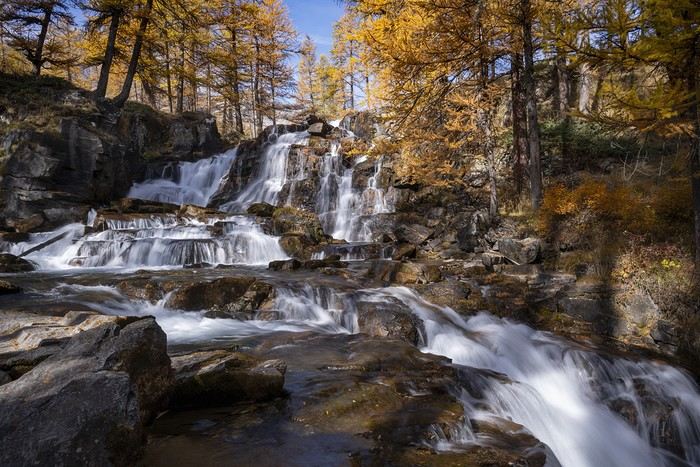
To chat about waterways, this is the place.
September 2025 Contest Discussion: World Signs
For the contest, it's here !
What are the criteria that make you choose one destination over another?
Hi there,
The title might be a bit long, but I hope it’s completely understandable!
When it comes to choosing your next trip, what tips the scales in favor of Eritrea over Ibiza?
Why pick Canada over French Polynesia?
The price? A magazine or TV report, a travel journal, an Instagram ad? Ease of travel? Minimal time difference? The country that has the most in common with all the trip participants? Activities? Relaxation? The desire to push your limits?
A photo?
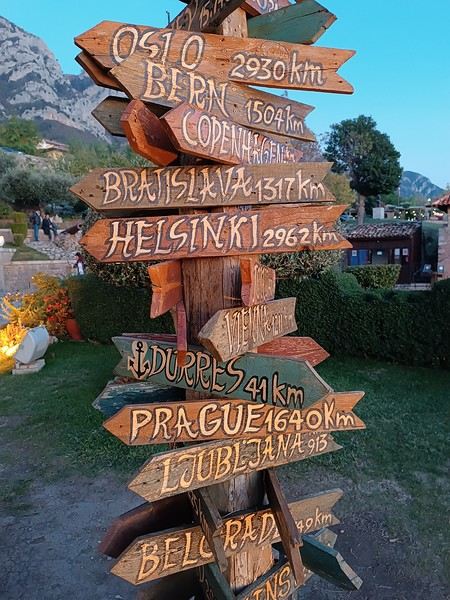
What else, I wonder...
Personally, I often prioritize simple destinations (no administrative hassles), where I’m not at risk (nothing extraordinary like getting kidnapped by Daesh or ending up in a jail cell because the current geopolitics aren’t favorable to my passport, etc.), and where I can drive.
Wide-open natural spaces are more my thing than urban anthills.
Finally, I try not to spend three days on a plane to reach my destination, and I aim for a maximum budget of 3500 € (for 3 weeks) in comfortable conditions—that means charming hotels, good meals, etc.
What about you?🙂
The title might be a bit long, but I hope it’s completely understandable!
When it comes to choosing your next trip, what tips the scales in favor of Eritrea over Ibiza?
Why pick Canada over French Polynesia?
The price? A magazine or TV report, a travel journal, an Instagram ad? Ease of travel? Minimal time difference? The country that has the most in common with all the trip participants? Activities? Relaxation? The desire to push your limits?
A photo?
What else, I wonder...
Personally, I often prioritize simple destinations (no administrative hassles), where I’m not at risk (nothing extraordinary like getting kidnapped by Daesh or ending up in a jail cell because the current geopolitics aren’t favorable to my passport, etc.), and where I can drive.
Wide-open natural spaces are more my thing than urban anthills.
Finally, I try not to spend three days on a plane to reach my destination, and I aim for a maximum budget of 3500 € (for 3 weeks) in comfortable conditions—that means charming hotels, good meals, etc.
What about you?🙂
Price and reviews for excursion + overnight to Erg Chegaga from M'hamid
Hi there,
We found a guide who offers the trip from M'hamid to a camp (departure at 3 PM, tea, meal, camel ride, overnight stay, breakfast, and return to M'Hamid by 11 AM the next day via the sacred oasis). He quoted us a price of 380 € for April. What do you think of this rate? This might sound like a silly question, but is it common to negotiate the price for this kind of thing (we're booking from France)? It’s still a big part of our travel budget.
Thanks
We found a guide who offers the trip from M'hamid to a camp (departure at 3 PM, tea, meal, camel ride, overnight stay, breakfast, and return to M'Hamid by 11 AM the next day via the sacred oasis). He quoted us a price of 380 € for April. What do you think of this rate? This might sound like a silly question, but is it common to negotiate the price for this kind of thing (we're booking from France)? It’s still a big part of our travel budget.
Thanks
Return to Tassili N'Ajjer (Algeria)
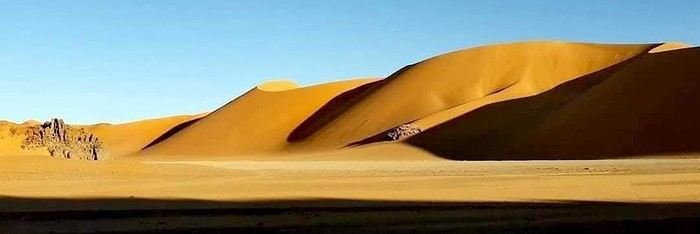 Where to go in 2025?
How about Algeria and a return to the Tassili n’Ajjer? This part of the Sahara is arguably one of the most beautiful deserts on the planet for its diversity and is accessible to everyone.
The vastness of the black rock forests and ochre dunes is complemented by the intimacy of the Djanet oasis, the heart of the Tuareg country, and the mineral memory of the Erg Admer, which bears traces of prehistoric human activity. Camping under the Milky Way, suspended in a sky of forgotten purity, adds another dimension to this rare journey.
Safety and travel in Burkina Faso
Hello everyone! From 2002 to 2017, I made 10 annual two-month trips to Burkina Faso, backpacking style—traveling solo (independent, self-sufficient, no agency) across the country. I happily mixed with the local population (neighborhoods, maquis, hostels, bush taxis...) and was always on the lookout for joyful, interesting exchanges. Back then, the country was peaceful, very welcoming, and any issues were always resolved with laughter, patience, and kindness!
In 2017, I was preparing to settle there for six months a year, like others do elsewhere... But in early 2018, I had an emergency medical airlift (a "welcome sign" from the skies, in hindsight—compared to what followed, the country’s negative and unpredictable evolution in recent years, plus the lasting COVID crisis...).
So, "while waiting for things to improve," I haven’t returned personally since 2018. Burkina Faso is still currently classified as a red zone ("strongly advised against for tourists") by our authorities. Though I’ve heard a few rare contradictory reports, what’s the *real* situation on the ground right now? Specifically: - General safety for Europeans - Security in the main cities - Road safety, intercity transport, and travel conditions
The current transitional president, Ibrahim Traoré, enforces strict censorship on communications (journalistic and digital networks) to the outside world... and RTB (Burkinabè television) is state-run... so...
Welcome to any fresh, recent updates from travelers or locals. Many thanks!
In 2017, I was preparing to settle there for six months a year, like others do elsewhere... But in early 2018, I had an emergency medical airlift (a "welcome sign" from the skies, in hindsight—compared to what followed, the country’s negative and unpredictable evolution in recent years, plus the lasting COVID crisis...).
So, "while waiting for things to improve," I haven’t returned personally since 2018. Burkina Faso is still currently classified as a red zone ("strongly advised against for tourists") by our authorities. Though I’ve heard a few rare contradictory reports, what’s the *real* situation on the ground right now? Specifically: - General safety for Europeans - Security in the main cities - Road safety, intercity transport, and travel conditions
The current transitional president, Ibrahim Traoré, enforces strict censorship on communications (journalistic and digital networks) to the outside world... and RTB (Burkinabè television) is state-run... so...
Welcome to any fresh, recent updates from travelers or locals. Many thanks!
Avant le voyage... il reste la musique (Maroc)
Bonjour,
En attendant cette mythique réouverture des frontières , j'occupe un peu de mon temps à écouter de la musique du Maroc, du désert et plus largement d' Afrique et du pourtour Méditerranéen .
J'ai découvert un groupe marocain qui s'appelle Tasuta N'Imal que j'apprécie beaucoup . C'est de la musique du Sud . Le clip est fait à Aït Benhaddou, à l'auberge Ayouz où j'ai séjourné déjà 2 fois . Donc çà me fait chaud au coeur et remue de bons souvenirs .
La musique adouci les moeurs et certains esprits s'étant échauffés sur le forum récemment, pourquoi ne pas tenter cette thérapie collective ...
J'espère que çà va passer et si çà marche, on pourrait peut-être continuer ?
https://www.youtube.com/watch?v=r4OjsKUBT-Q
A plus....
En attendant cette mythique réouverture des frontières , j'occupe un peu de mon temps à écouter de la musique du Maroc, du désert et plus largement d' Afrique et du pourtour Méditerranéen .
J'ai découvert un groupe marocain qui s'appelle Tasuta N'Imal que j'apprécie beaucoup . C'est de la musique du Sud . Le clip est fait à Aït Benhaddou, à l'auberge Ayouz où j'ai séjourné déjà 2 fois . Donc çà me fait chaud au coeur et remue de bons souvenirs .
La musique adouci les moeurs et certains esprits s'étant échauffés sur le forum récemment, pourquoi ne pas tenter cette thérapie collective ...
J'espère que çà va passer et si çà marche, on pourrait peut-être continuer ?
https://www.youtube.com/watch?v=r4OjsKUBT-Q
A plus....
Identité de genre et orientations sexuelles en voyage
Bonjour à toutes et à tous!
J'aimerais bien avoir votre opinion sur la façon dont les questions du genre et de l'orientation sexuelle sont perçues dans les différentes régions du monde que vous avez visitées.
En Occident, ces questions sont débattues et les différences de mieux en mieux acceptées, même s'il y a encore beaucoup de chemin à faire. Mais comment ça se passe ailleurs ? En Afrique par exemple, ou en Asie ?
Si je pose ma question sur ce forum c'est parce que j'aimerais avoir des avis de première main. Par exemple, qui d'entre vous a parlé à des hijras (Inde) ou à des Katoï (Thaïlande) de leurs conditions de vie? Savez-vous comment elles/ils sont vu.e.s par leurs compatriotes? Sont-elles/ils admis.e.s ou rejeté.e.s?
Une autre de mes questions tourne autour des touristes occidentales/aux LGBT. Y a-t-il des pays ou des régions où on peut en toute tranquillité afficher ses préférences? Par exemple, est-ce que deux lesbiennes peuvent marcher main dans la main dans le centre de Marrakech ou est-ce qu'il y a des bars LGBT en Chine?
Si vous êtes vous-même concerné.e.s par ces questions, pouvez-vous raconter des anecdotes et bien entendu donner des conseils sur où aller et où ne pas aller?
Merci d'avance 😎
PS:Pourquoi n'a-t-on le choix qu'entre deux sexes dans le formulaire d'inscription du site ?
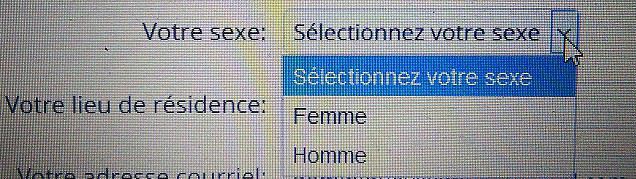
PS:Pourquoi n'a-t-on le choix qu'entre deux sexes dans le formulaire d'inscription du site ?
Voyage en voiture France-Bénin, visas et traversée au Maroc
Salut à touss , voilà je ves voyager de la France jusqu’aux Benin , je souhaiterais, avis , lconseil , et les informations nécessaires à réaliser mon projet , je compte passer du Maroc , Mauritanie Mali côté ivoire Ghana Togo benin !
J’ai plusieurs question : déjà y’a t’il plus rapide pour atteindre le benin ? Et la piste piste commence reelment à partire d’où ?
J’ai deux chien avec moi en ordre de vaccin et tout se qui va avec , je veut les prendre dite moi ce que vous en pencer ces réalisables ? Quel sont les problèmes et où je pourrai les rencontrer ?
J’aimerais connaître je budget , du bateau avec une voiture pour traverser le détroit ? Pour le Maroc
Pour être en règle avec l’es document , que me faut t’il pour mes papier pour moi , et mon véhicule pour entrer du Maroc , Mauritanie , Mali, côté d’ivoire , Ghana , Togo benin ? Je peut prendre des visa à l’avance pour certain pays dans un autre ? Le prix approximativement de visa pour entre dans ces pays ? Je compte pas trop visité ni faire du tourisme , juste rouler et me rendre chez moi au benin .
D’autre question viendront , je vous remercie pour tout ce qui on lu et qui on pris du temps à me répondre !
Pourquoi pas réaliser un convoi avec certain .
Merci à touss
J’ai plusieurs question : déjà y’a t’il plus rapide pour atteindre le benin ? Et la piste piste commence reelment à partire d’où ?
J’ai deux chien avec moi en ordre de vaccin et tout se qui va avec , je veut les prendre dite moi ce que vous en pencer ces réalisables ? Quel sont les problèmes et où je pourrai les rencontrer ?
J’aimerais connaître je budget , du bateau avec une voiture pour traverser le détroit ? Pour le Maroc
Pour être en règle avec l’es document , que me faut t’il pour mes papier pour moi , et mon véhicule pour entrer du Maroc , Mauritanie , Mali, côté d’ivoire , Ghana , Togo benin ? Je peut prendre des visa à l’avance pour certain pays dans un autre ? Le prix approximativement de visa pour entre dans ces pays ? Je compte pas trop visité ni faire du tourisme , juste rouler et me rendre chez moi au benin .
D’autre question viendront , je vous remercie pour tout ce qui on lu et qui on pris du temps à me répondre !
Pourquoi pas réaliser un convoi avec certain .
Merci à touss