Results for "Chine+hébergement"
About 48,538 results.
More options
Many results are in French, the community’s main language. English translations are added over time.
Search results
Un tour du monde n'est pas si intéressant
à bien réfléchir, c'est plus superficiel, chaque pays on ne peut visiter que 10 jours si non on rallonge la durée totale ( 1, 5 mois x 15 pays = 22 mois ) et ça coute plus cher ( trop cher )
le tour du monde pour vanter ? de toute façon le TDM n'a plus la même valeur que autre fois, maintenant avec avion et communication moderne...
et si on part pour voir moins de pays mais plus en profondeur ? plus souvent ?
je ne critique rien, je pose simplement un sujet
le tour du monde pour vanter ? de toute façon le TDM n'a plus la même valeur que autre fois, maintenant avec avion et communication moderne...
et si on part pour voir moins de pays mais plus en profondeur ? plus souvent ?
je ne critique rien, je pose simplement un sujet
Racket culturel en Inde
juste un mot sur la politique de l'Inde concernant le droit d'entree dans les musees ;
depuis environ 4 ans, il faut savoir que les "etrangers" sont tenus de payer parfois jusqu'a 50 fois plus cher que les locaux pour le billet d'entree dans certains musees (la grande majorite)...
quand un indien obtiendra un billet pour 2 ou 5 roupies, on vous demandera selon les sites de 50 a 300 roupies(comme au musee du Prince de Galles a Mumbay) voire plus de 900 roupies pour penetrer le Taj-Mahal...
vous devrez de plus essuyer l'attitude goguenarde de certains guichetiers tres conscients de l'enormitee des sommes qui nous sont demandees, voire la rudesse des gardiens qui n'hesitent pas a vous arreter pour vous controller....
savoir aussi que les appareils photos et cameras, cette fois ci la loi est la meme pour tous, sont habituellement taxes, voire interdit d'entree dans certains cas(mais vous ne pouvez pas les garder sur vous, des vestiaires payants(...) vous attendent).
C'EST UN VERITABLE RACKET D'ETAT qui s'appuit sur une logique xenophobe; quand a l'argent ainsi recolte, son devenir reste completement flou...il est notoire qu'une partie importante de la recette du Taj-Mahal disparait dans la nebuleuse du systeme du back-shish et de la corruption sans que cela profite a l'entretien du batiment, dans un etat de degradation certain encore accentue par les restauration malhabiles et bon-marche. Des monuments et oeuvres d'arts, souvent dans des conditions pitoyables qui serrent le coeur...
un etudiant en histoire de l'art ou toute personne qui s'interesse a l'art et la museographie doit donc s'attendre a debourser entre 20 et 100(rare) francs plusieurs fois par jours (monuments et musees...) de plus, nombres de musees appliquent cette loi trop heureux de l'opportunite d'un back-shish juteux, sans pour autant offrir aux visiteurs un avoir culturel a la hauteur du prix demande.
le prix d'une entree au musee du Louvre et au Musee "prince de galles" de Mumbay est a peu pres la meme....pourtant a l'interieur, la difference est grande ! le musee de Mumbay possede dans les quelques salles obscures qui le constituent, des collections de qualite tres inegale...
nous sommes victime d'une loi raciste, profondement arbitraire et injuste :
C'EST INACEPTABLE ...REFUSEZ D'ENTRER DANS LES MUSEES ET SITES HISTORIQUES INDIENS QUI PARTICIPENT A CE RACKET !( et avant, faites savoir au guichet la raison de votre refus) salut voyageurs,
C'EST UN VERITABLE RACKET D'ETAT qui s'appuit sur une logique xenophobe; quand a l'argent ainsi recolte, son devenir reste completement flou...il est notoire qu'une partie importante de la recette du Taj-Mahal disparait dans la nebuleuse du systeme du back-shish et de la corruption sans que cela profite a l'entretien du batiment, dans un etat de degradation certain encore accentue par les restauration malhabiles et bon-marche. Des monuments et oeuvres d'arts, souvent dans des conditions pitoyables qui serrent le coeur...
un etudiant en histoire de l'art ou toute personne qui s'interesse a l'art et la museographie doit donc s'attendre a debourser entre 20 et 100(rare) francs plusieurs fois par jours (monuments et musees...) de plus, nombres de musees appliquent cette loi trop heureux de l'opportunite d'un back-shish juteux, sans pour autant offrir aux visiteurs un avoir culturel a la hauteur du prix demande.
le prix d'une entree au musee du Louvre et au Musee "prince de galles" de Mumbay est a peu pres la meme....pourtant a l'interieur, la difference est grande ! le musee de Mumbay possede dans les quelques salles obscures qui le constituent, des collections de qualite tres inegale...
nous sommes victime d'une loi raciste, profondement arbitraire et injuste :
C'EST INACEPTABLE ...REFUSEZ D'ENTRER DANS LES MUSEES ET SITES HISTORIQUES INDIENS QUI PARTICIPENT A CE RACKET !( et avant, faites savoir au guichet la raison de votre refus) salut voyageurs,
Retour d'un voyage en Transsibérien
Nous revenons d'un voyage dans le Transsibérien, voyage hors de l'espace et du temps... voyage inoubliable et personnel à chacun... Nous l'avions préparé pendant environ dix-huit mois, et nous avons largement puisé des renseignements dans forum voyage. Nous avons beaucoup apprécié les commentaires si bien écrit de Loopkin. Aussi, nous voulons à notre tour, aider ceux qui aimeraient avoir des renseignements pratiques. D'abord, on se situe : Deux amies, dont les maris n'aiment pas le train, et qui ont préféré ne pas nous accompagner, à notre regret ! Pour nous c'était un rêve de longue date, et en parlant entre nous, on s'est aperçu de notre rêve commun, et on s'est dit alors, " pourquoi pas " ? Mon amie à 56 ans, et moi-même, 72 ans. Nous ne voulions pas partir avec un voyage organisé, mais nous avons demandé à une agence de nous aider à préparer le périple que nous voulions faire, avec les dates qui nous arrangeaient. Nous avions décidé de partir en mai 2004, cela nous semblait bien loin, on avait semble t'il le temps de nous y préparer mentalement, financièrement, etc... On peut vous assurer maintenant, que le temps va vite et que mai 2004 est vite arrivé ! Et c'est déjà passé ! Mais pas dans notre tête... Donc, l'agence a assuré les transferts à l'aéroport de Moscou, via un hôtel, transfert jusque devant la gare de Iaroslavl, et une visite guidée à Vladivostok. Elle nous a réservé les billets d'avion, l'hôtel à Moscou, et Vladivostok, et séjour chez l'habitant à Irkutsk, et également les billets de train, et les démarches pour les visas. ; Nous ne sommes peut-être pas si aventureuses que les jeunes, qui réservent eux-mêmes leurs billets de train, etc. mais on était plus rassuré comme ça, et nos maris également ! Nous avons fait le trajet, Moscou-Vladivostok, et Vladivostok - Irkutsk en train, puis retour en Avion, Irkutsk - Moscou et Moscou-Paris. Au départ, jusque Moscou, avec Aéroflot, ainsi que de lrkustk jusque Moscou au retour. Et, de Moscou à Paris, c'était un " combiné, Aéroflot - Air France ", mais avec avion Air France. Nous avons trouvé que les atterrissages avec Aéroflot étaient très doux et progressifs ; Dans le train, " le Rossya N°2 ", nous étions dans un compartiment à quatre, et avons, au départ, été deux fois trois nuits à trois, et une nuit à quatre. Et toujours avec des Russes. Même si l'on est un peu à l'étroit, les contacts sont toujours sympathiques et chaleureux, et intéressants. Nous pensons que s'il y a un problème avec certains, la provodnista peut nous changer de compartiment, s'il n'est pas trop plein. Nous sommes revenues par le train " Sibir " N°7 jusque Irkutsk, où l'une de nous a de la famille proche. Nous y sommes restées cinq jours, dans une famille qui loge des touristes. Début mai, il y avait très peu de touristes. Le temps était très agréable et même varié. Chaleur à Moscou, neige aux environs de Chita, pluie et brouillard quelquefois, mais dans l'ensemble, beau temps. Nous avons vu le côté Est du Lac Baïkal, en le longeant avec le train, encore gelé, et de toute beauté ! Par contre, à Listvianka, il était dégelé.
Le téléphone est très cher dans les hôtels !!! Les cartes de téléphone, sont différentes soit pour utiliser chez l'habitant, avec numéro code, soit cartes pour téléphone public, utilisable selon le district. Les cartes achetées à Moscou, ne fonctionnaient pas pour ltkutsk, et vice-versa... Et difficile à trouver des cartes, à Moscou, c'est au guichet du métro que nous les avons trouvées. N'hésitez pas à nous poser des questions
Le téléphone est très cher dans les hôtels !!! Les cartes de téléphone, sont différentes soit pour utiliser chez l'habitant, avec numéro code, soit cartes pour téléphone public, utilisable selon le district. Les cartes achetées à Moscou, ne fonctionnaient pas pour ltkutsk, et vice-versa... Et difficile à trouver des cartes, à Moscou, c'est au guichet du métro que nous les avons trouvées. N'hésitez pas à nous poser des questions
Converting a heavy-duty bus/coach/truck into a motorhome
I'm currently converting a DAF/HEULIEZ MB205 bus.
Cheaper and more spacious than a regular vehicle, the paperwork (in France) isn't too difficult for approval.
I'm ready to help anyone who wants to tackle this kind of project. Those who know, help those who want to....
Cheaper and more spacious than a regular vehicle, the paperwork (in France) isn't too difficult for approval.
I'm ready to help anyone who wants to tackle this kind of project. Those who know, help those who want to....
Pérou, le volcan Misti
😛La semaine dernière j'ai effectué, en individuel, l'ascension du volcan MISTI situé à Arequipa au Pérou. Il culmine à 5822 mètres d'altitude. Si vous souhaitez des infos pour y accéder, je me ferais un plaisir de vous répondre. Aussi si vous voulez des infos d'hôtel, circuit sur le Pérou ou autres, prix des bus, budget à prévoir... je me ferais un plaisir de vous aider dans vos recherches. Je suis un ancien routard, français et vivant au Pérou.
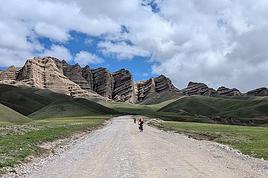
Breathtaking Kyrgyzstan!
This trip had been on my mind for about fifteen years.
But the discomfort of overnight stays, the difficulty of communication, and the prices of the few car rental options kept making me postpone the project.
And then, everything suddenly fell into place—I told myself, it’s time!
The preparations took longer than usual; the destination is still far from mainstream.
A bit of Kazakhstan? Not in the end.
The south or not the south? Yes, in the end.
Pre-book or go with the flow? Only two stops were a leap into the unknown.
To help me find the ideal route, I made great use of this forum (thanks to everyone for patiently answering my questions!), pored over travel journals and blogs (Christian, Jeff), zoomed in on Google Maps and Yandex, and bought the guide published by OunTravela about this destination (the guide has been updated since).
---/---
You’ve got your passport, international driver’s license, bank cards, and euros?
Off we go to Lyon—just one night left before our early morning flight.
Tomorrow night, we’ll be sleeping in Bishkek! (Steak for my partner’s mischievous nephews...)
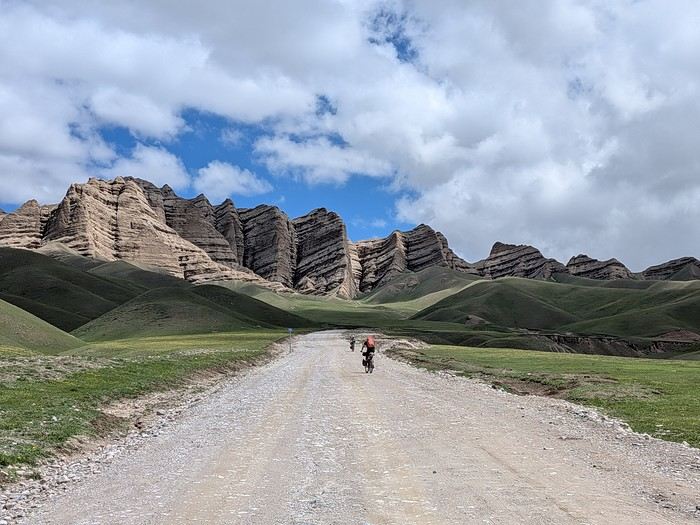
You’ll find here a post with some practical information.
And here, the version of the travel journal without comments.
---/---
As a supplement, the route track. Not necessarily ultra-accurate since Google has serious gaps for this destination...
From Bishkek to Karakol:
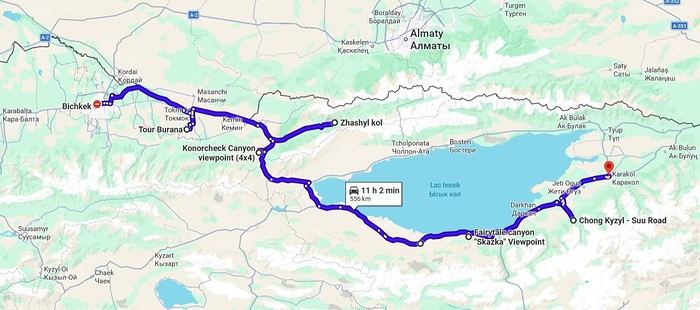
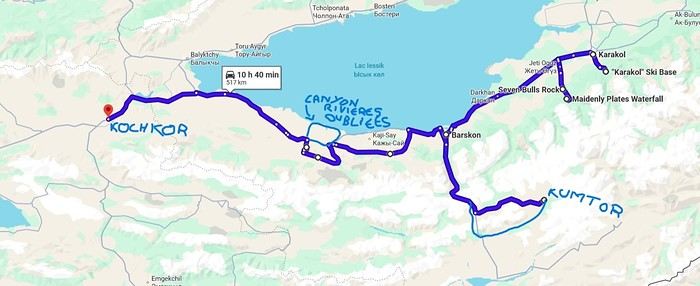
From Karakol to Kochkor:
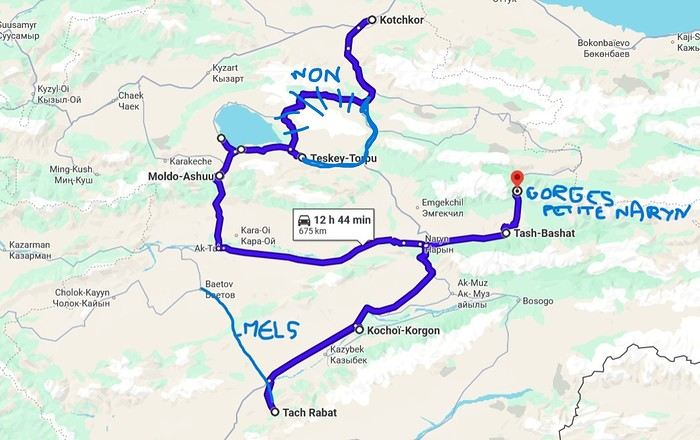
From Kochkor to Baetov:
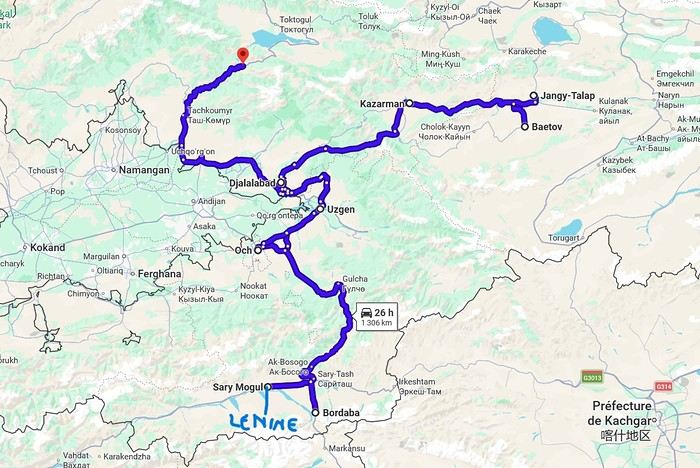
From Baetov to Kara-Köl:
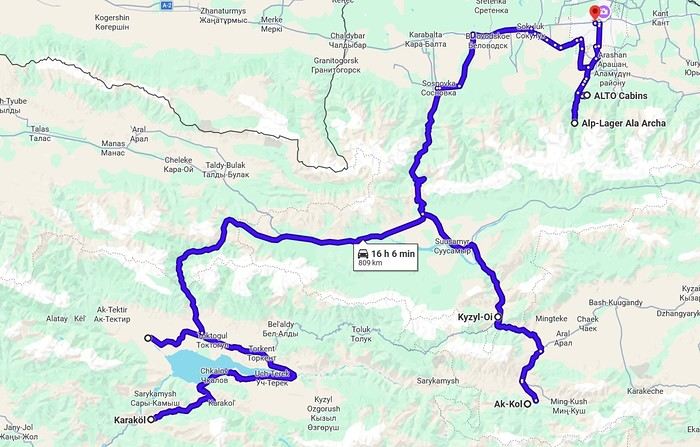
From Kara-Köl to Bishkek:

But the discomfort of overnight stays, the difficulty of communication, and the prices of the few car rental options kept making me postpone the project.
And then, everything suddenly fell into place—I told myself, it’s time!
The preparations took longer than usual; the destination is still far from mainstream.
A bit of Kazakhstan? Not in the end.
The south or not the south? Yes, in the end.
Pre-book or go with the flow? Only two stops were a leap into the unknown.
To help me find the ideal route, I made great use of this forum (thanks to everyone for patiently answering my questions!), pored over travel journals and blogs (Christian, Jeff), zoomed in on Google Maps and Yandex, and bought the guide published by OunTravela about this destination (the guide has been updated since).
---/---
You’ve got your passport, international driver’s license, bank cards, and euros?
Off we go to Lyon—just one night left before our early morning flight.
Tomorrow night, we’ll be sleeping in Bishkek! (Steak for my partner’s mischievous nephews...)
You’ll find here a post with some practical information.
And here, the version of the travel journal without comments.
---/---
As a supplement, the route track. Not necessarily ultra-accurate since Google has serious gaps for this destination...
From Bishkek to Karakol:
From Karakol to Kochkor:
From Kochkor to Baetov:
From Baetov to Kara-Köl:
From Kara-Köl to Bishkek:
3 weeks in Laos, stress-free
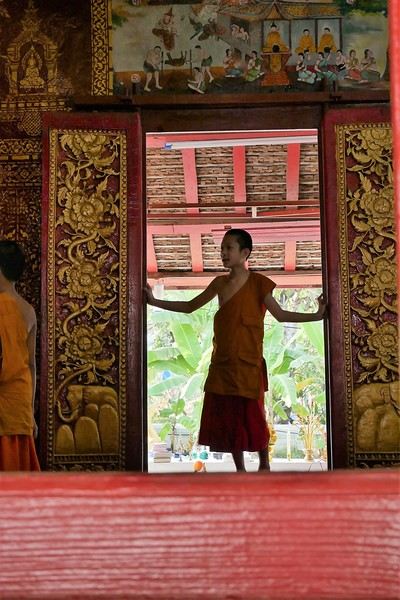 Come along, I'm taking you to this country where it's so nice to wander and slow down...
This trip was in 2023, but when I wanted to write my travel journal, VF was still closed to contributions... So, now that I've just finished my Japan travel journal here, I figured it was high time to honor this destination we came back from so enchanted. Disclaimer 1: This is a written travel journal. There’ll be text! Too much, for some! Disclaimer 2: This is an illustrated travel journal. There’ll be photos! Too many, for some!
I have to say, every time I try to discipline myself, to keep it shorter, to include fewer photos... I end up adding more. It feels like my dear Aunt Nicole, who exhausted us with her slide-show evenings in the 70s/80s, decided to take her revenge. The upside for you, readers, is that you can slip away anytime without offending Aunt Nicole. I won’t even notice!
Anyway, since I love maps, here’s one to give you an idea of where I’m taking you. As you can see, we only saw a tiny part of Laos (the areas circled in red); we only had 3 weeks for ourselves (my husband’s newly retired, I still work), and we prefer taking our time over rushing around like crazy.
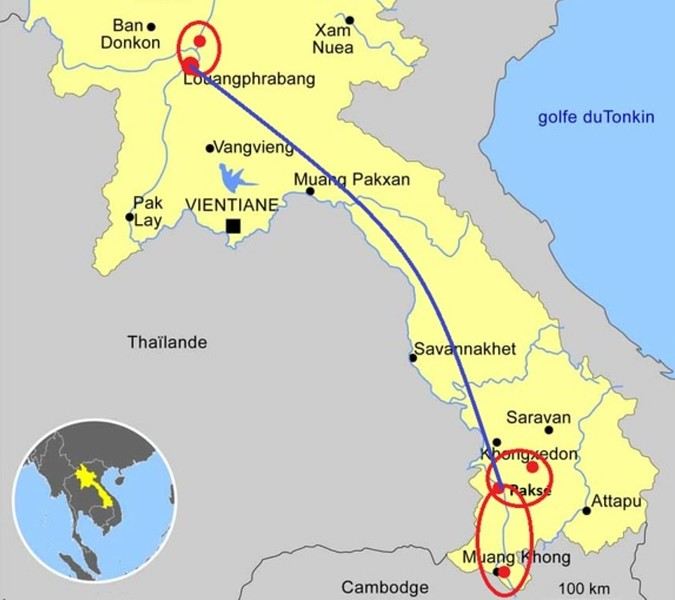
In broad strokes, it was very classic:
First, we “settled in” at Luang Prabang (8 days), because we wanted and needed to. From there, we took three days to venture a little further north—not far in kilometers, but as we know, distances aren’t just about km! Then we flew south to Paksé, letting ourselves drift down to the 4,000 Islands while stopping by the pre-Angkorian archaeological sites. We wrapped up with the Bolaven Plateau.
A few practical notes: We arrived via Bangkok, then took a Bangkok-Luang Prabang flight, having picked up our luggage in Bangkok to check it in for Luang Prabang. No issues—the Bangkok airport, which many of you know, is very well organized. We got our visas on arrival in Luang Prabang. Quick, but to be fair, we were on a “small” plane, and the big flights had arrived earlier, so we weren’t too crowded in line! At the end of our trip, we didn’t fly out of Paksé but from the nearby airport in Thailand, Ubon Ratchathani (a 2.5-hour drive from Paksé), then Bangkok and Paris. You’ll notice we skipped Vientiane to stay longer in Luang Prabang. That said, there’s now a high-speed train between Vientiane and Luang Prabang—good to know—and soon the (Chinese) train will go all the way to Bangkok and even Kuala Lumpur!
With that intro out of the way, let’s dive into the heart of the matter. To be continued: Slowing down the pace... in Luang Prabang
Some trips are born twice - Peru April - May 2025
Some trips are born twice.
Ours was supposed to happen in 2020. Everything was ready: the itinerary, the flight tickets, hotel reservations and Machu Picchu, the rental car, dreams of high altitudes and wide-open spaces. And then the world stopped.
Like so many other plans, our trip to Peru was put on hold. Disappointment was followed by a more concrete reality: paperwork, endless back-and-forth, and battles to recover some of the costs we’d already paid.
The years went by. Life moved on, with its shifting priorities and unexpected twists. Rescheduling this trip wasn’t possible until 2025.
The itinerary stayed mostly true to what we’d imagined five years earlier. One major difference, though—in 2020, we’d planned to rent a car and explore the roads completely independently. Most importantly, we hadn’t included the three-day Ausangate trek, due to lack of time.
For 2025, our plans evolved. 4x4 rental prices had skyrocketed, and when we looked at our schedule more closely, we realized quite a few days didn’t actually need a vehicle. So we made a different choice and opted for private drivers instead. A decision we never regretted. Always punctual, thoughtful, and available... they were so much more than just drivers.
All our reservations were made in January, except for the trek, which we booked in February.
Finding reliable drivers on our own was tough, so we asked Laurent from Tout Pérou to handle it for us. Going through Tout Pérou also gave us a discount on the train ride to Aguas Calientes, so Laurent booked those tickets too. He also bought our Machu Picchu entrance tickets at the same price we would’ve paid on the official website. When comparing domestic flight prices, we found it was cheaper to book from Peru, so Laurent took care of those as well.
This time, nothing was going to stop us. Peru was waiting. And we were ready. 🙂
Ours was supposed to happen in 2020. Everything was ready: the itinerary, the flight tickets, hotel reservations and Machu Picchu, the rental car, dreams of high altitudes and wide-open spaces. And then the world stopped.
Like so many other plans, our trip to Peru was put on hold. Disappointment was followed by a more concrete reality: paperwork, endless back-and-forth, and battles to recover some of the costs we’d already paid.
The years went by. Life moved on, with its shifting priorities and unexpected twists. Rescheduling this trip wasn’t possible until 2025.
The itinerary stayed mostly true to what we’d imagined five years earlier. One major difference, though—in 2020, we’d planned to rent a car and explore the roads completely independently. Most importantly, we hadn’t included the three-day Ausangate trek, due to lack of time.
For 2025, our plans evolved. 4x4 rental prices had skyrocketed, and when we looked at our schedule more closely, we realized quite a few days didn’t actually need a vehicle. So we made a different choice and opted for private drivers instead. A decision we never regretted. Always punctual, thoughtful, and available... they were so much more than just drivers.
All our reservations were made in January, except for the trek, which we booked in February.
Finding reliable drivers on our own was tough, so we asked Laurent from Tout Pérou to handle it for us. Going through Tout Pérou also gave us a discount on the train ride to Aguas Calientes, so Laurent booked those tickets too. He also bought our Machu Picchu entrance tickets at the same price we would’ve paid on the official website. When comparing domestic flight prices, we found it was cheaper to book from Peru, so Laurent took care of those as well.
This time, nothing was going to stop us. Peru was waiting. And we were ready. 🙂
Looking for a beach spot near Bangkok
Hi there,
I’m looking for a beach spot within 3 hours max of Bangkok for the end of my trip (January). I know full well I won’t find that postcard-perfect vibe of the more remote islands! But I don’t have a choice. If you’ve got any ideas... no high-rises, obviously not Pattaya, somewhere quiet, swimming possible, a hotel right on the beach (and not too dirty, the beach itself!) I’ve looked at hotels around Ko Samet or, across from it, on the mainland. I spotted the Bann Pae Cabana. But nothing really exciting on either side. New ideas welcome! 🙂
I’m looking for a beach spot within 3 hours max of Bangkok for the end of my trip (January). I know full well I won’t find that postcard-perfect vibe of the more remote islands! But I don’t have a choice. If you’ve got any ideas... no high-rises, obviously not Pattaya, somewhere quiet, swimming possible, a hotel right on the beach (and not too dirty, the beach itself!) I’ve looked at hotels around Ko Samet or, across from it, on the mainland. I spotted the Bann Pae Cabana. But nothing really exciting on either side. New ideas welcome! 🙂
Uzbekistan with family in the spring
Hello,
I’ve been dreaming about the Silk Road for a long time and hope to visit Uzbekistan next year with my husband and son (11 years old). Late April to early May.
I’m planning a very classic itinerary: Tashkent - Samarkand - Bukhara - Khiva - Tashkent.
I checked the Uzbekistan Railways website, but it seems you can only book tickets three months in advance?
Otherwise, I’ve seen some people in other discussions suggest booking through Uzrailway. Are these the apps below? Are they reliable?
I really don’t want to go through a travel agency—I’d prefer to organize everything myself—and it seems the only hurdle is booking the trains. I was thinking of taking the train from Tashkent to Samarkand, then to Bukhara, and finally to Khiva, before flying back from Urgench to Tashkent with Uzbekistan Airways (is that a bad idea?🤪). What do you think?
Since we’re traveling with a child, I’d rather book and organize everything in advance to avoid any potential hassles. I tend to plan my trips much more now than I used to😏.
Would you have any great accommodation recommendations (not luxury, but not a youth hostel either)? We prefer places with charm, friendly owners, and a nice setting...
Also, I speak several languages but not Uzbek or Russian🤪... Is English widely spoken these days?
Thanks everyone 🙂
I’ve been dreaming about the Silk Road for a long time and hope to visit Uzbekistan next year with my husband and son (11 years old). Late April to early May.
I’m planning a very classic itinerary: Tashkent - Samarkand - Bukhara - Khiva - Tashkent.
I checked the Uzbekistan Railways website, but it seems you can only book tickets three months in advance?
Otherwise, I’ve seen some people in other discussions suggest booking through Uzrailway. Are these the apps below? Are they reliable?
I really don’t want to go through a travel agency—I’d prefer to organize everything myself—and it seems the only hurdle is booking the trains. I was thinking of taking the train from Tashkent to Samarkand, then to Bukhara, and finally to Khiva, before flying back from Urgench to Tashkent with Uzbekistan Airways (is that a bad idea?🤪). What do you think?
Since we’re traveling with a child, I’d rather book and organize everything in advance to avoid any potential hassles. I tend to plan my trips much more now than I used to😏.
Would you have any great accommodation recommendations (not luxury, but not a youth hostel either)? We prefer places with charm, friendly owners, and a nice setting...
Also, I speak several languages but not Uzbek or Russian🤪... Is English widely spoken these days?
Thanks everyone 🙂
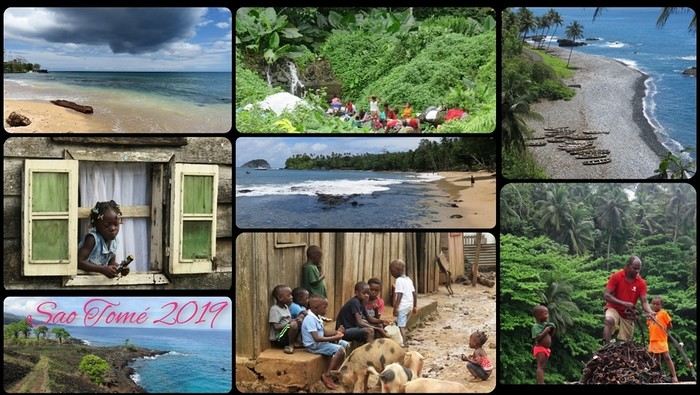
Sao Tomé, the forgotten island
Hey there, it's me again—back with my usual travel journal share for our loved ones, from our 15-day trip in October 2019.
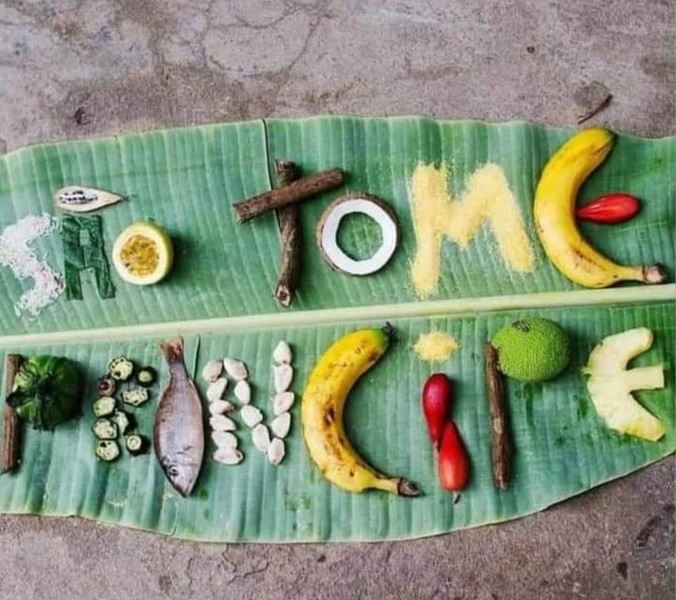
"Ah, here it is at last—that sweet scent of elsewhere so dear to Cricri and Lulu’s noses, that mix of apprehension and desire when facing the unknown.
We’re really diving into the unknown this time, taking you to the island of SAO TOMÉ... also known as the island: *‘Wait, what did you say?’* 😄. Because apparently, no one’s heard of Sao Tomé—except our Portuguese friends.
It’s an archipelago of three islands smack in the middle of the world, right on the equator, off the coast of Gabon.
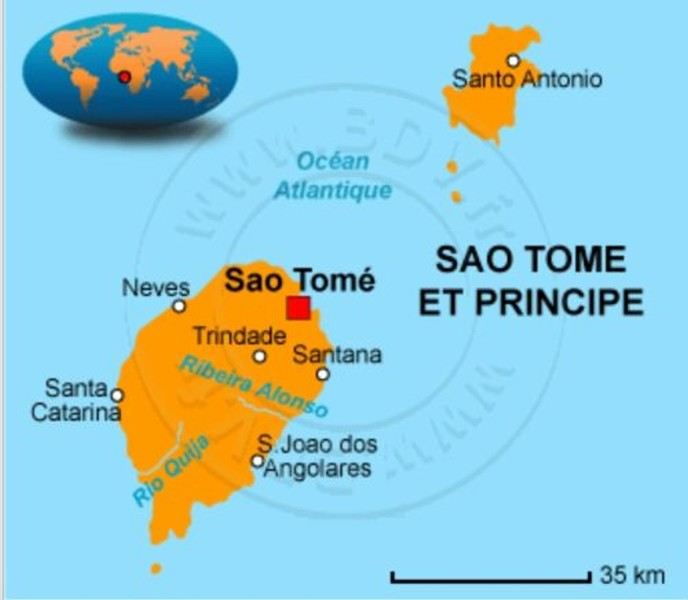
No, these aren’t the sun-soaked, Polynesian lagoon islands. Here, *‘it rains, it pours...’* pretty much all the time, it seems.
There’s not much to *‘see’* in the traditional tourist sense—EXCEPT for stunning landscapes, lush vegetation, a few beaches with golden or black sand, colonial buildings still in their original state, a single main road, and plenty of *‘tracks’* that are more or less drivable. All this surrounded by an African population that speaks Portuguese and is known for its warm welcome.
Well, that should be enough for our happiness—and hopefully yours too! 😊
Ready for landing?
"Ah, here it is at last—that sweet scent of elsewhere so dear to Cricri and Lulu’s noses, that mix of apprehension and desire when facing the unknown.
We’re really diving into the unknown this time, taking you to the island of SAO TOMÉ... also known as the island: *‘Wait, what did you say?’* 😄. Because apparently, no one’s heard of Sao Tomé—except our Portuguese friends.
It’s an archipelago of three islands smack in the middle of the world, right on the equator, off the coast of Gabon.
No, these aren’t the sun-soaked, Polynesian lagoon islands. Here, *‘it rains, it pours...’* pretty much all the time, it seems.
There’s not much to *‘see’* in the traditional tourist sense—EXCEPT for stunning landscapes, lush vegetation, a few beaches with golden or black sand, colonial buildings still in their original state, a single main road, and plenty of *‘tracks’* that are more or less drivable. All this surrounded by an African population that speaks Portuguese and is known for its warm welcome.
Well, that should be enough for our happiness—and hopefully yours too! 😊
Ready for landing?
Gulf Airlines
Hi there,
Lately, when I check Skyscanner (sorted by price low to high 😛), I don’t see Gulf airlines at the top of the list anymore. Instead, Air India dominates (I flew with them a few years ago, and my experience was pretty mixed). After that, there’s Royal Jordanian… and the first Gulf Air, Etihad, and others only show up at 7XX € or more (with endless layovers). What’s going on with these airlines? Did they change their target market? I really like these routes for Southeast Asia trips because they give you a perfect midway break.
Lately, when I check Skyscanner (sorted by price low to high 😛), I don’t see Gulf airlines at the top of the list anymore. Instead, Air India dominates (I flew with them a few years ago, and my experience was pretty mixed). After that, there’s Royal Jordanian… and the first Gulf Air, Etihad, and others only show up at 7XX € or more (with endless layovers). What’s going on with these airlines? Did they change their target market? I really like these routes for Southeast Asia trips because they give you a perfect midway break.
Travel: A Right for All? Reflections on Global Freedoms and Inequalities
Hello fellow travel enthusiasts! 🌍
As a traveler and blogger, I’ve often been struck by the huge inequalities tied to freedom of movement. While some cross borders with ease, others face major obstacles due to their nationality, background, or the restrictive policies of certain countries.
On the occasion of International Human Rights Day, I wrote an article reflecting on this issue: 📖 Travelers' Rights: A Reflection on Freedom of Movement and Global Inequalities
In this article, I cover topics like:
Inequalities between passports ("strong" vs. "weak" passports). The specific challenges faced by travelers from marginalized communities. How to take action to promote more inclusive and equitable travel.
I’d love to hear your thoughts! 😊 Have you ever experienced these inequalities while traveling? How do you think we could raise more awareness about this issue? Feel free to share your experiences or ask questions in this thread. I can’t wait to discuss this with you!
Travel is also about building bridges between cultures. So let’s make sure it becomes a reality for everyone. ✈️🌎 Thanks for reading, and I look forward to exchanging ideas with you!
On the occasion of International Human Rights Day, I wrote an article reflecting on this issue: 📖 Travelers' Rights: A Reflection on Freedom of Movement and Global Inequalities
In this article, I cover topics like:
Inequalities between passports ("strong" vs. "weak" passports). The specific challenges faced by travelers from marginalized communities. How to take action to promote more inclusive and equitable travel.
I’d love to hear your thoughts! 😊 Have you ever experienced these inequalities while traveling? How do you think we could raise more awareness about this issue? Feel free to share your experiences or ask questions in this thread. I can’t wait to discuss this with you!
Travel is also about building bridges between cultures. So let’s make sure it becomes a reality for everyone. ✈️🌎 Thanks for reading, and I look forward to exchanging ideas with you!
15 jours en août 2020 en Croatie
Bonjour tout le monde,
me voici de retour après plusieurs semaines d'hésitations quant à notre voyage de cet été. Le voyage d'origine est celui-ci : https://voyageforum.com/discussion/itineraires-logements-visites-road-trip-dix-jours-split-dubrovnik-en-aout-d9829312/
Malheureusement (ou pas d'ailleurs) il y a changement de programme.... en effet le vol aller est décalé et j'ai bien peur que Volotea m'annonce à la dernière minute qu'il n'y a carrément plus de vols !!! Bref pour faire simple, réservation annulée et nouvelle réservation chez Transavia quasi au même prix mais du 5 au 19 aout soit 4 jours de plus. Il me reste quand même 2 problèmes de taille, à savoir : - arrivée à Dubrovnik au lieu de Split - 3 nuits réservées et non annulables à Lumbarda ( et au prix des nuits j'ai pas trop envie de faire l'impasse dessus !! )
J'ai donc élaboré un nouveau voyage et bien sur il me faut des conseils avisés pour peaufiner tout ça...... Nous sommes 2 adultes avec 2 enfants de 10 et 16 ans. Voilà a quoi ça ressemble :
J1 : arrivée à Dubrovnik 10h le matin (nuit à Dubrovnik) J2 : visite de Dubrovnik + Mont Srd (nuit à Dubrovnik) J3 : Route pour Korcula via la presqu'ile (nuit à Lumbarda déjà réservée) J4 : Ile de Korcula (nuit à Lumbarda déjà réservée) J5 : Ile de Korcula (nuit à Lumbarda déjà réservée) J6 :route pour Split (par la route ou direct par ferry) (nuit aux alentours de Split) J7 : visite de Split (nuit aux alentours de Split) J8 : Krka (nuit aux alentours de Split) J9 : journée "off", surement visite de Trogir et baignade (nuit aux alentours de Split) J10 : J11 : J12 : Route pour Mljet (route ou ferry en fonction du point de départ) J13 : Ile de Mljet J14 : Ile de Mljet J15 : départ tot et avion à Dubrovnik 11h
Il me manque encore pas mal de choses mais c'est une 1ère ébauche... j'ai plusieurs interrogations : - Est ce qu'il ne vaut mieux pas aller en direct à Korcula le J1 et garder Dubrovnik pour la fin de parcours ? J'ai peur que 2 jours de plus sur cette ile fasse peut être de trop... - J10 et J11 j'hésite entre remonter au nord ou faire une autre ile (Hvar par ex) à la place de Mljet. J'aimerais bien pouvoir faire un détour par la Bosnie et Mostar mais malheureusement c'est pour le moment impossible à prévoir... - partir de Mljet le dernier jour est il faisable sans trop de risque ?
Bref beaucoup de points à éclaircir et il ne me reste que quelques semaines....
me voici de retour après plusieurs semaines d'hésitations quant à notre voyage de cet été. Le voyage d'origine est celui-ci : https://voyageforum.com/discussion/itineraires-logements-visites-road-trip-dix-jours-split-dubrovnik-en-aout-d9829312/
Malheureusement (ou pas d'ailleurs) il y a changement de programme.... en effet le vol aller est décalé et j'ai bien peur que Volotea m'annonce à la dernière minute qu'il n'y a carrément plus de vols !!! Bref pour faire simple, réservation annulée et nouvelle réservation chez Transavia quasi au même prix mais du 5 au 19 aout soit 4 jours de plus. Il me reste quand même 2 problèmes de taille, à savoir : - arrivée à Dubrovnik au lieu de Split - 3 nuits réservées et non annulables à Lumbarda ( et au prix des nuits j'ai pas trop envie de faire l'impasse dessus !! )
J'ai donc élaboré un nouveau voyage et bien sur il me faut des conseils avisés pour peaufiner tout ça...... Nous sommes 2 adultes avec 2 enfants de 10 et 16 ans. Voilà a quoi ça ressemble :
J1 : arrivée à Dubrovnik 10h le matin (nuit à Dubrovnik) J2 : visite de Dubrovnik + Mont Srd (nuit à Dubrovnik) J3 : Route pour Korcula via la presqu'ile (nuit à Lumbarda déjà réservée) J4 : Ile de Korcula (nuit à Lumbarda déjà réservée) J5 : Ile de Korcula (nuit à Lumbarda déjà réservée) J6 :route pour Split (par la route ou direct par ferry) (nuit aux alentours de Split) J7 : visite de Split (nuit aux alentours de Split) J8 : Krka (nuit aux alentours de Split) J9 : journée "off", surement visite de Trogir et baignade (nuit aux alentours de Split) J10 : J11 : J12 : Route pour Mljet (route ou ferry en fonction du point de départ) J13 : Ile de Mljet J14 : Ile de Mljet J15 : départ tot et avion à Dubrovnik 11h
Il me manque encore pas mal de choses mais c'est une 1ère ébauche... j'ai plusieurs interrogations : - Est ce qu'il ne vaut mieux pas aller en direct à Korcula le J1 et garder Dubrovnik pour la fin de parcours ? J'ai peur que 2 jours de plus sur cette ile fasse peut être de trop... - J10 et J11 j'hésite entre remonter au nord ou faire une autre ile (Hvar par ex) à la place de Mljet. J'aimerais bien pouvoir faire un détour par la Bosnie et Mostar mais malheureusement c'est pour le moment impossible à prévoir... - partir de Mljet le dernier jour est il faisable sans trop de risque ?
Bref beaucoup de points à éclaircir et il ne me reste que quelques semaines....
Hertz en faillite aux USA et Canada
J'espère que d'ici septembre le Covid sera qu'un mauvais souvenir . Je pensais aller aux USA en septembre 2020 en prenant mon billet d'avion en dernière minute . Même si les tarifs des billets sont en légère augmentation de 280 à 405 € pour un AR direct Paris Los Angeles, c'est le tarif des locations de SUV qui est passé de 24 à 49€ jours . Je viens de voir à la télévision que le groupe Hertz qui comprend Dollar et Thrifty, c'est déclarer en faillite aux USA et au Canada ce qui ne manquera pas de poser problème sur les tarifs des locations .
https://www.lefigaro.fr/flash-eco/hertz-se-declare-en-faillite-aux-etats-unis-et-au-canada-20200523
A quand l'ouverture des frontières dans l'espace Schengen? (à vélo)
Hello,
C'est un peu la question qu'on se pose et qui nous oblige à revoir nos plans, pour l'instant c'est très flou, visiblement ce ne serait pas avant Septembre voir même pas envisageable cette année, mais si vous avez des infos de ce côté là n'hésitez pas à les partager.
Gilles
C'est un peu la question qu'on se pose et qui nous oblige à revoir nos plans, pour l'instant c'est très flou, visiblement ce ne serait pas avant Septembre voir même pas envisageable cette année, mais si vous avez des infos de ce côté là n'hésitez pas à les partager.
Gilles
Adventures of a Bygone Era: The Philippines in 1984
After several discussions on VF about travel journals from the Philippines, I decided to write this curiosity: a trip report from a journey made in 1984, when traveling to the Philippines was still an adventure.
A curiosity because writing a travel journal about a trip 35 years later isn’t common, but also (mostly?) because exploring the Philippines at that time had little in common with traveling there today.
Obviously, I’ve forgotten a number of facts, most of the details, but with the help of a few notes from that time and a stack of slides (yes, there was life before digital 😊), many memories came back and added to the highlights I’d never forgotten. The scanned slides aren’t always great quality, but there are still quite a few to brighten up this chatter. Back then, we didn’t snap photos like we do now—film was too expensive—so I don’t have pictures of every place we visited... too bad, comparing some of those spots to how they look today would’ve been interesting.
Why "Adventures"? Why call it "Adventures" in the Philippines in 1984, a word so often used for a simple exotic trip? - Because the lack of information (no *Guide du Routard*, no *Lonely Planet*, no *Michelin Guide*, nothing, and obviously no internet) gave this trip what’s at the heart of adventure: the unknown. - Because the political situation made the stay sometimes dangerous. - Because transportation conditions were always epic, often perilous. - Because the question of where we’d spend the night came up almost every evening. - And for... quite a few other reasons.
That said, we weren’t exactly explorers!
Why the Philippines? First of all, why go to the Philippines in 1984—a country not exactly set up for tourism and about which we knew very little? How could we get an idea of the beauty of the Philippines and its points of interest when we had no guides or photos?
The idea came to us from Thailand a year earlier, during our first long-haul trip. After touring the north of the country, we met a Frenchman living in Phuket, where there were only a few tourists in Patong, with just a few small hotels and guesthouses. Kata and Karon had no buildings or roads, Rawai only had three palm-thatched bungalows, including ours, and the other islands were unknown to tourists. There was plenty to discover, and we wanted to return to this beautiful country... but the Frenchman made us dream about the Philippines—a country to explore, with wild landscapes.
Long evenings of discussion over multiple Sprite-Mekong cocktails (what memories of those headaches!) finally convinced us we had to go to the Philippines.
Episode 0: Before Departure The decision was made: we’d go to the Philippines in May 1984. Our friends and family were surprised when we announced we were going on vacation to the Philippines (a bit like saying today we were going paddleboarding in the Kerguelen Islands 🤪).
These days, preparing for each of our trips takes long evenings of research, planning, and noting down good addresses... etc. But for the Philippines in 1984, preparation was quick: we had very little information about the country, we were leaving almost at random, and the discovery would only be more exciting.
We still had a few bits of info gathered here and there: the rice terraces in northern Luzon, volcanoes, Negros where we were supposed to visit an acquaintance, Cebu and its marine life (we ended up going elsewhere), and absolutely avoid Mindanao, which was practically at war with the regime. That was about it, but it was already a great itinerary.
Nothing was organized in advance; we’d see day by day. We had no idea about travel times or even the existence of transportation options. The main (and sometimes only) way to connect two islands was by overloaded, rusty ferry. Only the big cities had airports.
Let’s Go: Episode 1: Paris to Manila My travel journals always start after arriving at the airport—the Europe-to-“Other Continent” trip isn’t interesting—but the flight to the Philippines was already an adventure, so I’ll make an exception.
This was the era when only a few Asian airlines were on par with Western ones: Thai, Singapore Airlines, and Philippine Airlines. They had beautiful, brand-new planes, and to attract customers (almost exclusively “businessmen”) from the usual airlines (Air France, Lufthansa, British Airways), there was opulence on board: unlimited champagne, all sorts of cocktails... Compared to today’s long-haul flights, there was still one small difference: no personal screens, just one screen at the front of the cabin with one mandatory movie. And I don’t know why, but we only got James Bond films, both ways... that must’ve been the trend at the time.
The tourism boom to Southeast Asia hadn’t started yet, and the “Asian Tigers” weren’t a thing, so there weren’t many business trips. That meant long-haul flights made stops everywhere to fill the planes. Our Philippine Airlines Boeing 747 left London, picked us up in Paris, then stopped in Frankfurt to take on a few Germans. I don’t know why we then made a stop in Dubai—a totally exotic place at the time. There was nothing to do there... things have changed a lot since. It was a small town lost in the desert. The airport was tiny, with just one or two buildings and a supermarket. During the stopover, everyone had to get off the plane and walk to the supermarket. Photo and electronic equipment were dirt cheap—I guess that was the only reason for the stop. Maybe it was their first commercial move. Emirates didn’t exist yet, as I checked online, but anyway, the idea that such a remote place could have its own airline was unthinkable.
Online, I found this photo of Dubai Airport in 1980. Anyone who’s transited through today’s massive airport with its rows of A380s will appreciate it: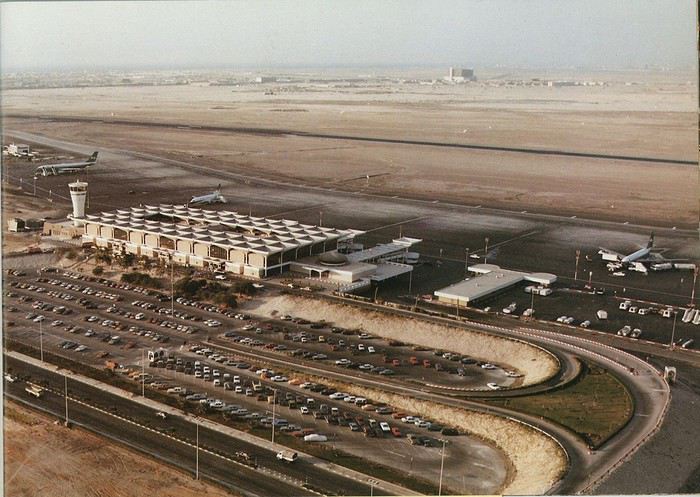
Next stop: New Delhi to drop off some Europeans and pick up a few Indians, and finally, the terminus: Manila. I don’t remember how long the trip took with its five stops—an unimaginable journey today. Despite all those stops to fill the plane, there was still enough space to stretch out on the four center seats of the 747, something that never happens these days despite all the flights in every direction.
So here we are, finally at Manila Airport around midnight.
Episode 1: Manila and Baguio To start, a quick note on the political and economic situation in the Philippines in 1984, which had consequences for us as tourists, as we’d soon realize upon arrival.
After several centuries of Spanish colonization, the Philippines became American at the start of the 20th century, then independent. In 1966, Marcos took power, and little by little, his regime sank into corruption and mismanagement, becoming a dictatorship with martial law, all for the benefit of his family and friends, who enriched themselves endlessly. The peak was the assassination of opposition leader Benigno Aquino in August 1983, which triggered harshly repressed protests. So we arrived a few months later in a very poor country, with omnipresent corruption and an extremely tense political situation, as we’d soon see for ourselves. Major protests took place in the main cities during our trip—I’ll come back to that. Two years later, Marcos fled to Hawaii after being forced out of power following rigged elections. This historical context explains a lot of the situations we found ourselves in over the following weeks.
Arriving in the middle of the night isn’t very cheerful. Manila was already a huge city with many slums, where you could find a few business hotels like the Hilton or Intercontinental—way out of our budget—and plenty of run-down hotels. Luckily, two Indians we’d chatted with on the plane offered to take us to their usual hotel. They came to Manila twice a year for business. We accepted their offer, relieved not to have to look for a place to stay in the middle of the night, figuring the address must be good since they came back every time... we were wrong 🙁
We left the airport and immediately got a taste of the local vibe when we got into the taxi: the police asked for our passports. We thought: what’s more normal than police in a dictatorship?
But that wasn’t it at all. Our two Indian friends explained that the police were noting our names along with the taxi number and time. Crime in Manila was so bad that the taxi driver would be held responsible if anything happened to us... welcome to the Philippines 😎 😎
Historically, the Philippines was a very violent country, where everything was settled with guns or machetes. Previous governments had banned carrying weapons, but Marcos later allowed the free sale and carrying of guns, and disputes were settled with pistols again (or worse, as we’d discover later). Since he’d released most of the criminals from prison to form a paramilitary militia at his service (I’ll talk about our encounter with these “heroes” later), it was pretty dangerous to go into many parts of Manila, where these “tonton macoutes” ruled.
We arrived at our hotel without incident... and then things started badly. The room was infested with big cockroaches—exactly what I hate most in those kinds of countries. No way to find another hotel at that hour. After the long flight, the urge to take a shower was so strong that we squeezed into the bathroom as best we could. After that, I don’t remember—I guess we must’ve fallen asleep exhausted under the sheets in the heat... air conditioning wasn’t widespread yet.
The next day, we just wanted to leave that dump as soon as possible. So we decided to head north right away, stopping in Baguio, and we’d visit Manila a bit on the way back.
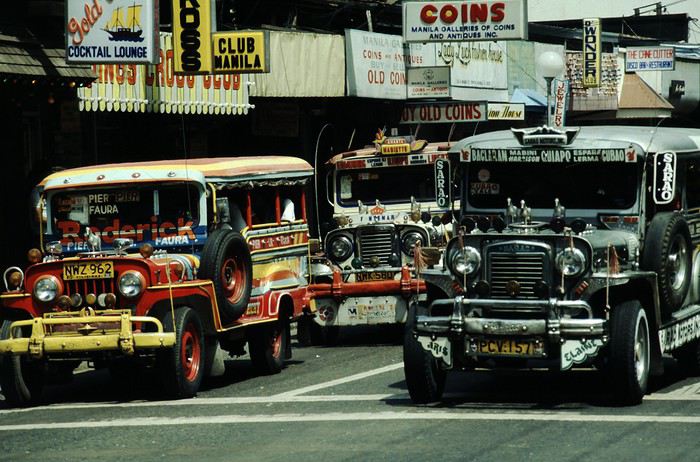
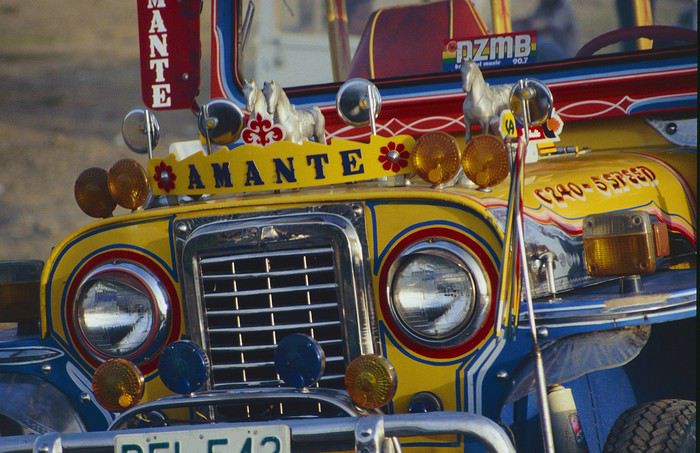
When we stepped outside, we discovered a pretty run-down neighborhood with potholed streets. But we also discovered the jeepneys. They were everywhere, flooding the streets.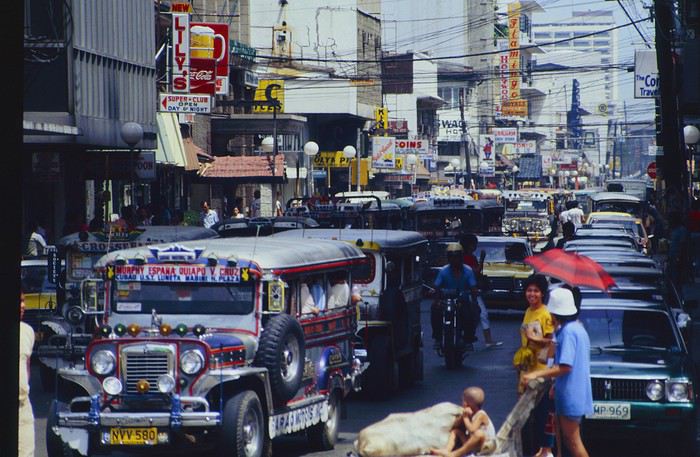
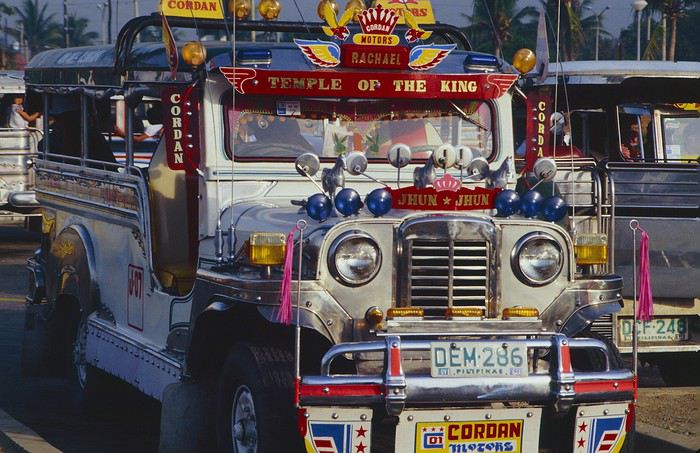
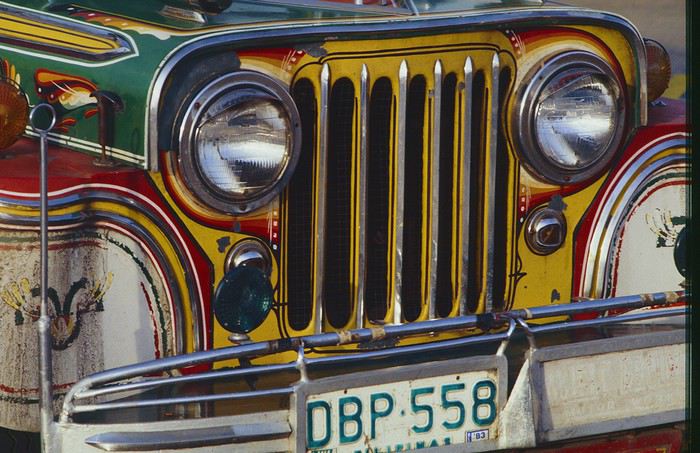
They had crazy sound systems, each one blasting louder than the last. The interiors were kitschy but fun. There weren’t many private cars—almost all transportation was by jeepney, with buses reserved for intercity trips.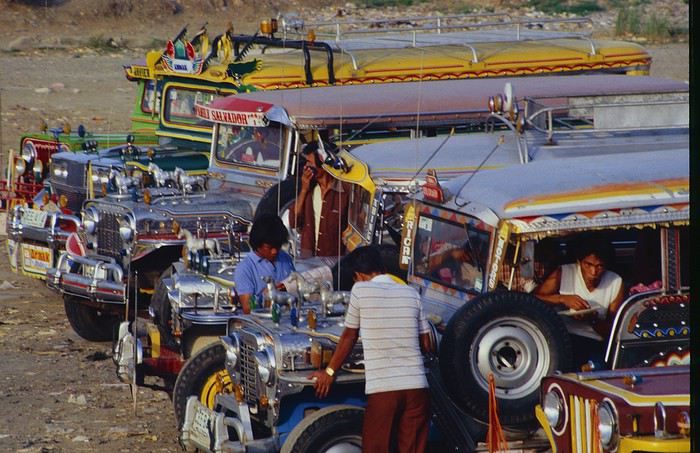
Before heading to the bus terminal for the north, somewhere on the outskirts of the city, we needed to exchange some money. I don’t remember how we ended up in a policeman’s jeep who offered his services: - Exchange money on the black market at a better rate than the banks. - Take us wherever we wanted, in this case, the bus terminal.
We accepted both offers (we’d still checked the official exchange rate from dollars to pesos). So we found ourselves in his jeep. After exchanging money, we left in his vehicle and stopped for gas. Without turning off the engine, he calmly smoked a cigarette while filling up. Since we were in a jeep with no doors or roof, we were ready to jump out if things went south, our travel bag in hand.
But we weren’t done with surprises yet. Once we left the small streets, we ended up in a neighborhood with wide avenues and not much traffic, which didn’t justify his incredible behavior. At every intersection, he made the sign of the cross, closed his eyes, and crossed without looking. I was more stunned than terrified! It wasn’t until we got out of the car later that I told Anne-Marie what had happened. I’d seen everything because the cop had put me in the front seat. Luckily, A-Marie hadn’t noticed anything from the back. Crossing Manila by trusting God rather than the rules of the road was ultimately effective. We were lucky—the trip was off to a good start. 🙂 🙂
We then passed through a neighborhood where slums stretched on for a while, and we left our policeman—friendly but a bit crazy—with relief.
A few hours by bus later, here we are in Baguio, cool in the mountains. My memories of Baguio are pretty fuzzy. I remember a small town. After some research while writing this journal, I found that the population was 120,000 in 1980. Given the population density in each home, that confirms my memory of a smallish town. Outside the “official” district with the president’s summer residence and government buildings, there were two or three paved streets with nice houses. The rest was very dirty and very poor, with lots of slums and dirt roads.
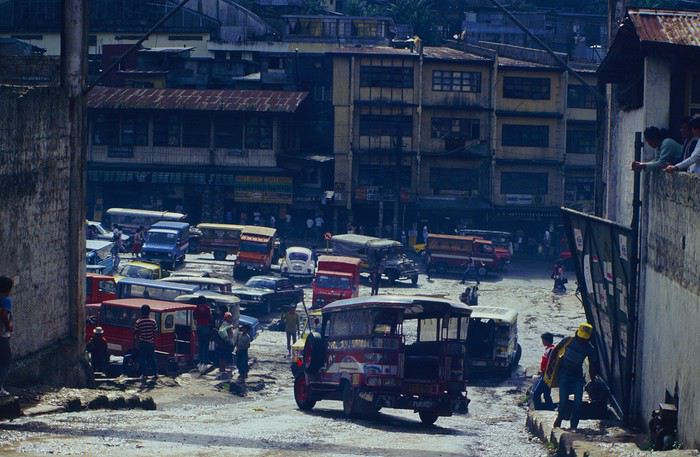
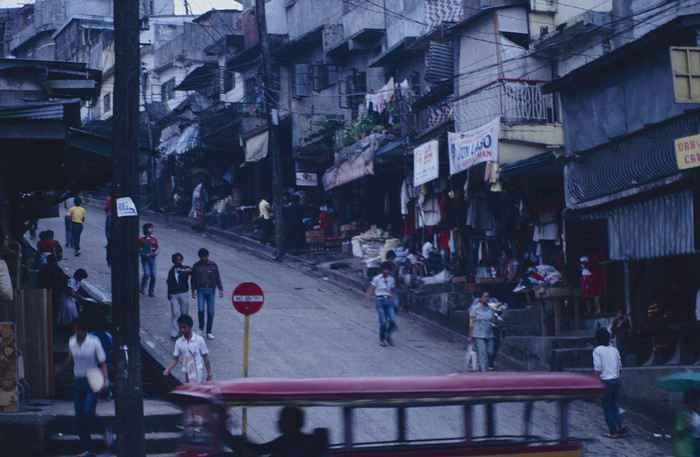
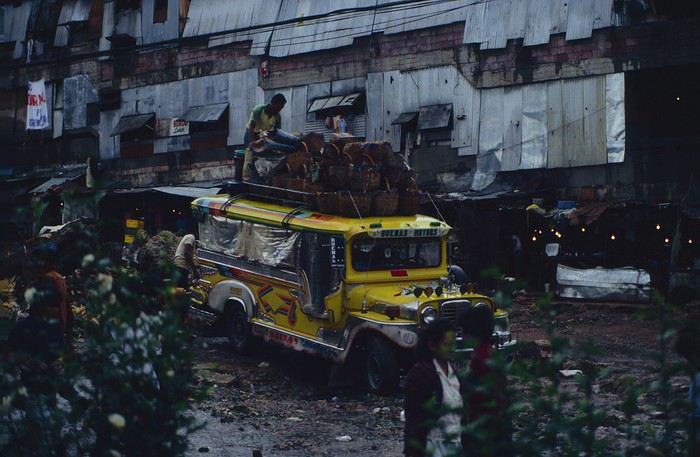
People we met on the street invited us to stay with them. These days, we wouldn’t just show up at strangers’ houses, which we should’ve done in Baguio—it would’ve saved us from an unimaginable and dangerous situation... which I won’t say anything about... !😊
The simple wooden house was on stilts at the edge of a hill with a view of the mountains. Since it was the start of the rainy season in a city that gets a lot of rain, we saw a lot of water. Our outings in town happened between downpours.
View from our lodging: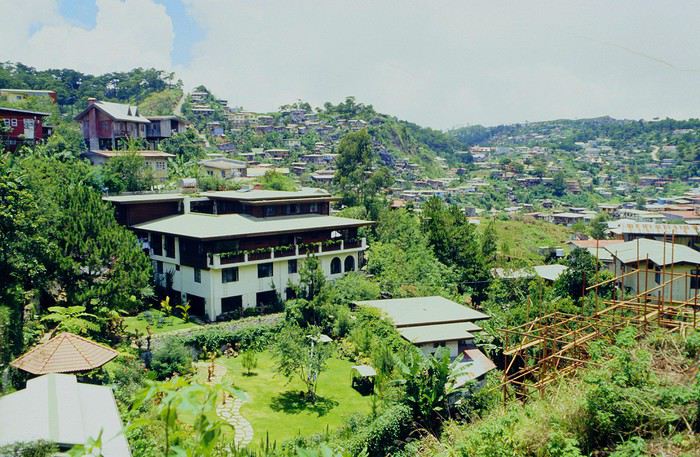
Episode 2: Baguio to Bontoc Aside from the situation briefly mentioned above, it was on the next leg to Bontoc that the adventure really began: an endless and dangerous road, a bus from another era, breathtaking landscapes, and surprising people.
We didn’t know the distance or how long it would take to get to Bontoc. When we arrived after about ten hours, we learned that Baguio to Bontoc was 140 km.
We got on a bus with wooden seats and settled in, two to a seat meant for two. As the bus filled up, passengers squeezed in three or four per seat, with chickens and baskets full of all sorts of things in the aisle. A little embarrassed, we didn’t know if we should squeeze in three on our seat. The seats were super tight (luckily, Filipinos are small), and I didn’t know where to put my legs given my height. I don’t remember if we stayed alone on our bench or if we ended up sharing with others.
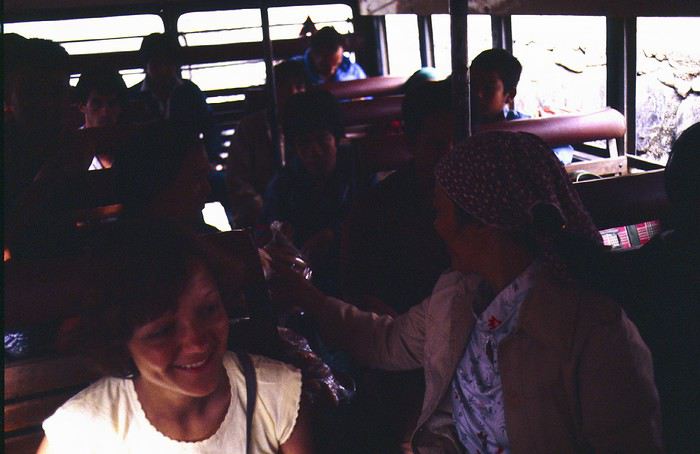
The “road” was a dirt track (or rather, a mud track) with endless turns. We held on as best we could to our slippery wooden seats—it was shaking in every direction. The woman behind us was carsick and throwing up... gross... but what were we doing there? Then we plunged into the Sierra Madre... just the name is dreamy!
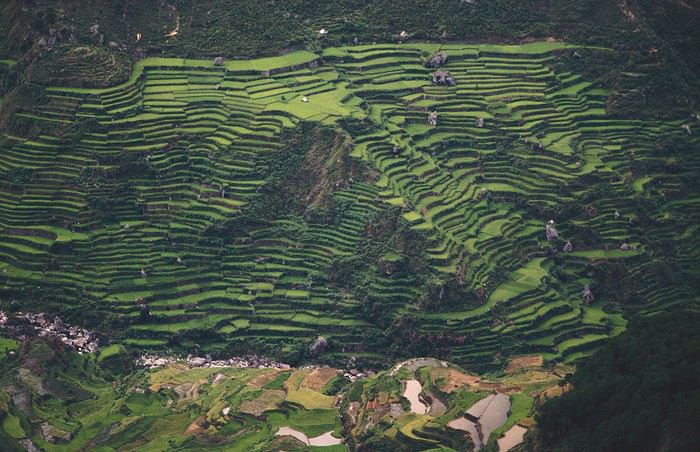
Rice terraces started to appear: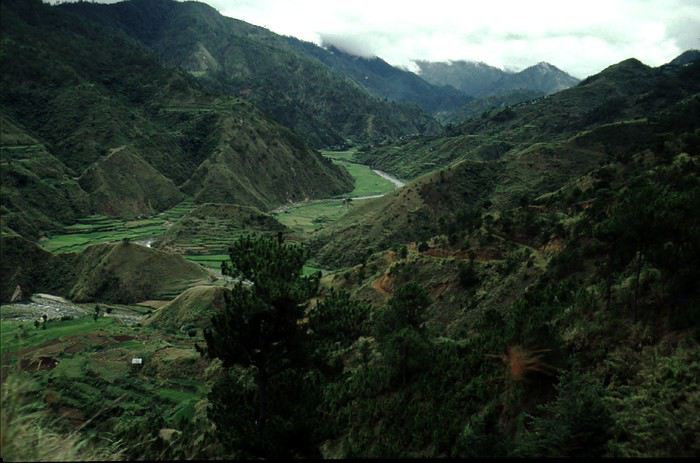
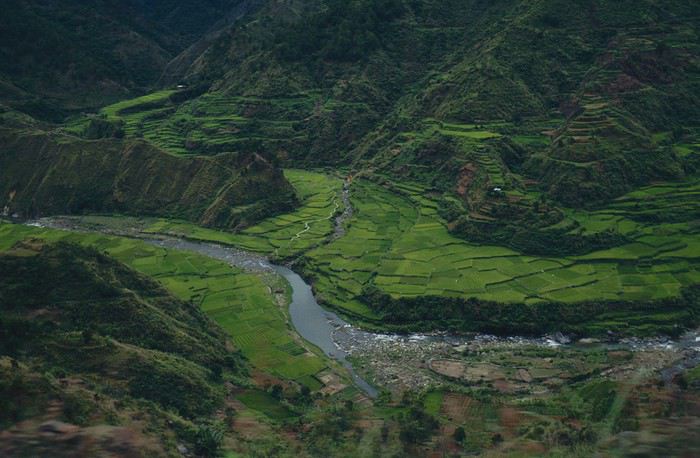
they took up more and more space along cliffs where we weren’t always reassured,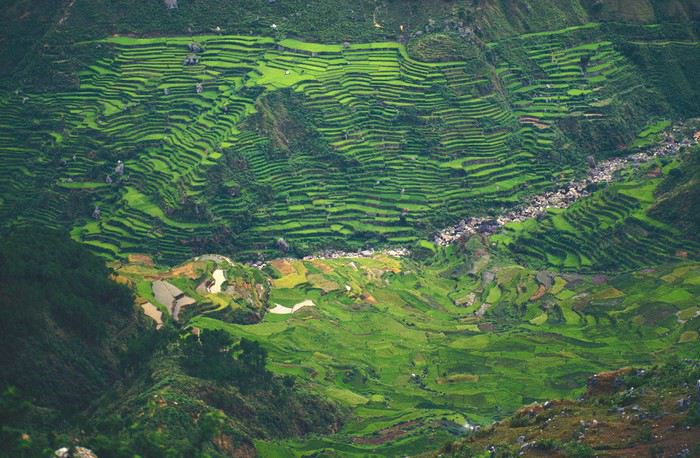
with lots of waterfalls (all that water had to go somewhere).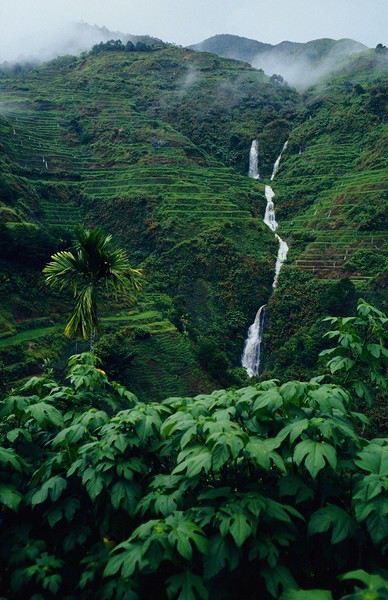
A few miserable villages stretched along the track, most often just a few houses balancing between the road and the drop. The bus stopped in every village—people got on or off and settled inside or on the roof. Street vendors offered their products to the bus passengers—a common sight in Asia, even today.
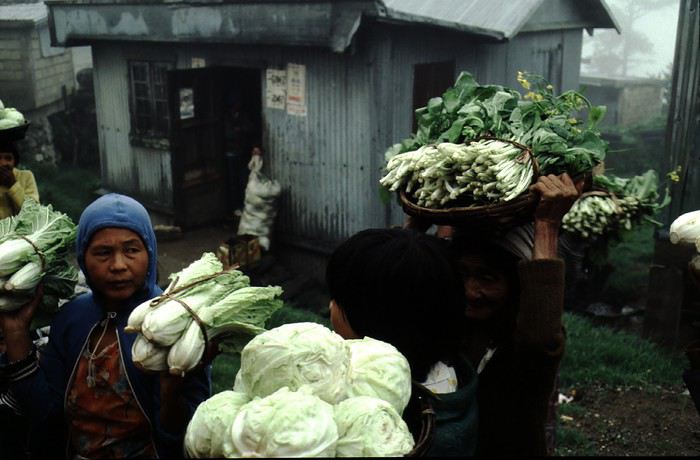
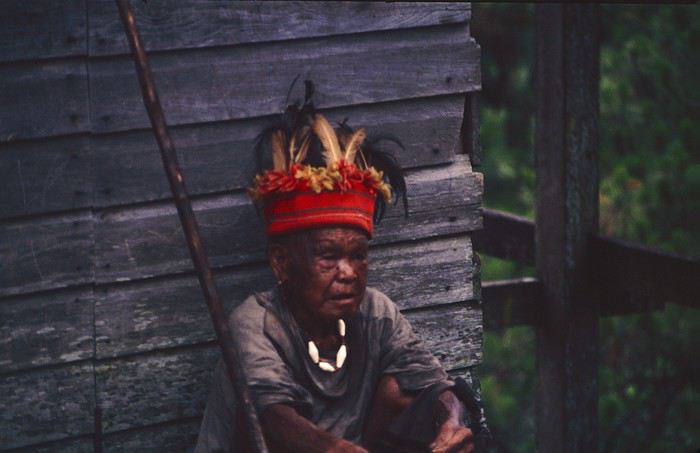
We were in another world—villagers were in loincloths, others had spears. The atmosphere was strange... but all good, we wanted exoticism, and we got it: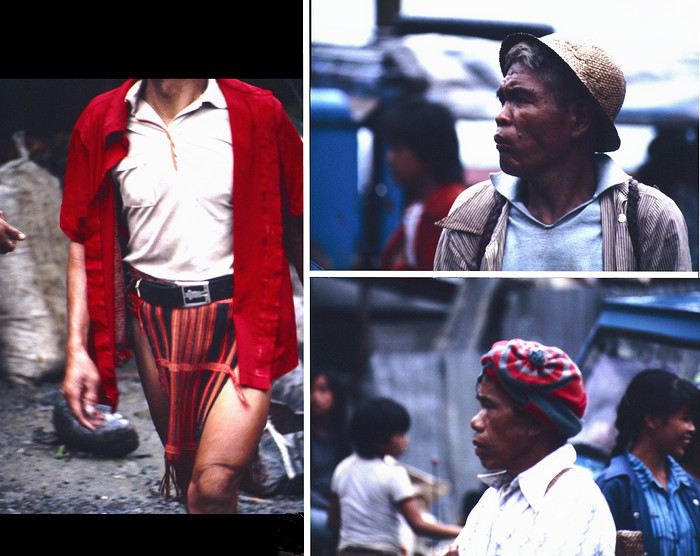
This so-called traditional outfit was everyday wear—it wasn’t for tourists since there weren’t any.
A curiosity because writing a travel journal about a trip 35 years later isn’t common, but also (mostly?) because exploring the Philippines at that time had little in common with traveling there today.
Obviously, I’ve forgotten a number of facts, most of the details, but with the help of a few notes from that time and a stack of slides (yes, there was life before digital 😊), many memories came back and added to the highlights I’d never forgotten. The scanned slides aren’t always great quality, but there are still quite a few to brighten up this chatter. Back then, we didn’t snap photos like we do now—film was too expensive—so I don’t have pictures of every place we visited... too bad, comparing some of those spots to how they look today would’ve been interesting.
Why "Adventures"? Why call it "Adventures" in the Philippines in 1984, a word so often used for a simple exotic trip? - Because the lack of information (no *Guide du Routard*, no *Lonely Planet*, no *Michelin Guide*, nothing, and obviously no internet) gave this trip what’s at the heart of adventure: the unknown. - Because the political situation made the stay sometimes dangerous. - Because transportation conditions were always epic, often perilous. - Because the question of where we’d spend the night came up almost every evening. - And for... quite a few other reasons.
That said, we weren’t exactly explorers!
Why the Philippines? First of all, why go to the Philippines in 1984—a country not exactly set up for tourism and about which we knew very little? How could we get an idea of the beauty of the Philippines and its points of interest when we had no guides or photos?
The idea came to us from Thailand a year earlier, during our first long-haul trip. After touring the north of the country, we met a Frenchman living in Phuket, where there were only a few tourists in Patong, with just a few small hotels and guesthouses. Kata and Karon had no buildings or roads, Rawai only had three palm-thatched bungalows, including ours, and the other islands were unknown to tourists. There was plenty to discover, and we wanted to return to this beautiful country... but the Frenchman made us dream about the Philippines—a country to explore, with wild landscapes.
Long evenings of discussion over multiple Sprite-Mekong cocktails (what memories of those headaches!) finally convinced us we had to go to the Philippines.
Episode 0: Before Departure The decision was made: we’d go to the Philippines in May 1984. Our friends and family were surprised when we announced we were going on vacation to the Philippines (a bit like saying today we were going paddleboarding in the Kerguelen Islands 🤪).
These days, preparing for each of our trips takes long evenings of research, planning, and noting down good addresses... etc. But for the Philippines in 1984, preparation was quick: we had very little information about the country, we were leaving almost at random, and the discovery would only be more exciting.
We still had a few bits of info gathered here and there: the rice terraces in northern Luzon, volcanoes, Negros where we were supposed to visit an acquaintance, Cebu and its marine life (we ended up going elsewhere), and absolutely avoid Mindanao, which was practically at war with the regime. That was about it, but it was already a great itinerary.
Nothing was organized in advance; we’d see day by day. We had no idea about travel times or even the existence of transportation options. The main (and sometimes only) way to connect two islands was by overloaded, rusty ferry. Only the big cities had airports.
Let’s Go: Episode 1: Paris to Manila My travel journals always start after arriving at the airport—the Europe-to-“Other Continent” trip isn’t interesting—but the flight to the Philippines was already an adventure, so I’ll make an exception.
This was the era when only a few Asian airlines were on par with Western ones: Thai, Singapore Airlines, and Philippine Airlines. They had beautiful, brand-new planes, and to attract customers (almost exclusively “businessmen”) from the usual airlines (Air France, Lufthansa, British Airways), there was opulence on board: unlimited champagne, all sorts of cocktails... Compared to today’s long-haul flights, there was still one small difference: no personal screens, just one screen at the front of the cabin with one mandatory movie. And I don’t know why, but we only got James Bond films, both ways... that must’ve been the trend at the time.
The tourism boom to Southeast Asia hadn’t started yet, and the “Asian Tigers” weren’t a thing, so there weren’t many business trips. That meant long-haul flights made stops everywhere to fill the planes. Our Philippine Airlines Boeing 747 left London, picked us up in Paris, then stopped in Frankfurt to take on a few Germans. I don’t know why we then made a stop in Dubai—a totally exotic place at the time. There was nothing to do there... things have changed a lot since. It was a small town lost in the desert. The airport was tiny, with just one or two buildings and a supermarket. During the stopover, everyone had to get off the plane and walk to the supermarket. Photo and electronic equipment were dirt cheap—I guess that was the only reason for the stop. Maybe it was their first commercial move. Emirates didn’t exist yet, as I checked online, but anyway, the idea that such a remote place could have its own airline was unthinkable.
Online, I found this photo of Dubai Airport in 1980. Anyone who’s transited through today’s massive airport with its rows of A380s will appreciate it:
Next stop: New Delhi to drop off some Europeans and pick up a few Indians, and finally, the terminus: Manila. I don’t remember how long the trip took with its five stops—an unimaginable journey today. Despite all those stops to fill the plane, there was still enough space to stretch out on the four center seats of the 747, something that never happens these days despite all the flights in every direction.
So here we are, finally at Manila Airport around midnight.
Episode 1: Manila and Baguio To start, a quick note on the political and economic situation in the Philippines in 1984, which had consequences for us as tourists, as we’d soon realize upon arrival.
After several centuries of Spanish colonization, the Philippines became American at the start of the 20th century, then independent. In 1966, Marcos took power, and little by little, his regime sank into corruption and mismanagement, becoming a dictatorship with martial law, all for the benefit of his family and friends, who enriched themselves endlessly. The peak was the assassination of opposition leader Benigno Aquino in August 1983, which triggered harshly repressed protests. So we arrived a few months later in a very poor country, with omnipresent corruption and an extremely tense political situation, as we’d soon see for ourselves. Major protests took place in the main cities during our trip—I’ll come back to that. Two years later, Marcos fled to Hawaii after being forced out of power following rigged elections. This historical context explains a lot of the situations we found ourselves in over the following weeks.
Arriving in the middle of the night isn’t very cheerful. Manila was already a huge city with many slums, where you could find a few business hotels like the Hilton or Intercontinental—way out of our budget—and plenty of run-down hotels. Luckily, two Indians we’d chatted with on the plane offered to take us to their usual hotel. They came to Manila twice a year for business. We accepted their offer, relieved not to have to look for a place to stay in the middle of the night, figuring the address must be good since they came back every time... we were wrong 🙁
We left the airport and immediately got a taste of the local vibe when we got into the taxi: the police asked for our passports. We thought: what’s more normal than police in a dictatorship?
But that wasn’t it at all. Our two Indian friends explained that the police were noting our names along with the taxi number and time. Crime in Manila was so bad that the taxi driver would be held responsible if anything happened to us... welcome to the Philippines 😎 😎
Historically, the Philippines was a very violent country, where everything was settled with guns or machetes. Previous governments had banned carrying weapons, but Marcos later allowed the free sale and carrying of guns, and disputes were settled with pistols again (or worse, as we’d discover later). Since he’d released most of the criminals from prison to form a paramilitary militia at his service (I’ll talk about our encounter with these “heroes” later), it was pretty dangerous to go into many parts of Manila, where these “tonton macoutes” ruled.
We arrived at our hotel without incident... and then things started badly. The room was infested with big cockroaches—exactly what I hate most in those kinds of countries. No way to find another hotel at that hour. After the long flight, the urge to take a shower was so strong that we squeezed into the bathroom as best we could. After that, I don’t remember—I guess we must’ve fallen asleep exhausted under the sheets in the heat... air conditioning wasn’t widespread yet.
The next day, we just wanted to leave that dump as soon as possible. So we decided to head north right away, stopping in Baguio, and we’d visit Manila a bit on the way back.
When we stepped outside, we discovered a pretty run-down neighborhood with potholed streets. But we also discovered the jeepneys. They were everywhere, flooding the streets.
They had crazy sound systems, each one blasting louder than the last. The interiors were kitschy but fun. There weren’t many private cars—almost all transportation was by jeepney, with buses reserved for intercity trips.
Before heading to the bus terminal for the north, somewhere on the outskirts of the city, we needed to exchange some money. I don’t remember how we ended up in a policeman’s jeep who offered his services: - Exchange money on the black market at a better rate than the banks. - Take us wherever we wanted, in this case, the bus terminal.
We accepted both offers (we’d still checked the official exchange rate from dollars to pesos). So we found ourselves in his jeep. After exchanging money, we left in his vehicle and stopped for gas. Without turning off the engine, he calmly smoked a cigarette while filling up. Since we were in a jeep with no doors or roof, we were ready to jump out if things went south, our travel bag in hand.
But we weren’t done with surprises yet. Once we left the small streets, we ended up in a neighborhood with wide avenues and not much traffic, which didn’t justify his incredible behavior. At every intersection, he made the sign of the cross, closed his eyes, and crossed without looking. I was more stunned than terrified! It wasn’t until we got out of the car later that I told Anne-Marie what had happened. I’d seen everything because the cop had put me in the front seat. Luckily, A-Marie hadn’t noticed anything from the back. Crossing Manila by trusting God rather than the rules of the road was ultimately effective. We were lucky—the trip was off to a good start. 🙂 🙂
We then passed through a neighborhood where slums stretched on for a while, and we left our policeman—friendly but a bit crazy—with relief.
A few hours by bus later, here we are in Baguio, cool in the mountains. My memories of Baguio are pretty fuzzy. I remember a small town. After some research while writing this journal, I found that the population was 120,000 in 1980. Given the population density in each home, that confirms my memory of a smallish town. Outside the “official” district with the president’s summer residence and government buildings, there were two or three paved streets with nice houses. The rest was very dirty and very poor, with lots of slums and dirt roads.
People we met on the street invited us to stay with them. These days, we wouldn’t just show up at strangers’ houses, which we should’ve done in Baguio—it would’ve saved us from an unimaginable and dangerous situation... which I won’t say anything about... !😊
The simple wooden house was on stilts at the edge of a hill with a view of the mountains. Since it was the start of the rainy season in a city that gets a lot of rain, we saw a lot of water. Our outings in town happened between downpours.
View from our lodging:
Episode 2: Baguio to Bontoc Aside from the situation briefly mentioned above, it was on the next leg to Bontoc that the adventure really began: an endless and dangerous road, a bus from another era, breathtaking landscapes, and surprising people.
We didn’t know the distance or how long it would take to get to Bontoc. When we arrived after about ten hours, we learned that Baguio to Bontoc was 140 km.
We got on a bus with wooden seats and settled in, two to a seat meant for two. As the bus filled up, passengers squeezed in three or four per seat, with chickens and baskets full of all sorts of things in the aisle. A little embarrassed, we didn’t know if we should squeeze in three on our seat. The seats were super tight (luckily, Filipinos are small), and I didn’t know where to put my legs given my height. I don’t remember if we stayed alone on our bench or if we ended up sharing with others.
The “road” was a dirt track (or rather, a mud track) with endless turns. We held on as best we could to our slippery wooden seats—it was shaking in every direction. The woman behind us was carsick and throwing up... gross... but what were we doing there? Then we plunged into the Sierra Madre... just the name is dreamy!
Rice terraces started to appear:
they took up more and more space along cliffs where we weren’t always reassured,
with lots of waterfalls (all that water had to go somewhere).
A few miserable villages stretched along the track, most often just a few houses balancing between the road and the drop. The bus stopped in every village—people got on or off and settled inside or on the roof. Street vendors offered their products to the bus passengers—a common sight in Asia, even today.
We were in another world—villagers were in loincloths, others had spears. The atmosphere was strange... but all good, we wanted exoticism, and we got it:
This so-called traditional outfit was everyday wear—it wasn’t for tourists since there weren’t any.
Le premier jour
Nous sommes le xx xx xxxx, jour de votre déconfinement, vous êtes guéri ou n'avez jamais été en contact avec le virus couronné.
Qu'imaginez-vous faire en premier ? 😛
(Par simplicité, nous allons partir du principe que votre région est redevenue comme avant à défaut du monde.)
(Par simplicité, nous allons partir du principe que votre région est redevenue comme avant à défaut du monde.)
Faut-il organiser le tour de France en 2020?
c'est un peu en dehors de notre mouvement, mais la question peut se poser
https://www.cyclismactu.net/news-tour-de-france-une-epidemiologiste-tire-la-sonnette-d-alarme-90384.html
Et vous qu'en pensez vous ?
Toadstool hoodoos
Bonjour,
Je suis revenues des States le dimanche, le mercredi, Trump annonçait la fermeture des frontières aux Européens. J'ai eu une profonde respiration en entendant la nouvelle!!!
Je ne raconterai pas tout mon voyage... J'aime autant le chemin qui conduit aux sites que les sites eux-mêmes.
J'ai eu un vrai coup de cœur pour pleins de sites dont j'ai profité dans le south west, mais ce qui m'a surtout marqué, c'est le fait que souvent, sur les carnets, on a parfois l'impression (à tort d'ailleurs) qu'un site c'est juste une succession de choses importantes à voir dont il faut faire la liste et puis c'est tout.
Je vais donc vous faire découvrir toadstool à ma façon, j'aimerais vous faire découvrir les différentes étapes de ma découverte de ce park gratuit..
Voici tout d'abord ce qu'on découvre de la route: des montagnes chocolatées. Le parking placé devant à notre arrivée ne comporte qu'une voiture noire en fin de matinée.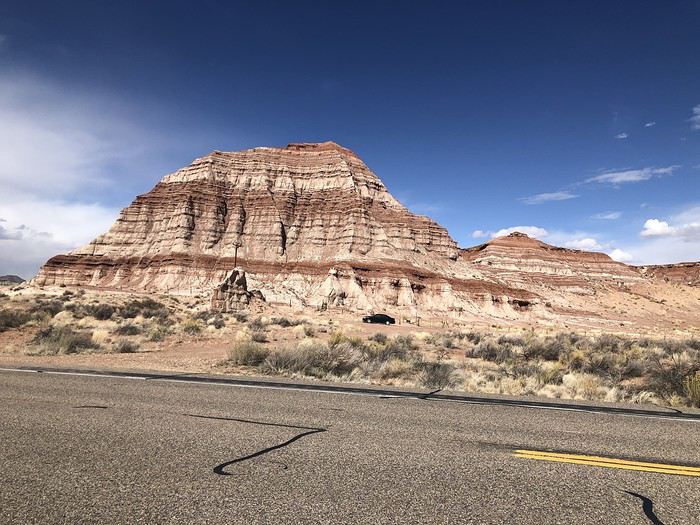
Puis sur le parking, ou se trouve la voiture noire, on voit le panneau qui vous rassure sur le nom du park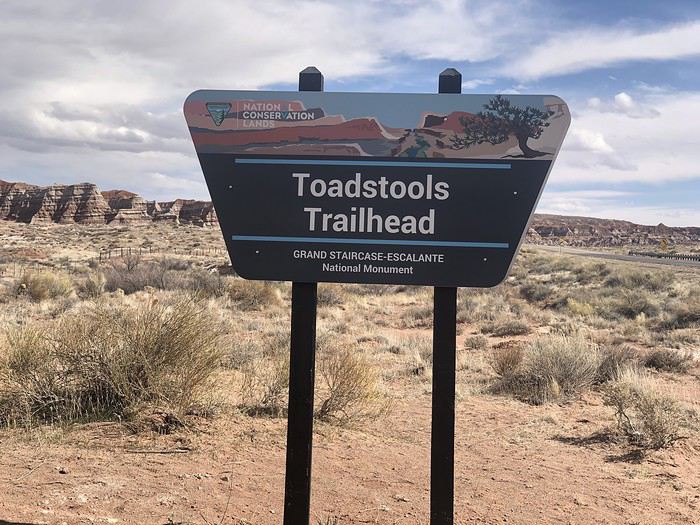
Il y a aussi un panneau qui vous informe sur ce qu'est un toadstool, c'est à-dire un champignon vénéneux, mais si vous allez sur place vous le verrez. Vous aurez toutes les infos sur la formation des toadstools, et aussi sur le fait que le chemin allé simple fait 0,8 miles et aller retour fait 1,6 miles. Je n'ai pas très bien compris l'intérêt de la distance aller simple et me suis demandée s'il y avait des gens qui comptaient rester la-bas définitivement??? 🤪
Ce panneau vous informe aussi du fait qu'en été il peut y faire terriblement chaud, et qu'il vaut mieux vous munir de litres d'eau, d'un chapeau..... A notre arrivée début mars, la température extérieure est de 15°C, le soleil éclaire juste ce qu'il faut, une petite bouteille d'eau pour chacun de nous est amplement suffisante, et de chapeau que nenni!
08 miles aller simple....Mais en fait, vous marcherez beaucoup plus que ça, car une fois sur le site il y aura tellement de coins qui vous attireront que vous y passerez facilement plus de 2 heures si vous vous donnez la peine d'aller découvrir les recoins qui sont derrière le site principal. Et surtout si vous vous donnez la peine de farfouiller un peu. C'est un vrai jeu de chasse au trésor auquel nous nous sommes livrés.
Donc une fois que nous avons complété le registre inséré dans une boite métallique noire qui permet aux rangers de savoir qui chercher s'il vous prenait l'envie d'y rester définitivement, et qu'ensuite nous avons franchi la barrière en barbelés qui laisse entrer les humains qui peuvent se faufiler, mais pas les bovins et les ovins qui ne pourraient pas tordre leur abdomen pour suivre le grillage, vous découvrez de plus près les massifs chocolatés.
Puis vous découvrez que vous avez le choix de marcher dans des washs (ce sont des lits de rivière à sec)
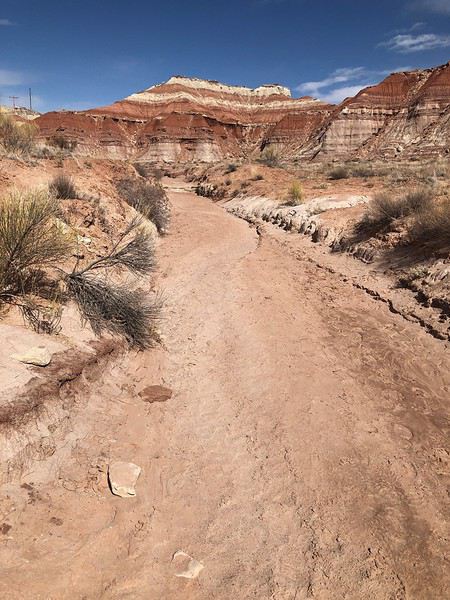
Les massifs chocolatés sont parfois ornés de chantilly, et parfois, le sentier semble sortir du wash pour venir s'incruster entre les mamelons. C'est ce que montre le petit poteau planté sur la droite. C'est une sorte de cairn civilisé, quoi.
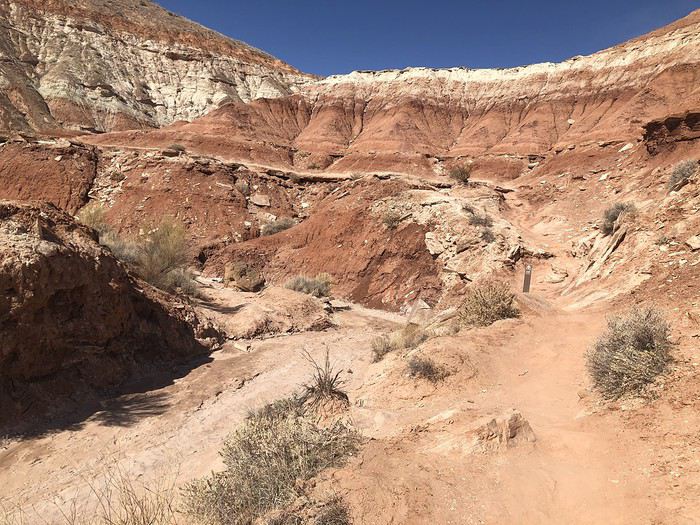
Le sentier peut parfois devenir un peu étroit, et si vous n'êtes pas à l'aise, il vaut mieux retourner dans le wash.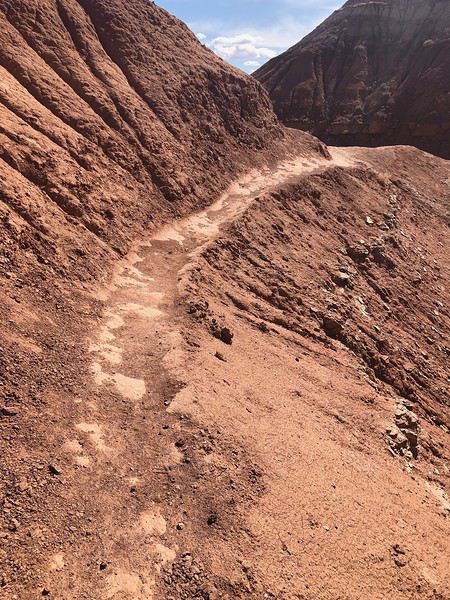
Parfois, c'est carrément acrobatique. Je me suis bien aidée de mes bâtons de marche.
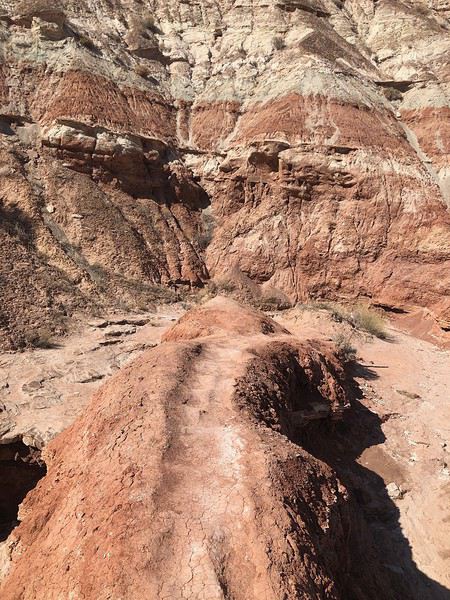
Parfois ce poteau soi disant indicateur m'a laissé perplexe. Tout droit semble-t-il dire... oui mais où est le tout droit en question?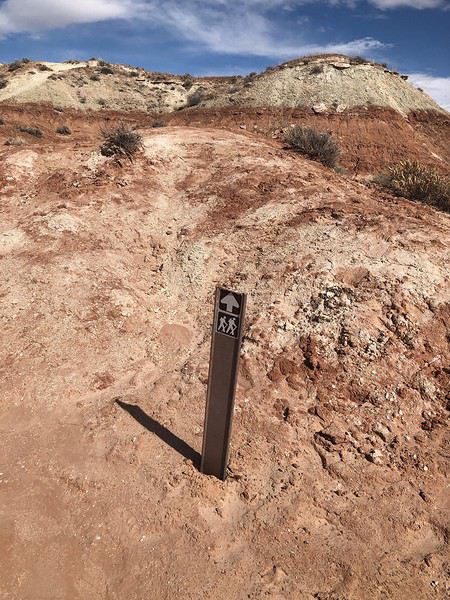
Inutile de dire que s'il a plu les jours qui précèdent votre passage, ou s'il a neigé, alors c'est une vraie pataugeoire dans laquelle vous évoluez. De simples sandales comme j'ai vu des gens en porter, ou même les chaussures de randonnée peuvent conduire à des chutes rocambolesques, ou causer des blessures sérieuses... Nous avons eu la chance en fin d'hiver d'être à une période sèche.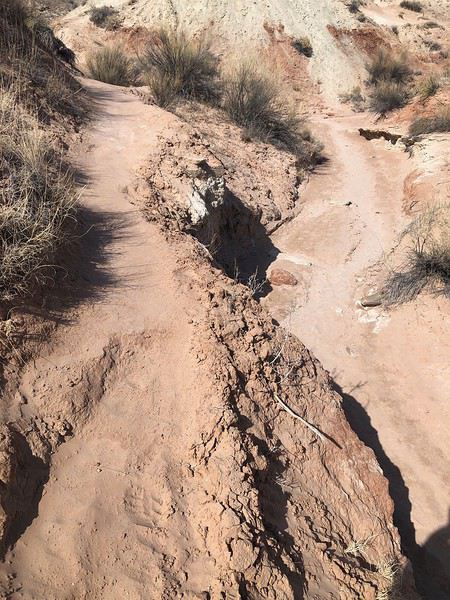
Et puis, il arrive que vous vous trouviez devant une ouverture comme celle là. Et à ce moment précis, plus aucun poteau, sinon ce ne serait pas marrant. Vous sauriez où aller, ce qui n'est manifestement pas le but. Alors, vous suivez votre instinct. Plutôt à droite? Plutôt à gauche? non? au centre alors?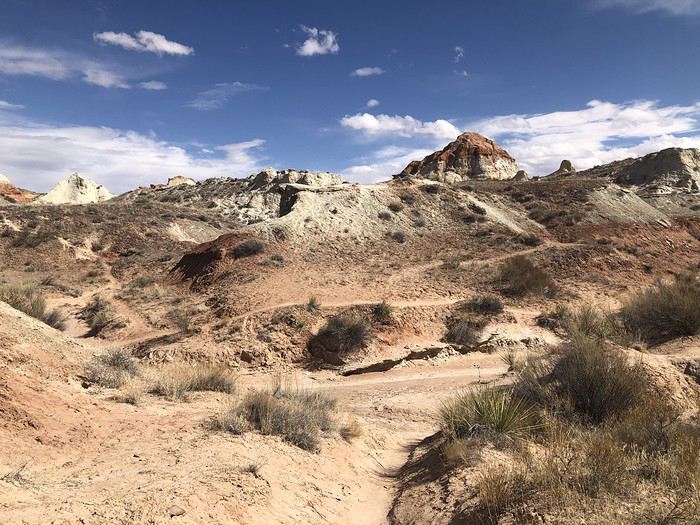
Et bien j'n'en sais rien. J'ai pris une direction au hasard, (ça fonctionne parfois) et j'ai atterri en face de ça.
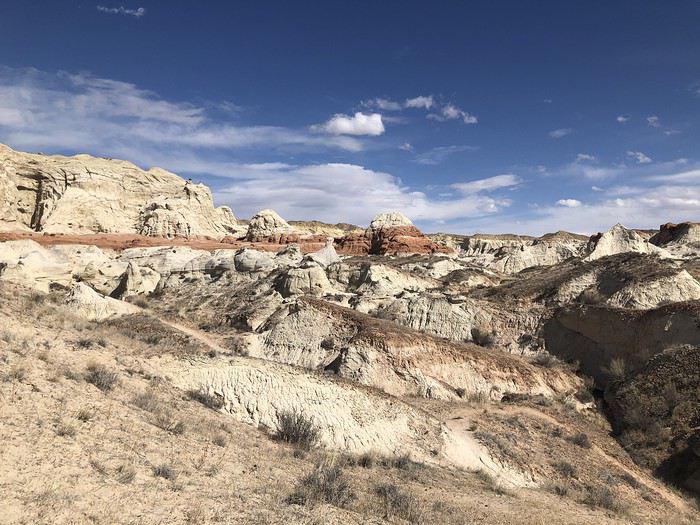
Sur ma gauche se trouvait le fameux chameau qui est sur toutes les photos de photographes professionnels, d'ailleurs sur place, il y en avait un qui ne s'intéressait qu'à ce mastodonte. C'est comme s'il était hermétique à toute la magie du reste.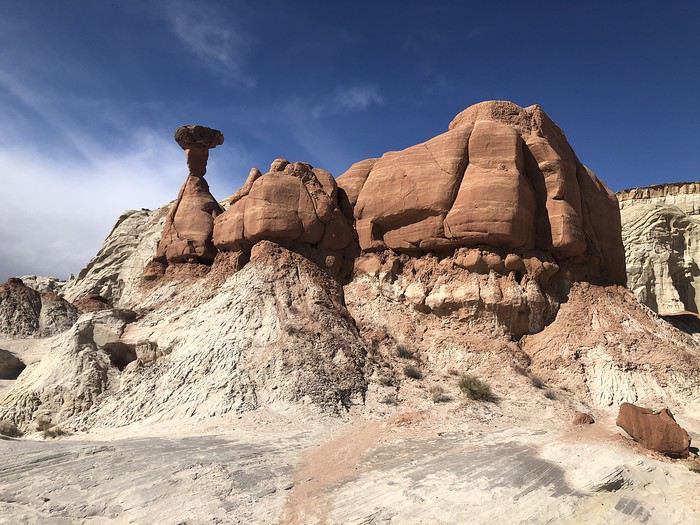
D'ailleurs, il s'est plein à mon mari du mauvais balisage des pistes qui lui avait fait perdre du temps. Il n'est resté qu'autour du chameau, le prenant sous toutes ses coutures, avec différents éclairages. Bon, comme ça, c'est un truc de vrai photographe et que je n'en suis pas, vous n'aurez donc pas la super photo avec le super éclairage qui fait rêver. Au lieu de ça, je suis partie sur la droite par rapport au chameau à la recherche d'un spot de hoodoos blancs, dont j'avais découvert l'existence sur un carnet. J'ai trouvé que ce mélange de blanc et de rouge était très beau.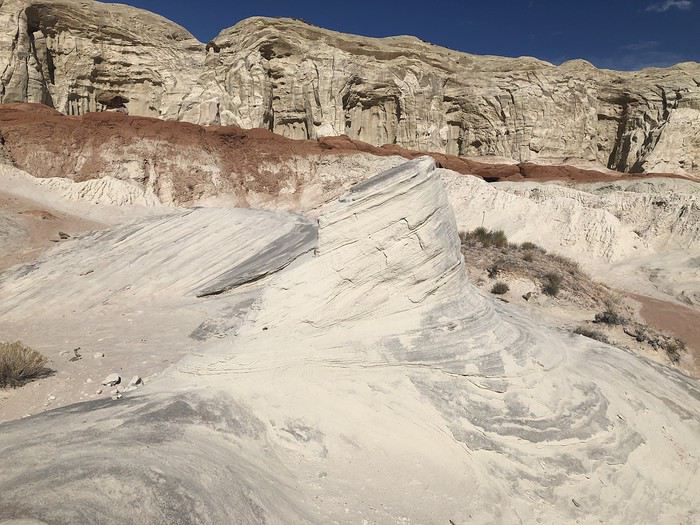
Vraiment très photogénique.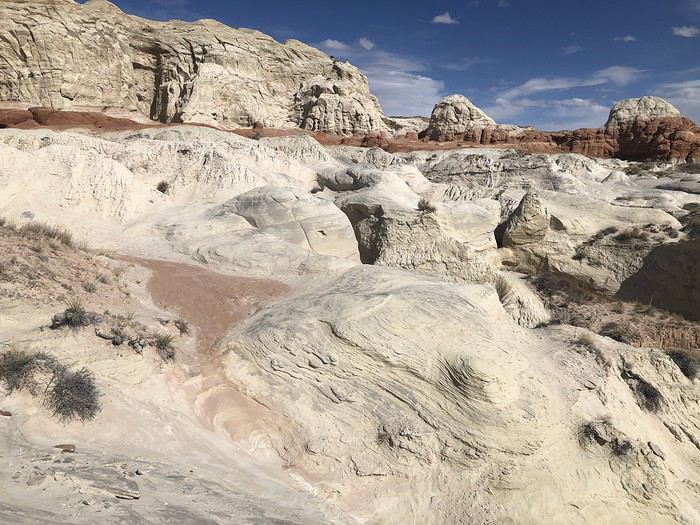
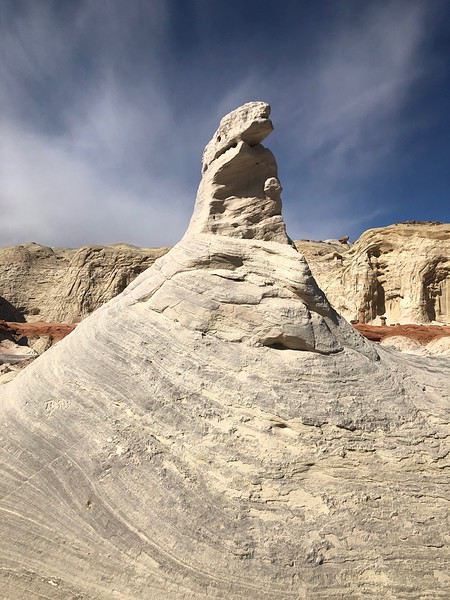
J'ai fait la connaissance du sphinx dont on a coupé le nez
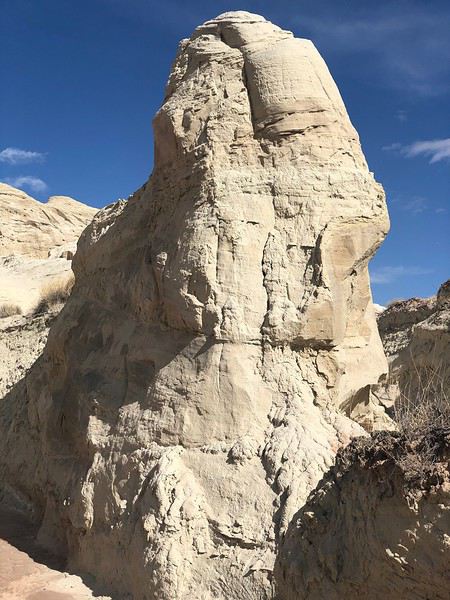
Puis j'ai continué à me diriger vers les massifs blancs qui sont sur la droite, curieuse de tout voir.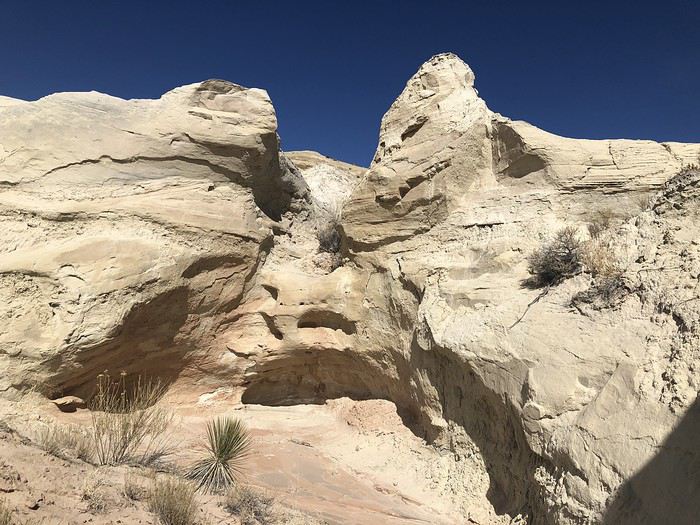
Je me suis retrouvée devant une paroi verticale que j'ai dû escalader, pour finalement, me retrouvée au milieu d'une alcove sans issue (enfin pour moi qui ne suis nullement cascadeuse). J'ai donc redescendu ma paroi verticale, et suis retournée sur mes pas.
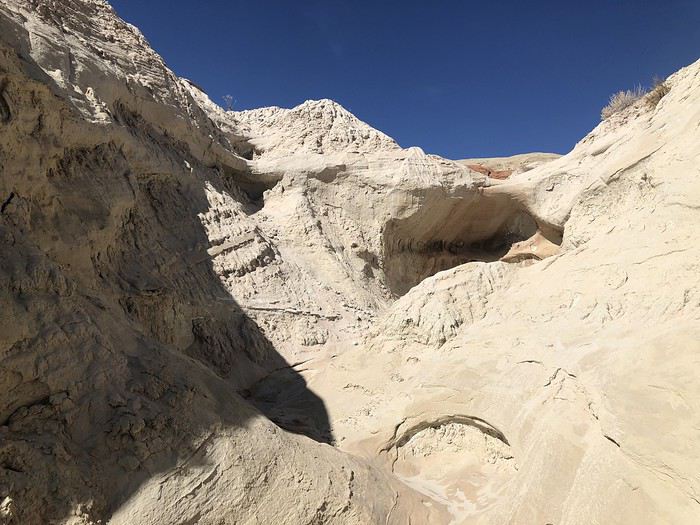
En revenant, je me suis retrouvée face à ce joli E.T. de Spielberg.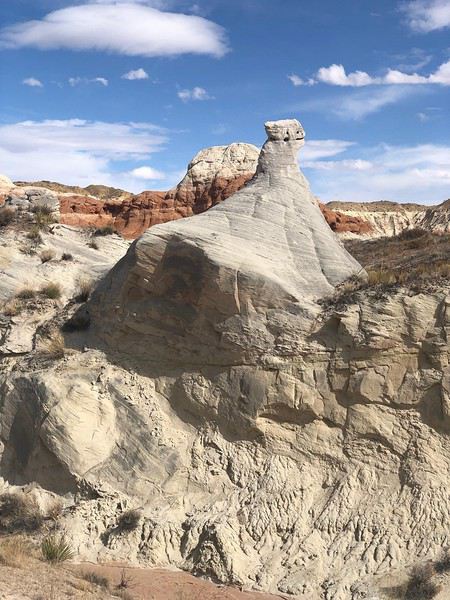
Puis après avoir laissé le chameau toujours sur ma gauche, je me suis retrouvée devant cette cour en rouge et blanc, avec quelques champignons qui émergeaient. Le tout entouré d'une paroi de colonnes blanches. C'est du plus bel effet.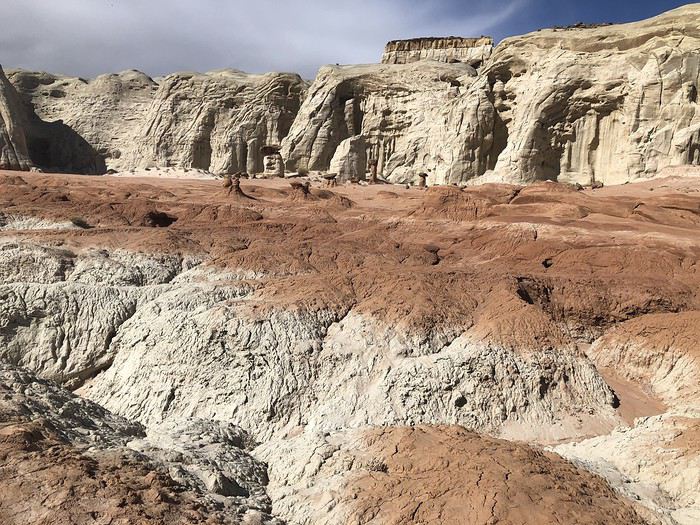
Le chameau au loin dans son environnement en rouge et blanc, a, je trouve, beaucoup plus d'assurance, surtout sous un ciel nuageux.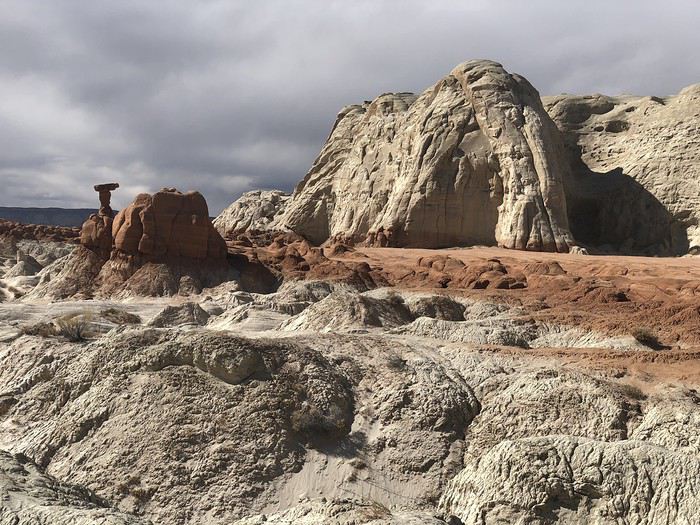
Il est une star parmi les autres, et ce personnage de Star wars ne me démentira pas.
Je suis revenues des States le dimanche, le mercredi, Trump annonçait la fermeture des frontières aux Européens. J'ai eu une profonde respiration en entendant la nouvelle!!!
Je ne raconterai pas tout mon voyage... J'aime autant le chemin qui conduit aux sites que les sites eux-mêmes.
J'ai eu un vrai coup de cœur pour pleins de sites dont j'ai profité dans le south west, mais ce qui m'a surtout marqué, c'est le fait que souvent, sur les carnets, on a parfois l'impression (à tort d'ailleurs) qu'un site c'est juste une succession de choses importantes à voir dont il faut faire la liste et puis c'est tout.
Je vais donc vous faire découvrir toadstool à ma façon, j'aimerais vous faire découvrir les différentes étapes de ma découverte de ce park gratuit..
Voici tout d'abord ce qu'on découvre de la route: des montagnes chocolatées. Le parking placé devant à notre arrivée ne comporte qu'une voiture noire en fin de matinée.
Puis sur le parking, ou se trouve la voiture noire, on voit le panneau qui vous rassure sur le nom du park
Il y a aussi un panneau qui vous informe sur ce qu'est un toadstool, c'est à-dire un champignon vénéneux, mais si vous allez sur place vous le verrez. Vous aurez toutes les infos sur la formation des toadstools, et aussi sur le fait que le chemin allé simple fait 0,8 miles et aller retour fait 1,6 miles. Je n'ai pas très bien compris l'intérêt de la distance aller simple et me suis demandée s'il y avait des gens qui comptaient rester la-bas définitivement??? 🤪
Ce panneau vous informe aussi du fait qu'en été il peut y faire terriblement chaud, et qu'il vaut mieux vous munir de litres d'eau, d'un chapeau..... A notre arrivée début mars, la température extérieure est de 15°C, le soleil éclaire juste ce qu'il faut, une petite bouteille d'eau pour chacun de nous est amplement suffisante, et de chapeau que nenni!
08 miles aller simple....Mais en fait, vous marcherez beaucoup plus que ça, car une fois sur le site il y aura tellement de coins qui vous attireront que vous y passerez facilement plus de 2 heures si vous vous donnez la peine d'aller découvrir les recoins qui sont derrière le site principal. Et surtout si vous vous donnez la peine de farfouiller un peu. C'est un vrai jeu de chasse au trésor auquel nous nous sommes livrés.
Donc une fois que nous avons complété le registre inséré dans une boite métallique noire qui permet aux rangers de savoir qui chercher s'il vous prenait l'envie d'y rester définitivement, et qu'ensuite nous avons franchi la barrière en barbelés qui laisse entrer les humains qui peuvent se faufiler, mais pas les bovins et les ovins qui ne pourraient pas tordre leur abdomen pour suivre le grillage, vous découvrez de plus près les massifs chocolatés.
Puis vous découvrez que vous avez le choix de marcher dans des washs (ce sont des lits de rivière à sec)
Les massifs chocolatés sont parfois ornés de chantilly, et parfois, le sentier semble sortir du wash pour venir s'incruster entre les mamelons. C'est ce que montre le petit poteau planté sur la droite. C'est une sorte de cairn civilisé, quoi.
Le sentier peut parfois devenir un peu étroit, et si vous n'êtes pas à l'aise, il vaut mieux retourner dans le wash.
Parfois, c'est carrément acrobatique. Je me suis bien aidée de mes bâtons de marche.
Parfois ce poteau soi disant indicateur m'a laissé perplexe. Tout droit semble-t-il dire... oui mais où est le tout droit en question?
Inutile de dire que s'il a plu les jours qui précèdent votre passage, ou s'il a neigé, alors c'est une vraie pataugeoire dans laquelle vous évoluez. De simples sandales comme j'ai vu des gens en porter, ou même les chaussures de randonnée peuvent conduire à des chutes rocambolesques, ou causer des blessures sérieuses... Nous avons eu la chance en fin d'hiver d'être à une période sèche.
Et puis, il arrive que vous vous trouviez devant une ouverture comme celle là. Et à ce moment précis, plus aucun poteau, sinon ce ne serait pas marrant. Vous sauriez où aller, ce qui n'est manifestement pas le but. Alors, vous suivez votre instinct. Plutôt à droite? Plutôt à gauche? non? au centre alors?
Et bien j'n'en sais rien. J'ai pris une direction au hasard, (ça fonctionne parfois) et j'ai atterri en face de ça.
Sur ma gauche se trouvait le fameux chameau qui est sur toutes les photos de photographes professionnels, d'ailleurs sur place, il y en avait un qui ne s'intéressait qu'à ce mastodonte. C'est comme s'il était hermétique à toute la magie du reste.
D'ailleurs, il s'est plein à mon mari du mauvais balisage des pistes qui lui avait fait perdre du temps. Il n'est resté qu'autour du chameau, le prenant sous toutes ses coutures, avec différents éclairages. Bon, comme ça, c'est un truc de vrai photographe et que je n'en suis pas, vous n'aurez donc pas la super photo avec le super éclairage qui fait rêver. Au lieu de ça, je suis partie sur la droite par rapport au chameau à la recherche d'un spot de hoodoos blancs, dont j'avais découvert l'existence sur un carnet. J'ai trouvé que ce mélange de blanc et de rouge était très beau.
Vraiment très photogénique.
J'ai fait la connaissance du sphinx dont on a coupé le nez
Puis j'ai continué à me diriger vers les massifs blancs qui sont sur la droite, curieuse de tout voir.
Je me suis retrouvée devant une paroi verticale que j'ai dû escalader, pour finalement, me retrouvée au milieu d'une alcove sans issue (enfin pour moi qui ne suis nullement cascadeuse). J'ai donc redescendu ma paroi verticale, et suis retournée sur mes pas.
En revenant, je me suis retrouvée face à ce joli E.T. de Spielberg.
Puis après avoir laissé le chameau toujours sur ma gauche, je me suis retrouvée devant cette cour en rouge et blanc, avec quelques champignons qui émergeaient. Le tout entouré d'une paroi de colonnes blanches. C'est du plus bel effet.
Le chameau au loin dans son environnement en rouge et blanc, a, je trouve, beaucoup plus d'assurance, surtout sous un ciel nuageux.
Il est une star parmi les autres, et ce personnage de Star wars ne me démentira pas.