Results for "Philippines+sécurité"
About 10,090 results.
More options
Many results are in French, the community’s main language. English translations are added over time.
Search results
Vivre aux Philippines ou ailleurs?
Bonjour à tous,
J'aimerai avoir votre opinion sur un sujet qui n'est pas facile à traîter.
Ma femme est des Philippines et moi même je suis Français, son désir est de vouloir partir de son pays pour aller vivre ailleurs comme le Canada ou les Etats Unis . Moi par contre mon souhait est de vouloir vivre dans son pays et de faire des affaires, le problème est que nous ne sommes pas d'accord sur ce point! Alors que faire ??????? Si quelqu'un a déjà eu ce genre de problèmes similaires, j 'attends vos réponses et vos conseils avec impatience car une décision doit être de toute façon prise . Merci à tous par avance .
Ma femme est des Philippines et moi même je suis Français, son désir est de vouloir partir de son pays pour aller vivre ailleurs comme le Canada ou les Etats Unis . Moi par contre mon souhait est de vouloir vivre dans son pays et de faire des affaires, le problème est que nous ne sommes pas d'accord sur ce point! Alors que faire ??????? Si quelqu'un a déjà eu ce genre de problèmes similaires, j 'attends vos réponses et vos conseils avec impatience car une décision doit être de toute façon prise . Merci à tous par avance .
Plongée en bouteilles aux Philippines
🙂 salut vribody, je dois me rendre aux philippines, et j'aimerai plonger en bouteilles . Ou dois je aller ? quels sont les prix pratiques ? verifient ils les diplomes (j'ai le 1er degre ffessm, mais j'ai paume le diplome, et puis quant le refaire, bonjour, pas le temps) . merci
Quel quartier choisir pour vivre à Manille?
Salut a tous,
je dois aller vivre a Manille a partir du mois de juillet... Je n' y suis alle que quelques jours. On m'incite a vivre dans le quartier de makati, mais j'ai trouve ca un peu impersonnel, l'ambiance centre commercial n'est pas trop mon fort. Est-ce qu'il y a un quartier different ou on puisse vivre et qui soit sympa, sans forcement croiserm des hordes d'Australiens et d'Americains en short ? y a t-il un quartier un peu ancien par exemple ? non pas que je sois friand de musees mais bon... L'idee est d'essayer d'eviter un ghetto a expatries, bien que ce ne soit peut etre pas possible la-bas. y a t-il un quartier ou il y a une ambiance un peu culturelle, genre galeries, librairies ... ? Voila merci pour vos reponses, Ikid
je dois aller vivre a Manille a partir du mois de juillet... Je n' y suis alle que quelques jours. On m'incite a vivre dans le quartier de makati, mais j'ai trouve ca un peu impersonnel, l'ambiance centre commercial n'est pas trop mon fort. Est-ce qu'il y a un quartier different ou on puisse vivre et qui soit sympa, sans forcement croiserm des hordes d'Australiens et d'Americains en short ? y a t-il un quartier un peu ancien par exemple ? non pas que je sois friand de musees mais bon... L'idee est d'essayer d'eviter un ghetto a expatries, bien que ce ne soit peut etre pas possible la-bas. y a t-il un quartier ou il y a une ambiance un peu culturelle, genre galeries, librairies ... ? Voila merci pour vos reponses, Ikid
Informations sur les Philippines
Bonjour à tous,
J'aurais aimé avoir un avis sur les philipines sur différents points:
1. Est-il facile de se déplacer dans le pays ? 2. Est-ce un pays "dangereux" ? 3. Les habitants sont-ils accueillants ? 4. Quelles sont les beautés à découvrir ?
Merci par avance !
J'aurais aimé avoir un avis sur les philipines sur différents points:
1. Est-il facile de se déplacer dans le pays ? 2. Est-ce un pays "dangereux" ? 3. Les habitants sont-ils accueillants ? 4. Quelles sont les beautés à découvrir ?
Merci par avance !
Risques aux Philippines?
Bonjour,
Je suis entrain d'organiser mon itinéraire de voyage sur 8 mois à partir de cet été. On m'a parlée des Philippines mais j'aimerais en savoir plus sur ces îles, sachant que je pars seule. Je crois comprendre que certaines parties ne sont pas recommandées aux voyageurs (Mindanao, Palawan, Basilan, Tawi-Tawi, Sulu). Pouvez-vous me confirmer ? Le reste des Philippines vaut-il le coup ? Est-ce assez facile d'accès et sans risque pour le reste des îles ?
Merci pour vos expériences et informations.
Krole
Je suis entrain d'organiser mon itinéraire de voyage sur 8 mois à partir de cet été. On m'a parlée des Philippines mais j'aimerais en savoir plus sur ces îles, sachant que je pars seule. Je crois comprendre que certaines parties ne sont pas recommandées aux voyageurs (Mindanao, Palawan, Basilan, Tawi-Tawi, Sulu). Pouvez-vous me confirmer ? Le reste des Philippines vaut-il le coup ? Est-ce assez facile d'accès et sans risque pour le reste des îles ?
Merci pour vos expériences et informations.
Krole
Trip report: Coron and Palawan in the Philippines
Hi everyone,
We (two adults, 74 and 70 years old) had already shared a travel journal about our first trip to the Philippines in February/March 2019 on this forum (https://voyageforum.com/v.f?post=9377175;search_string=carnet%20philippines). We had visited Manila, the Banaue rice terraces, Sagada, the Visayas (Bohol, Siquijor, Dumaguette), and on our way back to Luzon, the Taal volcano before returning to France. Delighted by this trip, organized by the French-speaking agency Alizé, we decided to further explore this beautiful country, this time focusing on Coron and Palawan.
Before writing this journal, I should mention that these are personal comments and don’t reflect any differing opinions. Without any literary or photographic talent, I’ll stick to the facts and share a few details about the visits, hotels, and restaurants.
Preparations
We decided to return in mid-January 2025 and consulted three French-speaking tour operators to create a trip based on our wishes (places to visit, type of accommodation) and budget. Comparing three operators helped us weigh their advice and make our choices. Only our first operator respected the budget, a second came close, and the third proposed a slightly more upscale trip. In the end, we chose the agency from our first trip. Our discussions helped refine our itinerary, and when we reviewed it point by point, the document provided was perfect, full of great tips. The most debated point was a 3-day, 2-night cruise between Coron and Palawan. We were tempted but worried about being the only "older" travelers among younger people and feared two uncomfortable nights. Reassured by our tour operator, we finally opted for this "exploration." We’ll come back to that later. Once the choice was made and dates set, we booked our international flights with Cathay Pacific for 750 € per person, which offers the best schedules (short layovers) at an acceptable price for flights arriving in Cebu. Our trip started on February 25 and returned to Paris on March 15.
International flights
The round-trip flights went smoothly. Cathay does the job well, without frills. The service quality seems to have slightly declined compared to our previous trips with them. Hong Kong Airport is huge but very practical. Note that not all airlines serve Cebu. Recommendation: Fill out your Philippine entry form within 72 hours before your flight. This can prevent issues with the airline (possible boarding refusal) and saves a lot of time upon arrival (see the Philippine embassy website).
Domestic flights
For our two domestic flights—Cebu to Coron and Puerto Princesa to Cebu—our tour operator chose Philippine Airlines and their propeller planes. No problems there.
Day 1: We landed around 12 PM (local time) after 17 hours of travel. A driver was waiting for us at the airport exit and took us to our hotel, intentionally chosen near the airport (Mandaue, about 10 minutes away) to help us recover and get a good night’s sleep before our early morning domestic flight the next day. The Mayoo Hotel, reasonably priced, was perfect for this. Large, beautiful room in a new building—clean, comfortable, with a spa. We could relax by the pool on the 16th floor and enjoy the city view. The breakfast was exceptional, and the staff was smiling, attentive, and helpful. An ATM in the lobby allowed for withdrawals. However, the hotel is in a neighborhood with nothing to see or do. We dined at the Korean restaurant K-GOGI across from the hotel—a real attraction and a great discovery.
Day 2: After a restful night, we were driven to the airport around 6:30 AM for an 8:10 AM flight from Cebu to Busuanga (Coron).
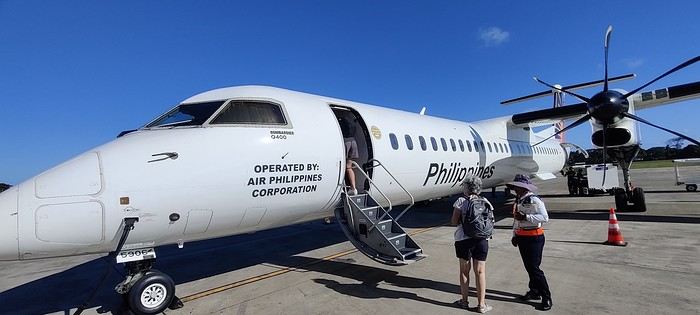
The flight was uneventful. Upon arrival, we paid 200 pesos per person for the Coron tourist fee before a 40-minute transfer to our hotel: Natura Resort, located outside the city in a secluded spot. The setting is stunning—a beautifully maintained tropical garden, a pleasant pool, and the option to book massages. The cottages are tropical-style with thatched roofs, simple and unpretentious.
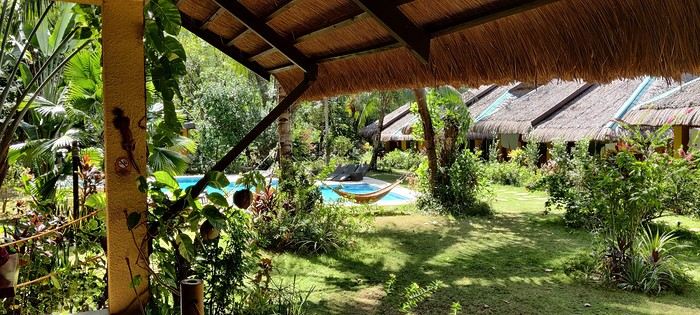
The owner, who speaks French, told us that given the heat and our ages, climbing the 721 steps to the top of Mount Tapyas wasn’t necessary. She gave us a few rooftop recommendations to watch the sunset over Coron Bay. After a good swim in the pool and a meal at the resort’s pleasant restaurant, we hired a tricycle to go into town. We were told it costs 150 pesos one way, and depending on the return time, it could exceed 250 pesos. But our driver gave us his WhatsApp number and charged the same price regardless of the time. He just earned two days’ worth of customers. He dropped us off at the port where bangkas (local boats) gather for day trips. It was the end of the day, so there was a rush. A few shops around the port sold waterproof bags for marine excursions at reasonable prices (compared to back home), after some bargaining. We wandered the town’s alleys looking for the Top Hotel, whose rooftop is famous. Indeed, it’s perfectly located to admire the sunset and enjoy a refreshing drink.
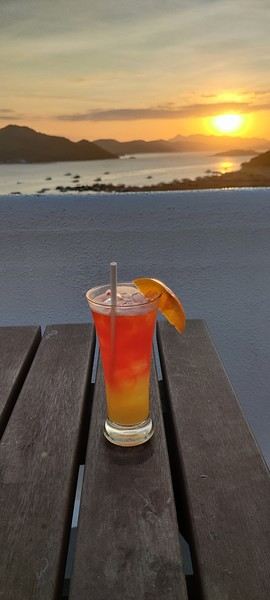
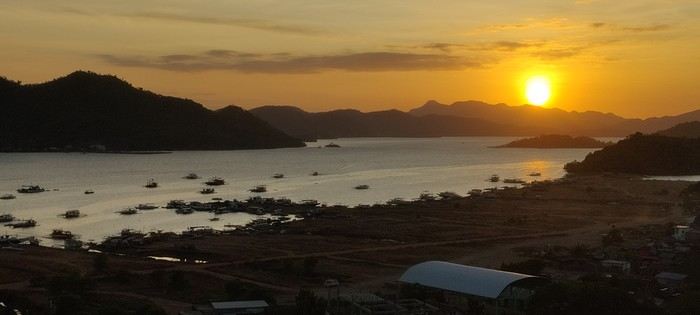
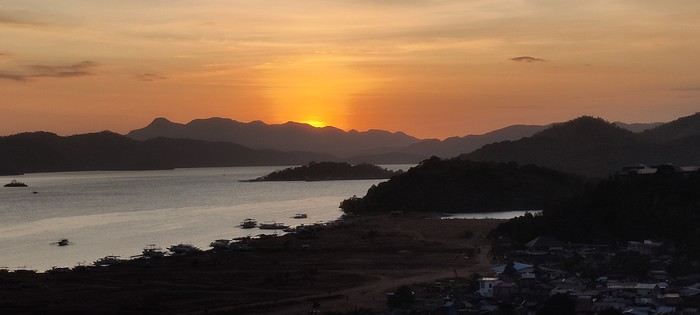
We dined nearby at a small Chinese restaurant, then just had to call our driver to head back. The night wasn’t entirely restful—our hotel had a soundtrack of all the countryside animals, and it seemed they had no set bedtime! :
Preparations
We decided to return in mid-January 2025 and consulted three French-speaking tour operators to create a trip based on our wishes (places to visit, type of accommodation) and budget. Comparing three operators helped us weigh their advice and make our choices. Only our first operator respected the budget, a second came close, and the third proposed a slightly more upscale trip. In the end, we chose the agency from our first trip. Our discussions helped refine our itinerary, and when we reviewed it point by point, the document provided was perfect, full of great tips. The most debated point was a 3-day, 2-night cruise between Coron and Palawan. We were tempted but worried about being the only "older" travelers among younger people and feared two uncomfortable nights. Reassured by our tour operator, we finally opted for this "exploration." We’ll come back to that later. Once the choice was made and dates set, we booked our international flights with Cathay Pacific for 750 € per person, which offers the best schedules (short layovers) at an acceptable price for flights arriving in Cebu. Our trip started on February 25 and returned to Paris on March 15.
International flights
The round-trip flights went smoothly. Cathay does the job well, without frills. The service quality seems to have slightly declined compared to our previous trips with them. Hong Kong Airport is huge but very practical. Note that not all airlines serve Cebu. Recommendation: Fill out your Philippine entry form within 72 hours before your flight. This can prevent issues with the airline (possible boarding refusal) and saves a lot of time upon arrival (see the Philippine embassy website).
Domestic flights
For our two domestic flights—Cebu to Coron and Puerto Princesa to Cebu—our tour operator chose Philippine Airlines and their propeller planes. No problems there.
Day 1: We landed around 12 PM (local time) after 17 hours of travel. A driver was waiting for us at the airport exit and took us to our hotel, intentionally chosen near the airport (Mandaue, about 10 minutes away) to help us recover and get a good night’s sleep before our early morning domestic flight the next day. The Mayoo Hotel, reasonably priced, was perfect for this. Large, beautiful room in a new building—clean, comfortable, with a spa. We could relax by the pool on the 16th floor and enjoy the city view. The breakfast was exceptional, and the staff was smiling, attentive, and helpful. An ATM in the lobby allowed for withdrawals. However, the hotel is in a neighborhood with nothing to see or do. We dined at the Korean restaurant K-GOGI across from the hotel—a real attraction and a great discovery.
Day 2: After a restful night, we were driven to the airport around 6:30 AM for an 8:10 AM flight from Cebu to Busuanga (Coron).
The flight was uneventful. Upon arrival, we paid 200 pesos per person for the Coron tourist fee before a 40-minute transfer to our hotel: Natura Resort, located outside the city in a secluded spot. The setting is stunning—a beautifully maintained tropical garden, a pleasant pool, and the option to book massages. The cottages are tropical-style with thatched roofs, simple and unpretentious.
The owner, who speaks French, told us that given the heat and our ages, climbing the 721 steps to the top of Mount Tapyas wasn’t necessary. She gave us a few rooftop recommendations to watch the sunset over Coron Bay. After a good swim in the pool and a meal at the resort’s pleasant restaurant, we hired a tricycle to go into town. We were told it costs 150 pesos one way, and depending on the return time, it could exceed 250 pesos. But our driver gave us his WhatsApp number and charged the same price regardless of the time. He just earned two days’ worth of customers. He dropped us off at the port where bangkas (local boats) gather for day trips. It was the end of the day, so there was a rush. A few shops around the port sold waterproof bags for marine excursions at reasonable prices (compared to back home), after some bargaining. We wandered the town’s alleys looking for the Top Hotel, whose rooftop is famous. Indeed, it’s perfectly located to admire the sunset and enjoy a refreshing drink.
We dined nearby at a small Chinese restaurant, then just had to call our driver to head back. The night wasn’t entirely restful—our hotel had a soundtrack of all the countryside animals, and it seemed they had no set bedtime! :
Itinéraire 3 mois en Asie Philippines - Malaisie - Indonésie
Bonjour à tous,
Après 2 séjours de 5 semaines chacun en Thaïlande, l'envie de retourner en Asie nous démange...
Nous avons pour projet de partir 3 mois en avril, mai et juin avec nos deux enfants qui auront 6 ans et 3 ans.
C'est encore un "projet" et nous bloquons vraiment sur l'itinéraire (qui me parait essentiel pour dessiner ce projet).
Pensez-vous que ce soit simple de faire Philippines > Malaisie > Indonésie ? (ordre le plus logique par rapport aux saisons)
Pensez-vous qu'une escale en nouvelle Calédonie ou Polynésie française au cours du voyage puisse être à envisager ?
Est-ce que l'ordre des pays vous parait le plus simple?
Merci de vos réponses !
Pensez-vous que ce soit simple de faire Philippines > Malaisie > Indonésie ? (ordre le plus logique par rapport aux saisons)
Pensez-vous qu'une escale en nouvelle Calédonie ou Polynésie française au cours du voyage puisse être à envisager ?
Est-ce que l'ordre des pays vous parait le plus simple?
Merci de vos réponses !
Adventures of a Bygone Era: The Philippines in 1984
After several discussions on VF about travel journals from the Philippines, I decided to write this curiosity: a trip report from a journey made in 1984, when traveling to the Philippines was still an adventure.
A curiosity because writing a travel journal about a trip 35 years later isn’t common, but also (mostly?) because exploring the Philippines at that time had little in common with traveling there today.
Obviously, I’ve forgotten a number of facts, most of the details, but with the help of a few notes from that time and a stack of slides (yes, there was life before digital 😊), many memories came back and added to the highlights I’d never forgotten. The scanned slides aren’t always great quality, but there are still quite a few to brighten up this chatter. Back then, we didn’t snap photos like we do now—film was too expensive—so I don’t have pictures of every place we visited... too bad, comparing some of those spots to how they look today would’ve been interesting.
Why "Adventures"? Why call it "Adventures" in the Philippines in 1984, a word so often used for a simple exotic trip? - Because the lack of information (no *Guide du Routard*, no *Lonely Planet*, no *Michelin Guide*, nothing, and obviously no internet) gave this trip what’s at the heart of adventure: the unknown. - Because the political situation made the stay sometimes dangerous. - Because transportation conditions were always epic, often perilous. - Because the question of where we’d spend the night came up almost every evening. - And for... quite a few other reasons.
That said, we weren’t exactly explorers!
Why the Philippines? First of all, why go to the Philippines in 1984—a country not exactly set up for tourism and about which we knew very little? How could we get an idea of the beauty of the Philippines and its points of interest when we had no guides or photos?
The idea came to us from Thailand a year earlier, during our first long-haul trip. After touring the north of the country, we met a Frenchman living in Phuket, where there were only a few tourists in Patong, with just a few small hotels and guesthouses. Kata and Karon had no buildings or roads, Rawai only had three palm-thatched bungalows, including ours, and the other islands were unknown to tourists. There was plenty to discover, and we wanted to return to this beautiful country... but the Frenchman made us dream about the Philippines—a country to explore, with wild landscapes.
Long evenings of discussion over multiple Sprite-Mekong cocktails (what memories of those headaches!) finally convinced us we had to go to the Philippines.
Episode 0: Before Departure The decision was made: we’d go to the Philippines in May 1984. Our friends and family were surprised when we announced we were going on vacation to the Philippines (a bit like saying today we were going paddleboarding in the Kerguelen Islands 🤪).
These days, preparing for each of our trips takes long evenings of research, planning, and noting down good addresses... etc. But for the Philippines in 1984, preparation was quick: we had very little information about the country, we were leaving almost at random, and the discovery would only be more exciting.
We still had a few bits of info gathered here and there: the rice terraces in northern Luzon, volcanoes, Negros where we were supposed to visit an acquaintance, Cebu and its marine life (we ended up going elsewhere), and absolutely avoid Mindanao, which was practically at war with the regime. That was about it, but it was already a great itinerary.
Nothing was organized in advance; we’d see day by day. We had no idea about travel times or even the existence of transportation options. The main (and sometimes only) way to connect two islands was by overloaded, rusty ferry. Only the big cities had airports.
Let’s Go: Episode 1: Paris to Manila My travel journals always start after arriving at the airport—the Europe-to-“Other Continent” trip isn’t interesting—but the flight to the Philippines was already an adventure, so I’ll make an exception.
This was the era when only a few Asian airlines were on par with Western ones: Thai, Singapore Airlines, and Philippine Airlines. They had beautiful, brand-new planes, and to attract customers (almost exclusively “businessmen”) from the usual airlines (Air France, Lufthansa, British Airways), there was opulence on board: unlimited champagne, all sorts of cocktails... Compared to today’s long-haul flights, there was still one small difference: no personal screens, just one screen at the front of the cabin with one mandatory movie. And I don’t know why, but we only got James Bond films, both ways... that must’ve been the trend at the time.
The tourism boom to Southeast Asia hadn’t started yet, and the “Asian Tigers” weren’t a thing, so there weren’t many business trips. That meant long-haul flights made stops everywhere to fill the planes. Our Philippine Airlines Boeing 747 left London, picked us up in Paris, then stopped in Frankfurt to take on a few Germans. I don’t know why we then made a stop in Dubai—a totally exotic place at the time. There was nothing to do there... things have changed a lot since. It was a small town lost in the desert. The airport was tiny, with just one or two buildings and a supermarket. During the stopover, everyone had to get off the plane and walk to the supermarket. Photo and electronic equipment were dirt cheap—I guess that was the only reason for the stop. Maybe it was their first commercial move. Emirates didn’t exist yet, as I checked online, but anyway, the idea that such a remote place could have its own airline was unthinkable.
Online, I found this photo of Dubai Airport in 1980. Anyone who’s transited through today’s massive airport with its rows of A380s will appreciate it: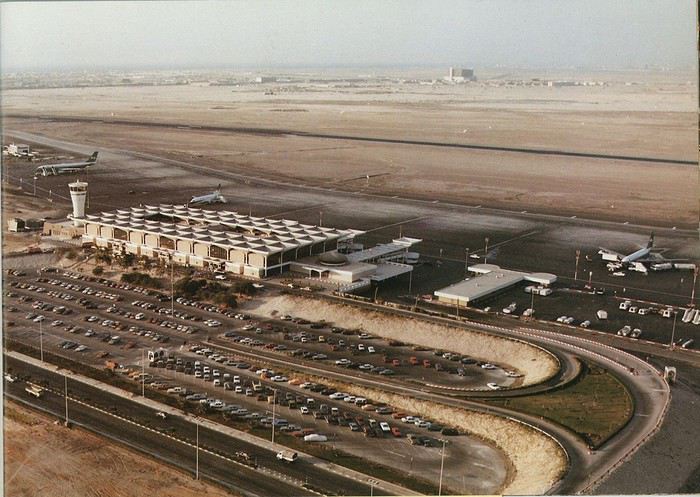
Next stop: New Delhi to drop off some Europeans and pick up a few Indians, and finally, the terminus: Manila. I don’t remember how long the trip took with its five stops—an unimaginable journey today. Despite all those stops to fill the plane, there was still enough space to stretch out on the four center seats of the 747, something that never happens these days despite all the flights in every direction.
So here we are, finally at Manila Airport around midnight.
Episode 1: Manila and Baguio To start, a quick note on the political and economic situation in the Philippines in 1984, which had consequences for us as tourists, as we’d soon realize upon arrival.
After several centuries of Spanish colonization, the Philippines became American at the start of the 20th century, then independent. In 1966, Marcos took power, and little by little, his regime sank into corruption and mismanagement, becoming a dictatorship with martial law, all for the benefit of his family and friends, who enriched themselves endlessly. The peak was the assassination of opposition leader Benigno Aquino in August 1983, which triggered harshly repressed protests. So we arrived a few months later in a very poor country, with omnipresent corruption and an extremely tense political situation, as we’d soon see for ourselves. Major protests took place in the main cities during our trip—I’ll come back to that. Two years later, Marcos fled to Hawaii after being forced out of power following rigged elections. This historical context explains a lot of the situations we found ourselves in over the following weeks.
Arriving in the middle of the night isn’t very cheerful. Manila was already a huge city with many slums, where you could find a few business hotels like the Hilton or Intercontinental—way out of our budget—and plenty of run-down hotels. Luckily, two Indians we’d chatted with on the plane offered to take us to their usual hotel. They came to Manila twice a year for business. We accepted their offer, relieved not to have to look for a place to stay in the middle of the night, figuring the address must be good since they came back every time... we were wrong 🙁
We left the airport and immediately got a taste of the local vibe when we got into the taxi: the police asked for our passports. We thought: what’s more normal than police in a dictatorship?
But that wasn’t it at all. Our two Indian friends explained that the police were noting our names along with the taxi number and time. Crime in Manila was so bad that the taxi driver would be held responsible if anything happened to us... welcome to the Philippines 😎 😎
Historically, the Philippines was a very violent country, where everything was settled with guns or machetes. Previous governments had banned carrying weapons, but Marcos later allowed the free sale and carrying of guns, and disputes were settled with pistols again (or worse, as we’d discover later). Since he’d released most of the criminals from prison to form a paramilitary militia at his service (I’ll talk about our encounter with these “heroes” later), it was pretty dangerous to go into many parts of Manila, where these “tonton macoutes” ruled.
We arrived at our hotel without incident... and then things started badly. The room was infested with big cockroaches—exactly what I hate most in those kinds of countries. No way to find another hotel at that hour. After the long flight, the urge to take a shower was so strong that we squeezed into the bathroom as best we could. After that, I don’t remember—I guess we must’ve fallen asleep exhausted under the sheets in the heat... air conditioning wasn’t widespread yet.
The next day, we just wanted to leave that dump as soon as possible. So we decided to head north right away, stopping in Baguio, and we’d visit Manila a bit on the way back.
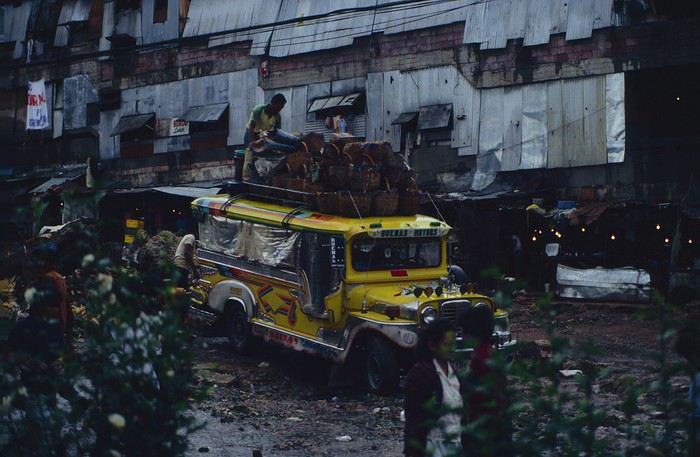
When we stepped outside, we discovered a pretty run-down neighborhood with potholed streets. But we also discovered the jeepneys. They were everywhere, flooding the streets.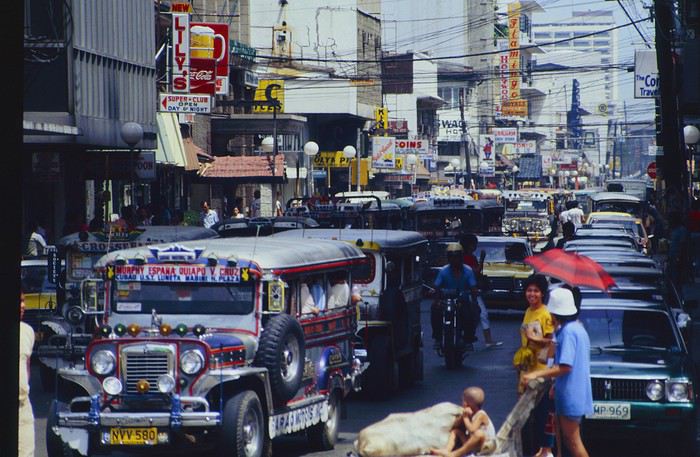
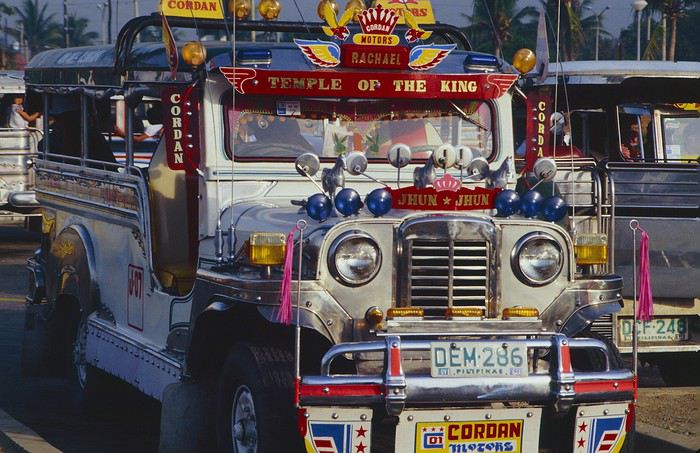
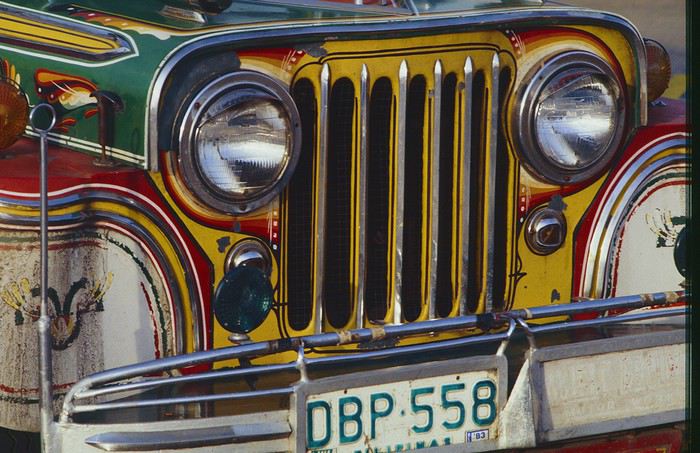
They had crazy sound systems, each one blasting louder than the last. The interiors were kitschy but fun. There weren’t many private cars—almost all transportation was by jeepney, with buses reserved for intercity trips.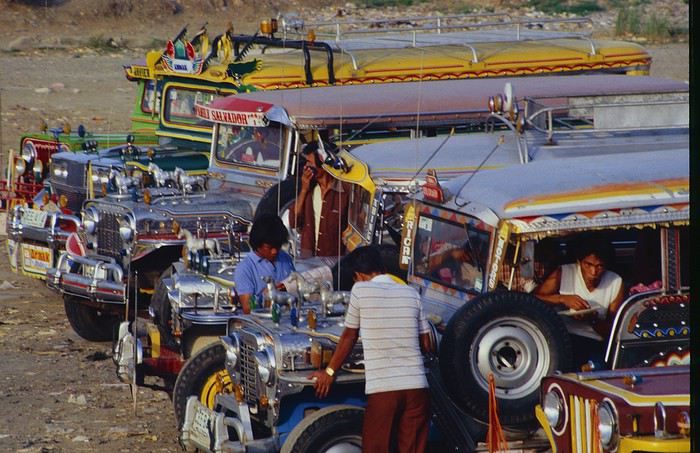
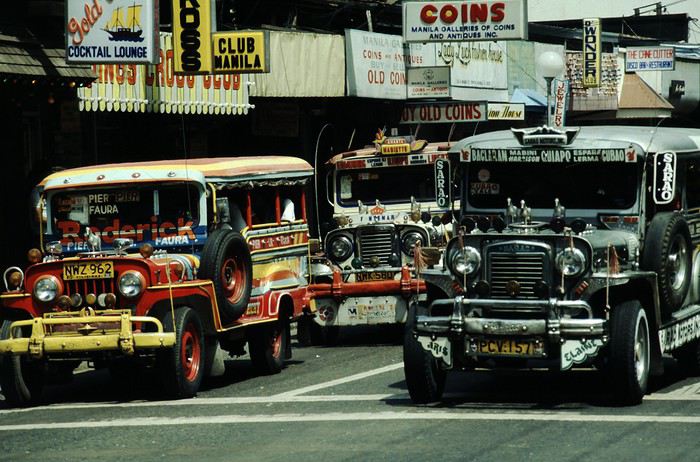
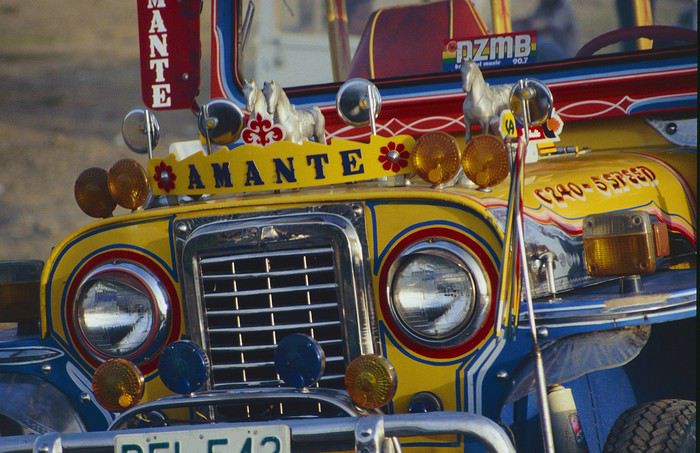
Before heading to the bus terminal for the north, somewhere on the outskirts of the city, we needed to exchange some money. I don’t remember how we ended up in a policeman’s jeep who offered his services: - Exchange money on the black market at a better rate than the banks. - Take us wherever we wanted, in this case, the bus terminal.
We accepted both offers (we’d still checked the official exchange rate from dollars to pesos). So we found ourselves in his jeep. After exchanging money, we left in his vehicle and stopped for gas. Without turning off the engine, he calmly smoked a cigarette while filling up. Since we were in a jeep with no doors or roof, we were ready to jump out if things went south, our travel bag in hand.
But we weren’t done with surprises yet. Once we left the small streets, we ended up in a neighborhood with wide avenues and not much traffic, which didn’t justify his incredible behavior. At every intersection, he made the sign of the cross, closed his eyes, and crossed without looking. I was more stunned than terrified! It wasn’t until we got out of the car later that I told Anne-Marie what had happened. I’d seen everything because the cop had put me in the front seat. Luckily, A-Marie hadn’t noticed anything from the back. Crossing Manila by trusting God rather than the rules of the road was ultimately effective. We were lucky—the trip was off to a good start. 🙂 🙂
We then passed through a neighborhood where slums stretched on for a while, and we left our policeman—friendly but a bit crazy—with relief.
A few hours by bus later, here we are in Baguio, cool in the mountains. My memories of Baguio are pretty fuzzy. I remember a small town. After some research while writing this journal, I found that the population was 120,000 in 1980. Given the population density in each home, that confirms my memory of a smallish town. Outside the “official” district with the president’s summer residence and government buildings, there were two or three paved streets with nice houses. The rest was very dirty and very poor, with lots of slums and dirt roads.
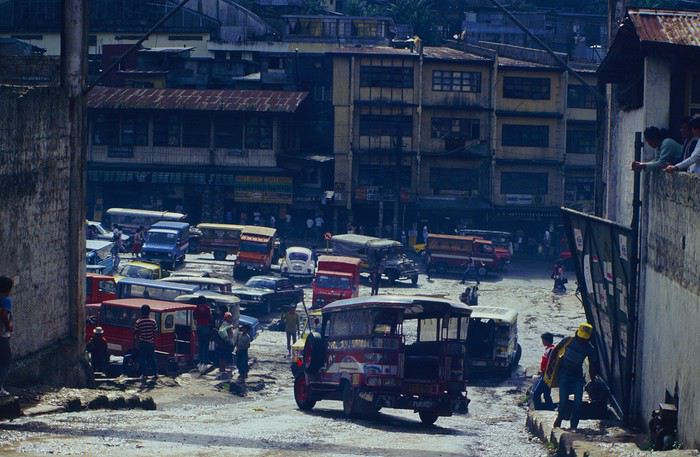
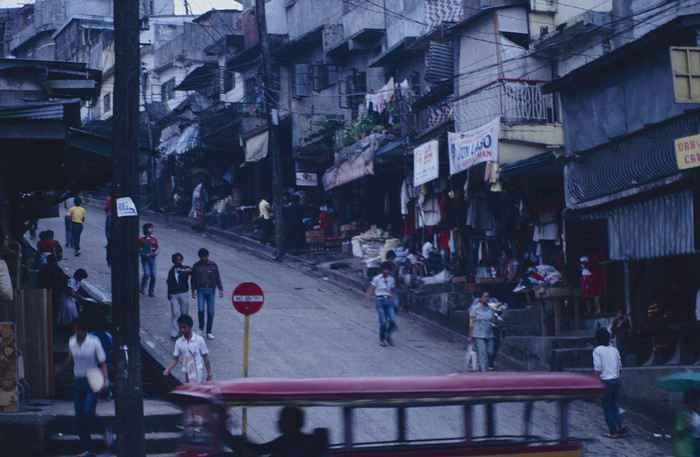
People we met on the street invited us to stay with them. These days, we wouldn’t just show up at strangers’ houses, which we should’ve done in Baguio—it would’ve saved us from an unimaginable and dangerous situation... which I won’t say anything about... !😊
The simple wooden house was on stilts at the edge of a hill with a view of the mountains. Since it was the start of the rainy season in a city that gets a lot of rain, we saw a lot of water. Our outings in town happened between downpours.
View from our lodging: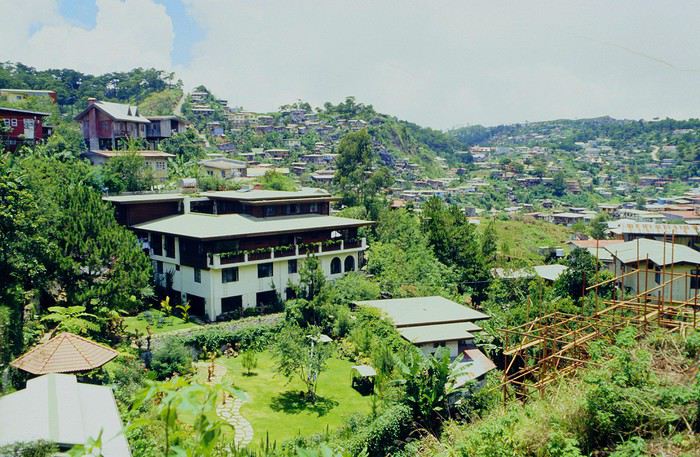
Episode 2: Baguio to Bontoc Aside from the situation briefly mentioned above, it was on the next leg to Bontoc that the adventure really began: an endless and dangerous road, a bus from another era, breathtaking landscapes, and surprising people.
We didn’t know the distance or how long it would take to get to Bontoc. When we arrived after about ten hours, we learned that Baguio to Bontoc was 140 km.
We got on a bus with wooden seats and settled in, two to a seat meant for two. As the bus filled up, passengers squeezed in three or four per seat, with chickens and baskets full of all sorts of things in the aisle. A little embarrassed, we didn’t know if we should squeeze in three on our seat. The seats were super tight (luckily, Filipinos are small), and I didn’t know where to put my legs given my height. I don’t remember if we stayed alone on our bench or if we ended up sharing with others.
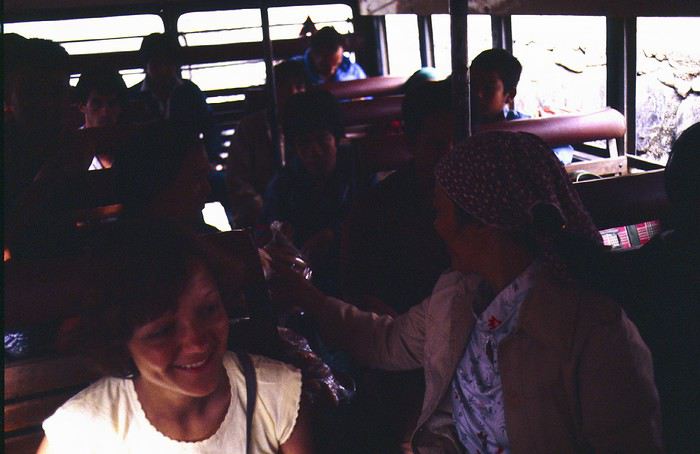
The “road” was a dirt track (or rather, a mud track) with endless turns. We held on as best we could to our slippery wooden seats—it was shaking in every direction. The woman behind us was carsick and throwing up... gross... but what were we doing there? Then we plunged into the Sierra Madre... just the name is dreamy!
Rice terraces started to appear: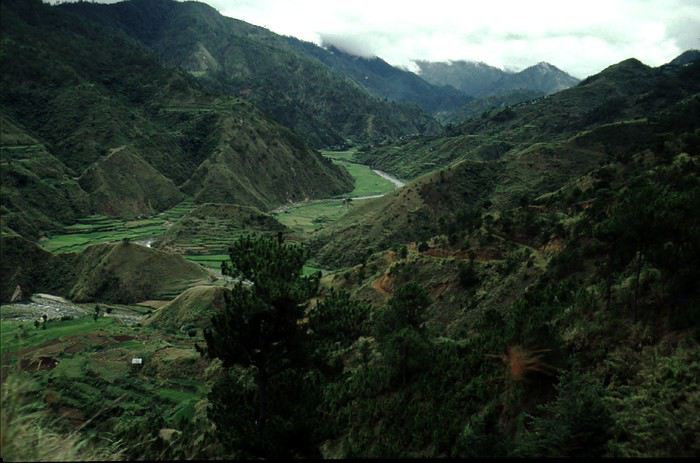
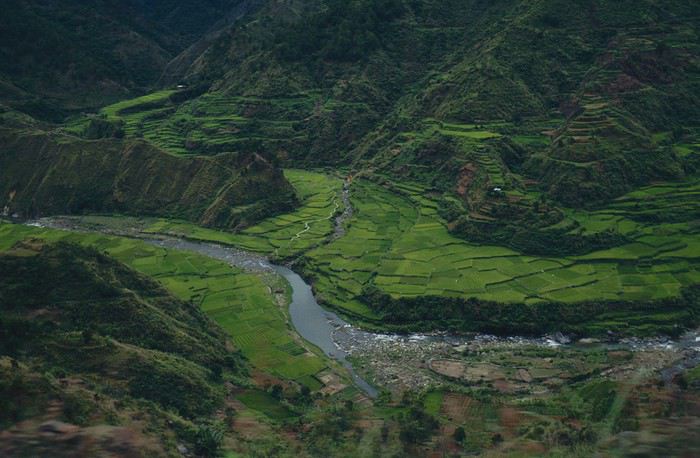
they took up more and more space along cliffs where we weren’t always reassured,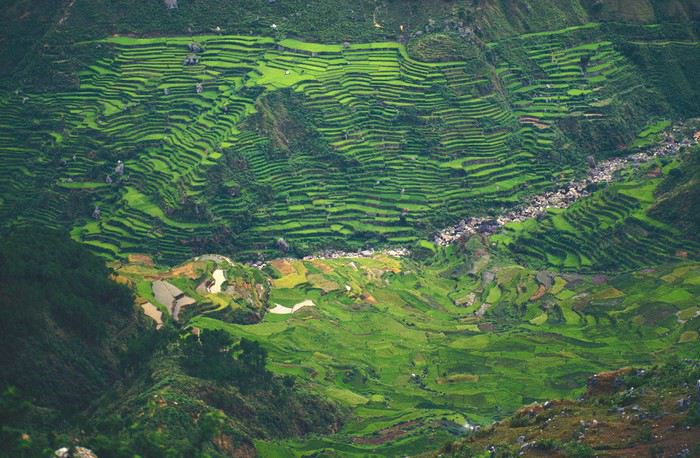
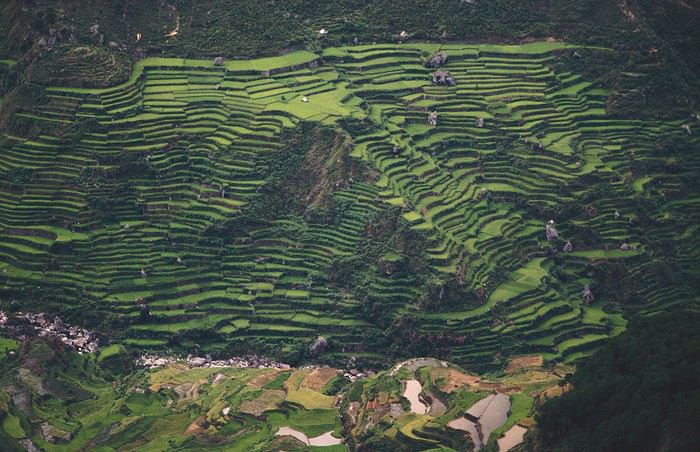
with lots of waterfalls (all that water had to go somewhere).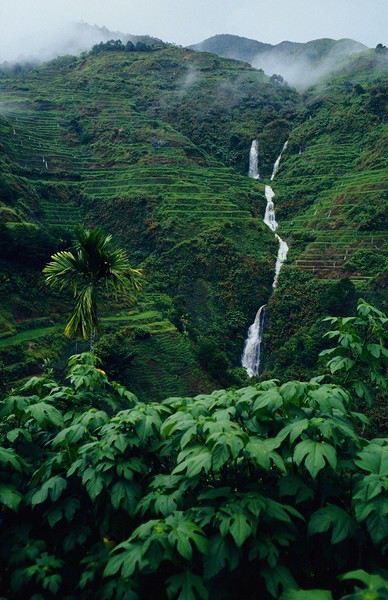
A few miserable villages stretched along the track, most often just a few houses balancing between the road and the drop. The bus stopped in every village—people got on or off and settled inside or on the roof. Street vendors offered their products to the bus passengers—a common sight in Asia, even today.
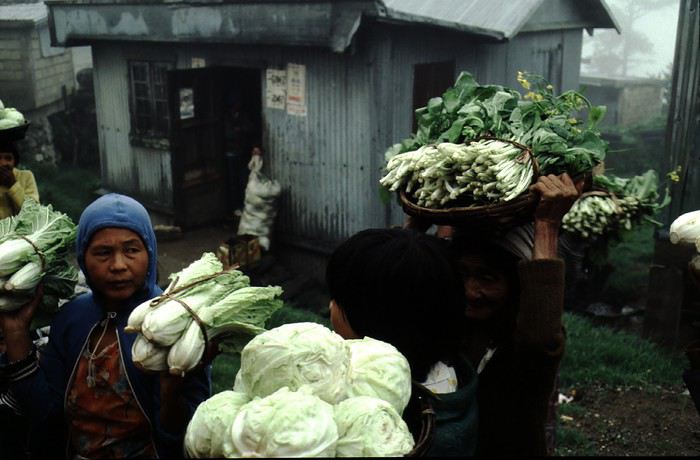
We were in another world—villagers were in loincloths, others had spears. The atmosphere was strange... but all good, we wanted exoticism, and we got it: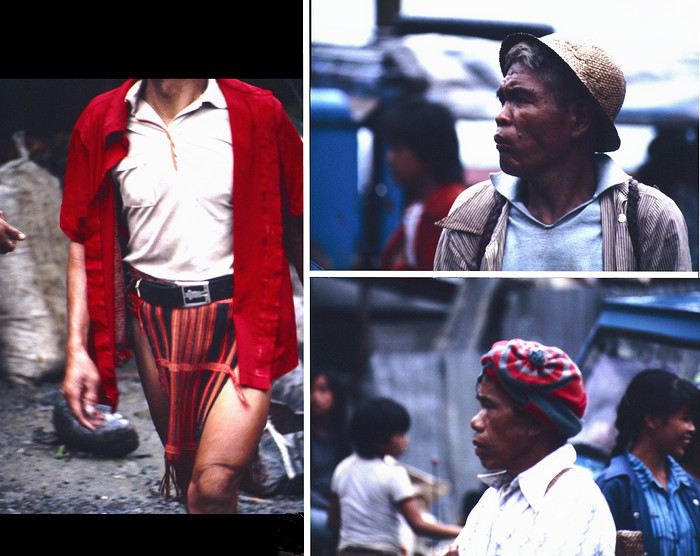
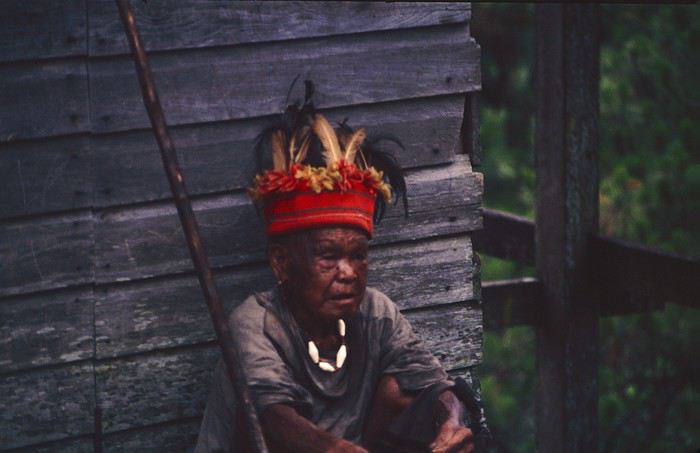
This so-called traditional outfit was everyday wear—it wasn’t for tourists since there weren’t any.
A curiosity because writing a travel journal about a trip 35 years later isn’t common, but also (mostly?) because exploring the Philippines at that time had little in common with traveling there today.
Obviously, I’ve forgotten a number of facts, most of the details, but with the help of a few notes from that time and a stack of slides (yes, there was life before digital 😊), many memories came back and added to the highlights I’d never forgotten. The scanned slides aren’t always great quality, but there are still quite a few to brighten up this chatter. Back then, we didn’t snap photos like we do now—film was too expensive—so I don’t have pictures of every place we visited... too bad, comparing some of those spots to how they look today would’ve been interesting.
Why "Adventures"? Why call it "Adventures" in the Philippines in 1984, a word so often used for a simple exotic trip? - Because the lack of information (no *Guide du Routard*, no *Lonely Planet*, no *Michelin Guide*, nothing, and obviously no internet) gave this trip what’s at the heart of adventure: the unknown. - Because the political situation made the stay sometimes dangerous. - Because transportation conditions were always epic, often perilous. - Because the question of where we’d spend the night came up almost every evening. - And for... quite a few other reasons.
That said, we weren’t exactly explorers!
Why the Philippines? First of all, why go to the Philippines in 1984—a country not exactly set up for tourism and about which we knew very little? How could we get an idea of the beauty of the Philippines and its points of interest when we had no guides or photos?
The idea came to us from Thailand a year earlier, during our first long-haul trip. After touring the north of the country, we met a Frenchman living in Phuket, where there were only a few tourists in Patong, with just a few small hotels and guesthouses. Kata and Karon had no buildings or roads, Rawai only had three palm-thatched bungalows, including ours, and the other islands were unknown to tourists. There was plenty to discover, and we wanted to return to this beautiful country... but the Frenchman made us dream about the Philippines—a country to explore, with wild landscapes.
Long evenings of discussion over multiple Sprite-Mekong cocktails (what memories of those headaches!) finally convinced us we had to go to the Philippines.
Episode 0: Before Departure The decision was made: we’d go to the Philippines in May 1984. Our friends and family were surprised when we announced we were going on vacation to the Philippines (a bit like saying today we were going paddleboarding in the Kerguelen Islands 🤪).
These days, preparing for each of our trips takes long evenings of research, planning, and noting down good addresses... etc. But for the Philippines in 1984, preparation was quick: we had very little information about the country, we were leaving almost at random, and the discovery would only be more exciting.
We still had a few bits of info gathered here and there: the rice terraces in northern Luzon, volcanoes, Negros where we were supposed to visit an acquaintance, Cebu and its marine life (we ended up going elsewhere), and absolutely avoid Mindanao, which was practically at war with the regime. That was about it, but it was already a great itinerary.
Nothing was organized in advance; we’d see day by day. We had no idea about travel times or even the existence of transportation options. The main (and sometimes only) way to connect two islands was by overloaded, rusty ferry. Only the big cities had airports.
Let’s Go: Episode 1: Paris to Manila My travel journals always start after arriving at the airport—the Europe-to-“Other Continent” trip isn’t interesting—but the flight to the Philippines was already an adventure, so I’ll make an exception.
This was the era when only a few Asian airlines were on par with Western ones: Thai, Singapore Airlines, and Philippine Airlines. They had beautiful, brand-new planes, and to attract customers (almost exclusively “businessmen”) from the usual airlines (Air France, Lufthansa, British Airways), there was opulence on board: unlimited champagne, all sorts of cocktails... Compared to today’s long-haul flights, there was still one small difference: no personal screens, just one screen at the front of the cabin with one mandatory movie. And I don’t know why, but we only got James Bond films, both ways... that must’ve been the trend at the time.
The tourism boom to Southeast Asia hadn’t started yet, and the “Asian Tigers” weren’t a thing, so there weren’t many business trips. That meant long-haul flights made stops everywhere to fill the planes. Our Philippine Airlines Boeing 747 left London, picked us up in Paris, then stopped in Frankfurt to take on a few Germans. I don’t know why we then made a stop in Dubai—a totally exotic place at the time. There was nothing to do there... things have changed a lot since. It was a small town lost in the desert. The airport was tiny, with just one or two buildings and a supermarket. During the stopover, everyone had to get off the plane and walk to the supermarket. Photo and electronic equipment were dirt cheap—I guess that was the only reason for the stop. Maybe it was their first commercial move. Emirates didn’t exist yet, as I checked online, but anyway, the idea that such a remote place could have its own airline was unthinkable.
Online, I found this photo of Dubai Airport in 1980. Anyone who’s transited through today’s massive airport with its rows of A380s will appreciate it:
Next stop: New Delhi to drop off some Europeans and pick up a few Indians, and finally, the terminus: Manila. I don’t remember how long the trip took with its five stops—an unimaginable journey today. Despite all those stops to fill the plane, there was still enough space to stretch out on the four center seats of the 747, something that never happens these days despite all the flights in every direction.
So here we are, finally at Manila Airport around midnight.
Episode 1: Manila and Baguio To start, a quick note on the political and economic situation in the Philippines in 1984, which had consequences for us as tourists, as we’d soon realize upon arrival.
After several centuries of Spanish colonization, the Philippines became American at the start of the 20th century, then independent. In 1966, Marcos took power, and little by little, his regime sank into corruption and mismanagement, becoming a dictatorship with martial law, all for the benefit of his family and friends, who enriched themselves endlessly. The peak was the assassination of opposition leader Benigno Aquino in August 1983, which triggered harshly repressed protests. So we arrived a few months later in a very poor country, with omnipresent corruption and an extremely tense political situation, as we’d soon see for ourselves. Major protests took place in the main cities during our trip—I’ll come back to that. Two years later, Marcos fled to Hawaii after being forced out of power following rigged elections. This historical context explains a lot of the situations we found ourselves in over the following weeks.
Arriving in the middle of the night isn’t very cheerful. Manila was already a huge city with many slums, where you could find a few business hotels like the Hilton or Intercontinental—way out of our budget—and plenty of run-down hotels. Luckily, two Indians we’d chatted with on the plane offered to take us to their usual hotel. They came to Manila twice a year for business. We accepted their offer, relieved not to have to look for a place to stay in the middle of the night, figuring the address must be good since they came back every time... we were wrong 🙁
We left the airport and immediately got a taste of the local vibe when we got into the taxi: the police asked for our passports. We thought: what’s more normal than police in a dictatorship?
But that wasn’t it at all. Our two Indian friends explained that the police were noting our names along with the taxi number and time. Crime in Manila was so bad that the taxi driver would be held responsible if anything happened to us... welcome to the Philippines 😎 😎
Historically, the Philippines was a very violent country, where everything was settled with guns or machetes. Previous governments had banned carrying weapons, but Marcos later allowed the free sale and carrying of guns, and disputes were settled with pistols again (or worse, as we’d discover later). Since he’d released most of the criminals from prison to form a paramilitary militia at his service (I’ll talk about our encounter with these “heroes” later), it was pretty dangerous to go into many parts of Manila, where these “tonton macoutes” ruled.
We arrived at our hotel without incident... and then things started badly. The room was infested with big cockroaches—exactly what I hate most in those kinds of countries. No way to find another hotel at that hour. After the long flight, the urge to take a shower was so strong that we squeezed into the bathroom as best we could. After that, I don’t remember—I guess we must’ve fallen asleep exhausted under the sheets in the heat... air conditioning wasn’t widespread yet.
The next day, we just wanted to leave that dump as soon as possible. So we decided to head north right away, stopping in Baguio, and we’d visit Manila a bit on the way back.
When we stepped outside, we discovered a pretty run-down neighborhood with potholed streets. But we also discovered the jeepneys. They were everywhere, flooding the streets.
They had crazy sound systems, each one blasting louder than the last. The interiors were kitschy but fun. There weren’t many private cars—almost all transportation was by jeepney, with buses reserved for intercity trips.
Before heading to the bus terminal for the north, somewhere on the outskirts of the city, we needed to exchange some money. I don’t remember how we ended up in a policeman’s jeep who offered his services: - Exchange money on the black market at a better rate than the banks. - Take us wherever we wanted, in this case, the bus terminal.
We accepted both offers (we’d still checked the official exchange rate from dollars to pesos). So we found ourselves in his jeep. After exchanging money, we left in his vehicle and stopped for gas. Without turning off the engine, he calmly smoked a cigarette while filling up. Since we were in a jeep with no doors or roof, we were ready to jump out if things went south, our travel bag in hand.
But we weren’t done with surprises yet. Once we left the small streets, we ended up in a neighborhood with wide avenues and not much traffic, which didn’t justify his incredible behavior. At every intersection, he made the sign of the cross, closed his eyes, and crossed without looking. I was more stunned than terrified! It wasn’t until we got out of the car later that I told Anne-Marie what had happened. I’d seen everything because the cop had put me in the front seat. Luckily, A-Marie hadn’t noticed anything from the back. Crossing Manila by trusting God rather than the rules of the road was ultimately effective. We were lucky—the trip was off to a good start. 🙂 🙂
We then passed through a neighborhood where slums stretched on for a while, and we left our policeman—friendly but a bit crazy—with relief.
A few hours by bus later, here we are in Baguio, cool in the mountains. My memories of Baguio are pretty fuzzy. I remember a small town. After some research while writing this journal, I found that the population was 120,000 in 1980. Given the population density in each home, that confirms my memory of a smallish town. Outside the “official” district with the president’s summer residence and government buildings, there were two or three paved streets with nice houses. The rest was very dirty and very poor, with lots of slums and dirt roads.
People we met on the street invited us to stay with them. These days, we wouldn’t just show up at strangers’ houses, which we should’ve done in Baguio—it would’ve saved us from an unimaginable and dangerous situation... which I won’t say anything about... !😊
The simple wooden house was on stilts at the edge of a hill with a view of the mountains. Since it was the start of the rainy season in a city that gets a lot of rain, we saw a lot of water. Our outings in town happened between downpours.
View from our lodging:
Episode 2: Baguio to Bontoc Aside from the situation briefly mentioned above, it was on the next leg to Bontoc that the adventure really began: an endless and dangerous road, a bus from another era, breathtaking landscapes, and surprising people.
We didn’t know the distance or how long it would take to get to Bontoc. When we arrived after about ten hours, we learned that Baguio to Bontoc was 140 km.
We got on a bus with wooden seats and settled in, two to a seat meant for two. As the bus filled up, passengers squeezed in three or four per seat, with chickens and baskets full of all sorts of things in the aisle. A little embarrassed, we didn’t know if we should squeeze in three on our seat. The seats were super tight (luckily, Filipinos are small), and I didn’t know where to put my legs given my height. I don’t remember if we stayed alone on our bench or if we ended up sharing with others.
The “road” was a dirt track (or rather, a mud track) with endless turns. We held on as best we could to our slippery wooden seats—it was shaking in every direction. The woman behind us was carsick and throwing up... gross... but what were we doing there? Then we plunged into the Sierra Madre... just the name is dreamy!
Rice terraces started to appear:
they took up more and more space along cliffs where we weren’t always reassured,
with lots of waterfalls (all that water had to go somewhere).
A few miserable villages stretched along the track, most often just a few houses balancing between the road and the drop. The bus stopped in every village—people got on or off and settled inside or on the roof. Street vendors offered their products to the bus passengers—a common sight in Asia, even today.
We were in another world—villagers were in loincloths, others had spears. The atmosphere was strange... but all good, we wanted exoticism, and we got it:
This so-called traditional outfit was everyday wear—it wasn’t for tourists since there weren’t any.
Du nord au sud de l'archipel philippin avec un détour par Singapour
Bonjour,
Ce carnet qu'en principe je n'aurais pas du faire, il m'a été soufflé par certains membres de VF et en ces temps troublés de Covid-19, nous en avons justement du temps, quoi que pour certains pour une fois ils croulent sous le travail (il se reconnaîtra 😇)
Je vais vous conter (un bien grand mot pour moi, vu que je ne suis pas très à l'aise avec les mots) ce périple vous amènera à Banaue et ses magnifiques rizière en terrasses, au sud sur l'île de Siargao et au centre à sur l'île de Panglao
Il n'y aura pas d'animaux pétrifiés, de rochers à perte de vue et de champignons hallucinogènes (elle se reconnaitra)
Il a commencé par un vol à destination de Manilles via Doha,
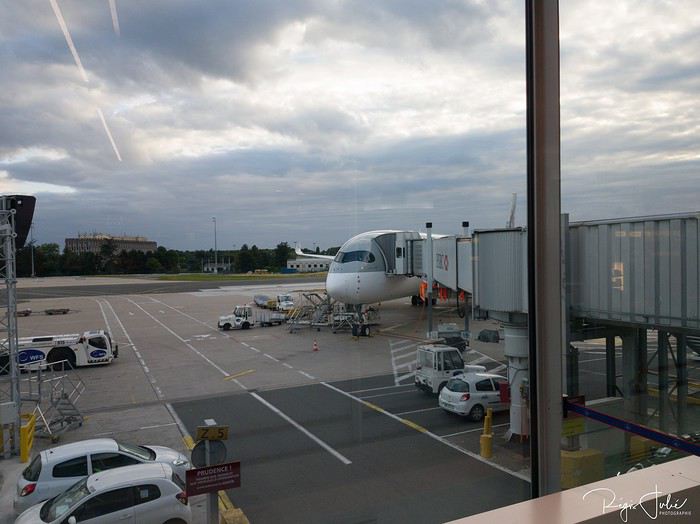
Une photo qui aurait eu sa place sur sans problème sur passenger shaming, ils nous a fait une très grande prestation jusqu'à Doha
On se retrouve bientôt à Manille 🙂
Ce carnet qu'en principe je n'aurais pas du faire, il m'a été soufflé par certains membres de VF et en ces temps troublés de Covid-19, nous en avons justement du temps, quoi que pour certains pour une fois ils croulent sous le travail (il se reconnaîtra 😇)
Je vais vous conter (un bien grand mot pour moi, vu que je ne suis pas très à l'aise avec les mots) ce périple vous amènera à Banaue et ses magnifiques rizière en terrasses, au sud sur l'île de Siargao et au centre à sur l'île de Panglao
Il n'y aura pas d'animaux pétrifiés, de rochers à perte de vue et de champignons hallucinogènes (elle se reconnaitra)
Il a commencé par un vol à destination de Manilles via Doha,
Une photo qui aurait eu sa place sur sans problème sur passenger shaming, ils nous a fait une très grande prestation jusqu'à Doha
On se retrouve bientôt à Manille 🙂
Aide/choix de parcours 16 jours aux Philippines?
Bonjour à tous,
je sais qu' il y a déjà eu plusieurs Post' sur les Philippines, mais .... dur dur de trancher. ;-(
Sans entrer des les détails à 100% des villes, si vous deviez m'orienter, en sachant qu'il y a des choix à faire pour 16 JOURS sur place (on ne peut pas tout faire!), que me conseillez -vous ?
J'ai envie de voir les rizières de Luzon, mais, avec tous les temps de route, j'ai peur de ne pas pouvoir faire bcp d'iles ensuite !?
Doit-on impérativement voir qq rizières sur Luzon ?
Faire une boucle sur CEBU & alentours + boucle sur Palawan + Coron = laisse du temps pour Luzon !?? j'ai un gros doute! ;-(
Si je termine le séjour à Coron, pour revenir sur Manille, des avions existent, ou faut retourner à Puerto ?
Un grand merci par avance pour votre aide. ;)
MERCI.
;)
je sais qu' il y a déjà eu plusieurs Post' sur les Philippines, mais .... dur dur de trancher. ;-(
Sans entrer des les détails à 100% des villes, si vous deviez m'orienter, en sachant qu'il y a des choix à faire pour 16 JOURS sur place (on ne peut pas tout faire!), que me conseillez -vous ?
J'ai envie de voir les rizières de Luzon, mais, avec tous les temps de route, j'ai peur de ne pas pouvoir faire bcp d'iles ensuite !?
Doit-on impérativement voir qq rizières sur Luzon ?
Faire une boucle sur CEBU & alentours + boucle sur Palawan + Coron = laisse du temps pour Luzon !?? j'ai un gros doute! ;-(
Si je termine le séjour à Coron, pour revenir sur Manille, des avions existent, ou faut retourner à Puerto ?
Un grand merci par avance pour votre aide. ;)
MERCI.
;)
Circuit aux Visayas: horaires bateaux, hébergements et bagages
Bonjour,
Nous sommes 4, 2 adultes et 2 enfants, qui auront 10 et 8 ans lors de notre voyage aux Philippines. Nous arrivons le 14 février 2020 en début d’après-midi et repartons le 27 février en début de soirée. J’ai beaucoup de mal à établir un circuit. C’est pourquoi j’ai besoin de vos avis.
Vendredi après-midi: Arrivée aéroport de Mactan, direction Moalboal Samedi : Moalboal et ses alentours. Dimanche: direction Malatapay visite de Dumaguete Lundi: Apo Island Mardi: Apo Island direction Siquijor Mercredi, jeudi: Siquijor Vendredi: Siquijor direction Tagbilaran - Bohol Samedi, dimanche, lundi: Bohol, Panglao, Balicasag Lundi: direction Mactan pour aller à Malapascua Mardi: Malapascua. Mercredi: Malapascua direction Mactan Jeudi: départ de Mactan.
Je n’ai pas les horaires des bateaux, ni même établie exactement les temps de parcours entre chaque destination. Si vous pouviez également me conseiller.
Concernant les hébergements sur chaque lieu que me conseillez-vous?
Dernière question, pour les bagages, j’ai le droit à 1 bagage en soute de 30 kg. Je comptais prendre une grosse valise. 4 petites en bagage à main plus 2 sac à dos. Je cherche le côté pratique lors des déplacements aussi ne vaut il pas mieux que des sacs?
Je vous remercie par avance pour vos suggestions.
Virginie
Nous sommes 4, 2 adultes et 2 enfants, qui auront 10 et 8 ans lors de notre voyage aux Philippines. Nous arrivons le 14 février 2020 en début d’après-midi et repartons le 27 février en début de soirée. J’ai beaucoup de mal à établir un circuit. C’est pourquoi j’ai besoin de vos avis.
Vendredi après-midi: Arrivée aéroport de Mactan, direction Moalboal Samedi : Moalboal et ses alentours. Dimanche: direction Malatapay visite de Dumaguete Lundi: Apo Island Mardi: Apo Island direction Siquijor Mercredi, jeudi: Siquijor Vendredi: Siquijor direction Tagbilaran - Bohol Samedi, dimanche, lundi: Bohol, Panglao, Balicasag Lundi: direction Mactan pour aller à Malapascua Mardi: Malapascua. Mercredi: Malapascua direction Mactan Jeudi: départ de Mactan.
Je n’ai pas les horaires des bateaux, ni même établie exactement les temps de parcours entre chaque destination. Si vous pouviez également me conseiller.
Concernant les hébergements sur chaque lieu que me conseillez-vous?
Dernière question, pour les bagages, j’ai le droit à 1 bagage en soute de 30 kg. Je comptais prendre une grosse valise. 4 petites en bagage à main plus 2 sac à dos. Je cherche le côté pratique lors des déplacements aussi ne vaut il pas mieux que des sacs?
Je vous remercie par avance pour vos suggestions.
Virginie
Pour un quatrième voyage aux Philippines
Partant une 4 ème fois aux Philippines, j 'ai besoin de vous.
Pour 3 semaines, j' hésite entre
SAMAR LEYTE SIARGAO SURIGAO
ou
MINDORO CORON
Ou
MINDANAO
Merci de me dire vos avis sachant que j'aime la nature, peu de monde, des endroits avec de la vie locale, nocturne notamment même si loin des sterotypes de boracay ou El nido.
Que faire sur ces spots où peu de renseignements sont disponibles. Hormis mindoro coron. Quels sont les jolis endoits à voir ? Merci
Paul
Merci de me dire vos avis sachant que j'aime la nature, peu de monde, des endroits avec de la vie locale, nocturne notamment même si loin des sterotypes de boracay ou El nido.
Que faire sur ces spots où peu de renseignements sont disponibles. Hormis mindoro coron. Quels sont les jolis endoits à voir ? Merci
Paul
Les rizières de Luzon dans les meilleures conditions (Philippines)
Bonjour,
Nous sommes un couple de retraités qui allons partir aux Philippines du 16 décembre au 5 février.
Nous finirons notre voyage par le nord de Luzon pour y voir les rizières et y séjourner durant 7j.
Plusieurs questions :
1°) Nous devrions choisir la compagnie de bus Coda Lines (il semblerait qu'il existe des bus dits de luxe) de Manille à Sagada ou Banaue. Nous aurions préféré des bus de jour...
2°)La période choisie ne semble pas correspondre à la période des rizières vertes! alors aller à Banaue ou Sagada (dans cette dernière région il y aurait plus de choses à voir aux alentours)?
3°)Nous sommes habitués à voyager seuls depuis plus de 30 ans surtout en Asie du Sud Est. Mais l'âge est là et nous aimerions choisir les rizières qui seraient les plus accessibles pour nous (éviter les longs trecks!) Merci de votre aide Tialou et Magguy
2°)La période choisie ne semble pas correspondre à la période des rizières vertes! alors aller à Banaue ou Sagada (dans cette dernière région il y aurait plus de choses à voir aux alentours)?
3°)Nous sommes habitués à voyager seuls depuis plus de 30 ans surtout en Asie du Sud Est. Mais l'âge est là et nous aimerions choisir les rizières qui seraient les plus accessibles pour nous (éviter les longs trecks!) Merci de votre aide Tialou et Magguy
Choix de destination et sécurité pour une femme seule
Bonjour,
je souhaite partir voyager un mois fin septembre et j'aimerais des conseils pour choisir ma destination.
Je pars seule, j'aime les plages, randonnées, visiter...Je n'aurais pas de moyens de transports donc j'aime bien être proche du centre et si c'est une ville où la mer est proche, près de la mer. Je me déplacerais avec les transports en commun, taxis (transport de groupe de préférence pour le budget).
J'hésite entre la Guadeloupe, l'Indonésie (bali et les îles gilli), et la Thailande sachant que j'ai déjà fait Phuket, Ko pipi, Ko lanta, ao nang, Ko tao, Ko samui, Ko phangan...ou peut être une autre destination si vous avez à me suggérer.
C e que j'aime, c'est voyager facilement comme en Thailande, et ou on se sent pas en insécurité. J'ai un budget moyen, j'aime réservé la 1 ère nuit et par la suite prendre un logement au fil de l'itinéraire que je me serais fait approximativement mais rien de figé pour une liberté et me laisser aller aux grès de mes envies.
Concernant les logements, du moment que c'est propre et pas de trous dans la chambre (j'aurais pas envie qu'un serpent s'y invite), je ne suis pas difficile.
Dans l'attente, au plaisir de vous lire.
Problème pour réserver un vol Cebu Pacific
Nous n’arrivons pas à réserver de France un vol intérieur sur le site de cebu pacific cela met un message d’erreur au moment du paiement...j’ai vu de nombreux messages identiques mais qui datent un peu .... avez vous une solution?
Philippines mars 2019: carnet de voyage Siargao/Cebu
Bonjour à tous ,
Ici commence notre carnet philippin. J’essaierai de fournir le maximum d’informations pratiques pour les futurs partants.
Petite présentation : nous sommes une famille de 4 avec 2 enfants de 17 ans. Les Philippines étaient notre deuxième fois en Asie après un séjour de 15 jours Komodo/Bali en Octobre 2017.
Le séjour s’est déroulé du 27 février au 11 mars 2019 ( 10 jours pleins sur place ).
Initialement, nous avions projeté un voyage de 2 semaines mais nous avons du revoir nos ambitions à la baisse à cause d’une épreuve anticipée du bac pour les enfants.
Après beaucoup d’hésitations sur le bien-fondé du voyage vient le casse-tête du choix des iles . Nous avons décidé de nous limiter à 2 pour privilégier la qualité plus que la quantité.
Même si 2 sur plus de 7600 iles c’est peu…😉
Siargao, avec ses airs de petit paradis, s’est imposée naturellement et rapidement alors même que nous étions en fin de saison des pluies là-bas. Elle revenait sans cesse dans les blogs de voyage et semblait être le coup de coeur de beaucoup. Nous y resterons 6 nuits.
On aurait adoré compléter par Palawan avec El Nido notamment mais pas très envie de la foule et cela augmentait considérablement la facture si vol interne jusqu’à El Nido pour gagner du temps (600€ AR pour 4).
Les philippines comptent 2 aéroports internationaux : Manille et Cebu Souhaitant éviter Manille, nous avons décidé de finir le séjour sur Cebu. Cebu, c’est moins carte postale , mais l’ile offre de nombreuses activités très sympas. Nous y séjournerons 4 nuits en fin de séjour.
Vol international Paris/Cebu avec 1 escale à Shanghai : 2260€ soit 565€ par personne
Compagnie China eastern airlines ( vols au départ et à l’arrivée sur Paris en A380 affrété par Air France)
Bon à savoir : il y a une taxe à payer au retour pour vol international au départ de l’aéroport de Cebu ( tout rénové, très moderne) d’environ 15 à 20€ par personne donc garder des pesos.
Vol interne Cebu/Siargao AR avec Cebu Pacific : 218€ soit environ 54€ par personne (inclus dans le prix ci-dessus 2 bagages de 20 kg ajoutés en supplément des 4 bagages de 7 kg autorisés)
Pour l’argent, je suis passée par un bureau de change parisien qui livre par correspondance. 1€= 55 pesos au moment de l’achat J’ai préféré assurer le coup vu que notre avion arrivait à Cebu vers 2H00 du matin. Un change était bien ouvert mais à un taux légèrement moins intéressant que celui trouvé en France donc pas de regret pour nous.
Au cours de notre voyage, nous n’avons jamais ressenti le moindre sentiment d’insécurité (éviter les zones à risques au Sud en suivant les recommandations du ministère des affaires étrangères).
Si le carnet contient trop de détails, n’hésitez pas à me le dire. J’espère que vous interviendrez nombreux pour ne pas avoir le sentiment de monologuer.
Le décor est planté, à bientôt pour la suite 🙂.
Ici commence notre carnet philippin. J’essaierai de fournir le maximum d’informations pratiques pour les futurs partants.
Petite présentation : nous sommes une famille de 4 avec 2 enfants de 17 ans. Les Philippines étaient notre deuxième fois en Asie après un séjour de 15 jours Komodo/Bali en Octobre 2017.
Le séjour s’est déroulé du 27 février au 11 mars 2019 ( 10 jours pleins sur place ).
Initialement, nous avions projeté un voyage de 2 semaines mais nous avons du revoir nos ambitions à la baisse à cause d’une épreuve anticipée du bac pour les enfants.
Après beaucoup d’hésitations sur le bien-fondé du voyage vient le casse-tête du choix des iles . Nous avons décidé de nous limiter à 2 pour privilégier la qualité plus que la quantité.
Même si 2 sur plus de 7600 iles c’est peu…😉
Siargao, avec ses airs de petit paradis, s’est imposée naturellement et rapidement alors même que nous étions en fin de saison des pluies là-bas. Elle revenait sans cesse dans les blogs de voyage et semblait être le coup de coeur de beaucoup. Nous y resterons 6 nuits.
On aurait adoré compléter par Palawan avec El Nido notamment mais pas très envie de la foule et cela augmentait considérablement la facture si vol interne jusqu’à El Nido pour gagner du temps (600€ AR pour 4).
Les philippines comptent 2 aéroports internationaux : Manille et Cebu Souhaitant éviter Manille, nous avons décidé de finir le séjour sur Cebu. Cebu, c’est moins carte postale , mais l’ile offre de nombreuses activités très sympas. Nous y séjournerons 4 nuits en fin de séjour.
Vol international Paris/Cebu avec 1 escale à Shanghai : 2260€ soit 565€ par personne
Compagnie China eastern airlines ( vols au départ et à l’arrivée sur Paris en A380 affrété par Air France)
Bon à savoir : il y a une taxe à payer au retour pour vol international au départ de l’aéroport de Cebu ( tout rénové, très moderne) d’environ 15 à 20€ par personne donc garder des pesos.
Vol interne Cebu/Siargao AR avec Cebu Pacific : 218€ soit environ 54€ par personne (inclus dans le prix ci-dessus 2 bagages de 20 kg ajoutés en supplément des 4 bagages de 7 kg autorisés)
Pour l’argent, je suis passée par un bureau de change parisien qui livre par correspondance. 1€= 55 pesos au moment de l’achat J’ai préféré assurer le coup vu que notre avion arrivait à Cebu vers 2H00 du matin. Un change était bien ouvert mais à un taux légèrement moins intéressant que celui trouvé en France donc pas de regret pour nous.
Au cours de notre voyage, nous n’avons jamais ressenti le moindre sentiment d’insécurité (éviter les zones à risques au Sud en suivant les recommandations du ministère des affaires étrangères).
Si le carnet contient trop de détails, n’hésitez pas à me le dire. J’espère que vous interviendrez nombreux pour ne pas avoir le sentiment de monologuer.
Le décor est planté, à bientôt pour la suite 🙂.
Billets Air China achetés sur ExploreTrip
J'ai achete des billets sur skyscanner tres avantageux pour Montreal , Phnom penh multidestination retour Manille Montreal. J'ai acheté mes vols sur AirChina mais par l'entremise de ExploreTrip.com
je commence a avoir un peu de doute lorsque je lis plusieurs commentaires négatifs sur exploreTrip.com
J'ai recu mes E-Tickets tout de suite apres la transaction et le montant des billets apparait sur ma carte de crédit.
Ce qui me fait avoir un doute c'est que je ne peux vérifier mon booking et ne peut selectionner mes sieges sur le site de Air China, .. j'ai envoye quelques messages au support Exploretrip. et il me dise que étant donné que je n'ai pas acheté mes billets directement sur le site de Air China. je ne peux aller sur leur site .. J'attend un retour de message de Air China leur ayant envoyer une demande.
Es que quel qu un pourrait me rassurer et me dire de quel façon je peut procéder.
merci
Claudette.
Retour d’une croisière en Chine, Japon, Corée du Sud, Taïwan, Philippines et Hong Kong
...Sur le Westerdam de Holland America Line
Bonjour et bienvenue à tous pour embarquer avec nous dans cette longue croisière !
C’est une fois de plus un itinéraire hors du commun, riche et varié qui a été la raison de notre choix pour cette croisière. Ajouter à cela un prix particulièrement attractif, 4800 euros la cabine extérieure, au milieu du bateau, pont 4, avec une grande baie vitrée fixe, pour 28 jours de croisière et de découvertes.
Deux semaines avant le départ les prix avaient encore baissés, et une cabine balcon était disponible à quelques cabines de celle que j’avais réservée pour à peine plus cher. J’ai demandé à payer la différence pour l’obtenir mais Un Ocean De Croisiere, l’intermédiaire de HAL en France a refusé. Pourtant les canadiens avec qui nous partons se sont vus proposer un « upgrade » par la compagnie. Autant dire que je n’étais pas très contente.
L’itinéraire :
Shanghai (Chine, 2 jours), Qingdao (Chine), Tianjin (Pékin, Chine, 2 jours), Nagasaki (Japon), Jeju (Corée du Sud), Séoul (Corée du Sud), Kagoshima (Japon), Shanghai (2 jours), Fukuoka (Japon), Busan (Corée du Sud), Naha (Okinawa, Japon), Ishigaki (Sakishima Islands, Japon), Hualien (Taiwan), Keelung (Taiwan), Kaohsiung (Taiwan), Manille (Philippines), Hong Kong (Chine)
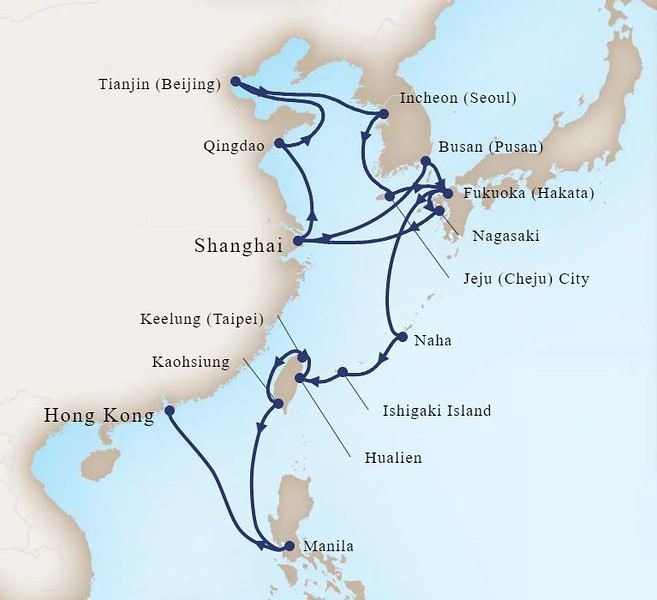
La croisière commence le 17 février mais dès le 13 février nous partons pour Shanghai afin de profiter de quelques jours sur place pour découvrir la ville que nous ne connaissons pas et que j’ai hâte de voir.
Le dernier vol du soir à Marseille est bondé pour rejoindre les différents vols de nuit au départ de Roissy. Le vol direct depuis CDG pour Shanghai passe rapidement, après Auckland, Shanghai ne parait pas bien loin.
Dès notre arrivée dans l’aérogare nous sommes harponnés par un pseudo représentant des hôtels, il a les badges de plusieurs grandes chaînes épinglées sur sa veste et essaie de se faire passer pour le responsable des transferts des hôtels. Il m’enlève ma valise des mains et je suis obligée de courir pour le rattraper et la récupérer. Il essaie de nous vendre un taxi à 850 ¥ (110€), beaucoup trop cher, ce n’est pas le prix que j’ai vu sur le net avant de partir.
Nous arrivons à nous en débarrasser et aussitôt un autre nous accoste avec le même procédé, cette fois c’est 550 ¥ rapidement tombés à 350 ¥ mais je cramponne ma valise et nous le semons dans les escalators.
Pour finir nous arrivons à trouver un stand officiel de taxi à l’extérieur où le prix est de 340 ¥ (44€), il y a aussi des taxis à prendre librement mais je suis méfiante. J’ai par la suite appris que c’était au minimum 320 ¥ quand on quittait l’aéroport pour aller en ville.
Tout au long de notre séjour nous avons à de multiples reprises pris les taxis qui fourmillent dans la ville. Ils fonctionnent très bien, avec un compteur et le prix est modique. Nous n’avons jamais eu aucun problème. Mais quand on arrive à l’aéroport ou pour aller au terminal de croisière, c’est une autre histoire…
Nous arrivons à notre hôtel à 20h45, c’est un Hôtel Boutique superbe. Une rose et des chocolats nous attendent dans la chambre qui est immense et très belle. Des « snacks » sont offerts gracieusement tous les soirs de 22h à 23h30. En réalité c’est un petit repas composé de soupe, de riz et de pâtes cuisinées à la chinoises, le tout très bon. Des boissons sont disponibles, dont du thé à la rose délicieux.
Bonjour et bienvenue à tous pour embarquer avec nous dans cette longue croisière !
C’est une fois de plus un itinéraire hors du commun, riche et varié qui a été la raison de notre choix pour cette croisière. Ajouter à cela un prix particulièrement attractif, 4800 euros la cabine extérieure, au milieu du bateau, pont 4, avec une grande baie vitrée fixe, pour 28 jours de croisière et de découvertes.
Deux semaines avant le départ les prix avaient encore baissés, et une cabine balcon était disponible à quelques cabines de celle que j’avais réservée pour à peine plus cher. J’ai demandé à payer la différence pour l’obtenir mais Un Ocean De Croisiere, l’intermédiaire de HAL en France a refusé. Pourtant les canadiens avec qui nous partons se sont vus proposer un « upgrade » par la compagnie. Autant dire que je n’étais pas très contente.
L’itinéraire :
Shanghai (Chine, 2 jours), Qingdao (Chine), Tianjin (Pékin, Chine, 2 jours), Nagasaki (Japon), Jeju (Corée du Sud), Séoul (Corée du Sud), Kagoshima (Japon), Shanghai (2 jours), Fukuoka (Japon), Busan (Corée du Sud), Naha (Okinawa, Japon), Ishigaki (Sakishima Islands, Japon), Hualien (Taiwan), Keelung (Taiwan), Kaohsiung (Taiwan), Manille (Philippines), Hong Kong (Chine)
La croisière commence le 17 février mais dès le 13 février nous partons pour Shanghai afin de profiter de quelques jours sur place pour découvrir la ville que nous ne connaissons pas et que j’ai hâte de voir.
Le dernier vol du soir à Marseille est bondé pour rejoindre les différents vols de nuit au départ de Roissy. Le vol direct depuis CDG pour Shanghai passe rapidement, après Auckland, Shanghai ne parait pas bien loin.
Dès notre arrivée dans l’aérogare nous sommes harponnés par un pseudo représentant des hôtels, il a les badges de plusieurs grandes chaînes épinglées sur sa veste et essaie de se faire passer pour le responsable des transferts des hôtels. Il m’enlève ma valise des mains et je suis obligée de courir pour le rattraper et la récupérer. Il essaie de nous vendre un taxi à 850 ¥ (110€), beaucoup trop cher, ce n’est pas le prix que j’ai vu sur le net avant de partir.
Nous arrivons à nous en débarrasser et aussitôt un autre nous accoste avec le même procédé, cette fois c’est 550 ¥ rapidement tombés à 350 ¥ mais je cramponne ma valise et nous le semons dans les escalators.
Pour finir nous arrivons à trouver un stand officiel de taxi à l’extérieur où le prix est de 340 ¥ (44€), il y a aussi des taxis à prendre librement mais je suis méfiante. J’ai par la suite appris que c’était au minimum 320 ¥ quand on quittait l’aéroport pour aller en ville.
Tout au long de notre séjour nous avons à de multiples reprises pris les taxis qui fourmillent dans la ville. Ils fonctionnent très bien, avec un compteur et le prix est modique. Nous n’avons jamais eu aucun problème. Mais quand on arrive à l’aéroport ou pour aller au terminal de croisière, c’est une autre histoire…
Nous arrivons à notre hôtel à 20h45, c’est un Hôtel Boutique superbe. Une rose et des chocolats nous attendent dans la chambre qui est immense et très belle. Des « snacks » sont offerts gracieusement tous les soirs de 22h à 23h30. En réalité c’est un petit repas composé de soupe, de riz et de pâtes cuisinées à la chinoises, le tout très bon. Des boissons sont disponibles, dont du thé à la rose délicieux.
Voyage aux Philippines avec 2 enfants de 8 ans
Bonjour/Bonsoir a Tous
Nous partons mi-avril aux philippines. 17 jours, départ Paris - arrivée Manille.
Nous avons encore des doutes... pourriez vous SVP nous abreuver de vos expériences?😊
Nous commençons avec 1 nuit a manille.
Puis bus pour banaue, une nuit sur place puis retour en bus. Nous avons lu les nombreux commentaires ne conseillant pas de trek avec enfants de cet age, donc on fera des promenades tranquilles. Si on trouve un moyen pas trop épuisant pour les enfants nous iront a Batad j’espere. Si vous avez des conseils je suis preneuse!
Nous avons beaucoup hésité entre moalboal et siquijor. Idem les commentaires du forum nous confortent dans le choix de Siquijor (plus tranquille pour les enfants apparemment aussi).
Nous finiront par palawan (port barton et el nido).
En tout 3 destinations, pas plus car nous sommes conscients du trajet et de la fatigue engendrée.
La ou nous ne sommes pas du tout sur c’est sur les moyens de transport entre chaque lieu.
Je ne trouve pas de vols directs manille-dumaguete ni dumaguete-porto princesa(ou el nido). j’ai l’impression que la liaison vers siquijor sera compliquée et cela m’inquiète fort.
Je m’y prends mal ou tout est booké😭?
Si vous pensez qu’on fait pas un itinéraire logique n’hesitez pas a me le faire savoir SVP. Je n’ ai Jamais autant galeré a établir l’itineraire d’un voyage... 🙄
Espérant vous lire 😀😀
Nadia
Itinéraires, transports et plongée sous-marine aux Philippines
Bonjour,
Je prévois partir tout le mois de février 2019 aux Philippines pour découvrir la culture et faire de la plongé sous-marine (je suis divemaster PADI). J'aimerais savoir s'il est très ambiteux de visiter tous ces lieux: Banaue - Sagada -Donsol - Île Ticao - Malapascua - Moalboal - Apo Island - El Nido. Si c'est trop ambitieux, quels sont les lieux que je devrais prioriser? Quelle est la façon la plus économique de rallier tous ces lieux? Est-ce qu'il y a une façon de se déplacer en ferry rapidement de Donsol à Malapascua? Je prévois voyager aux Philippines en février, est-ce la bonne saison pour faire du snorkling avec des requins-baleines? Quels clubs de plongé me conseillez-vous à Malaspacua, l'île de Ticao, l'île d'Apo et à Moalboal?
Merci
Julie
Je prévois partir tout le mois de février 2019 aux Philippines pour découvrir la culture et faire de la plongé sous-marine (je suis divemaster PADI). J'aimerais savoir s'il est très ambiteux de visiter tous ces lieux: Banaue - Sagada -Donsol - Île Ticao - Malapascua - Moalboal - Apo Island - El Nido. Si c'est trop ambitieux, quels sont les lieux que je devrais prioriser? Quelle est la façon la plus économique de rallier tous ces lieux? Est-ce qu'il y a une façon de se déplacer en ferry rapidement de Donsol à Malapascua? Je prévois voyager aux Philippines en février, est-ce la bonne saison pour faire du snorkling avec des requins-baleines? Quels clubs de plongé me conseillez-vous à Malaspacua, l'île de Ticao, l'île d'Apo et à Moalboal?
Merci
Julie