Results for "Pays-Bas+hébergement"
About 169,781 results.
More options
Many results are in French, the community’s main language. English translations are added over time.
Search results
Itinéraire dans le nord du Laos
Bonjour
Nous préparons notre 2ème voyage au Laos pour décembre prochain, lors de notre 1er voyage nous avons déjà eu un bon aperçu (nous avions bien pris notre temps pendant 1 mois 1/2) : arrivée par le sud, région des 4000 îles, paksé, plateau des bolovens 4 jours en moto, Vientiane, Vang Vieng, Luang Prabang et dans la famille à Paksane avec bien sur un gros coup de cœur pour la beauté des paysages et la gentillesse des Laos.
Nous avons des billets aller retour Bangkok, nous avions pensé prendre un vol air asia pour Chiang Rai puis :
- 1 nuit Chiang rai - bus Chiang rai - houessay - 1 nuit houessay - bateau houessay - Pakbeng - 1 nuit pakbeng - bateau pakbeng - Luang prabang - 3 ou 4 nuits Luang prabang - vol Luang prabang - Vientiane - 2 nuits Vientiane - bus Vientiane - Paksane - 5 nuits Paksane chez la famille - bus Paksane - Vientiane - 2 nuits Vientiane - train de nuit Vientiane Bangkok - 2 nuits Bangkok
J ai vu en brochure un itinéraire qui est identique au début (Chiang rai, houessay, bateau pour pakbeng, muang la, nong khiaw, Luang prabang, Vientiane). Je me souviens que déjà lors de notre dernier voyage nous avions hésité à aller á muang ngoi, des amis rencontrés au Laos avaient fait ce trajet en bateau, ils avaient trouvés les paysages de toute beauté mais le bateau inconfortable et très long environ 7h.
En lisant les avis et guide la descente muang khua - nong khiaw est indiqué comme la plus belle et beaucoup plus authentique. Le logement à Muang la apparemment est très cher, il faudrait donc prévoir dormir à une autre étape. J ai lu de bons avis sur muang sing, Luang namtha ...
Nous avons en tout 19 nuits (en comptant les nuits de transit en thailande), nous prévu de passer du temps á luang prabang (3 ou 4 nuits), Vientiane ( 2 ou 3 nuits) et Paksane (au moins 4 nuits chez la famille) car nous partons cette fois avec ma belle sœur qui ne connait pas du tout. Pour le reste c est assez flexible, surtout le début de l itinéraire.
Malheureusement (paradoxe pour le nord lao) je supporte un peu mal les transports en bus ou mini van si la route est sinueuse ou cahotique, j ai moyennement apprécié par exemple la route Vientiane van Vieng, la conduite des thai dans le sud thailande et les mini bus bondés au cambodge. Aucun souci pour la route de nuit paksé Vientiane toute droite !
J aurais donc besoin de vos commentaire, expériences, états des routes ... pour concevoir le début de notre itinéraire.
Merci d avance !
Alexandra
Nous préparons notre 2ème voyage au Laos pour décembre prochain, lors de notre 1er voyage nous avons déjà eu un bon aperçu (nous avions bien pris notre temps pendant 1 mois 1/2) : arrivée par le sud, région des 4000 îles, paksé, plateau des bolovens 4 jours en moto, Vientiane, Vang Vieng, Luang Prabang et dans la famille à Paksane avec bien sur un gros coup de cœur pour la beauté des paysages et la gentillesse des Laos.
Nous avons des billets aller retour Bangkok, nous avions pensé prendre un vol air asia pour Chiang Rai puis :
- 1 nuit Chiang rai - bus Chiang rai - houessay - 1 nuit houessay - bateau houessay - Pakbeng - 1 nuit pakbeng - bateau pakbeng - Luang prabang - 3 ou 4 nuits Luang prabang - vol Luang prabang - Vientiane - 2 nuits Vientiane - bus Vientiane - Paksane - 5 nuits Paksane chez la famille - bus Paksane - Vientiane - 2 nuits Vientiane - train de nuit Vientiane Bangkok - 2 nuits Bangkok
J ai vu en brochure un itinéraire qui est identique au début (Chiang rai, houessay, bateau pour pakbeng, muang la, nong khiaw, Luang prabang, Vientiane). Je me souviens que déjà lors de notre dernier voyage nous avions hésité à aller á muang ngoi, des amis rencontrés au Laos avaient fait ce trajet en bateau, ils avaient trouvés les paysages de toute beauté mais le bateau inconfortable et très long environ 7h.
En lisant les avis et guide la descente muang khua - nong khiaw est indiqué comme la plus belle et beaucoup plus authentique. Le logement à Muang la apparemment est très cher, il faudrait donc prévoir dormir à une autre étape. J ai lu de bons avis sur muang sing, Luang namtha ...
Nous avons en tout 19 nuits (en comptant les nuits de transit en thailande), nous prévu de passer du temps á luang prabang (3 ou 4 nuits), Vientiane ( 2 ou 3 nuits) et Paksane (au moins 4 nuits chez la famille) car nous partons cette fois avec ma belle sœur qui ne connait pas du tout. Pour le reste c est assez flexible, surtout le début de l itinéraire.
Malheureusement (paradoxe pour le nord lao) je supporte un peu mal les transports en bus ou mini van si la route est sinueuse ou cahotique, j ai moyennement apprécié par exemple la route Vientiane van Vieng, la conduite des thai dans le sud thailande et les mini bus bondés au cambodge. Aucun souci pour la route de nuit paksé Vientiane toute droite !
J aurais donc besoin de vos commentaire, expériences, états des routes ... pour concevoir le début de notre itinéraire.
Merci d avance !
Alexandra
Rester ou sortir de la piste cyclable?
Bonsoir,
Lors de vos divers périples ayant pour base une ou des pistes cyclables, rester vous tout le temps (hormis les ravitaillements et les visites) sur la piste balisée ou vous prenez des libertés sur l'itinéraire.
Je trouve que rester sur la piste nous prive de beaucoup de contacts 'extérieur', nous sommes les Indiens dans la réserve, mais nous garanti des contacts entre cyclistes.
Il m'arrive parfois, lorsque je trouve le paysage répétitif de me faire un circuit parallèle, et vous?
Jules
Piste cyclable de la Mer du Nord: qui connaît?
Hello tout le monde,
Je suis très interessé par faire la piste cyclable de la Mer du nord et je voudrais savoir si quelqu'un l'a déjà réalisée ?
En fait j'ai lu un bouquin la dessus (Migrations, Guillaume Roux) et ça avait l'air vraiment superbe.
Quelqu'un l'aurait-il déjà empruntée ? Y a-t-il des conseils, des parcours préférés etc... J'aimerais partir l'été prochain, alors je me prépare...
A +
Je suis très interessé par faire la piste cyclable de la Mer du nord et je voudrais savoir si quelqu'un l'a déjà réalisée ?
En fait j'ai lu un bouquin la dessus (Migrations, Guillaume Roux) et ça avait l'air vraiment superbe.
Quelqu'un l'aurait-il déjà empruntée ? Y a-t-il des conseils, des parcours préférés etc... J'aimerais partir l'été prochain, alors je me prépare...
A +
Hitchhiking in the 70s-80s
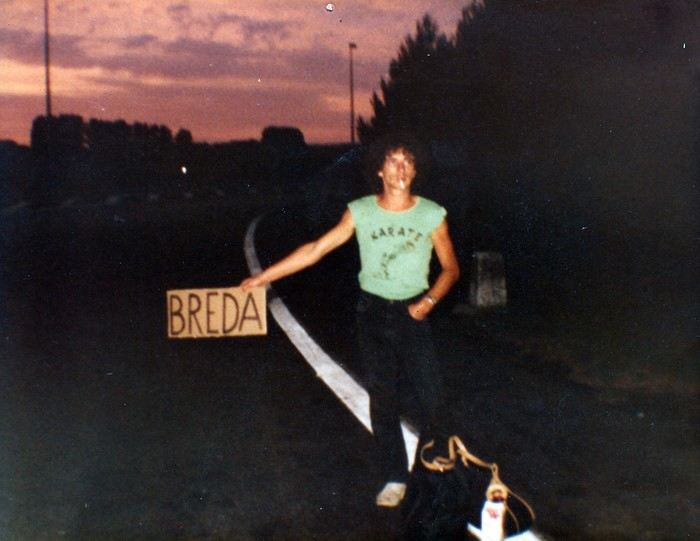
“Hey, your Marker... - My Marker? - The one you used to make hitchhiking signs.”
The marker in question is sitting proudly on the kitchen table. Marielle found it at the bottom of a moving box.
I’ve been meaning to tell the long story of my love affair with hitchhiking for years. Here we go.
To be honest, I’m not quite sure when it started. My earliest memory goes back to a fair with a bike race in my maternal grandparents’ village. I was with my cousin, my little sister, and three girl cousins. There were six of us, ages ranging from six or seven to thirteen or fourteen. Our parents stayed at the fair, and we’d had enough. So we decided to walk home. Only it was four kilometers away. So we hitchhiked. A guy driving an old car picked us all up and dropped us off at the farm. He probably found it amusing to see us thumbing a ride by the side of the road, but maybe it also worried him a bit. With everything you read in the papers...
Around fifteen or sixteen, I started hitchhiking regularly, alone or with a friend, to go to the nearby town. But it was especially when I started boarding school in Orléans that it became more regular. The first year, I’d leave Monday morning and come back Saturday noon by bus. It was an old, uncomfortable bus where we froze in winter. To make matters worse, I often got motion sickness if, as was too often the case, I ended up sitting in the back. In the spring, a high school friend suggested I hitchhike back. It meant a slight detour, but the advantage was taking only national roads.
So that’s how, from the end of tenth grade to twelfth grade, I’d thumb a ride every Saturday on the Pont de Bourgogne. Drivers were used to seeing young people hitchhiking, and it worked pretty well. Our biggest fear? Soldiers! At that time, military service was still mandatory, and on weekends, it wasn’t rare to see them competing with us. They’d keep their uniforms on to go home. That gave people confidence—with everything you read in the papers—and they’d rarely wait more than five minutes. We, with our long hair, were definitely less popular. From time to time, three big red-faced guys in a van coming back from a construction site would flip us off, yelling things like “go get a haircut, you bums!” Those were the good old days.
We still had a good laugh, though. Patrice, the friend I’d hitchhike back from school with on Saturdays, is a musician—I’d later discover he’s an excellent composer. A die-hard Beatles fan, he knows their repertoire by heart and spends his time singing at the top of his lungs while we thumb a ride. One Saturday late morning, we’d been waiting for a while at the exit of Châteauneuf-sur-Loire when a little lady came up to him and asked if he could please sing a little quieter: a baby was sleeping in the house. He put on the most sorry face: “Oh, sorry ma’am, we didn’t realize.” No sooner had the lady gone back inside than he started again. Luckily, a car stopped just then, sparing me the embarrassment of seeing the lady come back out.
Saturday was also the day when the cigarette pack was dangerously low. So before leaving, we’d go buy some “Parisiennes,” the “P4s” as we called them back then. They were slightly thinner cigarettes with a mix of tobacco scraps. Sometimes they tasted like light tobacco, sometimes like dark. Not great, but by the end of the week, our pocket money was gone. They were sold in small packs of four, hence the name P4. We’d only pay 20 centimes. On Saturdays, it was rare for the two of us to manage to scrape together 1.50 F to buy a whole pack of Gauloises...
The last twenty kilometers, I’d usually do alone, Patrice having reached his destination. From time to time, luck would smile on me: an acquaintance would just happen to pass by and stop. One January Saturday, at the exit of Gien, I ran into another guy from Argenton whom I knew a little. That day, the weather was nice, but the temperature was well below zero. It was around noon, and it was the off-peak hour. We were shivering, stamping our feet by the side of the road, when a Citroën “Tube” arrived: it was his father’s boss’s, a mason. They were both sitting in the front, but since they were obese, they had us climb onto the open back. Even though we huddled against the cab to shelter from the wind, the twenty kilometers felt very long, especially since we were only going sixty kilometers an hour. Our hands and cheeks were blue when we finally arrived.
The year I took my baccalaureate, a friend with a 2CV would take me Monday mornings with one or two others we’d pick up in nearby villages. We’d share the gas costs, but it was still cheaper than the bus. And in winter, the bus was my nightmare. You had to get up at five to catch it at six. Not enough sleep, and outside it was freezing or raining—or both. The 2CV was luxury. Plus, Philippe would pick me up at home. On the other hand, since I didn’t have class Saturday mornings—well, I did, but we only had PE the first two hours and nothing after—I’d skip class and slip out right after breakfast to thumb a ride at the Pont de Bourgogne.
Those three high school years were formative in this optional subject that was hitchhiking. Little by little, I learned the rules of the game. First, you shouldn’t walk along the road while thumbing. Cars go too fast and can’t stop easily. Accepting a ride that’s too short is also a no-go. The guy who offers to take you a little way but drops you off at some vague crossroads in the middle of nowhere? No thanks. You need to get dropped off in a town. If it’s a fairly big city, you often have to cross it from one end to the other, but it’s better. At the exit, you have to choose your spot well. Actually, you have to put yourself in the driver’s shoes: they need to see you early enough, not be going too fast, and be able to stop easily without risking an accident. So when leaving a city, it’s better not to go too far. It’s wiser to find a spot where cars go slowly and can stop easily. And preferably near a café. The café is for when you still have a few coins for a coffee and need to warm up. From time to time, you’d run into someone nice who’d make a detour to drop you off at a better spot to start again. Finally, if possible, avoid hitchhiking on Sundays. Cars are packed with whole families who, most of the time, aren’t going far. And then there’s the little worry of those people who rarely leave home: with everything you read in the papers...
During those high school years, it was only short trips, rarely exceeding a hundred kilometers. Later, I aimed bigger, and things were a bit different. In 1973-74, I crossed part of France for the first time on two or three occasions, coming back from the German border or returning to Bordeaux, where we lived briefly. Since there weren’t many highways back then, we took national roads. It was during these trips that I realized it was better to leave in the evening. As I said earlier, Sunday is to be avoided, but on weekdays, there’s another problem: if you leave in the morning, you only make short hops. First, it often takes longer to get going because drivers are people going to work nearby. Which brings us back to those who drop you off in a bad spot, far from everything. There, you have to know how to refuse. You thank the driver for stopping—oh, if only everyone could be like you—while explaining why you’d rather stay put. People don’t take offense, by the way. Those who pick up hitchhikers often hitchhiked themselves when they were in the military or before they had a car. In the late afternoon, you’d often run into salespeople or truckers, in other words, people who drive a lot. At that time, salespeople no longer had appointments and were more relaxed. They wanted to talk about something other than the merits of their products. On the radio, it was time for *Les Grosses Têtes*. You’d also quite often run into small business owners, professionals, or even hippies. The conversations were pleasant and often enriching. A little later in the evening, truckers would take over. They’d already driven a few hundred kilometers, and the depot or customs was still far away. So they’d gladly take a hitchhiker to stay awake at the wheel and chat. The radio with Max Ménier’s show *Les routiers sont sympas*, you’d eventually get tired of it. So a hitchhiker was a change. Others, who’d hit the road at midnight to be at their destination by morning, were nice and offered to let you lie down on the bunk while they drove. When you’d been hitchhiking since six in the evening, freezing in the wind between two vehicles, you weren’t unhappy to take a little nap.
Speaking of Max Ménier, he’d often make announcements for hitchhikers. One evening, I called him. It was getting late, and I still had quite a way to go. No luck: the show had ended for good the day before!
In short, it’s better not to rush, sleep in, and leave after lunch, or better yet, in the late afternoon. Obviously, I’m talking about when you have several hundred kilometers to cover. That’s when you have to play it pro.
First thing, especially at night, but it also applies in the middle of summer when the light is blinding: dress to be seen from far away. I’ll admit I have an advantage over most other hitchhikers: I’m small and don’t scare people. To balance that out, racist drivers often take me for an Arab and are less likely to pick me up, but overall, the balance tips in my favor. Back to the need to be seen: at night, I wear light-colored clothes. In headlights, you can see me from far away.
Second thing: travel light. Forget the big backpack with a frame. Drivers don’t always have room in the trunk or on the back seat, especially if it’s rained and the ground is wet. Plus, it forces them to get out of the car. If they’re nice enough to pick up a hitchhiker, you shouldn’t ask for too much either.
Third thing: bring a cardboard sign and a big marker—like the ones in the photo at the start of this post—to write the name of your destination. In the early 80s, I ran a tourist house in the Cher, but I lived in the Netherlands. In the off-season, it was only open on weekends. On Fridays, I’d leave Holland and return on Mondays. 1200 km round trip. On the way there, in Paris, I’d stand at Porte de la Chapelle. At that spot, the road is very wide, and drivers could stop easily. Obviously, on the sign, I didn’t write Eindhoven, which not everyone knows, and even less Amsterdam because of its seedy reputation. In that case, you’d expect to see a police car stop and two officers in kepis ask for your papers. So as a first destination, I’d write Compiègne. We were well out of Paris, and since it wasn’t too far, a trucker or salesperson was less reluctant to stop. Once past Compiègne, I’d take out my Lille sign. Once in Belgium, it wasn’t really necessary to use a sign anymore, since everyone was going in the same direction. Usually, the guy who picked me up at Porte de la Chapelle would say he wasn’t going far but could take me a little way. Before that, I’d still ask if there was a gas station on the highway where he could drop me off before exiting. While talking, the guy would realize he wasn’t dealing with a dangerous criminal. He’d pretend to check his watch, think for a moment, then say that actually, he was going to Belgium and could take me to the border or a little beyond. To leave Paris on the way back, I’d take the train to Melun, where it was easier to hitchhike than at Porte d’Italie.
Over all those years, I think I was pretty lucky. Or maybe philosophical enough not to imagine a car would stop after a few minutes. An hour’s wait was average. Sure, I sometimes waited three, four, or five hours. Most often at odd hours and in terrible weather. When it doesn’t work, it doesn’t work. But there’s always a moment when things pick up. Sure, when you’re soaked in freezing rain in the early morning after a sleepless night, you’re less philosophical than when I’m writing these lines comfortably at my computer, but it still holds true.
Earlier, I mentioned clothing and the importance of being well-rested before leaving. When you’ve eaten well and just gotten out of the shower, shaved, you’re in a better mood. And somehow, drivers sense it. Or at least, that’s the impression I’ve always had. It’s better to look in shape than disgusted at standing there, half-heartedly thumbing a ride. In short, when I’d start to get fed up with waiting, I’d go into the first café I saw for a coffee. Coming back out, I’d be refreshed, and most of the time, a car would stop within minutes. I’ve often said that when I stood by the side of the road thumbing a ride, I felt a bit like a gambler in front of a slot machine. It was a matter of giving luck a chance. And well, it worked out pretty well.
Then, there are countries where hitchhiking works really well and others where it’s harder. In the 70s-80s, it worked best in Germany and England. In the late afternoon, it wasn’t rare to be invited for tea. Well, that was in England. Tea meant being offered room and board. In Germany, they’d offer you coffee. Once there, they’d first show you the guest room and point out the bathroom before sitting you down in front of a big plate of cold cuts. In the evening, they’d go out in town, and the next morning, they’d usually drop you off at a good spot for hitchhiking. On the other hand, in Mediterranean and Scandinavian countries, you’d better be patient. In Spain or Italy, it’s better to take the train, which was dirt cheap back then. However, if you’re a couple traveling light, it’s already easier in most countries.
In 1982, I went on a trip around Turkey with my girlfriend. We only had two small bags, which was plenty. It was November-December, and we wore our warm, bulky clothes. Leaving Eindhoven at nine in the morning, we arrived in Graz, near the Yugoslav border, at eleven at night. 1300 km in a day! In just four or five vehicles. One to the German border, about fifty kilometers from Eindhoven, the second to Hagen in the Ruhr, the third to Salzburg, and the last to Graz at the Yugoslav border. Record broken. During the night crossing of Yugoslavia, we ran into a trucker close to retirement who lent us the truck’s bunk. So we arrived fresh and rested near Skopje the next morning. We continued to Thessaloniki in northern Greece before taking the train to Istanbul. In Turkey, we traveled a good part of the country by hitchhiking too. With truckers in old, overloaded, slow trucks that climbed hills at fifteen kilometers an hour, but also in cars where five or six people were already crammed in. And every time, we were invited for tea. Once, we were even picked up by a big shot in his Mercedes with a chauffeur. Until then, the average speed was around fifty kilometers an hour. There, we were going two hundred. On a national road, not a nice European highway.
I’ve also hitchhiked in Nepal, from Lumbini, Buddha’s birthplace, to a village on the way to Pokhara. It must have been midday. No bus until the next day. I gave it a try. A small truck overloaded with rice sacks, with two or three young people already perched on top, stopped. I rode on the roof of the cab. At fifty kilometers an hour when it was going well, with a breathtaking view. Coming back from India, I also crossed part of Iran by hitchhiking, from Tehran to the Turkish border. I did this trip with an Austrian I met at the hotel who, like me, had to watch his pennies. We gave it a shot. There was almost no traffic, but to our great surprise, the first car that passed in the area would always stop. They’d just ask for a modest contribution for gas, and it cost next to nothing.
Sometimes, you get scared too. After leaving Turkey in early December 82, we spent about two weeks in the southern Peloponnese harvesting olives. A few days before Christmas, we hitchhiked back to Holland. A girl picked us up in her little Fiat 500. We were driving on a mountain road, and that morning there was a bit of black ice. After crossing a pass, we saw the old Ford Taunus ahead of us at fifty meters start to skid. The driver let out a “heeee!” while grabbing my knees. I reflexively grabbed the wheel. Finally, the Taunus got back on track. And we didn’t swerve. But those few seconds felt very long.
In January 77, while I’d been living in Germany for a few months, I decided to spend a few days in Italy. By hitchhiking, of course. I left in the early afternoon, and by ten at night, I wasn’t far from Frankfurt. I saw a big Mercedes stop. The four or five young people crammed inside were listening to Schlager at full volume. Beer cans littered the floor. They didn’t have a precise destination, and as long as they were going south, that was fine with me. They’d finished their military service that very day and had clearly already celebrated their discharge. The driver was going 160, zigzagging dangerously from one side of the highway to the other. I should have realized he wasn’t entirely sober either. Luckily, there was almost no traffic. Finally, I managed to get dropped off at a gas station just before Frankfurt, relieved. I hope their trip didn’t end tragically.
Another time, coming back from Holland with my wife, we were picked up early in the morning near Senlis by two guys from Lille. They were going to work near Tours and could drop us off at Porte d’Italie. Apparently, they were coworkers but barely knew each other. The driver offered us a beer—at six in the morning, sure!—before opening another can for himself. He was clearly having trouble staying in the right lane. We politely declined, the passenger too. Everyone was tense. Luckily, it was rush hour on the ring road, and we were going slowly. When we got out of the car, the passenger said goodbye with the look of a guy being offered the condemned man’s rum and cigarette.
Finally, there are the annoying remarks from drivers who are either gay when you’re alone or turned on by the sight of your girlfriend when you’re a couple. In those cases, I’d get in the back so the guy wouldn’t feel too confident. And if the conversation got a little too suggestive, we’d deflect until we got dropped off.
And luckily, there are the times, not so rare after all, when you run into really nice people who invite you to eat and sleep at their place and drive you to a good spot the next morning. In Germany and England, that was common. And then there are the big strokes of luck, like during our trip to Turkey when we crossed most of Germany in one car, or that other time when some Germans drove me from the exit of Geneva all the way to the Costa Brava.
Going back to “with everything you read in the papers” and its variant “with everything you see on TV”—and now on the internet—it’s always left me perplexed. Personally, I’ve never heard of hitchhikers assaulting drivers, even if it may have happened. On the other hand, what was most common were hitchhikers being assaulted, especially girls. Anyway, even armed, it seems a bit stupid to assault the driver—wouldn’t that risk causing an accident?
Finally, since that time, I’ve occasionally wanted to hitchhike somewhere far away in France. Most often, too busy with work, it never happened, but the nostalgia hasn’t completely disappeared.
* * *
Other Hitchhikers
And then one day, I... settled down to become a driver myself. Ten years had passed, and you saw fewer and fewer hitchhikers. Or maybe I saw fewer because I had a regular job and wasn’t traveling the same way. And then I understood a few things.
Several times, I was tempted to pick up a hitchhiker, but they didn’t meet the required conditions. They were walking along the road instead of staying at the exit of the previous town. Hard to stop without risking an accident. Or the guy looked really scruffy. Or he was sulking, if not both. Then you think of that famous “with everything you read in the papers.” Not that I was scared, but unfortunately, the few hitchhikers I did pick up later were rarely interesting.
A few years ago, we picked up a young guy at the exit of a small town in Sologne. Not an easy spot for hitchhiking. Bad luck, he was a pretentious little jerk. He was barely 20 or 25 and talked like a bitter old man. He was a waiter in a restaurant. According to him, it was lucky he was there, otherwise the boss would have closed up shop long ago. You’d think he had thirty or forty years of professional experience behind him. As we approached Blois, he started ranting about Arabs, blaming them for all evils. And he laid it on thick. That morning, we were going to a teenager’s funeral who had just committed suicide, so he really got on our nerves, Mr. Know-It-All. Out of anger, I dropped him off next to a shopping center a few kilometers from downtown. Not nice, but it felt good.
Some time ago, we were driving around the Limousin on a Sunday to try out the used Twingo we’d just bought. We picked up a guy in his forties. A German who spoke French well. He started talking about the environment. He was a green Khmer. He got worked up all by himself with his pseudo-eco rant and, after a few kilometers, was almost yelling at us. As we were about to leave the main road for a small one, I dropped him off at a crossroads in the middle of nowhere. Normally, I would have made a little detour to take him to a better spot, but this time, I didn’t feel like doing the... eco-warrior a favor.
On the other hand, I’ve still done my good deed a few times. One June morning, coming back from Orléans, I saw a man in his sixties hitchhiking. The poor guy had had a rough time. He was from Montpellier and was coming back from Caen, where he’d been promised a job. Once there, they bluntly told him the position was already taken, and he had to go back. Except he didn’t have enough money left for the train. He’d spent the night hitchhiking without success. I could only take him as far as Lamotte-Beuvron, where I dropped him off near the fire station. Apparently, there was some vague shelter there or something, but it only opened a few hours later. In the meantime, he settled on the grass in a corner to sleep a little. While he was doing that, I quickly went to the train station to check the price of a ticket to Montpellier. It was within my means. Since he was sound asleep, I slipped the train ticket and 100 francs into his pocket. I couldn’t imagine him continuing to hitchhike all the way to Montpellier. And I bet he didn’t even have a piece of cardboard and a marker!
When we go to Brazil, we usually rent a small car. One day, we were coming back from Paracuru to Fortaleza when we saw a whole family hitchhiking. Two adults and two or three small children. Here near the equator, the sun sets very quickly, and it would soon be night. There was little traffic, and trucks wouldn’t stop because there was no room in the cab. As for the rich people driving big 4x4s, they wouldn’t stoop to picking up the lower classes. The only hope for this kind of family was usually a farmer or artisan who’d let them ride in the back of his pickup. Obviously, they were a bit surprised to see us. Everyone crammed in as best they could in the back of our little car. When we dropped them off, we got a whole string of “Deus lhes abençõe”—God bless you.
Still in Brazil, we were on the road from Barreirinhas to São Luís do Maranhão. About 150 km of deserted road with an isolated mud house here and there. A young woman flagged us down. She was very pregnant and had to get to the clinic twenty or thirty kilometers away to give birth. Someone was supposed to drive her, but the first signs of labor started earlier than expected, and the driver was unavailable. Even driving fast, we weren’t feeling great: it would be just our luck if she gave birth in the car!
Today, we’re in the age of smartphones and carpooling apps. Safety. With everything you see on TV... Three or four years ago, we signed up on a platform. Our first, and only, “client” was a little jerk who didn’t say a word the whole trip. No hello, no goodbye, and certainly no thank you. The next day, we found his Ray-Bans in the car. We didn’t run after him to give them back. Ha!
Yet Another Travel Journal in this (Too) Familiar Rajasthan, But with Family and Kids
Prologue
This journal recounts a trip to Rajasthan that’s already over a year old and that I’ve only now found the chance to write about. The summer of 2024 marked my return to India—my tenth trip—after six long years away since my last solo wanderings in Tamil Nadu in 2018 (the journal of which is published on this site). That absence was partly (but not only) due to the long COVID and post-COVID period, which saw a complete halt and then a major slowdown in global tourism. To top it off, Voyage Forum announced its closure in an end-of-the-world atmosphere. A sad time for our favorite social activity…
A few weeks after returning from Rajasthan, I tried to motivate myself to start writing a journal to publish on a forum claiming to be VF’s successor, which I’d eventually signed up for out of desperation. But I kept hesitating and putting the project off because, for one, I no longer have the time I used to. For another, the vibe wasn’t really taking off on that forum—it was overrun with ads and not very active, contrary to what its host’s name suggested. Despite its good intentions and commendable role as a stopgap, it also turned out to be very impractical to use, especially when you don’t have much time like me. I’ll admit I’d occasionally check back on VF to see if anything was happening. But all the discussions remained frozen in time, stuck in that fateful year, 2020. Then, rumors swirled online about shady reasons behind its closure, leaving little room for hope.
And then, one fine morning, I got a message at work from Marien informing me that VF had reopened. What a huge surprise! Even though the forum’s “end” had played out in a somewhat apocalyptic atmosphere, the memories of passionate and heated discussions, the frank debates, and the useful exchanges that made this site a traveler’s goldmine and a unique hub of conviviality all came rushing back to me like a breath of fresh air. I finally saw a sign and tried to motivate myself to find the time to publish the journal of this tenth trip to India and fifth to Rajasthan. But in the end, I got bogged down in professional and family obligations and never managed to find the time to get started. That’s now fixed, though, because I had two reasons for wanting to do it: I find that looking back on a trip to tell others about it is a highly beneficial introspective exercise. Also, I thought this journal could be useful to other travelers on a few points.
Because, “do we really need yet another journal about Rajasthan?” you might rightly ask! Especially in a time when so many journals about the “Land of Kings” have been published since VF’s return, not to mention the countless stories you can already find online about this region, one of India’s most touristy. And I’d add, why go back to Rajasthan for a fifth time, where I’ve already dragged my feet more than enough—through its forts, deserts, temples, cities, villages, bumpy roads, train stations, tasty street food stalls, cheap guesthouses, and more? Where some might see just another overhyped tourist destination full of the same old *Arabian Nights* clichés, worn to a thread, that I mentioned earlier, when there’s so much else to see in India? Well, first because it’s a magnificent country I never tire of, where I started an academic study and made so many connections. It’s also packed with places where you won’t find a single tourist (right, Marie-Jo?), even in the heart of well-trodden paths and classic itineraries. And most importantly, as I said earlier, things have changed in recent years. First, after six years without traveling far, the urge to go back to India was getting stronger. But this time, no more solo trips (often) or duo adventures (sometimes)—now it’s a team of four that has to come along! And even if you can argue with that, what better place than Rajasthan to introduce India to people who’ve never seen it? To kids you want to amaze? Plus, traveling with your new little family to your favorite country isn’t the same as going solo in often spartan conditions that only affect you. It’s a different challenge, but ultimately probably much harder. So, is it really reasonable to take two kids to India, including a two-year-old baby? That’s one of the main goals of this journal (but not the only one)—to try to answer that question.
As you can tell, it’s not so much the destination but the slightly unusual setup of this trip that, in my opinion, will make this journal interesting. Despite my experience and expertise (yes, I dare say it) in India, there were plenty of questions before we finalized the plan and said, “Alright, let’s go!” The questions were flying for us parents. Is it wise to travel to India with a two-year-old? What would we do (it happened) if the kids got very sick? Would they be able to handle a road trip on Rajasthan’s bumpy, dusty roads using public transport? Could they handle the shock of such a different world—the dirt, poverty, pollution, noise (…and the smell, as they say), the spicy food, monkeys, mosquitoes, snakes, tigers, leopards, and so on? In short, all the clichés that I usually joke about suddenly became potential realities. Another concern: as a mixed Franco-African family (not me, but my partner and her oldest), wouldn’t we risk not always being well received, given what you sometimes hear about that in India? How would Indians react to seeing a mixed-race family, the ultimate taboo in a country of purity and social segregation, which would undoubtedly raise many questions for them? Of course, not everything went as expected… Because, as you know, with India—and what makes it charming for some—there are always complications: sometimes where you don’t expect them… and sometimes where you do. I’ll go into detail about that in the journal to come (not right away) and in the final review (even later). These experiences could be useful to travelers who find themselves in similar situations and have the same questions we did before embarking on such a journey. And maybe it’ll spark the curiosity of those who aren’t concerned and will read yet another Rajasthan journal, but with its own unique twists.
Despite my unchanged constraints, which mean I have little time to write this, I don’t want to rush the story, so I’ll take my time. There will probably be lulls. I hope that won’t stop people from coming to react, debate, share their impressions, or ask for information.
This journal recounts a trip to Rajasthan that’s already over a year old and that I’ve only now found the chance to write about. The summer of 2024 marked my return to India—my tenth trip—after six long years away since my last solo wanderings in Tamil Nadu in 2018 (the journal of which is published on this site). That absence was partly (but not only) due to the long COVID and post-COVID period, which saw a complete halt and then a major slowdown in global tourism. To top it off, Voyage Forum announced its closure in an end-of-the-world atmosphere. A sad time for our favorite social activity…
A few weeks after returning from Rajasthan, I tried to motivate myself to start writing a journal to publish on a forum claiming to be VF’s successor, which I’d eventually signed up for out of desperation. But I kept hesitating and putting the project off because, for one, I no longer have the time I used to. For another, the vibe wasn’t really taking off on that forum—it was overrun with ads and not very active, contrary to what its host’s name suggested. Despite its good intentions and commendable role as a stopgap, it also turned out to be very impractical to use, especially when you don’t have much time like me. I’ll admit I’d occasionally check back on VF to see if anything was happening. But all the discussions remained frozen in time, stuck in that fateful year, 2020. Then, rumors swirled online about shady reasons behind its closure, leaving little room for hope.
And then, one fine morning, I got a message at work from Marien informing me that VF had reopened. What a huge surprise! Even though the forum’s “end” had played out in a somewhat apocalyptic atmosphere, the memories of passionate and heated discussions, the frank debates, and the useful exchanges that made this site a traveler’s goldmine and a unique hub of conviviality all came rushing back to me like a breath of fresh air. I finally saw a sign and tried to motivate myself to find the time to publish the journal of this tenth trip to India and fifth to Rajasthan. But in the end, I got bogged down in professional and family obligations and never managed to find the time to get started. That’s now fixed, though, because I had two reasons for wanting to do it: I find that looking back on a trip to tell others about it is a highly beneficial introspective exercise. Also, I thought this journal could be useful to other travelers on a few points.
Because, “do we really need yet another journal about Rajasthan?” you might rightly ask! Especially in a time when so many journals about the “Land of Kings” have been published since VF’s return, not to mention the countless stories you can already find online about this region, one of India’s most touristy. And I’d add, why go back to Rajasthan for a fifth time, where I’ve already dragged my feet more than enough—through its forts, deserts, temples, cities, villages, bumpy roads, train stations, tasty street food stalls, cheap guesthouses, and more? Where some might see just another overhyped tourist destination full of the same old *Arabian Nights* clichés, worn to a thread, that I mentioned earlier, when there’s so much else to see in India? Well, first because it’s a magnificent country I never tire of, where I started an academic study and made so many connections. It’s also packed with places where you won’t find a single tourist (right, Marie-Jo?), even in the heart of well-trodden paths and classic itineraries. And most importantly, as I said earlier, things have changed in recent years. First, after six years without traveling far, the urge to go back to India was getting stronger. But this time, no more solo trips (often) or duo adventures (sometimes)—now it’s a team of four that has to come along! And even if you can argue with that, what better place than Rajasthan to introduce India to people who’ve never seen it? To kids you want to amaze? Plus, traveling with your new little family to your favorite country isn’t the same as going solo in often spartan conditions that only affect you. It’s a different challenge, but ultimately probably much harder. So, is it really reasonable to take two kids to India, including a two-year-old baby? That’s one of the main goals of this journal (but not the only one)—to try to answer that question.
As you can tell, it’s not so much the destination but the slightly unusual setup of this trip that, in my opinion, will make this journal interesting. Despite my experience and expertise (yes, I dare say it) in India, there were plenty of questions before we finalized the plan and said, “Alright, let’s go!” The questions were flying for us parents. Is it wise to travel to India with a two-year-old? What would we do (it happened) if the kids got very sick? Would they be able to handle a road trip on Rajasthan’s bumpy, dusty roads using public transport? Could they handle the shock of such a different world—the dirt, poverty, pollution, noise (…and the smell, as they say), the spicy food, monkeys, mosquitoes, snakes, tigers, leopards, and so on? In short, all the clichés that I usually joke about suddenly became potential realities. Another concern: as a mixed Franco-African family (not me, but my partner and her oldest), wouldn’t we risk not always being well received, given what you sometimes hear about that in India? How would Indians react to seeing a mixed-race family, the ultimate taboo in a country of purity and social segregation, which would undoubtedly raise many questions for them? Of course, not everything went as expected… Because, as you know, with India—and what makes it charming for some—there are always complications: sometimes where you don’t expect them… and sometimes where you do. I’ll go into detail about that in the journal to come (not right away) and in the final review (even later). These experiences could be useful to travelers who find themselves in similar situations and have the same questions we did before embarking on such a journey. And maybe it’ll spark the curiosity of those who aren’t concerned and will read yet another Rajasthan journal, but with its own unique twists.
Despite my unchanged constraints, which mean I have little time to write this, I don’t want to rush the story, so I’ll take my time. There will probably be lulls. I hope that won’t stop people from coming to react, debate, share their impressions, or ask for information.
Cinq jours à Nador et ses environs
je pars en avril 5 jours a nador, que me conseillez vous? oujda, saidia, ..???
je pense louer une voiture à l'aeroport
No, I Won’t Be Going Back to China
Hello forum,
Did any of you feel the same things we did in China?
We spent a good twenty days there in August. First, we traveled solo around Chengdu, then joined an organized tour for 12 days (Beijing, Pingyao, Xi'an, Guilin, Xingping, Yangshuo, Shanghai, Wuzhen) and extended our stay by 4 extra days to visit Zhangjiajie.
The landscapes were stunning, and we have unforgettable memories... but we were really disappointed by the following points:
- The food: way too spicy. Lacking in flavor, not much taste. I’m speaking "in general" because we did enjoy some good steamed dumplings, smoked pork, and other dumplings... But compared to Thailand, Cambodia, or India, Chinese cuisine didn’t impress us at all.
- The behavior of the Chinese: disrespectful, rushed, agitated. You constantly have to fight—people push, crowd, and overwhelm you... At the entrance to the Terracotta Army (and other sites), it’s a human tidal wave... and I mean that literally. We were carried by the crowd without even touching the ground. It was like a situation where you have one bowl of rice and 20,000 starving people diving for it...
You’re at a ticket counter, and they cut in front of you. You’re in line for boarding, suitcase ready to go on the conveyor belt, and someone shows up out of nowhere to put THEIR suitcase down... even though they have a flight ticket with THEIR seat number and won’t be leaving before you!!!! You’re getting on the bus, and someone shoves past you just so they don’t end up behind you.
It’s like these people only think about themselves. I didn’t see a single person let someone else go first or even ask—it’s as if politeness and respect are completely foreign to them.
It’s honestly exhausting and draining...
- Communication: In every other country we’ve visited, whether in Asia or Europe, we always manage—with English, a few words of Italian, French, or Spanish. In China, I’ll be blunt: if you don’t speak Chinese, you’re screwed. And yet, a pair of kids around ten or twelve years old asked us in English where we were from :)
- Understanding: Here’s the rule. Even if the person you’re talking to speaks a little English and says they understand you... make sure they *really* do, because 9 times out of 10, they don’t. Out of pride or just cluelessness, they’ll give you a big smile and nod, but in reality, they didn’t get what you were saying.
Several times with our group, in the evening at a restaurant, if we hadn’t been helped by someone at another table who spoke a little English, we’d still be there. The classic example: the waiter brings one menu (for 10 people at the table), and we’re all trying to explain that we need 4 or more menus. Five minutes later, he’s still staring at us with that same blank smile...
In 3* or 4* hotels, you go to the front desk for a hot water or AC issue. Three or four staff members just stand there beaming at you. You try to explain with photos or a translator, but in the end, you leave with the problem unresolved.
They don’t speak—they shout... on buses, in hotels...
We were also surprised to find that self-service laundromats were almost nonexistent. We got scammed once at a hotel with an astronomical bill!
As for flights, we flew Air China on the way there and Austrian Airlines on the way back—no comparison. Air China had zero service and food that was "baby food" quality. Austrian Airlines had multiple services, a decent meal, and smiling flight attendants.
I don’t know if any of you had the same experience in this country, but I’m definitely not eager to go back. Whereas if someone offered me India, Thailand, or Vietnam tomorrow, I’d be there in a heartbeat!!!
Did any of you feel the same things we did in China?
We spent a good twenty days there in August. First, we traveled solo around Chengdu, then joined an organized tour for 12 days (Beijing, Pingyao, Xi'an, Guilin, Xingping, Yangshuo, Shanghai, Wuzhen) and extended our stay by 4 extra days to visit Zhangjiajie.
The landscapes were stunning, and we have unforgettable memories... but we were really disappointed by the following points:
- The food: way too spicy. Lacking in flavor, not much taste. I’m speaking "in general" because we did enjoy some good steamed dumplings, smoked pork, and other dumplings... But compared to Thailand, Cambodia, or India, Chinese cuisine didn’t impress us at all.
- The behavior of the Chinese: disrespectful, rushed, agitated. You constantly have to fight—people push, crowd, and overwhelm you... At the entrance to the Terracotta Army (and other sites), it’s a human tidal wave... and I mean that literally. We were carried by the crowd without even touching the ground. It was like a situation where you have one bowl of rice and 20,000 starving people diving for it...
You’re at a ticket counter, and they cut in front of you. You’re in line for boarding, suitcase ready to go on the conveyor belt, and someone shows up out of nowhere to put THEIR suitcase down... even though they have a flight ticket with THEIR seat number and won’t be leaving before you!!!! You’re getting on the bus, and someone shoves past you just so they don’t end up behind you.
It’s like these people only think about themselves. I didn’t see a single person let someone else go first or even ask—it’s as if politeness and respect are completely foreign to them.
It’s honestly exhausting and draining...
- Communication: In every other country we’ve visited, whether in Asia or Europe, we always manage—with English, a few words of Italian, French, or Spanish. In China, I’ll be blunt: if you don’t speak Chinese, you’re screwed. And yet, a pair of kids around ten or twelve years old asked us in English where we were from :)
- Understanding: Here’s the rule. Even if the person you’re talking to speaks a little English and says they understand you... make sure they *really* do, because 9 times out of 10, they don’t. Out of pride or just cluelessness, they’ll give you a big smile and nod, but in reality, they didn’t get what you were saying.
Several times with our group, in the evening at a restaurant, if we hadn’t been helped by someone at another table who spoke a little English, we’d still be there. The classic example: the waiter brings one menu (for 10 people at the table), and we’re all trying to explain that we need 4 or more menus. Five minutes later, he’s still staring at us with that same blank smile...
In 3* or 4* hotels, you go to the front desk for a hot water or AC issue. Three or four staff members just stand there beaming at you. You try to explain with photos or a translator, but in the end, you leave with the problem unresolved.
They don’t speak—they shout... on buses, in hotels...
We were also surprised to find that self-service laundromats were almost nonexistent. We got scammed once at a hotel with an astronomical bill!
As for flights, we flew Air China on the way there and Austrian Airlines on the way back—no comparison. Air China had zero service and food that was "baby food" quality. Austrian Airlines had multiple services, a decent meal, and smiling flight attendants.
I don’t know if any of you had the same experience in this country, but I’m definitely not eager to go back. Whereas if someone offered me India, Thailand, or Vietnam tomorrow, I’d be there in a heartbeat!!!
L'Ouest américain: départ et retour à Denver (3 semaines)
Bonjour,
Je me décide d'ouvrir un post dédié afin de ne pas faire n'importe quoi trop rapidement...🤪
En gros, nous sommes deux adultes et trois enfants (qui auront 4 ans 1/2, 8 ans et 10 ans en juillet 2019).
Nous aimerions partir trois semaines dans l'ouest mais avec départ et retour à Denver. Venant de Belgique, nous partirons de Bruxelles, c'est le plus pratique pour nous.
Pourquoi Denver? Car pour l'instant, il n'y a que via Icelandair (que l'on connait) qui donne un prix correct (+/- 4030€ pour nous 5).
Nos Estas et passeports sont ok (partis à NY cette année).
Pour la période, c'était soit juillet soit le congé de Pâques en avril. Au final, on a décidé de privilégier juillet malgré les désavantages de la chaleur, la foule etc.
Le but de ce post (dans un premier temps) est de savoir si c'est pas un peu dingue de partir de Denver pour faire une GROSSE boucle.
C-à-d → Denver, Las Vegas, LA, SF etc pour revenir par le nord sur Denver. En +/- 20 jours...😇
Si c'est totalement débile, nous devrions trouver des vols vers LA ou SF afin de faire une boucle plus petite. Du coup, prix encore plus conséquent mais autant faire les choses correctement, quitte à devoir post-poser ce voyage à 2020...🙁
Je vous remercie d'avance pour votre précieuse aide. Je m'en vais me documenter! 🙂
Je me décide d'ouvrir un post dédié afin de ne pas faire n'importe quoi trop rapidement...🤪
En gros, nous sommes deux adultes et trois enfants (qui auront 4 ans 1/2, 8 ans et 10 ans en juillet 2019).
Nous aimerions partir trois semaines dans l'ouest mais avec départ et retour à Denver. Venant de Belgique, nous partirons de Bruxelles, c'est le plus pratique pour nous.
Pourquoi Denver? Car pour l'instant, il n'y a que via Icelandair (que l'on connait) qui donne un prix correct (+/- 4030€ pour nous 5).
Nos Estas et passeports sont ok (partis à NY cette année).
Pour la période, c'était soit juillet soit le congé de Pâques en avril. Au final, on a décidé de privilégier juillet malgré les désavantages de la chaleur, la foule etc.
Le but de ce post (dans un premier temps) est de savoir si c'est pas un peu dingue de partir de Denver pour faire une GROSSE boucle.
C-à-d → Denver, Las Vegas, LA, SF etc pour revenir par le nord sur Denver. En +/- 20 jours...😇
Si c'est totalement débile, nous devrions trouver des vols vers LA ou SF afin de faire une boucle plus petite. Du coup, prix encore plus conséquent mais autant faire les choses correctement, quitte à devoir post-poser ce voyage à 2020...🙁
Je vous remercie d'avance pour votre précieuse aide. Je m'en vais me documenter! 🙂
15 jours solo en Andalousie
15 JOURS SOLO EN ANDALOUSIE
fin Mars/Début Avril2017
Cette fois-ci, je pars seule en Andalousie mais n'aimant pas la solitude forcée, je réserve une semaine de cours d'espagnol à Séville avec logement chez l'habitant et demi-pension. Puis Cordoue et Grenade seront au programme de mes visites.
En résumé : 1 semaine à Séville, 2 jours à Cordoue et 4 jours à Grenade Climat : fin mars frais le matin, il fait chaud à partir de 12h, dans les 24 degrés, idéal pour les visites. les deux premiers jours nuageux mais après grand soleil. Transports : avion pour aller de Paris à Séville, train pour aller à Cordoue et car pour se rendre à Grenade et retour en avion de Grenade à Paris Dépenses : moins cher qu’à Paris. On peut manger pour 10 €. Je me suis nourrie en ville mais j'ai bien mangé dans ma famille espagnole.
SEVILLE ou mon GROS coup de coeur :
Déplacements dans la ville : Je parle de la Vieille Ville qui est très étendue et faite de ruelles et de jolies places ou placettes. Tout se fait à pied. Ou alors louer un vélo. Des cours d’espagnol dispensés de façon ludique (enfin il y a quand même le subjonctif espagnol et tous ces temps qui se mélangent dans ma tête) avec 9 autres élèves venant de Chine, Corée, Allemagne, Angleterre, Pologne, ... L'après-midi est libre et après quelques tapas... bof, je ne suis pas très fan, cuisine grasse, pas raffinée mais par contre entrer dans les bars, voir leur décoration dont les gros jambons qui pendent du plafond... Une atmosphère bien agréable y règne, surtout le matin, à la pause des cours. Le soir, hébergement chez l'habitant, en demi-pension chez des Sévillans charmants. (organisé par l'école Giralda)
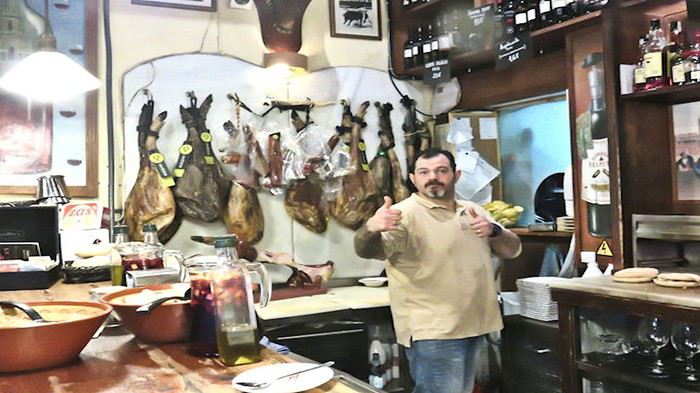
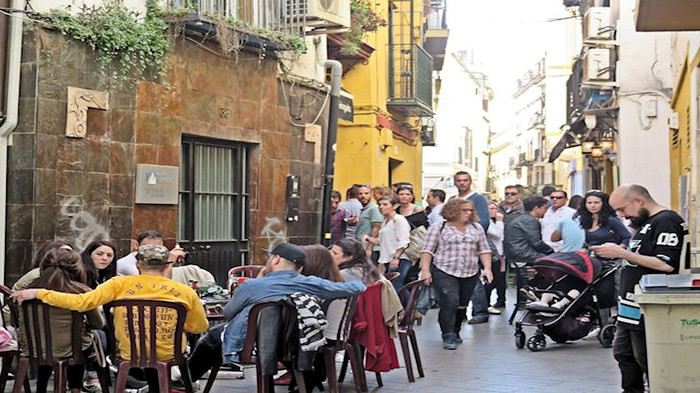
Les bars sont très animés l'après-midi, les Sévillans sont des gens très conviviaux, à en croire le remplissage des bars, et pas seulement à l'intérieur mais dehors; ils empiètent même sur les trottoirs. En passant, j'entends souvent comme un énorme bourdonnement dans les rues, à l’abord des places, ils sont tous à parler, une atmosphère que je ne connais pas à Paris.
LA CATHEDRALE & LA GIRALDA :
Je ne vous apprendrais rien si je vous disais que l’Andalousie fut autrefois et longtemps habitée par les Arabes et que donc l’art mudéjar (mosaïques et stucs, entre autres) est très répandu dans cette région.
La Cathédrale est absolument magnifique et il ne faut pas hésiter à monter en haut de la Giralda (montée longue mais douce car ce sont des pentes et non des escaliers, ça fatigue moins !) quelques photos pour vous en convaincre.
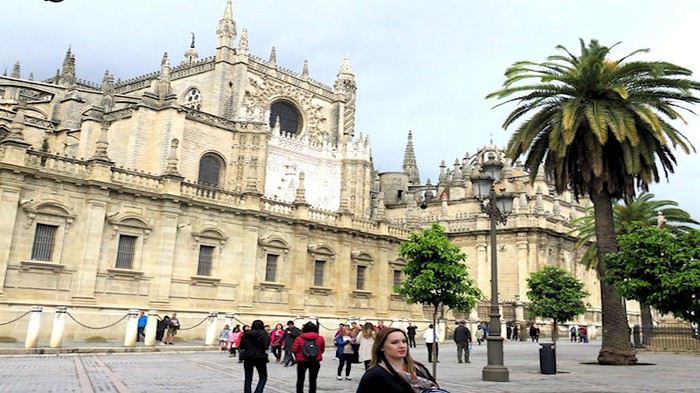
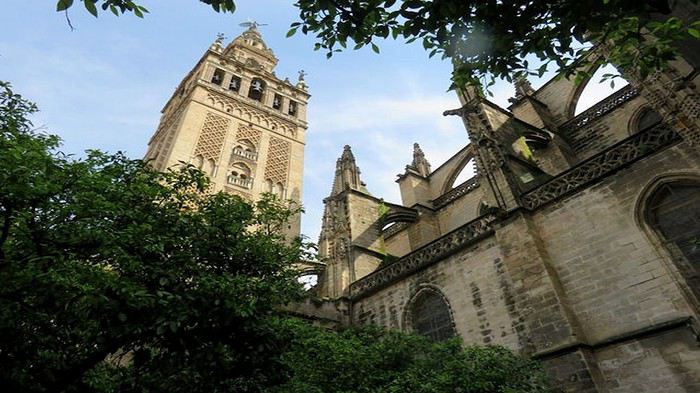
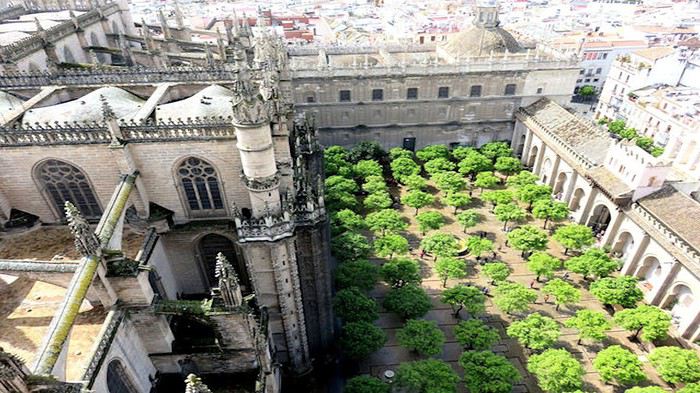
La Giralda, c'est la tour que l'on voit à gauche. Du haut de la tour, vue imprenable sur Séville et bien sûr la cathédrale et son jardin d'orangers.
L’ALCAZAR et ses jardins :
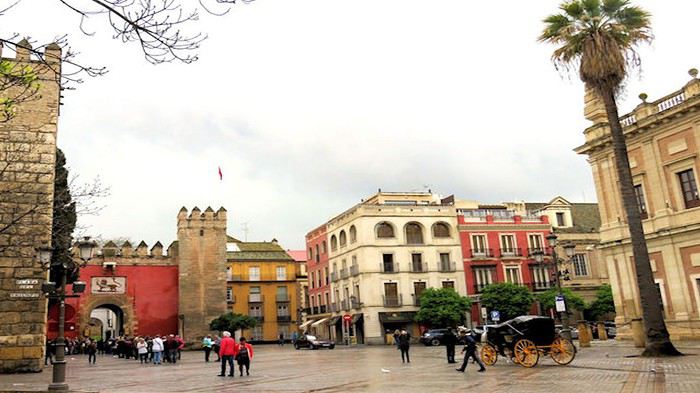
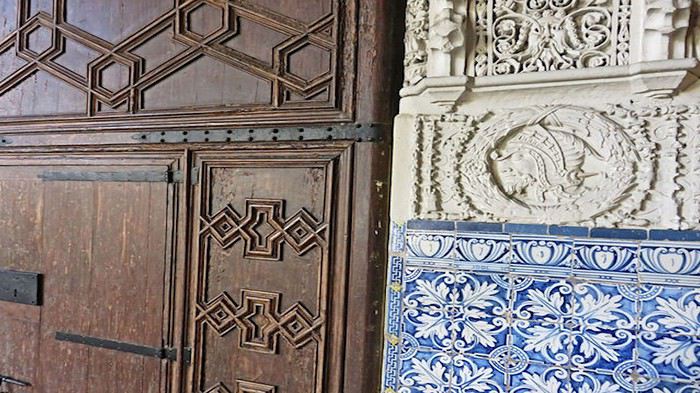
C’est un palais fortifié (alcázar) construit à Séville par les Omeyyades d'Espagne et modifié à plusieurs reprises pendant et après la période musulmane. Il est considéré comme l'exemple le plus brillant de l'architecture mudéjar sur la péninsule ibérique. En voici un exemple ici.
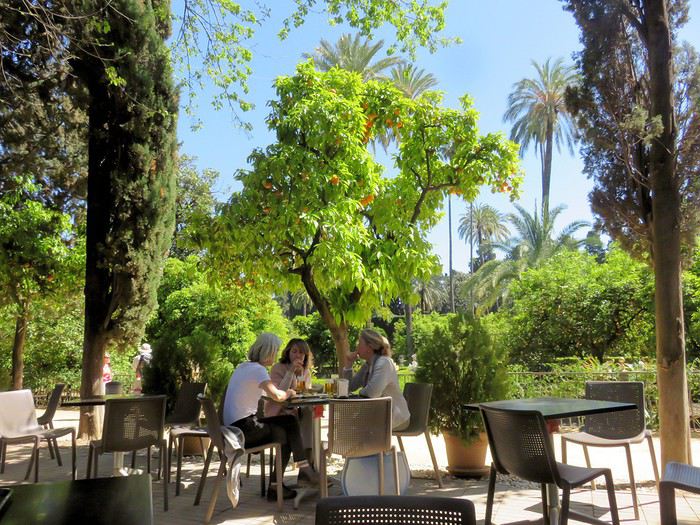
En fait, par les effets du hasard (quoique !), je me retrouve très vite dans les jardins. Une merveille, si !!! Ayant très faim, je me dirige tout de suite vers la cafétéria qui se trouve dans la partie du jardin la plus tranquille. Face aux orangers et aux palmiers, je prends la pause, une longue pause en admirant le paysage et goûtant au bonheur d’être là
Il faut au moins une heure pour visiter les jardins. Bien sûr, ce n’est pas prévu pour cela mais y manger (discrètement) est également possible. La visite du palais en lui-même nécessite également du temps.
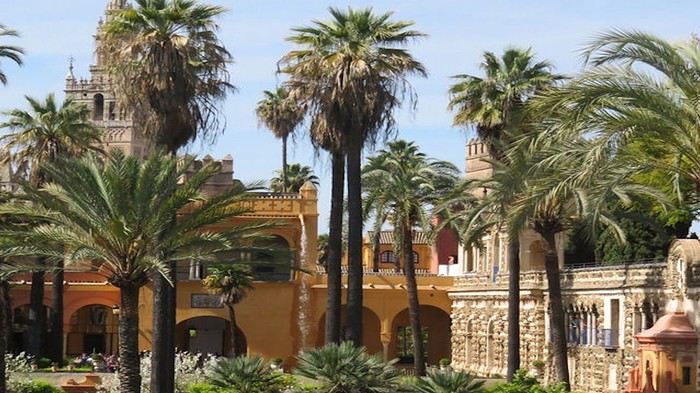
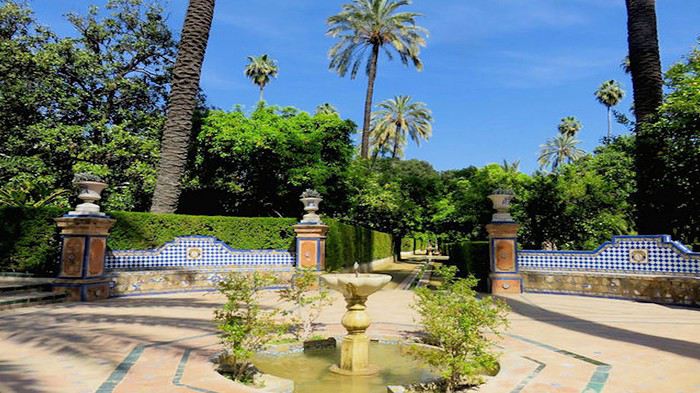
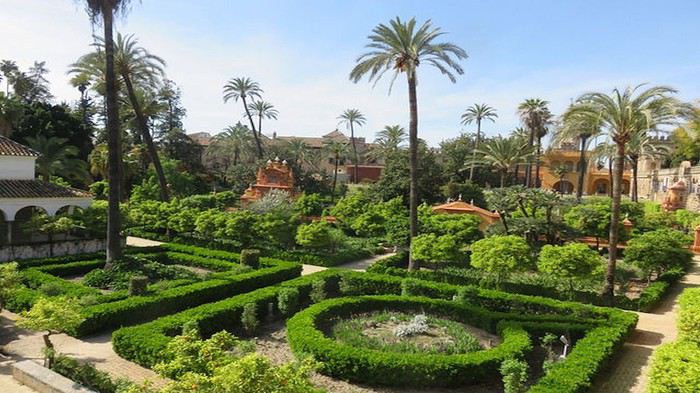
Orangers et Palmiers sont omniprésents dans Séville et, en ce moment, le doux parfum de la fleur d'oranger (ressemble à l'odeur du jasmin) accompagne les visiteurs, et pas seulement dans ce merveilleux jardin.
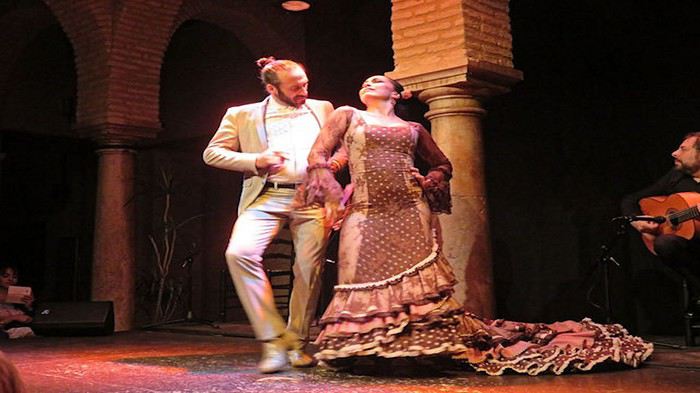
Spectacle de flamenco au Musée de la Danse (Museo de baile) La visite du musée du flamenco avec partie interactive est intéressante et on peut ensuite assister au spectacle. Réserver plusieurs jours à l’avance pour le spectacle, dans les 24 € avec la visite du musée.
On peut passer son temps à se balader dans les ruelles de Séville, se perdre, jeter un œil sur les patios, souvent très jolis. Juste marcher et découvrir.
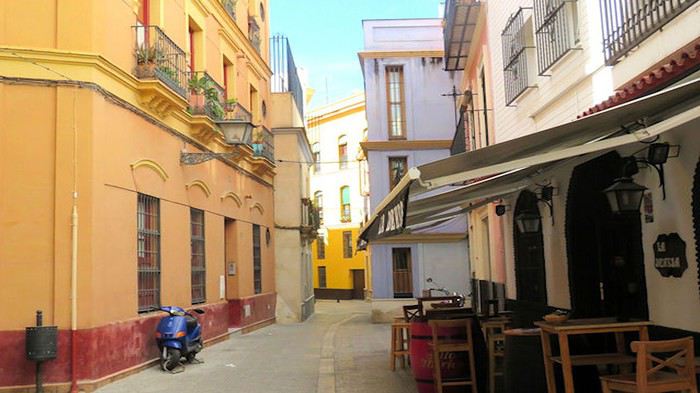
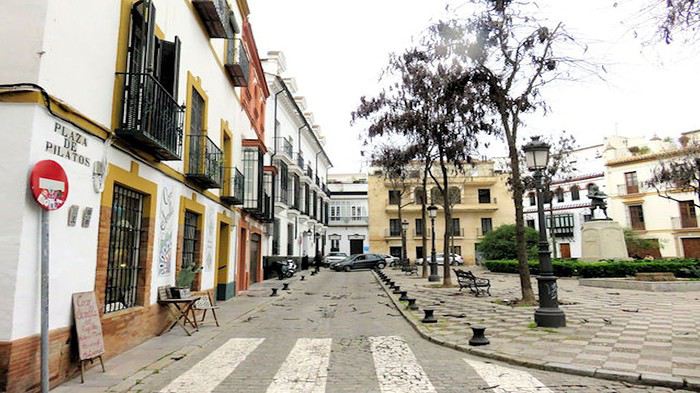
Beaucoup de maisons sont ouvertes sur des patios :
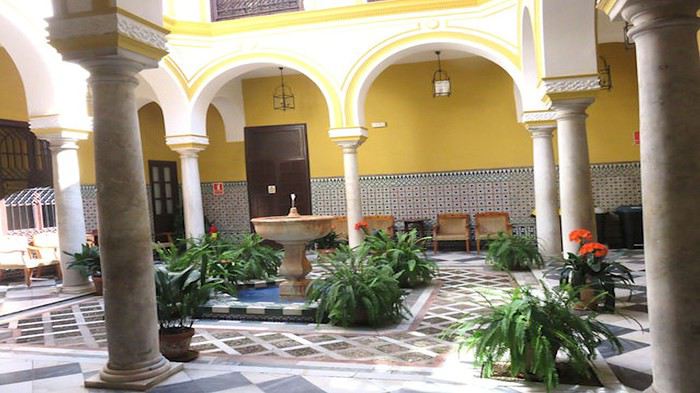
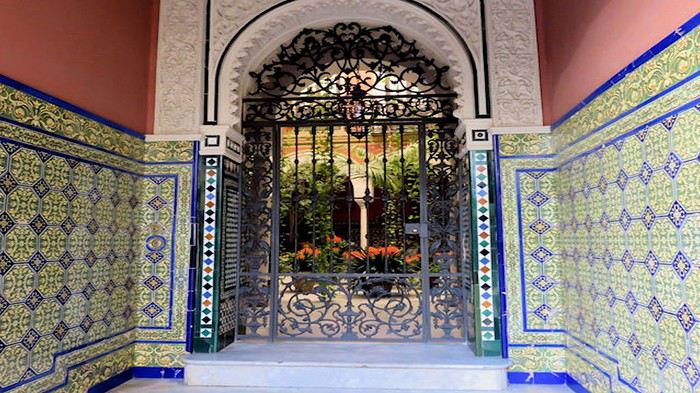
La Casa de Pilatos : Palais aristocratique de style mudéjar. Intéressant et je crois le mercredi après-midi visite gratuite pour les ressortissants européens (une bonne initiative !)
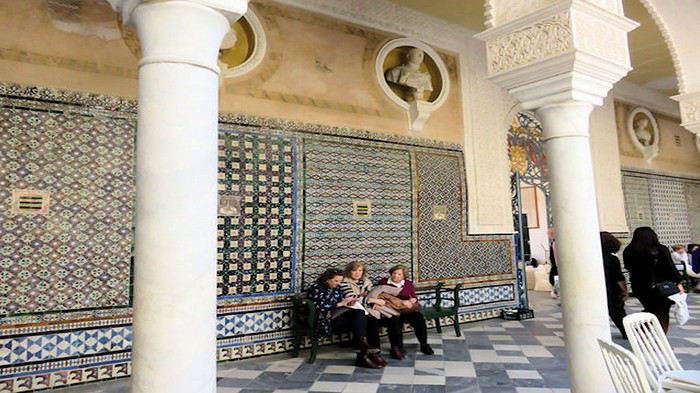
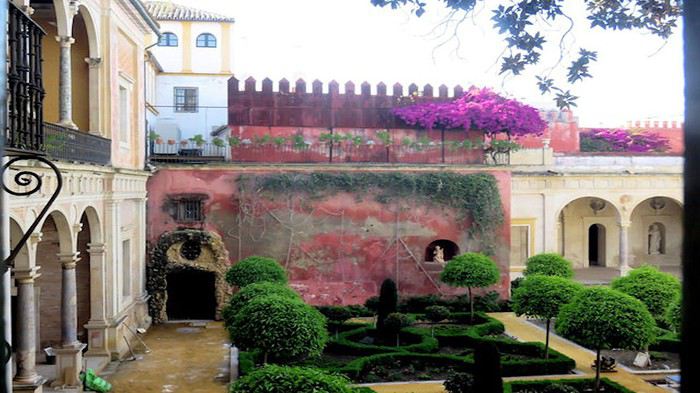
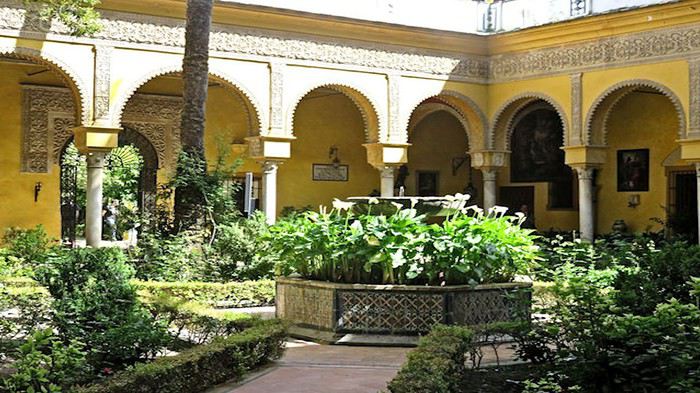
Le Palacio de las Duenas : encore une très belle demeure avec de beaux jardins. Il appartient à la Maison d'Albe et fut construit entre le XVe et le XVIe siècle. Composé de plusieurs édifices séparés par des patios et des jardins, son architecture allie les styles gothico-mudéjar et Renaissance.
Mes impressions : En une semaine, je n’ai pas tout vu … mais j’ai beaucoup marché et tellement aimé Séville. Je suis tombée sous son charme et je compte y retourner l’année prochaine pendant la Semaine Sainte en Avril, d’autant plus que, par hasard, j’ai assisté à une procession (préparatoire à cette grande fête) et c’était beau, si solennel, avec une musique pesante, tragique.
Mon voyage se poursuit, je prends le train pour Cordoba (env. 20 € le billet et env. une heure de trajet)
A suivre ...
Cette fois-ci, je pars seule en Andalousie mais n'aimant pas la solitude forcée, je réserve une semaine de cours d'espagnol à Séville avec logement chez l'habitant et demi-pension. Puis Cordoue et Grenade seront au programme de mes visites.
En résumé : 1 semaine à Séville, 2 jours à Cordoue et 4 jours à Grenade Climat : fin mars frais le matin, il fait chaud à partir de 12h, dans les 24 degrés, idéal pour les visites. les deux premiers jours nuageux mais après grand soleil. Transports : avion pour aller de Paris à Séville, train pour aller à Cordoue et car pour se rendre à Grenade et retour en avion de Grenade à Paris Dépenses : moins cher qu’à Paris. On peut manger pour 10 €. Je me suis nourrie en ville mais j'ai bien mangé dans ma famille espagnole.
SEVILLE ou mon GROS coup de coeur :
Déplacements dans la ville : Je parle de la Vieille Ville qui est très étendue et faite de ruelles et de jolies places ou placettes. Tout se fait à pied. Ou alors louer un vélo. Des cours d’espagnol dispensés de façon ludique (enfin il y a quand même le subjonctif espagnol et tous ces temps qui se mélangent dans ma tête) avec 9 autres élèves venant de Chine, Corée, Allemagne, Angleterre, Pologne, ... L'après-midi est libre et après quelques tapas... bof, je ne suis pas très fan, cuisine grasse, pas raffinée mais par contre entrer dans les bars, voir leur décoration dont les gros jambons qui pendent du plafond... Une atmosphère bien agréable y règne, surtout le matin, à la pause des cours. Le soir, hébergement chez l'habitant, en demi-pension chez des Sévillans charmants. (organisé par l'école Giralda)
Les bars sont très animés l'après-midi, les Sévillans sont des gens très conviviaux, à en croire le remplissage des bars, et pas seulement à l'intérieur mais dehors; ils empiètent même sur les trottoirs. En passant, j'entends souvent comme un énorme bourdonnement dans les rues, à l’abord des places, ils sont tous à parler, une atmosphère que je ne connais pas à Paris.
LA CATHEDRALE & LA GIRALDA :
Je ne vous apprendrais rien si je vous disais que l’Andalousie fut autrefois et longtemps habitée par les Arabes et que donc l’art mudéjar (mosaïques et stucs, entre autres) est très répandu dans cette région.
La Cathédrale est absolument magnifique et il ne faut pas hésiter à monter en haut de la Giralda (montée longue mais douce car ce sont des pentes et non des escaliers, ça fatigue moins !) quelques photos pour vous en convaincre.
La Giralda, c'est la tour que l'on voit à gauche. Du haut de la tour, vue imprenable sur Séville et bien sûr la cathédrale et son jardin d'orangers.
L’ALCAZAR et ses jardins :
C’est un palais fortifié (alcázar) construit à Séville par les Omeyyades d'Espagne et modifié à plusieurs reprises pendant et après la période musulmane. Il est considéré comme l'exemple le plus brillant de l'architecture mudéjar sur la péninsule ibérique. En voici un exemple ici.
En fait, par les effets du hasard (quoique !), je me retrouve très vite dans les jardins. Une merveille, si !!! Ayant très faim, je me dirige tout de suite vers la cafétéria qui se trouve dans la partie du jardin la plus tranquille. Face aux orangers et aux palmiers, je prends la pause, une longue pause en admirant le paysage et goûtant au bonheur d’être là
Il faut au moins une heure pour visiter les jardins. Bien sûr, ce n’est pas prévu pour cela mais y manger (discrètement) est également possible. La visite du palais en lui-même nécessite également du temps.
Orangers et Palmiers sont omniprésents dans Séville et, en ce moment, le doux parfum de la fleur d'oranger (ressemble à l'odeur du jasmin) accompagne les visiteurs, et pas seulement dans ce merveilleux jardin.
Spectacle de flamenco au Musée de la Danse (Museo de baile) La visite du musée du flamenco avec partie interactive est intéressante et on peut ensuite assister au spectacle. Réserver plusieurs jours à l’avance pour le spectacle, dans les 24 € avec la visite du musée.
On peut passer son temps à se balader dans les ruelles de Séville, se perdre, jeter un œil sur les patios, souvent très jolis. Juste marcher et découvrir.
Beaucoup de maisons sont ouvertes sur des patios :
La Casa de Pilatos : Palais aristocratique de style mudéjar. Intéressant et je crois le mercredi après-midi visite gratuite pour les ressortissants européens (une bonne initiative !)
Le Palacio de las Duenas : encore une très belle demeure avec de beaux jardins. Il appartient à la Maison d'Albe et fut construit entre le XVe et le XVIe siècle. Composé de plusieurs édifices séparés par des patios et des jardins, son architecture allie les styles gothico-mudéjar et Renaissance.
Mes impressions : En une semaine, je n’ai pas tout vu … mais j’ai beaucoup marché et tellement aimé Séville. Je suis tombée sous son charme et je compte y retourner l’année prochaine pendant la Semaine Sainte en Avril, d’autant plus que, par hasard, j’ai assisté à une procession (préparatoire à cette grande fête) et c’était beau, si solennel, avec une musique pesante, tragique.
Mon voyage se poursuit, je prends le train pour Cordoba (env. 20 € le billet et env. une heure de trajet)
A suivre ...
Location de voiture Alaska - Yukon
Bonjour, j'ai un casse-tête avec la location d'une voiture à partir de Anchorage. Je désire louer une voiture pour 3 semaines au mois d'août, traverser au Yukon et conduire en partie sur les routes en gravier. J'ai lu les fils de discussion qui portent sur les routes non-goudronnées et cela m'as réellement aidé à comprendre cet aspect particulier de la location de voiture dans cette région (merci à tous!). Nous sommes canadiens et avons les assurances complètes pour conduire au Canada et USA, donc cet aspect ne pose pas problème, en autant que le locateur le permette, "à nos risques".
Il y a un autre aspect dont il faut tenir compte et pour lequel les informations sont manquantes ou imprécises, c'est qu'il semble il y avoir des restrictions de plusieurs locateurs qui ne permettent pas de franchir la frontière avec leur voiture. Je ne parle pas ici du règlement canadien qui empêchait auparavant de passer la frontière avec une voiture loué, mais bel et bien de règles du locateur.
En tout état de cause, il me semble impossible d'utiliser les sites en ligne de location de voiture pour réserver, car ils manquent tous d'information/précisions sur la location (routes de gravier, frontière, assurances, prix, km permis, etc.). J'en suis rendu à contacter un par un les locateurs pour obtenir un devis clair.
J'aimerais obtenir des références d'entreprises d'Anchorage, basé sur votre expérience (avec une adresse de courriel que je pourrais contacter, ce serait vraiment facilitant pour moi), pour une location à partir de Anchorage et qui vous a permis d'aller au Yukon.
Cela m'aiderait à cibler mes recherches et contacts à réaliser, que je devrai faire pour louer une voiture. Compte-tenu du prix élevé des locations de voiture à cet endroit, si vous précisez le prix, cela m'aidera aussi. Merci!
Il y a un autre aspect dont il faut tenir compte et pour lequel les informations sont manquantes ou imprécises, c'est qu'il semble il y avoir des restrictions de plusieurs locateurs qui ne permettent pas de franchir la frontière avec leur voiture. Je ne parle pas ici du règlement canadien qui empêchait auparavant de passer la frontière avec une voiture loué, mais bel et bien de règles du locateur.
En tout état de cause, il me semble impossible d'utiliser les sites en ligne de location de voiture pour réserver, car ils manquent tous d'information/précisions sur la location (routes de gravier, frontière, assurances, prix, km permis, etc.). J'en suis rendu à contacter un par un les locateurs pour obtenir un devis clair.
J'aimerais obtenir des références d'entreprises d'Anchorage, basé sur votre expérience (avec une adresse de courriel que je pourrais contacter, ce serait vraiment facilitant pour moi), pour une location à partir de Anchorage et qui vous a permis d'aller au Yukon.
Cela m'aiderait à cibler mes recherches et contacts à réaliser, que je devrai faire pour louer une voiture. Compte-tenu du prix élevé des locations de voiture à cet endroit, si vous précisez le prix, cela m'aidera aussi. Merci!
Passages de frontières
Comment et pourquoi devient-on accro des voyages ?
Pour ma part, j'ai toujours soupçonné que le fait d'être né (il y a 50++ années) à proximité de la frontière belge a eu, dès mon plus jeune âge, une influence démesurée sur mon attraction pour tout ce qui est étranger et par extension tout ce qui est voyage.
En effet, quoi de plus étonnant qu'une frontière ? Une ligne souvent arbitraire et parfois invisible, mais qui dès qu'elle est franchie nous emmène dans un monde nouveau où plus rien (ou presque) ne ressemble à celui que l'on vient de quitter… à commencer, dans mes yeux de gamin, par les pièces de monnaie différentes et les panneaux routiers écrits dans une autre langue !
Une fois la frontière passée c'était à chaque fois une nouvelle aventure qui commencait. C'était en tout cas comment je ressentais nos fréquentes incursions en Belgique. Belgique Terre d'Aventures ! « Ca est bien une drôle d'histoire sais-tu !!! ».
Huit longues années plus tard, après un long voyage de plus de deux jours en voiture, je franchissais enfin ma deuxième frontière. Celle-ci était encore plus extraordinaire car pour l'atteindre il avait fallu survivre les nombreux virages de montagne. Mais quel extraordinaire moment de magie quand une fois arrivé au sommet, en plus du soleil d'été et des odeurs de pins, je découvrais la Mer Méditerranée et… l'Espagne. J'en suis sûr, je suis devenu accro à ce moment précis.
Depuis je suis en permanence à la poursuite de cet instant toujours aussi excitant qu'est le passage d'une frontière. Certes, au fil des années j'en ai connu certains plus délicats, plus stressants ou plus pénibles que d'autres mais l'excitation reste la même. Bien sur les frontières terrestres restent mes préférées, (surtout quand il faut franchir une rivière) mais je ne boude pas le plaisir d'arriver dans un aéroport et d'attendre avec une impatience grandissante le moment où les portes du hall des arrivées s'ouvriront enfin vers l'extérieur.
Quelle chance d'habiter en Europe quand on est addictif de frontières (border-freak). Lentement mais surement, je me suis assuré d'avoir mes 'doses' à intervalles réguliers. Certaines plus intenses, comme par exemple quand il s'agissait de passer de l'autre côté du 'rideau de fer' et d'autres plus exotiques quand la frontière du pays et aussi celle d'un nouveau continent.
Et puis un jour, j'ai réalisé que les 'effets' pouvaient se prolonger en habitant de l'autre côté d'une frontière. Habiter à l'étranger, et en particulier à Londres, me donnait l'impression d'être en vacances de manière permanente. Quelque temps plus tard, j'ai également réalisé que je pouvais 'contaminer' une autre personne et qu'ensemble nous pouvions facilement supporter de très fortes 'doses', c'est-à-dire partir plus loin et plus longtemps. A tel point qu'après plusieurs années de ce régime, nous ne sommes jamais plus 'redescendus' ou plutôt si, nous sommes redescendus mais bien plus loin que prévu puisque nous étions arrivés en Australie… Trente ans plus tard, nous y sommes toujours d'ailleurs !
Mais les choses étaient mal faites car le border-freak que j'étais devenu s'est retrouvé dans la plus grande ile au monde au milieu d'un univers sans frontière ?!
Après de longues années de sevrage, il était grand temps de contaminé notre progéniture. Cela n'a pas été compliqué seulement un peu couteux parfois mais qui compte les $ quand l'addiction s'appelle Voyages ?
Nos trois filles ont donc fait leur apprentissage en Asie du Sud-Est, proche et relativement bon marché, et parfois en Europe lorsque nous retrouvions nos familles respectives. Quand elles ont trouvé que bourlinguer avec les 'vieux' n'était plus si cool, elles se sont lancées chacune leur tour dans leur tour… du monde. Les élèves ont vite dépassé le maitre (enfin presque car j'avais une bonne longueur d'avance !).
Et puis ce fut aussi l'occasion pour nous de redécouvrir le bonheur de voyager juste à deux. Ainsi nous sommes allés plus loin, plus longtemps… et mieux encore plus souvent !!!
Maintenant je peux confirmer que ma mission est accomplie à 100%... puisqu'il y a toujours un membre de la famille en vadrouille à n'importe quel moment de l'année. Par contre, je crains que les passages de frontières les laissent totalement indifférentes… N'est pas border-freak qui veut !
To be continued...

Pour ma part, j'ai toujours soupçonné que le fait d'être né (il y a 50++ années) à proximité de la frontière belge a eu, dès mon plus jeune âge, une influence démesurée sur mon attraction pour tout ce qui est étranger et par extension tout ce qui est voyage.
En effet, quoi de plus étonnant qu'une frontière ? Une ligne souvent arbitraire et parfois invisible, mais qui dès qu'elle est franchie nous emmène dans un monde nouveau où plus rien (ou presque) ne ressemble à celui que l'on vient de quitter… à commencer, dans mes yeux de gamin, par les pièces de monnaie différentes et les panneaux routiers écrits dans une autre langue !
Une fois la frontière passée c'était à chaque fois une nouvelle aventure qui commencait. C'était en tout cas comment je ressentais nos fréquentes incursions en Belgique. Belgique Terre d'Aventures ! « Ca est bien une drôle d'histoire sais-tu !!! ».
Huit longues années plus tard, après un long voyage de plus de deux jours en voiture, je franchissais enfin ma deuxième frontière. Celle-ci était encore plus extraordinaire car pour l'atteindre il avait fallu survivre les nombreux virages de montagne. Mais quel extraordinaire moment de magie quand une fois arrivé au sommet, en plus du soleil d'été et des odeurs de pins, je découvrais la Mer Méditerranée et… l'Espagne. J'en suis sûr, je suis devenu accro à ce moment précis.
Depuis je suis en permanence à la poursuite de cet instant toujours aussi excitant qu'est le passage d'une frontière. Certes, au fil des années j'en ai connu certains plus délicats, plus stressants ou plus pénibles que d'autres mais l'excitation reste la même. Bien sur les frontières terrestres restent mes préférées, (surtout quand il faut franchir une rivière) mais je ne boude pas le plaisir d'arriver dans un aéroport et d'attendre avec une impatience grandissante le moment où les portes du hall des arrivées s'ouvriront enfin vers l'extérieur.
Quelle chance d'habiter en Europe quand on est addictif de frontières (border-freak). Lentement mais surement, je me suis assuré d'avoir mes 'doses' à intervalles réguliers. Certaines plus intenses, comme par exemple quand il s'agissait de passer de l'autre côté du 'rideau de fer' et d'autres plus exotiques quand la frontière du pays et aussi celle d'un nouveau continent.
Et puis un jour, j'ai réalisé que les 'effets' pouvaient se prolonger en habitant de l'autre côté d'une frontière. Habiter à l'étranger, et en particulier à Londres, me donnait l'impression d'être en vacances de manière permanente. Quelque temps plus tard, j'ai également réalisé que je pouvais 'contaminer' une autre personne et qu'ensemble nous pouvions facilement supporter de très fortes 'doses', c'est-à-dire partir plus loin et plus longtemps. A tel point qu'après plusieurs années de ce régime, nous ne sommes jamais plus 'redescendus' ou plutôt si, nous sommes redescendus mais bien plus loin que prévu puisque nous étions arrivés en Australie… Trente ans plus tard, nous y sommes toujours d'ailleurs !
Mais les choses étaient mal faites car le border-freak que j'étais devenu s'est retrouvé dans la plus grande ile au monde au milieu d'un univers sans frontière ?!
Après de longues années de sevrage, il était grand temps de contaminé notre progéniture. Cela n'a pas été compliqué seulement un peu couteux parfois mais qui compte les $ quand l'addiction s'appelle Voyages ?
Nos trois filles ont donc fait leur apprentissage en Asie du Sud-Est, proche et relativement bon marché, et parfois en Europe lorsque nous retrouvions nos familles respectives. Quand elles ont trouvé que bourlinguer avec les 'vieux' n'était plus si cool, elles se sont lancées chacune leur tour dans leur tour… du monde. Les élèves ont vite dépassé le maitre (enfin presque car j'avais une bonne longueur d'avance !).
Et puis ce fut aussi l'occasion pour nous de redécouvrir le bonheur de voyager juste à deux. Ainsi nous sommes allés plus loin, plus longtemps… et mieux encore plus souvent !!!
Maintenant je peux confirmer que ma mission est accomplie à 100%... puisqu'il y a toujours un membre de la famille en vadrouille à n'importe quel moment de l'année. Par contre, je crains que les passages de frontières les laissent totalement indifférentes… N'est pas border-freak qui veut !
To be continued...
Petit voyage à vélo, où aller en France?
Bonjour,
Nouveau sur ce forum je me présente Erik 38ans d'Argeles sur mer (66).
Passionné de vélo vintage, je me suis dis, pourquoi ne pas faire un tour un peu plus long. genre une semaine version camping sauvage.
Pour cela donc je me remonte un vieux 650b (pour les connaisseur). Coté matos ça va, choix de pneu guidon frein ..etc et question physique ça va aussi. Je roule tout les jours 1heure pour aller bosser plus footing le week end..
La seule chose qui me manque c'est euh, , , , où aller (en France) ben oui je n'ai pas trop d'idée et une petite "appréhension" sur le camping sauvage (c'est l'inconnue) y a t'il des endroits ou comportement à éviter Ah oui mon petit tour ce passerai l'été Merci de m'avoir lu Et au plaisir de faire vous partager mes connaissances et expérience
Erik
++
La seule chose qui me manque c'est euh, , , , où aller (en France) ben oui je n'ai pas trop d'idée et une petite "appréhension" sur le camping sauvage (c'est l'inconnue) y a t'il des endroits ou comportement à éviter Ah oui mon petit tour ce passerai l'été Merci de m'avoir lu Et au plaisir de faire vous partager mes connaissances et expérience
Erik
++
Tremblement de terre au Japon (11 mars 2011)
Bonjour à tous
J'ai crée ce post car partant au Japon dans 2 semaines, je suis un peu concerné.
Un tremblement de terre (8.9 de magnitude) vient de toucher le Japon au large de Sendaï. Tokyo a été touchée mais dans une moindre mesure. C'est surtout la région de Sendaï qui a été dévastée (tsunami de 10 m notamment).
Je voudrais avoir les remarques de personnes sur le départ ou sur place pour avoir un max d'info sur l'évolution des évènements (annulations de vols, de trains, dégâts, possibilité de visiter Tokyo...) dans les prochains jours / semaines.
La presse a toujours tendance à en rajouter, alors je leur fait limite confiance.
J'ai crée ce post car partant au Japon dans 2 semaines, je suis un peu concerné.
Un tremblement de terre (8.9 de magnitude) vient de toucher le Japon au large de Sendaï. Tokyo a été touchée mais dans une moindre mesure. C'est surtout la région de Sendaï qui a été dévastée (tsunami de 10 m notamment).
Je voudrais avoir les remarques de personnes sur le départ ou sur place pour avoir un max d'info sur l'évolution des évènements (annulations de vols, de trains, dégâts, possibilité de visiter Tokyo...) dans les prochains jours / semaines.
La presse a toujours tendance à en rajouter, alors je leur fait limite confiance.
Reprise progressive du trafic aérien (17 avril 2010)
Bonjour,
La création de se topic à pour but de récolter un maximum d'informations, dépêches de dernière minutes, avis, ou encore témoignoiges sur la reprise progressive du traffic aérien.
Cette malchance qui tombe en pleine vacances scolaire et qui risque de me faire rater mon voyage qui devrait se dérouler mercredi prochain à destination de New-York via Amsterdam.
Pensez-vous que Lundi 8 heure, il nous sera annoncer que la reprise du traffic sera une nouvelle fois repousser?
Merci d'avance pour votre participation.
La création de se topic à pour but de récolter un maximum d'informations, dépêches de dernière minutes, avis, ou encore témoignoiges sur la reprise progressive du traffic aérien.
Cette malchance qui tombe en pleine vacances scolaire et qui risque de me faire rater mon voyage qui devrait se dérouler mercredi prochain à destination de New-York via Amsterdam.
Pensez-vous que Lundi 8 heure, il nous sera annoncer que la reprise du traffic sera une nouvelle fois repousser?
Merci d'avance pour votre participation.
Planning a bike trip?
Who are you? Where are you from? Where are you going?
Like last year at this time, a post about bike travel ideas.
How many of us are preparing a trip planned for this year? Probably a lot.
What’s yours—the one you’ve been dying to do for so long, maybe too long? For us, it’s a modest PARIS-MARATHON by bike, followed by MARATHON-ATHENS on foot in June 2010. And you?
May the passion keep growing before, during, and after! Happy planning and safe travels to everyone.
Like last year at this time, a post about bike travel ideas.
How many of us are preparing a trip planned for this year? Probably a lot.
What’s yours—the one you’ve been dying to do for so long, maybe too long? For us, it’s a modest PARIS-MARATHON by bike, followed by MARATHON-ATHENS on foot in June 2010. And you?
May the passion keep growing before, during, and after! Happy planning and safe travels to everyone.
Tour de Belgique à vélo
bonjour tout le monde,
voilà j'ai le projet de faire un tour de Belgique à vélo et il y a évidemment plein de paramètres qui entre en jeux.
combien de temps pensez vous que cela pourrait prendre?
quelqu'un l'a-t-il déjà fait et pourrait m'aider sur l'itinéraire à emprunter?
niveau matos que faut il prévoir en sachant que j'aimerai faire un maximum de camping?
je pense que rouler entre 60 et 80 km par jour est une bonne moyenne.
merci pour vos réponses
à bientôt 😉
merci pour vos réponses
à bientôt 😉
Recherche projet d'aide humanitaire en été 2009
Bonjour!!
Je suis étudiante en services sociaux à L'Université de Montréal. J'ai toujours eu envie de m'impliquer dans un projet de voyage et encore plus d'aide humanitaire à l'étranger. Je désirerais partir pour environ 1 mois, autour de juillet ou aout 2009. Je débute mes recherches afin de recevoir le maximum d'informations sur différents projets et organismes. L'amérique sud ou L'afrique du nord m'interesse beaucoup. J'attend vos conseils, commentaires témoignages et idées!! Merci et au plaisir!
christine
Je suis étudiante en services sociaux à L'Université de Montréal. J'ai toujours eu envie de m'impliquer dans un projet de voyage et encore plus d'aide humanitaire à l'étranger. Je désirerais partir pour environ 1 mois, autour de juillet ou aout 2009. Je débute mes recherches afin de recevoir le maximum d'informations sur différents projets et organismes. L'amérique sud ou L'afrique du nord m'interesse beaucoup. J'attend vos conseils, commentaires témoignages et idées!! Merci et au plaisir!
christine
Recherchons mission humanitaire pour l'été 2009
Bonjour,
je m appelle delphine et je cherche une mission humanitaire pour l'été 2009.
Je travaille en collége et prepare avec grande motivation le concours d instit.
Moi et mon ami (qui se destine aussi aux metiers de l enseignement) cherchons a nous rendre utiles cet été.
Nous avons un budget d environ 2000 euros et notre bonne volonte et notre joie de vivre pour bagage.
si vous avez des tuyaux a nous donner sur des assos interessées n hesitez pas!!!
merci d avance.
Cherche à faire du bénévolat en Afrique au mois d'octobre
Hello tous,
Nous sommes deux filles de Suisse et nous souhaitons passer quelques semaines en Afrique en octobre 08. L'ideal serait de trouver un programme ou l on pourait aider/enseigner dans une ecole... Nous sommes bien evidement ouvertes a d'autres idees.
On attend vos suggestions avec impatience,
ciao
Nous sommes deux filles de Suisse et nous souhaitons passer quelques semaines en Afrique en octobre 08. L'ideal serait de trouver un programme ou l on pourait aider/enseigner dans une ecole... Nous sommes bien evidement ouvertes a d'autres idees.
On attend vos suggestions avec impatience,
ciao
Budget pour un mois et demi en Inde
Bonsoir,
Encore une petite question pour mon voyage en Inde (pour ceux qui se poseraient la question, mon précédent message parlait de deux semaines en Inde du sud mais je pars en fait seule pendant un mois et mon ami me rejoint ensuite pour 15 jours) : quel budget faudrait-il que je prévois pour un mois et demi en Inde, je comptais environ 1000€ tout compris (hôtels petits budgets, resto, visites et emplettes). Est-ce trop large ?
Dans l'attente de vous lier.
Poumablue
Encore une petite question pour mon voyage en Inde (pour ceux qui se poseraient la question, mon précédent message parlait de deux semaines en Inde du sud mais je pars en fait seule pendant un mois et mon ami me rejoint ensuite pour 15 jours) : quel budget faudrait-il que je prévois pour un mois et demi en Inde, je comptais environ 1000€ tout compris (hôtels petits budgets, resto, visites et emplettes). Est-ce trop large ?
Dans l'attente de vous lier.
Poumablue