Results for "Norvège+sécurité"
About 6,677 results.
More options
Many results are in French, the community’s main language. English translations are added over time.
Search results
Compagnie Norwegian pour Oslo
Bonjour,
J'ai trouvé un billet vraiment pas cher pour Oslo, 80 euros l'aller retour. Etonnant. J'aimerais savoir que penser de cette compagnie? Je sais qu'il faut rajouter le prix pour l'enregistrement des bagages (limité à 20kg), mais ce prix est vraiment dérisoire. Et pour un vélo il faut rajouter 26 euros, ce qui fait que le prix total est IMBATTABLE. Apparemment les taxes sont incluses, qq peut-il me confirmer???
Merci!
Jérôme
J'ai trouvé un billet vraiment pas cher pour Oslo, 80 euros l'aller retour. Etonnant. J'aimerais savoir que penser de cette compagnie? Je sais qu'il faut rajouter le prix pour l'enregistrement des bagages (limité à 20kg), mais ce prix est vraiment dérisoire. Et pour un vélo il faut rajouter 26 euros, ce qui fait que le prix total est IMBATTABLE. Apparemment les taxes sont incluses, qq peut-il me confirmer???
Merci!
Jérôme
Trek au Cap Nord (Norvége) en février
On pense faire un trekking en norvège et remonter jusqu'au cap nord en février.
Désirons savoir si cela est possible?Les température?les heures d'ensoleillement?......
Merci
Hébergement pas cher à Oslo en Norvège
Bonjour,
Qqn a-t-il de bons tuyaux pour un hébergement pas cher à Oslo à 2 (j'entends par pas cher inférieur à 70 euros la nuit !) du style guesthouse, auberges, pensions, chambres d'hotes, "hytte" ...hotel, c'est vraiment trop cher ! Merci de vos réponses si vous avez adresses et sites web !
Qqn a-t-il de bons tuyaux pour un hébergement pas cher à Oslo à 2 (j'entends par pas cher inférieur à 70 euros la nuit !) du style guesthouse, auberges, pensions, chambres d'hotes, "hytte" ...hotel, c'est vraiment trop cher ! Merci de vos réponses si vous avez adresses et sites web !
15 days for a motorcycle road trip: Corsica or Norway?
Hey everyone,
I’ve got 15 days off in June and I’m pretty undecided about where to go for a motorcycle road trip. Two strong desires are pulling me in different directions: Corsica or Norway.
Corsica has been a dream of mine for a long time: legendary roads, stunning landscapes, a unique vibe, and the perfect mix of sea and mountains. At the same time, I’m wondering if 2 weeks might be *too much* for Corsica—risking feeling like I’ve seen it all too quickly, especially on a bike. Since I also have an extra week free in May, I could use that specifically for Corsica. Maybe splitting it into two trips would make more sense? If so, which routes or regions would be the most interesting to plan for a 7-day trip?
On the other hand, Norway is *super* appealing. The landscapes look incredible, totally different from anything I’ve experienced, and it’d be a real “wow” trip. I know 15 days is still short for such a vast country. Getting all the way to the North Cape seems pretty much impossible in that time, but I’m curious about what realistic routes could be planned.
So I’m wondering: Is it better to save Norway for next year, take 3 weeks off, and do it *properly*? Or are 15 days enough for a first amazing taste of the country?
I’d love to hear about your experiences—whether it’s Corsica (ideal duration, routes) or Norway (what’s realistic in 2 weeks on a bike). Thanks in advance for your thoughts!
I’ve got 15 days off in June and I’m pretty undecided about where to go for a motorcycle road trip. Two strong desires are pulling me in different directions: Corsica or Norway.
Corsica has been a dream of mine for a long time: legendary roads, stunning landscapes, a unique vibe, and the perfect mix of sea and mountains. At the same time, I’m wondering if 2 weeks might be *too much* for Corsica—risking feeling like I’ve seen it all too quickly, especially on a bike. Since I also have an extra week free in May, I could use that specifically for Corsica. Maybe splitting it into two trips would make more sense? If so, which routes or regions would be the most interesting to plan for a 7-day trip?
On the other hand, Norway is *super* appealing. The landscapes look incredible, totally different from anything I’ve experienced, and it’d be a real “wow” trip. I know 15 days is still short for such a vast country. Getting all the way to the North Cape seems pretty much impossible in that time, but I’m curious about what realistic routes could be planned.
So I’m wondering: Is it better to save Norway for next year, take 3 weeks off, and do it *properly*? Or are 15 days enough for a first amazing taste of the country?
I’d love to hear about your experiences—whether it’s Corsica (ideal duration, routes) or Norway (what’s realistic in 2 weeks on a bike). Thanks in advance for your thoughts!
Spitsbergen – A Night with the Walruses on Lågøya
Spitsbergen, 80° North latitude. A lost archipelago on the edge of the world, northeast of Greenland, the last lands before the pole. I’m aboard the *Grigoriy Mikheev*, a Russian ship from the Murmansk Polar Research Institute. Russian flag, Russian crew. Chartered by OceanWide Expeditions.
Last night, we were stuck in drifting pack ice in the long Hinlopen Strait. This incident led to an unforgettable barbecue and party on the ship’s foredeck, but we had to abandon our plan to head south and circle Spitsbergen. This summer, there’s too much ice in the strait, and it’s too thick. At dawn, the tide turned, allowing us to break free and head north again. The ship is now moving slowly through sea ice density that satellite maps estimate at around five-tenths. Our progress is punctuated by dull thuds: the ship’s bow constantly shoves and fractures enormous ice floes.
At breakfast, Tarik, our expedition leader, informs us that our program will be significantly altered. Since we can’t cross the strait, we’ll turn back and head north. To kick off our Plan B, Tarik plans a landing tonight on the small island of Låg (Lågøya), at 80°10' North. Last summer, he saw a large walrus colony there and hopes we’ll find them again. The weather is perfect—glorious sunshine—and walruses are truly addicted to sunbathing on the beaches.
We’ve now exited the strait and are sailing far from the coast. In case the walrus colony is there, we don’t want the ship’s approach to scare them into the water before we even see them. So, we scan the shore methodically with binoculars. We pass several bays, round a cape, and examine several shorelines littered with driftwood, but no walruses in sight. Several times, clusters of large rounded rocks trigger false alarms… but no, they’re just rocks…
Suddenly, Tarik spots them through his binoculars! On an isolated peninsula, our expedition leader’s highly trained eye has picked out, among those brown masses, the shape and white color of the enormous tusks of what he calls "the heavyweights of the Arctic!" Now, fifteen or twenty pairs of binoculars are pointed in the indicated direction… Sure enough, I see them now! They’re there, huge, sprawled in the sun on the beach. Without Tarik’s sharp eye, we might have missed them. They’re so tightly packed together that they really look like a mass of brown rocks. Only the white, saber-shaped tusks and the occasional furtive movements hint that they’re animals.
It’s 11 PM, and on the deck of the *Grigoriy Mikheev*, as you can imagine, excitement has ramped up several notches. Several of us have already rushed to our cabins to gear up, pulling on boots and life jackets in anticipation of a landing that promises to be absolutely amazing. Tarik reins in our enthusiasm a bit: Okay, so we were lucky to find them, but now we need to think about how to approach them. Not that they’re dangerous—at least not on land… Their enormous bulk and their pseudo-feet (flippers) only allow for very limited mobility. But when they feel threatened, their first instinct is to head for the water, where their perfect ease keeps them safe. So, the challenge will be not to scare them off, to avoid them bolting into the water in the first few seconds! That’s exactly what would happen if we arrived by Zodiac right in front of them.
So, Tarik decides we’ll make a wide detour to land on the other side of the peninsula where they are. From there, we’ll leave the Zodiacs on the beach and cross the peninsula on foot, about a kilometer and a half. That way, we’ll approach the herd from behind. This approach will also keep us downwind of them. There you go—with a few precautions, they shouldn’t hear us coming or catch our scent.
Everyone is geared up now and practically bursting with impatience… While the Zodiacs are being lowered into the water, Tarik and Delphine recap the approach rules: absolute silence, communication only by signs, no dragging feet on the rocks, watch your step, and strict coordination with slow movements.
Here we go… we’re off now! Spray flying from the Zodiac’s bow, icy air whipping our faces, gloves gripping the side ropes, freezing splashes, pure emotion… Ahh, I love this! We describe a wide curve offshore to round the peninsula. Ahead of us, the magnificent landscape of this intensely blue sea unfolds, with the hills of Lågøya and, in the distance, the ice-covered mountains of Nordaustlandet under the sun. It’s midnight now. In July, at 80 degrees North, the sun is just like midday.
This navigation takes us far from the walruses, on the other side of the cape. Easy landing on a shoreline of large pebbles covered in giant seaweed brought in by the currents. They look like long strips of plastic—sometimes translucent, sometimes white, beige, or orange. In places, there are huge tangled layers of it. Our boots sink into this material, which gives off a strong iodine smell. Unfortunately, there’s also some plastic waste—fishing floats and net debris. Seeing this here is crazy… A little farther on, in a cove, tides and storms have piled up numerous tree trunks from Siberia.
We begin crossing the peninsula on foot, staying close together. We’re walking on a nearly deserted polar tundra. We’re only ten degrees of latitude from the North Pole here. The violent winds and extreme temperatures that dominate this island for nine months of the year allow only a few rare plants to grow, close to the ground, between the rocks. In places, rocks are covered with large patches of black lichen.
Gérard, rifle slung over his shoulder, constantly scans the terrain. Tarik and Delphine are also very vigilant. We know no one ever lands here, and although this environment isn’t ideal for bears, you never know—better to be cautious. The terrain is mostly flat, but whenever a small rise blocks our view, Gérard moves ahead and only signals us to proceed when he’s sure there’s no "big man in fur" (tradition dictates we don’t name the polar bear).
After a few hundred meters, we find an enormous whale vertebra. Judging by the state of the bone, it’s likely a relic from the whaling era that ravaged this area in the 17th century and all over northern Spitsbergen. A little farther on, the remains of a grave catch our attention. The only human trace on this remote island, this burial is surely very old, also likely dating from the whalers’ time. But this whaler’s final resting place didn’t shelter him for long—there’s not much left, just a piece of skull and a few broken bones. Due to the permafrost, the body could only be buried a few dozen centimeters deep, between some planks held in place by large stones. This makeshift grave was probably ravaged by a bear shortly after the burial. Several stone blocks are overturned, the planks are broken open. We only linger for a minute to pay our respects to this whaler, whose poor remains now merge with the mineral landscape.
A slight rise bulges in the center of the peninsula, and here we are at the highest point. If our orientation is correct, we’re heading straight for the walrus colony. A moment of emotion… my heart’s pounding. Yes, they’re there, about three hundred meters ahead of us! They haven’t moved since we spotted them from the *Grigoriy Mikheev*’s deck. They’re sprawled in a heap, packed tightly together in the sun, on the shingle beach. The light breeze blowing in our faces confirms we’re on the right track—not to be sniffed out from afar by the big beasts.
By signs, Tarik tells us we’ll approach slowly, in stages, moving about thirty meters at a time, making as little noise as possible with our boots, then freezing completely for a minute or two, crouching down to let them forget us. This strategy proves excellent. We’re now less than a hundred meters away, and it doesn’t seem like our presence is perceived as a threat by the "heavyweights of the Arctic." At this distance, let’s not kid ourselves: we’re certainly spotted, but our way of approaching must seem reassuring—or at least manageable—since they’re only a few meters from the water and know they could dash into it in seconds if they felt the need.
We now advance in shorter stages—twenty meters at a time, then just ten, crouching, then freezing like statues, our breathing nearly held from emotion and concentration. We’re now thirty meters from the mastodons. Our presence must be starting to stress them because they’re moving more. While still sprawled against each other, some suddenly rear up on their flipper-feet, grunting and snorting like monstrous pigs. Their head shakes make their two enormous ivory sabers sway. They jab them into the fat of their neighbors, who in turn stir and emit irritated snorts.
At Tarik’s signal, we move a few more meters, "on velvet paws"… We’re right there now. I hold my breath, throat tight… Intense emotion, a fantastic spectacle—these enormous Arctic animals sprawled in the sun, with the magnificent backdrop of snow-covered mountains across the sound. I think to myself: *I’m here… this can’t be real!* It’s nearly 2 AM now, the air is crystal clear, and the Arctic sun bathes this scene in what might be the most beautiful light I’ve ever seen. We’re about fifteen meters away now. Tarik signals that we won’t go any closer. The walruses are still lying down, but occasionally, our close presence and the clicking of cameras trigger bouts of agitation that ripple through the herd, causing some jostling. They’re so tightly packed and tangled that it’s a bit hard to count them. In the end, we tally sixteen, plus one "little one," half-crushed in the general mass.
Seen from here, they’re truly impressive! The "sumo wrestlers of the Arctic!" According to Tarik, they must weigh about a ton—slightly more for the males than the females—and the "little one" must already be around 200 kg. When the weather’s nice like today, they love sprawling on the beaches to soak up the sun.
Walruses are marvels of Arctic adaptation. They can modify their blood circulation depending on thermal conditions. They withstand extreme cold by directing most of their circulation to vital organs (heart, lungs) and minimizing peripheral blood flow (skin and limbs) to prevent heat loss. Conversely, when they sunbathe, they direct most of their blood flow to the skin, turning themselves into true solar collectors.
At this latitude, there’s practically no difference in sunlight between day and night. Noon or midnight, the sun’s angle barely changes. Walruses make the most of these fair-weather phases by sprawling in the sun 23 hours out of 24… Enough to make siesta lovers dream, right? Twenty-three hours of lounging… and the twenty-fourth for eating!
And when we say "eating," what a feast! The proverb *"Who sleeps dines"* is fully justified here: when a walrus decides to feed, it gulps down between 50 and 60 kg of shellfish in an hour! Its food consists of large bivalve mollusks, which it tears from the seabed with its tusks and sucks up nonstop! A 50 kg meal certainly justifies a 23-hour nap for digestion, right? And speaking of digestion—it’s what the "big guys" in front of us are doing right now! You might wonder how we know this… Well, I’ll tell you: if you were here, downwind (or should I say *down the winds!*) of these marine giants, you’d have no doubt! Pfft… what flatulence! I can confirm that today’s scent is called *"Morsanus, from the North"* (*"Because I’m worth it!"*). Mmm, yeah… Tarik, you had a great idea putting us upwind… at least *they* can’t smell us, but we sure can!
But… heepp! Delphine discreetly signals to get our attention—she’s just spotted something: in the smooth water of the bay, a small V-shaped ripple runs along the beach, then turns toward the shore… So the colony wasn’t complete on the beach… Here’s an 800 kg bather stepping ashore now, right before our astonished eyes! She lifts her head and stays like that for a long moment, her enormous tusks half out of the water. She looks exhausted, resting a bit before coming out. Or more likely, she’s hesitating to climb onto the beach because she’s seen us… The shapeless head stays still for a moment, then violently snorts like a clogged drain! A misshapen head where you can’t make out anything that usually makes a head! No eyes, no ears, no mouth… A sort of monstrous cabbage! But the temptation to join the warmth of the "sunbathers" is too strong! Here’s our pachyderm bather climbing the few meters of the shore and sprawling right in the middle of her companions, who greet her with jostling, grunts, and tusk jabs! Then everything settles back into order—800 kg of fat and flesh added to the fifteen or so tons of local biomass. Welcome to the club!
It seems the walruses have gotten a bit used to us now. They’re moving and grunting much less. I realize it wasn’t obvious to approach them like this without scaring them into the water… It’s thanks to Tarik and Delphine’s advice that we managed it. It’s also, let’s be honest, because we’re all passionate here, and there’s been total discipline and cohesion from the start of this approach.
It’s past 2 AM now—time to head back… We’ll leave them to their wild world, to their life at the beginning of the world. We’re happy to have disturbed them as little as possible and not to have disrupted their nap too much. We leave stealthily, first backing up a few meters, then turning around and crossing the peninsula again, walking slowly, avoiding making noise with our boots as long as we’re still close.
We find the Zodiacs on the shoreline with the giant kelp. The sea is like a lake—easy boarding. We make another wide loop to round the cape, passing offshore. The sharp cold stings my cheeks and ears again—I put my hat back on. The cold—I hadn’t thought about it at all during our encounter with the walruses. In the Zodiac, with the engine noise, no one speaks. The faces and smiles are those of men and women who’ve just crossed an inner frontier—the one that separates dream from reality. But tonight, that frontier was porous, and the dream entered reality.
We return to the *Grigoriy Mikheev*, waiting at anchor. It’s past 3 AM, but I don’t feel any fatigue. A few minutes later, I’m in my bunk, rocked by a gentle swell and the hum of the engines. In the soft warmth of the blanket, a strange sleep overtakes me… A sleep filled with luminous, icy landscapes, with large beasts bearing saber-like tusks. Large beasts that sleep, snore, snort, grunt, and jostle in their sleep… in *my* sleep. An unforgettable memory. It was July 2004, in Spitsbergen.
Chris51.
Last night, we were stuck in drifting pack ice in the long Hinlopen Strait. This incident led to an unforgettable barbecue and party on the ship’s foredeck, but we had to abandon our plan to head south and circle Spitsbergen. This summer, there’s too much ice in the strait, and it’s too thick. At dawn, the tide turned, allowing us to break free and head north again. The ship is now moving slowly through sea ice density that satellite maps estimate at around five-tenths. Our progress is punctuated by dull thuds: the ship’s bow constantly shoves and fractures enormous ice floes.
At breakfast, Tarik, our expedition leader, informs us that our program will be significantly altered. Since we can’t cross the strait, we’ll turn back and head north. To kick off our Plan B, Tarik plans a landing tonight on the small island of Låg (Lågøya), at 80°10' North. Last summer, he saw a large walrus colony there and hopes we’ll find them again. The weather is perfect—glorious sunshine—and walruses are truly addicted to sunbathing on the beaches.
We’ve now exited the strait and are sailing far from the coast. In case the walrus colony is there, we don’t want the ship’s approach to scare them into the water before we even see them. So, we scan the shore methodically with binoculars. We pass several bays, round a cape, and examine several shorelines littered with driftwood, but no walruses in sight. Several times, clusters of large rounded rocks trigger false alarms… but no, they’re just rocks…
Suddenly, Tarik spots them through his binoculars! On an isolated peninsula, our expedition leader’s highly trained eye has picked out, among those brown masses, the shape and white color of the enormous tusks of what he calls "the heavyweights of the Arctic!" Now, fifteen or twenty pairs of binoculars are pointed in the indicated direction… Sure enough, I see them now! They’re there, huge, sprawled in the sun on the beach. Without Tarik’s sharp eye, we might have missed them. They’re so tightly packed together that they really look like a mass of brown rocks. Only the white, saber-shaped tusks and the occasional furtive movements hint that they’re animals.
It’s 11 PM, and on the deck of the *Grigoriy Mikheev*, as you can imagine, excitement has ramped up several notches. Several of us have already rushed to our cabins to gear up, pulling on boots and life jackets in anticipation of a landing that promises to be absolutely amazing. Tarik reins in our enthusiasm a bit: Okay, so we were lucky to find them, but now we need to think about how to approach them. Not that they’re dangerous—at least not on land… Their enormous bulk and their pseudo-feet (flippers) only allow for very limited mobility. But when they feel threatened, their first instinct is to head for the water, where their perfect ease keeps them safe. So, the challenge will be not to scare them off, to avoid them bolting into the water in the first few seconds! That’s exactly what would happen if we arrived by Zodiac right in front of them.
So, Tarik decides we’ll make a wide detour to land on the other side of the peninsula where they are. From there, we’ll leave the Zodiacs on the beach and cross the peninsula on foot, about a kilometer and a half. That way, we’ll approach the herd from behind. This approach will also keep us downwind of them. There you go—with a few precautions, they shouldn’t hear us coming or catch our scent.
Everyone is geared up now and practically bursting with impatience… While the Zodiacs are being lowered into the water, Tarik and Delphine recap the approach rules: absolute silence, communication only by signs, no dragging feet on the rocks, watch your step, and strict coordination with slow movements.
Here we go… we’re off now! Spray flying from the Zodiac’s bow, icy air whipping our faces, gloves gripping the side ropes, freezing splashes, pure emotion… Ahh, I love this! We describe a wide curve offshore to round the peninsula. Ahead of us, the magnificent landscape of this intensely blue sea unfolds, with the hills of Lågøya and, in the distance, the ice-covered mountains of Nordaustlandet under the sun. It’s midnight now. In July, at 80 degrees North, the sun is just like midday.
This navigation takes us far from the walruses, on the other side of the cape. Easy landing on a shoreline of large pebbles covered in giant seaweed brought in by the currents. They look like long strips of plastic—sometimes translucent, sometimes white, beige, or orange. In places, there are huge tangled layers of it. Our boots sink into this material, which gives off a strong iodine smell. Unfortunately, there’s also some plastic waste—fishing floats and net debris. Seeing this here is crazy… A little farther on, in a cove, tides and storms have piled up numerous tree trunks from Siberia.
We begin crossing the peninsula on foot, staying close together. We’re walking on a nearly deserted polar tundra. We’re only ten degrees of latitude from the North Pole here. The violent winds and extreme temperatures that dominate this island for nine months of the year allow only a few rare plants to grow, close to the ground, between the rocks. In places, rocks are covered with large patches of black lichen.
Gérard, rifle slung over his shoulder, constantly scans the terrain. Tarik and Delphine are also very vigilant. We know no one ever lands here, and although this environment isn’t ideal for bears, you never know—better to be cautious. The terrain is mostly flat, but whenever a small rise blocks our view, Gérard moves ahead and only signals us to proceed when he’s sure there’s no "big man in fur" (tradition dictates we don’t name the polar bear).
After a few hundred meters, we find an enormous whale vertebra. Judging by the state of the bone, it’s likely a relic from the whaling era that ravaged this area in the 17th century and all over northern Spitsbergen. A little farther on, the remains of a grave catch our attention. The only human trace on this remote island, this burial is surely very old, also likely dating from the whalers’ time. But this whaler’s final resting place didn’t shelter him for long—there’s not much left, just a piece of skull and a few broken bones. Due to the permafrost, the body could only be buried a few dozen centimeters deep, between some planks held in place by large stones. This makeshift grave was probably ravaged by a bear shortly after the burial. Several stone blocks are overturned, the planks are broken open. We only linger for a minute to pay our respects to this whaler, whose poor remains now merge with the mineral landscape.
A slight rise bulges in the center of the peninsula, and here we are at the highest point. If our orientation is correct, we’re heading straight for the walrus colony. A moment of emotion… my heart’s pounding. Yes, they’re there, about three hundred meters ahead of us! They haven’t moved since we spotted them from the *Grigoriy Mikheev*’s deck. They’re sprawled in a heap, packed tightly together in the sun, on the shingle beach. The light breeze blowing in our faces confirms we’re on the right track—not to be sniffed out from afar by the big beasts.
By signs, Tarik tells us we’ll approach slowly, in stages, moving about thirty meters at a time, making as little noise as possible with our boots, then freezing completely for a minute or two, crouching down to let them forget us. This strategy proves excellent. We’re now less than a hundred meters away, and it doesn’t seem like our presence is perceived as a threat by the "heavyweights of the Arctic." At this distance, let’s not kid ourselves: we’re certainly spotted, but our way of approaching must seem reassuring—or at least manageable—since they’re only a few meters from the water and know they could dash into it in seconds if they felt the need.
We now advance in shorter stages—twenty meters at a time, then just ten, crouching, then freezing like statues, our breathing nearly held from emotion and concentration. We’re now thirty meters from the mastodons. Our presence must be starting to stress them because they’re moving more. While still sprawled against each other, some suddenly rear up on their flipper-feet, grunting and snorting like monstrous pigs. Their head shakes make their two enormous ivory sabers sway. They jab them into the fat of their neighbors, who in turn stir and emit irritated snorts.
At Tarik’s signal, we move a few more meters, "on velvet paws"… We’re right there now. I hold my breath, throat tight… Intense emotion, a fantastic spectacle—these enormous Arctic animals sprawled in the sun, with the magnificent backdrop of snow-covered mountains across the sound. I think to myself: *I’m here… this can’t be real!* It’s nearly 2 AM now, the air is crystal clear, and the Arctic sun bathes this scene in what might be the most beautiful light I’ve ever seen. We’re about fifteen meters away now. Tarik signals that we won’t go any closer. The walruses are still lying down, but occasionally, our close presence and the clicking of cameras trigger bouts of agitation that ripple through the herd, causing some jostling. They’re so tightly packed and tangled that it’s a bit hard to count them. In the end, we tally sixteen, plus one "little one," half-crushed in the general mass.
Seen from here, they’re truly impressive! The "sumo wrestlers of the Arctic!" According to Tarik, they must weigh about a ton—slightly more for the males than the females—and the "little one" must already be around 200 kg. When the weather’s nice like today, they love sprawling on the beaches to soak up the sun.
Walruses are marvels of Arctic adaptation. They can modify their blood circulation depending on thermal conditions. They withstand extreme cold by directing most of their circulation to vital organs (heart, lungs) and minimizing peripheral blood flow (skin and limbs) to prevent heat loss. Conversely, when they sunbathe, they direct most of their blood flow to the skin, turning themselves into true solar collectors.
At this latitude, there’s practically no difference in sunlight between day and night. Noon or midnight, the sun’s angle barely changes. Walruses make the most of these fair-weather phases by sprawling in the sun 23 hours out of 24… Enough to make siesta lovers dream, right? Twenty-three hours of lounging… and the twenty-fourth for eating!
And when we say "eating," what a feast! The proverb *"Who sleeps dines"* is fully justified here: when a walrus decides to feed, it gulps down between 50 and 60 kg of shellfish in an hour! Its food consists of large bivalve mollusks, which it tears from the seabed with its tusks and sucks up nonstop! A 50 kg meal certainly justifies a 23-hour nap for digestion, right? And speaking of digestion—it’s what the "big guys" in front of us are doing right now! You might wonder how we know this… Well, I’ll tell you: if you were here, downwind (or should I say *down the winds!*) of these marine giants, you’d have no doubt! Pfft… what flatulence! I can confirm that today’s scent is called *"Morsanus, from the North"* (*"Because I’m worth it!"*). Mmm, yeah… Tarik, you had a great idea putting us upwind… at least *they* can’t smell us, but we sure can!
But… heepp! Delphine discreetly signals to get our attention—she’s just spotted something: in the smooth water of the bay, a small V-shaped ripple runs along the beach, then turns toward the shore… So the colony wasn’t complete on the beach… Here’s an 800 kg bather stepping ashore now, right before our astonished eyes! She lifts her head and stays like that for a long moment, her enormous tusks half out of the water. She looks exhausted, resting a bit before coming out. Or more likely, she’s hesitating to climb onto the beach because she’s seen us… The shapeless head stays still for a moment, then violently snorts like a clogged drain! A misshapen head where you can’t make out anything that usually makes a head! No eyes, no ears, no mouth… A sort of monstrous cabbage! But the temptation to join the warmth of the "sunbathers" is too strong! Here’s our pachyderm bather climbing the few meters of the shore and sprawling right in the middle of her companions, who greet her with jostling, grunts, and tusk jabs! Then everything settles back into order—800 kg of fat and flesh added to the fifteen or so tons of local biomass. Welcome to the club!
It seems the walruses have gotten a bit used to us now. They’re moving and grunting much less. I realize it wasn’t obvious to approach them like this without scaring them into the water… It’s thanks to Tarik and Delphine’s advice that we managed it. It’s also, let’s be honest, because we’re all passionate here, and there’s been total discipline and cohesion from the start of this approach.
It’s past 2 AM now—time to head back… We’ll leave them to their wild world, to their life at the beginning of the world. We’re happy to have disturbed them as little as possible and not to have disrupted their nap too much. We leave stealthily, first backing up a few meters, then turning around and crossing the peninsula again, walking slowly, avoiding making noise with our boots as long as we’re still close.
We find the Zodiacs on the shoreline with the giant kelp. The sea is like a lake—easy boarding. We make another wide loop to round the cape, passing offshore. The sharp cold stings my cheeks and ears again—I put my hat back on. The cold—I hadn’t thought about it at all during our encounter with the walruses. In the Zodiac, with the engine noise, no one speaks. The faces and smiles are those of men and women who’ve just crossed an inner frontier—the one that separates dream from reality. But tonight, that frontier was porous, and the dream entered reality.
We return to the *Grigoriy Mikheev*, waiting at anchor. It’s past 3 AM, but I don’t feel any fatigue. A few minutes later, I’m in my bunk, rocked by a gentle swell and the hum of the engines. In the soft warmth of the blanket, a strange sleep overtakes me… A sleep filled with luminous, icy landscapes, with large beasts bearing saber-like tusks. Large beasts that sleep, snore, snort, grunt, and jostle in their sleep… in *my* sleep. An unforgettable memory. It was July 2004, in Spitsbergen.
Chris51.
Review of a Norway cruise on the Emerald Princess in June 2025 (1)
Hello everyone,
I’ve wanted to take this Norway cruise for a very long time. The first time I booked it was in July 2020 with Azamara. Unfortunately, it was canceled, as everyone remembers. When I tried to book it again, the prices (already a bit high with Azamara) had simply doubled. So, since then, I’ve been keeping an eye out every year for any opportunities...
The last time we sailed with Princess was eleven years ago, and things didn’t go very well. I came back pretty unhappy with their service and quite disappointed. Despite the $600 they gave me as credit for a future cruise, I’d never set foot on one of their ships again.
But this time, the opportunity arose—a fantastic itinerary with lots of stops, a reasonable price for 16 nights (I’ll share the details in the conclusion), and a ship that’s not too big, so to speak, with only 3,000 passengers. I’m not expecting much from the cruise line this time and am boarding the ship with low expectations beyond the itinerary.
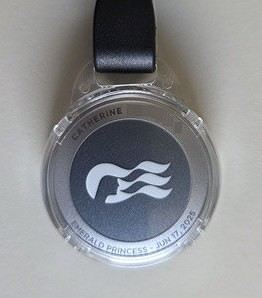
Princess has introduced an app to download before the cruise. It’s essential because online check-in is no longer available, and the agency doesn’t send a travel journal. Everything is done through the app. After completing the check-in on the app, we only know that we’ll need to pick up our key, the Medallion, at embarkation by following the blue line in the terminal and presenting our passport.
Up until our departure, the weather forecast for the coming week in Norway is disastrous—rain, rain, and more rain. It was pretty much the same two years ago before our Iceland cruise, and in the end, the weather turned out fine.
If you’re ready to embark on the Emerald Princess to discover this beautiful cruise and the stunning landscapes of Norway, let’s go!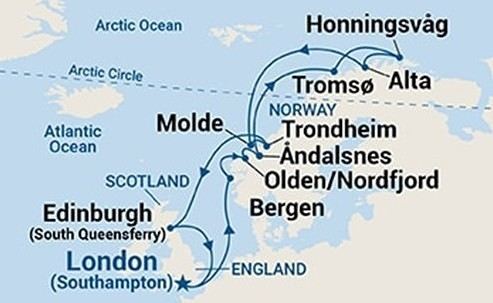
Southampton - Sea day - Bergen - Olden - Åndalsnes - Sea day - Tromsø - Honningsvåg (North Cape) - Alta - Sea day - Molde - Trondheim - Two sea days - Edinburgh - Sea day - Southampton
I’ve wanted to take this Norway cruise for a very long time. The first time I booked it was in July 2020 with Azamara. Unfortunately, it was canceled, as everyone remembers. When I tried to book it again, the prices (already a bit high with Azamara) had simply doubled. So, since then, I’ve been keeping an eye out every year for any opportunities...
The last time we sailed with Princess was eleven years ago, and things didn’t go very well. I came back pretty unhappy with their service and quite disappointed. Despite the $600 they gave me as credit for a future cruise, I’d never set foot on one of their ships again.
But this time, the opportunity arose—a fantastic itinerary with lots of stops, a reasonable price for 16 nights (I’ll share the details in the conclusion), and a ship that’s not too big, so to speak, with only 3,000 passengers. I’m not expecting much from the cruise line this time and am boarding the ship with low expectations beyond the itinerary.
Princess has introduced an app to download before the cruise. It’s essential because online check-in is no longer available, and the agency doesn’t send a travel journal. Everything is done through the app. After completing the check-in on the app, we only know that we’ll need to pick up our key, the Medallion, at embarkation by following the blue line in the terminal and presenting our passport.
Up until our departure, the weather forecast for the coming week in Norway is disastrous—rain, rain, and more rain. It was pretty much the same two years ago before our Iceland cruise, and in the end, the weather turned out fine.
If you’re ready to embark on the Emerald Princess to discover this beautiful cruise and the stunning landscapes of Norway, let’s go!
Southampton - Sea day - Bergen - Olden - Åndalsnes - Sea day - Tromsø - Honningsvåg (North Cape) - Alta - Sea day - Molde - Trondheim - Two sea days - Edinburgh - Sea day - Southampton
CFC Viking Legends Cruise
Hi there,
We’ve booked the CFC Viking Legends cruise (departing on 03/31/25), and the excursions have just been posted on the CFC website. What a disappointment... Stop in Copenhagen: 2 excursions offered, one of which includes +1.5 hours of walking Stop in Oslo: 2 excursions, one of which is a hike Stop in Sandnes (Stavanger): 2 excursions, one of which is a hike Lysekil (Sweden): 1 excursion, same as in Kristiansand and Zeebrugge.
We hesitated to book without knowing the excursions in advance, but the itinerary interested us. We were expecting more options for excursions... Since the ship leaves the day before from Zeebrugge, let’s hope there’s still space for the excursions. I’ll share our experience after we return from this first CFC discovery. MUM49
We’ve booked the CFC Viking Legends cruise (departing on 03/31/25), and the excursions have just been posted on the CFC website. What a disappointment... Stop in Copenhagen: 2 excursions offered, one of which includes +1.5 hours of walking Stop in Oslo: 2 excursions, one of which is a hike Stop in Sandnes (Stavanger): 2 excursions, one of which is a hike Lysekil (Sweden): 1 excursion, same as in Kristiansand and Zeebrugge.
We hesitated to book without knowing the excursions in advance, but the itinerary interested us. We were expecting more options for excursions... Since the ship leaves the day before from Zeebrugge, let’s hope there’s still space for the excursions. I’ll share our experience after we return from this first CFC discovery. MUM49
État des routes en Norvège au mois de janvier
Bonjour,
Je vais allez en Norvège au mois de janvier 2021 en voiture seul, j'habite dans le sud de Paris et vais donc passer par l'Allemagne, le Danemark, la Suède et ensuite la Norvège, je vais loger dans des Hytter à l'intérieur des camping. Mon interrogation dans un premier temps porte sur l'état des routes Norvégiennes, je prévois d'équiper ma voiture avec des pneus neige mais je me demande si cela est suffisant, je prévois également de prendre des chaînes, merci pour vos conseils, ah oui je souhaite monter jusqu'aux îles Lofoten.
Merci à vous
Je vais allez en Norvège au mois de janvier 2021 en voiture seul, j'habite dans le sud de Paris et vais donc passer par l'Allemagne, le Danemark, la Suède et ensuite la Norvège, je vais loger dans des Hytter à l'intérieur des camping. Mon interrogation dans un premier temps porte sur l'état des routes Norvégiennes, je prévois d'équiper ma voiture avec des pneus neige mais je me demande si cela est suffisant, je prévois également de prendre des chaînes, merci pour vos conseils, ah oui je souhaite monter jusqu'aux îles Lofoten.
Merci à vous
Road trip seule en van pendant un mois en Norvège
Bonjour à tous! Il y a bien longtemps maintenant que je ne suis plus venue ici… mais certains d'entre vous m'ont aidé plusieurs fois à préparer des voyages.
Le thème du jour pour moi : un road trip en septembre avec mon van, toute seule. Alors voilà, la Norvège me tente beaucoup, je partirai de Suisse et je remonterais tranquillement jusqu'à la Norvège, certains d'entre vous ont-ils déjà fait ca sur un mois? Pour conduire seule tous les jours ce n'est pas trop pénible? Je pense aussi aux randos la bas, safe à faire toute seule? Je suis plutôt bonne randonneuse mais j'ai presque toujours voyagé au moins à deux alors il y a un petit facteur stress pour moi à voyage seule cette fois.
Et à part la Norvège, des idées de destinations pour un mois en van? Plutôt nature, montagne, lac...
Mes questions sont très vagues pour le moment, je cherche doucement les inspirations, et avec vos récits, vos témoignages, ca peut m'aider!
Bon déconfinement à tous! (Oui parce qu'avec ce mois sans solde que j'ai posé il y a 1 an j'espère aussi que la situation sanitaire me permettra de voyager en septembre)
Le thème du jour pour moi : un road trip en septembre avec mon van, toute seule. Alors voilà, la Norvège me tente beaucoup, je partirai de Suisse et je remonterais tranquillement jusqu'à la Norvège, certains d'entre vous ont-ils déjà fait ca sur un mois? Pour conduire seule tous les jours ce n'est pas trop pénible? Je pense aussi aux randos la bas, safe à faire toute seule? Je suis plutôt bonne randonneuse mais j'ai presque toujours voyagé au moins à deux alors il y a un petit facteur stress pour moi à voyage seule cette fois.
Et à part la Norvège, des idées de destinations pour un mois en van? Plutôt nature, montagne, lac...
Mes questions sont très vagues pour le moment, je cherche doucement les inspirations, et avec vos récits, vos témoignages, ca peut m'aider!
Bon déconfinement à tous! (Oui parce qu'avec ce mois sans solde que j'ai posé il y a 1 an j'espère aussi que la situation sanitaire me permettra de voyager en septembre)
Itinéraire et hébergements pour trois semaines cet été en Norvège
bonjour à tous,
nous partons 3 semaines cet été, le 7 juillet exactement pour la Norvège. Nous sommes 2 adultes.
Ce qui est déjà réservé et prévu :
Vols Genève-Trondheim et retour.
Trondheim : 2 nuits réservées Voiture : réservée dès le 3ème jour et jusqu'à la fin (vraiment moins cher de louer en ville plutôt quà l'aéroport). Lofoten : hébergement réservé pour 6 nuits.
Itinéraire :
7-8 juillet : Trondheim 9-12 juillet : Route du littoral jusqu'à Bodø. 13-18 juillet : Lofoten, nous serons pour 6 nuits proche de Leknes (je voulais prendre 2 endroits mais nous avons trouvé un super endroit (enfin j'espère) et pas trop cher... donc voilà on y reste 6 nuits). 19-28 juillet : île de Senja, Tromsø, Veståralen et retour vers Trondheim 29 juillet : Tronhdeim - Genève
Voici donc mes questions :
Pour les 4 jours sur la route du littoral, pensez-vous qu'il faille réserver des hébergements ? Idem pour les ferrys, pensez-vous qu'il faille réserver ? Celui de Bodø-Lofoten, je pense le faire très vite.
Pour les 10 j. après les Lofoten, avez-vous des suggestions d'itinéraires ? faut-il réserver les hébergements aussi ?
Un grand merci d'avance pour vos idées et conseils. Sandrine
nous partons 3 semaines cet été, le 7 juillet exactement pour la Norvège. Nous sommes 2 adultes.
Ce qui est déjà réservé et prévu :
Vols Genève-Trondheim et retour.
Trondheim : 2 nuits réservées Voiture : réservée dès le 3ème jour et jusqu'à la fin (vraiment moins cher de louer en ville plutôt quà l'aéroport). Lofoten : hébergement réservé pour 6 nuits.
Itinéraire :
7-8 juillet : Trondheim 9-12 juillet : Route du littoral jusqu'à Bodø. 13-18 juillet : Lofoten, nous serons pour 6 nuits proche de Leknes (je voulais prendre 2 endroits mais nous avons trouvé un super endroit (enfin j'espère) et pas trop cher... donc voilà on y reste 6 nuits). 19-28 juillet : île de Senja, Tromsø, Veståralen et retour vers Trondheim 29 juillet : Tronhdeim - Genève
Voici donc mes questions :
Pour les 4 jours sur la route du littoral, pensez-vous qu'il faille réserver des hébergements ? Idem pour les ferrys, pensez-vous qu'il faille réserver ? Celui de Bodø-Lofoten, je pense le faire très vite.
Pour les 10 j. après les Lofoten, avez-vous des suggestions d'itinéraires ? faut-il réserver les hébergements aussi ?
Un grand merci d'avance pour vos idées et conseils. Sandrine
Transit à l'aéroport Oslo-Gardermoen
Bonsoir les voyageuses et voyageurs !
En Juillet 2020 nous arriverons sur Olso (de Montréal) à 15h10 heure locale.
Notre plan était de prendre le vol de 17h30 sur Tromso où nos commencerons notre périple de 3 semaines.
Notre agent nous a plutôt conseillé le vol de 21h50 sur Tromso...la raison étant que l'aéroport d'Oslo est très grand et on risque de manquer notre vol (celui de 17h30)
Si qqun connaît cet aéroport, croyez vous que notre plan original soit réaliste considérant que l'on doit passer la douane, récupérer notre valise et aller prendre notre liaison locale ?
Merci de votre feedback !
Catherine et Marie-France
En Juillet 2020 nous arriverons sur Olso (de Montréal) à 15h10 heure locale.
Notre plan était de prendre le vol de 17h30 sur Tromso où nos commencerons notre périple de 3 semaines.
Notre agent nous a plutôt conseillé le vol de 21h50 sur Tromso...la raison étant que l'aéroport d'Oslo est très grand et on risque de manquer notre vol (celui de 17h30)
Si qqun connaît cet aéroport, croyez vous que notre plan original soit réaliste considérant que l'on doit passer la douane, récupérer notre valise et aller prendre notre liaison locale ?
Merci de votre feedback !
Catherine et Marie-France
Compte rendu croisière jusqu'aux Spitzberg du 4 au 20 août 2019
Amis du forum, bonjour🙂,
Pour commencer, je précise que nous devions faire un séjour à Helsinki. C’est en voyant une ventre flash sur cette croisière que nous nous sommes décidés pour cette destination qui nous faisait rêver depuis longtemps mais qui nous était jusqu’alors inaccessible (1000 euros/pers en cabine intérieure bella pour 15 j, fallait sauter sur l’occasion !!!) Cette croisière débutait et finissait à Hambourg mais le bateau poursuivait ensuite jusqu’au Havre pour un périple en mer du Nord et il était possible de continuer deux jours de plus la croisière pour descendre au Havre. Ce que nous avons bien sûr fait étant de la région parisienne ! (120 euros de plus par personne dans la même cabine).
Voici donc le résumé de cette croisière dont le Spizberg fut l’apothéose !! :
Comme d’habitude, nous choisissons de partir la veille pour être certain d’être à l’heure sur le bateau. Notre vol étant à 16 h nous profitons de la matinée pour finaliser nos préparatifs puis un ami nous emmène à la gare routière de Cergy prendre le bus qui nous mène jusque Charles de Gaulle en un peu moins d’une heure et qui coûte un ticket de métro !!! Le vol se passe sans encombre et vers 17 h 30 nous arrivons à Hambourg. Bagages récupérés nous prenons le train S1 qui nous emmène à la gare centrale d’Hambourg en 25 mn puis, de là , alors que la Gay Pride se termine, nous marchons jusqu’à notre hôtel IBIS Budget qui se trouve à 10 mn à pied. Nous nous reposons un peu puis, l’heure du repas venue, nous descendons au restaurant de l’hôtel manger un fish and chips. Ensuite nous allons faire un tour dans le quartier histoire de se dégourdir les jambes. Les rues sont très sales, couvertes de déchets et de cannettes, restes de la Gay Pride !
Après une bonne nuit de sommeil, nous prenons le petit déjeuner puis retournons à la gare centrale prendre la navette MSC à 5 euros/pers qui nous mène jusqu’au port Steinwerder vers 11 h. Pas plus de 15 mn après nous sommes dans le bateau MSC Préziosa !!!
J’ai beaucoup aimé la déco de ce bateau. J’avais lu dans VF qu’il était beau et en effet je l’ai trouvé magnifique. Seul, le Jazz bar ne me plaît pas car il est tout vert !!.
Nous filons donc ensuite au restaurant. Là, c’est au choix : soit commande à la carte, soit se servir au buffet soit les deux lol.(ce sera ainsi tous les jours). Après un petit tour de repérage dans le bateau nous nous dirigeons vers la cabine, mon mari met son maillot de bain puis plongeon dans la piscine puis le jacuzzi pas encore très occupés. Les vacances commencent !!! Vers 17 h à lieu l’exercice de sécurité qui se passe très rapidement. Après la douche et s’être changés, nous traînons dans le bateau et dans les bars jusque 20 h 30, heure du repas du 2e service (le 1er service à lieu à 18 h 30). Notre table se trouve près de la fenêtre, c’est super !!! et nous nous retrouvons avec deux autres couples de français avec qui nous nous entendrons très bien du début à la fin !!! (heureusement car sinon, 15 j, c’est long !!!)
La suite dès que possible !
Pour commencer, je précise que nous devions faire un séjour à Helsinki. C’est en voyant une ventre flash sur cette croisière que nous nous sommes décidés pour cette destination qui nous faisait rêver depuis longtemps mais qui nous était jusqu’alors inaccessible (1000 euros/pers en cabine intérieure bella pour 15 j, fallait sauter sur l’occasion !!!) Cette croisière débutait et finissait à Hambourg mais le bateau poursuivait ensuite jusqu’au Havre pour un périple en mer du Nord et il était possible de continuer deux jours de plus la croisière pour descendre au Havre. Ce que nous avons bien sûr fait étant de la région parisienne ! (120 euros de plus par personne dans la même cabine).
Voici donc le résumé de cette croisière dont le Spizberg fut l’apothéose !! :
Comme d’habitude, nous choisissons de partir la veille pour être certain d’être à l’heure sur le bateau. Notre vol étant à 16 h nous profitons de la matinée pour finaliser nos préparatifs puis un ami nous emmène à la gare routière de Cergy prendre le bus qui nous mène jusque Charles de Gaulle en un peu moins d’une heure et qui coûte un ticket de métro !!! Le vol se passe sans encombre et vers 17 h 30 nous arrivons à Hambourg. Bagages récupérés nous prenons le train S1 qui nous emmène à la gare centrale d’Hambourg en 25 mn puis, de là , alors que la Gay Pride se termine, nous marchons jusqu’à notre hôtel IBIS Budget qui se trouve à 10 mn à pied. Nous nous reposons un peu puis, l’heure du repas venue, nous descendons au restaurant de l’hôtel manger un fish and chips. Ensuite nous allons faire un tour dans le quartier histoire de se dégourdir les jambes. Les rues sont très sales, couvertes de déchets et de cannettes, restes de la Gay Pride !
Après une bonne nuit de sommeil, nous prenons le petit déjeuner puis retournons à la gare centrale prendre la navette MSC à 5 euros/pers qui nous mène jusqu’au port Steinwerder vers 11 h. Pas plus de 15 mn après nous sommes dans le bateau MSC Préziosa !!!
J’ai beaucoup aimé la déco de ce bateau. J’avais lu dans VF qu’il était beau et en effet je l’ai trouvé magnifique. Seul, le Jazz bar ne me plaît pas car il est tout vert !!.
Nous filons donc ensuite au restaurant. Là, c’est au choix : soit commande à la carte, soit se servir au buffet soit les deux lol.(ce sera ainsi tous les jours). Après un petit tour de repérage dans le bateau nous nous dirigeons vers la cabine, mon mari met son maillot de bain puis plongeon dans la piscine puis le jacuzzi pas encore très occupés. Les vacances commencent !!! Vers 17 h à lieu l’exercice de sécurité qui se passe très rapidement. Après la douche et s’être changés, nous traînons dans le bateau et dans les bars jusque 20 h 30, heure du repas du 2e service (le 1er service à lieu à 18 h 30). Notre table se trouve près de la fenêtre, c’est super !!! et nous nous retrouvons avec deux autres couples de français avec qui nous nous entendrons très bien du début à la fin !!! (heureusement car sinon, 15 j, c’est long !!!)
La suite dès que possible !
Mésaventure sur circuit en Scandinavie
Nous étions à notre second voyage organisé, le premier s'étant très bien passé (Afrique du Sud en Aout 2017 un voyage formidable), nous choisissons"Circuit découvrir la Grande traversée de la Scandinavie" pour Aout 2018.
Etant novices nous avons fait confiance à notre agence de voyage TUI de Grenoble, et nous voilà partis le 12 Aout 2018.
Pendant toute la durée du voyage du bus, que des kilomètres à l'infini.(quelque traversée en ferry) lorsque nous demandions au guide des arrêts pour photographier les paysages ou Rennes, la réponse était toujours négative, par contre nous nous sommes arrêtés toujours dans les centres commerciaux.
Nous avons mangé tous les jours midi et soir du saumon avec un plat de légumes cuits à l'eau.
Le 22 Aout ayant 22 personnes malades sur un bus de 42 personnes, le guide à refusé de faire appel à un médecin, sous prétexte que le voyage devait continuer.
Ce voyage n'est pas à faire en bus mais en croisière, nous avons rencontré au retour dans l'avion des personnes enchantées de ce même voyage , mais qui avaient fait le bon choix .
En rentrant en France analyses médicales pour intoxication alimentaire.
Le prochain voyage serait le COSTA RICA mais nous sommes maintenant très prudent et avons besoin de vos expériences
Itinéraire de 15 jours en Norvège
Bonjour à tous.
Nous partons 15 jours au mois d'Août prochain en Norvège en famille.
Nous sommes 9 à partir (mes parents, frères, sœur et mes enfants (3 et 6 ans au moment du voyage).
On fait un circuit depuis Bergen. On aime la nature (heureusement :) ), les randonnées (au moins une sur une journée, ça serait top), les villages...
Mes parents ne souhaitent pas changer d'hébergement tous les jours ou tous les 2 jours mais plutôt se baser à 2-3 endroits dans le séjour et rayonner autour. Mais je n'arrive pas à savoir si c'est judicieux car effectivement on ne veut pas courir mais je veux quand même découvrir les incontournables.
Voici l'itinéraire rapide : - 2 nuits à Bergen - 4 nuits vers Sogndal pour voir : Balestrand, le Naeroyfjord, Borgund - 5 nuits à Geiranger pour Geiranger, le Dalsnibba, la route des Aigles, la route des Trolls, le Nordfjord - Une dernière étape, on ne sait pas encore - Retour sur Bergen
Est-ce que ça vous semble faisable ? et judicieux ? Ou vaut-il mieux un "vrai" road-trip en changeant tous les jours/2 jours d'étape ?
Merci beaucoup d'avance à tous,
Très bonne journée,
Marie
Nous partons 15 jours au mois d'Août prochain en Norvège en famille.
Nous sommes 9 à partir (mes parents, frères, sœur et mes enfants (3 et 6 ans au moment du voyage).
On fait un circuit depuis Bergen. On aime la nature (heureusement :) ), les randonnées (au moins une sur une journée, ça serait top), les villages...
Mes parents ne souhaitent pas changer d'hébergement tous les jours ou tous les 2 jours mais plutôt se baser à 2-3 endroits dans le séjour et rayonner autour. Mais je n'arrive pas à savoir si c'est judicieux car effectivement on ne veut pas courir mais je veux quand même découvrir les incontournables.
Voici l'itinéraire rapide : - 2 nuits à Bergen - 4 nuits vers Sogndal pour voir : Balestrand, le Naeroyfjord, Borgund - 5 nuits à Geiranger pour Geiranger, le Dalsnibba, la route des Aigles, la route des Trolls, le Nordfjord - Une dernière étape, on ne sait pas encore - Retour sur Bergen
Est-ce que ça vous semble faisable ? et judicieux ? Ou vaut-il mieux un "vrai" road-trip en changeant tous les jours/2 jours d'étape ?
Merci beaucoup d'avance à tous,
Très bonne journée,
Marie
Train NSB Oslo - Hjerkinn
bonjour,
J'ai commandé en ligne 2 billets NSB Oslo - Hjerkinn. Ces billets ont bien été pris en compte et téléchargés sur mon mobile. Je souhaiterais savoir s'il est possible de les avoir sous format papier ( en cas de défaillance du mobile) et si dans ce cas ils sont valides ?
merci de vos réponses randophil
J'ai commandé en ligne 2 billets NSB Oslo - Hjerkinn. Ces billets ont bien été pris en compte et téléchargés sur mon mobile. Je souhaiterais savoir s'il est possible de les avoir sous format papier ( en cas de défaillance du mobile) et si dans ce cas ils sont valides ?
merci de vos réponses randophil
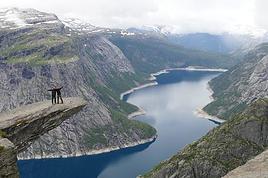
Trolltunga: randonner sans guide?
Je me rends en Norvège la première semaine de juin. J'ai prévu de faire la randonnée vers Trolltunga.
Savez vous s'il est possible de randonner sans guide? Est-ce obligatoire ou recommandé surtout si c'est toujours enneigé?
Merci à tous pour vos réponses.
Lieux d'observation d'aurores boréales en Norvège
Bonjour à tous,
Nous partons en Norvège la semaine prochaine afin d'observer des aurores boréales. Nous serons avec notre van chauffé!
Nous nous sommes fixés un itinéraire Tromsö, Vestéralen, Lofoten: quelqu'un d'entre-vous peut-il nous indiquer des spots d'observation bien placés dans ces lieux pour observer et photographier avec de beaux premiers plans?
Amitiés à tous
Eau à bord des paquebots de la compagnie Hurtigruten?
Bonjour,
Partant prochainement sur un des bateaux de la compagnie pour une croisière de 12 jours, je désirerais savoir si l'eau servie au repas au restaurant est gratuite comme beaucoup de compagnies, ou s'il faut payer comme chez Costa par exemple ? Merci. Et peut-on embarquer des boissons dans ses bagages ?
Observation de la faune au Svalbard
Bonjour,
Nous souhaiterions partir au Svalbard en mai ou en juin, dans le but principal d’observer et de photographier la faune notamment l’ours polaire, le renard arctique, le morse mais aussi oiseaux et cétacés.
Ayant seulement trouver des expéditions guidées à la journée pour observer l’ours polaire, ce qui serait trop peux à notre goût, et des croisières de 7 à 10 jours à des prix exorbitants, connaissez vous des solutions plus économiques? Est il toujours obligatoire d’etre accompagné par une guide?
Merci
Nous souhaiterions partir au Svalbard en mai ou en juin, dans le but principal d’observer et de photographier la faune notamment l’ours polaire, le renard arctique, le morse mais aussi oiseaux et cétacés.
Ayant seulement trouver des expéditions guidées à la journée pour observer l’ours polaire, ce qui serait trop peux à notre goût, et des croisières de 7 à 10 jours à des prix exorbitants, connaissez vous des solutions plus économiques? Est il toujours obligatoire d’etre accompagné par une guide?
Merci
Vidéo d'une croisière dans les fjords norvégiens et au pôle Nord
Pour vous donner une idée de ce qu'on peut vivre et découvrir lors d'une croisière dans les Fjords Norvégiens et au pôle Nord : Voici une vidéo de 7 mins sur la croisière Europe du Nord 2017 de 14 jours que nous avons effectuée l'été dernier :
https://www.youtube.com/watch?v=gpONWHhchPo&feature=youtu.be
On espère que cela vous fera rêver et qui sait, vous donnera envie d'y aller...😛
https://www.youtube.com/watch?v=gpONWHhchPo&feature=youtu.be
On espère que cela vous fera rêver et qui sait, vous donnera envie d'y aller...😛