Results for "Asie+du+Sud+(sous-continent+indien)+souvenir+artisanat"
About 110,803 results.
More options
Many results are in French, the community’s main language. English translations are added over time.
Search results
Nepal Feedback
NAMASTE NEPAL! PRACTICAL INFO AND EXPERIENCE FEEDBACK
Stay from March 25 to April 16, 2025
· Flight tickets Air India (via Delhi) (via Skyscanner) = 1130 € per person · Planned budget (and respected without too many restrictions and while buying a few small gifts) = 2000 € for the stay for two. Buses, taxis, and entrance fees to various sites represent a budget to consider. Meals are cheap. Drinks like beer/Coke, however, are not cheap and cost the equivalent of a meal. · Exchange rate of the rupee during our stay = 0.0064 € (the exchange rate is almost identical everywhere, including at the airport). · At the airport, purchase of two SIM cards (phone) = 1000 NPR x 2 for 28 days. · Kathmandu: we had booked the hotel upon arrival: Kathmandu Boutique Hotel (+977 015 357 446 – email: booking@kathmanduboutiquehotel.com), very well located in a quiet alley off the street, south of Thamel, a 10-minute walk from Durbar Square. A hotel like Nepal knows how to do, where tall people will have to duck. Night + breakfast = 18 € for two. Very warm welcome, great location, excellent value for money. · Bhaktapur: we had also booked a hotel for the end of our stay because the chance of the year 2025 made the Nepali New Year and Bisket Jatra particularly festive in Bhaktapur: Manju Baha Hotel School (+977 976 7234014 – email: manjubahahotel@gmail.com) located in an old monastery. "A social enterprise transforming an old monastery into a charming hotel, offering professional hospitality training to underprivileged Nepali youth." Night + breakfast = 32 € for two. Beautifully decorated room. Very warm welcome. Don’t miss the Changunarayan site (near Bhaktapur), it’s amazing. And if you’re lucky enough to be in Bhaktapur in mid-April for 3 days, there’s the Bisket Jatra festivities (Newari festival), joyful, noisy, fun, and wild… · Pokhara (hotel recommended by the Kathmandu hotel): Hotel Green Tara, Lakeside, 10th street, set back, quiet (Tel. +977 61 462698 – email: greentara_67@hotmail.com) · Trek permit (Lower Mustang, no need for an agency or guide, permits checked at Ghasa and Jomsom) = 2000 NPR per person (2 ID photos) · Bus Kathmandu/Pokhara and return = 2000 NPR per person · Bus Pokhara/Jomsom, 2 one-way tickets = 2800 NPR. · Taxi: negotiation with a driver we recommend, Vicky (+977 984 075 599). You explain what you want, negotiate the price, and he waits for you during the visit. Very charming, we used him several times. For example: departure from our hotel at 10 AM -> Boudhanath/Pashupatinath/Patan return at 5 PM to the hotel = 6500 NPR – Swayambhunath (round trip) = 1200 NPR · Site prices: https://ntb.gov.np/plan-your-trip/before-you-come/heritage-site-entry-fees o Visitor Pass for Kathmandu Durbar Square (for the duration of the stay, show your visa) = 1000 NPR per person (1 ID photo) o Bhaktapur Durbar Square (old town) = 1800 NPR per person o Patan = 1000 NPR per person o Swayambhu Stupa = 200 NPR per person o Boudha Stupa = 200 NPR per person o Pashupatinath Temple = 1000 NPR per person (interesting to take a guide) o Changunarayan Temple (6 km north of Bhaktapur) = 400 NPR per person o Mountain Museum in Pokhara = 750 NPR per person · E-cigarettes: e-cigarettes are banned in India and confiscated whether they’re in carry-on or checked luggage. On the way there, we had kept them in our carry-on, they were confiscated in Delhi. On the way back, learning from our previous experience, we put them in our checked luggage. Someone came to get us to take them out of our bags and confiscate them… You can find e-cigarettes and products in Kathmandu.
* * *
I’m 74 years old. I went to Nepal in 1982, 1983, and the last time in 1986. I wanted to introduce this beautiful and endearing country to my husband, and it was… now or never. So we decided it was now.
I knew the trek starting from Pokhara: Naudanda/Birethanti/Ghorepani/Tatopani/Kalopani. There was no way I was going to do that trek, especially the 1000-meter staircase to reach Ghorepani… You have to stay humble with age.
Back then, the road didn’t exist. I didn’t consider, with the construction of this road (NH48) along the western bank of the Kali Gandaki, doing a trek along a windy and dusty road. Was there an alternative hiking trail on the eastern bank? No one answered my question on VoyageForum, so I did my research online. And I found this site: "Andrées de Ruiter and Prem Rai - Trekking the Annapurna Circuit, including the new NATT trails that avoid the road - A guide to one of the most beautiful trekking regions in Nepal and the world (2011) - NATT = New Annapurna Trekking Trail".
Phew! A solution was emerging. This circuit from 2011 wasn’t fully marked. The idea was to go from Jomsom to Tatopani, so we needed to make sure the path was well-marked all the way, which we did, and the path exists, marked in red and white!
So, with the walking times information, we built our 8-day circuit:
· Jomsom/Thinigaon · Thinigaon/Chimang · Chimang/Saura · Saura/Kokhetanti · Rest day or, if in good shape: loop to Sekong Lake · Kokhetanti/Jhipra Deurali · Jhipra Deurali/Kopchepani · Kopchepani/Tatopani
It’s a senior trek, after all. So the walking times noted on the sites indicated 3 hours or even 4 hours for the two longest stages. That pace suited us fine.
On March 29, we left Kathmandu (1400m), after visiting the must-see sites, by bus to Pokhara: 200 km and 8.5 hours on a chaotic road under construction. I had a memory of Pokhara where it was the first city where you could see the Himalayan range, especially Machhapuchhare. But the pollution is such, the dust raised by traffic and construction, that no horizon is visible except the first hills around Pokhara.
We stayed 24 hours in Pokhara (820m), and on March 31, we left our luggage at the hotel and set off with our lightest backpacks: change of clothes, toiletries, first aid kit, anti-chafing cream, water bottle, sleeping bag liner, and light shoes for the stages.
We took the bus to Jomsom: 160 km/7.5 hours including stops for bathroom breaks, tea, and lunch. The road is nothing but a chaos of potholes, landslides, construction, dust, rebuilding, and mudslides. In Ghasa, the bus stops, and we’re told we’re at a checkpoint and that the two foreigners in the bus, my husband and I, need to have our permits checked, which takes a few minutes. The driving is rock-and-roll, surprising, and courteous. The drivers have their codes, and on these improbable roads, they’re virtuosos.
We could have chosen the plane, but several reasons dissuaded us: if there’s too much wind, the planes don’t take off; personally, I wasn’t reassured about landing in Jomsom, and this transport has a cost.
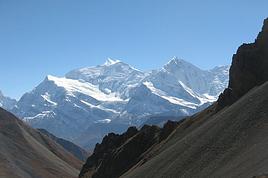
We arrived around 2 PM in Jomsom (2720m), and despite the early wake-up, the nearly 8 hours on the bus, and the altitude, we decided to head straight to Thinigaon (2840m). At the Jomsom checkpoint, they told us it was a 30-minute walk. Great! Except we took an hour and a half on an uphill road, bent over to fight a strong wind. But the Himalayan range is there! The Dhaulagiri, the Nilgiri, the Annapurnas as a reward.
In Thinigaon, we found a room at the "Nilgiri View Hotel" run by a didi (big sister in Nepali). From the lodge’s roof, she proudly showed us the different peaks surrounding the village and told us, worried, that it hadn’t snowed here for 3 years. She said there are very few tourists, that the season is rather in September/October/November. It seems there’s not a soul in this village, yet mules pass through the narrow street paved with large flat stones, their bells ringing. We dine at 6 PM and go to bed… Room = 1200 NPR and dinner, breakfast, and drinks = 2560 NPR.
On April 1, we set off at 9 AM, not for Chimang as planned but for Marpha! The didi from the Thinigaon lodge had said it was a 3-hour walk. The first part of this stage is attractive, the mountains are magnificent and imposing, the landscape is superb, there’s no one around, a feeling of being "alone in the world." We follow Dhumbra Tal, this small green lake. The path is a rocky track that climbs steeply. Then, around a hill, we start the big descent that joins the Kali Gandaki. We face the wind head-on, and the violent gusts take our breath away, throw us off balance, and envelop us in dust. We see the road on the other side of the Kali Gandaki. We arrive in the village of Chhairo at 2 PM, completely exhausted and with blistered feet, after 5 hours of walking instead of the planned 3.5 hours.
We’re welcomed by the village nurse, who tells us there’s a lodge in the village. Chhairo is a Tibetan village, a 20-minute walk from Marpha (according to the locals, multiply by 2 or even 3 for us…). We’re going to revise our trek plan and, first of all, spend the night in Chhairo.
The lodge is quite pleasant, and Karma, the hostess, is very friendly. She asks about our plans and suggests we stay in Chhairo the next day, from where we can visit Marpha and also Chimang, a 1-hour walk away, in light mode, meaning without backpacks. She invites us to participate in a village ceremony the next evening.
We immediately accept the proposal, as our feet need rest and the welcome is so warm… Dinner and bed!
We reworked our trek plan, which was too ambitious for our untrained bodies and, let’s face it… no longer in our first youth. In the initial plan, we thought there wouldn’t be too much elevation gain following the Kali Gandaki, but checking the map, we realize there might be significant elevation changes between Sauru and Sirkung. So we plan:
· Tomorrow: visit Marpha (2670m) and Chimang (2744m) · April 3: bus from Chhairo (2700m) to Kalopani (2530m) and continue on foot to Ghasa (2010m) · April 4: Ghasa/Pairataplo (1940m) · April 5: Pairatapla/Gadpar (1580m) · April 6: Gadpar/Narchyang (1510m) · April 7: Narchyang/Tatopani (1190m) · April 8: return to Pokhara.
Normally, it’s all downhill…
April 2, a rest day then… We set off in the morning to explore Marpha. We have to take a temporary bridge because the suspension bridge is closed due to road construction. We join the road and arrive in Marpha, a village famous for its apple orchards, brandy, cider, and apple juice production. This village is magnificent with its stone houses and monastery clinging to the hillside. The road construction spared it. There are people, but very few Western tourists.
We have lunch in Marpha and go back through Chhairo to take the path to Chimang. We cross a fragrant pine forest and find the rocky path; the landscape is splendid. We walk quietly, passing peaceful buffaloes and cows, and arrive at the foot of a stone staircase… 275 steps (which we counted on the way back) leading us to the village of Chimang. Chimang is an isolated Newari village that seems a bit desolate. Despite the slopes, there are crops on every little bit of land. Thankfully, we changed our initial program because there’s no lodge in this village, contrary to what we saw on a map… We wander through the village, which seems very deserted, have coffee in a house from another world, and then head back to Chhairo.
A rest day? = 5 hours of walking!!
Dinner and village ceremony. From what we understand, this ceremony is in honor of the Dalai Lama. Men, women, and children in traditional costumes gather twice a month; they dance, make, and offer small sweet cakes with Tibetan tea (made from tea, yak butter—often rancid—water, and salt). Surprising for first-timers…
Around 10 PM, we leave the ceremony; tomorrow morning, we need to be on the roadside by 7 AM to catch the bus to Kalopani…
This village of Chhairo is very pleasant and welcoming, no tourists, just two motorcyclists who arrived in the evening, one of whom participated in the ceremony and discreetly poured his Tibetan tea outside.
Lodge: "Norsang Tibetan Guesthouse and Restaurant". Total bill for 2 nights, 2 dinners, 2 breakfasts, and drinks = 8000 NPR.
April 3: bus from Chhairo to Kalopani, about 1.5 hours for the 20 km (200 NPR per person). We descend on the right bank of the Kali Gandaki. We find the red and white markings to resume the trek toward Ghasa. We’re in a fragrant pine forest, the Dhaulagiri on one side and the Annapurnas on the other, magnificent, and the path is pleasant and easy. We get a bit lost in this forest, always looking for the markings. Near Lete, two trekkers pass us, and we meet them again a little further on with two very young children, to whom we give the 2 hard-boiled eggs I didn’t eat this morning. They accepted them without hesitation.
We arrive in a village and ask for directions to Ghasa. The young girls point the way. But we come across a forest being logged, trees cut in all directions. We turn back and ask for confirmation. They confirm… But the two young girls catch up with us and clear the way. We have to step over, go around, and cross the felled trees, with no indication at all. Through this pick-up sticks of felled trees, the girls lead us to the top of a stone staircase, indicating that was the path. It’s the only place where we saw rhododendrons in bloom.
We descend the staircase. At the bottom, to the left, there’s a bridge to go toward Choyo, and to the right, a path to Ghasa. We take the right path and join the road. We should normally find the red and white markings, but we don’t… So we continue on the western bank road of the Kali Gandaki.
A little before the village of Misi, we see fumaroles on the opposite bank that seem to come from the ground. We don’t understand. We stopped to eat in the village of Misi (noodle soup = 600 NPR), but it’s hard to communicate with the elderly people running the guesthouse.
We continued on the road, not finding the marked path parallel to the road. Landslides, both on the left and right banks, seem to have taken over the marked routes. It’s a place where the Kali Gandaki gorge narrows, and on the opposite bank, the mountain smokes more and more, and we now hear the crackling of fire. Across from us, the mountain is burning… Our initial plan had us passing on that burning bank right now…
We arrive in Ghasa at 3:30 PM, a 6.5-hour stage but with a 1-hour stop at noon. We’re at the "Florida Guesthouse and Restaurant." From our room, we see the mountain smoking on the other side of the river, and at night, we see the flames. In this village, posters show Himalayan eagles and vultures that seem to be protected species. Indeed, we saw (and heard) 3 eagles circling today.
April 4 – Today, heading to Pairothapla or Kopchepani depending on our feet, accommodation options, and simply our desires.
No more smoke on the mountain this morning. It’s chilly, 7:45 AM, the sky is clear, just a smell of smoke outside.
Price of the lodge = 1000 NPR for the night + 3580 NPR for meals.
We cross Ghasa, which stretches over more than a kilometer. We have a drink at the last guesthouse in the village, and the didi, when she learns our destination, tells us to be careful because the villages we’re going to aren’t safe. Should we distribute our rupees in different pockets? Nah, we kept going.
At the exit of Ghasa, we find the red and white markings and take the suspension bridge to cross the boiling waters of the Kali Gandaki. The passage is impressive because the river is tumultuous. Lots of climbs and even more descents. We’re back on the eastern bank. It’s hot! On the narrow path, we meet a group of buffaloes. Who has the right of way? We decide to stick as close as possible to the rock wall and move forward calmly. The buffaloes look at us, chewing placidly, with no intention of jumping on us. Phew!
After a 5-hour stage (including stops), we arrive in Pairothapla, with hot feet and firm thighs, and decide we won’t go any further. It’s a good thing because there’s a lodge, the most basic so far, but with a great welcome. We have a meal and a short nap. The buffaloes we met on the way belong to this house. They come to drink at the fountain by the path.
Our host, very pleasant, doesn’t know what to do to please us and is very attentive. He wants to chat. He has two children, a 4-year-old girl and a 7-year-old boy. Where do they go to school? Do they go? He tells us that the fires in the mountain are caused by people, but for what reason? We won’t find out, but it’s illegal. From here, we can still see smoke rising in the distance. The wife is a bit less friendly. Corn kernels dry on a woven straw mat on the ground, and the mom sorts them.
From where we are, we overlook the valley and see the road under construction winding along the mountainside on the other bank.
Dinner on the terrace of the house overlooking the path, windbreaker and fleece on: dal bhat chicken for me and chicken curry for my husband: "organic" products, at least local production. There are small vegetable gardens everywhere with all sorts of vegetables.
April 5 – While we’re having breakfast on the terrace of our lodge, 5 porters, straps on their foreheads, heavily loaded, pass by on the path. A few minutes later, a group of 9 people appears. It must be said that since the beginning of our journey, we’ve met very few hikers. Two backpackers in Chhairo, the two hikers near Lete, two female hikers passed us before Pairothapla, a solo female hiker passed us…
The lodge in Pairothapla is called "Bimala Lodge & Thakali Kitchen" – Price for night + 4 meals + 2 breakfasts = 3000 NPR.
The descent toward the Kali Gandaki involves climbs whose steps we didn’t count. Clearly, the landslides on the mountain cause changes to the official ACAP trek marked in red and white, and the marking updates can’t keep up with the pace of these landslides. It’s almost always by chance that we find the markings. Fortunately, we can follow the power line that guides us somewhat.
Drink stop in Kopchepani, the legs are fine, but the feet don’t like being tightly enclosed. A group of trekkers with porters passes on the path. We met buffaloes that we kindly let pass; the path was wide enough, but it was a staircase going up, and we didn’t want to take any risks.
Across, a view of the magnificent Rupse Waterfall on the other bank of the Kali Gandaki, at the bottom, lots of vehicles and people.
Arrival in Gadpar after crossing a rather unwelcoming small village and cultivated gardens between dry stone walls, each better built than the last.
First lodge spotted, first lodge adopted to answer the call of our feet, and a very warm welcome from the owner. Since we hadn’t eaten at noon, we had Tibetan bread/jam. 6-hour stage including 1 hour of stops. Night + dinner + breakfast + drinks = 5060 NPR
April 6 – Today, heading to Narchyang.
For several days, we’ve seen banana trees with their bunches of fruit and even a prickly pear with large fruits ripening.
This stage is quite peaceful and pleasant. We take a suspension bridge to cross a tributary of the Kali Gandaki. While we’re resting for a moment before crossing the bridge, a couple of porters, a man and a woman, arrive and start across the bridge with their wood load in a basket held by a strap on their forehead, making them bend. We set off too… lighter than them.
On the other side of the bridge… a stone staircase, and it climbs steeply. The porter couple didn’t take this staircase; they went right on the path.
At the top of the staircase, we arrive in Narchyang after a 4-hour stage. A magnificent waterfall overlooks the village. We get lost in this fairly large village looking for a lodge. After wandering around for a while, we ask for directions, and an 84-year-old man takes us through the whole village and accompanies us to a very nice lodge run by a woman.
We chat with our hostess, who asks where we’re from and where we’re going. We explain that we want to reach Tatopani the next day and then return to Pokhara. She tells us there are 4x4s going directly to Pokhara and that it would probably be easier than taking a bus that might be full in Tatopani. After a quick consultation, we decide to return to Pokhara the next day by 4x4. She finds us a 4x4 with 2 seats left, departure at 8 AM – 5 hours on the road and 1500 NPR per person. A charming didi who does everything to be pleasant and helpful.
Narchyang community lodge = night + snacks + dinner + breakfast = 3000 NPR.
There you go, our trek ends tomorrow. Many necessary changes and adaptations to our initial trek, but no regrets, it was superb and a great experience that, for my part, I won’t be able to repeat. Always this encounter with the endearing, welcoming, curious, and very kind Nepali people. It was now or never, and we did it!
* * *
In conclusion, 3 full weeks in Nepal is a duration that allows visiting Kathmandu, Patan, and Bhaktapur, enjoying the various sites, and soaking in the atmosphere and urban Nepali life.
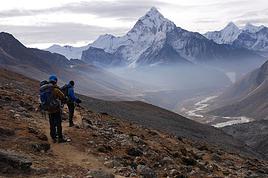
The trek, even revised and corrected, allowed us to get close to the impressive Annapurna and Dhaulagiri peaks. One or two acclimatization days might be necessary to get the body in tune with this magical and extraordinary land.
Stay from March 25 to April 16, 2025
· Flight tickets Air India (via Delhi) (via Skyscanner) = 1130 € per person · Planned budget (and respected without too many restrictions and while buying a few small gifts) = 2000 € for the stay for two. Buses, taxis, and entrance fees to various sites represent a budget to consider. Meals are cheap. Drinks like beer/Coke, however, are not cheap and cost the equivalent of a meal. · Exchange rate of the rupee during our stay = 0.0064 € (the exchange rate is almost identical everywhere, including at the airport). · At the airport, purchase of two SIM cards (phone) = 1000 NPR x 2 for 28 days. · Kathmandu: we had booked the hotel upon arrival: Kathmandu Boutique Hotel (+977 015 357 446 – email: booking@kathmanduboutiquehotel.com), very well located in a quiet alley off the street, south of Thamel, a 10-minute walk from Durbar Square. A hotel like Nepal knows how to do, where tall people will have to duck. Night + breakfast = 18 € for two. Very warm welcome, great location, excellent value for money. · Bhaktapur: we had also booked a hotel for the end of our stay because the chance of the year 2025 made the Nepali New Year and Bisket Jatra particularly festive in Bhaktapur: Manju Baha Hotel School (+977 976 7234014 – email: manjubahahotel@gmail.com) located in an old monastery. "A social enterprise transforming an old monastery into a charming hotel, offering professional hospitality training to underprivileged Nepali youth." Night + breakfast = 32 € for two. Beautifully decorated room. Very warm welcome. Don’t miss the Changunarayan site (near Bhaktapur), it’s amazing. And if you’re lucky enough to be in Bhaktapur in mid-April for 3 days, there’s the Bisket Jatra festivities (Newari festival), joyful, noisy, fun, and wild… · Pokhara (hotel recommended by the Kathmandu hotel): Hotel Green Tara, Lakeside, 10th street, set back, quiet (Tel. +977 61 462698 – email: greentara_67@hotmail.com) · Trek permit (Lower Mustang, no need for an agency or guide, permits checked at Ghasa and Jomsom) = 2000 NPR per person (2 ID photos) · Bus Kathmandu/Pokhara and return = 2000 NPR per person · Bus Pokhara/Jomsom, 2 one-way tickets = 2800 NPR. · Taxi: negotiation with a driver we recommend, Vicky (+977 984 075 599). You explain what you want, negotiate the price, and he waits for you during the visit. Very charming, we used him several times. For example: departure from our hotel at 10 AM -> Boudhanath/Pashupatinath/Patan return at 5 PM to the hotel = 6500 NPR – Swayambhunath (round trip) = 1200 NPR · Site prices: https://ntb.gov.np/plan-your-trip/before-you-come/heritage-site-entry-fees o Visitor Pass for Kathmandu Durbar Square (for the duration of the stay, show your visa) = 1000 NPR per person (1 ID photo) o Bhaktapur Durbar Square (old town) = 1800 NPR per person o Patan = 1000 NPR per person o Swayambhu Stupa = 200 NPR per person o Boudha Stupa = 200 NPR per person o Pashupatinath Temple = 1000 NPR per person (interesting to take a guide) o Changunarayan Temple (6 km north of Bhaktapur) = 400 NPR per person o Mountain Museum in Pokhara = 750 NPR per person · E-cigarettes: e-cigarettes are banned in India and confiscated whether they’re in carry-on or checked luggage. On the way there, we had kept them in our carry-on, they were confiscated in Delhi. On the way back, learning from our previous experience, we put them in our checked luggage. Someone came to get us to take them out of our bags and confiscate them… You can find e-cigarettes and products in Kathmandu.
* * *
I’m 74 years old. I went to Nepal in 1982, 1983, and the last time in 1986. I wanted to introduce this beautiful and endearing country to my husband, and it was… now or never. So we decided it was now.
I knew the trek starting from Pokhara: Naudanda/Birethanti/Ghorepani/Tatopani/Kalopani. There was no way I was going to do that trek, especially the 1000-meter staircase to reach Ghorepani… You have to stay humble with age.
Back then, the road didn’t exist. I didn’t consider, with the construction of this road (NH48) along the western bank of the Kali Gandaki, doing a trek along a windy and dusty road. Was there an alternative hiking trail on the eastern bank? No one answered my question on VoyageForum, so I did my research online. And I found this site: "Andrées de Ruiter and Prem Rai - Trekking the Annapurna Circuit, including the new NATT trails that avoid the road - A guide to one of the most beautiful trekking regions in Nepal and the world (2011) - NATT = New Annapurna Trekking Trail".
Phew! A solution was emerging. This circuit from 2011 wasn’t fully marked. The idea was to go from Jomsom to Tatopani, so we needed to make sure the path was well-marked all the way, which we did, and the path exists, marked in red and white!
So, with the walking times information, we built our 8-day circuit:
· Jomsom/Thinigaon · Thinigaon/Chimang · Chimang/Saura · Saura/Kokhetanti · Rest day or, if in good shape: loop to Sekong Lake · Kokhetanti/Jhipra Deurali · Jhipra Deurali/Kopchepani · Kopchepani/Tatopani
It’s a senior trek, after all. So the walking times noted on the sites indicated 3 hours or even 4 hours for the two longest stages. That pace suited us fine.
On March 29, we left Kathmandu (1400m), after visiting the must-see sites, by bus to Pokhara: 200 km and 8.5 hours on a chaotic road under construction. I had a memory of Pokhara where it was the first city where you could see the Himalayan range, especially Machhapuchhare. But the pollution is such, the dust raised by traffic and construction, that no horizon is visible except the first hills around Pokhara.
We stayed 24 hours in Pokhara (820m), and on March 31, we left our luggage at the hotel and set off with our lightest backpacks: change of clothes, toiletries, first aid kit, anti-chafing cream, water bottle, sleeping bag liner, and light shoes for the stages.
We took the bus to Jomsom: 160 km/7.5 hours including stops for bathroom breaks, tea, and lunch. The road is nothing but a chaos of potholes, landslides, construction, dust, rebuilding, and mudslides. In Ghasa, the bus stops, and we’re told we’re at a checkpoint and that the two foreigners in the bus, my husband and I, need to have our permits checked, which takes a few minutes. The driving is rock-and-roll, surprising, and courteous. The drivers have their codes, and on these improbable roads, they’re virtuosos.
We could have chosen the plane, but several reasons dissuaded us: if there’s too much wind, the planes don’t take off; personally, I wasn’t reassured about landing in Jomsom, and this transport has a cost.
We arrived around 2 PM in Jomsom (2720m), and despite the early wake-up, the nearly 8 hours on the bus, and the altitude, we decided to head straight to Thinigaon (2840m). At the Jomsom checkpoint, they told us it was a 30-minute walk. Great! Except we took an hour and a half on an uphill road, bent over to fight a strong wind. But the Himalayan range is there! The Dhaulagiri, the Nilgiri, the Annapurnas as a reward.
In Thinigaon, we found a room at the "Nilgiri View Hotel" run by a didi (big sister in Nepali). From the lodge’s roof, she proudly showed us the different peaks surrounding the village and told us, worried, that it hadn’t snowed here for 3 years. She said there are very few tourists, that the season is rather in September/October/November. It seems there’s not a soul in this village, yet mules pass through the narrow street paved with large flat stones, their bells ringing. We dine at 6 PM and go to bed… Room = 1200 NPR and dinner, breakfast, and drinks = 2560 NPR.
On April 1, we set off at 9 AM, not for Chimang as planned but for Marpha! The didi from the Thinigaon lodge had said it was a 3-hour walk. The first part of this stage is attractive, the mountains are magnificent and imposing, the landscape is superb, there’s no one around, a feeling of being "alone in the world." We follow Dhumbra Tal, this small green lake. The path is a rocky track that climbs steeply. Then, around a hill, we start the big descent that joins the Kali Gandaki. We face the wind head-on, and the violent gusts take our breath away, throw us off balance, and envelop us in dust. We see the road on the other side of the Kali Gandaki. We arrive in the village of Chhairo at 2 PM, completely exhausted and with blistered feet, after 5 hours of walking instead of the planned 3.5 hours.
We’re welcomed by the village nurse, who tells us there’s a lodge in the village. Chhairo is a Tibetan village, a 20-minute walk from Marpha (according to the locals, multiply by 2 or even 3 for us…). We’re going to revise our trek plan and, first of all, spend the night in Chhairo.
The lodge is quite pleasant, and Karma, the hostess, is very friendly. She asks about our plans and suggests we stay in Chhairo the next day, from where we can visit Marpha and also Chimang, a 1-hour walk away, in light mode, meaning without backpacks. She invites us to participate in a village ceremony the next evening.
We immediately accept the proposal, as our feet need rest and the welcome is so warm… Dinner and bed!
We reworked our trek plan, which was too ambitious for our untrained bodies and, let’s face it… no longer in our first youth. In the initial plan, we thought there wouldn’t be too much elevation gain following the Kali Gandaki, but checking the map, we realize there might be significant elevation changes between Sauru and Sirkung. So we plan:
· Tomorrow: visit Marpha (2670m) and Chimang (2744m) · April 3: bus from Chhairo (2700m) to Kalopani (2530m) and continue on foot to Ghasa (2010m) · April 4: Ghasa/Pairataplo (1940m) · April 5: Pairatapla/Gadpar (1580m) · April 6: Gadpar/Narchyang (1510m) · April 7: Narchyang/Tatopani (1190m) · April 8: return to Pokhara.
Normally, it’s all downhill…
April 2, a rest day then… We set off in the morning to explore Marpha. We have to take a temporary bridge because the suspension bridge is closed due to road construction. We join the road and arrive in Marpha, a village famous for its apple orchards, brandy, cider, and apple juice production. This village is magnificent with its stone houses and monastery clinging to the hillside. The road construction spared it. There are people, but very few Western tourists.
We have lunch in Marpha and go back through Chhairo to take the path to Chimang. We cross a fragrant pine forest and find the rocky path; the landscape is splendid. We walk quietly, passing peaceful buffaloes and cows, and arrive at the foot of a stone staircase… 275 steps (which we counted on the way back) leading us to the village of Chimang. Chimang is an isolated Newari village that seems a bit desolate. Despite the slopes, there are crops on every little bit of land. Thankfully, we changed our initial program because there’s no lodge in this village, contrary to what we saw on a map… We wander through the village, which seems very deserted, have coffee in a house from another world, and then head back to Chhairo.
A rest day? = 5 hours of walking!!
Dinner and village ceremony. From what we understand, this ceremony is in honor of the Dalai Lama. Men, women, and children in traditional costumes gather twice a month; they dance, make, and offer small sweet cakes with Tibetan tea (made from tea, yak butter—often rancid—water, and salt). Surprising for first-timers…
Around 10 PM, we leave the ceremony; tomorrow morning, we need to be on the roadside by 7 AM to catch the bus to Kalopani…
This village of Chhairo is very pleasant and welcoming, no tourists, just two motorcyclists who arrived in the evening, one of whom participated in the ceremony and discreetly poured his Tibetan tea outside.
Lodge: "Norsang Tibetan Guesthouse and Restaurant". Total bill for 2 nights, 2 dinners, 2 breakfasts, and drinks = 8000 NPR.
April 3: bus from Chhairo to Kalopani, about 1.5 hours for the 20 km (200 NPR per person). We descend on the right bank of the Kali Gandaki. We find the red and white markings to resume the trek toward Ghasa. We’re in a fragrant pine forest, the Dhaulagiri on one side and the Annapurnas on the other, magnificent, and the path is pleasant and easy. We get a bit lost in this forest, always looking for the markings. Near Lete, two trekkers pass us, and we meet them again a little further on with two very young children, to whom we give the 2 hard-boiled eggs I didn’t eat this morning. They accepted them without hesitation.
We arrive in a village and ask for directions to Ghasa. The young girls point the way. But we come across a forest being logged, trees cut in all directions. We turn back and ask for confirmation. They confirm… But the two young girls catch up with us and clear the way. We have to step over, go around, and cross the felled trees, with no indication at all. Through this pick-up sticks of felled trees, the girls lead us to the top of a stone staircase, indicating that was the path. It’s the only place where we saw rhododendrons in bloom.
We descend the staircase. At the bottom, to the left, there’s a bridge to go toward Choyo, and to the right, a path to Ghasa. We take the right path and join the road. We should normally find the red and white markings, but we don’t… So we continue on the western bank road of the Kali Gandaki.
A little before the village of Misi, we see fumaroles on the opposite bank that seem to come from the ground. We don’t understand. We stopped to eat in the village of Misi (noodle soup = 600 NPR), but it’s hard to communicate with the elderly people running the guesthouse.
We continued on the road, not finding the marked path parallel to the road. Landslides, both on the left and right banks, seem to have taken over the marked routes. It’s a place where the Kali Gandaki gorge narrows, and on the opposite bank, the mountain smokes more and more, and we now hear the crackling of fire. Across from us, the mountain is burning… Our initial plan had us passing on that burning bank right now…
We arrive in Ghasa at 3:30 PM, a 6.5-hour stage but with a 1-hour stop at noon. We’re at the "Florida Guesthouse and Restaurant." From our room, we see the mountain smoking on the other side of the river, and at night, we see the flames. In this village, posters show Himalayan eagles and vultures that seem to be protected species. Indeed, we saw (and heard) 3 eagles circling today.
April 4 – Today, heading to Pairothapla or Kopchepani depending on our feet, accommodation options, and simply our desires.
No more smoke on the mountain this morning. It’s chilly, 7:45 AM, the sky is clear, just a smell of smoke outside.
Price of the lodge = 1000 NPR for the night + 3580 NPR for meals.
We cross Ghasa, which stretches over more than a kilometer. We have a drink at the last guesthouse in the village, and the didi, when she learns our destination, tells us to be careful because the villages we’re going to aren’t safe. Should we distribute our rupees in different pockets? Nah, we kept going.
At the exit of Ghasa, we find the red and white markings and take the suspension bridge to cross the boiling waters of the Kali Gandaki. The passage is impressive because the river is tumultuous. Lots of climbs and even more descents. We’re back on the eastern bank. It’s hot! On the narrow path, we meet a group of buffaloes. Who has the right of way? We decide to stick as close as possible to the rock wall and move forward calmly. The buffaloes look at us, chewing placidly, with no intention of jumping on us. Phew!
After a 5-hour stage (including stops), we arrive in Pairothapla, with hot feet and firm thighs, and decide we won’t go any further. It’s a good thing because there’s a lodge, the most basic so far, but with a great welcome. We have a meal and a short nap. The buffaloes we met on the way belong to this house. They come to drink at the fountain by the path.
Our host, very pleasant, doesn’t know what to do to please us and is very attentive. He wants to chat. He has two children, a 4-year-old girl and a 7-year-old boy. Where do they go to school? Do they go? He tells us that the fires in the mountain are caused by people, but for what reason? We won’t find out, but it’s illegal. From here, we can still see smoke rising in the distance. The wife is a bit less friendly. Corn kernels dry on a woven straw mat on the ground, and the mom sorts them.
From where we are, we overlook the valley and see the road under construction winding along the mountainside on the other bank.
Dinner on the terrace of the house overlooking the path, windbreaker and fleece on: dal bhat chicken for me and chicken curry for my husband: "organic" products, at least local production. There are small vegetable gardens everywhere with all sorts of vegetables.
April 5 – While we’re having breakfast on the terrace of our lodge, 5 porters, straps on their foreheads, heavily loaded, pass by on the path. A few minutes later, a group of 9 people appears. It must be said that since the beginning of our journey, we’ve met very few hikers. Two backpackers in Chhairo, the two hikers near Lete, two female hikers passed us before Pairothapla, a solo female hiker passed us…
The lodge in Pairothapla is called "Bimala Lodge & Thakali Kitchen" – Price for night + 4 meals + 2 breakfasts = 3000 NPR.
The descent toward the Kali Gandaki involves climbs whose steps we didn’t count. Clearly, the landslides on the mountain cause changes to the official ACAP trek marked in red and white, and the marking updates can’t keep up with the pace of these landslides. It’s almost always by chance that we find the markings. Fortunately, we can follow the power line that guides us somewhat.
Drink stop in Kopchepani, the legs are fine, but the feet don’t like being tightly enclosed. A group of trekkers with porters passes on the path. We met buffaloes that we kindly let pass; the path was wide enough, but it was a staircase going up, and we didn’t want to take any risks.
Across, a view of the magnificent Rupse Waterfall on the other bank of the Kali Gandaki, at the bottom, lots of vehicles and people.
Arrival in Gadpar after crossing a rather unwelcoming small village and cultivated gardens between dry stone walls, each better built than the last.
First lodge spotted, first lodge adopted to answer the call of our feet, and a very warm welcome from the owner. Since we hadn’t eaten at noon, we had Tibetan bread/jam. 6-hour stage including 1 hour of stops. Night + dinner + breakfast + drinks = 5060 NPR
April 6 – Today, heading to Narchyang.
For several days, we’ve seen banana trees with their bunches of fruit and even a prickly pear with large fruits ripening.
This stage is quite peaceful and pleasant. We take a suspension bridge to cross a tributary of the Kali Gandaki. While we’re resting for a moment before crossing the bridge, a couple of porters, a man and a woman, arrive and start across the bridge with their wood load in a basket held by a strap on their forehead, making them bend. We set off too… lighter than them.
On the other side of the bridge… a stone staircase, and it climbs steeply. The porter couple didn’t take this staircase; they went right on the path.
At the top of the staircase, we arrive in Narchyang after a 4-hour stage. A magnificent waterfall overlooks the village. We get lost in this fairly large village looking for a lodge. After wandering around for a while, we ask for directions, and an 84-year-old man takes us through the whole village and accompanies us to a very nice lodge run by a woman.
We chat with our hostess, who asks where we’re from and where we’re going. We explain that we want to reach Tatopani the next day and then return to Pokhara. She tells us there are 4x4s going directly to Pokhara and that it would probably be easier than taking a bus that might be full in Tatopani. After a quick consultation, we decide to return to Pokhara the next day by 4x4. She finds us a 4x4 with 2 seats left, departure at 8 AM – 5 hours on the road and 1500 NPR per person. A charming didi who does everything to be pleasant and helpful.
Narchyang community lodge = night + snacks + dinner + breakfast = 3000 NPR.
There you go, our trek ends tomorrow. Many necessary changes and adaptations to our initial trek, but no regrets, it was superb and a great experience that, for my part, I won’t be able to repeat. Always this encounter with the endearing, welcoming, curious, and very kind Nepali people. It was now or never, and we did it!
* * *
In conclusion, 3 full weeks in Nepal is a duration that allows visiting Kathmandu, Patan, and Bhaktapur, enjoying the various sites, and soaking in the atmosphere and urban Nepali life.
The trek, even revised and corrected, allowed us to get close to the impressive Annapurna and Dhaulagiri peaks. One or two acclimatization days might be necessary to get the body in tune with this magical and extraordinary land.
India itinerary: too packed?
Hi everyone, and first of all, I wish you all wonderful travels in 2025! ;)
My partner and I (we're seniors) are leaving at the end of January for a 40-day trip to India, arriving in Cochin and departing from Delhi. After reading lots of travel journals about India, I’ve put together an itinerary, but I’m worried it might be too (very?) packed... Here’s my plan:
5 or 6 days in the backwaters Munnar: 1 or 2 nights? Ideally next: Madurai, Trichy, Tanjore, Kumbakonam, Chidambaram, Pondi, Mahabalipuram (number of nights in each place to be decided if I keep Tamil Nadu) Flight from Chennai to Varanasi Varanasi: 2 or 3 nights Overnight train to Agra Agra: 1 night Drive to Jaipur with a stop in Fatehpur Sikri Jaipur: 3 nights Bundi: 3 nights Drive to Udaipur with a stop in Chittorgarh? Udaipur: 2 nights Drive to Jodhpur with a stop in Ranakpur Jodhpur: 1 night Jaisalmer: 3 nights Flight to Delhi, then back to France.
This all feels *very* packed. We’re thinking of taking taxis between cities fairly often if public transport is too complicated or time-consuming. Do you think this is doable? Otherwise, the alternative would be to spend more time in Kerala (though we’re not really beach people) and skip Tamil Nadu (which I’d hate to do!!) to focus more on the north instead. We’ve never been to India before, and I’m a little worried about feeling overwhelmed with all the city and temple visits. We’re more used to alternating nature and culture. Looking forward to your valuable advice to finalize our itinerary!
My partner and I (we're seniors) are leaving at the end of January for a 40-day trip to India, arriving in Cochin and departing from Delhi. After reading lots of travel journals about India, I’ve put together an itinerary, but I’m worried it might be too (very?) packed... Here’s my plan:
5 or 6 days in the backwaters Munnar: 1 or 2 nights? Ideally next: Madurai, Trichy, Tanjore, Kumbakonam, Chidambaram, Pondi, Mahabalipuram (number of nights in each place to be decided if I keep Tamil Nadu) Flight from Chennai to Varanasi Varanasi: 2 or 3 nights Overnight train to Agra Agra: 1 night Drive to Jaipur with a stop in Fatehpur Sikri Jaipur: 3 nights Bundi: 3 nights Drive to Udaipur with a stop in Chittorgarh? Udaipur: 2 nights Drive to Jodhpur with a stop in Ranakpur Jodhpur: 1 night Jaisalmer: 3 nights Flight to Delhi, then back to France.
This all feels *very* packed. We’re thinking of taking taxis between cities fairly often if public transport is too complicated or time-consuming. Do you think this is doable? Otherwise, the alternative would be to spend more time in Kerala (though we’re not really beach people) and skip Tamil Nadu (which I’d hate to do!!) to focus more on the north instead. We’ve never been to India before, and I’m a little worried about feeling overwhelmed with all the city and temple visits. We’re more used to alternating nature and culture. Looking forward to your valuable advice to finalize our itinerary!
Séjour imminent dans le Tamil Nadu
Bonjour à tous,
Je pars après-demain pour mon neuvième séjour en Inde, mais mon premier au Tamil Nadu! Pas de problèmes particuliers pour me débrouiller et faire mes trajets. Mais comme j'y serai malheureusement pour très peu de temps (20 jours...) et que la qualité des informations du Lonely Planet continue à se dégrader, j'ai besoin de vos conseils et bons plans sur trois points.
- La solution la plus simple pour une arrivée après minuit à Chennai est-elle de prendre un pre-paid taxi?
- Je n'ai pas planifié un itinéraire précis, mais je prévois de faire quelque chose comme Chennai>Madurai>Kanyakumari>Rameswaram>Tanjore et/ou Trichy> Chidanbaram>Pondichéry>Tiruvanamalai>Mahabalipuram. D'autres suggestions? Des coups de cœur? Des déceptions? Des endroits que vous avez détesté ou trouvé sans intérêt? Des conseils?
- Niveau hébergement, sans chercher les bouges les plus glauques et miteux, je me contente très bien d'hébergements simples (voire spartiates) du moment que c'est à peu près propre et sûr. Je voyage habituellement dans des guest-houses bon marché: dans le nord de l'Inde, mon budget pour une nuit se situe généralement entre 500 et 800 roupies. Or, j'ai l'impression que la politique de Lonely Planet en matière de conseil en hébergement a bien changé: de moins en moins de guest-houses pas chères et rien en dessous de 1000 à 1500 roupies pour une simple avec AC (ce qui me paraît difficilement évitable en juillet/août dans le Tamil Nadu, surtout étant donné ma tolérance limitée aux fortes chaleurs). Le Tamil Nadu est-il plus cher que le nord de l'Inde sur ce plan? Avez-vous de bonnes adresses petit budget dans les étapes citées plus haut?
Merci d'avance pour vos conseils!
Si j'en ai le temps, j'essaierai de publier à mon retour un petit compte-rendu pratique, parce que ça manque cruellement sur le forum.
Je pars après-demain pour mon neuvième séjour en Inde, mais mon premier au Tamil Nadu! Pas de problèmes particuliers pour me débrouiller et faire mes trajets. Mais comme j'y serai malheureusement pour très peu de temps (20 jours...) et que la qualité des informations du Lonely Planet continue à se dégrader, j'ai besoin de vos conseils et bons plans sur trois points.
- La solution la plus simple pour une arrivée après minuit à Chennai est-elle de prendre un pre-paid taxi?
- Je n'ai pas planifié un itinéraire précis, mais je prévois de faire quelque chose comme Chennai>Madurai>Kanyakumari>Rameswaram>Tanjore et/ou Trichy> Chidanbaram>Pondichéry>Tiruvanamalai>Mahabalipuram. D'autres suggestions? Des coups de cœur? Des déceptions? Des endroits que vous avez détesté ou trouvé sans intérêt? Des conseils?
- Niveau hébergement, sans chercher les bouges les plus glauques et miteux, je me contente très bien d'hébergements simples (voire spartiates) du moment que c'est à peu près propre et sûr. Je voyage habituellement dans des guest-houses bon marché: dans le nord de l'Inde, mon budget pour une nuit se situe généralement entre 500 et 800 roupies. Or, j'ai l'impression que la politique de Lonely Planet en matière de conseil en hébergement a bien changé: de moins en moins de guest-houses pas chères et rien en dessous de 1000 à 1500 roupies pour une simple avec AC (ce qui me paraît difficilement évitable en juillet/août dans le Tamil Nadu, surtout étant donné ma tolérance limitée aux fortes chaleurs). Le Tamil Nadu est-il plus cher que le nord de l'Inde sur ce plan? Avez-vous de bonnes adresses petit budget dans les étapes citées plus haut?
Merci d'avance pour vos conseils!
Si j'en ai le temps, j'essaierai de publier à mon retour un petit compte-rendu pratique, parce que ça manque cruellement sur le forum.
Voyage direction le Ladakh et Zanskar
Bonjour à tous !
Et voilà je viens de réserver mon vol pour cet été direction le Ladakh !
J'y suis déjà allée en solo en 2012 et 2013 et depuis je n’attendais que d'y retourner ! Car à la base j'y avais été dans l'idée de me rendre au Zanskar et à chaque fois j'avais trouvé autre chose à faire ... Donc j'espère que cette fois sera la bonne !
Cependant quelques questions .... En effet je serai sur place que 3 semaines et je me demande bien si dans ce laps de temps j'aurai le temps d'aller au Zanskar tout en profitant un peu du Ladakh (j'y vais cette fois avec mon amoureux qui ne connait pas du tout cette région).
Mon but ultime est de me rendre au monastère de Pukhtal ...
Si vous avez des conseils je suis preneuse ! Je ne sais pas si la meilleure option c'est de prendre un bus Leh/ Kargil / Padum (d'ailleurs combien de jours en bus de Leh à Padum?) et de rejoindre le monastère à pied ? J'avais entendu que le sentier était parfois un peu dangereux ... Possible d'avoir recours à une agence pour faire cette petite portion ?
Ou si le mieux est de rejoindre le Zanskar via un trek ? (Lamayuru / padum?) ....
Ou même faire un trek avant la fin du voyage Padum / Darsha pour rejoindre ensuite Manali et éviter de me refaire la route direction Leh ...
Bref je sais pas trop comment optimiser mon temps sur place !
Ensuite aurez-vous un trek à me conseiller ? Trek d'acclimatation avant de rejoindre le Zanskar ? Sachant que j'ai déjà fait la vallée de la Markha, le trek de Tso Moriri à Tso Kar et un mini de Zinchen à Stok ...
Voilà c'est un peu brouillon mais si vous avez de quoi m'éclairer je suis preneuse ! Merci !!
Et voilà je viens de réserver mon vol pour cet été direction le Ladakh !
J'y suis déjà allée en solo en 2012 et 2013 et depuis je n’attendais que d'y retourner ! Car à la base j'y avais été dans l'idée de me rendre au Zanskar et à chaque fois j'avais trouvé autre chose à faire ... Donc j'espère que cette fois sera la bonne !
Cependant quelques questions .... En effet je serai sur place que 3 semaines et je me demande bien si dans ce laps de temps j'aurai le temps d'aller au Zanskar tout en profitant un peu du Ladakh (j'y vais cette fois avec mon amoureux qui ne connait pas du tout cette région).
Mon but ultime est de me rendre au monastère de Pukhtal ...
Si vous avez des conseils je suis preneuse ! Je ne sais pas si la meilleure option c'est de prendre un bus Leh/ Kargil / Padum (d'ailleurs combien de jours en bus de Leh à Padum?) et de rejoindre le monastère à pied ? J'avais entendu que le sentier était parfois un peu dangereux ... Possible d'avoir recours à une agence pour faire cette petite portion ?
Ou si le mieux est de rejoindre le Zanskar via un trek ? (Lamayuru / padum?) ....
Ou même faire un trek avant la fin du voyage Padum / Darsha pour rejoindre ensuite Manali et éviter de me refaire la route direction Leh ...
Bref je sais pas trop comment optimiser mon temps sur place !
Ensuite aurez-vous un trek à me conseiller ? Trek d'acclimatation avant de rejoindre le Zanskar ? Sachant que j'ai déjà fait la vallée de la Markha, le trek de Tso Moriri à Tso Kar et un mini de Zinchen à Stok ...
Voilà c'est un peu brouillon mais si vous avez de quoi m'éclairer je suis preneuse ! Merci !!
L'Inde surpasse économiquement la France...
C'est un évènement que l'on m'avait annoncé en 1995 lors de mon premier voyage vers l'Inde, c'est officialisé...l'année qui vient, 2018, verra l'Inde dépasser la France...Vous qui voyagez constamment depuis des années, quels sont vos vécus, vos impressions, vos regards sur cette évolution des niveaux de vie " sur le terrain"??
Deux jours et demi à Mandu (Inde)
2 jours 1/2 à Mandu
Bonjour je tente de vous envoyer ce souvenir de voyage avec des photos que je ne suis pas sure de bien insérer dans le texte
Notre vol intérieur Delhi/Indore arrive à 7h.
A l'aéroport nous nous offrons un taxi prépaid pour Mandu. 2200 roupies
Sur la route de nombreux dromadaires. Richement décorés.Certains transportent des agneaux. Des femmes les guident à pied. Leurs costumes magnifiques me rappellent ceux du Rajasthan. On est pourtant au sud du Madhya Pradesh.
Je demande au taxi s'il y a une camel fair quelque part. Il me dit que oui. Oú? On ne se comprend pas bien.
A une vingtaine de kms de Mandu nous traversons des petits villages où nous aurions bien aimé nous arrêter. Pour les personnes qui voyagent avec un chauffeur, c'est intéressant.
Mandu, petite ville qu'on est heureux de découvrir. Tranquille. Une "grande "rue, commerçante Main Road. La petite place du marché quotidien. A son centre un baobab. L'arrêt bus au pied d'un autre baobab.Pas d'autorickshaw. Tout se fait à pied tranquillou.
Nous logeons au Maharaja Hôtel, Jahaz Maal Road, sur la route qui mène à l'enclave royale.
Le proprio, ancien maire de Mandu, accompagné d'un fidèle aborigène, a énormément d'anecdotes à raconter mais sa consommation de whisky dès le matin rend ses récits laborieux et approximatifs quand il ne s'écroule pas sur sa chaise. Il nous a parlé de la culture des baobabs, de leurs fruits qui ont sauvé de la famine et de la soif des esclaves africains il y a 2 siècles.
L'hôtel est basique mais propre. En faisant abstraction de petites bestioles. Les chambres assez grandes donnent sur un jardin. C'est la première fois que nous passons une nuit tranquille, (excepté chez Leon) seulement les aboiements des chiens. On entend même les oiseaux. Nous y resterons 3 nuits. 800 roupies la nuit.
DAB en panne, le seul de la ville. Bien fait de changer suffisamment a l'aéroport de Delhi.
Nous sommes restés suffisamment de temps pour visiter à notre rythme les palais, mosquées, mausolées. Tombeaux.Un pur régal. À conseiller vivement à tous les passionnés d'histoire, d'architecture.
1/2 journée pour le groupe central. 200 roupies
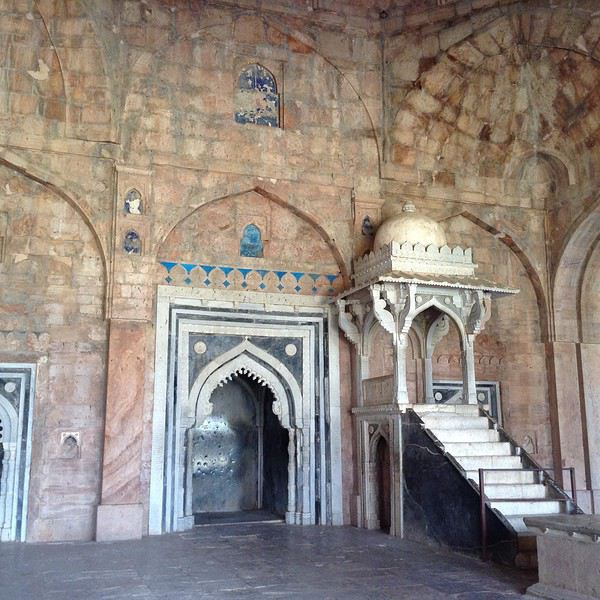
Jama Masjid, la mosquée rouge
Mausolée d'Hoshang Shah en restauration Les pierres en contrepoids, la chaise en équilibre . This is India.
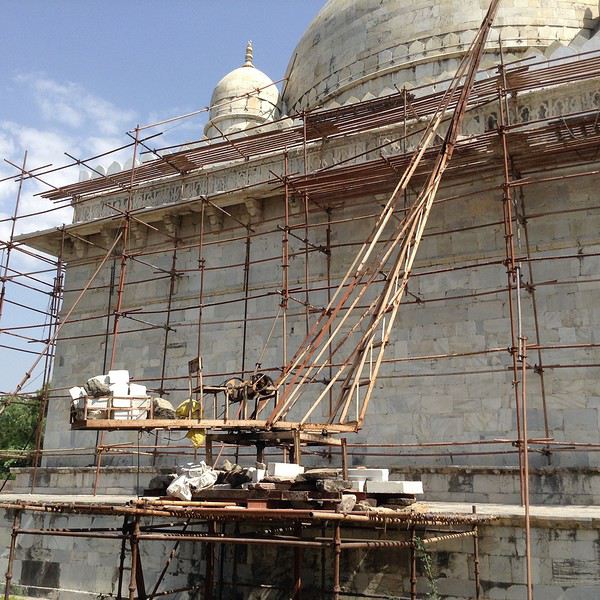
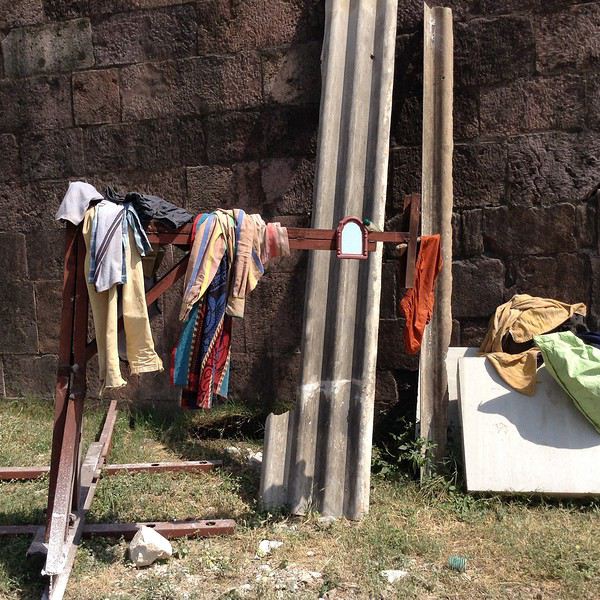
Les ouvriers taillent les pierres à l'ombre d'un baobab a l'extérieur . Leur coin toilette
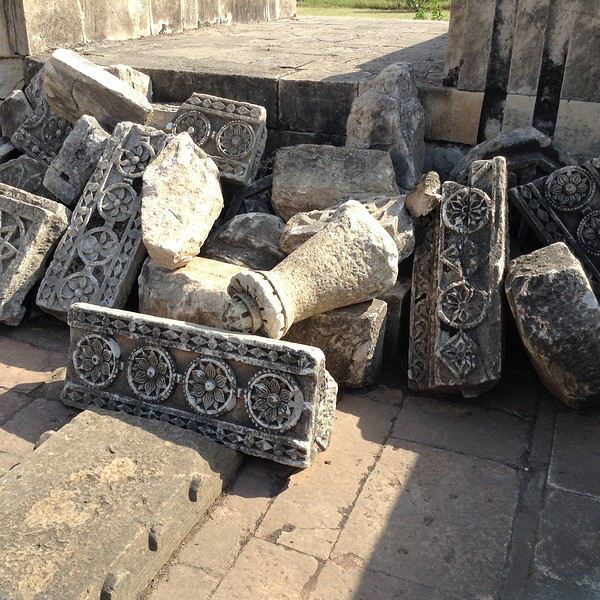
Ashrafi Mahal , école coranique. Ces pierres magnifiques en vrac au sol. Comme à Bhudj devant le palais.
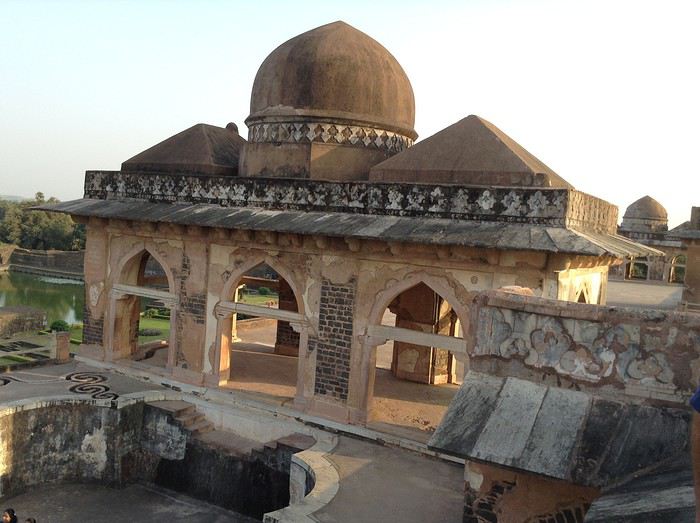
1/2 journée pour l'enclave royale, au nord. 200 roupies. Palais de Jahaz Mahal Celui d'Hindola Mahal Mosquée de Dilawar Khan Champa Baodi, un puits qu'on a pas été fichus de trouver.
1/2 journée pour le groupe Rewa Kund . 200 roupies
Merveilleuse architecture afghane. Une préférence pour le pavillon Rupmavati situé à 6 kms au sud de Mandu. Groupe de Rewa Kund. Quelques chauffeurs de taxi proposent de nous y emmener le soir pour voir le coucher du soleil. Très romantique paraît il. On préfère y aller de jour. On peut louer des vélos. 100 roupies/jour chez la mère d'un guide qui parle très bien anglais et utilise quelques mots en français pour alpaguer le touriste. Il s'appelle Vishwas. Un businessman très entreprenant...mais bon pas harcelant. Vélos tout neufs!! C'est bien la première fois. Cadre, guidon et garde boue encore dans leur emballage plastique. C'est sur Main road à gauche en allant vers le nord. Nous voilà partis sur ces vélos qui roulent nickel. Route mauvaise mais il y a pire. Un lac.Des temples , mausolées au loin dans la nature. Nous envisageons d'aller voir à notre retour .Mais avec la chaleur de fin de matinée nous rentrerons direct à l'hôtel. Ah le pavillon de la belle chanteuse Rupmavati . Un dôme dirigé vers le fleuve sacré , Narmada que l'on retrouve à Maheswar, pour prier et un dirigé vers le palais de son amoureux Baz Bahadur. La légende dit que Rupmavati avait exigé de lui la construction de ce pavillon en gage de son amour. Il paraît que de ce dôme sa voix portait jusqu'à lui. En hauteur, en pleine nature, ces monuments sont de toute beauté. J'adore cette architecture. Sobre. Imposante. Palais de Baz Bahadur.
Dôme du pavillon Rupmavati d'où elle chantait pour son chéri.
Pour manger Il y a bien une cantine dans notre hôtel mais toujours vide alors nous l'évitons malgré l’insistance pâteuse du patron jamais à jeun. Le Shivani restaurant. Main Road à gauche en allant vers le nord Bon Resto. Succulents allo et gobi paratha, à peine épicés. Je ne mangerai que ça et des bananes. Pas testé d'autres restos. Pour une fois que je peux manger pas épicé. Le jardin du Shivani juste en face où parait- il on peut prendre un petit déjeuner est en fait un dépotoir à ordures. Pour un lassi, mon ami, grand amateur, conseille le Relax Point, face à l'arrêt de bus. Les meilleurs du Madhya Pradesh, c'est fort possible. Fait aussi épicerie. Tenu par 2 gars super sympa. On s'y sentait si bien...
Seul point WI FI à ma connaissance, chez un marchand de tissus, Main road, a gauche en allant vers le sud, après la petite place du marché. En face d'un vieux monsieur qui fait des photocopies. 40 roupies/h Nous installe 2 chaises devant sa boutique. Il y a peut être la WIFI dans hôtels plus luxueux , je ne sais pas.
La prochaine fois je vous parle du marché hebdomadaire de Mandu.
Mausolée d'Hoshang Shah en restauration Les pierres en contrepoids, la chaise en équilibre . This is India.
Les ouvriers taillent les pierres à l'ombre d'un baobab a l'extérieur . Leur coin toilette
Ashrafi Mahal , école coranique. Ces pierres magnifiques en vrac au sol. Comme à Bhudj devant le palais.
1/2 journée pour l'enclave royale, au nord. 200 roupies. Palais de Jahaz Mahal Celui d'Hindola Mahal Mosquée de Dilawar Khan Champa Baodi, un puits qu'on a pas été fichus de trouver.
1/2 journée pour le groupe Rewa Kund . 200 roupies
Merveilleuse architecture afghane. Une préférence pour le pavillon Rupmavati situé à 6 kms au sud de Mandu. Groupe de Rewa Kund. Quelques chauffeurs de taxi proposent de nous y emmener le soir pour voir le coucher du soleil. Très romantique paraît il. On préfère y aller de jour. On peut louer des vélos. 100 roupies/jour chez la mère d'un guide qui parle très bien anglais et utilise quelques mots en français pour alpaguer le touriste. Il s'appelle Vishwas. Un businessman très entreprenant...mais bon pas harcelant. Vélos tout neufs!! C'est bien la première fois. Cadre, guidon et garde boue encore dans leur emballage plastique. C'est sur Main road à gauche en allant vers le nord. Nous voilà partis sur ces vélos qui roulent nickel. Route mauvaise mais il y a pire. Un lac.Des temples , mausolées au loin dans la nature. Nous envisageons d'aller voir à notre retour .Mais avec la chaleur de fin de matinée nous rentrerons direct à l'hôtel. Ah le pavillon de la belle chanteuse Rupmavati . Un dôme dirigé vers le fleuve sacré , Narmada que l'on retrouve à Maheswar, pour prier et un dirigé vers le palais de son amoureux Baz Bahadur. La légende dit que Rupmavati avait exigé de lui la construction de ce pavillon en gage de son amour. Il paraît que de ce dôme sa voix portait jusqu'à lui. En hauteur, en pleine nature, ces monuments sont de toute beauté. J'adore cette architecture. Sobre. Imposante. Palais de Baz Bahadur.
Dôme du pavillon Rupmavati d'où elle chantait pour son chéri.
Pour manger Il y a bien une cantine dans notre hôtel mais toujours vide alors nous l'évitons malgré l’insistance pâteuse du patron jamais à jeun. Le Shivani restaurant. Main Road à gauche en allant vers le nord Bon Resto. Succulents allo et gobi paratha, à peine épicés. Je ne mangerai que ça et des bananes. Pas testé d'autres restos. Pour une fois que je peux manger pas épicé. Le jardin du Shivani juste en face où parait- il on peut prendre un petit déjeuner est en fait un dépotoir à ordures. Pour un lassi, mon ami, grand amateur, conseille le Relax Point, face à l'arrêt de bus. Les meilleurs du Madhya Pradesh, c'est fort possible. Fait aussi épicerie. Tenu par 2 gars super sympa. On s'y sentait si bien...
Seul point WI FI à ma connaissance, chez un marchand de tissus, Main road, a gauche en allant vers le sud, après la petite place du marché. En face d'un vieux monsieur qui fait des photocopies. 40 roupies/h Nous installe 2 chaises devant sa boutique. Il y a peut être la WIFI dans hôtels plus luxueux , je ne sais pas.
La prochaine fois je vous parle du marché hebdomadaire de Mandu.
Périple Delhi - Rajasthan - Gujarat - Goa
bonjour,
Cette fois c'est décidé, nous partons fin janvier en Inde pour la 4ème fois. Et tant pis si nous avons un peu froid et certainement très chaud au cours de ce périple. Nous logerons dans des guest house simples, pas plus de 1000 rps, plus à Delhi et Mumbay ! mais je compte sur vous qui avez de bonnes adresses dans ces deux villes. Nous utiliserons le train, surtout, et le bus même si mes lombaires n'aiment pas du tout. Nous adorons par dessus tout flâner dans les rues, aller dans les marchés, regarder vivre les indiens... et la bonne cuisine.
Merci de me donner votre avis sur notre trajet.
Nous partirons donc vers le 30 janvier 2017, pas encore acheté les billets, et resterons jusqu'à la fin avril.
- Delhi, 3 jours, d'où nous partirons pour le Shekawati (un train les vendredis). Le départ pour cette région s'effectue de la gare Sarai Rohlla. Est ce que le quartier tibétain est loin de cette
gare ? Nous pensons également chercher un hôtel du côté de Pahar Gang. Train pour
- Shekawati (5 jours) où nous arrivons à Jhunjhunu et repartons de Mandawa. (bus)
- Bikaner (4jours) : qq connaît les balades proposées dans le désert, notamment par Vino Guest house. Pas trop piège à touriste qui fait sa balade sur un dromadaire ??? Train pour
- Jaïpur (3 jours) Bus pour
- Pushkar (3 jours, bus depuis Ajmer pour
- Bundi (5 jours), train pour
- Udaipur (5 jours) avec excursions à Khumbalgarh et Ranakpur. Train pour
- Amedabad (3 jours) train pour Bhuj
- Bhuj ( 19/20 jours), enfin la région de Bhuj où nous comptons visiter les villages (et y rester si c'est possible) , notamment Mandvi où nous séjournerons certainement plusieurs jours. Train pour
- Drangdhra (2 jours) puis??? je ne sais pas comment
- Zainabad d'où nous irons 2 jours chez Shanray Malik. Train pour
Concernant ces deux dernières destinations le parcours reste très flou, plus long plus court?? nous verrons sur place.
- Ahmebad ( 2jours). Train pour -Mumbay (4 jours). J' y cherche des adresses de guest house (ventilo et eau froide suffiront). QuelLe gare pour Goa ? Train pour - Goa (19/20 jours), là idem ce sera en fonction de ce que nous y trouverons. Mon envie c'est buller sous les cocotiers, balades dans l'arrière pays, bons plats goannais, ... Train pour - Mumbay (4jours) et retour à Paris.
Vous allez peut être vous dire que ce n'est pas très approfondi tout ça, mais je laisse la part belle à nos envies de rester là parce qu'on y est bien, que l'ambiance est belle et que la vie y est tranquille. ou d'en repartir dès le lendemain! Pas de réservations à l'avance, juste peut être la guest en arrivant à Delhi. Sinon, nous avons toujours appelé la veille pour le lendemain et ça a bien marché. Idem pour le train. AH, j'oubliais, j'ai lu qq part qu'il fallait produire ses tickets de change (euros/roupies) lorsqu'on achète un billet de train. Cela ne nous est jamais arrivé jusqu'à présent... est-ce vrai???
Merci par avance de nous faire bénéficier de votre expérience, pour vos critiques et vos bons plans !
Concernant ces deux dernières destinations le parcours reste très flou, plus long plus court?? nous verrons sur place.
- Ahmebad ( 2jours). Train pour -Mumbay (4 jours). J' y cherche des adresses de guest house (ventilo et eau froide suffiront). QuelLe gare pour Goa ? Train pour - Goa (19/20 jours), là idem ce sera en fonction de ce que nous y trouverons. Mon envie c'est buller sous les cocotiers, balades dans l'arrière pays, bons plats goannais, ... Train pour - Mumbay (4jours) et retour à Paris.
Vous allez peut être vous dire que ce n'est pas très approfondi tout ça, mais je laisse la part belle à nos envies de rester là parce qu'on y est bien, que l'ambiance est belle et que la vie y est tranquille. ou d'en repartir dès le lendemain! Pas de réservations à l'avance, juste peut être la guest en arrivant à Delhi. Sinon, nous avons toujours appelé la veille pour le lendemain et ça a bien marché. Idem pour le train. AH, j'oubliais, j'ai lu qq part qu'il fallait produire ses tickets de change (euros/roupies) lorsqu'on achète un billet de train. Cela ne nous est jamais arrivé jusqu'à présent... est-ce vrai???
Merci par avance de nous faire bénéficier de votre expérience, pour vos critiques et vos bons plans !
Mésaventure dès notre arrivée à Delhi
Bonjour à ceux qui me lisent,
Je prends le temps de raconter ce qui nous est arrivé avec mon compagnon à notre arrivée à Delhi il y a deux semaines.
Je précise que c'est mon 4 ième séjour en Inde, comme quoi il ne suffit pas d'être débutant pour se faire arnaquer.
Nous avions réservé un hotel à Pahar ganj, et au sortir de l'avion, nous avions pris le métro et étions sortis à la station New Delhi.
Tout allait bien jusque là.
Arrivés devant la gare des trains qui se trouve juste avant Pahar ganj, impossible de la traverser.
Là plusieurs personnes nous disent que c'est impossible en raison de normes de sécurité...patin couffin.
Du coup nous embarquons dans un rickshaw, supposé nous faire entrer dans le quartier (car du coup il y avait soit disant un détour de 2km à faire).
Bref, par un ensemble de relais malencontreux, nous nous retrouvons soit disant dans un bureau officiel qui nous explique que le quartier de notre hotel est bouclé, interdit aux touristes et dangereux pour les 3 prochains jours.
Soit disant plus aucune possibilité de rester à Delhi et plus aucun train ni bus de dispo pour bouger ailleurs. (le type du bureau officiel te montre le site de réservation de train et te dis que tout a changé et que tu ne peux plus bouger en train.Il appelle soit disant la station de bus et le type du bureau te dit que tout est plein ou annulé pour trois jours).
Impossible de rester ou de prendre un transport à un prix normal: nous devons payer un taxi privé.
Je sais, ca a l'air gros à tête reposée mais le jour ou tu débarque à 35 degrés avec ton gros sac et 28 heures de voyages dans les pattes....tu es super vulnérable.
Résultat: nous sommes quasiment forcés de quitter Delhi illico et en voiture privée le double du prix qu'on aurait jamais payé à la base. Je raconte ca ici car j'ai entendu une autre personne raconter mots pour mots la même mésaventure.
Résultat: on s'est fait voler une semaine de budget et on s'est retrouvés à Richikech, on a perdu notre résa d'hôtel, qui vraisemblablement n'était pas fermé.
Au prétexte d'un festival et par une concordance de malveillance, on est tombés dans le panneau :(. L'inde a mal démarrée et la seule chose qui console ma naïveté, c'est de pouvoir éviter à d'autres la même mésaventure. Avec un reçu j'aurais pu porter plainte, c'est ce que m'a suggéré un indien à qui j'ai raconté l'histoire.
Bref, La bande est organisée, faites gaffe en arrivant à Delhi. Pour info la somme en question s'est élevée à 160 euros, pour 226 km.
Tchuss à tutti
Erika
L'Inde en juin/juillet/août?
Bonjour à tous !
J'ai le projet de partir en Inde du Nord cet été, et il m'est assez difficile de faire le tri dans les avis que je trouve tant ceux-ci diffèrent...j'espère donc pouvoir obtenir ici quelques conseils de la part d'habitués !
Ce serait pour début juin. Je n'ai pas encore pris mon billet mais je voudrais le faire dès demain. Cependant, j'ai du mal à me décider concernant la date du retour. À l'origine, je partais dans le but de faire un trek au Ladakh pour 15 jours. Je pense faire l'aller-retour en bus par la route de Manali, et passer quelques jours à Leh, donc disons qu'en gros cela me prendrait 3 bonnes semaines (je veux y aller tranquillement).
Mais je m'étais dit qu'il serait bête de s'arrêter là. Il m'est possible de poursuivre le voyage pour un mois supplémentaire (soit 2 mois en tout). Or je lis partout que juin/juillet/aout est la pire période pour visiter l'Inde, on m'a carrément dit que ça ne valait pas le coup. Peut être qu'il serait plus judicieux de me consacrer au Ladakh et de découvrir le reste du pays une prochaine fois ?
Est-il possible d'entrer sans avoir de billet retour, et d'aviser sur place en fonction de mon ressenti et de la météo ? C'est un pays qui m'attire depuis un bon bout de temps, mais j'avoue que je l'appréhende. Je suis une jeune femme voyageant seule en mode "routarde", et j'ai lu de nombreuses expériences de filles qui, même en se faisant discrète, ont ressenti un profond malaise et ont du écourter leur voyage. Je suis très ouverte et j'ai envie de me faire mon propre avis sur la question, mais le prix de ce voyage est conséquent pour moi et j'ai très peur de me retrouver dans cette situation. Si je ne m'y sentais finalement pas bien, j'aimerais avoir la possibilité de prendre un billet d'avion pour un pays asiatique plus calme (par exemple la Thaïlande que je connais déja) et de re-tenter l'expérience indienne dans quelques années.
Dans le cas où j'y passerais deux mois complets, j'aimerais après le Ladakh visiter Agra, Jaïpur, Jodhpur, Pushkar, Rishikesh, et surtout Varanasi. Combien de temps consacrer idéalement à chacune de ces villes ? En un mois et en n'utilisant que les transports en commun, c'est assez ? Au Ladakh, à part un trek guidé, qu'est ce qu'il y aurait de beau à visiter par ses propres moyens ? D'ailleurs est ce que les treks proposés sur 15 jours sont adaptés aux débutants ? Enfin, est-il préférable de visiter d'abord le Ladakh puis le Rajasthan et Varanasi, ou de parcourir le pays pour terminer par le trek ? En fonction du climat, de la fréquentation (peut être moins de monde au Ladakh en juin qu'en juillet/aout ?), de l'adaptation au pays etc...
Je remercie par avance ceux qui auront la gentillesse de répondre à ce post un peu long :)
Je m'excuse si certaines de mes questions ont déja été posées, j'ai fait quelques recherches mais en ce moment le temps me manque et comme j'aimerais pouvoir prendre mes billets au plus vite...
Bonne soirée à vous !
Ce serait pour début juin. Je n'ai pas encore pris mon billet mais je voudrais le faire dès demain. Cependant, j'ai du mal à me décider concernant la date du retour. À l'origine, je partais dans le but de faire un trek au Ladakh pour 15 jours. Je pense faire l'aller-retour en bus par la route de Manali, et passer quelques jours à Leh, donc disons qu'en gros cela me prendrait 3 bonnes semaines (je veux y aller tranquillement).
Mais je m'étais dit qu'il serait bête de s'arrêter là. Il m'est possible de poursuivre le voyage pour un mois supplémentaire (soit 2 mois en tout). Or je lis partout que juin/juillet/aout est la pire période pour visiter l'Inde, on m'a carrément dit que ça ne valait pas le coup. Peut être qu'il serait plus judicieux de me consacrer au Ladakh et de découvrir le reste du pays une prochaine fois ?
Est-il possible d'entrer sans avoir de billet retour, et d'aviser sur place en fonction de mon ressenti et de la météo ? C'est un pays qui m'attire depuis un bon bout de temps, mais j'avoue que je l'appréhende. Je suis une jeune femme voyageant seule en mode "routarde", et j'ai lu de nombreuses expériences de filles qui, même en se faisant discrète, ont ressenti un profond malaise et ont du écourter leur voyage. Je suis très ouverte et j'ai envie de me faire mon propre avis sur la question, mais le prix de ce voyage est conséquent pour moi et j'ai très peur de me retrouver dans cette situation. Si je ne m'y sentais finalement pas bien, j'aimerais avoir la possibilité de prendre un billet d'avion pour un pays asiatique plus calme (par exemple la Thaïlande que je connais déja) et de re-tenter l'expérience indienne dans quelques années.
Dans le cas où j'y passerais deux mois complets, j'aimerais après le Ladakh visiter Agra, Jaïpur, Jodhpur, Pushkar, Rishikesh, et surtout Varanasi. Combien de temps consacrer idéalement à chacune de ces villes ? En un mois et en n'utilisant que les transports en commun, c'est assez ? Au Ladakh, à part un trek guidé, qu'est ce qu'il y aurait de beau à visiter par ses propres moyens ? D'ailleurs est ce que les treks proposés sur 15 jours sont adaptés aux débutants ? Enfin, est-il préférable de visiter d'abord le Ladakh puis le Rajasthan et Varanasi, ou de parcourir le pays pour terminer par le trek ? En fonction du climat, de la fréquentation (peut être moins de monde au Ladakh en juin qu'en juillet/aout ?), de l'adaptation au pays etc...
Je remercie par avance ceux qui auront la gentillesse de répondre à ce post un peu long :)
Je m'excuse si certaines de mes questions ont déja été posées, j'ai fait quelques recherches mais en ce moment le temps me manque et comme j'aimerais pouvoir prendre mes billets au plus vite...
Bonne soirée à vous !
Transport d'Hampi à Hassan
Bonjour,
j'ai lu sur un message de Voyage forum qu'il y avait une liaison en bus le matin Hampi - Hospet- Hassan. Mais ce message date de 2005 et je me demande s'il est encore d'actualité car lorsque je consulte Internet je ne vois aucune liaison de ce type.
Si un voyageur a des infos sur cette liaison, je suis preneur car actuellement je galère pour trouver un moyen de relier Hassan à partir d'Hampi
Merci
j'ai lu sur un message de Voyage forum qu'il y avait une liaison en bus le matin Hampi - Hospet- Hassan. Mais ce message date de 2005 et je me demande s'il est encore d'actualité car lorsque je consulte Internet je ne vois aucune liaison de ce type.
Si un voyageur a des infos sur cette liaison, je suis preneur car actuellement je galère pour trouver un moyen de relier Hassan à partir d'Hampi
Merci
Itinéraire: Rajasthan - Gujarat cet été!
Salut à tous,
Je reviens en Inde cet été et commence la préparation de mon itinéraire (un poil musclé…) pour profiter à plein du voyage ! Je suis preneur de vos avis et corrections en fonction de vos expériences. Également avide de vos bons plans de logement ou chauffeur (car je vais en avoir besoin ponctuellement).
Jour 1 : Arrivée dans la nuit à Delhi et train le matin pour Churu. Visite de Churu et bus pour Mandawa.
Jour 2 : Mandawa – Fathepur – Nawalgarh (si ce n’est pas trop ambitieux pour la journée, en bus locaux.)
Jour 3 : Mandawa et là j’aimerais faire appel au service d’un chauffeur pour rejoindre Bundi le soir même (j’aimerais éviter de prendre un bus pour Jaipur, nuit à Jaipur et bus le lendemain pour Bundi)
Jour 4 : Bundi
Jour 5 : Bundi (Train de nuit pour Udaipur)
Jour 6 : Udaipur
Jour 7 : Udaipur
Jour 8 : Udaipur – Mount Abu
Jour 9 : Mount abu – Sidhpur en train (visite) et nuit à Patan
Jour 10 : Patan
Jour 11 : Patan – Junagadh (grosse étape, soit en bus, soit avec chauffeur, soit… ?)
Jour 12 : Junagadh
Jour 13 : Junagadh – Diu
Jour 14 : Diu
Jour 15 : Diu – Palitana (Intéressé par les moyens de transports)
Jour 16 : Palitana – Ahmedabad
Jour 17 : Ahmedabad – Le soir vol pour Mumbai
18 – 19 – 20 : Mumbai
Merci d’avance pour votre aide et les ajustements qui ne manqueront pas de devoir être faits ! 😉
Je reviens en Inde cet été et commence la préparation de mon itinéraire (un poil musclé…) pour profiter à plein du voyage ! Je suis preneur de vos avis et corrections en fonction de vos expériences. Également avide de vos bons plans de logement ou chauffeur (car je vais en avoir besoin ponctuellement).
Jour 1 : Arrivée dans la nuit à Delhi et train le matin pour Churu. Visite de Churu et bus pour Mandawa.
Jour 2 : Mandawa – Fathepur – Nawalgarh (si ce n’est pas trop ambitieux pour la journée, en bus locaux.)
Jour 3 : Mandawa et là j’aimerais faire appel au service d’un chauffeur pour rejoindre Bundi le soir même (j’aimerais éviter de prendre un bus pour Jaipur, nuit à Jaipur et bus le lendemain pour Bundi)
Jour 4 : Bundi
Jour 5 : Bundi (Train de nuit pour Udaipur)
Jour 6 : Udaipur
Jour 7 : Udaipur
Jour 8 : Udaipur – Mount Abu
Jour 9 : Mount abu – Sidhpur en train (visite) et nuit à Patan
Jour 10 : Patan
Jour 11 : Patan – Junagadh (grosse étape, soit en bus, soit avec chauffeur, soit… ?)
Jour 12 : Junagadh
Jour 13 : Junagadh – Diu
Jour 14 : Diu
Jour 15 : Diu – Palitana (Intéressé par les moyens de transports)
Jour 16 : Palitana – Ahmedabad
Jour 17 : Ahmedabad – Le soir vol pour Mumbai
18 – 19 – 20 : Mumbai
Merci d’avance pour votre aide et les ajustements qui ne manqueront pas de devoir être faits ! 😉
Découverte de Bhopal: Quelques tuyaux?
Bonjour,
Je pars découvrir Bhopal avec une amie, en juillet prochain pour 4 jours. Nous nous sommes pas mal renseignées, mais nous adorerions être conseillées. Si vous connaissez la ville, si vous savez où nous pourrions loger et si nous pouvions faire des rencontres intéressantes, nous somme preneuses.
Au plaisir de vous lire...
Lioub
Je pars découvrir Bhopal avec une amie, en juillet prochain pour 4 jours. Nous nous sommes pas mal renseignées, mais nous adorerions être conseillées. Si vous connaissez la ville, si vous savez où nous pourrions loger et si nous pouvions faire des rencontres intéressantes, nous somme preneuses.
Au plaisir de vous lire...
Lioub
Rajasthan 2016 pour mes 50 ans
Bonjour,
Je prépare un voyage de découverte au Rajasthan pour mars 2016 avec mon épouse pour mon anniversaire (50 ans!!!!). Mon épouse et moi sommes plutôt de grand voyageurs et avons l'habitude des périples à l'étranger avec de grands kilométrages. J'étudie différentes propositions d'agences (Voyages in India, India peacok Travel, Marco Vasco). Le cahier des charges est simple : voyage en mars 2016 avec chauffeur (probablement anglophone) d'une durée de 15 jours avec hébergement luxe (on n'a pas tous les jours 50 ans) :
J0 départ de Paris J1 Delhi J2 Delhi / Shekhawati (257 km - 4h30/5h de route) J3 Shekhwati – Kuchaman J4 Kuchaman-Khimsar J5 Khimsar-Ramdeora- Jaisalmer J6 Jaisalmer J7 Jaisalmer / Jodhpur J8 Jodhpur – Ranakpur – Udaipur J9 Udaipur J10 Udaipur – Chittorgarh – Bundi J11 Bundi – Jaipur
J12 Jaipur J13 Jaipur – Agra J14 Agra-Delhi J15 Delhi : retour vers la France
Je vous passe le contenu des visites quotidiennes et le choix des hébergements. Je voudrais savoir si ce circuit est réaliste sachant qu'au moins 3 agences m'ont proposé à peu près ce même circuit.
Qu'en pensez-vous chers voyageurs connaisseurs du Rajasthan?
Très bonne journée.
Loïc
Je prépare un voyage de découverte au Rajasthan pour mars 2016 avec mon épouse pour mon anniversaire (50 ans!!!!). Mon épouse et moi sommes plutôt de grand voyageurs et avons l'habitude des périples à l'étranger avec de grands kilométrages. J'étudie différentes propositions d'agences (Voyages in India, India peacok Travel, Marco Vasco). Le cahier des charges est simple : voyage en mars 2016 avec chauffeur (probablement anglophone) d'une durée de 15 jours avec hébergement luxe (on n'a pas tous les jours 50 ans) :
J0 départ de Paris J1 Delhi J2 Delhi / Shekhawati (257 km - 4h30/5h de route) J3 Shekhwati – Kuchaman J4 Kuchaman-Khimsar J5 Khimsar-Ramdeora- Jaisalmer J6 Jaisalmer J7 Jaisalmer / Jodhpur J8 Jodhpur – Ranakpur – Udaipur J9 Udaipur J10 Udaipur – Chittorgarh – Bundi J11 Bundi – Jaipur
J12 Jaipur J13 Jaipur – Agra J14 Agra-Delhi J15 Delhi : retour vers la France
Je vous passe le contenu des visites quotidiennes et le choix des hébergements. Je voudrais savoir si ce circuit est réaliste sachant qu'au moins 3 agences m'ont proposé à peu près ce même circuit.
Qu'en pensez-vous chers voyageurs connaisseurs du Rajasthan?
Très bonne journée.
Loïc
Hôtel à Chitrakoot (Inde)
Je voudrais connaitre des hôtels pas cher a chitrakoot
D'avance merci
Itinéraire en Inde (Ladakh)
bonjour à tous...
en juillet août je pense découvrir l'inde du nord (c 'est mon premier voyage en inde , et je ne fais pas de trek..) j'avais penser aller au Ladakh... qu'en pensez vous.??? ... et prendre les moyens de locomotion locaux... y en a t il ???? avez vous des itinéraires à me suggérer ???
merci +++
Hébergement à Goa en mars
Bonjour,
Je me tourne vers vous pour quelques infos que j'espère vous pourrez me donner.
Nous sommes un couple de 53a et nous partons tous les ans en inde depuis 5 ou 6 ans. La première année a été un voyage en taxi, train et bus maintenant, nous voyageons uniquement en moto. Nous faisons environs 3000 km en 6 semaines.
Cette année pour la première fois, nous allons nous arrêter une dixaine de jour à Goa avant de remonter sur Bombay par la cote du Konkan.
Nous allons rester à Goa du 1er au 10 mars 2015 environs. C'est à ce moment que vous intervenez.
Nous avons décidé de loger dans le sud de Goa. La, plusieurs possibilité s'offre à nous.
Soit agonda soit palolem soit patnem etc etc.
En sachant que nous serons à goa pour nous reposer, manger du poisson, être tranquille, que dans le reste de l’inde nous dépensons entre 500 et 1000 inr pour se loger et entre 50 et 80 inr pour manger.
Pourriez-vous nous indiquer si vous connaissez des logements type hutte sur la plage, des guests houses sympa, des restau de poisson et crustacés pas cher ?
Quel endroit nous conseilleriez-vous dans le sud de goa ?
Je vous remercie Dominique
Quel endroit nous conseilleriez-vous dans le sud de goa ?
Je vous remercie Dominique
15 jours Tamil Nadu - Kerala
Bonsoir à tous !
Avec mon compagnon nous souhaiterions organiser un voyage de 15 jours afin de visiter les régions du Kerala et du Tamil Nadu. 15 jours car nous aimerions partir en dehors des mois de juillet août et comme je suis enseignante je ne peux pas partir plus de temps pendant les autres périodes de vacances dans l'année.
Je suis déjà partie dans le Tamil Nadu et j'ai complètement accroché à la région, c'est pour cela que je souhaite la faire découvrir à mon compagnon. Je pensais faire une semaine à l'Est (Pondichery, Mahabalipuram, Chidambaram) et l'autre à l'Ouest... Je ne cherche pas à tout voir car en 15 jours j'ai parfaitement conscience que c'est impossible et je souhaiterais surtout que ce voyage ne ressemble pas à une course.
Je me pose donc plusieurs questions: - comment rallier le Tamil Nadu au Kerala sans perdre trop de temps de voyage ? (sachant que je ne compte pas spécifiquement m'arrêter à Madurai)
- dans le Kerala, je pensais m'arrêter sur Allepey, Munnar, prendre le train pour Ooti mais tout cela reste très vague donc si vous avez des choses sympas à voir / à faire dans cette région, je suis preneuse ! J'ai lu dans plusieurs sujets des témoignages sur Kochin de personnes qui avaient été très déçues par la ville... est ce une étape à switcher au profit d'autre chose? (sachant que pour le Kerala on serait plus dans un trip nature, et pour le Tamil Nadu culturel et spirituel).
- enfin dernière question: j'adorerais passer par Mysore sur le trajet du retour mais j'ai peur que cela soit irréalisable par rapport à la distance. Où serait-il judicieux de prendre le vol retour, Bengalore, Kochin (?), autre?
Merci d'avance pour votre lecture et vos réponses 😉 J'attends vos conseils et vos expériences avec impatience !!!
Julie
Avec mon compagnon nous souhaiterions organiser un voyage de 15 jours afin de visiter les régions du Kerala et du Tamil Nadu. 15 jours car nous aimerions partir en dehors des mois de juillet août et comme je suis enseignante je ne peux pas partir plus de temps pendant les autres périodes de vacances dans l'année.
Je suis déjà partie dans le Tamil Nadu et j'ai complètement accroché à la région, c'est pour cela que je souhaite la faire découvrir à mon compagnon. Je pensais faire une semaine à l'Est (Pondichery, Mahabalipuram, Chidambaram) et l'autre à l'Ouest... Je ne cherche pas à tout voir car en 15 jours j'ai parfaitement conscience que c'est impossible et je souhaiterais surtout que ce voyage ne ressemble pas à une course.
Je me pose donc plusieurs questions: - comment rallier le Tamil Nadu au Kerala sans perdre trop de temps de voyage ? (sachant que je ne compte pas spécifiquement m'arrêter à Madurai)
- dans le Kerala, je pensais m'arrêter sur Allepey, Munnar, prendre le train pour Ooti mais tout cela reste très vague donc si vous avez des choses sympas à voir / à faire dans cette région, je suis preneuse ! J'ai lu dans plusieurs sujets des témoignages sur Kochin de personnes qui avaient été très déçues par la ville... est ce une étape à switcher au profit d'autre chose? (sachant que pour le Kerala on serait plus dans un trip nature, et pour le Tamil Nadu culturel et spirituel).
- enfin dernière question: j'adorerais passer par Mysore sur le trajet du retour mais j'ai peur que cela soit irréalisable par rapport à la distance. Où serait-il judicieux de prendre le vol retour, Bengalore, Kochin (?), autre?
Merci d'avance pour votre lecture et vos réponses 😉 J'attends vos conseils et vos expériences avec impatience !!!
Julie
Voyage au Kerala en mars 2014
bonjour
Nous partons eau Kerala avec 2 enfants dans quelques mois pour 2 semaines.
Nous partons depuis Paris, où nous conseillez vous d'atterrir?
Ensuite pour un voyage plutôt authentique mais assez confortable avez-vous des adresses dans les plantations de thé (si possible un lieu assez isolé en pleine nature), un à la mer (plutot des paillottes) et un dans les réserves d'éléphants?
De plus comment peut on aller d'un endroit à l'autre? Y a-t-il des trains? Ou une voiture avec chauffeur, et où les trouver?
Pourriez vous nous dire quel est le meilleur livre guide?
merci d'avance, julia
merci d'avance, julia
Holi Festival 2014 Mathura - Varanasi
Bonjour,
Je souhaite me rendre pendant le Holi Festival en inde du 14 au 20 mars 2014 Je recherche plusieurs informations et tuyaux de votre part. Nous sommes deux femmes et nous voulons participer et prendre des photos.
1- Nous pensions aller sur Vrindavan et Mathura puis Varanasi. Qu'en pensez vous ? Avez vous de bonnes adresses de contacts ou d'hébergement ?
2- nous voulions utiliser les trains classiques pour nous déplacer ? . Avez vous des tuyaux ou remarques ?
3- comment protéger contre poudre, poussière et eau l'appareil photo ? J'utilise un boitier 24x36 avec objectif de taille
Toutes informations utiles nous sera précieuse. J'attends vos réponses.
Je souhaite me rendre pendant le Holi Festival en inde du 14 au 20 mars 2014 Je recherche plusieurs informations et tuyaux de votre part. Nous sommes deux femmes et nous voulons participer et prendre des photos.
1- Nous pensions aller sur Vrindavan et Mathura puis Varanasi. Qu'en pensez vous ? Avez vous de bonnes adresses de contacts ou d'hébergement ?
2- nous voulions utiliser les trains classiques pour nous déplacer ? . Avez vous des tuyaux ou remarques ?
3- comment protéger contre poudre, poussière et eau l'appareil photo ? J'utilise un boitier 24x36 avec objectif de taille
Toutes informations utiles nous sera précieuse. J'attends vos réponses.
Que penser d'Udaipur?
Udaipur, ahh quelle belle ville, mais un peu trop touristique à mon goût! Les vendeurs sont à la limite du harcèlement!! Dommage pour eux, car on passe notre chemin! Les vendeurs suivent où vos yeux se posent et vous saute dessus à l'instant même! Mais, malgré tout, Udaipur à du charme, le lac est superbe et que dire du Lake palace... Nous avons aussi été sur le "Moonsoon Hill" pour y voir le merveilleux couché de soleil... magique! Mais retourner dans le Rajasthan, je crois bien que je passerais mon tour! et vous??
Mon court vidéo : http://www.youtube.com/watch?v=C_d5cD8B-TQ
Mon court vidéo : http://www.youtube.com/watch?v=C_d5cD8B-TQ