Results for "Asie+Centrale+itinéraire"
About 110,820 results.
More options
Many results are in French, the community’s main language. English translations are added over time.
Search results
Australie en camping-car
Bonjour,
Je cherche à savoir si c'est possible de se promener en australie en louant sur place un camping car. Et quel parcours vaut le plus la peine, quels sont les tarifs de location...
Merci pour vos réponses
Youmbam
Climatisation dans le camping car?
Bonjour !
Qui a fait l'expérience de l'installation d'une clim dans un CC ? Est-ce bien utile ? Doit-on préférer une clim moteur ou une clim cellule ?
La clim moteur ne fonctionnerait qu'en roulant et la clim cellule nécessite la pose d'une génératrice...
J'ai vu dans un catalogue d'accessoirs que l'on peut également acheter une petite clim portative...!!?
Nous allons voyager 8 mois en Asie... C'est le moment des grandes questions !
Merci de nous partager vos expériences et connaissances !
Magguy
Qui a fait l'expérience de l'installation d'une clim dans un CC ? Est-ce bien utile ? Doit-on préférer une clim moteur ou une clim cellule ?
La clim moteur ne fonctionnerait qu'en roulant et la clim cellule nécessite la pose d'une génératrice...
J'ai vu dans un catalogue d'accessoirs que l'on peut également acheter une petite clim portative...!!?
Nous allons voyager 8 mois en Asie... C'est le moment des grandes questions !
Merci de nous partager vos expériences et connaissances !
Magguy
Sécurité au Vénézuela
Bonjour à tous
En février prochain nous souhaitons partir au vénézuela, mais j'ai très peu quant aux problèmes de sécurité, y aurait t il qqn qui pourrait me rassurer
Nous souhaitons aller aux Llanos, parc de Mochima, Delta de l'Orénoque et los Roques. en 4 semaines par bus, c faisable?
Si vous avez des bons plans, n'hésitez pas à me contacter
vraiment merci d'avance à tous pour vos précieux renseignements
Sandrine
En février prochain nous souhaitons partir au vénézuela, mais j'ai très peu quant aux problèmes de sécurité, y aurait t il qqn qui pourrait me rassurer
Nous souhaitons aller aux Llanos, parc de Mochima, Delta de l'Orénoque et los Roques. en 4 semaines par bus, c faisable?
Si vous avez des bons plans, n'hésitez pas à me contacter
vraiment merci d'avance à tous pour vos précieux renseignements
Sandrine
L'échange de maison long terme et les enfants
Bonjour,
Nous envisageons un échange de maison à l'étranger pour une durée de 5 à 12 mois. On se pose des questions par rapport à la scolarité des enfants ( 7 et 12 ans), les problèmes éventuels de réintégration dans le sysytème scolaire au retour, etc..
Si quelqu'un a déjà vécu une expérience similaire, peut-être pourra -t-il partager son expérience et nous avertir des pièges éventuels .
merci
La route de la soie en camping car
Bonjour,
Je projete de faire en 2005-2006 la traversée de Paris à Shangai en camping-car en passant par :
l'Allemagne-l'Autriche-l'Italie-la Croatie-l'Albanie-la Grèce-la Turquie (istanbul-Erzurum)-l'Iran(Téhéran- Mashhad)-le Turkménistan(Mary)-l'Ouzbekistan(Samarcande-Tachkent)-le Kirghizistan(Och)-la Chine(Kashgar).
Mes questions concernent surtout la partie de la Turquie à la Chine:
(pour la Chine, il faut semble-t-il passer obligatoirement par un intermédiaire, si vous êtes rentrés en CHine sans intermédiaire avec votre propre véhicule, je suis preneuse du tuyau)
l'état des routes ? quels types de camping-car ? Est-il préférable d'avoir un véhicule tout-terrain ?
Le carnet de passage en douane est il obligatoire? Si oui, avec ce carnet avez-vous quand même rencontré des problèmes pour rentrer le véhicule dans un pays?
Y a t il des assurances à prendre ? si oui quel en est le coût ?
Prix de l'essence ?
Et tout ce qui vous semble important.
Merci de me faire profiter de votre expérience du terrain car par expérience je sais que les cartes sont bien souvent très aléatoires et les guides peu explicites des qu'il s'agit de sortir des sentiers battus.
Je projete de faire en 2005-2006 la traversée de Paris à Shangai en camping-car en passant par :
l'Allemagne-l'Autriche-l'Italie-la Croatie-l'Albanie-la Grèce-la Turquie (istanbul-Erzurum)-l'Iran(Téhéran- Mashhad)-le Turkménistan(Mary)-l'Ouzbekistan(Samarcande-Tachkent)-le Kirghizistan(Och)-la Chine(Kashgar).
Mes questions concernent surtout la partie de la Turquie à la Chine:
(pour la Chine, il faut semble-t-il passer obligatoirement par un intermédiaire, si vous êtes rentrés en CHine sans intermédiaire avec votre propre véhicule, je suis preneuse du tuyau)
l'état des routes ? quels types de camping-car ? Est-il préférable d'avoir un véhicule tout-terrain ?
Le carnet de passage en douane est il obligatoire? Si oui, avec ce carnet avez-vous quand même rencontré des problèmes pour rentrer le véhicule dans un pays?
Y a t il des assurances à prendre ? si oui quel en est le coût ?
Prix de l'essence ?
Et tout ce qui vous semble important.
Merci de me faire profiter de votre expérience du terrain car par expérience je sais que les cartes sont bien souvent très aléatoires et les guides peu explicites des qu'il s'agit de sortir des sentiers battus.
Tour du monde en camping car et en famille
Nous revenons d'un tour du monde de 4 ans en famille et en camping-car.
Si ça intéresse quelques voyageurs, voici notre site :
periple.fr.st
N'hésitez pas pour les questions.
Team
Si ça intéresse quelques voyageurs, voici notre site :
periple.fr.st
N'hésitez pas pour les questions.
Team
Tips for choosing a long-distance touring bike
Hi there,
I’m currently looking for a bike to do my first bike trip across France, with the ultimate goal of cycling through Latin America. I’ve got a lot of questions and I’d love to hear if you have any answers or advice to share. First off, I’ve been through this before with hiking. I want to get top-quality gear right away. When I started hiking, I ended up buying everything three times—first beginner gear, then intermediate, then expert, etc. For biking, I’d prefer to skip that process and invest right now in a bike that could ideally handle Latin America. I’ve set a total max budget of around 5000 € (roughly 4000–4500 € for the bike and the rest for accessories: panniers, helmet, cycling shorts, etc.).
So, I’ve got quite a few questions:
* I’ve read in several places that some people recommend buying the bike directly in Latin America. Since I need a first bike to train in Europe, would it be better to buy an entry-level bike in France (and sell it before the big departure)? Or is it preferable to start right away with my final bike to get used to it? Is buying it there just to save a bit of money?
* For a long-term trip (around six months) in Latin America, is it better to go for a gravel bike or a mountain bike?
* Should I buy a new bike or a refurbished one? Even more so given that I’m planning a long trip—could a refurbished bike end up causing more breakdowns?
If you have any advice on models, technical features to prioritize, or recommended sellers or resellers, I’d love to hear it. I’m a total beginner—I’ve only just started watching videos and reading up on the subject, and all the technical specs are new to me!
Thanks in advance for your help!
I’m currently looking for a bike to do my first bike trip across France, with the ultimate goal of cycling through Latin America. I’ve got a lot of questions and I’d love to hear if you have any answers or advice to share. First off, I’ve been through this before with hiking. I want to get top-quality gear right away. When I started hiking, I ended up buying everything three times—first beginner gear, then intermediate, then expert, etc. For biking, I’d prefer to skip that process and invest right now in a bike that could ideally handle Latin America. I’ve set a total max budget of around 5000 € (roughly 4000–4500 € for the bike and the rest for accessories: panniers, helmet, cycling shorts, etc.).
So, I’ve got quite a few questions:
* I’ve read in several places that some people recommend buying the bike directly in Latin America. Since I need a first bike to train in Europe, would it be better to buy an entry-level bike in France (and sell it before the big departure)? Or is it preferable to start right away with my final bike to get used to it? Is buying it there just to save a bit of money?
* For a long-term trip (around six months) in Latin America, is it better to go for a gravel bike or a mountain bike?
* Should I buy a new bike or a refurbished one? Even more so given that I’m planning a long trip—could a refurbished bike end up causing more breakdowns?
If you have any advice on models, technical features to prioritize, or recommended sellers or resellers, I’d love to hear it. I’m a total beginner—I’ve only just started watching videos and reading up on the subject, and all the technical specs are new to me!
Thanks in advance for your help!
Préparation d'un voyage en Arménie et Géorgie en camping-car
Bonjour,
je me présente , je m'appelle Fabienne, je suis marié à Philippe .
Nous voyageons en camping car depuis 17 ans, nous avons visité beaucoup de pays en Europe et maintenant nous voulons partir un peu plus loin, c'est à dire en Géorgie et Arménie en passant par la Turquie.
Ce voyage est prévu en mai 2020 pour 3 mois.
Donc je recherche des personnes qui pourraient m'aider à préparer notre circuit.
Nous prévoyons de passer par la Turquie en passant le long de la mer noire , de visiter la Géorgie et de rentrer en Arménie en dernier car j'ai vu que la frontière Turquie Arménie était fermée.
Tous vos conseils seront les bienvenus. ( routes , visas, frontières à ne pas approcher!!, camping sauvage, risques etc).
Merci beaucoup d'avance pour votre aide.
Fabienne et Philippe
Randonnée en Azerbaïdjan - Caucase: Xinaliq, Laza, Susay
Bonjour à tous,
Début mai nous devrions être en Azerbaïdjan avec quelques amis, nous prévoyons en particulier de nous rendre autour du Mont Shahdagh... par les villages de Xinalik, Laza, Susay... pas facile de trouver des informations récentes sur la possibilité qu'il y a de traîner (au moins un peu) son sac à dos dans ce coin là...
J'ai pu lire que l'armée était assez présente sur le secteur, si certains d'entre vous ont pu s'y rendre, je suis preneur de toutes informations sur les possibilité d'accès dans cette zone qui à l'air tout à fait magique !!
Merci pour vos conseils, A+ Renaud.
Début mai nous devrions être en Azerbaïdjan avec quelques amis, nous prévoyons en particulier de nous rendre autour du Mont Shahdagh... par les villages de Xinalik, Laza, Susay... pas facile de trouver des informations récentes sur la possibilité qu'il y a de traîner (au moins un peu) son sac à dos dans ce coin là...
J'ai pu lire que l'armée était assez présente sur le secteur, si certains d'entre vous ont pu s'y rendre, je suis preneur de toutes informations sur les possibilité d'accès dans cette zone qui à l'air tout à fait magique !!
Merci pour vos conseils, A+ Renaud.
Randonnée en Svaneti (Géorgie)
Nous avons fait de la randonnée en Svaneti, c'était incroyable! Il faut se rendre à Mestia, une belle ville en pleine restauration. Elle sera splendide après quoiqu'elle aura perdu son cachet traditionnel. La svaneti est en train de devenir un haut lieu touristique dépêchez-vous d'y aller!
Il y plusieurs randonnées possibles à faire en Svaneti. À Mestia, l'info touristique donne des cartes, mais elles sont sommaires (pas de topo). Il faut prévoir à Tbilissi des cartes topos à acheter chez Geoland. Mais encore là, certains chemins présentés par les cartes de Geoland sont là, d'autres non. Il serait préférable d'avoir une boussole ou un GPS. Les sentiers sont relativement balisés, mais pas tout le temps. Il faut prendre garde, mais en même temps, il y a toujours un villageois quelque part à qui vous pouvez demander de l'info. La randonnée vaut le détour, c, est là qu'on rencontre les paysans et qu'on savoure les treks!
Le trek de village en village est bien: de Mestia à Zabeshi, de Zabeshi à Adishi, d'Adishi à Iprari et d'Iprari à Ushguli. Vous pouvez faire un jour, deux jours, trois jours ou quatre jours, à vous de commencer par le village qui vous convient!
Bonne rando!
Karine www.chroniquesduvastemonde.com Blog tour du monde
Il y plusieurs randonnées possibles à faire en Svaneti. À Mestia, l'info touristique donne des cartes, mais elles sont sommaires (pas de topo). Il faut prévoir à Tbilissi des cartes topos à acheter chez Geoland. Mais encore là, certains chemins présentés par les cartes de Geoland sont là, d'autres non. Il serait préférable d'avoir une boussole ou un GPS. Les sentiers sont relativement balisés, mais pas tout le temps. Il faut prendre garde, mais en même temps, il y a toujours un villageois quelque part à qui vous pouvez demander de l'info. La randonnée vaut le détour, c, est là qu'on rencontre les paysans et qu'on savoure les treks!
Le trek de village en village est bien: de Mestia à Zabeshi, de Zabeshi à Adishi, d'Adishi à Iprari et d'Iprari à Ushguli. Vous pouvez faire un jour, deux jours, trois jours ou quatre jours, à vous de commencer par le village qui vous convient!
Bonne rando!
Karine www.chroniquesduvastemonde.com Blog tour du monde
Traversée de l'Europe à vélo?
Bonjour à Tous.
Bientôt fini les études 😉, et envi de me surpasser, j'ai depuis quelques temps l'objectif de découvrir les diversités culturelles en Europe. J'envisage de faire une traversée d'Europe en vélo et en autonomie, de Porto à Moscou🤪. J'ai déjà derrière moi quelques périples qui, je pense faciliterons ce projet. Cependant je n'arrive pas forcement à me rendre compte de l'ampleur des choses.
Avez vous un idée du temps qu'il faut pour faire une expé de ce genre, avez-vous vécu une expé similaire? Y a t'il selon vous des itinéraires intéressant, où des cultures à ne pas manquer?
D'avance merci pour vos réactions et réponses
JD
Tout petit... la planète!
Ces derniers temps, je constate que le jardin de nos possibilités et délire de voyage s'est considérablement retréci.
Sans sombrer dans une paranoïa déplacée, la carte du monde actuellement présente un peu partout des aspérités qui rendent les déplacements périlleux.
Entre les pays en guerre frontale ou larvée, les pays à instabilité politique chronique et les autres où "l'occidental" est plutôt mal vu, il y a des régions entières, des portions de continents où à moins de vouloir jouer au kamikaze ou au contraire se mettre la tête dans le sable, il est pratiquemment impossible de voyager avec un minimun de tranquillité.
Aucun continent n'échappe aujourd'hui à ce triste constat. A cela s'ajoute, l'insécurité dans certaines grandes villes du tiers-monde et également dans les notres. Et pour couronner le tout voilà maintenant que les poulets et les moustiques viennent davantage nous picorer notre "jardin routard universel"... décidemment, de plus en plus petite la planète! Quelle réflexion vous inspire ce retrécissement? Aujourdh'ui, la possibilité de voyager facilement ne va-t-elle pas de paire avec une standardisation des circuits y compris chez les routards faute de pouvoir aller partout? Sommes-nous en train de vivre une mutation dans notre façon de concevoir le voyage? l'intérêt grandissant sur ce forum pour les questions sociales, politiques, vie de la cité etc..ne reflète-t-il pas la fin d'une vision idéalisée voire poétique du voyage issue de la période post68 au profit d'une tentative d'explication des hommes, des peuples, des civilisations?... etc...etc...
Sans sombrer dans une paranoïa déplacée, la carte du monde actuellement présente un peu partout des aspérités qui rendent les déplacements périlleux.
Entre les pays en guerre frontale ou larvée, les pays à instabilité politique chronique et les autres où "l'occidental" est plutôt mal vu, il y a des régions entières, des portions de continents où à moins de vouloir jouer au kamikaze ou au contraire se mettre la tête dans le sable, il est pratiquemment impossible de voyager avec un minimun de tranquillité.
Aucun continent n'échappe aujourd'hui à ce triste constat. A cela s'ajoute, l'insécurité dans certaines grandes villes du tiers-monde et également dans les notres. Et pour couronner le tout voilà maintenant que les poulets et les moustiques viennent davantage nous picorer notre "jardin routard universel"... décidemment, de plus en plus petite la planète! Quelle réflexion vous inspire ce retrécissement? Aujourdh'ui, la possibilité de voyager facilement ne va-t-elle pas de paire avec une standardisation des circuits y compris chez les routards faute de pouvoir aller partout? Sommes-nous en train de vivre une mutation dans notre façon de concevoir le voyage? l'intérêt grandissant sur ce forum pour les questions sociales, politiques, vie de la cité etc..ne reflète-t-il pas la fin d'une vision idéalisée voire poétique du voyage issue de la période post68 au profit d'une tentative d'explication des hommes, des peuples, des civilisations?... etc...etc...
Premier grand voyage!
bonjour, je suis une jeune étudiante de 20 ans et j interromps mes études durant un an pour bouger, voyager, "voir le monde"! Alors je cherche des conseils: combien faut il reunir comme somme de départ? faut il mieux partir seule? ou acompagnée? Y a t il des destinations plus faciles pour une premiere fois? Je compte partir avec mon sac a dos et compter sur ma chance mais tout reste encore trés vague...Donc voila si tu vous avez des idées ou si je pouvais accompagner l un de vous pour une premiere fois??😛
merci d avance, flo!
merci d avance, flo!
From Mexico to the Wonderful Chiapas
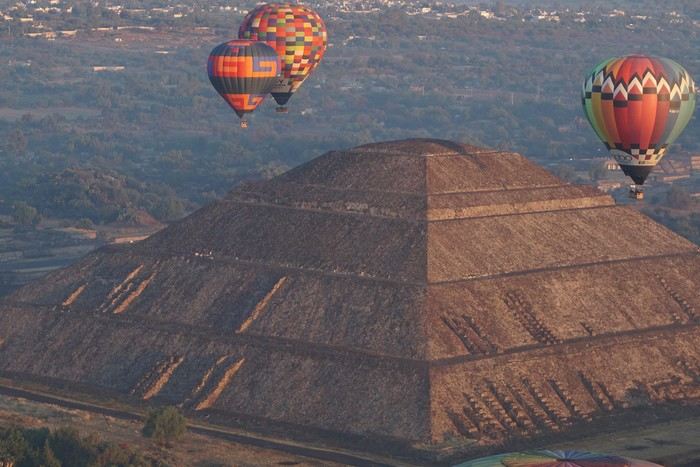
This one-month trip, from January 18 to February 17, 2026, allowed us to visit Mexico City and travel through the states of Puebla, Oaxaca, and Chiapas. We mainly used buses (ADO company) for medium and long distances and colectivos or taxis (or Uber) for shorter trips. Before leaving, I had contacted several people on the ground: Harry, a Vendéan settled in Oaxaca offering, among other things, discoveries of artisan villages or the Monte Albán site, and Oscar in Comitán de Domínguez. I’ll come back to our meeting with Oscar, who runs a local agency (CVL Travel Turismo Alternativo & Corre la voz) and owns a very pleasant hostel, a real highlight of our trip. Our journey took place in 8 stages on a loop starting from Mexico City. The connections between each were made by day or night buses depending on the trip duration. I had booked our seats in advance, either directly on the ADO company’s website or through booking platforms depending on the rates offered. Note that by planning ahead, I was able to benefit from very interesting "Early Booking" rates. There are several comfort classes. For all our trips, I had booked seats in Primera class buses, except for two in GL (Grand Luxe) class. The rates are very reasonable, and the buses turned out to be comfortable or even very comfortable (only the basic seat recline might surprise you).
Our itinerary and number of days per stage: Stage 1 – Mexico City: 4 days Stage 2 – Puebla: 2 days Stage 3 – Oaxaca: 4 days Stage 4 – San Agustinillo: 4 days Stage 5 – San Cristóbal de las Casas: 3 days Stage 6 – Comitán de Domínguez: 6 days Stage 7 – Palenque: 4 days Stage 8 – Mexico City: 2 days If I were to do it again, I’d remove one day from Palenque and add it either to Puebla or San Cristóbal to visit nearby sites or villages, or to San Agustinillo to enjoy one more day by the Pacific Ocean.
Stage 1: Mexico City (2,200 m / 9.2 million inhabitants) We arrived in the Mexican capital around 10:00 PM. The simplified customs process was very quick. After exchanging some money at the airport, we took a taxi to our youth hostel. We got around the capital on foot, of course, but also by metro. Signs are very rare, and we took the train in the wrong direction several times. After a few mistakes, we systematically asked on the platform if we were going the right way. The metro is very affordable. You need to get a rechargeable card (the Tarjeta de Movilidad Integrada) and top it up as needed. This card (less than 1 €) isn’t personal, so there’s no need to get one per person.
Mexico City: Day 1.
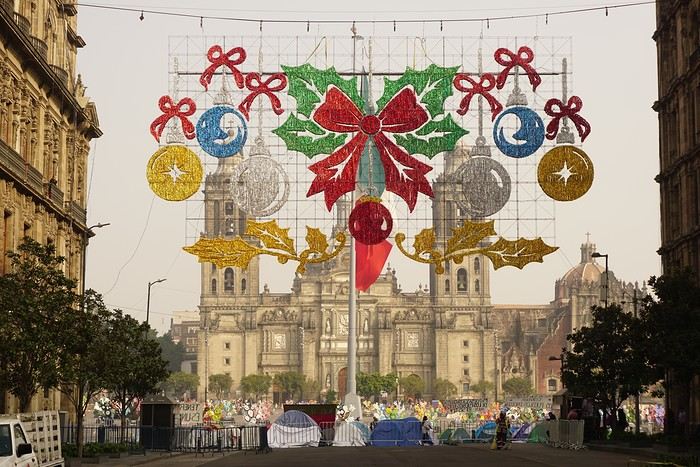
Visits and walks of the day (note: many museums are closed on Mondays): The Zócalo or Constitution Square: it’s one of the most beautiful, largest (195m x 240m), and oldest squares in the world. This is where Cortés decided to build the center of the new Spanish city on the site of the former Tenochtitlan market. Stones from the pyramids were used to pave the esplanade and build the surrounding colonial churches and buildings. During our visit, the huge square was covered with (resin) cacti, the theme of the temporary exhibition at the time. Indeed, temporary events or exhibitions take place here throughout the year. It’s also the endpoint for many protest marches.
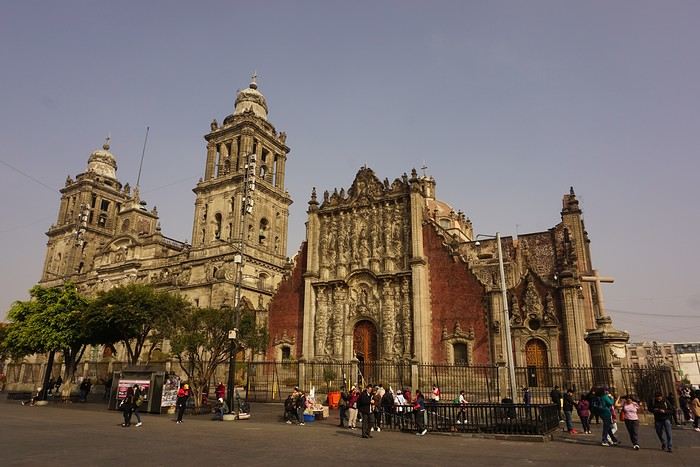
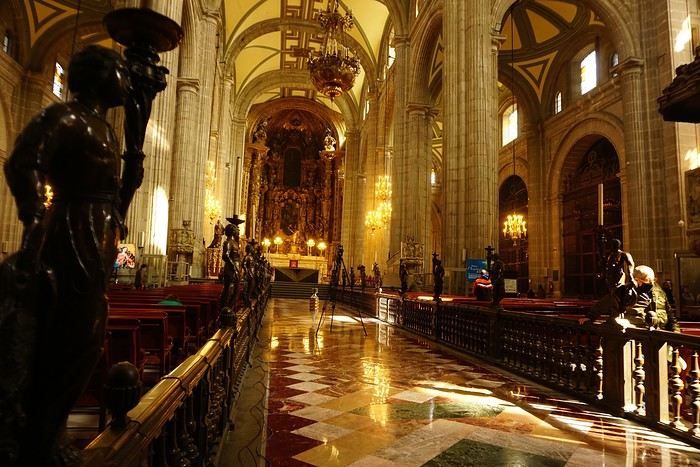


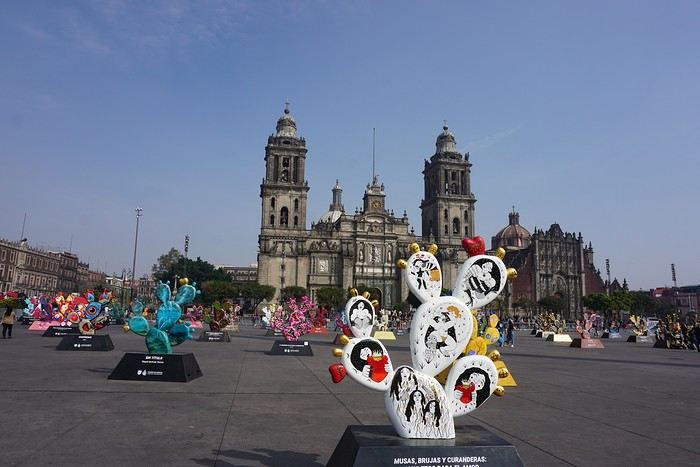
The cathedral: it’s sinking by one centimeter per year despite massive stabilization work (the collapse of many Mexican buildings—30 cm/year—is due to groundwater pumping). It was built starting in 1571 and completed in... 1813. The modest remains of the Templo Mayor (exterior view): they have high symbolic value, as this monument was the most important in the Mexica Empire.
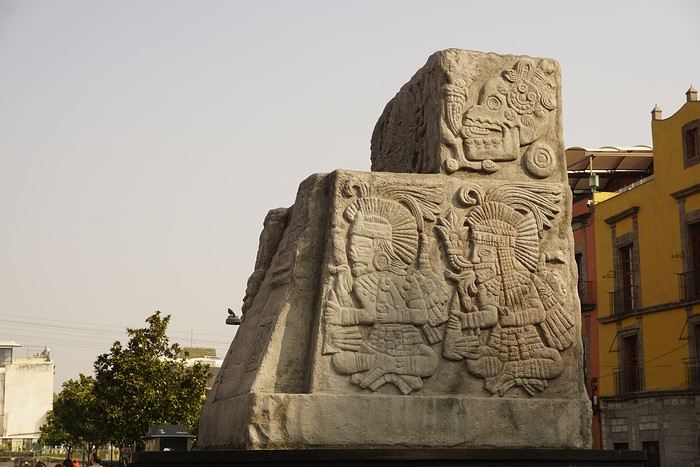 We then walked through the streets of the historic center to the Santísima Church, unfortunately closed for renovation work.
Next, we took the metro to visit one of Mexico’s most important pilgrimage sites: the Insigne y Nacional Basílicas de Santa María de Guadalupe, as well as the Capilla del Cerrito on the hill.
The first, dating from the colonial era, is really leaning a lot.
We then walked through the streets of the historic center to the Santísima Church, unfortunately closed for renovation work.
Next, we took the metro to visit one of Mexico’s most important pilgrimage sites: the Insigne y Nacional Basílicas de Santa María de Guadalupe, as well as the Capilla del Cerrito on the hill.
The first, dating from the colonial era, is really leaning a lot.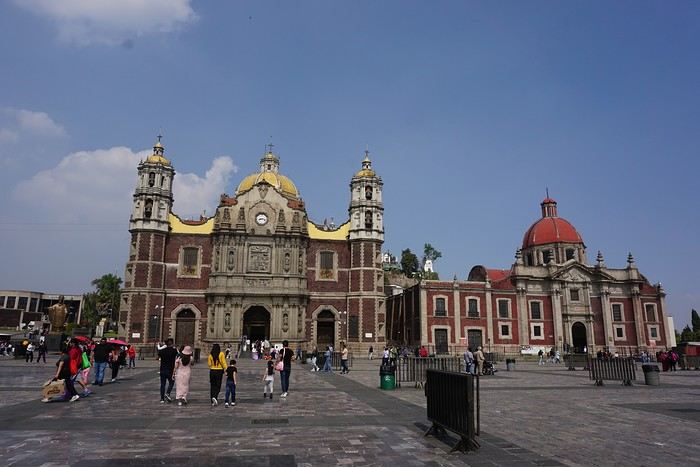
The second, shaped like a rotunda, is very impressive from the inside.
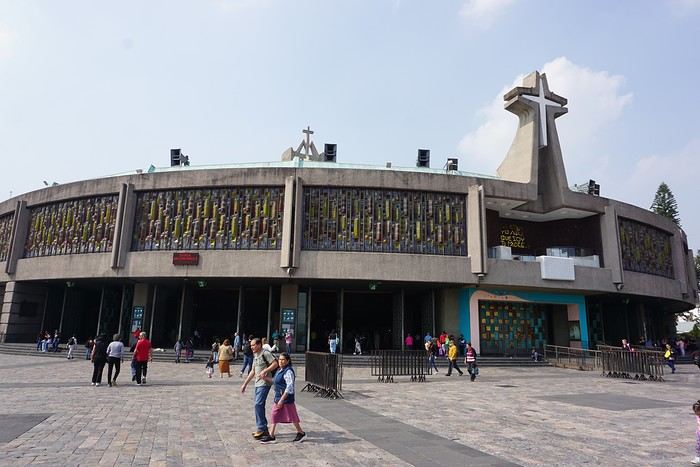
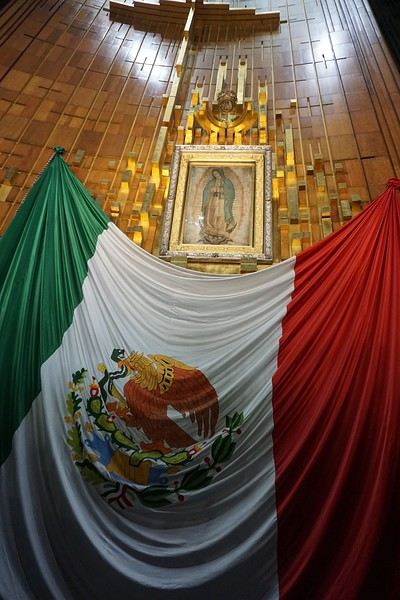
In the basement, there’s a sacred tunic where, in 1531, an image of the Virgin Mary is said to have appeared. A real mystery for scientists, the garment has never deteriorated since that date. Slow-moving conveyor belts allow pilgrims to admire it, preventing crowds from gathering in front of the image for hours. Well thought out!
 From the top of the Capilla del Cerrito, you get beautiful views of huge Mexico City.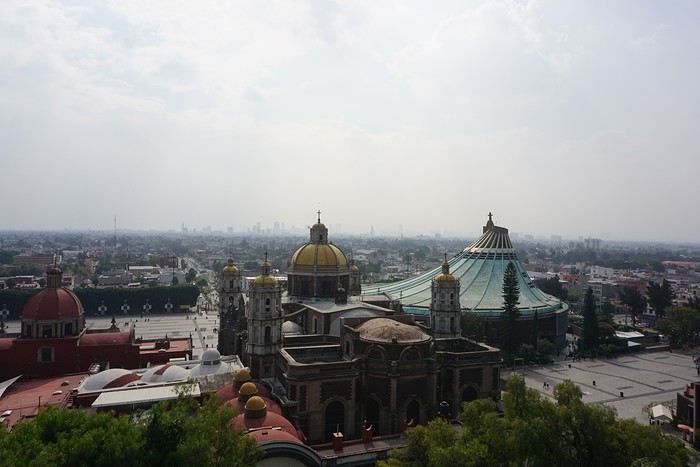
Yet Another Travel Journal in this (Too) Familiar Rajasthan, But with Family and Kids
Prologue
This journal recounts a trip to Rajasthan that’s already over a year old and that I’ve only now found the chance to write about. The summer of 2024 marked my return to India—my tenth trip—after six long years away since my last solo wanderings in Tamil Nadu in 2018 (the journal of which is published on this site). That absence was partly (but not only) due to the long COVID and post-COVID period, which saw a complete halt and then a major slowdown in global tourism. To top it off, Voyage Forum announced its closure in an end-of-the-world atmosphere. A sad time for our favorite social activity…
A few weeks after returning from Rajasthan, I tried to motivate myself to start writing a journal to publish on a forum claiming to be VF’s successor, which I’d eventually signed up for out of desperation. But I kept hesitating and putting the project off because, for one, I no longer have the time I used to. For another, the vibe wasn’t really taking off on that forum—it was overrun with ads and not very active, contrary to what its host’s name suggested. Despite its good intentions and commendable role as a stopgap, it also turned out to be very impractical to use, especially when you don’t have much time like me. I’ll admit I’d occasionally check back on VF to see if anything was happening. But all the discussions remained frozen in time, stuck in that fateful year, 2020. Then, rumors swirled online about shady reasons behind its closure, leaving little room for hope.
And then, one fine morning, I got a message at work from Marien informing me that VF had reopened. What a huge surprise! Even though the forum’s “end” had played out in a somewhat apocalyptic atmosphere, the memories of passionate and heated discussions, the frank debates, and the useful exchanges that made this site a traveler’s goldmine and a unique hub of conviviality all came rushing back to me like a breath of fresh air. I finally saw a sign and tried to motivate myself to find the time to publish the journal of this tenth trip to India and fifth to Rajasthan. But in the end, I got bogged down in professional and family obligations and never managed to find the time to get started. That’s now fixed, though, because I had two reasons for wanting to do it: I find that looking back on a trip to tell others about it is a highly beneficial introspective exercise. Also, I thought this journal could be useful to other travelers on a few points.
Because, “do we really need yet another journal about Rajasthan?” you might rightly ask! Especially in a time when so many journals about the “Land of Kings” have been published since VF’s return, not to mention the countless stories you can already find online about this region, one of India’s most touristy. And I’d add, why go back to Rajasthan for a fifth time, where I’ve already dragged my feet more than enough—through its forts, deserts, temples, cities, villages, bumpy roads, train stations, tasty street food stalls, cheap guesthouses, and more? Where some might see just another overhyped tourist destination full of the same old *Arabian Nights* clichés, worn to a thread, that I mentioned earlier, when there’s so much else to see in India? Well, first because it’s a magnificent country I never tire of, where I started an academic study and made so many connections. It’s also packed with places where you won’t find a single tourist (right, Marie-Jo?), even in the heart of well-trodden paths and classic itineraries. And most importantly, as I said earlier, things have changed in recent years. First, after six years without traveling far, the urge to go back to India was getting stronger. But this time, no more solo trips (often) or duo adventures (sometimes)—now it’s a team of four that has to come along! And even if you can argue with that, what better place than Rajasthan to introduce India to people who’ve never seen it? To kids you want to amaze? Plus, traveling with your new little family to your favorite country isn’t the same as going solo in often spartan conditions that only affect you. It’s a different challenge, but ultimately probably much harder. So, is it really reasonable to take two kids to India, including a two-year-old baby? That’s one of the main goals of this journal (but not the only one)—to try to answer that question.
As you can tell, it’s not so much the destination but the slightly unusual setup of this trip that, in my opinion, will make this journal interesting. Despite my experience and expertise (yes, I dare say it) in India, there were plenty of questions before we finalized the plan and said, “Alright, let’s go!” The questions were flying for us parents. Is it wise to travel to India with a two-year-old? What would we do (it happened) if the kids got very sick? Would they be able to handle a road trip on Rajasthan’s bumpy, dusty roads using public transport? Could they handle the shock of such a different world—the dirt, poverty, pollution, noise (…and the smell, as they say), the spicy food, monkeys, mosquitoes, snakes, tigers, leopards, and so on? In short, all the clichés that I usually joke about suddenly became potential realities. Another concern: as a mixed Franco-African family (not me, but my partner and her oldest), wouldn’t we risk not always being well received, given what you sometimes hear about that in India? How would Indians react to seeing a mixed-race family, the ultimate taboo in a country of purity and social segregation, which would undoubtedly raise many questions for them? Of course, not everything went as expected… Because, as you know, with India—and what makes it charming for some—there are always complications: sometimes where you don’t expect them… and sometimes where you do. I’ll go into detail about that in the journal to come (not right away) and in the final review (even later). These experiences could be useful to travelers who find themselves in similar situations and have the same questions we did before embarking on such a journey. And maybe it’ll spark the curiosity of those who aren’t concerned and will read yet another Rajasthan journal, but with its own unique twists.
Despite my unchanged constraints, which mean I have little time to write this, I don’t want to rush the story, so I’ll take my time. There will probably be lulls. I hope that won’t stop people from coming to react, debate, share their impressions, or ask for information.
This journal recounts a trip to Rajasthan that’s already over a year old and that I’ve only now found the chance to write about. The summer of 2024 marked my return to India—my tenth trip—after six long years away since my last solo wanderings in Tamil Nadu in 2018 (the journal of which is published on this site). That absence was partly (but not only) due to the long COVID and post-COVID period, which saw a complete halt and then a major slowdown in global tourism. To top it off, Voyage Forum announced its closure in an end-of-the-world atmosphere. A sad time for our favorite social activity…
A few weeks after returning from Rajasthan, I tried to motivate myself to start writing a journal to publish on a forum claiming to be VF’s successor, which I’d eventually signed up for out of desperation. But I kept hesitating and putting the project off because, for one, I no longer have the time I used to. For another, the vibe wasn’t really taking off on that forum—it was overrun with ads and not very active, contrary to what its host’s name suggested. Despite its good intentions and commendable role as a stopgap, it also turned out to be very impractical to use, especially when you don’t have much time like me. I’ll admit I’d occasionally check back on VF to see if anything was happening. But all the discussions remained frozen in time, stuck in that fateful year, 2020. Then, rumors swirled online about shady reasons behind its closure, leaving little room for hope.
And then, one fine morning, I got a message at work from Marien informing me that VF had reopened. What a huge surprise! Even though the forum’s “end” had played out in a somewhat apocalyptic atmosphere, the memories of passionate and heated discussions, the frank debates, and the useful exchanges that made this site a traveler’s goldmine and a unique hub of conviviality all came rushing back to me like a breath of fresh air. I finally saw a sign and tried to motivate myself to find the time to publish the journal of this tenth trip to India and fifth to Rajasthan. But in the end, I got bogged down in professional and family obligations and never managed to find the time to get started. That’s now fixed, though, because I had two reasons for wanting to do it: I find that looking back on a trip to tell others about it is a highly beneficial introspective exercise. Also, I thought this journal could be useful to other travelers on a few points.
Because, “do we really need yet another journal about Rajasthan?” you might rightly ask! Especially in a time when so many journals about the “Land of Kings” have been published since VF’s return, not to mention the countless stories you can already find online about this region, one of India’s most touristy. And I’d add, why go back to Rajasthan for a fifth time, where I’ve already dragged my feet more than enough—through its forts, deserts, temples, cities, villages, bumpy roads, train stations, tasty street food stalls, cheap guesthouses, and more? Where some might see just another overhyped tourist destination full of the same old *Arabian Nights* clichés, worn to a thread, that I mentioned earlier, when there’s so much else to see in India? Well, first because it’s a magnificent country I never tire of, where I started an academic study and made so many connections. It’s also packed with places where you won’t find a single tourist (right, Marie-Jo?), even in the heart of well-trodden paths and classic itineraries. And most importantly, as I said earlier, things have changed in recent years. First, after six years without traveling far, the urge to go back to India was getting stronger. But this time, no more solo trips (often) or duo adventures (sometimes)—now it’s a team of four that has to come along! And even if you can argue with that, what better place than Rajasthan to introduce India to people who’ve never seen it? To kids you want to amaze? Plus, traveling with your new little family to your favorite country isn’t the same as going solo in often spartan conditions that only affect you. It’s a different challenge, but ultimately probably much harder. So, is it really reasonable to take two kids to India, including a two-year-old baby? That’s one of the main goals of this journal (but not the only one)—to try to answer that question.
As you can tell, it’s not so much the destination but the slightly unusual setup of this trip that, in my opinion, will make this journal interesting. Despite my experience and expertise (yes, I dare say it) in India, there were plenty of questions before we finalized the plan and said, “Alright, let’s go!” The questions were flying for us parents. Is it wise to travel to India with a two-year-old? What would we do (it happened) if the kids got very sick? Would they be able to handle a road trip on Rajasthan’s bumpy, dusty roads using public transport? Could they handle the shock of such a different world—the dirt, poverty, pollution, noise (…and the smell, as they say), the spicy food, monkeys, mosquitoes, snakes, tigers, leopards, and so on? In short, all the clichés that I usually joke about suddenly became potential realities. Another concern: as a mixed Franco-African family (not me, but my partner and her oldest), wouldn’t we risk not always being well received, given what you sometimes hear about that in India? How would Indians react to seeing a mixed-race family, the ultimate taboo in a country of purity and social segregation, which would undoubtedly raise many questions for them? Of course, not everything went as expected… Because, as you know, with India—and what makes it charming for some—there are always complications: sometimes where you don’t expect them… and sometimes where you do. I’ll go into detail about that in the journal to come (not right away) and in the final review (even later). These experiences could be useful to travelers who find themselves in similar situations and have the same questions we did before embarking on such a journey. And maybe it’ll spark the curiosity of those who aren’t concerned and will read yet another Rajasthan journal, but with its own unique twists.
Despite my unchanged constraints, which mean I have little time to write this, I don’t want to rush the story, so I’ll take my time. There will probably be lulls. I hope that won’t stop people from coming to react, debate, share their impressions, or ask for information.
So where are they and what are they doing?
This catchy and somewhat mysterious title comes from several questions I’ve been asking myself.
VF has been back open for a reasonable number of weeks and months now. The number of visitors overall matches past averages, but the number of members online in the last 24 hours seems relatively lower than what we used to see.
Yet, to my surprise, I’m seeing fewer travel journals, way fewer messages, and way fewer questions. I don’t see many new registered users online, and I notice a number of members who are logged in but either aren’t participating or have stopped participating.
Something’s not adding up for me because, in my opinion, VF is still appealing, and I don’t see which other sites could really compete.
Was there a real break between pre- and post-Covid? Does it just take more time for some people to discover the site or learn that it’s active again? Do people now prefer quick consumption on sites like FB or others I’m not familiar with? Where have the site’s old-timers gone, and what are they doing with their time now? What’s really going on here?
VF has been back open for a reasonable number of weeks and months now. The number of visitors overall matches past averages, but the number of members online in the last 24 hours seems relatively lower than what we used to see.
Yet, to my surprise, I’m seeing fewer travel journals, way fewer messages, and way fewer questions. I don’t see many new registered users online, and I notice a number of members who are logged in but either aren’t participating or have stopped participating.
Something’s not adding up for me because, in my opinion, VF is still appealing, and I don’t see which other sites could really compete.
Was there a real break between pre- and post-Covid? Does it just take more time for some people to discover the site or learn that it’s active again? Do people now prefer quick consumption on sites like FB or others I’m not familiar with? Where have the site’s old-timers gone, and what are they doing with their time now? What’s really going on here?
La crème miracle c'est vraiment le pied?
Bonjour,
Comme beaucoup ici mon passeport restera donc dans son tiroir cet été. Mon vélo, lui, restera dans le garage et c'est en France, et à pied, que je vais voyager. Départ de Calais dans la semaine prochaine. L'idée est de rejoindre Hendaye, en 3 mois environ. J'ai déjà traversé la France en marchant il y a une dizaine d'années ( de Saint-Malo à Menton ). Je crois que j'ai réuni tout mon matériel ( je vais bivouaquer le plus clair du temps, donc le sac sera plutôt lourd ). Je vais étrenner mes Meindl en cuir toutes neuves pour l'occasion, donc je prends des kilomètres de sparadrap pour éteindre mes ampoules 🙂. Par contre je me demandais s'il existait une crème qui détend muscles et/ou tendons en fin d'étape ? Quotidiennement je pédale beaucoup mais je n'ai pas beaucoup marché ces derniers temps et j'ai peur des jambes-piquets du petit matin, surtout au début...
L.
Comme beaucoup ici mon passeport restera donc dans son tiroir cet été. Mon vélo, lui, restera dans le garage et c'est en France, et à pied, que je vais voyager. Départ de Calais dans la semaine prochaine. L'idée est de rejoindre Hendaye, en 3 mois environ. J'ai déjà traversé la France en marchant il y a une dizaine d'années ( de Saint-Malo à Menton ). Je crois que j'ai réuni tout mon matériel ( je vais bivouaquer le plus clair du temps, donc le sac sera plutôt lourd ). Je vais étrenner mes Meindl en cuir toutes neuves pour l'occasion, donc je prends des kilomètres de sparadrap pour éteindre mes ampoules 🙂. Par contre je me demandais s'il existait une crème qui détend muscles et/ou tendons en fin d'étape ? Quotidiennement je pédale beaucoup mais je n'ai pas beaucoup marché ces derniers temps et j'ai peur des jambes-piquets du petit matin, surtout au début...
L.
Brelan d'as dans les Stans: Kirghizistan, Tadjikistan et Ouzbekistan
Hello tous,
C'est avec plaisir que je vous fait partager notre voyage de l'été 2019 dans les pays en stan.🙂
La version complète est ici, elle se construit au même rythme que je fais paraitre mes posts
GENESE Mais quelle idée d’aller dans les stan ! En fait, à l’origine cela devait être le Ladakh (joliment raconté par Diamina et Ticapi que je salue). Mais la crainte de ne pas arriver à tenir sur des treks de longues durées et le fait de ne pas pouvoir conduire moi-même m’ont incité à chercher une alternative. C’est là que Marie(Mlefevre) a eu le bon goût de publier un carnet sur le Kirghizistan et Perju de relater son voyage dans les stans, les deux en self drive …. C’est bon on tient notre destination 2019 ! Au niveau pays, ambiance, c’est d‘abord le corridor de Wakham et le Pamir qui m’ont séduit et ce sera le « centre » du voyage. En revanche je n’ai pas trouvé grand-chose au niveau véhicule de location au Tadjikistan. Comme ce voyage se faisait avec des amis de longues dates (avec qui on a déjà sillonné la Bolivie et le nord-ouest de la Namibie) j’ai trouvé intéressant d’y adjoindre un petit bout de Kirghizistan qui leur permettait de voir un autre type de paysage et en plus il est beaucoup plus facile de louer un véhicule à Bishkek. Lorsque ma chère et tendre a vu que nous n’étions pas loin de Samarcande (qu’on avait admiré en 2007) elle a souhaité y retourner. Du coup cela nous a fait un voyage avec 3 ambiances différentes, ce qui est génial pour nous. Niveau durée il a fallu rajouter un petit bout aux 3 semaines initialement prévues pour arriver à tout faire tenir.

PREPARATION
A partir de là j’ai commencé à construire notre parcours. En parallèle j’ai fait des recherches (et demandes) pour le véhicule. Au final, j’ai retenu une agence Ouzbek francophone qui a tout de suite compris nos problématiques d’Européens (véhicule récent, avec matériel de camping, avec les différents transferts et qui prend en charge les quelques réservations d’hôtels, guides, etc, ..). Le véhicule sera donc un Toyota Prado de 2012. La compagnie aérienne sera Turkish Airline qui dessert très bien les pays en Stan (même un vol Samarcande - Istanbul) Visas: pour le Kirghizistan il est délivré directement à l'aéroport, en revanche pour le Tadjikistan il faut le demander à l'avance. ATTENTION, le Pamir nécessite un permis particulier (comme c'est une région semi-autonome), il faut le demander en même temps que le visa en cochant la case permit GBAO (région autonome duHaut-Badakhchan).
OUTILS Comme c'est une destination encore peu couru en self drive je vais développer un peu plus que d'hab. Au niveau guide papier: Je n'ai pas mis de "S" car il n’y en a eu quasiment qu’un, mais qui pour le coup est parfait pour qui veut voyager comme nous : le nouveau guide de Cecile Miramont et Laurent Bendel : KIRGHIZISTAN TADJIKISTAN, qui a été écrit à destination des self-drivers et qui propose différents itinéraires commentés. Mon conseil, après le voyage : le guide n’enjolive pas les choses et s’adresse plutôt aux personnes ayant déjà des notions de « off road » ou de voyage « solitaire », donc quand ils écrivent "difficile" ça l’est vraiment, même "moyen" c’est déjà costaud. Par forcément au niveau difficulté de la piste elle-même mais par la dangerosité liée à la solitude, le peu de traces et le risque de croiser des gués plus ou moins remplis. Au niveau carte: il y en a une très belle et complète pour le Pamir, il s'agit de celle de Markus Hauser édité par Gekco Maps.
Comme je suis très GPS j'ai fait pas mal de recherches. Pour Garmin je n'ai pas été plus séduit que ça. Du coup je me suis penché sur les applications Android. Je connaissais déjà MAPS.ME qui est très bien mais sans courbe de niveaux, j'ai donc aussi testé GAIA, OSMAND, TERRA MAP et SOVIET MILITARY MAPS. Cette dernière est celle qui offre le plus de possibilités de cartographie plus ou moins détaillée, dont les fameuses cartes militaires Russes ultra détaillées. Mais au final c'est OSMAND que j'ai utilisé le plus pendant le voyage, je pense même que cette application remplacera GARMIN dans mon véhicule. MAPS.ME est très bien, mais au niveau topographie elle est un cran en dessous et je l'ai trouvé moins pratique pour gérer les itinéraires. Ce qui est dommage, c'est que toutes ces applications n'ont pas leur pendant sur PC, ce qui aurait été pratique pour préparer le voyage. Du coup je fais tout sur Mapsource et je transfers ensuite les waypoints sur les applications. J'ai aussi utilisé une application où les voyageurs indiquent les lieux de bivouac (ou autre) qui leur ont plu. Il s'agit de IOVERLANDER, très bonne application également. Dernier outil et non des moindres: les CBT, ce sont les offices de tourisme version Kirghize, il y en a dans les principales villes touristiques. Ils sont du grande aide et ont bien souvent un site internet, par exemple sur celui de Nryn on peut acheter, à l'avance, les permis pour la zone frontalière. Ils peuvent aussi vous indiquer des randonnées, en organiser avec des guides, gérer les hébergements, ... Pour le Pamir vous avez l'équivalent qui se nomme PECTA, nous y achèterons les permis pour circuler dans le parc de Zorgul. Il y a aussi le site visitpamirs.com qui regroupe un certain nombre d'informations.
RAVITAILLEMENT et EQUIPEMENT : au Kirghizistan aucun problème, en revanche au Tadjikistan c’est une autre histoire, sur les hauts plateaux très peu de choses disponibles, mais comme on s’y attendait on avait amené des « sachets de graines ». Au niveau vestimentaire il faut de quoi résister au froid (polaire, doudoune, bonnet) mais sans que ce soit extrême non plus (je crois que nous n'avons jamais eu des températures négatives). EN revanche pour la nuit vaut mieux avoir de bon duvets, il a fait entre 0° et 15° suivant l'altitude et la localisation.
Compagnie Turkish Airline qui dessert très bien les pays en Stan (même un vol Samarcande - Istanbul)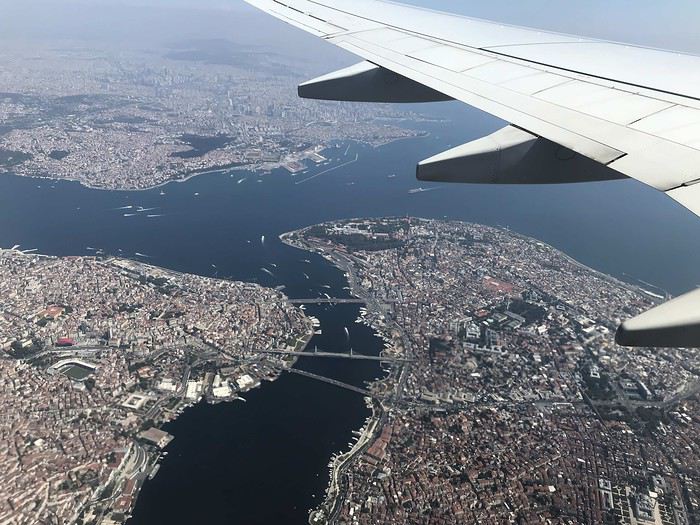
GENESE Mais quelle idée d’aller dans les stan ! En fait, à l’origine cela devait être le Ladakh (joliment raconté par Diamina et Ticapi que je salue). Mais la crainte de ne pas arriver à tenir sur des treks de longues durées et le fait de ne pas pouvoir conduire moi-même m’ont incité à chercher une alternative. C’est là que Marie(Mlefevre) a eu le bon goût de publier un carnet sur le Kirghizistan et Perju de relater son voyage dans les stans, les deux en self drive …. C’est bon on tient notre destination 2019 ! Au niveau pays, ambiance, c’est d‘abord le corridor de Wakham et le Pamir qui m’ont séduit et ce sera le « centre » du voyage. En revanche je n’ai pas trouvé grand-chose au niveau véhicule de location au Tadjikistan. Comme ce voyage se faisait avec des amis de longues dates (avec qui on a déjà sillonné la Bolivie et le nord-ouest de la Namibie) j’ai trouvé intéressant d’y adjoindre un petit bout de Kirghizistan qui leur permettait de voir un autre type de paysage et en plus il est beaucoup plus facile de louer un véhicule à Bishkek. Lorsque ma chère et tendre a vu que nous n’étions pas loin de Samarcande (qu’on avait admiré en 2007) elle a souhaité y retourner. Du coup cela nous a fait un voyage avec 3 ambiances différentes, ce qui est génial pour nous. Niveau durée il a fallu rajouter un petit bout aux 3 semaines initialement prévues pour arriver à tout faire tenir.
PREPARATION
A partir de là j’ai commencé à construire notre parcours. En parallèle j’ai fait des recherches (et demandes) pour le véhicule. Au final, j’ai retenu une agence Ouzbek francophone qui a tout de suite compris nos problématiques d’Européens (véhicule récent, avec matériel de camping, avec les différents transferts et qui prend en charge les quelques réservations d’hôtels, guides, etc, ..). Le véhicule sera donc un Toyota Prado de 2012. La compagnie aérienne sera Turkish Airline qui dessert très bien les pays en Stan (même un vol Samarcande - Istanbul) Visas: pour le Kirghizistan il est délivré directement à l'aéroport, en revanche pour le Tadjikistan il faut le demander à l'avance. ATTENTION, le Pamir nécessite un permis particulier (comme c'est une région semi-autonome), il faut le demander en même temps que le visa en cochant la case permit GBAO (région autonome duHaut-Badakhchan).
OUTILS Comme c'est une destination encore peu couru en self drive je vais développer un peu plus que d'hab. Au niveau guide papier: Je n'ai pas mis de "S" car il n’y en a eu quasiment qu’un, mais qui pour le coup est parfait pour qui veut voyager comme nous : le nouveau guide de Cecile Miramont et Laurent Bendel : KIRGHIZISTAN TADJIKISTAN, qui a été écrit à destination des self-drivers et qui propose différents itinéraires commentés. Mon conseil, après le voyage : le guide n’enjolive pas les choses et s’adresse plutôt aux personnes ayant déjà des notions de « off road » ou de voyage « solitaire », donc quand ils écrivent "difficile" ça l’est vraiment, même "moyen" c’est déjà costaud. Par forcément au niveau difficulté de la piste elle-même mais par la dangerosité liée à la solitude, le peu de traces et le risque de croiser des gués plus ou moins remplis. Au niveau carte: il y en a une très belle et complète pour le Pamir, il s'agit de celle de Markus Hauser édité par Gekco Maps.
Comme je suis très GPS j'ai fait pas mal de recherches. Pour Garmin je n'ai pas été plus séduit que ça. Du coup je me suis penché sur les applications Android. Je connaissais déjà MAPS.ME qui est très bien mais sans courbe de niveaux, j'ai donc aussi testé GAIA, OSMAND, TERRA MAP et SOVIET MILITARY MAPS. Cette dernière est celle qui offre le plus de possibilités de cartographie plus ou moins détaillée, dont les fameuses cartes militaires Russes ultra détaillées. Mais au final c'est OSMAND que j'ai utilisé le plus pendant le voyage, je pense même que cette application remplacera GARMIN dans mon véhicule. MAPS.ME est très bien, mais au niveau topographie elle est un cran en dessous et je l'ai trouvé moins pratique pour gérer les itinéraires. Ce qui est dommage, c'est que toutes ces applications n'ont pas leur pendant sur PC, ce qui aurait été pratique pour préparer le voyage. Du coup je fais tout sur Mapsource et je transfers ensuite les waypoints sur les applications. J'ai aussi utilisé une application où les voyageurs indiquent les lieux de bivouac (ou autre) qui leur ont plu. Il s'agit de IOVERLANDER, très bonne application également. Dernier outil et non des moindres: les CBT, ce sont les offices de tourisme version Kirghize, il y en a dans les principales villes touristiques. Ils sont du grande aide et ont bien souvent un site internet, par exemple sur celui de Nryn on peut acheter, à l'avance, les permis pour la zone frontalière. Ils peuvent aussi vous indiquer des randonnées, en organiser avec des guides, gérer les hébergements, ... Pour le Pamir vous avez l'équivalent qui se nomme PECTA, nous y achèterons les permis pour circuler dans le parc de Zorgul. Il y a aussi le site visitpamirs.com qui regroupe un certain nombre d'informations.
RAVITAILLEMENT et EQUIPEMENT : au Kirghizistan aucun problème, en revanche au Tadjikistan c’est une autre histoire, sur les hauts plateaux très peu de choses disponibles, mais comme on s’y attendait on avait amené des « sachets de graines ». Au niveau vestimentaire il faut de quoi résister au froid (polaire, doudoune, bonnet) mais sans que ce soit extrême non plus (je crois que nous n'avons jamais eu des températures négatives). EN revanche pour la nuit vaut mieux avoir de bon duvets, il a fait entre 0° et 15° suivant l'altitude et la localisation.
Compagnie Turkish Airline qui dessert très bien les pays en Stan (même un vol Samarcande - Istanbul)
Currency exchange while traveling: why do some still carry wads of cash?
Hi everyone,
In this age of zero-commission cards and fee-free accounts, I’m curious why some travelers still prefer to set off with a wallet stuffed with bills and exchange money on the spot.
I get it for those whose income comes from undeclared activities, but what about everyone else?
Between the risk of theft, scams at exchange counters, and fees that often end up being higher, I’m really puzzled.
The last time I traveled with a wad of cash was because I had to pay for accommodation in cash only, the local currency was the dollar (easy to exchange at a very low cost), and I was still paying some fees.
I’m still wondering about my next trip to Argentina because the situation there is very specific, but otherwise?
Is it an allergy to modern payment methods?
A budget so tight that an extra 20 € (the fees some local banks charge for withdrawals) on a 2000 € budget would be impossible to manage?
Thanks for shedding some light on this!
In this age of zero-commission cards and fee-free accounts, I’m curious why some travelers still prefer to set off with a wallet stuffed with bills and exchange money on the spot.
I get it for those whose income comes from undeclared activities, but what about everyone else?
Between the risk of theft, scams at exchange counters, and fees that often end up being higher, I’m really puzzled.
The last time I traveled with a wad of cash was because I had to pay for accommodation in cash only, the local currency was the dollar (easy to exchange at a very low cost), and I was still paying some fees.
I’m still wondering about my next trip to Argentina because the situation there is very specific, but otherwise?
Is it an allergy to modern payment methods?
A budget so tight that an extra 20 € (the fees some local banks charge for withdrawals) on a 2000 € budget would be impossible to manage?
Thanks for shedding some light on this!
Discovering the joys of camping in Namibia
This three-week trip to Namibia was a big first for us:
- Visiting a country in winter, for someone who starts feeling comfortable at 25°C (77°F).
- Camping, when we usually feel at home in a starred hotel.
- Sleeping on the roof of a car—what an idea... when a comfy bed is waiting just a bit further.
- Grocery shopping, cooking, doing the dishes... all the things we usually avoid to fully enjoy our vacation.
- Washing up when and how we can, when we can’t imagine going a day without a shower.
- Driving a big 4x4 on the left, with a manual transmission, when we usually opt for an automatic for more comfort.
Yep! You guessed it—we stepped way out of our comfort zone during this trip.
I had quite a few doubts while planning this adventure, but the more I read travel journals about Namibia, the more I wanted to go.
Personally, without this forum, I never would’ve dared to hit the Namibian roads in a 4x4. I was really anxious during the planning, so I want to thank everyone who contributed with their journals and forum discussions for helping me leave more peacefully.
At first, I wasn’t even considering sleeping in a tent. But after my husband’s persuasion—and my own curiosity to experience what I’d read in those travel journals—I gave in. So off we went in a double-cab Hilux with a rooftop tent.
And of course, let’s talk about me—the big cold-weather wimp. One of the biggest pre-trip challenges was choosing a sleeping bag. After a while, sleeping bags had no more secrets for me: temperature ratings (comfort, limit, extreme), shapes (mummy, rectangular), fillings (synthetic, down), compression rate, and weight... all these factors were a real puzzle. In the end, to make sure I wouldn’t be put off camping in winter (Australian winter, mind you), I went for a sleeping bag with a comfort rating of -10°C. And just to be *extra* sure I wouldn’t get cold, I bought a liner (never knew what that was before) in Thermolite, which boosts the sleeping bag’s temperature by 11°C. There are liners that add up to 15°C, but let’s not exaggerate—we’re not heading to the North Pole! My husband, on the other hand, got a sleeping bag with a -5°C comfort rating and a silk liner.
Was it enough? You’ll find out soon. In the meantime, another big thank you to everyone who helped me make this choice with their advice and experience.
Over a year in advance, we planned a three-week itinerary for our first trip to Namibia—classic route, nothing too out there. We chose to do the circuit clockwise because we wanted to finish on a high note in Etosha and its wildlife. They say it’s like Noah’s Ark out there! And why not, the cherry on top... some big cats.
We used Tourmaline’s services to book our accommodations and the 4x4.
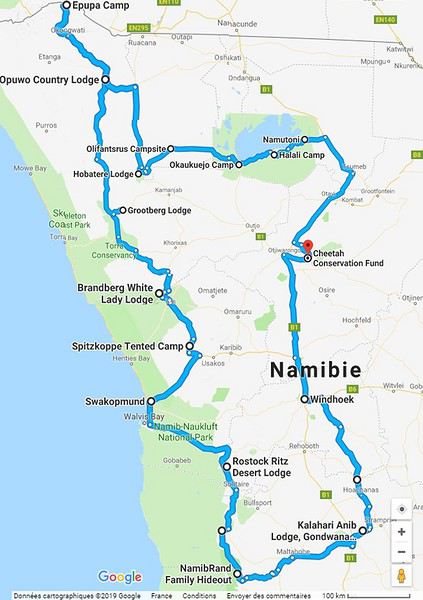
Here’s our planned itinerary with campsites and lodgings—yes, there are a few solid roofs in there; we didn’t want to push it too far.
Day 1: Windhoek – Windhoek Gardens Guesthouse Day 2: Kalahari Anib Campsite Day 3: Namibrand Family Hideout Day 4: Sesriem Camp Day 5: Sesriem Camp Day 6: Rostock Ritz Camp Day 7: Swakopmund - Sea Breeze Guesthouse Day 8: Swakopmund - Sea Breeze Guesthouse Day 9: Spitzkoppe Camp Tented Day 10: Brandberg White Lady Campsite Day 11: Grootberg Lodge Day 12: Opuwo Country Campsite Day 13: Epupa Camp Day 14: Hobatere Lodge Day 15: Etosha Olifantsrus Camp Day 16: Etosha Okaukuejo Camp Day 17: Etosha Halali Camp Day 18: Etosha Namutoni Camp Day 19: Cheetah Eco Lodge Day 20: Windhoek – Londiningi B&B
Alright! Are you ready to follow this adventure with us in our Hilux?
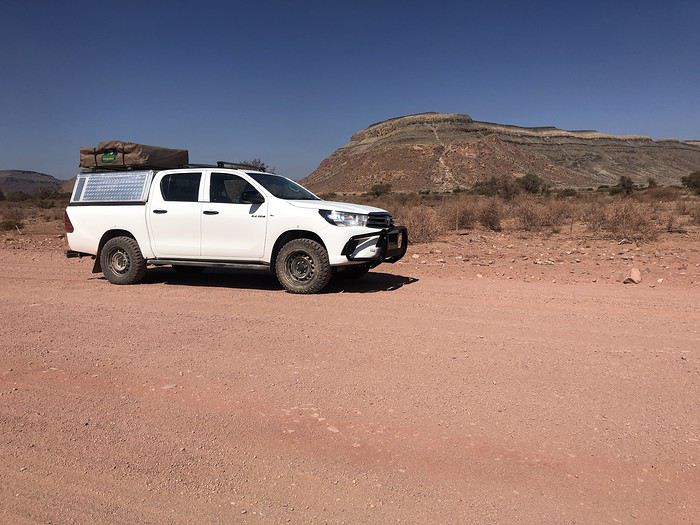
Yep! You guessed it—we stepped way out of our comfort zone during this trip.
I had quite a few doubts while planning this adventure, but the more I read travel journals about Namibia, the more I wanted to go.
Personally, without this forum, I never would’ve dared to hit the Namibian roads in a 4x4. I was really anxious during the planning, so I want to thank everyone who contributed with their journals and forum discussions for helping me leave more peacefully.
At first, I wasn’t even considering sleeping in a tent. But after my husband’s persuasion—and my own curiosity to experience what I’d read in those travel journals—I gave in. So off we went in a double-cab Hilux with a rooftop tent.
And of course, let’s talk about me—the big cold-weather wimp. One of the biggest pre-trip challenges was choosing a sleeping bag. After a while, sleeping bags had no more secrets for me: temperature ratings (comfort, limit, extreme), shapes (mummy, rectangular), fillings (synthetic, down), compression rate, and weight... all these factors were a real puzzle. In the end, to make sure I wouldn’t be put off camping in winter (Australian winter, mind you), I went for a sleeping bag with a comfort rating of -10°C. And just to be *extra* sure I wouldn’t get cold, I bought a liner (never knew what that was before) in Thermolite, which boosts the sleeping bag’s temperature by 11°C. There are liners that add up to 15°C, but let’s not exaggerate—we’re not heading to the North Pole! My husband, on the other hand, got a sleeping bag with a -5°C comfort rating and a silk liner.
Was it enough? You’ll find out soon. In the meantime, another big thank you to everyone who helped me make this choice with their advice and experience.
Over a year in advance, we planned a three-week itinerary for our first trip to Namibia—classic route, nothing too out there. We chose to do the circuit clockwise because we wanted to finish on a high note in Etosha and its wildlife. They say it’s like Noah’s Ark out there! And why not, the cherry on top... some big cats.
We used Tourmaline’s services to book our accommodations and the 4x4.
Here’s our planned itinerary with campsites and lodgings—yes, there are a few solid roofs in there; we didn’t want to push it too far.
Day 1: Windhoek – Windhoek Gardens Guesthouse Day 2: Kalahari Anib Campsite Day 3: Namibrand Family Hideout Day 4: Sesriem Camp Day 5: Sesriem Camp Day 6: Rostock Ritz Camp Day 7: Swakopmund - Sea Breeze Guesthouse Day 8: Swakopmund - Sea Breeze Guesthouse Day 9: Spitzkoppe Camp Tented Day 10: Brandberg White Lady Campsite Day 11: Grootberg Lodge Day 12: Opuwo Country Campsite Day 13: Epupa Camp Day 14: Hobatere Lodge Day 15: Etosha Olifantsrus Camp Day 16: Etosha Okaukuejo Camp Day 17: Etosha Halali Camp Day 18: Etosha Namutoni Camp Day 19: Cheetah Eco Lodge Day 20: Windhoek – Londiningi B&B
Alright! Are you ready to follow this adventure with us in our Hilux?