Results for "Ouzbékistan+événement"
About 3,430 results.
More options
Many results are in French, the community’s main language. English translations are added over time.
Search results
On the Silk Road: Chronicles of a Sixty-Something Traveling Completely Independently
From Beijing to Khiva: China, Kyrgyzstan, Tajikistan, Uzbekistan
Chronicle of anecdotes, highlights, and other adventures that marked this eight-week journey in 2018.
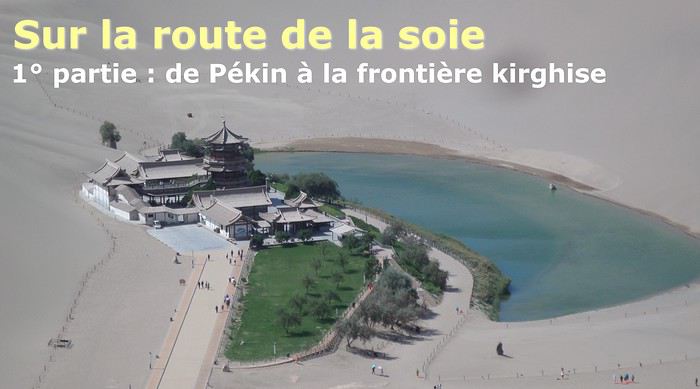
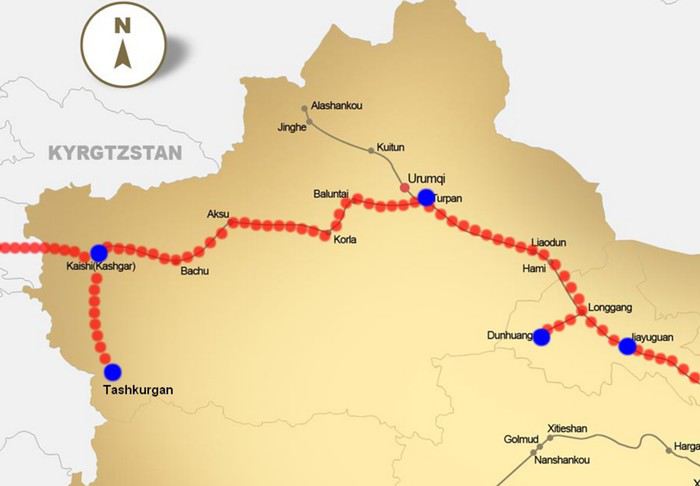
The Chinese Far West More than 30 years after my first trip to eastern China, I finally fulfilled an old dream: traveling solo from Beijing to the far west, discovering Xinjiang, the Uyghur people and the oppression they endure, the oases of Turpan and Kashgar, the Taklamakan Desert, the end of the Great Wall... The route was covered by train.
MENU PART 1: CHINA
1- Beijing (Jiankou) : the authentic Great Wall, without tourists 2- Cycling in Beijing, the best way to get around 3- Beijing : departure for the far west 4- Jiayuguan : getting by without English 5- Jiayuguan : scams and heritage 6- Dunhuang : abundance in the middle of the desert 7- Turpan : the Uyghurs under heavy surveillance 8- Kashgar : love at first sight for the old city 9- Kashgar : China’s recipe for controlling the populace 10- Tashkurgan : what on earth was I thinking going there! Kyrgyz border: a surreal epic Photo album from the 80s, contributions from other travelers (page 2)
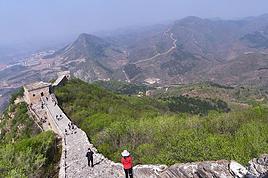
1- JIANKOU Finding the authentic Great Wall, without tourists or a guide Friday, August 24, 2018 Thirty years later, I didn’t feel like revisiting the Great Wall at Badaling or any other overcrowded site. I chose to explore it at Jiankou, in its wildest, most authentic, and unrestored section, starting from a lost village deep in a valley—though it wasn’t *that* lost, since it had everything for communication.
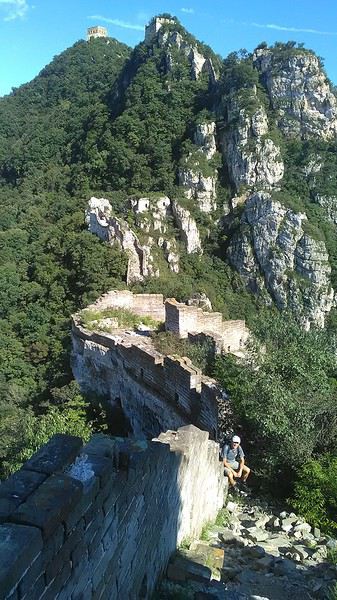
No need to pay for a taxi to get there—by timing it right, you can take the bus for just a few yuan. You have to get off at Xizhazi, the bus terminus. Be careful, there are only two buses a day in each direction. At the Xizhazi bus stop, I met a young couple who’d arrived with zero information about what to expect. We hiked the three of us toward the restored section of Mutianyu.
Still, be cautious With GPS and a topographic map (OpenTopoMap), you can set off without a problem or guide. The trail up to Jiankou is easy and well-marked. The trails down are too. But be careful—once you’re on the Wall, it’s real mountain hiking, with easy but dangerous climbing sections (over sheer drops). Not for amateurs or those afraid of heights! But what a reward. The Wall all to yourself, where it’s at its most daring. Truly mesmerizing.
More photos...
2- BEIJING The best way to get around the capital Sunday, August 26 The best way to explore the city is still by bike. Most are in a bike-share system, but you need to use an app—WeChat, the app that does everything, like monitoring your every move. No way I was installing that.
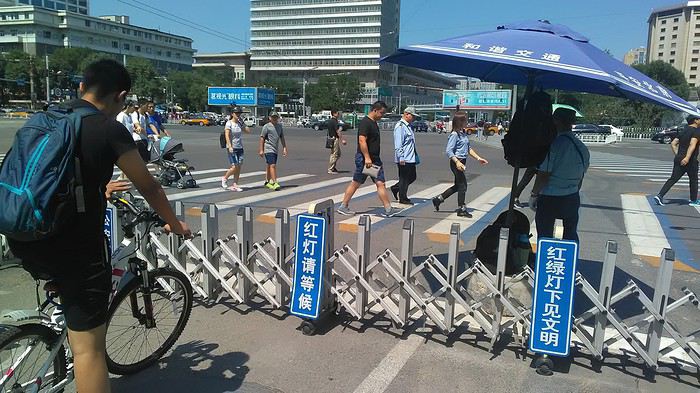
I found one at a rental shop near the hostel. The key is to quickly learn local traffic customs to minimize risks. Bike lanes are wide along the avenues.
But you still have to: - Watch out for anything parked on the bike paths—the most annoying are people napping or talking on the phone in their cars - Keep an eye on everything coming the wrong way—the list is long - The worst is right turns on red, which in Chinese traffic rules seem to have priority Once you get the hang of it, it’s fine. The city is huge but flat, so you can just wing it.
3- BEIJING By train to the far west Sunday, August 26 Beijing West Station is the size and operates like an airport. With your e-ticket from the agency, you first have to pick up your ticket at the special "English" counter, after passing through security. With your ticket in hand, you have to exit and enter through the boarding waiting area—not the platform—after a second security check.
 Then you find the right hall and wait for the sign to finally access the platform. In the end, it works pretty well given the incredible number of passengers to manage. Everywhere in Beijing, I saw that the Chinese have mastered crowd flow management.
Nice surprise: second-class carriages are clean, air-conditioned, and bright. Perfect, since I was in for 20 hours. One uniformed attendant per carriage, mobile meal service—luxury! Small downside: no luggage space. Hauling your suitcase up to the top bunk is quite a workout. I was in the middle, so it wasn’t too bad. The landscape, though, whether rural or urban, is pretty bleak. That should change once we leave the eastern plains.
Of course, I got my first police visit, with a thorough passport check and bag search. I was warned—going to the Chinese far west exposes you to this kind of hassle. But they were polite and respectful.
 The Chinese Far West
4- JIAYUGUAN Getting by without English Monday, August 27 At the gates of two deserts (Gobi and Taklamakan) and at the foot of the Tibetan highlands, the Great Wall ends at Jiayuguan. Here, I found the deeper China I’d somewhat rediscovered during my bike ride, even if now everyone gets around on electric bikes and I’m no longer stared at like an alien.
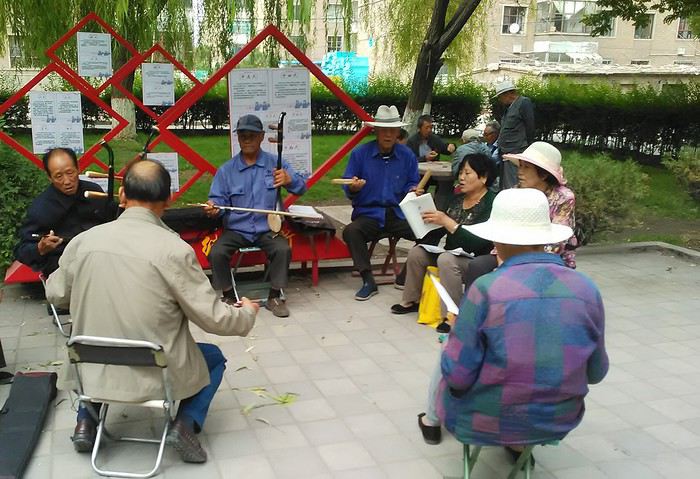
Prices are nothing like Beijing: you can find a full meal for 2 €, and my bike cost 7 € for two days. Plus, few people speak English—neither the owner of the HI hostel where I stayed, nor the ticket sellers at the sites, let alone the servers at the small eateries where I ate. Everything is written in Chinese. So I had to use the little Chinese I know to communicate about essentials. It makes the locals laugh to see a European trying to speak their language, but it earns respect. With Google Translate’s help, I managed.
Rant: With their avenues blocked for construction for kilometers without warning, and new roads not yet on maps, I must’ve taken 15 km of detours. More photos...
5- JIAYUGUAN Scams and heritage Tuesday, August 28 The Great Wall doesn’t exactly end at the fort I visited yesterday but 10 km further, at the entrance to a river gorge at the foot of the mountains. All that’s left is a badly damaged tower (more like a mound of earth) and a section of clay wall, similar to the one I biked yesterday.
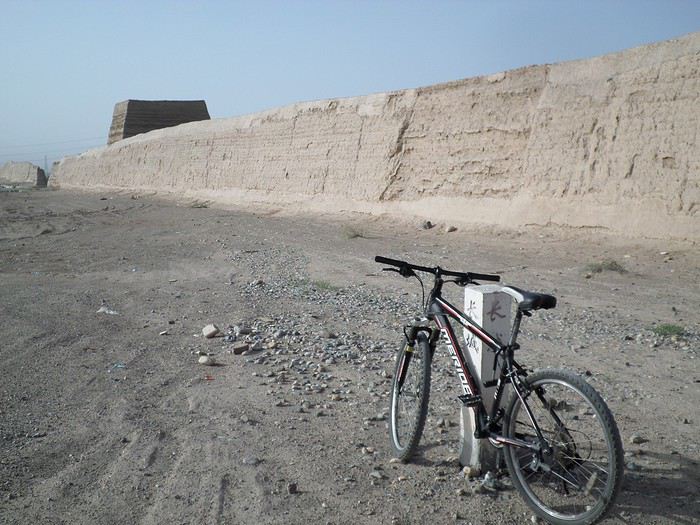
This morning, I hopped on my bike, determined to venture into the desert to see this highly symbolic site. First, you access it via a wide, brand-new road with not a soul in sight. Just before the site, I came across a grand welcome gate, very period-style, but it’s actually the inevitable toll booth.
Behind the gate, the road continues straight to the site, which you can see in the distance—at least 2 km away—the remains of the tower and wall. I had to leave my bike here. Fine. I went to the ticket counter and asked the price: 120 yuan! I couldn’t believe it—over 15 € for a simple mound of earth.
I showed my displeasure to the attendant, who couldn’t care less, and immediately turned back. 120 yuan—that’s the price for a new road, a fancy gate planted 2 km before the site just to force you to take a shuttle, and employees with nothing to do all day... Now I understand why I didn’t meet anyone!
Heritage China is a bit pricey Generally, sites are expensive for the country’s standard of living, but travelers are supposed to have money, so why hold back? I even gave up on the Forbidden City—reservations required days in advance (or on the black market at an impossible price). I prefer to keep the memory of my first visit, when entry must’ve cost a few dozen cents, and there were only a handful of visitors.
This morning, I took a taxi to see remarkable tombs of common people from the 3rd to 6th centuries. They’re small vaulted caves made of painted bricks, depicting scenes of daily life. Very pretty and moving. But even here, though the price was more reasonable, I was left wanting—only one of the 16 tombs is open to visitors, and it’s apparently not the most beautiful.
The authentic China—at least what’s left of it... Wandering the impersonal avenues of the city, you stumble upon a market. There, you still find traditional China—small shops with questionable hygiene, Go players, musicians, and even a dental prosthetist. The last refuge for those untouched by modernity. More photos...
6- DUNHUANG Abundance in the middle of the desert Wednesday, August 29 Well, I thought the landscape would be less bleak as I headed west. Nope. The only distraction in this expanse of dark, clayey sand is the forests of pylons and wind turbines, plus wild camels racing each other.
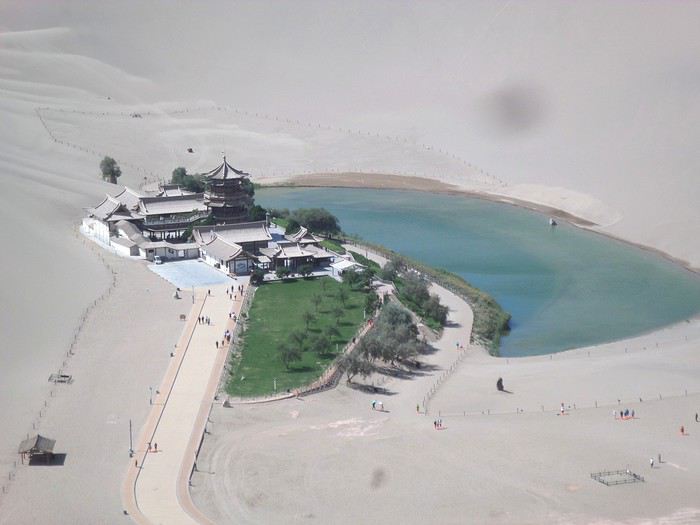 However, Dunhuang, the gateway to the Taklamakan, is by far the most pleasant Chinese city I know. There’s a real city center you can explore on foot. It’s hot but not unbearable, with a light, dry breeze. Much nicer than Beijing. The Han Chinese are still the majority, but the Muslim Uyghurs are more numerous, and the muezzin’s call to prayer echoes around the mosque.
The most surprising thing is the abundance and diversity of fruits and vegetables. You wonder how it all grows here. Well-irrigated, the desert sands are very fertile. Here, raisins have subtle, mysterious flavors, and the lamb really tastes like lamb.
Today, I visited the must-see Mingshashan, a dune complex next to which Pila is a molehill. The Basque Country, but covered in sand... More photos...
7- TURPAN The Uyghurs under heavy surveillance Friday, August 31 Surveillance cameras everywhere in the city, armed police stationed at intersections, in front of public buildings, at the entrance and inside tourist sites, police stations on every corner, patrols on foot or by car, khaki uniforms even for middle schoolers... here, the Han Chinese are in the minority, and you can feel it. Turpan feels like a city under siege.
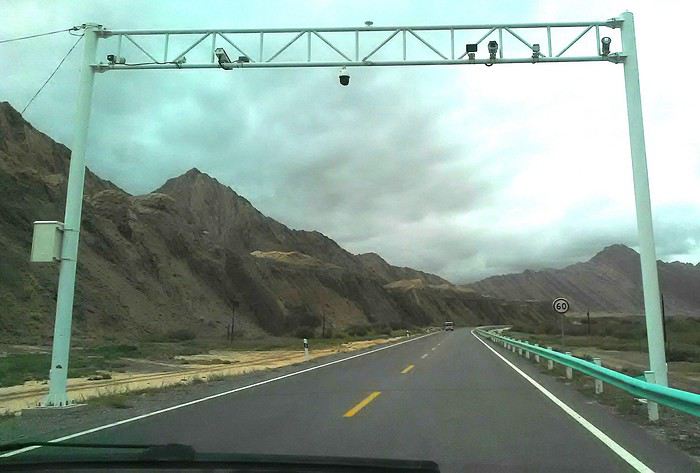
To enter the youth hostel where I stayed, there’s even a security gate, and the receptionist (a Han, like everyone in tourism) wears a bulletproof vest! Reassuring. Still, you don’t feel particularly threatened here, especially as a European. The troublemakers are the Chinese, not the Uyghurs. Generally, China is a very safe country for visitors.
Smile, you’re on camera! I was biking on an avenue when the car in front of me got flashed for driving slowly. I quickly understood why when I got flashed too.
Here, the official time is Beijing time, but it gets dark two hours later. It’ll be even worse in Kashgar. Trickier to manage: everything is displayed in Chinese and Arabic. Nothing in English. Choosing a menu is a shot in the dark. Apart from a few young Chinese, no one here speaks English, and my Chinese doesn’t seem very understandable...
Mogao, the end of the road for the Han Yesterday, near Dunhuang, I went to Mogao, a complex of decorated caves with Buddha sculptures and paintings. Stunning, but so crowded! Luckily, here in Turpan, Chinese tourists barely venture out. So I visited a Silk Road ghost town with only a handful of other visitors and under a howling wind.
The modern Chinese city is swallowing up the old Uyghur neighborhoods—only a museum-like district remains in the center, and pockets of resistance on the outskirts are doomed to disappear soon. More photos...
8- KASHGAR A (relative) love at first sight for the old city Sunday, September 2 After three overnight trains, here I am in the far west of China, nearly 4,000 km from the capital. Despite the omnipresent police and an old city preserved UNESCO-style, Kashgar is my Chinese love at first sight.
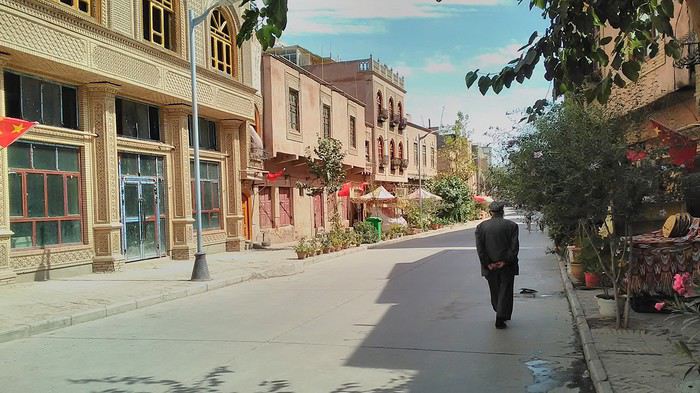
Finally, Chinese... well, sort of, because we’re in Uyghur territory here—a Turkic people with nothing culturally in common with the Han, the eastern Chinese. It started badly yesterday at Turfan station, where after three security gate passes, at least five passport checks, and a bag search, three adorable policewomen confiscated my antibacterial lotion because it had a flammable logo...
Then came the welcoming committee of armed cops at Kashgar station. Once all that was over, they left me alone—except you still have to go through security checks like everyone else to enter the old city, the bazaar, the livestock market... The further west you go, the more the siege mentality is evident. Luckily, the border isn’t far...
Despite the inevitable destruction-reconstruction, the city center has been well preserved. Thankfully, because it’s a very original style, a mix of local and colonial. I love it, even if it’s a bit too artificial, sanitized, and watered-down, and rather empty of residents. On the Silk Road, the city was famous for its great food. And it still is—rarely have I seen such richness and abundance of food! And not just scorpions or snakes. More photos...
9- KASHGAR China’s recipe for controlling the populace Saturday, September 1 Xinjiang, along with Tibet, is a "sensitive" area of rebellion in the eyes of Chinese authorities. As a result, the state has these regions and their populations under total control. Tourists also feel the consequences, even if they’re not at risk of re-education camps.
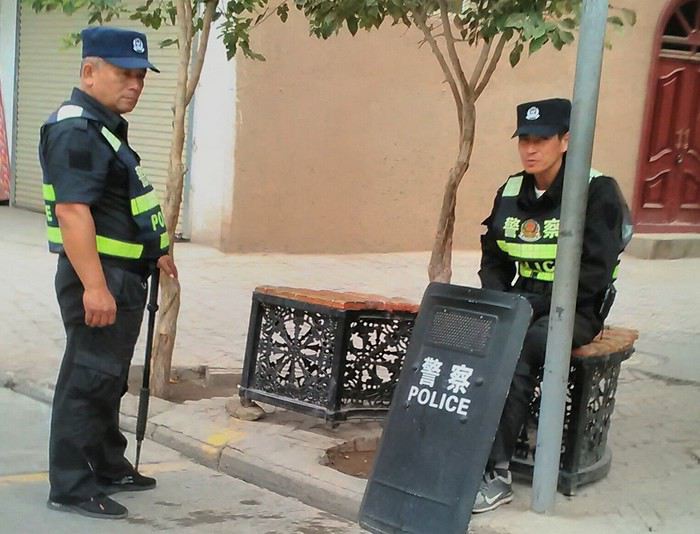 - Putting barbed wire and anti-ramming barriers around sensitive sites (schools, big hotels, government buildings...)
- Installing traffic surveillance gates with cameras and photo flashes (for all vehicles passing, including bikes) throughout the city and even in the countryside
- Posting uniformed guards with tasers, batons, or huge baseball bats every 100 meters
- Training the Han population (ethnic Chinese) in self-defense with sticks, preferably in the morning on the street. Men and women of all ages
- Starting school with the national anthem, doing military exercises, and receiving political indoctrination, all neatly lined up in the courtyard. (The dream school for any teacher)
- Placing a snitch in uniform (a pseudo-guard) in public gathering places, like youth hostels. Mine spends the day loafing around the courtyard
- Putting Chinese flags everywhere on the streets to remind everyone who’s in charge
- Installing security gates at every entrance to areas frequented by tourists (thanks for that) but not just there
- Never photographing cops, or else! I tried, but it’s not easy...
- Putting barbed wire and anti-ramming barriers around sensitive sites (schools, big hotels, government buildings...)
- Installing traffic surveillance gates with cameras and photo flashes (for all vehicles passing, including bikes) throughout the city and even in the countryside
- Posting uniformed guards with tasers, batons, or huge baseball bats every 100 meters
- Training the Han population (ethnic Chinese) in self-defense with sticks, preferably in the morning on the street. Men and women of all ages
- Starting school with the national anthem, doing military exercises, and receiving political indoctrination, all neatly lined up in the courtyard. (The dream school for any teacher)
- Placing a snitch in uniform (a pseudo-guard) in public gathering places, like youth hostels. Mine spends the day loafing around the courtyard
- Putting Chinese flags everywhere on the streets to remind everyone who’s in charge
- Installing security gates at every entrance to areas frequented by tourists (thanks for that) but not just there
- Never photographing cops, or else! I tried, but it’s not easy...
With all that, you can stroll around safely Not much crime! As for the amount the Chinese state spends to maintain such a system, it’s staggering! A third of the Han living in Xinjiang work in security. Today, I wandered freely around old Kashgar, which is quite large after all. More photos...
10- TASHKURGAN What on earth was I thinking going there! Wednesday, September 5 First, there’s the taxi—pretty crappy, with a driver who doesn’t speak a word of English and won’t stop smoking. Over six hours in that... shared with a completely out-of-it American.
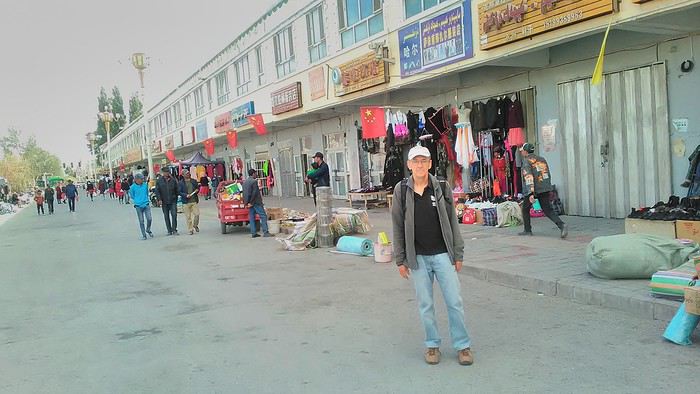
Then there are all the checkpoints along the way. I won’t go on—you know the drill by now.
After that, there’s Tashkurgan—a town with nothing to see, nothing to do. Deserted as soon as night falls. There’s this huge youth hostel and a few lost Chinese tapping away on their smartphones, chain-smoking. This lost American-European crowd, swapping tips on how to enter Pakistan or Tajikistan.
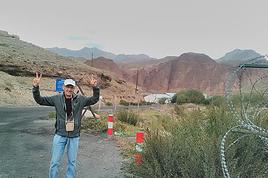
Luckily, there’s the Chinese Pamir Highway, lined with peaks over 7,000m. There’s the feeling of no longer being in China, with a population whose features are Middle Eastern. And these Tajik women with their stunning hairstyles and vibrant costumes. There’s the fact of having reached the westernmost Chinese city, far from crowds and tourist sites. A sort of end of the world. More photos...
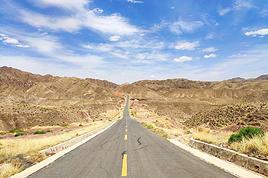
11- KYRGYZ BORDER A surreal epic Thursday, September 6 The road from Kashgar to the Kyrgyzstan border is a little over 200 km and passes through beautiful landscapes of colorful, desert-like mountains with acrobatic folds. That’s the bucolic part of the trip.
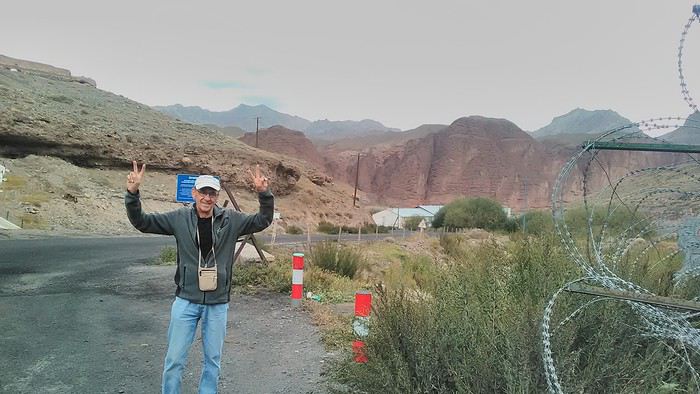 Yesterday, I managed to gather four people to rent a minibus to reach the border more easily: a Spaniard and an Argentine I’d already met in Turpan, and two New Zealanders who responded to the ad left at the hostel.
Absurdity and paranoia of Chinese authorities The highlight was crossing the town of Wuqia, 50 km past Kashgar. After tallying up with my fellow sufferers, we must’ve passed about ten checkpoints with: - Passport checks: 14 times, sometimes by two cops side by side - Bag checks: 4 times - Smartphone checks: 2 times, with deletion of "non-compliant" photos, and registration of your IMEI in the exit log!... Absurd and surreal at the same time, since my camera stayed in my bag, my apps are in French, and my photos have been online for ages...
With all that, we arrived just as the last checkpoint before the no man’s land marking the border between the two countries was on lunch break. And bam! Another 1.5-hour wait, alongside truckers who were much more used to this than we were.
What to think? The cops themselves aren’t fooled. They play the role they’re asked to, but sometimes you can coax a smile out of them—they realize how ridiculous the situation is.
What’s the point? That’s the big question my companions and I were tempted to answer with "to piss people off." To show you your place isn’t here, but with the other tourists, over there in the east, in Shanghai, Xi’an, or Guangzhou.
As for you, a traveler from a democratic country, you really experience this as aggression, humiliation, a violation of your private space. And yet, I’m respected, they speak to me properly. Today, I better understand what a Palestinian or a citizen of an occupied country might feel daily. A unique experience! Thanks, China.
And to top it off, the cherry on the cake! It’s still this glowing button you press to rate your passage after clearing the last obstacle before the exit stamp. I was so surprised it turned off before I could react. The Spaniard, with great humor and irony, had time to vote "excellent." In the end, he wasn’t wrong—you can hardly do better!
PS: I ditched my buddies at the border. They didn’t want to pay for a taxi to continue. So I took a direct taxi to Osh. The first 100 km are fabulous. I couldn’t take many photos, but I’ll be back on Monday to go to Tajikistan.
More photos...
The rest of the Silk Road, Part 2, in these travel journals: Kyrgyzstan, Tajikistan, Uzbekistan.
The Chinese Far West More than 30 years after my first trip to eastern China, I finally fulfilled an old dream: traveling solo from Beijing to the far west, discovering Xinjiang, the Uyghur people and the oppression they endure, the oases of Turpan and Kashgar, the Taklamakan Desert, the end of the Great Wall... The route was covered by train.
MENU PART 1: CHINA
1- Beijing (Jiankou) : the authentic Great Wall, without tourists 2- Cycling in Beijing, the best way to get around 3- Beijing : departure for the far west 4- Jiayuguan : getting by without English 5- Jiayuguan : scams and heritage 6- Dunhuang : abundance in the middle of the desert 7- Turpan : the Uyghurs under heavy surveillance 8- Kashgar : love at first sight for the old city 9- Kashgar : China’s recipe for controlling the populace 10- Tashkurgan : what on earth was I thinking going there! Kyrgyz border: a surreal epic Photo album from the 80s, contributions from other travelers (page 2)
1- JIANKOU Finding the authentic Great Wall, without tourists or a guide Friday, August 24, 2018 Thirty years later, I didn’t feel like revisiting the Great Wall at Badaling or any other overcrowded site. I chose to explore it at Jiankou, in its wildest, most authentic, and unrestored section, starting from a lost village deep in a valley—though it wasn’t *that* lost, since it had everything for communication.
No need to pay for a taxi to get there—by timing it right, you can take the bus for just a few yuan. You have to get off at Xizhazi, the bus terminus. Be careful, there are only two buses a day in each direction. At the Xizhazi bus stop, I met a young couple who’d arrived with zero information about what to expect. We hiked the three of us toward the restored section of Mutianyu.
Still, be cautious With GPS and a topographic map (OpenTopoMap), you can set off without a problem or guide. The trail up to Jiankou is easy and well-marked. The trails down are too. But be careful—once you’re on the Wall, it’s real mountain hiking, with easy but dangerous climbing sections (over sheer drops). Not for amateurs or those afraid of heights! But what a reward. The Wall all to yourself, where it’s at its most daring. Truly mesmerizing.
More photos...
2- BEIJING The best way to get around the capital Sunday, August 26 The best way to explore the city is still by bike. Most are in a bike-share system, but you need to use an app—WeChat, the app that does everything, like monitoring your every move. No way I was installing that.
I found one at a rental shop near the hostel. The key is to quickly learn local traffic customs to minimize risks. Bike lanes are wide along the avenues.
But you still have to: - Watch out for anything parked on the bike paths—the most annoying are people napping or talking on the phone in their cars - Keep an eye on everything coming the wrong way—the list is long - The worst is right turns on red, which in Chinese traffic rules seem to have priority Once you get the hang of it, it’s fine. The city is huge but flat, so you can just wing it.
3- BEIJING By train to the far west Sunday, August 26 Beijing West Station is the size and operates like an airport. With your e-ticket from the agency, you first have to pick up your ticket at the special "English" counter, after passing through security. With your ticket in hand, you have to exit and enter through the boarding waiting area—not the platform—after a second security check.
Then you find the right hall and wait for the sign to finally access the platform. In the end, it works pretty well given the incredible number of passengers to manage. Everywhere in Beijing, I saw that the Chinese have mastered crowd flow management.Nice surprise: second-class carriages are clean, air-conditioned, and bright. Perfect, since I was in for 20 hours. One uniformed attendant per carriage, mobile meal service—luxury! Small downside: no luggage space. Hauling your suitcase up to the top bunk is quite a workout. I was in the middle, so it wasn’t too bad. The landscape, though, whether rural or urban, is pretty bleak. That should change once we leave the eastern plains.
Of course, I got my first police visit, with a thorough passport check and bag search. I was warned—going to the Chinese far west exposes you to this kind of hassle. But they were polite and respectful.
The Chinese Far West4- JIAYUGUAN Getting by without English Monday, August 27 At the gates of two deserts (Gobi and Taklamakan) and at the foot of the Tibetan highlands, the Great Wall ends at Jiayuguan. Here, I found the deeper China I’d somewhat rediscovered during my bike ride, even if now everyone gets around on electric bikes and I’m no longer stared at like an alien.
Prices are nothing like Beijing: you can find a full meal for 2 €, and my bike cost 7 € for two days. Plus, few people speak English—neither the owner of the HI hostel where I stayed, nor the ticket sellers at the sites, let alone the servers at the small eateries where I ate. Everything is written in Chinese. So I had to use the little Chinese I know to communicate about essentials. It makes the locals laugh to see a European trying to speak their language, but it earns respect. With Google Translate’s help, I managed.
Rant: With their avenues blocked for construction for kilometers without warning, and new roads not yet on maps, I must’ve taken 15 km of detours. More photos...
5- JIAYUGUAN Scams and heritage Tuesday, August 28 The Great Wall doesn’t exactly end at the fort I visited yesterday but 10 km further, at the entrance to a river gorge at the foot of the mountains. All that’s left is a badly damaged tower (more like a mound of earth) and a section of clay wall, similar to the one I biked yesterday.
This morning, I hopped on my bike, determined to venture into the desert to see this highly symbolic site. First, you access it via a wide, brand-new road with not a soul in sight. Just before the site, I came across a grand welcome gate, very period-style, but it’s actually the inevitable toll booth.
Behind the gate, the road continues straight to the site, which you can see in the distance—at least 2 km away—the remains of the tower and wall. I had to leave my bike here. Fine. I went to the ticket counter and asked the price: 120 yuan! I couldn’t believe it—over 15 € for a simple mound of earth.
I showed my displeasure to the attendant, who couldn’t care less, and immediately turned back. 120 yuan—that’s the price for a new road, a fancy gate planted 2 km before the site just to force you to take a shuttle, and employees with nothing to do all day... Now I understand why I didn’t meet anyone!
Heritage China is a bit pricey Generally, sites are expensive for the country’s standard of living, but travelers are supposed to have money, so why hold back? I even gave up on the Forbidden City—reservations required days in advance (or on the black market at an impossible price). I prefer to keep the memory of my first visit, when entry must’ve cost a few dozen cents, and there were only a handful of visitors.
This morning, I took a taxi to see remarkable tombs of common people from the 3rd to 6th centuries. They’re small vaulted caves made of painted bricks, depicting scenes of daily life. Very pretty and moving. But even here, though the price was more reasonable, I was left wanting—only one of the 16 tombs is open to visitors, and it’s apparently not the most beautiful.
The authentic China—at least what’s left of it... Wandering the impersonal avenues of the city, you stumble upon a market. There, you still find traditional China—small shops with questionable hygiene, Go players, musicians, and even a dental prosthetist. The last refuge for those untouched by modernity. More photos...
6- DUNHUANG Abundance in the middle of the desert Wednesday, August 29 Well, I thought the landscape would be less bleak as I headed west. Nope. The only distraction in this expanse of dark, clayey sand is the forests of pylons and wind turbines, plus wild camels racing each other.
However, Dunhuang, the gateway to the Taklamakan, is by far the most pleasant Chinese city I know. There’s a real city center you can explore on foot. It’s hot but not unbearable, with a light, dry breeze. Much nicer than Beijing. The Han Chinese are still the majority, but the Muslim Uyghurs are more numerous, and the muezzin’s call to prayer echoes around the mosque.The most surprising thing is the abundance and diversity of fruits and vegetables. You wonder how it all grows here. Well-irrigated, the desert sands are very fertile. Here, raisins have subtle, mysterious flavors, and the lamb really tastes like lamb.
Today, I visited the must-see Mingshashan, a dune complex next to which Pila is a molehill. The Basque Country, but covered in sand... More photos...
7- TURPAN The Uyghurs under heavy surveillance Friday, August 31 Surveillance cameras everywhere in the city, armed police stationed at intersections, in front of public buildings, at the entrance and inside tourist sites, police stations on every corner, patrols on foot or by car, khaki uniforms even for middle schoolers... here, the Han Chinese are in the minority, and you can feel it. Turpan feels like a city under siege.
To enter the youth hostel where I stayed, there’s even a security gate, and the receptionist (a Han, like everyone in tourism) wears a bulletproof vest! Reassuring. Still, you don’t feel particularly threatened here, especially as a European. The troublemakers are the Chinese, not the Uyghurs. Generally, China is a very safe country for visitors.
Smile, you’re on camera! I was biking on an avenue when the car in front of me got flashed for driving slowly. I quickly understood why when I got flashed too.
Here, the official time is Beijing time, but it gets dark two hours later. It’ll be even worse in Kashgar. Trickier to manage: everything is displayed in Chinese and Arabic. Nothing in English. Choosing a menu is a shot in the dark. Apart from a few young Chinese, no one here speaks English, and my Chinese doesn’t seem very understandable...
Mogao, the end of the road for the Han Yesterday, near Dunhuang, I went to Mogao, a complex of decorated caves with Buddha sculptures and paintings. Stunning, but so crowded! Luckily, here in Turpan, Chinese tourists barely venture out. So I visited a Silk Road ghost town with only a handful of other visitors and under a howling wind.
The modern Chinese city is swallowing up the old Uyghur neighborhoods—only a museum-like district remains in the center, and pockets of resistance on the outskirts are doomed to disappear soon. More photos...
8- KASHGAR A (relative) love at first sight for the old city Sunday, September 2 After three overnight trains, here I am in the far west of China, nearly 4,000 km from the capital. Despite the omnipresent police and an old city preserved UNESCO-style, Kashgar is my Chinese love at first sight.
Finally, Chinese... well, sort of, because we’re in Uyghur territory here—a Turkic people with nothing culturally in common with the Han, the eastern Chinese. It started badly yesterday at Turfan station, where after three security gate passes, at least five passport checks, and a bag search, three adorable policewomen confiscated my antibacterial lotion because it had a flammable logo...
Then came the welcoming committee of armed cops at Kashgar station. Once all that was over, they left me alone—except you still have to go through security checks like everyone else to enter the old city, the bazaar, the livestock market... The further west you go, the more the siege mentality is evident. Luckily, the border isn’t far...
Despite the inevitable destruction-reconstruction, the city center has been well preserved. Thankfully, because it’s a very original style, a mix of local and colonial. I love it, even if it’s a bit too artificial, sanitized, and watered-down, and rather empty of residents. On the Silk Road, the city was famous for its great food. And it still is—rarely have I seen such richness and abundance of food! And not just scorpions or snakes. More photos...
9- KASHGAR China’s recipe for controlling the populace Saturday, September 1 Xinjiang, along with Tibet, is a "sensitive" area of rebellion in the eyes of Chinese authorities. As a result, the state has these regions and their populations under total control. Tourists also feel the consequences, even if they’re not at risk of re-education camps.
- Putting barbed wire and anti-ramming barriers around sensitive sites (schools, big hotels, government buildings...)
- Installing traffic surveillance gates with cameras and photo flashes (for all vehicles passing, including bikes) throughout the city and even in the countryside
- Posting uniformed guards with tasers, batons, or huge baseball bats every 100 meters
- Training the Han population (ethnic Chinese) in self-defense with sticks, preferably in the morning on the street. Men and women of all ages
- Starting school with the national anthem, doing military exercises, and receiving political indoctrination, all neatly lined up in the courtyard. (The dream school for any teacher)
- Placing a snitch in uniform (a pseudo-guard) in public gathering places, like youth hostels. Mine spends the day loafing around the courtyard
- Putting Chinese flags everywhere on the streets to remind everyone who’s in charge
- Installing security gates at every entrance to areas frequented by tourists (thanks for that) but not just there
- Never photographing cops, or else! I tried, but it’s not easy...With all that, you can stroll around safely Not much crime! As for the amount the Chinese state spends to maintain such a system, it’s staggering! A third of the Han living in Xinjiang work in security. Today, I wandered freely around old Kashgar, which is quite large after all. More photos...
10- TASHKURGAN What on earth was I thinking going there! Wednesday, September 5 First, there’s the taxi—pretty crappy, with a driver who doesn’t speak a word of English and won’t stop smoking. Over six hours in that... shared with a completely out-of-it American.
Then there are all the checkpoints along the way. I won’t go on—you know the drill by now.
After that, there’s Tashkurgan—a town with nothing to see, nothing to do. Deserted as soon as night falls. There’s this huge youth hostel and a few lost Chinese tapping away on their smartphones, chain-smoking. This lost American-European crowd, swapping tips on how to enter Pakistan or Tajikistan.
Luckily, there’s the Chinese Pamir Highway, lined with peaks over 7,000m. There’s the feeling of no longer being in China, with a population whose features are Middle Eastern. And these Tajik women with their stunning hairstyles and vibrant costumes. There’s the fact of having reached the westernmost Chinese city, far from crowds and tourist sites. A sort of end of the world. More photos...
11- KYRGYZ BORDER A surreal epic Thursday, September 6 The road from Kashgar to the Kyrgyzstan border is a little over 200 km and passes through beautiful landscapes of colorful, desert-like mountains with acrobatic folds. That’s the bucolic part of the trip.
Yesterday, I managed to gather four people to rent a minibus to reach the border more easily: a Spaniard and an Argentine I’d already met in Turpan, and two New Zealanders who responded to the ad left at the hostel.Absurdity and paranoia of Chinese authorities The highlight was crossing the town of Wuqia, 50 km past Kashgar. After tallying up with my fellow sufferers, we must’ve passed about ten checkpoints with: - Passport checks: 14 times, sometimes by two cops side by side - Bag checks: 4 times - Smartphone checks: 2 times, with deletion of "non-compliant" photos, and registration of your IMEI in the exit log!... Absurd and surreal at the same time, since my camera stayed in my bag, my apps are in French, and my photos have been online for ages...
With all that, we arrived just as the last checkpoint before the no man’s land marking the border between the two countries was on lunch break. And bam! Another 1.5-hour wait, alongside truckers who were much more used to this than we were.
What to think? The cops themselves aren’t fooled. They play the role they’re asked to, but sometimes you can coax a smile out of them—they realize how ridiculous the situation is.
What’s the point? That’s the big question my companions and I were tempted to answer with "to piss people off." To show you your place isn’t here, but with the other tourists, over there in the east, in Shanghai, Xi’an, or Guangzhou.
As for you, a traveler from a democratic country, you really experience this as aggression, humiliation, a violation of your private space. And yet, I’m respected, they speak to me properly. Today, I better understand what a Palestinian or a citizen of an occupied country might feel daily. A unique experience! Thanks, China.
And to top it off, the cherry on the cake! It’s still this glowing button you press to rate your passage after clearing the last obstacle before the exit stamp. I was so surprised it turned off before I could react. The Spaniard, with great humor and irony, had time to vote "excellent." In the end, he wasn’t wrong—you can hardly do better!
PS: I ditched my buddies at the border. They didn’t want to pay for a taxi to continue. So I took a direct taxi to Osh. The first 100 km are fabulous. I couldn’t take many photos, but I’ll be back on Monday to go to Tajikistan.
More photos...
The rest of the Silk Road, Part 2, in these travel journals: Kyrgyzstan, Tajikistan, Uzbekistan.
Trek à cheval et transports collectifs (Russie - Ouzbékistan ou Kirghizistan)
Bonjour,
Je projette un voyage en solo en Russie et le combiner avec l'Ouzbekistan ou le Kirghizistan.
J'aimerais avoir des témoignages d'expériences sur le transsibérien pour rejoindre Irkousk pas forcément depuis Moscou d'ailleurs
Et sur les transports collectifs pour se déplacer dans ces pays, et d'une région/ d'un pays à l'autre.
Je pense partir 6 à 7semaines, mais entre août et septembre, et bien sûr se pose la question de l'afflux de touristes à cette période, et du climat. Quelqu'un a-t-il fait un séjour dans le camp;"Golden Camel Camp dans l'Altaï? Et des infos sur de possibles randonnées à cheval dans cette région? Et j'hésite entre l'Ouzbekistan et le Kirghizistan comme 2è destination, le Kirghizistan pour une rando équestre, quoique les différents témoignages me donnent quelques doutes quant au sérieux des agences locales...🤪, et l'Ouzbékistan pour la route de la soir bien sûr! Merci d'avance pour vos retours!
Je pense partir 6 à 7semaines, mais entre août et septembre, et bien sûr se pose la question de l'afflux de touristes à cette période, et du climat. Quelqu'un a-t-il fait un séjour dans le camp;"Golden Camel Camp dans l'Altaï? Et des infos sur de possibles randonnées à cheval dans cette région? Et j'hésite entre l'Ouzbekistan et le Kirghizistan comme 2è destination, le Kirghizistan pour une rando équestre, quoique les différents témoignages me donnent quelques doutes quant au sérieux des agences locales...🤪, et l'Ouzbékistan pour la route de la soir bien sûr! Merci d'avance pour vos retours!
Double entrée au Kazakhstan (Ouzbékistan)
Bonjour,
Le Kazakhstan n'exige pas de visa pour un séjour n'excédant pas 30 jours.
Peut-on, à l'intérieur de ce laps de temps, arriver dans ce pays puis passer en Ouzbékistan, et, enfin, revenir au Kazakhstan ?
Merci pour votre aide.
Transports en commun Margilan - Och - Lac Son Koul - Bichkek
Salut à tous ! Après un périple de 15 jours en Ouzbékistan ( mai 2020 ), j'envisage de poursuivre une semaine au Kirghizistan. Quelques questions m'interrogent :
1) question d'actualité, la frontière entre Andijan et Och est-elle la plus pratique et est-elle toujours ouverte ? autre possibilité pour rejoindre Och depuis Margilan ?
2) J'ai lu pas mal de post sur les trajets au Kirghizistan mais la plupart effectués en voiture de location. Qu'en est-il en transport en commun sur l'axe Och - Jalalabad - Kazarman - Lac Son Koul - Kotchkor - Bichkek ?
3) On parle d'une nouvelle route Nord-Sud justement , est-elle terminée dans son ensemble ? Y a-t-il problème de circulation en début Juin ( question météo ) ?
4) Autres lieux et sites à découvrir sur cet axe ? Trouve-t-on facilement des taxis partagés ou autre comme en Ouzbékistan ?
5) Peut-on facilement trouver à organiser un ou deux jours de détente-découverte dans la région du lac ( campement bien situé et facile d'accés ( approche en véhicule ... pas trop trekkeur ! 😕 ) ? A partir de quelle ville ou village ? ( je pensais à Kazarman en venant du Sud ...) Merci d'avance pour les nombreuses réponses qui vont venir ... 😉 😉 😉
2) J'ai lu pas mal de post sur les trajets au Kirghizistan mais la plupart effectués en voiture de location. Qu'en est-il en transport en commun sur l'axe Och - Jalalabad - Kazarman - Lac Son Koul - Kotchkor - Bichkek ?
3) On parle d'une nouvelle route Nord-Sud justement , est-elle terminée dans son ensemble ? Y a-t-il problème de circulation en début Juin ( question météo ) ?
4) Autres lieux et sites à découvrir sur cet axe ? Trouve-t-on facilement des taxis partagés ou autre comme en Ouzbékistan ?
5) Peut-on facilement trouver à organiser un ou deux jours de détente-découverte dans la région du lac ( campement bien situé et facile d'accés ( approche en véhicule ... pas trop trekkeur ! 😕 ) ? A partir de quelle ville ou village ? ( je pensais à Kazarman en venant du Sud ...) Merci d'avance pour les nombreuses réponses qui vont venir ... 😉 😉 😉
Trajet, coût et durée Baku-Tachkent-Baku
bonjour à tous
je cherche le moyen le plus pratique ( coût - durée) pour faire Baku Tachkent en aller-retour sans passer par l'iran
un lien pour des billets serait le bienvenu
merci
Passage frontière Kirghizistan-Ouzbékistan via le Kazakhstan
Bonjour
Nous allons effectuer en bus le trajet Bichkek Tachkent.
Le trajet passe par le Kazakhstan.
Faut il un visa pour traverser ?
Merci d’ avance
Catherine
Visa transit au Turkménistan pour l'Ouzbékistan (Nukus)
Bonjour,
Je souhaite traverser en bateau de Baku (AZERBAIDJAN) vers Turkembaski (TURKMENISTAN). Est il possible d'avoir un visa transit 3-5 jours au Turkménistan et rejoindre Ashgabat, Gate of Hell et sortir à vers Nukus (Ouzbékistan) ? L'itinéraire doit il être précis à l'entrée au Turkménistan ? Je vais voyager avec un camion aménagé ; est il possible de bivouaquer vers la porte de l'enfer ? Ailleurs ?
Merci d'avance, Kastor
Je souhaite traverser en bateau de Baku (AZERBAIDJAN) vers Turkembaski (TURKMENISTAN). Est il possible d'avoir un visa transit 3-5 jours au Turkménistan et rejoindre Ashgabat, Gate of Hell et sortir à vers Nukus (Ouzbékistan) ? L'itinéraire doit il être précis à l'entrée au Turkménistan ? Je vais voyager avec un camion aménagé ; est il possible de bivouaquer vers la porte de l'enfer ? Ailleurs ?
Merci d'avance, Kastor
Trajet Naryn - Samarcande
Bonjour !
Nous prévoyons trois semaines en aout au Kirghizistan et Ouzbekistan.
Que conseillez vous pour faire le trajet Naryn / Samarcande ?
Nous serons en fin de trek et aimerions aller visiter Samarcande et Boukhara avant de rentrer à Paris.
Merci :)
Passage aux frontières (Iran - Turkménistan - Ouzbékistan)
Bonjour, nous ferons la route entre Iran et Turkménistan cet été, st-ce que les passage aux frontières sont toujours très long et comprennent toujours une fouille complète du véhicule? Merci d'avance! Ambroise
Change au Kazakhstan et en Ouzbékistan
Bonsoir,
J'ai lu qu'en Ouzbékistan il était préférable de faire le change ailleurs que dans les bureaux de change officiels mais qu'en est il pour le Kazakhstan ? Vaut il mieux avoir des € ou des $ ?
Merci
J'ai lu qu'en Ouzbékistan il était préférable de faire le change ailleurs que dans les bureaux de change officiels mais qu'en est il pour le Kazakhstan ? Vaut il mieux avoir des € ou des $ ?
Merci
Assurance pour le Kazakhstan, l'Ouzbékistan et la Géorgie
Bonjour,
Quelle assurances avez ou aviez vous pour visiter ces trois pays ? - Kazakhstan, Ouzbékistan, Géorgie ? Assurance prise en France ? Assurance prise à la frontière ? Assurance temporaire ? Je suis à la MACIF et ces trois pays ne sont pas couverts ...
Merci
Jack
Quelle assurances avez ou aviez vous pour visiter ces trois pays ? - Kazakhstan, Ouzbékistan, Géorgie ? Assurance prise en France ? Assurance prise à la frontière ? Assurance temporaire ? Je suis à la MACIF et ces trois pays ne sont pas couverts ...
Merci
Jack
Route de la soie, de Pékin à Khiva
Chine, Kirghistan, Tajikistan, Ouzbékistan, août-octobre 2018.
Les carnets de route d'un sexagénaire en autonomie complète. Anecdotes et petites histoires vécues sur le chemin, mais aussi photos, treks, conseils et astuces pour mieux voyager.
papydo2706.blogspot.com/
papydo2706.blogspot.com/
Trek au Kirghizistan et en Ouzbékistan
Nous partons pour un trek de 9 jours au Kirghistan Kizil Suu Lac Ala kul)
puis en Ouzbekistan 3 jours entre Samarcande et Bukhara.
J'aime bien apporter quelques petits cadeaux (utiles ou futiles) pour "services rendus" ! j'ai mis des balles en mousse, des voitures miniatures, des mikados, des lampes dynamos, des cartes postales de Paris et autre petites babioles. quelques trousses et stylos, bref des choses légères..........Qu'en pensez vous?
Par ailleurs, je suis preneur de toute recommandation et conseil pour éviter enquiquinements e galère.
MERCI
J'aime bien apporter quelques petits cadeaux (utiles ou futiles) pour "services rendus" ! j'ai mis des balles en mousse, des voitures miniatures, des mikados, des lampes dynamos, des cartes postales de Paris et autre petites babioles. quelques trousses et stylos, bref des choses légères..........Qu'en pensez vous?
Par ailleurs, je suis preneur de toute recommandation et conseil pour éviter enquiquinements e galère.
MERCI
Passage frontière Ouzbékistan - Kirghizistan en décembre
Bonjour à tous !
Avec ma copine nous souhaitons voyager en autonomie de septembre à décembre en Asie centrale.
On à pour le moment prévus de prendre un vol allez-retour à destination de Bichkek (Kirghizistan) car étant le moins onéreux.
Voici pour le moment l'organisation du voyage :
- Septembre : Visite du Kirghizistan - Octobre : Visite du Tadjikistan (avant la venu du froid) - Novembre : faire du volontariat au Tadjikistan ou en Ouzbékistan - Décembre : Visite de l'Ouzbékistan
Nous devrons donc rejoindre l'aéroport de Bichkek (Kirghizistan) vers le 20 décembre pour terminer la boucle.
Cependant, les températures peuvent vite descendre et certaines routes sont fermés en hiver. Les conversations concernant le trajet Ouzbékistan - Kirghizistan concernent des voyages au printemps, et sont souvent posté il y à plus de 2 ans... Or les pays évoluent et les infrastructures aussi !
Avez-vous des informations sur la possibilité de réaliser ce trajet ? Un immense merci d'avance !
Avec ma copine nous souhaitons voyager en autonomie de septembre à décembre en Asie centrale.
On à pour le moment prévus de prendre un vol allez-retour à destination de Bichkek (Kirghizistan) car étant le moins onéreux.
Voici pour le moment l'organisation du voyage :
- Septembre : Visite du Kirghizistan - Octobre : Visite du Tadjikistan (avant la venu du froid) - Novembre : faire du volontariat au Tadjikistan ou en Ouzbékistan - Décembre : Visite de l'Ouzbékistan
Nous devrons donc rejoindre l'aéroport de Bichkek (Kirghizistan) vers le 20 décembre pour terminer la boucle.
Cependant, les températures peuvent vite descendre et certaines routes sont fermés en hiver. Les conversations concernant le trajet Ouzbékistan - Kirghizistan concernent des voyages au printemps, et sont souvent posté il y à plus de 2 ans... Or les pays évoluent et les infrastructures aussi !
Avez-vous des informations sur la possibilité de réaliser ce trajet ? Un immense merci d'avance !
Circuit de 3 semaines Kirghizistan - Ouzbékistan
Bonjour à tous !
Nous sommes 2 et prévoyons de faire un circuit de 3 semaines au Kirghizistan et en Ouzbékistan au mois de juillet. Voici notre première idée d’itinéraire :
1 Arrivée Bishkek (matin) 2 Bishkek-Karakol (via Cholpon Ata) 3-5 Trek Karakol (Ala Kul-Altyn Arashan) 6 Karakol-Koshkor 7-8 Trek Kul Ukok 9-11Trek Song Kul 12 Bishkek-Arslanbob 13 Arslanbob 14 Arslanbob-Och-Kokand (Ouzbekistan) 15 Kokand-Tashkent 16 Tashkent-Ourgentch/Khiva (vol tôt) 17 Khiva/Ourguentch-Boukhara (vol tard) 18-20 Boukhara 21-22 Samarcande 23 Tashkent 24 Retour Paris
Ma première question est évidemment de savoir si cela est réalisable ! Mes autres questions sont les suivantes : 1. Peut-on réaliser un trek de trois jours (à pied) autour du lac Song Kul en indépendant ? 2. De manière générale, pour faire les treks en indépendant, est-il nécessaire d’avoir son propre matériel de campement ? 2. Le retour à Bishkek après Song Kul peut-il être évité avant de descendre vers Osh (j’ai cru comprendre que les trajets via Kazarman ou Suusamyr étaient assez incertains) ? 3. Le trajet Bishkek-Arslanbob dans la journée vaut-il le coup ? J'avoue ne pas bien concevoir cette partie du voyage (entre Song Kul et Osh). Je suis preneur de toute suggestion 😉 4. Kokand est-il une bonne idée pour faire une halte dans la vallée de Ferghana ?
D’avance, merci beaucoup pour vos réponses et commentaires !
Nous sommes 2 et prévoyons de faire un circuit de 3 semaines au Kirghizistan et en Ouzbékistan au mois de juillet. Voici notre première idée d’itinéraire :
1 Arrivée Bishkek (matin) 2 Bishkek-Karakol (via Cholpon Ata) 3-5 Trek Karakol (Ala Kul-Altyn Arashan) 6 Karakol-Koshkor 7-8 Trek Kul Ukok 9-11Trek Song Kul 12 Bishkek-Arslanbob 13 Arslanbob 14 Arslanbob-Och-Kokand (Ouzbekistan) 15 Kokand-Tashkent 16 Tashkent-Ourgentch/Khiva (vol tôt) 17 Khiva/Ourguentch-Boukhara (vol tard) 18-20 Boukhara 21-22 Samarcande 23 Tashkent 24 Retour Paris
Ma première question est évidemment de savoir si cela est réalisable ! Mes autres questions sont les suivantes : 1. Peut-on réaliser un trek de trois jours (à pied) autour du lac Song Kul en indépendant ? 2. De manière générale, pour faire les treks en indépendant, est-il nécessaire d’avoir son propre matériel de campement ? 2. Le retour à Bishkek après Song Kul peut-il être évité avant de descendre vers Osh (j’ai cru comprendre que les trajets via Kazarman ou Suusamyr étaient assez incertains) ? 3. Le trajet Bishkek-Arslanbob dans la journée vaut-il le coup ? J'avoue ne pas bien concevoir cette partie du voyage (entre Song Kul et Osh). Je suis preneur de toute suggestion 😉 4. Kokand est-il une bonne idée pour faire une halte dans la vallée de Ferghana ?
D’avance, merci beaucoup pour vos réponses et commentaires !
Visas en Asie Centrale: comment traverser les pays "stan" à vélo
Bonjour,
j'essaie de préparer mon voyage an Asie à vélo, mais je viens de lire qu'au Kazakhstan, il me fallait une invitation d'un résident si je souhaitais rester plus d'un mois dans le pays, or il se trouve que j'aimerais traverser ce pays à vélo, et donc probablement y rester plus d'un mois... j'ai alors pensé aux entrées et sorties multiples avec les pays voisins (ouzbek, kirghiz, ...) mais là encore il faut l'invitation d'un résident !
du coup je viens ici pour avoir des idées, des conseils, des retours d'expérience pour savoir comment pouvoir traverser ces pays à vélo 🙂
j'essaie de préparer mon voyage an Asie à vélo, mais je viens de lire qu'au Kazakhstan, il me fallait une invitation d'un résident si je souhaitais rester plus d'un mois dans le pays, or il se trouve que j'aimerais traverser ce pays à vélo, et donc probablement y rester plus d'un mois... j'ai alors pensé aux entrées et sorties multiples avec les pays voisins (ouzbek, kirghiz, ...) mais là encore il faut l'invitation d'un résident !
du coup je viens ici pour avoir des idées, des conseils, des retours d'expérience pour savoir comment pouvoir traverser ces pays à vélo 🙂
Voyage Kirghizistan - Ouzbékistan en septembre / octobre
Bonjour à tous,
Voilà nous sommes (moi et ma femme) sur le point de partir (enfin dans quelques semaines) au Kirghizistan et en Ouzbekistan du 2 Septembre au 11 Octobre. Le programme est d'environ faire 3 semaines en Kirghizistan et 3 semaines en Ouzbekistan. Le roadtrip est déjà fait depuis longtemps, par contre j'ai quelques questions concernant l'Ouzbekistan :
- Est il mieux de faire Osh - Tashkent ou Osh - Ferghana ? et comment s'y prendre et a quel prix ? - Est il vraiment sûr de faire du change sur le marché noir ? d'après ce que j'ai lu sur le forum, c'est oui, vous confirmez ? - J'ai lu qu'il est plus sympa de faire les visites dans le sens Tashkent - Khiva - Boukhara - Samarcande que Tashkent - Samarcande - Boukhara et Khiva ? - Si c'est dans ce sens là, quel est le moyen de transport petit prix (et a quel prix) pour faire Tashkent Khiva ? j'ai entendu parler d'un train grande vitesse mais il s'arrête peut être à Navoï ? J'avais penser a un moment prendre l'avion mais trop cher, surtout qu'on est pas très pressé. - Auriez vous des connaissances pouvant nous faire découvrir les trois villes de Khiva, Boukhara et Samarcande ? Nous ne cherchons pas a passer par un guide, mais je parle plutôt de locaux, bénévolement (pas non plus toute la journée) et plus dans le partage (on pourra très bien les inviter au restaurant ou quelque chose comme ça pour les remercier) J'ai vu que quelqu'un avez donné des contacts pour Khiva et Boukhara mais si vous avez d'autres connaissances...
Merci d'avance pour vos réponses !
Voilà nous sommes (moi et ma femme) sur le point de partir (enfin dans quelques semaines) au Kirghizistan et en Ouzbekistan du 2 Septembre au 11 Octobre. Le programme est d'environ faire 3 semaines en Kirghizistan et 3 semaines en Ouzbekistan. Le roadtrip est déjà fait depuis longtemps, par contre j'ai quelques questions concernant l'Ouzbekistan :
- Est il mieux de faire Osh - Tashkent ou Osh - Ferghana ? et comment s'y prendre et a quel prix ? - Est il vraiment sûr de faire du change sur le marché noir ? d'après ce que j'ai lu sur le forum, c'est oui, vous confirmez ? - J'ai lu qu'il est plus sympa de faire les visites dans le sens Tashkent - Khiva - Boukhara - Samarcande que Tashkent - Samarcande - Boukhara et Khiva ? - Si c'est dans ce sens là, quel est le moyen de transport petit prix (et a quel prix) pour faire Tashkent Khiva ? j'ai entendu parler d'un train grande vitesse mais il s'arrête peut être à Navoï ? J'avais penser a un moment prendre l'avion mais trop cher, surtout qu'on est pas très pressé. - Auriez vous des connaissances pouvant nous faire découvrir les trois villes de Khiva, Boukhara et Samarcande ? Nous ne cherchons pas a passer par un guide, mais je parle plutôt de locaux, bénévolement (pas non plus toute la journée) et plus dans le partage (on pourra très bien les inviter au restaurant ou quelque chose comme ça pour les remercier) J'ai vu que quelqu'un avez donné des contacts pour Khiva et Boukhara mais si vous avez d'autres connaissances...
Merci d'avance pour vos réponses !
Passage frontière à vélo à Shamaldy-Say (Kirghizistan - Ouzbékistan)
Bonjour je voudrais savoir si shamaldy sai est bien un poste frontière. Je voudrais y passer en prov Ouzbékistan. Merci
Si ce n'est pas le cas où est le poste le plus proche ?
Où trouver du gaz en Ouzbékistan et Kirghizistan?
Salut dsl pour le sujet un peu terre à terre mais cause avion je suis parti sans gaz et impossible d'en trouver à khiva et boukhara /mm un réchaud de camping est ce que j'ai mes chances à Samarka'd andijan ou bien au Kirghizistan ??? PS il paraît qu'il y a un bb de veloroutards à Samarka'd quelqu'un connait ? Bisous ouzbeks
Passage frontières voie terrestre Ouzbékistan - Kirghizistan
Bonjour 🙂
Dans le cadre d'un voyage en Ouzbékistan - Kirghizistan dans 15 jours nous projetons avec mon compagnon de passer de l'Ouzbékistan vers le Kirghizistan par la voie terrestre (les vols ne correspondant pas à nos dates).
Quel itinéraire privilégier ? (Samarcade puis) Taschkent - Bichkek via le Kazakhstan (dans ce cas, me confirmez-vous qu'il ne faut pas de visa de transit pour le Kazakhstan ?) en bus/train, ou l'itinéraire Taschkent - Och via la vallée de Ferghana et Andijan ?
L'idée serait d'effectuer le trajet le plus rapide possible pour des questions de timing.
Dernière chose : auriez-vous une agence à conseiller pour un trip à cheval de 3 - 4 jours et quelle région privilégierez-vous ? Plutôt Kochkor/Naryn lac Song Kul ou plutôt Karakol et les environs du lac Issyk Kul (nous sommes des cavaliers peu expérimentés) ?
Merci déjà pour vos réponses 🙂
Dans le cadre d'un voyage en Ouzbékistan - Kirghizistan dans 15 jours nous projetons avec mon compagnon de passer de l'Ouzbékistan vers le Kirghizistan par la voie terrestre (les vols ne correspondant pas à nos dates).
Quel itinéraire privilégier ? (Samarcade puis) Taschkent - Bichkek via le Kazakhstan (dans ce cas, me confirmez-vous qu'il ne faut pas de visa de transit pour le Kazakhstan ?) en bus/train, ou l'itinéraire Taschkent - Och via la vallée de Ferghana et Andijan ?
L'idée serait d'effectuer le trajet le plus rapide possible pour des questions de timing.
Dernière chose : auriez-vous une agence à conseiller pour un trip à cheval de 3 - 4 jours et quelle région privilégierez-vous ? Plutôt Kochkor/Naryn lac Song Kul ou plutôt Karakol et les environs du lac Issyk Kul (nous sommes des cavaliers peu expérimentés) ?
Merci déjà pour vos réponses 🙂