Results for "Asie+Centrale"
About 110,851 results.
More options
Many results are in French, the community’s main language. English translations are added over time.
Search results
Conseils pratiques pour Mongolie/Chine/Russie
J'envisage de partir pour un voyage en Monglie (1 ou 2 mois) et en Chine (Pékin, l'est et surtout le sud-est ), en passant par la Russie (Moscou, Irkoust, lac Baikal :Transsibérien) pour une période d'au moins 3-4 mois, entre mai et septembre.
😕 Mais mon problème c'est que je n'ai jamais voyagé aussi longtemps et aussi loin tout seul avec un sac sur le dos et à mesure que le départ se rapproche avec les visas, les billets de trains..., je flip de plus en plus! C'est vraiment pas évident à organiser seul!
Toutes ces appréhensions, heureusement, n' entachent pas ma motivation, bien au contraire 🙂 mais je me pose quand meme des questions d' ordre pratique: faut-il avoir beaucoup d'argent sur soi? (travelers, cartes de crédit, espèces?...), comment sont acceuillis les étrangers dans ces pays?, est-ce que c'est vrai qu'il vaut mieux réserver à l'avance ses billets de trains à cette période (où et comment faire depuis la France sans passer par une agence et sa commission? ) et réserver au moins la première nuit d' hotel à Moscou? ( pour l'invitation..., si vous avez des plans à pas trop cher? ).
Pour l'instant je pense que je vais d'abord réserver à l'avance le trajet Paris-Moscou en bus (Eurolines?), prévoir 3-4 jours à Moscou (hotels?) et réserver mon billet de train (transsibérien ) jusqu' à Irkoutsk avec peut-etre 1 ou 2 escales en route, et de là laisser enfin place à l'aventure 😎 : me diriger vers le lac Baikal pour y rester 1, 2 semaines? et réserver sur place le train pour Ulan-Bator si cela n'est pas trop compliqué au mois de juin?
J' aimerais prendre le temps de découvrir la Mongolie et ensuite reprendre le train à U-B pour rejoindre Pékin, mais ce sera très certainement en juillet et on m'a dit que c'était difficile de réserver sur place à cette période? 😠 (trop de touristes!).
Et pour finir mon périple découvrir l'est et le sud-est de la Chine (Hubéi, Hunan, Guangdong, Guangxi Yunnan ? ).Est-ce jouable pour un novice très motivé comme moi ?
Que d'interrogations! Si vous etes dans la meme situations que moi ou que vous l'avez été et que vous voulez bien éclairer ma lanterne n' hésitez pas.
PS : Je pense depuis quelque temps effectuer avant ça un petit voyage d'initiation de 2 semaines pour me mettre un peu en situation (vers fin fevrier début mars ), quelque chose de pas trop long à mettre en place et de pâs trop cher ! Si vous avez des suggestions!...
😕 Mais mon problème c'est que je n'ai jamais voyagé aussi longtemps et aussi loin tout seul avec un sac sur le dos et à mesure que le départ se rapproche avec les visas, les billets de trains..., je flip de plus en plus! C'est vraiment pas évident à organiser seul!
Toutes ces appréhensions, heureusement, n' entachent pas ma motivation, bien au contraire 🙂 mais je me pose quand meme des questions d' ordre pratique: faut-il avoir beaucoup d'argent sur soi? (travelers, cartes de crédit, espèces?...), comment sont acceuillis les étrangers dans ces pays?, est-ce que c'est vrai qu'il vaut mieux réserver à l'avance ses billets de trains à cette période (où et comment faire depuis la France sans passer par une agence et sa commission? ) et réserver au moins la première nuit d' hotel à Moscou? ( pour l'invitation..., si vous avez des plans à pas trop cher? ).
Pour l'instant je pense que je vais d'abord réserver à l'avance le trajet Paris-Moscou en bus (Eurolines?), prévoir 3-4 jours à Moscou (hotels?) et réserver mon billet de train (transsibérien ) jusqu' à Irkoutsk avec peut-etre 1 ou 2 escales en route, et de là laisser enfin place à l'aventure 😎 : me diriger vers le lac Baikal pour y rester 1, 2 semaines? et réserver sur place le train pour Ulan-Bator si cela n'est pas trop compliqué au mois de juin?
J' aimerais prendre le temps de découvrir la Mongolie et ensuite reprendre le train à U-B pour rejoindre Pékin, mais ce sera très certainement en juillet et on m'a dit que c'était difficile de réserver sur place à cette période? 😠 (trop de touristes!).
Et pour finir mon périple découvrir l'est et le sud-est de la Chine (Hubéi, Hunan, Guangdong, Guangxi Yunnan ? ).Est-ce jouable pour un novice très motivé comme moi ?
Que d'interrogations! Si vous etes dans la meme situations que moi ou que vous l'avez été et que vous voulez bien éclairer ma lanterne n' hésitez pas.
PS : Je pense depuis quelque temps effectuer avant ça un petit voyage d'initiation de 2 semaines pour me mettre un peu en situation (vers fin fevrier début mars ), quelque chose de pas trop long à mettre en place et de pâs trop cher ! Si vous avez des suggestions!...
3 semaines en Ouzbékistan
Je souhaite préparer un voyage d'environ 3 semaines en Ouzbékistan pour l'année prochaine. C'est vrai que je m'y prends tôt, mais j'aime bien glaner le maximun d'infos. Qui a visité ce pays récemment? Est-ce facile de se déplacer? Quel budget faut-il prévoir? Quelles sont les formalités pour le visa? On me dit qu'il n'y a plus besoin du voucher d'invitation... Quelle compagnie aérienne offre le meilleur prix? les agences de voyages ne sont pas au top pour ce genre de destination en vol sec et me proposent que des vols galères avec de multiples changements ou alors à des prix inabordables. Merci pour toutes les infos que vous voudrez bien me communiquer
Etapes sur Moscou-Pékin
Je souhaite partir l'été prochain en Russie, et plus particulièrement à St-Pétersbourg puis Moscou. Tout conseil de logement dans ce 2 villes sera le bienvenu.
Après cela nous projettons de prendre le Transsibérien et de faire étape sur le lac Baïkal. Faut-il absolument un guide pour explorer la nature autour de ce fabuleux lac ? Faites-nous part de vos expériences.
Ensuite route vers Ulan-Bator (toujours en train) d'où nous souhaiterions aller dans la steppe à cheval (1 à 2 semaines).
Enfin, direction Pékin pour visiter un peu la Chine et repartir vers Paris. Quel est le meilleur moyen pour traverser la frontière Mongolie-Chine et quelles sont les sites à voir absolument sur la route vers Pékin.
N'hésitez vraiment pas à nous donner plein de conseils....
Merci !!!!!!!
Après cela nous projettons de prendre le Transsibérien et de faire étape sur le lac Baïkal. Faut-il absolument un guide pour explorer la nature autour de ce fabuleux lac ? Faites-nous part de vos expériences.
Ensuite route vers Ulan-Bator (toujours en train) d'où nous souhaiterions aller dans la steppe à cheval (1 à 2 semaines).
Enfin, direction Pékin pour visiter un peu la Chine et repartir vers Paris. Quel est le meilleur moyen pour traverser la frontière Mongolie-Chine et quelles sont les sites à voir absolument sur la route vers Pékin.
N'hésitez vraiment pas à nous donner plein de conseils....
Merci !!!!!!!
Visa et budget pour l'Ouzbékistan
salut à tous,
je pars en ouzbékistan et je n'ai pas la moindre idéé actu du budget que je dois réserver (je pars du 27 février au 06 mars), je souhaiterai aussi savoir si j'ai esoin d'un visa etquel serait son prix, ainsi que le visa de transit car j'ai une escale à moscou...je sais que nombre d'entre vous sont pas mal baroufeurs, et certains d'entre vous pourraient me conseiller sur le prix d'un hotel qui ait un bon rapport qualité prix...merci à vous, José (e-mail: josep181@aol.com)
je pars en ouzbékistan et je n'ai pas la moindre idéé actu du budget que je dois réserver (je pars du 27 février au 06 mars), je souhaiterai aussi savoir si j'ai esoin d'un visa etquel serait son prix, ainsi que le visa de transit car j'ai une escale à moscou...je sais que nombre d'entre vous sont pas mal baroufeurs, et certains d'entre vous pourraient me conseiller sur le prix d'un hotel qui ait un bon rapport qualité prix...merci à vous, José (e-mail: josep181@aol.com)
La Russie avec son véhicule
Bonjour à tous!
J'envisage pour 2004 un voyage en Europe (ex-de l'Est) et souhaite me rendre également en Russie avec mon propre véhicule (Nissan Patrol GR).
Pour les pays de l'Europe de l'est (Pologne, Hongrie, Tchéquie...) pas trop de problèmes mais là où le bât me blesse c'est la Russie.
J'appelle donc à l'aide ceux et celles qui auraient voyagé avec leur propre véhicule en Russie ou qui connaîtraient de tels voyageurs pour pouvoir m'aider à préparer mon circuit.
Merci d'avance pour votre aide.
J'envisage pour 2004 un voyage en Europe (ex-de l'Est) et souhaite me rendre également en Russie avec mon propre véhicule (Nissan Patrol GR).
Pour les pays de l'Europe de l'est (Pologne, Hongrie, Tchéquie...) pas trop de problèmes mais là où le bât me blesse c'est la Russie.
J'appelle donc à l'aide ceux et celles qui auraient voyagé avec leur propre véhicule en Russie ou qui connaîtraient de tels voyageurs pour pouvoir m'aider à préparer mon circuit.
Merci d'avance pour votre aide.
Qui connait le Kazakshtan?
Salut a tous!!!!!!!!!
Cherche desesperement des infos sur le kazakhstan!!! Pays pourtant tres touristique!!!!!🤪 Mais apparement peu de personnes veulent en parler!!!!😛 Cherche sur les liaisons entre moscou et almaty en train ou plutot prendre le turksib a partir de novossibirsk, qu'est ce qu'il y a voir au kazakhstan??? Il parait que les montagne au sud sont magnifiques pourrais-je avoir confirmation?? Dans l'espoir d'attendre une reponse je souhaite a tout le monde un bon voyage!!!!!!!!!!! julien😉
Cherche desesperement des infos sur le kazakhstan!!! Pays pourtant tres touristique!!!!!🤪 Mais apparement peu de personnes veulent en parler!!!!😛 Cherche sur les liaisons entre moscou et almaty en train ou plutot prendre le turksib a partir de novossibirsk, qu'est ce qu'il y a voir au kazakhstan??? Il parait que les montagne au sud sont magnifiques pourrais-je avoir confirmation?? Dans l'espoir d'attendre une reponse je souhaite a tout le monde un bon voyage!!!!!!!!!!! julien😉
Voyage en individuel en Mongolie
Est-il possible en arrivant en Mongolie (Oulan Bator) de trouver aisément des chevaux ainsi qu' un guide interprète qui pourrait nous emmener (4 personnes dont 2 ados) dans la steppe pour un circuit d' au moins 2-3 semaines. Séjour prévu en juillet-août 2004. Notre souhait est aussi de faire un trajet par le transsibérien ; dans quel sens est-ce le plus facile ou y a-t-il le moins de tracasseries administratives ? Fourchette de prix pour le train, l' avion, location de chevaux et services de l' interprète ?
Merci
ISAND
Merci
ISAND
Qui connaît le Kirghizistan?
Hello tutti,
Aujourd'hui même, j'ai eu l'occasion de discuter avec un client qui me confia 20 jours son chat en pension et qui avait choisi le KIRGHIZSTAN comme destination de voyage accompagné de ces deux enfants.
Y-aurait-il quelqu'un qui connaisse un peu ce pays et qui y serait allé? Cela m'intéresse beaucoup!!
Miss cat
Aujourd'hui même, j'ai eu l'occasion de discuter avec un client qui me confia 20 jours son chat en pension et qui avait choisi le KIRGHIZSTAN comme destination de voyage accompagné de ces deux enfants.
Y-aurait-il quelqu'un qui connaisse un peu ce pays et qui y serait allé? Cela m'intéresse beaucoup!!
Miss cat
Itinéraire pour 5 semaines en Mongolie
pas bocoup de chose a dire juste que :
je cherche des plans de baroudage en Asie pour une durée approximative de 5 semaines et un budget d'etudiant : la mongolie en voiture a pédale...........un reve
les dates : c l'été
g deja été deux mois en inde l'an dernier et une fois au sri lanka...bon ben voila.............paul : 23 ans
je cherche des plans de baroudage en Asie pour une durée approximative de 5 semaines et un budget d'etudiant : la mongolie en voiture a pédale...........un reve
les dates : c l'été
g deja été deux mois en inde l'an dernier et une fois au sri lanka...bon ben voila.............paul : 23 ans
Besoin d'infos sur la Mongolie
Bonjour, je recherche des informations concernant la mongolie. je souhaite partir au mois d'aout. 😎
je souhaite aussi des informations sur le prix du transiberien.
La mongolie en hiver?
J'aimerais savoir s'il est possible d'envisager un voyage en Mongolie pendant les mois de septembre, oct., nov., déc., janvier, bref en plein hiver. Les températures sont elles les mêmes dans toute la Mongolie?
Trip from Samarkand to Bukhara
Hi there,
I wanted to book a train between these two cities, but there’s no availability at the times I need.
Could you tell me if it’s possible to find a taxi to connect these two cities, or book a shared taxi for the four of us?
Thanks for your help
Kyrgyzstan: Practical Information 2026
Recent information about this country is scarce, so I’m starting this post in addition to my travel journal to help fill the gap.
- Which airline from Europe?
Turkish Airlines seems like an excellent option. The price is very reasonable (just over 500 €), the layover isn’t too long, the in-flight comfort is decent (great movie selection), and the planes are modern. Plus, the price automatically includes 30 kilos of luggage, which is perfect for campers.
The downside: the outrageous prices at Istanbul Airport.
- Bishkek Airport
The airport is under full reconstruction. It’s chaotic. There are SIM card vendors upon arrival, but no currency exchange or ATMs in the baggage claim area. You’ll find those in the departures section, which means you have to exit and re-enter under the current setup.
Personally, I pre-booked a VTC with my hotel for the transfer to the city. (Prices vary depending on the hotel’s standard—1200 soms for mine.)
There are taxis and a bus available.
- Entry Requirements
No visa is required for French citizens for stays of up to 30 days.
- Currency
The currency is the som, and the conversion is easy—just divide by 100...
You can get soms by exchanging euros (dollars are useless) or by withdrawing from an ATM. Some ATMs charge fees. Those from Mbank and Optimabank are fee-free.
The maximum withdrawal is usually 20,000 soms.
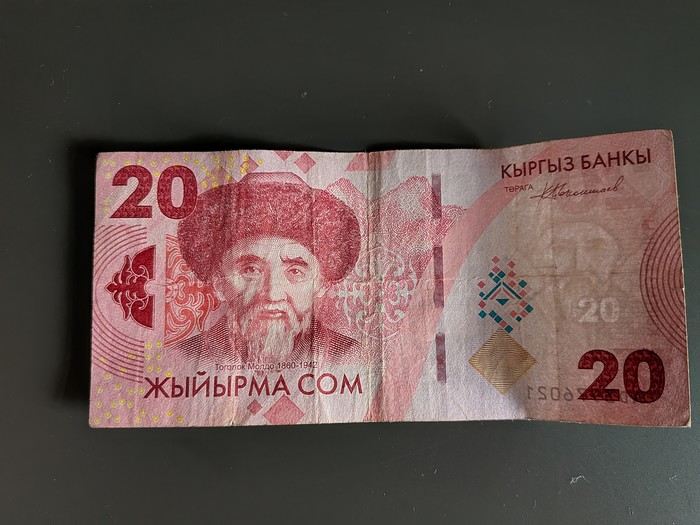
Bills come in 5000, 1000, 500, 200, 100, 50, and 20 soms.
Coins: 10, 5, 3, and 1 som.
- Paying
Card payments are accepted in supermarkets like Globus, some restaurants, gas stations of major chains (Bishkek Petroleum, Partner Neft, Red Petroleum), some hotels, national park entrances, tolls, etc.
But it doesn’t always work.
So always carry cash with you!
If the card works, great—otherwise, it’s back to the old days of wads of bills.
- Cost of Living
It’s really cheap (gas, affordable restaurants even at a decent standard, hotels, souvenirs, fruits, vegetables, water, bread...). For example, a lagman costs only 3.20 €, fixing a flat tire is 3.5 €, a full hour-long wash for a filthy 4x4 is 6 €, washing a big bag of laundry is 3 €, and a liter of 95-octane gas is 0.86 €...
On the pricier side: guesthouses and meals in guesthouses. The value for money is poor. I paid 40 € for a mediocre room with a very basic shared bathroom, while a double with AC, private bathroom, and fridge in a non-touristy hotel cost 20 €... Meals in guesthouses are the worst I’ve eaten and often the most expensive. Plus, they’re very light—don’t expect to fill up after a long day of hiking!
Car rentals are also quite expensive (70 $ per day for a RAV4 in my case).
In short, for two people, excluding accommodation and car rental, we spent an average of 45 € per day (groceries, restaurants, guesthouse dinners, souvenirs, paid activities, gas).
The trip cost us 2200 € per person all-inclusive for 3 weeks on the ground. Roughly 1/4 for the flight, 1/4 for the car, 1/4 for accommodation, and 1/4 for everything else.
- Getting Around
I’ve met cyclists, motorcyclists, people renting cars, those who drove their own vehicles from Europe, and others using public transport and taxis.
Personally, I chose to rent a car.
If you’re not planning long hikes or multi-day horse treks, it’s a great option for exploring the country.
Each car rental company has its own list of forbidden tracks. Make sure your planned route is allowed! Don’t think about ignoring this—vehicles are equipped with GPS trackers...
An international driver’s permit is required.
Police and speed cameras are everywhere, so it’s best to respect the signs (daytime running lights, seatbelts, 40-60 km/h in populated areas, 90 km/h on roads, zero tolerance for alcohol).
Locals have a unique driving style, and it can be dangerous on main roads (they overtake recklessly...). Like in Greece, South Africa, or Malta, a two-lane road is treated as a three-lane one. You pull over to let others pass or to let oncoming traffic overtake.
Without a car (at least a pseudo-4x4), you won’t be able to go everywhere. This country is a nature destination, but nature isn’t always accessible by public transport.
If a spot is near a road, great—the bus will get you almost to the door. Otherwise, you’ll need to hire an agency or take a taxi.
Cyclists will face steep climbs and dust. I’d advise avoiding main roads as much as possible—traffic isn’t on your side...
Motorcyclists will also eat a lot of dust and should research gas stations along their route (this advice also applies to vehicles running on 95-octane).
There’s a 95-octane pump in Kazarman and Gulcha.
Bikes and motorcycles have an advantage over cars, even 4x4s, as they can access some very remote tracks that other vehicles can’t (hikers and horses can obviously take them too!).
Be careful: some areas require a permit (border zones). Research this well in advance—the formalities don’t take an hour or even a day!
Be warned: Google Maps is completely unreliable (it shows roads that don’t exist, routes you through difficult tracks instead of paved roads, etc.). It’s essential to download Maps.me in advance. This app is much more reliable for this country, works offline, and is handy for hiking navigation.
A reminder: horseback riding is like cycling... If you’re not used to it or naturally padded in the right places, your backside will suffer in no time!
Think carefully before embarking on a multi-day trek!
Finally, this country is a kingdom of construction... The Chinese have taken over the market to improve truck circulation and are paving everywhere. (Good news: the Kazarman-Osh section via the tunnel is finally open in summer, even if the road isn’t quite finished.)
- Eating
I had prejudices about Kyrgyz food.
I was both wrong and right.
Supermarkets don’t offer much that’s appealing for picnics. It’s cheap, filling food, full of junk, and not gourmet. If you follow Yuka, I think you’ll be on a diet the whole trip. Bringing some pâté, sausages, or freeze-dried meals for certain nights is a good idea...
Guesthouse dinners consist of the eternal cucumber-tomato salad, a soup, and a light noodle or rice dish where you’ll be searching for the meat... Usually tough and unidentifiable. Beef? The bread is stale, and there’s no dessert or fruit.
Breakfasts always revolve around eggs or porridge... The homemade jam is usually good.
Tea is the number one drink, followed by kompot (a fruit-based drink), Coke, and Fanta.
If you want real coffee, bring your own—it’s very rare.
On the other hand, you eat well in restaurants. Lagman (homemade noodles, vegetables, spices, and usually beef), crispy eggplant, kuurdak (a kind of lamb stew with potatoes), kebabs, plov (pilaf rice with onions, carrots, and meat), and rainbow trout... For dessert? Nada!
And alcohol?
It’s available in all Globus stores: beer, wine, spirits, and you can consume your purchases in some guesthouses (depending on the owner’s religious tolerance). It’s also available in some restaurants (Bishkek, Karakol, Osh...).
The deadly specialty?
White fermented milk balls called kurut. If you think a raw-milk camembert is strong, steer clear! This is more like an old, dry, spicy goat cheese.
- Accommodation
In remote areas, it’s better to check availability on Booking a few days in advance rather than showing up last minute with high hopes.
Booking and Airbnb only offer a small portion of what’s available.
Not necessarily guesthouses, but mostly accommodations aimed at locals (business or leisure travel).
These places are generally more comfortable. There’s even some upscale options.
So it’s necessary to scour Google Maps or Yandex Maps... These accommodations are usually found on Instagram, and WhatsApp is handy for booking!
Prices are a bit of a lottery. So is the comfort. From 20 to 80 € for a double, usually with a private bathroom. (Average around 40 €). These rates are for mid-range options.
Otherwise, this country is a paradise for wild camping. In a camper van, rooftop tent, or ground tent... There are beautiful spots everywhere!
- Climate
I thought it would be quite cool/cold at altitude.
I packed too many warm clothes...
If you’re not doing high-altitude treks or sleeping in a tent, there’s no need to overload yourself with winter gear.
A good fleece, a windproof rain jacket, and technical base layers will be enough.
It only got really cold in the evenings at Song Kul Lake and Tash Rabat, and the yurts are equipped with thick blankets and a stove.
Elsewhere, temperatures ranged from 15 to 30 °C.
In short, I used the AC more than the heater! (It’s hard to drive with the windows open unless you want to be covered in dust in no time...)
- Communication
I bought an eSIM before the trip with a data plan for Kyrgyzstan (Beeline network). Perfect for communicating via WhatsApp right after landing, but this network isn’t the best in Kyrgyzstan.
We then got a physical SIM card with an unlimited one-month plan (less than 4 € including the SIM) at a Mega store downtown. This network is much better, and you get coverage in all cities and most villages. Usually in the mountain passes too.
To make yourself understood, it’s essential to download Google Translate with French, Kyrgyz, Russian, and English options.
Very useful for translating menus, signs, and communicating with locals.
Hosts and other tourism professionals will even pull out their phones to communicate with non-Russian speakers.
The police too...
- Religion
There’s a noticeable difference between the north and the southwest of the country.
In the north, it’s a bit like Albania. People are Muslim by culture but not really by religion.
In the southwest, radical Islam is growing. Mosques are more numerous and imposing. Men are more bearded, women more veiled.
For travelers, religion isn’t an issue except for the near-total absence of pork.
There’s Russian sausage, but reading the ingredient list, it’s more like a one-way ticket to cancer than an Auvergne dry sausage...
You can find the detailed account of the trip here.
- Which airline from Europe?
Turkish Airlines seems like an excellent option. The price is very reasonable (just over 500 €), the layover isn’t too long, the in-flight comfort is decent (great movie selection), and the planes are modern. Plus, the price automatically includes 30 kilos of luggage, which is perfect for campers.
The downside: the outrageous prices at Istanbul Airport.
- Bishkek Airport
The airport is under full reconstruction. It’s chaotic. There are SIM card vendors upon arrival, but no currency exchange or ATMs in the baggage claim area. You’ll find those in the departures section, which means you have to exit and re-enter under the current setup.
Personally, I pre-booked a VTC with my hotel for the transfer to the city. (Prices vary depending on the hotel’s standard—1200 soms for mine.)
There are taxis and a bus available.
- Entry Requirements
No visa is required for French citizens for stays of up to 30 days.
- Currency
The currency is the som, and the conversion is easy—just divide by 100...
You can get soms by exchanging euros (dollars are useless) or by withdrawing from an ATM. Some ATMs charge fees. Those from Mbank and Optimabank are fee-free.
The maximum withdrawal is usually 20,000 soms.
Bills come in 5000, 1000, 500, 200, 100, 50, and 20 soms.
Coins: 10, 5, 3, and 1 som.
- Paying
Card payments are accepted in supermarkets like Globus, some restaurants, gas stations of major chains (Bishkek Petroleum, Partner Neft, Red Petroleum), some hotels, national park entrances, tolls, etc.
But it doesn’t always work.
So always carry cash with you!
If the card works, great—otherwise, it’s back to the old days of wads of bills.
- Cost of Living
It’s really cheap (gas, affordable restaurants even at a decent standard, hotels, souvenirs, fruits, vegetables, water, bread...). For example, a lagman costs only 3.20 €, fixing a flat tire is 3.5 €, a full hour-long wash for a filthy 4x4 is 6 €, washing a big bag of laundry is 3 €, and a liter of 95-octane gas is 0.86 €...
On the pricier side: guesthouses and meals in guesthouses. The value for money is poor. I paid 40 € for a mediocre room with a very basic shared bathroom, while a double with AC, private bathroom, and fridge in a non-touristy hotel cost 20 €... Meals in guesthouses are the worst I’ve eaten and often the most expensive. Plus, they’re very light—don’t expect to fill up after a long day of hiking!
Car rentals are also quite expensive (70 $ per day for a RAV4 in my case).
In short, for two people, excluding accommodation and car rental, we spent an average of 45 € per day (groceries, restaurants, guesthouse dinners, souvenirs, paid activities, gas).
The trip cost us 2200 € per person all-inclusive for 3 weeks on the ground. Roughly 1/4 for the flight, 1/4 for the car, 1/4 for accommodation, and 1/4 for everything else.
- Getting Around
I’ve met cyclists, motorcyclists, people renting cars, those who drove their own vehicles from Europe, and others using public transport and taxis.
Personally, I chose to rent a car.
If you’re not planning long hikes or multi-day horse treks, it’s a great option for exploring the country.
Each car rental company has its own list of forbidden tracks. Make sure your planned route is allowed! Don’t think about ignoring this—vehicles are equipped with GPS trackers...
An international driver’s permit is required.
Police and speed cameras are everywhere, so it’s best to respect the signs (daytime running lights, seatbelts, 40-60 km/h in populated areas, 90 km/h on roads, zero tolerance for alcohol).
Locals have a unique driving style, and it can be dangerous on main roads (they overtake recklessly...). Like in Greece, South Africa, or Malta, a two-lane road is treated as a three-lane one. You pull over to let others pass or to let oncoming traffic overtake.
Without a car (at least a pseudo-4x4), you won’t be able to go everywhere. This country is a nature destination, but nature isn’t always accessible by public transport.
If a spot is near a road, great—the bus will get you almost to the door. Otherwise, you’ll need to hire an agency or take a taxi.
Cyclists will face steep climbs and dust. I’d advise avoiding main roads as much as possible—traffic isn’t on your side...
Motorcyclists will also eat a lot of dust and should research gas stations along their route (this advice also applies to vehicles running on 95-octane).
There’s a 95-octane pump in Kazarman and Gulcha.
Bikes and motorcycles have an advantage over cars, even 4x4s, as they can access some very remote tracks that other vehicles can’t (hikers and horses can obviously take them too!).
Be careful: some areas require a permit (border zones). Research this well in advance—the formalities don’t take an hour or even a day!
Be warned: Google Maps is completely unreliable (it shows roads that don’t exist, routes you through difficult tracks instead of paved roads, etc.). It’s essential to download Maps.me in advance. This app is much more reliable for this country, works offline, and is handy for hiking navigation.
A reminder: horseback riding is like cycling... If you’re not used to it or naturally padded in the right places, your backside will suffer in no time!
Think carefully before embarking on a multi-day trek!
Finally, this country is a kingdom of construction... The Chinese have taken over the market to improve truck circulation and are paving everywhere. (Good news: the Kazarman-Osh section via the tunnel is finally open in summer, even if the road isn’t quite finished.)
- Eating
I had prejudices about Kyrgyz food.
I was both wrong and right.
Supermarkets don’t offer much that’s appealing for picnics. It’s cheap, filling food, full of junk, and not gourmet. If you follow Yuka, I think you’ll be on a diet the whole trip. Bringing some pâté, sausages, or freeze-dried meals for certain nights is a good idea...
Guesthouse dinners consist of the eternal cucumber-tomato salad, a soup, and a light noodle or rice dish where you’ll be searching for the meat... Usually tough and unidentifiable. Beef? The bread is stale, and there’s no dessert or fruit.
Breakfasts always revolve around eggs or porridge... The homemade jam is usually good.
Tea is the number one drink, followed by kompot (a fruit-based drink), Coke, and Fanta.
If you want real coffee, bring your own—it’s very rare.
On the other hand, you eat well in restaurants. Lagman (homemade noodles, vegetables, spices, and usually beef), crispy eggplant, kuurdak (a kind of lamb stew with potatoes), kebabs, plov (pilaf rice with onions, carrots, and meat), and rainbow trout... For dessert? Nada!
And alcohol?
It’s available in all Globus stores: beer, wine, spirits, and you can consume your purchases in some guesthouses (depending on the owner’s religious tolerance). It’s also available in some restaurants (Bishkek, Karakol, Osh...).
The deadly specialty?
White fermented milk balls called kurut. If you think a raw-milk camembert is strong, steer clear! This is more like an old, dry, spicy goat cheese.
- Accommodation
In remote areas, it’s better to check availability on Booking a few days in advance rather than showing up last minute with high hopes.
Booking and Airbnb only offer a small portion of what’s available.
Not necessarily guesthouses, but mostly accommodations aimed at locals (business or leisure travel).
These places are generally more comfortable. There’s even some upscale options.
So it’s necessary to scour Google Maps or Yandex Maps... These accommodations are usually found on Instagram, and WhatsApp is handy for booking!
Prices are a bit of a lottery. So is the comfort. From 20 to 80 € for a double, usually with a private bathroom. (Average around 40 €). These rates are for mid-range options.
Otherwise, this country is a paradise for wild camping. In a camper van, rooftop tent, or ground tent... There are beautiful spots everywhere!
- Climate
I thought it would be quite cool/cold at altitude.
I packed too many warm clothes...
If you’re not doing high-altitude treks or sleeping in a tent, there’s no need to overload yourself with winter gear.
A good fleece, a windproof rain jacket, and technical base layers will be enough.
It only got really cold in the evenings at Song Kul Lake and Tash Rabat, and the yurts are equipped with thick blankets and a stove.
Elsewhere, temperatures ranged from 15 to 30 °C.
In short, I used the AC more than the heater! (It’s hard to drive with the windows open unless you want to be covered in dust in no time...)
- Communication
I bought an eSIM before the trip with a data plan for Kyrgyzstan (Beeline network). Perfect for communicating via WhatsApp right after landing, but this network isn’t the best in Kyrgyzstan.
We then got a physical SIM card with an unlimited one-month plan (less than 4 € including the SIM) at a Mega store downtown. This network is much better, and you get coverage in all cities and most villages. Usually in the mountain passes too.
To make yourself understood, it’s essential to download Google Translate with French, Kyrgyz, Russian, and English options.
Very useful for translating menus, signs, and communicating with locals.
Hosts and other tourism professionals will even pull out their phones to communicate with non-Russian speakers.
The police too...
- Religion
There’s a noticeable difference between the north and the southwest of the country.
In the north, it’s a bit like Albania. People are Muslim by culture but not really by religion.
In the southwest, radical Islam is growing. Mosques are more numerous and imposing. Men are more bearded, women more veiled.
For travelers, religion isn’t an issue except for the near-total absence of pork.
There’s Russian sausage, but reading the ingredient list, it’s more like a one-way ticket to cancer than an Auvergne dry sausage...
You can find the detailed account of the trip here.
Trajet entre Chine et Kazakhstan en train ou bus?
Bonjour
Je vais voyager en Asie. Avec bus et train, pas d'avion, non merci🙂
J'ai vu qu'il y avait une ligne entre Chine et Kazakhstan sur http://www.toutcelanest.net/autres/chine/fichiers/chinarail.jpg. Je voudrais simplement avoir quelques infos, en particulier sur le prix, confort et visa à la frontière.😉
De plus, ce serait super si vous aviez des infos sur le réseau ferré au KZstan : permet-il de traverser le pays d'est en ouest? En combien de temps? Pour quel prix? En venant de Chine, comment se passe pour traverser le KZstan?
Je vous remercie vraiment de prendr ele tems de me répondre😊
Ben
Je vais voyager en Asie. Avec bus et train, pas d'avion, non merci🙂
J'ai vu qu'il y avait une ligne entre Chine et Kazakhstan sur http://www.toutcelanest.net/autres/chine/fichiers/chinarail.jpg. Je voudrais simplement avoir quelques infos, en particulier sur le prix, confort et visa à la frontière.😉
De plus, ce serait super si vous aviez des infos sur le réseau ferré au KZstan : permet-il de traverser le pays d'est en ouest? En combien de temps? Pour quel prix? En venant de Chine, comment se passe pour traverser le KZstan?
Je vous remercie vraiment de prendr ele tems de me répondre😊
Ben
Informations sur l'auto-stop en Asie et en Russie?
Salut a tous et toutes les voyageuses,
Je suis en Nouvelle-Zelande et j'ai pour projet d'aller a Singapoure et de rentrer en Europe en stop en traversant l'Asie et la Russie. Des personnes peuvent-elles me donner des informations sur l'auto-stop dans ces pays? Est-ce securisant pour une femme seule ?
Merci pour vos reponses !
Je suis en Nouvelle-Zelande et j'ai pour projet d'aller a Singapoure et de rentrer en Europe en stop en traversant l'Asie et la Russie. Des personnes peuvent-elles me donner des informations sur l'auto-stop dans ces pays? Est-ce securisant pour une femme seule ?
Merci pour vos reponses !
Rejoindre la Mongolie depuis l'Asie du Sud-Est?
Bonjour a tous,
est ce que quelqu'un a fait le trajet asie du sud est-mongolie? Quels sont les moyens de transports possibles, et dans quel ordre de prix??
merci d'avance
Single Russia-Belarus visa and new train routes
Since last year, the unification of the Russian visa with Belarus has been in effect.
For reference, EU citizens haven’t needed a visa for Belarus for two years. However, it wasn’t possible to travel to Russia. Only Belarusian and Russian citizens could move freely within the union.
With the unified system, if you enter one of the two countries with a visa from either, you can now travel between them freely.
In the case of a Russian visa, it must be a paper visa glued into your passport—not an electronic visa.
This opens up the possibility of traveling to Russia from Lithuania via Minsk, for example, starting from Vilnius.
It also allows for travel circuits that would otherwise be difficult, despite the proximity of the cities.
So, I’m leaving on June 12th for Vilnius. A one-hour flight for around thirty euros with a carry-on bag, and from Vilnius Airport, there’s a bus to Minsk. My planned route for now is Vilnius-Minsk-Smolensk-Vitebsk-Polotsk-Pskov-Riga.
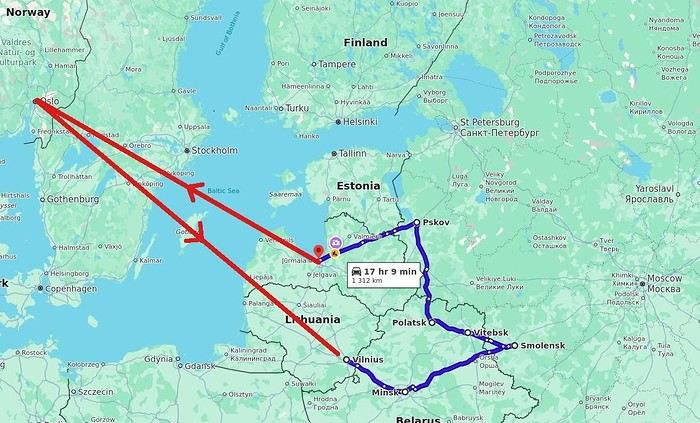
This crosses the Belarus-Russia border three times: from Minsk to Smolensk, then from Smolensk to Vitebsk, and finally from Polotsk to Pskov.
The region of this itinerary was, a thousand years ago, essentially that of the Krivichs, a local Slavic political entity. The term comes from "blood," *krew* in Polish, *krov* in Russian—basically "blood brothers." In Latvian, the word for Russians is *krievu*, by the way. Historically, the region corresponds to some of the old Russian principalities. Later, what marks Belarusian regions in general is, after the Great Schism of 1054, the division between Catholic and Orthodox zones, particularly as the Polish-Lithuanian Commonwealth expanded and contracted. In architecture, this corresponds to variations in Baroque styles, for example.
Vitebsk is known in France as the birthplace of Chagall. Born Russian, he first trained at the art school in Vitebsk, which was also attended by Malevich and Lissitzky, before completing his studies in Saint Petersburg, then moving to Berlin and later Paris. In Paris, Chagall met Cendrars, who had spent three years in Russia before and spoke enough Russian to help the newcomer get by a bit.
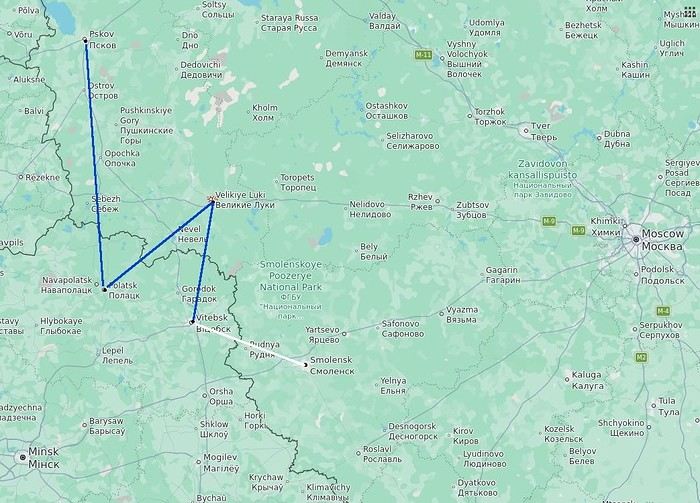
Back to the practical travel aspects: a local Pskov newspaper mentions that the Russian and Belarusian governments have a project for a Pskov-Polotsk train line. Previously, there were also plans for lines between Veliky Luki and Vitebsk, and Polotsk. A recently launched railway is Smolensk-Vitebsk, shown in white on the map, with projected lines in blue. https://pln-pskov.ru/society/583817.html https://pln-pskov.ru/society/578335.html
These will likely be "Hirondelle"—that is, *Lastochka*—the fast, spacious regional trains in Russia. Currently, all of this is done by bus, so the train is a very appealing and comfortable option. We’ll see how it goes.
With the unified system, if you enter one of the two countries with a visa from either, you can now travel between them freely.
In the case of a Russian visa, it must be a paper visa glued into your passport—not an electronic visa.
This opens up the possibility of traveling to Russia from Lithuania via Minsk, for example, starting from Vilnius.
It also allows for travel circuits that would otherwise be difficult, despite the proximity of the cities.
So, I’m leaving on June 12th for Vilnius. A one-hour flight for around thirty euros with a carry-on bag, and from Vilnius Airport, there’s a bus to Minsk. My planned route for now is Vilnius-Minsk-Smolensk-Vitebsk-Polotsk-Pskov-Riga.
This crosses the Belarus-Russia border three times: from Minsk to Smolensk, then from Smolensk to Vitebsk, and finally from Polotsk to Pskov.
The region of this itinerary was, a thousand years ago, essentially that of the Krivichs, a local Slavic political entity. The term comes from "blood," *krew* in Polish, *krov* in Russian—basically "blood brothers." In Latvian, the word for Russians is *krievu*, by the way. Historically, the region corresponds to some of the old Russian principalities. Later, what marks Belarusian regions in general is, after the Great Schism of 1054, the division between Catholic and Orthodox zones, particularly as the Polish-Lithuanian Commonwealth expanded and contracted. In architecture, this corresponds to variations in Baroque styles, for example.
Vitebsk is known in France as the birthplace of Chagall. Born Russian, he first trained at the art school in Vitebsk, which was also attended by Malevich and Lissitzky, before completing his studies in Saint Petersburg, then moving to Berlin and later Paris. In Paris, Chagall met Cendrars, who had spent three years in Russia before and spoke enough Russian to help the newcomer get by a bit.
Back to the practical travel aspects: a local Pskov newspaper mentions that the Russian and Belarusian governments have a project for a Pskov-Polotsk train line. Previously, there were also plans for lines between Veliky Luki and Vitebsk, and Polotsk. A recently launched railway is Smolensk-Vitebsk, shown in white on the map, with projected lines in blue. https://pln-pskov.ru/society/583817.html https://pln-pskov.ru/society/578335.html
These will likely be "Hirondelle"—that is, *Lastochka*—the fast, spacious regional trains in Russia. Currently, all of this is done by bus, so the train is a very appealing and comfortable option. We’ll see how it goes.
Review of my trip to Mongolia with guide Hacha
Hi everyone!
I wanted to share my experience from the trip I had this summer in Mongolia, in case it helps anyone get their bearings—I also relied a lot on forums myself.
We went as a couple with a French-speaking guide, Hacha, for a 17-day trek through the steppes and the Gobi Desert.
The experience was amazing—the landscapes are truly diverse and stunning. We started with a quick visit to Ulaanbaatar, then headed into the steppes for half the trip, including the Orkhon Valley, before moving on to the desert, which isn’t just sand but has incredibly varied scenery.
We traveled with Hacha, who has been a guide for 27 years and knows Mongolia inside out. She was accompanied by her daughter (with our consent). Hacha teaches French the rest of the year and speaks it perfectly. Her kindness and humor were much appreciated, and she’s become a friend. She prepared delicious homemade meals throughout the trip, adapted to European tastes since she’s used to it. We also had a driver who was really friendly and professional.
I injured myself on the way there with a sprained ankle, and Hacha immediately adjusted the pace and some activities to accommodate my injury, as well as booking more comfortable lodgings for the first few nights. She didn’t tell us it cost her extra, and we only found out later—we chose to pay a supplement, but she never asked for anything. Hacha was very fair with money, and her rates seem a bit lower than what we’d found elsewhere. She also tailors the program to the budget we gave her, and we had the option to adjust accommodations to fit our budget.
As for lodging, we stayed in tourist yurt camps (more comfortable with restaurants, showers, etc.), guest yurts, nights with nomadic families, and a few nights in tents. Our most memorable experience was two nights with nomads who welcomed us warmly, even though it was only the second time they’d hosted tourists. They shared their traditions with us, and the location was beautiful—right by a lake.
Hacha also adapted to our last-minute requests. For example, I mentioned wanting to see a shaman, which was tricky since it wasn’t planned in advance (my fault for not bringing it up earlier), but she used her contacts to see if there was a possibility. Unfortunately, no shamans were available, but we spontaneously stopped by the family of a young shaman during one of our trips. She wasn’t there, but we got to hear her parents’ stories and ask questions about the rituals to become a shaman and their experiences. It was a rare and unique moment I won’t forget!
We’ll definitely return to Mongolia as a family to explore less touristy regions (though we weren’t really bothered by tourism), as Hacha offers other off-the-beaten-path itineraries, including one that visits a turquoise lake surrounded by sand dunes—which sounds incredible, according to her.
I highly recommend Mongolia to anyone looking for an authentic trip that pushes you slightly out of your comfort zone while still feeling safe and enjoying breathtakingly diverse landscapes. And I 100% recommend Hacha—she created a personalized trip based on our requests and adapted to our needs and wishes on the spot!
I wanted to share my experience from the trip I had this summer in Mongolia, in case it helps anyone get their bearings—I also relied a lot on forums myself.
We went as a couple with a French-speaking guide, Hacha, for a 17-day trek through the steppes and the Gobi Desert.
The experience was amazing—the landscapes are truly diverse and stunning. We started with a quick visit to Ulaanbaatar, then headed into the steppes for half the trip, including the Orkhon Valley, before moving on to the desert, which isn’t just sand but has incredibly varied scenery.
We traveled with Hacha, who has been a guide for 27 years and knows Mongolia inside out. She was accompanied by her daughter (with our consent). Hacha teaches French the rest of the year and speaks it perfectly. Her kindness and humor were much appreciated, and she’s become a friend. She prepared delicious homemade meals throughout the trip, adapted to European tastes since she’s used to it. We also had a driver who was really friendly and professional.
I injured myself on the way there with a sprained ankle, and Hacha immediately adjusted the pace and some activities to accommodate my injury, as well as booking more comfortable lodgings for the first few nights. She didn’t tell us it cost her extra, and we only found out later—we chose to pay a supplement, but she never asked for anything. Hacha was very fair with money, and her rates seem a bit lower than what we’d found elsewhere. She also tailors the program to the budget we gave her, and we had the option to adjust accommodations to fit our budget.
As for lodging, we stayed in tourist yurt camps (more comfortable with restaurants, showers, etc.), guest yurts, nights with nomadic families, and a few nights in tents. Our most memorable experience was two nights with nomads who welcomed us warmly, even though it was only the second time they’d hosted tourists. They shared their traditions with us, and the location was beautiful—right by a lake.
Hacha also adapted to our last-minute requests. For example, I mentioned wanting to see a shaman, which was tricky since it wasn’t planned in advance (my fault for not bringing it up earlier), but she used her contacts to see if there was a possibility. Unfortunately, no shamans were available, but we spontaneously stopped by the family of a young shaman during one of our trips. She wasn’t there, but we got to hear her parents’ stories and ask questions about the rituals to become a shaman and their experiences. It was a rare and unique moment I won’t forget!
We’ll definitely return to Mongolia as a family to explore less touristy regions (though we weren’t really bothered by tourism), as Hacha offers other off-the-beaten-path itineraries, including one that visits a turquoise lake surrounded by sand dunes—which sounds incredible, according to her.
I highly recommend Mongolia to anyone looking for an authentic trip that pushes you slightly out of your comfort zone while still feeling safe and enjoying breathtakingly diverse landscapes. And I 100% recommend Hacha—she created a personalized trip based on our requests and adapted to our needs and wishes on the spot!
Crossing the border between Kazakhstan and Kyrgyzstan
Hi there,
I’m planning to visit Kazakhstan and Kyrgyzstan in early June, assuming the war doesn’t spread ??? Could anyone give me some info about the eastern border after visiting Charyn Canyon? First, is it possible to head east using public transport, or should I book a tour from Almaty and stay in the east to continue on to Kyrgyzstan toward Karakol? (I mean, not return to Almaty with the tour.) It’s a bit of a vague question, but those who’ve been there will know what I’m talking about;
Thanks!
Patrice
I’m planning to visit Kazakhstan and Kyrgyzstan in early June, assuming the war doesn’t spread ??? Could anyone give me some info about the eastern border after visiting Charyn Canyon? First, is it possible to head east using public transport, or should I book a tour from Almaty and stay in the east to continue on to Kyrgyzstan toward Karakol? (I mean, not return to Almaty with the tour.) It’s a bit of a vague question, but those who’ve been there will know what I’m talking about;
Thanks!
Patrice
Korgaljyn (Kazakhstan): guided tour for bird photography
Hi there,
I’d like to spend 2–3 days in the Korgaljyn area in May to photograph flamingos and other birds.
I’ll be in Astana and I’m looking for a tour that includes accommodation so I can stay for 2 days.
I’ve found the buses from Astana and info about the park’s facilities, but no accommodation or guided outings.
Has anyone done this?
Thanks for your help