Results for "parc+ou+nature+ou+paysage+|+127"
63743 results found.
Visite de Rio de Janeiro English translation pending
Salut !!!
je pars au brésil dans à peine 2 mois, j'ai deja prevu beaucoup de choses mais je suis en train de me poser la question de savoir combien de jours je dois rester à Rio pour voir le principal ??? et qu'y a t il de principal justement à voir ??? de plus je vais sans doute passer une nuit blanche à rio pendant le carnaval, savez vous combien peut couter une telle nuit au sambodrome ???
merci de vos reponses
Até logo Anthony
je pars au brésil dans à peine 2 mois, j'ai deja prevu beaucoup de choses mais je suis en train de me poser la question de savoir combien de jours je dois rester à Rio pour voir le principal ??? et qu'y a t il de principal justement à voir ??? de plus je vais sans doute passer une nuit blanche à rio pendant le carnaval, savez vous combien peut couter une telle nuit au sambodrome ???
merci de vos reponses
Até logo Anthony
Croatie, vos commentaires? English translation pending
Cette année, la Croatie est la destination à la mode. Tarif attractif, ouverture des frontières...
Est-que quelqu'un en a fait l'expérience ? Je serai curieux de lire vos témoignages.
Conseils sur notre parcours dans l'ouest des Etats-Unis English translation pending
Bonjour à tous...j'ai besoin d'aide pour préparer un voyage que nous allons faire pendant l'été 2005 dans l'ouest américain. Selon vos expériences, quelle durée nous conseillez vous pour visiter Capitol Reef, Arches et Canyonlands? Est-ce qu'il y a des choses intéressantes à faire entre Capitol Reef et Yellowstone? Combien de temps minimum à Yellowstone? Bref, toutes vos idées et expériences de cette partie des Etats-Unis (Cody, Devil's Tower, Custer, Fort Laramie, Estes Park...) sont les bienvenues ! 😉
Les Philippines, pour changer English translation pending
Dimanche 19/10/2003
Ouf, nous sommes enfin dans le 747 qui va nous amener à Manille. L'avion est plein comme un œuf. A Roissy, on nous a dit qu'il était surbooké de 73 places. Du coup, nous ne regrettons plus d'être arrivés un peu trop en avance. Nous avions prévu plus de temps que d'habitude à cause des factures de médicaments à faire viser par la Douane. En fait, l'opération a pris 5 mn. Aucun contrôle, il fallait seulement le double des factures que j'avais eu la bonne idée d'apporter.
Ensuite 55 mn de vol dans un B737 où nous étions bien serrés pour arriver à Francfort. Une heure plus tard, nous embarquons dans le 747, en premier SVP, grâce au jeune âge de Marc. Plus tard, nous regretterons le temps où voyager avec des enfants nous donnait des petits privilèges.
Lundi 20/10 22H
Manille, grande chambre d'hôtel impersonnelle, deux lits d'une personne seulement, mais deux grandes pièces et une banquette pour 1800P (les chambres à 1500P étant soi-disant toutes prises), et il y a une piscine. Pour la conversion des pesos en euros, ce n'est pas évident : 1€=63P, mais en francs, c'est très simple puisque 10P=1F. On va se retrouver à penser en francs alors que je fais la guerre à la maison pour qu'on n'en parle plus.
Nous devrions dormir car demain, nous nous levons à 6h pour prendre l'avion à 8h, mais pour notre horloge interne, il n'est que 16h. De plus, on se croirait à New-York à cause des incessants hurlements des sirènes que nous entendons depuis l'arrivée à l'hôtel. Eric a remarqué en descendant à la piscine un énorme incendie à 300m environ. D'où les sirènes. On dirait que tous les pompiers de Manille (12 millions d'habitants) convergent vers notre chambre. Pour dîner, nous sommes allés dans les rues adjacentes à l'hôtel et nous avons fini par manger dans la rue une soupe avec une assiette de riz et porc adobo, 190P pour nous 4. La sauce adobo est LA sauce philippine : sauce brune au soja, vinaigre et sucre. Nous voilà très vite dans le bain. Pas vu de blanc depuis notre arrivée à l'hôtel. Les sirènes continuent, le sommeil risque d'être léger. Vivement demain, Puerto Princesa devrait être beaucoup plus calme.
Mardi 21/10 le soir
Fin de la première journée, souvent la plus délicate dans ce genre de voyage. L'incendie d'hier était un très gros sinistre, c'est une gare de bus qui a brûlé, le feu s'étendant ensuit au bidonville voisin. Curieusement, la municipalité voulait récupérer le terrain du bidonville pour des projets immobiliers, mais les habitants s'y opposaient. Plus maintenant.
Pour arriver à Palawan, tout s'est passé comme prévu, après une nuit où personne n'a bien dormi sauf … moi. Incroyable. Une heure d'avion et nous voilà dans le petit aéroport provincial de Puerto. Nous récupérons les bagages et sortons.
Nous repérons immédiatement Lucie. Apparence sans surprise : femme brune, alerte, cheveux courts, lunettes, pas de maquillage. Pourrait interpréter une infirmière dans un téléfilm. Premier contact chaleureux. Elle est venue avec un couple d'amis philippins et leur véhicule, sorte de mini-songthaew (pour ceux qui connaissent la Thaïlande) bien pourri appelé ici multicab. Ouf, c'en est fini des 40 kg de médicaments et de vêtements que nous avons apportés pour le dispensaire.
10 mn plus tard, nous voilà à la pension où habite Lucie quand elle descend à Puerto. Le temps de poser les bagages et nous nous asseyons à l'extérieur avec Lucie. Nous avons bien sûr beaucoup à nous dire. Nous ne nous connaissons que par internet, il y a donc beaucoup de curiosité réciproque.
Comme nous l'avions deviné, son assoc se résume à 2 membres actifs, Lucie et Bernard, son ex-compagnon qui s'occupe de l'intendance en France. Le projet de dispensaire est un projet personnel de Lucie qu'elle mijote depuis une vingtaine d'années. Elle a attendu que ses 3 enfants (20, 23 et 25 ans maintenant) soient autonomes pour se lancer. Elle a beaucoup voyagé en Asie, avec en arrière-pensée le choix du pays où elle installerait son dispensaire. Elle a finalement choisi Palawan, à cause des besoins bien sûr, mais aussi parce que la majorité des habitants se débrouille bien en anglais. Le financement est en grande partie personnel. Le projet de couplage du dispensaire avec l'orphelinat a été abandonné, le directeur français de l'orphelinat étant parti avec la caisse après des rumeurs (fondées semble-t-il) de pédophilie (!). L'établissement est maintenant fermé.
Après quelques heures de papotage, nous allons faire un tour en ville. La pension est située en plein centre. Un bol de nouilles dans un resto viet, pas terribles, rien à voir avec les vietnamiens de l'avenue d'Ivry. Il y a sur Palawan, une minorité viet. A l'époque des boat people, les Philippines ont accueilli sou la pression "amicale" des USA, un contingent de réfugiés. Une partie d'entre eux a été installée sur Palawan où ils se sont assez bien intégrés. Il y a un quartier vietnamien, à la périphérie de Puerto, après l'aéroport.
Un petit tour chez un money changer pour changer quelques euros. Tout ça sans quitter l'avenue Rizal, épine dorsale de la ville qui n'a, de ce qu'on a vu aujourd'hui, aucun charme. Le pays est pauvre et ça se voit. Rizal est saturée de tricycles (prononcer à l'anglaise traillecikeul), sortes de tuk-tuk en plus rustique (si, si, c'est possible) qui créent un nuage de fumée puante nimbant tout le centre ville. Il y en avait 3000 à Puerto, mais le maire a récemment limité le nombre à 2000. C'est LE moyen de transport pour se déplacer en ville. Tarif : 4P/pers si la distance ne dépasse pas 2km ; au-delà, il faut négocier. On peut tenir à 5 dedans dont une personne sur la selle derrière le chauffeur. Ca paraît dingue, mais nous l'avons fait.
Petite sieste, puis nous allons dîner dans un des meilleurs restos de la ville, le Ka Lui, encore sur Rizal. Très belle salle joliment décorée avec parquet de bambou sur lequel nous marchons pieds nus. Pidio, le petit ami philippin de Lucie, nous accompagne. Il parle si doucement que nous avons du mal à le comprendre. Il est à Palawan pour son travail qui consiste à cartographier les zones de forêt vierge de l'île à partir de photos du satellite Spot, puis à vérifier sur place. Il est originaire de Manille. Le repas, constitué de plusieurs plats de poissons et crustacés est délicieux. Nous ne laissons rien. En amuse-gueule, nous avons dégusté des algues appelées ici "latok" et complètement inconnues chez nous. C'est croquant avec des vésicules qui craquent sous la dent et un goût de mer, un peu comme de l'huître. Ne pas confondre latok et lamok (moustique). Excellent repas, Lucie est étonnée de voir les garçons se régaler autant.
Mercredi 22/10, le soir
Hier, grosse nuit pour tout le monde (10 à 12 heures de sommeil selon les cas). Temps toujours menaçant. Un typhon passe près de nous, pas de chance. Déjeuner chez les amis de Lucie qui nous ont accueillis à l'aéroport. Malgré les consignes de Lucie, ils avaient préparé un super repas avec latok, coquillages, poulet adobo, et deux poissons différents servis avec une délicieuse sauce aigre-douce, le tout accompagné d'un légume inconnu (y compris de Lucie) et de riz bien sûr. C'était aussi bon qu'au resto d'hier soir. Accueil chaleureux de toute la famille, frères sœurs, grands-parents, … etc… plus en special guest, un beau-frère soi-disant journaliste pour l'armée et membre des services secrets en réalité. Rond, jovial, gourmand et très sympa, il a déjà rendu pas mal de services à Lucie depuis qu'elle a décidé de s'installer ici. Nous avons été reçus royalement alors que ce sont des gens très pauvres, Leia ne travaillant pas et Jong n'ayant pas de travail fixe. Leurs 2 fils de 8 et 10 ans (c'était l'anniversaire de ce dernier et nous lui avons offert 200P suivant le conseil de Lucie) étaient tétanisés et sont restés cloîtrés dans la petite maison. Il occupent 2 pièces d'une maison à loyer réduit appartenant à leur église, les logements voisins étant occupés par les frères de Jong. Si j'ai bien compris, le père, très malade, était le chef de cette communauté religieuse, avant de passer le relais à un de ses fils.
Avec Lucie, Jong et Leia, nous sommes ensuite allés voir un zoo à la sortie de la ville. Sorte de réserve d'animaux spécifiques de Palawan, nous avons vu des crocodiles de mer et de rivière (les plus gros, jusqu'à 9m), un aigle serpentaire, des aigles pêcheurs, …, et un animal que nous ne connaissions pas, le bearcat, petit plantigrade spécifique de Palawan. Sympa et ça nous sortait un peu. Chance, il n'a pas plu pendant la visite.
Le soir dîner au resto Kinabusch, très bon. Calamars grillés sur plaque de bronze pour les garçons, même chose mais avec du poisson en plus pour AM et soupe aigre aux crevettes, spécialité du coin pour moi. Pidio était avec nous. Il rentre demain à Manille pour 2 semaines de congés. Comme à chaque fois, il ira demain matin tôt au marché pour acheter 20 kg de poisson destiné à sa famille. Le poisson est nettement moins cher ici qu'à Manille. Lucie semble bien amoureuse. Au resto, impossible de tout payer malgré nos efforts, Pidio a même payé plus de la moitié (850P en tout pour nous 6).
Pidio est marié, enfin officiellement. Aux Philippines, le divorce est interdit (toujours l'église catho), ce qui est embêtant quand on veut refaire sa vie. Le couple de Pidio ne marchait plus bien et sa santé non plus. Grosse fatigue et brûlures d'estomac. Pidio va faire des analyses et le médecin lui demande où il prend ses repas. Pidio répond qu'il mange toujours chez lui, le médecin lui conseille alors de manger à l'extérieur pendant quelques temps. Son épouse avait une liaison et, voulant mettre un terme définitif à leur union, avait commencé à l'empoisonner. Pidio est devenu méfiant avec les femmes.
Le soir, nous nous sommes esquivés tôt pour les laisser passer la soirée ensemble. Après le déjeuner, coupure générale d'électricité, il paraît que ça arrive souvent ici. Le courant n'est revenu qu'en fin d'après-midi, juste avant la nuit.
Vendredi 24/10 9h
Sommes dans le bus de Port Barton attendant le départ, il pleut à seaux. Hier, pluie quasi ininterrompue, ça devient pénible. Sommes allés à Luzviminda (LUZon-VIsaias-MINdanao, 3 îles dont sont originaires les habitants du village) pour voir la maison-dispensaire de Lucie. Elle a loué un multicab car celui de Jong est trop pourri pour faire la route. Il y a environ 80 kg de bagages dont les 2 sacs que nous avons apportés. Jong, Leia et leur plus jeune fils nous accompagnent.
Voyage très lent, 1h30 pour faire 35 km. Luziminda est sur la route du sud, et donne sur la baie de Puerto. C'est un village d'agriculteurs et de pêcheurs. Un petit sentier mène à une première grande maison. C'est celle d'un américain qui n'y passe que quelques jours par an. En son absence, son gardien Greg peut en user à sa guise. Greg est le propriétaire du terrain où Lucie a fait construire. Passé cette maison, nous suivons un sentier jusqu'à la maison de Lucie. La maison de Greg et Deborah est un peu plus loin. Située sur une petite colline, la maison de Lucie est fonctionnelle. Une partie habitation de 30 m² avec un séjour-cuisine et 2 petites chambres, plus une salle d'eau attenante (non comptée dans les 30 m² ; une pièce de 20 m² pour le dispensaire. Une terrasse orientée ouest. Confort minimum, mais il y a quand même un frigo, une gazinière, une télé et 2 ensembles de fauteuils et canapés en bambou. Pas d'eau courante pour le moment, une pompe à main en contrebas.
Le site est agréable, on domine la verdure de laquelle émerge le toit de 3 habitations éparpillées. La maison est construite sur une solide base de béton montant jusqu'à 50 cm du sol, puis des panneaux de bambou tressé qu'il faudra revernir régulièrement, de même qu'il faudra traiter souvent toutes les parties en bois contre les termites. Comme trou perdu, c'est réussi. Il y a un sari-sari (épicerie) pas loin et c'est tout. Tout le reste doit être acheté à Puerto.
Nous aurions bien aimé faire une promenade pour découvrir les alentours et descendre jusqu'au port de pêche distant de 5 km, mais il pleut trop. Sommes restés sur la terrasse de 11h à 16h avec Lucie, Greg et Deborah, Jong et Leia, et leur fils qui s'est enfin déridé et qui joue bien avec Marc. Ils ont passé des heures à jouer avec 3 élastiques, ça change des tonnes de jouets dont nos enfants ne se servent pas. Deborah va aider Lucie au dispensaire qui ouvrira dans quelques semaines. Elle a l'air très gentille, mais ne parle pas bien anglais.
De retour à Puerto, je fais un saut au seul hypermarché de l'île, le NCCC qui se trouve tout près de la pension et y achète du rhum et du coca pour prendre l'apéro avec Lucie. A l'entrée du magasin, il y a une pancarte qui demande de déposer ses armes à la consigne. Tout le monde se fait palper avant de pénétrer dans la grande surface. Devant chaque banque, il y a un garde armé d'un fusil à pompe. J'ai demandé à Lucie s'il y avait souvent des braquages, réponse : non. C'est peut-être du folklore.
Après l'apéritif, nous allons dîner au Balinsasayaw, grand et excellent resto qui se trouve dans une rue parallèle à Rizal. Eric et moi partageons un plat de poisson cru mariné au kalamansi (petits agrumes de la forme d'une grosse bille et dont le jus a un goût entre le citron et la clémentine) et bien épicé et de succulents travers de porc.
Pendant le dîner, nous reparlons de ce que nous voulons faire le lendemain. Au début, nous avions prévu d'aller à Sabang pour voir la fameuse rivière souterraine, mais la route passe par un gué et il est tombé tellement d'eau que nous risquons de pas pouvoir passer. Lucie nous parle alors de Narra, un bled à 1h30 de route au sud, où un de ses copains tient un hôtel avec piscine au bord de la plage. Elle lui envoie un SMS pour savoir s'il y a de la place (3 bungalows seulement), auquel cas elle viendrait avec nous. Malheureusement, c'est plein. Nous décidons alors d'aller à Port Barton. C'est un petit village sur une plage de la côte ouest, à 150km au nord de Puerto, soit entre 4 et 12h (!) de jeepney. De là, nous pourrons éventuellement aller à Sabang en banca (bateaux traditionnels à double balancier) ou repartir vers Taytay et El Nido. Nous avons besoin de bouger, rester coincés à Puerto sous la pluie nous plombe le moral, surtout Anne-Marie qui est arrivée fatiguée et qui a mal dormi depuis.
Retour à l'hôtel. Après le coucher des enfants, nous nous retrouvons dehors avec Lucie et Roberto, le proprio de l'hôtel et ami de Lucie. Je ressors le rhum et nous finissons la soirée en rigolant bien, Roberto est très amusant et le rhum philippin n'est pas mauvais du tout, il fait penser au rhum cubain. Précisons que j'ai acheté la qualité supérieure, vieillie en fûts de chêne, à moins de 2 euros la bouteille. Roberto fait partie d'une des grandes familles de Puerto et il nous raconte plein d'histoires.
Revenons à aujourd'hui. Nous sommes donc installés dans le jeepney de Port Barton attendant le départ. Le terminal de bus et le marché ont récemment été déplacés du centre ville vers San Jose, un village à quelques km de Puerto afin de désengorger Puerto. Mais il y a toujours des bus qui partent du centre et qui font un arrêt à San Jose. Ici, rien n'est vraiment certain.
Ce matin, Pete, l'employé de nuit de la pension, très gentil et serviable, est allé vérifier que l'unique bus quotidien pour Port Barton partait bien du centre à 9h et nous a réservé des places. Nous arrivons en tricycle à 8h45. Le chauffeur nous dit qu'il ne partira qu'à 10h. Il pleut à verse et nous n'avons pas vu Lucie ce matin. La reverrons-nous ? Nous n'en savons rien, n'ayant alors aucune idée de notre itinéraire. De plus, il est possible de quitter Palawan par El Nido en avion ou bateau. Les conditions de voyage sont beaucoup plus rudes qu'en Thaïlande. Si le temps ne s'améliore pas rapidement, nous allons vers la galère. A 10h, le chauffeur vient spontanément nous prévenir que nous partirons un peu plus tard car il pleut trop. Pourquoi ?
A 10h30, la pluie est moins forte et nous partons. Nous comprenons tout de suite le problème du chauffeur : il n'y a pas d'essuie-glaces ! D'ailleurs, il n'y a pas de vitres au fenêtres, comme dans tous les jeepneys. Il y a tout de même un pare-brise que le chauffeur soulève en le maintenant ouvert avec un tasseau quand il ne pleut pas trop.
A 11h, nous sommes enfin sur la route, seule route goudronnée de l'île, dénommée sans honte "highway" et correspondant à une départementale en France. Le jeepney roule à bonne allure et à 14h, nous quittons la highway pour la piste de Port Barton. Jusque là, pas de problème, le jeepney s'arrête souvent pour embarquer ou débarquer des passagers et nous avons fait une pause déjeuner de 20 mn.
Maintenant, il s'agit de traverser l'île dans sa largeur (ici 22 km) par une piste de terre. Nous sommes optimistes et pensons qu'une heure suffira. Quelle erreur ! La piste est détrempée, parsemée d'ornières boueuses. Comme l'île est montagneuse, c'est une succession de montées et de descentes assez raides. Le jeepney part plusieurs fois en dérapage. AM et moi sommes assez crispés mais les enfants s'amusent bien. Il faut juste que le passager côté jungle fasse très attention à ne pas prendre de branche d'arbre dans la figure. Après la première fois, on est vigilant.
Une femme nous raconte que, de temps à autre, le jeepney se retrouve coincé ou en panne et que les passagers doivent alors passer la nuit sur place. Elle-même y a eu droit quelques mois auparavant. Entendant cela, AM flippe à l'idée de passer la nuit dans la jungle avec les moustiques, sangsues et autres bestiaux inquiétants. La femme se marre et je me demande si elle n'est pas un peu taquine.
Le chauffeur Toto est un as et connaît la route par cœur. Il faut dire qu'il ne fait que cet itinéraire avec son propre jeepney dénommé "Tiger" et qu'il habite Port Barton. Nous avons droit à tout excepté l'accident et la panne, ce qui est déjà bien. Un pont est endommagé, nous descendons tous et traversons le pont à pied avant d'observer la manœuvre de Toto. Nous nous enlisons 3 fois. La première, les 2 jeunes acolytes du chauffeur et des passagers du bus remplissent les ornières de pierres et nous passons. Les 2 suivantes, le jeepney est bien coincé et se dégage grâce au treuil intégré à l'avant comme sur un 4X4. Une fois, au moment de descendre, un passager empêche Marc de saisir une barre verticale, montrant nonchalamment un ver qui se tortille sur la barre. C'est une sangsue ! Je la prends avec un mouchoir en papier et la jette.
Nous arrivons finalement à bon port (Barton) à 16h30, donc nous avons mis 2h30 pour 22km. Nous nous installons à l'Eldorado, au nord du village. La GH est vide de touristes. Dîner sur place préparé par la patronne Lucy, une veuve philippine d'une cinquantaine d'années, très accueillante. Son mari était un australien né en Norvège dont elle a eu deux enfants, un garçon de 8 ans et une fille de 10. Alors que le garçon fait philippin, la fille, déjà très grande, offre un mélange étonnant, on dirait une scandinave aux yeux bridés et aux cheveux noirs, très jolie.
Très rapidement, Marc joue avec le petit garçon. Souvent, les gens pensent que voyager avec des enfants est un handicap alors que c'est souvent un moyen d'approcher plus vite les locaux.
Espérons que le soleil se montre enfin demain. Port Barton a l'air très sympa et nous n'avons pas vu de touriste, le seul étranger étant Mike qui nous a invité à passer chez lui où il vit avec son jeune compagnon philippin.
Nous voulions venir ici, pour changer des pays un peu trop balisés que sont La Thaïlande, Bali ou la Malaisie, c'est réussi.
Ouf, nous sommes enfin dans le 747 qui va nous amener à Manille. L'avion est plein comme un œuf. A Roissy, on nous a dit qu'il était surbooké de 73 places. Du coup, nous ne regrettons plus d'être arrivés un peu trop en avance. Nous avions prévu plus de temps que d'habitude à cause des factures de médicaments à faire viser par la Douane. En fait, l'opération a pris 5 mn. Aucun contrôle, il fallait seulement le double des factures que j'avais eu la bonne idée d'apporter.
Ensuite 55 mn de vol dans un B737 où nous étions bien serrés pour arriver à Francfort. Une heure plus tard, nous embarquons dans le 747, en premier SVP, grâce au jeune âge de Marc. Plus tard, nous regretterons le temps où voyager avec des enfants nous donnait des petits privilèges.
Lundi 20/10 22H
Manille, grande chambre d'hôtel impersonnelle, deux lits d'une personne seulement, mais deux grandes pièces et une banquette pour 1800P (les chambres à 1500P étant soi-disant toutes prises), et il y a une piscine. Pour la conversion des pesos en euros, ce n'est pas évident : 1€=63P, mais en francs, c'est très simple puisque 10P=1F. On va se retrouver à penser en francs alors que je fais la guerre à la maison pour qu'on n'en parle plus.
Nous devrions dormir car demain, nous nous levons à 6h pour prendre l'avion à 8h, mais pour notre horloge interne, il n'est que 16h. De plus, on se croirait à New-York à cause des incessants hurlements des sirènes que nous entendons depuis l'arrivée à l'hôtel. Eric a remarqué en descendant à la piscine un énorme incendie à 300m environ. D'où les sirènes. On dirait que tous les pompiers de Manille (12 millions d'habitants) convergent vers notre chambre. Pour dîner, nous sommes allés dans les rues adjacentes à l'hôtel et nous avons fini par manger dans la rue une soupe avec une assiette de riz et porc adobo, 190P pour nous 4. La sauce adobo est LA sauce philippine : sauce brune au soja, vinaigre et sucre. Nous voilà très vite dans le bain. Pas vu de blanc depuis notre arrivée à l'hôtel. Les sirènes continuent, le sommeil risque d'être léger. Vivement demain, Puerto Princesa devrait être beaucoup plus calme.
Mardi 21/10 le soir
Fin de la première journée, souvent la plus délicate dans ce genre de voyage. L'incendie d'hier était un très gros sinistre, c'est une gare de bus qui a brûlé, le feu s'étendant ensuit au bidonville voisin. Curieusement, la municipalité voulait récupérer le terrain du bidonville pour des projets immobiliers, mais les habitants s'y opposaient. Plus maintenant.
Pour arriver à Palawan, tout s'est passé comme prévu, après une nuit où personne n'a bien dormi sauf … moi. Incroyable. Une heure d'avion et nous voilà dans le petit aéroport provincial de Puerto. Nous récupérons les bagages et sortons.
Nous repérons immédiatement Lucie. Apparence sans surprise : femme brune, alerte, cheveux courts, lunettes, pas de maquillage. Pourrait interpréter une infirmière dans un téléfilm. Premier contact chaleureux. Elle est venue avec un couple d'amis philippins et leur véhicule, sorte de mini-songthaew (pour ceux qui connaissent la Thaïlande) bien pourri appelé ici multicab. Ouf, c'en est fini des 40 kg de médicaments et de vêtements que nous avons apportés pour le dispensaire.
10 mn plus tard, nous voilà à la pension où habite Lucie quand elle descend à Puerto. Le temps de poser les bagages et nous nous asseyons à l'extérieur avec Lucie. Nous avons bien sûr beaucoup à nous dire. Nous ne nous connaissons que par internet, il y a donc beaucoup de curiosité réciproque.
Comme nous l'avions deviné, son assoc se résume à 2 membres actifs, Lucie et Bernard, son ex-compagnon qui s'occupe de l'intendance en France. Le projet de dispensaire est un projet personnel de Lucie qu'elle mijote depuis une vingtaine d'années. Elle a attendu que ses 3 enfants (20, 23 et 25 ans maintenant) soient autonomes pour se lancer. Elle a beaucoup voyagé en Asie, avec en arrière-pensée le choix du pays où elle installerait son dispensaire. Elle a finalement choisi Palawan, à cause des besoins bien sûr, mais aussi parce que la majorité des habitants se débrouille bien en anglais. Le financement est en grande partie personnel. Le projet de couplage du dispensaire avec l'orphelinat a été abandonné, le directeur français de l'orphelinat étant parti avec la caisse après des rumeurs (fondées semble-t-il) de pédophilie (!). L'établissement est maintenant fermé.
Après quelques heures de papotage, nous allons faire un tour en ville. La pension est située en plein centre. Un bol de nouilles dans un resto viet, pas terribles, rien à voir avec les vietnamiens de l'avenue d'Ivry. Il y a sur Palawan, une minorité viet. A l'époque des boat people, les Philippines ont accueilli sou la pression "amicale" des USA, un contingent de réfugiés. Une partie d'entre eux a été installée sur Palawan où ils se sont assez bien intégrés. Il y a un quartier vietnamien, à la périphérie de Puerto, après l'aéroport.
Un petit tour chez un money changer pour changer quelques euros. Tout ça sans quitter l'avenue Rizal, épine dorsale de la ville qui n'a, de ce qu'on a vu aujourd'hui, aucun charme. Le pays est pauvre et ça se voit. Rizal est saturée de tricycles (prononcer à l'anglaise traillecikeul), sortes de tuk-tuk en plus rustique (si, si, c'est possible) qui créent un nuage de fumée puante nimbant tout le centre ville. Il y en avait 3000 à Puerto, mais le maire a récemment limité le nombre à 2000. C'est LE moyen de transport pour se déplacer en ville. Tarif : 4P/pers si la distance ne dépasse pas 2km ; au-delà, il faut négocier. On peut tenir à 5 dedans dont une personne sur la selle derrière le chauffeur. Ca paraît dingue, mais nous l'avons fait.
Petite sieste, puis nous allons dîner dans un des meilleurs restos de la ville, le Ka Lui, encore sur Rizal. Très belle salle joliment décorée avec parquet de bambou sur lequel nous marchons pieds nus. Pidio, le petit ami philippin de Lucie, nous accompagne. Il parle si doucement que nous avons du mal à le comprendre. Il est à Palawan pour son travail qui consiste à cartographier les zones de forêt vierge de l'île à partir de photos du satellite Spot, puis à vérifier sur place. Il est originaire de Manille. Le repas, constitué de plusieurs plats de poissons et crustacés est délicieux. Nous ne laissons rien. En amuse-gueule, nous avons dégusté des algues appelées ici "latok" et complètement inconnues chez nous. C'est croquant avec des vésicules qui craquent sous la dent et un goût de mer, un peu comme de l'huître. Ne pas confondre latok et lamok (moustique). Excellent repas, Lucie est étonnée de voir les garçons se régaler autant.
Mercredi 22/10, le soir
Hier, grosse nuit pour tout le monde (10 à 12 heures de sommeil selon les cas). Temps toujours menaçant. Un typhon passe près de nous, pas de chance. Déjeuner chez les amis de Lucie qui nous ont accueillis à l'aéroport. Malgré les consignes de Lucie, ils avaient préparé un super repas avec latok, coquillages, poulet adobo, et deux poissons différents servis avec une délicieuse sauce aigre-douce, le tout accompagné d'un légume inconnu (y compris de Lucie) et de riz bien sûr. C'était aussi bon qu'au resto d'hier soir. Accueil chaleureux de toute la famille, frères sœurs, grands-parents, … etc… plus en special guest, un beau-frère soi-disant journaliste pour l'armée et membre des services secrets en réalité. Rond, jovial, gourmand et très sympa, il a déjà rendu pas mal de services à Lucie depuis qu'elle a décidé de s'installer ici. Nous avons été reçus royalement alors que ce sont des gens très pauvres, Leia ne travaillant pas et Jong n'ayant pas de travail fixe. Leurs 2 fils de 8 et 10 ans (c'était l'anniversaire de ce dernier et nous lui avons offert 200P suivant le conseil de Lucie) étaient tétanisés et sont restés cloîtrés dans la petite maison. Il occupent 2 pièces d'une maison à loyer réduit appartenant à leur église, les logements voisins étant occupés par les frères de Jong. Si j'ai bien compris, le père, très malade, était le chef de cette communauté religieuse, avant de passer le relais à un de ses fils.
Avec Lucie, Jong et Leia, nous sommes ensuite allés voir un zoo à la sortie de la ville. Sorte de réserve d'animaux spécifiques de Palawan, nous avons vu des crocodiles de mer et de rivière (les plus gros, jusqu'à 9m), un aigle serpentaire, des aigles pêcheurs, …, et un animal que nous ne connaissions pas, le bearcat, petit plantigrade spécifique de Palawan. Sympa et ça nous sortait un peu. Chance, il n'a pas plu pendant la visite.
Le soir dîner au resto Kinabusch, très bon. Calamars grillés sur plaque de bronze pour les garçons, même chose mais avec du poisson en plus pour AM et soupe aigre aux crevettes, spécialité du coin pour moi. Pidio était avec nous. Il rentre demain à Manille pour 2 semaines de congés. Comme à chaque fois, il ira demain matin tôt au marché pour acheter 20 kg de poisson destiné à sa famille. Le poisson est nettement moins cher ici qu'à Manille. Lucie semble bien amoureuse. Au resto, impossible de tout payer malgré nos efforts, Pidio a même payé plus de la moitié (850P en tout pour nous 6).
Pidio est marié, enfin officiellement. Aux Philippines, le divorce est interdit (toujours l'église catho), ce qui est embêtant quand on veut refaire sa vie. Le couple de Pidio ne marchait plus bien et sa santé non plus. Grosse fatigue et brûlures d'estomac. Pidio va faire des analyses et le médecin lui demande où il prend ses repas. Pidio répond qu'il mange toujours chez lui, le médecin lui conseille alors de manger à l'extérieur pendant quelques temps. Son épouse avait une liaison et, voulant mettre un terme définitif à leur union, avait commencé à l'empoisonner. Pidio est devenu méfiant avec les femmes.
Le soir, nous nous sommes esquivés tôt pour les laisser passer la soirée ensemble. Après le déjeuner, coupure générale d'électricité, il paraît que ça arrive souvent ici. Le courant n'est revenu qu'en fin d'après-midi, juste avant la nuit.
Vendredi 24/10 9h
Sommes dans le bus de Port Barton attendant le départ, il pleut à seaux. Hier, pluie quasi ininterrompue, ça devient pénible. Sommes allés à Luzviminda (LUZon-VIsaias-MINdanao, 3 îles dont sont originaires les habitants du village) pour voir la maison-dispensaire de Lucie. Elle a loué un multicab car celui de Jong est trop pourri pour faire la route. Il y a environ 80 kg de bagages dont les 2 sacs que nous avons apportés. Jong, Leia et leur plus jeune fils nous accompagnent.
Voyage très lent, 1h30 pour faire 35 km. Luziminda est sur la route du sud, et donne sur la baie de Puerto. C'est un village d'agriculteurs et de pêcheurs. Un petit sentier mène à une première grande maison. C'est celle d'un américain qui n'y passe que quelques jours par an. En son absence, son gardien Greg peut en user à sa guise. Greg est le propriétaire du terrain où Lucie a fait construire. Passé cette maison, nous suivons un sentier jusqu'à la maison de Lucie. La maison de Greg et Deborah est un peu plus loin. Située sur une petite colline, la maison de Lucie est fonctionnelle. Une partie habitation de 30 m² avec un séjour-cuisine et 2 petites chambres, plus une salle d'eau attenante (non comptée dans les 30 m² ; une pièce de 20 m² pour le dispensaire. Une terrasse orientée ouest. Confort minimum, mais il y a quand même un frigo, une gazinière, une télé et 2 ensembles de fauteuils et canapés en bambou. Pas d'eau courante pour le moment, une pompe à main en contrebas.
Le site est agréable, on domine la verdure de laquelle émerge le toit de 3 habitations éparpillées. La maison est construite sur une solide base de béton montant jusqu'à 50 cm du sol, puis des panneaux de bambou tressé qu'il faudra revernir régulièrement, de même qu'il faudra traiter souvent toutes les parties en bois contre les termites. Comme trou perdu, c'est réussi. Il y a un sari-sari (épicerie) pas loin et c'est tout. Tout le reste doit être acheté à Puerto.
Nous aurions bien aimé faire une promenade pour découvrir les alentours et descendre jusqu'au port de pêche distant de 5 km, mais il pleut trop. Sommes restés sur la terrasse de 11h à 16h avec Lucie, Greg et Deborah, Jong et Leia, et leur fils qui s'est enfin déridé et qui joue bien avec Marc. Ils ont passé des heures à jouer avec 3 élastiques, ça change des tonnes de jouets dont nos enfants ne se servent pas. Deborah va aider Lucie au dispensaire qui ouvrira dans quelques semaines. Elle a l'air très gentille, mais ne parle pas bien anglais.
De retour à Puerto, je fais un saut au seul hypermarché de l'île, le NCCC qui se trouve tout près de la pension et y achète du rhum et du coca pour prendre l'apéro avec Lucie. A l'entrée du magasin, il y a une pancarte qui demande de déposer ses armes à la consigne. Tout le monde se fait palper avant de pénétrer dans la grande surface. Devant chaque banque, il y a un garde armé d'un fusil à pompe. J'ai demandé à Lucie s'il y avait souvent des braquages, réponse : non. C'est peut-être du folklore.
Après l'apéritif, nous allons dîner au Balinsasayaw, grand et excellent resto qui se trouve dans une rue parallèle à Rizal. Eric et moi partageons un plat de poisson cru mariné au kalamansi (petits agrumes de la forme d'une grosse bille et dont le jus a un goût entre le citron et la clémentine) et bien épicé et de succulents travers de porc.
Pendant le dîner, nous reparlons de ce que nous voulons faire le lendemain. Au début, nous avions prévu d'aller à Sabang pour voir la fameuse rivière souterraine, mais la route passe par un gué et il est tombé tellement d'eau que nous risquons de pas pouvoir passer. Lucie nous parle alors de Narra, un bled à 1h30 de route au sud, où un de ses copains tient un hôtel avec piscine au bord de la plage. Elle lui envoie un SMS pour savoir s'il y a de la place (3 bungalows seulement), auquel cas elle viendrait avec nous. Malheureusement, c'est plein. Nous décidons alors d'aller à Port Barton. C'est un petit village sur une plage de la côte ouest, à 150km au nord de Puerto, soit entre 4 et 12h (!) de jeepney. De là, nous pourrons éventuellement aller à Sabang en banca (bateaux traditionnels à double balancier) ou repartir vers Taytay et El Nido. Nous avons besoin de bouger, rester coincés à Puerto sous la pluie nous plombe le moral, surtout Anne-Marie qui est arrivée fatiguée et qui a mal dormi depuis.
Retour à l'hôtel. Après le coucher des enfants, nous nous retrouvons dehors avec Lucie et Roberto, le proprio de l'hôtel et ami de Lucie. Je ressors le rhum et nous finissons la soirée en rigolant bien, Roberto est très amusant et le rhum philippin n'est pas mauvais du tout, il fait penser au rhum cubain. Précisons que j'ai acheté la qualité supérieure, vieillie en fûts de chêne, à moins de 2 euros la bouteille. Roberto fait partie d'une des grandes familles de Puerto et il nous raconte plein d'histoires.
Revenons à aujourd'hui. Nous sommes donc installés dans le jeepney de Port Barton attendant le départ. Le terminal de bus et le marché ont récemment été déplacés du centre ville vers San Jose, un village à quelques km de Puerto afin de désengorger Puerto. Mais il y a toujours des bus qui partent du centre et qui font un arrêt à San Jose. Ici, rien n'est vraiment certain.
Ce matin, Pete, l'employé de nuit de la pension, très gentil et serviable, est allé vérifier que l'unique bus quotidien pour Port Barton partait bien du centre à 9h et nous a réservé des places. Nous arrivons en tricycle à 8h45. Le chauffeur nous dit qu'il ne partira qu'à 10h. Il pleut à verse et nous n'avons pas vu Lucie ce matin. La reverrons-nous ? Nous n'en savons rien, n'ayant alors aucune idée de notre itinéraire. De plus, il est possible de quitter Palawan par El Nido en avion ou bateau. Les conditions de voyage sont beaucoup plus rudes qu'en Thaïlande. Si le temps ne s'améliore pas rapidement, nous allons vers la galère. A 10h, le chauffeur vient spontanément nous prévenir que nous partirons un peu plus tard car il pleut trop. Pourquoi ?
A 10h30, la pluie est moins forte et nous partons. Nous comprenons tout de suite le problème du chauffeur : il n'y a pas d'essuie-glaces ! D'ailleurs, il n'y a pas de vitres au fenêtres, comme dans tous les jeepneys. Il y a tout de même un pare-brise que le chauffeur soulève en le maintenant ouvert avec un tasseau quand il ne pleut pas trop.
A 11h, nous sommes enfin sur la route, seule route goudronnée de l'île, dénommée sans honte "highway" et correspondant à une départementale en France. Le jeepney roule à bonne allure et à 14h, nous quittons la highway pour la piste de Port Barton. Jusque là, pas de problème, le jeepney s'arrête souvent pour embarquer ou débarquer des passagers et nous avons fait une pause déjeuner de 20 mn.
Maintenant, il s'agit de traverser l'île dans sa largeur (ici 22 km) par une piste de terre. Nous sommes optimistes et pensons qu'une heure suffira. Quelle erreur ! La piste est détrempée, parsemée d'ornières boueuses. Comme l'île est montagneuse, c'est une succession de montées et de descentes assez raides. Le jeepney part plusieurs fois en dérapage. AM et moi sommes assez crispés mais les enfants s'amusent bien. Il faut juste que le passager côté jungle fasse très attention à ne pas prendre de branche d'arbre dans la figure. Après la première fois, on est vigilant.
Une femme nous raconte que, de temps à autre, le jeepney se retrouve coincé ou en panne et que les passagers doivent alors passer la nuit sur place. Elle-même y a eu droit quelques mois auparavant. Entendant cela, AM flippe à l'idée de passer la nuit dans la jungle avec les moustiques, sangsues et autres bestiaux inquiétants. La femme se marre et je me demande si elle n'est pas un peu taquine.
Le chauffeur Toto est un as et connaît la route par cœur. Il faut dire qu'il ne fait que cet itinéraire avec son propre jeepney dénommé "Tiger" et qu'il habite Port Barton. Nous avons droit à tout excepté l'accident et la panne, ce qui est déjà bien. Un pont est endommagé, nous descendons tous et traversons le pont à pied avant d'observer la manœuvre de Toto. Nous nous enlisons 3 fois. La première, les 2 jeunes acolytes du chauffeur et des passagers du bus remplissent les ornières de pierres et nous passons. Les 2 suivantes, le jeepney est bien coincé et se dégage grâce au treuil intégré à l'avant comme sur un 4X4. Une fois, au moment de descendre, un passager empêche Marc de saisir une barre verticale, montrant nonchalamment un ver qui se tortille sur la barre. C'est une sangsue ! Je la prends avec un mouchoir en papier et la jette.
Nous arrivons finalement à bon port (Barton) à 16h30, donc nous avons mis 2h30 pour 22km. Nous nous installons à l'Eldorado, au nord du village. La GH est vide de touristes. Dîner sur place préparé par la patronne Lucy, une veuve philippine d'une cinquantaine d'années, très accueillante. Son mari était un australien né en Norvège dont elle a eu deux enfants, un garçon de 8 ans et une fille de 10. Alors que le garçon fait philippin, la fille, déjà très grande, offre un mélange étonnant, on dirait une scandinave aux yeux bridés et aux cheveux noirs, très jolie.
Très rapidement, Marc joue avec le petit garçon. Souvent, les gens pensent que voyager avec des enfants est un handicap alors que c'est souvent un moyen d'approcher plus vite les locaux.
Espérons que le soleil se montre enfin demain. Port Barton a l'air très sympa et nous n'avons pas vu de touriste, le seul étranger étant Mike qui nous a invité à passer chez lui où il vit avec son jeune compagnon philippin.
Nous voulions venir ici, pour changer des pays un peu trop balisés que sont La Thaïlande, Bali ou la Malaisie, c'est réussi.
Que pensez-vous de la République Dominicaine? English translation pending
Bonjour,
Toute nouvelle sur ce forum, j'attend vos impressions sur la République Dominicaine. Je dois y partir au mois de novembre, et depuis que j'ai fait ma réservation, de nombreuses personnes m'ont dit que je n'avais pas fait le bon choix 🙁.... que je serai déçue, que le pays, mis à part ses plages n'avait rien d'extraordinaire et que l'insécurité était quasi permanente.... Sympa, à présent je flippe un peu et espère ne pas avoir à regrtetter mon choix. Qu'en pensez vous?
Toute nouvelle sur ce forum, j'attend vos impressions sur la République Dominicaine. Je dois y partir au mois de novembre, et depuis que j'ai fait ma réservation, de nombreuses personnes m'ont dit que je n'avais pas fait le bon choix 🙁.... que je serai déçue, que le pays, mis à part ses plages n'avait rien d'extraordinaire et que l'insécurité était quasi permanente.... Sympa, à présent je flippe un peu et espère ne pas avoir à regrtetter mon choix. Qu'en pensez vous?
C'est parti!!!! English translation pending
Ca y est, le projet Geantropie commence vraiment. Et par la même mon grand voyage, rêvé depuis tant d'années. Après des mois de démarches personnelles puis administratives, je me suis envolé hier matin pour ma nouvelle vie, pour Mexico. Vous pourrez lire mes aventures géantropiques sur mon site (http://geantropie.free.fr, rubrique "En direct d'Amérique Latine"). Parfois, lorsque les aventures qui m'arriveront vaudront vraiment le coup, ou seront intéressantes mais sans rapport direct avec la Géantropie, je les relaterai ici, dans cette discussion. A suivre, donc.
Je souhaite à tous de réaliser ses rêves comme je viens de le faire hier.
Adelante!
Loopkin, le géantrope.
Je souhaite à tous de réaliser ses rêves comme je viens de le faire hier.
Adelante!
Loopkin, le géantrope.
Chroniques indiennes English translation pending
Si ca vous interesse, je vais vous raconter de temps en temps un peu de l’Inde, pas celle des voyages mais celle que je vis tous les jours, pour vous transporter ailleurs le temps de quelques minutes.
Chapitre 1 : Monsoon wedding (un super film de Mira Nair decouvert en France. J’ai donc achete le DVD ici.. bon malheureusement c’est en hindi sous-titre hindi. Heureusement que sur la pochette il etait precise hindi sous-titre anglais !)
Hier soir j’avais un diner (succulent jugez du peu : spinach shorba, murg tikka, paneer butter masala et roti !) avec mes collegues et leur familles.
Curieuse comme tout (et gaffeuse aussi des fois !), j’ai demande au collegue avec qui je bosse le plus quand et ou il a rencontre sa femme.
« je ne l’ai pas rencontre, je l’ai connue a mon mariage ! »
et oui, le cliche des mariages arranges est encore vrai.
J’ai fait un petit sondage discret : sur environ 20 personnes dans l’equipe, au max 5 sont des mariages d’amour…
Quand le jeune homme atteint 26-28 ans (l’age moyen pour la femme est 23-24 ans), la famille commence a chercher la femme a qui le lier. On fait appel aux connaissances et connaissances de connaissances. Les familles regardent la situation sociale du futur epoux, son metier et surtout les membres de la famille. En effet les 2 familles (parents, grands parents, oncles et toutes les descendances) vont passer beaucoup de temps ensemble, il faut donc des atomes crochus !
Mon chef indien, lui a rencontre sa femme 30 minutes avant le mariage. Ils ont discute de leur vision de la vie a deux, de l’education des enfants et comme ils etaient d’accord, hop, en route pour la ceremonie !
Bref quand je dis que en France les couples restent souvent 2-3 ans ensemble avant de se marier (quand ils se marient), ca les surprend plus qu'un peu !!!
« un couple peut-il vivre sans etre marie ? »
« oui ca arrive, mais il se cache ! » ... !
Les mariages arranges sont donc encore beaucoup a la mode en Inde, un peu moins dans les grandes villes plus « occidentalisees » que dans les campagnes profondes. Souvent aussi, les epoux sont encore plus jeunes quand ils sont maries d’office (j’ai vu dans le journal des epoux de 14-16 ans !)
Un mariage d’amour cette fois ci, un autre collegue. Il est de la caste des brahmanes, sa femme d’une caste inferieure. Il a du batailler 2 ans (!) avant de reussir a convaincre ses parents et avoir l’autorisation de se marier.
Faut savoir etre patient ! Et encore ca ne marche pas a tous les coup. Mais les castes c’est une autre histoire et encore un vaste debat !...
Je comprends donc mieux pourquoi quand on me demande (en VO, c’est plus authentique !):
« are you married ? »
« no »
« how old are you ? »
« 27 »
« what, 27 and not married ! »...
Et la mousson dans tout ca? Ben c’est de pire en pire. Pleut toujours les jours ou j’ai mes tongs et jamais les jours ou j’ai mon kway ! Allez comprendre ! En tout cas, c’est « rigolo » (enfin quand on est au sec) de voir ces rivieres prendre naissance au milieu de la route, tous ces gens avec des sacs plastique en guise de chapeau, les marchandes proteger leurs colliers de fleurs avec un parapluie troue… Bref la mousson, c’est une periode tant attendue, mais aussi un peu cocase a vivre (et je ne parle par des morts a cause des arbres qui s’ecrasent sur les auto-rickshaws, c’est malheureusement encore arrive la semaine derniere…)
Chapitre 1 : Monsoon wedding (un super film de Mira Nair decouvert en France. J’ai donc achete le DVD ici.. bon malheureusement c’est en hindi sous-titre hindi. Heureusement que sur la pochette il etait precise hindi sous-titre anglais !)
Hier soir j’avais un diner (succulent jugez du peu : spinach shorba, murg tikka, paneer butter masala et roti !) avec mes collegues et leur familles.
Curieuse comme tout (et gaffeuse aussi des fois !), j’ai demande au collegue avec qui je bosse le plus quand et ou il a rencontre sa femme.
« je ne l’ai pas rencontre, je l’ai connue a mon mariage ! »
et oui, le cliche des mariages arranges est encore vrai.
J’ai fait un petit sondage discret : sur environ 20 personnes dans l’equipe, au max 5 sont des mariages d’amour…
Quand le jeune homme atteint 26-28 ans (l’age moyen pour la femme est 23-24 ans), la famille commence a chercher la femme a qui le lier. On fait appel aux connaissances et connaissances de connaissances. Les familles regardent la situation sociale du futur epoux, son metier et surtout les membres de la famille. En effet les 2 familles (parents, grands parents, oncles et toutes les descendances) vont passer beaucoup de temps ensemble, il faut donc des atomes crochus !
Mon chef indien, lui a rencontre sa femme 30 minutes avant le mariage. Ils ont discute de leur vision de la vie a deux, de l’education des enfants et comme ils etaient d’accord, hop, en route pour la ceremonie !
Bref quand je dis que en France les couples restent souvent 2-3 ans ensemble avant de se marier (quand ils se marient), ca les surprend plus qu'un peu !!!
« un couple peut-il vivre sans etre marie ? »
« oui ca arrive, mais il se cache ! » ... !
Les mariages arranges sont donc encore beaucoup a la mode en Inde, un peu moins dans les grandes villes plus « occidentalisees » que dans les campagnes profondes. Souvent aussi, les epoux sont encore plus jeunes quand ils sont maries d’office (j’ai vu dans le journal des epoux de 14-16 ans !)
Un mariage d’amour cette fois ci, un autre collegue. Il est de la caste des brahmanes, sa femme d’une caste inferieure. Il a du batailler 2 ans (!) avant de reussir a convaincre ses parents et avoir l’autorisation de se marier.
Faut savoir etre patient ! Et encore ca ne marche pas a tous les coup. Mais les castes c’est une autre histoire et encore un vaste debat !...
Je comprends donc mieux pourquoi quand on me demande (en VO, c’est plus authentique !):
« are you married ? »
« no »
« how old are you ? »
« 27 »
« what, 27 and not married ! »...
Et la mousson dans tout ca? Ben c’est de pire en pire. Pleut toujours les jours ou j’ai mes tongs et jamais les jours ou j’ai mon kway ! Allez comprendre ! En tout cas, c’est « rigolo » (enfin quand on est au sec) de voir ces rivieres prendre naissance au milieu de la route, tous ces gens avec des sacs plastique en guise de chapeau, les marchandes proteger leurs colliers de fleurs avec un parapluie troue… Bref la mousson, c’est une periode tant attendue, mais aussi un peu cocase a vivre (et je ne parle par des morts a cause des arbres qui s’ecrasent sur les auto-rickshaws, c’est malheureusement encore arrive la semaine derniere…)
Pourquoi voyager?! English translation pending
Bonjour a tous et toutes!!!!
Amoureux du voyage? Amoureux de le bourlingue, amoureux de la terre, amoureux d'ailleurs...
Une question m'est venu en répondant a un autre poste. Je pense que jamais elle n'a été posé ici.
Pourquoi voyager vous?
La réponse est facile me direz-vous: pour DECOUVRIR.
Mais ma question va plus loin que ca, qu'est ce qui vous pousse a repartir encore et encore, pourquoi toujours partir plus loin, plus souvent, plus longtemps?
Pourquoi ce couper de ses etres qui nous aiment et nous chérissent pour aller se perdre au fin fond de la jungle et manger des trucs a l'odeur, couleur et gout bizarre? en revenir le coeur a l'envers, la tete ailleur avec l'impression que personne nous comprend et repartir pour trouver des gens qui nous comprennent?
Est ce que vous voyagez pour fuir quelque chose? Pour trouver quelque chose? Pour oublier?
A vos plumes les amis, et bonne chance .....😉
Amoureux du voyage? Amoureux de le bourlingue, amoureux de la terre, amoureux d'ailleurs...
Une question m'est venu en répondant a un autre poste. Je pense que jamais elle n'a été posé ici.
Pourquoi voyager vous?
La réponse est facile me direz-vous: pour DECOUVRIR.
Mais ma question va plus loin que ca, qu'est ce qui vous pousse a repartir encore et encore, pourquoi toujours partir plus loin, plus souvent, plus longtemps?
Pourquoi ce couper de ses etres qui nous aiment et nous chérissent pour aller se perdre au fin fond de la jungle et manger des trucs a l'odeur, couleur et gout bizarre? en revenir le coeur a l'envers, la tete ailleur avec l'impression que personne nous comprend et repartir pour trouver des gens qui nous comprennent?
Est ce que vous voyagez pour fuir quelque chose? Pour trouver quelque chose? Pour oublier?
A vos plumes les amis, et bonne chance .....😉
Chemin de compostelle English translation pending
Bonjour,
je cherche tout information pertinante sur le chemin de compostelle... (les prix, la durée, l'hébergement) tout tout tout. Je dois dire que je quitterais le Québec en Mai 2004 est ce un bon mois pour de la belle température?? Par quel ville est-il préférable de commencé?? J'aimerais beaucoup en savoir d'avantage...je me suis renseigné pour m'acheter un bouquin sur le sujet mais les prix sont beaucoup trop élevés alors je vais commencé par chercher de l'information par internet je penserai pour le livre plus tard....alors j'attend de vos nouvelles avec impatience....
merci 🙂
ariane
je cherche tout information pertinante sur le chemin de compostelle... (les prix, la durée, l'hébergement) tout tout tout. Je dois dire que je quitterais le Québec en Mai 2004 est ce un bon mois pour de la belle température?? Par quel ville est-il préférable de commencé?? J'aimerais beaucoup en savoir d'avantage...je me suis renseigné pour m'acheter un bouquin sur le sujet mais les prix sont beaucoup trop élevés alors je vais commencé par chercher de l'information par internet je penserai pour le livre plus tard....alors j'attend de vos nouvelles avec impatience....
merci 🙂
ariane
Quoi visiter à Halifax? English translation pending
Je vais aller a Halifax pour apprendre mon anglais durant le prochain printemps et j'aimerais savoir ce qu'il y a faire dans cette ville et autour, dans la Nouvelle-ecosse. Si quelqun a des bons endroits, j'aimerais bien les connaitres, merci
Villages around Hazaribagh in West Bengal
Wednesday, April 1st
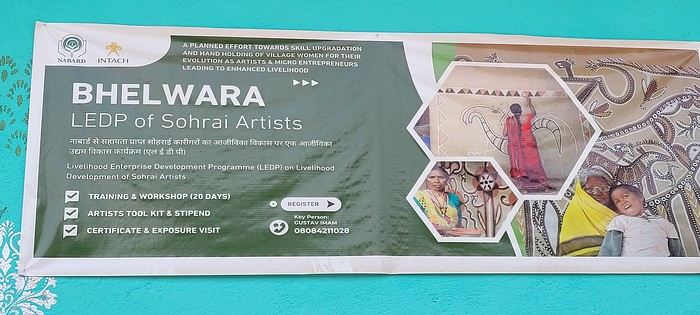
Hazaribagh I’ve got a meet-up with Adam Iman, a guide and painter. He picks me up from the hotel at 10 AM. Another traveler from Bangalore is supposed to join us, but while we wait for him to arrive, Adam takes me to see the paintings his mother and sister created at Hazaribagh station. The town became famous thanks to these murals, which can also be found in several surrounding villages. This art form has earned recognition and is now protected, a sign of its cultural importance. Once the visit is over, we go to pick up the other traveler and then head to our first village: Belwara, where Sohrai art is practiced. At the entrance, a sign proudly announces that we’re entering an artists’ village, where this art is created by women organized into micro-enterprises. Some even offer workshops for those who’d like to learn this tradition.
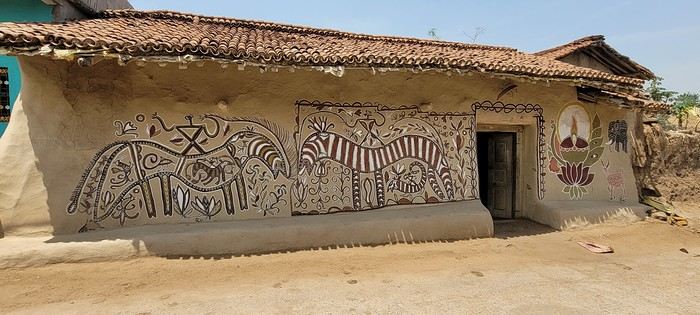
Sohrai art is tied to the harvest season, from October to mid-November. The motifs, in natural colors, celebrate fertility and abundance. The artists use pigments from the earth: red oxides, ochre, white kaolin, and black manganese. On the walls, you’ll see animals, fish, birds—all symbols of life and prosperity. As I look closer at the murals, I start to realize that each motif tells a story. Large animals like cows or bulls often take center stage. Their bodies are filled with intricate, almost hypnotic patterns. They symbolize wealth and prosperity for the household, as well as the deep respect for cattle, which are essential to daily life. On some facades, elephants stand out—massive and decorated with the same precision. They evoke quiet strength and protection. But it’s when I stop in front of one of the houses that I really take the time to look. The wall, a soft ochre, is entirely covered in murals. Two large animals stretch out on either side of the door, their elongated bodies fitting the length of the wall. Their silhouettes are filled with geometric patterns and incredibly fine curved lines, as if every space was patiently filled. Around them, stylized plants, flowers, and small decorative elements fill every gap. The door, dark and worn, becomes almost the silent center of the composition, framed by these living, protective forms. To the right, a more colorful motif catches the eye—a flower or a stylized lamp—like a touch of light on the earth. The whole thing gives an impression of perfect balance, between the rigor of the patterns and the freedom of the gesture.
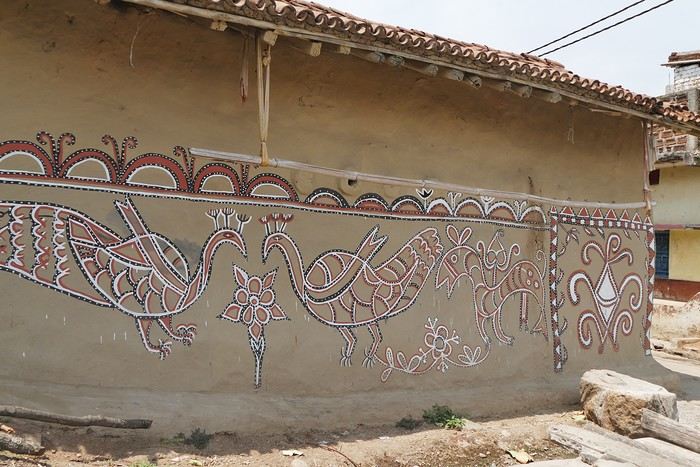
Elsewhere, birds and freer forms bring movement. Peacocks, recognizable by their stylized silhouettes, embody beauty and vitality, while fish symbolize water, fertility, and the continuity of life.
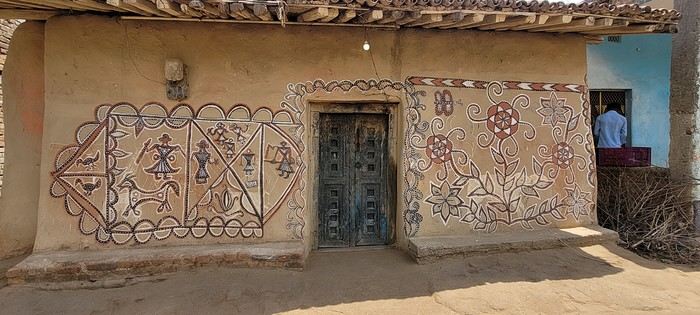
 On some paintings, the scenes become almost narrative: you can make out figures, everyday gestures, like a memory of the village inscribed in the walls. The decorative frames around the doors aren’t left to chance either—they symbolically protect the house, like a boundary between the inside and the outside world.
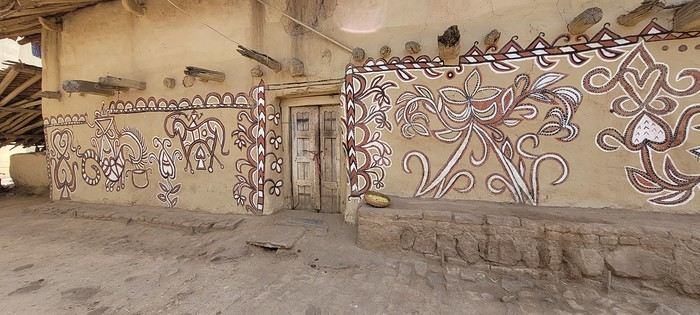
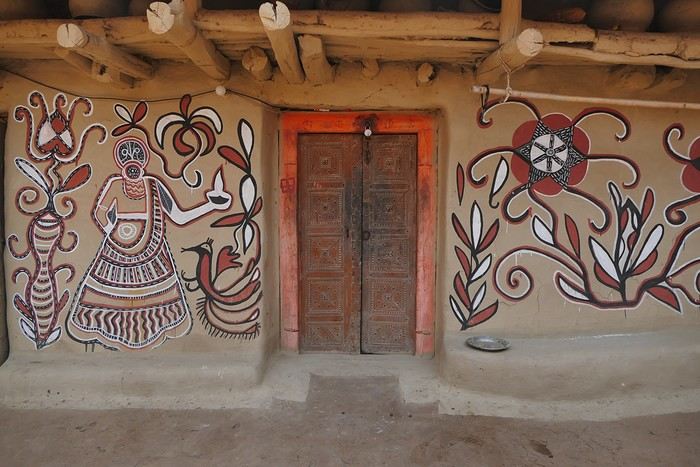
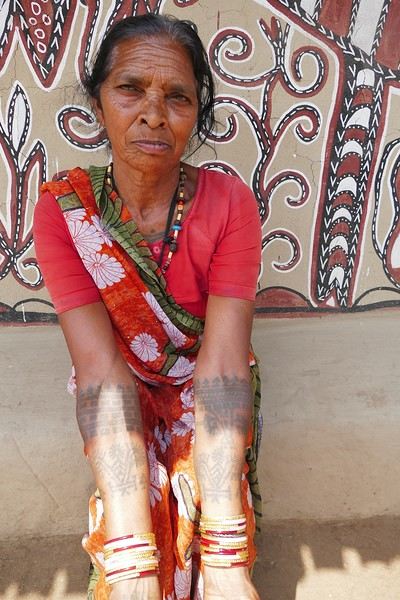
During the Sohrai festival, cattle are led into the jungle in the morning. Meanwhile, the women finish the *aripans*—these floor paintings—and continue the wall murals. Around noon, the animals return to the village, and the bulls’ horns are anointed with oil and vermilion in a gesture of gratitude, amid the vibrant colors adorning the houses. We visit several artists, including Parvat Devi, a well-known woman who has received many awards. Her arms are adorned with intriguing tattoos, which I’ll talk about in more detail later.
On another wall, the style changes completely. Here, no massive animals—just birds occupying the space, light and graceful, as if caught in mid-movement. Two silhouettes face each other, their long necks arched almost like mirrors, while their outstretched wings seem to vibrate with the patterns that compose them.
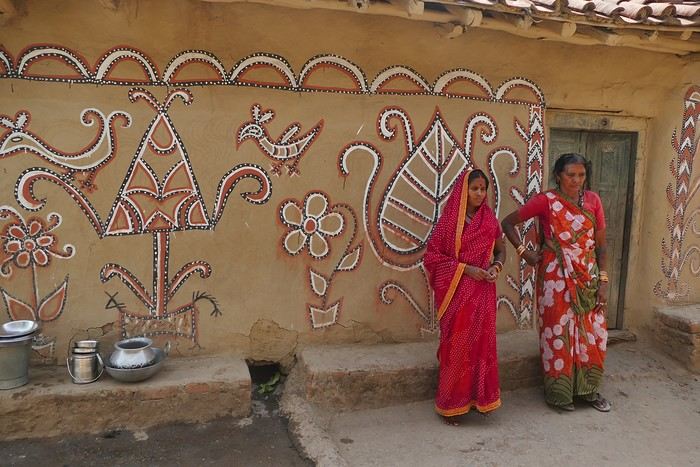
The design is more graphic, almost airy. The lines are smoother, more fluid, as if drawn in one confident stroke. The birds’ bodies aren’t solid—they’re filled with repetitive motifs like scales, stylized feathers, and spirals, giving a sense of continuous movement. Around them, everything comes to life: flowers burst open, arabesques swirl, and even the simplest shapes seem alive. What strikes me here is the sense of lightness. Where the large animals evoked stability and grounding, these birds bring something freer, almost joyful. They seem to embody movement, the circulation of life, like a breath flowing through the village.
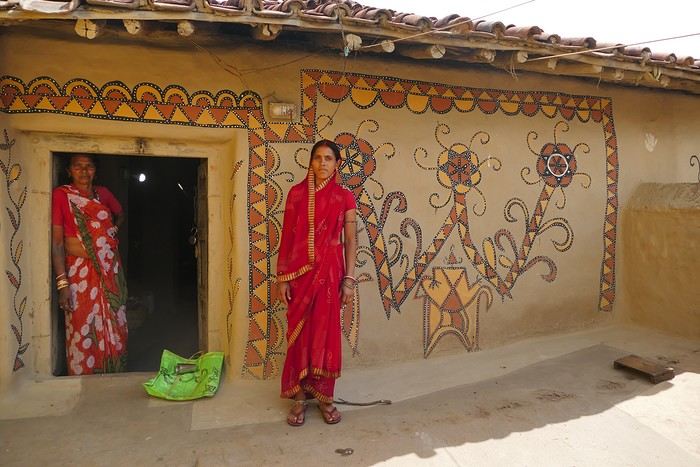
The colors remain the same—deep reds, intense blacks, and chalky white—but the rhythm is different. Faster, more spontaneous. As if each wall had its own personality, while still speaking the same language.
That’s probably why I’m so moved. I’d heard about these paintings from my friend Raja, and last year, I saw an exhibition in a village near my home. That first encounter made me want to come here. But seeing them in person is a whole different experience. These paintings are unique. This ancient art is passed down from mother to daughter, or mother-in-law to daughter-in-law, in a quiet, deeply living continuity. At first glance, it might seem almost childlike in its simplicity and pared-down forms. And yet, everything is thought out, balanced, mastered. Nothing is left to chance.
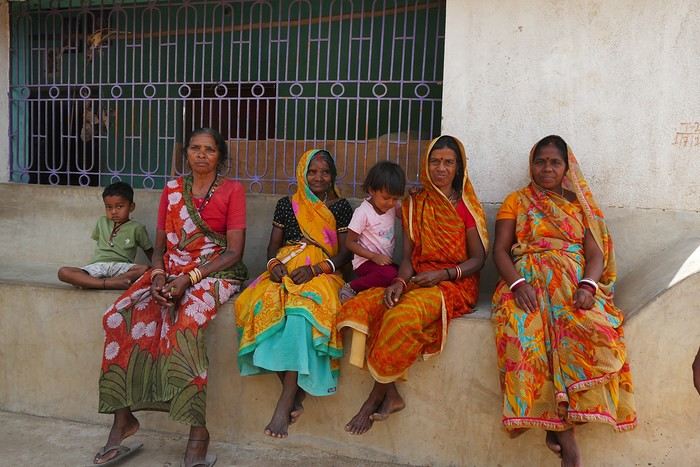
That apparent simplicity, combined with such rich symbolism, touches me deeply. There’s something sincere and essential in these walls—and that’s what moves me.
Hazaribagh I’ve got a meet-up with Adam Iman, a guide and painter. He picks me up from the hotel at 10 AM. Another traveler from Bangalore is supposed to join us, but while we wait for him to arrive, Adam takes me to see the paintings his mother and sister created at Hazaribagh station. The town became famous thanks to these murals, which can also be found in several surrounding villages. This art form has earned recognition and is now protected, a sign of its cultural importance. Once the visit is over, we go to pick up the other traveler and then head to our first village: Belwara, where Sohrai art is practiced. At the entrance, a sign proudly announces that we’re entering an artists’ village, where this art is created by women organized into micro-enterprises. Some even offer workshops for those who’d like to learn this tradition.
Sohrai art is tied to the harvest season, from October to mid-November. The motifs, in natural colors, celebrate fertility and abundance. The artists use pigments from the earth: red oxides, ochre, white kaolin, and black manganese. On the walls, you’ll see animals, fish, birds—all symbols of life and prosperity. As I look closer at the murals, I start to realize that each motif tells a story. Large animals like cows or bulls often take center stage. Their bodies are filled with intricate, almost hypnotic patterns. They symbolize wealth and prosperity for the household, as well as the deep respect for cattle, which are essential to daily life. On some facades, elephants stand out—massive and decorated with the same precision. They evoke quiet strength and protection. But it’s when I stop in front of one of the houses that I really take the time to look. The wall, a soft ochre, is entirely covered in murals. Two large animals stretch out on either side of the door, their elongated bodies fitting the length of the wall. Their silhouettes are filled with geometric patterns and incredibly fine curved lines, as if every space was patiently filled. Around them, stylized plants, flowers, and small decorative elements fill every gap. The door, dark and worn, becomes almost the silent center of the composition, framed by these living, protective forms. To the right, a more colorful motif catches the eye—a flower or a stylized lamp—like a touch of light on the earth. The whole thing gives an impression of perfect balance, between the rigor of the patterns and the freedom of the gesture.
Elsewhere, birds and freer forms bring movement. Peacocks, recognizable by their stylized silhouettes, embody beauty and vitality, while fish symbolize water, fertility, and the continuity of life.
On some paintings, the scenes become almost narrative: you can make out figures, everyday gestures, like a memory of the village inscribed in the walls. The decorative frames around the doors aren’t left to chance either—they symbolically protect the house, like a boundary between the inside and the outside world.During the Sohrai festival, cattle are led into the jungle in the morning. Meanwhile, the women finish the *aripans*—these floor paintings—and continue the wall murals. Around noon, the animals return to the village, and the bulls’ horns are anointed with oil and vermilion in a gesture of gratitude, amid the vibrant colors adorning the houses. We visit several artists, including Parvat Devi, a well-known woman who has received many awards. Her arms are adorned with intriguing tattoos, which I’ll talk about in more detail later.
On another wall, the style changes completely. Here, no massive animals—just birds occupying the space, light and graceful, as if caught in mid-movement. Two silhouettes face each other, their long necks arched almost like mirrors, while their outstretched wings seem to vibrate with the patterns that compose them.
The design is more graphic, almost airy. The lines are smoother, more fluid, as if drawn in one confident stroke. The birds’ bodies aren’t solid—they’re filled with repetitive motifs like scales, stylized feathers, and spirals, giving a sense of continuous movement. Around them, everything comes to life: flowers burst open, arabesques swirl, and even the simplest shapes seem alive. What strikes me here is the sense of lightness. Where the large animals evoked stability and grounding, these birds bring something freer, almost joyful. They seem to embody movement, the circulation of life, like a breath flowing through the village.
The colors remain the same—deep reds, intense blacks, and chalky white—but the rhythm is different. Faster, more spontaneous. As if each wall had its own personality, while still speaking the same language.
That’s probably why I’m so moved. I’d heard about these paintings from my friend Raja, and last year, I saw an exhibition in a village near my home. That first encounter made me want to come here. But seeing them in person is a whole different experience. These paintings are unique. This ancient art is passed down from mother to daughter, or mother-in-law to daughter-in-law, in a quiet, deeply living continuity. At first glance, it might seem almost childlike in its simplicity and pared-down forms. And yet, everything is thought out, balanced, mastered. Nothing is left to chance.
That apparent simplicity, combined with such rich symbolism, touches me deeply. There’s something sincere and essential in these walls—and that’s what moves me.
Tanzania Classics (Safari & Zanzibar)
I hesitated about writing this travel journal...
This summer, we only did the classics (the 3 northern parks and Zanzibar) and let a local agency take care of everything from start to finish.
No craziness, no risks, no sleeping under the stars, no self-drive, no venturing off the beaten path, no incidents, and not even any delays in the pre-planned itinerary...
But don’t think we were disappointed! The whole family (there were 6 of us) came back with smiles and memories of great moments spent together. So, if you're looking for a "classic" way to discover Tanzania, this is the place to be.
Our 2-week itinerary: - Arusha (1 night upon arrival) - Tarangire (1 night) - Ngorongoro (2 nights in Karatu then Irmisigiyo) - Serengeti (3 nights in Robanda, Togoro Plains, and Seronera) - Zanzibar Stone Town (1 night) - Zanzibar Matemwe (3 nights) - Zanzibar Jambiani (3 nights)
Hakuna matata!

No craziness, no risks, no sleeping under the stars, no self-drive, no venturing off the beaten path, no incidents, and not even any delays in the pre-planned itinerary...
But don’t think we were disappointed! The whole family (there were 6 of us) came back with smiles and memories of great moments spent together. So, if you're looking for a "classic" way to discover Tanzania, this is the place to be.
Our 2-week itinerary: - Arusha (1 night upon arrival) - Tarangire (1 night) - Ngorongoro (2 nights in Karatu then Irmisigiyo) - Serengeti (3 nights in Robanda, Togoro Plains, and Seronera) - Zanzibar Stone Town (1 night) - Zanzibar Matemwe (3 nights) - Zanzibar Jambiani (3 nights)
Hakuna matata!
USA Road Trip - November 2023
After staying in Aruba in November 2023, we picked up our camper van, which we had left in a hotel parking lot in Miami, Florida.
This isn’t our first road trip across the United States. Since we’re retired, we took the opportunity to travel along the American West Coast, starting with the Everglades in Florida to visit a few parks where we could spot alligators.
We also made a few stops in Mississippi and Texas to explore the most important cities in those states.
Did you know that Austin is home to the world’s largest urban bat colony? It’s truly impressive to see thousands of them take flight at dusk.
I invite you to keep reading this travel journal and watch the videos that’ll give you a little more insight into these different destinations.
Videos are embedded throughout the summary. Just click on the image to start the video.
To jump to a specific post, here are the relevant links:
FLORIDA:
Big Cypress National Preserve - Ochopee Captain Mitch's Everglades Airboat Tours Marco Island
MISSISSIPPI:
Exploring Biloxi
TEXAS:
Downtown Houston Corpus Christi San Antonio Attractions McNutt Sculpture Garden - San Antonio Mission San José - San Antonio Austin Attractions The World’s Largest Urban Bat Colony - Austin Downtown Fort Worth Attractions Downtown Dallas
This isn’t our first road trip across the United States. Since we’re retired, we took the opportunity to travel along the American West Coast, starting with the Everglades in Florida to visit a few parks where we could spot alligators.
We also made a few stops in Mississippi and Texas to explore the most important cities in those states.
Did you know that Austin is home to the world’s largest urban bat colony? It’s truly impressive to see thousands of them take flight at dusk.
I invite you to keep reading this travel journal and watch the videos that’ll give you a little more insight into these different destinations.
Videos are embedded throughout the summary. Just click on the image to start the video.
To jump to a specific post, here are the relevant links:
FLORIDA:
Big Cypress National Preserve - Ochopee Captain Mitch's Everglades Airboat Tours Marco Island
MISSISSIPPI:
Exploring Biloxi
TEXAS:
Downtown Houston Corpus Christi San Antonio Attractions McNutt Sculpture Garden - San Antonio Mission San José - San Antonio Austin Attractions The World’s Largest Urban Bat Colony - Austin Downtown Fort Worth Attractions Downtown Dallas
South Africa in safari mode: February/March 2026
Hi everyone,
With my girlfriend Christelle, we’ve chosen South Africa for our first trip to Southern Africa, focusing on safaris—after a long debate with a Cape Town/Kruger combo. But that would’ve meant cutting out St Lucia, which would’ve been harder to fit into another trip. And St Lucia—thanks to Michel and all those travel journals—we really wanted to go there.
So our 11-night itinerary ended up like this, mostly shaped by school holidays: - 3 nights in St Lucia - 1 night in Hluhluwe - 1 night at Mkhaya Game Reserve (Eswatini) - 1 night at Hlane Royal National Park (Eswatini) - 3 nights in Kruger (Berg en Dal / Satara / Tamboti) - 1 night at Shindzela Tented Camp in the Timbavati private reserve - 1 final night in Kruger at Lower Sabie
All of this in the off-season and rainy season, just a month after catastrophic floods that killed over 150 people and seriously damaged Kruger’s infrastructure.
I’ll jump straight to St Lucia and skip the loooong journey to get there (with a layover in Frankfurt, landing in Johannesburg, a domestic flight to Durban, and the rest by rental SUV—First Car Rental, perfect, no complaints).
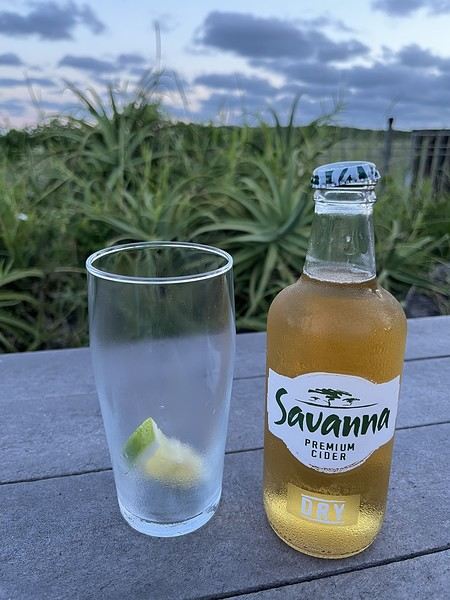
To motivate readers—especially some familiar faces here—I’ll drop in a first photo.
With my girlfriend Christelle, we’ve chosen South Africa for our first trip to Southern Africa, focusing on safaris—after a long debate with a Cape Town/Kruger combo. But that would’ve meant cutting out St Lucia, which would’ve been harder to fit into another trip. And St Lucia—thanks to Michel and all those travel journals—we really wanted to go there.
So our 11-night itinerary ended up like this, mostly shaped by school holidays: - 3 nights in St Lucia - 1 night in Hluhluwe - 1 night at Mkhaya Game Reserve (Eswatini) - 1 night at Hlane Royal National Park (Eswatini) - 3 nights in Kruger (Berg en Dal / Satara / Tamboti) - 1 night at Shindzela Tented Camp in the Timbavati private reserve - 1 final night in Kruger at Lower Sabie
All of this in the off-season and rainy season, just a month after catastrophic floods that killed over 150 people and seriously damaged Kruger’s infrastructure.
I’ll jump straight to St Lucia and skip the loooong journey to get there (with a layover in Frankfurt, landing in Johannesburg, a domestic flight to Durban, and the rest by rental SUV—First Car Rental, perfect, no complaints).
To motivate readers—especially some familiar faces here—I’ll drop in a first photo.
Slovak travel journal
Hello and welcome aboard this travel journal.
We’re heading to Slovakia together!
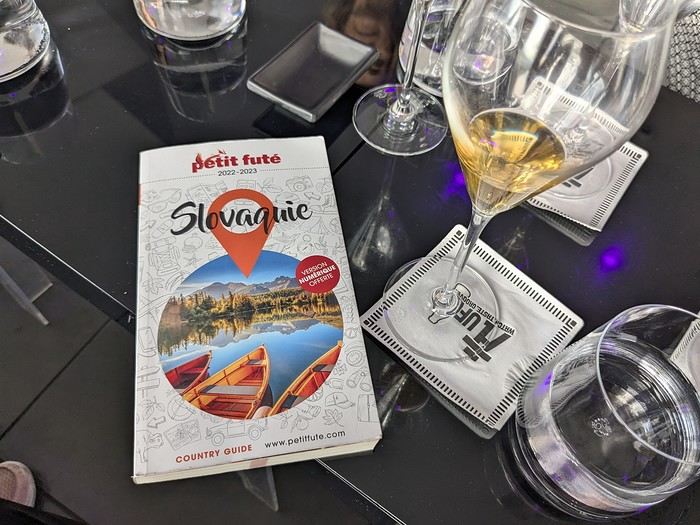 Why this country?
After visiting Hungary, Slovenia, Romania, and Poland in recent years, I’ve fallen in love with Eastern European countries. I adore the Slavic soul, its Austro-Hungarian villages, the gentle landscapes, the Carpathian Mountains, and that slightly mysterious atmosphere.
Slovakia evokes a certain imagination with its deep forests, medieval castles, and cobbled villages.
After seeing photos of the High Tatras—especially Lake Štrbské Pleso and Spiš Castle—I thought, "Let’s do it! We’re going!"
So, will Slovakia live up to what I imagine?
We’ll find out together.
We decided to travel as a group of six (five adults and a six-year-old child), by car (we needed two).
Here’s the day-by-day itinerary for this family trip, which started with a 3-day stay in Vienna (see the dedicated travel journal):
Why this country?
After visiting Hungary, Slovenia, Romania, and Poland in recent years, I’ve fallen in love with Eastern European countries. I adore the Slavic soul, its Austro-Hungarian villages, the gentle landscapes, the Carpathian Mountains, and that slightly mysterious atmosphere.
Slovakia evokes a certain imagination with its deep forests, medieval castles, and cobbled villages.
After seeing photos of the High Tatras—especially Lake Štrbské Pleso and Spiš Castle—I thought, "Let’s do it! We’re going!"
So, will Slovakia live up to what I imagine?
We’ll find out together.
We decided to travel as a group of six (five adults and a six-year-old child), by car (we needed two).
Here’s the day-by-day itinerary for this family trip, which started with a 3-day stay in Vienna (see the dedicated travel journal):
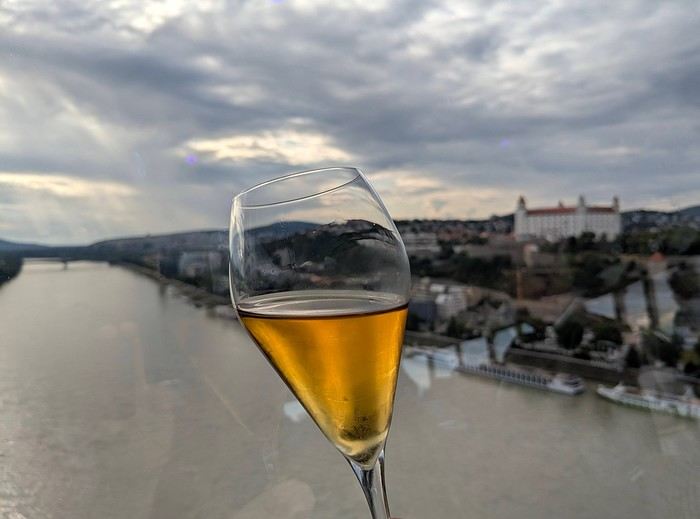
The itinerary: Day 1: Drive from Vienna to Banská Štiavnica and visit the town, then drive to Handlová Day 2: Bojnice Castle, the village of Čičmany, and a walk in the treetops at Bojnice, return to Handlová Day 3: Depart for Orava, visit Orava Castle and the Orava Skansen, drive to Veľký Slavkov Day 4: Visit Slovak Paradise—its gorges, lakes, and ice cave—overnight in Veľký Slavkov Day 5: Visit Bardejov, the "Death Road," wooden churches, and Ľubovňa Castle, overnight in Veľký Slavkov Day 6: Walks and hikes in the High Tatras, Lake Štrbské Pleso, Solisko summit, treetop walk in Ždiar, overnight in Veľký Slavkov Day 7: Drive to Košice, visit Spiš Castle, Tokaj wine route in Veľká Trňa, overnight in Košice Day 8: Visit Košice, overnight in Košice Day 9: Drive to Bratislava, stop at the Aragonite Cave in the Slovak Karst, overnight in Bratislava Day 10: Visit Bratislava, overnight stay Day 11 and 12: Return to France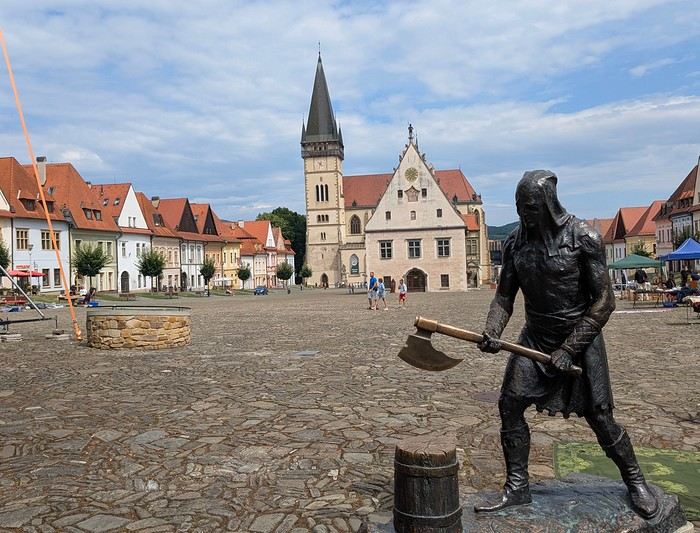
Budget: I’m giving prices for 2 adults / 1 child. Slovakia is more expensive than it seems, and some expenses shouldn’t be underestimated. Transportation: Tolls and gas from France: 500 € round trip Slovak vignette for one month: 17.10 € Gas is fixed at 1.49 € per liter (E10) Parking at sites (all paid by the day, even in the most remote villages, even if you stay for just an hour). Payment is often required in cash upon arrival: total 63 € We didn’t pay at Spiš (we arrived before the cashier) or Ľubovňa (we arrived after the cashier left). Parking at Orava Village was free. In Košice and Bratislava, we parked for free at our accommodations. Public transport in Bratislava and Košice: 1-1.2 € for a bus ticket. Vending machines are available at some stops; otherwise, buy via SMS (Slovak phones only) or official sales points.
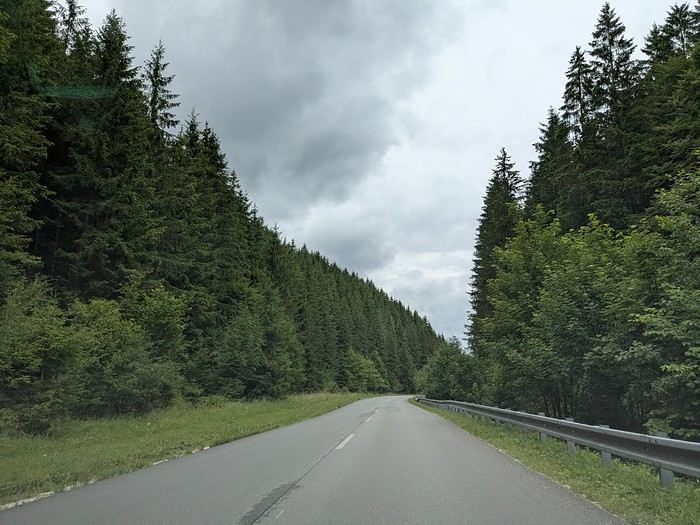
Accommodation: We mostly chose houses so we could cook ourselves and save on food. I’ve rated our satisfaction with these accommodations from 1 to 5 stars. Padua: DC Hotel: 1 night, 77 € ***** Handlová: Chata Remata: 2 nights, 120 € ***** Veľký Slavkov: Aplend: 4 nights, 220 € ** Košice: Luxury Old Town Loft 320m²: 2 nights, 120 € ***** Bratislava: Hotel Viktor: 2 nights, 138 € *** Brescia: Hotel Antica Fonte: 1 night, 82 € ***** Total: 757 €
Food: Groceries at Lidl for 5 meals for 3: 100 € (really cheap) Restaurants: 10-15 € per dish, ice cream 1-2.4 € per scoop, crêpes 8-12 €, a glass of wine 6-10 €... total: 500 €
Visits: There are discounts for seniors and children, which is great. We spent nearly 600 € in total, which is a lot. However, it’s a cultural destination with many castles, museums, caves, wine cellars, and nature activities: cable cars, canopy walks, paid hikes (Slovak Paradise gorges)... In the end, this trip to Slovakia cost nearly 2500 € for 3. We also need to add the Vienna portion to that. Now, here’s the day-by-day account of this beautiful journey.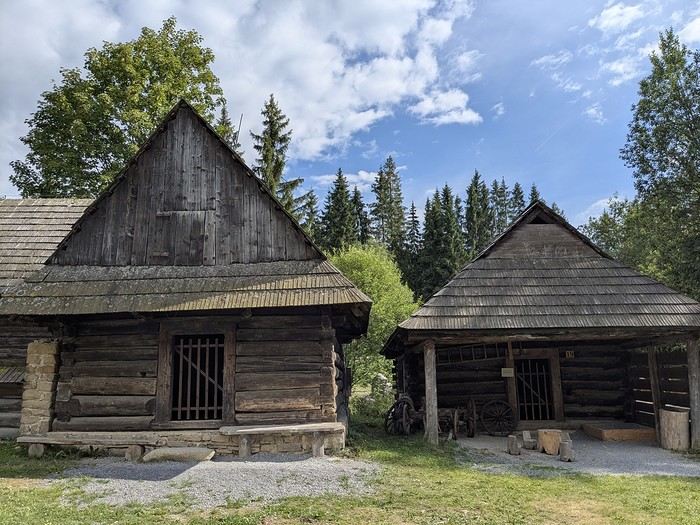
Why this country?
After visiting Hungary, Slovenia, Romania, and Poland in recent years, I’ve fallen in love with Eastern European countries. I adore the Slavic soul, its Austro-Hungarian villages, the gentle landscapes, the Carpathian Mountains, and that slightly mysterious atmosphere.
Slovakia evokes a certain imagination with its deep forests, medieval castles, and cobbled villages.
After seeing photos of the High Tatras—especially Lake Štrbské Pleso and Spiš Castle—I thought, "Let’s do it! We’re going!"
So, will Slovakia live up to what I imagine?
We’ll find out together.
We decided to travel as a group of six (five adults and a six-year-old child), by car (we needed two).
Here’s the day-by-day itinerary for this family trip, which started with a 3-day stay in Vienna (see the dedicated travel journal):
The itinerary: Day 1: Drive from Vienna to Banská Štiavnica and visit the town, then drive to Handlová Day 2: Bojnice Castle, the village of Čičmany, and a walk in the treetops at Bojnice, return to Handlová Day 3: Depart for Orava, visit Orava Castle and the Orava Skansen, drive to Veľký Slavkov Day 4: Visit Slovak Paradise—its gorges, lakes, and ice cave—overnight in Veľký Slavkov Day 5: Visit Bardejov, the "Death Road," wooden churches, and Ľubovňa Castle, overnight in Veľký Slavkov Day 6: Walks and hikes in the High Tatras, Lake Štrbské Pleso, Solisko summit, treetop walk in Ždiar, overnight in Veľký Slavkov Day 7: Drive to Košice, visit Spiš Castle, Tokaj wine route in Veľká Trňa, overnight in Košice Day 8: Visit Košice, overnight in Košice Day 9: Drive to Bratislava, stop at the Aragonite Cave in the Slovak Karst, overnight in Bratislava Day 10: Visit Bratislava, overnight stay Day 11 and 12: Return to France
Budget: I’m giving prices for 2 adults / 1 child. Slovakia is more expensive than it seems, and some expenses shouldn’t be underestimated. Transportation: Tolls and gas from France: 500 € round trip Slovak vignette for one month: 17.10 € Gas is fixed at 1.49 € per liter (E10) Parking at sites (all paid by the day, even in the most remote villages, even if you stay for just an hour). Payment is often required in cash upon arrival: total 63 € We didn’t pay at Spiš (we arrived before the cashier) or Ľubovňa (we arrived after the cashier left). Parking at Orava Village was free. In Košice and Bratislava, we parked for free at our accommodations. Public transport in Bratislava and Košice: 1-1.2 € for a bus ticket. Vending machines are available at some stops; otherwise, buy via SMS (Slovak phones only) or official sales points.
Accommodation: We mostly chose houses so we could cook ourselves and save on food. I’ve rated our satisfaction with these accommodations from 1 to 5 stars. Padua: DC Hotel: 1 night, 77 € ***** Handlová: Chata Remata: 2 nights, 120 € ***** Veľký Slavkov: Aplend: 4 nights, 220 € ** Košice: Luxury Old Town Loft 320m²: 2 nights, 120 € ***** Bratislava: Hotel Viktor: 2 nights, 138 € *** Brescia: Hotel Antica Fonte: 1 night, 82 € ***** Total: 757 €
Food: Groceries at Lidl for 5 meals for 3: 100 € (really cheap) Restaurants: 10-15 € per dish, ice cream 1-2.4 € per scoop, crêpes 8-12 €, a glass of wine 6-10 €... total: 500 €
Visits: There are discounts for seniors and children, which is great. We spent nearly 600 € in total, which is a lot. However, it’s a cultural destination with many castles, museums, caves, wine cellars, and nature activities: cable cars, canopy walks, paid hikes (Slovak Paradise gorges)... In the end, this trip to Slovakia cost nearly 2500 € for 3. We also need to add the Vienna portion to that. Now, here’s the day-by-day account of this beautiful journey.
Kattegat Tour and Norway’s Majestic Fjords – 32 Days (Denmark, Sweden, Norway)
Kattegat isn’t just the name of the village in the TV series *Vikings*—it’s also the stretch of water separating Denmark from Sweden... the sea, basically! And further north, you’ve got Norway and its fjords!
Originally, I’d planned to just do a loop around Kattegat, with the *Under* restaurant in Lindesnes as our anniversary treat... but along the way, we thought, why not "push" a little further north, keeping an eye on the budget since we’d chosen to travel by car in June 2025 through Scandinavia.
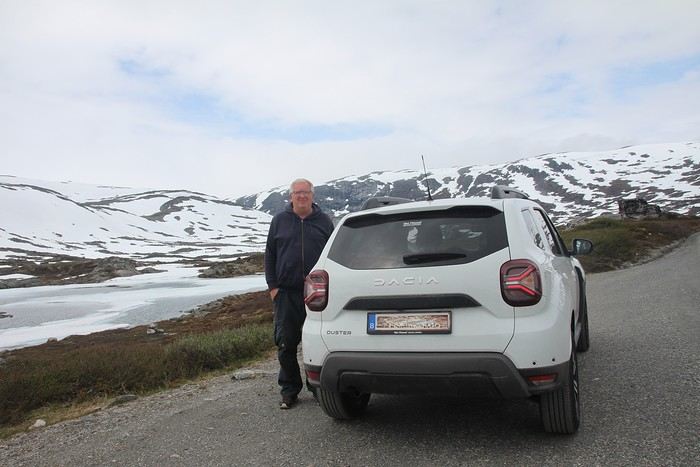
Why by car when most travelers opt for a camper van, while others prefer the comfort of cruises? Well, because we don’t own a camper van, renting one is pricey, and then you’ve got to add fuel costs (those things guzzle gas!), ferry fees, and other "tolls." All things considered, we went for mostly rentals—especially since there were four of us at the start of the trip. We spent the first week in Denmark with our daughter and son-in-law. Then they flew back to Belgium, and we continued our adventure as a couple. For accommodation, we mainly booked Airbnb apartments, which helped keep costs down and, most importantly, let us prepare our own meals (diet, diet!). In this travel journal, you’ll discover (or rediscover, for those who followed my older ones) our unbridled love for theme parks, museums, unique experiences, and—especially in Denmark—Legos! Unfortunately, we didn’t do any hikes this year because the unpredictable weather had made the trails slippery, and since I’d already taken three tumbles during the trip, I didn’t want to risk another! In the end, we traveled for 32 days, covered 6,200 km, and most importantly, discovered the charming country of Denmark, marveled at Norway’s breathtaking fjords—all without suffering the heatwave that hit France and Belgium that June! If you’ve got any questions, don’t hesitate to ask!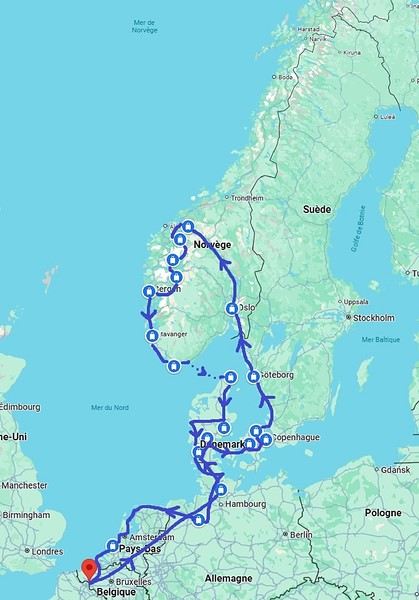
Why by car when most travelers opt for a camper van, while others prefer the comfort of cruises? Well, because we don’t own a camper van, renting one is pricey, and then you’ve got to add fuel costs (those things guzzle gas!), ferry fees, and other "tolls." All things considered, we went for mostly rentals—especially since there were four of us at the start of the trip. We spent the first week in Denmark with our daughter and son-in-law. Then they flew back to Belgium, and we continued our adventure as a couple. For accommodation, we mainly booked Airbnb apartments, which helped keep costs down and, most importantly, let us prepare our own meals (diet, diet!). In this travel journal, you’ll discover (or rediscover, for those who followed my older ones) our unbridled love for theme parks, museums, unique experiences, and—especially in Denmark—Legos! Unfortunately, we didn’t do any hikes this year because the unpredictable weather had made the trails slippery, and since I’d already taken three tumbles during the trip, I didn’t want to risk another! In the end, we traveled for 32 days, covered 6,200 km, and most importantly, discovered the charming country of Denmark, marveled at Norway’s breathtaking fjords—all without suffering the heatwave that hit France and Belgium that June! If you’ve got any questions, don’t hesitate to ask!
Two Quebecers Attempting Mount Meru
In 2015, for my 50th birthday, my daughter and I went to Kenya and Tanzania for a safari. Ten years later, for my 60th, a new African adventure: returning to Tanzania, this time to attempt the ascent of Mount Meru.
After watching documentaries and films about Everest climbers, I’ve always been drawn to the idea of experiencing something like that. I’m impressed by those who risk their lives just to chase their dreams and push their limits (my partner would say they’re crazy). I’ve never pretended I could climb the roof of the world. My sights were set on Kilimanjaro instead. But when my daughter planned our adventure, she lowered my ambitions by a few meters by choosing Meru—and I get it. We’re both very active, but we’re not seasoned athletes. And our mountains in Quebec, as beautiful as they are, don’t offer the chance to climb very high to test our endurance against the lack of oxygen.
So, to prepare physically, I worked my 60-year-old legs daily by walking and climbing small hills near home. As for altitude sickness, I’ll have to trust my system and my old lungs, but it still stresses me out. The departure is approaching, and there’s no turning back—I tell myself that at worst, I’ll have tried.
February 2nd, departure day. We leave Montreal on an Air France flight as scheduled. Luckily, because we were worried, our flight times were delayed, and our layover at CDG will be tight. After a 6.5-hour flight to Paris, no messing around—we have just enough time to sit for about thirty minutes before boarding another 8.5-hour flight to Zanzibar, still with Air France. In Zanzibar, we stay on the plane while pale-faced passengers disembark, replaced by sun-kissed travelers (it’s sunny and warm in Zanzibar). We then take a short flight to Kilimanjaro Airport, our final destination. Exhausted but happy to step off the big metal bird, a driver from the agency we chose (Soaring Flamingo) waits to take us to our hotel, the Tulia in Arusha. It’s 2 AM when we finally collapse onto the mattress. Tomorrow, we’ll spend the day recovering from the sleepless flight, relaxing by a murky pool in a beautiful flower-filled courtyard, surrounded by palm trees and the everyday sounds of Africa. At that moment, I feel privileged to share this experience with my daughter, and I think about the mountain that awaits us.
To be continued...
After watching documentaries and films about Everest climbers, I’ve always been drawn to the idea of experiencing something like that. I’m impressed by those who risk their lives just to chase their dreams and push their limits (my partner would say they’re crazy). I’ve never pretended I could climb the roof of the world. My sights were set on Kilimanjaro instead. But when my daughter planned our adventure, she lowered my ambitions by a few meters by choosing Meru—and I get it. We’re both very active, but we’re not seasoned athletes. And our mountains in Quebec, as beautiful as they are, don’t offer the chance to climb very high to test our endurance against the lack of oxygen.
So, to prepare physically, I worked my 60-year-old legs daily by walking and climbing small hills near home. As for altitude sickness, I’ll have to trust my system and my old lungs, but it still stresses me out. The departure is approaching, and there’s no turning back—I tell myself that at worst, I’ll have tried.
February 2nd, departure day. We leave Montreal on an Air France flight as scheduled. Luckily, because we were worried, our flight times were delayed, and our layover at CDG will be tight. After a 6.5-hour flight to Paris, no messing around—we have just enough time to sit for about thirty minutes before boarding another 8.5-hour flight to Zanzibar, still with Air France. In Zanzibar, we stay on the plane while pale-faced passengers disembark, replaced by sun-kissed travelers (it’s sunny and warm in Zanzibar). We then take a short flight to Kilimanjaro Airport, our final destination. Exhausted but happy to step off the big metal bird, a driver from the agency we chose (Soaring Flamingo) waits to take us to our hotel, the Tulia in Arusha. It’s 2 AM when we finally collapse onto the mattress. Tomorrow, we’ll spend the day recovering from the sleepless flight, relaxing by a murky pool in a beautiful flower-filled courtyard, surrounded by palm trees and the everyday sounds of Africa. At that moment, I feel privileged to share this experience with my daughter, and I think about the mountain that awaits us.
To be continued...
Texas, Louisiana, and a Touch of Florida
After five trips to the American West, we had planned to switch countries and continents to visit Turkey. However, by the time we made up our minds, flight ticket prices had nearly doubled, reaching 400 € for a round-trip ticket. A bit disappointed, I started looking at transatlantic flight prices and stumbled upon discounted tickets from Basel-Mulhouse to Dallas—at the same price as our tickets to Turkey!
No hesitation needed; we bought the five tickets for a total of 1,860 € excluding baggage!
From Fort Worth Airport, we had two options: - Head west on a loop through Texas, New Mexico, and southern Colorado - Head east to change the scenery and explore East Texas, Louisiana, with a possible detour into Florida.
The latter option won unanimously, so here we are, off to discover new states, mainly Louisiana and Texas.
One of the main post-COVID challenges is finding a reasonably priced car rental. After an initial booking around 1,300 €, we kept an eye on prices a few weeks before departure and managed to snag a better deal at around 900 € for a comfortable sedan.
Yes, this summer will also be a first: no 4x4, no camping, and plenty of restaurants!
As always, I’ve planned a packed itinerary, ready to adjust on the go. A few weeks before departure, we learned we’d be at full capacity—our eldest son, Maxime, got his first-year med school results. By finishing as a top admit, he avoided the mandatory July-August internship that would’ve kept him from joining us. Instead, he wrapped up his internship at the last minute the night before our big departure.
We’ll get to savor these special moments together.
The itinerary: Day 1 - 07/15: Fort Worth Day 2: Dallas Day 3: Jefferson - Caddo Lake Day 4: Black Bayou Lake - Natchez - Stanton Hall and Rosalie Mansion Day 5: St. Francisville - Rosedown Plantation - Cat Island Wildlife Refuge Day 6: Mobile - USS Alabama Battleship Memorial Park Day 7 - 8: Pensacola Beach Day 9: Bellingrath Gardens - New Orleans Day 10 - 11: New Orleans Day 12: Plantation Route Day 13: Jungle Gardens - Tabasco Factory - Vermilionville - Lake Martin Day 14: Baton Rouge - USS Kidd Day 15: Houma - Cajun Man's Swamp Tour Day 16: Galveston, Texas Day 17: Space Center Houston - Painted Churches Day 18: San Antonio Day 19: Texas Hill Country Day 20: Texas Hill Country and evening in San Antonio Day 21: Austin and Waco
Day 0 - 07/14: The departure timing isn’t exactly relaxing. On Thursday late afternoon, we hit the road to Alsace, aiming to drop off our two cockers with family before reaching the airport at 2 AM for a 3-hour power nap. Not exactly fresh, we arrive at the terminal looking for a British Airways counter. None in sight, so we try our luck at a United Airlines counter—who knows, maybe it’ll work out. And bingo! The agent checks us in. We didn’t quite understand why, but maybe there’s some agreement between airlines. For the first time, we’re traveling without checked baggage, so no extra fees. Not a huge feat, given the scorching temperatures awaiting us!
The connecting flight to London goes smoothly.
During the layover, liquid checks get stricter—now requiring small bottles to be in a pre-approved clear bag, with only one bag allowed per passenger. Normally, no big deal, but between deodorant, sunscreen, after-sun lotion, hand sanitizer, contact lens solution, etc., we spend 20 minutes optimizing the arrangement! When we finally succeed, one of the security staff bursts out laughing and congratulates us!
With our stomachs growling, we grab an American breakfast before browsing the airport shops.
We then discover our plane for the long-haul flight and are thrilled to see it’s an A380—a first for Laetitia, though the rest of the family experienced it during our winter getaway. Still just as impressive!
With a hint of uncertainty, we take off for the States—my third trip in barely 12 months. This time, no endless badlands, canyons, slot canyons, hoodoos, or brain rocks, but a journey through five states (Texas, Louisiana, a quick stop in Mississippi, Alabama, and the northwest tip of Florida), where we hope to soak up a unique vibe... with a packed schedule of diverse visits.
Arrival at Fort Worth Airport and customs go smoothly. Since we have no checked baggage, we’re first in line at the Dollar counter. In just 3 minutes, the formalities are done. We decline the Toll Pass, which I don’t think we’ll need based on my "calculations," and head to the Dollar parking lot, where an employee tells us we can pick any car we want!
There are about thirty cars waiting. Too many choices!
After last year’s mishap in Oakland, where our 4x4’s trunk was broken into, we’re looking for a sedan to hide our luggage this time. Unfortunately, there are none—only SUVs. We finally settle on a comfortable 7-seater Ford SUV with a massive trunk when set up for five.
On the road from Fort Worth to Dallas, we accidentally take a toll highway without realizing until it’s too late to exit. Let’s hope Dollar doesn’t charge us a week’s worth of their pricey Toll Pass for a $2 toll. We’ll see... In the meantime, Maxime sets up Google Maps to avoid toll roads.
Since it’s not too late, we stop by the nearest Walmart for groceries before checking into our hotel room for three nights in East Dallas suburb.
No hesitation needed; we bought the five tickets for a total of 1,860 € excluding baggage!
From Fort Worth Airport, we had two options: - Head west on a loop through Texas, New Mexico, and southern Colorado - Head east to change the scenery and explore East Texas, Louisiana, with a possible detour into Florida.
The latter option won unanimously, so here we are, off to discover new states, mainly Louisiana and Texas.
One of the main post-COVID challenges is finding a reasonably priced car rental. After an initial booking around 1,300 €, we kept an eye on prices a few weeks before departure and managed to snag a better deal at around 900 € for a comfortable sedan.
Yes, this summer will also be a first: no 4x4, no camping, and plenty of restaurants!
As always, I’ve planned a packed itinerary, ready to adjust on the go. A few weeks before departure, we learned we’d be at full capacity—our eldest son, Maxime, got his first-year med school results. By finishing as a top admit, he avoided the mandatory July-August internship that would’ve kept him from joining us. Instead, he wrapped up his internship at the last minute the night before our big departure.
We’ll get to savor these special moments together.
The itinerary: Day 1 - 07/15: Fort Worth Day 2: Dallas Day 3: Jefferson - Caddo Lake Day 4: Black Bayou Lake - Natchez - Stanton Hall and Rosalie Mansion Day 5: St. Francisville - Rosedown Plantation - Cat Island Wildlife Refuge Day 6: Mobile - USS Alabama Battleship Memorial Park Day 7 - 8: Pensacola Beach Day 9: Bellingrath Gardens - New Orleans Day 10 - 11: New Orleans Day 12: Plantation Route Day 13: Jungle Gardens - Tabasco Factory - Vermilionville - Lake Martin Day 14: Baton Rouge - USS Kidd Day 15: Houma - Cajun Man's Swamp Tour Day 16: Galveston, Texas Day 17: Space Center Houston - Painted Churches Day 18: San Antonio Day 19: Texas Hill Country Day 20: Texas Hill Country and evening in San Antonio Day 21: Austin and Waco
Day 0 - 07/14: The departure timing isn’t exactly relaxing. On Thursday late afternoon, we hit the road to Alsace, aiming to drop off our two cockers with family before reaching the airport at 2 AM for a 3-hour power nap. Not exactly fresh, we arrive at the terminal looking for a British Airways counter. None in sight, so we try our luck at a United Airlines counter—who knows, maybe it’ll work out. And bingo! The agent checks us in. We didn’t quite understand why, but maybe there’s some agreement between airlines. For the first time, we’re traveling without checked baggage, so no extra fees. Not a huge feat, given the scorching temperatures awaiting us!
The connecting flight to London goes smoothly.
During the layover, liquid checks get stricter—now requiring small bottles to be in a pre-approved clear bag, with only one bag allowed per passenger. Normally, no big deal, but between deodorant, sunscreen, after-sun lotion, hand sanitizer, contact lens solution, etc., we spend 20 minutes optimizing the arrangement! When we finally succeed, one of the security staff bursts out laughing and congratulates us!
With our stomachs growling, we grab an American breakfast before browsing the airport shops.
We then discover our plane for the long-haul flight and are thrilled to see it’s an A380—a first for Laetitia, though the rest of the family experienced it during our winter getaway. Still just as impressive!
With a hint of uncertainty, we take off for the States—my third trip in barely 12 months. This time, no endless badlands, canyons, slot canyons, hoodoos, or brain rocks, but a journey through five states (Texas, Louisiana, a quick stop in Mississippi, Alabama, and the northwest tip of Florida), where we hope to soak up a unique vibe... with a packed schedule of diverse visits.
Arrival at Fort Worth Airport and customs go smoothly. Since we have no checked baggage, we’re first in line at the Dollar counter. In just 3 minutes, the formalities are done. We decline the Toll Pass, which I don’t think we’ll need based on my "calculations," and head to the Dollar parking lot, where an employee tells us we can pick any car we want!
There are about thirty cars waiting. Too many choices!
After last year’s mishap in Oakland, where our 4x4’s trunk was broken into, we’re looking for a sedan to hide our luggage this time. Unfortunately, there are none—only SUVs. We finally settle on a comfortable 7-seater Ford SUV with a massive trunk when set up for five.
On the road from Fort Worth to Dallas, we accidentally take a toll highway without realizing until it’s too late to exit. Let’s hope Dollar doesn’t charge us a week’s worth of their pricey Toll Pass for a $2 toll. We’ll see... In the meantime, Maxime sets up Google Maps to avoid toll roads.
Since it’s not too late, we stop by the nearest Walmart for groceries before checking into our hotel room for three nights in East Dallas suburb.
Northern Chile, Andean impressions.
Alright, this year, we're heading back to South America!
The initial plan was to retrace the route we imagined in the summer of 2020: a trip to northern Argentina starting from Córdoba.
Unfortunately, the flight to Córdoba no longer exists, and airfares to Javier Milei’s country are both outrageously priced and involve multiple layovers.
So, I tweaked Google Flights every which way and finally found a flight within my budget—departing from Clermont-Ferrand!
Not to Argentina, though...
Our transatlantic flight will cross the snow-capped Andes, landing in Santiago, Chile, with a return from Lima!
In between, two domestic flights and a big road trip loop starting from the coastal city of Arica to explore the treasures of northern Chile.
Our mode of transport: a pseudo 4x4 that won’t take us through sand dunes or devilish tracks but will let us tackle the entire secondary network, including unpaved main roads, while still being insured.
Is the suitcase packed with all-season clothes?
Are the driver’s license and passport ready?
Bank cards and a few euros too?
Off we go for just over 3 weeks of southern wanderings!
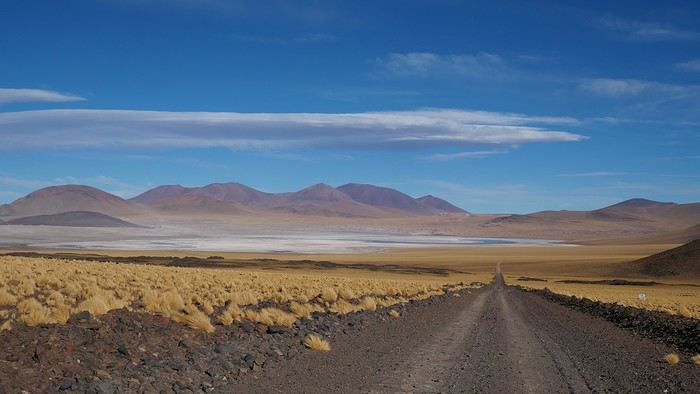
--/--
To keep all my esteemed readers on track, here are a few maps outlining the Arica-Arica loop!
1- From Arica to San Pedro de Atacama via Pica and the Salar de Huasco
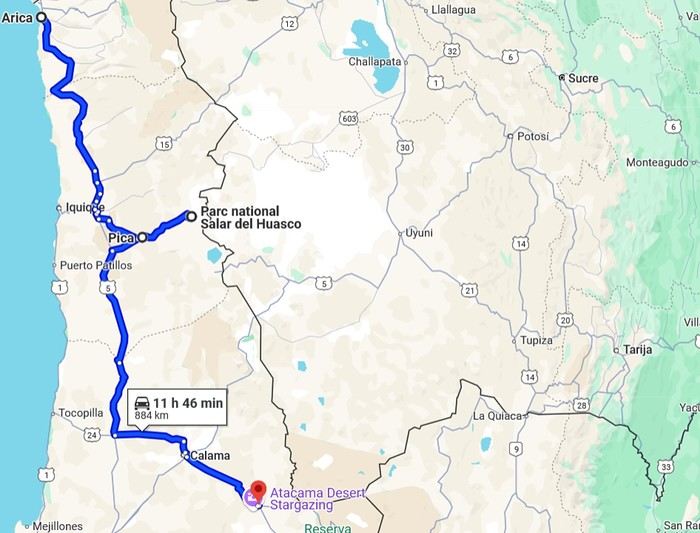 2- Around San Pedro
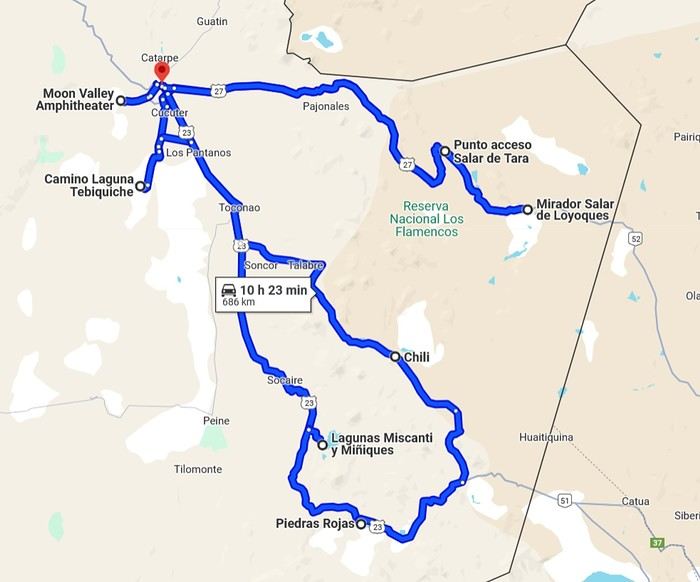
3- From San Pedro to Cariquima
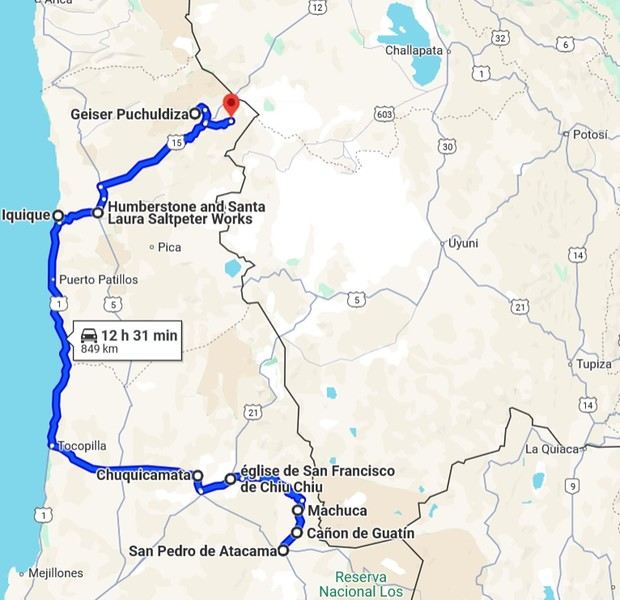
4- From Cariquima to Putre
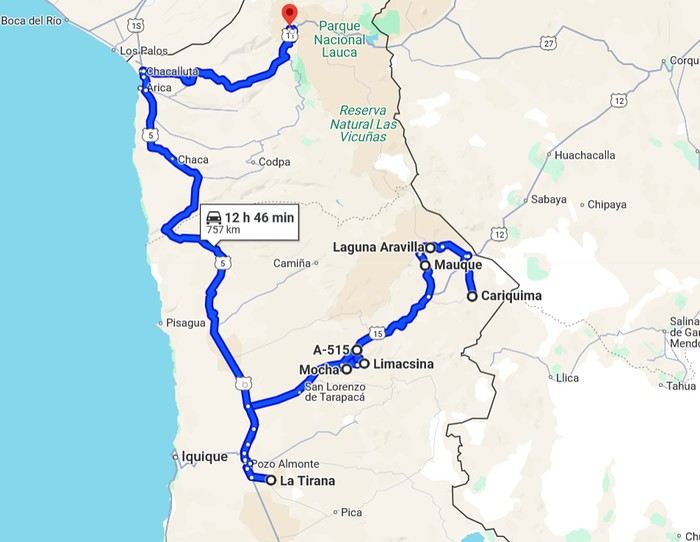
5 - From Putre to Arica
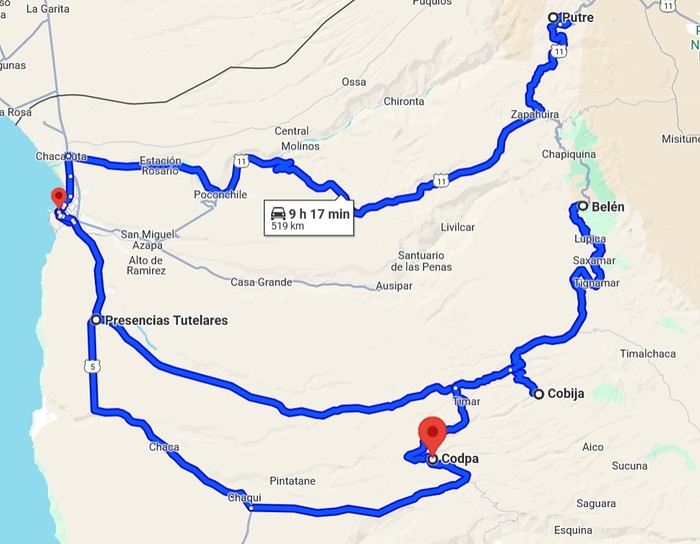
Gas stations in this part of Chile are located in Arica, Iquique, Pozo Almonte, Pica, Calama, and San Pedro de Atacama.
The initial plan was to retrace the route we imagined in the summer of 2020: a trip to northern Argentina starting from Córdoba.
Unfortunately, the flight to Córdoba no longer exists, and airfares to Javier Milei’s country are both outrageously priced and involve multiple layovers.
So, I tweaked Google Flights every which way and finally found a flight within my budget—departing from Clermont-Ferrand!
Not to Argentina, though...
Our transatlantic flight will cross the snow-capped Andes, landing in Santiago, Chile, with a return from Lima!
In between, two domestic flights and a big road trip loop starting from the coastal city of Arica to explore the treasures of northern Chile.
Our mode of transport: a pseudo 4x4 that won’t take us through sand dunes or devilish tracks but will let us tackle the entire secondary network, including unpaved main roads, while still being insured.
Is the suitcase packed with all-season clothes?
Are the driver’s license and passport ready?
Bank cards and a few euros too?
Off we go for just over 3 weeks of southern wanderings!
--/--
To keep all my esteemed readers on track, here are a few maps outlining the Arica-Arica loop!
1- From Arica to San Pedro de Atacama via Pica and the Salar de Huasco
2- Around San Pedro3- From San Pedro to Cariquima
4- From Cariquima to Putre
5 - From Putre to Arica
Gas stations in this part of Chile are located in Arica, Iquique, Pozo Almonte, Pica, Calama, and San Pedro de Atacama.
21-Day Trip to La Gomera and La Palma
Travel Journal: 21 Days in La Gomera and La Palma
From February 6 to February 26, 2024
Tuesday, February 6 We left around 9 AM with our car, along with Pierre-Paul and Patricia, heading to the Bluepark parking lot in Bartenheim. As expected, we were awaited and left promptly for EuroAirport Basel. Took off at 12:25 PM for a 4-hour-15-minute flight under excellent conditions. Beautiful arrival in Tenerife with Teide in sight under a clear blue sky. Fifteen minutes later, we waited for bus No. 40 to Los Cristianos with quite a few other tourists, but we managed to find four seats. From the bus station, it was a 20-minute walk to our hotel. We checked into a lovely apartment for the four of us, complete with all the comforts. Outside, it was quite warm—at least 25°C! After dropping off our luggage, we went for a stroll. The immediate surroundings of the hotel held no interest for us: a modern, concrete area filled with hotels, bars, tourist agencies, and unappealing restaurants all offering the same bland international cuisine. Pat went to cool off at the pool, unfortunately overrun by loud, drunk English tourists. I took a walk to the paseo maritimo that leads to the port, skirting the seafront. The promenade was pleasant, but it could have been any seaside resort in the world—same old scene: a succession of bars with blaring music where many elderly people sipped cold beers waiting for the sunset, the backdrop a wall of resort-style hotels resembling rabbit hutches! Upon reaching the port, I scouted the route we’d take the next day to the Fred Olsen ferry. Back at the apartment, in the early evening, we looked for a non-touristy restaurant for dinner. Monique stopped a woman to ask her opinion! In this area, she told us, there’s no restaurant that serves Canarian or Spanish cuisine! The only place with decent restaurants is at the port. Off we went to the port, where we sat down at Al Bordo restaurant and ordered a seafood paella for four. Excellent, and at a very reasonable price (36 € for two). We returned to the hotel along the seafront.
Wednesday, February 7
Woke up at 6 AM. Had breakfast in the apartment with what we’d bought the day before at a supermarket. It was still dark when we left on foot toward the port, walking along the calm seafront at this early hour. Forty minutes later, we arrived and waited 10 minutes before the ferry docked. At 9:30 AM, we left the port of Los Cristianos for a 50-minute crossing on a calm sea under a beautiful blue sky. There were quite a few people on this large ferry, but many had no luggage, meaning they were visiting La Gomera for the day and would take the ferry back in the evening. Upon disembarking, we went straight to our rental car agency to pick up the car we’d booked online a few months earlier. It was a nice Peugeot 2008, spacious enough for the four of us and our luggage. We immediately took the beautiful road from San Sebastián that climbs directly into the mountains toward our rental in Vallehermoso. The road was in perfect condition—it seemed brand new, like all the others we’d take on this island later. This side of the island is very arid with little vegetation, and the terrain is particularly rugged, as it is throughout the island. We stopped at our first miradors, which would be followed by many more throughout our Canarian trip. Our first visit was to the small village of Agulo, perched on a promontory above the sea and at the foot of a high cliff. The village features typical Canarian houses with windows flush with the façade and black volcanic stone masonry on white or reddish-brown walls. The first recommended restaurant was already booked for a group, so we settled for the shaded terrace of the excellent El Alameda bar-restaurant. From Agulo, you can access the Abrante viewpoint via a winding road, where the view of Agulo, 600 meters below, is exceptional. A glass ledge over the void lets you test your fear of heights!
We drove to Vallehermoso to do our grocery shopping at the supermarket—a habit that would continue until the end of the trip. Our little house, "Casa rural El Encatadora," is located in a beautiful flower-filled valley a few kilometers west of Vallehermoso. Each of us had a bedroom with an en-suite bathroom, plus a living room, kitchen, and a small terrace overlooking the quiet street at the valley’s end, which didn’t bother us at all.
Thursday, February 8 The good weather seemed to follow us since our arrival in the Canary Islands. This morning, we took the road—still as beautiful and new—toward Arure, high up to the west. The landscape was magnificent, with breathtaking glimpses of the sea far below. In Arure, we parked in front of Conchita’s bar, where a hike (Rother No. 30) starts toward two viewpoints: Alojera, which we reached after 45 minutes on a lovely path. Monique, tired from the first steep climb, stopped at the first viewpoint and hitchhiked back to Arure. Meanwhile, we continued toward the second viewpoint, Los Barranquillos, where the view of the surroundings was partially hidden by misty clouds rising from the sea. The entire mountain is sculpted by ancient, endless terraces climbing until the slope becomes too steep for construction—visible traces of the hard work of past inhabitants trying to survive in a harsh environment. We had a decent lunch at La Conchita bar, then drove to the small seaside town of Puerto la Caleta, sheltered by an immense cliff plunging into the sea. Black sand beach, rough sea—despite our encouragement, Pat didn’t dare to swim! As for the old village of Caleta, it’s perched on the mountainside, and visiting it requires climbing steep, stair-filled alleys to discover a few traditional houses. Back at the casa, dinner in, and card games...
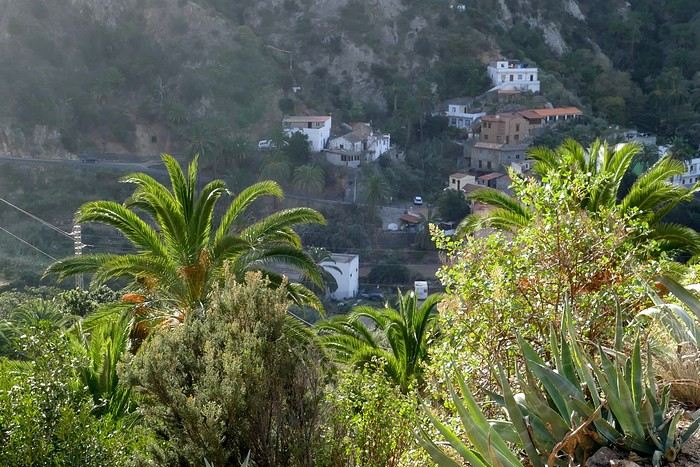 Vallehermoso
Friday, February 9 This morning, the sky was overcast, and the peaks around us were shrouded in clouds. We took the same road as yesterday to hike Las Creces. Quickly gaining altitude, we entered a thick fog—visibility was very limited. We stopped at the Las Creces parking lot; visibility improved, and the sun wasn’t far off. The hike is entirely within a beautiful laurel forest, with the sun playing hide-and-seek, but it wasn’t cold despite the altitude. After finishing the loop trail, we decided to picnic—not there, as it was too chilly—but on Vallehermoso’s beach, where we found a nice picnic area sheltered by large black rocks. A short digestive walk on the surrounding hill to admire the little beach from above. Back in Vallehermoso, we did some grocery shopping, then tried to return to the casa—only to find ourselves locked out because we’d left the key in the lock inside! After several attempts and with the help of Yéli, a relative of the owner we called for help, we were finally able to get back in!
Saturday, February 10
It rained last night, and the sky remained overcast. Monique decided to rest this morning. PP, Pat, and I set off on the hike that starts from the house toward the Marichal reservoir. The sun wasn’t far off, and by 11 AM, it was fully out. The pleasant hike passed by many flower-filled gardens and orchards—orange, lemon, and mandarin trees in fruit. The path climbed gently toward the reservoir, where the view of the Cano rock dominating the landscape was magnificent. The last part of the climb was a bit tough, overgrown with lush vegetation, and the trail was slippery from last night’s rain. We descended via a different, much more pleasant path and returned to the casa just in time for lunch, prepared by Monique. This valley is rich with its many farmers and market gardeners who’ve cultivated the entire valley, taking advantage of the water flowing down from the mountain, captured upstream and redistributed through countless pipes snaking along the paths. Numerous tanks also store water during dry periods. The houses are scattered across both sides of the valley, and these colorful little homes add a beautiful touch to the landscape. The many palm trees give this valley a distinctly tropical feel—you could almost imagine yourself in the Caribbean. Add to that some salsa music drifting from a hut where farmers were working, and the picture is complete. A well-chilled beer apéro capped off a lovely morning. The afternoon was dedicated to rest, relaxation, reading, and games.
Sunday, February 11 The blue sky returned, though a few clouds still capped the highest peaks. Today, we visited Garajonay National Park, which covers the highest central mountains. Up there, we were above the clouds, and the panoramas from the various viewpoints were stunning: first, Cherelepin, accessible from the Laguna Grande parking lot, then Alto de Garajonay, offering an exceptional view of Teide—over 3,000 meters high—emerging from the clouds on Tenerife, far in the distance. We continued to the Los Roques viewpoints, then stopped for lunch at the Degollada de Peraza restaurant, where the view of the barranco was impressive. We descended toward San Sebastián and checked into our new lodging, La Cabezada, located in the countryside about 3 km above San Sebastián. It’s a small apartment adjacent to the owner’s, with a lovely terrace overlooking the surrounding mountains and surrounded by a beautiful garden. Apéro, then dinner on our beautiful terrace.
Monday, February 12 This morning, we went down to visit San Sebastián de La Gomera: its old tower, main street with some beautiful traditional houses, and the Church of the Assumption. Back at the casa for lunch. In the afternoon, Pat, PP, and I set off on the short hike from San Sebastián beach to La Guancha beach. We drove down and parked on the beach. The path climbs along the hill overlooking San Sebastián, passes by the tall Christ statue dominating the landscape, and roughly follows the coast down to the isolated Guancha beach. A beautiful hike under a hot sun, and a swim was welcome, even if the beach and sea access weren’t very comfortable due to large pebbles and quickly deepening water. Apart from two nudist bathers, there was no one on this beach. We returned the same way.
Tuesday, February 13 Rest day. We went down to town to stroll and do some shopping. I took the opportunity to visit the parador, beautifully situated above the city in a lovely garden overlooking the port and town. Together, we went for a cuba libre at the "Cuba Libre" bar, then had lunch at Breñusca (mediocre paella!). Back at the casa, then we went back down to town to see a carnival parade, a "passacalles," which actually passed an hour earlier than scheduled. Oh well.
Wednesday, February 14 Each to their own program this morning. Pat went swimming at San Sebastián beach, Monique rested at the casa, and PP and I set off on the hike from Playa de Avalos to the Ermita de Guadalupe on Playa del Cangrejo. It wasn’t easy to find the right road or the parking spot, but we managed. The path seemed to have suffered landslides, according to a sign at the trailhead! We decided to check it out, ready to turn back if it seemed too dangerous. In the end, apart from one or two slightly tricky spots where we had to climb a pile of rocks, the trail remained passable, though a bit vertigo-inducing in places. The narrow path clings to very vertical cliffs nearly 300 meters above sea level! But what a magnificent view. At one point, the trail runs alongside a wall of basaltic pipes. We returned via the drivable track that parallels the trail a bit lower. Back at the house for lunch. In the late afternoon, we returned to town to attend the "Entierro de las Sardinas" (Burial of the Sardine), which closes the Canarian carnival festivities. While waiting, we strolled through the parador’s gardens and had mojitos in town. Around 9 PM, we heard the noise and cries of the mourners. The procession advanced, led by a large papier-mâché sardine on a float, surrounded by wailing mourners. The procession headed toward the sea, where the sardine was burned, and a mini fireworks display ended the procession. It was all very good-natured, and everyone had fun. We ended the evening with dinner at a good fish restaurant, El Pajar.
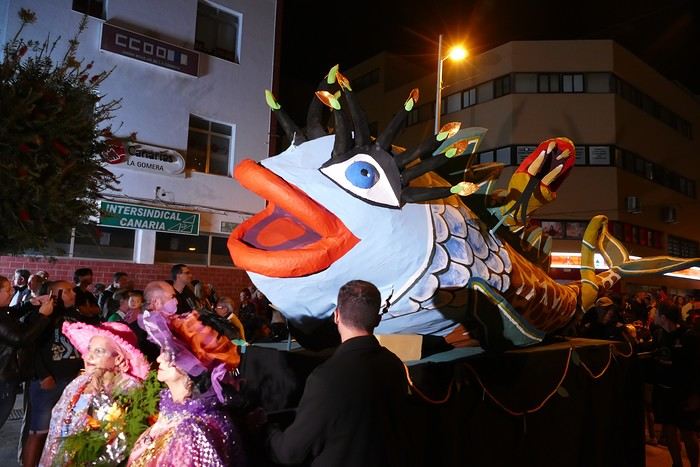 Entierro de la Sardina in San Sebastián de La Gomera
Thursday, February 15
Woke up at 5:15 AM. The only suitable ferry was at 7 AM, which would get us to La Palma by late morning rather than evening. We packed our bags, had breakfast, then headed to the port, left our rental car, and boarded the ferry to Tenerife, from where we’d continue to La Palma. Calm sea, beautiful sun—by 10:30 AM, we disembarked in La Palma. We picked up our car and immediately headed to our new apartment in Breña Alta. It’s a large apartment with a superb terrace facing the sea, fully equipped and very comfortable. The hosts recommended Casa Goyo restaurant, near the airport and close to us. It’s a restaurant with many small rooms, some of which can be reserved for families. The fish-based cuisine (chipirones, pulpo) was excellent, hearty, and reasonably priced. Since it’s in the airport’s flight path, we occasionally heard planes landing. Quick and efficient service. Afterward, we visited Santa Cruz de La Palma, which reminded us of the historic quarters of La Orotava in Tenerife or the capital of Gran Canaria.
Friday, February 16
Beautiful weather, blue sky. We headed to the San Bartolo viewpoint toward the northeast coast, then to the lovely village of San Andrés, which we explored. From there, we walked along the shore to the natural pools of Charco Azul, where we swam in the cool but "swimmable" sea. Back in San Andrés for lunch at the "San Andrés" restaurant on the beautiful church square. Very good fish-based meal. We got back in the car and continued along the north coast to the port of Espindola and the natural pools of Fajana near the Cumplida lighthouse. A fairly strong wind whipped up beautiful waves crashing onto the rocky coast in bursts of foam. Back in Santa Cruz, we stopped at the Mercadona supermarket to buy fresh shrimp for dinner.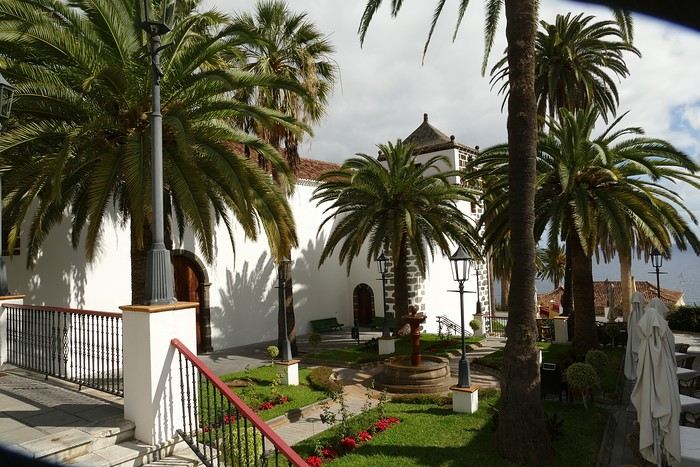 San Andrés
Saturday, February 17
Uniform blue sky, even on the heights. We took the beautiful road that winds up to the summit of the Caldera de Taburiente. Several viewpoints offer 360° views of the entire island and beyond: you can make out La Gomera, El Hierro, and, of course, Tenerife with the perfect triangle of Teide. We parked at the Los Andes viewpoint parking lot and started our hike to Pico de la Cruz along a trail following the ridge, offering superb views into the caldera. We got back in the car and passed by the Roque de los Muchachos astronomical complex, composed of numerous observatories, some with very aesthetic mirror telescopes. We hiked from the Roque de los Muchachos parking lot to the various viewpoints, always as impressive. Picnic on site, then back to Santa Cruz. We stopped by our car dealer because the oil warning light came on—better safe than sorry. The representative reassured us but preferred to give us a Fiat Cross SUV instead.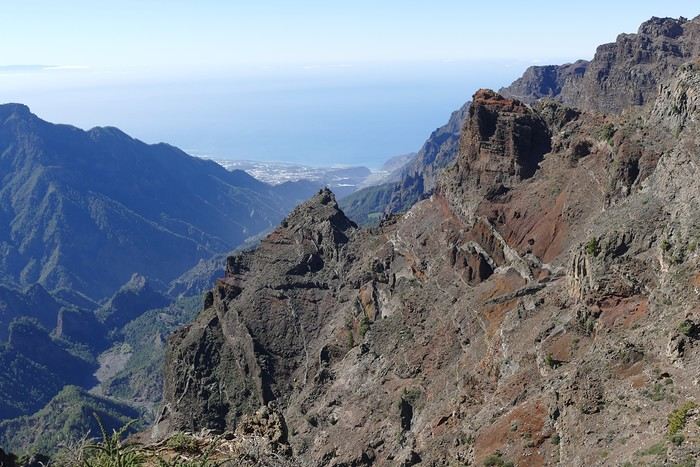 The Caldera de Taburiente
Sunday, February 18 The weather was a bit mixed, with cloudy patches. We set off to hike the Barranco de la Cuba de Galga. Unfortunately, the Los Tilos trail had been closed for several months due to a major landslide. The parking lot by the road was already quite full, and indeed, we crossed paths with many hikers along the way—it’s an easy hike with little elevation gain, which is rare here in La Palma! The beautiful path winds through a very narrow, deep gorge covered in lush tropical vegetation—you’d think you were in a Southeast Asian forest, especially with the humidity in the gorge bringing out earthy and floral scents. Halfway through, Monique turned back while the rest of us continued to the Cuba de Galga. A light drizzle accompanied us on the return. For lunch, we went to Chipi Chipi restaurant in the heights of Santa Cruz. The cool air forced us to leave the lovely terrace for the slightly noisy dining room. The meal was very good and hearty. Afternoon spent resting at our house.
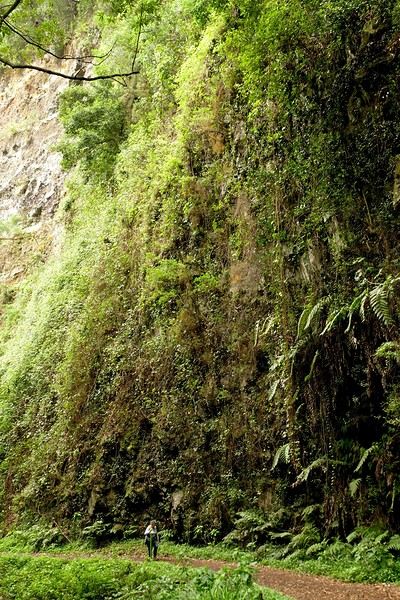 La Cuba de la Galga
Monday, February 19 A few clouds still clung to the nearby mountain peaks. We headed south to Los Canarios. We stopped in front of the small San Antonio Abad church, where a path leads to the viewpoint in 15 minutes. Then we visited the San Antonio Volcano Interpretation Center and climbed to the viewpoint via the trail along the crater’s edge, offering a plunging view into the crater. Then PP, Pat, and I headed toward the Teneguía volcano but turned back given the remaining distance and the intense heat bearing down on us! Plus, the landscape was rather arid and not very interesting. We got back in the car and drove down to the salt flats at the island’s southern tip. The ocean crashes here in large waves, exploding against the volcanic rocks and feeding a "blowhole" carved into the rock. We stopped for drinks at the salt flats restaurant, then headed home.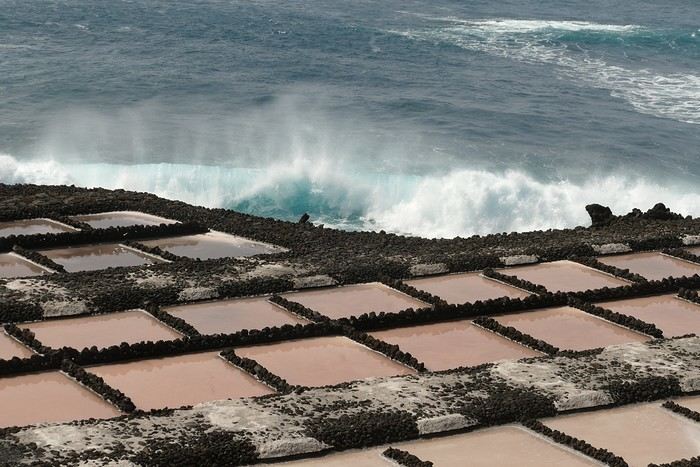 The salt flats in Fuencaliente
Tuesday, February 20 Beautiful weather with a few clouds clinging to the mountains, as usual. A relaxed morning since my parking reservation at La Cumbrecita didn’t start until 1 PM. It takes about 30 minutes from Santa Cruz to reach the valley floor via a beautiful but narrow road toward the end, though there’s very little traffic. Meanwhile, the clouds had disappeared, and the view from the La Cumbrecita viewpoint was superb. We recognized Pico de la Cruz in the distance, where we’d been a few days earlier. We then took the path leading to the Las Chozas viewpoint through a magnificent Canarian pine forest. We picnicked on site, then took the path to the Los Roques viewpoint. We returned the same way since the direct route was closed for construction. Back in Santa Cruz, we visited the Sanctuary of Las Nieves, with its beautiful golden Baroque altar.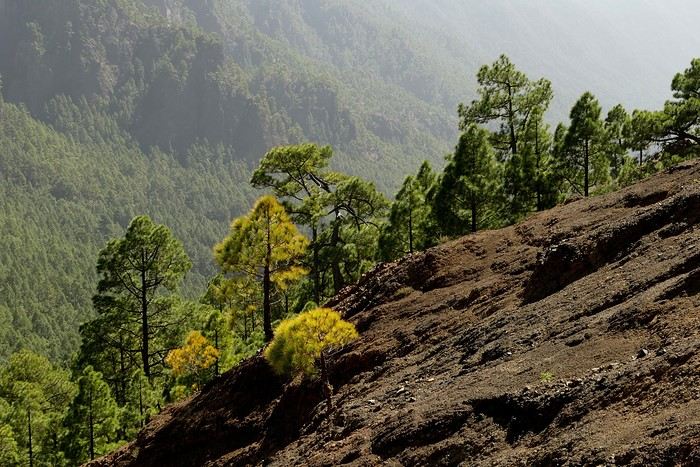 Hike from La Cumbrecita
Wednesday, February 21 After packing our things and loading the car, we left Santa Cruz under a very blue sky for Los Llanos de Aridane, where we stopped to visit this lovely town. The Church of Nuestra Señora de los Remedios has a beautiful coffered ceiling and an original papier-mâché Christ statue from the 16th century. Around it, colorful old Canarian houses brighten the streets of the town center. We took the opportunity to stroll, do some shopping, and finally sat down at La Pergola restaurant for a mediocre lunch. We got back in the car to check into our new house in Arecida. On the way, we stopped at the Mirador del Time, which once again offered an impressive panorama, allowing us—for the first time—to see the damage caused by the Tajogaite volcano eruption in 2021. You can clearly see the still-smoking crater and the large black lava flow covering the landscape down to the sea. We really liked our new accommodation: a local house that’s been renovated on the heights of Arecida, not far from the Canarian pine forest. From several terraces, we have a 360° view of the sea and mountains. We even have a private pool! There are two beautiful, brand-new bedrooms, each with its own bathroom—the best. Plus, we’re on the GR 131 trail that runs along the Barranco de las Angustias toward the northeast.
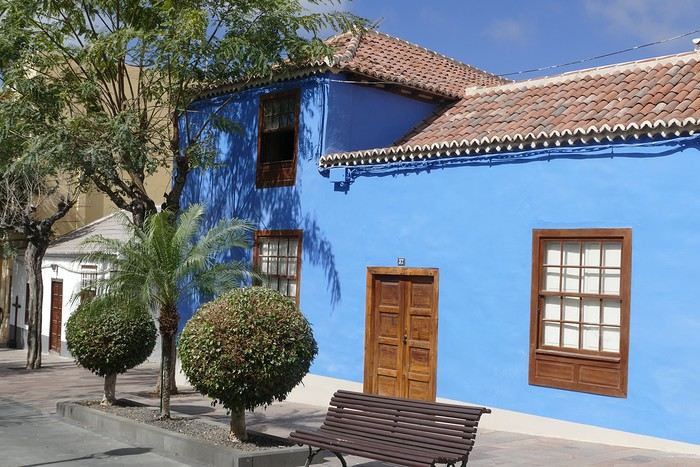 Los Llanos de Aridane
Thursday, February 22 Once again, beautiful weather greeted us when we woke up. We started the GR 131 with the goal of reaching the Torre del Time viewpoint—about 400 meters of elevation gain. The path, quite steep at first, winds through a superb Canarian pine forest. A few viewpoints let you appreciate the sheer drop of the Barranco de las Angustias—watch out for vertigo! At the Torre del Time viewpoint, there’s a nearly 1,000-meter vertical drop. We returned via another path, the PLP1, which meanders first through this beautiful forest, then along lovely flower-filled gardens adjacent to beautiful properties that cascade from the forest down to the road serving these neighborhoods. This afternoon, we tried to get closer to the area devastated by the 2021 lava flows. Several roads are still closed or reserved for residents, while others—brand new—have been rebuilt to open up this densely populated and cultivated region. In some places, the lava flow slightly diverted, sparing some properties that logically should have disappeared. Now, they’re encircled by a massive cooled lava field. In other spots, twisted and charred metal scraps or greenhouse remains protrude from the lava—all that’s left of the former banana plantations. A little higher up, you can see the slightly smoking crater of Tajogaite, responsible for this disaster. Back to Casa Barreros.
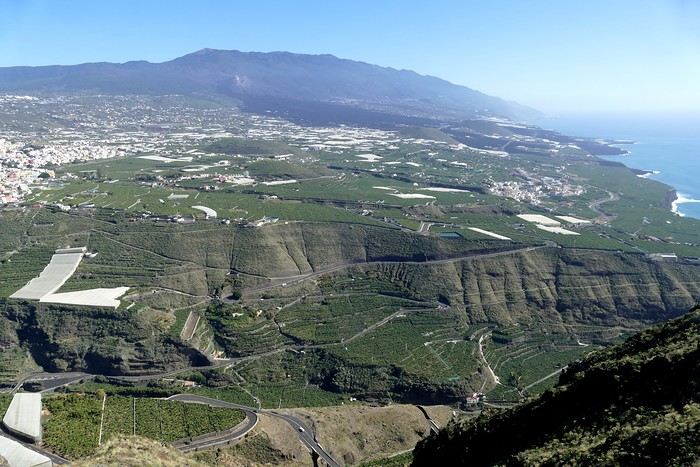 View of Los Llanos and, in the background, the 2021 lava flow
Friday, February 23
Though the sky was still blue, the temperature had dropped due to a chilly wind. By midday, it still rose to 22°C. Today, we headed north, specifically to the town of Tijarafe, where a very narrow road descends to the small port, Porís de Candelaria. The 3.7-kilometer road drops 700 meters in elevation, with gradients up to 30%—it was going to be intense! Indeed, the descent was scary, with the void right next to the very narrow road where passing was impossible except at a few rare spots. Everything went well—there was little traffic at this early hour. From the parking lot at the bottom, a path leads to Porís de Candelaria. It’s surprising to see this small fishing hamlet nestled in the shelter of an immense cave opening onto the sea, which was quite rough today. The sun, at this time of year, would appear late in the cave, which remained in shadow for much of the day. We returned via the same road, strolled through the small town of Puntagorda, and had lunch at El Jardín de los Naranjos restaurant—excellent meal.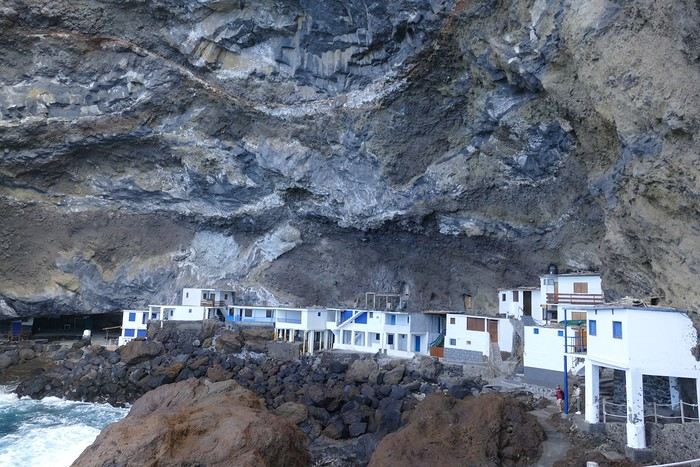 Fishing hamlet of Candelaria
Saturday, February 24 The air was still cool, but the sun was beautiful. While Monique stayed home to rest, the three of us headed to the village of Las Tricias to hike the Buracas Caves trail. We left the car parked on the LP1 road and took the small paved road down to the sign marking the trail’s start. The signage for all the trails we took here, as in La Gomera, was very well done. The path descended steadily, then more steeply toward the caves where the island’s first inhabitants lived—some petroglyphs are still visible in certain caves. The path then climbed back up, passing magnificent dragon trees and more or less elaborate huts occupied by Germans who’ve lived here for many years. Back at Casa Barreros for some rest.
Sunday, February 25 The weather once again blessed us with a beautiful day. This morning, we visited the local produce market held on weekends in Puntagorda. You’ll find agricultural products, crafts, and food to keep you going. A little further on, there’s a glass viewpoint overlooking the barranco plunging toward the sea, with a view of the thrill-seekers trying the zip line right next to it. Lunch at Naranjos—definitely a good spot—with their shrimp and spice tagliatelle. Back home for an afternoon of relaxation.
Monday, February 26 We left Arecida under a cloudy sky. Driving up from Los Llanos de Aridane toward the east, an enormous cascade of clouds poured from the mountain peaks into the Los Llanos plain—very impressive. Arriving in Santa Cruz, we went for a stroll, did some last-minute shopping, then had a final good-quality paella at La Chalana on the paseo maritimo. We left the car in the parking lot and took the 5 PM Olsen ferry to Tenerife on a slightly choppy sea, but the ferry didn’t rock too much. Arriving at 7:15 PM, we dropped off our things near the port in our reserved apartment and went for dinner at Abordo—rubbery chipirones. A digestive stroll among the ever-increasing number of tourists in Los Cristianos—restaurants were packed to the brim, the season is in full swing here. Gone is the calm of La Gomera and La Palma, and the laid-back tourism of German hikers among whom a few French were hiding!
Tuesday, February 27 To make our homemade breakfast more enjoyable, we went to buy pastries at the local bakery, then took one last walk on the paseo along the beaches, mingling with the many mobility scooters driven by elderly or disabled people, joggers, and tourists. Last apéro near the bus station, then off to the airport. After a smooth 4-hour-30-minute flight, we arrived in Basel-Mulhouse at 10:20 PM.
THE END
Conclusion A fantastic trip to two islands with magnificent and diverse nature, where landscapes range from desert-like to tropical depending on exposure to winds and clouds. Thanks to the many beautiful viewpoints, you can truly appreciate these exceptionally dynamic reliefs. A hiker’s paradise, the trails are all very well marked, though the choice of easy or moderate paths for "casual walkers" is quite limited. Another notable advantage, in our opinion, is that these islands are very lightly developed—you’ll hardly see any of those ugly hotel blocks that spoil the landscapes of some other Canary Islands. It’s true that the beaches on these two islands don’t meet traditional international tourism criteria: they’re small, with black sand, and often difficult to access. Special mention for the quality of the road network (except for a few small local roads), which seems brand new, well-paved, and well-signposted. We also enjoyed exceptional weather for February, with fewer than three days of gray or rainy weather out of 21.
Almost all the accommodations we chose met or exceeded our expectations, often at reasonable prices: an average of 98 € per night for an apartment or house with two bedrooms for four people.
All photos can be viewed by clicking this link: https://photos.app.goo.gl/G44pPk4g9PW1rNzg8
Tuesday, February 6 We left around 9 AM with our car, along with Pierre-Paul and Patricia, heading to the Bluepark parking lot in Bartenheim. As expected, we were awaited and left promptly for EuroAirport Basel. Took off at 12:25 PM for a 4-hour-15-minute flight under excellent conditions. Beautiful arrival in Tenerife with Teide in sight under a clear blue sky. Fifteen minutes later, we waited for bus No. 40 to Los Cristianos with quite a few other tourists, but we managed to find four seats. From the bus station, it was a 20-minute walk to our hotel. We checked into a lovely apartment for the four of us, complete with all the comforts. Outside, it was quite warm—at least 25°C! After dropping off our luggage, we went for a stroll. The immediate surroundings of the hotel held no interest for us: a modern, concrete area filled with hotels, bars, tourist agencies, and unappealing restaurants all offering the same bland international cuisine. Pat went to cool off at the pool, unfortunately overrun by loud, drunk English tourists. I took a walk to the paseo maritimo that leads to the port, skirting the seafront. The promenade was pleasant, but it could have been any seaside resort in the world—same old scene: a succession of bars with blaring music where many elderly people sipped cold beers waiting for the sunset, the backdrop a wall of resort-style hotels resembling rabbit hutches! Upon reaching the port, I scouted the route we’d take the next day to the Fred Olsen ferry. Back at the apartment, in the early evening, we looked for a non-touristy restaurant for dinner. Monique stopped a woman to ask her opinion! In this area, she told us, there’s no restaurant that serves Canarian or Spanish cuisine! The only place with decent restaurants is at the port. Off we went to the port, where we sat down at Al Bordo restaurant and ordered a seafood paella for four. Excellent, and at a very reasonable price (36 € for two). We returned to the hotel along the seafront.
Wednesday, February 7
Woke up at 6 AM. Had breakfast in the apartment with what we’d bought the day before at a supermarket. It was still dark when we left on foot toward the port, walking along the calm seafront at this early hour. Forty minutes later, we arrived and waited 10 minutes before the ferry docked. At 9:30 AM, we left the port of Los Cristianos for a 50-minute crossing on a calm sea under a beautiful blue sky. There were quite a few people on this large ferry, but many had no luggage, meaning they were visiting La Gomera for the day and would take the ferry back in the evening. Upon disembarking, we went straight to our rental car agency to pick up the car we’d booked online a few months earlier. It was a nice Peugeot 2008, spacious enough for the four of us and our luggage. We immediately took the beautiful road from San Sebastián that climbs directly into the mountains toward our rental in Vallehermoso. The road was in perfect condition—it seemed brand new, like all the others we’d take on this island later. This side of the island is very arid with little vegetation, and the terrain is particularly rugged, as it is throughout the island. We stopped at our first miradors, which would be followed by many more throughout our Canarian trip. Our first visit was to the small village of Agulo, perched on a promontory above the sea and at the foot of a high cliff. The village features typical Canarian houses with windows flush with the façade and black volcanic stone masonry on white or reddish-brown walls. The first recommended restaurant was already booked for a group, so we settled for the shaded terrace of the excellent El Alameda bar-restaurant. From Agulo, you can access the Abrante viewpoint via a winding road, where the view of Agulo, 600 meters below, is exceptional. A glass ledge over the void lets you test your fear of heights!
We drove to Vallehermoso to do our grocery shopping at the supermarket—a habit that would continue until the end of the trip. Our little house, "Casa rural El Encatadora," is located in a beautiful flower-filled valley a few kilometers west of Vallehermoso. Each of us had a bedroom with an en-suite bathroom, plus a living room, kitchen, and a small terrace overlooking the quiet street at the valley’s end, which didn’t bother us at all.
Thursday, February 8 The good weather seemed to follow us since our arrival in the Canary Islands. This morning, we took the road—still as beautiful and new—toward Arure, high up to the west. The landscape was magnificent, with breathtaking glimpses of the sea far below. In Arure, we parked in front of Conchita’s bar, where a hike (Rother No. 30) starts toward two viewpoints: Alojera, which we reached after 45 minutes on a lovely path. Monique, tired from the first steep climb, stopped at the first viewpoint and hitchhiked back to Arure. Meanwhile, we continued toward the second viewpoint, Los Barranquillos, where the view of the surroundings was partially hidden by misty clouds rising from the sea. The entire mountain is sculpted by ancient, endless terraces climbing until the slope becomes too steep for construction—visible traces of the hard work of past inhabitants trying to survive in a harsh environment. We had a decent lunch at La Conchita bar, then drove to the small seaside town of Puerto la Caleta, sheltered by an immense cliff plunging into the sea. Black sand beach, rough sea—despite our encouragement, Pat didn’t dare to swim! As for the old village of Caleta, it’s perched on the mountainside, and visiting it requires climbing steep, stair-filled alleys to discover a few traditional houses. Back at the casa, dinner in, and card games...
VallehermosoFriday, February 9 This morning, the sky was overcast, and the peaks around us were shrouded in clouds. We took the same road as yesterday to hike Las Creces. Quickly gaining altitude, we entered a thick fog—visibility was very limited. We stopped at the Las Creces parking lot; visibility improved, and the sun wasn’t far off. The hike is entirely within a beautiful laurel forest, with the sun playing hide-and-seek, but it wasn’t cold despite the altitude. After finishing the loop trail, we decided to picnic—not there, as it was too chilly—but on Vallehermoso’s beach, where we found a nice picnic area sheltered by large black rocks. A short digestive walk on the surrounding hill to admire the little beach from above. Back in Vallehermoso, we did some grocery shopping, then tried to return to the casa—only to find ourselves locked out because we’d left the key in the lock inside! After several attempts and with the help of Yéli, a relative of the owner we called for help, we were finally able to get back in!
Saturday, February 10
It rained last night, and the sky remained overcast. Monique decided to rest this morning. PP, Pat, and I set off on the hike that starts from the house toward the Marichal reservoir. The sun wasn’t far off, and by 11 AM, it was fully out. The pleasant hike passed by many flower-filled gardens and orchards—orange, lemon, and mandarin trees in fruit. The path climbed gently toward the reservoir, where the view of the Cano rock dominating the landscape was magnificent. The last part of the climb was a bit tough, overgrown with lush vegetation, and the trail was slippery from last night’s rain. We descended via a different, much more pleasant path and returned to the casa just in time for lunch, prepared by Monique. This valley is rich with its many farmers and market gardeners who’ve cultivated the entire valley, taking advantage of the water flowing down from the mountain, captured upstream and redistributed through countless pipes snaking along the paths. Numerous tanks also store water during dry periods. The houses are scattered across both sides of the valley, and these colorful little homes add a beautiful touch to the landscape. The many palm trees give this valley a distinctly tropical feel—you could almost imagine yourself in the Caribbean. Add to that some salsa music drifting from a hut where farmers were working, and the picture is complete. A well-chilled beer apéro capped off a lovely morning. The afternoon was dedicated to rest, relaxation, reading, and games.
Sunday, February 11 The blue sky returned, though a few clouds still capped the highest peaks. Today, we visited Garajonay National Park, which covers the highest central mountains. Up there, we were above the clouds, and the panoramas from the various viewpoints were stunning: first, Cherelepin, accessible from the Laguna Grande parking lot, then Alto de Garajonay, offering an exceptional view of Teide—over 3,000 meters high—emerging from the clouds on Tenerife, far in the distance. We continued to the Los Roques viewpoints, then stopped for lunch at the Degollada de Peraza restaurant, where the view of the barranco was impressive. We descended toward San Sebastián and checked into our new lodging, La Cabezada, located in the countryside about 3 km above San Sebastián. It’s a small apartment adjacent to the owner’s, with a lovely terrace overlooking the surrounding mountains and surrounded by a beautiful garden. Apéro, then dinner on our beautiful terrace.
Monday, February 12 This morning, we went down to visit San Sebastián de La Gomera: its old tower, main street with some beautiful traditional houses, and the Church of the Assumption. Back at the casa for lunch. In the afternoon, Pat, PP, and I set off on the short hike from San Sebastián beach to La Guancha beach. We drove down and parked on the beach. The path climbs along the hill overlooking San Sebastián, passes by the tall Christ statue dominating the landscape, and roughly follows the coast down to the isolated Guancha beach. A beautiful hike under a hot sun, and a swim was welcome, even if the beach and sea access weren’t very comfortable due to large pebbles and quickly deepening water. Apart from two nudist bathers, there was no one on this beach. We returned the same way.
Tuesday, February 13 Rest day. We went down to town to stroll and do some shopping. I took the opportunity to visit the parador, beautifully situated above the city in a lovely garden overlooking the port and town. Together, we went for a cuba libre at the "Cuba Libre" bar, then had lunch at Breñusca (mediocre paella!). Back at the casa, then we went back down to town to see a carnival parade, a "passacalles," which actually passed an hour earlier than scheduled. Oh well.
Wednesday, February 14 Each to their own program this morning. Pat went swimming at San Sebastián beach, Monique rested at the casa, and PP and I set off on the hike from Playa de Avalos to the Ermita de Guadalupe on Playa del Cangrejo. It wasn’t easy to find the right road or the parking spot, but we managed. The path seemed to have suffered landslides, according to a sign at the trailhead! We decided to check it out, ready to turn back if it seemed too dangerous. In the end, apart from one or two slightly tricky spots where we had to climb a pile of rocks, the trail remained passable, though a bit vertigo-inducing in places. The narrow path clings to very vertical cliffs nearly 300 meters above sea level! But what a magnificent view. At one point, the trail runs alongside a wall of basaltic pipes. We returned via the drivable track that parallels the trail a bit lower. Back at the house for lunch. In the late afternoon, we returned to town to attend the "Entierro de las Sardinas" (Burial of the Sardine), which closes the Canarian carnival festivities. While waiting, we strolled through the parador’s gardens and had mojitos in town. Around 9 PM, we heard the noise and cries of the mourners. The procession advanced, led by a large papier-mâché sardine on a float, surrounded by wailing mourners. The procession headed toward the sea, where the sardine was burned, and a mini fireworks display ended the procession. It was all very good-natured, and everyone had fun. We ended the evening with dinner at a good fish restaurant, El Pajar.
Entierro de la Sardina in San Sebastián de La GomeraThursday, February 15
Woke up at 5:15 AM. The only suitable ferry was at 7 AM, which would get us to La Palma by late morning rather than evening. We packed our bags, had breakfast, then headed to the port, left our rental car, and boarded the ferry to Tenerife, from where we’d continue to La Palma. Calm sea, beautiful sun—by 10:30 AM, we disembarked in La Palma. We picked up our car and immediately headed to our new apartment in Breña Alta. It’s a large apartment with a superb terrace facing the sea, fully equipped and very comfortable. The hosts recommended Casa Goyo restaurant, near the airport and close to us. It’s a restaurant with many small rooms, some of which can be reserved for families. The fish-based cuisine (chipirones, pulpo) was excellent, hearty, and reasonably priced. Since it’s in the airport’s flight path, we occasionally heard planes landing. Quick and efficient service. Afterward, we visited Santa Cruz de La Palma, which reminded us of the historic quarters of La Orotava in Tenerife or the capital of Gran Canaria.
Friday, February 16
Beautiful weather, blue sky. We headed to the San Bartolo viewpoint toward the northeast coast, then to the lovely village of San Andrés, which we explored. From there, we walked along the shore to the natural pools of Charco Azul, where we swam in the cool but "swimmable" sea. Back in San Andrés for lunch at the "San Andrés" restaurant on the beautiful church square. Very good fish-based meal. We got back in the car and continued along the north coast to the port of Espindola and the natural pools of Fajana near the Cumplida lighthouse. A fairly strong wind whipped up beautiful waves crashing onto the rocky coast in bursts of foam. Back in Santa Cruz, we stopped at the Mercadona supermarket to buy fresh shrimp for dinner.
San AndrésSaturday, February 17
Uniform blue sky, even on the heights. We took the beautiful road that winds up to the summit of the Caldera de Taburiente. Several viewpoints offer 360° views of the entire island and beyond: you can make out La Gomera, El Hierro, and, of course, Tenerife with the perfect triangle of Teide. We parked at the Los Andes viewpoint parking lot and started our hike to Pico de la Cruz along a trail following the ridge, offering superb views into the caldera. We got back in the car and passed by the Roque de los Muchachos astronomical complex, composed of numerous observatories, some with very aesthetic mirror telescopes. We hiked from the Roque de los Muchachos parking lot to the various viewpoints, always as impressive. Picnic on site, then back to Santa Cruz. We stopped by our car dealer because the oil warning light came on—better safe than sorry. The representative reassured us but preferred to give us a Fiat Cross SUV instead.
The Caldera de TaburienteSunday, February 18 The weather was a bit mixed, with cloudy patches. We set off to hike the Barranco de la Cuba de Galga. Unfortunately, the Los Tilos trail had been closed for several months due to a major landslide. The parking lot by the road was already quite full, and indeed, we crossed paths with many hikers along the way—it’s an easy hike with little elevation gain, which is rare here in La Palma! The beautiful path winds through a very narrow, deep gorge covered in lush tropical vegetation—you’d think you were in a Southeast Asian forest, especially with the humidity in the gorge bringing out earthy and floral scents. Halfway through, Monique turned back while the rest of us continued to the Cuba de Galga. A light drizzle accompanied us on the return. For lunch, we went to Chipi Chipi restaurant in the heights of Santa Cruz. The cool air forced us to leave the lovely terrace for the slightly noisy dining room. The meal was very good and hearty. Afternoon spent resting at our house.
La Cuba de la GalgaMonday, February 19 A few clouds still clung to the nearby mountain peaks. We headed south to Los Canarios. We stopped in front of the small San Antonio Abad church, where a path leads to the viewpoint in 15 minutes. Then we visited the San Antonio Volcano Interpretation Center and climbed to the viewpoint via the trail along the crater’s edge, offering a plunging view into the crater. Then PP, Pat, and I headed toward the Teneguía volcano but turned back given the remaining distance and the intense heat bearing down on us! Plus, the landscape was rather arid and not very interesting. We got back in the car and drove down to the salt flats at the island’s southern tip. The ocean crashes here in large waves, exploding against the volcanic rocks and feeding a "blowhole" carved into the rock. We stopped for drinks at the salt flats restaurant, then headed home.
The salt flats in FuencalienteTuesday, February 20 Beautiful weather with a few clouds clinging to the mountains, as usual. A relaxed morning since my parking reservation at La Cumbrecita didn’t start until 1 PM. It takes about 30 minutes from Santa Cruz to reach the valley floor via a beautiful but narrow road toward the end, though there’s very little traffic. Meanwhile, the clouds had disappeared, and the view from the La Cumbrecita viewpoint was superb. We recognized Pico de la Cruz in the distance, where we’d been a few days earlier. We then took the path leading to the Las Chozas viewpoint through a magnificent Canarian pine forest. We picnicked on site, then took the path to the Los Roques viewpoint. We returned the same way since the direct route was closed for construction. Back in Santa Cruz, we visited the Sanctuary of Las Nieves, with its beautiful golden Baroque altar.
Hike from La CumbrecitaWednesday, February 21 After packing our things and loading the car, we left Santa Cruz under a very blue sky for Los Llanos de Aridane, where we stopped to visit this lovely town. The Church of Nuestra Señora de los Remedios has a beautiful coffered ceiling and an original papier-mâché Christ statue from the 16th century. Around it, colorful old Canarian houses brighten the streets of the town center. We took the opportunity to stroll, do some shopping, and finally sat down at La Pergola restaurant for a mediocre lunch. We got back in the car to check into our new house in Arecida. On the way, we stopped at the Mirador del Time, which once again offered an impressive panorama, allowing us—for the first time—to see the damage caused by the Tajogaite volcano eruption in 2021. You can clearly see the still-smoking crater and the large black lava flow covering the landscape down to the sea. We really liked our new accommodation: a local house that’s been renovated on the heights of Arecida, not far from the Canarian pine forest. From several terraces, we have a 360° view of the sea and mountains. We even have a private pool! There are two beautiful, brand-new bedrooms, each with its own bathroom—the best. Plus, we’re on the GR 131 trail that runs along the Barranco de las Angustias toward the northeast.
Los Llanos de AridaneThursday, February 22 Once again, beautiful weather greeted us when we woke up. We started the GR 131 with the goal of reaching the Torre del Time viewpoint—about 400 meters of elevation gain. The path, quite steep at first, winds through a superb Canarian pine forest. A few viewpoints let you appreciate the sheer drop of the Barranco de las Angustias—watch out for vertigo! At the Torre del Time viewpoint, there’s a nearly 1,000-meter vertical drop. We returned via another path, the PLP1, which meanders first through this beautiful forest, then along lovely flower-filled gardens adjacent to beautiful properties that cascade from the forest down to the road serving these neighborhoods. This afternoon, we tried to get closer to the area devastated by the 2021 lava flows. Several roads are still closed or reserved for residents, while others—brand new—have been rebuilt to open up this densely populated and cultivated region. In some places, the lava flow slightly diverted, sparing some properties that logically should have disappeared. Now, they’re encircled by a massive cooled lava field. In other spots, twisted and charred metal scraps or greenhouse remains protrude from the lava—all that’s left of the former banana plantations. A little higher up, you can see the slightly smoking crater of Tajogaite, responsible for this disaster. Back to Casa Barreros.
View of Los Llanos and, in the background, the 2021 lava flowFriday, February 23
Though the sky was still blue, the temperature had dropped due to a chilly wind. By midday, it still rose to 22°C. Today, we headed north, specifically to the town of Tijarafe, where a very narrow road descends to the small port, Porís de Candelaria. The 3.7-kilometer road drops 700 meters in elevation, with gradients up to 30%—it was going to be intense! Indeed, the descent was scary, with the void right next to the very narrow road where passing was impossible except at a few rare spots. Everything went well—there was little traffic at this early hour. From the parking lot at the bottom, a path leads to Porís de Candelaria. It’s surprising to see this small fishing hamlet nestled in the shelter of an immense cave opening onto the sea, which was quite rough today. The sun, at this time of year, would appear late in the cave, which remained in shadow for much of the day. We returned via the same road, strolled through the small town of Puntagorda, and had lunch at El Jardín de los Naranjos restaurant—excellent meal.
Fishing hamlet of CandelariaSaturday, February 24 The air was still cool, but the sun was beautiful. While Monique stayed home to rest, the three of us headed to the village of Las Tricias to hike the Buracas Caves trail. We left the car parked on the LP1 road and took the small paved road down to the sign marking the trail’s start. The signage for all the trails we took here, as in La Gomera, was very well done. The path descended steadily, then more steeply toward the caves where the island’s first inhabitants lived—some petroglyphs are still visible in certain caves. The path then climbed back up, passing magnificent dragon trees and more or less elaborate huts occupied by Germans who’ve lived here for many years. Back at Casa Barreros for some rest.
Sunday, February 25 The weather once again blessed us with a beautiful day. This morning, we visited the local produce market held on weekends in Puntagorda. You’ll find agricultural products, crafts, and food to keep you going. A little further on, there’s a glass viewpoint overlooking the barranco plunging toward the sea, with a view of the thrill-seekers trying the zip line right next to it. Lunch at Naranjos—definitely a good spot—with their shrimp and spice tagliatelle. Back home for an afternoon of relaxation.
Monday, February 26 We left Arecida under a cloudy sky. Driving up from Los Llanos de Aridane toward the east, an enormous cascade of clouds poured from the mountain peaks into the Los Llanos plain—very impressive. Arriving in Santa Cruz, we went for a stroll, did some last-minute shopping, then had a final good-quality paella at La Chalana on the paseo maritimo. We left the car in the parking lot and took the 5 PM Olsen ferry to Tenerife on a slightly choppy sea, but the ferry didn’t rock too much. Arriving at 7:15 PM, we dropped off our things near the port in our reserved apartment and went for dinner at Abordo—rubbery chipirones. A digestive stroll among the ever-increasing number of tourists in Los Cristianos—restaurants were packed to the brim, the season is in full swing here. Gone is the calm of La Gomera and La Palma, and the laid-back tourism of German hikers among whom a few French were hiding!
Tuesday, February 27 To make our homemade breakfast more enjoyable, we went to buy pastries at the local bakery, then took one last walk on the paseo along the beaches, mingling with the many mobility scooters driven by elderly or disabled people, joggers, and tourists. Last apéro near the bus station, then off to the airport. After a smooth 4-hour-30-minute flight, we arrived in Basel-Mulhouse at 10:20 PM.
THE END
Conclusion A fantastic trip to two islands with magnificent and diverse nature, where landscapes range from desert-like to tropical depending on exposure to winds and clouds. Thanks to the many beautiful viewpoints, you can truly appreciate these exceptionally dynamic reliefs. A hiker’s paradise, the trails are all very well marked, though the choice of easy or moderate paths for "casual walkers" is quite limited. Another notable advantage, in our opinion, is that these islands are very lightly developed—you’ll hardly see any of those ugly hotel blocks that spoil the landscapes of some other Canary Islands. It’s true that the beaches on these two islands don’t meet traditional international tourism criteria: they’re small, with black sand, and often difficult to access. Special mention for the quality of the road network (except for a few small local roads), which seems brand new, well-paved, and well-signposted. We also enjoyed exceptional weather for February, with fewer than three days of gray or rainy weather out of 21.
Almost all the accommodations we chose met or exceeded our expectations, often at reasonable prices: an average of 98 € per night for an apartment or house with two bedrooms for four people.
All photos can be viewed by clicking this link: https://photos.app.goo.gl/G44pPk4g9PW1rNzg8
Your itinerary ideas for 12 nights in Thailand
Hi everyone,
I know my post might sound a bit repetitive with the questions asked regularly on this forum, but I’m feeling a little lost and thought I’d still ask for your help.
Here’s my situation:
I’m traveling to Thailand with my wife and 12-year-old son during the February 2025 school holidays. We’ll be spending 12 nights in the country.
So far, I only have our flight tickets to and from Phuket.
Now, I need to plan an itinerary that lets us discover beautiful places and the culture of this country.
I’d like to stay by the sea, with stunning fine-sand beaches and breathtaking landscapes in areas that aren’t too urban, but also be able to see some beautiful monuments, typical villages, and wildlife not too far away. That said, I don’t want to be lost deep in the jungle either—I’d like a bit of atmosphere in the evenings (no nightclubs, but rather nice bars with music).
I’ve done some research and here’s a first draft of what I might do:
Spend my first 3 nights in the suburbs of Phuket to explore the city and the province more broadly, Then head to Ko Yao Noi for 2 nights to discover the charms of Phang Nga Bay, Next, fly from Krabi to spend 4 nights on Koh Samui (maybe with a little excursion to Ko Pha Ngan?), Then fly back to Krabi to reach Koh Phi Phi for 2 nights, Finally, return to the Phuket area for my last night in Thailand to be close for my flight the next day.
The idea is to explore several places without having to pack and unpack every day, and to avoid spending hours on transport every day. What do you think? Do the places seem relevant? If so, does the number of nights seem appropriate? Thanks in advance for your help, Best regards, Lionel
Spend my first 3 nights in the suburbs of Phuket to explore the city and the province more broadly, Then head to Ko Yao Noi for 2 nights to discover the charms of Phang Nga Bay, Next, fly from Krabi to spend 4 nights on Koh Samui (maybe with a little excursion to Ko Pha Ngan?), Then fly back to Krabi to reach Koh Phi Phi for 2 nights, Finally, return to the Phuket area for my last night in Thailand to be close for my flight the next day.
The idea is to explore several places without having to pack and unpack every day, and to avoid spending hours on transport every day. What do you think? Do the places seem relevant? If so, does the number of nights seem appropriate? Thanks in advance for your help, Best regards, Lionel
Promenades au Rwanda English translation pending
C'est un voyage qui date un peu, mais il se trouve que les circonstances de la vie m'offrent du temps libre... L'occasion de replonger dans mes souvenirs et partager un voyage qui reste probablement d’actualité même si nous habitons un monde qui change de plus en plus vite...
dimanche 4 juin 2017 Mulhouse-Kigali
Le décollage approche, il faut choisir son Macron, heu, je voulais dire, son livre, pardon. Bon, dans la France du mois de juin 2017, cela revient strictement au même…

09:30 embarquement 11:20 Départ Basel Turkish Airlines (TK1924) 3 heures de vol 15:20 Arrivée Istanbul (heure locale) Changement d'Avion 18:35 TK 569 Turkich Airline
durée 6h30
00:05 Arrivée: Kigali (KGL), Kigali, Rwanda
Je précise que le mobile de ce voyage est que ma sœur vit à Kigali depuis quelques années. Son mari travaille "dans la diplomatie". Nous sommes attendus à l’aéroport par un chauffeur de l’ambassade. Ma soeur nous avait dit qu’ils seraient au lit, que la maison était ouverte et des infos pour retrouver sans aide notre chambre. Ceux qui connaissent mon célèbre sens de l’orientation ont déjà deviné que je suis allé me vautrer directement dans la chambre de nos hôtes…
lundi 5 juin 2017
Kigali C’est le lendemain qu’on a vraiment réalisé qu’on était en Afrique...
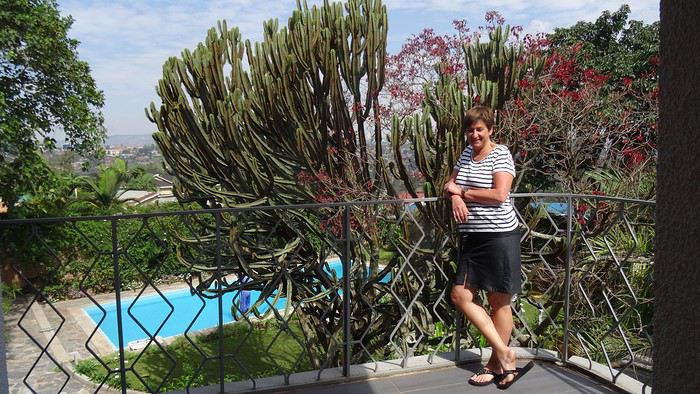
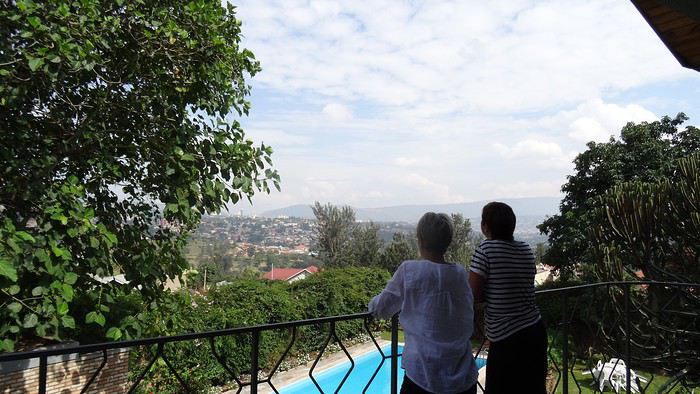
Bon, mais faut manger…On part faire des courses en ville, excellent moyen de prendre la température de l’endroit…Avec ma soeur, c’est tout de suite magouilles et compagnies…Elle me fait changer ma bonne vieille puce Bouygues contre une puce MTN locale. Elle alpague ensuite un gamin dans la rue qui tape sur mon clavier des suites de chiffres cabalistiques pour m’ouvrir les chemins d’une 3g low cost…
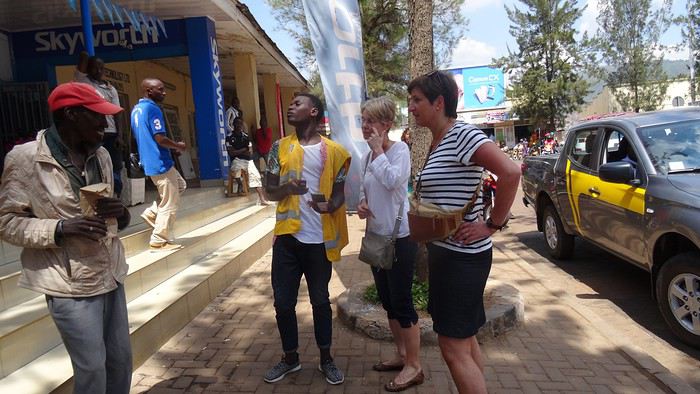
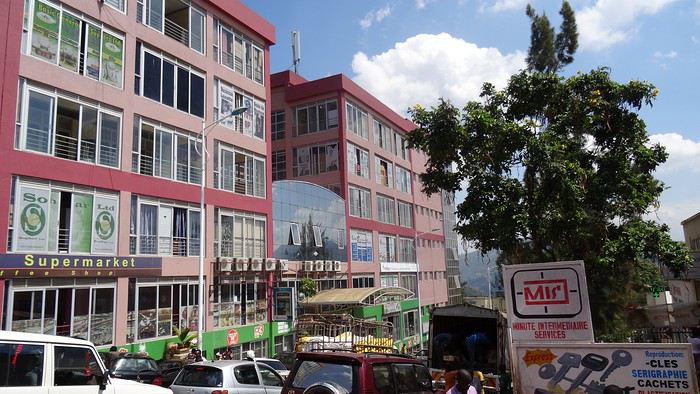
Comme souvent dans les pays qui se sont déversés dans le courant consumériste trop vite, les villes sont un gigantesque foutoir où l’architecture s’inspire beaucoup des gâteaux à la meringue, on côtoie le pire et le meilleur, un flot d’humains qui se débattent pour survivre, des raz de marée de véhicules, gigantesques 4*4 en concurrence avec des myriades de deux roues hétéroclites…C’est une ambiance, à l’africaine, des sonos déversent de la rumba congolaise, des types jouent au tam-tam…
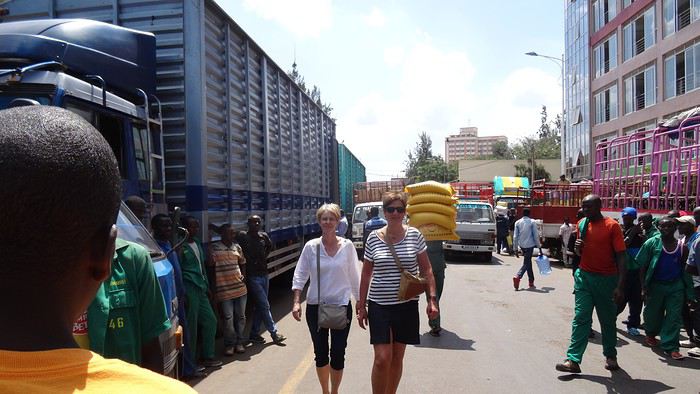
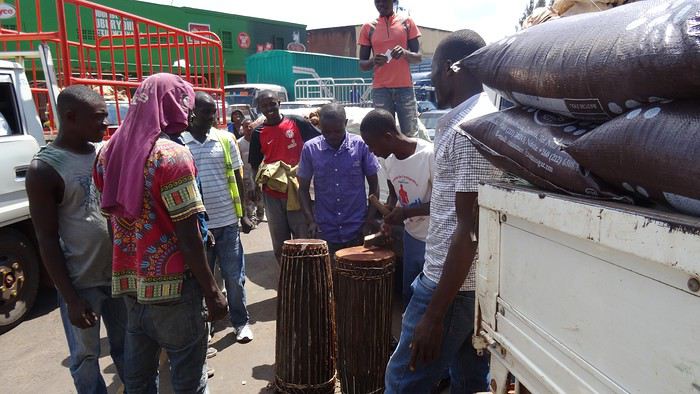
Partout des portefaix s’activent avec des montagnes posées sur la tête…
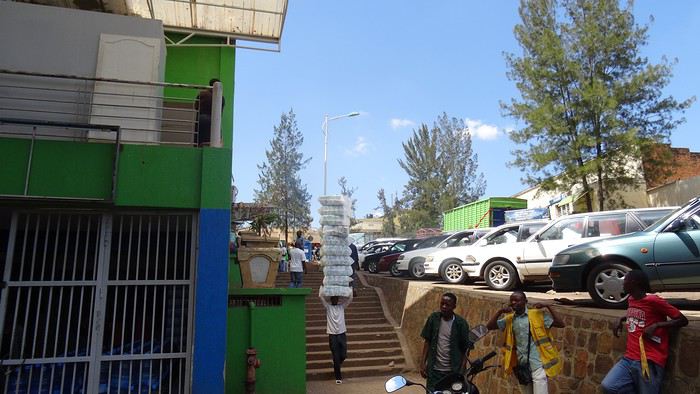
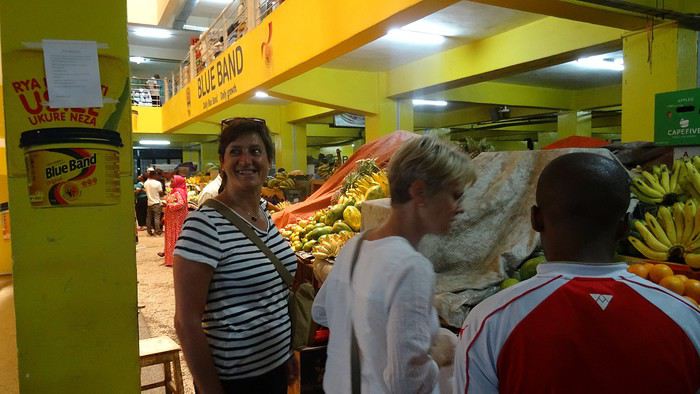
On arrive au marché. Ma sœur y est en territoire connu, négocie, interpelle
dimanche 4 juin 2017 Mulhouse-Kigali
Le décollage approche, il faut choisir son Macron, heu, je voulais dire, son livre, pardon. Bon, dans la France du mois de juin 2017, cela revient strictement au même…
09:30 embarquement 11:20 Départ Basel Turkish Airlines (TK1924) 3 heures de vol 15:20 Arrivée Istanbul (heure locale) Changement d'Avion 18:35 TK 569 Turkich Airline
durée 6h30
00:05 Arrivée: Kigali (KGL), Kigali, Rwanda
Je précise que le mobile de ce voyage est que ma sœur vit à Kigali depuis quelques années. Son mari travaille "dans la diplomatie". Nous sommes attendus à l’aéroport par un chauffeur de l’ambassade. Ma soeur nous avait dit qu’ils seraient au lit, que la maison était ouverte et des infos pour retrouver sans aide notre chambre. Ceux qui connaissent mon célèbre sens de l’orientation ont déjà deviné que je suis allé me vautrer directement dans la chambre de nos hôtes…
lundi 5 juin 2017
Kigali C’est le lendemain qu’on a vraiment réalisé qu’on était en Afrique...
Bon, mais faut manger…On part faire des courses en ville, excellent moyen de prendre la température de l’endroit…Avec ma soeur, c’est tout de suite magouilles et compagnies…Elle me fait changer ma bonne vieille puce Bouygues contre une puce MTN locale. Elle alpague ensuite un gamin dans la rue qui tape sur mon clavier des suites de chiffres cabalistiques pour m’ouvrir les chemins d’une 3g low cost…
Comme souvent dans les pays qui se sont déversés dans le courant consumériste trop vite, les villes sont un gigantesque foutoir où l’architecture s’inspire beaucoup des gâteaux à la meringue, on côtoie le pire et le meilleur, un flot d’humains qui se débattent pour survivre, des raz de marée de véhicules, gigantesques 4*4 en concurrence avec des myriades de deux roues hétéroclites…C’est une ambiance, à l’africaine, des sonos déversent de la rumba congolaise, des types jouent au tam-tam…
Partout des portefaix s’activent avec des montagnes posées sur la tête…
On arrive au marché. Ma sœur y est en territoire connu, négocie, interpelle
Afrique du Sud 2019: retour en terres africaines et premier road-trip en famille English translation pending
Heureux de retrouver le forum d’Afrique australe pour me replonger dans notre voyage de l’été dernier et le partager avec vous.
Bien que ce fut déjà mon 4ème voyage en Afrique du Sud celui-ci eut, dès la préparation, une saveur toute particulière puisque ça allait être notre premier voyage en famille depuis une éternité, et cette fois-ci les rôles étaient inversés puisque c’est moi qui allais faire découvrir à mes parents ma destination de cœur, l’Afrique. 🙂
La concordance des temps dans cette dernière phrase m’a achevé… Ce carnet s’annonce compliqué. 😄
C’est un voyage que nous avons donc réalisé à 5, mes parents, mes 2 jeunes frères et moi-même. Ma sœur n’ayant pas pu se joindre à nous et Alison, ma copine, ayant gardé ses congés pour notre voyage de Septembre en Tanzanie.
C’est un rêve qui, enfin, se réalisait puisque cela faisait plusieurs années que j’essayais d’organiser quelque chose en famille et c’est en rentrant d’Alaksa en Aout 2018 que mes parents se sont motivés pour visiter l’Afrique du Sud. J’ai donc eu quasiment 1an pour préparer ce magnifique voyage en parallèle de celui en Tanzanie avec Alison.
Le circuit se voulait tant classique que magnifique. 24 jours à travers l’Afrique du Sud, à mes yeux le plus beau pays du monde, de Joburg à Capetown.
J0 (06/07/19) : Paris -> Madrid -> Johannesburg J1 (07/07/19) : OR Tambo Int Airport -> Forever Blyde Canyon J2 (08/07/19) : Blyde River Canyon J3 (09/07/19) : Forever Blyde Canyon –> Kruger National Park J4 (10/07/19) : Kruger National Park J5 (11/07/19) : Kruger National Park J6 (12/07/19) : Kruger National Park J7 (13/07/19) : Kruger National Park J8 (14/07/19) : Kruger National Park -> Santa Lucia J9 (15/07/19) : Isimangaliso wetland Park J10 (16/07/19) : Hluhluwe-iMfolozi J11 (17/07/19) : Hluhluwe-iMfolozi J12 (18/07/19) : Hluhluwe-iMfolozi -> Golden Gate NP J13 (19/07/19) : Golden Gate NP J14 (20/07/19) : Golden Gate NP -> Mountain Zebra NP J15 (21/07/19) : Mountain Zebra NP J16 (22/07/19) : Mountain Zebra NP J17 (23/07/19) : Mountain Zebra NP ->Cambedoo NP J18 (24/07/19) : Cambedoo NP -> Addo Elephant NP J19 (25/07/19) : Addo Elephant NP -> De Hoop NR J20 (26/07/19) : De Hoop NR J21 (27/07/19) : De Hoop NR - Capetown J22 (28/07/19) : Capetown J23 (29/07/19) : Capetown J24 (30/07/19) : Capetown - Johannesburg J25 (31/07/19) : Soweto – Départ
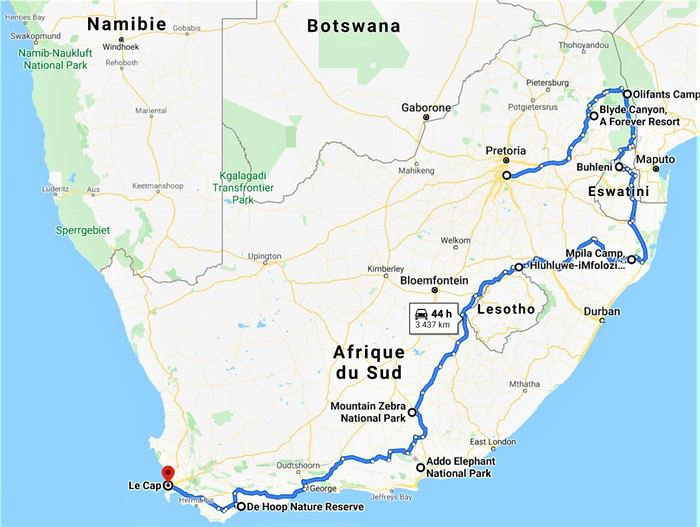
Étant 5 grands gabarits la question du véhicule était délicate puisque c’est dans ce véhicule que nous allions passer le plus de temps, en safari ou sur la route. Nous avons finalement opté pour la location d’un Hyundai H1 chez Budget, option la plus économique et la plus confortable avec 7 places et une plus haute garde au sol pour mieux voir les animaux et le paysage.
Après 11 mois d’attente, début des vacances scolaires et départ de Guadeloupe le vendredi 5 Juillet, pour mes parents et mes frères que je rejoindrai sur Paris le lendemain avant de décoller pour Madrid puis Joburg, tous ensemble, le samedi 6 au soir.
See you in the bush ! (Bilan conseils et budget en fin de carnet.)
Bien que ce fut déjà mon 4ème voyage en Afrique du Sud celui-ci eut, dès la préparation, une saveur toute particulière puisque ça allait être notre premier voyage en famille depuis une éternité, et cette fois-ci les rôles étaient inversés puisque c’est moi qui allais faire découvrir à mes parents ma destination de cœur, l’Afrique. 🙂
La concordance des temps dans cette dernière phrase m’a achevé… Ce carnet s’annonce compliqué. 😄
C’est un voyage que nous avons donc réalisé à 5, mes parents, mes 2 jeunes frères et moi-même. Ma sœur n’ayant pas pu se joindre à nous et Alison, ma copine, ayant gardé ses congés pour notre voyage de Septembre en Tanzanie.
C’est un rêve qui, enfin, se réalisait puisque cela faisait plusieurs années que j’essayais d’organiser quelque chose en famille et c’est en rentrant d’Alaksa en Aout 2018 que mes parents se sont motivés pour visiter l’Afrique du Sud. J’ai donc eu quasiment 1an pour préparer ce magnifique voyage en parallèle de celui en Tanzanie avec Alison.
Le circuit se voulait tant classique que magnifique. 24 jours à travers l’Afrique du Sud, à mes yeux le plus beau pays du monde, de Joburg à Capetown.
J0 (06/07/19) : Paris -> Madrid -> Johannesburg J1 (07/07/19) : OR Tambo Int Airport -> Forever Blyde Canyon J2 (08/07/19) : Blyde River Canyon J3 (09/07/19) : Forever Blyde Canyon –> Kruger National Park J4 (10/07/19) : Kruger National Park J5 (11/07/19) : Kruger National Park J6 (12/07/19) : Kruger National Park J7 (13/07/19) : Kruger National Park J8 (14/07/19) : Kruger National Park -> Santa Lucia J9 (15/07/19) : Isimangaliso wetland Park J10 (16/07/19) : Hluhluwe-iMfolozi J11 (17/07/19) : Hluhluwe-iMfolozi J12 (18/07/19) : Hluhluwe-iMfolozi -> Golden Gate NP J13 (19/07/19) : Golden Gate NP J14 (20/07/19) : Golden Gate NP -> Mountain Zebra NP J15 (21/07/19) : Mountain Zebra NP J16 (22/07/19) : Mountain Zebra NP J17 (23/07/19) : Mountain Zebra NP ->Cambedoo NP J18 (24/07/19) : Cambedoo NP -> Addo Elephant NP J19 (25/07/19) : Addo Elephant NP -> De Hoop NR J20 (26/07/19) : De Hoop NR J21 (27/07/19) : De Hoop NR - Capetown J22 (28/07/19) : Capetown J23 (29/07/19) : Capetown J24 (30/07/19) : Capetown - Johannesburg J25 (31/07/19) : Soweto – Départ
Étant 5 grands gabarits la question du véhicule était délicate puisque c’est dans ce véhicule que nous allions passer le plus de temps, en safari ou sur la route. Nous avons finalement opté pour la location d’un Hyundai H1 chez Budget, option la plus économique et la plus confortable avec 7 places et une plus haute garde au sol pour mieux voir les animaux et le paysage.
Après 11 mois d’attente, début des vacances scolaires et départ de Guadeloupe le vendredi 5 Juillet, pour mes parents et mes frères que je rejoindrai sur Paris le lendemain avant de décoller pour Madrid puis Joburg, tous ensemble, le samedi 6 au soir.
See you in the bush ! (Bilan conseils et budget en fin de carnet.)
Cape Town and Kruger: 12 days in February with teens
Hi everyone,
I’d love to share a little travel journal from our 14-day/12-night road trip with our two teens (14 and 17) in February/March 2020. A huge thank you to all of you who helped me plan this trip to South Africa—your patience with my endless questions was amazing!
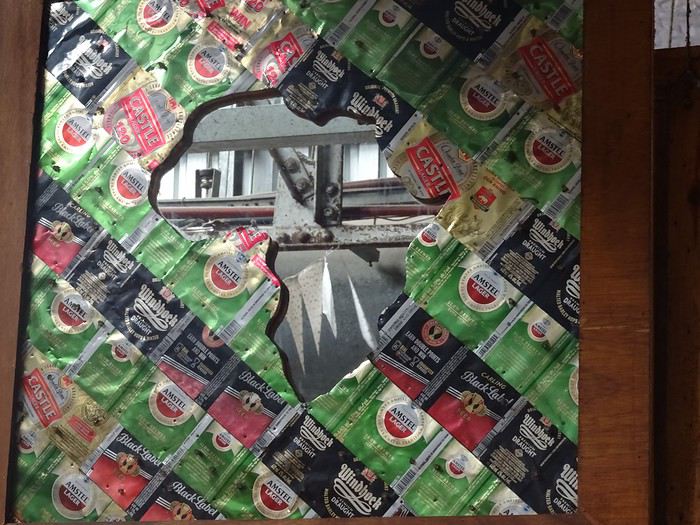
We left Lyon on Saturday, February 22 at 7:00 AM and arrived in Johannesburg at 10:00 PM after a short layover in Amsterdam. Flights cost 440 € per person (booked in October), with carry-on luggage. We added just one checked bag for the whole family (80 € round-trip with the free Flying Blue membership). Since we’d be moving around a lot, we packed light! In Lyon, we reserved parking at P5 in advance for 70 € for 14 days. The Air France/KLM flight was smooth. When we landed, we picked up our bags and had booked a night at the Aero Guest Lodge, just 5 minutes from the airport, with a free shuttle and breakfast. All you have to do is send a WhatsApp message when you arrive at the airport to let the shuttle driver know. The tricky part? Finding him in the terminal—he wasn’t holding a sign with the hotel’s name. 🤪 A South African called him for me since my English wasn’t great (and I had to get used to the accent 😛), and helped us spot the driver (who was actually less than 5 meters away!) with other guests. When we got to the hotel: all good, except we were 10 people in a van meant for 7. The room was spacious—one king-size bed and two single beds for the kids—with a simple but clean bathroom, a garden, pool, and breakfast (which we didn’t try). All for 65 €, so an awesome value!
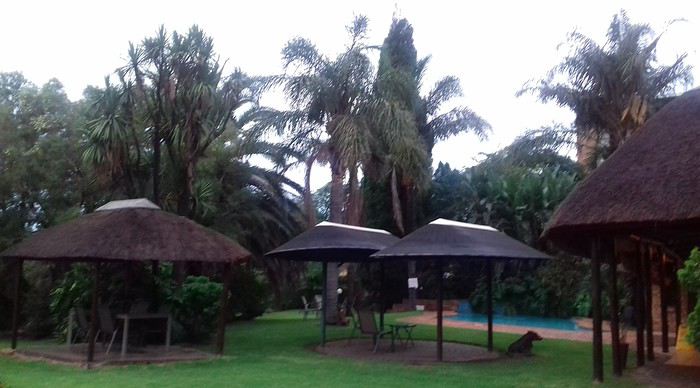 After a restful night, we woke up at 6:00 AM to catch the shuttle back to the airport. Just a heads-up: there’s only one shuttle per hour in the morning, and Kulula canceled our 9:00 AM flight, moving it to 8:00 AM—so no time for breakfast (it starts at 6:30).
We waited 15 minutes in the lovely garden for the driver, who dropped us off at the airport in 5 minutes.
We checked in for our flight to Cape Town, which cost around 40 € (including two checked bags per person).
We grabbed breakfast at the airport instead (less than 20 € for all four of us—one of the nice surprises of South Africa!), and arrived in Cape Town at 10:20 AM.
After a restful night, we woke up at 6:00 AM to catch the shuttle back to the airport. Just a heads-up: there’s only one shuttle per hour in the morning, and Kulula canceled our 9:00 AM flight, moving it to 8:00 AM—so no time for breakfast (it starts at 6:30).
We waited 15 minutes in the lovely garden for the driver, who dropped us off at the airport in 5 minutes.
We checked in for our flight to Cape Town, which cost around 40 € (including two checked bags per person).
We grabbed breakfast at the airport instead (less than 20 € for all four of us—one of the nice surprises of South Africa!), and arrived in Cape Town at 10:20 AM.
 After quickly picking up our bags, we headed to the Avis counter and left with a Toyota Corolla for 80 € for 4 days (rented with the Flying Blue card—free additional driver).
Everything’s on the left... not easy, but it works if you plan your route well.
We drove to our Airbnb in Constantia. We were surprised to see animals, bikes, and pedestrians on the highway!
We arrived around 11:30 AM at our rental—a huge house in the vineyards, in a super secure neighborhood, about 15-20 minutes from Hout Bay. It felt like Beverly Hills, but with super-high walls and barbed wire around the villas. 😕
After quickly picking up our bags, we headed to the Avis counter and left with a Toyota Corolla for 80 € for 4 days (rented with the Flying Blue card—free additional driver).
Everything’s on the left... not easy, but it works if you plan your route well.
We drove to our Airbnb in Constantia. We were surprised to see animals, bikes, and pedestrians on the highway!
We arrived around 11:30 AM at our rental—a huge house in the vineyards, in a super secure neighborhood, about 15-20 minutes from Hout Bay. It felt like Beverly Hills, but with super-high walls and barbed wire around the villas. 😕

We dropped off our bags, changed into shorts (it was around 30°C/86°F), and headed to the Bay Harbour Market in Hout Bay. We had lunch there—such a great vibe! We wandered through the stalls, everyone picked their own dish, and we sat down on the terrace. There was music, artisans of all kinds... a really nice moment.

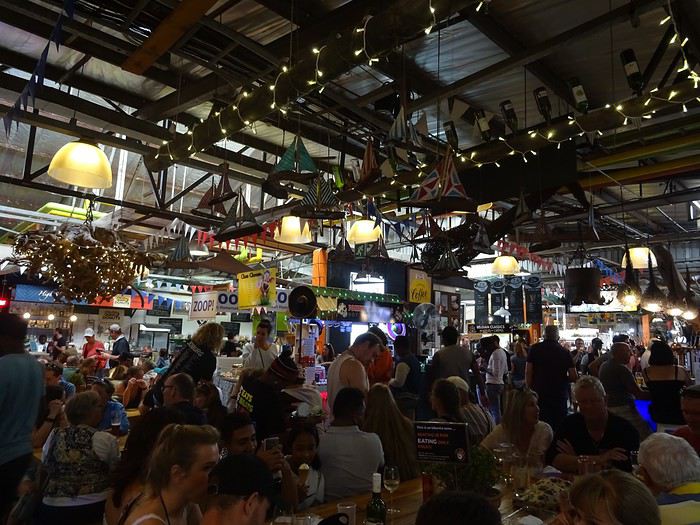
I’d withdrawn 50 € before leaving... and that gave me change to pay the parking attendant. Lunch cost around 30 € for four, including food and drinks.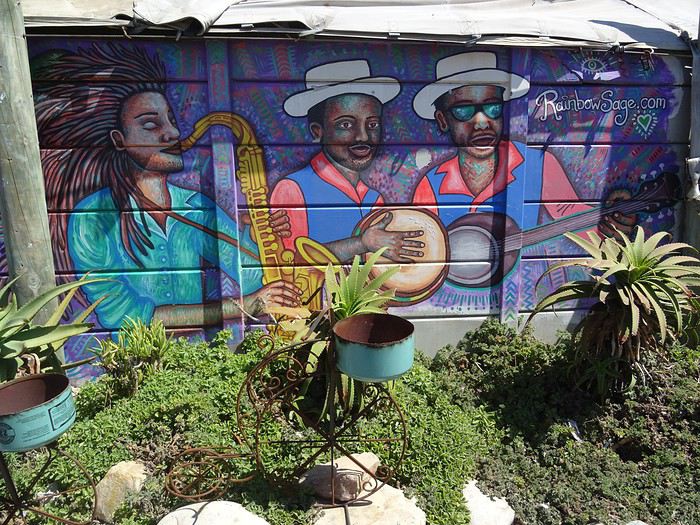

After browsing the artisan stalls, we headed to Hout Bay Beach near the restaurant, Marina Wharf (another small tip for the parking attendant—we’d have to get used to that!). We stopped to admire the sea lions. An ice cream for 1 €? No way we were saying no! 🙂
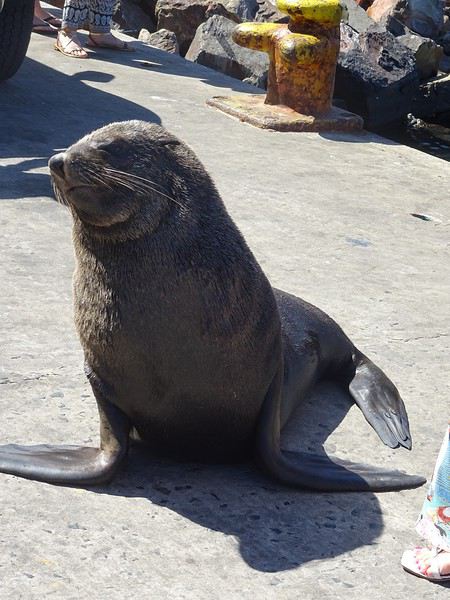
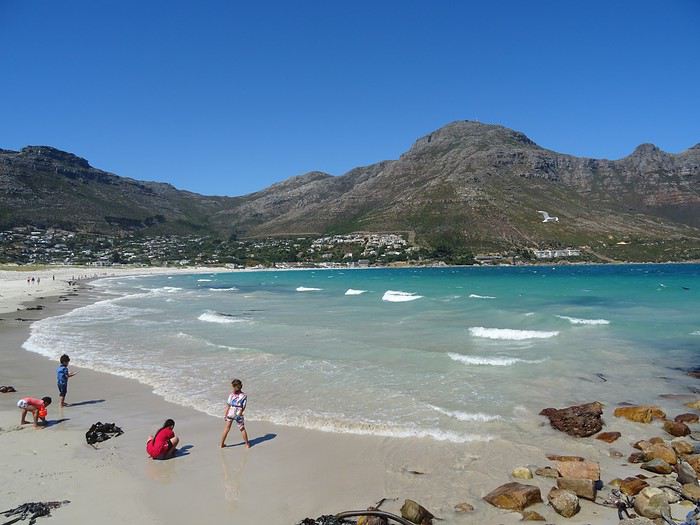
The fatigue was starting to hit, so we headed to the grocery store 10 minutes away (Constantia shopping center) and then had an aperitif in front of the vineyards, opening a delicious bottle of white wine.
I’d love to share a little travel journal from our 14-day/12-night road trip with our two teens (14 and 17) in February/March 2020. A huge thank you to all of you who helped me plan this trip to South Africa—your patience with my endless questions was amazing!
We left Lyon on Saturday, February 22 at 7:00 AM and arrived in Johannesburg at 10:00 PM after a short layover in Amsterdam. Flights cost 440 € per person (booked in October), with carry-on luggage. We added just one checked bag for the whole family (80 € round-trip with the free Flying Blue membership). Since we’d be moving around a lot, we packed light! In Lyon, we reserved parking at P5 in advance for 70 € for 14 days. The Air France/KLM flight was smooth. When we landed, we picked up our bags and had booked a night at the Aero Guest Lodge, just 5 minutes from the airport, with a free shuttle and breakfast. All you have to do is send a WhatsApp message when you arrive at the airport to let the shuttle driver know. The tricky part? Finding him in the terminal—he wasn’t holding a sign with the hotel’s name. 🤪 A South African called him for me since my English wasn’t great (and I had to get used to the accent 😛), and helped us spot the driver (who was actually less than 5 meters away!) with other guests. When we got to the hotel: all good, except we were 10 people in a van meant for 7. The room was spacious—one king-size bed and two single beds for the kids—with a simple but clean bathroom, a garden, pool, and breakfast (which we didn’t try). All for 65 €, so an awesome value!
After a restful night, we woke up at 6:00 AM to catch the shuttle back to the airport. Just a heads-up: there’s only one shuttle per hour in the morning, and Kulula canceled our 9:00 AM flight, moving it to 8:00 AM—so no time for breakfast (it starts at 6:30).
We waited 15 minutes in the lovely garden for the driver, who dropped us off at the airport in 5 minutes.
We checked in for our flight to Cape Town, which cost around 40 € (including two checked bags per person).
We grabbed breakfast at the airport instead (less than 20 € for all four of us—one of the nice surprises of South Africa!), and arrived in Cape Town at 10:20 AM.
After quickly picking up our bags, we headed to the Avis counter and left with a Toyota Corolla for 80 € for 4 days (rented with the Flying Blue card—free additional driver).
Everything’s on the left... not easy, but it works if you plan your route well.
We drove to our Airbnb in Constantia. We were surprised to see animals, bikes, and pedestrians on the highway!
We arrived around 11:30 AM at our rental—a huge house in the vineyards, in a super secure neighborhood, about 15-20 minutes from Hout Bay. It felt like Beverly Hills, but with super-high walls and barbed wire around the villas. 😕We dropped off our bags, changed into shorts (it was around 30°C/86°F), and headed to the Bay Harbour Market in Hout Bay. We had lunch there—such a great vibe! We wandered through the stalls, everyone picked their own dish, and we sat down on the terrace. There was music, artisans of all kinds... a really nice moment.
I’d withdrawn 50 € before leaving... and that gave me change to pay the parking attendant. Lunch cost around 30 € for four, including food and drinks.
After browsing the artisan stalls, we headed to Hout Bay Beach near the restaurant, Marina Wharf (another small tip for the parking attendant—we’d have to get used to that!). We stopped to admire the sea lions. An ice cream for 1 €? No way we were saying no! 🙂
The fatigue was starting to hit, so we headed to the grocery store 10 minutes away (Constantia shopping center) and then had an aperitif in front of the vineyards, opening a delicious bottle of white wine.
De Goa à Jaipur en 6 semaines cet hiver 2020 English translation pending
Notre motivation de ce 3 ème voyage en Inde et de visiter les sites de Ellora et Ajanta et c’est ce qui va déterminer notre trajet qui s’étale sur près de 6 semaines.
En 2012 notre voyage s’était arrêté à Hampi et en 2017 notre voyage en Inde après le Gujarat avait commencé à Bhopal.
Il a paru logique de commencer celui ci un peu au dessus de Hampi pour le terminer du moins dans sa première mouture vers Bundi.
La préparation se fait avec les guides papiers classiques mais surtout en consultant VF et des blogs d’autres voyageurs. Sur VF, nous suivons les anciens et les nouveaux « forumeurs » à qui je n’hésite pas à demander des conseils et je remercie ici ceux nombreux avec qui je suis entrée en contact et ceux dont j’ai profité simplement et anonymement de leurs récits et interventions de manière plus passive.
Voyager en Inde s’apprend et nos 3 voyages ont été formateurs. Le premier dans le sud avec chauffeur et soutien logistique d’une petite agence locale. Le deuxième au Gujarat avec chauffeur pendant 3 semaines et ensuite par nous mêmes de Bhopal à Dehli. Pour ce dernier on est prêt à voyager autant en transport en commun qu'en taxi, nous savons maintenant que ce n'est pas compliqué de se déplacer dans ce pays.
Nous ne sommes donc un couple de retraités plus si jeune et nous pouvons nous permettre de voyager autrement qu’en routard mais nous fuyons autant que possible les groupes et les hôtels et restos qui leurs sont réservés! Indépendants, nous essayons autant que faire se peux de partager la vie des Indiens, le fait de voyager à deux facilite grandement les rencontres et peut être aussi est ce un privilège d’avoir les cheveux gris…
Nous aimons autant que possible nous adapter calmement quand nous débutons un voyage, absorber la fatigue du voyage et le décalage horaire, s'acclimater donc... Aussi cette année nous passerons 3 jours à Goa pour débuter. Pas question de commencer dans les galères, pas envie non plus de plages et vous pensez bien que l’ambiance fêtarde que l’on vient habituellement chercher dans cet état n’est pas de notre gout. En me promenant sur ce blog https://sudhagee.com conseillé par Chris70 je découvre notre premier point de chute : Aldona dans le nord de Goa.
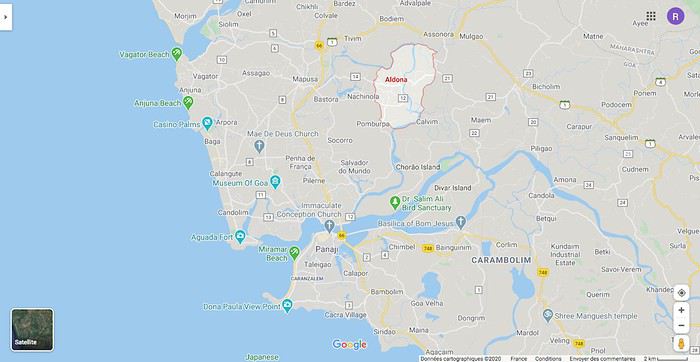
Nous ne sommes donc un couple de retraités plus si jeune et nous pouvons nous permettre de voyager autrement qu’en routard mais nous fuyons autant que possible les groupes et les hôtels et restos qui leurs sont réservés! Indépendants, nous essayons autant que faire se peux de partager la vie des Indiens, le fait de voyager à deux facilite grandement les rencontres et peut être aussi est ce un privilège d’avoir les cheveux gris…
Nous aimons autant que possible nous adapter calmement quand nous débutons un voyage, absorber la fatigue du voyage et le décalage horaire, s'acclimater donc... Aussi cette année nous passerons 3 jours à Goa pour débuter. Pas question de commencer dans les galères, pas envie non plus de plages et vous pensez bien que l’ambiance fêtarde que l’on vient habituellement chercher dans cet état n’est pas de notre gout. En me promenant sur ce blog https://sudhagee.com conseillé par Chris70 je découvre notre premier point de chute : Aldona dans le nord de Goa.
Le long de la frontière ouest américano-canadienne et un détour par Hawaï English translation pending
Après un voyage en solo l'année dernière dans l'ouest américain, en cet été 2019, c'est le nord ouest américain et le sud ouest canadien qui ont retenu mon attention. Et j'ai cette année embarqué mon neveu de 10 ans.
J'adore les animaux sauvages, la mer et les volcans et le moins que l'on puisse dire, c'est que ce voyage est tourné sur tout cela. Les nuits et repas sont du low cost: camping et hostels pour la majorité. Après ces courtes présentations, place au carnet.
Vendredi 5 juillet: départ de Londres pour Seattle
Le vol se fait sans encombre avec British airway, nous arrivons à Seattle vers 13h mais ne sortirons de l'aéroport que 4 heures plus tard. Le passage à la douane était hyper encombré et un veritable enfer. Nous récupérons la voiture, pas du tout le SUV prévu, elle ressemblait plutôt à une sorte des break, pour ce que j'y connais mais je crois que le cauchemar de la douane ne m'a pas donné envie de protesté , juste de quitter le plus vite possible l'aéroport.
Nous avons perdu toute l'après-midi et il ne me reste que peut de temps pour amener la surprise que je réservais à mon neveu c'est à dire la visite du magasin Funko pop à Davenport car c'est un collectionneur. Mais je suis optimiste , ça va le faire.
On a que une demi-heure avant la fermeture mais voir sa surprise et son sourire valait le détour.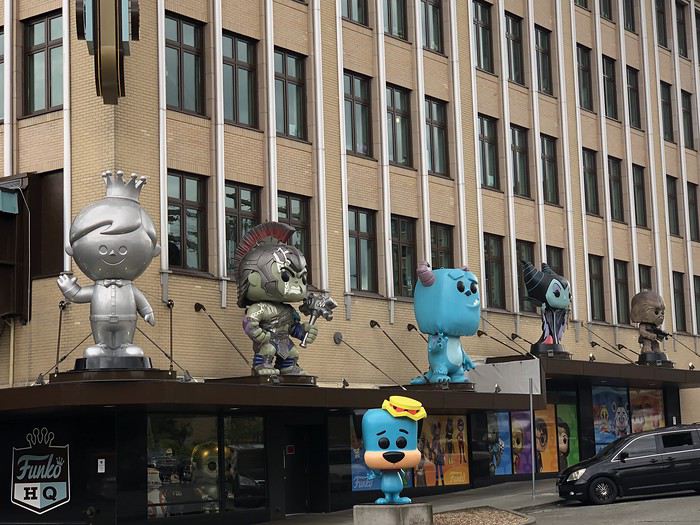

Le paradis des amateurs de pop vinyl. Puis retour vers Seattle avec arrêt au wallmart pour les courses essentielles et on découvre notre hostel dans Seattle. Samedi 6 juillet: Parc Olympique Forcément, le réveil est matinal, donc après un rapide petit-déjeuner, nous prenons la route vers la presqu'île qui abrite le Parc National Olympique. C'est une chaîne de montagnes qui fait face à Seattle. pour s'y rendre, nous embarquons dans un ferry qui nous fait faire la traversée mais le temps est très couvert. En passant par le Visiter center, j'apprends que le camping où nous devons passé la nuit est fermé car la route qui y mène est inondée, tant pis, on verra plus tard. ce qui me préoccupe, c'est la météo qui risque de nous empêcher d'apercevoir la chaîne olympique. Il faut pour cela monter prendre une route très montante qui nous amène à un point de vue face à la chaîne. mon seule espoir c'est de passer au-dessus des ses nuages de pluie. Nous commençons la montée, il pleut à torrent et effectivement nous arrivons dans les nuages. et passons au-dessus, sauf qu'il y a une 2ème couche au-dessus et nous ne verrons donc pas grand chose. On aura essayer/ Ma philosophie est simple, je n'ai pas fait tous ces km pour renoncer si près donc quoi qu'il arrive, je tente toujours ma chance.
 On aura au moins trouver la neige. En plein juillet, cela fait toujours bizarre.
Nous reprenons la route direction l'ouest de la presqu"île pour aller voir la côte sauvage et les forêts humides.
On s'arrête à un Subway pour le déjeuner, c'est pas trop mon truc mais bon. Et allons visiter la fore
êt humide de Hoh, gros bouchon pour y arriver, pourquoi ??? mais c'est très beau mais forcément trop peuplé , c'est un peu à la queue leleu mais j'ai beaucoup apprécié l'ambiance dans cette forêt d'arbres verdoyants et toutes ces lianes.
On aura au moins trouver la neige. En plein juillet, cela fait toujours bizarre.
Nous reprenons la route direction l'ouest de la presqu"île pour aller voir la côte sauvage et les forêts humides.
On s'arrête à un Subway pour le déjeuner, c'est pas trop mon truc mais bon. Et allons visiter la fore
êt humide de Hoh, gros bouchon pour y arriver, pourquoi ??? mais c'est très beau mais forcément trop peuplé , c'est un peu à la queue leleu mais j'ai beaucoup apprécié l'ambiance dans cette forêt d'arbres verdoyants et toutes ces lianes.
Nous allons ensuite à Ruby Beach découvrir la côte Pacifique et c'est juste splendide: les vaques qui viennent s'écraser sur les rochers, ces rochers qui sortent de la mer et cette dernière qui ramène les bois flottés qui viennent à leur tour jonchés la plage. Quel spectacle ! On reste un moment à contempler cela.
Mais le soleil disparait petit à petit et nous n'avons rien de prévu pour la nuit, il faut repartir pour Port Angeles , il y a 2h de route où nous trouvons un motel. Port Angeles, c'est plutôt moche et terne comme ville. Heureusement nous n'y resterons pas.
Le paradis des amateurs de pop vinyl. Puis retour vers Seattle avec arrêt au wallmart pour les courses essentielles et on découvre notre hostel dans Seattle. Samedi 6 juillet: Parc Olympique Forcément, le réveil est matinal, donc après un rapide petit-déjeuner, nous prenons la route vers la presqu'île qui abrite le Parc National Olympique. C'est une chaîne de montagnes qui fait face à Seattle. pour s'y rendre, nous embarquons dans un ferry qui nous fait faire la traversée mais le temps est très couvert. En passant par le Visiter center, j'apprends que le camping où nous devons passé la nuit est fermé car la route qui y mène est inondée, tant pis, on verra plus tard. ce qui me préoccupe, c'est la météo qui risque de nous empêcher d'apercevoir la chaîne olympique. Il faut pour cela monter prendre une route très montante qui nous amène à un point de vue face à la chaîne. mon seule espoir c'est de passer au-dessus des ses nuages de pluie. Nous commençons la montée, il pleut à torrent et effectivement nous arrivons dans les nuages. et passons au-dessus, sauf qu'il y a une 2ème couche au-dessus et nous ne verrons donc pas grand chose. On aura essayer/ Ma philosophie est simple, je n'ai pas fait tous ces km pour renoncer si près donc quoi qu'il arrive, je tente toujours ma chance.
On aura au moins trouver la neige. En plein juillet, cela fait toujours bizarre.
Nous reprenons la route direction l'ouest de la presqu"île pour aller voir la côte sauvage et les forêts humides.
On s'arrête à un Subway pour le déjeuner, c'est pas trop mon truc mais bon. Et allons visiter la fore
êt humide de Hoh, gros bouchon pour y arriver, pourquoi ??? mais c'est très beau mais forcément trop peuplé , c'est un peu à la queue leleu mais j'ai beaucoup apprécié l'ambiance dans cette forêt d'arbres verdoyants et toutes ces lianes.Nous allons ensuite à Ruby Beach découvrir la côte Pacifique et c'est juste splendide: les vaques qui viennent s'écraser sur les rochers, ces rochers qui sortent de la mer et cette dernière qui ramène les bois flottés qui viennent à leur tour jonchés la plage. Quel spectacle ! On reste un moment à contempler cela.
Mais le soleil disparait petit à petit et nous n'avons rien de prévu pour la nuit, il faut repartir pour Port Angeles , il y a 2h de route où nous trouvons un motel. Port Angeles, c'est plutôt moche et terne comme ville. Heureusement nous n'y resterons pas.
Voyager sans connaître la destination? Nous voilà inscrits... English translation pending
Nous sommes à un mois de notre départ et nous ne connaissons pas la destination puisque c'est un voyage mystère que nous avons réservé par l'agence CAP MYSTERE....
Nous avons donc rempli un questionnaire assez détaillé sur notre type de voyage, nos envies , nos budget...
C'est donc un voyage lointain avec une destination au soleil alliant la faune et la flore et hors des sentiers battus.
Nous allons bientôt recevoir le premier indice.
Nous sommes méga surexcités et en ce qui me concerne (moins mon conjoint plus sage) , je ne cesse de chercher les vols possibles avec les éléments que j'ai....
Arghhhh c'est horriblement dure d'attendre.
Nous avons donc rempli un questionnaire assez détaillé sur notre type de voyage, nos envies , nos budget...
C'est donc un voyage lointain avec une destination au soleil alliant la faune et la flore et hors des sentiers battus.
Nous allons bientôt recevoir le premier indice.
Nous sommes méga surexcités et en ce qui me concerne (moins mon conjoint plus sage) , je ne cesse de chercher les vols possibles avec les éléments que j'ai....
Arghhhh c'est horriblement dure d'attendre.
Concours photo du mois de février 2020: Les volcans English translation pending
Ouverture du 115ème Concours Photos de Voyage Forum
Le thème a été un peu compliqué pour moi à trouver, je me suis donc posé les questions suivantes : qu’est-ce que j’aimerais voir, quels paysages m’interpellent lorsque je voyage ? Alors, la réponse est dans ce thème : « Les volcans »
Je me suis demandé s’il pouvait être redondant avec le thème du mois de Juin 2019 « Chaleur » mais même s’il y a eu quelques photos présentant de la lave, des volcans en éruption, ce n’était qu’une très faible partie des photos proposées.
Je ne serai pas restrictive sur des volcans en activités, toutes les photos ayant un lien avec les volcans seront les bienvenues : des volcans éteints, endormis, des calderas effondrées, des champs de lave, des geysers d’eau chaude …
Quelques exemples :
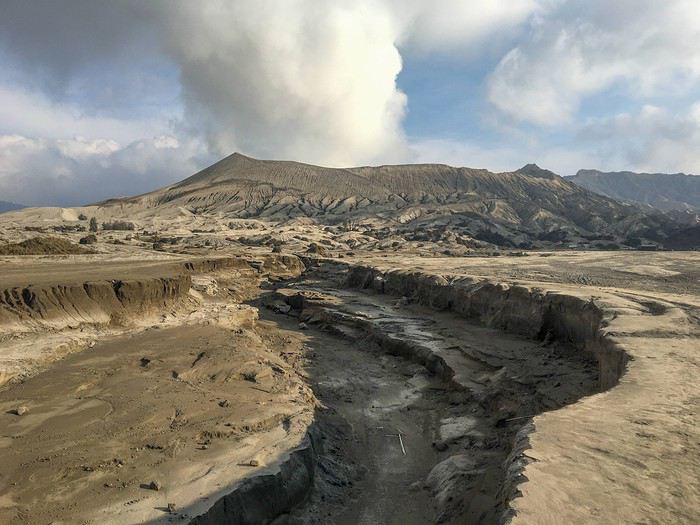 Mont Bromo sur l’île de Java en Indonésie
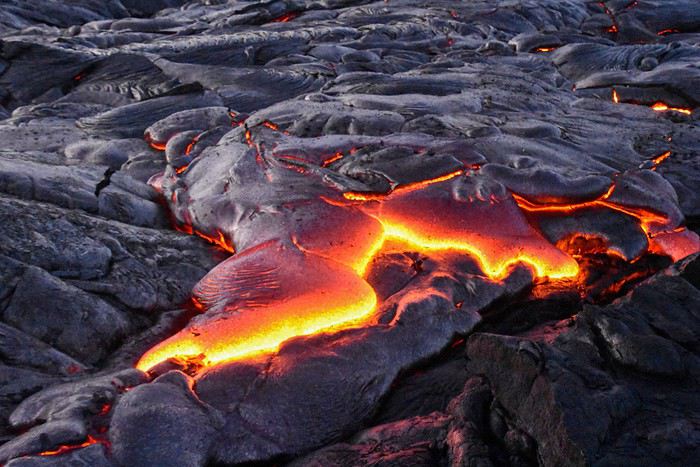 Coulée de lave provenant du volcan Kilauea sur Big Island à Hawaï
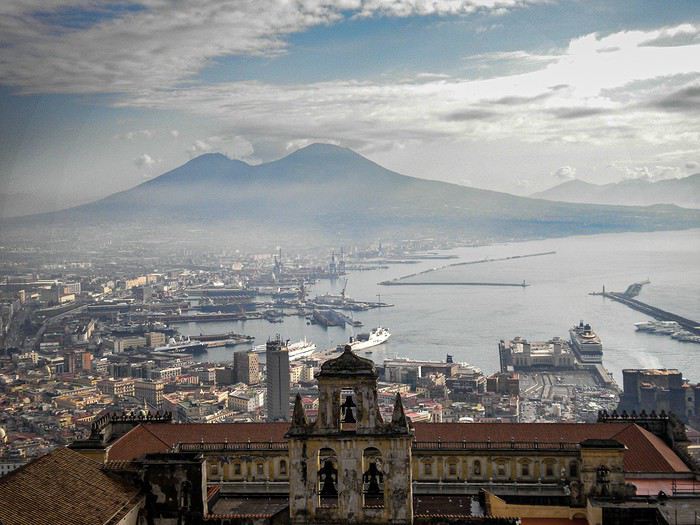 Vésuve dans la baie de Naples
Dépôt des photos jusqu’au Vendredi 21 Février minuit. Vous pouvez poster jusqu’à 3 photos, numérotées et postées dans des messages différents, accompagnées d’un petit descriptif (lieu, anecdote...)
Vote du Samedi 22 Février au Samedi 28 Février minuit. Merci d’indiquer le numéro de la photo, le pseudo et le nombre de points attribués. Photo n°1 = 3 pts Photo n°2 = 2 pts Photo n°3 = 1 pt Tous les membres de VF peuvent voter (même ceux qui n’ont pas déposé de photos).
En cas d’égalité de points pour la première position, la photo gagnante sera celle ayant obtenu le plus grand nombre de 1ères places, puis de secondes places ! L’heureux (se) gagnant(e) devra organiser le concours photo de Mars 2020.
Pour discuter, c’est par ici
Le thème a été un peu compliqué pour moi à trouver, je me suis donc posé les questions suivantes : qu’est-ce que j’aimerais voir, quels paysages m’interpellent lorsque je voyage ? Alors, la réponse est dans ce thème : « Les volcans »
Je me suis demandé s’il pouvait être redondant avec le thème du mois de Juin 2019 « Chaleur » mais même s’il y a eu quelques photos présentant de la lave, des volcans en éruption, ce n’était qu’une très faible partie des photos proposées.
Je ne serai pas restrictive sur des volcans en activités, toutes les photos ayant un lien avec les volcans seront les bienvenues : des volcans éteints, endormis, des calderas effondrées, des champs de lave, des geysers d’eau chaude …
Quelques exemples :
Mont Bromo sur l’île de Java en Indonésie
Coulée de lave provenant du volcan Kilauea sur Big Island à Hawaï
Vésuve dans la baie de NaplesDépôt des photos jusqu’au Vendredi 21 Février minuit. Vous pouvez poster jusqu’à 3 photos, numérotées et postées dans des messages différents, accompagnées d’un petit descriptif (lieu, anecdote...)
Vote du Samedi 22 Février au Samedi 28 Février minuit. Merci d’indiquer le numéro de la photo, le pseudo et le nombre de points attribués. Photo n°1 = 3 pts Photo n°2 = 2 pts Photo n°3 = 1 pt Tous les membres de VF peuvent voter (même ceux qui n’ont pas déposé de photos).
En cas d’égalité de points pour la première position, la photo gagnante sera celle ayant obtenu le plus grand nombre de 1ères places, puis de secondes places ! L’heureux (se) gagnant(e) devra organiser le concours photo de Mars 2020.
Pour discuter, c’est par ici
10 jours dans le Telangana et l'Andhra Pradesh English translation pending
Comme promis voici le retour des 10 jours passés dans le Telangana et l'Andhra Pradesh.
Hyderabad 1er jour. Partis de Mysore à 14h50 , nous arrivons à Hyderabad à 5h50 . Comme tous les trains que nous aurons pris celui a été à l'heure à 20 minutes près. J'ai hâte de découvrir cette région. La gare est très propre et bien sûr très animée. On cherche le comptoir des autoricshaws prepaid, qui se trouve à gauche en sortant de la gare. Des chauffeurs nous proposent la course a 50 r quel que soit l'hôtel, un autre 20 r si on va dans le sien. Non, on veut le prepaid. On nous indique le comptoir, fermé à cette heure ci. Je ne sais pas à quelle heure il ouvre. Un jeune homme demande si on a besoin d'aide. Il cherche notre hôtel, le Geetanjani, quartier Habid, sur son portable et traduit a un chauffeur l'adresse exacte. Merci. J'avais lu que les gens sont particulièrement sympas et aidants à Hyderabad. J'ai bien une carte SIm indienne dans mon portable mais pas de connexion internet. En plus Je n'arrive pas à l'utiliser ici. Elle m'a été donnée à Pondicherry. Habids road est immense. Notre hôtel est dans une impasse donnant sur une rue perpendiculaire. Nous serons plus au calme. Enfin c'est ce que nous croyons jusqu'à ce qu'on voit la chambre qui donne sur une carrière. Nous pensons nous accommoder du bruit des burins, nous regardons les gars tailler les pierres, encore une fois les conditions de travail nous effarent. Zéro protection dans ces nuages de poussières, les projections des éclats de pierre. Quand les machines outils se mettent en marche nous demandons à changer de chambre. De celle d'en face nous n'entendons plus rien.
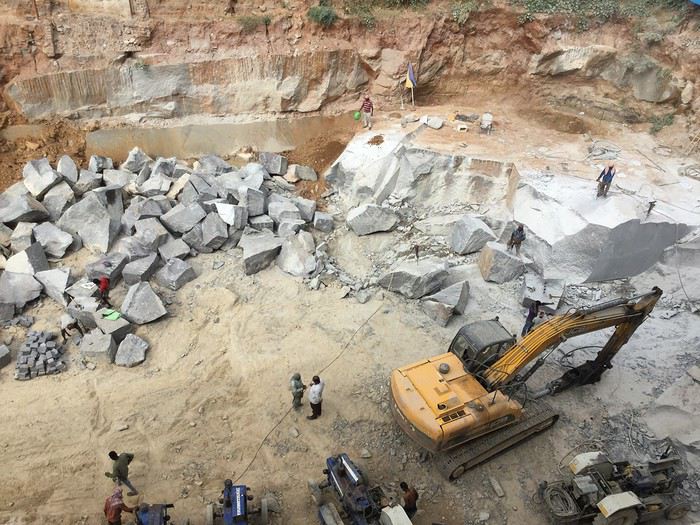
Chambre a 1000 r la nuit. Très confortable et propre. Literie super. Pas de supplément pour le early check in nous marmonne le gars bougon de l'accueil mal réveillé. J'ai rdv dans la matinée avec une jeune expat qui travaille avec des associations locales. Nous passons la journée ensemble et rencontrons des gens formidables. Le midi elle nous emmène dans un resto goûter le fameux Hyderabad biryani. Il paraît que ce sont les meilleurs de toute l'Inde. Mon ami se régale, moi qui ne supporte pas les épices, je ne prends qu'un aloo paratha. Le traffic est intense le matin entre 9h et 11h, et l'a.midi à partir de 16h. Nous rentrons dans les embouteillages, ce qui nous donne tout le temps de bien observer la vie dans les rues, et de laisser décanter toutes les émotions de cette journée, de ces rencontres. Cette ville nous plait, bien qu'elle soit fatigante. Je trouve que ça klaxonne un peu moins qu'ailleurs.Je ressens un peu la même chose qu'à ma première arrivée à Ahmedabad. Le contact avec les gens est facile, agréable, ils sont particulièrement aidants, nous ne sommes pas sollicités, sauf par les chauffeurs et encore, ils insistent peu. Demain nous visitons Fort Golgonde.
Hyderabad 1er jour. Partis de Mysore à 14h50 , nous arrivons à Hyderabad à 5h50 . Comme tous les trains que nous aurons pris celui a été à l'heure à 20 minutes près. J'ai hâte de découvrir cette région. La gare est très propre et bien sûr très animée. On cherche le comptoir des autoricshaws prepaid, qui se trouve à gauche en sortant de la gare. Des chauffeurs nous proposent la course a 50 r quel que soit l'hôtel, un autre 20 r si on va dans le sien. Non, on veut le prepaid. On nous indique le comptoir, fermé à cette heure ci. Je ne sais pas à quelle heure il ouvre. Un jeune homme demande si on a besoin d'aide. Il cherche notre hôtel, le Geetanjani, quartier Habid, sur son portable et traduit a un chauffeur l'adresse exacte. Merci. J'avais lu que les gens sont particulièrement sympas et aidants à Hyderabad. J'ai bien une carte SIm indienne dans mon portable mais pas de connexion internet. En plus Je n'arrive pas à l'utiliser ici. Elle m'a été donnée à Pondicherry. Habids road est immense. Notre hôtel est dans une impasse donnant sur une rue perpendiculaire. Nous serons plus au calme. Enfin c'est ce que nous croyons jusqu'à ce qu'on voit la chambre qui donne sur une carrière. Nous pensons nous accommoder du bruit des burins, nous regardons les gars tailler les pierres, encore une fois les conditions de travail nous effarent. Zéro protection dans ces nuages de poussières, les projections des éclats de pierre. Quand les machines outils se mettent en marche nous demandons à changer de chambre. De celle d'en face nous n'entendons plus rien.
Chambre a 1000 r la nuit. Très confortable et propre. Literie super. Pas de supplément pour le early check in nous marmonne le gars bougon de l'accueil mal réveillé. J'ai rdv dans la matinée avec une jeune expat qui travaille avec des associations locales. Nous passons la journée ensemble et rencontrons des gens formidables. Le midi elle nous emmène dans un resto goûter le fameux Hyderabad biryani. Il paraît que ce sont les meilleurs de toute l'Inde. Mon ami se régale, moi qui ne supporte pas les épices, je ne prends qu'un aloo paratha. Le traffic est intense le matin entre 9h et 11h, et l'a.midi à partir de 16h. Nous rentrons dans les embouteillages, ce qui nous donne tout le temps de bien observer la vie dans les rues, et de laisser décanter toutes les émotions de cette journée, de ces rencontres. Cette ville nous plait, bien qu'elle soit fatigante. Je trouve que ça klaxonne un peu moins qu'ailleurs.Je ressens un peu la même chose qu'à ma première arrivée à Ahmedabad. Le contact avec les gens est facile, agréable, ils sont particulièrement aidants, nous ne sommes pas sollicités, sauf par les chauffeurs et encore, ils insistent peu. Demain nous visitons Fort Golgonde.
28 jours dans l'Ouest américain en famille English translation pending
Bonjour à tous,
je suis un habitué de voyageforum, plutôt comme lecteur afin de peaufiner mes projets de voyages. Mais cette année nous avons réaliser un projet assez ambitieux. En effet, avec mon épouse nous avions fait notre voyage de noce en 2011 aux USA (tour cote Ouest Classique puis tour des villes de l'Est Boston, Cleveland, Pittsburg...New York). En rentrant de ce voyage nous pensions que ça serait une belle destination pour un voyage avec la famille de mon épouse par habituée à ce genre de trip. Depuis, nous avions réfléchis et décider d'offrir avec le frère de mon épouse ce voyage à mes beaux-parents pour fêter leur pension, anniversaires... etc. Entre-temps la famille c'est agrandi, des ennuis de santé on retardé le projet et finalement c'est en juillet 2019 que le projet se réalise.
Le groupe est composé de 10 personnes :
-ma famille :moi (B), ma femme (C), ma fille (S, 3 ans) et mon fils (A, 5 mois)
-la famille de mon beau-frère(x), sa femme (N), sa fille (L, 7 ans ) et son fils (P jr, 5 ans)
-mes beaux-parent, mon beau-père (P sr) et ma belle-mère (F)
Nous avons proposé plusieurs projets de programme à X et N, qui nous font totalement confiance. Nous organiserons donc tous le voyage avec mon épouse et leur soumettrons nos avancées. Après de nombreuses tergiversations, nous proposons de quand même ajouter le Yellowstone à ce programme, à mon gout un des plus beaux parc (je l'avais fait avec mes parents en 2007 ou 2008), . Nous savions que ça allait un peu surchargé le voyage et que ça provoquerait 2 jours de route intensive, mais nous pensons que ça en valait la chandelle, surtout que je pense que le reste de la famille de reviendra pas faire un voyage de ce type. Mais finalement ça s'est bien goupillé. Car nous ne l'avions pas fait lors de notre HoneyMoon, et je pensais qu'il plairait à tout le monde. Une des difficultés du programme était de ne pas faire exactement le même voyage qu'en 2011 tout en maintenant les "immanquables". En 2011, nous n'avions fait que très peu de randonnée/balade (à part Bright Angel Trail et Delicate Arch), cette année nous avons essayé d'en faire au moins une par parc, ce qui donne une nouvelle vision.
Voici pour le préambule, place au programme: 4 juillet: vol Dusseldorf-San Francisco (changement à Paris) 5 juillet: San Francisco (excursion à vélo jusque Sausalito) 6 juillet: San Francisco (Union Square, Ferry Building, ALCATRAZ NP, Pier 39) 7 juillet: San Francisco-Napa (Muir Woods NP) 8 juillet: Napa-South Lake Tahoe (dégustation de vin) 9 juillet: South Lake Tahoe-Yosemite NP (Vernal Fall) 10 juillet : Yosemite NP-Bishop (Glacier Point, Bridalveil Fall, El Capitan, Tioga Pass) 11 juillet: Bishop-Death Valley NP (Badwater, Artist Palette, Dante's View, Zabriskie Point) 12 juillet : Death Valley NP-Las Vegas (Red Rock NCA, le Strip de Las Vegas) 13 juillet: Las Vegas-Saint Georges (Valley Of Fire SP) 14 juillet: SaintGeorges-Bryce Canyon NP (Queens Garde/Navajo Loop, spectacle "country") 15 juillet: Bryce Canyon NP-Ogden (Salt Lake City) 16 juillet: Ogden-Grand Teton NP (Jenny Lake, Colter Bay) 17 juillet: Grand Teton NP-Yellowstone NP (Old Faithful, Black Sand Basin, Grand Prismatic, Norris Geyser Basin, l'OURS, Lamar Valley, Roosevelt Lodge) 18 juillet: Yellowstone NP-Jackson (Mammoth Hottspring, Canyon du Yellowstone, Mud Volcano, West Thumb) 19 juillet: Jackson-Vernal (Dinosaur NP) 20 juillet: Vernal-Moab (Canyonlands NP) 21 juillet: Moab (Arches NP) 22 juillet: Moab-Mesa Verde NP (Cliff Palace) 23 juillet : Mesa Verde NP-Monument Valley 24 juillet: Monument Valley-Page (Horseshoe Bend, Glen Canyon NP) 25 juillet: Page (Lower Antelope Canyon) 26 juillet: Page-Grand Canyon NP (Desert View, Hermits Road, Mohave Point) 27 juillet: Grand Canyon NP-Lake Havasu (Road 66, Williams, Seligman, Kingman, Oatman) 28 juillet: Lake Havasu-Los Angeles (Hollywood Boulevard, Long Beach) 29 juillet: Disneyland California 30 juillet: Disneyland California 31 juillet: vol Los Angeles-Dusseldorf (changement à Amsterdam)
le programme avait longuement été peaufiné, surtout pour l'organisation optimale des visites (éviter les aller-retour, avoir un hébergent à l'opposé de la direction du lendemain matin, les logements trop loin des parcs comme il y a toujours une distance certaine entre le guichet du parc et les points à visiter). On a parfois privilégié des hôtel un peu plus cher mais où on était sur de ne pas perdre de temps pour les visites, on a souvent loger directement dans les parcs, d'où l’intérêt de s'y prendre longtemps à l'avance (même comme ça j'ai failli avoir une mauvaise surprise pour Grand Teton et Yellowstone, je pensais qu'on ne pouvait réservé qu'un an à l'avance comme à d'autres endroits, mais en fait c'est plus!!! on a donc dû un peu modifier cette organisation à cause des disponibilités des logements que je souhaitais Colter Bay et Roosevelt Lodge) et comme il faut de la place pour 10 personnes (dont 3 enfants et un bébé), on en peut pas trop jouer à l'impro...
On savait le programme ambitieux, mais on voulait faire le plus de choses possible, pensant que le reste de la famille ne reviendrait peut-être. Mais finalement tous le programme a été respecté et très peu de chose ont du être annulées (Fire Wave à Valley Of Fire, il faisait vraiment trop chaud pour prendre le risque avec des enfants, Shafer Trail a Canyonlands avait été déconseillé par le Ranger pour notre véhicule et Joshua Tree a été laissé de coté pour privilégié LA)
Voici un peu pour les considérations générales.
Nous avons proposé plusieurs projets de programme à X et N, qui nous font totalement confiance. Nous organiserons donc tous le voyage avec mon épouse et leur soumettrons nos avancées. Après de nombreuses tergiversations, nous proposons de quand même ajouter le Yellowstone à ce programme, à mon gout un des plus beaux parc (je l'avais fait avec mes parents en 2007 ou 2008), . Nous savions que ça allait un peu surchargé le voyage et que ça provoquerait 2 jours de route intensive, mais nous pensons que ça en valait la chandelle, surtout que je pense que le reste de la famille de reviendra pas faire un voyage de ce type. Mais finalement ça s'est bien goupillé. Car nous ne l'avions pas fait lors de notre HoneyMoon, et je pensais qu'il plairait à tout le monde. Une des difficultés du programme était de ne pas faire exactement le même voyage qu'en 2011 tout en maintenant les "immanquables". En 2011, nous n'avions fait que très peu de randonnée/balade (à part Bright Angel Trail et Delicate Arch), cette année nous avons essayé d'en faire au moins une par parc, ce qui donne une nouvelle vision.
Voici pour le préambule, place au programme: 4 juillet: vol Dusseldorf-San Francisco (changement à Paris) 5 juillet: San Francisco (excursion à vélo jusque Sausalito) 6 juillet: San Francisco (Union Square, Ferry Building, ALCATRAZ NP, Pier 39) 7 juillet: San Francisco-Napa (Muir Woods NP) 8 juillet: Napa-South Lake Tahoe (dégustation de vin) 9 juillet: South Lake Tahoe-Yosemite NP (Vernal Fall) 10 juillet : Yosemite NP-Bishop (Glacier Point, Bridalveil Fall, El Capitan, Tioga Pass) 11 juillet: Bishop-Death Valley NP (Badwater, Artist Palette, Dante's View, Zabriskie Point) 12 juillet : Death Valley NP-Las Vegas (Red Rock NCA, le Strip de Las Vegas) 13 juillet: Las Vegas-Saint Georges (Valley Of Fire SP) 14 juillet: SaintGeorges-Bryce Canyon NP (Queens Garde/Navajo Loop, spectacle "country") 15 juillet: Bryce Canyon NP-Ogden (Salt Lake City) 16 juillet: Ogden-Grand Teton NP (Jenny Lake, Colter Bay) 17 juillet: Grand Teton NP-Yellowstone NP (Old Faithful, Black Sand Basin, Grand Prismatic, Norris Geyser Basin, l'OURS, Lamar Valley, Roosevelt Lodge) 18 juillet: Yellowstone NP-Jackson (Mammoth Hottspring, Canyon du Yellowstone, Mud Volcano, West Thumb) 19 juillet: Jackson-Vernal (Dinosaur NP) 20 juillet: Vernal-Moab (Canyonlands NP) 21 juillet: Moab (Arches NP) 22 juillet: Moab-Mesa Verde NP (Cliff Palace) 23 juillet : Mesa Verde NP-Monument Valley 24 juillet: Monument Valley-Page (Horseshoe Bend, Glen Canyon NP) 25 juillet: Page (Lower Antelope Canyon) 26 juillet: Page-Grand Canyon NP (Desert View, Hermits Road, Mohave Point) 27 juillet: Grand Canyon NP-Lake Havasu (Road 66, Williams, Seligman, Kingman, Oatman) 28 juillet: Lake Havasu-Los Angeles (Hollywood Boulevard, Long Beach) 29 juillet: Disneyland California 30 juillet: Disneyland California 31 juillet: vol Los Angeles-Dusseldorf (changement à Amsterdam)
le programme avait longuement été peaufiné, surtout pour l'organisation optimale des visites (éviter les aller-retour, avoir un hébergent à l'opposé de la direction du lendemain matin, les logements trop loin des parcs comme il y a toujours une distance certaine entre le guichet du parc et les points à visiter). On a parfois privilégié des hôtel un peu plus cher mais où on était sur de ne pas perdre de temps pour les visites, on a souvent loger directement dans les parcs, d'où l’intérêt de s'y prendre longtemps à l'avance (même comme ça j'ai failli avoir une mauvaise surprise pour Grand Teton et Yellowstone, je pensais qu'on ne pouvait réservé qu'un an à l'avance comme à d'autres endroits, mais en fait c'est plus!!! on a donc dû un peu modifier cette organisation à cause des disponibilités des logements que je souhaitais Colter Bay et Roosevelt Lodge) et comme il faut de la place pour 10 personnes (dont 3 enfants et un bébé), on en peut pas trop jouer à l'impro...
On savait le programme ambitieux, mais on voulait faire le plus de choses possible, pensant que le reste de la famille ne reviendrait peut-être. Mais finalement tous le programme a été respecté et très peu de chose ont du être annulées (Fire Wave à Valley Of Fire, il faisait vraiment trop chaud pour prendre le risque avec des enfants, Shafer Trail a Canyonlands avait été déconseillé par le Ranger pour notre véhicule et Joshua Tree a été laissé de coté pour privilégié LA)
Voici un peu pour les considérations générales.