Results for "Volos+et+hébergement+|+123+>+211"
75274 results found.
Tibet English translation pending
j'ai un projet d'aller au Tibet en Juin 2005, arrivée à KTM, puis par la route, retour idem, le tout en 3 semaine c'est jouable ?
Le visa chinois coute combien ?
A +++🙂
Le visa chinois coute combien ?
A +++🙂
Bons plans au Vénézuela English translation pending
Salut!
Nous partons avec mon copain pour 8 mois de Tour de l'Amérique Latine (Amérique du Sud + Amérique Centrale).
Nous commençons par le Venezuela (départ le 11 novembre), où nous resterons 15 jours avant d'arriver au Brésil via Manaus.
Quelques questions sur notre première destination :
Quels conseils pour ne pas avoir de mauvaise surprise à l'aéroport de Caracas (il paraît qu'il y a beaucoup de vols par bandes organisées?). Avez-vous de bonnes adresses d'hôtels que nous pourrions réserver depuis la France pour préparer au moins notre premier point de chute?
Nous voulons faire les îles, mais hésitons entre Los Roques (qui a l'air fabuleux, et nous adorons la plongée ; le pb, c'est que c'est très cher apparemment!!!) et Margarita (qui a l'air beaucoup plus touristique, ce qui nous fait un peu peur...
Nous avons également prévu une balade dans les Tepuis, mais il paraît aussi que c'est cher pour les survoler en avion (seule manière de les voir?).
Merci d 'avance de vos réponses!
;-)
Mathilde
Nous partons avec mon copain pour 8 mois de Tour de l'Amérique Latine (Amérique du Sud + Amérique Centrale).
Nous commençons par le Venezuela (départ le 11 novembre), où nous resterons 15 jours avant d'arriver au Brésil via Manaus.
Quelques questions sur notre première destination :
Quels conseils pour ne pas avoir de mauvaise surprise à l'aéroport de Caracas (il paraît qu'il y a beaucoup de vols par bandes organisées?). Avez-vous de bonnes adresses d'hôtels que nous pourrions réserver depuis la France pour préparer au moins notre premier point de chute?
Nous voulons faire les îles, mais hésitons entre Los Roques (qui a l'air fabuleux, et nous adorons la plongée ; le pb, c'est que c'est très cher apparemment!!!) et Margarita (qui a l'air beaucoup plus touristique, ce qui nous fait un peu peur...
Nous avons également prévu une balade dans les Tepuis, mais il paraît aussi que c'est cher pour les survoler en avion (seule manière de les voir?).
Merci d 'avance de vos réponses!
;-)
Mathilde
Autotour au Chili avec extension à l'Ile de Paques English translation pending
Bonjour
Je projette d'aller 3 semaines au Chili à Noël avec une copine mais comme les prix de circuits sont assez chers, j'envisage un autotour dans le Nord (Arica-Acatama) et une extension Ile de Paques.
Je ne connais pas un mot d'espagnol, n'ai pas d'expérience de l'altitude et le guide du routard ne conseille pas trop les autotours.
Je voulais savoir si c'est vraiment galère et si un Noël-Nouvel An pouvait être sympa là-bas sachant qu'il y a pas mal de monde et que certaines excursions guidées obligatoires (comme les Geysers de Tatio) pouvaient de prendre sur place au dernier moment. Et y'a -t-il vraiment possibilité de pénurie d'essence à San Pedro de Acatama ?
Merci pour vos avis et conseils
Je projette d'aller 3 semaines au Chili à Noël avec une copine mais comme les prix de circuits sont assez chers, j'envisage un autotour dans le Nord (Arica-Acatama) et une extension Ile de Paques.
Je ne connais pas un mot d'espagnol, n'ai pas d'expérience de l'altitude et le guide du routard ne conseille pas trop les autotours.
Je voulais savoir si c'est vraiment galère et si un Noël-Nouvel An pouvait être sympa là-bas sachant qu'il y a pas mal de monde et que certaines excursions guidées obligatoires (comme les Geysers de Tatio) pouvaient de prendre sur place au dernier moment. Et y'a -t-il vraiment possibilité de pénurie d'essence à San Pedro de Acatama ?
Merci pour vos avis et conseils
3 semaines en Ouzbékistan English translation pending
Je souhaite préparer un voyage d'environ 3 semaines en Ouzbékistan pour l'année prochaine. C'est vrai que je m'y prends tôt, mais j'aime bien glaner le maximun d'infos. Qui a visité ce pays récemment? Est-ce facile de se déplacer? Quel budget faut-il prévoir? Quelles sont les formalités pour le visa? On me dit qu'il n'y a plus besoin du voucher d'invitation... Quelle compagnie aérienne offre le meilleur prix? les agences de voyages ne sont pas au top pour ce genre de destination en vol sec et me proposent que des vols galères avec de multiples changements ou alors à des prix inabordables. Merci pour toutes les infos que vous voudrez bien me communiquer
Trip Report: Silk Road Journey in China
Hi everyone,
This trip report covers a journey along the Silk Road in China (see detailed description below) undertaken in October 2025. The goal isn’t to recount the trip but to provide information that might help those who want to take a similar journey. Much of the information is valid for any trip to China.
Who we are: a retired couple, aged 63 and 65 (age gives discounts on entry to various sites and museums in China, which is why I won’t list prices here—I don’t know them, but you can easily find them online). We’re used to traveling independently. We speak English, which is the only foreign language spoken in China, though by very few people. I speak and read a little Chinese, which helped, but you can easily get by without it (without any English at all, I think it would be more difficult).
Period: We arrived just after "Golden Week," when all of China is on vacation, and after the summer, when schools are out, so we encountered very few tourists (99.99% of whom were Chinese). Our experience with booking visits in advance (which we didn’t need to do) isn’t representative for those who want to travel in the summer! The October-November period was perfect for our trip—it wasn’t too hot or too cold (one day of snow on the Tibetan Plateau), though it was only a few degrees on the Tibetan part, with altitudes between 2,000 and 3,000 meters. The trees were beautifully colored.
General remarks: Everyone we dealt with was very kind and perfectly honest. If you order a meal without really understanding what to do and the person modifies your order, trust them—the result is what you need. If a taxi driver signals that they’ll wait for you to finish your visit and pick you up afterward, trust them. It means there aren’t many taxis where you are, and it’ll be more convenient. For prices at street vendors, we always found the right ballpark, and sometimes they even added a little extra to please us. A taxi driver treated us to lunch, and an employee drove us back to the hotel after a visit because there were no taxis. If you struggle to buy a ticket online because there’s no counter, someone will come to help. People even spontaneously ask if everything’s okay and if you need anything.
Everywhere we went was very clean, including restrooms (trains, stations, hotels, museums, tourist sites) and streets. The old stereotypes about this no longer apply.
The trip can be challenging for those who have difficulty walking. The distances to cover on foot in stations, to access sites, and within the sites themselves can sometimes be really long.
We used the Lonely Planet guide in English (published at the end of August 2025) a little for preparation, but mostly relied on the internet.
Before leaving: No visa is needed for French citizens for stays under 30 days. You get a stamp on your passport upon arrival and departure, and the formalities themselves are very quick in both directions (excluding any potential queues). Just a photo and fingerprints upon arrival, and welcome to China’s facial recognition system.
Money: All your payments (see below) will go through your Visa card—there will be hundreds, including many payments of 20 cents to a few euros. So, you need an international option that allows unlimited card transactions. Since cash is rarely needed, the allowed number of ATM withdrawals can be low. We made 3 withdrawals totaling 800 € for a month and could have managed with just 2. The exchange rate charged on our Visa card was 12 € for 100 RMB (yuan).
Install the following apps on your smartphone before leaving (otherwise, you’ll only have access to the Chinese versions, if available): - Alipay, which is used to pay everywhere in China (details below). You need to link it to your credit card, then provide proof of identity by uploading a passport photo and completing a facial recognition session. Alipay gives access to Didi (China’s Uber), public transport (metro/bus), and can also translate phrases. - WeChat (Weixin in Chinese, pronounced *weishin*), which is also used for payments but also replaces WhatsApp. Unfortunately, to activate your account, you need someone who already has WeChat to sponsor you (preferably a Chinese person). We asked someone at our first accommodations to do this—no problem. By sharing your WeChat number with accommodations, they can send you messages that are automatically translated, and you can communicate with people thanks to the translation (translation to French is very poor; it’s much better in English, but unfortunately, WeChat detects your phone’s language). Alipay and WeChat are accepted almost everywhere, but some places only accept WeChat. - Amap, the international version of Baidu Maps, which replaces Google Maps (not at all up-to-date in China). The English names of hotels often have little to do with the Chinese names except for a phonetic resemblance. To find them on Amap, it’s best to copy the Chinese name found on your Trip reservation under "show address in Chinese." - A VPN. We had CyberGhost, which didn’t work, but according to other travelers, NordVPN and Windscribe do. Without a VPN, you can’t access Google services, on WhatsApp you can send and receive text but not photos, and you can’t send or receive emails on Gmail addresses. We managed without a VPN by using Firefox as a browser and Bing as a search engine. - Trip, for booking trains and accommodations, and buying some tickets. It’s the equivalent of Booking for accommodations, but Booking has very few listings in China, while Trip has hundreds in every city. Most hotels and trains are exchangeable and refundable until the day before, with no or minimal fees.
You don’t need contactless (NFC) payment on your phone. Either you scan a barcode and enter the amount to pay, or you display a barcode, and they scan it with a scanner, and the amount is deducted directly.
Upon arrival: - Buy a Chinese SIM card: 100 RMB for 300 GB of data and several hours of talk time (we didn’t use it). Set the Chinese number as a reference on Alipay, WeChat, and Amap. - Find someone to sponsor you on WeChat.
Transportation: - **Plane**: China Eastern, Paris-Canton then Canton-Urumqi on the way out, and Xian-Canton then Canton-Paris on the way back. International flights were smooth, but the schedules for the two domestic flights were changed. It was fine on the way out because we had some leeway, but on the way back, we were notified the morning of that our flight was canceled and replaced with one that didn’t allow for the connection. We called and changed to an earlier flight (I think we were lucky to find available seats). - **Train**: Most long distances were covered by high-speed trains (called D or G in China) at 240 or 300 km/h. Second class is perfect—just as comfortable and clean as our TGVs. The only advantage of first class is the wider seats for larger people, but the downside is that seats are often booked in advance and thus less available. You can book trains long in advance on Trip, but they only go on sale in China 15 days before departure, so that’s when you’ll know if you have a ticket. Initially, we booked first class, but there were no seats available on the day, so we ended up booking everything in second class, which was perfect. There’s no paper ticket—if you’ve bought one, you go to the station, show your passport, and enter. You do the same to access the platform 15 minutes before the train, and that’s it. Our train was canceled twice, but no problem—we went to the ticket counter, got a refund, and were offered a replacement. It didn’t delay us by more than an hour (maybe it would be harder in peak season). For prices, check Trip.com, but it’s significantly cheaper than in France. - **Bus**: We took the bus between Xining and Tongren, Tongren to Xiahe, and Hezuo to Lanzhou—about 3 hours each time for 200 km, 6 € per person, and departures were right on time. - **Taxi**: For trips between the station and hotel, or hotel and visits. If you take a Didi via the Alipay app, you activate your location, enter your destination, and it offers several taxis. You accept, and you get the car’s license plate and its real-time position on the map. When you get in, the driver often asks for the last four digits of your phone number to confirm. Otherwise, you go to the taxi stand outside the station. The price per kilometer is around 20 cents, so for a 30 km trip from the station to the hotel, you’ll pay about 6 €. We never tried to save more by taking local buses, but since the metro in Xian costs 25 cents per trip, it’s probably in the same ballpark. Amap provides public transport routes like Google Maps. - **Driver**: We hired a taxi/driver for the day several times for sightseeing. Prices ranged from 350 to 1,000 RMB (the most expensive was arranged through the Sofitel Xining concierge) for trips ranging from a few hours to a full day, sometimes covering over 300 km (see the detailed trip description).
Accommodations: All booked in advance on Trip, but several were changed during the trip. Off-season, there were no issues. We mostly stayed in upscale places, but in China, that means 50 to 60 € per night in the most central or convenient neighborhood. Note: Almost all hotels have a 5/5 rating on Trip, but it seems the Chinese avoid giving lower ratings to be polite. So, you have to read the comments to realize that in France, we might have given a 2 or 3!
Food: At the table, you’re served hot water or a hot infusion, presumably made with purified water. We never got sick from drinking it, but don’t drink tap water. Purified or mineral water is easy to find.
In restaurants, you can manage by pointing to the dish you want from another diner, on the wall where there are photos, or on the menu with pictures. The food in the region isn’t often spicy, and people usually ask or signal before adding the red spicy sauce, so you should be able to handle it if you don’t like chili at all.
The "fake old quarters" in several cities are great places to find all kinds of restaurants (see detailed trip below).
Like Google Maps, Amap can show you nearby restaurants.
Shopping: For dried fruits, buy them in Turfan—you won’t find the same variety and quality even in Xian. Generally, if you like something, buy it. If you wait, you might not find it outside the region where you are.
In Xian, there’s a "Tea City" where you can find all kinds of tea (from cheap to very expensive).
The trip in more detail: I won’t dwell on the beauty or interest of the sites here since that’s a matter of personal taste. However, I will do so for lesser-known places to give an idea to those who might be interested.
For many sites, there are shuttles (sometimes not included in the ticket price but costing around 1 €) that take you to the interesting spots. We always took them—it saves you from walking past countless shops or along uninteresting paths.
- **Urumqi**: We spent only one night there, arriving in the middle of the afternoon and leaving the next morning. We stayed at the Dana Hotel in the bazaar. Given the size of the city, it’s a good option because I don’t think there are many other interesting places. The bazaar is brand new and not at all "typical" (Turfan’s bazaar is infinitely more interesting), but the dining area is very nice.
- **Turfan**: Stayed at the New Dap Hostel, which was great. The neighborhood is nice, not far from the city, and easy to find food. The museum is closed until 2026 (Amap provides museum hours and closures). We took a day trip (for the two of us) with a driver to the Bezeklik Caves, Flaming Mountains, the abandoned city of Gaochang, the Tuyuk Village Museum, and the Emin Minaret for 500 RMB from 9 AM to 8 PM (arranged by the hostel). The landscape during the excursion was quite fabulous. We also visited the Karez Museum and the abandoned city of Jiaohe on our own the next day. At this time of year, the sun sets around 6 PM, and there’s often haze after 5 PM, so for Jiaohe, for example, which takes about 3 hours to visit, it’s best to be there by 1 or 2 PM at the latest.
The Dahua Market area is perfect for dried fruits (including the famous grapes), and you can eat there among locals in their traditional costumes. Next to it, there are buildings full of shops selling made-in-China items—it kept us busy for a good half-day, if not more.
- **Dunhuang**: Stayed in a guesthouse near the dunes—the city center isn’t far but seems quite artificial. Visited the dunes, with a ticket valid for 3 days. Lots of Chinese tourists—very typical and interesting from an ethnological perspective 😊. We got up early one morning to climb the highest dune, just beyond the one everyone goes to. It’s a bit long and tiring, but the view is worth it. Visited the Mogao Caves, buying the ticket on-site (no chance in season without booking in advance). We met two other French people and got a French-speaking guide (by pretending not to understand English). It was really worth it—a group of 4 instead of 20, and they took their time (2 hours) for the visit. We took a day trip to the Yulin Caves (2.5 hours by road and 160 km one way) with a driver for 350 RMB. We liked it a lot, but if the Mogao Caves are enough for you, it’s not very different.
- **Jiayuguan**: Stayed in a city-center hotel. Visited the Wei and Jin tombs (actually just one)—that’s where we were told the taxi should wait to take us back to the city. We went down into a crypt with lots of decorated bricks from the 3rd century. We really liked it, but it’s not as spectacular as the fort if you’re not a fan. Visited the Jiayuguan Fort and, with the same ticket, climbed a small section of the Great Wall 10 km away. Plan at least 3 good hours for all this—there’s plenty to see.
- **Zhangye**: Stayed at The Silk Road Travelers Hostel, rustic but very nice and organizes excursions. Visited the Danxia (colored mountains)—just as spectacular as the photos. You can easily spend 3 hours there, so plan to finish before sunset to avoid the haze (you can always stay longer for the sunset if the weather’s nice). The next day, visited the Mati Si Temple in the cliff. The 10,000 Buddha Caves are under renovation, but the setting and the main temple are well worth the visit (the paths through the cliff tunnels must be hellish in peak season). You can probably organize these two excursions yourself by asking any taxi driver. Also visited the Giant Buddha Temple in the city center—really worth it.
- **Xining**: Stayed in a city-center hotel. Visited the Tibetan Medicine Museum to see the world’s largest thangka (1 km long), made over 40 years by renowned artists. It’s absolutely magnificent, on par with the virtuosity (but over 1 km) of the thangkas painted by famous artists in Xiahe (see below). Hired a female taxi driver for the day to visit Kumbum Monastery (Ta’er Si in Chinese) and the Danxia area in Guide, 50 km beyond the monastery. It’s less spectacular than Zhangye’s Danxia, but we really liked it (including the journey’s landscape). The next day, visited the old Ming-era Qutan Monastery—no visitors, with beautiful murals (half under renovation). Accessible by train to Haidong or Ledu, then a taxi. Xining’s mosque is of no interest, but there’s a pedestrian street with food stalls nearby that’s very nice.
- **Tongren**: Stayed near the main monastery. Visited Longwu Monastery (several hours), with lots of nice shops along the street leading to it. Then visited Wutun Monastery, which is less lively but beautiful and close to thangka workshops. You can go in and watch the painters at work. For a thangka made by a renowned artist, count about a year of work for 1 m² and around 10,000 €.
- **Xiahe**: Stayed in a city-center hotel. Visited Labrang Monastery—very nice but not as much as Tongren’s because many halls were closed. I think it’s better to go in season and take an English-guided tour (but it’s still worth the trip, even off-season).
- **Langmusi**: Took a taxi, but you can also take a bus (though very early in the morning and longer). Particularly beautiful for us because we woke up to bright sunshine and 5 cm of snow everywhere. Visited the two temples (really nice) and did the classic hike in the gorges starting at the Fairy Cave. For those interested, we continued along the canyon path, and after the meadow where marmots are clearly visible in summer, we climbed toward a pass on the left at 3,800 meters. The view of Langmusi and, above all, the vast grasslands and distant mountains was fabulous (3 hours round trip from the temple). You could probably reach the 4,000-meter summit by continuing up the valley instead of turning left, but according to guides, it’s better to count 7 hours round trip (no technical difficulty). You can leave Langmusi by bus, but off-season, you first have to take a taxi to a stop outside the city and wait for the bus. We didn’t try and took a taxi to Hezuo instead.
Note on this region: A high-speed train is under construction from Xining to Langmusi and beyond (never seen such an impressive construction site!). When it’s operational (in one or two years, I think), access to the area will be revolutionized, and perhaps some of the charm will be lost.
- **Hezuo**: Stopped on the way from Langmusi to Lanzhou. Visited the Milarepa Pagoda, entirely destroyed during the Cultural Revolution and since rebuilt. We liked it since we were passing through, but it doesn’t necessarily justify a long detour.
- **Lanzhou**: Reached by one of the many buses from Hezuo. Stayed in the "fake old quarter," which is extremely pleasant, especially in the evening with restaurants, groups of Chinese women dancing to loud music, etc. Visited Bingling Si with a driver, 120 km away—the landscape and site are absolutely magnificent, with no one around at our time of year. Visited the Gansu Museum (where the famous Flying Horse is, but it’s a replica). We bought the ticket on entry, but in season, you probably need to book in advance.
- **Yinchuan**: Stayed in the city center. A city we discovered by chance in the Lonely Planet—worth it if you have time. On the way, we stopped for a few hours in Zhongwei, where there’s an incredible Taoist temple (I’ll let you be surprised). Visited the Western Xia tombs—we took the short option, which visits Tomb 3. We think the others are similar but less impressive. The surrounding landscape and site are quite spectacular. Visited the film sets (really fun if you like Chinese movies), the short but interesting Ningxia Museum, and finally the modern art museum. The architecture is avant-garde, and there are some beautiful works (we like it, but it’s far from the center—hire a driver who waits, or you might have to wait for an employee to offer a ride back).
- **Tianshui**: Stayed in the suburbs, but you should find a hotel near the "fake old quarter" between the Fu Xi Temples and the Taoist temple—it’s a very nice area, and the two temples (especially the Taoist one) are within walking distance. Visited the Maijishan Caves—the ticket includes the shuttle to get there. Took a taxi from Lanzhou for about 10 € in 45 minutes. We found these caves fabulous.
- **Xi’an**: Stayed 500 meters from the Bell Tower at Hantang Inn—very convenient. We’d been before, so we didn’t revisit the Terracotta Army. The calligraphy district is worth it, as is the Muslim Quarter, though it’s very touristy. The area indicated on the Lonely Planet’s walking tour near the old fruit and vegetable market isn’t very interesting. To buy tea, you can go to the Northwest International Tea City, with dozens of shops. We chose one at random, tasted, and bought various teas. There’s everything from cheap to extremely expensive, but you can find reasonable prices even in seemingly luxurious shops. Along the street north of this area, there are large stores with tons of Chinese goods selling dishes, wedding items, etc. We spent hours there. In the city center, there are only malls with more or less international brands.
- **Longmen Grottoes**: Visited as a round trip by high-speed train from Xian—1 hour 15 minutes to Longmen’s high-speed train station, and the site entrance is 15 minutes by taxi.
We didn’t go to Mount Hua Shan, but there’s a high-speed train station nearby, and there were people on the train who were clearly going there. So, you can probably do this excursion in a day from Xian as well.
Conclusion: We hope this report makes you want to go or helps you if you’re already planning to. If you have questions that you can’t find the answer to by searching properly online and we can answer, don’t hesitate.
This trip report covers a journey along the Silk Road in China (see detailed description below) undertaken in October 2025. The goal isn’t to recount the trip but to provide information that might help those who want to take a similar journey. Much of the information is valid for any trip to China.
Who we are: a retired couple, aged 63 and 65 (age gives discounts on entry to various sites and museums in China, which is why I won’t list prices here—I don’t know them, but you can easily find them online). We’re used to traveling independently. We speak English, which is the only foreign language spoken in China, though by very few people. I speak and read a little Chinese, which helped, but you can easily get by without it (without any English at all, I think it would be more difficult).
Period: We arrived just after "Golden Week," when all of China is on vacation, and after the summer, when schools are out, so we encountered very few tourists (99.99% of whom were Chinese). Our experience with booking visits in advance (which we didn’t need to do) isn’t representative for those who want to travel in the summer! The October-November period was perfect for our trip—it wasn’t too hot or too cold (one day of snow on the Tibetan Plateau), though it was only a few degrees on the Tibetan part, with altitudes between 2,000 and 3,000 meters. The trees were beautifully colored.
General remarks: Everyone we dealt with was very kind and perfectly honest. If you order a meal without really understanding what to do and the person modifies your order, trust them—the result is what you need. If a taxi driver signals that they’ll wait for you to finish your visit and pick you up afterward, trust them. It means there aren’t many taxis where you are, and it’ll be more convenient. For prices at street vendors, we always found the right ballpark, and sometimes they even added a little extra to please us. A taxi driver treated us to lunch, and an employee drove us back to the hotel after a visit because there were no taxis. If you struggle to buy a ticket online because there’s no counter, someone will come to help. People even spontaneously ask if everything’s okay and if you need anything.
Everywhere we went was very clean, including restrooms (trains, stations, hotels, museums, tourist sites) and streets. The old stereotypes about this no longer apply.
The trip can be challenging for those who have difficulty walking. The distances to cover on foot in stations, to access sites, and within the sites themselves can sometimes be really long.
We used the Lonely Planet guide in English (published at the end of August 2025) a little for preparation, but mostly relied on the internet.
Before leaving: No visa is needed for French citizens for stays under 30 days. You get a stamp on your passport upon arrival and departure, and the formalities themselves are very quick in both directions (excluding any potential queues). Just a photo and fingerprints upon arrival, and welcome to China’s facial recognition system.
Money: All your payments (see below) will go through your Visa card—there will be hundreds, including many payments of 20 cents to a few euros. So, you need an international option that allows unlimited card transactions. Since cash is rarely needed, the allowed number of ATM withdrawals can be low. We made 3 withdrawals totaling 800 € for a month and could have managed with just 2. The exchange rate charged on our Visa card was 12 € for 100 RMB (yuan).
Install the following apps on your smartphone before leaving (otherwise, you’ll only have access to the Chinese versions, if available): - Alipay, which is used to pay everywhere in China (details below). You need to link it to your credit card, then provide proof of identity by uploading a passport photo and completing a facial recognition session. Alipay gives access to Didi (China’s Uber), public transport (metro/bus), and can also translate phrases. - WeChat (Weixin in Chinese, pronounced *weishin*), which is also used for payments but also replaces WhatsApp. Unfortunately, to activate your account, you need someone who already has WeChat to sponsor you (preferably a Chinese person). We asked someone at our first accommodations to do this—no problem. By sharing your WeChat number with accommodations, they can send you messages that are automatically translated, and you can communicate with people thanks to the translation (translation to French is very poor; it’s much better in English, but unfortunately, WeChat detects your phone’s language). Alipay and WeChat are accepted almost everywhere, but some places only accept WeChat. - Amap, the international version of Baidu Maps, which replaces Google Maps (not at all up-to-date in China). The English names of hotels often have little to do with the Chinese names except for a phonetic resemblance. To find them on Amap, it’s best to copy the Chinese name found on your Trip reservation under "show address in Chinese." - A VPN. We had CyberGhost, which didn’t work, but according to other travelers, NordVPN and Windscribe do. Without a VPN, you can’t access Google services, on WhatsApp you can send and receive text but not photos, and you can’t send or receive emails on Gmail addresses. We managed without a VPN by using Firefox as a browser and Bing as a search engine. - Trip, for booking trains and accommodations, and buying some tickets. It’s the equivalent of Booking for accommodations, but Booking has very few listings in China, while Trip has hundreds in every city. Most hotels and trains are exchangeable and refundable until the day before, with no or minimal fees.
You don’t need contactless (NFC) payment on your phone. Either you scan a barcode and enter the amount to pay, or you display a barcode, and they scan it with a scanner, and the amount is deducted directly.
Upon arrival: - Buy a Chinese SIM card: 100 RMB for 300 GB of data and several hours of talk time (we didn’t use it). Set the Chinese number as a reference on Alipay, WeChat, and Amap. - Find someone to sponsor you on WeChat.
Transportation: - **Plane**: China Eastern, Paris-Canton then Canton-Urumqi on the way out, and Xian-Canton then Canton-Paris on the way back. International flights were smooth, but the schedules for the two domestic flights were changed. It was fine on the way out because we had some leeway, but on the way back, we were notified the morning of that our flight was canceled and replaced with one that didn’t allow for the connection. We called and changed to an earlier flight (I think we were lucky to find available seats). - **Train**: Most long distances were covered by high-speed trains (called D or G in China) at 240 or 300 km/h. Second class is perfect—just as comfortable and clean as our TGVs. The only advantage of first class is the wider seats for larger people, but the downside is that seats are often booked in advance and thus less available. You can book trains long in advance on Trip, but they only go on sale in China 15 days before departure, so that’s when you’ll know if you have a ticket. Initially, we booked first class, but there were no seats available on the day, so we ended up booking everything in second class, which was perfect. There’s no paper ticket—if you’ve bought one, you go to the station, show your passport, and enter. You do the same to access the platform 15 minutes before the train, and that’s it. Our train was canceled twice, but no problem—we went to the ticket counter, got a refund, and were offered a replacement. It didn’t delay us by more than an hour (maybe it would be harder in peak season). For prices, check Trip.com, but it’s significantly cheaper than in France. - **Bus**: We took the bus between Xining and Tongren, Tongren to Xiahe, and Hezuo to Lanzhou—about 3 hours each time for 200 km, 6 € per person, and departures were right on time. - **Taxi**: For trips between the station and hotel, or hotel and visits. If you take a Didi via the Alipay app, you activate your location, enter your destination, and it offers several taxis. You accept, and you get the car’s license plate and its real-time position on the map. When you get in, the driver often asks for the last four digits of your phone number to confirm. Otherwise, you go to the taxi stand outside the station. The price per kilometer is around 20 cents, so for a 30 km trip from the station to the hotel, you’ll pay about 6 €. We never tried to save more by taking local buses, but since the metro in Xian costs 25 cents per trip, it’s probably in the same ballpark. Amap provides public transport routes like Google Maps. - **Driver**: We hired a taxi/driver for the day several times for sightseeing. Prices ranged from 350 to 1,000 RMB (the most expensive was arranged through the Sofitel Xining concierge) for trips ranging from a few hours to a full day, sometimes covering over 300 km (see the detailed trip description).
Accommodations: All booked in advance on Trip, but several were changed during the trip. Off-season, there were no issues. We mostly stayed in upscale places, but in China, that means 50 to 60 € per night in the most central or convenient neighborhood. Note: Almost all hotels have a 5/5 rating on Trip, but it seems the Chinese avoid giving lower ratings to be polite. So, you have to read the comments to realize that in France, we might have given a 2 or 3!
Food: At the table, you’re served hot water or a hot infusion, presumably made with purified water. We never got sick from drinking it, but don’t drink tap water. Purified or mineral water is easy to find.
In restaurants, you can manage by pointing to the dish you want from another diner, on the wall where there are photos, or on the menu with pictures. The food in the region isn’t often spicy, and people usually ask or signal before adding the red spicy sauce, so you should be able to handle it if you don’t like chili at all.
The "fake old quarters" in several cities are great places to find all kinds of restaurants (see detailed trip below).
Like Google Maps, Amap can show you nearby restaurants.
Shopping: For dried fruits, buy them in Turfan—you won’t find the same variety and quality even in Xian. Generally, if you like something, buy it. If you wait, you might not find it outside the region where you are.
In Xian, there’s a "Tea City" where you can find all kinds of tea (from cheap to very expensive).
The trip in more detail: I won’t dwell on the beauty or interest of the sites here since that’s a matter of personal taste. However, I will do so for lesser-known places to give an idea to those who might be interested.
For many sites, there are shuttles (sometimes not included in the ticket price but costing around 1 €) that take you to the interesting spots. We always took them—it saves you from walking past countless shops or along uninteresting paths.
- **Urumqi**: We spent only one night there, arriving in the middle of the afternoon and leaving the next morning. We stayed at the Dana Hotel in the bazaar. Given the size of the city, it’s a good option because I don’t think there are many other interesting places. The bazaar is brand new and not at all "typical" (Turfan’s bazaar is infinitely more interesting), but the dining area is very nice.
- **Turfan**: Stayed at the New Dap Hostel, which was great. The neighborhood is nice, not far from the city, and easy to find food. The museum is closed until 2026 (Amap provides museum hours and closures). We took a day trip (for the two of us) with a driver to the Bezeklik Caves, Flaming Mountains, the abandoned city of Gaochang, the Tuyuk Village Museum, and the Emin Minaret for 500 RMB from 9 AM to 8 PM (arranged by the hostel). The landscape during the excursion was quite fabulous. We also visited the Karez Museum and the abandoned city of Jiaohe on our own the next day. At this time of year, the sun sets around 6 PM, and there’s often haze after 5 PM, so for Jiaohe, for example, which takes about 3 hours to visit, it’s best to be there by 1 or 2 PM at the latest.
The Dahua Market area is perfect for dried fruits (including the famous grapes), and you can eat there among locals in their traditional costumes. Next to it, there are buildings full of shops selling made-in-China items—it kept us busy for a good half-day, if not more.
- **Dunhuang**: Stayed in a guesthouse near the dunes—the city center isn’t far but seems quite artificial. Visited the dunes, with a ticket valid for 3 days. Lots of Chinese tourists—very typical and interesting from an ethnological perspective 😊. We got up early one morning to climb the highest dune, just beyond the one everyone goes to. It’s a bit long and tiring, but the view is worth it. Visited the Mogao Caves, buying the ticket on-site (no chance in season without booking in advance). We met two other French people and got a French-speaking guide (by pretending not to understand English). It was really worth it—a group of 4 instead of 20, and they took their time (2 hours) for the visit. We took a day trip to the Yulin Caves (2.5 hours by road and 160 km one way) with a driver for 350 RMB. We liked it a lot, but if the Mogao Caves are enough for you, it’s not very different.
- **Jiayuguan**: Stayed in a city-center hotel. Visited the Wei and Jin tombs (actually just one)—that’s where we were told the taxi should wait to take us back to the city. We went down into a crypt with lots of decorated bricks from the 3rd century. We really liked it, but it’s not as spectacular as the fort if you’re not a fan. Visited the Jiayuguan Fort and, with the same ticket, climbed a small section of the Great Wall 10 km away. Plan at least 3 good hours for all this—there’s plenty to see.
- **Zhangye**: Stayed at The Silk Road Travelers Hostel, rustic but very nice and organizes excursions. Visited the Danxia (colored mountains)—just as spectacular as the photos. You can easily spend 3 hours there, so plan to finish before sunset to avoid the haze (you can always stay longer for the sunset if the weather’s nice). The next day, visited the Mati Si Temple in the cliff. The 10,000 Buddha Caves are under renovation, but the setting and the main temple are well worth the visit (the paths through the cliff tunnels must be hellish in peak season). You can probably organize these two excursions yourself by asking any taxi driver. Also visited the Giant Buddha Temple in the city center—really worth it.
- **Xining**: Stayed in a city-center hotel. Visited the Tibetan Medicine Museum to see the world’s largest thangka (1 km long), made over 40 years by renowned artists. It’s absolutely magnificent, on par with the virtuosity (but over 1 km) of the thangkas painted by famous artists in Xiahe (see below). Hired a female taxi driver for the day to visit Kumbum Monastery (Ta’er Si in Chinese) and the Danxia area in Guide, 50 km beyond the monastery. It’s less spectacular than Zhangye’s Danxia, but we really liked it (including the journey’s landscape). The next day, visited the old Ming-era Qutan Monastery—no visitors, with beautiful murals (half under renovation). Accessible by train to Haidong or Ledu, then a taxi. Xining’s mosque is of no interest, but there’s a pedestrian street with food stalls nearby that’s very nice.
- **Tongren**: Stayed near the main monastery. Visited Longwu Monastery (several hours), with lots of nice shops along the street leading to it. Then visited Wutun Monastery, which is less lively but beautiful and close to thangka workshops. You can go in and watch the painters at work. For a thangka made by a renowned artist, count about a year of work for 1 m² and around 10,000 €.
- **Xiahe**: Stayed in a city-center hotel. Visited Labrang Monastery—very nice but not as much as Tongren’s because many halls were closed. I think it’s better to go in season and take an English-guided tour (but it’s still worth the trip, even off-season).
- **Langmusi**: Took a taxi, but you can also take a bus (though very early in the morning and longer). Particularly beautiful for us because we woke up to bright sunshine and 5 cm of snow everywhere. Visited the two temples (really nice) and did the classic hike in the gorges starting at the Fairy Cave. For those interested, we continued along the canyon path, and after the meadow where marmots are clearly visible in summer, we climbed toward a pass on the left at 3,800 meters. The view of Langmusi and, above all, the vast grasslands and distant mountains was fabulous (3 hours round trip from the temple). You could probably reach the 4,000-meter summit by continuing up the valley instead of turning left, but according to guides, it’s better to count 7 hours round trip (no technical difficulty). You can leave Langmusi by bus, but off-season, you first have to take a taxi to a stop outside the city and wait for the bus. We didn’t try and took a taxi to Hezuo instead.
Note on this region: A high-speed train is under construction from Xining to Langmusi and beyond (never seen such an impressive construction site!). When it’s operational (in one or two years, I think), access to the area will be revolutionized, and perhaps some of the charm will be lost.
- **Hezuo**: Stopped on the way from Langmusi to Lanzhou. Visited the Milarepa Pagoda, entirely destroyed during the Cultural Revolution and since rebuilt. We liked it since we were passing through, but it doesn’t necessarily justify a long detour.
- **Lanzhou**: Reached by one of the many buses from Hezuo. Stayed in the "fake old quarter," which is extremely pleasant, especially in the evening with restaurants, groups of Chinese women dancing to loud music, etc. Visited Bingling Si with a driver, 120 km away—the landscape and site are absolutely magnificent, with no one around at our time of year. Visited the Gansu Museum (where the famous Flying Horse is, but it’s a replica). We bought the ticket on entry, but in season, you probably need to book in advance.
- **Yinchuan**: Stayed in the city center. A city we discovered by chance in the Lonely Planet—worth it if you have time. On the way, we stopped for a few hours in Zhongwei, where there’s an incredible Taoist temple (I’ll let you be surprised). Visited the Western Xia tombs—we took the short option, which visits Tomb 3. We think the others are similar but less impressive. The surrounding landscape and site are quite spectacular. Visited the film sets (really fun if you like Chinese movies), the short but interesting Ningxia Museum, and finally the modern art museum. The architecture is avant-garde, and there are some beautiful works (we like it, but it’s far from the center—hire a driver who waits, or you might have to wait for an employee to offer a ride back).
- **Tianshui**: Stayed in the suburbs, but you should find a hotel near the "fake old quarter" between the Fu Xi Temples and the Taoist temple—it’s a very nice area, and the two temples (especially the Taoist one) are within walking distance. Visited the Maijishan Caves—the ticket includes the shuttle to get there. Took a taxi from Lanzhou for about 10 € in 45 minutes. We found these caves fabulous.
- **Xi’an**: Stayed 500 meters from the Bell Tower at Hantang Inn—very convenient. We’d been before, so we didn’t revisit the Terracotta Army. The calligraphy district is worth it, as is the Muslim Quarter, though it’s very touristy. The area indicated on the Lonely Planet’s walking tour near the old fruit and vegetable market isn’t very interesting. To buy tea, you can go to the Northwest International Tea City, with dozens of shops. We chose one at random, tasted, and bought various teas. There’s everything from cheap to extremely expensive, but you can find reasonable prices even in seemingly luxurious shops. Along the street north of this area, there are large stores with tons of Chinese goods selling dishes, wedding items, etc. We spent hours there. In the city center, there are only malls with more or less international brands.
- **Longmen Grottoes**: Visited as a round trip by high-speed train from Xian—1 hour 15 minutes to Longmen’s high-speed train station, and the site entrance is 15 minutes by taxi.
We didn’t go to Mount Hua Shan, but there’s a high-speed train station nearby, and there were people on the train who were clearly going there. So, you can probably do this excursion in a day from Xian as well.
Conclusion: We hope this report makes you want to go or helps you if you’re already planning to. If you have questions that you can’t find the answer to by searching properly online and we can answer, don’t hesitate.
Three weeks in Yunnan in October 2025
We just spent three weeks in Yunnan.
I’ve started writing up a travel journal about the trip.
Layover canceled 4 months before the flight by Lufthansa
Hi,
I’m traveling to New Zealand in January 2026 with Lufthansa.
To check the allowed baggage dimensions, I went to my "booking" account on the Lufthansa website.
And that’s when I discovered that my last layover, the Zurich-Bordeaux flight operated by Swiffairlines, was canceled. I never received an email, and even worse, it’s not even noted on my booking.
So I contacted Lufthansa. They told me that for now, there are no other flights but that there will be by the time I leave.
They advised me to call them every week to get a flight.
What do you think of their response?
Has this ever happened to you?
Emilie
Madagascar - June 2025
Five years of an unintended break... The closure of VF, COVID... What a joy to rediscover the pleasure of sharing!
I’ve stayed true to my habits: the following account is a collection of practical tips rather than a travel journal...
Madagascar is as big as France and Belgium combined. In three weeks, choices have to be made! It was the Great Tsingy that inspired our trip. We decided to focus on the southwest and the RN7. We skipped the Deep South and the North. Oh well...
OUR ITINERARY IN 3 WEEKS:
Fri 6 June – Direct AF flight to Tana – Flight arrives at 10:30 PM – Tana Sat – Antsirabe Sun – Miandrivazo Mon – Drive to the Masiakampy pier – Descent of the Tsiribihina River by pirogue - Bivouac Tue – Descent of the Tsiribihina River by pirogue - Bivouac Wed – Descent of the Tsiribihina River by pirogue – Bekopaka Thu – Pirogue on the Manambolo River and Small Tsingy of Bemaraha – Bekopaka Fri – Great Tsingy of Bemaraha – Bekopaka Sat – Avenue of the Baobabs – Morondava Sun – Belo sur Mer Mon – Free day – Belo sur Mer Tue – Manja Wed – Andavadoaka Thu – Free day – Andavadoaka Fri – Salary Lagoon – Mangily Sat – Ranohira Sun – Isalo National Park - Ranohira Mon – Anja Reserve - Ambalavao - Fianarantsoa Tue – FCE train canceled – Visit to a Tanala village - Manakara Wed – Pirogue on the Pangalanes Canal – Ranomafana Thu – Ranomafana NP – Ranomafana Fri – Ambositra – Antsirabe Sat 28 June – AF flight to Paris – Flight departs at 11:55 PM
TRIP ORGANIZATION: I prepared my trip using the usual guides (LP and Rough Guide), the internet, and the Freytag & Berndt map (1:1,000,000). I’m old-school—I still love visualizing my route on a paper map, even though in Madagascar, it’s misleading because some National Roads are only national in name!...
The agency: Since we couldn’t deal directly with a driver-guide (we lacked reliable info to take the plunge), we went through an agency to organize the logistics of our trip. We didn’t feel like using bush taxis (not enough time) or driving a 4x4 ourselves (neither the skills nor the boldness). The French agency connected us with a local agency, to whom I sent my detailed itinerary by email. A few exchanges via email and WhatsApp calls allowed us to finalize everything quickly after some adjustments. As you’ve gathered... we multiplied the commissions, which inflated the budget. That said, in the end, we were thrilled with our decision and our choice. Our trip was booked by the end of 2024, and reservations were made immediately. No bad surprises: the bookings in the planned hotels were honored, often with one of the best rooms. On our last day in Tana, before departure, we were lucky enough to meet the director I’d been communicating with, who helped build and validate our circuit. A very warm debriefing.
The driver-guide: The agency assigned us Faly, 33, a driver-guide for over 10 years. He stayed with us from start to finish: he picked us up at the airport on arrival and dropped us off 23 days later. A very experienced driver (which is important here), an open and cultured guide, reliable, punctual, and a great companion. And a provider of good advice throughout the trip. We made the most of the long stretches on dirt roads or highways to listen to him talk about daily life, rituals, wildlife, and flora... No time wasted! With a great playlist in the background, we combined business with pleasure! Faly’s accommodation and meals were included (quite often, hotels offer free lodging and meals to driver-guides who bring clients), as was the fuel. That didn’t stop us from inviting Faly to share a beer or our evening meal sometimes. He didn’t always accept, wanting to let us "enjoy our romantic evenings," as he put it. Present without being intrusive! Faly is fully capable of organizing a tailor-made trip directly. I recommend him without any hesitation—we were delighted with his service. I’ll gladly share his contact details via PM to anyone who asks.
Local guides: It’s the national guide’s prerogative to choose the local guides (mandatory in the parks). Thanks to his experience, Faly always booked us amazing, competent, and interesting local guides.
Hotels: I told the agency I wanted charming, comfortable accommodations, without falling into flashy luxury. We loved all the hotels (except the Hôtel Kanto in Manja). The rooms, mostly bungalows, were always spacious and clean. Unfortunately, I can’t give the prices—I didn’t get the details. Breakfast is always included, usually fresh and hearty. Very often, a small bottle of water is provided in the room.
Tana Hôtel Les 3 Métis Power cuts are common (!) in Tana. Bring a headlamp.
Antsirabe Ecolodge – Les chambres du voyageur Maybe our favorite! A few bungalows, beautifully arranged in a splendid tropical garden. The dog Kodak welcomes us warmly.
Miandrivazo Hôtel Princesse Tsiribihina Magnificent view of the valley.
Bekopaka Hôtel Orchidée du Bemaraha 2 (yes, 2) beautiful pools, a large open common room.
Morondava Hôtel Baobab Café Brand new or at least, according to Faly, just renovated. Very comfortable but without much charm (international style).
Belo sur Mer Ecolodge du Menabe The bungalows, all made of wood, bamboo, and thatch, are set on the beach. Very spacious and fully equipped! Large open-air restaurant by the sea. No hot water from the tap—it’s available in plastic bottles heated by the sun in front of each bungalow. Actually, we never used it... Another very, very beautiful spot.
Manja Hôtel Kanto The only hotel on this leg of the journey, so no choice. The owner knows it and, as a result, doesn’t bother. It’s a real dive! Tiny, dark room, a sordid bathroom with only a trickle of water—we skipped the shower! Clean sheets, though. Obviously, no Wi-Fi. The only place where I didn’t leave a tip. We were well warned about the discomfort of this stop, both by the agency and Faly. We weren’t surprised, and it even became a running joke during the trip. On the other hand, we found a nice little market in town.
Andavadoaka Manga Lodge What bliss! Especially after the horrible Hôtel Kanto. A paradise-like spot, overlooking three beautiful deserted white-sand beaches. Meals are served on the terrace facing the sea. Stunning sunset. We loved spending a day lounging here! We were the only guests and were pampered.
Mangily (Ifaty) Mangily is the "suburb" of Ifaty. Hôtel Vovo Telo A large beachfront bungalow complex. More touristy but pleasant—we spent a lovely evening there with our feet in the sand.
Ranohira Le Relais de la Reine A splendid resort built by a Frenchman, at the foot of the rocks, very well integrated into the environment. Beautiful marked trail starting from the garden.
Fianarantsoa Villa Sylvestre Contrary to what its name suggests, it’s a hotel right in the city center. Quite decent, though.
Manakara Parthenay Club Pretty bungalows in a large garden by the sea, but swimming isn’t safe—the water is too dangerous and rough.
Ranomafana Hôtel Thermal Very spacious rooms.
Meals: Not all our meals were included. It’s really not expensive. 1 meat or fish dish: around 35,000 Ar 1 full menu (starter, main, dessert): around 70,000 Ar 1 large THB beer (65 cl): between 8,000 and 12,000 Ar 1 piña colada: 15,000 Ar 1 flavored rum: 6,000 Ar (sometimes free) 1 glass of baobab juice (!): 5,000 Ar
We always ate very well. Rice is everywhere, served in large quantities. Zebu meat is quite good if not overcooked. Personally, I prefer fish, and I feasted: grouper, captain, crab, small lobsters...
We happily discovered baobab juice (especially in Belo, on the west coast). And of course, flavored rums!
We bought 2 packs of 6 bottles of mineral water at Carrefour (!) (about 5,000 Ar per large bottle) at the start of our trip. That was enough, especially since we often got water in the bungalows.
We had a few picnics included in our trip. Instead of picking up the hotel’s lunchbox, Faly prepared delicious, fresh, and varied picnics for us: tuna pasta salad, fried rice with eggs, grilled vegetables, and avocado...
An exceptional address not to miss: Mad Zébu – Belo sur Tsiribihina A highly reputed restaurant, a favorite of LP and Rough Guide, and rightly so! Gourmet cuisine, refined and elegant. Barely more expensive than elsewhere, and it’s worth it. We stopped there on our way up to Bekopaka and the Tsingy NP. Fully booked! So Faly reserved for our return, three days later. We’re still thanking him! What a treat!
THE BUDGET: Ariary exchange rate: 5,000 Ar = 1 €
Pre-trip expenses: Direct Air France flights: 930 € per person round trip Cost of the circuit with the agency: 2,880 € per person
The visa: Issued on arrival, very quickly. 35 € per person for a stay under 30 days. Super simple. Super fast.
On-site expenses: As soon as we arrived at the airport (it was nearly midnight), Faly advised us to exchange our euros for all our needs. There are few opportunities on our route to find an ATM or an open bank with a good rate. To be more comfortable, he took us to a small office under military protection just outside the airport. I exchanged 1,200 € (I had asked the agency for advice on the amount to bring) at a rate of 4,750 Ar and became a millionaire. Faly recounted all the stacks. That covered all our expenses (meals, drinks, tips) without ever feeling deprived. Personal purchases were made at the end of the trip. Convenient—it served as an adjustment variable. We spent our last million (200 €) on marquetry and vanilla. Tip: We asked for 200,000 Ar in 5,000 Ar bills for tips. That wasn’t too much—I even ran short of small bills in the last two days.
Tips: Madagascar is a poor country where every service deserves a small reward. While not mandatory, it’s customary. But no one ever demanded or expected it openly. On the contrary, I sometimes had to remind a porter to give them my small bill. We never carried our luggage—porters were always present when the car arrived or waiting at our door to watch for our departure. I gave each of them 5,000 Ar. In restaurants, I rounded up to the nearest ten and left the change. Local guides also expect a tip: I gave around 20,000 Ar per day for the two of us. Finally, the national guide also expects a gratuity. I had read online to budget 5 € per day per person. I added more since we were so happy with his services. The tip was given at the end of the trip, in euros, outside the budget.
Total budget all included (excluding personal purchases): 8,690 € Clearly, Madagascar is a country where life isn’t expensive, but travel costs add up quickly due to the need to rent a 4x4 with a driver.
HIGHLIGHTS:
· The dirt roads Yes, I’m listing them among the highlights! We loved those long hours spent driving at 20 km/h on rocky, muddy, white, red, or gray sand tracks... surrounded by tropical vegetation, palm trees, pandanus, mango trees... The experiences were sometimes thrilling: crossing a river on a ferry (just planks of wood fixed on two motorized pirogues side by side) or crossing a river without a ferry, with just a kid running ahead of the 4x4 to show the way; soft sand where the 4x4 easily gets stuck... The tracks are quite narrow, and crossing paths with a bush taxi, a zebu cart, or a herd of goats is always epic. So many beautiful images, so many beautiful photos! Much more beautiful than on asphalt. So yes, we loved those long stretches on dirt roads. For us, it was clearly part of the journey. Faly was particularly careful, and the 4x4 was comfortable. No injuries, no fatigue, even after 7 or 8 hours on rough tracks. The national roads (including the famous RN7) are badly damaged by cyclones, huge trucks, and lack of maintenance. Potholes have turned into ostrich nests, and we didn’t drive much faster than on the dirt roads.
· The landscapes, villages, encounters... We crossed a variety of stunning landscapes: mountains with slopes covered in terraced crops, rice fields from apple green to emerald green, sugarcane fields, then tropical forests, baobab forests (they deserve a special paragraph below), traveler’s tree forests. And then coastlines with white sand dunes against a backdrop of blue hues!... Magical! We also passed through many villages with houses whose architecture varied by region. The Betsileo houses display beautiful decorative brick reliefs. On the west coast, the houses are more precarious, made of bamboo with palm-thatched roofs. In the Highlands region, we found solid houses with pastel plaster. Each region has its own landscape, crops, habitat, and clothing. Zebu carts are often the only means of transport in remote villages. We saw them very frequently. Again, the cart’s decoration depends on the region. And then, we met many villagers coming out of the bush and walking to the next market, carrying their crops on their heads or shoulders. More beautiful photos!
· The descent of the Tsiribihina River We boarded around 9 AM in a long pirogue with Gana, the local guide, and two pirogue men. So, five of us. The pirogue is long but narrow, about 65 cm wide. We sat one behind the other at the front on seats padded with what would become our mattresses during the bivouacs. We only took the bare essentials for two nights. A little goodbye to Faly, whom we’d see again in three days! Don’t forget us! The river is silty—meaning orange, opaque but clean. We glided along silently. Gana showed us the trees, birds, crocodiles (we saw five—apparently, we were lucky). The pirogue men rowed to get us as close as possible to these crocs sunbathing on the roots of big trees. Yeah, right!... as soon as we got too close, *splash*, they disappeared into the water. We marveled at the mini rice fields lining the river. Every tiny plot, no matter how small, is cultivated. Above them, banana fields. And on the water, a whole life of fishermen and villagers living with and from the river. Gana warned us we’d eat on the pirogue because the journey was long. So, I expected chips... But no—fried rice and zebu steak, cooked right in the pirogue!! Incredible! In the middle of the afternoon, we reached a small beach where we disembarked. Gana led us about a hundred meters to a sublime waterfall. We were alone there. We had time to swim. We’d brought our swimsuits and a towel (bought at the Carrefour in Antsirabe on Faly’s wise advice!). This swim in this paradise-like spot remains one of our best memories. We found our pirogue again and set off until our first bivouac. We’d sailed for 7 hours today. The tents were set up on a wide beach, without a single tree. A moment of solitude... Uh, where can we go to the bathroom?... Especially since it was a full moon, so we felt like we were in the spotlight. Anyway... we did as everyone else—walked away, dug a hole, and the others turned their backs. A hearty meal on the beach before a comfortable and silent night. The next day, same program, with slightly different landscapes. The gorges widened, the trees were different. But still many colorful birds. Again, we ate on the pirogue: grilled chicken and vegetables. 9 hours of sailing. A similar bivouac. This time, we got it. On the third day, we finished the descent with 5 hours of sailing. So, 7 hours, 9 hours, 5 hours... doing nothing. It might sound boring... but it wasn’t. Like the dirt roads, these were contemplative moments. It glides, it’s calm, relaxing, and there’s a lot of life on this river, animal and human. Contemplation. Suspended time. On arrival, we disembarked at a sort of joyful, bustling river port. Of course, Faly was already there to pick us up.
· The Tsingy de Bemaraha NP (Small and Great) I have vertigo. During my research, several agencies advised me against visiting the Great Tsingy. "Stick to the Small ones," they said. Grrr, no, not what I wanted—we’ve dreamed of this for years! The agency we chose also warned me but didn’t discourage me. So we started with the Small Tsingy, quite close to Bekopaka, guided by Alisha. This forest of sharp limestone rocks is impressive. No vertigo issues here. The day was completed with a short pirogue ride on the Manambolo River and a visit to two caves with pretty formations. The next day, Faly and Alisha drove us to the Great Tsingy (a good hour on a terrible track). Arriving at the park entrance, Alisha equipped us with harnesses, carabiners, and gave us some safety instructions. Faly was also equipped. Wait? He’s coming with us? I quickly understood he was there for me—if I got stuck, he could go back with me, and Philippe could continue with Alisha. A wise precaution that delighted and reassured me. In the end, it was unnecessary since the famous bridge crossing was fully secured by the harness and carabiners. 18 meters on planks, one by one, it didn’t sway too much—I walked looking straight ahead, not a glance down. I even managed to smile in the middle of the crossing—I have a photo to prove it! I was overjoyed! The circuit in the Great Tsingy is a loop, so we didn’t have to cross the bridge again. We climbed to viewpoints offering breathtaking panoramic views. It’s extraordinary, unique, incredible. All this to say that if you have vertigo, don’t hesitate! It’s doable! It’s completely safe and really worth pushing your limits a bit! For those who’ve done treetop adventure courses, it’s similar. Also, no need to be a great athlete—just a bit of agility to climb a few ladders and high steps. Don’t censor yourself! I even had a small regret—the loop was a bit short (about 2 hours). I would’ve liked to continue or even redo it, with less apprehension. Tip: Do the Small Tsingy before the Great ones, or not at all. And if you can only do one, do the Great ones without hesitation.
· Canoeing in the Belo mangrove The Belo sur Mer ecolodge lends small individual canoes for free to go to the mangrove. We left at high tide, paddled for about twenty minutes to reach a fairly sparse forest where we could easily venture in. Very shallow water, crystal clear—we could see the roots of all these trees, schools of tiny fish... It was quite surprising. Until then, I only knew impenetrable, tangled mangroves. Here, nothing like that—we walked through an aquatic forest. We loved this adventure so much we left a bit late. The tide had gone out, and we had to carry our canoes for the last few meters... Of course, the staff came to help (probably laughing silently!). The lodge owners gave all the necessary explanations and lent a waterproof bag for the phone (because yes, it’s worth taking photos!). A very useful precaution—the canoes are small, low in the water, and paddling quickly soaks you. Again, this isn’t just for Tony Estanguet! It didn’t cause us any problems, not even sore muscles the next day. A great experience. It’ll take about 2 hours.
· Isalo NP Big surprise when we saw this huge rocky massif appear on the RN7! A massif of colored sandstone, carved with crevasses giving it a ruined look. Le Relais de la Reine is a little gem cleverly nestled in the heart of these rocks. A small marked trail starts from the garden. We picked up the description at reception and set off. Without a guide, alone following the markers, it took us 2 hours to complete this magnificent little trail, giving us a first glimpse of the massif before the hike the next day. And we enjoyed being completely alone for this walk. It’s free, easy, and well-signposted. Don’t miss it. In the evening, Faly took us to the so-called Isalo Window site—a hole in a wall through which we could see the sunset. We met all the tourists in the area here. We weren’t blown away by the show... The next day, we left early to reach the start of the hike. We met Zozoly at the guides’ office in the small town of Ranohira. During this hike, we climbed through the rocks to a viewpoint offering stunning 360° views of the massif. Then we reached a site called the "natural pool," breathtakingly beautiful, especially since we were alone again. A sort of oasis, a cascading waterfall, palm trees and tree ferns, fine sand, all nestled at the bottom of a small canyon. Paradise-like. We resisted swimming, but it was really tempting. A long walk on the plateaus then led us to a well-equipped picnic site where a local team prepared grills. Concrete tables were tiered in a spacious, shady clearing where a whole family of ring-tailed lemurs frolicked. They knew the tourists’ habits and tried to snatch food. Playful and not very shy, they amused us with their antics! We had to resist not luring them with a piece of banana!! Thousands of photos!! After the meal, we set off again with Zozoly for another landscape. This time, we were by a small river at the bottom of a canyon with high walls covered in vegetation. The trail was narrow and slippery, on a ledge of the wall. We progressed carefully. No danger, though. We first reached the Blue Pool, which only turns blue in photos (surprise!), then the Black Pool fed by a shower of waterfalls. Two magnificent spots that showed us a completely different aspect of the massif.
· Anja Reserve This ficus forest is home to many groups of lemurs. Used to humans, whom they don’t fear, they move around us, ignoring us completely. It’s almost annoying... The best place on our trip to see lemurs.
· The FCE train To the great regret of Manakara’s inhabitants, the FCE train hasn’t reached here for over a year and a half. As a result, there are far fewer tourists—the train was part of the experience. We drove there and didn’t regret coming to this port on the east coast.
· Visit to a Tanala village This visit wasn’t part of our program—it was added by the agency to compensate for the train not running. Which was the case. Not big fans of this kind of visit, where we feel like we’re at a zoo, voyeuristic, lacking authenticity, we followed the local guide with some skepticism and exchanged dubious looks. And yet... the guide’s explanations about village life and the warm, smiling welcome from the villagers charmed us and dispelled all our concerns. We learned a lot, met smiling families, and were able to enter these beautiful bamboo houses. A very pleasant surprise, rich in lessons.
· The Pangalanes Canal Arriving in Manakara, we crossed a bridge overlooking the Pangalanes Canal. A cry of surprise: the water is turquoise! We took a short pirogue ride with a team of three pirogue men and Joël, a local guide who explained the drama caused by the train’s halt. We stopped in a fishing village where Joël bought fish for the barbecue. We ended up on a beach where the team prepared the meal while we went to watch the fishermen return on the nearby beach. We admired the fishermen’s dexterity in untangling their nets, sorting their fish, cleaning their gear. On our return, we found a small table set up on the beach, in the shade of palm trees and casuarinas. Lobsters, captain fish, grilled vegetables, sautéed potatoes. A real feast (included in the trip cost).
· Ranomafana NP A 4-5 hour hike (some climbing) in a dense secondary forest to look for lemurs. As usual, we were accompanied by a local guide who, while waiting to find our furry friends, gave us lots of info on the vegetation, birds, and Tanala ethnic rituals. In the forest, we met 4 or 5 trackers, armed with radios to alert guides of their findings. In the end, we saw several lemurs of different types. Quite far, quite high... A nice complement to our lemur encounters in Isalo. Here, it rains 200 days a year. We started the hike in thick fog, but the forest’s density protected us from the humidity. Be careful—it can be a bit frustrating to see the lemurs so far away, so high. Nothing like the Anja Reserve or Isalo NP. Here, what’s fun is the hunt.
· The baobabs We were captivated by these kings of the forest, noble, imposing, majestic. We spotted them from very far away, towering over the rest of the vegetation. Alone, in small groups, or in forests, our trip allowed us to see hundreds of them! Mainly on the west coast. All different—bald, hairy, shaggy, short and stout, tall and thin, like Laurel and Hardy. Philippe took to naming them. Respectfully!
OUR FAVORITES: · The variety of landscapes. · The Tsingy NP.
OUR DISAPPOINTMENTS: · The Avenue of the Baobabs, very overrated and the only place where we saw crowds. We saw many other "forests" of baobabs that were much more impressive. · It’s hard to approach the population calmly as swarms of children run up as soon as we arrive, asking for sweets. Without any aggression, their smiles and laughter quickly made us forget this small inconvenience. We never gave out candy, clothes, or money. We left pens at a school and clothes with Faly.
IF WE WERE TO DO IT AGAIN: · Same period, same duration, same pace, same itinerary, but if we were to do it again today, I’d go through Faly directly! · Maybe we should’ve stayed in Ambalavao instead of Fianarantsoa. · Plan a longer loop in the Great Tsingy—it felt a bit too short.
MISCELLANEOUS: The welcome: ‘Samala Vazaha,’ there are many, many kids, sometimes overwhelming, never aggressive. We were impressed by the villagers’ smiles and good humor, towards us or even among themselves—laughter was everywhere. Safety: No problems. Out of (excessive?) caution, we spread all our money across several bags that we padlocked whenever we left the hotel. Bribes: We were stopped several times on the road by police or gendarmes. They checked our papers, sometimes our passports. Faly was perfectly in order. No discussion, no bribes, a cordial greeting from the officers. However, several times we found ourselves at small "tolls" on the tracks for villagers who had leveled the road or filled a hole, or for the young guy who ran through the river to show the way... Faly complied without discussion: every service deserves a small bill. Language: French is still widely spoken. Credit card: Unused. Cash: You need it! The climate at this time: Ideal—blue skies, sunshine, and mild temperatures (20-25°C) throughout our trip. Temperatures started to drop by our departure—winter was setting in. Clothing: T-shirt or polo and a vest sometimes in the evening, sandals on our feet, hiking shoes for all the hikes. Tip: We left a bag in the car (completely safe) with things we didn’t need daily and dirty laundry. The two bags to take out at each stop were much lighter. Before leaving, we left several polos and T-shirts with Faly, which, once washed, will make a few people happy. Tourist crowds at this time: Low—we were sometimes the only guests at the hotel. Faly explained that at the Isalo picnic site, in high season, you have to queue for a table, whereas we had our pick. Photos: Lots! Too many! That’s the problem with digital—we take so many! Health issues: Nothing serious, just the usual mild traveler’s diarrhea. Mosquitoes: They’re voracious. We took anti-malaria treatment. I’m still not sure if it was the right thing to do... I’m always very skeptical about such precautions. Internet: Free Wi-Fi at the lodges’ reception (except at Hôtel Kanto!), sometimes (rarely) in the bungalows. Phone: We didn’t try to get a local SIM card—the evening Wi-Fi was enough for us to make calls and send messages via WhatsApp. Make sure to turn off mobile data and switch to airplane mode (I activated it a bit late—received calls, spam ones at that, were charged...). Electricity: French plugs. Personal purchases: Beautiful wooden objects (sculptures and marquetry) or zebu horn items in Ambositra. 1 kg of vanilla (400,000 Ar – 80 € per kg) in Tana.
IN CONCLUSION: A trip of contemplation. A pause for admiration, as our local guide in Isalo NP said. Nothing else to do but walk, look, and enjoy. Here, there are no old stones, no museums—it’s a trip where nature reigns supreme. And what nature!
I’ve stayed true to my habits: the following account is a collection of practical tips rather than a travel journal...
Madagascar is as big as France and Belgium combined. In three weeks, choices have to be made! It was the Great Tsingy that inspired our trip. We decided to focus on the southwest and the RN7. We skipped the Deep South and the North. Oh well...
OUR ITINERARY IN 3 WEEKS:
Fri 6 June – Direct AF flight to Tana – Flight arrives at 10:30 PM – Tana Sat – Antsirabe Sun – Miandrivazo Mon – Drive to the Masiakampy pier – Descent of the Tsiribihina River by pirogue - Bivouac Tue – Descent of the Tsiribihina River by pirogue - Bivouac Wed – Descent of the Tsiribihina River by pirogue – Bekopaka Thu – Pirogue on the Manambolo River and Small Tsingy of Bemaraha – Bekopaka Fri – Great Tsingy of Bemaraha – Bekopaka Sat – Avenue of the Baobabs – Morondava Sun – Belo sur Mer Mon – Free day – Belo sur Mer Tue – Manja Wed – Andavadoaka Thu – Free day – Andavadoaka Fri – Salary Lagoon – Mangily Sat – Ranohira Sun – Isalo National Park - Ranohira Mon – Anja Reserve - Ambalavao - Fianarantsoa Tue – FCE train canceled – Visit to a Tanala village - Manakara Wed – Pirogue on the Pangalanes Canal – Ranomafana Thu – Ranomafana NP – Ranomafana Fri – Ambositra – Antsirabe Sat 28 June – AF flight to Paris – Flight departs at 11:55 PM
TRIP ORGANIZATION: I prepared my trip using the usual guides (LP and Rough Guide), the internet, and the Freytag & Berndt map (1:1,000,000). I’m old-school—I still love visualizing my route on a paper map, even though in Madagascar, it’s misleading because some National Roads are only national in name!...
The agency: Since we couldn’t deal directly with a driver-guide (we lacked reliable info to take the plunge), we went through an agency to organize the logistics of our trip. We didn’t feel like using bush taxis (not enough time) or driving a 4x4 ourselves (neither the skills nor the boldness). The French agency connected us with a local agency, to whom I sent my detailed itinerary by email. A few exchanges via email and WhatsApp calls allowed us to finalize everything quickly after some adjustments. As you’ve gathered... we multiplied the commissions, which inflated the budget. That said, in the end, we were thrilled with our decision and our choice. Our trip was booked by the end of 2024, and reservations were made immediately. No bad surprises: the bookings in the planned hotels were honored, often with one of the best rooms. On our last day in Tana, before departure, we were lucky enough to meet the director I’d been communicating with, who helped build and validate our circuit. A very warm debriefing.
The driver-guide: The agency assigned us Faly, 33, a driver-guide for over 10 years. He stayed with us from start to finish: he picked us up at the airport on arrival and dropped us off 23 days later. A very experienced driver (which is important here), an open and cultured guide, reliable, punctual, and a great companion. And a provider of good advice throughout the trip. We made the most of the long stretches on dirt roads or highways to listen to him talk about daily life, rituals, wildlife, and flora... No time wasted! With a great playlist in the background, we combined business with pleasure! Faly’s accommodation and meals were included (quite often, hotels offer free lodging and meals to driver-guides who bring clients), as was the fuel. That didn’t stop us from inviting Faly to share a beer or our evening meal sometimes. He didn’t always accept, wanting to let us "enjoy our romantic evenings," as he put it. Present without being intrusive! Faly is fully capable of organizing a tailor-made trip directly. I recommend him without any hesitation—we were delighted with his service. I’ll gladly share his contact details via PM to anyone who asks.
Local guides: It’s the national guide’s prerogative to choose the local guides (mandatory in the parks). Thanks to his experience, Faly always booked us amazing, competent, and interesting local guides.
Hotels: I told the agency I wanted charming, comfortable accommodations, without falling into flashy luxury. We loved all the hotels (except the Hôtel Kanto in Manja). The rooms, mostly bungalows, were always spacious and clean. Unfortunately, I can’t give the prices—I didn’t get the details. Breakfast is always included, usually fresh and hearty. Very often, a small bottle of water is provided in the room.
Tana Hôtel Les 3 Métis Power cuts are common (!) in Tana. Bring a headlamp.
Antsirabe Ecolodge – Les chambres du voyageur Maybe our favorite! A few bungalows, beautifully arranged in a splendid tropical garden. The dog Kodak welcomes us warmly.
Miandrivazo Hôtel Princesse Tsiribihina Magnificent view of the valley.
Bekopaka Hôtel Orchidée du Bemaraha 2 (yes, 2) beautiful pools, a large open common room.
Morondava Hôtel Baobab Café Brand new or at least, according to Faly, just renovated. Very comfortable but without much charm (international style).
Belo sur Mer Ecolodge du Menabe The bungalows, all made of wood, bamboo, and thatch, are set on the beach. Very spacious and fully equipped! Large open-air restaurant by the sea. No hot water from the tap—it’s available in plastic bottles heated by the sun in front of each bungalow. Actually, we never used it... Another very, very beautiful spot.
Manja Hôtel Kanto The only hotel on this leg of the journey, so no choice. The owner knows it and, as a result, doesn’t bother. It’s a real dive! Tiny, dark room, a sordid bathroom with only a trickle of water—we skipped the shower! Clean sheets, though. Obviously, no Wi-Fi. The only place where I didn’t leave a tip. We were well warned about the discomfort of this stop, both by the agency and Faly. We weren’t surprised, and it even became a running joke during the trip. On the other hand, we found a nice little market in town.
Andavadoaka Manga Lodge What bliss! Especially after the horrible Hôtel Kanto. A paradise-like spot, overlooking three beautiful deserted white-sand beaches. Meals are served on the terrace facing the sea. Stunning sunset. We loved spending a day lounging here! We were the only guests and were pampered.
Mangily (Ifaty) Mangily is the "suburb" of Ifaty. Hôtel Vovo Telo A large beachfront bungalow complex. More touristy but pleasant—we spent a lovely evening there with our feet in the sand.
Ranohira Le Relais de la Reine A splendid resort built by a Frenchman, at the foot of the rocks, very well integrated into the environment. Beautiful marked trail starting from the garden.
Fianarantsoa Villa Sylvestre Contrary to what its name suggests, it’s a hotel right in the city center. Quite decent, though.
Manakara Parthenay Club Pretty bungalows in a large garden by the sea, but swimming isn’t safe—the water is too dangerous and rough.
Ranomafana Hôtel Thermal Very spacious rooms.
Meals: Not all our meals were included. It’s really not expensive. 1 meat or fish dish: around 35,000 Ar 1 full menu (starter, main, dessert): around 70,000 Ar 1 large THB beer (65 cl): between 8,000 and 12,000 Ar 1 piña colada: 15,000 Ar 1 flavored rum: 6,000 Ar (sometimes free) 1 glass of baobab juice (!): 5,000 Ar
We always ate very well. Rice is everywhere, served in large quantities. Zebu meat is quite good if not overcooked. Personally, I prefer fish, and I feasted: grouper, captain, crab, small lobsters...
We happily discovered baobab juice (especially in Belo, on the west coast). And of course, flavored rums!
We bought 2 packs of 6 bottles of mineral water at Carrefour (!) (about 5,000 Ar per large bottle) at the start of our trip. That was enough, especially since we often got water in the bungalows.
We had a few picnics included in our trip. Instead of picking up the hotel’s lunchbox, Faly prepared delicious, fresh, and varied picnics for us: tuna pasta salad, fried rice with eggs, grilled vegetables, and avocado...
An exceptional address not to miss: Mad Zébu – Belo sur Tsiribihina A highly reputed restaurant, a favorite of LP and Rough Guide, and rightly so! Gourmet cuisine, refined and elegant. Barely more expensive than elsewhere, and it’s worth it. We stopped there on our way up to Bekopaka and the Tsingy NP. Fully booked! So Faly reserved for our return, three days later. We’re still thanking him! What a treat!
THE BUDGET: Ariary exchange rate: 5,000 Ar = 1 €
Pre-trip expenses: Direct Air France flights: 930 € per person round trip Cost of the circuit with the agency: 2,880 € per person
The visa: Issued on arrival, very quickly. 35 € per person for a stay under 30 days. Super simple. Super fast.
On-site expenses: As soon as we arrived at the airport (it was nearly midnight), Faly advised us to exchange our euros for all our needs. There are few opportunities on our route to find an ATM or an open bank with a good rate. To be more comfortable, he took us to a small office under military protection just outside the airport. I exchanged 1,200 € (I had asked the agency for advice on the amount to bring) at a rate of 4,750 Ar and became a millionaire. Faly recounted all the stacks. That covered all our expenses (meals, drinks, tips) without ever feeling deprived. Personal purchases were made at the end of the trip. Convenient—it served as an adjustment variable. We spent our last million (200 €) on marquetry and vanilla. Tip: We asked for 200,000 Ar in 5,000 Ar bills for tips. That wasn’t too much—I even ran short of small bills in the last two days.
Tips: Madagascar is a poor country where every service deserves a small reward. While not mandatory, it’s customary. But no one ever demanded or expected it openly. On the contrary, I sometimes had to remind a porter to give them my small bill. We never carried our luggage—porters were always present when the car arrived or waiting at our door to watch for our departure. I gave each of them 5,000 Ar. In restaurants, I rounded up to the nearest ten and left the change. Local guides also expect a tip: I gave around 20,000 Ar per day for the two of us. Finally, the national guide also expects a gratuity. I had read online to budget 5 € per day per person. I added more since we were so happy with his services. The tip was given at the end of the trip, in euros, outside the budget.
Total budget all included (excluding personal purchases): 8,690 € Clearly, Madagascar is a country where life isn’t expensive, but travel costs add up quickly due to the need to rent a 4x4 with a driver.
HIGHLIGHTS:
· The dirt roads Yes, I’m listing them among the highlights! We loved those long hours spent driving at 20 km/h on rocky, muddy, white, red, or gray sand tracks... surrounded by tropical vegetation, palm trees, pandanus, mango trees... The experiences were sometimes thrilling: crossing a river on a ferry (just planks of wood fixed on two motorized pirogues side by side) or crossing a river without a ferry, with just a kid running ahead of the 4x4 to show the way; soft sand where the 4x4 easily gets stuck... The tracks are quite narrow, and crossing paths with a bush taxi, a zebu cart, or a herd of goats is always epic. So many beautiful images, so many beautiful photos! Much more beautiful than on asphalt. So yes, we loved those long stretches on dirt roads. For us, it was clearly part of the journey. Faly was particularly careful, and the 4x4 was comfortable. No injuries, no fatigue, even after 7 or 8 hours on rough tracks. The national roads (including the famous RN7) are badly damaged by cyclones, huge trucks, and lack of maintenance. Potholes have turned into ostrich nests, and we didn’t drive much faster than on the dirt roads.
· The landscapes, villages, encounters... We crossed a variety of stunning landscapes: mountains with slopes covered in terraced crops, rice fields from apple green to emerald green, sugarcane fields, then tropical forests, baobab forests (they deserve a special paragraph below), traveler’s tree forests. And then coastlines with white sand dunes against a backdrop of blue hues!... Magical! We also passed through many villages with houses whose architecture varied by region. The Betsileo houses display beautiful decorative brick reliefs. On the west coast, the houses are more precarious, made of bamboo with palm-thatched roofs. In the Highlands region, we found solid houses with pastel plaster. Each region has its own landscape, crops, habitat, and clothing. Zebu carts are often the only means of transport in remote villages. We saw them very frequently. Again, the cart’s decoration depends on the region. And then, we met many villagers coming out of the bush and walking to the next market, carrying their crops on their heads or shoulders. More beautiful photos!
· The descent of the Tsiribihina River We boarded around 9 AM in a long pirogue with Gana, the local guide, and two pirogue men. So, five of us. The pirogue is long but narrow, about 65 cm wide. We sat one behind the other at the front on seats padded with what would become our mattresses during the bivouacs. We only took the bare essentials for two nights. A little goodbye to Faly, whom we’d see again in three days! Don’t forget us! The river is silty—meaning orange, opaque but clean. We glided along silently. Gana showed us the trees, birds, crocodiles (we saw five—apparently, we were lucky). The pirogue men rowed to get us as close as possible to these crocs sunbathing on the roots of big trees. Yeah, right!... as soon as we got too close, *splash*, they disappeared into the water. We marveled at the mini rice fields lining the river. Every tiny plot, no matter how small, is cultivated. Above them, banana fields. And on the water, a whole life of fishermen and villagers living with and from the river. Gana warned us we’d eat on the pirogue because the journey was long. So, I expected chips... But no—fried rice and zebu steak, cooked right in the pirogue!! Incredible! In the middle of the afternoon, we reached a small beach where we disembarked. Gana led us about a hundred meters to a sublime waterfall. We were alone there. We had time to swim. We’d brought our swimsuits and a towel (bought at the Carrefour in Antsirabe on Faly’s wise advice!). This swim in this paradise-like spot remains one of our best memories. We found our pirogue again and set off until our first bivouac. We’d sailed for 7 hours today. The tents were set up on a wide beach, without a single tree. A moment of solitude... Uh, where can we go to the bathroom?... Especially since it was a full moon, so we felt like we were in the spotlight. Anyway... we did as everyone else—walked away, dug a hole, and the others turned their backs. A hearty meal on the beach before a comfortable and silent night. The next day, same program, with slightly different landscapes. The gorges widened, the trees were different. But still many colorful birds. Again, we ate on the pirogue: grilled chicken and vegetables. 9 hours of sailing. A similar bivouac. This time, we got it. On the third day, we finished the descent with 5 hours of sailing. So, 7 hours, 9 hours, 5 hours... doing nothing. It might sound boring... but it wasn’t. Like the dirt roads, these were contemplative moments. It glides, it’s calm, relaxing, and there’s a lot of life on this river, animal and human. Contemplation. Suspended time. On arrival, we disembarked at a sort of joyful, bustling river port. Of course, Faly was already there to pick us up.
· The Tsingy de Bemaraha NP (Small and Great) I have vertigo. During my research, several agencies advised me against visiting the Great Tsingy. "Stick to the Small ones," they said. Grrr, no, not what I wanted—we’ve dreamed of this for years! The agency we chose also warned me but didn’t discourage me. So we started with the Small Tsingy, quite close to Bekopaka, guided by Alisha. This forest of sharp limestone rocks is impressive. No vertigo issues here. The day was completed with a short pirogue ride on the Manambolo River and a visit to two caves with pretty formations. The next day, Faly and Alisha drove us to the Great Tsingy (a good hour on a terrible track). Arriving at the park entrance, Alisha equipped us with harnesses, carabiners, and gave us some safety instructions. Faly was also equipped. Wait? He’s coming with us? I quickly understood he was there for me—if I got stuck, he could go back with me, and Philippe could continue with Alisha. A wise precaution that delighted and reassured me. In the end, it was unnecessary since the famous bridge crossing was fully secured by the harness and carabiners. 18 meters on planks, one by one, it didn’t sway too much—I walked looking straight ahead, not a glance down. I even managed to smile in the middle of the crossing—I have a photo to prove it! I was overjoyed! The circuit in the Great Tsingy is a loop, so we didn’t have to cross the bridge again. We climbed to viewpoints offering breathtaking panoramic views. It’s extraordinary, unique, incredible. All this to say that if you have vertigo, don’t hesitate! It’s doable! It’s completely safe and really worth pushing your limits a bit! For those who’ve done treetop adventure courses, it’s similar. Also, no need to be a great athlete—just a bit of agility to climb a few ladders and high steps. Don’t censor yourself! I even had a small regret—the loop was a bit short (about 2 hours). I would’ve liked to continue or even redo it, with less apprehension. Tip: Do the Small Tsingy before the Great ones, or not at all. And if you can only do one, do the Great ones without hesitation.
· Canoeing in the Belo mangrove The Belo sur Mer ecolodge lends small individual canoes for free to go to the mangrove. We left at high tide, paddled for about twenty minutes to reach a fairly sparse forest where we could easily venture in. Very shallow water, crystal clear—we could see the roots of all these trees, schools of tiny fish... It was quite surprising. Until then, I only knew impenetrable, tangled mangroves. Here, nothing like that—we walked through an aquatic forest. We loved this adventure so much we left a bit late. The tide had gone out, and we had to carry our canoes for the last few meters... Of course, the staff came to help (probably laughing silently!). The lodge owners gave all the necessary explanations and lent a waterproof bag for the phone (because yes, it’s worth taking photos!). A very useful precaution—the canoes are small, low in the water, and paddling quickly soaks you. Again, this isn’t just for Tony Estanguet! It didn’t cause us any problems, not even sore muscles the next day. A great experience. It’ll take about 2 hours.
· Isalo NP Big surprise when we saw this huge rocky massif appear on the RN7! A massif of colored sandstone, carved with crevasses giving it a ruined look. Le Relais de la Reine is a little gem cleverly nestled in the heart of these rocks. A small marked trail starts from the garden. We picked up the description at reception and set off. Without a guide, alone following the markers, it took us 2 hours to complete this magnificent little trail, giving us a first glimpse of the massif before the hike the next day. And we enjoyed being completely alone for this walk. It’s free, easy, and well-signposted. Don’t miss it. In the evening, Faly took us to the so-called Isalo Window site—a hole in a wall through which we could see the sunset. We met all the tourists in the area here. We weren’t blown away by the show... The next day, we left early to reach the start of the hike. We met Zozoly at the guides’ office in the small town of Ranohira. During this hike, we climbed through the rocks to a viewpoint offering stunning 360° views of the massif. Then we reached a site called the "natural pool," breathtakingly beautiful, especially since we were alone again. A sort of oasis, a cascading waterfall, palm trees and tree ferns, fine sand, all nestled at the bottom of a small canyon. Paradise-like. We resisted swimming, but it was really tempting. A long walk on the plateaus then led us to a well-equipped picnic site where a local team prepared grills. Concrete tables were tiered in a spacious, shady clearing where a whole family of ring-tailed lemurs frolicked. They knew the tourists’ habits and tried to snatch food. Playful and not very shy, they amused us with their antics! We had to resist not luring them with a piece of banana!! Thousands of photos!! After the meal, we set off again with Zozoly for another landscape. This time, we were by a small river at the bottom of a canyon with high walls covered in vegetation. The trail was narrow and slippery, on a ledge of the wall. We progressed carefully. No danger, though. We first reached the Blue Pool, which only turns blue in photos (surprise!), then the Black Pool fed by a shower of waterfalls. Two magnificent spots that showed us a completely different aspect of the massif.
· Anja Reserve This ficus forest is home to many groups of lemurs. Used to humans, whom they don’t fear, they move around us, ignoring us completely. It’s almost annoying... The best place on our trip to see lemurs.
· The FCE train To the great regret of Manakara’s inhabitants, the FCE train hasn’t reached here for over a year and a half. As a result, there are far fewer tourists—the train was part of the experience. We drove there and didn’t regret coming to this port on the east coast.
· Visit to a Tanala village This visit wasn’t part of our program—it was added by the agency to compensate for the train not running. Which was the case. Not big fans of this kind of visit, where we feel like we’re at a zoo, voyeuristic, lacking authenticity, we followed the local guide with some skepticism and exchanged dubious looks. And yet... the guide’s explanations about village life and the warm, smiling welcome from the villagers charmed us and dispelled all our concerns. We learned a lot, met smiling families, and were able to enter these beautiful bamboo houses. A very pleasant surprise, rich in lessons.
· The Pangalanes Canal Arriving in Manakara, we crossed a bridge overlooking the Pangalanes Canal. A cry of surprise: the water is turquoise! We took a short pirogue ride with a team of three pirogue men and Joël, a local guide who explained the drama caused by the train’s halt. We stopped in a fishing village where Joël bought fish for the barbecue. We ended up on a beach where the team prepared the meal while we went to watch the fishermen return on the nearby beach. We admired the fishermen’s dexterity in untangling their nets, sorting their fish, cleaning their gear. On our return, we found a small table set up on the beach, in the shade of palm trees and casuarinas. Lobsters, captain fish, grilled vegetables, sautéed potatoes. A real feast (included in the trip cost).
· Ranomafana NP A 4-5 hour hike (some climbing) in a dense secondary forest to look for lemurs. As usual, we were accompanied by a local guide who, while waiting to find our furry friends, gave us lots of info on the vegetation, birds, and Tanala ethnic rituals. In the forest, we met 4 or 5 trackers, armed with radios to alert guides of their findings. In the end, we saw several lemurs of different types. Quite far, quite high... A nice complement to our lemur encounters in Isalo. Here, it rains 200 days a year. We started the hike in thick fog, but the forest’s density protected us from the humidity. Be careful—it can be a bit frustrating to see the lemurs so far away, so high. Nothing like the Anja Reserve or Isalo NP. Here, what’s fun is the hunt.
· The baobabs We were captivated by these kings of the forest, noble, imposing, majestic. We spotted them from very far away, towering over the rest of the vegetation. Alone, in small groups, or in forests, our trip allowed us to see hundreds of them! Mainly on the west coast. All different—bald, hairy, shaggy, short and stout, tall and thin, like Laurel and Hardy. Philippe took to naming them. Respectfully!
OUR FAVORITES: · The variety of landscapes. · The Tsingy NP.
OUR DISAPPOINTMENTS: · The Avenue of the Baobabs, very overrated and the only place where we saw crowds. We saw many other "forests" of baobabs that were much more impressive. · It’s hard to approach the population calmly as swarms of children run up as soon as we arrive, asking for sweets. Without any aggression, their smiles and laughter quickly made us forget this small inconvenience. We never gave out candy, clothes, or money. We left pens at a school and clothes with Faly.
IF WE WERE TO DO IT AGAIN: · Same period, same duration, same pace, same itinerary, but if we were to do it again today, I’d go through Faly directly! · Maybe we should’ve stayed in Ambalavao instead of Fianarantsoa. · Plan a longer loop in the Great Tsingy—it felt a bit too short.
MISCELLANEOUS: The welcome: ‘Samala Vazaha,’ there are many, many kids, sometimes overwhelming, never aggressive. We were impressed by the villagers’ smiles and good humor, towards us or even among themselves—laughter was everywhere. Safety: No problems. Out of (excessive?) caution, we spread all our money across several bags that we padlocked whenever we left the hotel. Bribes: We were stopped several times on the road by police or gendarmes. They checked our papers, sometimes our passports. Faly was perfectly in order. No discussion, no bribes, a cordial greeting from the officers. However, several times we found ourselves at small "tolls" on the tracks for villagers who had leveled the road or filled a hole, or for the young guy who ran through the river to show the way... Faly complied without discussion: every service deserves a small bill. Language: French is still widely spoken. Credit card: Unused. Cash: You need it! The climate at this time: Ideal—blue skies, sunshine, and mild temperatures (20-25°C) throughout our trip. Temperatures started to drop by our departure—winter was setting in. Clothing: T-shirt or polo and a vest sometimes in the evening, sandals on our feet, hiking shoes for all the hikes. Tip: We left a bag in the car (completely safe) with things we didn’t need daily and dirty laundry. The two bags to take out at each stop were much lighter. Before leaving, we left several polos and T-shirts with Faly, which, once washed, will make a few people happy. Tourist crowds at this time: Low—we were sometimes the only guests at the hotel. Faly explained that at the Isalo picnic site, in high season, you have to queue for a table, whereas we had our pick. Photos: Lots! Too many! That’s the problem with digital—we take so many! Health issues: Nothing serious, just the usual mild traveler’s diarrhea. Mosquitoes: They’re voracious. We took anti-malaria treatment. I’m still not sure if it was the right thing to do... I’m always very skeptical about such precautions. Internet: Free Wi-Fi at the lodges’ reception (except at Hôtel Kanto!), sometimes (rarely) in the bungalows. Phone: We didn’t try to get a local SIM card—the evening Wi-Fi was enough for us to make calls and send messages via WhatsApp. Make sure to turn off mobile data and switch to airplane mode (I activated it a bit late—received calls, spam ones at that, were charged...). Electricity: French plugs. Personal purchases: Beautiful wooden objects (sculptures and marquetry) or zebu horn items in Ambositra. 1 kg of vanilla (400,000 Ar – 80 € per kg) in Tana.
IN CONCLUSION: A trip of contemplation. A pause for admiration, as our local guide in Isalo NP said. Nothing else to do but walk, look, and enjoy. Here, there are no old stones, no museums—it’s a trip where nature reigns supreme. And what nature!
5 days in Saint Petersburg in May 2019
Hello there!
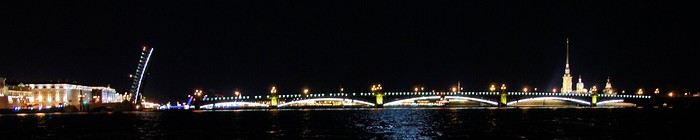
Here’s the recap of a little week we spent as a couple in Saint Petersburg in early May 2019, just before the *annus horribilis* of Covid. Since then, there’s also been the war in Ukraine, which has made things quite complicated, but tourist stays in Russia are still possible (see the discussion thread for the post-2022 situation). Looking back, early May was a bit too soon in the season—the trees were just starting to bud, and the wind was pretty chilly. It’s better to go at the end of May to enjoy the gardens.
Below is our 5-day itinerary. I’d brought along the inevitable Lonely Planet and the Blue Guide to Saint Petersburg, just to get a basic understanding of the architecture of the buildings I’d be admiring. I’d prepared two complementary routes on G**gle Maps in advance to cover the essentials of the city center in two days. That left the other days completely free for the big highlights: the Hermitage Museum and Peterhof Palace. We tried to adapt based on the weather, visiting Peterhof and its gardens on what was *supposed* to be the nicest day. We’d saved the Hermitage for a day when the weather was really bad, but in the end, we had more or less the same weather every day (sunny but windy and chilly).
Itinerary:
Day 1: City center north of Nevsky Prospect, up to the fortress (Route 1 on the map) Day 2: Peterhof Day 3: City center south of Nevsky Prospect up to Mariinsky (Route 2) Day 4: Canal boat tour during the day + nighttime boat ride on the Neva Day 5: Hermitage
Evening activities:
On the 3rd day, we saw an opera at the Mariinsky I, On the 4th day, we saw a ballet at the Mariinsky II, then headed back to the embankments at half past midnight for a nighttime cruise on the Neva—magical!
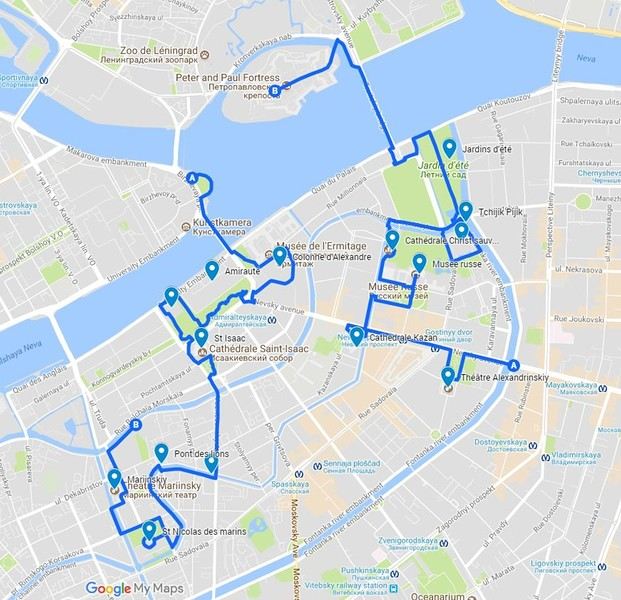
Here’s the recap of a little week we spent as a couple in Saint Petersburg in early May 2019, just before the *annus horribilis* of Covid. Since then, there’s also been the war in Ukraine, which has made things quite complicated, but tourist stays in Russia are still possible (see the discussion thread for the post-2022 situation). Looking back, early May was a bit too soon in the season—the trees were just starting to bud, and the wind was pretty chilly. It’s better to go at the end of May to enjoy the gardens.
Below is our 5-day itinerary. I’d brought along the inevitable Lonely Planet and the Blue Guide to Saint Petersburg, just to get a basic understanding of the architecture of the buildings I’d be admiring. I’d prepared two complementary routes on G**gle Maps in advance to cover the essentials of the city center in two days. That left the other days completely free for the big highlights: the Hermitage Museum and Peterhof Palace. We tried to adapt based on the weather, visiting Peterhof and its gardens on what was *supposed* to be the nicest day. We’d saved the Hermitage for a day when the weather was really bad, but in the end, we had more or less the same weather every day (sunny but windy and chilly).
Itinerary:
Day 1: City center north of Nevsky Prospect, up to the fortress (Route 1 on the map) Day 2: Peterhof Day 3: City center south of Nevsky Prospect up to Mariinsky (Route 2) Day 4: Canal boat tour during the day + nighttime boat ride on the Neva Day 5: Hermitage
Evening activities:
On the 3rd day, we saw an opera at the Mariinsky I, On the 4th day, we saw a ballet at the Mariinsky II, then headed back to the embankments at half past midnight for a nighttime cruise on the Neva—magical!
Malaysia or Mexico for a family trip: nature, beach, and culture?
Hi everyone!
We’re a family of 4: 2 adults and 2 kids aged 3 and 6.
I’m looking for a nature-beach-culture destination for May 2026. Right now, I’m torn between Mexico and Malaysia. I’ve read about the Yucatán, for example—it’s easy for a first trip to Mexico, but I’m worried I won’t get that authentic Mexican vibe, especially if we have to rent a car. I don’t want our trip to just be a checklist of beautiful sites. I love Asia for the atmosphere and the ease of traveling independently. Anyway, can you share your thoughts on these two destinations and help me with my research? Thanks!
Hélène
Sur les terres mayas English translation pending
Bonjour à tous les amoureux de voyage,
Je me propose de vous faire partager notre voyage au Guatemala, pays assez peu renseigné sur VF. Je l’agrémenterai de quelques photos (tablette) sans prétention qui se veulent seulement illustratives et je demande par avance votre indulgence.
Initialement nous avions opté pour un périple au Pérou en février. Les agences contactées ont eu l’honnêteté, et nous les en remercions, de nous indiquer que cela n’était pas une bonne période pour se rendre sur les plateaux andins. Après une longue hésitation nous avons orienté nos recherches vers le Guatemala et le Honduras et avons pris des contacts avec 2 agences francophones à Antigua pour des propositions et des devis. Très vite nous avons retenu « Bon Voyage » plus réactive et nettement moins chère que sa consœur. Après plusieurs itérations avec Arnaud (patron de l’agence) nous avons convergé vers un circuit de 16 j entre le 6/2 et le 21/2/2020.
Jour 1 :
Pour les vols internationaux nous avions le choix entre une escale aux USA ou à Madrid. Pour à peine plus cher (660 €/p) et un temps de vol bien plus court nous avons finalement choisi IBERIA au détriment des compagnies et contraintes (ESTA et douane) américaines. De plus les vols IBERIA sont au départ (et retour) d’Orly plus commode pour nous.
L’horaire de départ étant très matinal nous décidons de dormir à Orly. L’hôtel Ibis Budget « cœur d’Orly » fera l’affaire. Disons le, c’est cher pour un hôtel de ce type (entrée de gamme) mais il a le mérite de servir le PdJ à partir de 4 h. Cet horaire nous permet de garer notre voiture dans un parking de la zone industriel de Senia et une navette nous dépose à l’aéroport vers 6h. Le vol Orly - Madrid part à 7h30 et nous attendrons 3h pour prendre celui qui nous mènera à Guatemala City où nous arrivons vers 17 h (heure locale soit – 7h de décalage. Ces vols seront sans histoire ni retard. A notre arrivée, Luis notre chauffeur, nous attend. Son sourire et sa gentillesse nous séduisent de suite. Il est chargé de nous conduire à Antigua. Mais les routes à cette heure sont saturées et nous mettrons plus de 2h pour parvenir à Antigua pourtant distante de moins de 40 km de la capitale. Il nous dépose à l’hôtel Posada San Pedro dans lequel nous résiderons 5 nuits durant notre séjour. L’hôtel n’a que 8 chambres et ne sert pas de PdJ mais il est bien situé (7ième avenue) et il dispose d’un joli jardin intérieur et d’un solarium. La chambre n’est pas très grande mais offre une vue directe sur le volcan Fuego en activité permanente. Des fumées s’en échappent régulièrement et parfois des rougeurs nous signalent des coulées de lave. Sitôt arrivés nous nous couchons pour être d’attaque le lendemain.
Jour 2 :
Notre première tâche est de trouver le lieu de notre PdJ car l’hôtel ne propose pas ce service. Il s’agit du restaurant « Viejo Café » dans la 6ième avenue. Ce lieu regroupe une boulangerie et un joli patio où sont servis les PdJ. L’offre est excellente et le service souriant. Tant mieux car nous y reviendrons à maintes reprises. Nous avons RDV avec notre agent de voyage dont nous faisons la connaissance. Il nous fourni un roadbook très détaillé de notre périple avec une carte détaillée pour chaque ville étape, une liste de restaurants qu’il recommande, les lieux à visiter, les recommandations (sûreté, banques, …) et un téléphone pour le joindre en cas de nécessité. Nous rejoignons ensuite un guide francophone qui nous fait découvrir cette jolie ville d’Antigua classée par l’UNESCO. Il nous fait un historique de la cité bâtie par les Espagnols et nous indique comment s’orienter le plan des rues, toutes pavées, s’apparente à celui des villes américaines et elles se coupent toutes à angle droit. Comme à New York la 5ième avenue est la principale artère de la ville. Nous visitons successivement l’église Merced, son monastère, son jardin et sa terrasse d’où l’on peut contempler les 3 volcans qui entourent la ville. L’église bâtie en 1548 a été détruite puis restaurée plusieurs fois suite aux nombreux séismes qui ont frappé la ville, le plus récent datant de 1976, sa façade est jaune et ornée de nénuphars. Puis notre visite se poursuit par le monastère dont il ne subsiste que des ruines. Au milieu de la cour centrale, on découvre une fontaine monumentale elle aussi en forme de nénuphar.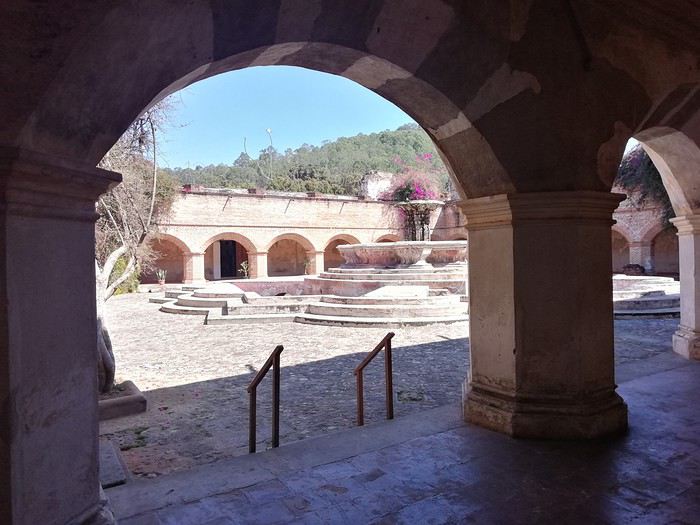
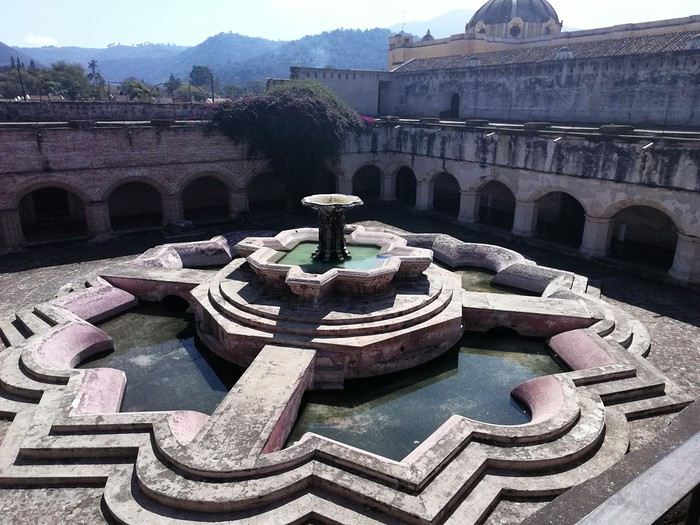
Pour profiter du panorama sur 3 volcans, nous gravissons les marches qui mènent à la terrasse. Puis nous gagnons la « Plaza mayor » cernée par de beaux édifices bâtis par les Espagnols, allant de la mairie à la cathédrale de la ville.
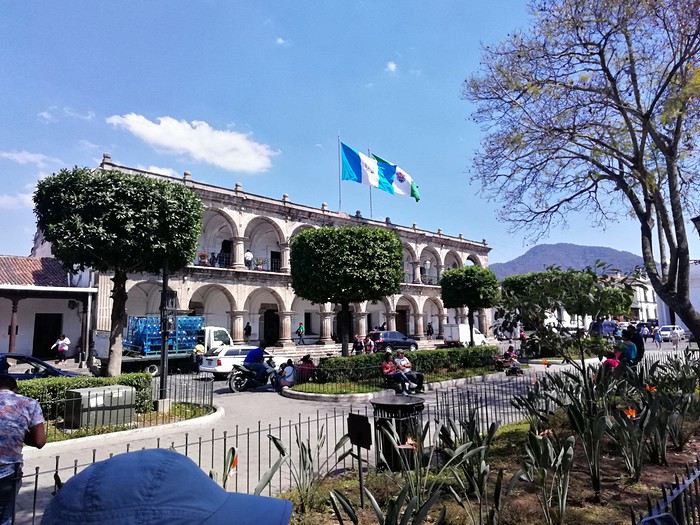 Nous passons devant le musée du chocolat avant de faire une halte pour découvrir le plus beau « Mac Do » du monde logé dans une magnifique hacienda d’époque avec un grand patio fleuri.
 Cela change des établissements habituels de cette marque.
On arpente les rues de la ville, occasion de découvrir des demeures coloniales splendides aux patios intérieurs abondamment fleuris,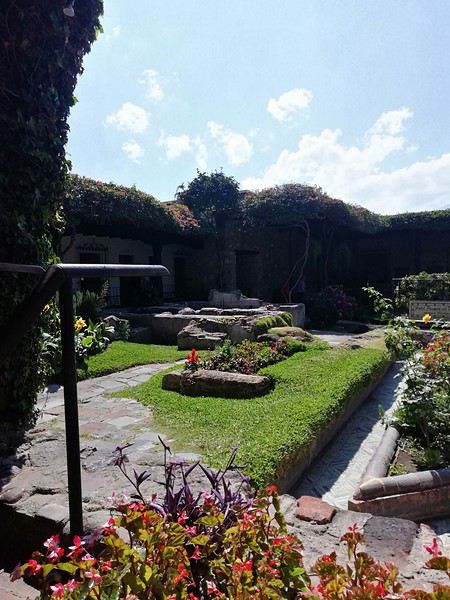
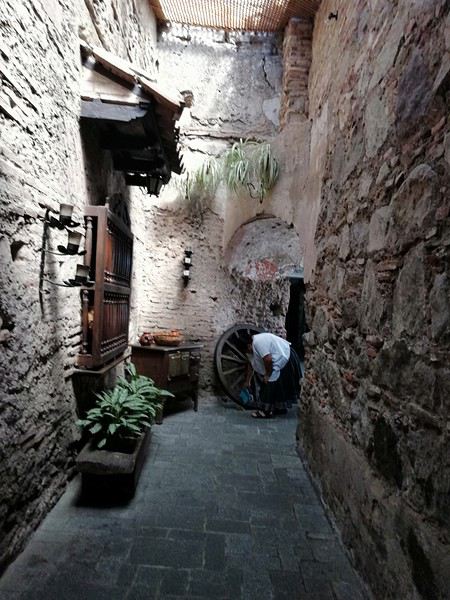
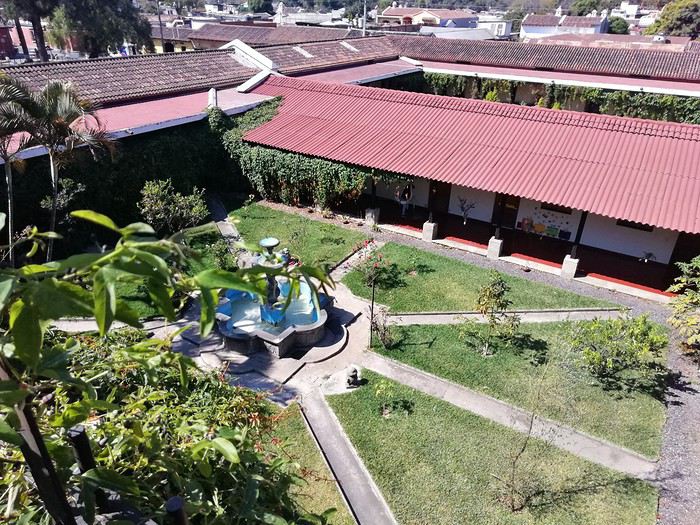
de voir un nombre impressionnant d’églises détruites par les tremblements de terre. Elles ne sont pas reconstruites faute de moyens pour les entretenir mais elles témoignent de l’emprise de la religion catholique sur le pays.
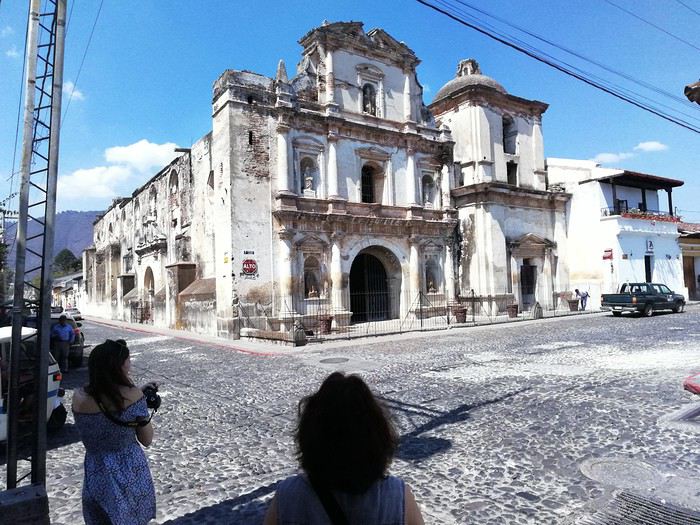
Notons à ce propos que l’on verra par la suite beaucoup de temples protestants de différentes obédiences, tout comme aux USA.
Je me propose de vous faire partager notre voyage au Guatemala, pays assez peu renseigné sur VF. Je l’agrémenterai de quelques photos (tablette) sans prétention qui se veulent seulement illustratives et je demande par avance votre indulgence.
Initialement nous avions opté pour un périple au Pérou en février. Les agences contactées ont eu l’honnêteté, et nous les en remercions, de nous indiquer que cela n’était pas une bonne période pour se rendre sur les plateaux andins. Après une longue hésitation nous avons orienté nos recherches vers le Guatemala et le Honduras et avons pris des contacts avec 2 agences francophones à Antigua pour des propositions et des devis. Très vite nous avons retenu « Bon Voyage » plus réactive et nettement moins chère que sa consœur. Après plusieurs itérations avec Arnaud (patron de l’agence) nous avons convergé vers un circuit de 16 j entre le 6/2 et le 21/2/2020.
Jour 1 :
Pour les vols internationaux nous avions le choix entre une escale aux USA ou à Madrid. Pour à peine plus cher (660 €/p) et un temps de vol bien plus court nous avons finalement choisi IBERIA au détriment des compagnies et contraintes (ESTA et douane) américaines. De plus les vols IBERIA sont au départ (et retour) d’Orly plus commode pour nous.
L’horaire de départ étant très matinal nous décidons de dormir à Orly. L’hôtel Ibis Budget « cœur d’Orly » fera l’affaire. Disons le, c’est cher pour un hôtel de ce type (entrée de gamme) mais il a le mérite de servir le PdJ à partir de 4 h. Cet horaire nous permet de garer notre voiture dans un parking de la zone industriel de Senia et une navette nous dépose à l’aéroport vers 6h. Le vol Orly - Madrid part à 7h30 et nous attendrons 3h pour prendre celui qui nous mènera à Guatemala City où nous arrivons vers 17 h (heure locale soit – 7h de décalage. Ces vols seront sans histoire ni retard. A notre arrivée, Luis notre chauffeur, nous attend. Son sourire et sa gentillesse nous séduisent de suite. Il est chargé de nous conduire à Antigua. Mais les routes à cette heure sont saturées et nous mettrons plus de 2h pour parvenir à Antigua pourtant distante de moins de 40 km de la capitale. Il nous dépose à l’hôtel Posada San Pedro dans lequel nous résiderons 5 nuits durant notre séjour. L’hôtel n’a que 8 chambres et ne sert pas de PdJ mais il est bien situé (7ième avenue) et il dispose d’un joli jardin intérieur et d’un solarium. La chambre n’est pas très grande mais offre une vue directe sur le volcan Fuego en activité permanente. Des fumées s’en échappent régulièrement et parfois des rougeurs nous signalent des coulées de lave. Sitôt arrivés nous nous couchons pour être d’attaque le lendemain.
Jour 2 :
Notre première tâche est de trouver le lieu de notre PdJ car l’hôtel ne propose pas ce service. Il s’agit du restaurant « Viejo Café » dans la 6ième avenue. Ce lieu regroupe une boulangerie et un joli patio où sont servis les PdJ. L’offre est excellente et le service souriant. Tant mieux car nous y reviendrons à maintes reprises. Nous avons RDV avec notre agent de voyage dont nous faisons la connaissance. Il nous fourni un roadbook très détaillé de notre périple avec une carte détaillée pour chaque ville étape, une liste de restaurants qu’il recommande, les lieux à visiter, les recommandations (sûreté, banques, …) et un téléphone pour le joindre en cas de nécessité. Nous rejoignons ensuite un guide francophone qui nous fait découvrir cette jolie ville d’Antigua classée par l’UNESCO. Il nous fait un historique de la cité bâtie par les Espagnols et nous indique comment s’orienter le plan des rues, toutes pavées, s’apparente à celui des villes américaines et elles se coupent toutes à angle droit. Comme à New York la 5ième avenue est la principale artère de la ville. Nous visitons successivement l’église Merced, son monastère, son jardin et sa terrasse d’où l’on peut contempler les 3 volcans qui entourent la ville. L’église bâtie en 1548 a été détruite puis restaurée plusieurs fois suite aux nombreux séismes qui ont frappé la ville, le plus récent datant de 1976, sa façade est jaune et ornée de nénuphars. Puis notre visite se poursuit par le monastère dont il ne subsiste que des ruines. Au milieu de la cour centrale, on découvre une fontaine monumentale elle aussi en forme de nénuphar.
Pour profiter du panorama sur 3 volcans, nous gravissons les marches qui mènent à la terrasse. Puis nous gagnons la « Plaza mayor » cernée par de beaux édifices bâtis par les Espagnols, allant de la mairie à la cathédrale de la ville.
Nous passons devant le musée du chocolat avant de faire une halte pour découvrir le plus beau « Mac Do » du monde logé dans une magnifique hacienda d’époque avec un grand patio fleuri.
Cela change des établissements habituels de cette marque.On arpente les rues de la ville, occasion de découvrir des demeures coloniales splendides aux patios intérieurs abondamment fleuris,
de voir un nombre impressionnant d’églises détruites par les tremblements de terre. Elles ne sont pas reconstruites faute de moyens pour les entretenir mais elles témoignent de l’emprise de la religion catholique sur le pays.
Notons à ce propos que l’on verra par la suite beaucoup de temples protestants de différentes obédiences, tout comme aux USA.
Vol Bâle - Anchorage avec escale English translation pending
Bonjour,
Un vol Bale Anchorage avec une escale à 730€ pour août 2020, pensez-vous qu’il est possible de trouver moins cher?
Merci pour vos réponses
Christine
Itinéraire dans les îles de la Polynésie English translation pending
Bonjour à tous !
Pour fêter nos 50 ans, un coup de folie nous a pris.... Nous partons (à 2) en Polynésie !!! 😎
Nos billets Paris/Papeete sont déjà achetés. 1300€ le billet avec ATN, j'ai trouvé ça raisonnable par rapport à ce que j'avais pu lire un peu à droite à gauche. Donc je me suis lancée. 3 semaines en août/sept prochain. Que l'année à venir va nous sembler longue...
Notre casse tête maintenant est d'établir notre circuit et c'est là que nous aurions besoin des précieux conseils des connaisseurs.
Nous souhaitons à la fois profiter pleinement de chaque endroit donc prendre notre temps et à la fois en voir un maximum bien sure. Nous sommes donc partis dans l'idée de rester 4 jours sur chaque île.
Est-ce trop pour certaines ? pas assez pour d'autres ?
Voici les îles que nous avons relevées : - Moorea - Raiatea ou Huahine - Bora bora - Maupiti - Rangiroa - Fakarava
Nous ne pensons pas faire Tahiti malheureusement. Il y a tellement d'autres îles qui nous semblent tellement plus belles et plus intéressantes. Nous arriverons donc le soir vers 22h et repartirons au plus tôt dès le lendemain matin.
L'ennui c'est que malgré tout, 4 jours sur 6 îles, ça ne rentre pas dans nos 20 jours....
Devons-nous supprimer une île un peu similaire à une autre (Bora bora/Maupiti ou Rangiroa/Fakarava) ou réduire le temps sur l'une des 6 îles pour les caser toutes mais sans pour autant avoir l'impression de courir avec les temps de transfert ? Car Bora bora & Maupiti ou Rangiroa & Fakarava nous font tellement envie !!!
Si vous avez aussi quelques recommandations quant à l'ordre d'enchaînement des îles, je suis également preneuse... j'ai commencé à regarder les jours & horaires des vols intérieurs et je sais que la tâche va être rude 😠
A noter que nous ne sommes pas des plongeurs, nous n'avons pas nos niveaux, mais adorons le snorkeling bien entendu.
Voilà pour nos premières interrogations 🤪
Je vous remercie par avance pour toutes vos précieuses réponses.
Pour fêter nos 50 ans, un coup de folie nous a pris.... Nous partons (à 2) en Polynésie !!! 😎
Nos billets Paris/Papeete sont déjà achetés. 1300€ le billet avec ATN, j'ai trouvé ça raisonnable par rapport à ce que j'avais pu lire un peu à droite à gauche. Donc je me suis lancée. 3 semaines en août/sept prochain. Que l'année à venir va nous sembler longue...
Notre casse tête maintenant est d'établir notre circuit et c'est là que nous aurions besoin des précieux conseils des connaisseurs.
Nous souhaitons à la fois profiter pleinement de chaque endroit donc prendre notre temps et à la fois en voir un maximum bien sure. Nous sommes donc partis dans l'idée de rester 4 jours sur chaque île.
Est-ce trop pour certaines ? pas assez pour d'autres ?
Voici les îles que nous avons relevées : - Moorea - Raiatea ou Huahine - Bora bora - Maupiti - Rangiroa - Fakarava
Nous ne pensons pas faire Tahiti malheureusement. Il y a tellement d'autres îles qui nous semblent tellement plus belles et plus intéressantes. Nous arriverons donc le soir vers 22h et repartirons au plus tôt dès le lendemain matin.
L'ennui c'est que malgré tout, 4 jours sur 6 îles, ça ne rentre pas dans nos 20 jours....
Devons-nous supprimer une île un peu similaire à une autre (Bora bora/Maupiti ou Rangiroa/Fakarava) ou réduire le temps sur l'une des 6 îles pour les caser toutes mais sans pour autant avoir l'impression de courir avec les temps de transfert ? Car Bora bora & Maupiti ou Rangiroa & Fakarava nous font tellement envie !!!
Si vous avez aussi quelques recommandations quant à l'ordre d'enchaînement des îles, je suis également preneuse... j'ai commencé à regarder les jours & horaires des vols intérieurs et je sais que la tâche va être rude 😠
A noter que nous ne sommes pas des plongeurs, nous n'avons pas nos niveaux, mais adorons le snorkeling bien entendu.
Voilà pour nos premières interrogations 🤪
Je vous remercie par avance pour toutes vos précieuses réponses.
Chine lors d'un voyage au long court avec enfants English translation pending
Bonjour à tous,
nous sommes en préparation d'un voyage de 4 ou 5 mois en famille.
Nos enfants ont 6 et 8 ans, nous envisageons de visiter l'Indonésie, l'Australie et la Thailande. Notre fil rouge sera les animaux, et là se pose la question d'aller voir les Pandas (nos filles sont vraiment fan de cet animal...) à Chengdu . Cependant aller en chine juste pour voir les pandas nous parait dommage.
Pensez vous que 15 jours en chine (Sichuan pour ne pas trop faire de transport) dont 5 jours à Chengdu et ses environs vous parait il cohérent ? si oui que visiter ? et n'est ce pas trop difficile de voyager en chine avec des enfants ?
Merci pour vos retours.
Cys
Cys
Projet cyclotourisme: direction plages du débarquement English translation pending
Bonjour,
Nous sommes un couple du Québec. On a choisi de prendre 3 semaines de vacances fin août début septembre pour un voyage à vélo. On ne fait pas de camping, on loge en gîte ou chambre d’hôtes. Nous avons des vélos qui ne sont pas des vtt, nos roues font du 700x25 ou 700x28. On débarque à Paris direction Cherbourg en train et de là, on fait la côte à vélo et voir et s’y arrêter sur les plages de débarquement.
On se demandait si on pouvait envisager, à notre arrivée à Paris, de faire la Seine pour se rendre au Havre et de là prendre le train pour Cherbourg. Est ce que cette randonnée vaut la peine ?
Bien hâte de vous lire.
Diane et Marc.
Première fois en Corse English translation pending
Bonjour à tous,
Voila j'aurais besoin de votre aide car avec mon compagnon nous souhaitons partir pour la 1ere fois en Corse pour une durée de 8 jours (durée du transport comprise)
Alors déja nous aimerions savoir quelles compagnies de ferry vous nous conseillez pour un depart de marseille.
Ensuite les différentes formalités administratives à accomplir car nous embarquerons avec notre voiture personnelle.
De plus je n'ai trouve nulle part d'information concernant les bagages (poids à respecter, etc). De plus je souhaiterai savoir s'il est possible de garder un petit bagage avec soi si nous voyageons en prenant juste les fauteuils et non pas la cabine (pas sure qu'il y ait des cabines disponibles pour nos dates). Est il possible d'avoir accés a une douche hors cabine ?
Et enfin que nous conseillez vous pour le voyage en lui même : si vous avez un camping sympa ou un hôtel avec une belle vue mais pas trop sophistiqué.
La corse du sud ? Du nord ? Tout a l'air tellement beau...nous sommes un peu perdus.
Merci beaucoup d'avance à vous pour toutes vos infos.
Yucatan en famille pour 3 semaines English translation pending
Hello tout le monde,
Il y a plusieurs discussion sur le forum parlant du Yucatan en famille mais ça fini par me mettre le doute sur le choix de notre parcours.
Nous avons 2 filles de 2,5ans et presque 5 ans et nous partons en avril prochain.
Voici notre programme avec location de voiture :
• Cancun : 1 nuit • Tulum : 5 nuits (nous avons trouvé une Posada à Chemuyil) • Bacalar : 3 nuits • Valladolid : 3 nuits • Rio Lagartos : 3 nuits • Holbox : 5 nuits
Nous avons envie de profitez sans courrir tout le temps, du coup nous avons supprimé Mérida (Uxmal, Izama...) Si nous avions pas d'enfants le sujet serait plus simple évidement :-)
Je ne sais pas si c'est la bonne option sachant qu'on souhaite faire de la plage et des activités nautiques, des visites de sites historiques, on aime aussi beaucoup visiter les villes sans oublié les animaux, la nature.... surtout avec des jeunes enfants.
Merci à vous pour vos précieux conseils. Une bretonne
Il y a plusieurs discussion sur le forum parlant du Yucatan en famille mais ça fini par me mettre le doute sur le choix de notre parcours.
Nous avons 2 filles de 2,5ans et presque 5 ans et nous partons en avril prochain.
Voici notre programme avec location de voiture :
• Cancun : 1 nuit • Tulum : 5 nuits (nous avons trouvé une Posada à Chemuyil) • Bacalar : 3 nuits • Valladolid : 3 nuits • Rio Lagartos : 3 nuits • Holbox : 5 nuits
Nous avons envie de profitez sans courrir tout le temps, du coup nous avons supprimé Mérida (Uxmal, Izama...) Si nous avions pas d'enfants le sujet serait plus simple évidement :-)
Je ne sais pas si c'est la bonne option sachant qu'on souhaite faire de la plage et des activités nautiques, des visites de sites historiques, on aime aussi beaucoup visiter les villes sans oublié les animaux, la nature.... surtout avec des jeunes enfants.
Merci à vous pour vos précieux conseils. Une bretonne
L'Ouganda, une perle africaine 2 English translation pending
Hello tous,
Pourquoi "Ouganda, une perle africaine 2 ", parce qu'en complément du carnet de Magryelle je souhaitais faire un carnet plus "pratique" et décrire la "périphérie" du voyage.
Pour la version blog avec photos, cartes etoutetout c'est ici
Donc commençons par le début:
La genèse
Une envie de repartir ensemble avec Marie-Gabriel, Yves, Nico et Thierry ... et une immense envie de voir les gorilles en Ouganda. En commençant à étudier la destination on s'est rendu compte que c'est un pays, sommes tout pas trop grand, mais qui a énormément à offrir. - Niveau paysages: l'Est rappelle le Kenya voisin et à l'Ouest, il y a le début de la forêt équatoriale et de hautes montagnes. - Niveau animaux, même si la population animale y est moins fournie qu'en Tanzanie ou en Afrique Australe, ils y sont tous avec en "bonus" 13 espèces de primates, avec en tête les gorilles et les chimpanzés. - Niveau population la densité est supérieure à l'Afrique Australe et l'ambiance générale fait plus "Afrique" que les déserts du Sud. Comme d'habitude nous partons en version "self drive" et nous avons construit l'itinéraire nous-même.
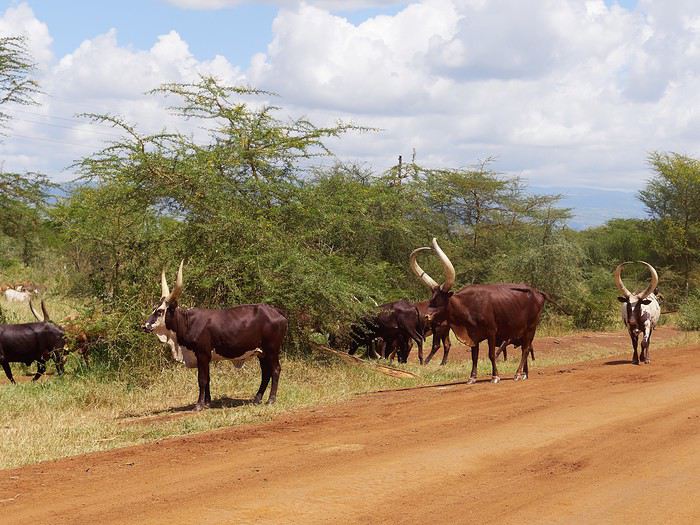
Les Outils
Pour nous repérer nous avions: pour le Gps: T4Africa et OpenStreetMap, pour les cartes papiers Nelles et Reise Know-How. Malgré tout ce matériel nous avons dû plusieurs fois naviguer "à l'inspiration", en effet les routes sont parfois des pistes défoncées, voir des sentiers ... le contraire étant également vrai !. Ce qui fait qu'on ne peut pas estimer le temps qu'on va mettre à l'avance.
Pour les guides papier: le Bradt et le Petit Futé. Le Bradt, en Anglais, mais toujours aussi précis et le Petit Futé bien pour faire un premier survol du pays.
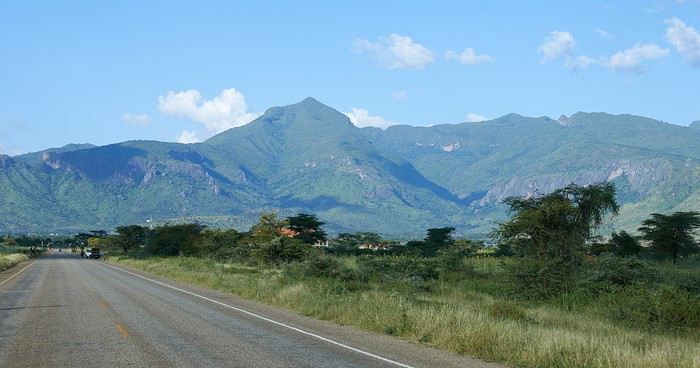
Pourquoi "Ouganda, une perle africaine 2 ", parce qu'en complément du carnet de Magryelle je souhaitais faire un carnet plus "pratique" et décrire la "périphérie" du voyage.
Pour la version blog avec photos, cartes etoutetout c'est ici
Donc commençons par le début:
La genèse
Une envie de repartir ensemble avec Marie-Gabriel, Yves, Nico et Thierry ... et une immense envie de voir les gorilles en Ouganda. En commençant à étudier la destination on s'est rendu compte que c'est un pays, sommes tout pas trop grand, mais qui a énormément à offrir. - Niveau paysages: l'Est rappelle le Kenya voisin et à l'Ouest, il y a le début de la forêt équatoriale et de hautes montagnes. - Niveau animaux, même si la population animale y est moins fournie qu'en Tanzanie ou en Afrique Australe, ils y sont tous avec en "bonus" 13 espèces de primates, avec en tête les gorilles et les chimpanzés. - Niveau population la densité est supérieure à l'Afrique Australe et l'ambiance générale fait plus "Afrique" que les déserts du Sud. Comme d'habitude nous partons en version "self drive" et nous avons construit l'itinéraire nous-même.
Les Outils
Pour nous repérer nous avions: pour le Gps: T4Africa et OpenStreetMap, pour les cartes papiers Nelles et Reise Know-How. Malgré tout ce matériel nous avons dû plusieurs fois naviguer "à l'inspiration", en effet les routes sont parfois des pistes défoncées, voir des sentiers ... le contraire étant également vrai !. Ce qui fait qu'on ne peut pas estimer le temps qu'on va mettre à l'avance.
Pour les guides papier: le Bradt et le Petit Futé. Le Bradt, en Anglais, mais toujours aussi précis et le Petit Futé bien pour faire un premier survol du pays.
Retour de trek Everest Base Camp + Gokyo (novembre - décembre 2018) English translation pending
Je viens de rentrer de 3 semaines au Nepal dont 2 semaines trek EBC+Gokyo.
réservé avec une agence népalaise, nous étions 4 + guide et porteurs.
mi nov à debut dec.
si vous avez des questions n'hésitez pas
j'en garde de tres bons souvenirs, tres belle météo meme si il faisait la froid la nuit et le matin...
j'en garde de tres bons souvenirs, tres belle météo meme si il faisait la froid la nuit et le matin...
Retour du Maroc du Sud après un mois English translation pending
Bonjour,
De retour d'un voyage d'un mois au Maroc, je vais vous faire part de mes impressions dans la mesure où j'ai construit mon itinéraire suite à mes lectures sur ce forum et j'avais publié un article ici le 4 octobre avec mon itinéraire "dilemme mer ou montagne".
Tout ce qui se dit ici s'est confirmé en très grande majorité. Le Maroc du sud est formidable à tous points de vue.
Je ne vais cependant pas republier les mêmes photos vues ici des dizaines de fois, d'autant plus que les sensibilités de chacun sont différentes. Je vais plutôt insister sur mes émotions ressenties.
Je suis plutôt routard mais mon épouse ne voyage jamais et a des critères de confort bien établis, il a fallu composer. Nous sommes tous les deux retraités, nous aimons plutôt le calme, nous fuyons la foule et le bruit, et surtout les coins trop touristiques.
Nous avons voyagé exclusivement avec les transports locaux, et c'est vraiment super.
Les Berbères et les Sarahouis nous ont vraiment plu. Que de belles rencontres.
Nous avons hélàs, à la plage de Legzira, vu des camionnettes de transport touristique débarquer du touriste genre bonde plus du premier âge avec une robe rose fushia trop courte et baskets assortis et des jeunes femmes qui ont confondu Cannes et Legzira. Et, ce qui est drôle, ce ne sont pas des hommes mais bien des femmes locales qui viennent vers elles les provoquer, les intimider, mais sans violence bien sûr. C'est de bonne guerre.
Mon épouse, en guise de protection solaire, avait plutôt mis son écharpe en foulard et elle a eu de nombreuses marques de sympathie des femmes et de la population en général. C'est pas grand chose mais ça leur fait un énorme plaisir, pourquoi s'en priver.
Nous avons été surpris par le fait que tout le monde, jeunes et vieux, y compris au milieu de nulle part aient un smartphone greffé dans la main et s'en servent beaucoup. Nous avons voyagé avec les bus LUX verts locaux, avec les poulets et le toutim, mais la cacophonie venait des conversations au téléphone de la plupart des occupants du bus.
Je me dois de vous faire part de ces anecdotes magnifiques : en pleine "campagne", on voit arriver un bus et nous sommes à 300 m dans une voie transversale. On fait des grands signes. Nous ayant aperçus, non seulement il s'arrête un peu plus loin mais il fait carrément une marche arrière pour venir nous attendre, sans que personne ne proteste, c'est hallucinant ! C'est arrivé à l'Oasis de Tighmert en dessous de Guelmim.
Nous sommes aussi montés une fois à l'arrière du bus, vers Tafraoute, et au bout de quelques minutes 2 tickets nous sont arrivés du chauffeur via chaque passager. Nous avons donné la pièce de 10 dirhams qui est passée de mains en mains jusqu'au chauffeur. C'est juste magnifique.
J'ai trop de coups de coeur pour les citer ici. Le seul point négatif, c'est vraiment que nous n'avons pas aimé Tiznit. Il y a une tension particulière, c'est difficile à décrire, on y est pas restés.
Concernant Sidi Ifni, je confirme qu'il faut vraiment avoir séjourné à l'hôtel Suerte Loca, c'est intemporel, mais il ne faut pas selon nous y manger. Par contre, le resto LE NOMAD un peu plus loin, c'est du 10/10.
Plutôt que de mettre tout en vrac, voici les étapes que j'ai effectuées, je donnerai mes infos hébergement et transport à ceux qui m'en demanderont : Via Inezgane et Tiznit : Aglou, Mirleft, Sidi Ifni, Oasis de Tighmert, Tafraout et Taroudant.
Pour finir cet article, je vais quand mettre une photo que j'ai prise dans les Gorges d'Aït Mansour, mais elle ne s'adresse qu'aux retraités comme moi qui comprendront (j'espère).
Une astuce extraordinaire que j'ai du lire ici : une semaine avant de partir et pendant un mois, faites une cure de PRO-BIOTIQUES, c'est hyper efficace, nous avons totalement évité la tourista (sans toutefois pour celà négliger les recommandations habituelles concernant la nourriture et la boisson au Maroc).
Attention aussi, pour les plus fragiles, au choc thermique lors du retour. De 20 à 24°, à Nantes il faisait un temps de chien et forte pluie, résultat 2 gros rhumes cinq étoiles.
Bon voyage à ceux qui partent.
Étape à Yosemite ou pas English translation pending
Bonjour à tous,
Je prépare un road trip dans l'Ouest Américain fin avril début mai 2019.
Au départ de San Francisco, je pensais faire une étape à Yosemite avec une journée de ballade le lendemain puis redescende vers Bakersfield
Jour 1 à 3 San Francisco
Jour 4 route vers Yosemite
Jour 5 Yosemite
Jour 6 route vers Bakersfield
Jour 7 Route vers Vegas via Death Valley.
Mon pb est qu'à la saison où nous partons (tioga road fermée) c'est peut être un grand détour sachant que nous ne partons que 21 jours et qu'ensuite j'ai d'autres choses de prévu dans notre planning.
Pensez vous que je devrais faire l'impasse sur Yosemite ou pas ?
La suite donnerait
Jour 8 Vegas
Jour 9 route vers Zion
Jour 10 route vers Bryce
Jour 11 Bryce
Jour 12 Route vers Page
Jour 13 Page : antelope les 2 et lake Lowell
Jour 14 Route vers Monument Valley
Jour 15 Route vers grand Cayon
Jour 16 et 17 route vers LA et là je ne sais pas où est il le mieux de prévoir une étape laughin/Kingsman ?
Jour 18 et 19 LA
Il me reste une journée possible que je peux "caser" si un endroit vous semble interessant. Sinon nous remonterions vers SF via la côté avec une nuit d'étape.
Je me suis comme d'autres, inspirer d'un circuit TO et j'hesite vraiment à me lancer seule. J'ai vu que cela s'organisait très bien seule. J'ai un gros doute en cas de pépin, impondérables...
Merci de me dire SVP
Bon dimanche à tous
Itinéraire 3 semaines seule de Johannesbourg au Cap English translation pending
Bonjour,
Je suis une jeune femme voyageant seul. Je serai en AFS fin janvier 2019. J'ai voyagé a plusieurs reprises, mais c'est mon premier road trip. Je me suis créée un itinéraire, j'aimerais vos commentaires si possible. J'aimerais préciser que j'aime beaucoup la randonnée en montagne.
Mes inquiétudes présentement sont de trouver le temps long a Kruger en Safari seule, la route vers le Cap, j'ai peur de ne pas avoir assez de temps au Cap et dans le secteur des vignobles.
Merci a tous, vos conseils sont précieux.
Jour 1 Arrivée a Johnnesburg (Airport Diamond Guest House) Jour 2 Visite Soweto (Airport Diamond Guest House) Jour 3 Direction Blide Canyon (Zur Alten Mine) Jour 4 Blide Canyaon (Zur Alten Mine) Jour 5 Direction Kruger (Traveller's Palm) Jour 6 Kruger (Hamilton Parks Country Lodge) Jour 7 Kruger (Hamilton Parks Country Lodge) Jour 8 Direction Swaziland (Sunset View Guest House) Jour 9 Swaziland (Sunset View Guest House) Jour 10 Direction Hluhluwe (Hluhluwe Country cottage) Jour 11 Hluhluwe (Hluhluwe Country cottage) Jour 12 Direction Ste-Lucia (Monzi Safaris Backpackers) Jour 13 Ste-Lucia (Monzi Safaris Backpackers) Jour 14 Direction Plettenberg Bay - avion durban - (Africa Array Backpackers Lodge) Jour 15 Plettenberg Bay (Africa Array Backpackers Lodge) Jour 16 Direction Knysna (Jembjo's Knysna Lodge et Backpackers) Jour 17 Knysna (Jembjo's Knysna Lodge et Backpackers) Jour 18 Direction Swellendam (Cypress cottage guest house) Jour 19 Direction Le Cap Jour 20 Le Cap Jour 21 Le Cap Jour 22 Le cap et départ pour Montréal en fin de journée
Jour 1 Arrivée a Johnnesburg (Airport Diamond Guest House) Jour 2 Visite Soweto (Airport Diamond Guest House) Jour 3 Direction Blide Canyon (Zur Alten Mine) Jour 4 Blide Canyaon (Zur Alten Mine) Jour 5 Direction Kruger (Traveller's Palm) Jour 6 Kruger (Hamilton Parks Country Lodge) Jour 7 Kruger (Hamilton Parks Country Lodge) Jour 8 Direction Swaziland (Sunset View Guest House) Jour 9 Swaziland (Sunset View Guest House) Jour 10 Direction Hluhluwe (Hluhluwe Country cottage) Jour 11 Hluhluwe (Hluhluwe Country cottage) Jour 12 Direction Ste-Lucia (Monzi Safaris Backpackers) Jour 13 Ste-Lucia (Monzi Safaris Backpackers) Jour 14 Direction Plettenberg Bay - avion durban - (Africa Array Backpackers Lodge) Jour 15 Plettenberg Bay (Africa Array Backpackers Lodge) Jour 16 Direction Knysna (Jembjo's Knysna Lodge et Backpackers) Jour 17 Knysna (Jembjo's Knysna Lodge et Backpackers) Jour 18 Direction Swellendam (Cypress cottage guest house) Jour 19 Direction Le Cap Jour 20 Le Cap Jour 21 Le Cap Jour 22 Le cap et départ pour Montréal en fin de journée
Sécurité au Cambodge English translation pending
Bonjour
Je cherche des informations. Le site de conseils aux voyageurs français du ministère indique "vigilance renforcée" pour tout le pays, mais dans la description rien ne le justifie vraiment. Le site canadien est plus inquiétant. (il est même question de mines) Qu'en est-il en réalité ? Est-ce sécurisé ?
Je cherche des informations. Le site de conseils aux voyageurs français du ministère indique "vigilance renforcée" pour tout le pays, mais dans la description rien ne le justifie vraiment. Le site canadien est plus inquiétant. (il est même question de mines) Qu'en est-il en réalité ? Est-ce sécurisé ?
Itinéraire Québec - Tadoussac - Gaspésie en 4 semaines (avec enfants) English translation pending
Bonjour,
J'avais posté il y a quelques temps un itinéraire qui excluait la Gaspesie et se concentrait sur le parc de la mauricie, de la Jacques Cartier, le fjord et les escoumins (itinéraire en famille de 5 personnes, donc 3 enfants de 5 à 11 ans) Je suis en train d'essayer d'y inclure la Gaspesie, pour essayer de rajouter plus de variétés, voir les grands classiques de la Gaspesie, et rechercher des activités pour les enfants. Je souhaite conserver malgré tout des endroits plus comme le parc de la Mauricie ou de la J. Cartier car ce genre de paysages nous attire beaucoup.
Voilà mon projet d'itinéraire et les (très nombreuses) questions associées:
J1: Arrivée à Montreal - courses - départ pour le parc de la Mauricie - Nuit Ottentik Mauricie 1 J2: Parc de la Mauricie - balades/baignades - Nuit Ottentik Mauricie 2 J3: Rando Canot chutes Waber - Nuit Ottentik Mauricie 3 J4: Départ pour Quebec: Soit matinée au parc soit départ matinal pour profiter de Quebec - Nuit Hotel Quebec (ou Levis?) 1 J5: Visite de Quebec - Nuit Hotel Quebec (ou Levis?) 2 Est ce que c'est trop court à Quebec? J6: Départ pour le parc des HG de la malbaie avec passage au canyon ste anne - Nuit Huttopia HG 1 J7: Balades HG de la malbaie - Nuit Huttopia HG 2 J8: Balades et rabaska dans le parc - Nuit Huttopia HG 3 Nous aurons 3 enfants de 5 à 11 ans, pourra t-on malgré tout faire des randos sympas avec eux? Pour la rabaska, je me suis renseignée, c'est ok. J9 - Départ pour Anse St Jean - Journée Baie des rochers - Nuit gite Anse St Jean 1 J10 - Balades Anse St Jean - Nuit gite anse st jean 2 J11 - Balades petit saguenay - Nuit gite Anse St Jean 3 Est ce trop long 2 jours complet? y a t-il des activités sympas avec lesenfants autres que des balades? J12 - Départ pour les escoumins, journée vers Sacré coeur (halte au beluga) - Nuit Condo Essipit J13 - Cap Bon désir - observation baleines - Nuit Condo Essipit 2 J14 - Tadoussac - Pointe de l'islet etc... - Nuit Condo Essipit 3 J15 - Départ pour la Gaspésie - traversier + route - Nuit gite vers parc gaspesie J16 - Randos balades parc gaspesie - Nuit gite parc gaspesie 2 J18 - Randos idem ou Exploramer à Ste Anne des monts - Nuit gite Gaspesie 3 Est ce trop avec de jeunes enfants? Y a t-il des randos qui leur seront accessibles? Nous voulons essayer de voir des animaux. J19 - Départ pour le parc Forillon - Nuit prêt à camper Forillon J20 - Balades dans le parc - Nuit prêt à camper Forillon 2 J21 - Départ pour Percé - visite Percé dans la journée. Nuit gite Percé1 J22 - Bateau pour l'ile bonaventure - Nuit gite percé 2 Faut il rester plus longtemps à Percé? Au cas ou pb meteo empechant d'aller à l'ile bonaventure le J22? ou est ce qu'on pourra envisager en cas de pbs de le faire J23 et de n'arriver à Bonaventure qu'en soirée? Sinon si un jour de plus, que faire à Percé en attendant? J23 - Départ pour Bonaventure - Nuit gite Bonaventure 1 J24 - Canoe sur la rivière - Nuit gite Bonaventure 2 J25 - Départ pour le parc du Bic - Nuit Huttopia Parc du Bic 1 Que faire pour rendre plus agréableles 4h de route? Parc Mishaga à 1h de bonaventure? y a t-il un arret sympa à faire? J26 - balades parc du bic - Nuit Huttopia Parc du Bic 2 J27 - balades parc du bic + activités proposées par le parc - Nuit Huttopia Parc du Bic 3 J28 - Route vers Quebec/J. Cartier - Nuit Huttopia J. Cartier 1 J29 - Randos J. Cartier - Nuit Huttopia J. Cartier 2 J30 - Rabaska + visite grottes + balades/baignades - Nuit Huttopia J. Cartier 2 J31 - Départ vers aéroport Montreal (ou quebec si je trouve un vol de retour de la)
Ca fait donc 31 jours, 3 de plus que ce que j'avais prévu initialement. Si j'arrive à trouver des gites pas trop chers en Gaspésie, ca peut peut etre se faire (et si le surplus 3 jours de voiture est raisonnable). Mais si je devais supprimer/allonger certaines choses, que me conseilleriez vous? J'essaie de varier les logements (prêt à camper et gites), d'insérer des activités sympas avec les enfants pour que ce ne soit pas que des randos. Mais il y a peut etre d'autres choses sympas à faire avec eux. Et je me demande si certains parcs ne sont pas redondants, si je ne devrais pas faire J. cartier juste apres Quebec etc...
Désolée pour la longueur! Et merci par avance de votre aide! Marie
J'avais posté il y a quelques temps un itinéraire qui excluait la Gaspesie et se concentrait sur le parc de la mauricie, de la Jacques Cartier, le fjord et les escoumins (itinéraire en famille de 5 personnes, donc 3 enfants de 5 à 11 ans) Je suis en train d'essayer d'y inclure la Gaspesie, pour essayer de rajouter plus de variétés, voir les grands classiques de la Gaspesie, et rechercher des activités pour les enfants. Je souhaite conserver malgré tout des endroits plus comme le parc de la Mauricie ou de la J. Cartier car ce genre de paysages nous attire beaucoup.
Voilà mon projet d'itinéraire et les (très nombreuses) questions associées:
J1: Arrivée à Montreal - courses - départ pour le parc de la Mauricie - Nuit Ottentik Mauricie 1 J2: Parc de la Mauricie - balades/baignades - Nuit Ottentik Mauricie 2 J3: Rando Canot chutes Waber - Nuit Ottentik Mauricie 3 J4: Départ pour Quebec: Soit matinée au parc soit départ matinal pour profiter de Quebec - Nuit Hotel Quebec (ou Levis?) 1 J5: Visite de Quebec - Nuit Hotel Quebec (ou Levis?) 2 Est ce que c'est trop court à Quebec? J6: Départ pour le parc des HG de la malbaie avec passage au canyon ste anne - Nuit Huttopia HG 1 J7: Balades HG de la malbaie - Nuit Huttopia HG 2 J8: Balades et rabaska dans le parc - Nuit Huttopia HG 3 Nous aurons 3 enfants de 5 à 11 ans, pourra t-on malgré tout faire des randos sympas avec eux? Pour la rabaska, je me suis renseignée, c'est ok. J9 - Départ pour Anse St Jean - Journée Baie des rochers - Nuit gite Anse St Jean 1 J10 - Balades Anse St Jean - Nuit gite anse st jean 2 J11 - Balades petit saguenay - Nuit gite Anse St Jean 3 Est ce trop long 2 jours complet? y a t-il des activités sympas avec lesenfants autres que des balades? J12 - Départ pour les escoumins, journée vers Sacré coeur (halte au beluga) - Nuit Condo Essipit J13 - Cap Bon désir - observation baleines - Nuit Condo Essipit 2 J14 - Tadoussac - Pointe de l'islet etc... - Nuit Condo Essipit 3 J15 - Départ pour la Gaspésie - traversier + route - Nuit gite vers parc gaspesie J16 - Randos balades parc gaspesie - Nuit gite parc gaspesie 2 J18 - Randos idem ou Exploramer à Ste Anne des monts - Nuit gite Gaspesie 3 Est ce trop avec de jeunes enfants? Y a t-il des randos qui leur seront accessibles? Nous voulons essayer de voir des animaux. J19 - Départ pour le parc Forillon - Nuit prêt à camper Forillon J20 - Balades dans le parc - Nuit prêt à camper Forillon 2 J21 - Départ pour Percé - visite Percé dans la journée. Nuit gite Percé1 J22 - Bateau pour l'ile bonaventure - Nuit gite percé 2 Faut il rester plus longtemps à Percé? Au cas ou pb meteo empechant d'aller à l'ile bonaventure le J22? ou est ce qu'on pourra envisager en cas de pbs de le faire J23 et de n'arriver à Bonaventure qu'en soirée? Sinon si un jour de plus, que faire à Percé en attendant? J23 - Départ pour Bonaventure - Nuit gite Bonaventure 1 J24 - Canoe sur la rivière - Nuit gite Bonaventure 2 J25 - Départ pour le parc du Bic - Nuit Huttopia Parc du Bic 1 Que faire pour rendre plus agréableles 4h de route? Parc Mishaga à 1h de bonaventure? y a t-il un arret sympa à faire? J26 - balades parc du bic - Nuit Huttopia Parc du Bic 2 J27 - balades parc du bic + activités proposées par le parc - Nuit Huttopia Parc du Bic 3 J28 - Route vers Quebec/J. Cartier - Nuit Huttopia J. Cartier 1 J29 - Randos J. Cartier - Nuit Huttopia J. Cartier 2 J30 - Rabaska + visite grottes + balades/baignades - Nuit Huttopia J. Cartier 2 J31 - Départ vers aéroport Montreal (ou quebec si je trouve un vol de retour de la)
Ca fait donc 31 jours, 3 de plus que ce que j'avais prévu initialement. Si j'arrive à trouver des gites pas trop chers en Gaspésie, ca peut peut etre se faire (et si le surplus 3 jours de voiture est raisonnable). Mais si je devais supprimer/allonger certaines choses, que me conseilleriez vous? J'essaie de varier les logements (prêt à camper et gites), d'insérer des activités sympas avec les enfants pour que ce ne soit pas que des randos. Mais il y a peut etre d'autres choses sympas à faire avec eux. Et je me demande si certains parcs ne sont pas redondants, si je ne devrais pas faire J. cartier juste apres Quebec etc...
Désolée pour la longueur! Et merci par avance de votre aide! Marie
Correspondance de 50 minutes à Amsterdam pour Osaka English translation pending
Bonjour
Ce sujet a été souvent développé dans ce forum, mais ce problème me tracasse quelque peu.
Je dois prendre un billet KLM pour Osaka en partant de Lyon, et il y a un vol intéressant avec une correspondance de 50 minutes à Amsterdam. J'ai téléphoné à KLM et il m'a été répondu que ce temps de correspondance est suffisant. J'avoue que je suis un peu dubitatif. Qu'en pensez-vous ? Le fait de me dire qu'ils me dirigeront vers un autre vol si je rate ma correspondance ne me rassure pas pour autant.
Pour le retour, c'est la même chose, mais je m'en fous, les vacances seront finies.
Merci pour vos commentaires.
Air France ou Air Chance? English translation pending
de plus en plus decu par cette compagnie
- retard de bagages 48h, bagages jamais retrouvés autre voyageurs sur un AMS-CDG !
- vol long courier annulé 48h a l'avance aucune indemnisation (et pas a cause de greves) je crois surtout que c'est un probleme de pilotes et d'avions comme sur pas mal d'autres compagnies
- modification des regles pour carte de fidelité
je sais qu'il y a un conflit social en ce moment, mais je connais pas trop la situation si les employés et les clients sont pas contents c'est pas bon signe
- retard de bagages 48h, bagages jamais retrouvés autre voyageurs sur un AMS-CDG !
- vol long courier annulé 48h a l'avance aucune indemnisation (et pas a cause de greves) je crois surtout que c'est un probleme de pilotes et d'avions comme sur pas mal d'autres compagnies
- modification des regles pour carte de fidelité
je sais qu'il y a un conflit social en ce moment, mais je connais pas trop la situation si les employés et les clients sont pas contents c'est pas bon signe
Annulation du vol pour Bali à cause de l'activité du volcan Agung English translation pending
Bonjour,
Je souhaite acheter un vol pour Bali (départ le 06/12) avec la compagnie Emirates. L'aéroport venant tout juste d'être fermé à cause de l'activité du volcan, je souhaitais savoir si j'allais bénéficier d'un remboursement en cas d'annulation.
L'aéroport à rouvert aujourd'hui mais il est probable qu'il soit fermé de nouveau dans les jours qui viennent. Emirates m'a affirmé par téléphone qu'ils me rembourseraient (même si je réservais le vol après que les perturbations aient commencé). Je suis cependant assez méfiant car ils sont très confiants au téléphone mais sont cependant dans l'incapacité de me fournir un mail qui laisserait une trace de l'échange.
Avez-vous déjà été confrontés à ce type de situation?
Je vous remercie par avance :)
Je souhaite acheter un vol pour Bali (départ le 06/12) avec la compagnie Emirates. L'aéroport venant tout juste d'être fermé à cause de l'activité du volcan, je souhaitais savoir si j'allais bénéficier d'un remboursement en cas d'annulation.
L'aéroport à rouvert aujourd'hui mais il est probable qu'il soit fermé de nouveau dans les jours qui viennent. Emirates m'a affirmé par téléphone qu'ils me rembourseraient (même si je réservais le vol après que les perturbations aient commencé). Je suis cependant assez méfiant car ils sont très confiants au téléphone mais sont cependant dans l'incapacité de me fournir un mail qui laisserait une trace de l'échange.
Avez-vous déjà été confrontés à ce type de situation?
Je vous remercie par avance :)
Projet de voyage à Terre-Neuve en 2018 English translation pending
Nous avons passé 3 semaines dans les Provinces Maritimes début septembre.
Au petit-déjeuner dans un gîte, nous avons engagé une discussion avec un couple de Montréal
Ils étaient tellement enthousiasmés par leur séjour à Terre-Neuve en septembre 2016 que cela nous a donné des idées pour un futur séjour en été 2018.
Les infos sont rares sur le web et sur VF, hormis le site de tourisme de Terre-Neuve..
Certains d’entre vous ont certainement fait ce voyage même s’ils n’ont pas rédigé de carnet , et pourront répondre à mes interrogations.
Je prévois 3 semaines, entre juillet et août. Ce sera trop tard pour les icebergs mais j’espère correct pour voir des baleines, des oiseaux (puffins, macareux et fous de Bassan). Nous avons vu ceux de l’ile Bonaventure en Gaspésie et c’est magique.
Je me suis inspirée d’une proposition de circuit sur le site de tourisme de Terre-Neuve :
St John’s – Witless Bay – Cape St Mary’s – Bonavista – le parc Terra Nova – Twillingate – le parc de Gros Morne .- parc des Arches
Après j’hésite :
Je ne veux pas aller tout au Nord au site Vikings mais y a-t-il des sites intéressants au nord des arches ?
Les villages acadiens proches de Stephenville sont-ils intéressants ainsi que la côte sud autour de Port aux Basques ?
Je pense que nous arriverons par avion à St John’s et repartirons de l’aéroport de Deer Lake. La location de voiture coûte un peu plus chère mais évite de refaire la route 1
J’ai besoin de votre aide pour proposer d’autres lieux, estimer le nombre de jours à passer dans chaque zone sachant que nous préférons ne pas changer d’hébergement tous les jours. Faut-il privilégier downtown pour le logement à St John’s ? Peut-être avez-vous des hébergements à conseiller tout au long du parcours.
Selon vous vaut-il mieux commencer le parcours depuis St John’s vers l’Ouest ou l’inverse ? Nous aimons les randos pas trop difficiles, les oiseaux, la nature et les couleurs locales. Est-il facile d’acheter à manger pour pique-niquer le midi et certains soirs ?
Merci d'avance pour votre aide. Michèle
J’ai besoin de votre aide pour proposer d’autres lieux, estimer le nombre de jours à passer dans chaque zone sachant que nous préférons ne pas changer d’hébergement tous les jours. Faut-il privilégier downtown pour le logement à St John’s ? Peut-être avez-vous des hébergements à conseiller tout au long du parcours.
Selon vous vaut-il mieux commencer le parcours depuis St John’s vers l’Ouest ou l’inverse ? Nous aimons les randos pas trop difficiles, les oiseaux, la nature et les couleurs locales. Est-il facile d’acheter à manger pour pique-niquer le midi et certains soirs ?
Merci d'avance pour votre aide. Michèle
Itinéraire à partir de Toronto English translation pending
Bonjour à tous,
Les billets d'avions sont pris (merci Air Canada). Nous partons du 9 au 28 mai, aller/retour Paris Toronto. Nous pensons louer une voiture et faire le circuit suivant : Toronto Niagara falls Milles Iles Otawa Montreal Quebec C'est après que je suis un peu perdue, en effet au Quebec et compte tenu de la météo en mai, faut-il prévoir d'aller en Mauricie, Gaspesie, Percé (ça a l'air superbe), bref, j'ai besoin de conseils. Nous sommes de jeunes retraités, pas trop sportifs aimant visiter les villes mais appréciant également les beaux paysages. J'ai l'habitude de réserver en avance mes hôtels sur booking, le mois de mai n'étant pas la haute saison, peut être que nous pourrions réserver sur place et cela laisserait plus de souplesse... Peut on faire une boucle sur ce trajet ou alors existe t-il des compagnie low cost pour pouvoir reprendre un vol Quebec/Toronto. Pour la location de voiture, avez vous des conseils ?
Je vous remercie par avance de l'aide que vous allez m'apporter.
Les billets d'avions sont pris (merci Air Canada). Nous partons du 9 au 28 mai, aller/retour Paris Toronto. Nous pensons louer une voiture et faire le circuit suivant : Toronto Niagara falls Milles Iles Otawa Montreal Quebec C'est après que je suis un peu perdue, en effet au Quebec et compte tenu de la météo en mai, faut-il prévoir d'aller en Mauricie, Gaspesie, Percé (ça a l'air superbe), bref, j'ai besoin de conseils. Nous sommes de jeunes retraités, pas trop sportifs aimant visiter les villes mais appréciant également les beaux paysages. J'ai l'habitude de réserver en avance mes hôtels sur booking, le mois de mai n'étant pas la haute saison, peut être que nous pourrions réserver sur place et cela laisserait plus de souplesse... Peut on faire une boucle sur ce trajet ou alors existe t-il des compagnie low cost pour pouvoir reprendre un vol Quebec/Toronto. Pour la location de voiture, avez vous des conseils ?
Je vous remercie par avance de l'aide que vous allez m'apporter.
Seule pour un mois (ou plus) au Kirghizistan English translation pending
Bonjour à tous :)
Je parcours les forums mais j'espère avoir ici des infos plus adaptées. Je compte partir début septembre, pour le mois entier, voire un mois et demi: budget sur place 1000€ max, sachant que je suis habituée des tout petits budgets et de la débrouille.
* Déjà, je voulais définitivement m'assurer que je n'ai aucune démarche de visa à effectuer - je suis Française, passeport UE. On l'obtient une fois le passeport tamponné à l'aéroport, et il a une durée de 60j, n'est-ce pas? Si bien qu'avant mon départ, je n'ai que mon avion à booker et rien d'autre à faire??
* Sur la base des infos précédentes, j'ai lu que je pouvais me rendre avec mon visa kirghize au Kazakhstan (Almaty & Jambul) et au Tadjikistan moyennant 50USD. Compte tenu du temps que je vais passer au Kirghizistan, me conseillez-vous de me rendre dans les 2 autres pays - et est-ce que les attentes et démarches aux frontières sont longues et laborieuses?- ou alors je serai largement occupée sur place?
* Je parcours le site CBT mais je ne trouve pas d'infos sur leurs tarifs. Vous avez une idée SVP pour les excursions journée/2-3j/plus? J'ai peur que ça coûte une fortune, et je me demande si, de manière plus rock n'roll, je ne peux pas trouver des petits plans bien moins onéreux sur place vu que j'aurai du temps...
* D'ailleurs, et c'est bien le but de mon post, quel circuit me conseillez-vous sur la base des 1000€? Ca fait 250€/semaine, ce n'est pas une fortune non plus donc je dois bien gérer :) Toutes les suggestions sont les bienvenues, sachant que j'aime les animaux, les rivières, que je suis d'un niveau de rando correct -pas immense sportive non plus- et que bien sûr, j'aimerais faire l'expérience de qqs nuits sous yourte.
* Last: je lis que l'on peut tomber sur des policiers pas très réglos. Ils peuvent tenter de faire monter en pression, ça je peux gérer, mais vu que je pense tout retirer en liquide et garder mon argent sur moi, je me dis que s'ils me fouillent, je risque de tout perdre. Que faire? Sachant que je suis une femme cela dit, que mes documents seront en règle et que je n'enfreidrai aucune loi, je me dis que j'ai peu de chance de me faire fouiller mais je demande quand-même.
Voilà, merci!!!
Je parcours les forums mais j'espère avoir ici des infos plus adaptées. Je compte partir début septembre, pour le mois entier, voire un mois et demi: budget sur place 1000€ max, sachant que je suis habituée des tout petits budgets et de la débrouille.
* Déjà, je voulais définitivement m'assurer que je n'ai aucune démarche de visa à effectuer - je suis Française, passeport UE. On l'obtient une fois le passeport tamponné à l'aéroport, et il a une durée de 60j, n'est-ce pas? Si bien qu'avant mon départ, je n'ai que mon avion à booker et rien d'autre à faire??
* Sur la base des infos précédentes, j'ai lu que je pouvais me rendre avec mon visa kirghize au Kazakhstan (Almaty & Jambul) et au Tadjikistan moyennant 50USD. Compte tenu du temps que je vais passer au Kirghizistan, me conseillez-vous de me rendre dans les 2 autres pays - et est-ce que les attentes et démarches aux frontières sont longues et laborieuses?- ou alors je serai largement occupée sur place?
* Je parcours le site CBT mais je ne trouve pas d'infos sur leurs tarifs. Vous avez une idée SVP pour les excursions journée/2-3j/plus? J'ai peur que ça coûte une fortune, et je me demande si, de manière plus rock n'roll, je ne peux pas trouver des petits plans bien moins onéreux sur place vu que j'aurai du temps...
* D'ailleurs, et c'est bien le but de mon post, quel circuit me conseillez-vous sur la base des 1000€? Ca fait 250€/semaine, ce n'est pas une fortune non plus donc je dois bien gérer :) Toutes les suggestions sont les bienvenues, sachant que j'aime les animaux, les rivières, que je suis d'un niveau de rando correct -pas immense sportive non plus- et que bien sûr, j'aimerais faire l'expérience de qqs nuits sous yourte.
* Last: je lis que l'on peut tomber sur des policiers pas très réglos. Ils peuvent tenter de faire monter en pression, ça je peux gérer, mais vu que je pense tout retirer en liquide et garder mon argent sur moi, je me dis que s'ils me fouillent, je risque de tout perdre. Que faire? Sachant que je suis une femme cela dit, que mes documents seront en règle et que je n'enfreidrai aucune loi, je me dis que j'ai peu de chance de me faire fouiller mais je demande quand-même.
Voilà, merci!!!