Results for "Parc+Corse+ou+GR20+|+127"
63709 results found.
Autotour en Namibie en 4x4 équipé camping en septembre 2007 English translation pending
Bonjour A TOUS ET BONNE ANNEE 2007😇
Nous voulons partir mi-septembre 2007 en Namibie en location 4x4 equipe camping. Peut etre 2 ou 3 vehicules. Aimerions connaitre vos idees de circuits sur la base de 15 jours voir 14 jours de loc + 2 jours sur la capitale. Vos avis sur les locations, couts et qu'avez vous paye +/- en budget camping nourriture parc etc.. sachant que nous sommes des aventuriers sans chichis!! nous aimons les choses simples pour multiplier nos voyages!!!!! J'ai deja des idees de budget de loc voir 100 euros/jours mais apres il y a toutes ces histoires de excess... je n'y comprends rien!!!! billet avion j'ai vu entre 1000 a 1200 euros!! merci a tous pour vos precieux conseils bien apprecies!!!! A vous lire avec plaisir😊 les aigles du desert😉
Nous voulons partir mi-septembre 2007 en Namibie en location 4x4 equipe camping. Peut etre 2 ou 3 vehicules. Aimerions connaitre vos idees de circuits sur la base de 15 jours voir 14 jours de loc + 2 jours sur la capitale. Vos avis sur les locations, couts et qu'avez vous paye +/- en budget camping nourriture parc etc.. sachant que nous sommes des aventuriers sans chichis!! nous aimons les choses simples pour multiplier nos voyages!!!!! J'ai deja des idees de budget de loc voir 100 euros/jours mais apres il y a toutes ces histoires de excess... je n'y comprends rien!!!! billet avion j'ai vu entre 1000 a 1200 euros!! merci a tous pour vos precieux conseils bien apprecies!!!! A vous lire avec plaisir😊 les aigles du desert😉
Parcs des États-Unis en camping-car English translation pending
Nous sommes 2 familles franciliennes(10 personnes au total) qui partons sur les parcs US en Aout 2007. Nous avons fait notre résa de motorhome et allons faire au départ de Las Vegas Grand Canyon, Bryce et Zion. J'ai vu qu'il y avait des RV Parks et je pense qu'il faut réserver à l'avance les places pour les nuits, surtout à cette époque. Avez vous l'experience de ce type de séjour? Et sur ces parcs, vos conseils de résa de site -ou autres commentaires- sont les bienvenus. 🙂
Spécial Parcs Nationaux dans l'Ouest américain English translation pending
Bonjour,
Nous partons ma femme et moi pour un circuit Parcs Nationaux Ouest Américain... Voici notre itinéraire (21/8 au 7/9), merci d'avance pour vos conseils, suggestions et autres remarques qui peuvent contribuer à rendre ce voyage encore plus inoubliable... 😉 Les hotels sont pour la plupart déjà réservés… Petite remarque également, ma femme sera enceinte de 4 mois donc cela nous limite à des randos de 4/5 h max ou alors un peu plus si pas de dénivelé…
Circuit préparé par nous même avec le guide du routard et qq sites web... Billets d'avion American Airlines réservé directement vie le site d'AA France (très compétitif).
Je mets volontairement pas mal de détail… ce n’est pas que l’on a planifié à la virgule car il est évident qu’on va suivre nos envies sur place, mais c’est pour avoir vos commentaires.
J1) Arrivée Salt-Lake-City: nuit à l'hotel The Peery Hotel
J2) Route vers Gran Teton NP : nuit au GT Lodge Sentier du Lac String
J3) Gran Teton NP : nuit au GT Lodge Sentier Amphiteatre Lake ou Lac Jenny (Lequel est mieux ?)
J4) Route Vers Yellowstone tot le matin : nuit au Lodge Grant Village Sentier shoshone ou riddle ou avalanche peak Old Faithfull
J5) Route vers le sud du parc : nuit au mammoth hot springs cabin Sentier upper geyser basssin / sentier mammoth hot springs
J6) ?? Matin: bain dans les sources chaudes… Où ? comment ? ca vaut la peine ? Cette journée fait le lien avec 1 étape entre Yellowstone et Moab. On pensait aller voir salt lake / antelope island et dormir dans un motel pas loin. Sinon avez-vous des suggestions pour optimiser au mieux cette étape entre Yellowstone et Moab ?
J7) route vers Moab : nuit à Sunflowerhill B&B Arches NP : sentier devil’s primitive loop
J8) Moab : nuit à Sunflowerhill B&B Canyonlands NP : sentier Syncline loop
J9) Trajet vers page en passant par MV : Nuit au ressort à Wahweap Nage dans le lac…
J10) Route vers GC : nuit au Yavapai Lodge Balade le long de la rive ou petite descente : que conseillez vous pour s’éloigner des foules sans descendre en bas car la remontée avec femme enceinte risque d’être trop rude…
J11) Trajet vers Las Vegas : nuit à l’Aladdin Des suggestions sur la route entre GC et Vegas ? Des suggestions pour les spectacles le soir ?
J12) Las Vegas : nuit à l’Aladdin Que faire d’intéressant dans les alentours de Las Vegas Des addresses d’outlet stores?
J13) Départ pour Zion NP : nuit au Driftwood lodge Sentier riverside walk
J14) Zion NP : nuit au Driftwood lodge Sentier angels landing ou hidden canyon
J15) route vers Bryce tot le matin: nuit au Bryceviewlodge Sentier queensgarden /navajo loop
J16) route vers Capitolreef : redriver lodge Sentier navajo knobs
J17) route vers Salt Lake : nuit pas encore réservée, dépent de si l’hotel de le première nuit était bien. D’autres suggestions à SLC pour finir en beauté ? Visite de la ville… des conseils ?
J18) retour 🙁
MERCI D'AVANCE ! ! !
Nous partons ma femme et moi pour un circuit Parcs Nationaux Ouest Américain... Voici notre itinéraire (21/8 au 7/9), merci d'avance pour vos conseils, suggestions et autres remarques qui peuvent contribuer à rendre ce voyage encore plus inoubliable... 😉 Les hotels sont pour la plupart déjà réservés… Petite remarque également, ma femme sera enceinte de 4 mois donc cela nous limite à des randos de 4/5 h max ou alors un peu plus si pas de dénivelé…
Circuit préparé par nous même avec le guide du routard et qq sites web... Billets d'avion American Airlines réservé directement vie le site d'AA France (très compétitif).
Je mets volontairement pas mal de détail… ce n’est pas que l’on a planifié à la virgule car il est évident qu’on va suivre nos envies sur place, mais c’est pour avoir vos commentaires.
J1) Arrivée Salt-Lake-City: nuit à l'hotel The Peery Hotel
J2) Route vers Gran Teton NP : nuit au GT Lodge Sentier du Lac String
J3) Gran Teton NP : nuit au GT Lodge Sentier Amphiteatre Lake ou Lac Jenny (Lequel est mieux ?)
J4) Route Vers Yellowstone tot le matin : nuit au Lodge Grant Village Sentier shoshone ou riddle ou avalanche peak Old Faithfull
J5) Route vers le sud du parc : nuit au mammoth hot springs cabin Sentier upper geyser basssin / sentier mammoth hot springs
J6) ?? Matin: bain dans les sources chaudes… Où ? comment ? ca vaut la peine ? Cette journée fait le lien avec 1 étape entre Yellowstone et Moab. On pensait aller voir salt lake / antelope island et dormir dans un motel pas loin. Sinon avez-vous des suggestions pour optimiser au mieux cette étape entre Yellowstone et Moab ?
J7) route vers Moab : nuit à Sunflowerhill B&B Arches NP : sentier devil’s primitive loop
J8) Moab : nuit à Sunflowerhill B&B Canyonlands NP : sentier Syncline loop
J9) Trajet vers page en passant par MV : Nuit au ressort à Wahweap Nage dans le lac…
J10) Route vers GC : nuit au Yavapai Lodge Balade le long de la rive ou petite descente : que conseillez vous pour s’éloigner des foules sans descendre en bas car la remontée avec femme enceinte risque d’être trop rude…
J11) Trajet vers Las Vegas : nuit à l’Aladdin Des suggestions sur la route entre GC et Vegas ? Des suggestions pour les spectacles le soir ?
J12) Las Vegas : nuit à l’Aladdin Que faire d’intéressant dans les alentours de Las Vegas Des addresses d’outlet stores?
J13) Départ pour Zion NP : nuit au Driftwood lodge Sentier riverside walk
J14) Zion NP : nuit au Driftwood lodge Sentier angels landing ou hidden canyon
J15) route vers Bryce tot le matin: nuit au Bryceviewlodge Sentier queensgarden /navajo loop
J16) route vers Capitolreef : redriver lodge Sentier navajo knobs
J17) route vers Salt Lake : nuit pas encore réservée, dépent de si l’hotel de le première nuit était bien. D’autres suggestions à SLC pour finir en beauté ? Visite de la ville… des conseils ?
J18) retour 🙁
MERCI D'AVANCE ! ! !
Camping sauvage en France et autres pays et sanctions? English translation pending
bonjour tou le monde
je suis un peu retisant a fair du camping sauvage et j aimerai savoir quels sanction en france est encouru pour ca?ET SI DANS D AUTRE PAYS le camping sauvage est autorisé?
VOILA MERCI D4AVANCE
Hongrie en camping-car cet été English translation pending
Nous allons cet été en hongrie en camping car via la rep tcheque et la slovaquie, etant peu fortunés, nous souhaiterions connaitre des bons plans pour poser le camping-car le soir sans passez par les campings bondés et chers, par exemple vers le lac balaton ou, il faut environs 25 € par nuit .
Si quequ'un a des tuyau, qu'il n'ésite pas .😉
Route entre Yellowstone et mont Rushmore (États-Unis) English translation pending
Bonjour, y a t-il quelqu'un parmi vous qui a fait cette route? et quelle route avez-vous pris? Combien de temps? Nous voulons savoir si la route est difficile car nous aurons notre tente-roulotte derrière la mini-fourgonnette.
Merci
Randonnées en Sardaigne English translation pending
Je cherche des renseignements pour randonner en Sardaigne (topo guide, gites, sites internet, ..........)
Merci d'avance
jafoin
France: coins sympathiques et peu connus English translation pending
Salut, je lance cette nouvelle discussion suite à un message d'un VFiste au sujet de Marseille.
Donnez chacun un ou deux endroits peu connus mais très sympas que vous avez visité personnellement en France.
Je commence : Saint-Blaise
Ce site antique est situé en Provence, près de Martigues (Ouest de Marseilles). Sur une colline couverte de pins, entre romarins et cygalles, se trouve les vestiges d'une ancienne ville ''gauloise'' entourée d'une enceinte grecque du IVe siècle av J-C en ''très'' bonne état (c'est très rare pour la France, et même pour l'ensemble de l'Ouest de la méditeranée.). Le site est historiquement très important, le paysage est magnifique, et en plus on est en Provence, une des plus belles régions du monde !!
A vous, faites-nous réver !
Donnez chacun un ou deux endroits peu connus mais très sympas que vous avez visité personnellement en France.
Je commence : Saint-Blaise
Ce site antique est situé en Provence, près de Martigues (Ouest de Marseilles). Sur une colline couverte de pins, entre romarins et cygalles, se trouve les vestiges d'une ancienne ville ''gauloise'' entourée d'une enceinte grecque du IVe siècle av J-C en ''très'' bonne état (c'est très rare pour la France, et même pour l'ensemble de l'Ouest de la méditeranée.). Le site est historiquement très important, le paysage est magnifique, et en plus on est en Provence, une des plus belles régions du monde !!
A vous, faites-nous réver !
France: tour de Bretagne à vélo - commentaires English translation pending
Bonjour, parti le 8 aout 2005 de Morlaix (finistere) avec un ami et nos vélos respectifs avec un chargement de 25 kilos par vélo, comprenant tente, récho et affaires. Partis dans l'optique de découvrir la Bretagne et de s'arréter où bon nous semble. Contrainte de temps de 3 semaines maximum ( 2 semaines au bout du compte, dégradation de la météo). Donc, 2 semaines de vélo en partant de Morlaix et arrivée à Morlaix (magnifique baie). Route vers Carentec et St pol de Léon en passant par l'ile Callot et avant la marée. Route cotière vers la baie de Kernic. Le périple continua vers l'ouest mais en plongeant à l'intérieur vers Lesneven voulant atteindre au plus rapidement la route des Abers. Passage par Plouider, Guissény Plougerneau. Arrivé à l'Aber Wrac'h en fin de soirée.Le lendemain traversée des différents Abers (Benoit, Ildut) pour arriver au Conquet et prendre le Bateau pour l'ile de Ouessant. Jusqu'à maintenant, aucun probleme avec les voitures, des paysages de reve, vraiment magnifique et non innondés de monde, un certain calme reignant. Les Bretons et les touristes étaient tres accueillant et tres respectueux des courageux du vélo. J'ai meme l'impression que les gens ont énormément de respect pour les voyageurs. Beaucoup s'arretent, interrogent, se rappellent de leur jeunesse. C'est un plaisir de discuter. 24 h sur l'ile de ouessant et retour sur la terre ferme au conquet. Contournement de Brest par St Renan, bourg Blanc, Plabennec, Landerneau et arret à Daoulas. Déja 5 jours d'écoulés. Repos des jambes. 3 jours à se reposer au festival du monde qui cela dit en passant est tres sympathique. Reprise le mardi vers le sud Bretagne - idée générale : beaucoup de monde contrairement au sud sur les routes et dans les villes. Départ de daoulas ce mardi pour Audierne en passant par le parc Régional D'Armorique et le Menez Hom... Quellemontée à 14 km/h. Direction vers Douarnenez.. ouille les jambes. l'arrivée est difficile mais magnifique. Apres petite collation au port, départ pour Audierne. Pas si fantastique comme ville. Probleme technique des vélos, chargement obligera a l'avenir des jantes double parois - roue completement voilée par les nies de poule. Difficulté de trouver un champ ou une plage pour dormir tellement la cote est habitée. Ensuite direction, le sud vers Pont l'abbé, Benodet, Concarneau la région des parisiens... enfin beaucoup de plaques d'immatriculation 75 92 etc ..... Région plus prospere que celle du nord finistere mais bien moins agréable pour les voyageurs, routes surempreintées, pas beaucoup de choix de route. Grande route avec piste cyclable. Ce qui nous sauve sur la route. La seule fois où l'on pouvait rouler a deux de fronts sans géner personne alors que la circulation était dense. Magnifiques villes bretonnes ayant son charme mais ne ressemblant en rien au nord beaucoup plus sauvage. Arrivé à Pont Avent, le lendemain petit arret à Nizon à la creperie (bonnes crepes, vraiment pas cheres, bonne ambiance, patron super sympathique, décoration et cadre agréable; boulangère tres souriante et le pain au sègle est bon - les galettes bretonnes penven sur la route de nizon sont tres bonnes situées juste a coté des galettes de Pont aven plus commerciales, un détour a faire). Ensuite pont aven où il y a trop de monde, juste le temps d'acheter un bon Kouig Amann (surement faute d'orthographe) et de reparti vers Quimperlé. Une ville carrefour.Direction le Faouet pour entrer dans le morbihan. Choix entre retour direct par Morlaix ou bien passage en cote d'armor. Ciel bleu, envie tres tranquille sur la route alors prolongation du chemin par les montagnes noires dans le Poher. Région vide, petit choc avec 50 km plus au sud. Passage par Rostrenen, Plougonver par les rébines, personne sur la route, un plaisir. Le décor était splendide avec les montagnes, les forets, les nuages. Dur pour les jambes avec le vent de nord ouest. Le désir de retrouver la mer se faisant ressentir alors direction les cotes d'armor apres une étape à Belle isle en terre. Direction Treguier: magnifique ville bretonne et route vers la cote. Longeant toutes la cote : quel décor magnifique; un corse rencontré sur la route disait la bretagne serait parfaite avec 3 degrés de plus et la corse avec 3 degrés de moins. C vrai mais entre 11 et 19h, la température nous permet de vivre contrairement au sud. Arrivé sur Perros Guirrec (ressemblant à la baule (loire atlantique) par son standing). Visite de Trebeurden, de lannion, charmant et retour sur Morlaix par saint jean du Doigt pointe de primel, le diben...
850 Km parcourus en 11 jours purs de vélo et environ 48 heures de vélo.. Un parcours a refaire....
Bonne alimentation. Le vélo, un tres bon moyen pour visiter. La Bretagne est vraiment plate .... lol Le vélo c génial quand il fait chaud, on prend l'air. et puis vivre quinze jours coupés du monde, quel plaisir!!!
A bientot
850 Km parcourus en 11 jours purs de vélo et environ 48 heures de vélo.. Un parcours a refaire....
Bonne alimentation. Le vélo, un tres bon moyen pour visiter. La Bretagne est vraiment plate .... lol Le vélo c génial quand il fait chaud, on prend l'air. et puis vivre quinze jours coupés du monde, quel plaisir!!!
A bientot
Vos plus beaux levers de soleil English translation pending
Réservés à ceux qui se lèvent tôt ! Vus de ma fenêtre, en novembre...
N'allez jamais au Vésuve! English translation pending
Bonjour,
ce week end, je suis partie en Italie. Nous sommes allés à Pompéï, on a visité les ruines (bien sûr), c'était vraiment bien puis nous avons voulu monter le Vésuve...et là c'est le drame !!!
Déjà "l'ascension" doit bien faire 50m de dénivellé et prendre 5-10min. On est arrivé sur un parking où des types avaient mis leur baraque à frites (bravo le parc national !!), quand un italien arrivait, ils le laissaient passer mais quand c'était un touriste, ils forçaient à se garer plus bas et à payer la place !!!!! Le prix varie selon la tête des gens, à nous on nous a demandé 2€50, à un vieux couple d'allemand 5€, etc... Et aux italiens...ben rien forcément y ont aucun droit d'être là !!
Autre anectode, y ont installé des toilettes (en plastique), une touriste anglaise y est allée et ils lui ont couru après pour qu'elle paye 5€ parce qu'elle les avait utilisé !!!! Ils l'ont retenu et attrapé par le bras en devenant assez "désagréable". Ces mecs profitent qu'on parle pas la langue et des vieux (qui ont un peu peur) pour extorquer de l'argent !!
Bon voilà l'ambiance de l'arrivée, admettons !! On continue et on arrive à la caisse...6€50 le ticket, pas de réduit pour les étudiants (enfin si mais y n'ont pas voulu le faire !!!), bon admettons !! On tombe sur une espèce d'harpie à la caisse qui ne connait qu'un mot en anglais: cash !! Il y avait un touriste allemand devant nous, il montre des pass touristiques achetés à Naples (donc il avait déjà payé pour monter) et là la caissière lui répond:"no credit card, cash !!". Du coup, il essaye de lui expliquer que c'est un pass, et elle se met à crier CASH au moins 10 fois et elle n'accepte pas qu'il passe !! On arrive enfin à avoir notre ticket, on rentre, on dit bonjour au type qui contrôle les billets et lui d'un mouvement dédaigneux de la main nous fait signe d'entrer (traduction: vous avez payé c'est tout ce qui nous intéresse !!).
Et là, c'est vrai que le cratère est impressionnant et que la vue sur la baie de Naples est superbe mais l'argent qu'on donne c'est bien pour l'entretien du site, non ?? Et qu'est-ce qu'on a vu dans le cratère ?? Ben une dizaine de pneu de voiture !!!! Et autour du site ?? Ben des mouchoirs, des papiers d'emballage, du papier toilette !!
Conclusion on a payé pourquoi ?? Pour que la pseudo mafia qui règne sur le parc du Vésuve s'en fout plein les poches et c'est tout !!!!!!!! Voilà comment se faire prendre pour un con en une leçon !!
ce week end, je suis partie en Italie. Nous sommes allés à Pompéï, on a visité les ruines (bien sûr), c'était vraiment bien puis nous avons voulu monter le Vésuve...et là c'est le drame !!!
Déjà "l'ascension" doit bien faire 50m de dénivellé et prendre 5-10min. On est arrivé sur un parking où des types avaient mis leur baraque à frites (bravo le parc national !!), quand un italien arrivait, ils le laissaient passer mais quand c'était un touriste, ils forçaient à se garer plus bas et à payer la place !!!!! Le prix varie selon la tête des gens, à nous on nous a demandé 2€50, à un vieux couple d'allemand 5€, etc... Et aux italiens...ben rien forcément y ont aucun droit d'être là !!
Autre anectode, y ont installé des toilettes (en plastique), une touriste anglaise y est allée et ils lui ont couru après pour qu'elle paye 5€ parce qu'elle les avait utilisé !!!! Ils l'ont retenu et attrapé par le bras en devenant assez "désagréable". Ces mecs profitent qu'on parle pas la langue et des vieux (qui ont un peu peur) pour extorquer de l'argent !!
Bon voilà l'ambiance de l'arrivée, admettons !! On continue et on arrive à la caisse...6€50 le ticket, pas de réduit pour les étudiants (enfin si mais y n'ont pas voulu le faire !!!), bon admettons !! On tombe sur une espèce d'harpie à la caisse qui ne connait qu'un mot en anglais: cash !! Il y avait un touriste allemand devant nous, il montre des pass touristiques achetés à Naples (donc il avait déjà payé pour monter) et là la caissière lui répond:"no credit card, cash !!". Du coup, il essaye de lui expliquer que c'est un pass, et elle se met à crier CASH au moins 10 fois et elle n'accepte pas qu'il passe !! On arrive enfin à avoir notre ticket, on rentre, on dit bonjour au type qui contrôle les billets et lui d'un mouvement dédaigneux de la main nous fait signe d'entrer (traduction: vous avez payé c'est tout ce qui nous intéresse !!).
Et là, c'est vrai que le cratère est impressionnant et que la vue sur la baie de Naples est superbe mais l'argent qu'on donne c'est bien pour l'entretien du site, non ?? Et qu'est-ce qu'on a vu dans le cratère ?? Ben une dizaine de pneu de voiture !!!! Et autour du site ?? Ben des mouchoirs, des papiers d'emballage, du papier toilette !!
Conclusion on a payé pourquoi ?? Pour que la pseudo mafia qui règne sur le parc du Vésuve s'en fout plein les poches et c'est tout !!!!!!!! Voilà comment se faire prendre pour un con en une leçon !!
besoin de critique sur idée parcours québec début mai English translation pending
bonsoir tout le monde
j'aurais besoin de vos lumières svp.
je suis en train de préparer un circuit que je ferais fin avril début mai avec une copine, en voiture de location, et je ne sais pas trop niveau distance si je suis très réaliste donc je vais vous exposer mon idée et je compte sur vous pour me dire si c'est jouable ou non, sachant quand même qu'on a pas peur de bouger et de bouger et de bouger!!
J 1: arrivée à montréal direction mont tremblant où on dormirait
J 2:visite du parc Mont tremblant (peut-on le traverser en voiture et ressortir du coté de Saint come?)
nuit vers saint jean de matha
J 3: visite de st jean de matha et du parc des chutes monte à peine etdes dalles (est-ce ouvert fin avril et est ce que ça vaut le coup?)
nuit à la tucque
J 4: direction lac st jean avec visite de val jabert, mashteuiatsh, et du zoo st félicien
nuit à péribonka
J 5: saguenay, ste rose du nord, baie ste marguerite
nuit à tadoussac
J 6:visite tadoussac, direction québec, parc de la chute montmorency
nuit à québec
J 7: visite de québec et direction montréal où on rend la voiture
J 8 9 10: montréal
Est ce faisable ou pas du tout?
autres questions en vrac:
où dormir vers st jean de matha bien et pas cher??
le zoo st félicien est-il ouvert à cette période??
les baleines sont-elles là ou pas encore??
et si n'importe quoi d'intéressant vous vient à l'esprit n'hésitez pas.
Un grand merci d'avance à tous ceux qui me donneront des tuyaux
élody
j'aurais besoin de vos lumières svp.
je suis en train de préparer un circuit que je ferais fin avril début mai avec une copine, en voiture de location, et je ne sais pas trop niveau distance si je suis très réaliste donc je vais vous exposer mon idée et je compte sur vous pour me dire si c'est jouable ou non, sachant quand même qu'on a pas peur de bouger et de bouger et de bouger!!
J 1: arrivée à montréal direction mont tremblant où on dormirait
J 2:visite du parc Mont tremblant (peut-on le traverser en voiture et ressortir du coté de Saint come?)
nuit vers saint jean de matha
J 3: visite de st jean de matha et du parc des chutes monte à peine etdes dalles (est-ce ouvert fin avril et est ce que ça vaut le coup?)
nuit à la tucque
J 4: direction lac st jean avec visite de val jabert, mashteuiatsh, et du zoo st félicien
nuit à péribonka
J 5: saguenay, ste rose du nord, baie ste marguerite
nuit à tadoussac
J 6:visite tadoussac, direction québec, parc de la chute montmorency
nuit à québec
J 7: visite de québec et direction montréal où on rend la voiture
J 8 9 10: montréal
Est ce faisable ou pas du tout?
autres questions en vrac:
où dormir vers st jean de matha bien et pas cher??
le zoo st félicien est-il ouvert à cette période??
les baleines sont-elles là ou pas encore??
et si n'importe quoi d'intéressant vous vient à l'esprit n'hésitez pas.
Un grand merci d'avance à tous ceux qui me donneront des tuyaux
élody
Croatie pour un novice? English translation pending
Bonjour à tous.
Je fais actuellement quelques recherches en vue de la préparation de mon voyage en CROATIE (fin août début septembre).
Je ne connais pas du tout ce pays et donc j'aurais besoin de votre aide.
J'aimerais visiter les villes classées mais aussi me prélasser sur des plages de rêves et visiter les îles (vos coups de cœur).
Voici donc mes questions :
- Avez-vous un itinéraire à me recommander pour un premier voyage là bas ?
- Vaut il mieux atterrir à Split, Zagreb ou Dubrovnik ?
- Quel est l’ordre de prix des billets d’avion ?
- Connaissez vous Air Horizon ?
- Quels guides me conseillez vous ?
- Quelles sont les plages ou règne le calme et où la mer est bleue comme en corse ????
- Quels sont les endroits à ne surtout pas rater ?
- Vaut il mieux louer une voiture ou bien privilégier les transport en commun ?
Merci de votre aide.
Khoulem.
Je fais actuellement quelques recherches en vue de la préparation de mon voyage en CROATIE (fin août début septembre).
Je ne connais pas du tout ce pays et donc j'aurais besoin de votre aide.
J'aimerais visiter les villes classées mais aussi me prélasser sur des plages de rêves et visiter les îles (vos coups de cœur).
Voici donc mes questions :
- Avez-vous un itinéraire à me recommander pour un premier voyage là bas ?
- Vaut il mieux atterrir à Split, Zagreb ou Dubrovnik ?
- Quel est l’ordre de prix des billets d’avion ?
- Connaissez vous Air Horizon ?
- Quels guides me conseillez vous ?
- Quelles sont les plages ou règne le calme et où la mer est bleue comme en corse ????
- Quels sont les endroits à ne surtout pas rater ?
- Vaut il mieux louer une voiture ou bien privilégier les transport en commun ?
Merci de votre aide.
Khoulem.
Handicap dans le monde English translation pending
Bonjour,
Depuis assez longtemps une question me tarabuste…Elle s’adresse à vous tous, ceux habitant à l’étranger, ceux ayant beaucoup voyagé ou à ceux sensibilisés à ce sujet.
Je suis éducatrice auprès de personnes déficientes intellectuelles, adultes, et nous travaillons dans le cadre d’un CAT (centre d’aide par le travail).
J’aimerais connaître vos avis, vos observations sur la situation des personnes handicapées à travers le monde. Quelle est leur place dans la société du pays que vous habitez ou que vous avez visité.
J’y pense car actuellement ce sont les jeux paralympiques et les prochains auront lieu en Chine, or quelle est la place des personnes handicapées dans la société chinoise ? Mais cette question est valable pour l’Afrique, l’Amérique, l’Asie, l’Océanie, l’Europe. Tous vos témoignages m’intéressent.
Existe t il des structures d’accueil, des possibilités de travail, les personnes handicapées sont elles totalement intégrées à la société ; ne les voyez vous jamais dans les rues ; les bus, magasins sont ils adaptés ;….La notion de handicap peut aussi ne pas exister (on est tous égaux mais avec des capacités différentes.)
Ce n’est pas un débat politique que je lance mais un thème social.
Merci à tous ceux qui répondront à cette question et m’éclaireront.
KénavoOdonate
Depuis assez longtemps une question me tarabuste…Elle s’adresse à vous tous, ceux habitant à l’étranger, ceux ayant beaucoup voyagé ou à ceux sensibilisés à ce sujet.
Je suis éducatrice auprès de personnes déficientes intellectuelles, adultes, et nous travaillons dans le cadre d’un CAT (centre d’aide par le travail).
J’aimerais connaître vos avis, vos observations sur la situation des personnes handicapées à travers le monde. Quelle est leur place dans la société du pays que vous habitez ou que vous avez visité.
J’y pense car actuellement ce sont les jeux paralympiques et les prochains auront lieu en Chine, or quelle est la place des personnes handicapées dans la société chinoise ? Mais cette question est valable pour l’Afrique, l’Amérique, l’Asie, l’Océanie, l’Europe. Tous vos témoignages m’intéressent.
Existe t il des structures d’accueil, des possibilités de travail, les personnes handicapées sont elles totalement intégrées à la société ; ne les voyez vous jamais dans les rues ; les bus, magasins sont ils adaptés ;….La notion de handicap peut aussi ne pas exister (on est tous égaux mais avec des capacités différentes.)
Ce n’est pas un débat politique que je lance mais un thème social.
Merci à tous ceux qui répondront à cette question et m’éclaireront.
KénavoOdonate
Choix entre le Vietnam et la Birmanie English translation pending
Qui a voyagé dans ces deux pays. Que me conseillez vous de faire en premier ?
Quel hôtel choisir English translation pending
Bonjour,
Je voudrais passer 15 jours debut mai à la Guadeloupe pour mon voyage de noce et j'héssite entre plusieurs hotels: l'Eden Palm, le Toubana, le Domaine de l'anse du rocher, le rayin vert, le domaine de malendure et le golf village. Pourriez vous me donner votre avis sur ces hotels sachant que je souhaite alterner visite de l'ile et pose romentique sur la plage ou au bord de la piscine. Merci d'avance pour vos conseils. Illio
Je voudrais passer 15 jours debut mai à la Guadeloupe pour mon voyage de noce et j'héssite entre plusieurs hotels: l'Eden Palm, le Toubana, le Domaine de l'anse du rocher, le rayin vert, le domaine de malendure et le golf village. Pourriez vous me donner votre avis sur ces hotels sachant que je souhaite alterner visite de l'ile et pose romentique sur la plage ou au bord de la piscine. Merci d'avance pour vos conseils. Illio
Naha & Osaka, Japan - June 2025
It’s an understatement to say that Japan is a world apart. All around me, people exclaim: "How lucky you are to be able to go there! I’ve always dreamed of visiting, of finding myself in that culture blending tradition and technology!" Yes, they’re right. Until the moment their dreams become reality and things appear as they truly are, without the filter of fantasized preconceptions. Because in the collective unconscious, Japan indeed seems like a civilization—if not neutral—at least stripped of any social maturation. As if it had emerged all at once from its canonical ages, offering only the best of its traditions, and as if those traditions were undoubtedly the foundation of its extraordinary discipline. Yet, as always, the truth is far more complex. Modern Japan is likely shaped by its millennia-old traditions. But that Japan is also the result of its own uncertainties and contradictions. I’ve always been wary. I’ve never understood why the cleaning women on the platform bow when the train arrives. At some point, too much discipline, too much deference—it makes you smile, it raises questions.
Finally, thanks to F., a dream is coming true! Not the dream of going to Japan—a country I’ve visited more than any other, except for Réunion and the UK—but the dream of completing the fastest round-the-world trip of my career. Indeed, due to the restrictions imposed by the Russians*, the plane flies over the Caucasus and China on the way there; on the return, it gracefully heads toward the Arctic after skirting the Aleutian Islands, Alaska, and Greenland. So, in nearly 26 hours of flight, I complete my 6th round-the-world trip. A round-the-world trip with just one stopover. Or two, if you count our impromptu detour to Okinawa.
(* In response to Western sanctions, Russia closed its airspace to Western airlines on February 28, 2022, except for Air Serbia, Turkish Airlines, Pegasus, and Belavia. This decision adds 2 to 3 hours to flight times and, incidentally, increases operating costs.)
The empire of noise. The empire that dazzles. In Japan, the auditory and visual space is constantly fed. No respite. You have to be strong. Navigating public transport feels like playing the most advanced video game: moving between language barriers and a different organization, the hero tries to ignore the numerous visual and auditory distractions. Mostly auditory, though. Because in Japan, there’s a culture of noise that has undoubtedly inspired our national railways. Everything must be announced. So, here and there, all along the route, we find agents whose sole role is to endlessly repeat safety messages through megaphones more or less suited to the situation. The result is a constant murmur, a kind of tinnitus, a subtle but incessant buzz that fades only at bedtime and returns with a vengeance at first light, when we descend back into the supposedly sterile depths of Osaka’s subway. "To go right, please turn right, kudasaï. When descending the stairs, please mind the steps, kudasaï. To go straight, please take the left corridor, kudasaï." That *kudasaï* ("please" in Japanese), I assure you, has permanently lodged itself in my auditory cells.
Screens are no exception; the brain is constantly stimulated. But paradoxically, passengers massively retreat into their own worlds via their screens. Literally glued to their phones, earbuds firmly in place, people escape into the virtual aisles of a furniture store, a game, a movie... In the train cars, raised voices are rare. The field is clear for announcements and other jingles. Each stop is announced by a little tune unique to each station. Simply incredible.
If we usually judge a country by the welcome its inhabitants offer, in Japan, we’re left wanting. Indeed, the Lost in Translation* spirit doesn’t just apply to verbal exchanges—it applies to everything, especially non-verbal communication. In Japan, me, the slightly North African Corsican, I’m at a loss. I speak loudly, I gesture, in front of a hotel concierge just as lost. Each for our own reasons. Yes, he speaks some English, but we can’t seem to connect. It’s a losing battle trying to find a bit of compassion from a local who’s far from familiar with Western concerns. I try to buy tickets for the World Expo? I run into a systematization as rigid as it is abrupt, which the concierge can’t seem to navigate. While we might still have a shred of common sense, here in Japan, everything is digitized. Soon, no one will be surprised that a QR code becomes essential just to go to the bathroom.
(* Film by Sofia Coppola, released in 2003, which explores isolation, unease, Japanese culture, and language through the experiences of two protagonists.)
In the end, we get that ticket for the Expo. After providing personal information on yet another account created for the occasion, we buy electronic tickets—a QR code, then—to regulate the comings and goings, the souls and aspirations of all these wandering beings scattered across the globe. And it’s probably for the best... Because we’ll be tens of thousands of visitors—100,000 to 150,000 per day—walking the aisles of this enormous improvised amusement park, a kind of delirious superstructure surrounded by the Grand Ring, the largest wooden construction in the world. Inside the park, the pavilions, flagship vessels of their respective countries, compete in ingenuity, proportionate to their GDP, to attract visitors. But you have to wait up to two hours to visit the most popular ones! Fortunately, about a hundred countries can be explored without waiting in shared, more spacious areas. What will I remember from this adventure? The beauty of that wooden structure, despite any environmental or financial considerations—200M € for barely renewable elements; a certain poetry, even magic, in the expression of this event—conversing with Juliette Petit, the splendid representative of Vanuatu, had something indescribable; a close-up experience of Japanese discipline when it came time to return to the subway after that epic evening—thousands upon thousands of people converging at the same time toward a single place without any interruption in the flow.
But my real passion is the countryside. So, I’ll especially remember that brief escape, on the very first day, to the Mino-o waterfall, where the journey itself was already enchanting. Quickly leaving the underground lines, our train speeds through the city’s endless expanse and drops us at the foot of a hill, the abrupt edge of the urban sprawl. The slope was too steep to build anything? We leave behind an impressive hotel, a capitalist eyesore defying the laws of elevation to tackle the climb toward the waterfall. A bucolic walk where the stroller can choose between a paved path or more epic trails. Here and there, stalls, temples, everywhere, a certain serenity. The city’s pulse gives way to a magnificent spectacle magnified by giant sequoias. From the depths of a ravine, we try to glimpse the sky beyond the foliage. Everything is oversized. Here, you can breathe.
***
In reality, Japan has never undertaken any real work of memory. Aside from a few feeble gestures to appease Washington in its choice of Asian partners, one wonders if the Japanese have ever truly grasped the horror they were forced to participate in. While our Judeo-Christian society has more or less assimilated the notions of forgiveness and self-questioning, where does Japanese society stand, juggling a millennia-old Zen philosophy and the unabashed Machiavellianism of an emperor utterly possessed? Is it just me, or does there float in the atmosphere a kind of unease, a malaise, an awkward relationship with reality? For me, bowing to a train as it enters the station is just the result of a poorly directed moral dilemma...
Ah, how distant is the time of sakoku, that closure of the country—both concrete and ideological—that was in vogue for two centuries. Because if no one could enter, no one could leave either! A boon for neighboring countries. But from 1854, following the skirmishes of Commodore Matthew Perry, who demanded Japan’s participation in trade, the country suddenly became aware of the disparities separating it from the West. Bring Japan up to the level of other nations? Industrialization, competition, search for raw materials... Hirohito (1901–1989) emerges on the scene, a bit expansionist and willing to stop at nothing to achieve his goals. Above all, he knew how to use, in his own way, the incredible capacity for self-sacrifice of his people...
We protest, we condemn, we all rally behind an acceptable discourse when it comes to discussing the use of the atomic bomb. Yet, we forget one essential thing: Hiroshima wasn’t enough to make Hirohito yield. While we’re bombarded with anti-fascist elements, as if the sole purpose of school curricula were to prevent us from voting for the National Rally, we completely overlook those events of rare cruelty that took place on the other side of the globe at a time contemporary with Nazi atrocities. Why? Because it was farther away, on the other side of the world? Because we must both condemn the use of nuclear weapons and Nazism? What a dangerous game. Killing civilians is beyond comprehension, everyone agrees on that. But hasn’t Japan ever been guilty of such atrocities? Our empathy is legitimate; it won’t, however, remove from my mind the idea that there was no other solution. Nagasaki is the most telling proof of that.
At least in France, in school textbooks, Hitler will have completely overshadowed the existence of people crueler and more abject than him. Certainly, Adolf was a deeply disturbed man whom events propelled to power. But I’m justified in believing that his approach was probably more humane than that of Joseph Stalin at the height of his art*. And if Hirohito followed the same line as Hitler, in the sense that he represented the superior race, he would apply with conviction what was Stalin’s credo: contempt for his own people when sending them to slaughter, and an even fiercer contempt for the human race when it didn’t have the good fortune to be Japanese. Just look at how China was invaded and by what means millions of Chinese were annihilated, burned, deported, buried alive! Operation Scorched Earth or Three Alls Policy for kill all, burn all, loot all? No comment. Even today, the Japanese are convinced they waged a patriotic war, when clearly, that war served only vague ideological (and certainly economic) interests.
(* "In many ways, Hitler’s National Socialism was far more humane than Communism: it wasn’t unthinkable to speak to the SS or the Gestapo, and dissuading them from sending you to a prison camp wasn’t utopian. To some extent (compared to the Communists), you could still expect a semblance of justice. All those who lived under Hitler and under Communism will tell you: as the front lines shifted, they always managed to end up in Germany, where, though it was a strange place ruled by a madman, life went on. Under Communism, there was no life; totalitarianism was absolute. Probably, Hitler’s conservatism prevented him from fully imitating Bolshevism." Seraphim Rose in The Revolutions of the 19th and 20th Centuries (circa 1970))
In Naha, we visit two strategic sites: the Imperial Navy headquarters and Maeda Escarpment, in Urasoe, better known as Hacksaw Ridge. I love this confrontation with history. In the hand-dug tunnels of the headquarters, we meet Japanese people seeking information. They’re not responsible for this tragedy. Neither are we. I would have liked to tell them that, to hug them, to move on. To finally believe in those peace messages displayed here and there. Yes, it’s curious to read those calls for peace* when no real work of memory** has been undertaken. Two civilizations, two perspectives, a profound misunderstanding. When I analyze the waste of that war—and particularly the waste of those Pacific battles—like Peleliu in autumn 1944 and Okinawa in spring 1945—I can’t bring myself to share in the pathological patriotism that reigns within these walls. There, the room where the last message of Admiral Minoru Ōta was transmitted in Morse, praising the merits of the archipelago’s people. A tangled mix that, yes, is charged with positive emotions but, no, won’t remove from my mind the idea that this people was completely conditioned, completely disconnected from reality. Allying with the Axis powers? Invading the South Pacific? And finding that noble! Everyone sees things through their own lens.
(* Peace Declaration by Denny Tamaki, Governor of Okinawa, June 2020. ** "Recognizing the atrocities committed by one’s country requires a mix of democratic culture and self-confidence that is more the exception than the rule." Dominique Moïsi in Les Échos, April 30, 2015)
Okinawa. 200,000 dead. Stemming from bushido, the way of the warrior, this conditioning reached its peak with the kamikaze philosophy in particular and suicide in general. So, schematically, here’s how things went: as the island was encircled—Peleliu, Iwo Jima, Okinawa—and all hope was lost, the order was given to kill ten American soldiers before taking one’s own life. The deceit of this system, where surrender is synonymous with dishonor, involves creating tunnels and secret pockets where Japanese soldiers hide and from which they emerge. Long before the atomic bomb, the knell of their war had sounded. Hiroshima and Nagasaki are just the result of human pride, of which Hirohito’s reign is the finest example. Why was this henchman of Satan left in place until his death? I don’t understand. While the humiliation inflicted on Germany repeatedly was abject, especially for its people, the absence of any real and pressing accountability for Hirohito in this large-scale carnage he instigated leaves room for the wildest interpretations. As if to underscore my point, Emperor Naruhito visited Okinawa the same day we did, paying his respects to the inhabitants who fell in battle. I looked at the faces in the monorail serving the south of the island. There were elderly people who undoubtedly lost their parents eighty years ago. To what extent can they blame this tragedy on the delusional visions of their leaders?
On Maeda Escarpment, I salute the courage of Desmond Doss, that conscientious objector who fought to serve his country while refusing to ever carry a weapon. There, at the top of a steep ridge, you can see to the north the Allies’ advance, while to the south, the slope is gentler down to Shuri, in front of the headquarters. The underground is a Swiss cheese filled with enemies. Desmond works as a medic. He manages to save 75 wounded from certain death by evacuating them at night from the battlefield using makeshift ropes. Back in Osaka, far from the somewhat dilapidated tropical islands, I rediscover the splendor and grandeur of Japan’s second-largest city. To tell the truth, and this applies to Okinawa too, the density is so insane on this archipelago that you sometimes wonder if it’s not just one giant city spread across the vast territory. Because between Tokyo and Osaka, while there are some mountains and forests, it’s the city that dominates; during rush hour, a rapid train connects the two cities every five minutes. We get lost in rather quiet alleys parallel to the main streets, only to find ourselves in the covered and lively galleries of Dōtonbori. We’re looking for a place to eat—above all, we’re trying to navigate the unlimited options stretching endlessly along the sidewalks. It’s absolutely mind-blowing. And while I introduce F. to a part of history that our Western societies have quickly forgotten, he initiates me into Japanese gastronomy despite my well-known aversion to Asian food. But nothing beats having a master in the field! We feast on okonomiyaki, Japanese pancakes expertly prepared and served on a teppan embedded in our table.
Night falls on Japan, and I still haven’t found the answer. Like in Singapore, one can praise the calm and serenity of human relationships, the delicacy that may just be hypocrisy, the politeness, the discipline. But above all, we notice that in the absence of freedom, in the absence of madness, poetry struggles to take root, boredom looms, as does real madness. Bushido still exists, honor is there and must be preserved. But the youth drowns in electronics and in willingly sterile cults (otaku), unable to discern what’s essential, failing to believe in their dreams. You have to succeed? Young people commit suicide because of school bullying, the slightly older ones because of work-related difficulties or marital problems. Nothing exceptional, we might say—average*—but you’d expect better from a country so well-organized, a country that makes so many Westerners dream. Yes, night falls on Japan. Empire of noise, empire of the senses, a very strange land where you find clean toilets in subway corridors but where the very meaning of life seems stifled by the mirages of technology. Above all, a civilization deprived of a penance that would prove salutary. We’re caught between two waters. Those of a shallow modernity without depth or anchor; those of a past that was majestic but irreparably tainted by the demonic madness of an overly adored emperor.
How can one fully thrive when guilt has no outlet?
(* France and Japan share a common statistic of 17 suicides per 100,000 inhabitants, which, depending on density, means 30 per day in France and 70 in Japan...)
Finally, thanks to F., a dream is coming true! Not the dream of going to Japan—a country I’ve visited more than any other, except for Réunion and the UK—but the dream of completing the fastest round-the-world trip of my career. Indeed, due to the restrictions imposed by the Russians*, the plane flies over the Caucasus and China on the way there; on the return, it gracefully heads toward the Arctic after skirting the Aleutian Islands, Alaska, and Greenland. So, in nearly 26 hours of flight, I complete my 6th round-the-world trip. A round-the-world trip with just one stopover. Or two, if you count our impromptu detour to Okinawa.
(* In response to Western sanctions, Russia closed its airspace to Western airlines on February 28, 2022, except for Air Serbia, Turkish Airlines, Pegasus, and Belavia. This decision adds 2 to 3 hours to flight times and, incidentally, increases operating costs.)
The empire of noise. The empire that dazzles. In Japan, the auditory and visual space is constantly fed. No respite. You have to be strong. Navigating public transport feels like playing the most advanced video game: moving between language barriers and a different organization, the hero tries to ignore the numerous visual and auditory distractions. Mostly auditory, though. Because in Japan, there’s a culture of noise that has undoubtedly inspired our national railways. Everything must be announced. So, here and there, all along the route, we find agents whose sole role is to endlessly repeat safety messages through megaphones more or less suited to the situation. The result is a constant murmur, a kind of tinnitus, a subtle but incessant buzz that fades only at bedtime and returns with a vengeance at first light, when we descend back into the supposedly sterile depths of Osaka’s subway. "To go right, please turn right, kudasaï. When descending the stairs, please mind the steps, kudasaï. To go straight, please take the left corridor, kudasaï." That *kudasaï* ("please" in Japanese), I assure you, has permanently lodged itself in my auditory cells.
Screens are no exception; the brain is constantly stimulated. But paradoxically, passengers massively retreat into their own worlds via their screens. Literally glued to their phones, earbuds firmly in place, people escape into the virtual aisles of a furniture store, a game, a movie... In the train cars, raised voices are rare. The field is clear for announcements and other jingles. Each stop is announced by a little tune unique to each station. Simply incredible.
If we usually judge a country by the welcome its inhabitants offer, in Japan, we’re left wanting. Indeed, the Lost in Translation* spirit doesn’t just apply to verbal exchanges—it applies to everything, especially non-verbal communication. In Japan, me, the slightly North African Corsican, I’m at a loss. I speak loudly, I gesture, in front of a hotel concierge just as lost. Each for our own reasons. Yes, he speaks some English, but we can’t seem to connect. It’s a losing battle trying to find a bit of compassion from a local who’s far from familiar with Western concerns. I try to buy tickets for the World Expo? I run into a systematization as rigid as it is abrupt, which the concierge can’t seem to navigate. While we might still have a shred of common sense, here in Japan, everything is digitized. Soon, no one will be surprised that a QR code becomes essential just to go to the bathroom.
(* Film by Sofia Coppola, released in 2003, which explores isolation, unease, Japanese culture, and language through the experiences of two protagonists.)
In the end, we get that ticket for the Expo. After providing personal information on yet another account created for the occasion, we buy electronic tickets—a QR code, then—to regulate the comings and goings, the souls and aspirations of all these wandering beings scattered across the globe. And it’s probably for the best... Because we’ll be tens of thousands of visitors—100,000 to 150,000 per day—walking the aisles of this enormous improvised amusement park, a kind of delirious superstructure surrounded by the Grand Ring, the largest wooden construction in the world. Inside the park, the pavilions, flagship vessels of their respective countries, compete in ingenuity, proportionate to their GDP, to attract visitors. But you have to wait up to two hours to visit the most popular ones! Fortunately, about a hundred countries can be explored without waiting in shared, more spacious areas. What will I remember from this adventure? The beauty of that wooden structure, despite any environmental or financial considerations—200M € for barely renewable elements; a certain poetry, even magic, in the expression of this event—conversing with Juliette Petit, the splendid representative of Vanuatu, had something indescribable; a close-up experience of Japanese discipline when it came time to return to the subway after that epic evening—thousands upon thousands of people converging at the same time toward a single place without any interruption in the flow.
But my real passion is the countryside. So, I’ll especially remember that brief escape, on the very first day, to the Mino-o waterfall, where the journey itself was already enchanting. Quickly leaving the underground lines, our train speeds through the city’s endless expanse and drops us at the foot of a hill, the abrupt edge of the urban sprawl. The slope was too steep to build anything? We leave behind an impressive hotel, a capitalist eyesore defying the laws of elevation to tackle the climb toward the waterfall. A bucolic walk where the stroller can choose between a paved path or more epic trails. Here and there, stalls, temples, everywhere, a certain serenity. The city’s pulse gives way to a magnificent spectacle magnified by giant sequoias. From the depths of a ravine, we try to glimpse the sky beyond the foliage. Everything is oversized. Here, you can breathe.
***
In reality, Japan has never undertaken any real work of memory. Aside from a few feeble gestures to appease Washington in its choice of Asian partners, one wonders if the Japanese have ever truly grasped the horror they were forced to participate in. While our Judeo-Christian society has more or less assimilated the notions of forgiveness and self-questioning, where does Japanese society stand, juggling a millennia-old Zen philosophy and the unabashed Machiavellianism of an emperor utterly possessed? Is it just me, or does there float in the atmosphere a kind of unease, a malaise, an awkward relationship with reality? For me, bowing to a train as it enters the station is just the result of a poorly directed moral dilemma...
Ah, how distant is the time of sakoku, that closure of the country—both concrete and ideological—that was in vogue for two centuries. Because if no one could enter, no one could leave either! A boon for neighboring countries. But from 1854, following the skirmishes of Commodore Matthew Perry, who demanded Japan’s participation in trade, the country suddenly became aware of the disparities separating it from the West. Bring Japan up to the level of other nations? Industrialization, competition, search for raw materials... Hirohito (1901–1989) emerges on the scene, a bit expansionist and willing to stop at nothing to achieve his goals. Above all, he knew how to use, in his own way, the incredible capacity for self-sacrifice of his people...
We protest, we condemn, we all rally behind an acceptable discourse when it comes to discussing the use of the atomic bomb. Yet, we forget one essential thing: Hiroshima wasn’t enough to make Hirohito yield. While we’re bombarded with anti-fascist elements, as if the sole purpose of school curricula were to prevent us from voting for the National Rally, we completely overlook those events of rare cruelty that took place on the other side of the globe at a time contemporary with Nazi atrocities. Why? Because it was farther away, on the other side of the world? Because we must both condemn the use of nuclear weapons and Nazism? What a dangerous game. Killing civilians is beyond comprehension, everyone agrees on that. But hasn’t Japan ever been guilty of such atrocities? Our empathy is legitimate; it won’t, however, remove from my mind the idea that there was no other solution. Nagasaki is the most telling proof of that.
At least in France, in school textbooks, Hitler will have completely overshadowed the existence of people crueler and more abject than him. Certainly, Adolf was a deeply disturbed man whom events propelled to power. But I’m justified in believing that his approach was probably more humane than that of Joseph Stalin at the height of his art*. And if Hirohito followed the same line as Hitler, in the sense that he represented the superior race, he would apply with conviction what was Stalin’s credo: contempt for his own people when sending them to slaughter, and an even fiercer contempt for the human race when it didn’t have the good fortune to be Japanese. Just look at how China was invaded and by what means millions of Chinese were annihilated, burned, deported, buried alive! Operation Scorched Earth or Three Alls Policy for kill all, burn all, loot all? No comment. Even today, the Japanese are convinced they waged a patriotic war, when clearly, that war served only vague ideological (and certainly economic) interests.
(* "In many ways, Hitler’s National Socialism was far more humane than Communism: it wasn’t unthinkable to speak to the SS or the Gestapo, and dissuading them from sending you to a prison camp wasn’t utopian. To some extent (compared to the Communists), you could still expect a semblance of justice. All those who lived under Hitler and under Communism will tell you: as the front lines shifted, they always managed to end up in Germany, where, though it was a strange place ruled by a madman, life went on. Under Communism, there was no life; totalitarianism was absolute. Probably, Hitler’s conservatism prevented him from fully imitating Bolshevism." Seraphim Rose in The Revolutions of the 19th and 20th Centuries (circa 1970))
In Naha, we visit two strategic sites: the Imperial Navy headquarters and Maeda Escarpment, in Urasoe, better known as Hacksaw Ridge. I love this confrontation with history. In the hand-dug tunnels of the headquarters, we meet Japanese people seeking information. They’re not responsible for this tragedy. Neither are we. I would have liked to tell them that, to hug them, to move on. To finally believe in those peace messages displayed here and there. Yes, it’s curious to read those calls for peace* when no real work of memory** has been undertaken. Two civilizations, two perspectives, a profound misunderstanding. When I analyze the waste of that war—and particularly the waste of those Pacific battles—like Peleliu in autumn 1944 and Okinawa in spring 1945—I can’t bring myself to share in the pathological patriotism that reigns within these walls. There, the room where the last message of Admiral Minoru Ōta was transmitted in Morse, praising the merits of the archipelago’s people. A tangled mix that, yes, is charged with positive emotions but, no, won’t remove from my mind the idea that this people was completely conditioned, completely disconnected from reality. Allying with the Axis powers? Invading the South Pacific? And finding that noble! Everyone sees things through their own lens.
(* Peace Declaration by Denny Tamaki, Governor of Okinawa, June 2020. ** "Recognizing the atrocities committed by one’s country requires a mix of democratic culture and self-confidence that is more the exception than the rule." Dominique Moïsi in Les Échos, April 30, 2015)
Okinawa. 200,000 dead. Stemming from bushido, the way of the warrior, this conditioning reached its peak with the kamikaze philosophy in particular and suicide in general. So, schematically, here’s how things went: as the island was encircled—Peleliu, Iwo Jima, Okinawa—and all hope was lost, the order was given to kill ten American soldiers before taking one’s own life. The deceit of this system, where surrender is synonymous with dishonor, involves creating tunnels and secret pockets where Japanese soldiers hide and from which they emerge. Long before the atomic bomb, the knell of their war had sounded. Hiroshima and Nagasaki are just the result of human pride, of which Hirohito’s reign is the finest example. Why was this henchman of Satan left in place until his death? I don’t understand. While the humiliation inflicted on Germany repeatedly was abject, especially for its people, the absence of any real and pressing accountability for Hirohito in this large-scale carnage he instigated leaves room for the wildest interpretations. As if to underscore my point, Emperor Naruhito visited Okinawa the same day we did, paying his respects to the inhabitants who fell in battle. I looked at the faces in the monorail serving the south of the island. There were elderly people who undoubtedly lost their parents eighty years ago. To what extent can they blame this tragedy on the delusional visions of their leaders?
On Maeda Escarpment, I salute the courage of Desmond Doss, that conscientious objector who fought to serve his country while refusing to ever carry a weapon. There, at the top of a steep ridge, you can see to the north the Allies’ advance, while to the south, the slope is gentler down to Shuri, in front of the headquarters. The underground is a Swiss cheese filled with enemies. Desmond works as a medic. He manages to save 75 wounded from certain death by evacuating them at night from the battlefield using makeshift ropes. Back in Osaka, far from the somewhat dilapidated tropical islands, I rediscover the splendor and grandeur of Japan’s second-largest city. To tell the truth, and this applies to Okinawa too, the density is so insane on this archipelago that you sometimes wonder if it’s not just one giant city spread across the vast territory. Because between Tokyo and Osaka, while there are some mountains and forests, it’s the city that dominates; during rush hour, a rapid train connects the two cities every five minutes. We get lost in rather quiet alleys parallel to the main streets, only to find ourselves in the covered and lively galleries of Dōtonbori. We’re looking for a place to eat—above all, we’re trying to navigate the unlimited options stretching endlessly along the sidewalks. It’s absolutely mind-blowing. And while I introduce F. to a part of history that our Western societies have quickly forgotten, he initiates me into Japanese gastronomy despite my well-known aversion to Asian food. But nothing beats having a master in the field! We feast on okonomiyaki, Japanese pancakes expertly prepared and served on a teppan embedded in our table.
Night falls on Japan, and I still haven’t found the answer. Like in Singapore, one can praise the calm and serenity of human relationships, the delicacy that may just be hypocrisy, the politeness, the discipline. But above all, we notice that in the absence of freedom, in the absence of madness, poetry struggles to take root, boredom looms, as does real madness. Bushido still exists, honor is there and must be preserved. But the youth drowns in electronics and in willingly sterile cults (otaku), unable to discern what’s essential, failing to believe in their dreams. You have to succeed? Young people commit suicide because of school bullying, the slightly older ones because of work-related difficulties or marital problems. Nothing exceptional, we might say—average*—but you’d expect better from a country so well-organized, a country that makes so many Westerners dream. Yes, night falls on Japan. Empire of noise, empire of the senses, a very strange land where you find clean toilets in subway corridors but where the very meaning of life seems stifled by the mirages of technology. Above all, a civilization deprived of a penance that would prove salutary. We’re caught between two waters. Those of a shallow modernity without depth or anchor; those of a past that was majestic but irreparably tainted by the demonic madness of an overly adored emperor.
How can one fully thrive when guilt has no outlet?
(* France and Japan share a common statistic of 17 suicides per 100,000 inhabitants, which, depending on density, means 30 per day in France and 70 in Japan...)
Annual National Parks Pass
Hi everyone.
I assume many of you already know, but the America the Beautiful annual pass, which was $80, will increase to $250 starting January 1, 2026.
So if you're planning to travel before the end of December 2026, it's in your best interest to buy your pass in December 2025, since it will still cost $80 and be valid until the end of December 2026 if you purchase it in December 2025.
This price increase only applies to non-U.S. residents.
Additionally, for those who planned to visit just one park, a $100 surcharge per person will apply to access a list of 11 national parks... For example, if there are 4 of you in a car, you’ll have to pay $35 + $400, which comes to $435 to visit one of the 11 parks on the list (I don’t have all of them... Bryce, Zion, Grand Canyon, Yellowstone, Grand Teton, etc.). Total madness.
The goal is to push people who only visit one park into buying the annual pass.
Last point: free entry days are over for non-residents!
That’s all for now.
I assume many of you already know, but the America the Beautiful annual pass, which was $80, will increase to $250 starting January 1, 2026.
So if you're planning to travel before the end of December 2026, it's in your best interest to buy your pass in December 2025, since it will still cost $80 and be valid until the end of December 2026 if you purchase it in December 2025.
This price increase only applies to non-U.S. residents.
Additionally, for those who planned to visit just one park, a $100 surcharge per person will apply to access a list of 11 national parks... For example, if there are 4 of you in a car, you’ll have to pay $35 + $400, which comes to $435 to visit one of the 11 parks on the list (I don’t have all of them... Bryce, Zion, Grand Canyon, Yellowstone, Grand Teton, etc.). Total madness.
The goal is to push people who only visit one park into buying the annual pass.
Last point: free entry days are over for non-residents!
That’s all for now.
First trip to Sardinia from 04/12/24 to 04/21/24
I just got back from Sardinia 2 and wanted to share my little recap with you.
It’s a stunning country, and the people are so welcoming.
We were lucky to see it at the end of April—I wouldn’t go in July or August because it gets overcrowded and loses its charm!!!
SARDINIA 2: 10 days
-Departure from Geneva to Olbia on Friday, 04/12/24 with EasyJet: 1h30 flight -Return from Cagliari to Geneva on Sunday, 04/21/24 with EasyJet: 1h40 flight (Round-trip price: 314 €) -Car rental with Locauto: 250 €, including 51 € for "full" insurance + 87 € (drop-off at a different airport) -Accommodation every night via Booking 13: room + kitchen *OLBIA: Arrival at the airport… wasted time at Locauto because there was only one person at the desk (you can check in online and send the driver’s license and ID, but it was impossible to do!) Headed to our lodging. *COSTA SMERALDA: The part we liked the least… everything feels artificial since the billionaires moved in (Porto Rotondo, Porto Cervo, Baia di Sardinia). We regret not stopping at Golfo Aranci to see its underwater art museum, Mumart. *ARZACHENA and its archaeological park (Tomba dei Giganti: Coddu Ecchju, Li Muri, Nuraghe la Prisgiona) to see in beautiful nature. Coastal road toward Palau (lagoons with lots of birds). *PALAU: Ferries to La Maddalena Island every 15/30 minutes (37 € for 2 people + 1 car). *** La Maddalena is part of an archipelago with 7 large islands and small islets… absolutely stunning… views of Corsica! *** -La Maddalena: A charming little town with narrow streets. -Follow the scenic coastal road that loops around the island for 21 km (gorgeous). -On the east side of the island, take a 600m bridge to Caprera Island (lots of great hiking trails). -Lots of beaches with granite rocks and wild coves. -Return by ferry to Palau. *SANTA TERESA GALLURA: Departure for Bonifacio 2, 4 km to Capo Testa (cape with a lighthouse… granite rocks). Here, there were Roman quarries. *Drive down a beautiful road along the Costa Paradiso (red trachyte). *CASTELSARDO: A fortified hilltop town worth seeing. *PORTO TORRES: Visit the Basilica San Gavino. *STINTINO and its beaches, including La Pelosa with its Genoese tower… too crowded for us! *Viewpoint at Capo Falcone with a view of Parco dell’Asinara (we didn’t have time to go, but it’s a must). *Drive down to Argentiera via small coastal roads (old lead, zinc, and silver mines). A "ghost town" with a museum that’s apparently only open on weekends at this time of year. *Small road (with stunning sea views) toward Grotta di Nettuno (you get there by a long staircase, but it was too windy and closed!). Capo Caccia. *Drive down (along lagoons with birds, including pink flamingos) toward Alghero (historic center: ramparts, bell tower, churches). The city of coral and lobsters! *Drive along the sea to Bosa, a colorful little town (Malvasia vineyards) between the Temo River and the sea. *Road to Montiferru Castle on a volcanic massif—ruins of the castle with a beautiful panorama of rolling hills (cork oak forests, chestnut trees, oaks) and cultivated plots. *** Cuglieri: Olive oil museum *** *Santa Caterina di Pittinuri, S’Archittu (many beaches with limestone cliffs) (many archaeological sites). *SINIS PENINSULA: Cabras and its lagoons with lots of pink flamingos. Archaeological museum with its Nuragic giants. *Archaeological site of Tharros. *ORISTANO: Not much visited, but it has some beautiful buildings. A traditional Sardinian pastry shop—an absolute delight (DELIGIA, Via Figoli 61). *Road surrounded by marshes, along the coast with beautiful little beaches. *Arrival at Costa Verde: The Piscinas dunes and beaches are stunning. Miniera Montevecchio and the surrounding old mines (Iglesiente road) (Naracauli, Ingurtosu). *** Near Guspini, in the mountains, visit the village of Arbus, where many Sardinian knife makers are based. But make the detour to meet Paolo Pusceddu, the master knife maker who opens his workshop and created the *Museo del Coltello Sardo* Via Roma, 15 · +39 349 053 7765. Absolutely fascinating and super interesting… he also sells his knives at very reasonable prices. *Masua (mines) then Pan di Zucchero. *Porto Flavia: Transport of minerals from a port carved into the cliff with two 600m tunnels… the visit is a must. *IGLESIAS: Worth visiting. *ISOLA DI SANT’ANTIOCO: A bridge connects it to Sardinia 2. Drive around the island via small roads. Calasetta (white and blue houses), Nido del Passeri, Cala Lunga, Capo Sperone, Turri. Beautiful beaches and stunning views. *Road to Teulada, then Chia (see the small road from Chia to Tuerredda). *PULA: Archaeological site of Nora. *CAPOTERRA: We ended our trip with a night at an agriturismo in the middle of olive groves, "Azienda Agricola Corte degli Ulivi" (Pixina Sa Murta, Marco: +39 347 246 2361). Unforgettable welcome, eco-friendly place (wooden house with water and electricity self-sufficiency). *Cagliari airport. In total, 1000 km, and we still didn’t finish exploring (the area south of Olbia and the interior are still on the list). The Sardinians are very welcoming. Sardinia 2 is diverse (beaches, countryside, towns, archaeological sites…). We were lucky to visit at the end of April—summer must be awful with the heat and tourist crowds! Easy to visit with kids.
-Departure from Geneva to Olbia on Friday, 04/12/24 with EasyJet: 1h30 flight -Return from Cagliari to Geneva on Sunday, 04/21/24 with EasyJet: 1h40 flight (Round-trip price: 314 €) -Car rental with Locauto: 250 €, including 51 € for "full" insurance + 87 € (drop-off at a different airport) -Accommodation every night via Booking 13: room + kitchen *OLBIA: Arrival at the airport… wasted time at Locauto because there was only one person at the desk (you can check in online and send the driver’s license and ID, but it was impossible to do!) Headed to our lodging. *COSTA SMERALDA: The part we liked the least… everything feels artificial since the billionaires moved in (Porto Rotondo, Porto Cervo, Baia di Sardinia). We regret not stopping at Golfo Aranci to see its underwater art museum, Mumart. *ARZACHENA and its archaeological park (Tomba dei Giganti: Coddu Ecchju, Li Muri, Nuraghe la Prisgiona) to see in beautiful nature. Coastal road toward Palau (lagoons with lots of birds). *PALAU: Ferries to La Maddalena Island every 15/30 minutes (37 € for 2 people + 1 car). *** La Maddalena is part of an archipelago with 7 large islands and small islets… absolutely stunning… views of Corsica! *** -La Maddalena: A charming little town with narrow streets. -Follow the scenic coastal road that loops around the island for 21 km (gorgeous). -On the east side of the island, take a 600m bridge to Caprera Island (lots of great hiking trails). -Lots of beaches with granite rocks and wild coves. -Return by ferry to Palau. *SANTA TERESA GALLURA: Departure for Bonifacio 2, 4 km to Capo Testa (cape with a lighthouse… granite rocks). Here, there were Roman quarries. *Drive down a beautiful road along the Costa Paradiso (red trachyte). *CASTELSARDO: A fortified hilltop town worth seeing. *PORTO TORRES: Visit the Basilica San Gavino. *STINTINO and its beaches, including La Pelosa with its Genoese tower… too crowded for us! *Viewpoint at Capo Falcone with a view of Parco dell’Asinara (we didn’t have time to go, but it’s a must). *Drive down to Argentiera via small coastal roads (old lead, zinc, and silver mines). A "ghost town" with a museum that’s apparently only open on weekends at this time of year. *Small road (with stunning sea views) toward Grotta di Nettuno (you get there by a long staircase, but it was too windy and closed!). Capo Caccia. *Drive down (along lagoons with birds, including pink flamingos) toward Alghero (historic center: ramparts, bell tower, churches). The city of coral and lobsters! *Drive along the sea to Bosa, a colorful little town (Malvasia vineyards) between the Temo River and the sea. *Road to Montiferru Castle on a volcanic massif—ruins of the castle with a beautiful panorama of rolling hills (cork oak forests, chestnut trees, oaks) and cultivated plots. *** Cuglieri: Olive oil museum *** *Santa Caterina di Pittinuri, S’Archittu (many beaches with limestone cliffs) (many archaeological sites). *SINIS PENINSULA: Cabras and its lagoons with lots of pink flamingos. Archaeological museum with its Nuragic giants. *Archaeological site of Tharros. *ORISTANO: Not much visited, but it has some beautiful buildings. A traditional Sardinian pastry shop—an absolute delight (DELIGIA, Via Figoli 61). *Road surrounded by marshes, along the coast with beautiful little beaches. *Arrival at Costa Verde: The Piscinas dunes and beaches are stunning. Miniera Montevecchio and the surrounding old mines (Iglesiente road) (Naracauli, Ingurtosu). *** Near Guspini, in the mountains, visit the village of Arbus, where many Sardinian knife makers are based. But make the detour to meet Paolo Pusceddu, the master knife maker who opens his workshop and created the *Museo del Coltello Sardo* Via Roma, 15 · +39 349 053 7765. Absolutely fascinating and super interesting… he also sells his knives at very reasonable prices. *Masua (mines) then Pan di Zucchero. *Porto Flavia: Transport of minerals from a port carved into the cliff with two 600m tunnels… the visit is a must. *IGLESIAS: Worth visiting. *ISOLA DI SANT’ANTIOCO: A bridge connects it to Sardinia 2. Drive around the island via small roads. Calasetta (white and blue houses), Nido del Passeri, Cala Lunga, Capo Sperone, Turri. Beautiful beaches and stunning views. *Road to Teulada, then Chia (see the small road from Chia to Tuerredda). *PULA: Archaeological site of Nora. *CAPOTERRA: We ended our trip with a night at an agriturismo in the middle of olive groves, "Azienda Agricola Corte degli Ulivi" (Pixina Sa Murta, Marco: +39 347 246 2361). Unforgettable welcome, eco-friendly place (wooden house with water and electricity self-sufficiency). *Cagliari airport. In total, 1000 km, and we still didn’t finish exploring (the area south of Olbia and the interior are still on the list). The Sardinians are very welcoming. Sardinia 2 is diverse (beaches, countryside, towns, archaeological sites…). We were lucky to visit at the end of April—summer must be awful with the heat and tourist crowds! Easy to visit with kids.
Undecided on the itinerary for a one-month summer road trip
Hi everyone,
We’re thinking of heading back to the US but we’re still debating the itinerary. We’d love to revisit New York, but after that...? We’ve already explored the East Coast without making it down to Florida. So we’re wondering if we should go there. New Orleans has been catching our eye, and Memphis with its blues-rock vibe is also really appealing. A road trip that would start on the East Coast and head inland/mid-country. Any suggestions?
Or... we’re even considering stretching all the way to the West Coast: - Passing through LA, which we’d ultimately skipped on our West Coast trip, but maybe it’s not the best time to go with all those wildfires that have devastated iconic spots... - Or heading north to Washington and/or Oregon states, or closer, Montana.
Anyway, I’d love to hear your thoughts on what kind of loop we could do in 4 weeks... Given that in 2023, we spent nearly 6 weeks in the West, covering San Francisco, Yosemite, Death Valley, Mammoth Lake, Monument Valley, Grand Canyon, Page and its surroundings, Arches, Canyonlands, Grand Teton, Yellowstone, Zion, Bryce, and Las Vegas.
On that note, I have to give a big shout-out to Thibaut, aka ITAT, for his time and invaluable advice in planning that West Coast trip. Since then, I’ve really enjoyed taking the time to share tips about places I’ve visited! Speaking of which, don’t hesitate to PM me for West Coast advice! Otherwise, I’ll be sharing a recap of that trip in a travel journal—currently in Word—that I’ll post on the forum later. For those interested, I also made a video montage (with clickable chapters in the description) of those 5 weeks here: https://www.youtube.com/watch?v=Wx8d4ommhv4. Just a heads-up: the Bodie videos aren’t mine (my GoPro died), and the grass was completely green when we passed through, unlike in the video.
Looking forward to your suggestions! !
We’re thinking of heading back to the US but we’re still debating the itinerary. We’d love to revisit New York, but after that...? We’ve already explored the East Coast without making it down to Florida. So we’re wondering if we should go there. New Orleans has been catching our eye, and Memphis with its blues-rock vibe is also really appealing. A road trip that would start on the East Coast and head inland/mid-country. Any suggestions?
Or... we’re even considering stretching all the way to the West Coast: - Passing through LA, which we’d ultimately skipped on our West Coast trip, but maybe it’s not the best time to go with all those wildfires that have devastated iconic spots... - Or heading north to Washington and/or Oregon states, or closer, Montana.
Anyway, I’d love to hear your thoughts on what kind of loop we could do in 4 weeks... Given that in 2023, we spent nearly 6 weeks in the West, covering San Francisco, Yosemite, Death Valley, Mammoth Lake, Monument Valley, Grand Canyon, Page and its surroundings, Arches, Canyonlands, Grand Teton, Yellowstone, Zion, Bryce, and Las Vegas.
On that note, I have to give a big shout-out to Thibaut, aka ITAT, for his time and invaluable advice in planning that West Coast trip. Since then, I’ve really enjoyed taking the time to share tips about places I’ve visited! Speaking of which, don’t hesitate to PM me for West Coast advice! Otherwise, I’ll be sharing a recap of that trip in a travel journal—currently in Word—that I’ll post on the forum later. For those interested, I also made a video montage (with clickable chapters in the description) of those 5 weeks here: https://www.youtube.com/watch?v=Wx8d4ommhv4. Just a heads-up: the Bodie videos aren’t mine (my GoPro died), and the grass was completely green when we passed through, unlike in the video.
Looking forward to your suggestions! !
22-day itinerary in Bosnia and Herzegovina and Croatia: your thoughts and advice?
Hello,
After spending some time reading through the forum posts, I’m finally taking the plunge to ask for your help. We’re planning a family trip—a couple with two kids aged 10 and 12—and we’ll be driving from the Paris region. Flying isn’t an option for us. We’ll pass through Munich on the way out and Mantua on the way back. I’ve tried to design an itinerary that suits our preferences: moving at a relaxed pace, avoiding constant packing and unpacking, and keeping the kids engaged. To give you an idea, our oldest wasn’t too impressed with Corsica because "it was meh, just pretty landscapes to look at." Our youngest is only happy when she can dip her feet in the water, and the parents aren’t fans of lounging on a towel for too long.
After all my research, I’ll admit I’m feeling a bit overwhelmed. Is this itinerary doable without turning into a mad dash? Am I missing any must-see spots? Is the Croatia leg realistic? Is it worth staying 4 nights on Brač, given we’re not big beach fans? Have I accounted for enough time at the border crossings? I’d love to hear your thoughts and advice.
Here’s the planned itinerary from July 21 to August 17: Day 1 to 4: Munich Day 5: Depart Munich for Plitvice Lakes (overnight there) Day 6: Visit Plitvice Lakes (overnight there) Day 7: Drive to Una (overnight in Cardaklije) Day 8: Visit Una (overnight in Cardaklije) Day 9: Rafting? (overnight in Cardaklije) Day 10: Drive to Sarajevo. Visit Jajce and Travnik? (overnight in Sarajevo) Day 11: Visit Sarajevo (overnight in Sarajevo) Day 12: Skakavac Waterfalls or other points of interest in the area (overnight in Sarajevo) Day 13: Drive to Mostar. Visit Konjic and Jablanica (overnight in Mostar or Blagaj?) Day 14: Kravica Waterfalls (overnight in Mostar or Blagaj?) Day 15: Visit Blagaj (overnight in Mostar or Blagaj?) Day 16: Visit Počitelj—drive to Hutovo Blato (overnight where???) Day 17: Visit (overnight where??) Day 18: Visit Split (and Trogir?) (overnight in Split or nearby) Day 19: Ferry to Brač (4 nights on Brač) Day 23: Ferry back to Split—drive to Šibenik (overnight in Šibenik or nearby) Day 24: Day trip to the Kornati Islands? (overnight in Šibenik) Day 25: Krka National Park (overnight in Šibenik) Day 26: Depart for Mantua
What do you think? I’m eagerly awaiting your responses. Thanks so much for your help!
After spending some time reading through the forum posts, I’m finally taking the plunge to ask for your help. We’re planning a family trip—a couple with two kids aged 10 and 12—and we’ll be driving from the Paris region. Flying isn’t an option for us. We’ll pass through Munich on the way out and Mantua on the way back. I’ve tried to design an itinerary that suits our preferences: moving at a relaxed pace, avoiding constant packing and unpacking, and keeping the kids engaged. To give you an idea, our oldest wasn’t too impressed with Corsica because "it was meh, just pretty landscapes to look at." Our youngest is only happy when she can dip her feet in the water, and the parents aren’t fans of lounging on a towel for too long.
After all my research, I’ll admit I’m feeling a bit overwhelmed. Is this itinerary doable without turning into a mad dash? Am I missing any must-see spots? Is the Croatia leg realistic? Is it worth staying 4 nights on Brač, given we’re not big beach fans? Have I accounted for enough time at the border crossings? I’d love to hear your thoughts and advice.
Here’s the planned itinerary from July 21 to August 17: Day 1 to 4: Munich Day 5: Depart Munich for Plitvice Lakes (overnight there) Day 6: Visit Plitvice Lakes (overnight there) Day 7: Drive to Una (overnight in Cardaklije) Day 8: Visit Una (overnight in Cardaklije) Day 9: Rafting? (overnight in Cardaklije) Day 10: Drive to Sarajevo. Visit Jajce and Travnik? (overnight in Sarajevo) Day 11: Visit Sarajevo (overnight in Sarajevo) Day 12: Skakavac Waterfalls or other points of interest in the area (overnight in Sarajevo) Day 13: Drive to Mostar. Visit Konjic and Jablanica (overnight in Mostar or Blagaj?) Day 14: Kravica Waterfalls (overnight in Mostar or Blagaj?) Day 15: Visit Blagaj (overnight in Mostar or Blagaj?) Day 16: Visit Počitelj—drive to Hutovo Blato (overnight where???) Day 17: Visit (overnight where??) Day 18: Visit Split (and Trogir?) (overnight in Split or nearby) Day 19: Ferry to Brač (4 nights on Brač) Day 23: Ferry back to Split—drive to Šibenik (overnight in Šibenik or nearby) Day 24: Day trip to the Kornati Islands? (overnight in Šibenik) Day 25: Krka National Park (overnight in Šibenik) Day 26: Depart for Mantua
What do you think? I’m eagerly awaiting your responses. Thanks so much for your help!
Martine and DD in Colorado and Utah
Hello everyone! 🙂
So many silent months, and now Voyage Forum is accessible again. That’s cool because we can pick up our discussions for our mutual enjoyment.
I hope everyone is doing well and that you’ve been able to take some great trips, whether to the USA or elsewhere.
In September 2020, we had planned a round trip to explore Colorado, but unfortunately, a nasty virus messed up our plans, closing borders and keeping us stuck at home. Luckily for us, canceling the car, flights, and accommodations didn’t cost us a thing—everything was refunded.
In 2023, a loop from Las Vegas let us revisit places we’d seen in 2017 and discover new ones, this time spending more time at each stop with some lovely hikes.
In 2024, we finally revisited the 2020 plan, and I’ll start with that.
However, unforeseen circumstances mean I have much less time than before, so I’ll keep my trip reports shorter (ha ha ha—you’ll have less of my prose to endure).
Another change: for those who remember the "Gang of Four crazy sixty-somethings," it was just DD and me this time. Our dear Mimi and Maumau left the Var to focus on raising horses and can’t leave their little green paradise to join us anymore. We were unfortunately much tamer without them.
We traveled from September 11 to October 3.
The itinerary
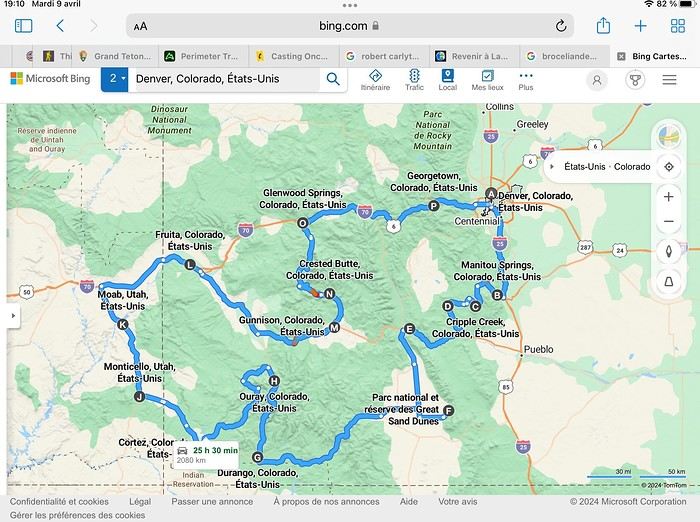
Day 1: Flight Marseille-Paris-Denver, then Manitou Springs (133 km) Day 2: Manitou Springs (49 km) Day 3: Cripple Creek (104 km) Day 4: Salida (254 km) Day 5: Great Sand Dunes (231 km) Day 6: Durango (283 km) Day 7: Durango (Durango-Silverton train) Day 8: Ouray (121 km) Day 9: Ouray (Perimeter Trail hike) Day 10: Cortez (213 km) Day 11: Cortez (Mesa Verde National Park, 134 km) Day 12: Monticello (268 km, detour to Chesler Park) Day 13: Moab (171 km, Delicate Arch) Day 14: Moab (98 km, Fisher Towers) Day 15: Moab (171 km, Canyonlands) Day 16: Fruita (210 km, Colorado National Monument) Day 17: Crested Butte (224 km via Kebler Pass) Day 18: Crested Butte (57 km) Day 19: Glenwood Springs (150 km) Day 20: Glenwood Springs (118 km, Rifle State Park) Day 21: Georgetown (258 km via Independence Pass) Day 22: Denver (123 km), then return flight
We speak very little English. We spent 21 nights there and covered a 3,400 km loop by car and 160 km on foot (we’re still trying to hike while we’re in shape) from Denver in September 2024. We wanted this road trip to help us explore Colorado a bit more—we’d only spent 6 nights there in 2019—and to see it during the fall foliage season. We also wanted to return to Utah (we love Moab) to enjoy its red rocks, which we adore.
In the prices you see (some in euros, others in dollars), I’ve included bank fees and exchange charges. The flights, car, and parking were paid by credit card when we booked in February. Usually, we book around November, but some obligations kept us from doing it earlier. We downloaded the MPC (Mobile Passport Control) app on our phone, which saved us time at immigration.
📊 **Budget: just under 8,500 € for both of us, all included**
📊 **Flights** Marseille-Paris (CDG)-Denver: 2,152 € for both of us, with one checked bag each
📊 **ESTA and America the Beautiful Pass** The ones from our 2023 road trip were still valid
📊 **Parking at Marseille airport: 122 €**
📊 **Car: Nissan Rogue (the French X-Trail) from Hertz: 1,165 €** By booking through Air France (and earning miles), we got a 15% discount. Hertz offers a free Hertz Gold Plus Rewards program, which gives us priority counter service.
📊 **Accommodation: 3,050 €** We stayed in motels and hotels of various ranges (from 100 € to 270 € per night, depending on the city), all booked through Hotels.com or Booking. Booking sometimes offers cheaper rates if you book via the "Booking mobile" app. We also got some preferential rates thanks to our Genius 2 status. Out of 21 nights, only one place didn’t include breakfast.
📊 **Other expenses (activities booked by credit card before leaving)** Durango-Silverton train: 210 € (we booked the enclosed vintage coach in March) Mesa Verde: Balcony House: 15.15 € (booked 14 days before the visit) Timed-entry passes for Arches National Park: 6 € for 3 days (booked June 1 for September entries via http://récreation.gov/). We booked three different days to play with the weather.
📊 **Supplementary insurance with AVA: 204 €** (due to our age 😅 and the high cost of medical consultations in the USA)
📊 **Cash: 1,540 €** We left with 1,000 € exchanged before departure and made two withdrawals (500 $ and 200 $). This cash was used to pay for: - Evening restaurants and tips (between 70 $ and 95 $ for two meals and two drinks) - Two state parks: Dead Horse State Park (20 $) and Rifle State Park (10 $) - The Monarch Pass gondola (24 $) - Midday picnics - Gas (slightly cheaper with cash): 204 $ for 3,400 km - Personal souvenirs and little treats.
Like in our previous road trips, we didn’t rent a GPS. We used the offline GPS app Here We Go, for which we’d downloaded maps of Colorado and Utah from France, as well as a new offline app called Organic Maps as a backup—though we didn’t end up needing it.
❤️❤️❤️ **Highlights (there are so many!)** 📍 The stunning landscapes of Colorado, especially with the fall colors 📍 A step back in time at the old farm in Florissant Fossil Beds National Monument 📍 The prairies of Cripple Creek and the mining remnants of the Vindicator Trail 📍 The cheeky chipmunks in the ghost town of St. Elmo 📍 Great Sand Dunes and its soft sand 📍 The steam train between Durango and Silverton: we’re glad we chose the round-trip because it rained heavily on the way there, but we got to enjoy the scenery on the way back when the sun came out 📍 The unexpected meet-up with Michèle from the group outside a restaurant in Durango 📍 The hot springs in Ouray 📍 Mesa Verde and its still-vibrant past 📍 The red rocks of Moab and Delicate Arch at sunset 📍 The lace-like Fisher Towers and the view from the end of the trail 📍 The gorgeous Route 128 leading to Colorado National Monument—small, easy to visit, and so beautiful 📍 The colors of the fabulous Kebler Pass, Crested Butte, and especially the hike through the golden aspens (Lower and Upper Loop) 📍 The waterfalls at Rifle State Park 📍 The tundra of Independence Pass 📍 The Halloween decorations in Georgetown and Idaho Springs
😞😞 **Flops (there are very few!)** 📍 The viewpoints we missed because they weren’t well-marked or we didn’t see the signs 📍 The closure of some hiking trails (Hanging Lake and parts of Canyonlands) and the Sal Mountain Loop road, which kept us from accessing it 📍😢 The Chesler Park hike we had to cut short due to poor time management—180 km between our stop in Cortez meant we didn’t arrive until 10:30 AM, way too late for a 17 km hike.
Hope this helps! Have a great evening, everyone, and see you soon! 😊
The itinerary
Day 1: Flight Marseille-Paris-Denver, then Manitou Springs (133 km) Day 2: Manitou Springs (49 km) Day 3: Cripple Creek (104 km) Day 4: Salida (254 km) Day 5: Great Sand Dunes (231 km) Day 6: Durango (283 km) Day 7: Durango (Durango-Silverton train) Day 8: Ouray (121 km) Day 9: Ouray (Perimeter Trail hike) Day 10: Cortez (213 km) Day 11: Cortez (Mesa Verde National Park, 134 km) Day 12: Monticello (268 km, detour to Chesler Park) Day 13: Moab (171 km, Delicate Arch) Day 14: Moab (98 km, Fisher Towers) Day 15: Moab (171 km, Canyonlands) Day 16: Fruita (210 km, Colorado National Monument) Day 17: Crested Butte (224 km via Kebler Pass) Day 18: Crested Butte (57 km) Day 19: Glenwood Springs (150 km) Day 20: Glenwood Springs (118 km, Rifle State Park) Day 21: Georgetown (258 km via Independence Pass) Day 22: Denver (123 km), then return flight
We speak very little English. We spent 21 nights there and covered a 3,400 km loop by car and 160 km on foot (we’re still trying to hike while we’re in shape) from Denver in September 2024. We wanted this road trip to help us explore Colorado a bit more—we’d only spent 6 nights there in 2019—and to see it during the fall foliage season. We also wanted to return to Utah (we love Moab) to enjoy its red rocks, which we adore.
In the prices you see (some in euros, others in dollars), I’ve included bank fees and exchange charges. The flights, car, and parking were paid by credit card when we booked in February. Usually, we book around November, but some obligations kept us from doing it earlier. We downloaded the MPC (Mobile Passport Control) app on our phone, which saved us time at immigration.
📊 **Budget: just under 8,500 € for both of us, all included**
📊 **Flights** Marseille-Paris (CDG)-Denver: 2,152 € for both of us, with one checked bag each
📊 **ESTA and America the Beautiful Pass** The ones from our 2023 road trip were still valid
📊 **Parking at Marseille airport: 122 €**
📊 **Car: Nissan Rogue (the French X-Trail) from Hertz: 1,165 €** By booking through Air France (and earning miles), we got a 15% discount. Hertz offers a free Hertz Gold Plus Rewards program, which gives us priority counter service.
📊 **Accommodation: 3,050 €** We stayed in motels and hotels of various ranges (from 100 € to 270 € per night, depending on the city), all booked through Hotels.com or Booking. Booking sometimes offers cheaper rates if you book via the "Booking mobile" app. We also got some preferential rates thanks to our Genius 2 status. Out of 21 nights, only one place didn’t include breakfast.
📊 **Other expenses (activities booked by credit card before leaving)** Durango-Silverton train: 210 € (we booked the enclosed vintage coach in March) Mesa Verde: Balcony House: 15.15 € (booked 14 days before the visit) Timed-entry passes for Arches National Park: 6 € for 3 days (booked June 1 for September entries via http://récreation.gov/). We booked three different days to play with the weather.
📊 **Supplementary insurance with AVA: 204 €** (due to our age 😅 and the high cost of medical consultations in the USA)
📊 **Cash: 1,540 €** We left with 1,000 € exchanged before departure and made two withdrawals (500 $ and 200 $). This cash was used to pay for: - Evening restaurants and tips (between 70 $ and 95 $ for two meals and two drinks) - Two state parks: Dead Horse State Park (20 $) and Rifle State Park (10 $) - The Monarch Pass gondola (24 $) - Midday picnics - Gas (slightly cheaper with cash): 204 $ for 3,400 km - Personal souvenirs and little treats.
Like in our previous road trips, we didn’t rent a GPS. We used the offline GPS app Here We Go, for which we’d downloaded maps of Colorado and Utah from France, as well as a new offline app called Organic Maps as a backup—though we didn’t end up needing it.
❤️❤️❤️ **Highlights (there are so many!)** 📍 The stunning landscapes of Colorado, especially with the fall colors 📍 A step back in time at the old farm in Florissant Fossil Beds National Monument 📍 The prairies of Cripple Creek and the mining remnants of the Vindicator Trail 📍 The cheeky chipmunks in the ghost town of St. Elmo 📍 Great Sand Dunes and its soft sand 📍 The steam train between Durango and Silverton: we’re glad we chose the round-trip because it rained heavily on the way there, but we got to enjoy the scenery on the way back when the sun came out 📍 The unexpected meet-up with Michèle from the group outside a restaurant in Durango 📍 The hot springs in Ouray 📍 Mesa Verde and its still-vibrant past 📍 The red rocks of Moab and Delicate Arch at sunset 📍 The lace-like Fisher Towers and the view from the end of the trail 📍 The gorgeous Route 128 leading to Colorado National Monument—small, easy to visit, and so beautiful 📍 The colors of the fabulous Kebler Pass, Crested Butte, and especially the hike through the golden aspens (Lower and Upper Loop) 📍 The waterfalls at Rifle State Park 📍 The tundra of Independence Pass 📍 The Halloween decorations in Georgetown and Idaho Springs
😞😞 **Flops (there are very few!)** 📍 The viewpoints we missed because they weren’t well-marked or we didn’t see the signs 📍 The closure of some hiking trails (Hanging Lake and parts of Canyonlands) and the Sal Mountain Loop road, which kept us from accessing it 📍😢 The Chesler Park hike we had to cut short due to poor time management—180 km between our stop in Cortez meant we didn’t arrive until 10:30 AM, way too late for a 17 km hike.
Hope this helps! Have a great evening, everyone, and see you soon! 😊
Komodo version "croisière tout confort" et "plongée camping" English translation pending
Allez je me lance : après le carnet philippin , voici le carnet indonésien retraçant une semaine passée au sein du parc de Komodo .
J’espère qu’il pourra aider les futurs voyageurs et les aidera à patienter jusque là .
Pour les nouveaux venus, nous voyageons en famille avec nos enfants qui avaient 15 ans au moment du voyage , qui s’est déroulé pendant les vacances de la Toussaint 2017 (une semaine à Komodo et une semaine à Bali essentiellement dans la région d’Ubud pendant la fête de Galungan )
Ce voyage fut le premier pour nous en Asie (et vous avez pu constater qu’il ne fut pas le dernier). Il a été fait en autonomie sans passer par une agence mais tout a été programmé et booké en avance.
Aller à Komodo pour un premier séjour asiatique n’est pas forcément très commun mais je rêvais de rencontrer et si possible de nager/plonger avec des raies manta. Plus voir les fameux dragons, ça ne se refuse pas c'est unique ...
Cela fut un bon prétexte pour ma fille et moi , après un baptême réalisé au Mexique en 2013, de passer notre Openwater à Marseille en juillet 2017 en prévision . Les hommes ne nous ont pas suivies (hélas pour notre porte monnaie , vu qu'au final ils ont décidé de plonger à Komodo et sans certification cela revient le double/plongée ... )
Pourquoi une semaine à Komodo ? Pour prendre le temps d’apprécier à sa juste valeur ce parc réputé pour être une destination phare pour les amoureux de plongée et snorkeling et bien en profiter.
Après une nuit proche de Labuan Bajo ( qui se trouve sur l’ile de Florès et qui est le port de départ pour le parc de Komodo) , nous avons fait une croisière de 4 jours/3 nuits puis deux jours de plongée en dormant sur l’ile de Sebayur directement au sein du parc national.
A bientôt pour la suite !

J’espère qu’il pourra aider les futurs voyageurs et les aidera à patienter jusque là .
Pour les nouveaux venus, nous voyageons en famille avec nos enfants qui avaient 15 ans au moment du voyage , qui s’est déroulé pendant les vacances de la Toussaint 2017 (une semaine à Komodo et une semaine à Bali essentiellement dans la région d’Ubud pendant la fête de Galungan )
Ce voyage fut le premier pour nous en Asie (et vous avez pu constater qu’il ne fut pas le dernier). Il a été fait en autonomie sans passer par une agence mais tout a été programmé et booké en avance.
Aller à Komodo pour un premier séjour asiatique n’est pas forcément très commun mais je rêvais de rencontrer et si possible de nager/plonger avec des raies manta. Plus voir les fameux dragons, ça ne se refuse pas c'est unique ...
Cela fut un bon prétexte pour ma fille et moi , après un baptême réalisé au Mexique en 2013, de passer notre Openwater à Marseille en juillet 2017 en prévision . Les hommes ne nous ont pas suivies (hélas pour notre porte monnaie , vu qu'au final ils ont décidé de plonger à Komodo et sans certification cela revient le double/plongée ... )
Pourquoi une semaine à Komodo ? Pour prendre le temps d’apprécier à sa juste valeur ce parc réputé pour être une destination phare pour les amoureux de plongée et snorkeling et bien en profiter.
Après une nuit proche de Labuan Bajo ( qui se trouve sur l’ile de Florès et qui est le port de départ pour le parc de Komodo) , nous avons fait une croisière de 4 jours/3 nuits puis deux jours de plongée en dormant sur l’ile de Sebayur directement au sein du parc national.
A bientôt pour la suite !
Voyage 3 semaines en Scandinavie en juillet (Copenhague, Oslo, Bergen...) English translation pending
Bonjour,
Je prépare un voyage en Scandinavie de 3 semaines en couple. un mélange urbain et nature.
Nous arriverons à Copenhague pour 4 jours environ ensuite je pense prendre le ferry pour Oslo. Ensuite, j'hésite Bergen en train ou bien avion pour les iles Lofoten. Bodo, ferry jusqu'à Mokenes. Nous pensons passer 4 jours complets. Ensuite avion pour Stockhom pour 4 ou 5 jours.
J'ai au moins 4 jours à remplir à partir de Oslo.
Est-ce que je vais à Bergen ? combien de jours à Oslo? je pensais un jour complet était suffisant.
il y a aussi le fjord de Geiranger qui semble incontournable. mais comment le placer dans cet itinéraire ?
Nous venons du Québec et ce sera notre seul voyage en Scandinavie. J'aimerais bien votre avis.
merci
Itinéraire de deux semaines avec bébé au Costa Rica English translation pending
Bonjour,
Nous avons pour projet de partir au Costa Rica du 8 au 22 Mai avec notre fille qui aura 2 ans. Déjà est ce que vous validez l'âge pour cette destination ? Quel itinéraire pour ces 15 jours ? Les incontournables à ne pas manquer ? Meteo favorable ? Je suis preneuse d'adresses de logements et restos par région ciblée. Nous louerons un 4x4. Alimentation pour bebe ? Hygiène ? Sécurité ? Merci pour tous vos conseils !
Nous avons pour projet de partir au Costa Rica du 8 au 22 Mai avec notre fille qui aura 2 ans. Déjà est ce que vous validez l'âge pour cette destination ? Quel itinéraire pour ces 15 jours ? Les incontournables à ne pas manquer ? Meteo favorable ? Je suis preneuse d'adresses de logements et restos par région ciblée. Nous louerons un 4x4. Alimentation pour bebe ? Hygiène ? Sécurité ? Merci pour tous vos conseils !
Circuit en boucle Denver via Yellowstone English translation pending
Bonjour les voyageurs,
Nous avons nos billets pour Denver pour août 2020. La priorité est de faire cette année Yellowstone. Nous démarrerons donc notre circuit en allant vers Yellowstone. J'ai bien des idées pour la suite du circuit mais j'ai un peu de mal à tout faire rentrer les cases et quelques manques sur les nuits étapes. Je vous donne mon itinéraire en espérant avoir quelques bons tuyaux . Pour info, on voyage en famille avec deux petits gars qui auront 11 et 7 ans lors du voyage. J 1 Paris- Denver J2 Denver - Rocky Mountain et nuit à Cheyenne J3 Cheyenne- Casper et nuit à Casper J4 Casper- Cody en passant par Thermopolis nuit à Cody ? J5 Cody- Gardiner nuit à Gardiner J6 Gardiner- West Yellowstone nuit à West Yellowstone J7 West Yellowstone - Grand Teton nuit à Jackson ou alentours? J8 Jackson- Rock spring et nuit à Rock spring J9 Rock Spring - Grand junction nuit à Fruita j10 Grand Junction- Durango nuit à Durango J11 Durango - Mesa verde nuit à Alamosa ou Pagosa springs J12 ? route vers Great sand Dune 1 ou 2nuits à Colorado Spring J13 ou J14 J14 J15: Colorado Spring -Denver nuit à Denver
Je voudrais bien caser deux nuits ici ou là pour se poser un peu , notamment en fin de séjour. Les hôtels de J1 à J6 sont déjà réservés. Merci d'avance pour vos conseils. Laetitia
Nous avons nos billets pour Denver pour août 2020. La priorité est de faire cette année Yellowstone. Nous démarrerons donc notre circuit en allant vers Yellowstone. J'ai bien des idées pour la suite du circuit mais j'ai un peu de mal à tout faire rentrer les cases et quelques manques sur les nuits étapes. Je vous donne mon itinéraire en espérant avoir quelques bons tuyaux . Pour info, on voyage en famille avec deux petits gars qui auront 11 et 7 ans lors du voyage. J 1 Paris- Denver J2 Denver - Rocky Mountain et nuit à Cheyenne J3 Cheyenne- Casper et nuit à Casper J4 Casper- Cody en passant par Thermopolis nuit à Cody ? J5 Cody- Gardiner nuit à Gardiner J6 Gardiner- West Yellowstone nuit à West Yellowstone J7 West Yellowstone - Grand Teton nuit à Jackson ou alentours? J8 Jackson- Rock spring et nuit à Rock spring J9 Rock Spring - Grand junction nuit à Fruita j10 Grand Junction- Durango nuit à Durango J11 Durango - Mesa verde nuit à Alamosa ou Pagosa springs J12 ? route vers Great sand Dune 1 ou 2nuits à Colorado Spring J13 ou J14 J14 J15: Colorado Spring -Denver nuit à Denver
Je voudrais bien caser deux nuits ici ou là pour se poser un peu , notamment en fin de séjour. Les hôtels de J1 à J6 sont déjà réservés. Merci d'avance pour vos conseils. Laetitia
Dangers de conduite au Japon? English translation pending
Bonjour à tous,
J'ai besoin de retours d'expérience sur la conduite au Japon et plus particulièrement sur les îles de shikoku, Kyushu et miyakojim et yakushima. Je serai là-bas en octobre prochain et ai prévu des locations de voiture. Néanmoins j'ai certaines interrogations et appréhensions après avoir lu certains blogs ou guide. Je n'ai jamais conduite à gauche et avec une voiture automatique mais bon ça, je pense que ça ne devrait pas poser de problème. Ce qui me fait douter c'est que j'ai le vertige et les routes de montagnes comme à shikoku ne le rassurent pas. Les routes sont elles étroites au Japon ? Il y a t'il bezucoup de circulation en octobre ? Voit on bezucoup les ravins? Y'a t'il bezucoup de route très pentues en montée ou en descente ?
Commencent par miyakojima, j'espère me familiariser avec la conduite à gauche.
Merci d'avance pour vos réponses.
J'ai besoin de retours d'expérience sur la conduite au Japon et plus particulièrement sur les îles de shikoku, Kyushu et miyakojim et yakushima. Je serai là-bas en octobre prochain et ai prévu des locations de voiture. Néanmoins j'ai certaines interrogations et appréhensions après avoir lu certains blogs ou guide. Je n'ai jamais conduite à gauche et avec une voiture automatique mais bon ça, je pense que ça ne devrait pas poser de problème. Ce qui me fait douter c'est que j'ai le vertige et les routes de montagnes comme à shikoku ne le rassurent pas. Les routes sont elles étroites au Japon ? Il y a t'il bezucoup de circulation en octobre ? Voit on bezucoup les ravins? Y'a t'il bezucoup de route très pentues en montée ou en descente ?
Commencent par miyakojima, j'espère me familiariser avec la conduite à gauche.
Merci d'avance pour vos réponses.
Croisière États-Unis - Canada English translation pending
Bonjour
nous sommes 4 personnes et nous faisons comme vous tous cette fameux croisière Etats Unis et canada ...les escales ne sont pas très longues et je me demande si on trouvera des taxis ou des tours opérateurs au pieds du bateau comme dans les autres croisières
Mon mari et moi , nous rentrons du premier tour du monde de Msc et dans 8/10 ports il y avait des propositions très interessantes
voila ma question
je suis preneuse de toutes idées et je vous ferai par des miennes
A tres bientôt pour ces préparations de cette croisière
Découverte de la Thaïlande du Sud en famille, de Bangkok à Koh Tao English translation pending
Bonjour à tous chers forumeurs
je me décide à écrire ce post après vous avoir beaucoup lu mais comme toujours, on cherche LA réponse à sa petite question particulière, je me lance donc!
Nous partons en famille (2 filles 9 et 13 ans) du 5 au 21 aout 2019 pour découvrir la thailande, plutôt sud en cette saison de mousson.
Notre profil de voyageurs: plutôt axé nature et découverte, loin des grands hôtels et du bling bling, mais pas franchement roots pour autant, le simple nous définira bien.
La vie sous -marine nous époustoufle (plongée pour le père et masque/tuba pour les autres) , mais la nature bien verte aussi ( ça c'est pour la mère, yogi à ses heures...).
Notre parcours est déjà plus ou moins établi, avec qqs petites interrogations en route, et certains doutes qui arrivent en lisant vos posts.
voilà notre projet:
arrivée Bangkok, découverte de la ville, canaux, puis une journée sur Ayutthaya, ça c bon.
train de nuit jusqu'à surat thani pour aller découvrir Kaoh sok, 2 nuits et lac de chiew larn. déjà première interrogation sur les agences avec qui partir: j'ai découverte le site de Mathilde, http://www.khaosok.asia/, mais j'avoue que je m'interroge sur les tarifs, environ 32 000 BHT pour 4 pour 2 jours 1 nuit alors que les sites des hôtels vendent les prestations autour de 15000 BHT. Je sais que pour ce tarif c'est du sur mesure, la question est juste: les toursstandards sont-ils si bondés et surfaits que ça ou cela vaut qd même le coup? (je ne parle pas du logement, je vais le réserver par moi même).
ensuite ça se corse: nous voulons aller sur Koh tao et au passage, faire un stop à koh samui pour faire une excursion dans le parc maritime d'Ang tong. a nouveau, je lis que les bateaux sont blindés, limite à ne pas valoir le coup, quel compromis peut-on trouver avec une agence plus petite pour que ça soit qd même une belle journée? nous avions envisager d'aller sur koh phaluai, et excursion privée avec un pêcheur, mais du coup, 1 jour pour y aller, 1 jour pour en partir, nous n'avons pas prévu assez de temps à priori, sauf à rogner sur la suite.
ensuite, plan initial, Koh tao, en visant les hôtels cote est (genre tanote bay ou chalok bay) pour être plus tranquille et profiter de qqs plongées pour monsieur et snorkelling pour mesdames. L'attrait eau cristalline et poissons est très fort. Gros hic qd je lis vos posts: plus blindée que Phuket à la haute saison dit philippe (http://www.phil-a-phuket.com/, en passant merci pour ce fabuleux blog bien renseigné!) j'ai peur! " Murder island" dis un autre, au secours! du coup, la question est: est ce un si mauvais choix cette ile, le risque est réel? Je ne doute pas de la beauté des fonds, mais est ce que je vais pouvoir en profiter en masque tuba sans voir plus de palmes que de poissons? nos filles sont vraiment motivées par les photos (et nous aussi!) mais on nous montre bien ce qu'on veut... des retours d'expérience de plongeurs (et non plongeurs) contents de leur séjour et ou?
J'ai bien vu à nouveau sur le post de philippe que Chumphon serait une option (http://www.phil-a-phuket.com/chumphon.html), pour le bateau et tour des iles, mais pas forcement pour les poissons.
voilà, ensuite retour bateau jusqu'à Chumphon, train de nuit pour Bangkok, 1 jour pour flâner et retour maison.
Merci à tous de vos commentaires avisés, et propositions autres, vos retours d'experience. Seule la première nuit à kaho sok est bookée , on peut donc ajuster notre programme, sachant que la jungle, la mer et les poissons doivent y trouver leur place! belle journée Audrey
arrivée Bangkok, découverte de la ville, canaux, puis une journée sur Ayutthaya, ça c bon.
train de nuit jusqu'à surat thani pour aller découvrir Kaoh sok, 2 nuits et lac de chiew larn. déjà première interrogation sur les agences avec qui partir: j'ai découverte le site de Mathilde, http://www.khaosok.asia/, mais j'avoue que je m'interroge sur les tarifs, environ 32 000 BHT pour 4 pour 2 jours 1 nuit alors que les sites des hôtels vendent les prestations autour de 15000 BHT. Je sais que pour ce tarif c'est du sur mesure, la question est juste: les toursstandards sont-ils si bondés et surfaits que ça ou cela vaut qd même le coup? (je ne parle pas du logement, je vais le réserver par moi même).
ensuite ça se corse: nous voulons aller sur Koh tao et au passage, faire un stop à koh samui pour faire une excursion dans le parc maritime d'Ang tong. a nouveau, je lis que les bateaux sont blindés, limite à ne pas valoir le coup, quel compromis peut-on trouver avec une agence plus petite pour que ça soit qd même une belle journée? nous avions envisager d'aller sur koh phaluai, et excursion privée avec un pêcheur, mais du coup, 1 jour pour y aller, 1 jour pour en partir, nous n'avons pas prévu assez de temps à priori, sauf à rogner sur la suite.
ensuite, plan initial, Koh tao, en visant les hôtels cote est (genre tanote bay ou chalok bay) pour être plus tranquille et profiter de qqs plongées pour monsieur et snorkelling pour mesdames. L'attrait eau cristalline et poissons est très fort. Gros hic qd je lis vos posts: plus blindée que Phuket à la haute saison dit philippe (http://www.phil-a-phuket.com/, en passant merci pour ce fabuleux blog bien renseigné!) j'ai peur! " Murder island" dis un autre, au secours! du coup, la question est: est ce un si mauvais choix cette ile, le risque est réel? Je ne doute pas de la beauté des fonds, mais est ce que je vais pouvoir en profiter en masque tuba sans voir plus de palmes que de poissons? nos filles sont vraiment motivées par les photos (et nous aussi!) mais on nous montre bien ce qu'on veut... des retours d'expérience de plongeurs (et non plongeurs) contents de leur séjour et ou?
J'ai bien vu à nouveau sur le post de philippe que Chumphon serait une option (http://www.phil-a-phuket.com/chumphon.html), pour le bateau et tour des iles, mais pas forcement pour les poissons.
voilà, ensuite retour bateau jusqu'à Chumphon, train de nuit pour Bangkok, 1 jour pour flâner et retour maison.
Merci à tous de vos commentaires avisés, et propositions autres, vos retours d'experience. Seule la première nuit à kaho sok est bookée , on peut donc ajuster notre programme, sachant que la jungle, la mer et les poissons doivent y trouver leur place! belle journée Audrey
Comment intégrer le Yellowstone dans une boucle? English translation pending
Bonjour à tous,
Je suis à la recherche de conseils et astuces pour mon deuxième voyage aux USA qui aura lieu en mai ou juin 2020. Le premier regroupait de grands classiques (Monument Valley, Grand Canyon, Page, Arches, Las Vegas, ...) Pour ce nouveau voyage, je souhaiterais refaire certains sites/villes (Grand Canyon, Antelope Canyon, Page, Las Vegas) et ajouter de nouveaux comme Zion NP, Havasupaï et surtout Yellowstone. Mes questions vont tournées autour de ce dernier. Il est difficile de le caser. J'ai fait de nombreuses simulations avec des vols internes, où atterrir depuis la France, est-ce qu'il serait mieux de faire le trajet en voiture depuis Las Vegas, ... Je souhaiterais donc savoir si vous avez des conseils à me donner svp pour "combler" le trajet que je compte faire entre Las Vegas ou Zion et Yellowstone à l'aller et au retour. Pour info, voici mon programme prévisionnel approximatif (sans tenir compte du nombre de nuits passées sur place): - Las Vegas - Havasupaï - Grand Canyon - Page - Zion - Yellowstone - Las Vegas Merci par avance pour vos remarques.
Nikedu44
Je suis à la recherche de conseils et astuces pour mon deuxième voyage aux USA qui aura lieu en mai ou juin 2020. Le premier regroupait de grands classiques (Monument Valley, Grand Canyon, Page, Arches, Las Vegas, ...) Pour ce nouveau voyage, je souhaiterais refaire certains sites/villes (Grand Canyon, Antelope Canyon, Page, Las Vegas) et ajouter de nouveaux comme Zion NP, Havasupaï et surtout Yellowstone. Mes questions vont tournées autour de ce dernier. Il est difficile de le caser. J'ai fait de nombreuses simulations avec des vols internes, où atterrir depuis la France, est-ce qu'il serait mieux de faire le trajet en voiture depuis Las Vegas, ... Je souhaiterais donc savoir si vous avez des conseils à me donner svp pour "combler" le trajet que je compte faire entre Las Vegas ou Zion et Yellowstone à l'aller et au retour. Pour info, voici mon programme prévisionnel approximatif (sans tenir compte du nombre de nuits passées sur place): - Las Vegas - Havasupaï - Grand Canyon - Page - Zion - Yellowstone - Las Vegas Merci par avance pour vos remarques.
Nikedu44