Results for "Mainz+ou+Mayence+|+9+>+196"
46012 results found.
Quelle pompe à vélo utilisez vous? English translation pending
On parle de pression des pneus dans un sujet recent...mais après recherche, je pense que personne n'ai parlé des pompes à vélo!!
Ca m'interesserai de savoir ce que vous avez comme matos pour mon prochain voyage, ayant cassé la mienne l'hiver dernier, une décat super pratique, mais qui a pas tenue 1 mois 1/2...niveau pression c'était nickel, elle monté a 4 bars sans soucis! Mais vu que c'est tout en plastique, comme la majorité des pompes, ça casse au bout d'un moment...
Qui a le produit miracle? J'ai roulé avec un français qui avant une pompe super costaud, mais je sais plus la marque, on pouvait remplacé chaque pièce de la pompe! Je cherche avant tout du bon matos, quitte a mettre le prix, mais je cherche aussi un truc pratqiue, petit quoi!!
Merci pour vos réponses!
Vince
Ca m'interesserai de savoir ce que vous avez comme matos pour mon prochain voyage, ayant cassé la mienne l'hiver dernier, une décat super pratique, mais qui a pas tenue 1 mois 1/2...niveau pression c'était nickel, elle monté a 4 bars sans soucis! Mais vu que c'est tout en plastique, comme la majorité des pompes, ça casse au bout d'un moment...
Qui a le produit miracle? J'ai roulé avec un français qui avant une pompe super costaud, mais je sais plus la marque, on pouvait remplacé chaque pièce de la pompe! Je cherche avant tout du bon matos, quitte a mettre le prix, mais je cherche aussi un truc pratqiue, petit quoi!!
Merci pour vos réponses!
Vince
Quatre Français arrêtés en République Dominicaine pour possession English translation pending
Ne faites pas comme les 4 Français qui vont avoir des vacances prolongées en République Dominicaine mais pas dans un hotel 4 étoiles si vous voyez ce que je veux dire. Ils se sont fait arrêtés ce week-end aux aéroports de la Romana et de Puerto Plata et ce n´est pas les premiers depuis un an.
Plus de 61 kg de drogues saisis dans leur valise répartis en 57 paquets soit 14 chacun.
2 jeunes Françaises de 20 ans, 1 Franco-Dominicaine et 1 Français.
Les chiens renifleurs dans les aéroports cela existe ici aussi.
Un retour difficile de Thaïlande English translation pending
Bonjour à tous,
Je reviens tout juste de thailande et comme beaucoup (voir tous !) j'ai le gros blues.... Je profite néanmoins de ce p'tit post pour vous rassurer tous et toutes : c toujours aussi bien ! Pour votre info j'étais à BKK pendant les festivités et j'ai été très impressionné par l'engouement des thais pour leur roi, j'ai découvert une ville toute jaune (sans jeu de mot) !
Si vous souhaitez des infos plus précise sur le temp, les endroits sympas pour sortir à BKK faite moi signe....
Je reviens tout juste de thailande et comme beaucoup (voir tous !) j'ai le gros blues.... Je profite néanmoins de ce p'tit post pour vous rassurer tous et toutes : c toujours aussi bien ! Pour votre info j'étais à BKK pendant les festivités et j'ai été très impressionné par l'engouement des thais pour leur roi, j'ai découvert une ville toute jaune (sans jeu de mot) !
Si vous souhaitez des infos plus précise sur le temp, les endroits sympas pour sortir à BKK faite moi signe....
Pique-nique à Paris - Champ de Mars - le dimanche 2 juillet 2006 English translation pending
Salut à tous,
Les beaux jours sont revenus sur la capitale et les pelouses des parcs et jardins parisiens n'attendent que nous pour une nouvelle rencontre placée sous le signe.....du voyage of course !😉
Instructions pour la journée ( mises à jour régulièrement dans ce post )
Pique-nique Paris le Dimanche 2 Juillet 12H30 au Champs de Mars. Métro Ecole Militaire, Dupleix, La Motte-Picquet, bus 80
Si vous êtes intéressés, inscrivez-vous sur ce post. Inutile de demander la permission, cette rencontre est ouverte à tous, pourvu que chacun apporte avec lui une dose de bonne humeur.
Le lieu exact du RDV sera précisé le Mercredi 28 Juin sur le post.
Thème : la pétanque par équipes de pays et que les meilleurs gagnent.😛
Les règles du jeu seront énoncées sur place. Les équipes seront constituées sur place également en fonction de .....bref....🙂
Que tou(te)s les boulistes se fassent connaître ici, notamment celles et ceux qui possèdent des jeux de pétanque ( les jeux en plastique sont formellement interdits ), qu'on ne se retrouve pas le bec dans l'eau le jour venu. Prévoir un mètre pour les tricheurs et un cochonnet fluo au cas où la partie s'éterniserait tard dans la nuit 😄( ça s'est déjà vu !😎 )
Je précise que rien n'est imposé, pour ceux qui n'oseraient pas affronter les filles à la pétanque, une sieste est toujours possible à l'ombre d'un arbuste en fleurs !
Pique-nique : chacun apporte une contribution, en fonction de ses moyens et de sa spécialité culinaire.
Cuisiniers du Dimanche, à vos fourneaux ! Les piètres cuisiniers pourront toujours pousser les portes de Mo..prix pour dévaliser le rayon boissons !
Afin que tout le monde n'amène pas les mêmes choses, on va lister qui amène quoi. C'est un peu scolaire j'en conviens mais super efficace au final !
Check list ( à compléter également sur le post ) Amuse-gueules : Salades : Charcuterie : Fromage éventuellement : Pain : Desserts : Boissons : Assiettes en plastique : Couverts en plastique : Verres en plastique : Sopalin : Nappes, plaids :
Je complèterai les infos manquantes sur ce fil de discussion au fur et à mesure.
Je remercie d'ores et déjà toutes celles et ceux qui vont faire vivre ce post jusqu'au 2 Juillet.
A très bientôt, venez nombreux !😉
Ailleurs😎
PS : si vous savez pas quoi faire les 24 et 25 Juin, une équipe parisienne de 20 personnes ( ABM + VF ) participe au rallye des marais. Venez encourager notre équipe pirate, nous vous serons reconnaissants !😏
Sinon, recherchons désespérément le capitaine Crochet 😐
PSS : une pensée énorme pour Simon, sur la route de la Transalpine, tu nous manques
Les beaux jours sont revenus sur la capitale et les pelouses des parcs et jardins parisiens n'attendent que nous pour une nouvelle rencontre placée sous le signe.....du voyage of course !😉
Instructions pour la journée ( mises à jour régulièrement dans ce post )
Pique-nique Paris le Dimanche 2 Juillet 12H30 au Champs de Mars. Métro Ecole Militaire, Dupleix, La Motte-Picquet, bus 80
Si vous êtes intéressés, inscrivez-vous sur ce post. Inutile de demander la permission, cette rencontre est ouverte à tous, pourvu que chacun apporte avec lui une dose de bonne humeur.
Le lieu exact du RDV sera précisé le Mercredi 28 Juin sur le post.
Thème : la pétanque par équipes de pays et que les meilleurs gagnent.😛
Les règles du jeu seront énoncées sur place. Les équipes seront constituées sur place également en fonction de .....bref....🙂
Que tou(te)s les boulistes se fassent connaître ici, notamment celles et ceux qui possèdent des jeux de pétanque ( les jeux en plastique sont formellement interdits ), qu'on ne se retrouve pas le bec dans l'eau le jour venu. Prévoir un mètre pour les tricheurs et un cochonnet fluo au cas où la partie s'éterniserait tard dans la nuit 😄( ça s'est déjà vu !😎 )
Je précise que rien n'est imposé, pour ceux qui n'oseraient pas affronter les filles à la pétanque, une sieste est toujours possible à l'ombre d'un arbuste en fleurs !
Pique-nique : chacun apporte une contribution, en fonction de ses moyens et de sa spécialité culinaire.
Cuisiniers du Dimanche, à vos fourneaux ! Les piètres cuisiniers pourront toujours pousser les portes de Mo..prix pour dévaliser le rayon boissons !
Afin que tout le monde n'amène pas les mêmes choses, on va lister qui amène quoi. C'est un peu scolaire j'en conviens mais super efficace au final !
Check list ( à compléter également sur le post ) Amuse-gueules : Salades : Charcuterie : Fromage éventuellement : Pain : Desserts : Boissons : Assiettes en plastique : Couverts en plastique : Verres en plastique : Sopalin : Nappes, plaids :
Je complèterai les infos manquantes sur ce fil de discussion au fur et à mesure.
Je remercie d'ores et déjà toutes celles et ceux qui vont faire vivre ce post jusqu'au 2 Juillet.
A très bientôt, venez nombreux !😉
Ailleurs😎
PS : si vous savez pas quoi faire les 24 et 25 Juin, une équipe parisienne de 20 personnes ( ABM + VF ) participe au rallye des marais. Venez encourager notre équipe pirate, nous vous serons reconnaissants !😏
Sinon, recherchons désespérément le capitaine Crochet 😐
PSS : une pensée énorme pour Simon, sur la route de la Transalpine, tu nous manques
C'est quoi l'Inde pour vous? English translation pending
En voyage en Inde depuis plus de 4 mois, j'en arrive fatalement a essayer (mon esprit fonctionne comme ca !), de synthetiser ce que peu representer cette dimension, ce pays, ce sous continent pour moi. Pas encore le bilan, mais j'y pense. Et c'est dans ce cadre qu'il me semble sympa et peut etre instructif que les voyageurs connaissant bien l'Inde, essayent (c'est probablement deja realise) de faire partager cette "synthese" qu'un jour ils ont pense. Bien sur, on peu se demander s'il faut ou non le faire, car reduire en quelques lignes ce qui represente des emotions, du vecu, etc..., n'est jamais riche en soit. Pas grave, c'est l'exercice qui me semble interessant 😉.
Ici, c'est le pays des 330 millions de dieux, Ici, c'est le pays ou rien n'est fini, Ici, c'est le pays ou rien n'est mort, Ici, c'est le pays de la transformation, Ici, tout renait.
Ici, c'est le pays des 330 millions de dieux, Ici, c'est le pays ou rien n'est fini, Ici, c'est le pays ou rien n'est mort, Ici, c'est le pays de la transformation, Ici, tout renait.
Valle de la Luna en Argentine English translation pending
Hola !
Suis actuellement a Mendoza, je comte remonter sur Salta, sur le chemin, il y a la Vallee de la lune pres de San Juan / Valle Fertile, je me demande si cela vaut la peie dy aller avec un voyage organise, un peu decu de ceux ci vu qu on passe plus de temps a faire des stop and go sans vraiment profiter ... D autant plus qu il parrait qu il vaut bien bien mieux y etre au coucher de jour, logiaue les couleurs doivent etre superbe ... mais pas de camping ...
Pourriez vous me faire pars de vos experiences, et s il est possible de se rendre facilement sur place et d y passer la nuit ...
Merci !! Chris.
Suis actuellement a Mendoza, je comte remonter sur Salta, sur le chemin, il y a la Vallee de la lune pres de San Juan / Valle Fertile, je me demande si cela vaut la peie dy aller avec un voyage organise, un peu decu de ceux ci vu qu on passe plus de temps a faire des stop and go sans vraiment profiter ... D autant plus qu il parrait qu il vaut bien bien mieux y etre au coucher de jour, logiaue les couleurs doivent etre superbe ... mais pas de camping ...
Pourriez vous me faire pars de vos experiences, et s il est possible de se rendre facilement sur place et d y passer la nuit ...
Merci !! Chris.
Rien que pour la beauté du texte English translation pending
Rien que pour la beauté du texte:
Deux hommes, tous les deux gravement malades, occupaient la même chambre d'hôpital.
L'un d'eux devait s'asseoir dans son lit pendant une heure chaque après-midi afin d'évacuer les sécrétions de ses poumons, son lit était à coté de la seule fenêtre de la chambre.
L'autre devait passer ses journées couché sur le dos. Les deux compagnons d'infortune se parlaient pendant des heures. Ils parlaient de leurs épouses et de leurs familles, décrivaient leur maison, leur travail, leur participation dans le service militaire et les endroits ou ils avaient été en vacances.
Et chaque après-midi, quand l'homme dans le lit près de la fenêtre pouvait s'asseoir, il passait le temps à décrire à son compagnon de chambre tout ce qu'il voyait dehors.
L'homme dans l'autre lit commença à vivre pendant ces périodes d'une heure où son monde était élargi et égayé par toutes les activités et les couleurs du monde extérieur.
De la chambre, la vue donnait sur un parc avec un beau lac, les canards et les cygnes jouaient sur l'eau tandis que les enfants faisaient voguer leurs
bateaux en modèles réduits. Les amoureux marchaient bras dessus, bras dessous, parmi des fleurs aux couleurs de l'arc-en-ciel, de grands arbres décoraient le paysage et on pouvait apercevoir au loin la ville se dessiner
Pendant que l'homme près de la fenêtre décrivait tous ces détails, l'homme de l'autre coté de la chambre fermait les yeux et imaginait la scène pittoresque.
Lors d'un bel après-midi, l'homme près de la fenêtre décrivit une parade qui passait par-là. Bien que l'autre homme n'ait pu entendre l'orchestre, il pouvait le voir avec les yeux de son imagination, tellement son compagnon le dépeignait de façon vivante.
Les jours et les semaines passèrent.
Un matin, à l'heure du bain, l'infirmière trouva le corps sans vie de l'homme près de la fenêtre, mort paisiblement dans son sommeil.
Attristée, elle appela les préposés pour qu'ils viennent prendre le corps.
Dès qu'il sentit que le moment était approprié, l'autre homme demanda s'il pouvait être déplacé à coté de la fenêtre.
L'infirmière, heureuse de lui accorder cette petite faveur, s'assura de son confort, puis elle le laissa seul.
Lentement, péniblement, le malade se souleva un peu, en s'appuyant sur un coude pour jeter son premier coup d'oeil dehors.
Enfin, il aurait la joie de voir par lui-même ce que son ami lui avait décrit.
Il s'étira pour se tourner lentement vers la fenêtre près du lit.
Or, tout ce qu'il vit, fut un mur !
L'homme demanda à l'infirmière pourquoi son compagnon de chambre décédé lui avait dépeint une toute autre réalité.
L'infirmière répondit que l'homme était aveugle et ne pouvait même pas voir le mur.
Peut-être a-t-il seulement voulu vous encourager, commenta-t-elle.
Epilogue :
Il y a un bonheur extraordinaire à rendre d'autres heureux, en dépit de nos propres épreuves.
La peine partagée réduit de moitié la douleur, mais le bonheur, une fois partagé, s'en trouve doublé.
Si vous voulez vous sentir riche, vous n'avez qu'à compter, parmi toutes les choses que vous possédez, celles que l'argent ne peut acheter.
Aujourd'hui est un cadeau, c'est pourquoi on l'appelle présent.
Deux hommes, tous les deux gravement malades, occupaient la même chambre d'hôpital.
L'un d'eux devait s'asseoir dans son lit pendant une heure chaque après-midi afin d'évacuer les sécrétions de ses poumons, son lit était à coté de la seule fenêtre de la chambre.
L'autre devait passer ses journées couché sur le dos. Les deux compagnons d'infortune se parlaient pendant des heures. Ils parlaient de leurs épouses et de leurs familles, décrivaient leur maison, leur travail, leur participation dans le service militaire et les endroits ou ils avaient été en vacances.
Et chaque après-midi, quand l'homme dans le lit près de la fenêtre pouvait s'asseoir, il passait le temps à décrire à son compagnon de chambre tout ce qu'il voyait dehors.
L'homme dans l'autre lit commença à vivre pendant ces périodes d'une heure où son monde était élargi et égayé par toutes les activités et les couleurs du monde extérieur.
De la chambre, la vue donnait sur un parc avec un beau lac, les canards et les cygnes jouaient sur l'eau tandis que les enfants faisaient voguer leurs
bateaux en modèles réduits. Les amoureux marchaient bras dessus, bras dessous, parmi des fleurs aux couleurs de l'arc-en-ciel, de grands arbres décoraient le paysage et on pouvait apercevoir au loin la ville se dessiner
Pendant que l'homme près de la fenêtre décrivait tous ces détails, l'homme de l'autre coté de la chambre fermait les yeux et imaginait la scène pittoresque.
Lors d'un bel après-midi, l'homme près de la fenêtre décrivit une parade qui passait par-là. Bien que l'autre homme n'ait pu entendre l'orchestre, il pouvait le voir avec les yeux de son imagination, tellement son compagnon le dépeignait de façon vivante.
Les jours et les semaines passèrent.
Un matin, à l'heure du bain, l'infirmière trouva le corps sans vie de l'homme près de la fenêtre, mort paisiblement dans son sommeil.
Attristée, elle appela les préposés pour qu'ils viennent prendre le corps.
Dès qu'il sentit que le moment était approprié, l'autre homme demanda s'il pouvait être déplacé à coté de la fenêtre.
L'infirmière, heureuse de lui accorder cette petite faveur, s'assura de son confort, puis elle le laissa seul.
Lentement, péniblement, le malade se souleva un peu, en s'appuyant sur un coude pour jeter son premier coup d'oeil dehors.
Enfin, il aurait la joie de voir par lui-même ce que son ami lui avait décrit.
Il s'étira pour se tourner lentement vers la fenêtre près du lit.
Or, tout ce qu'il vit, fut un mur !
L'homme demanda à l'infirmière pourquoi son compagnon de chambre décédé lui avait dépeint une toute autre réalité.
L'infirmière répondit que l'homme était aveugle et ne pouvait même pas voir le mur.
Peut-être a-t-il seulement voulu vous encourager, commenta-t-elle.
Epilogue :
Il y a un bonheur extraordinaire à rendre d'autres heureux, en dépit de nos propres épreuves.
La peine partagée réduit de moitié la douleur, mais le bonheur, une fois partagé, s'en trouve doublé.
Si vous voulez vous sentir riche, vous n'avez qu'à compter, parmi toutes les choses que vous possédez, celles que l'argent ne peut acheter.
Aujourd'hui est un cadeau, c'est pourquoi on l'appelle présent.
Trajet Cayenne (Guyane) - Buenos Aires (Argentine)? English translation pending
Salut à tous et à toutes,
Mon premier message sur ce forum, en espérant pouvoir profiter de votre expérience. Ça a l'air sympa ici.
Donc voici, une petite présentation rapide au niveau voyage, pas énormément voyagé mais un peu, sachant que lorsque je voyage c'est surtout la rencontre avec les personnes, leurs modes de vie, leurs visions des choses, qui m'intéresse le plus. Donc voili, en vrac, quelques pays que où je suis passé, essentiellement en Europe (Roumanie, Pologne, Sardaigne, Belgique et Suisse (oui oui, je les mets aussi, même si ça peut paraitre con, mais c'est plus exotique que ce qu'on peut penser à priori pour un petit français), puis un peu au Québec et en Guyane Française. Le plus souvent c'est l'occasion qui a fait le larron, que le véritable choix de la destination.
Là, j'envisage d'aller à Buenos Aires en Argentine et à Cayenne (en Guyane)(ou dans le sens inverse), et j'aurai voulu savoir si des personnes sur ce forum ont déjà fait un tel trajet, et si elles pouvaient me raconter la solution choisie : avion ? (en passant par où ?), bateau ?, bus ? autre ?
Combien de jour ? Quel intéret pour un tel voyage ? Dans quelles conditions ?
Certaines m'ont dit que le plus simple était de passer par Paris en avion :( ça m'enchante guère.
Une traversée en bus par le Brésil ? ça vaut le coup ? c'est intéressant ? quels avantages ? quels inconvénients ?
Période prévue je sais pas exactement quand encore mais à Buenos Aires au moins du 30 sept. au 10 oct 2006.
Merci pour vos expériences.
Titoulou
Mon premier message sur ce forum, en espérant pouvoir profiter de votre expérience. Ça a l'air sympa ici.
Donc voici, une petite présentation rapide au niveau voyage, pas énormément voyagé mais un peu, sachant que lorsque je voyage c'est surtout la rencontre avec les personnes, leurs modes de vie, leurs visions des choses, qui m'intéresse le plus. Donc voili, en vrac, quelques pays que où je suis passé, essentiellement en Europe (Roumanie, Pologne, Sardaigne, Belgique et Suisse (oui oui, je les mets aussi, même si ça peut paraitre con, mais c'est plus exotique que ce qu'on peut penser à priori pour un petit français), puis un peu au Québec et en Guyane Française. Le plus souvent c'est l'occasion qui a fait le larron, que le véritable choix de la destination.
Là, j'envisage d'aller à Buenos Aires en Argentine et à Cayenne (en Guyane)(ou dans le sens inverse), et j'aurai voulu savoir si des personnes sur ce forum ont déjà fait un tel trajet, et si elles pouvaient me raconter la solution choisie : avion ? (en passant par où ?), bateau ?, bus ? autre ?
Combien de jour ? Quel intéret pour un tel voyage ? Dans quelles conditions ?
Certaines m'ont dit que le plus simple était de passer par Paris en avion :( ça m'enchante guère.
Une traversée en bus par le Brésil ? ça vaut le coup ? c'est intéressant ? quels avantages ? quels inconvénients ?
Période prévue je sais pas exactement quand encore mais à Buenos Aires au moins du 30 sept. au 10 oct 2006.
Merci pour vos expériences.
Titoulou
Très mécontente d'Axis Airways English translation pending
Je suis reviens de La Réunion que je connais très bien. J'ai acheté un aller-retour pas cher sur le site de Go Voyage. Je suis partie fin décembre 2005 par Corsair et suis revenue ce 11 janvier par vol affrété par Go Voyage. La compagnie était donc Axis Airways dont je n'avais jamais entendue parler avant la confirmation de mon retour (72h avant mon départ de l'île). Au moment de l'enregistrement, je me présente très en avance avec 26 kg de bagage pour la soute. Quelle ne fut ma surprise de me voir taxer de 10 euro par kilo supplémentaire ! J'ai fait le tour du monde : j'ai toujours réussi à négocier. Pas de quartier cette fois-ci :même les gens ayant un malheureux kilo supplémentaire ont du raquer 10 euro de leur poche. Pour ceux n'ayant pas de sous : ils ont dû tout bonnement au vu et au su de tous ouvrir leur valise et la vider jusqu'à ce que la balance ne marque que 20 kg.
L'hôtesse de l'enregistrement m'a par ailleurs ordonné de mettre mon bagage cabine sur sa balance : 9kg de bagage pour 5 seulement autorisé. Je me déleste de qq kg, et juste avant de passer l'embarquement je m'aperçois que plein de passagers ont 2 bagages cabine que personne ne pèse ! Dans l'avion, pas assez de place pour les bagages des uns et des autres : les passagers pour certains sont donc forcés de voyager avec un bagage à leur pied. Je croyais que c'était interdit! Puis les écouteurs en vol sont vendus au prix de 2 euro. Le premier film est diffusé, le second pourtant annoncé se sera pas projeté. Escale à Djibouti : pas le droit de se lever ou d'aller aux toilettes. Retour sur Paris : petit-déjeuner sans café ou thé car la machine à chauffer l'eau ne fonctionne plus ! Avec ça serrés comme des sardines dans cet avion à deux rangées, et l'hôtesse de l'air (du nouvelle équipage embarqué à Djibouti) qui demande à ce qu'on soulève sa couverture en cours de vol pour qu'elle puisse bien vérifier qu'on a attaché sa ceinture.
Je n'ai jamais rien vu de tel! J'ai pourtant beaucoup beaucoup voyagé. Question bien-être et confort (oui je sais que c'est un charter : j'en ai fait d'autres !) j'ai trouvé ce vol particulièrement nul ! Et quitte à payer 60 euro de plus (le montant de ma taxe pour kg supplémentaires, je me garderais bien de revoler avec cette compagnie !). Pour moi c'est du racket organisé : une façon de reprendre d'une main ce qu'on a donné de l'autre. Mon voisin qui avait pris la même compagie à l'aller m'a assuré avoir eu des kilos supplémentaires dans ce trajet aller et on ne lui avait alors rien demandé. En plus l'avion est un peu déglingué en superficie certes : cendrier arraché, coutures des sièges déchirés, ... Du jamais vu ! et je vous assure que je ne suis pas du genre douillette.
Je m'envais donc écrire une lettre de protestation pour ce vol à deux euro et bien réfléchir à mes vols futurs.
L'essentiel est que tout le monde soit arrivé vivant à bon port, mais tout de même nous ne sommes pas du bétail, et même du bétail, je ne le traiterais pas comme ça.
Australie: j'y suis enfin English translation pending
😠 Je viens de passer 30mn a retranscrire mon carnet de voyage et ...plus rien tout a coup. Alors je recommence.
1ier, 2, 3 novembre 2005.
J'ai quitte une Suisse aux couleurs et aux parfums de l'automne, orange, or, brun, humus et feu de bois pour un vol de plusieurs heures avec des escales a Francfort, Singapour Darwin et pour finir par arrivee a Cairns.
Les controles se sont succeder de d plus en plus serieux. A Francfort j'ai quasi eu lle droit a la afouille corporelle et a Singapour mon coupe ongle n'est cette fois ci pas passe. Pour finir c'est a Cairns qu'a eu lieu le dernier controle, une fois mon bagage recupere, le passage de douane est une affaire tres serieuse qu'il ne faut pas prendre a la legere, ils chassent tout ce qui peut etre d'origine animale ou vegetale en provenance d'ailleurs. Pas de produits laitiers ou carnes, pas de fruits legumes fleur fruits plantes seche ou autre, pas de deco de noel avec des pommes de pins par exemple.
Une fois dans le hall d'arrive mon controle effectue je me lance a la recherche d'un telephone pour appeler grace a un numero gratuit le backpackers que j'ai reserve pour qu'ils viennent me chercher. Ma hantise etait que dans l'etat de fatigue avance dans le quel je serais je n'arrive pas avec mon pauvre anglais, ame faire comprendre. Ca a marche, c'est Marc qui est venu me prendre a l'aeroport. Dehors il fait chaud humide, c'est pas vraiment le genre de temperature dont jue raffole. Je profite du trajet pour avoir un premier appercu de Cairns. Je suis un peu deconcerte par le fait que je suis a ma place habituelle en voiture mais que cette fois ci je n'ai pas le volant😕. Arrive au backpacker le Traveller's oasis sur Scott street, je consacre ma fin de matinee a me reposer un peu . C'est grande3ment necessaire, de toute maniere, le sol ondule sous mes pieds et j'ai l'impression tres desagreable que je vais m'effondrer a chaque instant.
3nov. debut d'apres midi.
A peine plus fraiche je me decide apres une douche a ller me promener un peu, et puis il faut que je fasse une ou deux courses. Le traveller's et situe de l'autre cote de la gare par rapport au front de mer. Je dois donc passer les voix ferres (2)puis traverser un gigantesque centre commerciale avant de deboucher sur une avenue qui va me mene au front de mer. De chaque cote de cette avenue il y a de nombreuses boutiques. Au centre un terre plein, a certains endroits il y a des figuetrees gigantesques qui ont pousses et qui procure un peu d'ombre. Ils sont habites par de nombreux volatiles dont je n'appercois pas le plumage mais dont j'entend le ramage. Pas un son de connu. Tres different du piaf habituel.
Au bout de l'avenue je suis sur l'esplanade, il ya la un parc et un front de mer bien amenage, il y a un lagon d'eau de mer amenage pour la baignade. Car bien que la mer soit a 20 m quand elle est haute, la zone n'est pas propice a la baignade. Ne pas oublier de toutes facon que la periode des meduses a boite a commence. Elles sont mortelles. Ca dissuade de se baigner, de savoir ca, meme sur les plages les plus belles. Dans la marina il ya des bateaux enormes qui n'ont rien a envier aux yachts que l'on peut voir sur la cote d'azur. Depuis le port j'ai un peu de recule sur la ville et je peut donc voir qu'elle est entoure de montagnes boisees. De l'autre cote du detroit j'apercois meme la mangrove d'un vert legerement plus clair. Le sol continue a onduler sous mes pieds. Apres 3h de deambulations, je m'engouffre dans un grand magazin et j'essae de faire quelque course pour le repas de ce soir et le petit dejeuner de demain. 19h c'est l'heure maximale que j'ai pu atteindre maintenant il faut que j'aille me coucher. Vendredi 4 novembre 25 deg 6h deja reveillee, petit dej tranquille au bord de la piscine, les fetard d'hier soir on laisse quelques cadavres, dont un d'humain, j'espere que que ce ne'est pas tout le temps comme ca . J'ai bien fait de prendre mon stock de boule quies.
Je me decide pour la visite du jardin botanique. Je prend le bus 7 au city center, je paye 2, 90$ pour le trajet jusqu'au botanic garden, avec en prime un coup de klaxone de la part du chauffeur, qui me signale que je part dans le mauvais sens. Il y a deux parties, le jardin en lui meme, paradis des arbres, palmiers en tout genre, fougeres geantes et fleurs multiples et une partie parc, plus sauvage, avec des promenades en bois pour se deplacer dans la mangrove ou dans des partie de la rainforest. On peut a certains endroit y voir les nids impressionant des bush turkeys. Il ya aussi du cote des lakes, un ecosysteme d'eau douce et un d'eau sale.
J'ai du passe 2h dans le jardin lui meme, et apres un pose sandwich j'ai passe deux autres heures dans le coin le plus sauvage a guetter le bruit de deplacement des dindes sauvages. Fin d'apres midi apres quelques courses au calme.
1ier, 2, 3 novembre 2005.
J'ai quitte une Suisse aux couleurs et aux parfums de l'automne, orange, or, brun, humus et feu de bois pour un vol de plusieurs heures avec des escales a Francfort, Singapour Darwin et pour finir par arrivee a Cairns.
Les controles se sont succeder de d plus en plus serieux. A Francfort j'ai quasi eu lle droit a la afouille corporelle et a Singapour mon coupe ongle n'est cette fois ci pas passe. Pour finir c'est a Cairns qu'a eu lieu le dernier controle, une fois mon bagage recupere, le passage de douane est une affaire tres serieuse qu'il ne faut pas prendre a la legere, ils chassent tout ce qui peut etre d'origine animale ou vegetale en provenance d'ailleurs. Pas de produits laitiers ou carnes, pas de fruits legumes fleur fruits plantes seche ou autre, pas de deco de noel avec des pommes de pins par exemple.
Une fois dans le hall d'arrive mon controle effectue je me lance a la recherche d'un telephone pour appeler grace a un numero gratuit le backpackers que j'ai reserve pour qu'ils viennent me chercher. Ma hantise etait que dans l'etat de fatigue avance dans le quel je serais je n'arrive pas avec mon pauvre anglais, ame faire comprendre. Ca a marche, c'est Marc qui est venu me prendre a l'aeroport. Dehors il fait chaud humide, c'est pas vraiment le genre de temperature dont jue raffole. Je profite du trajet pour avoir un premier appercu de Cairns. Je suis un peu deconcerte par le fait que je suis a ma place habituelle en voiture mais que cette fois ci je n'ai pas le volant😕. Arrive au backpacker le Traveller's oasis sur Scott street, je consacre ma fin de matinee a me reposer un peu . C'est grande3ment necessaire, de toute maniere, le sol ondule sous mes pieds et j'ai l'impression tres desagreable que je vais m'effondrer a chaque instant.
3nov. debut d'apres midi.
A peine plus fraiche je me decide apres une douche a ller me promener un peu, et puis il faut que je fasse une ou deux courses. Le traveller's et situe de l'autre cote de la gare par rapport au front de mer. Je dois donc passer les voix ferres (2)puis traverser un gigantesque centre commerciale avant de deboucher sur une avenue qui va me mene au front de mer. De chaque cote de cette avenue il y a de nombreuses boutiques. Au centre un terre plein, a certains endroits il y a des figuetrees gigantesques qui ont pousses et qui procure un peu d'ombre. Ils sont habites par de nombreux volatiles dont je n'appercois pas le plumage mais dont j'entend le ramage. Pas un son de connu. Tres different du piaf habituel.
Au bout de l'avenue je suis sur l'esplanade, il ya la un parc et un front de mer bien amenage, il y a un lagon d'eau de mer amenage pour la baignade. Car bien que la mer soit a 20 m quand elle est haute, la zone n'est pas propice a la baignade. Ne pas oublier de toutes facon que la periode des meduses a boite a commence. Elles sont mortelles. Ca dissuade de se baigner, de savoir ca, meme sur les plages les plus belles. Dans la marina il ya des bateaux enormes qui n'ont rien a envier aux yachts que l'on peut voir sur la cote d'azur. Depuis le port j'ai un peu de recule sur la ville et je peut donc voir qu'elle est entoure de montagnes boisees. De l'autre cote du detroit j'apercois meme la mangrove d'un vert legerement plus clair. Le sol continue a onduler sous mes pieds. Apres 3h de deambulations, je m'engouffre dans un grand magazin et j'essae de faire quelque course pour le repas de ce soir et le petit dejeuner de demain. 19h c'est l'heure maximale que j'ai pu atteindre maintenant il faut que j'aille me coucher. Vendredi 4 novembre 25 deg 6h deja reveillee, petit dej tranquille au bord de la piscine, les fetard d'hier soir on laisse quelques cadavres, dont un d'humain, j'espere que que ce ne'est pas tout le temps comme ca . J'ai bien fait de prendre mon stock de boule quies.
Je me decide pour la visite du jardin botanique. Je prend le bus 7 au city center, je paye 2, 90$ pour le trajet jusqu'au botanic garden, avec en prime un coup de klaxone de la part du chauffeur, qui me signale que je part dans le mauvais sens. Il y a deux parties, le jardin en lui meme, paradis des arbres, palmiers en tout genre, fougeres geantes et fleurs multiples et une partie parc, plus sauvage, avec des promenades en bois pour se deplacer dans la mangrove ou dans des partie de la rainforest. On peut a certains endroit y voir les nids impressionant des bush turkeys. Il ya aussi du cote des lakes, un ecosysteme d'eau douce et un d'eau sale.
J'ai du passe 2h dans le jardin lui meme, et apres un pose sandwich j'ai passe deux autres heures dans le coin le plus sauvage a guetter le bruit de deplacement des dindes sauvages. Fin d'apres midi apres quelques courses au calme.
Aménager un bus anglais English translation pending
bonjours a tous. 😇
J'envisage l'achat d'un lot de 2 bus anglais en vue de les remetre en etat de rouler (au moins un) et de les transformer en habitation permanente. Je recherche infos techniques et details sur ces vehicules.
J'envisage l'achat d'un lot de 2 bus anglais en vue de les remetre en etat de rouler (au moins un) et de les transformer en habitation permanente. Je recherche infos techniques et details sur ces vehicules.
Contrefaçons italiennes... English translation pending
Ils sont nombreux celles et ceux qui goûtent aux produits de luxe et souhaitent s'en offrir une jolie copie. En Italie, juste après Menton, on rencontre très très très fréquemment des vendeurs de Vuitton et autres Rolex bidonnés... Sachez qu'il y a peu, les autorités italiennes ont mené une opération et ils ont interpellé les .......... acheteurs - gagné! Coût de l'amende chez nos voisins: 3.000 euros. En France, jusqu'à présent, nos douaniers se contentent de confisquer. Bref, faites attention, ce type d'achat n'est pas dénué de risques pour votre portefeuille! Comme ce type de négoce est courant par chez nous, l'affaire est à suivre...
Votre aide pour choisir les 12 meilleures photos... English translation pending
Bonjour amis photographes, 🙂
Suite à la bonne idée d'Eric laffarguee, je sollicite votre aide pour choisir les 12 meilleures photos parmi les 32 que je vous propose ici-même

Ceci pour un concours de photos numériques au niveau local, il s'agit de présenter 12 clichés sur un CD.
J'espère avoir plein de critiques, de remarques techniques comme celles de Gevehi... je précise que je suis complètement amateur, n'ayant jamais mis les pieds dans un club photo merci de votre indulgence... les photos ont été réalisées avec un Canon Powershot A95 en Inde, été 2005 & été 2004.
Par contre ne sachant pas faire de sondage sur mon site comme Eric, je vous demanderais de citer les numeros ou les noms..
Je vous remercie de votre aide.
les photos ont été réalisées avec un Canon Powershot A95 en Inde, été 2005 & été 2004.
Par contre ne sachant pas faire de sondage sur mon site comme Eric, je vous demanderais de citer les numeros ou les noms..
Je vous remercie de votre aide.
P.S. il vaut mieux passer votre naviguateur en plein écran pour voir les noms des photos...
Suite à la bonne idée d'Eric laffarguee, je sollicite votre aide pour choisir les 12 meilleures photos parmi les 32 que je vous propose ici-même
Ceci pour un concours de photos numériques au niveau local, il s'agit de présenter 12 clichés sur un CD.
J'espère avoir plein de critiques, de remarques techniques comme celles de Gevehi... je précise que je suis complètement amateur, n'ayant jamais mis les pieds dans un club photo merci de votre indulgence...
les photos ont été réalisées avec un Canon Powershot A95 en Inde, été 2005 & été 2004.
Par contre ne sachant pas faire de sondage sur mon site comme Eric, je vous demanderais de citer les numeros ou les noms..
Je vous remercie de votre aide.P.S. il vaut mieux passer votre naviguateur en plein écran pour voir les noms des photos...
Taxe douanières English translation pending
Bonjour,
J'aurais aimé savoir, si quelqu'un est bien renseigné sur le sujet, comment se passe les douanes lorsque l'on ramène des marchandises des pays hors union européenne. Je parle pas de faux mais de vrai marques que l'on trouve moins cher ailleurs. Est-ce que l'on doit payer une taxe à la douane ?? y a-t-il des quantités à respecter ?? merci de m'apporter ttes les infos que vous possédez !!!
J'aurais aimé savoir, si quelqu'un est bien renseigné sur le sujet, comment se passe les douanes lorsque l'on ramène des marchandises des pays hors union européenne. Je parle pas de faux mais de vrai marques que l'on trouve moins cher ailleurs. Est-ce que l'on doit payer une taxe à la douane ?? y a-t-il des quantités à respecter ?? merci de m'apporter ttes les infos que vous possédez !!!
Récapitulatif voyage Thaïlande English translation pending
Bonjour,
En novembre je vais faire mon premier "vrai" voyage et en même temps ce sera mon bapteme de l'air... j'aimerais être sûr de n'oublier aucun détail qui m'empêcherait de passer une douane, d'entrer dans un avion etc...
Je vais en Thailande, il faut un passeport pour les séjours de moins d'un mois donc aucun problème de ce côté.
1) J'ai déjà acheté mon billet Bruxelles - Bangkok chez Air France (Bruxelles - Paris CDG se fait en TGV), quels sont les poids autorisés pour les bagages en soute et cabine pour ce genre de vol chez AF ? quelqu'un a déjà fait ce type de trajet (train y compris via Bruxelles Midi) ? pourrait-il m'expliquer son déroulement ?
2) En arrivant à CDG, que dois-je faire ? des détails svp 😛 (niveau bagages, douanes, enregistrement ...)
3) Je compte aller dans une agence de la Thai Airways prendre un billet de correspondance pour Chiang Mai (une ville du nord), il y a un vol 2h30 après mon arrivée prévue à Bangkok, est-ce assez pour une correspondance ?
4) On m'a conseillé de faire enregistrer mes bagages à CDG pour Chiang Mai directement afin de gagner du temps, dans ce cas prennent-ils les mêmes avions et arrivent-ils en même temps que moi à la destination finale ?
5) j'arriverai en soirée à Chiang Mai, donc je prévois de réserver au moins ma première nuit d'hôtel via un site genre asiarooms quitte à prolonger mon séjour une fois à la réception de cet hôtel, en ne réservant qu'une seule nuit à l'avance, est-ce que je ne risque pas + d'être mis dans une chambre minable ?
6) Tous les conseils sont les bienvenus, étant donné que c'est mon premier voyage et que je le fais solo, avec vous des astuces ? des choses à savoir pour s'éviter des désagréments ?
Merci d'avance pour votre aide, je dois avouer que + la date approche, + je commence à flipper
1) J'ai déjà acheté mon billet Bruxelles - Bangkok chez Air France (Bruxelles - Paris CDG se fait en TGV), quels sont les poids autorisés pour les bagages en soute et cabine pour ce genre de vol chez AF ? quelqu'un a déjà fait ce type de trajet (train y compris via Bruxelles Midi) ? pourrait-il m'expliquer son déroulement ?
2) En arrivant à CDG, que dois-je faire ? des détails svp 😛 (niveau bagages, douanes, enregistrement ...)
3) Je compte aller dans une agence de la Thai Airways prendre un billet de correspondance pour Chiang Mai (une ville du nord), il y a un vol 2h30 après mon arrivée prévue à Bangkok, est-ce assez pour une correspondance ?
4) On m'a conseillé de faire enregistrer mes bagages à CDG pour Chiang Mai directement afin de gagner du temps, dans ce cas prennent-ils les mêmes avions et arrivent-ils en même temps que moi à la destination finale ?
5) j'arriverai en soirée à Chiang Mai, donc je prévois de réserver au moins ma première nuit d'hôtel via un site genre asiarooms quitte à prolonger mon séjour une fois à la réception de cet hôtel, en ne réservant qu'une seule nuit à l'avance, est-ce que je ne risque pas + d'être mis dans une chambre minable ?
6) Tous les conseils sont les bienvenus, étant donné que c'est mon premier voyage et que je le fais solo, avec vous des astuces ? des choses à savoir pour s'éviter des désagréments ?
Merci d'avance pour votre aide, je dois avouer que + la date approche, + je commence à flipper
Paris-Athènes à vélo English translation pending
Salut,
j' ai 18 ans et je souhaiterai faire Paris-Athènes à vélo. Le problème c'est que je n'ai jamais fait de voyage de ce type, mais je pense être assez sportif. J'estime faire cette aventure en 1mois et 10 jours.
Est ce que vous pourriez me donner des informations concernant le voyage, lieux à ne pas manquer, campings, budget.....et surtout adresses où l'on peut acheter des vélos (VTT avec suspension à l'avant simplement).
Merci
🙂 Gaback 🙂
j' ai 18 ans et je souhaiterai faire Paris-Athènes à vélo. Le problème c'est que je n'ai jamais fait de voyage de ce type, mais je pense être assez sportif. J'estime faire cette aventure en 1mois et 10 jours.
Est ce que vous pourriez me donner des informations concernant le voyage, lieux à ne pas manquer, campings, budget.....et surtout adresses où l'on peut acheter des vélos (VTT avec suspension à l'avant simplement).
Merci
🙂 Gaback 🙂
Cherche un beau riad à Marrakech English translation pending
bonjour à tous,
nous comptons partir en amoureux pour nos 20 ans de mariage à marrakech et plus précisément dans un riad.
pouvez-vous nous conseiller un endroit romantique avec la tranquilité, les massages le hammam enfin vous voyez, quelquechose de bien.
octobre est-il un bon mois ?
merci d'avance
nous comptons partir en amoureux pour nos 20 ans de mariage à marrakech et plus précisément dans un riad.
pouvez-vous nous conseiller un endroit romantique avec la tranquilité, les massages le hammam enfin vous voyez, quelquechose de bien.
octobre est-il un bon mois ?
merci d'avance
Amener le lait de croissance en bouteille en République Dominicaine? English translation pending
Salut a tous,
je cherche plusieurs personne pouvant me renseigner car je par 15 j en république domènicaine avec un petit de deux ans et demi qui boit du lait de croissance gervais en bouteille et je ne sais pas comment faire est ce que je prend le lait avec? si oui il ne va pas tournée? ect....
merci de vos réponse c'est très important pour moi.
bise a tous
je cherche plusieurs personne pouvant me renseigner car je par 15 j en république domènicaine avec un petit de deux ans et demi qui boit du lait de croissance gervais en bouteille et je ne sais pas comment faire est ce que je prend le lait avec? si oui il ne va pas tournée? ect....
merci de vos réponse c'est très important pour moi.
bise a tous
Chemin de Compostelle (Espagne-France) à pied? English translation pending
salut
est ce que quelqu'un a deja fait le chemin de compostelle (800 klm de l'espagne a la france) a pied.
est ce que ca en vaut la peine et quel son les herbergements disponible.
quel son les point d'interet (sauf le cote spirituel)
merci
phil
est ce que quelqu'un a deja fait le chemin de compostelle (800 klm de l'espagne a la france) a pied.
est ce que ca en vaut la peine et quel son les herbergements disponible.
quel son les point d'interet (sauf le cote spirituel)
merci
phil
Ah les préjugés! English translation pending
Qui n'a jamais entendu des préjugés grotesques et qui vous ont fait marrer!!!!!!!!!!!
Voici quelques petits préjugés donc j'ai eu l'honneur d'entendre: Mais au burkina ils ont de l'electricité? Ils doivent tous dormir dans des huttes en bois! En syrie mais ils vont tous te fusillier. Mais il n'y a pas de routes au maroc tu vas te perdre!
Si vous avez eu echos de quelques prejugés n'hesitez pas a les mettre !!
Voici quelques petits préjugés donc j'ai eu l'honneur d'entendre: Mais au burkina ils ont de l'electricité? Ils doivent tous dormir dans des huttes en bois! En syrie mais ils vont tous te fusillier. Mais il n'y a pas de routes au maroc tu vas te perdre!
Si vous avez eu echos de quelques prejugés n'hesitez pas a les mettre !!
Africantreck English translation pending
Hello tous,
Une ptit question, comme sa en passant, est ce que vous savez si africantreck des époux poussin (lui avait déjas écrit deux bouquin avec un de ses potes), et si par hazard quelqu'un la lu, il ets comment ???
think, see you
Philo
Une ptit question, comme sa en passant, est ce que vous savez si africantreck des époux poussin (lui avait déjas écrit deux bouquin avec un de ses potes), et si par hazard quelqu'un la lu, il ets comment ???
think, see you
Philo
Low-travel suspension fork for a touring bike
Hi there,
I’m planning to build a new touring bike. I want to prioritize lightness. That said, I’m tempted by a suspension fork that could offer some comfort on rougher roads. The recent appearance of gravel suspension forks on the market might meet my needs—at least on paper. I’m particularly considering the RockShox Rudy Ultimate XPLR fork. Unlike MTB forks, its travel is short: either 30 mm or 40 mm. It weighs 1400 g, which is 400/500 g more than a steel fork.
Any thoughts or real-world feedback on this?
I’m also wondering about the durability of magnesium (lower leg) for long-distance bike touring. And what’s the impact of skipping the manufacturer-recommended maintenance every 50 and 200 hours? That’s bound to happen on a long trip unless you carry extra gear. More generally, how reliable are these kinds of forks?
Thanks in advance
I’m planning to build a new touring bike. I want to prioritize lightness. That said, I’m tempted by a suspension fork that could offer some comfort on rougher roads. The recent appearance of gravel suspension forks on the market might meet my needs—at least on paper. I’m particularly considering the RockShox Rudy Ultimate XPLR fork. Unlike MTB forks, its travel is short: either 30 mm or 40 mm. It weighs 1400 g, which is 400/500 g more than a steel fork.
Any thoughts or real-world feedback on this?
I’m also wondering about the durability of magnesium (lower leg) for long-distance bike touring. And what’s the impact of skipping the manufacturer-recommended maintenance every 50 and 200 hours? That’s bound to happen on a long trip unless you carry extra gear. More generally, how reliable are these kinds of forks?
Thanks in advance
My first trip to Iceland, over 50 years ago.
My first trip to Iceland, in 1974.
Yes, you might be surprised: my first trip to Iceland dates back to July 1974. It’s been a little over 50 years since I first set foot on Icelandic soil. I was 23 years old. At the time, I was a geography student. I had just earned my bachelor’s degree and was finishing my master’s (what we’d now call a "master’s 2") in physical geography, with two specialties: glaciology and volcanology. In both fields, professors showed us slides of Iceland—glaciers and volcanoes—and in tutorials, we worked on maps and documents related to the physical geography of Iceland. So there you have it: ice and fire, in Icelandic « ís og eldur », I learned that year that it was Iceland’s national motto, and that’s what drew me there for my first big trip.
Iceland in 1974 was very different from today. It wasn’t a common destination. There were practically no tourists or tourist infrastructure. Some sites now famous and overcrowded were only accessible after hours of hiking on rough, unmarked trails. GPS didn’t exist, but I had managed to get local 1:100,000 maps that were pretty well done. I took my time to circle the entire island, camping in the wild. Most of my meager budget went toward the flight ticket and renting a Volkswagen "Beetle."
There were no paved roads in the country except in central Reykjavík and the main street of Akureyri. What’s now called Route 1 was everywhere dirt and gravel, pretty bumpy in places. According to my maps, this road didn’t allow for a full loop around Iceland: a section of about a hundred kilometers was missing on the south coast. But when I arrived in that area, I learned at a gas station that the last missing section had just been completed, finally allowing a full loop without backtracking. It was the section crossing the vast Skeiðarársandur, southwest of Vatnajökull. The new road was just a bulldozer track through this black ash desert. We crossed the multiple channels of the sandur on long single-lane wooden bridges. On these long pilings, the road was made of roughly nailed thick planks that made an awful racket when the car drove over them.
A nasty surprise: the cost of living. The difference with France seemed huge—everything was two to three times more expensive than back home. Prices were way beyond my tiny budget, and I wondered how I’d manage to get by.
The Icelanders back then were very different from today. From the start, I felt like a real outsider, ostracized, even outright rejected. Several times, when I asked for permission to pitch my small tent near a farm, the door would slam shut as soon as I asked (in English). Without a word… *Bam!*
So I struggled to feed myself, lacking money. I mostly bought loaves of sliced bread and corn flakes (unknown in France at the time), which I ate with cold, sugary milk. It was the cheapest and most filling thing I could find.
In Reykjavík, my only luxury was daring to enter a snack bar. There, I’d treat myself to a coffee or tea, having quickly learned that after paying for a cup once, you could go back to the counter and have it refilled as much as you wanted. I dreaded being asked if I wanted something to eat because I couldn’t afford it. Luckily, no one asked. So, alone in my corner, I’d pull out my loaf of sliced bread from my backpack and make sandwiches with the contents of the two plastic bottles on every table—one red, one yellow: ketchup and sweet mustard. I avoided the sideways glances from other customers. I’d eat my sandwiches and leave, both full and warmed up.
One time, near Selfoss, I saw a truck stop by the road and pick up two large aluminum cans left at the end of a farm track. A little further down the road, two more similar cans. I realized these cans were there to be collected by… well, I didn’t know who. No one in sight for miles. So, I’ll admit it: I stopped and opened one of those large cans, which contained a dairy product—a kind of very dense, compact white cheese (I later learned it was skyr). I scooped a nice layer from the top, smoothed the surface with my spoon, and carefully closed the can again. Yes, I know it wasn’t right, but that was over fifty years ago, and I can admit it now since the statute of limitations has surely passed, right? Another time, I boiled a piece of dried fish, hard as wood, for a long time on my camping stove—fish I’d taken from huge outdoor drying racks by the side of the road. On the road heading north from Reykjavík, the Akranes underwater tunnel didn’t exist yet. To get to Borgarnes and Snæfellsnes, you had to go around Hvalfjörður. Following the shore of this long fjord, I stumbled upon a whaling station in full operation. Intrigued by the plumes of steam and the sounds of machinery from the road, I stopped, and surprisingly, no one stopped me from entering the vast platform where workers were butchering a large whale. I’ll never forget the acrid smell of those huge piles of meat and bones, fat and guts, the screams of saws and winches, the steam from the boilers… A monstrous, hallucinatory sight that would shape a major interest for the rest of my life: whales.
At the end of my journey, I spent three days in the Westman Islands. The famous eruption of the Eldfell volcano had happened just months earlier, in 1973, and was barely over. Visiting Heimaey was one of the goals of my trip to Iceland, given my volcanology studies. Part of the fishing port was filled in by lava flows, and the entrance channel was reduced to just a few meters wide. Most of the village was covered by a layer of black, hot ash eight to ten meters thick. I walked on the roofs of houses—every now and then, a chimney or skylight would stick out. In the rain, this hot ash released intense steam; you couldn’t see twenty meters ahead. It felt like being in a giant outdoor sauna. The entire population had been evacuated during the eruption, but some residents were starting to return. Bulldozers and excavators were gradually clearing this gigantic mass of ash, street by street, layer by layer, avoiding demolishing the buried houses. A constant stream of trucks dumped these millions of tons of ash into the sea from a cliff. To finish clearing the houses, it was done with shovels and wheelbarrows, and this task was left to the homeowners. One day, I had the chance to lend a hand (or rather, a shovel) to a couple finishing clearing their house. They offered to let me pitch my tent near their place, on a thick layer of warm ash (I’d never experienced such comfort through my sleeping mat), and I’ll never forget that they gave me a big bowl of delicious soup they’d just made. The best meal I had during that trip. The next day, climbing the volcano, which was still smoking and spewing furiously, I nearly suffocated from sulfur dioxide and almost melted the soles of my shoes. So it was during this initiatory trip, 50 years ago, that my addiction to Iceland was born. The following year in Paris, by sheer chance—and perhaps helped by the magic of my amazing Kodachrome slides—I met a young woman who would become my wife. Very quickly, she became as hooked as I was on "the island of the world’s creation" (as I called it back then), and later, it was often her who’d say, "So… how about going back to Iceland this year?" We went back many times, in every season, summer and winter, and in every region of the country. And every time, when the plane starts its descent toward Keflavík Airport, we look at each other like kids invited to a birthday party, discovering the cake buffet… "Here we are… we’re back!"
Our travel conditions changed a lot afterward. With a better budget but still traveling independently, renting well-equipped 4x4s that let us go almost anywhere, at our own pace, including the highlands of the country’s interior. But always taking our time, dedicating each trip to fully exploring one region rather than rushing through kilometers. And leaving time for beautiful hikes or simply doing nothing—sitting at a viewpoint and just watching, observing the wild nature, in contemplative mode… Always staying with locals in the countryside, preferably on real farms with animals, thanks to an association of farmers offering accommodations. We speak fluent English and have learned a few common Icelandic phrases and expressions over time. With a bit of experience, we developed our little techniques for starting interesting conversations with Icelanders… who, thankfully, are no longer as distant as they were in 1974! We even made friends there.
We particularly loved the rugged, wild Iceland—not necessarily the desolate highlands of the interior, but rather the isolated regions where a few very old families still cling to their land and roots. With a soft spot for the Snæfellsnes Peninsula and especially the Westfjords, the "Vestfirðir," as the Icelanders call them. But we also love the Northeast, and even the far Northeast, so remote and where almost no one goes. Over time, we’ve done a lot of reading. We’ve learned a great deal about Iceland—its painful history, its tormented geography, its economy, its incredible medieval literature (the Sagas), and some quirks of its culture. And we greatly appreciate its contemporary authors, whose books fill several shelves in our library.
In 2008, on a return trip to Iceland, we went to the Westman Islands, to Heimaey. I hadn’t been back since my first trip in 1974, right after the Eldfell eruption. It was a pilgrimage for me, so many years later! An emotional moment seeing the huge frozen lava flow again. On the trails now set up to explore this vast chaos, people have put up signs indicating the names of the streets buried under the lava and the nature of the crushed buildings fifteen meters below. Plaques mark the locations of public buildings—here was the school, down there was the hospital… The part of the town that was under ash has been cleared, but not entirely—two streets were left partially buried, probably to show tourists. The volcano is still hot at the top. We climbed it, but this time I didn’t melt my soles.
We often talk about Iceland. We still call it "the island of the world’s creation" and tell our traveler friends how much this country fascinated and enchanted us. Those who’ve never been find it a bit odd, but everyone who’s been there understands.
You may have noticed I’m talking about it in the past tense… Indeed, I’ll admit that for several years now, we haven’t been back to Iceland, and I don’t think we’ll return. What we see on social media and in the news puts us off a bit. Mass tourism has arrived, and many developments have been made—not always for the best. Now, with two and a half million visitors a year, Iceland welcomes nearly six times its population. Tourism has become a key source of income for Icelanders. Good for them, maybe, but we don’t like it at all. We’re a bit wild, perhaps. And besides… the world is vast… We loved Iceland passionately, but we’ve always been inveterate travelers in general. So over the past fifty years, we’ve certainly explored all of Iceland’s regions, but also in the North Atlantic—the beautiful Norway, the stunning Lofoten Islands, the Shetland archipelago, the rugged and grand Faroe Islands, and then further north in the Arctic—the icy Greenland, Svalbard at the edge of the world, and even the Sjuøyane, the last islands before the North Pole, with small groups of enthusiasts and scientists on expedition ships. And many other regions of the world, but always with a taste for slightly offbeat places, both in terms of landscapes and nature and ways of life. Central Asia, the Azores, Peru, Bolivia, the Andes, Chile, Argentina, the vast Patagonia, Tierra del Fuego… and other little secret gems we won’t reveal. Not even on Voyage Forum.
But everywhere—yes, I mean everywhere—wherever you are, wherever you go, there’s always a moment when you think of Iceland…
Chris 51 - November 2025.
Yes, you might be surprised: my first trip to Iceland dates back to July 1974. It’s been a little over 50 years since I first set foot on Icelandic soil. I was 23 years old. At the time, I was a geography student. I had just earned my bachelor’s degree and was finishing my master’s (what we’d now call a "master’s 2") in physical geography, with two specialties: glaciology and volcanology. In both fields, professors showed us slides of Iceland—glaciers and volcanoes—and in tutorials, we worked on maps and documents related to the physical geography of Iceland. So there you have it: ice and fire, in Icelandic « ís og eldur », I learned that year that it was Iceland’s national motto, and that’s what drew me there for my first big trip.
Iceland in 1974 was very different from today. It wasn’t a common destination. There were practically no tourists or tourist infrastructure. Some sites now famous and overcrowded were only accessible after hours of hiking on rough, unmarked trails. GPS didn’t exist, but I had managed to get local 1:100,000 maps that were pretty well done. I took my time to circle the entire island, camping in the wild. Most of my meager budget went toward the flight ticket and renting a Volkswagen "Beetle."
There were no paved roads in the country except in central Reykjavík and the main street of Akureyri. What’s now called Route 1 was everywhere dirt and gravel, pretty bumpy in places. According to my maps, this road didn’t allow for a full loop around Iceland: a section of about a hundred kilometers was missing on the south coast. But when I arrived in that area, I learned at a gas station that the last missing section had just been completed, finally allowing a full loop without backtracking. It was the section crossing the vast Skeiðarársandur, southwest of Vatnajökull. The new road was just a bulldozer track through this black ash desert. We crossed the multiple channels of the sandur on long single-lane wooden bridges. On these long pilings, the road was made of roughly nailed thick planks that made an awful racket when the car drove over them.
A nasty surprise: the cost of living. The difference with France seemed huge—everything was two to three times more expensive than back home. Prices were way beyond my tiny budget, and I wondered how I’d manage to get by.
The Icelanders back then were very different from today. From the start, I felt like a real outsider, ostracized, even outright rejected. Several times, when I asked for permission to pitch my small tent near a farm, the door would slam shut as soon as I asked (in English). Without a word… *Bam!*
So I struggled to feed myself, lacking money. I mostly bought loaves of sliced bread and corn flakes (unknown in France at the time), which I ate with cold, sugary milk. It was the cheapest and most filling thing I could find.
In Reykjavík, my only luxury was daring to enter a snack bar. There, I’d treat myself to a coffee or tea, having quickly learned that after paying for a cup once, you could go back to the counter and have it refilled as much as you wanted. I dreaded being asked if I wanted something to eat because I couldn’t afford it. Luckily, no one asked. So, alone in my corner, I’d pull out my loaf of sliced bread from my backpack and make sandwiches with the contents of the two plastic bottles on every table—one red, one yellow: ketchup and sweet mustard. I avoided the sideways glances from other customers. I’d eat my sandwiches and leave, both full and warmed up.
One time, near Selfoss, I saw a truck stop by the road and pick up two large aluminum cans left at the end of a farm track. A little further down the road, two more similar cans. I realized these cans were there to be collected by… well, I didn’t know who. No one in sight for miles. So, I’ll admit it: I stopped and opened one of those large cans, which contained a dairy product—a kind of very dense, compact white cheese (I later learned it was skyr). I scooped a nice layer from the top, smoothed the surface with my spoon, and carefully closed the can again. Yes, I know it wasn’t right, but that was over fifty years ago, and I can admit it now since the statute of limitations has surely passed, right? Another time, I boiled a piece of dried fish, hard as wood, for a long time on my camping stove—fish I’d taken from huge outdoor drying racks by the side of the road. On the road heading north from Reykjavík, the Akranes underwater tunnel didn’t exist yet. To get to Borgarnes and Snæfellsnes, you had to go around Hvalfjörður. Following the shore of this long fjord, I stumbled upon a whaling station in full operation. Intrigued by the plumes of steam and the sounds of machinery from the road, I stopped, and surprisingly, no one stopped me from entering the vast platform where workers were butchering a large whale. I’ll never forget the acrid smell of those huge piles of meat and bones, fat and guts, the screams of saws and winches, the steam from the boilers… A monstrous, hallucinatory sight that would shape a major interest for the rest of my life: whales.
At the end of my journey, I spent three days in the Westman Islands. The famous eruption of the Eldfell volcano had happened just months earlier, in 1973, and was barely over. Visiting Heimaey was one of the goals of my trip to Iceland, given my volcanology studies. Part of the fishing port was filled in by lava flows, and the entrance channel was reduced to just a few meters wide. Most of the village was covered by a layer of black, hot ash eight to ten meters thick. I walked on the roofs of houses—every now and then, a chimney or skylight would stick out. In the rain, this hot ash released intense steam; you couldn’t see twenty meters ahead. It felt like being in a giant outdoor sauna. The entire population had been evacuated during the eruption, but some residents were starting to return. Bulldozers and excavators were gradually clearing this gigantic mass of ash, street by street, layer by layer, avoiding demolishing the buried houses. A constant stream of trucks dumped these millions of tons of ash into the sea from a cliff. To finish clearing the houses, it was done with shovels and wheelbarrows, and this task was left to the homeowners. One day, I had the chance to lend a hand (or rather, a shovel) to a couple finishing clearing their house. They offered to let me pitch my tent near their place, on a thick layer of warm ash (I’d never experienced such comfort through my sleeping mat), and I’ll never forget that they gave me a big bowl of delicious soup they’d just made. The best meal I had during that trip. The next day, climbing the volcano, which was still smoking and spewing furiously, I nearly suffocated from sulfur dioxide and almost melted the soles of my shoes. So it was during this initiatory trip, 50 years ago, that my addiction to Iceland was born. The following year in Paris, by sheer chance—and perhaps helped by the magic of my amazing Kodachrome slides—I met a young woman who would become my wife. Very quickly, she became as hooked as I was on "the island of the world’s creation" (as I called it back then), and later, it was often her who’d say, "So… how about going back to Iceland this year?" We went back many times, in every season, summer and winter, and in every region of the country. And every time, when the plane starts its descent toward Keflavík Airport, we look at each other like kids invited to a birthday party, discovering the cake buffet… "Here we are… we’re back!"
Our travel conditions changed a lot afterward. With a better budget but still traveling independently, renting well-equipped 4x4s that let us go almost anywhere, at our own pace, including the highlands of the country’s interior. But always taking our time, dedicating each trip to fully exploring one region rather than rushing through kilometers. And leaving time for beautiful hikes or simply doing nothing—sitting at a viewpoint and just watching, observing the wild nature, in contemplative mode… Always staying with locals in the countryside, preferably on real farms with animals, thanks to an association of farmers offering accommodations. We speak fluent English and have learned a few common Icelandic phrases and expressions over time. With a bit of experience, we developed our little techniques for starting interesting conversations with Icelanders… who, thankfully, are no longer as distant as they were in 1974! We even made friends there.
We particularly loved the rugged, wild Iceland—not necessarily the desolate highlands of the interior, but rather the isolated regions where a few very old families still cling to their land and roots. With a soft spot for the Snæfellsnes Peninsula and especially the Westfjords, the "Vestfirðir," as the Icelanders call them. But we also love the Northeast, and even the far Northeast, so remote and where almost no one goes. Over time, we’ve done a lot of reading. We’ve learned a great deal about Iceland—its painful history, its tormented geography, its economy, its incredible medieval literature (the Sagas), and some quirks of its culture. And we greatly appreciate its contemporary authors, whose books fill several shelves in our library.
In 2008, on a return trip to Iceland, we went to the Westman Islands, to Heimaey. I hadn’t been back since my first trip in 1974, right after the Eldfell eruption. It was a pilgrimage for me, so many years later! An emotional moment seeing the huge frozen lava flow again. On the trails now set up to explore this vast chaos, people have put up signs indicating the names of the streets buried under the lava and the nature of the crushed buildings fifteen meters below. Plaques mark the locations of public buildings—here was the school, down there was the hospital… The part of the town that was under ash has been cleared, but not entirely—two streets were left partially buried, probably to show tourists. The volcano is still hot at the top. We climbed it, but this time I didn’t melt my soles.
We often talk about Iceland. We still call it "the island of the world’s creation" and tell our traveler friends how much this country fascinated and enchanted us. Those who’ve never been find it a bit odd, but everyone who’s been there understands.
You may have noticed I’m talking about it in the past tense… Indeed, I’ll admit that for several years now, we haven’t been back to Iceland, and I don’t think we’ll return. What we see on social media and in the news puts us off a bit. Mass tourism has arrived, and many developments have been made—not always for the best. Now, with two and a half million visitors a year, Iceland welcomes nearly six times its population. Tourism has become a key source of income for Icelanders. Good for them, maybe, but we don’t like it at all. We’re a bit wild, perhaps. And besides… the world is vast… We loved Iceland passionately, but we’ve always been inveterate travelers in general. So over the past fifty years, we’ve certainly explored all of Iceland’s regions, but also in the North Atlantic—the beautiful Norway, the stunning Lofoten Islands, the Shetland archipelago, the rugged and grand Faroe Islands, and then further north in the Arctic—the icy Greenland, Svalbard at the edge of the world, and even the Sjuøyane, the last islands before the North Pole, with small groups of enthusiasts and scientists on expedition ships. And many other regions of the world, but always with a taste for slightly offbeat places, both in terms of landscapes and nature and ways of life. Central Asia, the Azores, Peru, Bolivia, the Andes, Chile, Argentina, the vast Patagonia, Tierra del Fuego… and other little secret gems we won’t reveal. Not even on Voyage Forum.
But everywhere—yes, I mean everywhere—wherever you are, wherever you go, there’s always a moment when you think of Iceland…
Chris 51 - November 2025.
Italy, My Stress Reliever
It was the start of winter; I was freezing, and the mood wasn’t exactly joyful—Ukraine, 49.3...
So I self-medicated: a week in Italy to hear laughter and that melodic language, and of course, to immerse myself in beauty for a while.
I was looking for a destination: Florence. The choice was biased because I wanted to revisit *Primavera* and *The Birth of Venus*.
Then came the choice of airline: Vueling flies directly to Florence, but you’ve got to know how to handle Vueling—sometimes you make it to your destination, sometimes you’re left at the gate. It’s not expensive, but that’s about all it’s worth. Best to know their rules of the game. Plus, Vueling leaves from Orly, which is super easy to get to by metro.
The gods were with me that day—Vueling actually got me to Florence. On arrival, the temperature was better than forecast, and I knew the days were slightly longer in Italy (and shorter in Stockholm). And the Italian language was floating in the air...
I took the new tram that takes you to the heart of the city, near the great "cheesecake" that’s said to mark the superiority of the Renaissance over Europe’s sublime Gothic cathedrals. I walked around the big pastry and turned onto *my* street, Via dei Servi. Along the way, I stewed over my guilt for not admiring the sublime *Duomo*; I hoped no police had detected my rebellious, deviant mindset.
I’d chosen a hotel on the stunning Piazza della Santissima Annunziata—I’ll even share its name, that’s the VF spirit: it’s the Hotel Due Fontane.
And that’s the real point of this post: until Easter, you can treat yourself to a room in a very charming hotel for around 60 €, breakfast buffet included! To do this, book on Booking.com and make it clear you’ll return the next day with a new reservation at that price. You’ll have left your things in the luggage room to move into a new room in the evening. I didn’t have to play that game since the reception gave me a long-term stay at a reduced rate.
The next day, the kind barista drew a perfect, beautiful flower on my cappuccino. That man was the smile and good cheer of Italy.
Florence had more to offer, and this time I wasn’t being picky like I was with the big white pastry: I had a date with *Primavera* and Venus. Off to the Uffizi; the weather was decent, much warmer than Paris, and the girls were laughing.
Arriving at the Uffizi: had I bought a skip-the-line ticket? What for? I walked in subito and even got the winter discount rate. You’ll agree that when visiting a museum, it doesn’t matter if it’s hot or not. When I got to Botticelli’s room, I love being alone—I have the illusion of owning two of the most beautiful paintings in the world. There was one tourist there that day. We admired *Primavera* and *The Birth of Venus* without getting in each other’s way; those young women painted so long ago show such beauty and radiate such elegance, especially in their faces.
I hesitated about going to the Accademia, but David is worth a revisit. If a skip-the-line ticket is ever needed, it’s here. But no! I walked in subito! Usually, women don’t openly show their attraction, but you might hear "He’s cute" about a man. Around David, it’s amusing to see they’re not immune to the sight.
Off to the Medici Chapels; entrance subita. I felt humbled by the princes’ munificence and the master’s works.
Then it was time for a stroll—maybe a Mannerist painting at Santa Felicita (oh, miracle, it was open), or playing the game of comparing the two crucifixes, including Donatello’s, sipping a Spritz in a little bar with a view of the Ponte Vecchio, wandering Via Roma in the evening among the cheerful crowd and shops decked out for Christmas. Seeing the Church of Santa Maria del Carmine for its frescoes and the Italian Pantheon at Santa Croce (Napoleon’s first girlfriend is buried there). Italy, land of frescoes!
Every evening, until I exhausted my pasta card, I enjoyed spaghetti on *my* Via dei Servi.
The point of this post: you can visit Florence at a very low cost, without impossible queues, and without tourist pressure, in reasonably warm weather until Easter. In May, the Due Fontane charges 220 to 250 €! For the rest, I may have rambled a bit. PS: Vueling stranded me on the way back; my punishment was staying an extra day in this incredibly welcoming city.
The point of this post: you can visit Florence at a very low cost, without impossible queues, and without tourist pressure, in reasonably warm weather until Easter. In May, the Due Fontane charges 220 to 250 €! For the rest, I may have rambled a bit. PS: Vueling stranded me on the way back; my punishment was staying an extra day in this incredibly welcoming city.
4 friends discover a piece of North India
Hello fellow travelers!
I’m adding my small contribution to the reopening celebration by posting this travel journal from India, made in January 2024. We’re 4 friends (2 couples), and we did a 3-week loop in Rajasthan, stopping by Delhi and Agra (which, as everyone knows, aren’t in Rajasthan 😛). Delhi - Agra - Jaipur - Bundi - Udaipur - Jodhpur - Jaisalmer - Delhi
We rented a car with a driver from Agra to Jaisalmer, 550 € for 14 days. https://chauffeurpriveeninde.com/fr/
We took the train from Delhi to Agra and the plane (Spicejet) from Jaisalmer to Delhi.
Most of the accommodations were booked on Booking before we left.
I’m sharing this story written by Richard and illustrated by me. We dedicate it to Nathalie and Bruno, our amazing travel companions.
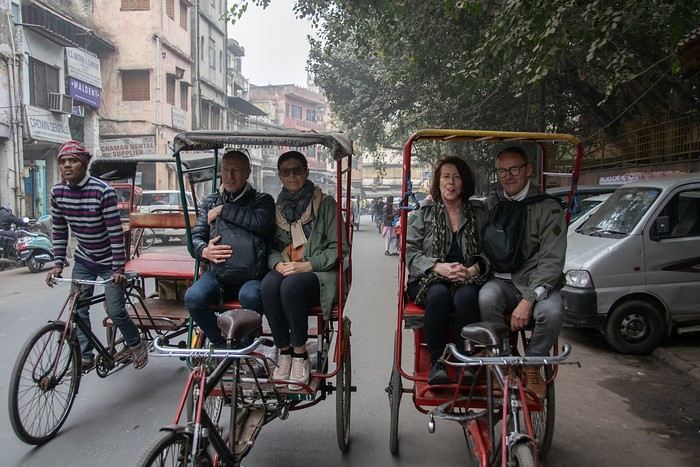
I’m adding my small contribution to the reopening celebration by posting this travel journal from India, made in January 2024. We’re 4 friends (2 couples), and we did a 3-week loop in Rajasthan, stopping by Delhi and Agra (which, as everyone knows, aren’t in Rajasthan 😛). Delhi - Agra - Jaipur - Bundi - Udaipur - Jodhpur - Jaisalmer - Delhi
We rented a car with a driver from Agra to Jaisalmer, 550 € for 14 days. https://chauffeurpriveeninde.com/fr/
We took the train from Delhi to Agra and the plane (Spicejet) from Jaisalmer to Delhi.
Most of the accommodations were booked on Booking before we left.
I’m sharing this story written by Richard and illustrated by me. We dedicate it to Nathalie and Bruno, our amazing travel companions.
Afrique du Sud 2019: retour en terres africaines et premier road-trip en famille English translation pending
Heureux de retrouver le forum d’Afrique australe pour me replonger dans notre voyage de l’été dernier et le partager avec vous.
Bien que ce fut déjà mon 4ème voyage en Afrique du Sud celui-ci eut, dès la préparation, une saveur toute particulière puisque ça allait être notre premier voyage en famille depuis une éternité, et cette fois-ci les rôles étaient inversés puisque c’est moi qui allais faire découvrir à mes parents ma destination de cœur, l’Afrique. 🙂
La concordance des temps dans cette dernière phrase m’a achevé… Ce carnet s’annonce compliqué. 😄
C’est un voyage que nous avons donc réalisé à 5, mes parents, mes 2 jeunes frères et moi-même. Ma sœur n’ayant pas pu se joindre à nous et Alison, ma copine, ayant gardé ses congés pour notre voyage de Septembre en Tanzanie.
C’est un rêve qui, enfin, se réalisait puisque cela faisait plusieurs années que j’essayais d’organiser quelque chose en famille et c’est en rentrant d’Alaksa en Aout 2018 que mes parents se sont motivés pour visiter l’Afrique du Sud. J’ai donc eu quasiment 1an pour préparer ce magnifique voyage en parallèle de celui en Tanzanie avec Alison.
Le circuit se voulait tant classique que magnifique. 24 jours à travers l’Afrique du Sud, à mes yeux le plus beau pays du monde, de Joburg à Capetown.
J0 (06/07/19) : Paris -> Madrid -> Johannesburg J1 (07/07/19) : OR Tambo Int Airport -> Forever Blyde Canyon J2 (08/07/19) : Blyde River Canyon J3 (09/07/19) : Forever Blyde Canyon –> Kruger National Park J4 (10/07/19) : Kruger National Park J5 (11/07/19) : Kruger National Park J6 (12/07/19) : Kruger National Park J7 (13/07/19) : Kruger National Park J8 (14/07/19) : Kruger National Park -> Santa Lucia J9 (15/07/19) : Isimangaliso wetland Park J10 (16/07/19) : Hluhluwe-iMfolozi J11 (17/07/19) : Hluhluwe-iMfolozi J12 (18/07/19) : Hluhluwe-iMfolozi -> Golden Gate NP J13 (19/07/19) : Golden Gate NP J14 (20/07/19) : Golden Gate NP -> Mountain Zebra NP J15 (21/07/19) : Mountain Zebra NP J16 (22/07/19) : Mountain Zebra NP J17 (23/07/19) : Mountain Zebra NP ->Cambedoo NP J18 (24/07/19) : Cambedoo NP -> Addo Elephant NP J19 (25/07/19) : Addo Elephant NP -> De Hoop NR J20 (26/07/19) : De Hoop NR J21 (27/07/19) : De Hoop NR - Capetown J22 (28/07/19) : Capetown J23 (29/07/19) : Capetown J24 (30/07/19) : Capetown - Johannesburg J25 (31/07/19) : Soweto – Départ
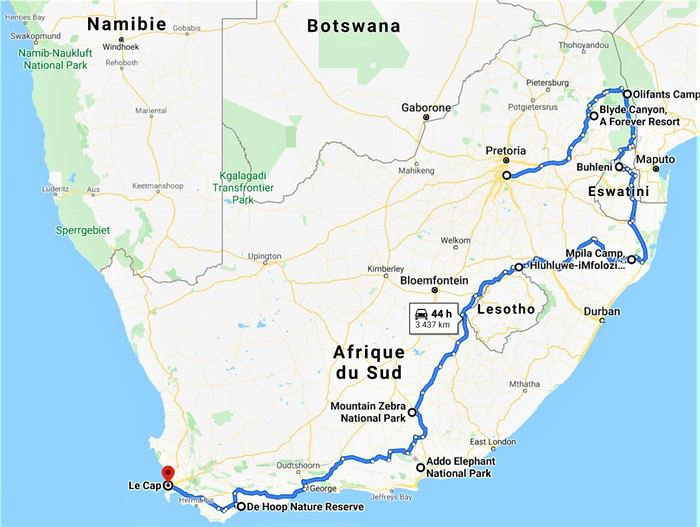
Étant 5 grands gabarits la question du véhicule était délicate puisque c’est dans ce véhicule que nous allions passer le plus de temps, en safari ou sur la route. Nous avons finalement opté pour la location d’un Hyundai H1 chez Budget, option la plus économique et la plus confortable avec 7 places et une plus haute garde au sol pour mieux voir les animaux et le paysage.
Après 11 mois d’attente, début des vacances scolaires et départ de Guadeloupe le vendredi 5 Juillet, pour mes parents et mes frères que je rejoindrai sur Paris le lendemain avant de décoller pour Madrid puis Joburg, tous ensemble, le samedi 6 au soir.
See you in the bush ! (Bilan conseils et budget en fin de carnet.)
Bien que ce fut déjà mon 4ème voyage en Afrique du Sud celui-ci eut, dès la préparation, une saveur toute particulière puisque ça allait être notre premier voyage en famille depuis une éternité, et cette fois-ci les rôles étaient inversés puisque c’est moi qui allais faire découvrir à mes parents ma destination de cœur, l’Afrique. 🙂
La concordance des temps dans cette dernière phrase m’a achevé… Ce carnet s’annonce compliqué. 😄
C’est un voyage que nous avons donc réalisé à 5, mes parents, mes 2 jeunes frères et moi-même. Ma sœur n’ayant pas pu se joindre à nous et Alison, ma copine, ayant gardé ses congés pour notre voyage de Septembre en Tanzanie.
C’est un rêve qui, enfin, se réalisait puisque cela faisait plusieurs années que j’essayais d’organiser quelque chose en famille et c’est en rentrant d’Alaksa en Aout 2018 que mes parents se sont motivés pour visiter l’Afrique du Sud. J’ai donc eu quasiment 1an pour préparer ce magnifique voyage en parallèle de celui en Tanzanie avec Alison.
Le circuit se voulait tant classique que magnifique. 24 jours à travers l’Afrique du Sud, à mes yeux le plus beau pays du monde, de Joburg à Capetown.
J0 (06/07/19) : Paris -> Madrid -> Johannesburg J1 (07/07/19) : OR Tambo Int Airport -> Forever Blyde Canyon J2 (08/07/19) : Blyde River Canyon J3 (09/07/19) : Forever Blyde Canyon –> Kruger National Park J4 (10/07/19) : Kruger National Park J5 (11/07/19) : Kruger National Park J6 (12/07/19) : Kruger National Park J7 (13/07/19) : Kruger National Park J8 (14/07/19) : Kruger National Park -> Santa Lucia J9 (15/07/19) : Isimangaliso wetland Park J10 (16/07/19) : Hluhluwe-iMfolozi J11 (17/07/19) : Hluhluwe-iMfolozi J12 (18/07/19) : Hluhluwe-iMfolozi -> Golden Gate NP J13 (19/07/19) : Golden Gate NP J14 (20/07/19) : Golden Gate NP -> Mountain Zebra NP J15 (21/07/19) : Mountain Zebra NP J16 (22/07/19) : Mountain Zebra NP J17 (23/07/19) : Mountain Zebra NP ->Cambedoo NP J18 (24/07/19) : Cambedoo NP -> Addo Elephant NP J19 (25/07/19) : Addo Elephant NP -> De Hoop NR J20 (26/07/19) : De Hoop NR J21 (27/07/19) : De Hoop NR - Capetown J22 (28/07/19) : Capetown J23 (29/07/19) : Capetown J24 (30/07/19) : Capetown - Johannesburg J25 (31/07/19) : Soweto – Départ
Étant 5 grands gabarits la question du véhicule était délicate puisque c’est dans ce véhicule que nous allions passer le plus de temps, en safari ou sur la route. Nous avons finalement opté pour la location d’un Hyundai H1 chez Budget, option la plus économique et la plus confortable avec 7 places et une plus haute garde au sol pour mieux voir les animaux et le paysage.
Après 11 mois d’attente, début des vacances scolaires et départ de Guadeloupe le vendredi 5 Juillet, pour mes parents et mes frères que je rejoindrai sur Paris le lendemain avant de décoller pour Madrid puis Joburg, tous ensemble, le samedi 6 au soir.
See you in the bush ! (Bilan conseils et budget en fin de carnet.)
On the Silk Road: Chronicles of a Sixty-Something Traveling Completely Independently
From Beijing to Khiva: China, Kyrgyzstan, Tajikistan, Uzbekistan
Chronicle of anecdotes, highlights, and other adventures that marked this eight-week journey in 2018.
The Chinese Far West More than 30 years after my first trip to eastern China, I finally fulfilled an old dream: traveling solo from Beijing to the far west, discovering Xinjiang, the Uyghur people and the oppression they endure, the oases of Turpan and Kashgar, the Taklamakan Desert, the end of the Great Wall... The route was covered by train.
MENU PART 1: CHINA
1- Beijing (Jiankou) : the authentic Great Wall, without tourists 2- Cycling in Beijing, the best way to get around 3- Beijing : departure for the far west 4- Jiayuguan : getting by without English 5- Jiayuguan : scams and heritage 6- Dunhuang : abundance in the middle of the desert 7- Turpan : the Uyghurs under heavy surveillance 8- Kashgar : love at first sight for the old city 9- Kashgar : China’s recipe for controlling the populace 10- Tashkurgan : what on earth was I thinking going there! Kyrgyz border: a surreal epic Photo album from the 80s, contributions from other travelers (page 2)
1- JIANKOU Finding the authentic Great Wall, without tourists or a guide Friday, August 24, 2018 Thirty years later, I didn’t feel like revisiting the Great Wall at Badaling or any other overcrowded site. I chose to explore it at Jiankou, in its wildest, most authentic, and unrestored section, starting from a lost village deep in a valley—though it wasn’t *that* lost, since it had everything for communication.
No need to pay for a taxi to get there—by timing it right, you can take the bus for just a few yuan. You have to get off at Xizhazi, the bus terminus. Be careful, there are only two buses a day in each direction. At the Xizhazi bus stop, I met a young couple who’d arrived with zero information about what to expect. We hiked the three of us toward the restored section of Mutianyu.
Still, be cautious With GPS and a topographic map (OpenTopoMap), you can set off without a problem or guide. The trail up to Jiankou is easy and well-marked. The trails down are too. But be careful—once you’re on the Wall, it’s real mountain hiking, with easy but dangerous climbing sections (over sheer drops). Not for amateurs or those afraid of heights! But what a reward. The Wall all to yourself, where it’s at its most daring. Truly mesmerizing.
More photos...
2- BEIJING The best way to get around the capital Sunday, August 26 The best way to explore the city is still by bike. Most are in a bike-share system, but you need to use an app—WeChat, the app that does everything, like monitoring your every move. No way I was installing that.
I found one at a rental shop near the hostel. The key is to quickly learn local traffic customs to minimize risks. Bike lanes are wide along the avenues.
But you still have to: - Watch out for anything parked on the bike paths—the most annoying are people napping or talking on the phone in their cars - Keep an eye on everything coming the wrong way—the list is long - The worst is right turns on red, which in Chinese traffic rules seem to have priority Once you get the hang of it, it’s fine. The city is huge but flat, so you can just wing it.
3- BEIJING By train to the far west Sunday, August 26 Beijing West Station is the size and operates like an airport. With your e-ticket from the agency, you first have to pick up your ticket at the special "English" counter, after passing through security. With your ticket in hand, you have to exit and enter through the boarding waiting area—not the platform—after a second security check.
 Then you find the right hall and wait for the sign to finally access the platform. In the end, it works pretty well given the incredible number of passengers to manage. Everywhere in Beijing, I saw that the Chinese have mastered crowd flow management.
Nice surprise: second-class carriages are clean, air-conditioned, and bright. Perfect, since I was in for 20 hours. One uniformed attendant per carriage, mobile meal service—luxury! Small downside: no luggage space. Hauling your suitcase up to the top bunk is quite a workout. I was in the middle, so it wasn’t too bad. The landscape, though, whether rural or urban, is pretty bleak. That should change once we leave the eastern plains.
Of course, I got my first police visit, with a thorough passport check and bag search. I was warned—going to the Chinese far west exposes you to this kind of hassle. But they were polite and respectful.
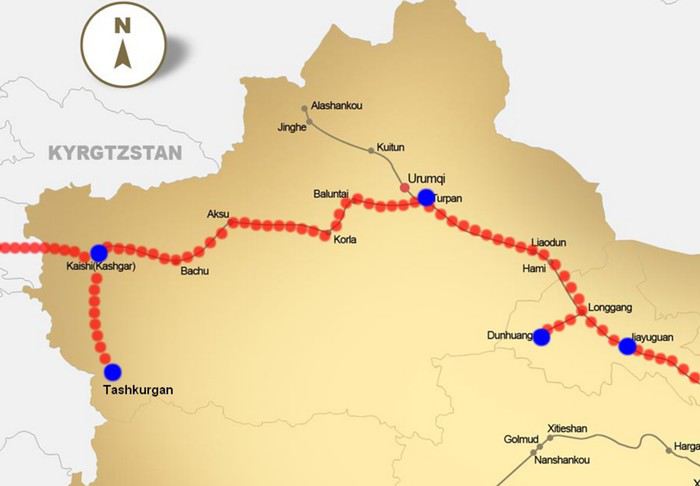 The Chinese Far West
4- JIAYUGUAN Getting by without English Monday, August 27 At the gates of two deserts (Gobi and Taklamakan) and at the foot of the Tibetan highlands, the Great Wall ends at Jiayuguan. Here, I found the deeper China I’d somewhat rediscovered during my bike ride, even if now everyone gets around on electric bikes and I’m no longer stared at like an alien.
Prices are nothing like Beijing: you can find a full meal for 2 €, and my bike cost 7 € for two days. Plus, few people speak English—neither the owner of the HI hostel where I stayed, nor the ticket sellers at the sites, let alone the servers at the small eateries where I ate. Everything is written in Chinese. So I had to use the little Chinese I know to communicate about essentials. It makes the locals laugh to see a European trying to speak their language, but it earns respect. With Google Translate’s help, I managed.
Rant: With their avenues blocked for construction for kilometers without warning, and new roads not yet on maps, I must’ve taken 15 km of detours. More photos...
5- JIAYUGUAN Scams and heritage Tuesday, August 28 The Great Wall doesn’t exactly end at the fort I visited yesterday but 10 km further, at the entrance to a river gorge at the foot of the mountains. All that’s left is a badly damaged tower (more like a mound of earth) and a section of clay wall, similar to the one I biked yesterday.
This morning, I hopped on my bike, determined to venture into the desert to see this highly symbolic site. First, you access it via a wide, brand-new road with not a soul in sight. Just before the site, I came across a grand welcome gate, very period-style, but it’s actually the inevitable toll booth.
Behind the gate, the road continues straight to the site, which you can see in the distance—at least 2 km away—the remains of the tower and wall. I had to leave my bike here. Fine. I went to the ticket counter and asked the price: 120 yuan! I couldn’t believe it—over 15 € for a simple mound of earth.
I showed my displeasure to the attendant, who couldn’t care less, and immediately turned back. 120 yuan—that’s the price for a new road, a fancy gate planted 2 km before the site just to force you to take a shuttle, and employees with nothing to do all day... Now I understand why I didn’t meet anyone!
Heritage China is a bit pricey Generally, sites are expensive for the country’s standard of living, but travelers are supposed to have money, so why hold back? I even gave up on the Forbidden City—reservations required days in advance (or on the black market at an impossible price). I prefer to keep the memory of my first visit, when entry must’ve cost a few dozen cents, and there were only a handful of visitors.
This morning, I took a taxi to see remarkable tombs of common people from the 3rd to 6th centuries. They’re small vaulted caves made of painted bricks, depicting scenes of daily life. Very pretty and moving. But even here, though the price was more reasonable, I was left wanting—only one of the 16 tombs is open to visitors, and it’s apparently not the most beautiful.
The authentic China—at least what’s left of it... Wandering the impersonal avenues of the city, you stumble upon a market. There, you still find traditional China—small shops with questionable hygiene, Go players, musicians, and even a dental prosthetist. The last refuge for those untouched by modernity. More photos...
6- DUNHUANG Abundance in the middle of the desert Wednesday, August 29 Well, I thought the landscape would be less bleak as I headed west. Nope. The only distraction in this expanse of dark, clayey sand is the forests of pylons and wind turbines, plus wild camels racing each other.
 However, Dunhuang, the gateway to the Taklamakan, is by far the most pleasant Chinese city I know. There’s a real city center you can explore on foot. It’s hot but not unbearable, with a light, dry breeze. Much nicer than Beijing. The Han Chinese are still the majority, but the Muslim Uyghurs are more numerous, and the muezzin’s call to prayer echoes around the mosque.
The most surprising thing is the abundance and diversity of fruits and vegetables. You wonder how it all grows here. Well-irrigated, the desert sands are very fertile. Here, raisins have subtle, mysterious flavors, and the lamb really tastes like lamb.
Today, I visited the must-see Mingshashan, a dune complex next to which Pila is a molehill. The Basque Country, but covered in sand... More photos...
7- TURPAN The Uyghurs under heavy surveillance Friday, August 31 Surveillance cameras everywhere in the city, armed police stationed at intersections, in front of public buildings, at the entrance and inside tourist sites, police stations on every corner, patrols on foot or by car, khaki uniforms even for middle schoolers... here, the Han Chinese are in the minority, and you can feel it. Turpan feels like a city under siege.
To enter the youth hostel where I stayed, there’s even a security gate, and the receptionist (a Han, like everyone in tourism) wears a bulletproof vest! Reassuring. Still, you don’t feel particularly threatened here, especially as a European. The troublemakers are the Chinese, not the Uyghurs. Generally, China is a very safe country for visitors.
Smile, you’re on camera! I was biking on an avenue when the car in front of me got flashed for driving slowly. I quickly understood why when I got flashed too.
Here, the official time is Beijing time, but it gets dark two hours later. It’ll be even worse in Kashgar. Trickier to manage: everything is displayed in Chinese and Arabic. Nothing in English. Choosing a menu is a shot in the dark. Apart from a few young Chinese, no one here speaks English, and my Chinese doesn’t seem very understandable...
Mogao, the end of the road for the Han Yesterday, near Dunhuang, I went to Mogao, a complex of decorated caves with Buddha sculptures and paintings. Stunning, but so crowded! Luckily, here in Turpan, Chinese tourists barely venture out. So I visited a Silk Road ghost town with only a handful of other visitors and under a howling wind.
The modern Chinese city is swallowing up the old Uyghur neighborhoods—only a museum-like district remains in the center, and pockets of resistance on the outskirts are doomed to disappear soon. More photos...
8- KASHGAR A (relative) love at first sight for the old city Sunday, September 2 After three overnight trains, here I am in the far west of China, nearly 4,000 km from the capital. Despite the omnipresent police and an old city preserved UNESCO-style, Kashgar is my Chinese love at first sight.
Finally, Chinese... well, sort of, because we’re in Uyghur territory here—a Turkic people with nothing culturally in common with the Han, the eastern Chinese. It started badly yesterday at Turfan station, where after three security gate passes, at least five passport checks, and a bag search, three adorable policewomen confiscated my antibacterial lotion because it had a flammable logo...
Then came the welcoming committee of armed cops at Kashgar station. Once all that was over, they left me alone—except you still have to go through security checks like everyone else to enter the old city, the bazaar, the livestock market... The further west you go, the more the siege mentality is evident. Luckily, the border isn’t far...
Despite the inevitable destruction-reconstruction, the city center has been well preserved. Thankfully, because it’s a very original style, a mix of local and colonial. I love it, even if it’s a bit too artificial, sanitized, and watered-down, and rather empty of residents. On the Silk Road, the city was famous for its great food. And it still is—rarely have I seen such richness and abundance of food! And not just scorpions or snakes. More photos...
9- KASHGAR China’s recipe for controlling the populace Saturday, September 1 Xinjiang, along with Tibet, is a "sensitive" area of rebellion in the eyes of Chinese authorities. As a result, the state has these regions and their populations under total control. Tourists also feel the consequences, even if they’re not at risk of re-education camps.
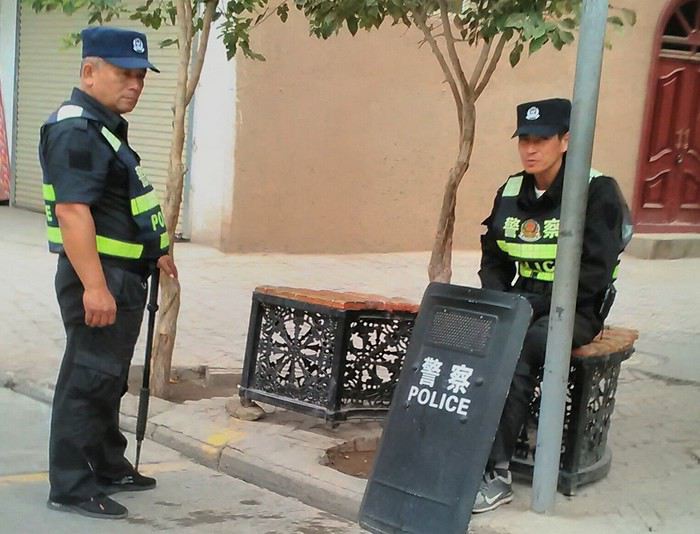 - Putting barbed wire and anti-ramming barriers around sensitive sites (schools, big hotels, government buildings...)
- Installing traffic surveillance gates with cameras and photo flashes (for all vehicles passing, including bikes) throughout the city and even in the countryside
- Posting uniformed guards with tasers, batons, or huge baseball bats every 100 meters
- Training the Han population (ethnic Chinese) in self-defense with sticks, preferably in the morning on the street. Men and women of all ages
- Starting school with the national anthem, doing military exercises, and receiving political indoctrination, all neatly lined up in the courtyard. (The dream school for any teacher)
- Placing a snitch in uniform (a pseudo-guard) in public gathering places, like youth hostels. Mine spends the day loafing around the courtyard
- Putting Chinese flags everywhere on the streets to remind everyone who’s in charge
- Installing security gates at every entrance to areas frequented by tourists (thanks for that) but not just there
- Never photographing cops, or else! I tried, but it’s not easy...
- Putting barbed wire and anti-ramming barriers around sensitive sites (schools, big hotels, government buildings...)
- Installing traffic surveillance gates with cameras and photo flashes (for all vehicles passing, including bikes) throughout the city and even in the countryside
- Posting uniformed guards with tasers, batons, or huge baseball bats every 100 meters
- Training the Han population (ethnic Chinese) in self-defense with sticks, preferably in the morning on the street. Men and women of all ages
- Starting school with the national anthem, doing military exercises, and receiving political indoctrination, all neatly lined up in the courtyard. (The dream school for any teacher)
- Placing a snitch in uniform (a pseudo-guard) in public gathering places, like youth hostels. Mine spends the day loafing around the courtyard
- Putting Chinese flags everywhere on the streets to remind everyone who’s in charge
- Installing security gates at every entrance to areas frequented by tourists (thanks for that) but not just there
- Never photographing cops, or else! I tried, but it’s not easy...
With all that, you can stroll around safely Not much crime! As for the amount the Chinese state spends to maintain such a system, it’s staggering! A third of the Han living in Xinjiang work in security. Today, I wandered freely around old Kashgar, which is quite large after all. More photos...
10- TASHKURGAN What on earth was I thinking going there! Wednesday, September 5 First, there’s the taxi—pretty crappy, with a driver who doesn’t speak a word of English and won’t stop smoking. Over six hours in that... shared with a completely out-of-it American.
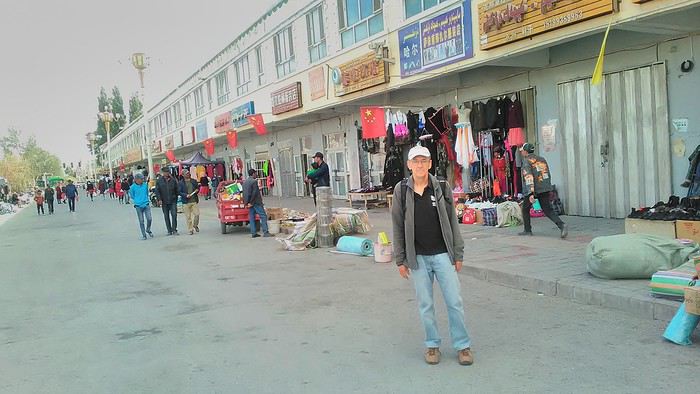
Then there are all the checkpoints along the way. I won’t go on—you know the drill by now.
After that, there’s Tashkurgan—a town with nothing to see, nothing to do. Deserted as soon as night falls. There’s this huge youth hostel and a few lost Chinese tapping away on their smartphones, chain-smoking. This lost American-European crowd, swapping tips on how to enter Pakistan or Tajikistan.
Luckily, there’s the Chinese Pamir Highway, lined with peaks over 7,000m. There’s the feeling of no longer being in China, with a population whose features are Middle Eastern. And these Tajik women with their stunning hairstyles and vibrant costumes. There’s the fact of having reached the westernmost Chinese city, far from crowds and tourist sites. A sort of end of the world. More photos...
11- KYRGYZ BORDER A surreal epic Thursday, September 6 The road from Kashgar to the Kyrgyzstan border is a little over 200 km and passes through beautiful landscapes of colorful, desert-like mountains with acrobatic folds. That’s the bucolic part of the trip.
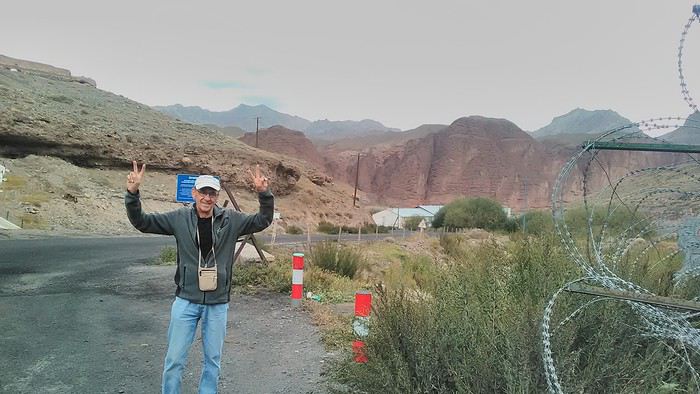 Yesterday, I managed to gather four people to rent a minibus to reach the border more easily: a Spaniard and an Argentine I’d already met in Turpan, and two New Zealanders who responded to the ad left at the hostel.
Absurdity and paranoia of Chinese authorities The highlight was crossing the town of Wuqia, 50 km past Kashgar. After tallying up with my fellow sufferers, we must’ve passed about ten checkpoints with: - Passport checks: 14 times, sometimes by two cops side by side - Bag checks: 4 times - Smartphone checks: 2 times, with deletion of "non-compliant" photos, and registration of your IMEI in the exit log!... Absurd and surreal at the same time, since my camera stayed in my bag, my apps are in French, and my photos have been online for ages...
With all that, we arrived just as the last checkpoint before the no man’s land marking the border between the two countries was on lunch break. And bam! Another 1.5-hour wait, alongside truckers who were much more used to this than we were.
What to think? The cops themselves aren’t fooled. They play the role they’re asked to, but sometimes you can coax a smile out of them—they realize how ridiculous the situation is.
What’s the point? That’s the big question my companions and I were tempted to answer with "to piss people off." To show you your place isn’t here, but with the other tourists, over there in the east, in Shanghai, Xi’an, or Guangzhou.
As for you, a traveler from a democratic country, you really experience this as aggression, humiliation, a violation of your private space. And yet, I’m respected, they speak to me properly. Today, I better understand what a Palestinian or a citizen of an occupied country might feel daily. A unique experience! Thanks, China.
And to top it off, the cherry on the cake! It’s still this glowing button you press to rate your passage after clearing the last obstacle before the exit stamp. I was so surprised it turned off before I could react. The Spaniard, with great humor and irony, had time to vote "excellent." In the end, he wasn’t wrong—you can hardly do better!
PS: I ditched my buddies at the border. They didn’t want to pay for a taxi to continue. So I took a direct taxi to Osh. The first 100 km are fabulous. I couldn’t take many photos, but I’ll be back on Monday to go to Tajikistan.
More photos...
The rest of the Silk Road, Part 2, in these travel journals: Kyrgyzstan, Tajikistan, Uzbekistan.
The Chinese Far West More than 30 years after my first trip to eastern China, I finally fulfilled an old dream: traveling solo from Beijing to the far west, discovering Xinjiang, the Uyghur people and the oppression they endure, the oases of Turpan and Kashgar, the Taklamakan Desert, the end of the Great Wall... The route was covered by train.
MENU PART 1: CHINA
1- Beijing (Jiankou) : the authentic Great Wall, without tourists 2- Cycling in Beijing, the best way to get around 3- Beijing : departure for the far west 4- Jiayuguan : getting by without English 5- Jiayuguan : scams and heritage 6- Dunhuang : abundance in the middle of the desert 7- Turpan : the Uyghurs under heavy surveillance 8- Kashgar : love at first sight for the old city 9- Kashgar : China’s recipe for controlling the populace 10- Tashkurgan : what on earth was I thinking going there! Kyrgyz border: a surreal epic Photo album from the 80s, contributions from other travelers (page 2)
1- JIANKOU Finding the authentic Great Wall, without tourists or a guide Friday, August 24, 2018 Thirty years later, I didn’t feel like revisiting the Great Wall at Badaling or any other overcrowded site. I chose to explore it at Jiankou, in its wildest, most authentic, and unrestored section, starting from a lost village deep in a valley—though it wasn’t *that* lost, since it had everything for communication.
No need to pay for a taxi to get there—by timing it right, you can take the bus for just a few yuan. You have to get off at Xizhazi, the bus terminus. Be careful, there are only two buses a day in each direction. At the Xizhazi bus stop, I met a young couple who’d arrived with zero information about what to expect. We hiked the three of us toward the restored section of Mutianyu.
Still, be cautious With GPS and a topographic map (OpenTopoMap), you can set off without a problem or guide. The trail up to Jiankou is easy and well-marked. The trails down are too. But be careful—once you’re on the Wall, it’s real mountain hiking, with easy but dangerous climbing sections (over sheer drops). Not for amateurs or those afraid of heights! But what a reward. The Wall all to yourself, where it’s at its most daring. Truly mesmerizing.
More photos...
2- BEIJING The best way to get around the capital Sunday, August 26 The best way to explore the city is still by bike. Most are in a bike-share system, but you need to use an app—WeChat, the app that does everything, like monitoring your every move. No way I was installing that.
I found one at a rental shop near the hostel. The key is to quickly learn local traffic customs to minimize risks. Bike lanes are wide along the avenues.
But you still have to: - Watch out for anything parked on the bike paths—the most annoying are people napping or talking on the phone in their cars - Keep an eye on everything coming the wrong way—the list is long - The worst is right turns on red, which in Chinese traffic rules seem to have priority Once you get the hang of it, it’s fine. The city is huge but flat, so you can just wing it.
3- BEIJING By train to the far west Sunday, August 26 Beijing West Station is the size and operates like an airport. With your e-ticket from the agency, you first have to pick up your ticket at the special "English" counter, after passing through security. With your ticket in hand, you have to exit and enter through the boarding waiting area—not the platform—after a second security check.
Then you find the right hall and wait for the sign to finally access the platform. In the end, it works pretty well given the incredible number of passengers to manage. Everywhere in Beijing, I saw that the Chinese have mastered crowd flow management.Nice surprise: second-class carriages are clean, air-conditioned, and bright. Perfect, since I was in for 20 hours. One uniformed attendant per carriage, mobile meal service—luxury! Small downside: no luggage space. Hauling your suitcase up to the top bunk is quite a workout. I was in the middle, so it wasn’t too bad. The landscape, though, whether rural or urban, is pretty bleak. That should change once we leave the eastern plains.
Of course, I got my first police visit, with a thorough passport check and bag search. I was warned—going to the Chinese far west exposes you to this kind of hassle. But they were polite and respectful.
The Chinese Far West4- JIAYUGUAN Getting by without English Monday, August 27 At the gates of two deserts (Gobi and Taklamakan) and at the foot of the Tibetan highlands, the Great Wall ends at Jiayuguan. Here, I found the deeper China I’d somewhat rediscovered during my bike ride, even if now everyone gets around on electric bikes and I’m no longer stared at like an alien.
Prices are nothing like Beijing: you can find a full meal for 2 €, and my bike cost 7 € for two days. Plus, few people speak English—neither the owner of the HI hostel where I stayed, nor the ticket sellers at the sites, let alone the servers at the small eateries where I ate. Everything is written in Chinese. So I had to use the little Chinese I know to communicate about essentials. It makes the locals laugh to see a European trying to speak their language, but it earns respect. With Google Translate’s help, I managed.
Rant: With their avenues blocked for construction for kilometers without warning, and new roads not yet on maps, I must’ve taken 15 km of detours. More photos...
5- JIAYUGUAN Scams and heritage Tuesday, August 28 The Great Wall doesn’t exactly end at the fort I visited yesterday but 10 km further, at the entrance to a river gorge at the foot of the mountains. All that’s left is a badly damaged tower (more like a mound of earth) and a section of clay wall, similar to the one I biked yesterday.
This morning, I hopped on my bike, determined to venture into the desert to see this highly symbolic site. First, you access it via a wide, brand-new road with not a soul in sight. Just before the site, I came across a grand welcome gate, very period-style, but it’s actually the inevitable toll booth.
Behind the gate, the road continues straight to the site, which you can see in the distance—at least 2 km away—the remains of the tower and wall. I had to leave my bike here. Fine. I went to the ticket counter and asked the price: 120 yuan! I couldn’t believe it—over 15 € for a simple mound of earth.
I showed my displeasure to the attendant, who couldn’t care less, and immediately turned back. 120 yuan—that’s the price for a new road, a fancy gate planted 2 km before the site just to force you to take a shuttle, and employees with nothing to do all day... Now I understand why I didn’t meet anyone!
Heritage China is a bit pricey Generally, sites are expensive for the country’s standard of living, but travelers are supposed to have money, so why hold back? I even gave up on the Forbidden City—reservations required days in advance (or on the black market at an impossible price). I prefer to keep the memory of my first visit, when entry must’ve cost a few dozen cents, and there were only a handful of visitors.
This morning, I took a taxi to see remarkable tombs of common people from the 3rd to 6th centuries. They’re small vaulted caves made of painted bricks, depicting scenes of daily life. Very pretty and moving. But even here, though the price was more reasonable, I was left wanting—only one of the 16 tombs is open to visitors, and it’s apparently not the most beautiful.
The authentic China—at least what’s left of it... Wandering the impersonal avenues of the city, you stumble upon a market. There, you still find traditional China—small shops with questionable hygiene, Go players, musicians, and even a dental prosthetist. The last refuge for those untouched by modernity. More photos...
6- DUNHUANG Abundance in the middle of the desert Wednesday, August 29 Well, I thought the landscape would be less bleak as I headed west. Nope. The only distraction in this expanse of dark, clayey sand is the forests of pylons and wind turbines, plus wild camels racing each other.
However, Dunhuang, the gateway to the Taklamakan, is by far the most pleasant Chinese city I know. There’s a real city center you can explore on foot. It’s hot but not unbearable, with a light, dry breeze. Much nicer than Beijing. The Han Chinese are still the majority, but the Muslim Uyghurs are more numerous, and the muezzin’s call to prayer echoes around the mosque.The most surprising thing is the abundance and diversity of fruits and vegetables. You wonder how it all grows here. Well-irrigated, the desert sands are very fertile. Here, raisins have subtle, mysterious flavors, and the lamb really tastes like lamb.
Today, I visited the must-see Mingshashan, a dune complex next to which Pila is a molehill. The Basque Country, but covered in sand... More photos...
7- TURPAN The Uyghurs under heavy surveillance Friday, August 31 Surveillance cameras everywhere in the city, armed police stationed at intersections, in front of public buildings, at the entrance and inside tourist sites, police stations on every corner, patrols on foot or by car, khaki uniforms even for middle schoolers... here, the Han Chinese are in the minority, and you can feel it. Turpan feels like a city under siege.
To enter the youth hostel where I stayed, there’s even a security gate, and the receptionist (a Han, like everyone in tourism) wears a bulletproof vest! Reassuring. Still, you don’t feel particularly threatened here, especially as a European. The troublemakers are the Chinese, not the Uyghurs. Generally, China is a very safe country for visitors.
Smile, you’re on camera! I was biking on an avenue when the car in front of me got flashed for driving slowly. I quickly understood why when I got flashed too.
Here, the official time is Beijing time, but it gets dark two hours later. It’ll be even worse in Kashgar. Trickier to manage: everything is displayed in Chinese and Arabic. Nothing in English. Choosing a menu is a shot in the dark. Apart from a few young Chinese, no one here speaks English, and my Chinese doesn’t seem very understandable...
Mogao, the end of the road for the Han Yesterday, near Dunhuang, I went to Mogao, a complex of decorated caves with Buddha sculptures and paintings. Stunning, but so crowded! Luckily, here in Turpan, Chinese tourists barely venture out. So I visited a Silk Road ghost town with only a handful of other visitors and under a howling wind.
The modern Chinese city is swallowing up the old Uyghur neighborhoods—only a museum-like district remains in the center, and pockets of resistance on the outskirts are doomed to disappear soon. More photos...
8- KASHGAR A (relative) love at first sight for the old city Sunday, September 2 After three overnight trains, here I am in the far west of China, nearly 4,000 km from the capital. Despite the omnipresent police and an old city preserved UNESCO-style, Kashgar is my Chinese love at first sight.
Finally, Chinese... well, sort of, because we’re in Uyghur territory here—a Turkic people with nothing culturally in common with the Han, the eastern Chinese. It started badly yesterday at Turfan station, where after three security gate passes, at least five passport checks, and a bag search, three adorable policewomen confiscated my antibacterial lotion because it had a flammable logo...
Then came the welcoming committee of armed cops at Kashgar station. Once all that was over, they left me alone—except you still have to go through security checks like everyone else to enter the old city, the bazaar, the livestock market... The further west you go, the more the siege mentality is evident. Luckily, the border isn’t far...
Despite the inevitable destruction-reconstruction, the city center has been well preserved. Thankfully, because it’s a very original style, a mix of local and colonial. I love it, even if it’s a bit too artificial, sanitized, and watered-down, and rather empty of residents. On the Silk Road, the city was famous for its great food. And it still is—rarely have I seen such richness and abundance of food! And not just scorpions or snakes. More photos...
9- KASHGAR China’s recipe for controlling the populace Saturday, September 1 Xinjiang, along with Tibet, is a "sensitive" area of rebellion in the eyes of Chinese authorities. As a result, the state has these regions and their populations under total control. Tourists also feel the consequences, even if they’re not at risk of re-education camps.
- Putting barbed wire and anti-ramming barriers around sensitive sites (schools, big hotels, government buildings...)
- Installing traffic surveillance gates with cameras and photo flashes (for all vehicles passing, including bikes) throughout the city and even in the countryside
- Posting uniformed guards with tasers, batons, or huge baseball bats every 100 meters
- Training the Han population (ethnic Chinese) in self-defense with sticks, preferably in the morning on the street. Men and women of all ages
- Starting school with the national anthem, doing military exercises, and receiving political indoctrination, all neatly lined up in the courtyard. (The dream school for any teacher)
- Placing a snitch in uniform (a pseudo-guard) in public gathering places, like youth hostels. Mine spends the day loafing around the courtyard
- Putting Chinese flags everywhere on the streets to remind everyone who’s in charge
- Installing security gates at every entrance to areas frequented by tourists (thanks for that) but not just there
- Never photographing cops, or else! I tried, but it’s not easy...With all that, you can stroll around safely Not much crime! As for the amount the Chinese state spends to maintain such a system, it’s staggering! A third of the Han living in Xinjiang work in security. Today, I wandered freely around old Kashgar, which is quite large after all. More photos...
10- TASHKURGAN What on earth was I thinking going there! Wednesday, September 5 First, there’s the taxi—pretty crappy, with a driver who doesn’t speak a word of English and won’t stop smoking. Over six hours in that... shared with a completely out-of-it American.
Then there are all the checkpoints along the way. I won’t go on—you know the drill by now.
After that, there’s Tashkurgan—a town with nothing to see, nothing to do. Deserted as soon as night falls. There’s this huge youth hostel and a few lost Chinese tapping away on their smartphones, chain-smoking. This lost American-European crowd, swapping tips on how to enter Pakistan or Tajikistan.
Luckily, there’s the Chinese Pamir Highway, lined with peaks over 7,000m. There’s the feeling of no longer being in China, with a population whose features are Middle Eastern. And these Tajik women with their stunning hairstyles and vibrant costumes. There’s the fact of having reached the westernmost Chinese city, far from crowds and tourist sites. A sort of end of the world. More photos...
11- KYRGYZ BORDER A surreal epic Thursday, September 6 The road from Kashgar to the Kyrgyzstan border is a little over 200 km and passes through beautiful landscapes of colorful, desert-like mountains with acrobatic folds. That’s the bucolic part of the trip.
Yesterday, I managed to gather four people to rent a minibus to reach the border more easily: a Spaniard and an Argentine I’d already met in Turpan, and two New Zealanders who responded to the ad left at the hostel.Absurdity and paranoia of Chinese authorities The highlight was crossing the town of Wuqia, 50 km past Kashgar. After tallying up with my fellow sufferers, we must’ve passed about ten checkpoints with: - Passport checks: 14 times, sometimes by two cops side by side - Bag checks: 4 times - Smartphone checks: 2 times, with deletion of "non-compliant" photos, and registration of your IMEI in the exit log!... Absurd and surreal at the same time, since my camera stayed in my bag, my apps are in French, and my photos have been online for ages...
With all that, we arrived just as the last checkpoint before the no man’s land marking the border between the two countries was on lunch break. And bam! Another 1.5-hour wait, alongside truckers who were much more used to this than we were.
What to think? The cops themselves aren’t fooled. They play the role they’re asked to, but sometimes you can coax a smile out of them—they realize how ridiculous the situation is.
What’s the point? That’s the big question my companions and I were tempted to answer with "to piss people off." To show you your place isn’t here, but with the other tourists, over there in the east, in Shanghai, Xi’an, or Guangzhou.
As for you, a traveler from a democratic country, you really experience this as aggression, humiliation, a violation of your private space. And yet, I’m respected, they speak to me properly. Today, I better understand what a Palestinian or a citizen of an occupied country might feel daily. A unique experience! Thanks, China.
And to top it off, the cherry on the cake! It’s still this glowing button you press to rate your passage after clearing the last obstacle before the exit stamp. I was so surprised it turned off before I could react. The Spaniard, with great humor and irony, had time to vote "excellent." In the end, he wasn’t wrong—you can hardly do better!
PS: I ditched my buddies at the border. They didn’t want to pay for a taxi to continue. So I took a direct taxi to Osh. The first 100 km are fabulous. I couldn’t take many photos, but I’ll be back on Monday to go to Tajikistan.
More photos...
The rest of the Silk Road, Part 2, in these travel journals: Kyrgyzstan, Tajikistan, Uzbekistan.
Traitement anti-palu pour Siem Reap et sa région? English translation pending
Bonjour,
Nous serons à Siem Reap en novembre et nous avons fait le vaccin contre l'hépatite A et la typhoIde mais, à votre avis , faut-il prendre le traitement anti-palud pour cette région? Notre médecin nous dit que non el le médecin d'une amie qui nous accompagne le lui a conseillé... Qu'en pensez-vous?
Nous serons à Siem Reap en novembre et nous avons fait le vaccin contre l'hépatite A et la typhoIde mais, à votre avis , faut-il prendre le traitement anti-palud pour cette région? Notre médecin nous dit que non el le médecin d'une amie qui nous accompagne le lui a conseillé... Qu'en pensez-vous?
Single-status certificate and Indian birth certificate for marriage: how we succeeded
Hello,
my Indian fiancé and I are getting married in France in a few weeks. Like many couples before us, we had extreme difficulties finding out the steps to follow in India to obtain the necessary documents for our marriage. We received no useful information from the Indian Embassy in Paris. It took us hours of research on traveler forums to gather scattered information and piece together the puzzle. I decided to summarize here the steps that allowed my fiancé to obtain the required papers, so other couples can struggle a little less than we did in the future.
I hope this post helps!
Context reminder: the list of documents required for a non-EU national to marry in France (see also www.service-public.fr):
Certificate of Custom: This is an explanation in French of the rules governing marriage eligibility in your country of origin. I read that some countries include proof that the applicant is indeed eligible. This is not the case for India.
Single-status certificate/marital capacity certificate. This is simply proof that you are eligible to marry under the laws of your country of origin.
Birth certificate.
All these documents must be less than 6 months old at the date of the banns publication.
The birth certificate and the single-status certificate must be apostilled. This procedure is linked to the international Hague Convention, of which both France and India are members. The apostille is a kind of stamp affixed to an official document by the authorities of the country where it was issued, giving it legal value in a third country.
How we obtained these documents:
The certificate of custom is very easy to obtain if you already live in France. You just need to go to the Indian Embassy in Paris with the required documents and pay the fees. We received it by mail the next day. The instructions on the Indian Embassy in Paris website are very clear (spring 2019). See also the VFS Global website (the company to which the embassy outsources consular activities).
Obtaining the single-status certificate was much more complicated. In France, a birth certificate is enough to prove whether you are married or not, as annotations are added for every major life event. In contrast, the Indian administration, although it can prove that someone is already married, is unable to prove that someone is still single. The only way to resolve this is to produce an affidavit. It took several trials and errors before we succeeded, as the administrators we dealt with generally did not know the procedure. Here’s what finally worked:
Prepare the affidavit on 100-rupee bond paper (first party: signatory; second party: Sub-Divisional Magistrate) at the Sub-Divisional Magistrate’s office in your place of birth. See Model No. 1 below. It must be signed by you and the Sub-Divisional Magistrate. For my fiancé, the latter only agreed to sign after presenting a certificate from the Tahsildar of his birth Taluk stating that he knew my fiancé was still single. If you don’t know the Tahsildar well, it might be useful to first request such a certificate from the "village accountant" before approaching the Tahsildar. We don’t know if the process would be the same in other districts than my fiancé’s. Attestation at the Regional Commissioner’s (RC) office. The Ministry of External Affairs will only apostille documents that have been attested this way. In our case, we found clear information about the procedure on the Regional Commissioner’s website (required documents, cost, bond paper value). The RC asked us to justify why my fiancé needed a single-status certificate. Such certificates are usually requested by people wishing to join the army, in which case the RC receives a request letter. I asked the mayor of my village to sign such a letter (see Model No. 2, which I wrote myself). I come from a very small town, which was lucky here, as the mayor knows both of us personally and immediately agreed to do it. I have no idea if it would be as easy in a larger town. Once the document was submitted to the RC, it was sent back to the administrator who issued it for authentication. This back-and-forth should not take more than 25 days, but it may be useful to follow the progress of the procedure by calling or visiting the offices of both administrations regularly. Send the attested documents to the Ministry of External Affairs (MEA) for apostille. In 2019, the Indian MEA only accepts apostille requests through private operators, whose list is available on the MEA website.
The birth certificate, once obtained from the municipality of your place of birth, follows the same procedure as the single-status certificate: attestation by the Regional Commissioner, then apostille at the Ministry of External Affairs.
Note: The Indian Embassy in Paris offers to issue a birth certificate. We recommend NOT GOING THROUGH THEM. The procedure is expensive, and they simply copy the information available on your passport. We seriously doubt the validity of such a document for marriage.
A few tips:
Obtaining these documents in India will require a lot of time, patience, and creativity! For us, more than 4 months passed between the moment my fiancé signed his single-status certificate and the day we had it apostilled in hand. In the meantime, there were dozens of phone calls and visits to various local administrations, a lot of brainstorming, and money wasted on canceled flights due to the monsoon.
If you have contacts in the local administration, don’t hesitate to use them. Also, if possible, closely monitor the progress of the procedures by calling or visiting the offices regularly, as mistakes are very common.
I recommend only requesting the certificate of custom once you’re close to having the other documents in hand, as it’s expensive, its issuance is very quick (at least if you both live in France; otherwise, I don’t know), and it’s only valid for 6 months.
All the steps for the birth certificate and the single-status certificate must be done in person, which can be complicated if you already live outside India. Some companies offer to handle it for you if you’re willing to pay. My fiancé bypassed the problem by designating his brother as an "Authorised representative" (a step taken at the notary of his birth Taluk). Once the single-status certificate was established in person, my fiancé’s brother was able to take over and complete the rest of the steps on his behalf. Finally, we asked the service provider handling the apostille to send the documents to our address in France via DHL (we don’t trust the postal service, as we’ve had mail stuck at customs for several weeks before).
My fiancé first tried to establish his single-status certificate at the notary of his birth Taluk. It didn’t work because the Regional Commissioner categorically refused to attest it. Indeed, it is generally forbidden to make any modifications to a document signed by a notary.
Once the birth certificate and the single-status certificate arrive in France, you must have them translated by a sworn translator registered with the Court of Appeal in your area. You can find the list on your Court of Appeal’s website. There are no sworn translators for all Indian languages! So, check beforehand if one exists for the language in which your certificates will be issued, or ensure they are issued in English.
Model No. 1 - Single-status certificate, affidavit
I, (name of applicant), son of (name of father) and (name of mother), with permanent address (address in India), solemnly affirm and declare as follows: 1. That I am a citizen of India 2. That I was born in (place of birth) on the (date of birth) 3. That I am holding a valid Indian passport bearing the number (passport number) issued at (place of issue) and valid from (date of issue) to (date of expiry). 4. That I am unmarried (single) and have no living spouse at present either in India or abroad 5. That I am eligible to marry an Indian or a person of any other nationality according to law. 6. That I am of sound health and in mentally fit condition 7. I further state that whatever stated therein is correct to the best of my knowledge.
I am aware that suppression of facts or furnishing false/misleading information is punishable under Indian law, under section 193(2), 199, 200 of the Indian Penal Code.
Solemnly declared at (place of signature) on (date of signature).
(your signature) (the subdivisional magistrate’s signature)
Model No. 2 – Request letter from the French mayor to the Indian Regional Commissioner
Dear Sir/Madam, (English version below) I, the undersigned (Mayor’s name), Mayor of the Commune of xxx, department of xxx, France, certify as follows. Firstly, that Mr./Ms. (Name of the Indian future spouse), citizen of India, passport No. xxx, issued in xxx on xxx, valid until xxx, residing at (address), INDIA, and Ms./Mr. (Name of the French future spouse), citizen of France, passport No. xxx, residing at (address), FRANCE, have requested that I solemnize their marriage in my Commune under French law.
Secondly, that French law requires me to request from Mr./Ms. (Name of the Indian future spouse) a certificate attesting to their single status.
Issued for all legal purposes.
(Place, date, stamp, and signature of the mayor)
Note: Prepared on the town hall’s letterhead, directly in both French AND English to avoid needing a translator.
Context reminder: the list of documents required for a non-EU national to marry in France (see also www.service-public.fr):
Certificate of Custom: This is an explanation in French of the rules governing marriage eligibility in your country of origin. I read that some countries include proof that the applicant is indeed eligible. This is not the case for India.
Single-status certificate/marital capacity certificate. This is simply proof that you are eligible to marry under the laws of your country of origin.
Birth certificate.
All these documents must be less than 6 months old at the date of the banns publication.
The birth certificate and the single-status certificate must be apostilled. This procedure is linked to the international Hague Convention, of which both France and India are members. The apostille is a kind of stamp affixed to an official document by the authorities of the country where it was issued, giving it legal value in a third country.
How we obtained these documents:
The certificate of custom is very easy to obtain if you already live in France. You just need to go to the Indian Embassy in Paris with the required documents and pay the fees. We received it by mail the next day. The instructions on the Indian Embassy in Paris website are very clear (spring 2019). See also the VFS Global website (the company to which the embassy outsources consular activities).
Obtaining the single-status certificate was much more complicated. In France, a birth certificate is enough to prove whether you are married or not, as annotations are added for every major life event. In contrast, the Indian administration, although it can prove that someone is already married, is unable to prove that someone is still single. The only way to resolve this is to produce an affidavit. It took several trials and errors before we succeeded, as the administrators we dealt with generally did not know the procedure. Here’s what finally worked:
Prepare the affidavit on 100-rupee bond paper (first party: signatory; second party: Sub-Divisional Magistrate) at the Sub-Divisional Magistrate’s office in your place of birth. See Model No. 1 below. It must be signed by you and the Sub-Divisional Magistrate. For my fiancé, the latter only agreed to sign after presenting a certificate from the Tahsildar of his birth Taluk stating that he knew my fiancé was still single. If you don’t know the Tahsildar well, it might be useful to first request such a certificate from the "village accountant" before approaching the Tahsildar. We don’t know if the process would be the same in other districts than my fiancé’s. Attestation at the Regional Commissioner’s (RC) office. The Ministry of External Affairs will only apostille documents that have been attested this way. In our case, we found clear information about the procedure on the Regional Commissioner’s website (required documents, cost, bond paper value). The RC asked us to justify why my fiancé needed a single-status certificate. Such certificates are usually requested by people wishing to join the army, in which case the RC receives a request letter. I asked the mayor of my village to sign such a letter (see Model No. 2, which I wrote myself). I come from a very small town, which was lucky here, as the mayor knows both of us personally and immediately agreed to do it. I have no idea if it would be as easy in a larger town. Once the document was submitted to the RC, it was sent back to the administrator who issued it for authentication. This back-and-forth should not take more than 25 days, but it may be useful to follow the progress of the procedure by calling or visiting the offices of both administrations regularly. Send the attested documents to the Ministry of External Affairs (MEA) for apostille. In 2019, the Indian MEA only accepts apostille requests through private operators, whose list is available on the MEA website.
The birth certificate, once obtained from the municipality of your place of birth, follows the same procedure as the single-status certificate: attestation by the Regional Commissioner, then apostille at the Ministry of External Affairs.
Note: The Indian Embassy in Paris offers to issue a birth certificate. We recommend NOT GOING THROUGH THEM. The procedure is expensive, and they simply copy the information available on your passport. We seriously doubt the validity of such a document for marriage.
A few tips:
Obtaining these documents in India will require a lot of time, patience, and creativity! For us, more than 4 months passed between the moment my fiancé signed his single-status certificate and the day we had it apostilled in hand. In the meantime, there were dozens of phone calls and visits to various local administrations, a lot of brainstorming, and money wasted on canceled flights due to the monsoon.
If you have contacts in the local administration, don’t hesitate to use them. Also, if possible, closely monitor the progress of the procedures by calling or visiting the offices regularly, as mistakes are very common.
I recommend only requesting the certificate of custom once you’re close to having the other documents in hand, as it’s expensive, its issuance is very quick (at least if you both live in France; otherwise, I don’t know), and it’s only valid for 6 months.
All the steps for the birth certificate and the single-status certificate must be done in person, which can be complicated if you already live outside India. Some companies offer to handle it for you if you’re willing to pay. My fiancé bypassed the problem by designating his brother as an "Authorised representative" (a step taken at the notary of his birth Taluk). Once the single-status certificate was established in person, my fiancé’s brother was able to take over and complete the rest of the steps on his behalf. Finally, we asked the service provider handling the apostille to send the documents to our address in France via DHL (we don’t trust the postal service, as we’ve had mail stuck at customs for several weeks before).
My fiancé first tried to establish his single-status certificate at the notary of his birth Taluk. It didn’t work because the Regional Commissioner categorically refused to attest it. Indeed, it is generally forbidden to make any modifications to a document signed by a notary.
Once the birth certificate and the single-status certificate arrive in France, you must have them translated by a sworn translator registered with the Court of Appeal in your area. You can find the list on your Court of Appeal’s website. There are no sworn translators for all Indian languages! So, check beforehand if one exists for the language in which your certificates will be issued, or ensure they are issued in English.
Model No. 1 - Single-status certificate, affidavit
I, (name of applicant), son of (name of father) and (name of mother), with permanent address (address in India), solemnly affirm and declare as follows: 1. That I am a citizen of India 2. That I was born in (place of birth) on the (date of birth) 3. That I am holding a valid Indian passport bearing the number (passport number) issued at (place of issue) and valid from (date of issue) to (date of expiry). 4. That I am unmarried (single) and have no living spouse at present either in India or abroad 5. That I am eligible to marry an Indian or a person of any other nationality according to law. 6. That I am of sound health and in mentally fit condition 7. I further state that whatever stated therein is correct to the best of my knowledge.
I am aware that suppression of facts or furnishing false/misleading information is punishable under Indian law, under section 193(2), 199, 200 of the Indian Penal Code.
Solemnly declared at (place of signature) on (date of signature).
(your signature) (the subdivisional magistrate’s signature)
Model No. 2 – Request letter from the French mayor to the Indian Regional Commissioner
Dear Sir/Madam, (English version below) I, the undersigned (Mayor’s name), Mayor of the Commune of xxx, department of xxx, France, certify as follows. Firstly, that Mr./Ms. (Name of the Indian future spouse), citizen of India, passport No. xxx, issued in xxx on xxx, valid until xxx, residing at (address), INDIA, and Ms./Mr. (Name of the French future spouse), citizen of France, passport No. xxx, residing at (address), FRANCE, have requested that I solemnize their marriage in my Commune under French law.
Secondly, that French law requires me to request from Mr./Ms. (Name of the Indian future spouse) a certificate attesting to their single status.
Issued for all legal purposes.
(Place, date, stamp, and signature of the mayor)
Note: Prepared on the town hall’s letterhead, directly in both French AND English to avoid needing a translator.
Escales en Amérique Centrale: Honduras, Belize, Mexique English translation pending

Récit de trois escales le long des rivages de la côte caraïbe d'Amérique centrale. Une première escale nature au Honduras sur l'île de Roatan puis deux autres en terre Maya, au Belize et ensuite au Mexique sur la péninsule du Yucatan, plus précisément à la découverte du fameux site archéologique de Tulum.
Les côtes honduriennes sont à présent en vue et le moment du débarquement à terre approche … Prêts à la balade ? Alors place au récit illustré.
..................................................................................................................................................................
HONDURAS, sur l'île de Roatan parmi une végétation tropicale exubérante
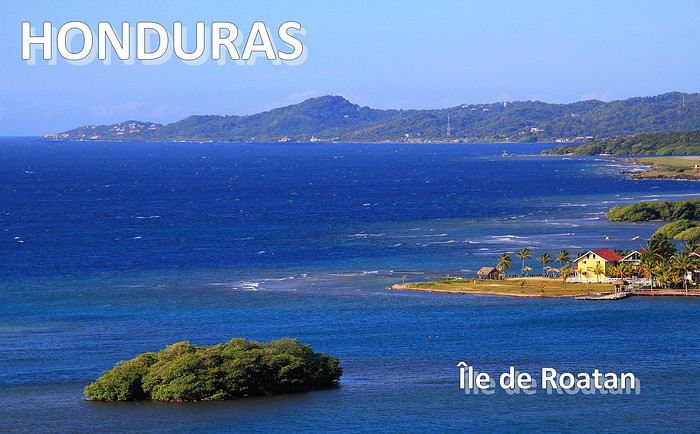
Assurément ce panorama vaut le coup d’œil. Roatan nous dévoile une partie de sa côte, celle qui s'étire au sud ouest de l'île. Baignée par les rayons généreux d'un doux soleil matinal, on contemple avec plaisir cette palette de teintes bleue (marine) et verte (végétale). Une vision qui suscite une irrésistible envie de découvertes à terre.
Durant une croisière d'île en île, le temps s'écoule entre navigation et excursions terrestres lors des escales. Le plus souvent la durée de l'escale, le temps d'une journée, nécessite de faire un choix parmi toutes les curiosités qu'il est possible de découvrir. Roatan est recouverte d'une dense forêt tropicale, du centre montagneux de l'île jusqu'aux plages des rivages … comme une invitation à nous décider pour une balade en forêt entre découverte de la flore tropicale et de quelques espèces de la faune locale.
Les quais du port de Mahogany nous attendent. Mahogany, acajou in english, un nom d'escale prédestiné pour partir en direction de l'exubérante forêt insulaire …
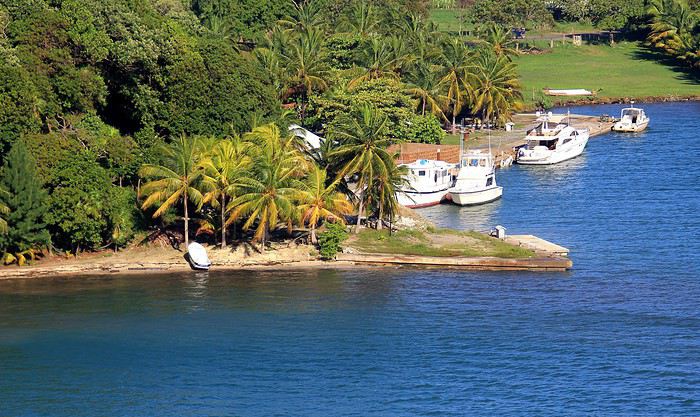
A bâbord, sous nos yeux, une vue plongeante sur un pittoresque quai longé de palmiers. Bon, pour les bateaux de croisières, le quai de débarquement est plus imposant, il se trouve à tribord et s'avère un peu moins photogénique. A seulement quelques dizaines de mètres du port, au centre de la baie, cette carcasse rouillée de bateau attire immanquablement le regard. Si Roatan est souvent présentée comme la « Perle du Honduras » avec sa nature si invitante, pour certains capitaines dont les navires se sont échoués sur les récifs de la barrière de corail, on imagine que leur avis a dû être bien différent !
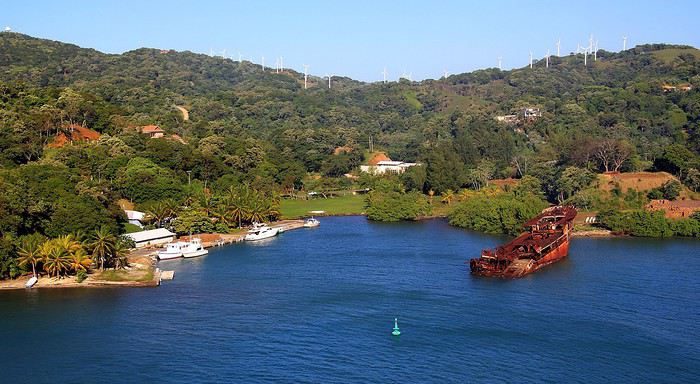
Au port, les couleurs du dépaysement sont hissées haut. Les couleurs nationales du Honduras flottent au gré du vent. Trois bandes horizontales, une blanche au centre entre deux bleues. Le blanc symbolise ce pays d'Amérique centrale situé entre deux mers représentées sur le drapeau par les bandes bleues (Mer Caraïbes et Océan Pacifique). Pour compléter le tableau des couleurs locales, une petite photo d'une plaque d'immatriculation d'un mini bus de l'île estampillée, Honduras.
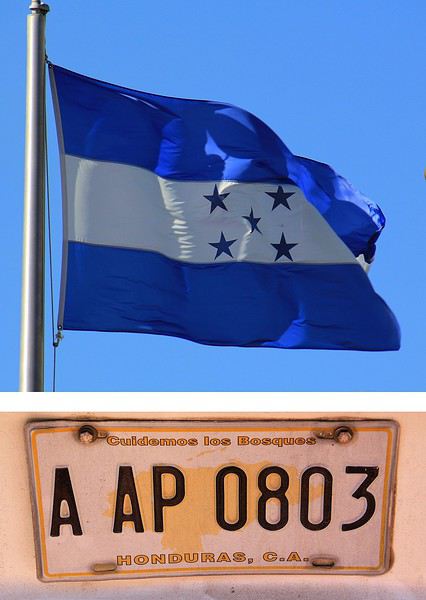
Le mini bus démarre, nous sommes à bord, la direction ? Un grand parc forestier de la pointe ouest de l'île. Le trajet nous fait d'abord longer la côte et traverser quelques hameaux. Ils sont bâtis de maisons, mi-dur, mi-bois, habités par des résidents que l'on imagine passés pour beaucoup d'activités de pêche et de cultures vivrières à des emplois en rapport avec le tourisme. Le parcours de la route s'élève vers les hauteurs tout en zigzaguant. Tournants, virages, côtes, faux plats et montées se succèdent à travers une forêt dense.
Au détour d'un point haut, une trouée à travers la canopée nous laisse voir un panorama étendu : un versant boisé plongeant vers la côte de l'île et au loin, au-delà d'un bras de mer, ce sont d'autres côtes que l'on aperçoit. Noyées dans la brume de chaleur, ce sont les rives continentales du Honduras situées à une soixantaine de kilomètres. Il ne reste plus qu'à parcourir une petite route tout en descente et serpentant entre forêt et jungle pour atteindre notre destination : le Parc Forestier de Gumbalinba.
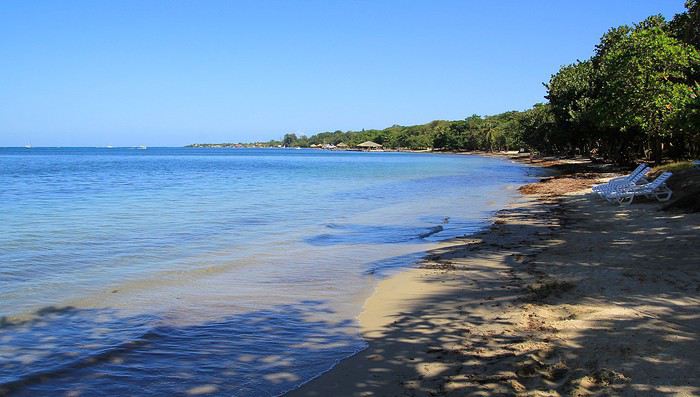
Un coup d’œil et une photo de la belle anse ombragée qui borde le parc avant de débuter la balade en forêt. Ici, pas besoin de machette pour progresser parmi la végétation tropicale, un réseau de chemins et de passages aménagés permettent de découvrir à flanc de collines les espèces d'arbres, de plantes et de fleurs tropicales. Plus de 200 espèces végétales sont répertoriées dans cet environnement particulièrement luxuriant.
Passée cette cascade coulant au milieu de son écrin vert, un panneau annonce sur un mode humoristique la présence dans les parages de drôles d'habitants : une colonie d'iguanes.
Avec leur impressionnant aspect, ces monstrueux lézards semblent sortis tout droit de la préhistoire comme des derniers survivants de la période des dinosaures. Une peau faite d'écailles qui évoque une carapace, de lambeaux de peau pendants et de sortes d'aiguilles hérissés sur le dos … Certains arborent des teintes allant du vert au brun gris, d'autres un cuir sombre tacheté de blanc. C'est cette variété, la noire, qui est la plus emblématique de l'île.
On ne sait qui sont les observateurs les plus attentifs, les visiteurs qui n'ont d'yeux que pour les iguanes ou ces animaux dont le regard figé traduit cependant une certaine crainte ? Quelques pas en se dandinant, en voilà deux qui s'immobilisent, les yeux sont aux aguets. La pose est parfaite pour leur tirer le portrait. Le temps de déclencher et les voilà qui déjà s'enfuient.
La balade prend maintenant un petit air d'aventure. On emprunte à présent un pont de cordes et de planches qui, vous vous en doutez, oscille au gré des pas. Il permet de surplomber un plan d'eau et de parvenir facilement sur le bord opposé.
A proximité, une clairière fait office de volière naturelle pour les perroquets. Dans cette pseudo pénombre que crée la voûte des grands arbres tropicaux, les couleurs du plumage de ces élégants volatiles paraissent encore plus éclatantes.
Et des perroquets qui participent au spectacle à une condition, que les visiteurs entrent eux aussi en scène. Tout est bien rodé. Il suffit de se transformer en perchoir humain, bras écartés, pour que quelques perroquets volent depuis les hautes branches jusqu'aux visiteurs se prêtant à ce petit jeu.
Mais attention, les oiseaux n'attendent pas toujours la récompense donnée par les accompagnateurs du parc. Non, souvent, les perroquets se servent eux même ! Perles, collier, boucles d'oreilles, boutons … enfin tout ce qui brille les fascine. Et hop, d'un rapide coup de bec voici une perle enserrée par un puissant bec crochu !
Superbes couleurs chatoyantes pour ces deux spécimens, les immortaliser d'abord en les photographiant puis plus tard m'est venue l'idée de reproduire, en dessin, le beau « jacquot » de droite.
D'autres oiseaux pourtant très présents dans cet environnement de forêts des tropiques sont beaucoup plus discrets. D'une part ils sont minuscules et de plus ils volent à vive allure … comme des insectes ! Il s'agit des fameux colibris à la courte taille et au poids « plumes », luisantes et colorées bien sûr. Finalement ici, on ne peut les observer seulement lorsqu'ils sont en vol stationnaire près de mangeoires/abreuvoirs mises à leur disposition.
Le petit colibri souvent appelé oiseau-mouche côtoie sur ma photo quelques abeilles, cela donne une échelle et une idée de leur taille. De toute évidence cette espèce est plus grande qu'une abeille et donc d'une quelconque mouche ! Bon, il faut dire qu'il existe une variété de colibris vraiment miniature nommée colibri d'Elena : 5 cm de long et 1,6 à 2 grammes pour le poids … et ceux-là sont aussi nommés oiseaux-abeilles, fin de la parenthèse.