Results for "Congo+Nile+trail+|+121+>+75"
9600 results found.
Tour d'Afrique à vélo, dangereux? English translation pending
Bonjour,
Nous sommes un couple et nous projetons de faire un tour d'Afrique à vélo à partir de juillet 2006. Certains pays tels le Soudan ou l'Ethiopie semblent dangereux, or notre voyage au départ de paris nous emmenerait vers l'Egypte pour rejoindre l'Afrique du Sud et remonter par la côte Ouest. Est-ce envisageable ou devons-nous penser à un autre itinéraire voire continent? Si nous sommes très motivés, nous sommes beaucoup dans le doute par rapport aux destinations. Toute aide sera la bienvenue.Merci d'avance! jph et flo
Nous sommes un couple et nous projetons de faire un tour d'Afrique à vélo à partir de juillet 2006. Certains pays tels le Soudan ou l'Ethiopie semblent dangereux, or notre voyage au départ de paris nous emmenerait vers l'Egypte pour rejoindre l'Afrique du Sud et remonter par la côte Ouest. Est-ce envisageable ou devons-nous penser à un autre itinéraire voire continent? Si nous sommes très motivés, nous sommes beaucoup dans le doute par rapport aux destinations. Toute aide sera la bienvenue.Merci d'avance! jph et flo
Faire de l'aide humanitaire English translation pending
bonjour, je m'appelle Milène et j'ai 18 ans 1/2. J'ai effectué un BEP sanitaire et social et un BTA service en milieu rural, pendant lesquels j'ai réalisé plusieurs stages. Ils m'ont beaucoup apportés et j'aime vraiment avoir des contacts et aider toutes sortes de personnes, c'est pour cela que j'aimerais faire de l'humanitaire, non seulement pour aider, mais aussi pour essayer d'apporter un peu de bonheur aux personnes.
Si vous pouvez me renseigner ou me faire des propositions j'en serais vraiment ravi.
Merci
Si vous pouvez me renseigner ou me faire des propositions j'en serais vraiment ravi.
Merci
Aide pour acheminer des ordinateurs à Nouakchott en Mauritanie English translation pending
Bonjour,
Afrologic est une association de loi 1901 qui vise à transférer la technologie informatique à destination des artistes d'Afrique ( www.afrologic.com).
Aujourd'hui, nous avons 3 ordinateurs et 3 imprimantes à livrer à Nouakchott.
Pour éviter des coûts de transport prohibitifs, nous cherchons des voyageurs allant là bas et pouvant nous aider au niveau logistique. Nous ne sommes pas obligés d'envoyer toutes les machines en même temps.
Contactez moi si vous pouvez nous venir en aide. Merci.
Jérôme Bignon - Président d'Afrologic
Contactez moi si vous pouvez nous venir en aide. Merci.
Jérôme Bignon - Président d'Afrologic
Concert pour la journée mondiale de lutte contre la désertification. English translation pending
Jam'Sahel + de 100 musiciens pour Sos Sahel International
Journée mondiale de lutte contre la désertification. Plus de 100 musiciens pour une grande soirée de concert au profit de SOS Sahel International. Avec Manu Dibango, Paco Sery, Les Nubians, Brice Wassy, JP Rykiel, Tamango, China, Paban Das Baul, Didier Malherbe, Queen Etemme, No Bluff Sound, Sally Nyolo, Jovino Dos Santos, Rockin'Squat, Juan Rozoff, Ali Wagué, Vicky Edimo, Patrick Bebey, Toops Bebey, Begane Dour, George Momboye, Yakhuba Cissoko, No Jazz, Mao Otayek, Hervé Lebongo, Neshwa, Félix Sabaleko, Stéphane Castri, Laurent de Wilde, Elvita Delgado, Guy Nsangue, Loy Ehlrich, Wild Congo, Julien Goualo, Kabine Kouyaté, Cheick Tidiane Seck, Oumou Kouyaté, Djélimory Diabaté Damafa …… AU CABARET SAUVAGE à Paris
Le 17 juin 2005 de 20h à 4h
entrée : 17 € en pré vente / 15 € sur place location points de vente habituels informations : 01 46 88 93 70
www.djigi.net
Journée mondiale de lutte contre la désertification. Plus de 100 musiciens pour une grande soirée de concert au profit de SOS Sahel International. Avec Manu Dibango, Paco Sery, Les Nubians, Brice Wassy, JP Rykiel, Tamango, China, Paban Das Baul, Didier Malherbe, Queen Etemme, No Bluff Sound, Sally Nyolo, Jovino Dos Santos, Rockin'Squat, Juan Rozoff, Ali Wagué, Vicky Edimo, Patrick Bebey, Toops Bebey, Begane Dour, George Momboye, Yakhuba Cissoko, No Jazz, Mao Otayek, Hervé Lebongo, Neshwa, Félix Sabaleko, Stéphane Castri, Laurent de Wilde, Elvita Delgado, Guy Nsangue, Loy Ehlrich, Wild Congo, Julien Goualo, Kabine Kouyaté, Cheick Tidiane Seck, Oumou Kouyaté, Djélimory Diabaté Damafa …… AU CABARET SAUVAGE à Paris
Le 17 juin 2005 de 20h à 4h
entrée : 17 € en pré vente / 15 € sur place location points de vente habituels informations : 01 46 88 93 70
www.djigi.net
Donne infos sur l'Ethiopie English translation pending
Salut à tous,
Je vais en Ethiopie depuis 7 ans, 2 à 3 fois par an pour 1 à 2 mois chaque fois.
Je suis tombé amoureux, tout particulièrement du Sud de la Vallée de l'Omo.
Je commence à bien connaître cette région et un peu le reste du pays.
Je suis à la disposition de ceux qui, envisageant d'y aller, ont envie d'infos.
@+
Je vais en Ethiopie depuis 7 ans, 2 à 3 fois par an pour 1 à 2 mois chaque fois.
Je suis tombé amoureux, tout particulièrement du Sud de la Vallée de l'Omo.
Je commence à bien connaître cette région et un peu le reste du pays.
Je suis à la disposition de ceux qui, envisageant d'y aller, ont envie d'infos.
@+
Que faire pour obtenir un permis de travail au canada? English translation pending
S.v.p, peut être que j'ai pas eu la formule correcte autre fois dans ma requette, ce pour cela que je simplifie Que faire pour avoir un PERMIS DE TRAVAIL AU CANADA écrivez moi je vous remerci joseph.
Mozambique Tanzanie Kenya bons plans English translation pending
Namaste,
6/8 mois en afrique australe à partir de fin juin, je recherche des bons plans pas cherrrrrrr et sympaaaa, du type hébergement, transport, visite des parcs, voile et sous l'eau, petits boulots ici et là, bref, vos trucs (que nous devons tous partager, et oui 😉). Et pi, comme chui un grand gourmant, les villages qui vous ont rendu heureux et donné confiance à nouveau en l'homme. Pour compléter le tout, je recherche des rencontres à faire sur place, autant avec l'homme de la rue que le paysan isolé géographiquement, alors si vous voyez ce que je veux dire, please parlez moi de vos expériences.
Je vous en remercie par avance et bon vent à toutes et à tous 😎
6/8 mois en afrique australe à partir de fin juin, je recherche des bons plans pas cherrrrrrr et sympaaaa, du type hébergement, transport, visite des parcs, voile et sous l'eau, petits boulots ici et là, bref, vos trucs (que nous devons tous partager, et oui 😉). Et pi, comme chui un grand gourmant, les villages qui vous ont rendu heureux et donné confiance à nouveau en l'homme. Pour compléter le tout, je recherche des rencontres à faire sur place, autant avec l'homme de la rue que le paysan isolé géographiquement, alors si vous voyez ce que je veux dire, please parlez moi de vos expériences.
Je vous en remercie par avance et bon vent à toutes et à tous 😎
Australie: une nuit agitée English translation pending
Photos prise en mode "rafale" avec le Powershot A80.
Sur deux nuits, un total de 3500 declenchements pour une cinquantaine de photos ou apparaissent des eclairs.C'est la ou l'on regrette le mode "pose" des appareils traditionnels.Experience a ne faire que si l'APN est encore sous garantie😏
A+
Sur deux nuits, un total de 3500 declenchements pour une cinquantaine de photos ou apparaissent des eclairs.C'est la ou l'on regrette le mode "pose" des appareils traditionnels.Experience a ne faire que si l'APN est encore sous garantie😏
A+
Les volcans: de l'Etna au Nyiragongo... English translation pending
Bonsoir tertoutes!🙂
Ne me lassant pas de rêvasser devant les innombrables clichés des paysages 😊😊 et après l'excellente initiative de Djzhongguo de lancer un topic sur les photos de montagnes ...Je me suis dite que les Volcans méritaient aussi d'avoir leur propre post ...Tellement il en existe une multitude.
Etna - Stromboli - Vesuve ...(Italie), Bardarbunga (Islande), les volcans d'Auvergne (France), Le Piton de la Fournaise (île de la Réunion), La Montagne Pelée (Martinique), L'Aqua de Pau (Portugal), l'Ararat (Turquie), le Fuji-Yama (Japon), Tambora (Indonésie), Mauna Laa (Hawaï), Kilimanjaro (Tanzanie), Nyiragongo (RDC), Villarrica (Chili), Misti (Pérou), Cotopaxi (Equateur), Mont Garibaldi (Canada) et tous les autres ...
Certains d'entres vous ont probablement déjà eu la chance d'en escalader, d'assister à une éruption volcanique, d'en photographier ... Ce serait sympa de partager nos clichés avec les Vfistes. 🙂🙂
Je débute avec le Nyamulagira (République Démocratique du Congo)
Ne me lassant pas de rêvasser devant les innombrables clichés des paysages 😊😊 et après l'excellente initiative de Djzhongguo de lancer un topic sur les photos de montagnes ...Je me suis dite que les Volcans méritaient aussi d'avoir leur propre post ...Tellement il en existe une multitude.
Etna - Stromboli - Vesuve ...(Italie), Bardarbunga (Islande), les volcans d'Auvergne (France), Le Piton de la Fournaise (île de la Réunion), La Montagne Pelée (Martinique), L'Aqua de Pau (Portugal), l'Ararat (Turquie), le Fuji-Yama (Japon), Tambora (Indonésie), Mauna Laa (Hawaï), Kilimanjaro (Tanzanie), Nyiragongo (RDC), Villarrica (Chili), Misti (Pérou), Cotopaxi (Equateur), Mont Garibaldi (Canada) et tous les autres ...
Certains d'entres vous ont probablement déjà eu la chance d'en escalader, d'assister à une éruption volcanique, d'en photographier ... Ce serait sympa de partager nos clichés avec les Vfistes. 🙂🙂
Je débute avec le Nyamulagira (République Démocratique du Congo)
Situation en Ethiopie 2005 English translation pending
Je planifie partir pour l'Ethiopie au début 2005. Je commence tout à coup à avoir peur (au niveau de la sécurité) à cause d'histoires que je lis et que j'entends... Est- ce que quelqu'un s'y est rendu récemment? Je sais qu'il n'existe plus beaucoup d'endroits "safe" dans ce monde, mais peut-être que quelqu'un aurait des expériences ou des conseils à me donner... Merci!
Retour d'Ouganda et Rwanda English translation pending
Bonjour
Je viens de rentrer d'Ouganda et du Rwanda. Je suis prête a donner renseignements et répondre à questions.
Merci
Antigone
Je viens de rentrer d'Ouganda et du Rwanda. Je suis prête a donner renseignements et répondre à questions.
Merci
Antigone
Annemarie Schwarzenbach ou le mal d'Europe English translation pending
Bonjour à tous!
Récemment, une nouvelle biographie sur la vie de l'écrivaine est parue chez "Payot". Ecrit par Dominique Laure Miermont, ce livre est assez intéressant pour toute personne s'intéressant à la personalité fascinante d'Annemarie Schwarzenbach.
Quelques réferences bibliographiques: "La vallée heureuse" "Nouvelle lyrique" "La mort en Perse" "Orient exils" Loin de New York.Reportages et photographies (1936-1938) Où est la terre des promesses? (avec Ella Maillart en Afghanistan) Vision d'Afghanistan Le refuge des cimes.
"Thomas Mann l'appellait "l'ange dévasté".
Roger Martin Du Gard la remerciait "de promener sur cette terre son beau visage d'ange inconsolable".
Carson Mc Cullers qui lui dédia "Reflets dans un oeil d'or" lisait sans ses traits "une indéfinissable expression douloureuse", Ella Maillart qui partit avec elle pour l'Afghanistan la présentait comme un "être noble au charme prenant".
Tout à la fois écrivain, journaliste, photographe et archéologue, issue d'une famille de riches industriels zurichois, Annemarie S. (1908-1942) n'a cessé de fuir un milieu en complète contrtadiction avec ses aspirations. De la Russie à la Perse, des Etats-Unis au Congo, son existence fut certes marquée par la morphine et plusieurs internements, mais aussi par une lutte acharnée contre le nazisme au travers de ses écrits et de son amitié tumultueuse avec Klaus et Erika, les enfants terribles de Thomas Mann.
Si vous avez lu ce livre ou encore ceux d'Annemarie Schwarzenbach, Ella Maillart, Klaus Mann...n'hésitez pas a partager vos impressions!
Récemment, une nouvelle biographie sur la vie de l'écrivaine est parue chez "Payot". Ecrit par Dominique Laure Miermont, ce livre est assez intéressant pour toute personne s'intéressant à la personalité fascinante d'Annemarie Schwarzenbach.
Quelques réferences bibliographiques: "La vallée heureuse" "Nouvelle lyrique" "La mort en Perse" "Orient exils" Loin de New York.Reportages et photographies (1936-1938) Où est la terre des promesses? (avec Ella Maillart en Afghanistan) Vision d'Afghanistan Le refuge des cimes.
"Thomas Mann l'appellait "l'ange dévasté".
Roger Martin Du Gard la remerciait "de promener sur cette terre son beau visage d'ange inconsolable".
Carson Mc Cullers qui lui dédia "Reflets dans un oeil d'or" lisait sans ses traits "une indéfinissable expression douloureuse", Ella Maillart qui partit avec elle pour l'Afghanistan la présentait comme un "être noble au charme prenant".
Tout à la fois écrivain, journaliste, photographe et archéologue, issue d'une famille de riches industriels zurichois, Annemarie S. (1908-1942) n'a cessé de fuir un milieu en complète contrtadiction avec ses aspirations. De la Russie à la Perse, des Etats-Unis au Congo, son existence fut certes marquée par la morphine et plusieurs internements, mais aussi par une lutte acharnée contre le nazisme au travers de ses écrits et de son amitié tumultueuse avec Klaus et Erika, les enfants terribles de Thomas Mann.
Si vous avez lu ce livre ou encore ceux d'Annemarie Schwarzenbach, Ella Maillart, Klaus Mann...n'hésitez pas a partager vos impressions!
Visiter le Bénin en transports locaux? English translation pending
Bonjour,
Une de mes amies souhaite partir au Bénin fin octobre et aimerait avoir quelques renseignements sur le pays...
Est ce facile de le visiter seul en empruntant les transports locaux?
Peux t-on trouver facilement des guides sur place et quels sont les endoits à ne pas manquer?
Tous vos conseils nous intéressent.Merci d'avance🙂
Une de mes amies souhaite partir au Bénin fin octobre et aimerait avoir quelques renseignements sur le pays...
Est ce facile de le visiter seul en empruntant les transports locaux?
Peux t-on trouver facilement des guides sur place et quels sont les endoits à ne pas manquer?
Tous vos conseils nous intéressent.Merci d'avance🙂
Tourisme et faune en Centrafrique English translation pending
Bonjour, Je voudrais savoir si quelqu'un a des infos sur l'état actuel du tourisme en centrafrique; notamment sur la faune (ce qu'il en reste, comment ça évolue ds les parcs du nord) Peut on encore visiter Gounda Saint floris, dans quelles conditions, et est ce que la faune y est encore visible.Je n'ai trouvé aucun tour operator qui proposait cette destination, ce qui n'est pas trés bon signe. Merci
Ouganda: permis pour le Bwindi National Parc English translation pending
Bonjour
Je vais en juillet en Ouganda. J'essaie depuis plusieurs jours de reserver un permis pour le Bwindi National Parc mais n'y arrive pas ...
Toute aide est la bienvenue
Antigone3
Je vais en juillet en Ouganda. J'essaie depuis plusieurs jours de reserver un permis pour le Bwindi National Parc mais n'y arrive pas ...
Toute aide est la bienvenue
Antigone3
J'en ai trouvé un....... English translation pending
😉 On se pose toujours la question de savoir quelle est la meilleure façon de voyager et surtout qui a le secret de pratiquer cette manière de faire.......j'ai trouvé et je vous présente Albert......
Un Français traverse l'Afrique à pied et sans argent
ABIDJAN (AFP) - "Je suis parti de Nancy le 31 août 2002 pour aller à l'île de la Réunion en passant par le chemin le plus court". Pour Albert Lebrun, 65 ans, le "plus court" c'est traverser l'Afrique à pied et sans argent. 14.000 km, peut-être sans retour.
Avec son chapeau pointu en peau, sa petite gourde frappée du drapeau français, son short surmonté d'une imposante bedaine et son bâton de scout, Albert Lebrun semble sorti tout droit d'une bande dessinée. Ce Français originaire de Meurthe-et-Moselle n'est pas un chasseur de records: "Après une vie tourmentée, douloureuse, c'est une renaissance. Je me sens léger".
Ouvrier d'usine à 14 ans, avant de devenir ambulancier puis militaire: une vie sur laquelle il a tourné la page. "J'ai tout vendu: mes vêtements, mes livres, mes disques. Mes souvenirs, je les ai mis dans une caisse".
Sur son chemin, Espagne, Maroc, Mauritanie, Sénégal, Guinée Bissau, Guinée. "Souvent j'ai eu droit à la case du chef de village que je traversais, avec lit et moustiquaire. Le luxe", raconte-t-il.
Bientôt le Ghana, le Togo, le Bénin, le Nigeria, le Cameroun, le Gabon et le Congo Brazzaville. "Là je ferai du bateau-stop sur la côte ouest jusqu'au Cap, et alors direction Durban sur la côte est pour enfin rejoindre la Réunion". Albert devrait y arriver "dans huit mois, peut-être neuf".
"Après une semaine de repos, un bilan de santé, je vais reprendre mon sac et faire le tour de l'île. Quelque part, je trouverai bien finalement un toit".
Pourquoi sans argent ou presque? "L'argent c'est la facilité. Je ne fais pas du tourisme, ce qui m'intéresse c'est les gens qui m'accueillent". Depuis le départ, il a d'ailleurs photographié tous ses hôtes.
Revenir en France dont il avait fait le tour à pied en 1998? "En principe c'est un voyage sans retour", assure-t-il.
--
Alors......? j'adore des news comme celle ci.........ça m'a mis de bonne humeur pour la journée et surtout bien relever le moral.........pas vous.....🙂
Un Français traverse l'Afrique à pied et sans argent
ABIDJAN (AFP) - "Je suis parti de Nancy le 31 août 2002 pour aller à l'île de la Réunion en passant par le chemin le plus court". Pour Albert Lebrun, 65 ans, le "plus court" c'est traverser l'Afrique à pied et sans argent. 14.000 km, peut-être sans retour.
Avec son chapeau pointu en peau, sa petite gourde frappée du drapeau français, son short surmonté d'une imposante bedaine et son bâton de scout, Albert Lebrun semble sorti tout droit d'une bande dessinée. Ce Français originaire de Meurthe-et-Moselle n'est pas un chasseur de records: "Après une vie tourmentée, douloureuse, c'est une renaissance. Je me sens léger".
Ouvrier d'usine à 14 ans, avant de devenir ambulancier puis militaire: une vie sur laquelle il a tourné la page. "J'ai tout vendu: mes vêtements, mes livres, mes disques. Mes souvenirs, je les ai mis dans une caisse".
Sur son chemin, Espagne, Maroc, Mauritanie, Sénégal, Guinée Bissau, Guinée. "Souvent j'ai eu droit à la case du chef de village que je traversais, avec lit et moustiquaire. Le luxe", raconte-t-il.
Bientôt le Ghana, le Togo, le Bénin, le Nigeria, le Cameroun, le Gabon et le Congo Brazzaville. "Là je ferai du bateau-stop sur la côte ouest jusqu'au Cap, et alors direction Durban sur la côte est pour enfin rejoindre la Réunion". Albert devrait y arriver "dans huit mois, peut-être neuf".
"Après une semaine de repos, un bilan de santé, je vais reprendre mon sac et faire le tour de l'île. Quelque part, je trouverai bien finalement un toit".
Pourquoi sans argent ou presque? "L'argent c'est la facilité. Je ne fais pas du tourisme, ce qui m'intéresse c'est les gens qui m'accueillent". Depuis le départ, il a d'ailleurs photographié tous ses hôtes.
Revenir en France dont il avait fait le tour à pied en 1998? "En principe c'est un voyage sans retour", assure-t-il.
--
Alors......? j'adore des news comme celle ci.........ça m'a mis de bonne humeur pour la journée et surtout bien relever le moral.........pas vous.....🙂
Pregos English translation pending
Hummmm....j'aurais le goût d'un vrai prégos comme les portugais savaient si bien les préparer à Luanda....dans le temps !
Pregos....je suis même pas certain de l, ortographe !!!!C'est un sandwich à la viande mais le secret est dans la préparation de ladite viande...Si qqun sait comment faire ???
Abrigado...
Memphre
Pregos....je suis même pas certain de l, ortographe !!!!C'est un sandwich à la viande mais le secret est dans la préparation de ladite viande...Si qqun sait comment faire ???
Abrigado...
Memphre
coéquipiere pour former un projet humanitaire English translation pending
salut moi je suis Julie, je croix avoir chercher partout dans internet pour trouver un projet d'aide humanitaire mais sans aucun succes, il m'est difficile de trouver quelque chose car je suis sans calification mais mon désir d'aider a l'étranger est tres fort. Alors jaimerais trouver une coéquipiere de grande préférance qui a a peu pres mon age(18 ans) pour m'aider a trouver un projet et planifier avec moi je suis du canada (quebec) alors il serait plus facile de communiquer si tu est aussi du quebec mais si non cest sans importance
merci
merci
Musique africaine percussion English translation pending
Bonjour
J'ai suivi un cours de danse africaine et j'ai adorer la musique...J'aimerais que vous me proposer des groupes de musique africaine percussion. J'ai acheter Guem, c'est très bon mais j'aimerais avoir de la musique avec des paroles. J'ai acheter aussi diouf.
merci d'avance🙂
la québécoise
J'ai suivi un cours de danse africaine et j'ai adorer la musique...J'aimerais que vous me proposer des groupes de musique africaine percussion. J'ai acheter Guem, c'est très bon mais j'aimerais avoir de la musique avec des paroles. J'ai acheter aussi diouf.
merci d'avance🙂
la québécoise
Traverser l'Afrique English translation pending
Bonjour à tous,
Je souhaiterais des informations sur la Mauritanie, notamment le réseau routier, les démarches pour réserver le train qui va de Nouadhibou à choum, savoir s'il est possible de rallier Tidjikdja en partant d'Atar à vélo.Egalement si des étapes sont possibles entre TIchit et Oualata.
Savoir également si quelqu'un est allé en Sierra léone et au libéria récemment.
J'aimerais aussi savoir s'il est possible de traverser le Burundi, l'Ouganda, la République démocratique du Congo et l'Angola sans trop de soucis.
Bref je prends tous les conseils qui se présenteront.
Merci d'avance.
Je souhaiterais des informations sur la Mauritanie, notamment le réseau routier, les démarches pour réserver le train qui va de Nouadhibou à choum, savoir s'il est possible de rallier Tidjikdja en partant d'Atar à vélo.Egalement si des étapes sont possibles entre TIchit et Oualata.
Savoir également si quelqu'un est allé en Sierra léone et au libéria récemment.
J'aimerais aussi savoir s'il est possible de traverser le Burundi, l'Ouganda, la République démocratique du Congo et l'Angola sans trop de soucis.
Bref je prends tous les conseils qui se présenteront.
Merci d'avance.
Passage frontières: Niger-Tchad-Caméroun ou Niger-Nigéria-Caméroun? English translation pending
Bonjour,
Toujours dans la préparation de mon voyage en 4x4 à travers l'Afrique
puis l'Australie, je recherche des infos, témoignages récents sur
passage terrestre pour rejoindre le Caméroun.
J'ai 2 options : Pouvez-vous me donner des conseils sur 1 - Version longue Niger -Tchad - Caméroun : Nguigmi -> Tchad (par Rig-rig) ->Bol ->Mao -> N'Djamena -> Kélo -> Moundou -> Pala-> Léré et Caméroun (par Garoua)
2 - Version courte Niger - Nigéria - Caméroun :> Diffa -> Nigéria (par Maduguri) -> Caméroun (par Mora) -> Maroua
Difficulté des trajets ? Etat des routes et pistes ? Fréquentation par transports locaux, touristes ? Comment se passe le passage de douane ? Faut-il prendre des guides notamment aux alentours du lac Tchad ? Existe-t'il des coins à éviter particulièrement (sécurité) ? Merci d'avance pour tout info qui peut me permettre de me faire une idée PS : SI vous avez des infos plus "touristiques" (endroits à aller voir, personne à contacter...) je les accepte volontiers aussi !!!
A bientot, Nadine
J'ai 2 options : Pouvez-vous me donner des conseils sur 1 - Version longue Niger -Tchad - Caméroun : Nguigmi -> Tchad (par Rig-rig) ->Bol ->Mao -> N'Djamena -> Kélo -> Moundou -> Pala-> Léré et Caméroun (par Garoua)
2 - Version courte Niger - Nigéria - Caméroun :> Diffa -> Nigéria (par Maduguri) -> Caméroun (par Mora) -> Maroua
Difficulté des trajets ? Etat des routes et pistes ? Fréquentation par transports locaux, touristes ? Comment se passe le passage de douane ? Faut-il prendre des guides notamment aux alentours du lac Tchad ? Existe-t'il des coins à éviter particulièrement (sécurité) ? Merci d'avance pour tout info qui peut me permettre de me faire une idée PS : SI vous avez des infos plus "touristiques" (endroits à aller voir, personne à contacter...) je les accepte volontiers aussi !!!
A bientot, Nadine
Cherche à faire de l'aide humanitaire English translation pending
Bien le bonjour Madmoiselles, mesdammes, messieurs, et les autres!
Nous sommes un petit groupe d'étudiant motivé à partir au tier monde et de se donner corps et âmes (dans les limites du raisonnable) pour aider les jeunes et les moins jeunes dans le besoin. Nous sommes prêt à y mettre beaucoup d'effort morale, physique et psychologique.
Nous n'avons pas de destinations précises, mais sommes ouvert à toutes les propositions.
Si vous avez des suggestions, des commentaires, des contactes ou quoi que ce soit, s'il vous plait, contactez nous....
Nous sommes un petit groupe d'étudiant motivé à partir au tier monde et de se donner corps et âmes (dans les limites du raisonnable) pour aider les jeunes et les moins jeunes dans le besoin. Nous sommes prêt à y mettre beaucoup d'effort morale, physique et psychologique.
Nous n'avons pas de destinations précises, mais sommes ouvert à toutes les propositions.
Si vous avez des suggestions, des commentaires, des contactes ou quoi que ce soit, s'il vous plait, contactez nous....
Refaire une mission humanitaire en Inde English translation pending
je suis infirmiere et j ai fait une mission humanitaire en inde du sud de 2 mois et je voudrais recommencer cette experience, voir pour l'avenir creer une assocation si vous etes interesse n esitez pas!!!
Désire participer à un projet de bénévolat à l'étranger English translation pending
bonjour,
je m'appelle Anne
ai 31 ans
célibataire..et non ce n'est pas un mari que je recherche!!
je souhaite partir en réserve naturelle comme bénévole.je viens de m'inscrire sur Forum afin d'obtenir plus de renseignement sur les démarches ou adresses que vous pourriez me fournir de personnes travaillant déjà dans une réserve ou ayant de l'expérience pour m'aider dans cette démarche.
mon but n'est pas de me faire des vacances...mais bien de réaliser un projet et de m'y investir.
je suis très ouverte...mais je ne parle que très peu l'Anglais...de ce fait l'idéal pour moi serait d'allier les deux.
l'apprentissage de la langue et un job.ça c'est évidement beaucoup demandé..mais...j'essaye!
L'australie...la nouvelle.Zéland..
je reste tout de même très attirée par Afrique..le Sénégal..
je sais en Afrique on ne parle pas l'Anglais...bon comme vous pouvez le constater, je reste très ouverte à vos propositions
je suis Bijoutière, joaillière de formation ( les pierres me passionnent)
je suis designer de métier, je sais dessiner!
et je suis sérieuse( pour cette recherche et pour le job)mais très rieuse dans la vie, sportive, aime la nature,
et attends très impatiement vos idées et remarques
😉 merci
je m'appelle Anne
ai 31 ans
célibataire..et non ce n'est pas un mari que je recherche!!
je souhaite partir en réserve naturelle comme bénévole.je viens de m'inscrire sur Forum afin d'obtenir plus de renseignement sur les démarches ou adresses que vous pourriez me fournir de personnes travaillant déjà dans une réserve ou ayant de l'expérience pour m'aider dans cette démarche.
mon but n'est pas de me faire des vacances...mais bien de réaliser un projet et de m'y investir.
je suis très ouverte...mais je ne parle que très peu l'Anglais...de ce fait l'idéal pour moi serait d'allier les deux.
l'apprentissage de la langue et un job.ça c'est évidement beaucoup demandé..mais...j'essaye!
L'australie...la nouvelle.Zéland..
je reste tout de même très attirée par Afrique..le Sénégal..
je sais en Afrique on ne parle pas l'Anglais...bon comme vous pouvez le constater, je reste très ouverte à vos propositions
je suis Bijoutière, joaillière de formation ( les pierres me passionnent)
je suis designer de métier, je sais dessiner!
et je suis sérieuse( pour cette recherche et pour le job)mais très rieuse dans la vie, sportive, aime la nature,
et attends très impatiement vos idées et remarques
😉 merci
Où faire de l'humanitaire pour 1 an en Afrique? English translation pending
Depuis très petit je me sens attiré par le continent africain. J'ai la certitude que j'ai quelque chose à faire là-bas. J'aimerai donc visiter ce continent mais pas en tant que touriste, j'ai vraiment envie de découvrir la culture africaine. Je pense donc que le meilleur moyen de réaliser mon but est de participer à une action humanitaire.
n'ayant rien de spécialement prévu pour l'année prochaine, j'aimerai partir pour une année dans ce continent.
si vous avez des offres d'actions humanitaires à me proposer, je suis preneur...
n'ayant rien de spécialement prévu pour l'année prochaine, j'aimerai partir pour une année dans ce continent.
si vous avez des offres d'actions humanitaires à me proposer, je suis preneur...
Comment aller faire du bénévolat à l'étranger? English translation pending
J'ai envie de consacrer une année de ma vie aux autres. Envie de partir à l'étranger mais jai l'impression que les associations recherchent des personnes hyper expérimentées. Moi, j'ai juste un bac +3, de l'expérience avec les enfants, les handicapés. Bref, j'ai un CV pas trop mal mais est ce que ça suffit ? De plus, je suis hyper motivée. J'ai réellement envie de partir quelque part. Envie de découvrir autre chose.
Si quelqu'un pourrait me donner un ou deux tuyaux, ce serait gentil !!
Merci, Élo
Si quelqu'un pourrait me donner un ou deux tuyaux, ce serait gentil !!
Merci, Élo
Africa: A Heartfelt Love for a Continent
“When the Whites came to Africa, we had the land and they had the Bible. They taught us to pray with our eyes closed: when we opened them, the Whites had the land and we had the Bible.” Jomo Kenyatta (p.7)
The Maggi cube, an unchallenged hegemony, and so much more
“The hopeless continent,” headlined The Economist, a British magazine, in July 2000 about Africa. Eleven years later, the same magazine headlined “Africa rising” instead. Images of Africa in the prosperous North constantly oscillate between apocalyptic scenarios and enthusiastic projections. A key issue with such images lies in the generalization they entail. If you look at the continent, considerable contrasts emerge depending on space and time. It’s no surprise that a region of the world encompassing such diverse ecological zones, maintaining such varied ties with other continents, comprising nearly fifty nation-states in sub-Saharan Africa alone, and characterized by a great diversity of languages, belief systems, and historical paths, doesn’t share a single destiny.
And yet, for many people outside Africa, as well as for many Africans, the continent constitutes a single entity, defined by criteria such as skin color, a colonial past, poverty, and the art of survival. Until now, these perspectives were generally accompanied by the idea that Africa had to—or should have—followed a single path together, sometimes called development, sometimes modernization, sometimes liberation, then a market economy. None of these paths delivered on their promises.
The two writers Alain Mabanckou and Abdourahman Waberi—one from Congo, the other raised in Djibouti, both long settled in France and now professors at renowned North American universities (Los Angeles, Washington)—have had enough of pessimistic scenarios: “We are aware that Africa is in the world and the world is in Africa. The same goes for all other continents, as our destinies are inextricably linked for better or worse. We refuse to see Africa as a reservoir of misfortunes or a continent cursed by atavistic misfortune and characterized by ethnic conflicts. [...] It’s this passionate flame we wanted to capture in a book [...] a kind of stroll through African cultures, without any demands, each letter of the alphabet leading us to a notion, a practice, a concept, a moment in history, literature, painting, politics, economics, cuisine, etc.” (p.10-11). Africa, they write, is on the verge of “imposing a signature, a style, a way of being in the world and in relation to the rest of the world.” (p.11) To put words to the continent’s diversity and dynamism, the two authors created a “rambling ABC,” a kind of portrait—or more precisely, a mythography—that lets you see and feel the pulse of a vast continent whose cultural power is unfolding before our eyes. Once marginalized or even mocked, the voice and importance of the Continent in global affairs are now undeniable” (p.11), containing over a hundred entries, mostly concise, written in a relaxed and casual style. The optimistic, even exuberant tone is set from the brief introduction. The duo of authors wants to “sing a love song to the cultures of our continent, to its inhabitants past and present, to its exceptional resources and its spectacular globalization despite a certain pollution that still clouds our skies due to the unmatched duration of dictatorships in some of our regions.” (p.12) In doing so, they don’t want to be too distracted by today’s Afewerki-Biya-Bongo-Déby & Co. ...
Of course, you’ll find tributes to great precursors like Frantz Fanon (“[...] it was a love story and admiration that wasn’t dimmed by the four decades separating his birth from ours. Let’s add that we were born while the native of Fort-de-France had left the world’s stage four years earlier, in the prime of life” p.141), Mongo Beti (“You must read and reread Mongo Beti, a genius who used his fame to support often just causes in Africa, like defending oppressed groups. His place is already in History. His oppressors, like the dictators Ahmadou Ahidjo and Paul Biya, can’t compete in the same category” p.64), the Malian Amadou Hampâté Bâ
(“Posterity remembers him mainly as an tireless defender of African cultures. His plea for the collection and preservation of traditional African knowledge remains a major event for all men and women of good will. One day in 1960, at the UNESCO podium, the native of Bandiagara sounded the alarm: ‘[...] Since we’ve admitted that the humanity of each people is the heritage of all humanity, if African traditions aren’t collected in time and written down, they’ll one day be missing from the universal archives of humanity.’” p.51),
Kwame Nkrumah, “one of the founders of Pan-Africanism, father of Ghana’s independence” (p.239), as well as the historian Cheikh Anta Diop, the writer, poet, and politician Aimé Césaire, and the economist and thinker Samir Amin, but also very warm tributes to certain contemporary African intellectuals like Souleymane Bachir Diagne and Achille Mbembe
(“A few years ago, in dominant economic circles, a rumor often resurfaced, usually disguised as a cold and scientifically proven analysis: Africa is useless. It’s a burden for the rest of the human community. With its 2% share in world trade, it would disappear from stock market radars without anyone noticing. So? Maybe it’ll be pulled up by other continents. Wanting to surpass itself is a crazy bet for Africans, they concluded. Arrogant or clueless, President Nicolas Sarkozy declared before an audience of students and teachers at Cheikh Anta Diop University in Dakar: ‘The African man hasn’t entered history enough [...] He only knows the eternal repetition of time marked by the endless repetition of the same gestures and words.’ That was in 2007. For decades, armed only with reason, an intellectual often steps up to debunk prejudices, lazy readings, and dishonest frameworks used as false fronts by those who, like Nicolas Sarkozy or former journalist Stephen Smith, out of ignorance, contempt, or condescension, distort African reality. This intellectual is none other than the historian and political scientist Achille Mbembe. This heir of Frantz Fanon, Amílcar Cabral, Jean-Marc Ela, and Fabien Eboussi-Boulaga was born in 1957 in Cameroon, in the Bassa region. Marked early by the upheavals of a fratricidal war, Achille Mbembe became the guardian of the memory of martyrs. After brilliant studies in Paris, he went on to teach at the best American universities, but the call of the Continent was stronger than anything else. In Dakar, he once directed CODESRIA (Council for the Development of Social Science Research in Africa) before joining the University of the Witwatersrand in Johannesburg, South Africa. Even though the author of *Critique of Black Reason* (Éditions La Découverte, 2015) spends a few months at Duke University in North Carolina, his observation post remains South Africa. From Johannesburg, Achille Mbembe scrutinizes Africa and the whole world. A lucid observer with an elegant and generous pen, Achille Mbembe knows how to blend big and small history: ‘I was born one day in July, as the month was drawing to a close. It was 1957, in that part of Africa recently named ‘Cameroon,’ a memory of the wonder that seized Portuguese sailors in the 15th century when, sailing up the river near Douala, they couldn’t help but note the presence of a multitude of crustaceans, and named it *Rio dos Camarões*, meaning ‘River of Shrimp.’ I grew up in the shadow of this nameless land, since, in a way, the name it bears is only the product of someone else’s astonishment: a lexical mistake, if you will.’ From this mistake or wound, he made leaven, a springboard to compose a rich work, recognized worldwide. To denounce barriers and barbarians too. But that’s not enough. Among his peers in circles of thought and action, Achille Mbembe passionately and consistently defends human dignity and the beauty of the world. In doing so, he fulfills the mission Frantz Fanon entrusted to him.” (p.227-229),
as well as entries dedicated to lesser-known artists and intellectuals, like the French journalist and activist Rokhaya Diallo, daughter of Senegalese and Gambian parents, or the Ethiopian filmmaker Haile Gerima, who has long lived in the United States. Other names from politics, sports, music, art, and literature: Kofi Annan, p.36; Barack Obama, p.243; Thomas Sankara, p.277; Ousmane Sow, p.285; Yambo Ouologuem, p.250; Léopold Sédar Senghor, p.282; Muhammad Ali, p.30; Nuruddin Farah, p.146; Salif Keita, p.203; Ahmadou Kourouma, p.206; Ngũgĩ wa Thiong’o, p.236; Winnie Mandela, p.224; Kylian Mbappé, p.226 ...
The authors, who resolutely commit to a “mythography” (p.11) of Africa, also pay special attention to local social movements, cultural events, and aspects of daily life. *Y’en a marre*, “which also meant ‘we’re fed up with sitting on our hands’” (p.320-321), emerged about a decade ago in Senegal as a citizen movement of peaceful resistance and symbolizes, the authors emphasize, the fact that African youth are increasingly fed up “with the political circus deployed in Africa since independence, as our parents would say, ‘since the White man left’...” (p.321). A full entry is dedicated to the Maggi bouillon cube, which has flooded African markets for about forty years and enjoys immense popularity (“It’s everywhere in Africa, from Dakar to Djibouti, and from Tangier to Cape Town. It’s in every pot, every stew. Little hands put it in every sauce, every local or adapted dish. An unchallenged hegemony! You’ll find it in diasporas too. The culinary strolls in Paris, in the [...] neighborhood” p.90). Critics blame it not only for impoverishing the aromatic diversity of local dishes but also for being harmful to health. And yet, “he poorest Africans, those who eat only once a day, a few spoonfuls of white beans and a ball of *foufou*, for example, are the most fervent users of the magic cube.” (p.92-93)
For *fonio*, “the new trendy cereal. [...] From the millet family, fonio is probably the oldest cereal cultivated in West Africa, and mainly in its sub-Saharan part, for millennia. [...] Easy to grow, water-efficient, fonio grows everywhere except on clay soils. Long neglected because it was considered the poor man’s crop, fonio is now a source of pride for the farmers who cultivate it and cherish it like the apple of their eye” (p.156-157), the authors immediately offer a detailed recipe, letting the reader know that “e can’t resist sharing this fonio with chicken recipe from Mali with you:
Ingredients: 1 chicken 3 large ripe red tomatoes 4 tbsp tomato paste 4 large onions 1 garlic clove 1/2 cup oil 2 Maggi cubes or salt 2 large carrots 1 turnip 1 large cabbage 2 large potatoes 1 celery stalk 1 packet pre-cooked fonio 4 okra (or okra powder) salt, pepper
Preparation: 1. Prepare the sauce: wash and cut the chicken. Peel the onions, garlic, and vegetables. 2. In a pot, fry the chicken pieces. 3. Dice the onions, tomatoes, carrots, and turnip very small and add them to the pot. 4. Add the tomato paste, salt, and pepper. 5. Simmer for 15 min, then add 2 L of water and the cooked chicken pieces. 6. Simmer for 30 min, then add the crushed garlic and celery, plus the cabbage cut into 4 and the potatoes cut in half. 7. Prepare the fonio: cover it with warm water, let it rest for 15 min, and cook it over low heat. 8. In a small pot, boil the okra and crush them. 9. Mix the crushed okra with the cooked fonio, then salt. Serve hot.” (p.158-159)
The comedy *Black Mic Mac*, released in French theaters in 1986 and addressing France’s increasingly restrictive immigration policy at the time, also gets an entry, as do *Tintin in the Congo*, the popular comic, and *Jip’s Café* (“[...] a little Africa in the heart of Paris, with passersby stopping to admire the ‘ambianceurs’ on the dance floor or attend the cultural events offered by the place” (p.194), an African establishment in Paris that Alain Mabanckou already immortalized in one of his novels.
The duo of authors also tackles thorny subjects like jihadism (p.119), the Rwandan genocide (p.272), the CFA franc (p.82), and dictatorship (p.110). While the two strike the right tone here, many entries leave a slightly bitter taste. Two examples: why doesn’t the text on Barack Obama mention the great disappointment of many people in Africa, who expected more from the African policy of the first U.S. president with African roots than just occasional warm words? Why do the comments on Winnie Mandela gloss over the fact that she was a highly controversial icon of the anti-apartheid movement due to her involvement in kidnappings, acts of torture, and murders of alleged apartheid collaborators? Instead, there’s a compassion that brings tears to the eyes: “She was often reduced to a secondary role, the wife of a great man” or “When victory came, she didn’t taste its fruits. Divorced, isolated. She would never be a ‘first lady’ in an evening gown, posing before a bed of chrysanthemums. They’d keep her far from the circles of power” (p.224-225). At this point, I would’ve liked the authors to take a slightly more critical stance...
That said, these “weaknesses” (if you can call them that) shouldn’t overshadow the book as a whole. It remains an informative, sometimes very entertaining, and often even original work in its own way.
Book information (the original French and the German translation):
Alain Mabanckou/Abdourahman Waberi. Dictionnaire enjoué des cultures africaines. Fayard, 2019. Alain Mabanckou/Abdourahman Waberi. Der Puls Afrikas. Eine Liebeserklärung von A bis Z. Reclam, 2022.
Hery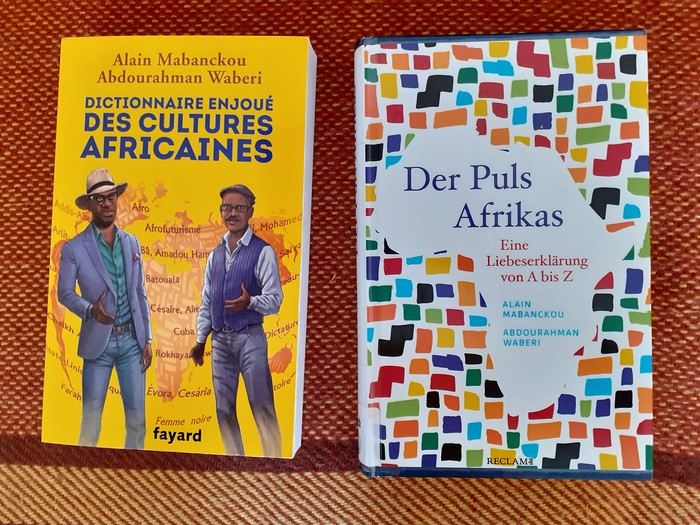
The Maggi cube, an unchallenged hegemony, and so much more
“The hopeless continent,” headlined The Economist, a British magazine, in July 2000 about Africa. Eleven years later, the same magazine headlined “Africa rising” instead. Images of Africa in the prosperous North constantly oscillate between apocalyptic scenarios and enthusiastic projections. A key issue with such images lies in the generalization they entail. If you look at the continent, considerable contrasts emerge depending on space and time. It’s no surprise that a region of the world encompassing such diverse ecological zones, maintaining such varied ties with other continents, comprising nearly fifty nation-states in sub-Saharan Africa alone, and characterized by a great diversity of languages, belief systems, and historical paths, doesn’t share a single destiny.
And yet, for many people outside Africa, as well as for many Africans, the continent constitutes a single entity, defined by criteria such as skin color, a colonial past, poverty, and the art of survival. Until now, these perspectives were generally accompanied by the idea that Africa had to—or should have—followed a single path together, sometimes called development, sometimes modernization, sometimes liberation, then a market economy. None of these paths delivered on their promises.
The two writers Alain Mabanckou and Abdourahman Waberi—one from Congo, the other raised in Djibouti, both long settled in France and now professors at renowned North American universities (Los Angeles, Washington)—have had enough of pessimistic scenarios: “We are aware that Africa is in the world and the world is in Africa. The same goes for all other continents, as our destinies are inextricably linked for better or worse. We refuse to see Africa as a reservoir of misfortunes or a continent cursed by atavistic misfortune and characterized by ethnic conflicts. [...] It’s this passionate flame we wanted to capture in a book [...] a kind of stroll through African cultures, without any demands, each letter of the alphabet leading us to a notion, a practice, a concept, a moment in history, literature, painting, politics, economics, cuisine, etc.” (p.10-11). Africa, they write, is on the verge of “imposing a signature, a style, a way of being in the world and in relation to the rest of the world.” (p.11) To put words to the continent’s diversity and dynamism, the two authors created a “rambling ABC,” a kind of portrait—or more precisely, a mythography—that lets you see and feel the pulse of a vast continent whose cultural power is unfolding before our eyes. Once marginalized or even mocked, the voice and importance of the Continent in global affairs are now undeniable” (p.11), containing over a hundred entries, mostly concise, written in a relaxed and casual style. The optimistic, even exuberant tone is set from the brief introduction. The duo of authors wants to “sing a love song to the cultures of our continent, to its inhabitants past and present, to its exceptional resources and its spectacular globalization despite a certain pollution that still clouds our skies due to the unmatched duration of dictatorships in some of our regions.” (p.12) In doing so, they don’t want to be too distracted by today’s Afewerki-Biya-Bongo-Déby & Co. ...
Of course, you’ll find tributes to great precursors like Frantz Fanon (“[...] it was a love story and admiration that wasn’t dimmed by the four decades separating his birth from ours. Let’s add that we were born while the native of Fort-de-France had left the world’s stage four years earlier, in the prime of life” p.141), Mongo Beti (“You must read and reread Mongo Beti, a genius who used his fame to support often just causes in Africa, like defending oppressed groups. His place is already in History. His oppressors, like the dictators Ahmadou Ahidjo and Paul Biya, can’t compete in the same category” p.64), the Malian Amadou Hampâté Bâ
(“Posterity remembers him mainly as an tireless defender of African cultures. His plea for the collection and preservation of traditional African knowledge remains a major event for all men and women of good will. One day in 1960, at the UNESCO podium, the native of Bandiagara sounded the alarm: ‘[...] Since we’ve admitted that the humanity of each people is the heritage of all humanity, if African traditions aren’t collected in time and written down, they’ll one day be missing from the universal archives of humanity.’” p.51),
Kwame Nkrumah, “one of the founders of Pan-Africanism, father of Ghana’s independence” (p.239), as well as the historian Cheikh Anta Diop, the writer, poet, and politician Aimé Césaire, and the economist and thinker Samir Amin, but also very warm tributes to certain contemporary African intellectuals like Souleymane Bachir Diagne and Achille Mbembe
(“A few years ago, in dominant economic circles, a rumor often resurfaced, usually disguised as a cold and scientifically proven analysis: Africa is useless. It’s a burden for the rest of the human community. With its 2% share in world trade, it would disappear from stock market radars without anyone noticing. So? Maybe it’ll be pulled up by other continents. Wanting to surpass itself is a crazy bet for Africans, they concluded. Arrogant or clueless, President Nicolas Sarkozy declared before an audience of students and teachers at Cheikh Anta Diop University in Dakar: ‘The African man hasn’t entered history enough [...] He only knows the eternal repetition of time marked by the endless repetition of the same gestures and words.’ That was in 2007. For decades, armed only with reason, an intellectual often steps up to debunk prejudices, lazy readings, and dishonest frameworks used as false fronts by those who, like Nicolas Sarkozy or former journalist Stephen Smith, out of ignorance, contempt, or condescension, distort African reality. This intellectual is none other than the historian and political scientist Achille Mbembe. This heir of Frantz Fanon, Amílcar Cabral, Jean-Marc Ela, and Fabien Eboussi-Boulaga was born in 1957 in Cameroon, in the Bassa region. Marked early by the upheavals of a fratricidal war, Achille Mbembe became the guardian of the memory of martyrs. After brilliant studies in Paris, he went on to teach at the best American universities, but the call of the Continent was stronger than anything else. In Dakar, he once directed CODESRIA (Council for the Development of Social Science Research in Africa) before joining the University of the Witwatersrand in Johannesburg, South Africa. Even though the author of *Critique of Black Reason* (Éditions La Découverte, 2015) spends a few months at Duke University in North Carolina, his observation post remains South Africa. From Johannesburg, Achille Mbembe scrutinizes Africa and the whole world. A lucid observer with an elegant and generous pen, Achille Mbembe knows how to blend big and small history: ‘I was born one day in July, as the month was drawing to a close. It was 1957, in that part of Africa recently named ‘Cameroon,’ a memory of the wonder that seized Portuguese sailors in the 15th century when, sailing up the river near Douala, they couldn’t help but note the presence of a multitude of crustaceans, and named it *Rio dos Camarões*, meaning ‘River of Shrimp.’ I grew up in the shadow of this nameless land, since, in a way, the name it bears is only the product of someone else’s astonishment: a lexical mistake, if you will.’ From this mistake or wound, he made leaven, a springboard to compose a rich work, recognized worldwide. To denounce barriers and barbarians too. But that’s not enough. Among his peers in circles of thought and action, Achille Mbembe passionately and consistently defends human dignity and the beauty of the world. In doing so, he fulfills the mission Frantz Fanon entrusted to him.” (p.227-229),
as well as entries dedicated to lesser-known artists and intellectuals, like the French journalist and activist Rokhaya Diallo, daughter of Senegalese and Gambian parents, or the Ethiopian filmmaker Haile Gerima, who has long lived in the United States. Other names from politics, sports, music, art, and literature: Kofi Annan, p.36; Barack Obama, p.243; Thomas Sankara, p.277; Ousmane Sow, p.285; Yambo Ouologuem, p.250; Léopold Sédar Senghor, p.282; Muhammad Ali, p.30; Nuruddin Farah, p.146; Salif Keita, p.203; Ahmadou Kourouma, p.206; Ngũgĩ wa Thiong’o, p.236; Winnie Mandela, p.224; Kylian Mbappé, p.226 ...
The authors, who resolutely commit to a “mythography” (p.11) of Africa, also pay special attention to local social movements, cultural events, and aspects of daily life. *Y’en a marre*, “which also meant ‘we’re fed up with sitting on our hands’” (p.320-321), emerged about a decade ago in Senegal as a citizen movement of peaceful resistance and symbolizes, the authors emphasize, the fact that African youth are increasingly fed up “with the political circus deployed in Africa since independence, as our parents would say, ‘since the White man left’...” (p.321). A full entry is dedicated to the Maggi bouillon cube, which has flooded African markets for about forty years and enjoys immense popularity (“It’s everywhere in Africa, from Dakar to Djibouti, and from Tangier to Cape Town. It’s in every pot, every stew. Little hands put it in every sauce, every local or adapted dish. An unchallenged hegemony! You’ll find it in diasporas too. The culinary strolls in Paris, in the [...] neighborhood” p.90). Critics blame it not only for impoverishing the aromatic diversity of local dishes but also for being harmful to health. And yet, “he poorest Africans, those who eat only once a day, a few spoonfuls of white beans and a ball of *foufou*, for example, are the most fervent users of the magic cube.” (p.92-93)
For *fonio*, “the new trendy cereal. [...] From the millet family, fonio is probably the oldest cereal cultivated in West Africa, and mainly in its sub-Saharan part, for millennia. [...] Easy to grow, water-efficient, fonio grows everywhere except on clay soils. Long neglected because it was considered the poor man’s crop, fonio is now a source of pride for the farmers who cultivate it and cherish it like the apple of their eye” (p.156-157), the authors immediately offer a detailed recipe, letting the reader know that “e can’t resist sharing this fonio with chicken recipe from Mali with you:
Ingredients: 1 chicken 3 large ripe red tomatoes 4 tbsp tomato paste 4 large onions 1 garlic clove 1/2 cup oil 2 Maggi cubes or salt 2 large carrots 1 turnip 1 large cabbage 2 large potatoes 1 celery stalk 1 packet pre-cooked fonio 4 okra (or okra powder) salt, pepper
Preparation: 1. Prepare the sauce: wash and cut the chicken. Peel the onions, garlic, and vegetables. 2. In a pot, fry the chicken pieces. 3. Dice the onions, tomatoes, carrots, and turnip very small and add them to the pot. 4. Add the tomato paste, salt, and pepper. 5. Simmer for 15 min, then add 2 L of water and the cooked chicken pieces. 6. Simmer for 30 min, then add the crushed garlic and celery, plus the cabbage cut into 4 and the potatoes cut in half. 7. Prepare the fonio: cover it with warm water, let it rest for 15 min, and cook it over low heat. 8. In a small pot, boil the okra and crush them. 9. Mix the crushed okra with the cooked fonio, then salt. Serve hot.” (p.158-159)
The comedy *Black Mic Mac*, released in French theaters in 1986 and addressing France’s increasingly restrictive immigration policy at the time, also gets an entry, as do *Tintin in the Congo*, the popular comic, and *Jip’s Café* (“[...] a little Africa in the heart of Paris, with passersby stopping to admire the ‘ambianceurs’ on the dance floor or attend the cultural events offered by the place” (p.194), an African establishment in Paris that Alain Mabanckou already immortalized in one of his novels.
The duo of authors also tackles thorny subjects like jihadism (p.119), the Rwandan genocide (p.272), the CFA franc (p.82), and dictatorship (p.110). While the two strike the right tone here, many entries leave a slightly bitter taste. Two examples: why doesn’t the text on Barack Obama mention the great disappointment of many people in Africa, who expected more from the African policy of the first U.S. president with African roots than just occasional warm words? Why do the comments on Winnie Mandela gloss over the fact that she was a highly controversial icon of the anti-apartheid movement due to her involvement in kidnappings, acts of torture, and murders of alleged apartheid collaborators? Instead, there’s a compassion that brings tears to the eyes: “She was often reduced to a secondary role, the wife of a great man” or “When victory came, she didn’t taste its fruits. Divorced, isolated. She would never be a ‘first lady’ in an evening gown, posing before a bed of chrysanthemums. They’d keep her far from the circles of power” (p.224-225). At this point, I would’ve liked the authors to take a slightly more critical stance...
That said, these “weaknesses” (if you can call them that) shouldn’t overshadow the book as a whole. It remains an informative, sometimes very entertaining, and often even original work in its own way.
Book information (the original French and the German translation):
Alain Mabanckou/Abdourahman Waberi. Dictionnaire enjoué des cultures africaines. Fayard, 2019. Alain Mabanckou/Abdourahman Waberi. Der Puls Afrikas. Eine Liebeserklärung von A bis Z. Reclam, 2022.
Hery
Africa Round Trip: Questions About Vehicle Type and Roads
Hi there!
I'm considering doing a round trip of Africa, starting in Morocco, then following the west coast down to the south, and finally heading back up along the east coast.
However, I have some big questions about the route:
From what I've gathered after a lot of research, the road seems quite doable without a 4x4 as far as Senegal, or even Benin?
It's between Benin and Namibia that it would get really tough, and I'd either need a 4x4 or to ship my vehicle if I'm in a converted H2L2 van (not 4x4)?
Could someone clarify this for me?
Otherwise, it seems like Southern, Northern, and Eastern Africa are accessible without a 4x4?
As for the vehicle, if a 4x4 is essential, I'm torn between: Kangoo 4x4 Lada Niva 4x4 standard C15 C15 4x4 Renault Trafic 4x4 (H2L2, so still quite large) or a Subaru Libero 4x4
Or would it even be possible with a simple Twingo? ^
But is that enough, or do I absolutely need a 4x4 like a Toyota, Land Rover, or something similar?
Those are my current questions! If anyone has some answers, that would be amazing!
Thanks so much!
I'm considering doing a round trip of Africa, starting in Morocco, then following the west coast down to the south, and finally heading back up along the east coast.
However, I have some big questions about the route:
From what I've gathered after a lot of research, the road seems quite doable without a 4x4 as far as Senegal, or even Benin?
It's between Benin and Namibia that it would get really tough, and I'd either need a 4x4 or to ship my vehicle if I'm in a converted H2L2 van (not 4x4)?
Could someone clarify this for me?
Otherwise, it seems like Southern, Northern, and Eastern Africa are accessible without a 4x4?
As for the vehicle, if a 4x4 is essential, I'm torn between: Kangoo 4x4 Lada Niva 4x4 standard C15 C15 4x4 Renault Trafic 4x4 (H2L2, so still quite large) or a Subaru Libero 4x4
Or would it even be possible with a simple Twingo? ^
But is that enough, or do I absolutely need a 4x4 like a Toyota, Land Rover, or something similar?
Those are my current questions! If anyone has some answers, that would be amazing!
Thanks so much!
Crossing Borders by Car: Zambia, Malawi, Tanzania
Hi there,
We’re doing a staged tour of Africa in our Citroën Dyane 2CV.
We left Belgium and our car is currently in Zambia. We’ll be joining it at the start of 2025 to continue on to Malawi and Tanzania.
We’d love to chat with overlanders who’ve already crossed these borders with a vehicle—without necessarily having a carnet de passage, given the costs and guarantees required.
Thanks
Voyage en Zambie, trop froid pour camper en juillet ou août (climat) English translation pending
Bonjour,
j'envisage un voyage en Zambie en juillet ou août mais je me demande si c'est la meilleure période? Cela me permettrait d'y rester un mois mais ne fait-il pas trop froid pour camper?
D'avance merci pour vos retours