Results for "Tremblade+|+127"
1998 results found.
Trip to Morocco in September-October 2025, in our camper van
Hi everyone,
We’re just back from a month-long trip to Morocco in our camper van.
After crossing France (we left from the Nantes area) and Spain, we arrived in Algeciras where we bought our boat tickets to Tangier. When we got to Tangier, as we were going through customs, you can imagine our surprise when the customs officer took our road map of Morocco and pointed out the label "Western Sahara" (just like in the forum’s destination section, by the way!).
He wanted it to say "Moroccan Sahara" instead!!! But there was nothing we could do—it was an old map... He wouldn’t listen, and after long discussions with the other (younger) customs officers, he finally gave it back and let us through... Unbelievable! Later, we heard that other travelers had their maps confiscated outright.
So, hide it well if you want to keep yours!!!
Anyway, we skirted around Tangier’s suburbs—pretty grim—and finally arrived in Asilah.
Following the coast and the long promenade along the beach, we reached the campsite. It was a bit crowded, not much shade, but it wasn’t far from the medina or the beach, and it wasn’t expensive. There’s some life here: Moroccan families seem to live on-site, in tents or basic bungalows. A woman was cooking tagine on a brazier—we were right in the atmosphere! The night was quiet, and we slept well. We set off on foot, walking along the seafront to the medina... We’d already been here in 2009. It was less touristy back then! Still, at this early hour, the little streets inside were very quiet. The walls had been freshly whitewashed, and there were even more murals than before. Around 11:30 AM, we strolled along the ramparts by the sea. There was a nice breeze! And a lot more people around. We enjoyed a milkshake on the terrace of a café overlooking the beach that stretches out at the foot of the medina. Some young guys were having fun diving off the rocks—and even off the top of the wall!
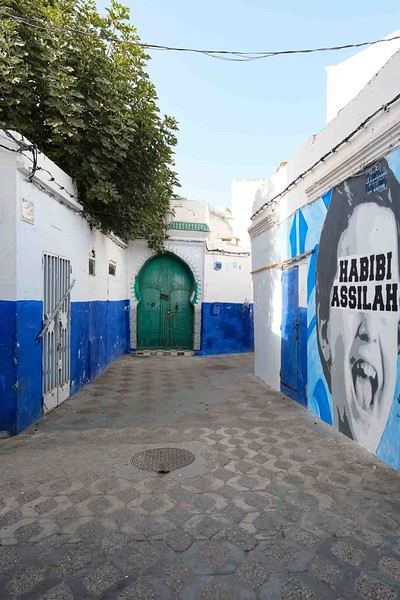
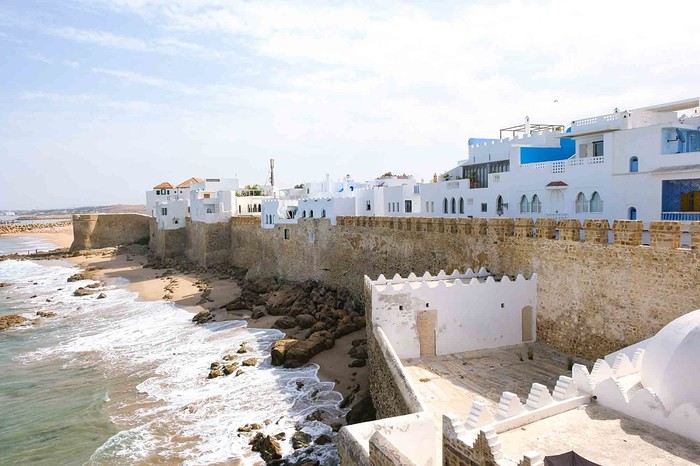
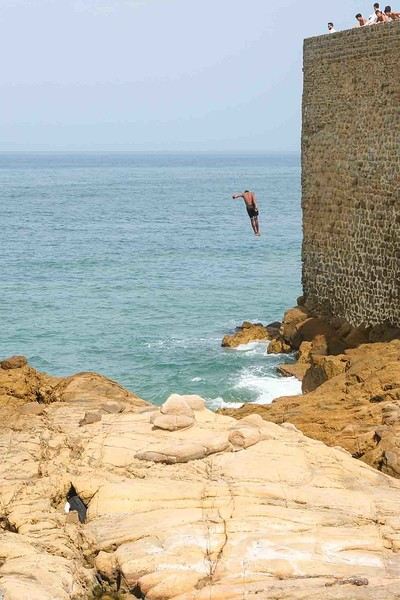
Anyway, we skirted around Tangier’s suburbs—pretty grim—and finally arrived in Asilah.
Following the coast and the long promenade along the beach, we reached the campsite. It was a bit crowded, not much shade, but it wasn’t far from the medina or the beach, and it wasn’t expensive. There’s some life here: Moroccan families seem to live on-site, in tents or basic bungalows. A woman was cooking tagine on a brazier—we were right in the atmosphere! The night was quiet, and we slept well. We set off on foot, walking along the seafront to the medina... We’d already been here in 2009. It was less touristy back then! Still, at this early hour, the little streets inside were very quiet. The walls had been freshly whitewashed, and there were even more murals than before. Around 11:30 AM, we strolled along the ramparts by the sea. There was a nice breeze! And a lot more people around. We enjoyed a milkshake on the terrace of a café overlooking the beach that stretches out at the foot of the medina. Some young guys were having fun diving off the rocks—and even off the top of the wall!
Bright red and a headache
Hello 🙂
I should be serving a warming drink to the participants in the discussion about gardens and parks that provide us with beautiful photos, I could mention the delicious buttery scent wafting from bakeries in the thread about returning to France, but my heart, its powerful pulse that nourishes my entire being, is elsewhere.
Dasht-e Lut, Yazd, Esfahan, Bam, Kerman, Qeshm, Hormuz—a melody, a prayer at the heart of desire.
A dream, an unattainable fantasy? No. Not anymore. A very serious Italian travel agency is organizing this trip for 6 people this winter. I’m signed up, I’m going, I’m living. Maybe.
"But you’re completely crazy!!!!"
I know... I know that every civilization, every society has a vital need to create scapegoats to define and justify itself, pathetically. And Iran is one of them, top of the list. I laugh or sigh, and it doesn’t bother me.
But that unchanging red, deep red and garnet, so beautiful in itself, in all the Western chancelleries repeats, whispers, shouts: don’t go, don’t go, don’t go, you’re putting yourself in danger and we can’t do anything for you. You’ll be turned into mere bargaining chips, into arguments for endless negotiations. Fear must be instilled, its power absolutely preserved, no concessions made to the enemy. The information (how many French hostages, real or fake, compared to the number of travelers?) is always lacking.
Traveling becomes a merciless confrontation between desire, the vital pulse, and anxiety, its ghosts.
Catherine
I should be serving a warming drink to the participants in the discussion about gardens and parks that provide us with beautiful photos, I could mention the delicious buttery scent wafting from bakeries in the thread about returning to France, but my heart, its powerful pulse that nourishes my entire being, is elsewhere.
Dasht-e Lut, Yazd, Esfahan, Bam, Kerman, Qeshm, Hormuz—a melody, a prayer at the heart of desire.
A dream, an unattainable fantasy? No. Not anymore. A very serious Italian travel agency is organizing this trip for 6 people this winter. I’m signed up, I’m going, I’m living. Maybe.
"But you’re completely crazy!!!!"
I know... I know that every civilization, every society has a vital need to create scapegoats to define and justify itself, pathetically. And Iran is one of them, top of the list. I laugh or sigh, and it doesn’t bother me.
But that unchanging red, deep red and garnet, so beautiful in itself, in all the Western chancelleries repeats, whispers, shouts: don’t go, don’t go, don’t go, you’re putting yourself in danger and we can’t do anything for you. You’ll be turned into mere bargaining chips, into arguments for endless negotiations. Fear must be instilled, its power absolutely preserved, no concessions made to the enemy. The information (how many French hostages, real or fake, compared to the number of travelers?) is always lacking.
Traveling becomes a merciless confrontation between desire, the vital pulse, and anxiety, its ghosts.
Catherine
How do you feel about coming back to France?
Hi there, I’ve been traveling for 18 years now, at least 6 months a year, and as the years go by, I actually enjoy coming back to France more and more—a feeling I struggled with at first. I mean, we always think the grass is greener elsewhere.
But in the end, I find meaning in that saying about how there’s no place like home. I still love traveling just as much, but now my trips are shorter, and I enjoy spending more time in our beautiful country, even though I don’t hesitate to criticize it.
How about you? How do you handle coming back from your travels?
My life in Camargue, my homeland, and in Colombia, my heart's country
My two bullfighting traditions when I'm back home in Camargue (France) and in Colombia (Caribbean) every time I return. 🤠
Details:
Bullfights (corridas) aren’t part of my two bullfighting traditions, but I respect those who attend them!!!
In these two ancestral bullfighting traditions—which aren’t bullfights—the Bulls and Toros aren’t killed or tortured, as some might think.
These are bull games where the animals return to their pastures afterward and only come back to the Arenas 2–3 times a year at most.
They spend 15 minutes in the ring for the Camarguais and 5 minutes for the Toros in the Colombian Corralejas.
They’re cared for and pampered. They’ll die of old age in miles of open fields.
The young people who face them are professionals, risking their lives to support their families and live their Passion for the Toro!!! 😄
https://youtu.be/yYKQer42HoQ
Colombian Corraleja in the link below (hope it works) 🤪
https://fb.watch/BMfmuCgQpG/
Review of a Norway cruise on the Emerald Princess in June 2025 (1)
Hello everyone,
I’ve wanted to take this Norway cruise for a very long time. The first time I booked it was in July 2020 with Azamara. Unfortunately, it was canceled, as everyone remembers. When I tried to book it again, the prices (already a bit high with Azamara) had simply doubled. So, since then, I’ve been keeping an eye out every year for any opportunities...
The last time we sailed with Princess was eleven years ago, and things didn’t go very well. I came back pretty unhappy with their service and quite disappointed. Despite the $600 they gave me as credit for a future cruise, I’d never set foot on one of their ships again.
But this time, the opportunity arose—a fantastic itinerary with lots of stops, a reasonable price for 16 nights (I’ll share the details in the conclusion), and a ship that’s not too big, so to speak, with only 3,000 passengers. I’m not expecting much from the cruise line this time and am boarding the ship with low expectations beyond the itinerary.
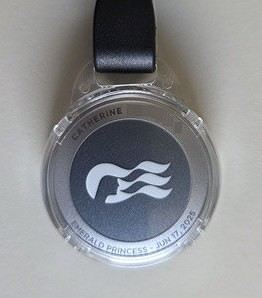
Princess has introduced an app to download before the cruise. It’s essential because online check-in is no longer available, and the agency doesn’t send a travel journal. Everything is done through the app. After completing the check-in on the app, we only know that we’ll need to pick up our key, the Medallion, at embarkation by following the blue line in the terminal and presenting our passport.
Up until our departure, the weather forecast for the coming week in Norway is disastrous—rain, rain, and more rain. It was pretty much the same two years ago before our Iceland cruise, and in the end, the weather turned out fine.
If you’re ready to embark on the Emerald Princess to discover this beautiful cruise and the stunning landscapes of Norway, let’s go!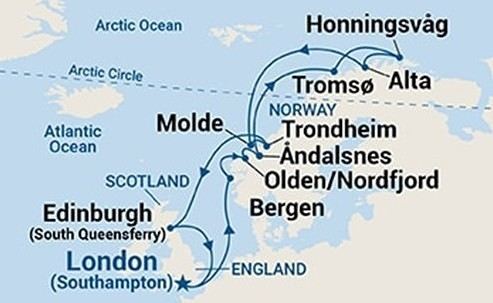
Southampton - Sea day - Bergen - Olden - Åndalsnes - Sea day - Tromsø - Honningsvåg (North Cape) - Alta - Sea day - Molde - Trondheim - Two sea days - Edinburgh - Sea day - Southampton
I’ve wanted to take this Norway cruise for a very long time. The first time I booked it was in July 2020 with Azamara. Unfortunately, it was canceled, as everyone remembers. When I tried to book it again, the prices (already a bit high with Azamara) had simply doubled. So, since then, I’ve been keeping an eye out every year for any opportunities...
The last time we sailed with Princess was eleven years ago, and things didn’t go very well. I came back pretty unhappy with their service and quite disappointed. Despite the $600 they gave me as credit for a future cruise, I’d never set foot on one of their ships again.
But this time, the opportunity arose—a fantastic itinerary with lots of stops, a reasonable price for 16 nights (I’ll share the details in the conclusion), and a ship that’s not too big, so to speak, with only 3,000 passengers. I’m not expecting much from the cruise line this time and am boarding the ship with low expectations beyond the itinerary.
Princess has introduced an app to download before the cruise. It’s essential because online check-in is no longer available, and the agency doesn’t send a travel journal. Everything is done through the app. After completing the check-in on the app, we only know that we’ll need to pick up our key, the Medallion, at embarkation by following the blue line in the terminal and presenting our passport.
Up until our departure, the weather forecast for the coming week in Norway is disastrous—rain, rain, and more rain. It was pretty much the same two years ago before our Iceland cruise, and in the end, the weather turned out fine.
If you’re ready to embark on the Emerald Princess to discover this beautiful cruise and the stunning landscapes of Norway, let’s go!
Southampton - Sea day - Bergen - Olden - Åndalsnes - Sea day - Tromsø - Honningsvåg (North Cape) - Alta - Sea day - Molde - Trondheim - Two sea days - Edinburgh - Sea day - Southampton
Family itinerary in Quebec in July: tips for finalizing the last leg after Parc du Bic
Hi there,
We’re heading to Quebec from July 7 to 21 with our two kids (ages 5 and 7) and my wife, and we’re putting together an itinerary while keeping some flexibility (though much less than we’d hoped, since we’re realizing accommodations are already filling up fast!).
Below is our draft plan—pretty far along since we’ve booked 9 out of 14 nights—but it’s definitely not perfect.
We’d love some advice on what to do after Parc du Bic (3 nights to improvise) before heading back to Parc Omega, where we’ve booked a tipi :-)
It seems clear that a 3-day Gaspésie loop isn’t doable (too bad about Percé and Parc Forillon, but I think we’re already covering a lot of ground with this route!). But what about the option of driving up to Sainte-Anne-des-Monts to spend a day in Parc de la Gaspésie before the (long) drive back, and still enjoying part of the coastal road, which looks stunning? Thanks in advance for your thoughts!
3 nights in Montreal (booked) Day 1 to 3 – July 7 to 9: Montreal
2 nights near Lac Saint-Charles, 20 min from Quebec City (booked) Day 4 – July 10: Montreal → Montmorency Falls → Quebec City (~3h drive) Day 5 – July 11: Quebec City
2 nights in the Saguenay region (booked) Day 6 – July 12: Quebec City → Baie-Saint-Paul → Canopée Lit (Saguenay), 20 min from Tadoussac Day 7 – July 13: Day in Tadoussac/Les Bergeronnes for a whale-watching excursion, then back toward the Saguenay Fjord for the evening and overnight stay
1 night in Parc du Bic (booked)
Day 8 – July 14: Ferry from Les Escoumins (2 PM) → Trois-Pistoles → Parc du Bic
3 nights to improvise—is it even feasible to go without reservations in July for a family of 4? Day 9 – July 15: Hikes/activities in Parc du Bic – overnight near Cap-Chat/Sainte-Anne-des-Monts??? Other ideas? Day 10 – July 16: Parc de la Gaspésie? Day 11 – July 17: More hikes? Then drive back toward the Mont-Joli area?
1 night at Parc Omega (booked)
Day 12 – July 18: Long drive back from Mont-Joli? Maybe via Kamouraska for a meal break, then overnight at Parc Omega
2 nights near Montreal or surrounding area
Day 13 – July 19: Visit Parc Omega, then a relaxed drive back via scenic routes to Montreal or nearby
Day 14 – July 20: Last day and night in Montreal or the suburbs, fun activities with the kids
Day 15 – July 21: Flight home in the evening
3 nights in Montreal (booked) Day 1 to 3 – July 7 to 9: Montreal
2 nights near Lac Saint-Charles, 20 min from Quebec City (booked) Day 4 – July 10: Montreal → Montmorency Falls → Quebec City (~3h drive) Day 5 – July 11: Quebec City
2 nights in the Saguenay region (booked) Day 6 – July 12: Quebec City → Baie-Saint-Paul → Canopée Lit (Saguenay), 20 min from Tadoussac Day 7 – July 13: Day in Tadoussac/Les Bergeronnes for a whale-watching excursion, then back toward the Saguenay Fjord for the evening and overnight stay
1 night in Parc du Bic (booked)
Day 8 – July 14: Ferry from Les Escoumins (2 PM) → Trois-Pistoles → Parc du Bic
3 nights to improvise—is it even feasible to go without reservations in July for a family of 4? Day 9 – July 15: Hikes/activities in Parc du Bic – overnight near Cap-Chat/Sainte-Anne-des-Monts??? Other ideas? Day 10 – July 16: Parc de la Gaspésie? Day 11 – July 17: More hikes? Then drive back toward the Mont-Joli area?
1 night at Parc Omega (booked)
Day 12 – July 18: Long drive back from Mont-Joli? Maybe via Kamouraska for a meal break, then overnight at Parc Omega
2 nights near Montreal or surrounding area
Day 13 – July 19: Visit Parc Omega, then a relaxed drive back via scenic routes to Montreal or nearby
Day 14 – July 20: Last day and night in Montreal or the suburbs, fun activities with the kids
Day 15 – July 21: Flight home in the evening
Sao Tomé, the forgotten island
Hey there, it's me again—back with my usual travel journal share for our loved ones, from our 15-day trip in October 2019.
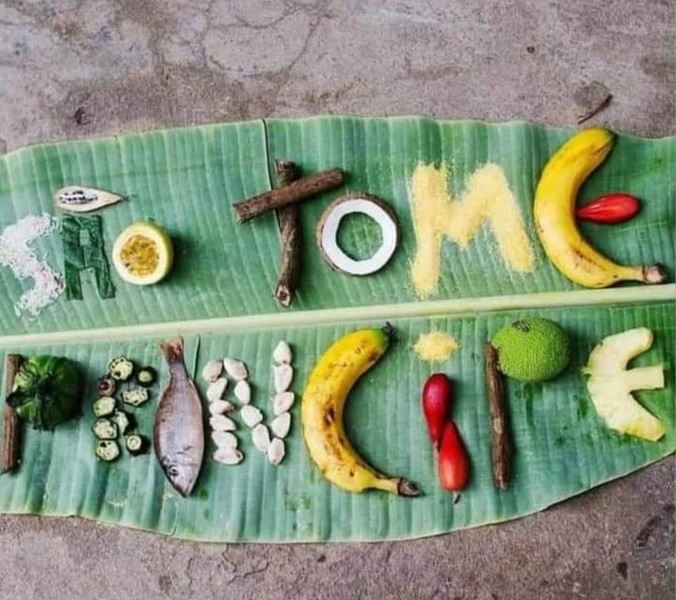
"Ah, here it is at last—that sweet scent of elsewhere so dear to Cricri and Lulu’s noses, that mix of apprehension and desire when facing the unknown.
We’re really diving into the unknown this time, taking you to the island of SAO TOMÉ... also known as the island: *‘Wait, what did you say?’* 😄. Because apparently, no one’s heard of Sao Tomé—except our Portuguese friends.
It’s an archipelago of three islands smack in the middle of the world, right on the equator, off the coast of Gabon.
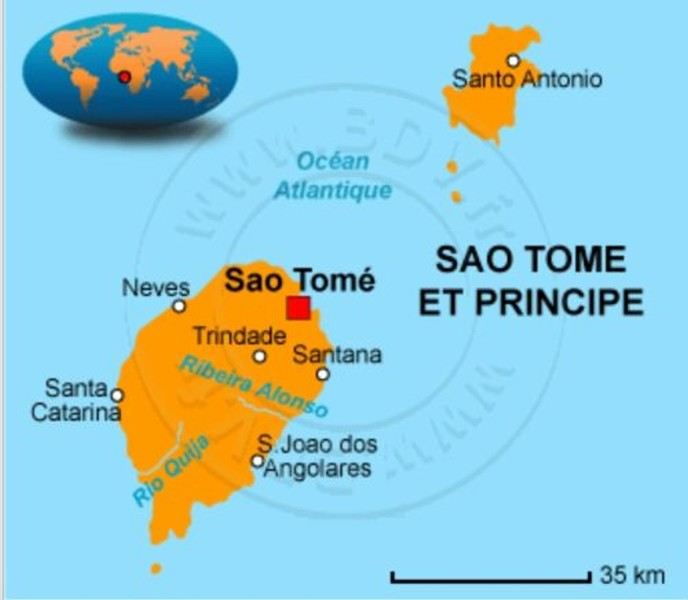
No, these aren’t the sun-soaked, Polynesian lagoon islands. Here, *‘it rains, it pours...’* pretty much all the time, it seems.
There’s not much to *‘see’* in the traditional tourist sense—EXCEPT for stunning landscapes, lush vegetation, a few beaches with golden or black sand, colonial buildings still in their original state, a single main road, and plenty of *‘tracks’* that are more or less drivable. All this surrounded by an African population that speaks Portuguese and is known for its warm welcome.
Well, that should be enough for our happiness—and hopefully yours too! 😊
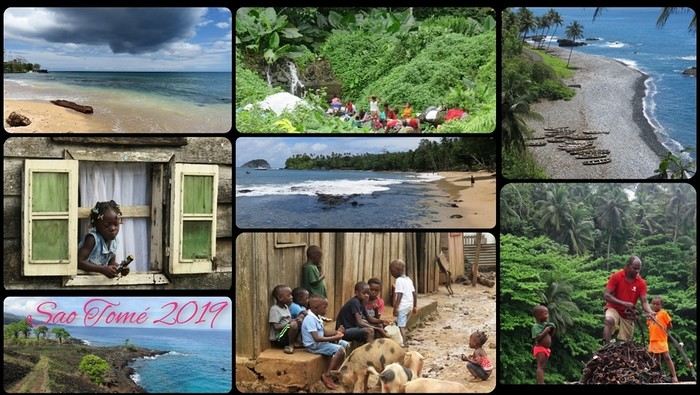
Ready for landing?
"Ah, here it is at last—that sweet scent of elsewhere so dear to Cricri and Lulu’s noses, that mix of apprehension and desire when facing the unknown.
We’re really diving into the unknown this time, taking you to the island of SAO TOMÉ... also known as the island: *‘Wait, what did you say?’* 😄. Because apparently, no one’s heard of Sao Tomé—except our Portuguese friends.
It’s an archipelago of three islands smack in the middle of the world, right on the equator, off the coast of Gabon.
No, these aren’t the sun-soaked, Polynesian lagoon islands. Here, *‘it rains, it pours...’* pretty much all the time, it seems.
There’s not much to *‘see’* in the traditional tourist sense—EXCEPT for stunning landscapes, lush vegetation, a few beaches with golden or black sand, colonial buildings still in their original state, a single main road, and plenty of *‘tracks’* that are more or less drivable. All this surrounded by an African population that speaks Portuguese and is known for its warm welcome.
Well, that should be enough for our happiness—and hopefully yours too! 😊
Ready for landing?
15-day itinerary from Bangkok to the southern classics
Hi there,
The round trip to Bangkok is almost booked.
Here’s the itinerary I’ve planned for this new trip to Thailand:
Arrival – 2 nights in Bangkok (any hotel recommendations? Very quiet, near Chinatown or by the river)
Train or taxi (which app should I use for Thailand?) to Phetchaburi – 2 nights (any hotel recommendations?)
Daytime train to Surat Thani – 1 night there (any hotel recommendations?)
Pick up the rental car and head to Khao Sok – 1 night there (any hotel recommendations?)
Drive to Ko Kho Khao – 3 nights – relaxation (any hotel recommendations?)
Drive to Phang Nga Bay – 1 night (any base recommendations?)
Excursion in the bay, then drive to Krabi – 2 nights (any hotel recommendations) or any other spot with beautiful, quiet beaches that you might know?
Return to Surat Thani – overnight train to Bangkok, then Ayutthaya (any hotel recommendations?)
Visit the site and transfer to the airport – sniff, time to head back!
If you have other suggestions, keeping in mind the trip’s vibe: beach time without crowds or entertainment, a bit of nature, a bit of culture, no stress... No domestic flights and charming accommodations (not at 150 € per night, even though the budget is reasonable!)
Not sure I’ll follow them all, but all your ideas are welcome! 😉
Thanks. 🙂
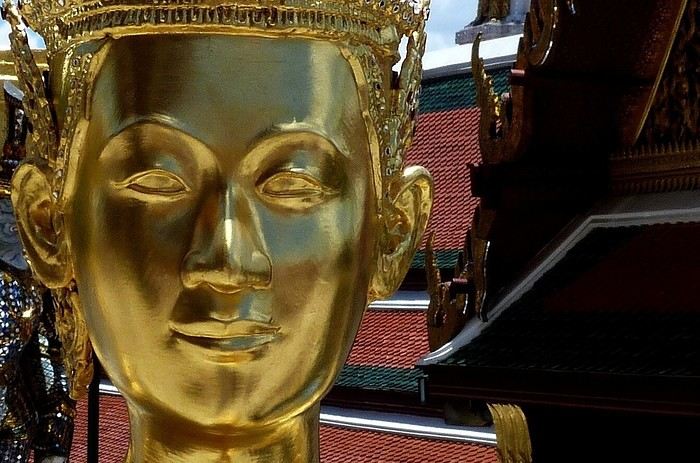
The round trip to Bangkok is almost booked.
Here’s the itinerary I’ve planned for this new trip to Thailand:
Arrival – 2 nights in Bangkok (any hotel recommendations? Very quiet, near Chinatown or by the river)
Train or taxi (which app should I use for Thailand?) to Phetchaburi – 2 nights (any hotel recommendations?)
Daytime train to Surat Thani – 1 night there (any hotel recommendations?)
Pick up the rental car and head to Khao Sok – 1 night there (any hotel recommendations?)
Drive to Ko Kho Khao – 3 nights – relaxation (any hotel recommendations?)
Drive to Phang Nga Bay – 1 night (any base recommendations?)
Excursion in the bay, then drive to Krabi – 2 nights (any hotel recommendations) or any other spot with beautiful, quiet beaches that you might know?
Return to Surat Thani – overnight train to Bangkok, then Ayutthaya (any hotel recommendations?)
Visit the site and transfer to the airport – sniff, time to head back!
If you have other suggestions, keeping in mind the trip’s vibe: beach time without crowds or entertainment, a bit of nature, a bit of culture, no stress... No domestic flights and charming accommodations (not at 150 € per night, even though the budget is reasonable!)
Not sure I’ll follow them all, but all your ideas are welcome! 😉
Thanks. 🙂
Jerusalem, the Earthly
5 AM, I’m shivering.
The icy February 2022 fog wraps around the deserted Terminal 2, closed for renovations, on the outskirts of which my hotel stands. I wait alone at the stop in the pitch-black night for the first shuttle of the day, which is supposed to take me to T1. I have no idea where I’m going. All I know is the name: Jerusalem. I’m entirely goy, just as entirely atheist, but I’ve been visiting that imaginary city for decades. It haunts, fantastical, the medieval images that once occupied me for so long. It regularly creeps into my ears through the misfortune of news reports from radios around the world. It crystallizes so many of humanity’s delusions, of which I’m a part. I know nothing about it, haven’t read a single guidebook. But I want to see it, walk its streets, live it for a few days. Make it real, tangible.
The flight is on time. This is the era of mandatory FFP2 masks on all flights landing in Italy (Europe?). The crew valiantly fights against passengers’ ingenious attempts to remove them: sipping their drinks milliliter by milliliter, nibbling their snacks cubic millimeter by cubic millimeter, feigning breathing difficulties, yanking off the elastic bands... A rabbi passes through the rows collecting donations. Men put on their tefillin, drape their prayer shawls, and rock to the rhythm of their prayers. Already, the sense of elsewhere.
Ben Gurion Airport is a stunning airport—monumental, bright, functional, adorned with archaeological remnants and enormous photographs showcasing the country’s great leader in its works. I collect my visa from a kiosk, quickly endure the routine interrogation from a military officer slumped in his seat, withdraw some shekels from an ATM, get my nostrils swabbed at one of the many molecular testing stations in exchange for a yellow all-inclusive resort-style wristband that grants me passage through the outer doors. I spend ages (I think I’m just not good at this) in the crowd trying to find a sherut heading to Jerusalem, then lose myself in the landscape. Mediterranean-style—red earth, stunted vegetation, overrun with sprawling construction. I do glute exercises in this traffic, where a Neapolitan driver would embody road indolence. Endless traffic jams signal the city’s approach. The sherut drops me a few steps from my hotel, the Saint George’s Cathedral Pilgrim Guest House, right on the edge of the dotted lines on maps marking the divide between Jewish and Arab Jerusalem. It’s a pleasant complex with an inner garden and beautiful rooms featuring exposed stone vaults—and thank goodness, because I’m not allowed to leave until I get my test results. The reception staff, incredibly helpful, guide me through the myriad of meal delivery options. A roof over my head, a full stomach—all that’s left is to wait. Read Caillois, check the increasingly precise, increasingly ominous rumors of war brewing, yet again, in Europe, and navigate the city’s virtual map to get a sense of where to head once freed.
The next day, it’s done, and my first destination is, quite naturally, the Old City. The first gate I come across is Jaffa Gate, so Jaffa Gate it is—leading from the chaos of vehicles of all kinds into the labyrinth of alleys packed with goods of all kinds.
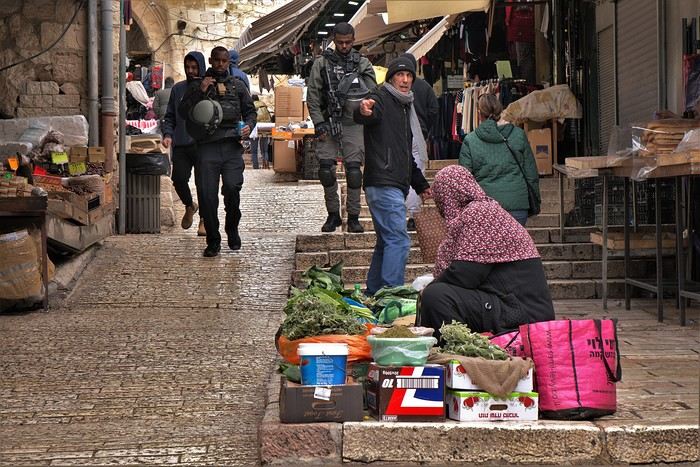
The flight is on time. This is the era of mandatory FFP2 masks on all flights landing in Italy (Europe?). The crew valiantly fights against passengers’ ingenious attempts to remove them: sipping their drinks milliliter by milliliter, nibbling their snacks cubic millimeter by cubic millimeter, feigning breathing difficulties, yanking off the elastic bands... A rabbi passes through the rows collecting donations. Men put on their tefillin, drape their prayer shawls, and rock to the rhythm of their prayers. Already, the sense of elsewhere.
Ben Gurion Airport is a stunning airport—monumental, bright, functional, adorned with archaeological remnants and enormous photographs showcasing the country’s great leader in its works. I collect my visa from a kiosk, quickly endure the routine interrogation from a military officer slumped in his seat, withdraw some shekels from an ATM, get my nostrils swabbed at one of the many molecular testing stations in exchange for a yellow all-inclusive resort-style wristband that grants me passage through the outer doors. I spend ages (I think I’m just not good at this) in the crowd trying to find a sherut heading to Jerusalem, then lose myself in the landscape. Mediterranean-style—red earth, stunted vegetation, overrun with sprawling construction. I do glute exercises in this traffic, where a Neapolitan driver would embody road indolence. Endless traffic jams signal the city’s approach. The sherut drops me a few steps from my hotel, the Saint George’s Cathedral Pilgrim Guest House, right on the edge of the dotted lines on maps marking the divide between Jewish and Arab Jerusalem. It’s a pleasant complex with an inner garden and beautiful rooms featuring exposed stone vaults—and thank goodness, because I’m not allowed to leave until I get my test results. The reception staff, incredibly helpful, guide me through the myriad of meal delivery options. A roof over my head, a full stomach—all that’s left is to wait. Read Caillois, check the increasingly precise, increasingly ominous rumors of war brewing, yet again, in Europe, and navigate the city’s virtual map to get a sense of where to head once freed.
The next day, it’s done, and my first destination is, quite naturally, the Old City. The first gate I come across is Jaffa Gate, so Jaffa Gate it is—leading from the chaos of vehicles of all kinds into the labyrinth of alleys packed with goods of all kinds.
La meilleure façon d'marcher, c'est de mettre un pied d'vant l'autre... English translation pending
Je déteste toujours autant marcher et pourtant, je recommence.
Comme un sentiment d’urgence pour n’entendre que les battements de mon cœur si secoué de peine qu’il ne me fallait plus entendre ni compréhension, ni compassion de quiconque.
Être seule, vraiment seule.
La terre est vivante, douée de mémoire et je ne voulais que cette mémoire. Je ne voulais m’encombrer de rien.
Homme sceptique un peu goguenard : « Fais-le mais je me souviens bien de ta dernière expédition ! » C’était il y a dix ans ou plus, je ne me souviens plus. « C’est facile, y’en a eu qu’une ! » Des pieds en plomb, les mollets noués, l’estomac creux, les aisselles malodorantes, les bras griffés mais j’avais vécu l’intense sentiment d’avancer malgré toute ma paresse et mon inexpérience. « Où veux-tu aller ? » « Au Mont-Beuvray » « 50 km en voiture, 100 aller-retour, ça va je pourrais aisément te récupérer, tu prévois combien de jours ? » Il rit.
« Chais pas, 10 km par jour, pas plus, et comme j’y vais au pif, je ne saurais pas ce que j’ai parcouru, je m’arrêterai quand j’en aurais marre, je verrai bien ».
La veille du départ, Fils aîné au téléphone, moqueur : « Maman, t’es toujours aussi dingue. Tu ne marches jamais, t’as même pas de bonnes godasses, tu f’rais mieux d’aller chez xxx, là, tu te ressourcerais. Un jour, il t’arrivera des bricoles avec tes idées huluberlues.../... » « Ehh, je ne monte qu’au Mont-Beuvray, tu parles d’une expédition ! » « Ouais mais t’as vu ton âge ? » « Merci mon grand. Tu sais, il y a tellement de gens qui marchent pour de bon, des centaines de kilomètres sur toute la terre. Marcher pour le plaisir, marcher pour aller chercher de l’eau au puits, marcher en compétition, marcher pour aller à l’école, pour tous ceux là, je vais faire une balade, une promenade de santé, ça n’a rien d’une aventure ou d’un exploit, j’vais mettre un pas d’vant l’autre et recommencer, c’est tout. »
Et le 13 juin, j’ai pris le sentier forestier derrière la maison.
Le sac à dos, celui dont je me sers pour le goûter des petits, est rempli avec un kway, un morceau de bâche. J’ai coupé celle qui traînait par terre recouvrant la moto pour la protéger des chiures d’hirondelles, un pull, la gourde, un gant de toilette, un savon, ma brosse à dents, un sac de cacahuètes bien grasses et bien salées, des bananes sèches bien trop sucrées, cinq pommes et mon opinel. Il a une forme bizarre ce sac, comme un ballon accroché à mon dos. Il pèse 2,8 kg. Et dans les poches de mon pantalon en toile, à droite mes clopes et mon briquet, à gauche le-pied-de-biche-à-tiques. J’me demande à quoi il me servira si j’ai une tique dans le dos ou sur la nuque ! J’ai rajouté ma carte d’identité, 40 euros, et concession pour Homme, mon téléphone. Il veut me géolocaliser. C’est qu’il m’aime Homme, à lui tout seul un océan dans lequel je nage avec tant de bonheur. Mais là, pas de nage papillon, des pas.
Et quand le téléphone n’aura plus de batteries ? On verra bien. Je dis toujours -on verra bien - .
Dans le Morvan, les fées laissent leurs empreintes surnaturelles et comme je n’ai aucune carte, je ne sais pas les lire et n’ai pas envie d’apprendre, je vais leur faire confiance. Le soleil se lève à l’est et se couche à l’ouest, je dois aller à l’ouest, je suivrai sa course.
Et le 13 juin, j’ai serré les paupières pour repousser l’aube naissante. Je n’avais plus du tout envie de partir, plus du tout envie de marcher. Mais quand la brûlure salée a piqué derrière les paupières comme tous ces derniers jours, je n’ai pas reculé. J’ai lu un jour que les mauvais souvenirs et les chagrins ont de longues ombres et si on passe notre vie dedans on ne verrait plus jamais le soleil.
Ce 13 juin, le soleil était là alors, j’ai pris le sentier derrière la maison.
J’m’en vais vous raiconter l’ histôère
.../...
Comme un sentiment d’urgence pour n’entendre que les battements de mon cœur si secoué de peine qu’il ne me fallait plus entendre ni compréhension, ni compassion de quiconque.
Être seule, vraiment seule.
La terre est vivante, douée de mémoire et je ne voulais que cette mémoire. Je ne voulais m’encombrer de rien.
Homme sceptique un peu goguenard : « Fais-le mais je me souviens bien de ta dernière expédition ! » C’était il y a dix ans ou plus, je ne me souviens plus. « C’est facile, y’en a eu qu’une ! » Des pieds en plomb, les mollets noués, l’estomac creux, les aisselles malodorantes, les bras griffés mais j’avais vécu l’intense sentiment d’avancer malgré toute ma paresse et mon inexpérience. « Où veux-tu aller ? » « Au Mont-Beuvray » « 50 km en voiture, 100 aller-retour, ça va je pourrais aisément te récupérer, tu prévois combien de jours ? » Il rit.
« Chais pas, 10 km par jour, pas plus, et comme j’y vais au pif, je ne saurais pas ce que j’ai parcouru, je m’arrêterai quand j’en aurais marre, je verrai bien ».
La veille du départ, Fils aîné au téléphone, moqueur : « Maman, t’es toujours aussi dingue. Tu ne marches jamais, t’as même pas de bonnes godasses, tu f’rais mieux d’aller chez xxx, là, tu te ressourcerais. Un jour, il t’arrivera des bricoles avec tes idées huluberlues.../... » « Ehh, je ne monte qu’au Mont-Beuvray, tu parles d’une expédition ! » « Ouais mais t’as vu ton âge ? » « Merci mon grand. Tu sais, il y a tellement de gens qui marchent pour de bon, des centaines de kilomètres sur toute la terre. Marcher pour le plaisir, marcher pour aller chercher de l’eau au puits, marcher en compétition, marcher pour aller à l’école, pour tous ceux là, je vais faire une balade, une promenade de santé, ça n’a rien d’une aventure ou d’un exploit, j’vais mettre un pas d’vant l’autre et recommencer, c’est tout. »
Et le 13 juin, j’ai pris le sentier forestier derrière la maison.
Le sac à dos, celui dont je me sers pour le goûter des petits, est rempli avec un kway, un morceau de bâche. J’ai coupé celle qui traînait par terre recouvrant la moto pour la protéger des chiures d’hirondelles, un pull, la gourde, un gant de toilette, un savon, ma brosse à dents, un sac de cacahuètes bien grasses et bien salées, des bananes sèches bien trop sucrées, cinq pommes et mon opinel. Il a une forme bizarre ce sac, comme un ballon accroché à mon dos. Il pèse 2,8 kg. Et dans les poches de mon pantalon en toile, à droite mes clopes et mon briquet, à gauche le-pied-de-biche-à-tiques. J’me demande à quoi il me servira si j’ai une tique dans le dos ou sur la nuque ! J’ai rajouté ma carte d’identité, 40 euros, et concession pour Homme, mon téléphone. Il veut me géolocaliser. C’est qu’il m’aime Homme, à lui tout seul un océan dans lequel je nage avec tant de bonheur. Mais là, pas de nage papillon, des pas.
Et quand le téléphone n’aura plus de batteries ? On verra bien. Je dis toujours -on verra bien - .
Dans le Morvan, les fées laissent leurs empreintes surnaturelles et comme je n’ai aucune carte, je ne sais pas les lire et n’ai pas envie d’apprendre, je vais leur faire confiance. Le soleil se lève à l’est et se couche à l’ouest, je dois aller à l’ouest, je suivrai sa course.
Et le 13 juin, j’ai serré les paupières pour repousser l’aube naissante. Je n’avais plus du tout envie de partir, plus du tout envie de marcher. Mais quand la brûlure salée a piqué derrière les paupières comme tous ces derniers jours, je n’ai pas reculé. J’ai lu un jour que les mauvais souvenirs et les chagrins ont de longues ombres et si on passe notre vie dedans on ne verrait plus jamais le soleil.
Ce 13 juin, le soleil était là alors, j’ai pris le sentier derrière la maison.
J’m’en vais vous raiconter l’ histôère
.../...
Concours photo de juin 2020: "Multicolore" English translation pending
Bonjour,
J'ai le privilège d'organiser le concours photos du moi de juin 2010. J'ai longuement hésité, beaucoup de sujets ont été déjà proposés et faire preuve d’originalité devient de plus en plus compliqué. Il fallait choisir, j'ai choisi : « Multicolore » : « Qui présente des couleurs variées » d 'après la définition. Je n'impose pas le nombre minimum de couleurs présentes, sachant que des photos avec seulement 2 couleurs pourront faire partie du thème, à partir du moment où elles sont en harmonie et que ça « éclate ». En effet, je voudrais que quand on ouvrira une photo, il y ait l'effet : « WHOUAAAAA, les couleurs... « Il faudra malgré tout garder à l'idée la notion de voyage.
Je pense que le thème laisse une grande ouverture.
On pourra présenter une multitude de sujets :
Pourquoi pas des animaux multicolores ?
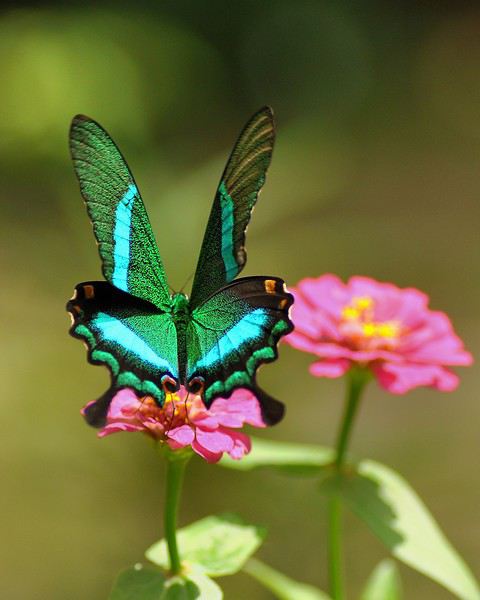
Des bâtiments multicolores ?
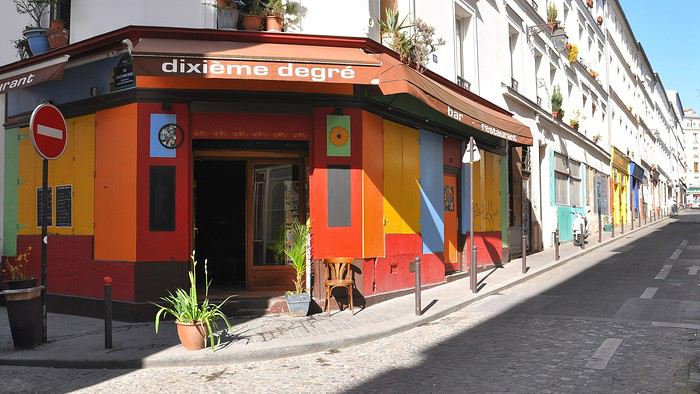
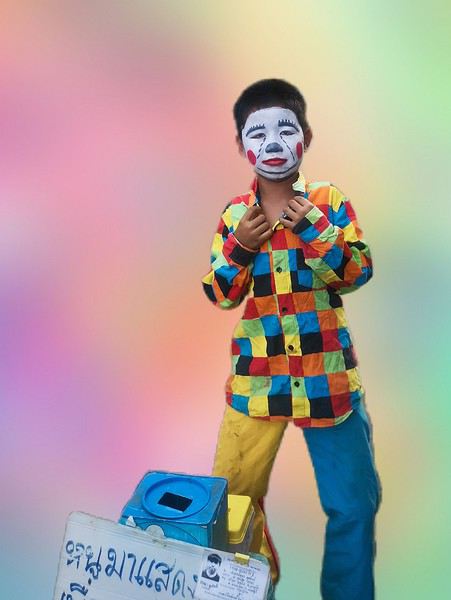
Des personnages ?
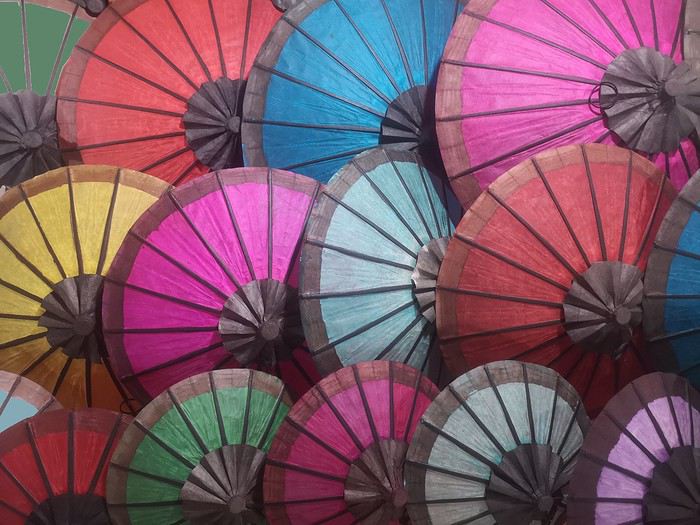
Des objets ?
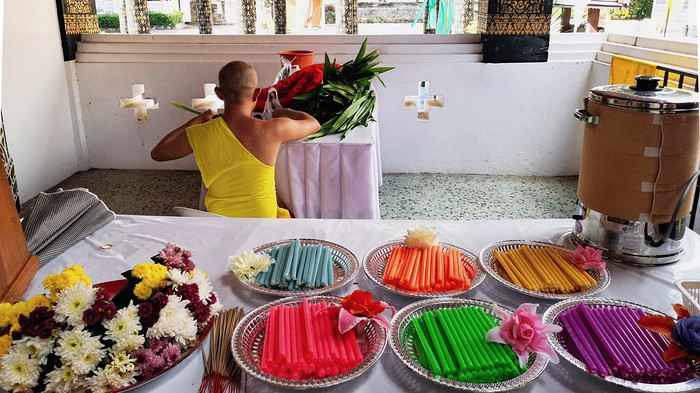
Des scènes de vie ?
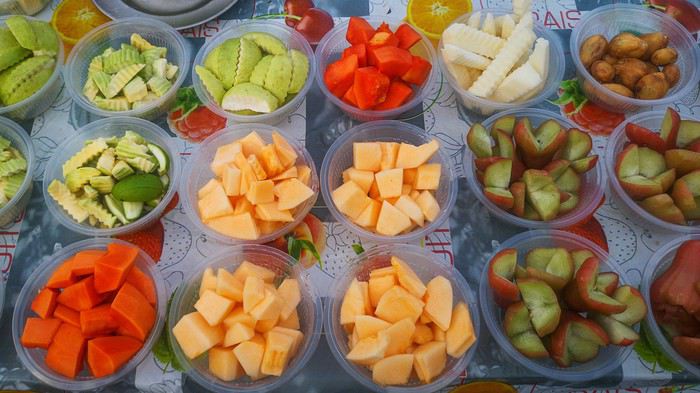
Et bien d'autres...
Participation : Chaque participant(e) peut proposer jusqu'à 3 photos, et ce jusqu'au mardi 23/06 à 24h00, heure de Paris. Chaque photo sera présentée dans un seul message, en indiquant son numéro (1, 2 ou 3). Pensez à ajouter une petite explication, commentaire, localisation, date de prise de vue.
Vote : Chaque membre VF peut voter pour les 3 photos qu'il ou elle juge les meilleures selon ses propres critères et en tenant compte du thème.
Les votes se feront du mercredi 24/06 au dimanche 28/06 à 24h00, heure de Paris. Les photos choisies seront citées dans l'ordre de préférence : - la 1re photo : 3 points - la 2e : 2 points - la 3e : 1 point
Un seul et unique vote pour 3 photos est accepté par membre.
Conclusion : Le vainqueur est l'auteur de la photo ayant reçu le plus de points. Les résultats seront publiés le 29/06. En cas d'égalité, le nombre de premières places prévaudra. Le vainqueur aura l'honneur d'organiser le concours du mois de juillet.
La discussion est ici : https://voyageforum.com/discussion/discussions-sujet-concours-photo-juin-2020-multicolore-d10297778/
Philippe
J'ai le privilège d'organiser le concours photos du moi de juin 2010. J'ai longuement hésité, beaucoup de sujets ont été déjà proposés et faire preuve d’originalité devient de plus en plus compliqué. Il fallait choisir, j'ai choisi : « Multicolore » : « Qui présente des couleurs variées » d 'après la définition. Je n'impose pas le nombre minimum de couleurs présentes, sachant que des photos avec seulement 2 couleurs pourront faire partie du thème, à partir du moment où elles sont en harmonie et que ça « éclate ». En effet, je voudrais que quand on ouvrira une photo, il y ait l'effet : « WHOUAAAAA, les couleurs... « Il faudra malgré tout garder à l'idée la notion de voyage.
Je pense que le thème laisse une grande ouverture.
On pourra présenter une multitude de sujets :
Pourquoi pas des animaux multicolores ?
Des bâtiments multicolores ?
Des personnages ?
Des objets ?
Des scènes de vie ?
Et bien d'autres...
Participation : Chaque participant(e) peut proposer jusqu'à 3 photos, et ce jusqu'au mardi 23/06 à 24h00, heure de Paris. Chaque photo sera présentée dans un seul message, en indiquant son numéro (1, 2 ou 3). Pensez à ajouter une petite explication, commentaire, localisation, date de prise de vue.
Vote : Chaque membre VF peut voter pour les 3 photos qu'il ou elle juge les meilleures selon ses propres critères et en tenant compte du thème.
Les votes se feront du mercredi 24/06 au dimanche 28/06 à 24h00, heure de Paris. Les photos choisies seront citées dans l'ordre de préférence : - la 1re photo : 3 points - la 2e : 2 points - la 3e : 1 point
Un seul et unique vote pour 3 photos est accepté par membre.
Conclusion : Le vainqueur est l'auteur de la photo ayant reçu le plus de points. Les résultats seront publiés le 29/06. En cas d'égalité, le nombre de premières places prévaudra. Le vainqueur aura l'honneur d'organiser le concours du mois de juillet.
La discussion est ici : https://voyageforum.com/discussion/discussions-sujet-concours-photo-juin-2020-multicolore-d10297778/
Philippe
Déréclusion! English translation pending
Déréclusion !
Je ne suis pas à un néologisme près.
Parce que j’me demande : Suis-je libre ? En liberté surveillée ? Contrainte ? Coercition sanitaire et salubrité publique... J’crois que secouer les peurs est mille fois plus efficace qu’un bracelet électronique. Voir le monde entier en pause, je ne pensais pas le vivre. Je comprends aujourd’hui avec quelle rapidité pourrait s’installer une dictature.
J’me demande pourquoi je ne ressens aucune crainte, pourquoi je me sens à mille lieux des peurs dont j’entends parler. Suis-je normale ? Suis-je inconsciente ? J’ai vu des gens avec un masque en voiture, mettre des gants pour tenir un chariot de magasin, où s’arrête le bon sens ? C’est quand même horripilant de se sentir infantilisé. Quand j’entends toutes ces sommités parler, j’ai l’impression qu’elles s’adressent à une population de mômes.
Parait que certains sont porteurs sains et transmettent le virus, paraît que certains ont eu la maladie sans s’en apercevoir et ont des anticorps, paraît que certains ont été malades et ont développé des anticorps, paraît que certains n’ont jamais été en contact et ne seront jamais malades, paraît qu’il faut qu’il y ait 60 % au moins de gens avec des anticorps pour l’immunité collective. Ca s’appelle RO lala.
Et beaucoup sont morts et au regard de l’humanité sur nos plus de 7 milliards, c’est une goutte. Une goutte d’acide et de chagrin pour les familles et amis des décédés, c’est certain. Des cataractes de panique pour des millions d’autres qui tremblent d’entendre un reniflement ou un éternuement. J’me demande aussi combien sont morts de faim et de maladie dans le même temps et aussi combien vont mourir des dégâts induits par le monde à l’arrêt.
Combien de pandémies ont-elles eu lieu sans que le monde occidental ne bouge un cil ? Un virus à la volette et qui disparaîtra comme tous les virus avant qu’un autre ne prenne le relais. C’est ainsi depuis toujours.
Ma solution : je respecte les peurs et angoisses des autres. Je respecte les consignes assenées à longueur de temps. Mais dans l’absolu, au fond de ma p’tite tête, j’pense tout autre chose et me tiens coite.
Je ne suis pas à un néologisme près.
Parce que j’me demande : Suis-je libre ? En liberté surveillée ? Contrainte ? Coercition sanitaire et salubrité publique... J’crois que secouer les peurs est mille fois plus efficace qu’un bracelet électronique. Voir le monde entier en pause, je ne pensais pas le vivre. Je comprends aujourd’hui avec quelle rapidité pourrait s’installer une dictature.
J’me demande pourquoi je ne ressens aucune crainte, pourquoi je me sens à mille lieux des peurs dont j’entends parler. Suis-je normale ? Suis-je inconsciente ? J’ai vu des gens avec un masque en voiture, mettre des gants pour tenir un chariot de magasin, où s’arrête le bon sens ? C’est quand même horripilant de se sentir infantilisé. Quand j’entends toutes ces sommités parler, j’ai l’impression qu’elles s’adressent à une population de mômes.
Parait que certains sont porteurs sains et transmettent le virus, paraît que certains ont eu la maladie sans s’en apercevoir et ont des anticorps, paraît que certains ont été malades et ont développé des anticorps, paraît que certains n’ont jamais été en contact et ne seront jamais malades, paraît qu’il faut qu’il y ait 60 % au moins de gens avec des anticorps pour l’immunité collective. Ca s’appelle RO lala.
Et beaucoup sont morts et au regard de l’humanité sur nos plus de 7 milliards, c’est une goutte. Une goutte d’acide et de chagrin pour les familles et amis des décédés, c’est certain. Des cataractes de panique pour des millions d’autres qui tremblent d’entendre un reniflement ou un éternuement. J’me demande aussi combien sont morts de faim et de maladie dans le même temps et aussi combien vont mourir des dégâts induits par le monde à l’arrêt.
Combien de pandémies ont-elles eu lieu sans que le monde occidental ne bouge un cil ? Un virus à la volette et qui disparaîtra comme tous les virus avant qu’un autre ne prenne le relais. C’est ainsi depuis toujours.
Ma solution : je respecte les peurs et angoisses des autres. Je respecte les consignes assenées à longueur de temps. Mais dans l’absolu, au fond de ma p’tite tête, j’pense tout autre chose et me tiens coite.
A quand l'ouverture des frontières dans l'espace Schengen? (à vélo) English translation pending
Hello,
C'est un peu la question qu'on se pose et qui nous oblige à revoir nos plans, pour l'instant c'est très flou, visiblement ce ne serait pas avant Septembre voir même pas envisageable cette année, mais si vous avez des infos de ce côté là n'hésitez pas à les partager.
Gilles
C'est un peu la question qu'on se pose et qui nous oblige à revoir nos plans, pour l'instant c'est très flou, visiblement ce ne serait pas avant Septembre voir même pas envisageable cette année, mais si vous avez des infos de ce côté là n'hésitez pas à les partager.
Gilles
Adventures of a Bygone Era: The Philippines in 1984
After several discussions on VF about travel journals from the Philippines, I decided to write this curiosity: a trip report from a journey made in 1984, when traveling to the Philippines was still an adventure.
A curiosity because writing a travel journal about a trip 35 years later isn’t common, but also (mostly?) because exploring the Philippines at that time had little in common with traveling there today.
Obviously, I’ve forgotten a number of facts, most of the details, but with the help of a few notes from that time and a stack of slides (yes, there was life before digital 😊), many memories came back and added to the highlights I’d never forgotten. The scanned slides aren’t always great quality, but there are still quite a few to brighten up this chatter. Back then, we didn’t snap photos like we do now—film was too expensive—so I don’t have pictures of every place we visited... too bad, comparing some of those spots to how they look today would’ve been interesting.
Why "Adventures"? Why call it "Adventures" in the Philippines in 1984, a word so often used for a simple exotic trip? - Because the lack of information (no *Guide du Routard*, no *Lonely Planet*, no *Michelin Guide*, nothing, and obviously no internet) gave this trip what’s at the heart of adventure: the unknown. - Because the political situation made the stay sometimes dangerous. - Because transportation conditions were always epic, often perilous. - Because the question of where we’d spend the night came up almost every evening. - And for... quite a few other reasons.
That said, we weren’t exactly explorers!
Why the Philippines? First of all, why go to the Philippines in 1984—a country not exactly set up for tourism and about which we knew very little? How could we get an idea of the beauty of the Philippines and its points of interest when we had no guides or photos?
The idea came to us from Thailand a year earlier, during our first long-haul trip. After touring the north of the country, we met a Frenchman living in Phuket, where there were only a few tourists in Patong, with just a few small hotels and guesthouses. Kata and Karon had no buildings or roads, Rawai only had three palm-thatched bungalows, including ours, and the other islands were unknown to tourists. There was plenty to discover, and we wanted to return to this beautiful country... but the Frenchman made us dream about the Philippines—a country to explore, with wild landscapes.
Long evenings of discussion over multiple Sprite-Mekong cocktails (what memories of those headaches!) finally convinced us we had to go to the Philippines.
Episode 0: Before Departure The decision was made: we’d go to the Philippines in May 1984. Our friends and family were surprised when we announced we were going on vacation to the Philippines (a bit like saying today we were going paddleboarding in the Kerguelen Islands 🤪).
These days, preparing for each of our trips takes long evenings of research, planning, and noting down good addresses... etc. But for the Philippines in 1984, preparation was quick: we had very little information about the country, we were leaving almost at random, and the discovery would only be more exciting.
We still had a few bits of info gathered here and there: the rice terraces in northern Luzon, volcanoes, Negros where we were supposed to visit an acquaintance, Cebu and its marine life (we ended up going elsewhere), and absolutely avoid Mindanao, which was practically at war with the regime. That was about it, but it was already a great itinerary.
Nothing was organized in advance; we’d see day by day. We had no idea about travel times or even the existence of transportation options. The main (and sometimes only) way to connect two islands was by overloaded, rusty ferry. Only the big cities had airports.
Let’s Go: Episode 1: Paris to Manila My travel journals always start after arriving at the airport—the Europe-to-“Other Continent” trip isn’t interesting—but the flight to the Philippines was already an adventure, so I’ll make an exception.
This was the era when only a few Asian airlines were on par with Western ones: Thai, Singapore Airlines, and Philippine Airlines. They had beautiful, brand-new planes, and to attract customers (almost exclusively “businessmen”) from the usual airlines (Air France, Lufthansa, British Airways), there was opulence on board: unlimited champagne, all sorts of cocktails... Compared to today’s long-haul flights, there was still one small difference: no personal screens, just one screen at the front of the cabin with one mandatory movie. And I don’t know why, but we only got James Bond films, both ways... that must’ve been the trend at the time.
The tourism boom to Southeast Asia hadn’t started yet, and the “Asian Tigers” weren’t a thing, so there weren’t many business trips. That meant long-haul flights made stops everywhere to fill the planes. Our Philippine Airlines Boeing 747 left London, picked us up in Paris, then stopped in Frankfurt to take on a few Germans. I don’t know why we then made a stop in Dubai—a totally exotic place at the time. There was nothing to do there... things have changed a lot since. It was a small town lost in the desert. The airport was tiny, with just one or two buildings and a supermarket. During the stopover, everyone had to get off the plane and walk to the supermarket. Photo and electronic equipment were dirt cheap—I guess that was the only reason for the stop. Maybe it was their first commercial move. Emirates didn’t exist yet, as I checked online, but anyway, the idea that such a remote place could have its own airline was unthinkable.
Online, I found this photo of Dubai Airport in 1980. Anyone who’s transited through today’s massive airport with its rows of A380s will appreciate it: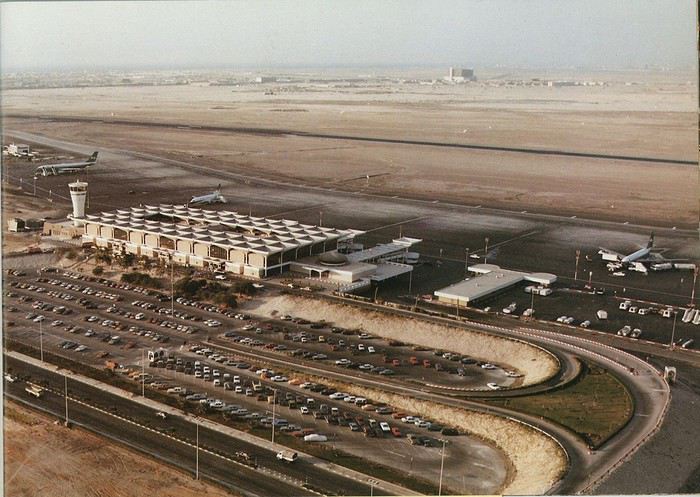
Next stop: New Delhi to drop off some Europeans and pick up a few Indians, and finally, the terminus: Manila. I don’t remember how long the trip took with its five stops—an unimaginable journey today. Despite all those stops to fill the plane, there was still enough space to stretch out on the four center seats of the 747, something that never happens these days despite all the flights in every direction.
So here we are, finally at Manila Airport around midnight.
Episode 1: Manila and Baguio To start, a quick note on the political and economic situation in the Philippines in 1984, which had consequences for us as tourists, as we’d soon realize upon arrival.
After several centuries of Spanish colonization, the Philippines became American at the start of the 20th century, then independent. In 1966, Marcos took power, and little by little, his regime sank into corruption and mismanagement, becoming a dictatorship with martial law, all for the benefit of his family and friends, who enriched themselves endlessly. The peak was the assassination of opposition leader Benigno Aquino in August 1983, which triggered harshly repressed protests. So we arrived a few months later in a very poor country, with omnipresent corruption and an extremely tense political situation, as we’d soon see for ourselves. Major protests took place in the main cities during our trip—I’ll come back to that. Two years later, Marcos fled to Hawaii after being forced out of power following rigged elections. This historical context explains a lot of the situations we found ourselves in over the following weeks.
Arriving in the middle of the night isn’t very cheerful. Manila was already a huge city with many slums, where you could find a few business hotels like the Hilton or Intercontinental—way out of our budget—and plenty of run-down hotels. Luckily, two Indians we’d chatted with on the plane offered to take us to their usual hotel. They came to Manila twice a year for business. We accepted their offer, relieved not to have to look for a place to stay in the middle of the night, figuring the address must be good since they came back every time... we were wrong 🙁
We left the airport and immediately got a taste of the local vibe when we got into the taxi: the police asked for our passports. We thought: what’s more normal than police in a dictatorship?
But that wasn’t it at all. Our two Indian friends explained that the police were noting our names along with the taxi number and time. Crime in Manila was so bad that the taxi driver would be held responsible if anything happened to us... welcome to the Philippines 😎 😎
Historically, the Philippines was a very violent country, where everything was settled with guns or machetes. Previous governments had banned carrying weapons, but Marcos later allowed the free sale and carrying of guns, and disputes were settled with pistols again (or worse, as we’d discover later). Since he’d released most of the criminals from prison to form a paramilitary militia at his service (I’ll talk about our encounter with these “heroes” later), it was pretty dangerous to go into many parts of Manila, where these “tonton macoutes” ruled.
We arrived at our hotel without incident... and then things started badly. The room was infested with big cockroaches—exactly what I hate most in those kinds of countries. No way to find another hotel at that hour. After the long flight, the urge to take a shower was so strong that we squeezed into the bathroom as best we could. After that, I don’t remember—I guess we must’ve fallen asleep exhausted under the sheets in the heat... air conditioning wasn’t widespread yet.
The next day, we just wanted to leave that dump as soon as possible. So we decided to head north right away, stopping in Baguio, and we’d visit Manila a bit on the way back.
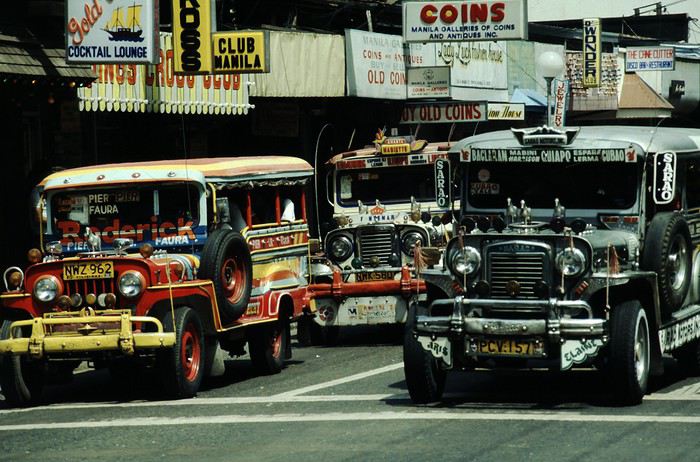
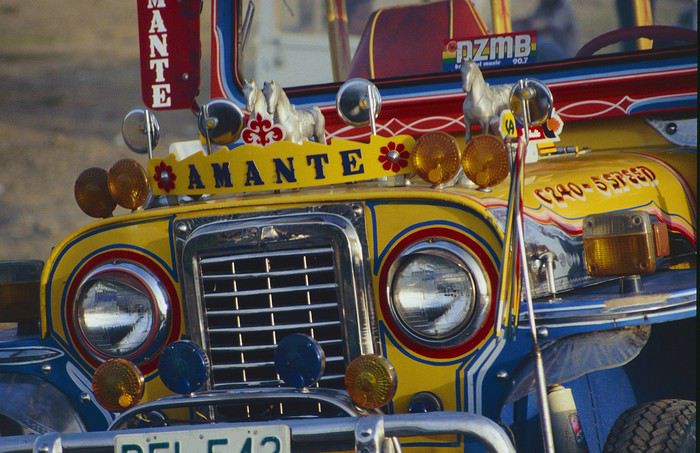
When we stepped outside, we discovered a pretty run-down neighborhood with potholed streets. But we also discovered the jeepneys. They were everywhere, flooding the streets.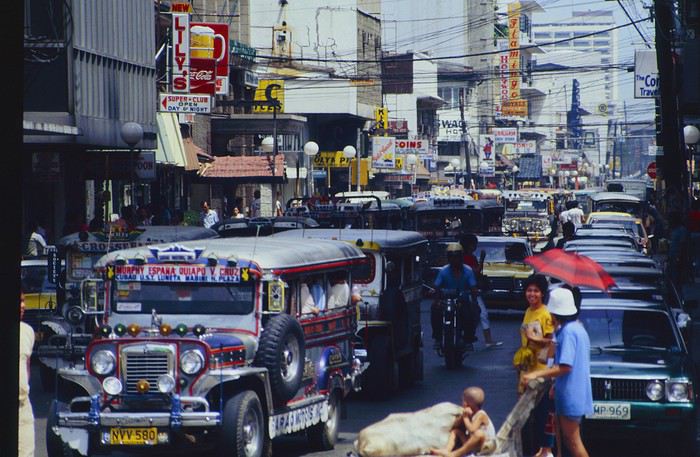
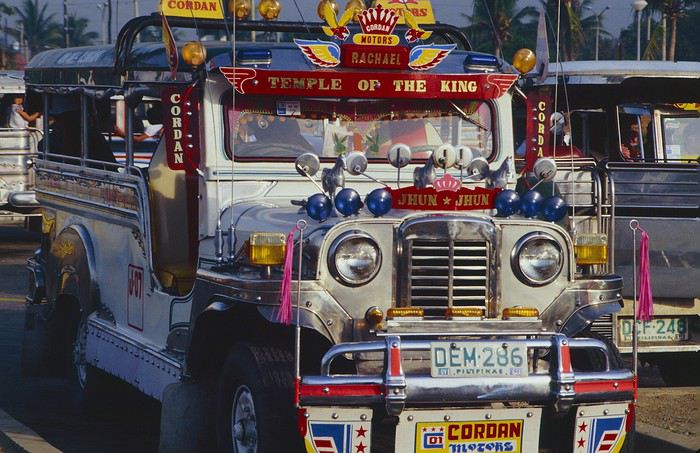
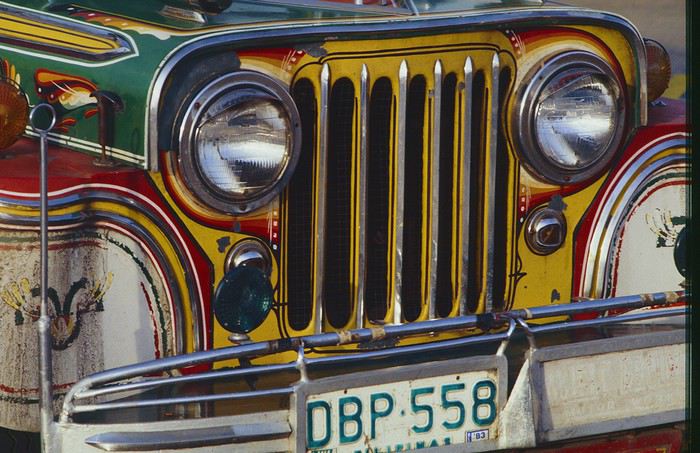
They had crazy sound systems, each one blasting louder than the last. The interiors were kitschy but fun. There weren’t many private cars—almost all transportation was by jeepney, with buses reserved for intercity trips.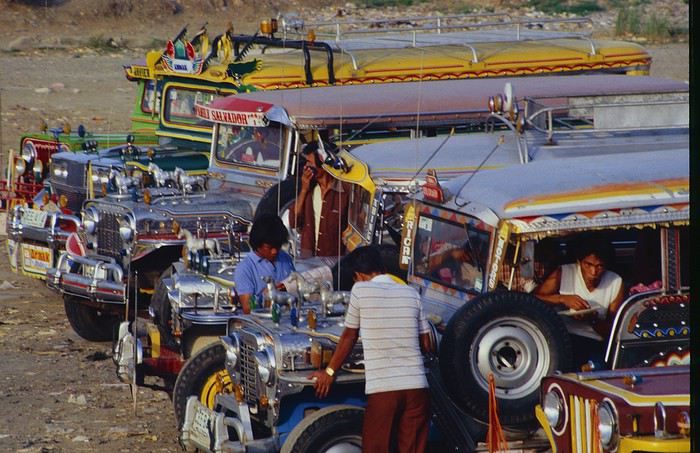
Before heading to the bus terminal for the north, somewhere on the outskirts of the city, we needed to exchange some money. I don’t remember how we ended up in a policeman’s jeep who offered his services: - Exchange money on the black market at a better rate than the banks. - Take us wherever we wanted, in this case, the bus terminal.
We accepted both offers (we’d still checked the official exchange rate from dollars to pesos). So we found ourselves in his jeep. After exchanging money, we left in his vehicle and stopped for gas. Without turning off the engine, he calmly smoked a cigarette while filling up. Since we were in a jeep with no doors or roof, we were ready to jump out if things went south, our travel bag in hand.
But we weren’t done with surprises yet. Once we left the small streets, we ended up in a neighborhood with wide avenues and not much traffic, which didn’t justify his incredible behavior. At every intersection, he made the sign of the cross, closed his eyes, and crossed without looking. I was more stunned than terrified! It wasn’t until we got out of the car later that I told Anne-Marie what had happened. I’d seen everything because the cop had put me in the front seat. Luckily, A-Marie hadn’t noticed anything from the back. Crossing Manila by trusting God rather than the rules of the road was ultimately effective. We were lucky—the trip was off to a good start. 🙂 🙂
We then passed through a neighborhood where slums stretched on for a while, and we left our policeman—friendly but a bit crazy—with relief.
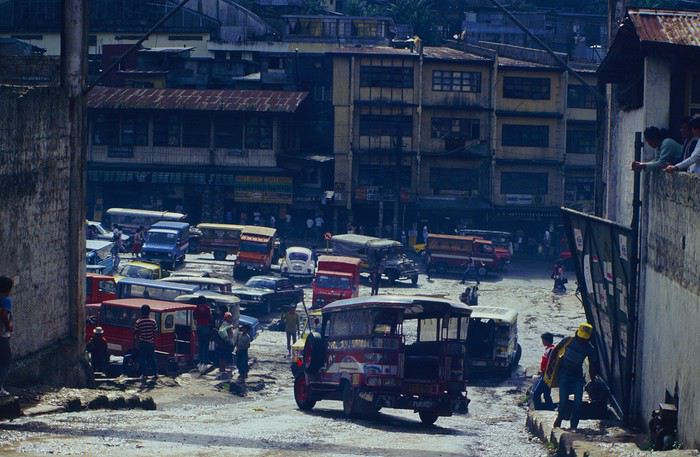
A few hours by bus later, here we are in Baguio, cool in the mountains. My memories of Baguio are pretty fuzzy. I remember a small town. After some research while writing this journal, I found that the population was 120,000 in 1980. Given the population density in each home, that confirms my memory of a smallish town. Outside the “official” district with the president’s summer residence and government buildings, there were two or three paved streets with nice houses. The rest was very dirty and very poor, with lots of slums and dirt roads.
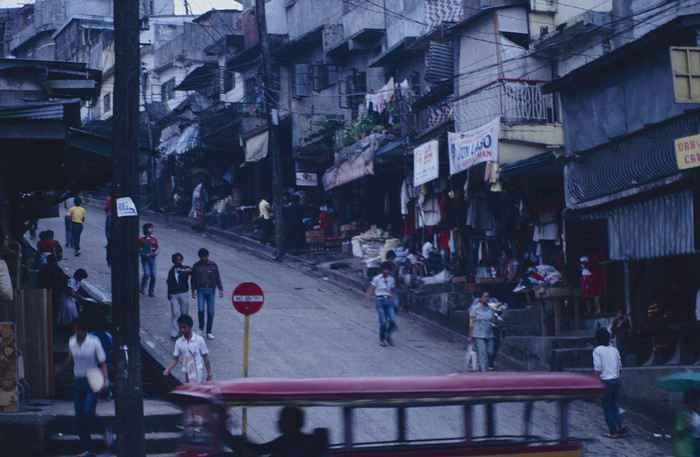
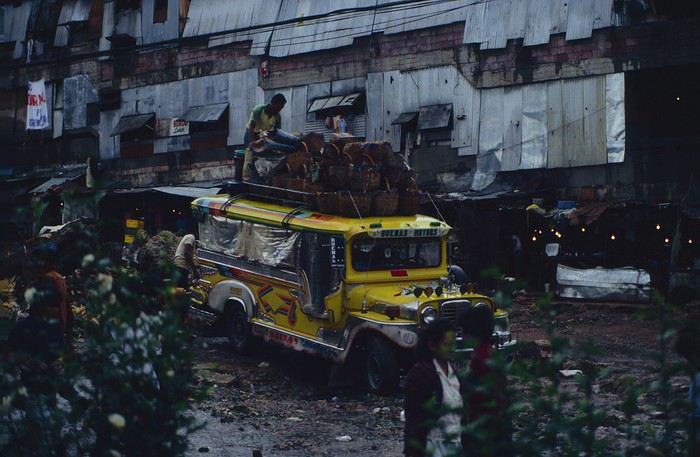
People we met on the street invited us to stay with them. These days, we wouldn’t just show up at strangers’ houses, which we should’ve done in Baguio—it would’ve saved us from an unimaginable and dangerous situation... which I won’t say anything about... !😊
The simple wooden house was on stilts at the edge of a hill with a view of the mountains. Since it was the start of the rainy season in a city that gets a lot of rain, we saw a lot of water. Our outings in town happened between downpours.
View from our lodging: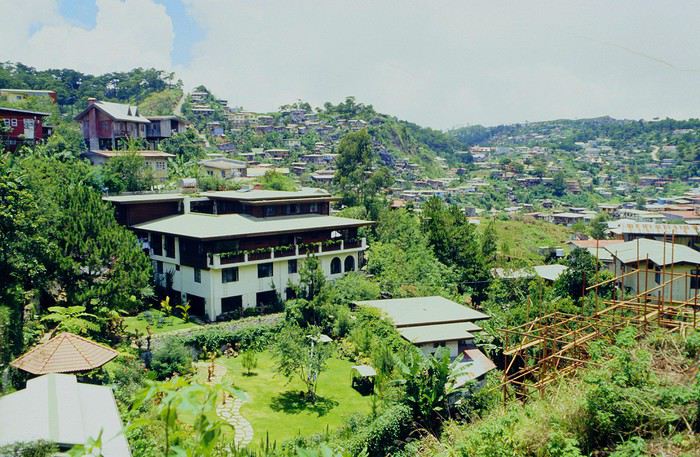
Episode 2: Baguio to Bontoc Aside from the situation briefly mentioned above, it was on the next leg to Bontoc that the adventure really began: an endless and dangerous road, a bus from another era, breathtaking landscapes, and surprising people.
We didn’t know the distance or how long it would take to get to Bontoc. When we arrived after about ten hours, we learned that Baguio to Bontoc was 140 km.
We got on a bus with wooden seats and settled in, two to a seat meant for two. As the bus filled up, passengers squeezed in three or four per seat, with chickens and baskets full of all sorts of things in the aisle. A little embarrassed, we didn’t know if we should squeeze in three on our seat. The seats were super tight (luckily, Filipinos are small), and I didn’t know where to put my legs given my height. I don’t remember if we stayed alone on our bench or if we ended up sharing with others.
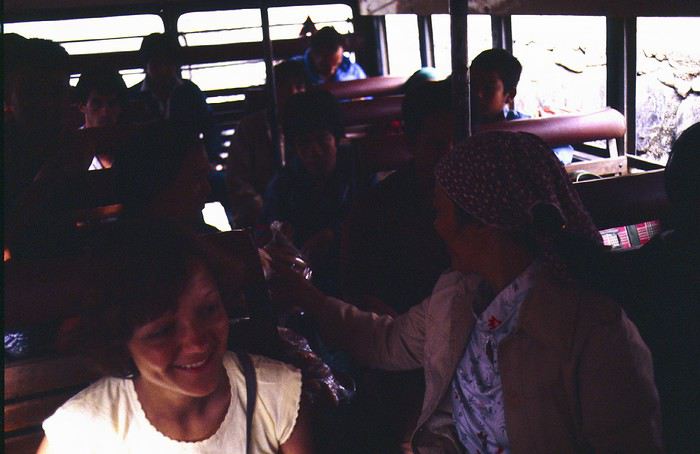
The “road” was a dirt track (or rather, a mud track) with endless turns. We held on as best we could to our slippery wooden seats—it was shaking in every direction. The woman behind us was carsick and throwing up... gross... but what were we doing there? Then we plunged into the Sierra Madre... just the name is dreamy!
Rice terraces started to appear: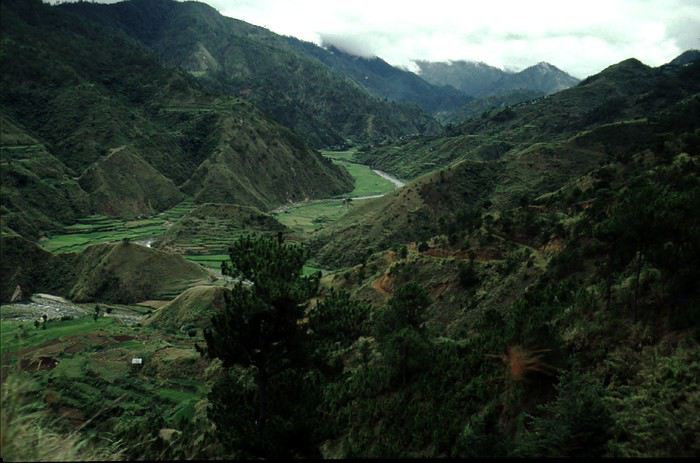
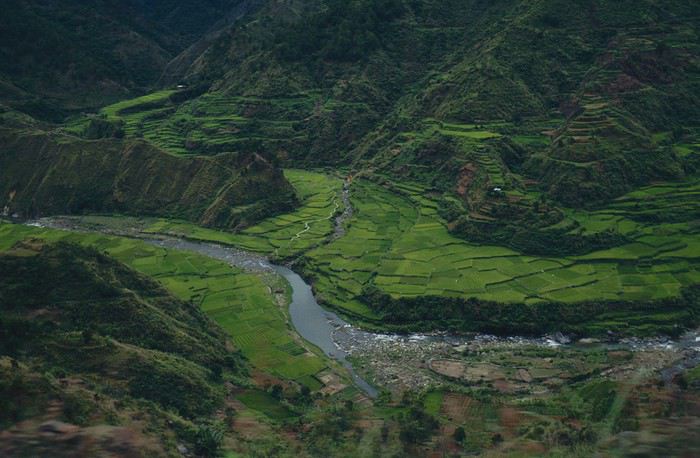
they took up more and more space along cliffs where we weren’t always reassured,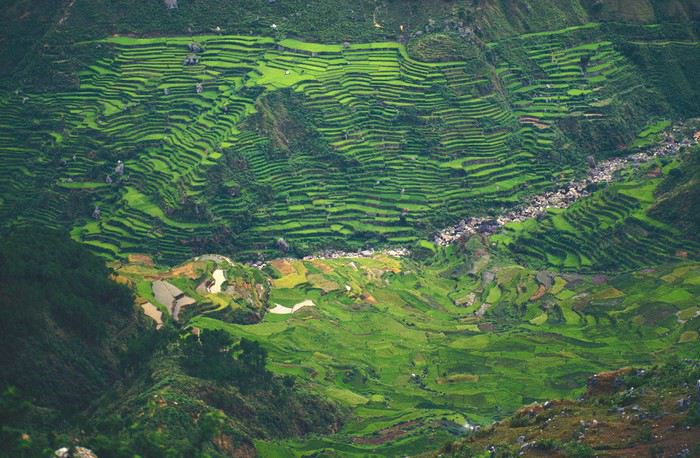
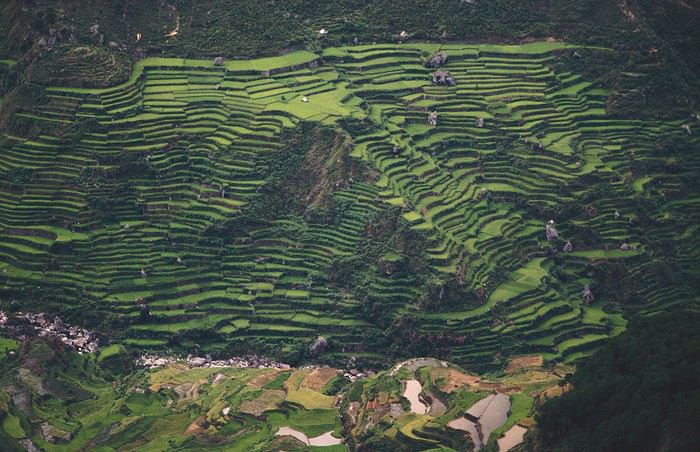
with lots of waterfalls (all that water had to go somewhere).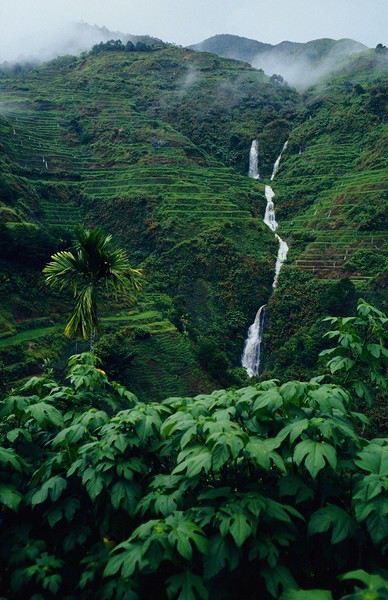
A few miserable villages stretched along the track, most often just a few houses balancing between the road and the drop. The bus stopped in every village—people got on or off and settled inside or on the roof. Street vendors offered their products to the bus passengers—a common sight in Asia, even today.
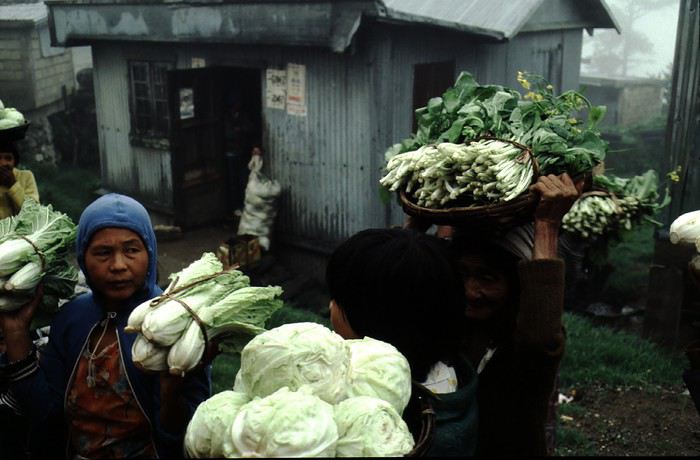
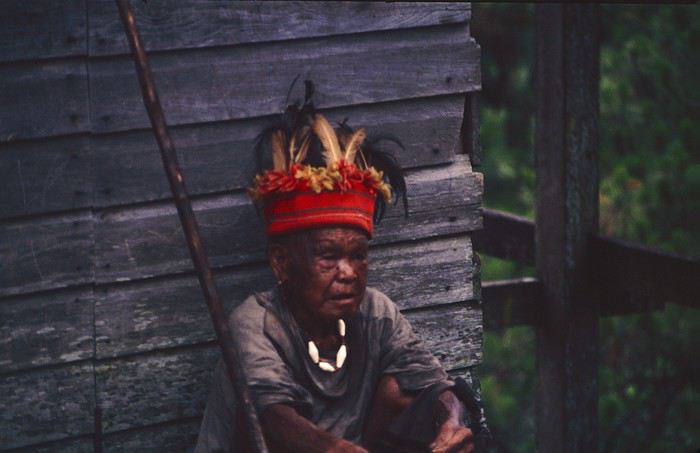
We were in another world—villagers were in loincloths, others had spears. The atmosphere was strange... but all good, we wanted exoticism, and we got it: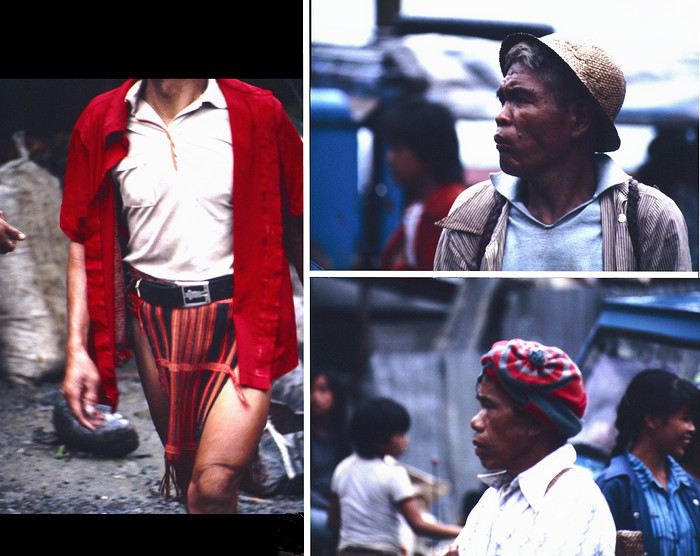
This so-called traditional outfit was everyday wear—it wasn’t for tourists since there weren’t any.
A curiosity because writing a travel journal about a trip 35 years later isn’t common, but also (mostly?) because exploring the Philippines at that time had little in common with traveling there today.
Obviously, I’ve forgotten a number of facts, most of the details, but with the help of a few notes from that time and a stack of slides (yes, there was life before digital 😊), many memories came back and added to the highlights I’d never forgotten. The scanned slides aren’t always great quality, but there are still quite a few to brighten up this chatter. Back then, we didn’t snap photos like we do now—film was too expensive—so I don’t have pictures of every place we visited... too bad, comparing some of those spots to how they look today would’ve been interesting.
Why "Adventures"? Why call it "Adventures" in the Philippines in 1984, a word so often used for a simple exotic trip? - Because the lack of information (no *Guide du Routard*, no *Lonely Planet*, no *Michelin Guide*, nothing, and obviously no internet) gave this trip what’s at the heart of adventure: the unknown. - Because the political situation made the stay sometimes dangerous. - Because transportation conditions were always epic, often perilous. - Because the question of where we’d spend the night came up almost every evening. - And for... quite a few other reasons.
That said, we weren’t exactly explorers!
Why the Philippines? First of all, why go to the Philippines in 1984—a country not exactly set up for tourism and about which we knew very little? How could we get an idea of the beauty of the Philippines and its points of interest when we had no guides or photos?
The idea came to us from Thailand a year earlier, during our first long-haul trip. After touring the north of the country, we met a Frenchman living in Phuket, where there were only a few tourists in Patong, with just a few small hotels and guesthouses. Kata and Karon had no buildings or roads, Rawai only had three palm-thatched bungalows, including ours, and the other islands were unknown to tourists. There was plenty to discover, and we wanted to return to this beautiful country... but the Frenchman made us dream about the Philippines—a country to explore, with wild landscapes.
Long evenings of discussion over multiple Sprite-Mekong cocktails (what memories of those headaches!) finally convinced us we had to go to the Philippines.
Episode 0: Before Departure The decision was made: we’d go to the Philippines in May 1984. Our friends and family were surprised when we announced we were going on vacation to the Philippines (a bit like saying today we were going paddleboarding in the Kerguelen Islands 🤪).
These days, preparing for each of our trips takes long evenings of research, planning, and noting down good addresses... etc. But for the Philippines in 1984, preparation was quick: we had very little information about the country, we were leaving almost at random, and the discovery would only be more exciting.
We still had a few bits of info gathered here and there: the rice terraces in northern Luzon, volcanoes, Negros where we were supposed to visit an acquaintance, Cebu and its marine life (we ended up going elsewhere), and absolutely avoid Mindanao, which was practically at war with the regime. That was about it, but it was already a great itinerary.
Nothing was organized in advance; we’d see day by day. We had no idea about travel times or even the existence of transportation options. The main (and sometimes only) way to connect two islands was by overloaded, rusty ferry. Only the big cities had airports.
Let’s Go: Episode 1: Paris to Manila My travel journals always start after arriving at the airport—the Europe-to-“Other Continent” trip isn’t interesting—but the flight to the Philippines was already an adventure, so I’ll make an exception.
This was the era when only a few Asian airlines were on par with Western ones: Thai, Singapore Airlines, and Philippine Airlines. They had beautiful, brand-new planes, and to attract customers (almost exclusively “businessmen”) from the usual airlines (Air France, Lufthansa, British Airways), there was opulence on board: unlimited champagne, all sorts of cocktails... Compared to today’s long-haul flights, there was still one small difference: no personal screens, just one screen at the front of the cabin with one mandatory movie. And I don’t know why, but we only got James Bond films, both ways... that must’ve been the trend at the time.
The tourism boom to Southeast Asia hadn’t started yet, and the “Asian Tigers” weren’t a thing, so there weren’t many business trips. That meant long-haul flights made stops everywhere to fill the planes. Our Philippine Airlines Boeing 747 left London, picked us up in Paris, then stopped in Frankfurt to take on a few Germans. I don’t know why we then made a stop in Dubai—a totally exotic place at the time. There was nothing to do there... things have changed a lot since. It was a small town lost in the desert. The airport was tiny, with just one or two buildings and a supermarket. During the stopover, everyone had to get off the plane and walk to the supermarket. Photo and electronic equipment were dirt cheap—I guess that was the only reason for the stop. Maybe it was their first commercial move. Emirates didn’t exist yet, as I checked online, but anyway, the idea that such a remote place could have its own airline was unthinkable.
Online, I found this photo of Dubai Airport in 1980. Anyone who’s transited through today’s massive airport with its rows of A380s will appreciate it:
Next stop: New Delhi to drop off some Europeans and pick up a few Indians, and finally, the terminus: Manila. I don’t remember how long the trip took with its five stops—an unimaginable journey today. Despite all those stops to fill the plane, there was still enough space to stretch out on the four center seats of the 747, something that never happens these days despite all the flights in every direction.
So here we are, finally at Manila Airport around midnight.
Episode 1: Manila and Baguio To start, a quick note on the political and economic situation in the Philippines in 1984, which had consequences for us as tourists, as we’d soon realize upon arrival.
After several centuries of Spanish colonization, the Philippines became American at the start of the 20th century, then independent. In 1966, Marcos took power, and little by little, his regime sank into corruption and mismanagement, becoming a dictatorship with martial law, all for the benefit of his family and friends, who enriched themselves endlessly. The peak was the assassination of opposition leader Benigno Aquino in August 1983, which triggered harshly repressed protests. So we arrived a few months later in a very poor country, with omnipresent corruption and an extremely tense political situation, as we’d soon see for ourselves. Major protests took place in the main cities during our trip—I’ll come back to that. Two years later, Marcos fled to Hawaii after being forced out of power following rigged elections. This historical context explains a lot of the situations we found ourselves in over the following weeks.
Arriving in the middle of the night isn’t very cheerful. Manila was already a huge city with many slums, where you could find a few business hotels like the Hilton or Intercontinental—way out of our budget—and plenty of run-down hotels. Luckily, two Indians we’d chatted with on the plane offered to take us to their usual hotel. They came to Manila twice a year for business. We accepted their offer, relieved not to have to look for a place to stay in the middle of the night, figuring the address must be good since they came back every time... we were wrong 🙁
We left the airport and immediately got a taste of the local vibe when we got into the taxi: the police asked for our passports. We thought: what’s more normal than police in a dictatorship?
But that wasn’t it at all. Our two Indian friends explained that the police were noting our names along with the taxi number and time. Crime in Manila was so bad that the taxi driver would be held responsible if anything happened to us... welcome to the Philippines 😎 😎
Historically, the Philippines was a very violent country, where everything was settled with guns or machetes. Previous governments had banned carrying weapons, but Marcos later allowed the free sale and carrying of guns, and disputes were settled with pistols again (or worse, as we’d discover later). Since he’d released most of the criminals from prison to form a paramilitary militia at his service (I’ll talk about our encounter with these “heroes” later), it was pretty dangerous to go into many parts of Manila, where these “tonton macoutes” ruled.
We arrived at our hotel without incident... and then things started badly. The room was infested with big cockroaches—exactly what I hate most in those kinds of countries. No way to find another hotel at that hour. After the long flight, the urge to take a shower was so strong that we squeezed into the bathroom as best we could. After that, I don’t remember—I guess we must’ve fallen asleep exhausted under the sheets in the heat... air conditioning wasn’t widespread yet.
The next day, we just wanted to leave that dump as soon as possible. So we decided to head north right away, stopping in Baguio, and we’d visit Manila a bit on the way back.
When we stepped outside, we discovered a pretty run-down neighborhood with potholed streets. But we also discovered the jeepneys. They were everywhere, flooding the streets.
They had crazy sound systems, each one blasting louder than the last. The interiors were kitschy but fun. There weren’t many private cars—almost all transportation was by jeepney, with buses reserved for intercity trips.
Before heading to the bus terminal for the north, somewhere on the outskirts of the city, we needed to exchange some money. I don’t remember how we ended up in a policeman’s jeep who offered his services: - Exchange money on the black market at a better rate than the banks. - Take us wherever we wanted, in this case, the bus terminal.
We accepted both offers (we’d still checked the official exchange rate from dollars to pesos). So we found ourselves in his jeep. After exchanging money, we left in his vehicle and stopped for gas. Without turning off the engine, he calmly smoked a cigarette while filling up. Since we were in a jeep with no doors or roof, we were ready to jump out if things went south, our travel bag in hand.
But we weren’t done with surprises yet. Once we left the small streets, we ended up in a neighborhood with wide avenues and not much traffic, which didn’t justify his incredible behavior. At every intersection, he made the sign of the cross, closed his eyes, and crossed without looking. I was more stunned than terrified! It wasn’t until we got out of the car later that I told Anne-Marie what had happened. I’d seen everything because the cop had put me in the front seat. Luckily, A-Marie hadn’t noticed anything from the back. Crossing Manila by trusting God rather than the rules of the road was ultimately effective. We were lucky—the trip was off to a good start. 🙂 🙂
We then passed through a neighborhood where slums stretched on for a while, and we left our policeman—friendly but a bit crazy—with relief.
A few hours by bus later, here we are in Baguio, cool in the mountains. My memories of Baguio are pretty fuzzy. I remember a small town. After some research while writing this journal, I found that the population was 120,000 in 1980. Given the population density in each home, that confirms my memory of a smallish town. Outside the “official” district with the president’s summer residence and government buildings, there were two or three paved streets with nice houses. The rest was very dirty and very poor, with lots of slums and dirt roads.
People we met on the street invited us to stay with them. These days, we wouldn’t just show up at strangers’ houses, which we should’ve done in Baguio—it would’ve saved us from an unimaginable and dangerous situation... which I won’t say anything about... !😊
The simple wooden house was on stilts at the edge of a hill with a view of the mountains. Since it was the start of the rainy season in a city that gets a lot of rain, we saw a lot of water. Our outings in town happened between downpours.
View from our lodging:
Episode 2: Baguio to Bontoc Aside from the situation briefly mentioned above, it was on the next leg to Bontoc that the adventure really began: an endless and dangerous road, a bus from another era, breathtaking landscapes, and surprising people.
We didn’t know the distance or how long it would take to get to Bontoc. When we arrived after about ten hours, we learned that Baguio to Bontoc was 140 km.
We got on a bus with wooden seats and settled in, two to a seat meant for two. As the bus filled up, passengers squeezed in three or four per seat, with chickens and baskets full of all sorts of things in the aisle. A little embarrassed, we didn’t know if we should squeeze in three on our seat. The seats were super tight (luckily, Filipinos are small), and I didn’t know where to put my legs given my height. I don’t remember if we stayed alone on our bench or if we ended up sharing with others.
The “road” was a dirt track (or rather, a mud track) with endless turns. We held on as best we could to our slippery wooden seats—it was shaking in every direction. The woman behind us was carsick and throwing up... gross... but what were we doing there? Then we plunged into the Sierra Madre... just the name is dreamy!
Rice terraces started to appear:
they took up more and more space along cliffs where we weren’t always reassured,
with lots of waterfalls (all that water had to go somewhere).
A few miserable villages stretched along the track, most often just a few houses balancing between the road and the drop. The bus stopped in every village—people got on or off and settled inside or on the roof. Street vendors offered their products to the bus passengers—a common sight in Asia, even today.
We were in another world—villagers were in loincloths, others had spears. The atmosphere was strange... but all good, we wanted exoticism, and we got it:
This so-called traditional outfit was everyday wear—it wasn’t for tourists since there weren’t any.
Happiness Settles in the Heart of the Maasai Mara
(October 2018).
This account of a short stay in Kenya was originally meant for our friends and family, but to pass the time—for both us and you—and to add some content to the increasingly quiet columns of Voyage Forum during these weeks of confinement, when travelers can only journey in their minds, we decided to share the 25 pages of my ramblings, illustrated with Yolande’s photos, from an extraordinary stay in the Maasai Mara National Reserve. We waited until the two previous discussions on this same topic, filled with stunning photos and started by Régis and then Claire—sometimes in agreement, sometimes differing but always full of insights—had quieted down a bit before jumping in. Well, we’ll give it a try.
Let’s clarify: one of us claims to be a beginner photographer, and the other is just an unrepentant dreamer and modest writer. We often pursued our passions separately—Yolande with her mentor and me with an incomparable tracker—so sometimes the photos don’t quite match the text, or vice versa.
We hope you enjoy reading this lengthy post, which is longer than usual in VF’s sections (except, of course, for Mr. Voyajou). A thousand apologies for straying off the beaten path.
Alright, here we go!
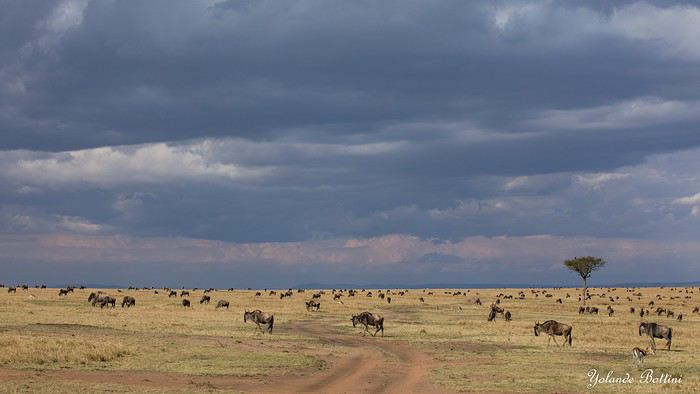
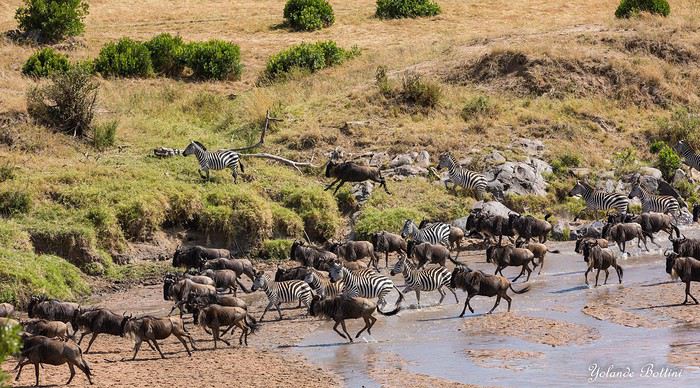
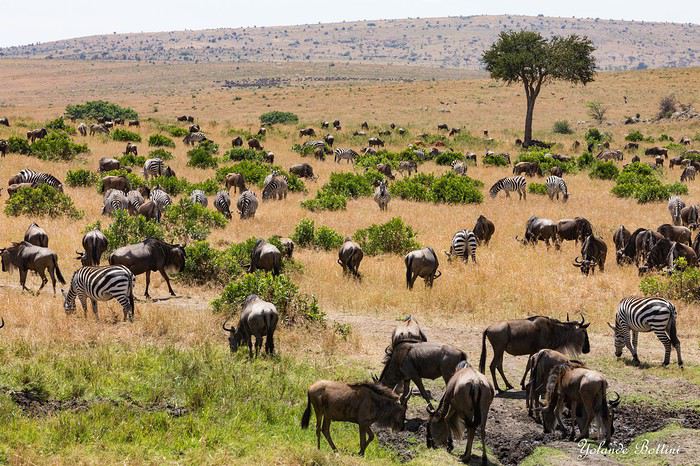
This account of a short stay in Kenya was originally meant for our friends and family, but to pass the time—for both us and you—and to add some content to the increasingly quiet columns of Voyage Forum during these weeks of confinement, when travelers can only journey in their minds, we decided to share the 25 pages of my ramblings, illustrated with Yolande’s photos, from an extraordinary stay in the Maasai Mara National Reserve. We waited until the two previous discussions on this same topic, filled with stunning photos and started by Régis and then Claire—sometimes in agreement, sometimes differing but always full of insights—had quieted down a bit before jumping in. Well, we’ll give it a try.
Let’s clarify: one of us claims to be a beginner photographer, and the other is just an unrepentant dreamer and modest writer. We often pursued our passions separately—Yolande with her mentor and me with an incomparable tracker—so sometimes the photos don’t quite match the text, or vice versa.
We hope you enjoy reading this lengthy post, which is longer than usual in VF’s sections (except, of course, for Mr. Voyajou). A thousand apologies for straying off the beaten path.
Alright, here we go!
Organisation de la nation en temps de guerre sanitaire English translation pending
Bonjour,
La pandémie actuelle est parfois l'occasion de chamailleries puériles, de règlements de comptes, etc. Certains veulent la peau de leur voisin. Par méchanceté ou pour évacuer leurs propres angoisses. La bassesse humaine comme dans toutes les guerres. Le problème est que cette guerre n'est pas la guerre d'un groupe humain contre un autre groupe humain. C'est la guerre de l'humanité toute entière contre un virus.
Je propose un fil de solidarité pour partager des méthodes passives éprouvées de lutte contre la propagation du virus pour pallier à la carence de beaucoup de gouvernements et compléter les mesures déjà prises.
Dans certains pays, on a prétendu que les masques ne servaient à rien avant de faire machine arrière. Voici une méthode de fabrication des masques approuvée par un organisme français :
https://www.europe1.fr/sante/coronavirus-un-referentiel-pour-fabriquer-ses-propres-masques-mis-en-ligne-3958168
https://www.afnor.org/actualites/coronavirus-telechargez-le-modele-de-masque-barriere/
Toutes les recettes artisanales mais éprouvées de lutte (désinfectant, etc) sont les bienvenues.
Cape Town and Kruger: 12 days in February with teens
Hi everyone,
I’d love to share a little travel journal from our 14-day/12-night road trip with our two teens (14 and 17) in February/March 2020. A huge thank you to all of you who helped me plan this trip to South Africa—your patience with my endless questions was amazing!
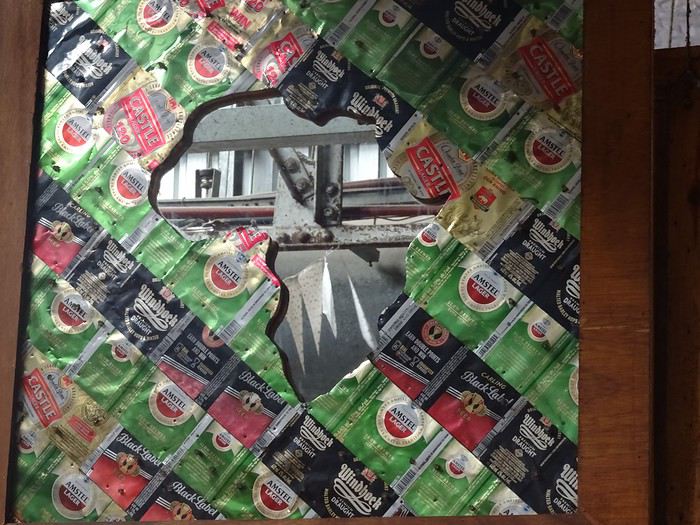
We left Lyon on Saturday, February 22 at 7:00 AM and arrived in Johannesburg at 10:00 PM after a short layover in Amsterdam. Flights cost 440 € per person (booked in October), with carry-on luggage. We added just one checked bag for the whole family (80 € round-trip with the free Flying Blue membership). Since we’d be moving around a lot, we packed light! In Lyon, we reserved parking at P5 in advance for 70 € for 14 days. The Air France/KLM flight was smooth. When we landed, we picked up our bags and had booked a night at the Aero Guest Lodge, just 5 minutes from the airport, with a free shuttle and breakfast. All you have to do is send a WhatsApp message when you arrive at the airport to let the shuttle driver know. The tricky part? Finding him in the terminal—he wasn’t holding a sign with the hotel’s name. 🤪 A South African called him for me since my English wasn’t great (and I had to get used to the accent 😛), and helped us spot the driver (who was actually less than 5 meters away!) with other guests. When we got to the hotel: all good, except we were 10 people in a van meant for 7. The room was spacious—one king-size bed and two single beds for the kids—with a simple but clean bathroom, a garden, pool, and breakfast (which we didn’t try). All for 65 €, so an awesome value!
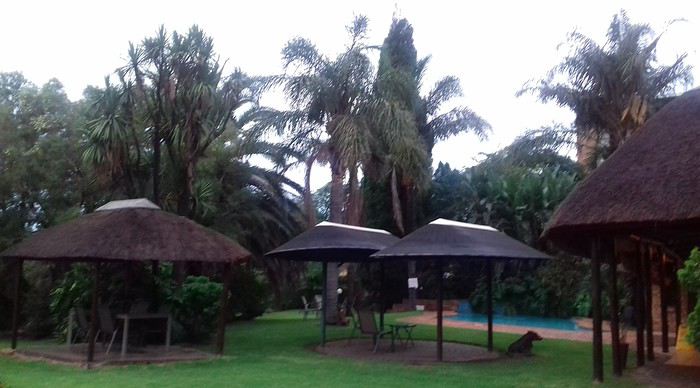 After a restful night, we woke up at 6:00 AM to catch the shuttle back to the airport. Just a heads-up: there’s only one shuttle per hour in the morning, and Kulula canceled our 9:00 AM flight, moving it to 8:00 AM—so no time for breakfast (it starts at 6:30).
We waited 15 minutes in the lovely garden for the driver, who dropped us off at the airport in 5 minutes.
We checked in for our flight to Cape Town, which cost around 40 € (including two checked bags per person).
We grabbed breakfast at the airport instead (less than 20 € for all four of us—one of the nice surprises of South Africa!), and arrived in Cape Town at 10:20 AM.
After a restful night, we woke up at 6:00 AM to catch the shuttle back to the airport. Just a heads-up: there’s only one shuttle per hour in the morning, and Kulula canceled our 9:00 AM flight, moving it to 8:00 AM—so no time for breakfast (it starts at 6:30).
We waited 15 minutes in the lovely garden for the driver, who dropped us off at the airport in 5 minutes.
We checked in for our flight to Cape Town, which cost around 40 € (including two checked bags per person).
We grabbed breakfast at the airport instead (less than 20 € for all four of us—one of the nice surprises of South Africa!), and arrived in Cape Town at 10:20 AM.
 After quickly picking up our bags, we headed to the Avis counter and left with a Toyota Corolla for 80 € for 4 days (rented with the Flying Blue card—free additional driver).
Everything’s on the left... not easy, but it works if you plan your route well.
We drove to our Airbnb in Constantia. We were surprised to see animals, bikes, and pedestrians on the highway!
We arrived around 11:30 AM at our rental—a huge house in the vineyards, in a super secure neighborhood, about 15-20 minutes from Hout Bay. It felt like Beverly Hills, but with super-high walls and barbed wire around the villas. 😕
After quickly picking up our bags, we headed to the Avis counter and left with a Toyota Corolla for 80 € for 4 days (rented with the Flying Blue card—free additional driver).
Everything’s on the left... not easy, but it works if you plan your route well.
We drove to our Airbnb in Constantia. We were surprised to see animals, bikes, and pedestrians on the highway!
We arrived around 11:30 AM at our rental—a huge house in the vineyards, in a super secure neighborhood, about 15-20 minutes from Hout Bay. It felt like Beverly Hills, but with super-high walls and barbed wire around the villas. 😕

We dropped off our bags, changed into shorts (it was around 30°C/86°F), and headed to the Bay Harbour Market in Hout Bay. We had lunch there—such a great vibe! We wandered through the stalls, everyone picked their own dish, and we sat down on the terrace. There was music, artisans of all kinds... a really nice moment.

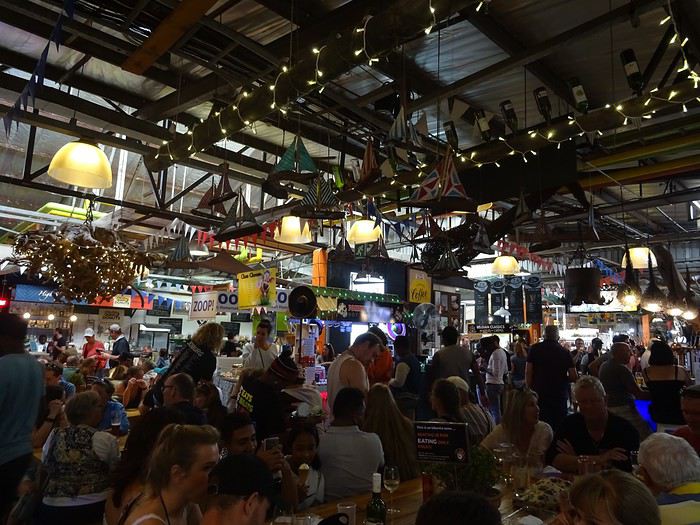
I’d withdrawn 50 € before leaving... and that gave me change to pay the parking attendant. Lunch cost around 30 € for four, including food and drinks.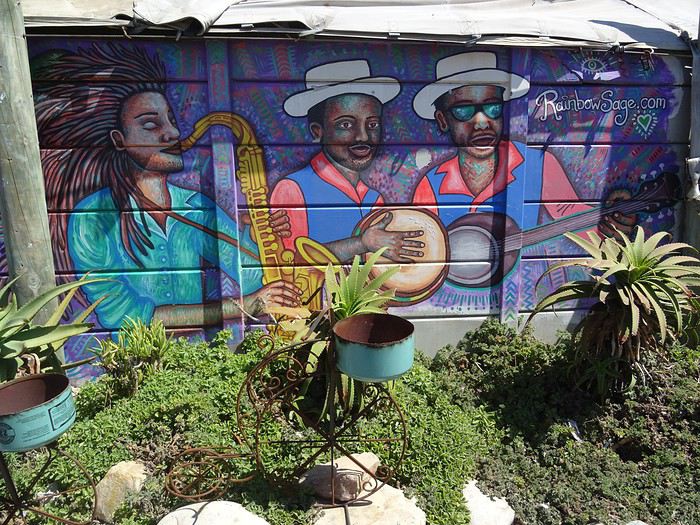

After browsing the artisan stalls, we headed to Hout Bay Beach near the restaurant, Marina Wharf (another small tip for the parking attendant—we’d have to get used to that!). We stopped to admire the sea lions. An ice cream for 1 €? No way we were saying no! 🙂
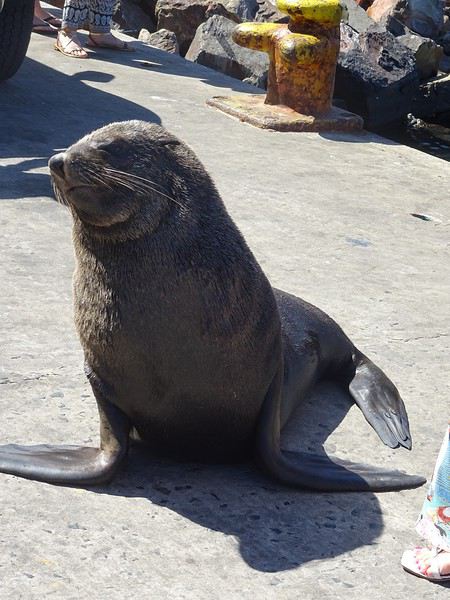
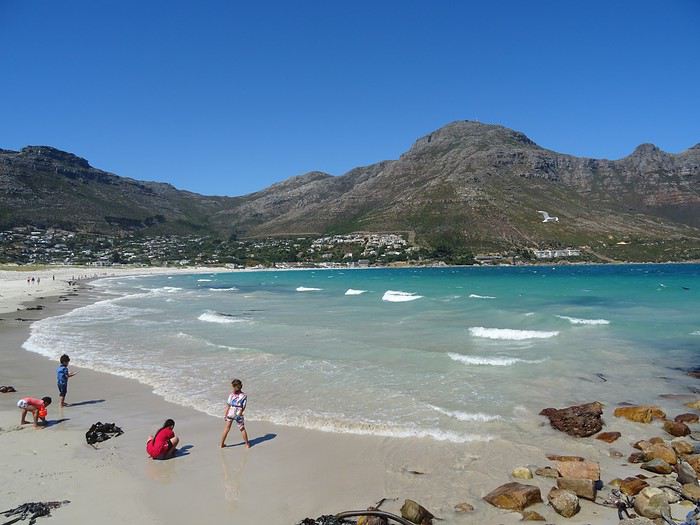
The fatigue was starting to hit, so we headed to the grocery store 10 minutes away (Constantia shopping center) and then had an aperitif in front of the vineyards, opening a delicious bottle of white wine.
I’d love to share a little travel journal from our 14-day/12-night road trip with our two teens (14 and 17) in February/March 2020. A huge thank you to all of you who helped me plan this trip to South Africa—your patience with my endless questions was amazing!
We left Lyon on Saturday, February 22 at 7:00 AM and arrived in Johannesburg at 10:00 PM after a short layover in Amsterdam. Flights cost 440 € per person (booked in October), with carry-on luggage. We added just one checked bag for the whole family (80 € round-trip with the free Flying Blue membership). Since we’d be moving around a lot, we packed light! In Lyon, we reserved parking at P5 in advance for 70 € for 14 days. The Air France/KLM flight was smooth. When we landed, we picked up our bags and had booked a night at the Aero Guest Lodge, just 5 minutes from the airport, with a free shuttle and breakfast. All you have to do is send a WhatsApp message when you arrive at the airport to let the shuttle driver know. The tricky part? Finding him in the terminal—he wasn’t holding a sign with the hotel’s name. 🤪 A South African called him for me since my English wasn’t great (and I had to get used to the accent 😛), and helped us spot the driver (who was actually less than 5 meters away!) with other guests. When we got to the hotel: all good, except we were 10 people in a van meant for 7. The room was spacious—one king-size bed and two single beds for the kids—with a simple but clean bathroom, a garden, pool, and breakfast (which we didn’t try). All for 65 €, so an awesome value!
After a restful night, we woke up at 6:00 AM to catch the shuttle back to the airport. Just a heads-up: there’s only one shuttle per hour in the morning, and Kulula canceled our 9:00 AM flight, moving it to 8:00 AM—so no time for breakfast (it starts at 6:30).
We waited 15 minutes in the lovely garden for the driver, who dropped us off at the airport in 5 minutes.
We checked in for our flight to Cape Town, which cost around 40 € (including two checked bags per person).
We grabbed breakfast at the airport instead (less than 20 € for all four of us—one of the nice surprises of South Africa!), and arrived in Cape Town at 10:20 AM.
After quickly picking up our bags, we headed to the Avis counter and left with a Toyota Corolla for 80 € for 4 days (rented with the Flying Blue card—free additional driver).
Everything’s on the left... not easy, but it works if you plan your route well.
We drove to our Airbnb in Constantia. We were surprised to see animals, bikes, and pedestrians on the highway!
We arrived around 11:30 AM at our rental—a huge house in the vineyards, in a super secure neighborhood, about 15-20 minutes from Hout Bay. It felt like Beverly Hills, but with super-high walls and barbed wire around the villas. 😕We dropped off our bags, changed into shorts (it was around 30°C/86°F), and headed to the Bay Harbour Market in Hout Bay. We had lunch there—such a great vibe! We wandered through the stalls, everyone picked their own dish, and we sat down on the terrace. There was music, artisans of all kinds... a really nice moment.
I’d withdrawn 50 € before leaving... and that gave me change to pay the parking attendant. Lunch cost around 30 € for four, including food and drinks.
After browsing the artisan stalls, we headed to Hout Bay Beach near the restaurant, Marina Wharf (another small tip for the parking attendant—we’d have to get used to that!). We stopped to admire the sea lions. An ice cream for 1 €? No way we were saying no! 🙂
The fatigue was starting to hit, so we headed to the grocery store 10 minutes away (Constantia shopping center) and then had an aperitif in front of the vineyards, opening a delicious bottle of white wine.
Installer un rétroviseur TX 400 (vélo) English translation pending
Bonjour tout le monde, pour ceux qui possèdent un tx 400 farrad avec le cintre d origine qu elle rétroviseur avez vous installer ? Je voudrais en installer un à l extrémité ( poignet) mais visiblement toutes les marques ne vont pas ! Merci beaucoup pour vos retours.
Voyage en famille au Québec et activités en février ou avril (climat) English translation pending
Bonjour à tous, moi c'est Vanessa et je prépare un voyage pour ma famille au Canada.
Nous sommes 2 adultes et 3 enfants de 14, 9 et 6 ans. Nous voulons partir de Québec, louer une voiture et partir sur les routes et visiter.
Nous voulons aller jusqu'à Montréal, voir Ottawa.
Après si nous avons le temps partir vers Toronto et les Chutes du Niagara. Mais ça c'est juste si le temps nous le permet.
Nous ne savons pas quand partir, de base nous voulions partir du 15 Avril au 1er Mai 2021. J'ai lu que ce n'était pas la bonne période pour partir. Je sais qu'il y a des choses que nous ne pourrons pas faire.
Donc nous avons ensuite pensé à partir pour février entre le 10 et le 26 février 2021, mais je me dis est ce que c'est le bon moment aussi ? est ce que les routes vont être praticables ?
Je suis donc en pleins doute pour les dates !
Nous avons envie de profiter de ce voyage pour réellement découvrir le Canada qui est un pays qui nous passionne.
Nous voulons tester pleins d'activités, comme le chien de traineau qui ne sera possible qu'en Février et non en Avril.
Faire certains parcs et faire des balades en raquettes….
Faire de la route ne nous pose pas de problème, c'est aussi pour nous un moyen de voir du pays ! Nous pensons faire des escales régulièrement.
Voilà j'ai été longue désolée mais j'ai besoin de vos conseils de votre expérience pour faire le meilleur choix !
Merci à tous 😉
Itinéraire de trois semaines avec enfants en juillet au Canada English translation pending
Bonjour,
Habitués des roads trips avec nos deux enfants(12 et 9) (ThaIilande, USA, ...) nous partons cette année au Canada et Quebec :
Nous avons un doute sur Kingston, est ce un incontournable avec ses milles iles (et visite du pénitencier) ou peut on le zapper ? Voici notre itiniéraire, à notre gout, il y a trop de "sauts de puces" type une nuit , deux nuits... et finalement cela nous fait perdre du temps en aménagement à l'hotel , départ etc... mais le problème est que le territoire est GRAND 🤪
Notre itinéraire : Toronto 3 nuits , Niagara falls : 2 nuits Kingston 1 nuit Ottawa : 2 nuits (on aurait aimé faire cornwalls et uppervillage) mauricie : trois rivières : 2 nuits mauricie : pourvoirie triton Saguenay : deux nuits Tadoussac : 1 nuit Coté Est de : 2 nuits (en passant par le Bic) Quebec : 2 nuits Montréal : 4 nuits
SI quelqu"un connait bien et peux me donner son avis, ce serait sympa, toute remarque autre est d'ailleurs bonne à prendre, merci !
cordialement, Isabelle
Habitués des roads trips avec nos deux enfants(12 et 9) (ThaIilande, USA, ...) nous partons cette année au Canada et Quebec :
Nous avons un doute sur Kingston, est ce un incontournable avec ses milles iles (et visite du pénitencier) ou peut on le zapper ? Voici notre itiniéraire, à notre gout, il y a trop de "sauts de puces" type une nuit , deux nuits... et finalement cela nous fait perdre du temps en aménagement à l'hotel , départ etc... mais le problème est que le territoire est GRAND 🤪
Notre itinéraire : Toronto 3 nuits , Niagara falls : 2 nuits Kingston 1 nuit Ottawa : 2 nuits (on aurait aimé faire cornwalls et uppervillage) mauricie : trois rivières : 2 nuits mauricie : pourvoirie triton Saguenay : deux nuits Tadoussac : 1 nuit Coté Est de : 2 nuits (en passant par le Bic) Quebec : 2 nuits Montréal : 4 nuits
SI quelqu"un connait bien et peux me donner son avis, ce serait sympa, toute remarque autre est d'ailleurs bonne à prendre, merci !
cordialement, Isabelle
Projet d'itinéraire de 11 jours pour visiter le Québec (en famille) English translation pending
Hello à tous !
Nous partons au Québec à la mi juin en famille (ma fille a 11 ans).
Je n'ai pas encore fait les détails. Pour le moment, j'essaie surtout d'être sûre de moi pour valider les billets d'avion ;) Savoir si cet itinéraire est réalisable...
Nous avons 11 jours. C'est assez court pour visiter le Québec, j'en conviens ;) Alors on essaie de faire au mieux. Nous ne souhaitons pas courir dans tous les sens, mais profiter de chaque moment. Evidemment, on a aussi envie d'en voir le plus... Pas facile de trouver le juste milieu...
J'ai commencé un premier itinéraire. Pourriez-vous y jeter un œil svp ? Quelque chose pour parait incohérent ?
14, 15, 16, 17 : Montréal 17, 18, 19 : Mauricie 19, 20, 21 : Fjord du Saguenay + Tadoussac (avec sortie baleines certainement) 21, 22, 23 : Charlevoix + Chutes Montmorency 23, 24, 25 : Québec 25 : retour Montréal pour prendre l'avion le soir
Merci :)
Nous partons au Québec à la mi juin en famille (ma fille a 11 ans).
Je n'ai pas encore fait les détails. Pour le moment, j'essaie surtout d'être sûre de moi pour valider les billets d'avion ;) Savoir si cet itinéraire est réalisable...
Nous avons 11 jours. C'est assez court pour visiter le Québec, j'en conviens ;) Alors on essaie de faire au mieux. Nous ne souhaitons pas courir dans tous les sens, mais profiter de chaque moment. Evidemment, on a aussi envie d'en voir le plus... Pas facile de trouver le juste milieu...
J'ai commencé un premier itinéraire. Pourriez-vous y jeter un œil svp ? Quelque chose pour parait incohérent ?
14, 15, 16, 17 : Montréal 17, 18, 19 : Mauricie 19, 20, 21 : Fjord du Saguenay + Tadoussac (avec sortie baleines certainement) 21, 22, 23 : Charlevoix + Chutes Montmorency 23, 24, 25 : Québec 25 : retour Montréal pour prendre l'avion le soir
Merci :)
Projet voyage au Québec du 10 au 21 août (Montréal - Québec - Gaspésie) English translation pending
Bonjour à tous
Tout d'abord tous mes vœux pour cette nouvelle année 😊🇨🇦 ça y est pour nous le compte à rebours à sonner, les choses deviennent concrètes 😍nous avons réservé nos billets d'avions notre séjour se déroulera du 10 au 21 août Nous devons voir pour louer une voiture car l'idée est de passer 2/3 jours maximum à Montréal, 3/4 jours à Québec et découvrir la Gaspesie Petite question faut il louer une voiture sur Montréal ou peut on se déplacer facilement en métro ? Bus ?.... On a éventuellement penser à prendre le train de Montréal à Québec et de louer une voiture à partir de Qu��bec jusqu'à la fin de notre séjour qu'en pensez-vous ? Autre question L'AVE doit être faite combien de temps avant ? Pour les hébergements on pense à faire du Air Bnb et se faire un bel hôtel du côté de Percé, côté excursion voir des baleines vers Percé, les chutes de Montmorency, un parc national pour des balades, du kayak et des milliers de photos 😝😝😊😊
Tout d'abord tous mes vœux pour cette nouvelle année 😊🇨🇦 ça y est pour nous le compte à rebours à sonner, les choses deviennent concrètes 😍nous avons réservé nos billets d'avions notre séjour se déroulera du 10 au 21 août Nous devons voir pour louer une voiture car l'idée est de passer 2/3 jours maximum à Montréal, 3/4 jours à Québec et découvrir la Gaspesie Petite question faut il louer une voiture sur Montréal ou peut on se déplacer facilement en métro ? Bus ?.... On a éventuellement penser à prendre le train de Montréal à Québec et de louer une voiture à partir de Qu��bec jusqu'à la fin de notre séjour qu'en pensez-vous ? Autre question L'AVE doit être faite combien de temps avant ? Pour les hébergements on pense à faire du Air Bnb et se faire un bel hôtel du côté de Percé, côté excursion voir des baleines vers Percé, les chutes de Montmorency, un parc national pour des balades, du kayak et des milliers de photos 😝😝😊😊
Photo: votre best of 2019 English translation pending
Bonjour à tous 🙂
2019 s'achève et il est grand temps de lancer cette nouvelle discussion pour partager le meilleur de l'année.
Sur le modèle des années passées, les principes à suivre sont les suivants : - 10 photos par membre, qui devront être numérotées, et postées dans un ou plusieurs messages, - ces photos doivent avoir été prises en voyage en 2019 - edit: sur suggestion de Kate, parmi votre sélection, une poignée pourra avoir été prise hors voyage - ce n'est pas un concours, il n'y aura pas de vote à clé - c'est en revanche l'opportunité d'échanger nos impressions sur les clichés (soyez prêts à recevoir des critiques positives... ou négatives, mais toujours constructives !)
En espérant vous voir nombreux sur la discussion, et y trouver la même qualité que les années passées !
Alors, qui se lance en premier ? 😉
Pour les nostalgiques, pour ceux qui en veulent toujours plus, voici les liens vers les best of des années passées (du moins, ceux que j'ai trouvés: qu'est-il advenu de 2016 et 2017 ?) : - 2012 - 2013 - 2014 - 2015 - 2018
Joyeuses fêtes à tous !
2019 s'achève et il est grand temps de lancer cette nouvelle discussion pour partager le meilleur de l'année.
Sur le modèle des années passées, les principes à suivre sont les suivants : - 10 photos par membre, qui devront être numérotées, et postées dans un ou plusieurs messages, - ces photos doivent avoir été prises en voyage en 2019 - edit: sur suggestion de Kate, parmi votre sélection, une poignée pourra avoir été prise hors voyage - ce n'est pas un concours, il n'y aura pas de vote à clé - c'est en revanche l'opportunité d'échanger nos impressions sur les clichés (soyez prêts à recevoir des critiques positives... ou négatives, mais toujours constructives !)
En espérant vous voir nombreux sur la discussion, et y trouver la même qualité que les années passées !
Alors, qui se lance en premier ? 😉
Pour les nostalgiques, pour ceux qui en veulent toujours plus, voici les liens vers les best of des années passées (du moins, ceux que j'ai trouvés: qu'est-il advenu de 2016 et 2017 ?) : - 2012 - 2013 - 2014 - 2015 - 2018
Joyeuses fêtes à tous !
From Ol Pejeta to Tsavo West (Kenya)
Hello everyone,
Here’s the story of our two-week trip—13 nights, actually—in the national parks of northern and southeastern Kenya, which we took last September at the end of summer. My wife and I planned this trip with a French agency (Bel Africa, Paris), which worked with a local operator in Nairobi (Nadhy Travels & Tours). The latter provided a driver-guide and vouchers, but no aperitif🙁! Our all-inclusive package included animal safaris exclusively in a customized 4x4 vehicle (with a pop-up roof) and accommodations in high-quality lodges that we selected ourselves. It’s great for comfort, but not so much for the wallet. The cost was obviously astronomical for the services provided. But that’s just my usual take on lodging in East and Southern Africa! Our itinerary was a loop starting and ending in Nairobi, passing through Ol Pejeta, Buffalo Springs-Samburu, Meru NP, Amboseli, and Tsavo West.
Trip breakdown:
Day 1 to 3: Ol Pejeta Day 3 to 7: Buffalo Springs Day 7 to 8: Meru NP-Nairobi Day 9 to 11: Nairobi-Amboseli Day 11 to 14: Tsavo West
Photo gear we brought:
- 1 bridge camera - 2 DSLR bodies - 2 telephoto lenses: 70-200mm f/2.8 and 200-500mm f/5.6 - 2 pairs of 10x42 binoculars
What motivated this trip? We wanted to recharge and were looking for a certain tranquility that would be ideal for wildlife observation and photography—our hobbies. That immediately ruled out the parks in the southwest, which are too crowded. Plus, those would have likely been a repeat of what we experienced in Tanzania a few years earlier (see my travel journal "The Great Migration"). Buffalo Springs particularly appealed to us because of the unique animal species it’s home to. It was really their existence that drove our choices. We wanted to see animals we’d never seen before in their natural habitats.
So, on a beautiful late-summer evening, we took off from Paris-CDG for Nairobi. The overnight flight was uneventful, and we landed early in the morning at Jomo Kenyatta International Airport (NBO). But our driver-guide wasn’t waiting for us. Judging by the number of signs being held up, we must have been the only travelers in that situation. Good grief, why wasn’t he there like all the others?
Here’s the story of our two-week trip—13 nights, actually—in the national parks of northern and southeastern Kenya, which we took last September at the end of summer. My wife and I planned this trip with a French agency (Bel Africa, Paris), which worked with a local operator in Nairobi (Nadhy Travels & Tours). The latter provided a driver-guide and vouchers, but no aperitif🙁! Our all-inclusive package included animal safaris exclusively in a customized 4x4 vehicle (with a pop-up roof) and accommodations in high-quality lodges that we selected ourselves. It’s great for comfort, but not so much for the wallet. The cost was obviously astronomical for the services provided. But that’s just my usual take on lodging in East and Southern Africa! Our itinerary was a loop starting and ending in Nairobi, passing through Ol Pejeta, Buffalo Springs-Samburu, Meru NP, Amboseli, and Tsavo West.
Trip breakdown:
Day 1 to 3: Ol Pejeta Day 3 to 7: Buffalo Springs Day 7 to 8: Meru NP-Nairobi Day 9 to 11: Nairobi-Amboseli Day 11 to 14: Tsavo West
Photo gear we brought:
- 1 bridge camera - 2 DSLR bodies - 2 telephoto lenses: 70-200mm f/2.8 and 200-500mm f/5.6 - 2 pairs of 10x42 binoculars
What motivated this trip? We wanted to recharge and were looking for a certain tranquility that would be ideal for wildlife observation and photography—our hobbies. That immediately ruled out the parks in the southwest, which are too crowded. Plus, those would have likely been a repeat of what we experienced in Tanzania a few years earlier (see my travel journal "The Great Migration"). Buffalo Springs particularly appealed to us because of the unique animal species it’s home to. It was really their existence that drove our choices. We wanted to see animals we’d never seen before in their natural habitats.
So, on a beautiful late-summer evening, we took off from Paris-CDG for Nairobi. The overnight flight was uneventful, and we landed early in the morning at Jomo Kenyatta International Airport (NBO). But our driver-guide wasn’t waiting for us. Judging by the number of signs being held up, we must have been the only travelers in that situation. Good grief, why wasn’t he there like all the others?
10 jours dans le Telangana et l'Andhra Pradesh English translation pending
Comme promis voici le retour des 10 jours passés dans le Telangana et l'Andhra Pradesh.
Hyderabad 1er jour. Partis de Mysore à 14h50 , nous arrivons à Hyderabad à 5h50 . Comme tous les trains que nous aurons pris celui a été à l'heure à 20 minutes près. J'ai hâte de découvrir cette région. La gare est très propre et bien sûr très animée. On cherche le comptoir des autoricshaws prepaid, qui se trouve à gauche en sortant de la gare. Des chauffeurs nous proposent la course a 50 r quel que soit l'hôtel, un autre 20 r si on va dans le sien. Non, on veut le prepaid. On nous indique le comptoir, fermé à cette heure ci. Je ne sais pas à quelle heure il ouvre. Un jeune homme demande si on a besoin d'aide. Il cherche notre hôtel, le Geetanjani, quartier Habid, sur son portable et traduit a un chauffeur l'adresse exacte. Merci. J'avais lu que les gens sont particulièrement sympas et aidants à Hyderabad. J'ai bien une carte SIm indienne dans mon portable mais pas de connexion internet. En plus Je n'arrive pas à l'utiliser ici. Elle m'a été donnée à Pondicherry. Habids road est immense. Notre hôtel est dans une impasse donnant sur une rue perpendiculaire. Nous serons plus au calme. Enfin c'est ce que nous croyons jusqu'à ce qu'on voit la chambre qui donne sur une carrière. Nous pensons nous accommoder du bruit des burins, nous regardons les gars tailler les pierres, encore une fois les conditions de travail nous effarent. Zéro protection dans ces nuages de poussières, les projections des éclats de pierre. Quand les machines outils se mettent en marche nous demandons à changer de chambre. De celle d'en face nous n'entendons plus rien.
Chambre a 1000 r la nuit. Très confortable et propre. Literie super. Pas de supplément pour le early check in nous marmonne le gars bougon de l'accueil mal réveillé. J'ai rdv dans la matinée avec une jeune expat qui travaille avec des associations locales. Nous passons la journée ensemble et rencontrons des gens formidables. Le midi elle nous emmène dans un resto goûter le fameux Hyderabad biryani. Il paraît que ce sont les meilleurs de toute l'Inde. Mon ami se régale, moi qui ne supporte pas les épices, je ne prends qu'un aloo paratha. Le traffic est intense le matin entre 9h et 11h, et l'a.midi à partir de 16h. Nous rentrons dans les embouteillages, ce qui nous donne tout le temps de bien observer la vie dans les rues, et de laisser décanter toutes les émotions de cette journée, de ces rencontres. Cette ville nous plait, bien qu'elle soit fatigante. Je trouve que ça klaxonne un peu moins qu'ailleurs.Je ressens un peu la même chose qu'à ma première arrivée à Ahmedabad. Le contact avec les gens est facile, agréable, ils sont particulièrement aidants, nous ne sommes pas sollicités, sauf par les chauffeurs et encore, ils insistent peu. Demain nous visitons Fort Golgonde.
Hyderabad 1er jour. Partis de Mysore à 14h50 , nous arrivons à Hyderabad à 5h50 . Comme tous les trains que nous aurons pris celui a été à l'heure à 20 minutes près. J'ai hâte de découvrir cette région. La gare est très propre et bien sûr très animée. On cherche le comptoir des autoricshaws prepaid, qui se trouve à gauche en sortant de la gare. Des chauffeurs nous proposent la course a 50 r quel que soit l'hôtel, un autre 20 r si on va dans le sien. Non, on veut le prepaid. On nous indique le comptoir, fermé à cette heure ci. Je ne sais pas à quelle heure il ouvre. Un jeune homme demande si on a besoin d'aide. Il cherche notre hôtel, le Geetanjani, quartier Habid, sur son portable et traduit a un chauffeur l'adresse exacte. Merci. J'avais lu que les gens sont particulièrement sympas et aidants à Hyderabad. J'ai bien une carte SIm indienne dans mon portable mais pas de connexion internet. En plus Je n'arrive pas à l'utiliser ici. Elle m'a été donnée à Pondicherry. Habids road est immense. Notre hôtel est dans une impasse donnant sur une rue perpendiculaire. Nous serons plus au calme. Enfin c'est ce que nous croyons jusqu'à ce qu'on voit la chambre qui donne sur une carrière. Nous pensons nous accommoder du bruit des burins, nous regardons les gars tailler les pierres, encore une fois les conditions de travail nous effarent. Zéro protection dans ces nuages de poussières, les projections des éclats de pierre. Quand les machines outils se mettent en marche nous demandons à changer de chambre. De celle d'en face nous n'entendons plus rien.
Chambre a 1000 r la nuit. Très confortable et propre. Literie super. Pas de supplément pour le early check in nous marmonne le gars bougon de l'accueil mal réveillé. J'ai rdv dans la matinée avec une jeune expat qui travaille avec des associations locales. Nous passons la journée ensemble et rencontrons des gens formidables. Le midi elle nous emmène dans un resto goûter le fameux Hyderabad biryani. Il paraît que ce sont les meilleurs de toute l'Inde. Mon ami se régale, moi qui ne supporte pas les épices, je ne prends qu'un aloo paratha. Le traffic est intense le matin entre 9h et 11h, et l'a.midi à partir de 16h. Nous rentrons dans les embouteillages, ce qui nous donne tout le temps de bien observer la vie dans les rues, et de laisser décanter toutes les émotions de cette journée, de ces rencontres. Cette ville nous plait, bien qu'elle soit fatigante. Je trouve que ça klaxonne un peu moins qu'ailleurs.Je ressens un peu la même chose qu'à ma première arrivée à Ahmedabad. Le contact avec les gens est facile, agréable, ils sont particulièrement aidants, nous ne sommes pas sollicités, sauf par les chauffeurs et encore, ils insistent peu. Demain nous visitons Fort Golgonde.
Organisme pour aller admirer les baleines à Tadoussac (Québec) English translation pending
Bonjour,
Auriez vous un organisme, des adresses pour aller voir les baleines.
Pour l'instant on a pris une nuit dans une cabane près de l'Anse de Roches.
Mais je ne sais pas du tout, si c'est vers taboussac que c'est mieux d'aller voir les baleines, ou y a t-il un autre endroit?
merci
Nathalie
Concours photo du mois de novembre 2019: "Les édifices religieux dans le monde" English translation pending
Ouverture du 112 ème Grand Concours Photos International de Voyage Forum.
" Les édifices religieux dans le monde"
Ce mois-ci je vous propose de nous faire partager à travers vos photos:
L'édifice d'églises (Cathédrale, Basilique...), Synagogues, Mosquées, Temples divers (Bouddhisme, Hindouisme..) que vous avez découvert lors de vos voyages....je compte sur vous pour nous surprendre et nous faire découvrir des édifices de toutes les religions connues et méconnues. (La liste des religions ci-dessus n'est pas exhaustive)
Les photos peuvent être une vue extérieure intégrale ou partielle de l'édifice.
Des détails architecturaux externes ou internes à l'édifice sont acceptés.
Les éventuels personnages religieux ou civils seront acceptés mais l'édifice doit être l'attrait principal de la photo.
Les gros plans d'objets religieux ne seront pas acceptés.
Le/la participant(e) doit être l'auteur de la photo...MDR 😛
Seules les photos dans le diaporama officiel sont validées pour être votées.
Toutes les photos déjà postées ultérieurement à une autre occasion seront invalidées.😕
Pour participer : Dépôt des photos jusqu’au vendredi 22 novembre 22h. Vous pouvez poster jusqu’à 3 photos, numérotées et postées dans des messages différents, accompagnées d’un petit descriptif (lieu, anecdote...)
Pour voter : du samedi 23 novembre au vendredi 29 novembre 23h 59. Merci d’indiquer le numéro de la photo, le pseudo et le nombre de points attribués. Photo n°1 = 3 pts Photo n°2 = 2 pts Photo n°3 = 1 pt Tous les membres de VF peuvent voter (même ceux qui n’ont pas déposé de photos). En cas d’égalité de points pour la première position, la photo gagnante sera celle ayant obtenu le plus grand nombre de 1ères places, puis de secondes places ! L’heureux(se) gagnant(e) devra organiser le concours photo du mois de Décembre.
Des exemples: Notre Dame de Paris
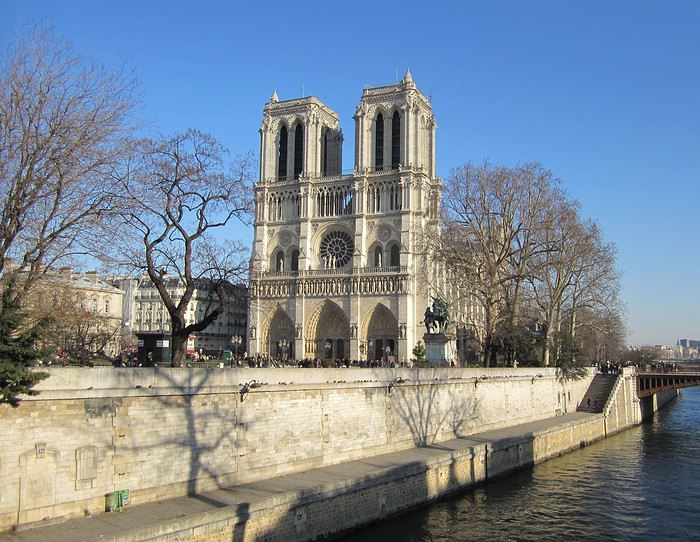
Détails Notre Dame de Paris
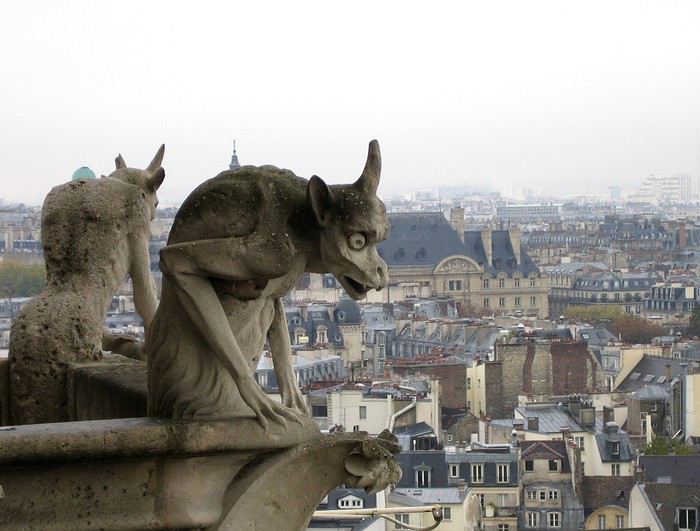 Détails d'un Temple au Yunnan Chine
Vue partielle extérieure Temple au Yunnan Chine
 La grande mosquée de Paris
 Le diaporama :
s.joomeo.com/5dbddd92688f3
JULIE
PS: on discute ici sur le concours de Novembre:😮
voyageforum.com/v.f?post=9805819;live=1;
Le diaporama :
s.joomeo.com/5dbddd92688f3
JULIE
PS: on discute ici sur le concours de Novembre:😮
voyageforum.com/v.f?post=9805819;live=1;
Pour participer : Dépôt des photos jusqu’au vendredi 22 novembre 22h. Vous pouvez poster jusqu’à 3 photos, numérotées et postées dans des messages différents, accompagnées d’un petit descriptif (lieu, anecdote...)
Pour voter : du samedi 23 novembre au vendredi 29 novembre 23h 59. Merci d’indiquer le numéro de la photo, le pseudo et le nombre de points attribués. Photo n°1 = 3 pts Photo n°2 = 2 pts Photo n°3 = 1 pt Tous les membres de VF peuvent voter (même ceux qui n’ont pas déposé de photos). En cas d’égalité de points pour la première position, la photo gagnante sera celle ayant obtenu le plus grand nombre de 1ères places, puis de secondes places ! L’heureux(se) gagnant(e) devra organiser le concours photo du mois de Décembre.
Des exemples: Notre Dame de Paris
Détails Notre Dame de Paris
Détails d'un Temple au Yunnan ChineVue partielle extérieure Temple au Yunnan Chine
La grande mosquée de Paris
Le diaporama :
s.joomeo.com/5dbddd92688f3
JULIE
PS: on discute ici sur le concours de Novembre:😮
voyageforum.com/v.f?post=9805819;live=1;Pow wow de Wendake (Québec) ou rassemblement de Mashteuiatsh (Saguenay–Lac-Saint-Jean)? English translation pending
Bonjour à tous.
Pour mon voyage de l'année prochaine j'aimerai savoir, pour ceux qui ont fait les deux, quel est le plus chouette pow wow entre Wendake et Mashteuiasth....Les deux doivent être superbes mais il faut que je fasse un choix...
Pour la Gaspésie, je vais y consacrer 10 à 12 jours et la seule interrogation que j'ai encore c'est où m'arrêter entre Rimouski et Percé..
Un arrêt du côté d'Amqui vaut il la peine?
Carleton sur mer..
Les deux??? Autre part d'incontournable???
Est ce qu'un arrêt du côté de Matane (à la fin du circuit) est intéressant??
Merci beaucoup à vous!!
Road trip à vélo de France jusqu'en Thaïlande: l'Asie en période de mousson? English translation pending
Bonjour à tous,
Nous suivons ce forum depuis quelques temps déjà en préparation de notre road-trip à vélo France-Thaïlande sur 14 mois, et départ prévu juillet 2020.
Ceci est notre premier message.
Dans l'élaboration de notre itinéraire, nous arriverions à priori en Inde autour du mois de février. Nous souhaitons ensuite contourner le Bangladesh, pour rejoindre la Birmanie puis la Thaïlande.
Or, la période suivant notre arrivée en Inde va correspondre à la période de mousson.
Voici nos questions: -est-ce que certains d'entre vous ont déjà voyagé dans ces pays durant cette saison? et si oui, est-ce "praticable" sans que ce soit complètement rédhibitoire? (surtout à vélo)
-est-ce qu'il vaudrait mieux partir via le Sud de l'Inde vers le Sri Lanka, et de là, envisager une traversée vers la Thaïlande, afin d'éviter la période de mousson, et rallonger notre périple vers la Malaisie ensuite...? Si oui, existe-t-il des lignes maritimes de l'Inde ou du Sri Lanka vers la Thaïlande?
Il ne nous est pas possible de décaler notre départ en raison des dates d'examens de deux de nos enfants (Baccalauréat et Brevet).
Bien qu'ayant vu des discussions abordant plus ou moins le sujet, nous sommes encore aujourd'hui sans réponses précises.
Merci d'avance pour vos retours
Perrine et Christophe de 8 à vélo
Nous suivons ce forum depuis quelques temps déjà en préparation de notre road-trip à vélo France-Thaïlande sur 14 mois, et départ prévu juillet 2020.
Ceci est notre premier message.
Dans l'élaboration de notre itinéraire, nous arriverions à priori en Inde autour du mois de février. Nous souhaitons ensuite contourner le Bangladesh, pour rejoindre la Birmanie puis la Thaïlande.
Or, la période suivant notre arrivée en Inde va correspondre à la période de mousson.
Voici nos questions: -est-ce que certains d'entre vous ont déjà voyagé dans ces pays durant cette saison? et si oui, est-ce "praticable" sans que ce soit complètement rédhibitoire? (surtout à vélo)
-est-ce qu'il vaudrait mieux partir via le Sud de l'Inde vers le Sri Lanka, et de là, envisager une traversée vers la Thaïlande, afin d'éviter la période de mousson, et rallonger notre périple vers la Malaisie ensuite...? Si oui, existe-t-il des lignes maritimes de l'Inde ou du Sri Lanka vers la Thaïlande?
Il ne nous est pas possible de décaler notre départ en raison des dates d'examens de deux de nos enfants (Baccalauréat et Brevet).
Bien qu'ayant vu des discussions abordant plus ou moins le sujet, nous sommes encore aujourd'hui sans réponses précises.
Merci d'avance pour vos retours
Perrine et Christophe de 8 à vélo
L'Ouest américain a-t-il mené à la ‘’rustography"? English translation pending
L’Ouest américain a-t-il mené à la ‘’rustography’ ? …
Dans un vaste échange précédent très ouvert Fabhyene a fait des remarques judicieuses qui m’ont paru mériter un petit développement …
‘’’ C'est marrant parce que certains se demandent pourquoi sur internet on trouve une telle fascination pour la rouille et les ruines. Sans remonter aux textes bibliques (tu es poussière et tu retourneras poussière), c'est oublier que les ruines étaient déjà fascinantes pour les Romantiques au 19ème siècle (à relier aussi à la thématiques des cités englouties)... et c'est aussi oublier la tradition dans la peinture occidentale des "vanités", ces représentations allégoriques de la mort, du temps qui passe et du caractère vain de toute activité humaine, vouée à la mort et la destruction... Plus récemment, c'est aussi une thématique qui s'est développée d'une revanche de la nature sur les hommes... Je pense qu'aux USA cela renvoie aussi aux villes fantômes, qui font partie du patrimoine... ‘’’ …
Le sujet est en effet assez fascinant quand on y réfléchit….
Chez les Romains qui ont dû leur Empire pour une bonne part à la maîtrise du fer mais qui n’avaient pas les moyens de comprendre l’oxydation, la rouille était un acte des dieux compensant la facilité avec laquelle le nouvel armement permettait de tuer l’ennemi … en tous cas c’est ce qu’ aurait écrit un certain Pline l’Ancien (🙂) en parlant de ferrum corrumpitur ( pas besoin de traduire). Cette interprétation force d’ailleurs le rapprochement avec la fiction développée dans La mort du fer(1931) de S.S. Held oû ce n’est pas une force divine mais une maladie venue de l’espace la sidérie encore appelée Mal bleu qui détruit la civilisation industrielle. La sidérie aurait bien sûr été introduite sur terre par une Sidérite …
Au Moyen Age et sous les latitudes humides on imagine le travail que çà devait être de maintenir l’armure hors rouille. Heureusement le Chevalier avait son fidèle Ecuyer qui s’en chargeait en frottant consciencieusement ladite armure avec du sable fin puis de l’huile de poisson, à ce qu’on lit chez les historiens! Cependant quand l’écuyer n’est plus là les choses peuvent mal tourner… on raconte d’un Chevalier Normand, en Angleterre, frappé par la Grâce divine ou pour échapper à l’ennemi, se réfugie dans la forêt et en signe de pénitence décide d’y vivre en ermite et ne plus jamais quitter son armure … de mauvaise langues disent qu’en réalité il ne pouvait plus l’ôter tant elle était rouillée. …...
Bon… passons sur les ponts effondrés à cause de la rouille des boulonnages de poutres acier ou du ferraillage interne, la plus récente étant celle du béton armé du pont Morandi de Gênes Alors, effectivement aux Etats Unis l’attrait contemporain de la rouille ‘’ renvoie aussi aux villes fantômes, qui font partie du patrimoine…’’
mais pas seulement….
Aux Etats Unis, en Australie et plus récemment au Royaume Uni se sont développés depuis une trentaine d’années un intérêt voire une passion pour ‘’la rouille’’ largement et d’abord associés à son esthétisme On peut probablement trouver un repère important dans l’introduction vers 1983 par le magazine Hemmings Motor News d’un calendrier thématique sur les voitures abandonnées dont voici la dernière édition :
L’art s’est donc emparé de la rouille : en peinture, en photographie, dans l’art textile oû c’est souvent tout simplement un objet de fer rouillé qui, posé pour un certain temps sur le tissu, imprime en rouille le canevas de l’oeuvre (textile rust dye) ..
Parlons photo et vieux trucks rouillés...
Il y a une douzaine d’années, ou un peu plus, une jeune architecte d’intérieur de la Côte Est, un peu pour s’amuser, met en vente dans une boutique quelques photos de vieux trucks abandonnés et rouillés prises à l’occasion d’un voyage dans l’Ouest. Elle s’aperçoit alors qu’elles partent toutes en un clin d’oeil et que les gens en redemandent. Stupeur : il y avait donc un marché pour çà !
Lors d’un interview de 2015 trucks & rust - Nancy "Weezy"Forman devait en effet déclarer :
“ A little bell went off in my head, ” Forman said. “I realized it was something people were loving, artistically, automotively and nostalgically.”
C’est ainsi qu’elle devient photographe spécialisée en RUSTOGRAPHY et qu’elle parcourt le pays, en particulier l’Ouest et le Sud Ouest, à la recherche de nouveaux sujets, mue par un sens artistique opportun puisque, incidemment, elle vend ses photos à partir de 250 et jusqu’à 2500 à 3000 dollars pour décorer les murs de votre cuisine, de votre bureau, de votre salle de séjour ou même de votre chambre…
Pour elle au moins l’expression ‘’beau comme un camion’’ a pris un sens concret !
Un autre photographe, Wayne Stadler, à peu près en même temps crée le groupe Rustography
S’il existe donc maintenant indiscutablement un rust art en anglophonie (à défaut d’un art de la rouille en francophonie) c’est à dire en fin de compte un art associé à l’oxydation du fer on peut en retracer l’origine loin… très loin en arrière, au paléolithique quand maîtrise du feu (= charbon de bois) et prise en compte des oxydes de fer (ocre etc..) ont permis l’art pariétal avec en premier lieu l’impression de mains positives ou négatives comme à La Grotte Chauvet-Pont d'Arc ( 36000 ans)
Le fer joue décidément un rôle capital dans l’histoire de la Terre et dans celle de l’humanité qu’elle porte.
Il a d’abord permis à la vie de se développer et de se maintenir grâce au puissant champ magnétique généré par le noyau externe (du fer liquide) au centre du globe qui la protège d’un excès de rayonnements et de particules solaires et cosmiques potentiellement léthales. Si un jour, le noyau s’étant suffisamment refroidi, le fer liquide arrêtait de ‘’bouger’’ sous nos pieds, le champ magnétique terrestre disparaissant alors, nous n’aurions plus à nous soucier de changement climatique…Nous disparaîtrions aussi, probablement complètement irradiés… mais çà n’est pas pour demain !
je m’égare un peu…...
Parlons ‘’rust’’ et paysages….
En peinture je me demande si ce n’est pas Georgia O'Keeffe elle-même qui n’aurait pas, la première, associé le terme ‘’rust’ à la peinture interprétative des paysages du sud ouest américain avec ‘’rust red hills’’. De ceci je ne suis pas sûr... quoiqu’il en soit le rust painting est maintenant bien établi
En francophonie on ne trouve pas un tel engouement. Cependant on peut citer au Quebec L'Art de la rouille de Jean-Pierre Tremblay (2016) et en France Rust-Art ou l'art de la rouille by AYRAULT BRIGITTE de Nantes (2015) dont le patronyme est bien celui auquel vous pensez . Son livre disponible chez l’ Américain Blurb, Inc. est payable en dollars. En en pied de couverture : ‘’ Rust in photo is an artistic and philosophic subject ‘’.
Au fait et la sculpture ?
Il existe bien sûr depuis des décennies des sculptures, constructions métalliques d’art plus ou moins rouillées ou plus ou moins potentiellement rouillées mais qui ne sont ni dédiées à la rouille ni construits avec elle . Superbe exemple avec Anza Borrego !
Par contre l’an dernier (2018) à Pittsburg ville qui semble avoir surmonté la crise de la Rust Belt issue du déclin industriel amorcé à la fin des années 70 le Carnegie Museum of Art a inauguré une œuvre dédiée à l’histoire industrielle passée, aux ouvriers, afro-américains entre autres qui l’ont fait vivre et à la musique jazz qui en est sortie. Occupant 185 m², constituée à partir de 11 tonnes de ferraille rouillée récupérée sur une friche industrielle et arrangée sur du charbon (en principe, peut-être une lave volcanique noire tenant lieu de charbon) et sur du verre pilé, l’oeuvre évoque par sa géométrie un ‘’sand painting’’ Navajo , ce qui n’est pas fortuit les auteurs étant trois Amérindiens de l’Ouest (dont un Navajo d’Albuquerque). From Smoke and Tangled Waters We Carried Fire Home est le titre complet de l’oeuvre que l’on peut admirer ... ou simplement voir ici :
From Smoke and Tangled Waters
Mais la rouille au sens large, c’est à dire l’oxydation du fer est à l’origine de bien d’autres beautés…..
Sans l’oxydation du fer , sans la ‘’rouille’’ le sud ouest américain serait à peu près monochrome et les formes mêmes des sédiments du plateau du Colorado (bof!) plus cohérents, seraient moins découpées, beaucoup moins spectaculaires parce que de la même manière que l’oxydation du ferraillage contribue à la désagrégation du béton des ponts elle contribue à celle des couches géologiques en créant des hétérogénéités. Le Plateau du Colorado ne serait qu’une masse d’une monotonie accablante. Déprimante perspective !
Rust et imagination
C’est un fait que les épaves abandonnées çà et là dans le désert, les ghost-towns, ou la forêt … çà titille l’imagination et on peut rêver un instant devant chacune d’entre elles. Le mystère est d’autant plus prégnant que, au milieu de nulle part, l’abandon semble avoir été brutal et imprévu.
L’exemple le plus médiatisé , le plus photographié depuis que les touristes affluent en Utah est probablement celui de la foreuse d’eau de Cathedral Valley (cathedral valley abandoned drill rig). On y voit un vieux truck de la marque INTERNATIONAL des années 50, reconnaissable à sa calandre, dont la peinture verte (comme c’était courant chez INTERNATIONAL à l’époque) est encore visible. On imagine qu’il a été pris dans une coulée de boue suite à un flash flood, que l’équipage ( de la Compagnie J. Pinkerton) a fuit, n’ayant plus tard jamais été en mesure de l’extirper de sa gangue. Peu à peu le sable, le recouvrant, il se fossilise pour...les archéologues du futur, tel un dinosaure de l’ère moderne ! Pour eux il portera aussi témoignage de l’une des Gun cultures les plus affirmées de notre temps puisque, comme beaucoup d’autres épaves, il a servi de cible aux ‘’ trigger happy’’ de la région en devenant un exemple d’une variante du ‘’rust art’’... à savoir le '’bullet ridden rusty car ‘’ dont voici un autre classique :
et dont un autre exemple fameux est bien sûr le véhicule dans lequel Bonnie and Clyde furent mitraillés libéralement ( Bonnie and Clyde's bullet riddled "death car" ). Assez morbide !
Si la foreuse sur camion est encore en batterie, tour dressée, matériel éparpillé tout autour, l’effet est encore plus saisissant. On dirait alors que le temps s’est figé.. comme à Pompéi ... sans les cendres. Mais là nous sommes dans l’ouest et, pendant une seconde, une idée va vous traverser la tête…. l’équipage aurait-il dû fuir pour échapper à une attaque d’ Apaches irréductibles descendus des montagnes. Que diable a-t-il bien pu survenir en effet à l’équipage de cette foreuse fantomatique abandonnée là, en urgence (sud de l’Arizona du côté de la San Pedro valley)….
En réalité l’affaire remonte à la fin des années 50 quand nombre de prospecteurs ont commencé à forer pour le pétrole dans le coin et sans beaucoup de succès… certains qui avaient vendu la peau de l’ours avant de l’avoir tué et emprunté pour payer leur matériel ont simplement dû couper court à leur aventure de manière en effet brutale... Mais qu’en est-il de ce mystérieux porte-voitures encore chargé de ses 4 voitures, lui aussi des années 50… ?
... Si vous avez une idée….lâchez vous !
Pour conclure sur une note d’humour tout en poursuivant votre réflexion métaphysique et si vous passez par là, visitez donc, en Oregon : The Rust Age - Zymoglyphic Museum
p.s. inutile de chercher Zymoglyphic dans le Merriam-Webster il n’y est pas encore ! Bonne journée !
Dans un vaste échange précédent très ouvert Fabhyene a fait des remarques judicieuses qui m’ont paru mériter un petit développement …
‘’’ C'est marrant parce que certains se demandent pourquoi sur internet on trouve une telle fascination pour la rouille et les ruines. Sans remonter aux textes bibliques (tu es poussière et tu retourneras poussière), c'est oublier que les ruines étaient déjà fascinantes pour les Romantiques au 19ème siècle (à relier aussi à la thématiques des cités englouties)... et c'est aussi oublier la tradition dans la peinture occidentale des "vanités", ces représentations allégoriques de la mort, du temps qui passe et du caractère vain de toute activité humaine, vouée à la mort et la destruction... Plus récemment, c'est aussi une thématique qui s'est développée d'une revanche de la nature sur les hommes... Je pense qu'aux USA cela renvoie aussi aux villes fantômes, qui font partie du patrimoine... ‘’’ …
Le sujet est en effet assez fascinant quand on y réfléchit….
Chez les Romains qui ont dû leur Empire pour une bonne part à la maîtrise du fer mais qui n’avaient pas les moyens de comprendre l’oxydation, la rouille était un acte des dieux compensant la facilité avec laquelle le nouvel armement permettait de tuer l’ennemi … en tous cas c’est ce qu’ aurait écrit un certain Pline l’Ancien (🙂) en parlant de ferrum corrumpitur ( pas besoin de traduire). Cette interprétation force d’ailleurs le rapprochement avec la fiction développée dans La mort du fer(1931) de S.S. Held oû ce n’est pas une force divine mais une maladie venue de l’espace la sidérie encore appelée Mal bleu qui détruit la civilisation industrielle. La sidérie aurait bien sûr été introduite sur terre par une Sidérite …
Au Moyen Age et sous les latitudes humides on imagine le travail que çà devait être de maintenir l’armure hors rouille. Heureusement le Chevalier avait son fidèle Ecuyer qui s’en chargeait en frottant consciencieusement ladite armure avec du sable fin puis de l’huile de poisson, à ce qu’on lit chez les historiens! Cependant quand l’écuyer n’est plus là les choses peuvent mal tourner… on raconte d’un Chevalier Normand, en Angleterre, frappé par la Grâce divine ou pour échapper à l’ennemi, se réfugie dans la forêt et en signe de pénitence décide d’y vivre en ermite et ne plus jamais quitter son armure … de mauvaise langues disent qu’en réalité il ne pouvait plus l’ôter tant elle était rouillée. …...
Bon… passons sur les ponts effondrés à cause de la rouille des boulonnages de poutres acier ou du ferraillage interne, la plus récente étant celle du béton armé du pont Morandi de Gênes Alors, effectivement aux Etats Unis l’attrait contemporain de la rouille ‘’ renvoie aussi aux villes fantômes, qui font partie du patrimoine…’’
mais pas seulement….
Aux Etats Unis, en Australie et plus récemment au Royaume Uni se sont développés depuis une trentaine d’années un intérêt voire une passion pour ‘’la rouille’’ largement et d’abord associés à son esthétisme On peut probablement trouver un repère important dans l’introduction vers 1983 par le magazine Hemmings Motor News d’un calendrier thématique sur les voitures abandonnées dont voici la dernière édition :
L’art s’est donc emparé de la rouille : en peinture, en photographie, dans l’art textile oû c’est souvent tout simplement un objet de fer rouillé qui, posé pour un certain temps sur le tissu, imprime en rouille le canevas de l’oeuvre (textile rust dye) ..
Parlons photo et vieux trucks rouillés...
Il y a une douzaine d’années, ou un peu plus, une jeune architecte d’intérieur de la Côte Est, un peu pour s’amuser, met en vente dans une boutique quelques photos de vieux trucks abandonnés et rouillés prises à l’occasion d’un voyage dans l’Ouest. Elle s’aperçoit alors qu’elles partent toutes en un clin d’oeil et que les gens en redemandent. Stupeur : il y avait donc un marché pour çà !
Lors d’un interview de 2015 trucks & rust - Nancy "Weezy"Forman devait en effet déclarer :
“ A little bell went off in my head, ” Forman said. “I realized it was something people were loving, artistically, automotively and nostalgically.”
C’est ainsi qu’elle devient photographe spécialisée en RUSTOGRAPHY et qu’elle parcourt le pays, en particulier l’Ouest et le Sud Ouest, à la recherche de nouveaux sujets, mue par un sens artistique opportun puisque, incidemment, elle vend ses photos à partir de 250 et jusqu’à 2500 à 3000 dollars pour décorer les murs de votre cuisine, de votre bureau, de votre salle de séjour ou même de votre chambre…
Pour elle au moins l’expression ‘’beau comme un camion’’ a pris un sens concret !
Un autre photographe, Wayne Stadler, à peu près en même temps crée le groupe Rustography
S’il existe donc maintenant indiscutablement un rust art en anglophonie (à défaut d’un art de la rouille en francophonie) c’est à dire en fin de compte un art associé à l’oxydation du fer on peut en retracer l’origine loin… très loin en arrière, au paléolithique quand maîtrise du feu (= charbon de bois) et prise en compte des oxydes de fer (ocre etc..) ont permis l’art pariétal avec en premier lieu l’impression de mains positives ou négatives comme à La Grotte Chauvet-Pont d'Arc ( 36000 ans)
Le fer joue décidément un rôle capital dans l’histoire de la Terre et dans celle de l’humanité qu’elle porte.
Il a d’abord permis à la vie de se développer et de se maintenir grâce au puissant champ magnétique généré par le noyau externe (du fer liquide) au centre du globe qui la protège d’un excès de rayonnements et de particules solaires et cosmiques potentiellement léthales. Si un jour, le noyau s’étant suffisamment refroidi, le fer liquide arrêtait de ‘’bouger’’ sous nos pieds, le champ magnétique terrestre disparaissant alors, nous n’aurions plus à nous soucier de changement climatique…Nous disparaîtrions aussi, probablement complètement irradiés… mais çà n’est pas pour demain !
je m’égare un peu…...
Parlons ‘’rust’’ et paysages….
En peinture je me demande si ce n’est pas Georgia O'Keeffe elle-même qui n’aurait pas, la première, associé le terme ‘’rust’ à la peinture interprétative des paysages du sud ouest américain avec ‘’rust red hills’’. De ceci je ne suis pas sûr... quoiqu’il en soit le rust painting est maintenant bien établi
En francophonie on ne trouve pas un tel engouement. Cependant on peut citer au Quebec L'Art de la rouille de Jean-Pierre Tremblay (2016) et en France Rust-Art ou l'art de la rouille by AYRAULT BRIGITTE de Nantes (2015) dont le patronyme est bien celui auquel vous pensez . Son livre disponible chez l’ Américain Blurb, Inc. est payable en dollars. En en pied de couverture : ‘’ Rust in photo is an artistic and philosophic subject ‘’.
Au fait et la sculpture ?
Il existe bien sûr depuis des décennies des sculptures, constructions métalliques d’art plus ou moins rouillées ou plus ou moins potentiellement rouillées mais qui ne sont ni dédiées à la rouille ni construits avec elle . Superbe exemple avec Anza Borrego !
Par contre l’an dernier (2018) à Pittsburg ville qui semble avoir surmonté la crise de la Rust Belt issue du déclin industriel amorcé à la fin des années 70 le Carnegie Museum of Art a inauguré une œuvre dédiée à l’histoire industrielle passée, aux ouvriers, afro-américains entre autres qui l’ont fait vivre et à la musique jazz qui en est sortie. Occupant 185 m², constituée à partir de 11 tonnes de ferraille rouillée récupérée sur une friche industrielle et arrangée sur du charbon (en principe, peut-être une lave volcanique noire tenant lieu de charbon) et sur du verre pilé, l’oeuvre évoque par sa géométrie un ‘’sand painting’’ Navajo , ce qui n’est pas fortuit les auteurs étant trois Amérindiens de l’Ouest (dont un Navajo d’Albuquerque). From Smoke and Tangled Waters We Carried Fire Home est le titre complet de l’oeuvre que l’on peut admirer ... ou simplement voir ici :
From Smoke and Tangled Waters
Mais la rouille au sens large, c’est à dire l’oxydation du fer est à l’origine de bien d’autres beautés…..
Sans l’oxydation du fer , sans la ‘’rouille’’ le sud ouest américain serait à peu près monochrome et les formes mêmes des sédiments du plateau du Colorado (bof!) plus cohérents, seraient moins découpées, beaucoup moins spectaculaires parce que de la même manière que l’oxydation du ferraillage contribue à la désagrégation du béton des ponts elle contribue à celle des couches géologiques en créant des hétérogénéités. Le Plateau du Colorado ne serait qu’une masse d’une monotonie accablante. Déprimante perspective !
Rust et imagination
C’est un fait que les épaves abandonnées çà et là dans le désert, les ghost-towns, ou la forêt … çà titille l’imagination et on peut rêver un instant devant chacune d’entre elles. Le mystère est d’autant plus prégnant que, au milieu de nulle part, l’abandon semble avoir été brutal et imprévu.
L’exemple le plus médiatisé , le plus photographié depuis que les touristes affluent en Utah est probablement celui de la foreuse d’eau de Cathedral Valley (cathedral valley abandoned drill rig). On y voit un vieux truck de la marque INTERNATIONAL des années 50, reconnaissable à sa calandre, dont la peinture verte (comme c’était courant chez INTERNATIONAL à l’époque) est encore visible. On imagine qu’il a été pris dans une coulée de boue suite à un flash flood, que l’équipage ( de la Compagnie J. Pinkerton) a fuit, n’ayant plus tard jamais été en mesure de l’extirper de sa gangue. Peu à peu le sable, le recouvrant, il se fossilise pour...les archéologues du futur, tel un dinosaure de l’ère moderne ! Pour eux il portera aussi témoignage de l’une des Gun cultures les plus affirmées de notre temps puisque, comme beaucoup d’autres épaves, il a servi de cible aux ‘’ trigger happy’’ de la région en devenant un exemple d’une variante du ‘’rust art’’... à savoir le '’bullet ridden rusty car ‘’ dont voici un autre classique :
et dont un autre exemple fameux est bien sûr le véhicule dans lequel Bonnie and Clyde furent mitraillés libéralement ( Bonnie and Clyde's bullet riddled "death car" ). Assez morbide !
Si la foreuse sur camion est encore en batterie, tour dressée, matériel éparpillé tout autour, l’effet est encore plus saisissant. On dirait alors que le temps s’est figé.. comme à Pompéi ... sans les cendres. Mais là nous sommes dans l’ouest et, pendant une seconde, une idée va vous traverser la tête…. l’équipage aurait-il dû fuir pour échapper à une attaque d’ Apaches irréductibles descendus des montagnes. Que diable a-t-il bien pu survenir en effet à l’équipage de cette foreuse fantomatique abandonnée là, en urgence (sud de l’Arizona du côté de la San Pedro valley)….
En réalité l’affaire remonte à la fin des années 50 quand nombre de prospecteurs ont commencé à forer pour le pétrole dans le coin et sans beaucoup de succès… certains qui avaient vendu la peau de l’ours avant de l’avoir tué et emprunté pour payer leur matériel ont simplement dû couper court à leur aventure de manière en effet brutale... Mais qu’en est-il de ce mystérieux porte-voitures encore chargé de ses 4 voitures, lui aussi des années 50… ?
... Si vous avez une idée….lâchez vous !
Pour conclure sur une note d’humour tout en poursuivant votre réflexion métaphysique et si vous passez par là, visitez donc, en Oregon : The Rust Age - Zymoglyphic Museum
p.s. inutile de chercher Zymoglyphic dans le Merriam-Webster il n’y est pas encore ! Bonne journée !