Results for "Dong+Xuan+|+8+>+194"
3837 results found.
Nostalgie indochinoise- Vietnam et Cambodge - 1 English translation pending
Paris-Saïgon (Ho Chi Minh-Ville)
Sous l'immense verrière de l'aéroport Charles de Gaulle, à Roissy, une énorme explosion retentit, faisant trembler sols et vitres... Un bagage abandonné vient d'être proprement pulvérisé par les services de sécurité. Incident ordinaire en ces lieux sensibles où le moindre sac oublié par son propriétaire n'a qu'une très courte durée de vie.
Nous meublons l'attente du vol Air-France pour Saïgon en allant déjeuner à la Brasserie Flo du terminal F. Agréable manière de passer les quelques heures en savourant une choucroute bien française, avant l'aventure indochinoise que nous avons choisie en cet automne de l'an 2000.
Déception lorsqu'on nous délivre nos cartes d'embarquement : rangée de sièges n° 43 ! Tout à l'arrière du gros Boeing 777-200... Les passagers sont comprimés dans l'énorme zinc comme sardines en boîte. Une jeune femme très enceinte est assise près de nous, sans égard particulier pour son état : c'est la zone de l'avion la plus exposée aux turbulences. Et turbulences il y a, tout au long de l'interminable vol sans escale jusqu'à Singapour. Nous traversons des tempêtes qui brassent le Jumbo-jet comme un fétu de paille. Le personnel de bord ne brille pas par sa courtoisie. Le steward daigne nous servir, du haut de sa grandeur, quelques plateaux-repas sans le moindre sourire. Il faut insister longuement pour obtenir un verre d'eau. "Vous devriez louer un avion privé" nous dit ce malappris à qui nous marquons notre mécontentement d'être si mal accueillis.
Courte escale à Singapour, dans l'aéroport éclaboussant de luxe, le plus beau d'Asie, où nous dégustons un succulent café dans la zone-transit. Au lever du soleil, voici la terre indochinoise noyée sous les flots du Mékong qui ont envahi la plaine qui miroite comme un lac immense. Comprimés pendant des heures dans l'espace étriqué de la classe Canigou, les passagers posent enfin le pied sur la terre ferme. Derrière le guichet d'accueil, les préposés à la vérification des passeports et visas ont tous une mine sévère et peu engageante... Ils scrutent attentivement chaque étranger et tamponnent comme à regret les documents dont il ne faudra se séparer à aucun prix : cette demande de visa qu'il a fallu remplir pour l'obtenir, et qu'il faudra présenter à nouveau au moment du retour en France...
Un taxi nous dépose à l'hôtel Saïgon-Prince, établissement touristique de belle allure sur le boulevard Nguyen-Hue, quartier des affaires de cette ville cosmopolite que tous les français continuent de nommer Saïgon, malgré le vilain nom "Ho-Chi-Minh-Ville" de la réunification... L'arrivée sur le sol vietnamien n'est pas dépaysant : il règne dans ce pays une atmosphère de France d'autrefois qui a laissé une profonde empreinte sur ses habitants. Dans le hall imposant du palace, on remarque surtout des clients japonais.
Confortable et silencieuse, la vaste chambre donne sur une cour intérieure, à l'écart des bruits de la circulation très dense sur le boulevard.
L'Agence Vietnam-Tourist nous a été fermement recommandée pour organiser notre séjour. C'est un organisme d'état (le pays est sous le régime "communiste-libéral") et son directeur francophone établit un plan de visites selon nos désirs, qui suivent de près ses conseils appuyés. Cette ville active, grouillante et surpeuplée est consacrée en premier lieu aux affaires et au commerce tout azimut. Malgré trente années de guerre meurtrière, le Vietnam se relève du cauchemar à une vitesse vertigineuse, grâce au courage et au dynamisme exceptionnel de la population. A maintes reprises, nous allons voir des preuves tangibles de la grande force de vie qui s'exprime à travers le pays.
Parfum de cuisine française, au "Bistro Augustin", le patron est vietnamien, mais il a séjourné en Bretagne de longues années. A nous le filet de porc à la moutarde, le bar grillé et la crème brûlée ! Tout est délicieux, servi par une mignonne jeune fille au fin minois de porcelaine. C'est sûr : on va revenir souvent chez Augustin pour d'autres agapes.
On marche avec plaisir sur les larges trottoirs des avenues dont certaines portent l'ancien nom colonial avec la nouvelle dénomination. L'ex-rue Catinat a été rebaptisée Dong Khol. Seules trois rues gardent encore leur nom d'origine: rue Pasteur, rue Calmette et rue Yersin. A noter que ce sont trois scientifiques-bienfaiteurs de l'humanité ayant inventé des vaccins contre des maladies redoutables.
Les monuments officiels de Saïgon sont des vestiges intacts construits par les français entre 1900 et 1908. L'Hôtel de Ville, pâtisserie de stuc rose et blanc, colonnettes et frises rococo, ferme la perspective de l'avenue Nguyen-Hue. Il faut braver le joyeux désordre des innombrables engins à deux roues qui sillonnent en rangs serrés les grandes artères. Le directeur de l'agence nous a donné ce conseil : "Vous traversez, sans courir ni vous arrêter, les conducteurs vous évitent et vous ne risquez rien !"... Facile à dire, mais il faut garder tout son sang-froid pour se lancer dans ce magma en mouvement perpétuel environné de vapeurs d'essence.
Nous pouvons témoigner de l'efficacité de la méthode, puisque nous reviendrons sains et saufs d'un audacieux périple de 30 jours. Autre recommandation : se méfier des nombreux pickpockets qui sévissent autour de l'hôtel. Et pas plus tard que ce premier soir, quand nous allons à pied au restaurant, de l'autre côté de l'avenue, mon compagnon est abordé et serré de près par deux gus, dans l'intention manifeste de lui piquer sa sacoche. Mais l'homme a déjà été piégé, à Istanbul, par de semblables individus, et il repousse l'assaut en gueulant si fort que les gars s'enfuient sans insister ! Que dit-on ? "Seul le fou tombe deux fois dans le même piège..."
Demain, destination : le delta du Mékong, le fleuve jaune dont nous avons aperçu de l'avion les méandres débordant sur la campagne inondée...
Sous l'immense verrière de l'aéroport Charles de Gaulle, à Roissy, une énorme explosion retentit, faisant trembler sols et vitres... Un bagage abandonné vient d'être proprement pulvérisé par les services de sécurité. Incident ordinaire en ces lieux sensibles où le moindre sac oublié par son propriétaire n'a qu'une très courte durée de vie.
Nous meublons l'attente du vol Air-France pour Saïgon en allant déjeuner à la Brasserie Flo du terminal F. Agréable manière de passer les quelques heures en savourant une choucroute bien française, avant l'aventure indochinoise que nous avons choisie en cet automne de l'an 2000.
Déception lorsqu'on nous délivre nos cartes d'embarquement : rangée de sièges n° 43 ! Tout à l'arrière du gros Boeing 777-200... Les passagers sont comprimés dans l'énorme zinc comme sardines en boîte. Une jeune femme très enceinte est assise près de nous, sans égard particulier pour son état : c'est la zone de l'avion la plus exposée aux turbulences. Et turbulences il y a, tout au long de l'interminable vol sans escale jusqu'à Singapour. Nous traversons des tempêtes qui brassent le Jumbo-jet comme un fétu de paille. Le personnel de bord ne brille pas par sa courtoisie. Le steward daigne nous servir, du haut de sa grandeur, quelques plateaux-repas sans le moindre sourire. Il faut insister longuement pour obtenir un verre d'eau. "Vous devriez louer un avion privé" nous dit ce malappris à qui nous marquons notre mécontentement d'être si mal accueillis.
Courte escale à Singapour, dans l'aéroport éclaboussant de luxe, le plus beau d'Asie, où nous dégustons un succulent café dans la zone-transit. Au lever du soleil, voici la terre indochinoise noyée sous les flots du Mékong qui ont envahi la plaine qui miroite comme un lac immense. Comprimés pendant des heures dans l'espace étriqué de la classe Canigou, les passagers posent enfin le pied sur la terre ferme. Derrière le guichet d'accueil, les préposés à la vérification des passeports et visas ont tous une mine sévère et peu engageante... Ils scrutent attentivement chaque étranger et tamponnent comme à regret les documents dont il ne faudra se séparer à aucun prix : cette demande de visa qu'il a fallu remplir pour l'obtenir, et qu'il faudra présenter à nouveau au moment du retour en France...
Un taxi nous dépose à l'hôtel Saïgon-Prince, établissement touristique de belle allure sur le boulevard Nguyen-Hue, quartier des affaires de cette ville cosmopolite que tous les français continuent de nommer Saïgon, malgré le vilain nom "Ho-Chi-Minh-Ville" de la réunification... L'arrivée sur le sol vietnamien n'est pas dépaysant : il règne dans ce pays une atmosphère de France d'autrefois qui a laissé une profonde empreinte sur ses habitants. Dans le hall imposant du palace, on remarque surtout des clients japonais.
Confortable et silencieuse, la vaste chambre donne sur une cour intérieure, à l'écart des bruits de la circulation très dense sur le boulevard.
L'Agence Vietnam-Tourist nous a été fermement recommandée pour organiser notre séjour. C'est un organisme d'état (le pays est sous le régime "communiste-libéral") et son directeur francophone établit un plan de visites selon nos désirs, qui suivent de près ses conseils appuyés. Cette ville active, grouillante et surpeuplée est consacrée en premier lieu aux affaires et au commerce tout azimut. Malgré trente années de guerre meurtrière, le Vietnam se relève du cauchemar à une vitesse vertigineuse, grâce au courage et au dynamisme exceptionnel de la population. A maintes reprises, nous allons voir des preuves tangibles de la grande force de vie qui s'exprime à travers le pays.
Parfum de cuisine française, au "Bistro Augustin", le patron est vietnamien, mais il a séjourné en Bretagne de longues années. A nous le filet de porc à la moutarde, le bar grillé et la crème brûlée ! Tout est délicieux, servi par une mignonne jeune fille au fin minois de porcelaine. C'est sûr : on va revenir souvent chez Augustin pour d'autres agapes.
On marche avec plaisir sur les larges trottoirs des avenues dont certaines portent l'ancien nom colonial avec la nouvelle dénomination. L'ex-rue Catinat a été rebaptisée Dong Khol. Seules trois rues gardent encore leur nom d'origine: rue Pasteur, rue Calmette et rue Yersin. A noter que ce sont trois scientifiques-bienfaiteurs de l'humanité ayant inventé des vaccins contre des maladies redoutables.
Les monuments officiels de Saïgon sont des vestiges intacts construits par les français entre 1900 et 1908. L'Hôtel de Ville, pâtisserie de stuc rose et blanc, colonnettes et frises rococo, ferme la perspective de l'avenue Nguyen-Hue. Il faut braver le joyeux désordre des innombrables engins à deux roues qui sillonnent en rangs serrés les grandes artères. Le directeur de l'agence nous a donné ce conseil : "Vous traversez, sans courir ni vous arrêter, les conducteurs vous évitent et vous ne risquez rien !"... Facile à dire, mais il faut garder tout son sang-froid pour se lancer dans ce magma en mouvement perpétuel environné de vapeurs d'essence.
Nous pouvons témoigner de l'efficacité de la méthode, puisque nous reviendrons sains et saufs d'un audacieux périple de 30 jours. Autre recommandation : se méfier des nombreux pickpockets qui sévissent autour de l'hôtel. Et pas plus tard que ce premier soir, quand nous allons à pied au restaurant, de l'autre côté de l'avenue, mon compagnon est abordé et serré de près par deux gus, dans l'intention manifeste de lui piquer sa sacoche. Mais l'homme a déjà été piégé, à Istanbul, par de semblables individus, et il repousse l'assaut en gueulant si fort que les gars s'enfuient sans insister ! Que dit-on ? "Seul le fou tombe deux fois dans le même piège..."
Demain, destination : le delta du Mékong, le fleuve jaune dont nous avons aperçu de l'avion les méandres débordant sur la campagne inondée...
Thaïlande-Cambodge-Laos English translation pending
Ola tout lmonde!!
Alors.. ma démarche est très simple, j'aimerai connaitre votre avis et récolter qq conseils quant au périple que je suis en train d'organiser avec deux amies: Thailande, cambodge et laos en 2 mois. voici un premier jet de ce voyage:
Arrivée à BKK, rester 2, 3 jours sur place Partir au cambodge (angkor, PP et sihanoukville) qq semaines REjoindre le laos par la thailande et y rester un bon mois
Plusieurs questions me viennent à l'esprit: vaut il mieux prendre un bus directement de BKK au nord du cambodge ou descendre ds le sud de la thailande, à Trat et prendre un bateau jusqu'au sud du cambodge, Sihanoukville? par quelle ville de la thailande est il plus judicieux de rejoindre le laos? Ns n avons pas forcement envie de nous eterniser en Thaïlande par contre sur la route qui ns menera au laos, si vous avez des villes à nous recommander, n'hesitez pas!!! pendant qu'on y est!
Merci à vous de m'aiguiller un peu ;o)) A très vite!!
Alors.. ma démarche est très simple, j'aimerai connaitre votre avis et récolter qq conseils quant au périple que je suis en train d'organiser avec deux amies: Thailande, cambodge et laos en 2 mois. voici un premier jet de ce voyage:
Arrivée à BKK, rester 2, 3 jours sur place Partir au cambodge (angkor, PP et sihanoukville) qq semaines REjoindre le laos par la thailande et y rester un bon mois
Plusieurs questions me viennent à l'esprit: vaut il mieux prendre un bus directement de BKK au nord du cambodge ou descendre ds le sud de la thailande, à Trat et prendre un bateau jusqu'au sud du cambodge, Sihanoukville? par quelle ville de la thailande est il plus judicieux de rejoindre le laos? Ns n avons pas forcement envie de nous eterniser en Thaïlande par contre sur la route qui ns menera au laos, si vous avez des villes à nous recommander, n'hesitez pas!!! pendant qu'on y est!
Merci à vous de m'aiguiller un peu ;o)) A très vite!!
La région du Guizhou et Yunan (Chine) English translation pending
Saut,
je pars dans le Guizhou et Yunan en Juillet et Aout. (J'ai renoncé à la birmanie qui est vraiment trop mouillée pendant la mousson parait il…)
Un amoureux du coin peut il me parler de la région…
Merci
Vietnam, si je peux vous être utile... English translation pending
Bonjour - Je viens d'effectuer un long voyage de 70 jours au VIETNAM (mon 3ème voyage ). Si je peux etre utile pour vous donner des renseignements pour voyager dans ce pays - sur des regions comme SAPA, l'Ile de PHU QUOC et sans oublier la Baie d'Along ! Contactez-moi !
Delta du Mekong au Vietnam English translation pending
bonjour a tous
a defaut de repondre a des mais particuliers, je me permets cette petite suggestion (mais c'est vraiment un bon plan) pour ceux qui souhaitent se rendre dans le delta du mekong et particulirement a chau doc notamment ceux qui viennent du cambodge (c' etait mon cas).
Si vos vous y arretez et suhaitez voir la region adressez vous a Monsieur Dung (prononcez yon ), mototaxi de 53 ans. c' est la bonte et la gentillesse incarnee. il parle francais et vous apprendra tout ce que vous voudrez sur le pays (arent, prix, langue...)
au lieu de vous rerouver a depenser des fortunes et faire profiter votre argent a quelqu' un dont la vie est pas des plus faciles : contactez le, vous ne serez pas decu.
pour le trouver, il est soit dans un petit "cafe" vietnamien a 50 metres a gauche de l' hotel thuan loi dans la journee. si pas la, donnez son nom. ou le soir a un cafe nomme thuy trian sur quang trun ou phan din phung. Si ils vous abordent, ne craignez rien et faites lui confiance.
pour ceux qui veulent eviter les groupes de touristes et veulent se retrouver un peu seul, le delta du mekong est ideal et c' est facile pour prendre les bus locaux. je pratique en ce moment meme
Pas besoin de partir de saigon (a moins que le temps vous manque) mais vu les groupes que j' ai croise c'est un peu le zoo.
a part ca, can tho et son marche flottant sont magiques
Avis aux interesse(e)s
a defaut de repondre a des mais particuliers, je me permets cette petite suggestion (mais c'est vraiment un bon plan) pour ceux qui souhaitent se rendre dans le delta du mekong et particulirement a chau doc notamment ceux qui viennent du cambodge (c' etait mon cas).
Si vos vous y arretez et suhaitez voir la region adressez vous a Monsieur Dung (prononcez yon ), mototaxi de 53 ans. c' est la bonte et la gentillesse incarnee. il parle francais et vous apprendra tout ce que vous voudrez sur le pays (arent, prix, langue...)
au lieu de vous rerouver a depenser des fortunes et faire profiter votre argent a quelqu' un dont la vie est pas des plus faciles : contactez le, vous ne serez pas decu.
pour le trouver, il est soit dans un petit "cafe" vietnamien a 50 metres a gauche de l' hotel thuan loi dans la journee. si pas la, donnez son nom. ou le soir a un cafe nomme thuy trian sur quang trun ou phan din phung. Si ils vous abordent, ne craignez rien et faites lui confiance.
pour ceux qui veulent eviter les groupes de touristes et veulent se retrouver un peu seul, le delta du mekong est ideal et c' est facile pour prendre les bus locaux. je pratique en ce moment meme
Pas besoin de partir de saigon (a moins que le temps vous manque) mais vu les groupes que j' ai croise c'est un peu le zoo.
a part ca, can tho et son marche flottant sont magiques
Avis aux interesse(e)s
Souvenirs à ramener du Vietnam? English translation pending
Je pars au Vietnam en avril.
Que faut-il ramener ?
Avez vous des idées originales ou quels sont les incontournables ?
D'avance merci
Que faut-il ramener ?
Avez vous des idées originales ou quels sont les incontournables ?
D'avance merci
Itinéraire et sécurité en Thaïlande English translation pending
salut a tous,
nous pensons partir en mars en thailande en sac a dos pour deux semaines mais j'ai plein de question dans la tête 1) est-ce-que 4 filles seules ca craint ou pas? 2) est-ce que deux semaines ce n'est pas trop court pour visiter un pays qui a l'air aussi beau? Est ce que quelqu'un pourrais me donner son avis sur notre itinéraire que j'ai fait arrivée a bangkok départ pour chiang mai (3 jours) 1 jours mae hong song 2 jours sukhothai et phitsanulok 1 jour ayuthaya 3 jours bangkok 4 jours ko samui si quelqu'un ou quelqu'une pouvait me donner son avis sur notre périple ce serait génial merci d'avance à tous
nous pensons partir en mars en thailande en sac a dos pour deux semaines mais j'ai plein de question dans la tête 1) est-ce-que 4 filles seules ca craint ou pas? 2) est-ce que deux semaines ce n'est pas trop court pour visiter un pays qui a l'air aussi beau? Est ce que quelqu'un pourrais me donner son avis sur notre itinéraire que j'ai fait arrivée a bangkok départ pour chiang mai (3 jours) 1 jours mae hong song 2 jours sukhothai et phitsanulok 1 jour ayuthaya 3 jours bangkok 4 jours ko samui si quelqu'un ou quelqu'une pouvait me donner son avis sur notre périple ce serait génial merci d'avance à tous
From Avignon to Casamance Without Flying
Hi there,
Last February, I made a trip using "public transport" from France to southern Senegal via Spain, Morocco, Western Sahara, and Mauritania.
It’s a journey of about 5,000 km, where I took trains (as far as Marrakech), ferries (to cross Gibraltar and then to reach Casamance from Dakar), and mostly buses on the long desert straightaways. I hadn’t planned any stops in advance or booked any hotels, except for the very first train to Spain, which left plenty of room for the unexpected. Why travel by land and sea? In recent years, flight-free travel has been gaining popularity. On social media, posts explaining how to cross Europe by train as quickly as possible go viral. Traveling without flying—and making sure people know about it—has become a great way to earn a badge of eco-responsibility: an essential totem for anyone wanting to prove both their dedication to the ecological cause and the wisdom of slow travel. I haven’t flown in years, and this journey to West Africa could easily be filed under "responsible travel." But it wouldn’t be honest to say that: in reality, it wasn’t really my aversion to flying that motivated this long trek. I see overland travel primarily as a way to experience the world’s geography at a grounded, earthly pace—the pace of the locals. Besides, I’ll be flying back, which disqualifies any claim to being a model of sustainability. So no eco-badge, and no adventurer’s badge either: you won’t find any heroic tales of camel rides in lost lands or mineral train wagons in this account (popular with influencers, the Mauritania iron ore train now attracts tourists from all over the world, turning "the experience" into something you "have to do at least once in your life"). This five-part story, written on the road, has no other ambition than to recount a journey through places and people, and to share the thoughts they inspire in me. As simply and, I hope, as humbly as possible.
I’m posting the episodes here, which you can also find on my blog (with more photos) at the following links:
Episode 1: Spain, from Avignon to Algeciras
Episode 2: Morocco, from Tangier to Tarfaya
Episode 3: Western Sahara, from Tarfaya to Guerguerat
Episode 4: Mauritania, from Guerguerat to Nouakchott
Episode 5: Senegal, from Rosso to Saloulou
To help those who might want to make the same trip, I’ve also put together a summary of the route with recommendations—you can read it at the end of the story and on the blog: From France to Senegal Without Flying: Route and Itinerary Recommendations
Happy reading, and safe travels!
Last February, I made a trip using "public transport" from France to southern Senegal via Spain, Morocco, Western Sahara, and Mauritania.
It’s a journey of about 5,000 km, where I took trains (as far as Marrakech), ferries (to cross Gibraltar and then to reach Casamance from Dakar), and mostly buses on the long desert straightaways. I hadn’t planned any stops in advance or booked any hotels, except for the very first train to Spain, which left plenty of room for the unexpected. Why travel by land and sea? In recent years, flight-free travel has been gaining popularity. On social media, posts explaining how to cross Europe by train as quickly as possible go viral. Traveling without flying—and making sure people know about it—has become a great way to earn a badge of eco-responsibility: an essential totem for anyone wanting to prove both their dedication to the ecological cause and the wisdom of slow travel. I haven’t flown in years, and this journey to West Africa could easily be filed under "responsible travel." But it wouldn’t be honest to say that: in reality, it wasn’t really my aversion to flying that motivated this long trek. I see overland travel primarily as a way to experience the world’s geography at a grounded, earthly pace—the pace of the locals. Besides, I’ll be flying back, which disqualifies any claim to being a model of sustainability. So no eco-badge, and no adventurer’s badge either: you won’t find any heroic tales of camel rides in lost lands or mineral train wagons in this account (popular with influencers, the Mauritania iron ore train now attracts tourists from all over the world, turning "the experience" into something you "have to do at least once in your life"). This five-part story, written on the road, has no other ambition than to recount a journey through places and people, and to share the thoughts they inspire in me. As simply and, I hope, as humbly as possible.
I’m posting the episodes here, which you can also find on my blog (with more photos) at the following links:
Episode 1: Spain, from Avignon to Algeciras
Episode 2: Morocco, from Tangier to Tarfaya
Episode 3: Western Sahara, from Tarfaya to Guerguerat
Episode 4: Mauritania, from Guerguerat to Nouakchott
Episode 5: Senegal, from Rosso to Saloulou
To help those who might want to make the same trip, I’ve also put together a summary of the route with recommendations—you can read it at the end of the story and on the blog: From France to Senegal Without Flying: Route and Itinerary Recommendations
Happy reading, and safe travels!
Airport bus from Hanoi to Cao Bang
Hi there, we’re landing at Hanoi Airport and would like to head straight to Cao Bang without going into Hanoi. Does anyone know if there are buses that go directly from the airport to Cao Bang (especially in the early afternoon)? Thanks in advance!
The Two of Us in Istanbul: A Turkish Blue Round
Hello everyone,
I’m not really a regular contributor to VoyageForum, but every time Kate and I travel, she encourages me to write a travel journal and publish it. And I must admit, it’s a very enjoyable intellectual exercise, though not always easy. As a VF contributor whose journals I’ve read once said, this retrospective work not only helps preserve memories but also provides a fruitful moment of introspection by bringing back emotions and feelings.
Kate and I spent a week in Istanbul. For her, who had already visited, it was a return; for me, it was a discovery.
As we’ve now made a habit of, I write the texts, and she posts her photos. We hope this illustrated story, crafted together, will revive beautiful sensations for those who know the city and inspire others to discover it. Here we go!
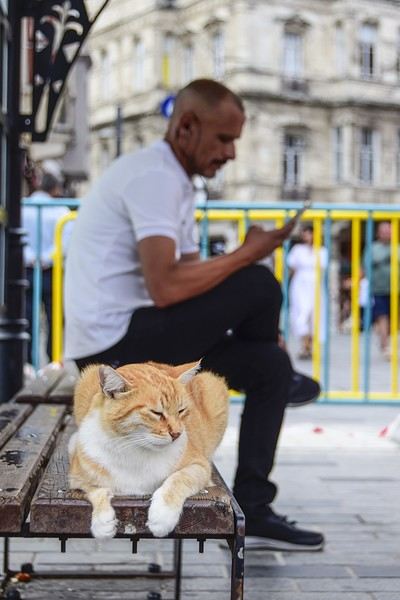
I’m not really a regular contributor to VoyageForum, but every time Kate and I travel, she encourages me to write a travel journal and publish it. And I must admit, it’s a very enjoyable intellectual exercise, though not always easy. As a VF contributor whose journals I’ve read once said, this retrospective work not only helps preserve memories but also provides a fruitful moment of introspection by bringing back emotions and feelings.
Kate and I spent a week in Istanbul. For her, who had already visited, it was a return; for me, it was a discovery.
As we’ve now made a habit of, I write the texts, and she posts her photos. We hope this illustrated story, crafted together, will revive beautiful sensations for those who know the city and inspire others to discover it. Here we go!
Travel Journal - 28 Days in China in August 2025
Hi everyone! I’m sharing a modest travel journal from my trip to China in August 2025.
There wasn’t much room for improvisation on this trip—everything was planned in advance. Since August is peak season, I decided to book train tickets early, and once that was set, I reserved all the accommodations too. I got everything on Trip.com.
I bought the flight tickets back in March from Hainan Airlines. They were super expensive, but with these travel dates, I couldn’t exactly dream of a bargain!
I picked up e-SIMs valid for a month from Free just before departure: 10 € for the e-SIM + 19.90 € for a one-month plan with 35 GB of data abroad.
No need for a VPN with these e-SIMs, but D. still got one—a multi-device plan for 5 € with a discount from Let’s VPN, valid for a month. It was for evenings at the hotel on Wi-Fi to avoid burning through the 35 GB with video.
I downloaded Alipay, WeChat, Amap (Baidu Maps), and Trip.com. We also have Google Translate and Maps.me—absolute must-haves.
We’re ready to go!
I’ve been waiting for this day for nearly 15 years!! I travel a lot, but this one—this is MY TRIP 🙂 It’s been postponed so many times: because I wanted to do it with the right person, because I have a Turkish stamp in my passport and heard they don’t issue visas with that, because of COVID... and then China introduced a 30-day visa exemption, and that was the green light! Ugh, they forced us to take our vacation in August this year—far from ideal—but no more delays. Saturday, August 2, 2025: it’s finally the big day!
Days 1 and 2: We got dropped off at Charles de Gaulle at 9:30 AM. I supposedly checked in online, but only for the first flight and without getting the boarding pass... Might as well scrap online check-in in that case. So, we spent over an hour in line at the counter to get them. We didn’t have any checked luggage—just our backpacks as carry-ons—so this was a step we’d never had to deal with before, but whatever, it’s done. No wait at passport control, 5 minutes through security, a quick walk around the terminal, 10 minutes in the boarding area, and it was already time to board. Departure around 12:45 PM, arrival in Chongqing at 4:50 AM. We had a few hours of layover before our next flight. Went through immigration, connecting flight control, and security. Pro tip: check your next flight’s boarding gate right after immigration. We never saw it displayed again anywhere in the terminal.
The Free e-SIMs work—phew!
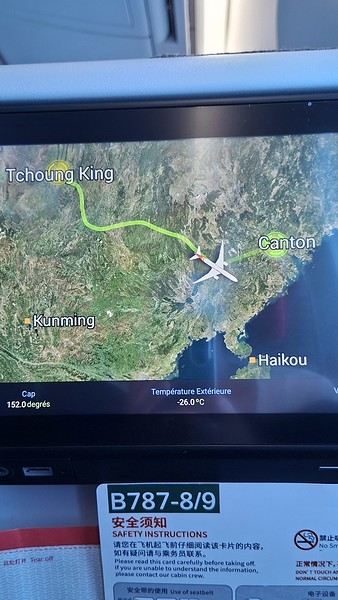
Took off at 9:30 AM, arrived in Guangzhou (Canton) at 11:20 AM in the rain. I love how Chongqing is translated as "Tchoung King" on the screens in the plane—very French!
During my first two trips to China, we paid for everything in cash, but this time, we’re going all-in on Alipay and WeChat. I still brought the leftover change from previous trips—it might come in handy. At the metro station, they showed us a QR code to buy tickets via WeChat. There were probably machines and even a ticket counter, but we didn’t see them, and buying via WeChat was pretty simple. 8 yuan to Changshu Lu, which is 22 stops. So far, so good. Then, we had to find the hotel, which wasn’t on Google Maps, Maps.me, or Amap... Easy 😎! We found it without too much hassle, though. Dropped off our stuff and went out to eat. 55 yuan for two claypots with fish/eel, rice, cabbage, and purple eggplant. When we left, it was pouring. We grabbed our umbrellas and set off to explore the neighborhood: Enning Road (we’ll come back later to check out a specific spot), Shangxiajiu (the pedestrian shopping street), Baohua Road... The area is pretty diverse—one street to the next, it’s like stepping into a different world.

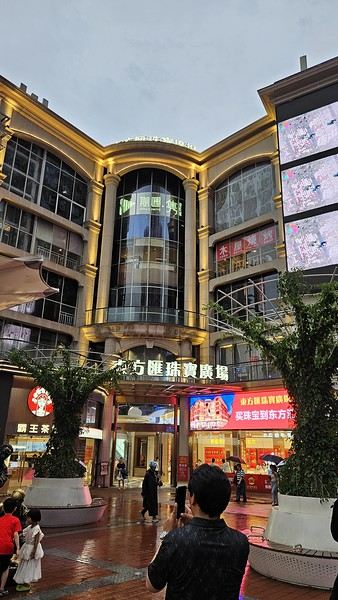
There weren’t many people around, probably because of the rain. We grabbed a quick street food dinner and went to bed—we were exhausted. We struggled to stay awake until 11 PM to adjust to the time change as quickly as possible. There’s a 6-hour time difference.
There wasn’t much room for improvisation on this trip—everything was planned in advance. Since August is peak season, I decided to book train tickets early, and once that was set, I reserved all the accommodations too. I got everything on Trip.com.
I bought the flight tickets back in March from Hainan Airlines. They were super expensive, but with these travel dates, I couldn’t exactly dream of a bargain!
I picked up e-SIMs valid for a month from Free just before departure: 10 € for the e-SIM + 19.90 € for a one-month plan with 35 GB of data abroad.
No need for a VPN with these e-SIMs, but D. still got one—a multi-device plan for 5 € with a discount from Let’s VPN, valid for a month. It was for evenings at the hotel on Wi-Fi to avoid burning through the 35 GB with video.
I downloaded Alipay, WeChat, Amap (Baidu Maps), and Trip.com. We also have Google Translate and Maps.me—absolute must-haves.
We’re ready to go!
I’ve been waiting for this day for nearly 15 years!! I travel a lot, but this one—this is MY TRIP 🙂 It’s been postponed so many times: because I wanted to do it with the right person, because I have a Turkish stamp in my passport and heard they don’t issue visas with that, because of COVID... and then China introduced a 30-day visa exemption, and that was the green light! Ugh, they forced us to take our vacation in August this year—far from ideal—but no more delays. Saturday, August 2, 2025: it’s finally the big day!
Days 1 and 2: We got dropped off at Charles de Gaulle at 9:30 AM. I supposedly checked in online, but only for the first flight and without getting the boarding pass... Might as well scrap online check-in in that case. So, we spent over an hour in line at the counter to get them. We didn’t have any checked luggage—just our backpacks as carry-ons—so this was a step we’d never had to deal with before, but whatever, it’s done. No wait at passport control, 5 minutes through security, a quick walk around the terminal, 10 minutes in the boarding area, and it was already time to board. Departure around 12:45 PM, arrival in Chongqing at 4:50 AM. We had a few hours of layover before our next flight. Went through immigration, connecting flight control, and security. Pro tip: check your next flight’s boarding gate right after immigration. We never saw it displayed again anywhere in the terminal.
The Free e-SIMs work—phew!
Took off at 9:30 AM, arrived in Guangzhou (Canton) at 11:20 AM in the rain. I love how Chongqing is translated as "Tchoung King" on the screens in the plane—very French!
During my first two trips to China, we paid for everything in cash, but this time, we’re going all-in on Alipay and WeChat. I still brought the leftover change from previous trips—it might come in handy. At the metro station, they showed us a QR code to buy tickets via WeChat. There were probably machines and even a ticket counter, but we didn’t see them, and buying via WeChat was pretty simple. 8 yuan to Changshu Lu, which is 22 stops. So far, so good. Then, we had to find the hotel, which wasn’t on Google Maps, Maps.me, or Amap... Easy 😎! We found it without too much hassle, though. Dropped off our stuff and went out to eat. 55 yuan for two claypots with fish/eel, rice, cabbage, and purple eggplant. When we left, it was pouring. We grabbed our umbrellas and set off to explore the neighborhood: Enning Road (we’ll come back later to check out a specific spot), Shangxiajiu (the pedestrian shopping street), Baohua Road... The area is pretty diverse—one street to the next, it’s like stepping into a different world.
There weren’t many people around, probably because of the rain. We grabbed a quick street food dinner and went to bed—we were exhausted. We struggled to stay awake until 11 PM to adjust to the time change as quickly as possible. There’s a 6-hour time difference.
Another side of my trip to Thailand: Villages, nature, countryside, mountains...
February 9th is a pivotal day during my trip to Thailand. Up until this date, my focus had been on cities, temples, and other urban landmarks. Starting February 10th, I’ll finally leave the city behind for the outskirts—one town, one life, farther from tourism, more real, more authentic... Then comes the bucolic surroundings of Chiang Mai, nature, the countryside, the mountains.
This morning, I head to visit the ethnographic museum. I’d been told about another one, but it’s permanently closed. I wonder if it’s the same one that might have changed its name and location.
I thoroughly enjoy visiting this museum. At first, I’m a bit annoyed because the place is packed with noisy school groups blocking the display cases without even showing the slightest interest. But soon, their chaperones manage to lead them into another room, giving me some peace. They maintain this distance throughout the tour, allowing me to explore the museum in complete tranquility. I really appreciate their tact.
I’m amazed by the absolutely stunning fabric displays and the countless everyday objects, especially the very old pottery. There’s so much beautiful basketry and intricately carved wood. The statues are also incredible... After seeing all of them, I no longer feel like buying any from the shops.
On my way back, not far from my hotel, I discover a rather unique place that only serves one drink, which they’ve made their specialty: egg coffee! A pretty surprising novelty. I have to try it.

At the bottom of the cup, they pour a layer of milk, topped with a layer of liquid coffee, followed by a layer of egg yolk, and finally a top layer that turns out to be a mix of coffee and cocoa powder. It’s a cold drink that, in the end, doesn’t have much flavor, and the price is pretty steep for such a small cup. You’re paying for the exclusivity!
Later in the day, I venture once again into small alleys, something I love doing when exploring a new city—no specific goal, just wandering east of the city, outside the walls.

I encounter very few tourists there and discover unsuspected little shops overflowing with lovely items, much cheaper than what you find in the heart of the tourist district. Then I wander through the floors of Warorot Market. I discover another kind of temple there: the temple of good deals. I love finding clothes that are really original for locals, not the flood of shirts and pants that tourists love but no Thai would ever buy, which invade the shops in the "Historic Square." I stop in my tracks in front of a stall with beautiful shirts featuring stunning geometric patterns in elegant color combinations and very short sleeves. Hmm, these would be perfect for showing off my biceps, one of which is adorned with the magnificent Ganesh tattoo I got last year in Bali. "When you’ve got nice things, you’ve got to show them off!" he said. 😜🙏💪 I pick out two for 380 baht and negotiate them down to 300. But the seller won’t go any lower. I understand I’ve reached the limit of her commercial possibilities. Just as I’m leaving the shop, happy with my purchase, my ever-helpful inner voice, Petite Voix, suggests: - You didn’t try them on because you were too lazy to take off the one you’re wearing and also because of the sweat, but you could just put one on over the one you’re wearing. It’s light enough that it won’t bother you.
I go back to the two sellers, who burst out laughing when I ask to try them on. - Oh no, it’s way too small for you! It’s a women’s shirt! - But they don’t look particularly feminine in style! And I chose XXL... I put the shirt on, and of course, it won’t close. Then I notice the buttons are on the wrong side. That’s why the sleeves seemed so short!!! They put the shirts back on the rack and refund me without any fuss, commenting amid total hilarity: - Well, thank goodness you tried it on just as you were leaving the shop!
Since I don’t want to walk too much before tomorrow’s first Big Outing with the driver, I end my stroll with a visit to two very pretty temples recommended by Joël.

I’d rather not post more temple photos. But these ones smell like village and countryside...


I’ve never seen anything like Wat Ket Karam, so extravagant...


And I end my day with two other lesser-known temples: Wat Noung Kham, simple and finally free of gold and glitter,

and Wat Dap Phai, where an intimate ceremony is taking place at the end of the day.
This morning, I head to visit the ethnographic museum. I’d been told about another one, but it’s permanently closed. I wonder if it’s the same one that might have changed its name and location.
I thoroughly enjoy visiting this museum. At first, I’m a bit annoyed because the place is packed with noisy school groups blocking the display cases without even showing the slightest interest. But soon, their chaperones manage to lead them into another room, giving me some peace. They maintain this distance throughout the tour, allowing me to explore the museum in complete tranquility. I really appreciate their tact.
I’m amazed by the absolutely stunning fabric displays and the countless everyday objects, especially the very old pottery. There’s so much beautiful basketry and intricately carved wood. The statues are also incredible... After seeing all of them, I no longer feel like buying any from the shops.
On my way back, not far from my hotel, I discover a rather unique place that only serves one drink, which they’ve made their specialty: egg coffee! A pretty surprising novelty. I have to try it.
At the bottom of the cup, they pour a layer of milk, topped with a layer of liquid coffee, followed by a layer of egg yolk, and finally a top layer that turns out to be a mix of coffee and cocoa powder. It’s a cold drink that, in the end, doesn’t have much flavor, and the price is pretty steep for such a small cup. You’re paying for the exclusivity!
Later in the day, I venture once again into small alleys, something I love doing when exploring a new city—no specific goal, just wandering east of the city, outside the walls.
I encounter very few tourists there and discover unsuspected little shops overflowing with lovely items, much cheaper than what you find in the heart of the tourist district. Then I wander through the floors of Warorot Market. I discover another kind of temple there: the temple of good deals. I love finding clothes that are really original for locals, not the flood of shirts and pants that tourists love but no Thai would ever buy, which invade the shops in the "Historic Square." I stop in my tracks in front of a stall with beautiful shirts featuring stunning geometric patterns in elegant color combinations and very short sleeves. Hmm, these would be perfect for showing off my biceps, one of which is adorned with the magnificent Ganesh tattoo I got last year in Bali. "When you’ve got nice things, you’ve got to show them off!" he said. 😜🙏💪 I pick out two for 380 baht and negotiate them down to 300. But the seller won’t go any lower. I understand I’ve reached the limit of her commercial possibilities. Just as I’m leaving the shop, happy with my purchase, my ever-helpful inner voice, Petite Voix, suggests: - You didn’t try them on because you were too lazy to take off the one you’re wearing and also because of the sweat, but you could just put one on over the one you’re wearing. It’s light enough that it won’t bother you.
I go back to the two sellers, who burst out laughing when I ask to try them on. - Oh no, it’s way too small for you! It’s a women’s shirt! - But they don’t look particularly feminine in style! And I chose XXL... I put the shirt on, and of course, it won’t close. Then I notice the buttons are on the wrong side. That’s why the sleeves seemed so short!!! They put the shirts back on the rack and refund me without any fuss, commenting amid total hilarity: - Well, thank goodness you tried it on just as you were leaving the shop!
Since I don’t want to walk too much before tomorrow’s first Big Outing with the driver, I end my stroll with a visit to two very pretty temples recommended by Joël.
I’d rather not post more temple photos. But these ones smell like village and countryside...
I’ve never seen anything like Wat Ket Karam, so extravagant...
And I end my day with two other lesser-known temples: Wat Noung Kham, simple and finally free of gold and glitter,
and Wat Dap Phai, where an intimate ceremony is taking place at the end of the day.
Vietnam or New Zealand for a woman traveling solo?
Hello everyone!
I REALLY need some advice because I’m feeling lost with my choices for my next solo trip—I’d like to book within the month .
Just so you know, my trip will be in September 2025 for about 17 days.
My top pick is Vietnam; I’ve never been to Asia.
I know the rainy season will be in full swing in September, but several reviews seemed to say it’s not necessarily a dealbreaker, even though it might affect a few hours each day.
PS: I was considering Cambodia, but apparently, the situation isn’t safe for a woman or a tourist right now.
I’ve also heard a lot about New Zealand, but I don’t know anyone who’s been there—especially solo. The nature looks amazing, but does 100% nature get boring quickly when you’re alone? Are there meet-up spots or restaurants/cafés in all the must-see places?
To give you some background, I’ve traveled solo before: Seville, Sweden (Stockholm and Lapland), and I spent 6 months exploring Marseille on my own. I love discovering places and cultures by myself.
Fun fact: my favorite trip was South Africa—for the change of scenery, the people I met, the landscapes, and the nature—but I wasn’t solo there.
Do you have any firsthand experience with these two destinations for a solo trip as a woman?
Or do you have other ideas that fit a similar budget and are interesting for 15–17 days, with a real sense of adventure? And, of course, safe and not too stressful for a woman!
(I’d also love to hear about any custom travel agencies you’ve had good experiences with—I really want to plan this trip as best as I can, but all the agencies I’ve found have mixed reviews.)
Thank you so much for your help!! I’ll keep you posted on my choice and I’m happy to answer any questions you might have!
The 4000 Islands (Southern Laos)
PAKSE AND THE BOLAVENS PLATEAU
Bolavens (or "Bolovens" – "the region of the Lavens," an old tribe).
PAKSE
A sleepy town, but packed with backpackers in transit between Laos and Cambodia. The streets are numbered, but since there are no signs, you just have to figure it out (rumor has it the signs have been planned for years; luckily, the center isn’t big). Tons of small hotels, including the well-known Sabaidy 2 on Street 20, a big bazaar catering to all budgets, from dark dorms with shared bathrooms to real rooms with terraces or balconies. Since it’s so popular, booking ahead is recommended. My favorite: the Sala Champa, pricier but with two large terraces, one with a bar, and especially a terrace restaurant I consider the best in Pakse (try the divine steamed fish with lemongrass + Lao Gold beer, a rare delight; ask for room 100, with a big terrace). More upscale, the lovely Résidence Sisouk, run by the very classy and French-speaking Mme Sisouk, from the wealthy Lao Sisouk family, the country’s top coffee producer and one of those francophone families you encounter here and there around the world, where class and culture reign – and perfect French. Delicious pastries and, of course, extraordinary coffee tastings. Similar prices at the Pakse Hotel, run by French owners and famous for its rooftop bar-restaurant (great view!).
Tons of restaurants besides those at Sala Champa and Pakse Hotel: from Dao Lin and Sabaidee at the corner of Street 20 and 13, to a decent Indian place (Hassan) and a nice, cheap spot, the Lao Restaurant & Bar, where you can enjoy Lao cuisine for just a few kips, both also on Street 20. You can feast on grilled fish at the countless riverside stalls along the Mekong.
Pakse is home to the famous Yves, a Belgian married to a Lao woman, Noy, who opened the travel agency Miss Noy. He’ll go out of his way to help tourists; he’s incredible, the real tourism office for the region, with maps, endless advice, and every weekday at 6 PM, a full-blown lecture on the Bolavens and the 4000 Islands. A bunch of young travelers listen intently to his explanations about the whole area (he hands out a well-made photocopied map). He also rents bikes and has an internet café with computers that, miraculously, work perfectly. He’s so popular that in high season, you need to book a motorbike 2-3 days in advance (but if he’s out – and he has 40 – he’ll find one for you).
THE BOLAVENS PLATEAU
Plateaus just aren’t my thing – flat-lands! There are some relatively high peaks in the middle, but they’re only accessible by trekking. You can do a small loop from Pakse-Tad Lo-Thateng-Pakson-Pakse, or a big one from Tad Lo to Sekong, then head south to join the Paksong-Pakse road. Starting in the north, the Phu Xam waterfalls are okay (interesting local minority village-museum to the right of the parking lot, and a terrace restaurant above the small falls). Well, they’re on the way, so you might as well see them! After that, a boring road leads to the Tad Lo waterfalls, with tons of small hotels. I chose the big blue house by the river at the right corner of the bridge, the Sipaseth GH, with cute little bungalows in the garden, 4 rooms with balconies overlooking the river, and great food on the terrace facing the falls. **Avoid at all costs**: the Saisee GH, once nice with its little stilt houses by the falls, but now a monument to filth, indifference, and rudeness (confirmed by several people, unanimous on the issue). Luckily, the lovely Tad Lo Lodge, with its bungalows by the falls and gourmet restaurant right above them – not cheap at all – finally built small houses in the woods on the other side for $25.
The next morning, I’d had enough of plateaus, so I took a small loop heading south from Tad Lo to Thateng, and there, a wonder 5 km south of town: the Sinouk Resort. It’s like stepping into *Gone with the Wind* or the Chevalier de Leyritz’s Martinique. In the middle of the Sisouk family’s 34-hectare coffee plantation, a huge garden with three large colonial-style houses: one by the river and pond with a suite + 3 luxury rooms + a small, cozy one for $40 (that’s where I stayed), one with 4 superior rooms for $60, and a very large one overlooking everything with 6 luxury rooms ($60) + 2 huge suites for $90. Of course, it’s all decorated with antique furniture, local knick-knacks, and antiques; there’s a pool, a beautiful restaurant with two terraces, one overlooking a large pond and one by its edge. The food and service are impeccable, and the coffee: from espresso with whipped cream to green tea or wild honey cappuccino… too bad it keeps you up, or you’d sip it all evening (and morning, and afternoon, and in between). In short, a dream!
Back to Pakse via Paksong (what a dump!) and the Tad Fane waterfalls, those are spectacular – twin sisters plunging 200 meters. You can hike down to swim at the bottom (1-hour jungle trek round trip). Across the way, the nice Tad Fane Resort (small houses and a big terrace-restaurant facing the falls).
I think I missed the Katamkok waterfalls, but I don’t believe it – all these falls can’t compare to Ban Gioc Falls in northern Vietnam!!!
CHAMPASAK AND THE 4000 ISLANDS
CHAMPASAK
Even sleepier than Pakse! To avoid the ferry, cross the new Mekong bridge in Pakse, and after about 10 km, turn left at the big "Phaphinoy" sign (the first village in town). When you arrive, turn at the "River Resort" sign. A sumptuous resort on the Mekong, developed with American capital – pure luxury (they even have their own rice field and vegetable garden for the restaurant). Continuing on, you’ll come across the very pleasant Anouxa GH, where I had dinner and stayed. Small bungalows facing the river, garden rooms, and two large wooden houses with huge family rooms + a big terrace on the Mekong, and the food is great! They rent bikes and motorbikes. Further to the right, the pricey Inthira Hotel, which I found uninteresting since it’s on the road instead of by the Mekong. There’s also a Folie Lodge on Don Daeng Island, which I didn’t visit (the word "Folie" is justified: crazy prices, up to $200 and more).
A few nice wats and, of course, Wat Phou, Laos’ most important archaeological site, 10 km south of Champassak in the plains and on the mountainside (the stairs are a killer!). Watch out for the scorching heat, and it closes at 4:30 PM. It’s not Angkor Wat, but it’s still worth the detour. Plan for 2 hours. Entry is 50,000 kips + 5,000 to park your motorbike.
KHIET NGON
To continue south to the 4000 Islands, you have to take the "ferry" (actually fun little things – two canoes joined by a platform; better not mess up when loading your motorbike!). Once on the other side, turn left, and you’ll hit National Road 13 (Pakse-Siphandone, the 4000 Islands), the most boring road I’ve ever been on, like Phnom Penh-Siem Reap – flat and nothing to see. BUT there’s a real gem worth checking out: Kiet Ngon. At Km 48, take the laterite road toward Attapeu (big sign: "Attapeu 155 km") and eat red dust for 8 km (toll: 20,000 kips), then turn right (signposted) onto a good track. You enter the beautiful Xe Pian National Park, where you can still find wild elephants, leopards, and tigers. You arrive at the entrance of the small village of Ban Khiet Ngon. On your right, a small concrete building with 4 decent, cheap rooms (60,000 kips), facing an old wooden house that serves as the tourism office and its "elephant parking" garden. This village is where you can go on an elephant ride (20,000 kips) to the top of Phou Asa, one of the most unusual places I’ve ever seen. You climb through the jungle and emerge onto a flat slate summit, completely bare – it really feels like the Moon! In the distance, an astonishing site built to commemorate a victory by Lao nationalists over Siamese invaders in the 19th century (so the site isn’t 1,000 years old, as the locals claim). A vast archaeological site with an enclosure 180 m by 50 m, marked by 2-meter-high walls and columns made of slate stacked without mortar. At the back, a ruined temple and a tower. Beautiful views of the whole region. Popular with tourists arriving by minibus from Pakse. The elephant rides in a line aren’t my thing, so they tell you it’s forbidden to ride a motorbike, but I did it anyway without any issues – except for the unhappy looks from the mahouts (turn right at the village entrance, sign for "Phou Asa").
If you’ve got the funds, follow the signs for "Kingfisher Lodge" and arrive at Laos’ first ecolodge, developed by a Lao-Italian family. Lovely stilt houses (750,000 kips with breakfast) and 2 bungalows with just fans (250,000 kips). A small two-story wooden building with a restaurant and a terrace by a pond – the bonus: in the evening, wild elephants and buffalo come to drink with you. Booking ahead is recommended since it’s popular with groups from Pakse.
Paper guides also mention the more remote village of Ban Papho, deep in the jungle. There used to be elephant rides, but they’ve stopped. However, there are great treks in the national park (check with the Green Discovery agency in Pakse, which specializes in treks all over Laos).
THE 4000 ISLANDS
You continue on the mind-numbing Road 13 from Pakse and arrive at a brand-new bridge leading to Don Khong Island, where there’s nothing to see except two wats, so if you skip it, you’re not missing much. Next, the Nakasang sign, a small port with mini-ferries crossing the Mekong to Don Det Island. A celebrity, that one – one of those trashy spots for young people who think you can only have fun if you’re wasted on alcohol and drugs. A small street along the river, lined with guesthouses, restaurants, and bars – total chaos! Plus, there’s nothing to see on the island. So, take a tuk-tuk from the jetty, cross the dump, and arrive in a little paradise: Don Khone Island. I planned to stay 2 days but had to be dragged away after 6. A small main village with a dirt road, tons of guesthouses and great restaurants, and lots of beautiful things to see.
For lodging on Don Khone, it’s usually wooden bungalows with river-view terraces. Options range from the elegant and pricey Sala Done Hotel to Somphamit, Pan’s, Pakha GH, and many others. I found my haven away from everything: the little Phonvilay, 3 small bamboo buildings with 2 simple rooms each, terraces above a branch of the Mekong, and a big plus – a small path just to the right that goes down the riverbank, so 3-4 nice swims a day. All for 60,000 kips. To get there, turn right at the end of the bridge until you reach the wat, then take the small path to the river on the right of the wat’s wall.
For food, you’re spoiled for choice. I had all my dinners at the Cordon Bleu of the Fleur du Mékong. I don’t know how she does it, but even the simplest dishes have something extra. She’s famous for her curry (more like a mild stew) of duck or chicken with potatoes and sweet potatoes – a hearty treat. Go for the chicken; Asian ducks are all skin and bones. Her grilled fish is divine!
The island has quite a history: the Mekong upstream is over a kilometer wide (it’s said to reach 14 km during high water) and "falls" onto a rocky barrier. It splits into countless small branches, flowing wherever there’s a crack – hence the 4000 Islands and the impressive rapids. The French discovered this while trying to navigate the Mekong from Saigon to Luang Prabang and China – and bam, impassable! So they built a narrow-gauge railway starting from the south of the island, bypassing the rapids, and ending at the north of Don Det Island. You can see two rusted locomotives, discovered in the jungle in 1990 by a French explorer: one in the southern extension of the bridge and the other in Ban Hang Khone village at the southern tip of the island, both with large English signs and fascinating old photos explaining the whole history of the railway, abandoned when Road 13 was built along the 4000 Islands (the rails were removed, and the railway track is now an excellent trail).
Somphamit Rapids (Li Phi)
Locals call them Li Phi, meaning "the abyss of evil spirits" (the "phi" that Lao people still believe in), because they think the falls and rapids trap spirits, to the point that no one would ever swim there. It’s very dramatic. Entry fee: 35,000 kips. Small beach and a big restaurant with a terrace and thatched-roof tables.
Khon Pa Sai Rapids
A completely different kind, just as spectacular, and less crowded. Turn left at the bridge exit and go to the northern end of the island (Ban Khon Nua village), then continue south until you see a big yellow sign "Khon Pa Sai Waterfalls" pointing to a small path on the left. You arrive at a small suspension bridge with a corner restaurant and terrace where the food is great (I had most of my lunches there). Cross the bridge and follow the path to a spectacular site of falls and rapids. In the middle, you’ll see unique structures – gigantic fish traps over 10 meters long. During high water, each trap can catch up to 500 kg of fish (yes, five hundred) per day.
Ban Hang Khone
This is the "French port" at the southern tip of the island, where the Mekong, after its rapids, spreads out for kilometers – a real inland sea. This is where you can see the famous Irrawaddy dolphins in the morning or late afternoon (boat excursions). To get there, take the trail that was the old railway track, or continue south on the path past the Khon Pa Sai falls (but not by motorbike – the bridge is out). A huge concrete terrace, part of the old port facilities, with a magnificent panoramic view of the Mekong stretching into the distance. Just before, a small path leads to a big beach (with restaurants).
If you go back to Road 13 (or take a pirogue from Don Khone), further south are the Pha Peng Falls, Asia’s highest river falls (15 m). I didn’t go, but they’re said to be spectacular.
Bolavens (or "Bolovens" – "the region of the Lavens," an old tribe).
PAKSE
A sleepy town, but packed with backpackers in transit between Laos and Cambodia. The streets are numbered, but since there are no signs, you just have to figure it out (rumor has it the signs have been planned for years; luckily, the center isn’t big). Tons of small hotels, including the well-known Sabaidy 2 on Street 20, a big bazaar catering to all budgets, from dark dorms with shared bathrooms to real rooms with terraces or balconies. Since it’s so popular, booking ahead is recommended. My favorite: the Sala Champa, pricier but with two large terraces, one with a bar, and especially a terrace restaurant I consider the best in Pakse (try the divine steamed fish with lemongrass + Lao Gold beer, a rare delight; ask for room 100, with a big terrace). More upscale, the lovely Résidence Sisouk, run by the very classy and French-speaking Mme Sisouk, from the wealthy Lao Sisouk family, the country’s top coffee producer and one of those francophone families you encounter here and there around the world, where class and culture reign – and perfect French. Delicious pastries and, of course, extraordinary coffee tastings. Similar prices at the Pakse Hotel, run by French owners and famous for its rooftop bar-restaurant (great view!).
Tons of restaurants besides those at Sala Champa and Pakse Hotel: from Dao Lin and Sabaidee at the corner of Street 20 and 13, to a decent Indian place (Hassan) and a nice, cheap spot, the Lao Restaurant & Bar, where you can enjoy Lao cuisine for just a few kips, both also on Street 20. You can feast on grilled fish at the countless riverside stalls along the Mekong.
Pakse is home to the famous Yves, a Belgian married to a Lao woman, Noy, who opened the travel agency Miss Noy. He’ll go out of his way to help tourists; he’s incredible, the real tourism office for the region, with maps, endless advice, and every weekday at 6 PM, a full-blown lecture on the Bolavens and the 4000 Islands. A bunch of young travelers listen intently to his explanations about the whole area (he hands out a well-made photocopied map). He also rents bikes and has an internet café with computers that, miraculously, work perfectly. He’s so popular that in high season, you need to book a motorbike 2-3 days in advance (but if he’s out – and he has 40 – he’ll find one for you).
THE BOLAVENS PLATEAU
Plateaus just aren’t my thing – flat-lands! There are some relatively high peaks in the middle, but they’re only accessible by trekking. You can do a small loop from Pakse-Tad Lo-Thateng-Pakson-Pakse, or a big one from Tad Lo to Sekong, then head south to join the Paksong-Pakse road. Starting in the north, the Phu Xam waterfalls are okay (interesting local minority village-museum to the right of the parking lot, and a terrace restaurant above the small falls). Well, they’re on the way, so you might as well see them! After that, a boring road leads to the Tad Lo waterfalls, with tons of small hotels. I chose the big blue house by the river at the right corner of the bridge, the Sipaseth GH, with cute little bungalows in the garden, 4 rooms with balconies overlooking the river, and great food on the terrace facing the falls. **Avoid at all costs**: the Saisee GH, once nice with its little stilt houses by the falls, but now a monument to filth, indifference, and rudeness (confirmed by several people, unanimous on the issue). Luckily, the lovely Tad Lo Lodge, with its bungalows by the falls and gourmet restaurant right above them – not cheap at all – finally built small houses in the woods on the other side for $25.
The next morning, I’d had enough of plateaus, so I took a small loop heading south from Tad Lo to Thateng, and there, a wonder 5 km south of town: the Sinouk Resort. It’s like stepping into *Gone with the Wind* or the Chevalier de Leyritz’s Martinique. In the middle of the Sisouk family’s 34-hectare coffee plantation, a huge garden with three large colonial-style houses: one by the river and pond with a suite + 3 luxury rooms + a small, cozy one for $40 (that’s where I stayed), one with 4 superior rooms for $60, and a very large one overlooking everything with 6 luxury rooms ($60) + 2 huge suites for $90. Of course, it’s all decorated with antique furniture, local knick-knacks, and antiques; there’s a pool, a beautiful restaurant with two terraces, one overlooking a large pond and one by its edge. The food and service are impeccable, and the coffee: from espresso with whipped cream to green tea or wild honey cappuccino… too bad it keeps you up, or you’d sip it all evening (and morning, and afternoon, and in between). In short, a dream!
Back to Pakse via Paksong (what a dump!) and the Tad Fane waterfalls, those are spectacular – twin sisters plunging 200 meters. You can hike down to swim at the bottom (1-hour jungle trek round trip). Across the way, the nice Tad Fane Resort (small houses and a big terrace-restaurant facing the falls).
I think I missed the Katamkok waterfalls, but I don’t believe it – all these falls can’t compare to Ban Gioc Falls in northern Vietnam!!!
CHAMPASAK AND THE 4000 ISLANDS
CHAMPASAK
Even sleepier than Pakse! To avoid the ferry, cross the new Mekong bridge in Pakse, and after about 10 km, turn left at the big "Phaphinoy" sign (the first village in town). When you arrive, turn at the "River Resort" sign. A sumptuous resort on the Mekong, developed with American capital – pure luxury (they even have their own rice field and vegetable garden for the restaurant). Continuing on, you’ll come across the very pleasant Anouxa GH, where I had dinner and stayed. Small bungalows facing the river, garden rooms, and two large wooden houses with huge family rooms + a big terrace on the Mekong, and the food is great! They rent bikes and motorbikes. Further to the right, the pricey Inthira Hotel, which I found uninteresting since it’s on the road instead of by the Mekong. There’s also a Folie Lodge on Don Daeng Island, which I didn’t visit (the word "Folie" is justified: crazy prices, up to $200 and more).
A few nice wats and, of course, Wat Phou, Laos’ most important archaeological site, 10 km south of Champassak in the plains and on the mountainside (the stairs are a killer!). Watch out for the scorching heat, and it closes at 4:30 PM. It’s not Angkor Wat, but it’s still worth the detour. Plan for 2 hours. Entry is 50,000 kips + 5,000 to park your motorbike.
KHIET NGON
To continue south to the 4000 Islands, you have to take the "ferry" (actually fun little things – two canoes joined by a platform; better not mess up when loading your motorbike!). Once on the other side, turn left, and you’ll hit National Road 13 (Pakse-Siphandone, the 4000 Islands), the most boring road I’ve ever been on, like Phnom Penh-Siem Reap – flat and nothing to see. BUT there’s a real gem worth checking out: Kiet Ngon. At Km 48, take the laterite road toward Attapeu (big sign: "Attapeu 155 km") and eat red dust for 8 km (toll: 20,000 kips), then turn right (signposted) onto a good track. You enter the beautiful Xe Pian National Park, where you can still find wild elephants, leopards, and tigers. You arrive at the entrance of the small village of Ban Khiet Ngon. On your right, a small concrete building with 4 decent, cheap rooms (60,000 kips), facing an old wooden house that serves as the tourism office and its "elephant parking" garden. This village is where you can go on an elephant ride (20,000 kips) to the top of Phou Asa, one of the most unusual places I’ve ever seen. You climb through the jungle and emerge onto a flat slate summit, completely bare – it really feels like the Moon! In the distance, an astonishing site built to commemorate a victory by Lao nationalists over Siamese invaders in the 19th century (so the site isn’t 1,000 years old, as the locals claim). A vast archaeological site with an enclosure 180 m by 50 m, marked by 2-meter-high walls and columns made of slate stacked without mortar. At the back, a ruined temple and a tower. Beautiful views of the whole region. Popular with tourists arriving by minibus from Pakse. The elephant rides in a line aren’t my thing, so they tell you it’s forbidden to ride a motorbike, but I did it anyway without any issues – except for the unhappy looks from the mahouts (turn right at the village entrance, sign for "Phou Asa").
If you’ve got the funds, follow the signs for "Kingfisher Lodge" and arrive at Laos’ first ecolodge, developed by a Lao-Italian family. Lovely stilt houses (750,000 kips with breakfast) and 2 bungalows with just fans (250,000 kips). A small two-story wooden building with a restaurant and a terrace by a pond – the bonus: in the evening, wild elephants and buffalo come to drink with you. Booking ahead is recommended since it’s popular with groups from Pakse.
Paper guides also mention the more remote village of Ban Papho, deep in the jungle. There used to be elephant rides, but they’ve stopped. However, there are great treks in the national park (check with the Green Discovery agency in Pakse, which specializes in treks all over Laos).
THE 4000 ISLANDS
You continue on the mind-numbing Road 13 from Pakse and arrive at a brand-new bridge leading to Don Khong Island, where there’s nothing to see except two wats, so if you skip it, you’re not missing much. Next, the Nakasang sign, a small port with mini-ferries crossing the Mekong to Don Det Island. A celebrity, that one – one of those trashy spots for young people who think you can only have fun if you’re wasted on alcohol and drugs. A small street along the river, lined with guesthouses, restaurants, and bars – total chaos! Plus, there’s nothing to see on the island. So, take a tuk-tuk from the jetty, cross the dump, and arrive in a little paradise: Don Khone Island. I planned to stay 2 days but had to be dragged away after 6. A small main village with a dirt road, tons of guesthouses and great restaurants, and lots of beautiful things to see.
For lodging on Don Khone, it’s usually wooden bungalows with river-view terraces. Options range from the elegant and pricey Sala Done Hotel to Somphamit, Pan’s, Pakha GH, and many others. I found my haven away from everything: the little Phonvilay, 3 small bamboo buildings with 2 simple rooms each, terraces above a branch of the Mekong, and a big plus – a small path just to the right that goes down the riverbank, so 3-4 nice swims a day. All for 60,000 kips. To get there, turn right at the end of the bridge until you reach the wat, then take the small path to the river on the right of the wat’s wall.
For food, you’re spoiled for choice. I had all my dinners at the Cordon Bleu of the Fleur du Mékong. I don’t know how she does it, but even the simplest dishes have something extra. She’s famous for her curry (more like a mild stew) of duck or chicken with potatoes and sweet potatoes – a hearty treat. Go for the chicken; Asian ducks are all skin and bones. Her grilled fish is divine!
The island has quite a history: the Mekong upstream is over a kilometer wide (it’s said to reach 14 km during high water) and "falls" onto a rocky barrier. It splits into countless small branches, flowing wherever there’s a crack – hence the 4000 Islands and the impressive rapids. The French discovered this while trying to navigate the Mekong from Saigon to Luang Prabang and China – and bam, impassable! So they built a narrow-gauge railway starting from the south of the island, bypassing the rapids, and ending at the north of Don Det Island. You can see two rusted locomotives, discovered in the jungle in 1990 by a French explorer: one in the southern extension of the bridge and the other in Ban Hang Khone village at the southern tip of the island, both with large English signs and fascinating old photos explaining the whole history of the railway, abandoned when Road 13 was built along the 4000 Islands (the rails were removed, and the railway track is now an excellent trail).
Somphamit Rapids (Li Phi)
Locals call them Li Phi, meaning "the abyss of evil spirits" (the "phi" that Lao people still believe in), because they think the falls and rapids trap spirits, to the point that no one would ever swim there. It’s very dramatic. Entry fee: 35,000 kips. Small beach and a big restaurant with a terrace and thatched-roof tables.
Khon Pa Sai Rapids
A completely different kind, just as spectacular, and less crowded. Turn left at the bridge exit and go to the northern end of the island (Ban Khon Nua village), then continue south until you see a big yellow sign "Khon Pa Sai Waterfalls" pointing to a small path on the left. You arrive at a small suspension bridge with a corner restaurant and terrace where the food is great (I had most of my lunches there). Cross the bridge and follow the path to a spectacular site of falls and rapids. In the middle, you’ll see unique structures – gigantic fish traps over 10 meters long. During high water, each trap can catch up to 500 kg of fish (yes, five hundred) per day.
Ban Hang Khone
This is the "French port" at the southern tip of the island, where the Mekong, after its rapids, spreads out for kilometers – a real inland sea. This is where you can see the famous Irrawaddy dolphins in the morning or late afternoon (boat excursions). To get there, take the trail that was the old railway track, or continue south on the path past the Khon Pa Sai falls (but not by motorbike – the bridge is out). A huge concrete terrace, part of the old port facilities, with a magnificent panoramic view of the Mekong stretching into the distance. Just before, a small path leads to a big beach (with restaurants).
If you go back to Road 13 (or take a pirogue from Don Khone), further south are the Pha Peng Falls, Asia’s highest river falls (15 m). I didn’t go, but they’re said to be spectacular.
Da Nang and Hoi An (Vietnam)
DANANG
A big city in the midst of an economic boom. The setting is stunning, with its large bay, the Son Tra Peninsula, and the Annamite Mountains on the horizon.
Where to stay and eat? Da Nang is a bustling business hub, so hotels are pricier and often fully booked. I was lucky to find a motorbike taxi driver who, after six full hotels, took me to Mai Son Hotel, 113 Nguyen Van Linh, a spotless 2-star place. Plus, right next door, there’s a great restaurant that seems popular with locals, and a good Chinese restaurant just a 5-minute walk away, Phi Lu (178 Nguyen Van Linh), recommended by the *Guide du Routard*. So, I’d definitely recommend this hotel. For a pricier option, the very Christian Dai A Hotel, near the tiny pink cathedral, is nice, but why pay more?
Actually, why stay in Da Nang when the gorgeous Hoi An is just 34 km to the south?
What to see? - The lovely Cham Museum (small, takes at most an hour) - The climb up Son Tra Peninsula (great views of the whole area) - The “tour” of the peninsula—quotation marks because the road stops two-thirds of the way. There’s an interesting little museum on the left before reaching the base of the huge statue, the Đong Đinh (large entrance on the left side of the hill), with traditional houses in the jungle holding artifacts over 2,000 years old (Sa Huynh culture; if you’re interested, check out the small Sa Huynh Museum in Hoi An, just before the Japanese Bridge). However, the big Linh Ung Pagoda is just colorful concrete! A beautiful resort, the Son Tra Beach Resort and Spa, sits on a pristine beach and isn’t too expensive: $120 for a garden room and $200–$270 for duplexes with a pool, where you can sleep six. Before reaching the resort, you’ll find two excellent seafood restaurants with large beachfront terraces on your right. - On the way to Hoi An, Marble Mountain, where I loved the village of marble sculpture workshops, the pretty pagodas and caves, and the stunning view from the top of the last promontory (the stairs are steep!). However, you can skip the famous China Beach and its resorts—all pretentious and expensive, not to mention the ones under construction on both sides of the road (they’re multiplying like crazy!). So, when traveling from Da Nang to Hoi An, I recommend two stops: the Cham Museum and Marble Mountain. - The beautiful drive to the Hai Van Pass (there weren’t any clouds!), offering spectacular views of the Da Nang region to the south and the coast to the north. The descent leads to the fishing village and beach of Lang Co, which is lovely but destined for rampant resort development, judging by the huge projects advertised on billboards along the road after the village. - Some affordable guesthouses ($15) and big resorts, including the lovely Lang Co Beach Resort, with a large pool and great value given the beautiful gardens and elegant bungalows. Recommended in Lang Co: lunch at one of the two stilt restaurants over the lagoon—great views and fresh seafood.
The public bus to Hoi An, 34 km south of Da Nang, takes 45 minutes for 50,000 dong. There’s one every half hour.
HOI AN This is a “must-see” for so many reasons: stunning old houses, temples, and pagodas; a colorful daily open-air and covered market near the bridge; charming little streets in the old quarter—especially at night, with all the multicolored lanterns and riverside restaurant terraces, it’s very romantic. The local food is delicious, the people are friendly and kind, there are two beautiful beaches, and attractions like the Cham ruins of My Son. Some say Hoi An is overrun with tourists and should be avoided. That’s true for the historic center and An Bang Beach, but not at all once you step outside.
WHERE TO STAY For a 2-star option, I recommend Ngo House Villa (99 Nguyen Phuc Tan St), very quiet on the island just across from the Old Quarter: 3-star rooms + suites, a large “Family” room, and a nice pool, all for $20 ($40 for the “Family” room). The same charming owner has a second hotel 20 meters away (No. 74), Phan Ngô, which is older but has a large terrace and a small pool—I prefer this one. For 3 stars, Thuy Duong 3 (92 Ba Trieu) is perfect, with a pool and garden ($40–$60). A bit pricier but great is A Han on Phan Bai Chau, with a large garden and terrace restaurant.
For those with a bigger budget, I recommend two riverside spots with rooms, suites, and pools, priced at $200–$350: the secluded Coco River Resort (formerly Ancient House River, with a large wooden terrace for romantic dinners by the river) and Anantara, (formerly Heritage), with bungalows close to the old town—but pricey.
Outside the city, my favorite hotel is Villa Loan, the new place from the famous Loan of Tam Coc, very quiet in the countryside, 15 minutes by bike from Old Hoi An and An Bang Beach. Beautiful rooms ($35), a Family room with two double beds ($55), two 65 m² twins that can sleep six (two large beds + two single beds—$80), a terrace restaurant, and a lovely pool. Prices include a buffet breakfast and a bike.
Also great is Daisy Anbang on An Bang Beach, elegant with a pool and beach just 50 meters away (skip the Aira next door—too expensive).
WHERE TO EAT Hoi An is Vietnam’s culinary capital. For Vietnamese food, I recommend Dao Tien, 21 Phan Bai Chau. No surprise—the chef is a former chef at the luxury 4-star Victoria Hoi An, a solid reference. The restaurant now has a beautiful terrace by the river (take the alley on the right side of the main street Dao Tien). Plus, you’re doing a good deed: a large part of the profits goes toward educating underprivileged children—one year of free hospitality, cooking, and English training, followed by job placement in local establishments. Madame Hien Hoi An (formerly Co Mai), 2 Nguyen Thai Hoc (left of the market), is another great spot—the chef is Didier Corlou, formerly of the famous *Porte d’Annam* and *Madame Hien* in Hanoi (closed in March 2022 due to COVID, so foreign tourists are still scarce). Also worth checking out is Secret Garden, in the Phuong Minh An alley (entrance at 60 Le Loi), set in a beautiful space. One of my favorites is Madam Kieu, 43 Nguyen Phuc Chu, right on the river across from the little bridge—very elegant with excellent Vietnamese cuisine. Unfortunately, all the restaurants on this esplanade blast “music” (boom boom boom yeah yeah yeah) in the evenings, so it’s impossible to talk—go for lunch instead.
For a break from Vietnamese food, try Good Morning Vietnam, a ridiculous name for an excellent Italian restaurant (11 Le Loi). The cheerful chef is from Bologna, the “Lyon of Italy”: lasagna like an Italian *mama*’s, delicious tagliatelle ai porcini (porcini mushrooms imported from Italy), and a divine homemade tiramisu (pro tip: order a grappa and drizzle a few drops on the tiramisu). It’s also one of the few places where you can get an excellent bottle of red wine for 350,000 dong instead of the usual 600,000–800,000 dong (South African Robertson Chapel). Another gem: the Japanese restaurant Samurai Kitchen (no sushi, but divine gyoza), 21 Phan Chau Trinh—the street on the right side of the market when you turn your back to the river. Finally, Ganesh, which I consider the best Indian restaurant in Vietnam (99 Tran Hung Dao St).
At An Bang, there are plenty of beachfront restaurants. The two best are the large one at the far right of the parking lot (huge seafood selection) and the fantastic La Luna d’Autumno, owned by the same person as the Italian restaurant of the same name, once considered the best in Vietnam but closed in 2020 due to COVID. Divine pizzas, including the vegetariana.
WHAT TO VISIT The Japanese Bridge and all the old Chinese houses, temples, and pagodas in the three historic streets. Don’t miss the extraordinary gallery-museum of the great French photographer Réhahn, the Precious Heritage Museum at 26 Phan Boi Chau. His remarkable photo collection—including the famous shot of the little Cham girl with clear blue eyes—has graced the covers of many magazines. His Montagnard Museum is a wonder, with a larger collection of tribal women’s costumes than the Museum of Ethnology in Hanoi. Free entry.
THE BEACHES Cua Dai Beach has mostly disappeared, a victim of the waves, except in a few spots. The beautiful An Bang Beach remains, with great beachfront restaurants, or you can head to Cham Island.
MY SON A beautiful complex of Cham ruins surrounded by mountains, 50 km southwest of Hoi An via a scenic road. You can rent a motorbike, take a motorbike taxi, or join a half-day organized tour. It’s best to go in the afternoon—less crowded than in the morning.
CHAM ISLANDS (Cu Lao Cham) Wow, I loved it! It reminded me of St. Barts 35 years ago. The archipelago, 19 km from Hoi An, consists of eight small islands within the Cu Lao Cham Marine Reserve, declared a “Biosphere Reserve” by UNESCO. The largest and only inhabited island, Hon Lao (Pearl Island), covers 1,317 hectares, and its highest peak reaches 517 meters. Hon Lao has two villages: Bai Lang, where the boats from Hoi An dock, and the charming little fishing port of Bai Huong. Part of the island is a military zone, so only the east coast is accessible to tourists.
To get there, you have three options: - The public boat (100,000 dong) that leaves from in front of Café des Amis at 7:30 AM. The catch is it returns to Hoi An at noon, so to enjoy the charm of the place, you’ll need to spend a night on the island (which I highly recommend). - Organized tours by Cham Diving Club, with two options: diving or snorkeling only. - A private speedboat, but it’s not cheap: $200 for the day!
Note: Even if the weather seems fine, the large public boat won’t leave if the sea is too rough. The only solution is to go to the port around 7:30 AM and check (easy, since it brings all the supplies for the island’s locals—if it’s leaving, it’ll be loading up). Avoid weekends—it gets swarmed with locals.
Small coves with dreamy beaches, as they say. Two are very close to Bai Lang: one to the left (facing the village), Bai Ong, lined with restaurants, and a tiny one to the right of the village. The other two beaches, including Bai Chong and the little fishing port of Bai Huong, are accessible by motorbike or boat. I recommend renting a motorbike (biking is tough due to steep hills) and taking the road that overlooks the coast—it’s stunning.
Great diving. The Cham Diving Club is superbly organized by a very friendly Italian, Lodovico, and two French guys (www.chamislanddiving.com).
When you arrive at Bai Lang’s pier, they’ll offer you TWO family-run guesthouses in the village. There are also homestays, but they’re really basic (usually bamboo mats on wooden planks as beds), no English or French is spoken, and locals speak a dialect that’s hard to understand even if you’re decent at Vietnamese. Anyway, I don’t recommend staying in Bai Lang because of the public loudspeakers. Two options if you want a quiet night: - A small guesthouse facing the tiny rice field on the way to Bai Ong Beach. Very clean rooms and a large terrace overlooking the “rice field.” 300,000 dong, with meals available on the terrace. Nha Nghi Vu Truong Tel: 235 386 4783 Mobile: 01 67 76 63 110. - Homestays in the little fishing port of Bai Huong.
Where to stay and eat? Da Nang is a bustling business hub, so hotels are pricier and often fully booked. I was lucky to find a motorbike taxi driver who, after six full hotels, took me to Mai Son Hotel, 113 Nguyen Van Linh, a spotless 2-star place. Plus, right next door, there’s a great restaurant that seems popular with locals, and a good Chinese restaurant just a 5-minute walk away, Phi Lu (178 Nguyen Van Linh), recommended by the *Guide du Routard*. So, I’d definitely recommend this hotel. For a pricier option, the very Christian Dai A Hotel, near the tiny pink cathedral, is nice, but why pay more?
Actually, why stay in Da Nang when the gorgeous Hoi An is just 34 km to the south?
What to see? - The lovely Cham Museum (small, takes at most an hour) - The climb up Son Tra Peninsula (great views of the whole area) - The “tour” of the peninsula—quotation marks because the road stops two-thirds of the way. There’s an interesting little museum on the left before reaching the base of the huge statue, the Đong Đinh (large entrance on the left side of the hill), with traditional houses in the jungle holding artifacts over 2,000 years old (Sa Huynh culture; if you’re interested, check out the small Sa Huynh Museum in Hoi An, just before the Japanese Bridge). However, the big Linh Ung Pagoda is just colorful concrete! A beautiful resort, the Son Tra Beach Resort and Spa, sits on a pristine beach and isn’t too expensive: $120 for a garden room and $200–$270 for duplexes with a pool, where you can sleep six. Before reaching the resort, you’ll find two excellent seafood restaurants with large beachfront terraces on your right. - On the way to Hoi An, Marble Mountain, where I loved the village of marble sculpture workshops, the pretty pagodas and caves, and the stunning view from the top of the last promontory (the stairs are steep!). However, you can skip the famous China Beach and its resorts—all pretentious and expensive, not to mention the ones under construction on both sides of the road (they’re multiplying like crazy!). So, when traveling from Da Nang to Hoi An, I recommend two stops: the Cham Museum and Marble Mountain. - The beautiful drive to the Hai Van Pass (there weren’t any clouds!), offering spectacular views of the Da Nang region to the south and the coast to the north. The descent leads to the fishing village and beach of Lang Co, which is lovely but destined for rampant resort development, judging by the huge projects advertised on billboards along the road after the village. - Some affordable guesthouses ($15) and big resorts, including the lovely Lang Co Beach Resort, with a large pool and great value given the beautiful gardens and elegant bungalows. Recommended in Lang Co: lunch at one of the two stilt restaurants over the lagoon—great views and fresh seafood.
The public bus to Hoi An, 34 km south of Da Nang, takes 45 minutes for 50,000 dong. There’s one every half hour.
HOI AN This is a “must-see” for so many reasons: stunning old houses, temples, and pagodas; a colorful daily open-air and covered market near the bridge; charming little streets in the old quarter—especially at night, with all the multicolored lanterns and riverside restaurant terraces, it’s very romantic. The local food is delicious, the people are friendly and kind, there are two beautiful beaches, and attractions like the Cham ruins of My Son. Some say Hoi An is overrun with tourists and should be avoided. That’s true for the historic center and An Bang Beach, but not at all once you step outside.
WHERE TO STAY For a 2-star option, I recommend Ngo House Villa (99 Nguyen Phuc Tan St), very quiet on the island just across from the Old Quarter: 3-star rooms + suites, a large “Family” room, and a nice pool, all for $20 ($40 for the “Family” room). The same charming owner has a second hotel 20 meters away (No. 74), Phan Ngô, which is older but has a large terrace and a small pool—I prefer this one. For 3 stars, Thuy Duong 3 (92 Ba Trieu) is perfect, with a pool and garden ($40–$60). A bit pricier but great is A Han on Phan Bai Chau, with a large garden and terrace restaurant.
For those with a bigger budget, I recommend two riverside spots with rooms, suites, and pools, priced at $200–$350: the secluded Coco River Resort (formerly Ancient House River, with a large wooden terrace for romantic dinners by the river) and Anantara, (formerly Heritage), with bungalows close to the old town—but pricey.
Outside the city, my favorite hotel is Villa Loan, the new place from the famous Loan of Tam Coc, very quiet in the countryside, 15 minutes by bike from Old Hoi An and An Bang Beach. Beautiful rooms ($35), a Family room with two double beds ($55), two 65 m² twins that can sleep six (two large beds + two single beds—$80), a terrace restaurant, and a lovely pool. Prices include a buffet breakfast and a bike.
Also great is Daisy Anbang on An Bang Beach, elegant with a pool and beach just 50 meters away (skip the Aira next door—too expensive).
WHERE TO EAT Hoi An is Vietnam’s culinary capital. For Vietnamese food, I recommend Dao Tien, 21 Phan Bai Chau. No surprise—the chef is a former chef at the luxury 4-star Victoria Hoi An, a solid reference. The restaurant now has a beautiful terrace by the river (take the alley on the right side of the main street Dao Tien). Plus, you’re doing a good deed: a large part of the profits goes toward educating underprivileged children—one year of free hospitality, cooking, and English training, followed by job placement in local establishments. Madame Hien Hoi An (formerly Co Mai), 2 Nguyen Thai Hoc (left of the market), is another great spot—the chef is Didier Corlou, formerly of the famous *Porte d’Annam* and *Madame Hien* in Hanoi (closed in March 2022 due to COVID, so foreign tourists are still scarce). Also worth checking out is Secret Garden, in the Phuong Minh An alley (entrance at 60 Le Loi), set in a beautiful space. One of my favorites is Madam Kieu, 43 Nguyen Phuc Chu, right on the river across from the little bridge—very elegant with excellent Vietnamese cuisine. Unfortunately, all the restaurants on this esplanade blast “music” (boom boom boom yeah yeah yeah) in the evenings, so it’s impossible to talk—go for lunch instead.
For a break from Vietnamese food, try Good Morning Vietnam, a ridiculous name for an excellent Italian restaurant (11 Le Loi). The cheerful chef is from Bologna, the “Lyon of Italy”: lasagna like an Italian *mama*’s, delicious tagliatelle ai porcini (porcini mushrooms imported from Italy), and a divine homemade tiramisu (pro tip: order a grappa and drizzle a few drops on the tiramisu). It’s also one of the few places where you can get an excellent bottle of red wine for 350,000 dong instead of the usual 600,000–800,000 dong (South African Robertson Chapel). Another gem: the Japanese restaurant Samurai Kitchen (no sushi, but divine gyoza), 21 Phan Chau Trinh—the street on the right side of the market when you turn your back to the river. Finally, Ganesh, which I consider the best Indian restaurant in Vietnam (99 Tran Hung Dao St).
At An Bang, there are plenty of beachfront restaurants. The two best are the large one at the far right of the parking lot (huge seafood selection) and the fantastic La Luna d’Autumno, owned by the same person as the Italian restaurant of the same name, once considered the best in Vietnam but closed in 2020 due to COVID. Divine pizzas, including the vegetariana.
WHAT TO VISIT The Japanese Bridge and all the old Chinese houses, temples, and pagodas in the three historic streets. Don’t miss the extraordinary gallery-museum of the great French photographer Réhahn, the Precious Heritage Museum at 26 Phan Boi Chau. His remarkable photo collection—including the famous shot of the little Cham girl with clear blue eyes—has graced the covers of many magazines. His Montagnard Museum is a wonder, with a larger collection of tribal women’s costumes than the Museum of Ethnology in Hanoi. Free entry.
THE BEACHES Cua Dai Beach has mostly disappeared, a victim of the waves, except in a few spots. The beautiful An Bang Beach remains, with great beachfront restaurants, or you can head to Cham Island.
MY SON A beautiful complex of Cham ruins surrounded by mountains, 50 km southwest of Hoi An via a scenic road. You can rent a motorbike, take a motorbike taxi, or join a half-day organized tour. It’s best to go in the afternoon—less crowded than in the morning.
CHAM ISLANDS (Cu Lao Cham) Wow, I loved it! It reminded me of St. Barts 35 years ago. The archipelago, 19 km from Hoi An, consists of eight small islands within the Cu Lao Cham Marine Reserve, declared a “Biosphere Reserve” by UNESCO. The largest and only inhabited island, Hon Lao (Pearl Island), covers 1,317 hectares, and its highest peak reaches 517 meters. Hon Lao has two villages: Bai Lang, where the boats from Hoi An dock, and the charming little fishing port of Bai Huong. Part of the island is a military zone, so only the east coast is accessible to tourists.
To get there, you have three options: - The public boat (100,000 dong) that leaves from in front of Café des Amis at 7:30 AM. The catch is it returns to Hoi An at noon, so to enjoy the charm of the place, you’ll need to spend a night on the island (which I highly recommend). - Organized tours by Cham Diving Club, with two options: diving or snorkeling only. - A private speedboat, but it’s not cheap: $200 for the day!
Note: Even if the weather seems fine, the large public boat won’t leave if the sea is too rough. The only solution is to go to the port around 7:30 AM and check (easy, since it brings all the supplies for the island’s locals—if it’s leaving, it’ll be loading up). Avoid weekends—it gets swarmed with locals.
Small coves with dreamy beaches, as they say. Two are very close to Bai Lang: one to the left (facing the village), Bai Ong, lined with restaurants, and a tiny one to the right of the village. The other two beaches, including Bai Chong and the little fishing port of Bai Huong, are accessible by motorbike or boat. I recommend renting a motorbike (biking is tough due to steep hills) and taking the road that overlooks the coast—it’s stunning.
Great diving. The Cham Diving Club is superbly organized by a very friendly Italian, Lodovico, and two French guys (www.chamislanddiving.com).
When you arrive at Bai Lang’s pier, they’ll offer you TWO family-run guesthouses in the village. There are also homestays, but they’re really basic (usually bamboo mats on wooden planks as beds), no English or French is spoken, and locals speak a dialect that’s hard to understand even if you’re decent at Vietnamese. Anyway, I don’t recommend staying in Bai Lang because of the public loudspeakers. Two options if you want a quiet night: - A small guesthouse facing the tiny rice field on the way to Bai Ong Beach. Very clean rooms and a large terrace overlooking the “rice field.” 300,000 dong, with meals available on the terrace. Nha Nghi Vu Truong Tel: 235 386 4783 Mobile: 01 67 76 63 110. - Homestays in the little fishing port of Bai Huong.
The "Must-Sees" of the American West
This adventure began during Covid... Yep, Covid turned a lot of things upside down, but most of all, it kept us cooped up for a few months and stopped us from traveling for a while—even longer for a die-hard fan of the American West like me.
While borders were closed, I started imagining what an ideal itinerary might look like—one that would string together all the Southwest must-sees in just two weeks, during the best time of year: September and October. When the U.S. announced in September 2021 that borders would reopen in the coming weeks, I regained hope and began scouting flight tickets for a departure in September 2022.
But here’s the thing: tackling solo hikes, each one tougher than the last, right in the heart of the Wilderness, could be a risky—even reckless—endeavor for a father of three. After a quick chat with some virtual friends who are just as passionate about the Southwest as I am, with good physical condition and nearly the same list of must-visit spots, Franck and his brother Sullivan were in! 🙂
In November, we snagged flight tickets from Nice to San Francisco for the modest sum of 400 €, and a few days later, I booked a Toyota Tacoma pickup for 840 € !
It’s not cheap for just 15 days, and a pickup isn’t exactly ideal for luggage, but the prices for full-size 4x4s have become totally outrageous! Due to border closures, rental companies had to offload a lot of these big 4x4s, which tourists love. Then, supply and demand did the rest !
Franck and I spent the winter and spring trying to cram the equivalent of three weeks of hikes into two. But even with physical limits, we had to stay reasonable! Three to four months before departure, we entered the lotteries for different must-see spots: The Subway, Coyote Buttes North (home to the famous Wave), and Coyote Buttes South (CBS).
The Wave is the holy grail for any Southwest enthusiast. Since 2015, we’ve tried our luck with the online and on-site lotteries about ten times, but the spots are unfortunately limited: just 20 per day. A glimmer of hope, though—since early 2022, that number has increased to 64 people allowed per day, with 48 spots awarded via the online lottery.
After all three of us tried our luck for The Wave, on June 1st at exactly 5 PM, I got an email that started with, "Congratulations! You were successful in the Coyote Buttes North (The Wave) September 2022 Permit Lottery at Coyote Buttes North (The Wave)...". At 5:01 PM, I called Franck, whose dream it’s been for over 20 years—ever since the first photos were published in a travel magazine! He didn’t believe me when I told him, and I had to forward the email for him to finally accept the unbelievable: we were going to The Wave and all the incredible spots scattered across the protected area of Coyote Buttes North.
I’ve already been to Coyote Buttes South twice, but there are areas I couldn’t explore in the middle of summer because they were too remote. So, I had no trouble letting my buddies convince me to go back for a third time. Plus, given how hard it is to access, we had no trouble securing a permit online as long as we logged in at exactly 8 PM on the dot!
For The Subway, all three of us struck out. No big deal—we won at CBN and CBS!
Among the sites to visit, there are two that I’m particularly attached to because I know my chances of wanting to see them again are slim. The first is Angel Arch, one of the most legendary arches in the Southwest, due to its remoteness from any trace of civilization. To get there, the recommended hike is Upper Salt Creek, and you’re looking at a 50 km round-trip in an area with no water (in September) and populated by bears.
The second site is the Hopi Salt Trail, in Navajo land, which, after a very tough hike, lets you marvel at the turquoise-blue waters of the Little Colorado before it meets the Colorado River. The Hopi Salt Trail is, like The Wave, the holy grail for any Southwest enthusiast, and the windows of opportunity to see the water in that magical color are very short each year. For this, you have to monitor the Little Colorado’s gauges downstream from Cameron: if the level stays at its lowest for 10 consecutive days—meaning no rain—you can hope for turquoise water. The ideal period rarely exceeds 30 days a year, and it’s usually in June that all the stars align.
But unfortunately, one month before departure, while the flow rate at Cameron looked promising, several storms in September dashed our hopes of doing the Hopi Salt Trail, even at the end of the road trip.
We still had two consolation prizes, though:
After a last-minute cancellation, while keeping an eye out for available spots for The Subway, it turned out that three spots opened up exactly on the day we’d planned to go—so we rushed to grab them!! Regarding the 4x4 rental, the prices for full-size models dropped by several hundred dollars, and we ended up finding a Chevrolet Tahoe for less than $1000. A steal and a serious boost in comfort, so we could store all our gear and food without worry!
Here’s the initial plan in a perfect world: D1 The White Domes - Camping D2 Sunrise at The White Domes - The Subway D3 Coyote Buttes North D4 Coyote Buttes South - White Pocket D5 Wahweap Hoodoos - Sidestep Canyon - Colourful Canyon - White Rocks - Sunset at Yellow Rock D6 Broken Bow Arch - Reflection Canyon D7 Coyote Gulch D8 The Volcano (or The Oasis - Zebra Slot Canyon if the weather’s good) - North Caineville Mesa D9 The Needles: Squaw Canyon - Lost Canyon combo - Druid Arch - Chesler Park D10 Upper Salt Creek Day 1 - Camping D11 Upper Salt Creek Day 2 D12 Hopi-Navajo Territory: Ha Ho No Geh Canyon, Coal Mine Canyon, Bends of the Little Colorado D13 Grand Canyon: South Kaibab Trail and Bright Angel Trail D14 Upper East Zion: East Temple Loop, Jughandle Arch, Center of the Universe, and Checkerboard Mesa Summit And several backup options in case of bad weather, including Spencer Trail, West Cove, and Buffington Pockets.
Enough talking—time for action!
While borders were closed, I started imagining what an ideal itinerary might look like—one that would string together all the Southwest must-sees in just two weeks, during the best time of year: September and October. When the U.S. announced in September 2021 that borders would reopen in the coming weeks, I regained hope and began scouting flight tickets for a departure in September 2022.
But here’s the thing: tackling solo hikes, each one tougher than the last, right in the heart of the Wilderness, could be a risky—even reckless—endeavor for a father of three. After a quick chat with some virtual friends who are just as passionate about the Southwest as I am, with good physical condition and nearly the same list of must-visit spots, Franck and his brother Sullivan were in! 🙂
In November, we snagged flight tickets from Nice to San Francisco for the modest sum of 400 €, and a few days later, I booked a Toyota Tacoma pickup for 840 € !
It’s not cheap for just 15 days, and a pickup isn’t exactly ideal for luggage, but the prices for full-size 4x4s have become totally outrageous! Due to border closures, rental companies had to offload a lot of these big 4x4s, which tourists love. Then, supply and demand did the rest !
Franck and I spent the winter and spring trying to cram the equivalent of three weeks of hikes into two. But even with physical limits, we had to stay reasonable! Three to four months before departure, we entered the lotteries for different must-see spots: The Subway, Coyote Buttes North (home to the famous Wave), and Coyote Buttes South (CBS).
The Wave is the holy grail for any Southwest enthusiast. Since 2015, we’ve tried our luck with the online and on-site lotteries about ten times, but the spots are unfortunately limited: just 20 per day. A glimmer of hope, though—since early 2022, that number has increased to 64 people allowed per day, with 48 spots awarded via the online lottery.
After all three of us tried our luck for The Wave, on June 1st at exactly 5 PM, I got an email that started with, "Congratulations! You were successful in the Coyote Buttes North (The Wave) September 2022 Permit Lottery at Coyote Buttes North (The Wave)...". At 5:01 PM, I called Franck, whose dream it’s been for over 20 years—ever since the first photos were published in a travel magazine! He didn’t believe me when I told him, and I had to forward the email for him to finally accept the unbelievable: we were going to The Wave and all the incredible spots scattered across the protected area of Coyote Buttes North.
I’ve already been to Coyote Buttes South twice, but there are areas I couldn’t explore in the middle of summer because they were too remote. So, I had no trouble letting my buddies convince me to go back for a third time. Plus, given how hard it is to access, we had no trouble securing a permit online as long as we logged in at exactly 8 PM on the dot!
For The Subway, all three of us struck out. No big deal—we won at CBN and CBS!
Among the sites to visit, there are two that I’m particularly attached to because I know my chances of wanting to see them again are slim. The first is Angel Arch, one of the most legendary arches in the Southwest, due to its remoteness from any trace of civilization. To get there, the recommended hike is Upper Salt Creek, and you’re looking at a 50 km round-trip in an area with no water (in September) and populated by bears.
The second site is the Hopi Salt Trail, in Navajo land, which, after a very tough hike, lets you marvel at the turquoise-blue waters of the Little Colorado before it meets the Colorado River. The Hopi Salt Trail is, like The Wave, the holy grail for any Southwest enthusiast, and the windows of opportunity to see the water in that magical color are very short each year. For this, you have to monitor the Little Colorado’s gauges downstream from Cameron: if the level stays at its lowest for 10 consecutive days—meaning no rain—you can hope for turquoise water. The ideal period rarely exceeds 30 days a year, and it’s usually in June that all the stars align.
But unfortunately, one month before departure, while the flow rate at Cameron looked promising, several storms in September dashed our hopes of doing the Hopi Salt Trail, even at the end of the road trip.
We still had two consolation prizes, though:
After a last-minute cancellation, while keeping an eye out for available spots for The Subway, it turned out that three spots opened up exactly on the day we’d planned to go—so we rushed to grab them!! Regarding the 4x4 rental, the prices for full-size models dropped by several hundred dollars, and we ended up finding a Chevrolet Tahoe for less than $1000. A steal and a serious boost in comfort, so we could store all our gear and food without worry!
Here’s the initial plan in a perfect world: D1 The White Domes - Camping D2 Sunrise at The White Domes - The Subway D3 Coyote Buttes North D4 Coyote Buttes South - White Pocket D5 Wahweap Hoodoos - Sidestep Canyon - Colourful Canyon - White Rocks - Sunset at Yellow Rock D6 Broken Bow Arch - Reflection Canyon D7 Coyote Gulch D8 The Volcano (or The Oasis - Zebra Slot Canyon if the weather’s good) - North Caineville Mesa D9 The Needles: Squaw Canyon - Lost Canyon combo - Druid Arch - Chesler Park D10 Upper Salt Creek Day 1 - Camping D11 Upper Salt Creek Day 2 D12 Hopi-Navajo Territory: Ha Ho No Geh Canyon, Coal Mine Canyon, Bends of the Little Colorado D13 Grand Canyon: South Kaibab Trail and Bright Angel Trail D14 Upper East Zion: East Temple Loop, Jughandle Arch, Center of the Universe, and Checkerboard Mesa Summit And several backup options in case of bad weather, including Spencer Trail, West Cove, and Buffington Pockets.
Enough talking—time for action!
15-day itinerary from Bangkok to the southern classics
Hi there,
The round trip to Bangkok is almost booked.
Here’s the itinerary I’ve planned for this new trip to Thailand:
Arrival – 2 nights in Bangkok (any hotel recommendations? Very quiet, near Chinatown or by the river)
Train or taxi (which app should I use for Thailand?) to Phetchaburi – 2 nights (any hotel recommendations?)
Daytime train to Surat Thani – 1 night there (any hotel recommendations?)
Pick up the rental car and head to Khao Sok – 1 night there (any hotel recommendations?)
Drive to Ko Kho Khao – 3 nights – relaxation (any hotel recommendations?)
Drive to Phang Nga Bay – 1 night (any base recommendations?)
Excursion in the bay, then drive to Krabi – 2 nights (any hotel recommendations) or any other spot with beautiful, quiet beaches that you might know?
Return to Surat Thani – overnight train to Bangkok, then Ayutthaya (any hotel recommendations?)
Visit the site and transfer to the airport – sniff, time to head back!
If you have other suggestions, keeping in mind the trip’s vibe: beach time without crowds or entertainment, a bit of nature, a bit of culture, no stress... No domestic flights and charming accommodations (not at 150 € per night, even though the budget is reasonable!)
Not sure I’ll follow them all, but all your ideas are welcome! 😉
Thanks. 🙂
The round trip to Bangkok is almost booked.
Here’s the itinerary I’ve planned for this new trip to Thailand:
Arrival – 2 nights in Bangkok (any hotel recommendations? Very quiet, near Chinatown or by the river)
Train or taxi (which app should I use for Thailand?) to Phetchaburi – 2 nights (any hotel recommendations?)
Daytime train to Surat Thani – 1 night there (any hotel recommendations?)
Pick up the rental car and head to Khao Sok – 1 night there (any hotel recommendations?)
Drive to Ko Kho Khao – 3 nights – relaxation (any hotel recommendations?)
Drive to Phang Nga Bay – 1 night (any base recommendations?)
Excursion in the bay, then drive to Krabi – 2 nights (any hotel recommendations) or any other spot with beautiful, quiet beaches that you might know?
Return to Surat Thani – overnight train to Bangkok, then Ayutthaya (any hotel recommendations?)
Visit the site and transfer to the airport – sniff, time to head back!
If you have other suggestions, keeping in mind the trip’s vibe: beach time without crowds or entertainment, a bit of nature, a bit of culture, no stress... No domestic flights and charming accommodations (not at 150 € per night, even though the budget is reasonable!)
Not sure I’ll follow them all, but all your ideas are welcome! 😉
Thanks. 🙂
Rêve de faire un tour du monde à vélo English translation pending
Bonjour à tous,
Mon rêve serait de faire un tour du monde à vélo, et est fais plusieurs estimations, en notant les endroits où je voulais absolument aller, le parcours le moment propice de ma vie...
Bref, j'ai compté à peu près 3 ans. Il faudrait que je n'ai pas encore d'enfant donc, on va dire avant 35 ans et si j'ai un travail il est impossible de partir 3 ans comme ça. Donc la seule fenêtre serait après mes études que je pense terminer à 23 ans. Le hic est le suivant : quelles seront les conséquences de partir 3 ans et d'avoir un aussi gros gouffre dans le CV pour trouver un travail ? Si je réalise ce rêve j'en assumerai toutes les conséquences, mais je voulais savoir à quelle point c'est compliquée de retrouver une vie normale et donc un boulot après 3 ans d'absence.
Je peux, au pire, coupé ce voyage et le transformer en 2 ans, puis en prenant une Année sabbatique par la suite mais je préférerais vraiment tout réaliser d'un coup, navoir à penser qu'à soi pendant 3 ans, ne plus avoir les tâches quotidienne... Bref je veux une vrai coupure avec le quotidien et la vie "normale" donc pus c'est long mieux c'est.
Merci beaucoup de vos réponses.
Ps: je pense faire des études dans un domaine très demander d'où la difficulté de trouver du travail dans ce domaine après 3 ans de vide. Mais au pire je peux faire totalement autre chose et patienter avant de trouver un poste. Encore merci !!
Ps: je pense faire des études dans un domaine très demander d'où la difficulté de trouver du travail dans ce domaine après 3 ans de vide. Mais au pire je peux faire totalement autre chose et patienter avant de trouver un poste. Encore merci !!
Le Tonkin, une région superbe et accueillante English translation pending
Bonjour à tous,
Voici venu le temps du confinement
et la publication de carnets de voyages d’antan.
J’entre dans la danse également et me voici venue vous conter un séjour de 17 jours dans le nord du Vietnam en décembre 2011.
Présentation rapide : nous partons en couple (nos fils de 4 et 3 ans sont confiés à leurs grands- parents). Habitués à voyager en mode autonome, sans réservations à l’avance et privilégiant la conduite d’un véhicule, nous devons changer nos habitudes en raison de l’interdiction faite aux étrangers de louer des véhicules. Nous décidons donc de faire appel aux services d’une agence locale pour nous permettre de visiter le nord du Vietnam à proximité de la frontière chinoise. Nous (enfin je 😇) ajoutons à ce programme la découverte de la région de Sapa, de Tam Coc (la baie d’Ha Long terrestre) et la baie d’Ha Long (avec une surprise pour mon mari). Peu férus des villes, nous visiterons un peu Hanoi le jour de notre arrivée et avant notre départ.
Jour 0 – dimanche 4 décembre
Après avoir fêté les 60 ans et trois jours de mon beau-père autour d’un déjeuner au restaurant, nous nous rendons en fin de journée à Roissy CDG pour un vol direct Paris – Hanoi sur Vietnam Airlines. Pas de souvenir particulier presque dix ans après ce vol 🙂
Jour 1 – lundi 5 décembre
Arrivée matinale à 6h40. J’étais passée par ACA Voyages pour obtenir une lettre d’invitation (24 $) pour nous permettre d’obtenir un visa d’entrée. Les formalités sont vite effectuées au guichet d'immigration (40 € pour nous deux). Après avoir effectué du change (500 euros contre 14 millions de dongs), nous prenons un taxi et nous rendons au Paramount Hotel & Travel, seul hôtel réservé à l’avance pour notre première nuit. Nous débutons notre journée par quelques démarches. Nous nous rendons dans les locaux de l’agence locale pour faire connaissance avec notre conseillère et régler le solde de la prestation. Direction ensuite la gare pour acheter des billets de train pour Tam Coc et Lao Cai. Aucun souci rencontré pour acheter les billets auprès d’un guichetier très aimable. L’après-midi est consacré à la visite d’Hanoi : le lac Hoan Kiem (le lac de l’Epée Restituée) et ses agréables berges.
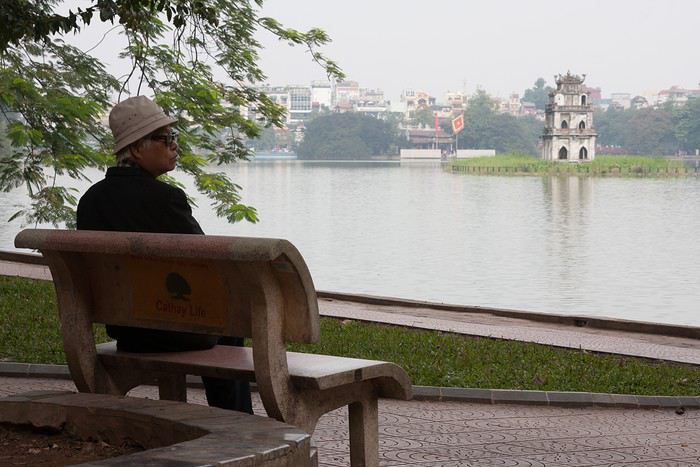
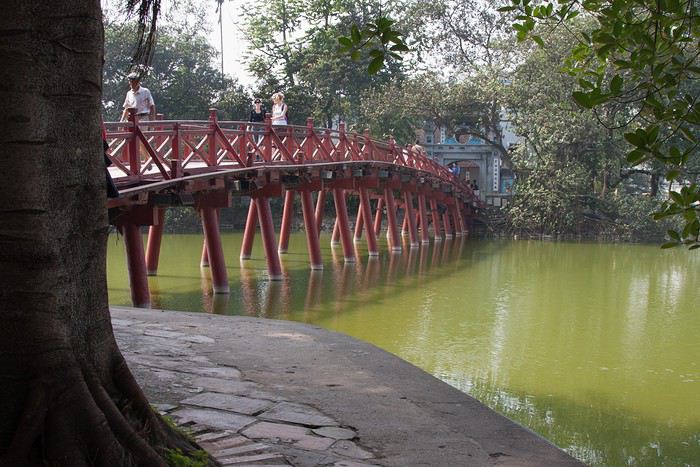
J’entre dans la danse également et me voici venue vous conter un séjour de 17 jours dans le nord du Vietnam en décembre 2011.
Présentation rapide : nous partons en couple (nos fils de 4 et 3 ans sont confiés à leurs grands- parents). Habitués à voyager en mode autonome, sans réservations à l’avance et privilégiant la conduite d’un véhicule, nous devons changer nos habitudes en raison de l’interdiction faite aux étrangers de louer des véhicules. Nous décidons donc de faire appel aux services d’une agence locale pour nous permettre de visiter le nord du Vietnam à proximité de la frontière chinoise. Nous (enfin je 😇) ajoutons à ce programme la découverte de la région de Sapa, de Tam Coc (la baie d’Ha Long terrestre) et la baie d’Ha Long (avec une surprise pour mon mari). Peu férus des villes, nous visiterons un peu Hanoi le jour de notre arrivée et avant notre départ.
Jour 0 – dimanche 4 décembre
Après avoir fêté les 60 ans et trois jours de mon beau-père autour d’un déjeuner au restaurant, nous nous rendons en fin de journée à Roissy CDG pour un vol direct Paris – Hanoi sur Vietnam Airlines. Pas de souvenir particulier presque dix ans après ce vol 🙂
Jour 1 – lundi 5 décembre
Arrivée matinale à 6h40. J’étais passée par ACA Voyages pour obtenir une lettre d’invitation (24 $) pour nous permettre d’obtenir un visa d’entrée. Les formalités sont vite effectuées au guichet d'immigration (40 € pour nous deux). Après avoir effectué du change (500 euros contre 14 millions de dongs), nous prenons un taxi et nous rendons au Paramount Hotel & Travel, seul hôtel réservé à l’avance pour notre première nuit. Nous débutons notre journée par quelques démarches. Nous nous rendons dans les locaux de l’agence locale pour faire connaissance avec notre conseillère et régler le solde de la prestation. Direction ensuite la gare pour acheter des billets de train pour Tam Coc et Lao Cai. Aucun souci rencontré pour acheter les billets auprès d’un guichetier très aimable. L’après-midi est consacré à la visite d’Hanoi : le lac Hoan Kiem (le lac de l’Epée Restituée) et ses agréables berges.
On part en vadrouille dans les Balkans! English translation pending
Et bien le confinement a de beaux jours devant lui ! Chose promise, chose due (publier une journée de vadrouille par jour de confinement) ! Après le carnet sur un voyage aux Etats-Unis (voyageforum.com/...-americain-d9943984/), après le carnet sur une vadrouille en Jordanie (https://voyageforum.com/discussion/on-part-en-vadrouille-en-jordanie-d9991360/), voici maintenant un carnet dans les balkans, voyage réalisé il y a maintenant quelques années :
Et on garde les bonnes habitudes, publication d'une journée par jour, à chaque fois à 17h30 ! Bonne lecture et n'hésite pas à laisser un commentaire, une question, une remarque, ...
Franck
Et on garde les bonnes habitudes, publication d'une journée par jour, à chaque fois à 17h30 ! Bonne lecture et n'hésite pas à laisser un commentaire, une question, une remarque, ...
Franck
Discussion du concours photo du mois d'avril 2020: "En famille" English translation pending
Pour discuter, partager, c'est ici !
Le concours est là 🙂
Compte rendu de croisière Costa Fortuna: Singapour-Malaisie-Thaïlande (décembre 2019) English translation pending
Hello !
Afin de faciliter la recherche des futurs croisiéristes voici un petit compte rendu de mes différentes escales : Déjà, avant le départ:
monnaie locale. Même si le dollar passe quasiment systématiquement, les prix seront toujours + avantageux en http:// monnaie locale. J’ai donc fait le change ici : www.changemagenta.fr forfait téléphonique : pensez à prendre un forfait téléphonique internationale. Exemple chez sosh : pass Evasion 29€ : 3Go + 30 min + 50 SMS. Les 3Go ont largement été suffisant pour faire mes recherches sur place : google map etc… Cela rassure beaucoup de savoir qu’à tout moment on peut savoir où on est et comment revenir ou appeler un taxi… Pour optimiser le forfait vous pouvez télécharger les plan de google map des différentes escales afin d'économiser quelques Mo - faire très attention à ne pas dépasser Si pas de forfait : DESACTIVER LE ROAMING ou les DATA mobiles - Pour vous donner un ordre d'idée j'ai utilisé 1500Mo. à 13€ du Mo. J'aurais du payé 20000€ de hors forfait... Application taxi : En Malaisie et Singapour vous pouvez utiliser l’application de taxi : grab (uber n’étant pas disponible)
Place aux escales :
Langkawi :
mon escale : Pour ne pas rentrer dans les détails je n’ai pas pu descendre longtemps du bateau. Mais ce que j’ai fait été très bien. J’ai pris un taxi à la plage la plus proche (le taxi se trouve à l’entrée de l’hotel : Resort World Langkawi Parking Lot - plan sur google map) nom de la plage PANTAI CENANG. La plage est magnifique, très propice à la baignade. De nombreux cafés et petites boutiques sur le coté. Idéal pour une journée farniente mojito plage. Prix taxi à l’aller = 20MYR = 4€ – retour (sous un cabanon bleu) 30 MYR = 6€ Je crois même qu'il est possible de faire des activités nautiques : jet ski, parachute attentionnelle, banane... Il y a aussi un petit centre commerciale où j'ai pu enfin me trouver un chapeau :D
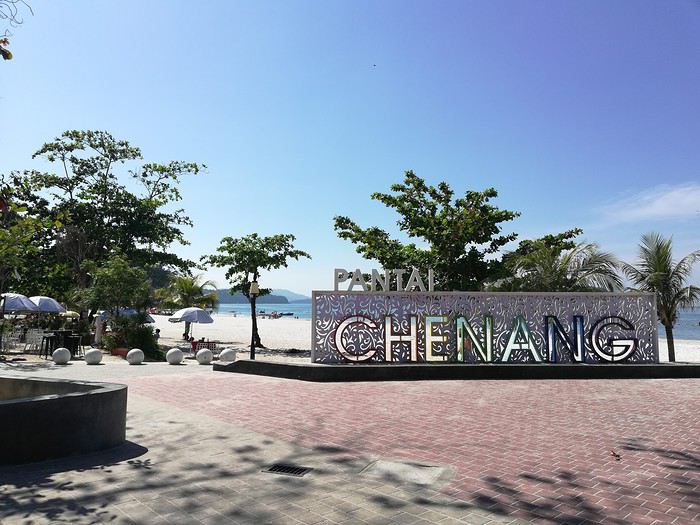
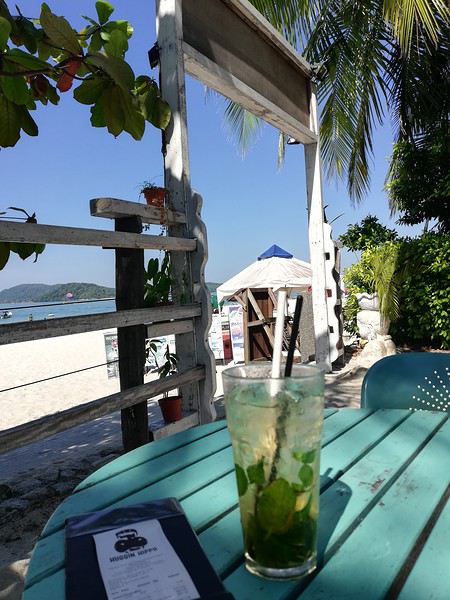
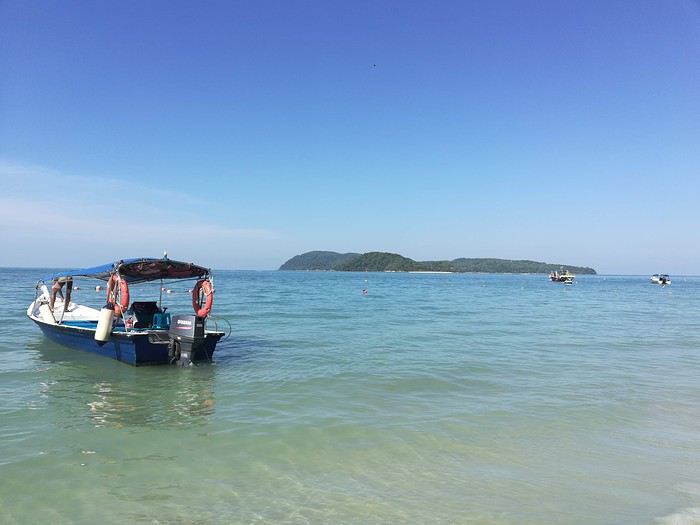
Possibilités :
A la sortie du bateau il y a beaucoup de possibilité : -taxi qui amène aux principales destinations : en longeant la route à gauche : ne pas hésiter à attendre d’autre croisiériste pour paratager les frais : omangrove Tour oSky cab et sky bridge : attention, j’ai eu bcp de mauvais commentaire sur le cable car. attente trop longue notamment…. oEagle square o… Attention le taxi vous emmène et vous attend dans les attractions touristiques mais les tickets de celle-ci seront à payer sur place lieu google map pour prendre le taxi
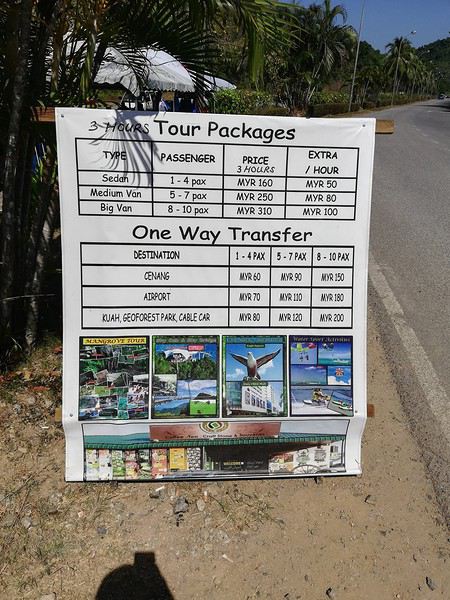
-tour de bateau : en tournant à droite après le pont. Le bateau fait plusieurs endroits. Je me rappelle pu des noms : eagle island, autres iles... Plusieurs départ de bateau possible. Tout de suite au premier bâtiment. En marchant un petit km sur la droite toujours : Island Hopping Langkawi - Alanona.Plan google map départ du bateau
Suite des escales à venir....
Afin de faciliter la recherche des futurs croisiéristes voici un petit compte rendu de mes différentes escales : Déjà, avant le départ:
monnaie locale. Même si le dollar passe quasiment systématiquement, les prix seront toujours + avantageux en http:// monnaie locale. J’ai donc fait le change ici : www.changemagenta.fr forfait téléphonique : pensez à prendre un forfait téléphonique internationale. Exemple chez sosh : pass Evasion 29€ : 3Go + 30 min + 50 SMS. Les 3Go ont largement été suffisant pour faire mes recherches sur place : google map etc… Cela rassure beaucoup de savoir qu’à tout moment on peut savoir où on est et comment revenir ou appeler un taxi… Pour optimiser le forfait vous pouvez télécharger les plan de google map des différentes escales afin d'économiser quelques Mo - faire très attention à ne pas dépasser Si pas de forfait : DESACTIVER LE ROAMING ou les DATA mobiles - Pour vous donner un ordre d'idée j'ai utilisé 1500Mo. à 13€ du Mo. J'aurais du payé 20000€ de hors forfait... Application taxi : En Malaisie et Singapour vous pouvez utiliser l’application de taxi : grab (uber n’étant pas disponible)
Place aux escales :
Langkawi :
mon escale : Pour ne pas rentrer dans les détails je n’ai pas pu descendre longtemps du bateau. Mais ce que j’ai fait été très bien. J’ai pris un taxi à la plage la plus proche (le taxi se trouve à l’entrée de l’hotel : Resort World Langkawi Parking Lot - plan sur google map) nom de la plage PANTAI CENANG. La plage est magnifique, très propice à la baignade. De nombreux cafés et petites boutiques sur le coté. Idéal pour une journée farniente mojito plage. Prix taxi à l’aller = 20MYR = 4€ – retour (sous un cabanon bleu) 30 MYR = 6€ Je crois même qu'il est possible de faire des activités nautiques : jet ski, parachute attentionnelle, banane... Il y a aussi un petit centre commerciale où j'ai pu enfin me trouver un chapeau :D
Possibilités :
A la sortie du bateau il y a beaucoup de possibilité : -taxi qui amène aux principales destinations : en longeant la route à gauche : ne pas hésiter à attendre d’autre croisiériste pour paratager les frais : omangrove Tour oSky cab et sky bridge : attention, j’ai eu bcp de mauvais commentaire sur le cable car. attente trop longue notamment…. oEagle square o… Attention le taxi vous emmène et vous attend dans les attractions touristiques mais les tickets de celle-ci seront à payer sur place lieu google map pour prendre le taxi
-tour de bateau : en tournant à droite après le pont. Le bateau fait plusieurs endroits. Je me rappelle pu des noms : eagle island, autres iles... Plusieurs départ de bateau possible. Tout de suite au premier bâtiment. En marchant un petit km sur la droite toujours : Island Hopping Langkawi - Alanona.Plan google map départ du bateau
Suite des escales à venir....
Périple en Asie du Sud-est English translation pending
Bonjour à tous,
J'avoue avoir pas mal tergiversé avant de me décider à publier ce carnet. Car l'Asie du Sud-Est, à commencer par la Thaïlande, est une zone sur laquelle beaucoup de carnets ont déjà été publiés, notamment par des voyageurs qui sont devenus de vrais spécialistes du secteur.
Et puis finalement, ce voyage en famille fut un tel régal qu'il me semble normal de faire un retour sur VF. J'y prends régulièrement des infos pour préparer mes voyages (merci notamment à Anne alias Xeta pour son carnet et ses infos pratiques), alors ce carnet sera un juste retour des choses.
Tout aurait dû bien commencer pour ce voyage car, contrairement à nos avions pour l'Indonésie en 2015 et pour le Nicaragua en 2017, qui avaient tous les deux été annulés au dernier moment alors que nous étions quelques centaines à poireauter en salle d'embarquement, notre avion pour Bangkok a bien décollé, lui, en temps et en heure. Mais sans nous quand même !
En effet, quelques jours plus tôt, le brevet des collèges que passait notre fils aîné avait été décalé de quelques jours par le ministre pour cause de... canicule ! Les école maternelles n'ont pas été fermées mais les collèges qui accueillaient le brevet, si ! Allez comprendre. Toujours est-il que notre avion s'est trouvé à décoller quelques minutes seulement après la fin de la dernière épreuve du brevet, nous étions donc un poil trop courts pour l'attraper. Nous avons ainsi dû décaler notre vol de 24 heures. Nous attendons d'ailleurs toujours le remboursement partiel auquel nous avons droit mais peu importe, c'est une autre histoire...
Si je cite cette anecdote qui n'a apparemment rien à voir avec la Thaïlande, c'est parce qu'une fois arrivés à Bangkok, le monsieur à l'accueil de notre hôtel nous annonce qu'il a annulé par erreur les 3 nuitées que nous y avions réservées. J'avais pourtant envoyé 2 mails de confirmation de notre réservation en précisant que nous manquerions juste la première nuit et j'avais reçu une réponse positive, mais il a fait la boulette quand même ! Bref, après le coup de l'avion, quand ça veut pas, ben ça veut pas 🤪
Nous prenons donc la nouvelle avec le sourire (quoi de plus normal dans ce pays !), alors que notre interlocuteur de l'hôtel, lui, n'esquisse pas le moindre rictus. Il paraît que quand on va au pays du sourire, il y en a toujours un qui fait exception à la règle. Pour nous, ce sera donc celui-là ! Mais ce n'est pas bien grave, tous les autres rattraperont le coup après lui, au fil de notre séjour...
Enfin bon, après une demi-journée perdue bêtement pour chercher un autre hôtel, puis pour le rejoindre au milieu de l'intense circulation de Bangkok, notre voyage peut enfin commencer. Sauf que c'est l'heure de manger puis de se coucher. Le voyage commencera donc enfin demain.
BANGKOK
Selon le dernier classement des villes les plus visitées du monde, Bangkok se situe à... la première place ! Devant Londres (2e) et Paris (3e), excusez du peu. Et si certains quartiers ne sont pas spécialement sexy, certains sites en revanche constituent de pures merveilles et justifient un tel classement.
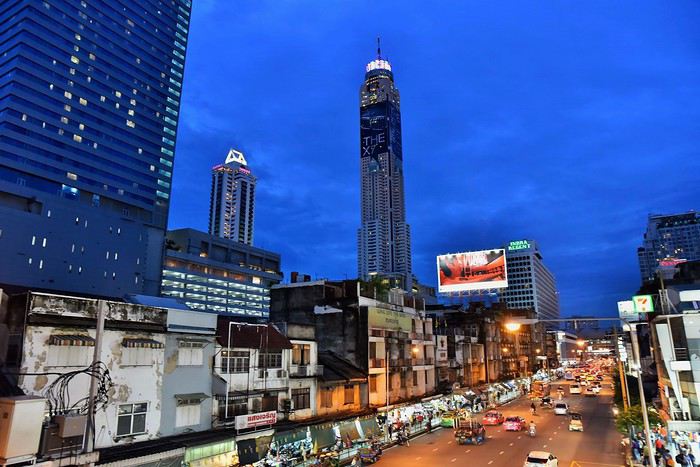
Après tous les problèmes que nous avons rencontrés d'emblée dans ce voyage, il ne nous reste plus qu'un jour pour visiter Bangkok, au lieu de deux et demi comme initialement prévu, sachant que nous y reviendrons une demi-journée au milieu du séjour.
Nous allons donc manquer de temps pour visiter la ville mais bon il faut faire avec et nous allons essayer de voir le maximum de choses pour cette première journée que nous n'avons pas volée !
Nous commençons donc par traverser, rapidement hélas, le marché aux fleurs.
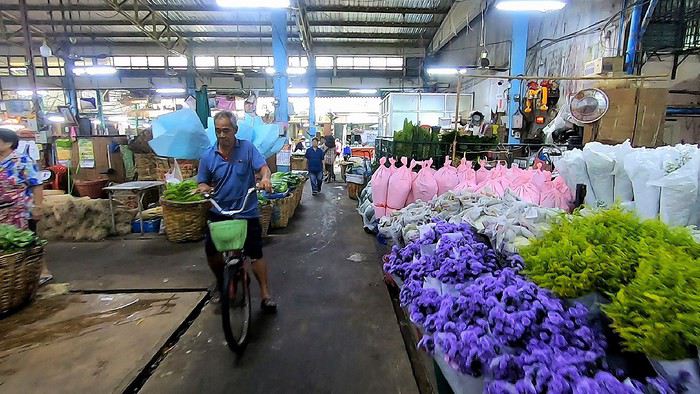
Il paraît qu'il est ouvert 24 heures sur 24. En tout cas lors de notre venue, il n'y a pas foule mais l'endroit, où il y a également pas mal de fruits et légumes, est vraiment agréable.
Nous enchaînons par l'un des fameux temples de Bangkok : le Wat Pho.
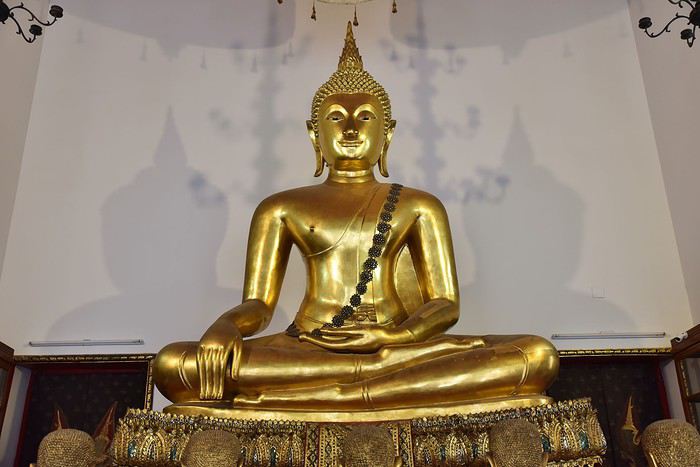
Son architecture nous dépayse totalement et je dois dire qu'avec le stress énorme que nous a causé pendant une semaine le report de notre départ, ce lieu sacré nous fait un bien fou. C'est pour vivre ce genre de moments que nous aimons tant voyager.
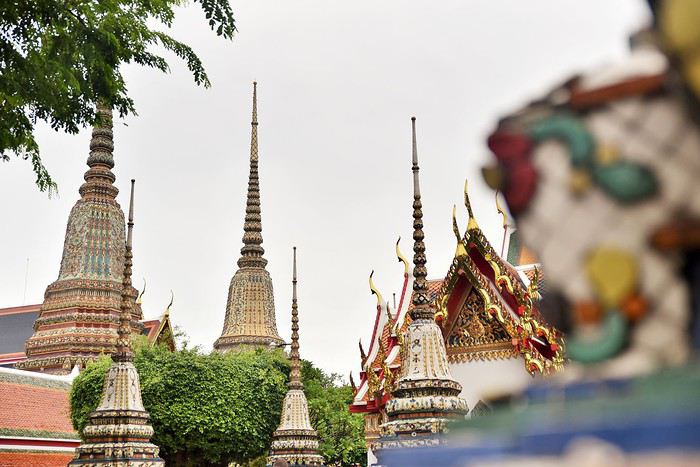
Alors bien sûr, le temps n'est pas très beau (pas étonnant, on est en juillet mais ça au moins, c'était prévu), contrairement au site !
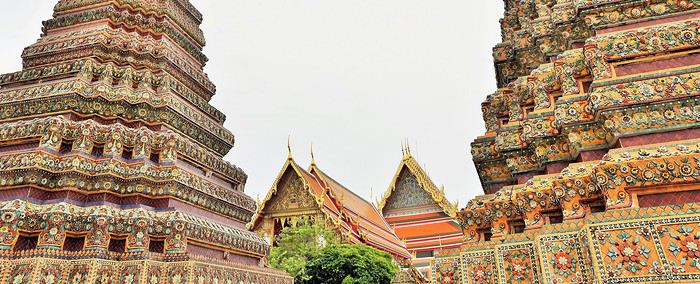
Là, ça y est, notre voyage est enfin bel et bien lancé.
A l'intérieur de ces bâtiments multicolores, les bouddhas sont omniprésents et rivalisent de sérénité.
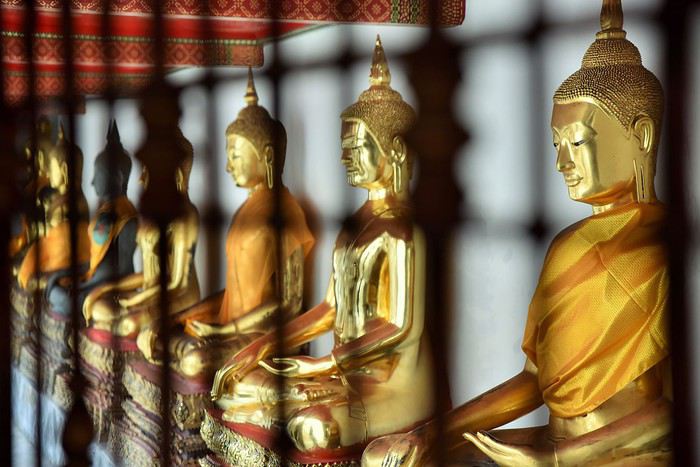
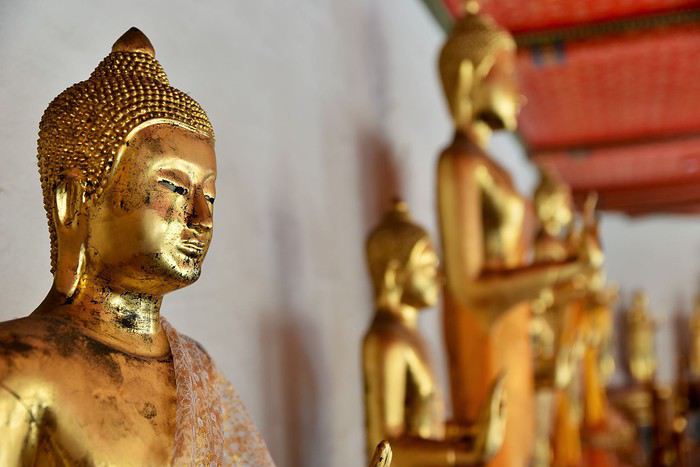
Le plus grand et le plus impressionnant d'entre eux, c'est Bouddha couché, représenté sur son lit de mort juste avant d'atteindre le Parinirvāṇa (la fin de l'existence physique pour qui a atteint l'éveil).
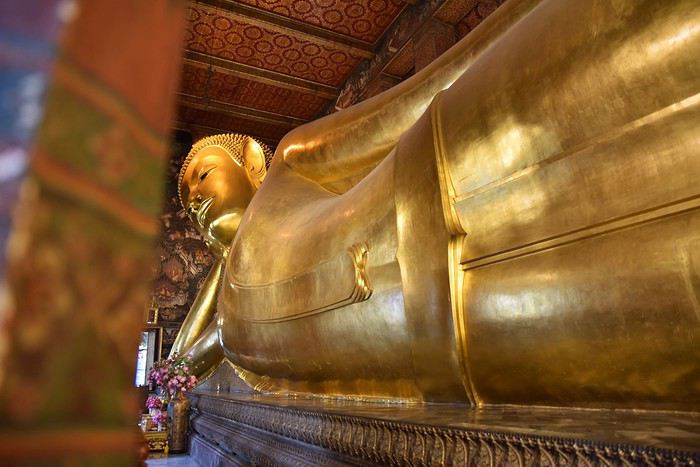
Ce magnifique bouddha est entièrement recouvert de feuilles d'or. Il nous impressionne.
La salle qui l'accueille, bien que très grande, semble trop exiguë pour cette statue qui en impose : 46 mètres de long sur 15 de haut.
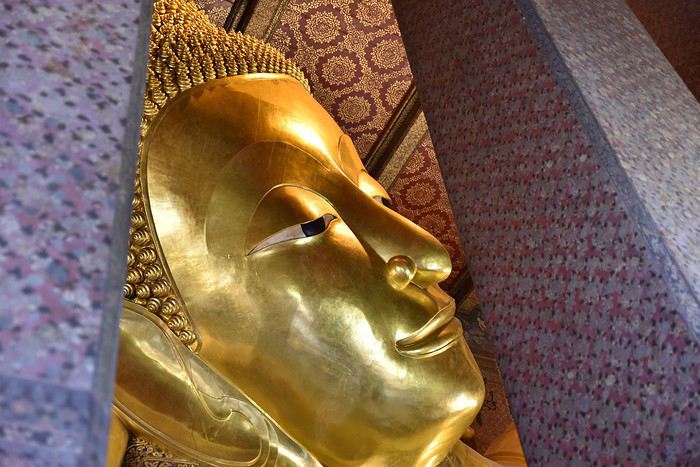
Et que dire de ses pieds, qui sont au moins aussi beaux que tout le reste : incrustés de nacre, ils représentent les 108 actions qui ont permis à Bouddha d'atteindre la perfection.
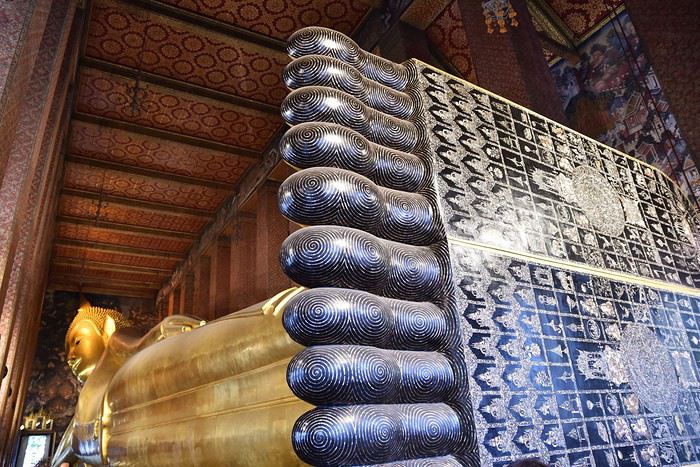
Ci-dessus : la plante du pied de Bouddha
Un peu plus loin se trouve le sanctuaire principal : l'Ubosot. A l'intérieur, on retrouve Bouddha, mais assis cette fois. C'est en dessous de cette statue toute en or et en cristal que sont conservées les cendres du célèbre roi Rama Ier (1737-1809).
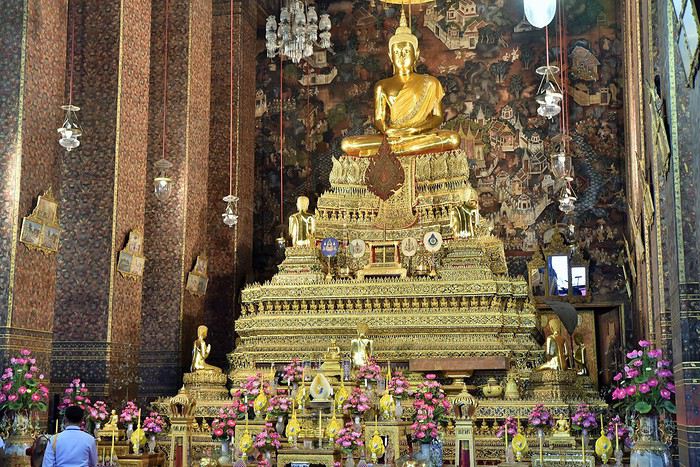
A noter enfin que dans l'enceinte du Wat Pho, on trouve également une école de médecine et de massages traditionnels, qui fut créée pour assurer la transmission des savoirs ancestraux.
Aujourd'hui, elle assure la formation des étudiants venus du monde entier. Les visiteurs peuvent d'ailleurs se faire masser dans les règles de l'art, même si l'attente peut parfois être un peu longue...
Bon, finalement, il commence bien ce voyage en Thaïlande. Nous enchaînons avec un autre temple, le Wat Arun.
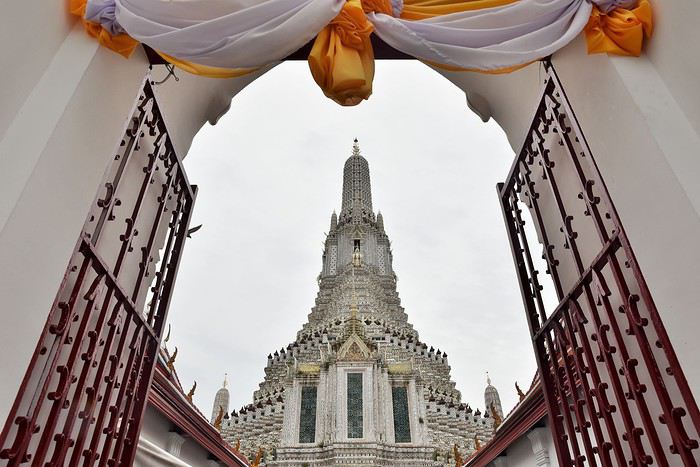
Contrairement au Wat Pho qui est très coloré, la Wat Arun apparaît plutôt blanc de loin. Mais de près, on constate que c'est une infinité de petites mosaïques colorées qui constituent ce gigantesque ensemble.
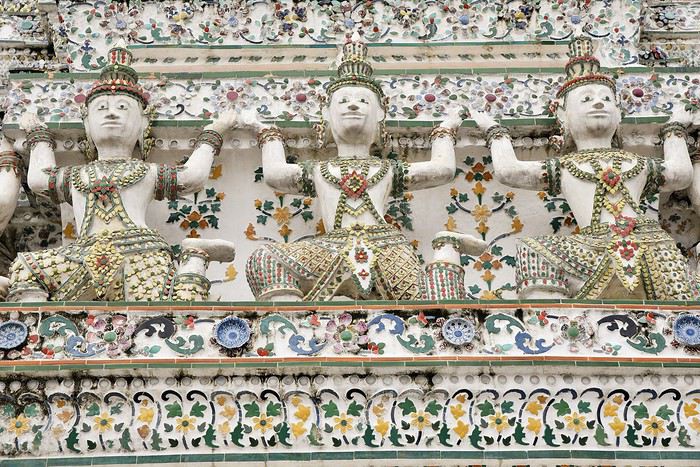
Une partie seulement des escaliers du prang central (72 mètres de haut) est ouverte au public, ce qui est suffisant pour avoir une jolie vue sur Bangkok quand le temps s'y prête... ce qui n'était pas le cas le jour de notre visite !
Si les deux temples que nous avons visités nous ont impressionnés, que dire de celui que nous allons voir dans la foulée : le Wat Phra Kaeo. Mais je posterai la suite dans un prochain message, ayant déjà presque atteint mon quota de photos...
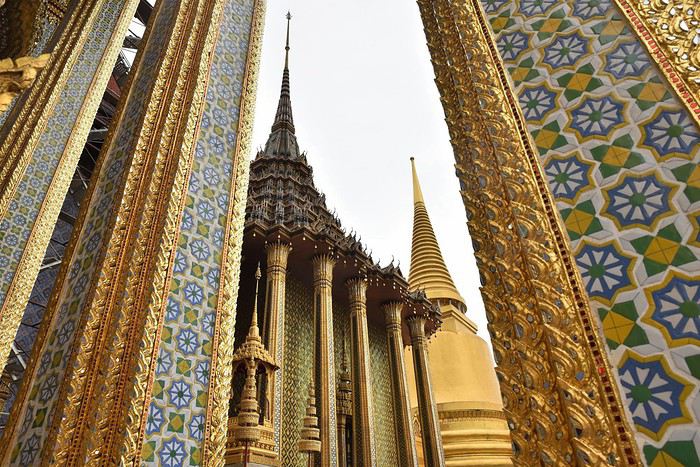
Retour d'un mois au Vietnam, des montagnes du nord au delta du Mekong English translation pending
Après 2 premiers carnets de voyage publiés sur VF consacrés à des régions indonésiennes peu touristiques
"La traversée des Célèbes (Sulawesi) en photos"
ou même pas du tout touristique
"Les Moluques: splendeurs (et galères) d'un archipel inconnu des touristes
voici un nouveau récit abondamment illustré sur un voyage au Vietnam.
Même si de nombreux beaux carnets ont déjà été publiés sur le Vietnam, j’espère que ce voyage en images rappellera de bons souvenirs aux uns, fournira des renseignements utiles aux autres pour leur prochain voyage ou plus simplement vous fera passer un bon moment en parcourant ce magnifique pays.
Avant de partir, quelques rapides infos sur le contexte (certaines rubriques seront détaillées plus loin au fil du récit, par ex la météo à cette période) :
- voyage réalisé de mi-septembre à mi-octobre 2019 - onzième voyage en Asie du Sud Est- en couple comme chaque fois, c'est bp plus simple - déplacement en bus, taxi, minibus (limousine) et avion (1 fois) réservés sur place 1 ou 2 jours avant, et en voiture particulière la 1ere semaine - logements : du basique chez l'habitant à un très bel hôtel à Ho Chi Minh, avec une préférence pour les petits hôtels de charme - bp de temps passé sur les forums et les guides avant le départ pour recenser les lieux qui nous intéressent, puis parcours modifié au jour le jour en fc de la météo, des envies, de la fatigue, des rencontres, etc .. Avant le départ, on a une superbe liste de lieux "à voir absolument", et sur place on s'aperçoit que ce magnifique programme est bien trop ambitieux. On supprime alors tel ou tels endroits pour ne pas transformer le voyage en une épuisante course de vitesse. - on aime bien prendre notre temps, s’arrêter qqs jours si un lieu nous plait, sauter des visites "incontournables" si ça nous barbe (fatigue, chaleur, overdose de visites, ...). - à la suite de très bons conseils de forumeurs qui se reconnaitront (un grand merci a eux), on a fait une entorse à notre façon de voyager (aucune réservation avant le départ, excepté l’hôtel le jour de l'arrivée) en réservant 8 jours avec une agence locale pour parcourir les montagnes du nord avec chauffeur et guide francophone. Partir avec une agence était en effet la meilleure solution pour découvrir cette région dépourvue de bus en de nombreux endroits, et le guide est bien utile pour ne pas se perdre en randonnée.
Allez, on y va 🙂
Nos étapes : - Extrême nord (Ha Giang - Meo Vac) vers les ethnies montagnardes et rizières - Baie de Lan Ha "la jumelle de la baie d'Halong" - Hanoi - Tam Coc, "la baie d'Halong terrestre" - Hue - Hoi An - Delta du Mekong - Ho Chi Minh
Episode 1 : A la rencontre des ethnies des montagnes du nord
Pour nous qui voyageons seuls d'habitude, nous apprécions d'être attendu à l'aéroport d'Hanoi à 6h30 par Vinh notre guide Vinh et Near notre chauffeur, direction le nord. Aux 11h de vol, on ajoute donc 5-6h de voiture pour Bac Ha, dont la moité environ sur une belle autoroute déserte.
Bac Ha est une petite ville au milieu des montagnes, avec seulement qqs petits hotels de milieu de gamme et des guesthouse, ce qui fait qu'on y rencontre qqs touristes, mais sans excès. 2h après notre arrivée à Bac Ha, nous voila parti pour une 1ère randonnée au milieu des rizières qui dominent la ville.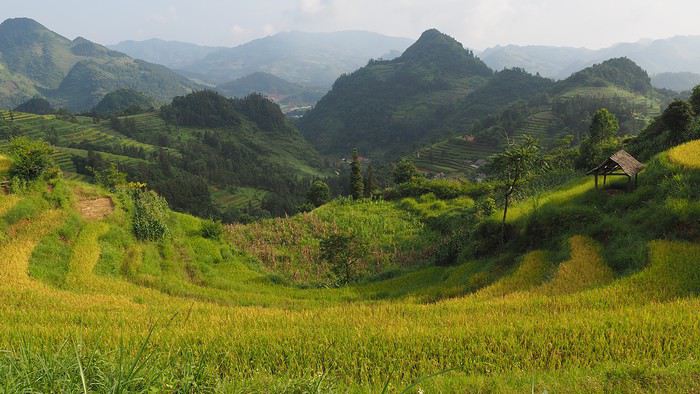
Ce ne sont pas les plus belles de la région, mais on passe un très agréable moment à se dégourdir les jambes après le voyage dans un tel environnement.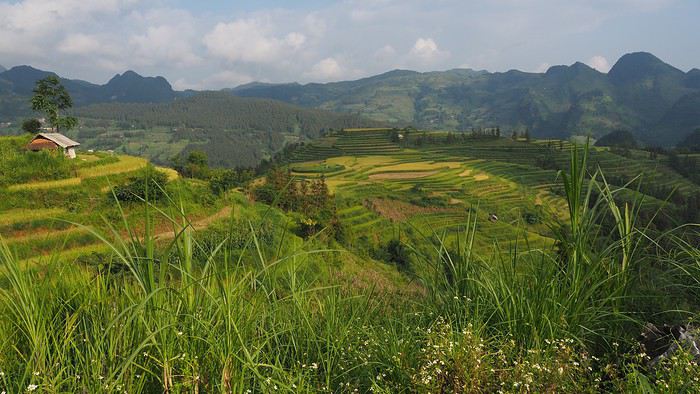 Comme convenu avec l'agence, 2 à 3h de marche entre villages et rizières seront chaque jour au programme : nous découvriront des villages, rencontreront des habitants de plusieurs ethnies au hasard des chemins, et marcherons tout simplement dans de magnifiques paysages de rizières.
Ethnie Hmong bariolé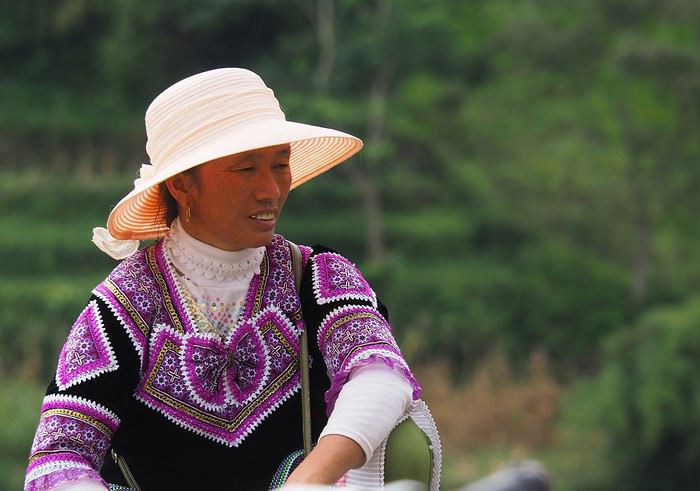
La région de Bac Ha est majoritairement habitée par de Hmong, ici Hmong à fleurs : (par la suite, si des erreurs se sont malheureusement glissées sur les noms d'ethnies, je ne me vexerai pas si les spécialistes rectifient 😉)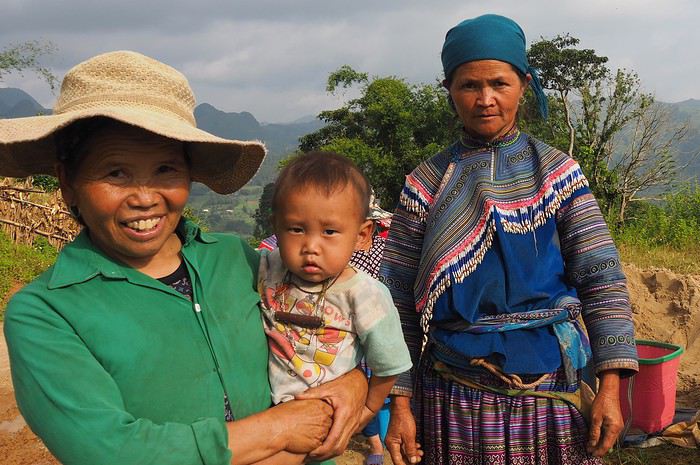
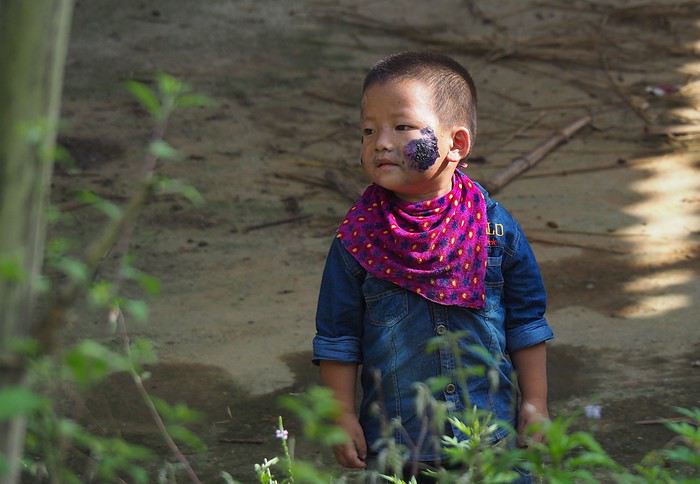
La récolte va bientôt commencer, les rizières commencent à passer du vert vif au jaune, nous les verrons jaune d'or dès le lendemain. Partout des paysans sont au travail : par l'intermédiaire de Vinh, nous échangeront à plusieurs reprises, eux qui sont aussi curieux sur nous que nous sur eux.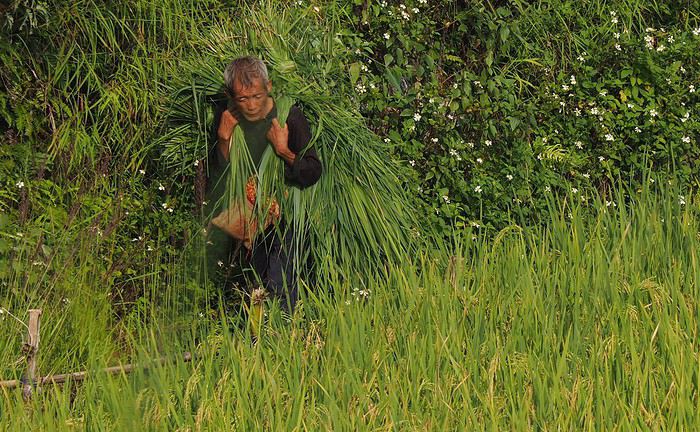
Le lendemain direction le marché de Can Cau a 45 min de Bac Ha (18km) sur une route zigzaguant dans un beau paysage de montagne (ce sera le régime de la semaine a venir).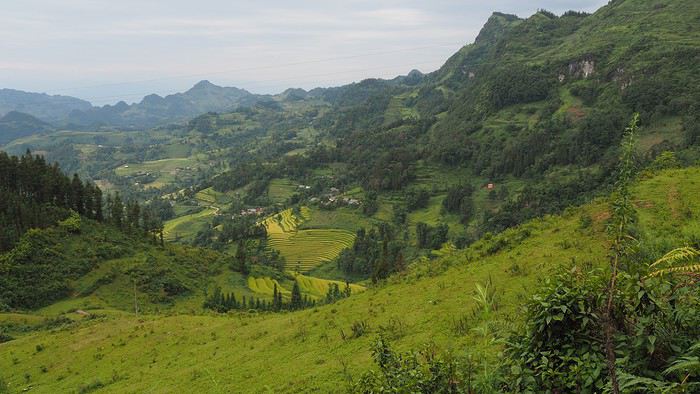
67 ans de présence française ont laissé ces beaux souvenirs le long des routes :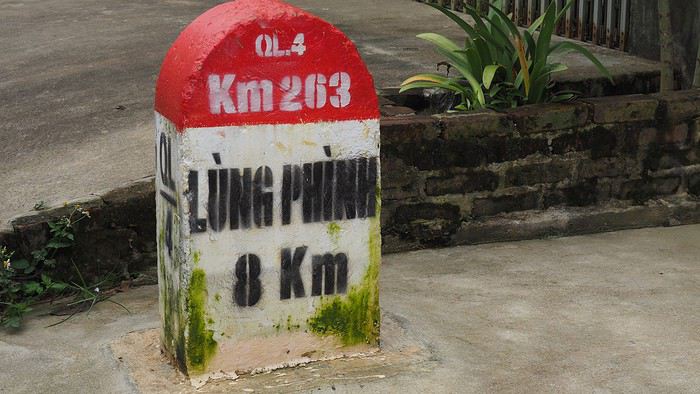
Notre parcours a été étudié avec l'agence pour être sur les marchés de Can Cau le samedi, de Bac Ha le dimanche et de Lun Phin le mercredi suivant Le marché de Can Cau est situé en pleine nature, à flan de montagne.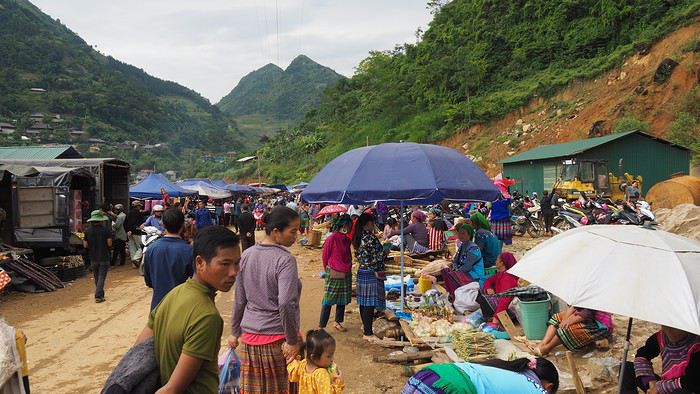
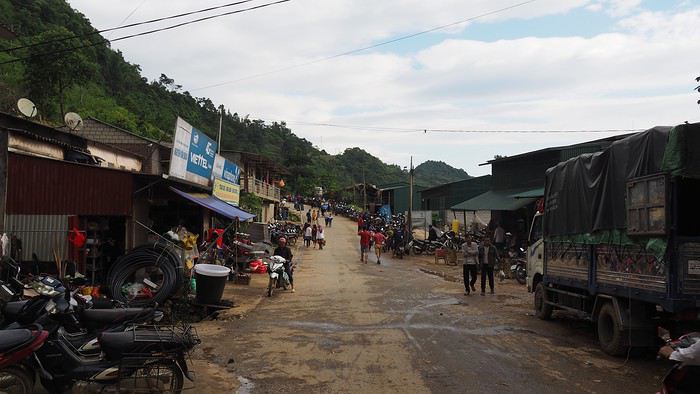
Hmong des alentours viennent y vendre ou acheter toutes sortes de produits, vêtements, nourritures, animaux vivants, oiseaux, etc ... :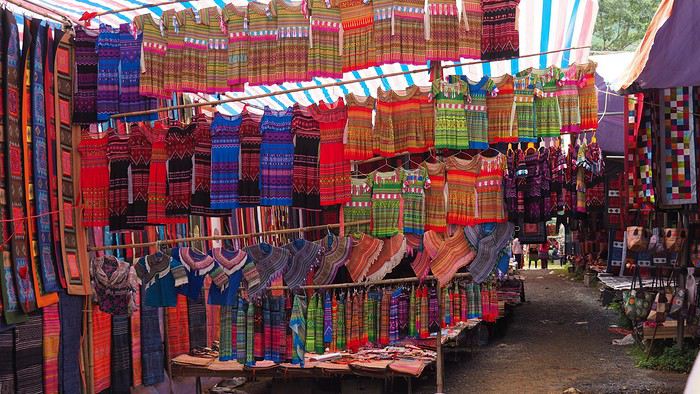
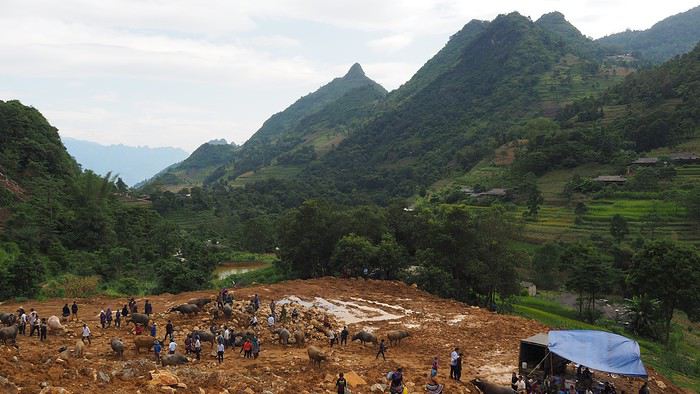
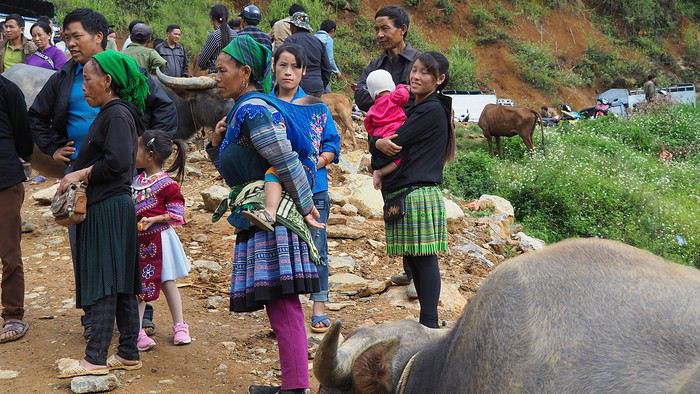
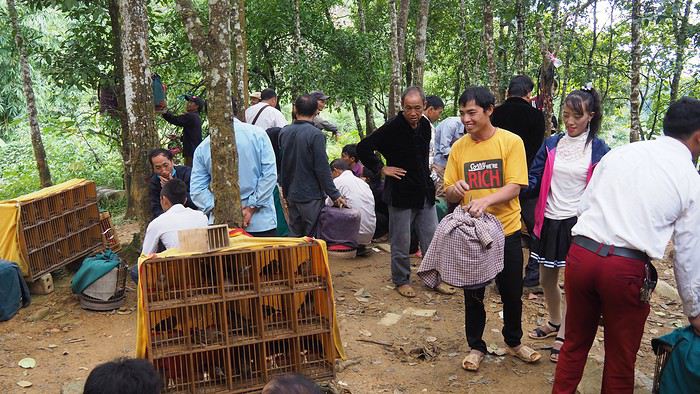
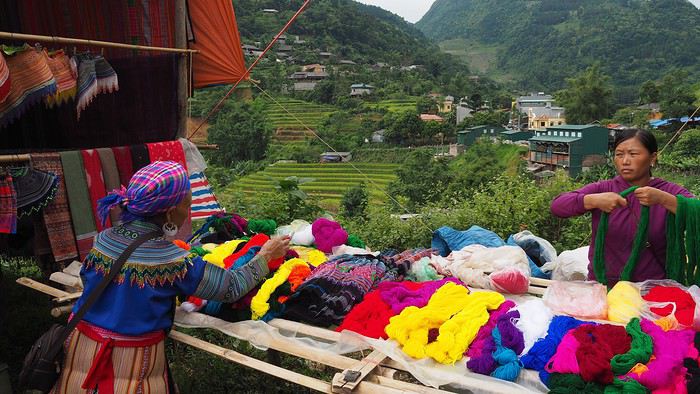 Hmong à fleurs(dessus et dessous)
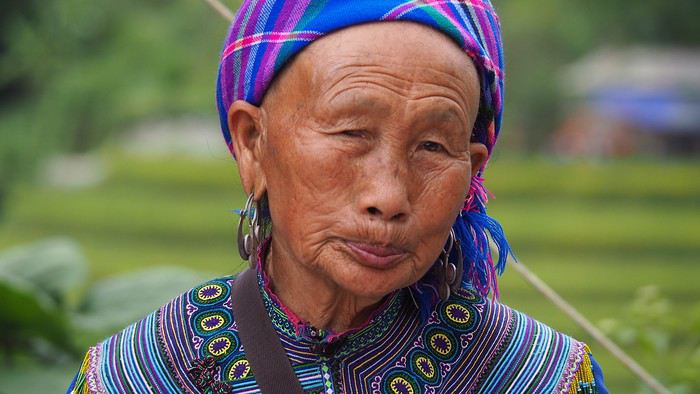
Certains repartent avec des vêtements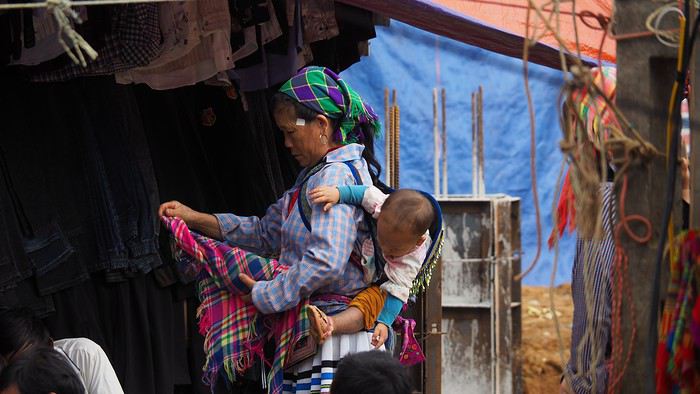
d'autres avec un porc ou une chèvre (pour l'achat de buffle la mobylette n'est pas conseillée)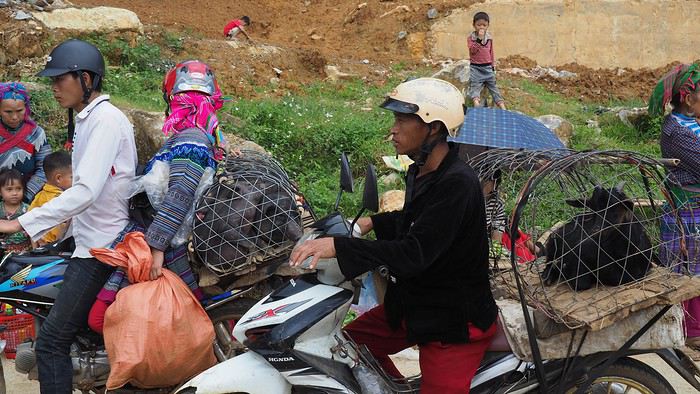
On est les seuls touristes. Le jour du marché est aussi l'occasion pour tous les villageois des alentours de se retrouver autour d'un thang cô (viande et intestins de bœuf dans un bouillon de sang, épices et herbes aromatiques) accompagné d’alcool de riz ou plus surprenant de Red Bull (!!) ... on n'arrête pas le progrès. On n'a pas gouté ce thang cô , le petit déjeuner n'étant pas loin .... excuse minable 😊
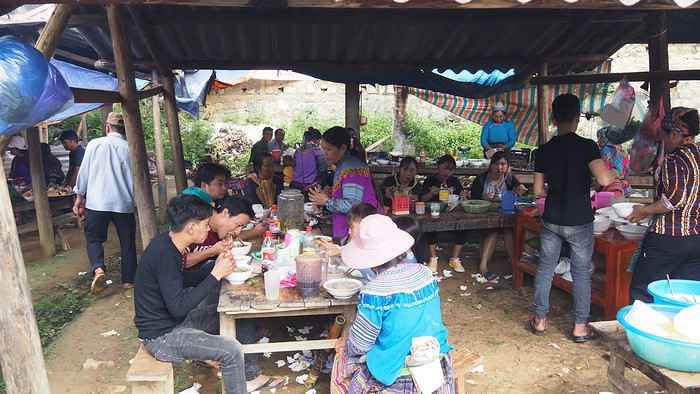
Red Bull et pipe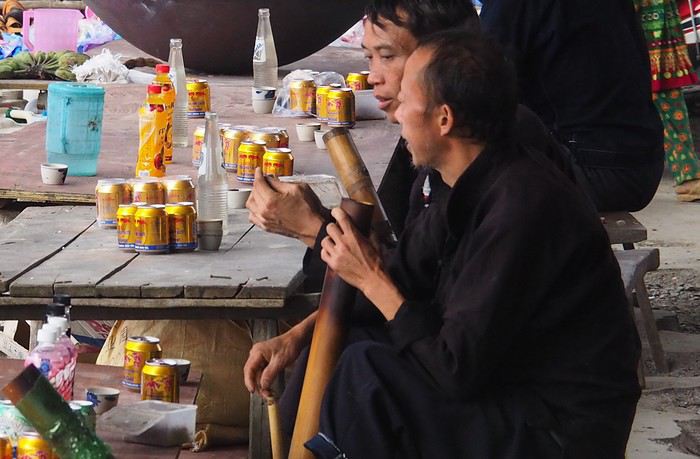
La suite très bientôt
Même si de nombreux beaux carnets ont déjà été publiés sur le Vietnam, j’espère que ce voyage en images rappellera de bons souvenirs aux uns, fournira des renseignements utiles aux autres pour leur prochain voyage ou plus simplement vous fera passer un bon moment en parcourant ce magnifique pays.
Avant de partir, quelques rapides infos sur le contexte (certaines rubriques seront détaillées plus loin au fil du récit, par ex la météo à cette période) :
- voyage réalisé de mi-septembre à mi-octobre 2019 - onzième voyage en Asie du Sud Est- en couple comme chaque fois, c'est bp plus simple - déplacement en bus, taxi, minibus (limousine) et avion (1 fois) réservés sur place 1 ou 2 jours avant, et en voiture particulière la 1ere semaine - logements : du basique chez l'habitant à un très bel hôtel à Ho Chi Minh, avec une préférence pour les petits hôtels de charme - bp de temps passé sur les forums et les guides avant le départ pour recenser les lieux qui nous intéressent, puis parcours modifié au jour le jour en fc de la météo, des envies, de la fatigue, des rencontres, etc .. Avant le départ, on a une superbe liste de lieux "à voir absolument", et sur place on s'aperçoit que ce magnifique programme est bien trop ambitieux. On supprime alors tel ou tels endroits pour ne pas transformer le voyage en une épuisante course de vitesse. - on aime bien prendre notre temps, s’arrêter qqs jours si un lieu nous plait, sauter des visites "incontournables" si ça nous barbe (fatigue, chaleur, overdose de visites, ...). - à la suite de très bons conseils de forumeurs qui se reconnaitront (un grand merci a eux), on a fait une entorse à notre façon de voyager (aucune réservation avant le départ, excepté l’hôtel le jour de l'arrivée) en réservant 8 jours avec une agence locale pour parcourir les montagnes du nord avec chauffeur et guide francophone. Partir avec une agence était en effet la meilleure solution pour découvrir cette région dépourvue de bus en de nombreux endroits, et le guide est bien utile pour ne pas se perdre en randonnée.
Allez, on y va 🙂
Nos étapes : - Extrême nord (Ha Giang - Meo Vac) vers les ethnies montagnardes et rizières - Baie de Lan Ha "la jumelle de la baie d'Halong" - Hanoi - Tam Coc, "la baie d'Halong terrestre" - Hue - Hoi An - Delta du Mekong - Ho Chi Minh
Episode 1 : A la rencontre des ethnies des montagnes du nord
Pour nous qui voyageons seuls d'habitude, nous apprécions d'être attendu à l'aéroport d'Hanoi à 6h30 par Vinh notre guide Vinh et Near notre chauffeur, direction le nord. Aux 11h de vol, on ajoute donc 5-6h de voiture pour Bac Ha, dont la moité environ sur une belle autoroute déserte.
Bac Ha est une petite ville au milieu des montagnes, avec seulement qqs petits hotels de milieu de gamme et des guesthouse, ce qui fait qu'on y rencontre qqs touristes, mais sans excès. 2h après notre arrivée à Bac Ha, nous voila parti pour une 1ère randonnée au milieu des rizières qui dominent la ville.
Ce ne sont pas les plus belles de la région, mais on passe un très agréable moment à se dégourdir les jambes après le voyage dans un tel environnement.
Comme convenu avec l'agence, 2 à 3h de marche entre villages et rizières seront chaque jour au programme : nous découvriront des villages, rencontreront des habitants de plusieurs ethnies au hasard des chemins, et marcherons tout simplement dans de magnifiques paysages de rizières.Ethnie Hmong bariolé
La région de Bac Ha est majoritairement habitée par de Hmong, ici Hmong à fleurs : (par la suite, si des erreurs se sont malheureusement glissées sur les noms d'ethnies, je ne me vexerai pas si les spécialistes rectifient 😉)
La récolte va bientôt commencer, les rizières commencent à passer du vert vif au jaune, nous les verrons jaune d'or dès le lendemain. Partout des paysans sont au travail : par l'intermédiaire de Vinh, nous échangeront à plusieurs reprises, eux qui sont aussi curieux sur nous que nous sur eux.
Le lendemain direction le marché de Can Cau a 45 min de Bac Ha (18km) sur une route zigzaguant dans un beau paysage de montagne (ce sera le régime de la semaine a venir).
67 ans de présence française ont laissé ces beaux souvenirs le long des routes :
Notre parcours a été étudié avec l'agence pour être sur les marchés de Can Cau le samedi, de Bac Ha le dimanche et de Lun Phin le mercredi suivant Le marché de Can Cau est situé en pleine nature, à flan de montagne.
Hmong des alentours viennent y vendre ou acheter toutes sortes de produits, vêtements, nourritures, animaux vivants, oiseaux, etc ... :
Hmong à fleurs(dessus et dessous)
Certains repartent avec des vêtements
d'autres avec un porc ou une chèvre (pour l'achat de buffle la mobylette n'est pas conseillée)
On est les seuls touristes. Le jour du marché est aussi l'occasion pour tous les villageois des alentours de se retrouver autour d'un thang cô (viande et intestins de bœuf dans un bouillon de sang, épices et herbes aromatiques) accompagné d’alcool de riz ou plus surprenant de Red Bull (!!) ... on n'arrête pas le progrès. On n'a pas gouté ce thang cô , le petit déjeuner n'étant pas loin .... excuse minable 😊
Red Bull et pipe
La suite très bientôt
Trois semaines en Chine de l'est en indépendant en septembre 2016 English translation pending
Je me suis lancée il y a peu dans mon premier carnet de voyage : tour de l’Allemagne en famille. Ce premier carnet a été plus simple à réaliser que prévu. Du coup, je me lance dans un carnet sur un séjour plus lointain, que je voulais réaliser depuis un moment
Avant toute chose, quelques mots de présentation. Ce carnet raconte un voyage en Chine effectué en septembre-octobre 2016. Je ne mentionnerai quasiment jamais de prix car ils ont pu varier.
Nous sommes un couple de trentenaires, encore sans enfant au moment de ce voyage. Nous aimons découvrir le monde et nous ne sommes pas du genre à rester des heures dans notre hébergement. Le matin on se lève, on petit-déjeune parfois, on prend nos affaires, on s'en va et on ne rentre que tard le soir. Quand nous arrivons en journée, on dépose rapidement les valises et on y va.
Nous ne sommes pas des backpackers vu que nous voyageons avec des valises rigides ;-) A l'usage je trouve ça bien plus pratique pour s'organiser et on peut transporter des choses fragiles. Nous préférons opter pour des logements confortables, en chambre double avec notre salle de bain, plutôt que des dortoirs. Le budget est plus élevé c'est sûr, mais on est plus en forme pour profiter de nos journées. On essaie un maximum de choisir des hébergements tenus par des locaux.
J'adore organiser des circuits pour nos vacances, prendre le temps de regarder ce qu'il y a à visiter, les endroits qui m'inspirent. A la fin, il y a toujours plus de choses à faire que nous avons de temps sur place, du coup je revoie mais objectifs à la baisse et je me lance dans les réservations. Mon conjoint, que j'appellerai ici P pour simplifier, n'est pas difficile et se laisse porter. Il agira sur place et dégainera son anglais alors que je ferai ma timide.
Bref, voici le planning de ces 21 jours en Chine. Je me suis concentrée sur la partie la plus accessible en transports terrestres une fois sur place (je stresse en avion, alors si on peut éviter et en plus limiter notre empreinte carbone, nous préférons). Nous sommes donc restés entre Beijing au nord, Xi'an à l'ouest, Yangshuo au sud et Shangaï à l'est. Nous avons essentiellement pris les trains à grande vitesse locaux. Nous sommes partis de mi-septembre à début octobre et pour éviter l'affluence dans les trains lors des vacances en Chine début octobre, nous avons décidé de rentrer sur Beijing juste avant et de visiter la ville à ce moment-là. Le reste plus en détails au jour le jour. Si vous voulez accéder à un jour en particulier, vous pouvez cliquer directement dessus, je mettrai les liens au fur et à mesure.
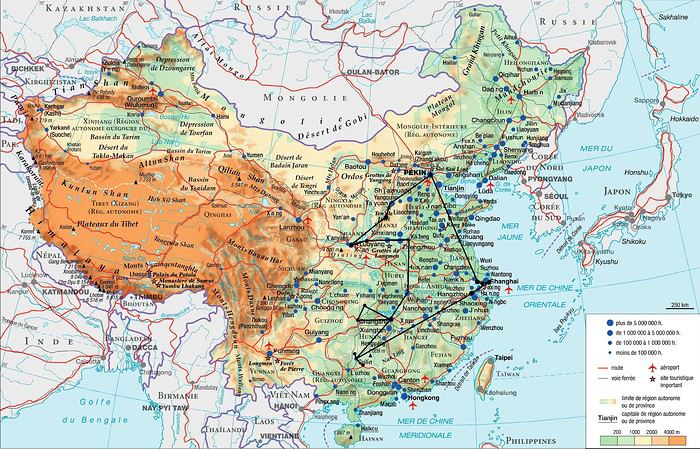
Avant de partir : les préparatifs pratiques Jour 1 et 2 : arrivée à Beijing (Pékin) Jour 3 : la grande muraille à Badaling Jour 4 : le train rapide Jour 4 (suite) : Pingyao Jour 5 : Xi'an Jour 5 (suite) : Xi'an Jour 6 : mont Huashan Jour 7 : transit vers Zhangjiajie Jour 8 : Zhangjiajie National Forest Park Jour 9 : Zhangjiajie, mont Tianmen Jour 9 (suite) : route vers Fenghuang Jour 10 : Fenghuang Jour 11 : trajet vers les rizières Longji Jour 12 : Longji Jour 12 (suite) : Longji Jour 13 : Yangshuo Jour 13 (suite) : Yangshuo Jour 14 : trajet vers Hangzhou Jour 15 : Hangzhou Jour 15 (suite) : Hangzhou Jour 16 : Shanghaï Jour 16 (suite) : Shanghaï Jour 16 (suite) : Shanghaï, soirée Jour 17 : Zhouzhuan Jour 18 : Suzhou Jour 19 : Suzhou et trajet vers Beijing Jour 20 : Beijing (Pékin), cité interdite Jour 20 (suite) : Beijing (Pékin), temple des lamas Jour 21 : Beijing (Pékin), temple du ciel Jour 21 (suite) : Beijing (Pékin), palais d'été Jour 21 (suite) : Beijing (Pékin), parc olympique Jour 22 : retour Conclusion
Concernant le budget, je n’ai plus les chiffres exacts mais voilà quelques infos : - billets Strasbourg-Francfort-Beijing avec Lufthansa environ 500€/personne - budget total sur place pour 21 jours un peu moins de 1 500€/personne (avec les souvenirs, boissons, …) - de mémoire la moyenne du budget hébergements doit être de 40€ par nuit pour deux - les trains rapides ne sont pas très chers, surtout comparés à l’Europe (prix sur trip.com) - les visites et entrées dans les parcs ne sont pas donnés, il faut prévoir un vrai budget. Il faut savoir qu’il faut souvent rajouter des frais annexes, parfois obligatoires, comme les bus internes ou les téléphériques. Notre budget visites est bien supérieur à notre budget transport sur place. - les repas ne coûtent vraiment pas cher sauf dans les grands restaurants renommés
Dernière précision importante, à chaque fois que je parlerai de touristes, il s’agit de touristes chinois. Nous n’avons croisé que très peu d’occidentaux. Nous avons même passé plusieurs jours sans en voir un seul.
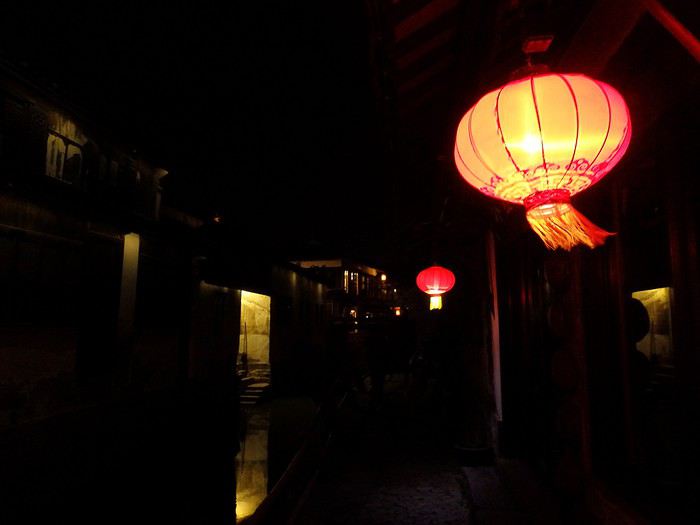
Avant toute chose, quelques mots de présentation. Ce carnet raconte un voyage en Chine effectué en septembre-octobre 2016. Je ne mentionnerai quasiment jamais de prix car ils ont pu varier.
Nous sommes un couple de trentenaires, encore sans enfant au moment de ce voyage. Nous aimons découvrir le monde et nous ne sommes pas du genre à rester des heures dans notre hébergement. Le matin on se lève, on petit-déjeune parfois, on prend nos affaires, on s'en va et on ne rentre que tard le soir. Quand nous arrivons en journée, on dépose rapidement les valises et on y va.
Nous ne sommes pas des backpackers vu que nous voyageons avec des valises rigides ;-) A l'usage je trouve ça bien plus pratique pour s'organiser et on peut transporter des choses fragiles. Nous préférons opter pour des logements confortables, en chambre double avec notre salle de bain, plutôt que des dortoirs. Le budget est plus élevé c'est sûr, mais on est plus en forme pour profiter de nos journées. On essaie un maximum de choisir des hébergements tenus par des locaux.
J'adore organiser des circuits pour nos vacances, prendre le temps de regarder ce qu'il y a à visiter, les endroits qui m'inspirent. A la fin, il y a toujours plus de choses à faire que nous avons de temps sur place, du coup je revoie mais objectifs à la baisse et je me lance dans les réservations. Mon conjoint, que j'appellerai ici P pour simplifier, n'est pas difficile et se laisse porter. Il agira sur place et dégainera son anglais alors que je ferai ma timide.
Bref, voici le planning de ces 21 jours en Chine. Je me suis concentrée sur la partie la plus accessible en transports terrestres une fois sur place (je stresse en avion, alors si on peut éviter et en plus limiter notre empreinte carbone, nous préférons). Nous sommes donc restés entre Beijing au nord, Xi'an à l'ouest, Yangshuo au sud et Shangaï à l'est. Nous avons essentiellement pris les trains à grande vitesse locaux. Nous sommes partis de mi-septembre à début octobre et pour éviter l'affluence dans les trains lors des vacances en Chine début octobre, nous avons décidé de rentrer sur Beijing juste avant et de visiter la ville à ce moment-là. Le reste plus en détails au jour le jour. Si vous voulez accéder à un jour en particulier, vous pouvez cliquer directement dessus, je mettrai les liens au fur et à mesure.
Avant de partir : les préparatifs pratiques Jour 1 et 2 : arrivée à Beijing (Pékin) Jour 3 : la grande muraille à Badaling Jour 4 : le train rapide Jour 4 (suite) : Pingyao Jour 5 : Xi'an Jour 5 (suite) : Xi'an Jour 6 : mont Huashan Jour 7 : transit vers Zhangjiajie Jour 8 : Zhangjiajie National Forest Park Jour 9 : Zhangjiajie, mont Tianmen Jour 9 (suite) : route vers Fenghuang Jour 10 : Fenghuang Jour 11 : trajet vers les rizières Longji Jour 12 : Longji Jour 12 (suite) : Longji Jour 13 : Yangshuo Jour 13 (suite) : Yangshuo Jour 14 : trajet vers Hangzhou Jour 15 : Hangzhou Jour 15 (suite) : Hangzhou Jour 16 : Shanghaï Jour 16 (suite) : Shanghaï Jour 16 (suite) : Shanghaï, soirée Jour 17 : Zhouzhuan Jour 18 : Suzhou Jour 19 : Suzhou et trajet vers Beijing Jour 20 : Beijing (Pékin), cité interdite Jour 20 (suite) : Beijing (Pékin), temple des lamas Jour 21 : Beijing (Pékin), temple du ciel Jour 21 (suite) : Beijing (Pékin), palais d'été Jour 21 (suite) : Beijing (Pékin), parc olympique Jour 22 : retour Conclusion
Concernant le budget, je n’ai plus les chiffres exacts mais voilà quelques infos : - billets Strasbourg-Francfort-Beijing avec Lufthansa environ 500€/personne - budget total sur place pour 21 jours un peu moins de 1 500€/personne (avec les souvenirs, boissons, …) - de mémoire la moyenne du budget hébergements doit être de 40€ par nuit pour deux - les trains rapides ne sont pas très chers, surtout comparés à l’Europe (prix sur trip.com) - les visites et entrées dans les parcs ne sont pas donnés, il faut prévoir un vrai budget. Il faut savoir qu’il faut souvent rajouter des frais annexes, parfois obligatoires, comme les bus internes ou les téléphériques. Notre budget visites est bien supérieur à notre budget transport sur place. - les repas ne coûtent vraiment pas cher sauf dans les grands restaurants renommés
Dernière précision importante, à chaque fois que je parlerai de touristes, il s’agit de touristes chinois. Nous n’avons croisé que très peu d’occidentaux. Nous avons même passé plusieurs jours sans en voir un seul.
Discussions du concours "Les édifices religieux dans le monde" English translation pending
C'est ici que l'on discute dans la bonne humeur et le respect de l'autre du concours du mois de novembre.😏
C'est aussi ici que l'on partage des photos en "OFF du concours" avant d'avoir trouver "la" bonne photo pour le concours.
Retour au concours de novembre:
voyageforum.com/...5795;live=1;#9805795
Informations relatives à la santé (paludisme, etc) au Vietnam (Institut Pasteur) English translation pending
Bonjour,
Je viens souvent sur ce site et je suis consterné de lire des demandes d'information relatives à la santé (palu, etc ...) au Vietnam.
Je veux simplement rappelé qu'en France nous avons la chance énorme d'avoir l'Institut Pasteur de renommée mondiale et qui est spécialisé dans ces conseils de santé.
Alors de grace, ne demandez pas à des inconnus, consultez de vrais spécialistes !
PS : à ce propos, si vous vous promenez à Dalat, HCMV, etc ... vous verrez ne nombreuses annexes de l'Institut Pasteur
https://www.pasteur.fr/fr/centre-medical/preparer-son-voyage/vietnam
https://www.pasteur.fr/fr/centre-medical/preparer-son-voyage/vietnam
Retour 2 semaines: Busan - Jeju - Séoul English translation pending
Bonjour
Voici un retour d’expérience suite à un voyage de 2 semaine en Corée du Sud, destination encore assez peu touristique. Ceci reflète juste mon expérience personnelle en 4 posts: informations générales, Busan /Gyeongju, Jeju, Séoul.
Notre itinéraire s’est limité à ces endroits, vu la durée du séjour (13,5 jours sur place début octobre 2019) mais aussi par choix. A mon avis, la Corée du Sud est très douée en marketing et propose des choses à voir dans tout le pays. Néanmoins, à la création de notre itinéraire, il nous semblait que toutes les destinations ne soient pas si exceptionnelles, d’où notre choix de ne pas voir tous les endroits et de ne pas visiter tous les temples, pour avoir aussi le temps de se poser. C’est un avis très personnel qui dépend de la durée du séjour, des centres d’intérêts et des voyages précédents. De même, mes commentaires tiennent compte d’un temps de vacances limité pour un choix de destination à travers le monde.
Nous avons rencontré assez peu de touristes orientaux à l’exception de Séoul. La météo (Octobre 2019) était généralement ensoleillée avec 2 jours de pluie suite à un typhon dans la région et du moins beau temps à Jeju.
Vols air china sur Busan via Pékin et de Séoul Gimpo (plus proche de Séoul, accessible en métro express ligne 9 et autres, aéroport plus simple) via Pékin: mieux qu’anticipé, bagages ok, à l’heure, repas ok (non épicé), boissons (mieux que Finnair ou XL Airways, similaire LATAM), transferts bien organisés, assez d’espace (en économique) sauf le premier vol sur Pékin qui était assez étroit aux jambes. Juste deux commentaires : il fait vraiment froid dans l’avion et le online check in est super lent. Il faut s’armer de patience et si possible d’un ordinateur (et non la version mobile).
Information générales
Transports publics: nous avons quasi exclusivement utilisé les transports en commun
T money: carte magnétique qui s’achète et se recharge dans les « convenience stores » (7/11, GS 24) et les stations de métro pour l’utilisation des transports dans tout le pays. Très pratique. En général un voyage coûte 1.000-1.400 krw. Prix 5.000 krw à l’achat mais il semble possible d’en acheter une « foreigner only » pour 4.000krw (pourtant on a acheté les nôtres a l’aeroport). Si tout le forfait n’est pas utilisé, possibilité de recevoir le solde restant en liquide. Naver map: une app gratuite à charger pour définir l’itinéraire dans tout le pays. L’app permet de chercher des lieux en anglais ou d’indiquer un point sur la carte. L’app indique le moyen de transport, le nombre d’arrêts, la durée, les transferts, l’entrée/sortie du métro à utiliser, le prix, etc. Le seul inconvénient est que l’app n’est pas super précise offline. Mieux que google maps.
Facilities:
Internet: nous n’avons pas acheté de carte locale. Il y a le wifi gratuit à énormément d’endroits dont les hôtels/cafés/magasins, dans les bus, les stations métro, en pleine rue. Toilettes: il y a des toilettes propres et gratuites dans les stations de métro, dans tous les centres commerciaux, à toutes les attractions, le long des chemins de randonnée, etc. Eau potable : il y a souvent des distributeurs d’eau à plusieurs endroits mais moins fréquents que les toilettes Les poubelles sont difficiles à trouver
Logement: on a choisi des hôtels 4 étoiles, 65eur/nuit en moyenne en chambre double. A ce prix-là, les chambres sont relativement petites avec peu de place pour les affaires, propre, salle de bain convenable, lit double 1,60 ou + confortable (et pas trop dur), souvent une isolation du bruit intérieur et extérieur insuffisante. La localisation est un critère essentiel pour nous pour l’utilisation des transports publiques et la vie nocturne.
Repas:
En général on n’a pas pris le petit déjeuner vu que le choix petit-déjeuner occidental est souvent très limité. Il y a énormément de cafés (chaînes locales et internationales, et autres) ouverts jusque tard dans la nuit. Le café est relativement cher (5.000-6.000 krw). On a mangé sur les marchés quelques fois ou emporté de la nourriture du 7/11. Pas toujours évidé de trouver un sandwich Le soir on a pu trouver à manger facilement, toutes les options disponibles, même non-épicé
Visites: beaucoup de sites sont très peu chers, 1.000-3.000krw/pers.
Communication : le niveau d’anglais est très moyen. Pour certaines visites, les indications sont à peine en anglais. Néanmoins les visites guidées semblaient ok et les indications importantes en ville sont en anglais.
Voici un retour d’expérience suite à un voyage de 2 semaine en Corée du Sud, destination encore assez peu touristique. Ceci reflète juste mon expérience personnelle en 4 posts: informations générales, Busan /Gyeongju, Jeju, Séoul.
Notre itinéraire s’est limité à ces endroits, vu la durée du séjour (13,5 jours sur place début octobre 2019) mais aussi par choix. A mon avis, la Corée du Sud est très douée en marketing et propose des choses à voir dans tout le pays. Néanmoins, à la création de notre itinéraire, il nous semblait que toutes les destinations ne soient pas si exceptionnelles, d’où notre choix de ne pas voir tous les endroits et de ne pas visiter tous les temples, pour avoir aussi le temps de se poser. C’est un avis très personnel qui dépend de la durée du séjour, des centres d’intérêts et des voyages précédents. De même, mes commentaires tiennent compte d’un temps de vacances limité pour un choix de destination à travers le monde.
Nous avons rencontré assez peu de touristes orientaux à l’exception de Séoul. La météo (Octobre 2019) était généralement ensoleillée avec 2 jours de pluie suite à un typhon dans la région et du moins beau temps à Jeju.
Vols air china sur Busan via Pékin et de Séoul Gimpo (plus proche de Séoul, accessible en métro express ligne 9 et autres, aéroport plus simple) via Pékin: mieux qu’anticipé, bagages ok, à l’heure, repas ok (non épicé), boissons (mieux que Finnair ou XL Airways, similaire LATAM), transferts bien organisés, assez d’espace (en économique) sauf le premier vol sur Pékin qui était assez étroit aux jambes. Juste deux commentaires : il fait vraiment froid dans l’avion et le online check in est super lent. Il faut s’armer de patience et si possible d’un ordinateur (et non la version mobile).
Information générales
Transports publics: nous avons quasi exclusivement utilisé les transports en commun
T money: carte magnétique qui s’achète et se recharge dans les « convenience stores » (7/11, GS 24) et les stations de métro pour l’utilisation des transports dans tout le pays. Très pratique. En général un voyage coûte 1.000-1.400 krw. Prix 5.000 krw à l’achat mais il semble possible d’en acheter une « foreigner only » pour 4.000krw (pourtant on a acheté les nôtres a l’aeroport). Si tout le forfait n’est pas utilisé, possibilité de recevoir le solde restant en liquide. Naver map: une app gratuite à charger pour définir l’itinéraire dans tout le pays. L’app permet de chercher des lieux en anglais ou d’indiquer un point sur la carte. L’app indique le moyen de transport, le nombre d’arrêts, la durée, les transferts, l’entrée/sortie du métro à utiliser, le prix, etc. Le seul inconvénient est que l’app n’est pas super précise offline. Mieux que google maps.
Facilities:
Internet: nous n’avons pas acheté de carte locale. Il y a le wifi gratuit à énormément d’endroits dont les hôtels/cafés/magasins, dans les bus, les stations métro, en pleine rue. Toilettes: il y a des toilettes propres et gratuites dans les stations de métro, dans tous les centres commerciaux, à toutes les attractions, le long des chemins de randonnée, etc. Eau potable : il y a souvent des distributeurs d’eau à plusieurs endroits mais moins fréquents que les toilettes Les poubelles sont difficiles à trouver
Logement: on a choisi des hôtels 4 étoiles, 65eur/nuit en moyenne en chambre double. A ce prix-là, les chambres sont relativement petites avec peu de place pour les affaires, propre, salle de bain convenable, lit double 1,60 ou + confortable (et pas trop dur), souvent une isolation du bruit intérieur et extérieur insuffisante. La localisation est un critère essentiel pour nous pour l’utilisation des transports publiques et la vie nocturne.
Repas:
En général on n’a pas pris le petit déjeuner vu que le choix petit-déjeuner occidental est souvent très limité. Il y a énormément de cafés (chaînes locales et internationales, et autres) ouverts jusque tard dans la nuit. Le café est relativement cher (5.000-6.000 krw). On a mangé sur les marchés quelques fois ou emporté de la nourriture du 7/11. Pas toujours évidé de trouver un sandwich Le soir on a pu trouver à manger facilement, toutes les options disponibles, même non-épicé
Visites: beaucoup de sites sont très peu chers, 1.000-3.000krw/pers.
Communication : le niveau d’anglais est très moyen. Pour certaines visites, les indications sont à peine en anglais. Néanmoins les visites guidées semblaient ok et les indications importantes en ville sont en anglais.
Quel parcours de 15 jours pour un second voyage au Vietnam English translation pending
Bonjour!
Nous envisageons de retourner au Vietnam fin janvier début février pour 15 jours.
Nous avons déjà vu la boucle du nord: Hanoï - Sapa - Baie d'Ha Long - Ninh Binh puis Hoï An.
Nous voulons retourner à Hanoï, passer plus de temps à Ninh Binh puis découvrir Hue et retourner quelques heures à Hoï An car le temps sera peut-être meilleur à cette époque.
Pourquoi pas continuer à descendre jusqu'à HCM pour rentrer en France.
Hate de vous lire
Nous voulons retourner à Hanoï, passer plus de temps à Ninh Binh puis découvrir Hue et retourner quelques heures à Hoï An car le temps sera peut-être meilleur à cette époque.
Pourquoi pas continuer à descendre jusqu'à HCM pour rentrer en France.
Hate de vous lire
Voyage un mois au Laos en novembre English translation pending
Bonjour
Nous sommes un couple de 70 ans toujours pas fatigué des voyages . Nous allons partir le 1 novembre au Laos pour 1 mois. Comme d'habitude : 1 billet d'avion , 2 guides papier et le reste se décide sur place .
Quelques questions :
- A l'arrivée à Vientiane quelqu'un peut il me donner une adresse d'un hôtel ou guest housse pas cher ?
- A l'aéroport quelle est la meilleure solution pour rejoindre le centre de Vientiane ? Bus , Taxi ...
-Habituellement comment est la météo au mois de novembre ?
- Le visa coûte moins cher quand on le prend à l'arrivée mais est ce facile et pas trop long pour l'obtenir ?
- Si quelqu'un connaissant bien le Laos peut me donner des idées sur les choses les plus intéressantes à voir en 1 mois avec un petit budget je suis preneur .
Par avance merci Jean Pierre
Par avance merci Jean Pierre