Results for "Croix+Rousse+|+127"
203150 results found.
Hôtel Sunrise Select Garden Beach à Hurghada English translation pending
Bonjour🙂,
J'ai réservé 10 jours de vacances All Inclusives dans cet hôtel du 27 janvier au 06 février 2005😎.
Quelqu'un est-il déjà allé dans cet hôtel, et quelles sont ses impressions?
(Propreté, nourriture, chambres, boissons etc...)
Merci de votre réponse😄.
J'ai réservé 10 jours de vacances All Inclusives dans cet hôtel du 27 janvier au 06 février 2005😎.
Quelqu'un est-il déjà allé dans cet hôtel, et quelles sont ses impressions?
(Propreté, nourriture, chambres, boissons etc...)
Merci de votre réponse😄.
Cambodge - Angkor - Ratanakiri English translation pending
Bonjour,
Allant au Cambodge vers mi octobre, j'aurais voulu avoir qqes renseignements :
qqun connait il une adresse sympa à Siem Reap, et y a t il besoin de réserver ?
j'envisage d'aller au Ratanakiri (depuis phnom penh) par voie maritime et terrestre et de revenir par voie aérienne. Est il préférable de réserver un billet longtemps avant ?
Je suis preneur de toute info (ballade à faire, site à ne pas manquer, ...) sur le Ratanakiri...
D'avance merci
Allant au Cambodge vers mi octobre, j'aurais voulu avoir qqes renseignements :
qqun connait il une adresse sympa à Siem Reap, et y a t il besoin de réserver ?
j'envisage d'aller au Ratanakiri (depuis phnom penh) par voie maritime et terrestre et de revenir par voie aérienne. Est il préférable de réserver un billet longtemps avant ?
Je suis preneur de toute info (ballade à faire, site à ne pas manquer, ...) sur le Ratanakiri...
D'avance merci
Donne conseils sur l'Ouzbékistan English translation pending
Salut,
Je vois qu'il y a une bonne ambiance sur ce forum, alors, si vous avez besoin de conseils sur l'Ouzbékistan et surtout sur ma ville natale de Tachkent, n'hésitez pas!
Suggestion voyage juin 2005 English translation pending
Bonjour à tous,
Je songe doucement aux vacances pour l'annee prochaine et j'aimerais avoir plusieurs avis.
En fait, j'aimerais partir fin juin avec ma copine pour feter la fin de ses etudes et son anniversaire.
Mon budget tournerait autour de 400-500euros par personne.
Alors, je cherche plutot un voyage basé sur le soleil, des temperatures elevees si possible, la mer ( belle de preference pour faire de la plongee ), quelques balades, pas trop calme ni trop bruyant.
Qu'est ce que vous me suggerez?
Merci a tous.
Je songe doucement aux vacances pour l'annee prochaine et j'aimerais avoir plusieurs avis.
En fait, j'aimerais partir fin juin avec ma copine pour feter la fin de ses etudes et son anniversaire.
Mon budget tournerait autour de 400-500euros par personne.
Alors, je cherche plutot un voyage basé sur le soleil, des temperatures elevees si possible, la mer ( belle de preference pour faire de la plongee ), quelques balades, pas trop calme ni trop bruyant.
Qu'est ce que vous me suggerez?
Merci a tous.
Louer une moto ou une voiture en République Dominicaine? English translation pending
Bonjour a tous, je serais dans la région de la romana, mais je peus me déplacer pour aller chercher l'engin qui me permettra de m'évader de mon hotel qui est trés isolé...
Si vous avez un commentaire positif ou négatif, je suis impatient... et Merci de votre aide
henri
Si vous avez un commentaire positif ou négatif, je suis impatient... et Merci de votre aide
henri
Quelles langues pour un tour du monde? English translation pending
Bonjour,
Je découvre avec bonheur ce forum ! J'ai déjà passé une partie de la soirée à lire avec curoisité les différents sujets abordés...
Bref. J'ai mille questions, beaucoup d'idées pour un tel projet. Je commencerai par quelquechose de tout bête. Quelles langues conseilleriez-vous pour entreprendre un tour du monde ? Vous allez me dire "ça dépend des pays traversés😛" ! C'est juste pour mettre le premier pied dans l'aventure, et commencer à prendre quelques cours éventuellement, pour que ça devienne concret (c'est bien le plus dur non, de se dire "allez j'y vais !"). Je me débrouille en anglais, mais je pense que l'espagnol par exemple est une langue intéressante à connaître non ?
Merci pour vos conseils.
Je découvre avec bonheur ce forum ! J'ai déjà passé une partie de la soirée à lire avec curoisité les différents sujets abordés...
Bref. J'ai mille questions, beaucoup d'idées pour un tel projet. Je commencerai par quelquechose de tout bête. Quelles langues conseilleriez-vous pour entreprendre un tour du monde ? Vous allez me dire "ça dépend des pays traversés😛" ! C'est juste pour mettre le premier pied dans l'aventure, et commencer à prendre quelques cours éventuellement, pour que ça devienne concret (c'est bien le plus dur non, de se dire "allez j'y vais !"). Je me débrouille en anglais, mais je pense que l'espagnol par exemple est une langue intéressante à connaître non ?
Merci pour vos conseils.
Train Moscou Pékin Hanoi Saigon English translation pending
j aimerai prendre le transiberien moscou pekin avec une halte a irkoutsk puis continuation sur pekin 1 semaine a pekin .ensuite pekin hanoi .ja imerai passer 2 mois entre le vietnam le laos la thailande et le cambodge. j ai deja fait le voyage plusieurs fois par avion.je sais que moscou pekin cest 8 jours. combien de jours pekin hanoi et quels sont les stops in contournables? APPAREMMENT EN COUPE 4 PLACES D APRES EMMANOMADE CA SERAIT 150 EUROS UN MOSCOU PEKIN.je connais bien la thailande pour y avoir sejourne 1 an sur les 5 dernieres annees avec extensions au laos.ja i rencontre beaucoup de routards qui m ont dit que la comunication etait hard avec les chinois qui seraient un peu racistes en dehors du business. quelqu un a t il deja fait ce trip
La destination de vos rêves......... English translation pending
Bonjour à tous!😉
Est ce que ça vous dirait de rajouter dans votre signature la destination de vos rêves? Juste pour que l'on sache où vous rêvez d'habiter!
Alan et moi venons de le rajouter dans notre signature, alors ça vous tente?
Bisous Alan et Telma🙂
Est ce que ça vous dirait de rajouter dans votre signature la destination de vos rêves? Juste pour que l'on sache où vous rêvez d'habiter!
Alan et moi venons de le rajouter dans notre signature, alors ça vous tente?
Bisous Alan et Telma🙂
Coût des hébergements en Ouzbékistan English translation pending
Bonjour!
Je pars avec un ami, en Ouzbékistan fin septembre pour 3 semaines. Tashkent, Samarcande, Boukkara, Kiva, la mer d'Aral, et si possible une virée dans la vallée de Fergana. Je viens de lire les messages, mais peu parlent du budget à prévoir... Les hôtels me parraissent d'un prix élevé, il serait interessant d'avoir quelques infos de voyageurs ayant visité récemment le pays, concernant les tarifs qu'ils ont payés. Quels guides de voyages utiliser: le petit futé? Lonely Planet ou Olizane? Merci de vos réponses. Pour ceux et celles qui partiront à la fin de l'été je serai là-bas du 289 au 2010.
Je pars avec un ami, en Ouzbékistan fin septembre pour 3 semaines. Tashkent, Samarcande, Boukkara, Kiva, la mer d'Aral, et si possible une virée dans la vallée de Fergana. Je viens de lire les messages, mais peu parlent du budget à prévoir... Les hôtels me parraissent d'un prix élevé, il serait interessant d'avoir quelques infos de voyageurs ayant visité récemment le pays, concernant les tarifs qu'ils ont payés. Quels guides de voyages utiliser: le petit futé? Lonely Planet ou Olizane? Merci de vos réponses. Pour ceux et celles qui partiront à la fin de l'été je serai là-bas du 289 au 2010.
Transports et logements pour la mer d'Aral, côté Ouzbékistan English translation pending
je cherche des informations sur la mer d'Aral.
il semble que ce lieu est contreversé.
doit-on y aller ou pas? y a -t-il des bus, au départ de Noukous, ou plus proche encore de la mer d'aral? y a -t-il des logements possibles.
pensez vous qu'il est bien d' y séjourner quelques jours?
il semble que ce lieu est contreversé.
doit-on y aller ou pas? y a -t-il des bus, au départ de Noukous, ou plus proche encore de la mer d'aral? y a -t-il des logements possibles.
pensez vous qu'il est bien d' y séjourner quelques jours?
Club Amigo Guardalavava English translation pending
Bonjour a tous!!!
Moi et mon conjoint prévoyont peut-être réserver a cet hôtel pour fin Juin.
Nous sommes des gens qui aiment la tranquilité et les belles plages.
Comment est la nourriture, l'hôtel en général et la plage.
J'ai lu que la plage était publique???
Merci pour vos réponses. Valérie
Moi et mon conjoint prévoyont peut-être réserver a cet hôtel pour fin Juin.
Nous sommes des gens qui aiment la tranquilité et les belles plages.
Comment est la nourriture, l'hôtel en général et la plage.
J'ai lu que la plage était publique???
Merci pour vos réponses. Valérie
24 heures de dingue en Russie: parachute et autres aventures... English translation pending
Bonjour.
comme promis à LaFleur, voici mon récit de mon saut en parachute en juillet 99, à 50 km au sud de Moscou, et ce qui s'est passé avant et après. Ce furent 24 heures absolument hors norme.
comme promis à LaFleur, voici mon récit de mon saut en parachute en juillet 99, à 50 km au sud de Moscou, et ce qui s'est passé avant et après. Ce furent 24 heures absolument hors norme.
Transsibérien Moscou-Pékin English translation pending
Hello,
Avec une copine, je prépare un mois de vacances pour effectuer le Moscou Pékin en train. J'aimerais avoir quelques tuyaux concernant les logements en Russie (pour avoir le fameux visa!!!!) et l'achat des billets.
Quelqu'un aurait-il des bons plans billets de train avec le transsibérien? Savez-vous s'il est facile de les acheter sur place?
Même question pour les logements en Russie (Moscou et lac Baïkal). A priori j'ai trouvé des organismes qui pourraient nous aider à trouver un logement chez l'habitant mais ce serait environ 20€/pers, ça me semble cher!
Merci d'avance pour votre aide
A+
Avec une copine, je prépare un mois de vacances pour effectuer le Moscou Pékin en train. J'aimerais avoir quelques tuyaux concernant les logements en Russie (pour avoir le fameux visa!!!!) et l'achat des billets.
Quelqu'un aurait-il des bons plans billets de train avec le transsibérien? Savez-vous s'il est facile de les acheter sur place?
Même question pour les logements en Russie (Moscou et lac Baïkal). A priori j'ai trouvé des organismes qui pourraient nous aider à trouver un logement chez l'habitant mais ce serait environ 20€/pers, ça me semble cher!
Merci d'avance pour votre aide
A+
8000 mètres... English translation pending
8000 mètres.
A plat, cela ne représente pas grand chose, mais à la verticale...
Depuis 2 ans, une idée lancinante traîne en moi. Cette frontière invisible et folle me trotte dans la tête. L'écrivain et alpiniste Greg Child appelle cette attirance "le ver", je trouve la métaphore assez intéressante. J'aimerai me lancer d'ici 5 ans ce défi. Je m'en crois capable.
Vous êtes alpiniste, montagnard ou néophyte ? Vous pensez parfois ou très souvent à un tel projet ? Vous trouvez ce genre d'entreprise totalement stupide ? Vous qui n'êtes donc pas indifférent à cette idée, votre avis m'intéresse.
A plat, cela ne représente pas grand chose, mais à la verticale...
Depuis 2 ans, une idée lancinante traîne en moi. Cette frontière invisible et folle me trotte dans la tête. L'écrivain et alpiniste Greg Child appelle cette attirance "le ver", je trouve la métaphore assez intéressante. J'aimerai me lancer d'ici 5 ans ce défi. Je m'en crois capable.
Vous êtes alpiniste, montagnard ou néophyte ? Vous pensez parfois ou très souvent à un tel projet ? Vous trouvez ce genre d'entreprise totalement stupide ? Vous qui n'êtes donc pas indifférent à cette idée, votre avis m'intéresse.
Transsibérien Moscou-Pékin: obtention des visas English translation pending
salut
Je dois me rendre chez un ami à Taian en Chine ( 500 kms de Pékin)
Je ferais la liaison Paris-Moscou par autocar
Ensuite, je souhaite emprunter le transsibérien Moscou-Pékin
Le but de mon voyage n’est pas pour l'instant de faire des stops en divers endroits, mais d’enquiller d’une traite les 9000 kms qui mènent à Pékin
J’ai déjà pas mal voyagé en Europe, mais je ne suis pas familier des procédures de visa Première question d’ingénu : lorsqu’on ne séjourne pas dans un pays, mais que l’on se contente de le traverser en quelques heures ou quelques jours quelque soit le moyen de transport, doit-on tout autant se munir d’un visa ? est-ce ce que l’on appelle le « visa de transit » ? 2eme question : de France, à combien s’élèvent environ les frais de visa si l’on cumule le visa pour entrer en Biélorussie vers Moscou, le visa russe, le visa mongol, et enfin le visa chinois ? il me semble qu’il existe la possibilité de prendre un visa à l’arrivée à la frontière mongole, non ? 3eme question : les délais d’obtention sont-ils longs ? y’a-t-il des difficultés d’obtention particulières, je pense surtout au visa russe ? 4eme question : où et comment acheter son billet transsibérien à Moscou ? Moscou-Irkoutsk, puis Irkoutsk-Pékin, c’est ça ? le fait de ne parler que l’anglais, et pas un mot de russe, peut-il poser problème ? combien y’a t-il de départ hebdomadaire à partir de Moscou ?
bon je sais, toutes ces questions, c’est un peu lourd mes amis... merci de votre aide
à bientôt
J’ai déjà pas mal voyagé en Europe, mais je ne suis pas familier des procédures de visa Première question d’ingénu : lorsqu’on ne séjourne pas dans un pays, mais que l’on se contente de le traverser en quelques heures ou quelques jours quelque soit le moyen de transport, doit-on tout autant se munir d’un visa ? est-ce ce que l’on appelle le « visa de transit » ? 2eme question : de France, à combien s’élèvent environ les frais de visa si l’on cumule le visa pour entrer en Biélorussie vers Moscou, le visa russe, le visa mongol, et enfin le visa chinois ? il me semble qu’il existe la possibilité de prendre un visa à l’arrivée à la frontière mongole, non ? 3eme question : les délais d’obtention sont-ils longs ? y’a-t-il des difficultés d’obtention particulières, je pense surtout au visa russe ? 4eme question : où et comment acheter son billet transsibérien à Moscou ? Moscou-Irkoutsk, puis Irkoutsk-Pékin, c’est ça ? le fait de ne parler que l’anglais, et pas un mot de russe, peut-il poser problème ? combien y’a t-il de départ hebdomadaire à partir de Moscou ?
bon je sais, toutes ces questions, c’est un peu lourd mes amis... merci de votre aide
à bientôt
Anti-moustique? English translation pending
Hello!
je rebondis sur toutes ces question concernant le palu : la plupart d'entre vous pense qu'il vaut mieux privilégier une bonne protection (moustiquaire, anti-moustique) à un traitement médicamenteux.
Pour ce qui est de l'anti-moustique, je me pose encore quelques questions : d'abord parce que le premier anti-moustique que j'ai utilisé m'a généré une giga allergie 🤪🤪. Le toubib m'a alors conseillé de changer de produit insecticide et je me suis tournée vers le 5 sur 5. Produit qui a super bien marché en Equateur (moi qui suis la victime favorite de ces bestioles, pas une ne s'est aventurée à venir me piquer!!). Par contre, effet ZERO en Thailande pour mon homme et moi!! Je lui avais clamé les vertus de ce produit miracle en long, large et travers et on a passé 8 jours à concourir pour le prix du nombre de piqûres.....
Alors, si on reste dans l'idée qu'on ne fait pas de prévention et donc pas de médoc de type lariam, malarone.... qu'en est-il si, sur place, le produit qui doit éviter que les mosquitos te transmettent la maladie se révèle innefficace?
je rebondis sur toutes ces question concernant le palu : la plupart d'entre vous pense qu'il vaut mieux privilégier une bonne protection (moustiquaire, anti-moustique) à un traitement médicamenteux.
Pour ce qui est de l'anti-moustique, je me pose encore quelques questions : d'abord parce que le premier anti-moustique que j'ai utilisé m'a généré une giga allergie 🤪🤪. Le toubib m'a alors conseillé de changer de produit insecticide et je me suis tournée vers le 5 sur 5. Produit qui a super bien marché en Equateur (moi qui suis la victime favorite de ces bestioles, pas une ne s'est aventurée à venir me piquer!!). Par contre, effet ZERO en Thailande pour mon homme et moi!! Je lui avais clamé les vertus de ce produit miracle en long, large et travers et on a passé 8 jours à concourir pour le prix du nombre de piqûres.....
Alors, si on reste dans l'idée qu'on ne fait pas de prévention et donc pas de médoc de type lariam, malarone.... qu'en est-il si, sur place, le produit qui doit éviter que les mosquitos te transmettent la maladie se révèle innefficace?
Sécurité pour auto stop en Europe de l'Est? English translation pending
Je prépare un voyage en solo et en auto-stop de Paris à Moscou.
Je comptais passer par la Pologne et la Biélorussie. Je sais que la Pologne est sans risque (tout étant relatif!) pour ce genre de voyage mais pour la Biélorussie, il semblerait que ce soit plus "chaud". Du coup, j'ai pensé qu'en contournant la Biélorussie par les pays Baltes, cela pourrait être plus "facile".
Est-ce que quelqu'un sait si en traversant la Lituanie et la Lettonie, je ferais le meilleur choix?
Les "difficultés" que j'entend sont: la facilité et la perméabilité des frontières "Monde Occidental" / "Monde soviétique"? l'auto-stop est-il courant dans les moeurs de ces pays?
Merci pour votre coup de main!! 😉
Je comptais passer par la Pologne et la Biélorussie. Je sais que la Pologne est sans risque (tout étant relatif!) pour ce genre de voyage mais pour la Biélorussie, il semblerait que ce soit plus "chaud". Du coup, j'ai pensé qu'en contournant la Biélorussie par les pays Baltes, cela pourrait être plus "facile".
Est-ce que quelqu'un sait si en traversant la Lituanie et la Lettonie, je ferais le meilleur choix?
Les "difficultés" que j'entend sont: la facilité et la perméabilité des frontières "Monde Occidental" / "Monde soviétique"? l'auto-stop est-il courant dans les moeurs de ces pays?
Merci pour votre coup de main!! 😉
Transsiberien: France-Moscou-Japon English translation pending
Avec des amis, nous voulons aller au Japon. Quelqu'un a lancé l'idée de traveerser la russie en transsiberien pour aller au Japon.
est ce que quelqu'un a deja pris le transsibérien? c'est bien et pratique comme moyen de transport?
Pour le retour on pensait prendre l'avion mais le tarif allée simple en avion est 2 * plus cher : problème. quelqu'un aurait des astuces?
Joanne
est ce que quelqu'un a deja pris le transsibérien? c'est bien et pratique comme moyen de transport?
Pour le retour on pensait prendre l'avion mais le tarif allée simple en avion est 2 * plus cher : problème. quelqu'un aurait des astuces?
Joanne
Hôtel Club Marmara Bellis 5* English translation pending
Que pouvez-vous me dire sur l'hôtelHOTEL CLUB MARMARA BELLIS 5*, en sachant que je suis très difficile, et exigence.
Merci d’avance. 😉
Merci d’avance. 😉
Question pour le transmongolien English translation pending
bonjour je part en mongolie cette été pour 2 ou 3mois avec 2 autre personne On compte acheter ou louer des chevaux (il faut qu'on se renseignement, ) pour visiter une partie du pays. Pour venir en mongolie on va passer par la chine (avion de lyon a Pékin) arriver a Pékin on souhaite prendre le transmongole mais on ne sait pas combien ça cout et si il y a bcp de train qui "circule" Si quelqu'un a des info dessu elles seront les bien venu. Ou alors prendre l'avion de lyon a moscou et prendre le transsibérien (aucune info dessu) si ca vaut plus le coup au niveau tarifs
J'aurai d'autre question :au niv de comment faire chauffer des aliment (gaz ou feu??), si on peut louer ou acheter des chevaux sur 2 mois et leur materiel (selle, materiel pr les chevaux de ba...), si il existe des interprete mongol / francais ou anglais pour etre plus proche des nomades et mongols ??, si les prise electrique existe et sont les mm quand france pour recharger les batteries de video ??
merci si vous avez des info. Gaelle
J'aurai d'autre question :au niv de comment faire chauffer des aliment (gaz ou feu??), si on peut louer ou acheter des chevaux sur 2 mois et leur materiel (selle, materiel pr les chevaux de ba...), si il existe des interprete mongol / francais ou anglais pour etre plus proche des nomades et mongols ??, si les prise electrique existe et sont les mm quand france pour recharger les batteries de video ??
merci si vous avez des info. Gaelle
Sécurité en Ouzbékistan English translation pending
J'envisage de faire un voyage en Ouzbekistan, mais je m'interroge sur la sécurité.
Y a t-il un risque pour les individuels ?
Combien de temps faut-il pour visiter le pays ?
Y a t-il d'autres choses à voir et qui valent le coup dans les pays voisins ?
Toute info sera la bienvenue (transport, logements, guides, etc ...)
Y a t-il un risque pour les individuels ?
Combien de temps faut-il pour visiter le pays ?
Y a t-il d'autres choses à voir et qui valent le coup dans les pays voisins ?
Toute info sera la bienvenue (transport, logements, guides, etc ...)
De Paris à Vladivostok par le cheval de fer English translation pending
Salut! Je suis très intéressé par un périple Paris-Vladivostok via Irkutsk, la Mongolie, Pékin et Haerbin via le Transsibérien. J'ai déjà pris qq notes sur les différents messages concernant le sujet (Loopkin notamment) mais qu'en est-il de l'obtention des fameux visas ? Quels sont les meilleurs moyens pour se les procurer, question coût et rapidité ? 😉
Je ne parle aussi pas un mot de russe, mongol ou mandarin 🤪 : avez-vous des méthodes efficaces pour connaître les bases de ces 3 langues en quelques mois ?
Bonne chance à tous dans vos entreprises de voyages et que les utilisateurs du transsibérien (passés ou présents) se fassent connaître pour qq conseils pratiques!!! 😛
A plus!
dom
Je ne parle aussi pas un mot de russe, mongol ou mandarin 🤪 : avez-vous des méthodes efficaces pour connaître les bases de ces 3 langues en quelques mois ?
Bonne chance à tous dans vos entreprises de voyages et que les utilisateurs du transsibérien (passés ou présents) se fassent connaître pour qq conseils pratiques!!! 😛
A plus!
dom
White sand beach en Thaïlande English translation pending
Kathy m'a donné des infos sympas sur Koh Chang et m'a parlé de White Sand Beach ?
Est ce que quelqu'un aurait d'autre infos sur cet endroit ? guest house etc ... ?
Merci pour vos infos. Je pars lundi.
Eléa
Est ce que quelqu'un aurait d'autre infos sur cet endroit ? guest house etc ... ?
Merci pour vos infos. Je pars lundi.
Eléa
Sud Lipez-Uyuni (Bolivie)-Atacama (Chili) début mars English translation pending
Salut à tous,
Je suis super attiré par cette région et voudrais m'y rendre Début Mars.
Premier pb : Est ce possible en 2 semaines ? je sais que c'est court et que lemieux c'estd'y passer 1 mois, mais bon, jen'ai pas ce temps. Où faut il mieux atterir, et peut on prendre une ligne intèrieur facilement?
Deuxième problème : ce n'est pas la meilleure pèriode pour y aller je crois. Quelqu'un s'est il rendu dans cette région début mars ? vos commentaires m'aideraient beaucoup.
Merci à tous d'avance
A+
Fil
Je suis super attiré par cette région et voudrais m'y rendre Début Mars.
Premier pb : Est ce possible en 2 semaines ? je sais que c'est court et que lemieux c'estd'y passer 1 mois, mais bon, jen'ai pas ce temps. Où faut il mieux atterir, et peut on prendre une ligne intèrieur facilement?
Deuxième problème : ce n'est pas la meilleure pèriode pour y aller je crois. Quelqu'un s'est il rendu dans cette région début mars ? vos commentaires m'aideraient beaucoup.
Merci à tous d'avance
A+
Fil
Transsibérien Moscou-Pékin en juillet/août English translation pending
bonjour !
Je souhaiterais faire en juillet-août Moscou-Pékin en transsibérien. Quelqu´un l´a`t´il déjà fait à cette période ?
Est-ce une bonne période ?
Peut-on acheter facilement son billet à Moscou, et quels sont à peu près les tarifs ? (je sais que de Paris une seule agence vend le billet Moscou-Pékin, ç´est hors de prix, et on ne peut s´arrêter en cours de route).
Merci pour les infos
Je souhaiterais faire en juillet-août Moscou-Pékin en transsibérien. Quelqu´un l´a`t´il déjà fait à cette période ?
Est-ce une bonne période ?
Peut-on acheter facilement son billet à Moscou, et quels sont à peu près les tarifs ? (je sais que de Paris une seule agence vend le billet Moscou-Pékin, ç´est hors de prix, et on ne peut s´arrêter en cours de route).
Merci pour les infos
Best of des destinations English translation pending
Petite pensee que j'ai en surfant un peu partout dans ce forum, quand on regarde le nombre de discussions et messages postes sur les destinations, l'Asie du Sud-Est et l'Afrique sont largement en tete talones par l'Europe et l'Asie du Sud.
J'ai le sentiment que c'est representatif des choix des voyageurs que nous sommes. 😎
Donc pour eviter la foule et les bains a touristes, il n'y a plus qu'a chercher la destination qui n'a aucune question sur ce forum ! 😏
Bon, c'etait ma reflexion du soir apres une overdose de boulot. Reflexion a 2 balles, basee sur aucune etude scientifique !
Bonne soiree a tous
Douya
J'ai le sentiment que c'est representatif des choix des voyageurs que nous sommes. 😎
Donc pour eviter la foule et les bains a touristes, il n'y a plus qu'a chercher la destination qui n'a aucune question sur ce forum ! 😏
Bon, c'etait ma reflexion du soir apres une overdose de boulot. Reflexion a 2 balles, basee sur aucune etude scientifique !
Bonne soiree a tous
Douya
Kyrgyzstan: Practical Information 2026
Recent information about this country is scarce, so I’m starting this post in addition to my travel journal to help fill the gap.
- Which airline from Europe?
Turkish Airlines seems like an excellent option. The price is very reasonable (just over 500 €), the layover isn’t too long, the in-flight comfort is decent (great movie selection), and the planes are modern. Plus, the price automatically includes 30 kilos of luggage, which is perfect for campers.
The downside: the outrageous prices at Istanbul Airport.
- Bishkek Airport
The airport is under full reconstruction. It’s chaotic. There are SIM card vendors upon arrival, but no currency exchange or ATMs in the baggage claim area. You’ll find those in the departures section, which means you have to exit and re-enter under the current setup.
Personally, I pre-booked a VTC with my hotel for the transfer to the city. (Prices vary depending on the hotel’s standard—1200 soms for mine.)
There are taxis and a bus available.
- Entry Requirements
No visa is required for French citizens for stays of up to 30 days.
- Currency
The currency is the som, and the conversion is easy—just divide by 100...
You can get soms by exchanging euros (dollars are useless) or by withdrawing from an ATM. Some ATMs charge fees. Those from Mbank and Optimabank are fee-free.
The maximum withdrawal is usually 20,000 soms.
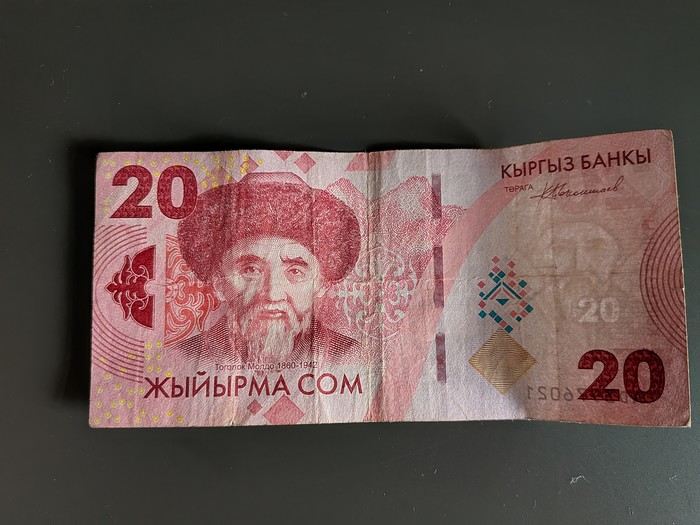
Bills come in 5000, 1000, 500, 200, 100, 50, and 20 soms.
Coins: 10, 5, 3, and 1 som.
- Paying
Card payments are accepted in supermarkets like Globus, some restaurants, gas stations of major chains (Bishkek Petroleum, Partner Neft, Red Petroleum), some hotels, national park entrances, tolls, etc.
But it doesn’t always work.
So always carry cash with you!
If the card works, great—otherwise, it’s back to the old days of wads of bills.
- Cost of Living
It’s really cheap (gas, affordable restaurants even at a decent standard, hotels, souvenirs, fruits, vegetables, water, bread...). For example, a lagman costs only 3.20 €, fixing a flat tire is 3.5 €, a full hour-long wash for a filthy 4x4 is 6 €, washing a big bag of laundry is 3 €, and a liter of 95-octane gas is 0.86 €...
On the pricier side: guesthouses and meals in guesthouses. The value for money is poor. I paid 40 € for a mediocre room with a very basic shared bathroom, while a double with AC, private bathroom, and fridge in a non-touristy hotel cost 20 €... Meals in guesthouses are the worst I’ve eaten and often the most expensive. Plus, they’re very light—don’t expect to fill up after a long day of hiking!
Car rentals are also quite expensive (70 $ per day for a RAV4 in my case).
In short, for two people, excluding accommodation and car rental, we spent an average of 45 € per day (groceries, restaurants, guesthouse dinners, souvenirs, paid activities, gas).
The trip cost us 2200 € per person all-inclusive for 3 weeks on the ground. Roughly 1/4 for the flight, 1/4 for the car, 1/4 for accommodation, and 1/4 for everything else.
- Getting Around
I’ve met cyclists, motorcyclists, people renting cars, those who drove their own vehicles from Europe, and others using public transport and taxis.
Personally, I chose to rent a car.
If you’re not planning long hikes or multi-day horse treks, it’s a great option for exploring the country.
Each car rental company has its own list of forbidden tracks. Make sure your planned route is allowed! Don’t think about ignoring this—vehicles are equipped with GPS trackers...
An international driver’s permit is required.
Police and speed cameras are everywhere, so it’s best to respect the signs (daytime running lights, seatbelts, 40-60 km/h in populated areas, 90 km/h on roads, zero tolerance for alcohol).
Locals have a unique driving style, and it can be dangerous on main roads (they overtake recklessly...). Like in Greece, South Africa, or Malta, a two-lane road is treated as a three-lane one. You pull over to let others pass or to let oncoming traffic overtake.
Without a car (at least a pseudo-4x4), you won’t be able to go everywhere. This country is a nature destination, but nature isn’t always accessible by public transport.
If a spot is near a road, great—the bus will get you almost to the door. Otherwise, you’ll need to hire an agency or take a taxi.
Cyclists will face steep climbs and dust. I’d advise avoiding main roads as much as possible—traffic isn’t on your side...
Motorcyclists will also eat a lot of dust and should research gas stations along their route (this advice also applies to vehicles running on 95-octane).
There’s a 95-octane pump in Kazarman and Gulcha.
Bikes and motorcycles have an advantage over cars, even 4x4s, as they can access some very remote tracks that other vehicles can’t (hikers and horses can obviously take them too!).
Be careful: some areas require a permit (border zones). Research this well in advance—the formalities don’t take an hour or even a day!
Be warned: Google Maps is completely unreliable (it shows roads that don’t exist, routes you through difficult tracks instead of paved roads, etc.). It’s essential to download Maps.me in advance. This app is much more reliable for this country, works offline, and is handy for hiking navigation.
A reminder: horseback riding is like cycling... If you’re not used to it or naturally padded in the right places, your backside will suffer in no time!
Think carefully before embarking on a multi-day trek!
Finally, this country is a kingdom of construction... The Chinese have taken over the market to improve truck circulation and are paving everywhere. (Good news: the Kazarman-Osh section via the tunnel is finally open in summer, even if the road isn’t quite finished.)
- Eating
I had prejudices about Kyrgyz food.
I was both wrong and right.
Supermarkets don’t offer much that’s appealing for picnics. It’s cheap, filling food, full of junk, and not gourmet. If you follow Yuka, I think you’ll be on a diet the whole trip. Bringing some pâté, sausages, or freeze-dried meals for certain nights is a good idea...
Guesthouse dinners consist of the eternal cucumber-tomato salad, a soup, and a light noodle or rice dish where you’ll be searching for the meat... Usually tough and unidentifiable. Beef? The bread is stale, and there’s no dessert or fruit.
Breakfasts always revolve around eggs or porridge... The homemade jam is usually good.
Tea is the number one drink, followed by kompot (a fruit-based drink), Coke, and Fanta.
If you want real coffee, bring your own—it’s very rare.
On the other hand, you eat well in restaurants. Lagman (homemade noodles, vegetables, spices, and usually beef), crispy eggplant, kuurdak (a kind of lamb stew with potatoes), kebabs, plov (pilaf rice with onions, carrots, and meat), and rainbow trout... For dessert? Nada!
And alcohol?
It’s available in all Globus stores: beer, wine, spirits, and you can consume your purchases in some guesthouses (depending on the owner’s religious tolerance). It’s also available in some restaurants (Bishkek, Karakol, Osh...).
The deadly specialty?
White fermented milk balls called kurut. If you think a raw-milk camembert is strong, steer clear! This is more like an old, dry, spicy goat cheese.
- Accommodation
In remote areas, it’s better to check availability on Booking a few days in advance rather than showing up last minute with high hopes.
Booking and Airbnb only offer a small portion of what’s available.
Not necessarily guesthouses, but mostly accommodations aimed at locals (business or leisure travel).
These places are generally more comfortable. There’s even some upscale options.
So it’s necessary to scour Google Maps or Yandex Maps... These accommodations are usually found on Instagram, and WhatsApp is handy for booking!
Prices are a bit of a lottery. So is the comfort. From 20 to 80 € for a double, usually with a private bathroom. (Average around 40 €). These rates are for mid-range options.
Otherwise, this country is a paradise for wild camping. In a camper van, rooftop tent, or ground tent... There are beautiful spots everywhere!
- Climate
I thought it would be quite cool/cold at altitude.
I packed too many warm clothes...
If you’re not doing high-altitude treks or sleeping in a tent, there’s no need to overload yourself with winter gear.
A good fleece, a windproof rain jacket, and technical base layers will be enough.
It only got really cold in the evenings at Song Kul Lake and Tash Rabat, and the yurts are equipped with thick blankets and a stove.
Elsewhere, temperatures ranged from 15 to 30 °C.
In short, I used the AC more than the heater! (It’s hard to drive with the windows open unless you want to be covered in dust in no time...)
- Communication
I bought an eSIM before the trip with a data plan for Kyrgyzstan (Beeline network). Perfect for communicating via WhatsApp right after landing, but this network isn’t the best in Kyrgyzstan.
We then got a physical SIM card with an unlimited one-month plan (less than 4 € including the SIM) at a Mega store downtown. This network is much better, and you get coverage in all cities and most villages. Usually in the mountain passes too.
To make yourself understood, it’s essential to download Google Translate with French, Kyrgyz, Russian, and English options.
Very useful for translating menus, signs, and communicating with locals.
Hosts and other tourism professionals will even pull out their phones to communicate with non-Russian speakers.
The police too...
- Religion
There’s a noticeable difference between the north and the southwest of the country.
In the north, it’s a bit like Albania. People are Muslim by culture but not really by religion.
In the southwest, radical Islam is growing. Mosques are more numerous and imposing. Men are more bearded, women more veiled.
For travelers, religion isn’t an issue except for the near-total absence of pork.
There’s Russian sausage, but reading the ingredient list, it’s more like a one-way ticket to cancer than an Auvergne dry sausage...
You can find the detailed account of the trip here.
- Which airline from Europe?
Turkish Airlines seems like an excellent option. The price is very reasonable (just over 500 €), the layover isn’t too long, the in-flight comfort is decent (great movie selection), and the planes are modern. Plus, the price automatically includes 30 kilos of luggage, which is perfect for campers.
The downside: the outrageous prices at Istanbul Airport.
- Bishkek Airport
The airport is under full reconstruction. It’s chaotic. There are SIM card vendors upon arrival, but no currency exchange or ATMs in the baggage claim area. You’ll find those in the departures section, which means you have to exit and re-enter under the current setup.
Personally, I pre-booked a VTC with my hotel for the transfer to the city. (Prices vary depending on the hotel’s standard—1200 soms for mine.)
There are taxis and a bus available.
- Entry Requirements
No visa is required for French citizens for stays of up to 30 days.
- Currency
The currency is the som, and the conversion is easy—just divide by 100...
You can get soms by exchanging euros (dollars are useless) or by withdrawing from an ATM. Some ATMs charge fees. Those from Mbank and Optimabank are fee-free.
The maximum withdrawal is usually 20,000 soms.
Bills come in 5000, 1000, 500, 200, 100, 50, and 20 soms.
Coins: 10, 5, 3, and 1 som.
- Paying
Card payments are accepted in supermarkets like Globus, some restaurants, gas stations of major chains (Bishkek Petroleum, Partner Neft, Red Petroleum), some hotels, national park entrances, tolls, etc.
But it doesn’t always work.
So always carry cash with you!
If the card works, great—otherwise, it’s back to the old days of wads of bills.
- Cost of Living
It’s really cheap (gas, affordable restaurants even at a decent standard, hotels, souvenirs, fruits, vegetables, water, bread...). For example, a lagman costs only 3.20 €, fixing a flat tire is 3.5 €, a full hour-long wash for a filthy 4x4 is 6 €, washing a big bag of laundry is 3 €, and a liter of 95-octane gas is 0.86 €...
On the pricier side: guesthouses and meals in guesthouses. The value for money is poor. I paid 40 € for a mediocre room with a very basic shared bathroom, while a double with AC, private bathroom, and fridge in a non-touristy hotel cost 20 €... Meals in guesthouses are the worst I’ve eaten and often the most expensive. Plus, they’re very light—don’t expect to fill up after a long day of hiking!
Car rentals are also quite expensive (70 $ per day for a RAV4 in my case).
In short, for two people, excluding accommodation and car rental, we spent an average of 45 € per day (groceries, restaurants, guesthouse dinners, souvenirs, paid activities, gas).
The trip cost us 2200 € per person all-inclusive for 3 weeks on the ground. Roughly 1/4 for the flight, 1/4 for the car, 1/4 for accommodation, and 1/4 for everything else.
- Getting Around
I’ve met cyclists, motorcyclists, people renting cars, those who drove their own vehicles from Europe, and others using public transport and taxis.
Personally, I chose to rent a car.
If you’re not planning long hikes or multi-day horse treks, it’s a great option for exploring the country.
Each car rental company has its own list of forbidden tracks. Make sure your planned route is allowed! Don’t think about ignoring this—vehicles are equipped with GPS trackers...
An international driver’s permit is required.
Police and speed cameras are everywhere, so it’s best to respect the signs (daytime running lights, seatbelts, 40-60 km/h in populated areas, 90 km/h on roads, zero tolerance for alcohol).
Locals have a unique driving style, and it can be dangerous on main roads (they overtake recklessly...). Like in Greece, South Africa, or Malta, a two-lane road is treated as a three-lane one. You pull over to let others pass or to let oncoming traffic overtake.
Without a car (at least a pseudo-4x4), you won’t be able to go everywhere. This country is a nature destination, but nature isn’t always accessible by public transport.
If a spot is near a road, great—the bus will get you almost to the door. Otherwise, you’ll need to hire an agency or take a taxi.
Cyclists will face steep climbs and dust. I’d advise avoiding main roads as much as possible—traffic isn’t on your side...
Motorcyclists will also eat a lot of dust and should research gas stations along their route (this advice also applies to vehicles running on 95-octane).
There’s a 95-octane pump in Kazarman and Gulcha.
Bikes and motorcycles have an advantage over cars, even 4x4s, as they can access some very remote tracks that other vehicles can’t (hikers and horses can obviously take them too!).
Be careful: some areas require a permit (border zones). Research this well in advance—the formalities don’t take an hour or even a day!
Be warned: Google Maps is completely unreliable (it shows roads that don’t exist, routes you through difficult tracks instead of paved roads, etc.). It’s essential to download Maps.me in advance. This app is much more reliable for this country, works offline, and is handy for hiking navigation.
A reminder: horseback riding is like cycling... If you’re not used to it or naturally padded in the right places, your backside will suffer in no time!
Think carefully before embarking on a multi-day trek!
Finally, this country is a kingdom of construction... The Chinese have taken over the market to improve truck circulation and are paving everywhere. (Good news: the Kazarman-Osh section via the tunnel is finally open in summer, even if the road isn’t quite finished.)
- Eating
I had prejudices about Kyrgyz food.
I was both wrong and right.
Supermarkets don’t offer much that’s appealing for picnics. It’s cheap, filling food, full of junk, and not gourmet. If you follow Yuka, I think you’ll be on a diet the whole trip. Bringing some pâté, sausages, or freeze-dried meals for certain nights is a good idea...
Guesthouse dinners consist of the eternal cucumber-tomato salad, a soup, and a light noodle or rice dish where you’ll be searching for the meat... Usually tough and unidentifiable. Beef? The bread is stale, and there’s no dessert or fruit.
Breakfasts always revolve around eggs or porridge... The homemade jam is usually good.
Tea is the number one drink, followed by kompot (a fruit-based drink), Coke, and Fanta.
If you want real coffee, bring your own—it’s very rare.
On the other hand, you eat well in restaurants. Lagman (homemade noodles, vegetables, spices, and usually beef), crispy eggplant, kuurdak (a kind of lamb stew with potatoes), kebabs, plov (pilaf rice with onions, carrots, and meat), and rainbow trout... For dessert? Nada!
And alcohol?
It’s available in all Globus stores: beer, wine, spirits, and you can consume your purchases in some guesthouses (depending on the owner’s religious tolerance). It’s also available in some restaurants (Bishkek, Karakol, Osh...).
The deadly specialty?
White fermented milk balls called kurut. If you think a raw-milk camembert is strong, steer clear! This is more like an old, dry, spicy goat cheese.
- Accommodation
In remote areas, it’s better to check availability on Booking a few days in advance rather than showing up last minute with high hopes.
Booking and Airbnb only offer a small portion of what’s available.
Not necessarily guesthouses, but mostly accommodations aimed at locals (business or leisure travel).
These places are generally more comfortable. There’s even some upscale options.
So it’s necessary to scour Google Maps or Yandex Maps... These accommodations are usually found on Instagram, and WhatsApp is handy for booking!
Prices are a bit of a lottery. So is the comfort. From 20 to 80 € for a double, usually with a private bathroom. (Average around 40 €). These rates are for mid-range options.
Otherwise, this country is a paradise for wild camping. In a camper van, rooftop tent, or ground tent... There are beautiful spots everywhere!
- Climate
I thought it would be quite cool/cold at altitude.
I packed too many warm clothes...
If you’re not doing high-altitude treks or sleeping in a tent, there’s no need to overload yourself with winter gear.
A good fleece, a windproof rain jacket, and technical base layers will be enough.
It only got really cold in the evenings at Song Kul Lake and Tash Rabat, and the yurts are equipped with thick blankets and a stove.
Elsewhere, temperatures ranged from 15 to 30 °C.
In short, I used the AC more than the heater! (It’s hard to drive with the windows open unless you want to be covered in dust in no time...)
- Communication
I bought an eSIM before the trip with a data plan for Kyrgyzstan (Beeline network). Perfect for communicating via WhatsApp right after landing, but this network isn’t the best in Kyrgyzstan.
We then got a physical SIM card with an unlimited one-month plan (less than 4 € including the SIM) at a Mega store downtown. This network is much better, and you get coverage in all cities and most villages. Usually in the mountain passes too.
To make yourself understood, it’s essential to download Google Translate with French, Kyrgyz, Russian, and English options.
Very useful for translating menus, signs, and communicating with locals.
Hosts and other tourism professionals will even pull out their phones to communicate with non-Russian speakers.
The police too...
- Religion
There’s a noticeable difference between the north and the southwest of the country.
In the north, it’s a bit like Albania. People are Muslim by culture but not really by religion.
In the southwest, radical Islam is growing. Mosques are more numerous and imposing. Men are more bearded, women more veiled.
For travelers, religion isn’t an issue except for the near-total absence of pork.
There’s Russian sausage, but reading the ingredient list, it’s more like a one-way ticket to cancer than an Auvergne dry sausage...
You can find the detailed account of the trip here.
Megacom SIM card, how does it work?
Hi there,
I’ve never bought a SIM card abroad or even used prepaid cards in France...
So I’m wondering how it all works?
You buy a SIM card and pop it into your phone. Okay, so far so good... 😏
But after that?
I can’t find the price of prepaid cards or how they work with MegaCom.
If someone could give me a step-by-step guide... 😊
Thanks! 🙂
I’ve never bought a SIM card abroad or even used prepaid cards in France...
So I’m wondering how it all works?
You buy a SIM card and pop it into your phone. Okay, so far so good... 😏
But after that?
I can’t find the price of prepaid cards or how they work with MegaCom.
If someone could give me a step-by-step guide... 😊
Thanks! 🙂
Off on a winter adventure in the American West!
Day 1 – February 14
We all have two lives. And the second one kicks off the day you realize you only have one, with the determination to spend the time you have left on what truly adds sparkle to your life, Kevin! I like to elegantly introduce a trip with a philosophical quote. First, it gives you the illusion that I’m some kind of deep thinker, and second, it lets me fill up the first few lines of my blank page when I don’t know how to tell you I’m diving back into what really lights up my life: another adventure beyond the horizon! And nearly every other year, like a toxic relationship, my horizon tends to take shape in Uncle Sam’s backyard. And this, despite his cousin Donald calling the shots. Speaking of which, it was partly that impulsive guy who pushed us to be just as impulsive and snag our four flight tickets at a ridiculously low price—a direct result of foreign tourism taking a hit from BetaMax’s repeated antics... Four tickets? Who are the other lucky ones? In this case, our lucky ones are actually lucky ladies: My Flo, always up for exploring the world with me on foot, camelback, or scooter, is obviously in on the fun. The other two seats went to our daughters, Sasha and Luna, both thrilled to be part of this new American adventure...
But what’s the American West like in February?... A gamble. Let’s call it Russian roulette since we’re not landing during peak weather season. That’s why we encouraged our transportation and accommodation to get cozy and produce a little camper van, so we can stay ultra-flexible in the face of any weather tantrums. We’ll be roaming in Kara the van with the motto "Follow the sun!" Bad weather? We bolt. Snow? We speed up. Sunny? We act like it was the plan all along and soak it up.
"Okay, but why keep coming back to the same corner of the globe? After ten American adventures, you must be tired of seeing the same things, right?" But I’m not crazy, you know!... The American West is like making love to your gorgeous wife over and over, always enjoying it just as much. And contrary to what you might think, the American West isn’t just the Grand Canyon, Monument Valley, Las Vegas, and Bryce Canyon. Proof is, after ten trips to the U.S., my retinas are still untouched by three-quarters of the places I scribbled on a napkin for this adventure... Oh, and add to that my wife, who I’ve easily converted to my religion, and boom... relapse is even easier! Because yes, we’ve landed in Los Angeles after a sunny flight over Greenland, still under Danish flag for now. And we’re already heading east through the XXL traffic of L.A.’s eight-lane highways, eager to dive into our first discoveries. But first, night is taking over the sky, and second, we’ve been officially awake for 24 hours, so I suggest wrapping up this intro. I’ll tell you more tomorrow morning. Sound good?
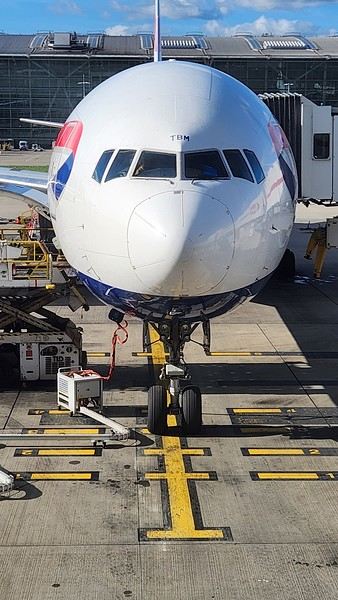

We all have two lives. And the second one kicks off the day you realize you only have one, with the determination to spend the time you have left on what truly adds sparkle to your life, Kevin! I like to elegantly introduce a trip with a philosophical quote. First, it gives you the illusion that I’m some kind of deep thinker, and second, it lets me fill up the first few lines of my blank page when I don’t know how to tell you I’m diving back into what really lights up my life: another adventure beyond the horizon! And nearly every other year, like a toxic relationship, my horizon tends to take shape in Uncle Sam’s backyard. And this, despite his cousin Donald calling the shots. Speaking of which, it was partly that impulsive guy who pushed us to be just as impulsive and snag our four flight tickets at a ridiculously low price—a direct result of foreign tourism taking a hit from BetaMax’s repeated antics... Four tickets? Who are the other lucky ones? In this case, our lucky ones are actually lucky ladies: My Flo, always up for exploring the world with me on foot, camelback, or scooter, is obviously in on the fun. The other two seats went to our daughters, Sasha and Luna, both thrilled to be part of this new American adventure...
But what’s the American West like in February?... A gamble. Let’s call it Russian roulette since we’re not landing during peak weather season. That’s why we encouraged our transportation and accommodation to get cozy and produce a little camper van, so we can stay ultra-flexible in the face of any weather tantrums. We’ll be roaming in Kara the van with the motto "Follow the sun!" Bad weather? We bolt. Snow? We speed up. Sunny? We act like it was the plan all along and soak it up.
"Okay, but why keep coming back to the same corner of the globe? After ten American adventures, you must be tired of seeing the same things, right?" But I’m not crazy, you know!... The American West is like making love to your gorgeous wife over and over, always enjoying it just as much. And contrary to what you might think, the American West isn’t just the Grand Canyon, Monument Valley, Las Vegas, and Bryce Canyon. Proof is, after ten trips to the U.S., my retinas are still untouched by three-quarters of the places I scribbled on a napkin for this adventure... Oh, and add to that my wife, who I’ve easily converted to my religion, and boom... relapse is even easier! Because yes, we’ve landed in Los Angeles after a sunny flight over Greenland, still under Danish flag for now. And we’re already heading east through the XXL traffic of L.A.’s eight-lane highways, eager to dive into our first discoveries. But first, night is taking over the sky, and second, we’ve been officially awake for 24 hours, so I suggest wrapping up this intro. I’ll tell you more tomorrow morning. Sound good?
"Glory": an Animal Farm for Zimbabwe—and the world
"400 pages of verbal pyrotechnics and animal magic" — The Times
"Bulawayo leans into exaggeration and irony to tell hard truths. *Glory* is jam-packed with comedy and farce, poking fun at an autocratic regime while illustrating the absurdity and surreal nature of a police state." — The Guardian
The cruelty and savagery of Zimbabwe’s (and Africa’s in general) "powerful animals"
Zimbabwean author NoViolet Bulawayo has written a novel that illustrates better than any documentary the complexity of colonial legacy. In doing so, she revisits George Orwell’s Animal Farm. Her novel *Glory* is a political satire about Zimbabwe—and it’s brimming with humor.
For thirty years, Zimbabwe has been stagnating under Robert Mugabe’s presidency. Human rights violations, corruption, and international sanctions have kept the population mired in poverty and oppression, while the regime exploits the meager earnings of the economy. As the 2017 elections approach, a power struggle erupts over the succession of the very elderly Father of the Nation (Mugabe). On the streets, people hope for long-awaited reforms; the people feel their moment has come.
And indeed, the army ousts Mugabe and his wife—"with her Gucci heels" (p.32)—who was positioning herself for the presidency. Hopes are dashed, however. The generals install former vice-president Emmerson Mnangagwa in power; the regime merely changes faces, but the problems remain the same.
In the novel, the country is called "Jidada, with a -da and another -da" (p.1); there’s no mistaking that this fictional state is Zimbabwe.
For *Glory*, her second novel, NoViolet Bulawayo invents a whole series of codes whose strength lies precisely in how easy they are to decipher. Like George Orwell’s Animal Farm, the characters populating Bulawayo’s universe aren’t humans but horses, goats, or crocodiles with all-too-human traits. Mugabe and Mnangagwa are horses, the spiritual leader is a pig, the soldiers are all bloodthirsty dogs, while the populace consists of goats, chickens, donkeys, and cats. The shift to the animal world serves only to better grasp the laws of despotism—and to ridicule real-life models. On one hand, the animals are humanized: they tweet, torture, travel in private jets. On the other, their greed, stupidity, and brutality stem from their animal nature.
It’s the old trick of fable: dressing men in animal disguises to make them easier to recognize. That’s how Orwell, in Animal Farm, traced how the promise of liberation from the Russian Revolution turned into Stalinist terror. In his 1945 fable, George Orwell describes how the animals of a farm drive out their farmer to organize the exploitation themselves, collectively. For a time, they truly taste freedom, but a clique of pigs ends up taking control. The central figures of the Soviet story—Stalin, Trotsky, Molotov—were easily recognizable.
Yet Bulawayo departs sharply from Orwell. She’s less concerned with precision and the force of argument than with satirical exaggeration. The deposed president is a senile old man who believes he can control even the sun’s course. The new stallion in power is a greedy debaucher. His soldiers sniff respectfully at his tail and backside.
In Bulawayo’s *Glory*, things are more complicated, but her novel also tells of a failed, incomplete liberation. In the author’s Animal Farm, Jidada, the colonial exploiters are followed by new forms of oppression. Because the former liberators become tyrants themselves. And because global power dynamics persist in neocolonial structures.
Wouldn’t that be enough to fuel a deeply depressing narrative? No—Bulawayo turns it into a blazing satire, full of wit and uncompromising criticism of power, a thread running through contemporary (not just) Zimbabwean history. The old warhorses in NoViolet Bulawayo’s Jidada, who continue to act as pack leaders, are easily recognizable as caricatures of the longtime dictator Robert Mugabe and his successor, current president Emmerson Mnangagwa.
The plot kicks off in high gear with independence day festivities. From the crack of dawn, everyone waits on Jidada Square for the Old Horse, the Father of the Nation and former liberator, whose reign "was nearing all of—not one, not two, not three, but four solid decades" (p.1). Everywhere, the colors of the Jidada Party shine; everywhere, true supporters cheer. Even the scorching sun plays its part: "At this point the sun, upon seeing arrive the leader who was decreed by God himself to rule and rule and keep ruling, a leader who'd in turn decreed the very sun to head his cheerleading squad, took a deep, deep breath and thoroughly blazed to impress" (p.2).
Finally, the Old Horse’s luxury carriage approaches "with the slowness of a hearse" (p.2), and "hoping to catch a glimpse of the legendary Father of the Nation," which causes "the animals fell over themselves like intoxicated frogs" (p.2). The sovereign’s speech is delayed a moment longer: "what I really want is a nap," groans the Old Horse as he takes his seat with such care "like his backside was made of expensive porcelain" (p.6).
Meanwhile, Bulawayo parades his entourage: the president’s wife (who earns her doctorate at Jidada University faster than "you could say diss, for dissertation. Tholukuthi it was as easy as ordering from a KFC drive-through, or perhaps even easier being that it was cheaper than KFC; it in fact cost her nothing and the degree actually came with a zero-calorie Diet Coke and a purple straw" (p.41), and she’s now known as Dr Sweet Mother. The cabinet includes "the Minister of the Revolution, the Minister of Corruption, the Minister of Order, the Minister of Things, the Minister of Nothing, the Minister of Propaganda, the Minister of Homophobic Affairs, the Minister of Disinformation and the Minister of Looting" (p.9). And of course the vice-president, who will soon become interim president when the Old Horse finally kicks the bucket—and then settle in as the new long-term president, who in the novel is called Tuvius Delight Shasha, or "Tuvy" for short (p.253), none other than Emmerson Mnangagwa. It’s him Bulawayo reserves her most merciless character description for.
"New Dispensation" (p.109) is Tuvy’s slogan for Jidada, and he loves repeating it so much he even named his parrot after it ("So inspired was Tuvy by the realisation that he rechristened his new pet parrot with the name New Dispensation—tholukuthi the bird having been acquired explicitly for the purposes of tweeting eulogies and accordingly glorifying the Saviour throughout the airs and skies of the nation. Tuvy then went on to hire a lecturer in English from the University of Jidada to teach New Dispensation to say the phrase 'New Dispensation'" p.110). But Tuvy’s Zimbabwe remains a nation without free, fair, and credible elections ("#freefairncredibleelection" p.161), and the promised equal treatment applies only insofar as Zimbabweans now queue up without discrimination in endless lines—and everyone is as poor as the next in the "queuenation" (p.283). Except for the powerful. They can "yes, tholukuthi, her immeasurable riches theirs to take. And take they did—
just take—take—take—take—take—take—take—take—take—take—take—take—take—take—take—take—take—take—take—take—take—take—take—take—take—take—take" (p.249-250).
In short: Bulawayo brilliantly depicts how former independence fighters become exploiters themselves. And how the country threatens to suffocate under the weight of corruption and repression. But she also literally stages the polyphony with which the people oppose imposed obedience to the official line.
Controversial online discussions keep interrupting the narrative—dialogues and social threads (see photo below) that Bulawayo masterfully integrates. From a literary standpoint, it’s a brilliant idea. And it shows, above all, that the author’s sympathy—so likeable—goes to all those who refuse to let their dream of true freedom be stolen, not even by the corrupt elites of their own country.
In the book’s acknowledgments, the first tribute goes to "The Jidadas of the world, clamouring for freedom on many fronts—A luta continua." (p.401) This reflects the realization that, not only in Jidada-Zimbabwe but in many other corners of the world, the end of colonial domination is still far from meaning the freedom hoped for by the vast majority of people. But it also means, more broadly, that this freedom must be won "on many fronts" (see above), both domestically and geopolitically.
That’s precisely what *Glory* so vividly highlights: how complex the project behind the term "postcolonialism" really is. With *Glory*, Bulawayo also delivers a scathing critique of the persistence of colonial mindsets in the West.
In the novel, the murder of George Floyd, racist police violence, and white-supremacist ideology in Trump’s United States perfectly illustrate the persistence of racism. It’s especially in the final chapters that Bulawayo lets Jidada’s inhabitants explicitly and unflinchingly criticize a neocolonial world order:
"It was not lost on us how the West, which loved to 'save' Africa and announce every action to the whole world, did so with one limb while manipulating, looting and fleecing us with the rest of its limbs so that more money in fact poured out of the continent than trickled in." (p.376)
"It was no mistake that multinational corporations yearly reaped and shipped colossal profits from Africa back to their countries as had been the case during colonial times. Even the sticks and stones would tell you that the African earth at any given time howled and shook and heaved from the extraction of its precious minerals that rarely benefited its own miserable children." (p.376)
"(...) we vowed to wage yet another war for Africa's second Liberation from neocolonial oppression. From exploitation. From plunder. From Western dominion. From indignity. From Abuse. We wanted real freedom. We wanted greedy, thieving paws off our wealth. We wanted Justice. We wanted a new world; we wanted a brand-new world so much we didn't sleep a wink that night." (p.377)
The Jidadas of this world must fight two enemies: Western neocolonialism and the autocratic instrumentalization of that argument; the persistence of Western racism and the populist appropriation of that humiliation by tyrants from their own ranks. Neither of these obstacles to freedom diminishes the historical and current guilt of the other. But the path to postcolonial liberation must overcome all these forms of oppression. After all, the colonizers didn’t bequeath democracies to formerly dominated nations, but instability and the principles of oppression and exploitation—which the so-called liberators have also internalized. Yet the fact that a satirical novel can capture the complexity of historical relationships while remaining, despite all the darkness of the subject, hilarious—well, that’s truly astonishing.
Finally, *Glory* ties into a major trauma in Zimbabwe’s post-independence history: the so-called Gukurahundi massacres. Between 1983 and 1987, tens of thousands of civilians were murdered by Mugabe’s bloody henchmen, most of them Ndebele. The State Security Minister and head of secret services at the time? You guessed it—Emmerson Mnangagwa.
When *Glory* turns to the massacres, the novel’s tone shifts completely. The story is now told through the narrative of the goat called Destiny, who, like NoViolet Bulawayo herself, left her home country at 18 for the United States and only returned after 13 years. In the book, the city of Bulawayo becomes a village where Destiny retraces her family’s history—and learns that part of it was also brutally murdered during the massacres.
The abuse of power and life under a dictatorship, dispossession, and a fiercely proud awareness of the psychological wounds and emotional vulnerability of a uprooted and disenfranchised people who had to forge a new language—a new set of names—to express their lived experiences are at the heart of this wonderful Zimbabwean author’s literary work, NoViolet Bulawayo. Shortly after her studies, she was already writing short stories about postcolonial power dynamics in Africa. But her playful, masterful, and often unconventional approach to language also plays a key role in her work. With virtuosity, she shifts from cynical images of power-obsessed elites to compassionate descriptions of the people’s suffering, ending with a hopeful sermon on courage—the courage to break free from fear and thus gain the strength for change ("And every one of them understood that whatever they heard within those hearts was the new national anthem, tholukuthi an anthem that spoke of the kind of glory that burns eternal and glows with living light." p.400). This novel is a genuine pleasure to read. And it’s exceptional. Good, African...
Book info (original English and German translation):
NoViolet Bulawayo. Glory. Chatto & Windus, 2022. NoViolet Bulawayo. Glory. Suhrkamp, 2023.
Hery
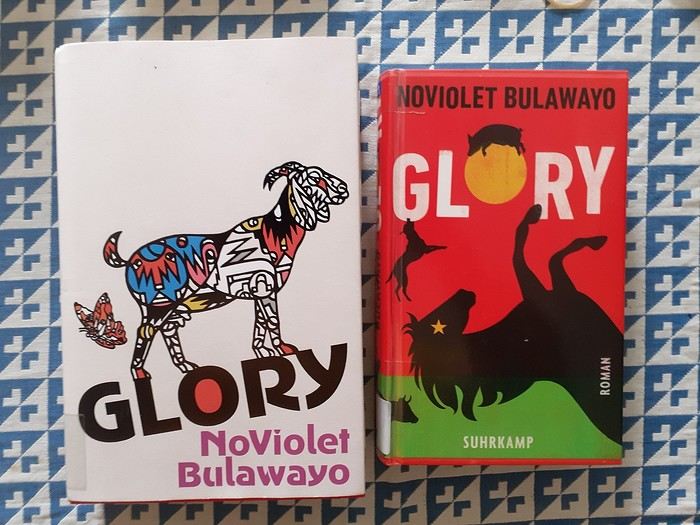 The books (in English, in German)
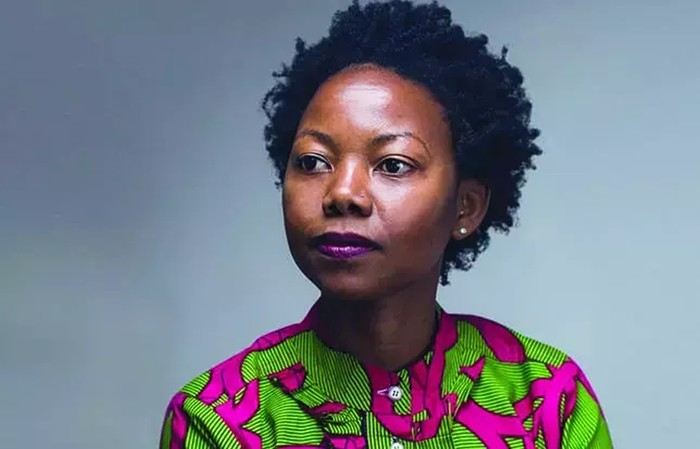 Author NoViolet Bulawayo, Zimbabwe
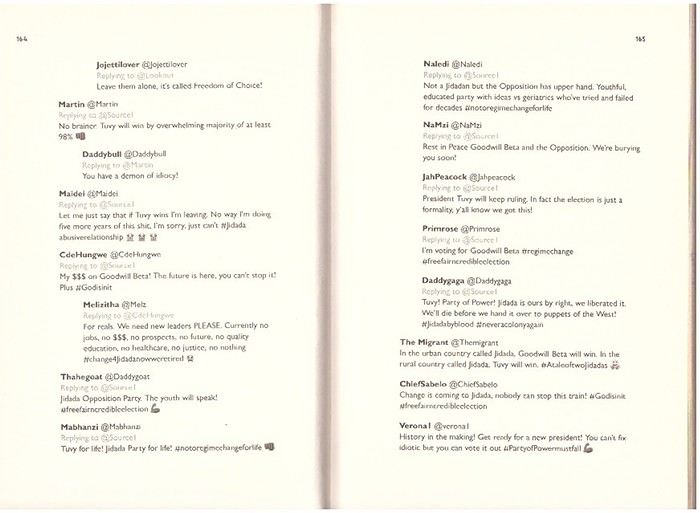 Threads (p.164-165)
"Bulawayo leans into exaggeration and irony to tell hard truths. *Glory* is jam-packed with comedy and farce, poking fun at an autocratic regime while illustrating the absurdity and surreal nature of a police state." — The Guardian
The cruelty and savagery of Zimbabwe’s (and Africa’s in general) "powerful animals"
Zimbabwean author NoViolet Bulawayo has written a novel that illustrates better than any documentary the complexity of colonial legacy. In doing so, she revisits George Orwell’s Animal Farm. Her novel *Glory* is a political satire about Zimbabwe—and it’s brimming with humor.
For thirty years, Zimbabwe has been stagnating under Robert Mugabe’s presidency. Human rights violations, corruption, and international sanctions have kept the population mired in poverty and oppression, while the regime exploits the meager earnings of the economy. As the 2017 elections approach, a power struggle erupts over the succession of the very elderly Father of the Nation (Mugabe). On the streets, people hope for long-awaited reforms; the people feel their moment has come.
And indeed, the army ousts Mugabe and his wife—"with her Gucci heels" (p.32)—who was positioning herself for the presidency. Hopes are dashed, however. The generals install former vice-president Emmerson Mnangagwa in power; the regime merely changes faces, but the problems remain the same.
In the novel, the country is called "Jidada, with a -da and another -da" (p.1); there’s no mistaking that this fictional state is Zimbabwe.
For *Glory*, her second novel, NoViolet Bulawayo invents a whole series of codes whose strength lies precisely in how easy they are to decipher. Like George Orwell’s Animal Farm, the characters populating Bulawayo’s universe aren’t humans but horses, goats, or crocodiles with all-too-human traits. Mugabe and Mnangagwa are horses, the spiritual leader is a pig, the soldiers are all bloodthirsty dogs, while the populace consists of goats, chickens, donkeys, and cats. The shift to the animal world serves only to better grasp the laws of despotism—and to ridicule real-life models. On one hand, the animals are humanized: they tweet, torture, travel in private jets. On the other, their greed, stupidity, and brutality stem from their animal nature.
It’s the old trick of fable: dressing men in animal disguises to make them easier to recognize. That’s how Orwell, in Animal Farm, traced how the promise of liberation from the Russian Revolution turned into Stalinist terror. In his 1945 fable, George Orwell describes how the animals of a farm drive out their farmer to organize the exploitation themselves, collectively. For a time, they truly taste freedom, but a clique of pigs ends up taking control. The central figures of the Soviet story—Stalin, Trotsky, Molotov—were easily recognizable.
Yet Bulawayo departs sharply from Orwell. She’s less concerned with precision and the force of argument than with satirical exaggeration. The deposed president is a senile old man who believes he can control even the sun’s course. The new stallion in power is a greedy debaucher. His soldiers sniff respectfully at his tail and backside.
In Bulawayo’s *Glory*, things are more complicated, but her novel also tells of a failed, incomplete liberation. In the author’s Animal Farm, Jidada, the colonial exploiters are followed by new forms of oppression. Because the former liberators become tyrants themselves. And because global power dynamics persist in neocolonial structures.
Wouldn’t that be enough to fuel a deeply depressing narrative? No—Bulawayo turns it into a blazing satire, full of wit and uncompromising criticism of power, a thread running through contemporary (not just) Zimbabwean history. The old warhorses in NoViolet Bulawayo’s Jidada, who continue to act as pack leaders, are easily recognizable as caricatures of the longtime dictator Robert Mugabe and his successor, current president Emmerson Mnangagwa.
The plot kicks off in high gear with independence day festivities. From the crack of dawn, everyone waits on Jidada Square for the Old Horse, the Father of the Nation and former liberator, whose reign "was nearing all of—not one, not two, not three, but four solid decades" (p.1). Everywhere, the colors of the Jidada Party shine; everywhere, true supporters cheer. Even the scorching sun plays its part: "At this point the sun, upon seeing arrive the leader who was decreed by God himself to rule and rule and keep ruling, a leader who'd in turn decreed the very sun to head his cheerleading squad, took a deep, deep breath and thoroughly blazed to impress" (p.2).
Finally, the Old Horse’s luxury carriage approaches "with the slowness of a hearse" (p.2), and "hoping to catch a glimpse of the legendary Father of the Nation," which causes "the animals fell over themselves like intoxicated frogs" (p.2). The sovereign’s speech is delayed a moment longer: "what I really want is a nap," groans the Old Horse as he takes his seat with such care "like his backside was made of expensive porcelain" (p.6).
Meanwhile, Bulawayo parades his entourage: the president’s wife (who earns her doctorate at Jidada University faster than "you could say diss, for dissertation. Tholukuthi it was as easy as ordering from a KFC drive-through, or perhaps even easier being that it was cheaper than KFC; it in fact cost her nothing and the degree actually came with a zero-calorie Diet Coke and a purple straw" (p.41), and she’s now known as Dr Sweet Mother. The cabinet includes "the Minister of the Revolution, the Minister of Corruption, the Minister of Order, the Minister of Things, the Minister of Nothing, the Minister of Propaganda, the Minister of Homophobic Affairs, the Minister of Disinformation and the Minister of Looting" (p.9). And of course the vice-president, who will soon become interim president when the Old Horse finally kicks the bucket—and then settle in as the new long-term president, who in the novel is called Tuvius Delight Shasha, or "Tuvy" for short (p.253), none other than Emmerson Mnangagwa. It’s him Bulawayo reserves her most merciless character description for.
"New Dispensation" (p.109) is Tuvy’s slogan for Jidada, and he loves repeating it so much he even named his parrot after it ("So inspired was Tuvy by the realisation that he rechristened his new pet parrot with the name New Dispensation—tholukuthi the bird having been acquired explicitly for the purposes of tweeting eulogies and accordingly glorifying the Saviour throughout the airs and skies of the nation. Tuvy then went on to hire a lecturer in English from the University of Jidada to teach New Dispensation to say the phrase 'New Dispensation'" p.110). But Tuvy’s Zimbabwe remains a nation without free, fair, and credible elections ("#freefairncredibleelection" p.161), and the promised equal treatment applies only insofar as Zimbabweans now queue up without discrimination in endless lines—and everyone is as poor as the next in the "queuenation" (p.283). Except for the powerful. They can "yes, tholukuthi, her immeasurable riches theirs to take. And take they did—
just take—take—take—take—take—take—take—take—take—take—take—take—take—take—take—take—take—take—take—take—take—take—take—take—take—take—take" (p.249-250).
In short: Bulawayo brilliantly depicts how former independence fighters become exploiters themselves. And how the country threatens to suffocate under the weight of corruption and repression. But she also literally stages the polyphony with which the people oppose imposed obedience to the official line.
Controversial online discussions keep interrupting the narrative—dialogues and social threads (see photo below) that Bulawayo masterfully integrates. From a literary standpoint, it’s a brilliant idea. And it shows, above all, that the author’s sympathy—so likeable—goes to all those who refuse to let their dream of true freedom be stolen, not even by the corrupt elites of their own country.
In the book’s acknowledgments, the first tribute goes to "The Jidadas of the world, clamouring for freedom on many fronts—A luta continua." (p.401) This reflects the realization that, not only in Jidada-Zimbabwe but in many other corners of the world, the end of colonial domination is still far from meaning the freedom hoped for by the vast majority of people. But it also means, more broadly, that this freedom must be won "on many fronts" (see above), both domestically and geopolitically.
That’s precisely what *Glory* so vividly highlights: how complex the project behind the term "postcolonialism" really is. With *Glory*, Bulawayo also delivers a scathing critique of the persistence of colonial mindsets in the West.
In the novel, the murder of George Floyd, racist police violence, and white-supremacist ideology in Trump’s United States perfectly illustrate the persistence of racism. It’s especially in the final chapters that Bulawayo lets Jidada’s inhabitants explicitly and unflinchingly criticize a neocolonial world order:
"It was not lost on us how the West, which loved to 'save' Africa and announce every action to the whole world, did so with one limb while manipulating, looting and fleecing us with the rest of its limbs so that more money in fact poured out of the continent than trickled in." (p.376)
"It was no mistake that multinational corporations yearly reaped and shipped colossal profits from Africa back to their countries as had been the case during colonial times. Even the sticks and stones would tell you that the African earth at any given time howled and shook and heaved from the extraction of its precious minerals that rarely benefited its own miserable children." (p.376)
"(...) we vowed to wage yet another war for Africa's second Liberation from neocolonial oppression. From exploitation. From plunder. From Western dominion. From indignity. From Abuse. We wanted real freedom. We wanted greedy, thieving paws off our wealth. We wanted Justice. We wanted a new world; we wanted a brand-new world so much we didn't sleep a wink that night." (p.377)
The Jidadas of this world must fight two enemies: Western neocolonialism and the autocratic instrumentalization of that argument; the persistence of Western racism and the populist appropriation of that humiliation by tyrants from their own ranks. Neither of these obstacles to freedom diminishes the historical and current guilt of the other. But the path to postcolonial liberation must overcome all these forms of oppression. After all, the colonizers didn’t bequeath democracies to formerly dominated nations, but instability and the principles of oppression and exploitation—which the so-called liberators have also internalized. Yet the fact that a satirical novel can capture the complexity of historical relationships while remaining, despite all the darkness of the subject, hilarious—well, that’s truly astonishing.
Finally, *Glory* ties into a major trauma in Zimbabwe’s post-independence history: the so-called Gukurahundi massacres. Between 1983 and 1987, tens of thousands of civilians were murdered by Mugabe’s bloody henchmen, most of them Ndebele. The State Security Minister and head of secret services at the time? You guessed it—Emmerson Mnangagwa.
When *Glory* turns to the massacres, the novel’s tone shifts completely. The story is now told through the narrative of the goat called Destiny, who, like NoViolet Bulawayo herself, left her home country at 18 for the United States and only returned after 13 years. In the book, the city of Bulawayo becomes a village where Destiny retraces her family’s history—and learns that part of it was also brutally murdered during the massacres.
The abuse of power and life under a dictatorship, dispossession, and a fiercely proud awareness of the psychological wounds and emotional vulnerability of a uprooted and disenfranchised people who had to forge a new language—a new set of names—to express their lived experiences are at the heart of this wonderful Zimbabwean author’s literary work, NoViolet Bulawayo. Shortly after her studies, she was already writing short stories about postcolonial power dynamics in Africa. But her playful, masterful, and often unconventional approach to language also plays a key role in her work. With virtuosity, she shifts from cynical images of power-obsessed elites to compassionate descriptions of the people’s suffering, ending with a hopeful sermon on courage—the courage to break free from fear and thus gain the strength for change ("And every one of them understood that whatever they heard within those hearts was the new national anthem, tholukuthi an anthem that spoke of the kind of glory that burns eternal and glows with living light." p.400). This novel is a genuine pleasure to read. And it’s exceptional. Good, African...
Book info (original English and German translation):
NoViolet Bulawayo. Glory. Chatto & Windus, 2022. NoViolet Bulawayo. Glory. Suhrkamp, 2023.
Hery
The books (in English, in German)
Author NoViolet Bulawayo, Zimbabwe
Threads (p.164-165)