Central Asia · Kirghizistan
FR

Many threads here are in French, the community’s main language. English translations are added over time.

AT
Attila 4 hours ago · Chalembert
Amazing Kyrgyzstan!
This trip had been on my mind for about fifteen years.

But the discomfort of overnight stays, the difficulty of communication, and the prices of the few car rentals kept making me postpone the project.

And then, everything fell into place—I told myself, now’s the time!

Preparations took longer than usual; the destination is still far from mainstream.

A bit of Kazakhstan? Not in the end.

The south or not? Yes, in the end.

Pre-book or play it by ear? Only two stops were a leap into the unknown.

To help me find the ideal route, I made great use of this forum (thanks to everyone for patiently answering my questions!), pored over travel journals and blogs (Christian, Jeff), zoomed in on Google Maps and Yandex, and bought the guide published by OunTravela on this destination (the guide has been updated since).

---/---

You’ve got your passport, international driver’s license, bank cards, and euros?

Off we go to Lyon—just one night left before our early morning flight.

Tomorrow night, we’ll be sleeping in Bishkek! (‘Beefsteak’ for my partner’s mischievous nephews...)


You’ll find here a post with some practical info.
Open
AT
Attila 2 days ago
Kyrgyzstan: Practical Information 2026
Recent information about this country is scarce, so I’m starting this post in addition to my travel journal to help fill the gap.

- Which airline from Europe?

Turkish Airlines seems like an excellent option. The price is very reasonable (just over 500 €), the layover isn’t too long, the in-flight comfort is decent (great movie selection), and the planes are modern. Plus, the price automatically includes 30 kilos of luggage, which is perfect for campers.

The downside: the outrageous prices at Istanbul Airport.

- Bishkek Airport

The airport is under full reconstruction. It’s chaotic. There are SIM card vendors upon arrival, but no currency exchange or ATMs in the baggage claim area. You’ll find those in the departures section, which means you have to exit and re-enter under the current setup.

Personally, I pre-booked a VTC with my hotel for the transfer to the city. (Prices vary depending on the hotel’s standard—1200 soms for mine.)

There are taxis and a bus available.

- Entry Requirements

No visa is required for French citizens for stays of up to 30 days.

- Currency

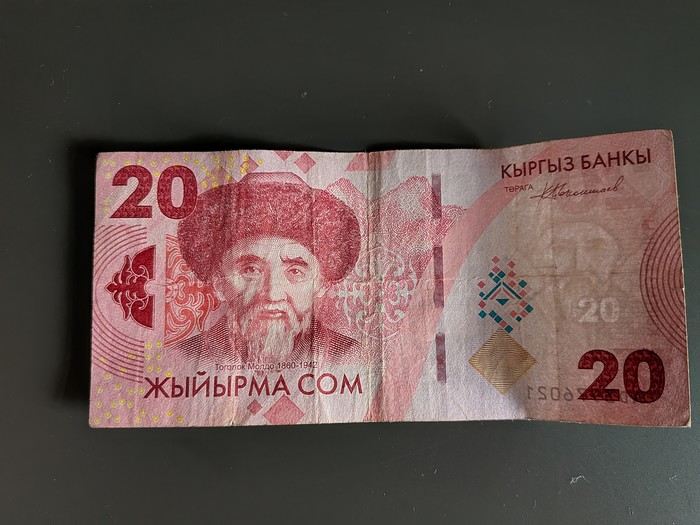
The currency is the som, and the conversion is easy—just divide by 100...

You can get soms by exchanging euros (dollars are useless) or by withdrawing from an ATM. Some ATMs charge fees. Those from Mbank and Optimabank are fee-free.

The maximum withdrawal is usually 20,000 soms.

Bills come in 5000, 1000, 500, 200, 100, 50, and 20 soms.

Coins: 10, 5, 3, and 1 som.

- Paying

Card payments are accepted in supermarkets like Globus, some restaurants, gas stations of major chains (Bishkek Petroleum, Partner Neft, Red Petroleum), some hotels, national park entrances, tolls, etc.

But it doesn’t always work.

So always carry cash with you!

If the card works, great—otherwise, it’s back to the old days of wads of bills.

- Cost of Living

It’s really cheap (gas, affordable restaurants even at a decent standard, hotels, souvenirs, fruits, vegetables, water, bread...). For example, a lagman costs only 3.20 €, fixing a flat tire is 3.5 €, a full hour-long wash for a filthy 4x4 is 6 €, washing a big bag of laundry is 3 €, and a liter of 95-octane gas is 0.86 €...

On the pricier side: guesthouses and meals in guesthouses. The value for money is poor. I paid 40 € for a mediocre room with a very basic shared bathroom, while a double with AC, private bathroom, and fridge in a non-touristy hotel cost 20 €... Meals in guesthouses are the worst I’ve eaten and often the most expensive. Plus, they’re very light—don’t expect to fill up after a long day of hiking!

Car rentals are also quite expensive (70 $ per day for a RAV4 in my case).

In short, for two people, excluding accommodation and car rental, we spent an average of 45 € per day (groceries, restaurants, guesthouse dinners, souvenirs, paid activities, gas).

The trip cost us 2200 € per person all-inclusive for 3 weeks on the ground. Roughly 1/4 for the flight, 1/4 for the car, 1/4 for accommodation, and 1/4 for everything else.

- Getting Around

I’ve met cyclists, motorcyclists, people renting cars, those who drove their own vehicles from Europe, and others using public transport and taxis.

Personally, I chose to rent a car.

If you’re not planning long hikes or multi-day horse treks, it’s a great option for exploring the country.

Each car rental company has its own list of forbidden tracks. Make sure your planned route is allowed! Don’t think about ignoring this—vehicles are equipped with GPS trackers...

An international driver’s permit is required.

Police and speed cameras are everywhere, so it’s best to respect the signs (daytime running lights, seatbelts, 40-60 km/h in populated areas, 90 km/h on roads, zero tolerance for alcohol).

Locals have a unique driving style, and it can be dangerous on main roads (they overtake recklessly...). Like in Greece, South Africa, or Malta, a two-lane road is treated as a three-lane one. You pull over to let others pass or to let oncoming traffic overtake.

Without a car (at least a pseudo-4x4), you won’t be able to go everywhere. This country is a nature destination, but nature isn’t always accessible by public transport.

If a spot is near a road, great—the bus will get you almost to the door. Otherwise, you’ll need to hire an agency or take a taxi.

Cyclists will face steep climbs and dust. I’d advise avoiding main roads as much as possible—traffic isn’t on your side...

Motorcyclists will also eat a lot of dust and should research gas stations along their route (this advice also applies to vehicles running on 95-octane).

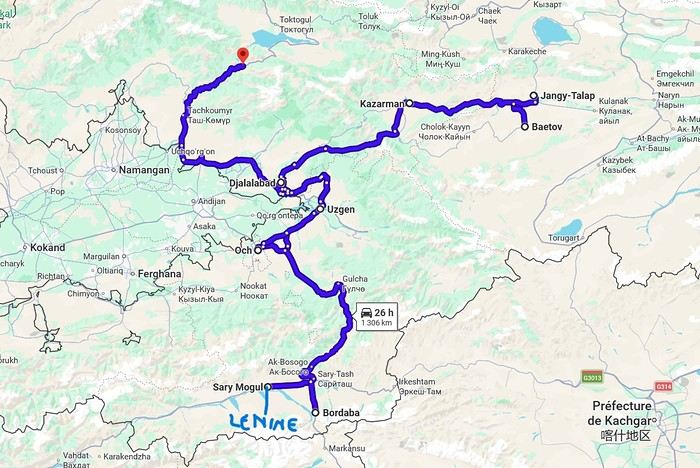
There’s a 95-octane pump in Kazarman and Gulcha.

Bikes and motorcycles have an advantage over cars, even 4x4s, as they can access some very remote tracks that other vehicles can’t (hikers and horses can obviously take them too!).

Be careful: some areas require a permit (border zones). Research this well in advance—the formalities don’t take an hour or even a day!

Be warned: Google Maps is completely unreliable (it shows roads that don’t exist, routes you through difficult tracks instead of paved roads, etc.). It’s essential to download Maps.me in advance. This app is much more reliable for this country, works offline, and is handy for hiking navigation.

A reminder: horseback riding is like cycling... If you’re not used to it or naturally padded in the right places, your backside will suffer in no time!

Think carefully before embarking on a multi-day trek!

Finally, this country is a kingdom of construction... The Chinese have taken over the market to improve truck circulation and are paving everywhere. (Good news: the Kazarman-Osh section via the tunnel is finally open in summer, even if the road isn’t quite finished.)

- Eating

I had prejudices about Kyrgyz food.

I was both wrong and right.

Supermarkets don’t offer much that’s appealing for picnics. It’s cheap, filling food, full of junk, and not gourmet. If you follow Yuka, I think you’ll be on a diet the whole trip. Bringing some pâté, sausages, or freeze-dried meals for certain nights is a good idea...

Guesthouse dinners consist of the eternal cucumber-tomato salad, a soup, and a light noodle or rice dish where you’ll be searching for the meat... Usually tough and unidentifiable. Beef? The bread is stale, and there’s no dessert or fruit.

Breakfasts always revolve around eggs or porridge... The homemade jam is usually good.

Tea is the number one drink, followed by kompot (a fruit-based drink), Coke, and Fanta.

If you want real coffee, bring your own—it’s very rare.

On the other hand, you eat well in restaurants. Lagman (homemade noodles, vegetables, spices, and usually beef), crispy eggplant, kuurdak (a kind of lamb stew with potatoes), kebabs, plov (pilaf rice with onions, carrots, and meat), and rainbow trout... For dessert? Nada!

And alcohol?

It’s available in all Globus stores: beer, wine, spirits, and you can consume your purchases in some guesthouses (depending on the owner’s religious tolerance). It’s also available in some restaurants (Bishkek, Karakol, Osh...).

The deadly specialty?

White fermented milk balls called kurut. If you think a raw-milk camembert is strong, steer clear! This is more like an old, dry, spicy goat cheese.

- Accommodation

In remote areas, it’s better to check availability on Booking a few days in advance rather than showing up last minute with high hopes.

Booking and Airbnb only offer a small portion of what’s available.

Not necessarily guesthouses, but mostly accommodations aimed at locals (business or leisure travel).

These places are generally more comfortable. There’s even some upscale options.

So it’s necessary to scour Google Maps or Yandex Maps... These accommodations are usually found on Instagram, and WhatsApp is handy for booking!

Prices are a bit of a lottery. So is the comfort. From 20 to 80 € for a double, usually with a private bathroom. (Average around 40 €). These rates are for mid-range options.

Otherwise, this country is a paradise for wild camping. In a camper van, rooftop tent, or ground tent... There are beautiful spots everywhere!

- Climate

I thought it would be quite cool/cold at altitude.

I packed too many warm clothes...

If you’re not doing high-altitude treks or sleeping in a tent, there’s no need to overload yourself with winter gear.

A good fleece, a windproof rain jacket, and technical base layers will be enough.

It only got really cold in the evenings at Song Kul Lake and Tash Rabat, and the yurts are equipped with thick blankets and a stove.

Elsewhere, temperatures ranged from 15 to 30 °C.

In short, I used the AC more than the heater! (It’s hard to drive with the windows open unless you want to be covered in dust in no time...)

- Communication

I bought an eSIM before the trip with a data plan for Kyrgyzstan (Beeline network). Perfect for communicating via WhatsApp right after landing, but this network isn’t the best in Kyrgyzstan.

We then got a physical SIM card with an unlimited one-month plan (less than 4 € including the SIM) at a Mega store downtown. This network is much better, and you get coverage in all cities and most villages. Usually in the mountain passes too.

To make yourself understood, it’s essential to download Google Translate with French, Kyrgyz, Russian, and English options.

Very useful for translating menus, signs, and communicating with locals.

Hosts and other tourism professionals will even pull out their phones to communicate with non-Russian speakers.

The police too...

- Religion

There’s a noticeable difference between the north and the southwest of the country.

In the north, it’s a bit like Albania. People are Muslim by culture but not really by religion.

In the southwest, radical Islam is growing. Mosques are more numerous and imposing. Men are more bearded, women more veiled.

For travelers, religion isn’t an issue except for the near-total absence of pork.

There’s Russian sausage, but reading the ingredient list, it’s more like a one-way ticket to cancer than an Auvergne dry sausage...


You can find the detailed account of the trip here.
Open
AT
Attila 5 days ago
3 weeks in Kazakhstan and Kyrgyzstan, preliminary travel questions
Hi there, 🙂

I’m thinking of taking a trip to these two countries in 2026 (late spring to early summer).

I’d arrive in Almaty and leave from Bishkek, and I’d be driving myself.

I plan to spend 1 week in Kazakhstan and 2 in Kyrgyzstan. The itinerary isn’t set yet.

My preliminary questions are about formalities, hassle levels, and the car.

From what I understand, no visa is needed, the passport must be valid for 6 months after entry, and there’s no longer a requirement to register with the authorities at each stop. In short, once you’re in, no administrative headaches.

Except for permits needed to drive in certain regions?

---/---

About crossing between the two countries:

- On foot - In a rental car

Quick? Easy?

---/---

Are both countries safe? (Meaning you don’t have to stay on guard all the time.) Are the cops corrupt? (A little, a lot, passionately, not at all?)

---/---

Is it better to rent a car for both countries or rent a vehicle in each country?

A 4x4 or something else?

Is accommodation plentiful enough that I can skip a rooftop tent, or is it better to rent a 4x4 with one?

I’ll definitely have more questions later...😉

Thanks for your answers !
Open
IC
Ichijooo 3 weeks ago · Marifb
Summer 2027 - Uzbekistan/Kyrgyzstan Family Trip (19 Nights)
Hello,

Summer 2026 hasn’t even arrived yet, and I’m already thinking about summer 2027! We’re a family with two kids, who will be 9.5 and 4.5 years old next summer (turning 5 at the end of October 2027, actually). We’d love to spend 19 nights in Uzbekistan and Kyrgyzstan—a part of the world that’s completely new to us. We enjoy traveling, do it often, and the kids are used to it (though we still need a bit of organization and comfort!). Here’s the rough outline of our itinerary: Day 1 - Arrival in Tashkent (ideally in the late afternoon). Head to the train station (by taxi?) to take the overnight sleeper train to Urgench (1 night). Day 2 - Khiva (2 nights): Taxi transfer from the station to the city. Visit Itchan Kala, the walls, and sunset. Day 4 - Head to Bukhara (3 nights) by train (about 6 hours). Visit the historic center, domes, and workshops. Day 7 - On to Samarkand (2 nights), but this time with a private driver. Visit Registan, the necropolis, and local crafts. Day 9 - Head to Osh (1 night) in Kyrgyzstan with the private driver, who’ll drop us at the border. Long transition day (including border crossing). If it’s not too late, visit Osh’s market (otherwise, the next morning). Day 10 - Pick up our rental car (4x4 without a driver this time) and drive to Toktogul (2 nights) and the Suusamyr Valley. Day 12 - Head to the Kochkor region (350 km - 4 nights): Tash Rabat, Song-Kul Lake (yurt stay), and Aigliers. Day 16 - Depart for Karakol/Issyk-Kul (250 km - 4 nights): Jeti-Oguz, Altyn Arashan, beaches, and hot springs. Day 20: Fly home. TOTAL = 19 nights What do you think? Budget-wise:

Flight tickets: 3000 € Uzbekistan logistics (accommodation ideally with a pool for the kids and vehicle): 1600 € Kyrgyzstan logistics (accommodation and 4x4 vehicle like a Pajero/Land Cruiser): 1600 € Living & food: 800 € TOTAL: 7000 €

Does this seem reasonable? Not overestimated or underestimated? Thanks for any feedback or tips from your own experiences.
Open
AT
Attila 3 weeks ago
Megacom SIM card, how does it work?
Hi there,

I’ve never bought a SIM card abroad or even used prepaid cards in France...

So I’m wondering how it all works?

You buy a SIM card and pop it into your phone. Okay, so far so good... 😏

But after that?

I can’t find the price of prepaid cards or how they work with MegaCom.

If someone could give me a step-by-step guide... 😊

Thanks! 🙂
Open
AT
Attila last month
What foods can I bring to Kyrgyzstan?
Hi there! 🙂

I’m not planning to bring all my meals for the 3 weeks of travel, but I’d like to spice up my picnic lunches and a few dinners in this country that’s not exactly known for its cuisine...

I’ve seen that fruits and vegetables are easy to find. Bread is also no problem.

I’m a bit unsure about the local cheese, but I’ll manage.

Actually, it’s what I’d put in my sandwiches that I’d like to pack: cured sausage, pâtés.

Are these foods allowed through customs?

Also, I’m thinking that bringing 3-4 freeze-dried meals could be a good option. I’ve never bought any before. Which brands are the most flavorful?

I’ve also noticed that real coffee is rare. (Meaning Kyrgyz people drink Nescafé. Sacrilege!) Can I easily find coffee there to make my own?

Finally, which supermarket chain is the best? (Meaning the one with the most variety and, above all, quality!)

Last question: where can I buy a gas stove in Bishkek? (I’ve heard that local gas canisters aren’t compatible with the stove I already own)

Thanks!
Open
AT
Attila last month
What short hikes can I do around Karakol?
Hi there,

I’m looking for half-day hikes near Karakol (not Jety-Oguz, since I’ll be heading there separately—max 30 minutes’ drive to the trailhead).

I can find longer treks, but nothing for a short outing!

So, if you’ve got any ideas...

Thanks! :)
Open
PA
Patricevinc 3 months ago
Crossing the border between Kazakhstan and Kyrgyzstan
Hi there,

I’m planning to visit Kazakhstan and Kyrgyzstan in early June, assuming the war doesn’t spread ??? Could anyone give me some info about the eastern border after visiting Charyn Canyon? First, is it possible to head east using public transport, or should I book a tour from Almaty and stay in the east to continue on to Kyrgyzstan toward Karakol? (I mean, not return to Almaty with the tour.) It’s a bit of a vague question, but those who’ve been there will know what I’m talking about;

Thanks!

Patrice
Open
AT
Attila 3 months ago
Condition of the Djalalabad-Kazarman track
Hello,

New year, new questions...😛

Since the Chinese highway isn’t finished yet (opening postponed year after year), I’m wondering what condition this track is in come June?

I’m a bit worried that the snowmelt might completely soak the track—or even that the snow might still be clinging to the mountainside near the pass...

Thanks 🙂
Open
HA
Halodujura 3 months ago
Tajikistan/Kyrgyzstan border via the Kyzyl-Art Pass
Hi there, My departure is slowly approaching, and now that I’ve got my Russian visa sorted, I’m fine-tuning the rest of my trip to Tajikistan. Since the Tajik visa is no longer required for stays under 30 days (for French nationals), I’ll need to visit the Ministry of Interior (OVIR) to register within 10 days of entering the country. No big deal, though, since I had to go there anyway to apply for my GBAO permit. 😉 However, I’ve *seen* several reports from travelers (mostly motorized) mentioning that you need an entry permit for Kyrgyzstan, which has to be arranged in advance at the Kyrgyz Ministry (consulate?) in Dushanbe. Otherwise, you’re *stuck* at the Kyzyl-Art border (with no Wi-Fi, of course, to try and sort it out). The most recent report was from a year ago, so I’d love to know if this is still the case and if it’s indeed at the Kyrgyz Ministry (consulate?) where you need to go for this pre-authorization. Does anyone have any recent info on this? Thanks in advance!
Open
OT
Otonomi 4 months ago
Solar vehicle Otonomi: seeking senior adventurer for journey from France to the Pamir!
It’s never too late to live intensely. I’m Guy, I’ve passed 70, and I’m looking for a female travel companion for an extraordinary adventure aboard OTONOMI—a solar-powered tandem I built with my own hands over two years. My past is that of an unrepentant traveler: crossing the Atlantic in an ultralight aircraft, swimming across channels, and a high-level sailing record in major transatlantic races... OTONOMI isn’t a retiree’s whim—it’s the final chapter of a life of adventure, perhaps the most beautiful one. Departure at the end of May. Route: Europe to Baku, crossing the Caspian by ferry, then Turkmenistan, Uzbekistan, Tajikistan, the Pamir, Kyrgyzstan, and return via Kazakhstan. At least 3-4 months. No need to be athletic—a session of *longe côte* (coastal walking) requires more physical effort than a full day on OTONOMI. You don’t even have to pedal at all. OTONOMI tows a foldable solar-powered caravan trailer—camping under the stars or staying in small local hotels, depending on your mood. Road expenses are shared simply. I’m looking for a free-spirited woman, curious, passionate about genuine encounters and wide-open spaces—appearance or insecurities don’t matter. Just that flame still burning inside you. A real-life test run is planned before departure—so we can meet naturally, without pressure. 📩 guy.otonomi@outlook.fr
Open
LU
Lumazero 9 months ago · Smopy44
Looking for feedback on bike touring in Central Asia
Hi everyone, We’re planning to spend 5 months cycling as a family in Central Asia. To align with the weather, we’re thinking of arriving in Uzbekistan in April, heading toward the Ferghana Valley in late April/early May, and wrapping up with a long stretch in Kyrgyzstan from mid-May to early August.

I haven’t really dug into the third part (Kyrgyzstan) yet, but from what I’ve seen on the forum and online, cycling across Uzbekistan doesn’t seem all that appealing: long, straight desert stretches with lots of trucks.

Has anyone come across any "hidden gem" routes they’d be willing to share? I’ve already noted that it’s best to avoid riding toward Tashkent. I’m looking for routes between Bukhara and Samarkand, and any nearby areas that are nice for cycling.

I’d love to fly into Dushanbe to reach Samarkand, but we all agree that it’s not a good fit for the season (early April) if we’re cycling, right?

Thanks for your feedback! Ludo
Open
CA
Caro26 11 months ago
Safety in Tajikistan, Kyrgyzstan, and Kazakhstan
Hi there, We're planning a trip from Astana to Dushanbe. By train across Kazakhstan, then using public transport in Kyrgyzstan (circling Lake Issyk-Kul) and Tajikistan, taking the northern route in the latter (from Khujand to Dushanbe). Have any of you been to these regions recently, and what do you think about the safety aspect? Thanks in advance! :)
Open
CE
Celineakavps last year · Lescs
What to do in 3 days starting from Bishkek?
Hi there,

I’m leaving for Bishkek tomorrow for work. I’ve decided to extend my business trip by 3 days. What can I do during those 3 days, considering I’m a solo female traveler and don’t have a driver’s license? I’m looking for nature and I’m not sure I won’t get altitude sickness above 3,000 meters! ;) (I’m used to traveling on a budget and taking local transport)

So excited to be back on this forum!

Thanks for your great tips. Céline
Open
SH
Shamseybert last year · Deudeu13
Fishing and hunting in Kyrgyzstan: do you need a permit?
hi, I’ve got a bit of a basic question!!

Do you need a permit for hunting and fishing in Kyrgyzstan? For fishing, I’m guessing not, but for hunting—does the country have any restrictions on carrying firearms, and is hunting regulated there???

Is it possible to find gear in Bishkek, or do you absolutely have to go through an agency??

It’s not like I’m a huge fan, but eating some fish would be awesome!!
Open
MA
Manothea last year · Changgulu
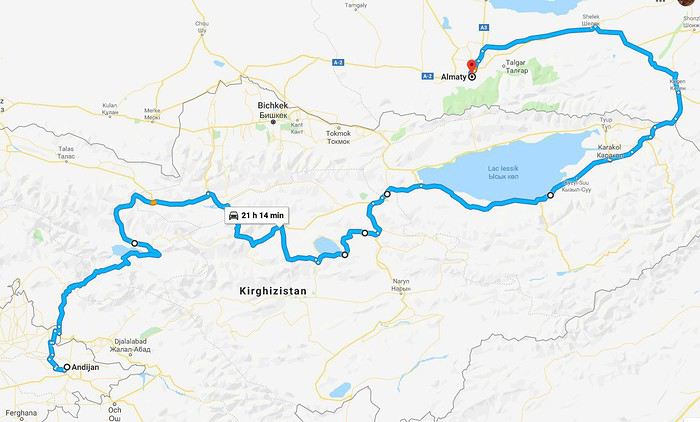
Road trip from Andijan (Uzbekistan) to Almaty (Kazakhstan) via Kyrgyzstan
Hello,

This summer, we’re heading to Central Asia. Family of 5—3 adults and 2 teens. Our plan is: - Arrive in Tashkent (1 day) - Train to Samarkand (2 days) - Return to Tashkent (1–2 days) - Train to Andijan. Then, things get a bit trickier...

Crossing Kyrgyzstan: Toktogul Reservoir - Suusamyr - Song Kol Lake - southern Issyk-Kul Lake - Karakol (over 10 days).

Then Kazakhstan: Charyn Canyon - Almaty (6–7 days, including renting a vehicle for the surrounding areas).

We’d like to cross Kyrgyzstan by bus or shared taxis (I think there are no trains there?). Our goal: travel simply, meet locals, share moments of conviviality, visit nice spots, and see beautiful landscapes. With three young ones (19, 16, 13), we need to mix up the visits—ancient sites, grand landscapes, countryside, cities. It’s okay if we don’t see every wonder... we’ll come back!

Has anyone here done this kind of road trip?

We’re still in the early planning stages, so thanks in advance for any feedback on the itinerary, accommodation tips, transport advice, etc.!

Maripi
Open
GO
Gomar last year
One-month itinerary in Central Asia
Hello! I’m so excited to be back on this forum—it’s helped me so much in the past! I need your expert advice for our next trip, which will take us to Central Asia: Uzbekistan, Tajikistan, Kyrgyzstan, and Kazakhstan.

We have a month, and here’s the itinerary I have in mind: Arrival in Tashkent – 2 days Bukhara – 2 days Samarkand – 3 days Panjakent – 1 day The Seven Lakes + Iskanderkul – 3 days Khujand – 2 days Fergana Valley – 3 days Song Kol Lake – 2 days Issyk-Kul Lake – 3 days Charyn Canyon – 1 day Kaindy Lake – 1 day Altyn Emel Park – 1 day Almaty – 1 day and departure

I know the travel times, especially in the mountains, can be long, but I’ve tried to optimize it so we can rest after the long drives. Our family includes three kids aged 5, 13, and 17. We’re used to backpacking. But I have *so* many questions: -Will it be extremely hot in Uzbekistan, but manageable in the other regions on my itinerary? -I’ve read conflicting things about trains in Uzbekistan: is it possible to book train tickets in advance from France? -For the Seven Lakes and Iskanderkul, do I need to hire a driver? Is it easy to find one? Since there are five of us, we’d need a large car… or is it possible to rent a car in Panjakent and drop it off in Khujand? -What’s worth visiting in the Fergana Valley? -I’d prefer to avoid domestic flights, so I planned to break up the Osh-Issyk-Kul Lake route by stopping at Song Kol Lake and taking a horseback ride. Is that realistic? Again, do I need to find a driver, or can we do it independently? -Where’s the best base for Issyk-Kul Lake? The main goal is to relax and swim (is it acceptable for women to wear swimsuits in these regions?) -For the last part of the trip—Charyn Canyon and Kaindy Lake from Issyk-Kul—is it doable, or do I need a driver once more? -Is Altyn Emel Park doable in the summer, or is it too hot? The idea is to see the views and do a short 3-hour hike.

Thanks so much for any firsthand tips or experiences you can share!
Open
GA
Galadriella last year · Babarovich
Trekking in Kyrgyzstan or Tajikistan?
Hi everyone! Just back from the Manaslu Circuit in Nepal, and I think for my next trip, I'd love a wilder environment. I'm considering a trek (two to three weeks) in Central Asia. Several agencies organize this kind of trip, and I was initially leaning toward Tajikistan, but after looking at travel photos, the landscapes seem very similar to the Alps, while Kyrgyzstan’s scenery looks more "exotic"—maybe closer to Mongolia? But these are just photos, and I’m struggling to get a real sense of it. I’d love to hear from people who’ve been to these destinations... Thanks so much! :-)
Open
AB
Ab004 last year · Changgulu
Tips for horseback trekking in Mongolia/Kazakhstan/Kyrgyzstan
Hey there, fellow travelers!

I’m planning a multi-month trek across Central Asia starting April/May 2025, blending horseback travel, hiking, and stops of a few weeks if the opportunity arises. Craving adventure, nature, horse contact, human connections, and culture. I’ve got decent endurance from camping and medium/long-haul trips, but this would be my first project of this scale—especially with horses and in such sparsely populated regions.

With an eye toward a well-prepared expedition that still leaves plenty of room for intuition, I’m casting my message in a bottle: + Tips for self-sufficient horseback prep (I plan to do some intensive training in Europe before departure, then start my journey on-site with an agency like Cheval d'Aventure for the first few weeks) + Suggestions for community development/solidarity projects I could join for a few weeks or months along the way + Travel buddy(ies) interested in joining me for part of the adventure (especially for self-sufficient horseback travel), or recommendations on how to find these companions + Any other kind of info is obviously welcome!

Thanks in advance for your invaluable help—and maybe see you for a stretch of the road together!

Antoine.
Open
FR
Fragap last year
Looking for contacts in Bishkek (Kyrgyzstan)
Hello,

I’m planning my return to Bishkek in March, where my Thai wife and I have parked our camper van. On our way back from Thailand, we’d love to connect with one or more French-speaking contacts who know Kyrgyzstan.

Best regards,
Open
SA
Sarana 2 years ago · Nimou74
On the Silk Road: Chronicles of a Sixty-Something Traveling Completely Independently
From Beijing to Khiva: China, Kyrgyzstan, Tajikistan, Uzbekistan Chronicle of anecdotes, highlights, and other adventures that marked this eight-week journey in 2018.
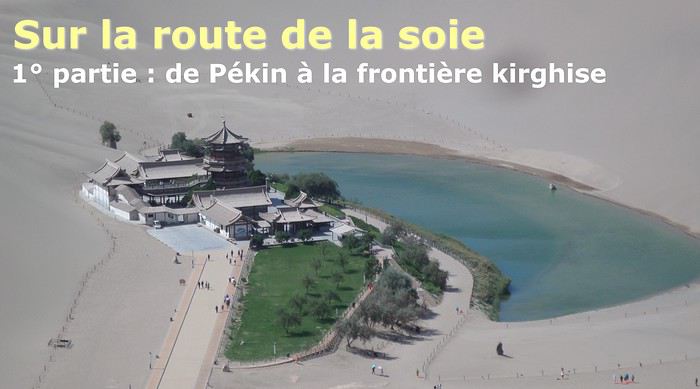


The Chinese Far West More than 30 years after my first trip to eastern China, I finally fulfilled an old dream: traveling solo from Beijing to the far west, discovering Xinjiang, the Uyghur people and the oppression they endure, the oases of Turpan and Kashgar, the Taklamakan Desert, the end of the Great Wall... The route was covered by train.

MENU PART 1: CHINA

1- Beijing (Jiankou) : the authentic Great Wall, without tourists 2- Cycling in Beijing, the best way to get around 3- Beijing : departure for the far west 4- Jiayuguan : getting by without English 5- Jiayuguan : scams and heritage 6- Dunhuang : abundance in the middle of the desert 7- Turpan : the Uyghurs under heavy surveillance 8- Kashgar : love at first sight for the old city 9- Kashgar : China’s recipe for controlling the populace 10- Tashkurgan : what on earth was I thinking going there! Kyrgyz border: a surreal epic Photo album from the 80s, contributions from other travelers (page 2)

1- JIANKOU Finding the authentic Great Wall, without tourists or a guide Friday, August 24, 2018 Thirty years later, I didn’t feel like revisiting the Great Wall at Badaling or any other overcrowded site. I chose to explore it at Jiankou, in its wildest, most authentic, and unrestored section, starting from a lost village deep in a valley—though it wasn’t *that* lost, since it had everything for communication.
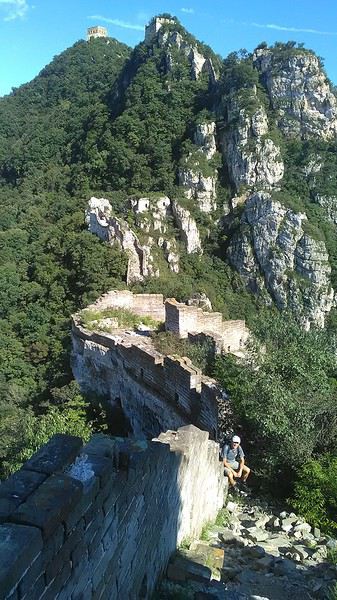


No need to pay for a taxi to get there—by timing it right, you can take the bus for just a few yuan. You have to get off at Xizhazi, the bus terminus. Be careful, there are only two buses a day in each direction. At the Xizhazi bus stop, I met a young couple who’d arrived with zero information about what to expect. We hiked the three of us toward the restored section of Mutianyu.

Still, be cautious With GPS and a topographic map (OpenTopoMap), you can set off without a problem or guide. The trail up to Jiankou is easy and well-marked. The trails down are too. But be careful—once you’re on the Wall, it’s real mountain hiking, with easy but dangerous climbing sections (over sheer drops). Not for amateurs or those afraid of heights! But what a reward. The Wall all to yourself, where it’s at its most daring. Truly mesmerizing.

More photos...

2- BEIJING The best way to get around the capital Sunday, August 26 The best way to explore the city is still by bike. Most are in a bike-share system, but you need to use an app—WeChat, the app that does everything, like monitoring your every move. No way I was installing that.
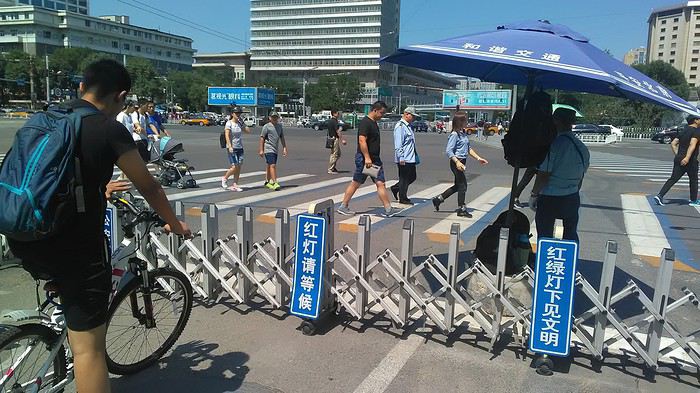


I found one at a rental shop near the hostel. The key is to quickly learn local traffic customs to minimize risks. Bike lanes are wide along the avenues.

But you still have to: - Watch out for anything parked on the bike paths—the most annoying are people napping or talking on the phone in their cars - Keep an eye on everything coming the wrong way—the list is long - The worst is right turns on red, which in Chinese traffic rules seem to have priority Once you get the hang of it, it’s fine. The city is huge but flat, so you can just wing it.

3- BEIJING By train to the far west Sunday, August 26 Beijing West Station is the size and operates like an airport. With your e-ticket from the agency, you first have to pick up your ticket at the special "English" counter, after passing through security. With your ticket in hand, you have to exit and enter through the boarding waiting area—not the platform—after a second security check.
Then you find the right hall and wait for the sign to finally access the platform. In the end, it works pretty well given the incredible number of passengers to manage. Everywhere in Beijing, I saw that the Chinese have mastered crowd flow management.

Nice surprise: second-class carriages are clean, air-conditioned, and bright. Perfect, since I was in for 20 hours. One uniformed attendant per carriage, mobile meal service—luxury! Small downside: no luggage space. Hauling your suitcase up to the top bunk is quite a workout. I was in the middle, so it wasn’t too bad. The landscape, though, whether rural or urban, is pretty bleak. That should change once we leave the eastern plains.

Of course, I got my first police visit, with a thorough passport check and bag search. I was warned—going to the Chinese far west exposes you to this kind of hassle. But they were polite and respectful.
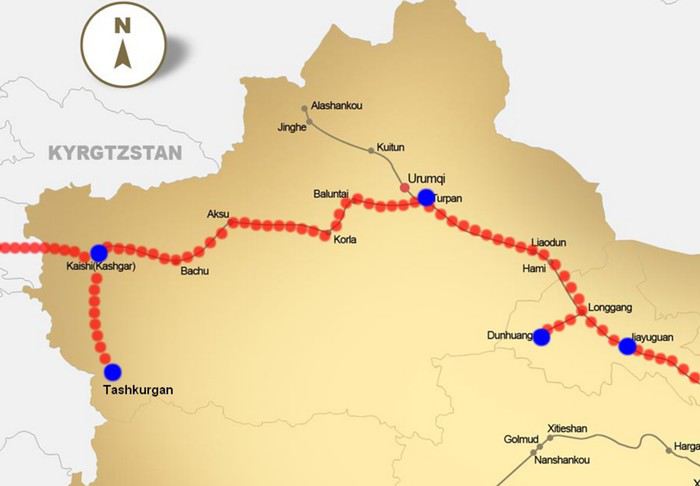
The Chinese Far West

4- JIAYUGUAN Getting by without English Monday, August 27 At the gates of two deserts (Gobi and Taklamakan) and at the foot of the Tibetan highlands, the Great Wall ends at Jiayuguan. Here, I found the deeper China I’d somewhat rediscovered during my bike ride, even if now everyone gets around on electric bikes and I’m no longer stared at like an alien.


Prices are nothing like Beijing: you can find a full meal for 2 €, and my bike cost 7 € for two days. Plus, few people speak English—neither the owner of the HI hostel where I stayed, nor the ticket sellers at the sites, let alone the servers at the small eateries where I ate. Everything is written in Chinese. So I had to use the little Chinese I know to communicate about essentials. It makes the locals laugh to see a European trying to speak their language, but it earns respect. With Google Translate’s help, I managed.

Rant: With their avenues blocked for construction for kilometers without warning, and new roads not yet on maps, I must’ve taken 15 km of detours. More photos...

5- JIAYUGUAN Scams and heritage Tuesday, August 28 The Great Wall doesn’t exactly end at the fort I visited yesterday but 10 km further, at the entrance to a river gorge at the foot of the mountains. All that’s left is a badly damaged tower (more like a mound of earth) and a section of clay wall, similar to the one I biked yesterday.
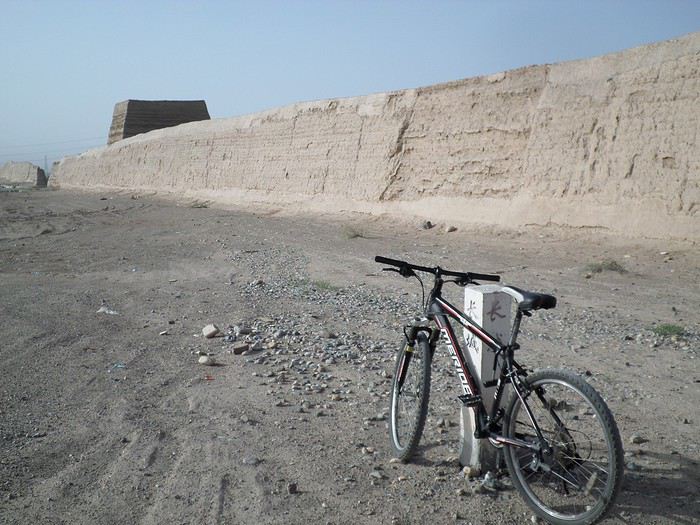


This morning, I hopped on my bike, determined to venture into the desert to see this highly symbolic site. First, you access it via a wide, brand-new road with not a soul in sight. Just before the site, I came across a grand welcome gate, very period-style, but it’s actually the inevitable toll booth.

Behind the gate, the road continues straight to the site, which you can see in the distance—at least 2 km away—the remains of the tower and wall. I had to leave my bike here. Fine. I went to the ticket counter and asked the price: 120 yuan! I couldn’t believe it—over 15 € for a simple mound of earth.

I showed my displeasure to the attendant, who couldn’t care less, and immediately turned back. 120 yuan—that’s the price for a new road, a fancy gate planted 2 km before the site just to force you to take a shuttle, and employees with nothing to do all day... Now I understand why I didn’t meet anyone!

Heritage China is a bit pricey Generally, sites are expensive for the country’s standard of living, but travelers are supposed to have money, so why hold back? I even gave up on the Forbidden City—reservations required days in advance (or on the black market at an impossible price). I prefer to keep the memory of my first visit, when entry must’ve cost a few dozen cents, and there were only a handful of visitors.

This morning, I took a taxi to see remarkable tombs of common people from the 3rd to 6th centuries. They’re small vaulted caves made of painted bricks, depicting scenes of daily life. Very pretty and moving. But even here, though the price was more reasonable, I was left wanting—only one of the 16 tombs is open to visitors, and it’s apparently not the most beautiful.

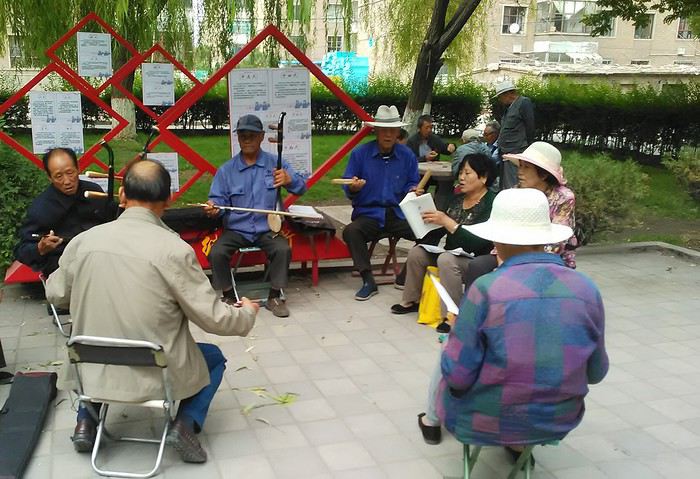
The authentic China—at least what’s left of it... Wandering the impersonal avenues of the city, you stumble upon a market. There, you still find traditional China—small shops with questionable hygiene, Go players, musicians, and even a dental prosthetist. The last refuge for those untouched by modernity. More photos...

6- DUNHUANG Abundance in the middle of the desert Wednesday, August 29 Well, I thought the landscape would be less bleak as I headed west. Nope. The only distraction in this expanse of dark, clayey sand is the forests of pylons and wind turbines, plus wild camels racing each other.
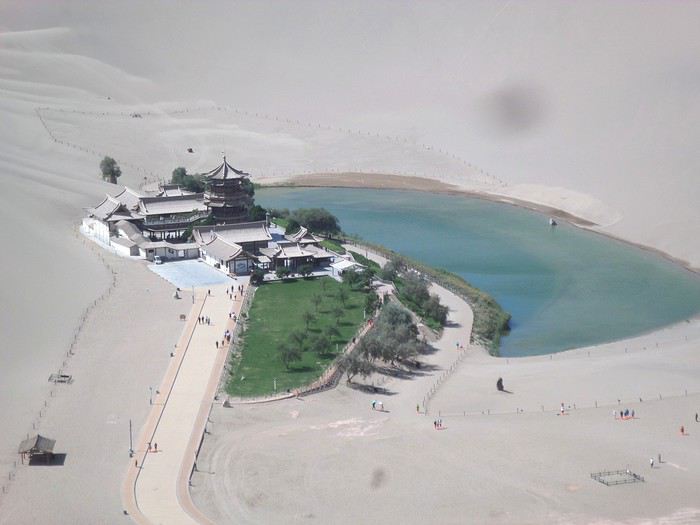
However, Dunhuang, the gateway to the Taklamakan, is by far the most pleasant Chinese city I know. There’s a real city center you can explore on foot. It’s hot but not unbearable, with a light, dry breeze. Much nicer than Beijing. The Han Chinese are still the majority, but the Muslim Uyghurs are more numerous, and the muezzin’s call to prayer echoes around the mosque.

The most surprising thing is the abundance and diversity of fruits and vegetables. You wonder how it all grows here. Well-irrigated, the desert sands are very fertile. Here, raisins have subtle, mysterious flavors, and the lamb really tastes like lamb.

Today, I visited the must-see Mingshashan, a dune complex next to which Pila is a molehill. The Basque Country, but covered in sand... More photos...

7- TURPAN The Uyghurs under heavy surveillance Friday, August 31 Surveillance cameras everywhere in the city, armed police stationed at intersections, in front of public buildings, at the entrance and inside tourist sites, police stations on every corner, patrols on foot or by car, khaki uniforms even for middle schoolers... here, the Han Chinese are in the minority, and you can feel it. Turpan feels like a city under siege.
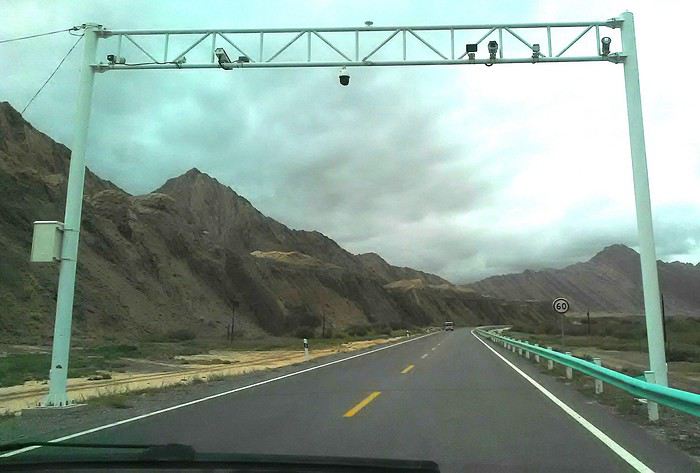


To enter the youth hostel where I stayed, there’s even a security gate, and the receptionist (a Han, like everyone in tourism) wears a bulletproof vest! Reassuring. Still, you don’t feel particularly threatened here, especially as a European. The troublemakers are the Chinese, not the Uyghurs. Generally, China is a very safe country for visitors.

Smile, you’re on camera! I was biking on an avenue when the car in front of me got flashed for driving slowly. I quickly understood why when I got flashed too.

Here, the official time is Beijing time, but it gets dark two hours later. It’ll be even worse in Kashgar. Trickier to manage: everything is displayed in Chinese and Arabic. Nothing in English. Choosing a menu is a shot in the dark. Apart from a few young Chinese, no one here speaks English, and my Chinese doesn’t seem very understandable...

Mogao, the end of the road for the Han Yesterday, near Dunhuang, I went to Mogao, a complex of decorated caves with Buddha sculptures and paintings. Stunning, but so crowded! Luckily, here in Turpan, Chinese tourists barely venture out. So I visited a Silk Road ghost town with only a handful of other visitors and under a howling wind.

The modern Chinese city is swallowing up the old Uyghur neighborhoods—only a museum-like district remains in the center, and pockets of resistance on the outskirts are doomed to disappear soon. More photos...

8- KASHGAR A (relative) love at first sight for the old city Sunday, September 2 After three overnight trains, here I am in the far west of China, nearly 4,000 km from the capital. Despite the omnipresent police and an old city preserved UNESCO-style, Kashgar is my Chinese love at first sight.
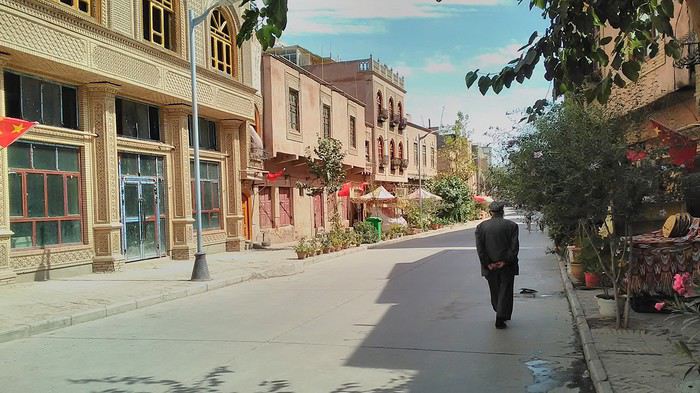


Finally, Chinese... well, sort of, because we’re in Uyghur territory here—a Turkic people with nothing culturally in common with the Han, the eastern Chinese. It started badly yesterday at Turfan station, where after three security gate passes, at least five passport checks, and a bag search, three adorable policewomen confiscated my antibacterial lotion because it had a flammable logo...

Then came the welcoming committee of armed cops at Kashgar station. Once all that was over, they left me alone—except you still have to go through security checks like everyone else to enter the old city, the bazaar, the livestock market... The further west you go, the more the siege mentality is evident. Luckily, the border isn’t far...

Despite the inevitable destruction-reconstruction, the city center has been well preserved. Thankfully, because it’s a very original style, a mix of local and colonial. I love it, even if it’s a bit too artificial, sanitized, and watered-down, and rather empty of residents. On the Silk Road, the city was famous for its great food. And it still is—rarely have I seen such richness and abundance of food! And not just scorpions or snakes. More photos...

9- KASHGAR China’s recipe for controlling the populace Saturday, September 1 Xinjiang, along with Tibet, is a "sensitive" area of rebellion in the eyes of Chinese authorities. As a result, the state has these regions and their populations under total control. Tourists also feel the consequences, even if they’re not at risk of re-education camps.
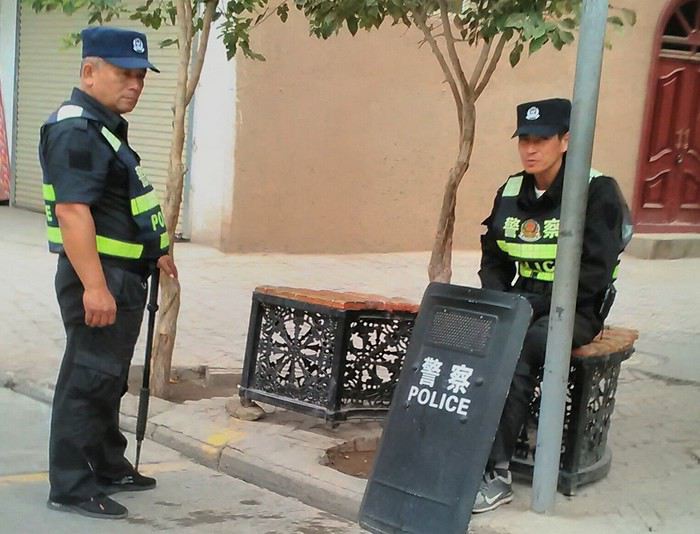
- Putting barbed wire and anti-ramming barriers around sensitive sites (schools, big hotels, government buildings...) - Installing traffic surveillance gates with cameras and photo flashes (for all vehicles passing, including bikes) throughout the city and even in the countryside - Posting uniformed guards with tasers, batons, or huge baseball bats every 100 meters - Training the Han population (ethnic Chinese) in self-defense with sticks, preferably in the morning on the street. Men and women of all ages - Starting school with the national anthem, doing military exercises, and receiving political indoctrination, all neatly lined up in the courtyard. (The dream school for any teacher) - Placing a snitch in uniform (a pseudo-guard) in public gathering places, like youth hostels. Mine spends the day loafing around the courtyard - Putting Chinese flags everywhere on the streets to remind everyone who’s in charge - Installing security gates at every entrance to areas frequented by tourists (thanks for that) but not just there - Never photographing cops, or else! I tried, but it’s not easy...

With all that, you can stroll around safely Not much crime! As for the amount the Chinese state spends to maintain such a system, it’s staggering! A third of the Han living in Xinjiang work in security. Today, I wandered freely around old Kashgar, which is quite large after all. More photos...

10- TASHKURGAN What on earth was I thinking going there! Wednesday, September 5 First, there’s the taxi—pretty crappy, with a driver who doesn’t speak a word of English and won’t stop smoking. Over six hours in that... shared with a completely out-of-it American.
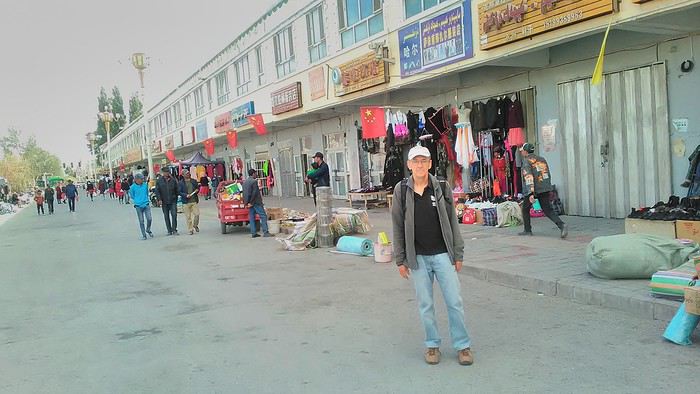


Then there are all the checkpoints along the way. I won’t go on—you know the drill by now.

After that, there’s Tashkurgan—a town with nothing to see, nothing to do. Deserted as soon as night falls. There’s this huge youth hostel and a few lost Chinese tapping away on their smartphones, chain-smoking. This lost American-European crowd, swapping tips on how to enter Pakistan or Tajikistan.

Luckily, there’s the Chinese Pamir Highway, lined with peaks over 7,000m. There’s the feeling of no longer being in China, with a population whose features are Middle Eastern. And these Tajik women with their stunning hairstyles and vibrant costumes. There’s the fact of having reached the westernmost Chinese city, far from crowds and tourist sites. A sort of end of the world. More photos...

11- KYRGYZ BORDER A surreal epic Thursday, September 6 The road from Kashgar to the Kyrgyzstan border is a little over 200 km and passes through beautiful landscapes of colorful, desert-like mountains with acrobatic folds. That’s the bucolic part of the trip.
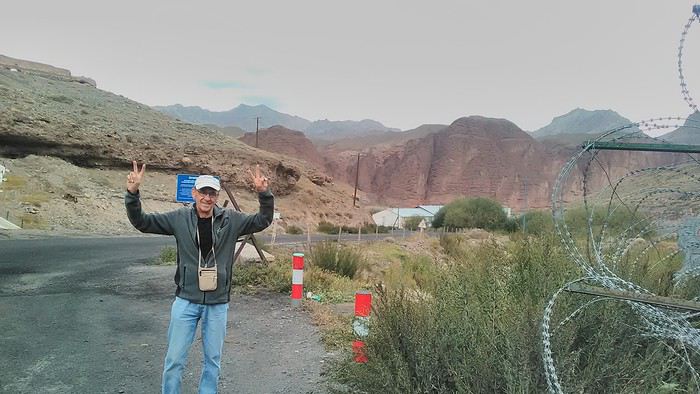
Yesterday, I managed to gather four people to rent a minibus to reach the border more easily: a Spaniard and an Argentine I’d already met in Turpan, and two New Zealanders who responded to the ad left at the hostel.

Absurdity and paranoia of Chinese authorities The highlight was crossing the town of Wuqia, 50 km past Kashgar. After tallying up with my fellow sufferers, we must’ve passed about ten checkpoints with: - Passport checks: 14 times, sometimes by two cops side by side - Bag checks: 4 times - Smartphone checks: 2 times, with deletion of "non-compliant" photos, and registration of your IMEI in the exit log!... Absurd and surreal at the same time, since my camera stayed in my bag, my apps are in French, and my photos have been online for ages...

With all that, we arrived just as the last checkpoint before the no man’s land marking the border between the two countries was on lunch break. And bam! Another 1.5-hour wait, alongside truckers who were much more used to this than we were.

What to think? The cops themselves aren’t fooled. They play the role they’re asked to, but sometimes you can coax a smile out of them—they realize how ridiculous the situation is.

What’s the point? That’s the big question my companions and I were tempted to answer with "to piss people off." To show you your place isn’t here, but with the other tourists, over there in the east, in Shanghai, Xi’an, or Guangzhou.

As for you, a traveler from a democratic country, you really experience this as aggression, humiliation, a violation of your private space. And yet, I’m respected, they speak to me properly. Today, I better understand what a Palestinian or a citizen of an occupied country might feel daily. A unique experience! Thanks, China.

And to top it off, the cherry on the cake! It’s still this glowing button you press to rate your passage after clearing the last obstacle before the exit stamp. I was so surprised it turned off before I could react. The Spaniard, with great humor and irony, had time to vote "excellent." In the end, he wasn’t wrong—you can hardly do better!

PS: I ditched my buddies at the border. They didn’t want to pay for a taxi to continue. So I took a direct taxi to Osh. The first 100 km are fabulous. I couldn’t take many photos, but I’ll be back on Monday to go to Tajikistan.

More photos...

The rest of the Silk Road, Part 2, in these travel journals: Kyrgyzstan, Tajikistan, Uzbekistan.
Open
FR
Fred1906 6 years ago · Meg2
Idée de trekking d'une semaine en Géorgie ou au Kirghizistan?
bonjour,

je suis allé en Georgie, à kagbezi, ( trés alpin, trés beau) et à borjomi ( un peut trop d'arbres , pour avoir une vue dégagée). avez vous une idée de trekking d'une semaine, dans un autre coin de Georgie, ou au Kirghizstan ? merci des infos fred
Open
BE
Ben270602 6 years ago · Changgulu
Ouverture des frontières en Asie Centrale pour l'été 2020? (à vélo)
Bonjour à tous. Nous devions faire cet été la Pamir Highway en vélo....et le Covid19 a fait sont apparition..... Nous sommes le 15 juin, et je constate que les pays d'Asie Central ont encore tous leur frontières fermées (Ouzbekistan-Tadjikistan-Kirghizstan) . Avez vous des informations précises sur leur prochaine ouverture ? et le passage entre chaque pays ? Merci d'avance pour vos informations ! Cordialement Ben270602
Open
CA
Capucine1234 6 years ago · Changgulu
Trek Ala Kul au Kirghizstan
Bonjour,

Je n'arrive pas à me faire une idée sur la réelle difficulté du trek pour Ala Kul. Certains semblent dire qu'il nécessite une bonne condition physique, d'autres qu'il est accessible à tous tant que l'on a un peu d'énergie.

Je souhaiterai le faire en trois jours (une nuit au lac et après redescendre vers les sources chaudes d'Altyn Arashan pour y passer une nuit également)

Pouvez-vous me faire vos retours svp sur la réelle difficulté de ce trek ?

Merci d'avance pour votre aide Capucine
Open
OU
Oumouba 6 years ago · Changgulu
Trek Canyon de Boom (Kirghizistan)
Bonjour à tous,

Je prépare deux treks en autonomie complète avec mon ami au Kirghizistan. J'ai récolté déjà beaucoup d'informations notamment grâce à ce forum mais il me reste quelques questions.

Nous voudrions faire un premier trek entre le canyon de boom (canyon de konorchek) - Shamsy - Song Kul puis un deuxième entre Jeti-Oguz- Lac Ala Kul- Altyn Arashan.

Voici mes questions : - Quelqu'un connaît-il le tracé précis de la première étape que j'envisage (départ canyon de boom, jusqu'à une confluence de rivière dans la vallée de Konorchek, en aval du col des Kolkhozes ? J'ai repéré tout le reste mais je ne trouve pas le tracé de cette partie-là. - De même pour le départ, quelle destination demander au bus ou train ? (je sais qu'il est question d'un village avec une statue de léopard en béton sur la route entre Bishkek et Balakchy mais je ne trouve pas son nom. - Pensez-vous qu'il est facile de retourner à Kochkor en véhicule quelconque (bus, taxi, stop) en arrivant à pied au lac Song Kul? - Savez-vous s'il y a des zones sur ces deux treks où il est difficile de trouver de l'eau?

J'ai bien conscience que mes questions sont très spécifiques, mais je tente quand même. Merci à vous !

Miléna
Open
GI
Gizmo94 6 years ago
Choix d'itinéraires à vélo au Kirghizistan
Bonjour, Je pars le 1er juillet pour un périple de 3 semaines à vélo au Kirghizistan et j'ai quelques questions concernant l'élaboration de l'itinéraire qui commencera à Karakol situé sur la rive sud du lac Issyk Kul et ensuite j'aimerai rejoindre le lac Son Kul et la vallée de Suusamyr. 1ère option : Le très classique passage par Kochkor, Sari Bulak et le col Kalmak Ashuu qui mène au Lac Son Kul mais j'ai l'impression qu'il risque d'y avoir beaucoup de circulation sur cet axe là. Ma deuxième option serait de passer par le col de Tosor qui mene à Naryn mais dans ce sens c'est plus de 2000m de dénivelé positif pour d'atteindre le col à 3900m d'altitude et d'après les infos que j'ai eu, le passage peut être problématique avant mi juillet à cause de la neige. J'aimerai bien avoir un retour d'expérience de voyageurs qui sont passés par le col de Tosor à vélo ? Ma troisième option serait de prendre la piste de Barskoon au Lac Issy Kul et de passer par le col Arabel, Japak bel, saty Bulak et Son Kul . Dernière question : Dans quel sens faire cet itinéraire. Commencer par la vallée de Suusamyr ou le lac Issyk Kul. Merci pour vos réponses. Rachid
Open
ID
Idéalement 6 years ago · Pampelichkaa
Voyage chez l'habitant avec agence francophone au Kirghizistan
J'ai un projet de voyage au Kirghizistan pour 2021. avez-vous des sites pour me procurer la carte du pays. . Quelle période la plus idéale. Merci de me donner vos astuces et idées de découverte. Adresse d'agence francophone correcte. Je privilégie l'hébergement chez l'habitant, être en contact avec les locaux.
Open
ET
Etchelecou 6 years ago · Suil
Schwalbe Marathon GT 365 26x2.00 ou Marathon Plus 26x2.00 (à vélo sur goudron et pistes)
Bonjour, Pour voyages au long cours (goudron et pistes) chargés, vaut-il mieux prendre des pneus Marathon GT 365 26x2.00 ou des pneus Marathon Plus 26x2.00 ? Au cours de mes récents voyages, j'ai utilisé des marathon mondial mais pas convaincu par rapport aux anciens marathon increvables qu'on ne trouve plus. Sur les mondial j'ai eu des fissures sur les flancs. Je précise que je gonfle à 4 bars avec un poids de vélo chargé autour de 50 kg plus le bonhomme soit un poids total d'environ 125-130 kg. J'hésite maintenant entre Marathon GT 365 26x2.00 ou Marathon Plus 26x2.00, ou d'autre ... Merci de vos retours d'expérience. André
Open

Recommended for you

Previous Page 1 of 38 Next