Hi, do you have any great tips for spending New Year's Eve away? Destination doesn't matter. Thanks!
Ongoing discussions
Ongoing discussions posted in the forum sections, sorted by latest message.
Showing 91–120 of 365 discussions.
I've traveled quite a bit in Vietnam over the past few years—from the southern delta to bustling cities and even some small islands—but what really sticks with me is the north, the high mountains.
Up there, there's something different—maybe slower, more raw. The morning markets with ethnic groups, women in traditional clothes, the colors...
The stilt houses, kids following you and laughing for no reason, the terraced rice fields—it almost feels unreal at times, so vast and quiet, yet so human and simple.
You often hear that Sapa has become too touristy, and that's partly true, especially in the center. But as soon as you move a little farther away, everything changes quickly. The landscapes open up, encounters feel more natural, and you rediscover something truly authentic.
I think it's that contrast that struck me—the difference between what you imagine before going and what you actually discover when you take the time.
And you—what memory do you hold onto from Vietnam? A particular place that touched you more than others?
Hello,
A must-read for anyone planning to travel to Kenya or Tanzania in the coming months.
https://www.corsematin.com/article/francemonde/70999544524516/lonu-prevoit-un-el-nino-de-tres-forte-intensite-ces-cinq-prochains-mois
In Nov./Dec. 2022, I went on a safari in the region and we suffered from the extreme temperatures caused by the "El Niño" phenomenon in the Indian Ocean at that time. On top of the extreme heat, there can be torrential rains, flooding, etc., which have led to disasters with casualties.
Worth keeping in mind (just in case).
Best regards, ...
A must-read for anyone planning to travel to Kenya or Tanzania in the coming months.
https://www.corsematin.com/article/francemonde/70999544524516/lonu-prevoit-un-el-nino-de-tres-forte-intensite-ces-cinq-prochains-mois
In Nov./Dec. 2022, I went on a safari in the region and we suffered from the extreme temperatures caused by the "El Niño" phenomenon in the Indian Ocean at that time. On top of the extreme heat, there can be torrential rains, flooding, etc., which have led to disasters with casualties.
Worth keeping in mind (just in case).
Best regards, ...
I'M PLANNING TO GO TO CORSICA IN 2027, EITHER IN JUNE OR MAYBE SEPTEMBER (haven't decided yet).
I'd like to know which is the most cost-effective way to get there from La Rochelle: by plane or by boat?
Once there, I'd rent a basic car (though I don’t know which agency yet).
I plan to do the 10-day *Mare a Mare* hike.
Hi there,
With little time during my trip to Thailand, which should I prioritize: the city of Kanchanaburi or Chiang Rai?
Thanks for your replies
Hello hello
It's decided—2027 will be Brazil, in the summer (unless you advise against it 😕). From what I’ve read, the weather’s okay, even if it’s a bit chilly for swimming. We’re going, as always, as a group of four, with our teens. 🙂
We’d be looking at a solid two weeks, at least 14 days on the ground. I’m planning way ahead to nail down an itinerary and book our flight tickets (the prices I’m seeing already are freaking me out…).
From my research, I’ve come across some classic routes: Rio/Iguazu/Paraty/Ilha Grande. Roughly: 4 days in Rio, 2 in Iguazu, 2 in Paraty, and 3 on Ilha Verde. That’d leave us one more stop on the trip.
Since we like to end with a "chill" stop for the kids,
My questions: - Is Ilha Verde worth it this time of year? I’ve read that swimming might not be an option—water’s too cold… So not ideal for a chill/relaxing destination? - How should we round out the trip in the South? São Paulo? Another stop along the Costa Verde? - Wouldn’t it make more sense to head up to the Northeast, where it’s warmer, like Salvador de Bahia?
But Salvador raises other questions: - Are there flights from Iguazu to Salvador? - And for the return to France, would we have to connect through Rio or São Paulo from Salvador? - Any suggestions for places to stay around Salvador?
Thanks for your input—I’m sure I’ll have more questions as I go along. 😉
It's decided—2027 will be Brazil, in the summer (unless you advise against it 😕). From what I’ve read, the weather’s okay, even if it’s a bit chilly for swimming. We’re going, as always, as a group of four, with our teens. 🙂
We’d be looking at a solid two weeks, at least 14 days on the ground. I’m planning way ahead to nail down an itinerary and book our flight tickets (the prices I’m seeing already are freaking me out…).
From my research, I’ve come across some classic routes: Rio/Iguazu/Paraty/Ilha Grande. Roughly: 4 days in Rio, 2 in Iguazu, 2 in Paraty, and 3 on Ilha Verde. That’d leave us one more stop on the trip.
Since we like to end with a "chill" stop for the kids,
My questions: - Is Ilha Verde worth it this time of year? I’ve read that swimming might not be an option—water’s too cold… So not ideal for a chill/relaxing destination? - How should we round out the trip in the South? São Paulo? Another stop along the Costa Verde? - Wouldn’t it make more sense to head up to the Northeast, where it’s warmer, like Salvador de Bahia?
But Salvador raises other questions: - Are there flights from Iguazu to Salvador? - And for the return to France, would we have to connect through Rio or São Paulo from Salvador? - Any suggestions for places to stay around Salvador?
Thanks for your input—I’m sure I’ll have more questions as I go along. 😉
Hi there, I'm looking for ideas for a 15-day self-drive trip in Costa Rica in March, preferably off the beaten path. Thanks!
This isn't an ad! Young Nepalis want to learn French cooking! Fancy helping out? You'll be hosted and fed :)) Thanks and maybe see you soon in Nepal.
Hi, I’d love some tips for visiting Costa Rica with someone who can’t walk for long distances. Is it doable? Thanks for your feedback!
Hi everyone,
From January 1st to 4th, I’m heading to Barcelona for the first time. Beyond the tourist sites—which are going to cost me an arm and a leg!!—I’d love to spend a day off the beaten path and see some less touristy spots. What do you recommend? I’ll be getting around on foot, by metro, or possibly by train if it’s not too far. I love both nature and cultural spots. And one last thing—is Barcelona at night safe for a woman alone, or is it sketchy?
Thanks for your help! :)
From January 1st to 4th, I’m heading to Barcelona for the first time. Beyond the tourist sites—which are going to cost me an arm and a leg!!—I’d love to spend a day off the beaten path and see some less touristy spots. What do you recommend? I’ll be getting around on foot, by metro, or possibly by train if it’s not too far. I love both nature and cultural spots. And one last thing—is Barcelona at night safe for a woman alone, or is it sketchy?
Thanks for your help! :)
Hello,
Can anyone tell me what the current road conditions are like around Kathmandu, Pokhara, and Australian Camp? Thanks! Guylaine
Can anyone tell me what the current road conditions are like around Kathmandu, Pokhara, and Australian Camp? Thanks! Guylaine
Hello!
We're a family of 4—3 adults and a 14-year-old. We're seasoned travelers with a passion for science, culture, and history. In short, we love discovering and learning.
We'll be in India for 3 weeks, from December 11, 2026 (in Goa) to January 3, 2027 (in Thiruvananthapuram).
We're looking for one or more drivers to handle the journey and guides who speak clear, fluent English, French, or Spanish. We'd love guides who are knowledgeable, passionate about their region, and able to answer our countless questions while giving us in-depth insights into the places, rituals, culture, and more.
Do you know of such guides or drivers, or have any tips on how to find people who can help us create unforgettable memories?
Thank you so much in advance!
Cat
I’d like to do a kind of personal retreat this winter and I’m looking for a destination near the sea (preferably an island) that’s quiet. Is that possible in Thailand, or should I consider another destination?
Thanks for your thoughts.
Dayi
Has anyone done the Atlantic cycling route crossing Norway (EuroVelo 1)?
Which direction is the hardest?
From NORTH to SOUTH or the other way around?
Hi there,
who has already done the EURO VELO 1 in Norway from the south to the North Cape, and what are the main difficulties:
elevation gain, etc.......
Otherwise, who has already done the EURO VELO 7 from south to north, crossing Sweden up to the North Cape? If so, what are the difficulties, elevation gain, and does it pass through villages for supplies, etc.......
Hi there,
I’ve got my flight ticket sorted—departing in mid-November and returning in mid-March. I’ll arrive in Santiago and leave from Buenos Aires. I’ve already been to southern Argentina, specifically Torres del Paine National Park, and I’d love to go back to do the full W trek (I only did the shorter version last time). I also want to do some hiking and maybe even tackle a summit. I climb and occasionally do some mountaineering, so I’ll definitely be going with a guide.
I plan to start around Temuco in Chile, with the idea of heading toward the lakes, then taking the Carretera Austral. I’m not sure if I’ll go all the way to Ushuaia—it’s supposed to not be *that* worth it, except for the bragging rights of saying you’ve been to the end of the world.
I saw there are lakes in Argentina too.
I don’t have a precise itinerary, but what I’d love is, once I reach the southernmost point of my trip, to take a mini-cruise to see some wildlife. Any tips for that?
What kind of sleeping bag did you take? Is a 0°C (32°F) one enough? And one last question: white gas stove or can I get by with my gas stove?
Nath
I’ve got my flight ticket sorted—departing in mid-November and returning in mid-March. I’ll arrive in Santiago and leave from Buenos Aires. I’ve already been to southern Argentina, specifically Torres del Paine National Park, and I’d love to go back to do the full W trek (I only did the shorter version last time). I also want to do some hiking and maybe even tackle a summit. I climb and occasionally do some mountaineering, so I’ll definitely be going with a guide.
I plan to start around Temuco in Chile, with the idea of heading toward the lakes, then taking the Carretera Austral. I’m not sure if I’ll go all the way to Ushuaia—it’s supposed to not be *that* worth it, except for the bragging rights of saying you’ve been to the end of the world.
I saw there are lakes in Argentina too.
I don’t have a precise itinerary, but what I’d love is, once I reach the southernmost point of my trip, to take a mini-cruise to see some wildlife. Any tips for that?
What kind of sleeping bag did you take? Is a 0°C (32°F) one enough? And one last question: white gas stove or can I get by with my gas stove?
Nath
Hello fellow travelers
We’re heading to Norway for the first time as a couple for 8 days in December
I’m really torn about how much time to spend at each stop (and how many stops to make) We’d like to explore the cities, visit the Christmas market, see some beautiful landscapes, and if we have time, a stave church.
We arrive in Oslo on December 5th around 5 PM and leave from Bergen on December 12th around 11 AM.
Initially, we were thinking: Oslo from the 5th to the 8th Train to Bergen on the 8th, then stay until the 12th
But now we’d like to fit Flåm into the itinerary
Do you think it’s better to do: From the 5th to the 8th: Oslo On the 8th: train from Oslo to Flåm (arriving at 3 PM) On the 9th: a short fjord cruise, then the 2 PM train to Bergen (but then the Myrdal–Bergen stretch will be in the dark) From the 9th to the 12th: Bergen
Or should we adjust the number of nights in each place? Maybe shorten Oslo? Add a night in Flåm? Skip Flåm altogether? I’m not sure 😅
Thanks!
We’re heading to Norway for the first time as a couple for 8 days in December
I’m really torn about how much time to spend at each stop (and how many stops to make) We’d like to explore the cities, visit the Christmas market, see some beautiful landscapes, and if we have time, a stave church.
We arrive in Oslo on December 5th around 5 PM and leave from Bergen on December 12th around 11 AM.
Initially, we were thinking: Oslo from the 5th to the 8th Train to Bergen on the 8th, then stay until the 12th
But now we’d like to fit Flåm into the itinerary
Do you think it’s better to do: From the 5th to the 8th: Oslo On the 8th: train from Oslo to Flåm (arriving at 3 PM) On the 9th: a short fjord cruise, then the 2 PM train to Bergen (but then the Myrdal–Bergen stretch will be in the dark) From the 9th to the 12th: Bergen
Or should we adjust the number of nights in each place? Maybe shorten Oslo? Add a night in Flåm? Skip Flåm altogether? I’m not sure 😅
Thanks!
Hi everyone.
My partner, our daughter, and I are planning a walking trip to Madagascar in July-August 2027. We’d love any tips or info you can share about this plan. Which regions should we prioritize? Is a local guide better than a well-established agency? Where’s the best place to buy our flight tickets from Réunion? Thanks for your input!
My partner, our daughter, and I are planning a walking trip to Madagascar in July-August 2027. We’d love any tips or info you can share about this plan. Which regions should we prioritize? Is a local guide better than a well-established agency? Where’s the best place to buy our flight tickets from Réunion? Thanks for your input!
Hi, I need your advice.
I’m heading to Drancy in the Paris region this Friday, on Auguste Blanqui Street—apparently it’s next to a police station.
I’d like to get from there to the Musée Grévin, but I’m not sure how: should I take the bus, RER, tram, or metro? If a kind soul could point me in the right direction and explain what type of transport ticket I need, I’d really appreciate it. I’m new to getting around Paris—I’m from the north and not used to it.
Thanks in advance!
hi
I was almost done with my e-visa application, and when I selected the payment method, I chose Razorpay. It glitched, and I got a server error 500/404... No matter how many times I go back to "complete partially filled form," it doesn’t work...
What should I do? Thanks for your help!
Preamble: Why La Gomera?
When we started looking for a summer destination a few months ago, our first criterion was to avoid extreme heat and heatwaves. We had already been to Norway two years ago and are considering going back in the future for other occasions. So, we had some fun asking ChatGPT which destinations enjoyed a mild climate during the summer without going too far. Among the list provided by the AI were the Canary Islands... The idea of a place we wouldn’t have thought of first, both not too far away and exotic enough, appealed to us: “Hmm, why not?”
This destination had never really attracted me, though Magali was a bit more interested. Five years earlier, COVID had caused a short break in my professional activity, and I had planned a trip because the flight price was attractive, and I was looking for a destination different from what usually appeals to me, more than out of deep interest. From a distance and with a social judgment I acknowledge (it’s not great, but it’s not completely wrong), I had the image of a destination for party-goers enjoying the sun without the slightest interest in local culture, with concrete coastlines and denatured landscapes—everything I detest the most. Still, I had done some quick research on the different islands and spotted Lanzarote for its beautiful volcanic landscapes, hiking trails, beaches, and the impression of a good balance between activity and fewer crowds than Tenerife or Gran Canaria. Then I dropped the idea of going, without ever reconsidering traveling to the Canaries...
Until now! Because we started researching the different islands of the archipelago to see which ones might appeal to us the most. It was La Gomera, the third smallest island of the archipelago, more praised for its hiking trails and preserved nature than for its beaches, away from mass tourism (fifty times fewer tourists than Tenerife) but still a bit more developed than its wild neighbor El Hierro, that caught our attention. Contrary to what might be suggested later, I’m not at all addicted to AI, but I use it from time to time to synthesize quick research or simply for experimentation. Since ChatGPT had started anticipating my tastes lately as if it had become my buddy (often successfully, sometimes off the mark), I asked which Canary Island would suit me best for a trip with my family. The tool answered first with... La Gomera. So, I tested it and teased it a bit to see if this suggestion was well-founded, as the method sometimes makes it contradict itself. But no luck: “You’d appreciate the wild nature of El Hierro, but with family, you’ll find little activity for the kids. You won’t like the touristy vibe of the big islands like Tenerife, Gran Canaria, Lanzarote, and Fuerteventura. You could consider La Palma, but it’s really La Gomera that will suit you best, based on your interests and the criteria given.” So, we dug deeper into our research and were convinced without a shadow of a doubt that this island was the one waiting for us.
Without knowing it, we had Canarians in our circle who revealed their origins when they heard about our travel plans. One from Tenerife insisted we’d be better off choosing Tenerife (obviously...) because it also has preserved spots and that La Gomera, “you can explore it in two or three days, you’ll get bored quickly...” The other, a colleague from Gran Canaria who had never visited La Gomera, still recommended it without hesitation because it turned out her parents had just gone there on vacation: they loved it and had encountered few tourists. She also tended to think this destination was usually the subject of short stays, but according to what her parents told her, taking your time there was also a great idea. However, in our research, the idea that La Gomera is an island you can explore in three or four days max kept coming up. So, we considered combining its visit with La Palma or El Hierro, the other two that caught our eye. But hopping between islands by ferry represents a significant budget for non-Canarians, even more so for a family of four. Then, scrutinizing Google Maps, it seemed obvious that two weeks were too short to discover two islands as they deserve, and that there seemed to be plenty to see in La Gomera, given its very unique culture. After all, we read that some people spend several months a year there, others never even leave... Finally, these landscapes and this atmosphere, which seemed to us a mix of Europe, North Africa, and Latin America, tempted us. So, it would be two weeks in La Gomera, deal!
La Gomera is therefore the second... well, the third smallest island of the Canaries since La Graciosa was recently recognized as a fully inhabited island. It has the shape of a rough circle about 20 to 25 kilometers in diameter and has just over 20,000 inhabitants, half of them in its capital, San Sebastián de la Gomera, the only real town. Like its Canarian sisters, La Gomera is a volcanic formation that rose about 10 million years ago. The island is very mountainous and rugged, covered with red and black rocky landscapes. Geological activity has shaped, between the sprawling massifs that end in steep cliffs in the ocean, six coastal valleys with tropical vegetation that have favored human settlement. They divide the island like slices of a cake; from the north clockwise: the agricultural Vallehermoso, the rustic Agulo, the green, humid, and fertile Hermigua, the sunny capital San Sebastián de la Gomera, the southern and isolated Alajeró-Santiago, and the seaside Valle Gran Rey. They constitute the six municipalities (more like cantons to our French understanding) of the territory.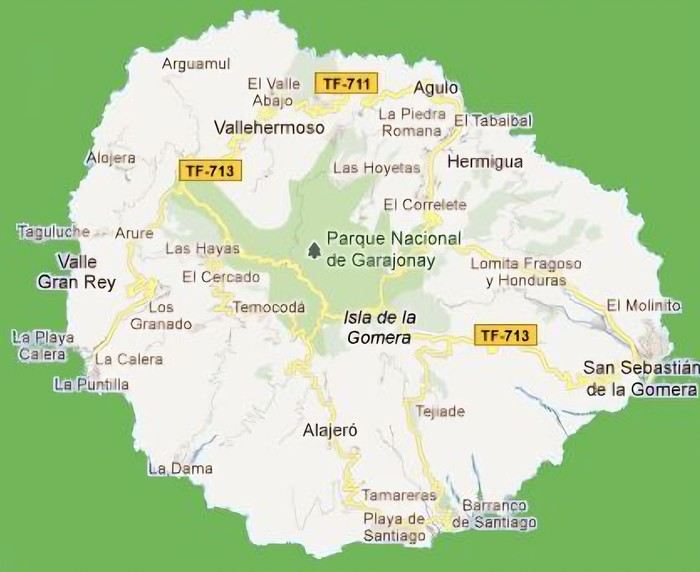 The large solidified magma massifs that shape the heart of the island have created a large depression more protected from the sun at its center, allowing the growth of a vast laurel forest, today grouped within the Garajonay National Park, La Gomera’s green lung, which has earned it the status of a World Biosphere Reserve. Its completely European appearance contrasts sharply with the rocky and tropical landscapes of the rest of the island. Thus, the climate varies greatly from one point to another on the island: in summer, you can quickly go from a dry and sunny valley at 35°C to a humid forest area at altitude at 18°C.
La Gomera was populated late. As with the rest of the Canaries, human presence is thought to have begun about 2,000 years ago. Groups of animist Berbers, probably fleeing persecution, gradually populated the archipelago, especially the western islands and La Gomera, becoming its small aboriginal population: the Guanches (or later Gomeros). The animist and pastoral civilization of the Guanches thrived until the Spanish takeover in the 15th century, which, after a short period of harmony and mixing with the indigenous people, suddenly ended in bloodshed... La Gomera later became the “Columbus Island” after Christopher Columbus’s stopover, increasing the blending of populations. In the 20th century, many Gomeros emigrated to Cuba and other Latin American countries in search of a better life, bringing back a mix of cultures and traits quite palpable in today’s Gomeran culture. It is, however, in La Gomera that the vestiges of Guanche culture seem to have left the most traces, in the language, gastronomy, social practices... Moreover, most Gomeros, especially in remote villages, have a particular identifiable type and proudly claim their ancestral roots, even making La Gomera a bit exotic in the eyes of other Canarians.
Perhaps that’s why it has never really wanted to develop its tourist infrastructure too much. If we set aside the tourists who visit for the day by bus or boat from Tenerife on a marked itinerary (and whom we ultimately rarely encounter), La Gomera has remained a hidden gem, a destination focused on nature discovery that attracts hikers, nature-loving divers, and scientists for its fauna and flora, and to a lesser extent, beachgoers who don’t seek overly developed coastlines. Tourist activity is therefore limited. Roughly speaking, you’ll find a majority of Spaniards, including a substantial number of residents from other Canary Islands, many Germans who have a particular fondness for La Gomera and spend long stays there or own second homes, to the point that the German cultural footprint is clearly noticeable in some places (it’s said to be Angela Merkel’s favorite holiday spot), and still quite a few French. The presence of other nationalities seemed negligible to us. Most travelers come mainly for hiking, but it’s also a prime spot for whale watching. Additionally, the seaside resorts of La Gomera—San Sebastián, Santiago, and especially Valle Gran Rey—are well-known destinations for hippies, especially German ones, ranging from chic boho hippies to old-school hippies who’ve been there for decades, quite similar to those you’d meet in India in Goa, Rishikesh, or Paharganj. Thus, practices like naturism, vegetarianism, and local organic production are quite well established in some areas.
Some practical info: - The round-trip flight from Paris to Tenerife cost us 365 € per person (outbound with Transavia, return with EasyJet), including checked luggage and three seats reserved side by side. - We chose two bases to explore the island: one week in Valle Gran Rey, reputed to be the most pleasant of the three seaside resorts, and one week in Hermigua, more mountainous and close to the natural park. We booked two houses with balconies and views: the first at 120 € per night, the second at 99 €. - The round-trip ferry between Tenerife and La Gomera cost us 270 € with the company Baleària Canarias, including discounts for children aged 4 and 12, but I don’t have the exact details. It was a bit cheaper than with the other company, Fred Olsen. - Finally, we rented a car through the agency Cicar for 360 € for 16 days, which comes to 22.50 € per day. - Apart from that, we didn’t plan anything and decided the day before or even the morning of what we wanted to do. We didn’t invest in any paper guide on the Canaries, as information on La Gomera was scarce, but we used the very comprehensive site La Gomera Travel, a travel guide published by the Canary Islands Tourism Council, a real goldmine of almost exhaustive information on the island.
Alright, off we go for 16 days of adventure discovering La Gomera!
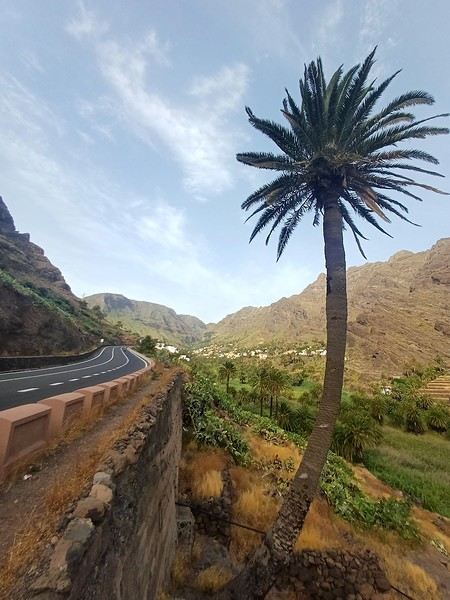
And we start the trip with music!
We start the trip with music!
When we started looking for a summer destination a few months ago, our first criterion was to avoid extreme heat and heatwaves. We had already been to Norway two years ago and are considering going back in the future for other occasions. So, we had some fun asking ChatGPT which destinations enjoyed a mild climate during the summer without going too far. Among the list provided by the AI were the Canary Islands... The idea of a place we wouldn’t have thought of first, both not too far away and exotic enough, appealed to us: “Hmm, why not?”
This destination had never really attracted me, though Magali was a bit more interested. Five years earlier, COVID had caused a short break in my professional activity, and I had planned a trip because the flight price was attractive, and I was looking for a destination different from what usually appeals to me, more than out of deep interest. From a distance and with a social judgment I acknowledge (it’s not great, but it’s not completely wrong), I had the image of a destination for party-goers enjoying the sun without the slightest interest in local culture, with concrete coastlines and denatured landscapes—everything I detest the most. Still, I had done some quick research on the different islands and spotted Lanzarote for its beautiful volcanic landscapes, hiking trails, beaches, and the impression of a good balance between activity and fewer crowds than Tenerife or Gran Canaria. Then I dropped the idea of going, without ever reconsidering traveling to the Canaries...
Until now! Because we started researching the different islands of the archipelago to see which ones might appeal to us the most. It was La Gomera, the third smallest island of the archipelago, more praised for its hiking trails and preserved nature than for its beaches, away from mass tourism (fifty times fewer tourists than Tenerife) but still a bit more developed than its wild neighbor El Hierro, that caught our attention. Contrary to what might be suggested later, I’m not at all addicted to AI, but I use it from time to time to synthesize quick research or simply for experimentation. Since ChatGPT had started anticipating my tastes lately as if it had become my buddy (often successfully, sometimes off the mark), I asked which Canary Island would suit me best for a trip with my family. The tool answered first with... La Gomera. So, I tested it and teased it a bit to see if this suggestion was well-founded, as the method sometimes makes it contradict itself. But no luck: “You’d appreciate the wild nature of El Hierro, but with family, you’ll find little activity for the kids. You won’t like the touristy vibe of the big islands like Tenerife, Gran Canaria, Lanzarote, and Fuerteventura. You could consider La Palma, but it’s really La Gomera that will suit you best, based on your interests and the criteria given.” So, we dug deeper into our research and were convinced without a shadow of a doubt that this island was the one waiting for us.
Without knowing it, we had Canarians in our circle who revealed their origins when they heard about our travel plans. One from Tenerife insisted we’d be better off choosing Tenerife (obviously...) because it also has preserved spots and that La Gomera, “you can explore it in two or three days, you’ll get bored quickly...” The other, a colleague from Gran Canaria who had never visited La Gomera, still recommended it without hesitation because it turned out her parents had just gone there on vacation: they loved it and had encountered few tourists. She also tended to think this destination was usually the subject of short stays, but according to what her parents told her, taking your time there was also a great idea. However, in our research, the idea that La Gomera is an island you can explore in three or four days max kept coming up. So, we considered combining its visit with La Palma or El Hierro, the other two that caught our eye. But hopping between islands by ferry represents a significant budget for non-Canarians, even more so for a family of four. Then, scrutinizing Google Maps, it seemed obvious that two weeks were too short to discover two islands as they deserve, and that there seemed to be plenty to see in La Gomera, given its very unique culture. After all, we read that some people spend several months a year there, others never even leave... Finally, these landscapes and this atmosphere, which seemed to us a mix of Europe, North Africa, and Latin America, tempted us. So, it would be two weeks in La Gomera, deal!
La Gomera is therefore the second... well, the third smallest island of the Canaries since La Graciosa was recently recognized as a fully inhabited island. It has the shape of a rough circle about 20 to 25 kilometers in diameter and has just over 20,000 inhabitants, half of them in its capital, San Sebastián de la Gomera, the only real town. Like its Canarian sisters, La Gomera is a volcanic formation that rose about 10 million years ago. The island is very mountainous and rugged, covered with red and black rocky landscapes. Geological activity has shaped, between the sprawling massifs that end in steep cliffs in the ocean, six coastal valleys with tropical vegetation that have favored human settlement. They divide the island like slices of a cake; from the north clockwise: the agricultural Vallehermoso, the rustic Agulo, the green, humid, and fertile Hermigua, the sunny capital San Sebastián de la Gomera, the southern and isolated Alajeró-Santiago, and the seaside Valle Gran Rey. They constitute the six municipalities (more like cantons to our French understanding) of the territory.
The large solidified magma massifs that shape the heart of the island have created a large depression more protected from the sun at its center, allowing the growth of a vast laurel forest, today grouped within the Garajonay National Park, La Gomera’s green lung, which has earned it the status of a World Biosphere Reserve. Its completely European appearance contrasts sharply with the rocky and tropical landscapes of the rest of the island. Thus, the climate varies greatly from one point to another on the island: in summer, you can quickly go from a dry and sunny valley at 35°C to a humid forest area at altitude at 18°C.La Gomera was populated late. As with the rest of the Canaries, human presence is thought to have begun about 2,000 years ago. Groups of animist Berbers, probably fleeing persecution, gradually populated the archipelago, especially the western islands and La Gomera, becoming its small aboriginal population: the Guanches (or later Gomeros). The animist and pastoral civilization of the Guanches thrived until the Spanish takeover in the 15th century, which, after a short period of harmony and mixing with the indigenous people, suddenly ended in bloodshed... La Gomera later became the “Columbus Island” after Christopher Columbus’s stopover, increasing the blending of populations. In the 20th century, many Gomeros emigrated to Cuba and other Latin American countries in search of a better life, bringing back a mix of cultures and traits quite palpable in today’s Gomeran culture. It is, however, in La Gomera that the vestiges of Guanche culture seem to have left the most traces, in the language, gastronomy, social practices... Moreover, most Gomeros, especially in remote villages, have a particular identifiable type and proudly claim their ancestral roots, even making La Gomera a bit exotic in the eyes of other Canarians.
Perhaps that’s why it has never really wanted to develop its tourist infrastructure too much. If we set aside the tourists who visit for the day by bus or boat from Tenerife on a marked itinerary (and whom we ultimately rarely encounter), La Gomera has remained a hidden gem, a destination focused on nature discovery that attracts hikers, nature-loving divers, and scientists for its fauna and flora, and to a lesser extent, beachgoers who don’t seek overly developed coastlines. Tourist activity is therefore limited. Roughly speaking, you’ll find a majority of Spaniards, including a substantial number of residents from other Canary Islands, many Germans who have a particular fondness for La Gomera and spend long stays there or own second homes, to the point that the German cultural footprint is clearly noticeable in some places (it’s said to be Angela Merkel’s favorite holiday spot), and still quite a few French. The presence of other nationalities seemed negligible to us. Most travelers come mainly for hiking, but it’s also a prime spot for whale watching. Additionally, the seaside resorts of La Gomera—San Sebastián, Santiago, and especially Valle Gran Rey—are well-known destinations for hippies, especially German ones, ranging from chic boho hippies to old-school hippies who’ve been there for decades, quite similar to those you’d meet in India in Goa, Rishikesh, or Paharganj. Thus, practices like naturism, vegetarianism, and local organic production are quite well established in some areas.
Some practical info: - The round-trip flight from Paris to Tenerife cost us 365 € per person (outbound with Transavia, return with EasyJet), including checked luggage and three seats reserved side by side. - We chose two bases to explore the island: one week in Valle Gran Rey, reputed to be the most pleasant of the three seaside resorts, and one week in Hermigua, more mountainous and close to the natural park. We booked two houses with balconies and views: the first at 120 € per night, the second at 99 €. - The round-trip ferry between Tenerife and La Gomera cost us 270 € with the company Baleària Canarias, including discounts for children aged 4 and 12, but I don’t have the exact details. It was a bit cheaper than with the other company, Fred Olsen. - Finally, we rented a car through the agency Cicar for 360 € for 16 days, which comes to 22.50 € per day. - Apart from that, we didn’t plan anything and decided the day before or even the morning of what we wanted to do. We didn’t invest in any paper guide on the Canaries, as information on La Gomera was scarce, but we used the very comprehensive site La Gomera Travel, a travel guide published by the Canary Islands Tourism Council, a real goldmine of almost exhaustive information on the island.
Alright, off we go for 16 days of adventure discovering La Gomera!
And we start the trip with music!
We start the trip with music!
Hello everyone,
I’m currently planning several trips to Morocco (Marrakech, Draa Valley, Merzouga) and I’m wondering about the reliability of data connections outside major urban centers.
Here’s what I’ve observed on the ground so far: - In cities (Marrakech, Agadir, Fez), 4G is excellent, including in the medina riads. - On the Tizi n'Tichka road and toward Ouarzazate, coverage remains decent, with a few dead spots here and there. - In Saharan areas (Merzouga, Chegaga), the connection becomes patchy: some camps get great reception, others none at all.
My specific questions: 1) On your recent trips, which operator (Maroc Telecom, inwi, Orange) gave you the best coverage in the Atlas and Sahara? 2) Have international eSIMs seemed as reliable as a local Moroccan SIM, or have you noticed a difference in speed in rural areas? 3) While trekking or driving a 4x4 in the desert, have you come across completely dead zones despite theoretical coverage?
I’m happy to share my own coverage notes if it helps, and I’ll gladly answer any questions about Morocco—I know it well.
Thanks in advance for your feedback!
Best regards, Dennis
I’m currently planning several trips to Morocco (Marrakech, Draa Valley, Merzouga) and I’m wondering about the reliability of data connections outside major urban centers.
Here’s what I’ve observed on the ground so far: - In cities (Marrakech, Agadir, Fez), 4G is excellent, including in the medina riads. - On the Tizi n'Tichka road and toward Ouarzazate, coverage remains decent, with a few dead spots here and there. - In Saharan areas (Merzouga, Chegaga), the connection becomes patchy: some camps get great reception, others none at all.
My specific questions: 1) On your recent trips, which operator (Maroc Telecom, inwi, Orange) gave you the best coverage in the Atlas and Sahara? 2) Have international eSIMs seemed as reliable as a local Moroccan SIM, or have you noticed a difference in speed in rural areas? 3) While trekking or driving a 4x4 in the desert, have you come across completely dead zones despite theoretical coverage?
I’m happy to share my own coverage notes if it helps, and I’ll gladly answer any questions about Morocco—I know it well.
Thanks in advance for your feedback!
Best regards, Dennis
Hi everyone,
I’m in the middle of planning a round-the-world 4x4 trip spread over 2 years, covering around 70 countries. Unfortunately, using a vehicle poses some challenges when it comes to moving between continents (e.g., the Bering Strait). After lots of research, consulting books, maps, and making countless phone calls, I still can’t figure out how to get from Russia to Alaska via the Bering Strait (access via the Road of Bones to Magadan and then continuing above Anadyr).
So, I’m open to any recommendations, tips, or contacts to find out if it’s possible by boat or any other means.
You can also reach me on FB: https://www.facebook.com/pages/Road-trip-42/702124999863774?ref=hl
Thanks for your replies!!
Roadtrip42 -> Traveling the world is possible!
I’m in the middle of planning a round-the-world 4x4 trip spread over 2 years, covering around 70 countries. Unfortunately, using a vehicle poses some challenges when it comes to moving between continents (e.g., the Bering Strait). After lots of research, consulting books, maps, and making countless phone calls, I still can’t figure out how to get from Russia to Alaska via the Bering Strait (access via the Road of Bones to Magadan and then continuing above Anadyr).
So, I’m open to any recommendations, tips, or contacts to find out if it’s possible by boat or any other means.
You can also reach me on FB: https://www.facebook.com/pages/Road-trip-42/702124999863774?ref=hl
Thanks for your replies!!
Roadtrip42 -> Traveling the world is possible!
I’m reporting to VF that my message count dropped from around 5,160 to 5,090 over the last three days.
Is there now an issue with the message count, an unintended disappearance, or some kind of pruning?
I’m asking because I haven’t received any info about this.
Is there now an issue with the message count, an unintended disappearance, or some kind of pruning?
I’m asking because I haven’t received any info about this.
Hi everyone!
If you're looking for great tips and offbeat spots, if you love exploring uncharted parts of a country, if the exotic is your adrenaline, then move along!
Our 15 days in early May in this part of Turkey (a country I first discovered during a city trip to Istanbul in 2017) will only tread well-worn paths and revisit popular routes. Simply because I kept hoping until the very end that our flight to Jordan wouldn’t be canceled. Events in the Gulf proved me wrong, so we left with: Zero preparation. Not a single hotel booked (well, except the first one), no visits planned, just a flight ticket bought three weeks earlier. No guidebook, no app—just the desire to explore southern Turkey and Cappadocia, whose images and the chance to stretch our legs had caught my eye.
Oh, wait—I did bring along a new guide: Gemini! Yes, my friends, generative AI was my chief advisor throughout the trip for sites to visit, accommodations, routes, and even restaurants! An experiment I wanted to try to form my own opinion on using this new technology. And what better way to test it than a Turkish getaway?
The verdict? You’ll have to wait for the trip recap to find out!
The main idea of the trip is also relaxation.
So, the plan is Antalya for a few days, the Turkish Riviera for a few more, Cappadocia as the highlight, and a return via Antalya to wrap up the trip. And it was all planned by AI!
So, if you're ready, fasten your seatbelts—cabin crew, doors to automatic and cross check—boarding for Turkey now!
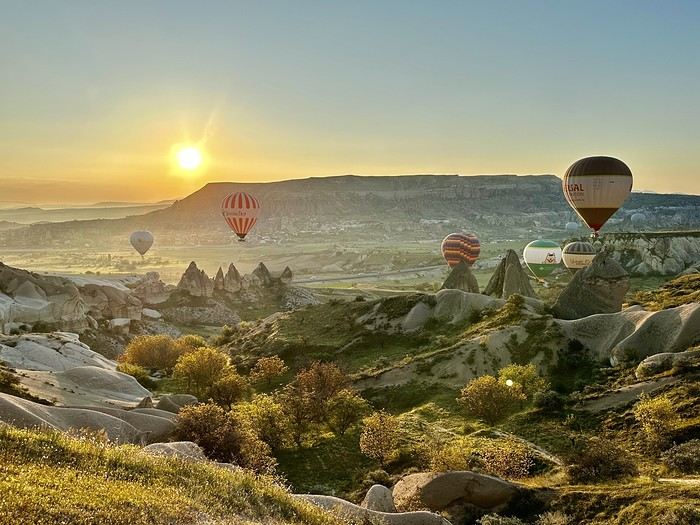 A little sneak peek?
If you're looking for great tips and offbeat spots, if you love exploring uncharted parts of a country, if the exotic is your adrenaline, then move along!
Our 15 days in early May in this part of Turkey (a country I first discovered during a city trip to Istanbul in 2017) will only tread well-worn paths and revisit popular routes. Simply because I kept hoping until the very end that our flight to Jordan wouldn’t be canceled. Events in the Gulf proved me wrong, so we left with: Zero preparation. Not a single hotel booked (well, except the first one), no visits planned, just a flight ticket bought three weeks earlier. No guidebook, no app—just the desire to explore southern Turkey and Cappadocia, whose images and the chance to stretch our legs had caught my eye.
Oh, wait—I did bring along a new guide: Gemini! Yes, my friends, generative AI was my chief advisor throughout the trip for sites to visit, accommodations, routes, and even restaurants! An experiment I wanted to try to form my own opinion on using this new technology. And what better way to test it than a Turkish getaway?
The verdict? You’ll have to wait for the trip recap to find out!
The main idea of the trip is also relaxation.
So, the plan is Antalya for a few days, the Turkish Riviera for a few more, Cappadocia as the highlight, and a return via Antalya to wrap up the trip. And it was all planned by AI!
So, if you're ready, fasten your seatbelts—cabin crew, doors to automatic and cross check—boarding for Turkey now!
A little sneak peek?Hi,
July 2026: I’m writing to you from Dali.
First, I got scammed on Booking—AI-retouched photos. No tourists at this hotel (Yishanju Designer Hotel), and the reality was horrible: dirty, with a disgusting breakfast. It’s better to use Trip.com here.
Next, the old town was an infernal cacophony, packed with tourists who shoved past without a care. Some vendors harassed you to buy things. All the stalls sold the same cheap plastic junk or other uninteresting stuff. The beautiful scenery was ruined by vendors lining 100% of the alleys. Impossible to walk, crushing heat, nothing good to eat except fresh fruit. Horrible experience.
Day 2: We went to Cangshan Mountain by cable car—the ride was short and nothing spectacular. We were at 2,600 m.
My plan was to see Erhai Lake. Unfortunately, I followed the advice of an AI chatbot: take the boat at Langkan Dock. The Didi dropped us off in the nearest area, which was full of charming little alleys but packed with Chinese tourists. The three-wheeled yellow cabs zoomed through the narrow streets, forcing you to hug the walls, on top of the scooters and other pedestrians to deal with. Crossing the neighborhood was hellish and suffocating. Once out, we hit the "corniche," which was also packed with Chinese tourists. The lake’s edge was all pebbles, and everyone was standing around taking photos. I was with my 5-year-old son. I would’ve liked to sit down and let him play with stones by the water, but it was clear we didn’t belong. They were even shoving each other for a shot! There were no boats in sight. In short, we’d had enough, and there was nothing interesting there either.
On the way back, we had to cross that maze again under the scorching sun. My son was braver than me—I even had a little dizzy spell from all the chaos. Add to that Dali’s altitude (2,200 m), so altitude insomnia, fatigue, and vulnerability during the day...
The restaurants weren’t inviting—the staff served sticky rice in a little bucket. The dishes were wrapped, and you had to figure it out yourself. After that, they ignored you completely, even if you were the only tourist.
On the 3rd day, it was time to leave for Shaxi. I hope to see beautiful villages. But honestly, I’m exhausted by this atmosphere where everything is complicated, communication is never smooth, noise is everywhere, and the behavior of some Chinese people is abusive...
Silver lining: not a drop of rain in 4 days and blue skies.
I couldn’t visit the villages in southern Yunnan because of rain and storms there... But I was expecting to see a few more tourists.
I couldn’t visit the villages in southern Yunnan because of rain and storms there... But I was expecting to see a few more tourists.
Hi there,
I’m reaching out with a question about which park to choose for a 3-day safari in Kenya.
After 20 days in Uganda, I’m meeting up with my dad for a 3-day safari (that works for him). We’ll be meeting in Nairobi and have a full day to travel to a park (preferably the farthest from Nairobi to avoid crowds?) and spend 4 nights there before heading back to the capital for our flight to France.
I’d love to hear your recommendations since I’ve read so many great tips on this forum.
Thanks,
David
I’m reaching out with a question about which park to choose for a 3-day safari in Kenya.
After 20 days in Uganda, I’m meeting up with my dad for a 3-day safari (that works for him). We’ll be meeting in Nairobi and have a full day to travel to a park (preferably the farthest from Nairobi to avoid crowds?) and spend 4 nights there before heading back to the capital for our flight to France.
I’d love to hear your recommendations since I’ve read so many great tips on this forum.
Thanks,
David
Hello,
We are two couples of friends aged between 65 and 70. Do you have a local agency or a local French-speaking driver-guide to recommend for a trip around Sri Lanka between February 14 and March 14, 2027? We’re open to any tips for our trip. The reviews and advice for agencies found on the forum are several years old. Thanks for your help.
hi
to recent travelers in South Africa,
I’ve heard there’s a document you need to present
when you arrive.
Can you help me out?
THANKS
Hello,
We’ve booked our flights to Tromsø from January 9th to 16th, 2027.
Now it’s time to plan our stay, and I’ll admit I’m feeling a bit unsure...
We definitely intend to rent a car, but what route should we take?
Should we book accommodation for the entire stay (7 nights) in Tromsø and do day trips (Sommarøy, Kvaløya, Lyngen, a day in Tromsø, a boat excursion, and then... what else?)? Or spend 3–4 days in Tromsø and hit the road for another 3–4 days somewhere else—but where?
I’d also considered splitting it: 3 days in Tromsø and 3 days in Målselv, so we could explore a different region by car and maybe try some downhill or cross-country skiing.
Is this area interesting beyond skiing?
During a recent trip to Lapland, we already tried dog sledding and snowmobiling, so we’re not planning to repeat those activities. Instead, we’d love to discover the landscapes and Sami culture.
I’d love to hear about your experiences or suggestions to help us plan our trip.
Thanks,
Recommended for you
 Turkey 2026: Riviera, Antalya, and Cappadocia
 Page by Page on the Assisi Way – 1,200 km on Foot
 How to nail your trek in wet climates: which pants keep you truly dry?
 Densha Otaku - Lesser-Known Regions
 Two weeks under the Puglia sun
 Back to Swedish Lapland: Trekking the Kungsleden and Crossing Sarek
 The Pearl of Africa - July-August 2026
 A little piece of Sulawesi with the family: Rantepao and Selayar