Introduction:
For years, I’ve heard about Costa Rica, which seems like a country "made for me"—nature, not cities.
I almost went in 2019, but a family issue made me cancel.
Initially, I wanted to spend at least three weeks there, planning to go in our summer despite it being the rainy season. Then I realized what I wanted to do could fit into two weeks, so I ended up going in February.
Plus, January’s weather was so awful that some sunshine should do me good.
I found a flight at a decent price, but with two downsides.
The first is that it leaves from Paris CDG, and the second is that it’s with Air France—a airline I’d sworn off after my misadventures with them back in 2008. We’ll see how it goes!
Travel journals
Carnets de voyage, descriptions de souvenirs mémorables, reportages, comptes rendus de voyages, etc.
Showing 61–90 of 5,481 discussions.
Many threads here are in French, the community’s main language. English translations are added over time.
Okay, Palermo—we know it. We go there to marvel at the architectural wonders born from the Arab-Norman-Byzantine-Gothic mix. And rightly so. We also go to treat our taste buds to all kinds of delights, both savory and sweet. Again, rightly so. We go to succumb to the charms of Palermo’s women, their sun-kissed skin glowing with golden highlights. Still, rightly so. And all while fantasizing about a mafia we’ll never actually see. Anyway.
But you’ll also find street art everywhere, even in the historic center. Sometimes, you just need to step a few meters away from the main tourist highways like Cassaro, Via Maqueda, or the main arteries of the Ballarò, Capo, or Vucciria markets to stumble upon some amazing murals. Duck into one or two slightly grimy alleys, weaving past trash and crumbling walls, and you’ll find real gems.
For example, just 50 meters south of the main artery of the Mercato del Capo, there’s a great spot with dozens of murals in a tiny neighborhood of run-down mini-houses. You’ll find plenty more south of the Mercato di Ballarò, in the Albergheria (the grittier side, not the one near Cassaro). There’s some in Ballarò itself too, but it’s hard to spot when the market’s in full swing with stalls everywhere. La Kalsa isn’t left out either, nor is Vucciria—just step away from the restaurant-packed streets.
Here are a few examples that really caught my eye.
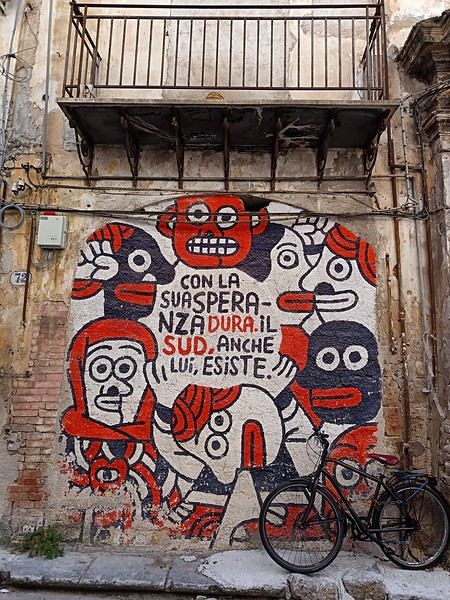
(In the heart of Albergheria, on a street every visitor walks down—lovely message from an unidentified artist)
But you’ll also find street art everywhere, even in the historic center. Sometimes, you just need to step a few meters away from the main tourist highways like Cassaro, Via Maqueda, or the main arteries of the Ballarò, Capo, or Vucciria markets to stumble upon some amazing murals. Duck into one or two slightly grimy alleys, weaving past trash and crumbling walls, and you’ll find real gems.
For example, just 50 meters south of the main artery of the Mercato del Capo, there’s a great spot with dozens of murals in a tiny neighborhood of run-down mini-houses. You’ll find plenty more south of the Mercato di Ballarò, in the Albergheria (the grittier side, not the one near Cassaro). There’s some in Ballarò itself too, but it’s hard to spot when the market’s in full swing with stalls everywhere. La Kalsa isn’t left out either, nor is Vucciria—just step away from the restaurant-packed streets.
Here are a few examples that really caught my eye.
(In the heart of Albergheria, on a street every visitor walks down—lovely message from an unidentified artist)Arrival at Chetumal Airport - Car rental
- 3 days in BACALAR: Magnificent lagoon. The edges of the lagoon are private (so paid access!). From the road, you can't see the lagoon. You have to take one of the many unpaved trails and walk about 2 km. You get a beautiful view of the lagoon from the Bacalar fort, a charming little lively town.
Los Rapidos: A really beautiful spot (paid entry, of course!). It's definitely worth spending a few hours there. You just let yourself drift gently with the current in turquoise, warm water. Hard to find—it's very poorly signposted.
Cenote Azul: Very close to Los Rapidos. It's a round lake with deep blue water. Nothing extraordinary. We have the same in Auvergne! A little restaurant by the edge is nice.
Cocalitos: Beautiful viewpoint over the lagoon and the submerged cenote. Developed shoreline (large field to lay your towel, hammocks, bar).
Mayan ruins ICHTIKAL, recently discovered. Recent developments, and one of the few places still free (parking is paid). A lovely walk in the woods, but as everywhere in this region, there are very few animals!
1 night in Pisté to visit Chichen Itza at the first light. Hire a French-speaking guide and go at opening time to enjoy the site before the tourist buses arrive. It's an exceptional place! At the end of the visit, check out the Sacred Cenote. It's inside the site at the end of a small path lined with souvenir vendors. Just to see—no swimming.
Cenote TSUKAN: A recently discovered cenote, so still not very crowded (12 km from Pisté). Very peaceful environment. Swimming (water max. 22°C). Life jacket mandatory. Good restaurant.
2 days in Coba - Visit to the Coba ruins. Very busy site. Paid parking + tax for the Mayans + site entry.
Punta Laguna: A 3-hour walk in the woods with a guide. We saw just one pair of howler monkeys high up in a tree, 25 m away! As I mentioned earlier, we saw few animals and birds in this region (except for iguanas, which are everywhere). I imagined trekking through the jungle surrounded by monkeys and toucans—nope, no jungle, just undergrowth, and no toucans (they come in July during the rainy season, apparently!).
4 days on the island of COZUMEL: Car ferry taken from Calica (Punta Venado). Bookings on the Ultramar or Transcaribe websites.
Sargassum invasion on the beaches (same, if not worse, in Tulum and Playa del Carmen, according to tourists we met). All beaches are private. Access to Beach Clubs is expensive. You have to book entry to Playa Palancar if you want to be sure to get a spot (it was full for us!). The El Cielo beach to see the starfish is only accessible by boat! Near El Cielo, many stingrays swim in the shallow waters of El Cielito. That's where all the boats stop, and we enjoyed ceviche with water up to our knees and rays looking for food! Poor rays!!!
Bonjour à tous,
Profitant du calme de ces jours que nous impose ce Covid-19, je me suis dit qu'il était temps de vous faire partager mon expérience au Costa Rica. Une fois de plus, j'ai trouvé beaucoup de renseignements sur ce forum, donc si je peux aider à mon tour c'est avec plaisir!
Voici déjà quelques informations générales : - Séjour de 2 semaines en 4x4 pendant la saison sèche, du 27/01 au 10/02 - Nous sommes 2 voyageurs de 27 ans, sans enfant Et voilà les étapes du voyage : Jour 1 : Arrivée à San José Jour 2 : San José - Tortuguero Jour 3 : Tortuguero Jour 4 : Tortuguero - Arenal Jour 5 : Arenal Jour 6 : Arenal - Tenorio Jour 7 : Tenorio - Monteverde Jour 8 : Monteverde - Quepos Jour 9 : Quepos Jour 10 : Quepos - Uvita Jour 11 : Uvita - Sierpe - Bahia Drake Jour 12 & 13 : Bahia Drake Jour 14 : Bahia Drake - San José Jour 15 : Vol retour pour la Suisse...
Bien sûr nous avons dû faire des choix, impossible de tout voir en 2 semaines mais franchement, nous sommes très très contents du parcours. Nous avons pu voir encore plus de choses que nous le pensions!
Alors, prêt 😉? C'est parti!
JOUR 1 - arrivée à San José
Après un vol Zürich-Francfort-San José qui s'est bien déroulé, nous voici enfin, après des mois de préparation et d'impatience, à San José 😎!! Comme nous avons réservé pour le lendemain un 4x4 avec l'agence ToutCostaRica, nous irons dormir pour cette nuit dans un de leur hôtel, le Melrost. Un de leur agent est là pour nous récupérer à la sortie et nous amène à l'hôtel, très proche de l'aéroport. Nous sommes en début de soirée, il fait déjà nuit donc pas d'exploration de la ville ce soir. On s'autorise une première bière locale sur la terrasse, aux bruits des oiseaux, et allons directement dormir.
Hotel Melrost : Petit bâtiment tout simple, mais bien pratique pour faire juste une nuit à San José (enfin, Alajuela) avant de repartir. Chambre très bien et le petit-déj est excellent!

JOUR 2 - Départ pour Tortuguero
Ce matin, nous avions rendez-vous à l'hôtel avec ToutCostaRica, chez qui nous avons loué un 4x4. Un briefing est organisé par petit groupe pour tous les locataires de voiture afin de discuter de nos circuits, des bons plans, du pays et autres astuces. Nous avons trouvé ça intéressant, mais très long! Il y aurait moyen de faire plus court, parce que nous rappeler de mettre de la crème solaire au soleil et de ne pas laisser de valeurs en vue dans la voiture, il me semble que ça parait logique... Du coup, au bout d'un moment on le remercie pour tous ses conseils, et partons avec notre Toyota Rav4 flambant neuf! Toute la location s'est très bien passée avec TCR, c'était parfait. Après avoir quitté les embouteillages de San José, nous voici sur de jolies petites routes plus ou moins en bon état jusqu'à La Pavona. Là, nous laissons notre voiture sur le parking surveillé et avons partons directement en bateau (départ de 15h00) pour rejoindre Tortuguero, sur la côte Caraïbe. Rien que la traversée en bateau nous émerveille. Nous avons déjà la chance de voir un basilique émeraude, des iguanes et une multitude d'oiseaux. Après 40 minutes, nous débarquons directement sur le ponton de notre hôtel, le Casa Marbella. Après avoir posé nos affaires dans la chambre, on part directement explorer ce village via sa seule rue traversante. Animé, coloré et chaud! Comme nous n'avons rien prévu de plus aujourd'hui, on retourne sur la terrasse de l'hôtel boire un jus face aux canaux. Ensuite, petit souper et au lit pour être en forme demain matin!
Casa Marbella : Très sympa, ponton/terrasse bien pratique pour arriver et repartir directement par bateau. Petit-déjeuner absolument délicieux! Chambre bien, clim ne fonctionnait pas par contre.


A bientôt pour la suite!
Profitant du calme de ces jours que nous impose ce Covid-19, je me suis dit qu'il était temps de vous faire partager mon expérience au Costa Rica. Une fois de plus, j'ai trouvé beaucoup de renseignements sur ce forum, donc si je peux aider à mon tour c'est avec plaisir!
Voici déjà quelques informations générales : - Séjour de 2 semaines en 4x4 pendant la saison sèche, du 27/01 au 10/02 - Nous sommes 2 voyageurs de 27 ans, sans enfant Et voilà les étapes du voyage : Jour 1 : Arrivée à San José Jour 2 : San José - Tortuguero Jour 3 : Tortuguero Jour 4 : Tortuguero - Arenal Jour 5 : Arenal Jour 6 : Arenal - Tenorio Jour 7 : Tenorio - Monteverde Jour 8 : Monteverde - Quepos Jour 9 : Quepos Jour 10 : Quepos - Uvita Jour 11 : Uvita - Sierpe - Bahia Drake Jour 12 & 13 : Bahia Drake Jour 14 : Bahia Drake - San José Jour 15 : Vol retour pour la Suisse...
Bien sûr nous avons dû faire des choix, impossible de tout voir en 2 semaines mais franchement, nous sommes très très contents du parcours. Nous avons pu voir encore plus de choses que nous le pensions!
Alors, prêt 😉? C'est parti!
JOUR 1 - arrivée à San José
Après un vol Zürich-Francfort-San José qui s'est bien déroulé, nous voici enfin, après des mois de préparation et d'impatience, à San José 😎!! Comme nous avons réservé pour le lendemain un 4x4 avec l'agence ToutCostaRica, nous irons dormir pour cette nuit dans un de leur hôtel, le Melrost. Un de leur agent est là pour nous récupérer à la sortie et nous amène à l'hôtel, très proche de l'aéroport. Nous sommes en début de soirée, il fait déjà nuit donc pas d'exploration de la ville ce soir. On s'autorise une première bière locale sur la terrasse, aux bruits des oiseaux, et allons directement dormir.
Hotel Melrost : Petit bâtiment tout simple, mais bien pratique pour faire juste une nuit à San José (enfin, Alajuela) avant de repartir. Chambre très bien et le petit-déj est excellent!

JOUR 2 - Départ pour Tortuguero
Ce matin, nous avions rendez-vous à l'hôtel avec ToutCostaRica, chez qui nous avons loué un 4x4. Un briefing est organisé par petit groupe pour tous les locataires de voiture afin de discuter de nos circuits, des bons plans, du pays et autres astuces. Nous avons trouvé ça intéressant, mais très long! Il y aurait moyen de faire plus court, parce que nous rappeler de mettre de la crème solaire au soleil et de ne pas laisser de valeurs en vue dans la voiture, il me semble que ça parait logique... Du coup, au bout d'un moment on le remercie pour tous ses conseils, et partons avec notre Toyota Rav4 flambant neuf! Toute la location s'est très bien passée avec TCR, c'était parfait. Après avoir quitté les embouteillages de San José, nous voici sur de jolies petites routes plus ou moins en bon état jusqu'à La Pavona. Là, nous laissons notre voiture sur le parking surveillé et avons partons directement en bateau (départ de 15h00) pour rejoindre Tortuguero, sur la côte Caraïbe. Rien que la traversée en bateau nous émerveille. Nous avons déjà la chance de voir un basilique émeraude, des iguanes et une multitude d'oiseaux. Après 40 minutes, nous débarquons directement sur le ponton de notre hôtel, le Casa Marbella. Après avoir posé nos affaires dans la chambre, on part directement explorer ce village via sa seule rue traversante. Animé, coloré et chaud! Comme nous n'avons rien prévu de plus aujourd'hui, on retourne sur la terrasse de l'hôtel boire un jus face aux canaux. Ensuite, petit souper et au lit pour être en forme demain matin!
Casa Marbella : Très sympa, ponton/terrasse bien pratique pour arriver et repartir directement par bateau. Petit-déjeuner absolument délicieux! Chambre bien, clim ne fonctionnait pas par contre.


A bientôt pour la suite!
...
" We’re ALL different, and so are our expectations when it comes to travel or leisure ". There are—without a doubt—as many ways to experience a trip as there are travelers!! For the two of us, it’s only our love of wild nature that guides us to East Africa. The stated goal of this trip was purely wildlife-focused, and NOT about discovering the country or its people.
...
Hello everyone,
Previously, I shared the account of a trip/safari in southern Tanzania in June 2024, in the Mikumi and Selous reserves.
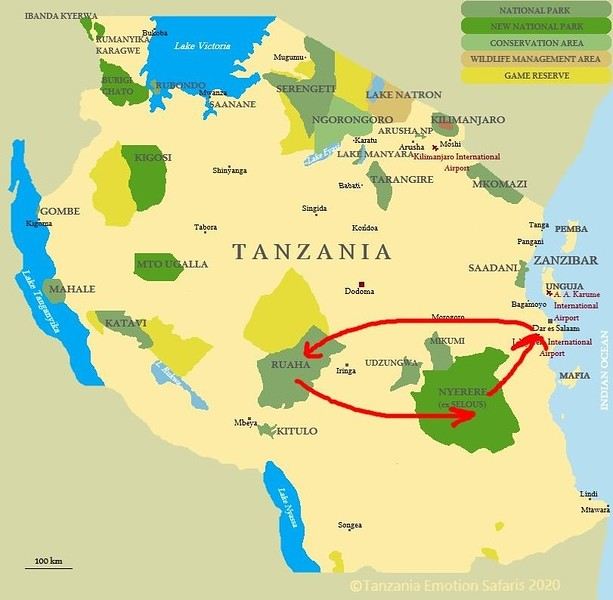
This time, still in southern Tanzania, I invite you to join us in Ruaha National Park. (Then, depending on the number of images allowed in my quota, at the end of my story, we’ll return to Selous for the second part of the same trip.)
- This trip/safari took place in November 2022. - Our flight started in Marseille, heading to Addis Ababa, then Dar es Salaam (via Ethiopian Airlines). In Dar, we spent one night at a hotel near the airfield.
-1- During the layover in Addis Ababa. The Airbus A-350 in the early morning mist.

Reminder: Click on each image to enlarge it, if needed. .
From Dar es Salaam, if you want to go by road to Ruaha, it’ll take a very long and tiring day. 🤪
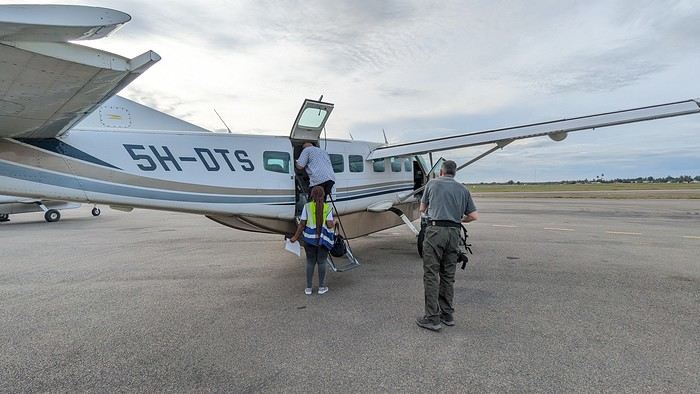
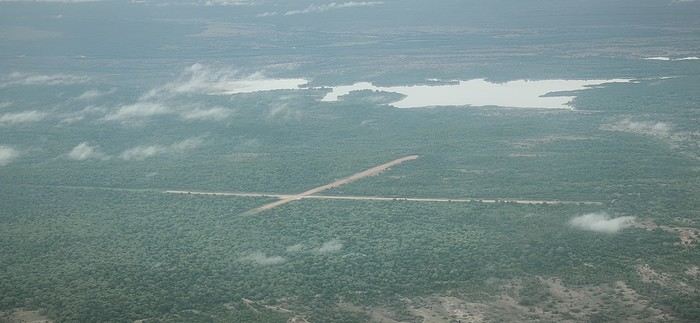
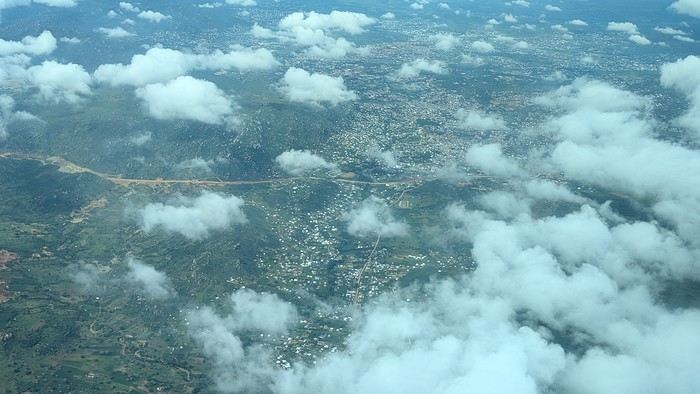
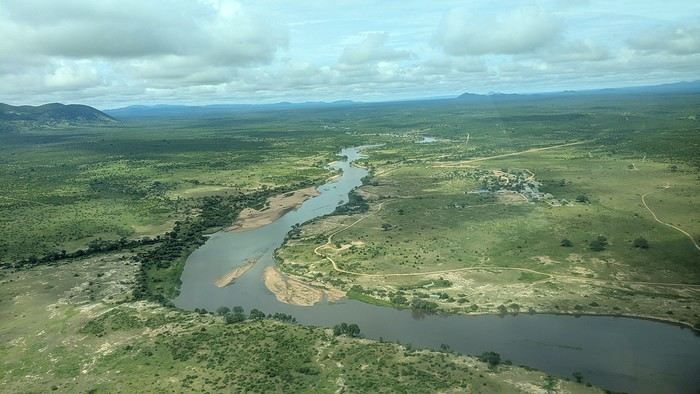
On previous trips, we’ve always taken a bush plane for this route. In this case, it took just over an hour and a half, with two short intermediate stops to drop off passengers at other bush airstrips.
Since I’m also passionate about aviation, I love these flights where you can admire the landscapes from low altitude while sitting right behind the pilot 🙂.
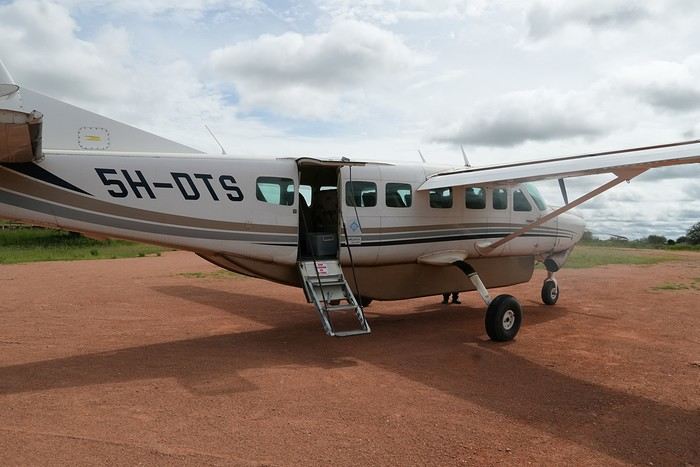
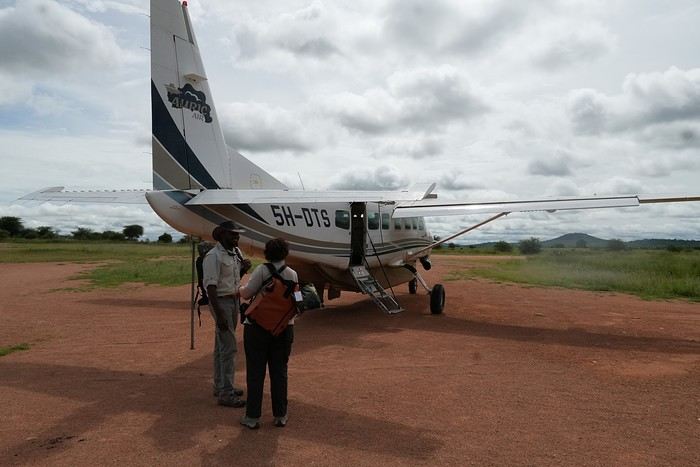
-2- These routes mainly use Cessna 208 Caravans.

At the Msembe airstrip, we’re greeted around 1:30 PM by a guide and a driver from our chosen lodge. They brought a picnic basket, which we enjoy at a nearby picnic area. We’re by the Ruaha River, completely dry—it’s scorching hot.
-3- The first mammals we encounter are a pair of female impalas, accompanied by a young male.

Reminder: Click on the image to view it in larger size. 😉
-4- To save the hippopotamus populations from certain death, rangers had to dig holes in the sand with bulldozers. Fortunately, water is present beneath the sand layer.

-5- This crocodile doesn’t seem to have been accepted as a swimming neighbor by the hippos...

We’ll explore along the river for 2-3 hours before crossing it at a ford toward the southern part of the reserve.
-6- The typical landscape of Ruaha, with its many baobabs.

-7- My buddy the R.L.B. is also here to welcome me.... 🙂 🙂

-8- As well as this little bee-eater... 😎

-9- ...which reminds us of the origin of its name...!

-10- Above a rare waterhole, a fish eagle keeps watch for fish...

...
*** Please wait until the end of the story for any questions or to share your own experiences in Ruaha. (Or via PM.) Thanks in advance for keeping this account smooth and enjoyable. 😉
...
*** I’m not an ornithologist, but birds are an important and unavoidable part of safari discoveries. You’ll find quite a few in the images of my story. 😎
...
" We’re ALL different, and so are our expectations when it comes to travel or leisure ". There are—without a doubt—as many ways to experience a trip as there are travelers!! For the two of us, it’s only our love of wild nature that guides us to East Africa. The stated goal of this trip was purely wildlife-focused, and NOT about discovering the country or its people.
...
Hello everyone,
Previously, I shared the account of a trip/safari in southern Tanzania in June 2024, in the Mikumi and Selous reserves.
This time, still in southern Tanzania, I invite you to join us in Ruaha National Park. (Then, depending on the number of images allowed in my quota, at the end of my story, we’ll return to Selous for the second part of the same trip.)
- This trip/safari took place in November 2022. - Our flight started in Marseille, heading to Addis Ababa, then Dar es Salaam (via Ethiopian Airlines). In Dar, we spent one night at a hotel near the airfield.
-1- During the layover in Addis Ababa. The Airbus A-350 in the early morning mist.

Reminder: Click on each image to enlarge it, if needed. .
From Dar es Salaam, if you want to go by road to Ruaha, it’ll take a very long and tiring day. 🤪
On previous trips, we’ve always taken a bush plane for this route. In this case, it took just over an hour and a half, with two short intermediate stops to drop off passengers at other bush airstrips.
Since I’m also passionate about aviation, I love these flights where you can admire the landscapes from low altitude while sitting right behind the pilot 🙂.
-2- These routes mainly use Cessna 208 Caravans.

At the Msembe airstrip, we’re greeted around 1:30 PM by a guide and a driver from our chosen lodge. They brought a picnic basket, which we enjoy at a nearby picnic area. We’re by the Ruaha River, completely dry—it’s scorching hot.
-3- The first mammals we encounter are a pair of female impalas, accompanied by a young male.

Reminder: Click on the image to view it in larger size. 😉
-4- To save the hippopotamus populations from certain death, rangers had to dig holes in the sand with bulldozers. Fortunately, water is present beneath the sand layer.

-5- This crocodile doesn’t seem to have been accepted as a swimming neighbor by the hippos...

We’ll explore along the river for 2-3 hours before crossing it at a ford toward the southern part of the reserve.
-6- The typical landscape of Ruaha, with its many baobabs.

-7- My buddy the R.L.B. is also here to welcome me.... 🙂 🙂

-8- As well as this little bee-eater... 😎

-9- ...which reminds us of the origin of its name...!

-10- Above a rare waterhole, a fish eagle keeps watch for fish...

...
*** Please wait until the end of the story for any questions or to share your own experiences in Ruaha. (Or via PM.) Thanks in advance for keeping this account smooth and enjoyable. 😉
...
*** I’m not an ornithologist, but birds are an important and unavoidable part of safari discoveries. You’ll find quite a few in the images of my story. 😎
...
It's been 39 years since we last came back to Andalusia...
For this last week of March, we waited until the end of the "votes" in France to go soak up some sun in southern Spain. And spring is the ideal season.
Our itinerary was a very (very) classic loop: Seville / Granada / Ronda and the white villages / Seville (with the start of Holy Week as a bonus gift!).
We flew from Lyon with Transavia (no issues) and landed in Seville on Monday. We rented a car (Goldcar), drove for 3 hours, and there we were in Granada, charmed by its ZTL (limited traffic zone) that Waze made us discover in detail (a nightmare!). Our hotel: Hotel Monjas del Carmen (perfectly located and with parking).
The weather was overcast, but a little stroll through the Albaicín district was a must. In the evening, we had dinner at "Restaurant Arabe Ambar" to get into the Nasrid atmosphere—we recommend it!


For this last week of March, we waited until the end of the "votes" in France to go soak up some sun in southern Spain. And spring is the ideal season.
Our itinerary was a very (very) classic loop: Seville / Granada / Ronda and the white villages / Seville (with the start of Holy Week as a bonus gift!).
We flew from Lyon with Transavia (no issues) and landed in Seville on Monday. We rented a car (Goldcar), drove for 3 hours, and there we were in Granada, charmed by its ZTL (limited traffic zone) that Waze made us discover in detail (a nightmare!). Our hotel: Hotel Monjas del Carmen (perfectly located and with parking).
The weather was overcast, but a little stroll through the Albaicín district was a must. In the evening, we had dinner at "Restaurant Arabe Ambar" to get into the Nasrid atmosphere—we recommend it!


D'un lagon à l'autre ou d'une île à l'autre … De Blue Bay au Morne Brabant ou encore de l'île aux Aigrettes à l'île aux Bénitiers.
Dans ce récit de voyage je vous propose une balade dans le sud de l'île Maurice, une région sans doute moins connue que celles des rivages très fréquentés des stations balnéaires, pourtant, c'est une Maurice dépaysante, authentique et charmante qui se dévoile aux voyageurs tout au long de cet itinéraire.

Blue Bay, en voilà un nom de lieu qui d'emblée annonce la couleur … évidemment, le bleu est la teinte dominante de ce lagon. Ici, on ajouterait volontiers un « s » de pluriel au mot bleu, tellement les nuances bleutées de cette baie sont nombreuses et variées. Du bleu turquoise matinal du fond du lagon où se mire la mangrove des berges au bleu clair translucide de la mi-journée, le plus admirable, lorsque le soleil est au zénith. Mais il y a aussi le bleu marine de la fin d'après-midi alors que les derniers rayons du soleil apportent quelques touches dorées aux vaguelettes.


Quel bonheur d'admirer ce paysage avec toutes ces tonalités, elles varient selon l'inclinaison du soleil, la présence ou non de nuages ou encore selon les fonds sous-marins (sable clair ou coraux). Comment pourrait-on se lasser de telles visions dignes du Paradis ! Plantons un peu plus le décor. Ce lagon est un des plus vastes de l'île Maurice et par chance ses rivages restent préservés. Il n'y a aucune construction disgracieuse sur ses berges, seulement quelques pavillons d'un luxueux hôtel mais ils sont en parti masqués par des filaos (une variété de pins des tropiques) et quelques cocotiers. Et en face, c'est le discret village et la plage de Blue Bay.

Pour le reste, la nature est reine ici avec une alternance de végétation verdoyante (palmiers, filaos et mangrove) et de plages de sable clair ponctuées de rochers noirs. L'entrée du lagon est protégée par une barrière de corail sur laquelle viennent déferler les vagues de l'Océan indien formant ainsi un ourlet d'écume qui surligne l'horizon. Et puis, comme si ce décor n'était déjà pas suffisamment idyllique, il y a aussi une île posée sur ces eaux d'un bleu incroyablement esthétique : l'île des Deux Cocos, c'est son nom, est un havre tropical privé avec une seule construction. Une maison à la surprenante architecture de style mauresque, elle peut se louer à un prix que je n'ose imaginer … alors contentons nous seulement d'admirer ce paysage de rêve.

Même si les eaux du lagon sont d'une transparence étonnante, pour observer les poissons tropicaux et les coraux, il faut se balader soit en bateau à fond de verre (la vision est un peu floue et déformée) ou bien, et c'est bien mieux, nager avec masque et tuba, là, on évolue au milieu d'un véritable aquarium …. sans aucune paroi. L'émerveillement est garanti ! J'avoue qu'au cours de ma (trop courte) séance de snorkeling, je n'ai pas vu la totalité des espèces de poissons de ce lagon, loin s'en faut, on en dénombre paraît-il plus de 72 !


Mais j'ai remarqué et admiré quelques scalaires aux élégantes nageoires, des poissons perroquets avec leurs couleurs chatoyantes et leurs écaillent scintillantes et surtout des bancs de poissons zébrés, les fameux sergents majors. Ces deux mauriciens que l'on aperçoit de dos les jambes dans l'eau, ont une autre façon de s'intéresser aux poissons de la baie, eux, c'est avec lignes et hameçons qu'ils les taquinent.


L'exploration du lagon peut être agréablement complétée par une balade en kayak. En quelques coups de pagaies, je me trouve presque au milieu de la baie et là, le temps d'une pause, mon regard hésite entre l'observation du paysage alentour (toujours superbe) et la vue des fonds sous-marins à travers des eaux cristallines à souhait. Tiens ! voici quelques poissons qui furtivement apparaissent à proximité de mon kayak …. avant de filer se cacher dans les anfractuosités des coraux. Un peu plus loin, parvenu près des berges du lagon, je longe maintenant la mangrove et ses amas de tiges imbriquées, encore un autre aspect des lieux intéressants à découvrir.

Un lagon si riche en observations et en émotions esthétiques vous fait vite penser que vous êtes parvenu ici aux portes du paradis. Alors que mes pensées s'évadent au gré de mes coups de rame, le silence environnant du si paisible lagon se voit déchiré par un bruit qui progressivement monte en puissance … un avion de ligne survole les lieux avant d'atterrir sur une piste de l'aéroport de l'île, il est situé à proximité du lagon. Bon, il faut bien reconnaître que c'est vraiment le seul détail de cet environnement qui vous ramène à la réalité, le paradis peut-il véritablement exister sur notre terre ? On doit tout de même ajouter qu'heureusement les atterrissages et décollages ne sont finalement pas trop fréquents !

Le crépuscule arrive vite dans les régions subtropicales, c'est à présent l'heure bleue sur le lagon bleu. De l'île des Deux Cocos parviennent quelques notes de musique, rythmées et accompagnées de lumières colorées, la soirée sera festive jusque tard dans la nuit …

…………………………………………………………………………………………………………………………………
Après le lagon et ses bains de mer place au bain de foule, nous sommes maintenant en ville. Principale cité du sud avec ses 16000 habitants, Mahébourg est même la seconde agglomération de Maurice, son ambiance est loin de ressembler à l'agitation (et aux embouteillages) de la capitale Port-Louis. Ici, pas de grands immeubles mais des résidences, des maisons, des cases et des boutiques qui fleurent bon une cité provinciale à l'atmosphère paisible des tropiques.

La foule, on la rencontrera un peu plus tard au marché central. Nous sommes lundi matin et c'est jour d'affluence mais la matinée débute et certaines allées du marché couvert restent encore clairsemées.

Sous ces bâches colorées, les étals croulent sous des monticules de légumes et de fruits. Ici des tomates en vrac, là des pyramides d'aubergines ... Plus loin ce sont des étalages de fruits : pastèques, ananas, bananes et aussi de litchis, les premiers de la saison me dit une marchande. C'est bien appétissant tout ça ! On continue la visite en se faufilant entre les porteurs de cageots, les vendeurs et les ménagères très affairées à tâter, à soupeser et à comparer les différents fruits et légumes … avant enfin, d'acheter leurs provisions. Les paniers se remplissent alors que les conversations vont bon train dans une ambiance décontractée mais quelque peu bruyante.

Presque à l'extérieur, sont alignés les stands des spécialités indo-mauriciennes. Ici, ça hume la friture bien huileuse. Dans les présentoirs sont empilés en nombre des samoussa et des dholl puri, ces fameuses galettes préparées avec de la farine de lentilles et fourrées de légumes cuisinés. Il y a aussi quelques beignets d'aubergines … Voilà que la vue de toutes ces spécialités locales me donnent l'envie d'y goûter même si tout cela semble un peu (enfin, très !) gras. Faisons donc nos emplettes, ce sera pour le pique-nique de la mi-journée. En revanche, je préfère m'abstenir de gâteaux-piments, pourtant la vendeuse m'en propose avec gentillesse mais je redoute ce « piquant » local auquel mes papilles ne sont pas habituées !

Quittons le marché et empruntons, au hasard, une rue qui est particulièrement encombrée et très passante, elle donne encore sur un autre marché couvert, celui des vêtements. Là on trouve parmi les stands une profusion d'étoffes et de saris colorés mais aussi des tee-shirts, des jeans et des casquettes …

Près du cours d'eau le Chaux, juste avant le pont qui mène à un quartier populaire en périphérie, on trouve l'ancien lavoir. Il semble faire partie du patrimoine et du passé car les bassins sont complètement à sec et le lieu est désert, il n'y a aucune personne en train de frotter, taper ou essorer le linge. Soit, le lundi n'est pas ici jour de lessive ; soit, c'est la conséquence de l'utilisation des machines à laver le linge qui ont désormais remplacé les lavandières ?
Une importante communauté d'origine indienne vit à Mahébourg, elle a bien sûr ses lieux de culte à l'image de ce temple hindou situé à l'entrée de la ville, couleurs et divinités le décorent.

--
Suite du récit, message suivant : la Fête hindoue de Divali, l'île aux Aigrettes, les falaises rocheuses du Sud ...

Blue Bay, en voilà un nom de lieu qui d'emblée annonce la couleur … évidemment, le bleu est la teinte dominante de ce lagon. Ici, on ajouterait volontiers un « s » de pluriel au mot bleu, tellement les nuances bleutées de cette baie sont nombreuses et variées. Du bleu turquoise matinal du fond du lagon où se mire la mangrove des berges au bleu clair translucide de la mi-journée, le plus admirable, lorsque le soleil est au zénith. Mais il y a aussi le bleu marine de la fin d'après-midi alors que les derniers rayons du soleil apportent quelques touches dorées aux vaguelettes.


Quel bonheur d'admirer ce paysage avec toutes ces tonalités, elles varient selon l'inclinaison du soleil, la présence ou non de nuages ou encore selon les fonds sous-marins (sable clair ou coraux). Comment pourrait-on se lasser de telles visions dignes du Paradis ! Plantons un peu plus le décor. Ce lagon est un des plus vastes de l'île Maurice et par chance ses rivages restent préservés. Il n'y a aucune construction disgracieuse sur ses berges, seulement quelques pavillons d'un luxueux hôtel mais ils sont en parti masqués par des filaos (une variété de pins des tropiques) et quelques cocotiers. Et en face, c'est le discret village et la plage de Blue Bay.

Pour le reste, la nature est reine ici avec une alternance de végétation verdoyante (palmiers, filaos et mangrove) et de plages de sable clair ponctuées de rochers noirs. L'entrée du lagon est protégée par une barrière de corail sur laquelle viennent déferler les vagues de l'Océan indien formant ainsi un ourlet d'écume qui surligne l'horizon. Et puis, comme si ce décor n'était déjà pas suffisamment idyllique, il y a aussi une île posée sur ces eaux d'un bleu incroyablement esthétique : l'île des Deux Cocos, c'est son nom, est un havre tropical privé avec une seule construction. Une maison à la surprenante architecture de style mauresque, elle peut se louer à un prix que je n'ose imaginer … alors contentons nous seulement d'admirer ce paysage de rêve.

Même si les eaux du lagon sont d'une transparence étonnante, pour observer les poissons tropicaux et les coraux, il faut se balader soit en bateau à fond de verre (la vision est un peu floue et déformée) ou bien, et c'est bien mieux, nager avec masque et tuba, là, on évolue au milieu d'un véritable aquarium …. sans aucune paroi. L'émerveillement est garanti ! J'avoue qu'au cours de ma (trop courte) séance de snorkeling, je n'ai pas vu la totalité des espèces de poissons de ce lagon, loin s'en faut, on en dénombre paraît-il plus de 72 !


Mais j'ai remarqué et admiré quelques scalaires aux élégantes nageoires, des poissons perroquets avec leurs couleurs chatoyantes et leurs écaillent scintillantes et surtout des bancs de poissons zébrés, les fameux sergents majors. Ces deux mauriciens que l'on aperçoit de dos les jambes dans l'eau, ont une autre façon de s'intéresser aux poissons de la baie, eux, c'est avec lignes et hameçons qu'ils les taquinent.


L'exploration du lagon peut être agréablement complétée par une balade en kayak. En quelques coups de pagaies, je me trouve presque au milieu de la baie et là, le temps d'une pause, mon regard hésite entre l'observation du paysage alentour (toujours superbe) et la vue des fonds sous-marins à travers des eaux cristallines à souhait. Tiens ! voici quelques poissons qui furtivement apparaissent à proximité de mon kayak …. avant de filer se cacher dans les anfractuosités des coraux. Un peu plus loin, parvenu près des berges du lagon, je longe maintenant la mangrove et ses amas de tiges imbriquées, encore un autre aspect des lieux intéressants à découvrir.

Un lagon si riche en observations et en émotions esthétiques vous fait vite penser que vous êtes parvenu ici aux portes du paradis. Alors que mes pensées s'évadent au gré de mes coups de rame, le silence environnant du si paisible lagon se voit déchiré par un bruit qui progressivement monte en puissance … un avion de ligne survole les lieux avant d'atterrir sur une piste de l'aéroport de l'île, il est situé à proximité du lagon. Bon, il faut bien reconnaître que c'est vraiment le seul détail de cet environnement qui vous ramène à la réalité, le paradis peut-il véritablement exister sur notre terre ? On doit tout de même ajouter qu'heureusement les atterrissages et décollages ne sont finalement pas trop fréquents !

Le crépuscule arrive vite dans les régions subtropicales, c'est à présent l'heure bleue sur le lagon bleu. De l'île des Deux Cocos parviennent quelques notes de musique, rythmées et accompagnées de lumières colorées, la soirée sera festive jusque tard dans la nuit …

…………………………………………………………………………………………………………………………………
Après le lagon et ses bains de mer place au bain de foule, nous sommes maintenant en ville. Principale cité du sud avec ses 16000 habitants, Mahébourg est même la seconde agglomération de Maurice, son ambiance est loin de ressembler à l'agitation (et aux embouteillages) de la capitale Port-Louis. Ici, pas de grands immeubles mais des résidences, des maisons, des cases et des boutiques qui fleurent bon une cité provinciale à l'atmosphère paisible des tropiques.

La foule, on la rencontrera un peu plus tard au marché central. Nous sommes lundi matin et c'est jour d'affluence mais la matinée débute et certaines allées du marché couvert restent encore clairsemées.

Sous ces bâches colorées, les étals croulent sous des monticules de légumes et de fruits. Ici des tomates en vrac, là des pyramides d'aubergines ... Plus loin ce sont des étalages de fruits : pastèques, ananas, bananes et aussi de litchis, les premiers de la saison me dit une marchande. C'est bien appétissant tout ça ! On continue la visite en se faufilant entre les porteurs de cageots, les vendeurs et les ménagères très affairées à tâter, à soupeser et à comparer les différents fruits et légumes … avant enfin, d'acheter leurs provisions. Les paniers se remplissent alors que les conversations vont bon train dans une ambiance décontractée mais quelque peu bruyante.

Presque à l'extérieur, sont alignés les stands des spécialités indo-mauriciennes. Ici, ça hume la friture bien huileuse. Dans les présentoirs sont empilés en nombre des samoussa et des dholl puri, ces fameuses galettes préparées avec de la farine de lentilles et fourrées de légumes cuisinés. Il y a aussi quelques beignets d'aubergines … Voilà que la vue de toutes ces spécialités locales me donnent l'envie d'y goûter même si tout cela semble un peu (enfin, très !) gras. Faisons donc nos emplettes, ce sera pour le pique-nique de la mi-journée. En revanche, je préfère m'abstenir de gâteaux-piments, pourtant la vendeuse m'en propose avec gentillesse mais je redoute ce « piquant » local auquel mes papilles ne sont pas habituées !

Quittons le marché et empruntons, au hasard, une rue qui est particulièrement encombrée et très passante, elle donne encore sur un autre marché couvert, celui des vêtements. Là on trouve parmi les stands une profusion d'étoffes et de saris colorés mais aussi des tee-shirts, des jeans et des casquettes …

Près du cours d'eau le Chaux, juste avant le pont qui mène à un quartier populaire en périphérie, on trouve l'ancien lavoir. Il semble faire partie du patrimoine et du passé car les bassins sont complètement à sec et le lieu est désert, il n'y a aucune personne en train de frotter, taper ou essorer le linge. Soit, le lundi n'est pas ici jour de lessive ; soit, c'est la conséquence de l'utilisation des machines à laver le linge qui ont désormais remplacé les lavandières ?
Une importante communauté d'origine indienne vit à Mahébourg, elle a bien sûr ses lieux de culte à l'image de ce temple hindou situé à l'entrée de la ville, couleurs et divinités le décorent.

--
Suite du récit, message suivant : la Fête hindoue de Divali, l'île aux Aigrettes, les falaises rocheuses du Sud ...
Hello,
After several years, I’ve finally decided to repost a travel journal on the forum. We returned a few weeks ago from an incredible trip to Kenya, and it’s reignited my desire to share our emotions in the face of these animals.
Kenya wasn’t originally a priority for us in terms of safari—we had the impression it was too touristy. So, we started with other destinations: Namibia, Tanzania, Botswana, and South Africa. But as I did more research, especially on the forum (thanks in part to Sylvie’s many trips), I eventually convinced myself that Kenya could be magnificent, as long as we chose our itinerary carefully and avoided peak seasons.
We ended up going in January, from the 17th to the 31st. We worked with a travel agency (TP) that crafted a custom itinerary for us: Samburu-Ol Pejeta-Naivasha-Maji Moto-Maasai Mara-Diani. They partnered with a local French-speaking agency, and everything was perfectly organized. Our trip exceeded all our expectations, and none of it would’ve been as amazing without our guide, Alfred. He accompanied us for 10 days and was a fantastic travel companion—professional, respectful of the animals, and always in good spirits. We formed a great bond with him in such a short time.
- **January 17th** After meeting up with Juliette and Charlotte in Rennes the night before, we left at 4 AM for Roissy Charles de Gaulle Airport. The thick fog made the drive pretty rough, but we arrived safely around 7:45 AM. A Blue Valet driver was waiting to take our car. Check-in went smoothly, and we waited patiently for our 10:40 AM flight. Unfortunately, despite boarding on time, a passenger was missing, and we had to find a replacement last minute. Then, another passenger who had checked in and dropped off their luggage wasn’t on the plane, so they had to unload their bags. After a long period of uncertainty and spotty communication from the crew, we finally took off over an hour late.
We arrived in Nairobi in the late afternoon, 45 minutes behind schedule. The administrative formalities were endless—it took nearly 1.5 hours from landing to leaving the airport with our luggage. When we stepped out, Alfred, our guide, was waiting with a big smile and drove us to the Eka Hotel, not far from the airport. Exhausted from the long journey, we fell asleep quickly.
- **January 18th** Alfred met us at 7 AM for a long drive to Samburu Reserve. We had a peaceful night, unlike the girls, who barely slept because their neighbors were talking loudly all night. Things even escalated when Charlotte started shouting insults to get them to quiet down, but it didn’t work.
It was Sunday, so traffic around Nairobi and along the route was light. Aside from a quick "technical stop," we drove straight through and arrived in Samburu after just under 6 hours. Because of the lower altitude (around 1,000m on average), it was hot—over 30°C in mid-January.
As soon as we entered the reserve, we spotted some impalas and quickly came across one of the region’s endemic species: the reticulated giraffe, which is absolutely stunning.

While heading to our camp for lunch, Alfred crossed paths with another vehicle and learned that a leopard was nearby. We started searching, and a few minutes later, Anny spotted a shape in a tree—it was our leopard!


There were actually two of them—a mother and her adolescent. The young one was perched high in the tree, in the shade. We got to observe them for a good half-hour in excellent conditions, with just one other vehicle nearby.


Alfred also noticed that the mother had hidden prey (a gerenuk gazelle) in the vegetation, away from prying eyes.
It was time to head to our camp, the Ashnil Samburu Camp, located in the Buffalo Springs area, by the river, in an idyllic setting surrounded by the region’s typical vegetation.


The welcome was fantastic—we immediately felt at home, and that feeling lasted throughout our 3-day stay in the reserve. It was 2 PM, but no one rushed us to the table. Our waitress, Sheila, who took care of us the whole time, was as lovely as the rest of the team. Barely seated, we were invited to watch an elephant passing right by the camp, in front of the restaurant. This trip was off to a great start!
After lunch, we relaxed by the pool. Monkeys, especially vervets, were everywhere, and a camp employee was assigned to keep an eye on them and shoo them away if needed (especially the baboons).
A little before 4 PM, we met up with Alfred for our first game drive. Just outside the camp, a few elephants were in the valley near the river.


We’d see them in the same area almost every day. We also spotted some gazelles.

After several years, I’ve finally decided to repost a travel journal on the forum. We returned a few weeks ago from an incredible trip to Kenya, and it’s reignited my desire to share our emotions in the face of these animals.
Kenya wasn’t originally a priority for us in terms of safari—we had the impression it was too touristy. So, we started with other destinations: Namibia, Tanzania, Botswana, and South Africa. But as I did more research, especially on the forum (thanks in part to Sylvie’s many trips), I eventually convinced myself that Kenya could be magnificent, as long as we chose our itinerary carefully and avoided peak seasons.
We ended up going in January, from the 17th to the 31st. We worked with a travel agency (TP) that crafted a custom itinerary for us: Samburu-Ol Pejeta-Naivasha-Maji Moto-Maasai Mara-Diani. They partnered with a local French-speaking agency, and everything was perfectly organized. Our trip exceeded all our expectations, and none of it would’ve been as amazing without our guide, Alfred. He accompanied us for 10 days and was a fantastic travel companion—professional, respectful of the animals, and always in good spirits. We formed a great bond with him in such a short time.
- **January 17th** After meeting up with Juliette and Charlotte in Rennes the night before, we left at 4 AM for Roissy Charles de Gaulle Airport. The thick fog made the drive pretty rough, but we arrived safely around 7:45 AM. A Blue Valet driver was waiting to take our car. Check-in went smoothly, and we waited patiently for our 10:40 AM flight. Unfortunately, despite boarding on time, a passenger was missing, and we had to find a replacement last minute. Then, another passenger who had checked in and dropped off their luggage wasn’t on the plane, so they had to unload their bags. After a long period of uncertainty and spotty communication from the crew, we finally took off over an hour late.
We arrived in Nairobi in the late afternoon, 45 minutes behind schedule. The administrative formalities were endless—it took nearly 1.5 hours from landing to leaving the airport with our luggage. When we stepped out, Alfred, our guide, was waiting with a big smile and drove us to the Eka Hotel, not far from the airport. Exhausted from the long journey, we fell asleep quickly.
- **January 18th** Alfred met us at 7 AM for a long drive to Samburu Reserve. We had a peaceful night, unlike the girls, who barely slept because their neighbors were talking loudly all night. Things even escalated when Charlotte started shouting insults to get them to quiet down, but it didn’t work.
It was Sunday, so traffic around Nairobi and along the route was light. Aside from a quick "technical stop," we drove straight through and arrived in Samburu after just under 6 hours. Because of the lower altitude (around 1,000m on average), it was hot—over 30°C in mid-January.
As soon as we entered the reserve, we spotted some impalas and quickly came across one of the region’s endemic species: the reticulated giraffe, which is absolutely stunning.

While heading to our camp for lunch, Alfred crossed paths with another vehicle and learned that a leopard was nearby. We started searching, and a few minutes later, Anny spotted a shape in a tree—it was our leopard!


There were actually two of them—a mother and her adolescent. The young one was perched high in the tree, in the shade. We got to observe them for a good half-hour in excellent conditions, with just one other vehicle nearby.


Alfred also noticed that the mother had hidden prey (a gerenuk gazelle) in the vegetation, away from prying eyes.
It was time to head to our camp, the Ashnil Samburu Camp, located in the Buffalo Springs area, by the river, in an idyllic setting surrounded by the region’s typical vegetation.


The welcome was fantastic—we immediately felt at home, and that feeling lasted throughout our 3-day stay in the reserve. It was 2 PM, but no one rushed us to the table. Our waitress, Sheila, who took care of us the whole time, was as lovely as the rest of the team. Barely seated, we were invited to watch an elephant passing right by the camp, in front of the restaurant. This trip was off to a great start!
After lunch, we relaxed by the pool. Monkeys, especially vervets, were everywhere, and a camp employee was assigned to keep an eye on them and shoo them away if needed (especially the baboons).
A little before 4 PM, we met up with Alfred for our first game drive. Just outside the camp, a few elephants were in the valley near the river.


We’d see them in the same area almost every day. We also spotted some gazelles.

We’ve read it all about Bali: mass tourism, non-stop parties, ferry disasters, the kingdom of “Instagrammers,” pollution, “Bali belly”... But luckily, this island isn’t just about Kuta’s beaches and the Lempuyang Temple.
Sure, it’s not as exotic or off-the-beaten-path as other Indonesian islands (the Moluccas, Timor, Flores...), but we spent 3 weeks there and loved it!
Our (planned) itinerary in 7 stops: - Ubud (4 nights) - Sidemen (2 nights) - Gili Meno (3 nights) - Amed (2 nights) - Pemuteran (4 nights) - Munduk (2 nights) - Jatiluwih (2 nights)

We booked our accommodations in advance, and for the rest (drivers, activities...), we took it day by day with help from the homestays (making sure to contact them a few days ahead via WhatsApp).
In the end, it’s an “easy” destination, very affordable, and one that’s managed to keep a certain authenticity.

Sure, it’s not as exotic or off-the-beaten-path as other Indonesian islands (the Moluccas, Timor, Flores...), but we spent 3 weeks there and loved it!
Our (planned) itinerary in 7 stops: - Ubud (4 nights) - Sidemen (2 nights) - Gili Meno (3 nights) - Amed (2 nights) - Pemuteran (4 nights) - Munduk (2 nights) - Jatiluwih (2 nights)

We booked our accommodations in advance, and for the rest (drivers, activities...), we took it day by day with help from the homestays (making sure to contact them a few days ahead via WhatsApp).
In the end, it’s an “easy” destination, very affordable, and one that’s managed to keep a certain authenticity.

Lombok, Indonésie : un paradis oublié ?
Nous rentrons de 3 semaines (hé oui, seulement…) à Lombok, une île voisine et à quelques miles de Bali. Comme je n’ai trouvé que très peu d’information avant de partir hormis sur les Gili et le Rinjani en « organisé » j’ai essayé de rassembler qqs informations qui pourraient êtres utiles à un « Voyage Forumiste » désireux d’y promener son sac. Rien d’exhaustif donc, mais peut être qqs bon plans… Pour ceux qui voudrait prendre un Lonely Planet « Bali & Lombok », il faut savoir que les prix sont faux (compter + 30% notamment suite à l’augmentation du prix de l’essence), que de nombreuses infos ne sont pas à jour (en fait la dernière version doit au moins dater de 2 ans, voire 3 ans) et que les vrais bon plan n’y sont pas… Bref, inutile de charger votre sac (on avait déjà 17kg de bagage à 2, on s’embourgeoise…), une bonne carte sera bien plus utile.
Climat : nous sommes parti fin Août-mi Septembre, le climat est donc idéal dans cette région (idéal de Juin à Septembre), il fait bon, pas trop chaud, un petit vent souffle et tient la Bintang au frai le soir, pure bonheur !
Y aller : le moins couteux et de prendre un vol pour Kuala Lumpur (Malaysia Airlines) puis changer d’aéroport (rejoindre le LCC terminal coûte 1, 5 Rhinggit en bus) et prendre un vol Air Asia pour Bali (acheté au préalable sur Internet). Une fois à Bali, pour rejoindre Lombok : soit un nouvel avion -compter environ 30E- un petit Fokker à hélice (l’héritage des hollandais surement…) ; soit en bateau mais comme il faut rejoindre Pagangbay dans l’Est de Bali pour prendre le ferry on « perd » (notion très relative en voyage me direz vous) pas mal de temps (compter au moins 6 heures en tout) pour économiser qqs euros. Comme on est déjà en milieu d’après-midi et que l’on ne veut pas passer une nuit à Bali on opte pour le « Tuk Tuk à hélices » 😉. C’est la première fois qu’on me fait monter sur la balance avec mon sac avant de me faire monter dans un avion !!! Je sais que j’ai grossi ces derniers temps mais quand même… 😮
Arrivé en fin de journée à Mataram, Lombok, on décide de parer au plus presser et de trouver un lit pas trop loin. Direction donc Senggigi « la » station balnéaire de Lombok. On échoue dans la première GH « Lina Cottages », 75, 000R la nuit. Epuisé, on attque notre première destination : direct au pays des songes …. Je me réveille vers minuit, j’ai l’impression d’entendre Massimo !!??!! J’ai pourtant pas abusé de la Bintang, le décalage horaire donne t-il des hallucinations 🤪? Non j’entends bien Massimo chanter à tue-tête ! Au bout de qqs secondes « lost in translation » je comprends que le Marina, bar branché de Senggigi, a –comme tous les soir- un groupe qui joue live et que ces cons là reprennent ce standard de la grande musique française (sic) que vous avez surement malheureusement entendu un jour. Venir si loin pour s’entendre hurler dans les oreilles « Massiiiimooooo, Masssiimmoooo, Massiiimmooomooooo… » comme si on était au camping de la plage de Juan les pins : y a des quoi en déprimer plus d’un ! Bref, on met les voiles asap. Juste le temps de découvrir Senggigi, ses 4 ou 5 bars, ses 10 restaux, 3 ou 4 hôtels de luxe, on est encore très loin de Kuta Bali mais c’est pas notre tasse de thé quand même. On réalise assez vite qu’il n’y a que très peu de transports organisés (mis à part qqs liaisons bus de la Perama quasiment toutes avec passage obligatoire par Senggigi) à Lombok, et pour ne pas passer nos 3 semaines dans des Bemos on opte rapidement pour la location de voiture (trop vieux pour la moto à deux, on l’avait pourtant fait à Bali… D’ailleurs bien nous en à pris, les routes sont vraiment trop pourries à Lombok pour la moto). Senggigi est un des rares endroit de l’île ou l’on peut louer une voiture ainsi que retirer de l’argent liquide. Après une négo très ardue j’obtiens le Suzuki Katana à 120, 000R / j (au lieu de 200, 000R affiché partout), je suis un peu frustré, je trouve ça cher. Un local en vacance à Lombok (il vit en Australie depuis longtemps) me dira plus tard que lui même n’a pas réussir à obtenir ce tarif, que les prix on bcp augmentés avec l’augmentation du pétrole (de 2, 500R le litre il y à 2 ans à 5, 000R aujourd’hui).
Bref, on laisse Massimo à son succès interplanétaire et on met le cap plein Sud. Je suis curieux de voir si l’on peut loger sur une petite île de la péninsule du sud-ouest de Lombok. Après 60km et 1h30 nous arrivons à Taun où l’on trouve un « Cap’tain » prêt à nous emmener sur Gili Nanggu, il semble y avoir une GH sur l’île. Encore une nego vraiment ardue on obtient 150, 000R pour l’aller et retour 2 jours plus tard (un guide qui emmène des touristes sur l’île à la journée me dira plus tard sur l’île qu’il paye lui 185, 000RA/R le même jour). L’île fait à peine quelques centaines de mètres de diamètre et la seule GH « Gili Nanggu Cottages » (165, 000R la nuit) de l’île nous propose un sympathique bungalow d’architecture typique de Lombok. Impossible de négocier, on est de toute façon coincé sur l’île ! Vers le milieu d’après midi, les visiteurs à la journée (souvent depuis Senggigi) quittent l’île. On doit être une dizaine à y dormir. Le sable est blanc, l’eau transparente est peuplée de poissons, les couchés de soleil remarquables…mais les coraux sont assez abimés…
Nous décidons ensuite de filer plein Sud vers Kuta Lombok. La route la plus directe qui passe par Sepi est en « petit » sur la carte…mmmm… le Lonely Planet -c’est bien la seule fois où il nous sera « utile » (sic)- fait un avertissement spécial pour dire que de nombreux lecteurs se sont fait agresser dans le coin. Voulant éclaircir ce mystère pour mes collègues de Voyage Forum, nous nous y engouffrons tout droit ! La route est effectivement défoncées de chez défoncées, dans le genre –si l’on omet les ravines creusées par la pluie- un nid de poule au mètre carré ce qui n’est pas peut dire ! Je cherche le goudron pour poser mes roues ! Après 80km, 3 heures de tappe-cul et de magnifiques paysages sur la campagne aride du sud de Lombok ainsi que des baies turquoises et désertes, nous arrivons à Kuta Lombok. Sur la route, en guise d’agression et de voleurs, nous n’avons croisé que des enfants sur le chemin de l’école, de magnifiques sourires aux lèvres et nous lançant de joyeux « hellloooo ». Il faut dire que nous n’avons pas croisé une seule autre voiture durant tout le trajet.
Kuta est très loin de son homonyme Balinaise. Elle s’étend sur à peine quelques centaines de mètres au bord d’une très belle baie de sable rond (oui, rond. Il roule sous les pieds). Une dizaine de restaus (déserts) et autant de GH (5% d’occupation m’a t-on dit, on n’a croisé qu’une dizaine d’occidentaux en 3jours). Aucune GH ne donne sur la plage mais toutes sont de l’autre côté de la route sur un jardin intérieur. Un peu dommage. Par contre la baie est très belle et qqs familles de pêcheurs vivent dans des huttes vraiment sommaires sur la plage. On décide de pousser jusqu’au Novotel histoire de faire le tour du coin. La végétation luxuriante contraste avec l’aridité des alentours, 2 piscines…autant d’eau pure dépensée et le drapeau « Accor » finissent de me donner envie de retourner vers les cabanes de pêcheurs… Finalement, on trouve une GH sur la plage à l’extrémité Est de la baie de Kuta juste avant de filer vers le Novotel, le « Lombok Baru ». C’est la seule sur la plage. Bungalow nickel face à la mer pour 105, 000R la nuit. La famille d’origine Chinoise qui tient le lieu m’explique que cela ne fait que 3 ans qu’ils ont ouvert et qu’ils se développent doucement quand ils ont un peu d’argent. Un nouveau bungalow et d’ailleurs en construction et le « jardin » encore en devenir….
La baie Tajung Aan quelques km à l’Est de celle de Kuta est magnifique, immense, sable blanc, absolument personne hormis quelques vendeurs de sarong un peu collant…. La baie vaut vraiment le coup d’œil (à défaut du coup de soleil). Un vieux monsieur édenté essayera même de nous vendre une noix de coco en imaginant une chanson (improvisée totalement, suite à ma copine qui chantait pour ne pas les entendre ;-)) avec ses 3 mots de broken English « Coconut mist’errrr…. mister coconuttttee… If no coconut, no monyyyy… Coconut mister…etc » qu’il nous chantera pendant au moins 10 minutes ! Un instant rare, une belle rencontre… La chanson ne nous quittera pas du voyage, aujourd’hui encore je me la chante pour ne pas trop déprimer d’être rentré… Un soir, un serveur Balinais exilé à Lombok depuis 7 ans nous donnera bcp d’info sur le coin, la culture, les gens. Il nous parlera de ce problème de sécurité à Kuta. C’est vrai, il y a de fréquents vols, argent, voiture…etc Pour lui s’est la faute au manque d’éducation de nombreux habitants du coin, qui ne voient pas plus loin que le bout de leur nez et que les touristes risquent de ne plus revenir (c’est d’ailleurs assez désert Kuta). Après y a voir passer qqs jours, on sent bien qu’il ne faut pas tenter le diable et exposer argent, bijoux au milieu de cette pauvreté du sud de Lombok. De là à en faire un coupe-gorge il y a un pas ! Cela ne m’empêchera pas d’y retourner en tous les cas !
Nous mettons ensuite cap vers l’Est, le Nord-Est même. Ça m’intrigue, il y a des petites îles sur ma carte et je n’ai trouvé absolument personne qui avait été dans ce coin pour me renseigner. On file donc vers Labu Pandan (115km, 3 heures - j’ai un peu fait fumer le Katana…). Ce qui semblait être un petit village est en fait une GH toute seule et quelques bateaux de pêche sur la plage. La GH « Pondok Gili Lampu » vend aussi des produits de base aux locaux ainsi qu’un vieux restau basic avec 5 ou 6 bungalow au confort sommaire (60, 000R la nuit), une belle plage de sable noir déserte. Ils nous proposent d’aller faire du snorkeling sur Gili Lampu ainsi que d’y camper (organisé par la GH). Mais aucune infrastructure, ni eau sur l’île. Le vent qui souffle assez fort nous invitera à rester sur la plage, la visibilité pour le snorkeling et le sable dans le duvet ne nous motivant pas plus que ça... Le patron des lieux, Yanto, ne parle pas un mot d’Anglais mais est un homme absolument adorable. Encore une rencontre du cœur qui fait tellement de bien. La vie est douce, on se laisse aller au rythme du farniente du bout du monde…
On file ensuite vers Sembalun Lawang, le point de départ le moins fréquenté pour le trek du Rinjani (la plupart partent de Senaru). La route par le sud se passe sans problème, on franchi un col a 1700m, la seule personne que l’on croise est un vendeur de glaces ambulant qui nous double avec sa moto dans la montée, il doit avoir le feu aux fesses, pour un vendeur de glaces c’est un comble ! Après 65km et 1h15 de virages nous arrivons à Sembalun Lawang et garons notre fidèle Katana à la GH « Sembalun Nauli » qui se compose de 4 bungalow indépendants (90, 000R la nuit), au milieu de nul-part. Il n’y a rien autour, devant nous se dresse le Rinjani, notre objectif des 3 jours à venir. La GH se charge de nous trouver le matos (sac de couchage, tente), d’embaucher deux porteur et acheter la nourriture. J’obtiens le prix de 1, 400, 000 R pour 2 personnes et 3 jours. En faisant cela soit même je pense que l’on peut tirer 1, 000, 000 ou 1, 200, 000 mais nous n’avons croisé tellement personne à SL (pas un restaurant, même le Rinjani Trekking Center est fermé (le monsieur faisait la sieste soit disant…) que j’ai pas envie de me prendre plus la tête que ça. On est bien loin des 170 USD / personne annoncés à Senggigi !
Les 3 jours de trekk au Rinjani sont une expérience unique et pas uniquement pour le paysage mais aussi pour le « partage » (relatif j’en convient) avec les porteurs : Mister Adi (qui parlote Anglais) et Mister An (qui ne parle que Sasak et Indo). Le premier jour on relie Sembalun au camp de base. 1700m de dénivelé sous le soleil, 6 bonnes heures de marche sans compter les pauses. Mon sac à dos commun, qui doit faire ses 10kg pèse lourd dans la montée. On profite des pauses pour boire, nos porteurs pour fumer !! Je ne sais pas comment ils font ! Le lendemain départ 2h30 du matin pour atteindre le sommet (1500m de dénivelé) à 6h pour le levé de soleil. Les 300 derniers mètres sont terribles, une pente à 35/40°, toute droite, dans du sable avec des petites pierres… Ceux qui disent avancer d’un mètre et reculer de 50cm n’ont pas bien vu la pente ! Les pas font plutôt 20cm max pour reculer de…parfois 20 cm… dure dure… Mais on arrive quand même au sommet (3726m tout de même) ce qui n’est pas le cas de tout le monde… Avis aux amateurs, mieux vaut être bien en forme et surtout avoir le moral ! Plus beau que le levé de soleil, le couché de la lune, quasiment pleine et rousse, vers 4h du matin, était splendide ! Question vertige, c’est vrai que l’on marche sur une espèce d’arrête, mais même pour moi qui n’aime pas trop le vide, ça a été. Retour au camp de base, Mister An nous a préparé de bonnes banana pancakes, un rituel ici paraît-il, un régal pour nous ! Puis descente vers le lac Segara Anak au milieu du cratère, c’est raide et avec nos poteaux téléphoniques à la place des jambes ça n’est pas une mince affaire : « adeng adeng mister An !!! ». Nos profitons des sources d’eau chaude (40° !) et je me baigne même dans le lac lui même, l’eau doit être à 20°, elle est d’une pureté incroyable, je suis seul face au Gunung Baru le cône volcanique actif : inoubliable ! Le 3eme jour, on remonte pour sortir du cratère puis 2000m de dénivelé négatif vers Senaru où des Ojek (moto taxi) nous attendent pour repartir vers Sembalun afin de retrouver notre voiture toujours au Sembalun Nauli. Puis route vers Senggigi (2h, au taquet) où cette fois nous dormirons au Dharmarie (150, 000R au lieu de 300, 000R), chambre nickel, belle salle de bain, bcp moins bruyant que le Lina ! On rend notre Susuki Katana avec 3 jours de retard (j’ai cru qu’ils allaient faire une syncope, ils nous on cherché partout et sont même aller jusqu’à Kuta !), bref, je paye 2 jours de plus sur le 3 et nous filons prendre le bateau de la Perama qui rejoint directement Gili Air depuis Senggigi (70, 000R / personne).
Nous avons choisi Gili Air suite aux différents posts que j’ai pu lire sur Voyage Forum (merci ;-)). On se retrouve je ne sais comment avec un ami français au Hotel Gili Air (oui, je sais, après notre aventure Rinjanienne on c’est fait plaisir…) au Nord de l’île, où l’on négocie la chambre à 225, 000R la nuit au lieu des 38$ affichés. Le petit déjeuner inclue est gargantuesque et la piscine d’eau de mer bien sympa (à défaut du personnel de l’hôtel…). L’île est assez sympa, sable blanc, jolis poissons, tortues, mais les coraux sont abimés à de nombreux endroits…. Hamac, snorkeling, poisson grillé et Bintang, un bonheur simple 😇
Au bout de 3j le démon de la bougeotte nous reprend. Nous voulons rejoindre Komodo en bateau. 2 organismes propose ce voyage de 4j aller simple jusqu’à Flores : la Perama (1, 400, 000R / pers pour nuit sur le pont) et une autre dont j’ai oublié le nom pour 850, 000 R. Impossible de négocier avec la Perama, le prochain départ est dans 5j (tous les 6 jours je crois), on se rabat sur l’autre. Tout à l’air de bien fonctionner (le bateau part en fait de Labuhan Lombok à l’Est de Lombok que l’on rejoint en bus depuis Gili Air) jusqu’à ce que l’agence nous dise qu’il n’y a que 2 vols dans la semaine pour rejoindre Bali depuis Labuan Banjo à Flores pour le retour, ce qui nous coince 3j à Flores et nous fait rater notre vol retour vers Kuala Lumpur. Comme pour finir de nous convaincre la dame de l’agence nous dit que nous ne sommes que 6 inscrits et que le bateau ne part pas à moins de 8 personnes… ça tombe à l’eau…. On décide donc de finir notre périple par quelques jours à Bali histoire de voire l’évolution de l’île depuis notre dernier passage en 2003.
Je ne vais pas m’étendre sur Bali bcp plus connu que Lombok, seulement 3 bonnes adresses : - Ubud : qu’est ce que ça s’est construit depuis 03 ! On se croirait presque devant les boutiques d’un centre ville français ! : « Nick’s Pension », vers le haut de la monkey forest, descendre une petite allée à gauche en remontant jusqu’au bout, un paradis de verdure, au milieu des rizières, au calme, à 50m de la monkey forest. Piscine très sympa. 300, 000R la nuit négocié à 150, 000R. - Amed : « Wa Wa We We II » (120, 000R la nuit) magnifique piscine à débordement, bungalow très sympa, ambiance « relax »… - Jimbaran : « Villa Puri Royan » (à partir de 120, 000R) comme une hacienda sur 3 étages avec une piscine au milieu. Juste à côté des Warung de plage. LE bon plan de Jimbaran.
Quand on passe de Lombok à Bali, on sent une nette différence. Au niveau du développement tout d’abord. A Lombok les voitures sont rares en dehors de Mataram / Senggigi. Le développement est loin d’être celui de Bali ; surement Bali il y a 20 ans ! J’ai eu vent du démarrage le 1er Aout 2006 des travaux de construction d’un aéroport international à Praya au centre de Lombok… Même si la construction devrait durer 5 ou 10 ans, il est peut être temps d’y aller… Ensuite au niveau des « gens », la culture ou la religion influents, il est vrai que c’est moins facile qu’à Bali (c’est d’ailleurs si particulier à Bali…), que les relations peuvent être plus hardues, voire tendues parfois ; peut être moins facile d’accès pour les « voyageurs-en-coup-de-vent » que nous sommes tout simplement… La voiture nous a aussi évité de nombreux problèmes (négo pour les bemos, arrivée du ferry…etc). En tous les cas nous y avons fait de très belles rencontres et ne nous sommes jamais senti agressé. J’imagine que d’autres expériences peuvent être différentes surtout si l’on est facilement impressionnable.
J’espère que vous trouverez dans ce post quelques infos utiles… Lorsque vous vous rendrez dans ce coin du monde, essayez de quitter les sentiers trop battus des Gili ou de Senggigi. Lombok et ses habitants vaut bien un petit tour d’horizon…
Selamat Jalan
Nous rentrons de 3 semaines (hé oui, seulement…) à Lombok, une île voisine et à quelques miles de Bali. Comme je n’ai trouvé que très peu d’information avant de partir hormis sur les Gili et le Rinjani en « organisé » j’ai essayé de rassembler qqs informations qui pourraient êtres utiles à un « Voyage Forumiste » désireux d’y promener son sac. Rien d’exhaustif donc, mais peut être qqs bon plans… Pour ceux qui voudrait prendre un Lonely Planet « Bali & Lombok », il faut savoir que les prix sont faux (compter + 30% notamment suite à l’augmentation du prix de l’essence), que de nombreuses infos ne sont pas à jour (en fait la dernière version doit au moins dater de 2 ans, voire 3 ans) et que les vrais bon plan n’y sont pas… Bref, inutile de charger votre sac (on avait déjà 17kg de bagage à 2, on s’embourgeoise…), une bonne carte sera bien plus utile.
Climat : nous sommes parti fin Août-mi Septembre, le climat est donc idéal dans cette région (idéal de Juin à Septembre), il fait bon, pas trop chaud, un petit vent souffle et tient la Bintang au frai le soir, pure bonheur !
Y aller : le moins couteux et de prendre un vol pour Kuala Lumpur (Malaysia Airlines) puis changer d’aéroport (rejoindre le LCC terminal coûte 1, 5 Rhinggit en bus) et prendre un vol Air Asia pour Bali (acheté au préalable sur Internet). Une fois à Bali, pour rejoindre Lombok : soit un nouvel avion -compter environ 30E- un petit Fokker à hélice (l’héritage des hollandais surement…) ; soit en bateau mais comme il faut rejoindre Pagangbay dans l’Est de Bali pour prendre le ferry on « perd » (notion très relative en voyage me direz vous) pas mal de temps (compter au moins 6 heures en tout) pour économiser qqs euros. Comme on est déjà en milieu d’après-midi et que l’on ne veut pas passer une nuit à Bali on opte pour le « Tuk Tuk à hélices » 😉. C’est la première fois qu’on me fait monter sur la balance avec mon sac avant de me faire monter dans un avion !!! Je sais que j’ai grossi ces derniers temps mais quand même… 😮
Arrivé en fin de journée à Mataram, Lombok, on décide de parer au plus presser et de trouver un lit pas trop loin. Direction donc Senggigi « la » station balnéaire de Lombok. On échoue dans la première GH « Lina Cottages », 75, 000R la nuit. Epuisé, on attque notre première destination : direct au pays des songes …. Je me réveille vers minuit, j’ai l’impression d’entendre Massimo !!??!! J’ai pourtant pas abusé de la Bintang, le décalage horaire donne t-il des hallucinations 🤪? Non j’entends bien Massimo chanter à tue-tête ! Au bout de qqs secondes « lost in translation » je comprends que le Marina, bar branché de Senggigi, a –comme tous les soir- un groupe qui joue live et que ces cons là reprennent ce standard de la grande musique française (sic) que vous avez surement malheureusement entendu un jour. Venir si loin pour s’entendre hurler dans les oreilles « Massiiiimooooo, Masssiimmoooo, Massiiimmooomooooo… » comme si on était au camping de la plage de Juan les pins : y a des quoi en déprimer plus d’un ! Bref, on met les voiles asap. Juste le temps de découvrir Senggigi, ses 4 ou 5 bars, ses 10 restaux, 3 ou 4 hôtels de luxe, on est encore très loin de Kuta Bali mais c’est pas notre tasse de thé quand même. On réalise assez vite qu’il n’y a que très peu de transports organisés (mis à part qqs liaisons bus de la Perama quasiment toutes avec passage obligatoire par Senggigi) à Lombok, et pour ne pas passer nos 3 semaines dans des Bemos on opte rapidement pour la location de voiture (trop vieux pour la moto à deux, on l’avait pourtant fait à Bali… D’ailleurs bien nous en à pris, les routes sont vraiment trop pourries à Lombok pour la moto). Senggigi est un des rares endroit de l’île ou l’on peut louer une voiture ainsi que retirer de l’argent liquide. Après une négo très ardue j’obtiens le Suzuki Katana à 120, 000R / j (au lieu de 200, 000R affiché partout), je suis un peu frustré, je trouve ça cher. Un local en vacance à Lombok (il vit en Australie depuis longtemps) me dira plus tard que lui même n’a pas réussir à obtenir ce tarif, que les prix on bcp augmentés avec l’augmentation du pétrole (de 2, 500R le litre il y à 2 ans à 5, 000R aujourd’hui).
Bref, on laisse Massimo à son succès interplanétaire et on met le cap plein Sud. Je suis curieux de voir si l’on peut loger sur une petite île de la péninsule du sud-ouest de Lombok. Après 60km et 1h30 nous arrivons à Taun où l’on trouve un « Cap’tain » prêt à nous emmener sur Gili Nanggu, il semble y avoir une GH sur l’île. Encore une nego vraiment ardue on obtient 150, 000R pour l’aller et retour 2 jours plus tard (un guide qui emmène des touristes sur l’île à la journée me dira plus tard sur l’île qu’il paye lui 185, 000RA/R le même jour). L’île fait à peine quelques centaines de mètres de diamètre et la seule GH « Gili Nanggu Cottages » (165, 000R la nuit) de l’île nous propose un sympathique bungalow d’architecture typique de Lombok. Impossible de négocier, on est de toute façon coincé sur l’île ! Vers le milieu d’après midi, les visiteurs à la journée (souvent depuis Senggigi) quittent l’île. On doit être une dizaine à y dormir. Le sable est blanc, l’eau transparente est peuplée de poissons, les couchés de soleil remarquables…mais les coraux sont assez abimés…
Nous décidons ensuite de filer plein Sud vers Kuta Lombok. La route la plus directe qui passe par Sepi est en « petit » sur la carte…mmmm… le Lonely Planet -c’est bien la seule fois où il nous sera « utile » (sic)- fait un avertissement spécial pour dire que de nombreux lecteurs se sont fait agresser dans le coin. Voulant éclaircir ce mystère pour mes collègues de Voyage Forum, nous nous y engouffrons tout droit ! La route est effectivement défoncées de chez défoncées, dans le genre –si l’on omet les ravines creusées par la pluie- un nid de poule au mètre carré ce qui n’est pas peut dire ! Je cherche le goudron pour poser mes roues ! Après 80km, 3 heures de tappe-cul et de magnifiques paysages sur la campagne aride du sud de Lombok ainsi que des baies turquoises et désertes, nous arrivons à Kuta Lombok. Sur la route, en guise d’agression et de voleurs, nous n’avons croisé que des enfants sur le chemin de l’école, de magnifiques sourires aux lèvres et nous lançant de joyeux « hellloooo ». Il faut dire que nous n’avons pas croisé une seule autre voiture durant tout le trajet.
Kuta est très loin de son homonyme Balinaise. Elle s’étend sur à peine quelques centaines de mètres au bord d’une très belle baie de sable rond (oui, rond. Il roule sous les pieds). Une dizaine de restaus (déserts) et autant de GH (5% d’occupation m’a t-on dit, on n’a croisé qu’une dizaine d’occidentaux en 3jours). Aucune GH ne donne sur la plage mais toutes sont de l’autre côté de la route sur un jardin intérieur. Un peu dommage. Par contre la baie est très belle et qqs familles de pêcheurs vivent dans des huttes vraiment sommaires sur la plage. On décide de pousser jusqu’au Novotel histoire de faire le tour du coin. La végétation luxuriante contraste avec l’aridité des alentours, 2 piscines…autant d’eau pure dépensée et le drapeau « Accor » finissent de me donner envie de retourner vers les cabanes de pêcheurs… Finalement, on trouve une GH sur la plage à l’extrémité Est de la baie de Kuta juste avant de filer vers le Novotel, le « Lombok Baru ». C’est la seule sur la plage. Bungalow nickel face à la mer pour 105, 000R la nuit. La famille d’origine Chinoise qui tient le lieu m’explique que cela ne fait que 3 ans qu’ils ont ouvert et qu’ils se développent doucement quand ils ont un peu d’argent. Un nouveau bungalow et d’ailleurs en construction et le « jardin » encore en devenir….
La baie Tajung Aan quelques km à l’Est de celle de Kuta est magnifique, immense, sable blanc, absolument personne hormis quelques vendeurs de sarong un peu collant…. La baie vaut vraiment le coup d’œil (à défaut du coup de soleil). Un vieux monsieur édenté essayera même de nous vendre une noix de coco en imaginant une chanson (improvisée totalement, suite à ma copine qui chantait pour ne pas les entendre ;-)) avec ses 3 mots de broken English « Coconut mist’errrr…. mister coconuttttee… If no coconut, no monyyyy… Coconut mister…etc » qu’il nous chantera pendant au moins 10 minutes ! Un instant rare, une belle rencontre… La chanson ne nous quittera pas du voyage, aujourd’hui encore je me la chante pour ne pas trop déprimer d’être rentré… Un soir, un serveur Balinais exilé à Lombok depuis 7 ans nous donnera bcp d’info sur le coin, la culture, les gens. Il nous parlera de ce problème de sécurité à Kuta. C’est vrai, il y a de fréquents vols, argent, voiture…etc Pour lui s’est la faute au manque d’éducation de nombreux habitants du coin, qui ne voient pas plus loin que le bout de leur nez et que les touristes risquent de ne plus revenir (c’est d’ailleurs assez désert Kuta). Après y a voir passer qqs jours, on sent bien qu’il ne faut pas tenter le diable et exposer argent, bijoux au milieu de cette pauvreté du sud de Lombok. De là à en faire un coupe-gorge il y a un pas ! Cela ne m’empêchera pas d’y retourner en tous les cas !
Nous mettons ensuite cap vers l’Est, le Nord-Est même. Ça m’intrigue, il y a des petites îles sur ma carte et je n’ai trouvé absolument personne qui avait été dans ce coin pour me renseigner. On file donc vers Labu Pandan (115km, 3 heures - j’ai un peu fait fumer le Katana…). Ce qui semblait être un petit village est en fait une GH toute seule et quelques bateaux de pêche sur la plage. La GH « Pondok Gili Lampu » vend aussi des produits de base aux locaux ainsi qu’un vieux restau basic avec 5 ou 6 bungalow au confort sommaire (60, 000R la nuit), une belle plage de sable noir déserte. Ils nous proposent d’aller faire du snorkeling sur Gili Lampu ainsi que d’y camper (organisé par la GH). Mais aucune infrastructure, ni eau sur l’île. Le vent qui souffle assez fort nous invitera à rester sur la plage, la visibilité pour le snorkeling et le sable dans le duvet ne nous motivant pas plus que ça... Le patron des lieux, Yanto, ne parle pas un mot d’Anglais mais est un homme absolument adorable. Encore une rencontre du cœur qui fait tellement de bien. La vie est douce, on se laisse aller au rythme du farniente du bout du monde…
On file ensuite vers Sembalun Lawang, le point de départ le moins fréquenté pour le trek du Rinjani (la plupart partent de Senaru). La route par le sud se passe sans problème, on franchi un col a 1700m, la seule personne que l’on croise est un vendeur de glaces ambulant qui nous double avec sa moto dans la montée, il doit avoir le feu aux fesses, pour un vendeur de glaces c’est un comble ! Après 65km et 1h15 de virages nous arrivons à Sembalun Lawang et garons notre fidèle Katana à la GH « Sembalun Nauli » qui se compose de 4 bungalow indépendants (90, 000R la nuit), au milieu de nul-part. Il n’y a rien autour, devant nous se dresse le Rinjani, notre objectif des 3 jours à venir. La GH se charge de nous trouver le matos (sac de couchage, tente), d’embaucher deux porteur et acheter la nourriture. J’obtiens le prix de 1, 400, 000 R pour 2 personnes et 3 jours. En faisant cela soit même je pense que l’on peut tirer 1, 000, 000 ou 1, 200, 000 mais nous n’avons croisé tellement personne à SL (pas un restaurant, même le Rinjani Trekking Center est fermé (le monsieur faisait la sieste soit disant…) que j’ai pas envie de me prendre plus la tête que ça. On est bien loin des 170 USD / personne annoncés à Senggigi !
Les 3 jours de trekk au Rinjani sont une expérience unique et pas uniquement pour le paysage mais aussi pour le « partage » (relatif j’en convient) avec les porteurs : Mister Adi (qui parlote Anglais) et Mister An (qui ne parle que Sasak et Indo). Le premier jour on relie Sembalun au camp de base. 1700m de dénivelé sous le soleil, 6 bonnes heures de marche sans compter les pauses. Mon sac à dos commun, qui doit faire ses 10kg pèse lourd dans la montée. On profite des pauses pour boire, nos porteurs pour fumer !! Je ne sais pas comment ils font ! Le lendemain départ 2h30 du matin pour atteindre le sommet (1500m de dénivelé) à 6h pour le levé de soleil. Les 300 derniers mètres sont terribles, une pente à 35/40°, toute droite, dans du sable avec des petites pierres… Ceux qui disent avancer d’un mètre et reculer de 50cm n’ont pas bien vu la pente ! Les pas font plutôt 20cm max pour reculer de…parfois 20 cm… dure dure… Mais on arrive quand même au sommet (3726m tout de même) ce qui n’est pas le cas de tout le monde… Avis aux amateurs, mieux vaut être bien en forme et surtout avoir le moral ! Plus beau que le levé de soleil, le couché de la lune, quasiment pleine et rousse, vers 4h du matin, était splendide ! Question vertige, c’est vrai que l’on marche sur une espèce d’arrête, mais même pour moi qui n’aime pas trop le vide, ça a été. Retour au camp de base, Mister An nous a préparé de bonnes banana pancakes, un rituel ici paraît-il, un régal pour nous ! Puis descente vers le lac Segara Anak au milieu du cratère, c’est raide et avec nos poteaux téléphoniques à la place des jambes ça n’est pas une mince affaire : « adeng adeng mister An !!! ». Nos profitons des sources d’eau chaude (40° !) et je me baigne même dans le lac lui même, l’eau doit être à 20°, elle est d’une pureté incroyable, je suis seul face au Gunung Baru le cône volcanique actif : inoubliable ! Le 3eme jour, on remonte pour sortir du cratère puis 2000m de dénivelé négatif vers Senaru où des Ojek (moto taxi) nous attendent pour repartir vers Sembalun afin de retrouver notre voiture toujours au Sembalun Nauli. Puis route vers Senggigi (2h, au taquet) où cette fois nous dormirons au Dharmarie (150, 000R au lieu de 300, 000R), chambre nickel, belle salle de bain, bcp moins bruyant que le Lina ! On rend notre Susuki Katana avec 3 jours de retard (j’ai cru qu’ils allaient faire une syncope, ils nous on cherché partout et sont même aller jusqu’à Kuta !), bref, je paye 2 jours de plus sur le 3 et nous filons prendre le bateau de la Perama qui rejoint directement Gili Air depuis Senggigi (70, 000R / personne).
Nous avons choisi Gili Air suite aux différents posts que j’ai pu lire sur Voyage Forum (merci ;-)). On se retrouve je ne sais comment avec un ami français au Hotel Gili Air (oui, je sais, après notre aventure Rinjanienne on c’est fait plaisir…) au Nord de l’île, où l’on négocie la chambre à 225, 000R la nuit au lieu des 38$ affichés. Le petit déjeuner inclue est gargantuesque et la piscine d’eau de mer bien sympa (à défaut du personnel de l’hôtel…). L’île est assez sympa, sable blanc, jolis poissons, tortues, mais les coraux sont abimés à de nombreux endroits…. Hamac, snorkeling, poisson grillé et Bintang, un bonheur simple 😇
Au bout de 3j le démon de la bougeotte nous reprend. Nous voulons rejoindre Komodo en bateau. 2 organismes propose ce voyage de 4j aller simple jusqu’à Flores : la Perama (1, 400, 000R / pers pour nuit sur le pont) et une autre dont j’ai oublié le nom pour 850, 000 R. Impossible de négocier avec la Perama, le prochain départ est dans 5j (tous les 6 jours je crois), on se rabat sur l’autre. Tout à l’air de bien fonctionner (le bateau part en fait de Labuhan Lombok à l’Est de Lombok que l’on rejoint en bus depuis Gili Air) jusqu’à ce que l’agence nous dise qu’il n’y a que 2 vols dans la semaine pour rejoindre Bali depuis Labuan Banjo à Flores pour le retour, ce qui nous coince 3j à Flores et nous fait rater notre vol retour vers Kuala Lumpur. Comme pour finir de nous convaincre la dame de l’agence nous dit que nous ne sommes que 6 inscrits et que le bateau ne part pas à moins de 8 personnes… ça tombe à l’eau…. On décide donc de finir notre périple par quelques jours à Bali histoire de voire l’évolution de l’île depuis notre dernier passage en 2003.
Je ne vais pas m’étendre sur Bali bcp plus connu que Lombok, seulement 3 bonnes adresses : - Ubud : qu’est ce que ça s’est construit depuis 03 ! On se croirait presque devant les boutiques d’un centre ville français ! : « Nick’s Pension », vers le haut de la monkey forest, descendre une petite allée à gauche en remontant jusqu’au bout, un paradis de verdure, au milieu des rizières, au calme, à 50m de la monkey forest. Piscine très sympa. 300, 000R la nuit négocié à 150, 000R. - Amed : « Wa Wa We We II » (120, 000R la nuit) magnifique piscine à débordement, bungalow très sympa, ambiance « relax »… - Jimbaran : « Villa Puri Royan » (à partir de 120, 000R) comme une hacienda sur 3 étages avec une piscine au milieu. Juste à côté des Warung de plage. LE bon plan de Jimbaran.
Quand on passe de Lombok à Bali, on sent une nette différence. Au niveau du développement tout d’abord. A Lombok les voitures sont rares en dehors de Mataram / Senggigi. Le développement est loin d’être celui de Bali ; surement Bali il y a 20 ans ! J’ai eu vent du démarrage le 1er Aout 2006 des travaux de construction d’un aéroport international à Praya au centre de Lombok… Même si la construction devrait durer 5 ou 10 ans, il est peut être temps d’y aller… Ensuite au niveau des « gens », la culture ou la religion influents, il est vrai que c’est moins facile qu’à Bali (c’est d’ailleurs si particulier à Bali…), que les relations peuvent être plus hardues, voire tendues parfois ; peut être moins facile d’accès pour les « voyageurs-en-coup-de-vent » que nous sommes tout simplement… La voiture nous a aussi évité de nombreux problèmes (négo pour les bemos, arrivée du ferry…etc). En tous les cas nous y avons fait de très belles rencontres et ne nous sommes jamais senti agressé. J’imagine que d’autres expériences peuvent être différentes surtout si l’on est facilement impressionnable.
J’espère que vous trouverez dans ce post quelques infos utiles… Lorsque vous vous rendrez dans ce coin du monde, essayez de quitter les sentiers trop battus des Gili ou de Senggigi. Lombok et ses habitants vaut bien un petit tour d’horizon…
Selamat Jalan
Hey there, community! Back this weekend, below is my travel journal from my adventure in Indonesia. Enjoy the read!!!
Day 1 - August 10, 2025 New life downloading for three weeks! And for that, Flo and I launched a public tender... A public tender? What’s that got to do with a travel journal???... Well, when you think about it, few destinations tick all the boxes for an August adventure: Meaning, finding a place that’s exotic in the middle of August, not too expensive, not too packed with tourists, warm but not *too* warm, with postcard-perfect landscapes, dreamy beaches, tasty cuisine with a hint of exoticism, friendly and welcoming locals, where you’re free to sleep under the stars among the mosquitos, take transport surrounded by chickens, and even eat from a pig trough if you feel like it—well, turns out it’s not that easy to find! I’d even say, given how thick the list of requirements is, there’s a big risk the tender could be declared unsuccessful for failing to meet just one criterion. Let’s just say the candidates better submit a rock-solid proposal!
After reviewing all the responses and presentations from the candidates, the obvious choice for us is... Indonesia! Except that trying to explore a country as vast as Indonesia and its 17,504 islands in less than five years is a bit like reading the summary of a Proust novel without taking the time to savor each of its 950 pages! Don’t worry, I won’t name them all here. Besides, do they even all have names? No! Only 7,870 have been named—their parents clearly ran out of ideas for the rest. Anyway, our society, which worships the "work more to earn more" mantra, unfortunately limits our adventure time. So we’ll only get to see a small part of Indonesia, and we’ll have to make a tough choice to head for the best of the best in this archipelago of over seventeen thousand islands. Each one has its own selling points: Sumatra, Sulawesi, Java, the Celebes, Bali, Borneo, Papua, Timor, the Moluccas... So many names that smell of adventure... Another tender, another list of requirements, another review of proposals... Drumroll... Splash splash... And the lucky winner is... Ta-da... Java, Bali’s big sister, where I’ve already been eight years ago... Java the programming language. The Java of Broadway. We’re gonna *do* the Java. Java the coffee. And yes, Java is also an island!
This island, four times smaller than France, is home to 136 million people, making it the most populated island in the world! Fun fact: Indonesia, with its 260 million inhabitants, is just shy of the podium for the world’s most populated countries, after the winning trio of India, China, and the United States. And it’s on this island of Java that you’ll find Jakarta, the (soon-to-be-former) capital and main airport of the country, where we’ll soon land after our nineteen-hour flight! Yep, nineteen hours! I mean, Indonesia in general—and Java in particular—is a *tad* farther than going on vacation to Grandma Yoyo’s! Not sure where it is? Easy. Grab a map. Plant your finger on the big island at the bottom right—aka Australia for those who struggle with geography—move it up two centimeters, and bam, welcome to Indonesia!

Nice transition, right? Because "Welcome to Indonesia" is exactly what the friendly flight attendant just said to me as we got off the plane! That’s it, our chakras are open, we’ve arrived at our (air)port. Time for rest, pool, cocktails, and a beach with our toes spread out... Wait, if you bought that, you clearly don’t know us yet! Since we still have energy to burn and need to adjust to the flight and time difference, we tackle the long administrative formalities to enter Indonesia, just to earn the right to hop in a 45-minute Grab taxi to the train station. The train station? What train station?... What do you usually do at a train station? Take a train, of course! Off we go for a three-hour train ride to Bandung, where we’ll officially start our adventure tomorrow after our first Indonesian night...
Unfortunately, we were a bit slow off the mark, which meant we missed the 6:25 PM train by two minutes. Oh well, we’ll have to wait until 11 PM. We take the opportunity to stretch our legs in Jakarta, soak up the atmosphere, and enjoy the delicious smells wafting from the *warungs*—those little typical street restaurants. A quick stop at the National Monument, a detour to a night market to devour our first *kwetiaw goreng* and *teh manis* for 60,000 rupiahs (that’s 3 € for two), and just like that, our penalty is lifted, and we’re allowed to hit the road again. Off to Bandung, where we arrive at 2 AM for... a *very* short night...


Day 1 - August 10, 2025 New life downloading for three weeks! And for that, Flo and I launched a public tender... A public tender? What’s that got to do with a travel journal???... Well, when you think about it, few destinations tick all the boxes for an August adventure: Meaning, finding a place that’s exotic in the middle of August, not too expensive, not too packed with tourists, warm but not *too* warm, with postcard-perfect landscapes, dreamy beaches, tasty cuisine with a hint of exoticism, friendly and welcoming locals, where you’re free to sleep under the stars among the mosquitos, take transport surrounded by chickens, and even eat from a pig trough if you feel like it—well, turns out it’s not that easy to find! I’d even say, given how thick the list of requirements is, there’s a big risk the tender could be declared unsuccessful for failing to meet just one criterion. Let’s just say the candidates better submit a rock-solid proposal!
After reviewing all the responses and presentations from the candidates, the obvious choice for us is... Indonesia! Except that trying to explore a country as vast as Indonesia and its 17,504 islands in less than five years is a bit like reading the summary of a Proust novel without taking the time to savor each of its 950 pages! Don’t worry, I won’t name them all here. Besides, do they even all have names? No! Only 7,870 have been named—their parents clearly ran out of ideas for the rest. Anyway, our society, which worships the "work more to earn more" mantra, unfortunately limits our adventure time. So we’ll only get to see a small part of Indonesia, and we’ll have to make a tough choice to head for the best of the best in this archipelago of over seventeen thousand islands. Each one has its own selling points: Sumatra, Sulawesi, Java, the Celebes, Bali, Borneo, Papua, Timor, the Moluccas... So many names that smell of adventure... Another tender, another list of requirements, another review of proposals... Drumroll... Splash splash... And the lucky winner is... Ta-da... Java, Bali’s big sister, where I’ve already been eight years ago... Java the programming language. The Java of Broadway. We’re gonna *do* the Java. Java the coffee. And yes, Java is also an island!
This island, four times smaller than France, is home to 136 million people, making it the most populated island in the world! Fun fact: Indonesia, with its 260 million inhabitants, is just shy of the podium for the world’s most populated countries, after the winning trio of India, China, and the United States. And it’s on this island of Java that you’ll find Jakarta, the (soon-to-be-former) capital and main airport of the country, where we’ll soon land after our nineteen-hour flight! Yep, nineteen hours! I mean, Indonesia in general—and Java in particular—is a *tad* farther than going on vacation to Grandma Yoyo’s! Not sure where it is? Easy. Grab a map. Plant your finger on the big island at the bottom right—aka Australia for those who struggle with geography—move it up two centimeters, and bam, welcome to Indonesia!

Nice transition, right? Because "Welcome to Indonesia" is exactly what the friendly flight attendant just said to me as we got off the plane! That’s it, our chakras are open, we’ve arrived at our (air)port. Time for rest, pool, cocktails, and a beach with our toes spread out... Wait, if you bought that, you clearly don’t know us yet! Since we still have energy to burn and need to adjust to the flight and time difference, we tackle the long administrative formalities to enter Indonesia, just to earn the right to hop in a 45-minute Grab taxi to the train station. The train station? What train station?... What do you usually do at a train station? Take a train, of course! Off we go for a three-hour train ride to Bandung, where we’ll officially start our adventure tomorrow after our first Indonesian night...
Unfortunately, we were a bit slow off the mark, which meant we missed the 6:25 PM train by two minutes. Oh well, we’ll have to wait until 11 PM. We take the opportunity to stretch our legs in Jakarta, soak up the atmosphere, and enjoy the delicious smells wafting from the *warungs*—those little typical street restaurants. A quick stop at the National Monument, a detour to a night market to devour our first *kwetiaw goreng* and *teh manis* for 60,000 rupiahs (that’s 3 € for two), and just like that, our penalty is lifted, and we’re allowed to hit the road again. Off to Bandung, where we arrive at 2 AM for... a *very* short night...


Hi there,
I arrived in Berlin last night. In another discussion, I shared how much of a "nightmare" the flights from Nice were.
I’ll be posting some impressions here—what I liked and what I didn’t like as much.
This is my first time in Berlin. I’m staying for two weeks. For now, I’m alone, but I’ll be joined by someone in a few days.
Just to clarify, I won’t be posting any photos because my camera gave up the ghost the day before I left. It refused to read memory cards, and I don’t have a smartphone—just a tablet that I leave at the hotel.
Speaking of photos, a few years ago, at the Ducasse d’Ath in Belgium, I met a retired teacher who wasn’t taking any pictures of the festival. I asked her, "You’re not taking any photos?" She told me that during a trip to Nicaragua, she’d photographed howler monkeys and only noticed when looking at the pictures later that the males had huge testicles—something she hadn’t realized in person. She said, "Since then, I don’t bother with photos anymore!" I’ve thought about that often and wonder if I should do the same and stop taking pictures. Still, I’ll probably get a smartphone since it’s hard to go without one these days.
I arrived in Berlin last night. In another discussion, I shared how much of a "nightmare" the flights from Nice were.
I’ll be posting some impressions here—what I liked and what I didn’t like as much.
This is my first time in Berlin. I’m staying for two weeks. For now, I’m alone, but I’ll be joined by someone in a few days.
Just to clarify, I won’t be posting any photos because my camera gave up the ghost the day before I left. It refused to read memory cards, and I don’t have a smartphone—just a tablet that I leave at the hotel.
Speaking of photos, a few years ago, at the Ducasse d’Ath in Belgium, I met a retired teacher who wasn’t taking any pictures of the festival. I asked her, "You’re not taking any photos?" She told me that during a trip to Nicaragua, she’d photographed howler monkeys and only noticed when looking at the pictures later that the males had huge testicles—something she hadn’t realized in person. She said, "Since then, I don’t bother with photos anymore!" I’ve thought about that often and wonder if I should do the same and stop taking pictures. Still, I’ll probably get a smartphone since it’s hard to go without one these days.
Another fresh travel journal!
The context: For my 60th birthday, I had planned to take my family (kids + partners) for a week in Gran Canaria, at an all-inclusive hotel, but with the firm intention of exploring and hiking. The deal was to meet up at least in the evenings to spend time together, if my pace didn’t suit them. Personally, I’m not into beaches and lazing around, but my daughter-in-law is pretty cool. We were going to be together, do what we liked, and all would be well. Unfortunately, five days before departure, my mother-in-law passed away, and of course, we had to cancel everything. I was able to get a refund for a lot of things, including the hotel despite missing the free cancellation deadline (really cool of them), and I got a one-year credit for the full price of the flight tickets. So, we tried to plan the same thing for my kids, but with their schedules, we couldn’t find a date. I had to find a destination served by Iberia, far enough to use up my credit. We don’t know the Caribbean, we needed sun and a bit of rest, so the Dominican Republic won out. But no way were we going to mess up by staying in an all-inclusive hotel and only visiting the island’s paradise beaches… (we’ll get back to that). So, as usual, I put together a little road trip with a rental car.
Here we go!!!!
Day 1: Crossing the Atlantic Super early departure for Lyon-Saint Exupéry Airport. A 3-hour layover in Madrid (my wife’s had enough of flight delays, so I played it safe). Flight to Santo Domingo without any issues. The luggage arrived, the driver I’d booked was there, everything went smoothly. We got to our hotel in the Zona Colonial around 4 PM. Bad luck—it’s on a cute little square where there was supposed to be neighborhood activity in the evening. It’s completely under construction! Too bad! We decided to head to the Malecón, a sort of local Promenade des Anglais, except there are no English people. It’s nice, safe, spacious, and by the ocean. We walked for a while, and as happy hour rolled around, I started my training as an intern in rum-based cocktails. A mojito, classic, but it’s amazing to be sipping the drink in the warmth, right by the big blue. On the way back to the hotel, we grabbed some bananas, ate them in the room, and then bedtime.
The plus: We actually left! The minus: There isn’t one
The context: For my 60th birthday, I had planned to take my family (kids + partners) for a week in Gran Canaria, at an all-inclusive hotel, but with the firm intention of exploring and hiking. The deal was to meet up at least in the evenings to spend time together, if my pace didn’t suit them. Personally, I’m not into beaches and lazing around, but my daughter-in-law is pretty cool. We were going to be together, do what we liked, and all would be well. Unfortunately, five days before departure, my mother-in-law passed away, and of course, we had to cancel everything. I was able to get a refund for a lot of things, including the hotel despite missing the free cancellation deadline (really cool of them), and I got a one-year credit for the full price of the flight tickets. So, we tried to plan the same thing for my kids, but with their schedules, we couldn’t find a date. I had to find a destination served by Iberia, far enough to use up my credit. We don’t know the Caribbean, we needed sun and a bit of rest, so the Dominican Republic won out. But no way were we going to mess up by staying in an all-inclusive hotel and only visiting the island’s paradise beaches… (we’ll get back to that). So, as usual, I put together a little road trip with a rental car.
Here we go!!!!
Day 1: Crossing the Atlantic Super early departure for Lyon-Saint Exupéry Airport. A 3-hour layover in Madrid (my wife’s had enough of flight delays, so I played it safe). Flight to Santo Domingo without any issues. The luggage arrived, the driver I’d booked was there, everything went smoothly. We got to our hotel in the Zona Colonial around 4 PM. Bad luck—it’s on a cute little square where there was supposed to be neighborhood activity in the evening. It’s completely under construction! Too bad! We decided to head to the Malecón, a sort of local Promenade des Anglais, except there are no English people. It’s nice, safe, spacious, and by the ocean. We walked for a while, and as happy hour rolled around, I started my training as an intern in rum-based cocktails. A mojito, classic, but it’s amazing to be sipping the drink in the warmth, right by the big blue. On the way back to the hotel, we grabbed some bananas, ate them in the room, and then bedtime.
The plus: We actually left! The minus: There isn’t one
Hi everyone.
Because that’s also what sparks the desire in every traveler (well, at least for me) to set foot on Australian soil: discovering a new continent.
Right now, I’ve got some time on my hands—those who follow me know that. A nasty muscle tear (which really doesn’t want to heal) is keeping me grounded for another week, so I’ve decided to open a new travel journal, recounting my recent trip from December 14, 2024, to January 12, 2025, in Australia.
The origins of this trip started last May in Crete, an island I chose for a 10-day break. It’s really lovely, by the way, but that’s not the point… It’s around this time every year that we decide on our next winter destination, and Argentina was at the top of the list—Sydney wasn’t even on the radar… I’d been looking at flights to Buenos Aires for a while, and the prices were shocking… But by the pool one lazy afternoon, scrolling on my iPhone, a promo from Geneva to Sydney caught my eye. The deal ticked two boxes on my traveler’s bucket list: a flight to Australia and a flight with Singapore Airlines, often ranked as the world’s best airline. A quick chat with the missus (well, of course!) and the decision was made: off to the land of kangaroos! Now, once you add luggage and Economy Plus, it still comes to 1600 € per person, but that’s a reasonable price. Either way, we already know what we’re in for—Australia is a budget commitment!

Thanks to 123rf for the image loan 😛
Right now, I’ve got some time on my hands—those who follow me know that. A nasty muscle tear (which really doesn’t want to heal) is keeping me grounded for another week, so I’ve decided to open a new travel journal, recounting my recent trip from December 14, 2024, to January 12, 2025, in Australia.
The origins of this trip started last May in Crete, an island I chose for a 10-day break. It’s really lovely, by the way, but that’s not the point… It’s around this time every year that we decide on our next winter destination, and Argentina was at the top of the list—Sydney wasn’t even on the radar… I’d been looking at flights to Buenos Aires for a while, and the prices were shocking… But by the pool one lazy afternoon, scrolling on my iPhone, a promo from Geneva to Sydney caught my eye. The deal ticked two boxes on my traveler’s bucket list: a flight to Australia and a flight with Singapore Airlines, often ranked as the world’s best airline. A quick chat with the missus (well, of course!) and the decision was made: off to the land of kangaroos! Now, once you add luggage and Economy Plus, it still comes to 1600 € per person, but that’s a reasonable price. Either way, we already know what we’re in for—Australia is a budget commitment!

Thanks to 123rf for the image loan 😛
Hello everyone, I’m happy to welcome you to this new travel journal.
We’re heading to Costa Rica together—a Central American destination that dreams are made of for many French travelers and attracts crowds from France.

It was the country’s wild nature and safety that convinced us to go, since we’re traveling with our 7-year-old little one. We didn’t have much vacation time in February 2026 (only 12 days), so we optimized as much as possible.

Here’s the itinerary: Wednesday, February 11: Flight from Marseille to San Jose via Paris and Atlanta Thursday, February 12: Pick up the car, drive to Poas Volcano, visit La Paz Waterfall Gardens Friday, February 13: Poas Volcano and drive to Manuel Antonio Saturday, February 14: Manuel Antonio National Park Sunday, February 15: Nauyaca Waterfall and Playa Linda Monday, February 16: Drive to Monte Verde and Santa Elena Reserve Tuesday, February 17: El Tigre Waterfall Reserve and Treetopia Park Wednesday, February 18: Monte Verde Reserve with a guide and drive to La Fortuna Thursday, February 19: Sloth guided tour, Observatory Lodge Park Friday, February 20: Arenal Volcano National Park, Termalistas del Arenal hot springs, and night tour Saturday, February 21: Return to San Jose, flight to Paris via Atlanta Sunday, February 22: Arrival in Paris and flight to Marseille. That gives us a solid 9 days in the country.

Budget breakdown: Costa Rica is an expensive country, but no more so than France. However, almost all hikes and waterfalls are paid entry, which can really add up. For meals, sodas (6–10 €) are cheaper than restaurants (10–20 € per dish).

Flights: We chose Delta Airlines for the price: Marseille to San Jose was 740 € per person (modifiable, with checked baggage and seat selection included). Other direct flights from Europe were priced between 1200 € and 1600 € with more restrictive conditions. That’s 2220 € for the family.

Accommodations: Alajuela, first night: 139 € (1 night) at Rodeo Estancia Boutique Hotel, with personalized airport pickup, transfer to the hotel, and a briefing from Vert Costa Rica agency the next day. Poas: 66 € (1 night) at Cabañas Tierra Fértil (entire apartment). Manuel Antonio: 394 € (3 nights) at La Palapa Ecolodge (hotel in the jungle). Monte Verde: Chalet Aloha Monteverde Cloud Forest (2 bedrooms): 125 € (2 nights). La Fortuna: Arenal Dream Garden (1 bedroom): 217 € (3 nights). Total: 941 €.

Car rental: I went through Vert Costa Rica agency (Vincent is a French expat who set up the agency in Costa Rica and makes great YouTube videos with useful tips). I rented a 4x4 that was delivered to the hotel the day after arrival and returned at the airport before the flight. The total was 772 €, including full insurance (zero deductible), a child seat, and a phone with a Costa Rican SIM and WhatsApp. The rental company was Poas Rent a Car. The vehicle was well-maintained—no complaints. Gas: 100 € for the whole trip (3 fill-ups).

Activities: To get discounts, I bought the pass offered by Vincent, which paid for itself after just one activity. It cost me 30 € (promo since I rented the car through him). Prices are for 3 people. I’ve added stars to rate them: La Paz Waterfall Gardens ****: 112 € Poas Volcano National Park *: 33 € Manuel Antonio National Park ****: 35 € Nauyaca Waterfall ***: 25 € Santa Elena Reserve **: 45 € El Tigre Waterfall Reserve ****: 141 € (with meal) Treetopia (ziplining, suspension bridges) **: 250 € Guided tour of Monte Verde Reserve ***: 113 € Sloth guided tour (with breakfast) ***: 115 € Arenal Observatory Lodge (with meal) ****: 102 € Arenal Volcano National Park *: 34 € Termalistas del Arenal ****: 20 € Night tour ***: 116 € Total: 1171 €.

Meals: 600 € My favorite restaurants: Poas: Food court Mercaditas in Fraijanes Manuel Antonio (near La Palapa): La Langosta and also El Patio Near Nauyaca Waterfall: Ricar2 el Avión Between Manuel Antonio and Monte Verde: Soda D’Calle Santa Elena: HG’s Food Guadalupe (between Monte Verde and La Fortuna): Soda Río Piedras Arenal Observatory Lodge restaurant Arenal Oasis Ecolodge restaurant

Other expenses: 300 € (groceries for breakfast, drinks, ice cream, souvenirs, etc.) Total overall: 6065 € (about 2020 € per person).
Now, here’s the day-by-day account of this beautiful trip.
https://voyageforum.com/images/posts/small/1772295011-z8mILBEUXHU8Ajz.jpg

It was the country’s wild nature and safety that convinced us to go, since we’re traveling with our 7-year-old little one. We didn’t have much vacation time in February 2026 (only 12 days), so we optimized as much as possible.

Here’s the itinerary: Wednesday, February 11: Flight from Marseille to San Jose via Paris and Atlanta Thursday, February 12: Pick up the car, drive to Poas Volcano, visit La Paz Waterfall Gardens Friday, February 13: Poas Volcano and drive to Manuel Antonio Saturday, February 14: Manuel Antonio National Park Sunday, February 15: Nauyaca Waterfall and Playa Linda Monday, February 16: Drive to Monte Verde and Santa Elena Reserve Tuesday, February 17: El Tigre Waterfall Reserve and Treetopia Park Wednesday, February 18: Monte Verde Reserve with a guide and drive to La Fortuna Thursday, February 19: Sloth guided tour, Observatory Lodge Park Friday, February 20: Arenal Volcano National Park, Termalistas del Arenal hot springs, and night tour Saturday, February 21: Return to San Jose, flight to Paris via Atlanta Sunday, February 22: Arrival in Paris and flight to Marseille. That gives us a solid 9 days in the country.

Budget breakdown: Costa Rica is an expensive country, but no more so than France. However, almost all hikes and waterfalls are paid entry, which can really add up. For meals, sodas (6–10 €) are cheaper than restaurants (10–20 € per dish).

Flights: We chose Delta Airlines for the price: Marseille to San Jose was 740 € per person (modifiable, with checked baggage and seat selection included). Other direct flights from Europe were priced between 1200 € and 1600 € with more restrictive conditions. That’s 2220 € for the family.

Accommodations: Alajuela, first night: 139 € (1 night) at Rodeo Estancia Boutique Hotel, with personalized airport pickup, transfer to the hotel, and a briefing from Vert Costa Rica agency the next day. Poas: 66 € (1 night) at Cabañas Tierra Fértil (entire apartment). Manuel Antonio: 394 € (3 nights) at La Palapa Ecolodge (hotel in the jungle). Monte Verde: Chalet Aloha Monteverde Cloud Forest (2 bedrooms): 125 € (2 nights). La Fortuna: Arenal Dream Garden (1 bedroom): 217 € (3 nights). Total: 941 €.

Car rental: I went through Vert Costa Rica agency (Vincent is a French expat who set up the agency in Costa Rica and makes great YouTube videos with useful tips). I rented a 4x4 that was delivered to the hotel the day after arrival and returned at the airport before the flight. The total was 772 €, including full insurance (zero deductible), a child seat, and a phone with a Costa Rican SIM and WhatsApp. The rental company was Poas Rent a Car. The vehicle was well-maintained—no complaints. Gas: 100 € for the whole trip (3 fill-ups).

Activities: To get discounts, I bought the pass offered by Vincent, which paid for itself after just one activity. It cost me 30 € (promo since I rented the car through him). Prices are for 3 people. I’ve added stars to rate them: La Paz Waterfall Gardens ****: 112 € Poas Volcano National Park *: 33 € Manuel Antonio National Park ****: 35 € Nauyaca Waterfall ***: 25 € Santa Elena Reserve **: 45 € El Tigre Waterfall Reserve ****: 141 € (with meal) Treetopia (ziplining, suspension bridges) **: 250 € Guided tour of Monte Verde Reserve ***: 113 € Sloth guided tour (with breakfast) ***: 115 € Arenal Observatory Lodge (with meal) ****: 102 € Arenal Volcano National Park *: 34 € Termalistas del Arenal ****: 20 € Night tour ***: 116 € Total: 1171 €.

Meals: 600 € My favorite restaurants: Poas: Food court Mercaditas in Fraijanes Manuel Antonio (near La Palapa): La Langosta and also El Patio Near Nauyaca Waterfall: Ricar2 el Avión Between Manuel Antonio and Monte Verde: Soda D’Calle Santa Elena: HG’s Food Guadalupe (between Monte Verde and La Fortuna): Soda Río Piedras Arenal Observatory Lodge restaurant Arenal Oasis Ecolodge restaurant

Other expenses: 300 € (groceries for breakfast, drinks, ice cream, souvenirs, etc.) Total overall: 6065 € (about 2020 € per person).
Now, here’s the day-by-day account of this beautiful trip.
https://voyageforum.com/images/posts/small/1772295011-z8mILBEUXHU8Ajz.jpg
Hello everyone,
After sharing some safari photos from southern Tanzania, I’d like to show you those from our latest safari in Kenya in October 2025.
First, I’d like to thank Sylvie56, whose previous travel journals about this country inspired our trip choices. Thanks also for the info you sent us via PM. THANK YOU!
The following account is from a simple wildlife enthusiast. You won’t find anything here but images of landscapes, mammals, and birds. The stated purpose of this trip was purely and solely wildlife-focused. (It was in no way a discovery of the country or its people).
This stay/safari began (and ended) in Nairobi, with flights between France and Kenya operated by Qatar Airways departing from Nice.
Over two weeks, we first visited the reserves of Tsavo West and Tsavo East, then after a long road trip, the two reserves of Buffalo Springs and Samburu.
= Please wait until the end of the journal to ask any specific questions (or send them via PM) to keep the story flowing without interruptions or off-topic comments.
Thanks for your understanding.
...
Previous Kenya safari trip in 2017, here:
http://www.image-nature.com/forum/viewtopic.php?f=162&t=61119
...
After sharing some safari photos from southern Tanzania, I’d like to show you those from our latest safari in Kenya in October 2025.
First, I’d like to thank Sylvie56, whose previous travel journals about this country inspired our trip choices. Thanks also for the info you sent us via PM. THANK YOU!
The following account is from a simple wildlife enthusiast. You won’t find anything here but images of landscapes, mammals, and birds. The stated purpose of this trip was purely and solely wildlife-focused. (It was in no way a discovery of the country or its people).
This stay/safari began (and ended) in Nairobi, with flights between France and Kenya operated by Qatar Airways departing from Nice.
Over two weeks, we first visited the reserves of Tsavo West and Tsavo East, then after a long road trip, the two reserves of Buffalo Springs and Samburu.
= Please wait until the end of the journal to ask any specific questions (or send them via PM) to keep the story flowing without interruptions or off-topic comments.
Thanks for your understanding.
...
Previous Kenya safari trip in 2017, here:
http://www.image-nature.com/forum/viewtopic.php?f=162&t=61119
...
Bonjour,
L’idée de faire un voyage en Bolivie m’est venue en voyant les photos de Jean-François (Max68) sur son site internet. Je me suis dit que nous devions absolument voir ces magnifiques paysages avec les lagunes colorées. Mais, faire ce voyage en self-drive ne semblait pas réalisable pour nous. En effet, il y a quelques années, tout le monde déconseillait de partir dans le Sud Lipez avec une seule voiture.
La Laguna Kara
C’est en découvrant les carnets de Laurent (Lolobe) et de Pascal (Pepe874) qui ont voyagé dans le Sud Lipez seul, avec une voiture de chez Biz Rent a Car, que je me suis dit que nous pourrions peut-être tenter de faire la même chose. Entre temps, nous avions quand-même pris contact avec une agence sur place, afin d’organiser un voyage avec chauffeur et guide. Mais, faire ce voyage en self-drive nous tentait bien. Avec les encouragements et conseils de Thierry (Tbernay) et de Jean-François (Max68) nous nous sommes alors lancés dans l’organisation de ce voyage en self-drive. J’aimerais les remercier pour leurs conseils qui nous ont été bien utiles. Egalement un grand merci aux autres forumeurs pour les informations reçues lors de la préparation.
La Laguna Colorada
La préparation de ce voyage s’est faite pendant une période compliquée pour notre famille. La maladie et le décès de ma belle-mère et quelques petits soucis de santé pour ma part, nous ont fait douter à plusieurs reprises et presque fait abandonner le projet.
Nous avons réservé les vols internationaux en février chez Swiss. Cette compagnie offrait le meilleur rapport temps de voyage - prix depuis la Suisse. Pour les vols, Swiss propose un Zurich – São Paulo avec sa propre flotte et un São Paulo – Santa Cruz avec GOL. Au mois de juin, GOL annule le vol du samedi et nous met sur celui de dimanche. Passer un peu plus de 24 heures dans cette grande ville brésilienne, ne nous arrange pas du tout, nous demandons donc à Swiss de nous mettre sur le vol suivant pour le trajet Zurich – São Paulo. Dommage, nous perdons une journée en Bolivie et nous pouvons oublier la visite du marché de Tarabucco le dimanche.
Dans la foulée, nous avons aussi réservé la voiture en février. Après avoir contacté Imbex et Biz, nous nous sommes décidés pour cette dernière agence. Ne parlant pas espagnol, nous étions bien contents de pouvoir communiquer avec Alejandra en français. Le contact a été bon, Alejandra répondait à toutes nos questions avec patience. Parfois, il fallait attendre quelques jours pour avoir une réponse, mais nous avons également pu communiquer avec elle par WhatsApp. De retour de notre voyage, nous pouvons que conseiller Biz pour une location en Bolivie. Les voitures sont bien préparées pour les pistes du Sud Lipez. L’agence est sérieuse, les voitures sont récentes et très bien entretenues.
"Notre" voiture, Toyota Hilux
En préparant le voyage, nous nous sommes rendu compte que les élections présidentielles auront lieu pendant que nous étions en Bolivie. Le risque de « bloqueos », blocages de routes et autres manifestations, était donc bien réel. Mais, en Bolivie, les « bloqueos » semblent être fréquents, il faut donc toujours compter avec ce genre de désagrément. Fin août, début septembre, la ville d’Uyuni et la région du Salar furent bloquées pendant plusieurs jours, au point qu’il y a eu une pénurie de nourriture, d’essence et d’argent liquide. De peur d’un blocage à Uyuni, de ne pas pouvoir visiter le Salar, nous avons donc décidé de commencer par celui-ci, s’il ne devait pas y avoir de problème.
Le jour des élections, tout le pays est à l'arrêt. Les avions sont cloués au sol, les bus et taxis ont l'interdiction de circuler et il est interdit de rouler avec une voiture privée. Il peut y avoir quelques exceptions, les ambulances, la police ou certains corps de métiers. Mais pour nous, les touristes, il était impossible d’obtenir une permission pour rouler. Nous avons pourtant demandé à l’ambassade et Biz a demandé une permission au bureau électoral. Nous devions donc nous organiser pour être dans un endroit où il y avait de quoi nous occuper la journée sans utiliser la voiture.
Nous avons décidé de ne réserver aucun logement à l’avance, une première pour nous. En effet, habituellement, nous préparons nos étapes et faisons les réservations des lodges, hôtels ou campings bien à l’avance. Cette fois, seule la chambre à Sucre a été réservée, afin d’avoir un pied-à-terre en arrivant.
En juillet, Alex (Delhenry) m’a contacté pour nous proposer de faire un bout du voyage ensemble. Il n’avait pas compris que nous partions seulement en octobre. Nous avons donc pu profiter des nouvelles toutes fraîches lors de son retour du Sud Lipez. Merci Alex, tes infos, notamment sur la partie Guadalupe – Tupiza, furent très utiles.
En septembre, nous avons aussi eu des contacts avec Jean-Louis (Avx) et Anne (Xeta) qui partaient aussi au mois d’octobre, mais une et deux semaines après nous. Nous avons diné avec Jean-Louis et son amie lors de notre retour du Sud Lipez et avons aussi gardé contact avec Anne. C’était bien sympa de communiquer avec eux. Malheureusement, pour Anne et son mari, le voyage fut bien plus agité que pour nous. Ils ont subi les problèmes, suite aux élections, de plein fouet.
L'ascension du volcan Tunupa
L’itinéraire n’était pas fixé, nous avons décidé de nous organiser sur place, à la dernière minute. Deux semaines avant notre départ, j’ai repris contact avec Alejandra de chez Biz pour avancer la location de la voiture d’une journée. Avec les élections présidentielles, nous avons préféré quitter la ville de Sucre le plus rapidement possible et avons privilégié la région du Sud Lipez. En effet, à part à Uyuni et Tupiza, le risque de blocages y est nul. Nous avons aussi prévu un retour sur Sucre avec une marge de deux nuits sur place, afin de ne pas risquer de perdre nos vols en cas de problèmes sur la route. Tout ceci peut paraître exagéré, mais avec le recul, nous avons bien fait. Si nous avions quitté Sucre un jour plus tard, nous n’aurions pas pu passer à Potosi qui était complètement bloquée. Pour rentrer, nous avons juste passé « entre les gouttes » en ce qui concerne les blocages à Potosi et ailleurs. Bref, parfois il faut écouter sa petite voix intérieure et la suivre.
Voici nos étapes, comme écrit plus haut, seules les deux premières nuitées à Sucre ont été réservées à l’avance.
J1 Départ de la Suisse
J2 Sucre (La Selenita)
J3 Sucre (La Selenita)
J4 Colchani (Hotel de Sal Luna Salada)
J5 Jirira (Auberge Doña Lupe)
J6 Sur le Salar (dans la voiture)
J7 A quelques kilomètres d’Estancia Catal (dans la voiture)
J8 Laguna Hedionda (Hôtel Los Flamencos)
J9 Laguna Colorada (Auberge au bord de la Lagune)
J10 Au milieu de nul part, sur le trajet Laguna Verde – Mina Horsu – Quetena Chico (dans la voiture)
J11 Quetena Chico (Lamphaya Lodge Andino)
J12 Quetena Chico (Lamphaya Lodge Andino)
J13 Guadalupe (Chambre d’hôte chez Celia)
J14 Le long du Rio Grande (dans la voiture)
J15 Tupiza (Hôtel Mitru)
J16 Tupiza (Hôtel Mitru)
J17 Sucre (La Selenita)
J18 Sucre (La Selenita)
J19 Santa Cruz (Hôtel Sun)
J20 Départ de Santa Cruz
J21 Arrivée en Suisse
Comme vous pouvez le voir, nous avons passé 13 nuits dans le Sud Lipez. Au début de notre préparation, neuf nuits étaient prévues, mais Jean-François (Max68) m’a conseillé d’y passer plus de temps. Très bon conseil, nous ne l’avons pas regretté. Nous aurions même pu y passer 2-3 jours de plus sans nous ennuyer.
Le self-drive dans le Sud Lipez demande un peu de préparation et un bon GPS. Nous avons décidé de faire simple et avons utilisé maps.me pour nous guider. Cette application est très bien. Il est conseillé d’enregistrer les points GPS des différentes étapes à l’avance. Pour certaines étapes, j’ai utilisé Google Earth, pour visualiser les pistes et sites à visiter. Si on reste sur les pistes des tours opérateurs, il est quasi impossible de se perdre. Pour notre part, nous avons souvent choisi de sortir des pistes et circuits empruntés par les TO et avons pris un itinéraire différent. Lors de certaines étapes, nous ne voyions aucune autre voiture. Bref, en cas de panne, il est important d’avoir avec soi de l’eau et de la nourriture pour plusieurs jours. Selon les endroits, il n’y a aucun signal, le téléphone ne fonctionne donc pas. Autre point essentiel, il fait froid dans le Sud Lipez et un bon sac de couchage est indispensable. Nous nous sommes équipés avec des sacs en plumes, température de confort -10° et ne l’avons pas regretté lors de nos nuitées en voiture.
Le désert de Dali
Certaines pistes sont très caillouteuses, le risque de crevaison est réel. Sur ces pistes, le temps de route donné par maps.me était bien en dessous du temps que nous avons mis pour faire notre étape. Certains tronçons ne nous permettaient pas de dépasser les 15 km/h.
Beaucoup de forumeurs conseillent de faire le « tour » du Sud Lipez de Tupiza à Uyuni, donc de finir par le Salar, afin d’éviter les nombreux tours opérateurs d’Uyuni. Ceci est peut-être valable pour un voyage organisé avec une agence, mais en self-drive, le sens du circuit n’a absolument aucune importance. Je dois dire que le peu de véhicules que nous avons croisés, venait surtout depuis Tupiza et du Chili et pas d’Uyuni. Donc, si un départ d’Uyuni vous arrange, n’hésitez pas de le faire dans ce sens. Finir à Tupiza a l’avantage d’aller vers le « chaud », vers un climat plus clément. Pour nos étapes et ascensions prévues, commencer à Uyuni, nous permettait une meilleure acclimatation. En effet, passer quelques nuits entre 3600 m et 3800 m d’altitude avant de monter à plus de 4000 m est une bonne chose.
Le Salar d'Uyuni le matin
Dans l’ensemble, nous n’avons croisé et vu que très peu de monde, sauf à la Laguna Hedionda et à Chalviri. Il y avait plusieurs tours opérateurs, dans l’hôtel Los Flamencos à la Laguna Hedionda. Mais la journée, nous ne les avons pas vus. Peu de monde sur le Salar, peu de monde en route et, en général, peu de monde le soir dans les logements. Seul endroit qui nous a littéralement choqué, c’est Chalviri. Nous pensions y dormir, tout était complet et nous avons compté une quarantaine de jeeps de tours opérateurs sur le site. Nous y étions pourtant vers midi. Dans les thermes de Polques (Chalviri), il y avait tellement de monde que nous avons vite fait une croix sur la baignade. De plus, l’endroit ne nous a pas emballé plus que ça, se baigner très proche de la piste avec en arrière-plan les lodges et restaurants, bof. Pourtant, cet endroit semble être plébiscité par beaucoup de touristes, donc à vous de voir.
En ce qui concerne les photos, j’ai gardé l’ambiance et les couleurs que nous avons vus. Les couleurs des lagunes sont souvent sublimes, mais certaines photos que l’on peut trouver sur internet sont pas mal retouchées et parfois trop saturées. Les paysages du Sud Lipez sont sublimes, la retouche exagérée des photos est absolument superflue.
Si vous ne voulez pas lire tous les commentaires, le début du carnet est ici: https://voyageforum.com/v.f?post=9888761;a=9888761
L’idée de faire un voyage en Bolivie m’est venue en voyant les photos de Jean-François (Max68) sur son site internet. Je me suis dit que nous devions absolument voir ces magnifiques paysages avec les lagunes colorées. Mais, faire ce voyage en self-drive ne semblait pas réalisable pour nous. En effet, il y a quelques années, tout le monde déconseillait de partir dans le Sud Lipez avec une seule voiture.
La Laguna KaraC’est en découvrant les carnets de Laurent (Lolobe) et de Pascal (Pepe874) qui ont voyagé dans le Sud Lipez seul, avec une voiture de chez Biz Rent a Car, que je me suis dit que nous pourrions peut-être tenter de faire la même chose. Entre temps, nous avions quand-même pris contact avec une agence sur place, afin d’organiser un voyage avec chauffeur et guide. Mais, faire ce voyage en self-drive nous tentait bien. Avec les encouragements et conseils de Thierry (Tbernay) et de Jean-François (Max68) nous nous sommes alors lancés dans l’organisation de ce voyage en self-drive. J’aimerais les remercier pour leurs conseils qui nous ont été bien utiles. Egalement un grand merci aux autres forumeurs pour les informations reçues lors de la préparation.
La Laguna ColoradaLa préparation de ce voyage s’est faite pendant une période compliquée pour notre famille. La maladie et le décès de ma belle-mère et quelques petits soucis de santé pour ma part, nous ont fait douter à plusieurs reprises et presque fait abandonner le projet.
Nous avons réservé les vols internationaux en février chez Swiss. Cette compagnie offrait le meilleur rapport temps de voyage - prix depuis la Suisse. Pour les vols, Swiss propose un Zurich – São Paulo avec sa propre flotte et un São Paulo – Santa Cruz avec GOL. Au mois de juin, GOL annule le vol du samedi et nous met sur celui de dimanche. Passer un peu plus de 24 heures dans cette grande ville brésilienne, ne nous arrange pas du tout, nous demandons donc à Swiss de nous mettre sur le vol suivant pour le trajet Zurich – São Paulo. Dommage, nous perdons une journée en Bolivie et nous pouvons oublier la visite du marché de Tarabucco le dimanche.
Dans la foulée, nous avons aussi réservé la voiture en février. Après avoir contacté Imbex et Biz, nous nous sommes décidés pour cette dernière agence. Ne parlant pas espagnol, nous étions bien contents de pouvoir communiquer avec Alejandra en français. Le contact a été bon, Alejandra répondait à toutes nos questions avec patience. Parfois, il fallait attendre quelques jours pour avoir une réponse, mais nous avons également pu communiquer avec elle par WhatsApp. De retour de notre voyage, nous pouvons que conseiller Biz pour une location en Bolivie. Les voitures sont bien préparées pour les pistes du Sud Lipez. L’agence est sérieuse, les voitures sont récentes et très bien entretenues.
"Notre" voiture, Toyota Hilux En préparant le voyage, nous nous sommes rendu compte que les élections présidentielles auront lieu pendant que nous étions en Bolivie. Le risque de « bloqueos », blocages de routes et autres manifestations, était donc bien réel. Mais, en Bolivie, les « bloqueos » semblent être fréquents, il faut donc toujours compter avec ce genre de désagrément. Fin août, début septembre, la ville d’Uyuni et la région du Salar furent bloquées pendant plusieurs jours, au point qu’il y a eu une pénurie de nourriture, d’essence et d’argent liquide. De peur d’un blocage à Uyuni, de ne pas pouvoir visiter le Salar, nous avons donc décidé de commencer par celui-ci, s’il ne devait pas y avoir de problème.
Le jour des élections, tout le pays est à l'arrêt. Les avions sont cloués au sol, les bus et taxis ont l'interdiction de circuler et il est interdit de rouler avec une voiture privée. Il peut y avoir quelques exceptions, les ambulances, la police ou certains corps de métiers. Mais pour nous, les touristes, il était impossible d’obtenir une permission pour rouler. Nous avons pourtant demandé à l’ambassade et Biz a demandé une permission au bureau électoral. Nous devions donc nous organiser pour être dans un endroit où il y avait de quoi nous occuper la journée sans utiliser la voiture.
Nous avons décidé de ne réserver aucun logement à l’avance, une première pour nous. En effet, habituellement, nous préparons nos étapes et faisons les réservations des lodges, hôtels ou campings bien à l’avance. Cette fois, seule la chambre à Sucre a été réservée, afin d’avoir un pied-à-terre en arrivant.
En juillet, Alex (Delhenry) m’a contacté pour nous proposer de faire un bout du voyage ensemble. Il n’avait pas compris que nous partions seulement en octobre. Nous avons donc pu profiter des nouvelles toutes fraîches lors de son retour du Sud Lipez. Merci Alex, tes infos, notamment sur la partie Guadalupe – Tupiza, furent très utiles.
En septembre, nous avons aussi eu des contacts avec Jean-Louis (Avx) et Anne (Xeta) qui partaient aussi au mois d’octobre, mais une et deux semaines après nous. Nous avons diné avec Jean-Louis et son amie lors de notre retour du Sud Lipez et avons aussi gardé contact avec Anne. C’était bien sympa de communiquer avec eux. Malheureusement, pour Anne et son mari, le voyage fut bien plus agité que pour nous. Ils ont subi les problèmes, suite aux élections, de plein fouet.
L'ascension du volcan TunupaL’itinéraire n’était pas fixé, nous avons décidé de nous organiser sur place, à la dernière minute. Deux semaines avant notre départ, j’ai repris contact avec Alejandra de chez Biz pour avancer la location de la voiture d’une journée. Avec les élections présidentielles, nous avons préféré quitter la ville de Sucre le plus rapidement possible et avons privilégié la région du Sud Lipez. En effet, à part à Uyuni et Tupiza, le risque de blocages y est nul. Nous avons aussi prévu un retour sur Sucre avec une marge de deux nuits sur place, afin de ne pas risquer de perdre nos vols en cas de problèmes sur la route. Tout ceci peut paraître exagéré, mais avec le recul, nous avons bien fait. Si nous avions quitté Sucre un jour plus tard, nous n’aurions pas pu passer à Potosi qui était complètement bloquée. Pour rentrer, nous avons juste passé « entre les gouttes » en ce qui concerne les blocages à Potosi et ailleurs. Bref, parfois il faut écouter sa petite voix intérieure et la suivre.
Voici nos étapes, comme écrit plus haut, seules les deux premières nuitées à Sucre ont été réservées à l’avance.
J1 Départ de la Suisse
J2 Sucre (La Selenita)
J3 Sucre (La Selenita)
J4 Colchani (Hotel de Sal Luna Salada)
J5 Jirira (Auberge Doña Lupe)
J6 Sur le Salar (dans la voiture)
J7 A quelques kilomètres d’Estancia Catal (dans la voiture)
J8 Laguna Hedionda (Hôtel Los Flamencos)
J9 Laguna Colorada (Auberge au bord de la Lagune)
J10 Au milieu de nul part, sur le trajet Laguna Verde – Mina Horsu – Quetena Chico (dans la voiture)
J11 Quetena Chico (Lamphaya Lodge Andino)
J12 Quetena Chico (Lamphaya Lodge Andino)
J13 Guadalupe (Chambre d’hôte chez Celia)
J14 Le long du Rio Grande (dans la voiture)
J15 Tupiza (Hôtel Mitru)
J16 Tupiza (Hôtel Mitru)
J17 Sucre (La Selenita)
J18 Sucre (La Selenita)
J19 Santa Cruz (Hôtel Sun)
J20 Départ de Santa Cruz
J21 Arrivée en Suisse
Comme vous pouvez le voir, nous avons passé 13 nuits dans le Sud Lipez. Au début de notre préparation, neuf nuits étaient prévues, mais Jean-François (Max68) m’a conseillé d’y passer plus de temps. Très bon conseil, nous ne l’avons pas regretté. Nous aurions même pu y passer 2-3 jours de plus sans nous ennuyer.
Le self-drive dans le Sud Lipez demande un peu de préparation et un bon GPS. Nous avons décidé de faire simple et avons utilisé maps.me pour nous guider. Cette application est très bien. Il est conseillé d’enregistrer les points GPS des différentes étapes à l’avance. Pour certaines étapes, j’ai utilisé Google Earth, pour visualiser les pistes et sites à visiter. Si on reste sur les pistes des tours opérateurs, il est quasi impossible de se perdre. Pour notre part, nous avons souvent choisi de sortir des pistes et circuits empruntés par les TO et avons pris un itinéraire différent. Lors de certaines étapes, nous ne voyions aucune autre voiture. Bref, en cas de panne, il est important d’avoir avec soi de l’eau et de la nourriture pour plusieurs jours. Selon les endroits, il n’y a aucun signal, le téléphone ne fonctionne donc pas. Autre point essentiel, il fait froid dans le Sud Lipez et un bon sac de couchage est indispensable. Nous nous sommes équipés avec des sacs en plumes, température de confort -10° et ne l’avons pas regretté lors de nos nuitées en voiture.
Le désert de DaliCertaines pistes sont très caillouteuses, le risque de crevaison est réel. Sur ces pistes, le temps de route donné par maps.me était bien en dessous du temps que nous avons mis pour faire notre étape. Certains tronçons ne nous permettaient pas de dépasser les 15 km/h.
Beaucoup de forumeurs conseillent de faire le « tour » du Sud Lipez de Tupiza à Uyuni, donc de finir par le Salar, afin d’éviter les nombreux tours opérateurs d’Uyuni. Ceci est peut-être valable pour un voyage organisé avec une agence, mais en self-drive, le sens du circuit n’a absolument aucune importance. Je dois dire que le peu de véhicules que nous avons croisés, venait surtout depuis Tupiza et du Chili et pas d’Uyuni. Donc, si un départ d’Uyuni vous arrange, n’hésitez pas de le faire dans ce sens. Finir à Tupiza a l’avantage d’aller vers le « chaud », vers un climat plus clément. Pour nos étapes et ascensions prévues, commencer à Uyuni, nous permettait une meilleure acclimatation. En effet, passer quelques nuits entre 3600 m et 3800 m d’altitude avant de monter à plus de 4000 m est une bonne chose.
Le Salar d'Uyuni le matinDans l’ensemble, nous n’avons croisé et vu que très peu de monde, sauf à la Laguna Hedionda et à Chalviri. Il y avait plusieurs tours opérateurs, dans l’hôtel Los Flamencos à la Laguna Hedionda. Mais la journée, nous ne les avons pas vus. Peu de monde sur le Salar, peu de monde en route et, en général, peu de monde le soir dans les logements. Seul endroit qui nous a littéralement choqué, c’est Chalviri. Nous pensions y dormir, tout était complet et nous avons compté une quarantaine de jeeps de tours opérateurs sur le site. Nous y étions pourtant vers midi. Dans les thermes de Polques (Chalviri), il y avait tellement de monde que nous avons vite fait une croix sur la baignade. De plus, l’endroit ne nous a pas emballé plus que ça, se baigner très proche de la piste avec en arrière-plan les lodges et restaurants, bof. Pourtant, cet endroit semble être plébiscité par beaucoup de touristes, donc à vous de voir.
En ce qui concerne les photos, j’ai gardé l’ambiance et les couleurs que nous avons vus. Les couleurs des lagunes sont souvent sublimes, mais certaines photos que l’on peut trouver sur internet sont pas mal retouchées et parfois trop saturées. Les paysages du Sud Lipez sont sublimes, la retouche exagérée des photos est absolument superflue.
Si vous ne voulez pas lire tous les commentaires, le début du carnet est ici: https://voyageforum.com/v.f?post=9888761;a=9888761
Prologue
This journal recounts a trip to Rajasthan that’s already over a year old and that I’ve only now found the chance to write about. The summer of 2024 marked my return to India—my tenth trip—after six long years away since my last solo wanderings in Tamil Nadu in 2018 (the journal of which is published on this site). That absence was partly (but not only) due to the long COVID and post-COVID period, which saw a complete halt and then a major slowdown in global tourism. To top it off, Voyage Forum announced its closure in an end-of-the-world atmosphere. A sad time for our favorite social activity…
A few weeks after returning from Rajasthan, I tried to motivate myself to start writing a journal to publish on a forum claiming to be VF’s successor, which I’d eventually signed up for out of desperation. But I kept hesitating and putting the project off because, for one, I no longer have the time I used to. For another, the vibe wasn’t really taking off on that forum—it was overrun with ads and not very active, contrary to what its host’s name suggested. Despite its good intentions and commendable role as a stopgap, it also turned out to be very impractical to use, especially when you don’t have much time like me. I’ll admit I’d occasionally check back on VF to see if anything was happening. But all the discussions remained frozen in time, stuck in that fateful year, 2020. Then, rumors swirled online about shady reasons behind its closure, leaving little room for hope.
And then, one fine morning, I got a message at work from Marien informing me that VF had reopened. What a huge surprise! Even though the forum’s “end” had played out in a somewhat apocalyptic atmosphere, the memories of passionate and heated discussions, the frank debates, and the useful exchanges that made this site a traveler’s goldmine and a unique hub of conviviality all came rushing back to me like a breath of fresh air. I finally saw a sign and tried to motivate myself to find the time to publish the journal of this tenth trip to India and fifth to Rajasthan. But in the end, I got bogged down in professional and family obligations and never managed to find the time to get started. That’s now fixed, though, because I had two reasons for wanting to do it: I find that looking back on a trip to tell others about it is a highly beneficial introspective exercise. Also, I thought this journal could be useful to other travelers on a few points.
Because, “do we really need yet another journal about Rajasthan?” you might rightly ask! Especially in a time when so many journals about the “Land of Kings” have been published since VF’s return, not to mention the countless stories you can already find online about this region, one of India’s most touristy. And I’d add, why go back to Rajasthan for a fifth time, where I’ve already dragged my feet more than enough—through its forts, deserts, temples, cities, villages, bumpy roads, train stations, tasty street food stalls, cheap guesthouses, and more? Where some might see just another overhyped tourist destination full of the same old *Arabian Nights* clichés, worn to a thread, that I mentioned earlier, when there’s so much else to see in India? Well, first because it’s a magnificent country I never tire of, where I started an academic study and made so many connections. It’s also packed with places where you won’t find a single tourist (right, Marie-Jo?), even in the heart of well-trodden paths and classic itineraries. And most importantly, as I said earlier, things have changed in recent years. First, after six years without traveling far, the urge to go back to India was getting stronger. But this time, no more solo trips (often) or duo adventures (sometimes)—now it’s a team of four that has to come along! And even if you can argue with that, what better place than Rajasthan to introduce India to people who’ve never seen it? To kids you want to amaze? Plus, traveling with your new little family to your favorite country isn’t the same as going solo in often spartan conditions that only affect you. It’s a different challenge, but ultimately probably much harder. So, is it really reasonable to take two kids to India, including a two-year-old baby? That’s one of the main goals of this journal (but not the only one)—to try to answer that question.
As you can tell, it’s not so much the destination but the slightly unusual setup of this trip that, in my opinion, will make this journal interesting. Despite my experience and expertise (yes, I dare say it) in India, there were plenty of questions before we finalized the plan and said, “Alright, let’s go!” The questions were flying for us parents. Is it wise to travel to India with a two-year-old? What would we do (it happened) if the kids got very sick? Would they be able to handle a road trip on Rajasthan’s bumpy, dusty roads using public transport? Could they handle the shock of such a different world—the dirt, poverty, pollution, noise (…and the smell, as they say), the spicy food, monkeys, mosquitoes, snakes, tigers, leopards, and so on? In short, all the clichés that I usually joke about suddenly became potential realities. Another concern: as a mixed Franco-African family (not me, but my partner and her oldest), wouldn’t we risk not always being well received, given what you sometimes hear about that in India? How would Indians react to seeing a mixed-race family, the ultimate taboo in a country of purity and social segregation, which would undoubtedly raise many questions for them? Of course, not everything went as expected… Because, as you know, with India—and what makes it charming for some—there are always complications: sometimes where you don’t expect them… and sometimes where you do. I’ll go into detail about that in the journal to come (not right away) and in the final review (even later). These experiences could be useful to travelers who find themselves in similar situations and have the same questions we did before embarking on such a journey. And maybe it’ll spark the curiosity of those who aren’t concerned and will read yet another Rajasthan journal, but with its own unique twists.
Despite my unchanged constraints, which mean I have little time to write this, I don’t want to rush the story, so I’ll take my time. There will probably be lulls. I hope that won’t stop people from coming to react, debate, share their impressions, or ask for information.
This journal recounts a trip to Rajasthan that’s already over a year old and that I’ve only now found the chance to write about. The summer of 2024 marked my return to India—my tenth trip—after six long years away since my last solo wanderings in Tamil Nadu in 2018 (the journal of which is published on this site). That absence was partly (but not only) due to the long COVID and post-COVID period, which saw a complete halt and then a major slowdown in global tourism. To top it off, Voyage Forum announced its closure in an end-of-the-world atmosphere. A sad time for our favorite social activity…
A few weeks after returning from Rajasthan, I tried to motivate myself to start writing a journal to publish on a forum claiming to be VF’s successor, which I’d eventually signed up for out of desperation. But I kept hesitating and putting the project off because, for one, I no longer have the time I used to. For another, the vibe wasn’t really taking off on that forum—it was overrun with ads and not very active, contrary to what its host’s name suggested. Despite its good intentions and commendable role as a stopgap, it also turned out to be very impractical to use, especially when you don’t have much time like me. I’ll admit I’d occasionally check back on VF to see if anything was happening. But all the discussions remained frozen in time, stuck in that fateful year, 2020. Then, rumors swirled online about shady reasons behind its closure, leaving little room for hope.
And then, one fine morning, I got a message at work from Marien informing me that VF had reopened. What a huge surprise! Even though the forum’s “end” had played out in a somewhat apocalyptic atmosphere, the memories of passionate and heated discussions, the frank debates, and the useful exchanges that made this site a traveler’s goldmine and a unique hub of conviviality all came rushing back to me like a breath of fresh air. I finally saw a sign and tried to motivate myself to find the time to publish the journal of this tenth trip to India and fifth to Rajasthan. But in the end, I got bogged down in professional and family obligations and never managed to find the time to get started. That’s now fixed, though, because I had two reasons for wanting to do it: I find that looking back on a trip to tell others about it is a highly beneficial introspective exercise. Also, I thought this journal could be useful to other travelers on a few points.
Because, “do we really need yet another journal about Rajasthan?” you might rightly ask! Especially in a time when so many journals about the “Land of Kings” have been published since VF’s return, not to mention the countless stories you can already find online about this region, one of India’s most touristy. And I’d add, why go back to Rajasthan for a fifth time, where I’ve already dragged my feet more than enough—through its forts, deserts, temples, cities, villages, bumpy roads, train stations, tasty street food stalls, cheap guesthouses, and more? Where some might see just another overhyped tourist destination full of the same old *Arabian Nights* clichés, worn to a thread, that I mentioned earlier, when there’s so much else to see in India? Well, first because it’s a magnificent country I never tire of, where I started an academic study and made so many connections. It’s also packed with places where you won’t find a single tourist (right, Marie-Jo?), even in the heart of well-trodden paths and classic itineraries. And most importantly, as I said earlier, things have changed in recent years. First, after six years without traveling far, the urge to go back to India was getting stronger. But this time, no more solo trips (often) or duo adventures (sometimes)—now it’s a team of four that has to come along! And even if you can argue with that, what better place than Rajasthan to introduce India to people who’ve never seen it? To kids you want to amaze? Plus, traveling with your new little family to your favorite country isn’t the same as going solo in often spartan conditions that only affect you. It’s a different challenge, but ultimately probably much harder. So, is it really reasonable to take two kids to India, including a two-year-old baby? That’s one of the main goals of this journal (but not the only one)—to try to answer that question.
As you can tell, it’s not so much the destination but the slightly unusual setup of this trip that, in my opinion, will make this journal interesting. Despite my experience and expertise (yes, I dare say it) in India, there were plenty of questions before we finalized the plan and said, “Alright, let’s go!” The questions were flying for us parents. Is it wise to travel to India with a two-year-old? What would we do (it happened) if the kids got very sick? Would they be able to handle a road trip on Rajasthan’s bumpy, dusty roads using public transport? Could they handle the shock of such a different world—the dirt, poverty, pollution, noise (…and the smell, as they say), the spicy food, monkeys, mosquitoes, snakes, tigers, leopards, and so on? In short, all the clichés that I usually joke about suddenly became potential realities. Another concern: as a mixed Franco-African family (not me, but my partner and her oldest), wouldn’t we risk not always being well received, given what you sometimes hear about that in India? How would Indians react to seeing a mixed-race family, the ultimate taboo in a country of purity and social segregation, which would undoubtedly raise many questions for them? Of course, not everything went as expected… Because, as you know, with India—and what makes it charming for some—there are always complications: sometimes where you don’t expect them… and sometimes where you do. I’ll go into detail about that in the journal to come (not right away) and in the final review (even later). These experiences could be useful to travelers who find themselves in similar situations and have the same questions we did before embarking on such a journey. And maybe it’ll spark the curiosity of those who aren’t concerned and will read yet another Rajasthan journal, but with its own unique twists.
Despite my unchanged constraints, which mean I have little time to write this, I don’t want to rush the story, so I’ll take my time. There will probably be lulls. I hope that won’t stop people from coming to react, debate, share their impressions, or ask for information.
Why not Malta? We thought it was an original, off-the-beaten-path destination...
The advantage is there’s a direct flight from Toulouse, our departure city. That’s what convinced us to take a week-long couple’s trip to Malta.
I had booked the accommodations (breakfast included) + an airport/hotel transfer on Booking.
First stop: VILLA DEL PORTO, a very pleasant guest house in a great location. We were welcomed by the owner, who gave us all the info we needed to get around. How to get to Valletta? By ferry shuttle. Valletta Ferry Service - Cospicua.
And for everything else, a brilliant app for the buses that crisscross the island: TALLINJA. I highly recommend this app. We traveled by bus all week without any issues.
The next day, we spent the day in Valletta, the capital. That’s when we realized this destination is actually very popular—streets packed with thousands of tourists! Luckily, we managed to navigate through parallel alleys and find small hostels or bars to eat or grab a drink. The city is stunning and steeped in history.
On the third day, we took the bus to the south of the island: MARSAXLOKK. A charming, authentic fishing port with plenty of waterfront restaurants and souvenir shops. We ate at CAFÉ DE PARIS—a delicious fresh fish, perfectly prepared.
On the way back, we wandered through the beautiful town of Senglea. Then we ordered takeout from D VIRI'S TAKE AWAY near the guest house via email. It was delicious!
On the fourth day, we left Villa del Porto and headed to Valletta by ferry to catch the GOZO FAST FERRY—a 45-minute catamaran ride to the island of Gozo.
After a good lunch by the port, we took the bus to our destination: XLENDI.
A village at the end of a gorgeous bay. We stayed at the San Andrea Hotel—a small room with a balcony and sea view.
Fifth day: Bus to Victoria. A magnificent citadel, a meal at a small bar in Piazza San Frangisk, then we continued by bus to the north, stopping in Marsalforn for coffee by the sea and a short walk to the natural salt pans carved into the rock. Back to the hotel by bus.
Sixth day: A short walk to Xlendi Tower, a watchtower at the entrance of the bay, beautifully restored. Then we set off on a sea excursion in a small boat for six passengers. Honestly, I recommend it! Two hours cruising along the breathtaking coastline and turquoise sea—20 € per person. www.gozoboathire.com
Delicious lunch on the terrace at "The Boathouse Restaurant."
Seventh day: We packed our bags again and returned to Malta by ferry to Cirkewwa. The terminal isn’t very welcoming—you have to take a bus to find a town.
We had lunch in Mellieha, then continued our journey, still using local buses, to RABAT, next to the ancient fortified city of MDINA. Another stunning city we explored at our own pace once the tourists had left.
Eighth day: Bus to the airport.
In conclusion, we’re thrilled with our trip. Of course, we didn’t see all the sites recommended by guidebooks, but we wandered at our own rhythm and came back with a head full of memories, images, and great moments spent in Malta and Gozo.
Villa Del Porto Address: Marina Street 1, KKR 1521 Kalkara, Malta Phone: +356 2166 8420 GPS Coordinates: N 035° 53.399, E 14° 31.557
Xlendi Bay
the seabeds in the coves
Villa Del Porto Address: Marina Street 1, KKR 1521 Kalkara, Malta Phone: +356 2166 8420 GPS Coordinates: N 035° 53.399, E 14° 31.557
Xlendi Bay
the seabeds in the coves
We arrive in the evening in Marrakesh, and a taxi arranged by our friendly Riad is waiting for us. The driver takes us to the door, where we’re briefly greeted by our hosts. The room is heated—phew—because it’s really cold on this January 17th for our arrival. Riad Alisma, where we’re staying for 2 nights. The next morning, it’s pouring rain when we wake up, but after a good breakfast, the rain has calmed down. Off we go to the medersa, which allows for a relatively sheltered visit. We’d visited this palace 15 years ago—it’s been renovated since then.


From there, without the rain, we wander aimlessly and eventually end up near the tanneries, but it’s Sunday, and there’s very little activity. Of course, we get hassled by a tout.

Here, the hides after being treated with lime—I love the colors.
We part ways a bit annoyed. He gets a little revenge by giving us bad directions, and we end up outside the city walls. We decide to take a taxi to the new modern art museum—60 dirhams for the 5 km, which is nothing when you think about it. That tout, who we didn’t ask for anything and made it clear we weren’t buying anything, dragged us into a shop supposedly only open that day and demanded 50 dirhams for his "services"! Let’s forget that bad moment and enjoy the exhibition at the MACAL.

The taxi on the way back drops us off at Place des Ferblantiers, not far from our Riad. We’re a little peckish—it’s worth mentioning that at lunchtime, we only ate a plate of beans from a street vendor. So, we buy a bunch of little sweets, each more delicious than the last, at Ajar. We snack while sipping mint tea and watching life go by around us. A final visit to the Museum of Moroccan Cuisine on our way back helps us dodge a few more showers. Then it’s back to the Riad. The atmosphere in the city is heating up—it’s the AFCON final tonight. The temperatures, though? Not so much. We ordered a meal at the Riad, and it was a good call—not only was it really tasty, but the rain also picked up again. Our day in Marrakesh ends under the covers with a good book and some photo sorting. Still, we managed 10,750 steps. View of our Riad

Tomorrow, we’ll pick up our rental car from Medloc and head to Essaouira.


From there, without the rain, we wander aimlessly and eventually end up near the tanneries, but it’s Sunday, and there’s very little activity. Of course, we get hassled by a tout.

Here, the hides after being treated with lime—I love the colors.
We part ways a bit annoyed. He gets a little revenge by giving us bad directions, and we end up outside the city walls. We decide to take a taxi to the new modern art museum—60 dirhams for the 5 km, which is nothing when you think about it. That tout, who we didn’t ask for anything and made it clear we weren’t buying anything, dragged us into a shop supposedly only open that day and demanded 50 dirhams for his "services"! Let’s forget that bad moment and enjoy the exhibition at the MACAL.

The taxi on the way back drops us off at Place des Ferblantiers, not far from our Riad. We’re a little peckish—it’s worth mentioning that at lunchtime, we only ate a plate of beans from a street vendor. So, we buy a bunch of little sweets, each more delicious than the last, at Ajar. We snack while sipping mint tea and watching life go by around us. A final visit to the Museum of Moroccan Cuisine on our way back helps us dodge a few more showers. Then it’s back to the Riad. The atmosphere in the city is heating up—it’s the AFCON final tonight. The temperatures, though? Not so much. We ordered a meal at the Riad, and it was a good call—not only was it really tasty, but the rain also picked up again. Our day in Marrakesh ends under the covers with a good book and some photo sorting. Still, we managed 10,750 steps. View of our Riad

Tomorrow, we’ll pick up our rental car from Medloc and head to Essaouira.
I'm starting a new travel journal in Italy.
It's about a month-long trip (from September 3, 2025, to October 4, 2025), or rather a part of it. This section matches the title: an opera festival in Verona (one evening) and the Dolomites in the Veneto region.
I'm posting the part of the trip I think will interest French-speaking readers the most (since this is where I saw the most French travelers).
Here’s a quick summary:
- Trip in September 2025
- Solo travel with camping (caravan)
- Small geographic area: besides Verona, the surroundings of the Marmolada massif and Cortina d'Ampezzo.
- Main but not exclusive activity: hiking.
Since I have limited internet access where I am now, I’ll be writing slowly. Here we go!
Day 1: Thursday, September 4, 2025
I arrived in Veneto under the sun and with warm weather. I drove to Verona and tried to find a spot at the campsite (Verona Village) located south of the city. Unfortunately, it was full. Booking on the website was mandatory, but when I tried to reserve a few days ago, the site never moved from the "reservation" step to the "payment" step (I don’t know why—it’s always like that in these cases). I found another solution over the phone; the drive from southern Verona to the northeast was a bit long, but I finally settled at the "Oro Verde" campsite. It’s an "agricampeggio" (farm camping or rural campsite) on the outskirts of the city, and its name (green gold) suggests they produce olives there. Since it wasn’t late, I biked to the Adige River, following the recommended route into the city.
Since I have limited internet access where I am now, I’ll be writing slowly. Here we go!
Day 1: Thursday, September 4, 2025
I arrived in Veneto under the sun and with warm weather. I drove to Verona and tried to find a spot at the campsite (Verona Village) located south of the city. Unfortunately, it was full. Booking on the website was mandatory, but when I tried to reserve a few days ago, the site never moved from the "reservation" step to the "payment" step (I don’t know why—it’s always like that in these cases). I found another solution over the phone; the drive from southern Verona to the northeast was a bit long, but I finally settled at the "Oro Verde" campsite. It’s an "agricampeggio" (farm camping or rural campsite) on the outskirts of the city, and its name (green gold) suggests they produce olives there. Since it wasn’t late, I biked to the Adige River, following the recommended route into the city.
Hey fellow travelers!
So, a new year has begun. It’s time to reconnect with the VF buddies and wish you all my best for 2026—a year I hope is obviously full of travel, since, as I just made up: "If travel’s good, everything’s good" 😄.
To celebrate, I’m inviting you into my new "travel journal," the one from our latest trip in November 2025, a little two-week adventure.
This time, we headed to The Gambia, a tiny country tucked right in the middle of Senegal, before making our way to Casamance.
The Gambia is English-speaking, Senegal is French-speaking, but the locals? They couldn’t care less—because in this part of the world, they mostly speak Wolof, Fula, Jola, or Mandinka. Hence the title: Senegambia 😉.
As usual, I’m sharing the live updates I sent to friends and family—super casual, of course.
I know this isn’t the kind of destination that draws crowds, but if you love adventure, laughter, and emotion, it might just be your thing 😊.
Hugs 😘
So, a new year has begun. It’s time to reconnect with the VF buddies and wish you all my best for 2026—a year I hope is obviously full of travel, since, as I just made up: "If travel’s good, everything’s good" 😄.
To celebrate, I’m inviting you into my new "travel journal," the one from our latest trip in November 2025, a little two-week adventure.
This time, we headed to The Gambia, a tiny country tucked right in the middle of Senegal, before making our way to Casamance.
The Gambia is English-speaking, Senegal is French-speaking, but the locals? They couldn’t care less—because in this part of the world, they mostly speak Wolof, Fula, Jola, or Mandinka. Hence the title: Senegambia 😉.
As usual, I’m sharing the live updates I sent to friends and family—super casual, of course.
I know this isn’t the kind of destination that draws crowds, but if you love adventure, laughter, and emotion, it might just be your thing 😊.
Hugs 😘
5-day cruise around Komodo
Not usually a fan of organized trips, during my stay in Labuan Bajo on Flores in May 2024, I started looking for a fisherman who could show me the islands around Komodo. At the port, I met Ari, a former freediver who knows the islands well, especially the best spots for fish and coral.
At the Bohême guest house, I proposed this outing, and one of the activity leaders was happy to join. We headed to Angel Island, where Ari took us snorkeling around the island. During this beautiful day, we appreciated his professionalism, and I suggested coming back the following year for a 5-day cruise. We had to agree on a budget and the period to consider.
Over the next year, we kept in touch via WhatsApp.
However, a month before departure, Ari told me he had lent his boat to a friend, who ran it aground on a rock, causing it to sink. No boat, no cruise! Since we had an agreement, I asked him to find another solution. His searches in the port, where everyone knows each other, turned out to be fruitful.
A certain "Captain" Kambar agreed to take us. He sometimes charters his boat for local travel agencies and could free up the requested period.
There will be six of us on board, as in the meantime, my daughter’s friend, Amandine, could join us for the cruise. Ari will act as a guide, and a mechanic will also be present. To reserve the boat for September 4th, Ari asked me to transfer a deposit of 5 million IDR to his account. After some hesitation, I decided to trust him and made the transfer. A few days later, he confirmed receipt of the amount.
In early September, we arrived in Labuan Bajo. Our first mission was to check the boat’s condition, the presence of life jackets, what we would eat, and if there were any restrictions on drinks. Everything was in order and met our expectations.
The day before departure, we met a 26-year-old Czech woman traveling alone after a stay in New Zealand. The description of our cruise excited her, and she got Ari’s number. That evening, at the restaurant, while we discussed the final preparations, Thérèsa joined us and asked if she could come along for the five-day cruise. Since she seemed like good company, I gladly accepted. However, following Indonesian custom, I negotiated firmly with Ari for a discount, and he agreed to lower the price by 2 million.
On September 4th, we set sail to explore the islands of Komodo and, above all, the seabeds, equipped with fins, masks, and snorkels. We had brought a board game for the trips between islands or for the evenings. In the end, it wasn’t used: the crossings rarely lasted more than an hour, except for two two-hour trips, and the conditions on board weren’t suitable for playing.

The first island we visited is north of Labuan Bajo: Seraya Small.
We didn’t disembark but anchored a short distance away. The coral reef, between 5 and 10 meters deep, offered visibility of 8 to 10 meters. We started with a few dives from the boat, as the water was so inviting. As with most of the upcoming sites, we were the only ones enjoying this little paradise.
Over about a kilometer along the drop-off, colorful corals and fish abound. As long as you don’t go past the rocky point on the right, the currents remain very weak, and the spot is accessible to beginners. After enjoying the sea enough, we returned to the boat, where Ari had prepared a good meal of rice, chicken, and vegetables. It was simple but excellent after all that effort.
In the afternoon, we discovered Bero Island, where it was very hot. There were fewer fish and corals than at Seraya, but the corals were on white sand, allowing for beautiful, bright photos.
In the evening, we visited Hatamin, a fishing village. The population is very young and curious about our visit. At our request, we could have watched a local dance, but it would have taken some time to organize, and we didn’t plan to return. Ari asked if we wanted to take a shower, as on the boat, we could only rinse off with a little water from a basin.
On the second day, snorkeling near Hatamin, a small paradise island with white sand like in a travel brochure. A small temple is located in the middle of the island. In the water, we saw our first small reef sharks, some clownfish, and a sergeant major fish that followed us throughout our swim. The most beautiful part to explore is opposite the beach. Many corals and fish of all colors. A sailboat was anchored a short distance away, but we didn’t see anyone except an old man who apparently lived in the temple above.


In the afternoon, we headed to the nearby island of Sabolong Besar. It’s a pretty little island with a harmonious resort made up of luxury huts that don’t spoil the landscape. In some places, the water is very clear with good visibility, and some schools of very young blacktip reef sharks swirl near the boat. There are beautiful corals on the left side of the resort and a bit of current when you approach the drop-off. Since the area to explore wasn’t very large, we had time to head to Sabolong Kecil. Then we went to the fishing village of Messah, where a Muslim celebration was taking place. There were people everywhere with many food offerings—what activity! It was like an anthill.

And at the end of the day, we anchored near Kanawa with a beautiful sunset.
On the third day, we discovered Kanawa and some hawksbill turtles. There were many colorful corals, but we didn’t stay long. During this day, the stops were close together, making it intense with four visits.
Then we arrived at Sebayur Besar with a different snorkeling approach: Ari dropped us in the current, and we drifted for over a kilometer before he came to pick us up. At first, it seemed a bit worrying to see the boat move away while we were offshore, but we were quickly carried by the current and passed almost too quickly by so many corals and fish to see. What a pleasure to drift and freedive with little effort.
The drift lasted a good hour, and we reached Siaba Island, where the water was colder. There were many boats, and we had quickly lost the habit of seeing other tourists. Visibility was average—it was a nice spot, but after the drift at Sebayur, we liked it less. Around 1 p.m., we anchored with other boats because Ari met up with some friends, and we ate heartily since the cool water had whetted our appetites.

In the afternoon, we were at Manta Point. The water was cool, and there was a lot of excitement trying to follow the giant manta rays. We managed to dive down and get close to them, but it took a lot of effort and breath because, despite their leisurely appearance, they move quite fast for us little swimmers. Here, they come to feed and then return to the depths, and it’s not always certain you’ll encounter them. We ended the day at Makassar with a two-hour sail. There was a lot of wind and swell, the boat rocked, and we hoped there wouldn’t be an engine breakdown. We had to take down the tent on the boat’s roof, which had also been used for sleeping. Makassar’s beach is pink, caused by microorganisms called foraminifera. There are many beach huts along the shore, and we were alone, though it must get busy here during the day. On the fourth day, we visited Padar Island for its viewpoint amid hordes of tourists, then headed to Rinca and its Komodo dragons. Rinca is much less crowded than Komodo, which is why we chose this visit. We saw a few and took the usual photos. In the late afternoon, we snorkeled at Pempend Island, where the sea was choppy and the water a bit murky. And on the last day, we visited Strawberry Rock, named after the reddish rock overlooking the sea. There were many corals, but the water was rough with reduced visibility, and then we went to Kelor with its tourist "bars" and the pretty viewpoint.
In conclusion, we shared amazing moments and managed to complete our program. Luckily, the weather was very kind, and not a drop of rain fell in early September, except just upon returning to the port. It’s worth noting that after five intense days in the water from morning to night, we were glad to return to dry land because we were exhausted.
My daughter and her friend were so thrilled that, in return, they developed a website for Ari to help him get known, and I can share the link if you’d like. I visit Voyage Forum from time to time, so if you have any questions, don’t hesitate—I’ll answer them.
Not usually a fan of organized trips, during my stay in Labuan Bajo on Flores in May 2024, I started looking for a fisherman who could show me the islands around Komodo. At the port, I met Ari, a former freediver who knows the islands well, especially the best spots for fish and coral.
At the Bohême guest house, I proposed this outing, and one of the activity leaders was happy to join. We headed to Angel Island, where Ari took us snorkeling around the island. During this beautiful day, we appreciated his professionalism, and I suggested coming back the following year for a 5-day cruise. We had to agree on a budget and the period to consider.
Over the next year, we kept in touch via WhatsApp.
However, a month before departure, Ari told me he had lent his boat to a friend, who ran it aground on a rock, causing it to sink. No boat, no cruise! Since we had an agreement, I asked him to find another solution. His searches in the port, where everyone knows each other, turned out to be fruitful.
A certain "Captain" Kambar agreed to take us. He sometimes charters his boat for local travel agencies and could free up the requested period.There will be six of us on board, as in the meantime, my daughter’s friend, Amandine, could join us for the cruise. Ari will act as a guide, and a mechanic will also be present. To reserve the boat for September 4th, Ari asked me to transfer a deposit of 5 million IDR to his account. After some hesitation, I decided to trust him and made the transfer. A few days later, he confirmed receipt of the amount.
In early September, we arrived in Labuan Bajo. Our first mission was to check the boat’s condition, the presence of life jackets, what we would eat, and if there were any restrictions on drinks. Everything was in order and met our expectations.
The day before departure, we met a 26-year-old Czech woman traveling alone after a stay in New Zealand. The description of our cruise excited her, and she got Ari’s number. That evening, at the restaurant, while we discussed the final preparations, Thérèsa joined us and asked if she could come along for the five-day cruise. Since she seemed like good company, I gladly accepted. However, following Indonesian custom, I negotiated firmly with Ari for a discount, and he agreed to lower the price by 2 million.
On September 4th, we set sail to explore the islands of Komodo and, above all, the seabeds, equipped with fins, masks, and snorkels. We had brought a board game for the trips between islands or for the evenings. In the end, it wasn’t used: the crossings rarely lasted more than an hour, except for two two-hour trips, and the conditions on board weren’t suitable for playing.

The first island we visited is north of Labuan Bajo: Seraya Small.
We didn’t disembark but anchored a short distance away. The coral reef, between 5 and 10 meters deep, offered visibility of 8 to 10 meters. We started with a few dives from the boat, as the water was so inviting. As with most of the upcoming sites, we were the only ones enjoying this little paradise.
Over about a kilometer along the drop-off, colorful corals and fish abound. As long as you don’t go past the rocky point on the right, the currents remain very weak, and the spot is accessible to beginners. After enjoying the sea enough, we returned to the boat, where Ari had prepared a good meal of rice, chicken, and vegetables. It was simple but excellent after all that effort.
In the afternoon, we discovered Bero Island, where it was very hot. There were fewer fish and corals than at Seraya, but the corals were on white sand, allowing for beautiful, bright photos.
In the evening, we visited Hatamin, a fishing village. The population is very young and curious about our visit. At our request, we could have watched a local dance, but it would have taken some time to organize, and we didn’t plan to return. Ari asked if we wanted to take a shower, as on the boat, we could only rinse off with a little water from a basin.On the second day, snorkeling near Hatamin, a small paradise island with white sand like in a travel brochure. A small temple is located in the middle of the island. In the water, we saw our first small reef sharks, some clownfish, and a sergeant major fish that followed us throughout our swim. The most beautiful part to explore is opposite the beach. Many corals and fish of all colors. A sailboat was anchored a short distance away, but we didn’t see anyone except an old man who apparently lived in the temple above.


In the afternoon, we headed to the nearby island of Sabolong Besar. It’s a pretty little island with a harmonious resort made up of luxury huts that don’t spoil the landscape. In some places, the water is very clear with good visibility, and some schools of very young blacktip reef sharks swirl near the boat. There are beautiful corals on the left side of the resort and a bit of current when you approach the drop-off. Since the area to explore wasn’t very large, we had time to head to Sabolong Kecil. Then we went to the fishing village of Messah, where a Muslim celebration was taking place. There were people everywhere with many food offerings—what activity! It was like an anthill.

And at the end of the day, we anchored near Kanawa with a beautiful sunset.
On the third day, we discovered Kanawa and some hawksbill turtles. There were many colorful corals, but we didn’t stay long. During this day, the stops were close together, making it intense with four visits.
Then we arrived at Sebayur Besar with a different snorkeling approach: Ari dropped us in the current, and we drifted for over a kilometer before he came to pick us up. At first, it seemed a bit worrying to see the boat move away while we were offshore, but we were quickly carried by the current and passed almost too quickly by so many corals and fish to see. What a pleasure to drift and freedive with little effort.The drift lasted a good hour, and we reached Siaba Island, where the water was colder. There were many boats, and we had quickly lost the habit of seeing other tourists. Visibility was average—it was a nice spot, but after the drift at Sebayur, we liked it less. Around 1 p.m., we anchored with other boats because Ari met up with some friends, and we ate heartily since the cool water had whetted our appetites.

In the afternoon, we were at Manta Point. The water was cool, and there was a lot of excitement trying to follow the giant manta rays. We managed to dive down and get close to them, but it took a lot of effort and breath because, despite their leisurely appearance, they move quite fast for us little swimmers. Here, they come to feed and then return to the depths, and it’s not always certain you’ll encounter them. We ended the day at Makassar with a two-hour sail. There was a lot of wind and swell, the boat rocked, and we hoped there wouldn’t be an engine breakdown. We had to take down the tent on the boat’s roof, which had also been used for sleeping. Makassar’s beach is pink, caused by microorganisms called foraminifera. There are many beach huts along the shore, and we were alone, though it must get busy here during the day. On the fourth day, we visited Padar Island for its viewpoint amid hordes of tourists, then headed to Rinca and its Komodo dragons. Rinca is much less crowded than Komodo, which is why we chose this visit. We saw a few and took the usual photos. In the late afternoon, we snorkeled at Pempend Island, where the sea was choppy and the water a bit murky. And on the last day, we visited Strawberry Rock, named after the reddish rock overlooking the sea. There were many corals, but the water was rough with reduced visibility, and then we went to Kelor with its tourist "bars" and the pretty viewpoint.
In conclusion, we shared amazing moments and managed to complete our program. Luckily, the weather was very kind, and not a drop of rain fell in early September, except just upon returning to the port. It’s worth noting that after five intense days in the water from morning to night, we were glad to return to dry land because we were exhausted.
My daughter and her friend were so thrilled that, in return, they developed a website for Ari to help him get known, and I can share the link if you’d like. I visit Voyage Forum from time to time, so if you have any questions, don’t hesitate—I’ll answer them.
Bonjour
Nous ne sommes pas sûrs que ce compte-rendu soit vraiment utile pour les backpakers de VF.
Comme indiqué dans notre profil, nos carnets de route s’adressent en priorité aux jeunes aménageurs de fourgon qui depuis des années suivent nos balades. Pas de blabla culturel mais une reconstitution en images qui suivent scrupuleusement les parcours motorisés.
Ils peuvent toutefois apporter un autre point de vue, celui du voyage en immersion dans un petit véhicule passe-partout qui a passionné les Iraniens. Ce n’est pas une mais 100 visites de l’aménagement que nous avons dû faire !
Bref, à vous de voir 😏
L’itinéraire ? Pas de programme trop précis. C’est au feeling, à l’impro, à l’envie ......puisque notre fourgon nous rend entièrement autonome. Sylvie voulait voir Persépolis, les cités du désert et la perle Ispahan. Pour moi, Abadan et Bandar-Abbas où je descendais en TIR dans les années 1970. Puis Bam et le Baloutchistan où je n’ai jamais roulé.
A ce propos, plus de 40 ans d’expérience des routes internationales n’immunisent pas contre les erreurs. Trop confiant, j’ai sous estimé les tensions dans certaines zones. Récits dans les textes accompagnant les photos.
Au total, ces 30 jours sont partagés en ligne dans 2 albums.
Clic sur "i" pour afficher le récit sur le côté des photos :
Album 1 : GOLFE PERSIQUE
Album 2 : IRAN 2017
La carte des carnets de route

Pour terminer, quelques images de nos coups de cœur 😏
Shushtar, Khouzistan

Île de Qeshm

Détroit d'Ormuz

Bam

Golfe d'Oman

Désert de Shahdad

Ardabil

Varzaneh

Cordialement Sylvie & Bernard
Nous ne sommes pas sûrs que ce compte-rendu soit vraiment utile pour les backpakers de VF.
Comme indiqué dans notre profil, nos carnets de route s’adressent en priorité aux jeunes aménageurs de fourgon qui depuis des années suivent nos balades. Pas de blabla culturel mais une reconstitution en images qui suivent scrupuleusement les parcours motorisés.
Ils peuvent toutefois apporter un autre point de vue, celui du voyage en immersion dans un petit véhicule passe-partout qui a passionné les Iraniens. Ce n’est pas une mais 100 visites de l’aménagement que nous avons dû faire !
Bref, à vous de voir 😏
L’itinéraire ? Pas de programme trop précis. C’est au feeling, à l’impro, à l’envie ......puisque notre fourgon nous rend entièrement autonome. Sylvie voulait voir Persépolis, les cités du désert et la perle Ispahan. Pour moi, Abadan et Bandar-Abbas où je descendais en TIR dans les années 1970. Puis Bam et le Baloutchistan où je n’ai jamais roulé.
A ce propos, plus de 40 ans d’expérience des routes internationales n’immunisent pas contre les erreurs. Trop confiant, j’ai sous estimé les tensions dans certaines zones. Récits dans les textes accompagnant les photos.
Au total, ces 30 jours sont partagés en ligne dans 2 albums.
Clic sur "i" pour afficher le récit sur le côté des photos :
Album 1 : GOLFE PERSIQUE
Album 2 : IRAN 2017
La carte des carnets de route

Pour terminer, quelques images de nos coups de cœur 😏
Shushtar, Khouzistan

Île de Qeshm

Détroit d'Ormuz

Bam

Golfe d'Oman

Désert de Shahdad

Ardabil

Varzaneh

Cordialement Sylvie & Bernard
It’s an understatement to say that Japan is a world apart. All around me, people exclaim: "How lucky you are to be able to go there! I’ve always dreamed of visiting, of finding myself in that culture blending tradition and technology!" Yes, they’re right. Until the moment their dreams become reality and things appear as they truly are, without the filter of fantasized preconceptions. Because in the collective unconscious, Japan indeed seems like a civilization—if not neutral—at least stripped of any social maturation. As if it had emerged all at once from its canonical ages, offering only the best of its traditions, and as if those traditions were undoubtedly the foundation of its extraordinary discipline. Yet, as always, the truth is far more complex. Modern Japan is likely shaped by its millennia-old traditions. But that Japan is also the result of its own uncertainties and contradictions. I’ve always been wary. I’ve never understood why the cleaning women on the platform bow when the train arrives. At some point, too much discipline, too much deference—it makes you smile, it raises questions.
Finally, thanks to F., a dream is coming true! Not the dream of going to Japan—a country I’ve visited more than any other, except for Réunion and the UK—but the dream of completing the fastest round-the-world trip of my career. Indeed, due to the restrictions imposed by the Russians*, the plane flies over the Caucasus and China on the way there; on the return, it gracefully heads toward the Arctic after skirting the Aleutian Islands, Alaska, and Greenland. So, in nearly 26 hours of flight, I complete my 6th round-the-world trip. A round-the-world trip with just one stopover. Or two, if you count our impromptu detour to Okinawa.
(* In response to Western sanctions, Russia closed its airspace to Western airlines on February 28, 2022, except for Air Serbia, Turkish Airlines, Pegasus, and Belavia. This decision adds 2 to 3 hours to flight times and, incidentally, increases operating costs.)
The empire of noise. The empire that dazzles. In Japan, the auditory and visual space is constantly fed. No respite. You have to be strong. Navigating public transport feels like playing the most advanced video game: moving between language barriers and a different organization, the hero tries to ignore the numerous visual and auditory distractions. Mostly auditory, though. Because in Japan, there’s a culture of noise that has undoubtedly inspired our national railways. Everything must be announced. So, here and there, all along the route, we find agents whose sole role is to endlessly repeat safety messages through megaphones more or less suited to the situation. The result is a constant murmur, a kind of tinnitus, a subtle but incessant buzz that fades only at bedtime and returns with a vengeance at first light, when we descend back into the supposedly sterile depths of Osaka’s subway. "To go right, please turn right, kudasaï. When descending the stairs, please mind the steps, kudasaï. To go straight, please take the left corridor, kudasaï." That *kudasaï* ("please" in Japanese), I assure you, has permanently lodged itself in my auditory cells.
Screens are no exception; the brain is constantly stimulated. But paradoxically, passengers massively retreat into their own worlds via their screens. Literally glued to their phones, earbuds firmly in place, people escape into the virtual aisles of a furniture store, a game, a movie... In the train cars, raised voices are rare. The field is clear for announcements and other jingles. Each stop is announced by a little tune unique to each station. Simply incredible.
If we usually judge a country by the welcome its inhabitants offer, in Japan, we’re left wanting. Indeed, the Lost in Translation* spirit doesn’t just apply to verbal exchanges—it applies to everything, especially non-verbal communication. In Japan, me, the slightly North African Corsican, I’m at a loss. I speak loudly, I gesture, in front of a hotel concierge just as lost. Each for our own reasons. Yes, he speaks some English, but we can’t seem to connect. It’s a losing battle trying to find a bit of compassion from a local who’s far from familiar with Western concerns. I try to buy tickets for the World Expo? I run into a systematization as rigid as it is abrupt, which the concierge can’t seem to navigate. While we might still have a shred of common sense, here in Japan, everything is digitized. Soon, no one will be surprised that a QR code becomes essential just to go to the bathroom.
(* Film by Sofia Coppola, released in 2003, which explores isolation, unease, Japanese culture, and language through the experiences of two protagonists.)
In the end, we get that ticket for the Expo. After providing personal information on yet another account created for the occasion, we buy electronic tickets—a QR code, then—to regulate the comings and goings, the souls and aspirations of all these wandering beings scattered across the globe. And it’s probably for the best... Because we’ll be tens of thousands of visitors—100,000 to 150,000 per day—walking the aisles of this enormous improvised amusement park, a kind of delirious superstructure surrounded by the Grand Ring, the largest wooden construction in the world. Inside the park, the pavilions, flagship vessels of their respective countries, compete in ingenuity, proportionate to their GDP, to attract visitors. But you have to wait up to two hours to visit the most popular ones! Fortunately, about a hundred countries can be explored without waiting in shared, more spacious areas. What will I remember from this adventure? The beauty of that wooden structure, despite any environmental or financial considerations—200M € for barely renewable elements; a certain poetry, even magic, in the expression of this event—conversing with Juliette Petit, the splendid representative of Vanuatu, had something indescribable; a close-up experience of Japanese discipline when it came time to return to the subway after that epic evening—thousands upon thousands of people converging at the same time toward a single place without any interruption in the flow.
But my real passion is the countryside. So, I’ll especially remember that brief escape, on the very first day, to the Mino-o waterfall, where the journey itself was already enchanting. Quickly leaving the underground lines, our train speeds through the city’s endless expanse and drops us at the foot of a hill, the abrupt edge of the urban sprawl. The slope was too steep to build anything? We leave behind an impressive hotel, a capitalist eyesore defying the laws of elevation to tackle the climb toward the waterfall. A bucolic walk where the stroller can choose between a paved path or more epic trails. Here and there, stalls, temples, everywhere, a certain serenity. The city’s pulse gives way to a magnificent spectacle magnified by giant sequoias. From the depths of a ravine, we try to glimpse the sky beyond the foliage. Everything is oversized. Here, you can breathe.
***
In reality, Japan has never undertaken any real work of memory. Aside from a few feeble gestures to appease Washington in its choice of Asian partners, one wonders if the Japanese have ever truly grasped the horror they were forced to participate in. While our Judeo-Christian society has more or less assimilated the notions of forgiveness and self-questioning, where does Japanese society stand, juggling a millennia-old Zen philosophy and the unabashed Machiavellianism of an emperor utterly possessed? Is it just me, or does there float in the atmosphere a kind of unease, a malaise, an awkward relationship with reality? For me, bowing to a train as it enters the station is just the result of a poorly directed moral dilemma...
Ah, how distant is the time of sakoku, that closure of the country—both concrete and ideological—that was in vogue for two centuries. Because if no one could enter, no one could leave either! A boon for neighboring countries. But from 1854, following the skirmishes of Commodore Matthew Perry, who demanded Japan’s participation in trade, the country suddenly became aware of the disparities separating it from the West. Bring Japan up to the level of other nations? Industrialization, competition, search for raw materials... Hirohito (1901–1989) emerges on the scene, a bit expansionist and willing to stop at nothing to achieve his goals. Above all, he knew how to use, in his own way, the incredible capacity for self-sacrifice of his people...
We protest, we condemn, we all rally behind an acceptable discourse when it comes to discussing the use of the atomic bomb. Yet, we forget one essential thing: Hiroshima wasn’t enough to make Hirohito yield. While we’re bombarded with anti-fascist elements, as if the sole purpose of school curricula were to prevent us from voting for the National Rally, we completely overlook those events of rare cruelty that took place on the other side of the globe at a time contemporary with Nazi atrocities. Why? Because it was farther away, on the other side of the world? Because we must both condemn the use of nuclear weapons and Nazism? What a dangerous game. Killing civilians is beyond comprehension, everyone agrees on that. But hasn’t Japan ever been guilty of such atrocities? Our empathy is legitimate; it won’t, however, remove from my mind the idea that there was no other solution. Nagasaki is the most telling proof of that.
At least in France, in school textbooks, Hitler will have completely overshadowed the existence of people crueler and more abject than him. Certainly, Adolf was a deeply disturbed man whom events propelled to power. But I’m justified in believing that his approach was probably more humane than that of Joseph Stalin at the height of his art*. And if Hirohito followed the same line as Hitler, in the sense that he represented the superior race, he would apply with conviction what was Stalin’s credo: contempt for his own people when sending them to slaughter, and an even fiercer contempt for the human race when it didn’t have the good fortune to be Japanese. Just look at how China was invaded and by what means millions of Chinese were annihilated, burned, deported, buried alive! Operation Scorched Earth or Three Alls Policy for kill all, burn all, loot all? No comment. Even today, the Japanese are convinced they waged a patriotic war, when clearly, that war served only vague ideological (and certainly economic) interests.
(* "In many ways, Hitler’s National Socialism was far more humane than Communism: it wasn’t unthinkable to speak to the SS or the Gestapo, and dissuading them from sending you to a prison camp wasn’t utopian. To some extent (compared to the Communists), you could still expect a semblance of justice. All those who lived under Hitler and under Communism will tell you: as the front lines shifted, they always managed to end up in Germany, where, though it was a strange place ruled by a madman, life went on. Under Communism, there was no life; totalitarianism was absolute. Probably, Hitler’s conservatism prevented him from fully imitating Bolshevism." Seraphim Rose in The Revolutions of the 19th and 20th Centuries (circa 1970))
In Naha, we visit two strategic sites: the Imperial Navy headquarters and Maeda Escarpment, in Urasoe, better known as Hacksaw Ridge. I love this confrontation with history. In the hand-dug tunnels of the headquarters, we meet Japanese people seeking information. They’re not responsible for this tragedy. Neither are we. I would have liked to tell them that, to hug them, to move on. To finally believe in those peace messages displayed here and there. Yes, it’s curious to read those calls for peace* when no real work of memory** has been undertaken. Two civilizations, two perspectives, a profound misunderstanding. When I analyze the waste of that war—and particularly the waste of those Pacific battles—like Peleliu in autumn 1944 and Okinawa in spring 1945—I can’t bring myself to share in the pathological patriotism that reigns within these walls. There, the room where the last message of Admiral Minoru Ōta was transmitted in Morse, praising the merits of the archipelago’s people. A tangled mix that, yes, is charged with positive emotions but, no, won’t remove from my mind the idea that this people was completely conditioned, completely disconnected from reality. Allying with the Axis powers? Invading the South Pacific? And finding that noble! Everyone sees things through their own lens.
(* Peace Declaration by Denny Tamaki, Governor of Okinawa, June 2020. ** "Recognizing the atrocities committed by one’s country requires a mix of democratic culture and self-confidence that is more the exception than the rule." Dominique Moïsi in Les Échos, April 30, 2015)
Okinawa. 200,000 dead. Stemming from bushido, the way of the warrior, this conditioning reached its peak with the kamikaze philosophy in particular and suicide in general. So, schematically, here’s how things went: as the island was encircled—Peleliu, Iwo Jima, Okinawa—and all hope was lost, the order was given to kill ten American soldiers before taking one’s own life. The deceit of this system, where surrender is synonymous with dishonor, involves creating tunnels and secret pockets where Japanese soldiers hide and from which they emerge. Long before the atomic bomb, the knell of their war had sounded. Hiroshima and Nagasaki are just the result of human pride, of which Hirohito’s reign is the finest example. Why was this henchman of Satan left in place until his death? I don’t understand. While the humiliation inflicted on Germany repeatedly was abject, especially for its people, the absence of any real and pressing accountability for Hirohito in this large-scale carnage he instigated leaves room for the wildest interpretations. As if to underscore my point, Emperor Naruhito visited Okinawa the same day we did, paying his respects to the inhabitants who fell in battle. I looked at the faces in the monorail serving the south of the island. There were elderly people who undoubtedly lost their parents eighty years ago. To what extent can they blame this tragedy on the delusional visions of their leaders?
On Maeda Escarpment, I salute the courage of Desmond Doss, that conscientious objector who fought to serve his country while refusing to ever carry a weapon. There, at the top of a steep ridge, you can see to the north the Allies’ advance, while to the south, the slope is gentler down to Shuri, in front of the headquarters. The underground is a Swiss cheese filled with enemies. Desmond works as a medic. He manages to save 75 wounded from certain death by evacuating them at night from the battlefield using makeshift ropes. Back in Osaka, far from the somewhat dilapidated tropical islands, I rediscover the splendor and grandeur of Japan’s second-largest city. To tell the truth, and this applies to Okinawa too, the density is so insane on this archipelago that you sometimes wonder if it’s not just one giant city spread across the vast territory. Because between Tokyo and Osaka, while there are some mountains and forests, it’s the city that dominates; during rush hour, a rapid train connects the two cities every five minutes. We get lost in rather quiet alleys parallel to the main streets, only to find ourselves in the covered and lively galleries of Dōtonbori. We’re looking for a place to eat—above all, we’re trying to navigate the unlimited options stretching endlessly along the sidewalks. It’s absolutely mind-blowing. And while I introduce F. to a part of history that our Western societies have quickly forgotten, he initiates me into Japanese gastronomy despite my well-known aversion to Asian food. But nothing beats having a master in the field! We feast on okonomiyaki, Japanese pancakes expertly prepared and served on a teppan embedded in our table.
Night falls on Japan, and I still haven’t found the answer. Like in Singapore, one can praise the calm and serenity of human relationships, the delicacy that may just be hypocrisy, the politeness, the discipline. But above all, we notice that in the absence of freedom, in the absence of madness, poetry struggles to take root, boredom looms, as does real madness. Bushido still exists, honor is there and must be preserved. But the youth drowns in electronics and in willingly sterile cults (otaku), unable to discern what’s essential, failing to believe in their dreams. You have to succeed? Young people commit suicide because of school bullying, the slightly older ones because of work-related difficulties or marital problems. Nothing exceptional, we might say—average*—but you’d expect better from a country so well-organized, a country that makes so many Westerners dream. Yes, night falls on Japan. Empire of noise, empire of the senses, a very strange land where you find clean toilets in subway corridors but where the very meaning of life seems stifled by the mirages of technology. Above all, a civilization deprived of a penance that would prove salutary. We’re caught between two waters. Those of a shallow modernity without depth or anchor; those of a past that was majestic but irreparably tainted by the demonic madness of an overly adored emperor.
How can one fully thrive when guilt has no outlet?
(* France and Japan share a common statistic of 17 suicides per 100,000 inhabitants, which, depending on density, means 30 per day in France and 70 in Japan...)
Finally, thanks to F., a dream is coming true! Not the dream of going to Japan—a country I’ve visited more than any other, except for Réunion and the UK—but the dream of completing the fastest round-the-world trip of my career. Indeed, due to the restrictions imposed by the Russians*, the plane flies over the Caucasus and China on the way there; on the return, it gracefully heads toward the Arctic after skirting the Aleutian Islands, Alaska, and Greenland. So, in nearly 26 hours of flight, I complete my 6th round-the-world trip. A round-the-world trip with just one stopover. Or two, if you count our impromptu detour to Okinawa.
(* In response to Western sanctions, Russia closed its airspace to Western airlines on February 28, 2022, except for Air Serbia, Turkish Airlines, Pegasus, and Belavia. This decision adds 2 to 3 hours to flight times and, incidentally, increases operating costs.)
The empire of noise. The empire that dazzles. In Japan, the auditory and visual space is constantly fed. No respite. You have to be strong. Navigating public transport feels like playing the most advanced video game: moving between language barriers and a different organization, the hero tries to ignore the numerous visual and auditory distractions. Mostly auditory, though. Because in Japan, there’s a culture of noise that has undoubtedly inspired our national railways. Everything must be announced. So, here and there, all along the route, we find agents whose sole role is to endlessly repeat safety messages through megaphones more or less suited to the situation. The result is a constant murmur, a kind of tinnitus, a subtle but incessant buzz that fades only at bedtime and returns with a vengeance at first light, when we descend back into the supposedly sterile depths of Osaka’s subway. "To go right, please turn right, kudasaï. When descending the stairs, please mind the steps, kudasaï. To go straight, please take the left corridor, kudasaï." That *kudasaï* ("please" in Japanese), I assure you, has permanently lodged itself in my auditory cells.
Screens are no exception; the brain is constantly stimulated. But paradoxically, passengers massively retreat into their own worlds via their screens. Literally glued to their phones, earbuds firmly in place, people escape into the virtual aisles of a furniture store, a game, a movie... In the train cars, raised voices are rare. The field is clear for announcements and other jingles. Each stop is announced by a little tune unique to each station. Simply incredible.
If we usually judge a country by the welcome its inhabitants offer, in Japan, we’re left wanting. Indeed, the Lost in Translation* spirit doesn’t just apply to verbal exchanges—it applies to everything, especially non-verbal communication. In Japan, me, the slightly North African Corsican, I’m at a loss. I speak loudly, I gesture, in front of a hotel concierge just as lost. Each for our own reasons. Yes, he speaks some English, but we can’t seem to connect. It’s a losing battle trying to find a bit of compassion from a local who’s far from familiar with Western concerns. I try to buy tickets for the World Expo? I run into a systematization as rigid as it is abrupt, which the concierge can’t seem to navigate. While we might still have a shred of common sense, here in Japan, everything is digitized. Soon, no one will be surprised that a QR code becomes essential just to go to the bathroom.
(* Film by Sofia Coppola, released in 2003, which explores isolation, unease, Japanese culture, and language through the experiences of two protagonists.)
In the end, we get that ticket for the Expo. After providing personal information on yet another account created for the occasion, we buy electronic tickets—a QR code, then—to regulate the comings and goings, the souls and aspirations of all these wandering beings scattered across the globe. And it’s probably for the best... Because we’ll be tens of thousands of visitors—100,000 to 150,000 per day—walking the aisles of this enormous improvised amusement park, a kind of delirious superstructure surrounded by the Grand Ring, the largest wooden construction in the world. Inside the park, the pavilions, flagship vessels of their respective countries, compete in ingenuity, proportionate to their GDP, to attract visitors. But you have to wait up to two hours to visit the most popular ones! Fortunately, about a hundred countries can be explored without waiting in shared, more spacious areas. What will I remember from this adventure? The beauty of that wooden structure, despite any environmental or financial considerations—200M € for barely renewable elements; a certain poetry, even magic, in the expression of this event—conversing with Juliette Petit, the splendid representative of Vanuatu, had something indescribable; a close-up experience of Japanese discipline when it came time to return to the subway after that epic evening—thousands upon thousands of people converging at the same time toward a single place without any interruption in the flow.
But my real passion is the countryside. So, I’ll especially remember that brief escape, on the very first day, to the Mino-o waterfall, where the journey itself was already enchanting. Quickly leaving the underground lines, our train speeds through the city’s endless expanse and drops us at the foot of a hill, the abrupt edge of the urban sprawl. The slope was too steep to build anything? We leave behind an impressive hotel, a capitalist eyesore defying the laws of elevation to tackle the climb toward the waterfall. A bucolic walk where the stroller can choose between a paved path or more epic trails. Here and there, stalls, temples, everywhere, a certain serenity. The city’s pulse gives way to a magnificent spectacle magnified by giant sequoias. From the depths of a ravine, we try to glimpse the sky beyond the foliage. Everything is oversized. Here, you can breathe.
***
In reality, Japan has never undertaken any real work of memory. Aside from a few feeble gestures to appease Washington in its choice of Asian partners, one wonders if the Japanese have ever truly grasped the horror they were forced to participate in. While our Judeo-Christian society has more or less assimilated the notions of forgiveness and self-questioning, where does Japanese society stand, juggling a millennia-old Zen philosophy and the unabashed Machiavellianism of an emperor utterly possessed? Is it just me, or does there float in the atmosphere a kind of unease, a malaise, an awkward relationship with reality? For me, bowing to a train as it enters the station is just the result of a poorly directed moral dilemma...
Ah, how distant is the time of sakoku, that closure of the country—both concrete and ideological—that was in vogue for two centuries. Because if no one could enter, no one could leave either! A boon for neighboring countries. But from 1854, following the skirmishes of Commodore Matthew Perry, who demanded Japan’s participation in trade, the country suddenly became aware of the disparities separating it from the West. Bring Japan up to the level of other nations? Industrialization, competition, search for raw materials... Hirohito (1901–1989) emerges on the scene, a bit expansionist and willing to stop at nothing to achieve his goals. Above all, he knew how to use, in his own way, the incredible capacity for self-sacrifice of his people...
We protest, we condemn, we all rally behind an acceptable discourse when it comes to discussing the use of the atomic bomb. Yet, we forget one essential thing: Hiroshima wasn’t enough to make Hirohito yield. While we’re bombarded with anti-fascist elements, as if the sole purpose of school curricula were to prevent us from voting for the National Rally, we completely overlook those events of rare cruelty that took place on the other side of the globe at a time contemporary with Nazi atrocities. Why? Because it was farther away, on the other side of the world? Because we must both condemn the use of nuclear weapons and Nazism? What a dangerous game. Killing civilians is beyond comprehension, everyone agrees on that. But hasn’t Japan ever been guilty of such atrocities? Our empathy is legitimate; it won’t, however, remove from my mind the idea that there was no other solution. Nagasaki is the most telling proof of that.
At least in France, in school textbooks, Hitler will have completely overshadowed the existence of people crueler and more abject than him. Certainly, Adolf was a deeply disturbed man whom events propelled to power. But I’m justified in believing that his approach was probably more humane than that of Joseph Stalin at the height of his art*. And if Hirohito followed the same line as Hitler, in the sense that he represented the superior race, he would apply with conviction what was Stalin’s credo: contempt for his own people when sending them to slaughter, and an even fiercer contempt for the human race when it didn’t have the good fortune to be Japanese. Just look at how China was invaded and by what means millions of Chinese were annihilated, burned, deported, buried alive! Operation Scorched Earth or Three Alls Policy for kill all, burn all, loot all? No comment. Even today, the Japanese are convinced they waged a patriotic war, when clearly, that war served only vague ideological (and certainly economic) interests.
(* "In many ways, Hitler’s National Socialism was far more humane than Communism: it wasn’t unthinkable to speak to the SS or the Gestapo, and dissuading them from sending you to a prison camp wasn’t utopian. To some extent (compared to the Communists), you could still expect a semblance of justice. All those who lived under Hitler and under Communism will tell you: as the front lines shifted, they always managed to end up in Germany, where, though it was a strange place ruled by a madman, life went on. Under Communism, there was no life; totalitarianism was absolute. Probably, Hitler’s conservatism prevented him from fully imitating Bolshevism." Seraphim Rose in The Revolutions of the 19th and 20th Centuries (circa 1970))
In Naha, we visit two strategic sites: the Imperial Navy headquarters and Maeda Escarpment, in Urasoe, better known as Hacksaw Ridge. I love this confrontation with history. In the hand-dug tunnels of the headquarters, we meet Japanese people seeking information. They’re not responsible for this tragedy. Neither are we. I would have liked to tell them that, to hug them, to move on. To finally believe in those peace messages displayed here and there. Yes, it’s curious to read those calls for peace* when no real work of memory** has been undertaken. Two civilizations, two perspectives, a profound misunderstanding. When I analyze the waste of that war—and particularly the waste of those Pacific battles—like Peleliu in autumn 1944 and Okinawa in spring 1945—I can’t bring myself to share in the pathological patriotism that reigns within these walls. There, the room where the last message of Admiral Minoru Ōta was transmitted in Morse, praising the merits of the archipelago’s people. A tangled mix that, yes, is charged with positive emotions but, no, won’t remove from my mind the idea that this people was completely conditioned, completely disconnected from reality. Allying with the Axis powers? Invading the South Pacific? And finding that noble! Everyone sees things through their own lens.
(* Peace Declaration by Denny Tamaki, Governor of Okinawa, June 2020. ** "Recognizing the atrocities committed by one’s country requires a mix of democratic culture and self-confidence that is more the exception than the rule." Dominique Moïsi in Les Échos, April 30, 2015)
Okinawa. 200,000 dead. Stemming from bushido, the way of the warrior, this conditioning reached its peak with the kamikaze philosophy in particular and suicide in general. So, schematically, here’s how things went: as the island was encircled—Peleliu, Iwo Jima, Okinawa—and all hope was lost, the order was given to kill ten American soldiers before taking one’s own life. The deceit of this system, where surrender is synonymous with dishonor, involves creating tunnels and secret pockets where Japanese soldiers hide and from which they emerge. Long before the atomic bomb, the knell of their war had sounded. Hiroshima and Nagasaki are just the result of human pride, of which Hirohito’s reign is the finest example. Why was this henchman of Satan left in place until his death? I don’t understand. While the humiliation inflicted on Germany repeatedly was abject, especially for its people, the absence of any real and pressing accountability for Hirohito in this large-scale carnage he instigated leaves room for the wildest interpretations. As if to underscore my point, Emperor Naruhito visited Okinawa the same day we did, paying his respects to the inhabitants who fell in battle. I looked at the faces in the monorail serving the south of the island. There were elderly people who undoubtedly lost their parents eighty years ago. To what extent can they blame this tragedy on the delusional visions of their leaders?
On Maeda Escarpment, I salute the courage of Desmond Doss, that conscientious objector who fought to serve his country while refusing to ever carry a weapon. There, at the top of a steep ridge, you can see to the north the Allies’ advance, while to the south, the slope is gentler down to Shuri, in front of the headquarters. The underground is a Swiss cheese filled with enemies. Desmond works as a medic. He manages to save 75 wounded from certain death by evacuating them at night from the battlefield using makeshift ropes. Back in Osaka, far from the somewhat dilapidated tropical islands, I rediscover the splendor and grandeur of Japan’s second-largest city. To tell the truth, and this applies to Okinawa too, the density is so insane on this archipelago that you sometimes wonder if it’s not just one giant city spread across the vast territory. Because between Tokyo and Osaka, while there are some mountains and forests, it’s the city that dominates; during rush hour, a rapid train connects the two cities every five minutes. We get lost in rather quiet alleys parallel to the main streets, only to find ourselves in the covered and lively galleries of Dōtonbori. We’re looking for a place to eat—above all, we’re trying to navigate the unlimited options stretching endlessly along the sidewalks. It’s absolutely mind-blowing. And while I introduce F. to a part of history that our Western societies have quickly forgotten, he initiates me into Japanese gastronomy despite my well-known aversion to Asian food. But nothing beats having a master in the field! We feast on okonomiyaki, Japanese pancakes expertly prepared and served on a teppan embedded in our table.
Night falls on Japan, and I still haven’t found the answer. Like in Singapore, one can praise the calm and serenity of human relationships, the delicacy that may just be hypocrisy, the politeness, the discipline. But above all, we notice that in the absence of freedom, in the absence of madness, poetry struggles to take root, boredom looms, as does real madness. Bushido still exists, honor is there and must be preserved. But the youth drowns in electronics and in willingly sterile cults (otaku), unable to discern what’s essential, failing to believe in their dreams. You have to succeed? Young people commit suicide because of school bullying, the slightly older ones because of work-related difficulties or marital problems. Nothing exceptional, we might say—average*—but you’d expect better from a country so well-organized, a country that makes so many Westerners dream. Yes, night falls on Japan. Empire of noise, empire of the senses, a very strange land where you find clean toilets in subway corridors but where the very meaning of life seems stifled by the mirages of technology. Above all, a civilization deprived of a penance that would prove salutary. We’re caught between two waters. Those of a shallow modernity without depth or anchor; those of a past that was majestic but irreparably tainted by the demonic madness of an overly adored emperor.
How can one fully thrive when guilt has no outlet?
(* France and Japan share a common statistic of 17 suicides per 100,000 inhabitants, which, depending on density, means 30 per day in France and 70 in Japan...)
Let’s be clear—it was a fantastic time to visit, and Jordan is an amazing country!
100% sunshine and temperatures between 25 and 35°C, depending on the altitude.
No stress at all: Jordanians live up to their reputation as a charming, helpful, and fun-loving people. No hassles, no pushy sales—just pure joy sharing time and laughter with them.
Over 11 days, we intentionally skipped the north to spend more time in Petra, Wadi Rum, Dana, and diving in Aqaba. No regrets whatsoever 😄
Practical tips at the end of the travel journal.
Road trip: Arrived at 10 PM (Nantes-Frankfurt/Amman in under 9 hours). Spent the night near the airport.
Day 1: Left at 8 AM for Mount Nebo and the Dead Sea Center—picnic in the middle of the lovely Wadi Himara (great spot, 2-hour round trip—thanks to the GPS coordinates from the agency. It takes guts to leave your car parked alone with all the luggage inside, but honestly, no stress at all). Afternoon at the Movenpick (pricey but nice) to enjoy the Dead Sea. Dinner on-site. Perfect relaxation for a first day.

Day 2: Drove south along the Dead Sea. First stop at Wadi Mujib (great, fun, and full of water—max 2-hour round trip). Then a second swim in the Dead Sea, 10 km past the Wadi Mujib Center, which we preferred over the Movenpick spot because it felt wilder. Just pull over when you see tents along the road where you can take a shower after swimming (a must! Cost: 3 JOD per shower). The scenery is stunning, and the swim feels more natural than at the hotels. A really cool experience.
Around 3 PM, took the scenic route after the Dead Sea toward Little Petra (1.5 hours). Don’t take the King’s Highway directly—instead, continue on the Wadi Arabia road, then turn left (Route 60) after the town of Feifa and the ‘Jo Petrol’ gas station. Worth it! Visited Little Petra in the late afternoon and had dinner + stayed overnight at the Seven Wonder Luxury Camp. TOP: warm welcome and great advice on the best order for hikes in Petra based on sunlight and avoiding backtracking. We regretted not staying two nights…
Day 3: PETRA Petra info: Not many people around, so we really enjoyed it (thanks to the geopolitical situation). We’ll share the times of our circuits since we were able to catch the sun on the key sites (9:30 AM for the Treasury). As amateur photographers, we took our time on all the visits and circuits—you can shave off about 25% of the suggested times. But rushing can ruin Petra’s magic! For us, two full days is the minimum.

First day in Petra with arrival at 7:30 AM. Free parking in front of the visitor center… Program: Siq, Khazneh (40 min), then the amazing “High Place of Sacrifice” circuit between 9:30 AM and 12:30 PM, starting directly to the left before the theater. This avoids climbing in the sun (great tip from our camp host the night before!).
Arrived at the Great Temple, lunch at the ‘The Bassin’ self-service (17 JOD per person!). Expensive, but it’s a good place to rest 😉 Then visited the churches with viewpoints over the temples, accompanied by two friends 🙂, the Colonnaded Street, and the tombs (in the sun at 4 PM), the Theater… then back via the Khazneh and the Siq (another 40 min!).
Arrived at the Seven Wonder Hotel in Petra at 5 PM, exhausted!! Good hotel, simple room, but an amazing rooftop with a pool—perfect for relaxing after Petra. A car is necessary to reach the visitor center and possibly downtown for dinner (the hotel dining room isn’t cozy at all). Two great places to eat: Mr. Falafel for lunch or dinner (also makes takeaway meals for 4 JOD)—simple but delicious! My Mom's Recipe Restaurant—great decor on the terrace and really tasty food. Day 4: Little Petra to the Monastery circuit. You need a special ticket issued on the road to Little Petra (you can get there by taxi from the visitor center for 10 JOD or by shuttle), where they take you in a 4x4 to the start of the trail. This saves an hour of walking in the sun but costs 5 JOD per person. Started the trail around 8:30 AM. Count 3 hours to get all the way down. Great circuit that avoids climbing the 800 steps (just descending them!).
Before reaching the Monastery, tea break at the “End of the World Coffee” following the “best view” sign—the name isn’t exaggerated!!!! Breathtaking desert views in a charming setting. We could’ve stayed forever!
Great tip: Picnic at Petra (free tables available next to the BASIN restaurant, and sandwiches for sale—though not great—if you didn’t bring your own). Then we wandered around the site: a small circuit behind the Nabatean Restaurant with a view of the entire site, returning via the path that runs above Qasr al-Bint, the Great Temple, and the Colonnaded Street to reach the Street of Facades. This path offers another stunning view overlooking the temples and tombs. We took our time, and it was amazing… Back to Seven Wonder by 3:30 PM… The call of the pool, and we were exhausted!
Day 5: Last day in Petra with the Al Khubtha Trail circuit to see the Khazneh from above. Really fun to do (2.5-hour round trip, including 30 minutes of contemplation 😊. Best in the morning to see the Khazneh in the sun 👉 9:15 AM). Return via the tombs, and we recommend going straight up while staying left of the main path (amazing circuit with the best view of the theater—gorgeous).

Back to the car at 1 PM, lunch at Mr. Falafel, and headed to Aqaba via Little Petra and the Dead Sea (the Wadi Arabia road we loved!) to take the “Rift Valley—West Route” to Aqaba. The scenery loses its charm once you hit Route 65—we ended up regretting not taking the shorter route… but if you haven’t taken the Wadi Arabia road before, don’t miss it! Arrived at the Bedouin Garden Village at 5 PM (Aqaba, South Beach), and diving briefing 😊! Simple hotel with a great vibe and a nice little pool. However, not the cleanest (rooms and common areas)—you can tell there’s been a lack of guests lately, which is a shame because the location, decor, and atmosphere are all great. On the other hand, disappointed by the southern beaches—dirty and almost deserted, with nothing open for dinner in the evening.
Day 6-7: Morning dives (great marine life, easy shore dives with unique wrecks—cargo ship, tank, plane sunk near the shore). Lots of colorful fish, though small. Afternoons and evenings in Aqaba, which turned out to be a lively and pleasant city. Sunset drinks by the embankment near the giant flag—a great mix of local life, loud racing boats, music… we loved it. Dinner at Al Shami Restaurant—delicious, affordable, and a really nice terrace with a view of the beautiful Sharif Hussein bin Ali Mosque. Perfect lemon-mint juice!
Day 8: Two final dives in the morning, then drove to Wadi Rum (1 hour). Welcomed by Khaled and Claire from Mars on Earth (a top agency we highly recommend—they put together a “semi-custom” stay based on our schedule and desire to avoid crowds. Claire is French, which makes booking and planning ahead via email much easier). Afternoon in a private 4x4 in northern Wadi Rum to see the most famous and visited sites (lots of improbable selfies 😠!). Gorgeous sunset with Bedouin tea over the fire. Khaled is amazing, with a beautiful smile… Arrived at the tent camp for the night. Great location, unique dinner, and a fun evening around the fire with Khaled leading cool games that got everyone chatting. Beautiful tent with a view of the stars…
Day 9: Trek to Burdah Rock Bridge (3 hours)—for sporty types only, as it’s a tough climb and descent with no protection or pitons… basically climbing with just a 3-meter rope held by our guide to help us! But what an amazing memory, incredible views, and a real adventure for my 57 years! Would do it again in a heartbeat 😊!
Then headed south in Wadi Rum. Let’s just say it was our favorite area… we strongly recommend spending a full day there… Wild, red, and empty—another planet! Salem, our climbing guide, took us to wonderful spots with breathtaking views. We wished the day could’ve lasted 48 hours!

End of the day: sunset, Bedouin tea, beautiful views… Just the classics 😉, but we loved it! Then spent the night under the stars. Salem set up comfortable mattresses and thick blankets, prepared tea and dinner over the wood fire. An amazing experience—like being a kid again, with a sky so stunning we fought sleep just to keep our eyes open.
Day 10: Woke up around 7 AM after a great night under the stars! Breakfast… and then it was time to head back to Claire and Khaled’s to pick up our car. Drove to Wadi Ghuweir (2.5 hours from the King’s Highway). A truly magnificent wadi reached after a steep descent (don’t take a Fiat 500 for the climb back up!). Make sure to hike 2 hours in to reach a lush oasis with water where you can swim in the middle of the wadi… We didn’t know and stopped 15 minutes too early… I still regret it!! If there’s no water at the start of the hike, it’s because it’s flowing underground—don’t give up thinking the wadi is dry! That’s why it’s Claire’s and Family in Jordan’s favorite wadi. A must-do! Picnic in the wadi. Around 4 PM, headed to Dana—visited this tiny, unique village, half in ruins and half restored while keeping its old-world charm. Stayed overnight and had dinner at Dana Luxury Huts (amazing view with a private balcony, great triangular rooms—though the bathroom is tiny). Run by a family. Delicious food cooked by the mom. Bedouin tea after dinner around the fire—such a nice moment.
Day 11: “Sheq Al Reesh” trek in Dana Valley booked through the Luxury Huts hotel. Four hours in a totally different landscape from the desert—unique and guided by a fantastic guide who prepared a memorable lunch over a fire on the cliffside. We really loved this hike and the peacefulness of Dana. A great stop to break up the long drive back to the airport. Left Dana at 2 PM for Kerak Castle (2.5-hour drive). Nice visit, especially the underground passages. Then drove to Madaba (1.5 hours) to explore the city by night, do some last-minute shopping, and wait for our 3:30 AM flight… not fun!
Good to know:
Late October was a perfect time—temperatures between 25 and 35°C depending on location (mountains or sea), with lows of 13°C at night in Wadi Rum 👉 A fleece is enough; it’s not that cold in the desert, and the blankets are amazing. Eleven days is the perfect amount of time to take it slow, stop for "Bedouin tea" invitations in unexpected places, and soak in the colors! We don’t regret doing the trip "backwards"—starting with the Dead Sea and ending with Wadi Rum and Dana (usually, people start with the King’s Highway). We recommend the ‘Family In Jordan’ guide for those who want an easy way to find trailheads and routes. Don’t hesitate to explore multiple wadis—not just Wadi Mujib! We highly recommend Mars on Earth for organizing your Wadi Rum stay. Very professional, with great bivouac and camp locations. No pushy salespeople. Jordanians are very respectful (especially toward women), super smiley, and helpful. We felt completely at ease—almost too much so 😉 Renting a car is a great option, but if possible, choose a mid-size category with a "real" engine and check the tires. The hills are tough, and some roads turn into semi-off-road for 500 meters… No issues driving—roads are in good condition. The only problem is the aggressive speed bumps everywhere. The Dana-Madaba King’s Highway is long (4 hours). Budget varies a lot depending on your choices: from a simple lunch for 4 JOD to a dinner for 30 JOD, depending on how touristy the restaurant is… On average, 8–10 JOD for a good local or seafood dish + drink, and 30–40 JOD for a night in a hotel (except the Movenpick, unfortunately ☹). Watch out for Fridays—it’s really hard to find picnic supplies! If you’re still hesitant, the Jordan Pass is a must and very cost-effective since it includes your visa. Get it online. Consider hubs like Madrid or Frankfurt—often faster and cheaper than flying via Paris and Air France if you live in the provinces!
Road trip: Arrived at 10 PM (Nantes-Frankfurt/Amman in under 9 hours). Spent the night near the airport.
Day 1: Left at 8 AM for Mount Nebo and the Dead Sea Center—picnic in the middle of the lovely Wadi Himara (great spot, 2-hour round trip—thanks to the GPS coordinates from the agency. It takes guts to leave your car parked alone with all the luggage inside, but honestly, no stress at all). Afternoon at the Movenpick (pricey but nice) to enjoy the Dead Sea. Dinner on-site. Perfect relaxation for a first day.

Day 2: Drove south along the Dead Sea. First stop at Wadi Mujib (great, fun, and full of water—max 2-hour round trip). Then a second swim in the Dead Sea, 10 km past the Wadi Mujib Center, which we preferred over the Movenpick spot because it felt wilder. Just pull over when you see tents along the road where you can take a shower after swimming (a must! Cost: 3 JOD per shower). The scenery is stunning, and the swim feels more natural than at the hotels. A really cool experience.

Around 3 PM, took the scenic route after the Dead Sea toward Little Petra (1.5 hours). Don’t take the King’s Highway directly—instead, continue on the Wadi Arabia road, then turn left (Route 60) after the town of Feifa and the ‘Jo Petrol’ gas station. Worth it! Visited Little Petra in the late afternoon and had dinner + stayed overnight at the Seven Wonder Luxury Camp. TOP: warm welcome and great advice on the best order for hikes in Petra based on sunlight and avoiding backtracking. We regretted not staying two nights…

Day 3: PETRA Petra info: Not many people around, so we really enjoyed it (thanks to the geopolitical situation). We’ll share the times of our circuits since we were able to catch the sun on the key sites (9:30 AM for the Treasury). As amateur photographers, we took our time on all the visits and circuits—you can shave off about 25% of the suggested times. But rushing can ruin Petra’s magic! For us, two full days is the minimum.

First day in Petra with arrival at 7:30 AM. Free parking in front of the visitor center… Program: Siq, Khazneh (40 min), then the amazing “High Place of Sacrifice” circuit between 9:30 AM and 12:30 PM, starting directly to the left before the theater. This avoids climbing in the sun (great tip from our camp host the night before!).

Arrived at the Great Temple, lunch at the ‘The Bassin’ self-service (17 JOD per person!). Expensive, but it’s a good place to rest 😉 Then visited the churches with viewpoints over the temples, accompanied by two friends 🙂, the Colonnaded Street, and the tombs (in the sun at 4 PM), the Theater… then back via the Khazneh and the Siq (another 40 min!).

Arrived at the Seven Wonder Hotel in Petra at 5 PM, exhausted!! Good hotel, simple room, but an amazing rooftop with a pool—perfect for relaxing after Petra. A car is necessary to reach the visitor center and possibly downtown for dinner (the hotel dining room isn’t cozy at all). Two great places to eat: Mr. Falafel for lunch or dinner (also makes takeaway meals for 4 JOD)—simple but delicious! My Mom's Recipe Restaurant—great decor on the terrace and really tasty food. Day 4: Little Petra to the Monastery circuit. You need a special ticket issued on the road to Little Petra (you can get there by taxi from the visitor center for 10 JOD or by shuttle), where they take you in a 4x4 to the start of the trail. This saves an hour of walking in the sun but costs 5 JOD per person. Started the trail around 8:30 AM. Count 3 hours to get all the way down. Great circuit that avoids climbing the 800 steps (just descending them!).

Before reaching the Monastery, tea break at the “End of the World Coffee” following the “best view” sign—the name isn’t exaggerated!!!! Breathtaking desert views in a charming setting. We could’ve stayed forever!

Great tip: Picnic at Petra (free tables available next to the BASIN restaurant, and sandwiches for sale—though not great—if you didn’t bring your own). Then we wandered around the site: a small circuit behind the Nabatean Restaurant with a view of the entire site, returning via the path that runs above Qasr al-Bint, the Great Temple, and the Colonnaded Street to reach the Street of Facades. This path offers another stunning view overlooking the temples and tombs. We took our time, and it was amazing… Back to Seven Wonder by 3:30 PM… The call of the pool, and we were exhausted!
Day 5: Last day in Petra with the Al Khubtha Trail circuit to see the Khazneh from above. Really fun to do (2.5-hour round trip, including 30 minutes of contemplation 😊. Best in the morning to see the Khazneh in the sun 👉 9:15 AM). Return via the tombs, and we recommend going straight up while staying left of the main path (amazing circuit with the best view of the theater—gorgeous).

Back to the car at 1 PM, lunch at Mr. Falafel, and headed to Aqaba via Little Petra and the Dead Sea (the Wadi Arabia road we loved!) to take the “Rift Valley—West Route” to Aqaba. The scenery loses its charm once you hit Route 65—we ended up regretting not taking the shorter route… but if you haven’t taken the Wadi Arabia road before, don’t miss it! Arrived at the Bedouin Garden Village at 5 PM (Aqaba, South Beach), and diving briefing 😊! Simple hotel with a great vibe and a nice little pool. However, not the cleanest (rooms and common areas)—you can tell there’s been a lack of guests lately, which is a shame because the location, decor, and atmosphere are all great. On the other hand, disappointed by the southern beaches—dirty and almost deserted, with nothing open for dinner in the evening.
Day 6-7: Morning dives (great marine life, easy shore dives with unique wrecks—cargo ship, tank, plane sunk near the shore). Lots of colorful fish, though small. Afternoons and evenings in Aqaba, which turned out to be a lively and pleasant city. Sunset drinks by the embankment near the giant flag—a great mix of local life, loud racing boats, music… we loved it. Dinner at Al Shami Restaurant—delicious, affordable, and a really nice terrace with a view of the beautiful Sharif Hussein bin Ali Mosque. Perfect lemon-mint juice!
Day 8: Two final dives in the morning, then drove to Wadi Rum (1 hour). Welcomed by Khaled and Claire from Mars on Earth (a top agency we highly recommend—they put together a “semi-custom” stay based on our schedule and desire to avoid crowds. Claire is French, which makes booking and planning ahead via email much easier). Afternoon in a private 4x4 in northern Wadi Rum to see the most famous and visited sites (lots of improbable selfies 😠!). Gorgeous sunset with Bedouin tea over the fire. Khaled is amazing, with a beautiful smile… Arrived at the tent camp for the night. Great location, unique dinner, and a fun evening around the fire with Khaled leading cool games that got everyone chatting. Beautiful tent with a view of the stars…

Day 9: Trek to Burdah Rock Bridge (3 hours)—for sporty types only, as it’s a tough climb and descent with no protection or pitons… basically climbing with just a 3-meter rope held by our guide to help us! But what an amazing memory, incredible views, and a real adventure for my 57 years! Would do it again in a heartbeat 😊!

Then headed south in Wadi Rum. Let’s just say it was our favorite area… we strongly recommend spending a full day there… Wild, red, and empty—another planet! Salem, our climbing guide, took us to wonderful spots with breathtaking views. We wished the day could’ve lasted 48 hours!

End of the day: sunset, Bedouin tea, beautiful views… Just the classics 😉, but we loved it! Then spent the night under the stars. Salem set up comfortable mattresses and thick blankets, prepared tea and dinner over the wood fire. An amazing experience—like being a kid again, with a sky so stunning we fought sleep just to keep our eyes open.
Day 10: Woke up around 7 AM after a great night under the stars! Breakfast… and then it was time to head back to Claire and Khaled’s to pick up our car. Drove to Wadi Ghuweir (2.5 hours from the King’s Highway). A truly magnificent wadi reached after a steep descent (don’t take a Fiat 500 for the climb back up!). Make sure to hike 2 hours in to reach a lush oasis with water where you can swim in the middle of the wadi… We didn’t know and stopped 15 minutes too early… I still regret it!! If there’s no water at the start of the hike, it’s because it’s flowing underground—don’t give up thinking the wadi is dry! That’s why it’s Claire’s and Family in Jordan’s favorite wadi. A must-do! Picnic in the wadi. Around 4 PM, headed to Dana—visited this tiny, unique village, half in ruins and half restored while keeping its old-world charm. Stayed overnight and had dinner at Dana Luxury Huts (amazing view with a private balcony, great triangular rooms—though the bathroom is tiny). Run by a family. Delicious food cooked by the mom. Bedouin tea after dinner around the fire—such a nice moment.
Day 11: “Sheq Al Reesh” trek in Dana Valley booked through the Luxury Huts hotel. Four hours in a totally different landscape from the desert—unique and guided by a fantastic guide who prepared a memorable lunch over a fire on the cliffside. We really loved this hike and the peacefulness of Dana. A great stop to break up the long drive back to the airport. Left Dana at 2 PM for Kerak Castle (2.5-hour drive). Nice visit, especially the underground passages. Then drove to Madaba (1.5 hours) to explore the city by night, do some last-minute shopping, and wait for our 3:30 AM flight… not fun!
Good to know:
Late October was a perfect time—temperatures between 25 and 35°C depending on location (mountains or sea), with lows of 13°C at night in Wadi Rum 👉 A fleece is enough; it’s not that cold in the desert, and the blankets are amazing. Eleven days is the perfect amount of time to take it slow, stop for "Bedouin tea" invitations in unexpected places, and soak in the colors! We don’t regret doing the trip "backwards"—starting with the Dead Sea and ending with Wadi Rum and Dana (usually, people start with the King’s Highway). We recommend the ‘Family In Jordan’ guide for those who want an easy way to find trailheads and routes. Don’t hesitate to explore multiple wadis—not just Wadi Mujib! We highly recommend Mars on Earth for organizing your Wadi Rum stay. Very professional, with great bivouac and camp locations. No pushy salespeople. Jordanians are very respectful (especially toward women), super smiley, and helpful. We felt completely at ease—almost too much so 😉 Renting a car is a great option, but if possible, choose a mid-size category with a "real" engine and check the tires. The hills are tough, and some roads turn into semi-off-road for 500 meters… No issues driving—roads are in good condition. The only problem is the aggressive speed bumps everywhere. The Dana-Madaba King’s Highway is long (4 hours). Budget varies a lot depending on your choices: from a simple lunch for 4 JOD to a dinner for 30 JOD, depending on how touristy the restaurant is… On average, 8–10 JOD for a good local or seafood dish + drink, and 30–40 JOD for a night in a hotel (except the Movenpick, unfortunately ☹). Watch out for Fridays—it’s really hard to find picnic supplies! If you’re still hesitant, the Jordan Pass is a must and very cost-effective since it includes your visa. Get it online. Consider hubs like Madrid or Frankfurt—often faster and cheaper than flying via Paris and Air France if you live in the provinces!
My three little girls and I went on a family safari in Tanzania. It was magnificent—unbelievable how the animals don’t even notice us. They just go about their lives right before our eyes.I’ll answer some of the common questions that come up. It’s expensive, but I’d say it costs about the same as a week at a Club Med in Martinique, and honestly, we preferred this. Is it dangerous? Not with the animals if you don’t get out of the car. The real risks are being swept away by water if you go from late February to June, especially in the Serengeti, and car accidents if your guide drives a little too fast (though you can just tell them you’re scared if they overtake without visibility). Should you go to the Serengeti even though it’s far? My answer is yes—it’s where you’ll see lions, lionesses, cheetahs, and leopards (we only saw one).
Booking an agency is a must because the guides call each other as soon as they spot a lion, cheetah, leopard, or especially when it’s safe to cross rivers. We were often alone (just our two cars) except when there was a call—then everyone rushes over, and you end up with about twenty cars.
That’s all for now—feel free to message me privately for more details.
Hi everyone,
It’s been a while since I last posted... so I’m jumping back in with this amazing trip we took in October 2025:
We’re doing this trip with fellow traveler friends who, like us, have already been to Japan. That means we can aim for a different side of Japan, away from the usual tourist circuits. That’s why I opted to rent a car instead of relying on trains. I was drawn to the castles and the samurai-novel atmosphere.
When I plotted the sites I wanted to visit on Google Maps, it suggested a return route via the island of Shikoku, so it turned into a nice loop around the Seto Inland Sea between Kyushu, Chugoku, and Shikoku.
The trip will be just the four of us, doing it all independently. I rented a car from Budget in Fukuoka. Before heading over, I watched several videos to get an idea of what to expect—road signs, parking, and general driving behavior. In Japan, they drive on the left, but that’s not an issue since in Southern Africa we also drive on the “wrong side of the road,” so I’m used to it. For accommodations, after checking with two agencies, I decided to handle it myself. It saved a significant amount of money, and I was able to choose exactly what I wanted. I know I can be picky about the type of lodging I want, especially in Japan where you can really treat yourself. We stayed in some stunning ryokans, once in little cabins run by monks next to a temple, and more.
Here’s the route: Fukuoka - Hagi - Miyajima - Matsue - Okayama - Kurashiki - Matsuyama - Yufuin - Kurokawa - Kumamoto - Fukuoka
Here we gooo...
It’s been a while since I last posted... so I’m jumping back in with this amazing trip we took in October 2025:
We’re doing this trip with fellow traveler friends who, like us, have already been to Japan. That means we can aim for a different side of Japan, away from the usual tourist circuits. That’s why I opted to rent a car instead of relying on trains. I was drawn to the castles and the samurai-novel atmosphere.
When I plotted the sites I wanted to visit on Google Maps, it suggested a return route via the island of Shikoku, so it turned into a nice loop around the Seto Inland Sea between Kyushu, Chugoku, and Shikoku.
The trip will be just the four of us, doing it all independently. I rented a car from Budget in Fukuoka. Before heading over, I watched several videos to get an idea of what to expect—road signs, parking, and general driving behavior. In Japan, they drive on the left, but that’s not an issue since in Southern Africa we also drive on the “wrong side of the road,” so I’m used to it. For accommodations, after checking with two agencies, I decided to handle it myself. It saved a significant amount of money, and I was able to choose exactly what I wanted. I know I can be picky about the type of lodging I want, especially in Japan where you can really treat yourself. We stayed in some stunning ryokans, once in little cabins run by monks next to a temple, and more.

Here’s the route: Fukuoka - Hagi - Miyajima - Matsue - Okayama - Kurashiki - Matsuyama - Yufuin - Kurokawa - Kumamoto - Fukuoka
Here we gooo...
Bonjour à tous,
A mon tour de partager mes impressions, itinéraires et adresses au Cap Vert. Je me suis en effet beaucoup inspirée des carnets de route pour choisir les îles à visiter... Je suis donc partie accompagnée d'une amie pour 12 jours sur place.
Nous avons choisi les îles de Santo Antano pour ses randonnées et Sao Vicente pour profiter du carnaval.
Nous sommes arrivées à Sao Vicente et nous avons passé la 1ere demi journée à nous renseigner sur les horaires de ferry pour Santo Antao et à trouver 2 nuits d'hébergements pour le retour à Sao Vicente pendant le carnaval. Nous avons eu beaucoup de chance de trouver une chambre libre dans une pension tout près de la plage de Laghina alors que tous les hotels et pensions de la ville affichaient complets. En effet, mieux vaut s'y prendre à l'avance pour obtenir une chambre pendant la période du carnaval.
Nous achetons également une carte de téléphone qui s'est avérée utiles pour faire qqs réservations pendant le séjour. Nous prenons quelques conseils auprès de l'office de tourisme situé en plein centre ville.
Départ pour Santo Antao le jour même à 14h30. Les ferrys de Sao Vicente à Santo Antao sont a priori les plus ponctuels. Et pour cause, ils sont très à l'heure voire partent avec 5 min d'avance. Embarquement 30 minute avant l'horaire afin de ne pas manquer le départ.
Sur le ferry, nous rencontrons Vany qui gère une pension du côté de la vallée de Paùl. Il nous dit que son restaurant est très bon. Il est adorable, nous gardons ses coordonnées et n'en serons pas déçues.
Nous arrivons à Santo Antano et nous demandons au colectivo de nous emmener jusqu'à Ponta Do Sol pour 400 esc par pers. Entre temps, nous achetons la carte 1/500000 de Santo Antao (indispensable pour marcher sans guide).
Le colectivo nous dépose devant la porte de chez une petite dame très gentille qui loue des chambres à l'étage de sa maison. (3000 esc la nuit + petit dej. Pour 2 personnes). Nous posons nos affaires et discutons avec une connaissance sur place pour décider de nos itinéraires et marches. Nous décidons de faire l'itinéraire suivant (itinéraire qui s'est parfois décidé au jour le jour):
de Ponta do Sol à Cha d'Igreja (chemin 212)
de Cha d'Igreja en passant par Cabo de Mocho jusqu'à Ribeira Grande (puis retour en colectivo jusqu'à Ponta Do Sol) (chemins 213a, 213, 208a, puis la route)
La route de la corda (en taxi) jusqu'à cova de Paùl puis la vallée de Paùl (avec guide chemins 101 et 102 sans doute)
Cha de Morte jusqu'à Alta Mira III (départ de chez Tia Rosa puis chemins 302 et 303)
Alta Mira III en passant par la vallée de Mira jusqu'à la mer puis retour à Alta Mira III (chemins 303 et 305a et retour par la route)
Il faut retenir que les randos. c'est de la montée et de la descente non-stop, pas de plat !
de Ponta do Sol à Cha d'Igreja (chemin 212)
Nous partons de notre pension vers 8h30 avec un sac à dos léger, de l'eau, qqs petites choses à grignoter en route et qqs affaires pour passer la nuit à Cha d'Igreja (notre logeuse a gentiment accepté de garder nos gros sacs à dos pour la nuit, de retournons chez elle la nuit d'après).
Chemin très facile, impossible de se perdre. On nous a conseillé de le faire dans ce sens car c'est, a priori, plus joli et plus facile que dans l'autre...Le paysage à voir est celui de la côte mais aussi les villages perchés sur le flan luxuriant de montagne. Le seul bémol est le nuage de particule de sable qui gène la visibilité sur la mer notamment. Arrivée à Cha d'Igreja à 14h30. Nous nous installons dans une pension que l'on nous avait conseillée (5600 esc. pour 2 personnes avec diner+nuit+petit dej)
Arrivées à Cha d'Igreja, il y a une place où les gens se rassemblent le soir. Ce soir là, les enfants se sont déguisés car c'est déjà les prémisses du carnaval. Nous allons également visiter un ecolodge tenu par des français juste avant l'entrée du village. L'endroit est très chouette, ils ont des bungalows et des tentes tout confort. Je pense que ça vaut le coup d'y rester mais nous avions déjà booké notre pension (ça sera pour une autre fois!)
de Cha d'Igreja en passant par Cabo de Mocho jusqu'à Ribeira Grande
Nous partons vers 8h/8h30, pour 3/3h30 heures de marche jusqu'à Boca de Ambas. Paysage sublime pendant toute la marche. Nous nous arrêtons dans une merceria (petite boutique) à Boca de Ambas pour acheter un jus de fruit et manger qqs fruits. Nous rencontrons alors un papi qui nous demande « are you French ? So you don't speak English ? », mais là, coup de bluff, nous parlons anglais (il en reste coi!). Nous entamons une discussion, il nous explique qu'il a bcp voyagé, nous présente à ses voisines du village, et tient absolument à nous accompagner jusqu'à maison Zeca (à environ 40 min de marche). Nous acceptons avec plaisir sa compagnie mais son idée n'est pas de marcher mais de nous y déposer en voiture. Nous voilà donc parties dans son 4*4. De là, il nous montre le chemin pour rejoindre Coculi en passant par Cha de Lobhinos. Nous demandons tout de même notre chemin à 2-3 reprises car nous n'étions pas toujours certaines du chemin à prendre. Nous passons par Ribeirao, Lombo de Negrinho puis marchons avec groupe sur la route de Cha de Saida (environ 2h30 de marche). La encore, le paysage est magnifique. Ensuite nous tombons sur la piste pour aller à Coculi. C'est moins joli, nous décidons de monter dans le 1er véhicule qui passe pour nous amener à Ribeira Grande puis à Synagogue où nous avons pu nous baigner dans les piscines naturelles.
Retour à Ponta do Sol vers 17h. Nous dinons dans l'excellent restaurant qui se trouve en bord de mer, juste devant la statue du plongeur (le corp d'une tortue est sur la devanture du restaurant). Coup de chance, il reste une table car le restau est pris d’assaut.
Ponta do Sol est une ville assez agréable, animée, nous avons même assistées aux répétitions du carnaval. Ca change du calme du Cha d'Igreja.
La route de la corda (en taxi) jusqu'à cova de Paùl puis la vallée de Paul avec guide
Le taxi nous prend à 8h30, nous filons vers le cratère de cova. Nous partons avec un petit sac à dos car notre chauffeur du colectivo se charge avec grande gentillesse de déposer nos gros sacs vers Paùl dans la pension que nous avons réservée. Nous nous arrêtons en chemin, le paysage est splendide, je regrette déjà de n'avoir pas fait un bout de ce chemin à pied. Nous montons en haut du cratère et descendons dans la vallée de Paul. Je m'attendais à la voir dans les nuages mais c'était en fait très dégagé et vert. La vallée de Paul est très belle. Le guide nous donne quelques brèves explications sur les plantes que nous croisons. Nous faisons beaucoup de descente, c'est assez éreintant pour les pieds. Je pense que j'aurais préféré faire un mix de rando dans la vallée de corda et sur Paùl.
Tarif pour le guide : 4500 esc pour la journée et 3000 esc pour le taxi
Nous arrivons dans la pension réservée qui est très réputée pour sa bonne cuisine (et pour cause). A notre arrivée, le cuisinier choisit le poisson pour le menu du soir, dans la pêche : une langouste... elle est pour nous !!:) Le cadre de la terrasse de cette pension (sur laquelle se trouve le restaurant) est superbe et le personnel adorable (notamment Vany qui tient l'endroit et que nous avions rencontré sur le Ferry). Il y a même un petit espace dédié avec une scène pour les soirées avec musique en live. En revanche, la chambre est un peu moins confortable (pas d'eau par moment, pas mal de bruit) mais ce n'est pas grave, le cadre et les gens nous font vite oublier les petits désagréments. Adresse : me contacter en MP si vous voulez
Cha de Morte jusqu'à Alta Mira III (départ de chez Tia Rosa puis chemins 302 et 303)
Nous partons de Paùl en passant par Porto Novo où nous profitons du changement de colectivo pour prendre nos billets de ferry (2 jours plus tard). Nous décidons d'aller du côté d'Alta Mira III. Le tenancier de la (seule?) pension làbas est aussi chauffeur du colectivo pour faire la route de Porto Novo à la Vallée d'Alta Mira. Il nous dépose en chemin à côté de la maison de Tia Rosa (indiqué sur le plan) et nous partons route 302. Le paysage change radicalement, c'est beaucoup plus aride que sur la partie Nord et Est de l'île. Néanmoins les paysages et « dykes » de la 2eme partie de la route sont spectaculaires. Nous marchons environ 3h 30 et arrivons dans la pension (contact par MP - 2000 esc par personne pr la nuit + Dîner + petit dej). Le calme qui règne dans le village contraste avec l'ambiance de chez Vany la veille. La cuisine est excellente, on se régale !
Alta Mira III en passant par la vallée de Mira jusqu'à la mer puis retour à Alta Mira III (chemins 303 et 305a et retour par la route)
Dernière rando avant le retour à Sao Vicente. Nous allons dans la vallée de l'Alta Mira en passant par Alto Mira II jusqu'à la mer (environ 4h de marche). La 1ere partie jusqu'à Dominguihas est particulièrement belle, ensuite, j'ai trouvé le paysage plus monotone. Nous sommes rentrées par la route et heureusement nous avons croisé une voiture (contre toute attente pour un dimanche en cette région isolée) à hauteur du village de Jorge LUIS qui nous a déposé au point de vue de Selada à 4km de notre pension. Sinon, c'était retour par la route en montée (pas très fun). 2eme nuit dans notre pension (avec un dîner merveilleux).
Nous avons quitté l'île de la rando pour arriver sur l'île de la fête : Sao Vicente. Une parade du carnaval a lieu le soir même. Nous dînons dans une restaurant de la rue Lisboa qui offre une vue sur la parade depuis le balcon (qui est plein à craquer). Nous avons le plaisir de voir un défilé magnifique façon « petit rio » (avec costumes de plumes, chars, danse, musique, chant, batucada). Une fois le cortège passé, nous filons un peu plus loin (sur la praça nova) pour en profiter plus longtemps. Mardi 9 février : jour J du carnaval (mais en fait, les parades s'enchaînent depuis le vendredi, défilés des écoles notamment.... la ville est en fête depuis plusieurs jours déjà) : 4 groupes doivent défiler à partir de 15h. Nous décidons de retenter le spot de la veille, mais cette fois, tous les restaurants affichent portes closes, il faut avoir réserver des tickets pour pouvoir profiter des balcons... mais des tickets, il n'y en a plus à vendre. Nous tenons vraiment à avoir une vue en hauteur... on tente la balustrade de l'alliance française comme bcp d'autres cap-verdiens (le muret fait la largeur d'une tong...), ça tient tout juste mais nous avons notre place que nous occuperons pendant presque 5 heures. L'esprit est le même que la veille : chars, costumes, danses avec des participants de 7 à 77 ans (et plus...). La soirée se termine par un grand concert en plein air puis, plus rien... nous cherchons d'autres endroits avec de la musique, sans succès, nous rentrons en restant un peu sur notre faim, on aurait bien prolongé le moment. Il reste 3 jours à Sao Vicente : balade sur la plage (entre Calhau et Praia das gatas environ 3h, il faut y aller à marée basse). La mer ramène beaucoup de déchets, c'est dommage car la plage est très belle (mas difficile de se baigner à cause des courants forts). Marche jusqu'au sommet de Monte Verde (très belle vue si temps dégagé mais le vent est très violent en haut – possibilité d'y aller en taxi aussi) Nous nous baignons sur la plage de Mindhelo (Laghina), buvons des cafés à la pergola (à côté de l'alliance française) et on profite du soleil pendant qu'il pleut des cordes à Paris:)
Super voyage en somme, j'espère que vous passerez aussi un très bon moment dans ce petit coin de paradis.
A mon tour de partager mes impressions, itinéraires et adresses au Cap Vert. Je me suis en effet beaucoup inspirée des carnets de route pour choisir les îles à visiter... Je suis donc partie accompagnée d'une amie pour 12 jours sur place.
Nous avons choisi les îles de Santo Antano pour ses randonnées et Sao Vicente pour profiter du carnaval.
Nous sommes arrivées à Sao Vicente et nous avons passé la 1ere demi journée à nous renseigner sur les horaires de ferry pour Santo Antao et à trouver 2 nuits d'hébergements pour le retour à Sao Vicente pendant le carnaval. Nous avons eu beaucoup de chance de trouver une chambre libre dans une pension tout près de la plage de Laghina alors que tous les hotels et pensions de la ville affichaient complets. En effet, mieux vaut s'y prendre à l'avance pour obtenir une chambre pendant la période du carnaval.
Nous achetons également une carte de téléphone qui s'est avérée utiles pour faire qqs réservations pendant le séjour. Nous prenons quelques conseils auprès de l'office de tourisme situé en plein centre ville.
Départ pour Santo Antao le jour même à 14h30. Les ferrys de Sao Vicente à Santo Antao sont a priori les plus ponctuels. Et pour cause, ils sont très à l'heure voire partent avec 5 min d'avance. Embarquement 30 minute avant l'horaire afin de ne pas manquer le départ.
Sur le ferry, nous rencontrons Vany qui gère une pension du côté de la vallée de Paùl. Il nous dit que son restaurant est très bon. Il est adorable, nous gardons ses coordonnées et n'en serons pas déçues.
Nous arrivons à Santo Antano et nous demandons au colectivo de nous emmener jusqu'à Ponta Do Sol pour 400 esc par pers. Entre temps, nous achetons la carte 1/500000 de Santo Antao (indispensable pour marcher sans guide).
Le colectivo nous dépose devant la porte de chez une petite dame très gentille qui loue des chambres à l'étage de sa maison. (3000 esc la nuit + petit dej. Pour 2 personnes). Nous posons nos affaires et discutons avec une connaissance sur place pour décider de nos itinéraires et marches. Nous décidons de faire l'itinéraire suivant (itinéraire qui s'est parfois décidé au jour le jour):
de Ponta do Sol à Cha d'Igreja (chemin 212)
de Cha d'Igreja en passant par Cabo de Mocho jusqu'à Ribeira Grande (puis retour en colectivo jusqu'à Ponta Do Sol) (chemins 213a, 213, 208a, puis la route)
La route de la corda (en taxi) jusqu'à cova de Paùl puis la vallée de Paùl (avec guide chemins 101 et 102 sans doute)
Cha de Morte jusqu'à Alta Mira III (départ de chez Tia Rosa puis chemins 302 et 303)
Alta Mira III en passant par la vallée de Mira jusqu'à la mer puis retour à Alta Mira III (chemins 303 et 305a et retour par la route)
Il faut retenir que les randos. c'est de la montée et de la descente non-stop, pas de plat !
de Ponta do Sol à Cha d'Igreja (chemin 212)
Nous partons de notre pension vers 8h30 avec un sac à dos léger, de l'eau, qqs petites choses à grignoter en route et qqs affaires pour passer la nuit à Cha d'Igreja (notre logeuse a gentiment accepté de garder nos gros sacs à dos pour la nuit, de retournons chez elle la nuit d'après).
Chemin très facile, impossible de se perdre. On nous a conseillé de le faire dans ce sens car c'est, a priori, plus joli et plus facile que dans l'autre...Le paysage à voir est celui de la côte mais aussi les villages perchés sur le flan luxuriant de montagne. Le seul bémol est le nuage de particule de sable qui gène la visibilité sur la mer notamment. Arrivée à Cha d'Igreja à 14h30. Nous nous installons dans une pension que l'on nous avait conseillée (5600 esc. pour 2 personnes avec diner+nuit+petit dej)
Arrivées à Cha d'Igreja, il y a une place où les gens se rassemblent le soir. Ce soir là, les enfants se sont déguisés car c'est déjà les prémisses du carnaval. Nous allons également visiter un ecolodge tenu par des français juste avant l'entrée du village. L'endroit est très chouette, ils ont des bungalows et des tentes tout confort. Je pense que ça vaut le coup d'y rester mais nous avions déjà booké notre pension (ça sera pour une autre fois!)
de Cha d'Igreja en passant par Cabo de Mocho jusqu'à Ribeira Grande
Nous partons vers 8h/8h30, pour 3/3h30 heures de marche jusqu'à Boca de Ambas. Paysage sublime pendant toute la marche. Nous nous arrêtons dans une merceria (petite boutique) à Boca de Ambas pour acheter un jus de fruit et manger qqs fruits. Nous rencontrons alors un papi qui nous demande « are you French ? So you don't speak English ? », mais là, coup de bluff, nous parlons anglais (il en reste coi!). Nous entamons une discussion, il nous explique qu'il a bcp voyagé, nous présente à ses voisines du village, et tient absolument à nous accompagner jusqu'à maison Zeca (à environ 40 min de marche). Nous acceptons avec plaisir sa compagnie mais son idée n'est pas de marcher mais de nous y déposer en voiture. Nous voilà donc parties dans son 4*4. De là, il nous montre le chemin pour rejoindre Coculi en passant par Cha de Lobhinos. Nous demandons tout de même notre chemin à 2-3 reprises car nous n'étions pas toujours certaines du chemin à prendre. Nous passons par Ribeirao, Lombo de Negrinho puis marchons avec groupe sur la route de Cha de Saida (environ 2h30 de marche). La encore, le paysage est magnifique. Ensuite nous tombons sur la piste pour aller à Coculi. C'est moins joli, nous décidons de monter dans le 1er véhicule qui passe pour nous amener à Ribeira Grande puis à Synagogue où nous avons pu nous baigner dans les piscines naturelles.
Retour à Ponta do Sol vers 17h. Nous dinons dans l'excellent restaurant qui se trouve en bord de mer, juste devant la statue du plongeur (le corp d'une tortue est sur la devanture du restaurant). Coup de chance, il reste une table car le restau est pris d’assaut.
Ponta do Sol est une ville assez agréable, animée, nous avons même assistées aux répétitions du carnaval. Ca change du calme du Cha d'Igreja.
La route de la corda (en taxi) jusqu'à cova de Paùl puis la vallée de Paul avec guide
Le taxi nous prend à 8h30, nous filons vers le cratère de cova. Nous partons avec un petit sac à dos car notre chauffeur du colectivo se charge avec grande gentillesse de déposer nos gros sacs vers Paùl dans la pension que nous avons réservée. Nous nous arrêtons en chemin, le paysage est splendide, je regrette déjà de n'avoir pas fait un bout de ce chemin à pied. Nous montons en haut du cratère et descendons dans la vallée de Paul. Je m'attendais à la voir dans les nuages mais c'était en fait très dégagé et vert. La vallée de Paul est très belle. Le guide nous donne quelques brèves explications sur les plantes que nous croisons. Nous faisons beaucoup de descente, c'est assez éreintant pour les pieds. Je pense que j'aurais préféré faire un mix de rando dans la vallée de corda et sur Paùl.
Tarif pour le guide : 4500 esc pour la journée et 3000 esc pour le taxi
Nous arrivons dans la pension réservée qui est très réputée pour sa bonne cuisine (et pour cause). A notre arrivée, le cuisinier choisit le poisson pour le menu du soir, dans la pêche : une langouste... elle est pour nous !!:) Le cadre de la terrasse de cette pension (sur laquelle se trouve le restaurant) est superbe et le personnel adorable (notamment Vany qui tient l'endroit et que nous avions rencontré sur le Ferry). Il y a même un petit espace dédié avec une scène pour les soirées avec musique en live. En revanche, la chambre est un peu moins confortable (pas d'eau par moment, pas mal de bruit) mais ce n'est pas grave, le cadre et les gens nous font vite oublier les petits désagréments. Adresse : me contacter en MP si vous voulez
Cha de Morte jusqu'à Alta Mira III (départ de chez Tia Rosa puis chemins 302 et 303)
Nous partons de Paùl en passant par Porto Novo où nous profitons du changement de colectivo pour prendre nos billets de ferry (2 jours plus tard). Nous décidons d'aller du côté d'Alta Mira III. Le tenancier de la (seule?) pension làbas est aussi chauffeur du colectivo pour faire la route de Porto Novo à la Vallée d'Alta Mira. Il nous dépose en chemin à côté de la maison de Tia Rosa (indiqué sur le plan) et nous partons route 302. Le paysage change radicalement, c'est beaucoup plus aride que sur la partie Nord et Est de l'île. Néanmoins les paysages et « dykes » de la 2eme partie de la route sont spectaculaires. Nous marchons environ 3h 30 et arrivons dans la pension (contact par MP - 2000 esc par personne pr la nuit + Dîner + petit dej). Le calme qui règne dans le village contraste avec l'ambiance de chez Vany la veille. La cuisine est excellente, on se régale !
Alta Mira III en passant par la vallée de Mira jusqu'à la mer puis retour à Alta Mira III (chemins 303 et 305a et retour par la route)
Dernière rando avant le retour à Sao Vicente. Nous allons dans la vallée de l'Alta Mira en passant par Alto Mira II jusqu'à la mer (environ 4h de marche). La 1ere partie jusqu'à Dominguihas est particulièrement belle, ensuite, j'ai trouvé le paysage plus monotone. Nous sommes rentrées par la route et heureusement nous avons croisé une voiture (contre toute attente pour un dimanche en cette région isolée) à hauteur du village de Jorge LUIS qui nous a déposé au point de vue de Selada à 4km de notre pension. Sinon, c'était retour par la route en montée (pas très fun). 2eme nuit dans notre pension (avec un dîner merveilleux).
Nous avons quitté l'île de la rando pour arriver sur l'île de la fête : Sao Vicente. Une parade du carnaval a lieu le soir même. Nous dînons dans une restaurant de la rue Lisboa qui offre une vue sur la parade depuis le balcon (qui est plein à craquer). Nous avons le plaisir de voir un défilé magnifique façon « petit rio » (avec costumes de plumes, chars, danse, musique, chant, batucada). Une fois le cortège passé, nous filons un peu plus loin (sur la praça nova) pour en profiter plus longtemps. Mardi 9 février : jour J du carnaval (mais en fait, les parades s'enchaînent depuis le vendredi, défilés des écoles notamment.... la ville est en fête depuis plusieurs jours déjà) : 4 groupes doivent défiler à partir de 15h. Nous décidons de retenter le spot de la veille, mais cette fois, tous les restaurants affichent portes closes, il faut avoir réserver des tickets pour pouvoir profiter des balcons... mais des tickets, il n'y en a plus à vendre. Nous tenons vraiment à avoir une vue en hauteur... on tente la balustrade de l'alliance française comme bcp d'autres cap-verdiens (le muret fait la largeur d'une tong...), ça tient tout juste mais nous avons notre place que nous occuperons pendant presque 5 heures. L'esprit est le même que la veille : chars, costumes, danses avec des participants de 7 à 77 ans (et plus...). La soirée se termine par un grand concert en plein air puis, plus rien... nous cherchons d'autres endroits avec de la musique, sans succès, nous rentrons en restant un peu sur notre faim, on aurait bien prolongé le moment. Il reste 3 jours à Sao Vicente : balade sur la plage (entre Calhau et Praia das gatas environ 3h, il faut y aller à marée basse). La mer ramène beaucoup de déchets, c'est dommage car la plage est très belle (mas difficile de se baigner à cause des courants forts). Marche jusqu'au sommet de Monte Verde (très belle vue si temps dégagé mais le vent est très violent en haut – possibilité d'y aller en taxi aussi) Nous nous baignons sur la plage de Mindhelo (Laghina), buvons des cafés à la pergola (à côté de l'alliance française) et on profite du soleil pendant qu'il pleut des cordes à Paris:)
Super voyage en somme, j'espère que vous passerez aussi un très bon moment dans ce petit coin de paradis.
I just got back from Sardinia 2 and wanted to share my little recap with you.
It’s a stunning country, and the people are so welcoming.
We were lucky to see it at the end of April—I wouldn’t go in July or August because it gets overcrowded and loses its charm!!!
SARDINIA 2: 10 days
-Departure from Geneva to Olbia on Friday, 04/12/24 with EasyJet: 1h30 flight -Return from Cagliari to Geneva on Sunday, 04/21/24 with EasyJet: 1h40 flight (Round-trip price: 314 €) -Car rental with Locauto: 250 €, including 51 € for "full" insurance + 87 € (drop-off at a different airport) -Accommodation every night via Booking 13: room + kitchen *OLBIA: Arrival at the airport… wasted time at Locauto because there was only one person at the desk (you can check in online and send the driver’s license and ID, but it was impossible to do!) Headed to our lodging. *COSTA SMERALDA: The part we liked the least… everything feels artificial since the billionaires moved in (Porto Rotondo, Porto Cervo, Baia di Sardinia). We regret not stopping at Golfo Aranci to see its underwater art museum, Mumart. *ARZACHENA and its archaeological park (Tomba dei Giganti: Coddu Ecchju, Li Muri, Nuraghe la Prisgiona) to see in beautiful nature. Coastal road toward Palau (lagoons with lots of birds). *PALAU: Ferries to La Maddalena Island every 15/30 minutes (37 € for 2 people + 1 car). *** La Maddalena is part of an archipelago with 7 large islands and small islets… absolutely stunning… views of Corsica! *** -La Maddalena: A charming little town with narrow streets. -Follow the scenic coastal road that loops around the island for 21 km (gorgeous). -On the east side of the island, take a 600m bridge to Caprera Island (lots of great hiking trails). -Lots of beaches with granite rocks and wild coves. -Return by ferry to Palau. *SANTA TERESA GALLURA: Departure for Bonifacio 2, 4 km to Capo Testa (cape with a lighthouse… granite rocks). Here, there were Roman quarries. *Drive down a beautiful road along the Costa Paradiso (red trachyte). *CASTELSARDO: A fortified hilltop town worth seeing. *PORTO TORRES: Visit the Basilica San Gavino. *STINTINO and its beaches, including La Pelosa with its Genoese tower… too crowded for us! *Viewpoint at Capo Falcone with a view of Parco dell’Asinara (we didn’t have time to go, but it’s a must). *Drive down to Argentiera via small coastal roads (old lead, zinc, and silver mines). A "ghost town" with a museum that’s apparently only open on weekends at this time of year. *Small road (with stunning sea views) toward Grotta di Nettuno (you get there by a long staircase, but it was too windy and closed!). Capo Caccia. *Drive down (along lagoons with birds, including pink flamingos) toward Alghero (historic center: ramparts, bell tower, churches). The city of coral and lobsters! *Drive along the sea to Bosa, a colorful little town (Malvasia vineyards) between the Temo River and the sea. *Road to Montiferru Castle on a volcanic massif—ruins of the castle with a beautiful panorama of rolling hills (cork oak forests, chestnut trees, oaks) and cultivated plots. *** Cuglieri: Olive oil museum *** *Santa Caterina di Pittinuri, S’Archittu (many beaches with limestone cliffs) (many archaeological sites). *SINIS PENINSULA: Cabras and its lagoons with lots of pink flamingos. Archaeological museum with its Nuragic giants. *Archaeological site of Tharros. *ORISTANO: Not much visited, but it has some beautiful buildings. A traditional Sardinian pastry shop—an absolute delight (DELIGIA, Via Figoli 61). *Road surrounded by marshes, along the coast with beautiful little beaches. *Arrival at Costa Verde: The Piscinas dunes and beaches are stunning. Miniera Montevecchio and the surrounding old mines (Iglesiente road) (Naracauli, Ingurtosu). *** Near Guspini, in the mountains, visit the village of Arbus, where many Sardinian knife makers are based. But make the detour to meet Paolo Pusceddu, the master knife maker who opens his workshop and created the *Museo del Coltello Sardo* Via Roma, 15 · +39 349 053 7765. Absolutely fascinating and super interesting… he also sells his knives at very reasonable prices. *Masua (mines) then Pan di Zucchero. *Porto Flavia: Transport of minerals from a port carved into the cliff with two 600m tunnels… the visit is a must. *IGLESIAS: Worth visiting. *ISOLA DI SANT’ANTIOCO: A bridge connects it to Sardinia 2. Drive around the island via small roads. Calasetta (white and blue houses), Nido del Passeri, Cala Lunga, Capo Sperone, Turri. Beautiful beaches and stunning views. *Road to Teulada, then Chia (see the small road from Chia to Tuerredda). *PULA: Archaeological site of Nora. *CAPOTERRA: We ended our trip with a night at an agriturismo in the middle of olive groves, "Azienda Agricola Corte degli Ulivi" (Pixina Sa Murta, Marco: +39 347 246 2361). Unforgettable welcome, eco-friendly place (wooden house with water and electricity self-sufficiency). *Cagliari airport. In total, 1000 km, and we still didn’t finish exploring (the area south of Olbia and the interior are still on the list). The Sardinians are very welcoming. Sardinia 2 is diverse (beaches, countryside, towns, archaeological sites…). We were lucky to visit at the end of April—summer must be awful with the heat and tourist crowds! Easy to visit with kids.