https://youtu.be/suZYN3LvgkQ
Première découverte du nord Vietnam, un très beau voyage mais...
by Lol64
This discussion is in French, the community’s main language.
Bonjour
Eh bien merci de renforcer ce que j'ai dit, je pense que ce forum est fait pour apporter ses points de vue, moi j'apporte mon experience de 20 ans du Nord Vietnam, maintenant si des gens préfèrent aller voir la Baie d'Halong ou bien, y ont trouve une experience exceptionnelle tant mieux, ca ne se juge pas et ca ne se commente pas, mais de mes yeux et mes ressentiments je leur dit si vous avez un temps très court, ne prenez pas le risque d'aller dans des endroits ou vous pourriez être déçus et j'en ai vu plus d'un, surtout que beaucoup de gens visite le Vietnam en 1 seul voyage du Nord au Sud et ne réalisent qu'en Février, la Baie d'Halong il faut porter un anorak de ski et qu'il y a un grand risque de faire froid et pluvieux et ses retrouver sur un bateau dans ces conditions en plus de la pollution et autres évidement ils repartent déçus.
Il est vrai aussi qu'avoir vécu la Baie d'Halong il y a 20 ans au fur et a mesure j'ai pu voir la pollution se developper et cet endroit magnifique se détruire petit a petit donc j' essaye forcement de l'éviter quand on part dans le Nord. Encore une fois je propose d'autres emplacements qui font partie de la Baie d'Halong mais un peu moins dans le flot de touriste.
J'utilise ce forum quelque fois quand je pars quelque part et dans le nombre de commentaires qu'il peut y avoir sur une region, une ville je repère très rapidement les commentaires qui correspondent a ma manière de voyager et ceux avec lesquels je ne passerai des vacances. Donc voici l'info, faites en ce que vous voulez. Bon Voyage.
Il est vrai aussi qu'avoir vécu la Baie d'Halong il y a 20 ans au fur et a mesure j'ai pu voir la pollution se developper et cet endroit magnifique se détruire petit a petit donc j' essaye forcement de l'éviter quand on part dans le Nord. Encore une fois je propose d'autres emplacements qui font partie de la Baie d'Halong mais un peu moins dans le flot de touriste.
J'utilise ce forum quelque fois quand je pars quelque part et dans le nombre de commentaires qu'il peut y avoir sur une region, une ville je repère très rapidement les commentaires qui correspondent a ma manière de voyager et ceux avec lesquels je ne passerai des vacances. Donc voici l'info, faites en ce que vous voulez. Bon Voyage.
Bonjour Philippe,
Je crois que sur le fond on est complètement d'accord ! On l'a juste exprimé différemment... 😉
Vous avez complètement raison d'alerter les futurs voyageurs sur ces points importants : faire attention au climat de la période concernée, ne pas vouloir tout voir en 15 jours, réaliser les distances entre les lieux (c'est très grand le Vietnam), prendre le temps de découvrir les lieux et les personnes au lieu de courir d'un spot à un autre, etc. C'est appréciable que quelqu'un qui y vit depuis longtemps fasse bénéficier les futurs voyageurs de ces expériences. Moi je ne suis allée que 2 fois 15 jours au Vietnam et je n'en ai vu qu'un aperçu !
Violaine
Violaine
Résiste, suis ton coeur qui insiste
Bonjour,
Je lis aussi ce carnet depuis le début et j'ai été très surprise du mauvais retour sur l'agence GP Travel. J'ai fait 10 jours de circuit avec eux en septembre 2015 :Hanoî, Nghia Lo, Mu can Chai, passage rapide à Sapa et Bac Ha que nous connaissions déjà, Xin Man, Nam Hong( 2 jours de trek avec nuit chez l'habitant, Pan Hou, Ha Giang, DongVan, Meo Vac et retour à Hanoï.
Notre but était de voir ces paysages en période de moisson et d'approcher les ethnies de ces régions.
L'agence nous a fait un circuit sur mesure et nous n'avons eu à nous plaindre que de la météo. Nous avons l'habitude de voyager en Asie du Sud Est sans agence, mais nous avons particulièrement apprécié notre guide et le chauffeur. Ils adoraient ces régions et se sont mis en quatre pour nous les faire apprécier malgré 2 jours de pluie où on ne voyait rien...Le guide qui a travaillé aussi avec Terre d'Av , Nouvelles frontières...était fils de paysans pauvres et nous a donné quantités d'explications sur l'agriculture.
Très cultivé en Français aussi, et bien entendu sur l'histoire du Vietnam et les sites qu'on visitait. Comme il adorait cuisiner, il avait repéré ce que je préférais , il l'achetait sur les marchés et le cuisinait quand on arrivait chez l'habitant. Grâce à eux nous avons découvert quantité de choses qui nous avaient échappé lors de notre premier voyage. Les contacts avec les ethnies ont été excellents, je n'ai été mal à l'aise qu'une fois du côté de Dong Van (je ne veux pas jouer les voyeurs auprès de gens d'une extrême pauvreté).
Au Vietnam, les Viets sont souvent très méprisants avec ceux que le régime politique appelle "les ethnies minoritaires", notre guide était au contraire très respectueux. ll cherchait à communiquer avec les enfants qui vont à l'école et parlent vietnamien. Quand nous avons fait des treks, il y avait toujours un guide local qui faisait l'interprète entre son ethnie et le vietnamien.
Je suis une passionnée de photo, le chauffeur s'arrêtait sans problème à ma demande selon les paysages , marchés...
Je dirais donc le contraire de ce que j'ai lu dans ce post: nous avons fait un superbe voyage et l'équipe chauffeur et guide y est pour beaucoup.
J'ai apprécié de faire ce que je voulais, sans me soucier de l'intendance (transports, repas) . De ce point de vue c'était un voyage de rêve...
La responsable de l'agence a appelé à plusieurs reprises pendant le circuit pour savoir si nous étions satisfaits...mais elle n'a pas réussi à modifier la météo .
Je vous conseille de contacter GP Travel pour attirer l'attention sur ce post (mais je crois qu'ils le lisent), afin qu'ils vous donnent un guide qui a fait ses preuves et pas le dernier des remplaçants...Si vous faites un compte rendu désagréable, ils vont perdre la clientèle de VF alors qu'ils font de la pub sur le site.
Je pense qu'ils vont bien vous servir...
gaura
Bonsoir Michèle
Nous nous apprêtons à partir pour la 10ème fois au Vietnam , pas avec GP Travel, mais je ne peux que confirmer que à 97% nous avons toujours été satisfaits par nos chauffeurs et guides/traducteurs .Pour les 3% il ne s'agissait que de guides locaux à la journée mais avec une note 3/5 . Bien sûr ayez un programme détaillé pour eux pour parler de la même chose (itinéraire , arrêts . lieux à visiter) Comme Gaura le guide va repérer ce qui vous passionne et éventuellement vous proposera d'adapter le programme pour répondre à vos attentes . A vous d'accepter ou non . Il rendra compte à son agence en cas d'acceptation . Votre voyage en sera alors d'autant plus personnalisé . Pas de craintes exagérées , il faut dialoguer avec son guide et tout a le maximum de chances de bien se passer Bon voyage Eric
HENON Eric
Bonsoir Éric.
Oui, vous avez raison, prudence, confiance et dialogue.
Jusqu'à présent, nous avions l'habitude de voyager sans guide, plus de liberté.pour le Vietnam, surtout pour le nord, nous avons choisi d'avoir guide et chauffeur afin de ne pas avoir à nous occuper de l'intendance et surtout ne pas avoir à conduire. Ne pas avoir à gérer la conduite à la vietnamienne, ou des routes défoncées, avoir des itinéraires de secours en cas de....
Ce sera notre deuxième voyage avec guide et chauffeur, le premier était Bali, et franchement nous étions bien contents de ne pas avoir eu à conduire !!!! Et nous avons eu un guide très attentionné, compétent, et avec qui nous avons gardé le contact.
Je souhaite qu'il en soit de même pour ce prochain voyage.
Bon voyage à vous donc et que 2018 vous soit douce.
PS: si quelqu'un peut m'aider dans ma recherche des dates de marchés à lung phin en début octobre 2018, cela m'aiderait beaucoup pour construire mon itinéraire. D'avance merci !!!
Michèle
PS: si quelqu'un peut m'aider dans ma recherche des dates de marchés à lung phin en début octobre 2018, cela m'aiderait beaucoup pour construire mon itinéraire. D'avance merci !!!
Michèle
Michèle.
Bonsoir Michèle
Merci pour vos souhaits pour 2018. Que cette nouvelle Année vous soit propice aussi et une bonne santé pour pouvoir continuer à parcourir le monde . Pour le marché de Lung Phin il a lieu le jour du tigre (Dân ou Ba ) et le jour du Singe (Than) donc tous les 6 jours. Si personne ne répond plus précisément je vais ressortir une vieille méthode de calcul postée par Jean Pierre et que j'ai conservée dans un coin . Rassurez vous je me ferais confirmer par un vietnamien!!! Bon premiers pas dans cette nouvelle année Eric
HENON Eric
Bonsoir
En reprenant des notes je constate que Larsay mentionnait 2 Lung Phin l'un près de Bac Ha (13 km au nord) sur la route de Can Cau qui a lieu le Dimanche l'autre près de Meo Vac (15km à l'ouest ) sur la route de Yen Binh . Jour du Tigre et du Singe Je ne connais pas le premier . Duquel parlez vous? Eric
HENON Eric
Pho Cao: jours du tigre et du dragon
Lung Phin: Tigre et singe
Bao Lac: 5, 10 ,15, 20, 25, 30 lunaire
Hung Sao: 6, 11, 16, 21, 26 lunaire
Thong Hue: 2, 7, 12, 17, 22, 27 lunaire
Si Lo: chevre et buffle
Sa Phin: Serpent et cochon
Tho Bang: rat et cheval
Je n'ai pas encore achete mon calendrier Vietnamien 2018, alors je n'ai pas encore fait la conversion en solaire. Ce sera fait dans le courant du mois
Bonne annee a tous,
JP
Je n'ai pas encore achete mon calendrier Vietnamien 2018, alors je n'ai pas encore fait la conversion en solaire. Ce sera fait dans le courant du mois
Bonne annee a tous,
JP
Lung Phin, pres de Meo Vac, marche jours du tigre et du singe.
Lung Phin, celui pres de Bac Ha, sur la route de Can Cau et Si Ma Cai, le marche est a date fixe, le dimanche , je crois.
JP
JP
Coucou
Bonne année! La période hivernale (décembre février) est-elle appropriée pour visiter le nord vietnam? Je n'aime pas la chaleur!
Nord Chili, NOA, Sud Lipez, La Paz août 2012 https://voyageforum.com/forum/mois_dans_andes_peripeties_en_altitude_D5526293/
Apologie du southwest en hiver https://voyageforum.com/forum/apologie_sud-ouest_etats-unis_en_hiver_D5851267/
Impressions d'Afrique et de Namibie
le froid et le brouillard sont au rendez vous
il faut aimer mais cela a son charme
Bonne année et merci Jean pour cette réponse.
( Je n'ai pas réussi à me convaincre de vous appeler porcsucre, surtout en cette période de Noël, où le porc se mange sous toutes ses formes en Martinique: jambon, paté, boudin, ragout, .....)
J'ai trouvé des infos complètes dans cette discussion à laquelle vous avez participé. Pour le moment je me contenterai de lire des carnets.... 🤪
Nord Chili, NOA, Sud Lipez, La Paz août 2012 https://voyageforum.com/forum/mois_dans_andes_peripeties_en_altitude_D5526293/
Apologie du southwest en hiver https://voyageforum.com/forum/apologie_sud-ouest_etats-unis_en_hiver_D5851267/
Impressions d'Afrique et de Namibie
BONNE ET HEUREUSE ANNÉE, Laure!!!
Que tu fasses encore de nombreux voyages qui pourront (ou pas) donner lieu à de merveilleux carnets!! Bises!
Nord Chili, NOA, Sud Lipez, La Paz août 2012 https://voyageforum.com/forum/mois_dans_andes_peripeties_en_altitude_D5526293/
Apologie du southwest en hiver https://voyageforum.com/forum/apologie_sud-ouest_etats-unis_en_hiver_D5851267/
Impressions d'Afrique et de Namibie
Bonjour et très bonne année à tous !
Je vais faire une réponse collective, contrairement à mes habitudes car ces derniers temps, j'ai eu un peu de mal à suivre 😊 J'espère que ça n'offusquera personne. Ceci étant dit, certaines choses méritent d'être mises au point. C'est fou comme on peut écrire une chose et s'entendre dire en avoir écrit une autre 😛
@ Steph 21 et Philper, merci pour votre participation et votre ouverture toujours très intéressante et constructive. C'est comme ça que je conçois les échanges sur un forum afin d'apporter un max d'infos et de points de vues 🙂
@ Gaura : Je n'ai JAMAIS fait de retour négatif sur notre agence, vous m'avez mal lue ou mal comprise. C'est la relation avec notre guide exclusivement qui n'a pas été optimale et je pense sincèrement que ce type d'aventure est inhérent à cette formule de voyage et non à une agence propre c'est pourquoi j'ai choisi d'en parler ici.
@ Lesgateux : Je vous souhaite un très beau voyage et si ce carnet vous permet d'être plus attentive dans vos préparatifs et relations avec l'agence, j'en suis heureuse, c'était en partie mon but. Je pense que ce carnet s'étire un peu trop et que les lecteurs finissent par se perdre et interpréter les choses à leur manière ce qui est regrettable 😕 Je rappelle que nous avons fait, comme mentionné dans le titre UN TRÈS BEAU VOYAGE. Il n'était pas parfait pour nous, sans doute aurait-il satisfait d'autres voyageurs qui n'avaient pas nos exigences. Je rappelle aussi que l'agence nous a appelés à deux reprises et que j'ai souligné dans ce récit la difficulté de résoudre un soucis de cet ordre par simple appel téléphonique.
Voyager avec guide et chauffeur n'est pas une panacée, en tous cas pas pour nous qui avons l'habitude de voyager différemment c'est ce que je voulais mettre en évidence en partageant mon expérience. Ce n'est donc pas le procès d'une agence mais celui d'un système. Merci de replacer mes propos dans leur contexte 😉
@ Biquette 07 : mais oui, je me doutais que tu n'étais pas loin 😉 et tu peux dire que c'est beau, le répéter, le marteler parce que oui, c'est beau 😄 et ce n'est ni superflu, ni nunuche. Je partage avec toi cette répulsion sur l'idée de "faire" un pays. Je préfère cent fois le vivre même s'il faut garder en tête que ce n'est qu'une toute petite tranche de vie, personnelle et très subjective mais quelle ouverture dans une vie quotidienne souvent terriblement routinière !
Sur ce, je me remets à la suite, ma bonne résolution de l'année n°1 étant de terminer au plus vite ce carnet (avant que ça ne tourne en eau de boudin 😇😠) pour laisser la place aux suivants qui ne manqueront pas de venir enrichir la section Vietnam de VF 🙂
Je vais faire une réponse collective, contrairement à mes habitudes car ces derniers temps, j'ai eu un peu de mal à suivre 😊 J'espère que ça n'offusquera personne. Ceci étant dit, certaines choses méritent d'être mises au point. C'est fou comme on peut écrire une chose et s'entendre dire en avoir écrit une autre 😛
@ Steph 21 et Philper, merci pour votre participation et votre ouverture toujours très intéressante et constructive. C'est comme ça que je conçois les échanges sur un forum afin d'apporter un max d'infos et de points de vues 🙂
@ Gaura : Je n'ai JAMAIS fait de retour négatif sur notre agence, vous m'avez mal lue ou mal comprise. C'est la relation avec notre guide exclusivement qui n'a pas été optimale et je pense sincèrement que ce type d'aventure est inhérent à cette formule de voyage et non à une agence propre c'est pourquoi j'ai choisi d'en parler ici.
@ Lesgateux : Je vous souhaite un très beau voyage et si ce carnet vous permet d'être plus attentive dans vos préparatifs et relations avec l'agence, j'en suis heureuse, c'était en partie mon but. Je pense que ce carnet s'étire un peu trop et que les lecteurs finissent par se perdre et interpréter les choses à leur manière ce qui est regrettable 😕 Je rappelle que nous avons fait, comme mentionné dans le titre UN TRÈS BEAU VOYAGE. Il n'était pas parfait pour nous, sans doute aurait-il satisfait d'autres voyageurs qui n'avaient pas nos exigences. Je rappelle aussi que l'agence nous a appelés à deux reprises et que j'ai souligné dans ce récit la difficulté de résoudre un soucis de cet ordre par simple appel téléphonique.
Voyager avec guide et chauffeur n'est pas une panacée, en tous cas pas pour nous qui avons l'habitude de voyager différemment c'est ce que je voulais mettre en évidence en partageant mon expérience. Ce n'est donc pas le procès d'une agence mais celui d'un système. Merci de replacer mes propos dans leur contexte 😉
@ Biquette 07 : mais oui, je me doutais que tu n'étais pas loin 😉 et tu peux dire que c'est beau, le répéter, le marteler parce que oui, c'est beau 😄 et ce n'est ni superflu, ni nunuche. Je partage avec toi cette répulsion sur l'idée de "faire" un pays. Je préfère cent fois le vivre même s'il faut garder en tête que ce n'est qu'une toute petite tranche de vie, personnelle et très subjective mais quelle ouverture dans une vie quotidienne souvent terriblement routinière !
Sur ce, je me remets à la suite, ma bonne résolution de l'année n°1 étant de terminer au plus vite ce carnet (avant que ça ne tourne en eau de boudin 😇😠) pour laisser la place aux suivants qui ne manqueront pas de venir enrichir la section Vietnam de VF 🙂
J8 VENDREDI 29/9 : MEO VAC > HA GIANG ET LA BOUCLE EST BOUCLÉE
Il nous reste deux journées à passer en compagnie de notre guide et de notre chauffeur. La première, pour atteindre Ha Giang, la seconde pour le retour à Hanoi. Deux journées qui ne seront pas transcendantes, dominées par la route et les kilomètres, incontournables, à avaler. Côté relationnel, tout le monde a jeté l'éponge. Le guide est en service minimum et nous, dans notre tête, on est déjà à Hanoï, dans la baie d'Halong, dans la région de Tam Coc, enfin libres de nos agissements.
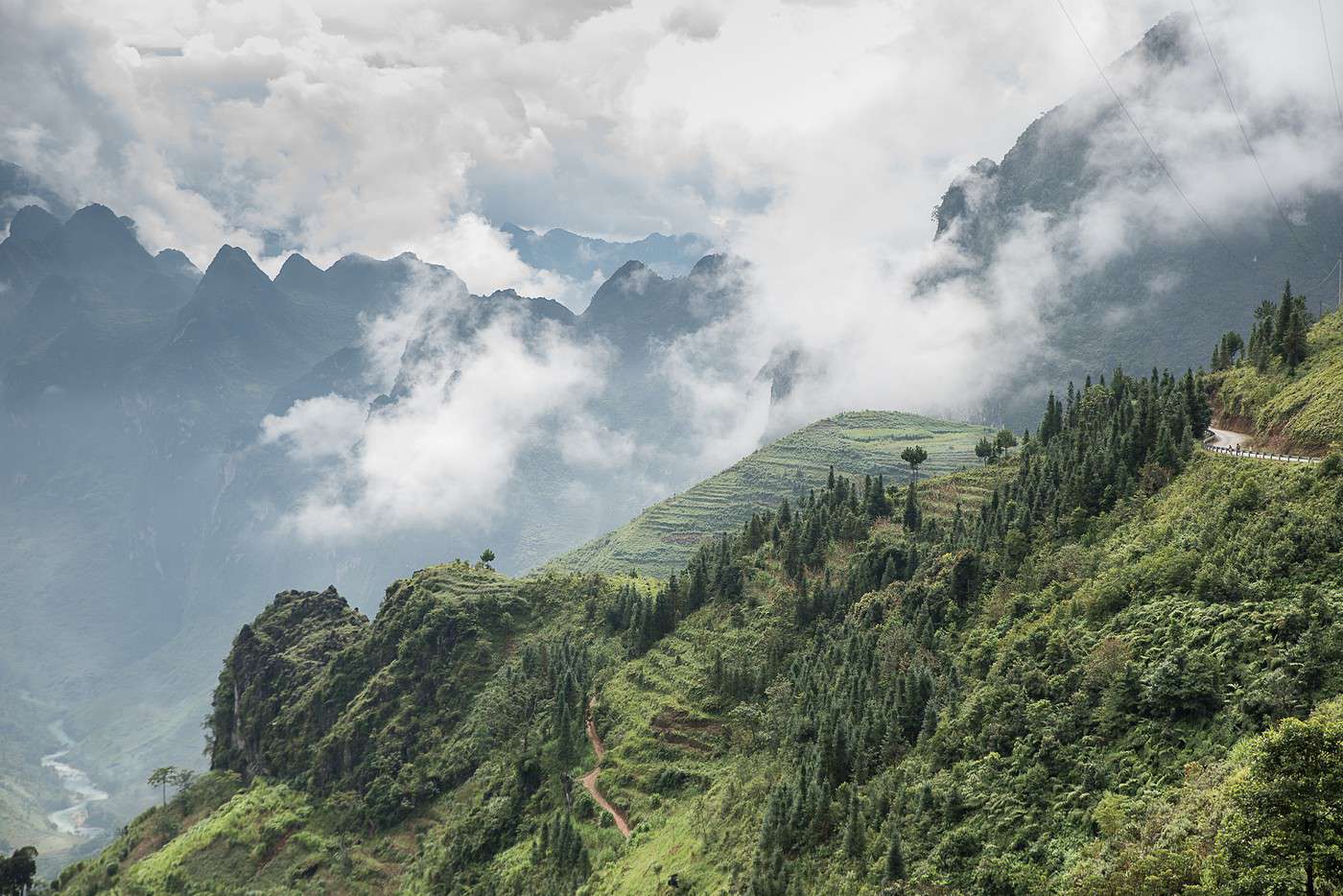
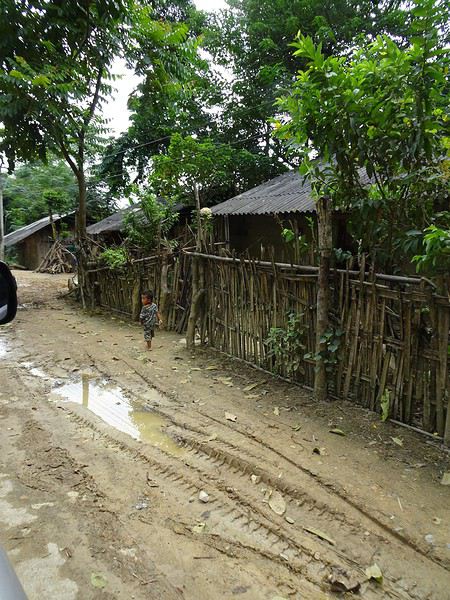
Pour rejoindre Ha Giang, nous passerons pas Camp Bac Me, une longue, très longue route enclavée dans la forêt, mauvaise, abimée par les pluies et le temps, en travaux de surcroit. Le trajet, déjà long, s'étire démesurément, n'en finit pas, se transforme en galère. Et pour couronner le tout, il se met à pleuvoir, une pluie forte et soudaine dont l'Asie a le secret. La route disparait sous le reflet de l'eau, l'air est strié de cordes mouvantes qui viennent frapper le sol avec un claquement sec. On ne voit pas à deux pas, même la lumière du soleil est voilée.
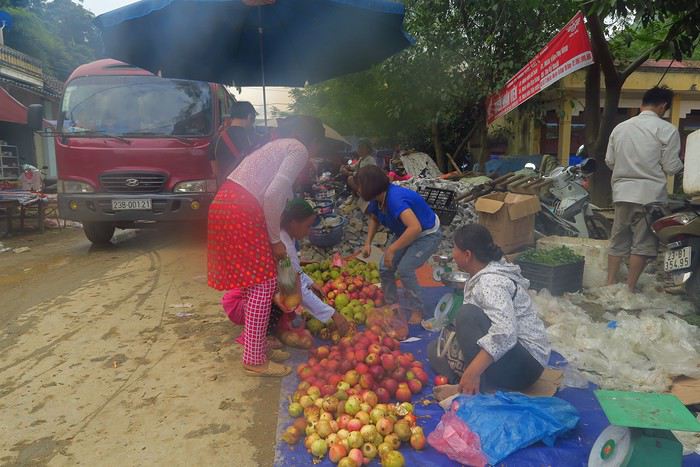
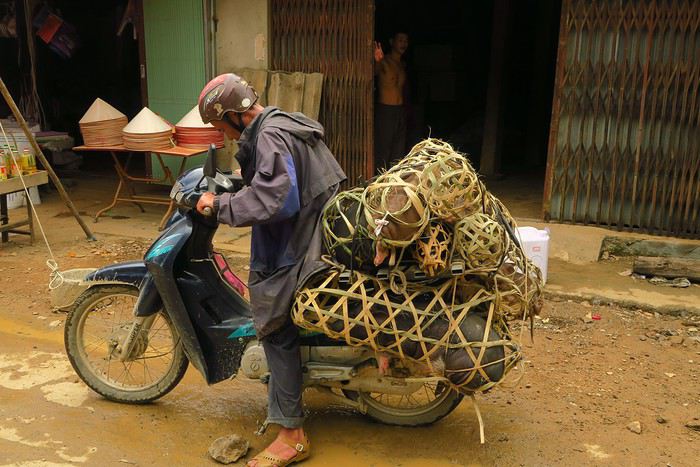
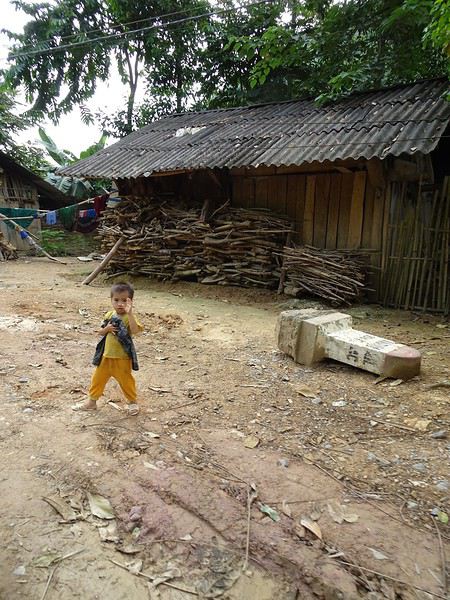
Une dizaine de minutes d'arrêt dans un marché au bord de la route. On patauge dans la boue. Une brume épaisse et moite s'élève du sol, trempe les cheveux, s'infiltre jusque dans l'objectif des appareils photos. Ici pas de touristes, pas d'étals bien rangés, pas de costumes chatoyants. C'est un capharnaüm d'objets cosmopolites qui s'entassent le long de la route de terre, au ras des roues des rares véhicules. Tout est si différent. Finies les images de cartes postales, les sourires édulcorés. La manne du tourisme n'est pas arrivée jusque là et il semble tout à coup bien moins séduisant de vivre le long de ce cordon ombilical rocailleux qui fait office de route.


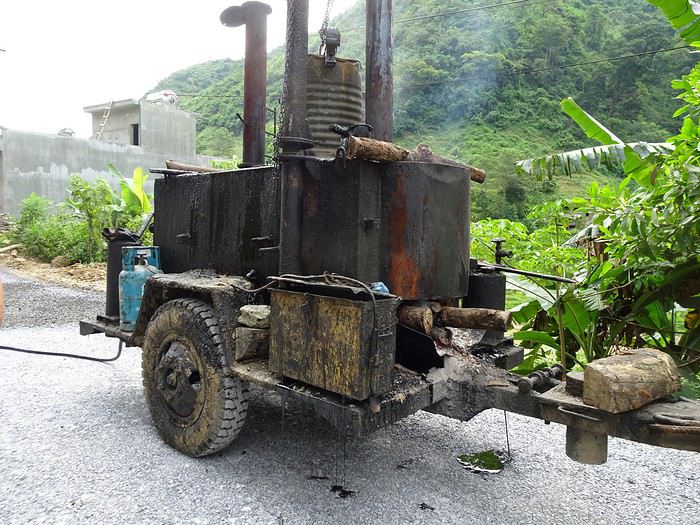
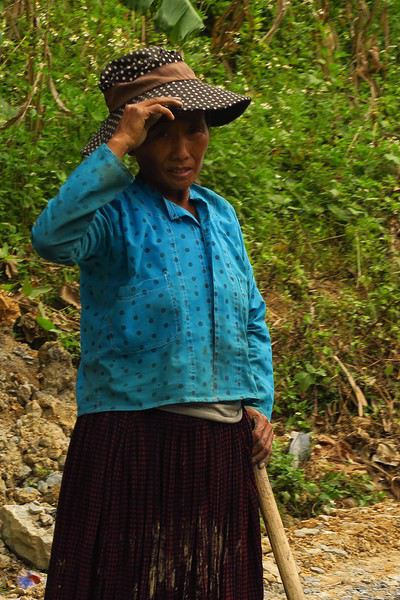
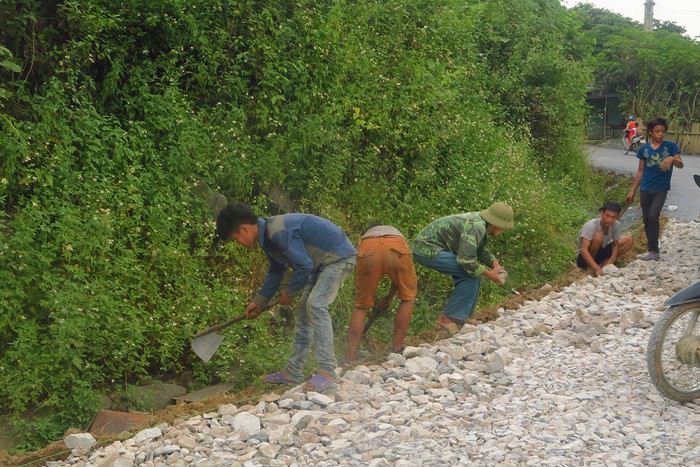
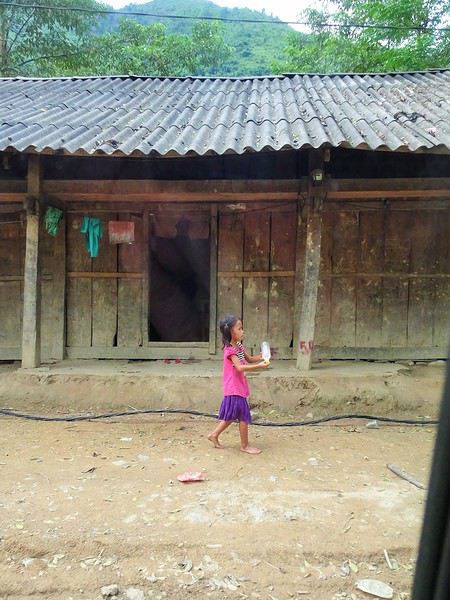
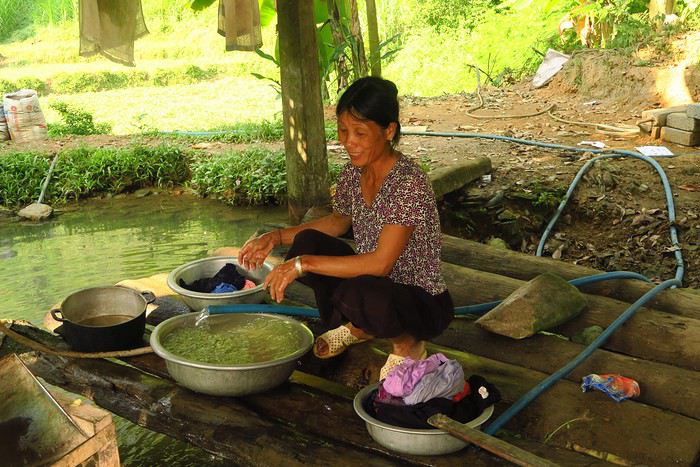
La suite de notre itinéraire n'est qu'une succession de chantiers précaires, de masures réduites à leur plus simple expression. Les hommes, les femmes, colonisent les bas côtés, travaillant à mains nues dans la caillasse avec des machines d'un autre âge, vaquant à la lessive, à la vaisselle, dans l'eau trouble d'une rigole qui s'écoule tandis que les gamins, à peine vêtus, un peu sidérés, souvent pieds nus déambulent le long de la route. Voilà encore une autre image du Vietnam, différente et bien moins porteuse de rêves. Une réalité qui frappe, qui dérange.

La voiture bringuebale, cahote, tressaute entre les pierres tranchantes et les déchirures de l'asphalte. La visibilité n'est pas très bonne à l'arrière de la Ford Everest. Difficile d'obtenir un cliché correct. Il y avait pourtant de quoi faire, plus du domaine du reportage que de la photo souvenir d'ailleurs.


Il nous reste deux journées à passer en compagnie de notre guide et de notre chauffeur. La première, pour atteindre Ha Giang, la seconde pour le retour à Hanoi. Deux journées qui ne seront pas transcendantes, dominées par la route et les kilomètres, incontournables, à avaler. Côté relationnel, tout le monde a jeté l'éponge. Le guide est en service minimum et nous, dans notre tête, on est déjà à Hanoï, dans la baie d'Halong, dans la région de Tam Coc, enfin libres de nos agissements.
Pour rejoindre Ha Giang, nous passerons pas Camp Bac Me, une longue, très longue route enclavée dans la forêt, mauvaise, abimée par les pluies et le temps, en travaux de surcroit. Le trajet, déjà long, s'étire démesurément, n'en finit pas, se transforme en galère. Et pour couronner le tout, il se met à pleuvoir, une pluie forte et soudaine dont l'Asie a le secret. La route disparait sous le reflet de l'eau, l'air est strié de cordes mouvantes qui viennent frapper le sol avec un claquement sec. On ne voit pas à deux pas, même la lumière du soleil est voilée.
Une dizaine de minutes d'arrêt dans un marché au bord de la route. On patauge dans la boue. Une brume épaisse et moite s'élève du sol, trempe les cheveux, s'infiltre jusque dans l'objectif des appareils photos. Ici pas de touristes, pas d'étals bien rangés, pas de costumes chatoyants. C'est un capharnaüm d'objets cosmopolites qui s'entassent le long de la route de terre, au ras des roues des rares véhicules. Tout est si différent. Finies les images de cartes postales, les sourires édulcorés. La manne du tourisme n'est pas arrivée jusque là et il semble tout à coup bien moins séduisant de vivre le long de ce cordon ombilical rocailleux qui fait office de route.


La suite de notre itinéraire n'est qu'une succession de chantiers précaires, de masures réduites à leur plus simple expression. Les hommes, les femmes, colonisent les bas côtés, travaillant à mains nues dans la caillasse avec des machines d'un autre âge, vaquant à la lessive, à la vaisselle, dans l'eau trouble d'une rigole qui s'écoule tandis que les gamins, à peine vêtus, un peu sidérés, souvent pieds nus déambulent le long de la route. Voilà encore une autre image du Vietnam, différente et bien moins porteuse de rêves. Une réalité qui frappe, qui dérange.


La voiture bringuebale, cahote, tressaute entre les pierres tranchantes et les déchirures de l'asphalte. La visibilité n'est pas très bonne à l'arrière de la Ford Everest. Difficile d'obtenir un cliché correct. Il y avait pourtant de quoi faire, plus du domaine du reportage que de la photo souvenir d'ailleurs.


J8 VENDREDI 29/9 : MEO VAC > HA GIANG ET LA BOUCLE EST BOUCLÉE (suite et fin)
Le prochain arrêt sera pour le déjeuner, à Bac Me, une autre gargote, toujours la même, un autre bol de riz, un plat de viande aux saveurs identiques. Tous ces aliments ont perdu l'exotisme du début du voyage. Les baguettes enchaînent les allers-retours du bol à la bouche et de la bouche au bol en mode automatique.

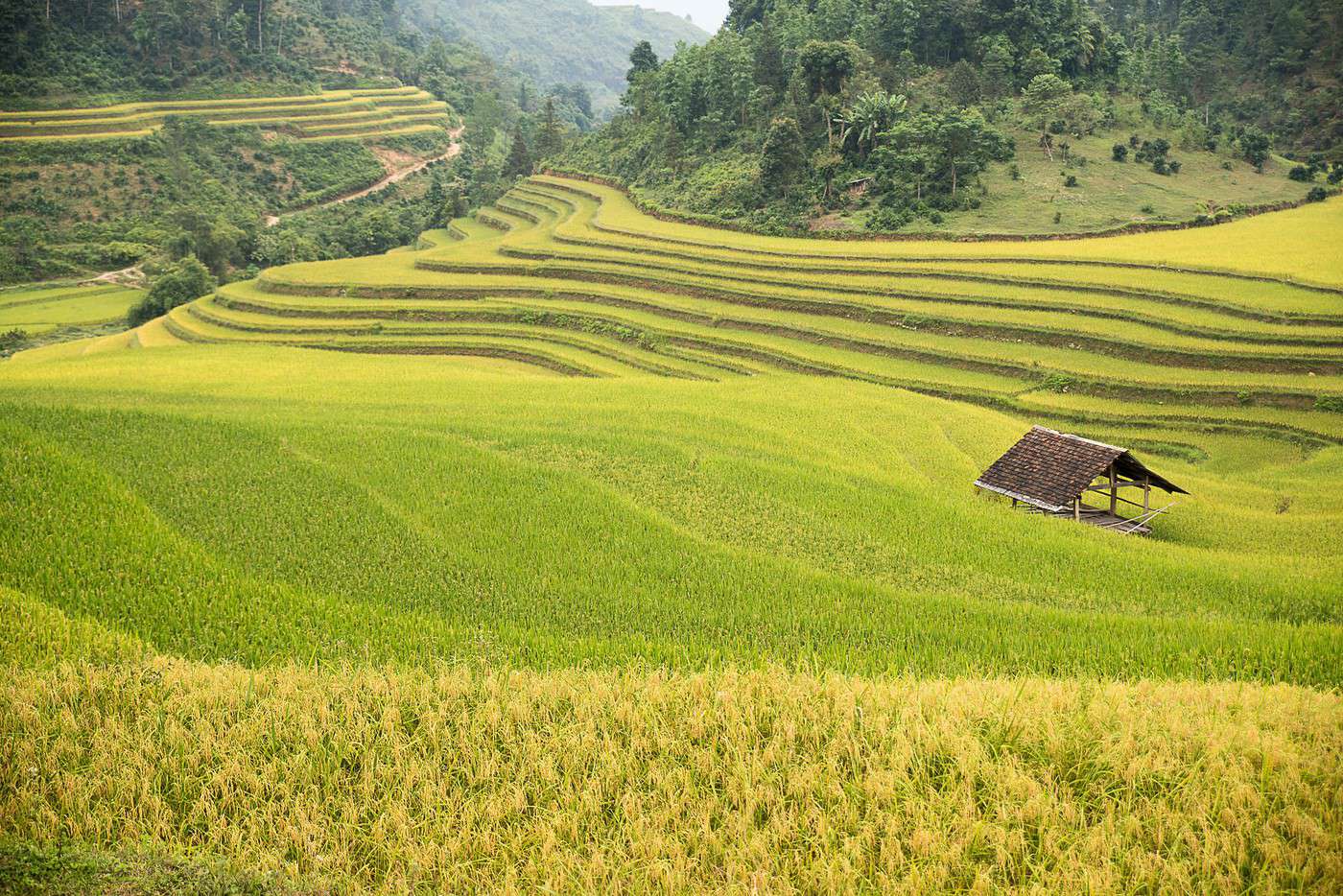
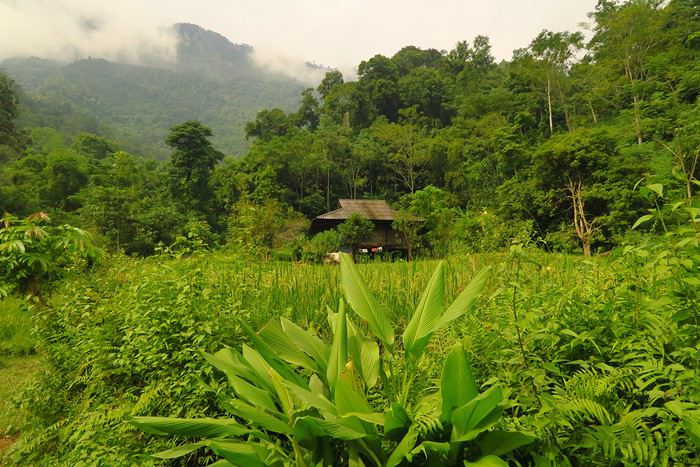
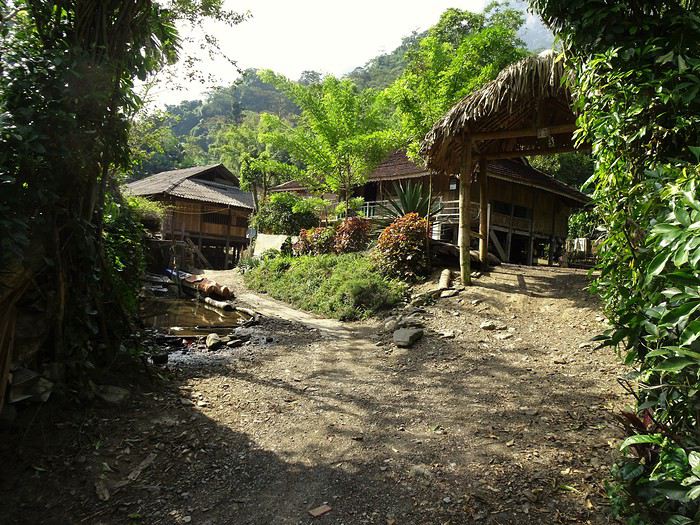
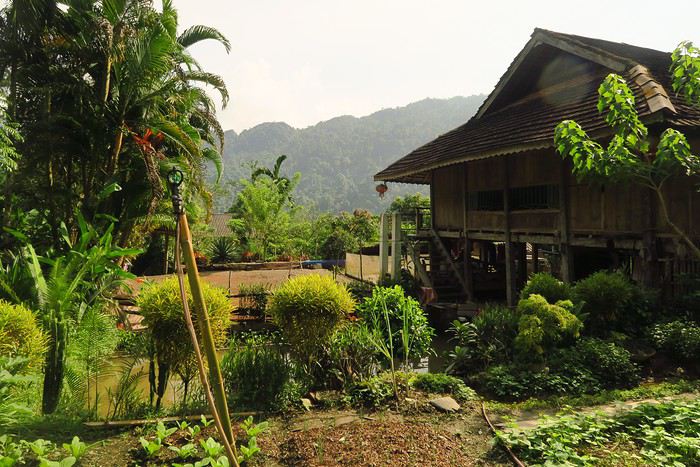
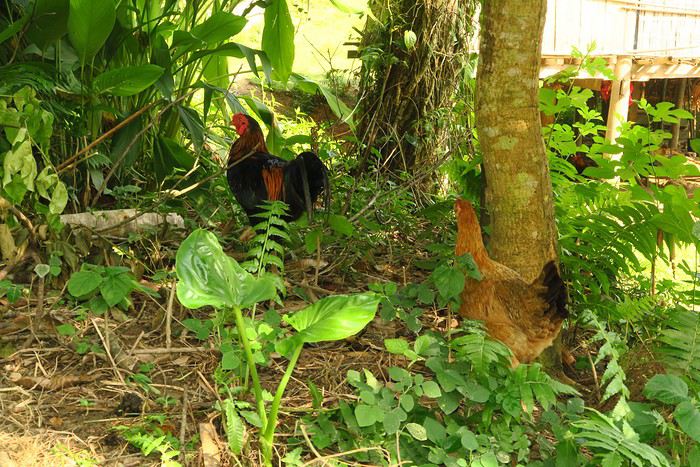
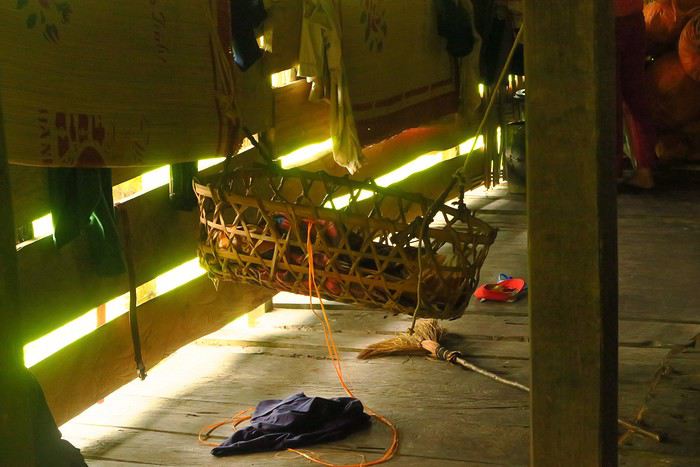
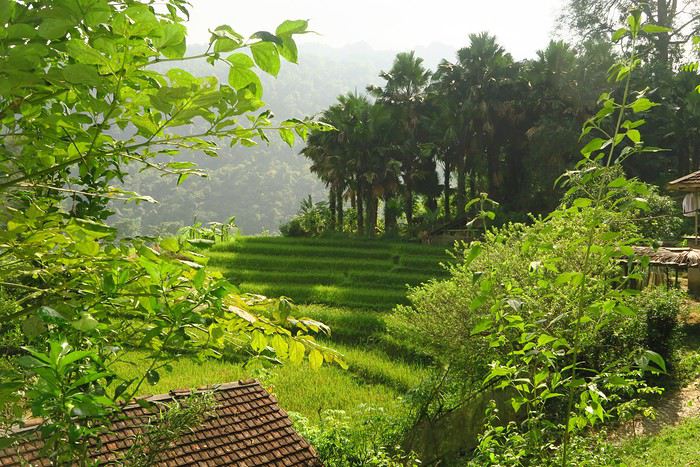
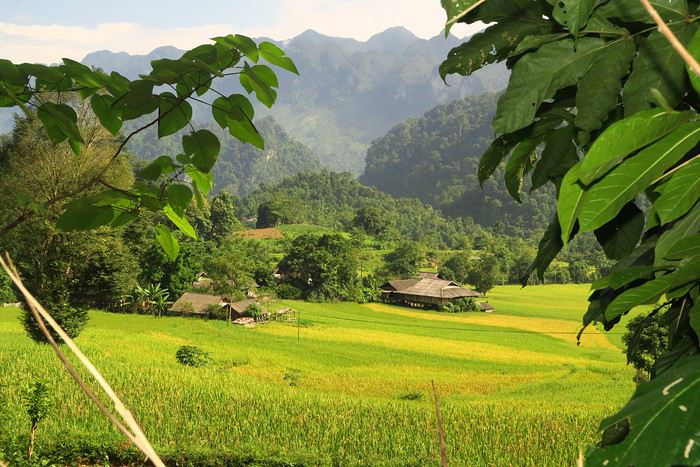
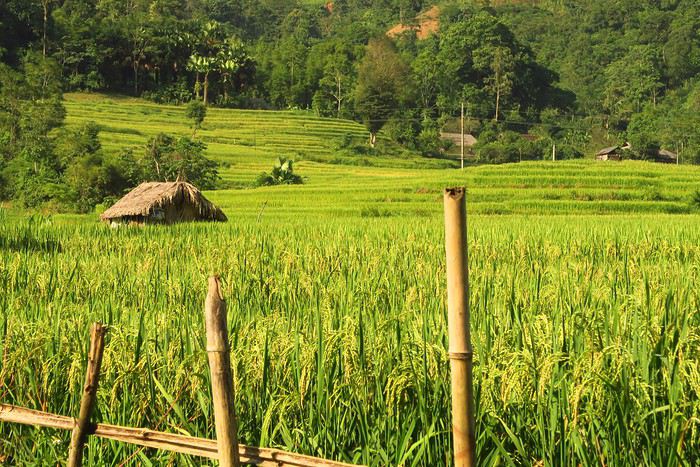
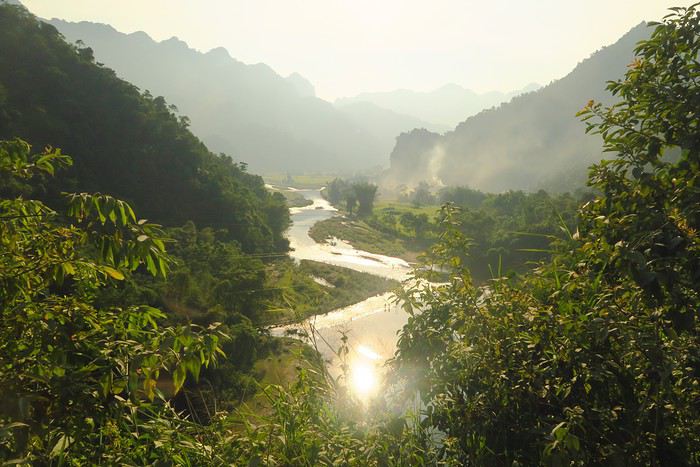
Retour à la route. La pluie a fini par s'arrêter. Le soleil perce entre de gros nuages blancs, aussitôt brûlant. On nous propose un petit tour dans un village Tay construit au bord d'une rivière. Proposition acceptée. La voiture s'arrête et on dégringole un sentier de terre pour rejoindre le village en contrebas. Dans cette petite vallée où la chaleur et l'humidité règnent en maître, des maisons sur pilotis se dégagent d'une végétation luxuriante. Bananiers, maïs, riz, potager et plantations diverses, foisonnent et envahissent le moindre espace. Des papillons dansent dans un rayon de soleil. Il y a des poules, bien sûr, des chiens, des cochons, une ou deux chèvres et aussi quelques buffles. Dans un bassin aménagé, de gros poissons dessinent de larges arcs de cercle. Le riz n'est pas encore récolté, ce sera pour bientôt.


Nous voilà invités à entrer dans l'une des habitations, à prendre le thé. Comme d'habitude, la famille est au complet, silencieuse, souriante, presque en représentation. Comme d'habitude, le guide fait son laïus : la pauvreté, la difficulté de vivre ici, les conditions de vie précaire, les repas pas toujours garantis. Pourtant, même si l'on imagine bien que les hivers ici ne doivent pas être faciles, même si on voit que l'opulence ne règne pas ici en maître, ces maisons vastes et propres, ces champs prolifiques, ces animaux prospères donnent au village un aspect séduisant qu'on ne peut s'empêcher de comparer aux habitations si précaires entrevues ce matin en bordure de route et dont on ne nous a pas dit un mot. Incontestablement, Il fait meilleur vivre ici.


On poursuit, à pied, à travers champs, traversant les rizières comme un gigantesque escalier, glissant, chutant, dérapant sur la terre encore trempée, toute frémissante dans la chaleur qui nous enveloppe. On a construit, ici, d'étroites rigoles de béton qui conduisent l'eau aux différentes habitations et qui évoquent, dans une moindre mesure, les fameuses levadas de l'île de Madère. Certaines parties du chemin qui longe la rivière ont été cimentées par les habitants eux-mêmes.


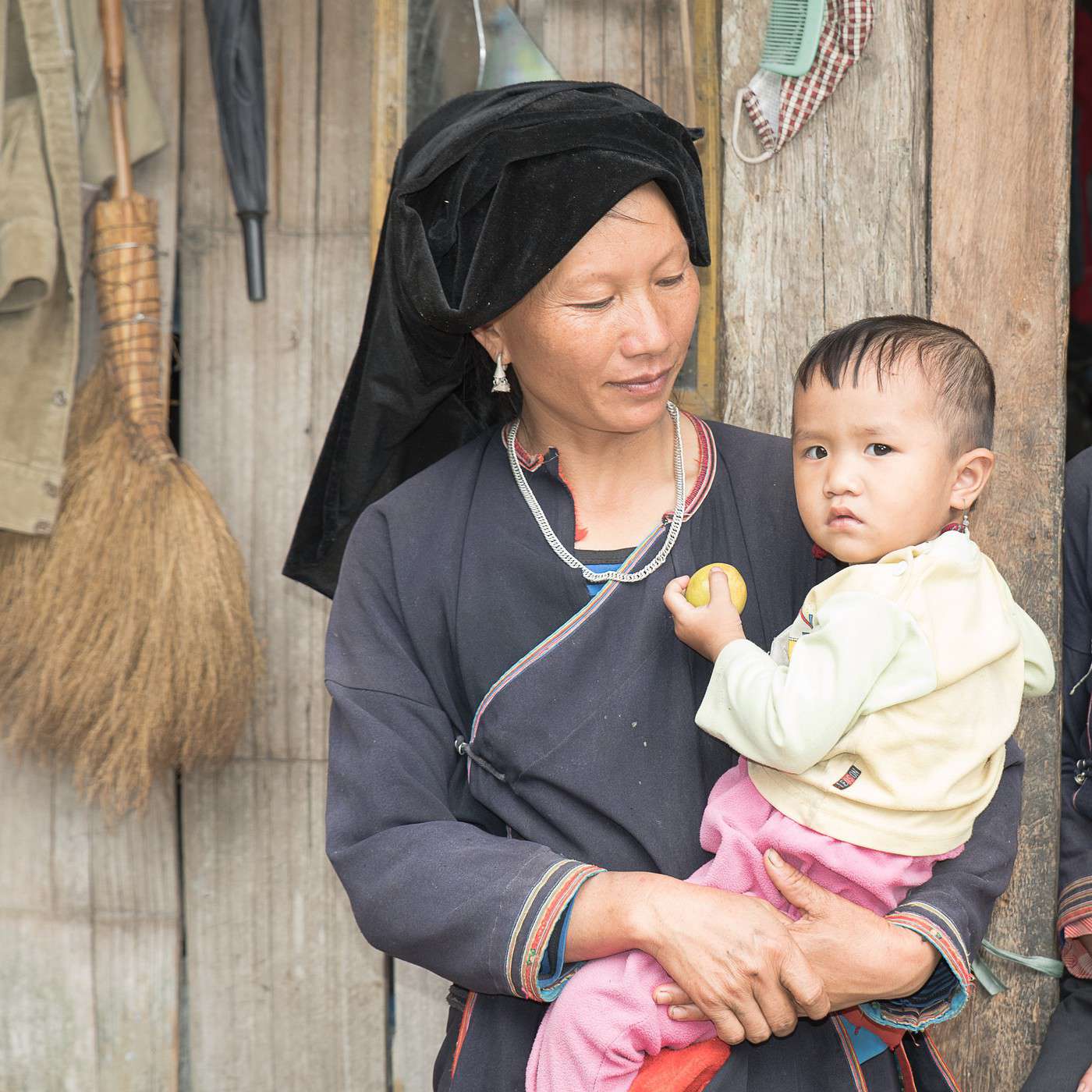
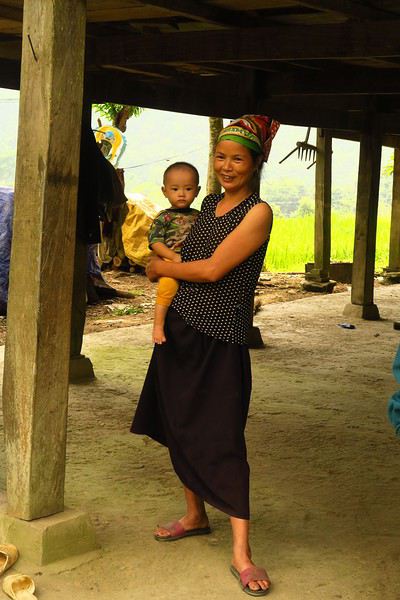
Entre les monts abondamment boisés qui protègent cette vallée, les champs s'étalent, vert tendre et vert sombre mêlés. Une gamine passe, un petit sur le dos, une femme plus âgée s'approche, saisit mes mains, les serrent fort, les yeux plantées dans les miens avec une intensité clairement perceptible. Quand les mots n'ont plus le pouvoir, les gestes reprennent la première place et ce simple contact, chargé d'émotion, prend soudain une valeur inhabituelle, si précieuse. Nous sommes deux femmes côte à côte, deux femmes à des milliers de kilomètres, deux femmes, l'une paysanne d'un autre siècle, l'autre citadine dans le tourbillon de la technologie mais toujours et finalement, deux femmes, identiques et animées, au fond, de préoccupations similaires. Un vrai retour à l'essentiel.


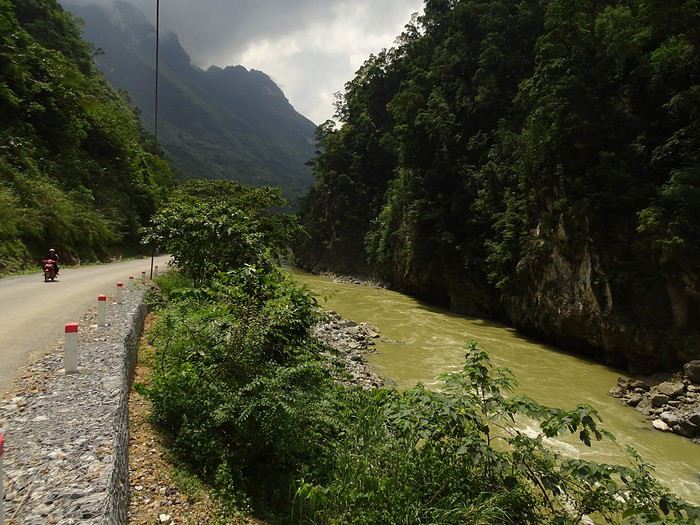
La voiture nous rattrape alors que nous rejoignons la route. Cette fois-ci, c'est fini. La fin du parcours est étonnamment facile. Elle glisse le long de la rivière striée d'un ou deux barrages qui scintille sous les rayons du soleil couchant et on apprécie à sa juste mesure, le macadam qui enrobe la chaussée.

Nous retrouvons Ha Giang, l'hôtel et ses ouvriers toujours au travail. La suite est ici
Le prochain arrêt sera pour le déjeuner, à Bac Me, une autre gargote, toujours la même, un autre bol de riz, un plat de viande aux saveurs identiques. Tous ces aliments ont perdu l'exotisme du début du voyage. Les baguettes enchaînent les allers-retours du bol à la bouche et de la bouche au bol en mode automatique.

Retour à la route. La pluie a fini par s'arrêter. Le soleil perce entre de gros nuages blancs, aussitôt brûlant. On nous propose un petit tour dans un village Tay construit au bord d'une rivière. Proposition acceptée. La voiture s'arrête et on dégringole un sentier de terre pour rejoindre le village en contrebas. Dans cette petite vallée où la chaleur et l'humidité règnent en maître, des maisons sur pilotis se dégagent d'une végétation luxuriante. Bananiers, maïs, riz, potager et plantations diverses, foisonnent et envahissent le moindre espace. Des papillons dansent dans un rayon de soleil. Il y a des poules, bien sûr, des chiens, des cochons, une ou deux chèvres et aussi quelques buffles. Dans un bassin aménagé, de gros poissons dessinent de larges arcs de cercle. Le riz n'est pas encore récolté, ce sera pour bientôt.


Nous voilà invités à entrer dans l'une des habitations, à prendre le thé. Comme d'habitude, la famille est au complet, silencieuse, souriante, presque en représentation. Comme d'habitude, le guide fait son laïus : la pauvreté, la difficulté de vivre ici, les conditions de vie précaire, les repas pas toujours garantis. Pourtant, même si l'on imagine bien que les hivers ici ne doivent pas être faciles, même si on voit que l'opulence ne règne pas ici en maître, ces maisons vastes et propres, ces champs prolifiques, ces animaux prospères donnent au village un aspect séduisant qu'on ne peut s'empêcher de comparer aux habitations si précaires entrevues ce matin en bordure de route et dont on ne nous a pas dit un mot. Incontestablement, Il fait meilleur vivre ici.


On poursuit, à pied, à travers champs, traversant les rizières comme un gigantesque escalier, glissant, chutant, dérapant sur la terre encore trempée, toute frémissante dans la chaleur qui nous enveloppe. On a construit, ici, d'étroites rigoles de béton qui conduisent l'eau aux différentes habitations et qui évoquent, dans une moindre mesure, les fameuses levadas de l'île de Madère. Certaines parties du chemin qui longe la rivière ont été cimentées par les habitants eux-mêmes.


Entre les monts abondamment boisés qui protègent cette vallée, les champs s'étalent, vert tendre et vert sombre mêlés. Une gamine passe, un petit sur le dos, une femme plus âgée s'approche, saisit mes mains, les serrent fort, les yeux plantées dans les miens avec une intensité clairement perceptible. Quand les mots n'ont plus le pouvoir, les gestes reprennent la première place et ce simple contact, chargé d'émotion, prend soudain une valeur inhabituelle, si précieuse. Nous sommes deux femmes côte à côte, deux femmes à des milliers de kilomètres, deux femmes, l'une paysanne d'un autre siècle, l'autre citadine dans le tourbillon de la technologie mais toujours et finalement, deux femmes, identiques et animées, au fond, de préoccupations similaires. Un vrai retour à l'essentiel.


La voiture nous rattrape alors que nous rejoignons la route. Cette fois-ci, c'est fini. La fin du parcours est étonnamment facile. Elle glisse le long de la rivière striée d'un ou deux barrages qui scintille sous les rayons du soleil couchant et on apprécie à sa juste mesure, le macadam qui enrobe la chaussée.

Nous retrouvons Ha Giang, l'hôtel et ses ouvriers toujours au travail. La suite est ici
Bonjour,
Bien que votre message collectif ne me soit destiné j'y répond, comme sur un forum...et parce que comme pour vous, certaines choses méritent d’être mises au point. Je n'ai plus commenté depuis un moment pour ne pas troubler votre récit. Le voilà terminé, j'ai pu voyager agréablement au travers de vos photos et pour ce vous en remercie. Cependant le MAIS étant omniprésent, il a à mon gout terni les descriptions et pourtant votre plume est un vrai plaisir. Je regrette que vous n'ayez pu apprécier comme il se doit votre voyage, je vous en souhaite d'autres plus appropriés à vos profils et sans doute dans d'autre contrées.. J'espère que vous garderez cependant en mémoire ces femmes et ces hommes des belles montagnes du nord. Très bonne année, bien à vous Fabienne
Je vais faire une réponse collective, contrairement à mes habitudes car ces derniers temps, j'ai eu un peu de mal à suivre 😊 J'espère que ça n'offusquera personne. Ceci étant dit, certaines choses méritent d'être mises au point. C'est fou comme on peut écrire une chose et s'entendre dire en avoir écrit une autre 😛 Nous avons bien compris ce que nous avons lu cependant le ressenti de certain ne semble pas vous convenir. Ecrire un carnet de voyage sur un forum induit des réponses qui ne peuvent toujours aller dans votre sens. Vous ne pouvez alors sélectionner les lecteurs et les avis qui vous agréaient, il faudrait choisir pour ce un autre mode de diffusion.
@ Gaura : Je n'ai JAMAIS fait de retour négatif sur notre agence, vous m'avez mal lue ou mal comprise. C'est la relation avec notre guide exclusivement qui n'a pas été optimale et je pense sincèrement que ce type d'aventure est inhérent à cette formule de voyage et non à une agence propre c'est pourquoi j'ai choisi d'en parler ici. Non, vous n'avez pas impliqué directement l'agence cependant, elle était bien en fond de toile, c'est bien elle qui vous a confiés à ce guide qui ne vous convenait pas. Les lecteurs ne peuvent que faire le rapprochement et les craintes s'insinuent, c'est immanquable.
@ Lesgateux : Je vous souhaite un très beau voyage et si ce carnet vous permet d'être plus attentive dans vos préparatifs et relations avec l'agence, j'en suis heureuse, c'était en partie mon but. Je pense que ce carnet s'étire un peu trop et que les lecteurs finissent par se perdre et interpréter les choses à leur manière ce qui est regrettable 😕 Je rappelle que nous avons fait, comme mentionné dans le titre UN TRÈS BEAU VOYAGE. Il n'était pas parfait pour nous, sans doute aurait-il satisfait d'autres voyageurs qui n'avaient pas nos exigences. Je rappelle aussi que l'agence nous a appelés à deux reprises et que j'ai souligné dans ce récit la difficulté de résoudre un soucis de cet ordre par simple appel téléphonique. Si vous aviez voulu attirer l'attention sur le fait d'être vigilants sur la préparation et la relation avec l'agence peut être auriez vous pu le préciser une bonne fois pour toute et non pas insinuer à chaque chapitre la mauvaise harmonie de votre équipage. Vous reprochez aux lecteurs d'interpréter à leur manière, posez vous la question de ce qui induit cette même interprétation, ne serait ce pas votre façon de relater? Quand à la résolution de votre souci, je ne vois vraiment pas ce qui a bloqué, si l'agence vous appelle pour savoir si tout va bien, c'est bien le moment de dire ce qui ne vous correspond pas! Par quel autre moyen auriez vous voulu solutionner ce problème si ce n'est en en faisant part à l’organisateur, c'est bien pour cela qu'il vous contacte....de plus, vous étiez informée avant votre départ de l'importance de réactivité à ce propos et ce dès les premiers jours....vous n'en avez pas tenu compte, vous ne pouvez jeter l'opprobre que sur le guide et le chauffeur. Ce type de problème ne s'arrange jamais en cours de voyage, je vous avais avertie..
Voyager avec guide et chauffeur n'est pas une panacée, en tous cas pas pour nous qui avons l'habitude de voyager différemment c'est ce que je voulais mettre en évidence en partageant mon expérience. Ce n'est donc pas le procès d'une agence mais celui d'un système. Merci de replacer mes propos dans leur contexte 😉 Là aussi ce n’était pas évident à déceler, vous aviez dit être timides, ne pas avoir l'habitude de voyager accompagnés mais cela n'induisait pas une aversion totale du voyage guidé au point d'en faire un procès, mais juste un manque d’expérience en la matière. Il est cependant possible de visiter cette région sans guide, en prenant le bus local ou la moto, en suivant les grands axes en bus ou en s'écartant un peu en moto. Ces deux modes demandent une préparation approfondie si l'on veut voir ce que vous avez visité sans pour autant (si envie) pouvoir entrer en relation avec la population. Le système, c'est sans doute ce qui ne vous convient pas, mais vous l'avez accepté sachant de quoi il retournait et ne pouvez le mettre en cause juste parce que vous n'êtes pas entrée en phase avec votre guide. Les témoignages de beaucoup sur ce forum s'opposent au votre, les voyages dans cette région se passent bien, les découvertes sont réelles et la satisfaction (presque) toujours au rendez vous. Les guides sont des personnes présentes, actives, attentives, je regrette que le votre n'ait été à la hauteur de vos attentes, mais c'est bien une exception, surtout sur une telle longueur... Ces troubles se produisent plus sur de courts séjours et le plus souvent avec des guides locaux qui n'auront pas la même formation et la même habitude que les guides de grands circuits. J'ai pu constater au travers de vos belles photos que les endroits visités sont très beaux, éloignés des grands tracés et souvent créant l'émotion...
Bien que votre message collectif ne me soit destiné j'y répond, comme sur un forum...et parce que comme pour vous, certaines choses méritent d’être mises au point. Je n'ai plus commenté depuis un moment pour ne pas troubler votre récit. Le voilà terminé, j'ai pu voyager agréablement au travers de vos photos et pour ce vous en remercie. Cependant le MAIS étant omniprésent, il a à mon gout terni les descriptions et pourtant votre plume est un vrai plaisir. Je regrette que vous n'ayez pu apprécier comme il se doit votre voyage, je vous en souhaite d'autres plus appropriés à vos profils et sans doute dans d'autre contrées.. J'espère que vous garderez cependant en mémoire ces femmes et ces hommes des belles montagnes du nord. Très bonne année, bien à vous Fabienne
Je vais faire une réponse collective, contrairement à mes habitudes car ces derniers temps, j'ai eu un peu de mal à suivre 😊 J'espère que ça n'offusquera personne. Ceci étant dit, certaines choses méritent d'être mises au point. C'est fou comme on peut écrire une chose et s'entendre dire en avoir écrit une autre 😛 Nous avons bien compris ce que nous avons lu cependant le ressenti de certain ne semble pas vous convenir. Ecrire un carnet de voyage sur un forum induit des réponses qui ne peuvent toujours aller dans votre sens. Vous ne pouvez alors sélectionner les lecteurs et les avis qui vous agréaient, il faudrait choisir pour ce un autre mode de diffusion.
@ Gaura : Je n'ai JAMAIS fait de retour négatif sur notre agence, vous m'avez mal lue ou mal comprise. C'est la relation avec notre guide exclusivement qui n'a pas été optimale et je pense sincèrement que ce type d'aventure est inhérent à cette formule de voyage et non à une agence propre c'est pourquoi j'ai choisi d'en parler ici. Non, vous n'avez pas impliqué directement l'agence cependant, elle était bien en fond de toile, c'est bien elle qui vous a confiés à ce guide qui ne vous convenait pas. Les lecteurs ne peuvent que faire le rapprochement et les craintes s'insinuent, c'est immanquable.
@ Lesgateux : Je vous souhaite un très beau voyage et si ce carnet vous permet d'être plus attentive dans vos préparatifs et relations avec l'agence, j'en suis heureuse, c'était en partie mon but. Je pense que ce carnet s'étire un peu trop et que les lecteurs finissent par se perdre et interpréter les choses à leur manière ce qui est regrettable 😕 Je rappelle que nous avons fait, comme mentionné dans le titre UN TRÈS BEAU VOYAGE. Il n'était pas parfait pour nous, sans doute aurait-il satisfait d'autres voyageurs qui n'avaient pas nos exigences. Je rappelle aussi que l'agence nous a appelés à deux reprises et que j'ai souligné dans ce récit la difficulté de résoudre un soucis de cet ordre par simple appel téléphonique. Si vous aviez voulu attirer l'attention sur le fait d'être vigilants sur la préparation et la relation avec l'agence peut être auriez vous pu le préciser une bonne fois pour toute et non pas insinuer à chaque chapitre la mauvaise harmonie de votre équipage. Vous reprochez aux lecteurs d'interpréter à leur manière, posez vous la question de ce qui induit cette même interprétation, ne serait ce pas votre façon de relater? Quand à la résolution de votre souci, je ne vois vraiment pas ce qui a bloqué, si l'agence vous appelle pour savoir si tout va bien, c'est bien le moment de dire ce qui ne vous correspond pas! Par quel autre moyen auriez vous voulu solutionner ce problème si ce n'est en en faisant part à l’organisateur, c'est bien pour cela qu'il vous contacte....de plus, vous étiez informée avant votre départ de l'importance de réactivité à ce propos et ce dès les premiers jours....vous n'en avez pas tenu compte, vous ne pouvez jeter l'opprobre que sur le guide et le chauffeur. Ce type de problème ne s'arrange jamais en cours de voyage, je vous avais avertie..
Voyager avec guide et chauffeur n'est pas une panacée, en tous cas pas pour nous qui avons l'habitude de voyager différemment c'est ce que je voulais mettre en évidence en partageant mon expérience. Ce n'est donc pas le procès d'une agence mais celui d'un système. Merci de replacer mes propos dans leur contexte 😉 Là aussi ce n’était pas évident à déceler, vous aviez dit être timides, ne pas avoir l'habitude de voyager accompagnés mais cela n'induisait pas une aversion totale du voyage guidé au point d'en faire un procès, mais juste un manque d’expérience en la matière. Il est cependant possible de visiter cette région sans guide, en prenant le bus local ou la moto, en suivant les grands axes en bus ou en s'écartant un peu en moto. Ces deux modes demandent une préparation approfondie si l'on veut voir ce que vous avez visité sans pour autant (si envie) pouvoir entrer en relation avec la population. Le système, c'est sans doute ce qui ne vous convient pas, mais vous l'avez accepté sachant de quoi il retournait et ne pouvez le mettre en cause juste parce que vous n'êtes pas entrée en phase avec votre guide. Les témoignages de beaucoup sur ce forum s'opposent au votre, les voyages dans cette région se passent bien, les découvertes sont réelles et la satisfaction (presque) toujours au rendez vous. Les guides sont des personnes présentes, actives, attentives, je regrette que le votre n'ait été à la hauteur de vos attentes, mais c'est bien une exception, surtout sur une telle longueur... Ces troubles se produisent plus sur de courts séjours et le plus souvent avec des guides locaux qui n'auront pas la même formation et la même habitude que les guides de grands circuits. J'ai pu constater au travers de vos belles photos que les endroits visités sont très beaux, éloignés des grands tracés et souvent créant l'émotion...
Pour bien aimer un pays il faut le manger, le boire et l’entendre chanter. (Michel Déon)
Ce grain de sel ne manque pas de piment.
Au moins, vos bonnes résolutions auront duré quinze heures...
Chaque fois qu'il y a le moindre avis non positif, vous réagissez comme si c'était la première fois. Après 500 fois, on se demande si c'est si difficile de se souvenir des 499 précédentes... C'aurait été si simple de ne pas insister.
« Tout le monde s'interroge sur comment laisser une meilleure planète à nos enfants, mais on devrait plutôt penser à laisser de meilleurs enfants pour notre planète. » Clint Eastwood
Ce grain de sel ne manque pas de piment.
Au moins, vos bonnes résolutions auront duré quinze heures...
Chaque fois qu'il y a le moindre avis non positif, vous réagissez comme si c'était la première fois. Après 500 fois, on se demande si c'est si difficile de se souvenir des 499 précédentes... C'aurait été si simple de ne pas insister.
C'est exactement ce que je me disais , moi qui vient de lire ce beau carnet.
Chaque fois qu'il y a le moindre avis non positif, vous réagissez comme si c'était la première fois. Après 500 fois, on se demande si c'est si difficile de se souvenir des 499 précédentes... C'aurait été si simple de ne pas insister.
C'est exactement ce que je me disais , moi qui vient de lire ce beau carnet.
"La vie est un voyage qui se vit au présent ou jamais ...."
Cela ne remet bien sûr pas en question les nombreux apports de cette respectable participante critique.
J'ai toutefois du mal à admettre les arguments du genre " Fallait pas vous promener en ville si vous ne vouliez pas être agressés " ou " Fallait pas mettre de minijupe si vous ne vouliez pas être ...ée "
Je pensais implicite le respect du long travail de rédaction et de mise en ligne d'un carnet de voyage, surtout quand celui-ci est assez fourni. Quant à l'argument énonçant qu'il faut admettre la critique, celui-ci a par ailleurs été employé par des personnes dont la motivation était plutôt justifiée par la rancoeur et la jalousie. Je suis donc très circonspect par rapport à ça. Cela ouvre la porte à tous les abus.
Je crois que ce n'est pas bien de commencer gentiment par complimenter pour les photos puis ensuite de démonter méthodiquement le travail accompli pour l'une ou l'autre réflexion ayant eu le malheur de déplaire. Il est des censeurs qui s'ignorent.
Un carnet aussi complet manquait à ce forum pour la boucle du nord, c'est maintenant chose faite.
J'ai toutefois du mal à admettre les arguments du genre " Fallait pas vous promener en ville si vous ne vouliez pas être agressés " ou " Fallait pas mettre de minijupe si vous ne vouliez pas être ...ée "
Je pensais implicite le respect du long travail de rédaction et de mise en ligne d'un carnet de voyage, surtout quand celui-ci est assez fourni. Quant à l'argument énonçant qu'il faut admettre la critique, celui-ci a par ailleurs été employé par des personnes dont la motivation était plutôt justifiée par la rancoeur et la jalousie. Je suis donc très circonspect par rapport à ça. Cela ouvre la porte à tous les abus.
Je crois que ce n'est pas bien de commencer gentiment par complimenter pour les photos puis ensuite de démonter méthodiquement le travail accompli pour l'une ou l'autre réflexion ayant eu le malheur de déplaire. Il est des censeurs qui s'ignorent.
Un carnet aussi complet manquait à ce forum pour la boucle du nord, c'est maintenant chose faite.
« Tout le monde s'interroge sur comment laisser une meilleure planète à nos enfants, mais on devrait plutôt penser à laisser de meilleurs enfants pour notre planète. » Clint Eastwood
Bonsoir et Bonne année
J'ai suivi dans mon coin votre voyage, j'apprécie votre prose et vos photos.
Je regrette que votre ressenti donne lieu à autant de discussions oiseuses. Un carnet c'est le reflet d'une expérience personnelle, pas un publireportage. Vous l'avez vécu comme cela, vous le transcrivez comme vous l'avez ressenti, et si cela ne rentre pas systématiquement dans le cadre touristiquement correct du" j'ai fait un voyage extraordinaire, avec des gens extraordinaires, organisé de manière extraordinaire par une agence extraordinaire", et alors???? Y a t il encore une liberté d'expression? Pourquoi critiquer Lol64 qui a été déçue par certains aspects. Nous n'avons pas à critiquer cela. Son voyage s'est déroulé d'une certaine manière, elle nous le donne à voir , merci à elle, et point barre.
J'ai suivi dans mon coin votre voyage, j'apprécie votre prose et vos photos.
Je regrette que votre ressenti donne lieu à autant de discussions oiseuses. Un carnet c'est le reflet d'une expérience personnelle, pas un publireportage. Vous l'avez vécu comme cela, vous le transcrivez comme vous l'avez ressenti, et si cela ne rentre pas systématiquement dans le cadre touristiquement correct du" j'ai fait un voyage extraordinaire, avec des gens extraordinaires, organisé de manière extraordinaire par une agence extraordinaire", et alors???? Y a t il encore une liberté d'expression? Pourquoi critiquer Lol64 qui a été déçue par certains aspects. Nous n'avons pas à critiquer cela. Son voyage s'est déroulé d'une certaine manière, elle nous le donne à voir , merci à elle, et point barre.
Je n'aurai pas le temps...
Cela ne remet bien sûr pas en question les nombreux apports de cette respectable participante critique.
J'ai toutefois du mal à admettre les arguments du genre " Fallait pas vous promener en ville si vous ne vouliez pas être agressés " ou " Fallait pas mettre de minijupe si vous ne vouliez pas être ...ée "
Je pensais implicite le respect du long travail de rédaction et de mise en ligne d'un carnet de voyage, surtout quand celui-ci est assez fourni. Quant à l'argument énonçant qu'il faut admettre la critique, celui-ci a par ailleurs été employé par des personnes dont la motivation était plutôt justifiée par la rancoeur et la jalousie. Je suis donc très circonspect par rapport à ça. Cela ouvre la porte à tous les abus.
Nous sommes heureusement nombreux(es) à partager ton avis. La nouvelle année ne changera pas le côté négatif de certains malheureusement... Puisse Asia7, devenir plus zen, à l'image des pays qu'elle dit affectionner pour 2018.😇
J'ai toutefois du mal à admettre les arguments du genre " Fallait pas vous promener en ville si vous ne vouliez pas être agressés " ou " Fallait pas mettre de minijupe si vous ne vouliez pas être ...ée "
Je pensais implicite le respect du long travail de rédaction et de mise en ligne d'un carnet de voyage, surtout quand celui-ci est assez fourni. Quant à l'argument énonçant qu'il faut admettre la critique, celui-ci a par ailleurs été employé par des personnes dont la motivation était plutôt justifiée par la rancoeur et la jalousie. Je suis donc très circonspect par rapport à ça. Cela ouvre la porte à tous les abus.
Nous sommes heureusement nombreux(es) à partager ton avis. La nouvelle année ne changera pas le côté négatif de certains malheureusement... Puisse Asia7, devenir plus zen, à l'image des pays qu'elle dit affectionner pour 2018.😇
« Voyager rend modeste. Vous voyez quelle petite place vous occupez dans le monde. » - Gustave Flaubert
https://www.myatlas.com/anneclaire95
Sinon, très bonne année, à toutes et tous ! 🙂
« Voyager rend modeste. Vous voyez quelle petite place vous occupez dans le monde. » - Gustave Flaubert
https://www.myatlas.com/anneclaire95
Bonjour Laure ,
J'ai lu ton carnet . De belles photos , et un récit sincère , c'est une grande qualité .
En plus ton récit est de ceux dont , étape après étape , on a envie de connaître la suite .
Je te souhaite de bons nouveaux voyages pour 2018 🙂
J'ai lu ton carnet . De belles photos , et un récit sincère , c'est une grande qualité .
En plus ton récit est de ceux dont , étape après étape , on a envie de connaître la suite .
Je te souhaite de bons nouveaux voyages pour 2018 🙂
"La vie est un voyage qui se vit au présent ou jamais ...."
Bonsoir Laure.
Un grand merci et bravo pour ce carnet de voyage. J'ai pris un réel plaisir a vous lire, votre style est très agréable, on vous lit comme un bon roman.
D'ailleurs, je pense que je le relirais, ne serait-ce que pour m'impregner de cette atmosphère propre a l'Asie que vous avez su si bien decrire.
Bonne année à vous.
Michèle.
Bonjour Fabienne et merci pour vos vœux.
Je ne répondrai pas suite à votre commentaire. Que ce soit en public ou en privé, force est de constater que nos échanges sont devenus deux monologues stériles 😕
Concernant ce carnet de voyage, il n'est pas encore terminé. Il me reste quelques jours à rédiger à propos de notre passage dans la baie d'Halong et le secteur de Tam Coc, sans guide cette fois-ci. Je vais donc aller au bout de ce récit avec toujours le même soucis d'honnêteté en ce qui concerne mes impressions que cela plaise ou non. Après tout, personne n'est obligé de lire ce carnet.
Je ne répondrai pas suite à votre commentaire. Que ce soit en public ou en privé, force est de constater que nos échanges sont devenus deux monologues stériles 😕
Concernant ce carnet de voyage, il n'est pas encore terminé. Il me reste quelques jours à rédiger à propos de notre passage dans la baie d'Halong et le secteur de Tam Coc, sans guide cette fois-ci. Je vais donc aller au bout de ce récit avec toujours le même soucis d'honnêteté en ce qui concerne mes impressions que cela plaise ou non. Après tout, personne n'est obligé de lire ce carnet.
Merci beaucoup pour vos vœux et vos commentaires. La pollution semble un mal inhérent à notre société et il faut bien s'en accommoder 😉 Envers et contre tout (tous), j'ai essayé de rester fidèle à mes impressions et mon ressenti.
Je vous souhaite de belles découvertes futures 🙂
Merci pour ce message très positif 🙂
Comme vous le faites fort justement remarquer, je ne suis ni journaliste, ni publicitaire pour brosser un tableau idyllique d'une quelconque destination. Je suis juste une voyageuse comme tant d'autres, partageant ses impressions avec d'autres voyageurs.
Ce forum est formidable car chacun peut s'y exprimer librement dans le respect de l'autre (évidemment) ce qui en fait, à mon sens, toute sa valeur. Dans ce cadre, tout est permis, même, parfois, la mauvaise foi 😛 Je pense que chacun fera son propre tri.
Comme vous le faites fort justement remarquer, je ne suis ni journaliste, ni publicitaire pour brosser un tableau idyllique d'une quelconque destination. Je suis juste une voyageuse comme tant d'autres, partageant ses impressions avec d'autres voyageurs.
Ce forum est formidable car chacun peut s'y exprimer librement dans le respect de l'autre (évidemment) ce qui en fait, à mon sens, toute sa valeur. Dans ce cadre, tout est permis, même, parfois, la mauvaise foi 😛 Je pense que chacun fera son propre tri.
Bonjour Moushika,
ton récit est de ceux dont, étape après étape, on a envie de connaître la suite
Un peu comme un feuilleton alors, c'est chouette, j'aime bien l'idée 😉 Bon, il ne s'y passe pas grand chose de palpitant et j'aime autant ça, en étant l'actrice principale ... 😄 pour le suspens et les rebondissements, il faudra repasser !
Merci pour ce sympathique commentaire et très beaux futurs voyages à toi.
ton récit est de ceux dont, étape après étape, on a envie de connaître la suite
Un peu comme un feuilleton alors, c'est chouette, j'aime bien l'idée 😉 Bon, il ne s'y passe pas grand chose de palpitant et j'aime autant ça, en étant l'actrice principale ... 😄 pour le suspens et les rebondissements, il faudra repasser !
Merci pour ce sympathique commentaire et très beaux futurs voyages à toi.
Bonjour Laure
Félicitations pour ce magnifique carnet de voyage et ces très belles photos . J'ai dévoré vos textes écrits dans un style si agréable à lire , un vrai régal ! Et je vous trouve d'une exquise courtoisie de prendre la peine de répondre individuellement aux intervenants .
Vous dites que c'est votre bonne éducation qui vous a empêchée de ruer dans les brancards avec votre guide ...eh bien , moi , je vous trouve d'un courage et d'une persévérance exemplaires de continuer ce carnet avec toutes les remarques parfois désobligeantes que vous avez dû subir !!
Allons Laure : vous n'avez pas compris ?? il faut toujours dire que tout était splendide , que les gens étaient gentils et courtois , qu'il n'y a pas d'arnaques ( ou alors , c'est que vous n'êtes pas très malin ), Même pour la météo : si vous avez eu mauvais temps : c'est de votre faute , vous auriez dû partir à une autre période... )...comment , vous n'avez pas dit : "WOUAH " ??? vous avez osé ??? on vous dit alors qu'il fallait aller ailleurs ...ou rester chez vous...
Eh bien , moi , je vous dis un grand MERCI pour ce superbe carnet qui va m'être fort utile lors de notre prochain voyage au nord Vietnam , en voiture avec chauffeur ( mais sans guide 😉 )
Aura-t-on la suite ? ou alors , vous jetez l'éponge ?..j'aurais bien aimé vous suivre à Tam Coc et en baie d'Halong .
A tous ceux qui regrettent que les carnets sur le nord Vietnam sont rares , je crois qu'il ne faut pas s'étonner ...!!
Bonne année à vous , Laure , et continuez à faire de beaux voyages .
Cordialement
Ghislaine
emoran
Bonjour Michèle,
J'ai également pris plaisir à revivre, par l'intermédiaire d'un clavier et d'un écran, ce voyage au goût si particulier qui nous a (en dehors des petites contrariétés relationnelles bien entendu 😉) beaucoup plu.
Je suis sûre que vous allez faire de votre côté de très belles découvertes sur les routes et les petits chemins de ce pays tout en contraste.
Merci à vous 🙂
J'ai également pris plaisir à revivre, par l'intermédiaire d'un clavier et d'un écran, ce voyage au goût si particulier qui nous a (en dehors des petites contrariétés relationnelles bien entendu 😉) beaucoup plu.
Je suis sûre que vous allez faire de votre côté de très belles découvertes sur les routes et les petits chemins de ce pays tout en contraste.
Merci à vous 🙂
Bonjour Laure ,
avant tout, je te souhaite une très bonne année 2018 jalonnée de nombreuses aventures qui te combleront de joie : continue, par tes récits, à nous faire voyager avec toi !
J'ai décroché de V F pendant les "fêtes" : famille oblige, retour ( agréable ) des enfants , service B&B, ... C'est donc avec une énorme surprise que j'ai lu les derniers commentaires, carrément sur ton carnet où 'on' s'est mis à critiquer et échanger des conseils, des marrants comme te conseiller moto ou vélo ( sans cela , pas d'issue ... ) ou des moins marrants ...
Voilà qu'en plus ; 'on' s'est mis à donner SON ressenti et à critiquer le tien : ce m'a semblé complètement déplacé !
De plus j'ai été sidérée par le peu d'attention de certains esprits chagrins, qui avaient conclu rapidement ( comment ? ) que le carnet était terminé et du coup, donnaient donc leurs propres conclusions : je n'en croyais pas mes yeux et je suis retournée au début pour m'assurer qu'il y aurait une suite !
Et donc, à bientôt pour la suite : si j'ai bien compris, vous êtes débarrassés des entraves et vous allez continuer tranquillement votre périple : à bientôt .
Brigitte .
avant tout, je te souhaite une très bonne année 2018 jalonnée de nombreuses aventures qui te combleront de joie : continue, par tes récits, à nous faire voyager avec toi !
J'ai décroché de V F pendant les "fêtes" : famille oblige, retour ( agréable ) des enfants , service B&B, ... C'est donc avec une énorme surprise que j'ai lu les derniers commentaires, carrément sur ton carnet où 'on' s'est mis à critiquer et échanger des conseils, des marrants comme te conseiller moto ou vélo ( sans cela , pas d'issue ... ) ou des moins marrants ...
Voilà qu'en plus ; 'on' s'est mis à donner SON ressenti et à critiquer le tien : ce m'a semblé complètement déplacé !
De plus j'ai été sidérée par le peu d'attention de certains esprits chagrins, qui avaient conclu rapidement ( comment ? ) que le carnet était terminé et du coup, donnaient donc leurs propres conclusions : je n'en croyais pas mes yeux et je suis retournée au début pour m'assurer qu'il y aurait une suite !
Et donc, à bientôt pour la suite : si j'ai bien compris, vous êtes débarrassés des entraves et vous allez continuer tranquillement votre périple : à bientôt .
Brigitte .
Brigitte
Bonjour Ghislaine,
vous n'avez pas compris ?? il faut toujours dire que tout était splendide, que les gens étaient gentils et courtois
Ben si, je le savais bien mais je trouve que c'est d'une part d'un ennui terrible 😇 et d'autre part que ça n'apporte pas grand chose à la communauté des voyageurs. 😄😄😄
Aura-t-on la suite ? ou alors, vous jetez l'éponge ?..j'aurais bien aimé vous suivre à Tam Coc et en baie d'Halong.
Vous aurez la suite et sans trop tarder je pense. Il faut bien plus que quelques remarques désagréables pour me décourager. J'ai de surcroît l'habitude de terminer ce que j'ai commencé (je suis toujours extrêmement frustrée et j'enrage, quand un carnet est laissé à l'abandon et que le lecteur se retrouve un peu bête tout seul au bord de la route). Et puis, il y a les gens qui comme vous m'encouragent. Vous ne pouvez pas savoir comme de toutes petites remarques peuvent être précieuses.
Vous dites que c'est votre bonne éducation qui vous a empêchée de ruer dans les brancards
En fait, je ne vois que cette explication. Quelques années plus tôt, j'aurais tout envoyer balader 😊 ce qui n'est pas toujours très constructif non plus 😉. J'ai un peu du mal à trouver le juste milieu. Je préfère les extrêmes 😏
Merci Ghislaine et je vous souhaite une très belle année riche en découvertes de toutes sortes
vous n'avez pas compris ?? il faut toujours dire que tout était splendide, que les gens étaient gentils et courtois
Ben si, je le savais bien mais je trouve que c'est d'une part d'un ennui terrible 😇 et d'autre part que ça n'apporte pas grand chose à la communauté des voyageurs. 😄😄😄
Aura-t-on la suite ? ou alors, vous jetez l'éponge ?..j'aurais bien aimé vous suivre à Tam Coc et en baie d'Halong.
Vous aurez la suite et sans trop tarder je pense. Il faut bien plus que quelques remarques désagréables pour me décourager. J'ai de surcroît l'habitude de terminer ce que j'ai commencé (je suis toujours extrêmement frustrée et j'enrage, quand un carnet est laissé à l'abandon et que le lecteur se retrouve un peu bête tout seul au bord de la route). Et puis, il y a les gens qui comme vous m'encouragent. Vous ne pouvez pas savoir comme de toutes petites remarques peuvent être précieuses.
Vous dites que c'est votre bonne éducation qui vous a empêchée de ruer dans les brancards
En fait, je ne vois que cette explication. Quelques années plus tôt, j'aurais tout envoyer balader 😊 ce qui n'est pas toujours très constructif non plus 😉. J'ai un peu du mal à trouver le juste milieu. Je préfère les extrêmes 😏
Merci Ghislaine et je vous souhaite une très belle année riche en découvertes de toutes sortes
Heu , désolée si j'ai cru que le carnet était fini , d'ailleurs je réclamais une suite ...
j'ai écrit ce message , énervée que j'étais , avant de m'apercevoir que d'autres messages avaient été écrits entre temps . j'espère que vous ne m'incluez pas dans les "esprits chagrins ".
Ghislaine
emoran
Bonjour Brigitte et Bonne année à toi ainsi qu'à tes proches !
Oui, oui, oui, il y aura une suite ET une fin. Pour moi aussi, les fêtes et tout leur cortège m'ont un peu accaparée et mon récit a pris du retard. Il n'est pas toujours bon de traîner en chemin 😛
si j'ai bien compris, vous êtes débarrassés des entraves et vous allez continuer tranquillement votre périple
C'est bien ça sauf que comme je suis, parait-il, un esprit ronchon, blasé, exigeant et jamais content, oui je sais, j'en rajoute un peu 😇😄 c'est pour faire bonne mesure. Je vais encore râler, après le temps qui a décidé de virer sa cuti, après les vélos qui ne sont pas des VTT et s'embourbent honteusement, après les escaliers sur les sites sans escalators (quand même) et le ciel pas assez bleu ... 😄😄😄 C'est fou, je me demande comment font les gens qui vivent un voyage P.A.R.F.A.I.T ...
Allez, mieux vaut en rire, non ? A tout de suite
Oui, oui, oui, il y aura une suite ET une fin. Pour moi aussi, les fêtes et tout leur cortège m'ont un peu accaparée et mon récit a pris du retard. Il n'est pas toujours bon de traîner en chemin 😛
si j'ai bien compris, vous êtes débarrassés des entraves et vous allez continuer tranquillement votre périple
C'est bien ça sauf que comme je suis, parait-il, un esprit ronchon, blasé, exigeant et jamais content, oui je sais, j'en rajoute un peu 😇😄 c'est pour faire bonne mesure. Je vais encore râler, après le temps qui a décidé de virer sa cuti, après les vélos qui ne sont pas des VTT et s'embourbent honteusement, après les escaliers sur les sites sans escalators (quand même) et le ciel pas assez bleu ... 😄😄😄 C'est fou, je me demande comment font les gens qui vivent un voyage P.A.R.F.A.I.T ...
Allez, mieux vaut en rire, non ? A tout de suite
Tout d'abord, meilleurs vœux pour cette nouvelle année, pleine de beaux voyages 😉.
Je suis depuis le début ton carnet que j'apprécie énormément 😊.
C'est, justement, ce que personnellement j'attend du forum, les ressentis, les mésaventures, les joies , les waouh ou non... Sinon, je me contenterais des guides de voyage et des sites officiels où tout est super, beau, magnifique, à voir... 😛
Encore un grand merci pour ce retour, j'attend comme beaucoup d'autres la suite 🙂
"Voyager est un triple plaisir : l'attente, l'éblouissement et le souvenir." Ilka Chase
J9 Samedi 30/9 : Ha Giang > Hanoi
Partie 1 : Retour à Hanoï
Ha Giang-Hanoi, c'est une route comme il en existe des milliers, du macadam, des voitures, des camions, des villages qui se transforment peu à peu en villes et qui se ressemblent tous. Rien de bien folichon. Six heures de route environ et pas grand chose à se mettre sous l'objectif.
On s'arrêtera dans une propriété qui cultive le thé à grande échelle. Invités par les propriétaires à boire le thé, on mesurera la prospérité de cette famille qui contraste violemment avec le mode de vie des ethnies du nord.
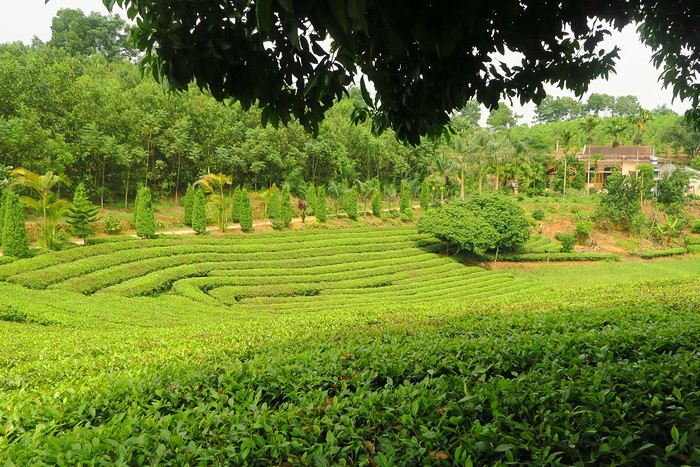
Lors de notre arrivée à Hanoi, une semaine plus tôt, on s'était senti dépaysés. Aujourd'hui, en s'approchant de la capitale, on a l'impression de retrouver un monde connu plus proche du nôtre tant le fossé qui nous sépare de l'extrême nord Vietnam était vertigineux.
Une dernière gargote, les derniers kilomètres et nous retrouvons notre hôtel du vieux quartier dans l'après-midi, un peu sonné par le contraste.
Partie 2 : le pont Long Bien
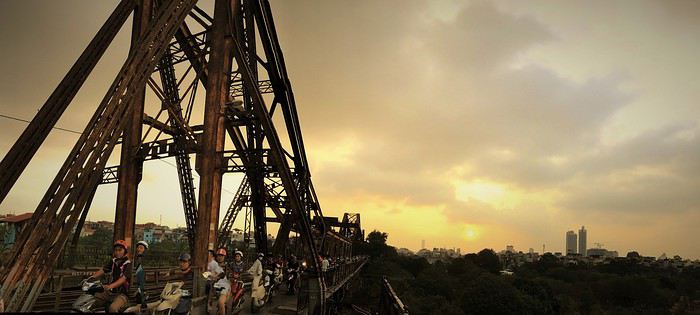
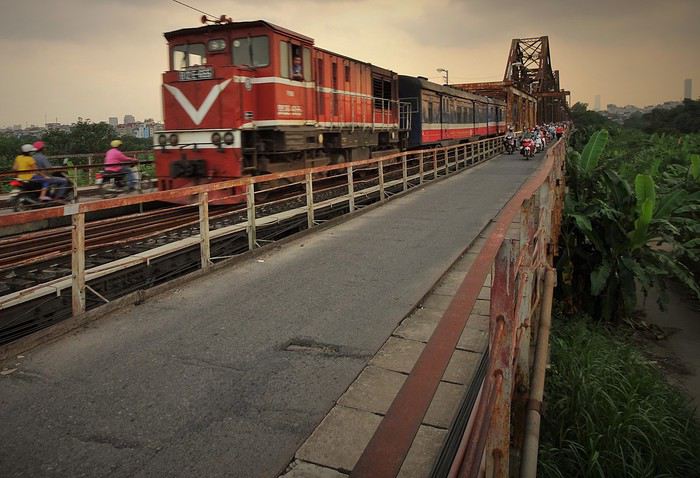
Le pont Long Bien anciennement pont Paul Doumer, plus d'un siècle au compteur et un kilomètre et demi de béton et d'acier qui enjambe le fleuve Rouge. Un monument, mais un monument marqué comme un vieux baroudeur par les cicatrices du temps et de l'histoire. Les français (entre autres) l'ont construit, les américains bombardés, aujourd'hui, les motos et les trains vietnamiens l'empruntent encore
Ça, c'est pour la partie historique (sommaire c'est vrai 😊 mais on trouvera aisément sur la toile de quoi étoffer ce rapide résumé)
Pourquoi avoir voulu à tout prix mettre au programme une visite de ce vieux pont, lointain cousin de la tour Eiffel et témoignage d'un petit morceau de l'histoire franco-vietnamienne alors qu'il y a tant à voir à Hanoi que nous ne connaissons pas encore ?
C'est une histoire de feeling, une rencontre sur le net lors de la préparation de ce voyage. Avant même de poser un pied en Asie, ce vieux monsieur de fer m'avait séduite par son côté romantique et désuet. Consciente d'une potentielle désillusion face à la réalité, j'ai cependant décidé de lui donner sa chance et d'y conduire mon homme en fin de journée pour une balade un peu en dehors des sentiers battus (quoique ... 😇)
Situé à un plus d'un kilomètre des vieux quartiers et du lac Hoan Kiem, il est aisément accessible à pied, le tout étant de trouver l'endroit où on peut y grimper, c'est à dire, la gare, ce qui semble être une évidence mais qui ne l'était pas pour nous ce jour là. Heureusement à Hanoï, on trouve aisément quelques anglophones qui nous ont très gentiment remis sur le droit chemin.
Ce qui frappe de prime abord, c'est cette accumulation de poutres métalliques rivetées, soudées, rouillées qui se croisent et se rejoignent, partant à l'assaut du ciel au mépris des lois de la pesanteur. Loin du gris froid de l'acier, elles sont teintées par la corrosion et se parent de longues traînées irrégulières couleur brique qui s'enflamment sous le soleil couchant. On les dirait presque vivantes. D'ailleurs elles vibrent et ronronnent sous le flot continu des deux roues qui défilent de chaque côté dans un vrombissement entêtant.
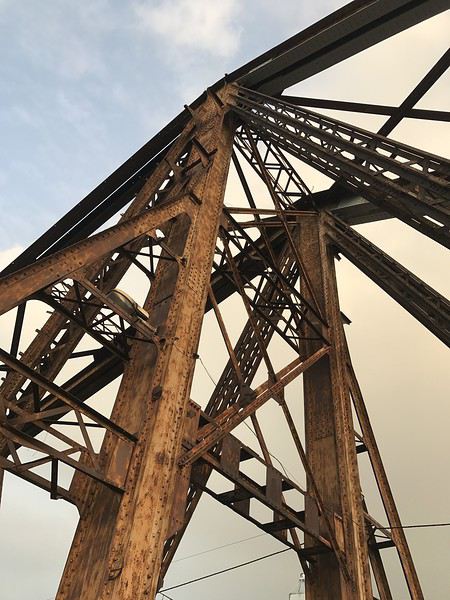
Au sol, les plaques cimentées disjointes se soulèvent et se chevauchent dans une stabilité toute relative, laissant apparaître, parfois, une faille où l'on entrevoit l'éclat du fleuve. Et le long des rails qui soulignent les lignes abstraites d'une perspective parfaite, des câbles se mêlent, s'emmêlent, rampant sur le sol, partant à l'assaut d'une grille qui s'élève en protection dérisoire. Ce pont vit, gémit, tremble sous le poids de son histoire, dans un présent qui file à toute vitesse vers l'avenir.
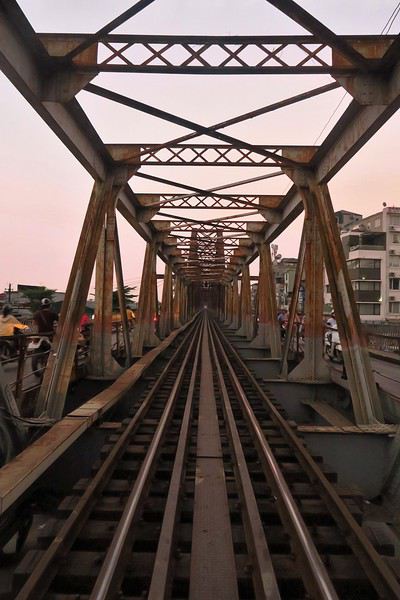
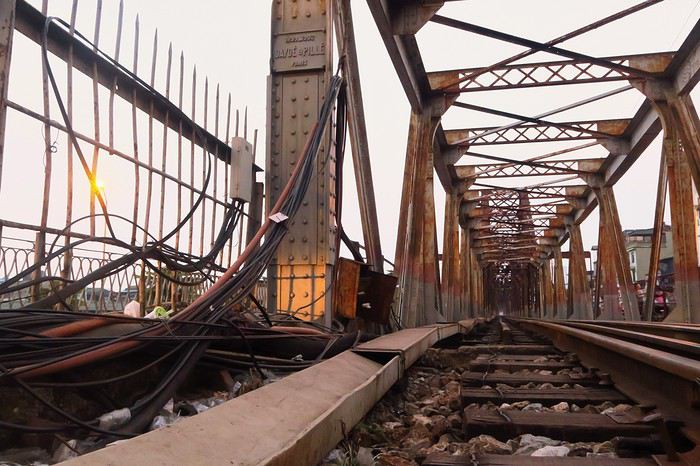
En avançant droit devant sur l'étroite bande réservée aux piétons, on prend de la hauteur, on sort de la ville, vision privilégiée qui entraîne un étrange sentiment, comme si on était soudain en dehors du temps et de cette vie grouillante qui fait toute l'âme d'Hanoï.
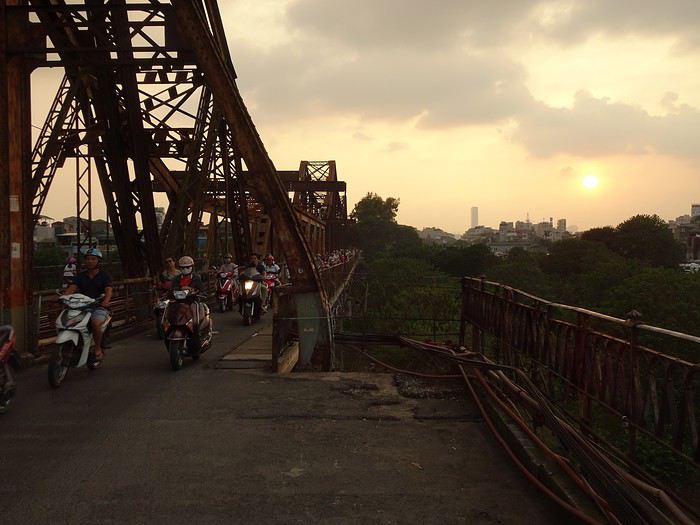
Derrière, qui s'éloigne déjà, il y a la ville, grise et serrée, Hanoï aujourd'hui, quelques bâtiments qui s'élèvent, des grues qui en promettent d'autres, Hanoï demain. Dessous, une autre cité se cache entre les gros piliers de béton, dans une végétation qui prolifère et fanfaronne, faite de tôles, de cartons et de vieilles bâches délavées. Une sorte de cour des miracles où hommes et animaux se retrouvent au milieu d'un amas de détritus, où l'on respire la précarité, où l'on vit en catimini. Hanoï aujourd'hui, toujours, Hanoï qui se cache.
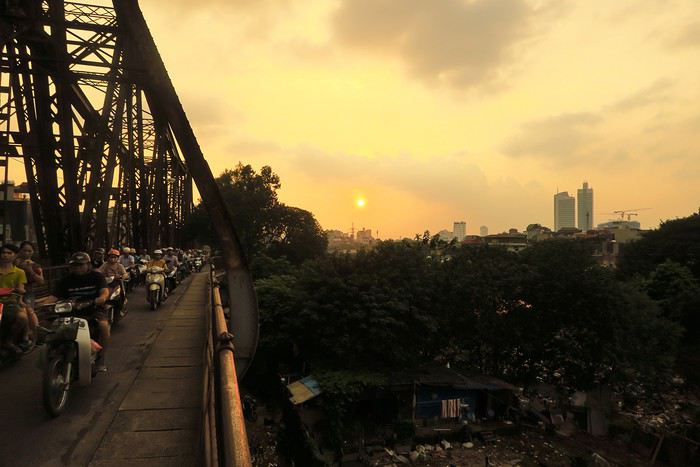
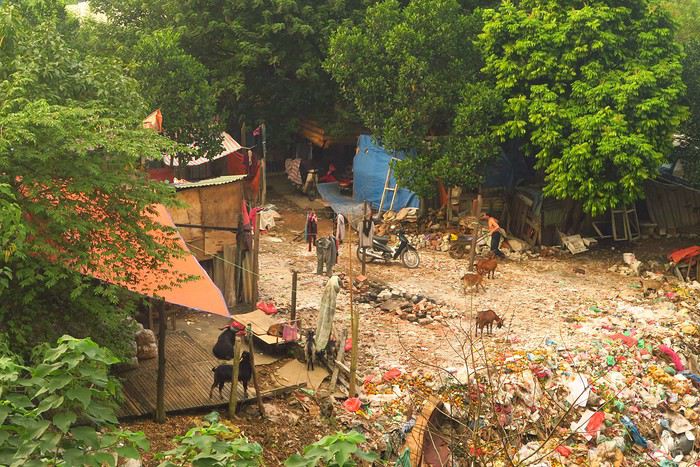
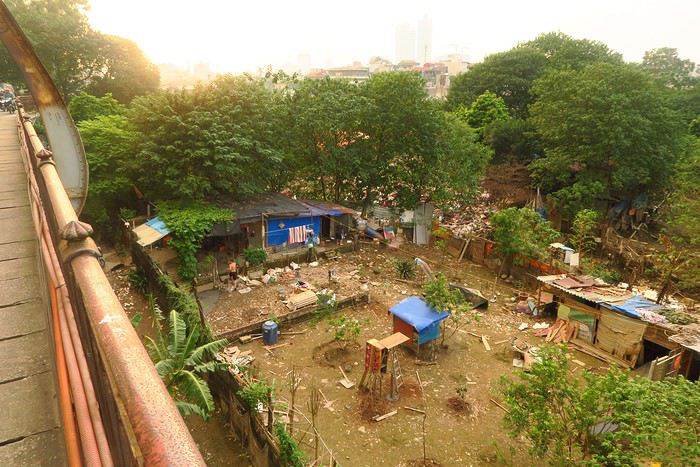
La ligne toute d'acier et ciment nous emmène, nous emporte, on avance encore, un peu étourdi par le mouvement incessant des motos qui nous frôlent. Le fleuve Rouge se dessine plus précisément, sauvage et indompté, rongé par une végétation prolifique. Il s'étale, prend ses aises, grignote les berges au hasard d'une courbe. Des pêcheurs sur des barques à fond plat s'y déplacent sans un bruit. Un autre monde encore.
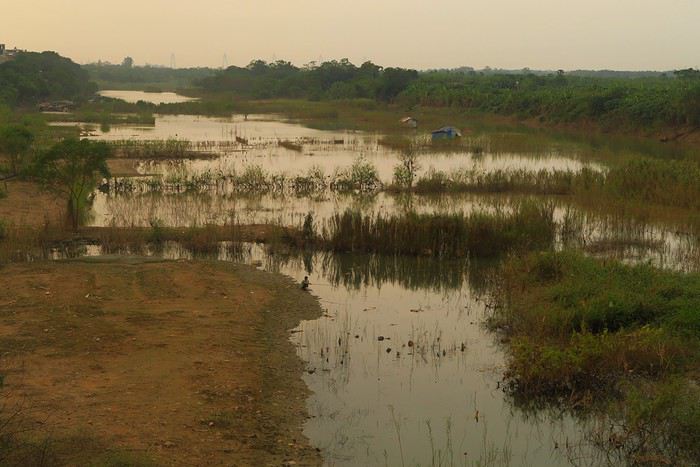
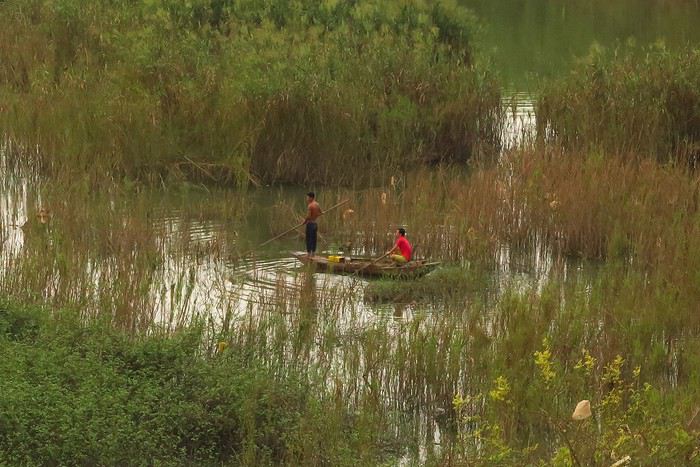
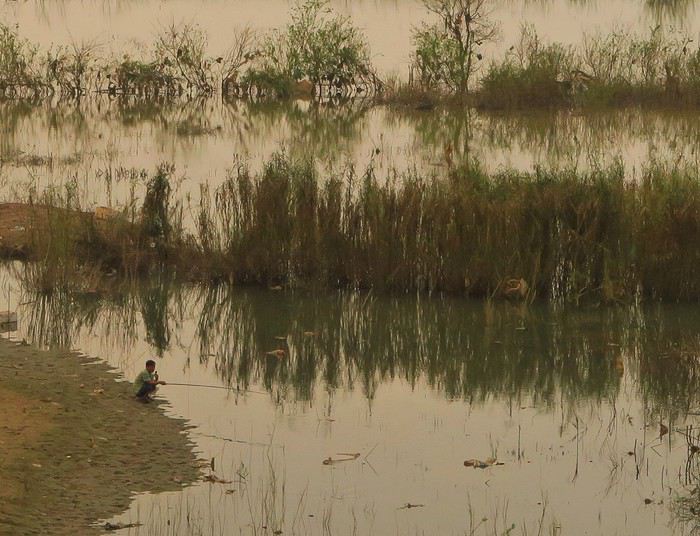
Et l'île des bananes apparaît, luxuriante, multipliant les nuances de vert. Une jungle née des entrailles de la ville à moins que ce ne soit le contraire ... On peut y descendre. C'est ici que nous ferons demi-tour, au milieu du pont.
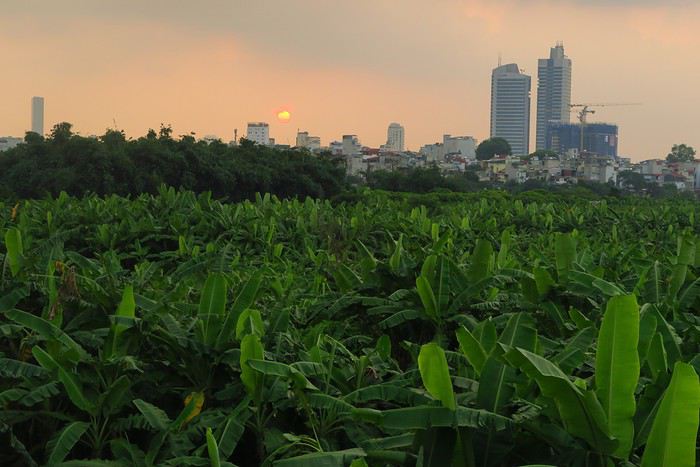
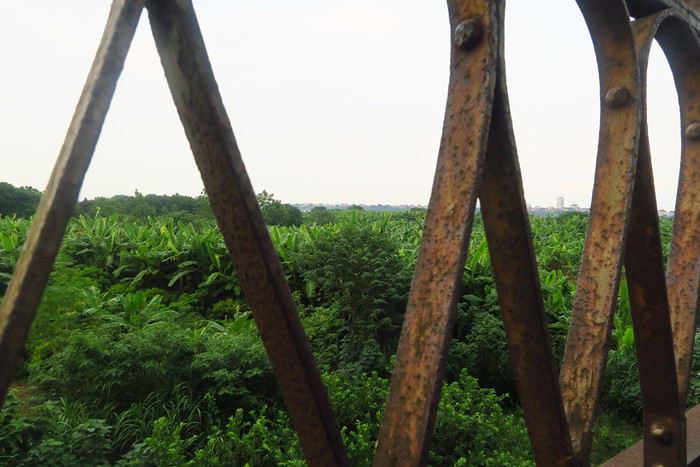
Marcher à la queue leu leu, pas d'autres possibilités, sur cette étroite bande irrégulière et vibrante, dans le brouhaha des moteurs et la légère brise du soir qui tombe, sous l'ombre démesurée des grands piliers d'acier, c'est un voyage en soi, un lien à travers les temps, un morceau de poésie. Pas sûr qu'il résistera encore longtemps, ce pont, au temps qui se presse et qui pèse toujours plus. Pas sûr qu'il racontera toujours, aux visiteurs réceptifs, ces histoires d'hommes et de femmes en route vers l'histoire.
Partie 3 : et encore la vieille ville
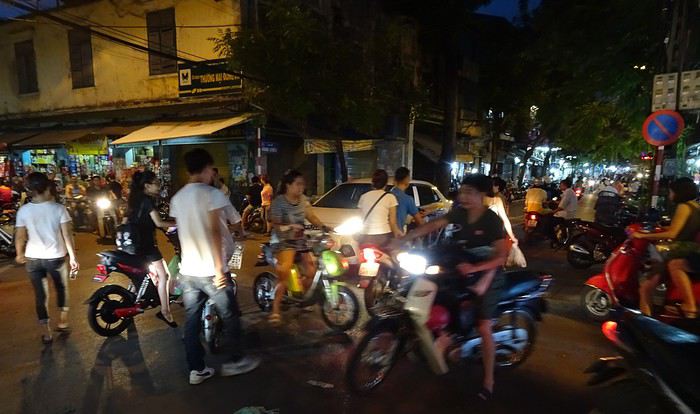
Retour dans la vieille ville, dans un quartier qui se conjugue au présent, dans le bruit qui remplit le moindre espace, dans la foule mouvante et compacte, dans la lumière éblouissante. La nuit est tombée. Dans cette trêve toute relative dans le combat inégal des hommes et de la fournaise diurne, la ville s'éveille si tant est qu'elle ait dormi un jour. Et ça grouille, et ça se presse, et ça s'agite comme dans une fourmilière ébranlée par un coup de pied malencontreux.
Samedi soir, les voitures sont interdites dans les vieux quartiers. Barricades, policiers en uniforme, mais ici tout se discute, tout se négocie. Les barrières glissent, un véhicule s'engage dans la marée humaine qui avance et se croise, presque corps à corps.
Samedi soir, les marchands sont partout, vendent de tout, à boire, à manger, à porter et emporter, n'importe quoi, à n'importe qui. On se faufile, on se glisse, on se coule entre deux étals colorés, entre les petits tabourets occupés, parmi des vélos surchargés qui peinent à trouver un passage.
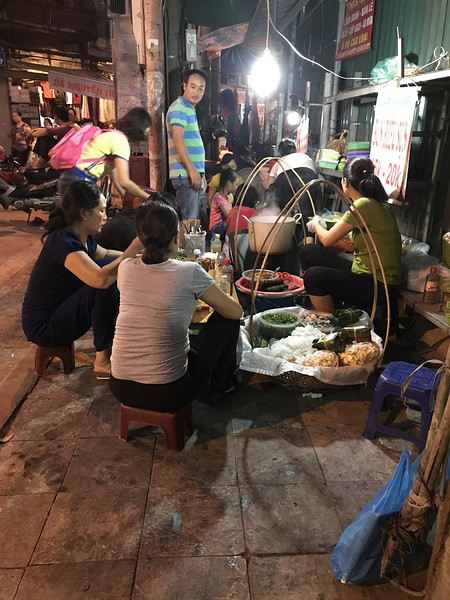
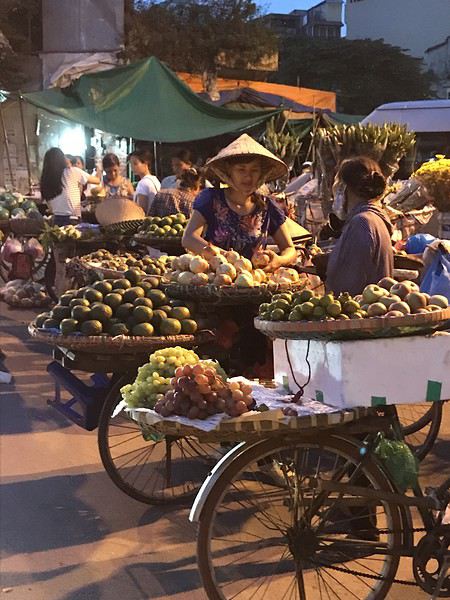
Samedi soir, les touristes en profitent, les marchands les attendent, sourire aux lèvres, mains tendues et charabia multilingue. Ils sont à pied ou en cyclo, en short et tee shirt au logo agressif, l'appareil photo accroché au cou comme une amulette qu'ils ne quittent jamais, souvent trop grands, parfois trop corpulents pour se fondre dans la masse.
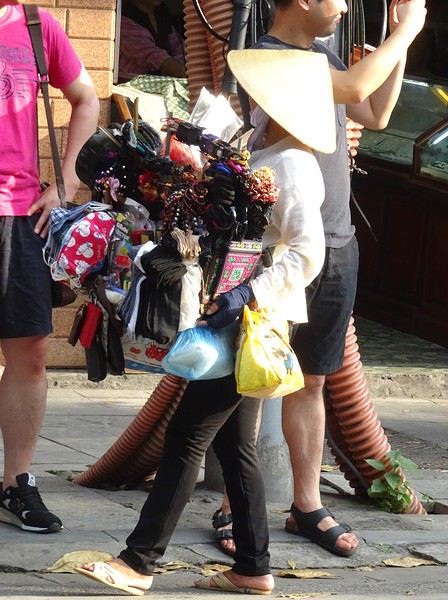
Samedi soir sur les rives du lac Hoan Kiem, impossible de faire un pas. La foule est partout. Musique, jongleurs, cracheurs de feu, c'est une coulée humaine qui glisse lentement et vous emporte, vous entraîne sans le moindre choix possible, brûlante et vibrante.
Après plusieurs heures de marche dans cette jungle de bras et de jambes mêlés, on rend les armes, on regagne notre hôtel, hagards et épuisés. On avait oublié, perdus dans les montagnes aux confins de la Chine, l'effervescence des villes d'Asie et leur mouvance tentaculaire. La suite est ici

Partie 1 : Retour à Hanoï
Ha Giang-Hanoi, c'est une route comme il en existe des milliers, du macadam, des voitures, des camions, des villages qui se transforment peu à peu en villes et qui se ressemblent tous. Rien de bien folichon. Six heures de route environ et pas grand chose à se mettre sous l'objectif.
On s'arrêtera dans une propriété qui cultive le thé à grande échelle. Invités par les propriétaires à boire le thé, on mesurera la prospérité de cette famille qui contraste violemment avec le mode de vie des ethnies du nord.

Lors de notre arrivée à Hanoi, une semaine plus tôt, on s'était senti dépaysés. Aujourd'hui, en s'approchant de la capitale, on a l'impression de retrouver un monde connu plus proche du nôtre tant le fossé qui nous sépare de l'extrême nord Vietnam était vertigineux.
Une dernière gargote, les derniers kilomètres et nous retrouvons notre hôtel du vieux quartier dans l'après-midi, un peu sonné par le contraste.
Partie 2 : le pont Long Bien
Le pont Long Bien anciennement pont Paul Doumer, plus d'un siècle au compteur et un kilomètre et demi de béton et d'acier qui enjambe le fleuve Rouge. Un monument, mais un monument marqué comme un vieux baroudeur par les cicatrices du temps et de l'histoire. Les français (entre autres) l'ont construit, les américains bombardés, aujourd'hui, les motos et les trains vietnamiens l'empruntent encore
Ça, c'est pour la partie historique (sommaire c'est vrai 😊 mais on trouvera aisément sur la toile de quoi étoffer ce rapide résumé)
Pourquoi avoir voulu à tout prix mettre au programme une visite de ce vieux pont, lointain cousin de la tour Eiffel et témoignage d'un petit morceau de l'histoire franco-vietnamienne alors qu'il y a tant à voir à Hanoi que nous ne connaissons pas encore ?
C'est une histoire de feeling, une rencontre sur le net lors de la préparation de ce voyage. Avant même de poser un pied en Asie, ce vieux monsieur de fer m'avait séduite par son côté romantique et désuet. Consciente d'une potentielle désillusion face à la réalité, j'ai cependant décidé de lui donner sa chance et d'y conduire mon homme en fin de journée pour une balade un peu en dehors des sentiers battus (quoique ... 😇)
Situé à un plus d'un kilomètre des vieux quartiers et du lac Hoan Kiem, il est aisément accessible à pied, le tout étant de trouver l'endroit où on peut y grimper, c'est à dire, la gare, ce qui semble être une évidence mais qui ne l'était pas pour nous ce jour là. Heureusement à Hanoï, on trouve aisément quelques anglophones qui nous ont très gentiment remis sur le droit chemin.
Ce qui frappe de prime abord, c'est cette accumulation de poutres métalliques rivetées, soudées, rouillées qui se croisent et se rejoignent, partant à l'assaut du ciel au mépris des lois de la pesanteur. Loin du gris froid de l'acier, elles sont teintées par la corrosion et se parent de longues traînées irrégulières couleur brique qui s'enflamment sous le soleil couchant. On les dirait presque vivantes. D'ailleurs elles vibrent et ronronnent sous le flot continu des deux roues qui défilent de chaque côté dans un vrombissement entêtant.


Au sol, les plaques cimentées disjointes se soulèvent et se chevauchent dans une stabilité toute relative, laissant apparaître, parfois, une faille où l'on entrevoit l'éclat du fleuve. Et le long des rails qui soulignent les lignes abstraites d'une perspective parfaite, des câbles se mêlent, s'emmêlent, rampant sur le sol, partant à l'assaut d'une grille qui s'élève en protection dérisoire. Ce pont vit, gémit, tremble sous le poids de son histoire, dans un présent qui file à toute vitesse vers l'avenir.


En avançant droit devant sur l'étroite bande réservée aux piétons, on prend de la hauteur, on sort de la ville, vision privilégiée qui entraîne un étrange sentiment, comme si on était soudain en dehors du temps et de cette vie grouillante qui fait toute l'âme d'Hanoï.

Derrière, qui s'éloigne déjà, il y a la ville, grise et serrée, Hanoï aujourd'hui, quelques bâtiments qui s'élèvent, des grues qui en promettent d'autres, Hanoï demain. Dessous, une autre cité se cache entre les gros piliers de béton, dans une végétation qui prolifère et fanfaronne, faite de tôles, de cartons et de vieilles bâches délavées. Une sorte de cour des miracles où hommes et animaux se retrouvent au milieu d'un amas de détritus, où l'on respire la précarité, où l'on vit en catimini. Hanoï aujourd'hui, toujours, Hanoï qui se cache.


La ligne toute d'acier et ciment nous emmène, nous emporte, on avance encore, un peu étourdi par le mouvement incessant des motos qui nous frôlent. Le fleuve Rouge se dessine plus précisément, sauvage et indompté, rongé par une végétation prolifique. Il s'étale, prend ses aises, grignote les berges au hasard d'une courbe. Des pêcheurs sur des barques à fond plat s'y déplacent sans un bruit. Un autre monde encore.


Et l'île des bananes apparaît, luxuriante, multipliant les nuances de vert. Une jungle née des entrailles de la ville à moins que ce ne soit le contraire ... On peut y descendre. C'est ici que nous ferons demi-tour, au milieu du pont.


Marcher à la queue leu leu, pas d'autres possibilités, sur cette étroite bande irrégulière et vibrante, dans le brouhaha des moteurs et la légère brise du soir qui tombe, sous l'ombre démesurée des grands piliers d'acier, c'est un voyage en soi, un lien à travers les temps, un morceau de poésie. Pas sûr qu'il résistera encore longtemps, ce pont, au temps qui se presse et qui pèse toujours plus. Pas sûr qu'il racontera toujours, aux visiteurs réceptifs, ces histoires d'hommes et de femmes en route vers l'histoire.

Partie 3 : et encore la vieille ville
Retour dans la vieille ville, dans un quartier qui se conjugue au présent, dans le bruit qui remplit le moindre espace, dans la foule mouvante et compacte, dans la lumière éblouissante. La nuit est tombée. Dans cette trêve toute relative dans le combat inégal des hommes et de la fournaise diurne, la ville s'éveille si tant est qu'elle ait dormi un jour. Et ça grouille, et ça se presse, et ça s'agite comme dans une fourmilière ébranlée par un coup de pied malencontreux.
Samedi soir, les voitures sont interdites dans les vieux quartiers. Barricades, policiers en uniforme, mais ici tout se discute, tout se négocie. Les barrières glissent, un véhicule s'engage dans la marée humaine qui avance et se croise, presque corps à corps.

Samedi soir, les marchands sont partout, vendent de tout, à boire, à manger, à porter et emporter, n'importe quoi, à n'importe qui. On se faufile, on se glisse, on se coule entre deux étals colorés, entre les petits tabourets occupés, parmi des vélos surchargés qui peinent à trouver un passage.


Samedi soir, les touristes en profitent, les marchands les attendent, sourire aux lèvres, mains tendues et charabia multilingue. Ils sont à pied ou en cyclo, en short et tee shirt au logo agressif, l'appareil photo accroché au cou comme une amulette qu'ils ne quittent jamais, souvent trop grands, parfois trop corpulents pour se fondre dans la masse.

Samedi soir sur les rives du lac Hoan Kiem, impossible de faire un pas. La foule est partout. Musique, jongleurs, cracheurs de feu, c'est une coulée humaine qui glisse lentement et vous emporte, vous entraîne sans le moindre choix possible, brûlante et vibrante.
Après plusieurs heures de marche dans cette jungle de bras et de jambes mêlés, on rend les armes, on regagne notre hôtel, hagards et épuisés. On avait oublié, perdus dans les montagnes aux confins de la Chine, l'effervescence des villes d'Asie et leur mouvance tentaculaire. La suite est ici
Bonne année Isabelle, avec des tas de découvertes, des rencontres, des expériences nouvelles et sympathiques
j'attend du forum, les ressentis, les mésaventures, les joies, les waouh ou non...
C'est exactement la même chose pour moi. Les récits qui m'ont le plus aidée (en dehors des considérations pratiques très utiles également) sont ceux qui m'ont permis de m'identifier ou pas afin de faire mes propres choix et construire MON voyage en connaissance de cause. Mais il y en a peu sur le nord Vietnam comparé à d'autres destinations.
A bientôt et merci pour tes vœux et ton commentaire 🙂
j'attend du forum, les ressentis, les mésaventures, les joies, les waouh ou non...
C'est exactement la même chose pour moi. Les récits qui m'ont le plus aidée (en dehors des considérations pratiques très utiles également) sont ceux qui m'ont permis de m'identifier ou pas afin de faire mes propres choix et construire MON voyage en connaissance de cause. Mais il y en a peu sur le nord Vietnam comparé à d'autres destinations.
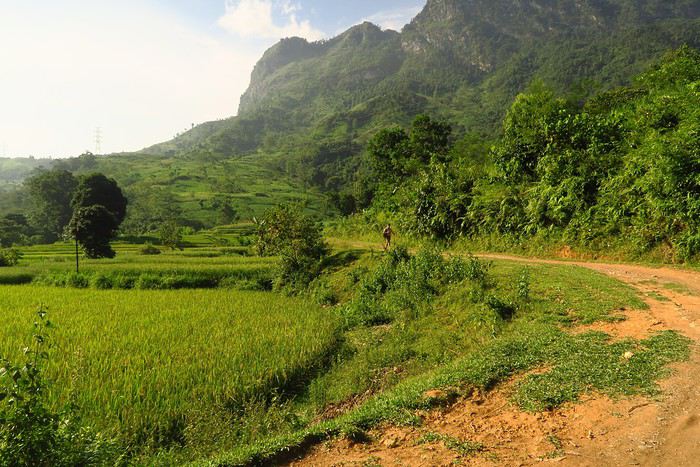
A bientôt et merci pour tes vœux et ton commentaire 🙂
Vive la suite 🙂 ... même si nous, nous n'avions pas trop aimé la baie d'Halong 😮.
Je me permet juste une remarque; sans être vexé, je suis tout de même un peu touché par le fait que cela fait plusieurs fois que je lis qu'il n'y a pas (ou très peu) de carnets sur le Nord Vietnam ... alors que j'en avais écrit un, reprit dans mon blog (avec photos). Et il m'avait semblé avoir été objectif. J'y avais, notamment, fait état de l'importance à accorder au choix du guide 😊
Surtout ne t'arrête pas 🙂
Je me permet juste une remarque; sans être vexé, je suis tout de même un peu touché par le fait que cela fait plusieurs fois que je lis qu'il n'y a pas (ou très peu) de carnets sur le Nord Vietnam ... alors que j'en avais écrit un, reprit dans mon blog (avec photos). Et il m'avait semblé avoir été objectif. J'y avais, notamment, fait état de l'importance à accorder au choix du guide 😊
Surtout ne t'arrête pas 🙂
Je me présente mes excuses pour avoir occulté l'un et l'autre précédent carnet de voyage et pour avoir cru celui-ci terminé. Ce doit être l'émotion ; certaines images vont longtemps hanter mes pensées...
« Tout le monde s'interroge sur comment laisser une meilleure planète à nos enfants, mais on devrait plutôt penser à laisser de meilleurs enfants pour notre planète. » Clint Eastwood
hihihi
moi aussi , je suis d'abord restée dubitative sur ce "nus" avant de comprendre la faute de frappe...
emoran
J'ai mis un moment à comprendre ... merci 😊
j'ai modifié 😮
Salut Jean François,
Je me permet juste une remarque; sans être vexé, je suis tout de même un peu touché par le fait que cela fait plusieurs fois que je lis qu'il n'y a pas (ou très peu) de carnets sur le Nord Vietnam
Bien sûr, il y a des carnets sur le nord Vietnam mais si on enlève le sud, le Laos et le Cambodge, on doit tomber à une petite dizaine (je crois les avoir tous lus 😊) c'est quand même bien moins que dans d'autres régions du globe comme l'ouest des USA ou la Namibie. Quant à tes carnets, ne t'inquiète pas, c'est difficile de passer à côté ... 😄 j'en ai déjà écumé un certain nombre 😉
Surtout ne t'arrête pas
Ah si, je vais m'arrêter, mais à la fin, et c'est pour bientôt. Il est temps je crois 😛
Je me permet juste une remarque; sans être vexé, je suis tout de même un peu touché par le fait que cela fait plusieurs fois que je lis qu'il n'y a pas (ou très peu) de carnets sur le Nord Vietnam
Bien sûr, il y a des carnets sur le nord Vietnam mais si on enlève le sud, le Laos et le Cambodge, on doit tomber à une petite dizaine (je crois les avoir tous lus 😊) c'est quand même bien moins que dans d'autres régions du globe comme l'ouest des USA ou la Namibie. Quant à tes carnets, ne t'inquiète pas, c'est difficile de passer à côté ... 😄 j'en ai déjà écumé un certain nombre 😉
Surtout ne t'arrête pas
Ah si, je vais m'arrêter, mais à la fin, et c'est pour bientôt. Il est temps je crois 😛
Bien sûr, il y a des carnets sur le nord Vietnam mais si on enlève le sud, le Laos et le Cambodge, on doit tomber à une petite dizaine (je crois les avoir tous lus 😊) c'est quand même bien moins que dans d'autres régions du globe comme l'ouest des USA ou la Namibie.
Bonjour Laure,
Je le trouve génial ton carnet, d'autant plus qu'ils se font rares dans cette partie du globe. Comme tu l'écris très justement, il y en a beaucoup plus sur la Namibie et surtout l'ouest des USA. Mais pourquoi donc ? Beaucoup plus de visiteurs qu'ailleurs pour cette dernière destination, ce qui explique sans doute cela. Pour ma part, je n'ai écrit que 2 carnets: un sur les USA (of course !) et un autre sur les Philippines dans la foulée (c'était l'année suivante). J'ai eu beaucoup plus de retours avec le 1er carnet que le 2ème. Je n'en ai jamais écrit d'autre avant et après ces destinations. Peut être qu'un jour ?? Après la Namibie ??? J'en profite pour te souhaiter une très bonne année 2018 avec encore de beaux voyages. 🙂
Bonjour Laure,
Je le trouve génial ton carnet, d'autant plus qu'ils se font rares dans cette partie du globe. Comme tu l'écris très justement, il y en a beaucoup plus sur la Namibie et surtout l'ouest des USA. Mais pourquoi donc ? Beaucoup plus de visiteurs qu'ailleurs pour cette dernière destination, ce qui explique sans doute cela. Pour ma part, je n'ai écrit que 2 carnets: un sur les USA (of course !) et un autre sur les Philippines dans la foulée (c'était l'année suivante). J'ai eu beaucoup plus de retours avec le 1er carnet que le 2ème. Je n'en ai jamais écrit d'autre avant et après ces destinations. Peut être qu'un jour ?? Après la Namibie ??? J'en profite pour te souhaiter une très bonne année 2018 avec encore de beaux voyages. 🙂
« Voyager rend modeste. Vous voyez quelle petite place vous occupez dans le monde. » - Gustave Flaubert
https://www.myatlas.com/anneclaire95
A Lol64
Permettez moi de vous signaler quelques notes qui vous auraient été utiles en préparation de votre voyage au Nord Vietnam. Notamment sur le choix du guide et les avatars https://voyageforum.com/v.f?post=2627087;#2627087
Doc.Bedel
Bonjour,
Je me suis permis de suivre votre lien, c'est fort intéressant. 🙂 Effectivement au Vietnam pour être guide il faut suivre une formation. Ils ont ensuite une carte qu'ils sont sensés avoir en permanence sur eux et même visible je crois. C'est déjà une garantie qu'au moins le savoir "théorique" est acquis.
Merci 🙂
Je me suis permis de suivre votre lien, c'est fort intéressant. 🙂 Effectivement au Vietnam pour être guide il faut suivre une formation. Ils ont ensuite une carte qu'ils sont sensés avoir en permanence sur eux et même visible je crois. C'est déjà une garantie qu'au moins le savoir "théorique" est acquis.
Merci 🙂
Log in first, then come back to this page.
You might also like
De Hô-Chi-Minh au Cambodge via le MékongFR
22 jours au VietnamFR
Il est grand temps de rallumer les étoiles! (Vietnam)FR
Un mois au Vietnam, des montagnes du nord au delta du MékongFR
Dormir chez les Lolos Noirs sans guideFR
Le Tonkin, une région superbe et accueillanteFR
Découverte des ethnies minoritaires du nord du VietnamFR
More discussions
Here’s a little clip we filmed in November–December 2019 (just before Covid) of a trip from Hanoi to Cat Ba Bay and then on to Xishuangbanna via Luang Namtha.
https://youtu.be/suZYN3LvgkQ
Wednesday, April 1st
Hazaribagh I’ve got a meet-up with Adam Iman, a guide and painter. He picks me up from the hotel at 10 AM. Another traveler from Bangalore is supposed to join us, but while we wait for him to arrive, Adam takes me to see the paintings his mother and sister created at Hazaribagh station. The town became famous thanks to these murals, which can also be found in several surrounding villages. This art form has earned recognition and is now protected, a sign of its cultural importance. Once the visit is over, we go to pick up the other traveler and then head to our first village: Belwara, where Sohrai art is practiced. At the entrance, a sign proudly announces that we’re entering an artists’ village, where this art is created by women organized into micro-enterprises. Some even offer workshops for those who’d like to learn this tradition.

Sohrai art is tied to the harvest season, from October to mid-November. The motifs, in natural colors, celebrate fertility and abundance. The artists use pigments from the earth: red oxides, ochre, white kaolin, and black manganese. On the walls, you’ll see animals, fish, birds—all symbols of life and prosperity. As I look closer at the murals, I start to realize that each motif tells a story. Large animals like cows or bulls often take center stage. Their bodies are filled with intricate, almost hypnotic patterns. They symbolize wealth and prosperity for the household, as well as the deep respect for cattle, which are essential to daily life. On some facades, elephants stand out—massive and decorated with the same precision. They evoke quiet strength and protection. But it’s when I stop in front of one of the houses that I really take the time to look. The wall, a soft ochre, is entirely covered in murals. Two large animals stretch out on either side of the door, their elongated bodies fitting the length of the wall. Their silhouettes are filled with geometric patterns and incredibly fine curved lines, as if every space was patiently filled. Around them, stylized plants, flowers, and small decorative elements fill every gap. The door, dark and worn, becomes almost the silent center of the composition, framed by these living, protective forms. To the right, a more colorful motif catches the eye—a flower or a stylized lamp—like a touch of light on the earth. The whole thing gives an impression of perfect balance, between the rigor of the patterns and the freedom of the gesture.

Elsewhere, birds and freer forms bring movement. Peacocks, recognizable by their stylized silhouettes, embody beauty and vitality, while fish symbolize water, fertility, and the continuity of life.
On some paintings, the scenes become almost narrative: you can make out figures, everyday gestures, like a memory of the village inscribed in the walls. The decorative frames around the doors aren’t left to chance either—they symbolically protect the house, like a boundary between the inside and the outside world.
During the Sohrai festival, cattle are led into the jungle in the morning. Meanwhile, the women finish the *aripans*—these floor paintings—and continue the wall murals. Around noon, the animals return to the village, and the bulls’ horns are anointed with oil and vermilion in a gesture of gratitude, amid the vibrant colors adorning the houses. We visit several artists, including Parvat Devi, a well-known woman who has received many awards. Her arms are adorned with intriguing tattoos, which I’ll talk about in more detail later.

On another wall, the style changes completely. Here, no massive animals—just birds occupying the space, light and graceful, as if caught in mid-movement. Two silhouettes face each other, their long necks arched almost like mirrors, while their outstretched wings seem to vibrate with the patterns that compose them.

The design is more graphic, almost airy. The lines are smoother, more fluid, as if drawn in one confident stroke. The birds’ bodies aren’t solid—they’re filled with repetitive motifs like scales, stylized feathers, and spirals, giving a sense of continuous movement. Around them, everything comes to life: flowers burst open, arabesques swirl, and even the simplest shapes seem alive. What strikes me here is the sense of lightness. Where the large animals evoked stability and grounding, these birds bring something freer, almost joyful. They seem to embody movement, the circulation of life, like a breath flowing through the village.

The colors remain the same—deep reds, intense blacks, and chalky white—but the rhythm is different. Faster, more spontaneous. As if each wall had its own personality, while still speaking the same language.
That’s probably why I’m so moved. I’d heard about these paintings from my friend Raja, and last year, I saw an exhibition in a village near my home. That first encounter made me want to come here. But seeing them in person is a whole different experience. These paintings are unique. This ancient art is passed down from mother to daughter, or mother-in-law to daughter-in-law, in a quiet, deeply living continuity. At first glance, it might seem almost childlike in its simplicity and pared-down forms. And yet, everything is thought out, balanced, mastered. Nothing is left to chance.

That apparent simplicity, combined with such rich symbolism, touches me deeply. There’s something sincere and essential in these walls—and that’s what moves me.
Hazaribagh I’ve got a meet-up with Adam Iman, a guide and painter. He picks me up from the hotel at 10 AM. Another traveler from Bangalore is supposed to join us, but while we wait for him to arrive, Adam takes me to see the paintings his mother and sister created at Hazaribagh station. The town became famous thanks to these murals, which can also be found in several surrounding villages. This art form has earned recognition and is now protected, a sign of its cultural importance. Once the visit is over, we go to pick up the other traveler and then head to our first village: Belwara, where Sohrai art is practiced. At the entrance, a sign proudly announces that we’re entering an artists’ village, where this art is created by women organized into micro-enterprises. Some even offer workshops for those who’d like to learn this tradition.

Sohrai art is tied to the harvest season, from October to mid-November. The motifs, in natural colors, celebrate fertility and abundance. The artists use pigments from the earth: red oxides, ochre, white kaolin, and black manganese. On the walls, you’ll see animals, fish, birds—all symbols of life and prosperity. As I look closer at the murals, I start to realize that each motif tells a story. Large animals like cows or bulls often take center stage. Their bodies are filled with intricate, almost hypnotic patterns. They symbolize wealth and prosperity for the household, as well as the deep respect for cattle, which are essential to daily life. On some facades, elephants stand out—massive and decorated with the same precision. They evoke quiet strength and protection. But it’s when I stop in front of one of the houses that I really take the time to look. The wall, a soft ochre, is entirely covered in murals. Two large animals stretch out on either side of the door, their elongated bodies fitting the length of the wall. Their silhouettes are filled with geometric patterns and incredibly fine curved lines, as if every space was patiently filled. Around them, stylized plants, flowers, and small decorative elements fill every gap. The door, dark and worn, becomes almost the silent center of the composition, framed by these living, protective forms. To the right, a more colorful motif catches the eye—a flower or a stylized lamp—like a touch of light on the earth. The whole thing gives an impression of perfect balance, between the rigor of the patterns and the freedom of the gesture.

Elsewhere, birds and freer forms bring movement. Peacocks, recognizable by their stylized silhouettes, embody beauty and vitality, while fish symbolize water, fertility, and the continuity of life.
On some paintings, the scenes become almost narrative: you can make out figures, everyday gestures, like a memory of the village inscribed in the walls. The decorative frames around the doors aren’t left to chance either—they symbolically protect the house, like a boundary between the inside and the outside world.

During the Sohrai festival, cattle are led into the jungle in the morning. Meanwhile, the women finish the *aripans*—these floor paintings—and continue the wall murals. Around noon, the animals return to the village, and the bulls’ horns are anointed with oil and vermilion in a gesture of gratitude, amid the vibrant colors adorning the houses. We visit several artists, including Parvat Devi, a well-known woman who has received many awards. Her arms are adorned with intriguing tattoos, which I’ll talk about in more detail later.

On another wall, the style changes completely. Here, no massive animals—just birds occupying the space, light and graceful, as if caught in mid-movement. Two silhouettes face each other, their long necks arched almost like mirrors, while their outstretched wings seem to vibrate with the patterns that compose them.

The design is more graphic, almost airy. The lines are smoother, more fluid, as if drawn in one confident stroke. The birds’ bodies aren’t solid—they’re filled with repetitive motifs like scales, stylized feathers, and spirals, giving a sense of continuous movement. Around them, everything comes to life: flowers burst open, arabesques swirl, and even the simplest shapes seem alive. What strikes me here is the sense of lightness. Where the large animals evoked stability and grounding, these birds bring something freer, almost joyful. They seem to embody movement, the circulation of life, like a breath flowing through the village.

The colors remain the same—deep reds, intense blacks, and chalky white—but the rhythm is different. Faster, more spontaneous. As if each wall had its own personality, while still speaking the same language.
That’s probably why I’m so moved. I’d heard about these paintings from my friend Raja, and last year, I saw an exhibition in a village near my home. That first encounter made me want to come here. But seeing them in person is a whole different experience. These paintings are unique. This ancient art is passed down from mother to daughter, or mother-in-law to daughter-in-law, in a quiet, deeply living continuity. At first glance, it might seem almost childlike in its simplicity and pared-down forms. And yet, everything is thought out, balanced, mastered. Nothing is left to chance.

That apparent simplicity, combined with such rich symbolism, touches me deeply. There’s something sincere and essential in these walls—and that’s what moves me.
Here we go!!!
I left home at 4 AM on October 31st and headed to Barcelona. Driving through Barcelona on the ring road stresses me out a bit, but at 6 AM the traffic is smooth, and I arrive at the airport without any issues. I call the valet, who quickly comes to pick up my car. He takes photos of it from all angles before letting me go.
Baggage check-in hasn’t started yet, and there are already several of us waiting.
Once free, everything happens very quickly. The flight to Abu Dhabi is on time and goes smoothly. I’ve never had any problems with this airline, which I’ve been using for several years.
The flight to Bangkok arrives at 7 AM as scheduled. This is my first time in Thailand and Bangkok. I’m used to traveling in India, and I notice that everything here is well organized—the customs process is quick, and the luggage is already on the carousel.
I booked a taxi on Booking. All I have to do is find the right exit and door based on the agency’s instructions. A large sign with the names of people who booked is posted on a wall. A hostess greets me and calls the taxi, which arrives 5 minutes later. I booked one night at the Lost Inn BKK hotel in the Phra Nakhon district, and we arrive at 9 AM. The welcome isn’t warm, and I have to wait until noon, sitting on a chair, before I can check into my room. I’m exhausted, and sleeping sitting up isn’t ideal. Noon finally arrives—the room is small but clean, which is fine for one night. I quickly take a shower to wake up because I plan to spend the afternoon visiting the Grand Palace. First, I need to exchange some money, and the banks are all close together on the same street, which is very convenient. When I enter one, a hostess gives me a ticket and invites me to sit down. There are about twenty counters, and I wait quietly until my number is called. The exchange is quick, so I can head out to find the Royal Palace. It’s actually very easy, and the walk is pleasant.
Entry to the Royal Palace (500 baht).

It’s magnificent and grand, and there are quite a few of us visiting. The sky is gray, it’s very humid, and a shower interrupts the visit. It’s a vast complex of temples and palaces. The buildings are colorful and sparkling, with a great sense of serenity (without the tourists, of course). I quietly enjoy the place and try to take photos without tourists, which isn’t easy.

Very close to the Grand Palace is Wat Pho, one of the oldest Buddhist temples in the capital.

It’s very famous for its 46-meter-long reclining Buddha statue.


Walking around the temple, you can see different representations of Buddha, all covered in gold leaf.

Inside the temple, on one side, monks recite their prayers, while the other side is reserved for tourists who come to meditate in silence.

Before returning to the hotel, I have dinner at an Indian restaurant. I go to bed early because tomorrow’s wake-up call will be very early again.
Saturday, November 2nd Wake-up at 4 AM, departure from the hotel at 4:30 AM. The taxi I booked via Booking is waiting for me and takes me to the airport. The trip is fairly quick—he takes small roads, and at this hour, there’s no traffic.
The flight to Phnom Penh is on time. Before boarding, I realize I left my fleece jacket on the carousel, but it’s too late to go back for it.
The flight goes well, and customs is quick.
At the exit, I take a tuk-tuk to Julieka’s GH near the museum. The welcome is friendly. I won’t be able to check into my room until noon, so I take the opportunity to exchange some euros on the market street. The street is lined with restaurants, and I’ll have my first meal there.
The museum is right across the street, so I don’t waste any time visiting it.

The representations of Hindu deities are very different from those in India, and I don’t recognize them. Many beautiful Buddhas are on display.

The museum is very pleasant, and there aren’t too many people, which is a plus.
At the exit, I return to the GH, settle into my room—which is decent and clean.
The Royal Palace is 1 km away. I walk along a garden, and at the end of the street is the Tonlé Sap, but I turn right. I arrive at a large esplanade and see the buildings with tiered roofs and glazed tiles. The entrance to the palace is a little further away.
At the entrance, I notice there isn’t the same crowd as at the one in BKK.
Khmer architecture is magnificent. The complex consists of gardens, palaces, pagodas with golden roofs, and slender spires.

The Silver Pagoda houses the small Emerald Buddha, which is actually made of jade. The silver flooring is covered with carpets. Photos are not allowed.
The walls surrounding the pagoda are covered with frescoes depicting scenes from the Ramayana.
Baggage check-in hasn’t started yet, and there are already several of us waiting.
Once free, everything happens very quickly. The flight to Abu Dhabi is on time and goes smoothly. I’ve never had any problems with this airline, which I’ve been using for several years.
The flight to Bangkok arrives at 7 AM as scheduled. This is my first time in Thailand and Bangkok. I’m used to traveling in India, and I notice that everything here is well organized—the customs process is quick, and the luggage is already on the carousel.
I booked a taxi on Booking. All I have to do is find the right exit and door based on the agency’s instructions. A large sign with the names of people who booked is posted on a wall. A hostess greets me and calls the taxi, which arrives 5 minutes later. I booked one night at the Lost Inn BKK hotel in the Phra Nakhon district, and we arrive at 9 AM. The welcome isn’t warm, and I have to wait until noon, sitting on a chair, before I can check into my room. I’m exhausted, and sleeping sitting up isn’t ideal. Noon finally arrives—the room is small but clean, which is fine for one night. I quickly take a shower to wake up because I plan to spend the afternoon visiting the Grand Palace. First, I need to exchange some money, and the banks are all close together on the same street, which is very convenient. When I enter one, a hostess gives me a ticket and invites me to sit down. There are about twenty counters, and I wait quietly until my number is called. The exchange is quick, so I can head out to find the Royal Palace. It’s actually very easy, and the walk is pleasant.
Entry to the Royal Palace (500 baht).

It’s magnificent and grand, and there are quite a few of us visiting. The sky is gray, it’s very humid, and a shower interrupts the visit. It’s a vast complex of temples and palaces. The buildings are colorful and sparkling, with a great sense of serenity (without the tourists, of course). I quietly enjoy the place and try to take photos without tourists, which isn’t easy.

Very close to the Grand Palace is Wat Pho, one of the oldest Buddhist temples in the capital.

It’s very famous for its 46-meter-long reclining Buddha statue.


Walking around the temple, you can see different representations of Buddha, all covered in gold leaf.

Inside the temple, on one side, monks recite their prayers, while the other side is reserved for tourists who come to meditate in silence.

Before returning to the hotel, I have dinner at an Indian restaurant. I go to bed early because tomorrow’s wake-up call will be very early again.
Saturday, November 2nd Wake-up at 4 AM, departure from the hotel at 4:30 AM. The taxi I booked via Booking is waiting for me and takes me to the airport. The trip is fairly quick—he takes small roads, and at this hour, there’s no traffic.
The flight to Phnom Penh is on time. Before boarding, I realize I left my fleece jacket on the carousel, but it’s too late to go back for it.
The flight goes well, and customs is quick.
At the exit, I take a tuk-tuk to Julieka’s GH near the museum. The welcome is friendly. I won’t be able to check into my room until noon, so I take the opportunity to exchange some euros on the market street. The street is lined with restaurants, and I’ll have my first meal there.
The museum is right across the street, so I don’t waste any time visiting it.

The representations of Hindu deities are very different from those in India, and I don’t recognize them. Many beautiful Buddhas are on display.

The museum is very pleasant, and there aren’t too many people, which is a plus.
At the exit, I return to the GH, settle into my room—which is decent and clean.
The Royal Palace is 1 km away. I walk along a garden, and at the end of the street is the Tonlé Sap, but I turn right. I arrive at a large esplanade and see the buildings with tiered roofs and glazed tiles. The entrance to the palace is a little further away.
At the entrance, I notice there isn’t the same crowd as at the one in BKK.
Khmer architecture is magnificent. The complex consists of gardens, palaces, pagodas with golden roofs, and slender spires.

The Silver Pagoda houses the small Emerald Buddha, which is actually made of jade. The silver flooring is covered with carpets. Photos are not allowed.
The walls surrounding the pagoda are covered with frescoes depicting scenes from the Ramayana.
March 2nd — Departure by bus from Latour at 6:50 AM. The journey isn’t direct: we pass through Elne then Corneilla. In Perpignan, I switch to a BlablaBus heading to Barcelona’s northern bus station. Before reaching Le Perthus, French police stop us to check IDs. Several people aren’t in order, but after about fifteen minutes, we’re on our way again. We’re checked again at La Jonquera: this time, the wait lasts almost forty-five minutes while police identify those in violation and wait for a vehicle to pick them up. The driver then tries to make up for lost time; we finally arrive at our destination half an hour late.
I quickly head to the Arc de Triomphe metro station, located 200 meters away: you have to cross the bridge along the bus parking lot, then walk through a large garden; the station is on the right before the garden entrance. The trip to the airport isn’t direct: I have to change at Tomasso and take the line to the airport, where I arrive at 1 PM.
At the Emirates counter, I learn my flight was just canceled due to the war in Iran; they offer me another flight for the next day. I have to wait at the airport until 7 PM before being taken to a hotel; the next morning, I’ll take a flight to Vienna (with an 8-hour layover), then an Air India flight to Delhi, and finally a flight to Kolkata. I agree: I don’t know Vienna, so it’ll be an unexpected discovery.
At 7 PM, a small group is taken to the hotel, 35 minutes from the airport, where we’re served a light dinner upon arrival.
March 3rd — A taxi picks me up at 6:30 AM; the flight to Vienna takes off at 9:30 AM and arrives at noon. I’m free until 7 PM; the metro is direct to the city center. The weather is pleasant and not too cold, luckily, since my clothes are light.
When I exit the metro, I spot the St. Stephen’s Cathedral tower in the distance and approach it: the roof, made of glazed tiles, is remarkable.

Entry is free, and the interior, a mix of Gothic and Baroque styles in the center, is stunning.

Not far from there is St. Anne’s Church

, also Baroque, adorned with beautiful frescoes

—a music concert adds an enchanting atmosphere to the visit. I continue my walk at random through the pedestrian streets lined with magnificent buildings: I’m charmed by the city.


Before heading back to the airport, I stop at a lovely tea salon. My flight will eventually leave with a delay.
Wednesday, March 4th — Delhi and a little luggage scare We arrive in Delhi shortly after noon. Immigration is quick, and good news: my bag was checked through from Barcelona to Kolkata. I head to the connecting terminal and arrive half an hour before boarding: the flight goes smoothly. Upon arrival, the luggage comes out quickly… except mine. After filing a report, I’m told my bag is in Delhi—I have to retrieve it before taking another flight. I didn’t know (or had forgotten): with the delays, I wouldn’t have had time to pick it up and make the connection.
I take a taxi to the Ichamati Hotel. The welcome is warm, and the room is clean but very small. Without my bag, I feel a bit lost—I have nothing to change into.
Tonight, I’m dining with Raja and his friends at a beautiful restaurant, an old colonial house turned into a hotel.


We’re happy to see each other and have a comforting evening together.
I quickly head to the Arc de Triomphe metro station, located 200 meters away: you have to cross the bridge along the bus parking lot, then walk through a large garden; the station is on the right before the garden entrance. The trip to the airport isn’t direct: I have to change at Tomasso and take the line to the airport, where I arrive at 1 PM.
At the Emirates counter, I learn my flight was just canceled due to the war in Iran; they offer me another flight for the next day. I have to wait at the airport until 7 PM before being taken to a hotel; the next morning, I’ll take a flight to Vienna (with an 8-hour layover), then an Air India flight to Delhi, and finally a flight to Kolkata. I agree: I don’t know Vienna, so it’ll be an unexpected discovery.
At 7 PM, a small group is taken to the hotel, 35 minutes from the airport, where we’re served a light dinner upon arrival.
March 3rd — A taxi picks me up at 6:30 AM; the flight to Vienna takes off at 9:30 AM and arrives at noon. I’m free until 7 PM; the metro is direct to the city center. The weather is pleasant and not too cold, luckily, since my clothes are light.
When I exit the metro, I spot the St. Stephen’s Cathedral tower in the distance and approach it: the roof, made of glazed tiles, is remarkable.

Entry is free, and the interior, a mix of Gothic and Baroque styles in the center, is stunning.

Not far from there is St. Anne’s Church

, also Baroque, adorned with beautiful frescoes

—a music concert adds an enchanting atmosphere to the visit. I continue my walk at random through the pedestrian streets lined with magnificent buildings: I’m charmed by the city.


Before heading back to the airport, I stop at a lovely tea salon. My flight will eventually leave with a delay.
Wednesday, March 4th — Delhi and a little luggage scare We arrive in Delhi shortly after noon. Immigration is quick, and good news: my bag was checked through from Barcelona to Kolkata. I head to the connecting terminal and arrive half an hour before boarding: the flight goes smoothly. Upon arrival, the luggage comes out quickly… except mine. After filing a report, I’m told my bag is in Delhi—I have to retrieve it before taking another flight. I didn’t know (or had forgotten): with the delays, I wouldn’t have had time to pick it up and make the connection.
I take a taxi to the Ichamati Hotel. The welcome is warm, and the room is clean but very small. Without my bag, I feel a bit lost—I have nothing to change into.
Tonight, I’m dining with Raja and his friends at a beautiful restaurant, an old colonial house turned into a hotel.


We’re happy to see each other and have a comforting evening together.
Day 1 – February 14
We all have two lives. And the second one kicks off the day you realize you only have one, with the determination to spend the time you have left on what truly adds sparkle to your life, Kevin! I like to elegantly introduce a trip with a philosophical quote. First, it gives you the illusion that I’m some kind of deep thinker, and second, it lets me fill up the first few lines of my blank page when I don’t know how to tell you I’m diving back into what really lights up my life: another adventure beyond the horizon! And nearly every other year, like a toxic relationship, my horizon tends to take shape in Uncle Sam’s backyard. And this, despite his cousin Donald calling the shots. Speaking of which, it was partly that impulsive guy who pushed us to be just as impulsive and snag our four flight tickets at a ridiculously low price—a direct result of foreign tourism taking a hit from BetaMax’s repeated antics... Four tickets? Who are the other lucky ones? In this case, our lucky ones are actually lucky ladies: My Flo, always up for exploring the world with me on foot, camelback, or scooter, is obviously in on the fun. The other two seats went to our daughters, Sasha and Luna, both thrilled to be part of this new American adventure...
But what’s the American West like in February?... A gamble. Let’s call it Russian roulette since we’re not landing during peak weather season. That’s why we encouraged our transportation and accommodation to get cozy and produce a little camper van, so we can stay ultra-flexible in the face of any weather tantrums. We’ll be roaming in Kara the van with the motto "Follow the sun!" Bad weather? We bolt. Snow? We speed up. Sunny? We act like it was the plan all along and soak it up.
"Okay, but why keep coming back to the same corner of the globe? After ten American adventures, you must be tired of seeing the same things, right?" But I’m not crazy, you know!... The American West is like making love to your gorgeous wife over and over, always enjoying it just as much. And contrary to what you might think, the American West isn’t just the Grand Canyon, Monument Valley, Las Vegas, and Bryce Canyon. Proof is, after ten trips to the U.S., my retinas are still untouched by three-quarters of the places I scribbled on a napkin for this adventure... Oh, and add to that my wife, who I’ve easily converted to my religion, and boom... relapse is even easier! Because yes, we’ve landed in Los Angeles after a sunny flight over Greenland, still under Danish flag for now. And we’re already heading east through the XXL traffic of L.A.’s eight-lane highways, eager to dive into our first discoveries. But first, night is taking over the sky, and second, we’ve been officially awake for 24 hours, so I suggest wrapping up this intro. I’ll tell you more tomorrow morning. Sound good?


We all have two lives. And the second one kicks off the day you realize you only have one, with the determination to spend the time you have left on what truly adds sparkle to your life, Kevin! I like to elegantly introduce a trip with a philosophical quote. First, it gives you the illusion that I’m some kind of deep thinker, and second, it lets me fill up the first few lines of my blank page when I don’t know how to tell you I’m diving back into what really lights up my life: another adventure beyond the horizon! And nearly every other year, like a toxic relationship, my horizon tends to take shape in Uncle Sam’s backyard. And this, despite his cousin Donald calling the shots. Speaking of which, it was partly that impulsive guy who pushed us to be just as impulsive and snag our four flight tickets at a ridiculously low price—a direct result of foreign tourism taking a hit from BetaMax’s repeated antics... Four tickets? Who are the other lucky ones? In this case, our lucky ones are actually lucky ladies: My Flo, always up for exploring the world with me on foot, camelback, or scooter, is obviously in on the fun. The other two seats went to our daughters, Sasha and Luna, both thrilled to be part of this new American adventure...
But what’s the American West like in February?... A gamble. Let’s call it Russian roulette since we’re not landing during peak weather season. That’s why we encouraged our transportation and accommodation to get cozy and produce a little camper van, so we can stay ultra-flexible in the face of any weather tantrums. We’ll be roaming in Kara the van with the motto "Follow the sun!" Bad weather? We bolt. Snow? We speed up. Sunny? We act like it was the plan all along and soak it up.
"Okay, but why keep coming back to the same corner of the globe? After ten American adventures, you must be tired of seeing the same things, right?" But I’m not crazy, you know!... The American West is like making love to your gorgeous wife over and over, always enjoying it just as much. And contrary to what you might think, the American West isn’t just the Grand Canyon, Monument Valley, Las Vegas, and Bryce Canyon. Proof is, after ten trips to the U.S., my retinas are still untouched by three-quarters of the places I scribbled on a napkin for this adventure... Oh, and add to that my wife, who I’ve easily converted to my religion, and boom... relapse is even easier! Because yes, we’ve landed in Los Angeles after a sunny flight over Greenland, still under Danish flag for now. And we’re already heading east through the XXL traffic of L.A.’s eight-lane highways, eager to dive into our first discoveries. But first, night is taking over the sky, and second, we’ve been officially awake for 24 hours, so I suggest wrapping up this intro. I’ll tell you more tomorrow morning. Sound good?


Hi everyone, I’m Patrick, 67 years old, a seasoned traveler (already 22 trips outside Europe).
In autumn 2025, I took my first 3-week trip to Japan, with stops in Tokyo, Kamakura, Matsumoto, Kamikochi, Takayama, Kanazawa, Kyoto, Nara, Osaka, Koyasan, Tokyo again, and Nikko.
I wanted to go back in May 2026 and explore some lesser-known places to complement my first trip.
Last year, there were four of us traveling together to discover Japan (a fairly classic itinerary). This time, I’ll be traveling solo for part of the trip and with a couple of French friends for the rest.
The weather was gorgeous in May, averaging around 25°C, with two very hot days in Kyoto and only two rainy days.
As usual, I organized everything myself, gathering plenty of information from various sites, including this one.
Transportation: An ICOCA card is essential. I got a 5-day Kansai-Hiroshima pass because I took the shinkansen between Hiroshima and Osaka three times, and it paid for itself quickly.
Accommodations: Mostly through Booking. No issues at all. Average cost was 46 € per night.
Meals: For breakfast, I alternated between buying food at a konbini to eat in my room or on the train and grabbing something at local cafés. For lunch and dinner, I tried to vary my meals as much as possible—lots of sashimi, sushi, and ramen. Okonomiyaki in Osaka and Hiroshima. Oysters in every form (raw, grilled, fried) in Onomichi and Hiroshima. A variety of seafood (shrimp, shellfish) in Hiroshima and Matsumoto. Fish whose names often escaped me, but notably mackerel and eel (unagi). Tempura and gyoza. Chicken skewers (yakitori) and one teppanyaki meal. One omakase meal (9 different dishes). In the end, not much meat aside from a few yakitori skewers. No splurges on super expensive wagyu or Kobe beef. Average dinner cost: 4,800 yen, drinks included.
The Itinerary: Day 1: Departure from Brussels Day 2: Arrival in Osaka Day 3: To Himeji, then Kurashiki Day 4: To Fukuyama, then Tomo no Ura, then Onomichi Day 5: Cycling the Shimanami Kaido Day 6: To Takahara, then Hiroshima Day 7: To Kyoto to attend the Aoi Matsuri parade Day 8: To Miyajima Day 9: Hiroshima, then Kyoto Day 10: Southern Kyoto Day 11: Northern Kyoto Day 12: Final day in Kyoto, then to Nagatsugawa Day 13: Start of the Nakasendo Trail (Magome to Tsumago) Day 14: Second day of the trail (Kiso Fukushima) Day 15: Third day of the trail (Narai), then Matsumoto Day 16: To Mt. Fuji (Kawaguchiko) Day 17: To Tokyo Day 18: Excursion to Enoshima and Kamakura Day 19: Flight home, with a 10-hour layover in Hong Kong Day 20: Arrival in Brussels
Transportation: An ICOCA card is essential. I got a 5-day Kansai-Hiroshima pass because I took the shinkansen between Hiroshima and Osaka three times, and it paid for itself quickly.
Accommodations: Mostly through Booking. No issues at all. Average cost was 46 € per night.
Meals: For breakfast, I alternated between buying food at a konbini to eat in my room or on the train and grabbing something at local cafés. For lunch and dinner, I tried to vary my meals as much as possible—lots of sashimi, sushi, and ramen. Okonomiyaki in Osaka and Hiroshima. Oysters in every form (raw, grilled, fried) in Onomichi and Hiroshima. A variety of seafood (shrimp, shellfish) in Hiroshima and Matsumoto. Fish whose names often escaped me, but notably mackerel and eel (unagi). Tempura and gyoza. Chicken skewers (yakitori) and one teppanyaki meal. One omakase meal (9 different dishes). In the end, not much meat aside from a few yakitori skewers. No splurges on super expensive wagyu or Kobe beef. Average dinner cost: 4,800 yen, drinks included.
The Itinerary: Day 1: Departure from Brussels Day 2: Arrival in Osaka Day 3: To Himeji, then Kurashiki Day 4: To Fukuyama, then Tomo no Ura, then Onomichi Day 5: Cycling the Shimanami Kaido Day 6: To Takahara, then Hiroshima Day 7: To Kyoto to attend the Aoi Matsuri parade Day 8: To Miyajima Day 9: Hiroshima, then Kyoto Day 10: Southern Kyoto Day 11: Northern Kyoto Day 12: Final day in Kyoto, then to Nagatsugawa Day 13: Start of the Nakasendo Trail (Magome to Tsumago) Day 14: Second day of the trail (Kiso Fukushima) Day 15: Third day of the trail (Narai), then Matsumoto Day 16: To Mt. Fuji (Kawaguchiko) Day 17: To Tokyo Day 18: Excursion to Enoshima and Kamakura Day 19: Flight home, with a 10-hour layover in Hong Kong Day 20: Arrival in Brussels
I’m sharing our three-week trip to Japan from late October to mid-November 2025. There were four of us—my partner and a couple of friends.
I’ve traveled often with my friend Christian (Bolivia, Argentina, Costa Rica, Namibia, Laos), but this time our partners joined us.
The rough itinerary:
Arrival in Tokyo. Visiting Shinjuku/Shibuya districts + day trip to Kamakura
5 days in the Japanese Alps, from Matsumoto to Kanazawa (via Kamikochi, Hirayu Onsen, and Takayama)
5 days in Kyoto
Nara, Osaka, Koyasan
Return to Tokyo (Asakusa district), with a day trip to Nikko
We booked our flights well in advance (9 months ahead): the flight cost 1086 € per person. Compared to over 2000 € if we’d booked for the same dates just 3 months prior.
For accommodations, we mostly used Booking.com. The onsen was booked via Japanican, and in Kyoto, we stayed in an Airbnb.
We also made 5 train reservations a month in advance on Klook or directly on the train’s website.
Day 1: Departure from Brussels (October 24, 2025) Early morning takeoff at 6 AM to Munich (1.5-hour layover) with Lufthansa, then a 12-hour flight with ANA, arriving the next morning at 7 AM at Tokyo Haneda.
Day 2: Arrival in Tokyo Airport formalities were quick. The eSIM we bought before leaving activated as soon as we landed (10 GB plan with Saily—more than enough for our mobile internet needs, mainly Google Maps and Google Translate). We’d received 4 ICOCA cards from our neighbors, which we loaded with 15000 ¥ each. We took the Keihin train, then the Yamanote Line. It’s easy to navigate since everything is in English, and each station is announced on scrolling displays in English too.
We got off the Yamanote Line at the station just after Shinjuku because it’s easier to exit that massive station with our luggage. So we ended up in Shin-Okubo, right in the Korean district. A 10-minute walk took us to Villa Fontaine Hotel. A great hotel, well-located north of the Kabukichō district. The room even seemed bigger than we’d expected.
It was 15°C, but it rained—and kept raining on and off all day. Belgian weather, basically.
We went for a walk in Shinjuku Gyoen Park. Not as pretty in the rain, but the big greenhouse was interesting.
Then our first ramen (hearty and for 1000 ¥—pretty much the price of all our ramen during the trip). We headed back to the hotel since check-in was after 3 PM. Shower and relax before going out for dinner. Dinner was barbecue at Shichirin Yakiniku Anan (1700 ¥ each—good and cheap). Ordering via tablet wasn’t easy, but luckily it was in English.
We ended the evening with a stroll through Kabukichō before a well-deserved sleep.

Day 1: Departure from Brussels (October 24, 2025) Early morning takeoff at 6 AM to Munich (1.5-hour layover) with Lufthansa, then a 12-hour flight with ANA, arriving the next morning at 7 AM at Tokyo Haneda.
Day 2: Arrival in Tokyo Airport formalities were quick. The eSIM we bought before leaving activated as soon as we landed (10 GB plan with Saily—more than enough for our mobile internet needs, mainly Google Maps and Google Translate). We’d received 4 ICOCA cards from our neighbors, which we loaded with 15000 ¥ each. We took the Keihin train, then the Yamanote Line. It’s easy to navigate since everything is in English, and each station is announced on scrolling displays in English too.

We got off the Yamanote Line at the station just after Shinjuku because it’s easier to exit that massive station with our luggage. So we ended up in Shin-Okubo, right in the Korean district. A 10-minute walk took us to Villa Fontaine Hotel. A great hotel, well-located north of the Kabukichō district. The room even seemed bigger than we’d expected.

It was 15°C, but it rained—and kept raining on and off all day. Belgian weather, basically.
We went for a walk in Shinjuku Gyoen Park. Not as pretty in the rain, but the big greenhouse was interesting.
Then our first ramen (hearty and for 1000 ¥—pretty much the price of all our ramen during the trip). We headed back to the hotel since check-in was after 3 PM. Shower and relax before going out for dinner. Dinner was barbecue at Shichirin Yakiniku Anan (1700 ¥ each—good and cheap). Ordering via tablet wasn’t easy, but luckily it was in English.

We ended the evening with a stroll through Kabukichō before a well-deserved sleep.


Namaste!
Here I am live from Delhi, past midnight, at least 30 degrees....
I wanted to post the start of this France travel journal but couldn’t find the time, so here it is live!
Off we go for a third trip, but this time for double the duration—6 weeks with the goal of discovering Ladakh and Spiti, starting with a detour to Varanasi to meet up with Babeli and her family.
Phir milenge for the rest of the adventures...
This trip had been on my mind for about fifteen years.
But the discomfort of overnight stays, the difficulty of communication, and the prices of the few car rentals kept making me postpone the project.
And then, everything fell into place—I told myself, now’s the time!
Preparations took longer than usual; the destination is still far from mainstream.
A bit of Kazakhstan? Not in the end.
The south or not? Yes, in the end.
Pre-book or play it by ear? Only two stops were a leap into the unknown.
To help me find the ideal route, I made great use of this forum (thanks to everyone for patiently answering my questions!), pored over travel journals and blogs (Christian, Jeff), zoomed in on Google Maps and Yandex, and bought the guide published by OunTravela on this destination (the guide has been updated since).
---/---
You’ve got your passport, international driver’s license, bank cards, and euros?
Off we go to Lyon—just one night left before our early morning flight.
Tomorrow night, we’ll be sleeping in Bishkek! (‘Beefsteak’ for my partner’s mischievous nephews...)

You’ll find here a post with some practical info.
But the discomfort of overnight stays, the difficulty of communication, and the prices of the few car rentals kept making me postpone the project.
And then, everything fell into place—I told myself, now’s the time!
Preparations took longer than usual; the destination is still far from mainstream.
A bit of Kazakhstan? Not in the end.
The south or not? Yes, in the end.
Pre-book or play it by ear? Only two stops were a leap into the unknown.
To help me find the ideal route, I made great use of this forum (thanks to everyone for patiently answering my questions!), pored over travel journals and blogs (Christian, Jeff), zoomed in on Google Maps and Yandex, and bought the guide published by OunTravela on this destination (the guide has been updated since).
---/---
You’ve got your passport, international driver’s license, bank cards, and euros?
Off we go to Lyon—just one night left before our early morning flight.
Tomorrow night, we’ll be sleeping in Bishkek! (‘Beefsteak’ for my partner’s mischievous nephews...)

You’ll find here a post with some practical info.
I'm starting my first travel journal since VF reopened!
This will mostly be to share my impressions and some photos, with a few days' delay, but I'm starting this journal while I'm still here.
First, I'd like to thank those who helped me prepare for this trip.
I was able to organize this stay in one of the most expensive countries in the world thanks to the home-exchange principle. Not necessarily a direct swap, but through a points system, which is more practical for choosing where you want to go without it having to be a reciprocal exchange.
For this trip, there will already be two different accommodations. We'll see how it goes after that.
The first place is near Yverdon-les-Bains, close to Lake Neuchâtel.
So, we're going to explore this area!
We arrived under capricious weather that won’t leave us for the next few days!
We had dinner at a pizzeria recommended by *Le Routard* in Yverdon, then took a little nighttime stroll through the town center before heading inland to settle into our accommodation.
We discovered a very large, quiet house—and especially the cat that stayed behind! Funny for a couple of mice! He’ll be sleeping with us 😹
This will mostly be to share my impressions and some photos, with a few days' delay, but I'm starting this journal while I'm still here.
First, I'd like to thank those who helped me prepare for this trip.
I was able to organize this stay in one of the most expensive countries in the world thanks to the home-exchange principle. Not necessarily a direct swap, but through a points system, which is more practical for choosing where you want to go without it having to be a reciprocal exchange.
For this trip, there will already be two different accommodations. We'll see how it goes after that.
The first place is near Yverdon-les-Bains, close to Lake Neuchâtel.
So, we're going to explore this area!
We arrived under capricious weather that won’t leave us for the next few days!
We had dinner at a pizzeria recommended by *Le Routard* in Yverdon, then took a little nighttime stroll through the town center before heading inland to settle into our accommodation.
We discovered a very large, quiet house—and especially the cat that stayed behind! Funny for a couple of mice! He’ll be sleeping with us 😹
Hi everyone!
If you're looking for great tips and offbeat spots, if you love exploring uncharted parts of a country, if the exotic is your adrenaline, then move along!
Our 15 days in early May in this part of Turkey (a country I first discovered during a city trip to Istanbul in 2017) will only tread well-worn paths and revisit popular routes. Simply because I kept hoping until the very end that our flight to Jordan wouldn’t be canceled. Events in the Gulf proved me wrong, so we left with: Zero preparation. Not a single hotel booked (well, except the first one), no visits planned, just a flight ticket bought three weeks earlier. No guidebook, no app—just the desire to explore southern Turkey and Cappadocia, whose images and the chance to stretch our legs had caught my eye.
Oh, wait—I did bring along a new guide: Gemini! Yes, my friends, generative AI was my chief advisor throughout the trip for sites to visit, accommodations, routes, and even restaurants! An experiment I wanted to try to form my own opinion on using this new technology. And what better way to test it than a Turkish getaway?
The verdict? You’ll have to wait for the trip recap to find out!
The main idea of the trip is also relaxation.
So, the plan is Antalya for a few days, the Turkish Riviera for a few more, Cappadocia as the highlight, and a return via Antalya to wrap up the trip. And it was all planned by AI!
So, if you're ready, fasten your seatbelts—cabin crew, doors to automatic and cross check—boarding for Turkey now!
A little sneak peek?
If you're looking for great tips and offbeat spots, if you love exploring uncharted parts of a country, if the exotic is your adrenaline, then move along!
Our 15 days in early May in this part of Turkey (a country I first discovered during a city trip to Istanbul in 2017) will only tread well-worn paths and revisit popular routes. Simply because I kept hoping until the very end that our flight to Jordan wouldn’t be canceled. Events in the Gulf proved me wrong, so we left with: Zero preparation. Not a single hotel booked (well, except the first one), no visits planned, just a flight ticket bought three weeks earlier. No guidebook, no app—just the desire to explore southern Turkey and Cappadocia, whose images and the chance to stretch our legs had caught my eye.
Oh, wait—I did bring along a new guide: Gemini! Yes, my friends, generative AI was my chief advisor throughout the trip for sites to visit, accommodations, routes, and even restaurants! An experiment I wanted to try to form my own opinion on using this new technology. And what better way to test it than a Turkish getaway?
The verdict? You’ll have to wait for the trip recap to find out!
The main idea of the trip is also relaxation.
So, the plan is Antalya for a few days, the Turkish Riviera for a few more, Cappadocia as the highlight, and a return via Antalya to wrap up the trip. And it was all planned by AI!
So, if you're ready, fasten your seatbelts—cabin crew, doors to automatic and cross check—boarding for Turkey now!
A little sneak peek?We did the Langtang trek (hike) from September 10th to 17th, with the first and last days being the trip from Kathmandu and back—so 6 days of actual walking. It’s a fairly well-known trek but certainly not as famous or crowded as those in the Annapurna or Everest regions, which is why we chose it.
In theory, it’s mandatory to have a guide for this trek. In reality, it seems there are ways to bypass the regulations: we met at least two people hiking without a guide—a South Korean, a New Zealander, and possibly also a couple of English women and an American couple, though we’re not sure if they had a guide.
The agency we booked with had told us it was an affordable trek for relatively older people in good shape—which is our case (I’m 72 myself). I have to say upfront that we found it quite challenging, maybe because we didn’t have good weather—it was the end of the monsoon season. To be clear, no matter your fitness level, I’d say doing this trek in the middle of the monsoon season would be suicidal.
Day 1 – Journey from Kathmandu to Syapru Besi
On Monday, September 8th, there had been violent protests in Kathmandu against the government, which had, among other things, blocked access to social media and been accused of nepotism and corruption. There were 19 deaths. The situation was very tense on the day of our departure, Wednesday the 10th. The agency warned us that public transport was very unreliable. So, we decided to take a jeep, at an additional cost of $100 ($160 minus what was already budgeted for the bus).
We left a little before 7 a.m. and it took us a good hour just to reach the outskirts of Kathmandu. Along the way, we saw several houses and vehicles set on fire by protesters.
The road to Syapru Besi is only 120 km, but it’s frankly awful. It’s always narrow, winds through endless mountains, and the shoulders range from bad to confusing to nonexistent. Several sections are just dirt tracks. We didn’t regret opting for the jeep, as we could stop several times at our convenience—if only to let Y (my Thai partner) throw up everything she had. She’d taken her usual motion sickness medication, but the constant turns, accelerations, and braking eventually made her terribly carsick.
In Nuwakot, we stopped for breakfast at a nice little restaurant, Jimbu. It was around 8:30 a.m., and we’d barely covered 60 km. The restaurant has a lovely garden overlooking the Trishuli Ganga, the river flowing down from Syapru Besi. First photo: the river in the bottom right corner, mist and clouds over the mountain on the other side.
An hour later, my second photo: the hills along the Trishuli Ganga. You can see the different crops—lush green rice paddies in the lower right and corn, already yellowed and likely harvested, in the foreground on the left. And of course, the mist and clouds through which you can glimpse the mountain on the other side of the river.
In theory, it’s mandatory to have a guide for this trek. In reality, it seems there are ways to bypass the regulations: we met at least two people hiking without a guide—a South Korean, a New Zealander, and possibly also a couple of English women and an American couple, though we’re not sure if they had a guide.
The agency we booked with had told us it was an affordable trek for relatively older people in good shape—which is our case (I’m 72 myself). I have to say upfront that we found it quite challenging, maybe because we didn’t have good weather—it was the end of the monsoon season. To be clear, no matter your fitness level, I’d say doing this trek in the middle of the monsoon season would be suicidal.
Day 1 – Journey from Kathmandu to Syapru Besi
On Monday, September 8th, there had been violent protests in Kathmandu against the government, which had, among other things, blocked access to social media and been accused of nepotism and corruption. There were 19 deaths. The situation was very tense on the day of our departure, Wednesday the 10th. The agency warned us that public transport was very unreliable. So, we decided to take a jeep, at an additional cost of $100 ($160 minus what was already budgeted for the bus).
We left a little before 7 a.m. and it took us a good hour just to reach the outskirts of Kathmandu. Along the way, we saw several houses and vehicles set on fire by protesters.
The road to Syapru Besi is only 120 km, but it’s frankly awful. It’s always narrow, winds through endless mountains, and the shoulders range from bad to confusing to nonexistent. Several sections are just dirt tracks. We didn’t regret opting for the jeep, as we could stop several times at our convenience—if only to let Y (my Thai partner) throw up everything she had. She’d taken her usual motion sickness medication, but the constant turns, accelerations, and braking eventually made her terribly carsick.
In Nuwakot, we stopped for breakfast at a nice little restaurant, Jimbu. It was around 8:30 a.m., and we’d barely covered 60 km. The restaurant has a lovely garden overlooking the Trishuli Ganga, the river flowing down from Syapru Besi. First photo: the river in the bottom right corner, mist and clouds over the mountain on the other side.
An hour later, my second photo: the hills along the Trishuli Ganga. You can see the different crops—lush green rice paddies in the lower right and corn, already yellowed and likely harvested, in the foreground on the left. And of course, the mist and clouds through which you can glimpse the mountain on the other side of the river.
Summer 2022 left me with a sense of unfinished business, so here I am back in Swedish Lapland for summer 2024, ready to attempt the Sarek crossing again—and this time, tackle part of the Kungsleden too.
After much hesitation, my partner Jean Marie and I decided to start with the Kungsleden, which is, from what we’ve read, stunning but very busy (and it really is!!), and finish with the wilder option: SAREK! This park is known as Europe’s last true wilderness—sounds like a dream, right?! The downside of this plan is that there’s no way to resupply in Sarek, and the Kungsleden isn’t exactly set up for long-distance trekking either, so we’ll have to carry a lot of food for the first part of the trip with Sarek in mind. Oh well, we’re motivated!
Our plan is to start in Abisko (the classic route), head to Vakkotavare (also classic, but with some variations to avoid the official trail and the crowds), then continue the Kungsleden from Saltoluokta. Before reaching Aktse, we’ll set off on an east-to-west crossing of Sarek (weather-dependent, since aside from the Skarja hut in the center of the park, there’s no shelter if conditions turn bad). At least we’ll be on the right side of the park to climb Skierfe and enjoy the jaw-dropping view of Rappaladen if we have to bail on Sarek.
All in all, that’s 17 days of trekking, including 1 rest day and 1 buffer day for weather delays.
So if you’re interested, I invite you to follow our fully packed backpacks!
08/03 - Abisko – 5km before Abiskojaure Some info (guides we used for prep, SFT map, sending food to Saltoluokta) 08/04 – 5km before Abiskojaure - on the east shore of Lake Alisjavri 08/05 – East shore of Lake Alisjavri – just before Tjaktja 08/06 – Just before Tjaktja – above the Salka hut via Nallo 08/07 - Salka – just past Singi + side trip to Djalson Lake 08/08 - Singi – Teusajaure 08/09 - Teusajaure - Vakkotavare (end of the first section of the Kungsleden) 08/10 – rest day in Saltoluokta + round trip to the Sámi village of Pietjaure 08/11 – Saltoluokta – Sitojaure 08/12 - Sitojaure - Skierfe - Sarek or no Sarek? 08/13 – Skierfe – somewhere above Rapadalen 08/14 – Somewhere above Rapadalen – above the Skarki hut 08/15 – Above the Skarki hut - Skarja 08/16 – Camping at Skarja 08/17 – Ruohtesvagge 08/18 – Ruohtesvagge - Padjelantaleden 08/19 – Padjelantaleden - Ritsem – End of the trek 08/20–24 - End of the trip (Lullea - Stockholm) And of course, the recap
After much hesitation, my partner Jean Marie and I decided to start with the Kungsleden, which is, from what we’ve read, stunning but very busy (and it really is!!), and finish with the wilder option: SAREK! This park is known as Europe’s last true wilderness—sounds like a dream, right?! The downside of this plan is that there’s no way to resupply in Sarek, and the Kungsleden isn’t exactly set up for long-distance trekking either, so we’ll have to carry a lot of food for the first part of the trip with Sarek in mind. Oh well, we’re motivated!
Our plan is to start in Abisko (the classic route), head to Vakkotavare (also classic, but with some variations to avoid the official trail and the crowds), then continue the Kungsleden from Saltoluokta. Before reaching Aktse, we’ll set off on an east-to-west crossing of Sarek (weather-dependent, since aside from the Skarja hut in the center of the park, there’s no shelter if conditions turn bad). At least we’ll be on the right side of the park to climb Skierfe and enjoy the jaw-dropping view of Rappaladen if we have to bail on Sarek.
All in all, that’s 17 days of trekking, including 1 rest day and 1 buffer day for weather delays.
So if you’re interested, I invite you to follow our fully packed backpacks!
08/03 - Abisko – 5km before Abiskojaure Some info (guides we used for prep, SFT map, sending food to Saltoluokta) 08/04 – 5km before Abiskojaure - on the east shore of Lake Alisjavri 08/05 – East shore of Lake Alisjavri – just before Tjaktja 08/06 – Just before Tjaktja – above the Salka hut via Nallo 08/07 - Salka – just past Singi + side trip to Djalson Lake 08/08 - Singi – Teusajaure 08/09 - Teusajaure - Vakkotavare (end of the first section of the Kungsleden) 08/10 – rest day in Saltoluokta + round trip to the Sámi village of Pietjaure 08/11 – Saltoluokta – Sitojaure 08/12 - Sitojaure - Skierfe - Sarek or no Sarek? 08/13 – Skierfe – somewhere above Rapadalen 08/14 – Somewhere above Rapadalen – above the Skarki hut 08/15 – Above the Skarki hut - Skarja 08/16 – Camping at Skarja 08/17 – Ruohtesvagge 08/18 – Ruohtesvagge - Padjelantaleden 08/19 – Padjelantaleden - Ritsem – End of the trek 08/20–24 - End of the trip (Lullea - Stockholm) And of course, the recap
Preamble
June 2024. While hiking with my brother on the GR 36 Tour du Morvan, I catch sight now and then of strange rectangular markers fixed to tree trunks. Against a bright orange background, a deep black Greek tau topped with a white dove. My first encounter with the Assisi Way. The Way of St. Francis: a pilgrimage route linking Vézelay in Burgundy to Assisi in Italy, covering nearly 1,800 km. It felt like an obvious next step—I immediately knew I’d take it on, attempt the adventure solo.

In the months that followed, I talked about my project to everyone—family, friends, my partner. An avalanche of comments, more or less the same but varying depending on each person’s character and life experiences. But deep down, it all boiled down to one legitimate question: why?
And the answers? Hesitant, awkward, partial, even confused. I quickly realized they weren’t so easy to find. It was as if my project seemed more like a whim, a kind of intimate caprice, rather than a well-thought-out plan. Of course, I knew the reasons that pushed me to leave—you always have to give some. Loved ones need to understand to feel reassured, and that’s understandable. But I fear that when I list them, they’ll sound like the same old checklist anyone embarking on this kind of journey might give. Of all the reasons I could mention, I’ll highlight just one here: the call of the road, the solo adventure that brings a powerful sense of freedom. A bit like Monsieur Seguin’s goat, who from her comfortable pen gazes longingly at the unconstrained horizon of the mountain. But if I’m being honest, I think I didn’t really know what I was looking for—or, more importantly, what I’d find. Deep down, when I reflect on it, one word keeps coming up that explains nothing and everything at once: desire.
Now well past sixty, I know that when I ask myself who I am or where I’m going, two things bring me fully back to myself: hiking and writing. And my intention was also to anchor this adventure through words, day by day. Writing down my feelings, emotions, discoveries, and reflections each evening. The famous travel journal that grounds the daily experience in reality. When I discovered the app "Polarstep," which was initially just meant to keep my loved ones updated and reassured, inform them of my progress, and maintain a connection, I found an opportunity to do it a little differently than usual. No retrospective notes polished up after returning, but spontaneous writing—recounting everything that crossed my mind during the day and publishing it immediately. A journey lived in real time.
This text is the exact transcription of my daily writings. Rereading them, I didn’t change a thing—just corrected a few mistakes and tweaked some awkward phrasing here and there. Short texts, fitting the format imposed by this kind of app. Writing as if addressing others.
Now, all that was left was to walk. April 18, 2026 – Vézelay.

June 2024. While hiking with my brother on the GR 36 Tour du Morvan, I catch sight now and then of strange rectangular markers fixed to tree trunks. Against a bright orange background, a deep black Greek tau topped with a white dove. My first encounter with the Assisi Way. The Way of St. Francis: a pilgrimage route linking Vézelay in Burgundy to Assisi in Italy, covering nearly 1,800 km. It felt like an obvious next step—I immediately knew I’d take it on, attempt the adventure solo.

In the months that followed, I talked about my project to everyone—family, friends, my partner. An avalanche of comments, more or less the same but varying depending on each person’s character and life experiences. But deep down, it all boiled down to one legitimate question: why?
And the answers? Hesitant, awkward, partial, even confused. I quickly realized they weren’t so easy to find. It was as if my project seemed more like a whim, a kind of intimate caprice, rather than a well-thought-out plan. Of course, I knew the reasons that pushed me to leave—you always have to give some. Loved ones need to understand to feel reassured, and that’s understandable. But I fear that when I list them, they’ll sound like the same old checklist anyone embarking on this kind of journey might give. Of all the reasons I could mention, I’ll highlight just one here: the call of the road, the solo adventure that brings a powerful sense of freedom. A bit like Monsieur Seguin’s goat, who from her comfortable pen gazes longingly at the unconstrained horizon of the mountain. But if I’m being honest, I think I didn’t really know what I was looking for—or, more importantly, what I’d find. Deep down, when I reflect on it, one word keeps coming up that explains nothing and everything at once: desire.
Now well past sixty, I know that when I ask myself who I am or where I’m going, two things bring me fully back to myself: hiking and writing. And my intention was also to anchor this adventure through words, day by day. Writing down my feelings, emotions, discoveries, and reflections each evening. The famous travel journal that grounds the daily experience in reality. When I discovered the app "Polarstep," which was initially just meant to keep my loved ones updated and reassured, inform them of my progress, and maintain a connection, I found an opportunity to do it a little differently than usual. No retrospective notes polished up after returning, but spontaneous writing—recounting everything that crossed my mind during the day and publishing it immediately. A journey lived in real time.
This text is the exact transcription of my daily writings. Rereading them, I didn’t change a thing—just corrected a few mistakes and tweaked some awkward phrasing here and there. Short texts, fitting the format imposed by this kind of app. Writing as if addressing others.
Now, all that was left was to walk. April 18, 2026 – Vézelay.

You can post your personal photos in the following thread: https://voyageforum.com/forum/quelque-part-en-thailande-d10655574/
This travel journal is therefore intended solely for my photos, to present a consistent style. All the shots were taken with a simple Samsung Galaxy smartphone and with whatever was at hand.
All stays combined, I’ve spent the equivalent of a year at most in Thailand, and I’m no great expert. However, after many trips, lots of reading on VoyageForum and other sites, and conversations with many locals as well as expats, my view of the country is becoming clearer, though it’s constantly evolving. You never stop discovering and learning.
I guess I wanted to deliver a puzzle, mainly for those who want to get an idea of the country here and for those who feel nostalgic about it. I don’t know if this minimalist sharing will interest anyone, but it’ll do me good to put it together. After so many months without traveling and then these other long months with VF closed, there’s plenty of material available.
There’ll be a mix of places, periods, and subjects, but it might well be intentional.

I suspect many Thais have dogs because they make excellent guardians for the home. Nothing better to deter burglars or to signal the presence of a snake. You’ll often see Thais tapping the top of their dog’s head, but don’t be fooled: it’s a sign of affection from them. Judging by the dogs’ reactions, they’re used to it.
Thailand is one of the countries on the planet where rabies is still present, so keep that in mind. It’s not just bites that can be dangerous, so don’t let just any dog lick you. Especially on a wound, of course. Even though dogs often fear humans—this dangerous and unpredictable predator—we still need to stay cautious. Be careful when walking into alleys because the dog will defend its master’s big yard. Be careful at night, and be careful when they’re in packs. It sometimes crosses our minds that Thailand isn’t all that made for walking around, and dogs are one of the reasons. That said, it’s not uncommon to see them chasing bikes or scooters. Cars, though? Much rarer—they’re too big.
It seems Thais prefer to give their dogs freedom by not locking them behind gates. Though sometimes the gate is closed, the little side door is wide open. Oh, and sometimes there’s no gate in front of the property, or it’s been full of holes for years.
You’ll often see dogs sleeping on the roadside, sometimes right on the road. When you approach, they move aside nonchalantly—or not at all. It’s less funny when they suddenly appear from thick vegetation, reminding visitors not to drive too fast. As a result, you’ll notice that dogs with injuries or missing legs aren’t that rare.
Since they believe in reincarnation and respect for all forms of life, they don’t chase dog packs away too much, and they don’t sterilize them enough. When you see a small pack roaming freely in the countryside, you think twice about running into them at the edge of a field. A darker side of this is that euthanasia isn’t often practiced. Twice, we saw dogs at death’s door in temples, enduring terrible suffering with no one to help. The image (and the smell) of one of them, agonizing and exuding the stench of death, still comes back to me sometimes.
Some of you may have seen the YouTube vlog of a French woman living in Phuket who was given a little pig by her Thai friends. The animal, well-fed, quickly became a happy and enormous beast with its own garden. Yet it didn’t take long for it to fall seriously ill and become incurable. In her video, the French woman described how difficult it was to find a vet willing to perform euthanasia.
You’ll often see bowls by the side of the road. Thais leave food and water there for stray cats and dogs. Overall, they have a big heart for animals.
If you ever pop into a shopping mall, you might see people pushing their small dogs in strollers. It’s not just for fun—these strollers are provided for customers to put their pets in, otherwise you can’t bring them inside. It looks a bit odd when you expect to see a baby.
This travel journal is therefore intended solely for my photos, to present a consistent style. All the shots were taken with a simple Samsung Galaxy smartphone and with whatever was at hand.
All stays combined, I’ve spent the equivalent of a year at most in Thailand, and I’m no great expert. However, after many trips, lots of reading on VoyageForum and other sites, and conversations with many locals as well as expats, my view of the country is becoming clearer, though it’s constantly evolving. You never stop discovering and learning.
I guess I wanted to deliver a puzzle, mainly for those who want to get an idea of the country here and for those who feel nostalgic about it. I don’t know if this minimalist sharing will interest anyone, but it’ll do me good to put it together. After so many months without traveling and then these other long months with VF closed, there’s plenty of material available.
There’ll be a mix of places, periods, and subjects, but it might well be intentional.

I suspect many Thais have dogs because they make excellent guardians for the home. Nothing better to deter burglars or to signal the presence of a snake. You’ll often see Thais tapping the top of their dog’s head, but don’t be fooled: it’s a sign of affection from them. Judging by the dogs’ reactions, they’re used to it.
Thailand is one of the countries on the planet where rabies is still present, so keep that in mind. It’s not just bites that can be dangerous, so don’t let just any dog lick you. Especially on a wound, of course. Even though dogs often fear humans—this dangerous and unpredictable predator—we still need to stay cautious. Be careful when walking into alleys because the dog will defend its master’s big yard. Be careful at night, and be careful when they’re in packs. It sometimes crosses our minds that Thailand isn’t all that made for walking around, and dogs are one of the reasons. That said, it’s not uncommon to see them chasing bikes or scooters. Cars, though? Much rarer—they’re too big.
It seems Thais prefer to give their dogs freedom by not locking them behind gates. Though sometimes the gate is closed, the little side door is wide open. Oh, and sometimes there’s no gate in front of the property, or it’s been full of holes for years.
You’ll often see dogs sleeping on the roadside, sometimes right on the road. When you approach, they move aside nonchalantly—or not at all. It’s less funny when they suddenly appear from thick vegetation, reminding visitors not to drive too fast. As a result, you’ll notice that dogs with injuries or missing legs aren’t that rare.
Since they believe in reincarnation and respect for all forms of life, they don’t chase dog packs away too much, and they don’t sterilize them enough. When you see a small pack roaming freely in the countryside, you think twice about running into them at the edge of a field. A darker side of this is that euthanasia isn’t often practiced. Twice, we saw dogs at death’s door in temples, enduring terrible suffering with no one to help. The image (and the smell) of one of them, agonizing and exuding the stench of death, still comes back to me sometimes.
Some of you may have seen the YouTube vlog of a French woman living in Phuket who was given a little pig by her Thai friends. The animal, well-fed, quickly became a happy and enormous beast with its own garden. Yet it didn’t take long for it to fall seriously ill and become incurable. In her video, the French woman described how difficult it was to find a vet willing to perform euthanasia.
You’ll often see bowls by the side of the road. Thais leave food and water there for stray cats and dogs. Overall, they have a big heart for animals.
If you ever pop into a shopping mall, you might see people pushing their small dogs in strollers. It’s not just for fun—these strollers are provided for customers to put their pets in, otherwise you can’t bring them inside. It looks a bit odd when you expect to see a baby.
This travel journal summarizes a trip I took in March to Argentine and Chilean Patagonia. It starts in El Calafate and ends in Ushuaia. During my planning, I considered looking into the Australis cruise from Punta Arenas to Ushuaia, as well as the W trek in Torres del Paine National Park. In both cases, I was put off by the prices. Instead of the cruise, I found two interesting wildlife excursions from Punta Arenas: whale watching in the Strait of Magellan and observing king penguins in Tierra del Fuego. The journey to Ushuaia was by bus. For Torres del Paine, things were a bit confusing, so I reached out to two agencies. In the end, I went with a rental car option, overnight stays on-site, and day hikes. I shared my full itinerary with the agency and ended up being taken care of by a local Argentine agency and a Chilean one.
So, here we go...
From Southern Shikoku, between land and sea, to the blue waters of Miyakojima and finally Tokyo’s megacity
Hi everyone,
I have to admit, I really hesitated before deciding to write this travel journal... Writing one takes a lot of time and energy, and since this is my 4th trip, I wondered if it would even interest anyone other than myself (both for the discovery and the writing). But after a few people asked, "Are you going to write a journal?" and especially after rediscovering the joy of reading other travelers’ journals about Japan or elsewhere on this forum, I’ve decided to share my 4th installment in the Land of the Rising Sun here.
The itinerary: 27 full days, from late May to late June 2025, right in the middle of the rainy season, including:
-->13 days in Shikoku, from Kochi (Kochi Prefecture) to Matsuyama (Ehime Prefecture)

-->7 days in Miyakojima (Okinawa Prefecture)

-->7 days in Tokyo

The trip was decided on fairly last-minute again this year.
Since I regularly check flight prices to track fluctuations for this destination even without concrete plans, stumbling upon a slightly cheaper direct flight (900 €) than what I’d seen in previous months (around 1,200–1,400 € on average) for a Paris-Tokyo route with Japanese airline ANA was too tempting to resist the urge to return to this enchanting country. After much hesitation between exploring the San’in region (Matsue, Tottori, Yamaguchi) and Southern Shikoku, the decision was made—I took the plunge! The ticket is booked: Paris to Kochi with a layover in Tokyo, all with ANA, the airline I’d been dreaming of... for 1,120 € per person. Okay, it’s not cheap, but it’s better than in 2023.
Departure in 2 weeks! Now I just have to get everything ready!
Intense prep work over these next 2 weeks to:
finalize a more precise itinerary and reach an agreement—yep, because even though we both love Japan, our preferences differ slightly, and we have to choose between exploring new places or revisiting beloved spots... decide how much time to spend in each area without rushing while still exploring research places that might interest us and watch videos about Japan book accommodations: yes, it’s possible to do this on the spot, but last year, we realized that last-minute options were pretty expensive, so we’re booking ahead—though we’ll keep a few options open in case better deals pop up later reserve rental cars order yen check the weather regularly and wonder if choosing the *tsuyu* (rainy season) was really a good idea—are we going to be drenched the whole time???
"What hard work," you might say! Going to Japan for a month—what a tough life! Despite this being my 4th trip, the excitement is just as intense as the first time.
The only small downside is that when we booked the flight, there weren’t many seats left, so we’re only sitting together on the international return flight. Plus, on the way there, we have middle seats. Another lingering question: what French-language films will be available? According to the internet, the selection seems limited. Oh well, these are just minor details—it’s already time to fly! PS: I’ll be posting slowly and irregularly... so for those interested, be patient, and maybe set an alert...
Hi everyone,
I have to admit, I really hesitated before deciding to write this travel journal... Writing one takes a lot of time and energy, and since this is my 4th trip, I wondered if it would even interest anyone other than myself (both for the discovery and the writing). But after a few people asked, "Are you going to write a journal?" and especially after rediscovering the joy of reading other travelers’ journals about Japan or elsewhere on this forum, I’ve decided to share my 4th installment in the Land of the Rising Sun here.
The itinerary: 27 full days, from late May to late June 2025, right in the middle of the rainy season, including:
-->13 days in Shikoku, from Kochi (Kochi Prefecture) to Matsuyama (Ehime Prefecture)

-->7 days in Miyakojima (Okinawa Prefecture)

-->7 days in Tokyo

The trip was decided on fairly last-minute again this year.
Since I regularly check flight prices to track fluctuations for this destination even without concrete plans, stumbling upon a slightly cheaper direct flight (900 €) than what I’d seen in previous months (around 1,200–1,400 € on average) for a Paris-Tokyo route with Japanese airline ANA was too tempting to resist the urge to return to this enchanting country. After much hesitation between exploring the San’in region (Matsue, Tottori, Yamaguchi) and Southern Shikoku, the decision was made—I took the plunge! The ticket is booked: Paris to Kochi with a layover in Tokyo, all with ANA, the airline I’d been dreaming of... for 1,120 € per person. Okay, it’s not cheap, but it’s better than in 2023.
Departure in 2 weeks! Now I just have to get everything ready!
Intense prep work over these next 2 weeks to:
finalize a more precise itinerary and reach an agreement—yep, because even though we both love Japan, our preferences differ slightly, and we have to choose between exploring new places or revisiting beloved spots... decide how much time to spend in each area without rushing while still exploring research places that might interest us and watch videos about Japan book accommodations: yes, it’s possible to do this on the spot, but last year, we realized that last-minute options were pretty expensive, so we’re booking ahead—though we’ll keep a few options open in case better deals pop up later reserve rental cars order yen check the weather regularly and wonder if choosing the *tsuyu* (rainy season) was really a good idea—are we going to be drenched the whole time???
"What hard work," you might say! Going to Japan for a month—what a tough life! Despite this being my 4th trip, the excitement is just as intense as the first time.
The only small downside is that when we booked the flight, there weren’t many seats left, so we’re only sitting together on the international return flight. Plus, on the way there, we have middle seats. Another lingering question: what French-language films will be available? According to the internet, the selection seems limited. Oh well, these are just minor details—it’s already time to fly! PS: I’ll be posting slowly and irregularly... so for those interested, be patient, and maybe set an alert...
Kattegat isn’t just the name of the village in the TV series *Vikings*—it’s also the stretch of water separating Denmark from Sweden... the sea, basically! And further north, you’ve got Norway and its fjords!
Originally, I’d planned to just do a loop around Kattegat, with the *Under* restaurant in Lindesnes as our anniversary treat... but along the way, we thought, why not "push" a little further north, keeping an eye on the budget since we’d chosen to travel by car in June 2025 through Scandinavia.

Why by car when most travelers opt for a camper van, while others prefer the comfort of cruises? Well, because we don’t own a camper van, renting one is pricey, and then you’ve got to add fuel costs (those things guzzle gas!), ferry fees, and other "tolls." All things considered, we went for mostly rentals—especially since there were four of us at the start of the trip. We spent the first week in Denmark with our daughter and son-in-law. Then they flew back to Belgium, and we continued our adventure as a couple. For accommodation, we mainly booked Airbnb apartments, which helped keep costs down and, most importantly, let us prepare our own meals (diet, diet!). In this travel journal, you’ll discover (or rediscover, for those who followed my older ones) our unbridled love for theme parks, museums, unique experiences, and—especially in Denmark—Legos! Unfortunately, we didn’t do any hikes this year because the unpredictable weather had made the trails slippery, and since I’d already taken three tumbles during the trip, I didn’t want to risk another! In the end, we traveled for 32 days, covered 6,200 km, and most importantly, discovered the charming country of Denmark, marveled at Norway’s breathtaking fjords—all without suffering the heatwave that hit France and Belgium that June! If you’ve got any questions, don’t hesitate to ask!

Why by car when most travelers opt for a camper van, while others prefer the comfort of cruises? Well, because we don’t own a camper van, renting one is pricey, and then you’ve got to add fuel costs (those things guzzle gas!), ferry fees, and other "tolls." All things considered, we went for mostly rentals—especially since there were four of us at the start of the trip. We spent the first week in Denmark with our daughter and son-in-law. Then they flew back to Belgium, and we continued our adventure as a couple. For accommodation, we mainly booked Airbnb apartments, which helped keep costs down and, most importantly, let us prepare our own meals (diet, diet!). In this travel journal, you’ll discover (or rediscover, for those who followed my older ones) our unbridled love for theme parks, museums, unique experiences, and—especially in Denmark—Legos! Unfortunately, we didn’t do any hikes this year because the unpredictable weather had made the trails slippery, and since I’d already taken three tumbles during the trip, I didn’t want to risk another! In the end, we traveled for 32 days, covered 6,200 km, and most importantly, discovered the charming country of Denmark, marveled at Norway’s breathtaking fjords—all without suffering the heatwave that hit France and Belgium that June! If you’ve got any questions, don’t hesitate to ask!

Hi there,
Here’s our account of our trip to Malaysia from September 11th to 27th. I hope our tips can help others as much as this forum has helped us!
Day 0:
Departure from Nantes with a transfer in Amsterdam via KLM (720 €).
Day 1:
We arrive at KLIA1 in the early afternoon. First challenge: figuring out where to pick up our luggage. Turns out the answer is right under our noses—we need to take the airport’s internal metro! Once we’ve got our bags, we withdraw some cash from a Maybank ATM right there. Next up: SIM card! Just outside the arrivals hall, several kiosks offer them. We go for a Celcom 5 GB card (70 RM). Then it’s taxi time to get to KL, in the Bukit Bintang area—about 85 RM in a slightly old taxi with weak air conditioning. We check into our Airbnb apartment, which is clean, more spacious than a hotel room, and—best of all—has a charming balcony with a gorgeous nighttime view!

We end up hanging out on that balcony, reviewing our plans for the next day. After dark, we take the monorail just a short walk away to enjoy our first evening on a rooftop at the 34th floor: Hélipad (Raja Chulan station—you have to enter the Menara Tower at the base of the station) with a panoramic view of the city and its iconic towers.


Finally, we head to Jalan Alor to grab a bite in this super busy street. Big sleep ahead! 😴
Here’s our account of our trip to Malaysia from September 11th to 27th. I hope our tips can help others as much as this forum has helped us!
Day 0:
Departure from Nantes with a transfer in Amsterdam via KLM (720 €).
Day 1:
We arrive at KLIA1 in the early afternoon. First challenge: figuring out where to pick up our luggage. Turns out the answer is right under our noses—we need to take the airport’s internal metro! Once we’ve got our bags, we withdraw some cash from a Maybank ATM right there. Next up: SIM card! Just outside the arrivals hall, several kiosks offer them. We go for a Celcom 5 GB card (70 RM). Then it’s taxi time to get to KL, in the Bukit Bintang area—about 85 RM in a slightly old taxi with weak air conditioning. We check into our Airbnb apartment, which is clean, more spacious than a hotel room, and—best of all—has a charming balcony with a gorgeous nighttime view!

We end up hanging out on that balcony, reviewing our plans for the next day. After dark, we take the monorail just a short walk away to enjoy our first evening on a rooftop at the 34th floor: Hélipad (Raja Chulan station—you have to enter the Menara Tower at the base of the station) with a panoramic view of the city and its iconic towers.


Finally, we head to Jalan Alor to grab a bite in this super busy street. Big sleep ahead! 😴
After a pretty disastrous weather-wise trip to Gran Canaria, we’re hoping this time the sun will shine in Puglia.
It’s not a sure thing, though—the weather’s been awful all over Europe in early May.
For those who’d like to (re)read the story without the digressions, it’s here.
Saturday, May 16: This time we’re flying out of Charleroi (Brussels South): the ticket prices, flight times, and proximity all worked for us. The airport (Ryanair) was recently renovated... but it’s still not very well organized. There are hardly any seats in the boarding areas, and... the restrooms cost money!!! The flight goes smoothly, though, and we land in Bari a little late.
We quickly pick up our rental car, a very local-looking Pandina (even more so than the Fiat 500 in this region), and hit the Italian roads... and their unique driving quirks (like the fact that the countless road signs along the streets and in towns are purely decorative 😏, and that Italian cars don’t have turn signals 😮... except for rental cars).
About an hour later, we arrive at our first accommodation, right in the middle of the countryside near Monopoli. The owner isn’t there, but they’ve left us a ton of info via messages and even turned on the space heater, which is a nice touch. We explore the property:

And the next morning before breakfast, its immediate surroundings:


Sunday, May 17: After our "seaside" experience in Gran Canaria last weekend (packed with people and locals), we decide to start inland. After a hearty breakfast,

we head toward Alberobello, a super touristy village famous for its trulli—those stone houses with conical roofs. We easily find a free parking spot on a street near the Aia Piccola district, where some trulli are still lived in year-round.


We almost immediately come across the Trullo Sovrano (the only two-story one), which you can visit (but we skip it—it’s opening time, and there’s already a line).

From there, we head down toward the Basilica of Cosma e Damiano... but we don’t go in because there’s a mass.

Now we’re on the main Piazza del Popolo, which connects the two districts of Alberobello: Rione Aia Piccola and Rione Monti, the more touristy one.
For those who’d like to (re)read the story without the digressions, it’s here.
Saturday, May 16: This time we’re flying out of Charleroi (Brussels South): the ticket prices, flight times, and proximity all worked for us. The airport (Ryanair) was recently renovated... but it’s still not very well organized. There are hardly any seats in the boarding areas, and... the restrooms cost money!!! The flight goes smoothly, though, and we land in Bari a little late.
We quickly pick up our rental car, a very local-looking Pandina (even more so than the Fiat 500 in this region), and hit the Italian roads... and their unique driving quirks (like the fact that the countless road signs along the streets and in towns are purely decorative 😏, and that Italian cars don’t have turn signals 😮... except for rental cars).
About an hour later, we arrive at our first accommodation, right in the middle of the countryside near Monopoli. The owner isn’t there, but they’ve left us a ton of info via messages and even turned on the space heater, which is a nice touch. We explore the property:

And the next morning before breakfast, its immediate surroundings:


Sunday, May 17: After our "seaside" experience in Gran Canaria last weekend (packed with people and locals), we decide to start inland. After a hearty breakfast,

we head toward Alberobello, a super touristy village famous for its trulli—those stone houses with conical roofs. We easily find a free parking spot on a street near the Aia Piccola district, where some trulli are still lived in year-round.


We almost immediately come across the Trullo Sovrano (the only two-story one), which you can visit (but we skip it—it’s opening time, and there’s already a line).

From there, we head down toward the Basilica of Cosma e Damiano... but we don’t go in because there’s a mass.

Now we’re on the main Piazza del Popolo, which connects the two districts of Alberobello: Rione Aia Piccola and Rione Monti, the more touristy one.

Come along, I'm taking you to this country where it's so nice to wander and slow down...This trip was in 2023, but when I wanted to write my travel journal, VF was still closed to contributions... So, now that I've just finished my Japan travel journal here, I figured it was high time to honor this destination we came back from so enchanted. Disclaimer 1: This is a written travel journal. There’ll be text! Too much, for some! Disclaimer 2: This is an illustrated travel journal. There’ll be photos! Too many, for some!
I have to say, every time I try to discipline myself, to keep it shorter, to include fewer photos... I end up adding more. It feels like my dear Aunt Nicole, who exhausted us with her slide-show evenings in the 70s/80s, decided to take her revenge. The upside for you, readers, is that you can slip away anytime without offending Aunt Nicole. I won’t even notice!
Anyway, since I love maps, here’s one to give you an idea of where I’m taking you. As you can see, we only saw a tiny part of Laos (the areas circled in red); we only had 3 weeks for ourselves (my husband’s newly retired, I still work), and we prefer taking our time over rushing around like crazy.

In broad strokes, it was very classic:
First, we “settled in” at Luang Prabang (8 days), because we wanted and needed to. From there, we took three days to venture a little further north—not far in kilometers, but as we know, distances aren’t just about km! Then we flew south to Paksé, letting ourselves drift down to the 4,000 Islands while stopping by the pre-Angkorian archaeological sites. We wrapped up with the Bolaven Plateau.
A few practical notes: We arrived via Bangkok, then took a Bangkok-Luang Prabang flight, having picked up our luggage in Bangkok to check it in for Luang Prabang. No issues—the Bangkok airport, which many of you know, is very well organized. We got our visas on arrival in Luang Prabang. Quick, but to be fair, we were on a “small” plane, and the big flights had arrived earlier, so we weren’t too crowded in line! At the end of our trip, we didn’t fly out of Paksé but from the nearby airport in Thailand, Ubon Ratchathani (a 2.5-hour drive from Paksé), then Bangkok and Paris. You’ll notice we skipped Vientiane to stay longer in Luang Prabang. That said, there’s now a high-speed train between Vientiane and Luang Prabang—good to know—and soon the (Chinese) train will go all the way to Bangkok and even Kuala Lumpur!
With that intro out of the way, let’s dive into the heart of the matter. To be continued: Slowing down the pace... in Luang Prabang
Here’s a little story about my first trip to Japan with my partner.
We went for our first visit from October 29 to November 13, 2024.
I had planned this entire trip back in November 2020, but given the health situation at the time, I had to cancel...
Here’s the classic route we took:
We booked everything ourselves and got a regional pass for the area from Kyoto to Hiroshima. The hotels were reserved 3 months in advance on Book... and Agod... (1030 € for 2 people for 13 nights = 80 €/night). For the flight, we chose a Qatar Airways flight with a layover to break up the long journey (950 € per person). We also got a pass on the same site (Japan-Experience) to take the train connecting Narita Airport to Shibuya Station (the N'EX Narita Express). Since the airport is 75 km from central Tokyo, we opted for this mode of transport, even though there are cheaper alternatives. After reading various posts on VoyageForum, I understood how important it was to have a Welcome Suica card to pay for public transport (subway, tram, bus, boat throughout the country), and we were able to buy one at Narita Airport. It turned out to be super useful! After a long but smooth journey, we found ourselves at Narita Airport in the evening. Even though we had a pass for the Narita Express, we had to go to a counter to make a reservation for the train (mandatory). Then, once we arrived at Shibuya Station, we took the subway for 2 stops and finally reached our hotel, exhausted (Hotel Asia Center of Japan – 270 € for 3 nights with breakfast included).
I had planned this entire trip back in November 2020, but given the health situation at the time, I had to cancel...
Here’s the classic route we took:

We booked everything ourselves and got a regional pass for the area from Kyoto to Hiroshima. The hotels were reserved 3 months in advance on Book... and Agod... (1030 € for 2 people for 13 nights = 80 €/night). For the flight, we chose a Qatar Airways flight with a layover to break up the long journey (950 € per person). We also got a pass on the same site (Japan-Experience) to take the train connecting Narita Airport to Shibuya Station (the N'EX Narita Express). Since the airport is 75 km from central Tokyo, we opted for this mode of transport, even though there are cheaper alternatives. After reading various posts on VoyageForum, I understood how important it was to have a Welcome Suica card to pay for public transport (subway, tram, bus, boat throughout the country), and we were able to buy one at Narita Airport. It turned out to be super useful! After a long but smooth journey, we found ourselves at Narita Airport in the evening. Even though we had a pass for the Narita Express, we had to go to a counter to make a reservation for the train (mandatory). Then, once we arrived at Shibuya Station, we took the subway for 2 stops and finally reached our hotel, exhausted (Hotel Asia Center of Japan – 270 € for 3 nights with breakfast included).

Hi there!
I’m inviting you on a stroll through my drawings—a completely subjective, far from exhaustive, and totally personal take, since it’s based on my own sketches. I put this travel journal together after returning in late 2024, mostly using felt-tip pens and pencils, with a few collages thrown in. I worked from our personal photos.
Let’s start with the shotengai...

Our first "wow" moment came as we stepped out of the subway in Asakusa, the Tokyo neighborhood where we’d booked our hotel for our first five nights. Exhausted after our long flight, we finally arrived and took an exit that led straight into a shotengai—one of those covered shopping streets that pop up in city centers and flourished between the 1950s and 1980s.
It was an instant aesthetic shock, like a close encounter of the third kind between the modern city, a typical Asian market with its street stalls, the vintage vibe of the arcade, the sheer abundance of goods, and the bustling crowd—a mix of tourists, pilgrims (thanks to nearby Senso-ji Temple), and locals (it’s a very working-class area). In the end, it set the tone for a feeling we’d experience throughout the trip. Wherever we went, shotengai turned out to be fantastic spots for finding little restaurants, shops, or even fresh produce. Some are like real mazes, like in Kyoto, where we spent ages trying to relocate a restaurant we’d loved ;-)
In Kanazawa, the Omicho Market:
And in Kyoto, Nishiki Market:
To be continued...
I’m inviting you on a stroll through my drawings—a completely subjective, far from exhaustive, and totally personal take, since it’s based on my own sketches. I put this travel journal together after returning in late 2024, mostly using felt-tip pens and pencils, with a few collages thrown in. I worked from our personal photos.Let’s start with the shotengai...

Our first "wow" moment came as we stepped out of the subway in Asakusa, the Tokyo neighborhood where we’d booked our hotel for our first five nights. Exhausted after our long flight, we finally arrived and took an exit that led straight into a shotengai—one of those covered shopping streets that pop up in city centers and flourished between the 1950s and 1980s.
It was an instant aesthetic shock, like a close encounter of the third kind between the modern city, a typical Asian market with its street stalls, the vintage vibe of the arcade, the sheer abundance of goods, and the bustling crowd—a mix of tourists, pilgrims (thanks to nearby Senso-ji Temple), and locals (it’s a very working-class area). In the end, it set the tone for a feeling we’d experience throughout the trip. Wherever we went, shotengai turned out to be fantastic spots for finding little restaurants, shops, or even fresh produce. Some are like real mazes, like in Kyoto, where we spent ages trying to relocate a restaurant we’d loved ;-)
In Kanazawa, the Omicho Market:
And in Kyoto, Nishiki Market:
To be continued...
Hi everyone,
With my girlfriend Christelle, we’ve chosen South Africa for our first trip to Southern Africa, focusing on safaris—after a long debate with a Cape Town/Kruger combo. But that would’ve meant cutting out St Lucia, which would’ve been harder to fit into another trip. And St Lucia—thanks to Michel and all those travel journals—we really wanted to go there.
So our 11-night itinerary ended up like this, mostly shaped by school holidays: - 3 nights in St Lucia - 1 night in Hluhluwe - 1 night at Mkhaya Game Reserve (Eswatini) - 1 night at Hlane Royal National Park (Eswatini) - 3 nights in Kruger (Berg en Dal / Satara / Tamboti) - 1 night at Shindzela Tented Camp in the Timbavati private reserve - 1 final night in Kruger at Lower Sabie
All of this in the off-season and rainy season, just a month after catastrophic floods that killed over 150 people and seriously damaged Kruger’s infrastructure.
I’ll jump straight to St Lucia and skip the loooong journey to get there (with a layover in Frankfurt, landing in Johannesburg, a domestic flight to Durban, and the rest by rental SUV—First Car Rental, perfect, no complaints).
To motivate readers—especially some familiar faces here—I’ll drop in a first photo.

With my girlfriend Christelle, we’ve chosen South Africa for our first trip to Southern Africa, focusing on safaris—after a long debate with a Cape Town/Kruger combo. But that would’ve meant cutting out St Lucia, which would’ve been harder to fit into another trip. And St Lucia—thanks to Michel and all those travel journals—we really wanted to go there.
So our 11-night itinerary ended up like this, mostly shaped by school holidays: - 3 nights in St Lucia - 1 night in Hluhluwe - 1 night at Mkhaya Game Reserve (Eswatini) - 1 night at Hlane Royal National Park (Eswatini) - 3 nights in Kruger (Berg en Dal / Satara / Tamboti) - 1 night at Shindzela Tented Camp in the Timbavati private reserve - 1 final night in Kruger at Lower Sabie
All of this in the off-season and rainy season, just a month after catastrophic floods that killed over 150 people and seriously damaged Kruger’s infrastructure.
I’ll jump straight to St Lucia and skip the loooong journey to get there (with a layover in Frankfurt, landing in Johannesburg, a domestic flight to Durban, and the rest by rental SUV—First Car Rental, perfect, no complaints).
To motivate readers—especially some familiar faces here—I’ll drop in a first photo.

We went to Albania in August 2025.
Our itinerary included adventure (sporty activities, site visits), naps on the beach interspersed with swims, incredible natural sites, and a bit of culture.
I booked all our accommodations on Booking.com. Note: almost all places ask to be paid in cash!! You can obviously withdraw from banks, but the fees are pretty high. Luckily, we had plenty of cash, and the country is very safe. You can pay in euros most of the time, which avoids exchange fees. We started in Tirana. I’d read a really interesting post about Albania’s bunkers (link in my profile). We chose to visit Bunk’Art with a guide from the agency that wrote the post. It was fascinating—not only to better understand the country’s history but also because her grandfather was repressed by the regime, and she shared her family’s experience with us.
Bunkers are everywhere! In Tirana, Bunk’Art is the most interesting and largest. You’ll see the dictator Enver Hoxha’s office, where he would’ve taken refuge in case of an attack on the country. Bring a sweater—it’s really cold in the underground tunnels and their huge corridors. You can visit other bunkers around the country, in Tirana and elsewhere. Almost all are just abandoned. The cable car up Mount Dajti is right next to Bunk’Art. The view is stunning—you realize Tirana is so close to the mountains and the sea... But otherwise, it’s not that exciting for older teens (17 and 19) and their parents. We picked up a rental car in Tirana—it’d be ours for the next three weeks. We used Goalbania’s agency to avoid any hassles. First, there aren’t many cars available in Albania in summer. Second, French credit cards can be a nightmare abroad. So we preferred to sort that out in advance. After Tirana, we headed to Permet. Just a heads-up: the roads are in great condition except in the mountains. And Albanian drivers aren’t stressful to deal with. Though you might suddenly encounter a herd of goats crossing the road—haha—but if you’re not going too fast, it’s fine. In Permet, I’d been dreaming of rafting on the Vjosa, one of Europe’s last wild rivers. And we did it with a local agency! It’s beautiful, accessible to everyone, not too physical but still a bit lively—just how we like it. You can even jump into the river in some spots. In Permet, we also hiked through a canyon and visited a lovely little church.

And we took a workshop to make their local culinary pride: gliko. It’s a jam with whole fruits inside. We’d seen it on Goalbania’s site, and it was really fun. We were with a family where the secret to making gliko has been passed down for generations... Next, we headed to Gjirokastër. A city we loved: its old traditional houses (Skendulli and Zekate), its grand castle, the Ali Pasha Bridge. Along the way, we stopped for artisanal ice cream at a little shop run by a grandmother who’s been making it herself for ages.

One afternoon, my husband *had* to go to the coast in the south, to Ksamil (he’d read it was better than Sarandë). Verdict: we didn’t like it. Parking is a nightmare, the beaches are super noisy and crowded. The sea is packed with jet skis, boats, pedalos, and ropes. Avoid it.
On the other hand, we really liked Himarë, where we went next. We stayed at a campsite where we rented tents with mattresses and sheets inside. Right by the sea, on a low cliff (about 2 meters high). You can hear the waves at night... Magical!! To swim, you either jump straight into the sea (almost from the tent) or climb down a ladder, which you’ll need to climb back up to get out.

I was a little worried the campsite wouldn’t be very comfortable, so afterward, I’d booked a small place in Gjilek. Turns out, the place was really tiny (one room for four, no kitchen) and pretty expensive (over 100 € a night). We’d drive to the beach or restaurants—it’s on a steep slope, so not very accessible. Parking near the sea is tricky. But the (private) beaches were nice—we’d rent an umbrella not too close to the music and spend the day there. We also went to a wilder beach, harder to reach, via a long path. Behind the beach, there’s an amazing canyon where we’d sometimes climb using ropes (already in place, no need to bring your own) over big boulders rolled around by the stream, which must swell a lot in spring. So, the sea in Albania: it’s nice if you like swimming and relaxing, but it’s not the most interesting part of the country. There are so many other amazing things to see and discover—so many stunning sites! Maybe an agency could’ve helped us find more practical accommodations and avoid Ksamil and its surroundings. We left the coast to head to the beautiful city of Berat and its "thousand windows." We explored the city, its fortress, and its icon museum.

Then we discovered the Osum Canyon—it’s incredible. The view from the top is breathtaking. And at the bottom, it’s magical. There’s little water in summer, so rafting isn’t an option. We weren’t tempted by the big-tube descent offered by an agency—it looked fun, but the group had 40 people. We preferred hiking on our own as a family of four. We scouted the area on Google Maps... and found where to descend. We walked in the water, then it rose to our waists, then our shoulders... We weren’t moving fast. And how to get back up?? Eventually, we followed a group with a guide—the path was hard to find.

After that unforgettable hike, we visited the Bogovë Waterfalls. It’s pretty, and we swam, but the water was *really* cold. We passed through Tirana again and then headed to Shkodër. We explored a bit—its charming little streets, the Rozafa Fortress. There’s a tiny museum where you can see *huge* Ottoman stone cannonballs. And they tell you the (charming) story of the young woman who was walled alive in the castle’s foundations to ensure its strength... Shkodër is mostly a stopover to head into the mountains and discover Theth. Our goal: hiking in the Valbona Valley, from Valbona to Theth. We organized the trip ourselves, without an agency, but it took some time to figure everything out. So I’ll save you the trouble—haha. Book your tickets on the Komanilakeferry website. The ticket includes: 🙂 minibus transfer from downtown Shkodër to Koman 🙂 ferry ticket from Koman to Fierze. This ferry ride is *gorgeous*—between mountain slopes covered in pine trees, and sometimes a little house with a few fields...

🙂 minibus ticket from Fierze to Valbona. Now you’re in the mountains! The minibus drops you off near your accommodation—pick one as close as possible to the start of the hike (if that’s your goal!). The ones at the far end of the village add up to 1.5 hours of walking. Our choice: Guesthouse Dioni. The host is really lovely, it’s in the woods, and it’s basic but great. After a day of hiking, we arrived in Theth. What beautiful mountains! Then we explored Theth and the surrounding area. It’s pretty busy, but you can still enjoy the Blue Eye of Theth and its swim. It’s *so* cold! But so beautiful!

🙂 minibus ticket from Theth back to Shkodër. After a night in Shkodër, we drove to Kepi i Rodonit. A guidebook (I forget which one) raved about its beauty. And it *is* beautiful!

But the view is ruined by plastic bottles and other trash in the bushes, along the paths, and of course on the beaches. The only peaceful spot: the private beach at Kepi i Rodonit, which is cleaned. You can rent an umbrella and have lunch there. That’s where we spent our last few days—very relaxing. In short... Albania turned out to be perfect for us and our teens!
I booked all our accommodations on Booking.com. Note: almost all places ask to be paid in cash!! You can obviously withdraw from banks, but the fees are pretty high. Luckily, we had plenty of cash, and the country is very safe. You can pay in euros most of the time, which avoids exchange fees. We started in Tirana. I’d read a really interesting post about Albania’s bunkers (link in my profile). We chose to visit Bunk’Art with a guide from the agency that wrote the post. It was fascinating—not only to better understand the country’s history but also because her grandfather was repressed by the regime, and she shared her family’s experience with us.

Bunkers are everywhere! In Tirana, Bunk’Art is the most interesting and largest. You’ll see the dictator Enver Hoxha’s office, where he would’ve taken refuge in case of an attack on the country. Bring a sweater—it’s really cold in the underground tunnels and their huge corridors. You can visit other bunkers around the country, in Tirana and elsewhere. Almost all are just abandoned. The cable car up Mount Dajti is right next to Bunk’Art. The view is stunning—you realize Tirana is so close to the mountains and the sea... But otherwise, it’s not that exciting for older teens (17 and 19) and their parents. We picked up a rental car in Tirana—it’d be ours for the next three weeks. We used Goalbania’s agency to avoid any hassles. First, there aren’t many cars available in Albania in summer. Second, French credit cards can be a nightmare abroad. So we preferred to sort that out in advance. After Tirana, we headed to Permet. Just a heads-up: the roads are in great condition except in the mountains. And Albanian drivers aren’t stressful to deal with. Though you might suddenly encounter a herd of goats crossing the road—haha—but if you’re not going too fast, it’s fine. In Permet, I’d been dreaming of rafting on the Vjosa, one of Europe’s last wild rivers. And we did it with a local agency! It’s beautiful, accessible to everyone, not too physical but still a bit lively—just how we like it. You can even jump into the river in some spots. In Permet, we also hiked through a canyon and visited a lovely little church.

And we took a workshop to make their local culinary pride: gliko. It’s a jam with whole fruits inside. We’d seen it on Goalbania’s site, and it was really fun. We were with a family where the secret to making gliko has been passed down for generations... Next, we headed to Gjirokastër. A city we loved: its old traditional houses (Skendulli and Zekate), its grand castle, the Ali Pasha Bridge. Along the way, we stopped for artisanal ice cream at a little shop run by a grandmother who’s been making it herself for ages.

One afternoon, my husband *had* to go to the coast in the south, to Ksamil (he’d read it was better than Sarandë). Verdict: we didn’t like it. Parking is a nightmare, the beaches are super noisy and crowded. The sea is packed with jet skis, boats, pedalos, and ropes. Avoid it.
On the other hand, we really liked Himarë, where we went next. We stayed at a campsite where we rented tents with mattresses and sheets inside. Right by the sea, on a low cliff (about 2 meters high). You can hear the waves at night... Magical!! To swim, you either jump straight into the sea (almost from the tent) or climb down a ladder, which you’ll need to climb back up to get out.

I was a little worried the campsite wouldn’t be very comfortable, so afterward, I’d booked a small place in Gjilek. Turns out, the place was really tiny (one room for four, no kitchen) and pretty expensive (over 100 € a night). We’d drive to the beach or restaurants—it’s on a steep slope, so not very accessible. Parking near the sea is tricky. But the (private) beaches were nice—we’d rent an umbrella not too close to the music and spend the day there. We also went to a wilder beach, harder to reach, via a long path. Behind the beach, there’s an amazing canyon where we’d sometimes climb using ropes (already in place, no need to bring your own) over big boulders rolled around by the stream, which must swell a lot in spring. So, the sea in Albania: it’s nice if you like swimming and relaxing, but it’s not the most interesting part of the country. There are so many other amazing things to see and discover—so many stunning sites! Maybe an agency could’ve helped us find more practical accommodations and avoid Ksamil and its surroundings. We left the coast to head to the beautiful city of Berat and its "thousand windows." We explored the city, its fortress, and its icon museum.

Then we discovered the Osum Canyon—it’s incredible. The view from the top is breathtaking. And at the bottom, it’s magical. There’s little water in summer, so rafting isn’t an option. We weren’t tempted by the big-tube descent offered by an agency—it looked fun, but the group had 40 people. We preferred hiking on our own as a family of four. We scouted the area on Google Maps... and found where to descend. We walked in the water, then it rose to our waists, then our shoulders... We weren’t moving fast. And how to get back up?? Eventually, we followed a group with a guide—the path was hard to find.

After that unforgettable hike, we visited the Bogovë Waterfalls. It’s pretty, and we swam, but the water was *really* cold. We passed through Tirana again and then headed to Shkodër. We explored a bit—its charming little streets, the Rozafa Fortress. There’s a tiny museum where you can see *huge* Ottoman stone cannonballs. And they tell you the (charming) story of the young woman who was walled alive in the castle’s foundations to ensure its strength... Shkodër is mostly a stopover to head into the mountains and discover Theth. Our goal: hiking in the Valbona Valley, from Valbona to Theth. We organized the trip ourselves, without an agency, but it took some time to figure everything out. So I’ll save you the trouble—haha. Book your tickets on the Komanilakeferry website. The ticket includes: 🙂 minibus transfer from downtown Shkodër to Koman 🙂 ferry ticket from Koman to Fierze. This ferry ride is *gorgeous*—between mountain slopes covered in pine trees, and sometimes a little house with a few fields...

🙂 minibus ticket from Fierze to Valbona. Now you’re in the mountains! The minibus drops you off near your accommodation—pick one as close as possible to the start of the hike (if that’s your goal!). The ones at the far end of the village add up to 1.5 hours of walking. Our choice: Guesthouse Dioni. The host is really lovely, it’s in the woods, and it’s basic but great. After a day of hiking, we arrived in Theth. What beautiful mountains! Then we explored Theth and the surrounding area. It’s pretty busy, but you can still enjoy the Blue Eye of Theth and its swim. It’s *so* cold! But so beautiful!

🙂 minibus ticket from Theth back to Shkodër. After a night in Shkodër, we drove to Kepi i Rodonit. A guidebook (I forget which one) raved about its beauty. And it *is* beautiful!

But the view is ruined by plastic bottles and other trash in the bushes, along the paths, and of course on the beaches. The only peaceful spot: the private beach at Kepi i Rodonit, which is cleaned. You can rent an umbrella and have lunch there. That’s where we spent our last few days—very relaxing. In short... Albania turned out to be perfect for us and our teens!
A new work assignment means our vacation dates can't stay the same.
We had planned to go to the Canary Islands, but flight prices are skyrocketing with this new holiday schedule.
So, I’m looking for an alternative to Gran Canaria and El Hierro and found two round-trip flights with Wizz Air to Tirana.
398 €, including baggage and seats—perfect!
Plus, the departure and return times are great, which is pretty rare for a low-cost flight!
All that’s left is to rent a car, plan the route, and book accommodations.
With two weeks, we’ll have to make some choices!
Here’s the final itinerary: Shkodra (2 nights), Valbonë (3 nights), Tirana (1 night), Lake Ohrid (1 night), Korçë (1 night), Përmet (1 night), Gjirokastër (1 night), Himarë (2 nights), Berat (2 nights), and Krujë (1 night).
A mix of countryside and small towns, a bit of the Mediterranean, and some mountains!
Late October isn’t the best season, so let’s keep our fingers crossed for the rest...

We had planned to go to the Canary Islands, but flight prices are skyrocketing with this new holiday schedule.
So, I’m looking for an alternative to Gran Canaria and El Hierro and found two round-trip flights with Wizz Air to Tirana.
398 €, including baggage and seats—perfect!
Plus, the departure and return times are great, which is pretty rare for a low-cost flight!
All that’s left is to rent a car, plan the route, and book accommodations.
With two weeks, we’ll have to make some choices!
Here’s the final itinerary: Shkodra (2 nights), Valbonë (3 nights), Tirana (1 night), Lake Ohrid (1 night), Korçë (1 night), Përmet (1 night), Gjirokastër (1 night), Himarë (2 nights), Berat (2 nights), and Krujë (1 night).
A mix of countryside and small towns, a bit of the Mediterranean, and some mountains!
Late October isn’t the best season, so let’s keep our fingers crossed for the rest...

Hi there,
I’m diving into a recap of our loop—pretty classic, really—Denver-Yellowstone-Denver this past summer, from July 24 to August 17. Given the sheer number of trip reports already out there (or in the works), and since I don’t have the writing chops or the photography skills of many of you, I’ll keep it practical—well, I’ll try, at least—to share our take on some of the less-visited parks and spots.
First off, a huge thank you to everyone whose trip reports, blogs, websites, comments, and more helped us put together this itinerary. Looking back, it could’ve been even better optimized: a few disappointments when we missed out on some great discoveries, often because we were short on time. Plenty of reasons to come back to the area!
We’re traveling with our four (almost) teens—18, 16, 14, and nearly 12 years old. To keep the trip enjoyable for everyone, we had to make compromises on both sides: cutting a visit short to spend more time swimming, waking up at dawn, and so on. But logistics also played a big role—things like laundry, grocery shopping, and keeping luggage organized could’ve quickly become time-consuming without a little planning. And honestly, I think we visited every Walmart along the way! Blame it on the lack of fridges in some accommodations and, more importantly, the *very* limited space in the car, which made it impossible to bring a proper cooler. I’ll come back to the car saga later.
For accommodations, this year we alternated between basic cabins in KOA campgrounds and Yellowstone (when staying more than one night in the same place) and hotels. Always with a pool (except in Yellowstone, of course), which let the kids burn off energy—because they always have reserves, even after packed days!—and, let’s be honest, gave us a chance to relax. No Wi-Fi issues either; we all had plans with 25 GB of data (a big thanks to Gilles for the amazing deal at 0.99 €). It worked perfectly, even for texts and calls between phones—no extra charges.
Now, onto our route: as I mentioned, a classic Denver-Yellowstone-Denver loop. To avoid rushing through the parks or spending all our time on the road, we prioritized staying as close to them as possible, with at least two nights in each place. And I’ve got to say, it’s really nice to settle in, even if it’s just for two nights. It also helped us deal with the weather, which wasn’t always great during this trip. The trade-off? With vacation time being limited, some driving days ended up being long. We knew that going in, but since we kept a relaxed pace with no time constraints (don’t ask me for timings—I don’t keep track of the clock on vacation, except in the morning to get everyone up before noon!), we sometimes ended up with marathon days.
With that said, I’ll dive into the trip itself in the next post.
I’m diving into a recap of our loop—pretty classic, really—Denver-Yellowstone-Denver this past summer, from July 24 to August 17. Given the sheer number of trip reports already out there (or in the works), and since I don’t have the writing chops or the photography skills of many of you, I’ll keep it practical—well, I’ll try, at least—to share our take on some of the less-visited parks and spots.
First off, a huge thank you to everyone whose trip reports, blogs, websites, comments, and more helped us put together this itinerary. Looking back, it could’ve been even better optimized: a few disappointments when we missed out on some great discoveries, often because we were short on time. Plenty of reasons to come back to the area!
We’re traveling with our four (almost) teens—18, 16, 14, and nearly 12 years old. To keep the trip enjoyable for everyone, we had to make compromises on both sides: cutting a visit short to spend more time swimming, waking up at dawn, and so on. But logistics also played a big role—things like laundry, grocery shopping, and keeping luggage organized could’ve quickly become time-consuming without a little planning. And honestly, I think we visited every Walmart along the way! Blame it on the lack of fridges in some accommodations and, more importantly, the *very* limited space in the car, which made it impossible to bring a proper cooler. I’ll come back to the car saga later.
For accommodations, this year we alternated between basic cabins in KOA campgrounds and Yellowstone (when staying more than one night in the same place) and hotels. Always with a pool (except in Yellowstone, of course), which let the kids burn off energy—because they always have reserves, even after packed days!—and, let’s be honest, gave us a chance to relax. No Wi-Fi issues either; we all had plans with 25 GB of data (a big thanks to Gilles for the amazing deal at 0.99 €). It worked perfectly, even for texts and calls between phones—no extra charges.
Now, onto our route: as I mentioned, a classic Denver-Yellowstone-Denver loop. To avoid rushing through the parks or spending all our time on the road, we prioritized staying as close to them as possible, with at least two nights in each place. And I’ve got to say, it’s really nice to settle in, even if it’s just for two nights. It also helped us deal with the weather, which wasn’t always great during this trip. The trade-off? With vacation time being limited, some driving days ended up being long. We knew that going in, but since we kept a relaxed pace with no time constraints (don’t ask me for timings—I don’t keep track of the clock on vacation, except in the morning to get everyone up before noon!), we sometimes ended up with marathon days.
With that said, I’ll dive into the trip itself in the next post.
15 days across Gran Canaria, El Hierro, and a dash of Tenerife under the storm Thérèse!
The planned itinerary will be slightly disrupted...
(The version without discussions is here)
The planned itinerary will be slightly disrupted...
(The version without discussions is here)
And we still haven’t seen everything!
Before setting off for new horizons at the end of this year, it’s time for me to share my trip to Cape Verde this summer 2025.
I particularly love these spontaneous trips, and our stay in Cape Verde is one of those because it was only at the beginning of April that we decided on this getaway, which had been catching our eye for a while, given our love for the mountains.
As always—well, when it’s open—I turned to VF, and I want to immediately thank Marie, aka ptitortue, who helped me a lot in planning this trip through her travel journals and our exchanges!
Because Cape Verde is both small and vast! We decided not to rush from one airport to another, to enjoy the places and the people, but also to relax, since the work backlog from being stuck in May (see my previous travel journal 😅) had to be caught up on in June.
So, 4 islands will be our winners from 06/28 to 07/19:
Santiago first for logistical reasons, as round-trip flights from the capital Praia were the cheapest (650 €/person from Lyon via Lisbon with TAP, still!)
São Vicente, because it’s the gateway to the next one but ultimately more than that...
Santo Antão, pretty much the main goal of the trip since Marie (and the photos) had really sold it to me.
And finally, Sal Island, for some rest—a non-negotiable condition for my other half—and we’ll see that I should’ve listened to Marie...
That said, what a chatterbox I am—buckle up, flight attendants at the doors, off we go on new beautiful escapes! (Thanks to Sophie for the easy loan)
Last note for my eager fan club 😏: yes, there will be alcohol—how could there not be in the land of grogue!
It starts here:
https://voyageforum.com/v.f?post=10790234;a=10790234

I particularly love these spontaneous trips, and our stay in Cape Verde is one of those because it was only at the beginning of April that we decided on this getaway, which had been catching our eye for a while, given our love for the mountains.
As always—well, when it’s open—I turned to VF, and I want to immediately thank Marie, aka ptitortue, who helped me a lot in planning this trip through her travel journals and our exchanges!
Because Cape Verde is both small and vast! We decided not to rush from one airport to another, to enjoy the places and the people, but also to relax, since the work backlog from being stuck in May (see my previous travel journal 😅) had to be caught up on in June.
So, 4 islands will be our winners from 06/28 to 07/19:
Santiago first for logistical reasons, as round-trip flights from the capital Praia were the cheapest (650 €/person from Lyon via Lisbon with TAP, still!)
São Vicente, because it’s the gateway to the next one but ultimately more than that...
Santo Antão, pretty much the main goal of the trip since Marie (and the photos) had really sold it to me.
And finally, Sal Island, for some rest—a non-negotiable condition for my other half—and we’ll see that I should’ve listened to Marie...
That said, what a chatterbox I am—buckle up, flight attendants at the doors, off we go on new beautiful escapes! (Thanks to Sophie for the easy loan)
Last note for my eager fan club 😏: yes, there will be alcohol—how could there not be in the land of grogue!
It starts here:
https://voyageforum.com/v.f?post=10790234;a=10790234

Hello,
Since I enjoy not only the countryside but also everything related to rail travel, I’m starting this photo thread dedicated to trains in Thailand (I’d guess most of us have taken one at some point...).
Feel free to post your pictures here as long as they fit the theme: rolling stock**, stations**, platforms, tracks (even without a train on them), technical equipment, engineering structures (bridges, viaducts), etc.—all in Thailand.
For each photo, I’ll (or you can) note the station or line where it was taken.
Comments and questions are welcome.
* train ** interiors or exteriors
All aboard!
* train ** interiors or exteriors
All aboard!