
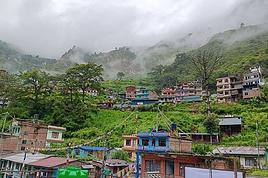







Langtang – Trekking in the Rain
FR

Translated into English.

HU Huguetter Veteran ·
Yes, this trek was special because the damage was still visible—you couldn’t help but be moved... or forget what had happened. But another trek was also special for different reasons: crossing Mustang before the road arrived, back when half the lodgings were homestays. It felt like stepping back in time—stunning landscapes and villages, welcoming locals, and no one else on the trails. Another one that stood out was doing ABC solo, with no guide or porter. The opposite of Mustang—crowds on the trails, nationalities I’d never seen on Nepali routes before, like Chinese, Malaysians, Indians...
NI Nimou74 Veteran ·
However, another trek, for different reasons, was also special: crossing Mustang before the road arrived and at a time when half the accommodations were homestays. Like stepping back in time, with stunning landscapes and villages, welcoming locals, and no one on the trails.

Yes, Mustang is a wonderful region. The landscapes are truly spectacular, especially the left bank of the Kali Gandaki, and very different from most treks in Nepal. I’d recommended it to George.

Another one that was a bit special, done solo without a guide or porter: ABC

Strangely, it’s the trek I liked the least in Nepal. It was our very first experience in the country... It rained a lot that season, so I really sympathize with George’s bad luck with the weather—muddy trails, constant humidity... Plus, you’re often at the bottom of the valley, crossing villages, so lots of stairs... But that didn’t stop us from returning to Nepal regularly afterward.
HU Huguetter Veteran ·
I agree with you about the ABC—it’s the one we liked the least too, mainly because of the crowds on the trails. The trek is easy to access, not too tough, and can be done in just a few days. After that, when it comes to the weather, Nepal aficionados know you’ve got to wait until mid-October to avoid the rain, even if nothing’s ever certain 😉
GE GeorgesOZ Globetrotter ·
I agree with you about the ABC trek—the one we liked the least, mainly because of the crowds on the trails. The trek is easily accessible, not too tough, and can be done in just a few days. As for the weather, Nepal enthusiasts know you should wait until mid-October to avoid the rain, even if nothing’s ever guaranteed 😉

Thanks to you, Anne-Claire, and the other contributors. It’s really nice of you to share all these tips about trekking in Nepal. I’m taking good notes. One thing’s clear, though—it’s definitely better to wait until mid-October before setting off!

I still need to give a quick rundown of the costs for our Langtang trek. But to give you an idea, it’s not exactly a cheap affair. When you factor in agency fees, porter costs, a guide, plus expenses not included in the package (especially drinks), it ends up being way more than 1,000 euros for a couple—more like 1,500 euros than 1,000 for 8 days. And I’m not even counting gear if you need to buy it or the flight to Nepal.

With that in mind, Mustang, which seems so appealing, is actually really expensive because of the permit costs. 🙁
DJ Djalma Globetrotter ·
To give you an idea of the cost of a 20-day trek around the Annapurnas, fully self-sufficient (no guide or porters)... Well, this was back in the 80s... It cost us 500 francs for two! All included—permit, food, and accommodation. That’s the equivalent of 100 euros today! (For two.) We slept for a maximum of 3 Nepalese rupees (80 centimes in francs!). Sometimes it was even free, as long as we ate our meals at the same guesthouse, of course. In 1985, I spent even less going without a permit to the Kanchenjunga base camp, mostly sleeping in locals’ homes. But it was *very* spartan! For Upper Mustang or Upper Dolpo, you can’t avoid the permit, which costs at least $500, often $600 or more since the trek usually lasts over 10 days. You also have to add the cost of a licensed guide or agency (mandatory), plus round-trip flights to Jomsom and the Kathmandu-Pokhara bus. A quick question about your trek: did you use a local agency in Kathmandu? Or a French agency like Alibert or similar? Because the price can double for the same service—since the French agency subcontracts with a local one...
AL AlainB69 ·
With a local agency booked from France, the price is around 1000 € all-inclusive: transport from Kathmandu, a guide-porter (10 kg) just for me, food and lodging, and flexible dates. Half the price of a French agency with a group and rigid schedule. You’ll need to add a "serious" tip though.

TE TerryTara ·
I’ll try to shed some light and be transparent about prices, since as a South Asia Travel Organizer living in Nepal with my wife, a trekking guide, I think I know the current rates inside and out.

First off, I don’t like comparing different professionals’ offers because what’s included varies from one provider to another. Even with a similar program, I find it difficult—if not impossible—to compare, because it depends on the quality of the guide/porter, the trekking season, and the customer service provided by the agency or independent guide. Just look at how many people come to me during peak season because their agencies don’t help when there’s a problem with the program, like right now when most Nepali passes have been buried under meters of snow for the past two days. The price might have been attractive, but in many cases, it doesn’t include problem management—except for helicopters and making a huge profit off trekkers’ insurance.

Then, of course, there’s the provider’s origin. All French agencies delegate to local providers. I imagine this has advantages for some (like insurance), but what about the quality of the service and, more importantly, fair compensation for local workers? Last April, I met a trekking group on the Nar-Phu to Thorung La circuit who had paid over 4000 € per person for 18 days with a well-known agency (I won’t name names—Al...). Talking to the FRENCH-SPEAKING guide, he told me he was paid 2500 NPR per day and was eagerly waiting for tips because clients from this big French company are usually generous. Those are his words, and it’s pretty sad... For comparison, experienced independent English-speaking guides generally charge around 3500 NPR per day (not including tips). I find it outrageous what some French agencies pay, but at least the guide is guaranteed work throughout the year.

But even with a local agency, there’s no certainty about fair payment for the guide. The biggest Nepali agencies, which work in volume and offer attractive deals, pay guides between 1400 and 1800 NPR per day in 2025. Even more outrageous, but it explains why tips are MANDATORY with these agencies. For example, a French-speaking guide should normally earn at least 5000 NPR per day.

For the most organized guides, their salary is based on the number of participants. This allows clients to pay less individually while better compensating the guide and giving them more financial visibility throughout the year, since no one treks 12 months a year. It also makes it possible to offer a fair price for solo trekkers. The cost varies depending on whether food and lodging are included. Many don’t like doing this because they feel like they’re losing money, but sometimes it’s actually the opposite. In many places (only the very touristy ones), if the client has a guide but pays for the guesthouse themselves, many lodge owners don’t hesitate to include the guide’s expenses (room & dal bhat) because they tolerate guides earning a little extra from clients not consuming much, but not clients saving money at the expense of BOTH the guide AND the lodge. So, depending on the route and the provider, paying for a package can actually be a saving beyond just convenience, where the client doesn’t have to worry about anything.

Prices can vary enormously between regions. Sagarmatha is extremely expensive for both clients and guides/porters (800 NPR for a porter’s dal bhat in Gorakshep when their bed is the common room couch—it stings, especially when they’re paid 1000–1200 NPR per day when working for agencies), while Rolwaling, for example, is much cheaper, with prices that make sense given the overall cost of living in Nepal. Prices adjust based on how personalized the program is and what’s included. A route off the beaten path may be priced higher because it requires more knowledge and work than a standardized trek.

Ultimately, beyond a specific price, I think it’s up to each person to assess the quality of the agency or independent guide’s work, their expertise, and what they bring to clients. In my opinion, there’s a minimum ethical standard to respect (for example, 2000 NPR per day in 2025 for a porter who doesn’t speak English, and you’ll still need to add a tip). After that, it’s up to each person to decide based on the costs inherent to the route (private vehicle, number of meals included, etc.) and the guide’s quality. The advice I can give is that no matter if you find a cheap or expensive service, what matters is being happy to travel with the people you hire. You’ll be sharing an extraordinary experience with them, and the joy of that shared moment usually makes you happy to pay the person who worked for you and gave you a unique experience. If that bothers you, then don’t hire a guide and explore the trekking areas allowed for independent travelers—it’ll definitely cost less, no doubt about that haha.

No one gets rich from trekking in Nepal. Some see it as a financial opportunity, but those who last are people who deeply love their job and are happy to share their country because it’s far from an easy profession, whether in the short or long term. Except maybe for guides doing Poon Hill 28 times a year and nothing else. But what about those spending 9 months a year above 4000m between Sagarmatha, Makalu, Kanchenjunga, Annapurna, etc.?

Of course, there are always scammers and dishonest people—some who have a public Facebook group but it’s actually run by the guide’s wife to only recommend her husband. Others who are so highly recommended that they say yes to everyone and then, at the last minute, tell them they’re no longer available and give them an inexperienced guide who doesn’t speak French, just to maximize their income. But luckily, these things always come to light. That’s why, before hiring someone, it’s important to check their professionalism and ask for guarantees (guide license, agency’s legal information, etc.). Traveling isn’t that simple, haha.

Beyond specific prices, I’ll end by saying that what’s most important is ethics. Hiring a porter is ethical; loading them up with 50kg on their back isn’t. Any agency that puts more than 20kg on a porter’s back is practicing modern slavery. Yes, some do it personally to build their lodge at high altitude because they have no choice—otherwise, no one would. A guide isn’t just supposed to be a cheerful companion but a mountain professional who helps you whether things are going well or when decisions need to be made to ensure your safety. An agency deserves to be paid for its work (organization, customer service, providing professionals), especially since agencies are the only ones who pay taxes—guides and porters don’t pay any, and it’s undeclared in 99% of cases, whether they’re independent or working for an agency. Everyone deserves their salary, and it’s important to be aware of that to decide whether you can afford to hire professionals.

In short, prices vary widely, but I can only advise working with professionals who put people first—experienced professionals who love their job. That way, you maximize your chances of having an amazing experience and fairly compensating the people involved. When you contact a guide and their first recommendation is Everest Base Camp, the Annapurna Circuit, or just the region they’re from without considering your needs: RED FLAG—BE CAREFUL.

If you have questions about prices, services, or general concerns, don’t hesitate. My job is to organize trips, but I’m a traveler first and foremost, and I know all too well what it’s like to be in the dark about a destination. My comments are based on my experience and what I see daily, but if anything doesn’t sit right with you or isn’t clear, I’d be happy to discuss it! :)
SU SuperNomad ·
Hi TerryTara,

I’ve had the chance to go trekking in Nepal several times (Annapurna Circuit, ABC, Three Passes Trek in the Everest region, Langtang-Helambu) but it’s been a while now (2008–2011). Since then, I’ve been wondering if it’s still possible to do solo treks without a guide or porter. Also, do you have any updates on permit regulations and which regions/treks require them? Finally, is there a long-distance trek in the country—something that would take several months to complete?

Thanks for your replies!
TE TerryTara ·
Hi TerryTara,

I had the chance to go trekking several times in Nepal (Annapurna Circuit, ABC, Three Passes Trek in the Everest region, Langtang-Helambu) but it’s been a while (2008-2011). Since then, I’ve been wondering if it’s still possible to do treks solo without a guide or porter. Also, do you have any updates on regulations regarding permits and the areas you can trek through? Finally, is there a long-distance trek in the country? One that lasts several months of walking?

Thanks for your answers

It has indeed been a while—Nepal is quite different now compared to back then :)

Solo treks without a guide or porter are still definitely possible, and nothing has changed except for the "Restricted Areas" like Nar, Upper Mustang, Manaslu, etc. The only new requirement is that you now need a guide for Shivapuri National Park, whereas before you didn’t. If you speak some Nepali or have strong persuasion skills, you don’t necessarily need a guide—just being with a Nepali is enough.

As for a long-distance trek, the most famous one is the GHT, the Great Himalaya Trail, which crosses the Himalayan range. There are variations between the classic high route and the lower route, which was more recently defined to avoid restricted areas, allowing you to do it completely independently from start to finish. This helps with skill/knowledge issues since there are technical sections, like the pass between Makalu and Sagarmatha (Sherpani Pass), which sometimes require camping.

But the GHT is so long with all the elevation gain that it’s typically broken into several parts, allowing you to complete it in 2, 3, 4, or more trips.

Beyond the GHT, there are plenty of trekking routes that can be combined or adjusted to hike for weeks or even months without any problem. The Himalayas are so vast that trekking all the valleys in Nepal in one lifetime isn’t possible—unless you’re a superhuman like Kilian Jornet, haha
SU SuperNomad ·
Thanks for the quick reply!

Seriously, Nepal has really changed! For the better, I hope! 🙂

I’ll take the time to look into this GHT route. If I have any questions, I’ll go ahead and add you to my contacts.

See you around!
DJ Djalma Globetrotter ·
hi there

it's Shivapuri National Park. If you can get by in Nepali or have serious powers of persuasion, you don’t need a guide—just being with a Nepali is enough.

Do you know why that is? I crossed it on my way from Sundarijal to the Langtang (Laurebina Pass). The "park" isn’t very high in altitude—it’s mostly forest, and there’s little risk of getting lost. Honestly, I’m not sure what makes it special. You exit pretty quickly into Helambu.
DJ Djalma Globetrotter ·
Any idea what the GHT might be like? https://www.martinpierre.fr/pages/treks-asie/great-himalaya-trail.html Martin Pierre’s descriptions and route guides are the best I’ve come across. Duration: 120 to 130 days, around 1,700 km. https://www.tamera.fr/voyages/himalaya-et-inde/la-grande-traversee-du-nepal-1500-km-pied-sur-le-toit-du-monde
TE TerryTara ·
Thanks for the quick reply!

Seriously! Nepal has really changed! Hopefully for the better :)

I’ll take the time to look into this GHT route. If I have any questions, I’ll go ahead and add you to my contacts.

See you around!

Some things have changed for the better, others for the worse. Development always has its pros and cons, and perspectives vary. I live in Nepal, so I can mostly say positive things about this adopted country of mine. What’s certain is that Nepal remains a wonderful playground :)

Feel free to reach out if you need anything—you can contact me directly through the website or social media: Nepal ma Tara.

Do you know why? I crossed it starting from Sundarijal toward Langtang (Laurebina Pass). The "park" isn’t very high in altitude—it’s mostly forest, and there’s little risk of getting lost. To be honest, I don’t know what makes it special. You exit pretty quickly by crossing into Helambu.

Several reasons—the army now controls the area much more strictly than in the past. Even if you take side trails, you risk running into soldiers who aren’t exactly welcoming. Last year, I found myself at gunpoint, being yelled at about what I was doing there, even though I technically hadn’t entered the park yet and was just passing through a regular village.

There have been numerous "incidents," both real and premeditated (attacks, kidnappings, murders), making the area sensitive. There have also been a few animal attacks, which led to measures like "no solo travelers in the park." This applies to Nepalis too—they don’t let anyone wander alone and take contact details from everyone passing through. On the western side at Jamacho, you’re forced to take a single out-and-back trail, and they’ll tell you the latest time you must return. If you don’t, they’ll call you, and if you don’t answer, they’ll contact your emergency contact.

Personally, I think it’s overkill, and unless someone explains it clearly to me, I find it ridiculous. The same thing happened near Champa Devi due to "incidents," but there’s no control there. Same with Phulchoki, near Godawari—it’s even more absurd because there’s literally an army presence at the summit.

But that’s Nepal—sometimes you just have to accept you won’t understand why, haha
SU SuperNomad ·
Thanks Djalma! Great tip.

@Terry Your intro page is amazing—what a life journey! 😐
TE TerryTara ·
Thanks Djalma! Great tip

@Terry Your intro page is amazing—what a life journey! 😐

I can confirm it’s not the most conventional path, but hey, anything’s possible in life! :)
FA FabGreg Globetrotter ·
If on the return from Langtang Helambu you go via Ganja La (a very difficult pass at 5200m to do with a guide)

Crossing the north side of the pass was made easier before autumn 2016 by the installation of a fixed rope along the exposed final access ridge, and a long ladder (retreat if the ridge is too snowy). But it’s still not for the Sunday hiker...

Check out the video starting at 24'03 in https://www.youtube.com/watch?v=GWK9eJTrs50. The long ladder can be seen on the left at 24'38, not as secured as in our Alps (for example, the impressive Schöllijoch between Turtmann and Zermatt).

On the south side of Ganja La, it remains just as wild to reach Tahrke Ghyang in Helambu: 2 long days without a single village or hamlet, with water sources scarce along the route following the ridges. However, the route shown on OpenStreetMap and similar platforms seems to match what’s reported, including tracks published on Wikiloc.

Fabrice
DJ Djalma Globetrotter ·
Good evening, The video makes it look pretty cool without snow. I did it in early March and it wasn’t easy without proper gear! No GPS back then either... I knew the Ganja La pass was tough, plus you have to bivouac for 3 nights... and after the pass, finding the right path isn’t straightforward. Alone, I would’ve gone straight down into the first valley and gotten completely lost. That’s why I hired a local "guide" at Kyangin Gompa. There was a lot of snow, and the "guide" spent ages looking for the right passage. No fixed ropes back then either.

No ice axe, and my rented crampons from KTM gave out on me, so I had to dig steps into the frozen snow with the tips of my shoes—no room for error. One slip and I would’ve gone crashing onto the rocks hundreds of meters below. We bivouacked at the foot of the pass in a meter of snow, and at night, rocks were tumbling down just a few meters from our tents... Long story short, I was pretty freaked out and so relieved after crossing the pass. Two more days of nothing until Tharkhekiang.

Oh, and I almost forgot—no water! And my guide hadn’t planned anything at all...
DJ Djalma Globetrotter ·
To be continued... https://www.youtube.com/watch?v=tsTrfRz7_as
SU SuperNomad ·
I don’t remember this kind of ladder when I hiked the Langtang.

Nepal is so rustic! 😐 I just got back from the US where I hiked the PCT—totally different!!
DJ Djalma Globetrotter ·
I don’t remember that ladder when I trekked the Langtang.

Hi, Did you go through the Ganja La?! What year was that? If it was just the Langtang Valley, there aren’t really any difficulties, so no need for a ladder. 😉

Similar discussions

You might also like