No, I don’t think things have changed toward foreigners. But you can feel an increase in anti-terrorism surveillance in very busy places. Obviously, it’s done the Chinese way—just for show, with an unusual attitude. In short, they check anyone a police officer considers suspicious. I don’t know anyone this has happened to, and I appreciate being able to walk anywhere at night without fear of being attacked.
I just read your feedback with great interest and sadness. Is Xinjiang going to end up like Tibet? I knew the situation in the region had deteriorated, but I didn’t realize it was to this extent.
I just got back from China and noticed the same things as you. I’d even add that for the Chinese, respecting traffic laws and copyright is more of a vague suggestion.
Now, while I sometimes felt the crowds were too dense and the subway too packed, you have to realize there are 25 million people in Beijing and 35 million in Shanghai. That’s Canada’s entire population in one city.
The concept of lining up doesn’t seem to exist. So when in Rome, do as the Romans do! I realized I’m pretty good at cutting in line.
You’re searched everywhere—that’s not Chinese culture, it’s the Communist Party’s control. Not really to control everything, but to make people realize they *could* know everything if they wanted. Because I seriously doubt a terrorist would target the Beijing subway, given how little the Chinese are involved in international conflicts.
The language—yeah, it can be frustrating at times. Some people don’t speak English and don’t even try. Fortunately, not everyone’s like that, and things are changing. I chatted with the woman sitting next to me on the train, and she told me her 3-year-old daughter was taking private English lessons.
So yes, I had a wonderful trip. But after 10 days, I was really glad when my plane touched down in Dorval.
I don’t quite understand what you mean about copyright. It’s true that working with the Chinese requires a good understanding of their culture. The best thing, of course, is to have Chinese friends. A verbal agreement carries much more weight there than here, but once something is decided, they stick to it. You really have to understand that the Chinese are excellent businesspeople in every sense. Negotiating every point of a contract is a must, and it can take time. Always stay calm, courteous, and respectful of their customs, and everything will go smoothly. Like any good businessperson, the Chinese want to keep their clients or partners happy. Scams might happen in tourist spots, targeting people you’ll never see again. But who hasn’t been scammed on the French Riviera? If it happens to you, just shout to draw a crowd and get the police involved. You’ll see how quickly things get resolved, even if you don’t speak Chinese. Safe travels to everyone, and leave your prejudices and arrogance at home before you go.
I went to Xinjiang in 2013, and none of this was happening. I spent about ten days there without any ID checks on the street or at Urumqi train station when I arrived. Even when crossing the border by train from Kazakhstan, my luggage wasn’t searched.
The area near Kazakhstan is far less sensitive than Kashgaria, where the epicenter is in Yarkand (the Uyghurs are still a strong demographic majority there). Controls are probably much lighter there, even today.
Why such a crackdown? The effects of the war in Syria, where Uyghurs went to fight for ISIS? The various attacks in recent years?
The war in Syria is just a convenient backdrop to justify local measures internationally.
Attacks in Xinjiang don’t make the headlines in Western TV news, but they’re very real. At the very least, the ones officially reported are listed in en.wikipedia.org/...2007–present.
Since 2013, there have been, among others:
- the attack on Tiananmen Square,
- the attack at Kunming railway station,
- the attack at Ürümqi railway station during a visit by Xi Jinping.
Above all, the security chief changed in August 2016—it’s now Chen Quanguo, who previously ran the Tibet Autonomous Region. He’s applying the same tactics tested and proven in Tibet to Xinjiang, while using cutting-edge technology:
- mandatory GPS in all vehicles,
- compulsory DNA sampling for the entire population.
I’m not optimistic about the local status of the Uyghurs. Xinjiang’s position as a communication hub toward Central Asia and its mineral and energy resources make it far too strategic. No matter who’s in power, China will never let go. Especially since the issue will be demographically resolved in a few decades.
There aren’t as many controls in Tibetan regions outside Tibet. In fact, there’s hardly any.
That’s exactly what I observed in Qinghai and the Tibetan areas of Gansu. At most, there were lighthearted checks to enter the new bus station in Xining.
I even visited a monastery where there were many photos of the Dalai Lama. His identity was confirmed to me with a big smile. Shows that the Chinese police still have some gaps...
Note: I don’t think I’ll return to Xinjiang. But I’d love to explore the cultural riches of the rest of China. The Chinese don’t have the same sense of hospitality as the Iranians, but I was still pleasantly surprised—it went against the reputation I’d heard. This discussion reflects that, but my experience was very enjoyable.
Sure, the Chinese rarely speak English outside of young, educated people in international megacities. But how many Americans speak a language other than English? The French population isn’t exactly open to foreign languages either (except those of immigrants).
In every country, learning even a little of the local language opens many hearts.
It was with a huge smile that the Han border guard at the Irkeshtam Pass told me, "Welcome back to China."
In two years, it’s 15 days in Xinjiang,
and I’m sure I’d still have fewer problems than if I wandered off the beaten path in southern France! !
In light of my experience in Xinjiang in September 2018, I wouldn’t be so sure. Unless you’re talking about some of the notoriously rough areas in southern France.
Controls in Xinjiang are frequent and often extremely thorough.
For example, during my first train trip (Kashgar -> Kuqa), my backpack was searched completely, including the contents of an aspirin tube and a vitamin C tube. Once everything was unpacked and inspected, I was urgently told to pack up quickly, and my toiletry bag paid the price (probably mistakenly handed to the passenger next to me by the inspector).
Generally, access controls at Xinjiang’s train stations are strict and very time-consuming. Much more so than at other train stations I’ve used in Gansu, Qinghai, Ningxia, and Shaanxi. In fact, when returning to Xinjiang, it was the only time I had an ID check on the train, between Liuyuan and Hami, including a photo of my passport, visa, and my face in the background: "welcome to Xinjiang" 😐.
Additionally, there are areas in Xinjiang where tourists are unofficially banned from entering.
For instance, in Yèchéng/Kargilik, I was stopped even before leaving the train station. To exit the station, there’s an ID check, like in Ürümqi (but surprisingly not in Kuqa). Spotted in the queue, I was taken aside by two security officers and escorted by four soldiers. The escort was polite but firm.
After a long wait—probably to get approval from higher-ups—the verdict came: no visiting anything. The security officers escorted me to the bus station, where they found me a shared taxi to Shāchē/Yarkand.
In Yarkand, I didn’t even get close to the city. At the first road checkpoint east of the city, I was pulled out of the shared taxi, taken over by three plainclothes officers, and driven to the western checkpoint. After a very long wait, I was finally handed off to a private vehicle (since there was no more public transport) heading to Kashgar. I arrived at 3:30 AM Beijing Time after multiple road checks.
But my troubles weren’t over. The neighborhood around my youth hostel (east of the lake) was blocked off by police, and I had to walk around three sides—2.5 km instead of 200 m—on foot, since it wasn’t in the direction of my escort.
In all my travels (see my profile), I’ve never experienced anything like this. Even the state of siege in Srinagar (Indian Kashmir) seems mild in comparison.
The Chinese state is highly professional in its security control over Xinjiang, using state-of-the-art technology. This includes 24/7 automatic photo identification of everything passing through major urban and intercity roads. It applies to both Han Chinese and Uyghurs without discrimination.
In Xinjiang, while train station access controls are tedious, they’re still less time-consuming than the numerous road checks. Stick to trains if you can!
Access to markets and bazaars is often also subject to security checks (X-ray for bags, metal detectors, pat-downs, and body scans). Even the very modest open-air market in the Uyghur town of Kuqa was surrounded by barbed wire fencing.
Surveillance cameras are everywhere, including in rural areas—like near a desecrated Muslim cemetery. I only realized this after a police car came to check on me and delete the photos I’d taken with my smartphone. Before that forced deletion, I’d only seen decorative ruins with the photogenic backdrop of the Flaming Mountains. The photo deletion made me question why what I’d seen was "sensitive."
In crowded places, like Kashgar’s historic old town, the police presence is overwhelming—almost 2-3 officers patrolling every 30 meters. And that’s just the uniformed ones...
These security measures are approved and appreciated by all the English-speaking Han Chinese I’ve discussed this with—both locals and tourists from coastal China (Beijing, Shanghai, Shenzhen...).
Fabrice
Non-Chinese speaker, though I’ve learned to count and use survival vocabulary (train station, train, bus, hotel, youth hostel, museum...).
P.S.: In Xinjiang, as well as in Gansu, Qinghai, Ningxia, and Shaanxi, I had excellent interactions with the Chinese people I met, whether they spoke English or not. Just avoid groups.
What on earth are you planning to do in Xinjiang, LOL? You’re not unaware that there have been numerous attacks by Uyghur extremists that resulted in massacres at several train stations. The way this is managed is undoubtedly more "radical" than here, but as you point out, the Han Chinese appreciate this heavy police presence. You came back safe and sound—that’s what matters. And now you better understand the word "Chinese complications" :) Keep cool in all circumstances. If you travel with a general hatred of "cops," there might be some... misunderstandings.
Good evening,
I’ve been traveling since 2000 (retired now) and spend about a month in France and another month in Spain or Italy every year.
Every two years, I also take at least a month-long trip to Asia (China, Russia, Siberia, Mongolia, Uzbekistan, Kyrgyzstan, Kazakhstan, etc.). I’ve never had any problems in Asia.
On my own, I’ve driven 70,000 km in my vehicle, and I’ve often received help from police or locals.
In Southern Europe, you can’t move around without locking up all your luggage or your vehicle.
I’ve only had thefts and safety issues in Southern Europe.
Maybe I’ve just been unlucky,
but in Asia, I’ve always been welcomed warmly—even by families who could only offer me a bowl of rice.
That’s why I prefer Asia for my vacations. I always travel alone in these countries.
Everyone has their own preferences!
For Xinjiang in 2020. My guide is Chinese, my friend is Uyghur, and my driver is from the region. And I’m not taking the train—my driver is taking me across the Taklamakan Desert from Kashgar to Urumqi.
Worth seeing in 2020, but all my Chinese contacts confirmed there wouldn’t be any problems.
When it comes to security, there’s no comparison. Our Western countries are far less safe than most tourist destinations. I’ll still set aside Central and South America, though.
That’s not what I was warning you about—it was the intensity of police road checks in Xinjiang. Always courteous, but extremely time-consuming.
While Chinese citizens go through automatic mode (ID card scan, facial recognition identity verification, automatic database logging), that’s not yet the case for foreign nationals:
- Two separate checks and computer loggings by two different officers (making any collusion more complicated).
- Passport photo + face shot in the background, seemingly sent to a specialist center for authentication.
There must be some processing of the information and photo because the wait time far exceeds the time needed to input the data. Yet my current passport doesn’t list any sensitive destinations (so no Iran or Syria, where I’ve traveled in the past).
On top of that, there’s the vehicle check (X-rayed under a gantry, with no passengers or luggage) and the driver check (sometimes longer than for my passport).
Finally, if you arrive after a few buses or during rush hour, you’ll be stuck in line for a long time.
Also, note that speed limits are relatively low and strictly followed by drivers. On top of surveillance cameras, there must be plenty of speed cameras...
All these hassles are avoided by taking the train.
This is really specific to Xinjiang. No road checks during the rest of my trip.
The road network is of very high quality, especially the highways, but heavy with freight traffic on toll-free roads. When there’s construction, the traffic jam can get very long with all those trucks.
at least 1 month in Asia (China, Russia, Siberia, Mongolia, Uzbekistan, Kyrgyzstan, Kazakhstan, etc.).
Since summer 2017, third-country nationals can enter Xinjiang from Tajikistan via the Kulma Pass. That was my case in late August 2018, and I ended up on the Karakoram Highway near Tashkurgan.
Worth seeing in 2020, but all my Chinese contacts confirmed there wouldn’t be any problems.
It would cost them a lot to admit there are "problems" in this great China that’s reclaiming its standing.
Still, as long as you don’t stop between Kashgar and Khotan/Hotan (an area I was "expelled" from), and your guides vouch for you, things should go smoothly.
You’re more likely to fear an earthquake. Or getting hit by an electric scooter you didn’t hear, since sidewalks are often given over to them—especially in Kashgar.
my driver took me across the Taklamakan Desert from Kashgar to Urumqi.
If you’re not going to Khotan, that means you’ll take the Northern Route via Aksu, Kuqa, and Korla. In that case, you’ll skirt the Taklamakan but not cross it. To cross it via one of the two desert roads, you’d have to go through either Khotan (toward Aksu/Kuqa) or Niya or Qiemo (toward Korla). That means taking the Southern Route, at least partly—the same one Marco Polo and your fellow countryman Ella Maillart traveled.
The distance from Kashgar to Ürümqi is huge, with few sights to see along the way...
urumki
Ürümqi is pronounced "Urumtchi" for French speakers. For the Han, it’s "Wulumutchi." Learning to pronounce pinyin is helpful for being understood—even by English speakers, especially for place names.
All the Silk Road itineraries passed through Xinjiang. As a result, there’s a wealth of artistic and cultural heritage there. That said, it was the landscapes that really blew me away:
- The Karakoram Highway.
- The natural setting of Tashkorgan.
- The Tianshan Canyon, north of Kuqa.
- The Flaming Mountains near Turpan.
- The grape-drying racks around Turpan.
There can’t be many places left where silk Atlas is still made by hand, like in Jiya, near Khotan.
You’re not unaware that there have been numerous attacks by Uyghur extremists
Absolutely—I’d been planning this trip since 2009 (after a first opportunity in 1995!), so I wasn’t oblivious to the fact that the region is under tight security.
In the cities, the checks turned out to be far less intrusive than some reports suggested, with claims of passport controls every 20 meters in certain areas.
In Kashgar, for example, I was only checked to enter the bazaar, the train station, the bus station, a small underground shopping hall near Id Kah Square, and the tourist sites I visited (Abakh Khoja Mausoleum, Kashgar District Museum). But I wasn’t checked at all in the historic old town of Kashgar, where I could wander freely.
Similar experiences in Tashkorgan, Kuqa, Ürümqi, Turpan, and Khotan.
What did surprise me was how much time the checks wasted—especially the roadside ones.
which resulted in massacres in several train stations.
It made headlines in China, but on a national scale, it’s microscopic. The Kunming station attack had 31 deaths—not even a Bataclan. On November 13, 2015, Paris had 130 deaths. That’d be the equivalent of 2,817 deaths in China’s population.
More than massacres, these are challenges to the Party’s "enlightened" governance—an unacceptable challenge to its authority.
Their way of handling it is undoubtedly more "radical" than ours, but as you point out, the Han Chinese appreciate this heavy police presence.
And I told them that if attacks like Bataclan 2015 or Nice 2016 happened too often, France could see similar security measures within 10 years. A state’s first duty has always been to ensure its citizens’ safety—even if it means building a fortress.
If you go in with a general hatred of "cops," there might be some... misunderstandings.
What made you think I had any hatred for cops in my comments?
I mentioned that the checks were always polite—sometimes even friendly. Like that young police officer who told me he was a software-engineering graduate... "and now, I’m a cop 😕..." Clearly disappointed with his career prospects. Others asked me about Paris, a city they dream of for its supposed romance. Most of the officers who dealt with me spoke some English, which made these exchanges possible.
Your experience in Yarkand will be interesting to hear, given my "deportation."
Note that in Khotan, very few hotels accept foreigners. In fact, only one hotel claimed to welcome foreigners, but it was already fully booked by midday—apparently due to a large number of Pakistani guests.
It took police intervention for the Khotan Hotel to agree to take me in, but at a price that was highly discouraging. Maybe a subtle way to refuse me, despite the police’s efforts—several officers really went out of their way to help and support me.
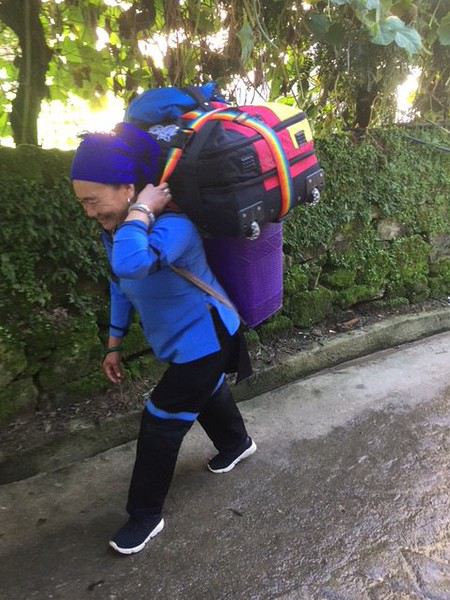
And there you have it. She carries my luggage for free! And in 70% of cases, they didn’t even want me to carry my own bags! I’m 76 years old, and 80% of Chinese people would give up their seat for me on buses! And this only happens in China! It’s never happened to me in Europe!!
For my part, I’ve taken many trips to Greece and Italy when I was younger. I mainly took the ferry from Ancona to Patras, but also traveled by road through the former Eastern Bloc countries. I never had any problems anywhere. We once left a large camera bag containing all our money on a terrace in Genoa. When we returned a few hours later, we found our bag untouched behind the bar at the restaurant. I think it all depends on our attitude, no matter where I’ve been. I’ve always been extremely cautious in highly touristy areas by not flaunting anything that might attract envy: keeping my watch in my pocket, wearing ordinary and worn-out clothes, using minimal photo gear that’s artificially aged, and never looking like I’m searching for something—only pulling out a map in discreet spots. In Naples, for example, I accepted the paid help of a young local "guide" and was able to go wherever I wanted without any issues. A little common sense never hurts.
In China, I only go for work, so most of my tourist stops are with Chinese friends. But I often go for walks in Shanghai in the evening, sometimes very late, and no one has ever bothered me. In professional relationships, I’ve never had any bad surprises after concluding a contract—sometimes just verbal but always very detailed and therefore inevitably time-consuming. I’m learning Chinese, which makes my interlocutors laugh a lot, but everyone appreciates the effort you’re making.
But basically, we agree. I didn’t write that I sensed any hatred of cops in what you said. It was a general remark, probably poorly worded. Corruption and dishonesty are rare among "ordinary" Chinese people, who’ve been taught certain principles since school and tend to respect them. I see this among the many students I interact with, often from working-class backgrounds. On the street, as soon as someone realizes you’re French, you hear "De Gaulle" in a flood of Chinese words. De Gaulle is compared to Mao. They both restored their country’s independence through acts of bravery.... You have to understand that "the Party," as people here often call it—and you can think what you want about it (but just think, otherwise Switzerland might be a better option)—wants to develop tourism. Why would the police bother people who are supposed to go home praising China? I see police officers and military personnel as people doing their jobs seriously, nothing more, nothing less. Stay calm, smile, and nothing bad will happen to you. There are over 10,000 French expats in Shanghai. It’s a very organized community, easy to connect with thanks to *Le Petit Journal de Shanghai*, which I recommend reading before your stay to avoid many misunderstandings. Of course, there are issues here like anywhere else—renting or buying an apartment, for example—but the French community will help you avoid known pitfalls. Don’t forget to register (by mail) with the French Embassy or Consulate before you leave.
Jean
https://lepetitjournal.com/shanghaihttps://www.youtube.com/watch?v=gBJzhp7Oskg&t=401s
In October 2017 in Xinjiang, in Kuitun (east of Ürümqi), I was stopped by Chinese police and taken to the police station, where I spent an afternoon being interrogated. From what I understood during the interrogation (same questions for hours, I think to see if I’d give the same answers), the officers thought I was a journalist "disguised" as a tourist. They checked my camera and my laptop. Everything was handled courteously, and once they were sure I wasn’t a journalist, they drove me back in a police car to where they’d stopped me!
During my road trips (Ürümqi, Kuitun, Urho, and back to Ürümqi), I must’ve been stopped at least fifteen times, with each stop lasting at least 10 to 15 minutes. Again, it was always courteous—during one check, since it was freezing cold, they even let me into a prefab building and brought me a chair!! There was only one stop where the atmosphere was really tense (not weather-wise!!!), where the officer who checked me didn’t even bother to look at me or say a word...
And a little moment of laughter with two officers in Urho: I was waiting in my hotel lobby, and when I saw the police come in, I took out my passport to hand it over. They walked right past me without even checking me, and as they left, they said in English, "Have a nice trip in Urho"!!!
In October 2017 in Xinjiang, in Kuitun (east of Urumqi), I was stopped by the Chinese police and taken to the police station, where I spent an afternoon being interrogated. From what I understood during the interrogation (same questions for hours, I think to see if I gave the same answers every time), the police thought I was a journalist "disguised" as a tourist. They checked my camera and my laptop. Everything went courteously, and once they were sure I wasn’t a journalist, they drove me back in a police car to where they’d stopped me! During my road trips (Urumqi, Kuitun, and Urho, then back to Urumqi), I was checked at least fifteen times, with each stop lasting at least 10 to 15 minutes. Same thing—always courteous—even during one check when it was very cold, they had me come into a prefab building and brought me a chair!! Only one check had a very cold atmosphere (not meteorologically speaking!!!), where the officer who checked me didn’t even deign to look at me and didn’t say a word... And a little laugh with two police officers in Urho, where I was waiting in the lobby of my hotel. When I saw the officers come in, I took out my passport to hand to them, but they walked right past me without even checking me. As they left, they said in English, "have a nice trip in Urho"!!!
That’s the China I know :) Stay zen, and everything goes well—sometimes slowly, which gives you time to meditate and observe... You never waste your time by staying positive and avoiding complaints. But what’s said in this post should make us vigilant. Bring a "clean" laptop to avoid any misunderstandings: no photos of your bedroom exploits, etc.
Jean
I’m starting to think about a trip to Japan, though I haven’t yet decided on the exact duration or itinerary, and I have a few questions for those who know the country well or have traveled there recently.
First, about getting around: what do you think are the most economical and reliable ways to travel across Japan and move between cities? I’m thinking of trains, overnight buses, domestic flights, regional passes, etc. I’m not necessarily looking for the fastest option, but rather a good balance between cost, simplicity, and reliability.
I also have a question about the return ticket. Since I don’t yet know how long I’ll stay in Japan—or even if I’ll return directly to France (I might continue to another Asian country)—is it mandatory to have a return or exit ticket before entering Japan? Would a ticket to another Asian country suffice?
Regarding accommodation, I usually prefer staying in youth hostels rather than hotels. Are hostels easy to find all over Japan, including outside Tokyo, Kyoto, and Osaka? And what’s the average budget per night for something clean and well-located?
Finally, I’d like to get an idea of the overall budget for the trip. Is Japan still relatively affordable when traveling simply, or do expenses add up quickly? I’m mainly thinking about:
transportation between cities;
local transportation;
youth hostels;
food;
potential domestic flights.
My plan is to travel fairly freely, without necessarily booking everything in advance, so I can adjust my itinerary or stay longer in places I like.
If anyone has traveled this way in Japan, I’d love to hear about your experiences, tips, and maybe an idea of the daily budget to expect.
Hi everyone,
So, big departure for me next week—I can’t wait! +++
Here’s my itinerary; feel free to leave your comments. Just to let you know, skipping Jiuzhaigou was a choice on our part :/. And if you have any updated prices, since the ones I noted are from the internet and might not be current.
-21: Arrival at 16:25 in Beijing
°The Sanlitun Inn
-22: Beijing Ming Tombs (20¥)
°The Sanlitun Inn
-23: Beijing
°Night train to Xi’an
-24: Xi’an -Terracotta Army (45¥ Steven, 90¥ me)
-Night market in the Muslim Quarter
°Xi’an Guoha Hotel Apartment
-25: Xi’an -Big Wild Goose Pagoda (31¥)
°Xi’an Guoha Hotel Apartment
-26: Xi’an -City Walls (20¥ Steven, 40¥ me)
°Night train to Chengdu
-27: Chengdu -Giant Panda Research Base (58¥)
°Hanting Hotel Chengdu Huayang Branch
-28: Chengdu -Qingyang Taoist Palace (5¥)
°Hanting Hotel Chengdu Huayang Branch
-29: Departure for Mount Emei
°Mount Emei Hongxiu Hotel
-30: Mount Emei -Wannian Temple (180¥ me, 90¥ Steven)
°Mount Emei Hongxiu Hotel
-31: Mount Emei
°Mount Emei Hongxiu Hotel
-1: Departure for Leshan
°Le Cheng Hotel
-2: Leshan -Leshan Giant Buddha (50¥ by boat)
°Le Cheng Hotel
-3: Departure for Chongqing
°Hanting Hotel Chongqing Chengjiaping Branch
-4: Departure for Dazu -Dazu Rock Carvings (80¥)
°Kaka Theme Apartment
-5: Departure for Chongqing
°Letu Hostel
-6: Chongqing -Eling Park
-Ancient town of Ciqikou
°Letu Hostel
-7: Chongqing -Hongyadong shopping street
°Letu Hostel
-8: Chongqing
°Night train to Zhengzhou
-9: Zhengzhou -Shaolin Temple (130¥)
°Love Home Apartment
-10: Zhengzhou -Mount Song Shan
°Night train to Beijing
-11: Beijing
°The Sanlitun Inn
-12: Beijing
°The Sanlitun Inn
-13: Beijing -Great Wall of China (64¥ with bus)
°The Sanlitun Inn
-14: Beijing Summer Palace (40-50¥)
°The Sanlitun Inn
-15: Beijing -Forbidden City (80¥ with audio guide)
°The Sanlitun Inn
-16: Beijing
I’m currently in the process of booking my hotels.
I have a question about these two apps. I’m planning to use trips.com to book my trains (if I understood correctly, that’s the best way to do it).
Is there any advantage to booking hotels with trips.com, or can I keep using Booking? (I’m used to the interface.) My hidden question is whether it’ll work smoothly when I’m there (for new bookings or retrieving the ones I’ve already made).
I’m currently planning a trip to Japan with my two kids.
Before going any further, my main question is about the budget. While flights are pretty straightforward—just compare prices—when it comes to daily expenses, I have no idea what to expect.
We’re thinking of traveling between mid-July (around the 19th, give or take 2-3 days) and mid-August (returning by August 20th at the latest).
Duration: 15 days (though we could stretch it by 2-3 days if it makes sense price-wise).
Family of 4, including two kids aged 9 and 12.
Before we had kids, we used to travel pretty "rough" and book things on the spot (we often took basic flights), but this time, it might be trickier. That said, we’re not looking for luxury—just somewhere decent to sleep and shower so we can save money for as many activities and sightseeing as possible.
For those who’ve recently had a family trip like this or are familiar with Japan, I’d love any advice—especially what a reasonable daily budget might look like (or at least the absolute minimum to make the trip feasible).
Thanks in advance!
P.S.: I’ll admit I struggled a bit with the categories, so if this post needs to be moved, no problem! ;-)
Hi,
My departure is coming up soon—two months backpacking in Taiwan, so much to discover! I’d love to hear about your travel experiences.
My main interests are meeting people, understanding how things work, hiking, and nature in general. I’ve also done a lot of reading about Taiwan’s complex situation.
I do stone sculpture.
I also want to visit Orchid Island for its history.
Marie
Hi there,
I’m planning my trip for May. Here’s my itinerary for 4.5 days in Seoul:
May 5: afternoon at Mangwon Market, Mangridan-gil, Han River
May 6: Gyeongbokgung, Tongin Market & Seochon, Bukchon, Insadong, Jogyesa Temple, and Ikseon-dong
May 7: Namdaemun Market, Deoksugung Palace, stroll along Cheonggyecheon, Seoullo 7017, Hongdae
May 8:Changdeokgung + Changgyeonggung, Gwangjang Market, Jongmyo Shrine, Jongno Boulevard for the big parade
May 9:Morning in Gangnam, Bongeunsa, Namsangol Hanok Village, N Seoul Tower Plaza
What do you think of this itinerary? Is there anything I should add, remove, or swap out? I tried to keep travel time to a minimum, but I might be missing something. I’d love to hear all your thoughts—thanks!
Philippe
According to my calculations, I’ll be in Zhangjiajie on Monday, November 16th. I adjusted my itinerary to avoid the weekend.
I’m wondering:
1- Do I need to book the park entrance in advance (like, is there a visitor limit?)
2- I plan to take the elevator and maybe a cable car (I’ll walk the rest—I’m in good shape). Should I book those too, or can I sort it out when I arrive?
3- On Wednesday, November 18th, I’m aiming for Tianmen Mountain. Same question—do I need to reserve? I read it’s under construction right now. And apparently, it’s line C.
3 bis - Also, is it possible to go all the way to the top by bus only, without the cable car, and finish on foot?
Hi everyone, I’m preparing for a one-month trip in October. I’m traveling solo and would love to explore the countryside, but I’m also wondering if there are any themed urban hikes or walks. In Japan, I did some themed city tours, especially by bike.
Thanks for any tips you can share!
Marie
Hi,
Our trip is planned for 20 days in Japan next April. We have a free subscription that would allow us to use 35 GB (I’m a bit confused), but we also need to be able to make phone calls with a French couple traveling with us for a few days, and that seems impossible due to cost... Any solutions for using GPS while keeping those 35 GB? Used to traveling in Southeast Asia, we usually rely on local SIM cards. Is it easy to do the same in Japan?
Thanks for your help!
Best,
Tialou
I’m looking for advice from seasoned travelers about a roughly one-month trip to Japan.
From late October to late November 2026.
We often travel in Southeast Asia but have never been to Japan.
Based on what I’ve read, I’d love to hear your thoughts on:
- Is traveling day-to-day, without booking hotels or trains in advance, possible in Japan?
(I’ve read many travel journals and blogs that say everything was booked way in advance… but that’s not how we usually travel.)
- Will the Japan Rail Pass be worth it for us?
(According to an old simulator, I’m looking at around 400 € for trains compared to 570 € for the JRP.)
Here’s our rough itinerary (which may change):
- Arrival Osaka: 3 nights with Nara
- Hiroshima and Miyajima Island: 3 nights
- Kurashiki or Naoshima: 2 nights
- Himeji: 1 night
- Kyoto: 4 nights
- Kanazawa: 2 nights
- Takayama and Shirakawa-go: 3 nights
- Around Mount Fuji: 3 nights
- Tokyo with Nikko: 6 nights (no theme parks)
Departure from Tokyo
I’ve booked my flight ticket to China, arriving in Hong Kong and departing from Chongqing.
I have 27 nights there.
Here’s my draft itinerary:
Hong Kong arrival (minimum 3 nights + 1 night for Macau)
Shenzhen (1 night – immigration, day and night city visit)
Guangzhou (2 nights – 2 days of sightseeing)
Yangshuo (3 nights – 2 full days)
Passing through Guilin (0 nights – 1 day)
Longsheng or Longji Rice Terraces Green (2 nights)
Sanjiang (1 night)
Kunming (1 night)
Dali (2 nights – 1 day of sightseeing)
Lijiang (2 nights – 1 day of sightseeing)
Shangri-La (1 night)
Chengdu (2 nights – 1 full day for Buddha)
Zhangjiajie (4 nights – 4 days)
Chongqing (2 nights)
I have an efficient travel style (I wake up very early and generally move quickly).
I don’t want to see the Stone Forest in Kunming because it looks too much like the Tsingy in Madagascar.
What do you think?
Thanks for any kind of feedback.
Hi,
July 2026: I’m writing to you from Dali.
First, I got scammed on Booking—AI-retouched photos. No tourists at this hotel (Yishanju Designer Hotel), and the reality was horrible: dirty, with a disgusting breakfast. It’s better to use Trip.com here.
Next, the old town was an infernal cacophony, packed with tourists who shoved past without a care. Some vendors harassed you to buy things. All the stalls sold the same cheap plastic junk or other uninteresting stuff. The beautiful scenery was ruined by vendors lining 100% of the alleys. Impossible to walk, crushing heat, nothing good to eat except fresh fruit. Horrible experience.
Day 2: We went to Cangshan Mountain by cable car—the ride was short and nothing spectacular. We were at 2,600 m.
My plan was to see Erhai Lake. Unfortunately, I followed the advice of an AI chatbot: take the boat at Langkan Dock. The Didi dropped us off in the nearest area, which was full of charming little alleys but packed with Chinese tourists. The three-wheeled yellow cabs zoomed through the narrow streets, forcing you to hug the walls, on top of the scooters and other pedestrians to deal with. Crossing the neighborhood was hellish and suffocating. Once out, we hit the "corniche," which was also packed with Chinese tourists. The lake’s edge was all pebbles, and everyone was standing around taking photos. I was with my 5-year-old son. I would’ve liked to sit down and let him play with stones by the water, but it was clear we didn’t belong. They were even shoving each other for a shot! There were no boats in sight. In short, we’d had enough, and there was nothing interesting there either.
On the way back, we had to cross that maze again under the scorching sun. My son was braver than me—I even had a little dizzy spell from all the chaos. Add to that Dali’s altitude (2,200 m), so altitude insomnia, fatigue, and vulnerability during the day...
The restaurants weren’t inviting—the staff served sticky rice in a little bucket. The dishes were wrapped, and you had to figure it out yourself. After that, they ignored you completely, even if you were the only tourist.
On the 3rd day, it was time to leave for Shaxi. I hope to see beautiful villages. But honestly, I’m exhausted by this atmosphere where everything is complicated, communication is never smooth, noise is everywhere, and the behavior of some Chinese people is abusive...
Silver lining: not a drop of rain in 4 days and blue skies.
I couldn’t visit the villages in southern Yunnan because of rain and storms there...
But I was expecting to see a few more tourists.
Next year, we’re celebrating 20 years of marriage (and travel 🙂), and we’re looking for something new, pretty legendary, and something the teens will enjoy too.
The family council has settled on Japan for now. And it’d have to be a summer trip—no choice there.
The catch: I keep reading that August isn’t the right season for southern Japan. It’s hot, humid, and there’s a risk of typhoons… Okay, but what does that *actually* mean in practice? Are there any travelers who’ve been there during this time? Is it *that* unbearable?
We’re pretty familiar with Southeast Asia—last year, we dealt with scorching heat in Vietnam and insane humidity, plus a typhoon we experienced from a distance, and visiting Angkor in the blazing sun. Is it worse than that?
Hey there,
In the sea of VPNs, I'm looking for one to use in China for just a month (free or paid). Which one should I pick? All the ones I've found are for several months or even a year.
Hi,
I’ve always been used to exchanging my money (€) in town no matter the country (with a "mini exchange" at the airport if needed).
I can’t find any recent posts on this topic from the last few years.
Does anyone have any insights on this? Intrinsic benefits, best places to exchange, etc.?
I arrive at Tokyo Haneda on a Friday around 12:30 PM, and my first night is very close to Shinjuku.
Thanks.
Here are some tips from our 6-week trip (summer 2026) to China, Vietnam, and Cambodia. We traveled as a family of four with two kids aged 15 and 12.
I hope these notes help other travelers!
CHINA
General
You’ll need to download and set up a few apps:
- Alipay and WeChat for payments (I didn’t withdraw a single bill the entire trip)
- Didi for taxis
- Amap = Chinese Maps (works great, especially for subways)
- A translation app (we used Papago, but it sometimes gave weird results)
- Google Lens for translating menus or signs—super handy.
- HelloRide for bikes
- Gemini and ChatGPT for everything: understanding daily life, enhancing visits, checking the weather, finding things.
- HomeExchange if you want to lower travel costs (few listings in Asia except in big cities, often expats)
- Trip.com is very useful, even essential, for trains, domestic flights, and hotels. Like Booking.com, the more you book with them, the more perks you get. So I’d even suggest checking flight tickets on this site, even if it’s a bit pricier. However, buying train tickets is complicated because (1) they only open 15 days in advance, and (2) they sell out fast. Trip.com just promises to buy them as soon as they’re available but doesn’t always succeed. It’s stressful and might force you to change your plans, especially if you’re aiming for a sleeper car and there are no seats left. Watch out for station names—many cities have multiple stations, including a high-speed rail one outside the city.
For internet, we got the Asia plan from Holafly. It worked but seemed much slower than Chinese internet. I regretted not buying a Chinese SIM card because without internet in China, everything is VERY complicated (money, transport, etc.).
For the firewall, we used ExpressVPN, but it wasn’t always reliable. A bit disappointing. Ask ChatGPT for tips with screenshots to improve the settings.
Since we only had one SIM card with internet, we couldn’t rent shared bikes. If I were to do it again, I’d get a SIM for each person, even the kids, because distances in cities are huge. We walked *a lot*. Same goes for buses—it’s tricky with just one internet connection. Better to have a phone per person with internet.
Book your visits as far in advance as possible—they often sell out.
Watch out for power banks: if they don’t explicitly say "3C," they’ll confiscate it. Even if there’s a little airplane logo.
Shanghai
In the evening, the streets leading to the Bund from the metro were so crowded that police were out in force blocking roads. Arrive early. We went around the north side.
Suzhou
Be careful—there are two stations (common in China), and the high-speed rail one is 45–50 minutes from the old town.
The Humble Administrator’s Garden was *packed*—we don’t recommend it. It turned into a marathon day from Shanghai (almost 4 hours from our hotel to the garden).
Beijing
Forbidden City: Don’t go—I know it’s a shame, but it’s too crowded. I couldn’t buy tickets on the official site because of the kids’ passports. We ended up with a guided tour, the only way to get in (tickets sell out fast). The visit was disappointing—bad guide *and* massive crowds. You’ll queue a lot to enter and see certain areas. You’ll be checked often, so pack your bags carefully.
Great Wall at Mutianyu: Crowded. Two hours by bus, and even though we arrived early, people were already leaving! I really think the best option is to leave your big bags in Beijing and stay overnight near the Wall. That way, you’ll have it to yourself a bit more. For transport: get off at Tiananmen Square metro and look for buses with official guides in bright yellow-green vests. No need to buy tickets online—they made me cancel mine to rebook on the spot. Buses leave when full. Note: the cable car and chairlift are separate—if you want to go up one side and down the other, you’ll need different tickets. The endless queue for the toboggan ride put us off.
Quick tip: Incredible swimming spot in Beijing—on the north shore of Houhai Lake, you can swim by crossing the barrier. We did it twice with about ten other people. Bring a swimsuit!
Shapotou Desert
Amazing, but it gets *very* hot in the afternoon. We had a tent (not an air-conditioned bungalow), which was unbearable during the day. We hung out in the restaurant.
The paid activities are fun, except the camels—they look sad. The real highlight is the evening and sunset. The only downside: you can’t explore the desert alone or far—they don’t rent 4x4s, for example.
We stayed at "The Desert Camping Hotel of the Proprietress of Shapotou." They were lovely.
Zhongwei
Gaomiao Temple and its underground: Fun and short—you’ll see quirky Buddhist hell paintings.
Xi’an
Terracotta Army: We took a Didi because for four people, a car was almost the same price as four shuttle tickets. It was packed—chaotic to see properly.
We visited the halls in order: 3, 2, then 1—a good choice.
Hua Shan Mountains: Left before sunrise to arrive when the ticket office opened (7 AM, I think). We were shocked to see so many people already coming down.
45 minutes by bus to the west cable car, then 15 minutes up.
We did the west, south, east, central, then north peaks (in that order) before taking the other cable car down (you can buy the ticket at the top). A beautiful day.
In the city, check out...
Chengdu
Panda Research Center: Like Hua Shan, plan to arrive when the ticket office opens. Already *tons* of people, and it moves fast to see the big pandas before their nap. Have them drop you at the west entrance (not south), or you’ll have to walk uphill.
Leshan Giant Buddha: Interesting. The trip is a bit long (metro, then train, then city bus, then shuttle on-site). We didn’t take the boat option but walked. In the end, you only spend a few minutes at the Buddha’s feet, but it’s a nice day out.
Hotel tip: Panda Enjoy Home Hotel Apartments (Chengdu East Railway Station Dongda Road Branch). The view is insane, and the neighborhood is super convenient and nice. 646 CNY for 2 nights.
Swimming: The municipal pool is an interesting experience, but don’t expect to swim—no one does. Everyone just splashes around where they can stand. The hours are a bit odd, with a break in the late afternoon.
Kunming
The bike path along Dian Lake is pretty and often well-protected from cars. But like everywhere in China, it’s *packed*. Not much to say about visits—the flower market is a wholesale market, not very interesting. The ethnic minorities museum closed right in front of us.
All the big malls are good for shopping.
Dali
We thought we could bike around the lake in two days. Wrong on two counts: First, the lake’s edge is blocked to traffic and reserved for bikes (or tourist mini-buses). So you’re stuck on the main road, which never gives you a view of the lake, with all the trucks and cars. Doing 120 km like that wouldn’t make sense, in our opinion. The rice fields around are nice but not as impressive as elsewhere, so Dali isn’t worth it for that.
The old town, all restored, is pretty but *packed*—thousands of people, especially in the evening.
Hekou (Vietnam border)
Comfortable train from Kunming. In the parking lot, a bus (not well-marked, but Didi is an option) takes you to the border in 15–20 minutes. Short wait at both border posts. Fun to see the two lampposts near the border line: the Chinese one is new, modern, with a surveillance camera (of course), while the Vietnamese one is old and a bit rusty.
VIETNAM
General:
- You’ll need the Grab app for taxis
- Very disappointed with 12Go—it doesn’t show all buses, never connects you with the company, and refuses refunds. Try booking directly with companies like FUTA Bus instead.
- Credit cards are often accepted (supermarkets and modern stores), otherwise, you’ll need cash
Lao Cai
2 km between the border and the train station.
The sleeper bus to Hanoi with Sao Viet is well-organized—it works.
Hanoi
Ho Chi Minh Mausoleum closes early (10:30 AM, I think).
Women’s Museum: Very good, not too long
Temple of Literature: Beautiful, fairly quick
This is where you should buy souvenirs, clothes, and knockoffs—the prices are reasonable, and the sellers are nicer than elsewhere. We recommend Cho Dong Xuan.
Tu Long Bay
We did 2 days, 1 night (so really 24 hours on the boat) with Parfum d’Automne (French-speaking agency), which put us on a Cycad Cruise boat. Cost: 300 € per person—expensive, but it was amazing, super luxurious, and the buffet meals were delicious. We don’t regret the splurge. The only downside: no swimming in the bay (but there’s a pool on the boat). To swim, you’d need a 3-day, 2-night trip to an area not protected by the maritime park.
Phong Nha
If you didn’t do the northern mountains due to time or weather (like us), Phong Nha is a great stop for a motorbike ride. It’s beautiful, especially the mountains west of the city toward the caves.
There are two (small) swimming spots at the Botanic Garden—a pleasant 45-minute walk without stops.
Hotel tip: Sunbeam Village (very friendly, pool, breakfast by the river, motorbike rentals)
Da Nang
Hotel tip: Meridians by Hsuite—you’ll have the beach almost to yourself. You’ll still need to walk 15–20 minutes to the hyper-touristy area if you want to rent surfboards (150–200k VND per hour).
The beach is beautiful, and the water is 30°C—great for a break on a long trip, especially since all transport goes through Da Nang.
Hoi An
45 minutes from Da Nang, so it’s easy to visit in a day, especially since the city isn’t that big and it’s *very* hot.
Cooking class: MS Hanh cooking class—great (the market tour is a bit useless). We don’t recommend the "basket boat" tour—it’s a bit sad on a big brown pond with elderly guides.
Ho Chi Minh City
Ben Thanh Market is a nightmare: starting prices are exorbitant, and the vendors are aggressive. Don’t go.
The War Remnants Museum can be really tough for kids.
Can Tho
Avoid this city. We made the mistake of going to see the floating market—don’t.
Chau Doc
No Grab in the city, but regular taxis.
One day is enough if you go early to the forest and the mountain in the late afternoon.
250k VND per person for the forest and its canals (45 minutes by motorbike)
The sunset at Victoria Nui Sam can be magnificent if the clouds cooperate.
Cheap and good restaurant: Quan Nem Nuong Sau Hiep
Hotel tip: Homestay Khoa (2,250,000 VND for 3 nights)—adorable hostess, full of tips, clean rooms.
The speedboat to Cambodia is more comfortable than a bus. Book with Hangchau a few days in advance—payment in cash on the day (1,640,000 đ).
CAMBODIA
General:
- Issues with the "Bakong Tourists" app—we had to go to a big bank to load money onto it. We barely used it afterward.
Phnom Penh
For us, a day and a half is enough if you want to spend more time elsewhere.
Markets close early (around 6 PM) and are less interesting than in Hanoi, for example.
The Royal Palace has a break from 11 AM to 2 PM, but there aren’t many people in the afternoon.
Siem Reap
Trip with Capitol company—the bus is basic but cheap. Departs at 10:15 AM, 7-hour ride.
Angkor entrance fee: 62 USD per person for a 3-day pass. Tickets are picked up at Angkor Enterprise.
Renting two 125cc motorbikes: 10 USD each, plus 7 USD for gas.
By bike, it took me 25 minutes to reach Angkor Wat’s pools. A basic city bike rental was 1 USD per hour.
Short circuit by motorbike (in reverse): 7 hours with stops everywhere.
Grand tour by tuk-tuk: Only 5 temples, 4.5 hours.
If you want to see lots of monkeys, they’re grouped west of Bayon.
For the temples, we asked Gemini (AI) at each stop to point out details that might interest kids (who can get bored with the repetition). It gave fun facts and things to look for—great for the little ones.
Hotel tip: The Five Senses, run by a Frenchman, Bruno, who knows Cambodia inside out and organizes tours.
Restaurant tip: Wild (only spring rolls, but *so* many varieties—delicious and cheap)
Watch out: 1 hour to the airport, 50 km from the city.
Show tip: The Phare Circus
We’re arriving as a group of three in Tokyo on Saturday, October 17th, then heading straight to Kyoto by direct train.
On Sunday and Monday, we’ll explore Kyoto, and in the evening, we’ll take a train to Osaka to spend the night.
On Tuesday, we’ll pick up a rental car at Itami Airport for a 6-day/5-night road trip around Shikoku:
- 2 nights in the Iya Valley
- Thursday morning, we’ll head to Matsuyama for 2 nights.
- Saturday, we’ll visit Mima (town, a few temples + overnight stay) and return on Sunday to drop off the car in Osaka.
We’ll leave very early on Monday the 26th by plane for Aomori in northern Honshu, where we’ll pick up another rental car at the airport for a 5-day/4-night trip:
- Day 1: Tsugaru Peninsula (Takayam Inari, Cape Tappi, Kanita); overnight in Kanita
- Day 2: Ferry transfer to the Mutsu Peninsula (cliffs, Lake Usori); overnight in Shimofuro
- Day 3: Head to the Hakkoda Mountains and onsens galore; overnight TBD
- Day 4: Return the car in Aomori by noon and explore the city before taking the train to Tokyo in the evening
We’ll spend Friday night in Tokyo, wander around on Saturday, and head home on Sunday.
Thoughts on the road feasibility of this trip? We’ll be there right in the middle of Koyo season, so it’ll be busy...
I know it’s a lot of driving, but there are two of us who can take turns. We’re not afraid of driving, even in the mountains and on the left side! Just wondering, are we going to be rushing, or is this manageable? AI says it’s all good, but it’s not the one driving...
Any tips for booking accommodations in the Iya Valley? Not many places have email addresses or websites (I know Booking.com exists, but not all listings are on there... and given the season, I think it’s better to book ahead!). Same question applies for northern Honshu.
For the rental car, I’m thinking of going with Alamo since at least it’s in French and straightforward, but are there any direct rental companies with user-friendly websites (Toyota Rentacar, ugh... 🏴☠️)?
Another question: With so many trains, is it even necessary to book them in advance? Can we just go to the ticket counter and grab seats on the spot?
For paying for the rental car, do we need a credit or debit card?
I booked my trip from May 5 to 26, 2027. I’m starting to plan my itinerary and look for hotels (I know it’s early!). While I’ve found some in Seoul and Busan, I’m noticing that elsewhere—like Yeosu—most hotels aren’t available (on Booking.com, for example, almost all are unavailable). AI tells me not to worry because hotels in South Korea only open bookings 6 months in advance, so it’s normal to see most of them unavailable on booking sites.
Could you confirm this for me and, of course, reassure me (!)? Thanks so much.
philippe
We’re back from a one-month trip to China and wanted to share our itinerary. Hopefully, this can give future travelers some ideas for exploring this beautiful country.
Beijing → Temple of Heaven / Forbidden City
Jinshanling → Great Wall
Zhangjiajie → Tianmen Mountain and Heaven’s Gate
Wulingyuan → Avatar Mountains / sandstone pillars
Fenghuang → riverside houses
Ping’an → terraced rice fields
Tiantouzhai → village / rice terraces
Yangshuo → Li River / karst mountains
Shanghai → skyline with the Oriental Pearl Tower
Our travel journal is available on our travel journal, written day by day. You’ll find lots of photos and some travel tips there.
I’m starting to look at neighborhoods in Seoul, and I’m leaning toward staying in a hotel in Insa-Dong—I’ve spotted one really close to Unhyeongung.
Is this a good area—nice and convenient for exploring the city?
Otherwise, I’ve also found another hotel in Yongsan-Gu, right near the station of the same name. Is that station useful for getting around Seoul?
Since I’ll be in South Korea for nearly two months, I plan to spend at least a week in Seoul to recover from jet lag (it takes me a while to adjust...). So, I’d love a neighborhood that’s pleasant and a hotel not too far from a subway station.
Hi there,
I’d like to do this cycling route over 2 or 3 days. I’m struggling to figure out and find a (good) bike rental that lets me start in Onomichi and drop off in Imabari. Can anyone help with great tips for rentals and accommodations along the route? How do I get back to Onomichi afterward?
I’m back with my detailed itinerary for 20 days in South Korea—it’s my first trip to the country. Our idea is to experience a more rural and cultural Korea. Here’s the rough plan: Seoul for 4 nights at the start and 1 night at the end, Gurye for 4 nights, Suncheon for 4 nights, Namhae for 4 nights, and Gyeongju for 2 nights. The goal is to pick a base and explore the surrounding areas. What do you think of this itinerary? Anything you’d change?
thanks